

ADOU-阿斗
5.1k Posts

ADOU-阿斗
Report
Block User
阿斗——普通人、平凡人、古蜀一帝……信仰比特币、加密、web3……2013年入圈,看见过1百U的BTC,感谢关注!
Open Trade
Occasional Trader
5.2 Years
9.2K+ Following
26.1K+ Followers
24.8K+ Liked
Posts
Portfolio
All
Quotes
Videos
Live
·
--
Top 15 most influential figures in the crypto world—General ranks first. Truly a talented returnee.
Top 15 most influential figures in the crypto world—General ranks first. Truly a talented returnee.

1
107
·
--
How could a group of people like this have evolved? They have no thoughts, no conscience, no sense of right and wrong. They have no principles—not even the most basic awareness possessed by single-celled organisms. There is only one principle in their minds: taking sides. And they have only one belief: obedience. They don't judge right and wrong by the facts, but by which side they're on. This group is terrifying. They have no thoughts, no principles, and no conscience whatsoever. And this group is enormous.
How could a group of people like this have evolved? They have no thoughts, no conscience, no sense of right and wrong. They have no principles—not even the most basic awareness possessed by single-celled organisms. There is only one principle in their minds: taking sides. And they have only one belief: obedience. They don't judge right and wrong by the facts, but by which side they're on. This group is terrifying. They have no thoughts, no principles, and no conscience whatsoever. And this group is enormous.
131
·
--

Article
The Inside Story of the National Data GroupThe National Data Group sounds impressive. But dig beneath the surface and it boils down to this: it wants to bring the country’s data landlords under one roof. They each control their own patch and none of them is willing to let go. The result? They’re all data landlords themselves. The company was set up with their pooled money, so the people doing the acquiring and the ones being acquired are all on the same side. It has 30 billion yuan in registered capital and was launched in Xiong’an. It’s the 100th central state-owned enterprise. It all looks like quite a show, but the show is for outsiders. Take a closer look at its shareholders: State Grid, China Southern Power Grid, and the three major telecom operators. They’re all state-backed, and they all control the pipelines. Who are these people? The ones who hold the data behind the walls. Getting a bunch of landlords who each rule their own hill to fund a company that’s supposed to take over their land is awkward from the start. How do you expect to fight that battle? The opponents are the shareholders. Rely on negotiation? Dream on. The only option is heavy-handed pressure from higher up. Market mechanisms won’t work here. And history offers two ready-made examples of consolidation imposed by force: the broadcasting industry’s “one network” initiative and the railway mergers. Both were national-level consolidations, yet even today they’re mostly just on paper: the paperwork was merged, but the people weren’t. Even more awkward, the assets don’t match the pitch. The truly valuable data is in the hands of Tencent, ByteDance, Alibaba, and the like: social, transaction, and consumer data. None of that has anything to do with this group; it’s not in its bowl. What it wants to bring under its umbrella is government data and data on water, electricity, and gas—all legacy data from old systems, isolated information silos, a dime a dozen. Low value, highly sensitive: it has the worst of both worlds. It can’t fetch a good price, and the moment you touch it, it blows up. You can’t monetize it, and trying to do so means crossing a red line—and you’re almost certain to cross one. To monetize it, you have to overstep; if you don’t, all your effort is for nothing. These data are like chicken ribs: not worth eating, but too wasteful to throw away. They’re classic stranded assets. Trying to build a business worth hundreds of billions of yuan out of them isn’t ambition; it’s an illusion. Try to make a feast out of chicken ribs, and the whole thing disappears as soon as the fire is lit. Then there was the big wave of getting data assets onto balance sheets, sweeping everything along with it. One more line appeared in the accounting entries. Put simply, it was cosmetic accounting. As long as the books looked good, that was enough. Put an inflated price on the data and write it into the accounts, and suddenly assets appear out of nowhere. The balance sheet looks better, the scale grows, and the numbers look impressive. You can even use the data as collateral to borrow money. But good-looking books don’t mean anyone will pay, let alone that there’ll be cash flow. Numbers on a balance sheet can’t pay salaries. Inside the system, nobody dares to puncture that illusion; whoever does will be held responsible. More seriously, the law still hasn’t clarified who owns the data. No one dares to make the call. The rules aren’t settled, but the work starts anyway. It’s like getting on the train before buying a ticket and sorting it out later—buying the ticket while the train is already moving. Get started first: if it works, it’s called innovation; take one wrong step, and you’ve crossed a red line. So don’t be dazzled by the words “national team.” A big name doesn’t mean it can get things done. Its direction isn’t wrong, but in this industry, failure has never been about choosing the wrong direction. It’s about execution. The real risk isn’t that it fails to build a data business. It’s that it ends up as a monopolistic transfer station. The data still won’t flow; instead, there’ll be one more tollbooth. And a new kind of rent-seeking around data will emerge. In short, the table is big and the seat is high. But taking a seat doesn’t mean you’ll win. And when you lay out the hand it’s holding, there aren’t many truly valuable cards.
The Inside Story of the National Data Group
The National Data Group sounds impressive. But dig beneath the surface and it boils down to this: it wants to bring the country’s data landlords under one roof. They each control their own patch and none of them is willing to let go. The result? They’re all data landlords themselves. The company was set up with their pooled money, so the people doing the acquiring and the ones being acquired are all on the same side. It has 30 billion yuan in registered capital and was launched in Xiong’an. It’s the 100th central state-owned enterprise. It all looks like quite a show, but the show is for outsiders. Take a closer look at its shareholders: State Grid, China Southern Power Grid, and the three major telecom operators. They’re all state-backed, and they all control the pipelines. Who are these people? The ones who hold the data behind the walls. Getting a bunch of landlords who each rule their own hill to fund a company that’s supposed to take over their land is awkward from the start. How do you expect to fight that battle? The opponents are the shareholders. Rely on negotiation? Dream on. The only option is heavy-handed pressure from higher up. Market mechanisms won’t work here. And history offers two ready-made examples of consolidation imposed by force: the broadcasting industry’s “one network” initiative and the railway mergers. Both were national-level consolidations, yet even today they’re mostly just on paper: the paperwork was merged, but the people weren’t. Even more awkward, the assets don’t match the pitch. The truly valuable data is in the hands of Tencent, ByteDance, Alibaba, and the like: social, transaction, and consumer data. None of that has anything to do with this group; it’s not in its bowl. What it wants to bring under its umbrella is government data and data on water, electricity, and gas—all legacy data from old systems, isolated information silos, a dime a dozen. Low value, highly sensitive: it has the worst of both worlds. It can’t fetch a good price, and the moment you touch it, it blows up. You can’t monetize it, and trying to do so means crossing a red line—and you’re almost certain to cross one. To monetize it, you have to overstep; if you don’t, all your effort is for nothing. These data are like chicken ribs: not worth eating, but too wasteful to throw away. They’re classic stranded assets. Trying to build a business worth hundreds of billions of yuan out of them isn’t ambition; it’s an illusion. Try to make a feast out of chicken ribs, and the whole thing disappears as soon as the fire is lit. Then there was the big wave of getting data assets onto balance sheets, sweeping everything along with it. One more line appeared in the accounting entries. Put simply, it was cosmetic accounting. As long as the books looked good, that was enough. Put an inflated price on the data and write it into the accounts, and suddenly assets appear out of nowhere. The balance sheet looks better, the scale grows, and the numbers look impressive. You can even use the data as collateral to borrow money. But good-looking books don’t mean anyone will pay, let alone that there’ll be cash flow. Numbers on a balance sheet can’t pay salaries. Inside the system, nobody dares to puncture that illusion; whoever does will be held responsible. More seriously, the law still hasn’t clarified who owns the data. No one dares to make the call. The rules aren’t settled, but the work starts anyway. It’s like getting on the train before buying a ticket and sorting it out later—buying the ticket while the train is already moving. Get started first: if it works, it’s called innovation; take one wrong step, and you’ve crossed a red line. So don’t be dazzled by the words “national team.” A big name doesn’t mean it can get things done. Its direction isn’t wrong, but in this industry, failure has never been about choosing the wrong direction. It’s about execution. The real risk isn’t that it fails to build a data business. It’s that it ends up as a monopolistic transfer station. The data still won’t flow; instead, there’ll be one more tollbooth. And a new kind of rent-seeking around data will emerge. In short, the table is big and the seat is high. But taking a seat doesn’t mean you’ll win. And when you lay out the hand it’s holding, there aren’t many truly valuable cards.
290
·
--
After doing your best, leave the rest to fate. Our hands are only so big, and there are too many things we can’t hold on to. Learn to make peace with yourself. Gaining something isn’t necessarily a blessing, and losing something isn’t necessarily a misfortune. You gave it your all, yet you didn’t become wealthy, powerful, or famous. Perhaps God was protecting you all along. Everything is arranged for the best.
After doing your best, leave the rest to fate. Our hands are only so big, and there are too many things we can’t hold on to. Learn to make peace with yourself. Gaining something isn’t necessarily a blessing, and losing something isn’t necessarily a misfortune. You gave it your all, yet you didn’t become wealthy, powerful, or famous. Perhaps God was protecting you all along. Everything is arranged for the best.
1
283
·
--
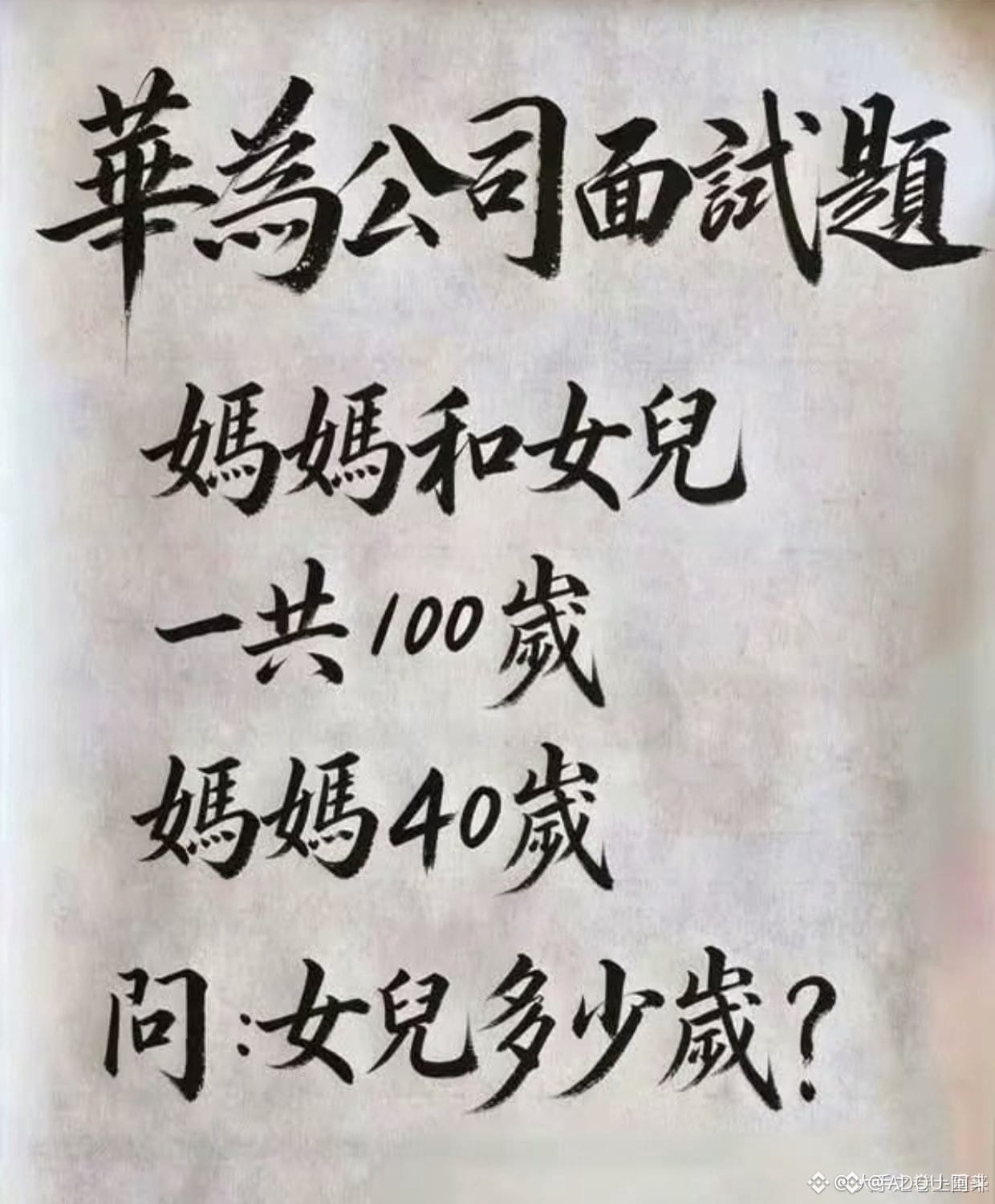
This isn't a pure math problem; it's an interdisciplinary question involving sociology, anthropology, and other fields.
This isn't a pure math problem; it's an interdisciplinary question involving sociology, anthropology, and other fields.
162
·
--
Remember this: We Chinese shouldn’t be fixated on innovating from 0 to 1. We should focus on applying innovations from 1 to 100. Let the Americans handle all that tough, exhausting, thankless grunt work. We need to think bigger: copy their homework, embrace the spirit of open source, and talk about a community with a shared future. We’re all one family in this global village—what’s yours is mine, and what’s mine is still mine. It’s easy and profitable, and it’ll drive those Americans crazy. This isn’t a tactic; it’s a strategy.
Remember this: We Chinese shouldn’t be fixated on innovating from 0 to 1. We should focus on applying innovations from 1 to 100. Let the Americans handle all that tough, exhausting, thankless grunt work. We need to think bigger: copy their homework, embrace the spirit of open source, and talk about a community with a shared future. We’re all one family in this global village—what’s yours is mine, and what’s mine is still mine. It’s easy and profitable, and it’ll drive those Americans crazy. This isn’t a tactic; it’s a strategy.
208
·
--
On October 26, BNB STANDARD #BNC held its listing bell-ringing ceremony at Nasdaq. Changpeng Zhao (CZ) attended and delivered remarks. CZ said that BNB launched in 2017 as a simple token, without even its own blockchain—and that he never imagined he’d be standing at Nasdaq nine years later! CZ closed by saying, “Let’s build the future together.” #BNB #BNC #ChangpengZhao #CZ #Nasdaq
On October 26, BNB STANDARD #BNC held its listing bell-ringing ceremony at Nasdaq. Changpeng Zhao (CZ) attended and delivered remarks. CZ said that BNB launched in 2017 as a simple token, without even its own blockchain—and that he never imagined he’d be standing at Nasdaq nine years later! CZ closed by saying, “Let’s build the future together.” #BNB #BNC #ChangpengZhao #CZ #Nasdaq
195
·
--
It's my page. You look at whatever I post, got it?
It's my page. You look at whatever I post, got it?

283
·
--

Article
The Secret Behind Liangshan’s Astonishing Stockpile of Silver IngotsTo tell the story of Liangshan’s silver ingots, we first have to talk about opium!
In the late Qing dynasty and early Republican period, opium ran rampant across China, and Liangshan was no exception.
Around 1910, the Yi people of Liangshan began growing opium like crazy, turning entire hillsides into poppy fields. When harvest time came, opium was as hot as fresh naan—everyone wanted it!
Traders from outside brought salt, cloth, iron goods, and even guns to trade for our opium. The scale of the business was enough to make your heart race!
Back then, people in Liangshan didn’t think much of paper money. Everyone had their eyes fixed on silver, especially those gleaming silver ingots.
The Secret Behind Liangshan’s Astonishing Stockpile of Silver Ingots
To tell the story of Liangshan’s silver ingots, we first have to talk about opium!
In the late Qing dynasty and early Republican period, opium ran rampant across China, and Liangshan was no exception.
Around 1910, the Yi people of Liangshan began growing opium like crazy, turning entire hillsides into poppy fields. When harvest time came, opium was as hot as fresh naan—everyone wanted it!
Traders from outside brought salt, cloth, iron goods, and even guns to trade for our opium. The scale of the business was enough to make your heart race!
Back then, people in Liangshan didn’t think much of paper money. Everyone had their eyes fixed on silver, especially those gleaming silver ingots.
1
296
·
--
AI discovers security vulnerabilities in PHP, prompting countries to urgently shut down government websites. According to a Reuters report on October 21, government websites in several European countries and other regions went offline on the 21st after a critical vulnerability was exposed in the widely used programming language PHP. Website operators around the world moved quickly to protect their systems. On the 21st, PHP developers urgently released a new patch to fix vulnerabilities that had remained hidden in the software for years and were only recently discovered with the help of artificial intelligence (AI). The developers urged all users to update immediately. With technology companies warning that some hackers were already exploiting the vulnerabilities, many organizations—including government agencies across Europe—took their websites offline as a precaution. Experts said that now the patch is public, AI tools can reverse-engineer the vulnerability with little effort. Hackers may launch attacks before systems have been updated, so experts are preparing for a wave of intrusions. Kostin Raiu, co-founder of the cybersecurity research and incident response organization TLP:Black, said AI is driving an “exploitation race.” He said the next step would be mass attacks on vulnerable web servers across the internet.
AI discovers security vulnerabilities in PHP, prompting countries to urgently shut down government websites. According to a Reuters report on October 21, government websites in several European countries and other regions went offline on the 21st after a critical vulnerability was exposed in the widely used programming language PHP. Website operators around the world moved quickly to protect their systems. On the 21st, PHP developers urgently released a new patch to fix vulnerabilities that had remained hidden in the software for years and were only recently discovered with the help of artificial intelligence (AI). The developers urged all users to update immediately. With technology companies warning that some hackers were already exploiting the vulnerabilities, many organizations—including government agencies across Europe—took their websites offline as a precaution. Experts said that now the patch is public, AI tools can reverse-engineer the vulnerability with little effort. Hackers may launch attacks before systems have been updated, so experts are preparing for a wave of intrusions. Kostin Raiu, co-founder of the cybersecurity research and incident response organization TLP:Black, said AI is driving an “exploitation race.” He said the next step would be mass attacks on vulnerable web servers across the internet.
199
·
--
Gossip about Chongqing’s roly-poly, USDT market
Gossip about Chongqing’s roly-poly, USDT market

409
·
--
What's going on? Is this for real? XT Exchange
What's going on? Is this for real? XT Exchange
4
1
259
·
--
The “Legends” of Uniswap and HyperliquidThe “legends” of Uniswap and Hyperliquid are stories of two projects that defined decentralized trading in different eras through entirely opposite paths. One pioneered the AMM (automated market maker) model, built from scratch by an “unemployed young man”; the other was a high-performance, trading-specific blockchain built by an “18-person team of quant geeks.”
🦄 Uniswap: The “Accidental Revolution” of an Unemployed Young Man and AMMs
Uniswap’s story began with a layoff. Its founder, Hayden Adams, was a mechanical engineer at Siemens. After being laid off in 2017, he taught himself Solidity programming from scratch at a friend’s urging.
His goal was simple: to realize an automated market-making concept proposed by Vitalik Buterin. Uniswap v1 launched in November 2018 with no funding, no token, and a founder whose Twitter account had just 200 followers.
The “Legends” of Uniswap and Hyperliquid
The “legends” of Uniswap and Hyperliquid are stories of two projects that defined decentralized trading in different eras through entirely opposite paths. One pioneered the AMM (automated market maker) model, built from scratch by an “unemployed young man”; the other was a high-performance, trading-specific blockchain built by an “18-person team of quant geeks.”
🦄 Uniswap: The “Accidental Revolution” of an Unemployed Young Man and AMMs
Uniswap’s story began with a layoff. Its founder, Hayden Adams, was a mechanical engineer at Siemens. After being laid off in 2017, he taught himself Solidity programming from scratch at a friend’s urging.
His goal was simple: to realize an automated market-making concept proposed by Vitalik Buterin. Uniswap v1 launched in November 2018 with no funding, no token, and a founder whose Twitter account had just 200 followers.
157
·
--
Hyperliquid founder Jeff Yan: Did he do in two years what took Binance ten? Jeff Yan has a soft spot for chameleons. But he isn’t fascinated by the metaphor of “changing color to blend into your surroundings”—he simply loves the animals themselves. His Twitter handle is @chameleon_jeff (note: “chameleon” is the English word for 变色龙). In a recent podcast, he explained this fascination: chameleons can move each eye independently to look in different directions; “two toes point forward and three point backward, which reflects a really interesting evolutionary path,” and they have powerful projectile tongues. “They’re kind of like aliens on Earth,” he said.
It’s an odd way to open, but it helps you understand the man. With a team of just 10 and no venture capital funding, he built one of the world’s largest trading platforms.
Over the past 12 months, Hyperliquid has recorded $1.8 trillion in trading volume. The platform accounts for more than 10% of global perpetual futures trading and over 70% of perpetual contract trading volume on decentralized exchanges (DEXs). More than 200,000 active users trade on the platform every day, generating hundreds of millions of dollars in revenue.

197
Log in to explore more content
Join global crypto users on Binance Square
⚡️ Get latest and useful information about crypto.
💬 Trusted by the world’s largest crypto exchange.
👍 Discover real insights from verified creators.
Email / Phone number
Trending Topics
BinanceProcesses$4.65BWithdrawals
10,386 views
79 Discussing
Binance Processes $4.65 Billion in Withdrawals After Reopening, Net Outflow of $3.64 Billion Equals 2.1% of Its $171 Billion in Assets
Binance News
·32 Likes
·8.8k views
WithdrawalsBack: 15 networks live
5,604 views
112 Discussing
BinanceUpdatesProofofReservesAddresses
97,128 views
1,380 Discussing