

Kyber Network
529 Posts

Kyber Network
 Square Verified+
Report
Block User
Swap crypto at the best rates with KyberSwap, the Multichain Aggregator available on 16 chains.
Website: https://kyberswap.com/
0 Following
660 Followers
146 Liked
Posts
All
Quotes
Videos
PINNED
BREAKING: A major step forward for aggregator’s routing begins now on EVM.
Introducing Smart Settlement, an execution upgrade for more resilient swaps to protect users from slippage, PropAMM manipulation, MEV, JIT, while bringing even Higher Swap Output.
You’ve got the best quote, now you get the best execution.
BREAKING: A major step forward for aggregator’s routing begins now on EVM.
Introducing Smart Settlement, an execution upgrade for more resilient swaps to protect users from slippage, PropAMM manipulation, MEV, JIT, while bringing even Higher Swap Output.
You’ve got the best quote, now you get the best execution.
Introducing Smart Settlement, an execution upgrade for more resilient swaps to protect users from slippage, PropAMM manipulation, MEV, JIT, while bringing even Higher Swap Output.
You’ve got the best quote, now you get the best execution.
1
170
New week, new names on the KyberSwap trending list 👀 Which one’s on your radar?
#SEASON
#PANGEA
#MOOLAH
#GANG
#年年
Check out the full trending list: kyberswap.com
New week, new names on the KyberSwap trending list 👀 Which one’s on your radar?
#SEASON
#PANGEA
#MOOLAH
#GANG
#年年
Check out the full trending list: kyberswap.com
#SEASON
#PANGEA
#MOOLAH
#GANG
#年年
Check out the full trending list: kyberswap.com

87
We’ve seen the reports on the recent PHP vulnerabilities and are monitoring closely.
KyberSwap’s trading products, including our dApp, APIs and smart contracts, are not built on PHP and are not affected.
Stay safe: our official site is kyberswap.com, and ignore any DM asking you to install a “security update”. We don’t DM first.
We’ve seen the reports on the recent PHP vulnerabilities and are monitoring closely.
KyberSwap’s trading products, including our dApp, APIs and smart contracts, are not built on PHP and are not affected.
Stay safe: our official site is kyberswap.com, and ignore any DM asking you to install a “security update”. We don’t DM first.
KyberSwap’s trading products, including our dApp, APIs and smart contracts, are not built on PHP and are not affected.
Stay safe: our official site is kyberswap.com, and ignore any DM asking you to install a “security update”. We don’t DM first.
111
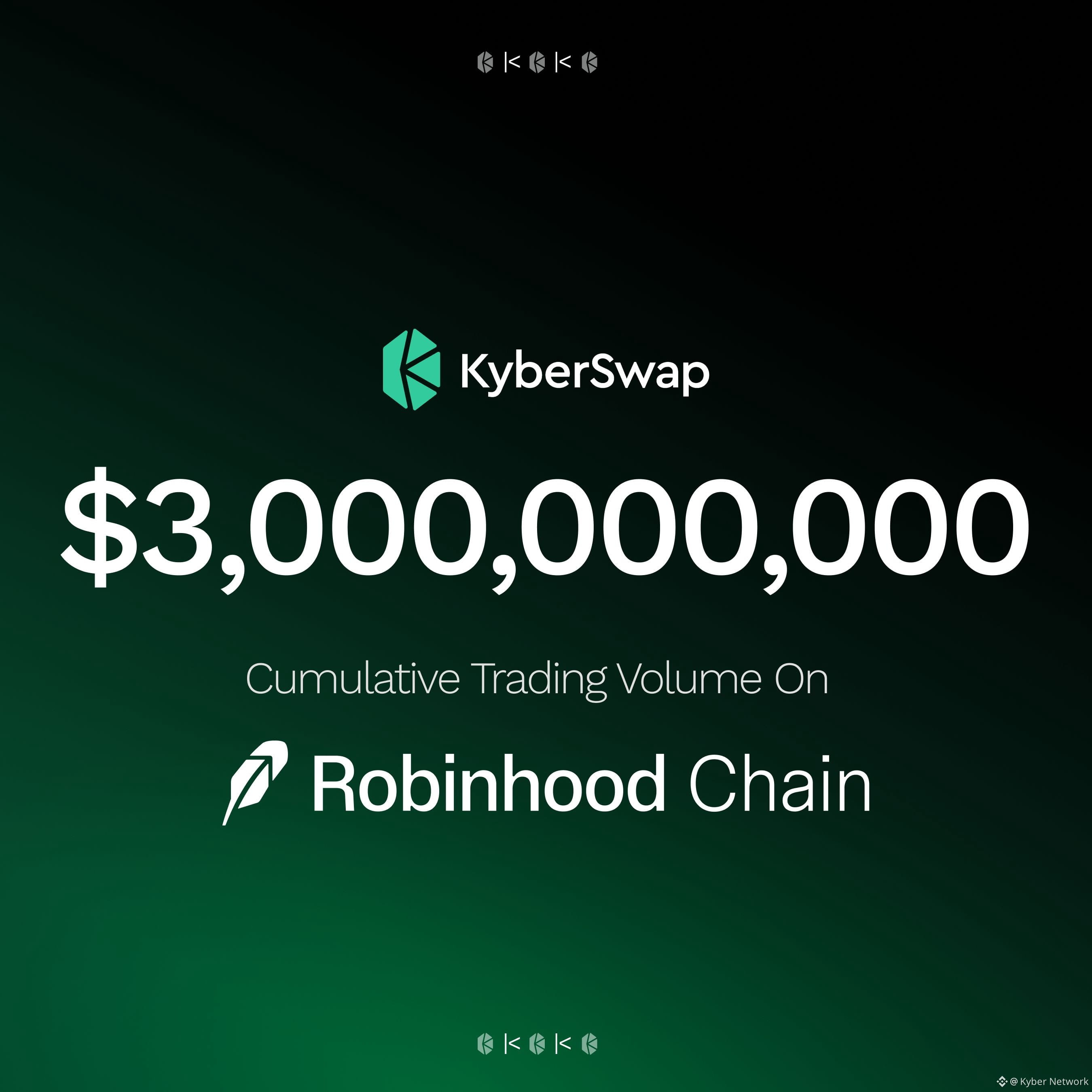
three billion dollars in trading volume on Robinhood Chain
next stop: four
three billion dollars in trading volume on Robinhood Chain
next stop: four
next stop: four
72
Article
How Much Does a Cross-Chain Swap Cost? Fees, Gas and What to CompareA cross-chain swap usually costs a small percentage of the trade plus network gas on the chain you swap from. The exact total depends on the tokens, the chains and the route that moves your funds.
That is why two quotes for the same swap can deliver different amounts. This guide breaks down each cost, shows what KyberSwap charges, and explains what to compare before you confirm.
What Makes Up the Cost of a Cross-Chain Swap?
The cost of a cross-chain swap has four parts: source-chain gas, route provider costs, a platform fee and price impact.
A simple way to think about it: you pay the network to send the transaction, you pay a provider to deliver value on the other chain, and the market sets the final rate.
Source-chain gas: the network fee for the transaction you sign in your wallet.Route provider costs: what the bridge, relayer or solver charges to move value between chains and complete the destination side.Platform fee: what the interface charges for finding and executing the route.Price impact and slippage: the gap between the quoted rate and the rate you actually get.
Not every part shows up as its own line. Many providers build their costs into the quoted output, so the amount you receive tells you more than any single fee label.
Fees: What Does KyberSwap Charge for a Cross-chain Swap?
KyberSwap applies a Platform Fee of 0.05% to 0.25% for using Cross-chain Swap. The rate depends on the route and the volatility level of the tokens.
EVM ↔ EVM: 0.05% for stable tokens or the same native token, 0.10% for common tokens, 0.15% for exotic tokens and 0.25% for high-volatility tokens.NEAR ↔ EVM: 0.1% for stable tokens or the same native token, and 0.2% for all other tokens.Solana ↔ EVM: 0.1% for stable tokens or the same native token, and 0.2% for all other tokens.BTC ↔ EVM: a flat 0.25% for all tokens.Non-EVM ↔ Non-EVM: a flat 0.25% for all tokens.
The lowest rate, 0.05%, applies to Stable tokens & Same native token on EVM ↔ EVM routes. The rate rises with the volatility level of the tokens. BTC ↔ EVM and Non-EVM ↔ Non-EVM routes use a flat 0.25%.
For example, a $1,000 swap between stable tokens on an EVM ↔ EVM route falls in the 0.05% tier. The Platform Fee on that swap is about $0.50.
The applicable Platform Fee is shown in the swap details section after the route is generated and before you confirm the transaction.
Protocol Fee: The Route Provider’s Charge
Some third-party providers may charge a protocol-specific fee, shown as Protocol Fee, for using their route. The Protocol Fee is separate from the Platform Fee.
If applicable, the Protocol Fee is displayed in the Swap Details when this route is selected, or within the Choose Your Route section during route comparison.
Gas: Which Chain Do You Pay Gas On?
You pay gas on the source chain, where you approve the cross-chain swap transaction in your wallet. The amount depends on that chain’s network conditions when you swap.
This makes your source chain a real cost decision. The same transaction usually costs far more gas on Ethereum mainnet than on a Layer 2 such as Arbitrum or Base. For small swaps, source-chain gas can be the largest cost in the whole trade.
Token Approval Can Add a Transaction
You might need to approve the input token first if you haven’t previously authorized the protocol to swap this token on your behalf. Token approval is a separate action and may require gas.
What Happens on the Destination Chain?
A cross-chain swap includes the swap on the source chain, bridging, and settlement on the destination chain. When the swap succeeds, the output tokens are delivered to your receiving address on the destination chain.
To move or use those tokens on the destination chain afterward, you will need that chain’s gas token.
Price Impact and Slippage: The Cost That Isn’t Listed as a Fee
Price impact and slippage can cost more than all fees combined on a large swap or a thinly traded token.
Price impact comes from liquidity. A large order moves the price in the pools that fill it, so you get a worse average rate. Slippage comes from time. Prices can move between the moment you see a quote and the moment the swap completes, and cross-chain swaps take longer than same-chain swaps.
Before you click Confirm Swap on KyberSwap, carefully review the confirmation box. It shows the token amount, destination address, minimum received, estimated processing time and platform fee.
What to Compare Before You Confirm a Cross-Chain Swap
Compare the amount you will receive on the destination chain, not the headline fee. A route with a lower fee can still deliver fewer tokens if its pricing is worse.
KyberSwap does this comparison for you by default. After you enter an amount, KyberSwap automatically fetches real-time quotes from multiple third-party cross-chain protocols and selects the option that provides the best rate among the quotes. Supported protocols include NEAR Intents, Across, Relay Protocol, deBridge, LI.FI, Mayan Finance, Bungee and Symbiosis.
To see every option, click More Options to open the Choose Your Route section. There you can compare available providers, view estimated return amounts, fees and estimated arrival times, and choose another quote you prefer.
Four Things to Check in Every Quote
Estimated return amount: the output amount after the route’s fees and pricing. This is the number to rank routes by.Minimum received: shown in the confirmation box before you confirm. Check it alongside the estimated return amount, especially for volatile tokens.Platform Fee and Protocol Fee: both appear before you confirm, so you can see exactly what the route charges.Estimated processing time: some chains or protocols may take more time to complete. For a time-sensitive trade, a slightly lower quote that arrives much faster can be the better choice.
Compare Against Bridging and Swapping Separately
A cross-chain swap replaces two jobs: moving funds to another chain and swapping into the token you want. Doing them separately means paying for each step yourself.
The manual path usually includes source-chain gas for the bridge, a bridge fee, destination-chain gas for the swap and a DEX trading cost. It also requires holding the destination chain’s gas token before you can swap at all.
With Cross-chain Swap, you can swap from any token on one chain to a different token on another chain, directly through KyberSwap, with no external steps required.
FAQ
Are cross-chain swaps more expensive than same-chain swaps?
Yes. Cross-chain swaps usually cost more than same-chain swaps. Moving value between chains adds provider costs, and the longer processing time leaves more room for price movement.
Why does Cross-chain Swap have a fee when Swap on KyberSwap does not?
No platform fee is applied to Swap when you access KyberSwap.com directly. For Cross-chain Swap, KyberSwap applies a platform fee to support the continued development and maintenance of the feature.
What happens if a cross-chain swap fails?
A failed cross-chain swap on KyberSwap is automatically reverted. The input tokens are returned to your sender wallet address.
You can follow every swap’s status in the transaction history panel, from Processing to Success or Failed.
Which Cross-Chain Swaps Cost the Least?
The cheapest cross-chain swaps use Stable tokens & Same native token on an EVM ↔ EVM route, starting from a low-gas source chain. The Platform Fee is 0.05% and gas stays small, so your main decision is usually speed.
Swaps involving high-volatility tokens, BTC or other non-EVM routes fall into higher Platform Fee tiers. On these routes, price impact can matter more than fees, so compare estimated return and Minimum received across routes before you confirm.
Ready to see the numbers for your own swap? Open the Cross-chain tab on KyberSwap or visit kyberswap.com/cross-chain and compare live quotes before you sign.
How Much Does a Cross-Chain Swap Cost? Fees, Gas and What to Compare
A cross-chain swap usually costs a small percentage of the trade plus network gas on the chain you swap from. The exact total depends on the tokens, the chains and the route that moves your funds.
That is why two quotes for the same swap can deliver different amounts. This guide breaks down each cost, shows what KyberSwap charges, and explains what to compare before you confirm.
What Makes Up the Cost of a Cross-Chain Swap?
The cost of a cross-chain swap has four parts: source-chain gas, route provider costs, a platform fee and price impact.
A simple way to think about it: you pay the network to send the transaction, you pay a provider to deliver value on the other chain, and the market sets the final rate.
Source-chain gas: the network fee for the transaction you sign in your wallet.Route provider costs: what the bridge, relayer or solver charges to move value between chains and complete the destination side.Platform fee: what the interface charges for finding and executing the route.Price impact and slippage: the gap between the quoted rate and the rate you actually get.
Not every part shows up as its own line. Many providers build their costs into the quoted output, so the amount you receive tells you more than any single fee label.
Fees: What Does KyberSwap Charge for a Cross-chain Swap?
KyberSwap applies a Platform Fee of 0.05% to 0.25% for using Cross-chain Swap. The rate depends on the route and the volatility level of the tokens.
EVM ↔ EVM: 0.05% for stable tokens or the same native token, 0.10% for common tokens, 0.15% for exotic tokens and 0.25% for high-volatility tokens.NEAR ↔ EVM: 0.1% for stable tokens or the same native token, and 0.2% for all other tokens.Solana ↔ EVM: 0.1% for stable tokens or the same native token, and 0.2% for all other tokens.BTC ↔ EVM: a flat 0.25% for all tokens.Non-EVM ↔ Non-EVM: a flat 0.25% for all tokens.
The lowest rate, 0.05%, applies to Stable tokens & Same native token on EVM ↔ EVM routes. The rate rises with the volatility level of the tokens. BTC ↔ EVM and Non-EVM ↔ Non-EVM routes use a flat 0.25%.
For example, a $1,000 swap between stable tokens on an EVM ↔ EVM route falls in the 0.05% tier. The Platform Fee on that swap is about $0.50.
The applicable Platform Fee is shown in the swap details section after the route is generated and before you confirm the transaction.
Protocol Fee: The Route Provider’s Charge
Some third-party providers may charge a protocol-specific fee, shown as Protocol Fee, for using their route. The Protocol Fee is separate from the Platform Fee.
If applicable, the Protocol Fee is displayed in the Swap Details when this route is selected, or within the Choose Your Route section during route comparison.
Gas: Which Chain Do You Pay Gas On?
You pay gas on the source chain, where you approve the cross-chain swap transaction in your wallet. The amount depends on that chain’s network conditions when you swap.
This makes your source chain a real cost decision. The same transaction usually costs far more gas on Ethereum mainnet than on a Layer 2 such as Arbitrum or Base. For small swaps, source-chain gas can be the largest cost in the whole trade.
Token Approval Can Add a Transaction
You might need to approve the input token first if you haven’t previously authorized the protocol to swap this token on your behalf. Token approval is a separate action and may require gas.
What Happens on the Destination Chain?
A cross-chain swap includes the swap on the source chain, bridging, and settlement on the destination chain. When the swap succeeds, the output tokens are delivered to your receiving address on the destination chain.
To move or use those tokens on the destination chain afterward, you will need that chain’s gas token.
Price Impact and Slippage: The Cost That Isn’t Listed as a Fee
Price impact and slippage can cost more than all fees combined on a large swap or a thinly traded token.
Price impact comes from liquidity. A large order moves the price in the pools that fill it, so you get a worse average rate. Slippage comes from time. Prices can move between the moment you see a quote and the moment the swap completes, and cross-chain swaps take longer than same-chain swaps.
Before you click Confirm Swap on KyberSwap, carefully review the confirmation box. It shows the token amount, destination address, minimum received, estimated processing time and platform fee.
What to Compare Before You Confirm a Cross-Chain Swap
Compare the amount you will receive on the destination chain, not the headline fee. A route with a lower fee can still deliver fewer tokens if its pricing is worse.
KyberSwap does this comparison for you by default. After you enter an amount, KyberSwap automatically fetches real-time quotes from multiple third-party cross-chain protocols and selects the option that provides the best rate among the quotes. Supported protocols include NEAR Intents, Across, Relay Protocol, deBridge, LI.FI, Mayan Finance, Bungee and Symbiosis.
To see every option, click More Options to open the Choose Your Route section. There you can compare available providers, view estimated return amounts, fees and estimated arrival times, and choose another quote you prefer.
Four Things to Check in Every Quote
Estimated return amount: the output amount after the route’s fees and pricing. This is the number to rank routes by.Minimum received: shown in the confirmation box before you confirm. Check it alongside the estimated return amount, especially for volatile tokens.Platform Fee and Protocol Fee: both appear before you confirm, so you can see exactly what the route charges.Estimated processing time: some chains or protocols may take more time to complete. For a time-sensitive trade, a slightly lower quote that arrives much faster can be the better choice.
Compare Against Bridging and Swapping Separately
A cross-chain swap replaces two jobs: moving funds to another chain and swapping into the token you want. Doing them separately means paying for each step yourself.
The manual path usually includes source-chain gas for the bridge, a bridge fee, destination-chain gas for the swap and a DEX trading cost. It also requires holding the destination chain’s gas token before you can swap at all.
With Cross-chain Swap, you can swap from any token on one chain to a different token on another chain, directly through KyberSwap, with no external steps required.
FAQ
Are cross-chain swaps more expensive than same-chain swaps?
Yes. Cross-chain swaps usually cost more than same-chain swaps. Moving value between chains adds provider costs, and the longer processing time leaves more room for price movement.
Why does Cross-chain Swap have a fee when Swap on KyberSwap does not?
No platform fee is applied to Swap when you access KyberSwap.com directly. For Cross-chain Swap, KyberSwap applies a platform fee to support the continued development and maintenance of the feature.
What happens if a cross-chain swap fails?
A failed cross-chain swap on KyberSwap is automatically reverted. The input tokens are returned to your sender wallet address.
You can follow every swap’s status in the transaction history panel, from Processing to Success or Failed.
Which Cross-Chain Swaps Cost the Least?
The cheapest cross-chain swaps use Stable tokens & Same native token on an EVM ↔ EVM route, starting from a low-gas source chain. The Platform Fee is 0.05% and gas stays small, so your main decision is usually speed.
Swaps involving high-volatility tokens, BTC or other non-EVM routes fall into higher Platform Fee tiers. On these routes, price impact can matter more than fees, so compare estimated return and Minimum received across routes before you confirm.
Ready to see the numbers for your own swap? Open the Cross-chain tab on KyberSwap or visit kyberswap.com/cross-chain and compare live quotes before you sign.
That is why two quotes for the same swap can deliver different amounts. This guide breaks down each cost, shows what KyberSwap charges, and explains what to compare before you confirm.
What Makes Up the Cost of a Cross-Chain Swap?
The cost of a cross-chain swap has four parts: source-chain gas, route provider costs, a platform fee and price impact.
A simple way to think about it: you pay the network to send the transaction, you pay a provider to deliver value on the other chain, and the market sets the final rate.
Source-chain gas: the network fee for the transaction you sign in your wallet.Route provider costs: what the bridge, relayer or solver charges to move value between chains and complete the destination side.Platform fee: what the interface charges for finding and executing the route.Price impact and slippage: the gap between the quoted rate and the rate you actually get.
Not every part shows up as its own line. Many providers build their costs into the quoted output, so the amount you receive tells you more than any single fee label.
Fees: What Does KyberSwap Charge for a Cross-chain Swap?
KyberSwap applies a Platform Fee of 0.05% to 0.25% for using Cross-chain Swap. The rate depends on the route and the volatility level of the tokens.
EVM ↔ EVM: 0.05% for stable tokens or the same native token, 0.10% for common tokens, 0.15% for exotic tokens and 0.25% for high-volatility tokens.NEAR ↔ EVM: 0.1% for stable tokens or the same native token, and 0.2% for all other tokens.Solana ↔ EVM: 0.1% for stable tokens or the same native token, and 0.2% for all other tokens.BTC ↔ EVM: a flat 0.25% for all tokens.Non-EVM ↔ Non-EVM: a flat 0.25% for all tokens.
The lowest rate, 0.05%, applies to Stable tokens & Same native token on EVM ↔ EVM routes. The rate rises with the volatility level of the tokens. BTC ↔ EVM and Non-EVM ↔ Non-EVM routes use a flat 0.25%.
For example, a $1,000 swap between stable tokens on an EVM ↔ EVM route falls in the 0.05% tier. The Platform Fee on that swap is about $0.50.
The applicable Platform Fee is shown in the swap details section after the route is generated and before you confirm the transaction.
Protocol Fee: The Route Provider’s Charge
Some third-party providers may charge a protocol-specific fee, shown as Protocol Fee, for using their route. The Protocol Fee is separate from the Platform Fee.
If applicable, the Protocol Fee is displayed in the Swap Details when this route is selected, or within the Choose Your Route section during route comparison.
Gas: Which Chain Do You Pay Gas On?
You pay gas on the source chain, where you approve the cross-chain swap transaction in your wallet. The amount depends on that chain’s network conditions when you swap.
This makes your source chain a real cost decision. The same transaction usually costs far more gas on Ethereum mainnet than on a Layer 2 such as Arbitrum or Base. For small swaps, source-chain gas can be the largest cost in the whole trade.
Token Approval Can Add a Transaction
You might need to approve the input token first if you haven’t previously authorized the protocol to swap this token on your behalf. Token approval is a separate action and may require gas.
What Happens on the Destination Chain?
A cross-chain swap includes the swap on the source chain, bridging, and settlement on the destination chain. When the swap succeeds, the output tokens are delivered to your receiving address on the destination chain.
To move or use those tokens on the destination chain afterward, you will need that chain’s gas token.
Price Impact and Slippage: The Cost That Isn’t Listed as a Fee
Price impact and slippage can cost more than all fees combined on a large swap or a thinly traded token.
Price impact comes from liquidity. A large order moves the price in the pools that fill it, so you get a worse average rate. Slippage comes from time. Prices can move between the moment you see a quote and the moment the swap completes, and cross-chain swaps take longer than same-chain swaps.
Before you click Confirm Swap on KyberSwap, carefully review the confirmation box. It shows the token amount, destination address, minimum received, estimated processing time and platform fee.
What to Compare Before You Confirm a Cross-Chain Swap
Compare the amount you will receive on the destination chain, not the headline fee. A route with a lower fee can still deliver fewer tokens if its pricing is worse.
KyberSwap does this comparison for you by default. After you enter an amount, KyberSwap automatically fetches real-time quotes from multiple third-party cross-chain protocols and selects the option that provides the best rate among the quotes. Supported protocols include NEAR Intents, Across, Relay Protocol, deBridge, LI.FI, Mayan Finance, Bungee and Symbiosis.
To see every option, click More Options to open the Choose Your Route section. There you can compare available providers, view estimated return amounts, fees and estimated arrival times, and choose another quote you prefer.
Four Things to Check in Every Quote
Estimated return amount: the output amount after the route’s fees and pricing. This is the number to rank routes by.Minimum received: shown in the confirmation box before you confirm. Check it alongside the estimated return amount, especially for volatile tokens.Platform Fee and Protocol Fee: both appear before you confirm, so you can see exactly what the route charges.Estimated processing time: some chains or protocols may take more time to complete. For a time-sensitive trade, a slightly lower quote that arrives much faster can be the better choice.
Compare Against Bridging and Swapping Separately
A cross-chain swap replaces two jobs: moving funds to another chain and swapping into the token you want. Doing them separately means paying for each step yourself.
The manual path usually includes source-chain gas for the bridge, a bridge fee, destination-chain gas for the swap and a DEX trading cost. It also requires holding the destination chain’s gas token before you can swap at all.
With Cross-chain Swap, you can swap from any token on one chain to a different token on another chain, directly through KyberSwap, with no external steps required.
FAQ
Are cross-chain swaps more expensive than same-chain swaps?
Yes. Cross-chain swaps usually cost more than same-chain swaps. Moving value between chains adds provider costs, and the longer processing time leaves more room for price movement.
Why does Cross-chain Swap have a fee when Swap on KyberSwap does not?
No platform fee is applied to Swap when you access KyberSwap.com directly. For Cross-chain Swap, KyberSwap applies a platform fee to support the continued development and maintenance of the feature.
What happens if a cross-chain swap fails?
A failed cross-chain swap on KyberSwap is automatically reverted. The input tokens are returned to your sender wallet address.
You can follow every swap’s status in the transaction history panel, from Processing to Success or Failed.
Which Cross-Chain Swaps Cost the Least?
The cheapest cross-chain swaps use Stable tokens & Same native token on an EVM ↔ EVM route, starting from a low-gas source chain. The Platform Fee is 0.05% and gas stays small, so your main decision is usually speed.
Swaps involving high-volatility tokens, BTC or other non-EVM routes fall into higher Platform Fee tiers. On these routes, price impact can matter more than fees, so compare estimated return and Minimum received across routes before you confirm.
Ready to see the numbers for your own swap? Open the Cross-chain tab on KyberSwap or visit kyberswap.com/cross-chain and compare live quotes before you sign.
159
Article
How to Save Gas Fees on Ethereum: Why Limit Orders Cost Less to TradeHow Can You Save Gas Fees on Ethereum?
You save gas fees on Ethereum by sending fewer on-chain transactions and sending them when the network is less busy.
A Limit Order helps with the first part. Placing a Limit Order is a signature, not a transaction, so it does not require gas. When the order fills, the taker pays the gas fee to settle the trade on-chain.
That makes a Limit Order one of the simplest ways to trade on Ethereum with less gas from your own wallet. It also comes with trade-offs, which are covered below.
What Makes Ethereum Gas Fees Expensive?
Ethereum gas fees depend on two things: how much work your transaction needs, and how much demand there is for block space at that moment.
The work is measured in gas units. A simple ETH transfer uses relatively little gas. A token swap uses more, because it calls smart contracts and may route through several pools.
The price of each gas unit changes with network activity. Ethereum adds a base fee that rises when blocks are full and falls when they are not. You can also add a priority fee to get your transaction included faster.
So your total gas cost is roughly the gas units used multiplied by the price per unit. Saving gas means lowering one of those two numbers, or not sending the transaction yourself at all.
5 Practical Ways to Save Gas on Ethereum
The most effective way to save gas on Ethereum is to send fewer transactions from your wallet. The other tactics reduce what each remaining transaction costs.
1. Trade When the Network Is Less Busy
Gas prices rise and fall with demand for block space. If your trade is not urgent, sending it when activity is lower can reduce the price you pay per gas unit.
2. Avoid Repeat Approvals
Token approval is a separate on-chain transaction, and it requires gas. Once a contract already has enough allowance for a token, you do not need to approve it again for the next trade.
3. Skip Unnecessary Wrapping
Wrapping ETH into WETH is also an on-chain transaction. On a KyberSwap Limit Order, wrapping only applies when you sell a native token such as ETH, so holding WETH avoids that step.
4. Let the Taker Submit the Settlement Transaction
With a Limit Order, you sign the order instead of sending a swap transaction. The taker pays the gas fee to settle the trade on-chain. The next section explains why this cuts your gas.
5. Move Small Trades to a Lower-Gas Chain
If you trade small amounts often, Ethereum gas can take a large share of each trade. On most other chains supported by KyberSwap, gas costs are negligible by comparison.
Why Do Limit Orders Cost Less to Trade?
Limit Orders cost less to trade because the maker does not send the transaction that settles the trade. You sign the order once, and the taker pays the gas fee and taker fee to settle it on-chain.
A market swap works the other way. You send the swap transaction yourself, so you pay the gas for every trade.
Action Market swap on Ethereum KyberSwap Limit Order (maker) Token approval Gas, first time per token Gas, first time per token Wrap ETH to WETH Not needed Gas, only when selling a native token Place the trade You send the transaction and pay gas You sign the order. Signing does not require gas Settle the trade Included in your swap transaction The taker pays the gas fee Cancel Nothing to cancel Gasless Cancel is free. Hard Cancel requires gas
The one-time steps are similar. The difference shows up in the actions you repeat: placing, settling and changing your mind.
Change Your Price Without Paying Gas
A KyberSwap Limit Order fills at the rate you set when you signed it. If the market moves and you want a new price, you cancel the order and create a new one.
With Gasless Cancel, that adjustment costs no gas. Creating the new order is also gasless, as long as your token approval is already in place. On Ethereum, where every transaction counts, this lets you keep adjusting your plan without paying gas each time.
If the order was recently shared with a taker, Gasless Cancel usually completes in seconds, but can take up to 5 minutes.
Hard Cancel is still available when you need instant cancellation. It requires gas, because it invalidates the order on-chain.
Your Tokens Stay in Your Wallet
Tokens stay in your wallet until the order settles. You do not need to send a transaction to deposit them anywhere first.
When Is a Market Swap Still the Better Choice on Ethereum?
A market swap is still the better choice when you need the trade done now, or when your order is too small for a taker to settle profitably on Ethereum.
Small Orders May Not Fill on Ethereum
The taker pays gas to settle your order, so takers weigh the order's size, gas fees and their own margin before filling it. On Ethereum, high gas can make small trades unprofitable for takers.
As a result, low-volume orders on Ethereum are unlikely to fill unless the price moves enough to cover taker gas costs. Gas costs are negligible on other chains, so this matters most on Ethereum.
A Limit Order Waits for Your Price
A Limit Order only fills when the market reaches your rate and a taker settles it. If the market never reaches your target, the order stays open until you cancel it or it expires.
A market swap executes at the current rate in one transaction. You pay the gas, but you get the trade immediately.
Which One Fits Your Trade?
If you want to... Better fit on Ethereum Buy or sell at a specific price, without urgency Limit Order Adjust your target price often Limit Order, with Gasless Cancel Get the trade done right now Market swap
Frequently Asked Questions
Is a KyberSwap Limit Order Completely Gas-Free on Ethereum?
No. Signing the order does not require gas, and the taker pays the gas to settle it. Token approval, wrapping a native token and Hard Cancel are on-chain transactions that require gas.
Who Pays the Taker Fee on a KyberSwap Limit Order?
The taker pays the taker fee, along with the gas fee to settle the trade on-chain.
Do I Need to Approve My Token Every Time I Place a Limit Order?
No. Token approval is needed the first time for each token. It is skipped on subsequent orders.
Can a Swap Fill My Limit Order?
Yes. Limit Orders are a liquidity source on the KyberSwap Aggregator, so swaps via the Aggregator will also be routed through active limit orders when the rate is competitive.
Which Approach Saves You the Most Gas?
If you trade on Ethereum with a target price in mind and an order large enough to attract takers, a Limit Order saves the most gas. You pay for approval once, sign orders without gas, and let the taker pay to settle.
If you trade small amounts or need the trade done right away, a market swap is the more reliable choice. Timing it for a quieter network, or moving small trades to a lower-gas chain, keeps that cost down.
To try it, open the Limit Order tab on the Swap page at kyberswap.com, select Ethereum, and set the rate you want to trade at.
How to Save Gas Fees on Ethereum: Why Limit Orders Cost Less to Trade
How Can You Save Gas Fees on Ethereum?
You save gas fees on Ethereum by sending fewer on-chain transactions and sending them when the network is less busy.
A Limit Order helps with the first part. Placing a Limit Order is a signature, not a transaction, so it does not require gas. When the order fills, the taker pays the gas fee to settle the trade on-chain.
That makes a Limit Order one of the simplest ways to trade on Ethereum with less gas from your own wallet. It also comes with trade-offs, which are covered below.
What Makes Ethereum Gas Fees Expensive?
Ethereum gas fees depend on two things: how much work your transaction needs, and how much demand there is for block space at that moment.
The work is measured in gas units. A simple ETH transfer uses relatively little gas. A token swap uses more, because it calls smart contracts and may route through several pools.
The price of each gas unit changes with network activity. Ethereum adds a base fee that rises when blocks are full and falls when they are not. You can also add a priority fee to get your transaction included faster.
So your total gas cost is roughly the gas units used multiplied by the price per unit. Saving gas means lowering one of those two numbers, or not sending the transaction yourself at all.
5 Practical Ways to Save Gas on Ethereum
The most effective way to save gas on Ethereum is to send fewer transactions from your wallet. The other tactics reduce what each remaining transaction costs.
1. Trade When the Network Is Less Busy
Gas prices rise and fall with demand for block space. If your trade is not urgent, sending it when activity is lower can reduce the price you pay per gas unit.
2. Avoid Repeat Approvals
Token approval is a separate on-chain transaction, and it requires gas. Once a contract already has enough allowance for a token, you do not need to approve it again for the next trade.
3. Skip Unnecessary Wrapping
Wrapping ETH into WETH is also an on-chain transaction. On a KyberSwap Limit Order, wrapping only applies when you sell a native token such as ETH, so holding WETH avoids that step.
4. Let the Taker Submit the Settlement Transaction
With a Limit Order, you sign the order instead of sending a swap transaction. The taker pays the gas fee to settle the trade on-chain. The next section explains why this cuts your gas.
5. Move Small Trades to a Lower-Gas Chain
If you trade small amounts often, Ethereum gas can take a large share of each trade. On most other chains supported by KyberSwap, gas costs are negligible by comparison.
Why Do Limit Orders Cost Less to Trade?
Limit Orders cost less to trade because the maker does not send the transaction that settles the trade. You sign the order once, and the taker pays the gas fee and taker fee to settle it on-chain.
A market swap works the other way. You send the swap transaction yourself, so you pay the gas for every trade.
Action Market swap on Ethereum KyberSwap Limit Order (maker) Token approval Gas, first time per token Gas, first time per token Wrap ETH to WETH Not needed Gas, only when selling a native token Place the trade You send the transaction and pay gas You sign the order. Signing does not require gas Settle the trade Included in your swap transaction The taker pays the gas fee Cancel Nothing to cancel Gasless Cancel is free. Hard Cancel requires gas
The one-time steps are similar. The difference shows up in the actions you repeat: placing, settling and changing your mind.
Change Your Price Without Paying Gas
A KyberSwap Limit Order fills at the rate you set when you signed it. If the market moves and you want a new price, you cancel the order and create a new one.
With Gasless Cancel, that adjustment costs no gas. Creating the new order is also gasless, as long as your token approval is already in place. On Ethereum, where every transaction counts, this lets you keep adjusting your plan without paying gas each time.
If the order was recently shared with a taker, Gasless Cancel usually completes in seconds, but can take up to 5 minutes.
Hard Cancel is still available when you need instant cancellation. It requires gas, because it invalidates the order on-chain.
Your Tokens Stay in Your Wallet
Tokens stay in your wallet until the order settles. You do not need to send a transaction to deposit them anywhere first.
When Is a Market Swap Still the Better Choice on Ethereum?
A market swap is still the better choice when you need the trade done now, or when your order is too small for a taker to settle profitably on Ethereum.
Small Orders May Not Fill on Ethereum
The taker pays gas to settle your order, so takers weigh the order's size, gas fees and their own margin before filling it. On Ethereum, high gas can make small trades unprofitable for takers.
As a result, low-volume orders on Ethereum are unlikely to fill unless the price moves enough to cover taker gas costs. Gas costs are negligible on other chains, so this matters most on Ethereum.
A Limit Order Waits for Your Price
A Limit Order only fills when the market reaches your rate and a taker settles it. If the market never reaches your target, the order stays open until you cancel it or it expires.
A market swap executes at the current rate in one transaction. You pay the gas, but you get the trade immediately.
Which One Fits Your Trade?
If you want to... Better fit on Ethereum Buy or sell at a specific price, without urgency Limit Order Adjust your target price often Limit Order, with Gasless Cancel Get the trade done right now Market swap
Frequently Asked Questions
Is a KyberSwap Limit Order Completely Gas-Free on Ethereum?
No. Signing the order does not require gas, and the taker pays the gas to settle it. Token approval, wrapping a native token and Hard Cancel are on-chain transactions that require gas.
Who Pays the Taker Fee on a KyberSwap Limit Order?
The taker pays the taker fee, along with the gas fee to settle the trade on-chain.
Do I Need to Approve My Token Every Time I Place a Limit Order?
No. Token approval is needed the first time for each token. It is skipped on subsequent orders.
Can a Swap Fill My Limit Order?
Yes. Limit Orders are a liquidity source on the KyberSwap Aggregator, so swaps via the Aggregator will also be routed through active limit orders when the rate is competitive.
Which Approach Saves You the Most Gas?
If you trade on Ethereum with a target price in mind and an order large enough to attract takers, a Limit Order saves the most gas. You pay for approval once, sign orders without gas, and let the taker pay to settle.
If you trade small amounts or need the trade done right away, a market swap is the more reliable choice. Timing it for a quieter network, or moving small trades to a lower-gas chain, keeps that cost down.
To try it, open the Limit Order tab on the Swap page at kyberswap.com, select Ethereum, and set the rate you want to trade at.
You save gas fees on Ethereum by sending fewer on-chain transactions and sending them when the network is less busy.
A Limit Order helps with the first part. Placing a Limit Order is a signature, not a transaction, so it does not require gas. When the order fills, the taker pays the gas fee to settle the trade on-chain.
That makes a Limit Order one of the simplest ways to trade on Ethereum with less gas from your own wallet. It also comes with trade-offs, which are covered below.
What Makes Ethereum Gas Fees Expensive?
Ethereum gas fees depend on two things: how much work your transaction needs, and how much demand there is for block space at that moment.
The work is measured in gas units. A simple ETH transfer uses relatively little gas. A token swap uses more, because it calls smart contracts and may route through several pools.
The price of each gas unit changes with network activity. Ethereum adds a base fee that rises when blocks are full and falls when they are not. You can also add a priority fee to get your transaction included faster.
So your total gas cost is roughly the gas units used multiplied by the price per unit. Saving gas means lowering one of those two numbers, or not sending the transaction yourself at all.
5 Practical Ways to Save Gas on Ethereum
The most effective way to save gas on Ethereum is to send fewer transactions from your wallet. The other tactics reduce what each remaining transaction costs.
1. Trade When the Network Is Less Busy
Gas prices rise and fall with demand for block space. If your trade is not urgent, sending it when activity is lower can reduce the price you pay per gas unit.
2. Avoid Repeat Approvals
Token approval is a separate on-chain transaction, and it requires gas. Once a contract already has enough allowance for a token, you do not need to approve it again for the next trade.
3. Skip Unnecessary Wrapping
Wrapping ETH into WETH is also an on-chain transaction. On a KyberSwap Limit Order, wrapping only applies when you sell a native token such as ETH, so holding WETH avoids that step.
4. Let the Taker Submit the Settlement Transaction
With a Limit Order, you sign the order instead of sending a swap transaction. The taker pays the gas fee to settle the trade on-chain. The next section explains why this cuts your gas.
5. Move Small Trades to a Lower-Gas Chain
If you trade small amounts often, Ethereum gas can take a large share of each trade. On most other chains supported by KyberSwap, gas costs are negligible by comparison.
Why Do Limit Orders Cost Less to Trade?
Limit Orders cost less to trade because the maker does not send the transaction that settles the trade. You sign the order once, and the taker pays the gas fee and taker fee to settle it on-chain.
A market swap works the other way. You send the swap transaction yourself, so you pay the gas for every trade.
Action Market swap on Ethereum KyberSwap Limit Order (maker) Token approval Gas, first time per token Gas, first time per token Wrap ETH to WETH Not needed Gas, only when selling a native token Place the trade You send the transaction and pay gas You sign the order. Signing does not require gas Settle the trade Included in your swap transaction The taker pays the gas fee Cancel Nothing to cancel Gasless Cancel is free. Hard Cancel requires gas
The one-time steps are similar. The difference shows up in the actions you repeat: placing, settling and changing your mind.
Change Your Price Without Paying Gas
A KyberSwap Limit Order fills at the rate you set when you signed it. If the market moves and you want a new price, you cancel the order and create a new one.
With Gasless Cancel, that adjustment costs no gas. Creating the new order is also gasless, as long as your token approval is already in place. On Ethereum, where every transaction counts, this lets you keep adjusting your plan without paying gas each time.
If the order was recently shared with a taker, Gasless Cancel usually completes in seconds, but can take up to 5 minutes.
Hard Cancel is still available when you need instant cancellation. It requires gas, because it invalidates the order on-chain.
Your Tokens Stay in Your Wallet
Tokens stay in your wallet until the order settles. You do not need to send a transaction to deposit them anywhere first.
When Is a Market Swap Still the Better Choice on Ethereum?
A market swap is still the better choice when you need the trade done now, or when your order is too small for a taker to settle profitably on Ethereum.
Small Orders May Not Fill on Ethereum
The taker pays gas to settle your order, so takers weigh the order's size, gas fees and their own margin before filling it. On Ethereum, high gas can make small trades unprofitable for takers.
As a result, low-volume orders on Ethereum are unlikely to fill unless the price moves enough to cover taker gas costs. Gas costs are negligible on other chains, so this matters most on Ethereum.
A Limit Order Waits for Your Price
A Limit Order only fills when the market reaches your rate and a taker settles it. If the market never reaches your target, the order stays open until you cancel it or it expires.
A market swap executes at the current rate in one transaction. You pay the gas, but you get the trade immediately.
Which One Fits Your Trade?
If you want to... Better fit on Ethereum Buy or sell at a specific price, without urgency Limit Order Adjust your target price often Limit Order, with Gasless Cancel Get the trade done right now Market swap
Frequently Asked Questions
Is a KyberSwap Limit Order Completely Gas-Free on Ethereum?
No. Signing the order does not require gas, and the taker pays the gas to settle it. Token approval, wrapping a native token and Hard Cancel are on-chain transactions that require gas.
Who Pays the Taker Fee on a KyberSwap Limit Order?
The taker pays the taker fee, along with the gas fee to settle the trade on-chain.
Do I Need to Approve My Token Every Time I Place a Limit Order?
No. Token approval is needed the first time for each token. It is skipped on subsequent orders.
Can a Swap Fill My Limit Order?
Yes. Limit Orders are a liquidity source on the KyberSwap Aggregator, so swaps via the Aggregator will also be routed through active limit orders when the rate is competitive.
Which Approach Saves You the Most Gas?
If you trade on Ethereum with a target price in mind and an order large enough to attract takers, a Limit Order saves the most gas. You pay for approval once, sign orders without gas, and let the taker pay to settle.
If you trade small amounts or need the trade done right away, a market swap is the more reliable choice. Timing it for a quieter network, or moving small trades to a lower-gas chain, keeps that cost down.
To try it, open the Limit Order tab on the Swap page at kyberswap.com, select Ethereum, and set the rate you want to trade at.
129
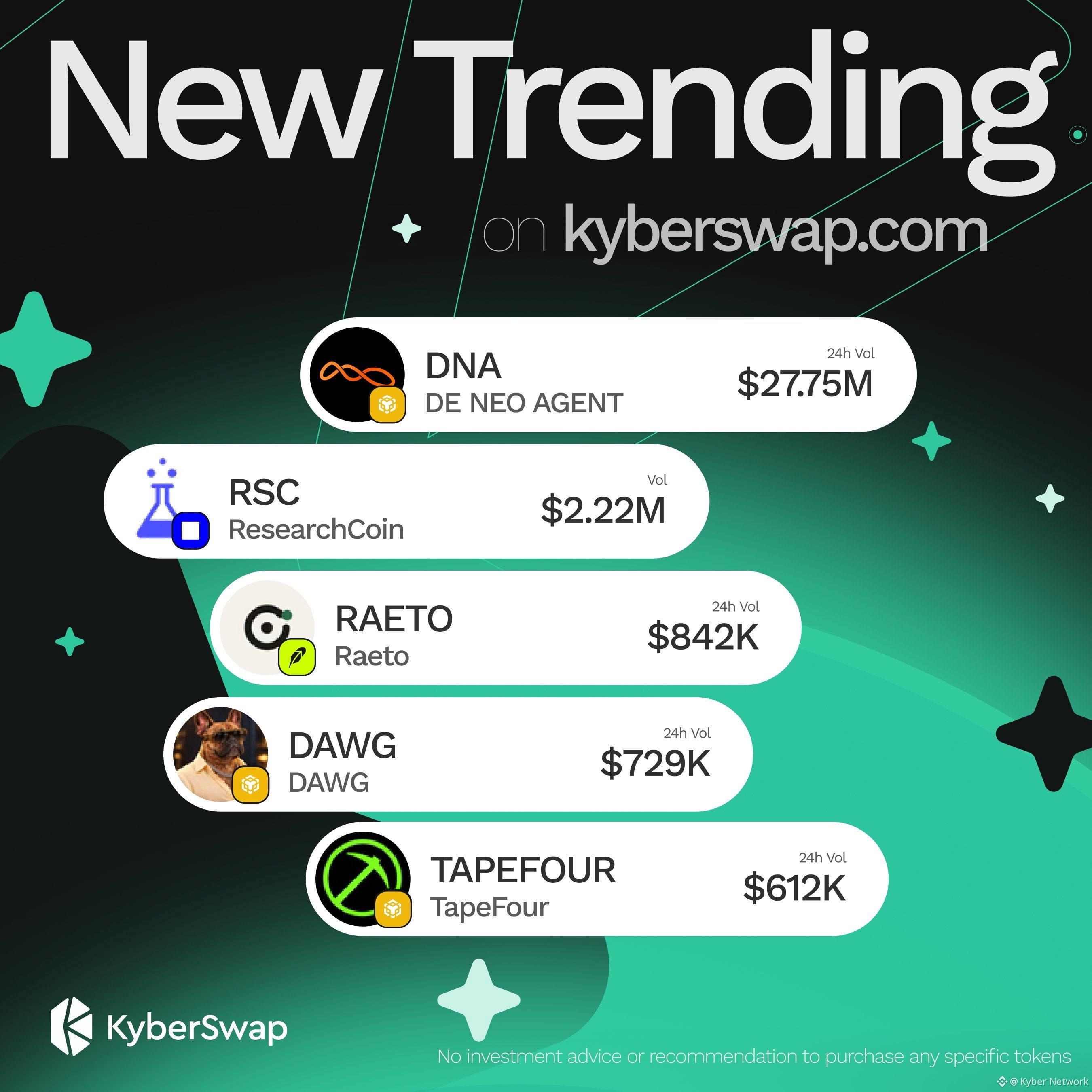
gm to everyone trenching on KyberSwap. which one are you aping today?
#DNA
#RSC
#RAETO
#DAWG
#TAPEFOUR
Check out the full trending list: https://kyberswap.com
gm to everyone trenching on KyberSwap. which one are you aping today?
#DNA
#RSC
#RAETO
#DAWG
#TAPEFOUR
Check out the full trending list: https://kyberswap.com
#DNA
#RSC
#RAETO
#DAWG
#TAPEFOUR
Check out the full trending list: https://kyberswap.com
1
675
Article
Maker vs Taker on a DEX: How They Work in Limit OrdersIf you have used Limit Orders on a DEX, you have probably seen the terms maker and taker. The difference sounds technical, but it comes down to a simple question:
Are you creating a trading opportunity, or are you accepting one that already exists?
A maker sets the terms of an order and waits for someone willing to trade against it. A taker accepts those available terms and completes the other side of the trade.
Understanding that difference matters because the two sides play different roles in how a DEX Limit Order is priced, matched, and eventually settled. On KyberSwap, the distinction also affects how orders are created, where tokens remain while an order is open, and who handles the on-chain transaction when the trade is filled.
What Is a Maker vs a Taker on a DEX?
In a DEX Limit Order, the maker creates an order at a chosen price, while the taker fills an available order when its terms become attractive to execute.
Suppose ETH is trading around $3,400, but you only want to sell 1 ETH if you can receive at least $3,500.
You create a Limit Order offering 1 ETH at your chosen rate and leave it open. You are the maker because you have created an available trading opportunity instead of immediately accepting the current market price.
Later, another side is willing to trade under terms that satisfy your order. When that trade is settled, that side acts as the taker.
The important point is that maker and taker describe roles in the trade, not two different types of people. A trader can be a maker in one transaction and interact with existing liquidity in another.
How Does the Maker and Taker Model Work in a DEX Limit Order?
The maker and taker model solves a basic problem with Limit Orders.
The maker wants control over price but does not know exactly when another side of the market will be ready to trade. Requiring the maker to continuously monitor the market and submit a transaction at the right moment would remove much of the value of using a Limit Order in the first place.
Instead, the maker defines the trading instructions in advance.
On KyberSwap, the maker specifies what tokens they want to trade, the amount, the rate they are willing to accept, and how long the order should remain valid. The maker then signs the order off-chain rather than broadcasting a new transaction to the blockchain.
The signed order can then wait for suitable execution conditions.
When a taker finds an opportunity to execute the order under acceptable terms, the taker handles settlement on-chain. KyberSwap's current documentation describes Limit Order as being powered by a network of takers, with trades automatically settled on-chain when the predefined conditions are met.
So the maker does not need to return when the target becomes available and manually execute the trade.
The maker sets the terms first. The taker completes the trade later.
What Does the Maker Control?
The main reason to act as a maker is control over the terms of the trade.
A maker is not asking the market:
What rate can I get right now?
Instead, the maker is saying:
This is the rate at which I am willing to trade.
For a sell Limit Order, that means setting the minimum rate you are willing to accept. For a buy Limit Order, it means defining the maximum rate you are willing to pay.
This does not mean the maker controls whether the order will be filled. The market still needs to create an executable opportunity, and a suitable taker still needs to take the other side.
That distinction is important.
The maker controls the conditions. The maker does not control the arrival of demand.
If the chosen price never becomes attractive to the other side of the market, the order can remain open until it expires or is cancelled. KyberSwap also notes that thin trading pairs and very small orders can have fewer viable taker opportunities.
What Does the Taker Actually Do?
The taker turns an available maker order into an executed trade.
A taker evaluates open orders and acts when there is an economically viable opportunity to fill one. That means the maker's price is only one part of the decision. Order size, network gas, available market prices, and other execution conditions can also matter.
This is why a chart touching your Limit Order price does not automatically mean the order must be filled.
Imagine a very small Limit Order reaches its target. Filling it may technically be possible, but if the cost of settling the transaction is too high relative to the value available from the trade, a taker may have little reason to execute it.
KyberSwap's current Limit Order guidance specifically identifies this as one reason smaller maker orders may remain unfilled even after the target becomes reachable.
The taker therefore does more than simply confirm that a price has been reached. The trade still needs to make sense as an executable on-chain transaction.
Does a Maker Need to Keep Tokens Locked While Waiting?
A maker may need to leave an order open for hours or days, so having assets locked away during that period would reduce flexibility.
KyberSwap handles this by keeping the maker's tokens in their wallet while the Limit Order remains open. The tokens move only when a matching trade is settled on-chain.
This means becoming a maker does not require depositing the tokens into an order book contract simply to wait for execution.
There is an important consequence, however.
Because the assets remain under the maker's control, the maker can also spend or move them elsewhere. If there is no longer enough balance or allowance available when a taker tries to execute the order, settlement may no longer be possible.
So keeping tokens in your wallet provides flexibility, but the maker still needs to keep the order sufficiently funded if they want it to remain executable.
Who Pays Gas, the Maker or the Taker?
Maker and taker roles also help explain where gas appears in a DEX Limit Order.
On KyberSwap, creating the Limit Order itself does not require a new on-chain transaction from the maker. The maker signs the order off-chain, which allows the order to be created without network gas after any required token approval is already in place.
When the order becomes suitable for execution, the taker handles the on-chain settlement and its gas cost.
That division of responsibilities is what allows a maker to set an order and step away from the market.
There can still be other gas related actions. For example, approving a token for the first time can require an on-chain transaction, while KyberSwap also offers different cancellation paths depending on whether the maker wants a gasless cancellation or immediate on-chain cancellation.
But the maker does not need to submit another transaction simply because the Limit Order becomes fillable.
Is a Maker the Same as an AMM Liquidity Provider?
Not exactly.
Both can make liquidity available to traders, but the mechanism and user intent are different.
An AMM liquidity provider deposits assets into a liquidity position that traders can swap against according to the pool's pricing mechanism. Depending on the pool, the LP may earn trading fees in return for supplying that capital.
A Limit Order maker instead makes a specific amount available under specific trading terms. The maker chooses the acceptable rate and waits for an opposing side to execute against the order.
For most traders, the useful mental model is therefore not:
I am becoming an LP by placing a Limit Order.
It is:
I am making an order available at the price I am willing to trade.
This distinction also explains why maker liquidity can appear as visible order book depth. KyberSwap Limit Order 2.0 surfaces realistic maker liquidity through a live order book so traders can see available orders and interact with them directly.
Why Do Makers Matter to a DEX?
Without makers, there is nothing for a taker to take.
Every maker order adds an available trading opportunity at a particular price and size. A deeper set of meaningful maker orders gives other market participants more potential options when they want to trade.
This becomes especially important in an order book style market because liquidity is not only about how much capital exists. It also matters where that liquidity is available across different prices.
For the maker, the motivation is price control.
For the taker, the benefit is having available orders to execute against.
For the market, the maker and taker relationship connects those two needs.
KyberSwap extends that relationship beyond the Limit Order interface itself. Limit Orders can also act as a liquidity source for KyberSwap Aggregator, which means eligible maker liquidity may become relevant to broader swap routing when the order provides suitable execution.
The deeper mechanics of how that creates additional potential taker exposure are a separate topic, but the important foundation is simple: makers create the available orders that taker demand can interact with.
Are You Always a Maker When You Place a Limit Order?
On KyberSwap Limit Order, the user creating and signing the order is the maker.
That terminology is useful because the order is created first and then waits for the taker side to settle it when suitable conditions appear. KyberSwap also exposes separate Maker and Taker APIs around these roles.
Across trading platforms more broadly, terminology can become more nuanced. An order that immediately consumes existing order book liquidity may be treated differently depending on the exchange and its matching rules.
For understanding KyberSwap Limit Orders, however, the mental model is straightforward:
you create the order as the maker, and a taker later fills it.
Why Does the Maker vs Taker Difference Matter?
Maker and taker are not just technical labels.
They explain the entire lifecycle of a DEX Limit Order.
The maker chooses the rate and makes an order available. The order can wait without requiring the maker to continually transact on-chain. The maker retains custody of the tokens while waiting.
The taker watches for an executable opportunity, accepts available maker liquidity, and handles the settlement transaction when the trade makes sense.
Once those roles are clear, several Limit Order questions become easier to understand.
Why can an order reach its target and still remain unfilled? It still needs viable taker demand.
Why can the maker leave the market after placing the order? The taker handles settlement later.
Why do the maker's tokens remain in the wallet? The signed order represents permission to trade under defined terms rather than an immediate transfer.
And why does broader taker access matter? Because an order only becomes an executed trade when suitable demand reaches the liquidity the maker has made available.
Maker Sets the Terms, Taker Completes the Trade
A DEX Limit Order separates two jobs that happen almost simultaneously in an instant swap.
The maker decides the price and makes the trade available.
The taker decides when those terms are worth executing and completes the trade on-chain.
On KyberSwap, that structure allows makers to create gasless signed orders, keep their assets in their wallets while they wait, and let takers handle settlement when the required conditions are met.
For a trader considering a Limit Order, that is the most useful distinction to remember.
Being a maker means choosing the terms first and waiting for the market to come to them.
Frequently Asked Questions
What Is a Maker on a DEX?
A maker creates an available trading order instead of immediately consuming existing liquidity. In KyberSwap Limit Order, the maker chooses the token pair, amount, rate, and expiry, then signs the order and waits for suitable execution.
What Is a Taker on a DEX?
A taker fills an available maker order when its terms become executable and economically suitable. On KyberSwap, the taker handles the on-chain settlement transaction when a matching opportunity is found.
Does a Limit Order Make Me a Maker?
Usually, yes, if your Limit Order creates a new order that waits for someone else to fill it. In that case, you are adding available liquidity and acting as the maker. If an order immediately executes against existing liquidity, some trading venues may classify that side as the taker instead.
On KyberSwap Limit Order, the user who creates and signs the order acts as the maker, while the party that later executes against it acts as the taker.
Does the Maker Pay Gas When a Limit Order Fills?
On KyberSwap, the taker handles the gas required for on-chain settlement. The maker may still need an initial token approval transaction if the required allowance is not already available.
What Happens If No Taker Fills My Order?
The order can remain open until it is filled, cancelled, or reaches its expiry. Reaching the target price alone does not guarantee execution because the order still needs viable taker demand.
Maker vs Taker on a DEX: How They Work in Limit Orders
If you have used Limit Orders on a DEX, you have probably seen the terms maker and taker. The difference sounds technical, but it comes down to a simple question:
Are you creating a trading opportunity, or are you accepting one that already exists?
A maker sets the terms of an order and waits for someone willing to trade against it. A taker accepts those available terms and completes the other side of the trade.
Understanding that difference matters because the two sides play different roles in how a DEX Limit Order is priced, matched, and eventually settled. On KyberSwap, the distinction also affects how orders are created, where tokens remain while an order is open, and who handles the on-chain transaction when the trade is filled.
What Is a Maker vs a Taker on a DEX?
In a DEX Limit Order, the maker creates an order at a chosen price, while the taker fills an available order when its terms become attractive to execute.
Suppose ETH is trading around $3,400, but you only want to sell 1 ETH if you can receive at least $3,500.
You create a Limit Order offering 1 ETH at your chosen rate and leave it open. You are the maker because you have created an available trading opportunity instead of immediately accepting the current market price.
Later, another side is willing to trade under terms that satisfy your order. When that trade is settled, that side acts as the taker.
The important point is that maker and taker describe roles in the trade, not two different types of people. A trader can be a maker in one transaction and interact with existing liquidity in another.
How Does the Maker and Taker Model Work in a DEX Limit Order?
The maker and taker model solves a basic problem with Limit Orders.
The maker wants control over price but does not know exactly when another side of the market will be ready to trade. Requiring the maker to continuously monitor the market and submit a transaction at the right moment would remove much of the value of using a Limit Order in the first place.
Instead, the maker defines the trading instructions in advance.
On KyberSwap, the maker specifies what tokens they want to trade, the amount, the rate they are willing to accept, and how long the order should remain valid. The maker then signs the order off-chain rather than broadcasting a new transaction to the blockchain.
The signed order can then wait for suitable execution conditions.
When a taker finds an opportunity to execute the order under acceptable terms, the taker handles settlement on-chain. KyberSwap's current documentation describes Limit Order as being powered by a network of takers, with trades automatically settled on-chain when the predefined conditions are met.
So the maker does not need to return when the target becomes available and manually execute the trade.
The maker sets the terms first. The taker completes the trade later.
What Does the Maker Control?
The main reason to act as a maker is control over the terms of the trade.
A maker is not asking the market:
What rate can I get right now?
Instead, the maker is saying:
This is the rate at which I am willing to trade.
For a sell Limit Order, that means setting the minimum rate you are willing to accept. For a buy Limit Order, it means defining the maximum rate you are willing to pay.
This does not mean the maker controls whether the order will be filled. The market still needs to create an executable opportunity, and a suitable taker still needs to take the other side.
That distinction is important.
The maker controls the conditions. The maker does not control the arrival of demand.
If the chosen price never becomes attractive to the other side of the market, the order can remain open until it expires or is cancelled. KyberSwap also notes that thin trading pairs and very small orders can have fewer viable taker opportunities.
What Does the Taker Actually Do?
The taker turns an available maker order into an executed trade.
A taker evaluates open orders and acts when there is an economically viable opportunity to fill one. That means the maker's price is only one part of the decision. Order size, network gas, available market prices, and other execution conditions can also matter.
This is why a chart touching your Limit Order price does not automatically mean the order must be filled.
Imagine a very small Limit Order reaches its target. Filling it may technically be possible, but if the cost of settling the transaction is too high relative to the value available from the trade, a taker may have little reason to execute it.
KyberSwap's current Limit Order guidance specifically identifies this as one reason smaller maker orders may remain unfilled even after the target becomes reachable.
The taker therefore does more than simply confirm that a price has been reached. The trade still needs to make sense as an executable on-chain transaction.
Does a Maker Need to Keep Tokens Locked While Waiting?
A maker may need to leave an order open for hours or days, so having assets locked away during that period would reduce flexibility.
KyberSwap handles this by keeping the maker's tokens in their wallet while the Limit Order remains open. The tokens move only when a matching trade is settled on-chain.
This means becoming a maker does not require depositing the tokens into an order book contract simply to wait for execution.
There is an important consequence, however.
Because the assets remain under the maker's control, the maker can also spend or move them elsewhere. If there is no longer enough balance or allowance available when a taker tries to execute the order, settlement may no longer be possible.
So keeping tokens in your wallet provides flexibility, but the maker still needs to keep the order sufficiently funded if they want it to remain executable.
Who Pays Gas, the Maker or the Taker?
Maker and taker roles also help explain where gas appears in a DEX Limit Order.
On KyberSwap, creating the Limit Order itself does not require a new on-chain transaction from the maker. The maker signs the order off-chain, which allows the order to be created without network gas after any required token approval is already in place.
When the order becomes suitable for execution, the taker handles the on-chain settlement and its gas cost.
That division of responsibilities is what allows a maker to set an order and step away from the market.
There can still be other gas related actions. For example, approving a token for the first time can require an on-chain transaction, while KyberSwap also offers different cancellation paths depending on whether the maker wants a gasless cancellation or immediate on-chain cancellation.
But the maker does not need to submit another transaction simply because the Limit Order becomes fillable.
Is a Maker the Same as an AMM Liquidity Provider?
Not exactly.
Both can make liquidity available to traders, but the mechanism and user intent are different.
An AMM liquidity provider deposits assets into a liquidity position that traders can swap against according to the pool's pricing mechanism. Depending on the pool, the LP may earn trading fees in return for supplying that capital.
A Limit Order maker instead makes a specific amount available under specific trading terms. The maker chooses the acceptable rate and waits for an opposing side to execute against the order.
For most traders, the useful mental model is therefore not:
I am becoming an LP by placing a Limit Order.
It is:
I am making an order available at the price I am willing to trade.
This distinction also explains why maker liquidity can appear as visible order book depth. KyberSwap Limit Order 2.0 surfaces realistic maker liquidity through a live order book so traders can see available orders and interact with them directly.
Why Do Makers Matter to a DEX?
Without makers, there is nothing for a taker to take.
Every maker order adds an available trading opportunity at a particular price and size. A deeper set of meaningful maker orders gives other market participants more potential options when they want to trade.
This becomes especially important in an order book style market because liquidity is not only about how much capital exists. It also matters where that liquidity is available across different prices.
For the maker, the motivation is price control.
For the taker, the benefit is having available orders to execute against.
For the market, the maker and taker relationship connects those two needs.
KyberSwap extends that relationship beyond the Limit Order interface itself. Limit Orders can also act as a liquidity source for KyberSwap Aggregator, which means eligible maker liquidity may become relevant to broader swap routing when the order provides suitable execution.
The deeper mechanics of how that creates additional potential taker exposure are a separate topic, but the important foundation is simple: makers create the available orders that taker demand can interact with.
Are You Always a Maker When You Place a Limit Order?
On KyberSwap Limit Order, the user creating and signing the order is the maker.
That terminology is useful because the order is created first and then waits for the taker side to settle it when suitable conditions appear. KyberSwap also exposes separate Maker and Taker APIs around these roles.
Across trading platforms more broadly, terminology can become more nuanced. An order that immediately consumes existing order book liquidity may be treated differently depending on the exchange and its matching rules.
For understanding KyberSwap Limit Orders, however, the mental model is straightforward:
you create the order as the maker, and a taker later fills it.
Why Does the Maker vs Taker Difference Matter?
Maker and taker are not just technical labels.
They explain the entire lifecycle of a DEX Limit Order.
The maker chooses the rate and makes an order available. The order can wait without requiring the maker to continually transact on-chain. The maker retains custody of the tokens while waiting.
The taker watches for an executable opportunity, accepts available maker liquidity, and handles the settlement transaction when the trade makes sense.
Once those roles are clear, several Limit Order questions become easier to understand.
Why can an order reach its target and still remain unfilled? It still needs viable taker demand.
Why can the maker leave the market after placing the order? The taker handles settlement later.
Why do the maker's tokens remain in the wallet? The signed order represents permission to trade under defined terms rather than an immediate transfer.
And why does broader taker access matter? Because an order only becomes an executed trade when suitable demand reaches the liquidity the maker has made available.
Maker Sets the Terms, Taker Completes the Trade
A DEX Limit Order separates two jobs that happen almost simultaneously in an instant swap.
The maker decides the price and makes the trade available.
The taker decides when those terms are worth executing and completes the trade on-chain.
On KyberSwap, that structure allows makers to create gasless signed orders, keep their assets in their wallets while they wait, and let takers handle settlement when the required conditions are met.
For a trader considering a Limit Order, that is the most useful distinction to remember.
Being a maker means choosing the terms first and waiting for the market to come to them.
Frequently Asked Questions
What Is a Maker on a DEX?
A maker creates an available trading order instead of immediately consuming existing liquidity. In KyberSwap Limit Order, the maker chooses the token pair, amount, rate, and expiry, then signs the order and waits for suitable execution.
What Is a Taker on a DEX?
A taker fills an available maker order when its terms become executable and economically suitable. On KyberSwap, the taker handles the on-chain settlement transaction when a matching opportunity is found.
Does a Limit Order Make Me a Maker?
Usually, yes, if your Limit Order creates a new order that waits for someone else to fill it. In that case, you are adding available liquidity and acting as the maker. If an order immediately executes against existing liquidity, some trading venues may classify that side as the taker instead.
On KyberSwap Limit Order, the user who creates and signs the order acts as the maker, while the party that later executes against it acts as the taker.
Does the Maker Pay Gas When a Limit Order Fills?
On KyberSwap, the taker handles the gas required for on-chain settlement. The maker may still need an initial token approval transaction if the required allowance is not already available.
What Happens If No Taker Fills My Order?
The order can remain open until it is filled, cancelled, or reaches its expiry. Reaching the target price alone does not guarantee execution because the order still needs viable taker demand.
Are you creating a trading opportunity, or are you accepting one that already exists?
A maker sets the terms of an order and waits for someone willing to trade against it. A taker accepts those available terms and completes the other side of the trade.
Understanding that difference matters because the two sides play different roles in how a DEX Limit Order is priced, matched, and eventually settled. On KyberSwap, the distinction also affects how orders are created, where tokens remain while an order is open, and who handles the on-chain transaction when the trade is filled.
What Is a Maker vs a Taker on a DEX?
In a DEX Limit Order, the maker creates an order at a chosen price, while the taker fills an available order when its terms become attractive to execute.
Suppose ETH is trading around $3,400, but you only want to sell 1 ETH if you can receive at least $3,500.
You create a Limit Order offering 1 ETH at your chosen rate and leave it open. You are the maker because you have created an available trading opportunity instead of immediately accepting the current market price.
Later, another side is willing to trade under terms that satisfy your order. When that trade is settled, that side acts as the taker.
The important point is that maker and taker describe roles in the trade, not two different types of people. A trader can be a maker in one transaction and interact with existing liquidity in another.
How Does the Maker and Taker Model Work in a DEX Limit Order?
The maker and taker model solves a basic problem with Limit Orders.
The maker wants control over price but does not know exactly when another side of the market will be ready to trade. Requiring the maker to continuously monitor the market and submit a transaction at the right moment would remove much of the value of using a Limit Order in the first place.
Instead, the maker defines the trading instructions in advance.
On KyberSwap, the maker specifies what tokens they want to trade, the amount, the rate they are willing to accept, and how long the order should remain valid. The maker then signs the order off-chain rather than broadcasting a new transaction to the blockchain.
The signed order can then wait for suitable execution conditions.
When a taker finds an opportunity to execute the order under acceptable terms, the taker handles settlement on-chain. KyberSwap's current documentation describes Limit Order as being powered by a network of takers, with trades automatically settled on-chain when the predefined conditions are met.
So the maker does not need to return when the target becomes available and manually execute the trade.
The maker sets the terms first. The taker completes the trade later.
What Does the Maker Control?
The main reason to act as a maker is control over the terms of the trade.
A maker is not asking the market:
What rate can I get right now?
Instead, the maker is saying:
This is the rate at which I am willing to trade.
For a sell Limit Order, that means setting the minimum rate you are willing to accept. For a buy Limit Order, it means defining the maximum rate you are willing to pay.
This does not mean the maker controls whether the order will be filled. The market still needs to create an executable opportunity, and a suitable taker still needs to take the other side.
That distinction is important.
The maker controls the conditions. The maker does not control the arrival of demand.
If the chosen price never becomes attractive to the other side of the market, the order can remain open until it expires or is cancelled. KyberSwap also notes that thin trading pairs and very small orders can have fewer viable taker opportunities.
What Does the Taker Actually Do?
The taker turns an available maker order into an executed trade.
A taker evaluates open orders and acts when there is an economically viable opportunity to fill one. That means the maker's price is only one part of the decision. Order size, network gas, available market prices, and other execution conditions can also matter.
This is why a chart touching your Limit Order price does not automatically mean the order must be filled.
Imagine a very small Limit Order reaches its target. Filling it may technically be possible, but if the cost of settling the transaction is too high relative to the value available from the trade, a taker may have little reason to execute it.
KyberSwap's current Limit Order guidance specifically identifies this as one reason smaller maker orders may remain unfilled even after the target becomes reachable.
The taker therefore does more than simply confirm that a price has been reached. The trade still needs to make sense as an executable on-chain transaction.
Does a Maker Need to Keep Tokens Locked While Waiting?
A maker may need to leave an order open for hours or days, so having assets locked away during that period would reduce flexibility.
KyberSwap handles this by keeping the maker's tokens in their wallet while the Limit Order remains open. The tokens move only when a matching trade is settled on-chain.
This means becoming a maker does not require depositing the tokens into an order book contract simply to wait for execution.
There is an important consequence, however.
Because the assets remain under the maker's control, the maker can also spend or move them elsewhere. If there is no longer enough balance or allowance available when a taker tries to execute the order, settlement may no longer be possible.
So keeping tokens in your wallet provides flexibility, but the maker still needs to keep the order sufficiently funded if they want it to remain executable.
Who Pays Gas, the Maker or the Taker?
Maker and taker roles also help explain where gas appears in a DEX Limit Order.
On KyberSwap, creating the Limit Order itself does not require a new on-chain transaction from the maker. The maker signs the order off-chain, which allows the order to be created without network gas after any required token approval is already in place.
When the order becomes suitable for execution, the taker handles the on-chain settlement and its gas cost.
That division of responsibilities is what allows a maker to set an order and step away from the market.
There can still be other gas related actions. For example, approving a token for the first time can require an on-chain transaction, while KyberSwap also offers different cancellation paths depending on whether the maker wants a gasless cancellation or immediate on-chain cancellation.
But the maker does not need to submit another transaction simply because the Limit Order becomes fillable.
Is a Maker the Same as an AMM Liquidity Provider?
Not exactly.
Both can make liquidity available to traders, but the mechanism and user intent are different.
An AMM liquidity provider deposits assets into a liquidity position that traders can swap against according to the pool's pricing mechanism. Depending on the pool, the LP may earn trading fees in return for supplying that capital.
A Limit Order maker instead makes a specific amount available under specific trading terms. The maker chooses the acceptable rate and waits for an opposing side to execute against the order.
For most traders, the useful mental model is therefore not:
I am becoming an LP by placing a Limit Order.
It is:
I am making an order available at the price I am willing to trade.
This distinction also explains why maker liquidity can appear as visible order book depth. KyberSwap Limit Order 2.0 surfaces realistic maker liquidity through a live order book so traders can see available orders and interact with them directly.
Why Do Makers Matter to a DEX?
Without makers, there is nothing for a taker to take.
Every maker order adds an available trading opportunity at a particular price and size. A deeper set of meaningful maker orders gives other market participants more potential options when they want to trade.
This becomes especially important in an order book style market because liquidity is not only about how much capital exists. It also matters where that liquidity is available across different prices.
For the maker, the motivation is price control.
For the taker, the benefit is having available orders to execute against.
For the market, the maker and taker relationship connects those two needs.
KyberSwap extends that relationship beyond the Limit Order interface itself. Limit Orders can also act as a liquidity source for KyberSwap Aggregator, which means eligible maker liquidity may become relevant to broader swap routing when the order provides suitable execution.
The deeper mechanics of how that creates additional potential taker exposure are a separate topic, but the important foundation is simple: makers create the available orders that taker demand can interact with.
Are You Always a Maker When You Place a Limit Order?
On KyberSwap Limit Order, the user creating and signing the order is the maker.
That terminology is useful because the order is created first and then waits for the taker side to settle it when suitable conditions appear. KyberSwap also exposes separate Maker and Taker APIs around these roles.
Across trading platforms more broadly, terminology can become more nuanced. An order that immediately consumes existing order book liquidity may be treated differently depending on the exchange and its matching rules.
For understanding KyberSwap Limit Orders, however, the mental model is straightforward:
you create the order as the maker, and a taker later fills it.
Why Does the Maker vs Taker Difference Matter?
Maker and taker are not just technical labels.
They explain the entire lifecycle of a DEX Limit Order.
The maker chooses the rate and makes an order available. The order can wait without requiring the maker to continually transact on-chain. The maker retains custody of the tokens while waiting.
The taker watches for an executable opportunity, accepts available maker liquidity, and handles the settlement transaction when the trade makes sense.
Once those roles are clear, several Limit Order questions become easier to understand.
Why can an order reach its target and still remain unfilled? It still needs viable taker demand.
Why can the maker leave the market after placing the order? The taker handles settlement later.
Why do the maker's tokens remain in the wallet? The signed order represents permission to trade under defined terms rather than an immediate transfer.
And why does broader taker access matter? Because an order only becomes an executed trade when suitable demand reaches the liquidity the maker has made available.
Maker Sets the Terms, Taker Completes the Trade
A DEX Limit Order separates two jobs that happen almost simultaneously in an instant swap.
The maker decides the price and makes the trade available.
The taker decides when those terms are worth executing and completes the trade on-chain.
On KyberSwap, that structure allows makers to create gasless signed orders, keep their assets in their wallets while they wait, and let takers handle settlement when the required conditions are met.
For a trader considering a Limit Order, that is the most useful distinction to remember.
Being a maker means choosing the terms first and waiting for the market to come to them.
Frequently Asked Questions
What Is a Maker on a DEX?
A maker creates an available trading order instead of immediately consuming existing liquidity. In KyberSwap Limit Order, the maker chooses the token pair, amount, rate, and expiry, then signs the order and waits for suitable execution.
What Is a Taker on a DEX?
A taker fills an available maker order when its terms become executable and economically suitable. On KyberSwap, the taker handles the on-chain settlement transaction when a matching opportunity is found.
Does a Limit Order Make Me a Maker?
Usually, yes, if your Limit Order creates a new order that waits for someone else to fill it. In that case, you are adding available liquidity and acting as the maker. If an order immediately executes against existing liquidity, some trading venues may classify that side as the taker instead.
On KyberSwap Limit Order, the user who creates and signs the order acts as the maker, while the party that later executes against it acts as the taker.
Does the Maker Pay Gas When a Limit Order Fills?
On KyberSwap, the taker handles the gas required for on-chain settlement. The maker may still need an initial token approval transaction if the required allowance is not already available.
What Happens If No Taker Fills My Order?
The order can remain open until it is filled, cancelled, or reaches its expiry. Reaching the target price alone does not guarantee execution because the order still needs viable taker demand.
150
Article
Why Become a Limit Order Maker on a DEX? 6 Benefits for TradersA market swap is useful when you want to trade at the best available rate now. But not every trade needs to happen immediately.
Sometimes you already know the price at which you are willing to buy or sell. In that situation, becoming a Limit Order maker lets you define the terms first and wait for suitable demand instead of accepting the current executable rate.
On KyberSwap, the maker creates and signs the Limit Order, while a taker later settles the trade on-chain when the order becomes suitable to execute. This structure gives makers several practical benefits beyond simply choosing a target price.
This guide focuses on six practical benefits for Limit Order makers: setting your own price, placing orders without gas, cancelling orders without gas, avoiding the Limit Order fee as the maker, keeping tokens in your wallet while waiting, and reaching more trading demand through KyberSwap Aggregator.
What Does It Mean to Become a Limit Order Maker?
A maker creates an available trading opportunity instead of immediately consuming liquidity that is already available.
Suppose ETH is trading around $3,400, but you only want to sell 1 ETH if you can receive at least $3,500.
Rather than trading at the current rate, you create a sell Limit Order at your chosen level. The order remains available until suitable conditions appear, it expires, or you cancel it.
In that trade, you are the maker because you define the terms first. The other side that later executes against the order acts as the taker.
The reason to become a maker is therefore not simply to delay a trade. It is to gain more control over how, when, and at what cost you are willing to trade.
Those differences become more practical once you look at what the maker actually gains from this setup. On KyberSwap, becoming a Limit Order maker comes with six main benefits, from controlling your execution price to reducing maker side costs and giving your order more ways to reach potential taker demand.
1. Set the Exact Price You Are Willing to Trade At
The most direct benefit of becoming a maker is price control.
When you need to trade immediately, you generally work with liquidity and rates available at that moment. A Limit Order changes the decision. Instead of asking what price the market can give you now, you decide what price would make the trade worthwhile for you.
For a buy order, that can mean waiting for a lower entry.
For a sell order, it can mean waiting for a higher exit.
KyberSwap Limit Order lets the maker specify the desired rate before signing the order. The trade only becomes executable when conditions satisfy the terms the maker agreed to.
This can be useful when your trade already has a clear plan behind it.
For example, if you own ETH at $3,400 and only want to reduce the position at $3,500, repeatedly checking the market and manually swapping when that level appears adds unnecessary work. A maker order lets you express that decision in advance.
Price control should not be confused with guaranteed execution. Setting $3,500 means you are unwilling to accept less than your signed rate. It does not mean suitable taker demand must appear.
The benefit is that you control the acceptable terms before the trade happens.
2. Place the Order Without Paying Network Gas
Price control becomes less attractive if every attempt to place or adjust an order requires another on-chain transaction.
That is especially relevant on networks where gas costs can rise quickly during periods of high activity.
KyberSwap avoids that cost at order creation by using an off-chain signed order model. The maker signs the trading instructions with their wallet rather than broadcasting a new blockchain transaction simply to place the order. As a result, creating the Limit Order itself does not require network gas from the maker.
Once the order is open, leaving it active also does not create recurring gas transactions.
When suitable execution is found, the taker handles the on-chain settlement. The taker also pays the gas fee and taker fee required to settle the trade.
There is one important distinction.
If the token still needs approval before it can be used by the Limit Order contract, that approval is an on-chain transaction and can require gas. A Hard Cancel also requires gas because it immediately invalidates the order on-chain.
But the maker does not need to pay gas merely to create the signed order or because the order eventually becomes fillable.
For traders who place orders regularly, that removes a cost that could otherwise make repeated maker activity less practical.
3. Cancel Your Order Without Paying Gas
Changing market conditions can make an open Limit Order less useful than when you first placed it. KyberSwap gives makers a Gasless Cancel option, so you can cancel an active order without sending an on-chain cancellation transaction or paying gas.
Gasless Cancel may take up to five minutes to fully take effect. If you need the order cancelled immediately, Hard Cancel is available instead and requires an on-chain transaction with gas.
4. Pay Zero Maker Fee on KyberSwap Limit Orders
Gas is only one type of trading cost.
Even when order creation itself is gasless, a maker still needs to ask what the platform charges when the order eventually executes.
KyberSwap currently describes its Limit Order product as having a zero maker fee. The fee associated with direct taker settlement is handled on the taker side rather than being charged to the maker who placed the resting order.
That distinction matters because makers can leave orders available without adding another KyberSwap maker fee to the eventual execution.
Consider a trader who regularly places entries and exits instead of making one occasional trade. Even a small maker fee applied to every successful order can accumulate as trading volume increases.
With a zero maker fee structure, the maker can focus more directly on the rate they are willing to trade at.
This should still be separated from other possible costs in the order lifecycle. Token approval may require network gas, and the taker side has its own gas and fee structure when filling orders. The key benefit for the maker is specifically that KyberSwap does not add a maker fee when the Limit Order is filled.
5. Keep Your Tokens in Your Wallet While the Order Waits
A Limit Order may remain open for hours or days before the market creates the opportunity you want.
If placing the order required transferring your assets into a separate custody account or locking them inside an order book contract for the entire waiting period, that would reduce your flexibility.
KyberSwap Limit Orders work differently.
The maker signs the order off-chain while the tokens remain in the maker's wallet. The assets only move when a taker successfully settles the order on-chain.
For the maker, this means placing a Limit Order does not require giving up custody of the tokens while waiting.
You can still see and control the assets from your wallet.
There is also a responsibility that comes with that flexibility. Because the assets remain under your control, you can move or spend them elsewhere. If the wallet no longer contains enough of the required token, or if the necessary allowance is no longer available, the order may not be executable when a taker arrives.
So the benefit is not that the same capital can safely be committed everywhere at once.
The benefit is that your assets do not need to sit locked away simply because you have an open Limit Order.
For traders who value self custody, that is a meaningful difference.
6. Give Your Order More Potential Ways to Reach Taker Demand
Setting a good price does not automatically produce a fill.
A maker still needs suitable demand on the other side.
That creates an important question after the order is placed:
Who can actually reach it?
KyberSwap Limit Orders are integrated into KyberSwap Aggregator as an additional liquidity source. That means an eligible active Limit Order can potentially become relevant not only to users interacting directly with Limit Orders, but also to regular swap flow routed through the Aggregator.
Imagine you have an active order offering ETH at a competitive rate.
Separately, another user comes to KyberSwap to swap USDC into ETH. They may not be looking for your Limit Order or even thinking about the maker and taker model.
KyberSwap Aggregator evaluates available liquidity for that swap. If your order provides suitable liquidity for the route, the Aggregator can potentially route demand through the Limit Order.
From the swap user's perspective, they are simply looking for a competitive route.
From the maker's perspective, that creates another possible path for demand to reach the order.
KyberSwap originally described the Aggregator integration as increasing the potential chance for maker orders to be filled while also allowing swap users to access Limit Order liquidity when it improves their route.
This does not guarantee that an order will execute.
An unrealistic price, insufficient balance, low trading activity, or an order that is too small to justify settlement can still remain unfilled. Broader exposure does not replace those conditions.
What it changes is the number of potential ways suitable taker demand can encounter the maker's order.
When Does Becoming a Maker Make Sense?
Being a maker is useful when price control matters more than immediate execution.
If you already know the rate at which you want to buy or sell, a Limit Order allows you to express that decision in advance rather than monitoring the market continuously.
The KyberSwap model adds several benefits around that basic use case. You can create the order without paying network gas, avoid a maker fee when the order fills, keep the assets in your own wallet while waiting, and potentially expose the order to broader demand through KyberSwap Aggregator.
The tradeoff is patience.
A maker chooses the terms but cannot force the other side of the market to accept them. The order still needs appropriate price conditions and viable taker demand before it can execute.
That makes Limit Orders especially useful for planned entries and exits where getting the chosen rate matters more than trading immediately.
Becoming a Maker Is About More Than Waiting for a Price
It is easy to reduce a Limit Order to one feature:
choose a price and wait.
For the maker, the experience is broader than that.
You choose the rate you are willing to trade at. You can create the order without a new gas transaction. KyberSwap does not charge a maker fee when the order fills. Your tokens remain in your wallet while the order is open. And eligible orders can potentially reach demand through the wider KyberSwap Aggregator flow.
Together, those features make becoming a maker more practical for traders who already have a price in mind and do not need immediate execution.
The useful question is therefore not simply whether a Limit Order is better than an instant trade.
It is:
Do you want to accept the market's available terms now, or define your own terms and let potential taker demand come to you?
For traders in the second group, becoming a Limit Order maker can be a useful way to put that plan into action.
Frequently Asked Questions
Does a Limit Order Maker Pay Gas When the Order Fills?
No. When a KyberSwap Limit Order is filled, the taker pays the gas required for on-chain settlement.
Can I Cancel a Limit Order Without Paying Gas?
Yes. KyberSwap Gasless Cancel lets you cancel an active Limit Order without paying gas. In most cases cancellation is almost immediate, although you may need to wait briefly if the order was recently included in a taker or Aggregator quote.
Are My Tokens Locked While My Limit Order Is Open?
No. Tokens committed to a KyberSwap Limit Order remain in the maker's wallet until the order is settled. The maker should keep enough balance and allowance available if they want the order to remain fillable.
Can a Limit Order Be Partially Filled?
Yes. A taker can fill only part of a Limit Order. The remaining amount can stay open until it is filled, cancelled, or expires, as long as enough balance and allowance remain available.
What Happens If My Limit Order Expires Before It Is Filled?
Any unfilled amount is automatically cancelled once the order reaches its expiry and can no longer be filled. The tokens remain in the maker's wallet.
Why Become a Limit Order Maker on a DEX? 6 Benefits for Traders
A market swap is useful when you want to trade at the best available rate now. But not every trade needs to happen immediately.
Sometimes you already know the price at which you are willing to buy or sell. In that situation, becoming a Limit Order maker lets you define the terms first and wait for suitable demand instead of accepting the current executable rate.
On KyberSwap, the maker creates and signs the Limit Order, while a taker later settles the trade on-chain when the order becomes suitable to execute. This structure gives makers several practical benefits beyond simply choosing a target price.
This guide focuses on six practical benefits for Limit Order makers: setting your own price, placing orders without gas, cancelling orders without gas, avoiding the Limit Order fee as the maker, keeping tokens in your wallet while waiting, and reaching more trading demand through KyberSwap Aggregator.
What Does It Mean to Become a Limit Order Maker?
A maker creates an available trading opportunity instead of immediately consuming liquidity that is already available.
Suppose ETH is trading around $3,400, but you only want to sell 1 ETH if you can receive at least $3,500.
Rather than trading at the current rate, you create a sell Limit Order at your chosen level. The order remains available until suitable conditions appear, it expires, or you cancel it.
In that trade, you are the maker because you define the terms first. The other side that later executes against the order acts as the taker.
The reason to become a maker is therefore not simply to delay a trade. It is to gain more control over how, when, and at what cost you are willing to trade.
Those differences become more practical once you look at what the maker actually gains from this setup. On KyberSwap, becoming a Limit Order maker comes with six main benefits, from controlling your execution price to reducing maker side costs and giving your order more ways to reach potential taker demand.
1. Set the Exact Price You Are Willing to Trade At
The most direct benefit of becoming a maker is price control.
When you need to trade immediately, you generally work with liquidity and rates available at that moment. A Limit Order changes the decision. Instead of asking what price the market can give you now, you decide what price would make the trade worthwhile for you.
For a buy order, that can mean waiting for a lower entry.
For a sell order, it can mean waiting for a higher exit.
KyberSwap Limit Order lets the maker specify the desired rate before signing the order. The trade only becomes executable when conditions satisfy the terms the maker agreed to.
This can be useful when your trade already has a clear plan behind it.
For example, if you own ETH at $3,400 and only want to reduce the position at $3,500, repeatedly checking the market and manually swapping when that level appears adds unnecessary work. A maker order lets you express that decision in advance.
Price control should not be confused with guaranteed execution. Setting $3,500 means you are unwilling to accept less than your signed rate. It does not mean suitable taker demand must appear.
The benefit is that you control the acceptable terms before the trade happens.
2. Place the Order Without Paying Network Gas
Price control becomes less attractive if every attempt to place or adjust an order requires another on-chain transaction.
That is especially relevant on networks where gas costs can rise quickly during periods of high activity.
KyberSwap avoids that cost at order creation by using an off-chain signed order model. The maker signs the trading instructions with their wallet rather than broadcasting a new blockchain transaction simply to place the order. As a result, creating the Limit Order itself does not require network gas from the maker.
Once the order is open, leaving it active also does not create recurring gas transactions.
When suitable execution is found, the taker handles the on-chain settlement. The taker also pays the gas fee and taker fee required to settle the trade.
There is one important distinction.
If the token still needs approval before it can be used by the Limit Order contract, that approval is an on-chain transaction and can require gas. A Hard Cancel also requires gas because it immediately invalidates the order on-chain.
But the maker does not need to pay gas merely to create the signed order or because the order eventually becomes fillable.
For traders who place orders regularly, that removes a cost that could otherwise make repeated maker activity less practical.
3. Cancel Your Order Without Paying Gas
Changing market conditions can make an open Limit Order less useful than when you first placed it. KyberSwap gives makers a Gasless Cancel option, so you can cancel an active order without sending an on-chain cancellation transaction or paying gas.
Gasless Cancel may take up to five minutes to fully take effect. If you need the order cancelled immediately, Hard Cancel is available instead and requires an on-chain transaction with gas.
4. Pay Zero Maker Fee on KyberSwap Limit Orders
Gas is only one type of trading cost.
Even when order creation itself is gasless, a maker still needs to ask what the platform charges when the order eventually executes.
KyberSwap currently describes its Limit Order product as having a zero maker fee. The fee associated with direct taker settlement is handled on the taker side rather than being charged to the maker who placed the resting order.
That distinction matters because makers can leave orders available without adding another KyberSwap maker fee to the eventual execution.
Consider a trader who regularly places entries and exits instead of making one occasional trade. Even a small maker fee applied to every successful order can accumulate as trading volume increases.
With a zero maker fee structure, the maker can focus more directly on the rate they are willing to trade at.
This should still be separated from other possible costs in the order lifecycle. Token approval may require network gas, and the taker side has its own gas and fee structure when filling orders. The key benefit for the maker is specifically that KyberSwap does not add a maker fee when the Limit Order is filled.
5. Keep Your Tokens in Your Wallet While the Order Waits
A Limit Order may remain open for hours or days before the market creates the opportunity you want.
If placing the order required transferring your assets into a separate custody account or locking them inside an order book contract for the entire waiting period, that would reduce your flexibility.
KyberSwap Limit Orders work differently.
The maker signs the order off-chain while the tokens remain in the maker's wallet. The assets only move when a taker successfully settles the order on-chain.
For the maker, this means placing a Limit Order does not require giving up custody of the tokens while waiting.
You can still see and control the assets from your wallet.
There is also a responsibility that comes with that flexibility. Because the assets remain under your control, you can move or spend them elsewhere. If the wallet no longer contains enough of the required token, or if the necessary allowance is no longer available, the order may not be executable when a taker arrives.
So the benefit is not that the same capital can safely be committed everywhere at once.
The benefit is that your assets do not need to sit locked away simply because you have an open Limit Order.
For traders who value self custody, that is a meaningful difference.
6. Give Your Order More Potential Ways to Reach Taker Demand
Setting a good price does not automatically produce a fill.
A maker still needs suitable demand on the other side.
That creates an important question after the order is placed:
Who can actually reach it?
KyberSwap Limit Orders are integrated into KyberSwap Aggregator as an additional liquidity source. That means an eligible active Limit Order can potentially become relevant not only to users interacting directly with Limit Orders, but also to regular swap flow routed through the Aggregator.
Imagine you have an active order offering ETH at a competitive rate.
Separately, another user comes to KyberSwap to swap USDC into ETH. They may not be looking for your Limit Order or even thinking about the maker and taker model.
KyberSwap Aggregator evaluates available liquidity for that swap. If your order provides suitable liquidity for the route, the Aggregator can potentially route demand through the Limit Order.
From the swap user's perspective, they are simply looking for a competitive route.
From the maker's perspective, that creates another possible path for demand to reach the order.
KyberSwap originally described the Aggregator integration as increasing the potential chance for maker orders to be filled while also allowing swap users to access Limit Order liquidity when it improves their route.
This does not guarantee that an order will execute.
An unrealistic price, insufficient balance, low trading activity, or an order that is too small to justify settlement can still remain unfilled. Broader exposure does not replace those conditions.
What it changes is the number of potential ways suitable taker demand can encounter the maker's order.
When Does Becoming a Maker Make Sense?
Being a maker is useful when price control matters more than immediate execution.
If you already know the rate at which you want to buy or sell, a Limit Order allows you to express that decision in advance rather than monitoring the market continuously.
The KyberSwap model adds several benefits around that basic use case. You can create the order without paying network gas, avoid a maker fee when the order fills, keep the assets in your own wallet while waiting, and potentially expose the order to broader demand through KyberSwap Aggregator.
The tradeoff is patience.
A maker chooses the terms but cannot force the other side of the market to accept them. The order still needs appropriate price conditions and viable taker demand before it can execute.
That makes Limit Orders especially useful for planned entries and exits where getting the chosen rate matters more than trading immediately.
Becoming a Maker Is About More Than Waiting for a Price
It is easy to reduce a Limit Order to one feature:
choose a price and wait.
For the maker, the experience is broader than that.
You choose the rate you are willing to trade at. You can create the order without a new gas transaction. KyberSwap does not charge a maker fee when the order fills. Your tokens remain in your wallet while the order is open. And eligible orders can potentially reach demand through the wider KyberSwap Aggregator flow.
Together, those features make becoming a maker more practical for traders who already have a price in mind and do not need immediate execution.
The useful question is therefore not simply whether a Limit Order is better than an instant trade.
It is:
Do you want to accept the market's available terms now, or define your own terms and let potential taker demand come to you?
For traders in the second group, becoming a Limit Order maker can be a useful way to put that plan into action.
Frequently Asked Questions
Does a Limit Order Maker Pay Gas When the Order Fills?
No. When a KyberSwap Limit Order is filled, the taker pays the gas required for on-chain settlement.
Can I Cancel a Limit Order Without Paying Gas?
Yes. KyberSwap Gasless Cancel lets you cancel an active Limit Order without paying gas. In most cases cancellation is almost immediate, although you may need to wait briefly if the order was recently included in a taker or Aggregator quote.
Are My Tokens Locked While My Limit Order Is Open?
No. Tokens committed to a KyberSwap Limit Order remain in the maker's wallet until the order is settled. The maker should keep enough balance and allowance available if they want the order to remain fillable.
Can a Limit Order Be Partially Filled?
Yes. A taker can fill only part of a Limit Order. The remaining amount can stay open until it is filled, cancelled, or expires, as long as enough balance and allowance remain available.
What Happens If My Limit Order Expires Before It Is Filled?
Any unfilled amount is automatically cancelled once the order reaches its expiry and can no longer be filled. The tokens remain in the maker's wallet.
Sometimes you already know the price at which you are willing to buy or sell. In that situation, becoming a Limit Order maker lets you define the terms first and wait for suitable demand instead of accepting the current executable rate.
On KyberSwap, the maker creates and signs the Limit Order, while a taker later settles the trade on-chain when the order becomes suitable to execute. This structure gives makers several practical benefits beyond simply choosing a target price.
This guide focuses on six practical benefits for Limit Order makers: setting your own price, placing orders without gas, cancelling orders without gas, avoiding the Limit Order fee as the maker, keeping tokens in your wallet while waiting, and reaching more trading demand through KyberSwap Aggregator.
What Does It Mean to Become a Limit Order Maker?
A maker creates an available trading opportunity instead of immediately consuming liquidity that is already available.
Suppose ETH is trading around $3,400, but you only want to sell 1 ETH if you can receive at least $3,500.
Rather than trading at the current rate, you create a sell Limit Order at your chosen level. The order remains available until suitable conditions appear, it expires, or you cancel it.
In that trade, you are the maker because you define the terms first. The other side that later executes against the order acts as the taker.
The reason to become a maker is therefore not simply to delay a trade. It is to gain more control over how, when, and at what cost you are willing to trade.
Those differences become more practical once you look at what the maker actually gains from this setup. On KyberSwap, becoming a Limit Order maker comes with six main benefits, from controlling your execution price to reducing maker side costs and giving your order more ways to reach potential taker demand.
1. Set the Exact Price You Are Willing to Trade At
The most direct benefit of becoming a maker is price control.
When you need to trade immediately, you generally work with liquidity and rates available at that moment. A Limit Order changes the decision. Instead of asking what price the market can give you now, you decide what price would make the trade worthwhile for you.
For a buy order, that can mean waiting for a lower entry.
For a sell order, it can mean waiting for a higher exit.
KyberSwap Limit Order lets the maker specify the desired rate before signing the order. The trade only becomes executable when conditions satisfy the terms the maker agreed to.
This can be useful when your trade already has a clear plan behind it.
For example, if you own ETH at $3,400 and only want to reduce the position at $3,500, repeatedly checking the market and manually swapping when that level appears adds unnecessary work. A maker order lets you express that decision in advance.
Price control should not be confused with guaranteed execution. Setting $3,500 means you are unwilling to accept less than your signed rate. It does not mean suitable taker demand must appear.
The benefit is that you control the acceptable terms before the trade happens.
2. Place the Order Without Paying Network Gas
Price control becomes less attractive if every attempt to place or adjust an order requires another on-chain transaction.
That is especially relevant on networks where gas costs can rise quickly during periods of high activity.
KyberSwap avoids that cost at order creation by using an off-chain signed order model. The maker signs the trading instructions with their wallet rather than broadcasting a new blockchain transaction simply to place the order. As a result, creating the Limit Order itself does not require network gas from the maker.
Once the order is open, leaving it active also does not create recurring gas transactions.
When suitable execution is found, the taker handles the on-chain settlement. The taker also pays the gas fee and taker fee required to settle the trade.
There is one important distinction.
If the token still needs approval before it can be used by the Limit Order contract, that approval is an on-chain transaction and can require gas. A Hard Cancel also requires gas because it immediately invalidates the order on-chain.
But the maker does not need to pay gas merely to create the signed order or because the order eventually becomes fillable.
For traders who place orders regularly, that removes a cost that could otherwise make repeated maker activity less practical.
3. Cancel Your Order Without Paying Gas
Changing market conditions can make an open Limit Order less useful than when you first placed it. KyberSwap gives makers a Gasless Cancel option, so you can cancel an active order without sending an on-chain cancellation transaction or paying gas.
Gasless Cancel may take up to five minutes to fully take effect. If you need the order cancelled immediately, Hard Cancel is available instead and requires an on-chain transaction with gas.
4. Pay Zero Maker Fee on KyberSwap Limit Orders
Gas is only one type of trading cost.
Even when order creation itself is gasless, a maker still needs to ask what the platform charges when the order eventually executes.
KyberSwap currently describes its Limit Order product as having a zero maker fee. The fee associated with direct taker settlement is handled on the taker side rather than being charged to the maker who placed the resting order.
That distinction matters because makers can leave orders available without adding another KyberSwap maker fee to the eventual execution.
Consider a trader who regularly places entries and exits instead of making one occasional trade. Even a small maker fee applied to every successful order can accumulate as trading volume increases.
With a zero maker fee structure, the maker can focus more directly on the rate they are willing to trade at.
This should still be separated from other possible costs in the order lifecycle. Token approval may require network gas, and the taker side has its own gas and fee structure when filling orders. The key benefit for the maker is specifically that KyberSwap does not add a maker fee when the Limit Order is filled.
5. Keep Your Tokens in Your Wallet While the Order Waits
A Limit Order may remain open for hours or days before the market creates the opportunity you want.
If placing the order required transferring your assets into a separate custody account or locking them inside an order book contract for the entire waiting period, that would reduce your flexibility.
KyberSwap Limit Orders work differently.
The maker signs the order off-chain while the tokens remain in the maker's wallet. The assets only move when a taker successfully settles the order on-chain.
For the maker, this means placing a Limit Order does not require giving up custody of the tokens while waiting.
You can still see and control the assets from your wallet.
There is also a responsibility that comes with that flexibility. Because the assets remain under your control, you can move or spend them elsewhere. If the wallet no longer contains enough of the required token, or if the necessary allowance is no longer available, the order may not be executable when a taker arrives.
So the benefit is not that the same capital can safely be committed everywhere at once.
The benefit is that your assets do not need to sit locked away simply because you have an open Limit Order.
For traders who value self custody, that is a meaningful difference.
6. Give Your Order More Potential Ways to Reach Taker Demand
Setting a good price does not automatically produce a fill.
A maker still needs suitable demand on the other side.
That creates an important question after the order is placed:
Who can actually reach it?
KyberSwap Limit Orders are integrated into KyberSwap Aggregator as an additional liquidity source. That means an eligible active Limit Order can potentially become relevant not only to users interacting directly with Limit Orders, but also to regular swap flow routed through the Aggregator.
Imagine you have an active order offering ETH at a competitive rate.
Separately, another user comes to KyberSwap to swap USDC into ETH. They may not be looking for your Limit Order or even thinking about the maker and taker model.
KyberSwap Aggregator evaluates available liquidity for that swap. If your order provides suitable liquidity for the route, the Aggregator can potentially route demand through the Limit Order.
From the swap user's perspective, they are simply looking for a competitive route.
From the maker's perspective, that creates another possible path for demand to reach the order.
KyberSwap originally described the Aggregator integration as increasing the potential chance for maker orders to be filled while also allowing swap users to access Limit Order liquidity when it improves their route.
This does not guarantee that an order will execute.
An unrealistic price, insufficient balance, low trading activity, or an order that is too small to justify settlement can still remain unfilled. Broader exposure does not replace those conditions.
What it changes is the number of potential ways suitable taker demand can encounter the maker's order.
When Does Becoming a Maker Make Sense?
Being a maker is useful when price control matters more than immediate execution.
If you already know the rate at which you want to buy or sell, a Limit Order allows you to express that decision in advance rather than monitoring the market continuously.
The KyberSwap model adds several benefits around that basic use case. You can create the order without paying network gas, avoid a maker fee when the order fills, keep the assets in your own wallet while waiting, and potentially expose the order to broader demand through KyberSwap Aggregator.
The tradeoff is patience.
A maker chooses the terms but cannot force the other side of the market to accept them. The order still needs appropriate price conditions and viable taker demand before it can execute.
That makes Limit Orders especially useful for planned entries and exits where getting the chosen rate matters more than trading immediately.
Becoming a Maker Is About More Than Waiting for a Price
It is easy to reduce a Limit Order to one feature:
choose a price and wait.
For the maker, the experience is broader than that.
You choose the rate you are willing to trade at. You can create the order without a new gas transaction. KyberSwap does not charge a maker fee when the order fills. Your tokens remain in your wallet while the order is open. And eligible orders can potentially reach demand through the wider KyberSwap Aggregator flow.
Together, those features make becoming a maker more practical for traders who already have a price in mind and do not need immediate execution.
The useful question is therefore not simply whether a Limit Order is better than an instant trade.
It is:
Do you want to accept the market's available terms now, or define your own terms and let potential taker demand come to you?
For traders in the second group, becoming a Limit Order maker can be a useful way to put that plan into action.
Frequently Asked Questions
Does a Limit Order Maker Pay Gas When the Order Fills?
No. When a KyberSwap Limit Order is filled, the taker pays the gas required for on-chain settlement.
Can I Cancel a Limit Order Without Paying Gas?
Yes. KyberSwap Gasless Cancel lets you cancel an active Limit Order without paying gas. In most cases cancellation is almost immediate, although you may need to wait briefly if the order was recently included in a taker or Aggregator quote.
Are My Tokens Locked While My Limit Order Is Open?
No. Tokens committed to a KyberSwap Limit Order remain in the maker's wallet until the order is settled. The maker should keep enough balance and allowance available if they want the order to remain fillable.
Can a Limit Order Be Partially Filled?
Yes. A taker can fill only part of a Limit Order. The remaining amount can stay open until it is filled, cancelled, or expires, as long as enough balance and allowance remain available.
What Happens If My Limit Order Expires Before It Is Filled?
Any unfilled amount is automatically cancelled once the order reaches its expiry and can no longer be filled. The tokens remain in the maker's wallet.
143
Article
Who Fills Your DEX Limit Order? How Makers Reach More TakersYou place a Limit Order at the price you want, sign it, and wait.
The market eventually moves toward your target. But reaching the right price is only part of what needs to happen before the trade executes. Someone still needs to be willing and able to take the other side of your order.
That is the role of the taker.
For a Limit Order maker, understanding where takers come from matters because an order that more potential takers can reach has more opportunities to find a match. On KyberSwap, maker orders are not limited to users manually browsing the Limit Order interface. Eligible active Limit Orders can also become a liquidity source for KyberSwap Aggregator, creating another path for swap demand to reach them.
This article explains who fills a DEX Limit Order, what makes a taker willing to execute it, and how broader order exposure can create more opportunities for makers to get filled.
Who Actually Fills a DEX Limit Order?
A DEX Limit Order usually involves two sides: a maker and a taker.
The maker creates the trading opportunity. You choose what token you want to trade, how much you want to trade, the rate you are willing to accept, and how long the order should remain active.
The taker accepts that opportunity when the order becomes attractive enough to execute.
Suppose ETH is trading around $3,400 and you want to sell 1 ETH only if you can receive at least $3,500.
You create a Limit Order offering your ETH at that rate. At this point, you are the maker.
Later, market conditions change. If someone can take your 1 ETH under terms that satisfy the order and make economic sense for them, they can settle the trade. That party is the taker.
On KyberSwap, the maker signs the order off-chain. The signed order waits for a suitable taker, and the taker handles the on-chain settlement when the order can be executed.
The important distinction is simple:
The maker makes liquidity available at chosen terms. The taker turns that available order into an executed trade.
What Happens After a Maker Places an Order?
Once you have signed a KyberSwap Limit Order, the trade does not immediately move on-chain.
Your order is stored off-chain and waits for an execution opportunity. Your tokens remain in your wallet rather than being transferred into an order book contract while you wait. Creating the order itself does not require a gas transaction from the maker.
This gives the maker price control without requiring constant interaction with the blockchain.
But it also means the order still needs another side.
A target price becoming available does not automatically create a completed trade. There needs to be a taker that can execute against the maker's terms and justify the cost of settling the transaction on-chain.
That is why a Limit Order should be thought of as an available trading opportunity, not a guaranteed future transaction.
Where Do Takers Come From on a DEX?
On KyberSwap, the Aggregator is the main way Limit Orders get filled. Limit Orders are integrated into the Aggregator as a liquidity source, so when an open order offers a competitive rate, regular Swap demand can route through that order and fill it automatically.
This means a maker does not need to wait for one specific trader to open the Limit Order page and manually take the order. A user may simply be making a normal Swap on KyberSwap, and the Aggregator can use an eligible Limit Order if it provides competitive liquidity for that route.
Limit Orders can also be filled directly by other takers through the order book. But for most KyberSwap Limit Orders, Aggregator routing is the primary path connecting maker orders with trading demand.
For the maker, this means the order can reach demand that already exists across KyberSwap Swap, rather than relying only on users who are actively browsing the Limit Order book.
Why Does Reaching More Potential Takers Matter?
Imagine two identical Limit Orders.
Both makers want to sell the same token, at the same price, for the same amount.
The first order is only visible inside a small order flow where relatively few takers encounter it.
The second order can also participate in a wider trading flow where more swap demand may interact with it.
The underlying price condition is identical, but the second order has more potential opportunities to meet the other side of the market.
This is why order exposure matters alongside price.
KyberSwap Limit Orders are integrated into the Aggregator as a liquidity source. When an open order offers a competitive rate, the Aggregator can route swap demand through it and fill the order automatically. This gives makers access to broader swap demand while giving swap users another source of competitive liquidity.
Broader exposure does not guarantee execution.
If the price is unrealistic, the pair has little trading activity, the maker no longer has sufficient balance, or taking the order is economically unattractive after settlement costs, the order can still remain open.
What broader exposure changes is the number of potential paths through which suitable demand may reach the order.
How Can a KyberSwap Aggregator Swap Reach a Maker Order?
The easiest way to understand this is to look at the maker order as another available source of liquidity.
Suppose you place a Limit Order selling ETH for USDC at a rate you are happy with.
Separately, another user wants to swap USDC into ETH through KyberSwap Aggregator.
The Aggregator searches the liquidity sources available for that trade. If your active Limit Order is eligible and provides useful execution for that swap, Limit Order liquidity can become part of the route.
From the swap user's perspective, they are simply trying to get a competitive route.
From the maker's perspective, that swap creates another potential source of taker demand.
KyberSwap therefore connects two activities that might otherwise appear separate:
makers placing price specific Limit Orders and users looking for swap liquidity through the Aggregator.
This does not mean every Aggregator swap will interact with a Limit Order. The maker order still needs to be relevant and economically suitable for the route. But when those conditions align, the Aggregator provides another way for demand to reach available maker liquidity.
What Makes a Maker Order Attractive to a Taker?
A taker is not only asking whether the market has touched your target.
They also need the trade to make economic sense.
One important factor is price. Your rate must provide an executable opportunity for the other side of the trade.
Another is order size. The taker handles the on-chain settlement and therefore needs to consider network costs. A very small order can technically satisfy its price condition while still being unattractive to execute if the economic value of the trade does not justify the gas required for settlement.
Trading activity around the pair matters as well. A highly active pair naturally creates more potential demand than a thin market with relatively few participants.
Finally, the maker needs to keep enough balance and allowance available for the order to remain fillable. Because the tokens stay in the maker's wallet, spending tokens or reducing approval can lower the amount available to fill. The order can still be partially filled up to the remaining available amount. If nothing remains available, it cannot be filled.
These conditions explain why target price and taker access work together.
A good price with no suitable counterparty cannot execute. More potential takers cannot rescue an order whose terms are not viable.
What Does the Maker Need to Do While Waiting?
Very little needs to happen from the maker's wallet once the order is active.
KyberSwap Limit Orders are signed off-chain, so leaving an order open does not create recurring gas transactions. When a suitable execution appears, the taker handles the on-chain settlement rather than requiring the maker to return and manually submit the trade.
That is what allows an order to fill while the maker is away from the market.
The maker does, however, need to keep the order executable.
That means maintaining enough of the token being sold in the connected wallet and keeping the required allowance available. Because the assets remain under the maker's control, using them somewhere else can affect whether the order can still settle when a taker arrives.
For makers, this is an important tradeoff of keeping assets unlocked: you retain control of the tokens, but you also remain responsible for keeping the order funded.
What Does Broader Taker Access Change for Makers?
Price control is usually the first reason a trader uses a Limit Order.
But once the order is placed, distribution becomes part of the execution problem.
A maker does not only need the market to reach the chosen rate. The order also needs to exist somewhere potential takers can interact with it.
KyberSwap approaches this by giving Limit Orders multiple potential routes to demand. Traders can interact with maker liquidity through the Limit Order experience, while eligible active orders can also participate as liquidity inside KyberSwap Aggregator routing.
For makers, that means placing a Limit Order is not simply about publishing a price and hoping someone happens to see it.
The order can become part of a broader trading environment where other users are already looking for liquidity.
That does not remove the normal requirements for a fill. Price, order size, market activity, balance, allowance, and settlement economics still matter.
It does mean the order has more potential ways to meet suitable demand.
A Limit Order Needs More Than the Right Price
A Limit Order gives the maker control over the price, but price alone does not execute the trade.
A taker still needs to take the other side.
On a DEX, that taker may come from dedicated Limit Order activity, automated execution systems, or broader swap flow capable of interacting with the maker's order.
KyberSwap connects these paths by integrating Limit Orders into its Aggregator as an additional liquidity source. For makers, this can widen potential exposure beyond traders who are specifically browsing the Limit Order book.
The useful mental model is therefore:
Set the terms as a maker. Keep the order ready. Let more potential taker demand have a chance to reach it.
A fill is never guaranteed, but the more suitable paths there are between your order and the other side of the market, the more opportunities that order has to execute.
Frequently Asked Questions
Who Pays Gas When a KyberSwap Limit Order Is Filled?
The taker handles the on-chain settlement transaction. The maker does not need to send another transaction when the order becomes executable. A maker may still need to pay gas for an initial token approval if sufficient allowance does not already exist.
Does Reaching My Target Price Guarantee a Fill?
No. A suitable taker still needs to execute the order. Order size, settlement costs, trading activity, available balance, allowance, and access to potential takers can all affect whether the order is filled.
Do My Tokens Leave My Wallet While I Wait for a Taker?
No. With KyberSwap Limit Orders, the maker's tokens stay in the wallet while the order waits and only move when a suitable trade settles on-chain. Makers should therefore keep enough balance and allowance available for execution.
Who Fills Your DEX Limit Order? How Makers Reach More Takers
You place a Limit Order at the price you want, sign it, and wait.
The market eventually moves toward your target. But reaching the right price is only part of what needs to happen before the trade executes. Someone still needs to be willing and able to take the other side of your order.
That is the role of the taker.
For a Limit Order maker, understanding where takers come from matters because an order that more potential takers can reach has more opportunities to find a match. On KyberSwap, maker orders are not limited to users manually browsing the Limit Order interface. Eligible active Limit Orders can also become a liquidity source for KyberSwap Aggregator, creating another path for swap demand to reach them.
This article explains who fills a DEX Limit Order, what makes a taker willing to execute it, and how broader order exposure can create more opportunities for makers to get filled.
Who Actually Fills a DEX Limit Order?
A DEX Limit Order usually involves two sides: a maker and a taker.
The maker creates the trading opportunity. You choose what token you want to trade, how much you want to trade, the rate you are willing to accept, and how long the order should remain active.
The taker accepts that opportunity when the order becomes attractive enough to execute.
Suppose ETH is trading around $3,400 and you want to sell 1 ETH only if you can receive at least $3,500.
You create a Limit Order offering your ETH at that rate. At this point, you are the maker.
Later, market conditions change. If someone can take your 1 ETH under terms that satisfy the order and make economic sense for them, they can settle the trade. That party is the taker.
On KyberSwap, the maker signs the order off-chain. The signed order waits for a suitable taker, and the taker handles the on-chain settlement when the order can be executed.
The important distinction is simple:
The maker makes liquidity available at chosen terms. The taker turns that available order into an executed trade.
What Happens After a Maker Places an Order?
Once you have signed a KyberSwap Limit Order, the trade does not immediately move on-chain.
Your order is stored off-chain and waits for an execution opportunity. Your tokens remain in your wallet rather than being transferred into an order book contract while you wait. Creating the order itself does not require a gas transaction from the maker.
This gives the maker price control without requiring constant interaction with the blockchain.
But it also means the order still needs another side.
A target price becoming available does not automatically create a completed trade. There needs to be a taker that can execute against the maker's terms and justify the cost of settling the transaction on-chain.
That is why a Limit Order should be thought of as an available trading opportunity, not a guaranteed future transaction.
Where Do Takers Come From on a DEX?
On KyberSwap, the Aggregator is the main way Limit Orders get filled. Limit Orders are integrated into the Aggregator as a liquidity source, so when an open order offers a competitive rate, regular Swap demand can route through that order and fill it automatically.
This means a maker does not need to wait for one specific trader to open the Limit Order page and manually take the order. A user may simply be making a normal Swap on KyberSwap, and the Aggregator can use an eligible Limit Order if it provides competitive liquidity for that route.
Limit Orders can also be filled directly by other takers through the order book. But for most KyberSwap Limit Orders, Aggregator routing is the primary path connecting maker orders with trading demand.
For the maker, this means the order can reach demand that already exists across KyberSwap Swap, rather than relying only on users who are actively browsing the Limit Order book.
Why Does Reaching More Potential Takers Matter?
Imagine two identical Limit Orders.
Both makers want to sell the same token, at the same price, for the same amount.
The first order is only visible inside a small order flow where relatively few takers encounter it.
The second order can also participate in a wider trading flow where more swap demand may interact with it.
The underlying price condition is identical, but the second order has more potential opportunities to meet the other side of the market.
This is why order exposure matters alongside price.
KyberSwap Limit Orders are integrated into the Aggregator as a liquidity source. When an open order offers a competitive rate, the Aggregator can route swap demand through it and fill the order automatically. This gives makers access to broader swap demand while giving swap users another source of competitive liquidity.
Broader exposure does not guarantee execution.
If the price is unrealistic, the pair has little trading activity, the maker no longer has sufficient balance, or taking the order is economically unattractive after settlement costs, the order can still remain open.
What broader exposure changes is the number of potential paths through which suitable demand may reach the order.
How Can a KyberSwap Aggregator Swap Reach a Maker Order?
The easiest way to understand this is to look at the maker order as another available source of liquidity.
Suppose you place a Limit Order selling ETH for USDC at a rate you are happy with.
Separately, another user wants to swap USDC into ETH through KyberSwap Aggregator.
The Aggregator searches the liquidity sources available for that trade. If your active Limit Order is eligible and provides useful execution for that swap, Limit Order liquidity can become part of the route.
From the swap user's perspective, they are simply trying to get a competitive route.
From the maker's perspective, that swap creates another potential source of taker demand.
KyberSwap therefore connects two activities that might otherwise appear separate:
makers placing price specific Limit Orders and users looking for swap liquidity through the Aggregator.
This does not mean every Aggregator swap will interact with a Limit Order. The maker order still needs to be relevant and economically suitable for the route. But when those conditions align, the Aggregator provides another way for demand to reach available maker liquidity.
What Makes a Maker Order Attractive to a Taker?
A taker is not only asking whether the market has touched your target.
They also need the trade to make economic sense.
One important factor is price. Your rate must provide an executable opportunity for the other side of the trade.
Another is order size. The taker handles the on-chain settlement and therefore needs to consider network costs. A very small order can technically satisfy its price condition while still being unattractive to execute if the economic value of the trade does not justify the gas required for settlement.
Trading activity around the pair matters as well. A highly active pair naturally creates more potential demand than a thin market with relatively few participants.
Finally, the maker needs to keep enough balance and allowance available for the order to remain fillable. Because the tokens stay in the maker's wallet, spending tokens or reducing approval can lower the amount available to fill. The order can still be partially filled up to the remaining available amount. If nothing remains available, it cannot be filled.
These conditions explain why target price and taker access work together.
A good price with no suitable counterparty cannot execute. More potential takers cannot rescue an order whose terms are not viable.
What Does the Maker Need to Do While Waiting?
Very little needs to happen from the maker's wallet once the order is active.
KyberSwap Limit Orders are signed off-chain, so leaving an order open does not create recurring gas transactions. When a suitable execution appears, the taker handles the on-chain settlement rather than requiring the maker to return and manually submit the trade.
That is what allows an order to fill while the maker is away from the market.
The maker does, however, need to keep the order executable.
That means maintaining enough of the token being sold in the connected wallet and keeping the required allowance available. Because the assets remain under the maker's control, using them somewhere else can affect whether the order can still settle when a taker arrives.
For makers, this is an important tradeoff of keeping assets unlocked: you retain control of the tokens, but you also remain responsible for keeping the order funded.
What Does Broader Taker Access Change for Makers?
Price control is usually the first reason a trader uses a Limit Order.
But once the order is placed, distribution becomes part of the execution problem.
A maker does not only need the market to reach the chosen rate. The order also needs to exist somewhere potential takers can interact with it.
KyberSwap approaches this by giving Limit Orders multiple potential routes to demand. Traders can interact with maker liquidity through the Limit Order experience, while eligible active orders can also participate as liquidity inside KyberSwap Aggregator routing.
For makers, that means placing a Limit Order is not simply about publishing a price and hoping someone happens to see it.
The order can become part of a broader trading environment where other users are already looking for liquidity.
That does not remove the normal requirements for a fill. Price, order size, market activity, balance, allowance, and settlement economics still matter.
It does mean the order has more potential ways to meet suitable demand.
A Limit Order Needs More Than the Right Price
A Limit Order gives the maker control over the price, but price alone does not execute the trade.
A taker still needs to take the other side.
On a DEX, that taker may come from dedicated Limit Order activity, automated execution systems, or broader swap flow capable of interacting with the maker's order.
KyberSwap connects these paths by integrating Limit Orders into its Aggregator as an additional liquidity source. For makers, this can widen potential exposure beyond traders who are specifically browsing the Limit Order book.
The useful mental model is therefore:
Set the terms as a maker. Keep the order ready. Let more potential taker demand have a chance to reach it.
A fill is never guaranteed, but the more suitable paths there are between your order and the other side of the market, the more opportunities that order has to execute.
Frequently Asked Questions
Who Pays Gas When a KyberSwap Limit Order Is Filled?
The taker handles the on-chain settlement transaction. The maker does not need to send another transaction when the order becomes executable. A maker may still need to pay gas for an initial token approval if sufficient allowance does not already exist.
Does Reaching My Target Price Guarantee a Fill?
No. A suitable taker still needs to execute the order. Order size, settlement costs, trading activity, available balance, allowance, and access to potential takers can all affect whether the order is filled.
Do My Tokens Leave My Wallet While I Wait for a Taker?
No. With KyberSwap Limit Orders, the maker's tokens stay in the wallet while the order waits and only move when a suitable trade settles on-chain. Makers should therefore keep enough balance and allowance available for execution.
The market eventually moves toward your target. But reaching the right price is only part of what needs to happen before the trade executes. Someone still needs to be willing and able to take the other side of your order.
That is the role of the taker.
For a Limit Order maker, understanding where takers come from matters because an order that more potential takers can reach has more opportunities to find a match. On KyberSwap, maker orders are not limited to users manually browsing the Limit Order interface. Eligible active Limit Orders can also become a liquidity source for KyberSwap Aggregator, creating another path for swap demand to reach them.
This article explains who fills a DEX Limit Order, what makes a taker willing to execute it, and how broader order exposure can create more opportunities for makers to get filled.
Who Actually Fills a DEX Limit Order?
A DEX Limit Order usually involves two sides: a maker and a taker.
The maker creates the trading opportunity. You choose what token you want to trade, how much you want to trade, the rate you are willing to accept, and how long the order should remain active.
The taker accepts that opportunity when the order becomes attractive enough to execute.
Suppose ETH is trading around $3,400 and you want to sell 1 ETH only if you can receive at least $3,500.
You create a Limit Order offering your ETH at that rate. At this point, you are the maker.
Later, market conditions change. If someone can take your 1 ETH under terms that satisfy the order and make economic sense for them, they can settle the trade. That party is the taker.
On KyberSwap, the maker signs the order off-chain. The signed order waits for a suitable taker, and the taker handles the on-chain settlement when the order can be executed.
The important distinction is simple:
The maker makes liquidity available at chosen terms. The taker turns that available order into an executed trade.
What Happens After a Maker Places an Order?
Once you have signed a KyberSwap Limit Order, the trade does not immediately move on-chain.
Your order is stored off-chain and waits for an execution opportunity. Your tokens remain in your wallet rather than being transferred into an order book contract while you wait. Creating the order itself does not require a gas transaction from the maker.
This gives the maker price control without requiring constant interaction with the blockchain.
But it also means the order still needs another side.
A target price becoming available does not automatically create a completed trade. There needs to be a taker that can execute against the maker's terms and justify the cost of settling the transaction on-chain.
That is why a Limit Order should be thought of as an available trading opportunity, not a guaranteed future transaction.
Where Do Takers Come From on a DEX?
On KyberSwap, the Aggregator is the main way Limit Orders get filled. Limit Orders are integrated into the Aggregator as a liquidity source, so when an open order offers a competitive rate, regular Swap demand can route through that order and fill it automatically.
This means a maker does not need to wait for one specific trader to open the Limit Order page and manually take the order. A user may simply be making a normal Swap on KyberSwap, and the Aggregator can use an eligible Limit Order if it provides competitive liquidity for that route.
Limit Orders can also be filled directly by other takers through the order book. But for most KyberSwap Limit Orders, Aggregator routing is the primary path connecting maker orders with trading demand.
For the maker, this means the order can reach demand that already exists across KyberSwap Swap, rather than relying only on users who are actively browsing the Limit Order book.
Why Does Reaching More Potential Takers Matter?
Imagine two identical Limit Orders.
Both makers want to sell the same token, at the same price, for the same amount.
The first order is only visible inside a small order flow where relatively few takers encounter it.
The second order can also participate in a wider trading flow where more swap demand may interact with it.
The underlying price condition is identical, but the second order has more potential opportunities to meet the other side of the market.
This is why order exposure matters alongside price.
KyberSwap Limit Orders are integrated into the Aggregator as a liquidity source. When an open order offers a competitive rate, the Aggregator can route swap demand through it and fill the order automatically. This gives makers access to broader swap demand while giving swap users another source of competitive liquidity.
Broader exposure does not guarantee execution.
If the price is unrealistic, the pair has little trading activity, the maker no longer has sufficient balance, or taking the order is economically unattractive after settlement costs, the order can still remain open.
What broader exposure changes is the number of potential paths through which suitable demand may reach the order.
How Can a KyberSwap Aggregator Swap Reach a Maker Order?
The easiest way to understand this is to look at the maker order as another available source of liquidity.
Suppose you place a Limit Order selling ETH for USDC at a rate you are happy with.
Separately, another user wants to swap USDC into ETH through KyberSwap Aggregator.
The Aggregator searches the liquidity sources available for that trade. If your active Limit Order is eligible and provides useful execution for that swap, Limit Order liquidity can become part of the route.
From the swap user's perspective, they are simply trying to get a competitive route.
From the maker's perspective, that swap creates another potential source of taker demand.
KyberSwap therefore connects two activities that might otherwise appear separate:
makers placing price specific Limit Orders and users looking for swap liquidity through the Aggregator.
This does not mean every Aggregator swap will interact with a Limit Order. The maker order still needs to be relevant and economically suitable for the route. But when those conditions align, the Aggregator provides another way for demand to reach available maker liquidity.
What Makes a Maker Order Attractive to a Taker?
A taker is not only asking whether the market has touched your target.
They also need the trade to make economic sense.
One important factor is price. Your rate must provide an executable opportunity for the other side of the trade.
Another is order size. The taker handles the on-chain settlement and therefore needs to consider network costs. A very small order can technically satisfy its price condition while still being unattractive to execute if the economic value of the trade does not justify the gas required for settlement.
Trading activity around the pair matters as well. A highly active pair naturally creates more potential demand than a thin market with relatively few participants.
Finally, the maker needs to keep enough balance and allowance available for the order to remain fillable. Because the tokens stay in the maker's wallet, spending tokens or reducing approval can lower the amount available to fill. The order can still be partially filled up to the remaining available amount. If nothing remains available, it cannot be filled.
These conditions explain why target price and taker access work together.
A good price with no suitable counterparty cannot execute. More potential takers cannot rescue an order whose terms are not viable.
What Does the Maker Need to Do While Waiting?
Very little needs to happen from the maker's wallet once the order is active.
KyberSwap Limit Orders are signed off-chain, so leaving an order open does not create recurring gas transactions. When a suitable execution appears, the taker handles the on-chain settlement rather than requiring the maker to return and manually submit the trade.
That is what allows an order to fill while the maker is away from the market.
The maker does, however, need to keep the order executable.
That means maintaining enough of the token being sold in the connected wallet and keeping the required allowance available. Because the assets remain under the maker's control, using them somewhere else can affect whether the order can still settle when a taker arrives.
For makers, this is an important tradeoff of keeping assets unlocked: you retain control of the tokens, but you also remain responsible for keeping the order funded.
What Does Broader Taker Access Change for Makers?
Price control is usually the first reason a trader uses a Limit Order.
But once the order is placed, distribution becomes part of the execution problem.
A maker does not only need the market to reach the chosen rate. The order also needs to exist somewhere potential takers can interact with it.
KyberSwap approaches this by giving Limit Orders multiple potential routes to demand. Traders can interact with maker liquidity through the Limit Order experience, while eligible active orders can also participate as liquidity inside KyberSwap Aggregator routing.
For makers, that means placing a Limit Order is not simply about publishing a price and hoping someone happens to see it.
The order can become part of a broader trading environment where other users are already looking for liquidity.
That does not remove the normal requirements for a fill. Price, order size, market activity, balance, allowance, and settlement economics still matter.
It does mean the order has more potential ways to meet suitable demand.
A Limit Order Needs More Than the Right Price
A Limit Order gives the maker control over the price, but price alone does not execute the trade.
A taker still needs to take the other side.
On a DEX, that taker may come from dedicated Limit Order activity, automated execution systems, or broader swap flow capable of interacting with the maker's order.
KyberSwap connects these paths by integrating Limit Orders into its Aggregator as an additional liquidity source. For makers, this can widen potential exposure beyond traders who are specifically browsing the Limit Order book.
The useful mental model is therefore:
Set the terms as a maker. Keep the order ready. Let more potential taker demand have a chance to reach it.
A fill is never guaranteed, but the more suitable paths there are between your order and the other side of the market, the more opportunities that order has to execute.
Frequently Asked Questions
Who Pays Gas When a KyberSwap Limit Order Is Filled?
The taker handles the on-chain settlement transaction. The maker does not need to send another transaction when the order becomes executable. A maker may still need to pay gas for an initial token approval if sufficient allowance does not already exist.
Does Reaching My Target Price Guarantee a Fill?
No. A suitable taker still needs to execute the order. Order size, settlement costs, trading activity, available balance, allowance, and access to potential takers can all affect whether the order is filled.
Do My Tokens Leave My Wallet While I Wait for a Taker?
No. With KyberSwap Limit Orders, the maker's tokens stay in the wallet while the order waits and only move when a suitable trade settles on-chain. Makers should therefore keep enough balance and allowance available for execution.
133
What’s trending on KyberSwap right now 👀
#BIBI
#WORM
#TORCH
#HYDX
#DRV
Trade at the best rate: https://kyberswap.com
What’s trending on KyberSwap right now 👀
#BIBI
#WORM
#TORCH
#HYDX
#DRV
Trade at the best rate: https://kyberswap.com
#BIBI
#WORM
#TORCH
#HYDX
#DRV
Trade at the best rate: https://kyberswap.com
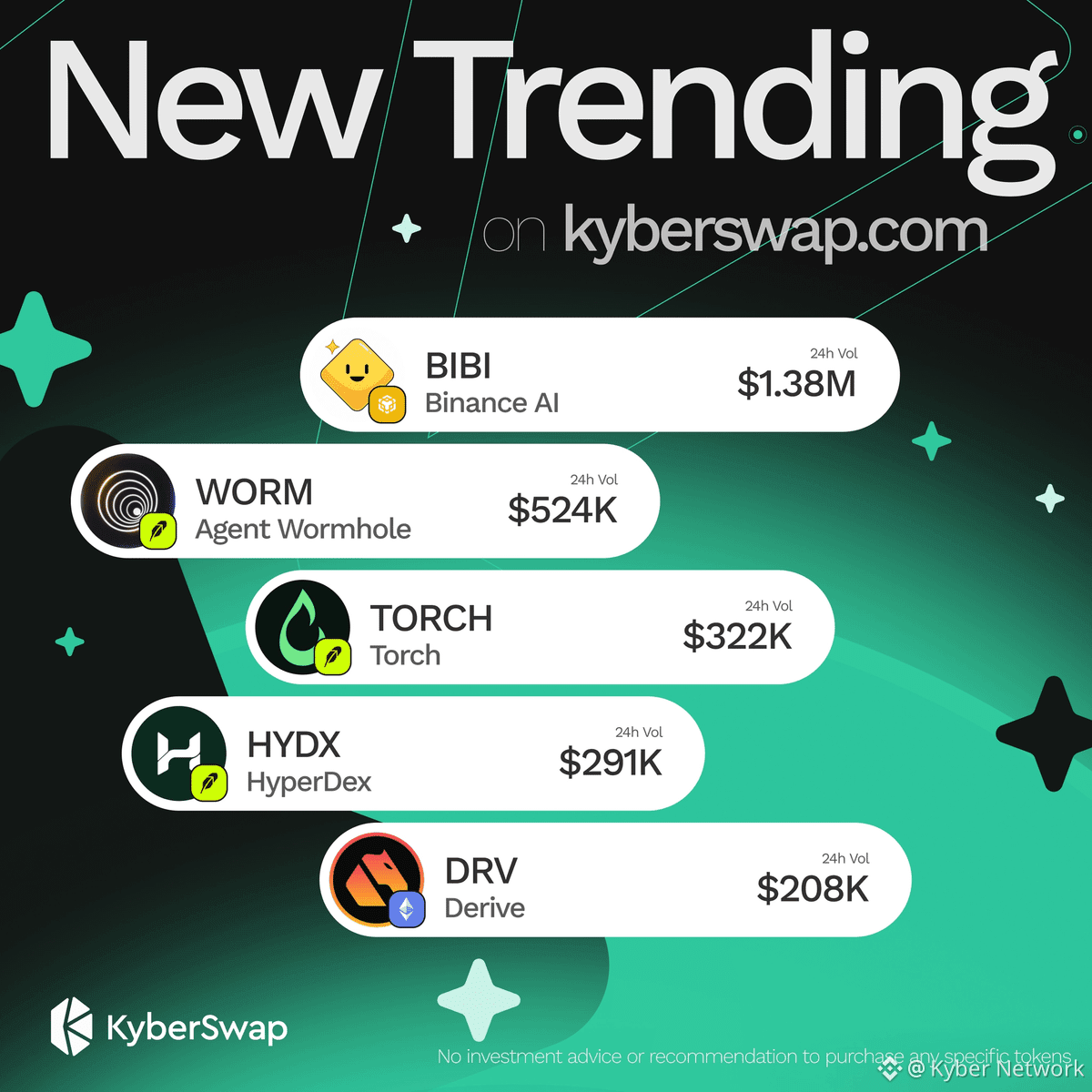
478
The market went quiet, but smart LPs are still cooking hard.
Here are 5 low volatility pools worth exploring on KyberEarn:
• USDT/USDC https://kyberswap.com/pools/bnb/uniswap-v4/0xf8c7b3c122f31aec155c6beb0c1c78a5e74208358a840cadfbc6129b59391850
• DAI/USDC https://kyberswap.com/pools/bnb/uniswapv3/0x2431459f3d248ec340db22680c00f31c03ec0982
• USDe/USDC https://kyberswap.com/pools/ethereum/uniswap-v4/0x56fc29b86900aa0afa6e20b020429bffba1105cfb45070492c67529b46eb48c1
• USDC/USDT https://kyberswap.com/pools/base/uniswapv3/0xd56da2b74ba826f19015e6b7dd9dae1903e85da1
• WBTC/CBBTC https://kyberswap.com/pools/arbitrum/uniswap-v4/0xa7b7064a428fa4391a7efb7054cde38bcf0967348fe403e04de9c98811de327f
👉 Explore more opportunities: https://kyberswap.com/earn/pools?tag=low_volatility
The market went quiet, but smart LPs are still cooking hard.
Here are 5 low volatility pools worth exploring on KyberEarn:
• USDT/USDC https://kyberswap.com/pools/bnb/uniswap-v4/0xf8c7b3c122f31aec155c6beb0c1c78a5e74208358a840cadfbc6129b59391850
• DAI/USDC https://kyberswap.com/pools/bnb/uniswapv3/0x2431459f3d248ec340db22680c00f31c03ec0982
• USDe/USDC https://kyberswap.com/pools/ethereum/uniswap-v4/0x56fc29b86900aa0afa6e20b020429bffba1105cfb45070492c67529b46eb48c1
• USDC/USDT https://kyberswap.com/pools/base/uniswapv3/0xd56da2b74ba826f19015e6b7dd9dae1903e85da1
• WBTC/CBBTC https://kyberswap.com/pools/arbitrum/uniswap-v4/0xa7b7064a428fa4391a7efb7054cde38bcf0967348fe403e04de9c98811de327f
👉 Explore more opportunities: https://kyberswap.com/earn/pools?tag=low_volatility
Here are 5 low volatility pools worth exploring on KyberEarn:
• USDT/USDC https://kyberswap.com/pools/bnb/uniswap-v4/0xf8c7b3c122f31aec155c6beb0c1c78a5e74208358a840cadfbc6129b59391850
• DAI/USDC https://kyberswap.com/pools/bnb/uniswapv3/0x2431459f3d248ec340db22680c00f31c03ec0982
• USDe/USDC https://kyberswap.com/pools/ethereum/uniswap-v4/0x56fc29b86900aa0afa6e20b020429bffba1105cfb45070492c67529b46eb48c1
• USDC/USDT https://kyberswap.com/pools/base/uniswapv3/0xd56da2b74ba826f19015e6b7dd9dae1903e85da1
• WBTC/CBBTC https://kyberswap.com/pools/arbitrum/uniswap-v4/0xa7b7064a428fa4391a7efb7054cde38bcf0967348fe403e04de9c98811de327f
👉 Explore more opportunities: https://kyberswap.com/earn/pools?tag=low_volatility
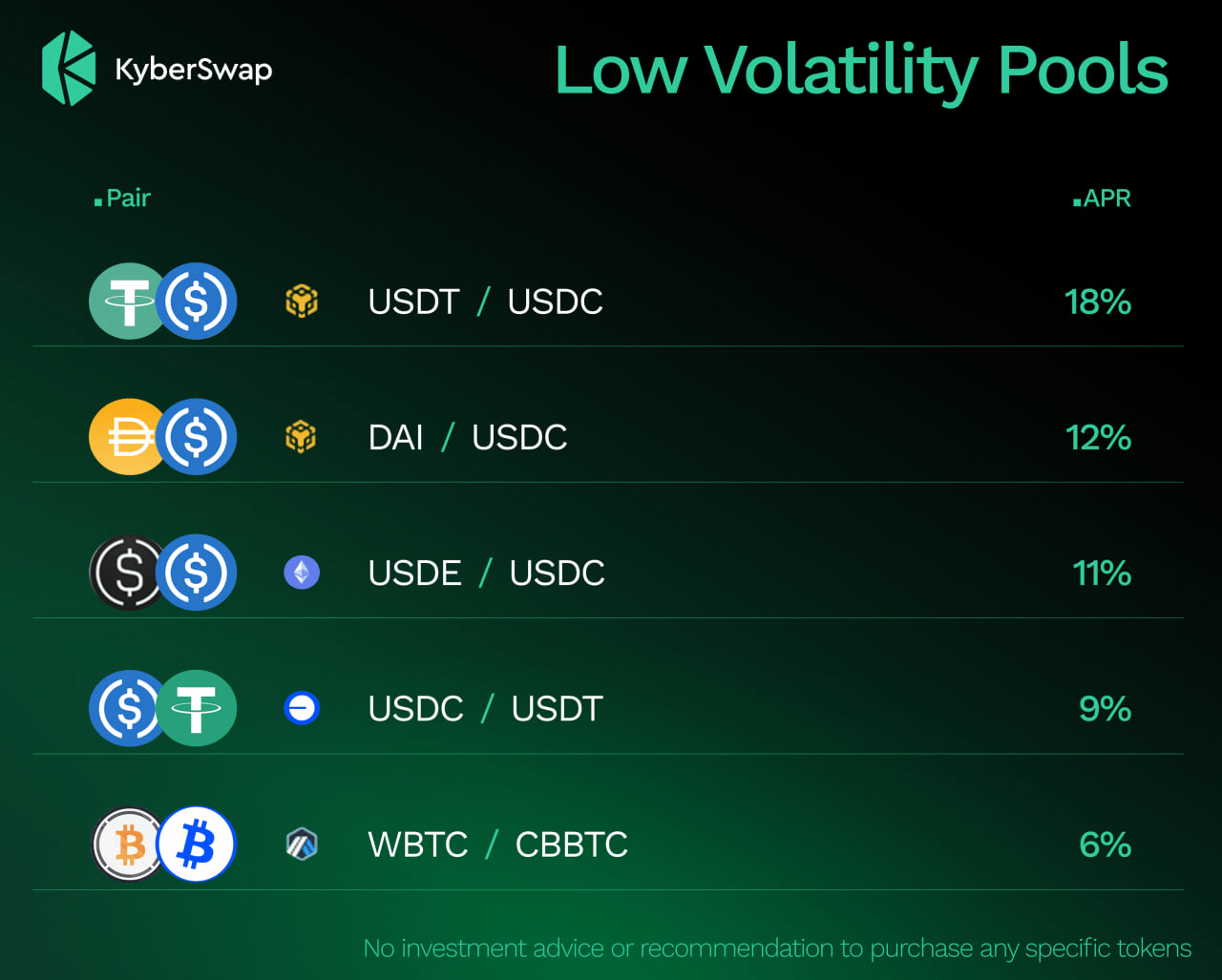
253
Article
Best Free DEX Aggregator APIs for EVM Builders in 2026Adding swap functionality to an EVM app can look simple at first. But once you need to support more tokens, liquidity sources, or networks, maintaining separate DEX integrations can quickly become a bigger engineering task than expected.
A DEX aggregator API can simplify that process by connecting your app to multiple liquidity sources through one integration. Instead of building and maintaining routing logic for every DEX yourself, you can rely on an aggregator to search available routes and return the transaction data needed for execution.
For builders, the next question is usually which DEX aggregator API is the best fit for the product being built. Cost matters, especially when looking for a free API, but it is only one part of the decision. Chain coverage, routing quality, rate limits, integration requirements, liquidity access and the costs passed to end users all matter as well.
This guide compares the leading options for EVM builders in 2026 and looks at what “free” actually means once an integration moves from testing into real user activity.
What Is a DEX Aggregator API?
A DEX aggregator API lets a wallet, dApp, trading terminal, or other Web3 product find and execute swaps across multiple decentralized exchanges through one integration.
The application provides information such as the token pair and trade amount, and the aggregator searches available liquidity to find a suitable route. It then returns the data needed to prepare and execute the swap.
KyberSwap Aggregator, for example, can split trades across multiple liquidity sources when that produces a better route. Its API also separates route discovery from transaction building, giving developers control over when the route is requested and when the final transaction is prepared.
What Does “Free DEX Aggregator API” Actually Mean?
A free API does not necessarily mean every trade executed through it is free.
There are several costs builders should separate when evaluating an aggregator.
API access cost is what the developer pays to access the API itself.
Provider fees are additional fees the aggregator may apply when a swap is executed.
Network gas is the blockchain cost required to execute the transaction.
Liquidity provider fees come from the pools or liquidity sources used by the route.
Integrator fees are optional fees an application may add to monetize its own swap flow.
This distinction is important because two APIs can both be described as free to access while producing different costs once users begin trading.
What Makes a Free DEX Aggregator API Actually Good?
The best free API is not necessarily the one with the lowest visible price. It is the one that keeps costs low without giving up the things users actually care about when they trade.
For EVM builders, five areas matter most.
A provider only needs to be weak in one of these areas to create friction later.
For example, a completely free API that performs poorly on the token pairs your users trade may create worse economics than a paid alternative. Likewise, an API with strong routing but limited network coverage can become expensive from an engineering perspective if the team eventually has to add another routing system for new chains.
That is why “best” should always mean best fit for the application, not simply the provider with the lowest starting price.
Why Should Builders Look Beyond the API Subscription?
The cost of an aggregator becomes more important after the integration is live.
Suppose two APIs are both free to start. One adds an additional fee every time a user swaps, while the other does not. For a small test app, the difference may barely matter. For a wallet or trading product processing substantial volume, that fee is repeated across every transaction.
This is why builders should estimate costs based on expected trading activity rather than only development access.
A useful question is:
If this product processes ten times more trading volume next year, which costs also increase ten times?
Network gas is unavoidable because the blockchain still has to execute the transaction. Liquidity pool fees may also apply depending on the route.
An additional aggregator fee is different because it adds another cost layer on top of those existing trading costs.
KyberSwap is relevant here because the Aggregator API is free to integrate and KyberSwap has a 0% swap fee. Normal network gas and liquidity source fees can still apply.
Some other aggregator APIs use paid access plans, infrastructure fees, or transaction fees as part of their business model. Builders should check these separately rather than assuming “free API” means “no additional cost when users trade.”
Why Does Routing Quality Matter for a Free API?
Saving money on API access is not useful if users receive weaker execution.
Liquidity on EVM networks is fragmented across decentralized exchanges, different pool designs, and other liquidity sources. The strongest route for a $500 trade may be different from the strongest route for a $50,000 trade.
A useful aggregator therefore needs to do more than expose a swap endpoint. It needs to search enough liquidity to find competitive routes for the actual markets your product serves.
For builders, this creates a simple testing rule:
Do not judge an aggregator only by its pricing page. Test the trades your users are actually likely to make.
Use realistic token pairs, networks, and transaction sizes. Compare the expected amount received and the total transaction cost under normal conditions and during more volatile periods.
This matters especially for wallets and trading interfaces where the user experiences the final execution result, not the cost of the API behind it.
KyberSwap Aggregator searches fragmented liquidity across multiple sources and can split a trade when using more than one source produces a stronger route. That makes routing quality part of the value proposition rather than treating “free” as the only reason to integrate.
Why Does EVM Coverage Matter When Choosing an Aggregator?
An app rarely knows exactly where its users will be trading a year from now.
A product may start on Base because that is where its current users are active, then later expand to Ethereum, BNB Chain, Arbitrum, Robinhood Chain, Arc, or another EVM ecosystem.
If the chosen aggregator does not support the new network, the development team may need to add another provider or maintain a second routing layer.
That creates engineering cost even if the original API was free.
Builders should therefore ask:
Does this API support only the chain I need today, or can it also support the networks likely to appear on the product roadmap?
The total number of supported chains is less important than whether the right chains are supported.
KyberSwap Aggregator supports multiple established and newer EVM networks, making it relevant for products that expect their swap functionality to expand alongside their network coverage.
The detailed integration requirements and latest supported network list belong in the KyberSwap specific integration guide. For the purpose of choosing a free aggregator, the important point is that network coverage should be treated as a long term infrastructure decision, not just a launch requirement.
Can a Free DEX Aggregator API Be Used in Production?
Free does not automatically mean hobby grade.
What matters is whether the provider offers a realistic path from initial testing to production traffic.
A developer may make only a few requests while building an MVP. A production wallet can generate many more because users continuously change trade amounts, refresh quotes, switch pairs, and sometimes never execute the final transaction.
Builders should therefore evaluate:
How much traffic can I use during development?
What happens when my traffic increases?
Is there a clear path to higher capacity?
Will scaling the API force me into a completely different integration or pricing model?
These questions are easy to ignore when a product is small, but they become important once the swap interface has active users.
KyberSwap provides public Aggregator access and a separate path for integrations that require greater throughput. Builders evaluating it for production should estimate expected quote traffic rather than looking only at the number of completed transactions.
The implementation details belong in the dedicated KyberSwap Aggregator API guide, while the decision principle is broader: a good free API should have a credible path from testing to production.
How Should EVM Builders Test a DEX Aggregator API Before Choosing One?
The strongest way to choose an aggregator is to test it against the product you are actually building.
Start with the networks and token pairs expected to generate most of the application's activity. Then test several realistic trade sizes rather than one convenient example.
A wallet focused on stablecoin swaps should benchmark stablecoin routes. A trading app serving memecoin users should test less liquid pairs and volatile conditions. A product expecting larger trades should check whether routing quality changes as transaction size increases.
Then look beyond the quote itself.
Consider how much the user ultimately receives after relevant costs, whether routes remain usable during volatile periods, whether the required chains are supported, and whether the access model fits expected production traffic.
The result should answer a much more useful question than “Is this API free?”
It should tell you:
Will this API still make sense when real users start trading through my product?
Where Does KyberSwap Fit Among Free DEX Aggregator APIs?
KyberSwap is a strong option for EVM builders whose priority is keeping the aggregation layer lightweight from a cost perspective without giving up broad liquidity routing.
Builders can integrate the Aggregator API without an upfront paid API subscription, while KyberSwap has a 0% swap fee. The Aggregator searches across multiple liquidity sources, supports multiple EVM networks, and provides a path for integrations that need more production capacity.
That combination is particularly relevant for products that expect swap volume to grow.
A provider fee that looks small on individual transactions can compound with volume. A routing limitation that is barely noticeable during development can become visible once thousands of users are trading. And limited chain support can eventually create another integration project for the development team.
KyberSwap's value in the free API category is therefore not simply that API access costs nothing. It is the combination of free integration, 0% swap fee, multi network EVM coverage, and aggregated liquidity routing.
What Is the Best Free DEX Aggregator API for EVM Builders?
The best free DEX aggregator API is the one that remains useful after the product moves beyond its first test swap.
For an EVM builder, that means looking for low API cost, low additional trading cost, competitive routing, support for the right networks, and a realistic path to production scale.
KyberSwap is a strong fit when free integration and a 0% swap fee are priorities, particularly for products that also need aggregated liquidity across multiple EVM ecosystems.
The final decision should still come from real testing. Run the pairs, trade sizes, networks, and traffic patterns your users are likely to generate.
A free API is valuable because it lowers the barrier to building. The best one is the API that continues to create value after users arrive.
Frequently Asked Questions
Does a Free DEX Aggregator API Mean Swaps Are Free?
No. Free API access does not remove blockchain gas or fees charged by underlying liquidity pools. Some providers also apply their own fees when swaps execute, so API subscription cost and trading cost should be evaluated separately.
Which DEX Aggregator API Is Free to Integrate?
KyberSwap Aggregator API can be integrated without an upfront paid API subscription. Other providers may offer free tiers, paid subscriptions, or infrastructure fee models, so builders should check both API access cost and fees that apply when users trade.
Can a dApp Add Its Own Fee to Aggregated Swaps?
Yes. KyberSwap supports configurable integrator fees through the Aggregator API, allowing an integrating application to specify fee collection as part of its swap flow. Other providers also provide monetization mechanisms for integrators.
Best Free DEX Aggregator APIs for EVM Builders in 2026
Adding swap functionality to an EVM app can look simple at first. But once you need to support more tokens, liquidity sources, or networks, maintaining separate DEX integrations can quickly become a bigger engineering task than expected.
A DEX aggregator API can simplify that process by connecting your app to multiple liquidity sources through one integration. Instead of building and maintaining routing logic for every DEX yourself, you can rely on an aggregator to search available routes and return the transaction data needed for execution.
For builders, the next question is usually which DEX aggregator API is the best fit for the product being built. Cost matters, especially when looking for a free API, but it is only one part of the decision. Chain coverage, routing quality, rate limits, integration requirements, liquidity access and the costs passed to end users all matter as well.
This guide compares the leading options for EVM builders in 2026 and looks at what “free” actually means once an integration moves from testing into real user activity.
What Is a DEX Aggregator API?
A DEX aggregator API lets a wallet, dApp, trading terminal, or other Web3 product find and execute swaps across multiple decentralized exchanges through one integration.
The application provides information such as the token pair and trade amount, and the aggregator searches available liquidity to find a suitable route. It then returns the data needed to prepare and execute the swap.
KyberSwap Aggregator, for example, can split trades across multiple liquidity sources when that produces a better route. Its API also separates route discovery from transaction building, giving developers control over when the route is requested and when the final transaction is prepared.
What Does “Free DEX Aggregator API” Actually Mean?
A free API does not necessarily mean every trade executed through it is free.
There are several costs builders should separate when evaluating an aggregator.
API access cost is what the developer pays to access the API itself.
Provider fees are additional fees the aggregator may apply when a swap is executed.
Network gas is the blockchain cost required to execute the transaction.
Liquidity provider fees come from the pools or liquidity sources used by the route.
Integrator fees are optional fees an application may add to monetize its own swap flow.
This distinction is important because two APIs can both be described as free to access while producing different costs once users begin trading.
What Makes a Free DEX Aggregator API Actually Good?
The best free API is not necessarily the one with the lowest visible price. It is the one that keeps costs low without giving up the things users actually care about when they trade.
For EVM builders, five areas matter most.
A provider only needs to be weak in one of these areas to create friction later.
For example, a completely free API that performs poorly on the token pairs your users trade may create worse economics than a paid alternative. Likewise, an API with strong routing but limited network coverage can become expensive from an engineering perspective if the team eventually has to add another routing system for new chains.
That is why “best” should always mean best fit for the application, not simply the provider with the lowest starting price.
Why Should Builders Look Beyond the API Subscription?
The cost of an aggregator becomes more important after the integration is live.
Suppose two APIs are both free to start. One adds an additional fee every time a user swaps, while the other does not. For a small test app, the difference may barely matter. For a wallet or trading product processing substantial volume, that fee is repeated across every transaction.
This is why builders should estimate costs based on expected trading activity rather than only development access.
A useful question is:
If this product processes ten times more trading volume next year, which costs also increase ten times?
Network gas is unavoidable because the blockchain still has to execute the transaction. Liquidity pool fees may also apply depending on the route.
An additional aggregator fee is different because it adds another cost layer on top of those existing trading costs.
KyberSwap is relevant here because the Aggregator API is free to integrate and KyberSwap has a 0% swap fee. Normal network gas and liquidity source fees can still apply.
Some other aggregator APIs use paid access plans, infrastructure fees, or transaction fees as part of their business model. Builders should check these separately rather than assuming “free API” means “no additional cost when users trade.”
Why Does Routing Quality Matter for a Free API?
Saving money on API access is not useful if users receive weaker execution.
Liquidity on EVM networks is fragmented across decentralized exchanges, different pool designs, and other liquidity sources. The strongest route for a $500 trade may be different from the strongest route for a $50,000 trade.
A useful aggregator therefore needs to do more than expose a swap endpoint. It needs to search enough liquidity to find competitive routes for the actual markets your product serves.
For builders, this creates a simple testing rule:
Do not judge an aggregator only by its pricing page. Test the trades your users are actually likely to make.
Use realistic token pairs, networks, and transaction sizes. Compare the expected amount received and the total transaction cost under normal conditions and during more volatile periods.
This matters especially for wallets and trading interfaces where the user experiences the final execution result, not the cost of the API behind it.
KyberSwap Aggregator searches fragmented liquidity across multiple sources and can split a trade when using more than one source produces a stronger route. That makes routing quality part of the value proposition rather than treating “free” as the only reason to integrate.
Why Does EVM Coverage Matter When Choosing an Aggregator?
An app rarely knows exactly where its users will be trading a year from now.
A product may start on Base because that is where its current users are active, then later expand to Ethereum, BNB Chain, Arbitrum, Robinhood Chain, Arc, or another EVM ecosystem.
If the chosen aggregator does not support the new network, the development team may need to add another provider or maintain a second routing layer.
That creates engineering cost even if the original API was free.
Builders should therefore ask:
Does this API support only the chain I need today, or can it also support the networks likely to appear on the product roadmap?
The total number of supported chains is less important than whether the right chains are supported.
KyberSwap Aggregator supports multiple established and newer EVM networks, making it relevant for products that expect their swap functionality to expand alongside their network coverage.
The detailed integration requirements and latest supported network list belong in the KyberSwap specific integration guide. For the purpose of choosing a free aggregator, the important point is that network coverage should be treated as a long term infrastructure decision, not just a launch requirement.
Can a Free DEX Aggregator API Be Used in Production?
Free does not automatically mean hobby grade.
What matters is whether the provider offers a realistic path from initial testing to production traffic.
A developer may make only a few requests while building an MVP. A production wallet can generate many more because users continuously change trade amounts, refresh quotes, switch pairs, and sometimes never execute the final transaction.
Builders should therefore evaluate:
How much traffic can I use during development?
What happens when my traffic increases?
Is there a clear path to higher capacity?
Will scaling the API force me into a completely different integration or pricing model?
These questions are easy to ignore when a product is small, but they become important once the swap interface has active users.
KyberSwap provides public Aggregator access and a separate path for integrations that require greater throughput. Builders evaluating it for production should estimate expected quote traffic rather than looking only at the number of completed transactions.
The implementation details belong in the dedicated KyberSwap Aggregator API guide, while the decision principle is broader: a good free API should have a credible path from testing to production.
How Should EVM Builders Test a DEX Aggregator API Before Choosing One?
The strongest way to choose an aggregator is to test it against the product you are actually building.
Start with the networks and token pairs expected to generate most of the application's activity. Then test several realistic trade sizes rather than one convenient example.
A wallet focused on stablecoin swaps should benchmark stablecoin routes. A trading app serving memecoin users should test less liquid pairs and volatile conditions. A product expecting larger trades should check whether routing quality changes as transaction size increases.
Then look beyond the quote itself.
Consider how much the user ultimately receives after relevant costs, whether routes remain usable during volatile periods, whether the required chains are supported, and whether the access model fits expected production traffic.
The result should answer a much more useful question than “Is this API free?”
It should tell you:
Will this API still make sense when real users start trading through my product?
Where Does KyberSwap Fit Among Free DEX Aggregator APIs?
KyberSwap is a strong option for EVM builders whose priority is keeping the aggregation layer lightweight from a cost perspective without giving up broad liquidity routing.
Builders can integrate the Aggregator API without an upfront paid API subscription, while KyberSwap has a 0% swap fee. The Aggregator searches across multiple liquidity sources, supports multiple EVM networks, and provides a path for integrations that need more production capacity.
That combination is particularly relevant for products that expect swap volume to grow.
A provider fee that looks small on individual transactions can compound with volume. A routing limitation that is barely noticeable during development can become visible once thousands of users are trading. And limited chain support can eventually create another integration project for the development team.
KyberSwap's value in the free API category is therefore not simply that API access costs nothing. It is the combination of free integration, 0% swap fee, multi network EVM coverage, and aggregated liquidity routing.
What Is the Best Free DEX Aggregator API for EVM Builders?
The best free DEX aggregator API is the one that remains useful after the product moves beyond its first test swap.
For an EVM builder, that means looking for low API cost, low additional trading cost, competitive routing, support for the right networks, and a realistic path to production scale.
KyberSwap is a strong fit when free integration and a 0% swap fee are priorities, particularly for products that also need aggregated liquidity across multiple EVM ecosystems.
The final decision should still come from real testing. Run the pairs, trade sizes, networks, and traffic patterns your users are likely to generate.
A free API is valuable because it lowers the barrier to building. The best one is the API that continues to create value after users arrive.
Frequently Asked Questions
Does a Free DEX Aggregator API Mean Swaps Are Free?
No. Free API access does not remove blockchain gas or fees charged by underlying liquidity pools. Some providers also apply their own fees when swaps execute, so API subscription cost and trading cost should be evaluated separately.
Which DEX Aggregator API Is Free to Integrate?
KyberSwap Aggregator API can be integrated without an upfront paid API subscription. Other providers may offer free tiers, paid subscriptions, or infrastructure fee models, so builders should check both API access cost and fees that apply when users trade.
Can a dApp Add Its Own Fee to Aggregated Swaps?
Yes. KyberSwap supports configurable integrator fees through the Aggregator API, allowing an integrating application to specify fee collection as part of its swap flow. Other providers also provide monetization mechanisms for integrators.
A DEX aggregator API can simplify that process by connecting your app to multiple liquidity sources through one integration. Instead of building and maintaining routing logic for every DEX yourself, you can rely on an aggregator to search available routes and return the transaction data needed for execution.
For builders, the next question is usually which DEX aggregator API is the best fit for the product being built. Cost matters, especially when looking for a free API, but it is only one part of the decision. Chain coverage, routing quality, rate limits, integration requirements, liquidity access and the costs passed to end users all matter as well.
This guide compares the leading options for EVM builders in 2026 and looks at what “free” actually means once an integration moves from testing into real user activity.
What Is a DEX Aggregator API?
A DEX aggregator API lets a wallet, dApp, trading terminal, or other Web3 product find and execute swaps across multiple decentralized exchanges through one integration.
The application provides information such as the token pair and trade amount, and the aggregator searches available liquidity to find a suitable route. It then returns the data needed to prepare and execute the swap.
KyberSwap Aggregator, for example, can split trades across multiple liquidity sources when that produces a better route. Its API also separates route discovery from transaction building, giving developers control over when the route is requested and when the final transaction is prepared.
What Does “Free DEX Aggregator API” Actually Mean?
A free API does not necessarily mean every trade executed through it is free.
There are several costs builders should separate when evaluating an aggregator.
API access cost is what the developer pays to access the API itself.
Provider fees are additional fees the aggregator may apply when a swap is executed.
Network gas is the blockchain cost required to execute the transaction.
Liquidity provider fees come from the pools or liquidity sources used by the route.
Integrator fees are optional fees an application may add to monetize its own swap flow.
This distinction is important because two APIs can both be described as free to access while producing different costs once users begin trading.
What Makes a Free DEX Aggregator API Actually Good?
The best free API is not necessarily the one with the lowest visible price. It is the one that keeps costs low without giving up the things users actually care about when they trade.
For EVM builders, five areas matter most.
A provider only needs to be weak in one of these areas to create friction later.
For example, a completely free API that performs poorly on the token pairs your users trade may create worse economics than a paid alternative. Likewise, an API with strong routing but limited network coverage can become expensive from an engineering perspective if the team eventually has to add another routing system for new chains.
That is why “best” should always mean best fit for the application, not simply the provider with the lowest starting price.
Why Should Builders Look Beyond the API Subscription?
The cost of an aggregator becomes more important after the integration is live.
Suppose two APIs are both free to start. One adds an additional fee every time a user swaps, while the other does not. For a small test app, the difference may barely matter. For a wallet or trading product processing substantial volume, that fee is repeated across every transaction.
This is why builders should estimate costs based on expected trading activity rather than only development access.
A useful question is:
If this product processes ten times more trading volume next year, which costs also increase ten times?
Network gas is unavoidable because the blockchain still has to execute the transaction. Liquidity pool fees may also apply depending on the route.
An additional aggregator fee is different because it adds another cost layer on top of those existing trading costs.
KyberSwap is relevant here because the Aggregator API is free to integrate and KyberSwap has a 0% swap fee. Normal network gas and liquidity source fees can still apply.
Some other aggregator APIs use paid access plans, infrastructure fees, or transaction fees as part of their business model. Builders should check these separately rather than assuming “free API” means “no additional cost when users trade.”
Why Does Routing Quality Matter for a Free API?
Saving money on API access is not useful if users receive weaker execution.
Liquidity on EVM networks is fragmented across decentralized exchanges, different pool designs, and other liquidity sources. The strongest route for a $500 trade may be different from the strongest route for a $50,000 trade.
A useful aggregator therefore needs to do more than expose a swap endpoint. It needs to search enough liquidity to find competitive routes for the actual markets your product serves.
For builders, this creates a simple testing rule:
Do not judge an aggregator only by its pricing page. Test the trades your users are actually likely to make.
Use realistic token pairs, networks, and transaction sizes. Compare the expected amount received and the total transaction cost under normal conditions and during more volatile periods.
This matters especially for wallets and trading interfaces where the user experiences the final execution result, not the cost of the API behind it.
KyberSwap Aggregator searches fragmented liquidity across multiple sources and can split a trade when using more than one source produces a stronger route. That makes routing quality part of the value proposition rather than treating “free” as the only reason to integrate.
Why Does EVM Coverage Matter When Choosing an Aggregator?
An app rarely knows exactly where its users will be trading a year from now.
A product may start on Base because that is where its current users are active, then later expand to Ethereum, BNB Chain, Arbitrum, Robinhood Chain, Arc, or another EVM ecosystem.
If the chosen aggregator does not support the new network, the development team may need to add another provider or maintain a second routing layer.
That creates engineering cost even if the original API was free.
Builders should therefore ask:
Does this API support only the chain I need today, or can it also support the networks likely to appear on the product roadmap?
The total number of supported chains is less important than whether the right chains are supported.
KyberSwap Aggregator supports multiple established and newer EVM networks, making it relevant for products that expect their swap functionality to expand alongside their network coverage.
The detailed integration requirements and latest supported network list belong in the KyberSwap specific integration guide. For the purpose of choosing a free aggregator, the important point is that network coverage should be treated as a long term infrastructure decision, not just a launch requirement.
Can a Free DEX Aggregator API Be Used in Production?
Free does not automatically mean hobby grade.
What matters is whether the provider offers a realistic path from initial testing to production traffic.
A developer may make only a few requests while building an MVP. A production wallet can generate many more because users continuously change trade amounts, refresh quotes, switch pairs, and sometimes never execute the final transaction.
Builders should therefore evaluate:
How much traffic can I use during development?
What happens when my traffic increases?
Is there a clear path to higher capacity?
Will scaling the API force me into a completely different integration or pricing model?
These questions are easy to ignore when a product is small, but they become important once the swap interface has active users.
KyberSwap provides public Aggregator access and a separate path for integrations that require greater throughput. Builders evaluating it for production should estimate expected quote traffic rather than looking only at the number of completed transactions.
The implementation details belong in the dedicated KyberSwap Aggregator API guide, while the decision principle is broader: a good free API should have a credible path from testing to production.
How Should EVM Builders Test a DEX Aggregator API Before Choosing One?
The strongest way to choose an aggregator is to test it against the product you are actually building.
Start with the networks and token pairs expected to generate most of the application's activity. Then test several realistic trade sizes rather than one convenient example.
A wallet focused on stablecoin swaps should benchmark stablecoin routes. A trading app serving memecoin users should test less liquid pairs and volatile conditions. A product expecting larger trades should check whether routing quality changes as transaction size increases.
Then look beyond the quote itself.
Consider how much the user ultimately receives after relevant costs, whether routes remain usable during volatile periods, whether the required chains are supported, and whether the access model fits expected production traffic.
The result should answer a much more useful question than “Is this API free?”
It should tell you:
Will this API still make sense when real users start trading through my product?
Where Does KyberSwap Fit Among Free DEX Aggregator APIs?
KyberSwap is a strong option for EVM builders whose priority is keeping the aggregation layer lightweight from a cost perspective without giving up broad liquidity routing.
Builders can integrate the Aggregator API without an upfront paid API subscription, while KyberSwap has a 0% swap fee. The Aggregator searches across multiple liquidity sources, supports multiple EVM networks, and provides a path for integrations that need more production capacity.
That combination is particularly relevant for products that expect swap volume to grow.
A provider fee that looks small on individual transactions can compound with volume. A routing limitation that is barely noticeable during development can become visible once thousands of users are trading. And limited chain support can eventually create another integration project for the development team.
KyberSwap's value in the free API category is therefore not simply that API access costs nothing. It is the combination of free integration, 0% swap fee, multi network EVM coverage, and aggregated liquidity routing.
What Is the Best Free DEX Aggregator API for EVM Builders?
The best free DEX aggregator API is the one that remains useful after the product moves beyond its first test swap.
For an EVM builder, that means looking for low API cost, low additional trading cost, competitive routing, support for the right networks, and a realistic path to production scale.
KyberSwap is a strong fit when free integration and a 0% swap fee are priorities, particularly for products that also need aggregated liquidity across multiple EVM ecosystems.
The final decision should still come from real testing. Run the pairs, trade sizes, networks, and traffic patterns your users are likely to generate.
A free API is valuable because it lowers the barrier to building. The best one is the API that continues to create value after users arrive.
Frequently Asked Questions
Does a Free DEX Aggregator API Mean Swaps Are Free?
No. Free API access does not remove blockchain gas or fees charged by underlying liquidity pools. Some providers also apply their own fees when swaps execute, so API subscription cost and trading cost should be evaluated separately.
Which DEX Aggregator API Is Free to Integrate?
KyberSwap Aggregator API can be integrated without an upfront paid API subscription. Other providers may offer free tiers, paid subscriptions, or infrastructure fee models, so builders should check both API access cost and fees that apply when users trade.
Can a dApp Add Its Own Fee to Aggregated Swaps?
Yes. KyberSwap supports configurable integrator fees through the Aggregator API, allowing an integrating application to specify fee collection as part of its swap flow. Other providers also provide monetization mechanisms for integrators.
195
Article
KyberSwap Aggregator API for EVM Builders: Integration, Cost and Chain SupportAdding swaps to an EVM product is rarely just about getting a quote from token A to token B.
Once an application moves beyond a simple prototype, builders also need to think about how routes are found, how transactions are prepared, what happens when traffic grows, which networks can be supported, and what costs are eventually passed to users.
A DEX aggregator API can remove part of that infrastructure burden by connecting an application to multiple liquidity sources through one integration. But before choosing one, builders usually need clear answers to three questions:
How difficult is it to integrate? What does it cost? Which networks can it support?
This guide looks at KyberSwap Aggregator API through those three questions, then covers a few additional factors that matter before using it in production.
How Does KyberSwap Aggregator API Integration Work?
For a builder, the first concern is usually not how many features an API has. It is how much engineering work sits between the first request and a working swap inside the product.
KyberSwap Aggregator API is designed to handle liquidity discovery and routing while leaving the application in control of its own interface and execution flow.
Instead of integrating individual DEXs and building separate routing logic for each venue, the application can send a trade request to KyberSwap. The Aggregator searches available liquidity and returns a route that can then be used to construct the swap transaction.
What Does the Basic Integration Flow Look Like?
KyberSwap separates route discovery from transaction building.
When a user selects a token pair and trade amount, the application first requests a route. The response includes information such as the expected output, route details, gas estimate, and the router contract that will be used for execution.
Once the user is ready to trade, the application sends the selected route back through the build endpoint together with transaction specific parameters such as the sender, recipient, slippage tolerance, and deadline.
KyberSwap then returns the encoded transaction data required for execution.
For the builder, the flow is straightforward:
find the route → build the transaction → let the user execute it onchain
Separating these stages gives the application more control over when routing happens and when the final transaction is prepared. This matters because a route shown to a user can become outdated while they are reviewing the trade or changing the amount.
The result is a relatively simple integration model without forcing the application to give up control over its own trading experience.
What Do Builders Need to Access the API?
Access setup matters because it determines how quickly a team can start testing and how cleanly the integration can scale later.
The current KyberSwap docs direct integrators to the Swap API gateway at:
https://api.kyberswap.com/swap/
Requests to this gateway should include an X-Api-Key header with every request. Builders need to obtain that API key from the KyberSwap team / BD.
The older base URL still works, but it is rate limited, and the docs recommend migrating to the gateway path. So for a new integration, the gateway should be treated as the main route rather than an optional upgrade.
That gives builders a clearer production path from the beginning.
What Happens When Request Volume Grows?
A production trading application may generate far more quote requests than completed swaps.
Users change token amounts, compare pairs, refresh quotes, or leave before submitting a transaction. A wallet or trading terminal can therefore produce substantial API traffic even when the final number of executed trades is much lower.
That is why builders should estimate expected quote traffic, not only expected swap volume.
With KyberSwap, the practical question is not just whether the API can return a working route for one test trade. It is whether the application's traffic pattern fits the expected gateway usage once the product is live.
Since the current docs position the Swap API gateway as the main integration path, teams that expect meaningful production traffic should plan gateway access with KyberSwap early. Relying on the older rate limited base URL is more suitable for legacy usage than for a new production setup.
Should You Use the Aggregator API or the KyberSwap Widget?
Not every team needs direct control over route requests and transaction construction.
If the goal is to add a working swap interface quickly, KyberSwap Widget provides a faster path with less frontend work.
If the product already has its own trading interface or needs control over token selection, routing requests, transaction building, fee logic, or the surrounding user flow, the Aggregator API is the more flexible choice.
The decision comes down to how much of the swap experience the product wants to own.
What Does KyberSwap Aggregator API Cost?
An API can look inexpensive during development but become costly once users begin trading at scale.
For builders, it is useful to separate the cost of accessing the API from the cost of executing a swap.
KyberSwap Public APIs do not require an upfront paid subscription for normal public access. KyberSwap also has a 0% swap fee.
That does not mean every part of the transaction is free.
Network gas comes from the blockchain itself. Liquidity provider fees can come from the pools included in the selected route.
These costs are separate from KyberSwap's own Swap fee.
Can Builders Add Their Own Integrator Fee?
Some products want swaps to be purely a user feature. Others want trading activity to become part of the business model.
KyberSwap Aggregator API allows the integrating application to configure an integrator fee.
Builders can define the fee amount, receiving address, and how the fee is collected as part of the swap flow. If the application does not configure an integrator fee, no such fee is added.
This gives wallets, trading applications, and other Web3 products a way to monetize swap activity while continuing to use KyberSwap for routing and transaction construction.
The integrator fee is separate from the 0% swap fee.
Which EVM Chains Can You Support With KyberSwap Aggregator API?
An application that launches on one network today may need several more later.
A project might start on Base, then expand to Ethereum and Robinhood Chain. A wallet may need Arbitrum or Optimism next. If every expansion requires a completely new swap architecture, the maintenance burden grows alongside the product.
KyberSwap Aggregator is designed to work across supported EVM networks using the same general integration model.
Builders specify the target network in the API request, while the Aggregator searches the liquidity available on that chain.
KyberSwap currently supports major EVM ecosystems including Ethereum, Base, BNB Chain, Arbitrum, Optimism, Robinhood Chain, and other supported networks.
The value is not simply the number of networks available.
The larger benefit is that the application can reuse the same general route discovery and transaction building flow as it expands to additional supported chains.
Can One Integration Be Reused Across Multiple EVM Chains?
Yes, as long as the networks are supported by KyberSwap.
Suppose a dApp launches on Base and later adds Ethereum. The application does not need to replace the entire aggregation layer. It can keep the same general API architecture while changing the network and handling the tokens and liquidity available there.
This reduces the amount of routing infrastructure the team needs to rebuild every time the product expands.
Builders should still check the latest supported network list before launch because chain coverage can change as new ecosystems are added.
What Else Should EVM Builders Evaluate?
Integration, cost, and chain support determine whether an API fits the product architecture.
Routing quality determines whether that integration actually creates a good swap experience for users.
A free API is not especially valuable if users consistently receive weak execution.
Liquidity in DeFi is fragmented across DEXs, pools, and other sources. The strongest route for one trade size may not be the strongest route for another.
KyberSwap Aggregator searches across available liquidity rather than forcing the application to choose one venue in advance. It can also split trades across multiple sources when a combined route produces a stronger result.
For users, that means they do not need to manually compare several DEXs before trading.
For builders, the important step is to test the API using the actual token pairs, networks, and trade sizes expected in the product. A large liquidity source count is useful context, but real route testing provides more decision value.
Is KyberSwap Aggregator API a Good Fit for Your EVM App?
KyberSwap Aggregator API is most relevant when the problem goes beyond adding one simple swap.
A builder may need to avoid maintaining multiple DEX integrations, launch without paying for an upfront API subscription, expand across EVM networks, access fragmented liquidity, or create a revenue model around swap volume.
KyberSwap addresses those needs through one Aggregator architecture, a route and build integration flow, public API access, a 0% swap fee, configurable integrator fees, and support across multiple EVM networks.
The final decision should still be tested against the application's real requirements.
Look at the networks the product needs, the pairs users are likely to trade, expected quote traffic, typical trade sizes, and the amount of control the application needs over the swap experience.
The useful question is not simply whether KyberSwap Aggregator API has enough features. It is whether it removes enough routing and integration work from the product while still giving the builder the control, economics, and network coverage the application needs.
Frequently Asked Questions
Is KyberSwap Aggregator API Free to Integrate?
Yes. Builders can access KyberSwap Aggregator API without an upfront paid API subscription. KyberSwap Swap also has a 0% KyberSwap swap fee, while network gas and fees from underlying liquidity sources can still apply.
Does KyberSwap Aggregator API Require an API Key?
Yes. The current docs direct integrators to the Swap API gateway, and requests should include an X-Api-Key header. Builders need to obtain that key from the KyberSwap team / BD.
The older base URL still works, but it is rate limited, and the docs recommend migrating to the gateway path.
Which EVM Networks Does KyberSwap Aggregator API Support?
KyberSwap supports multiple EVM networks, including major ecosystems such as Ethereum, Base, BNB Chain, Arbitrum, Optimism and Robinhood Chain. Builders should check the latest supported network list before launch because coverage can expand over time.
Can I Use One KyberSwap API Integration Across Multiple EVM Chains?
Yes. The same general route discovery and transaction building flow can be reused across supported EVM networks, which helps reduce the need to maintain a separate swap architecture for each chain.
KyberSwap Aggregator API for EVM Builders: Integration, Cost and Chain Support
Adding swaps to an EVM product is rarely just about getting a quote from token A to token B.
Once an application moves beyond a simple prototype, builders also need to think about how routes are found, how transactions are prepared, what happens when traffic grows, which networks can be supported, and what costs are eventually passed to users.
A DEX aggregator API can remove part of that infrastructure burden by connecting an application to multiple liquidity sources through one integration. But before choosing one, builders usually need clear answers to three questions:
How difficult is it to integrate? What does it cost? Which networks can it support?
This guide looks at KyberSwap Aggregator API through those three questions, then covers a few additional factors that matter before using it in production.
How Does KyberSwap Aggregator API Integration Work?
For a builder, the first concern is usually not how many features an API has. It is how much engineering work sits between the first request and a working swap inside the product.
KyberSwap Aggregator API is designed to handle liquidity discovery and routing while leaving the application in control of its own interface and execution flow.
Instead of integrating individual DEXs and building separate routing logic for each venue, the application can send a trade request to KyberSwap. The Aggregator searches available liquidity and returns a route that can then be used to construct the swap transaction.
What Does the Basic Integration Flow Look Like?
KyberSwap separates route discovery from transaction building.
When a user selects a token pair and trade amount, the application first requests a route. The response includes information such as the expected output, route details, gas estimate, and the router contract that will be used for execution.
Once the user is ready to trade, the application sends the selected route back through the build endpoint together with transaction specific parameters such as the sender, recipient, slippage tolerance, and deadline.
KyberSwap then returns the encoded transaction data required for execution.
For the builder, the flow is straightforward:
find the route → build the transaction → let the user execute it onchain
Separating these stages gives the application more control over when routing happens and when the final transaction is prepared. This matters because a route shown to a user can become outdated while they are reviewing the trade or changing the amount.
The result is a relatively simple integration model without forcing the application to give up control over its own trading experience.
What Do Builders Need to Access the API?
Access setup matters because it determines how quickly a team can start testing and how cleanly the integration can scale later.
The current KyberSwap docs direct integrators to the Swap API gateway at:
https://api.kyberswap.com/swap/
Requests to this gateway should include an X-Api-Key header with every request. Builders need to obtain that API key from the KyberSwap team / BD.
The older base URL still works, but it is rate limited, and the docs recommend migrating to the gateway path. So for a new integration, the gateway should be treated as the main route rather than an optional upgrade.
That gives builders a clearer production path from the beginning.
What Happens When Request Volume Grows?
A production trading application may generate far more quote requests than completed swaps.
Users change token amounts, compare pairs, refresh quotes, or leave before submitting a transaction. A wallet or trading terminal can therefore produce substantial API traffic even when the final number of executed trades is much lower.
That is why builders should estimate expected quote traffic, not only expected swap volume.
With KyberSwap, the practical question is not just whether the API can return a working route for one test trade. It is whether the application's traffic pattern fits the expected gateway usage once the product is live.
Since the current docs position the Swap API gateway as the main integration path, teams that expect meaningful production traffic should plan gateway access with KyberSwap early. Relying on the older rate limited base URL is more suitable for legacy usage than for a new production setup.
Should You Use the Aggregator API or the KyberSwap Widget?
Not every team needs direct control over route requests and transaction construction.
If the goal is to add a working swap interface quickly, KyberSwap Widget provides a faster path with less frontend work.
If the product already has its own trading interface or needs control over token selection, routing requests, transaction building, fee logic, or the surrounding user flow, the Aggregator API is the more flexible choice.
The decision comes down to how much of the swap experience the product wants to own.
What Does KyberSwap Aggregator API Cost?
An API can look inexpensive during development but become costly once users begin trading at scale.
For builders, it is useful to separate the cost of accessing the API from the cost of executing a swap.
KyberSwap Public APIs do not require an upfront paid subscription for normal public access. KyberSwap also has a 0% swap fee.
That does not mean every part of the transaction is free.
Network gas comes from the blockchain itself. Liquidity provider fees can come from the pools included in the selected route.
These costs are separate from KyberSwap's own Swap fee.
Can Builders Add Their Own Integrator Fee?
Some products want swaps to be purely a user feature. Others want trading activity to become part of the business model.
KyberSwap Aggregator API allows the integrating application to configure an integrator fee.
Builders can define the fee amount, receiving address, and how the fee is collected as part of the swap flow. If the application does not configure an integrator fee, no such fee is added.
This gives wallets, trading applications, and other Web3 products a way to monetize swap activity while continuing to use KyberSwap for routing and transaction construction.
The integrator fee is separate from the 0% swap fee.
Which EVM Chains Can You Support With KyberSwap Aggregator API?
An application that launches on one network today may need several more later.
A project might start on Base, then expand to Ethereum and Robinhood Chain. A wallet may need Arbitrum or Optimism next. If every expansion requires a completely new swap architecture, the maintenance burden grows alongside the product.
KyberSwap Aggregator is designed to work across supported EVM networks using the same general integration model.
Builders specify the target network in the API request, while the Aggregator searches the liquidity available on that chain.
KyberSwap currently supports major EVM ecosystems including Ethereum, Base, BNB Chain, Arbitrum, Optimism, Robinhood Chain, and other supported networks.
The value is not simply the number of networks available.
The larger benefit is that the application can reuse the same general route discovery and transaction building flow as it expands to additional supported chains.
Can One Integration Be Reused Across Multiple EVM Chains?
Yes, as long as the networks are supported by KyberSwap.
Suppose a dApp launches on Base and later adds Ethereum. The application does not need to replace the entire aggregation layer. It can keep the same general API architecture while changing the network and handling the tokens and liquidity available there.
This reduces the amount of routing infrastructure the team needs to rebuild every time the product expands.
Builders should still check the latest supported network list before launch because chain coverage can change as new ecosystems are added.
What Else Should EVM Builders Evaluate?
Integration, cost, and chain support determine whether an API fits the product architecture.
Routing quality determines whether that integration actually creates a good swap experience for users.
A free API is not especially valuable if users consistently receive weak execution.
Liquidity in DeFi is fragmented across DEXs, pools, and other sources. The strongest route for one trade size may not be the strongest route for another.
KyberSwap Aggregator searches across available liquidity rather than forcing the application to choose one venue in advance. It can also split trades across multiple sources when a combined route produces a stronger result.
For users, that means they do not need to manually compare several DEXs before trading.
For builders, the important step is to test the API using the actual token pairs, networks, and trade sizes expected in the product. A large liquidity source count is useful context, but real route testing provides more decision value.
Is KyberSwap Aggregator API a Good Fit for Your EVM App?
KyberSwap Aggregator API is most relevant when the problem goes beyond adding one simple swap.
A builder may need to avoid maintaining multiple DEX integrations, launch without paying for an upfront API subscription, expand across EVM networks, access fragmented liquidity, or create a revenue model around swap volume.
KyberSwap addresses those needs through one Aggregator architecture, a route and build integration flow, public API access, a 0% swap fee, configurable integrator fees, and support across multiple EVM networks.
The final decision should still be tested against the application's real requirements.
Look at the networks the product needs, the pairs users are likely to trade, expected quote traffic, typical trade sizes, and the amount of control the application needs over the swap experience.
The useful question is not simply whether KyberSwap Aggregator API has enough features. It is whether it removes enough routing and integration work from the product while still giving the builder the control, economics, and network coverage the application needs.
Frequently Asked Questions
Is KyberSwap Aggregator API Free to Integrate?
Yes. Builders can access KyberSwap Aggregator API without an upfront paid API subscription. KyberSwap Swap also has a 0% KyberSwap swap fee, while network gas and fees from underlying liquidity sources can still apply.
Does KyberSwap Aggregator API Require an API Key?
Yes. The current docs direct integrators to the Swap API gateway, and requests should include an X-Api-Key header. Builders need to obtain that key from the KyberSwap team / BD.
The older base URL still works, but it is rate limited, and the docs recommend migrating to the gateway path.
Which EVM Networks Does KyberSwap Aggregator API Support?
KyberSwap supports multiple EVM networks, including major ecosystems such as Ethereum, Base, BNB Chain, Arbitrum, Optimism and Robinhood Chain. Builders should check the latest supported network list before launch because coverage can expand over time.
Can I Use One KyberSwap API Integration Across Multiple EVM Chains?
Yes. The same general route discovery and transaction building flow can be reused across supported EVM networks, which helps reduce the need to maintain a separate swap architecture for each chain.
Once an application moves beyond a simple prototype, builders also need to think about how routes are found, how transactions are prepared, what happens when traffic grows, which networks can be supported, and what costs are eventually passed to users.
A DEX aggregator API can remove part of that infrastructure burden by connecting an application to multiple liquidity sources through one integration. But before choosing one, builders usually need clear answers to three questions:
How difficult is it to integrate? What does it cost? Which networks can it support?
This guide looks at KyberSwap Aggregator API through those three questions, then covers a few additional factors that matter before using it in production.
How Does KyberSwap Aggregator API Integration Work?
For a builder, the first concern is usually not how many features an API has. It is how much engineering work sits between the first request and a working swap inside the product.
KyberSwap Aggregator API is designed to handle liquidity discovery and routing while leaving the application in control of its own interface and execution flow.
Instead of integrating individual DEXs and building separate routing logic for each venue, the application can send a trade request to KyberSwap. The Aggregator searches available liquidity and returns a route that can then be used to construct the swap transaction.
What Does the Basic Integration Flow Look Like?
KyberSwap separates route discovery from transaction building.
When a user selects a token pair and trade amount, the application first requests a route. The response includes information such as the expected output, route details, gas estimate, and the router contract that will be used for execution.
Once the user is ready to trade, the application sends the selected route back through the build endpoint together with transaction specific parameters such as the sender, recipient, slippage tolerance, and deadline.
KyberSwap then returns the encoded transaction data required for execution.
For the builder, the flow is straightforward:
find the route → build the transaction → let the user execute it onchain
Separating these stages gives the application more control over when routing happens and when the final transaction is prepared. This matters because a route shown to a user can become outdated while they are reviewing the trade or changing the amount.
The result is a relatively simple integration model without forcing the application to give up control over its own trading experience.
What Do Builders Need to Access the API?
Access setup matters because it determines how quickly a team can start testing and how cleanly the integration can scale later.
The current KyberSwap docs direct integrators to the Swap API gateway at:
https://api.kyberswap.com/swap/
Requests to this gateway should include an X-Api-Key header with every request. Builders need to obtain that API key from the KyberSwap team / BD.
The older base URL still works, but it is rate limited, and the docs recommend migrating to the gateway path. So for a new integration, the gateway should be treated as the main route rather than an optional upgrade.
That gives builders a clearer production path from the beginning.
What Happens When Request Volume Grows?
A production trading application may generate far more quote requests than completed swaps.
Users change token amounts, compare pairs, refresh quotes, or leave before submitting a transaction. A wallet or trading terminal can therefore produce substantial API traffic even when the final number of executed trades is much lower.
That is why builders should estimate expected quote traffic, not only expected swap volume.
With KyberSwap, the practical question is not just whether the API can return a working route for one test trade. It is whether the application's traffic pattern fits the expected gateway usage once the product is live.
Since the current docs position the Swap API gateway as the main integration path, teams that expect meaningful production traffic should plan gateway access with KyberSwap early. Relying on the older rate limited base URL is more suitable for legacy usage than for a new production setup.
Should You Use the Aggregator API or the KyberSwap Widget?
Not every team needs direct control over route requests and transaction construction.
If the goal is to add a working swap interface quickly, KyberSwap Widget provides a faster path with less frontend work.
If the product already has its own trading interface or needs control over token selection, routing requests, transaction building, fee logic, or the surrounding user flow, the Aggregator API is the more flexible choice.
The decision comes down to how much of the swap experience the product wants to own.
What Does KyberSwap Aggregator API Cost?
An API can look inexpensive during development but become costly once users begin trading at scale.
For builders, it is useful to separate the cost of accessing the API from the cost of executing a swap.
KyberSwap Public APIs do not require an upfront paid subscription for normal public access. KyberSwap also has a 0% swap fee.
That does not mean every part of the transaction is free.
Network gas comes from the blockchain itself. Liquidity provider fees can come from the pools included in the selected route.
These costs are separate from KyberSwap's own Swap fee.
Can Builders Add Their Own Integrator Fee?
Some products want swaps to be purely a user feature. Others want trading activity to become part of the business model.
KyberSwap Aggregator API allows the integrating application to configure an integrator fee.
Builders can define the fee amount, receiving address, and how the fee is collected as part of the swap flow. If the application does not configure an integrator fee, no such fee is added.
This gives wallets, trading applications, and other Web3 products a way to monetize swap activity while continuing to use KyberSwap for routing and transaction construction.
The integrator fee is separate from the 0% swap fee.
Which EVM Chains Can You Support With KyberSwap Aggregator API?
An application that launches on one network today may need several more later.
A project might start on Base, then expand to Ethereum and Robinhood Chain. A wallet may need Arbitrum or Optimism next. If every expansion requires a completely new swap architecture, the maintenance burden grows alongside the product.
KyberSwap Aggregator is designed to work across supported EVM networks using the same general integration model.
Builders specify the target network in the API request, while the Aggregator searches the liquidity available on that chain.
KyberSwap currently supports major EVM ecosystems including Ethereum, Base, BNB Chain, Arbitrum, Optimism, Robinhood Chain, and other supported networks.
The value is not simply the number of networks available.
The larger benefit is that the application can reuse the same general route discovery and transaction building flow as it expands to additional supported chains.
Can One Integration Be Reused Across Multiple EVM Chains?
Yes, as long as the networks are supported by KyberSwap.
Suppose a dApp launches on Base and later adds Ethereum. The application does not need to replace the entire aggregation layer. It can keep the same general API architecture while changing the network and handling the tokens and liquidity available there.
This reduces the amount of routing infrastructure the team needs to rebuild every time the product expands.
Builders should still check the latest supported network list before launch because chain coverage can change as new ecosystems are added.
What Else Should EVM Builders Evaluate?
Integration, cost, and chain support determine whether an API fits the product architecture.
Routing quality determines whether that integration actually creates a good swap experience for users.
A free API is not especially valuable if users consistently receive weak execution.
Liquidity in DeFi is fragmented across DEXs, pools, and other sources. The strongest route for one trade size may not be the strongest route for another.
KyberSwap Aggregator searches across available liquidity rather than forcing the application to choose one venue in advance. It can also split trades across multiple sources when a combined route produces a stronger result.
For users, that means they do not need to manually compare several DEXs before trading.
For builders, the important step is to test the API using the actual token pairs, networks, and trade sizes expected in the product. A large liquidity source count is useful context, but real route testing provides more decision value.
Is KyberSwap Aggregator API a Good Fit for Your EVM App?
KyberSwap Aggregator API is most relevant when the problem goes beyond adding one simple swap.
A builder may need to avoid maintaining multiple DEX integrations, launch without paying for an upfront API subscription, expand across EVM networks, access fragmented liquidity, or create a revenue model around swap volume.
KyberSwap addresses those needs through one Aggregator architecture, a route and build integration flow, public API access, a 0% swap fee, configurable integrator fees, and support across multiple EVM networks.
The final decision should still be tested against the application's real requirements.
Look at the networks the product needs, the pairs users are likely to trade, expected quote traffic, typical trade sizes, and the amount of control the application needs over the swap experience.
The useful question is not simply whether KyberSwap Aggregator API has enough features. It is whether it removes enough routing and integration work from the product while still giving the builder the control, economics, and network coverage the application needs.
Frequently Asked Questions
Is KyberSwap Aggregator API Free to Integrate?
Yes. Builders can access KyberSwap Aggregator API without an upfront paid API subscription. KyberSwap Swap also has a 0% KyberSwap swap fee, while network gas and fees from underlying liquidity sources can still apply.
Does KyberSwap Aggregator API Require an API Key?
Yes. The current docs direct integrators to the Swap API gateway, and requests should include an X-Api-Key header. Builders need to obtain that key from the KyberSwap team / BD.
The older base URL still works, but it is rate limited, and the docs recommend migrating to the gateway path.
Which EVM Networks Does KyberSwap Aggregator API Support?
KyberSwap supports multiple EVM networks, including major ecosystems such as Ethereum, Base, BNB Chain, Arbitrum, Optimism and Robinhood Chain. Builders should check the latest supported network list before launch because coverage can expand over time.
Can I Use One KyberSwap API Integration Across Multiple EVM Chains?
Yes. The same general route discovery and transaction building flow can be reused across supported EVM networks, which helps reduce the need to maintain a separate swap architecture for each chain.
149
Earn 5.5% APY with any of your idle tokens.
I repeat.
Earn 5.5% APY with any of your idle tokens.
Earn 5.5% APY with any of your idle tokens.
I repeat.
Earn 5.5% APY with any of your idle tokens.
I repeat.
Earn 5.5% APY with any of your idle tokens.
2
132
Today's top fee-printing pools on KyberEarn? Mostly Ethereum.
Which one gets your capital? 👀
ZEVIO/USDC https://kyberswap.com/pools/ethereum/uniswap-v4/0x8bb66a21892c26fbfc177422201afdf07b8f6b55af5b47b088a2fb8ab71fa5b1
CLAUS/USDC https://kyberswap.com/pools/ethereum/uniswap-v4/0x60446cf938c80775d2cf640580da230ca80d69de93f4683a23aa1abb7e47e57b
ETH/ZC https://kyberswap.com/pools/ethereum/uniswap-v4/0xca375e569f6424f058c48f84e62de5d64240e2c6fef7662791d209465ed7e0c4
ETH/VIBE https://kyberswap.com/pools/ethereum/uniswap-v4/0xb07d640fd9e2eb9dc81b953c8e4fd006bdfeaf276010fb5418eb763ca15abfb3
WETH/PONS https://kyberswap.com/pools/robinhood/uniswapv3/0x10cc6bd38112cac182db90b6a71d8bb5939526ba
👉 Explore more opportunities: http://kyberswap.com/earn/pools
Today's top fee-printing pools on KyberEarn? Mostly Ethereum.
Which one gets your capital? 👀
ZEVIO/USDC https://kyberswap.com/pools/ethereum/uniswap-v4/0x8bb66a21892c26fbfc177422201afdf07b8f6b55af5b47b088a2fb8ab71fa5b1
CLAUS/USDC https://kyberswap.com/pools/ethereum/uniswap-v4/0x60446cf938c80775d2cf640580da230ca80d69de93f4683a23aa1abb7e47e57b
ETH/ZC https://kyberswap.com/pools/ethereum/uniswap-v4/0xca375e569f6424f058c48f84e62de5d64240e2c6fef7662791d209465ed7e0c4
ETH/VIBE https://kyberswap.com/pools/ethereum/uniswap-v4/0xb07d640fd9e2eb9dc81b953c8e4fd006bdfeaf276010fb5418eb763ca15abfb3
WETH/PONS https://kyberswap.com/pools/robinhood/uniswapv3/0x10cc6bd38112cac182db90b6a71d8bb5939526ba
👉 Explore more opportunities: http://kyberswap.com/earn/pools
Which one gets your capital? 👀
ZEVIO/USDC https://kyberswap.com/pools/ethereum/uniswap-v4/0x8bb66a21892c26fbfc177422201afdf07b8f6b55af5b47b088a2fb8ab71fa5b1
CLAUS/USDC https://kyberswap.com/pools/ethereum/uniswap-v4/0x60446cf938c80775d2cf640580da230ca80d69de93f4683a23aa1abb7e47e57b
ETH/ZC https://kyberswap.com/pools/ethereum/uniswap-v4/0xca375e569f6424f058c48f84e62de5d64240e2c6fef7662791d209465ed7e0c4
ETH/VIBE https://kyberswap.com/pools/ethereum/uniswap-v4/0xb07d640fd9e2eb9dc81b953c8e4fd006bdfeaf276010fb5418eb763ca15abfb3
WETH/PONS https://kyberswap.com/pools/robinhood/uniswapv3/0x10cc6bd38112cac182db90b6a71d8bb5939526ba
👉 Explore more opportunities: http://kyberswap.com/earn/pools
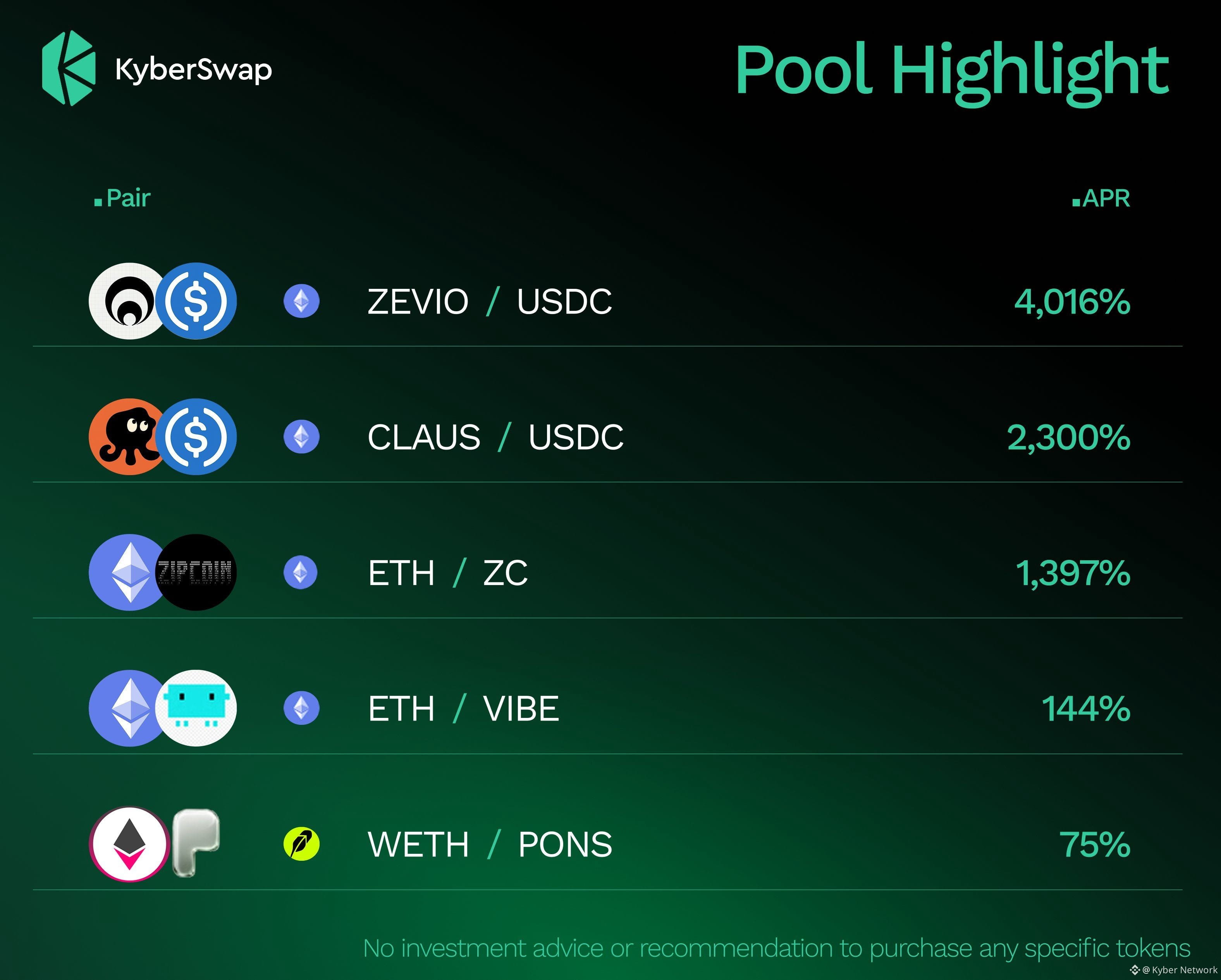
1
427
Article
Do DEX Limit Orders Cost Gas? Creation, Execution and Cancellation ExplainedYou place a Limit Order that is described as gasless, but your wallet may still ask you to approve a token or pay gas when cancelling. So where does the gas actually come from?
The key is that a DEX Limit Order is not one single transaction. Token approval, order creation, waiting, execution, and cancellation are separate actions, and each can handle gas differently.
On KyberSwap, for example, you can create a Limit Order without paying network gas. The order is signed off-chain and waits for a taker, who handles the on-chain settlement when a match is found. Gas may still appear when a token needs approval or when you choose an immediate on-chain cancellation.
Following the order from start to finish makes the cost much easier to understand.
Where Does Gas Actually Appear in a DEX Limit Order?
The easiest way to think about gas is to ask one question at every stage:
Does this action require a transaction from your wallet to be processed on-chain?
If the answer is no, the action can often be gasless. If the blockchain needs to process your transaction directly, network gas normally applies.
This is why calling a Limit Order simply “gasless” can be confusing without looking at the full lifecycle. The order itself can be gasless even though a separate approval or immediate cancellation still requires an on-chain transaction.
Why Am I Asked to Pay Gas Before Placing a Limit Order?
This is one of the easiest parts of the process to misunderstand.
You may open Limit Order for the first time, choose your token, and then see your wallet ask you to confirm a transaction with a gas cost. It can look like KyberSwap is charging gas to create the order.
In many cases, that transaction is actually a token approval, not the Limit Order itself.
Before a smart contract can use an ERC20 token from your wallet, it needs permission to access the amount required for the trade. If the KyberSwap Limit Order contract does not already have sufficient allowance, you first need to approve the token.
That approval is recorded on-chain, so it requires network gas.
Once sufficient allowance is available, you do not need a new approval simply because you want to create another Limit Order using the same existing permission.
This distinction also exists on other DEXs. Uniswap, for example, explains that a token may first require an on-chain Permit2 approval with a network cost, while signing the actual Limit Order afterward does not require another network cost.
So if your wallet asks for gas before your first Limit Order, check what you are approving. The cost may come from preparing the token for future settlement rather than placing the order itself.
Can You Place a KyberSwap Limit Order Without Paying Gas?
Yes.
Once the required token allowance is available, creating a KyberSwap Limit Order is gasless.
Instead of broadcasting a new transaction to the blockchain, you sign the trading instructions with your wallet. The signature records details such as the assets, amount, target rate, and expiry without immediately settling a trade on-chain.
KyberSwap describes its Limit Orders as signed off-chain orders that are settled on-chain only when the required conditions are met. Its current documentation lists Limit Order creation as gasless.
For the user, this solves a practical problem.
Imagine wanting to buy a token at a lower price later. If merely placing that instruction required an on-chain transaction every time, changing your trading plan could repeatedly cost gas.
With a signed off-chain order, you can define the price you want and let the order wait without paying network gas just to place it.
Does an Open Limit Order Keep Costing Gas While It Waits?
No. Simply leaving a KyberSwap Limit Order open does not create recurring gas transactions for the maker.
Once the signed order is available, it can wait for your target conditions without your wallet continually broadcasting transactions.
That matters when your target may take hours or days to reach. You do not need to keep paying gas just because the order remains active.
Your assets also stay in your wallet while the order waits. KyberSwap only settles the trade once a matching execution is found.
You should still keep enough of the required token and sufficient allowance available. Because the assets remain under your control, moving them elsewhere can affect whether the order is ready to settle later.
Who Pays Gas When a KyberSwap Limit Order Fills?
You do not need to return to KyberSwap and submit another transaction when your target conditions are reached.
KyberSwap uses a maker and taker model. The maker signs the trading instructions in advance, then a taker handles the on-chain settlement when the order becomes suitable to execute.
For the maker, this means the actual fill does not require another gas transaction from their wallet. KyberSwap’s current Limit Order content states that the taker pays the gas needed to settle the trade on-chain.
This is also why your order can execute while you are away from the market. You do not need to sit in front of the chart, notice that the target has been reached, and manually send the swap yourself.
Gas still matters to the execution process, however, because the taker needs to decide whether filling an order makes economic sense after considering network costs. This is one reason very small Limit Orders can sometimes take longer to fill.
The important distinction is therefore not whether gas exists somewhere in the transaction. It is who needs to submit the on-chain transaction and who directly handles that gas cost.
Can You Cancel a KyberSwap Limit Order Without Paying Gas?
Yes.
KyberSwap provides Gasless Cancel for users who want to remove an active Limit Order without sending an on-chain cancellation transaction.
This is useful when your trading plan changes and avoiding another network cost matters more than immediate on-chain invalidation.
There is one trade-off. If the order has recently been shared with a taker, the existing authorization may need a short period to expire. KyberSwap’s more recent Limit Order guide states that Gasless Cancel can involve a wait of up to around 5 minutes in those cases.
There are also situations where waiting is not what you want.
For example, the market may suddenly move against your original trading plan and you want to make sure the old order cannot execute while conditions are changing.
KyberSwap provides Hard Cancel for that case. Hard Cancel immediately invalidates the order on-chain, which means your wallet sends a blockchain transaction and network gas applies.
The choice is therefore straightforward:
Gasless Cancel is useful when you want to cancel without paying network gas.
Hard Cancel is useful when immediate on-chain cancellation matters more than the gas cost.
Instead of forcing every cancellation into the same model, KyberSwap lets the user choose based on what matters in that situation.
Does Gasless Mean There Are No Other Costs?
Gas describes the cost of processing an on-chain transaction. It should not automatically be treated as another word for every possible trading cost.
This distinction matters because a product can offer gasless order creation while still relying on blockchain transactions elsewhere in the execution flow.
For KyberSwap specifically, its current product documentation describes Limit Orders as gasless, slippage-free, and zero-maker-fee for users.
The practical exception remains network actions initiated directly from your wallet. A required token approval has an on-chain gas cost, and Hard Cancel requires gas because you are asking the blockchain to immediately invalidate the order.
So rather than asking only whether Limit Orders are “free,” it is more useful to identify which actions require an on-chain transaction from you.
How Does Gas Handling Differ Across DEX Limit Orders?
Gasless Limit Orders are not unique to one DEX. Several platforms use signed orders so makers do not need to broadcast a new transaction just to set a target price.
The details become more important at approval, execution, and cancellation.
Uniswap states that its Limit Order is submitted with a Permit2 signature that does not require a network cost once the necessary approval is in place. The order is then available to third party fillers.
1inch similarly documents off-chain signed orders where order creation itself does not require gas, while token approval may require gas and manual cancellation can incur a gas fee.
The broad model is similar. What differentiates the experience is which parts of the lifecycle the maker can complete without an on-chain transaction.
For KyberSwap, Gasless Cancel adds another gasless option after the order has already been created.
Frequently Asked Questions
Do I Need Gas to Place a KyberSwap Limit Order?
No gas is required to create the Limit Order itself. You sign the order off-chain rather than broadcasting an on-chain transaction.
If the token does not already have sufficient allowance, you may first need a token approval, which requires network gas.
Who Pays Gas When a KyberSwap Limit Order Fills?
The taker handles the on-chain settlement transaction. The maker does not need to send another transaction when the Limit Order reaches executable conditions.
Can I Cancel a KyberSwap Limit Order Without Gas?
Yes. Gasless Cancel lets you cancel without paying network gas.
KyberSwap also provides Hard Cancel when you want immediate on-chain cancellation. Hard Cancel requires gas.
Does an Expired Limit Order Cost Gas?
An order that simply remains open and reaches its expiry does not require a new maker transaction just to expire.
Any token approval you completed earlier is a separate on-chain action and has its own gas cost.
Know Which Action You Are Paying For
When your wallet asks for gas during a Limit Order flow, the useful question is not simply “Why isn’t this gasless?”
Ask what action the wallet is asking you to perform.
A token may need an initial approval. The Limit Order itself can then be created off-chain without gas and wait without recurring network costs. When execution conditions are met, a taker handles the on-chain settlement. If you later want to cancel, KyberSwap gives you a gasless option as well as an immediate on-chain Hard Cancel.
That makes the KyberSwap Limit Order flow easier to understand: approve when needed, place gaslessly, wait without recurring gas, let the taker settle, and choose how you want to cancel.
Once those actions are separated, the idea of a gasless Limit Order becomes much clearer.
Do DEX Limit Orders Cost Gas? Creation, Execution and Cancellation Explained
You place a Limit Order that is described as gasless, but your wallet may still ask you to approve a token or pay gas when cancelling. So where does the gas actually come from?
The key is that a DEX Limit Order is not one single transaction. Token approval, order creation, waiting, execution, and cancellation are separate actions, and each can handle gas differently.
On KyberSwap, for example, you can create a Limit Order without paying network gas. The order is signed off-chain and waits for a taker, who handles the on-chain settlement when a match is found. Gas may still appear when a token needs approval or when you choose an immediate on-chain cancellation.
Following the order from start to finish makes the cost much easier to understand.
Where Does Gas Actually Appear in a DEX Limit Order?
The easiest way to think about gas is to ask one question at every stage:
Does this action require a transaction from your wallet to be processed on-chain?
If the answer is no, the action can often be gasless. If the blockchain needs to process your transaction directly, network gas normally applies.
This is why calling a Limit Order simply “gasless” can be confusing without looking at the full lifecycle. The order itself can be gasless even though a separate approval or immediate cancellation still requires an on-chain transaction.
Why Am I Asked to Pay Gas Before Placing a Limit Order?
This is one of the easiest parts of the process to misunderstand.
You may open Limit Order for the first time, choose your token, and then see your wallet ask you to confirm a transaction with a gas cost. It can look like KyberSwap is charging gas to create the order.
In many cases, that transaction is actually a token approval, not the Limit Order itself.
Before a smart contract can use an ERC20 token from your wallet, it needs permission to access the amount required for the trade. If the KyberSwap Limit Order contract does not already have sufficient allowance, you first need to approve the token.
That approval is recorded on-chain, so it requires network gas.
Once sufficient allowance is available, you do not need a new approval simply because you want to create another Limit Order using the same existing permission.
This distinction also exists on other DEXs. Uniswap, for example, explains that a token may first require an on-chain Permit2 approval with a network cost, while signing the actual Limit Order afterward does not require another network cost.
So if your wallet asks for gas before your first Limit Order, check what you are approving. The cost may come from preparing the token for future settlement rather than placing the order itself.
Can You Place a KyberSwap Limit Order Without Paying Gas?
Yes.
Once the required token allowance is available, creating a KyberSwap Limit Order is gasless.
Instead of broadcasting a new transaction to the blockchain, you sign the trading instructions with your wallet. The signature records details such as the assets, amount, target rate, and expiry without immediately settling a trade on-chain.
KyberSwap describes its Limit Orders as signed off-chain orders that are settled on-chain only when the required conditions are met. Its current documentation lists Limit Order creation as gasless.
For the user, this solves a practical problem.
Imagine wanting to buy a token at a lower price later. If merely placing that instruction required an on-chain transaction every time, changing your trading plan could repeatedly cost gas.
With a signed off-chain order, you can define the price you want and let the order wait without paying network gas just to place it.
Does an Open Limit Order Keep Costing Gas While It Waits?
No. Simply leaving a KyberSwap Limit Order open does not create recurring gas transactions for the maker.
Once the signed order is available, it can wait for your target conditions without your wallet continually broadcasting transactions.
That matters when your target may take hours or days to reach. You do not need to keep paying gas just because the order remains active.
Your assets also stay in your wallet while the order waits. KyberSwap only settles the trade once a matching execution is found.
You should still keep enough of the required token and sufficient allowance available. Because the assets remain under your control, moving them elsewhere can affect whether the order is ready to settle later.
Who Pays Gas When a KyberSwap Limit Order Fills?
You do not need to return to KyberSwap and submit another transaction when your target conditions are reached.
KyberSwap uses a maker and taker model. The maker signs the trading instructions in advance, then a taker handles the on-chain settlement when the order becomes suitable to execute.
For the maker, this means the actual fill does not require another gas transaction from their wallet. KyberSwap’s current Limit Order content states that the taker pays the gas needed to settle the trade on-chain.
This is also why your order can execute while you are away from the market. You do not need to sit in front of the chart, notice that the target has been reached, and manually send the swap yourself.
Gas still matters to the execution process, however, because the taker needs to decide whether filling an order makes economic sense after considering network costs. This is one reason very small Limit Orders can sometimes take longer to fill.
The important distinction is therefore not whether gas exists somewhere in the transaction. It is who needs to submit the on-chain transaction and who directly handles that gas cost.
Can You Cancel a KyberSwap Limit Order Without Paying Gas?
Yes.
KyberSwap provides Gasless Cancel for users who want to remove an active Limit Order without sending an on-chain cancellation transaction.
This is useful when your trading plan changes and avoiding another network cost matters more than immediate on-chain invalidation.
There is one trade-off. If the order has recently been shared with a taker, the existing authorization may need a short period to expire. KyberSwap’s more recent Limit Order guide states that Gasless Cancel can involve a wait of up to around 5 minutes in those cases.
There are also situations where waiting is not what you want.
For example, the market may suddenly move against your original trading plan and you want to make sure the old order cannot execute while conditions are changing.
KyberSwap provides Hard Cancel for that case. Hard Cancel immediately invalidates the order on-chain, which means your wallet sends a blockchain transaction and network gas applies.
The choice is therefore straightforward:
Gasless Cancel is useful when you want to cancel without paying network gas.
Hard Cancel is useful when immediate on-chain cancellation matters more than the gas cost.
Instead of forcing every cancellation into the same model, KyberSwap lets the user choose based on what matters in that situation.
Does Gasless Mean There Are No Other Costs?
Gas describes the cost of processing an on-chain transaction. It should not automatically be treated as another word for every possible trading cost.
This distinction matters because a product can offer gasless order creation while still relying on blockchain transactions elsewhere in the execution flow.
For KyberSwap specifically, its current product documentation describes Limit Orders as gasless, slippage-free, and zero-maker-fee for users.
The practical exception remains network actions initiated directly from your wallet. A required token approval has an on-chain gas cost, and Hard Cancel requires gas because you are asking the blockchain to immediately invalidate the order.
So rather than asking only whether Limit Orders are “free,” it is more useful to identify which actions require an on-chain transaction from you.
How Does Gas Handling Differ Across DEX Limit Orders?
Gasless Limit Orders are not unique to one DEX. Several platforms use signed orders so makers do not need to broadcast a new transaction just to set a target price.
The details become more important at approval, execution, and cancellation.
Uniswap states that its Limit Order is submitted with a Permit2 signature that does not require a network cost once the necessary approval is in place. The order is then available to third party fillers.
1inch similarly documents off-chain signed orders where order creation itself does not require gas, while token approval may require gas and manual cancellation can incur a gas fee.
The broad model is similar. What differentiates the experience is which parts of the lifecycle the maker can complete without an on-chain transaction.
For KyberSwap, Gasless Cancel adds another gasless option after the order has already been created.
Frequently Asked Questions
Do I Need Gas to Place a KyberSwap Limit Order?
No gas is required to create the Limit Order itself. You sign the order off-chain rather than broadcasting an on-chain transaction.
If the token does not already have sufficient allowance, you may first need a token approval, which requires network gas.
Who Pays Gas When a KyberSwap Limit Order Fills?
The taker handles the on-chain settlement transaction. The maker does not need to send another transaction when the Limit Order reaches executable conditions.
Can I Cancel a KyberSwap Limit Order Without Gas?
Yes. Gasless Cancel lets you cancel without paying network gas.
KyberSwap also provides Hard Cancel when you want immediate on-chain cancellation. Hard Cancel requires gas.
Does an Expired Limit Order Cost Gas?
An order that simply remains open and reaches its expiry does not require a new maker transaction just to expire.
Any token approval you completed earlier is a separate on-chain action and has its own gas cost.
Know Which Action You Are Paying For
When your wallet asks for gas during a Limit Order flow, the useful question is not simply “Why isn’t this gasless?”
Ask what action the wallet is asking you to perform.
A token may need an initial approval. The Limit Order itself can then be created off-chain without gas and wait without recurring network costs. When execution conditions are met, a taker handles the on-chain settlement. If you later want to cancel, KyberSwap gives you a gasless option as well as an immediate on-chain Hard Cancel.
That makes the KyberSwap Limit Order flow easier to understand: approve when needed, place gaslessly, wait without recurring gas, let the taker settle, and choose how you want to cancel.
Once those actions are separated, the idea of a gasless Limit Order becomes much clearer.
The key is that a DEX Limit Order is not one single transaction. Token approval, order creation, waiting, execution, and cancellation are separate actions, and each can handle gas differently.
On KyberSwap, for example, you can create a Limit Order without paying network gas. The order is signed off-chain and waits for a taker, who handles the on-chain settlement when a match is found. Gas may still appear when a token needs approval or when you choose an immediate on-chain cancellation.
Following the order from start to finish makes the cost much easier to understand.
Where Does Gas Actually Appear in a DEX Limit Order?
The easiest way to think about gas is to ask one question at every stage:
Does this action require a transaction from your wallet to be processed on-chain?
If the answer is no, the action can often be gasless. If the blockchain needs to process your transaction directly, network gas normally applies.
This is why calling a Limit Order simply “gasless” can be confusing without looking at the full lifecycle. The order itself can be gasless even though a separate approval or immediate cancellation still requires an on-chain transaction.
Why Am I Asked to Pay Gas Before Placing a Limit Order?
This is one of the easiest parts of the process to misunderstand.
You may open Limit Order for the first time, choose your token, and then see your wallet ask you to confirm a transaction with a gas cost. It can look like KyberSwap is charging gas to create the order.
In many cases, that transaction is actually a token approval, not the Limit Order itself.
Before a smart contract can use an ERC20 token from your wallet, it needs permission to access the amount required for the trade. If the KyberSwap Limit Order contract does not already have sufficient allowance, you first need to approve the token.
That approval is recorded on-chain, so it requires network gas.
Once sufficient allowance is available, you do not need a new approval simply because you want to create another Limit Order using the same existing permission.
This distinction also exists on other DEXs. Uniswap, for example, explains that a token may first require an on-chain Permit2 approval with a network cost, while signing the actual Limit Order afterward does not require another network cost.
So if your wallet asks for gas before your first Limit Order, check what you are approving. The cost may come from preparing the token for future settlement rather than placing the order itself.
Can You Place a KyberSwap Limit Order Without Paying Gas?
Yes.
Once the required token allowance is available, creating a KyberSwap Limit Order is gasless.
Instead of broadcasting a new transaction to the blockchain, you sign the trading instructions with your wallet. The signature records details such as the assets, amount, target rate, and expiry without immediately settling a trade on-chain.
KyberSwap describes its Limit Orders as signed off-chain orders that are settled on-chain only when the required conditions are met. Its current documentation lists Limit Order creation as gasless.
For the user, this solves a practical problem.
Imagine wanting to buy a token at a lower price later. If merely placing that instruction required an on-chain transaction every time, changing your trading plan could repeatedly cost gas.
With a signed off-chain order, you can define the price you want and let the order wait without paying network gas just to place it.
Does an Open Limit Order Keep Costing Gas While It Waits?
No. Simply leaving a KyberSwap Limit Order open does not create recurring gas transactions for the maker.
Once the signed order is available, it can wait for your target conditions without your wallet continually broadcasting transactions.
That matters when your target may take hours or days to reach. You do not need to keep paying gas just because the order remains active.
Your assets also stay in your wallet while the order waits. KyberSwap only settles the trade once a matching execution is found.
You should still keep enough of the required token and sufficient allowance available. Because the assets remain under your control, moving them elsewhere can affect whether the order is ready to settle later.
Who Pays Gas When a KyberSwap Limit Order Fills?
You do not need to return to KyberSwap and submit another transaction when your target conditions are reached.
KyberSwap uses a maker and taker model. The maker signs the trading instructions in advance, then a taker handles the on-chain settlement when the order becomes suitable to execute.
For the maker, this means the actual fill does not require another gas transaction from their wallet. KyberSwap’s current Limit Order content states that the taker pays the gas needed to settle the trade on-chain.
This is also why your order can execute while you are away from the market. You do not need to sit in front of the chart, notice that the target has been reached, and manually send the swap yourself.
Gas still matters to the execution process, however, because the taker needs to decide whether filling an order makes economic sense after considering network costs. This is one reason very small Limit Orders can sometimes take longer to fill.
The important distinction is therefore not whether gas exists somewhere in the transaction. It is who needs to submit the on-chain transaction and who directly handles that gas cost.
Can You Cancel a KyberSwap Limit Order Without Paying Gas?
Yes.
KyberSwap provides Gasless Cancel for users who want to remove an active Limit Order without sending an on-chain cancellation transaction.
This is useful when your trading plan changes and avoiding another network cost matters more than immediate on-chain invalidation.
There is one trade-off. If the order has recently been shared with a taker, the existing authorization may need a short period to expire. KyberSwap’s more recent Limit Order guide states that Gasless Cancel can involve a wait of up to around 5 minutes in those cases.
There are also situations where waiting is not what you want.
For example, the market may suddenly move against your original trading plan and you want to make sure the old order cannot execute while conditions are changing.
KyberSwap provides Hard Cancel for that case. Hard Cancel immediately invalidates the order on-chain, which means your wallet sends a blockchain transaction and network gas applies.
The choice is therefore straightforward:
Gasless Cancel is useful when you want to cancel without paying network gas.
Hard Cancel is useful when immediate on-chain cancellation matters more than the gas cost.
Instead of forcing every cancellation into the same model, KyberSwap lets the user choose based on what matters in that situation.
Does Gasless Mean There Are No Other Costs?
Gas describes the cost of processing an on-chain transaction. It should not automatically be treated as another word for every possible trading cost.
This distinction matters because a product can offer gasless order creation while still relying on blockchain transactions elsewhere in the execution flow.
For KyberSwap specifically, its current product documentation describes Limit Orders as gasless, slippage-free, and zero-maker-fee for users.
The practical exception remains network actions initiated directly from your wallet. A required token approval has an on-chain gas cost, and Hard Cancel requires gas because you are asking the blockchain to immediately invalidate the order.
So rather than asking only whether Limit Orders are “free,” it is more useful to identify which actions require an on-chain transaction from you.
How Does Gas Handling Differ Across DEX Limit Orders?
Gasless Limit Orders are not unique to one DEX. Several platforms use signed orders so makers do not need to broadcast a new transaction just to set a target price.
The details become more important at approval, execution, and cancellation.
Uniswap states that its Limit Order is submitted with a Permit2 signature that does not require a network cost once the necessary approval is in place. The order is then available to third party fillers.
1inch similarly documents off-chain signed orders where order creation itself does not require gas, while token approval may require gas and manual cancellation can incur a gas fee.
The broad model is similar. What differentiates the experience is which parts of the lifecycle the maker can complete without an on-chain transaction.
For KyberSwap, Gasless Cancel adds another gasless option after the order has already been created.
Frequently Asked Questions
Do I Need Gas to Place a KyberSwap Limit Order?
No gas is required to create the Limit Order itself. You sign the order off-chain rather than broadcasting an on-chain transaction.
If the token does not already have sufficient allowance, you may first need a token approval, which requires network gas.
Who Pays Gas When a KyberSwap Limit Order Fills?
The taker handles the on-chain settlement transaction. The maker does not need to send another transaction when the Limit Order reaches executable conditions.
Can I Cancel a KyberSwap Limit Order Without Gas?
Yes. Gasless Cancel lets you cancel without paying network gas.
KyberSwap also provides Hard Cancel when you want immediate on-chain cancellation. Hard Cancel requires gas.
Does an Expired Limit Order Cost Gas?
An order that simply remains open and reaches its expiry does not require a new maker transaction just to expire.
Any token approval you completed earlier is a separate on-chain action and has its own gas cost.
Know Which Action You Are Paying For
When your wallet asks for gas during a Limit Order flow, the useful question is not simply “Why isn’t this gasless?”
Ask what action the wallet is asking you to perform.
A token may need an initial approval. The Limit Order itself can then be created off-chain without gas and wait without recurring network costs. When execution conditions are met, a taker handles the on-chain settlement. If you later want to cancel, KyberSwap gives you a gasless option as well as an immediate on-chain Hard Cancel.
That makes the KyberSwap Limit Order flow easier to understand: approve when needed, place gaslessly, wait without recurring gas, let the taker settle, and choose how you want to cancel.
Once those actions are separated, the idea of a gasless Limit Order becomes much clearer.
2
170
Ethereum is so back in the trenches 👀
#AI
#ORBIO
#CLAUS
#ZC
#BONER
Trade at the best rate: https://kyberswap.com
Ethereum is so back in the trenches 👀
#AI
#ORBIO
#CLAUS
#ZC
#BONER
Trade at the best rate: https://kyberswap.com
#AI
#ORBIO
#CLAUS
#ZC
#BONER
Trade at the best rate: https://kyberswap.com

407
Article
Where Do New Tokens Launch on Robinhood Chain and How Can You Trade Them Early?Robinhood Chain went live on mainnet on July 1, 2026, and new tokens started appearing almost immediately. Most of them launch on third-party launchpads, trade on a bonding curve for a while, then move into a DEX pool once they graduate. Knowing where a token sits in that journey decides where you can buy it and what price you get.
The short answer is simple. New tokens on Robinhood Chain launch on platforms like Pons and Flap, and most DEX liquidity on the chain sits in Uniswap pools. KyberSwap lets you trade at both stages, routing into Pons and Flap bonding curves before graduation and across 650+ liquidity sources after it, so you get the best available rate without checking each venue yourself.
Where Do New Tokens Launch on Robinhood Chain?
Robinhood Chain has no official launchpad of its own. The network is a permissionless Ethereum Layer 2 built on Arbitrum technology, so anyone can deploy a token, and launch activity runs entirely through third-party platforms. Treat any token or site claiming to be the “official” Robinhood Chain launchpad with caution.
Two launchpads carry much of that activity. Pons is built for Robinhood Chain and lets anyone create a fixed-supply token and trade it straight from their wallet. Flap is a multi-chain launchpad that supports Robinhood Chain with a bonding curve model.
The pace has been fast. According to Dune data, 42,709 new tokens launched on Robinhood Chain in a single 24-hour period ending July 17, 2026, with Pons accounting for 11,547 and Flap for 9,935. Launch counts change daily, so treat these figures as a snapshot rather than a steady rate.
How Does a New Token Go From Launch to Open Market?
Every new token follows one of two paths. Some start on a bonding curve and graduate to a DEX pool later, while others skip the curve and launch straight into a pool. The path tells you where liquidity sits at each moment.
On a bonding curve, the launchpad’s own contract sets the price with a formula. Each buy pushes the price up, and each sell pulls it down. Once the curve reaches its graduation target, the launchpad moves liquidity into a regular DEX pool and the curve closes for good. On Pons, graduated tokens move into a Uniswap v4 pool.
Direct-to-pool launches work differently. The token goes live with a Uniswap pool from day one, so it trades like any other token from its first block. There is no curve phase and no graduation event to wait for.
Why Does Most New-Token Liquidity End Up on Uniswap?
Uniswap has been part of Robinhood Chain since day one. Robinhood named it a launch partner, with a dedicated AMM serving as the chain’s primary public liquidity protocol. Graduating tokens and direct launches both tend to land in Uniswap pools as a result.
The numbers reflect that position. At the time of writing, Uniswap v3 and v4 account for roughly 90% of DEX liquidity on Robinhood Chain. For traders, the real question is rarely which DEX to use, but which pool offers the right price at the right moment.
That is where a single venue falls short. A direct Uniswap swap quotes only the pools it trades against, and it cannot reach a token that is still on a launchpad curve. If you want to be early, you need a way to trade before graduation and still get a fair price after it.
How Can You Trade New Robinhood Chain Tokens Early With KyberSwap?
KyberSwap covers a new token across its whole journey. The KyberSwap Aggregator is live on Robinhood Chain (chain ID 4663) and connects to 650+ liquidity sources across 20 chains, including Uniswap pools and launchpad bonding curves.
Trade before graduation. KyberSwap routes trades into Pons and Flap bonding curves directly. You can buy a token while it is still on the curve, from the same swap screen you use for any other trade. After graduation, KyberSwap routes through the token’s DEX liquidity, so you don’t need to switch apps or hunt for pool addresses.
Get the best available rate after launch. Once a token trades in DEX pools, the Aggregator compares available liquidity and splits your trade across the most capital-efficient route. KyberSwap charges no platform fee on swaps.
Find tokens worth a closer look. Token Discovery surfaces trending tokens and onchain signals such as holder counts and flows. It gives you a quick read on a new token before you commit funds.
Set your entry price. Limit Order lets you choose the exact price you want to buy or sell at, with gasless order placement and zero maker fee. That suits volatile new tokens, where chasing the price with instant swaps can get expensive.
Fund your wallet from any chain. Cross-chain Swap moves and exchanges assets across 23 networks, so you can bring funds onto Robinhood Chain and start trading in one flow.
Launchpad vs Uniswap vs KyberSwap: Where Should You Trade a New Token?
Each venue covers a different part of a token’s life. The launchpad is the source during the curve phase, Uniswap holds most liquidity after graduation, and KyberSwap reaches both from one place.
How Do You Trade Brand-New Tokens More Safely?
New tokens carry real risk, and a few habits go a long way. Early prices move fast, liquidity is often thin, and lookalike tokens are common on permissionless chains.
Verify the contract address from the project’s official channels before you buy.Check liquidity depth, since a shallow curve or pool can move sharply on a modest order.Set slippage deliberately rather than accepting a wide default.Read the launchpad’s fee terms, as some bonding curves charge trading fees and creator taxes on each buy and sell.Know where the token trades now, because a graduated curve closes and all trading moves to the DEX pool.
KyberSwap gives you access to tokens that already trade onchain, but it does not vet the projects behind them. That research is yours to do, and it matters most in a token’s first hours.
Frequently Asked Questions
Does Robinhood Chain have an official launchpad?
No. All launchpads on Robinhood Chain are third-party platforms, including Pons and Flap. Be cautious with any token or site that claims to be the chain’s official launchpad.
What does it mean when a token graduates?
A token graduates when its bonding curve reaches the launchpad’s target. The launchpad then moves liquidity into a DEX pool, such as a Uniswap v4 pool for Pons tokens, and the curve stops trading.
Can you buy a Robinhood Chain token before it graduates?
Yes. You can buy on the launchpad itself or through KyberSwap, which routes into Pons and Flap bonding curves directly. After graduation, KyberSwap routes through the token’s DEX liquidity instead.
Is KyberSwap live on Robinhood Chain?
Yes. KyberSwap supports Robinhood Chain (chain ID 4663), with the Aggregator, Limit Order, KyberZap and Cross-chain Swap all live on the network.
How do you get funds onto Robinhood Chain to trade new tokens?
Use KyberSwap Cross-chain Swap to move and exchange assets across 23 networks in one flow. Robinhood Chain uses ETH for gas, so keep some ETH in your wallet before you start trading.
Start Trading New Robinhood Chain Tokens With KyberSwap
New tokens on Robinhood Chain move from launchpad curves to DEX pools, and you can trade them at either stage. KyberSwap follows the whole journey, routing into Pons and Flap curves before graduation and across 650+ liquidity sources after it. Open KyberSwap, select Robinhood Chain and trade new tokens at the best available rate.
Where Do New Tokens Launch on Robinhood Chain and How Can You Trade Them Early?
Robinhood Chain went live on mainnet on July 1, 2026, and new tokens started appearing almost immediately. Most of them launch on third-party launchpads, trade on a bonding curve for a while, then move into a DEX pool once they graduate. Knowing where a token sits in that journey decides where you can buy it and what price you get.
The short answer is simple. New tokens on Robinhood Chain launch on platforms like Pons and Flap, and most DEX liquidity on the chain sits in Uniswap pools. KyberSwap lets you trade at both stages, routing into Pons and Flap bonding curves before graduation and across 650+ liquidity sources after it, so you get the best available rate without checking each venue yourself.
Where Do New Tokens Launch on Robinhood Chain?
Robinhood Chain has no official launchpad of its own. The network is a permissionless Ethereum Layer 2 built on Arbitrum technology, so anyone can deploy a token, and launch activity runs entirely through third-party platforms. Treat any token or site claiming to be the “official” Robinhood Chain launchpad with caution.
Two launchpads carry much of that activity. Pons is built for Robinhood Chain and lets anyone create a fixed-supply token and trade it straight from their wallet. Flap is a multi-chain launchpad that supports Robinhood Chain with a bonding curve model.
The pace has been fast. According to Dune data, 42,709 new tokens launched on Robinhood Chain in a single 24-hour period ending July 17, 2026, with Pons accounting for 11,547 and Flap for 9,935. Launch counts change daily, so treat these figures as a snapshot rather than a steady rate.
How Does a New Token Go From Launch to Open Market?
Every new token follows one of two paths. Some start on a bonding curve and graduate to a DEX pool later, while others skip the curve and launch straight into a pool. The path tells you where liquidity sits at each moment.
On a bonding curve, the launchpad’s own contract sets the price with a formula. Each buy pushes the price up, and each sell pulls it down. Once the curve reaches its graduation target, the launchpad moves liquidity into a regular DEX pool and the curve closes for good. On Pons, graduated tokens move into a Uniswap v4 pool.
Direct-to-pool launches work differently. The token goes live with a Uniswap pool from day one, so it trades like any other token from its first block. There is no curve phase and no graduation event to wait for.
Why Does Most New-Token Liquidity End Up on Uniswap?
Uniswap has been part of Robinhood Chain since day one. Robinhood named it a launch partner, with a dedicated AMM serving as the chain’s primary public liquidity protocol. Graduating tokens and direct launches both tend to land in Uniswap pools as a result.
The numbers reflect that position. At the time of writing, Uniswap v3 and v4 account for roughly 90% of DEX liquidity on Robinhood Chain. For traders, the real question is rarely which DEX to use, but which pool offers the right price at the right moment.
That is where a single venue falls short. A direct Uniswap swap quotes only the pools it trades against, and it cannot reach a token that is still on a launchpad curve. If you want to be early, you need a way to trade before graduation and still get a fair price after it.
How Can You Trade New Robinhood Chain Tokens Early With KyberSwap?
KyberSwap covers a new token across its whole journey. The KyberSwap Aggregator is live on Robinhood Chain (chain ID 4663) and connects to 650+ liquidity sources across 20 chains, including Uniswap pools and launchpad bonding curves.
Trade before graduation. KyberSwap routes trades into Pons and Flap bonding curves directly. You can buy a token while it is still on the curve, from the same swap screen you use for any other trade. After graduation, KyberSwap routes through the token’s DEX liquidity, so you don’t need to switch apps or hunt for pool addresses.
Get the best available rate after launch. Once a token trades in DEX pools, the Aggregator compares available liquidity and splits your trade across the most capital-efficient route. KyberSwap charges no platform fee on swaps.
Find tokens worth a closer look. Token Discovery surfaces trending tokens and onchain signals such as holder counts and flows. It gives you a quick read on a new token before you commit funds.
Set your entry price. Limit Order lets you choose the exact price you want to buy or sell at, with gasless order placement and zero maker fee. That suits volatile new tokens, where chasing the price with instant swaps can get expensive.
Fund your wallet from any chain. Cross-chain Swap moves and exchanges assets across 23 networks, so you can bring funds onto Robinhood Chain and start trading in one flow.
Launchpad vs Uniswap vs KyberSwap: Where Should You Trade a New Token?
Each venue covers a different part of a token’s life. The launchpad is the source during the curve phase, Uniswap holds most liquidity after graduation, and KyberSwap reaches both from one place.
How Do You Trade Brand-New Tokens More Safely?
New tokens carry real risk, and a few habits go a long way. Early prices move fast, liquidity is often thin, and lookalike tokens are common on permissionless chains.
Verify the contract address from the project’s official channels before you buy.Check liquidity depth, since a shallow curve or pool can move sharply on a modest order.Set slippage deliberately rather than accepting a wide default.Read the launchpad’s fee terms, as some bonding curves charge trading fees and creator taxes on each buy and sell.Know where the token trades now, because a graduated curve closes and all trading moves to the DEX pool.
KyberSwap gives you access to tokens that already trade onchain, but it does not vet the projects behind them. That research is yours to do, and it matters most in a token’s first hours.
Frequently Asked Questions
Does Robinhood Chain have an official launchpad?
No. All launchpads on Robinhood Chain are third-party platforms, including Pons and Flap. Be cautious with any token or site that claims to be the chain’s official launchpad.
What does it mean when a token graduates?
A token graduates when its bonding curve reaches the launchpad’s target. The launchpad then moves liquidity into a DEX pool, such as a Uniswap v4 pool for Pons tokens, and the curve stops trading.
Can you buy a Robinhood Chain token before it graduates?
Yes. You can buy on the launchpad itself or through KyberSwap, which routes into Pons and Flap bonding curves directly. After graduation, KyberSwap routes through the token’s DEX liquidity instead.
Is KyberSwap live on Robinhood Chain?
Yes. KyberSwap supports Robinhood Chain (chain ID 4663), with the Aggregator, Limit Order, KyberZap and Cross-chain Swap all live on the network.
How do you get funds onto Robinhood Chain to trade new tokens?
Use KyberSwap Cross-chain Swap to move and exchange assets across 23 networks in one flow. Robinhood Chain uses ETH for gas, so keep some ETH in your wallet before you start trading.
Start Trading New Robinhood Chain Tokens With KyberSwap
New tokens on Robinhood Chain move from launchpad curves to DEX pools, and you can trade them at either stage. KyberSwap follows the whole journey, routing into Pons and Flap curves before graduation and across 650+ liquidity sources after it. Open KyberSwap, select Robinhood Chain and trade new tokens at the best available rate.
The short answer is simple. New tokens on Robinhood Chain launch on platforms like Pons and Flap, and most DEX liquidity on the chain sits in Uniswap pools. KyberSwap lets you trade at both stages, routing into Pons and Flap bonding curves before graduation and across 650+ liquidity sources after it, so you get the best available rate without checking each venue yourself.
Where Do New Tokens Launch on Robinhood Chain?
Robinhood Chain has no official launchpad of its own. The network is a permissionless Ethereum Layer 2 built on Arbitrum technology, so anyone can deploy a token, and launch activity runs entirely through third-party platforms. Treat any token or site claiming to be the “official” Robinhood Chain launchpad with caution.
Two launchpads carry much of that activity. Pons is built for Robinhood Chain and lets anyone create a fixed-supply token and trade it straight from their wallet. Flap is a multi-chain launchpad that supports Robinhood Chain with a bonding curve model.
The pace has been fast. According to Dune data, 42,709 new tokens launched on Robinhood Chain in a single 24-hour period ending July 17, 2026, with Pons accounting for 11,547 and Flap for 9,935. Launch counts change daily, so treat these figures as a snapshot rather than a steady rate.
How Does a New Token Go From Launch to Open Market?
Every new token follows one of two paths. Some start on a bonding curve and graduate to a DEX pool later, while others skip the curve and launch straight into a pool. The path tells you where liquidity sits at each moment.
On a bonding curve, the launchpad’s own contract sets the price with a formula. Each buy pushes the price up, and each sell pulls it down. Once the curve reaches its graduation target, the launchpad moves liquidity into a regular DEX pool and the curve closes for good. On Pons, graduated tokens move into a Uniswap v4 pool.
Direct-to-pool launches work differently. The token goes live with a Uniswap pool from day one, so it trades like any other token from its first block. There is no curve phase and no graduation event to wait for.
Why Does Most New-Token Liquidity End Up on Uniswap?
Uniswap has been part of Robinhood Chain since day one. Robinhood named it a launch partner, with a dedicated AMM serving as the chain’s primary public liquidity protocol. Graduating tokens and direct launches both tend to land in Uniswap pools as a result.
The numbers reflect that position. At the time of writing, Uniswap v3 and v4 account for roughly 90% of DEX liquidity on Robinhood Chain. For traders, the real question is rarely which DEX to use, but which pool offers the right price at the right moment.
That is where a single venue falls short. A direct Uniswap swap quotes only the pools it trades against, and it cannot reach a token that is still on a launchpad curve. If you want to be early, you need a way to trade before graduation and still get a fair price after it.
How Can You Trade New Robinhood Chain Tokens Early With KyberSwap?
KyberSwap covers a new token across its whole journey. The KyberSwap Aggregator is live on Robinhood Chain (chain ID 4663) and connects to 650+ liquidity sources across 20 chains, including Uniswap pools and launchpad bonding curves.
Trade before graduation. KyberSwap routes trades into Pons and Flap bonding curves directly. You can buy a token while it is still on the curve, from the same swap screen you use for any other trade. After graduation, KyberSwap routes through the token’s DEX liquidity, so you don’t need to switch apps or hunt for pool addresses.
Get the best available rate after launch. Once a token trades in DEX pools, the Aggregator compares available liquidity and splits your trade across the most capital-efficient route. KyberSwap charges no platform fee on swaps.
Find tokens worth a closer look. Token Discovery surfaces trending tokens and onchain signals such as holder counts and flows. It gives you a quick read on a new token before you commit funds.
Set your entry price. Limit Order lets you choose the exact price you want to buy or sell at, with gasless order placement and zero maker fee. That suits volatile new tokens, where chasing the price with instant swaps can get expensive.
Fund your wallet from any chain. Cross-chain Swap moves and exchanges assets across 23 networks, so you can bring funds onto Robinhood Chain and start trading in one flow.
Launchpad vs Uniswap vs KyberSwap: Where Should You Trade a New Token?
Each venue covers a different part of a token’s life. The launchpad is the source during the curve phase, Uniswap holds most liquidity after graduation, and KyberSwap reaches both from one place.
How Do You Trade Brand-New Tokens More Safely?
New tokens carry real risk, and a few habits go a long way. Early prices move fast, liquidity is often thin, and lookalike tokens are common on permissionless chains.
Verify the contract address from the project’s official channels before you buy.Check liquidity depth, since a shallow curve or pool can move sharply on a modest order.Set slippage deliberately rather than accepting a wide default.Read the launchpad’s fee terms, as some bonding curves charge trading fees and creator taxes on each buy and sell.Know where the token trades now, because a graduated curve closes and all trading moves to the DEX pool.
KyberSwap gives you access to tokens that already trade onchain, but it does not vet the projects behind them. That research is yours to do, and it matters most in a token’s first hours.
Frequently Asked Questions
Does Robinhood Chain have an official launchpad?
No. All launchpads on Robinhood Chain are third-party platforms, including Pons and Flap. Be cautious with any token or site that claims to be the chain’s official launchpad.
What does it mean when a token graduates?
A token graduates when its bonding curve reaches the launchpad’s target. The launchpad then moves liquidity into a DEX pool, such as a Uniswap v4 pool for Pons tokens, and the curve stops trading.
Can you buy a Robinhood Chain token before it graduates?
Yes. You can buy on the launchpad itself or through KyberSwap, which routes into Pons and Flap bonding curves directly. After graduation, KyberSwap routes through the token’s DEX liquidity instead.
Is KyberSwap live on Robinhood Chain?
Yes. KyberSwap supports Robinhood Chain (chain ID 4663), with the Aggregator, Limit Order, KyberZap and Cross-chain Swap all live on the network.
How do you get funds onto Robinhood Chain to trade new tokens?
Use KyberSwap Cross-chain Swap to move and exchange assets across 23 networks in one flow. Robinhood Chain uses ETH for gas, so keep some ETH in your wallet before you start trading.
Start Trading New Robinhood Chain Tokens With KyberSwap
New tokens on Robinhood Chain move from launchpad curves to DEX pools, and you can trade them at either stage. KyberSwap follows the whole journey, routing into Pons and Flap curves before graduation and across 650+ liquidity sources after it. Open KyberSwap, select Robinhood Chain and trade new tokens at the best available rate.
184
Log in to explore more content
Join global crypto users on Binance Square
⚡️ Get latest and useful information about crypto.
💬 Trusted by the world’s largest crypto exchange.
👍 Discover real insights from verified creators.
Email / Phone number