
Maxine Agency
1.2k Posts

Maxine Agency
Report
Block User
Frequent Trader
5.4 Years
32 Following
450 Followers
958 Liked
Posts
All
Quotes
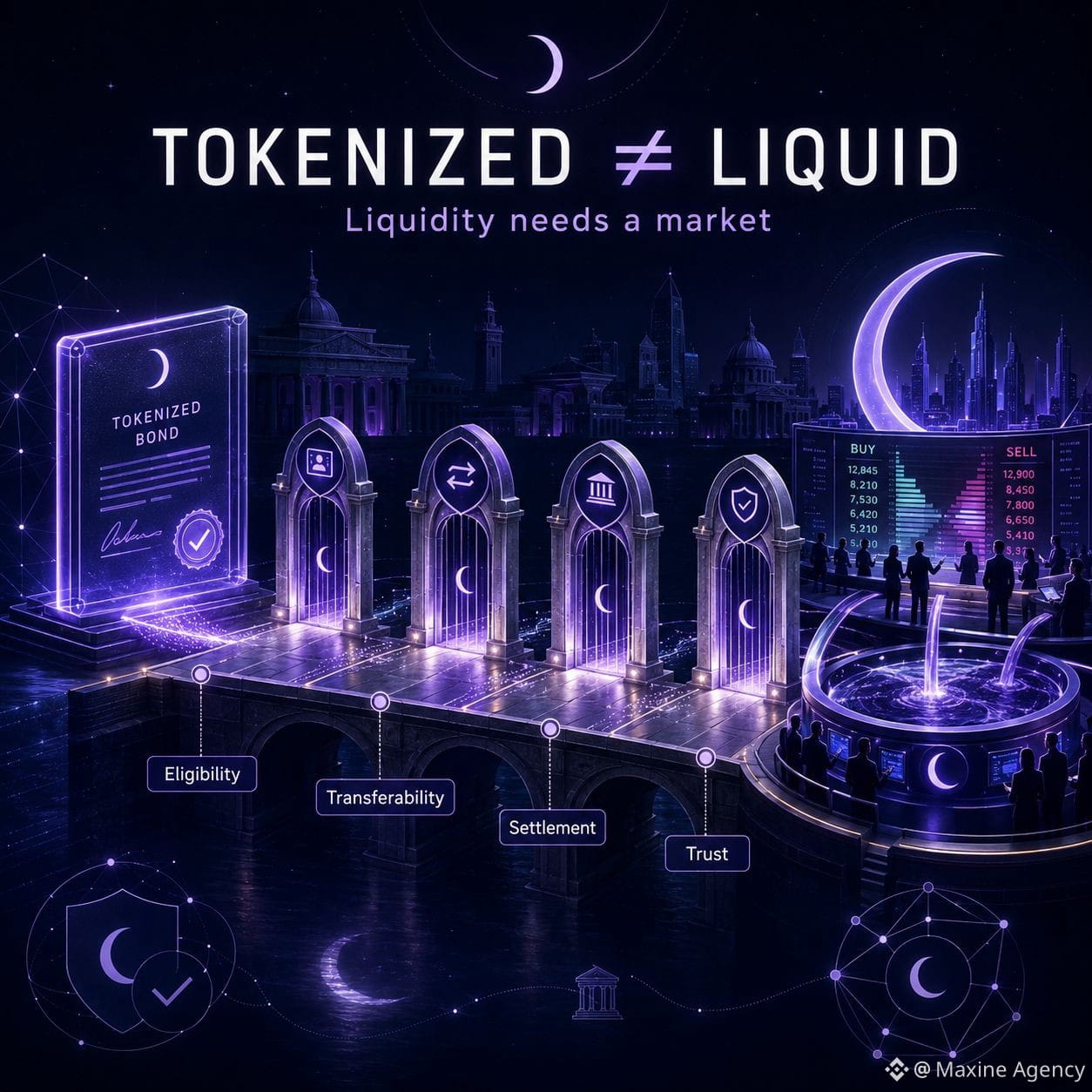
There was a time when I thought RWA was fairly simple: put an asset on the blockchain, split ownership into smaller pieces, and open access to more people—so liquidity would naturally increase.
But the more I read about Dusk, the more I see that tokenization only solves the “representation of assets,” while the market behind it still has to answer a whole set of harder questions.
A bond or a security can be tokenized very easily from a technical standpoint. But who is allowed to buy, who the asset can be transferred to, how ownership is recognized, how settlement takes place, and which party is responsible in the event of a dispute all depend on the legal framework and the operational infrastructure.
So I started separating the two concepts.
Tokenization makes assets easier to issue, track, and transfer in a digital environment. Liquidity, however, requires actual buyers and sellers, real transferability, and enough trust for parties to be willing to trade.
That’s where I find Dusk’s direction particularly noteworthy.
Dusk doesn’t treat RWA as simply minting a token and putting it on an explorer. For managed assets, privacy, eligibility, selective disclosure, and settlement must all come together because “permissionless” may not be entirely suitable for real securities.
In my view, the biggest problem with RWA is not how many assets a blockchain can hold.
It’s whether that infrastructure can turn digital ownership rights into a market that participants genuinely want to trade in.
If the law still limits who can buy and the asset is still difficult to transfer, blockchain may reduce friction but may not necessarily create new liquidity.
It might just make existing liquidity operate more efficiently.
@Dusk_Foundation $DUSK #dusk
$DEBIT $TMX
There was a time when I thought RWA was fairly simple: put an asset on the blockchain, split ownership into smaller pieces, and open access to more people—so liquidity would naturally increase.
But the more I read about Dusk, the more I see that tokenization only solves the “representation of assets,” while the market behind it still has to answer a whole set of harder questions.
A bond or a security can be tokenized very easily from a technical standpoint. But who is allowed to buy, who the asset can be transferred to, how ownership is recognized, how settlement takes place, and which party is responsible in the event of a dispute all depend on the legal framework and the operational infrastructure.
So I started separating the two concepts.
Tokenization makes assets easier to issue, track, and transfer in a digital environment. Liquidity, however, requires actual buyers and sellers, real transferability, and enough trust for parties to be willing to trade.
That’s where I find Dusk’s direction particularly noteworthy.
Dusk doesn’t treat RWA as simply minting a token and putting it on an explorer. For managed assets, privacy, eligibility, selective disclosure, and settlement must all come together because “permissionless” may not be entirely suitable for real securities.
In my view, the biggest problem with RWA is not how many assets a blockchain can hold.
It’s whether that infrastructure can turn digital ownership rights into a market that participants genuinely want to trade in.
If the law still limits who can buy and the asset is still difficult to transfer, blockchain may reduce friction but may not necessarily create new liquidity.
It might just make existing liquidity operate more efficiently.
@Dusk $DUSK #dusk
$DEBIT $TMX
But the more I read about Dusk, the more I see that tokenization only solves the “representation of assets,” while the market behind it still has to answer a whole set of harder questions.
A bond or a security can be tokenized very easily from a technical standpoint. But who is allowed to buy, who the asset can be transferred to, how ownership is recognized, how settlement takes place, and which party is responsible in the event of a dispute all depend on the legal framework and the operational infrastructure.
So I started separating the two concepts.
Tokenization makes assets easier to issue, track, and transfer in a digital environment. Liquidity, however, requires actual buyers and sellers, real transferability, and enough trust for parties to be willing to trade.
That’s where I find Dusk’s direction particularly noteworthy.
Dusk doesn’t treat RWA as simply minting a token and putting it on an explorer. For managed assets, privacy, eligibility, selective disclosure, and settlement must all come together because “permissionless” may not be entirely suitable for real securities.
In my view, the biggest problem with RWA is not how many assets a blockchain can hold.
It’s whether that infrastructure can turn digital ownership rights into a market that participants genuinely want to trade in.
If the law still limits who can buy and the asset is still difficult to transfer, blockchain may reduce friction but may not necessarily create new liquidity.
It might just make existing liquidity operate more efficiently.
@Dusk $DUSK #dusk
$DEBIT $TMX
1
1
388
I started finding DUSK more interesting on days when the chart isn’t too appealing anymore
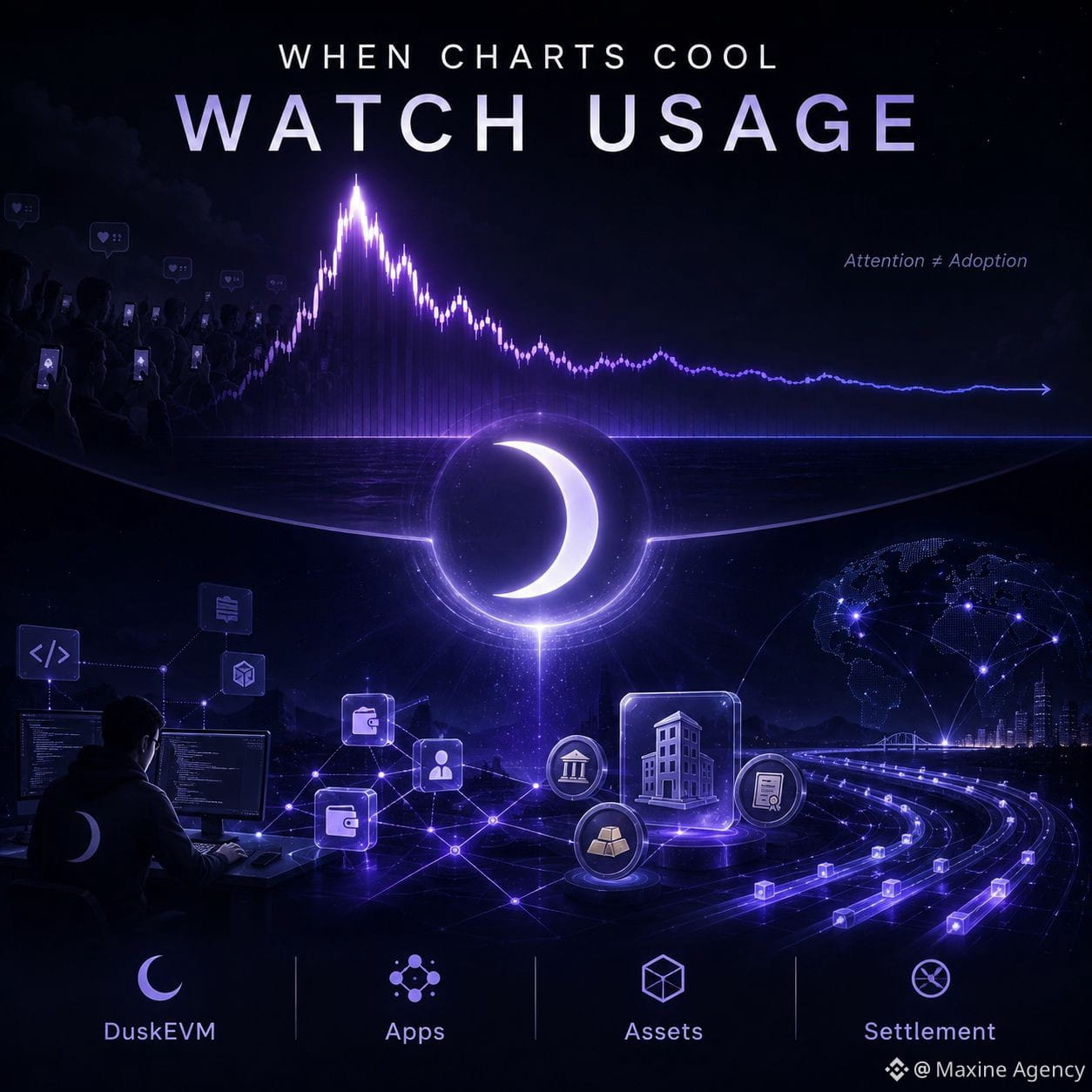
There was a time when I mostly saw Dusk through its price. When volume rose strongly and the chart moved quickly, it felt like the project was being repriced by the market.
But the more I followed, the more I realized the price only reflects attention in the moment. The harder part is determining whether that attention can turn into real network usage demand.
In my view, DuskEVM is an important step in this story. Developers who are familiar with Solidity and Ethereum’s tooling can get to Dusk more easily, while the distinct elements of the system—its settlement and privacy layers—still remain.
What I want to see next isn’t another partnership announcement.
I want to know, after developers can get in more easily, will they stay and build products. Will the app generate transactions on a steady basis. Will tokenized assets truly be issued and settled, or do they only appear in the roadmap.
This question is even more important because $DUSK is still being issued to pay rewards to the network. Emissions can fund staking and security in the early phase, but in the long run, that new token supply still needs to be absorbed by real demand.
If activity grows more slowly than supply, even a beautiful candle won’t change much.
On the other hand, if usage starts to rise steadily even after the market’s excitement fades, I’ll consider that a more valuable signal than any breakout momentum.
The chart tells me where traders’ attention is going.
And new network activity tells me whether Dusk is getting closer to a real economy.
@Dusk_Foundation #dusk $TMX $STAR
I started finding DUSK more interesting on days when the chart isn’t too appealing anymore
There was a time when I mostly saw Dusk through its price. When volume rose strongly and the chart moved quickly, it felt like the project was being repriced by the market.
But the more I followed, the more I realized the price only reflects attention in the moment. The harder part is determining whether that attention can turn into real network usage demand.
In my view, DuskEVM is an important step in this story. Developers who are familiar with Solidity and Ethereum’s tooling can get to Dusk more easily, while the distinct elements of the system—its settlement and privacy layers—still remain.
What I want to see next isn’t another partnership announcement.
I want to know, after developers can get in more easily, will they stay and build products. Will the app generate transactions on a steady basis. Will tokenized assets truly be issued and settled, or do they only appear in the roadmap.
This question is even more important because $DUSK is still being issued to pay rewards to the network. Emissions can fund staking and security in the early phase, but in the long run, that new token supply still needs to be absorbed by real demand.
If activity grows more slowly than supply, even a beautiful candle won’t change much.
On the other hand, if usage starts to rise steadily even after the market’s excitement fades, I’ll consider that a more valuable signal than any breakout momentum.
The chart tells me where traders’ attention is going.
And new network activity tells me whether Dusk is getting closer to a real economy.
@Dusk #dusk $TMX $STAR
There was a time when I mostly saw Dusk through its price. When volume rose strongly and the chart moved quickly, it felt like the project was being repriced by the market.
But the more I followed, the more I realized the price only reflects attention in the moment. The harder part is determining whether that attention can turn into real network usage demand.
In my view, DuskEVM is an important step in this story. Developers who are familiar with Solidity and Ethereum’s tooling can get to Dusk more easily, while the distinct elements of the system—its settlement and privacy layers—still remain.
What I want to see next isn’t another partnership announcement.
I want to know, after developers can get in more easily, will they stay and build products. Will the app generate transactions on a steady basis. Will tokenized assets truly be issued and settled, or do they only appear in the roadmap.
This question is even more important because $DUSK is still being issued to pay rewards to the network. Emissions can fund staking and security in the early phase, but in the long run, that new token supply still needs to be absorbed by real demand.
If activity grows more slowly than supply, even a beautiful candle won’t change much.
On the other hand, if usage starts to rise steadily even after the market’s excitement fades, I’ll consider that a more valuable signal than any breakout momentum.
The chart tells me where traders’ attention is going.
And new network activity tells me whether Dusk is getting closer to a real economy.
@Dusk #dusk $TMX $STAR
2
2
201
I’m more interested in $DUSK than when the price stops rising
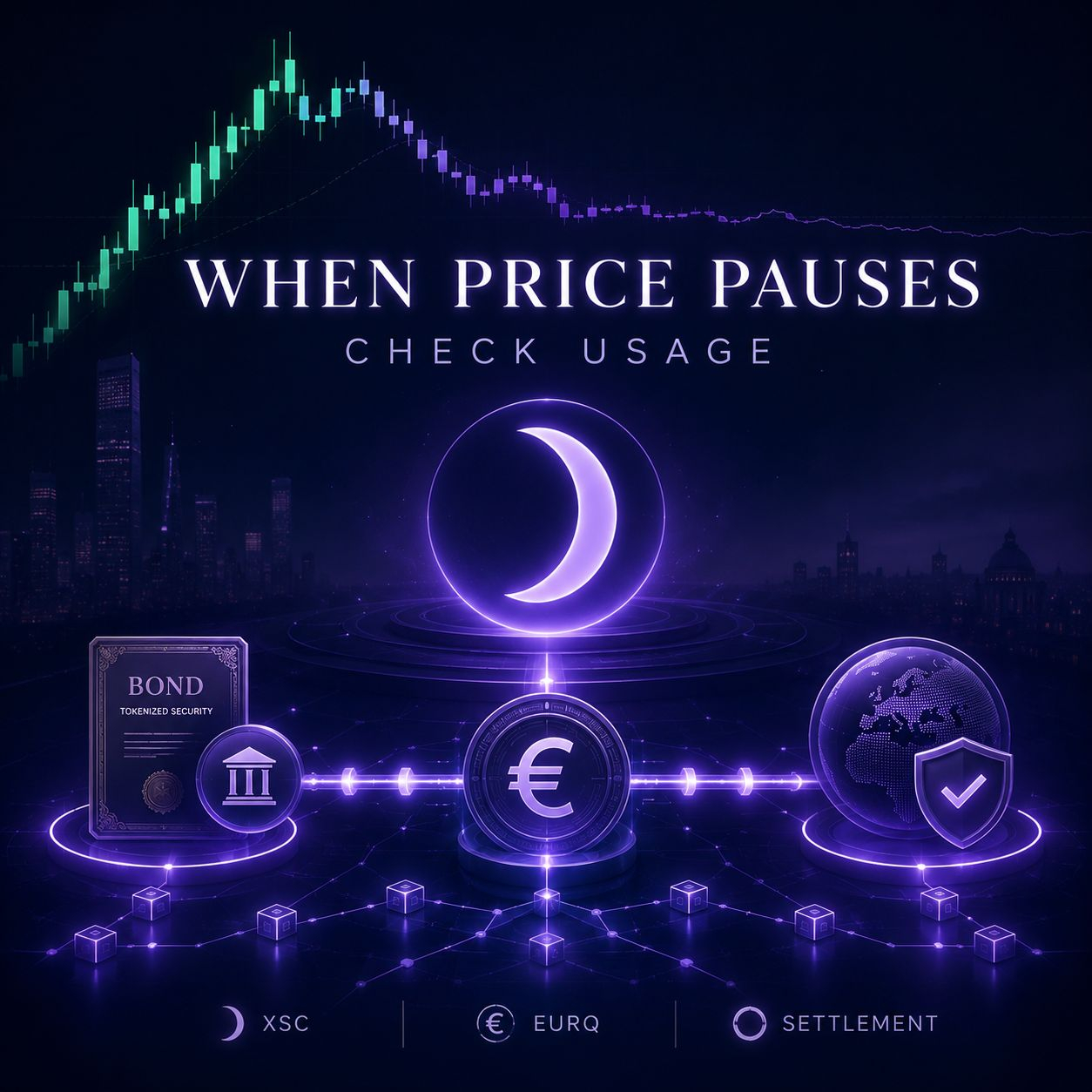
A strong upswing always draws attention to Dusk, but I don’t want to use candle patterns as evidence that the project’s thesis is correct.
What I find more worth watching is the infrastructure.
Dusk is trying to solve a fairly difficult onchain finance problem: assets need to be verified and compliant, yet the company also can’t disclose its entire positions, identities, or transaction history to anyone who looks at the blockchain.
XSC, selective disclosure, and DuskEVM all circle around that boundary. And EURQ makes the story more practical, because tokenized securities don’t just need the assets to be brought onchain—they also need a compatible payment rail so that money and assets can settle within the same ecosystem.
In my view, this is the part that’s easiest to overlook.
A blockchain can tokenize bonds or funds, but if the payment step still has to route out to the traditional system, then the onchain experience only solves half the puzzle.
So I’m not too excited if DUSK just climbs along with volume over a few days. Momentum may bring traders in, but it doesn’t say they’ll stay.
What I want to see after the market cools down is whether trading volume, truly settled assets, and demand for using Dusk continue to rise.
If activity remains even after the chart stops looking attractive, then the upswing would start to have meaning beyond speculation.
@Dusk_Foundation #dusk $UAI $LAB
I’m more interested in $DUSK than when the price stops rising
A strong upswing always draws attention to Dusk, but I don’t want to use candle patterns as evidence that the project’s thesis is correct.
What I find more worth watching is the infrastructure.
Dusk is trying to solve a fairly difficult onchain finance problem: assets need to be verified and compliant, yet the company also can’t disclose its entire positions, identities, or transaction history to anyone who looks at the blockchain.
XSC, selective disclosure, and DuskEVM all circle around that boundary. And EURQ makes the story more practical, because tokenized securities don’t just need the assets to be brought onchain—they also need a compatible payment rail so that money and assets can settle within the same ecosystem.
In my view, this is the part that’s easiest to overlook.
A blockchain can tokenize bonds or funds, but if the payment step still has to route out to the traditional system, then the onchain experience only solves half the puzzle.
So I’m not too excited if DUSK just climbs along with volume over a few days. Momentum may bring traders in, but it doesn’t say they’ll stay.
What I want to see after the market cools down is whether trading volume, truly settled assets, and demand for using Dusk continue to rise.
If activity remains even after the chart stops looking attractive, then the upswing would start to have meaning beyond speculation.
@Dusk #dusk $UAI $LAB
A strong upswing always draws attention to Dusk, but I don’t want to use candle patterns as evidence that the project’s thesis is correct.
What I find more worth watching is the infrastructure.
Dusk is trying to solve a fairly difficult onchain finance problem: assets need to be verified and compliant, yet the company also can’t disclose its entire positions, identities, or transaction history to anyone who looks at the blockchain.
XSC, selective disclosure, and DuskEVM all circle around that boundary. And EURQ makes the story more practical, because tokenized securities don’t just need the assets to be brought onchain—they also need a compatible payment rail so that money and assets can settle within the same ecosystem.
In my view, this is the part that’s easiest to overlook.
A blockchain can tokenize bonds or funds, but if the payment step still has to route out to the traditional system, then the onchain experience only solves half the puzzle.
So I’m not too excited if DUSK just climbs along with volume over a few days. Momentum may bring traders in, but it doesn’t say they’ll stay.
What I want to see after the market cools down is whether trading volume, truly settled assets, and demand for using Dusk continue to rise.
If activity remains even after the chart stops looking attractive, then the upswing would start to have meaning beyond speculation.
@Dusk #dusk $UAI $LAB
1
2
578
JubJub caught my attention with the part of the story that’s least talked about in Dusk’s privacy
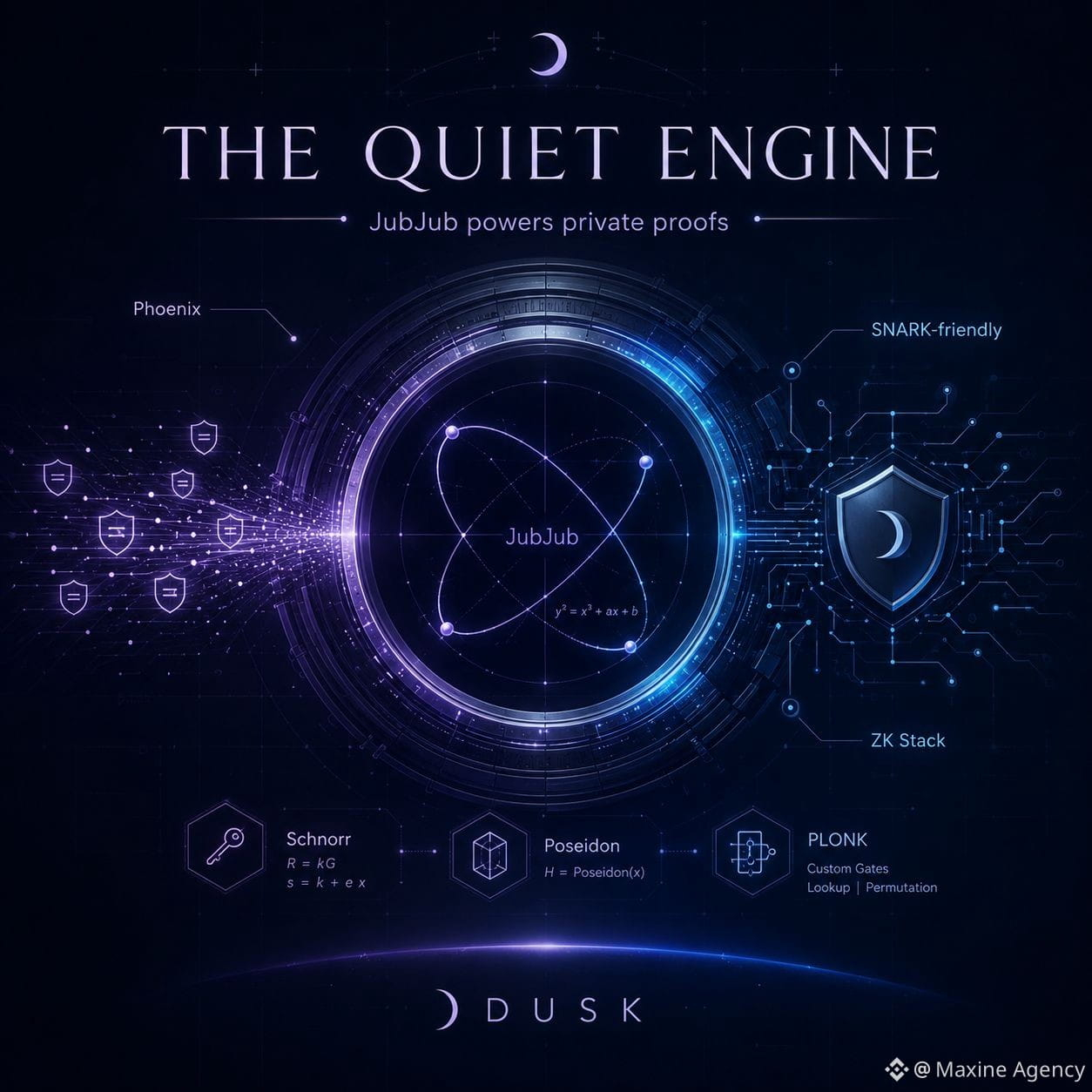
When talking about Dusk, the most visible pieces are still confidential transactions, selective disclosure, or privately held financial assets. But the further I read down into the cryptographic layer underneath, the more I find JubJub far more interesting than its name suggests.
JubJub is an elliptic curve designed to work efficiently in SNARK-friendly environments. With Dusk, that matters because privacy isn’t just about hiding data on the interface. Zero-knowledge proofs still have to verify that transactions follow the correct rules without forcing sensitive data to be publicly revealed.
Phoenix shows that role pretty clearly. Phoenix’s shielded address is built from points on JubJub, while Dusk also adds primitives like Schnorr, Poseidon, and PLONK into its cryptographic stack.
What I like here is that Dusk doesn’t try to turn JubJub into a standalone narrative. It’s like a part deep inside an engine: users hardly need to know it exists, but choosing the wrong primitives can make proofs heavier or harder to integrate.
Of course, a beautiful cryptographic stack doesn’t create adoption by itself. Dusk still has to prove that developers, organizations, and real assets genuinely need this infrastructure.
But if you want to understand whether a privacy chain actually does the serious technical work, I think you should look beneath the marketing keywords.
Sometimes the most worth seeing thing is exactly the part that has no ticker, no campaign, and nobody touting it.
@Dusk_Foundation $DUSK #dusk $AOP $4
JubJub caught my attention with the part of the story that’s least talked about in Dusk’s privacy
When talking about Dusk, the most visible pieces are still confidential transactions, selective disclosure, or privately held financial assets. But the further I read down into the cryptographic layer underneath, the more I find JubJub far more interesting than its name suggests.
JubJub is an elliptic curve designed to work efficiently in SNARK-friendly environments. With Dusk, that matters because privacy isn’t just about hiding data on the interface. Zero-knowledge proofs still have to verify that transactions follow the correct rules without forcing sensitive data to be publicly revealed.
Phoenix shows that role pretty clearly. Phoenix’s shielded address is built from points on JubJub, while Dusk also adds primitives like Schnorr, Poseidon, and PLONK into its cryptographic stack.
What I like here is that Dusk doesn’t try to turn JubJub into a standalone narrative. It’s like a part deep inside an engine: users hardly need to know it exists, but choosing the wrong primitives can make proofs heavier or harder to integrate.
Of course, a beautiful cryptographic stack doesn’t create adoption by itself. Dusk still has to prove that developers, organizations, and real assets genuinely need this infrastructure.
But if you want to understand whether a privacy chain actually does the serious technical work, I think you should look beneath the marketing keywords.
Sometimes the most worth seeing thing is exactly the part that has no ticker, no campaign, and nobody touting it.
@Dusk $DUSK #dusk $AOP $4
When talking about Dusk, the most visible pieces are still confidential transactions, selective disclosure, or privately held financial assets. But the further I read down into the cryptographic layer underneath, the more I find JubJub far more interesting than its name suggests.
JubJub is an elliptic curve designed to work efficiently in SNARK-friendly environments. With Dusk, that matters because privacy isn’t just about hiding data on the interface. Zero-knowledge proofs still have to verify that transactions follow the correct rules without forcing sensitive data to be publicly revealed.
Phoenix shows that role pretty clearly. Phoenix’s shielded address is built from points on JubJub, while Dusk also adds primitives like Schnorr, Poseidon, and PLONK into its cryptographic stack.
What I like here is that Dusk doesn’t try to turn JubJub into a standalone narrative. It’s like a part deep inside an engine: users hardly need to know it exists, but choosing the wrong primitives can make proofs heavier or harder to integrate.
Of course, a beautiful cryptographic stack doesn’t create adoption by itself. Dusk still has to prove that developers, organizations, and real assets genuinely need this infrastructure.
But if you want to understand whether a privacy chain actually does the serious technical work, I think you should look beneath the marketing keywords.
Sometimes the most worth seeing thing is exactly the part that has no ticker, no campaign, and nobody touting it.
@Dusk $DUSK #dusk $AOP $4
2
2
200
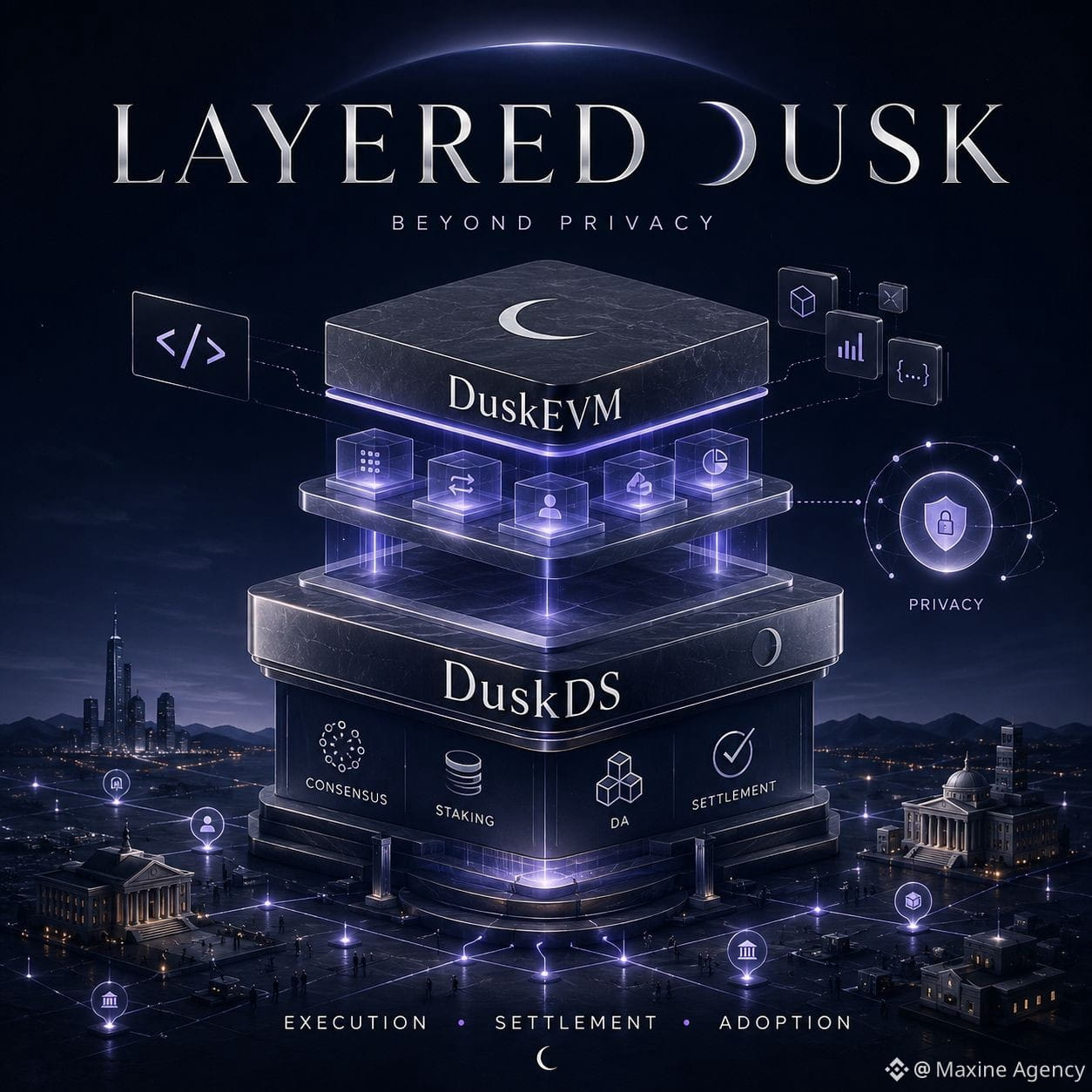
Dusk is shifting from a “privacy chain” to a more clearly layered infrastructure
In the past, when looking at Dusk, I almost only focused on privacy. That’s understandable because the project has spent years building infrastructure for confidential finance before the mainnet launched in early 2025.
But the more I looked at the upgrades afterward, the more the most interesting part seemed to be how Dusk is separating each network task.
DuskDS focuses on consensus, staking, data availability, and settlement. DuskEVM provides a more familiar environment for Solidity developers. Privacy still exists, but it is no longer forced to be a mandatory requirement for every application.
In my view, this is quite an important change.
A blockchain with strong privacy technology, but that forces developers to learn too many new things, will inevitably narrow the set of people who can build on it. Introducing EVM helps reduce the cost of switching, while separate layers of settlement and privacy still preserve what makes Dusk different from a typical EVM chain.
So upgrades like blob transactions or PLONK V2 look more like infrastructure preparation than a “new feature”.
But a beautiful architecture on paper doesn’t tell you much.
What I want to see is whether DuskEVM can keep developers actively working long-term, whether the transaction volume truly increases, and which financial assets ultimately get settled through DuskDS rather than just stopping at demos or announcements.
If those numbers show up, separating execution from settlement will have real-world significance.
If not, Dusk has only solved the design problem—it hasn’t solved the adoption problem yet.
@Dusk_Foundation $DUSK #dusk
$UP $MarsCoin
Dusk is shifting from a “privacy chain” to a more clearly layered infrastructure
In the past, when looking at Dusk, I almost only focused on privacy. That’s understandable because the project has spent years building infrastructure for confidential finance before the mainnet launched in early 2025.
But the more I looked at the upgrades afterward, the more the most interesting part seemed to be how Dusk is separating each network task.
DuskDS focuses on consensus, staking, data availability, and settlement. DuskEVM provides a more familiar environment for Solidity developers. Privacy still exists, but it is no longer forced to be a mandatory requirement for every application.
In my view, this is quite an important change.
A blockchain with strong privacy technology, but that forces developers to learn too many new things, will inevitably narrow the set of people who can build on it. Introducing EVM helps reduce the cost of switching, while separate layers of settlement and privacy still preserve what makes Dusk different from a typical EVM chain.
So upgrades like blob transactions or PLONK V2 look more like infrastructure preparation than a “new feature”.
But a beautiful architecture on paper doesn’t tell you much.
What I want to see is whether DuskEVM can keep developers actively working long-term, whether the transaction volume truly increases, and which financial assets ultimately get settled through DuskDS rather than just stopping at demos or announcements.
If those numbers show up, separating execution from settlement will have real-world significance.
If not, Dusk has only solved the design problem—it hasn’t solved the adoption problem yet.
@Dusk $DUSK #dusk
$UP $MarsCoin
In the past, when looking at Dusk, I almost only focused on privacy. That’s understandable because the project has spent years building infrastructure for confidential finance before the mainnet launched in early 2025.
But the more I looked at the upgrades afterward, the more the most interesting part seemed to be how Dusk is separating each network task.
DuskDS focuses on consensus, staking, data availability, and settlement. DuskEVM provides a more familiar environment for Solidity developers. Privacy still exists, but it is no longer forced to be a mandatory requirement for every application.
In my view, this is quite an important change.
A blockchain with strong privacy technology, but that forces developers to learn too many new things, will inevitably narrow the set of people who can build on it. Introducing EVM helps reduce the cost of switching, while separate layers of settlement and privacy still preserve what makes Dusk different from a typical EVM chain.
So upgrades like blob transactions or PLONK V2 look more like infrastructure preparation than a “new feature”.
But a beautiful architecture on paper doesn’t tell you much.
What I want to see is whether DuskEVM can keep developers actively working long-term, whether the transaction volume truly increases, and which financial assets ultimately get settled through DuskDS rather than just stopping at demos or announcements.
If those numbers show up, separating execution from settlement will have real-world significance.
If not, Dusk has only solved the design problem—it hasn’t solved the adoption problem yet.
@Dusk $DUSK #dusk
$UP $MarsCoin
1
1
197
Verified
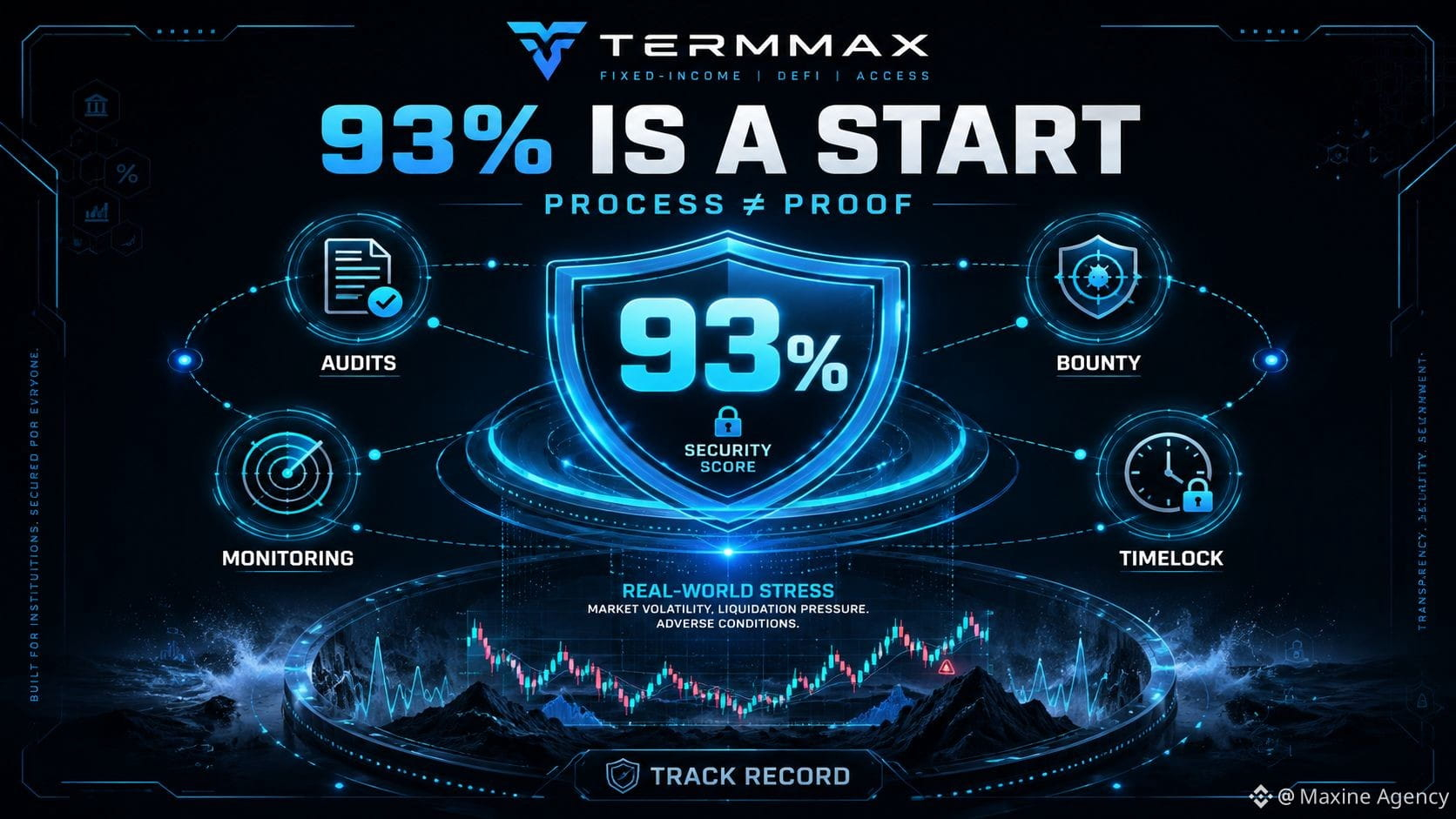
Notable: TermMax’s 93% security score, but I don’t see it as the final proof
I usually skim security pages pretty quickly because most protocols share the same set of keywords: audit, bug bounty, monitoring, timelock. But TermMax made me stop when I saw DeFiSafety giving it 93%—the same level the project uses to compare itself with Aave V3.
This number is good, but I think how to interpret it matters more than the score itself.
DeFiSafety doesn’t directly audit the code. They evaluate the process, documentation, transparency level, and how the protocol applies safe practices. So a 93% score indicates that TermMax has a well-built security process—not that the smart contract has been proven “93% safe.”
Looking at the current stack, TermMax has several layers: audit to catch bugs before deployment, bug bounty to expand the inspection surface, Hypernative to watch for anomalies after the system is live, and timelock to slow down sensitive changes. Each layer handles a different type of risk.
But there’s still something you can’t buy in advance with an audit.
That’s a track record of surviving the real market.
Aave V3 has an advantage because it has been running for years and through many high-pressure scenarios. TermMax currently doesn’t have the same amount of hard-earned, real-world data.
So I won’t ask whether TermMax is secure.
I want to see how this security stack reacts when liquidity swings sharply, when oracles come under pressure, or when a real edge case shows up on mainnet.
The score tells you how seriously the protocol prepares.
A new track record shows how well those preparations hold up against reality.
@termmax #TermMax
$BEAT $BTC $ARX
Notable: TermMax’s 93% security score, but I don’t see it as the final proof
I usually skim security pages pretty quickly because most protocols share the same set of keywords: audit, bug bounty, monitoring, timelock. But TermMax made me stop when I saw DeFiSafety giving it 93%—the same level the project uses to compare itself with Aave V3.
This number is good, but I think how to interpret it matters more than the score itself.
DeFiSafety doesn’t directly audit the code. They evaluate the process, documentation, transparency level, and how the protocol applies safe practices. So a 93% score indicates that TermMax has a well-built security process—not that the smart contract has been proven “93% safe.”
Looking at the current stack, TermMax has several layers: audit to catch bugs before deployment, bug bounty to expand the inspection surface, Hypernative to watch for anomalies after the system is live, and timelock to slow down sensitive changes. Each layer handles a different type of risk.
But there’s still something you can’t buy in advance with an audit.
That’s a track record of surviving the real market.
Aave V3 has an advantage because it has been running for years and through many high-pressure scenarios. TermMax currently doesn’t have the same amount of hard-earned, real-world data.
So I won’t ask whether TermMax is secure.
I want to see how this security stack reacts when liquidity swings sharply, when oracles come under pressure, or when a real edge case shows up on mainnet.
The score tells you how seriously the protocol prepares.
A new track record shows how well those preparations hold up against reality.
@TermMax #TermMax
$BEAT $BTC $ARX
I usually skim security pages pretty quickly because most protocols share the same set of keywords: audit, bug bounty, monitoring, timelock. But TermMax made me stop when I saw DeFiSafety giving it 93%—the same level the project uses to compare itself with Aave V3.
This number is good, but I think how to interpret it matters more than the score itself.
DeFiSafety doesn’t directly audit the code. They evaluate the process, documentation, transparency level, and how the protocol applies safe practices. So a 93% score indicates that TermMax has a well-built security process—not that the smart contract has been proven “93% safe.”
Looking at the current stack, TermMax has several layers: audit to catch bugs before deployment, bug bounty to expand the inspection surface, Hypernative to watch for anomalies after the system is live, and timelock to slow down sensitive changes. Each layer handles a different type of risk.
But there’s still something you can’t buy in advance with an audit.
That’s a track record of surviving the real market.
Aave V3 has an advantage because it has been running for years and through many high-pressure scenarios. TermMax currently doesn’t have the same amount of hard-earned, real-world data.
So I won’t ask whether TermMax is secure.
I want to see how this security stack reacts when liquidity swings sharply, when oracles come under pressure, or when a real edge case shows up on mainnet.
The score tells you how seriously the protocol prepares.
A new track record shows how well those preparations hold up against reality.
@TermMax #TermMax
$BEAT $BTC $ARX
1
2
715
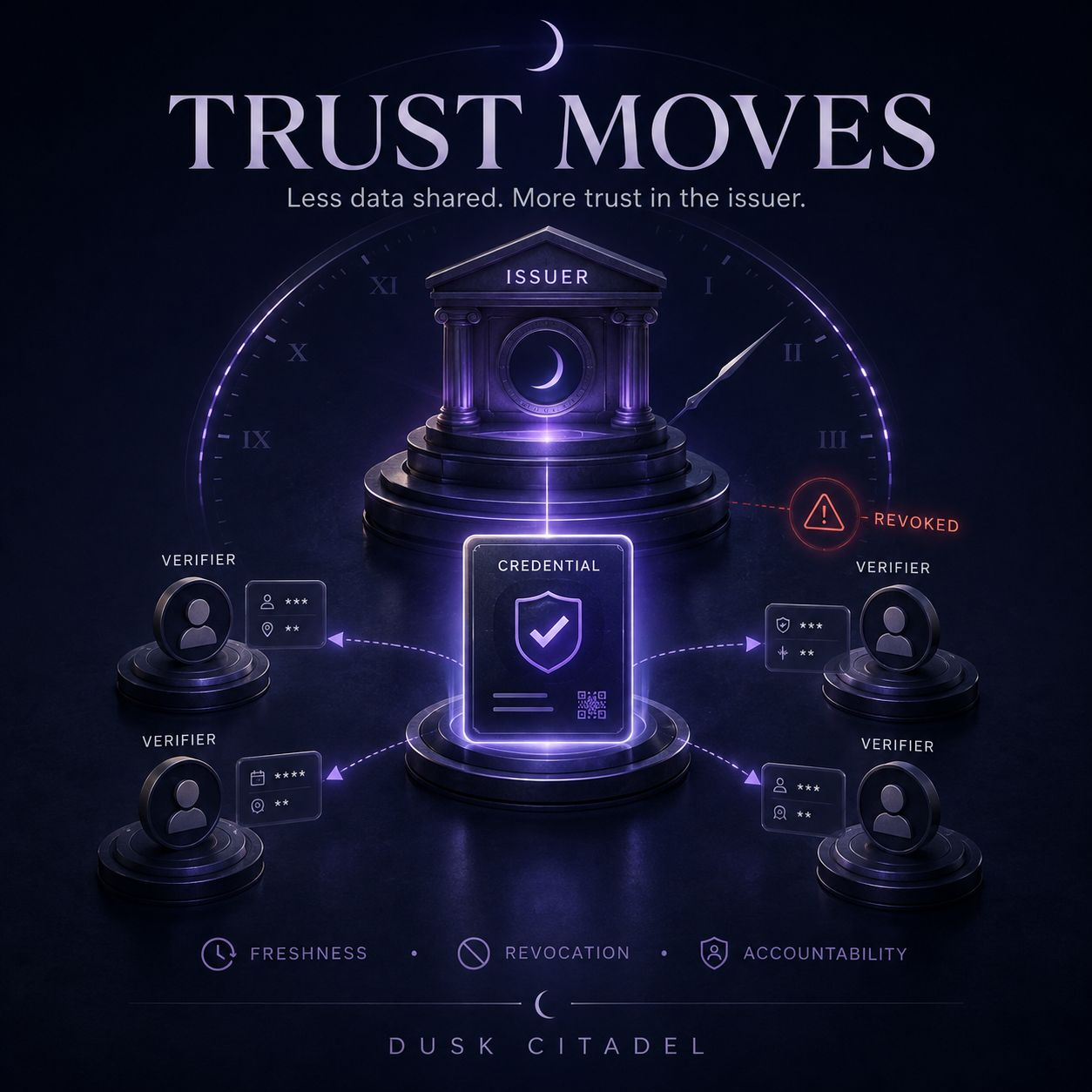
Citadel reduces the need to share data, but it also makes me pay closer attention to the credential issuer
What I find interesting about Citadel is that users don’t need to provide the entire KYC dossier every time someone wants to verify them.
After being checked, a credential can be used to prove specific things such as jurisdiction, investor status, or whether a given compliance requirement has been met. The verifier receives only the exact information it needs, rather than the whole identity data set.
At first, I thought this was simply reducing trust.
But looking more closely, trust is actually just moved to another place.
If multiple organizations accept the same credential, the issuer’s original decision carries even more weight. One assessment can be reused many times, so mistakes made during credential issuance can spread further rather than affecting only a single transaction.
Time makes the problem even harder. A credential that’s correct today may not be correct a few months from now. Sanctions status, jurisdiction, or eligibility can all change.
So for me, the most important part of Citadel isn’t just selective disclosure. It also lies in freshness, revocation, and the issuer’s accountability when the underlying data changes.
I’ll also be interested in the number of credentials that are actually reused—not just the number of integrations that are announced.
Because privacy only answers the question: “how much does the verifier need to see?”
But when a credential is wrong or outdated, the harder question remains: who is responsible for the decision that the entire system has come to trust?
@Dusk_Foundation $DUSK #dusk
$APR $BNB
Citadel reduces the need to share data, but it also makes me pay closer attention to the credential issuer
What I find interesting about Citadel is that users don’t need to provide the entire KYC dossier every time someone wants to verify them.
After being checked, a credential can be used to prove specific things such as jurisdiction, investor status, or whether a given compliance requirement has been met. The verifier receives only the exact information it needs, rather than the whole identity data set.
At first, I thought this was simply reducing trust.
But looking more closely, trust is actually just moved to another place.
If multiple organizations accept the same credential, the issuer’s original decision carries even more weight. One assessment can be reused many times, so mistakes made during credential issuance can spread further rather than affecting only a single transaction.
Time makes the problem even harder. A credential that’s correct today may not be correct a few months from now. Sanctions status, jurisdiction, or eligibility can all change.
So for me, the most important part of Citadel isn’t just selective disclosure. It also lies in freshness, revocation, and the issuer’s accountability when the underlying data changes.
I’ll also be interested in the number of credentials that are actually reused—not just the number of integrations that are announced.
Because privacy only answers the question: “how much does the verifier need to see?”
But when a credential is wrong or outdated, the harder question remains: who is responsible for the decision that the entire system has come to trust?
@Dusk $DUSK #dusk
$APR $BNB
What I find interesting about Citadel is that users don’t need to provide the entire KYC dossier every time someone wants to verify them.
After being checked, a credential can be used to prove specific things such as jurisdiction, investor status, or whether a given compliance requirement has been met. The verifier receives only the exact information it needs, rather than the whole identity data set.
At first, I thought this was simply reducing trust.
But looking more closely, trust is actually just moved to another place.
If multiple organizations accept the same credential, the issuer’s original decision carries even more weight. One assessment can be reused many times, so mistakes made during credential issuance can spread further rather than affecting only a single transaction.
Time makes the problem even harder. A credential that’s correct today may not be correct a few months from now. Sanctions status, jurisdiction, or eligibility can all change.
So for me, the most important part of Citadel isn’t just selective disclosure. It also lies in freshness, revocation, and the issuer’s accountability when the underlying data changes.
I’ll also be interested in the number of credentials that are actually reused—not just the number of integrations that are announced.
Because privacy only answers the question: “how much does the verifier need to see?”
But when a credential is wrong or outdated, the harder question remains: who is responsible for the decision that the entire system has come to trust?
@Dusk $DUSK #dusk
$APR $BNB
4
3
189
Partly True
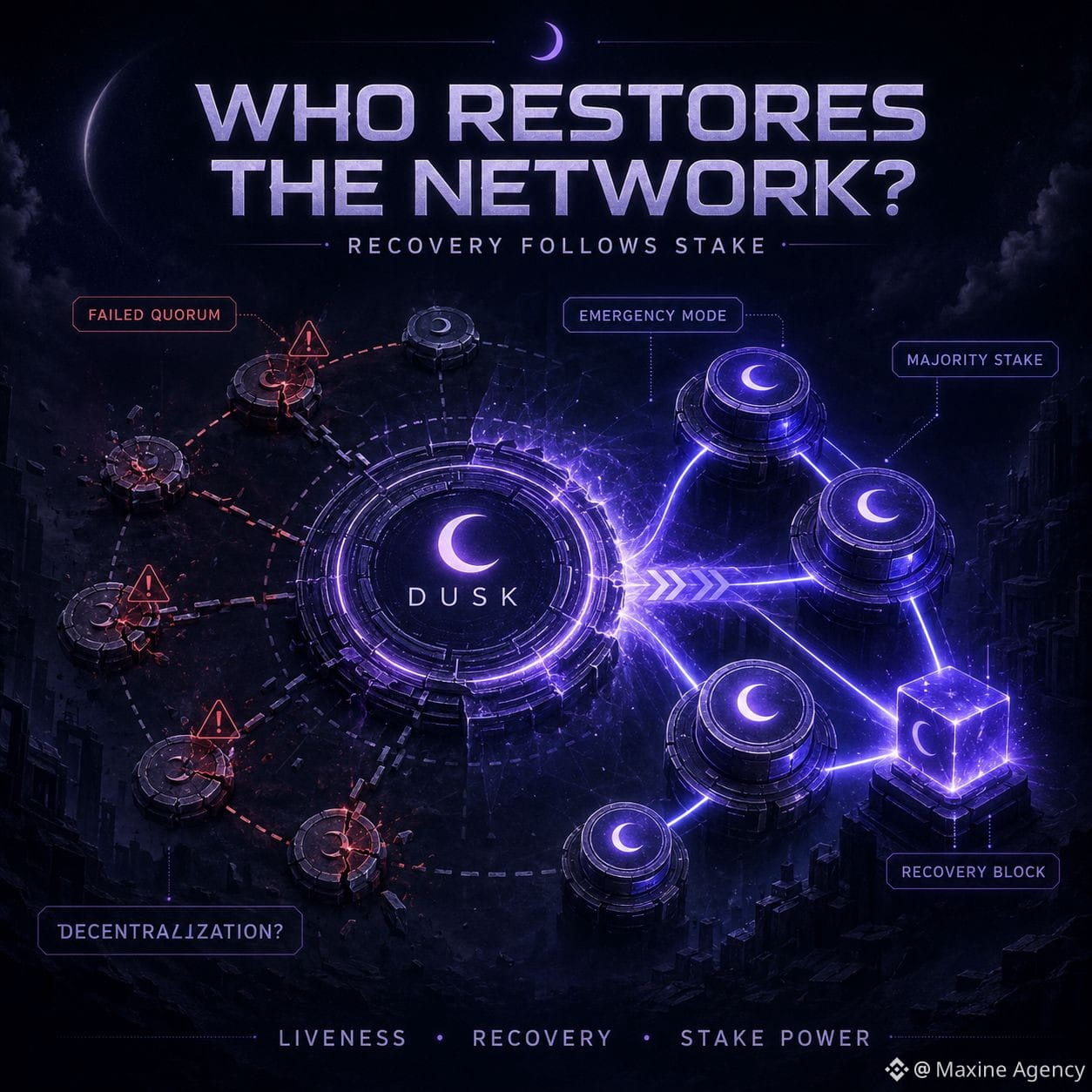
The more trouble Dusk runs into, the more I care about who holds the power to restore networking
Reading Dusk’s consensus section, I don’t think the “normal” mechanism is the main thing to worry about. What’s interesting is what happens when the network repeatedly fails to reach quorum.
After 16 failed iterations, Succinct Attestation switches to emergency mode. The timeout for each step is removed, allowing multiple iterations to be opened concurrently to increase the chance of finding a valid block. If multiple candidates reach consensus, the block from the lower-numbered iteration gets priority.
This design helps the network avoid getting stuck just because some provisioners are slow or disconnected. But it also makes me pay attention to another boundary: when network conditions worsen, recovery ability becomes more clearly dependent on the distribution of stake.
In the final approach, an emergency block is only created when the group of provisioners asks it to take the majority of the network’s total stake. Meanwhile, to directly participate in consensus, a provisioner currently needs a minimum stake of 1,000 DUSK.
So for me, staking isn’t only a way to earn rewards. It also determines who carries more weight when the system needs to get out of an abnormal state.
In my view, the important test for Dusk isn’t a day when the network runs smoothly. It’s when congestion increases, some nodes fall behind, and committees keep changing—can the network recover without concentrating decision-making power into a single large stake group.
A recovery mechanism can be technically very solid.
But if the ability to save the network becomes increasingly concentrated by stake, then decentralization is the most important thing to measure carefully.
@Dusk_Foundation $DUSK #dusk
$ONDO $BTC
The more trouble Dusk runs into, the more I care about who holds the power to restore networking
Reading Dusk’s consensus section, I don’t think the “normal” mechanism is the main thing to worry about. What’s interesting is what happens when the network repeatedly fails to reach quorum.
After 16 failed iterations, Succinct Attestation switches to emergency mode. The timeout for each step is removed, allowing multiple iterations to be opened concurrently to increase the chance of finding a valid block. If multiple candidates reach consensus, the block from the lower-numbered iteration gets priority.
This design helps the network avoid getting stuck just because some provisioners are slow or disconnected. But it also makes me pay attention to another boundary: when network conditions worsen, recovery ability becomes more clearly dependent on the distribution of stake.
In the final approach, an emergency block is only created when the group of provisioners asks it to take the majority of the network’s total stake. Meanwhile, to directly participate in consensus, a provisioner currently needs a minimum stake of 1,000 DUSK.
So for me, staking isn’t only a way to earn rewards. It also determines who carries more weight when the system needs to get out of an abnormal state.
In my view, the important test for Dusk isn’t a day when the network runs smoothly. It’s when congestion increases, some nodes fall behind, and committees keep changing—can the network recover without concentrating decision-making power into a single large stake group.
A recovery mechanism can be technically very solid.
But if the ability to save the network becomes increasingly concentrated by stake, then decentralization is the most important thing to measure carefully.
@Dusk $DUSK #dusk
$ONDO $BTC
Reading Dusk’s consensus section, I don’t think the “normal” mechanism is the main thing to worry about. What’s interesting is what happens when the network repeatedly fails to reach quorum.
After 16 failed iterations, Succinct Attestation switches to emergency mode. The timeout for each step is removed, allowing multiple iterations to be opened concurrently to increase the chance of finding a valid block. If multiple candidates reach consensus, the block from the lower-numbered iteration gets priority.
This design helps the network avoid getting stuck just because some provisioners are slow or disconnected. But it also makes me pay attention to another boundary: when network conditions worsen, recovery ability becomes more clearly dependent on the distribution of stake.
In the final approach, an emergency block is only created when the group of provisioners asks it to take the majority of the network’s total stake. Meanwhile, to directly participate in consensus, a provisioner currently needs a minimum stake of 1,000 DUSK.
So for me, staking isn’t only a way to earn rewards. It also determines who carries more weight when the system needs to get out of an abnormal state.
In my view, the important test for Dusk isn’t a day when the network runs smoothly. It’s when congestion increases, some nodes fall behind, and committees keep changing—can the network recover without concentrating decision-making power into a single large stake group.
A recovery mechanism can be technically very solid.
But if the ability to save the network becomes increasingly concentrated by stake, then decentralization is the most important thing to measure carefully.
@Dusk $DUSK #dusk
$ONDO $BTC
5
3
609
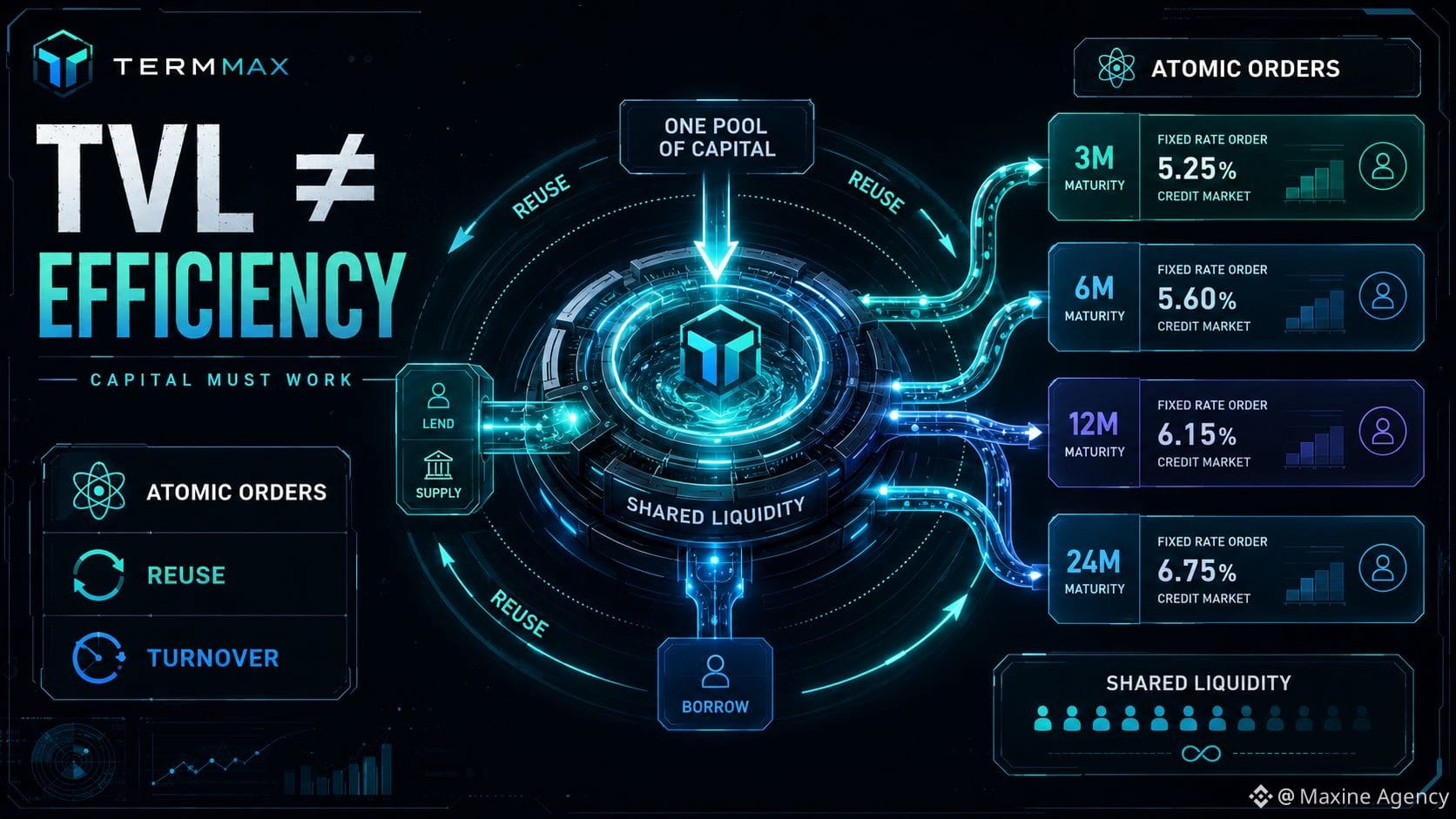
TVL is big, but it may not fully reflect TermMax’s capital efficiency
What I find interesting about DeFi is that liquidity can look very “thick” on a dashboard, but in reality it often just sits there for quite a while between executions. The capital is still present—it’s just not always located exactly where borrowing demand exists.
TermMax’s Atomic Orders caught my attention because it addresses this point.
Instead of splitting liquidity into multiple portions for each market or each maturity, a single pool of capital can serve many different orders. If this mechanism works efficiently, one dollar of liquidity doesn’t just show up once in TVL—it can also be reused across multiple credit opportunities.
So I think TVL alone isn’t enough to evaluate TermMax.
A protocol can have a high TVL, but if most of the capital is waiting around, it’s not necessarily more effective than a smaller system with higher capital turnover. With Atomic Orders, what I want to look at is the speed at which capital is matched, how many times it can be reused, and how much credit volume each dollar of liquidity actually supports.
But shared liquidity also has a point that needs to be checked.
Many markets may appear deeper when they share the same liquidity source. However, if borrowing demand spikes strongly across multiple places at the same time, the real limit of how much liquidity is available will become visible. Capital may be allocated more efficiently, but it doesn’t become infinite.
In my view, this is the metric worth paying attention to in TermMax.
Not only how much money the protocol can keep, but how many times each dollar of capital can “work” before the system starts hitting its liquidity limits.
@termmax #TermMax
$SKYAI $BTC $BNB
TVL is big, but it may not fully reflect TermMax’s capital efficiency
What I find interesting about DeFi is that liquidity can look very “thick” on a dashboard, but in reality it often just sits there for quite a while between executions. The capital is still present—it’s just not always located exactly where borrowing demand exists.
TermMax’s Atomic Orders caught my attention because it addresses this point.
Instead of splitting liquidity into multiple portions for each market or each maturity, a single pool of capital can serve many different orders. If this mechanism works efficiently, one dollar of liquidity doesn’t just show up once in TVL—it can also be reused across multiple credit opportunities.
So I think TVL alone isn’t enough to evaluate TermMax.
A protocol can have a high TVL, but if most of the capital is waiting around, it’s not necessarily more effective than a smaller system with higher capital turnover. With Atomic Orders, what I want to look at is the speed at which capital is matched, how many times it can be reused, and how much credit volume each dollar of liquidity actually supports.
But shared liquidity also has a point that needs to be checked.
Many markets may appear deeper when they share the same liquidity source. However, if borrowing demand spikes strongly across multiple places at the same time, the real limit of how much liquidity is available will become visible. Capital may be allocated more efficiently, but it doesn’t become infinite.
In my view, this is the metric worth paying attention to in TermMax.
Not only how much money the protocol can keep, but how many times each dollar of capital can “work” before the system starts hitting its liquidity limits.
@TermMax #TermMax
$SKYAI $BTC $BNB
What I find interesting about DeFi is that liquidity can look very “thick” on a dashboard, but in reality it often just sits there for quite a while between executions. The capital is still present—it’s just not always located exactly where borrowing demand exists.
TermMax’s Atomic Orders caught my attention because it addresses this point.
Instead of splitting liquidity into multiple portions for each market or each maturity, a single pool of capital can serve many different orders. If this mechanism works efficiently, one dollar of liquidity doesn’t just show up once in TVL—it can also be reused across multiple credit opportunities.
So I think TVL alone isn’t enough to evaluate TermMax.
A protocol can have a high TVL, but if most of the capital is waiting around, it’s not necessarily more effective than a smaller system with higher capital turnover. With Atomic Orders, what I want to look at is the speed at which capital is matched, how many times it can be reused, and how much credit volume each dollar of liquidity actually supports.
But shared liquidity also has a point that needs to be checked.
Many markets may appear deeper when they share the same liquidity source. However, if borrowing demand spikes strongly across multiple places at the same time, the real limit of how much liquidity is available will become visible. Capital may be allocated more efficiently, but it doesn’t become infinite.
In my view, this is the metric worth paying attention to in TermMax.
Not only how much money the protocol can keep, but how many times each dollar of capital can “work” before the system starts hitting its liquidity limits.
@TermMax #TermMax
$SKYAI $BTC $BNB
2
2
722
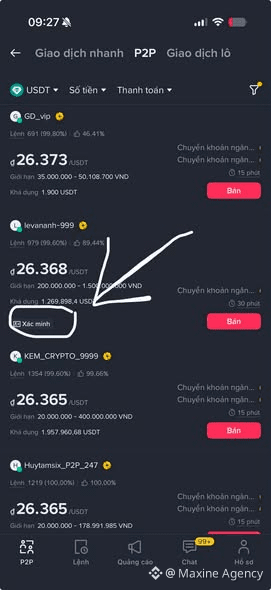
P2P now has an additional “Verification” layer, and I think this is a detail worth checking before placing an order.
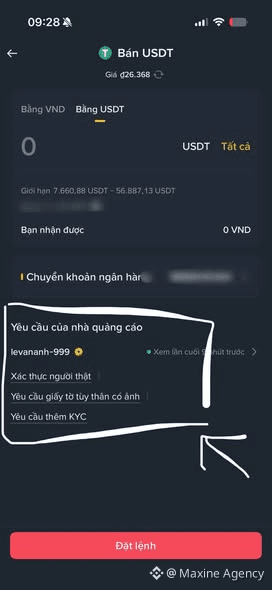
The other day, when I was using Binance P2P, I noticed that some Merchants now have a “Verification” label right under their ads. If you click to view more carefully, you may see extra steps in the advertiser’s requirements—such as verifying a real person, providing photo ID, or additional KYC.
The important point I noticed is that these requirements aren’t shown at the final step; they appear right before you place the order. That means before clicking “Sell,” users should open the Merchant’s terms/conditions and read them carefully. If the ad requires additional verification that I don’t want to provide or can’t meet, it’s best to stop right away rather than opening an Order and only then realizing it.
In my view, this is a fairly reasonable control layer for P2P transactions—especially for Merchants who handle large volumes. When both parties’ identities are clearer, matching the payer, the source of funds, and handling disputes later is also easier.
But having verification doesn’t mean I skip other safety steps. When selling USDT, I still need to confirm that the money has actually arrived in the account before I Release. When buying, I still transfer to the exact account shown in the Order and keep the entire conversation within Binance. If a Merchant asks me to send documents through a channel outside the platform, I won’t follow it just because the ad has a “verification” label.
What I’ve learned is that before, I usually focused on the price, Completion Rate, and number of orders.
Now I’ll also look at one more thing: what exactly the Merchant is asking me to verify before the transaction.
Reading carefully for 10 seconds before placing the order is still easier than dealing with an unsuitable order afterward.
@Binance_Vietnam #BinanceP2PAnToan
$BTC $ON $EDGE
P2P now has an additional “Verification” layer, and I think this is a detail worth checking before placing an order.
The other day, when I was using Binance P2P, I noticed that some Merchants now have a “Verification” label right under their ads. If you click to view more carefully, you may see extra steps in the advertiser’s requirements—such as verifying a real person, providing photo ID, or additional KYC.
The important point I noticed is that these requirements aren’t shown at the final step; they appear right before you place the order. That means before clicking “Sell,” users should open the Merchant’s terms/conditions and read them carefully. If the ad requires additional verification that I don’t want to provide or can’t meet, it’s best to stop right away rather than opening an Order and only then realizing it.
In my view, this is a fairly reasonable control layer for P2P transactions—especially for Merchants who handle large volumes. When both parties’ identities are clearer, matching the payer, the source of funds, and handling disputes later is also easier.
But having verification doesn’t mean I skip other safety steps. When selling USDT, I still need to confirm that the money has actually arrived in the account before I Release. When buying, I still transfer to the exact account shown in the Order and keep the entire conversation within Binance. If a Merchant asks me to send documents through a channel outside the platform, I won’t follow it just because the ad has a “verification” label.
What I’ve learned is that before, I usually focused on the price, Completion Rate, and number of orders.
Now I’ll also look at one more thing: what exactly the Merchant is asking me to verify before the transaction.
Reading carefully for 10 seconds before placing the order is still easier than dealing with an unsuitable order afterward.
@Binance Vietnam #BinanceP2PAnToan
$BTC $ON $EDGE
The other day, when I was using Binance P2P, I noticed that some Merchants now have a “Verification” label right under their ads. If you click to view more carefully, you may see extra steps in the advertiser’s requirements—such as verifying a real person, providing photo ID, or additional KYC.
The important point I noticed is that these requirements aren’t shown at the final step; they appear right before you place the order. That means before clicking “Sell,” users should open the Merchant’s terms/conditions and read them carefully. If the ad requires additional verification that I don’t want to provide or can’t meet, it’s best to stop right away rather than opening an Order and only then realizing it.
In my view, this is a fairly reasonable control layer for P2P transactions—especially for Merchants who handle large volumes. When both parties’ identities are clearer, matching the payer, the source of funds, and handling disputes later is also easier.
But having verification doesn’t mean I skip other safety steps. When selling USDT, I still need to confirm that the money has actually arrived in the account before I Release. When buying, I still transfer to the exact account shown in the Order and keep the entire conversation within Binance. If a Merchant asks me to send documents through a channel outside the platform, I won’t follow it just because the ad has a “verification” label.
What I’ve learned is that before, I usually focused on the price, Completion Rate, and number of orders.
Now I’ll also look at one more thing: what exactly the Merchant is asking me to verify before the transaction.
Reading carefully for 10 seconds before placing the order is still easier than dealing with an unsuitable order afterward.
@Binance Vietnam #BinanceP2PAnToan
$BTC $ON $EDGE
1
2
1.8k
·
--
Bullish
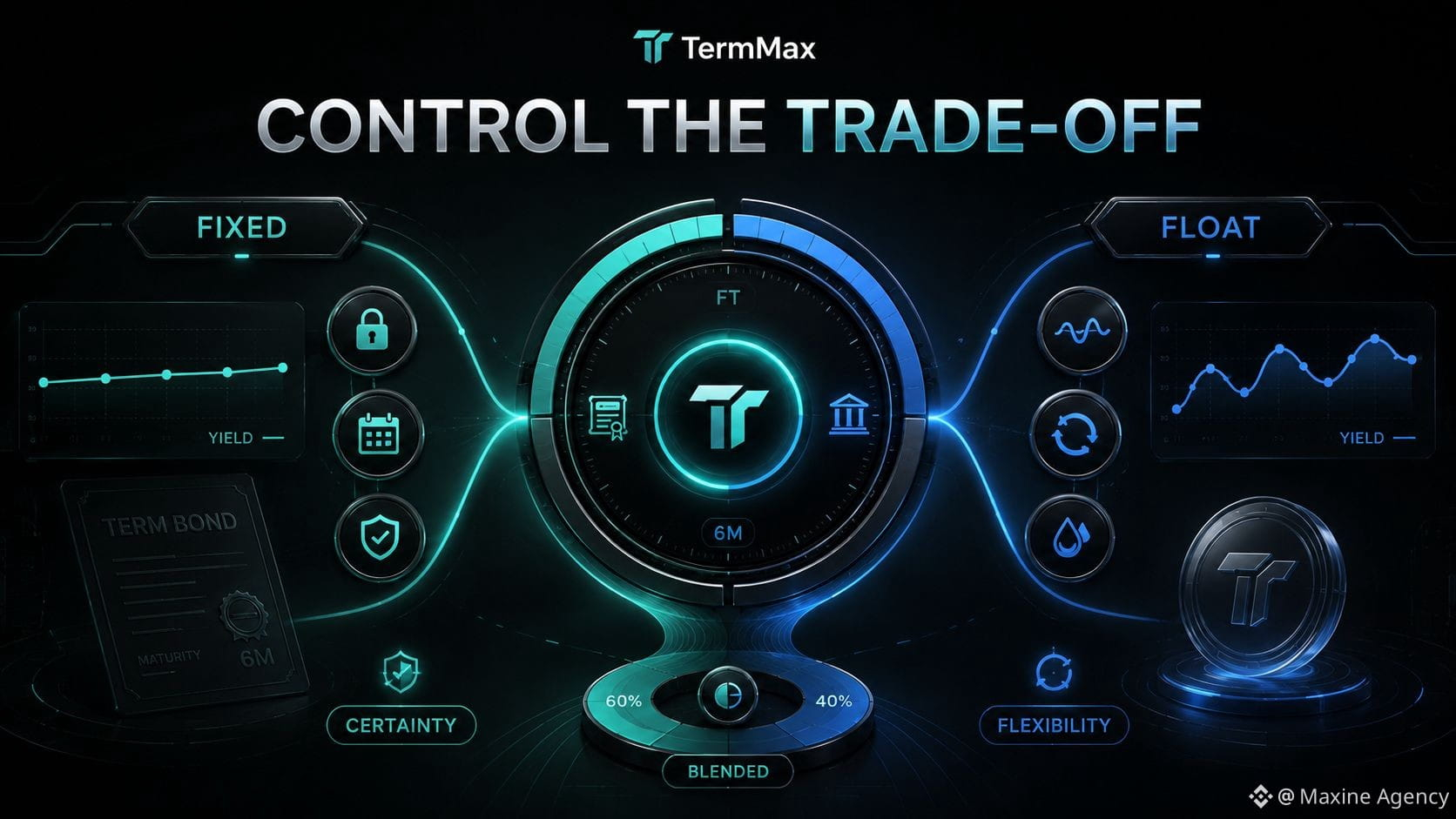
Fixed rate vs floating rate lending: I think the answer depends on what you want to control.
The more I look at TermMax, the more I realize that fixed rate lending is not just about “more stable interest rates.” It’s about trading away some flexibility in exchange for the ability to know your costs or returns in advance right from the start.
If you lend 100,000 USD for 12 months with a fixed rate, I know almost exactly what yield I’m locking my capital in for, and when that position ends. This is useful if your goal is to plan cash flow or maintain a stable strategy without having to check interest rates every day.
But the price you pay is opportunity.
The market can move faster than the loan term. New interest rates could be higher than what you locked in. Another pool might become more attractive. Or you may simply want to withdraw early to switch to a different strategy.
Floating rate is the opposite. I keep flexibility, but I have to accept that returns change continuously and are harder to predict.
So in my view, fixed and floating don’t really compete like “which is absolutely better.” They solve two different needs.
Fixed rate is a better fit when I prioritize certainty and want to know the financial outcome of a position ahead of time.
Floating rate fits better when I place a high value on liquidity and the ability to change strategies.
If I had 100,000 USD to lend for 12 months, I probably wouldn’t pick one side completely. I’d split the capital: 60k USD to lock in a fixed rate and create a predictable yield base, and keep the rest in floating to maintain the ability to adjust when the market changes.
For you, if you had to choose one for the next 12 months—would certainty or flexibility matter more?
@termmax #TermMax
$BNB $RICE $APR
Fixed rate vs floating rate lending: I think the answer depends on what you want to control.
The more I look at TermMax, the more I realize that fixed rate lending is not just about “more stable interest rates.” It’s about trading away some flexibility in exchange for the ability to know your costs or returns in advance right from the start.
If you lend 100,000 USD for 12 months with a fixed rate, I know almost exactly what yield I’m locking my capital in for, and when that position ends. This is useful if your goal is to plan cash flow or maintain a stable strategy without having to check interest rates every day.
But the price you pay is opportunity.
The market can move faster than the loan term. New interest rates could be higher than what you locked in. Another pool might become more attractive. Or you may simply want to withdraw early to switch to a different strategy.
Floating rate is the opposite. I keep flexibility, but I have to accept that returns change continuously and are harder to predict.
So in my view, fixed and floating don’t really compete like “which is absolutely better.” They solve two different needs.
Fixed rate is a better fit when I prioritize certainty and want to know the financial outcome of a position ahead of time.
Floating rate fits better when I place a high value on liquidity and the ability to change strategies.
If I had 100,000 USD to lend for 12 months, I probably wouldn’t pick one side completely. I’d split the capital: 60k USD to lock in a fixed rate and create a predictable yield base, and keep the rest in floating to maintain the ability to adjust when the market changes.
For you, if you had to choose one for the next 12 months—would certainty or flexibility matter more?
@TermMax #TermMax
$BNB $RICE $APR
The more I look at TermMax, the more I realize that fixed rate lending is not just about “more stable interest rates.” It’s about trading away some flexibility in exchange for the ability to know your costs or returns in advance right from the start.
If you lend 100,000 USD for 12 months with a fixed rate, I know almost exactly what yield I’m locking my capital in for, and when that position ends. This is useful if your goal is to plan cash flow or maintain a stable strategy without having to check interest rates every day.
But the price you pay is opportunity.
The market can move faster than the loan term. New interest rates could be higher than what you locked in. Another pool might become more attractive. Or you may simply want to withdraw early to switch to a different strategy.
Floating rate is the opposite. I keep flexibility, but I have to accept that returns change continuously and are harder to predict.
So in my view, fixed and floating don’t really compete like “which is absolutely better.” They solve two different needs.
Fixed rate is a better fit when I prioritize certainty and want to know the financial outcome of a position ahead of time.
Floating rate fits better when I place a high value on liquidity and the ability to change strategies.
If I had 100,000 USD to lend for 12 months, I probably wouldn’t pick one side completely. I’d split the capital: 60k USD to lock in a fixed rate and create a predictable yield base, and keep the rest in floating to maintain the ability to adjust when the market changes.
For you, if you had to choose one for the next 12 months—would certainty or flexibility matter more?
@TermMax #TermMax
$BNB $RICE $APR
2
1
472
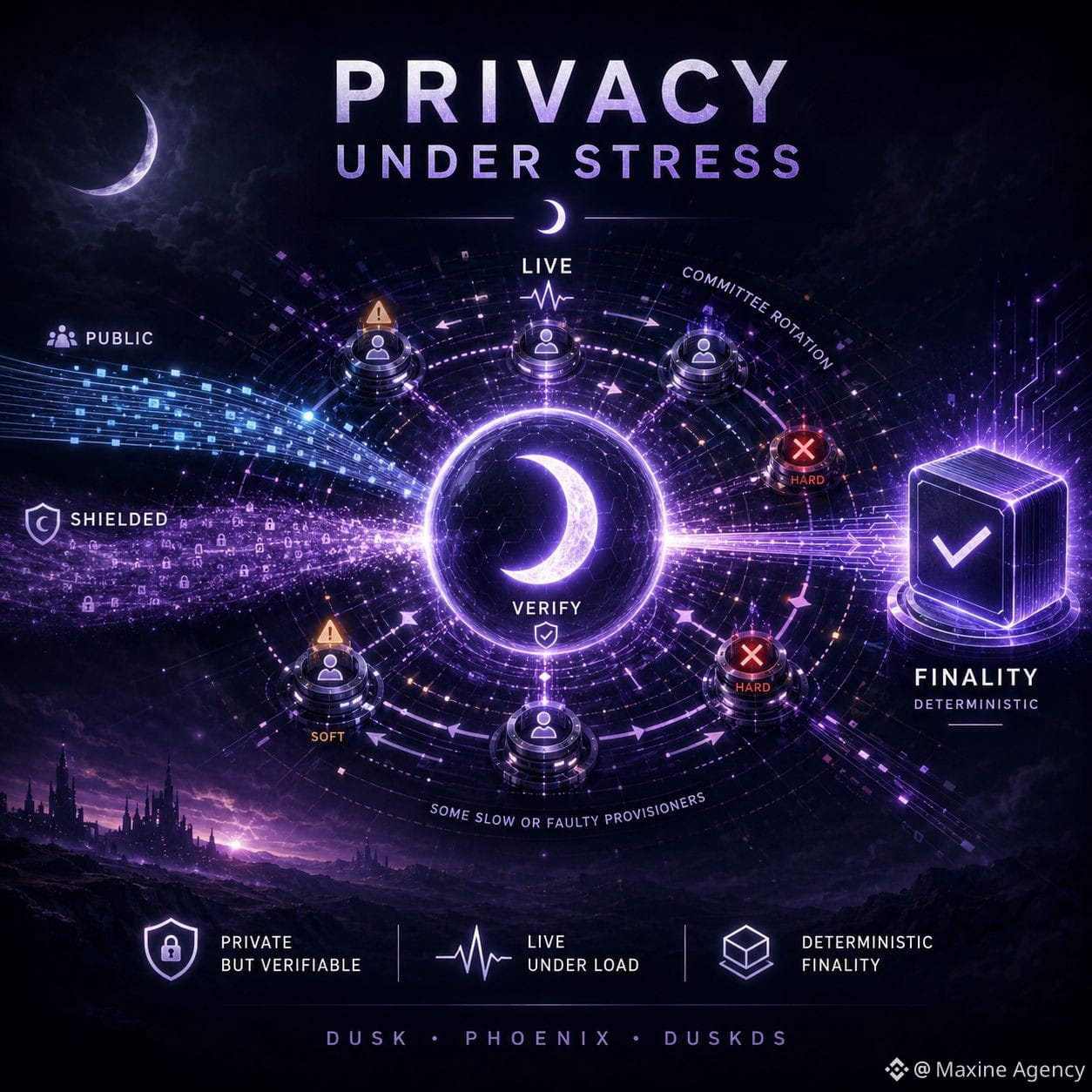
Dusk’s privacy is only truly trustworthy when the network is under stress
What changed my view of Phoenix was realizing that “not seeing” doesn’t mean “not being able to verify.”
For shielded transactions, a public observer can’t see the sender, receiver, or amount like Moonlight does, but the network still has to verify the transaction before the state can be accepted. DuskDS then submits the block through proposal, validation, and ratification to achieve deterministic finality.
In normal conditions, this model is quite compact. What I want to look closer at is when the network gets crowded.
If public and confidential transactions both put pressure on the system, the committee keeps changing, and some provisioners start falling behind the rhythm—privacy is no longer the only question. The network also has to maintain liveness and finality without lowering verification standards.
The part I find reasonable is that Dusk doesn’t treat every error the same. Provisioners who miss their duties may receive a soft penalty, while behavior that can be proven wrong—like an invalid vote or a conflicting signature—can result in a hard penalty.
To me, this is a more interesting test than a single private transaction running smoothly.
A good privacy system doesn’t only need to hide data when everything is normal. It must preserve verifiability when nodes fall out of sync, the committee rotates, and network load spikes.
If Dusk can hold that boundary, privacy becomes truly an attribute of the infrastructure—not just an experience in the wallet.
@Dusk_Foundation $DUSK #dusk
$RICE $BTW
Dusk’s privacy is only truly trustworthy when the network is under stress
What changed my view of Phoenix was realizing that “not seeing” doesn’t mean “not being able to verify.”
For shielded transactions, a public observer can’t see the sender, receiver, or amount like Moonlight does, but the network still has to verify the transaction before the state can be accepted. DuskDS then submits the block through proposal, validation, and ratification to achieve deterministic finality.
In normal conditions, this model is quite compact. What I want to look closer at is when the network gets crowded.
If public and confidential transactions both put pressure on the system, the committee keeps changing, and some provisioners start falling behind the rhythm—privacy is no longer the only question. The network also has to maintain liveness and finality without lowering verification standards.
The part I find reasonable is that Dusk doesn’t treat every error the same. Provisioners who miss their duties may receive a soft penalty, while behavior that can be proven wrong—like an invalid vote or a conflicting signature—can result in a hard penalty.
To me, this is a more interesting test than a single private transaction running smoothly.
A good privacy system doesn’t only need to hide data when everything is normal. It must preserve verifiability when nodes fall out of sync, the committee rotates, and network load spikes.
If Dusk can hold that boundary, privacy becomes truly an attribute of the infrastructure—not just an experience in the wallet.
@Dusk $DUSK #dusk
$RICE $BTW
What changed my view of Phoenix was realizing that “not seeing” doesn’t mean “not being able to verify.”
For shielded transactions, a public observer can’t see the sender, receiver, or amount like Moonlight does, but the network still has to verify the transaction before the state can be accepted. DuskDS then submits the block through proposal, validation, and ratification to achieve deterministic finality.
In normal conditions, this model is quite compact. What I want to look closer at is when the network gets crowded.
If public and confidential transactions both put pressure on the system, the committee keeps changing, and some provisioners start falling behind the rhythm—privacy is no longer the only question. The network also has to maintain liveness and finality without lowering verification standards.
The part I find reasonable is that Dusk doesn’t treat every error the same. Provisioners who miss their duties may receive a soft penalty, while behavior that can be proven wrong—like an invalid vote or a conflicting signature—can result in a hard penalty.
To me, this is a more interesting test than a single private transaction running smoothly.
A good privacy system doesn’t only need to hide data when everything is normal. It must preserve verifiability when nodes fall out of sync, the committee rotates, and network load spikes.
If Dusk can hold that boundary, privacy becomes truly an attribute of the infrastructure—not just an experience in the wallet.
@Dusk $DUSK #dusk
$RICE $BTW
6
2
99
Sell USDT with Fast Trading on Binance P2P: quick steps, but the final step must be checked very carefully
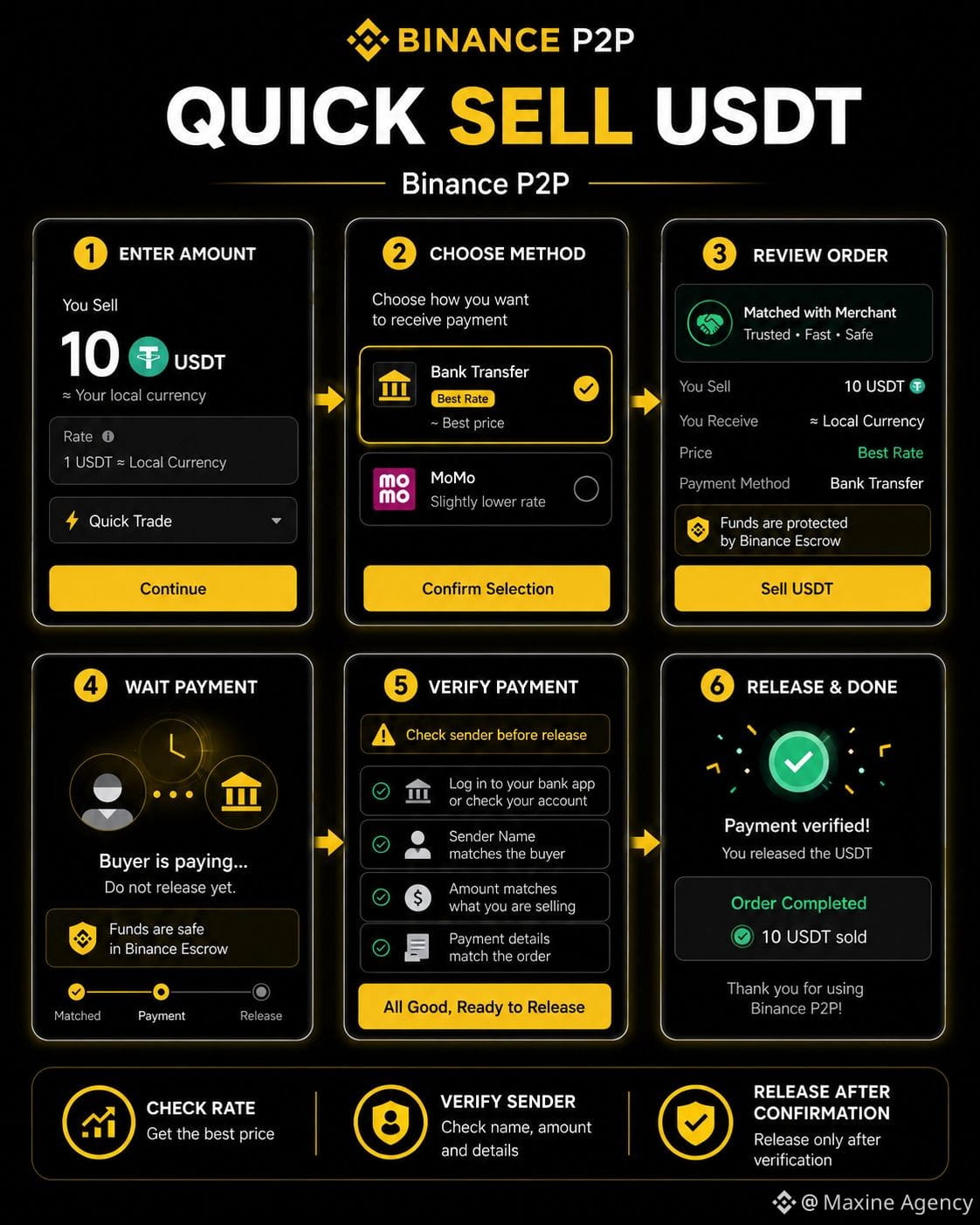
I just tried the Sell flow again under Fast Trading, and it’s quite easy to use if you follow each step properly.
First, go to P2P → Fast Trading → select Sell, then enter the amount of USDT you want to sell. In the screenshot I tried with $10. The system shows the estimated VND amount so you can check before continuing.
Next, choose the payment method for receiving money. At the time I made the transaction, bank transfer was 25,506đ/USDT, while MoMo was 25,455đ/USDT. I usually compare these two rates because even if you sell the same amount of USDT, the actual amount received can still differ.
After selecting bank transfer, Binance matches the order with Merchant GiaoDichTuDong_247. The final price in the order is 25,506đ/USDT and the estimated received amount is 254,804đ.
From here, you don’t need to find a buyer yourself anymore. All you need to do is wait for the counterpart to transfer payment to the registered bank account.
This is also the most important step.
When Binance notifies that the buyer has paid, I still open my banking app to verify. You must match the exact amount, the transaction status, and especially the sender’s name. If the sender’s real name does not match the buyer’s name shown in the Order, I will not click “Unlock” and will use Dispute/Report to handle it.
Only when all information matches, do I select “Received” and then confirm to unlock the USDT.
After release, the order moves to Completed, and the 10 USDT are recorded as successfully sold.
Fast Trading helps remove the step of finding a merchant, but it doesn’t remove the final verification step.
Fast in execution, but taking a few extra seconds to check the payment is the safest approach I’ve found.
@Binance_Vietnam #BinanceP2PAnToan
$RICE $BTW $M
Sell USDT with Fast Trading on Binance P2P: quick steps, but the final step must be checked very carefully
I just tried the Sell flow again under Fast Trading, and it’s quite easy to use if you follow each step properly.
First, go to P2P → Fast Trading → select Sell, then enter the amount of USDT you want to sell. In the screenshot I tried with $10. The system shows the estimated VND amount so you can check before continuing.
Next, choose the payment method for receiving money. At the time I made the transaction, bank transfer was 25,506đ/USDT, while MoMo was 25,455đ/USDT. I usually compare these two rates because even if you sell the same amount of USDT, the actual amount received can still differ.
After selecting bank transfer, Binance matches the order with Merchant GiaoDichTuDong_247. The final price in the order is 25,506đ/USDT and the estimated received amount is 254,804đ.
From here, you don’t need to find a buyer yourself anymore. All you need to do is wait for the counterpart to transfer payment to the registered bank account.
This is also the most important step.
When Binance notifies that the buyer has paid, I still open my banking app to verify. You must match the exact amount, the transaction status, and especially the sender’s name. If the sender’s real name does not match the buyer’s name shown in the Order, I will not click “Unlock” and will use Dispute/Report to handle it.
Only when all information matches, do I select “Received” and then confirm to unlock the USDT.
After release, the order moves to Completed, and the 10 USDT are recorded as successfully sold.
Fast Trading helps remove the step of finding a merchant, but it doesn’t remove the final verification step.
Fast in execution, but taking a few extra seconds to check the payment is the safest approach I’ve found.
@Binance Vietnam #BinanceP2PAnToan
$RICE $BTW $M
I just tried the Sell flow again under Fast Trading, and it’s quite easy to use if you follow each step properly.
First, go to P2P → Fast Trading → select Sell, then enter the amount of USDT you want to sell. In the screenshot I tried with $10. The system shows the estimated VND amount so you can check before continuing.
Next, choose the payment method for receiving money. At the time I made the transaction, bank transfer was 25,506đ/USDT, while MoMo was 25,455đ/USDT. I usually compare these two rates because even if you sell the same amount of USDT, the actual amount received can still differ.
After selecting bank transfer, Binance matches the order with Merchant GiaoDichTuDong_247. The final price in the order is 25,506đ/USDT and the estimated received amount is 254,804đ.
From here, you don’t need to find a buyer yourself anymore. All you need to do is wait for the counterpart to transfer payment to the registered bank account.
This is also the most important step.
When Binance notifies that the buyer has paid, I still open my banking app to verify. You must match the exact amount, the transaction status, and especially the sender’s name. If the sender’s real name does not match the buyer’s name shown in the Order, I will not click “Unlock” and will use Dispute/Report to handle it.
Only when all information matches, do I select “Received” and then confirm to unlock the USDT.
After release, the order moves to Completed, and the 10 USDT are recorded as successfully sold.
Fast Trading helps remove the step of finding a merchant, but it doesn’t remove the final verification step.
Fast in execution, but taking a few extra seconds to check the payment is the safest approach I’ve found.
@Binance Vietnam #BinanceP2PAnToan
$RICE $BTW $M
1
1
619
TermMax can be correct for long-term needs, but it still needs to prove that users actually want to change their habits
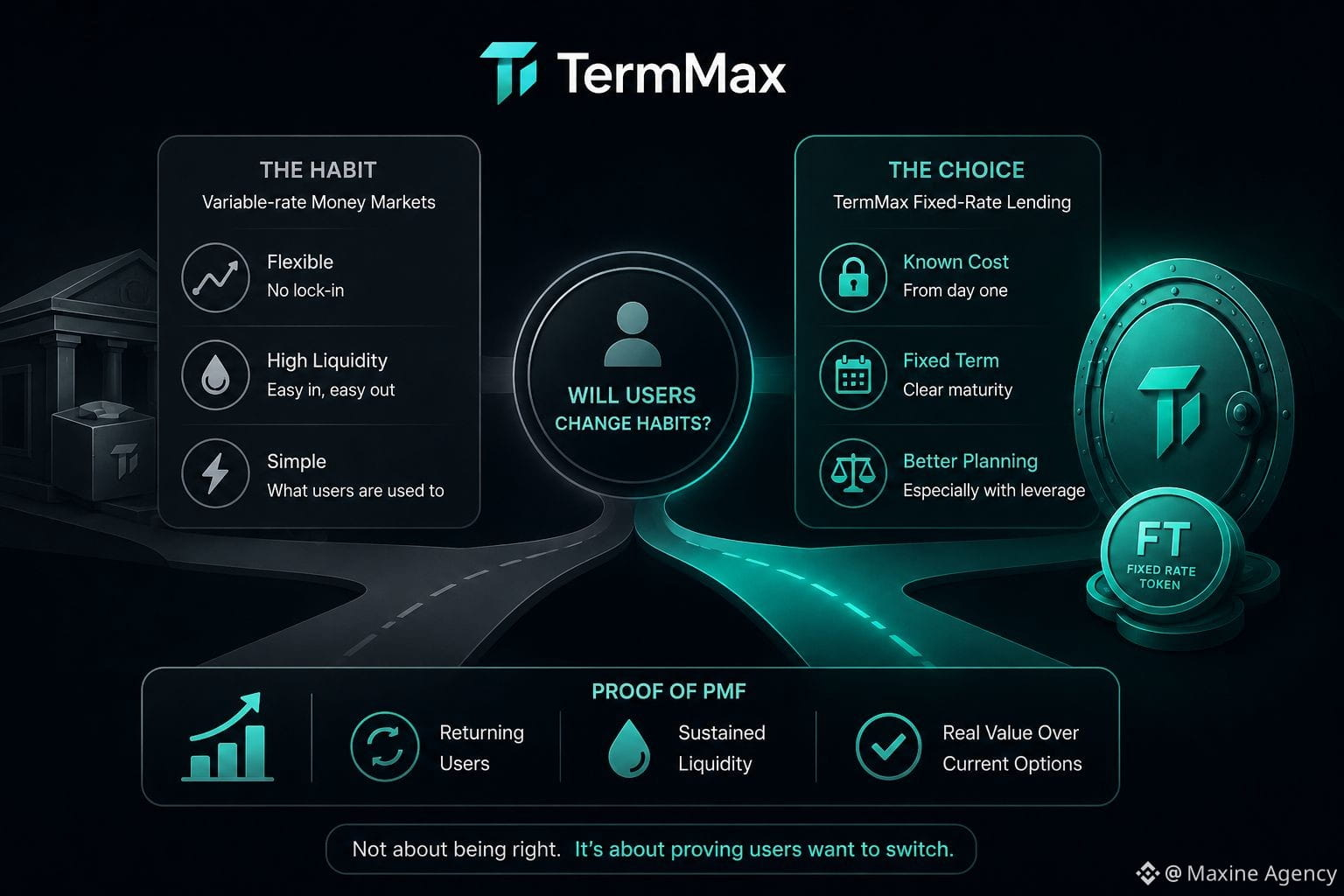
The more I read about TermMax, the more I realize the most important question isn’t whether fixed-rate lending is reasonable. Financially, it makes sense because borrowers know their cost of capital in advance, lenders know their yield in advance, and both have clear maturity dates.
But DeFi isn’t short of rational products
The harder part is convincing users to leave the familiar money market. A floating interest rate can be annoying, but in return you get high liquidity, simple operations, and you don’t have to think too much about maturities. For many people, that convenience is already good enough.
TermMax only truly makes a difference when the certainty of the cost of capital is worth more than the flexibility users currently have.
This is most obvious with leverage. If a strategy relies on thin profit margins, knowing the financing cost ahead of time can help calculate positions more accurately, but for someone who only deposits assets to earn yield, the benefits of fixed rates may not be strong enough to make them change their behavior.
So I think XP or Activity Points can only solve the initial attraction problem. They can pull volume and users into the system, but they don’t answer the harder question: after rewards decrease, will they come back because of the product itself?
I don’t doubt that demand for fixed income will grow as crypto matures
What I’m not sure about is timing
If TermMax wants to prove product-market fit, I’ll look at the rate at which users return, liquidity retained after incentives, and whether fixed rates really help them manage capital better than current alternatives
@termmax #TermMax
$BTC $LAB $X
TermMax can be correct for long-term needs, but it still needs to prove that users actually want to change their habits
The more I read about TermMax, the more I realize the most important question isn’t whether fixed-rate lending is reasonable. Financially, it makes sense because borrowers know their cost of capital in advance, lenders know their yield in advance, and both have clear maturity dates.
But DeFi isn’t short of rational products
The harder part is convincing users to leave the familiar money market. A floating interest rate can be annoying, but in return you get high liquidity, simple operations, and you don’t have to think too much about maturities. For many people, that convenience is already good enough.
TermMax only truly makes a difference when the certainty of the cost of capital is worth more than the flexibility users currently have.
This is most obvious with leverage. If a strategy relies on thin profit margins, knowing the financing cost ahead of time can help calculate positions more accurately, but for someone who only deposits assets to earn yield, the benefits of fixed rates may not be strong enough to make them change their behavior.
So I think XP or Activity Points can only solve the initial attraction problem. They can pull volume and users into the system, but they don’t answer the harder question: after rewards decrease, will they come back because of the product itself?
I don’t doubt that demand for fixed income will grow as crypto matures
What I’m not sure about is timing
If TermMax wants to prove product-market fit, I’ll look at the rate at which users return, liquidity retained after incentives, and whether fixed rates really help them manage capital better than current alternatives
@TermMax #TermMax
$BTC $LAB $X
The more I read about TermMax, the more I realize the most important question isn’t whether fixed-rate lending is reasonable. Financially, it makes sense because borrowers know their cost of capital in advance, lenders know their yield in advance, and both have clear maturity dates.
But DeFi isn’t short of rational products
The harder part is convincing users to leave the familiar money market. A floating interest rate can be annoying, but in return you get high liquidity, simple operations, and you don’t have to think too much about maturities. For many people, that convenience is already good enough.
TermMax only truly makes a difference when the certainty of the cost of capital is worth more than the flexibility users currently have.
This is most obvious with leverage. If a strategy relies on thin profit margins, knowing the financing cost ahead of time can help calculate positions more accurately, but for someone who only deposits assets to earn yield, the benefits of fixed rates may not be strong enough to make them change their behavior.
So I think XP or Activity Points can only solve the initial attraction problem. They can pull volume and users into the system, but they don’t answer the harder question: after rewards decrease, will they come back because of the product itself?
I don’t doubt that demand for fixed income will grow as crypto matures
What I’m not sure about is timing
If TermMax wants to prove product-market fit, I’ll look at the rate at which users return, liquidity retained after incentives, and whether fixed rates really help them manage capital better than current alternatives
@TermMax #TermMax
$BTC $LAB $X
1
1
184
·
--
Bullish
Dusk Trade makes me think “neobrokers” on-chain shouldn’t be judged by the user interface.
If you only look from the user side, Dusk Trade looks quite like a place to discover and trade tokenized assets—but what I care about more is what happens behind the trading screen.
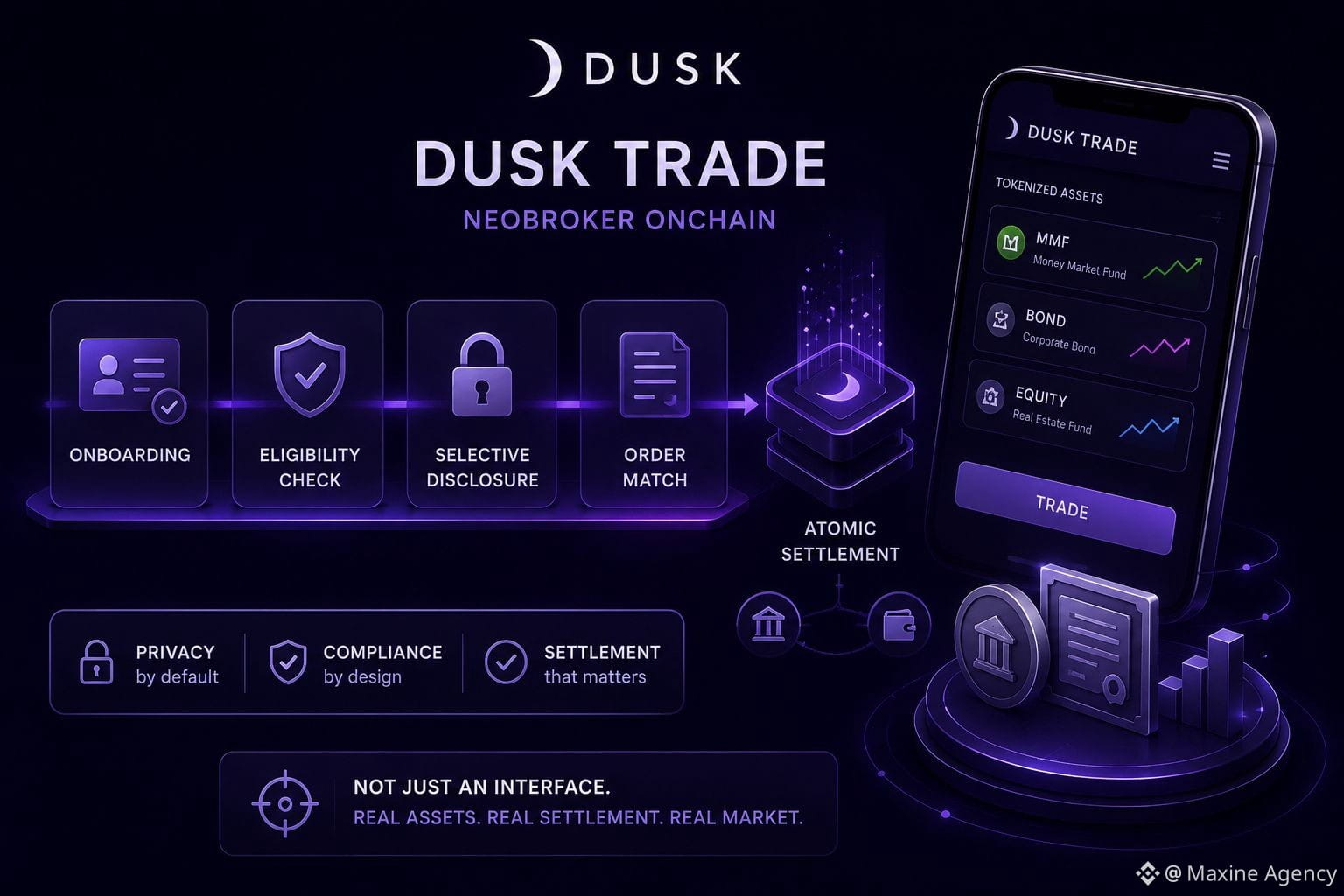
With managed assets, an order isn’t just about matching price. Buyers also have to go through onboarding, meet eligibility requirements, connect their wallet, and only the necessary data is disclosed to authorized parties. Dusk Trade is bringing all those steps into a single workflow, while coordinating both the asset side and the payment side before settlement.
In my view, this is what neobroker means in the RWA context. The value isn’t in turning bonds or funds into tokens and putting them into a new app. What’s harder is making ownership, trading conditions, privacy, and settlement work seamlessly together.
But I still don’t want to judge Dusk Trade based on a waitlist.
Registration numbers only show curiosity. What’s more worth looking at is which real assets the issuer is actually listing, how many accounts are truly eligible to trade, and how much value has been settled through the system.
Dusk still describes Dusk Trade as a product being built. So for me, the important milestone isn’t how many people are waiting for the app, but when MMF, bonds, or other regulated assets start generating real volume.
Narratives can draw attention.
Real settlement is what proves the market exists.
@Dusk_Foundation $DUSK #dusk
$CLO $LAB
Dusk Trade makes me think “neobrokers” on-chain shouldn’t be judged by the user interface.
If you only look from the user side, Dusk Trade looks quite like a place to discover and trade tokenized assets—but what I care about more is what happens behind the trading screen.
With managed assets, an order isn’t just about matching price. Buyers also have to go through onboarding, meet eligibility requirements, connect their wallet, and only the necessary data is disclosed to authorized parties. Dusk Trade is bringing all those steps into a single workflow, while coordinating both the asset side and the payment side before settlement.
In my view, this is what neobroker means in the RWA context. The value isn’t in turning bonds or funds into tokens and putting them into a new app. What’s harder is making ownership, trading conditions, privacy, and settlement work seamlessly together.
But I still don’t want to judge Dusk Trade based on a waitlist.
Registration numbers only show curiosity. What’s more worth looking at is which real assets the issuer is actually listing, how many accounts are truly eligible to trade, and how much value has been settled through the system.
Dusk still describes Dusk Trade as a product being built. So for me, the important milestone isn’t how many people are waiting for the app, but when MMF, bonds, or other regulated assets start generating real volume.
Narratives can draw attention.
Real settlement is what proves the market exists.
@Dusk $DUSK #dusk
$CLO $LAB
If you only look from the user side, Dusk Trade looks quite like a place to discover and trade tokenized assets—but what I care about more is what happens behind the trading screen.
With managed assets, an order isn’t just about matching price. Buyers also have to go through onboarding, meet eligibility requirements, connect their wallet, and only the necessary data is disclosed to authorized parties. Dusk Trade is bringing all those steps into a single workflow, while coordinating both the asset side and the payment side before settlement.
In my view, this is what neobroker means in the RWA context. The value isn’t in turning bonds or funds into tokens and putting them into a new app. What’s harder is making ownership, trading conditions, privacy, and settlement work seamlessly together.
But I still don’t want to judge Dusk Trade based on a waitlist.
Registration numbers only show curiosity. What’s more worth looking at is which real assets the issuer is actually listing, how many accounts are truly eligible to trade, and how much value has been settled through the system.
Dusk still describes Dusk Trade as a product being built. So for me, the important milestone isn’t how many people are waiting for the app, but when MMF, bonds, or other regulated assets start generating real volume.
Narratives can draw attention.
Real settlement is what proves the market exists.
@Dusk $DUSK #dusk
$CLO $LAB
2
1
96
Last week, my friend made a 20k$ profit from an alpha offer, so he sold USDT to catch the bottom of gold. He said that the P2P order that day looked completely normal. The funds were transferred in full, the sender’s name was very similar to the information in the Order, and the transfer memo/content was also nothing unusual—so he released the order right away without overthinking.
A few days later, the bank contacted him again to ask about the source of the funds and then locked his bank account.
This situation made me realize one thing: escrow protects crypto during a transaction, but it cannot speak on behalf of the seller to determine where the fiat money comes from before it enters the seller’s bank account.
This is the kind of risk that doesn’t show up immediately on the screen. Once the Order is completed and the USDT has left the wallet, the question about the source of funds can appear.
The more you trade, the more you realize that “getting used to it” can sometimes be more dangerous than being new. After dozens of smooth orders, it’s easy to assume everything is fine because the amount is correct, the buyer is polite, and the Merchant has a good history.
But those signals don’t replace the need to verify the sender.
When selling P2P, I always prioritize a payment account whose name matches the buyer in the Order, keep all communication within Binance, and save the Order ID along with the bank transfer receipt. If the money comes from a third-party account or if any information doesn’t match, I don’t make assumptions about the reason and then release just to get it over with.
Not every transaction with a different name is problematic, but if I don’t clearly understand the source of the funds, I also have no reason to rush to unlock the crypto.
Safe P2P isn’t only about avoiding losing USDT during the order.
Sometimes, it’s also ensuring that a few days later, I still have enough evidence to clearly explain where the money has gone through my account.
@Binance_Vietnam #BinanceP2PAnToan
$APR $CLO $BTC
Last week, my friend made a 20k$ profit from an alpha offer, so he sold USDT to catch the bottom of gold. He said that the P2P order that day looked completely normal. The funds were transferred in full, the sender’s name was very similar to the information in the Order, and the transfer memo/content was also nothing unusual—so he released the order right away without overthinking.
A few days later, the bank contacted him again to ask about the source of the funds and then locked his bank account.
This situation made me realize one thing: escrow protects crypto during a transaction, but it cannot speak on behalf of the seller to determine where the fiat money comes from before it enters the seller’s bank account.
This is the kind of risk that doesn’t show up immediately on the screen. Once the Order is completed and the USDT has left the wallet, the question about the source of funds can appear.
The more you trade, the more you realize that “getting used to it” can sometimes be more dangerous than being new. After dozens of smooth orders, it’s easy to assume everything is fine because the amount is correct, the buyer is polite, and the Merchant has a good history.
But those signals don’t replace the need to verify the sender.
When selling P2P, I always prioritize a payment account whose name matches the buyer in the Order, keep all communication within Binance, and save the Order ID along with the bank transfer receipt. If the money comes from a third-party account or if any information doesn’t match, I don’t make assumptions about the reason and then release just to get it over with.
Not every transaction with a different name is problematic, but if I don’t clearly understand the source of the funds, I also have no reason to rush to unlock the crypto.
Safe P2P isn’t only about avoiding losing USDT during the order.
Sometimes, it’s also ensuring that a few days later, I still have enough evidence to clearly explain where the money has gone through my account.
@Binance Vietnam #BinanceP2PAnToan
$APR $CLO $BTC
A few days later, the bank contacted him again to ask about the source of the funds and then locked his bank account.
This situation made me realize one thing: escrow protects crypto during a transaction, but it cannot speak on behalf of the seller to determine where the fiat money comes from before it enters the seller’s bank account.
This is the kind of risk that doesn’t show up immediately on the screen. Once the Order is completed and the USDT has left the wallet, the question about the source of funds can appear.
The more you trade, the more you realize that “getting used to it” can sometimes be more dangerous than being new. After dozens of smooth orders, it’s easy to assume everything is fine because the amount is correct, the buyer is polite, and the Merchant has a good history.
But those signals don’t replace the need to verify the sender.
When selling P2P, I always prioritize a payment account whose name matches the buyer in the Order, keep all communication within Binance, and save the Order ID along with the bank transfer receipt. If the money comes from a third-party account or if any information doesn’t match, I don’t make assumptions about the reason and then release just to get it over with.
Not every transaction with a different name is problematic, but if I don’t clearly understand the source of the funds, I also have no reason to rush to unlock the crypto.
Safe P2P isn’t only about avoiding losing USDT during the order.
Sometimes, it’s also ensuring that a few days later, I still have enough evidence to clearly explain where the money has gone through my account.
@Binance Vietnam #BinanceP2PAnToan
$APR $CLO $BTC
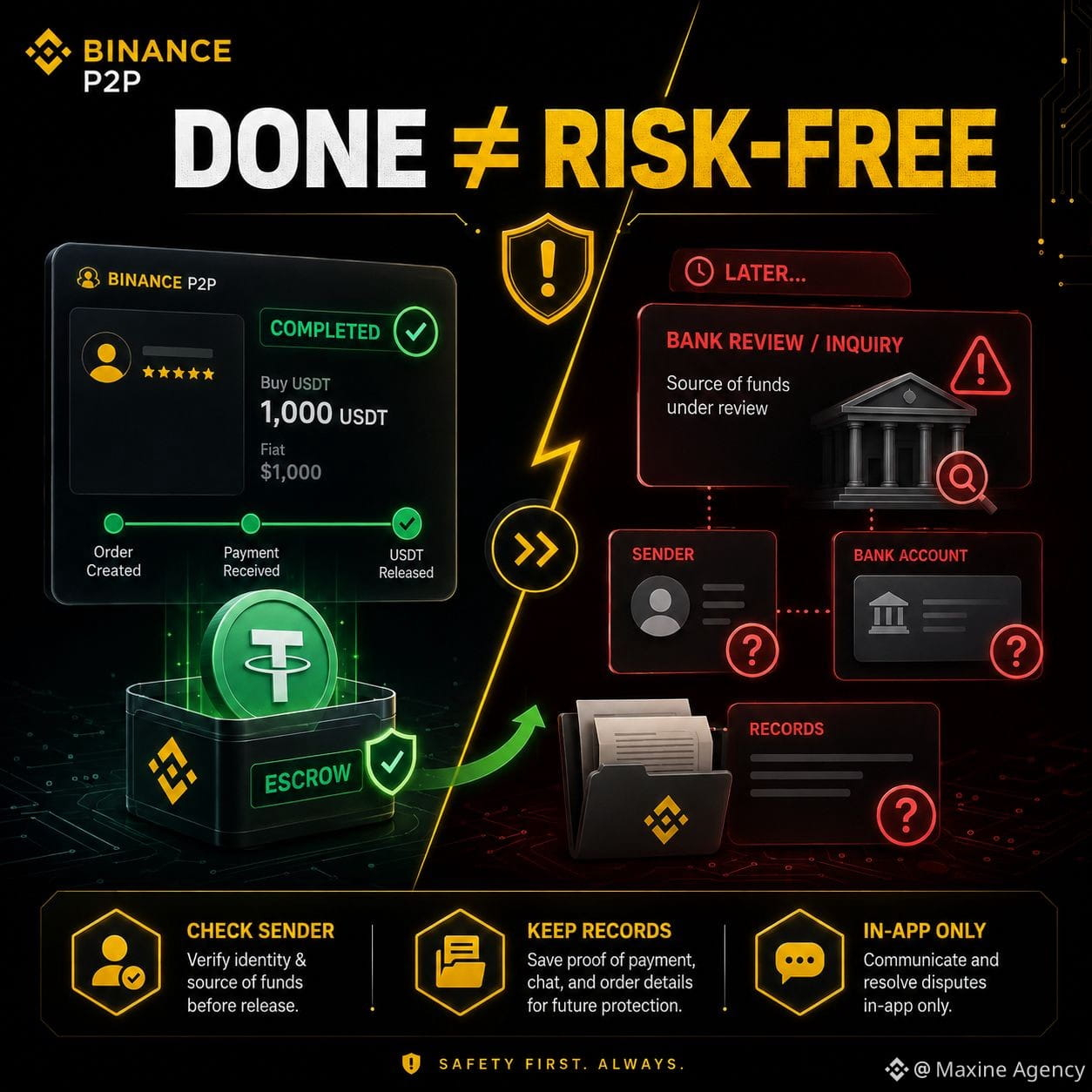
1
2
955
TermMax does not eliminate uncertainty; it prices uncertainty before trading begins
At first, I thought fixed rate lending was appealing because it helps borrowers escape interest rate volatility. Choose a term, lock the cost level, and know in advance how much you’ll have to pay at maturity. It sounds almost completely opposite to the rest of DeFi.
But reading more carefully about TermMax’s mechanism, I realized “fixed” doesn’t mean risk disappears.
FTs are designed like a zero-coupon bond: they represent the right to receive a specified amount of debt tokens on the maturity date. This lets lenders know in advance what they will receive, while borrowers can lock in their cost of capital from the start.
What’s interesting is that the same infrastructure still supports leverage and strategies aimed at finding additional yield.
So @termmax actually doesn’t remove uncertainty from the market. It shifts the uncertainty to the time of pricing. Once a fixed rate is formed, participants still have to decide whether that rate properly reflects expectations about interest rates, liquidity, and risk over the entire term.
If the market changes after the position is opened, the contract does not change. Users get certainty, but in return they accept the possibility that the locked rate later becomes less attractive than the market.
In my view, this is the key point of #TermMax
Fixed rate isn’t a promise that DeFi has no volatility. It’s a way to turn future volatility into a price you can agree to today.
What I care about isn’t how much risk TermMax removes, but how accurately its market prices that risk before users lock the term and commit real capital.
$BTC $BNB $X
TermMax does not eliminate uncertainty; it prices uncertainty before trading begins
At first, I thought fixed rate lending was appealing because it helps borrowers escape interest rate volatility. Choose a term, lock the cost level, and know in advance how much you’ll have to pay at maturity. It sounds almost completely opposite to the rest of DeFi.
But reading more carefully about TermMax’s mechanism, I realized “fixed” doesn’t mean risk disappears.
FTs are designed like a zero-coupon bond: they represent the right to receive a specified amount of debt tokens on the maturity date. This lets lenders know in advance what they will receive, while borrowers can lock in their cost of capital from the start.
What’s interesting is that the same infrastructure still supports leverage and strategies aimed at finding additional yield.
So @TermMax actually doesn’t remove uncertainty from the market. It shifts the uncertainty to the time of pricing. Once a fixed rate is formed, participants still have to decide whether that rate properly reflects expectations about interest rates, liquidity, and risk over the entire term.
If the market changes after the position is opened, the contract does not change. Users get certainty, but in return they accept the possibility that the locked rate later becomes less attractive than the market.
In my view, this is the key point of #TermMax
Fixed rate isn’t a promise that DeFi has no volatility. It’s a way to turn future volatility into a price you can agree to today.
What I care about isn’t how much risk TermMax removes, but how accurately its market prices that risk before users lock the term and commit real capital.
$BTC $BNB $X
At first, I thought fixed rate lending was appealing because it helps borrowers escape interest rate volatility. Choose a term, lock the cost level, and know in advance how much you’ll have to pay at maturity. It sounds almost completely opposite to the rest of DeFi.
But reading more carefully about TermMax’s mechanism, I realized “fixed” doesn’t mean risk disappears.
FTs are designed like a zero-coupon bond: they represent the right to receive a specified amount of debt tokens on the maturity date. This lets lenders know in advance what they will receive, while borrowers can lock in their cost of capital from the start.
What’s interesting is that the same infrastructure still supports leverage and strategies aimed at finding additional yield.
So @TermMax actually doesn’t remove uncertainty from the market. It shifts the uncertainty to the time of pricing. Once a fixed rate is formed, participants still have to decide whether that rate properly reflects expectations about interest rates, liquidity, and risk over the entire term.
If the market changes after the position is opened, the contract does not change. Users get certainty, but in return they accept the possibility that the locked rate later becomes less attractive than the market.
In my view, this is the key point of #TermMax
Fixed rate isn’t a promise that DeFi has no volatility. It’s a way to turn future volatility into a price you can agree to today.
What I care about isn’t how much risk TermMax removes, but how accurately its market prices that risk before users lock the term and commit real capital.
$BTC $BNB $X
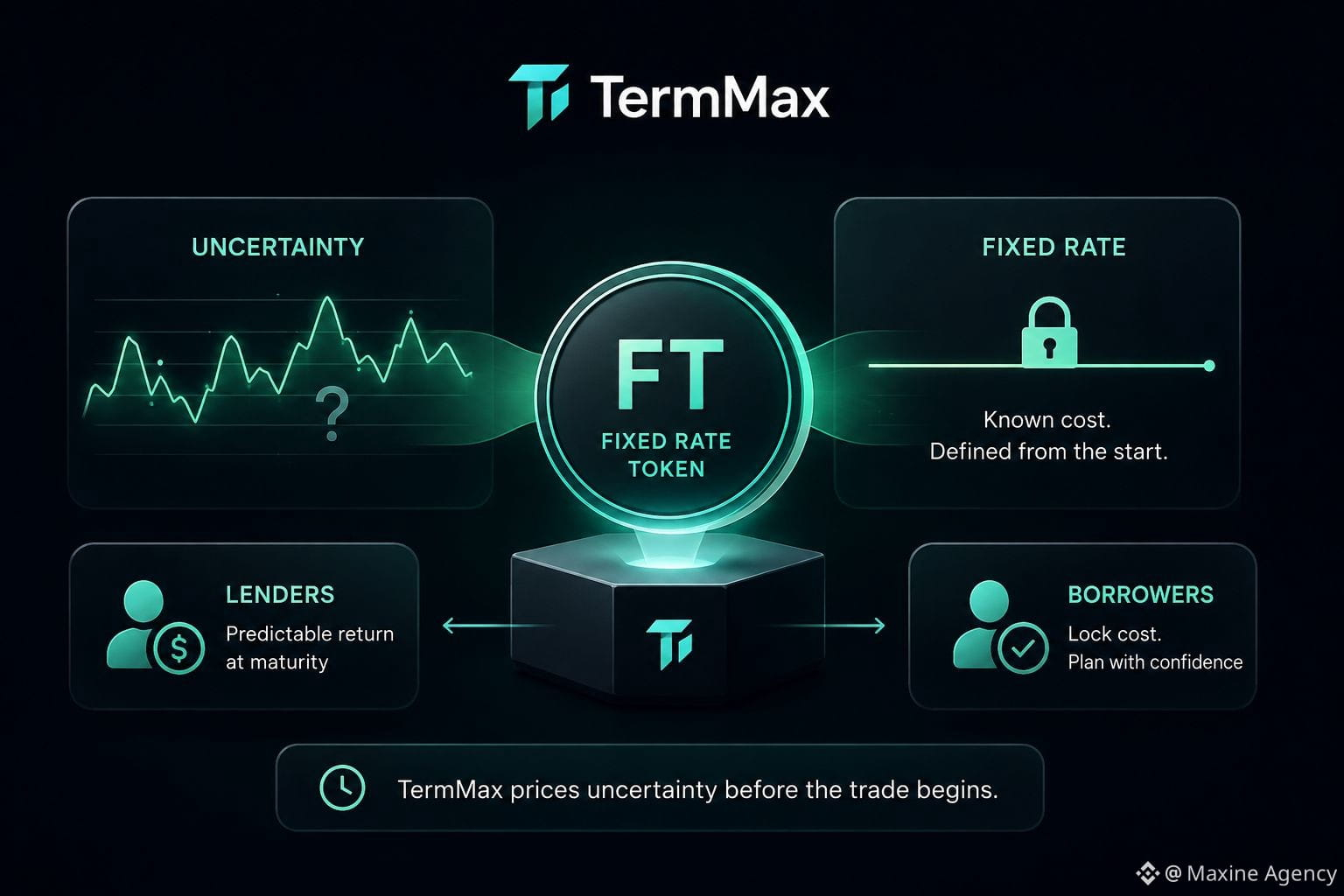
2
1
223
The Dusk halving doesn’t tell me how much staking will earn
At first, I thought I could estimate staking yield fairly accurately just by looking at Dusk’s emission schedule. But when I set the emission amount against how much DUSK is being staked, I found that these two things are related, but not the same.
Under the current mechanism, the network emits 19.8 DUSK per block. The total planned emissions are 500 million DUSK over 36 years, and the emission rate halves every four years. This part is fairly easy to predict because it’s defined at the protocol level.
But the yield for each staker depends on other variables.
If total active stake increases, each validator’s or delegator’s share of the overall reward pool decreases, assuming all other factors remain unchanged. In addition, participation in consensus and transaction fees also matter. So even with the same emission per block, the actual APY can still change significantly.
This is where I used to confuse the two concepts.
Halving only indicates the rate at which new DUSK enters the reward system. It doesn’t say how much my stake will receive. A fixed emission schedule simply makes the supply of rewards easier to predict, but it doesn’t eliminate the competition among staking participants.
So if I want to evaluate staking, I won’t just look at the halving schedule. I’ll also track the total active stake and how that stake amount changes over time.
The more predictable the emissions are, the more important the competition among stakers becomes.
In my view, for Dusk, the question worth considering isn’t “how many rewards per block?” but rather “how many DUSK are competing together to receive those rewards?”
@Dusk_Foundation $DUSK #dusk
$STBL $LAB
The Dusk halving doesn’t tell me how much staking will earn
At first, I thought I could estimate staking yield fairly accurately just by looking at Dusk’s emission schedule. But when I set the emission amount against how much DUSK is being staked, I found that these two things are related, but not the same.
Under the current mechanism, the network emits 19.8 DUSK per block. The total planned emissions are 500 million DUSK over 36 years, and the emission rate halves every four years. This part is fairly easy to predict because it’s defined at the protocol level.
But the yield for each staker depends on other variables.
If total active stake increases, each validator’s or delegator’s share of the overall reward pool decreases, assuming all other factors remain unchanged. In addition, participation in consensus and transaction fees also matter. So even with the same emission per block, the actual APY can still change significantly.
This is where I used to confuse the two concepts.
Halving only indicates the rate at which new DUSK enters the reward system. It doesn’t say how much my stake will receive. A fixed emission schedule simply makes the supply of rewards easier to predict, but it doesn’t eliminate the competition among staking participants.
So if I want to evaluate staking, I won’t just look at the halving schedule. I’ll also track the total active stake and how that stake amount changes over time.
The more predictable the emissions are, the more important the competition among stakers becomes.
In my view, for Dusk, the question worth considering isn’t “how many rewards per block?” but rather “how many DUSK are competing together to receive those rewards?”
@Dusk $DUSK #dusk
$STBL $LAB
At first, I thought I could estimate staking yield fairly accurately just by looking at Dusk’s emission schedule. But when I set the emission amount against how much DUSK is being staked, I found that these two things are related, but not the same.
Under the current mechanism, the network emits 19.8 DUSK per block. The total planned emissions are 500 million DUSK over 36 years, and the emission rate halves every four years. This part is fairly easy to predict because it’s defined at the protocol level.
But the yield for each staker depends on other variables.
If total active stake increases, each validator’s or delegator’s share of the overall reward pool decreases, assuming all other factors remain unchanged. In addition, participation in consensus and transaction fees also matter. So even with the same emission per block, the actual APY can still change significantly.
This is where I used to confuse the two concepts.
Halving only indicates the rate at which new DUSK enters the reward system. It doesn’t say how much my stake will receive. A fixed emission schedule simply makes the supply of rewards easier to predict, but it doesn’t eliminate the competition among staking participants.
So if I want to evaluate staking, I won’t just look at the halving schedule. I’ll also track the total active stake and how that stake amount changes over time.
The more predictable the emissions are, the more important the competition among stakers becomes.
In my view, for Dusk, the question worth considering isn’t “how many rewards per block?” but rather “how many DUSK are competing together to receive those rewards?”
@Dusk $DUSK #dusk
$STBL $LAB
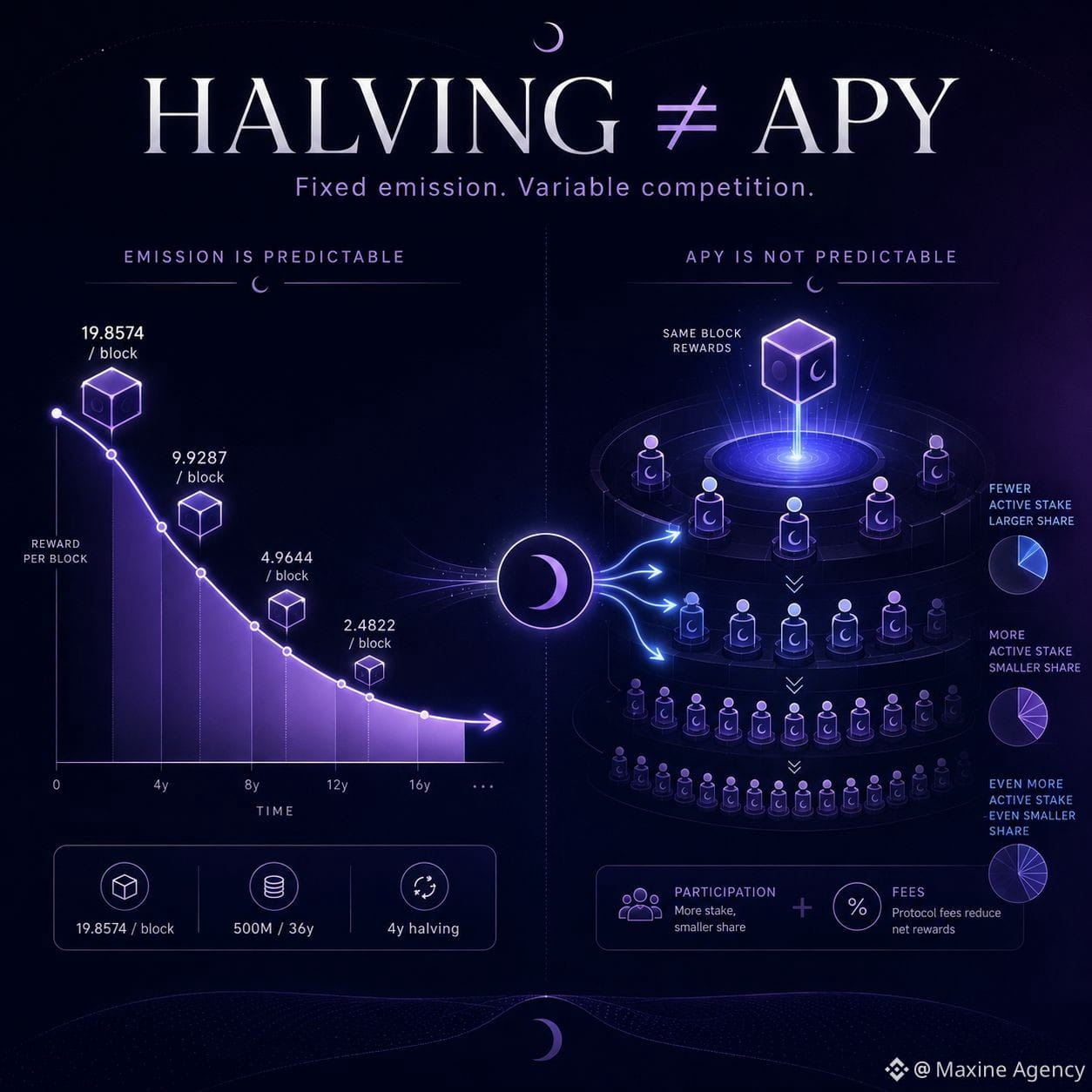
7
2
141
I’ve been using Binance P2P since 2022, and the longer I trade, the less I care about “hunting for a good price.”
I went back through my transaction screenshots from 21/1/2022 and found a sell order for 1,656 USDT. I received 38,836,512 VND, which is roughly 23,452 VND/USDT.
Looking back, I realized I’ve been using Binance P2P for so long. At the beginning, I only cared about one thing: which merchant buys at the higher price should be chosen. After many years, my trading approach has changed a lot.
The first tip is not to look at price only. A difference of just a few dozen VND per USDT isn’t worth trading for a partner who responds slowly, has complicated terms, or has an unstable transaction history. Before placing an order, I always check the Completion Rate, the number of orders completed, trading limits, and payment methods.
I also look at several ads at the same time to understand the overall market level. Ads at the top of the page don’t necessarily have the best price, so a few seconds of comparison can help you avoid placing an order with a price that’s way off.
The second tip: when selling USDT, I only release after I open my banking app myself and confirm that the money has truly arrived. Transfer screenshots, SMS, or messages like “I’ve transferred” can’t replace this step.
Third, I keep all communication inside the Order Chat. If the counterparty asks to move to Zalo or Telegram, change the receiving account, or handle anything outside Binance, I stop right away.
For large orders, I also often split them into smaller ones. This makes it easier to control the cash flow and reduces pressure if one transaction ends up having an issue.
Finally, I always prioritize process over speed. Effective P2P isn’t the fastest way to trade or a way to make an extra few tens of thousands.
It’s when the money comes in correctly, the information matches, the evidence is complete, and I don’t have to gamble on my own subjectivity.
@Binance_Vietnam #BinanceP2PAnToan
$BTC $APR $LAB
I’ve been using Binance P2P since 2022, and the longer I trade, the less I care about “hunting for a good price.”
I went back through my transaction screenshots from 21/1/2022 and found a sell order for 1,656 USDT. I received 38,836,512 VND, which is roughly 23,452 VND/USDT.
Looking back, I realized I’ve been using Binance P2P for so long. At the beginning, I only cared about one thing: which merchant buys at the higher price should be chosen. After many years, my trading approach has changed a lot.
The first tip is not to look at price only. A difference of just a few dozen VND per USDT isn’t worth trading for a partner who responds slowly, has complicated terms, or has an unstable transaction history. Before placing an order, I always check the Completion Rate, the number of orders completed, trading limits, and payment methods.
I also look at several ads at the same time to understand the overall market level. Ads at the top of the page don’t necessarily have the best price, so a few seconds of comparison can help you avoid placing an order with a price that’s way off.
The second tip: when selling USDT, I only release after I open my banking app myself and confirm that the money has truly arrived. Transfer screenshots, SMS, or messages like “I’ve transferred” can’t replace this step.
Third, I keep all communication inside the Order Chat. If the counterparty asks to move to Zalo or Telegram, change the receiving account, or handle anything outside Binance, I stop right away.
For large orders, I also often split them into smaller ones. This makes it easier to control the cash flow and reduces pressure if one transaction ends up having an issue.
Finally, I always prioritize process over speed. Effective P2P isn’t the fastest way to trade or a way to make an extra few tens of thousands.
It’s when the money comes in correctly, the information matches, the evidence is complete, and I don’t have to gamble on my own subjectivity.
@Binance Vietnam #BinanceP2PAnToan
$BTC $APR $LAB
I went back through my transaction screenshots from 21/1/2022 and found a sell order for 1,656 USDT. I received 38,836,512 VND, which is roughly 23,452 VND/USDT.
Looking back, I realized I’ve been using Binance P2P for so long. At the beginning, I only cared about one thing: which merchant buys at the higher price should be chosen. After many years, my trading approach has changed a lot.
The first tip is not to look at price only. A difference of just a few dozen VND per USDT isn’t worth trading for a partner who responds slowly, has complicated terms, or has an unstable transaction history. Before placing an order, I always check the Completion Rate, the number of orders completed, trading limits, and payment methods.
I also look at several ads at the same time to understand the overall market level. Ads at the top of the page don’t necessarily have the best price, so a few seconds of comparison can help you avoid placing an order with a price that’s way off.
The second tip: when selling USDT, I only release after I open my banking app myself and confirm that the money has truly arrived. Transfer screenshots, SMS, or messages like “I’ve transferred” can’t replace this step.
Third, I keep all communication inside the Order Chat. If the counterparty asks to move to Zalo or Telegram, change the receiving account, or handle anything outside Binance, I stop right away.
For large orders, I also often split them into smaller ones. This makes it easier to control the cash flow and reduces pressure if one transaction ends up having an issue.
Finally, I always prioritize process over speed. Effective P2P isn’t the fastest way to trade or a way to make an extra few tens of thousands.
It’s when the money comes in correctly, the information matches, the evidence is complete, and I don’t have to gamble on my own subjectivity.
@Binance Vietnam #BinanceP2PAnToan
$BTC $APR $LAB
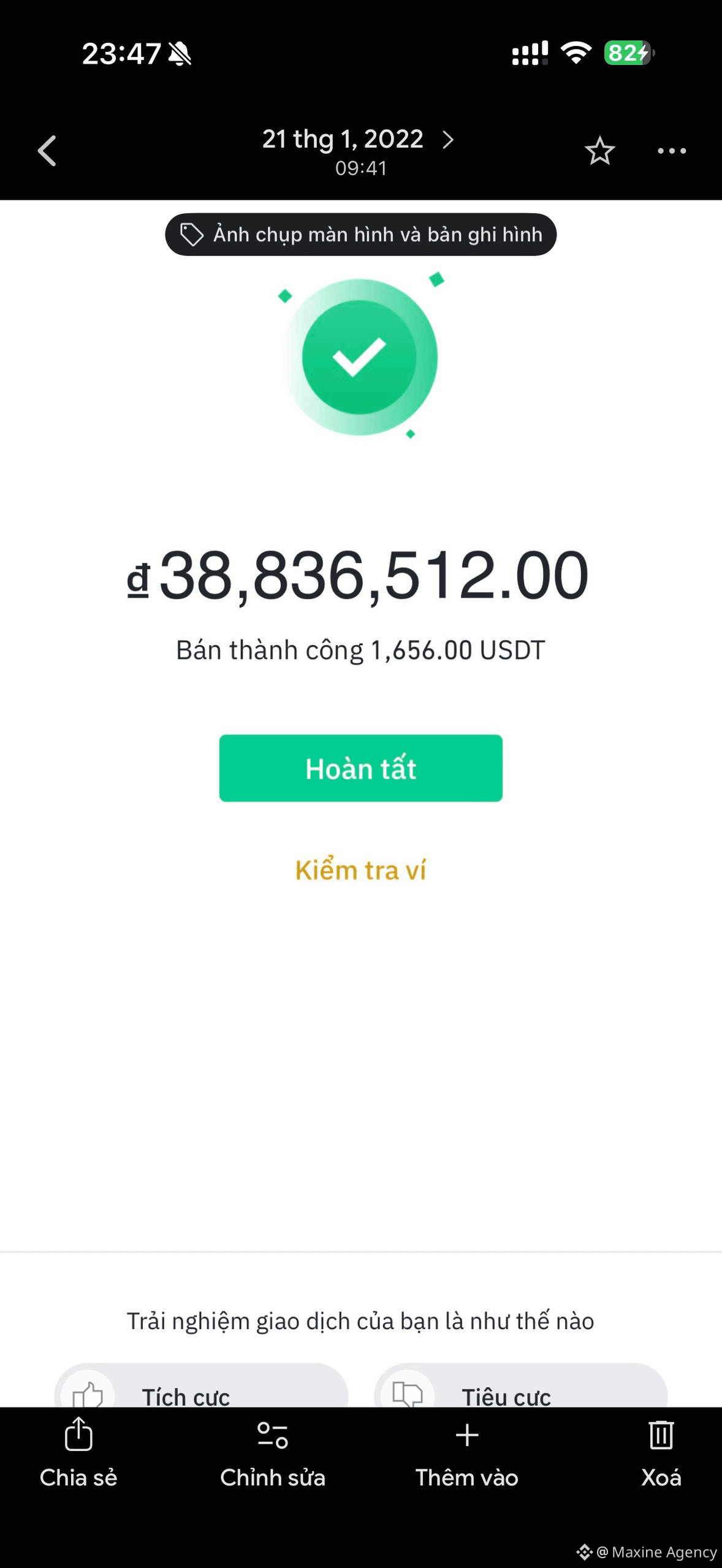
1
3
428
The key to Dusk that makes me think more about “the right to view”
When reading about Phoenix, at first I noticed the part of the transaction that is hidden from the public view of observers, but what made me struggle more was selective disclosure.
Phoenix lets the owner share a viewing key so that another party can identify which outputs belong to them and, using the provided data, read the corresponding values. This fits audits or reporting because the person who needs to verify can see enough information without turning the entire transaction into public data.
But from here arises a question that is rarely discussed: how long should the right to view exist?
An audit has a start and end time. Meanwhile, a viewing key is a cryptographic access right. If a business shares it with an auditor, what matters is not only who gets to view it, but also what data range they can see, how the key is managed, and what happens once the original purpose has been completed.
In my view, this is the more practical side of privacy than hiding balances from an explorer.
A blockchain can prevent the public from seeing Phoenix data, but once information has been disclosed validly, the system cannot make a copy that the recipient saved simply vanish. Privacy therefore does not end at cryptography—it also depends on access control governance and off-chain processes.
What I want to track at #dusk l is how viewing authority is constrained in practice.
Who can view, which parts they can view, and for how long?
If selective disclosure can answer all three questions, then privacy truly becomes a tool for managed finance.
@Dusk_Foundation $DUSK $Q $BASED
The key to Dusk that makes me think more about “the right to view”
When reading about Phoenix, at first I noticed the part of the transaction that is hidden from the public view of observers, but what made me struggle more was selective disclosure.
Phoenix lets the owner share a viewing key so that another party can identify which outputs belong to them and, using the provided data, read the corresponding values. This fits audits or reporting because the person who needs to verify can see enough information without turning the entire transaction into public data.
But from here arises a question that is rarely discussed: how long should the right to view exist?
An audit has a start and end time. Meanwhile, a viewing key is a cryptographic access right. If a business shares it with an auditor, what matters is not only who gets to view it, but also what data range they can see, how the key is managed, and what happens once the original purpose has been completed.
In my view, this is the more practical side of privacy than hiding balances from an explorer.
A blockchain can prevent the public from seeing Phoenix data, but once information has been disclosed validly, the system cannot make a copy that the recipient saved simply vanish. Privacy therefore does not end at cryptography—it also depends on access control governance and off-chain processes.
What I want to track at #dusk l is how viewing authority is constrained in practice.
Who can view, which parts they can view, and for how long?
If selective disclosure can answer all three questions, then privacy truly becomes a tool for managed finance.
@Dusk $DUSK $Q $BASED
When reading about Phoenix, at first I noticed the part of the transaction that is hidden from the public view of observers, but what made me struggle more was selective disclosure.
Phoenix lets the owner share a viewing key so that another party can identify which outputs belong to them and, using the provided data, read the corresponding values. This fits audits or reporting because the person who needs to verify can see enough information without turning the entire transaction into public data.
But from here arises a question that is rarely discussed: how long should the right to view exist?
An audit has a start and end time. Meanwhile, a viewing key is a cryptographic access right. If a business shares it with an auditor, what matters is not only who gets to view it, but also what data range they can see, how the key is managed, and what happens once the original purpose has been completed.
In my view, this is the more practical side of privacy than hiding balances from an explorer.
A blockchain can prevent the public from seeing Phoenix data, but once information has been disclosed validly, the system cannot make a copy that the recipient saved simply vanish. Privacy therefore does not end at cryptography—it also depends on access control governance and off-chain processes.
What I want to track at #dusk l is how viewing authority is constrained in practice.
Who can view, which parts they can view, and for how long?
If selective disclosure can answer all three questions, then privacy truly becomes a tool for managed finance.
@Dusk $DUSK $Q $BASED
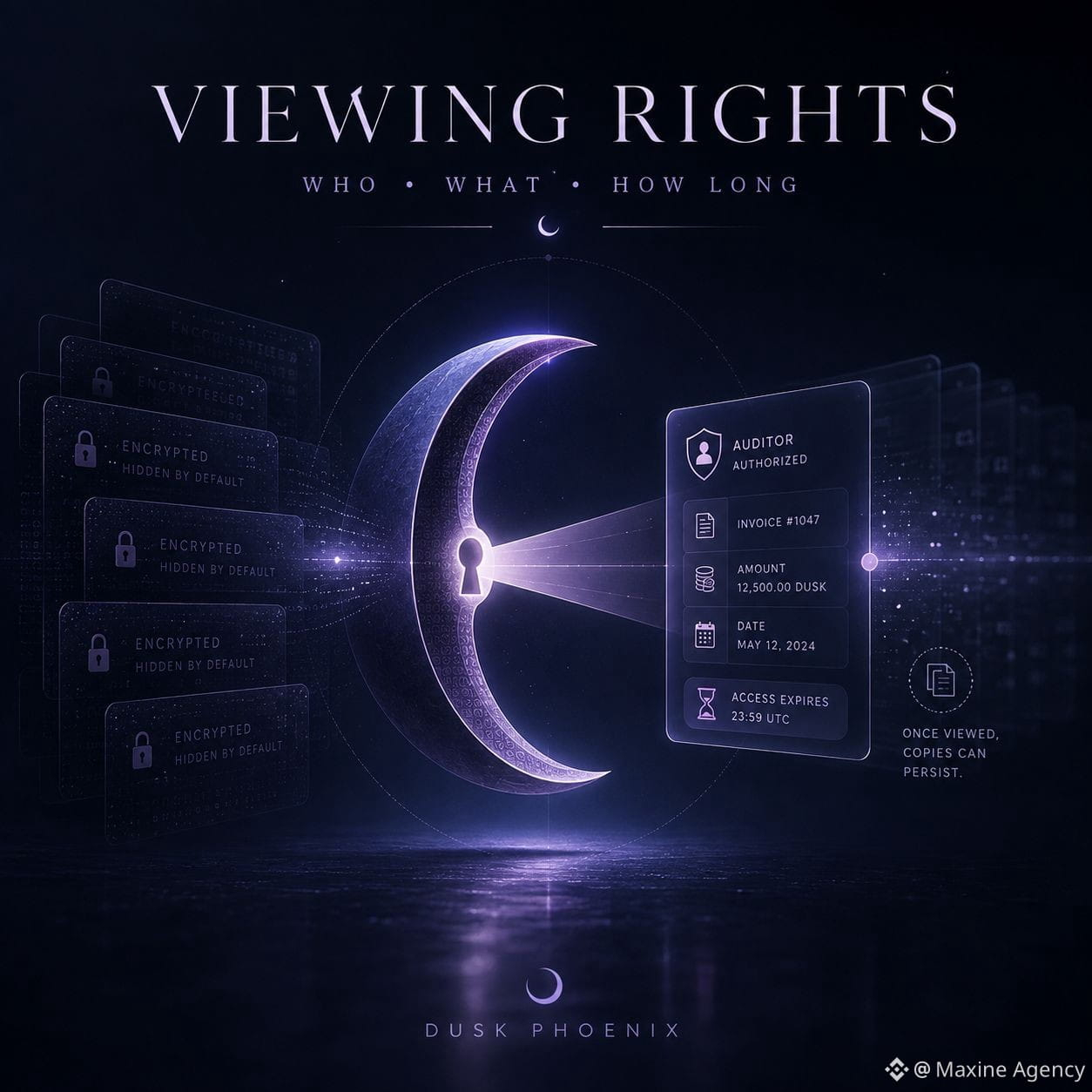
4
2
273
Log in to explore more content
Join global crypto users on Binance Square
⚡️ Get latest and useful information about crypto.
💬 Trusted by the world’s largest crypto exchange.
👍 Discover real insights from verified creators.
Email / Phone number
Trending Topics
USAugustPPIRisesLessThanExpected
38,289 views
691 Discussing
🚨 US AUG PPI: Rises LESS Than Expected! Bullish for Crypto? 🚀
PPI +0.4% MoM as expected, but CORE PPI only +0.2% vs +0.3% expected - cooling!
What it means:
• Wholesale inflation softer than feared
• Fed rate hike chance now 62% - but dovish signals coming
• Core PCE revisions expected downward - bullish
• BTC usually pumps on softer PPI
Fed meeting Sep 15-16 - Market now expects pause, not hike?
Is this the green light for Q4 rally?
#Bitcoin #PPI #Fed #CryptoNews #BTC#usaugustppiriseslessthanexpected
True News
·1 Likes
·1.3k views
SECApprovesNasdaqTexasCommodityTrustRule
22,845 views
508 Discussing
ECBRaisesRatesSecondTimeTo2.5%
20,436 views
374 Discussing