
加密城市 Crypto City
9.8k Posts

加密城市 Crypto City
 Square Verified+
Report
Block User
0 Following
5.9K+ Followers
6.1K+ Liked
Posts
AI Articles Can Even Be Caught in Japanese! Japanese Author Tests Pangram Tool: 100% Hit on Gemini-Generated ContentCan AI-written articles really be detected? Earlier, when Substack introduced an AI article detection tool called Pangram, it sparked discussion about whether paid content had been heavily ghostwritten by AI. Now Japanese media has also actually tested with “Japanese.”
Japan (Gendai Business) author Masakazu Kobayashi recently tested Pangram by inserting both Japanese text generated by Google Gemini and articles he wrote himself before generative AI became widespread. The former was judged as “100% AI-generated,” while the latter was judged as “100% human-written.”
Although just two samples are far from enough to prove that Pangram is also officially claimed to be 99.99% accurate for Japanese, it at least shows that: even though Pangram currently primarily offers its service in English, it already has the ability to recognize AI-written Japanese articles.
AI Articles Can Even Be Caught in Japanese! Japanese Author Tests Pangram Tool: 100% Hit on Gemini-Generated Content
Can AI-written articles really be detected? Earlier, when Substack introduced an AI article detection tool called Pangram, it sparked discussion about whether paid content had been heavily ghostwritten by AI. Now Japanese media has also actually tested with “Japanese.”
Japan (Gendai Business) author Masakazu Kobayashi recently tested Pangram by inserting both Japanese text generated by Google Gemini and articles he wrote himself before generative AI became widespread. The former was judged as “100% AI-generated,” while the latter was judged as “100% human-written.”
Although just two samples are far from enough to prove that Pangram is also officially claimed to be 99.99% accurate for Japanese, it at least shows that: even though Pangram currently primarily offers its service in English, it already has the ability to recognize AI-written Japanese articles.
Japan (Gendai Business) author Masakazu Kobayashi recently tested Pangram by inserting both Japanese text generated by Google Gemini and articles he wrote himself before generative AI became widespread. The former was judged as “100% AI-generated,” while the latter was judged as “100% human-written.”
Although just two samples are far from enough to prove that Pangram is also officially claimed to be 99.99% accurate for Japanese, it at least shows that: even though Pangram currently primarily offers its service in English, it already has the ability to recognize AI-written Japanese articles.
123
Can Stablecoins Be Included in M1 or M2? Fed Research Explores the Possibility, Moving Toward Official Money Supply IndicatorsThe Fed’s research on stablecoin classification suggests they may be included in M1 or M2 in the future.
The Federal Reserve (Fed) released its latest FEDS Notes research on September 4, exploring new forms of money such as tokenized deposits, tokenized money market funds, and payment stablecoins, and how they should be incorporated into U.S. official measures of the money supply in the future.
The study notes that payment stablecoins have partial functions of money. Depending on the real-world usage scenarios, they may be classified in M1 in the future, or included in M2 as items that are not part of M1.
Currently, the Fed publishes monthly data on the monetary base, M1, and M2 via H.6. M1 mainly includes currency in circulation, demand deposits, and other highly liquid deposits, emphasizing assets that can be used immediately for transactions. M2 includes M1 plus additional assets such as small-denomination time deposits and retail-oriented money market funds, which are more geared toward short-term saving purposes.
Can Stablecoins Be Included in M1 or M2? Fed Research Explores the Possibility, Moving Toward Official Money Supply Indicators
The Fed’s research on stablecoin classification suggests they may be included in M1 or M2 in the future.
The Federal Reserve (Fed) released its latest FEDS Notes research on September 4, exploring new forms of money such as tokenized deposits, tokenized money market funds, and payment stablecoins, and how they should be incorporated into U.S. official measures of the money supply in the future.
The study notes that payment stablecoins have partial functions of money. Depending on the real-world usage scenarios, they may be classified in M1 in the future, or included in M2 as items that are not part of M1.
Currently, the Fed publishes monthly data on the monetary base, M1, and M2 via H.6. M1 mainly includes currency in circulation, demand deposits, and other highly liquid deposits, emphasizing assets that can be used immediately for transactions. M2 includes M1 plus additional assets such as small-denomination time deposits and retail-oriented money market funds, which are more geared toward short-term saving purposes.
The Federal Reserve (Fed) released its latest FEDS Notes research on September 4, exploring new forms of money such as tokenized deposits, tokenized money market funds, and payment stablecoins, and how they should be incorporated into U.S. official measures of the money supply in the future.
The study notes that payment stablecoins have partial functions of money. Depending on the real-world usage scenarios, they may be classified in M1 in the future, or included in M2 as items that are not part of M1.
Currently, the Fed publishes monthly data on the monetary base, M1, and M2 via H.6. M1 mainly includes currency in circulation, demand deposits, and other highly liquid deposits, emphasizing assets that can be used immediately for transactions. M2 includes M1 plus additional assets such as small-denomination time deposits and retail-oriented money market funds, which are more geared toward short-term saving purposes.
142
Korea to launch tokenization of securities in 2027! Three-phase blueprint unveiled: expands to stocks, bonds and fundsThe Korean government has released a new blueprint for the digitalization of capital markets. On September 4, the Financial Services Commission (FSC) held the third joint public-private meeting of the tokenized securities task force, announcing that starting in February 2027 it will build the tokenized securities infrastructure in three phases. The planned application scope will expand from existing fragmented investment products to traditional financial products such as stocks, bonds, and funds.
Amendments to Korea’s (Electronic Securities Act) and (Capital Markets Act) were passed by the National Assembly on January 15, 2026, and the related regulations are scheduled to take effect on February 4, 2027. The legislative changes formally recognize that issuance and transfer records of securities can be maintained using blockchain distributed ledgers, and they grant legal effect to the relevant ledgers. Korean regulators emphasized that tokenized securities are not a new category of asset, but one method of issuance alongside paper securities and electronic securities; they must still comply with existing requirements for securities registration, information disclosure, and intermediary broker license.
Korea to launch tokenization of securities in 2027! Three-phase blueprint unveiled: expands to stocks, bonds and funds
The Korean government has released a new blueprint for the digitalization of capital markets. On September 4, the Financial Services Commission (FSC) held the third joint public-private meeting of the tokenized securities task force, announcing that starting in February 2027 it will build the tokenized securities infrastructure in three phases. The planned application scope will expand from existing fragmented investment products to traditional financial products such as stocks, bonds, and funds.
Amendments to Korea’s (Electronic Securities Act) and (Capital Markets Act) were passed by the National Assembly on January 15, 2026, and the related regulations are scheduled to take effect on February 4, 2027. The legislative changes formally recognize that issuance and transfer records of securities can be maintained using blockchain distributed ledgers, and they grant legal effect to the relevant ledgers. Korean regulators emphasized that tokenized securities are not a new category of asset, but one method of issuance alongside paper securities and electronic securities; they must still comply with existing requirements for securities registration, information disclosure, and intermediary broker license.
Amendments to Korea’s (Electronic Securities Act) and (Capital Markets Act) were passed by the National Assembly on January 15, 2026, and the related regulations are scheduled to take effect on February 4, 2027. The legislative changes formally recognize that issuance and transfer records of securities can be maintained using blockchain distributed ledgers, and they grant legal effect to the relevant ledgers. Korean regulators emphasized that tokenized securities are not a new category of asset, but one method of issuance alongside paper securities and electronic securities; they must still comply with existing requirements for securities registration, information disclosure, and intermediary broker license.
109
SoftBank’s Masayoshi Son: Humans will become super-humans! Business performance indicators should change to "AI return on investment"The world is moving toward full AI adoption across major industries. At that time, it is expected that 100 trillion AI intelligent agents and 1 billion humanoid robots will come into play. How can companies prepare themselves to become AI-native businesses? In his keynote address at SoftBank World 2026, SoftBank founder Masayoshi Son said that companies need to introduce Return on AI—"Return on Artificial Intelligence Investment"—as an operational metric, and transition systematically into an AI-Native "artificial intelligence-native enterprise."
Artificial superintelligence leads global value creation growth
Sun Masayoshi explained in his speech that the economic output of Artificial Superintelligence (ASI) is expected to account for 20% of global GDP by 2040, reaching an annual output of 7,000 trillion yen. Over time, the labor market will gradually shift to a hundred trillion AI agents and 1 billion humanoid robots. These systems have the ability to operate independently, communicate, and continuously learn, becoming the primary labor force on production lines. To meet the corresponding computing-power demand, the capacity of global AI data centers (AI Data Center) needs to reach 3 terawatts. The average annual investment is expected to be about $5 trillion, thereby driving computing power to Quetta-level (1030).
SoftBank’s Masayoshi Son: Humans will become super-humans! Business performance indicators should change to "AI return on investment"
The world is moving toward full AI adoption across major industries. At that time, it is expected that 100 trillion AI intelligent agents and 1 billion humanoid robots will come into play. How can companies prepare themselves to become AI-native businesses? In his keynote address at SoftBank World 2026, SoftBank founder Masayoshi Son said that companies need to introduce Return on AI—"Return on Artificial Intelligence Investment"—as an operational metric, and transition systematically into an AI-Native "artificial intelligence-native enterprise."
Artificial superintelligence leads global value creation growth
Sun Masayoshi explained in his speech that the economic output of Artificial Superintelligence (ASI) is expected to account for 20% of global GDP by 2040, reaching an annual output of 7,000 trillion yen. Over time, the labor market will gradually shift to a hundred trillion AI agents and 1 billion humanoid robots. These systems have the ability to operate independently, communicate, and continuously learn, becoming the primary labor force on production lines. To meet the corresponding computing-power demand, the capacity of global AI data centers (AI Data Center) needs to reach 3 terawatts. The average annual investment is expected to be about $5 trillion, thereby driving computing power to Quetta-level (1030).
Artificial superintelligence leads global value creation growth
Sun Masayoshi explained in his speech that the economic output of Artificial Superintelligence (ASI) is expected to account for 20% of global GDP by 2040, reaching an annual output of 7,000 trillion yen. Over time, the labor market will gradually shift to a hundred trillion AI agents and 1 billion humanoid robots. These systems have the ability to operate independently, communicate, and continuously learn, becoming the primary labor force on production lines. To meet the corresponding computing-power demand, the capacity of global AI data centers (AI Data Center) needs to reach 3 terawatts. The average annual investment is expected to be about $5 trillion, thereby driving computing power to Quetta-level (1030).
119
Verified

Article
Working with Wangdao Bank to Launch the Bito.ONE Pilot Program, BitoGroup Rolls Out Taiwan’s First Enterprise-Grade Stablecoin Settlement Case[The following content is provided by BitoGroup]
Stablecoins are gradually being incorporated into the world’s mainstream financial systems, and Taiwan has also entered a new phase of integrating stablecoins with banking. BitoGroup, a virtual asset firm in Taiwan, announced the official launch of a pilot program for its enterprise-grade stablecoin settlement solution, “Bito.ONE.” Wangdao Bank has selected BitoGroup to build an institutional-level stablecoin settlement service, implementing first a model of collaboration between virtual asset service providers (VASPs) and banks. This covers processes including enterprise payments, transaction verification, exchanges between stablecoins and fiat currencies, and settlement, and will further be rolled out to real enterprise applications to position early for cross-border enterprise stablecoin financial services.
Working with Wangdao Bank to Launch the Bito.ONE Pilot Program, BitoGroup Rolls Out Taiwan’s First Enterprise-Grade Stablecoin Settlement Case
[The following content is provided by BitoGroup]
Stablecoins are gradually being incorporated into the world’s mainstream financial systems, and Taiwan has also entered a new phase of integrating stablecoins with banking. BitoGroup, a virtual asset firm in Taiwan, announced the official launch of a pilot program for its enterprise-grade stablecoin settlement solution, “Bito.ONE.” Wangdao Bank has selected BitoGroup to build an institutional-level stablecoin settlement service, implementing first a model of collaboration between virtual asset service providers (VASPs) and banks. This covers processes including enterprise payments, transaction verification, exchanges between stablecoins and fiat currencies, and settlement, and will further be rolled out to real enterprise applications to position early for cross-border enterprise stablecoin financial services.
Stablecoins are gradually being incorporated into the world’s mainstream financial systems, and Taiwan has also entered a new phase of integrating stablecoins with banking. BitoGroup, a virtual asset firm in Taiwan, announced the official launch of a pilot program for its enterprise-grade stablecoin settlement solution, “Bito.ONE.” Wangdao Bank has selected BitoGroup to build an institutional-level stablecoin settlement service, implementing first a model of collaboration between virtual asset service providers (VASPs) and banks. This covers processes including enterprise payments, transaction verification, exchanges between stablecoins and fiat currencies, and settlement, and will further be rolled out to real enterprise applications to position early for cross-border enterprise stablecoin financial services.
1
1.5k

Article
Can fruit flies trade crypto? Coinbase engineer opens source Stonkfly project: gives a fruit fly $100 to trade BitcoinCan fruit flies trade crypto?
An engineer is giving a "fruit fly" $100 to trade Bitcoin.
It sounds strange, but this is indeed the latest open-source project by Coinbase engineer Alex Wormuth called Stonkfly. He also asked curiously: "Can fruit flies become rich?"
Stonkfly is a fruit-fly brain-connection simulation system used to operate cryptocurrency trading accounts. It is based on the MaleCNS v1.0 fruit-fly connectome released by Google, retaining 166,700 neurons and 25.6 million connections. The project first converts publicly available Bitcoin prices into RGB charts, then stimulates 3,335 brightness inputs and 811 color inputs. Fixed neural readout mechanisms then generate buy, sell, or hold recommendations. After the Coinbase AgentKit ActionProvider checks the limits, it places orders through Coinbase Advanced.
Can fruit flies trade crypto? Coinbase engineer opens source Stonkfly project: gives a fruit fly $100 to trade Bitcoin
Can fruit flies trade crypto?
An engineer is giving a "fruit fly" $100 to trade Bitcoin.
It sounds strange, but this is indeed the latest open-source project by Coinbase engineer Alex Wormuth called Stonkfly. He also asked curiously: "Can fruit flies become rich?"
Stonkfly is a fruit-fly brain-connection simulation system used to operate cryptocurrency trading accounts. It is based on the MaleCNS v1.0 fruit-fly connectome released by Google, retaining 166,700 neurons and 25.6 million connections. The project first converts publicly available Bitcoin prices into RGB charts, then stimulates 3,335 brightness inputs and 811 color inputs. Fixed neural readout mechanisms then generate buy, sell, or hold recommendations. After the Coinbase AgentKit ActionProvider checks the limits, it places orders through Coinbase Advanced.
An engineer is giving a "fruit fly" $100 to trade Bitcoin.
It sounds strange, but this is indeed the latest open-source project by Coinbase engineer Alex Wormuth called Stonkfly. He also asked curiously: "Can fruit flies become rich?"
Stonkfly is a fruit-fly brain-connection simulation system used to operate cryptocurrency trading accounts. It is based on the MaleCNS v1.0 fruit-fly connectome released by Google, retaining 166,700 neurons and 25.6 million connections. The project first converts publicly available Bitcoin prices into RGB charts, then stimulates 3,335 brightness inputs and 811 color inputs. Fixed neural readout mechanisms then generate buy, sell, or hold recommendations. After the Coinbase AgentKit ActionProvider checks the limits, it places orders through Coinbase Advanced.
1
46
You can’t just wait for QDay! The U.S. pours $300 million into three quantum companies, and discussions about Bitcoin’s post-quantum migration heat upThe U.S. government is ramping up investment in the quantum computing industry, bringing the “quantum threat” that Bitcoin has long faced back from theoretical risk to a practical engineering issue. On September 8, the U.S. Department of Commerce officially finalized CHIPS R&D incentives for Rigetti, D-Wave, and Quantinuum. Each company can receive up to $100 million, for a combined total of up to $300 million. The funding will be used for technologies such as quantum chips, cryogenic systems, improvements in error rates, and fault-tolerant quantum computing.
It is worth noting that the $300 million is not the entirety of Washington’s quantum investment this time. On the same day, photonic quantum computing company PsiQuantum also received the highest possible $100 million in R&D incentives. GlobalFoundries received up to $375 million, including efforts to establish domestic U.S. capabilities for quantum wafer foundry services. As early as May this year, the U.S. Department of Commerce announced that nine companies expressed intentions to invest a total of $2.013 billion in the quantum industry, indicating that policy is gradually shifting from foundational research toward manufacturing and large-scale hardware.
You can’t just wait for QDay! The U.S. pours $300 million into three quantum companies, and discussions about Bitcoin’s post-quantum migration heat up
The U.S. government is ramping up investment in the quantum computing industry, bringing the “quantum threat” that Bitcoin has long faced back from theoretical risk to a practical engineering issue. On September 8, the U.S. Department of Commerce officially finalized CHIPS R&D incentives for Rigetti, D-Wave, and Quantinuum. Each company can receive up to $100 million, for a combined total of up to $300 million. The funding will be used for technologies such as quantum chips, cryogenic systems, improvements in error rates, and fault-tolerant quantum computing.
It is worth noting that the $300 million is not the entirety of Washington’s quantum investment this time. On the same day, photonic quantum computing company PsiQuantum also received the highest possible $100 million in R&D incentives. GlobalFoundries received up to $375 million, including efforts to establish domestic U.S. capabilities for quantum wafer foundry services. As early as May this year, the U.S. Department of Commerce announced that nine companies expressed intentions to invest a total of $2.013 billion in the quantum industry, indicating that policy is gradually shifting from foundational research toward manufacturing and large-scale hardware.
It is worth noting that the $300 million is not the entirety of Washington’s quantum investment this time. On the same day, photonic quantum computing company PsiQuantum also received the highest possible $100 million in R&D incentives. GlobalFoundries received up to $375 million, including efforts to establish domestic U.S. capabilities for quantum wafer foundry services. As early as May this year, the U.S. Department of Commerce announced that nine companies expressed intentions to invest a total of $2.013 billion in the quantum industry, indicating that policy is gradually shifting from foundational research toward manufacturing and large-scale hardware.
40

Article
Forecast Bitcoin to reach $400,000 by 2030! Coinbase CEO: The bottom of this cycle has already appearedCoinbase CEO is bullish on Bitcoin, saying the bottom of this price cycle has already appeared
After Bitcoin ($BTC) underwent a major correction this year, Brian Armstrong, co-founder and CEO of the cryptocurrency exchange Coinbase, has once again publicly turned bullish on the outlook. He believes the price bottom of this market cycle for Bitcoin may already have appeared, and that in the next one to two years it could return to an upward trend.
In an interview with Bloomberg Television on September 10, Armstrong said that he personally believes Bitcoin has already passed the price bottom of this cycle. As the next Bitcoin halving gradually approaches, the price may move upward again in the next one to two years.
Forecast Bitcoin to reach $400,000 by 2030! Coinbase CEO: The bottom of this cycle has already appeared
Coinbase CEO is bullish on Bitcoin, saying the bottom of this price cycle has already appeared
After Bitcoin ($BTC) underwent a major correction this year, Brian Armstrong, co-founder and CEO of the cryptocurrency exchange Coinbase, has once again publicly turned bullish on the outlook. He believes the price bottom of this market cycle for Bitcoin may already have appeared, and that in the next one to two years it could return to an upward trend.
In an interview with Bloomberg Television on September 10, Armstrong said that he personally believes Bitcoin has already passed the price bottom of this cycle. As the next Bitcoin halving gradually approaches, the price may move upward again in the next one to two years.
After Bitcoin ($BTC) underwent a major correction this year, Brian Armstrong, co-founder and CEO of the cryptocurrency exchange Coinbase, has once again publicly turned bullish on the outlook. He believes the price bottom of this market cycle for Bitcoin may already have appeared, and that in the next one to two years it could return to an upward trend.
In an interview with Bloomberg Television on September 10, Armstrong said that he personally believes Bitcoin has already passed the price bottom of this cycle. As the next Bitcoin halving gradually approaches, the price may move upward again in the next one to two years.
129
Micron unveils the highest bonus ever! A million-dollar thank-you bonus for Taiwan employees; production-line pay could reach up to 68 monthsMemory giant Micron announced on the 11th that it will distribute compensation for the 2026 fiscal year (FY26) to more than 60,000 employees worldwide. The scale is the largest since the company was founded. For eligible employees in Taiwan, each person can receive a NT$1,000,000 thank-you bonus. For production-line personnel, total compensation is equivalent to 35 to 68 months of salary.
Related coverage: Micron prepares to counter a strike! Urgently rolls out the highest performance bonus in history, with the CEO appearing in a video to show support for Taiwan
Micron Taiwan to distribute a million-dollar thank-you bonus! Additional performance bonus up to 500%
Micron stated that employees who join in Taiwan before August 29, 2025 can receive a NT$1,000,000 thank-you bonus per person. For new employees during the fiscal year FY26, the bonus will be paid proportionally based on their time on the job. In addition to cash incentives, the annual performance bonus can reach up to 500% of the base target. There are also additional stock awards; for entry-level engineers, the average total compensation is about NT$2.9 million. If stock awards are included, total compensation can reach NT$3.4 million. For production-line personnel, compensation is equivalent to about 35 to 68 months of salary.
Micron unveils the highest bonus ever! A million-dollar thank-you bonus for Taiwan employees; production-line pay could reach up to 68 months
Memory giant Micron announced on the 11th that it will distribute compensation for the 2026 fiscal year (FY26) to more than 60,000 employees worldwide. The scale is the largest since the company was founded. For eligible employees in Taiwan, each person can receive a NT$1,000,000 thank-you bonus. For production-line personnel, total compensation is equivalent to 35 to 68 months of salary.
Related coverage: Micron prepares to counter a strike! Urgently rolls out the highest performance bonus in history, with the CEO appearing in a video to show support for Taiwan
Micron Taiwan to distribute a million-dollar thank-you bonus! Additional performance bonus up to 500%
Micron stated that employees who join in Taiwan before August 29, 2025 can receive a NT$1,000,000 thank-you bonus per person. For new employees during the fiscal year FY26, the bonus will be paid proportionally based on their time on the job. In addition to cash incentives, the annual performance bonus can reach up to 500% of the base target. There are also additional stock awards; for entry-level engineers, the average total compensation is about NT$2.9 million. If stock awards are included, total compensation can reach NT$3.4 million. For production-line personnel, compensation is equivalent to about 35 to 68 months of salary.
Related coverage: Micron prepares to counter a strike! Urgently rolls out the highest performance bonus in history, with the CEO appearing in a video to show support for Taiwan
Micron Taiwan to distribute a million-dollar thank-you bonus! Additional performance bonus up to 500%
Micron stated that employees who join in Taiwan before August 29, 2025 can receive a NT$1,000,000 thank-you bonus per person. For new employees during the fiscal year FY26, the bonus will be paid proportionally based on their time on the job. In addition to cash incentives, the annual performance bonus can reach up to 500% of the base target. There are also additional stock awards; for entry-level engineers, the average total compensation is about NT$2.9 million. If stock awards are included, total compensation can reach NT$3.4 million. For production-line personnel, compensation is equivalent to about 35 to 68 months of salary.
66

Article
Jensen Huang Refutes the “AI Will Destroy Humanity” Video With Over 100 Million Views: They Spread Panic to Sell New ProductsHuang Renxun: The recent AI doomsday panic is to sell new products
At the latest Goldman Sachs Technology and Media Summit, NVIDIA CEO Jensen Huang said that the outside world’s fear of AI is essentially a topic that the cybersecurity industry has stirred up in order to create new business opportunities.
In the investment world, Huang Renxun has long been seen as one of the so-called AI barometers. Now, however, his remarks may face the risk of the main narrative going off track—especially as public concerns that AI may cause large-scale destruction continue to intensify.
According to (Axios), Huang Renxun said on a forum, “The reason everyone talks so much about cybersecurity today is because this industry is about to release some new products.” He also asked, “What other way is better at creating demand than manufacturing a problem? Who wouldn’t want their market to fall into a frenzy, with consumers lining up to pay for purchases?”
Jensen Huang Refutes the “AI Will Destroy Humanity” Video With Over 100 Million Views: They Spread Panic to Sell New Products
Huang Renxun: The recent AI doomsday panic is to sell new products
At the latest Goldman Sachs Technology and Media Summit, NVIDIA CEO Jensen Huang said that the outside world’s fear of AI is essentially a topic that the cybersecurity industry has stirred up in order to create new business opportunities.
In the investment world, Huang Renxun has long been seen as one of the so-called AI barometers. Now, however, his remarks may face the risk of the main narrative going off track—especially as public concerns that AI may cause large-scale destruction continue to intensify.
According to (Axios), Huang Renxun said on a forum, “The reason everyone talks so much about cybersecurity today is because this industry is about to release some new products.” He also asked, “What other way is better at creating demand than manufacturing a problem? Who wouldn’t want their market to fall into a frenzy, with consumers lining up to pay for purchases?”
At the latest Goldman Sachs Technology and Media Summit, NVIDIA CEO Jensen Huang said that the outside world’s fear of AI is essentially a topic that the cybersecurity industry has stirred up in order to create new business opportunities.
In the investment world, Huang Renxun has long been seen as one of the so-called AI barometers. Now, however, his remarks may face the risk of the main narrative going off track—especially as public concerns that AI may cause large-scale destruction continue to intensify.
According to (Axios), Huang Renxun said on a forum, “The reason everyone talks so much about cybersecurity today is because this industry is about to release some new products.” He also asked, “What other way is better at creating demand than manufacturing a problem? Who wouldn’t want their market to fall into a frenzy, with consumers lining up to pay for purchases?”
53

Article
Don’t just watch the Fed! Experts reveal Bitcoin’s “turning-point code”: Nonfarm hits hardest, Core CPI lasts longerMarkets often treat the Federal Reserve (Fed) interest rate decision as the most important macro trigger for Bitcoin, but Coin Metrics’ latest research points to a different answer: if you look only at the first 30 minutes after a news release, the U.S. employment data is actually the piece of information most likely to cause BTC to abruptly change direction.
In a comparison published by Coin Metrics on September 8 (Bitcoin’s Shifting Macro Identity), it analyzed BTC volatility around the nonfarm payroll report, the Core Consumer Price Index (Core CPI), and FOMC decisions during the period from January 2025 to September 2026. The results show that within the first 30 minutes after the jobs report is released, the median BTC absolute price change is about 2 times that of a typical non-event period. Core CPI shortly follows at about 1.8 times. By contrast, the FOMC rate decision—what the market pays the most attention to—saw volatility in both observation windows remain roughly at normal baseline levels.
Don’t just watch the Fed! Experts reveal Bitcoin’s “turning-point code”: Nonfarm hits hardest, Core CPI lasts longer
Markets often treat the Federal Reserve (Fed) interest rate decision as the most important macro trigger for Bitcoin, but Coin Metrics’ latest research points to a different answer: if you look only at the first 30 minutes after a news release, the U.S. employment data is actually the piece of information most likely to cause BTC to abruptly change direction.
In a comparison published by Coin Metrics on September 8 (Bitcoin’s Shifting Macro Identity), it analyzed BTC volatility around the nonfarm payroll report, the Core Consumer Price Index (Core CPI), and FOMC decisions during the period from January 2025 to September 2026. The results show that within the first 30 minutes after the jobs report is released, the median BTC absolute price change is about 2 times that of a typical non-event period. Core CPI shortly follows at about 1.8 times. By contrast, the FOMC rate decision—what the market pays the most attention to—saw volatility in both observation windows remain roughly at normal baseline levels.
In a comparison published by Coin Metrics on September 8 (Bitcoin’s Shifting Macro Identity), it analyzed BTC volatility around the nonfarm payroll report, the Core Consumer Price Index (Core CPI), and FOMC decisions during the period from January 2025 to September 2026. The results show that within the first 30 minutes after the jobs report is released, the median BTC absolute price change is about 2 times that of a typical non-event period. Core CPI shortly follows at about 1.8 times. By contrast, the FOMC rate decision—what the market pays the most attention to—saw volatility in both observation windows remain roughly at normal baseline levels.
58
Driving the tokenization of agri-assets! Indian agricultural finance platform partners with Avalanche to put $2 billion in grain receipts on-chainIndian large-scale agricultural warehousing and storage merchant trials RWA; grain receipts are moved to Avalanche
India’s large agricultural warehousing and agri-finance platform, Arya.ag, is testing the tokenization of grain warehouse receipts. Using Avalanche technology, it builds a dedicated Layer 1 blockchain so that farmers, storage operators, and financial institutions can verify ownership and collateral status of agricultural products within the same system.
The initiative was publicly introduced by Indian tech entrepreneur Nandan Nilekani at the Global Fintech Festival in Mumbai. It is currently in the testing phase, with three major banks participating, though their names have not yet been disclosed.
Driving the tokenization of agri-assets! Indian agricultural finance platform partners with Avalanche to put $2 billion in grain receipts on-chain
Indian large-scale agricultural warehousing and storage merchant trials RWA; grain receipts are moved to Avalanche
India’s large agricultural warehousing and agri-finance platform, Arya.ag, is testing the tokenization of grain warehouse receipts. Using Avalanche technology, it builds a dedicated Layer 1 blockchain so that farmers, storage operators, and financial institutions can verify ownership and collateral status of agricultural products within the same system.
The initiative was publicly introduced by Indian tech entrepreneur Nandan Nilekani at the Global Fintech Festival in Mumbai. It is currently in the testing phase, with three major banks participating, though their names have not yet been disclosed.
India’s large agricultural warehousing and agri-finance platform, Arya.ag, is testing the tokenization of grain warehouse receipts. Using Avalanche technology, it builds a dedicated Layer 1 blockchain so that farmers, storage operators, and financial institutions can verify ownership and collateral status of agricultural products within the same system.
The initiative was publicly introduced by Indian tech entrepreneur Nandan Nilekani at the Global Fintech Festival in Mumbai. It is currently in the testing phase, with three major banks participating, though their names have not yet been disclosed.
59

Article
Up to US$3B in size! Tether launches a private credit fund, with USDT targeting the SME funding gapTether launches a private credit fund, targeting the funding gap for small and medium-sized enterprises
Global stablecoin leader Tether and London private credit asset management firm Fasanara Capital have recently announced the joint launch of a private credit evergreen fund called “StableFund.”
The StableFund is jointly seeded by the two companies with an initial US$400 million, with a future goal of raising up to US$3 billion in funding from third-party investment institutions.
As the global private credit market is expected to grow from an estimated size of around US$3 trillion to US$5 trillion by 2029, the purpose of establishing StableFund is to ride this trend and direct large capital toward small and medium-sized enterprises that have long been overlooked by traditional finance.
Up to US$3B in size! Tether launches a private credit fund, with USDT targeting the SME funding gap
Tether launches a private credit fund, targeting the funding gap for small and medium-sized enterprises
Global stablecoin leader Tether and London private credit asset management firm Fasanara Capital have recently announced the joint launch of a private credit evergreen fund called “StableFund.”
The StableFund is jointly seeded by the two companies with an initial US$400 million, with a future goal of raising up to US$3 billion in funding from third-party investment institutions.
As the global private credit market is expected to grow from an estimated size of around US$3 trillion to US$5 trillion by 2029, the purpose of establishing StableFund is to ride this trend and direct large capital toward small and medium-sized enterprises that have long been overlooked by traditional finance.
Global stablecoin leader Tether and London private credit asset management firm Fasanara Capital have recently announced the joint launch of a private credit evergreen fund called “StableFund.”
The StableFund is jointly seeded by the two companies with an initial US$400 million, with a future goal of raising up to US$3 billion in funding from third-party investment institutions.
As the global private credit market is expected to grow from an estimated size of around US$3 trillion to US$5 trillion by 2029, the purpose of establishing StableFund is to ride this trend and direct large capital toward small and medium-sized enterprises that have long been overlooked by traditional finance.
27

Article
U.S. PPI surges beyond expectations! Bitcoin drops below $77,000 as liquidations across the market exceed $560 millionU.S. PPI up 5.4% year over year as inflation concerns flare up again
The latest U.S. inflation data once again brought pressure to the market. On September 10, the U.S. Bureau of Labor Statistics (BLS) released figures showing that the August Producer Price Index (PPI) rose 0.4% month over month, higher than July’s 0.1%; the year-over-year rate climbed from 4.8% in July to 5.4%, indicating that producer-side inflation has accelerated again.
Looking at the details, the biggest price pressure in August came from goods. Final demand goods prices increased 1.1% in a single month, with more than three-quarters of the rise attributable to energy prices; final demand energy prices rose 4.2% month over month.
U.S. PPI surges beyond expectations! Bitcoin drops below $77,000 as liquidations across the market exceed $560 million
U.S. PPI up 5.4% year over year as inflation concerns flare up again
The latest U.S. inflation data once again brought pressure to the market. On September 10, the U.S. Bureau of Labor Statistics (BLS) released figures showing that the August Producer Price Index (PPI) rose 0.4% month over month, higher than July’s 0.1%; the year-over-year rate climbed from 4.8% in July to 5.4%, indicating that producer-side inflation has accelerated again.
Looking at the details, the biggest price pressure in August came from goods. Final demand goods prices increased 1.1% in a single month, with more than three-quarters of the rise attributable to energy prices; final demand energy prices rose 4.2% month over month.
The latest U.S. inflation data once again brought pressure to the market. On September 10, the U.S. Bureau of Labor Statistics (BLS) released figures showing that the August Producer Price Index (PPI) rose 0.4% month over month, higher than July’s 0.1%; the year-over-year rate climbed from 4.8% in July to 5.4%, indicating that producer-side inflation has accelerated again.
Looking at the details, the biggest price pressure in August came from goods. Final demand goods prices increased 1.1% in a single month, with more than three-quarters of the rise attributable to energy prices; final demand energy prices rose 4.2% month over month.
134
GPT-6 Astra Demand Explodes! OpenAI Pauses New Pro Subscriptions: This Plan Puts a Heavy Load on the SystemEncrypted City 2026/9/11 Update: Earlier today, Thibault Sottiaux (Tibo), head of OpenAI’s core products and platform, announced that subscriptions to the $200 Pro plan have been paused. Because these subscription tiers place the heaviest burden on the system, the company hopes to take the smallest step possible to continue providing the broadest access.
The following is the original content:
After OpenAI’s latest flagship model, GPT-6 Astra, went live, the hype has continued to rise—potentially even starting to affect new user subscriptions to ChatGPT Pro. In a post on X, Tibo—the head of OpenAI’s core products and platform and also involved in Codex development—said that the demand brought by Astra has been truly unprecedented. Even though OpenAI has gone through multiple rapid growth phases in the past, he has never seen usage demand of this scale.
GPT-6 Astra Demand Explodes! OpenAI Pauses New Pro Subscriptions: This Plan Puts a Heavy Load on the System
Encrypted City 2026/9/11 Update: Earlier today, Thibault Sottiaux (Tibo), head of OpenAI’s core products and platform, announced that subscriptions to the $200 Pro plan have been paused. Because these subscription tiers place the heaviest burden on the system, the company hopes to take the smallest step possible to continue providing the broadest access.
The following is the original content:
After OpenAI’s latest flagship model, GPT-6 Astra, went live, the hype has continued to rise—potentially even starting to affect new user subscriptions to ChatGPT Pro. In a post on X, Tibo—the head of OpenAI’s core products and platform and also involved in Codex development—said that the demand brought by Astra has been truly unprecedented. Even though OpenAI has gone through multiple rapid growth phases in the past, he has never seen usage demand of this scale.
The following is the original content:
After OpenAI’s latest flagship model, GPT-6 Astra, went live, the hype has continued to rise—potentially even starting to affect new user subscriptions to ChatGPT Pro. In a post on X, Tibo—the head of OpenAI’s core products and platform and also involved in Codex development—said that the demand brought by Astra has been truly unprecedented. Even though OpenAI has gone through multiple rapid growth phases in the past, he has never seen usage demand of this scale.
128

Article
Taiwan’s first VASP! MaiCoin applies for listing; last year revenue was 522 million, with a loss of 466 millionMaiCoin’s parent company submits an innovative board listing application, becoming Taiwan’s first VASP
Taiwan-based cryptocurrency exchange platform MaiCoin has officially initiated its listing procedures. According to a press release from the Taiwan Stock Exchange, MaiCoin’s group parent company, Modernity Financial Holdings, an exempted company incorporated in the Cayman Islands (Modernity Financial Holdings), filed the application for first listing on the Innovative Board on September 9. The stock code is 7903, and the company abbreviation is “MaiCoin-KY”.
This is also related to the first virtual asset service provider (VASP) in Taiwan to file a listing application with the Taiwan Stock Exchange. If the listing review proceeds smoothly and the company completes the listing, MaiCoin could become Taiwan’s first listed company in the capital markets with cryptocurrency trading and digital asset services as its core business.
Taiwan’s first VASP! MaiCoin applies for listing; last year revenue was 522 million, with a loss of 466 million
MaiCoin’s parent company submits an innovative board listing application, becoming Taiwan’s first VASP
Taiwan-based cryptocurrency exchange platform MaiCoin has officially initiated its listing procedures. According to a press release from the Taiwan Stock Exchange, MaiCoin’s group parent company, Modernity Financial Holdings, an exempted company incorporated in the Cayman Islands (Modernity Financial Holdings), filed the application for first listing on the Innovative Board on September 9. The stock code is 7903, and the company abbreviation is “MaiCoin-KY”.
This is also related to the first virtual asset service provider (VASP) in Taiwan to file a listing application with the Taiwan Stock Exchange. If the listing review proceeds smoothly and the company completes the listing, MaiCoin could become Taiwan’s first listed company in the capital markets with cryptocurrency trading and digital asset services as its core business.
Taiwan-based cryptocurrency exchange platform MaiCoin has officially initiated its listing procedures. According to a press release from the Taiwan Stock Exchange, MaiCoin’s group parent company, Modernity Financial Holdings, an exempted company incorporated in the Cayman Islands (Modernity Financial Holdings), filed the application for first listing on the Innovative Board on September 9. The stock code is 7903, and the company abbreviation is “MaiCoin-KY”.
This is also related to the first virtual asset service provider (VASP) in Taiwan to file a listing application with the Taiwan Stock Exchange. If the listing review proceeds smoothly and the company completes the listing, MaiCoin could become Taiwan’s first listed company in the capital markets with cryptocurrency trading and digital asset services as its core business.
118
Robinhood Chain Earned $33 Million in 15 Days in Fees! Bernstein: HOOD Stock Could Reach $160In its latest report, research firm Bernstein maintained its “Outperform” rating on Robinhood Markets and set a $160 price target. Compared with Robinhood’s Friday closing price of $122.11, that implies there is still roughly 31% upside.
Bernstein analyst Gautam Chhugani’s team summarized the progress on Robinhood Chain over the past two-plus months in one sentence: “The chain is now earnings.” This chain is now generating profits.
Since Robinhood Chain launched on July 1, TVL has quickly surpassed $1.5 billion, and DEX cumulative trading volume has exceeded $50 billion. But what Bernstein is really paying attention to isn’t the size of on-chain assets—it’s that Robinhood has already started pulling in substantial real revenue from these trades.
Robinhood Chain Earned $33 Million in 15 Days in Fees! Bernstein: HOOD Stock Could Reach $160
In its latest report, research firm Bernstein maintained its “Outperform” rating on Robinhood Markets and set a $160 price target. Compared with Robinhood’s Friday closing price of $122.11, that implies there is still roughly 31% upside.
Bernstein analyst Gautam Chhugani’s team summarized the progress on Robinhood Chain over the past two-plus months in one sentence: “The chain is now earnings.” This chain is now generating profits.
Since Robinhood Chain launched on July 1, TVL has quickly surpassed $1.5 billion, and DEX cumulative trading volume has exceeded $50 billion. But what Bernstein is really paying attention to isn’t the size of on-chain assets—it’s that Robinhood has already started pulling in substantial real revenue from these trades.
Bernstein analyst Gautam Chhugani’s team summarized the progress on Robinhood Chain over the past two-plus months in one sentence: “The chain is now earnings.” This chain is now generating profits.
Since Robinhood Chain launched on July 1, TVL has quickly surpassed $1.5 billion, and DEX cumulative trading volume has exceeded $50 billion. But what Bernstein is really paying attention to isn’t the size of on-chain assets—it’s that Robinhood has already started pulling in substantial real revenue from these trades.
33
Article
Countering AMC’s CEO! Robinhood’s CEO: We don’t need AMC’s approval to issue AMC stock tokensTenev, for the first time, publicly responded, saying that issuing stock tokens does not require AMC’s approval.
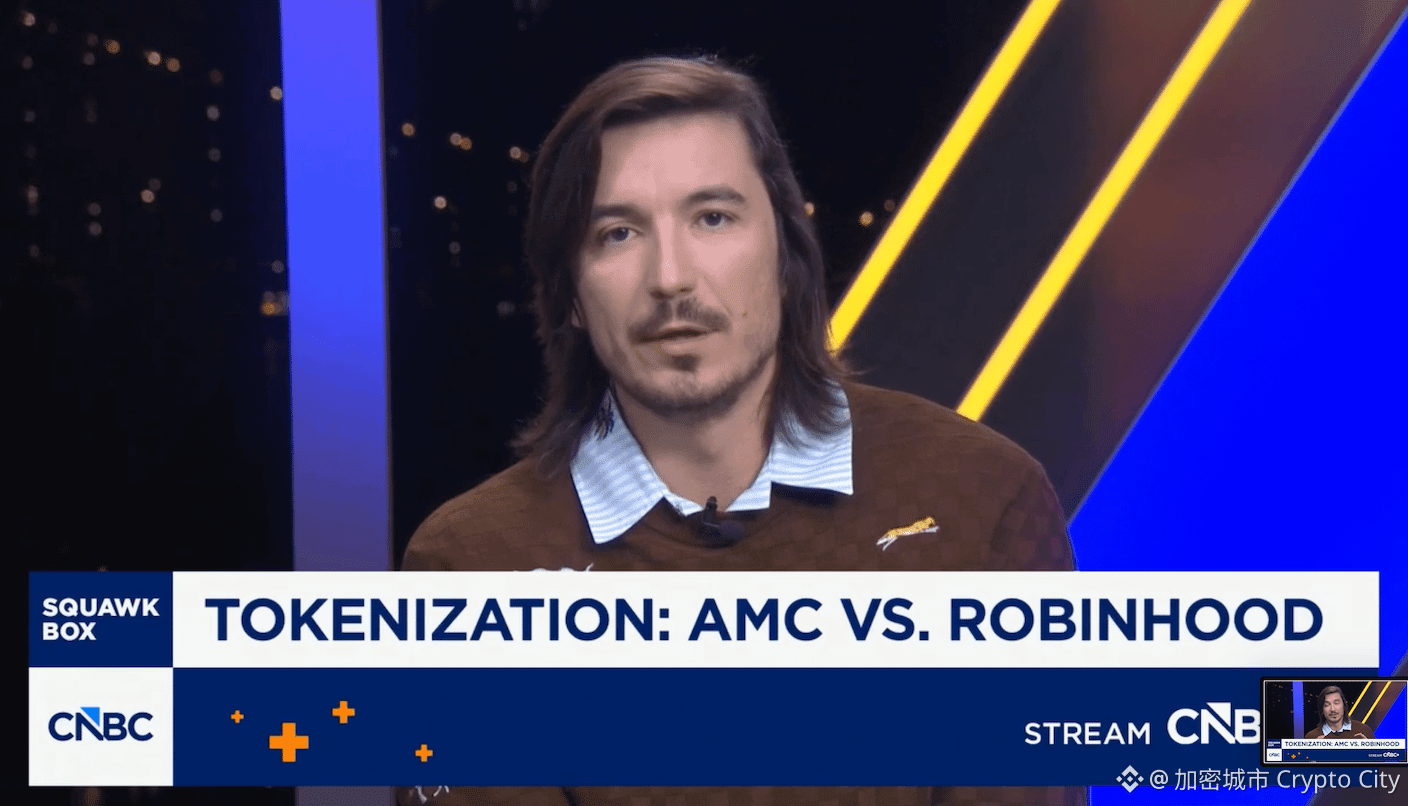
The controversy over stock tokens between Robinhood and the U.S. chain of movie theaters AMC Entertainment continues to rage on. On September 9, Robinhood chairman and CEO Vlad Tenev appeared on CNBC (Squawk Box) and, for the first time, publicly gave detailed answers to criticism from AMC CEO Adam Aron, emphasizing that Robinhood has the right to issue and list financial products linked to publicly traded company stocks.
Source: CNBC Robinhood chairman and CEO Vlad Tenev, for the first time, publicly responded to criticism from AMC CEO Adam Aron, emphasizing that Robinhood has the right to issue financial products linked to publicly traded company stocks.
Countering AMC’s CEO! Robinhood’s CEO: We don’t need AMC’s approval to issue AMC stock tokens
Tenev, for the first time, publicly responded, saying that issuing stock tokens does not require AMC’s approval.
The controversy over stock tokens between Robinhood and the U.S. chain of movie theaters AMC Entertainment continues to rage on. On September 9, Robinhood chairman and CEO Vlad Tenev appeared on CNBC (Squawk Box) and, for the first time, publicly gave detailed answers to criticism from AMC CEO Adam Aron, emphasizing that Robinhood has the right to issue and list financial products linked to publicly traded company stocks.
Source: CNBC Robinhood chairman and CEO Vlad Tenev, for the first time, publicly responded to criticism from AMC CEO Adam Aron, emphasizing that Robinhood has the right to issue financial products linked to publicly traded company stocks.
The controversy over stock tokens between Robinhood and the U.S. chain of movie theaters AMC Entertainment continues to rage on. On September 9, Robinhood chairman and CEO Vlad Tenev appeared on CNBC (Squawk Box) and, for the first time, publicly gave detailed answers to criticism from AMC CEO Adam Aron, emphasizing that Robinhood has the right to issue and list financial products linked to publicly traded company stocks.
Source: CNBC Robinhood chairman and CEO Vlad Tenev, for the first time, publicly responded to criticism from AMC CEO Adam Aron, emphasizing that Robinhood has the right to issue financial products linked to publicly traded company stocks.
45
TSMC teams up with ASML to spark the 12-inch photomask revolution! High-NA EUV-themed Jia-Deng and Far Sight to benefitSemiconductor lithography leader ASML and Taiwan Semiconductor Manufacturing Co. (TSMC, 2330) have officially announced a deep strategic partnership. They confirmed that starting in 2030, TSMC will introduce high numerical aperture extreme ultraviolet (High-NA EUV) technology into advanced-process mass production, and together will launch the most radical industrial revolution in the history of chip manufacturing—upgrading the current 6-inch photomask specifications to “12-inch photomasks” by doubling them. The two sides plan to set up pilot production lines for 12-inch photomasks before 2031, and achieve full system readiness for mass production by 2033. This move not only overcomes the exposure-physics limitations of next-generation giant AI chips, but also positions TSMC to leap from a “technology adopter” to a global “rule maker.” Analysts also specifically pointed out that Jia-Deng (3680) and Far Sight (6196) will directly benefit from Taiwanese fabs.
TSMC teams up with ASML to spark the 12-inch photomask revolution! High-NA EUV-themed Jia-Deng and Far Sight to benefit
Semiconductor lithography leader ASML and Taiwan Semiconductor Manufacturing Co. (TSMC, 2330) have officially announced a deep strategic partnership. They confirmed that starting in 2030, TSMC will introduce high numerical aperture extreme ultraviolet (High-NA EUV) technology into advanced-process mass production, and together will launch the most radical industrial revolution in the history of chip manufacturing—upgrading the current 6-inch photomask specifications to “12-inch photomasks” by doubling them. The two sides plan to set up pilot production lines for 12-inch photomasks before 2031, and achieve full system readiness for mass production by 2033. This move not only overcomes the exposure-physics limitations of next-generation giant AI chips, but also positions TSMC to leap from a “technology adopter” to a global “rule maker.” Analysts also specifically pointed out that Jia-Deng (3680) and Far Sight (6196) will directly benefit from Taiwanese fabs.
34
Split MetaMask into an Independent Operating Company! Consensys Announces Restructuring, New Company Will Focus on the Institutional MarketConsensys splits into two; MetaMask transforms into an independent company
Ethereum infrastructure developer Consensys has announced a major restructuring. Consensys Software Inc. announced on September 9 that it plans to split into two independent operating companies by the end of 2026—separating MetaMask, which is aimed at general users, from its development of Ethereum protocol and institutional-grade blockchain infrastructure business.
Under the plan, the existing Consensys Software Inc. will be renamed MetaMask, with Ethereum co-founder and Consensys founder Joe Lubin serving as chairman and CEO. Going forward, it will focus on self-custody financial services.
Split MetaMask into an Independent Operating Company! Consensys Announces Restructuring, New Company Will Focus on the Institutional Market
Consensys splits into two; MetaMask transforms into an independent company
Ethereum infrastructure developer Consensys has announced a major restructuring. Consensys Software Inc. announced on September 9 that it plans to split into two independent operating companies by the end of 2026—separating MetaMask, which is aimed at general users, from its development of Ethereum protocol and institutional-grade blockchain infrastructure business.
Under the plan, the existing Consensys Software Inc. will be renamed MetaMask, with Ethereum co-founder and Consensys founder Joe Lubin serving as chairman and CEO. Going forward, it will focus on self-custody financial services.
Ethereum infrastructure developer Consensys has announced a major restructuring. Consensys Software Inc. announced on September 9 that it plans to split into two independent operating companies by the end of 2026—separating MetaMask, which is aimed at general users, from its development of Ethereum protocol and institutional-grade blockchain infrastructure business.
Under the plan, the existing Consensys Software Inc. will be renamed MetaMask, with Ethereum co-founder and Consensys founder Joe Lubin serving as chairman and CEO. Going forward, it will focus on self-custody financial services.
166
Log in to explore more content
Join global crypto users on Binance Square
⚡️ Get latest and useful information about crypto.
💬 Trusted by the world’s largest crypto exchange.
👍 Discover real insights from verified creators.
Email / Phone number
Trending Topics
ClarityActFacesProceduralVoteSept15
42,033 views
632 Discussing
Tuesday, September 15, 2:15pm ET. Mark it. 🗓️
The Senate votes on whether to even debate the CLARITY Act, the bill that would finally define which coins are securities vs commodities under US law.
Needs 60 votes. Republicans have 53. Several Democrats need to cross over, and it's not guaranteed.
Fail this vote = the bill is dead for 2026, likely until 2029 (midterms eat the calendar after this).
Pass this vote = doors open to real debate, still a long way to actual law.
Biggest crypto regulation moment of the year happens in a few days.
#ClarityActFacesProceduralVoteSept15
NewbieToNode
·3 Likes
·3.8k views
US2YearYieldRisesTo4.61%
32,147 views
612 Discussing
US10YearTreasuryYieldNears5%
18,806 views
354 Discussing