
Crypto_Paykash
2.4k Posts

Crypto_Paykash
Report
Block User
Crypto enthusiast | Exploring blockchain and digital assets | Content creator | Writer | CMC KOL.
Open Trade
Occasional Trader
4.5 Years
18 Following
2.0K+ Followers
3.2K+ Liked
Posts
Portfolio
All
Quotes
PINNED
For many traders that doesn't know how SpaceX $SPCX works is much bigger than many traders give it credit for.
From my perspective, anyone buying now should be thinking long term rather than chasing short-term price action. The company's future revenue potential is massive, so don't be surprised if the price trades below $100 at some point. That's completely normal in the stock market.
If you believe in the long-term story, short-term volatility is just part of the journey.
For many traders that doesn't know how SpaceX $SPCX works is much bigger than many traders give it credit for.
From my perspective, anyone buying now should be thinking long term rather than chasing short-term price action. The company's future revenue potential is massive, so don't be surprised if the price trades below $100 at some point. That's completely normal in the stock market.
If you believe in the long-term story, short-term volatility is just part of the journey.
From my perspective, anyone buying now should be thinking long term rather than chasing short-term price action. The company's future revenue potential is massive, so don't be surprised if the price trades below $100 at some point. That's completely normal in the stock market.
If you believe in the long-term story, short-term volatility is just part of the journey.
17
3
122
397.8k
PINNED
Article
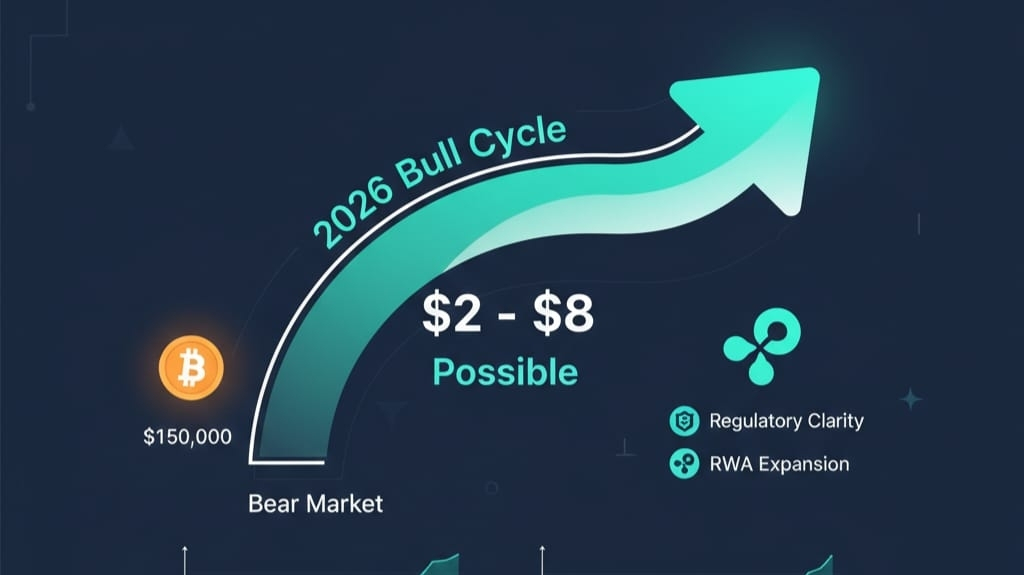
Understanding XRP’s Potential Cycle Turn in 2026Crypto markets move in cycles periods of rapid growth followed by deep corrections. In early 2026, sentiment feels bearish: Bitcoin sits near $69K after pulling back from 2025 highs, while major altcoins like Solana (SOL) and are down roughly 40–45% year-to-date. Historically, however, these pessimistic phases often set the stage for the next major rally.
XRP is particularly interesting right now. Trading around $1.40–$1.60, it remains below its 2018 ATH of $3.65 but far above the $0.20 lows seen in past downturns. The big question: Could 2026 mark a cycle turn from bear to bull?
What Are Crypto Market Cycles?
Crypto cycles typically align with Bitcoin’s four-year halving rhythm:
Accumulation, Bull Market, Distribution, Bear Market.
While we appear to be in a cooling phase, catalysts like ETF approvals, regulatory clarity, and institutional adoption can accelerate a reversal.
XRP’s 2026 Outlook
Analysts remain mixed but increasingly optimistic.
Conservative views: $2–$4 without major catalysts.
Bullish scenarios: $5–$8 if ETFs, regulation, and adoption improve.
Extreme upside: Higher targets depend heavily on mass institutional use.
Key drivers to watch:
Institutional inflows through potential XRP ETFs
Regulatory progress for Ripple
Expansion into real-world assets (RWAs)
A broader Bitcoin recovery
Technically, XRP appears to be defending previous breakout zones, suggesting $1.40 could act as strong support but regulatory setbacks or prolonged bearish conditions could keep it range-bound.
XRP vs. Solana: Speed vs. Stability
Solana tends to move faster due to retail hype, DeFi activity, and meme-coin ecosystems. Its cycles are explosive but volatile.
SOL: High-beta asset that often rebounds quickly.
XRP: Slower mover with stronger institutional narratives.
If alt season returns, may surge first, but XRP could deliver steadier, more sustainable gains.
XRP vs. Bitcoin: Following the Market Leader
Bitcoin still dictates macro direction. Historically, alts rally after BTC strengthens.
A BTC push toward new highs could lift XRP into the $4–$8 range.
Unlike Bitcoin’s scarcity-driven growth, XRP’s upside relies more on adoption and utility.
Expect higher volatility but also larger percentage moves.
In Conclusion:
Market cycles reward patience. While sentiment is uncertain, consolidation often comes before expansion.
The edge belongs to investors who stay informed and think long-term because the biggest moves usually begin when conviction is quiet.
Understanding XRP’s Potential Cycle Turn in 2026
Crypto markets move in cycles periods of rapid growth followed by deep corrections. In early 2026, sentiment feels bearish: Bitcoin sits near $69K after pulling back from 2025 highs, while major altcoins like Solana (SOL) and are down roughly 40–45% year-to-date. Historically, however, these pessimistic phases often set the stage for the next major rally.
XRP is particularly interesting right now. Trading around $1.40–$1.60, it remains below its 2018 ATH of $3.65 but far above the $0.20 lows seen in past downturns. The big question: Could 2026 mark a cycle turn from bear to bull?
What Are Crypto Market Cycles?
Crypto cycles typically align with Bitcoin’s four-year halving rhythm:
Accumulation, Bull Market, Distribution, Bear Market.
While we appear to be in a cooling phase, catalysts like ETF approvals, regulatory clarity, and institutional adoption can accelerate a reversal.
XRP’s 2026 Outlook
Analysts remain mixed but increasingly optimistic.
Conservative views: $2–$4 without major catalysts.
Bullish scenarios: $5–$8 if ETFs, regulation, and adoption improve.
Extreme upside: Higher targets depend heavily on mass institutional use.
Key drivers to watch:
Institutional inflows through potential XRP ETFs
Regulatory progress for Ripple
Expansion into real-world assets (RWAs)
A broader Bitcoin recovery
Technically, XRP appears to be defending previous breakout zones, suggesting $1.40 could act as strong support but regulatory setbacks or prolonged bearish conditions could keep it range-bound.
XRP vs. Solana: Speed vs. Stability
Solana tends to move faster due to retail hype, DeFi activity, and meme-coin ecosystems. Its cycles are explosive but volatile.
SOL: High-beta asset that often rebounds quickly.
XRP: Slower mover with stronger institutional narratives.
If alt season returns, may surge first, but XRP could deliver steadier, more sustainable gains.
XRP vs. Bitcoin: Following the Market Leader
Bitcoin still dictates macro direction. Historically, alts rally after BTC strengthens.
A BTC push toward new highs could lift XRP into the $4–$8 range.
Unlike Bitcoin’s scarcity-driven growth, XRP’s upside relies more on adoption and utility.
Expect higher volatility but also larger percentage moves.
In Conclusion:
Market cycles reward patience. While sentiment is uncertain, consolidation often comes before expansion.
The edge belongs to investors who stay informed and think long-term because the biggest moves usually begin when conviction is quiet.
XRP is particularly interesting right now. Trading around $1.40–$1.60, it remains below its 2018 ATH of $3.65 but far above the $0.20 lows seen in past downturns. The big question: Could 2026 mark a cycle turn from bear to bull?
What Are Crypto Market Cycles?
Crypto cycles typically align with Bitcoin’s four-year halving rhythm:
Accumulation, Bull Market, Distribution, Bear Market.
While we appear to be in a cooling phase, catalysts like ETF approvals, regulatory clarity, and institutional adoption can accelerate a reversal.
XRP’s 2026 Outlook
Analysts remain mixed but increasingly optimistic.
Conservative views: $2–$4 without major catalysts.
Bullish scenarios: $5–$8 if ETFs, regulation, and adoption improve.
Extreme upside: Higher targets depend heavily on mass institutional use.
Key drivers to watch:
Institutional inflows through potential XRP ETFs
Regulatory progress for Ripple
Expansion into real-world assets (RWAs)
A broader Bitcoin recovery
Technically, XRP appears to be defending previous breakout zones, suggesting $1.40 could act as strong support but regulatory setbacks or prolonged bearish conditions could keep it range-bound.
XRP vs. Solana: Speed vs. Stability
Solana tends to move faster due to retail hype, DeFi activity, and meme-coin ecosystems. Its cycles are explosive but volatile.
SOL: High-beta asset that often rebounds quickly.
XRP: Slower mover with stronger institutional narratives.
If alt season returns, may surge first, but XRP could deliver steadier, more sustainable gains.
XRP vs. Bitcoin: Following the Market Leader
Bitcoin still dictates macro direction. Historically, alts rally after BTC strengthens.
A BTC push toward new highs could lift XRP into the $4–$8 range.
Unlike Bitcoin’s scarcity-driven growth, XRP’s upside relies more on adoption and utility.
Expect higher volatility but also larger percentage moves.
In Conclusion:
Market cycles reward patience. While sentiment is uncertain, consolidation often comes before expansion.
The edge belongs to investors who stay informed and think long-term because the biggest moves usually begin when conviction is quiet.
8
5
71
55.5k
H.C. Wainwright recently cut its $IREN price target from $74 to $56 following the latest earnings, although it maintained its Buy rating.
Another thing worth watching is the delay in IREN's $4 billion ARR target. What was initially expected by December 2026 has now been pushed to January 2027, with February also a possibility due to customer-requested network design changes and supplier timing issues.
I'm still watching a few things before changing my bullish outlook. IREN continues to expect around $6 billion in additional funding sources to support its remaining FY2027 capital expenditure.
The concern for me is how the company manages that expansion without putting too much pressure on shareholders through further dilution or debt. The investment only makes sense if the revenue growth eventually justifies the capital being deployed.
One thing I've learned from following the stock market is that opportunities don't disappear just because sentiment changes. Markets keep moving, but the investors who adapt, understand the risks and evolve.
#HuangRisksOusterOverReportedAffairWithSubordinate
H.C. Wainwright recently cut its $IREN price target from $74 to $56 following the latest earnings, although it maintained its Buy rating.
Another thing worth watching is the delay in IREN's $4 billion ARR target. What was initially expected by December 2026 has now been pushed to January 2027, with February also a possibility due to customer-requested network design changes and supplier timing issues.
I'm still watching a few things before changing my bullish outlook. IREN continues to expect around $6 billion in additional funding sources to support its remaining FY2027 capital expenditure.
The concern for me is how the company manages that expansion without putting too much pressure on shareholders through further dilution or debt. The investment only makes sense if the revenue growth eventually justifies the capital being deployed.
One thing I've learned from following the stock market is that opportunities don't disappear just because sentiment changes. Markets keep moving, but the investors who adapt, understand the risks and evolve.
#HuangRisksOusterOverReportedAffairWithSubordinate
Another thing worth watching is the delay in IREN's $4 billion ARR target. What was initially expected by December 2026 has now been pushed to January 2027, with February also a possibility due to customer-requested network design changes and supplier timing issues.
I'm still watching a few things before changing my bullish outlook. IREN continues to expect around $6 billion in additional funding sources to support its remaining FY2027 capital expenditure.
The concern for me is how the company manages that expansion without putting too much pressure on shareholders through further dilution or debt. The investment only makes sense if the revenue growth eventually justifies the capital being deployed.
One thing I've learned from following the stock market is that opportunities don't disappear just because sentiment changes. Markets keep moving, but the investors who adapt, understand the risks and evolve.
#HuangRisksOusterOverReportedAffairWithSubordinate
124
88% of surveyed $NVDA employees reportedly want Jensen Huang to remain CEO, while only 1% want him gone.
That's a pretty strong vote of confidence.
Jensen hasn't just built Nvidia into a major force in the semiconductor industry. He's helped position the company at the center of the AI revolution.
With demand for AI computing still growing, having employees who believe in the person leading the company is another interesting signal to watch.
Nvidia's biggest advantage may not just be its chips, but the leadership driving its long-term vision.
#CanNvidiaEarningsEaseMarketConcerns?
88% of surveyed $NVDA employees reportedly want Jensen Huang to remain CEO, while only 1% want him gone.
That's a pretty strong vote of confidence.
Jensen hasn't just built Nvidia into a major force in the semiconductor industry. He's helped position the company at the center of the AI revolution.
With demand for AI computing still growing, having employees who believe in the person leading the company is another interesting signal to watch.
Nvidia's biggest advantage may not just be its chips, but the leadership driving its long-term vision.
#CanNvidiaEarningsEaseMarketConcerns?
That's a pretty strong vote of confidence.
Jensen hasn't just built Nvidia into a major force in the semiconductor industry. He's helped position the company at the center of the AI revolution.
With demand for AI computing still growing, having employees who believe in the person leading the company is another interesting signal to watch.
Nvidia's biggest advantage may not just be its chips, but the leadership driving its long-term vision.
#CanNvidiaEarningsEaseMarketConcerns?

418
One thing I think the market is still underestimating about neoclouds is the improvement in long-term contract pricing.
The opportunity was never just about rising demand for AI compute. It was also about whether the premium customers were willing to pay for short-term capacity would eventually translate into better long-term contracts.
We're starting to see that happen with $CRWV.
If this trend continues, companies like CRWV and $NBIS could benefit from stronger revenue visibility, better contract economics and potentially higher valuations.
Of course, execution, financing and future capacity expansion still matter. But the pricing power argument is becoming much harder to dismiss.
The neocloud thesis is evolving beyond simply having enough GPUs. It's increasingly about how much value they can extract from the infrastructure they build.
One thing I think the market is still underestimating about neoclouds is the improvement in long-term contract pricing.
The opportunity was never just about rising demand for AI compute. It was also about whether the premium customers were willing to pay for short-term capacity would eventually translate into better long-term contracts.
We're starting to see that happen with $CRWV.
If this trend continues, companies like CRWV and $NBIS could benefit from stronger revenue visibility, better contract economics and potentially higher valuations.
Of course, execution, financing and future capacity expansion still matter. But the pricing power argument is becoming much harder to dismiss.
The neocloud thesis is evolving beyond simply having enough GPUs. It's increasingly about how much value they can extract from the infrastructure they build.
The opportunity was never just about rising demand for AI compute. It was also about whether the premium customers were willing to pay for short-term capacity would eventually translate into better long-term contracts.
We're starting to see that happen with $CRWV.
If this trend continues, companies like CRWV and $NBIS could benefit from stronger revenue visibility, better contract economics and potentially higher valuations.
Of course, execution, financing and future capacity expansion still matter. But the pricing power argument is becoming much harder to dismiss.
The neocloud thesis is evolving beyond simply having enough GPUs. It's increasingly about how much value they can extract from the infrastructure they build.
367
Goldman Sachs runs brokerage, investment advisory, and institutional businesses, so “beneficial ownership” can include shares held or managed across different reporting units and client accounts.
This filing deserves attention, but it isn’t enough on its own to invalidate the $IREN bull thesis. I’d want to see comparable 13F data before concluding Goldman is materially reducing its position.
What I’d pay more attention to is whether IREN can actually deliver on its Microsoft infrastructure commitments and how the company plans to finance its $25–30B FY2027 capital expenditure plan.
Goldman Sachs runs brokerage, investment advisory, and institutional businesses, so “beneficial ownership” can include shares held or managed across different reporting units and client accounts.
This filing deserves attention, but it isn’t enough on its own to invalidate the $IREN bull thesis. I’d want to see comparable 13F data before concluding Goldman is materially reducing its position.
What I’d pay more attention to is whether IREN can actually deliver on its Microsoft infrastructure commitments and how the company plans to finance its $25–30B FY2027 capital expenditure plan.
This filing deserves attention, but it isn’t enough on its own to invalidate the $IREN bull thesis. I’d want to see comparable 13F data before concluding Goldman is materially reducing its position.
What I’d pay more attention to is whether IREN can actually deliver on its Microsoft infrastructure commitments and how the company plans to finance its $25–30B FY2027 capital expenditure plan.
312
$CRWV confirmed that its delayed-draw term loan facilities can cover 70%–100% of the CapEx tied to specific customer contracts.
That matters because it means CoreWeave won’t necessarily have to fund every new GPU deployment entirely from its own balance sheet.
Its weighted average cost of debt has fallen to 7.9%, down 250 basis points year over year, and the company has already paid down more than $4 billion of debt through its financing mechanism.
I think this meaningfully strengthens the investment thesis. That said, the key risks are infrastructure delivery delays, whether customer cash flows arrive as expected, and whether margins improve enough to justify the enormous capital requirements.
One thing I’d watch closely in 2027 is whether revenue growth and operating cash flow start catching up with CapEx and interest expenses.
$CRWV confirmed that its delayed-draw term loan facilities can cover 70%–100% of the CapEx tied to specific customer contracts.
That matters because it means CoreWeave won’t necessarily have to fund every new GPU deployment entirely from its own balance sheet.
Its weighted average cost of debt has fallen to 7.9%, down 250 basis points year over year, and the company has already paid down more than $4 billion of debt through its financing mechanism.
I think this meaningfully strengthens the investment thesis. That said, the key risks are infrastructure delivery delays, whether customer cash flows arrive as expected, and whether margins improve enough to justify the enormous capital requirements.
One thing I’d watch closely in 2027 is whether revenue growth and operating cash flow start catching up with CapEx and interest expenses.
That matters because it means CoreWeave won’t necessarily have to fund every new GPU deployment entirely from its own balance sheet.
Its weighted average cost of debt has fallen to 7.9%, down 250 basis points year over year, and the company has already paid down more than $4 billion of debt through its financing mechanism.
I think this meaningfully strengthens the investment thesis. That said, the key risks are infrastructure delivery delays, whether customer cash flows arrive as expected, and whether margins improve enough to justify the enormous capital requirements.
One thing I’d watch closely in 2027 is whether revenue growth and operating cash flow start catching up with CapEx and interest expenses.
285
🚨 LATEST: $SPCX led by Elon Musk, is planning a major expansion in Starbase, Texas, combining a natural gas-powered plant with a supercomputer facility.
The first phase of the project is estimated to cost around $24 billion.
🚨 LATEST: $SPCX led by Elon Musk, is planning a major expansion in Starbase, Texas, combining a natural gas-powered plant with a supercomputer facility.
The first phase of the project is estimated to cost around $24 billion.
The first phase of the project is estimated to cost around $24 billion.

1
518
Disputed
$CRWV reports earnings tomorrow, and I'm particularly interested in how the company is managing its aggressive AI infrastructure expansion.
Revenue growth and its massive backlog show that demand remains strong, but the bigger question is whether that growth is translating into sustainable profitability.
I'll be watching revenue, margins, capital expenditure, debt levels and forward guidance.
A revenue beat would be positive, but rising financing costs and cash flow pressure could still complicate the outlook.
For me, the guidance and balance sheet will matter just as much as the headline earnings numbers.
$CRWV reports earnings tomorrow, and I'm particularly interested in how the company is managing its aggressive AI infrastructure expansion.
Revenue growth and its massive backlog show that demand remains strong, but the bigger question is whether that growth is translating into sustainable profitability.
I'll be watching revenue, margins, capital expenditure, debt levels and forward guidance.
A revenue beat would be positive, but rising financing costs and cash flow pressure could still complicate the outlook.
For me, the guidance and balance sheet will matter just as much as the headline earnings numbers.
Revenue growth and its massive backlog show that demand remains strong, but the bigger question is whether that growth is translating into sustainable profitability.
I'll be watching revenue, margins, capital expenditure, debt levels and forward guidance.
A revenue beat would be positive, but rising financing costs and cash flow pressure could still complicate the outlook.
For me, the guidance and balance sheet will matter just as much as the headline earnings numbers.
1
347
Personally, I see the Jensen Huang situation as more of a personal matter than something that directly affects NVIDIA's business. Plenty of wealthy and influential people have complicated personal relationships and still manage to move forward professionally. Elon Musk is one example. Unless there's evidence of an actual impact on company operations or leadership, I wouldn't automatically connect the two.
What I find more interesting is NVIDIA's recent market performance. Concerns about a possible Democratic sweep in the midterms have raised questions about tougher data center regulations, yet most AI stocks have been green this week while $NVDA continues to struggle.
That's the part I'm paying more attention to. If the broader AI sector is performing well, why is NVIDIA lagging behind?
Could it be valuation concerns, profit-taking, questions about hyperscaler spending, or changing expectations around future AI demand?
From my perspective, I'm also weighing whether it's a good time to add more NVDA on the dip.
I still see NVIDIA as a strong long-term AI play, but I think its recent weakness deserves a closer look rather than simply blaming the headlines surrounding Jensen Huang.
#NvidiaInvestigatesAfterHuang’sAffairApology
Personally, I see the Jensen Huang situation as more of a personal matter than something that directly affects NVIDIA's business. Plenty of wealthy and influential people have complicated personal relationships and still manage to move forward professionally. Elon Musk is one example. Unless there's evidence of an actual impact on company operations or leadership, I wouldn't automatically connect the two.
What I find more interesting is NVIDIA's recent market performance. Concerns about a possible Democratic sweep in the midterms have raised questions about tougher data center regulations, yet most AI stocks have been green this week while $NVDA continues to struggle.
That's the part I'm paying more attention to. If the broader AI sector is performing well, why is NVIDIA lagging behind?
Could it be valuation concerns, profit-taking, questions about hyperscaler spending, or changing expectations around future AI demand?
From my perspective, I'm also weighing whether it's a good time to add more NVDA on the dip.
I still see NVIDIA as a strong long-term AI play, but I think its recent weakness deserves a closer look rather than simply blaming the headlines surrounding Jensen Huang.
#NvidiaInvestigatesAfterHuang’sAffairApology
What I find more interesting is NVIDIA's recent market performance. Concerns about a possible Democratic sweep in the midterms have raised questions about tougher data center regulations, yet most AI stocks have been green this week while $NVDA continues to struggle.
That's the part I'm paying more attention to. If the broader AI sector is performing well, why is NVIDIA lagging behind?
Could it be valuation concerns, profit-taking, questions about hyperscaler spending, or changing expectations around future AI demand?
From my perspective, I'm also weighing whether it's a good time to add more NVDA on the dip.
I still see NVIDIA as a strong long-term AI play, but I think its recent weakness deserves a closer look rather than simply blaming the headlines surrounding Jensen Huang.
#NvidiaInvestigatesAfterHuang’sAffairApology
2
447
Verified
$CRWV reports Tuesday, followed by Nebius on Thursday. Both earnings reports come at a time when investors are becoming more cautious about AI infrastructure spending, financing costs and the returns on massive data-center investments.
What makes this interesting is that both companies have taken significant hits despite their growth opportunities. Between October 6 and November 6, CRWV fell 49.4% and NBIS dropped 48.2%.
I'm particularly interested in what these earnings will reveal about their growth execution, customer demand, capital requirements and forward guidance.
$NBIS has a broader full-stack AI cloud platform, while CoreWeave has a strong GPU infrastructure and cloud business. Their business models and financial obligations deserve separate evaluations.
For CRWV, I'll be watching backlog conversion, financing costs and project delivery. For NBIS, revenue growth, infrastructure expansion and how efficiently it can fund its ambitious capacity plans will be important.
I think these results could influence momentum across the wider AI infrastructure sector. Strong execution and credible guidance could help restore confidence, while weaker financing outlooks or delays could put further pressure on valuations.
Now it's whether the recent selloff has created an opportunity or exposed risks the market was previously overlooking.
#AIChipSlumpNasdaq
$CRWV reports Tuesday, followed by Nebius on Thursday. Both earnings reports come at a time when investors are becoming more cautious about AI infrastructure spending, financing costs and the returns on massive data-center investments.
What makes this interesting is that both companies have taken significant hits despite their growth opportunities. Between October 6 and November 6, CRWV fell 49.4% and NBIS dropped 48.2%.
I'm particularly interested in what these earnings will reveal about their growth execution, customer demand, capital requirements and forward guidance.
$NBIS has a broader full-stack AI cloud platform, while CoreWeave has a strong GPU infrastructure and cloud business. Their business models and financial obligations deserve separate evaluations.
For CRWV, I'll be watching backlog conversion, financing costs and project delivery. For NBIS, revenue growth, infrastructure expansion and how efficiently it can fund its ambitious capacity plans will be important.
I think these results could influence momentum across the wider AI infrastructure sector. Strong execution and credible guidance could help restore confidence, while weaker financing outlooks or delays could put further pressure on valuations.
Now it's whether the recent selloff has created an opportunity or exposed risks the market was previously overlooking.
#AIChipSlumpNasdaq
What makes this interesting is that both companies have taken significant hits despite their growth opportunities. Between October 6 and November 6, CRWV fell 49.4% and NBIS dropped 48.2%.
I'm particularly interested in what these earnings will reveal about their growth execution, customer demand, capital requirements and forward guidance.
$NBIS has a broader full-stack AI cloud platform, while CoreWeave has a strong GPU infrastructure and cloud business. Their business models and financial obligations deserve separate evaluations.
For CRWV, I'll be watching backlog conversion, financing costs and project delivery. For NBIS, revenue growth, infrastructure expansion and how efficiently it can fund its ambitious capacity plans will be important.
I think these results could influence momentum across the wider AI infrastructure sector. Strong execution and credible guidance could help restore confidence, while weaker financing outlooks or delays could put further pressure on valuations.
Now it's whether the recent selloff has created an opportunity or exposed risks the market was previously overlooking.
#AIChipSlumpNasdaq
578
Hyperscalers are committing enormous amounts of capital to AI infrastructure. Investors want to know whether the revenue generated will justify that spending.
The recent selloff shows that even companies reporting strong results can get punished when guidance or expectations disappoint, just like how $IREN earnings reports.
Companies with expensive financing, excessive dilution, weak customer commitments and limited operating cash flow could struggle.
For IREN, $NBIS and $CRWV , I think the next phase will be about separating companies that can successfully monetize AI demand from those that simply built capacity ahead of it.
The AI boom might not be over. But the market is entering a phase where execution matters more.
#AIChipSlumpNasdaq
Hyperscalers are committing enormous amounts of capital to AI infrastructure. Investors want to know whether the revenue generated will justify that spending.
The recent selloff shows that even companies reporting strong results can get punished when guidance or expectations disappoint, just like how $IREN earnings reports.
Companies with expensive financing, excessive dilution, weak customer commitments and limited operating cash flow could struggle.
For IREN, $NBIS and $CRWV , I think the next phase will be about separating companies that can successfully monetize AI demand from those that simply built capacity ahead of it.
The AI boom might not be over. But the market is entering a phase where execution matters more.
#AIChipSlumpNasdaq
The recent selloff shows that even companies reporting strong results can get punished when guidance or expectations disappoint, just like how $IREN earnings reports.
Companies with expensive financing, excessive dilution, weak customer commitments and limited operating cash flow could struggle.
For IREN, $NBIS and $CRWV , I think the next phase will be about separating companies that can successfully monetize AI demand from those that simply built capacity ahead of it.
The AI boom might not be over. But the market is entering a phase where execution matters more.
#AIChipSlumpNasdaq
3
568
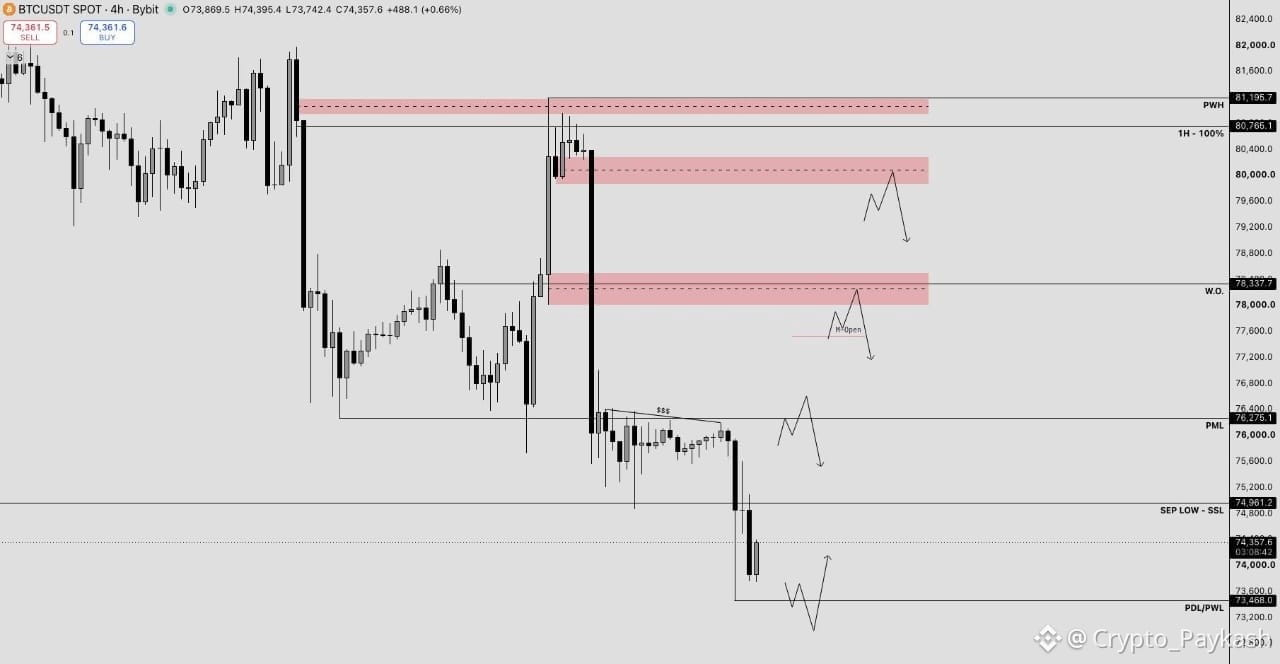
$BTC is heading into CPI week after pulling back towards the $73.4K region.
As I mentioned last week, losing the 76.2K PML and failing to reclaim it as support would leave room for another move lower. That played out yesterday, giving us a fresh setup to work with this week.
For now, the local structure remains bearish as long as BTC stays below 81.2K.
On the lower timeframe, we've nearly filled a daily imbalance and swept a significant amount of sell-side liquidity below the monthly lows. This makes a relief bounce worth watching.
A sweep below the current 73.5K PWL, followed by a bullish trigger, could offer a decent long setup, with 76.2K BSL as the first target and potentially more upside beyond that.
For shorts, I'd rather wait for price to retrace into higher areas. My main zones are 76.2K, 78K and 80K, moving from more aggressive to more conservative entries.
I'm not looking to enter blindly at any of these levels. I'll wait for price to reach my POIs and look for confirmation before making a move.
Zooming out, the bigger picture still looks bullish, but the current structure leaves plenty of room for further downside. BTC could even revisit 65K without necessarily breaking its broader bullish trend.
With CPI coming tomorrow, I'm keeping risk under control and would rather wait for the data before taking any aggressive positions.
#BitcoinFiveWeeklyLosses
$BTC is heading into CPI week after pulling back towards the $73.4K region.
As I mentioned last week, losing the 76.2K PML and failing to reclaim it as support would leave room for another move lower. That played out yesterday, giving us a fresh setup to work with this week.
For now, the local structure remains bearish as long as BTC stays below 81.2K.
On the lower timeframe, we've nearly filled a daily imbalance and swept a significant amount of sell-side liquidity below the monthly lows. This makes a relief bounce worth watching.
A sweep below the current 73.5K PWL, followed by a bullish trigger, could offer a decent long setup, with 76.2K BSL as the first target and potentially more upside beyond that.
For shorts, I'd rather wait for price to retrace into higher areas. My main zones are 76.2K, 78K and 80K, moving from more aggressive to more conservative entries.
I'm not looking to enter blindly at any of these levels. I'll wait for price to reach my POIs and look for confirmation before making a move.
Zooming out, the bigger picture still looks bullish, but the current structure leaves plenty of room for further downside. BTC could even revisit 65K without necessarily breaking its broader bullish trend.
With CPI coming tomorrow, I'm keeping risk under control and would rather wait for the data before taking any aggressive positions.
#BitcoinFiveWeeklyLosses
As I mentioned last week, losing the 76.2K PML and failing to reclaim it as support would leave room for another move lower. That played out yesterday, giving us a fresh setup to work with this week.
For now, the local structure remains bearish as long as BTC stays below 81.2K.
On the lower timeframe, we've nearly filled a daily imbalance and swept a significant amount of sell-side liquidity below the monthly lows. This makes a relief bounce worth watching.
A sweep below the current 73.5K PWL, followed by a bullish trigger, could offer a decent long setup, with 76.2K BSL as the first target and potentially more upside beyond that.
For shorts, I'd rather wait for price to retrace into higher areas. My main zones are 76.2K, 78K and 80K, moving from more aggressive to more conservative entries.
I'm not looking to enter blindly at any of these levels. I'll wait for price to reach my POIs and look for confirmation before making a move.
Zooming out, the bigger picture still looks bullish, but the current structure leaves plenty of room for further downside. BTC could even revisit 65K without necessarily breaking its broader bullish trend.
With CPI coming tomorrow, I'm keeping risk under control and would rather wait for the data before taking any aggressive positions.
#BitcoinFiveWeeklyLosses
1
353
After everything that happened involving $NVDA CEO, could this become the beginning of a decline for the company, or will people eventually move past the controversy surrounding his personal life?
At the end of the day, we all have parts of our lives we prefer to keep private. Just because someone is a public figure doesn't mean they stop being human.
People should be able to separate someone's personal life from their professional achievements.
#NvidiaInvestigatesAfterHuang’sAffairApology
After everything that happened involving $NVDA CEO, could this become the beginning of a decline for the company, or will people eventually move past the controversy surrounding his personal life?
At the end of the day, we all have parts of our lives we prefer to keep private. Just because someone is a public figure doesn't mean they stop being human.
People should be able to separate someone's personal life from their professional achievements.
#NvidiaInvestigatesAfterHuang’sAffairApology
At the end of the day, we all have parts of our lives we prefer to keep private. Just because someone is a public figure doesn't mean they stop being human.
People should be able to separate someone's personal life from their professional achievements.
#NvidiaInvestigatesAfterHuang’sAffairApology
1
683
What Is Left for AI Stocks After the Midterm Election Shock?
The AI narrative has taken another hit following the Democrats' sweeping midterm victory, with investors becoming more concerned about potential data center restrictions, energy demand and tighter regulatory oversight.
Stocks like $IREN , $CIFR , $NBIS and $CRWV are particularly exposed because their growth depends heavily on expanding AI infrastructure.
But I don't think the AI opportunity is over. The next phase could simply become more selective.
1. AI demand
2. Power availability
3. Signed contracts
4. Funding and dilution
5. Regulatory clarity
For me, the next winners may not necessarily be the companies announcing the biggest AI expansion plans, but those capable of turning their investments into sustainable revenue and cash flow.
The market is becoming less willing to reward promises without execution.
What Is Left for AI Stocks After the Midterm Election Shock?
The AI narrative has taken another hit following the Democrats' sweeping midterm victory, with investors becoming more concerned about potential data center restrictions, energy demand and tighter regulatory oversight.
Stocks like $IREN , $CIFR , $NBIS and $CRWV are particularly exposed because their growth depends heavily on expanding AI infrastructure.
But I don't think the AI opportunity is over. The next phase could simply become more selective.
1. AI demand
2. Power availability
3. Signed contracts
4. Funding and dilution
5. Regulatory clarity
For me, the next winners may not necessarily be the companies announcing the biggest AI expansion plans, but those capable of turning their investments into sustainable revenue and cash flow.
The market is becoming less willing to reward promises without execution.
The AI narrative has taken another hit following the Democrats' sweeping midterm victory, with investors becoming more concerned about potential data center restrictions, energy demand and tighter regulatory oversight.
Stocks like $IREN , $CIFR , $NBIS and $CRWV are particularly exposed because their growth depends heavily on expanding AI infrastructure.
But I don't think the AI opportunity is over. The next phase could simply become more selective.
1. AI demand
2. Power availability
3. Signed contracts
4. Funding and dilution
5. Regulatory clarity
For me, the next winners may not necessarily be the companies announcing the biggest AI expansion plans, but those capable of turning their investments into sustainable revenue and cash flow.
The market is becoming less willing to reward promises without execution.
513
Verified
The Midterm election outcome doesn't seem to be aligning well with the AI stock market narrative, and Trump remains a major factor in the uncertainty surrounding the sector.
Where does that leave us now, and what should investors expect next?
We've also seen oil pull back towards $90, yet it still seems to be holding relatively high levels. What's keeping prices elevated despite the recent decline?
The Midterm election outcome doesn't seem to be aligning well with the AI stock market narrative, and Trump remains a major factor in the uncertainty surrounding the sector.
Where does that leave us now, and what should investors expect next?
We've also seen oil pull back towards $90, yet it still seems to be holding relatively high levels. What's keeping prices elevated despite the recent decline?
Where does that leave us now, and what should investors expect next?
We've also seen oil pull back towards $90, yet it still seems to be holding relatively high levels. What's keeping prices elevated despite the recent decline?
1
2
466
I've been watching the reaction across AI stocks following the US midterm elections, and I think there's more behind the selloff than just political uncertainty.
The Democratic victories in Congress and key states like Texas and Georgia have raised concerns about the future of AI infrastructure development in the US.
AI companies are investing billions of dollars in new data centers, GPUs, computing capacity and energy infrastructure. However, growing opposition from local communities over electricity costs, environmental concerns and land use could make future projects more difficult to approve.
This is where investors are becoming cautious.
Companies like $IREN , $CIFR.US , $APLD and $CORZ could face increased uncertainty around permitting, construction timelines and financing. $CRWV is also worth watching given its massive infrastructure spending and funding requirements.
Even $NVDAB could feel some indirect pressure if slower data center expansion eventually affects demand expectations for AI chips.
What's particularly concerning is that several communities have already voted in favour of restrictions or temporary moratoriums on new data center developments. That introduces another layer of risk for companies counting on rapid expansion.
However, I don't think this automatically means the AI boom is coming to an end.
The demand for computing power hasn't suddenly disappeared. What the market is reassessing is how quickly companies can build, how much it will cost and whether their projected returns can justify the enormous capital investments.
For me, the important distinction is between a company facing temporary political and permitting challenges and one experiencing a genuine deterioration in AI demand.
The AI infrastructure opportunity is still there, but the market may be entering a phase where execution matters more than ambitious expansion plans.
#USMidterms-WhatAreMarketsExpecting?
I've been watching the reaction across AI stocks following the US midterm elections, and I think there's more behind the selloff than just political uncertainty.
The Democratic victories in Congress and key states like Texas and Georgia have raised concerns about the future of AI infrastructure development in the US.
AI companies are investing billions of dollars in new data centers, GPUs, computing capacity and energy infrastructure. However, growing opposition from local communities over electricity costs, environmental concerns and land use could make future projects more difficult to approve.
This is where investors are becoming cautious.
Companies like $IREN , $CIFR.US , $APLD and $CORZ could face increased uncertainty around permitting, construction timelines and financing. $CRWV is also worth watching given its massive infrastructure spending and funding requirements.
Even $NVDAB could feel some indirect pressure if slower data center expansion eventually affects demand expectations for AI chips.
What's particularly concerning is that several communities have already voted in favour of restrictions or temporary moratoriums on new data center developments. That introduces another layer of risk for companies counting on rapid expansion.
However, I don't think this automatically means the AI boom is coming to an end.
The demand for computing power hasn't suddenly disappeared. What the market is reassessing is how quickly companies can build, how much it will cost and whether their projected returns can justify the enormous capital investments.
For me, the important distinction is between a company facing temporary political and permitting challenges and one experiencing a genuine deterioration in AI demand.
The AI infrastructure opportunity is still there, but the market may be entering a phase where execution matters more than ambitious expansion plans.
#USMidterms-WhatAreMarketsExpecting?
The Democratic victories in Congress and key states like Texas and Georgia have raised concerns about the future of AI infrastructure development in the US.
AI companies are investing billions of dollars in new data centers, GPUs, computing capacity and energy infrastructure. However, growing opposition from local communities over electricity costs, environmental concerns and land use could make future projects more difficult to approve.
This is where investors are becoming cautious.
Companies like $IREN , $CIFR.US , $APLD and $CORZ could face increased uncertainty around permitting, construction timelines and financing. $CRWV is also worth watching given its massive infrastructure spending and funding requirements.
Even $NVDAB could feel some indirect pressure if slower data center expansion eventually affects demand expectations for AI chips.
What's particularly concerning is that several communities have already voted in favour of restrictions or temporary moratoriums on new data center developments. That introduces another layer of risk for companies counting on rapid expansion.
However, I don't think this automatically means the AI boom is coming to an end.
The demand for computing power hasn't suddenly disappeared. What the market is reassessing is how quickly companies can build, how much it will cost and whether their projected returns can justify the enormous capital investments.
For me, the important distinction is between a company facing temporary political and permitting challenges and one experiencing a genuine deterioration in AI demand.
The AI infrastructure opportunity is still there, but the market may be entering a phase where execution matters more than ambitious expansion plans.
#USMidterms-WhatAreMarketsExpecting?
594
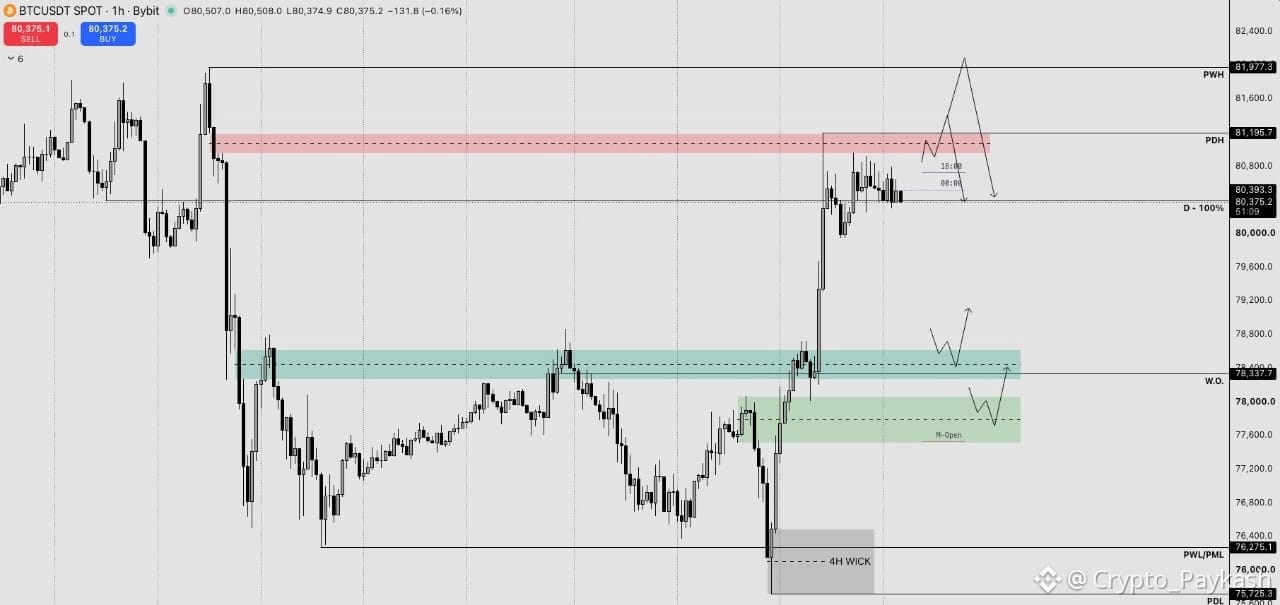
$BTC managed to close the daily candle above the 80.3K daily imbalance after moving back towards 81.1K.
That's a positive development, but I still think 82K is the key level to reclaim this month, as it represents the 50% midpoint of October's range.
For now, Bitcoin is consolidating after testing the 81.1K 1H imbalance. Although this is a short-term area of interest, I'm not looking to open shorts just yet.
I'd rather see price sweep the 81.2K PDH or potentially the 82K PWH before considering hedge shorts, provided a clear trigger appears.
Since sell-side liquidity below the PWL/PML has already been taken, I'd like to see price work towards the buy-side liquidity levels next.
I'm still holding my long from 76.1K, so there's no reason to chase price here. I'd rather wait for cleaner retests.
For potential long continuations, 78.7K is my first area of interest. The 77.7K region, around and below the monthly open, is another zone where I'll be watching for confirmation.
One thing I'm keeping in mind is NFP. I'm generally not keen on taking fresh positions the day before the release because Bitcoin often gets stuck in consolidation as the market waits for the data. I'd rather stay patient than force a trade.
#BTCRebounds80K
$BTC managed to close the daily candle above the 80.3K daily imbalance after moving back towards 81.1K.
That's a positive development, but I still think 82K is the key level to reclaim this month, as it represents the 50% midpoint of October's range.
For now, Bitcoin is consolidating after testing the 81.1K 1H imbalance. Although this is a short-term area of interest, I'm not looking to open shorts just yet.
I'd rather see price sweep the 81.2K PDH or potentially the 82K PWH before considering hedge shorts, provided a clear trigger appears.
Since sell-side liquidity below the PWL/PML has already been taken, I'd like to see price work towards the buy-side liquidity levels next.
I'm still holding my long from 76.1K, so there's no reason to chase price here. I'd rather wait for cleaner retests.
For potential long continuations, 78.7K is my first area of interest. The 77.7K region, around and below the monthly open, is another zone where I'll be watching for confirmation.
One thing I'm keeping in mind is NFP. I'm generally not keen on taking fresh positions the day before the release because Bitcoin often gets stuck in consolidation as the market waits for the data. I'd rather stay patient than force a trade.
#BTCRebounds80K
That's a positive development, but I still think 82K is the key level to reclaim this month, as it represents the 50% midpoint of October's range.
For now, Bitcoin is consolidating after testing the 81.1K 1H imbalance. Although this is a short-term area of interest, I'm not looking to open shorts just yet.
I'd rather see price sweep the 81.2K PDH or potentially the 82K PWH before considering hedge shorts, provided a clear trigger appears.
Since sell-side liquidity below the PWL/PML has already been taken, I'd like to see price work towards the buy-side liquidity levels next.
I'm still holding my long from 76.1K, so there's no reason to chase price here. I'd rather wait for cleaner retests.
For potential long continuations, 78.7K is my first area of interest. The 77.7K region, around and below the monthly open, is another zone where I'll be watching for confirmation.
One thing I'm keeping in mind is NFP. I'm generally not keen on taking fresh positions the day before the release because Bitcoin often gets stuck in consolidation as the market waits for the data. I'd rather stay patient than force a trade.
#BTCRebounds80K
1
976
Democrat Gina Hinojosa has defeated Republican Greg Abbott in the Texas governor's race.
Existing infrastructure could become more valuable
$IRENB already has substantial land, power capacity and data center development plans in Texas.
Childress and Sweetwater become particularly important, Sweetwater 2 (SW2) still needs its data center permit despite having power interconnection approval.
The remaining pipeline faces more uncertainty, A moratorium or stricter permitting process could delay future expansion, increase costs and affect how quickly IREN can bring its wider pipeline online.
I don't think this automatically destroys the IREN investment thesis, but I wouldn't immediately call it bullish either.
The potential advantage is that IREN has already secured significant power and infrastructure that would be difficult for new competitors to replicate.
However, having secured power doesn't automatically mean every future data center receives approval.
Hinojosa cannot simply change every permitting rule unilaterally. The scope of her executive authority and cooperation from the Texas legislature will matter.
This is a development worth monitoring closely.
#USMidterms-WhatAreMarketsExpecting?
Democrat Gina Hinojosa has defeated Republican Greg Abbott in the Texas governor's race.
Existing infrastructure could become more valuable
$IRENB already has substantial land, power capacity and data center development plans in Texas.
Childress and Sweetwater become particularly important, Sweetwater 2 (SW2) still needs its data center permit despite having power interconnection approval.
The remaining pipeline faces more uncertainty, A moratorium or stricter permitting process could delay future expansion, increase costs and affect how quickly IREN can bring its wider pipeline online.
I don't think this automatically destroys the IREN investment thesis, but I wouldn't immediately call it bullish either.
The potential advantage is that IREN has already secured significant power and infrastructure that would be difficult for new competitors to replicate.
However, having secured power doesn't automatically mean every future data center receives approval.
Hinojosa cannot simply change every permitting rule unilaterally. The scope of her executive authority and cooperation from the Texas legislature will matter.
This is a development worth monitoring closely.
#USMidterms-WhatAreMarketsExpecting?
Existing infrastructure could become more valuable
$IRENB already has substantial land, power capacity and data center development plans in Texas.
Childress and Sweetwater become particularly important, Sweetwater 2 (SW2) still needs its data center permit despite having power interconnection approval.
The remaining pipeline faces more uncertainty, A moratorium or stricter permitting process could delay future expansion, increase costs and affect how quickly IREN can bring its wider pipeline online.
I don't think this automatically destroys the IREN investment thesis, but I wouldn't immediately call it bullish either.
The potential advantage is that IREN has already secured significant power and infrastructure that would be difficult for new competitors to replicate.
However, having secured power doesn't automatically mean every future data center receives approval.
Hinojosa cannot simply change every permitting rule unilaterally. The scope of her executive authority and cooperation from the Texas legislature will matter.
This is a development worth monitoring closely.
#USMidterms-WhatAreMarketsExpecting?
409
$AMD latest earnings make this an interesting question.
The company delivered a record $13.38 billion in quarterly revenue, up 45% year over year. More importantly, its Data Center revenue jumped 97% to $8.55 billion, showing just how much demand is building across AI infrastructure. AMD also guided for approximately $17 billion in Q4 revenue.
$NVDA remains the dominant player in AI accelerators, and I don't think that changes overnight. Its CUDA ecosystem, software advantage and established relationships with hyperscalers give it a strong competitive position.
But the AI opportunity is getting bigger, and it doesn't necessarily belong to one company.
AMD is becoming a serious alternative for customers looking to diversify their chip suppliers. Its EPYC processors, Instinct GPUs and rack-scale Helios systems give it more ways to compete in the data center market.
AI infrastructure requires more than NVIDIA GPUs. It needs CPUs, memory, networking, storage, power and data center capacity.
Companies across this entire supply chain could benefit as investment in AI continues.
Personally, I think investors should look beyond NVIDIA when evaluating the AI trade. AMD's latest results are another reminder that there are multiple ways to benefit from this growth cycle.
NVIDIA may still be leading the race, but the competition is getting more interesting.
$AMD latest earnings make this an interesting question.
The company delivered a record $13.38 billion in quarterly revenue, up 45% year over year. More importantly, its Data Center revenue jumped 97% to $8.55 billion, showing just how much demand is building across AI infrastructure. AMD also guided for approximately $17 billion in Q4 revenue.
$NVDA remains the dominant player in AI accelerators, and I don't think that changes overnight. Its CUDA ecosystem, software advantage and established relationships with hyperscalers give it a strong competitive position.
But the AI opportunity is getting bigger, and it doesn't necessarily belong to one company.
AMD is becoming a serious alternative for customers looking to diversify their chip suppliers. Its EPYC processors, Instinct GPUs and rack-scale Helios systems give it more ways to compete in the data center market.
AI infrastructure requires more than NVIDIA GPUs. It needs CPUs, memory, networking, storage, power and data center capacity.
Companies across this entire supply chain could benefit as investment in AI continues.
Personally, I think investors should look beyond NVIDIA when evaluating the AI trade. AMD's latest results are another reminder that there are multiple ways to benefit from this growth cycle.
NVIDIA may still be leading the race, but the competition is getting more interesting.
The company delivered a record $13.38 billion in quarterly revenue, up 45% year over year. More importantly, its Data Center revenue jumped 97% to $8.55 billion, showing just how much demand is building across AI infrastructure. AMD also guided for approximately $17 billion in Q4 revenue.
$NVDA remains the dominant player in AI accelerators, and I don't think that changes overnight. Its CUDA ecosystem, software advantage and established relationships with hyperscalers give it a strong competitive position.
But the AI opportunity is getting bigger, and it doesn't necessarily belong to one company.
AMD is becoming a serious alternative for customers looking to diversify their chip suppliers. Its EPYC processors, Instinct GPUs and rack-scale Helios systems give it more ways to compete in the data center market.
AI infrastructure requires more than NVIDIA GPUs. It needs CPUs, memory, networking, storage, power and data center capacity.
Companies across this entire supply chain could benefit as investment in AI continues.
Personally, I think investors should look beyond NVIDIA when evaluating the AI trade. AMD's latest results are another reminder that there are multiple ways to benefit from this growth cycle.
NVIDIA may still be leading the race, but the competition is getting more interesting.
405
Log in to explore more content
Join global crypto users on Binance Square
⚡️ Get latest and useful information about crypto.
💬 Trusted by the world’s largest crypto exchange.
👍 Discover real insights from verified creators.
Email / Phone number
Trending Topics
HuangRisksOusterOverReportedAffairWithSubordinate
48,596 views
711 Discussing
Nvidia Board Meets to Decide Jensen Huang's Future as Crisis Deepens
Binance News
·37 Likes
·43k views
AnthropicRejectsIPODelayValuationinQuestion
501,420 views
4,127 Discussing
CoreWeaveJumps10%On168%RevenueGrowth
83,336 views
1,019 Discussing