
币监会主席
1.3k Posts

币监会主席
加密市场“气氛组选手”兼实盘“赌徒”(bushi)。盯BTC涨跌比追剧还勤,主打一个在波动里整活——赚了吹牛皮,亏了喊“没法玩”,主打真实。
Open Trade
Frequent Trader
4.4 Years
934 Following
335 Followers
1.9K+ Liked
Posts
Portfolio
All
Quotes
Videos
PINNED
When you can’t bear it anymore, you often wish you had a strong support to lean on. But no matter how you look, you’ll find that some mountains are covered in thorns, while others are teeming with wild beasts—so you should be your own mountain.
——Cai Chongda $NVDAon
——Cai Chongda $NVDAon
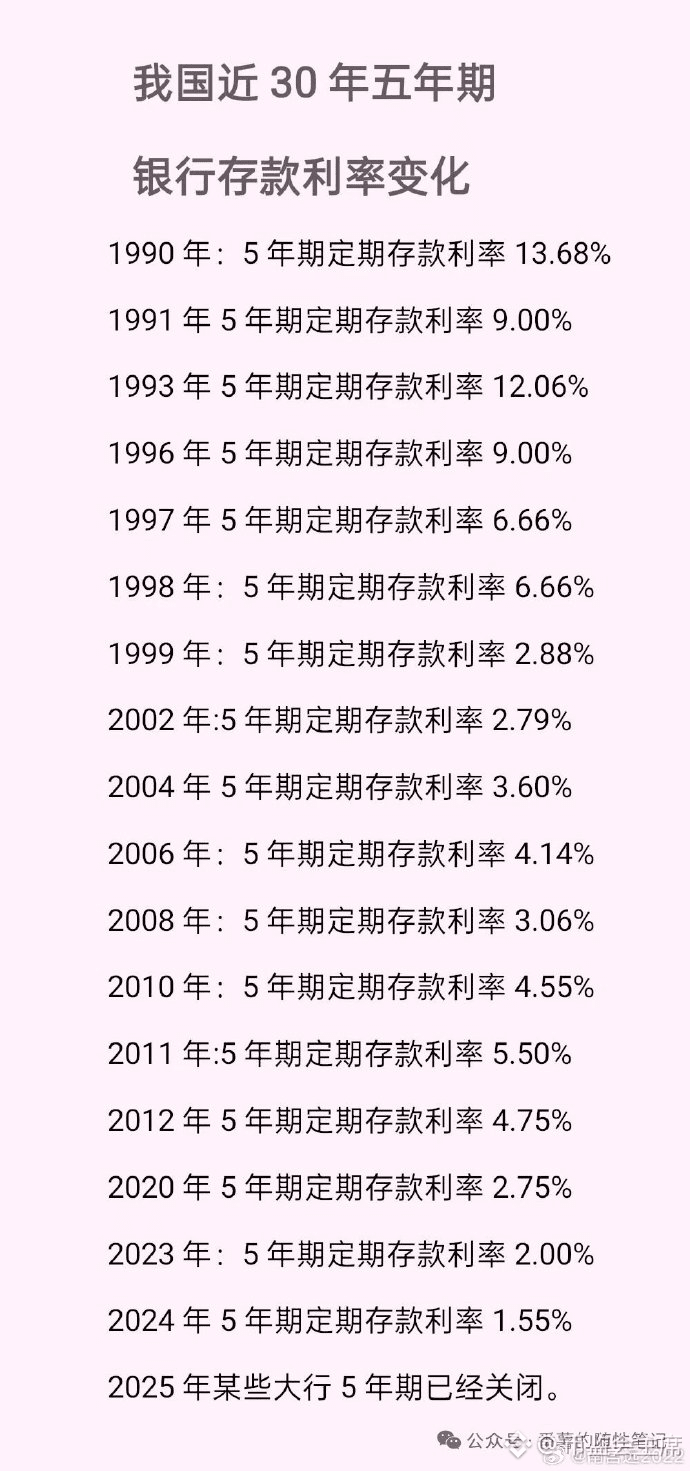





Some banks in Shanghai have begun accepting 40-year mortgage applications with longer terms. Existing mortgages can also apply for an extension. At first glance, this news seems unrelated to crypto, but placed in a macro framework, it tells a very clear story. The traditional financial system is pushing duration to the extreme—buying space with time.
The crypto community should read this as a macro puzzle piece, not a piece of unrelated social news swept to the side.
The specific rules are not complicated. According to a report by Caixin Global citing Guancha News, the Shanghai branch of Bank of Communications allows existing mortgages to be deferred. After the deferral, the combined total of the original term and the extended term must not exceed 40 years. Several banks have set a threshold: the borrower’s age plus the loan term must not exceed 75 years. This means that for people applying for a new 40-year mortgage, the loan must be disbursed before age 35. Those born before 1991 are basically ineligible for newly issued 40-year mortgages. A branch of ICBC in Shanghai has widened the standard to 80 years, giving people a bit more leeway.
Why is this move to stretch debt maturities worth an on-chain investor’s extra look?
First, it indirectly confirms a low-interest-rate environment and looser liquidity. When banks are willing to extend repayment periods to 40 years, fundamentally they are responding to the reality that long-term funding costs are falling and residents’ cash flow is under pressure. The longer the duration, the more sensitive it is to discount rates—and this holds true for BTC as well. With each macro shift toward looser liquidity, the valuation elasticity of long-duration assets tends to be amplified. Growth stocks, gold, and BTC—seen by some as a form of digital gold—fall into this category. As interest rates move down, the present value of future cash flows moves up. It’s the same pricing logic at work.
Second, it reflects a common mindset of pushing risk into the future. Whether it’s deferring mortgage payments or an even broader monetary expansion, the system uses time to digest existing leverage. This liquidity won’t stay confined to the traditional real-estate channel; it will always search for places with higher marginal returns, and on-chain assets are one of those options. When returns in traditional channels are squeezed thinner, people’s tolerance for volatility often rises—because the cost of inaction is also increasing.
Third, generational differences are becoming more explicit. Younger people can use longer leverage to lock in lower monthly payments, while older groups are shut out and therefore need to rely more on equities, gold, and on-chain assets to supplement inflation-hedging and retirement allocations. In this context, crypto plays the role of a low-barrier, globalized allocation tool—one that doesn’t depend on local banking systems to participate in long-cycle assets.
Fourth, it reminds us to re-understand the concept of asset duration. In the past, people thought duration was something bond-fund managers cared about. Now a mortgage can be taken for 40 years, suggesting that society’s weighting in pricing long-term cash flows is rising. When ordinary households stretch their debt duration to the maximum, the relative attractiveness of long-duration assets like equities and crypto will gradually change too, because the funding benchmark has changed.
Shanghai is often at the front end of policy pilots. If similar operations are later rolled out to more cities, it would indicate that looseness exists with consistency—behind it is the same direction. For crypto, direction matters more than magnitude, because capital will price the direction early. A policy on its own may have limited weight; what matters is the macro curve behind it.
There’s another point that’s easy to overlook. Crypto-native users have actually lived in long-duration cycles for a long time: halvings, holding through bull and bear cycles—the whole thing is, in essence, a duration preference. When traditional finance also starts stretching terms to 40 years, it indicates that duration thinking is moving from the periphery into mainstream allocations. When these two duration logics meet, on-chain assets will be compared more frequently with traditional long-duration assets—this in itself is a signal that attention is rising.
Of course, we need to distinguish the nature of leverage. A mortgage is collateralized and constrained by cash-flow requirements; it’s not the same thing as contract positions. Simply equating an increase in housing-duration to crypto going up makes the logic chain too jumpy. A more accurate reading is to place it along the main line of interest rates, liquidity, and risk appetite—as a somewhat mild footnote, not as a direct decision trigger.
On the operational level, how should this signal be used? It can’t give you a buy or sell point, but it can help you calibrate your position narrative. When duration preference rises and discount-rate expectations fall, the error-tolerance space for long-term capital expands—making it more suitable to shift attention from short-term volatility to a longer holding cycle. Conversely, if these loosening actions stop and deferred applications are revoked, that would be the alarm for a liquidity turn. The value of macro signals isn’t in predicting the next specific candlestick—it’s in helping you judge which part of the cycle you’re currently in.
If you watch the macro, you shouldn’t only watch candlesticks. For ordinary people, their monthly payment schedule often tells you where the money will need to be prepared to go earlier than any trading software. If mortgages can be extended to 40 years, it means society is willing to push the pricing horizon further into the future. Changes in duration preference will ultimately map onto all long-duration assets, and crypto is simply the youngest—and most sensitive—slice of that basket. Instead of asking whether this news is a bullish or bearish catalyst, record it in your own macro notebook and wait for the next data point to either confirm it or overturn it.
The crypto community should read this as a macro puzzle piece, not a piece of unrelated social news swept to the side.
The specific rules are not complicated. According to a report by Caixin Global citing Guancha News, the Shanghai branch of Bank of Communications allows existing mortgages to be deferred. After the deferral, the combined total of the original term and the extended term must not exceed 40 years. Several banks have set a threshold: the borrower’s age plus the loan term must not exceed 75 years. This means that for people applying for a new 40-year mortgage, the loan must be disbursed before age 35. Those born before 1991 are basically ineligible for newly issued 40-year mortgages. A branch of ICBC in Shanghai has widened the standard to 80 years, giving people a bit more leeway.
Why is this move to stretch debt maturities worth an on-chain investor’s extra look?
First, it indirectly confirms a low-interest-rate environment and looser liquidity. When banks are willing to extend repayment periods to 40 years, fundamentally they are responding to the reality that long-term funding costs are falling and residents’ cash flow is under pressure. The longer the duration, the more sensitive it is to discount rates—and this holds true for BTC as well. With each macro shift toward looser liquidity, the valuation elasticity of long-duration assets tends to be amplified. Growth stocks, gold, and BTC—seen by some as a form of digital gold—fall into this category. As interest rates move down, the present value of future cash flows moves up. It’s the same pricing logic at work.
Second, it reflects a common mindset of pushing risk into the future. Whether it’s deferring mortgage payments or an even broader monetary expansion, the system uses time to digest existing leverage. This liquidity won’t stay confined to the traditional real-estate channel; it will always search for places with higher marginal returns, and on-chain assets are one of those options. When returns in traditional channels are squeezed thinner, people’s tolerance for volatility often rises—because the cost of inaction is also increasing.
Third, generational differences are becoming more explicit. Younger people can use longer leverage to lock in lower monthly payments, while older groups are shut out and therefore need to rely more on equities, gold, and on-chain assets to supplement inflation-hedging and retirement allocations. In this context, crypto plays the role of a low-barrier, globalized allocation tool—one that doesn’t depend on local banking systems to participate in long-cycle assets.
Fourth, it reminds us to re-understand the concept of asset duration. In the past, people thought duration was something bond-fund managers cared about. Now a mortgage can be taken for 40 years, suggesting that society’s weighting in pricing long-term cash flows is rising. When ordinary households stretch their debt duration to the maximum, the relative attractiveness of long-duration assets like equities and crypto will gradually change too, because the funding benchmark has changed.
Shanghai is often at the front end of policy pilots. If similar operations are later rolled out to more cities, it would indicate that looseness exists with consistency—behind it is the same direction. For crypto, direction matters more than magnitude, because capital will price the direction early. A policy on its own may have limited weight; what matters is the macro curve behind it.
There’s another point that’s easy to overlook. Crypto-native users have actually lived in long-duration cycles for a long time: halvings, holding through bull and bear cycles—the whole thing is, in essence, a duration preference. When traditional finance also starts stretching terms to 40 years, it indicates that duration thinking is moving from the periphery into mainstream allocations. When these two duration logics meet, on-chain assets will be compared more frequently with traditional long-duration assets—this in itself is a signal that attention is rising.
Of course, we need to distinguish the nature of leverage. A mortgage is collateralized and constrained by cash-flow requirements; it’s not the same thing as contract positions. Simply equating an increase in housing-duration to crypto going up makes the logic chain too jumpy. A more accurate reading is to place it along the main line of interest rates, liquidity, and risk appetite—as a somewhat mild footnote, not as a direct decision trigger.
On the operational level, how should this signal be used? It can’t give you a buy or sell point, but it can help you calibrate your position narrative. When duration preference rises and discount-rate expectations fall, the error-tolerance space for long-term capital expands—making it more suitable to shift attention from short-term volatility to a longer holding cycle. Conversely, if these loosening actions stop and deferred applications are revoked, that would be the alarm for a liquidity turn. The value of macro signals isn’t in predicting the next specific candlestick—it’s in helping you judge which part of the cycle you’re currently in.
If you watch the macro, you shouldn’t only watch candlesticks. For ordinary people, their monthly payment schedule often tells you where the money will need to be prepared to go earlier than any trading software. If mortgages can be extended to 40 years, it means society is willing to push the pricing horizon further into the future. Changes in duration preference will ultimately map onto all long-duration assets, and crypto is simply the youngest—and most sensitive—slice of that basket. Instead of asking whether this news is a bullish or bearish catalyst, record it in your own macro notebook and wait for the next data point to either confirm it or overturn it.
$SOL 生态 team visited the National Bank of Georgia, discussing stablecoins, cross-border payments, and open financial tools. When a public chain team directly connects with the central bank, on-chain settlement moves one step closer to the sovereign financial system. Smaller countries’ central banks are often more willing to experiment with trial and error, and regulatory sandboxes typically run faster. The compliant implementation of stablecoins may first break out from these areas, then in turn influence larger mainstream markets.

On August 31, the Hang Seng Tech Index turned higher in the afternoon. MiniMax-W (00100.HK) saw its gains widen to more than 17%, while Zhipu (02513.HK) rose by over 5%.
Since the listing of Chapter 18C, MiniMax and Zhipu have become sample cases of the “two big model champions” segment in Hong Kong stocks, demonstrating strong sector linkages. Each time the Hang Seng Tech Index adjusts and the constituents of the Stock Connect change, it triggers a wave of impulse trading; after being included in the index, their synchrony has become noticeably stronger.
The liquidity premium in the AI sector is spreading from US stocks such as NVIDIA and Meta to Hong Kong AI equities. This logic chain traces upstream to computing power, electricity, and semiconductors; downstream, it will give rise to more commercialized deployments of encrypted AI agents.
$COTI #港股 #恒生科技 #AI
Since the listing of Chapter 18C, MiniMax and Zhipu have become sample cases of the “two big model champions” segment in Hong Kong stocks, demonstrating strong sector linkages. Each time the Hang Seng Tech Index adjusts and the constituents of the Stock Connect change, it triggers a wave of impulse trading; after being included in the index, their synchrony has become noticeably stronger.
The liquidity premium in the AI sector is spreading from US stocks such as NVIDIA and Meta to Hong Kong AI equities. This logic chain traces upstream to computing power, electricity, and semiconductors; downstream, it will give rise to more commercialized deployments of encrypted AI agents.
$COTI #港股 #恒生科技 #AI

In the last week of August, Strategy bought another 4,603 BTC at an average price of $80,318 per coin, pushing this company’s total accumulated holdings to 845,050 BTC.
Based on the HTX quote for BTC on August 31 at $78,492, the company is already up by more than $2.6 billion. The company’s total purchase cost is $63.73 billion, with a weighted average cost of $75,412. In other words, this final buy was made above the average price, but the overall position still has a substantial safety cushion.
Looking back at Strategy’s BTC allocation pace over the past few years—from starting in 2020 by stockpiling coins on its balance sheet, to later issuing convertibles, preferred shares, and bonds, and systematizing and integrating financing instruments—it effectively transformed a software-services public company into a “BTC capital allocation platform.” Now, changes in its holdings have almost become a contrarian indicator for institutions: it doesn’t sell when markets rise, it doesn’t back off when markets fall, and it relies purely on time to compound.
This time, choosing to add at high levels in August is itself a very clear statement. After BTC in August rebounded by +24.95%, the quarterly average price has already been pushed above $80,000. Buying with leverage at this level can only be based on one judgment: the expected returns from long-term holding far outweigh the risks of short-term pullbacks.
For ordinary investors, the value of this kind of disclosure lies in the high-transparency institutional holdings sample it provides: the entry timing, the pace of adding positions, the holding period, and the path of changes between unrealized gains and losses are all laid out plainly. A publicly listed company has used real money to walk you through an entire BTC asset-allocation cycle.
What’s truly worth emulating is position discipline—whether it can hold steady when unrealized gains are +$2.6 billion, and whether it still has the nerve to buy at historical highs.
$BTC #比特币 #Strategy #Institutional holdings
Based on the HTX quote for BTC on August 31 at $78,492, the company is already up by more than $2.6 billion. The company’s total purchase cost is $63.73 billion, with a weighted average cost of $75,412. In other words, this final buy was made above the average price, but the overall position still has a substantial safety cushion.
Looking back at Strategy’s BTC allocation pace over the past few years—from starting in 2020 by stockpiling coins on its balance sheet, to later issuing convertibles, preferred shares, and bonds, and systematizing and integrating financing instruments—it effectively transformed a software-services public company into a “BTC capital allocation platform.” Now, changes in its holdings have almost become a contrarian indicator for institutions: it doesn’t sell when markets rise, it doesn’t back off when markets fall, and it relies purely on time to compound.
This time, choosing to add at high levels in August is itself a very clear statement. After BTC in August rebounded by +24.95%, the quarterly average price has already been pushed above $80,000. Buying with leverage at this level can only be based on one judgment: the expected returns from long-term holding far outweigh the risks of short-term pullbacks.
For ordinary investors, the value of this kind of disclosure lies in the high-transparency institutional holdings sample it provides: the entry timing, the pace of adding positions, the holding period, and the path of changes between unrealized gains and losses are all laid out plainly. A publicly listed company has used real money to walk you through an entire BTC asset-allocation cycle.
What’s truly worth emulating is position discipline—whether it can hold steady when unrealized gains are +$2.6 billion, and whether it still has the nerve to buy at historical highs.
$BTC #比特币 #Strategy #Institutional holdings
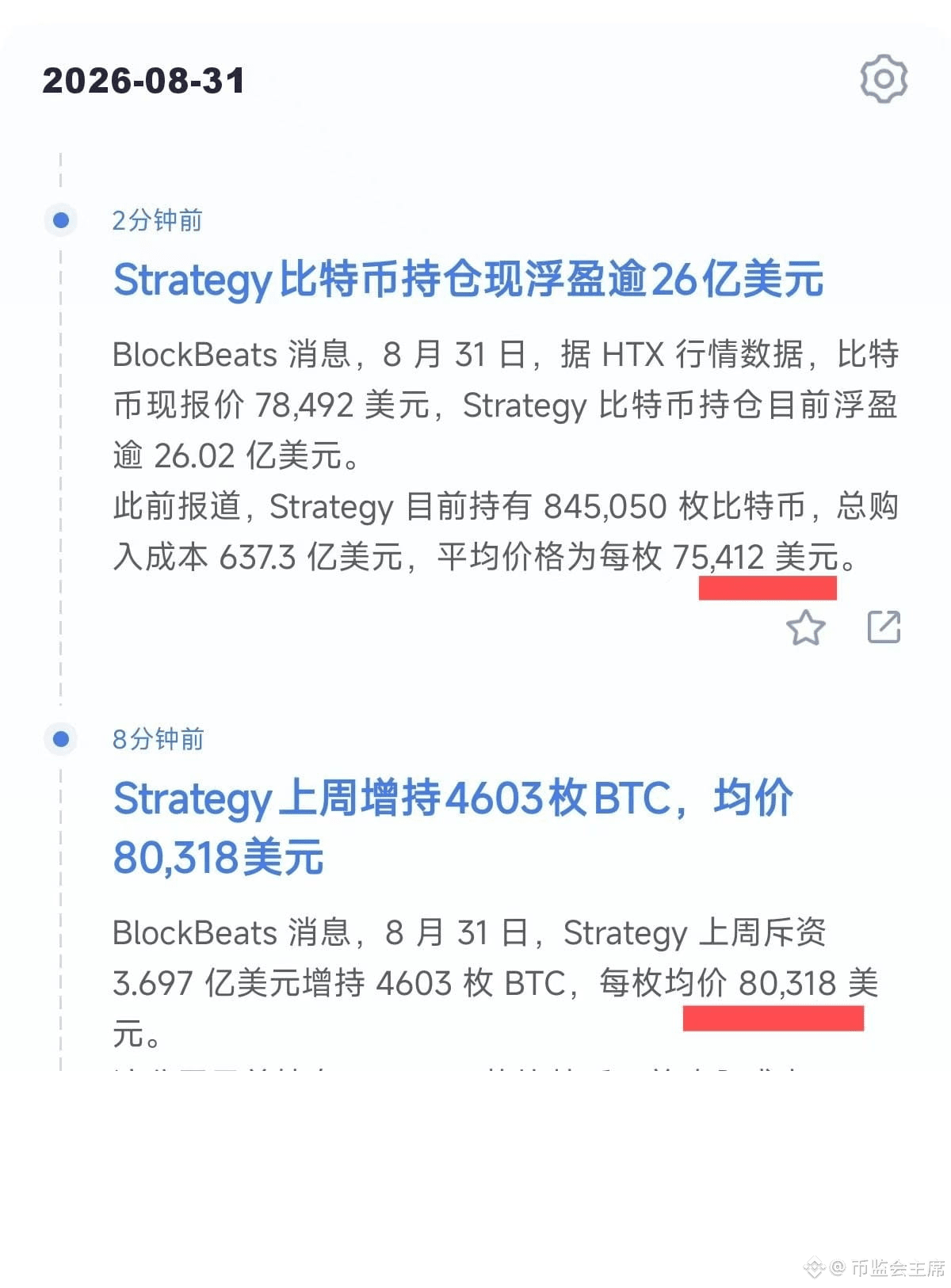
1000 USDT U Perpetual Contract mission completed. 1000/1000 USDT fully filled, and 58 XPL coupon vouchers have been credited.
These “trade-to-earn air drops” campaigns like Binance’s are essentially a hidden rebate for genuinely active users. Take a quick look at the mission history in the task panel—those little gains add up too as positions.
$XPL #币安 #合约任务 #airdrop
These “trade-to-earn air drops” campaigns like Binance’s are essentially a hidden rebate for genuinely active users. Take a quick look at the mission history in the task panel—those little gains add up too as positions.
$XPL #币安 #合约任务 #airdrop
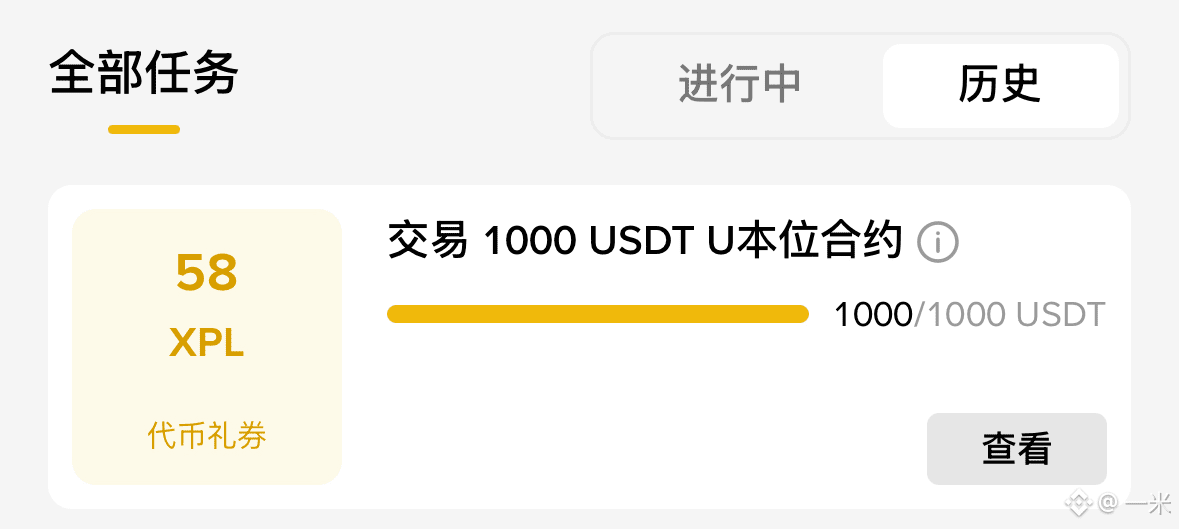
Robinhood Wallet and Fomo exposed as enabling the use of credit cards to buy meme coins; transactions are classified as “digital goods” rather than crypto purchases, circumventing some card network rules. Compliance arbitrage can acquire users in the short term, but in the long run it still depends on how regulators draw the boundaries.
$COTI #Robinhood #Meme币 #compliance
$COTI #Robinhood #Meme币 #compliance
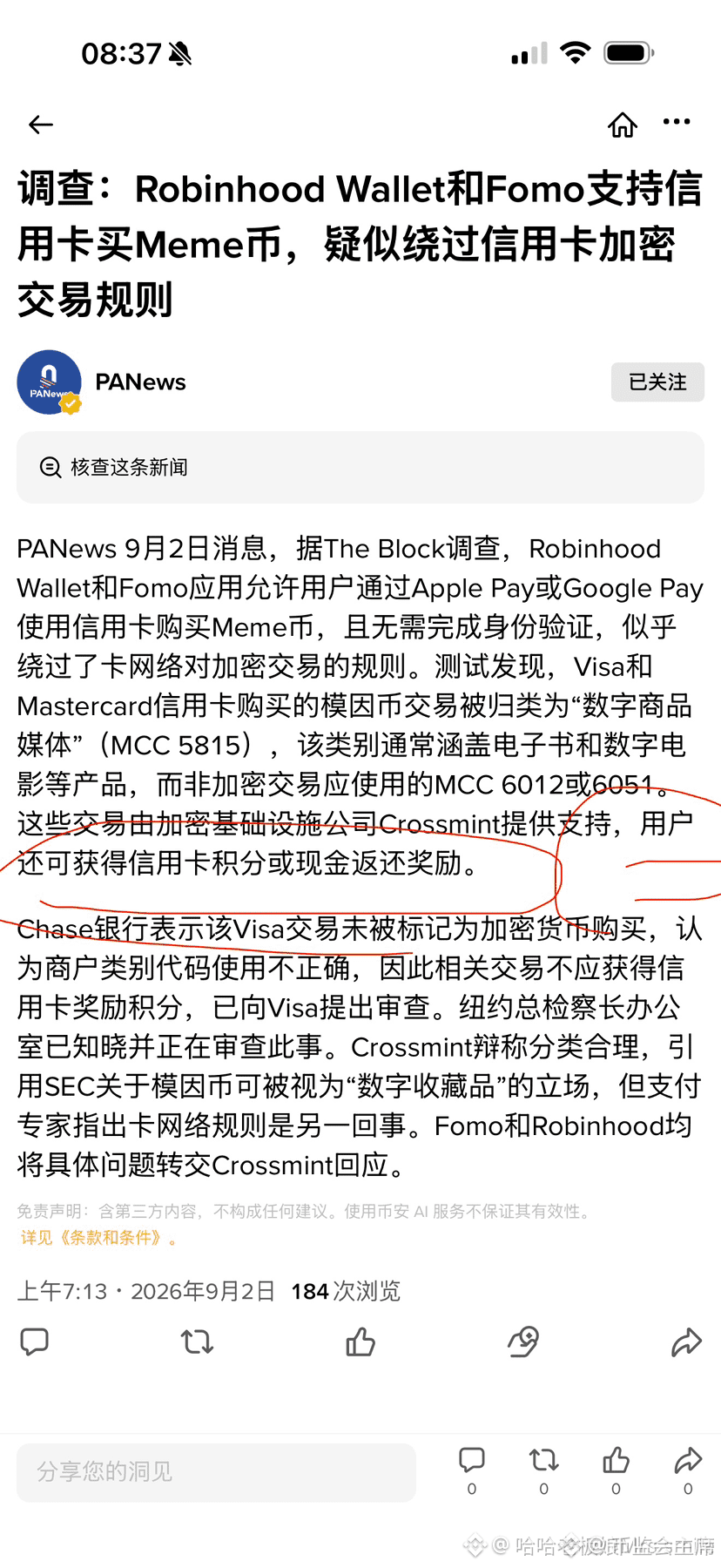
BlackRock’s latest disclosed 2026 Q2 holdings show that assets under management on the watchlist stand at $6.7 trillion.
Breaking down the portfolio structure, the weights of technology and semiconductors are already so high that they can no longer be ignored. The top five holdings are Nvidia at 5.8%, Apple at 5.0%, Alphabet at 4.4%, Microsoft at 3.4%, and Amazon at 2.7%. Add Broadcom at 2.3%, Micron at 1.8%, Meta at 1.5%, and Tesla and AMD at 1.3% each, and these hard-tech and platform-type companies together account for nearly one-third of total assets.
For such large institutions, the concentration at the top is largely determined by passive index weighting, rather than purely active bets. But when nearly one-third of the combination held by the world’s largest players is tied to only a handful of technology companies, the effect of valuation fluctuations on the overall market is heavier than what may appear on the surface.
For ordinary investors, buying along with the index means what you’re essentially buying is this weight structure. When the tech stock weight is already in a high range, the portfolio’s risk exposure to a single industry is raised accordingly.
$NVDA $AAPL
Breaking down the portfolio structure, the weights of technology and semiconductors are already so high that they can no longer be ignored. The top five holdings are Nvidia at 5.8%, Apple at 5.0%, Alphabet at 4.4%, Microsoft at 3.4%, and Amazon at 2.7%. Add Broadcom at 2.3%, Micron at 1.8%, Meta at 1.5%, and Tesla and AMD at 1.3% each, and these hard-tech and platform-type companies together account for nearly one-third of total assets.
For such large institutions, the concentration at the top is largely determined by passive index weighting, rather than purely active bets. But when nearly one-third of the combination held by the world’s largest players is tied to only a handful of technology companies, the effect of valuation fluctuations on the overall market is heavier than what may appear on the surface.
For ordinary investors, buying along with the index means what you’re essentially buying is this weight structure. When the tech stock weight is already in a high range, the portfolio’s risk exposure to a single industry is raised accordingly.
$NVDA $AAPL
Bitcoin spot ETF trading volume surged week over week to $22 billion, setting a new high for this cycle.
The chart is from checkonchain. The stacked columns show major allocations such as IBIT, FBTC, and ARKB all expanding in tandem, while the black line indicates that BTC’s spot price was in a high-range consolidation during the same period.
A spike in trading volume usually has two interpretations. One is that incremental capital is proactively stepping in; institutions’ willingness to allocate to bitcoin via the ETF channel is heating up. The other is that turnover among existing positions accelerates—heightened price volatility drives short-term funds to enter and exit more frequently. Looking at trading volume alone can’t distinguish between the two; it needs to be assessed together with net inflow data.
Worth noting is that increased activity through the ETF channel can change the structure of BTC’s marginal price-setting power. When spot ETF holdings become large enough, the liquidity rhythm of traditional markets is likely to transmit more into the crypto space, and the volatility characteristics previously determined purely by internal crypto supply and demand may weaken.
$BTC
The chart is from checkonchain. The stacked columns show major allocations such as IBIT, FBTC, and ARKB all expanding in tandem, while the black line indicates that BTC’s spot price was in a high-range consolidation during the same period.
A spike in trading volume usually has two interpretations. One is that incremental capital is proactively stepping in; institutions’ willingness to allocate to bitcoin via the ETF channel is heating up. The other is that turnover among existing positions accelerates—heightened price volatility drives short-term funds to enter and exit more frequently. Looking at trading volume alone can’t distinguish between the two; it needs to be assessed together with net inflow data.
Worth noting is that increased activity through the ETF channel can change the structure of BTC’s marginal price-setting power. When spot ETF holdings become large enough, the liquidity rhythm of traditional markets is likely to transmit more into the crypto space, and the volatility characteristics previously determined purely by internal crypto supply and demand may weaken.
$BTC
The informed source from the victim side of the Hangzhou drinking-party incident: The girl sought help to no avail and was briefly unconscious when she resisted and was hospitalized#比特币永续合约资金费率创20个月新高 $AAPL.US

AAPL+0.05%
AAPLUS+0.31%
Satoshi Nakamoto’s Bitcoin just lies there quietly.
Single signature. The key was created on a computer connected to the internet. No complicated multisig setup. No carefully designed custodial architecture.
17 years later, no one stole them.#中国7月产出零售投资全线不及预期 $GOOGL.US
Single signature. The key was created on a computer connected to the internet. No complicated multisig setup. No carefully designed custodial architecture.
17 years later, no one stole them.#中国7月产出零售投资全线不及预期 $GOOGL.US
#SpaceX股价涨至140美元 $PORTAL Quant Trading Giant Exposed: Loses $15 Billion in a Single Month
In July, U.S. high-frequency trading market maker Jane Street recorded losses of about $15 billion. Insiders said the quant giant disclosed this figure to its lenders. For Jane Street, it is a rare setback. In recent years, Jane Street has become one of the key players in global markets. Before this loss occurred, the firm’s quarterly performance had been setting records for itself. Caixin previously noted that Jane Street achieved a record net trading income of $16.1 billion in the first quarter this year, surpassing Wall Street’s top investment banks and competitors such as Castle Securities and Hudson River Trading. Insiders said that even after factoring in the July loss, Jane Street’s net trading income over the past year through Friday still exceeded $40 billion.
Jane Street’s massive July loss came amid extreme volatility in U.S. artificial intelligence (AI) stocks. After a strong rally during most of 2026, AI shares saw a sharp reversal in July, plunging rapidly. The selloff also hit several hedge funds focused on AI, including Situational Awareness, led by “AI prodigy” Leopold Aschenbrenner—Jane Street is one of the investors in that fund. It is worth noting that Jane Street’s investment in Situational Awareness is unusual: it primarily trades using its own capital. Insiders said the two companies are closely connected—one former Jane Street employee previously worked at Situational Awareness
In July, U.S. high-frequency trading market maker Jane Street recorded losses of about $15 billion. Insiders said the quant giant disclosed this figure to its lenders. For Jane Street, it is a rare setback. In recent years, Jane Street has become one of the key players in global markets. Before this loss occurred, the firm’s quarterly performance had been setting records for itself. Caixin previously noted that Jane Street achieved a record net trading income of $16.1 billion in the first quarter this year, surpassing Wall Street’s top investment banks and competitors such as Castle Securities and Hudson River Trading. Insiders said that even after factoring in the July loss, Jane Street’s net trading income over the past year through Friday still exceeded $40 billion.
Jane Street’s massive July loss came amid extreme volatility in U.S. artificial intelligence (AI) stocks. After a strong rally during most of 2026, AI shares saw a sharp reversal in July, plunging rapidly. The selloff also hit several hedge funds focused on AI, including Situational Awareness, led by “AI prodigy” Leopold Aschenbrenner—Jane Street is one of the investors in that fund. It is worth noting that Jane Street’s investment in Situational Awareness is unusual: it primarily trades using its own capital. Insiders said the two companies are closely connected—one former Jane Street employee previously worked at Situational Awareness
Reddit (RDDT) confirms inclusion in the S&P 500, effective before market open on August 18, replacing the acquired AVB. It briefly surged about 11% after hours.
Passive buying from index funds is real, tangible demand. But getting added to the index isn’t a free lunch—historically, many stocks have “announced a rise and been included in a decline.”
This is similar to the logic behind ETF approvals in the crypto asset space: forced buying supports underlying structural demand, but “buy the expectation, sell the fact” holds true on both sides. Traditional finance is accelerating its absorption of community-based assets—this is a signal worth watching for the crypto market.
$RDDT .US #美股 #标普500 #被动买盘
Passive buying from index funds is real, tangible demand. But getting added to the index isn’t a free lunch—historically, many stocks have “announced a rise and been included in a decline.”
This is similar to the logic behind ETF approvals in the crypto asset space: forced buying supports underlying structural demand, but “buy the expectation, sell the fact” holds true on both sides. Traditional finance is accelerating its absorption of community-based assets—this is a signal worth watching for the crypto market.
$RDDT .US #美股 #标普500 #被动买盘
RDDTUS-1.95%
This week, the US July CPI and PPI data are set to be released, and market attention is shifting back to the inflation path and rate-cut expectations.
CPI reflects overall price pressure, while PPI provides a leading indication of cost pressures on the corporate side; together, they shape the Federal Reserve’s policy room. If the data come in below expectations, rate-cut expectations often heat up; if they exceed expectations, short-term volatility in risk assets may be amplified.
For the crypto market, expectations for macro liquidity remain an important contextual variable. Volatility typically increases before and after the data release, so position management is often more crucial than directional judgment.
$APR #US July CPI and PPI data to be released this week
CPI reflects overall price pressure, while PPI provides a leading indication of cost pressures on the corporate side; together, they shape the Federal Reserve’s policy room. If the data come in below expectations, rate-cut expectations often heat up; if they exceed expectations, short-term volatility in risk assets may be amplified.
For the crypto market, expectations for macro liquidity remain an important contextual variable. Volatility typically increases before and after the data release, so position management is often more crucial than directional judgment.
$APR #US July CPI and PPI data to be released this week
I scrolled to a video about “70 beauty micro-habits” and, after watching, felt that this logic is actually the same as investing.
Nothing in the video—early sleep, exercise, skincare, diet—shows results immediately. Everything relies on building it day by day. Many people give up after three days when they don’t see changes, but what truly widens the gap is precisely the following dozens of days and hundreds of days.
It’s the same in the crypto market. People ask every day: which coin will rise tomorrow, which track will explode next week. But the ones that really run are often those who do a few dull things solidly first—understand their own risk tolerance, set a maximum position limit, don’t panic-buy when it drops, don’t get carried away when it rises, and then simply wait patiently for the cycle.
Compounding fears two things most: interruption and impulsive moves. Hear one theory today and change your strategy once; tomorrow you switch to another asset—time is all spent starting over, while the principal just stays where it is.
My own experience is that treating “do a little every day” as a habit is far more useful than “go all out once in a while.” Whether it’s getting better looking or getting richer, the path is pretty much the same: repeat simple actions until they bring about a qualitative change. Don’t expect shortcuts—most shortcuts are really just taking your principal.
标签 $COTI #复利 #自律 #长期主义
Nothing in the video—early sleep, exercise, skincare, diet—shows results immediately. Everything relies on building it day by day. Many people give up after three days when they don’t see changes, but what truly widens the gap is precisely the following dozens of days and hundreds of days.
It’s the same in the crypto market. People ask every day: which coin will rise tomorrow, which track will explode next week. But the ones that really run are often those who do a few dull things solidly first—understand their own risk tolerance, set a maximum position limit, don’t panic-buy when it drops, don’t get carried away when it rises, and then simply wait patiently for the cycle.
Compounding fears two things most: interruption and impulsive moves. Hear one theory today and change your strategy once; tomorrow you switch to another asset—time is all spent starting over, while the principal just stays where it is.
My own experience is that treating “do a little every day” as a habit is far more useful than “go all out once in a while.” Whether it’s getting better looking or getting richer, the path is pretty much the same: repeat simple actions until they bring about a qualitative change. Don’t expect shortcuts—most shortcuts are really just taking your principal.
标签 $COTI #复利 #自律 #长期主义
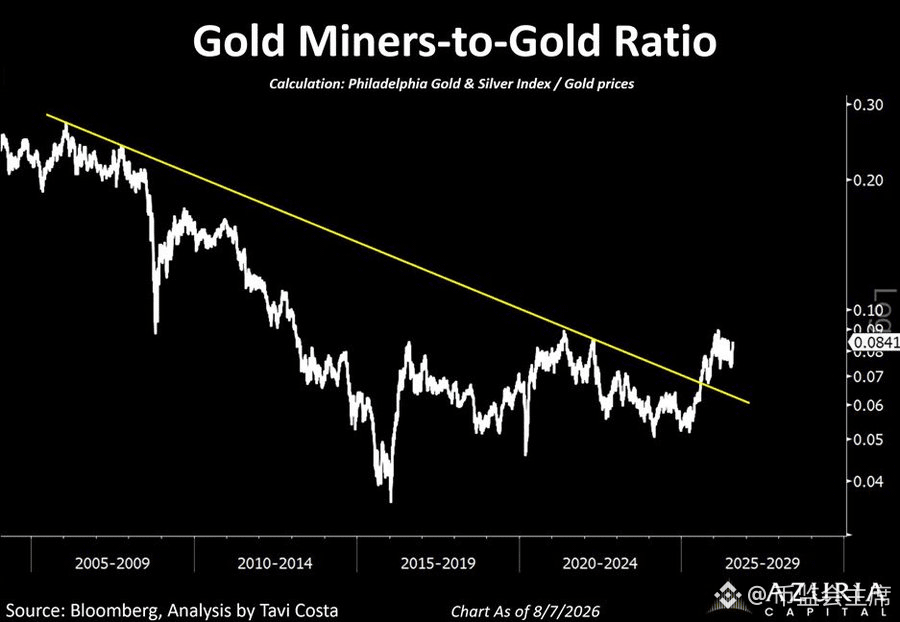
Seeing this chart, the ratio between gold mining stocks and the gold price has finally broken through a downward trend line that has lasted for more than ten years. The current ratio is roughly around 0.084.
Over the past nearly 20 years, the overall performance of gold mining stocks has failed to beat gold itself. The reason is also quite simple: as the gold price rises, costs rise as well; share dilution, environmental protection, and geopolitical risk come in waves one after another, causing the stocks’ sensitivity to weaken over time. But when the ratio breaks the trend line, it implies that capital is starting to re-price “equity that can produce gold” again, beyond just “physical gold.”
I think this has reference value for crypto assets. Many people compare BTC to digital gold, and mining stocks to mining company stocks. But BTC itself does not have the problem of expanding extraction costs, nor does it face resource risk tied to a single country. So, in the “scarcity narrative,” BTC is cleaner than gold mining stocks, but in terms of “discounted cash flow,” it’s not as good as mature mining companies that pay dividends.
In other words, BTC and gold mining stocks are two variants of the gold narrative: one locks in scarcity through protocol rules, and the other amplifies the gold price through corporate earnings. A breakout in the ratio suggests the market is shifting from “buying only gold” to “buying gold-related assets,” with risk appetite moving up one notch.
My own approach is to treat it as an indirect signal: when traditional markets are willing to pay a premium for higher-risk gold-related assets, high-beta positions in the crypto market typically benefit as well. But I don’t chase when it’s already at a high level—I use it only as a reference for position sizing.
Tag $COTI #黄金 #资产配置 #cryptocurrency
Over the past nearly 20 years, the overall performance of gold mining stocks has failed to beat gold itself. The reason is also quite simple: as the gold price rises, costs rise as well; share dilution, environmental protection, and geopolitical risk come in waves one after another, causing the stocks’ sensitivity to weaken over time. But when the ratio breaks the trend line, it implies that capital is starting to re-price “equity that can produce gold” again, beyond just “physical gold.”
I think this has reference value for crypto assets. Many people compare BTC to digital gold, and mining stocks to mining company stocks. But BTC itself does not have the problem of expanding extraction costs, nor does it face resource risk tied to a single country. So, in the “scarcity narrative,” BTC is cleaner than gold mining stocks, but in terms of “discounted cash flow,” it’s not as good as mature mining companies that pay dividends.
In other words, BTC and gold mining stocks are two variants of the gold narrative: one locks in scarcity through protocol rules, and the other amplifies the gold price through corporate earnings. A breakout in the ratio suggests the market is shifting from “buying only gold” to “buying gold-related assets,” with risk appetite moving up one notch.
My own approach is to treat it as an indirect signal: when traditional markets are willing to pay a premium for higher-risk gold-related assets, high-beta positions in the crypto market typically benefit as well. But I don’t chase when it’s already at a high level—I use it only as a reference for position sizing.
Tag $COTI #黄金 #资产配置 #cryptocurrency
Log in to explore more content