

Zerionix
538 Posts

Zerionix
Report
Block User
Crypto Researcher • Market Structure • Data > Hype • Daily updates → NFA
0 Following
13 Followers
66 Liked
Posts
·
--
A whale is betting $140M+ on Bitcoin and Ethereum. But here's what matters most.
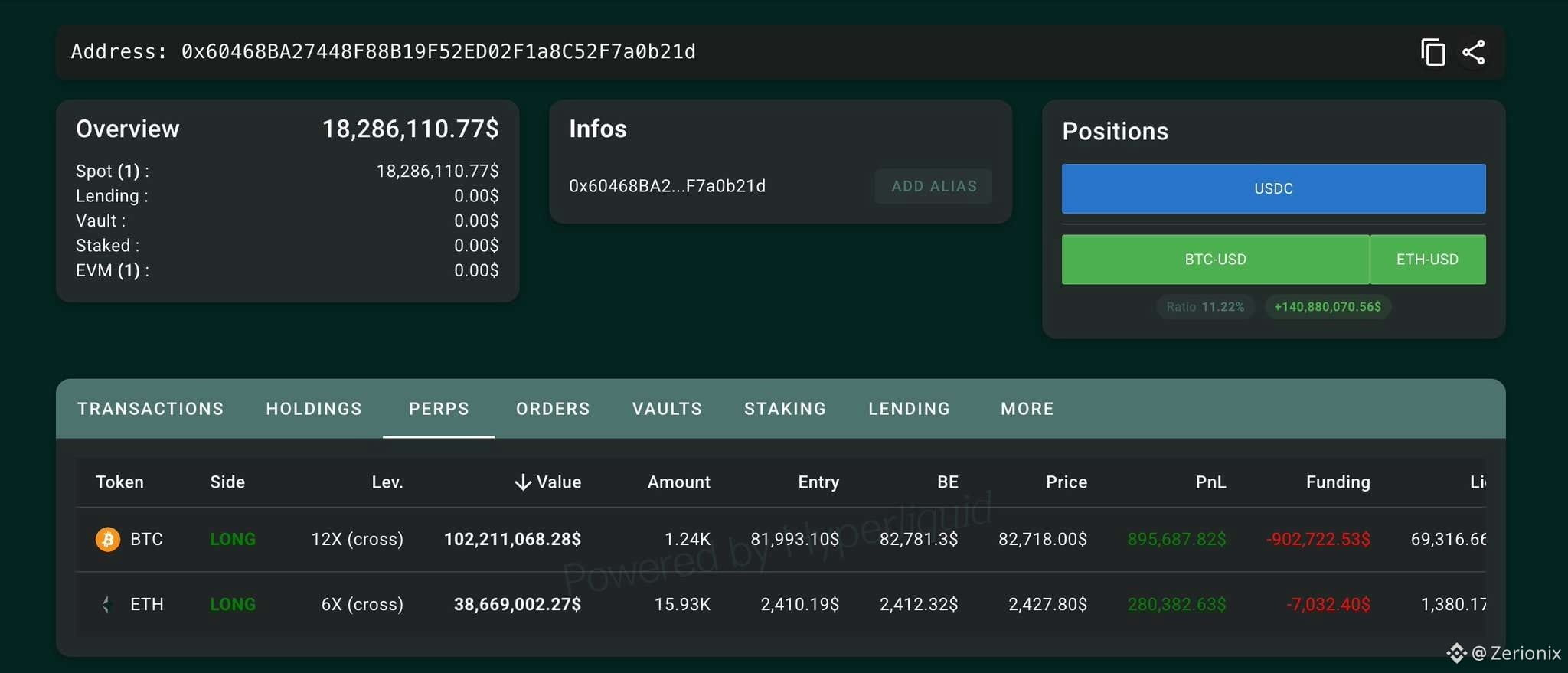
One large trader is reportedly holding long positions worth around $140.88 million across BTC and ETH:
→ 1,236 BTC — approximately $102.2M
→ 15,928 ETH — approximately $38.67M
That's a significant bullish position, especially with most of the exposure concentrated in Bitcoin.
What stands out to me is the confidence behind a position of this size. This trader is positioned for prices to rise, but that doesn't necessarily mean a rally is guaranteed or that the broader market shares the same outlook.
There's also a difference between holding spot assets and using leveraged futures. If these are leveraged positions, a sharp move against the trader could trigger liquidations and add volatility to the market.
Personally, I watch whale positioning as a clue to market sentiment, not a signal to follow blindly. Large traders can be wrong, too.
The real question isn't how much this whale is betting. It's whether price action will confirm that bullish conviction.
Source: Hypurrscan — https://hypurrscan.io/address/0x6046…
$BTC #BTC Price Analysis# $ETH #Meme Alpha#
A whale is betting $140M+ on Bitcoin and Ethereum. But here's what matters most.
One large trader is reportedly holding long positions worth around $140.88 million across BTC and ETH:
→ 1,236 BTC — approximately $102.2M
→ 15,928 ETH — approximately $38.67M
That's a significant bullish position, especially with most of the exposure concentrated in Bitcoin.
What stands out to me is the confidence behind a position of this size. This trader is positioned for prices to rise, but that doesn't necessarily mean a rally is guaranteed or that the broader market shares the same outlook.
There's also a difference between holding spot assets and using leveraged futures. If these are leveraged positions, a sharp move against the trader could trigger liquidations and add volatility to the market.
Personally, I watch whale positioning as a clue to market sentiment, not a signal to follow blindly. Large traders can be wrong, too.
The real question isn't how much this whale is betting. It's whether price action will confirm that bullish conviction.
Source: Hypurrscan — https://hypurrscan.io/address/0x6046…
$BTC #BTC Price Analysis# $ETH #Meme Alpha#
One large trader is reportedly holding long positions worth around $140.88 million across BTC and ETH:
→ 1,236 BTC — approximately $102.2M
→ 15,928 ETH — approximately $38.67M
That's a significant bullish position, especially with most of the exposure concentrated in Bitcoin.
What stands out to me is the confidence behind a position of this size. This trader is positioned for prices to rise, but that doesn't necessarily mean a rally is guaranteed or that the broader market shares the same outlook.
There's also a difference between holding spot assets and using leveraged futures. If these are leveraged positions, a sharp move against the trader could trigger liquidations and add volatility to the market.
Personally, I watch whale positioning as a clue to market sentiment, not a signal to follow blindly. Large traders can be wrong, too.
The real question isn't how much this whale is betting. It's whether price action will confirm that bullish conviction.
Source: Hypurrscan — https://hypurrscan.io/address/0x6046…
$BTC #BTC Price Analysis# $ETH #Meme Alpha#
32
·
--
Altcoins are feeling the fear on Wall Street.
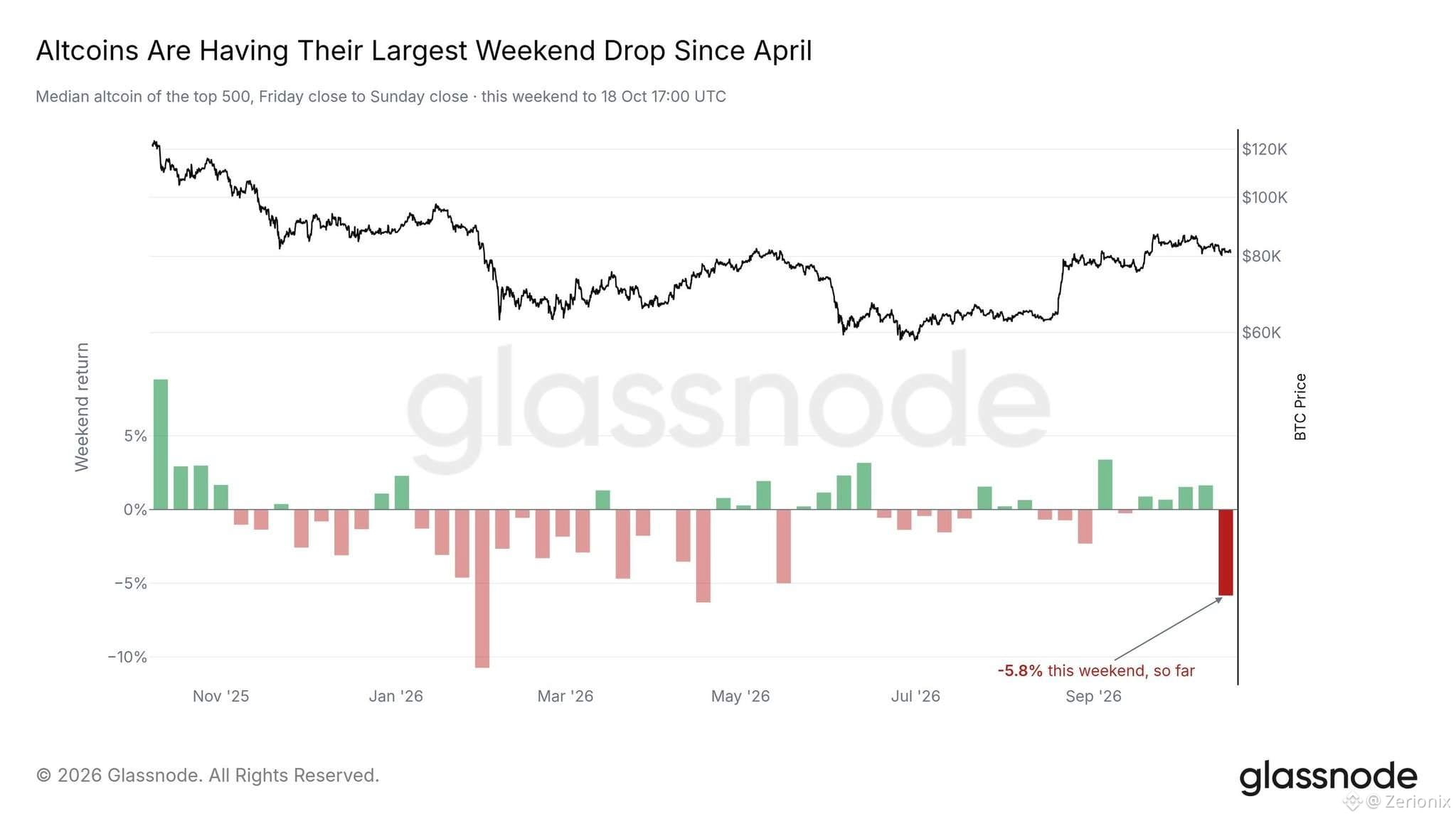
The typical altcoin is down more than 5% this weekend, putting the market on track for its biggest weekend decline since April, according to Glassnode. The sell-off reflects growing fear in equity markets spilling into crypto.
What stands out to me is how quickly sentiment can change when investors start reducing risk.
When stocks come under pressure, crypto often feels the impact too. But altcoins can take a harder hit because liquidity is thinner and speculative positioning can unwind quickly, leaving smaller tokens more exposed when sellers dominate.
There's another detail worth watching: since Bitcoin's June low, buying on Fridays and selling on Sundays had reportedly been a profitable pattern. This weekend's decline challenges that trend.
Personally, I think this is a reminder that altcoins don't trade on their own narratives alone. When fear takes over the broader market, even promising projects can get caught in the same wave of selling.
The key question now is whether this is a temporary weekend flush or the beginning of a deeper risk-off move.
When market fear spreads, liquidity often disappears just when traders need it most.
#BTC Price Analysis# #Altcoin Season# $SOL $BNB
Altcoins are feeling the fear on Wall Street.
The typical altcoin is down more than 5% this weekend, putting the market on track for its biggest weekend decline since April, according to Glassnode. The sell-off reflects growing fear in equity markets spilling into crypto.
What stands out to me is how quickly sentiment can change when investors start reducing risk.
When stocks come under pressure, crypto often feels the impact too. But altcoins can take a harder hit because liquidity is thinner and speculative positioning can unwind quickly, leaving smaller tokens more exposed when sellers dominate.
There's another detail worth watching: since Bitcoin's June low, buying on Fridays and selling on Sundays had reportedly been a profitable pattern. This weekend's decline challenges that trend.
Personally, I think this is a reminder that altcoins don't trade on their own narratives alone. When fear takes over the broader market, even promising projects can get caught in the same wave of selling.
The key question now is whether this is a temporary weekend flush or the beginning of a deeper risk-off move.
When market fear spreads, liquidity often disappears just when traders need it most.
#BTC Price Analysis# #Altcoin Season# $SOL $BNB
The typical altcoin is down more than 5% this weekend, putting the market on track for its biggest weekend decline since April, according to Glassnode. The sell-off reflects growing fear in equity markets spilling into crypto.
What stands out to me is how quickly sentiment can change when investors start reducing risk.
When stocks come under pressure, crypto often feels the impact too. But altcoins can take a harder hit because liquidity is thinner and speculative positioning can unwind quickly, leaving smaller tokens more exposed when sellers dominate.
There's another detail worth watching: since Bitcoin's June low, buying on Fridays and selling on Sundays had reportedly been a profitable pattern. This weekend's decline challenges that trend.
Personally, I think this is a reminder that altcoins don't trade on their own narratives alone. When fear takes over the broader market, even promising projects can get caught in the same wave of selling.
The key question now is whether this is a temporary weekend flush or the beginning of a deeper risk-off move.
When market fear spreads, liquidity often disappears just when traders need it most.
#BTC Price Analysis# #Altcoin Season# $SOL $BNB
48
·
--
TRON is generating more revenue than every other blockchain. But the real question is why.
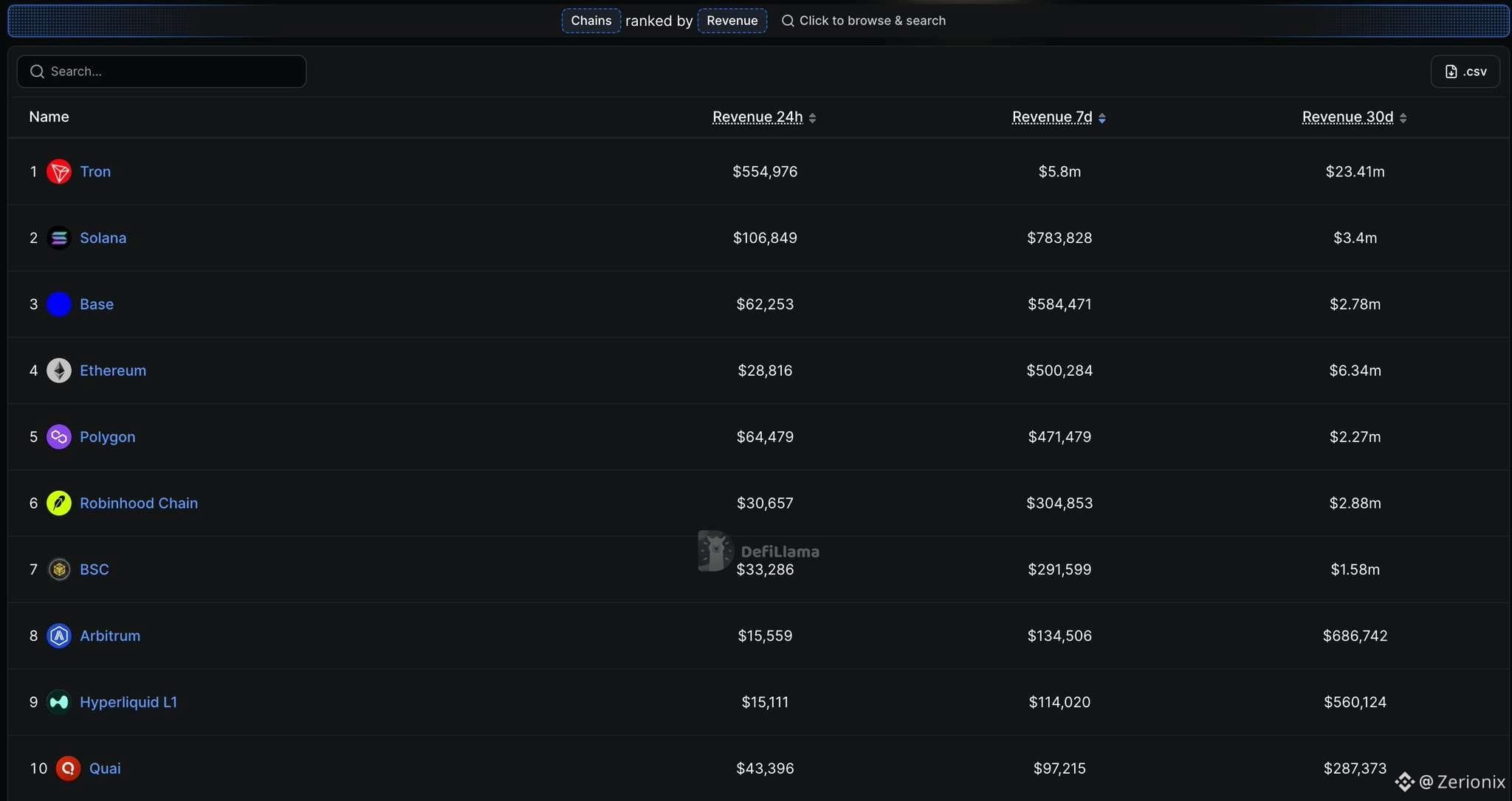
According to DefiLlama, TRON ranks No. 1 in blockchain revenue across the 24-hour, 7-day, and 30-day timeframes, with monthly revenue reaching $23.41 million.
What stands out to me is that TRON's strength isn't just about attracting attention. Its network has become a major settlement layer for USDT transfers, especially for users who want relatively low-cost ways to move dollars across crypto markets.
That creates a different kind of demand. People don't necessarily need to speculate on TRX to use the network. They need the infrastructure to move stablecoins, and that activity can generate fees.
This is why I think revenue is an important metric to watch. Token prices can move on hype and expectations, but network revenue gives us another way to measure actual usage.
Still, high revenue alone doesn't tell the whole story. We need to consider how sustainable that activity is, how much of the revenue translates into value for TRX holders, and how TRON compares with competing networks over time.
The bigger takeaway? Sometimes the strongest blockchain isn't the one making the most noise. It's the one people keep using.
Source: DefiLlama — https://defillama.com/revenue/chains
#BTC Price Analysis# #Meme Alpha# #Meme Alpha# $TRX
TRON is generating more revenue than every other blockchain. But the real question is why.
According to DefiLlama, TRON ranks No. 1 in blockchain revenue across the 24-hour, 7-day, and 30-day timeframes, with monthly revenue reaching $23.41 million.
What stands out to me is that TRON's strength isn't just about attracting attention. Its network has become a major settlement layer for USDT transfers, especially for users who want relatively low-cost ways to move dollars across crypto markets.
That creates a different kind of demand. People don't necessarily need to speculate on TRX to use the network. They need the infrastructure to move stablecoins, and that activity can generate fees.
This is why I think revenue is an important metric to watch. Token prices can move on hype and expectations, but network revenue gives us another way to measure actual usage.
Still, high revenue alone doesn't tell the whole story. We need to consider how sustainable that activity is, how much of the revenue translates into value for TRX holders, and how TRON compares with competing networks over time.
The bigger takeaway? Sometimes the strongest blockchain isn't the one making the most noise. It's the one people keep using.
Source: DefiLlama — https://defillama.com/revenue/chains
#BTC Price Analysis# #Meme Alpha# #Meme Alpha# $TRX
According to DefiLlama, TRON ranks No. 1 in blockchain revenue across the 24-hour, 7-day, and 30-day timeframes, with monthly revenue reaching $23.41 million.
What stands out to me is that TRON's strength isn't just about attracting attention. Its network has become a major settlement layer for USDT transfers, especially for users who want relatively low-cost ways to move dollars across crypto markets.
That creates a different kind of demand. People don't necessarily need to speculate on TRX to use the network. They need the infrastructure to move stablecoins, and that activity can generate fees.
This is why I think revenue is an important metric to watch. Token prices can move on hype and expectations, but network revenue gives us another way to measure actual usage.
Still, high revenue alone doesn't tell the whole story. We need to consider how sustainable that activity is, how much of the revenue translates into value for TRX holders, and how TRON compares with competing networks over time.
The bigger takeaway? Sometimes the strongest blockchain isn't the one making the most noise. It's the one people keep using.
Source: DefiLlama — https://defillama.com/revenue/chains
#BTC Price Analysis# #Meme Alpha# #Meme Alpha# $TRX
60
·
--
Over $10 BILLION is now sitting in crypto lending vaults. Regulators are starting to pay attention. 👀
According to the Financial Times, deposits have climbed from $4B at the start of last year to more than $10B.
These vaults pool crypto assets and deploy them through lending strategies managed by smart contracts or human curators. Depending on the strategy, advertised yields can range from around 3% to over 20%.
But higher yield doesn't come from nowhere.
Users face smart contract vulnerabilities, collateral failures, liquidity risks and the possibility that a curator makes poor decisions. In stressed markets, automatic liquidations can also accelerate losses.
Now the regulatory question is getting harder to ignore. The US SEC and European regulators are examining where certain vaults and their managers fit within existing financial rules. Moving an investment strategy onchain doesn't automatically remove its legal obligations.
Personally, I think this is a turning point for DeFi. More capital means these products are becoming harder for traditional finance to ignore, but growth without clear risk disclosure can create problems that only become obvious when markets turn ugly.
The real test isn't whether vaults can attract $10B.
It's whether they can protect that capital when the yield strategy stops working.
Would stronger regulation make DeFi lending safer, or risk pushing its most useful innovation out of reach? 👀
$BTC #BTC Price Analysis# #Altcoin Season# $SOL
Over $10 BILLION is now sitting in crypto lending vaults. Regulators are starting to pay attention. 👀
According to the Financial Times, deposits have climbed from $4B at the start of last year to more than $10B.
These vaults pool crypto assets and deploy them through lending strategies managed by smart contracts or human curators. Depending on the strategy, advertised yields can range from around 3% to over 20%.
But higher yield doesn't come from nowhere.
Users face smart contract vulnerabilities, collateral failures, liquidity risks and the possibility that a curator makes poor decisions. In stressed markets, automatic liquidations can also accelerate losses.
Now the regulatory question is getting harder to ignore. The US SEC and European regulators are examining where certain vaults and their managers fit within existing financial rules. Moving an investment strategy onchain doesn't automatically remove its legal obligations.
Personally, I think this is a turning point for DeFi. More capital means these products are becoming harder for traditional finance to ignore, but growth without clear risk disclosure can create problems that only become obvious when markets turn ugly.
The real test isn't whether vaults can attract $10B.
It's whether they can protect that capital when the yield strategy stops working.
Would stronger regulation make DeFi lending safer, or risk pushing its most useful innovation out of reach? 👀
$BTC #BTC Price Analysis# #Altcoin Season# $SOL
According to the Financial Times, deposits have climbed from $4B at the start of last year to more than $10B.
These vaults pool crypto assets and deploy them through lending strategies managed by smart contracts or human curators. Depending on the strategy, advertised yields can range from around 3% to over 20%.
But higher yield doesn't come from nowhere.
Users face smart contract vulnerabilities, collateral failures, liquidity risks and the possibility that a curator makes poor decisions. In stressed markets, automatic liquidations can also accelerate losses.
Now the regulatory question is getting harder to ignore. The US SEC and European regulators are examining where certain vaults and their managers fit within existing financial rules. Moving an investment strategy onchain doesn't automatically remove its legal obligations.
Personally, I think this is a turning point for DeFi. More capital means these products are becoming harder for traditional finance to ignore, but growth without clear risk disclosure can create problems that only become obvious when markets turn ugly.
The real test isn't whether vaults can attract $10B.
It's whether they can protect that capital when the yield strategy stops working.
Would stronger regulation make DeFi lending safer, or risk pushing its most useful innovation out of reach? 👀
$BTC #BTC Price Analysis# #Altcoin Season# $SOL

53
·
--
Small and mid cap crypto is outperforming Bitcoin. But is altseason actually here?
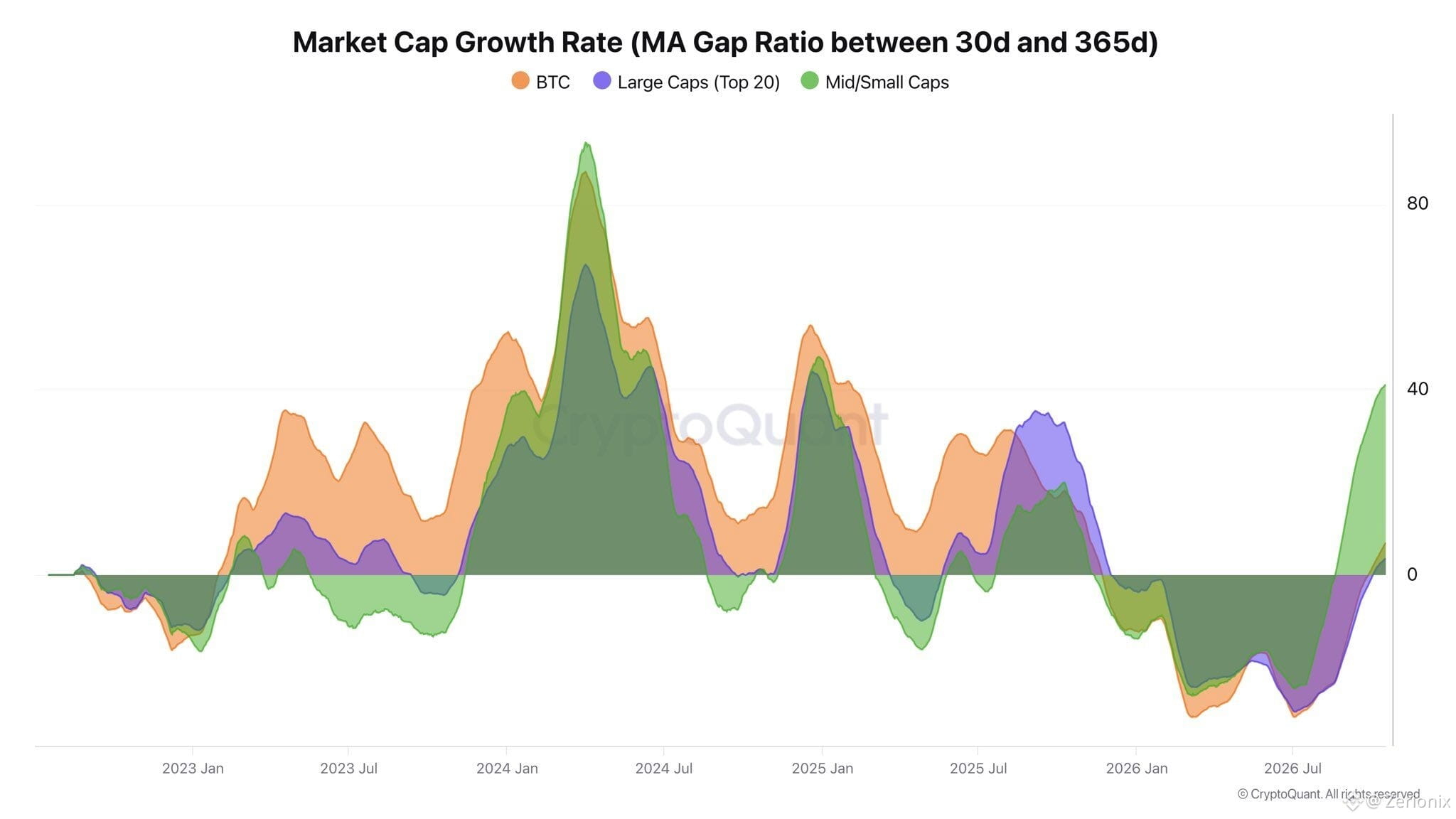
According to CryptoQuant analyst Darkfost, small and mid cap crypto has recorded a 41% market cap growth ratio since late August, compared with just 7% for $BTC.
That’s a meaningful divergence. Capital may be rotating toward riskier assets as traders look beyond Bitcoin for stronger returns.
But there’s a catch.
Outperformance alone doesn’t confirm altseason. Smaller tokens can rally sharply on relatively thin liquidity, and those gains can disappear just as quickly when sentiment shifts.
Personally, I’d watch whether the strength spreads across the wider altcoin market, whether $BTC dominance keeps declining, and whether volume supports the move.
If those signals align, this rotation could have legs. If gains remain concentrated in a few tokens, it may be another short lived rally.
The real test isn't which coins are pumping today. It's whether the broader market can sustain the move.
Altseason loading, or another fakeout? 👀
$BTC #BTC Price Analysis# #Altcoin Season# $ZEC
Small and mid cap crypto is outperforming Bitcoin. But is altseason actually here?
According to CryptoQuant analyst Darkfost, small and mid cap crypto has recorded a 41% market cap growth ratio since late August, compared with just 7% for $BTC.
That’s a meaningful divergence. Capital may be rotating toward riskier assets as traders look beyond Bitcoin for stronger returns.
But there’s a catch.
Outperformance alone doesn’t confirm altseason. Smaller tokens can rally sharply on relatively thin liquidity, and those gains can disappear just as quickly when sentiment shifts.
Personally, I’d watch whether the strength spreads across the wider altcoin market, whether $BTC dominance keeps declining, and whether volume supports the move.
If those signals align, this rotation could have legs. If gains remain concentrated in a few tokens, it may be another short lived rally.
The real test isn't which coins are pumping today. It's whether the broader market can sustain the move.
Altseason loading, or another fakeout? 👀
$BTC #BTC Price Analysis# #Altcoin Season# $ZEC
According to CryptoQuant analyst Darkfost, small and mid cap crypto has recorded a 41% market cap growth ratio since late August, compared with just 7% for $BTC.
That’s a meaningful divergence. Capital may be rotating toward riskier assets as traders look beyond Bitcoin for stronger returns.
But there’s a catch.
Outperformance alone doesn’t confirm altseason. Smaller tokens can rally sharply on relatively thin liquidity, and those gains can disappear just as quickly when sentiment shifts.
Personally, I’d watch whether the strength spreads across the wider altcoin market, whether $BTC dominance keeps declining, and whether volume supports the move.
If those signals align, this rotation could have legs. If gains remain concentrated in a few tokens, it may be another short lived rally.
The real test isn't which coins are pumping today. It's whether the broader market can sustain the move.
Altseason loading, or another fakeout? 👀
$BTC #BTC Price Analysis# #Altcoin Season# $ZEC
·
--
Justin Sun reportedly sold 80% to 90% of his $ETH position near $3,600 to $4,000. He kept his Bitcoin untouched and moved heavily into U.S. stocks.
In an October 16 interview with William Joy, the TRON founder explained that he saw a fragile double top forming on Ethereum’s chart.
Rather than wait for confirmation, he cut most of his ETH exposure while retaining a smaller core position. Reports say he had not bought back in by the time of the interview.
And here’s the interesting part.
Sun didn't make the same move with Bitcoin. He reportedly left his core $BTC holdings untouched while shifting capital toward U.S. equities.
That suggests he was making a distinction between assets, not simply abandoning crypto altogether.
Personally, I think the key lesson is that even major crypto figures can have very different convictions about ETH and BTC. A double top can warn of weakening momentum, but it isn't a guaranteed reversal signal.
There's also a timing detail worth noting. These sales reportedly happened in November or December 2025, so this is a disclosure of an earlier decision, not necessarily a fresh market move.
Still, the question is worth asking.
If someone who once held a large ETH position sees better opportunities elsewhere, what would convince them to rotate back?
Because the real signal isn't just who sells.
It's what would make them buy again. 👀
$ETH #BTC Price Analysis# #Altcoin Season#
Justin Sun reportedly sold 80% to 90% of his $ETH position near $3,600 to $4,000. He kept his Bitcoin untouched and moved heavily into U.S. stocks.
In an October 16 interview with William Joy, the TRON founder explained that he saw a fragile double top forming on Ethereum’s chart.
Rather than wait for confirmation, he cut most of his ETH exposure while retaining a smaller core position. Reports say he had not bought back in by the time of the interview.
And here’s the interesting part.
Sun didn't make the same move with Bitcoin. He reportedly left his core $BTC holdings untouched while shifting capital toward U.S. equities.
That suggests he was making a distinction between assets, not simply abandoning crypto altogether.
Personally, I think the key lesson is that even major crypto figures can have very different convictions about ETH and BTC. A double top can warn of weakening momentum, but it isn't a guaranteed reversal signal.
There's also a timing detail worth noting. These sales reportedly happened in November or December 2025, so this is a disclosure of an earlier decision, not necessarily a fresh market move.
Still, the question is worth asking.
If someone who once held a large ETH position sees better opportunities elsewhere, what would convince them to rotate back?
Because the real signal isn't just who sells.
It's what would make them buy again. 👀
$ETH #BTC Price Analysis# #Altcoin Season#
In an October 16 interview with William Joy, the TRON founder explained that he saw a fragile double top forming on Ethereum’s chart.
Rather than wait for confirmation, he cut most of his ETH exposure while retaining a smaller core position. Reports say he had not bought back in by the time of the interview.
And here’s the interesting part.
Sun didn't make the same move with Bitcoin. He reportedly left his core $BTC holdings untouched while shifting capital toward U.S. equities.
That suggests he was making a distinction between assets, not simply abandoning crypto altogether.
Personally, I think the key lesson is that even major crypto figures can have very different convictions about ETH and BTC. A double top can warn of weakening momentum, but it isn't a guaranteed reversal signal.
There's also a timing detail worth noting. These sales reportedly happened in November or December 2025, so this is a disclosure of an earlier decision, not necessarily a fresh market move.
Still, the question is worth asking.
If someone who once held a large ETH position sees better opportunities elsewhere, what would convince them to rotate back?
Because the real signal isn't just who sells.
It's what would make them buy again. 👀
$ETH #BTC Price Analysis# #Altcoin Season#

·
--
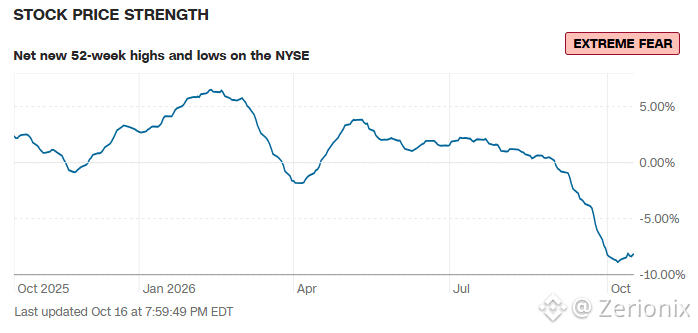
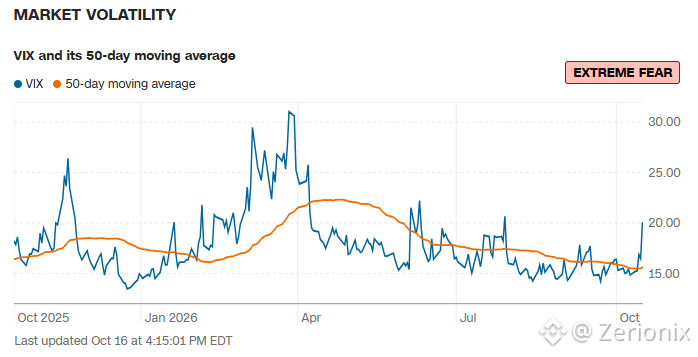
Wall Street is flashing extreme fear, but crypto's Fear & Greed Index is still sitting in neutral territory. That divergence is worth watching. 👀
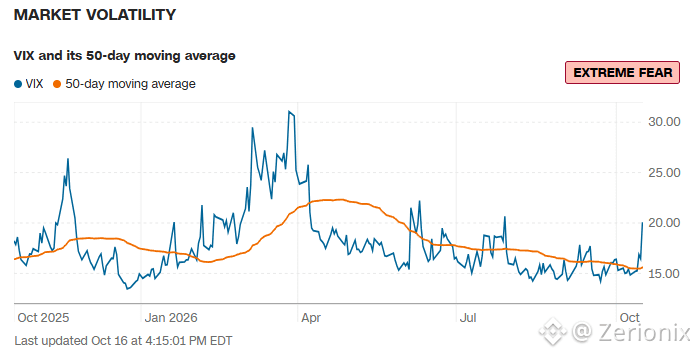
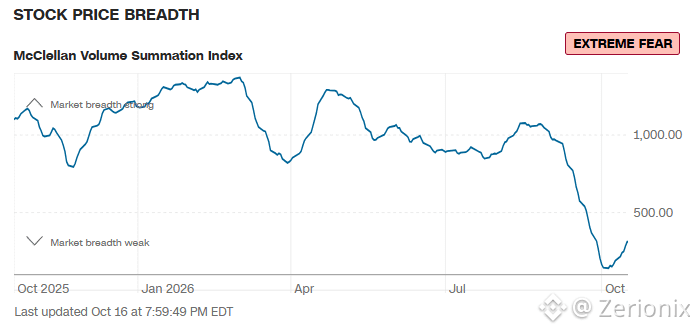
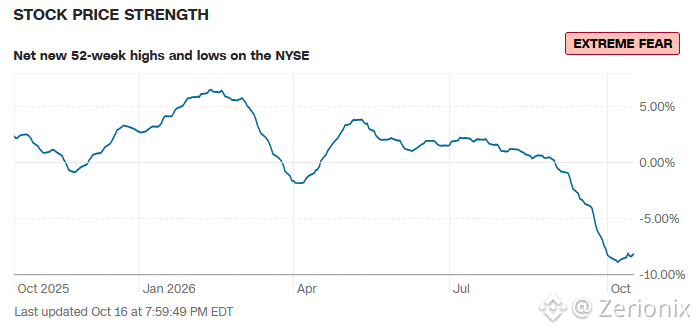
According to Coin Bureau’s breakdown of CNN’s Fear & Greed Index, Wall Street’s reading plunged from 46 to 18 in just one week, its lowest level since April. Six of the index’s seven indicators are now showing extreme fear.
The warning signs are spread across the market.
Volatility is rising, investors are paying more attention to downside protection, bonds have outperformed stocks over the past 20 trading days, and market breadth has weakened sharply.
Even momentum is fading. The S&P 500 remains above its 125 day moving average, but its cushion has narrowed considerably.
Meanwhile, the junk bond gauge is showing fear rather than extreme fear, suggesting credit markets haven't deteriorated to the same degree across every indicator.
Now compare that with crypto.
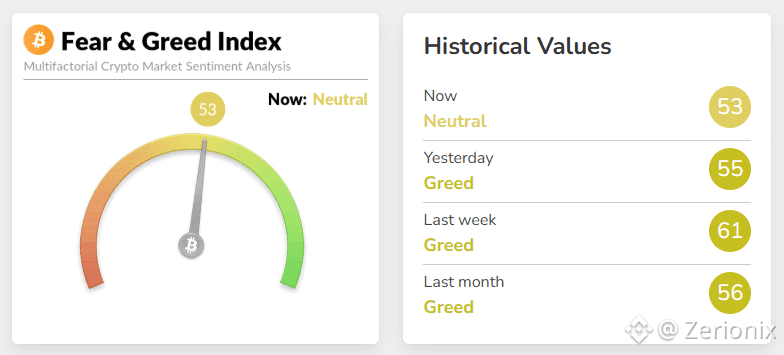
The Crypto Fear & Greed Index is reportedly at 53, in neutral territory, while Bitcoin is down just 1.2% on the week.
Personally, I wouldn't interpret that gap as proof that Bitcoin is immune to Wall Street's weakness.
Crypto trades around the clock, but it remains sensitive to liquidity, risk appetite and broader market positioning. If equity weakness spreads and investors start reducing exposure across risk assets, Bitcoin could still feel the pressure.
The other possibility is that crypto is showing relative resilience for now.
The key is whether that resilience holds if traditional markets get worse.
Wall Street is getting nervous. The question is whether Bitcoin keeps ignoring the warning signs or eventually catches up.
$BTC #BTC Price Analysis# $ETH #Altcoin Season#
Wall Street is flashing extreme fear, but crypto's Fear & Greed Index is still sitting in neutral territory. That divergence is worth watching. 👀
According to Coin Bureau’s breakdown of CNN’s Fear & Greed Index, Wall Street’s reading plunged from 46 to 18 in just one week, its lowest level since April. Six of the index’s seven indicators are now showing extreme fear.
The warning signs are spread across the market.
Volatility is rising, investors are paying more attention to downside protection, bonds have outperformed stocks over the past 20 trading days, and market breadth has weakened sharply.
Even momentum is fading. The S&P 500 remains above its 125 day moving average, but its cushion has narrowed considerably.
Meanwhile, the junk bond gauge is showing fear rather than extreme fear, suggesting credit markets haven't deteriorated to the same degree across every indicator.
Now compare that with crypto.
The Crypto Fear & Greed Index is reportedly at 53, in neutral territory, while Bitcoin is down just 1.2% on the week.
Personally, I wouldn't interpret that gap as proof that Bitcoin is immune to Wall Street's weakness.
Crypto trades around the clock, but it remains sensitive to liquidity, risk appetite and broader market positioning. If equity weakness spreads and investors start reducing exposure across risk assets, Bitcoin could still feel the pressure.
The other possibility is that crypto is showing relative resilience for now.
The key is whether that resilience holds if traditional markets get worse.
Wall Street is getting nervous. The question is whether Bitcoin keeps ignoring the warning signs or eventually catches up.
$BTC #BTC Price Analysis# $ETH #Altcoin Season#
According to Coin Bureau’s breakdown of CNN’s Fear & Greed Index, Wall Street’s reading plunged from 46 to 18 in just one week, its lowest level since April. Six of the index’s seven indicators are now showing extreme fear.
The warning signs are spread across the market.
Volatility is rising, investors are paying more attention to downside protection, bonds have outperformed stocks over the past 20 trading days, and market breadth has weakened sharply.
Even momentum is fading. The S&P 500 remains above its 125 day moving average, but its cushion has narrowed considerably.
Meanwhile, the junk bond gauge is showing fear rather than extreme fear, suggesting credit markets haven't deteriorated to the same degree across every indicator.
Now compare that with crypto.
The Crypto Fear & Greed Index is reportedly at 53, in neutral territory, while Bitcoin is down just 1.2% on the week.
Personally, I wouldn't interpret that gap as proof that Bitcoin is immune to Wall Street's weakness.
Crypto trades around the clock, but it remains sensitive to liquidity, risk appetite and broader market positioning. If equity weakness spreads and investors start reducing exposure across risk assets, Bitcoin could still feel the pressure.
The other possibility is that crypto is showing relative resilience for now.
The key is whether that resilience holds if traditional markets get worse.
Wall Street is getting nervous. The question is whether Bitcoin keeps ignoring the warning signs or eventually catches up.
$BTC #BTC Price Analysis# $ETH #Altcoin Season#
·
--
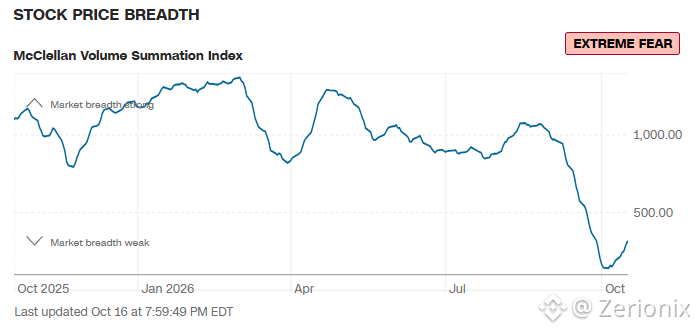
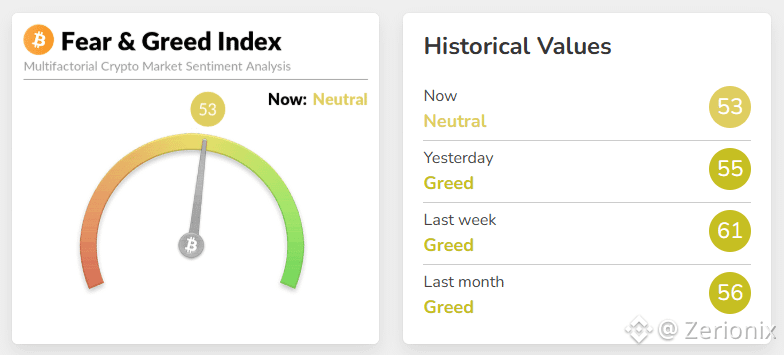
Wall Street is flashing extreme fear, but crypto's Fear & Greed Index is still sitting in neutral territory. That divergence is worth watching. 👀
According to Coin Bureau’s breakdown of CNN’s Fear & Greed Index, Wall Street’s reading plunged from 46 to 18 in just one week, its lowest level since April. Six of the index’s seven indicators are now showing extreme fear.
The warning signs are spread across the market.
Volatility is rising, investors are paying more attention to downside protection, bonds have outperformed stocks over the past 20 trading days, and market breadth has weakened sharply.
Even momentum is fading. The S&P 500 remains above its 125 day moving average, but its cushion has narrowed considerably.
Meanwhile, the junk bond gauge is showing fear rather than extreme fear, suggesting credit markets haven't deteriorated to the same degree across every indicator.
Now compare that with crypto.
The Crypto Fear & Greed Index is reportedly at 53, in neutral territory, while Bitcoin is down just 1.2% on the week.
Personally, I wouldn't interpret that gap as proof that Bitcoin is immune to Wall Street's weakness.
Crypto trades around the clock, but it remains sensitive to liquidity, risk appetite and broader market positioning. If equity weakness spreads and investors start reducing exposure across risk assets, Bitcoin could still feel the pressure.
The other possibility is that crypto is showing relative resilience for now.
The key is whether that resilience holds if traditional markets get worse.
Wall Street is getting nervous. The question is whether Bitcoin keeps ignoring the warning signs or eventually catches up.
Wall Street is flashing extreme fear, but crypto's Fear & Greed Index is still sitting in neutral territory. That divergence is worth watching. 👀
According to Coin Bureau’s breakdown of CNN’s Fear & Greed Index, Wall Street’s reading plunged from 46 to 18 in just one week, its lowest level since April. Six of the index’s seven indicators are now showing extreme fear.
The warning signs are spread across the market.
Volatility is rising, investors are paying more attention to downside protection, bonds have outperformed stocks over the past 20 trading days, and market breadth has weakened sharply.
Even momentum is fading. The S&P 500 remains above its 125 day moving average, but its cushion has narrowed considerably.
Meanwhile, the junk bond gauge is showing fear rather than extreme fear, suggesting credit markets haven't deteriorated to the same degree across every indicator.
Now compare that with crypto.
The Crypto Fear & Greed Index is reportedly at 53, in neutral territory, while Bitcoin is down just 1.2% on the week.
Personally, I wouldn't interpret that gap as proof that Bitcoin is immune to Wall Street's weakness.
Crypto trades around the clock, but it remains sensitive to liquidity, risk appetite and broader market positioning. If equity weakness spreads and investors start reducing exposure across risk assets, Bitcoin could still feel the pressure.
The other possibility is that crypto is showing relative resilience for now.
The key is whether that resilience holds if traditional markets get worse.
Wall Street is getting nervous. The question is whether Bitcoin keeps ignoring the warning signs or eventually catches up.
According to Coin Bureau’s breakdown of CNN’s Fear & Greed Index, Wall Street’s reading plunged from 46 to 18 in just one week, its lowest level since April. Six of the index’s seven indicators are now showing extreme fear.
The warning signs are spread across the market.
Volatility is rising, investors are paying more attention to downside protection, bonds have outperformed stocks over the past 20 trading days, and market breadth has weakened sharply.
Even momentum is fading. The S&P 500 remains above its 125 day moving average, but its cushion has narrowed considerably.
Meanwhile, the junk bond gauge is showing fear rather than extreme fear, suggesting credit markets haven't deteriorated to the same degree across every indicator.
Now compare that with crypto.
The Crypto Fear & Greed Index is reportedly at 53, in neutral territory, while Bitcoin is down just 1.2% on the week.
Personally, I wouldn't interpret that gap as proof that Bitcoin is immune to Wall Street's weakness.
Crypto trades around the clock, but it remains sensitive to liquidity, risk appetite and broader market positioning. If equity weakness spreads and investors start reducing exposure across risk assets, Bitcoin could still feel the pressure.
The other possibility is that crypto is showing relative resilience for now.
The key is whether that resilience holds if traditional markets get worse.
Wall Street is getting nervous. The question is whether Bitcoin keeps ignoring the warning signs or eventually catches up.
28
·
--
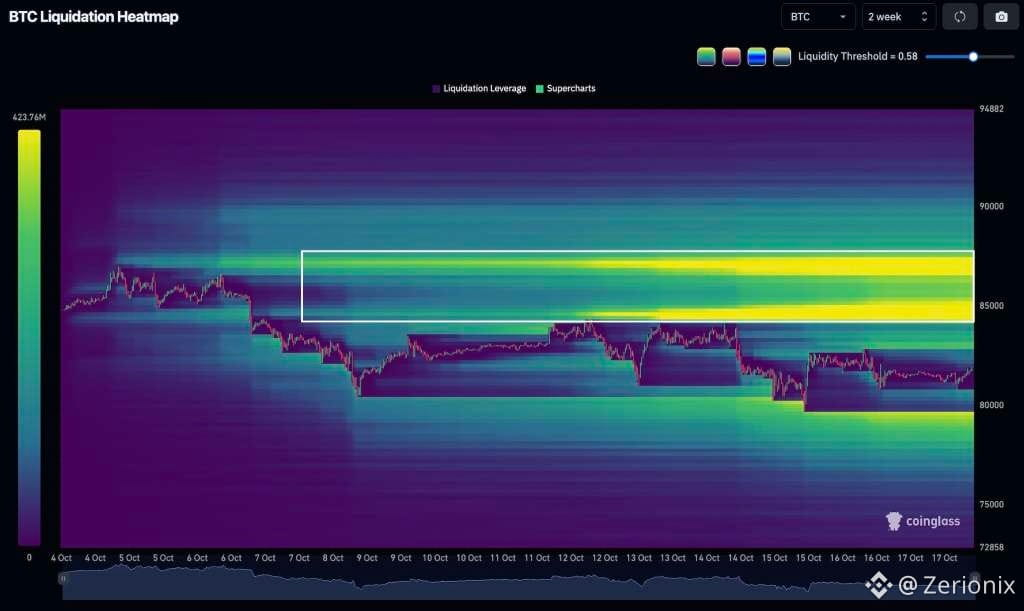
Bitcoin has a massive liquidity cluster sitting above its current price. But a short squeeze isn't guaranteed.
The Coinglass liquidation heatmap shows bright liquidity zones around $84,000 to $88,000, with particularly strong concentrations near the upper end of that range.
BTC has been trending lower across the period shown, so these levels are worth watching if buyers regain control.
Here's why.
When price moves into a dense cluster of leveraged short positions, forced liquidations can create additional buying pressure. That can accelerate an upward move and turn a normal rebound into a short squeeze.
But there's a catch.
A liquidation heatmap shows estimated liquidation levels, not guaranteed orders waiting to be triggered. Liquidity can change, and price could just as easily continue lower before reaching those zones.
Personally, I'm watching whether BTC can reclaim nearby resistance with real buying volume. If it does, that overhead liquidity could become a potential target.
If buyers fail to step in, the heatmap alone won't save the bullish setup.
The interesting part isn't just how much liquidity sits above Bitcoin.
It's whether price has enough momentum to reach it. 👀
$BTC #BTC Price Analysis# #Bitcoin Price Prediction: What is Bitcoins next move?#
Bitcoin has a massive liquidity cluster sitting above its current price. But a short squeeze isn't guaranteed.
The Coinglass liquidation heatmap shows bright liquidity zones around $84,000 to $88,000, with particularly strong concentrations near the upper end of that range.
BTC has been trending lower across the period shown, so these levels are worth watching if buyers regain control.
Here's why.
When price moves into a dense cluster of leveraged short positions, forced liquidations can create additional buying pressure. That can accelerate an upward move and turn a normal rebound into a short squeeze.
But there's a catch.
A liquidation heatmap shows estimated liquidation levels, not guaranteed orders waiting to be triggered. Liquidity can change, and price could just as easily continue lower before reaching those zones.
Personally, I'm watching whether BTC can reclaim nearby resistance with real buying volume. If it does, that overhead liquidity could become a potential target.
If buyers fail to step in, the heatmap alone won't save the bullish setup.
The interesting part isn't just how much liquidity sits above Bitcoin.
It's whether price has enough momentum to reach it. 👀
$BTC #BTC Price Analysis# #Bitcoin Price Prediction: What is Bitcoins next move?#
The Coinglass liquidation heatmap shows bright liquidity zones around $84,000 to $88,000, with particularly strong concentrations near the upper end of that range.
BTC has been trending lower across the period shown, so these levels are worth watching if buyers regain control.
Here's why.
When price moves into a dense cluster of leveraged short positions, forced liquidations can create additional buying pressure. That can accelerate an upward move and turn a normal rebound into a short squeeze.
But there's a catch.
A liquidation heatmap shows estimated liquidation levels, not guaranteed orders waiting to be triggered. Liquidity can change, and price could just as easily continue lower before reaching those zones.
Personally, I'm watching whether BTC can reclaim nearby resistance with real buying volume. If it does, that overhead liquidity could become a potential target.
If buyers fail to step in, the heatmap alone won't save the bullish setup.
The interesting part isn't just how much liquidity sits above Bitcoin.
It's whether price has enough momentum to reach it. 👀
$BTC #BTC Price Analysis# #Bitcoin Price Prediction: What is Bitcoins next move?#
31
·
--
Solana just edged out BNB Chain in stablecoin transfer count. But the gap is tighter than you might think.
According to the reported September figures, Solana recorded 557 million stablecoin transfers, compared with 543 million on BNB Chain.
That’s a difference of just 14 million transfers, putting Solana roughly 2.6% ahead.
What stands out to me is how competitive the race for stablecoin activity has become. Stablecoins are increasingly important to payments, trading, DeFi and moving liquidity across crypto markets.
But transfer count is only one piece of the picture.
A network can process more transfers without necessarily moving more value or generating more economic activity. Transaction value, unique users, fees and liquidity all help explain whether that activity reflects meaningful adoption or simply a high volume of small transactions.
Personally, I see this as a useful signal for Solana’s usage, not definitive proof that it leads every stablecoin metric.
The bigger question is whether Solana can turn that transaction activity into sustained growth across payments and DeFi.
Because winning the transfer count is one thing.
Capturing the value flowing through those transfers is another.
$SOL #Macro Insights# #BNBChain# $BNB
Solana just edged out BNB Chain in stablecoin transfer count. But the gap is tighter than you might think.
According to the reported September figures, Solana recorded 557 million stablecoin transfers, compared with 543 million on BNB Chain.
That’s a difference of just 14 million transfers, putting Solana roughly 2.6% ahead.
What stands out to me is how competitive the race for stablecoin activity has become. Stablecoins are increasingly important to payments, trading, DeFi and moving liquidity across crypto markets.
But transfer count is only one piece of the picture.
A network can process more transfers without necessarily moving more value or generating more economic activity. Transaction value, unique users, fees and liquidity all help explain whether that activity reflects meaningful adoption or simply a high volume of small transactions.
Personally, I see this as a useful signal for Solana’s usage, not definitive proof that it leads every stablecoin metric.
The bigger question is whether Solana can turn that transaction activity into sustained growth across payments and DeFi.
Because winning the transfer count is one thing.
Capturing the value flowing through those transfers is another.
$SOL #Macro Insights# #BNBChain# $BNB
According to the reported September figures, Solana recorded 557 million stablecoin transfers, compared with 543 million on BNB Chain.
That’s a difference of just 14 million transfers, putting Solana roughly 2.6% ahead.
What stands out to me is how competitive the race for stablecoin activity has become. Stablecoins are increasingly important to payments, trading, DeFi and moving liquidity across crypto markets.
But transfer count is only one piece of the picture.
A network can process more transfers without necessarily moving more value or generating more economic activity. Transaction value, unique users, fees and liquidity all help explain whether that activity reflects meaningful adoption or simply a high volume of small transactions.
Personally, I see this as a useful signal for Solana’s usage, not definitive proof that it leads every stablecoin metric.
The bigger question is whether Solana can turn that transaction activity into sustained growth across payments and DeFi.
Because winning the transfer count is one thing.
Capturing the value flowing through those transfers is another.
$SOL #Macro Insights# #BNBChain# $BNB

44
·
--
$450M in active loans in less than seven months. Aave V4 is starting to show that its launch was more than just another protocol upgrade.
Since going live in March 2026, the latest version of Aave has reportedly reached $450M in active loans, a sign that borrowers are beginning to use the new system at scale.
And that distinction matters.
In DeFi, launch hype is easy. Sustained borrowing activity is harder to achieve because users need liquidity, competitive rates and enough confidence in the protocol to put capital to work.
Personally, I think active loans are a more useful adoption signal than TVL alone. Deposited capital shows what users are willing to supply, while outstanding loans show that borrowers are actually using the available liquidity.
But $450M doesn't tell the whole story.
I'd still want to see how much of that activity comes from organic demand, whether borrowing remains steady as market conditions change, and how the protocol manages risk as it grows.
More borrowing can mean stronger product adoption, but it also means greater exposure to collateral volatility, liquidations and bad debt if risk controls fail.
The next milestone isn't just a bigger number.
It's whether Aave V4 can keep growing while maintaining healthy utilization and strong risk management.
Because in DeFi lending, scale gets attention. Sustainable credit is what builds trust.
$AAVE #BTC Price Analysis# #Meme Alpha# $SUI
$450M in active loans in less than seven months. Aave V4 is starting to show that its launch was more than just another protocol upgrade.
Since going live in March 2026, the latest version of Aave has reportedly reached $450M in active loans, a sign that borrowers are beginning to use the new system at scale.
And that distinction matters.
In DeFi, launch hype is easy. Sustained borrowing activity is harder to achieve because users need liquidity, competitive rates and enough confidence in the protocol to put capital to work.
Personally, I think active loans are a more useful adoption signal than TVL alone. Deposited capital shows what users are willing to supply, while outstanding loans show that borrowers are actually using the available liquidity.
But $450M doesn't tell the whole story.
I'd still want to see how much of that activity comes from organic demand, whether borrowing remains steady as market conditions change, and how the protocol manages risk as it grows.
More borrowing can mean stronger product adoption, but it also means greater exposure to collateral volatility, liquidations and bad debt if risk controls fail.
The next milestone isn't just a bigger number.
It's whether Aave V4 can keep growing while maintaining healthy utilization and strong risk management.
Because in DeFi lending, scale gets attention. Sustainable credit is what builds trust.
$AAVE #BTC Price Analysis# #Meme Alpha# $SUI
Since going live in March 2026, the latest version of Aave has reportedly reached $450M in active loans, a sign that borrowers are beginning to use the new system at scale.
And that distinction matters.
In DeFi, launch hype is easy. Sustained borrowing activity is harder to achieve because users need liquidity, competitive rates and enough confidence in the protocol to put capital to work.
Personally, I think active loans are a more useful adoption signal than TVL alone. Deposited capital shows what users are willing to supply, while outstanding loans show that borrowers are actually using the available liquidity.
But $450M doesn't tell the whole story.
I'd still want to see how much of that activity comes from organic demand, whether borrowing remains steady as market conditions change, and how the protocol manages risk as it grows.
More borrowing can mean stronger product adoption, but it also means greater exposure to collateral volatility, liquidations and bad debt if risk controls fail.
The next milestone isn't just a bigger number.
It's whether Aave V4 can keep growing while maintaining healthy utilization and strong risk management.
Because in DeFi lending, scale gets attention. Sustainable credit is what builds trust.
$AAVE #BTC Price Analysis# #Meme Alpha# $SUI

46
·
--
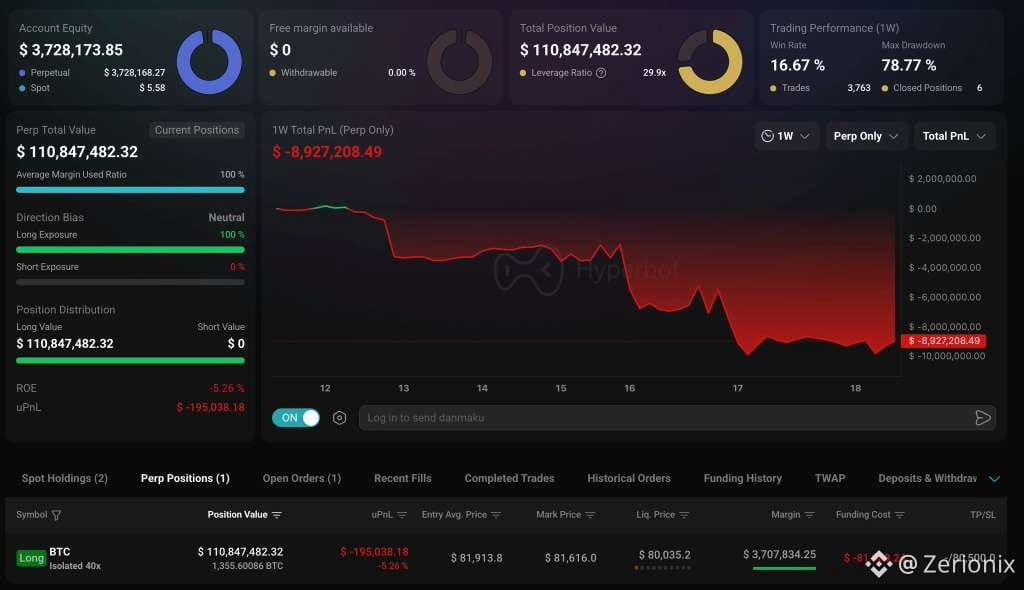
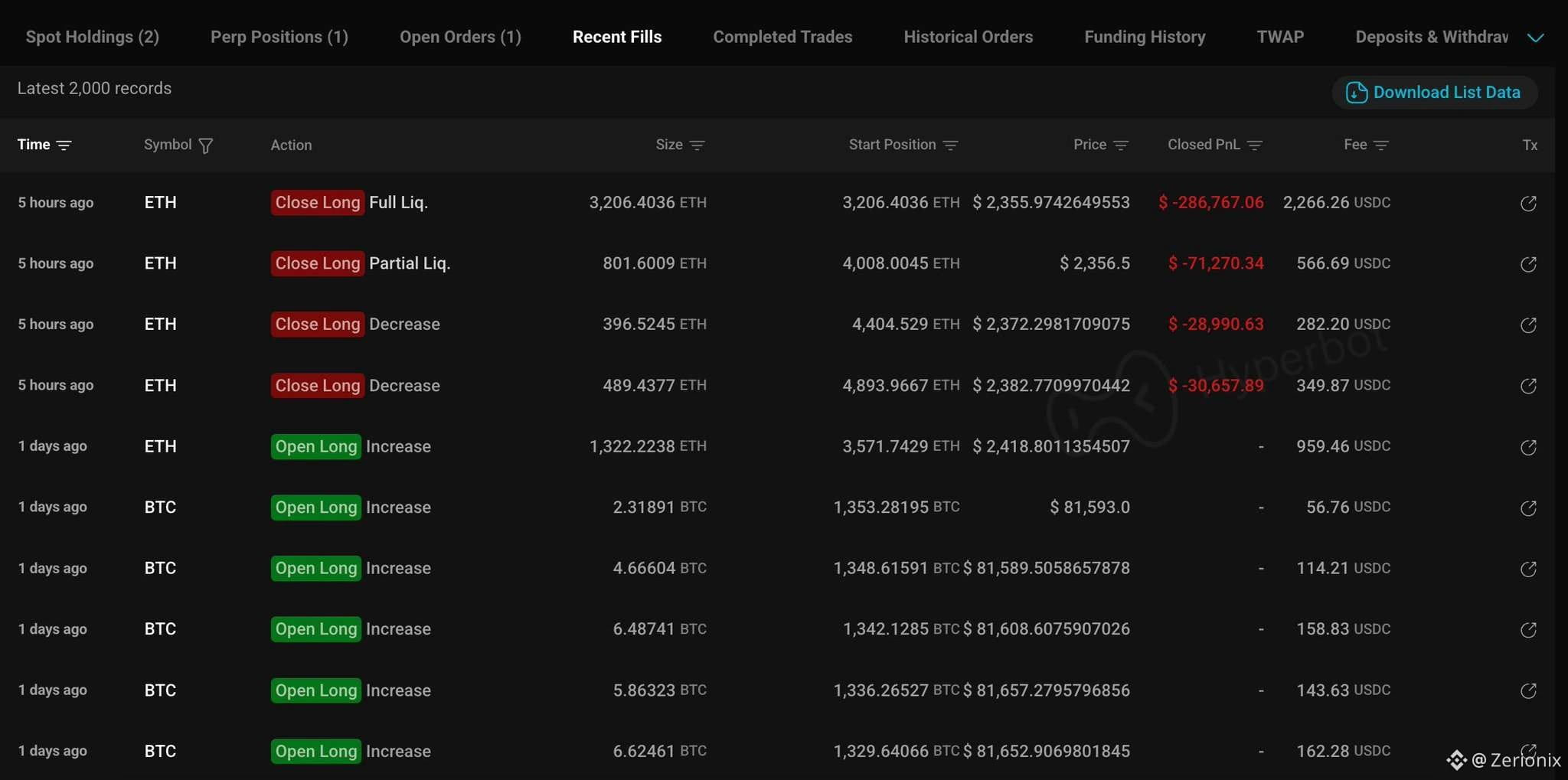
Another $1.08M gone. This trader’s $ETH long has been fully liquidated, and his remaining $BTC position is still sitting dangerously close to the edge.
According to Lookonchain, the trader still holds a long position of 1,355.6 $BTC, worth approximately $110.85M.
His liquidation price is $80,035.7, but there’s an important detail. He has reportedly placed a stop loss at $80,500.
That leaves roughly $464 between his stop loss and liquidation price.
On a position this large, that gap matters. A sharp move, slippage or execution issues could affect how much of the position is actually closed near the intended level.
Personally, I wouldn’t focus only on the $110M headline. A position’s notional value isn't the same as the trader’s capital at risk, and we don't know his full margin setup or whether he has other hedges.
Still, losing another $1.08M on ETH while holding a massive BTC long puts the risk into perspective.
Leverage can make a trader look like a whale on the way up and leave them fighting for survival on the way down.
Now the real question is whether BTC holds above that stop level, or volatility forces another painful exit.
$ETH #BTC Price Analysis# #Altcoin Season# $BTC
Another $1.08M gone. This trader’s $ETH long has been fully liquidated, and his remaining $BTC position is still sitting dangerously close to the edge.
According to Lookonchain, the trader still holds a long position of 1,355.6 $BTC, worth approximately $110.85M.
His liquidation price is $80,035.7, but there’s an important detail. He has reportedly placed a stop loss at $80,500.
That leaves roughly $464 between his stop loss and liquidation price.
On a position this large, that gap matters. A sharp move, slippage or execution issues could affect how much of the position is actually closed near the intended level.
Personally, I wouldn’t focus only on the $110M headline. A position’s notional value isn't the same as the trader’s capital at risk, and we don't know his full margin setup or whether he has other hedges.
Still, losing another $1.08M on ETH while holding a massive BTC long puts the risk into perspective.
Leverage can make a trader look like a whale on the way up and leave them fighting for survival on the way down.
Now the real question is whether BTC holds above that stop level, or volatility forces another painful exit.
$ETH #BTC Price Analysis# #Altcoin Season# $BTC
According to Lookonchain, the trader still holds a long position of 1,355.6 $BTC, worth approximately $110.85M.
His liquidation price is $80,035.7, but there’s an important detail. He has reportedly placed a stop loss at $80,500.
That leaves roughly $464 between his stop loss and liquidation price.
On a position this large, that gap matters. A sharp move, slippage or execution issues could affect how much of the position is actually closed near the intended level.
Personally, I wouldn’t focus only on the $110M headline. A position’s notional value isn't the same as the trader’s capital at risk, and we don't know his full margin setup or whether he has other hedges.
Still, losing another $1.08M on ETH while holding a massive BTC long puts the risk into perspective.
Leverage can make a trader look like a whale on the way up and leave them fighting for survival on the way down.
Now the real question is whether BTC holds above that stop level, or volatility forces another painful exit.
$ETH #BTC Price Analysis# #Altcoin Season# $BTC
74
·
--
Banks may have more influence over stablecoin growth than many crypto investors realize.
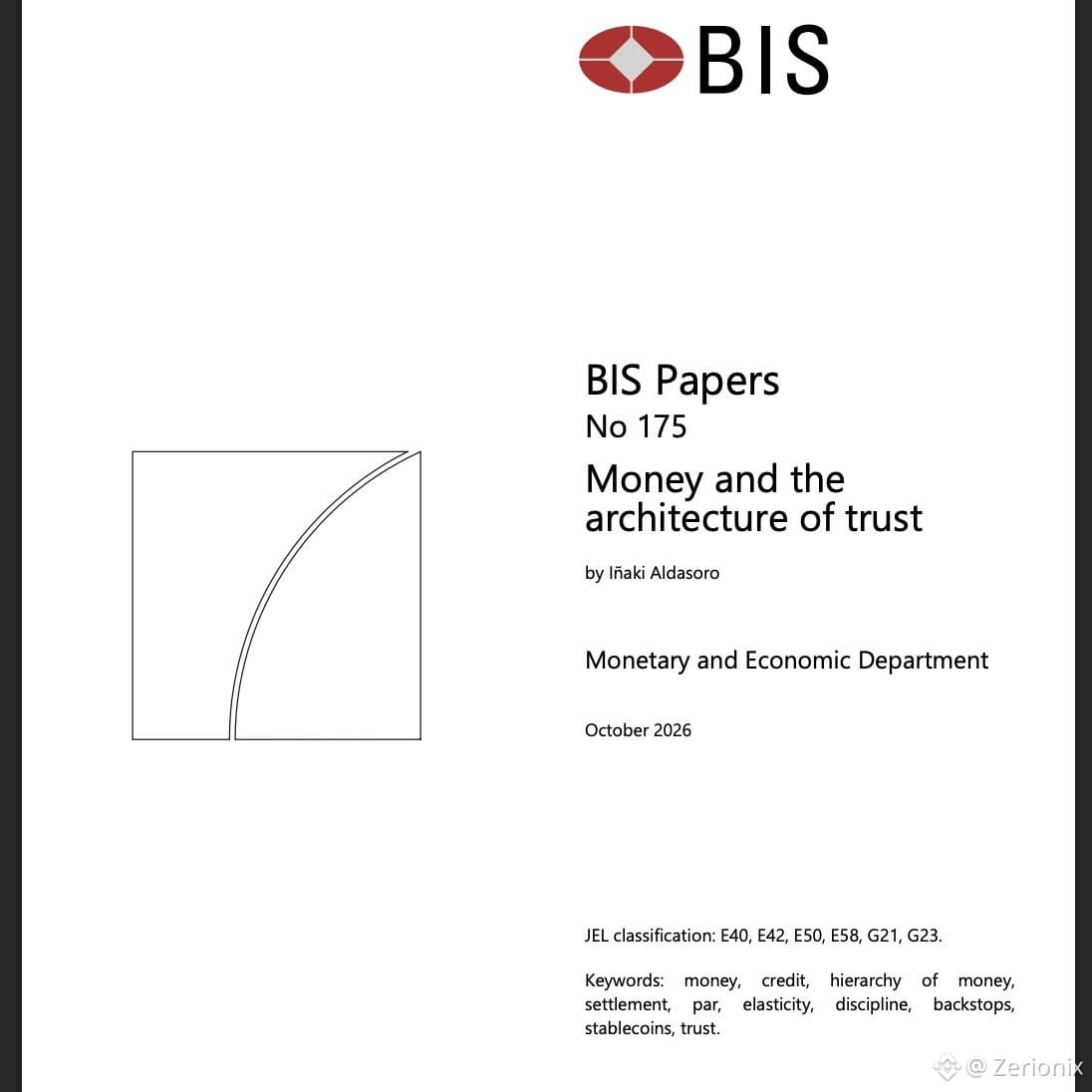
A new Bank for International Settlements (BIS) study suggests that even a tiny increase in U.S. bank deposit rates can slow stablecoin expansion.
Researchers found that a 0.01 percentage-point increase in deposit rates was associated with roughly a 3 percentage-point drop in stablecoin market-cap growth over 10 weeks. The effect was stronger for USDC than USDT. The study used U.S. data from 2019 to June 2025.
Why does this matter?
Stablecoins offer a convenient way to hold dollar value and move money across crypto markets, but most don't pay holders interest. If banks start offering better returns on deposits, some people may have less reason to keep their money in stablecoins.
And here's the interesting part: major banks still hold enormous amounts of customer deposits while paying little or no interest on many accounts. That leaves room for competition over where people choose to keep their money.
Personally, I think this highlights something important: stablecoin adoption isn't driven by crypto demand alone. Traditional banking rates can influence it too.
But there's a distinction worth remembering. The study links higher deposit rates to slower stablecoin growth; it doesn't prove that bank deposits or lending automatically fall when stablecoins grow.
The bigger question is whether stablecoins can keep expanding as banks compete harder for depositors — and whether future yield-bearing stablecoins change that equation.
$BTC #BTC Price Analysis# #Macro Insights# $ETH
Banks may have more influence over stablecoin growth than many crypto investors realize.
A new Bank for International Settlements (BIS) study suggests that even a tiny increase in U.S. bank deposit rates can slow stablecoin expansion.
Researchers found that a 0.01 percentage-point increase in deposit rates was associated with roughly a 3 percentage-point drop in stablecoin market-cap growth over 10 weeks. The effect was stronger for USDC than USDT. The study used U.S. data from 2019 to June 2025.
Why does this matter?
Stablecoins offer a convenient way to hold dollar value and move money across crypto markets, but most don't pay holders interest. If banks start offering better returns on deposits, some people may have less reason to keep their money in stablecoins.
And here's the interesting part: major banks still hold enormous amounts of customer deposits while paying little or no interest on many accounts. That leaves room for competition over where people choose to keep their money.
Personally, I think this highlights something important: stablecoin adoption isn't driven by crypto demand alone. Traditional banking rates can influence it too.
But there's a distinction worth remembering. The study links higher deposit rates to slower stablecoin growth; it doesn't prove that bank deposits or lending automatically fall when stablecoins grow.
The bigger question is whether stablecoins can keep expanding as banks compete harder for depositors — and whether future yield-bearing stablecoins change that equation.
$BTC #BTC Price Analysis# #Macro Insights# $ETH
A new Bank for International Settlements (BIS) study suggests that even a tiny increase in U.S. bank deposit rates can slow stablecoin expansion.
Researchers found that a 0.01 percentage-point increase in deposit rates was associated with roughly a 3 percentage-point drop in stablecoin market-cap growth over 10 weeks. The effect was stronger for USDC than USDT. The study used U.S. data from 2019 to June 2025.
Why does this matter?
Stablecoins offer a convenient way to hold dollar value and move money across crypto markets, but most don't pay holders interest. If banks start offering better returns on deposits, some people may have less reason to keep their money in stablecoins.
And here's the interesting part: major banks still hold enormous amounts of customer deposits while paying little or no interest on many accounts. That leaves room for competition over where people choose to keep their money.
Personally, I think this highlights something important: stablecoin adoption isn't driven by crypto demand alone. Traditional banking rates can influence it too.
But there's a distinction worth remembering. The study links higher deposit rates to slower stablecoin growth; it doesn't prove that bank deposits or lending automatically fall when stablecoins grow.
The bigger question is whether stablecoins can keep expanding as banks compete harder for depositors — and whether future yield-bearing stablecoins change that equation.
$BTC #BTC Price Analysis# #Macro Insights# $ETH

45
·
--
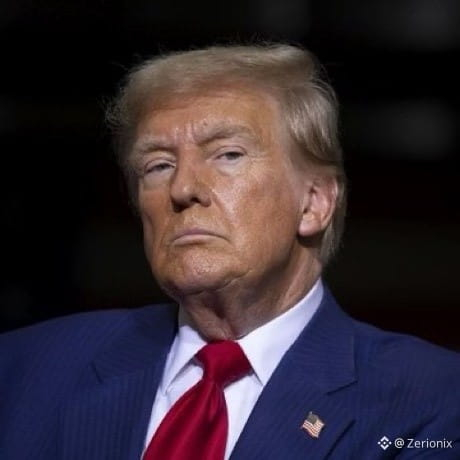
Trump faces potential court sanctions in his $10 billion lawsuit against the BBC.
A U.S. magistrate judge has warned Donald Trump that sanctions could follow if he continues failing to participate in the legal process surrounding his defamation case against the British broadcaster.
The dispute centers on a BBC documentary that edited portions of Trump's January 6, 2021 speech. The BBC apologized for the editing but denies that it defamed him.
Trump's legal team canceled a deposition scheduled for October 16, citing “matters of national importance,” and reportedly suggested January 2027 as an alternative — after the case's December discovery deadline.
The BBC is asking the court to compel his testimony. Judge Enjolique A. Lett has ordered Trump to respond by October 22.
The key distinction: the judge has threatened sanctions, not imposed them. The dispute is now about whether Trump will provide testimony within the court's schedule while the underlying defamation claims remain unresolved.
Source: Associated Press, Bloomberg Law.
$TRUMP #BTC Price Analysis# #Altcoin Season#
Trump faces potential court sanctions in his $10 billion lawsuit against the BBC.
A U.S. magistrate judge has warned Donald Trump that sanctions could follow if he continues failing to participate in the legal process surrounding his defamation case against the British broadcaster.
The dispute centers on a BBC documentary that edited portions of Trump's January 6, 2021 speech. The BBC apologized for the editing but denies that it defamed him.
Trump's legal team canceled a deposition scheduled for October 16, citing “matters of national importance,” and reportedly suggested January 2027 as an alternative — after the case's December discovery deadline.
The BBC is asking the court to compel his testimony. Judge Enjolique A. Lett has ordered Trump to respond by October 22.
The key distinction: the judge has threatened sanctions, not imposed them. The dispute is now about whether Trump will provide testimony within the court's schedule while the underlying defamation claims remain unresolved.
Source: Associated Press, Bloomberg Law.
$TRUMP #BTC Price Analysis# #Altcoin Season#
A U.S. magistrate judge has warned Donald Trump that sanctions could follow if he continues failing to participate in the legal process surrounding his defamation case against the British broadcaster.
The dispute centers on a BBC documentary that edited portions of Trump's January 6, 2021 speech. The BBC apologized for the editing but denies that it defamed him.
Trump's legal team canceled a deposition scheduled for October 16, citing “matters of national importance,” and reportedly suggested January 2027 as an alternative — after the case's December discovery deadline.
The BBC is asking the court to compel his testimony. Judge Enjolique A. Lett has ordered Trump to respond by October 22.
The key distinction: the judge has threatened sanctions, not imposed them. The dispute is now about whether Trump will provide testimony within the court's schedule while the underlying defamation claims remain unresolved.
Source: Associated Press, Bloomberg Law.
$TRUMP #BTC Price Analysis# #Altcoin Season#

54
·
--
The G7 is preparing for a financial crisis where AI could be the attacker. 👀
G7 finance leaders have agreed to run tabletop exercises simulating cyberattacks powered by frontier AI, according to Reuters.
Japan’s Finance Minister Satsuki Katayama said the drills will test how authorities respond to AI driven threats against financial systems. Private financial institutions may also participate.
The goal is to identify gaps in existing protocols and update response manuals before a real incident exposes them.
And this matters because AI is changing the economics of cyberattacks.
More capable models could help attackers automate vulnerability discovery, generate convincing phishing campaigns and coordinate attacks at a speed that traditional response systems may struggle to match.
Financial institutions are particularly exposed because banks, payment networks, exchanges and other critical services are deeply interconnected. An attack on one part of the system can create problems far beyond its original target.
Personally, I think the most important part of this announcement isn't the simulation itself. It's whether these exercises reveal weaknesses that authorities can actually fix.
A tabletop drill can expose coordination failures, but it cannot guarantee that real institutions will respond effectively under pressure.
The next step is turning those lessons into stronger defenses, faster information sharing and clear responsibilities during an incident.
AI is becoming a tool for both sides of cybersecurity.
The question is whether financial institutions can improve their defenses as quickly as the threats evolve.
#BTC Price Analysis# $ETH #Altcoin Season#
The G7 is preparing for a financial crisis where AI could be the attacker. 👀
G7 finance leaders have agreed to run tabletop exercises simulating cyberattacks powered by frontier AI, according to Reuters.
Japan’s Finance Minister Satsuki Katayama said the drills will test how authorities respond to AI driven threats against financial systems. Private financial institutions may also participate.
The goal is to identify gaps in existing protocols and update response manuals before a real incident exposes them.
And this matters because AI is changing the economics of cyberattacks.
More capable models could help attackers automate vulnerability discovery, generate convincing phishing campaigns and coordinate attacks at a speed that traditional response systems may struggle to match.
Financial institutions are particularly exposed because banks, payment networks, exchanges and other critical services are deeply interconnected. An attack on one part of the system can create problems far beyond its original target.
Personally, I think the most important part of this announcement isn't the simulation itself. It's whether these exercises reveal weaknesses that authorities can actually fix.
A tabletop drill can expose coordination failures, but it cannot guarantee that real institutions will respond effectively under pressure.
The next step is turning those lessons into stronger defenses, faster information sharing and clear responsibilities during an incident.
AI is becoming a tool for both sides of cybersecurity.
The question is whether financial institutions can improve their defenses as quickly as the threats evolve.
#BTC Price Analysis# $ETH #Altcoin Season#
G7 finance leaders have agreed to run tabletop exercises simulating cyberattacks powered by frontier AI, according to Reuters.
Japan’s Finance Minister Satsuki Katayama said the drills will test how authorities respond to AI driven threats against financial systems. Private financial institutions may also participate.
The goal is to identify gaps in existing protocols and update response manuals before a real incident exposes them.
And this matters because AI is changing the economics of cyberattacks.
More capable models could help attackers automate vulnerability discovery, generate convincing phishing campaigns and coordinate attacks at a speed that traditional response systems may struggle to match.
Financial institutions are particularly exposed because banks, payment networks, exchanges and other critical services are deeply interconnected. An attack on one part of the system can create problems far beyond its original target.
Personally, I think the most important part of this announcement isn't the simulation itself. It's whether these exercises reveal weaknesses that authorities can actually fix.
A tabletop drill can expose coordination failures, but it cannot guarantee that real institutions will respond effectively under pressure.
The next step is turning those lessons into stronger defenses, faster information sharing and clear responsibilities during an incident.
AI is becoming a tool for both sides of cybersecurity.
The question is whether financial institutions can improve their defenses as quickly as the threats evolve.
#BTC Price Analysis# $ETH #Altcoin Season#


69
·
--
Having USDT in your wallet doesn't mean you can use it on every network.
USDT on TON and USDT on Base exist on different blockchains. Sending tokens through an ordinary transfer won't move them between networks.
That's where cross chain swaps come in.
Before making the move, check the source and destination networks, review the estimated amount you'll receive, and account for transaction fees. Keep enough TON available for the required network fee, too.
Once you've initiated the swap, monitor its progress until the destination transaction is complete. Don't assume that starting the process means your USDT has already arrived on Base.
STONfi provides a guide for this exact route, making it easier to understand the process before you begin:
https://ston.fi/how-to-send-usdt-from-ton-to-base
What interests me about cross chain infrastructure is how it can connect different ecosystems without making users manually handle every bridging step themselves.
That's also part of what Omniston is designed to enable: cross chain execution between supported networks.
The experience may become simpler, but checking the network, understanding the fees, and verifying completion still matter.
$ZEC #BTC Price Analysis# #BTC Price Analysis#
Having USDT in your wallet doesn't mean you can use it on every network.
USDT on TON and USDT on Base exist on different blockchains. Sending tokens through an ordinary transfer won't move them between networks.
That's where cross chain swaps come in.
Before making the move, check the source and destination networks, review the estimated amount you'll receive, and account for transaction fees. Keep enough TON available for the required network fee, too.
Once you've initiated the swap, monitor its progress until the destination transaction is complete. Don't assume that starting the process means your USDT has already arrived on Base.
STONfi provides a guide for this exact route, making it easier to understand the process before you begin:
https://ston.fi/how-to-send-usdt-from-ton-to-base
What interests me about cross chain infrastructure is how it can connect different ecosystems without making users manually handle every bridging step themselves.
That's also part of what Omniston is designed to enable: cross chain execution between supported networks.
The experience may become simpler, but checking the network, understanding the fees, and verifying completion still matter.
$ZEC #BTC Price Analysis# #BTC Price Analysis#
USDT on TON and USDT on Base exist on different blockchains. Sending tokens through an ordinary transfer won't move them between networks.
That's where cross chain swaps come in.
Before making the move, check the source and destination networks, review the estimated amount you'll receive, and account for transaction fees. Keep enough TON available for the required network fee, too.
Once you've initiated the swap, monitor its progress until the destination transaction is complete. Don't assume that starting the process means your USDT has already arrived on Base.
STONfi provides a guide for this exact route, making it easier to understand the process before you begin:
https://ston.fi/how-to-send-usdt-from-ton-to-base
What interests me about cross chain infrastructure is how it can connect different ecosystems without making users manually handle every bridging step themselves.
That's also part of what Omniston is designed to enable: cross chain execution between supported networks.
The experience may become simpler, but checking the network, understanding the fees, and verifying completion still matter.
$ZEC #BTC Price Analysis# #BTC Price Analysis#

54
·
--
Claude just solved a 26 year old cryptography mystery in under 30 minutes. And the answer could change how we think about AI in security research.
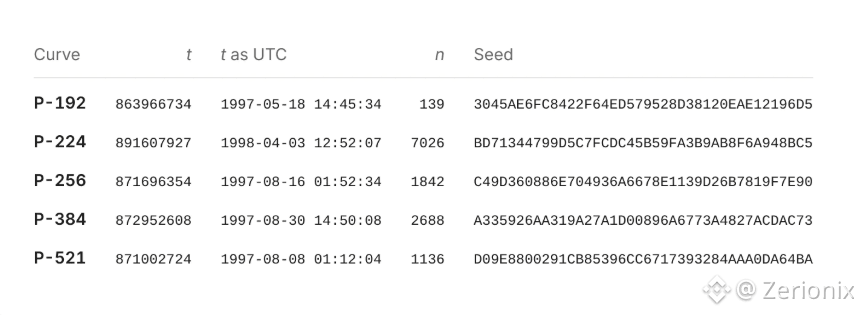
Anthropic says Claude traced the origins of the supposedly random seeds used for elliptic curves such as P‑256 to simple timestamps from 1997 and 1998.
NIST published the curves in 2000, but the origins of those parameters had remained unexplained for decades.
That uncertainty helped fuel speculation about whether the NSA could have hidden a backdoor in the curves.
Claude’s discovery offers a much simpler explanation. The $36,864 bounty is set to be donated to the Internet Security Research Group.
But there’s an important distinction here. This does not mean Claude broke P‑256 or cracked modern encryption. Anthropic says the finding makes deliberate backdoor theories much less plausible.
Personally, I think the bigger story is the research capability itself.
AI isn't just generating code or answering technical questions. It can help investigate decades old problems by finding patterns, testing hypotheses and connecting evidence that researchers may have struggled to piece together.
That capability can help defenders audit the systems we already trust. It could also help attackers search for weaknesses faster.
The real question is how many long standing security mysteries AI will help solve next.
Because the same technology that helps us understand our defenses could also help someone find a way around them. 👀
$BTC #BTC Price Analysis# $ETH #Altcoin Season#
Claude just solved a 26 year old cryptography mystery in under 30 minutes. And the answer could change how we think about AI in security research.
Anthropic says Claude traced the origins of the supposedly random seeds used for elliptic curves such as P‑256 to simple timestamps from 1997 and 1998.
NIST published the curves in 2000, but the origins of those parameters had remained unexplained for decades.
That uncertainty helped fuel speculation about whether the NSA could have hidden a backdoor in the curves.
Claude’s discovery offers a much simpler explanation. The $36,864 bounty is set to be donated to the Internet Security Research Group.
But there’s an important distinction here. This does not mean Claude broke P‑256 or cracked modern encryption. Anthropic says the finding makes deliberate backdoor theories much less plausible.
Personally, I think the bigger story is the research capability itself.
AI isn't just generating code or answering technical questions. It can help investigate decades old problems by finding patterns, testing hypotheses and connecting evidence that researchers may have struggled to piece together.
That capability can help defenders audit the systems we already trust. It could also help attackers search for weaknesses faster.
The real question is how many long standing security mysteries AI will help solve next.
Because the same technology that helps us understand our defenses could also help someone find a way around them. 👀
$BTC #BTC Price Analysis# $ETH #Altcoin Season#
Anthropic says Claude traced the origins of the supposedly random seeds used for elliptic curves such as P‑256 to simple timestamps from 1997 and 1998.
NIST published the curves in 2000, but the origins of those parameters had remained unexplained for decades.
That uncertainty helped fuel speculation about whether the NSA could have hidden a backdoor in the curves.
Claude’s discovery offers a much simpler explanation. The $36,864 bounty is set to be donated to the Internet Security Research Group.
But there’s an important distinction here. This does not mean Claude broke P‑256 or cracked modern encryption. Anthropic says the finding makes deliberate backdoor theories much less plausible.
Personally, I think the bigger story is the research capability itself.
AI isn't just generating code or answering technical questions. It can help investigate decades old problems by finding patterns, testing hypotheses and connecting evidence that researchers may have struggled to piece together.
That capability can help defenders audit the systems we already trust. It could also help attackers search for weaknesses faster.
The real question is how many long standing security mysteries AI will help solve next.
Because the same technology that helps us understand our defenses could also help someone find a way around them. 👀
$BTC #BTC Price Analysis# $ETH #Altcoin Season#
69
·
--
What Actually Happens When You Swap on a DEX?
A DEX swap looks simple. Choose your tokens, check the amount, confirm, and wait.
But there's more happening behind that single click than most beginners realize.
1. Liquidity matters
On many DEXs, trades happen through liquidity pools containing token pairs. The available liquidity affects how much your trade can move the price. A pool with limited depth may give you a worse execution on a large swap.
2. The displayed price isn't everything
Price impact, slippage, and fees can all affect what you actually receive. A token trading at $1 doesn't guarantee you'll get 1,000 tokens for $1,000.
That's why I always recommend checking the estimated output, minimum received, and price impact before confirming.
3. Routing makes a difference
Different DEXs and pools can offer different execution opportunities. Where supported, routing across multiple liquidity sources can help find a suitable swap, although it doesn't guarantee the best price every time.
This is one reason infrastructure matters.STONfi uses Omniston to connect liquidity sources and support smarter execution across its ecosystem.
4. Confirmation isn't always the final step
After you approve a transaction, the blockchain still needs to process it. Cross-chain swaps can involve additional execution and settlement steps, so checking transaction status matters.
Before swapping, check the token, network, estimated output, fees, and minimum received.
If you're new to decentralized exchanges, "WhatIsDEX" (https://whatisdex.com/) is a useful place to start learning the basics.
A DEX swap isn't just exchanging one token for another. Liquidity, pricing, routing, and execution all shape the result.
Understanding those mechanics helps you make more informed decisions before putting your funds at risk.
Explore STON.fi → https://ston.fi/omniston
$ETH #BTC Price Analysis# #Altcoin Season# $SOL
What Actually Happens When You Swap on a DEX?
A DEX swap looks simple. Choose your tokens, check the amount, confirm, and wait.
But there's more happening behind that single click than most beginners realize.
1. Liquidity matters
On many DEXs, trades happen through liquidity pools containing token pairs. The available liquidity affects how much your trade can move the price. A pool with limited depth may give you a worse execution on a large swap.
2. The displayed price isn't everything
Price impact, slippage, and fees can all affect what you actually receive. A token trading at $1 doesn't guarantee you'll get 1,000 tokens for $1,000.
That's why I always recommend checking the estimated output, minimum received, and price impact before confirming.
3. Routing makes a difference
Different DEXs and pools can offer different execution opportunities. Where supported, routing across multiple liquidity sources can help find a suitable swap, although it doesn't guarantee the best price every time.
This is one reason infrastructure matters.STONfi uses Omniston to connect liquidity sources and support smarter execution across its ecosystem.
4. Confirmation isn't always the final step
After you approve a transaction, the blockchain still needs to process it. Cross-chain swaps can involve additional execution and settlement steps, so checking transaction status matters.
Before swapping, check the token, network, estimated output, fees, and minimum received.
If you're new to decentralized exchanges, "WhatIsDEX" (https://whatisdex.com/) is a useful place to start learning the basics.
A DEX swap isn't just exchanging one token for another. Liquidity, pricing, routing, and execution all shape the result.
Understanding those mechanics helps you make more informed decisions before putting your funds at risk.
Explore STON.fi → https://ston.fi/omniston
$ETH #BTC Price Analysis# #Altcoin Season# $SOL
A DEX swap looks simple. Choose your tokens, check the amount, confirm, and wait.
But there's more happening behind that single click than most beginners realize.
1. Liquidity matters
On many DEXs, trades happen through liquidity pools containing token pairs. The available liquidity affects how much your trade can move the price. A pool with limited depth may give you a worse execution on a large swap.
2. The displayed price isn't everything
Price impact, slippage, and fees can all affect what you actually receive. A token trading at $1 doesn't guarantee you'll get 1,000 tokens for $1,000.
That's why I always recommend checking the estimated output, minimum received, and price impact before confirming.
3. Routing makes a difference
Different DEXs and pools can offer different execution opportunities. Where supported, routing across multiple liquidity sources can help find a suitable swap, although it doesn't guarantee the best price every time.
This is one reason infrastructure matters.STONfi uses Omniston to connect liquidity sources and support smarter execution across its ecosystem.
4. Confirmation isn't always the final step
After you approve a transaction, the blockchain still needs to process it. Cross-chain swaps can involve additional execution and settlement steps, so checking transaction status matters.
Before swapping, check the token, network, estimated output, fees, and minimum received.
If you're new to decentralized exchanges, "WhatIsDEX" (https://whatisdex.com/) is a useful place to start learning the basics.
A DEX swap isn't just exchanging one token for another. Liquidity, pricing, routing, and execution all shape the result.
Understanding those mechanics helps you make more informed decisions before putting your funds at risk.
Explore STON.fi → https://ston.fi/omniston
$ETH #BTC Price Analysis# #Altcoin Season# $SOL

56
·
--
Bitget is letting traders speculate on a company before it even goes public.
The exchange has launched JIOUSDT, a pre IPO perpetual contract tied to Jio Platforms.
Reliance Industries’ digital arm is reportedly targeting a $3.5B IPO at a $106B valuation, potentially making it India’s largest ever listing.
But here’s the interesting part.
Traders can gain exposure to the market’s expectations before the actual shares become publicly available.
Personally, I think pre IPO perps are an interesting expansion of crypto derivatives. They bring traditional private market narratives into a market that never sleeps.
But there’s a catch.
A perpetual contract is not the same as owning Jio shares. Traders are speculating on the contract’s price, and its pricing may not perfectly track any eventual IPO valuation or listing price.
That means liquidity, funding rates and price discovery matter even more.
The real question is whether these products become a serious bridge between crypto trading and traditional markets, or simply another high leverage speculation tool.
Would you trade a company before its IPO?
$BTC #BTC Price Analysis# $BGB #Macro Insights#
Bitget is letting traders speculate on a company before it even goes public.
The exchange has launched JIOUSDT, a pre IPO perpetual contract tied to Jio Platforms.
Reliance Industries’ digital arm is reportedly targeting a $3.5B IPO at a $106B valuation, potentially making it India’s largest ever listing.
But here’s the interesting part.
Traders can gain exposure to the market’s expectations before the actual shares become publicly available.
Personally, I think pre IPO perps are an interesting expansion of crypto derivatives. They bring traditional private market narratives into a market that never sleeps.
But there’s a catch.
A perpetual contract is not the same as owning Jio shares. Traders are speculating on the contract’s price, and its pricing may not perfectly track any eventual IPO valuation or listing price.
That means liquidity, funding rates and price discovery matter even more.
The real question is whether these products become a serious bridge between crypto trading and traditional markets, or simply another high leverage speculation tool.
Would you trade a company before its IPO?
$BTC #BTC Price Analysis# $BGB #Macro Insights#
The exchange has launched JIOUSDT, a pre IPO perpetual contract tied to Jio Platforms.
Reliance Industries’ digital arm is reportedly targeting a $3.5B IPO at a $106B valuation, potentially making it India’s largest ever listing.
But here’s the interesting part.
Traders can gain exposure to the market’s expectations before the actual shares become publicly available.
Personally, I think pre IPO perps are an interesting expansion of crypto derivatives. They bring traditional private market narratives into a market that never sleeps.
But there’s a catch.
A perpetual contract is not the same as owning Jio shares. Traders are speculating on the contract’s price, and its pricing may not perfectly track any eventual IPO valuation or listing price.
That means liquidity, funding rates and price discovery matter even more.
The real question is whether these products become a serious bridge between crypto trading and traditional markets, or simply another high leverage speculation tool.
Would you trade a company before its IPO?
$BTC #BTC Price Analysis# $BGB #Macro Insights#


72
·
--
When the market gets boring, meme traders start looking for a new playground.
Cat-themed coins are up 14% while DOGE sits in the red. And honestly, the interesting part isn't just the price difference. It's where traders are choosing to take their risks.
When established meme coins lose momentum, some traders start chasing smaller tokens with fresh narratives and the potential for bigger percentage moves. Attention shifts, volume follows, and suddenly the coins nobody was talking about become the center of the conversation.
But there's a catch. A smaller coin pumping harder doesn't automatically mean money is rotating out of DOGE and into cats. Sometimes it's just a short-lived wave of speculation.
Personally, I think this says more about market psychology than which animal wins the meme-coin race. When traders get impatient, they don't always leave the market. They look for something more exciting.
The real question is whether cat coins can sustain this attention or whether traders are simply chasing the next quick pump.
In meme coins, attention can move fast. So can the exit.
$DOGE #BTC Price Analysis# $CASHCAT
When the market gets boring, meme traders start looking for a new playground.
Cat-themed coins are up 14% while DOGE sits in the red. And honestly, the interesting part isn't just the price difference. It's where traders are choosing to take their risks.
When established meme coins lose momentum, some traders start chasing smaller tokens with fresh narratives and the potential for bigger percentage moves. Attention shifts, volume follows, and suddenly the coins nobody was talking about become the center of the conversation.
But there's a catch. A smaller coin pumping harder doesn't automatically mean money is rotating out of DOGE and into cats. Sometimes it's just a short-lived wave of speculation.
Personally, I think this says more about market psychology than which animal wins the meme-coin race. When traders get impatient, they don't always leave the market. They look for something more exciting.
The real question is whether cat coins can sustain this attention or whether traders are simply chasing the next quick pump.
In meme coins, attention can move fast. So can the exit.
$DOGE #BTC Price Analysis# $CASHCAT
Cat-themed coins are up 14% while DOGE sits in the red. And honestly, the interesting part isn't just the price difference. It's where traders are choosing to take their risks.
When established meme coins lose momentum, some traders start chasing smaller tokens with fresh narratives and the potential for bigger percentage moves. Attention shifts, volume follows, and suddenly the coins nobody was talking about become the center of the conversation.
But there's a catch. A smaller coin pumping harder doesn't automatically mean money is rotating out of DOGE and into cats. Sometimes it's just a short-lived wave of speculation.
Personally, I think this says more about market psychology than which animal wins the meme-coin race. When traders get impatient, they don't always leave the market. They look for something more exciting.
The real question is whether cat coins can sustain this attention or whether traders are simply chasing the next quick pump.
In meme coins, attention can move fast. So can the exit.
$DOGE #BTC Price Analysis# $CASHCAT

72
Log in to explore more content
Join global crypto users on Binance Square
⚡️ Get latest and useful information about crypto.
💬 Trusted by the world’s largest crypto exchange.
👍 Discover real insights from verified creators.
Email / Phone number
Trending Topics
BinancePick
3.4M views
164,520 Discussing
Join #EarningsSeason: Predict Earnings on Binance Pick, Share Your Take on Binance Square!
Binance Square Official
·419 Likes
·345.4k views
EarningsSeason
5.5M views
26,872 Discussing
StrategySkipsBitcoinPurchasesSpends$205MOnSTRCBuybacks
823 views
24 Discussing