

BitHappy
1.3k Posts

BitHappy
Report
Block User
快乐星球主理人|持续阅读与思考|探索生息、套利、空投与周期中!

Creator Awards 2024

原创之星
74 Following
25.3K+ Followers
30.0K+ Liked
2 Badges
Posts
All
Quotes
Videos
·
--
Partly True
Binance replenishing the stolen tokens is a buy order announced in advance~
How long the price gap lasts depends on when withdrawals resume.
According to cross-exchange data from @PrincipiaRes: before the incident, the median price gap for 13 coins on Binance and OKX was under 3 basis points.
Now, for several coins the hacker sold, Binance is actually more expensive:
1/ PEPE is about 67 basis points higher;
2/ ENA is about 24 basis points higher;
3/ UNI and WLD are each about 17 basis points higher;
4/ TRX is the other way around: Binance is about 218 basis points cheaper.
The same data shows Binance’s share of combined trading volume across the two exchanges fell across the board, with BTC dropping from about 76% to about 61%.
Why is Binance more expensive instead? Because everyone knows it needs to replenish the stolen tokens.
Based on the list of stolen assets, the altcoin replenishment that can be priced is worth about $233 million (UNI: about $49 million, ENA: about $42 million, PEPE: about $38 million)—just over 10% of the roughly $1.34 billion shortfall.
These coins have relatively small market caps, and their prices are already about 14% to 38% above the prices the hacker sold them at.
In other words, the market has already priced in some of Binance’s replenishment buying.
Under normal conditions, price gaps that last only a few seconds get arbitraged away because coins can move freely between the two exchanges.
With withdrawals not fully restored, arbitrageurs can’t move coins in or out, so the gap can hold. Its lifespan is tied to the pace at which withdrawals resume.
In practice:
1/ If you already have inventory on both exchanges: sell on Binance and buy back on OKX. You can lock in the spread without transferring funds, then rebalance gradually once withdrawals resume;
2/ If you only have coins on one side: you can’t truly hedge the positions—you’re just betting on the direction;
3/ If you want to deposit new coins to Binance to capture the spread: by the time you can withdraw them, the gap will probably have narrowed already, and may not even cover the round-trip costs.
In my view, the best trade-off is to lock in the spread using only inventory you already have, and not deposit new coins to Binance for this.
It’s also worth distinguishing between before and after withdrawals resume: before they do, the gap is supported by coins being unable to get in; once they resume, the first wave of arbitrage trades will narrow it, and what remains will be the genuine replenishment buying.
When we talked about the hour of hacker selling earlier, I said that the people who make money aren’t necessarily the ones who spot it fastest, but the ones who already have their ammunition in place. Same goes this time.
A few caveats: the price gaps and replenishment estimates are from third parties; Binance’s announcement is the source of truth for the breakdown of stolen assets; basis-point figures are snapshots, so use live prices before placing orders.
If you’re interested, first check your inventory on both exchanges, then decide whether to trade.
This is for informational purposes only and does not constitute investment advice.
BitHappy, evolving all the time

2
5
5.5k
·
--
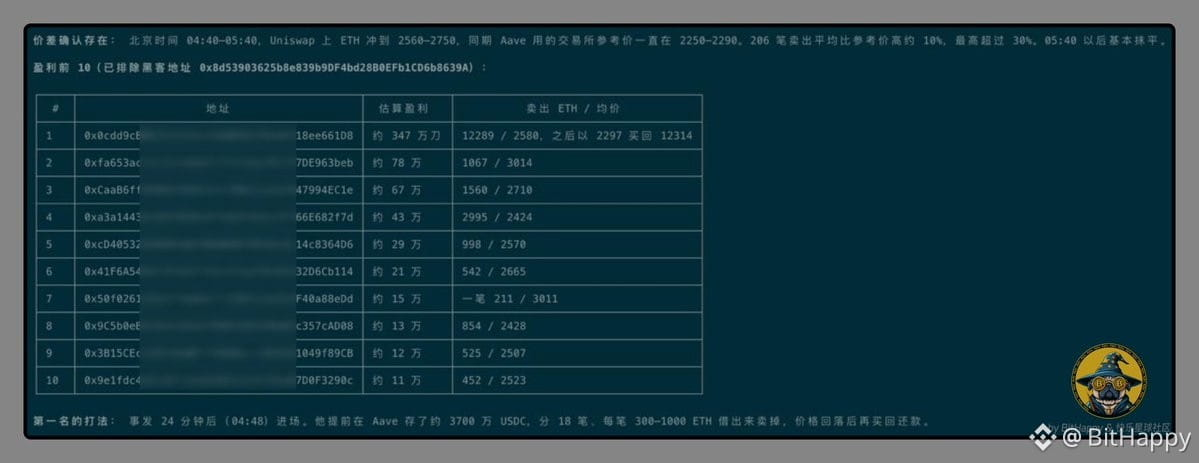
During the hour the hacker’s sell-off shook the market, the money being made was already sitting in Aave!
It wasn’t about who spotted it fastest, but whose firepower was already on-chain.
According to several analysts’ on-chain reviews:
After Binance’s hot wallet was hacked shortly after 4 a.m. Beijing time on October 30, the hacker swapped U for ETH on DEXs.
On Uniswap, ETH was bought up to around $2,560–$2,750, with some trades exceeding $3,000;
Aave’s Chainlink oracle, using exchange prices, stayed around $2,250–$2,290.
The same ETH was about 15%–30% more expensive on-chain, and the price gap lasted nearly an hour.
Binance suspended withdrawals, so cheap ETH on exchanges couldn’t be moved on-chain.
Here’s what the top-ranked address did:
1/ Had already deposited about $37 million in USDC into Aave;
2/ Borrowed ETH at the oracle price about 24 minutes after the incident;
3/ Sold it through a DEX aggregator for around $2,600, then deposited, borrowed, and sold again;
4/ Bought ETH back to repay the loan after prices fell, and had mostly closed the position within about two hours.
Let’s break down the numbers:
Sold about 12,289 ETH at an average price of around $2,580;
Bought it back at an average price of around $2,297;
Price difference: about $283 per ETH;
Net profit: about $3.47 million (before gas fees);
About 9.4% on roughly $37 million in capital.
The top ten addresses made about $6.36–$6.43 million combined.
This money wasn’t stolen, and there was nothing wrong with Aave’s contracts.
Essentially, it was CEX–DEX arbitrage, with Aave serving as a “window for borrowing ETH at exchange prices.”
The key was where your money was while that window was open.
I was asleep, so all I could do was kick myself.
After 5:30, the price gap had narrowed to just around 3%–5%. Aave froze the market starting at 5:42, and anyone who arrived late couldn’t even borrow.
The price gap was only there for those who already had their firepower on-chain.
The risks need to be understood too:
1/ The sell-off relied on the hacker’s buying pressure; once it stopped, the price gap narrowed;
2/ Until the ETH sold is bought back, you’re effectively short, and a rising market can hurt your health factor;
3/ Gas was very expensive—one person in the group spent about $5,000.
The top-ranked address split the sales into 18 transactions, each for about 300–1,000 ETH.
Next time, ask first: Is there money on-chain? Which protocol should you use? Can you understand how the oracle feeds prices?
If someone in the group hadn’t made $200,000 from $500,000 that morning, I might’ve gotten another half hour of sleep.
The above is for informational purposes only and does not constitute investment advice.
BitHappy, continuously evolving
1
4.3k
·
--
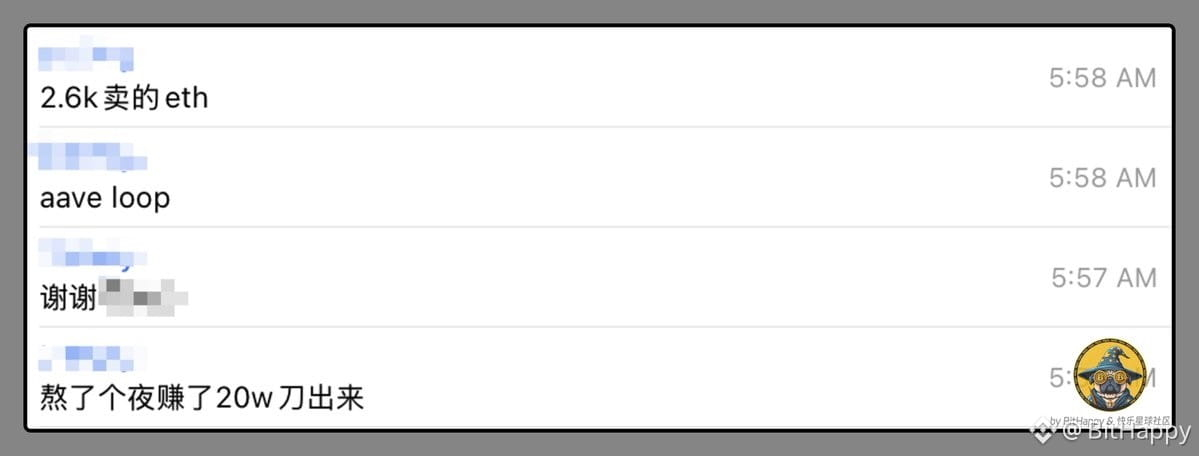
Missed 10:30 again!!!
Around 6:30 in the morning, I glanced at my phone and saw that the monitoring alerts were blowing up and the group chat was blowing up, so I knew something had happened again.
I could barely open my eyes, but I saw a message from a group member saying they’d made 20WU on a 50WU principal (strategy shown in the image).
I was instantly wide awake.
I struggled for over an hour, didn’t make a single cent, and couldn’t get back to sleep either.
Around 8, I thought it over and realized there was nothing I could do, and I couldn’t withdraw my funds either. I figured there probably wouldn’t be any losses—and even if there were, there was nothing I could do about it.
Then I went back to sleep until around 11. I thought it over and realized there was nothing I could do, and I couldn’t withdraw my funds either. I figured there probably wouldn’t be any losses.
That extra nap felt amazing. The last time I slept until 11, I think I was still a young man!
1
4.6k
·
--
Verified
Hyperliquid’s perpetuals are set to land in the United States, distributed via ICE-OKX!
Let’s break down who is doing what across the three layers of compliance, product, and distribution, as well as the approval bottlenecks for the JV.
According to ICE’s October 29 press release: ICE and Trade[XYZ] reached an agreement to turn the latter’s Hyperliquid-deployed perpetual market into a U.S.-regulated structure.
ICE will serve as the exclusive operator of Trade[XYZ]’s regulated market and make a strategic investment in Trade[XYZ].
On the retail side, there will be a separate dedicated market and clearing arrangement, deliberately isolated from ICE’s existing institutional futures and clearing businesses.
In other words: institutional clients do not bear the counterparty risk of this retail trading setup.
This is the prerequisite for something that can be framed within the U.S. licensing narrative, not a repackaging of an offshore DEX.
The product layer remains the Trade[XYZ] + Hyperliquid stack: short-duration, 24/7, covering crypto, equity indices, commodities, FX, and other RWA-style perpetuals.
On the U.S. side, a separate regulated structure is also needed, along with approvals required to support leveraged trading.
After KYC/AML checks are passed, customers are expected to be reached through membership in an FCM.
The distribution layer is the part most relevant to OKX users!
The release makes it clear: retail perpetuals are expected to be distributed through partners, brokers, and platforms, including the ICE-OKX joint venture.
The division of labor is roughly: OKX provides global retail access and trading reach, ICE provides the regulated market and clearing framework, and Trade[XYZ] provides retail perpetual product expertise.
For OKX, the incremental question is whether compliant products can connect to its own user pool.
The JV itself still needs broker-dealer/FCM and other approvals, and the approval checklist is fairly long: the new market and clearing structure, leverage-related approvals, and the ICE-OKX JV’s FCM/BD.
Moreover, offshore Hyperliquid/Trade[XYZ] liquidity and future U.S. KYC/AML perpetuals are two separate paths.
The latter is mainly about compliance and reachable user groups, but that does not mean lower fees or better depth.
If it really goes live through the JV, the practical questions are: how accounts and regions are segmented, whether margin flows through the FCM channel, and whether it is segregated from existing OKX derivatives accounts.
Stay tuned!
The above is for information sharing only and does not constitute any investment advice.
BitHappy, continuously evolving

1
1
2.3k
·
--
STRC’s move to daily dividends has passed. What do we do next?
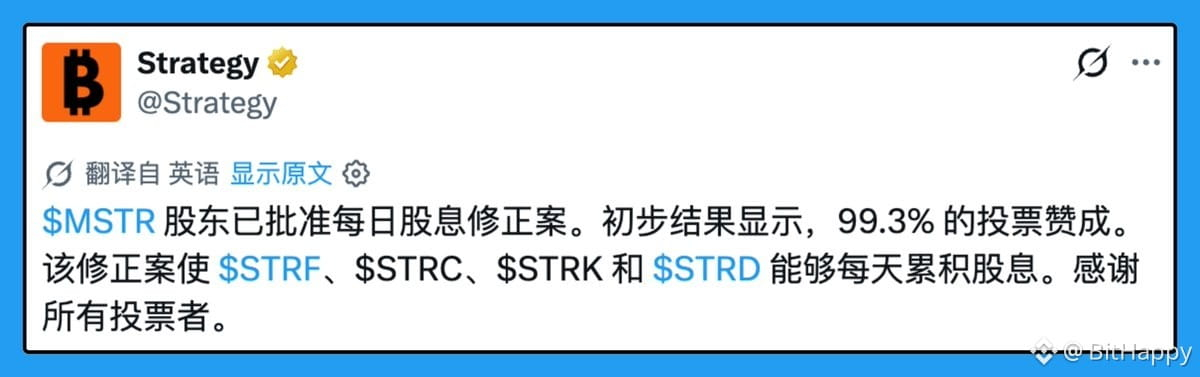
After the October 28 special shareholder meeting, Strategy’s 8-K stated that, based on preliminary vote counts, the move to daily dividends for all four preferred stocks had passed. STRC will begin accruing dividend entitlements daily on November 1; STRF, STRK, and STRD will do so starting January 1, 2027. Implementation still depends on the amended Certificates of Designations being filed and taking effect. Dividends will accrue on weekends and holidays too, and declared dividends are generally paid on the next business day.
When I wrote about daily dividends the day before yesterday, I put together some figures: since August 2025, the median price drop on monthly ex-dividend dates has been about 43 basis points, around 22 for twice-monthly dividends, and only about 3.3 for daily dividends. 3.3 × 365 is still about 12%, in line with the annualized dividend. What’s reduced isn’t the money, but that fixed gap down that used to happen twice a month. According to related posts, this Friday is STRC’s last twice-monthly ex-dividend date; check the exchange’s ex-dividend calendar.
Let’s break down the strategies by what they make money from.
Strategies that capture the ex-dividend gap: According to related posts, STRC perpetuals on Hyperliquid don’t compensate for dividends, so spot naturally falls on the ex-dividend date and a naked short can capture that move. With the gap down shrinking to around 3 basis points a day, the small event-driven spread is basically gone.
Long spot plus short perpetuals: The same source puts the discount at around 25 basis points and funding at around 10 basis points every 8 hours—about 30 basis points a day, roughly nine times the 3.3 basis points of daily dividends. The P&L of the position depends almost entirely on the direction of funding and how the discount reverts; the dividend is still there, but it’s no longer the main character. Discounts and funding rates change quickly, so use live market data for the current figures.
Using STRC or related exposure as collateral, looping, and earning yield: With the fixed gap of around 22 basis points that occurred twice a month gone, there’s no need to leave extra liquidation buffer specifically for ex-dividend dates—just allow for normal day-to-day volatility.
I laid out my own practical experience when I wrote the “STRC: From Getting Started to Profitable” series of recaps: my higher-risk positions were mainly in STRC-related yield-bearing exposure like apyUSD and sUSDat. What really helped me maneuver was coefficient depegging, opening on-chain spot positions alongside short futures when needed, and LP positions after the window narrowed. Position sizing and risk management matter more than any single arbitrage trade.
As for daily dividends: once the ex-dividend gap gets smaller, the small spreads created by mispricing around ex-dividend dates will fade. If you’re still hedging with “related spot + short STRC,” the calculation needs to shift from “capture a chunk of the ex-dividend drop” to “earn funding and the reversion of the discount.” The dividend leg is now just a few basis points a day. The coefficient relationship is still there, and the depegging window won’t disappear just because dividends go daily, but opportunities driven by the twice-monthly gap down will become rarer.
Dividend frequency, settlement cycles, and compensation rules may seem technical, but they can quietly change the source of a strategy’s profits. Yeah, after the move to daily dividends, STRC just feels a little neither-here-nor-there.
Series recap: https://x.com/BitHappy/status/2109907286194049402
The above is for informational purposes only and does not constitute investment advice.
BitHappy, continuously evolving
333
·
--
Over the past couple of days, some folks have been discussing another RWUSD strategy on Binance: subscribe with USDT and redeem in USDC to capture the exchange-rate spread~
The key is still to look at the breakeven exchange rate, then the annualized return.
One post calculated that since mid-October, the average USDC/USDT rate has been roughly 1.0011.
The fact that USDC is slightly more expensive than USDT is a cost for people buying USDC; for those holding USDT, it can become a source of income.
Here’s how it works: subscribe to RWUSD with USDT, then redeem immediately and choose to receive USDC. According to the official information, standard redemptions are credited on T+3, with a 0.05% fee.
Let’s calculate one round:
Gross profit is about 0.11%—that’s the premium;
After deducting the 0.05% redemption fee, net profit is about 0.06%;
At one round every 3 days, that’s about 121 rounds a year: roughly 7.3% simple interest, or 7.6% compounded.
It doesn’t involve going on-chain or earning interest; the return comes from the exchange-rate spread. Compared with USDG’s 7%–10%, it’s not bad either.
The key is the breakeven point: with a 0.05% fee, USDC/USDT needs to be above 1.0005 to avoid a loss.
If the premium narrows from 0.11% to 0.05%, that round is for nothing. The annualized return assumes the premium stays unchanged—that’s an ideal scenario. The breakeven point is the baseline.
There are also two variables that are easy to overlook:
1/ Price lag: You may see a rate of 1.0011 when subscribing, but USDC won’t arrive for 3 days. You won’t know what price you can sell at until then.
2/ Rules risk: The subscription and redemption channels are product features, not designed for arbitrage. If you use them back and forth frequently, be prepared for possible restrictions. In February, I also put some funds into RWUSD to balance my USDT and USDC holdings. At the time, I heard that using it for arbitrage too often could get you “added to the list of users restricted from using the feature” (a few folks were restricted).
A safer approach is to start another round only when the premium is well above the breakeven point, leaving some room for price movements over those 3 days. Once the funds arrive, check the current exchange rate; if it’s below the breakeven point, hold on to the USDC for now rather than rushing to sell.
Another option is to proceed only if you’re comfortable with the possibility of having the feature restricted.
The above is for informational purposes only and does not constitute investment advice.
BitHappy, continuously evolving
359
·
--
Before farming Perp points, ask yourself one thing: do they have a secondary-market price?
The StandX airdrop checker went live today: if there’s a cost of capital, you’re bound to lose money. On the timeline, BuTongRen6 shared some numbers: 5,000U+ in fees, a total loss of 20,000U, and an airdrop worth just 900U. Let’s break it down:
1/ That’s 900 ÷ 5,000 ≈ 18% of the fees, and 900 ÷ 20,000 = 4.5% of the total loss;
2/ Based on the points rules, xiaoyon52351223 worked backward and estimated that points farmed before the first halving on May 24 returned about one-tenth of the fees, while after the second halving on August 10, the return fell to around one-fortieth.
So rather than an airdrop, you could call it a fee rebate. Of course, StandX also officially declared it a failure.
What’s more worth reviewing is the pricing. StandX did have pre-market trading: in mid-October, FDV markets for it appeared on Aspecta, Predict, and Polymarket, with prices ranging from $180 million to over $300 million. But pre-market trading priced a token that was supposed to launch in the future. When the team announced on October 15 that it wouldn’t launch a token, those prices had nothing to anchor to. The project team alone decided how many DUSD the points would convert to, and there was no market beforehand where you could lock in the conversion rate. Personally, my HODL points weren’t worth anything; only points earned by paying fees got a rebate.
Compare that with two other projects recently:
1/ Variational: its points trade OTC. A quote of 50U per point recently surfaced, though not long ago people were valuing them at 7–8U. There’s disagreement over whether the quote is genuine, so don’t treat it as an executed price.
2/ Predict: Binance Futures launched a PREDICT pre-market contract on October 25, and Aster had listed one earlier. There’s also an FDV market on Polymarket. At least the points have market quotes and hedging tools, though the airdrop allocation hasn’t been announced, so the hedge ratio is only an estimate.
So when I look at Perp points now, I care about three things:
1/ Is there a secondary-market price (OTC, pre-market, or prediction markets), and does it correspond to what I’ll actually receive?
2/ Are there tools to lock in some of their value ahead of time?
3/ If neither is available, I calculate costs assuming a maximum rebate of 10% of fees, and set my loss budget based on that upper limit.
Farming points is basically buying a lottery ticket with no price tag. Put a price on it yourself first, and you’ll feel a lot better about it.
For those who farmed StandX: DUSD claims open on November 1 and close on December 31. Use only the official link. Gurus, which other Perp points you’ve farmed have a secondary-market price?
The above is for informational purposes only and does not constitute investment advice.
BitHappy, evolving continuously
907
·
--
Who sets the price of tokenized-stock collateral when the stock market is closed on weekends?
A month ago, Binance announced that regular users could also use bStocks as collateral. The rules changed this weekend: starting October 24 at 00:00 (UTC), the bStocks collateral index price will update dynamically 24/7. While the market is closed, it will reference Binance’s own order book, smooth the Impact Mid Price using EWMA, and apply dedicated price-movement limits. The exact figures haven’t been disclosed.
In other words: on weekends, the value of your collateral is based on Binance’s order book, not the underlying stock.
Meanwhile, Aave V4 on Base accepts seven tokenized U.S. stocks from Coinbase (not bStocks), using Chainlink’s 24/5 price feed: over the weekend, prices stay frozen at the last quote, then incorporate all the news from the market closure at once when trading resumes. One grinds along through the weekend; the other swallows it all in one gulp!
And yet, on the first Saturday night under the new rules, Bitcoin fell below $80,000. According to The Block, over $404 million in long positions were liquidated in just over four hours. U.S. stocks were closed, but we’d already been liquidated over here 🤣
If you use tokenized stocks as collateral, you may want to do four things on weekends:
1/ Raise your margin to a level you can sleep with before Friday’s close;
2/ Set price alerts based on Binance’s collateral index price, not the underlying stock’s closing price;
3/ Check your collateral ratio on Friday—it may need adjusting at any time;
4/ Don’t let tokenized-stock collateral and highly leveraged crypto positions take a sharp BTC drop together in the same cross-margin account.
With two sets of rules running side by side, price discrepancies can emerge. Here are some things I’ve thought of but haven’t tested in practice yet:
1/ Weekend divergence and Monday convergence: when $SOXL is not trading, the crypto side often deviates by more than 6%; much of that gap narrows before the market opens and after trading begins. Now that collateral prices follow the weekend order book, the margin pressure on convergence trades needs to be recalculated.
2/ They’re not the same token: bStocks and Coinbase tokenized stocks track the same underlying shares, but their issuers, blockchains, and redemption rules differ. At best, you can say A ≈ B; you’ll need to verify the conversion ratios and routes yourself.
3/ Frozen prices versus on-chain trading prices: Aave calculates collateral using frozen prices over the weekend, while the Base secondary market remains open. In theory, that leaves room for a discount—but liquidations on a gap-up opening will use the new price. It’s not free money.
4/ The few hours when quotes resume: Aave’s price feed updates in one step at 8 p.m. Sunday Eastern Time, while Binance transitions gradually. The collateral prices on the two platforms may briefly diverge, so it’s worth keeping an eye on them—but whether there’s a trade to make remains unclear.
Put simply, the stock market may be closed, but pricing rules don’t take a break. Anyone here used tokenized-stock collateral on both platforms? Have you been watching the spread? 👀
The above is for informational purposes only and does not constitute investment advice.
BitHappy, evolving all the time
245
·
--
Metric vs. Uniswap vs. Fables: Where Do LP Returns Actually Come From?
Metric is all over the timeline again, probably because its referral program just opened 🤣 I got in early and have already taken a loss~
First, let’s look at how the three are priced:
1/ Uniswap (concentrated liquidity): The pool itself determines the price, and trades (mainly arbitrage) are what move it. LPs earn fees, but stop earning when the price moves out of their range.
2/ Fables: The underlying pool is still a Uniswap v4 pool, but it adds a Hook that automatically adjusts fees according to the calendar. Fees differ at market open, market close, overnight, and on weekends. Keepers can only lower fees temporarily, by up to 50% for a maximum of 72 hours.
3/ Metric: The pool doesn’t calculate the price itself. A Price Provider supplies the buy price, sell price, and reference price. Liquidity is placed in a range around the reference price and shifts along with it.
The sources of returns also differ: Uniswap and Fables earn fees (Fables charges more during periods of information asymmetry). Metric charges traders no fees; LPs earn Edge (the spread between the execution price and the reference price), minus the curator’s and Metric’s share (7.5% by default). But no matter which one you use, the people who actually pay are those who need to trade immediately.
Now, about market closures. When the US stock market is closed, $SOXL crypto markets often diverge by more than 6%: stocks have stopped trading, but on-chain markets haven’t. For Uniswap and Fables, after Monday’s gap, arbitrageurs push the pool to the new price, and LPs bear the cost of the difference. Fables’ higher fees price in the risk, but don’t guarantee that losses will be covered.
Metric’s docs put it plainly: when a price feed stops updating, trades continue at the last price until the staleness limit is exceeded, at which point trading stops. Chainlink stock pools stop immediately when they receive a market-closed signal. The reference price may lag, and on BSC, trades may even get in before a quote update and execute against an outdated quote—while APR still counts the Edge. Protections exist, but they’re not absolute.
There’s another line in the docs I really agree with: “Positive Edge doesn't mean you're making money.” The official example: you earn $50 in Edge, but after the price rises 10%, you end up $950 worse off than if you had simply held. Inventory changes are the bigger factor.
By the margin-of-safety principle in The Intelligent Investor, first look at how much you could lose in the worst case, then look at APR. Liquidity has been extremely poor lately, so those willing to take on stock exposure can give it a try. The points program hasn’t been officially announced yet, but reportedly 500,000 points are distributed each week.
This is for informational purposes only and does not constitute investment advice.
BitHappy, evolving continuously
733
·
--
The Hynix Korea–U.S. price-spread convergence strategy I ran with Binance AI Pro is now closed, and I’ve locked in the profits! But the process didn’t go smoothly.
Following up on the earlier entry, the strategy launched without a hitch. AI even designed a closing rule specifically for it: check for losses on either leg every 5 minutes and automatically close if they exceed a threshold. When I woke up in the morning, the Korea–U.S. spread had converged to 49%, with an unrealized profit of about $87. I remembered someone in the group saying this spread could also be traded as a swing, and that there was no need to wait for it to converge completely. So I decided to close out while I had the chance and switch to a swing strategy later.
But I hit a snag when closing the position:
1/ I asked AI Pro to close it, and it told me to manually tap the Close All button on the position card—but there was no button on the page at all (Image 1).
2/ I asked it to close again, and it sent me a position card. But tapping it took me to a contract page showing no open positions.
3/ I had no choice but to take the strategy offline. The system said it would automatically close the position when taken offline. Afterward, I couldn’t tap the Transfer button on the strategy page, and it didn’t show my account balance. My total balance hadn’t changed either (Image 2).
4/ I asked AI Pro to help transfer the funds, but it said the position was still open (Image 3). There was no position on the contract page, so it said the funds were in the sub-account. But the contract page in the sub-account showed no position either. I started to panic—had my money disappeared?
5/ I opened AI Pro in the sub-account, and the page immediately displayed: “Unable to verify your account status. Workspace locked” (Image 4).
By then, I was already regretting not going through the entire process first before trading live. I eventually checked the sub-account’s trading history and confirmed that the position had been closed. My principal was safe, and I made a little money, but I wasn’t able to close the position promptly. The whole process was rocky and honestly a bit nerve-racking.
After this hands-on experience, there are a few things to keep in mind with AI Pro:
1/ The conversation takes place in the main account, while the strategy funds are in the sub-account, so you can’t directly view the funds or positions;
2/ For now, you can’t manage sub-account positions directly through the conversation—you can only do so through the strategy itself;
3/ After manually managing a position (taking a strategy offline or manually opening/closing a position), the position information provided by AI Pro may be inaccurate, so you’ll need to check the sub-account yourself;
4/ After closing a strategy, the AI Pro page in the main account won’t show your funds or let you transfer them directly. You’ll need to check the sub-account.
I’m not sure if this is an isolated issue, but it did happen to me, and I hope the Binance team will look into it. I’m still working on a Hynix Korea–U.S. swing spread strategy. This time, I plan to test it in a demo account first, although the demo account may also be affected by how sub-accounts work.
Has anyone else using AI Pro run into anything similar?
The above is for informational purposes only and does not constitute investment advice.
BitHappy, evolving every day
142
·
--
Taking advantage of the Korea–US price spread in Hynix to give Binance AI Pro a try!
People have been trading the price spread between Hynix shares in Korea and the US, along with funding-rate arbitrage, for over half a year. Over the past three or four days, the spread has fluctuated less and less, and quite a few people in the group are stuck in positions and starting to complain loudly. My take is that when everyone else is complaining, it’s often a good time to open a position—and my cost basis is a little lower than theirs—so I wanted to try one and see how it went. Around the same time, people on X were discussing Binance AI Pro, and I wanted to see whether it could put a complete strategy into action in one go.
Hedging itself has a few hurdles: how to roughly balance the positions on both sides, how far the spread needs to deviate before entering, how to pause or reduce the position when funding rates get too high, and how to ensure both sides are closed together when losses hit a threshold, so no unhedged position is left behind.
To avoid wasting my Binance AI Tokens (points), I first worked with Grok to clarify the strategy logic, risk parameters, funding-cost controls, and rules for closing both sides at the same time. Then I fed everything to Binance AI in one go. With just one conversation, it generated a visual workflow and launched it in the demo account; after that, I switched to live trading.
The order was placed successfully: a conditional order was placed on one side first, and the other side opened at the same time. The stop-loss was automatically set to close both sides in full, leaving no unhedged position. But after opening, the premium widened a bit more, and I’m currently at an unrealized loss (including fees). The biggest drawback is the high funding cost on the long Korean-stock contract side, estimated at around 60 USDT per day for a position of roughly 20,000 USDT. Binance currently doesn’t let you buy the underlying shares, so the hedge has to be between contracts. Hopefully, they’ll eventually let users buy the actual shares directly. I’ll post updates on the stop-loss and closing status later.
Key points for the prompt, if you’d like to test it:
1/ Account risk controls: Total margin of 10,000 USDT, 2x leverage, notional value capped at around 20,000 USDT, isolated margin; maximum loss on either side around 1,000 USDT; if a stop-loss is triggered, both legs must be fully closed, leaving no naked exposure.
2/ Strategy logic: Go long SKHYNIXUSDT (tracks the Korean shares, relatively cheaper) and short SKHYUSDT (tracks the ADR, relatively more expensive), matching by equal notional value rather than mechanically matching the number of shares at a 10:1 ratio.
3/ Entry signal: Price-ratio z-score, normalized on a rolling basis using 100 one-hour candles. Enter only when the spread deviates clearly from its norm, to avoid paying funding costs for nothing when the spread has already converged.
4/ Funding-cost gate: Set a threshold based on the actual daily USDT cost of both legs, accounting for their different settlement intervals. If costs are too high, pause or reduce the position.
5/ Stop-loss execution: If either leg or the combined position reaches the loss threshold, use reduce-only trigger orders to close both sides in full at the same time.
6/ Other: Generate the visual workflow and code first, run a simulation before going live, and explain the opening quantity, notional value, margin usage, conditions for closing both sides, and main risks. Don’t open a position if there isn’t enough data.
This is for informational purposes only and does not constitute investment advice.
BitHappy, evolving all the time
498
·
--
Last week, I watched Xiandao interview Brother Sun, and he shared an interesting take: now that Hyperliquid has received regulatory clemency, CEXs may gradually shift toward DEXs in the future. Then, over the weekend, I saw people discussing PopDEX, which is backed by Bitget, and it suddenly struck me that this is really worth thinking about: exchanges may already have reached some kind of tacit consensus, but they’re all still waiting.
But for a new player like PopDEX, having a strong backer isn’t nearly enough. These days, people generally want to see real results before they commit. Without something compelling, it’s hard to get trading activity off the ground.
PopDEX describes itself as trading infrastructure built for traders, while MegaPop is a value-sharing mechanism built on real trading activity. The idea of “sharing value” is appealing in itself, because it usually points to buybacks or cashback—not just handing out points.
The key is MegaPop:
1/ Every week, 40% of the platform’s revenue goes into the prize pool;
2/ Users earn tickets through real trades;
3/ A weekly draw is held, with all tickets, the prize pool, results, and distributions publicly recorded on-chain;
4/ The winning numbers are determined by Bitcoin block hashes, helping minimize the scope for human intervention.
This means users who trade are sharing in the platform’s revenue in a relatively fair and random way. And because the draw is random, it’s also harder to target or game—even for professional players.
Honestly, paying out stablecoins directly instead of points offers far more certainty. At least people know exactly what they’re getting, rather than having to wait for all kinds of explanations from the project team later on.
The team is probably also concerned that revenue will be limited at the start and that the revenue-sharing rewards won’t be compelling enough, so it plans to add extra rewards in two installments for the first round, totaling around 250,000 U.
Of course, that’s only the 40%. The remaining 60% will be returned through rebates and ecosystem activities. This part isn’t transparent enough yet, but that’s understandable: rebates have always been one of the most important ways exchanges—whether CEXs or DEXs—have innovated, and users at different levels naturally need to be treated differently. I just hope future campaigns are clearer and help increase the revenue-sharing percentage.
So, what should users make of this? If you already need to hedge, or are checking out other platforms, you could move some of your trading volume to PopDEX and give it a try. And if you’re already making money from trading, it’s even more worth a look.
In short, keep making the trades you were going to make anyway—now you’ll also get tickets for a chance to win every week on PopDEX. If you hit a huge prize, that’ll be absolutely wild!
This is for informational purposes only and does not constitute investment advice.
BitHappy, constantly evolving
87
·
--
STRC: From Getting In to Turning a Profit—What’s Next?
I spent August and September traveling with my wife and kids to escape the heat, so my reading plan was put on hold for a while. A few days ago, I picked it back up with the first edition of The Intelligent Investor, published in 1949.
Chapter 4 and the chapters that follow repeatedly make this point: preferred stocks can expose all kinds of problems when markets are weak, and should only be bought when they fall to unreasonably low prices!
That line hit home immediately. The lessons on what to avoid, learned by smart investors in 1949, are still mistakes we’re making in 2026. I’m sure you know what I mean.
In this review, I’ll walk through the timeline and my thought process, and share four arbitrage strategies that have stood the test of time. I hope they’ll be useful to anyone who experienced this run or missed it but is interested in arbitrage—and this is also a review for myself.
But the STRC campaign wasn’t just about arbitrage. It also involved:
1/ Trading Pendle PT/YT—for example, minting large amounts of YT-apyUSD and swing trading it, as well as the massive interest payouts from YT-sUSDat rebates;
2/ Arbitraging project mechanics, such as discrepancies between the sUSDat oracle price, on-chain price, and contract price;
3/ Competing for routing across LPs with different fee rates—for example, deciding whether 0.25% or 0.1999% is better, or using a 0.0001% LP to take in and sell inventory directly, avoiding Swap’s hefty tax;
4/ And, most importantly, position sizing and risk management.
Overall, the STRC campaign of 2026 was a lesson worth remembering from my time in crypto. It lasted so long and involved so many tactics that I can’t even recall all the details now.
So here’s a reminder: record your reviews promptly. Even if you don’t plan to share them right away, write down the details first so you can learn and improve.
The two basic arbitrage models I wrote about earlier laid the groundwork for this summary, and follow the same logic as my actual trades: the “A = B” depeg arbitrage model, and the “A = B, B = C, therefore A = C” depeg arbitrage model.
Series recap: How I got into STRC; Arbitrage self-rescue, Part 1 (apxUSD and apyUSD depeg arbitrage); Part 2 (spread arbitrage by shorting STRC across three tokens); Part 3 (sUSDat swaps and LPs).
That’s the end of the series. If there are other approaches you’d like to discuss, feel free to leave a comment~
The above is for informational purposes only and does not constitute investment advice.
BitHappy, always evolving
166
·
--
STRC: From Getting In to Making a Profit — Arbitrage Self-Rescue, Part 3
The first two posts covered two ways to break even. Going back to the formula, since both apxUSD and sUSDat are related to STRC, we can rewrite it as:
sUSDat ≈ apxUSD × y ≈ STRC × 0.01 × y
In other words, you can also arbitrage the peg between sUSDat and apxUSD. When apxUSD falls below sUSDat by more than the coefficient implies (usually because apxUSD is falling), buy the cheaper one and wait for the prices to converge.
After more than a week of repeatedly swapping around the peg, opportunities suddenly became scarce. It turned out someone had created an apxUSD/sUSDat LP, making the exchange rate increasingly stable. I switched to providing liquidity too, only swapping during extreme volatility. Earning $300–500 a day was easy. As my LP position grew and fewer people sold their apxUSD at a loss, opportunities became rarer and rarer. By the end of June, STRC had recovered to around 80, and I was close to my breakeven price of 82.
Next came the road to profit. The core idea was still the same: whenever the coefficient relationship falls out of alignment, there’s a window to act. But these windows are often very brief, and liquidity depth and fees can quickly eat into profits. Once July arrived, it was hard to make more than 1% without leverage using the first three methods, while liquidity was too shallow to use leverage. So many people had sold at a loss and left in June that price discrepancies became noticeably less frequent.
But I held on to apyUSD and sUSDat until mid-September, only recently selling all my apyUSD. It wasn’t an emotional attachment—I still saw room for arbitrage. Continuing with the formula, sUSDat and apyUSD also have a coefficient relationship:
sUSDat × x ≈ STRC × y
The approach was much the same as before: swapping and providing liquidity. On the wildest day, a whale sold 2 million apyUSD in a single day, and my $20K LP wallet earned over $3,000 that day. Windows like that were rare afterward. From July to September, daily profits dwindled from $1,000–2,000 to less than $100.
The decline makes sense: the pool of available capital is limited, and the number of people willing to sell at a loss can only decrease over time. The people who believe the most are often the ones who get hurt the most. The earliest large-scale outflows came from apxUSD: it went from being a stablecoin to an unstable one, at one point becoming impossible to redeem (redemptions later resumed, but with hefty fees), and its price still couldn’t keep up with STRC.
These strategies helped me break even early and earn profits for two consecutive months. That wraps up this series of arbitrage retrospectives. In the next post, I’ll draw on what I’ve been reading lately to talk about how I see things and what I plan to do after this wave.
This is for informational purposes only and does not constitute investment advice.
BitHappy, always evolving
64
·
--
From Getting Into STRC to Making a Profit: Arbitrage as a Way Out, Part Two
After arbitraging the depegs of apxUSD and apyUSD, I could finally see a way to get out of my position. The key insight was this: as long as a coefficient relationship exists, any price discrepancy presents an opportunity to make a profit, even if the window is often very short. To speed up the convergence, I also posted about this logic on X, and the influence of my account helped me to some extent. You can imagine how desperate I was at the time, even though the strategy itself worked.
Let’s look at the formula again: apyUSD ≈ apxUSD × x ≈ STRC × 0.01 × x. This shows that apxUSD also has a coefficient relationship with STRC, further confirming that all three are pegged to STRC:
apxUSD ≈ STRC × 0.01
apyUSD ≈ STRC × 0.01 × x
sUSDat ≈ STRC × 0.01 × y
So when apxUSD, apyUSD, or sUSDat falls below its implied coefficient value, you can buy these three tokens on-chain and short STRC on an exchange to arbitrage the price difference. This is consistent with the model I wrote about earlier: “A = B, B = C, therefore A = C.”
As it happened, throughout June, holders of STRC-related tokens were all on edge. Countless people cut their losses and ran, and each sell-off created a price discrepancy. You could see it both in the group chats and on-chain: some people exited outright, while others looked for opportunities based on the coefficient relationships.
The problem was that very few exchanges supported STRC contracts at the time. The first one I knew of was Lighter, but its market depth was extremely poor—only around 10,000—so this strategy offered very limited profits in the first half of June. Those with access to U.S. stock brokerages could trade directly through their brokers.
Since the logic holds, opportunities like this are still around as of the day I’m writing this—for example, apyUSD last night. The image shows apxUSD’s price movement. It should maintain a 100:1 ratio with STRC, but it often deviates by 2–4%. However, on-chain fees for apxUSD and apyUSD are too high, so there’s basically no profit unless the price difference exceeds 0.5%. sUSDat, meanwhile, is too stable and rarely offers an opportunity.
There’s another, more important constraint for me: I’ve already used up my high-risk capital, so in theory I shouldn’t allocate any new funds to shorting STRC contracts. I only have sUSDat and apyUSD on hand. What else can I do to move things around? I’ll share a new arbitrage strategy in the next post.
The above is for informational purposes only and does not constitute investment advice.
BitHappy, always evolving
59
·
--
STRC: From Getting Started to Making a Profit — Arbitrage as a Way to Recover (1)
In my previous post, I mentioned that after using up my high-risk capital, I was sitting on an unrealized loss of at least 50%. Even though I had only used my high-risk allocation, the psychological burden was heavy: I had used recursive borrowing against my Apyx position, and counting the borrowed funds, I was nearly fully invested. Later, I realized that even while stuck in apyUSD, I could still quickly reduce my losses by taking advantage of the proportional relationship between it and apxUSD. This was my first successful arbitrage.
Before STRC’s sharp drop, both the official team and the outside world considered apxUSD a stablecoin. But its collateral included STRC, so when it was undercollateralized, its net asset value could only fall along with it. The team never admitted that it wasn’t a stablecoin, nor did it say that it was pegged to STRC. But based on the collateral mechanics, apxUSD and STRC must have a proportional relationship: at the very least, it should hold at around 100:1, and theoretically the ratio should be higher, since STRC is not its only collateral.
apyUSD’s net asset value growth is linked to STRC distributions, and its underlying asset is apxUSD:
apyUSD ≈ apxUSD × x ≈ STRC × 0.01 × x
In reality, though, apyUSD’s drop was once 3–4 times that of apxUSD: apxUSD fell 7%, while apyUSD fell by more than 30%. Since the formula holds, even if you’re already stuck in apyUSD, you can use some apyUSD as collateral to borrow apxUSD, then swap it back for more apyUSD and profit from the exchange-rate gap. At its peak, the gap reached 23%. This happened twice, and each window lasted only a few hours.
Unfortunately, all I had on hand was apyUSD and sUSDat. I had also used recursive borrowing to add to my apyUSD position, pushing my LTV to around 60%. I didn’t want to touch sUSDat, which was performing better, so I could only use some apyUSD as collateral to borrow apxUSD and swap it for apyUSD. Two days later, the opportunities offering returns above 20% were gone.
The upper half of the chart shows apyUSD’s USD-denominated price movement: when STRC actually fell by more than 30% on June 27, apyUSD only fell along with apxUSD and did not significantly overshoot to the downside. The lower half shows the price movement denominated in apxUSD; the fluctuations are negligible, confirming that the peg between the two holds. And because the formula holds, similar depegging arbitrage opportunities have continued to offer profits of 1%–3%. This follows the same logic as the “A = B” depegging model I wrote about earlier.
Unfortunately, I rushed to buy the dip and had little capital available. Otherwise, the first round of declines in June alone could have turned my losses into profits. At this point, the price had not yet recovered, but my losses were already much smaller, and at least I could see a way to break even.
In the next post, I’ll continue with another long-term arbitrage strategy.
The above is for informational purposes only and does not constitute investment advice.
BitHappy, continuously evolving
67
·
--
STRC: From Getting In to Turning a Profit—How I Got In!
Now that STRC’s price has stabilized and mostly returned to its peg, most people who held STRC, sUSDat, or apyUSD early on are in profit—as long as they didn’t sell at a loss along the way. But a few months ago, things were completely different. I used only part of my high-risk allocation, as planned, but after one decline after another, I had nearly wiped out that portion, with unrealized losses at one point exceeding 30%.
Looking back, I realized the key wasn’t whether to touch STRC. It was that once the relationships between these tokens’ coefficients became misaligned, tradable price spreads emerged. So I’m breaking down the whole journey—from getting in and getting stuck to recovering and turning a profit—as a series. This first post is about how I got in.
In March and April, STRC and Apyx were being discussed frequently on X. The market was sluggish and crypto thefts were rampant, so I watched from the sidelines for a long time. It wasn’t until apxUSD launched on Kraken that I gave up on apxUSD’s low APY (I knew at the time that it had exposure to STRC) and put one-fifth of my high-risk allocation into apyUSD, aiming for an APY of around 40%.
Then Saturn caught my attention. It also had two tokens: the stablecoin USDat and sUSDat, which has exposure to STRC. sUSDat’s net asset value falls when STRC goes ex-dividend, and historically its price has usually returned to its peg afterward. I allocated another one-fifth of my high-risk portfolio to trading the ex-dividend drop and subsequent recovery. After the ex-dividend date, I’d hold for about 15 days; over the first two months, the return was roughly 2–3%. I thought I could earn around six months’ worth of returns at a 40% APY before the TGE in October.
After STRC went ex-dividend in early June, it failed to stabilize. On the evening of June 4, it fell nearly 8%, and sUSDat dropped in tandem. Assuming it was a depeg, I kept buying the dip. Unexpectedly, the stablecoin apxUSD fell too, and apyUSD fell even harder, dropping as much as 30% at one point. Fortunately, I’d previously unwound a few layers of looping positions to trade YT, which kept me from being liquidated. Believing STRC wouldn’t collapse, I kept adding to my positions. Eventually, apyUSD and sUSDat each made up half of my high-risk allocation. Including the looping loans, apyUSD was down more than 50%, while STRC itself had fallen only about 7%.
The nightmare was only beginning. STRC plunged twice more, on June 6 and 27, reaching a low of only about 68% of its peg. By then, I had already used up my entire high-risk allocation. My position-sizing plan saved me by keeping me from putting all my funds in, but because I was determined to stick to it, I could only shuffle around my existing positions and try to get myself out of trouble.
In the next post, I’ll cover the first and most effective arbitrage route: re-examining the coefficient relationship between apxUSD and apyUSD.
This is for informational purposes only and does not constitute investment advice.
BitHappy, constantly evolving
101
·
--
I hadn’t been keeping an eye on Sui for a while, and was surprised to find that the familiar Bluefin vault layer now supports Ethereum. The core is still on Sui; what’s changed is that Ember, which it incubated, is no longer serving Sui alone.
The newly launched PPLUS vault offers around 11% for a standard deposit. Looping through Suilend or Bluefin Lend can bring the estimated yield to 30%+. I deposited with Ember last year, then withdrew during the bear market. This time, I’m curious to see how it has packaged its complex strategies.
PPLUS stands for Bitwise Premium+ RWA Vault. You deposit USDC, Ember mints shares, and Bitwise selects the assets, allocates the portfolio, applies leverage, and manages risk. The underlying assets are three types of tokenized credit: Huma’s short-duration cross-border payment financing; USD_ai loans backed by AI GPUs; and high-quality home equity debt from Hastra, which partners with Figure. You deposit with Ember; Bitwise is the strategy manager, not the issuer or operator.
It differs from the earlier PAPY: PAPY is more like an overcollateralized lending vault, with a target yield of around 5%–6%; PPLUS adds leverage to similar RWAs, with an official target of 10%+ and higher risk. Yield comes from three layers: interest on the underlying credit, the vault’s internal leverage spread, and using PPLUS as collateral in lending markets. The third layer is optional, not standard. Current TVL is around $12.84M.
Two ways to use it:
1/ Standard deposit, with an expected yield of around 11%; deposits are available on Sui or Ethereum.
2/ Lending loop: deposit PPLUS into Bluefin Lend or Suilend, borrow USDC, swap it for more PPLUS, and deposit it back, for an expected yield of over 30%. But the vault already uses leverage internally, so looping adds lending leverage on top of the strategy’s leverage. Keep a close eye on liquidation levels.
Greater potential for returns also means greater risk. The official warning states that this is a leveraged credit strategy and that deposited assets could be partially or completely lost.
A note on Bitwise: founded in 2017, it is a crypto asset management firm. According to the company, it manages over $15 billion in client assets and offers more than 40 products across US ETFs and European ETPs. Its spot Bitcoin ETF, BITB, has around $3.2 billion in assets, while its Solana staking ETF, BSOL, has over $1.2 billion, making it currently the world’s largest SOL ETF.
In other words, PPLUS isn’t a high-yield box hastily put together by a new team. It brings an onchain strategy from an asset manager that has managed BTC, ETH, and SOL for traditional investors.
The above is for informational purposes only and does not constitute investment advice.
BitHappy, always evolving
332
·
--
The most common post on the timeline isn’t an analysis. It’s “I made money.”
Screenshots can be edited, but once your address is visible, you’ve basically revealed your entry and exit points, where you added to your position, and when you took profits. Show it off and people might copy you; don’t, and it can look like you’re making it up. Wanting people to see your results without letting them see how you got them is a common dilemma for arbitrage traders—not vanity.
I’ve been stuck on the same thing these past ten days. This crypto-equities run has been great: I put in 5WU and nearly doubled it to 9WU in ten days. Every day I wanted to post about it and keep a record for later review. A few times, my cursor hovered over the Send button, but I still didn’t post. I only shared a few balance screenshots in the group. Without an address, all I can say is “I made money,” and people will assume I’m bragging. With an address, my method is no longer mine alone.
So the real question isn’t whether to show off. It’s whether people are verifying your results—or getting access to your wallet and your playbook.
The same issue applies to institutions and whales, just at a different scale. Individuals worry about their methods being copied; institutions worry about their positions, timing, and execution paths being visible in real time on a public chain—so their strategies get priced in or front-run before they’re even finished playing out. On-chain transparency by default is a social burden for retail traders, but a cost for serious money moving on-chain. What institutions want isn’t to erase the record; it’s to keep things auditable internally while revealing only what needs to be verified externally.
Verification answers “Is it real?” Privacy determines “How much is made public?” Only by treating those as separate questions can whales and institutions feel safe bringing their full scale on-chain.
Privacy project Primus Labs, which received funding from YZi Labs at the end of August, is working to separate those two things: prove you got the results without laying out the path you took. It can’t yet prove in one click that you “nearly doubled your money in ten days,” but it has already put the same structure to work in two areas:
1/ Its partnership with Kaito verifies people: proving you participated and traded without exposing your account, filtering out fake engagement from the noise;
2/ Its partnership with Unitas verifies funds: proving that reserves are sufficient and healthy without livestreaming the operation, so institutions can earn trust without leaking sensitive information.
The report card individuals want and the proof of reserves institutions need are built on the same idea: first prove it’s real, then decide how much to disclose. Building “verifiable without leaking sensitive information” into a real commercial use case also helps explain why it later received investment from YZi Labs: first came the use case, then the backing.
Starting with individual needs, maybe in the future we can post fewer screenshots and share one more proof on X. What institutions need is the same idea at a larger scale: go on-chain, but don’t broadcast the path. If you’re interested in Primus’s technology, check out teacher anymose’s post.
The above is for informational purposes only and does not constitute investment advice.
BitHappy, always evolving
41
·
--
A postmortem on a rule-arbitrage strategy that’s now over~
On August 24, 2026, I took part in Binance Agentic Wallet’s bStocks trading competition. At the time, my thinking was: the rules were readable, I could add a hedge leg, and it was worth doing. My target was a top-ten finish, with an estimated prize of over $5,000; in reality, I finished around fiftieth and earned a little over $400. Here’s the conclusion upfront: the arbitrage structure worked, but my ranking and expected-value estimates did not.
The key rule was that the leaderboard only counted realized P&L from closed positions. A teammate thought we could only buy spot and couldn’t hedge fully, so I added a leg: use inverse tickers (SOXL/SOXS) as the short position. That way, whether prices went up or down, we could generate one realized-profit leg, while hedging the overall directional exposure. We were both confident, and nobody dissented. We spent about four hours on it, tied up $15,000, and incurred $30 in friction costs. Due to network issues, some positions weren’t closed in time. Unrealized P&L didn’t count, and we didn’t even receive $600.
Where the return came from: the $400 came from Binance’s promotional prize pool, not from price spreads. The prize pool was capped and unlocked in tiers based on participating users’ bStocks AUM, with the Top 100 then ranked by realized P&L. Hedging only reduced directional exposure; it didn’t explain where the prize money came from or guarantee a particular ranking.
How the risks played out: the main risk was the leaderboard, not the market. The more people who understood the same rules, the higher the P&L needed to make the leaderboard—and a top-ten finish turned into a top-fifty finish. I treated those participants as background rather than a key variable. That was my main mistake. The second layer was eligibility and review; the third was capital tied up, friction costs, execution, and residual hedge risk. What really lowered my guard was a small circle of consensus: both the information and the idea that this was “the right thing to do” came through a teammate, and their agreement was mistaken for validation.
The outcome doesn’t determine whether the decision was sound: before participating, I should have mapped out three possibilities—making the Top 10; the hedge working but getting pushed into the middle or lower ranks; or execution or eligibility problems reducing the prize to zero. What happened was the second scenario, compounded by positions not being closed in time.
What’s worth keeping: read the rules, add a short leg, control friction costs, and make closing positions on time a checklist item. The lesson: a leaderboard is a game, and balancing your own books isn’t the end of it.
Next time, I’ll pay extra attention to three things: Is the payout coming from a prize pool or from spreads? If it’s a prize pool, look at the distribution of rankings rather than a single point estimate. Decide whether the capital tied up is acceptable on the assumption that only a few hundred dollars may be left. And separately ask whether positions can be closed within the available window.
Understanding the rules is necessary, but it isn’t sufficient to achieve a target ranking. Hedging manages directional exposure; it can’t manage how the prize pool is distributed, or positions that haven’t been closed.
This article is a public contribution to the “IP Growth Flywheel System Based on Your Circle of Competence.”
The above is for informational purposes only and does not constitute investment advice.
BitHappy, continuing to evolve
190
Log in to explore more content
Join global crypto users on Binance Square
⚡️ Get latest and useful information about crypto.
💬 Trusted by the world’s largest crypto exchange.
👍 Discover real insights from verified creators.
Email / Phone number