
Baheet
1 Posts

Baheet
Report
Block User
deep research. onchain markets. AI
1 Following
6 Followers
0 Liked
Posts
·
--
Verified
Article
89% of x402's Volume Wasn't RealIn November last year I wrote about x402. I opened that piece admitting I had dismissed it as another crypto buzzword, then spent 1,600 words explaining why I changed my mind.
Coinbase and Cloudflare had revived a status code the web left unused for three decades, Google and Visa were circling, and the agentic economy looked like it found the PMF it had been waiting for.
Eleven months is a long time in this industry, so I went back to check my own work.
When I first came across the term “x402”, I thought to myself this is just another crypto buzzword
where everyone acts like we just unlocked a groundbreaking, one of a kind, revolutionary innovation...
Some of it held up well. The protocol now lives under the Linux Foundation, it settles on twelve chains, and the technical limitation I flagged at the end of that article has been fixed. stripe, Google, @Visa and @Mastercard have all shipped their own standards for agent payments since then.
Then there is the part I didn't know when I hit publish. According to Artemis, 81% of the dollar volume moving through x402 in December 2025 was gamed.
A month after my article, most of the activity people (me included) pointed to as proof of adoption was wallets paying themselves, much of it tied to memecoin farming.
That is what this piece is about. The rails for agent payments got built faster than almost anyone expected. The buyers never showed up, and the numbers the industry kept quoting made that very hard to notice.
What I Got Right: The Rails
First, the governance question has been answered. Coinbase handed the protocol to the x402 Foundation, a Linux Foundation project, in April, and the Foundation went fully operational in July with 40 members.
The premier tier is a like a list of the companies that run payments on the internet today: Visa, Mastercard, American Express, Stripe, Shopify, Google, AWS and Cloudflare, alongside Coinbase and the Solana Foundation. A premier seat costs $200,000 a year
The compatibility problem is gone too. My November piece ended on x402's dependence on EIP-3009, which locked out USDT. Coinbase has since added support for almost any ERC-20 token through Uniswap's Permit2 contract, USDT included.
The chain problem has mostly solved itself as well. x402 now settles on twelve chains, and the XRP Ledger alone passed 14 million agent payments this month.
The bigger change is that x402 stopped being the only answer.
Stripe and Tempo launched the Machine Payments Protocol in March, built around sessions where an agent authorizes a spending limit once and streams payments against it. Google's AP2 handles proof that a human authorized a purchase, and uses x402 as its stablecoin rail.
Mastercard has run live agent transactions in Hong Kong, Australia and Europe, and Visa has its own agent program with more than 100 partners. Stripe supports x402 and MPP at the same time, which tells you how seriously the payments industry takes this category.
On infrastructure, the bull case I made in November was right, and probably understated.
Infrastructure was never going to be the hard part, though.
The Numbers Everyone Quoted
If you have read anything about x402 this year, you have probably seen the same two numbers: 75.41 million transactions and $24.24 million in volume over the last 30 days. They sit on the x402.org homepage. As Daniel McGlynn documented, they are not a live counter. They have not moved since March. The same block claims 22,000 sellers, against roughly 5,300 that actually show up on-chain.
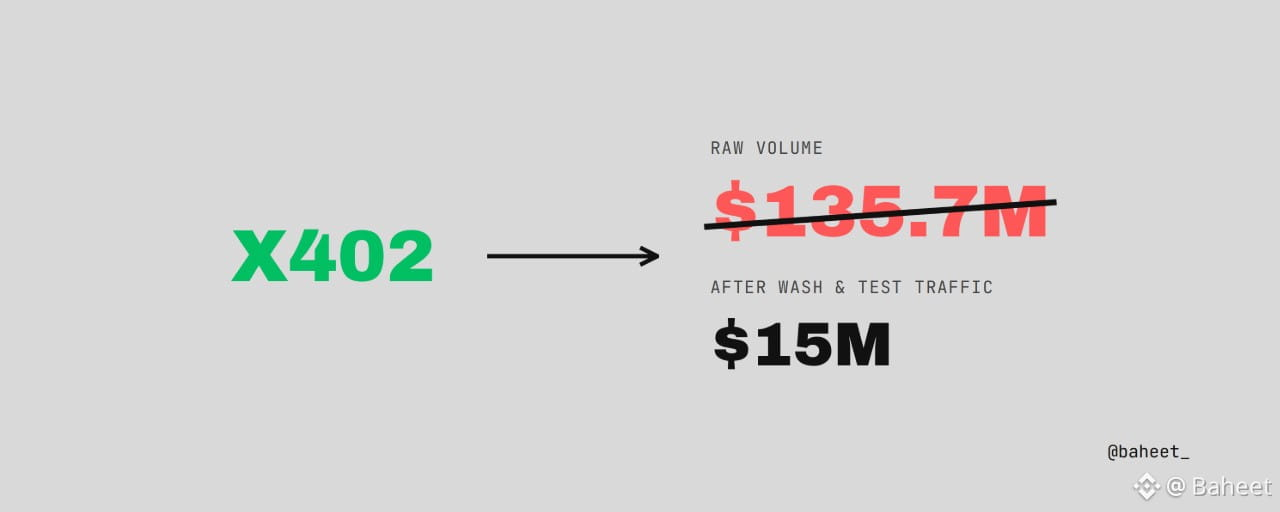
The better data tells a smaller story. In a joint report, Visa and Artemis counted 178.3 million raw x402 transactions worth $135.7 million from launch in May 2025 to April 21, 2026. After stripping out wash trading and test activity, 109.6 million transactions and about $15 million were left. Artemis had put the gamed share of December's dollar volume at 81%. Run the same filter across x402's whole first year, and about 89% of the dollars disappear.
Visa's head of crypto, Cuy Sheffield, later put adjusted volume at about $19 million since launch. CoinDesk, using Artemis data, put real activity in March at roughly $28,000 a day. For a protocol backed by the biggest names in payments, that is a rounding error.
The trend is not kind either. Daily transactions averaged around 731,000 in December 2025, the peak of the memecoin wave, then fell more than 92% by February.
Who Is Actually Buying
Spending is extremely concentrated. A round 4,000 wallets, the top 1%, drive about 90% of adjusted volume. Roughly 422,000 wallets have paid for something, but only a few thousand do most of the spending.
One developer tried buying a single call from 100 x402 sellers. Of 85 paid calls, 74 returned a real answer, so the sellers mostly deliver. The problem is the other side: 65% of sellers had a single payer, and only 1.1% had ten or more. They show up, they work, and almost nobody comes back.
Another tracker, WhatAgentsBuy, looked at 6.4 million payments over 17 days in August. It found 96.4% of them went to sellers where a single wallet supplied at least 90% of that day's money, though those sellers took only 28% of the dollars. It also found 92% of wallets paying for x402 APIs only ever pay one seller.
Where repeat demand does exist, it looks unremarkable. The most-paid listings are resold versions of search tools developers already use, like Exa, Tavily, Firecrawl and You.com. One reseller of Exa search had 176 paying wallets and about 26,000 calls. On-chain data reads sit just behind it. These are developer tools, called by developers' scripts, priced at about a cent per call.
That demand is useful and it is real. It is also a long way from the agentic economy I described in November, where agents discover services on their own, negotiate prices and pay each other for work. What exists today is mostly developers wiring a wallet into a script so it can pay for search without signing up for an API key.
The rails assumed a buyer that barely exists yet: an agent with a budget of its own, and a human who trusts it to spend.
The Problem Isn't Only Onchain
It would be easy to blame crypto for all this. Stablecoin wallets are clunky, the rails are unfamiliar to most businesses, and memecoin farming polluted the data.
The clearest evidence of the demand gap came from somewhere else entirely: OpenAI, running on card rails with one of the largest consumer audiences on the internet.
OpenAI launched Instant Checkout inside ChatGPT on September 29, 2025, built on the Agentic Commerce Protocol it developed with Stripe. By March 2026 it had pulled back. Merchants now run their own checkout, and OpenAI says it is focusing on helping people discover and compare products instead. The number of Shopify merchants live on native checkout reportedly sat around 30 from February into mid-year. One named failure point was stale inventory and pricing data, a reminder of how much plumbing sits between an agent that can pay and an agent that should.
Trust is the other half. A Product.ai survey in April found only 14% of shoppers who use AI for product research trust its recommendations without checking another source first. If people won't trust an agent's suggestion, they are not handing it the checkout.
Read closely, the card networks are candid about where they stand. Visa talks about partner counts and builders in sandbox. Mastercard talks about first live transactions in new markets. Neither has published agent payment volumes.
Every major payments company now has an agent strategy, and so far none has shown agents spending at scale.
Close
I was right that x402 was more than a buzzword, and wrong about where the bottleneck would sit.
In November I treated payments as the missing piece of the agentic economy, the thing that would unlock agent commerce once someone built it. Someone did build it, several times over, and the transactions mostly didn't come.
The bottleneck sits upstream of payment. Agents need things worth buying that they can't get for free, and the people behind them need enough confidence to hand over a budget. Merchants, meanwhile, need proof of who an agent is acting for. Google's AP2 mandates, Visa's Trusted Agent Protocol and Mastercard's Verifiable Intent are all attempts at that last problem, which suggests the payments industry has quietly reached the same conclusion.
There are early signs worth watching. According to Chainalysis, transactions of $1 or more grew from 49% of the value moving through x402 in early 2025 to 95% by early 2026, so the payments that do happen are getting larger. Agents that pay for their own compute, like Conway Research's Automaton, are a small but genuine version of the original thesis. The idea is still alive.
If you want to know when that changes, ignore transaction counts and protocol launches. Watch how many independent buyers pay more than one seller. When that number starts climbing, agents have started shopping.
Until then, x402 is excellent infrastructure waiting on its customers.
89% of x402's Volume Wasn't Real
In November last year I wrote about x402. I opened that piece admitting I had dismissed it as another crypto buzzword, then spent 1,600 words explaining why I changed my mind.
Coinbase and Cloudflare had revived a status code the web left unused for three decades, Google and Visa were circling, and the agentic economy looked like it found the PMF it had been waiting for.
Eleven months is a long time in this industry, so I went back to check my own work.
When I first came across the term “x402”, I thought to myself this is just another crypto buzzword
where everyone acts like we just unlocked a groundbreaking, one of a kind, revolutionary innovation...
Some of it held up well. The protocol now lives under the Linux Foundation, it settles on twelve chains, and the technical limitation I flagged at the end of that article has been fixed. stripe, Google, @Visa and @Mastercard have all shipped their own standards for agent payments since then.
Then there is the part I didn't know when I hit publish. According to Artemis, 81% of the dollar volume moving through x402 in December 2025 was gamed.
A month after my article, most of the activity people (me included) pointed to as proof of adoption was wallets paying themselves, much of it tied to memecoin farming.
That is what this piece is about. The rails for agent payments got built faster than almost anyone expected. The buyers never showed up, and the numbers the industry kept quoting made that very hard to notice.
What I Got Right: The Rails
First, the governance question has been answered. Coinbase handed the protocol to the x402 Foundation, a Linux Foundation project, in April, and the Foundation went fully operational in July with 40 members.
The premier tier is a like a list of the companies that run payments on the internet today: Visa, Mastercard, American Express, Stripe, Shopify, Google, AWS and Cloudflare, alongside Coinbase and the Solana Foundation. A premier seat costs $200,000 a year
The compatibility problem is gone too. My November piece ended on x402's dependence on EIP-3009, which locked out USDT. Coinbase has since added support for almost any ERC-20 token through Uniswap's Permit2 contract, USDT included.
The chain problem has mostly solved itself as well. x402 now settles on twelve chains, and the XRP Ledger alone passed 14 million agent payments this month.
The bigger change is that x402 stopped being the only answer.
Stripe and Tempo launched the Machine Payments Protocol in March, built around sessions where an agent authorizes a spending limit once and streams payments against it. Google's AP2 handles proof that a human authorized a purchase, and uses x402 as its stablecoin rail.
Mastercard has run live agent transactions in Hong Kong, Australia and Europe, and Visa has its own agent program with more than 100 partners. Stripe supports x402 and MPP at the same time, which tells you how seriously the payments industry takes this category.
On infrastructure, the bull case I made in November was right, and probably understated.
Infrastructure was never going to be the hard part, though.
The Numbers Everyone Quoted
If you have read anything about x402 this year, you have probably seen the same two numbers: 75.41 million transactions and $24.24 million in volume over the last 30 days. They sit on the x402.org homepage. As Daniel McGlynn documented, they are not a live counter. They have not moved since March. The same block claims 22,000 sellers, against roughly 5,300 that actually show up on-chain.
The better data tells a smaller story. In a joint report, Visa and Artemis counted 178.3 million raw x402 transactions worth $135.7 million from launch in May 2025 to April 21, 2026. After stripping out wash trading and test activity, 109.6 million transactions and about $15 million were left. Artemis had put the gamed share of December's dollar volume at 81%. Run the same filter across x402's whole first year, and about 89% of the dollars disappear.
Visa's head of crypto, Cuy Sheffield, later put adjusted volume at about $19 million since launch. CoinDesk, using Artemis data, put real activity in March at roughly $28,000 a day. For a protocol backed by the biggest names in payments, that is a rounding error.
The trend is not kind either. Daily transactions averaged around 731,000 in December 2025, the peak of the memecoin wave, then fell more than 92% by February.
Who Is Actually Buying
Spending is extremely concentrated. A round 4,000 wallets, the top 1%, drive about 90% of adjusted volume. Roughly 422,000 wallets have paid for something, but only a few thousand do most of the spending.
One developer tried buying a single call from 100 x402 sellers. Of 85 paid calls, 74 returned a real answer, so the sellers mostly deliver. The problem is the other side: 65% of sellers had a single payer, and only 1.1% had ten or more. They show up, they work, and almost nobody comes back.
Another tracker, WhatAgentsBuy, looked at 6.4 million payments over 17 days in August. It found 96.4% of them went to sellers where a single wallet supplied at least 90% of that day's money, though those sellers took only 28% of the dollars. It also found 92% of wallets paying for x402 APIs only ever pay one seller.
Where repeat demand does exist, it looks unremarkable. The most-paid listings are resold versions of search tools developers already use, like Exa, Tavily, Firecrawl and You.com. One reseller of Exa search had 176 paying wallets and about 26,000 calls. On-chain data reads sit just behind it. These are developer tools, called by developers' scripts, priced at about a cent per call.
That demand is useful and it is real. It is also a long way from the agentic economy I described in November, where agents discover services on their own, negotiate prices and pay each other for work. What exists today is mostly developers wiring a wallet into a script so it can pay for search without signing up for an API key.
The rails assumed a buyer that barely exists yet: an agent with a budget of its own, and a human who trusts it to spend.
The Problem Isn't Only Onchain
It would be easy to blame crypto for all this. Stablecoin wallets are clunky, the rails are unfamiliar to most businesses, and memecoin farming polluted the data.
The clearest evidence of the demand gap came from somewhere else entirely: OpenAI, running on card rails with one of the largest consumer audiences on the internet.
OpenAI launched Instant Checkout inside ChatGPT on September 29, 2025, built on the Agentic Commerce Protocol it developed with Stripe. By March 2026 it had pulled back. Merchants now run their own checkout, and OpenAI says it is focusing on helping people discover and compare products instead. The number of Shopify merchants live on native checkout reportedly sat around 30 from February into mid-year. One named failure point was stale inventory and pricing data, a reminder of how much plumbing sits between an agent that can pay and an agent that should.
Trust is the other half. A Product.ai survey in April found only 14% of shoppers who use AI for product research trust its recommendations without checking another source first. If people won't trust an agent's suggestion, they are not handing it the checkout.
Read closely, the card networks are candid about where they stand. Visa talks about partner counts and builders in sandbox. Mastercard talks about first live transactions in new markets. Neither has published agent payment volumes.
Every major payments company now has an agent strategy, and so far none has shown agents spending at scale.
Close
I was right that x402 was more than a buzzword, and wrong about where the bottleneck would sit.
In November I treated payments as the missing piece of the agentic economy, the thing that would unlock agent commerce once someone built it. Someone did build it, several times over, and the transactions mostly didn't come.
The bottleneck sits upstream of payment. Agents need things worth buying that they can't get for free, and the people behind them need enough confidence to hand over a budget. Merchants, meanwhile, need proof of who an agent is acting for. Google's AP2 mandates, Visa's Trusted Agent Protocol and Mastercard's Verifiable Intent are all attempts at that last problem, which suggests the payments industry has quietly reached the same conclusion.
There are early signs worth watching. According to Chainalysis, transactions of $1 or more grew from 49% of the value moving through x402 in early 2025 to 95% by early 2026, so the payments that do happen are getting larger. Agents that pay for their own compute, like Conway Research's Automaton, are a small but genuine version of the original thesis. The idea is still alive.
If you want to know when that changes, ignore transaction counts and protocol launches. Watch how many independent buyers pay more than one seller. When that number starts climbing, agents have started shopping.
Until then, x402 is excellent infrastructure waiting on its customers.
OPENAI-2.47%
GOOGUS-2.01%
2.7k
Log in to explore more content
Join global crypto users on Binance Square
⚡️ Get latest and useful information about crypto.
💬 Trusted by the world’s largest crypto exchange.
👍 Discover real insights from verified creators.
Email / Phone number
Trending Topics
BinanceReopensWithdrawalsForMoreAssets
950,676 views
4,871 Discussing
Security Incident | Recovery Update #8: Withdrawals for More Assets to Reopen (2026-11-05)
Binance Announcement
·446 Likes
·2.1M views
USStocksSlipandCryptoMarketUnderBroadPressure
40,121 views
352 Discussing
StrategySTRCResumesIssuanceAfterOver170Days
34,316 views
484 Discussing