
0xLinh
429 Posts

0xLinh
Report
Block User
Researcher / Investor
15 Following
45 Followers
129 Liked
Posts
All
Quotes
·
--
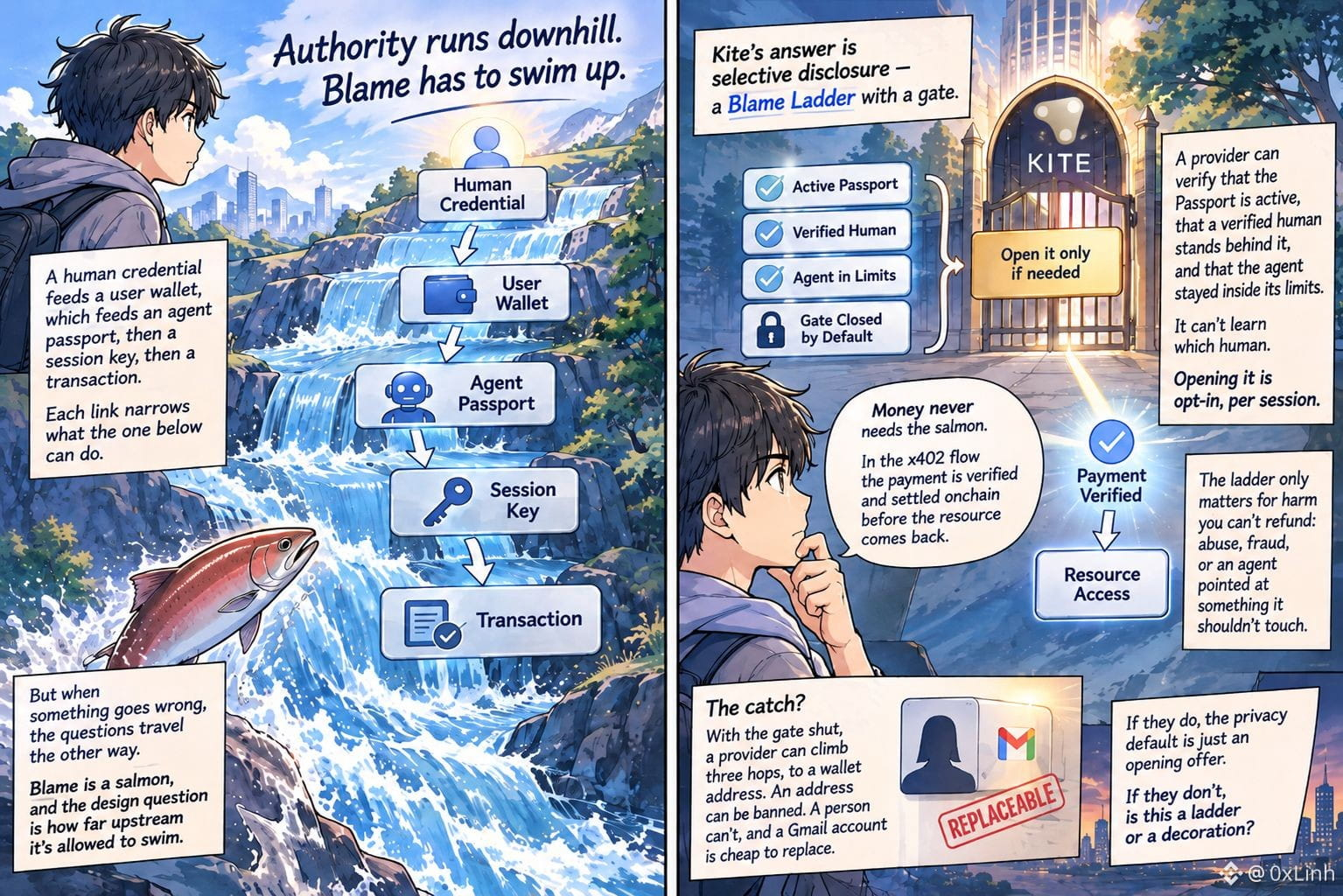
Authority runs downhill. Blame has to swim up.
That’s how I ended up reading Kite Passport. A human credential feeds a user wallet, which feeds an agent passport, then a session key, then a transaction. Each link narrows what the one below it can do, like a river splitting into streams until a session dries up the moment its scope is spent.
But when something goes wrong, the questions travel the other way. Who sent this? Who’s behind it? Blame is a salmon, and the design question is how far upstream it’s allowed to swim. Four hops separate a transaction from a human, and the last hop is the one that matters.
Kite’s answer is selective disclosure, and I think of it as a Blame Ladder with a gate. A provider can verify that the Passport is active, that a verified human stands behind it, and that the agent stayed inside its limits. It can’t learn which human. The gate is shut by default. Opening it is opt-in, per session.
Money never needs the salmon. In the x402 flow the payment is verified and settled onchain before the resource comes back. The ladder only matters for harm you can’t refund: abuse, fraud, an agent pointed at something it shouldn’t touch.
Here’s what stopped me. With the gate shut, a provider can climb three hops, to a wallet address. An address can be banned. A person can’t, and a Gmail account, the deep dive’s own example of a verified human, is cheap to replace. So the ladder ends at a pond, and a person can dig another one.
I won’t judge this by how many Passports exist. I’d watch who controls the gate, what forces it open, and whether providers in regulated categories refuse to serve a shut one.
If they do, the privacy default is just an opening offer. If they don’t, is this a ladder or a decoration?
$KITE
#KiteBBW ⭐️
1
1
125
·
--

Article
I Played Pixels During a Bear Market. The Game Felt Different. Here's Why.The PIXEL price had been declining for about six weeks when I started consciously paying attention to how the bear market was affecting my actual in-game experience.
The decline wasn't catastrophic. PIXEL hadn't gone to zero. But it had lost enough value from its local high that the dollar return on my daily reward accumulation, which I had been tracking as a secondary metric to my Coin output, was noticeably lower per session than it had been two months earlier. The same amount of $PIXEL earned was worth less.
Here's the specific observation I want to record about what that did, and didn't do, to the game.
What didn't change: the farming loop, the cooking system, the crafting chains, the guild coordination, the leaderboard competition. All of those continued operating exactly as they had during the period when the token was higher. The mechanics were unchanged. The world was unchanged. Ranger Dale was still in Terra Villa. The crops still grew. The crafting stations still ran.
What changed: the conversation in the Pixels community.
The Terra Villa chat got quieter. Not dramatically. A noticeable reduction in the ambient energy of the public space. The Discord channels that usually buzzed with strategy discussion had fewer posts. The guild chat, which had been reliably active in the evenings, started having days where it was mostly silent. Players who I had seen daily in the VIP Lounge started showing up every other day, then less. The community contracted around the core of players whose reasons for being in Pixels were clearly not only financial. 🤔
What I found genuinely revealing about this is the demographic shift it made visible.
The Pixels player base, at full token appreciation, includes a significant population of players whose primary interest is the PIXEL return. When the return declines, those players reduce their investment of time. This is rational behavior. It's also the mechanism through which a web3 game's community can hollow out during a price decline: the financially-motivated players leave proportionally to the price drop, and the community that remains is a smaller, more committed version of itself.
That smaller, more committed version of the Pixels community was, honestly, a better community to be in during those six weeks.
The players who showed up during the bear phase were the ones who found something in Pixels worth being there for beyond the token price. The conversations were different: less about "what's the best way to maximize PIXEL daily earnings" and more about "what are you building, what are you trying to figure out." The social texture of Terra Villa in a bear market is quieter and warmer simultaneously. Less bustle, more substance. 😅
The key takeaway I've been sitting with since: the most important question about Pixels' long-term health isn't whether $PIXEL appreciates or depreciates over any given quarter. It's the ratio of players whose engagement survives a bear phase to the total player base. A game where 90% of players leave when the token drops 40% is not a sustainable community. A game where 30% of players stay because they genuinely enjoy it has a resilient core that can survive a cycle.
What that ratio looks like in Pixels I can't calculate with precision from inside the game. The DAU numbers that circulate in community channels give a rough sense, but distinguishing "stayed because the game is good" from "stayed because they're waiting to recover losses" from "stayed because their habits are entrenched" requires individual player motivations that no metric captures cleanly.
The Pixels bear market period taught me something about my own reason for being there. I kept playing. The daily output in dollar terms was lower. The game itself was fine. I was not primarily there for the financial return in those six weeks, and knowing that felt like a useful thing to confirm about myself.
Whether Pixels has designed its game to retain people like that, people for whom the financial case isn't the primary one, deliberately, or whether the farming and social systems just happen to produce that retention as a byproduct, is something I've been wondering about since week one of the bear phase.
The six weeks of bear market also produced a specific economic observation that I haven't seen discussed much in Pixels community guides.
Marketplace prices for common goods, measured in Coins, were slightly lower during the bear phase than the preceding bull period. Not dramatically. About 5% on the categories I track. My interpretation: the players who exit during price declines include a meaningful number of active producers who had been creating supply in those categories. When they leave, supply contracts. Prices should rise on reduced supply, not fall. The fact that they fell suggests that demand contracted faster than supply did, because some of the demand in Pixels' Coins marketplace was being driven by players who were earning well from PIXEL rewards and spending freely. When the reward value dropped, so did their spending.
The Pixels internal Coins economy is not fully insulated from PIXEL dynamics. I had believed it was, based on the "Coins and PIXEL are separate systems" framing. They are separate in mechanism. They're connected in the player behaviors that link them.
@pixels $OPG #pixel
I Played Pixels During a Bear Market. The Game Felt Different. Here's Why.
The PIXEL price had been declining for about six weeks when I started consciously paying attention to how the bear market was affecting my actual in-game experience.
The decline wasn't catastrophic. PIXEL hadn't gone to zero. But it had lost enough value from its local high that the dollar return on my daily reward accumulation, which I had been tracking as a secondary metric to my Coin output, was noticeably lower per session than it had been two months earlier. The same amount of $PIXEL earned was worth less.
Here's the specific observation I want to record about what that did, and didn't do, to the game.
What didn't change: the farming loop, the cooking system, the crafting chains, the guild coordination, the leaderboard competition. All of those continued operating exactly as they had during the period when the token was higher. The mechanics were unchanged. The world was unchanged. Ranger Dale was still in Terra Villa. The crops still grew. The crafting stations still ran.
What changed: the conversation in the Pixels community.
The Terra Villa chat got quieter. Not dramatically. A noticeable reduction in the ambient energy of the public space. The Discord channels that usually buzzed with strategy discussion had fewer posts. The guild chat, which had been reliably active in the evenings, started having days where it was mostly silent. Players who I had seen daily in the VIP Lounge started showing up every other day, then less. The community contracted around the core of players whose reasons for being in Pixels were clearly not only financial. 🤔
What I found genuinely revealing about this is the demographic shift it made visible.
The Pixels player base, at full token appreciation, includes a significant population of players whose primary interest is the PIXEL return. When the return declines, those players reduce their investment of time. This is rational behavior. It's also the mechanism through which a web3 game's community can hollow out during a price decline: the financially-motivated players leave proportionally to the price drop, and the community that remains is a smaller, more committed version of itself.
That smaller, more committed version of the Pixels community was, honestly, a better community to be in during those six weeks.
The players who showed up during the bear phase were the ones who found something in Pixels worth being there for beyond the token price. The conversations were different: less about "what's the best way to maximize PIXEL daily earnings" and more about "what are you building, what are you trying to figure out." The social texture of Terra Villa in a bear market is quieter and warmer simultaneously. Less bustle, more substance. 😅
The key takeaway I've been sitting with since: the most important question about Pixels' long-term health isn't whether $PIXEL appreciates or depreciates over any given quarter. It's the ratio of players whose engagement survives a bear phase to the total player base. A game where 90% of players leave when the token drops 40% is not a sustainable community. A game where 30% of players stay because they genuinely enjoy it has a resilient core that can survive a cycle.
What that ratio looks like in Pixels I can't calculate with precision from inside the game. The DAU numbers that circulate in community channels give a rough sense, but distinguishing "stayed because the game is good" from "stayed because they're waiting to recover losses" from "stayed because their habits are entrenched" requires individual player motivations that no metric captures cleanly.
The Pixels bear market period taught me something about my own reason for being there. I kept playing. The daily output in dollar terms was lower. The game itself was fine. I was not primarily there for the financial return in those six weeks, and knowing that felt like a useful thing to confirm about myself.
Whether Pixels has designed its game to retain people like that, people for whom the financial case isn't the primary one, deliberately, or whether the farming and social systems just happen to produce that retention as a byproduct, is something I've been wondering about since week one of the bear phase.
The six weeks of bear market also produced a specific economic observation that I haven't seen discussed much in Pixels community guides.
Marketplace prices for common goods, measured in Coins, were slightly lower during the bear phase than the preceding bull period. Not dramatically. About 5% on the categories I track. My interpretation: the players who exit during price declines include a meaningful number of active producers who had been creating supply in those categories. When they leave, supply contracts. Prices should rise on reduced supply, not fall. The fact that they fell suggests that demand contracted faster than supply did, because some of the demand in Pixels' Coins marketplace was being driven by players who were earning well from PIXEL rewards and spending freely. When the reward value dropped, so did their spending.
The Pixels internal Coins economy is not fully insulated from PIXEL dynamics. I had believed it was, based on the "Coins and PIXEL are separate systems" framing. They are separate in mechanism. They're connected in the player behaviors that link them.
@Pixels $OPG #pixel
1
3
1.5k
·
--
The Pixels team didn't publish the full weighting logic of the smart distribution system. The sharecropper rates aren't set by a central authority. The craft efficiency of specific loops isn't announced. Guild strategy emerges from players experimenting in isolation and sharing selectively.
I thought this was accidental transparency management.
Now I think it might be architectural.
If every player knew every other player's optimal strategy, all strategies would converge. Converged strategies mean uniform behavior. Uniform behavior means the system gets no signal diversity. No signal diversity means the behavioral model can't distinguish healthy ecosystem activity from optimized performance theater.
The Pixels ecosystem functions partly because different players, with different levels of information, play differently. Some play casually. Some play optimally. Some play according to outdated guides. Some experiment. This variance is how value gradients form in the economy. It's how the marketplace maintains price tension. It's how the smart distribution model gets the signal heterogeneity it needs to function.
Fragmented knowledge isn't a side effect. It's the substrate.
Pixels has never said this. But the Realms Scripting Engine, planned to let third-party developers build on the platform, will produce exactly this: developers with deep knowledge of specific subsystems, casual players with surface knowledge, traders reading on-chain signals, analysts using Hivemind AI. All operating in the same economy with different information layers.
Whether that was designed or inherited, the outcome is a system that might genuinely require distributed ignorance to maintain the behavioral diversity it runs on.
That's a strange thing to build and never mention 😂.
@pixels $PIXEL $OPG #pixel
The Pixels team didn't publish the full weighting logic of the smart distribution system. The sharecropper rates aren't set by a central authority. The craft efficiency of specific loops isn't announced. Guild strategy emerges from players experimenting in isolation and sharing selectively.
I thought this was accidental transparency management.
Now I think it might be architectural.
If every player knew every other player's optimal strategy, all strategies would converge. Converged strategies mean uniform behavior. Uniform behavior means the system gets no signal diversity. No signal diversity means the behavioral model can't distinguish healthy ecosystem activity from optimized performance theater.
The Pixels ecosystem functions partly because different players, with different levels of information, play differently. Some play casually. Some play optimally. Some play according to outdated guides. Some experiment. This variance is how value gradients form in the economy. It's how the marketplace maintains price tension. It's how the smart distribution model gets the signal heterogeneity it needs to function.
Fragmented knowledge isn't a side effect. It's the substrate.
Pixels has never said this. But the Realms Scripting Engine, planned to let third-party developers build on the platform, will produce exactly this: developers with deep knowledge of specific subsystems, casual players with surface knowledge, traders reading on-chain signals, analysts using Hivemind AI. All operating in the same economy with different information layers.
Whether that was designed or inherited, the outcome is a system that might genuinely require distributed ignorance to maintain the behavioral diversity it runs on.
That's a strange thing to build and never mention 😂.
@Pixels $PIXEL $OPG #pixel

1
1
348
·
--
Article
My First Trade on the Pixels Marketplace Lost Me Money. The Lesson Was Worth It.I made my first player-to-player trade on the Pixels marketplace on day twenty-three.
The Trust Score threshold to access it had taken me longer than expected to clear, partly because of the reputation system overhaul I ran into early on. By the time I could actually trade, I had been watching the marketplace from the outside for nearly two weeks, reading prices, tracking what sold, building what I thought was a solid understanding of the market before I participated in it.
I was wrong, in the specific way that watching a market and trading in one are fundamentally different activities. 🤔
My first sale was a batch of mid-tier crafted goods I had produced over a long weekend of focused crafting. I priced them at what I thought was market rate based on several days of observation. They sat unsold for forty-eight hours. I lowered the price. They sat for another twelve hours. I lowered it again. They sold immediately at the second reduced price, and then, two hours later, I watched three other sellers list the same goods at a price between my first and second listing. The market had not been at my observed rate. I had been looking at listed prices, not at transaction prices, and in a marketplace like Pixels', those two numbers are not the same thing.
Listed price is what sellers want. Transaction price is what the market actually pays.
In Pixels, checking the marketplace shows you what's currently listed. It does not easily show you the recent transaction history, the actual prices at which goods changed hands. A player can list crafted goods at a premium price and leave them sitting for weeks without selling. Those listings inflate the apparent market price. The real clearing price, the price that actually moves goods, can be significantly lower, and you find it by transacting, not by observing. 💀
This is not unique to Pixels. It's how illiquid markets work generally. But it's a lesson that most guides and community resources don't spell out clearly, partly because experienced traders internalize it and forget it's not obvious, and partly because Pixels' marketplace interface doesn't surface historical transaction data in a way that would make the distinction visible to newcomers.
The loss on that first batch was small. A few hundred Coins, not a meaningful setback. But it reframed how I approach the Pixels marketplace entirely.
After that trade, I spent about a week doing small test transactions before committing larger batches. I would price a single unit slightly below my estimated market rate and watch how quickly it moved. Fast sale meant I was under market. No movement meant I was over. This gave me actual transaction data rather than observation data, and within a week I had a much more accurate sense of clearing prices for the goods I was producing.
The marketplace also taught me something about the Pixels economy that I hadn't expected: price discovery is doing real economic work.
Pixels' player-to-player marketplace is not a centralized exchange with an order book and instant matching. It's a peer-to-peer listing market. Players set prices, other players decide whether to pay them, and goods move or don't based on those individual decisions. In aggregate, this process reveals information about what resources and crafted goods are actually worth to Pixels players at any given moment, which is real market information that feeds back into what's worth producing.
I started checking the marketplace before planning my crafting queue rather than after. If mid-tier processed goods were moving quickly at good prices, I'd prioritize producing them. If a category was flooded with listings, I'd pivot. The marketplace stopped being a place I sold things and became a planning input. That shift improved my Coin income more than any single crafting optimization I had made previously.
The marketplace fee structure in Pixels is worth understanding because it affects strategy in non-obvious ways.
Players pay marketplace fees on each transaction, and the fee percentage is affected by your Trust Score. Higher Trust Score means lower fees. Lower fees mean more Coins from each sale. For small batches, the fee difference is minimal. For players operating at significant volume, it compounds. This creates another compounding advantage for experienced players with high reputation scores: not only do they have better crafting infrastructure and deeper skill levels, their transaction costs are lower. 😅
Whether Pixels' marketplace will develop more sophisticated tooling, historical transaction data, price charts, volume indicators, as the game matures is something I watch with genuine interest. The raw mechanics are there. The information layer on top of them is still thin. And in a game where economic decisions compound over time, information quality is competitive advantage.
What I find genuinely compelling about the Pixels marketplace, despite its friction, is that it's a real market. Not a simulated economy with NPC price floors. A market where player decisions set prices, supply and demand actually interact, and information asymmetry produces winners and losers. That's a more interesting economic environment than most games offer.
My first trade lost me money. Every trade since has been better than the one before it. That's the curve you're actually signing up for when you enter a real market, not a guaranteed return on a preset formula.
@pixels $TRADOOR $PIXEL #pixel
My First Trade on the Pixels Marketplace Lost Me Money. The Lesson Was Worth It.
I made my first player-to-player trade on the Pixels marketplace on day twenty-three.
The Trust Score threshold to access it had taken me longer than expected to clear, partly because of the reputation system overhaul I ran into early on. By the time I could actually trade, I had been watching the marketplace from the outside for nearly two weeks, reading prices, tracking what sold, building what I thought was a solid understanding of the market before I participated in it.
I was wrong, in the specific way that watching a market and trading in one are fundamentally different activities. 🤔
My first sale was a batch of mid-tier crafted goods I had produced over a long weekend of focused crafting. I priced them at what I thought was market rate based on several days of observation. They sat unsold for forty-eight hours. I lowered the price. They sat for another twelve hours. I lowered it again. They sold immediately at the second reduced price, and then, two hours later, I watched three other sellers list the same goods at a price between my first and second listing. The market had not been at my observed rate. I had been looking at listed prices, not at transaction prices, and in a marketplace like Pixels', those two numbers are not the same thing.
Listed price is what sellers want. Transaction price is what the market actually pays.
In Pixels, checking the marketplace shows you what's currently listed. It does not easily show you the recent transaction history, the actual prices at which goods changed hands. A player can list crafted goods at a premium price and leave them sitting for weeks without selling. Those listings inflate the apparent market price. The real clearing price, the price that actually moves goods, can be significantly lower, and you find it by transacting, not by observing. 💀
This is not unique to Pixels. It's how illiquid markets work generally. But it's a lesson that most guides and community resources don't spell out clearly, partly because experienced traders internalize it and forget it's not obvious, and partly because Pixels' marketplace interface doesn't surface historical transaction data in a way that would make the distinction visible to newcomers.
The loss on that first batch was small. A few hundred Coins, not a meaningful setback. But it reframed how I approach the Pixels marketplace entirely.
After that trade, I spent about a week doing small test transactions before committing larger batches. I would price a single unit slightly below my estimated market rate and watch how quickly it moved. Fast sale meant I was under market. No movement meant I was over. This gave me actual transaction data rather than observation data, and within a week I had a much more accurate sense of clearing prices for the goods I was producing.
The marketplace also taught me something about the Pixels economy that I hadn't expected: price discovery is doing real economic work.
Pixels' player-to-player marketplace is not a centralized exchange with an order book and instant matching. It's a peer-to-peer listing market. Players set prices, other players decide whether to pay them, and goods move or don't based on those individual decisions. In aggregate, this process reveals information about what resources and crafted goods are actually worth to Pixels players at any given moment, which is real market information that feeds back into what's worth producing.
I started checking the marketplace before planning my crafting queue rather than after. If mid-tier processed goods were moving quickly at good prices, I'd prioritize producing them. If a category was flooded with listings, I'd pivot. The marketplace stopped being a place I sold things and became a planning input. That shift improved my Coin income more than any single crafting optimization I had made previously.
The marketplace fee structure in Pixels is worth understanding because it affects strategy in non-obvious ways.
Players pay marketplace fees on each transaction, and the fee percentage is affected by your Trust Score. Higher Trust Score means lower fees. Lower fees mean more Coins from each sale. For small batches, the fee difference is minimal. For players operating at significant volume, it compounds. This creates another compounding advantage for experienced players with high reputation scores: not only do they have better crafting infrastructure and deeper skill levels, their transaction costs are lower. 😅
Whether Pixels' marketplace will develop more sophisticated tooling, historical transaction data, price charts, volume indicators, as the game matures is something I watch with genuine interest. The raw mechanics are there. The information layer on top of them is still thin. And in a game where economic decisions compound over time, information quality is competitive advantage.
What I find genuinely compelling about the Pixels marketplace, despite its friction, is that it's a real market. Not a simulated economy with NPC price floors. A market where player decisions set prices, supply and demand actually interact, and information asymmetry produces winners and losers. That's a more interesting economic environment than most games offer.
My first trade lost me money. Every trade since has been better than the one before it. That's the curve you're actually signing up for when you enter a real market, not a guaranteed return on a preset formula.
@Pixels $TRADOOR $PIXEL #pixel
2
1
281
·
--
Pixels has a Task Board. Carefully designed. Variable demand. Different tiers require different skill levels. Probably the most mechanically interesting economic system in the game, built specifically to prevent everyone from running the same strategy.
Then Twitter happened.
The day a mid-sized crypto influencer posted "current best PIXEL/hour: Popberry rotation tier 3 orders" the Task Board became a Popberry farm. Not because Pixels designed it that way. Because social proof is louder than any mechanic. If enough people you trust are doing a thing, you do the thing. The system's intention becomes irrelevant.
This is the social proof override. Pixels is more exposed to it than most Web3 games because the community is so large and so vocal. One million daily active users means one million people watching each other. Information about what's "working" propagates faster than any design update can counter. By the time Pixels patches the optimal play, the meta has already migrated to the new community consensus.
The April 2025 strategic shift toward referral rewards and content creator incentives deepens this dynamic. Pixels is explicitly funding the information network that produces social proof cascades. Referring creators demonstrate strategies to new players who arrive pre-primed to follow them. That's retention by imitation, not by genuine game engagement.
I'm not saying it doesn't work. Clearly it does at some level. Pixels generated $20 million in revenue in 2024 and much of that came from community-driven player acquisition. But a game that survives primarily on social proof is always one bad influencer cycle away from a narrative shift. And narrative shifts in Web3 gaming move with brutal speed. Pixels' own $1.02 to $0.008 token trajectory is evidence of how fast the story can change when the community consensus flips. The current structure amplifies that risk while also being the engine of growth. 🤔
@pixels $PIXEL $TRADOOR #pixel
Pixels has a Task Board. Carefully designed. Variable demand. Different tiers require different skill levels. Probably the most mechanically interesting economic system in the game, built specifically to prevent everyone from running the same strategy.
Then Twitter happened.
The day a mid-sized crypto influencer posted "current best PIXEL/hour: Popberry rotation tier 3 orders" the Task Board became a Popberry farm. Not because Pixels designed it that way. Because social proof is louder than any mechanic. If enough people you trust are doing a thing, you do the thing. The system's intention becomes irrelevant.
This is the social proof override. Pixels is more exposed to it than most Web3 games because the community is so large and so vocal. One million daily active users means one million people watching each other. Information about what's "working" propagates faster than any design update can counter. By the time Pixels patches the optimal play, the meta has already migrated to the new community consensus.
The April 2025 strategic shift toward referral rewards and content creator incentives deepens this dynamic. Pixels is explicitly funding the information network that produces social proof cascades. Referring creators demonstrate strategies to new players who arrive pre-primed to follow them. That's retention by imitation, not by genuine game engagement.
I'm not saying it doesn't work. Clearly it does at some level. Pixels generated $20 million in revenue in 2024 and much of that came from community-driven player acquisition. But a game that survives primarily on social proof is always one bad influencer cycle away from a narrative shift. And narrative shifts in Web3 gaming move with brutal speed. Pixels' own $1.02 to $0.008 token trajectory is evidence of how fast the story can change when the community consensus flips. The current structure amplifies that risk while also being the engine of growth. 🤔
@Pixels $PIXEL $TRADOOR #pixel
2
1
345
·
--
Article
Pixels Is Closer to an Experimentation Platform Than a Fixed GameGames ship. Platforms iterate. The distinction isn't just semantic; it describes fundamentally different relationships with their users and fundamentally different design philosophies.
A game has a version. It ships with defined mechanics, a content set, a balance state. Players learn that version, develop strategies for it, and evaluate it as a stable artifact. Updates improve it or change it, but each version has integrity as a complete thing. Most games in your library are this: they reached a state the developers were satisfied with, and they exist as that state.
Platforms never ship in the same sense. They iterate continuously based on user behavior data, competitive signals, and evolving infrastructure. There is no "version" of Twitter you can evaluate independently of the moment you're looking at it. The platform is always in motion. This is why the phrase "move fast and break things" made sense as platform development philosophy and would be disqualifying for a game studio.
Pixels is a platform operating with a game's marketing vocabulary. I've become convinced of this after watching its development arc.
Consider the pace of change. The migration from Polygon to Ronin in November 2023 was a total infrastructure replacement. The dual-token system (BERRY and PIXEL) was deprecated and replaced with a single on-chain token and off-chain Coins in early 2025. The "smart" distribution algorithm has been recalibrated continuously since launch, with the parameters never fully disclosed. The Chapter 2.5 update cut core economic constants by 84%. Chapter 3 introduced entirely new game mechanics (Unions, Yieldstones, competitive prize pools) that changed how the economy's highest-activity segments work. The Hivemind AI layer added a monitoring and intelligence infrastructure that operates across the entire ecosystem. Each of these changes reshaped what Pixels is at a fundamental level. No fixed game does this to itself this frequently.
Then consider the explicit goal framing. Luke Barwikowski has publicly described Pixels as a user acquisition engine for a broader ecosystem of Web3 games, aiming to develop five to six titles. This is platform thinking. A standalone game's goal is to be a great standalone game. A platform's goal is to attract users who will engage with multiple products within a connected ecosystem. The Forgotten Runiverse integration, the Pixel Dungeons companion launch, the cross-game reputation and achievement system Pixels is building toward: these are platform architecture decisions.
The Hivemind AI deployment is maybe the clearest tell. Building and deploying an AI agent swarm to monitor community activity, on-chain data, and social sentiment in real-time is not a game feature. It's a platform operational infrastructure investment. Games don't need real-time AI-powered community monitoring; platforms do. The fact that Pixels built this and frames it as a feature rather than as the operational backbone of a platform that needs to make rapid, data-informed decisions is itself revealing.
The experimentation framing is also visible in how Pixels approaches economic adjustments. Barwikowski's stated philosophy is rapid iteration rather than waiting for perfect conditions. That's not how game balance patches work; that's how A/B testing on a live platform works. The "smart" distribution algorithm is explicitly described as experimental and continuously adjusted. Chapter updates are described as experiments in competitive mechanics. The goal of "net ecosystem spend" is a platform KPI, not a game design goal.
This matters for how players should think about engaging with Pixels. If Pixels is a game, the appropriate stance is to learn the current version and develop mastery. If Pixels is an experimentation platform, the appropriate stance is to treat each version as temporary and evaluate your engagement around the platform's direction rather than any particular mechanic. These are different orientations that produce different behaviors and different risk profiles for the time and capital invested.
The platform framing also has implications for valuing $PIXEL. If Pixels is a fixed game, $PIXEL's value should derive from the game's persistent mechanics. If Pixels is a platform, $PIXEL's value derives from the growth trajectory of the whole ecosystem, including games not yet launched and integrations not yet complete. Platform tokens are valued differently than in-game tokens because the addressable market and the development trajectory are different inputs to the valuation. GOAT if the multi-game thesis plays out; not so much if it doesn't.
What Pixels hasn't fully done is explicitly embrace the platform identity in its public communication. The marketing language remains game-forward: farming, exploration, creation, community. These are real aspects of the experience. But they're the surface layer of what is, under the hood, a continuously-iterated digital economy platform with game mechanics as its primary user interface.
I think Pixels would serve its most engaged community better by being more explicit about the platform identity. Players who understand they're participating in an evolving platform make different and more realistic decisions about their engagement, their capital investment in NFTs, and their expectations around economic stability. The gap between the game-framing and the platform-reality is one of the persistent sources of community friction that no chapter update will close.
@pixels $PIXEL $TRADOOR #pixel
Pixels Is Closer to an Experimentation Platform Than a Fixed Game
Games ship. Platforms iterate. The distinction isn't just semantic; it describes fundamentally different relationships with their users and fundamentally different design philosophies.
A game has a version. It ships with defined mechanics, a content set, a balance state. Players learn that version, develop strategies for it, and evaluate it as a stable artifact. Updates improve it or change it, but each version has integrity as a complete thing. Most games in your library are this: they reached a state the developers were satisfied with, and they exist as that state.
Platforms never ship in the same sense. They iterate continuously based on user behavior data, competitive signals, and evolving infrastructure. There is no "version" of Twitter you can evaluate independently of the moment you're looking at it. The platform is always in motion. This is why the phrase "move fast and break things" made sense as platform development philosophy and would be disqualifying for a game studio.
Pixels is a platform operating with a game's marketing vocabulary. I've become convinced of this after watching its development arc.
Consider the pace of change. The migration from Polygon to Ronin in November 2023 was a total infrastructure replacement. The dual-token system (BERRY and PIXEL) was deprecated and replaced with a single on-chain token and off-chain Coins in early 2025. The "smart" distribution algorithm has been recalibrated continuously since launch, with the parameters never fully disclosed. The Chapter 2.5 update cut core economic constants by 84%. Chapter 3 introduced entirely new game mechanics (Unions, Yieldstones, competitive prize pools) that changed how the economy's highest-activity segments work. The Hivemind AI layer added a monitoring and intelligence infrastructure that operates across the entire ecosystem. Each of these changes reshaped what Pixels is at a fundamental level. No fixed game does this to itself this frequently.
Then consider the explicit goal framing. Luke Barwikowski has publicly described Pixels as a user acquisition engine for a broader ecosystem of Web3 games, aiming to develop five to six titles. This is platform thinking. A standalone game's goal is to be a great standalone game. A platform's goal is to attract users who will engage with multiple products within a connected ecosystem. The Forgotten Runiverse integration, the Pixel Dungeons companion launch, the cross-game reputation and achievement system Pixels is building toward: these are platform architecture decisions.
The Hivemind AI deployment is maybe the clearest tell. Building and deploying an AI agent swarm to monitor community activity, on-chain data, and social sentiment in real-time is not a game feature. It's a platform operational infrastructure investment. Games don't need real-time AI-powered community monitoring; platforms do. The fact that Pixels built this and frames it as a feature rather than as the operational backbone of a platform that needs to make rapid, data-informed decisions is itself revealing.
The experimentation framing is also visible in how Pixels approaches economic adjustments. Barwikowski's stated philosophy is rapid iteration rather than waiting for perfect conditions. That's not how game balance patches work; that's how A/B testing on a live platform works. The "smart" distribution algorithm is explicitly described as experimental and continuously adjusted. Chapter updates are described as experiments in competitive mechanics. The goal of "net ecosystem spend" is a platform KPI, not a game design goal.
This matters for how players should think about engaging with Pixels. If Pixels is a game, the appropriate stance is to learn the current version and develop mastery. If Pixels is an experimentation platform, the appropriate stance is to treat each version as temporary and evaluate your engagement around the platform's direction rather than any particular mechanic. These are different orientations that produce different behaviors and different risk profiles for the time and capital invested.
The platform framing also has implications for valuing $PIXEL . If Pixels is a fixed game, $PIXEL 's value should derive from the game's persistent mechanics. If Pixels is a platform, $PIXEL 's value derives from the growth trajectory of the whole ecosystem, including games not yet launched and integrations not yet complete. Platform tokens are valued differently than in-game tokens because the addressable market and the development trajectory are different inputs to the valuation. GOAT if the multi-game thesis plays out; not so much if it doesn't.
What Pixels hasn't fully done is explicitly embrace the platform identity in its public communication. The marketing language remains game-forward: farming, exploration, creation, community. These are real aspects of the experience. But they're the surface layer of what is, under the hood, a continuously-iterated digital economy platform with game mechanics as its primary user interface.
I think Pixels would serve its most engaged community better by being more explicit about the platform identity. Players who understand they're participating in an evolving platform make different and more realistic decisions about their engagement, their capital investment in NFTs, and their expectations around economic stability. The gap between the game-framing and the platform-reality is one of the persistent sources of community friction that no chapter update will close.
@Pixels $PIXEL $TRADOOR #pixel
4
2
478
·
--
Pixels is an economy. Economies need uptime. The game's infrastructure documentation doesn't spend much time on what happens when the infrastructure doesn't have it.
The $PIXEL reward system resolves continuously: daily distributions, quest completions, leaderboard snapshots. Each of those is a time-sensitive event. If the Ronin network experiences congestion, if the Pixels servers are down during a leaderboard snapshot window, the economic consequences for players aren't symmetric. Some players lose a daily distribution cycle. Others lose a leaderboard position they'd spent the day earning. The system doesn't compensate for lost windows — it just moves to the next one. 😭 The economy keeps its schedule. Players adapt to it, or they eat the loss without recourse. The asymmetry between the platform's continuity and the player's economic exposure isn't discussed in the documentation.
This matters more as Pixels scales cross-game. The mid-2025 integration with partner games means PIXEL is now flowing across multiple game engines and networks simultaneously. Each integration point is a potential downtime surface. A maintenance window in The Forgotten Runiverse during a joint event affects Pixels players' cross-game rewards. The dependency graph gets wide fast, and each added node is one more thing that can have a bad Tuesday at the worst moment.
The VIP membership model makes downtime an economic category. VIP costs $PIXEL monthly. A player who pays for VIP and loses access to VIP-exclusive areas or VIP earning bonuses during an outage has paid for uptime that wasn't delivered. The terms of service handle this in the standard way: no guarantees. But "no guarantees" and "player-owned economy" don't quite sit together without friction.
Pixels hasn't published SLA targets or incident response protocols in any document I've found. That's normal for a gaming company. It's less normal for one that frames participation as economic ownership.
@pixels $TRADOOR #pixel
Pixels is an economy. Economies need uptime. The game's infrastructure documentation doesn't spend much time on what happens when the infrastructure doesn't have it.
The $PIXEL reward system resolves continuously: daily distributions, quest completions, leaderboard snapshots. Each of those is a time-sensitive event. If the Ronin network experiences congestion, if the Pixels servers are down during a leaderboard snapshot window, the economic consequences for players aren't symmetric. Some players lose a daily distribution cycle. Others lose a leaderboard position they'd spent the day earning. The system doesn't compensate for lost windows — it just moves to the next one. 😭 The economy keeps its schedule. Players adapt to it, or they eat the loss without recourse. The asymmetry between the platform's continuity and the player's economic exposure isn't discussed in the documentation.
This matters more as Pixels scales cross-game. The mid-2025 integration with partner games means PIXEL is now flowing across multiple game engines and networks simultaneously. Each integration point is a potential downtime surface. A maintenance window in The Forgotten Runiverse during a joint event affects Pixels players' cross-game rewards. The dependency graph gets wide fast, and each added node is one more thing that can have a bad Tuesday at the worst moment.
The VIP membership model makes downtime an economic category. VIP costs $PIXEL monthly. A player who pays for VIP and loses access to VIP-exclusive areas or VIP earning bonuses during an outage has paid for uptime that wasn't delivered. The terms of service handle this in the standard way: no guarantees. But "no guarantees" and "player-owned economy" don't quite sit together without friction.
Pixels hasn't published SLA targets or incident response protocols in any document I've found. That's normal for a gaming company. It's less normal for one that frames participation as economic ownership.
@Pixels $TRADOOR #pixel
3
1
531
·
--
Article
Pixels Has to Choose: Make the Game Fair, or Make It Engaging. It Can't Fully Do Both.Fairness and engagement are not synonyms. In most contexts we assume they move together: a fair game is an engaging game, and vice versa. But in a game with real money attached to the reward structure, the relationship between fairness and engagement gets complicated, and Pixels is living inside that complication right now.
Start with the clearest version of the tension. The land NFT system creates a two-tier economy from the moment a player joins. Land owners access higher-tier resources, earn more per unit of time, and have compounding advantages that widen over time. A player who bought a top-tier land plot in 2023 for $10,000 is in a fundamentally different economic position than a free-to-play player farming on a Speck. Both are "playing Pixels." They are not playing the same game. The land owner's expected return per session is categorically higher. That's unfair in the strict sense: identical labor time produces different economic outcomes based on starting capital.
But here's the problem. The land NFT system is also the reason Pixels had a player base at all in its early growth phase. The promise of land ownership as a yield-producing asset was what motivated the original investment community. The NFT market generated early revenue and community formation. Destroy the land advantage and you destroy the investment thesis that funded the game's growth. Fairness, applied retroactively to the land system, is not free. It costs the exact constituency that built the ecosystem.
Pixels has threaded this needle through a design philosophy that doesn't flatten the advantage but creates pathways for non-land players. Free-to-play players can access Specks, join guilds to access higher-tier resources, participate in events, complete the task board. The gap is real but not absolute. You can play Pixels without land. You will not earn at the same rate as a landowner. The design accepts the unfairness as a structural feature and builds access routes around it.
The engagement side of this tradeoff is where it gets interesting. Variable reward structures, where high-investment players can earn meaningfully more than low-investment players, are more engaging than flat structures. This is the same reason competitive ladders in games produce more sustained engagement than egalitarian participation rewards. The delta between your current state and a better state creates motivation. If land owners and Speck farmers earned identically, the motivation to acquire land would disappear, and with it the investment community that funds development. The unfairness is load-bearing.
Stacked, Pixels' AI economy platform, personalizes incentives rather than standardizing them. A veteran land owner who hasn't spent in 30 days receives a different offer than a free-to-play newcomer at the same engagement point. This is technically less fair, because two players with similar behavioral signals receive different economic treatment. But it's more engaging for each cohort, because the offer is calibrated to the specific value proposition relevant to that player's position in the economy. Personalization is structured unfairness that produces better engagement outcomes than universal fairness.
The VIP system is another explicit fairness-engagement tradeoff. VIP costs $10/month in PIXEL and provides meaningful advantages: extra energy, reduced marketplace fees, exclusive area access, 400 instant energy every 8 hours. Players who can afford VIP have compounding advantages over players who cannot. This is unfair. It is also what drives $PIXEL demand and sustains the token economy. The team cannot drop VIP without losing a major deflationary mechanism and a major revenue line.
The April 2025 strategic update made this tradeoff explicit. Pixels is deliberately shifting toward serving players who "are more active, spend more, or hold PIXEL long-term." That is a conscious choice to optimize for the players whose participation is economically valuable to the studio, not for the players who are most disadvantaged by the existing structure. It's a rational business decision. It is not a fairness-maximizing decision. And the players who needed a fairness-first approach, the free-to-play base who could have become a sustainable long-term community, are the cohort most likely to have churned in the 2024-2025 user base decline.
I don't think there's a clean resolution here. Engagement-first design produces unfair outcomes. Fairness-first design produces lower engagement. Pixels chose engagement. The question is whether the unfairness was calibrated carefully enough to retain the players who could tolerate it, and shed the players who couldn't without losing structural health. The jury is still out.
The honest admission Pixels could make, but hasn't, is that the fairness-engagement tradeoff was consciously made in favor of engagement from the beginning. Land NFTs as yield-producing assets were the original design. $PIXEL as a premium currency that amplifies advantage for spenders was the original design. The two-tier economy wasn't a mistake. It was a business model. What changed in 2024-2025 was the public framing: Pixels started talking more explicitly about sustainability and player retention without acknowledging that the existing design systematically advantages high-capital players.
The strategic shift toward "daily active users with higher lifetime value" in April 2025 is internally consistent with this design philosophy. You're just being more explicit about it. High-lifetime-value players are, almost by definition, the players who can afford to engage with the premium layer of the economy. The shift isn't changing the fairness-engagement tradeoff. It's accepting it more explicitly and designing for it more deliberately. Whether that's a maturation of the business model or an abandonment of the broader player base that made Pixels famous is a genuinely contested question among the people who've been watching Pixels the longest. 😭
@pixels $PIXEL #pixel $TRADOOR
Pixels Has to Choose: Make the Game Fair, or Make It Engaging. It Can't Fully Do Both.
Fairness and engagement are not synonyms. In most contexts we assume they move together: a fair game is an engaging game, and vice versa. But in a game with real money attached to the reward structure, the relationship between fairness and engagement gets complicated, and Pixels is living inside that complication right now.
Start with the clearest version of the tension. The land NFT system creates a two-tier economy from the moment a player joins. Land owners access higher-tier resources, earn more per unit of time, and have compounding advantages that widen over time. A player who bought a top-tier land plot in 2023 for $10,000 is in a fundamentally different economic position than a free-to-play player farming on a Speck. Both are "playing Pixels." They are not playing the same game. The land owner's expected return per session is categorically higher. That's unfair in the strict sense: identical labor time produces different economic outcomes based on starting capital.
But here's the problem. The land NFT system is also the reason Pixels had a player base at all in its early growth phase. The promise of land ownership as a yield-producing asset was what motivated the original investment community. The NFT market generated early revenue and community formation. Destroy the land advantage and you destroy the investment thesis that funded the game's growth. Fairness, applied retroactively to the land system, is not free. It costs the exact constituency that built the ecosystem.
Pixels has threaded this needle through a design philosophy that doesn't flatten the advantage but creates pathways for non-land players. Free-to-play players can access Specks, join guilds to access higher-tier resources, participate in events, complete the task board. The gap is real but not absolute. You can play Pixels without land. You will not earn at the same rate as a landowner. The design accepts the unfairness as a structural feature and builds access routes around it.
The engagement side of this tradeoff is where it gets interesting. Variable reward structures, where high-investment players can earn meaningfully more than low-investment players, are more engaging than flat structures. This is the same reason competitive ladders in games produce more sustained engagement than egalitarian participation rewards. The delta between your current state and a better state creates motivation. If land owners and Speck farmers earned identically, the motivation to acquire land would disappear, and with it the investment community that funds development. The unfairness is load-bearing.
Stacked, Pixels' AI economy platform, personalizes incentives rather than standardizing them. A veteran land owner who hasn't spent in 30 days receives a different offer than a free-to-play newcomer at the same engagement point. This is technically less fair, because two players with similar behavioral signals receive different economic treatment. But it's more engaging for each cohort, because the offer is calibrated to the specific value proposition relevant to that player's position in the economy. Personalization is structured unfairness that produces better engagement outcomes than universal fairness.
The VIP system is another explicit fairness-engagement tradeoff. VIP costs $10/month in PIXEL and provides meaningful advantages: extra energy, reduced marketplace fees, exclusive area access, 400 instant energy every 8 hours. Players who can afford VIP have compounding advantages over players who cannot. This is unfair. It is also what drives $PIXEL demand and sustains the token economy. The team cannot drop VIP without losing a major deflationary mechanism and a major revenue line.
The April 2025 strategic update made this tradeoff explicit. Pixels is deliberately shifting toward serving players who "are more active, spend more, or hold PIXEL long-term." That is a conscious choice to optimize for the players whose participation is economically valuable to the studio, not for the players who are most disadvantaged by the existing structure. It's a rational business decision. It is not a fairness-maximizing decision. And the players who needed a fairness-first approach, the free-to-play base who could have become a sustainable long-term community, are the cohort most likely to have churned in the 2024-2025 user base decline.
I don't think there's a clean resolution here. Engagement-first design produces unfair outcomes. Fairness-first design produces lower engagement. Pixels chose engagement. The question is whether the unfairness was calibrated carefully enough to retain the players who could tolerate it, and shed the players who couldn't without losing structural health. The jury is still out.
The honest admission Pixels could make, but hasn't, is that the fairness-engagement tradeoff was consciously made in favor of engagement from the beginning. Land NFTs as yield-producing assets were the original design. $PIXEL as a premium currency that amplifies advantage for spenders was the original design. The two-tier economy wasn't a mistake. It was a business model. What changed in 2024-2025 was the public framing: Pixels started talking more explicitly about sustainability and player retention without acknowledging that the existing design systematically advantages high-capital players.
The strategic shift toward "daily active users with higher lifetime value" in April 2025 is internally consistent with this design philosophy. You're just being more explicit about it. High-lifetime-value players are, almost by definition, the players who can afford to engage with the premium layer of the economy. The shift isn't changing the fairness-engagement tradeoff. It's accepting it more explicitly and designing for it more deliberately. Whether that's a maturation of the business model or an abandonment of the broader player base that made Pixels famous is a genuinely contested question among the people who've been watching Pixels the longest. 😭
@Pixels $PIXEL #pixel $TRADOOR
7
5
431
·
--
When players know that Stacked will send a re-engagement offer after 30 days of inactivity, the 30-day absence becomes a strategy. This is not a hypothetical. It's the standard response to any predictable incentive structure that becomes publicly known.
Pixels' Stacked campaign data showed a 178% conversion increase on veteran players who had not spent in over 30 days. That data is now public. Any veteran Pixels player who reads the Stacked launch documentation knows the trigger condition. Some percentage will internalize it. The offer arrives, it feels earned, it might even be appreciated. But the player behavior generating the signal is now partially endogenous to the reward system itself.
This is the Lucas Critique applied to game economics. When you make a policy rule public, rational agents adjust behavior to account for the rule, and the rule's effects change. Stacked was designed on historical player behavior before players knew the system existed. Now that Stacked is public and its trigger conditions appear in press materials, the behavioral model it was trained on is potentially obsolete.
Pixels hasn't addressed this directly. The sophisticated response would be to either keep campaign trigger conditions confidential, which conflicts with the transparency a Web3 community expects, or to continuously retrain the model on post-announcement behavior. Whether new behavior still generates meaningful signal or just strategic noise is the unresolved question. 💀
@pixels $TRADOOR $PIXEL #pixel
When players know that Stacked will send a re-engagement offer after 30 days of inactivity, the 30-day absence becomes a strategy. This is not a hypothetical. It's the standard response to any predictable incentive structure that becomes publicly known.
Pixels' Stacked campaign data showed a 178% conversion increase on veteran players who had not spent in over 30 days. That data is now public. Any veteran Pixels player who reads the Stacked launch documentation knows the trigger condition. Some percentage will internalize it. The offer arrives, it feels earned, it might even be appreciated. But the player behavior generating the signal is now partially endogenous to the reward system itself.
This is the Lucas Critique applied to game economics. When you make a policy rule public, rational agents adjust behavior to account for the rule, and the rule's effects change. Stacked was designed on historical player behavior before players knew the system existed. Now that Stacked is public and its trigger conditions appear in press materials, the behavioral model it was trained on is potentially obsolete.
Pixels hasn't addressed this directly. The sophisticated response would be to either keep campaign trigger conditions confidential, which conflicts with the transparency a Web3 community expects, or to continuously retrain the model on post-announcement behavior. Whether new behavior still generates meaningful signal or just strategic noise is the unresolved question. 💀
@Pixels $TRADOOR $PIXEL #pixel
6
4
912
·
--

Article
What Actually Changes Player Behavior in Pixels: Updates or PIXEL Price?I've been playing and watching the Pixels community long enough to form a thesis about this, but the thesis makes me uncomfortable enough that I want to test it against data before I state it. So let me trace what the available evidence shows about whether game updates or token price drives the behavioral changes that actually matter: how many players show up, how much they spend, how engaged they are.
The 2024 Data Points
Pixels released the Chapter 2 update in June 2024, a major content update with new skills, marketplace overhaul, avatar system, and enhanced guild mechanics. The Pixels financial report shows DAU peaked in May 2024, before Chapter 2 launched. Chapter 2 did not arrest the DAU decline. The player count peak came during the play-to-airdrop period, when PIXEL was new, its price was high, and the financial incentive to farm was maximum. Chapter 2 arrived after the peak and did not reverse it.
The Chapter 2.5 update in early 2025, which brought XP rebalancing and BERRY deprecation, coincided with a period of continued price decline. The behavioral response from the community was not a surge in new player acquisition. It was a quality-of-life improvement for existing engaged players, who appreciated the pacing changes and the Coins system clarity. The update improved retention among paying players without driving significant new inflows.
Contrast this with what PIXEL price movements produced. The February 2024 Binance launch and price surge to 0.51, then 1.02, drove a wave of new wallet creation and farming activity that no single content update has matched. The August 2024 guild mushroom event with 85,000 PIXEL in prizes, a content event, drove guild activity spikes. But the underlying DAU trajectory through 2024 tracked PIXEL price more closely than content update cadence.
The Honest Thesis
My read, which I don't love because it implies something uncomfortable about the nature of Pixels' community: for most players, PIXEL price is the primary behavioral driver and game updates are the secondary driver. Players who are primarily extracting value from the game arrive when extraction is profitable and leave when it isn't, regardless of what the game content looks like. Players who genuinely enjoy the game respond to content updates and stay through price cycles, but this group is smaller and was not the majority of the DAU peak in May 2024.
The 75% growth in paying wallets through 2024, occurring alongside DAU decline, supports this reading. The paying players, the ones who value the game enough to spend PIXEL on VIP passes, cosmetics, and premium features, stayed engaged and increased their spending even as overall wallet counts fell. These players are responding to game updates and seasonal content. The departed players, the ones who grew DAU to its May 2024 peak, were responding to PIXEL price and left when that driver weakened.
What This Implies for Design Decisions
If this behavioral split is accurate, it has a real implication for how the Pixels team should prioritize its development resources. Content updates improve quality and retention for the engaged spending cohort. Token economics, price drivers, and external market narrative drive the casual extraction cohort. The team can invest in one, the other, or both. Since mid-2024, the strategic shift toward high-lifetime-value users suggests the team has implicitly chosen to invest in the engaged spending cohort, accepting that the casual extraction cohort will remain price-sensitive and volatile.
That's a sustainable business decision. A small, spending, deeply-engaged community is more valuable to a game's long-term health than a large, volatile, extraction-focused audience. But it is also a decision to let PIXEL's role as the primary behavioral driver for the mass audience be somewhat outside the team's control, since PIXEL price is primarily set by external markets, as I explored in the liquidity piece. The team can improve the game and improve retention. They cannot directly control the signal that brings the largest number of players in.
The uncomfortable implication: Pixels became the biggest Web3 game by DAU partly because PIXEL's market narrative attracted an extraction audience. Building a sustainable game means replacing that audience with a smaller, more committed one. The replacement is happening. But the metrics that made Pixels famous, DAU records, daily active wallet counts, the "most popular Web3 game" headline, were driven by a dynamic that the team is now deliberately designing against.
I still don't know whether the long-term engaged player community, the one responding to content updates rather than token price, is large enough to build the game's next phase on. The data from 2025 will be more telling than 2024 because 2025 is the first full year where the team is explicitly optimizing for quality engagement over raw quantity. Whether the game gets better or the numbers get smaller or both is the question I am watching.
@pixels $CHIP $PIXEL #pixel
What Actually Changes Player Behavior in Pixels: Updates or PIXEL Price?
I've been playing and watching the Pixels community long enough to form a thesis about this, but the thesis makes me uncomfortable enough that I want to test it against data before I state it. So let me trace what the available evidence shows about whether game updates or token price drives the behavioral changes that actually matter: how many players show up, how much they spend, how engaged they are.
The 2024 Data Points
Pixels released the Chapter 2 update in June 2024, a major content update with new skills, marketplace overhaul, avatar system, and enhanced guild mechanics. The Pixels financial report shows DAU peaked in May 2024, before Chapter 2 launched. Chapter 2 did not arrest the DAU decline. The player count peak came during the play-to-airdrop period, when PIXEL was new, its price was high, and the financial incentive to farm was maximum. Chapter 2 arrived after the peak and did not reverse it.
The Chapter 2.5 update in early 2025, which brought XP rebalancing and BERRY deprecation, coincided with a period of continued price decline. The behavioral response from the community was not a surge in new player acquisition. It was a quality-of-life improvement for existing engaged players, who appreciated the pacing changes and the Coins system clarity. The update improved retention among paying players without driving significant new inflows.
Contrast this with what PIXEL price movements produced. The February 2024 Binance launch and price surge to 0.51, then 1.02, drove a wave of new wallet creation and farming activity that no single content update has matched. The August 2024 guild mushroom event with 85,000 PIXEL in prizes, a content event, drove guild activity spikes. But the underlying DAU trajectory through 2024 tracked PIXEL price more closely than content update cadence.
The Honest Thesis
My read, which I don't love because it implies something uncomfortable about the nature of Pixels' community: for most players, PIXEL price is the primary behavioral driver and game updates are the secondary driver. Players who are primarily extracting value from the game arrive when extraction is profitable and leave when it isn't, regardless of what the game content looks like. Players who genuinely enjoy the game respond to content updates and stay through price cycles, but this group is smaller and was not the majority of the DAU peak in May 2024.
The 75% growth in paying wallets through 2024, occurring alongside DAU decline, supports this reading. The paying players, the ones who value the game enough to spend PIXEL on VIP passes, cosmetics, and premium features, stayed engaged and increased their spending even as overall wallet counts fell. These players are responding to game updates and seasonal content. The departed players, the ones who grew DAU to its May 2024 peak, were responding to PIXEL price and left when that driver weakened.
What This Implies for Design Decisions
If this behavioral split is accurate, it has a real implication for how the Pixels team should prioritize its development resources. Content updates improve quality and retention for the engaged spending cohort. Token economics, price drivers, and external market narrative drive the casual extraction cohort. The team can invest in one, the other, or both. Since mid-2024, the strategic shift toward high-lifetime-value users suggests the team has implicitly chosen to invest in the engaged spending cohort, accepting that the casual extraction cohort will remain price-sensitive and volatile.
That's a sustainable business decision. A small, spending, deeply-engaged community is more valuable to a game's long-term health than a large, volatile, extraction-focused audience. But it is also a decision to let PIXEL's role as the primary behavioral driver for the mass audience be somewhat outside the team's control, since PIXEL price is primarily set by external markets, as I explored in the liquidity piece. The team can improve the game and improve retention. They cannot directly control the signal that brings the largest number of players in.
The uncomfortable implication: Pixels became the biggest Web3 game by DAU partly because PIXEL's market narrative attracted an extraction audience. Building a sustainable game means replacing that audience with a smaller, more committed one. The replacement is happening. But the metrics that made Pixels famous, DAU records, daily active wallet counts, the "most popular Web3 game" headline, were driven by a dynamic that the team is now deliberately designing against.
I still don't know whether the long-term engaged player community, the one responding to content updates rather than token price, is large enough to build the game's next phase on. The data from 2025 will be more telling than 2024 because 2025 is the first full year where the team is explicitly optimizing for quality engagement over raw quantity. Whether the game gets better or the numbers get smaller or both is the question I am watching.
@Pixels $CHIP $PIXEL #pixel
2
3
304
·
--
"Quality of Life Upgrades" is one of the official PIXEL utility categories. It's listed on CoinMarketCap's Pixels page. I want to actually examine what that means in practice, because QoL (quality of life) is doing a lot of work as a category label. 😂
QoL upgrades that Pixels has shipped requiring PIXEL include: cosmetic skins and avatar items, crafting recipe unlocks, speed boosts for build timers, temporary energy refills. These are real. Players spend PIXEL on them. The utility is live.
But here's the frame problem. A cosmetic skin is not a quality of life improvement in the traditional sense. It's an aesthetic purchase. A speed boost that costs PIXEL to skip a timer is not quality of life, it's monetized patience. An energy refill that lets you keep playing is closer to the original definition, but it's also a mechanic that creates the deficit it then sells you the solution to.
The phrase "quality of life" in game design typically means reducing friction the player didn't choose. Auto-sort inventory. Faster UI. Better map visibility. Real QoL.
What Pixels has shipped under the QoL label is a mix of cosmetics, convenience paywalls, and energy economy items. They're all legitimate game design choices. The honest framing is just different from the official one.
I genuinely don't know if this matters much for PIXEL valuation. Tokens get spent either way. But if the governance utility is prospective and the QoL utility is partially cosmetic, the real-time utility case for holding PIXEL rests more narrowly on VIP and guild mechanics than the five-category list implies.
@pixels $PIXEL #pixel
"Quality of Life Upgrades" is one of the official PIXEL utility categories. It's listed on CoinMarketCap's Pixels page. I want to actually examine what that means in practice, because QoL (quality of life) is doing a lot of work as a category label. 😂
QoL upgrades that Pixels has shipped requiring PIXEL include: cosmetic skins and avatar items, crafting recipe unlocks, speed boosts for build timers, temporary energy refills. These are real. Players spend PIXEL on them. The utility is live.
But here's the frame problem. A cosmetic skin is not a quality of life improvement in the traditional sense. It's an aesthetic purchase. A speed boost that costs PIXEL to skip a timer is not quality of life, it's monetized patience. An energy refill that lets you keep playing is closer to the original definition, but it's also a mechanic that creates the deficit it then sells you the solution to.
The phrase "quality of life" in game design typically means reducing friction the player didn't choose. Auto-sort inventory. Faster UI. Better map visibility. Real QoL.
What Pixels has shipped under the QoL label is a mix of cosmetics, convenience paywalls, and energy economy items. They're all legitimate game design choices. The honest framing is just different from the official one.
I genuinely don't know if this matters much for PIXEL valuation. Tokens get spent either way. But if the governance utility is prospective and the QoL utility is partially cosmetic, the real-time utility case for holding PIXEL rests more narrowly on VIP and guild mechanics than the five-category list implies.
@Pixels $PIXEL #pixel
2
2
88
·
--
Article
The Guild Wars Effect: How Competition Changed What a Guild Means in PixelsBefore Guild Wars existed in Pixels, a guild was primarily a social coordination structure. You joined one because your friends were in it, or because you wanted access to a land plot for farming, or because the guild had a good reputation in the community and membership meant something about your own standing. Guilds had Discord servers. They had informal hierarchies. Some had written rules, most had understood norms. The way you evaluated a guild was through vibes: was the community active, were the members helpful, did the social dynamics feel healthy. There was no formal competitive record. There was no scoreboard that summarized what your guild had done over the past three months. The guild's reputation was a lived social thing, not a number.
Guild Wars Season 1 ran in August 2024. The prize pool was 500,000 $PIXEL, roughly $89,000 at the time. The mechanics centered on mushroom cultivation in a guild vs. guild format. Guilds were matched by size. The competitive structure was real but relatively low-stakes. Players who participated described it as a fun event on top of normal play. The social dynamics inside guilds during Season 1 shifted somewhat toward coordination, but the fundamental identity of a guild as a social community didn't substantially change. Most players could opt into the competition or not without it fundamentally altering their relationship to their guild.
Then Guild Wars Season 2: Spore Sports happened.
Season 2 ran from December 10, 2024 to March 4, 2025. The prize pool expanded from 500,000 $PIXEL to 15 million $PIXEL, valued at approximately $3.6 million to $4 million. The event ran for three months. Competition sessions were scheduled twice daily, four days per week, at fixed UTC times. The guild tier system, based on member count, determined which prize share a guild competed for. Top three guilds at season end took the largest shares. Weekly prizes ensured ongoing pressure throughout. The structure was no longer an event layered on top of the game. For any guild taking the season seriously, it became the game.
What that change did to social trust inside guilds
The formalization of competitive record created a new evaluation layer that hadn't previously existed. In a guild without a Guild Wars standing, you evaluated members on social criteria: helpfulness, activity, whether they contributed to the community. With a Guild Wars leaderboard, you now had competitive criteria that ran alongside those social ones. A guild member who was a genuinely pleasant community presence but couldn't reliably show up for the twice-daily scheduled sessions became an optimization problem. Not a bad person. An optimization problem. The coordination tools that guilds started using, role assignment by engagement level, resource allocation protocols, daily harvest tracking in Discord, are standard tools for competitive guilds in any serious game. They're unusual in what had been a cozy farming social game.
I talked to players in multiple guilds during and after Season 2. The consistent observation was that guilds split into roughly two cultures based on how seriously they took the competition. Guilds that engaged fully with the competitive structure became much more organized and much less casual. Guild members who didn't want a three-month scheduling commitment dropped to less active roles or found more casual guilds. Guilds that stayed casual watched their competitive standing reflect that choice, which produced a different kind of social pressure: the visible leaderboard told you exactly how your low-key approach was performing relative to organized guilds.
The divergence between formal record and actual social trust
Here's the specific dynamic that emerged from Guild Wars that I think the Pixels team didn't fully anticipate. A guild's formal competitive record, which is public and searchable, started to function as a recruitment advertisement rather than purely a reflection of community health. High-ranking guilds in Season 2 received member applications from players who had no history with those communities, who were attracted specifically to the competitive performance. Those guilds now faced a new question: do you admit players who want to join because of your record, but who have no relationship with the community that built that record? Some said yes and changed their demographic composition significantly. Some said no and stayed more insular. Neither choice was obviously correct.
The guilds that said yes and grew quickly sometimes found that the new members brought coordination energy but not community investment. The new players were there for the next Guild Wars, not for the guild. After Season 2 ended, some of those guilds saw their active member count drop significantly as yield-seeking members redistributed to wherever the next competitive opportunity was. The formal record showed a top-tier guild. The actual social fabric underneath it was thinner than the record implied.
The guilds that stayed smaller and more insular maintained social trust but dropped in the tiered competition brackets, since prize shares depend partially on member count. Smaller guilds with high trust compete in lower prize tiers regardless of how sophisticated their coordination is. Size is partially a proxy for competitive access in the Pixels Guild Wars structure.
What a guild means now
The word "guild" in Pixels in 2026 carries a dual meaning it didn't have in 2023. It still means community. It now also means competitive unit with a public record, a resource allocation structure, and a recruitment profile shaped by past performance. Those two meanings are compatible in some guilds and in tension in others. The Pixels team built Guild Wars to drive engagement and token burns, and it succeeded at both. The Guild Wars Season 1 resulted in more $PIXEL burned than distributed, which was held up as an ecosystem health signal. Season 2 expanded the model significantly.
What the competitive seasons also built, without being designed to, was a stratification of the guild ecosystem into communities organized around different primary values. Whether that stratification is healthy for the long-term social identity of Pixels is a question the player base is still working out in real time.
@pixels $CHIP #pixel
The Guild Wars Effect: How Competition Changed What a Guild Means in Pixels
Before Guild Wars existed in Pixels, a guild was primarily a social coordination structure. You joined one because your friends were in it, or because you wanted access to a land plot for farming, or because the guild had a good reputation in the community and membership meant something about your own standing. Guilds had Discord servers. They had informal hierarchies. Some had written rules, most had understood norms. The way you evaluated a guild was through vibes: was the community active, were the members helpful, did the social dynamics feel healthy. There was no formal competitive record. There was no scoreboard that summarized what your guild had done over the past three months. The guild's reputation was a lived social thing, not a number.
Guild Wars Season 1 ran in August 2024. The prize pool was 500,000 $PIXEL , roughly $89,000 at the time. The mechanics centered on mushroom cultivation in a guild vs. guild format. Guilds were matched by size. The competitive structure was real but relatively low-stakes. Players who participated described it as a fun event on top of normal play. The social dynamics inside guilds during Season 1 shifted somewhat toward coordination, but the fundamental identity of a guild as a social community didn't substantially change. Most players could opt into the competition or not without it fundamentally altering their relationship to their guild.
Then Guild Wars Season 2: Spore Sports happened.
Season 2 ran from December 10, 2024 to March 4, 2025. The prize pool expanded from 500,000 $PIXEL to 15 million $PIXEL , valued at approximately $3.6 million to $4 million. The event ran for three months. Competition sessions were scheduled twice daily, four days per week, at fixed UTC times. The guild tier system, based on member count, determined which prize share a guild competed for. Top three guilds at season end took the largest shares. Weekly prizes ensured ongoing pressure throughout. The structure was no longer an event layered on top of the game. For any guild taking the season seriously, it became the game.
What that change did to social trust inside guilds
The formalization of competitive record created a new evaluation layer that hadn't previously existed. In a guild without a Guild Wars standing, you evaluated members on social criteria: helpfulness, activity, whether they contributed to the community. With a Guild Wars leaderboard, you now had competitive criteria that ran alongside those social ones. A guild member who was a genuinely pleasant community presence but couldn't reliably show up for the twice-daily scheduled sessions became an optimization problem. Not a bad person. An optimization problem. The coordination tools that guilds started using, role assignment by engagement level, resource allocation protocols, daily harvest tracking in Discord, are standard tools for competitive guilds in any serious game. They're unusual in what had been a cozy farming social game.
I talked to players in multiple guilds during and after Season 2. The consistent observation was that guilds split into roughly two cultures based on how seriously they took the competition. Guilds that engaged fully with the competitive structure became much more organized and much less casual. Guild members who didn't want a three-month scheduling commitment dropped to less active roles or found more casual guilds. Guilds that stayed casual watched their competitive standing reflect that choice, which produced a different kind of social pressure: the visible leaderboard told you exactly how your low-key approach was performing relative to organized guilds.
The divergence between formal record and actual social trust
Here's the specific dynamic that emerged from Guild Wars that I think the Pixels team didn't fully anticipate. A guild's formal competitive record, which is public and searchable, started to function as a recruitment advertisement rather than purely a reflection of community health. High-ranking guilds in Season 2 received member applications from players who had no history with those communities, who were attracted specifically to the competitive performance. Those guilds now faced a new question: do you admit players who want to join because of your record, but who have no relationship with the community that built that record? Some said yes and changed their demographic composition significantly. Some said no and stayed more insular. Neither choice was obviously correct.
The guilds that said yes and grew quickly sometimes found that the new members brought coordination energy but not community investment. The new players were there for the next Guild Wars, not for the guild. After Season 2 ended, some of those guilds saw their active member count drop significantly as yield-seeking members redistributed to wherever the next competitive opportunity was. The formal record showed a top-tier guild. The actual social fabric underneath it was thinner than the record implied.
The guilds that stayed smaller and more insular maintained social trust but dropped in the tiered competition brackets, since prize shares depend partially on member count. Smaller guilds with high trust compete in lower prize tiers regardless of how sophisticated their coordination is. Size is partially a proxy for competitive access in the Pixels Guild Wars structure.
What a guild means now
The word "guild" in Pixels in 2026 carries a dual meaning it didn't have in 2023. It still means community. It now also means competitive unit with a public record, a resource allocation structure, and a recruitment profile shaped by past performance. Those two meanings are compatible in some guilds and in tension in others. The Pixels team built Guild Wars to drive engagement and token burns, and it succeeded at both. The Guild Wars Season 1 resulted in more $PIXEL burned than distributed, which was held up as an ecosystem health signal. Season 2 expanded the model significantly.
What the competitive seasons also built, without being designed to, was a stratification of the guild ecosystem into communities organized around different primary values. Whether that stratification is healthy for the long-term social identity of Pixels is a question the player base is still working out in real time.
@Pixels $CHIP #pixel
5
3
1k
·
--
After Three Reads of the vPIXEL AMA, What I Still Haven't Resolved
Let me be honest about where I landed after working through the April 23, 2025 AMA transcript on $vPIXEL design. I understand the mechanism now. I don't understand the long-run equilibrium. Those are different things.
The mechanism: $vPIXEL is backed 1:1 by $PIXEL, has identical in-game purchasing and staking power, but is spend-or-stake-only. No liquidity. No exchange listing. If you want to withdraw from the game and choose $vPIXEL instead of regular $PIXEL, you bypass the farmer fee. If you later want liquid $PIXEL on-chain, you have to redeposit the $vPIXEL back into the game and withdraw again as $PIXEL, which triggers the farmer fee you avoided the first time. There's no on-chain swap path. Luke acknowledged in the AMA that adding one probably makes sense. It wasn't there at launch.
What I can't resolve: the staking yield question. At vPIXEL launch, staking yield was to be paid in regular $PIXEL regardless of whether you staked $vPIXEL or $PIXEL. Luke floated the idea that yield might shift toward $vPIXEL in future because it's "more powerful for aligning Pixels goals." If staking yield eventually becomes $vPIXEL, that changes the extraction math significantly. Stakers would receive a non-liquid asset as their return on locked capital.
That's not a disaster scenario — $vPIXEL can be spent or staked, so it has real in-game utility. But it's a meaningful shift in what staking returns actually mean for someone who needs liquidity. The AMA raised the possibility and didn't commit. I'm still watching for the commitment.
@pixels $PIXEL #pixel
After Three Reads of the vPIXEL AMA, What I Still Haven't Resolved
Let me be honest about where I landed after working through the April 23, 2025 AMA transcript on $vPIXEL design. I understand the mechanism now. I don't understand the long-run equilibrium. Those are different things.
The mechanism: $vPIXEL is backed 1:1 by $PIXEL , has identical in-game purchasing and staking power, but is spend-or-stake-only. No liquidity. No exchange listing. If you want to withdraw from the game and choose $vPIXEL instead of regular $PIXEL , you bypass the farmer fee. If you later want liquid $PIXEL on-chain, you have to redeposit the $vPIXEL back into the game and withdraw again as $PIXEL , which triggers the farmer fee you avoided the first time. There's no on-chain swap path. Luke acknowledged in the AMA that adding one probably makes sense. It wasn't there at launch.
What I can't resolve: the staking yield question. At vPIXEL launch, staking yield was to be paid in regular $PIXEL regardless of whether you staked $vPIXEL or $PIXEL . Luke floated the idea that yield might shift toward $vPIXEL in future because it's "more powerful for aligning Pixels goals." If staking yield eventually becomes $vPIXEL, that changes the extraction math significantly. Stakers would receive a non-liquid asset as their return on locked capital.
That's not a disaster scenario — $vPIXEL can be spent or staked, so it has real in-game utility. But it's a meaningful shift in what staking returns actually mean for someone who needs liquidity. The AMA raised the possibility and didn't commit. I'm still watching for the commitment.
@Pixels $PIXEL #pixel
4
4
4k
·
--

Article
Three Mistakes Every Failed Web3 Game Made That Pixels Specifically AvoidedThe 2021-2023 period of web3 gaming produced a lot of projects and a lot of failures. I've read enough post-mortems, watched enough collapses, and talked to enough former players of defunct games to think I understand the common patterns. What's interesting about Pixels is not just that it survived this period. It's that it appears to have understood the specific failure modes in advance and designed around them.
Let me name the three mistakes that killed most of the competition, and then trace how Pixels' design choices correspond to each one.
Mistake One: Token Value as the Primary Retention Mechanism
The first and most common cause of web3 game failure in this period was building retention around token appreciation rather than gameplay experience. Games that followed this model did the same thing: they offered early adopters financial incentives to join and participate, those incentives attracted players whose primary motivation was financial, token price rose as new money entered, and then the cycle reversed.
When token prices declined, these players had no reason to stay. They were there for the financial return. The financial return disappeared. They left. The player exit accelerated the token decline, which accelerated further player exit. Every game that built primarily on financial retention faced this spiral.
Pixels made a specific and consequential different bet: build a game people want to play. Not a game people want to earn from, a game they want to play. The farming loop, the social layer, the community infrastructure, the Terra Villa world with its named NPCs and community events, all of this was built to create an experience worth having independent of token price.
The evidence that this bet worked is the bear market behavior. When $PIXEL dropped over 80% from its 2024 peak, the Pixels community contracted but didn't collapse. Players who were primarily there for financial return left. Players who were there for the game, the community, the developed farms, the guild relationships, mostly stayed. The community floor was the play-first layer, not the earn-first layer.
Axie Infinity, the most famous web3 gaming collapse, was almost pure earn-first. The gameplay was thin relative to the financial mechanics. When the financial mechanics broke, there was nothing holding the community. Pixels built the holding layer first.
Mistake Two: Uncapped Inflationary Supply with No Functional Burn
The second common cause of web3 game failure was economic architecture that couldn't sustain itself. Games with infinitely mintable play-to-earn tokens, no meaningful supply constraints, and inadequate burn mechanisms consistently produced the same outcome: token hyperinflation, value collapse, economy destruction.
Pixels ran into a version of this problem themselves with $BERRY. The documentation is candid about this: $BERRY inflated at approximately 2% daily. In a traditional MMO, soft currency inflation at this rate is manageable because the currency has no external market. In a web3 game, soft currency can be sold, which means inflation is a selling pressure on the token that never stops.
What Pixels did differently from the games that fully collapsed: they identified the problem and acted on it before the economy was destroyed. The transition from $BERRY to $PIXEL as the primary token, and then to an off-chain Coins system for soft currency functions, was explicitly an economic architecture correction based on observed inflation behavior.
The resulting structure is more sophisticated than most web3 games shipped: $PIXEL as a hard-capped premium token with defined utility (NFT minting, guild creation, VIP access, premium features), Coins as an off-chain soft currency for regular transactions that doesn't create external sell pressure, and a marketplace that generates fee flows that can be used for buyback and burn.
Most failed web3 games couldn't make this transition because by the time the inflation problem was visible, the token's credibility was already destroyed and the player community's trust was gone. Pixels made the transition while the game was still growing and before the economic damage was irreversible.
The willingness to make a hard architectural change to protect the economy, even at the cost of significant communication friction with players who had $BERRY holdings, is one of the operationally most impressive things Pixels has done.
Mistake Three: Building on Financial Incentive Structures That Require Constant New Entrant Capital
The third failure mode is what I'd call the Ponzi architecture problem: game economies that only function when new players are continuously entering and spending. The financial returns for existing players come from new player capital, not from genuine value creation within the game.
When new player inflow slows, which it inevitably does, the returns for existing players decline. Existing players exit seeking returns elsewhere. New player inflow declines further because the game is visibly less profitable. The cycle to collapse is fast.
This structure is common in web3 games because it emerges almost automatically from play-to-earn design without careful architecture. If you're paying players in tokens for playing, and the token price depends on demand which depends on new players buying in, you've built a structure that requires continuous growth to stay viable.
Pixels avoided this through a combination of design choices. The energy system limits per-account production, which limits the maximum token distribution rate. The crafting economy creates genuine value through player skill and knowledge rather than just time spent. Land NFTs create a value store that isn't purely dependent on player count growth. The Coins system removes much of the soft currency from the on-chain economy entirely, reducing the sell pressure that destroys token value in growth slowdowns.
The result is a game that can function at steady state with an established player base rather than requiring continuous new player growth to remain economically viable. This doesn't mean growth isn't valuable or that Pixels doesn't benefit from new players. It means the economy doesn't die when growth slows.
That's the minimum viable design requirement for a web3 game with long-term ambitions. Most of the failed games from 2021-2023 didn't meet it.
What Pixels Got Right and Hasn't Proven Yet
I want to be careful not to present Pixels as having solved web3 gaming. It has avoided the specific failure modes that killed its contemporaries. That's a significant achievement.
What it hasn't proven is sustainability across a full market cycle: the behavior of its economy through a prolonged bear period, a second major price run, and the bear period that follows that. The 2021-2023 games that failed were never going to survive. Pixels is built to survive, but survival over a full cycle is different from survival over two years.
The mistakes it avoided were necessary to clear. They were not sufficient to guarantee long-term success. That part is still being demonstrated.
@pixels #pixel
Three Mistakes Every Failed Web3 Game Made That Pixels Specifically Avoided
The 2021-2023 period of web3 gaming produced a lot of projects and a lot of failures. I've read enough post-mortems, watched enough collapses, and talked to enough former players of defunct games to think I understand the common patterns. What's interesting about Pixels is not just that it survived this period. It's that it appears to have understood the specific failure modes in advance and designed around them.
Let me name the three mistakes that killed most of the competition, and then trace how Pixels' design choices correspond to each one.
Mistake One: Token Value as the Primary Retention Mechanism
The first and most common cause of web3 game failure in this period was building retention around token appreciation rather than gameplay experience. Games that followed this model did the same thing: they offered early adopters financial incentives to join and participate, those incentives attracted players whose primary motivation was financial, token price rose as new money entered, and then the cycle reversed.
When token prices declined, these players had no reason to stay. They were there for the financial return. The financial return disappeared. They left. The player exit accelerated the token decline, which accelerated further player exit. Every game that built primarily on financial retention faced this spiral.
Pixels made a specific and consequential different bet: build a game people want to play. Not a game people want to earn from, a game they want to play. The farming loop, the social layer, the community infrastructure, the Terra Villa world with its named NPCs and community events, all of this was built to create an experience worth having independent of token price.
The evidence that this bet worked is the bear market behavior. When $PIXEL dropped over 80% from its 2024 peak, the Pixels community contracted but didn't collapse. Players who were primarily there for financial return left. Players who were there for the game, the community, the developed farms, the guild relationships, mostly stayed. The community floor was the play-first layer, not the earn-first layer.
Axie Infinity, the most famous web3 gaming collapse, was almost pure earn-first. The gameplay was thin relative to the financial mechanics. When the financial mechanics broke, there was nothing holding the community. Pixels built the holding layer first.
Mistake Two: Uncapped Inflationary Supply with No Functional Burn
The second common cause of web3 game failure was economic architecture that couldn't sustain itself. Games with infinitely mintable play-to-earn tokens, no meaningful supply constraints, and inadequate burn mechanisms consistently produced the same outcome: token hyperinflation, value collapse, economy destruction.
Pixels ran into a version of this problem themselves with $BERRY. The documentation is candid about this: $BERRY inflated at approximately 2% daily. In a traditional MMO, soft currency inflation at this rate is manageable because the currency has no external market. In a web3 game, soft currency can be sold, which means inflation is a selling pressure on the token that never stops.
What Pixels did differently from the games that fully collapsed: they identified the problem and acted on it before the economy was destroyed. The transition from $BERRY to $PIXEL as the primary token, and then to an off-chain Coins system for soft currency functions, was explicitly an economic architecture correction based on observed inflation behavior.
The resulting structure is more sophisticated than most web3 games shipped: $PIXEL as a hard-capped premium token with defined utility (NFT minting, guild creation, VIP access, premium features), Coins as an off-chain soft currency for regular transactions that doesn't create external sell pressure, and a marketplace that generates fee flows that can be used for buyback and burn.
Most failed web3 games couldn't make this transition because by the time the inflation problem was visible, the token's credibility was already destroyed and the player community's trust was gone. Pixels made the transition while the game was still growing and before the economic damage was irreversible.
The willingness to make a hard architectural change to protect the economy, even at the cost of significant communication friction with players who had $BERRY holdings, is one of the operationally most impressive things Pixels has done.
Mistake Three: Building on Financial Incentive Structures That Require Constant New Entrant Capital
The third failure mode is what I'd call the Ponzi architecture problem: game economies that only function when new players are continuously entering and spending. The financial returns for existing players come from new player capital, not from genuine value creation within the game.
When new player inflow slows, which it inevitably does, the returns for existing players decline. Existing players exit seeking returns elsewhere. New player inflow declines further because the game is visibly less profitable. The cycle to collapse is fast.
This structure is common in web3 games because it emerges almost automatically from play-to-earn design without careful architecture. If you're paying players in tokens for playing, and the token price depends on demand which depends on new players buying in, you've built a structure that requires continuous growth to stay viable.
Pixels avoided this through a combination of design choices. The energy system limits per-account production, which limits the maximum token distribution rate. The crafting economy creates genuine value through player skill and knowledge rather than just time spent. Land NFTs create a value store that isn't purely dependent on player count growth. The Coins system removes much of the soft currency from the on-chain economy entirely, reducing the sell pressure that destroys token value in growth slowdowns.
The result is a game that can function at steady state with an established player base rather than requiring continuous new player growth to remain economically viable. This doesn't mean growth isn't valuable or that Pixels doesn't benefit from new players. It means the economy doesn't die when growth slows.
That's the minimum viable design requirement for a web3 game with long-term ambitions. Most of the failed games from 2021-2023 didn't meet it.
What Pixels Got Right and Hasn't Proven Yet
I want to be careful not to present Pixels as having solved web3 gaming. It has avoided the specific failure modes that killed its contemporaries. That's a significant achievement.
What it hasn't proven is sustainability across a full market cycle: the behavior of its economy through a prolonged bear period, a second major price run, and the bear period that follows that. The 2021-2023 games that failed were never going to survive. Pixels is built to survive, but survival over a full cycle is different from survival over two years.
The mistakes it avoided were necessary to clear. They were not sufficient to guarantee long-term success. That part is still being demonstrated.
@Pixels #pixel
4
2
1.3k
·
--
Every mainstream piece I've read about Pixels frames it as a play-to-earn game. That framing is not wrong, exactly, but it consistently explains the wrong thing about why players are actually there.
Play-to-earn implies the primary motivation is the earn. Token number goes up, player logs in. Token number goes down, player logs out. In that framing, the community behavior in 2025 is inexplicable: $PIXEL dropped over 80% from its early 2024 peak, and the game still had hundreds of thousands of active wallets. The earn story doesn't explain that.
What mainstream coverage consistently misses is that Pixels is social infrastructure for a specific type of player. The guild system, the Terra Villa hub, the Discord community that functions as the real game manual, these are what retain players when the economic signals are terrible. People log in to talk to their guildmates. They log in because their farm needs tending and they've developed a relationship with the routine. They log in because the 16-bit world feels like somewhere they belong.
That's not play-to-earn behavior. That's community behavior. The economy is the reason many players came, but it's demonstrably not the reason they stayed.
The distinction matters because it changes what the game's risks are. A play-to-earn game dies when the token dies. A community game survives bad economic cycles if the social layer stays intact. Pixels' real resilience test isn't the next bull run. It's whether the community holds during the next bear. So far, the answer appears to be yes. ✨
@pixels $PIXEL #pixel
Every mainstream piece I've read about Pixels frames it as a play-to-earn game. That framing is not wrong, exactly, but it consistently explains the wrong thing about why players are actually there.
Play-to-earn implies the primary motivation is the earn. Token number goes up, player logs in. Token number goes down, player logs out. In that framing, the community behavior in 2025 is inexplicable: $PIXEL dropped over 80% from its early 2024 peak, and the game still had hundreds of thousands of active wallets. The earn story doesn't explain that.
What mainstream coverage consistently misses is that Pixels is social infrastructure for a specific type of player. The guild system, the Terra Villa hub, the Discord community that functions as the real game manual, these are what retain players when the economic signals are terrible. People log in to talk to their guildmates. They log in because their farm needs tending and they've developed a relationship with the routine. They log in because the 16-bit world feels like somewhere they belong.
That's not play-to-earn behavior. That's community behavior. The economy is the reason many players came, but it's demonstrably not the reason they stayed.
The distinction matters because it changes what the game's risks are. A play-to-earn game dies when the token dies. A community game survives bad economic cycles if the social layer stays intact. Pixels' real resilience test isn't the next bull run. It's whether the community holds during the next bear. So far, the answer appears to be yes. ✨
@Pixels $PIXEL #pixel

8
5
91
·
--

Article
What Pixels Gets Right About Player Communication That Every Other Web3 Game MissesThe communication failures that define the industry.
The Web3 game communication playbook of 2021 and 2022 was, in most cases, a disaster. Projects launched with whitepapers that made promises the teams couldn't deliver. Twitter announcements introduced features that never shipped. Roadmaps had quarterly milestones that slipped year after year without public acknowledgment. When things went wrong, the standard response was either silence or a brief post framing the problem as a learning opportunity without specifying what went wrong or what would change.
Players learned to distrust Web3 game communication as a category. Not because every team was dishonest, but because the structural incentives of token-based game development pushed teams toward optimistic forward projections and away from frank acknowledgment of problems. The token price was a permanent audience. Everything the team said was also a statement to token holders. That pressure produced communication that was simultaneously promotional and evasive.
The @pixels approach is different in several specific ways that are reproducible, not dependent on the specific team culture, and worth documenting because the industry hasn't absorbed them.
The AMA structure as transparency infrastructure
@pixels runs AMAs on a relatively consistent schedule. These sessions are not press releases with questions attached. They are genuine Q&A sessions where CEO Luke Barwikowski and team members answer player questions directly, including questions about things that aren't going well.
In the October 2025 AMA preceding Chapter 3, Barwikowski acknowledged that the decision to slow down development to "perfect systems first" had been a mistake. Not a strategic pivot framed as evolution. A named mistake with a stated reversal. "In the early days of Pixels, our strength was pure brute force. We shipped fast, without overthinking polish, and it worked. As our user base grew, we slowed down to perfect systems first, and honestly, that was a mistake." This is accountability language. It's rare in Web3 gaming.
The earlier AMAs in 2024 and 2025 follow a similar pattern: questions about things players are frustrated with get answered directly, including answers like "yes, this is a problem we're working on" or "we tried X, it didn't work, we're switching to Y." The frequency and candor of AMA communication creates a player base that believes it's being told the truth about the game's development, which is a precondition for the kind of long-term community trust that retains players through difficult patches.
The patch note culture
@pixels patch notes are detailed, specific, and written in language accessible to players who don't have technical development backgrounds. They document what changed, why it changed, and what the team expects the change to produce. They acknowledge when previous decisions needed reversal.
This is not the universal standard. Many Web3 games publish update announcements that describe new features in marketing language without explaining why existing features were broken, changed, or removed. Players who experienced the broken features have no official explanation for what happened. The information vacuum is filled by community speculation, which is usually less accurate and less charitable than the truth would be.
@Pixels' patch note culture doesn't prevent players from being frustrated by updates. It prevents the frustration from becoming distrust. Players who know why a mechanic changed, even if they disagree with the change, are more likely to stay than players who experience an unexplained change and have to speculate about the team's motives.
The chapter recap as narrative continuity
@pixels publishes chapter recaps that frame each major development phase as part of an ongoing story of the game's development. These recaps acknowledge what worked, what didn't, and what the team learned. They position each chapter as a step in a longer journey rather than a discrete promise made and evaluated.
This framing is psychologically significant. Players who experience a disappointing update in the context of a communicated development narrative can locate the disappointment within a larger arc: this chapter had problems, the team acknowledged them, the next chapter addresses them. Players who experience a disappointing update with no communicated narrative context experience the disappointment as the whole story.
The chapter recap structure gives @pixels narrative continuity that most Web3 games have replaced with perpetual hype cycles. Hype cycles produce high short-term engagement and catastrophic disappointment when features underdeliver. Narrative continuity produces moderate consistent engagement and resilient community trust.
What isn't right and what the approach can't fix
None of this communication approach addresses the substantive problems in @pixels 's product, the DAO that hasn't launched, the Realms Scripting Engine that has no release date, the interoperability promises that have partially delivered. Candid communication about delays is better than silence, but it's not the same as delivering on the original timeline.
The communication approach also can't manufacture community trust that the product hasn't earned. A team that communicates openly about a game that's genuinely not working will be trusted more than a team that hypes a game that's genuinely not working, but both outcomes produce player departure in the end.
What the approach can do is maintain the community during difficult periods and give the team a realistic window to fix problems before players lose faith entirely. In a game category where player retention through uncertainty is exceptionally difficult, that window matters more than in any other context.
$PIXEL #pixel
What Pixels Gets Right About Player Communication That Every Other Web3 Game Misses
The communication failures that define the industry.
The Web3 game communication playbook of 2021 and 2022 was, in most cases, a disaster. Projects launched with whitepapers that made promises the teams couldn't deliver. Twitter announcements introduced features that never shipped. Roadmaps had quarterly milestones that slipped year after year without public acknowledgment. When things went wrong, the standard response was either silence or a brief post framing the problem as a learning opportunity without specifying what went wrong or what would change.
Players learned to distrust Web3 game communication as a category. Not because every team was dishonest, but because the structural incentives of token-based game development pushed teams toward optimistic forward projections and away from frank acknowledgment of problems. The token price was a permanent audience. Everything the team said was also a statement to token holders. That pressure produced communication that was simultaneously promotional and evasive.
The @Pixels approach is different in several specific ways that are reproducible, not dependent on the specific team culture, and worth documenting because the industry hasn't absorbed them.
The AMA structure as transparency infrastructure
@Pixels runs AMAs on a relatively consistent schedule. These sessions are not press releases with questions attached. They are genuine Q&A sessions where CEO Luke Barwikowski and team members answer player questions directly, including questions about things that aren't going well.
In the October 2025 AMA preceding Chapter 3, Barwikowski acknowledged that the decision to slow down development to "perfect systems first" had been a mistake. Not a strategic pivot framed as evolution. A named mistake with a stated reversal. "In the early days of Pixels, our strength was pure brute force. We shipped fast, without overthinking polish, and it worked. As our user base grew, we slowed down to perfect systems first, and honestly, that was a mistake." This is accountability language. It's rare in Web3 gaming.
The earlier AMAs in 2024 and 2025 follow a similar pattern: questions about things players are frustrated with get answered directly, including answers like "yes, this is a problem we're working on" or "we tried X, it didn't work, we're switching to Y." The frequency and candor of AMA communication creates a player base that believes it's being told the truth about the game's development, which is a precondition for the kind of long-term community trust that retains players through difficult patches.
The patch note culture
@Pixels patch notes are detailed, specific, and written in language accessible to players who don't have technical development backgrounds. They document what changed, why it changed, and what the team expects the change to produce. They acknowledge when previous decisions needed reversal.
This is not the universal standard. Many Web3 games publish update announcements that describe new features in marketing language without explaining why existing features were broken, changed, or removed. Players who experienced the broken features have no official explanation for what happened. The information vacuum is filled by community speculation, which is usually less accurate and less charitable than the truth would be.
@Pixels' patch note culture doesn't prevent players from being frustrated by updates. It prevents the frustration from becoming distrust. Players who know why a mechanic changed, even if they disagree with the change, are more likely to stay than players who experience an unexplained change and have to speculate about the team's motives.
The chapter recap as narrative continuity
@Pixels publishes chapter recaps that frame each major development phase as part of an ongoing story of the game's development. These recaps acknowledge what worked, what didn't, and what the team learned. They position each chapter as a step in a longer journey rather than a discrete promise made and evaluated.
This framing is psychologically significant. Players who experience a disappointing update in the context of a communicated development narrative can locate the disappointment within a larger arc: this chapter had problems, the team acknowledged them, the next chapter addresses them. Players who experience a disappointing update with no communicated narrative context experience the disappointment as the whole story.
The chapter recap structure gives @Pixels narrative continuity that most Web3 games have replaced with perpetual hype cycles. Hype cycles produce high short-term engagement and catastrophic disappointment when features underdeliver. Narrative continuity produces moderate consistent engagement and resilient community trust.
What isn't right and what the approach can't fix
None of this communication approach addresses the substantive problems in @Pixels 's product, the DAO that hasn't launched, the Realms Scripting Engine that has no release date, the interoperability promises that have partially delivered. Candid communication about delays is better than silence, but it's not the same as delivering on the original timeline.
The communication approach also can't manufacture community trust that the product hasn't earned. A team that communicates openly about a game that's genuinely not working will be trusted more than a team that hypes a game that's genuinely not working, but both outcomes produce player departure in the end.
What the approach can do is maintain the community during difficult periods and give the team a realistic window to fix problems before players lose faith entirely. In a game category where player retention through uncertainty is exceptionally difficult, that window matters more than in any other context.
$PIXEL #pixel
2
2
144
·
--
Play-to-earn told you what you'd get before you played. Play-to-airdrop waited until you already cared. That's the whole game. 👍
In a P2E model, the earn is the explicit contract. You play, the game pays, the pay is the point. Players enter with earnings expectations already formed. They measure every session against those expectations, and when earnings fall below the floor, they don't stop playing a game they love. They terminate a contract that stopped paying. The departure is rational.
@Pixels ran its play-to-airdrop campaign in January 2024 on a completely different frame. You played. $PIXEL was distributed at the end based on your activity. But the earn wasn't the upfront promise. The game was the promise. The $PIXEL arrived later, like a season bonus you'd half-forgotten to expect. You didn't enter with a salary expectation. You entered as a player.
The cognitive shift this creates is not trivial. The airdrop felt like a gift. Wages feel like obligation. People respond to gifts and wages differently even when the dollar amounts are identical. Gratitude is a different motivational state from entitlement, and it produces different behaviors: higher retention, more positive community sentiment, more organic referrals.
The result was 1.25 million unique users in a single month, Ronin up 700% for the year.
But here's where I get stuck: the model worked partly because it was new. Players entered without airdrop expectations because they'd never been airdropped before. They have now. The next campaign runs against a population that knows the frame and prices it in from day one.
@pixels $PIXEL #pixel
Play-to-earn told you what you'd get before you played. Play-to-airdrop waited until you already cared. That's the whole game. 👍
In a P2E model, the earn is the explicit contract. You play, the game pays, the pay is the point. Players enter with earnings expectations already formed. They measure every session against those expectations, and when earnings fall below the floor, they don't stop playing a game they love. They terminate a contract that stopped paying. The departure is rational.
@Pixels ran its play-to-airdrop campaign in January 2024 on a completely different frame. You played. $PIXEL was distributed at the end based on your activity. But the earn wasn't the upfront promise. The game was the promise. The $PIXEL arrived later, like a season bonus you'd half-forgotten to expect. You didn't enter with a salary expectation. You entered as a player.
The cognitive shift this creates is not trivial. The airdrop felt like a gift. Wages feel like obligation. People respond to gifts and wages differently even when the dollar amounts are identical. Gratitude is a different motivational state from entitlement, and it produces different behaviors: higher retention, more positive community sentiment, more organic referrals.
The result was 1.25 million unique users in a single month, Ronin up 700% for the year.
But here's where I get stuck: the model worked partly because it was new. Players entered without airdrop expectations because they'd never been airdropped before. They have now. The next campaign runs against a population that knows the frame and prices it in from day one.
@Pixels $PIXEL #pixel
3
7
15k
·
--
Article
Why Pixels' Biggest Design Problem Is That It Attracted the Wrong Player Expectations at LaunchPixels' story from 2023 through 2024 is, on its surface, a success story. Migration from Polygon to Ronin in October 2023. Explosive user growth. $PIXEL launch on Binance in February 2024, becoming the 10th most traded cryptocurrency in its first week. 1 million daily active users by May 2024. $20 million in revenue for the full year.
Underneath this, a design problem was forming that the user count success was masking. Pixels had attracted an enormous player base with expectations that the game, as designed, was not built to fulfill. The mismatch between what players expected to find and what the game actually is has shaped every significant community conflict since, and it's the design problem the team is most likely still working through.
What Players Were Told (Explicitly and Implicitly)
The Pixels pitch in late 2023 and early 2024 had several overlapping messages, and the combination was dangerous because different messages appealed to different player types who had incompatible expectations.
Message one was the play-to-earn revival narrative. Axie Infinity had collapsed. Web3 gaming was supposed to be dead. Here was a web3 game growing fast on the same blockchain Axie ran on. The narrative wrote itself: play-to-earn is back, and this is the game doing it. Players who came through this narrative expected an economy with meaningful earning potential and a sustainable model.
Message two was the free-to-play farming game. Accessible. Casual. Browser-based. No crypto knowledge needed, just sign up with email. This message attracted players who wanted a relaxing farming experience with some blockchain extras. Their expectation was a game worth playing for its own sake.
Message three was the web3 investment opportunity. Land NFT prices rising. $PIXEL launching on Binance. Early adopters positioned well. This message attracted players who were primarily interested in asset appreciation and didn't necessarily intend to play the game at all.
These three player types have almost nothing in common. Their definitions of success, their frustration triggers, and their behaviors in the economy are entirely different.
What the Game Actually Is
Pixels, as designed, is primarily a social platform with an economic layer, using a farming game as the activity that produces community cohesion and token utility. I've argued this in more detail elsewhere, but the core point is: Pixels is not a play-to-earn engine, not a purely casual farming game, and not a speculative asset platform. It's something between and across all three.
The reputation system, the guild mechanics, the off-chain Coin economy, the VIP structure, the tiered marketplace access, all of these systems make more sense as social platform infrastructure than as any of the three player types' expected systems.
For the play-to-earn player expecting an Axie-like earning model: the reputation requirements and task board calibration are frustrating restrictions on earning that feel like the game is withholding what it promised.
For the casual farmer: the economic complexity and the prevalence of community discourse about $PIXEL price and task board optimization are a constant reminder that the social context is financialized in ways that change the feel of the game.
For the speculative investor: the Pixel price decline from $1.02 to low cents made the land NFT appreciation story collapse almost immediately, and the token price has not recovered.
The Expectation-Mismatch Consequence
When a product attracts users with incompatible expectations, the result is predictable. Each group interprets every design decision through their own expectation lens, finds it lacking, and produces vocal criticism that doesn't always make sense to the other groups.
Play-to-earn players see Chapter 2's reputation gating as the team extracting more spend from them before allowing them to earn. Casual farmers see the same gating as appropriate quality control. Speculative investors see every balance change as an explanation for why their land NFTs aren't appreciating. None of these readings is wrong, given the expectations each group brought in.
The design team is, essentially, navigating a community that has no single shared understanding of what kind of product Pixels is. That's an extremely difficult design and communication challenge. Every system update has to be compatible with the platform vision while also not completely alienating any of the three legacy player groups.
The Structural Solution Pixels Has Partially Implemented
The clearest solution to the expectation mismatch problem is to narrow the message and accept some churn among users whose expectations can't be met. Pixels has moved in this direction with its shift in messaging toward "quality players" and "sustainable economy" language that better describes what the game actually rewards.
The reputation system is part of this: it filters for players who invest, both financially and behaviorally, which over time selects for players whose expectations align more closely with the platform vision.
The $20M revenue figure is another signal: if VIP members, guild leaders, and active marketplace participants are generating that revenue, the core economic activity is being done by players whose behavior matches the platform model even if their initial expectations were different.
The problem is that narrowing the player base to players with aligned expectations means accepting that the headline user count metric, which was what attracted the press coverage, investment interest, and developer credibility in 2024, will be lower. A game optimized for 100,000 highly engaged, economically-integrated players might generate the same or more revenue than a game with 500,000 daily active users who are mostly extractors and tourists.
Pixels seems to be implicitly moving toward that model. Whether the team has explicitly made that choice, and whether they're communicating it clearly to investors and the community, is less clear. The game that Pixels is becoming, and the game that most of its coverage describes, are still somewhat different things.
@pixels #pixel
Why Pixels' Biggest Design Problem Is That It Attracted the Wrong Player Expectations at Launch
Pixels' story from 2023 through 2024 is, on its surface, a success story. Migration from Polygon to Ronin in October 2023. Explosive user growth. $PIXEL launch on Binance in February 2024, becoming the 10th most traded cryptocurrency in its first week. 1 million daily active users by May 2024. $20 million in revenue for the full year.
Underneath this, a design problem was forming that the user count success was masking. Pixels had attracted an enormous player base with expectations that the game, as designed, was not built to fulfill. The mismatch between what players expected to find and what the game actually is has shaped every significant community conflict since, and it's the design problem the team is most likely still working through.
What Players Were Told (Explicitly and Implicitly)
The Pixels pitch in late 2023 and early 2024 had several overlapping messages, and the combination was dangerous because different messages appealed to different player types who had incompatible expectations.
Message one was the play-to-earn revival narrative. Axie Infinity had collapsed. Web3 gaming was supposed to be dead. Here was a web3 game growing fast on the same blockchain Axie ran on. The narrative wrote itself: play-to-earn is back, and this is the game doing it. Players who came through this narrative expected an economy with meaningful earning potential and a sustainable model.
Message two was the free-to-play farming game. Accessible. Casual. Browser-based. No crypto knowledge needed, just sign up with email. This message attracted players who wanted a relaxing farming experience with some blockchain extras. Their expectation was a game worth playing for its own sake.
Message three was the web3 investment opportunity. Land NFT prices rising. $PIXEL launching on Binance. Early adopters positioned well. This message attracted players who were primarily interested in asset appreciation and didn't necessarily intend to play the game at all.
These three player types have almost nothing in common. Their definitions of success, their frustration triggers, and their behaviors in the economy are entirely different.
What the Game Actually Is
Pixels, as designed, is primarily a social platform with an economic layer, using a farming game as the activity that produces community cohesion and token utility. I've argued this in more detail elsewhere, but the core point is: Pixels is not a play-to-earn engine, not a purely casual farming game, and not a speculative asset platform. It's something between and across all three.
The reputation system, the guild mechanics, the off-chain Coin economy, the VIP structure, the tiered marketplace access, all of these systems make more sense as social platform infrastructure than as any of the three player types' expected systems.
For the play-to-earn player expecting an Axie-like earning model: the reputation requirements and task board calibration are frustrating restrictions on earning that feel like the game is withholding what it promised.
For the casual farmer: the economic complexity and the prevalence of community discourse about $PIXEL price and task board optimization are a constant reminder that the social context is financialized in ways that change the feel of the game.
For the speculative investor: the Pixel price decline from $1.02 to low cents made the land NFT appreciation story collapse almost immediately, and the token price has not recovered.
The Expectation-Mismatch Consequence
When a product attracts users with incompatible expectations, the result is predictable. Each group interprets every design decision through their own expectation lens, finds it lacking, and produces vocal criticism that doesn't always make sense to the other groups.
Play-to-earn players see Chapter 2's reputation gating as the team extracting more spend from them before allowing them to earn. Casual farmers see the same gating as appropriate quality control. Speculative investors see every balance change as an explanation for why their land NFTs aren't appreciating. None of these readings is wrong, given the expectations each group brought in.
The design team is, essentially, navigating a community that has no single shared understanding of what kind of product Pixels is. That's an extremely difficult design and communication challenge. Every system update has to be compatible with the platform vision while also not completely alienating any of the three legacy player groups.
The Structural Solution Pixels Has Partially Implemented
The clearest solution to the expectation mismatch problem is to narrow the message and accept some churn among users whose expectations can't be met. Pixels has moved in this direction with its shift in messaging toward "quality players" and "sustainable economy" language that better describes what the game actually rewards.
The reputation system is part of this: it filters for players who invest, both financially and behaviorally, which over time selects for players whose expectations align more closely with the platform vision.
The $20M revenue figure is another signal: if VIP members, guild leaders, and active marketplace participants are generating that revenue, the core economic activity is being done by players whose behavior matches the platform model even if their initial expectations were different.
The problem is that narrowing the player base to players with aligned expectations means accepting that the headline user count metric, which was what attracted the press coverage, investment interest, and developer credibility in 2024, will be lower. A game optimized for 100,000 highly engaged, economically-integrated players might generate the same or more revenue than a game with 500,000 daily active users who are mostly extractors and tourists.
Pixels seems to be implicitly moving toward that model. Whether the team has explicitly made that choice, and whether they're communicating it clearly to investors and the community, is less clear. The game that Pixels is becoming, and the game that most of its coverage describes, are still somewhat different things.
@Pixels #pixel
2
2
296
·
--
Pixels' Chapter 3 roadmap mentions PvP. The official framing uses language like "meaningful strategic decisions." I want to think about the gap between that phrase and what actually happens when you introduce competition into a farming game. 🤔
The Pixels player base includes three distinct groups who've been attracted by different things: players who are there for the community and casual farming, players who are there to earn $PIXEL, and players who are there because they bought land NFTs and need economic returns. None of these groups were recruited on the promise of competitive combat.
When PvP arrives, it enters a player base whose social norm is cooperative resource gathering and guild coordination. The "meaningful strategic decisions" framing suggests depth: counter-builds, resource denial, territory control. What tends to actually happen in P2E game PvP is that the players with the most invested, the ones with the most $PIXEL, the best gear, the most time, win most often. The resulting dynamic is less "strategic" and more "expensive."
The deeper issue: a PvP system in a game where in-game assets have real-world value creates a situation where losing has real-world cost. That's not what the farming player base signed up for, and converting them to enjoy competitive loss is genuinely hard product design.
Axie Infinity had PvP as a core mechanic from the start. Pixels is trying to bolt it on after the culture has already formed. Whether the culture absorbs it or splits around it is the actual design question Chapter 3 has to answer.
@pixels $PIXEL #pixel
Pixels' Chapter 3 roadmap mentions PvP. The official framing uses language like "meaningful strategic decisions." I want to think about the gap between that phrase and what actually happens when you introduce competition into a farming game. 🤔
The Pixels player base includes three distinct groups who've been attracted by different things: players who are there for the community and casual farming, players who are there to earn $PIXEL , and players who are there because they bought land NFTs and need economic returns. None of these groups were recruited on the promise of competitive combat.
When PvP arrives, it enters a player base whose social norm is cooperative resource gathering and guild coordination. The "meaningful strategic decisions" framing suggests depth: counter-builds, resource denial, territory control. What tends to actually happen in P2E game PvP is that the players with the most invested, the ones with the most $PIXEL , the best gear, the most time, win most often. The resulting dynamic is less "strategic" and more "expensive."
The deeper issue: a PvP system in a game where in-game assets have real-world value creates a situation where losing has real-world cost. That's not what the farming player base signed up for, and converting them to enjoy competitive loss is genuinely hard product design.
Axie Infinity had PvP as a core mechanic from the start. Pixels is trying to bolt it on after the culture has already formed. Whether the culture absorbs it or splits around it is the actual design question Chapter 3 has to answer.
@Pixels $PIXEL #pixel
4
3
6.4k
·
--

Article
The DAO That Isn't There Yet: Pixels' Governance GapThe governance section of Pixels' roadmap describes a DAO. Community governance over the game's development direction, resource allocation, and ecosystem decisions. The $PIXEL token will eventually serve as the governance instrument. Stakers will have influence over how ecosystem rewards are distributed.
That's the plan. Let me describe the current state.
Pixels is governed by its founding team. Luke Barwikowski makes strategy decisions. The development team makes design decisions. The timing and content of game updates, the structure of the economy, the rules governing VIP membership, the fee structures, the decision to deprecate $BERRY and introduce Coins, all of these were made by a centralized team without formal community approval.
This is not unusual for a project at Pixels' stage. Building governance infrastructure into a live service game while simultaneously managing a rapidly evolving economy and player base is operationally complex. Most successful projects delay formal governance until the core product is stable enough to withstand the slower decision-making that governance processes typically require.
The problem is the gap between the governance language in the project's communications and the governance reality.
"PIXEL Staking is about more than just rewards. It's about giving players a real voice in the future of our ecosystem." That's Barwikowski's quote from the May 2025 staking launch announcement. It describes staking as a mechanism for player voice in ecosystem decisions.
The staking mechanic as currently designed allows players to allocate $PIXEL to specific games. The allocation influences which games receive larger shares of the ecosystem reward pool. This is a form of preference expression with economic consequences. It's a meaningful form of participation.
It's not governance.
Governance means players have formal authority over decisions that affect them. It means the team has a binding obligation to implement decisions the governance process produces. It means there's a mechanism for reversing decisions that the community rejects.
The current staking system creates player influence over one dimension of the ecosystem: game reward allocation. It doesn't create player authority over game design decisions, economic rule changes, fee structure modifications, or team composition. The things that most significantly affect the player experience remain within the founding team's authority.
The $BERRY deprecation is the clearest example. That decision materially changed the earning potential of free-to-play users. It was made unilaterally by the team. The reasoning was sound and the decision was probably correct for long-term ecosystem health. But it was made by the team, announced to the community, and implemented. The community did not vote on it. The staking system did not provide a mechanism for the community to delay or modify it.
I want to be careful here. I'm not arguing the decision was wrong. I think it was right. I'm arguing that framing staking as "a real voice" while making decisions of that magnitude unilaterally creates a dissonance between the governance language and the governance reality.
The projects that have successfully implemented DAO governance in Web3, Uniswap, Compound, Gitcoin, have several things in common. They have clearly defined governance scopes, what decisions the DAO makes and doesn't make. They have transparent voting mechanisms with defined quorum and threshold requirements. They have a track record of implementing governance decisions even when the outcome is inconvenient for the founding team. They have legal structures that support the governance obligations.
Pixels has the intention to build this. The roadmap includes DAO governance. The team has the right values around it, Barwikowski's communications consistently emphasize community ownership and player agency. The staking infrastructure is part of the eventual governance architecture.
What doesn't exist yet is the formal mechanism, the binding obligation, or the track record. The current state is: the team makes decisions with good faith attention to community sentiment, and the community has a staking mechanism that influences one economic parameter.
That's governance-adjacent. It's not governance.
The gap matters more as the game scales. When Pixels had 50,000 daily active users, centralized decision-making was operationally appropriate and the stakes of any individual decision were manageable. With 1 million daily active users and $24 million in annual revenue, the decisions made by the founding team have larger consequences for more people. The moral case for formal governance, the one where the people affected by decisions have formal authority over them, gets stronger as the scale increases.
The roadmap DAO is a real commitment. I'm watching for what it looks like when it launches: what decisions fall within its scope, what threshold is required for approval, and whether the team implements outcomes that limit their own authority in ways that cost them flexibility.
That last part is the real test. DAO governance is easy to commit to in principle. It's harder to follow through on when the governance process produces decisions the founding team disagrees with.
@pixels $PIXEL #pixel
The DAO That Isn't There Yet: Pixels' Governance Gap
The governance section of Pixels' roadmap describes a DAO. Community governance over the game's development direction, resource allocation, and ecosystem decisions. The $PIXEL token will eventually serve as the governance instrument. Stakers will have influence over how ecosystem rewards are distributed.
That's the plan. Let me describe the current state.
Pixels is governed by its founding team. Luke Barwikowski makes strategy decisions. The development team makes design decisions. The timing and content of game updates, the structure of the economy, the rules governing VIP membership, the fee structures, the decision to deprecate $BERRY and introduce Coins, all of these were made by a centralized team without formal community approval.
This is not unusual for a project at Pixels' stage. Building governance infrastructure into a live service game while simultaneously managing a rapidly evolving economy and player base is operationally complex. Most successful projects delay formal governance until the core product is stable enough to withstand the slower decision-making that governance processes typically require.
The problem is the gap between the governance language in the project's communications and the governance reality.
"PIXEL Staking is about more than just rewards. It's about giving players a real voice in the future of our ecosystem." That's Barwikowski's quote from the May 2025 staking launch announcement. It describes staking as a mechanism for player voice in ecosystem decisions.
The staking mechanic as currently designed allows players to allocate $PIXEL to specific games. The allocation influences which games receive larger shares of the ecosystem reward pool. This is a form of preference expression with economic consequences. It's a meaningful form of participation.
It's not governance.
Governance means players have formal authority over decisions that affect them. It means the team has a binding obligation to implement decisions the governance process produces. It means there's a mechanism for reversing decisions that the community rejects.
The current staking system creates player influence over one dimension of the ecosystem: game reward allocation. It doesn't create player authority over game design decisions, economic rule changes, fee structure modifications, or team composition. The things that most significantly affect the player experience remain within the founding team's authority.
The $BERRY deprecation is the clearest example. That decision materially changed the earning potential of free-to-play users. It was made unilaterally by the team. The reasoning was sound and the decision was probably correct for long-term ecosystem health. But it was made by the team, announced to the community, and implemented. The community did not vote on it. The staking system did not provide a mechanism for the community to delay or modify it.
I want to be careful here. I'm not arguing the decision was wrong. I think it was right. I'm arguing that framing staking as "a real voice" while making decisions of that magnitude unilaterally creates a dissonance between the governance language and the governance reality.
The projects that have successfully implemented DAO governance in Web3, Uniswap, Compound, Gitcoin, have several things in common. They have clearly defined governance scopes, what decisions the DAO makes and doesn't make. They have transparent voting mechanisms with defined quorum and threshold requirements. They have a track record of implementing governance decisions even when the outcome is inconvenient for the founding team. They have legal structures that support the governance obligations.
Pixels has the intention to build this. The roadmap includes DAO governance. The team has the right values around it, Barwikowski's communications consistently emphasize community ownership and player agency. The staking infrastructure is part of the eventual governance architecture.
What doesn't exist yet is the formal mechanism, the binding obligation, or the track record. The current state is: the team makes decisions with good faith attention to community sentiment, and the community has a staking mechanism that influences one economic parameter.
That's governance-adjacent. It's not governance.
The gap matters more as the game scales. When Pixels had 50,000 daily active users, centralized decision-making was operationally appropriate and the stakes of any individual decision were manageable. With 1 million daily active users and $24 million in annual revenue, the decisions made by the founding team have larger consequences for more people. The moral case for formal governance, the one where the people affected by decisions have formal authority over them, gets stronger as the scale increases.
The roadmap DAO is a real commitment. I'm watching for what it looks like when it launches: what decisions fall within its scope, what threshold is required for approval, and whether the team implements outcomes that limit their own authority in ways that cost them flexibility.
That last part is the real test. DAO governance is easy to commit to in principle. It's harder to follow through on when the governance process produces decisions the founding team disagrees with.
@Pixels $PIXEL #pixel
2
1
615
Log in to explore more content
Join global crypto users on Binance Square
⚡️ Get latest and useful information about crypto.
💬 Trusted by the world’s largest crypto exchange.
👍 Discover real insights from verified creators.
Email / Phone number
Trending Topics
BinanceWithdrawalScamWarning
39,831 views
641 Discussing
Binance Warns Users of Withdrawal Scams as Services Resume: It Will Never Charge Fees, Sell Queue Spots or Ask You to Move Funds to a “Vault”
Binance News
·14 Likes
·8k views
USMidtermElections
602,855 views
3,219 Discussing
USOctoberNFP-AreRateCutsStillPossible
46,350 views
528 Discussing