

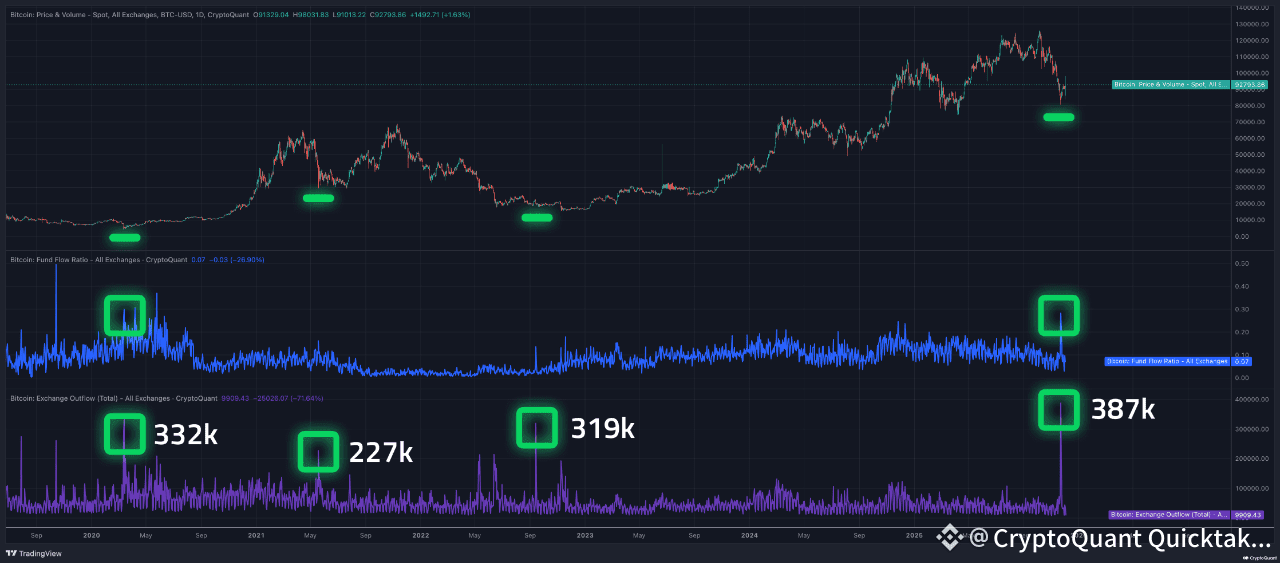
Recent spikes in Bitcoin’s Exchange Outflow (Total) and Fund Flow Ratio have drawn attention, as similar patterns historically appeared near important market lows. The question is whether these movements hint at the early stages of a new accumulation phase.
Metric dynamics
Exchange Outflow (Total): Measures the total BTC leaving exchange-labeled wallets. However, large spikes such as 332k, 227k, 319k, and 387k BTC do not always represent real investor withdrawals. These extreme values often result from internal exchange wallet reorganizations, including cold-wallet consolidation or system maintenance. Still, clusters of elevated outflows—whether user-driven or internal—tend to occur near macro turning points, indicating heightened structural activity on exchanges.
Fund Flow Ratio: Compares exchange-related volume to total on-chain volume. High spikes signal periods where a meaningful share of network activity is tied to exchanges. During downtrends, these jumps often appear when traders capitulate or when larger players reposition, which can precede medium- to long-term market stabilization.
Correlation with price
Historically, when outflows rise while price consolidates or declines, it may indicate that long-term holders are accumulating or exchanges are preparing for major liquidity shifts. Similarly, Fund Flow Ratio surges typically reflect stress or aggressive repositioning—conditions commonly found near market bottoms.
Risk considerations
These metrics provide valuable context for understanding long-term market behavior, but they should never be used as standalone buy-sell signals. Internal transfers, short-term volatility, and broader macro conditions can distort interpretations. Effective risk management requires combining on-chain data with technical structure, liquidity trends, and sentiment analysis to form a complete view of market conditions.
Written by The Alchemist 9
