

#treasury
treasury
156,868 views
1,100 Discussing
Hot
Latest

·
--
Corporate treasuries are starting to use AI to manage stablecoin cash flows.
According to reports from PANews and others, Ripple Treasury has launched an AI orchestration layer to help coordinate cash positions, forecasting, reconciliation, and other processes. It has also added an “always-on yield” feature, allowing corporate clients to earn yield on digital assets such as RLUSD without having to monitor markets and place orders themselves. The direction is clear: moving stablecoins beyond “payment tools” and a step closer to “overnight corporate cash management.”
How to read this: The product pitch sounds appealing, but its real-world adoption still depends on three things: whether yield sources and risks are disclosed transparently, whether there are lockup or redemption restrictions, and whether corporate internal controls can handle automated execution 24/7. RLUSD liquidity and compliance terms should also be checked separately—don’t interpret “yield support” as risk-free fixed income. At launch, prioritize official disclosures and actual settlement records.
#Ripple #RLUSD #Treasury #Stablecoin
Corporate treasuries are starting to use AI to manage stablecoin cash flows.
According to reports from PANews and others, Ripple Treasury has launched an AI orchestration layer to help coordinate cash positions, forecasting, reconciliation, and other processes. It has also added an “always-on yield” feature, allowing corporate clients to earn yield on digital assets such as RLUSD without having to monitor markets and place orders themselves. The direction is clear: moving stablecoins beyond “payment tools” and a step closer to “overnight corporate cash management.”
How to read this: The product pitch sounds appealing, but its real-world adoption still depends on three things: whether yield sources and risks are disclosed transparently, whether there are lockup or redemption restrictions, and whether corporate internal controls can handle automated execution 24/7. RLUSD liquidity and compliance terms should also be checked separately—don’t interpret “yield support” as risk-free fixed income. At launch, prioritize official disclosures and actual settlement records.
#Ripple #RLUSD #Treasury #Stablecoin
According to reports from PANews and others, Ripple Treasury has launched an AI orchestration layer to help coordinate cash positions, forecasting, reconciliation, and other processes. It has also added an “always-on yield” feature, allowing corporate clients to earn yield on digital assets such as RLUSD without having to monitor markets and place orders themselves. The direction is clear: moving stablecoins beyond “payment tools” and a step closer to “overnight corporate cash management.”
How to read this: The product pitch sounds appealing, but its real-world adoption still depends on three things: whether yield sources and risks are disclosed transparently, whether there are lockup or redemption restrictions, and whether corporate internal controls can handle automated execution 24/7. RLUSD liquidity and compliance terms should also be checked separately—don’t interpret “yield support” as risk-free fixed income. At launch, prioritize official disclosures and actual settlement records.
#Ripple #RLUSD #Treasury #Stablecoin
4

Justin Sun's Nasdaq experiment is 15 cents from a delisting warning.
TRON Inc shares are hovering around $1.15–$1.22 — barely above Nasdaq's $1 minimum bid price. Per Protos, the stock has shed roughly 50% from this year's highs, and Finnhub data puts the one-year return near −55%. Close below $1 for 30 straight sessions and Nasdaq starts a 180-day compliance clock toward delisting.
The irony: TRON Inc is a TRX treasury vehicle holding over $250 million in TRX, yet its market cap sits above $500 million — the wrapper is valued at nearly twice the crypto underneath. Meanwhile TRX itself sits flat around $0.331, unbothered.
This is the 2026 treasury-trade squeeze in miniature: the tokens hold up, but the wrapper trades at whatever premium the equity market feels like. Strategy proved the premium could last years. A growing list of smaller vehicles is proving it can evaporate in months.
Would you pay double the token price to hold it through a stock ticker — or is the treasury wrapper premium officially dead? NFA, always DYOR.
$TRX
#TRON #CryptoNews #Nasdaq #Treasury
Justin Sun's Nasdaq experiment is 15 cents from a delisting warning.
TRON Inc shares are hovering around $1.15–$1.22 — barely above Nasdaq's $1 minimum bid price. Per Protos, the stock has shed roughly 50% from this year's highs, and Finnhub data puts the one-year return near −55%. Close below $1 for 30 straight sessions and Nasdaq starts a 180-day compliance clock toward delisting.
The irony: TRON Inc is a TRX treasury vehicle holding over $250 million in TRX, yet its market cap sits above $500 million — the wrapper is valued at nearly twice the crypto underneath. Meanwhile TRX itself sits flat around $0.331, unbothered.
This is the 2026 treasury-trade squeeze in miniature: the tokens hold up, but the wrapper trades at whatever premium the equity market feels like. Strategy proved the premium could last years. A growing list of smaller vehicles is proving it can evaporate in months.
Would you pay double the token price to hold it through a stock ticker — or is the treasury wrapper premium officially dead? NFA, always DYOR.
$TRX
#TRON #CryptoNews #Nasdaq #Treasury
TRON Inc shares are hovering around $1.15–$1.22 — barely above Nasdaq's $1 minimum bid price. Per Protos, the stock has shed roughly 50% from this year's highs, and Finnhub data puts the one-year return near −55%. Close below $1 for 30 straight sessions and Nasdaq starts a 180-day compliance clock toward delisting.
The irony: TRON Inc is a TRX treasury vehicle holding over $250 million in TRX, yet its market cap sits above $500 million — the wrapper is valued at nearly twice the crypto underneath. Meanwhile TRX itself sits flat around $0.331, unbothered.
This is the 2026 treasury-trade squeeze in miniature: the tokens hold up, but the wrapper trades at whatever premium the equity market feels like. Strategy proved the premium could last years. A growing list of smaller vehicles is proving it can evaporate in months.
Would you pay double the token price to hold it through a stock ticker — or is the treasury wrapper premium officially dead? NFA, always DYOR.
$TRX
#TRON #CryptoNews #Nasdaq #Treasury
1
8
Japan's Bitcoin treasury just bought its way onto the Nasdaq.
Shareholders of Nasdaq-listed Super League approved a deal giving Metaplanet a 93.7% stake, funded with 2,100 BTC and $2.5 million in cash. Metaplanet takes 44.86 million common shares, governance-linked preferred stock, and 10-year warrants — plus control of the board. Its shares stay locked up for five years.
The company rebrands as Superplanet under the ticker SUPA, with a strategy centered on growing Bitcoin holdings per share. Notably, future buys will be funded through perpetual preferred stock rather than conventional debt — and Metaplanet can inject up to $210 million more via junior preferred shares.
Context: Metaplanet already holds 44,000 BTC, the second-largest public corporate stash behind Strategy. While some treasury vehicles wind down, Metaplanet is buying a US capital-markets machine to raise dollars instead of yen.
Is the Nasdaq listing the next edge in the treasury arms race — or just leverage with better marketing? NFA. DYOR.
$BTC #Treasury
Japan's Bitcoin treasury just bought its way onto the Nasdaq.
Shareholders of Nasdaq-listed Super League approved a deal giving Metaplanet a 93.7% stake, funded with 2,100 BTC and $2.5 million in cash. Metaplanet takes 44.86 million common shares, governance-linked preferred stock, and 10-year warrants — plus control of the board. Its shares stay locked up for five years.
The company rebrands as Superplanet under the ticker SUPA, with a strategy centered on growing Bitcoin holdings per share. Notably, future buys will be funded through perpetual preferred stock rather than conventional debt — and Metaplanet can inject up to $210 million more via junior preferred shares.
Context: Metaplanet already holds 44,000 BTC, the second-largest public corporate stash behind Strategy. While some treasury vehicles wind down, Metaplanet is buying a US capital-markets machine to raise dollars instead of yen.
Is the Nasdaq listing the next edge in the treasury arms race — or just leverage with better marketing? NFA. DYOR.
$BTC #Treasury
Shareholders of Nasdaq-listed Super League approved a deal giving Metaplanet a 93.7% stake, funded with 2,100 BTC and $2.5 million in cash. Metaplanet takes 44.86 million common shares, governance-linked preferred stock, and 10-year warrants — plus control of the board. Its shares stay locked up for five years.
The company rebrands as Superplanet under the ticker SUPA, with a strategy centered on growing Bitcoin holdings per share. Notably, future buys will be funded through perpetual preferred stock rather than conventional debt — and Metaplanet can inject up to $210 million more via junior preferred shares.
Context: Metaplanet already holds 44,000 BTC, the second-largest public corporate stash behind Strategy. While some treasury vehicles wind down, Metaplanet is buying a US capital-markets machine to raise dollars instead of yen.
Is the Nasdaq listing the next edge in the treasury arms race — or just leverage with better marketing? NFA. DYOR.
$BTC #Treasury
30
A top-five public Solana treasury just sold everything.
SkyAI (formerly Sharps Technology) confirmed Monday it has completed the sale of all its SOL — once over 2 million tokens, the fifth-largest public Solana stash. It now holds roughly $223.8 million in cash as of Oct 16, earmarked for a $201.3 million tender offer to buy back 95% of its shares and warrants at $3 each. If fully subscribed, about $22.5 million is left before costs. It even dropped the offer's SOL-above-$100 condition — moot when you hold none.
The subplot: Bastion Trading, holding nearly 10% of SkyAI, called for an independent review of the sales and refused to tender under the proposed terms.
The tape barely blinked — SOL $104.06, +1.7% in 24h. Either the market already priced the exit, or treasury flows never moved SOL much to begin with.
When a top-five treasury walks away entirely, what does that say about the premium these vehicles used to command? NFA. DYOR.
$SOL #Treasury #Solana
A top-five public Solana treasury just sold everything.
SkyAI (formerly Sharps Technology) confirmed Monday it has completed the sale of all its SOL — once over 2 million tokens, the fifth-largest public Solana stash. It now holds roughly $223.8 million in cash as of Oct 16, earmarked for a $201.3 million tender offer to buy back 95% of its shares and warrants at $3 each. If fully subscribed, about $22.5 million is left before costs. It even dropped the offer's SOL-above-$100 condition — moot when you hold none.
The subplot: Bastion Trading, holding nearly 10% of SkyAI, called for an independent review of the sales and refused to tender under the proposed terms.
The tape barely blinked — SOL $104.06, +1.7% in 24h. Either the market already priced the exit, or treasury flows never moved SOL much to begin with.
When a top-five treasury walks away entirely, what does that say about the premium these vehicles used to command? NFA. DYOR.
$SOL #Treasury #Solana
SkyAI (formerly Sharps Technology) confirmed Monday it has completed the sale of all its SOL — once over 2 million tokens, the fifth-largest public Solana stash. It now holds roughly $223.8 million in cash as of Oct 16, earmarked for a $201.3 million tender offer to buy back 95% of its shares and warrants at $3 each. If fully subscribed, about $22.5 million is left before costs. It even dropped the offer's SOL-above-$100 condition — moot when you hold none.
The subplot: Bastion Trading, holding nearly 10% of SkyAI, called for an independent review of the sales and refused to tender under the proposed terms.
The tape barely blinked — SOL $104.06, +1.7% in 24h. Either the market already priced the exit, or treasury flows never moved SOL much to begin with.
When a top-five treasury walks away entirely, what does that say about the premium these vehicles used to command? NFA. DYOR.
$SOL #Treasury #Solana
29
Corporate Bitcoin treasuries just bought the dip again — and this time the smaller names are doing the heavy lifting.
Strive disclosed a 1,223 BTC purchase at an average of $81,734, lifting its treasury to 36,818 BTC — worth roughly $3 billion at current prices. That's its third buy in eight days, totaling 7,356 BTC. The financing behind it: a $700 million preferred offering settling October 20, expected to net about $630 million.
Strategy, the pioneer of this playbook, added a more modest 267 BTC — but its bigger move was buying back $193 million of its STRC preferred shares and expanding that buyback program from $2 billion to $3 billion.
The honest part: these purchases didn't move the market. Bitcoin sits at $82,084, up less than 1% on the day. Treasury buying is steady background demand, not a price catalyst.
Which treasury model breaks first if the dip keeps dipping — equity-funded or preferred-funded? NFA. DYOR.
$BTC #Bitcoin #Treasury
Corporate Bitcoin treasuries just bought the dip again — and this time the smaller names are doing the heavy lifting.
Strive disclosed a 1,223 BTC purchase at an average of $81,734, lifting its treasury to 36,818 BTC — worth roughly $3 billion at current prices. That's its third buy in eight days, totaling 7,356 BTC. The financing behind it: a $700 million preferred offering settling October 20, expected to net about $630 million.
Strategy, the pioneer of this playbook, added a more modest 267 BTC — but its bigger move was buying back $193 million of its STRC preferred shares and expanding that buyback program from $2 billion to $3 billion.
The honest part: these purchases didn't move the market. Bitcoin sits at $82,084, up less than 1% on the day. Treasury buying is steady background demand, not a price catalyst.
Which treasury model breaks first if the dip keeps dipping — equity-funded or preferred-funded? NFA. DYOR.
$BTC #Bitcoin #Treasury
Strive disclosed a 1,223 BTC purchase at an average of $81,734, lifting its treasury to 36,818 BTC — worth roughly $3 billion at current prices. That's its third buy in eight days, totaling 7,356 BTC. The financing behind it: a $700 million preferred offering settling October 20, expected to net about $630 million.
Strategy, the pioneer of this playbook, added a more modest 267 BTC — but its bigger move was buying back $193 million of its STRC preferred shares and expanding that buyback program from $2 billion to $3 billion.
The honest part: these purchases didn't move the market. Bitcoin sits at $82,084, up less than 1% on the day. Treasury buying is steady background demand, not a price catalyst.
Which treasury model breaks first if the dip keeps dipping — equity-funded or preferred-funded? NFA. DYOR.
$BTC #Bitcoin #Treasury
13

·
--
Strategy has made another big move! The Bitcoin treasury company recently did two major things: it bought $22 million worth of BTC and repurchased $193 million worth of STRC shares. It now holds over 840,000 BTC at an average cost of around $75,000, and has raised its stock buyback cap to $3 billion. The way the big players operate is something ordinary people just can’t understand!
Strategy's making big moves! The Bitcoin treasury firm just scooped up $22M in Bitcoin while buying back $193M of its own STRC shares. Now they're holding over 848K BTC at an average cost of $75,446, and raised their stock buyback cap to $3B. When whales play, we watch!
#Bitcoin #Treasury
$BTC $STRC
Strategy has made another big move! The Bitcoin treasury company recently did two major things: it bought $22 million worth of BTC and repurchased $193 million worth of STRC shares. It now holds over 840,000 BTC at an average cost of around $75,000, and has raised its stock buyback cap to $3 billion. The way the big players operate is something ordinary people just can’t understand!
Strategy's making big moves! The Bitcoin treasury firm just scooped up $22M in Bitcoin while buying back $193M of its own STRC shares. Now they're holding over 848K BTC at an average cost of $75,446, and raised their stock buyback cap to $3B. When whales play, we watch!
#Bitcoin #Treasury
$BTC $STRC
Strategy's making big moves! The Bitcoin treasury firm just scooped up $22M in Bitcoin while buying back $193M of its own STRC shares. Now they're holding over 848K BTC at an average cost of $75,446, and raised their stock buyback cap to $3B. When whales play, we watch!
#Bitcoin #Treasury
$BTC $STRC
37

The US Department of the Treasury announced on October 16 that the fiscal year 2026 budget deficit reached $1.99 trillion, marking the third-largest annual shortfall in US history. Total government spending surged 6% to a record $7.40 trillion, heavily driven by debt servicing costs that jumped 12% to an unprecedented $1.36 trillion.
This fiscal expansion pushes the deficit to 6.2% of GDP, up from 5.8% in the previous year. Crucially, debt interest payments are now consuming an unsustainable portion of federal revenues despite record total tax receipts of $5.40 trillion.
For traditional markets, massive debt issuance to fund this gap keeps upward pressure on benchmark bond yields. Persistent fiscal expansion also complicates monetary policy, sustaining stubborn inflation expectations and challenging long-term dollar stability.
For crypto assets, unchecked sovereign deficit spending reinforces the core narrative for decentralized stores of value. Prolonged debt monetization concerns often drive institutional liquidity toward hard assets like $BTC as a hedge against fiat debasement.
#USDeficit #Treasury #MacroEconomics
The US Department of the Treasury announced on October 16 that the fiscal year 2026 budget deficit reached $1.99 trillion, marking the third-largest annual shortfall in US history. Total government spending surged 6% to a record $7.40 trillion, heavily driven by debt servicing costs that jumped 12% to an unprecedented $1.36 trillion.
This fiscal expansion pushes the deficit to 6.2% of GDP, up from 5.8% in the previous year. Crucially, debt interest payments are now consuming an unsustainable portion of federal revenues despite record total tax receipts of $5.40 trillion.
For traditional markets, massive debt issuance to fund this gap keeps upward pressure on benchmark bond yields. Persistent fiscal expansion also complicates monetary policy, sustaining stubborn inflation expectations and challenging long-term dollar stability.
For crypto assets, unchecked sovereign deficit spending reinforces the core narrative for decentralized stores of value. Prolonged debt monetization concerns often drive institutional liquidity toward hard assets like $BTC as a hedge against fiat debasement.
#USDeficit #Treasury #MacroEconomics
This fiscal expansion pushes the deficit to 6.2% of GDP, up from 5.8% in the previous year. Crucially, debt interest payments are now consuming an unsustainable portion of federal revenues despite record total tax receipts of $5.40 trillion.
For traditional markets, massive debt issuance to fund this gap keeps upward pressure on benchmark bond yields. Persistent fiscal expansion also complicates monetary policy, sustaining stubborn inflation expectations and challenging long-term dollar stability.
For crypto assets, unchecked sovereign deficit spending reinforces the core narrative for decentralized stores of value. Prolonged debt monetization concerns often drive institutional liquidity toward hard assets like $BTC as a hedge against fiat debasement.
#USDeficit #Treasury #MacroEconomics
47

#Solana treasury firm SkyAl’s $SOL holdings have dropped about 70%.
An October filing showed the company’s balance fell from more than 2 million SOL in mid-September to roughly 600,000 SOL. Shareholder Bastion Trading is pressing for answers on the sales and has said it will not join SkyAl’s $3-per-share tender offer until concerns are addressed.
{spot}(SOLUSDT)
The development has raised questions about treasury strategy and potential selling pressure tied to the reduced position.
#SOL #SkyAl #CoinVahini #Treasury
#Solana treasury firm SkyAl’s $SOL holdings have dropped about 70%.
An October filing showed the company’s balance fell from more than 2 million SOL in mid-September to roughly 600,000 SOL. Shareholder Bastion Trading is pressing for answers on the sales and has said it will not join SkyAl’s $3-per-share tender offer until concerns are addressed.
The development has raised questions about treasury strategy and potential selling pressure tied to the reduced position.
#SOL #SkyAl #CoinVahini #Treasury
An October filing showed the company’s balance fell from more than 2 million SOL in mid-September to roughly 600,000 SOL. Shareholder Bastion Trading is pressing for answers on the sales and has said it will not join SkyAl’s $3-per-share tender offer until concerns are addressed.
The development has raised questions about treasury strategy and potential selling pressure tied to the reduced position.
#SOL #SkyAl #CoinVahini #Treasury
21

·
--
Scott Bessent brought Judy Shelton onto his team at the Treasury Department.
The news is surprising because the Senate blocked her nomination to the Federal Reserve in the past. Her economic ideas have always sparked considerable debate in Washington.
Now, Shelton will work directly as an adviser to the Treasury secretary. It’s a move that signals a clear shift in the department’s direction.
Appointments like this often bring significant volatility to debt markets. Ultimately, all of this affects confidence in the dollar and the appeal of assets like $BTC.
Are you surprised by her return to the political front lines?
#Treasury #Bitcoin
Scott Bessent brought Judy Shelton onto his team at the Treasury Department.
The news is surprising because the Senate blocked her nomination to the Federal Reserve in the past. Her economic ideas have always sparked considerable debate in Washington.
Now, Shelton will work directly as an adviser to the Treasury secretary. It’s a move that signals a clear shift in the department’s direction.
Appointments like this often bring significant volatility to debt markets. Ultimately, all of this affects confidence in the dollar and the appeal of assets like $BTC .
Are you surprised by her return to the political front lines?
#Treasury #Bitcoin
The news is surprising because the Senate blocked her nomination to the Federal Reserve in the past. Her economic ideas have always sparked considerable debate in Washington.
Now, Shelton will work directly as an adviser to the Treasury secretary. It’s a move that signals a clear shift in the department’s direction.
Appointments like this often bring significant volatility to debt markets. Ultimately, all of this affects confidence in the dollar and the appeal of assets like $BTC .
Are you surprised by her return to the political front lines?
#Treasury #Bitcoin


31

·
--
Article
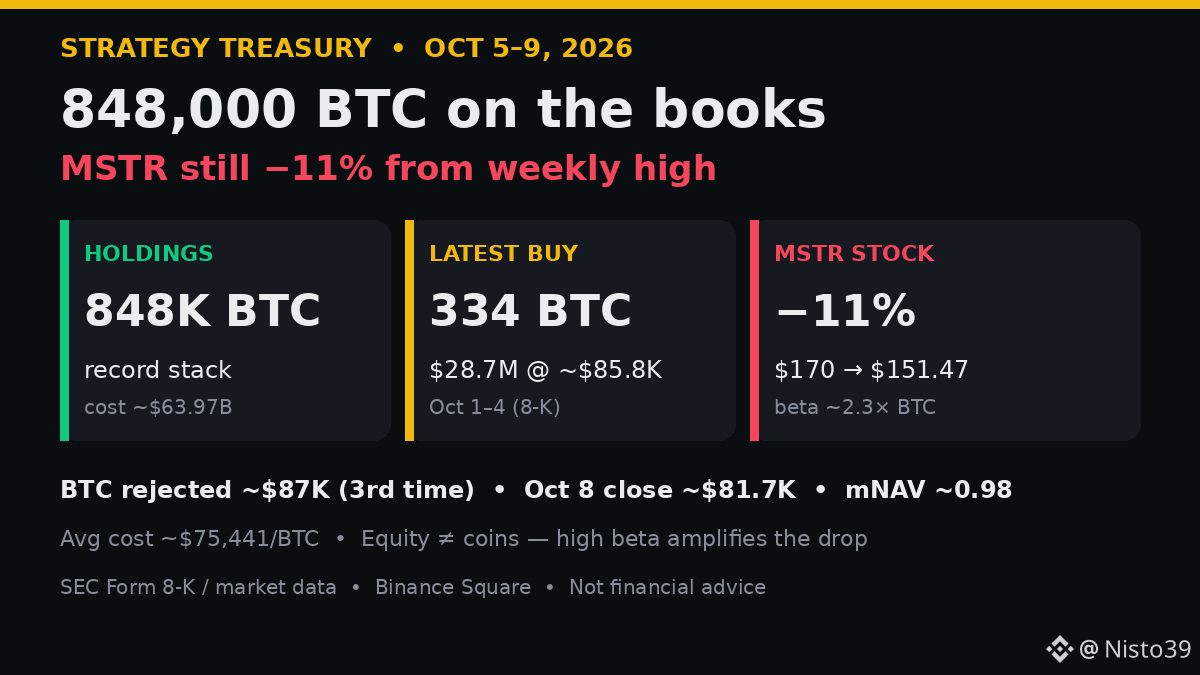
848K BTC on the Books — Why MSTR Still Fell 11%Strategy just printed a record Bitcoin stack — and its stock still fell ~11% from the weekly high. That split is the real lesson this week.
💥 The numbers (SEC Form 8-K Oct 5 + market closes through Oct 8–9)
• Holdings: 848,000 BTC as of Oct 4 — a new company record (up from 847,666 at end-September)
• Latest buy: 334 BTC for $28.7M between Oct 1–4 at an average ~$85,839 (fees included)
• Total cost basis: ~$63.97B → ~$75,441 per BTC
• At ~$82K spot, the stack is worth roughly ~$69.5B — still above cost, but the latest lot was bought ~$10K above average cost
• MSTR closed Oct 8 at $151.47 — about 11% below the Oct 2 intraday high of $170.17 (Oct 7 alone was −6.79%)
• Bitcoin rejected the ~$86.5K–$87.2K band for a third time since late September; Oct 8 close near ~$81.7K, Oct 9 dip near ~$80.4K then rebound toward ~$82.4K
• Stock sensitivity: ~2.3× Bitcoin’s daily moves recently; mNAV slipped to ~0.98 (a small discount to the BTC holdings)
A corporate treasury, in plain words: a company that parks a large share of its balance sheet in Bitcoin instead of only cash. Strategy (formerly MicroStrategy) is the best-known example. mNAV compares the stock’s market value with the value of the coins it holds — above 1 = premium, below 1 = discount.
📉 Why the stock fell while the stack hit a record
Fundamentals (more BTC on the books) did not change this week. The price of Bitcoin did. When BTC failed $87K and liquidations hit, a high-beta equity amplified the drop: ~6% off BTC’s weekly high mapped into ~11% off MSTR’s.
The funding nuance: Strategy still raises money partly by selling new shares (ATM program) and buying more BTC. That math works better when the stock trades at a premium to its Bitcoin. At a discount (~0.98 mNAV), issuing equity to buy more coins is less favorable per share. Record holdings ≠ “buy the stock blindly.”
🧭 What this means for someone like Tendai in Harare
Tendai hears “company bought more Bitcoin” and assumes the share price must rise the same day. This week’s print is the counter-lesson:
• Holding more coins is a balance-sheet story; the stock is a leverage story on BTC’s short-term path
• Buying above your average cost ($85.8K lot vs ~$75.4K average) can still be a long-term plan — and still look painful if price chops under $85K
• Equity volatility is not the same as holding spot BTC yourself
Practical rules that survive any treasury headline:
1. Separate “coins on the balance sheet” from “what the stock did today” — they can diverge for weeks
2. If you want Bitcoin exposure, spot $BTC is simpler than a leveraged equity proxy
3. Watch $80K–$80.4K support and the $86.5K–$87.2K ceiling; CPI (Oct 14) and Fed (Oct 27–28) still sit ahead
📍 Levels still in play
• BTC: defend ~$80K–$81K; reclaim toward $85.5K / $87K needs stronger spot demand
• MSTR lens: Oct 8 low ~$147 as near support; weekly highs ~$168–$170 as resistance if BTC recovers
Your turn: when a company stacks to a record but the stock sells off with Bitcoin — do you treat that as noise, or as a reminder that equity ≠ coins? 👇
Not financial advice. Crypto and crypto-linked stocks are volatile: only use money you can afford to lose. Do your own research.
#Bitcoin #Strategy #CryptoNews #Treasury #Binance
848K BTC on the Books — Why MSTR Still Fell 11%
Strategy just printed a record Bitcoin stack — and its stock still fell ~11% from the weekly high. That split is the real lesson this week.
💥 The numbers (SEC Form 8-K Oct 5 + market closes through Oct 8–9)
• Holdings: 848,000 BTC as of Oct 4 — a new company record (up from 847,666 at end-September)
• Latest buy: 334 BTC for $28.7M between Oct 1–4 at an average ~$85,839 (fees included)
• Total cost basis: ~$63.97B → ~$75,441 per BTC
• At ~$82K spot, the stack is worth roughly ~$69.5B — still above cost, but the latest lot was bought ~$10K above average cost
• MSTR closed Oct 8 at $151.47 — about 11% below the Oct 2 intraday high of $170.17 (Oct 7 alone was −6.79%)
• Bitcoin rejected the ~$86.5K–$87.2K band for a third time since late September; Oct 8 close near ~$81.7K, Oct 9 dip near ~$80.4K then rebound toward ~$82.4K
• Stock sensitivity: ~2.3× Bitcoin’s daily moves recently; mNAV slipped to ~0.98 (a small discount to the BTC holdings)
A corporate treasury, in plain words: a company that parks a large share of its balance sheet in Bitcoin instead of only cash. Strategy (formerly MicroStrategy) is the best-known example. mNAV compares the stock’s market value with the value of the coins it holds — above 1 = premium, below 1 = discount.
📉 Why the stock fell while the stack hit a record
Fundamentals (more BTC on the books) did not change this week. The price of Bitcoin did. When BTC failed $87K and liquidations hit, a high-beta equity amplified the drop: ~6% off BTC’s weekly high mapped into ~11% off MSTR’s.
The funding nuance: Strategy still raises money partly by selling new shares (ATM program) and buying more BTC. That math works better when the stock trades at a premium to its Bitcoin. At a discount (~0.98 mNAV), issuing equity to buy more coins is less favorable per share. Record holdings ≠ “buy the stock blindly.”
🧭 What this means for someone like Tendai in Harare
Tendai hears “company bought more Bitcoin” and assumes the share price must rise the same day. This week’s print is the counter-lesson:
• Holding more coins is a balance-sheet story; the stock is a leverage story on BTC’s short-term path
• Buying above your average cost ($85.8K lot vs ~$75.4K average) can still be a long-term plan — and still look painful if price chops under $85K
• Equity volatility is not the same as holding spot BTC yourself
Practical rules that survive any treasury headline:
1. Separate “coins on the balance sheet” from “what the stock did today” — they can diverge for weeks
2. If you want Bitcoin exposure, spot $BTC is simpler than a leveraged equity proxy
3. Watch $80K–$80.4K support and the $86.5K–$87.2K ceiling; CPI (Oct 14) and Fed (Oct 27–28) still sit ahead
📍 Levels still in play
• BTC: defend ~$80K–$81K; reclaim toward $85.5K / $87K needs stronger spot demand
• MSTR lens: Oct 8 low ~$147 as near support; weekly highs ~$168–$170 as resistance if BTC recovers
Your turn: when a company stacks to a record but the stock sells off with Bitcoin — do you treat that as noise, or as a reminder that equity ≠ coins? 👇
Not financial advice. Crypto and crypto-linked stocks are volatile: only use money you can afford to lose. Do your own research.
#Bitcoin #Strategy #CryptoNews #Treasury #Binance
💥 The numbers (SEC Form 8-K Oct 5 + market closes through Oct 8–9)
• Holdings: 848,000 BTC as of Oct 4 — a new company record (up from 847,666 at end-September)
• Latest buy: 334 BTC for $28.7M between Oct 1–4 at an average ~$85,839 (fees included)
• Total cost basis: ~$63.97B → ~$75,441 per BTC
• At ~$82K spot, the stack is worth roughly ~$69.5B — still above cost, but the latest lot was bought ~$10K above average cost
• MSTR closed Oct 8 at $151.47 — about 11% below the Oct 2 intraday high of $170.17 (Oct 7 alone was −6.79%)
• Bitcoin rejected the ~$86.5K–$87.2K band for a third time since late September; Oct 8 close near ~$81.7K, Oct 9 dip near ~$80.4K then rebound toward ~$82.4K
• Stock sensitivity: ~2.3× Bitcoin’s daily moves recently; mNAV slipped to ~0.98 (a small discount to the BTC holdings)
A corporate treasury, in plain words: a company that parks a large share of its balance sheet in Bitcoin instead of only cash. Strategy (formerly MicroStrategy) is the best-known example. mNAV compares the stock’s market value with the value of the coins it holds — above 1 = premium, below 1 = discount.
📉 Why the stock fell while the stack hit a record
Fundamentals (more BTC on the books) did not change this week. The price of Bitcoin did. When BTC failed $87K and liquidations hit, a high-beta equity amplified the drop: ~6% off BTC’s weekly high mapped into ~11% off MSTR’s.
The funding nuance: Strategy still raises money partly by selling new shares (ATM program) and buying more BTC. That math works better when the stock trades at a premium to its Bitcoin. At a discount (~0.98 mNAV), issuing equity to buy more coins is less favorable per share. Record holdings ≠ “buy the stock blindly.”
🧭 What this means for someone like Tendai in Harare
Tendai hears “company bought more Bitcoin” and assumes the share price must rise the same day. This week’s print is the counter-lesson:
• Holding more coins is a balance-sheet story; the stock is a leverage story on BTC’s short-term path
• Buying above your average cost ($85.8K lot vs ~$75.4K average) can still be a long-term plan — and still look painful if price chops under $85K
• Equity volatility is not the same as holding spot BTC yourself
Practical rules that survive any treasury headline:
1. Separate “coins on the balance sheet” from “what the stock did today” — they can diverge for weeks
2. If you want Bitcoin exposure, spot $BTC is simpler than a leveraged equity proxy
3. Watch $80K–$80.4K support and the $86.5K–$87.2K ceiling; CPI (Oct 14) and Fed (Oct 27–28) still sit ahead
📍 Levels still in play
• BTC: defend ~$80K–$81K; reclaim toward $85.5K / $87K needs stronger spot demand
• MSTR lens: Oct 8 low ~$147 as near support; weekly highs ~$168–$170 as resistance if BTC recovers
Your turn: when a company stacks to a record but the stock sells off with Bitcoin — do you treat that as noise, or as a reminder that equity ≠ coins? 👇
Not financial advice. Crypto and crypto-linked stocks are volatile: only use money you can afford to lose. Do your own research.
#Bitcoin #Strategy #CryptoNews #Treasury #Binance
54

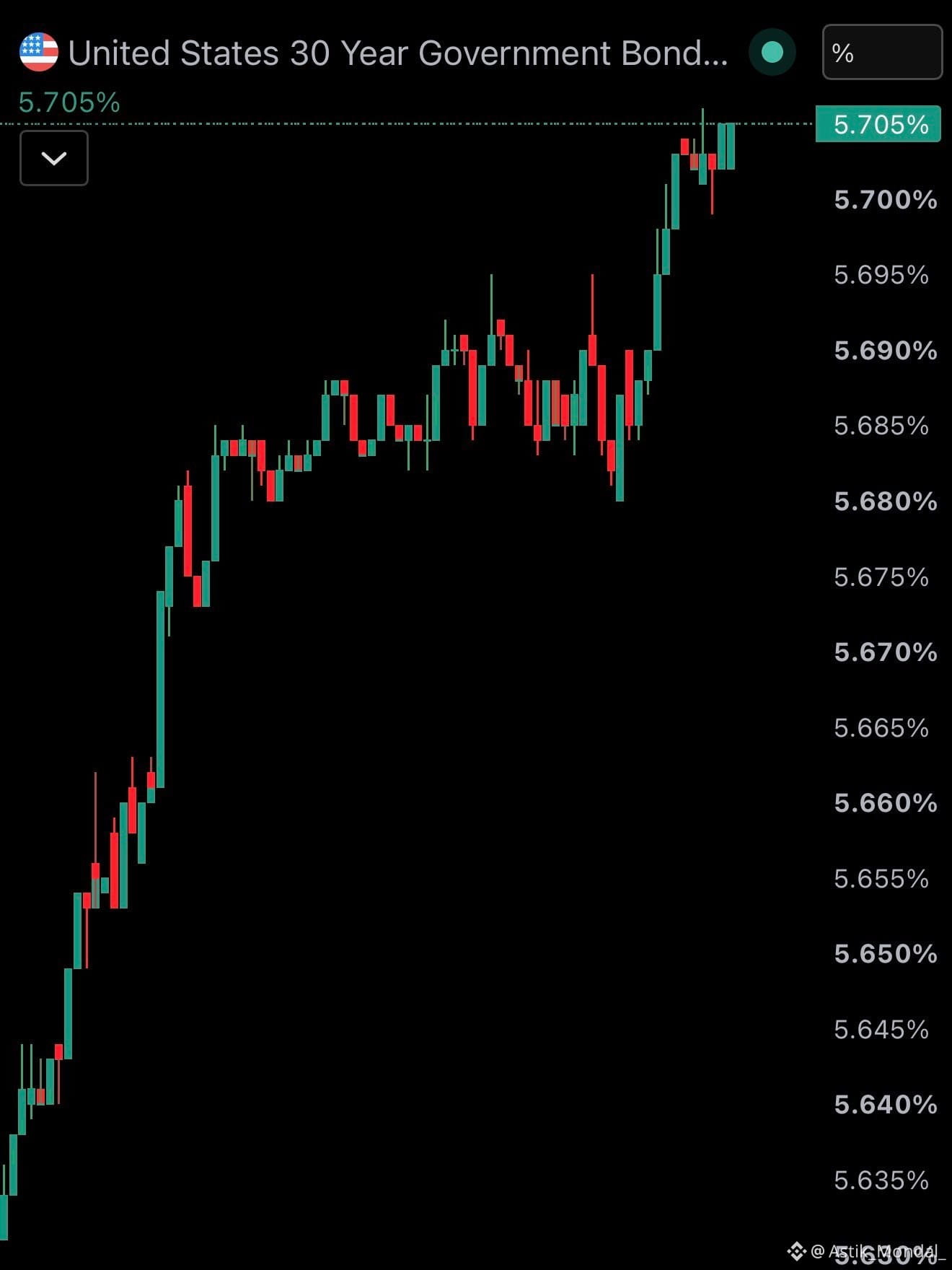
🚨 JUST IN: 🇺🇸 THE US 30-YEAR TREASURY YIELD JUST HIT 5.70%.
That’s the highest level since 2002.
And this is NOT just a bond-market story.
Higher long-term yields mean higher borrowing costs across the US economy.
Mortgages get more expensive.
Government debt becomes harder to finance.
Corporate borrowing costs rise.
And the pressure can spill directly into stocks, the dollar and crypto.
The bigger concern?
If long-term yields keep climbing while inflation remains sticky, the Fed could have less room to ease financial conditions.
That creates a dangerous setup for risk assets.
Wall Street is watching.
Crypto should be watching even closer.
#Bitcoin #Crypto #FederalReserve #Treasury #StockMarket
🚨 JUST IN: 🇺🇸 THE US 30-YEAR TREASURY YIELD JUST HIT 5.70%.
That’s the highest level since 2002.
And this is NOT just a bond-market story.
Higher long-term yields mean higher borrowing costs across the US economy.
Mortgages get more expensive.
Government debt becomes harder to finance.
Corporate borrowing costs rise.
And the pressure can spill directly into stocks, the dollar and crypto.
The bigger concern?
If long-term yields keep climbing while inflation remains sticky, the Fed could have less room to ease financial conditions.
That creates a dangerous setup for risk assets.
Wall Street is watching.
Crypto should be watching even closer.
#Bitcoin #Crypto #FederalReserve #Treasury #StockMarket
That’s the highest level since 2002.
And this is NOT just a bond-market story.
Higher long-term yields mean higher borrowing costs across the US economy.
Mortgages get more expensive.
Government debt becomes harder to finance.
Corporate borrowing costs rise.
And the pressure can spill directly into stocks, the dollar and crypto.
The bigger concern?
If long-term yields keep climbing while inflation remains sticky, the Fed could have less room to ease financial conditions.
That creates a dangerous setup for risk assets.
Wall Street is watching.
Crypto should be watching even closer.
#Bitcoin #Crypto #FederalReserve #Treasury #StockMarket
BTC+0.00%
TLTETF+0.01%
1
46
During today's trading session, the U.S. 30-year Treasury yield surged by 6 basis points to hit 5.7041%. This move officially sets a new high not seen since 2002, signaling persistent pressure across long-duration debt.
This breakout reflects mounting market anxiety over prolonged high interest rates and massive sovereign debt issuance. Investors are demanding higher term premiums as economic resilience collides with sticky inflation concerns.
Surging long-term yields typically tighten broader financial conditions rapidly, lifting borrowing costs across mortgage and corporate credit markets. Traditional equities and speculative growth sectors face direct valuation compression under these elevated benchmark rates.
For crypto, rising risk-free yields continue to drain capital from speculative assets, keeping $BTC and altcoins under short-term pressure. Liquidity conditions remain tight as capital gravitates toward attractive yields in safe-haven sovereign debt. 📈
#BondYields #MacroEconomics #Treasury
During today's trading session, the U.S. 30-year Treasury yield surged by 6 basis points to hit 5.7041%. This move officially sets a new high not seen since 2002, signaling persistent pressure across long-duration debt.
This breakout reflects mounting market anxiety over prolonged high interest rates and massive sovereign debt issuance. Investors are demanding higher term premiums as economic resilience collides with sticky inflation concerns.
Surging long-term yields typically tighten broader financial conditions rapidly, lifting borrowing costs across mortgage and corporate credit markets. Traditional equities and speculative growth sectors face direct valuation compression under these elevated benchmark rates.
For crypto, rising risk-free yields continue to drain capital from speculative assets, keeping $BTC and altcoins under short-term pressure. Liquidity conditions remain tight as capital gravitates toward attractive yields in safe-haven sovereign debt. 📈
#BondYields #MacroEconomics #Treasury
This breakout reflects mounting market anxiety over prolonged high interest rates and massive sovereign debt issuance. Investors are demanding higher term premiums as economic resilience collides with sticky inflation concerns.
Surging long-term yields typically tighten broader financial conditions rapidly, lifting borrowing costs across mortgage and corporate credit markets. Traditional equities and speculative growth sectors face direct valuation compression under these elevated benchmark rates.
For crypto, rising risk-free yields continue to drain capital from speculative assets, keeping $BTC and altcoins under short-term pressure. Liquidity conditions remain tight as capital gravitates toward attractive yields in safe-haven sovereign debt. 📈
#BondYields #MacroEconomics #Treasury
21

·
--
🚨 U.S. TREASURY 3-YEAR AUCTION: SOLID DEMAND 👀
The U.S. Treasury sold $58B of 3-year notes at a 4.932% yield, slightly below the 4.934% pre-auction level.
📊 Key numbers:
🏦 Primary dealers: 10.7%
🎯 Direct bidders: 31.7% — well above the recent 21.5% average
🌍 Indirect bidders: 57.6%
📈 Bid-to-cover: 2.62× vs 2.65× six-auction average
💡 My take: The auction looks broadly healthy. Strong direct-bidder participation helped push the clearing yield slightly lower, while the short end of the Treasury curve showed little reaction.
👀 For crypto traders, keep watching Treasury yields + liquidity + BTC reaction. These can influence risk appetite across markets.
{spot}(BTCUSDT)
$BTC $ETH — macro still matters. 🌎📊
{spot}(ETHUSDT)
#Bitcoin #Ethereum #Crypto #Treasury #US10Y
🚨 U.S. TREASURY 3-YEAR AUCTION: SOLID DEMAND 👀
The U.S. Treasury sold $58B of 3-year notes at a 4.932% yield, slightly below the 4.934% pre-auction level.
📊 Key numbers:
🏦 Primary dealers: 10.7%
🎯 Direct bidders: 31.7% — well above the recent 21.5% average
🌍 Indirect bidders: 57.6%
📈 Bid-to-cover: 2.62× vs 2.65× six-auction average
💡 My take: The auction looks broadly healthy. Strong direct-bidder participation helped push the clearing yield slightly lower, while the short end of the Treasury curve showed little reaction.
👀 For crypto traders, keep watching Treasury yields + liquidity + BTC reaction. These can influence risk appetite across markets.
$BTC $ETH — macro still matters. 🌎📊
#Bitcoin #Ethereum #Crypto #Treasury #US10Y
The U.S. Treasury sold $58B of 3-year notes at a 4.932% yield, slightly below the 4.934% pre-auction level.
📊 Key numbers:
🏦 Primary dealers: 10.7%
🎯 Direct bidders: 31.7% — well above the recent 21.5% average
🌍 Indirect bidders: 57.6%
📈 Bid-to-cover: 2.62× vs 2.65× six-auction average
💡 My take: The auction looks broadly healthy. Strong direct-bidder participation helped push the clearing yield slightly lower, while the short end of the Treasury curve showed little reaction.
👀 For crypto traders, keep watching Treasury yields + liquidity + BTC reaction. These can influence risk appetite across markets.
$BTC $ETH — macro still matters. 🌎📊
#Bitcoin #Ethereum #Crypto #Treasury #US10Y
1
142

🚨 The U.S. government has successfully traced a massive fundraising network linked to Hamas, through which more than $2 million was raised via charitable organizations. Even more notable is the crypto component: tens of thousands of dollars were transferred in cryptocurrency.
This is an important reminder of the growing level of regulatory scrutiny facing the crypto industry worldwide. When an agency like the Treasury makes a statement like this, everyone in the community needs to reconsider their approach to security and compliance in their operations.
While this news doesn’t directly signal anything about the price of Bitcoin or Ethereum, it reminds us that the regulatory environment is a key factor shaping the market as it develops.
👉 Where do you think controls like these will steer innovation—or will they simply force the industry to adapt to new regulations?
#Treasury #CryptoRegulation #CryptoNews #Vietnam
🚨 The U.S. government has successfully traced a massive fundraising network linked to Hamas, through which more than $2 million was raised via charitable organizations. Even more notable is the crypto component: tens of thousands of dollars were transferred in cryptocurrency.
This is an important reminder of the growing level of regulatory scrutiny facing the crypto industry worldwide. When an agency like the Treasury makes a statement like this, everyone in the community needs to reconsider their approach to security and compliance in their operations.
While this news doesn’t directly signal anything about the price of Bitcoin or Ethereum, it reminds us that the regulatory environment is a key factor shaping the market as it develops.
👉 Where do you think controls like these will steer innovation—or will they simply force the industry to adapt to new regulations?
#Treasury #CryptoRegulation #CryptoNews #Vietnam
This is an important reminder of the growing level of regulatory scrutiny facing the crypto industry worldwide. When an agency like the Treasury makes a statement like this, everyone in the community needs to reconsider their approach to security and compliance in their operations.
While this news doesn’t directly signal anything about the price of Bitcoin or Ethereum, it reminds us that the regulatory environment is a key factor shaping the market as it develops.
👉 Where do you think controls like these will steer innovation—or will they simply force the industry to adapt to new regulations?
#Treasury #CryptoRegulation #CryptoNews #Vietnam
13

·
--
Wall Street lied to you about "safe investments"—this chart proves it beyond a shadow of a doubt! 📉💥🚨
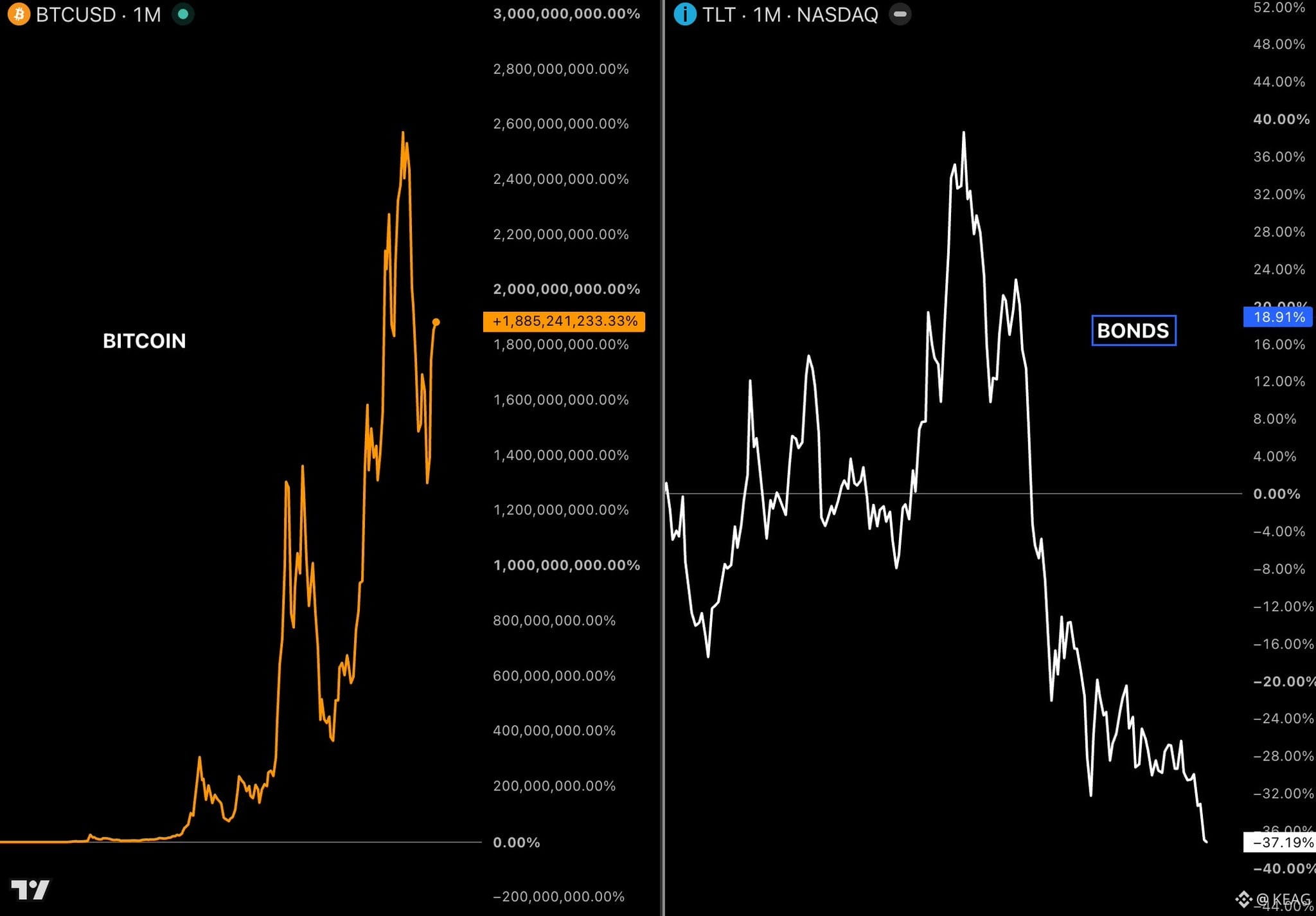
Look at the brutal reality of inflation and central bank fiat printing since 2010:
• $1,000 in US Long-Term Treasury Bonds ($TLTP.ETF
{etf_us}(TLTP.ETF)
): Worth roughly $630 today after inflation and bond yield collapses (-37.19% real loss)!
• $1,000 in Bitcoin ($BTC): Worth over $1.8 BILLION today (+1,885,241,233% gains)!
Why Traditional Finance is Broken:
Bonds = Guaranteed Loss: Holding long-term debt while governments print trillions completely destroys your purchasing power.
Bitcoin = Asymmetric Hedge: $BTC is the only absolute finite asset on Earth designed to outrun fiat debasement.
The Mindset Shift: Institutions called Bitcoin "too risky" in 2010 while pushing bonds that wiped out 37% of investor wealth!
Be honest—if someone offers you US Treasury Bonds or Bitcoin for the next 10 years, which one are you choosing?
Let’s settle this in the comments right now 👇
🚀 Drop 'BITCOIN' if you're holding $BTC !
🏦 Drop 'BONDS' if you still trust Wall Street!
(Hit Like ❤️, Drop your vote below 💬, Share with your friends 🔄, and Follow 📌 for daily high-conviction updates!)
#GreekPoliceBustCryptoScamRingArrest17 #BinanceSquareFamily #Treasury
Wall Street lied to you about "safe investments"—this chart proves it beyond a shadow of a doubt! 📉💥🚨
Look at the brutal reality of inflation and central bank fiat printing since 2010:
• $1,000 in US Long-Term Treasury Bonds ($TLTP.ETF
): Worth roughly $630 today after inflation and bond yield collapses (-37.19% real loss)!
• $1,000 in Bitcoin ($BTC ): Worth over $1.8 BILLION today (+1,885,241,233% gains)!
Why Traditional Finance is Broken:
Bonds = Guaranteed Loss: Holding long-term debt while governments print trillions completely destroys your purchasing power.
Bitcoin = Asymmetric Hedge: $BTC is the only absolute finite asset on Earth designed to outrun fiat debasement.
The Mindset Shift: Institutions called Bitcoin "too risky" in 2010 while pushing bonds that wiped out 37% of investor wealth!
Be honest—if someone offers you US Treasury Bonds or Bitcoin for the next 10 years, which one are you choosing?
Let’s settle this in the comments right now 👇
🚀 Drop 'BITCOIN' if you're holding $BTC !
🏦 Drop 'BONDS' if you still trust Wall Street!
(Hit Like ❤️, Drop your vote below 💬, Share with your friends 🔄, and Follow 📌 for daily high-conviction updates!)
#GreekPoliceBustCryptoScamRingArrest17 #BinanceSquareFamily #Treasury
Look at the brutal reality of inflation and central bank fiat printing since 2010:
• $1,000 in US Long-Term Treasury Bonds ($TLTP.ETF
): Worth roughly $630 today after inflation and bond yield collapses (-37.19% real loss)!
• $1,000 in Bitcoin ($BTC ): Worth over $1.8 BILLION today (+1,885,241,233% gains)!
Why Traditional Finance is Broken:
Bonds = Guaranteed Loss: Holding long-term debt while governments print trillions completely destroys your purchasing power.
Bitcoin = Asymmetric Hedge: $BTC is the only absolute finite asset on Earth designed to outrun fiat debasement.
The Mindset Shift: Institutions called Bitcoin "too risky" in 2010 while pushing bonds that wiped out 37% of investor wealth!
Be honest—if someone offers you US Treasury Bonds or Bitcoin for the next 10 years, which one are you choosing?
Let’s settle this in the comments right now 👇
🚀 Drop 'BITCOIN' if you're holding $BTC !
🏦 Drop 'BONDS' if you still trust Wall Street!
(Hit Like ❤️, Drop your vote below 💬, Share with your friends 🔄, and Follow 📌 for daily high-conviction updates!)
#GreekPoliceBustCryptoScamRingArrest17 #BinanceSquareFamily #Treasury
BTC+0.00%
TLTETF+0.01%
31

·
--
Bullish
Partly True
🇺🇸 Treasury withdrew $91,000,000,000 from its TGA balance on Thursday.
The same day, US bond yields dropped 10 to 12 basis points.
Treasury had previously said it could use the TGA balance for bond purchases, and it's possible that this has already begun.
#Treasury #TreasuryDepartment #bond
🇺🇸 Treasury withdrew $91,000,000,000 from its TGA balance on Thursday.
The same day, US bond yields dropped 10 to 12 basis points.
Treasury had previously said it could use the TGA balance for bond purchases, and it's possible that this has already begun.
#Treasury #TreasuryDepartment #bond
The same day, US bond yields dropped 10 to 12 basis points.
Treasury had previously said it could use the TGA balance for bond purchases, and it's possible that this has already begun.
#Treasury #TreasuryDepartment #bond


AGGETF-0.05%
1
1k

🐋 $SKY TREASURY STOCK SDEV EXPLODES 770% WHILE TOKEN RECALIBRATES AT SUPPORT! 📈
📌 Wall Street equity markets just delivered a massive re-rating on SDEV, pushing its monthly run up 770% despite previous mNAV valuation discounts near 0.39. 📊 While treasury equity is skyrocketing after dilution fears cleared, $SKY itself is experiencing a temporary 6.82% cool-off down to $0.0871.
💡 Smart money is closely monitoring this glaring valuation disconnect between token market pricing and underlying treasury holdings. 🔍 When institutional proxy vehicles experience historic repricing, token markets usually bridge the divergence quickly. 💬 Do you expect $SKY to ignite a catch-up rally from these support levels? 👇
⚠️ Not financial advice. Always manage your risk. 🛡️
🏷️ #SKY #Altcoins #Treasury #Crypto
⚡ 🦈
🐋 $SKY TREASURY STOCK SDEV EXPLODES 770% WHILE TOKEN RECALIBRATES AT SUPPORT! 📈
📌 Wall Street equity markets just delivered a massive re-rating on SDEV, pushing its monthly run up 770% despite previous mNAV valuation discounts near 0.39. 📊 While treasury equity is skyrocketing after dilution fears cleared, $SKY itself is experiencing a temporary 6.82% cool-off down to $0.0871.
💡 Smart money is closely monitoring this glaring valuation disconnect between token market pricing and underlying treasury holdings. 🔍 When institutional proxy vehicles experience historic repricing, token markets usually bridge the divergence quickly. 💬 Do you expect $SKY to ignite a catch-up rally from these support levels? 👇
⚠️ Not financial advice. Always manage your risk. 🛡️
🏷️ #SKY #Altcoins #Treasury #Crypto
⚡ 🦈
📌 Wall Street equity markets just delivered a massive re-rating on SDEV, pushing its monthly run up 770% despite previous mNAV valuation discounts near 0.39. 📊 While treasury equity is skyrocketing after dilution fears cleared, $SKY itself is experiencing a temporary 6.82% cool-off down to $0.0871.
💡 Smart money is closely monitoring this glaring valuation disconnect between token market pricing and underlying treasury holdings. 🔍 When institutional proxy vehicles experience historic repricing, token markets usually bridge the divergence quickly. 💬 Do you expect $SKY to ignite a catch-up rally from these support levels? 👇
⚠️ Not financial advice. Always manage your risk. 🛡️
🏷️ #SKY #Altcoins #Treasury #Crypto
⚡ 🦈
39
🚨 JUST IN: 🇺🇸 President Trump says “certain levels of inflation” could pay down the $40 TRILLION U.S. national debt “very rapidly.”
The idea: inflation can reduce the real value of existing fixed-rate government debt.
But there’s a major catch.
Higher inflation can push Treasury yields higher, increasing the cost of refinancing and servicing new debt.
With U.S. debt already above $40 trillion and bond yields elevated, markets are watching this closely.
#Trump #Inflation #USDebt #Treasury #Markets
🚨 JUST IN: 🇺🇸 President Trump says “certain levels of inflation” could pay down the $40 TRILLION U.S. national debt “very rapidly.”
The idea: inflation can reduce the real value of existing fixed-rate government debt.
But there’s a major catch.
Higher inflation can push Treasury yields higher, increasing the cost of refinancing and servicing new debt.
With U.S. debt already above $40 trillion and bond yields elevated, markets are watching this closely.
#Trump #Inflation #USDebt #Treasury #Markets
The idea: inflation can reduce the real value of existing fixed-rate government debt.
But there’s a major catch.
Higher inflation can push Treasury yields higher, increasing the cost of refinancing and servicing new debt.
With U.S. debt already above $40 trillion and bond yields elevated, markets are watching this closely.
#Trump #Inflation #USDebt #Treasury #Markets

1
30

⚡ $HYPE TREASURY WIPES OUT DEBT ENTIRELY AS DEFI ACCELERATION BEGINS 🦈
Hyperion DeFi just cleared $8.6M in legacy debt, wiping its balance sheet completely clean while unlocking pure capital flexibility for on-chain expansion. 📊 By monetizing $HYPE treasury reserves to obliterate institutional debt obligations, management is streamlining equity buybacks alongside boosted revenue guidance.
💡 Smart money recognizes clean balance sheets as the ultimate springboard before aggressive DeFi deployment cycles take off. 🌊 With legacy debt friction removed, capital efficiency turns heavily in favor of long-term treasury expansion. 🤔 How do you see corporate treasury models impacting the next phase of DeFi adoption? 👇
⚠️ Not financial advice. Always manage your risk. 🛡️
🏷️ #HYPE #DeFi #Treasury #Crypto
🔥 💎
⚡ $HYPE TREASURY WIPES OUT DEBT ENTIRELY AS DEFI ACCELERATION BEGINS 🦈
Hyperion DeFi just cleared $8.6M in legacy debt, wiping its balance sheet completely clean while unlocking pure capital flexibility for on-chain expansion. 📊 By monetizing $HYPE treasury reserves to obliterate institutional debt obligations, management is streamlining equity buybacks alongside boosted revenue guidance.
💡 Smart money recognizes clean balance sheets as the ultimate springboard before aggressive DeFi deployment cycles take off. 🌊 With legacy debt friction removed, capital efficiency turns heavily in favor of long-term treasury expansion. 🤔 How do you see corporate treasury models impacting the next phase of DeFi adoption? 👇
⚠️ Not financial advice. Always manage your risk. 🛡️
🏷️ #HYPE #DeFi #Treasury #Crypto
🔥 💎
Hyperion DeFi just cleared $8.6M in legacy debt, wiping its balance sheet completely clean while unlocking pure capital flexibility for on-chain expansion. 📊 By monetizing $HYPE treasury reserves to obliterate institutional debt obligations, management is streamlining equity buybacks alongside boosted revenue guidance.
💡 Smart money recognizes clean balance sheets as the ultimate springboard before aggressive DeFi deployment cycles take off. 🌊 With legacy debt friction removed, capital efficiency turns heavily in favor of long-term treasury expansion. 🤔 How do you see corporate treasury models impacting the next phase of DeFi adoption? 👇
⚠️ Not financial advice. Always manage your risk. 🛡️
🏷️ #HYPE #DeFi #Treasury #Crypto
🔥 💎
42

Verified
#us10yearyieldnears5.3%
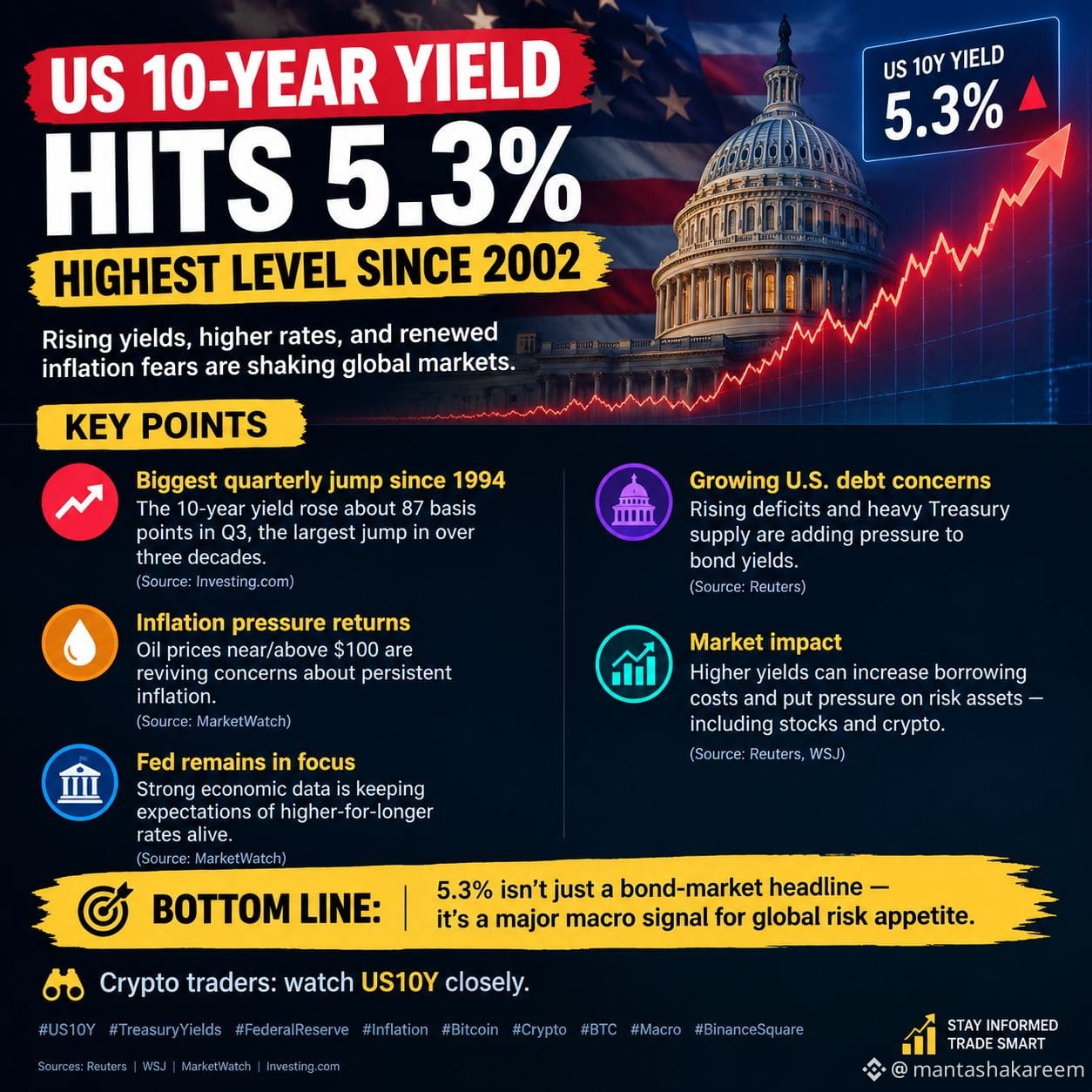
🚨 US 10-YEAR YIELD HITS 5.3% — WHY MARKETS CARE
The U.S. 10-year Treasury yield has surged to around 5.3%, reaching its highest level since 2002.
🔹 Biggest quarterly jump since 1994 — the yield climbed about 87 bps in Q3.
🔹 Inflation pressure: Oil prices near/above $100 are reviving concerns about persistent inflation.
🔹 Fed risk: Strong economic data is keeping expectations of higher-for-longer rates alive.
🔹 Debt concerns: Rising U.S. deficits and heavy Treasury supply are adding pressure to bond yields.
🔹 Market impact: Higher yields can increase borrowing costs and put pressure on risk assets, including stocks and crypto.
📌 Bottom line: 5.3% isn't just a bond-market headline — it's a major macro signal for global risk appetite.
👀 Crypto traders: watch US10Y closely.
#US10Y #Treasury
{etf_us}(ETFT.ETF)
#us10yearyieldnears5.3%
🚨 US 10-YEAR YIELD HITS 5.3% — WHY MARKETS CARE
The U.S. 10-year Treasury yield has surged to around 5.3%, reaching its highest level since 2002.
🔹 Biggest quarterly jump since 1994 — the yield climbed about 87 bps in Q3.
🔹 Inflation pressure: Oil prices near/above $100 are reviving concerns about persistent inflation.
🔹 Fed risk: Strong economic data is keeping expectations of higher-for-longer rates alive.
🔹 Debt concerns: Rising U.S. deficits and heavy Treasury supply are adding pressure to bond yields.
🔹 Market impact: Higher yields can increase borrowing costs and put pressure on risk assets, including stocks and crypto.
📌 Bottom line: 5.3% isn't just a bond-market headline — it's a major macro signal for global risk appetite.
👀 Crypto traders: watch US10Y closely.
#US10Y #Treasury
🚨 US 10-YEAR YIELD HITS 5.3% — WHY MARKETS CARE
The U.S. 10-year Treasury yield has surged to around 5.3%, reaching its highest level since 2002.
🔹 Biggest quarterly jump since 1994 — the yield climbed about 87 bps in Q3.
🔹 Inflation pressure: Oil prices near/above $100 are reviving concerns about persistent inflation.
🔹 Fed risk: Strong economic data is keeping expectations of higher-for-longer rates alive.
🔹 Debt concerns: Rising U.S. deficits and heavy Treasury supply are adding pressure to bond yields.
🔹 Market impact: Higher yields can increase borrowing costs and put pressure on risk assets, including stocks and crypto.
📌 Bottom line: 5.3% isn't just a bond-market headline — it's a major macro signal for global risk appetite.
👀 Crypto traders: watch US10Y closely.
#US10Y #Treasury
TLTETF+0.01%
1
3.1k
Log in to explore more content
Join global crypto users on Binance Square
⚡️ Get latest and useful information about crypto.
💬 Trusted by the world’s largest crypto exchange.
👍 Discover real insights from verified creators.
Email / Phone number
Trending Topics
1
#BinancePick
3.1M views
153,186 Discussing
2
#EarningsSeason
5.3M views
26,054 Discussing
3
#AnthropicTTMRevenueGrewAbout1200%
34,849 views
441 Discussing
4
#AnthropicS1ExpectedToday
28,801 views
359 Discussing
5
#SouthKoreaReportedlyWeighsFourthCryptoTaxDelay
32,516 views
487 Discussing
6
#FranklinTempletonFilesForTwoDividendToBitcoinETFs
43,167 views
557 Discussing
7
#StrategyMSTRSurpassesNasdaqInMarketCap
33,124 views
398 Discussing
8
#CanadaProposesStablecoinRedemptionWithin3BusinessDays
1,394 views
36 Discussing
9
#ElectrumWalletBugLetRogueServersStealFunds
32,677 views
478 Discussing
10
#ArgentineCourtDismissesLIBRACaseAgainstMilei
48,762 views
598 Discussing