

#nvidia
nvidia
3.2M views
6,491 Discussing
Hot
Latest

·
--
Article
Nvidia Has Lost The China AI Accelerator MarketNvidia has lost its AI accelerator market in China, according to coverage of the company's position in the region.
The loss follows export controls that restrict the sale of advanced AI chips to Chinese customers, pushing buyers toward domestic alternatives.
China was historically a significant revenue pool. Losing it changes the shape of the addressable market even as demand elsewhere keeps growing.
The competitive consequence is the more important part: a restricted market is where domestic chipmakers iterate fastest, with guaranteed volume and no foreign competitor at the high end.
Nvidia has not framed this as permanent, and the policy environment is the variable that would determine any reversal.
What is harder to rebuild: market share or supply chain? $NVDA #Nvidia #AI #Chips #BinanceSquare
Nvidia Has Lost The China AI Accelerator Market
Nvidia has lost its AI accelerator market in China, according to coverage of the company's position in the region.
The loss follows export controls that restrict the sale of advanced AI chips to Chinese customers, pushing buyers toward domestic alternatives.
China was historically a significant revenue pool. Losing it changes the shape of the addressable market even as demand elsewhere keeps growing.
The competitive consequence is the more important part: a restricted market is where domestic chipmakers iterate fastest, with guaranteed volume and no foreign competitor at the high end.
Nvidia has not framed this as permanent, and the policy environment is the variable that would determine any reversal.
What is harder to rebuild: market share or supply chain? $NVDA #Nvidia #AI #Chips #BinanceSquare
The loss follows export controls that restrict the sale of advanced AI chips to Chinese customers, pushing buyers toward domestic alternatives.
China was historically a significant revenue pool. Losing it changes the shape of the addressable market even as demand elsewhere keeps growing.
The competitive consequence is the more important part: a restricted market is where domestic chipmakers iterate fastest, with guaranteed volume and no foreign competitor at the high end.
Nvidia has not framed this as permanent, and the policy environment is the variable that would determine any reversal.
What is harder to rebuild: market share or supply chain? $NVDA #Nvidia #AI #Chips #BinanceSquare
79
NVIDIA (NVDA) is around $210.96, down about 0.6% today and nearly 7.5% this month.
The AI trade is cooling, but the business behind it still has momentum: NVIDIA reported $96.2B in quarterly revenue, up 106% year over year. The question is whether demand can keep outpacing rising expectations.
My lean: cautiously bullish on the pullback, while watching for signs that AI spending is translating into continued growth.
Is this a buying opportunity—or a warning that the AI trade is crowded?
#NVDA #NVIDIA #Aİ
NVIDIA (NVDA) is around $210.96, down about 0.6% today and nearly 7.5% this month.
The AI trade is cooling, but the business behind it still has momentum: NVIDIA reported $96.2B in quarterly revenue, up 106% year over year. The question is whether demand can keep outpacing rising expectations.
My lean: cautiously bullish on the pullback, while watching for signs that AI spending is translating into continued growth.
Is this a buying opportunity—or a warning that the AI trade is crowded?
#NVDA #NVIDIA #Aİ
The AI trade is cooling, but the business behind it still has momentum: NVIDIA reported $96.2B in quarterly revenue, up 106% year over year. The question is whether demand can keep outpacing rising expectations.
My lean: cautiously bullish on the pullback, while watching for signs that AI spending is translating into continued growth.
Is this a buying opportunity—or a warning that the AI trade is crowded?
#NVDA #NVIDIA #Aİ
74
·
--
Article
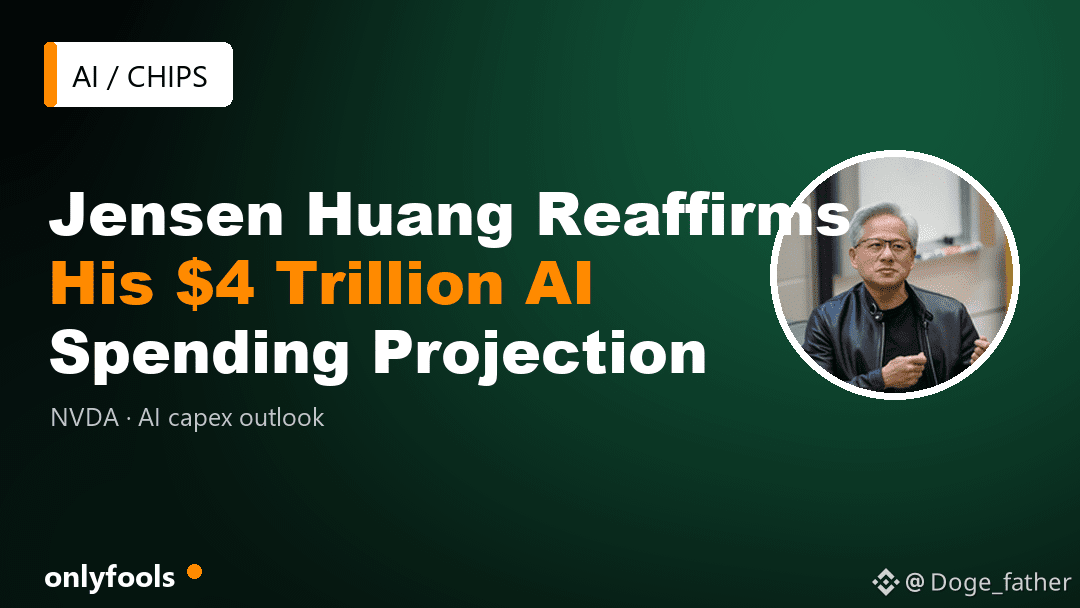
Jensen Huang Reaffirms His $4 Trillion AI Spending ProjectionNvidia CEO Jensen Huang has reaffirmed his projection that AI spending will reach $4 trillion, according to coverage of his recent remarks.
The number is a cumulative view of the infrastructure build-out needed to run AI at scale, not a revenue forecast for any single company.
The figure matters because it sets the bar for what chipmakers, data center operators and power providers are planning against. If the build-out tracks that path, the demand for accelerators and memory stays elevated.
It also sets up a wide gap between the projection and what is actually being spent today, which is where the debate lives.
Huang has made versions of this argument repeatedly, and the market has learned to treat it as a directional signal rather than a forecast.
Is $4 trillion realistic for AI infrastructure, or aspirational framing? $NVDA #Nvidia #AI #JensenHuang #BinanceSquare
Jensen Huang Reaffirms His $4 Trillion AI Spending Projection
Nvidia CEO Jensen Huang has reaffirmed his projection that AI spending will reach $4 trillion, according to coverage of his recent remarks.
The number is a cumulative view of the infrastructure build-out needed to run AI at scale, not a revenue forecast for any single company.
The figure matters because it sets the bar for what chipmakers, data center operators and power providers are planning against. If the build-out tracks that path, the demand for accelerators and memory stays elevated.
It also sets up a wide gap between the projection and what is actually being spent today, which is where the debate lives.
Huang has made versions of this argument repeatedly, and the market has learned to treat it as a directional signal rather than a forecast.
Is $4 trillion realistic for AI infrastructure, or aspirational framing? $NVDA #Nvidia #AI #JensenHuang #BinanceSquare
The number is a cumulative view of the infrastructure build-out needed to run AI at scale, not a revenue forecast for any single company.
The figure matters because it sets the bar for what chipmakers, data center operators and power providers are planning against. If the build-out tracks that path, the demand for accelerators and memory stays elevated.
It also sets up a wide gap between the projection and what is actually being spent today, which is where the debate lives.
Huang has made versions of this argument repeatedly, and the market has learned to treat it as a directional signal rather than a forecast.
Is $4 trillion realistic for AI infrastructure, or aspirational framing? $NVDA #Nvidia #AI #JensenHuang #BinanceSquare
59
·
--
Article
Nvidia's Next Business May Be A $2,000 Per-GPU Annual FeeNvidia has discussed charging around $2,000 per GPU per year for software that runs AI agents on what it calls AI factories.
Details remain unclear about exactly which workloads and deployments the fee would apply to, and whether existing customers would be grandfathered in.
If it holds, this would shift part of Nvidia's revenue from one-time hardware sales toward recurring software revenue tied to the installed base of chips.
For customers, the calculus changes: the GPU becomes the entry ticket and the software becomes the ongoing subscription.
Nvidia has not confirmed the pricing publicly, so treat the $2,000 figure as reported rather than official.
Would you pay a per-GPU annual fee if it meant your agents ran reliably at scale? $NVDA #Nvidia #AI #Semiconductors #BinanceSquare
Nvidia's Next Business May Be A $2,000 Per-GPU Annual Fee
Nvidia has discussed charging around $2,000 per GPU per year for software that runs AI agents on what it calls AI factories.
Details remain unclear about exactly which workloads and deployments the fee would apply to, and whether existing customers would be grandfathered in.
If it holds, this would shift part of Nvidia's revenue from one-time hardware sales toward recurring software revenue tied to the installed base of chips.
For customers, the calculus changes: the GPU becomes the entry ticket and the software becomes the ongoing subscription.
Nvidia has not confirmed the pricing publicly, so treat the $2,000 figure as reported rather than official.
Would you pay a per-GPU annual fee if it meant your agents ran reliably at scale? $NVDA #Nvidia #AI #Semiconductors #BinanceSquare
Details remain unclear about exactly which workloads and deployments the fee would apply to, and whether existing customers would be grandfathered in.
If it holds, this would shift part of Nvidia's revenue from one-time hardware sales toward recurring software revenue tied to the installed base of chips.
For customers, the calculus changes: the GPU becomes the entry ticket and the software becomes the ongoing subscription.
Nvidia has not confirmed the pricing publicly, so treat the $2,000 figure as reported rather than official.
Would you pay a per-GPU annual fee if it meant your agents ran reliably at scale? $NVDA #Nvidia #AI #Semiconductors #BinanceSquare
63

·
--
Bullish
$NVDAB
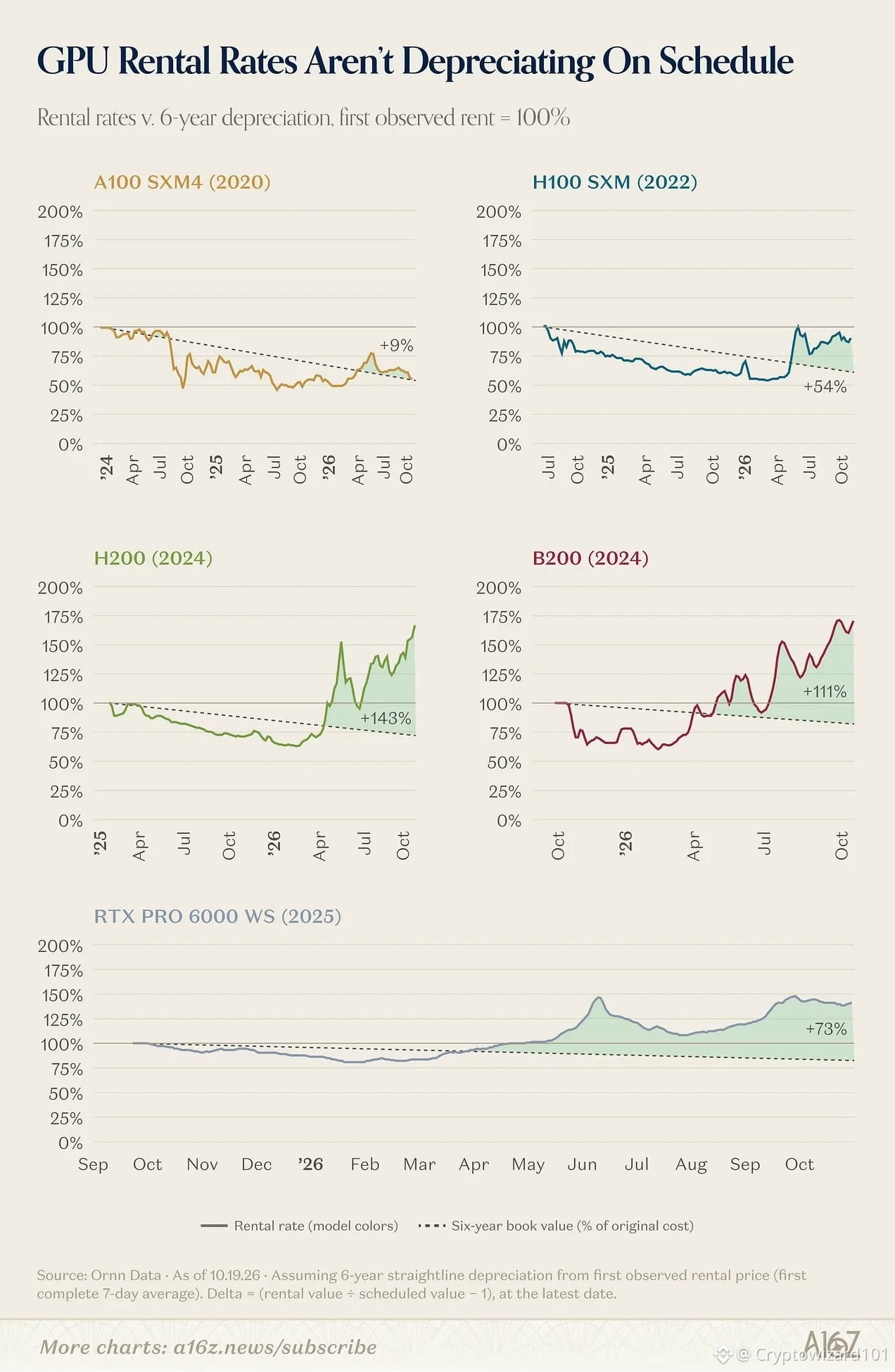
NVIDIA’s AI infrastructure is proving to be a durable, valuable asset with strong long-term investment potential. As new AI applications and workloads continue to emerge, more businesses rely on NVIDIA’s platform for computing power and productivity. This growing adoption increases demand for its GPUs and AI systems, potentially supporting sustainable revenue growth. The key takeaway is that #NVIDIA infrastructure is not just benefiting from today’s AI boom; its continued usefulness across multiple industries could help maintain its value and drive long-term business growth.
{spot}(NVDABUSDT)
$NVDAB
NVIDIA’s AI infrastructure is proving to be a durable, valuable asset with strong long-term investment potential. As new AI applications and workloads continue to emerge, more businesses rely on NVIDIA’s platform for computing power and productivity. This growing adoption increases demand for its GPUs and AI systems, potentially supporting sustainable revenue growth. The key takeaway is that #NVIDIA infrastructure is not just benefiting from today’s AI boom; its continued usefulness across multiple industries could help maintain its value and drive long-term business growth.
NVIDIA’s AI infrastructure is proving to be a durable, valuable asset with strong long-term investment potential. As new AI applications and workloads continue to emerge, more businesses rely on NVIDIA’s platform for computing power and productivity. This growing adoption increases demand for its GPUs and AI systems, potentially supporting sustainable revenue growth. The key takeaway is that #NVIDIA infrastructure is not just benefiting from today’s AI boom; its continued usefulness across multiple industries could help maintain its value and drive long-term business growth.
321


·
--
Verified

Article
Bridging NVIDIA and Blockchain — A New Era of Tokenized AssetsCan blockchain technology transform how people access traditional financial markets? NVDAB is one example of how tokenization is bringing established equities into the digital asset ecosystem.
What Is NVDAB?
NVDAB, known as NVIDIA Tokenized bStocks, is a blockchain-based financial asset designed to provide economic exposure to NVIDIA Corporation shares. Issued by BTECH Holdings Limited, it operates on the BNB Chain and connects traditional equity markets with blockchain technology. According to published project information, the tokens are backed by corresponding underlying shares, subject to the product's legal and custody arrangements.
Unlike an ordinary cryptocurrency created around its own blockchain project, NVDAB represents a tokenized financial instrument whose value is linked to NVIDIA stock. This distinction is important because its performance depends heavily on the underlying company's share price and the structure of the tokenized product.
Why Is NVDAB Attracting Attention?
NVIDIA has become an important company in the artificial intelligence industry. Its graphics processing units, data-center technology, and computing platforms support AI development across multiple sectors.
NVDAB brings this traditional financial exposure into a blockchain-based environment. The tokenization model can offer extended trading access, digital asset transfers, and potential integration with decentralized finance applications where supported.
This creates an interesting connection between two rapidly developing areas: artificial intelligence infrastructure and blockchain-based financial markets.
The Role of Blockchain Technology
Tokenization converts rights or exposure associated with a traditional financial asset into a digital token. In NVDAB's case, the model is designed to connect NVIDIA share exposure with blockchain infrastructure.
Potential features include:
- Extended market access: Trading may be available beyond conventional stock-market hours, depending on platform availability.
- Blockchain transparency: On-chain transactions can be independently inspected, although blockchain records alone do not prove that underlying assets are fully backed.
- Digital accessibility: Eligible users may access tokenized financial products through supported services.
- DeFi integration: Certain decentralized finance applications may support tokenized assets for lending or other financial functions.
These features illustrate the potential of tokenization, but their availability and benefits depend on the issuer, platform rules, liquidity, and applicable regulations.
What Factors Could Influence NVDAB?
NVDAB's market performance can be affected by several factors.
1. NVIDIA's stock performance
Because NVDAB is linked to NVIDIA shares, company earnings, AI-related demand, competition, and investor expectations can influence its value.
2. Artificial intelligence growth
Developments in AI infrastructure, data-center spending, and semiconductor technology can affect market sentiment toward NVIDIA and, indirectly, NVDAB.
3. Liquidity and trading activity
Trading volume, market depth, and the difference between buying and selling prices influence how efficiently a token can be traded. Tokenized assets may not always follow their underlying stock price perfectly across every platform.
4. Issuer and regulatory considerations
The legal rights attached to a token, redemption conditions, custody arrangements, geographic restrictions, and issuer reliability are essential factors to understand before evaluating this type of asset.
Risks That Should Not Be Ignored
NVDAB is not the same as directly holding NVIDIA shares through a traditional brokerage account. Token holders must understand the rights provided by the product's legal structure, including any restrictions on redemption and access to the underlying security.
Other risks include stock-price volatility, blockchain transaction fees, smart-contract vulnerabilities, exchange or liquidity problems, and potential differences between token prices and the underlying share price.
Tokenization does not eliminate financial risk, and no market trend guarantees future gains.
Tokenized Finance
The development of NVDAB reflects a broader movement toward connecting traditional financial instruments with blockchain networks. As tokenization develops, investors and institutions will continue to examine its potential benefits alongside questions about regulation, investor protection, transparency, and market infrastructure.
The long-term significance of tokenized assets will depend not simply on technological innovation, but also on whether these products provide clear legal rights, dependable asset backing, and sustainable market access.
Final Thoughts
NVDAB represents an emerging intersection between NVIDIA's role in the AI economy and blockchain-based financial infrastructure. Its significance lies in demonstrating how traditional equity exposure can be represented in a digital format.
However, understanding the underlying stock, token structure, issuer, and associated risks is more important than following market hype. In the evolving world of tokenized finance, informed analysis remains essential.
Discussion: Do you think tokenized stocks will become a major part of the future financial system, or will traditional stock markets remain the preferred option?
{spot}(NVDABUSDT)
$NVDAB #NVIDIA
Bridging NVIDIA and Blockchain — A New Era of Tokenized Assets
Can blockchain technology transform how people access traditional financial markets? NVDAB is one example of how tokenization is bringing established equities into the digital asset ecosystem.
What Is NVDAB?
NVDAB, known as NVIDIA Tokenized bStocks, is a blockchain-based financial asset designed to provide economic exposure to NVIDIA Corporation shares. Issued by BTECH Holdings Limited, it operates on the BNB Chain and connects traditional equity markets with blockchain technology. According to published project information, the tokens are backed by corresponding underlying shares, subject to the product's legal and custody arrangements.
Unlike an ordinary cryptocurrency created around its own blockchain project, NVDAB represents a tokenized financial instrument whose value is linked to NVIDIA stock. This distinction is important because its performance depends heavily on the underlying company's share price and the structure of the tokenized product.
Why Is NVDAB Attracting Attention?
NVIDIA has become an important company in the artificial intelligence industry. Its graphics processing units, data-center technology, and computing platforms support AI development across multiple sectors.
NVDAB brings this traditional financial exposure into a blockchain-based environment. The tokenization model can offer extended trading access, digital asset transfers, and potential integration with decentralized finance applications where supported.
This creates an interesting connection between two rapidly developing areas: artificial intelligence infrastructure and blockchain-based financial markets.
The Role of Blockchain Technology
Tokenization converts rights or exposure associated with a traditional financial asset into a digital token. In NVDAB's case, the model is designed to connect NVIDIA share exposure with blockchain infrastructure.
Potential features include:
- Extended market access: Trading may be available beyond conventional stock-market hours, depending on platform availability.
- Blockchain transparency: On-chain transactions can be independently inspected, although blockchain records alone do not prove that underlying assets are fully backed.
- Digital accessibility: Eligible users may access tokenized financial products through supported services.
- DeFi integration: Certain decentralized finance applications may support tokenized assets for lending or other financial functions.
These features illustrate the potential of tokenization, but their availability and benefits depend on the issuer, platform rules, liquidity, and applicable regulations.
What Factors Could Influence NVDAB?
NVDAB's market performance can be affected by several factors.
1. NVIDIA's stock performance
Because NVDAB is linked to NVIDIA shares, company earnings, AI-related demand, competition, and investor expectations can influence its value.
2. Artificial intelligence growth
Developments in AI infrastructure, data-center spending, and semiconductor technology can affect market sentiment toward NVIDIA and, indirectly, NVDAB.
3. Liquidity and trading activity
Trading volume, market depth, and the difference between buying and selling prices influence how efficiently a token can be traded. Tokenized assets may not always follow their underlying stock price perfectly across every platform.
4. Issuer and regulatory considerations
The legal rights attached to a token, redemption conditions, custody arrangements, geographic restrictions, and issuer reliability are essential factors to understand before evaluating this type of asset.
Risks That Should Not Be Ignored
NVDAB is not the same as directly holding NVIDIA shares through a traditional brokerage account. Token holders must understand the rights provided by the product's legal structure, including any restrictions on redemption and access to the underlying security.
Other risks include stock-price volatility, blockchain transaction fees, smart-contract vulnerabilities, exchange or liquidity problems, and potential differences between token prices and the underlying share price.
Tokenization does not eliminate financial risk, and no market trend guarantees future gains.
Tokenized Finance
The development of NVDAB reflects a broader movement toward connecting traditional financial instruments with blockchain networks. As tokenization develops, investors and institutions will continue to examine its potential benefits alongside questions about regulation, investor protection, transparency, and market infrastructure.
The long-term significance of tokenized assets will depend not simply on technological innovation, but also on whether these products provide clear legal rights, dependable asset backing, and sustainable market access.
Final Thoughts
NVDAB represents an emerging intersection between NVIDIA's role in the AI economy and blockchain-based financial infrastructure. Its significance lies in demonstrating how traditional equity exposure can be represented in a digital format.
However, understanding the underlying stock, token structure, issuer, and associated risks is more important than following market hype. In the evolving world of tokenized finance, informed analysis remains essential.
Discussion: Do you think tokenized stocks will become a major part of the future financial system, or will traditional stock markets remain the preferred option?
$NVDAB #NVIDIA
What Is NVDAB?
NVDAB, known as NVIDIA Tokenized bStocks, is a blockchain-based financial asset designed to provide economic exposure to NVIDIA Corporation shares. Issued by BTECH Holdings Limited, it operates on the BNB Chain and connects traditional equity markets with blockchain technology. According to published project information, the tokens are backed by corresponding underlying shares, subject to the product's legal and custody arrangements.
Unlike an ordinary cryptocurrency created around its own blockchain project, NVDAB represents a tokenized financial instrument whose value is linked to NVIDIA stock. This distinction is important because its performance depends heavily on the underlying company's share price and the structure of the tokenized product.
Why Is NVDAB Attracting Attention?
NVIDIA has become an important company in the artificial intelligence industry. Its graphics processing units, data-center technology, and computing platforms support AI development across multiple sectors.
NVDAB brings this traditional financial exposure into a blockchain-based environment. The tokenization model can offer extended trading access, digital asset transfers, and potential integration with decentralized finance applications where supported.
This creates an interesting connection between two rapidly developing areas: artificial intelligence infrastructure and blockchain-based financial markets.
The Role of Blockchain Technology
Tokenization converts rights or exposure associated with a traditional financial asset into a digital token. In NVDAB's case, the model is designed to connect NVIDIA share exposure with blockchain infrastructure.
Potential features include:
- Extended market access: Trading may be available beyond conventional stock-market hours, depending on platform availability.
- Blockchain transparency: On-chain transactions can be independently inspected, although blockchain records alone do not prove that underlying assets are fully backed.
- Digital accessibility: Eligible users may access tokenized financial products through supported services.
- DeFi integration: Certain decentralized finance applications may support tokenized assets for lending or other financial functions.
These features illustrate the potential of tokenization, but their availability and benefits depend on the issuer, platform rules, liquidity, and applicable regulations.
What Factors Could Influence NVDAB?
NVDAB's market performance can be affected by several factors.
1. NVIDIA's stock performance
Because NVDAB is linked to NVIDIA shares, company earnings, AI-related demand, competition, and investor expectations can influence its value.
2. Artificial intelligence growth
Developments in AI infrastructure, data-center spending, and semiconductor technology can affect market sentiment toward NVIDIA and, indirectly, NVDAB.
3. Liquidity and trading activity
Trading volume, market depth, and the difference between buying and selling prices influence how efficiently a token can be traded. Tokenized assets may not always follow their underlying stock price perfectly across every platform.
4. Issuer and regulatory considerations
The legal rights attached to a token, redemption conditions, custody arrangements, geographic restrictions, and issuer reliability are essential factors to understand before evaluating this type of asset.
Risks That Should Not Be Ignored
NVDAB is not the same as directly holding NVIDIA shares through a traditional brokerage account. Token holders must understand the rights provided by the product's legal structure, including any restrictions on redemption and access to the underlying security.
Other risks include stock-price volatility, blockchain transaction fees, smart-contract vulnerabilities, exchange or liquidity problems, and potential differences between token prices and the underlying share price.
Tokenization does not eliminate financial risk, and no market trend guarantees future gains.
Tokenized Finance
The development of NVDAB reflects a broader movement toward connecting traditional financial instruments with blockchain networks. As tokenization develops, investors and institutions will continue to examine its potential benefits alongside questions about regulation, investor protection, transparency, and market infrastructure.
The long-term significance of tokenized assets will depend not simply on technological innovation, but also on whether these products provide clear legal rights, dependable asset backing, and sustainable market access.
Final Thoughts
NVDAB represents an emerging intersection between NVIDIA's role in the AI economy and blockchain-based financial infrastructure. Its significance lies in demonstrating how traditional equity exposure can be represented in a digital format.
However, understanding the underlying stock, token structure, issuer, and associated risks is more important than following market hype. In the evolving world of tokenized finance, informed analysis remains essential.
Discussion: Do you think tokenized stocks will become a major part of the future financial system, or will traditional stock markets remain the preferred option?
$NVDAB #NVIDIA
M_Yousaf_Trader:
good 👍
1
2
118

·
--
Article
Bitcoin vs NVIDIA: Which Is Riskier in 2026?$BTC
Surprise! Bitcoin’s price volatility is now close to NVIDIA’s stock. 📊
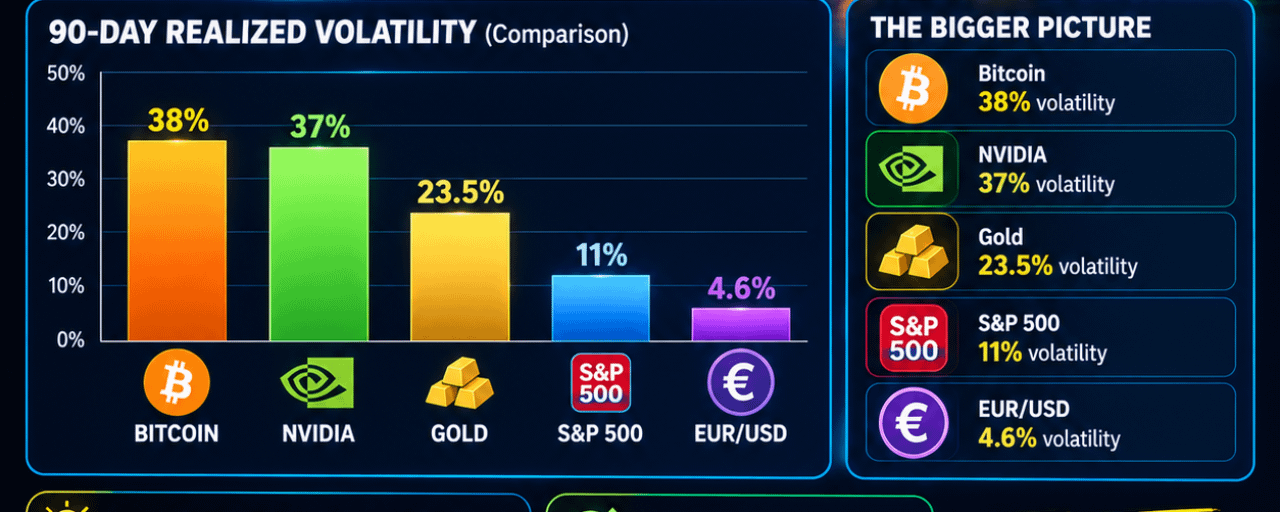
According to CoinDesk’s October 23 report, Bitcoin’s 90-day realized volatility was around 38%, compared with approximately 37% for NVIDIA.
Here’s the bigger picture:
🟠 Bitcoin: 38% volatility🟢 NVIDIA: 37%🥇 Gold: 23.5%📉 S&P 500: 11%💵 EUR/USD: 4.6%
What does this mean?
Bitcoin has become less volatile than in some previous years, but its price can still swing sharply. Higher volatility creates opportunities—but also increases the risk of losses.
My takeaway: Don’t judge an investment by potential returns alone. Understand its volatility, your time horizon, and how much risk you can afford.
💬 Your opinion: Which would you choose for a long-term investment—Bitcoin or NVIDIA? Why?
#bitcoin
#NVIDIA #CryptoAnalysis #Investing #BinanceSquare
Bitcoin vs NVIDIA: Which Is Riskier in 2026?
$BTC
Surprise! Bitcoin’s price volatility is now close to NVIDIA’s stock. 📊
According to CoinDesk’s October 23 report, Bitcoin’s 90-day realized volatility was around 38%, compared with approximately 37% for NVIDIA.
Here’s the bigger picture:
🟠 Bitcoin: 38% volatility🟢 NVIDIA: 37%🥇 Gold: 23.5%📉 S&P 500: 11%💵 EUR/USD: 4.6%
What does this mean?
Bitcoin has become less volatile than in some previous years, but its price can still swing sharply. Higher volatility creates opportunities—but also increases the risk of losses.
My takeaway: Don’t judge an investment by potential returns alone. Understand its volatility, your time horizon, and how much risk you can afford.
💬 Your opinion: Which would you choose for a long-term investment—Bitcoin or NVIDIA? Why?
#bitcoin
#NVIDIA #CryptoAnalysis #Investing #BinanceSquare
Surprise! Bitcoin’s price volatility is now close to NVIDIA’s stock. 📊
According to CoinDesk’s October 23 report, Bitcoin’s 90-day realized volatility was around 38%, compared with approximately 37% for NVIDIA.
Here’s the bigger picture:
🟠 Bitcoin: 38% volatility🟢 NVIDIA: 37%🥇 Gold: 23.5%📉 S&P 500: 11%💵 EUR/USD: 4.6%
What does this mean?
Bitcoin has become less volatile than in some previous years, but its price can still swing sharply. Higher volatility creates opportunities—but also increases the risk of losses.
My takeaway: Don’t judge an investment by potential returns alone. Understand its volatility, your time horizon, and how much risk you can afford.
💬 Your opinion: Which would you choose for a long-term investment—Bitcoin or NVIDIA? Why?
#bitcoin
#NVIDIA #CryptoAnalysis #Investing #BinanceSquare
111
·
--
Bullish
🟢 NVIDIA is preparing for a new phase of the AI boom
🚀 Demand for AI chips is so high that NVIDIA is expanding not only processor production, but its entire supplier network.
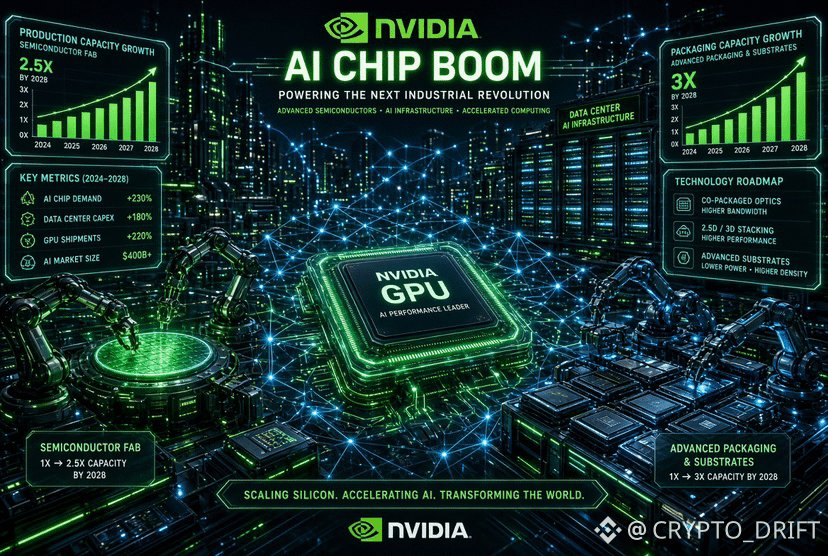
🏭 On October 21, the company announced new agreements with partners to help increase production capacity. In particular, capacity for manufacturing chip substrates is expected to grow 2.5 times over the next three years, while advanced packaging capacity is set to more than triple by the end of 2028.
💡 Why does this matter? Developing AI takes more than simply creating a powerful chip. It also requires memory, complex packaging, cooling systems, electricity, and data centers. If even one link in the chain can’t keep up with demand, scaling slows down.
📈 For NVIDIA, this is an opportunity to grow its business, but an important question remains for investors: will AI demand be enough to justify the industry’s enormous spending over the long term?
🤔 What do you think: will NVIDIA remain the leader in the AI market for much longer, or will competitors gradually start taking market share?
#NVIDIA #AI #TechNews
🟢 NVIDIA is preparing for a new phase of the AI boom
🚀 Demand for AI chips is so high that NVIDIA is expanding not only processor production, but its entire supplier network.
🏭 On October 21, the company announced new agreements with partners to help increase production capacity. In particular, capacity for manufacturing chip substrates is expected to grow 2.5 times over the next three years, while advanced packaging capacity is set to more than triple by the end of 2028.
💡 Why does this matter? Developing AI takes more than simply creating a powerful chip. It also requires memory, complex packaging, cooling systems, electricity, and data centers. If even one link in the chain can’t keep up with demand, scaling slows down.
📈 For NVIDIA, this is an opportunity to grow its business, but an important question remains for investors: will AI demand be enough to justify the industry’s enormous spending over the long term?
🤔 What do you think: will NVIDIA remain the leader in the AI market for much longer, or will competitors gradually start taking market share?
#NVIDIA #AI #TechNews
🚀 Demand for AI chips is so high that NVIDIA is expanding not only processor production, but its entire supplier network.
🏭 On October 21, the company announced new agreements with partners to help increase production capacity. In particular, capacity for manufacturing chip substrates is expected to grow 2.5 times over the next three years, while advanced packaging capacity is set to more than triple by the end of 2028.
💡 Why does this matter? Developing AI takes more than simply creating a powerful chip. It also requires memory, complex packaging, cooling systems, electricity, and data centers. If even one link in the chain can’t keep up with demand, scaling slows down.
📈 For NVIDIA, this is an opportunity to grow its business, but an important question remains for investors: will AI demand be enough to justify the industry’s enormous spending over the long term?
🤔 What do you think: will NVIDIA remain the leader in the AI market for much longer, or will competitors gradually start taking market share?
#NVIDIA #AI #TechNews
114

·
--
Nvidia’s backing faces a credit test: neoclouds take the first hitThe sharpest chill in this week’s AI narrative didn’t come from model evaluations, but from credit markets. Nvidia’s disclosures point to roughly $36 billion in off-balance-sheet backing for neoclouds, while stories are also circulating about guarantees of up to around $105 billion for large data center projects. In normal times, it looks like “free insurance.” When the weather turns, people start putting a price on that insurance.
CoreWeave, Nebius, and IREN have all fallen by more than 30% in October. For CoreWeave, bond prices have dropped to a discount and CDS spreads have widened to levels suggesting roughly a 60% five-year probability of default. The exact figure depends on the model, but the direction is clear: credit markets are getting skeptical about the “customers who sell the shovels.”
Nvidia’s backing faces a credit test: neoclouds take the first hit
The sharpest chill in this week’s AI narrative didn’t come from model evaluations, but from credit markets. Nvidia’s disclosures point to roughly $36 billion in off-balance-sheet backing for neoclouds, while stories are also circulating about guarantees of up to around $105 billion for large data center projects. In normal times, it looks like “free insurance.” When the weather turns, people start putting a price on that insurance.
CoreWeave, Nebius, and IREN have all fallen by more than 30% in October. For CoreWeave, bond prices have dropped to a discount and CDS spreads have widened to levels suggesting roughly a 60% five-year probability of default. The exact figure depends on the model, but the direction is clear: credit markets are getting skeptical about the “customers who sell the shovels.”
CoreWeave, Nebius, and IREN have all fallen by more than 30% in October. For CoreWeave, bond prices have dropped to a discount and CDS spreads have widened to levels suggesting roughly a 60% five-year probability of default. The exact figure depends on the model, but the direction is clear: credit markets are getting skeptical about the “customers who sell the shovels.”
9

·
--
The $NVDA conference in Berlin featured some rather unusual scenes.
Beyond the frenzy surrounding Jensen Huang, people stopped to watch robotic ducks in action.
There was also time to talk about the pressure the neocloud sector is feeling as artificial intelligence advances.
It’s curious to see how they mix technical presentations with robots that look like toys.
Did you imagine an event like this would have an atmosphere like that?
#Nvidia #IA #GTC
The $NVDA conference in Berlin featured some rather unusual scenes.
Beyond the frenzy surrounding Jensen Huang, people stopped to watch robotic ducks in action.
There was also time to talk about the pressure the neocloud sector is feeling as artificial intelligence advances.
It’s curious to see how they mix technical presentations with robots that look like toys.
Did you imagine an event like this would have an atmosphere like that?
#Nvidia #IA #GTC
Beyond the frenzy surrounding Jensen Huang, people stopped to watch robotic ducks in action.
There was also time to talk about the pressure the neocloud sector is feeling as artificial intelligence advances.
It’s curious to see how they mix technical presentations with robots that look like toys.
Did you imagine an event like this would have an atmosphere like that?
#Nvidia #IA #GTC
29

·
--
#NVDA 👀CEO #NVIDIA Jensen Huang is ready to pay $8 billion because of a new tax on billionaires. “The more you earn, the more you pay,” he said. 💰
Such calmness from a CEO about enormous expenses is the best indicator of confidence in his business.
From here, everyone can draw their own conclusions and do their own analysis. I’m just showing what I see in the market.
Maybe we’ll have to wait a while, or maybe they’ll pump it as soon as tomorrow. 😂
$NVDAB
#NVDA 👀CEO #NVIDIA Jensen Huang is ready to pay $8 billion because of a new tax on billionaires. “The more you earn, the more you pay,” he said. 💰
Such calmness from a CEO about enormous expenses is the best indicator of confidence in his business.
From here, everyone can draw their own conclusions and do their own analysis. I’m just showing what I see in the market.
Maybe we’ll have to wait a while, or maybe they’ll pump it as soon as tomorrow. 😂
$NVDAB
Such calmness from a CEO about enormous expenses is the best indicator of confidence in his business.
From here, everyone can draw their own conclusions and do their own analysis. I’m just showing what I see in the market.
Maybe we’ll have to wait a while, or maybe they’ll pump it as soon as tomorrow. 😂
$NVDAB
53

🚨 $NVDA
{future}(NVDAUSDT)
Tomorrow’s Market Analysis: The $210 Defense Battle! Will AI Chip Stocks Rebound or Keep Falling?
📊 Nvidia closed at $210.96 last Friday, down 0.59%. Tomorrow’s key question isn’t just AI demand—it’s whether the market is still willing to pay for high AI growth!
🔥 A Look at Three Key Developments
1️⃣ AI demand remains strong, supporting Nvidia’s fundamentals
Nvidia’s Blackwell and next-generation Rubin platforms remain important growth drivers for the expansion of AI data centers. The market is also closely watching the AI investment plans of major cloud companies, which will affect expectations for Nvidia’s future orders and revenue.
2️⃣ Concerns over AI capital spending are growing, putting tech stocks under pressure
Last Thursday, the Nasdaq fell about 2.6%, and semiconductor stocks faced significant selling pressure. Meta’s AI investment costs have raised concerns in the market, and investors are paying closer attention to the returns on AI spending—not just revenue growth.
3️⃣ Oil prices and interest rates pose additional risks
Recently, rising oil prices have fueled inflation concerns, while the yield on 10-year U.S. Treasury bonds is nearing 5%. If interest rates continue to rise, high-valuation tech stocks could face greater valuation pressure.
📈 10/26 NVDA Long/Short Trading Plan
🟢 Long Strategy
Support to watch: $210–211
Entry condition: Break above $214 with rising volume
First target: $217
Second target: $220
Reference stop-loss: Below $211
🔴 Short Strategy
Entry condition: Break decisively below $210 and fail to reclaim it on a rebound
First target: $207
Second target: $204
Reference stop-loss: Above $213
But if $210 fails to hold while the Nasdaq and semiconductor sector weaken at the same time, beware of a pullback to $207 or even lower.
⚠️ This week, the market will also be watching earnings from major tech companies and the Fed’s interest rate decision. Intraday volatility may increase around these announcements, so avoid blindly chasing prices with oversized positions.
👇 Click below to trade, follow me, and stay up to date on more NVDA, SOXL, and semiconductor market analysis!
#NVDA #NVIDIA #Aİ
🚨 $NVDA
Tomorrow’s Market Analysis: The $210 Defense Battle! Will AI Chip Stocks Rebound or Keep Falling?
📊 Nvidia closed at $210.96 last Friday, down 0.59%. Tomorrow’s key question isn’t just AI demand—it’s whether the market is still willing to pay for high AI growth!
🔥 A Look at Three Key Developments
1️⃣ AI demand remains strong, supporting Nvidia’s fundamentals
Nvidia’s Blackwell and next-generation Rubin platforms remain important growth drivers for the expansion of AI data centers. The market is also closely watching the AI investment plans of major cloud companies, which will affect expectations for Nvidia’s future orders and revenue.
2️⃣ Concerns over AI capital spending are growing, putting tech stocks under pressure
Last Thursday, the Nasdaq fell about 2.6%, and semiconductor stocks faced significant selling pressure. Meta’s AI investment costs have raised concerns in the market, and investors are paying closer attention to the returns on AI spending—not just revenue growth.
3️⃣ Oil prices and interest rates pose additional risks
Recently, rising oil prices have fueled inflation concerns, while the yield on 10-year U.S. Treasury bonds is nearing 5%. If interest rates continue to rise, high-valuation tech stocks could face greater valuation pressure.
📈 10/26 NVDA Long/Short Trading Plan
🟢 Long Strategy
Support to watch: $210–211
Entry condition: Break above $214 with rising volume
First target: $217
Second target: $220
Reference stop-loss: Below $211
🔴 Short Strategy
Entry condition: Break decisively below $210 and fail to reclaim it on a rebound
First target: $207
Second target: $204
Reference stop-loss: Above $213
But if $210 fails to hold while the Nasdaq and semiconductor sector weaken at the same time, beware of a pullback to $207 or even lower.
⚠️ This week, the market will also be watching earnings from major tech companies and the Fed’s interest rate decision. Intraday volatility may increase around these announcements, so avoid blindly chasing prices with oversized positions.
👇 Click below to trade, follow me, and stay up to date on more NVDA, SOXL, and semiconductor market analysis!
#NVDA #NVIDIA #Aİ
Tomorrow’s Market Analysis: The $210 Defense Battle! Will AI Chip Stocks Rebound or Keep Falling?
📊 Nvidia closed at $210.96 last Friday, down 0.59%. Tomorrow’s key question isn’t just AI demand—it’s whether the market is still willing to pay for high AI growth!
🔥 A Look at Three Key Developments
1️⃣ AI demand remains strong, supporting Nvidia’s fundamentals
Nvidia’s Blackwell and next-generation Rubin platforms remain important growth drivers for the expansion of AI data centers. The market is also closely watching the AI investment plans of major cloud companies, which will affect expectations for Nvidia’s future orders and revenue.
2️⃣ Concerns over AI capital spending are growing, putting tech stocks under pressure
Last Thursday, the Nasdaq fell about 2.6%, and semiconductor stocks faced significant selling pressure. Meta’s AI investment costs have raised concerns in the market, and investors are paying closer attention to the returns on AI spending—not just revenue growth.
3️⃣ Oil prices and interest rates pose additional risks
Recently, rising oil prices have fueled inflation concerns, while the yield on 10-year U.S. Treasury bonds is nearing 5%. If interest rates continue to rise, high-valuation tech stocks could face greater valuation pressure.
📈 10/26 NVDA Long/Short Trading Plan
🟢 Long Strategy
Support to watch: $210–211
Entry condition: Break above $214 with rising volume
First target: $217
Second target: $220
Reference stop-loss: Below $211
🔴 Short Strategy
Entry condition: Break decisively below $210 and fail to reclaim it on a rebound
First target: $207
Second target: $204
Reference stop-loss: Above $213
But if $210 fails to hold while the Nasdaq and semiconductor sector weaken at the same time, beware of a pullback to $207 or even lower.
⚠️ This week, the market will also be watching earnings from major tech companies and the Fed’s interest rate decision. Intraday volatility may increase around these announcements, so avoid blindly chasing prices with oversized positions.
👇 Click below to trade, follow me, and stay up to date on more NVDA, SOXL, and semiconductor market analysis!
#NVDA #NVIDIA #Aİ
1
31

NVIDIA Unveils Vera Rubin Architecture to Accelerate AI Factory Expansion
At the OCP Global Summit, NVIDIA announced that the Vera Rubin architecture is now available worldwide and introduced new software components to support the DSX AI Factory platform.#AI #NVIDIA
NVIDIA Unveils Vera Rubin Architecture to Accelerate AI Factory Expansion
At the OCP Global Summit, NVIDIA announced that the Vera Rubin architecture is now available worldwide and introduced new software components to support the DSX AI Factory platform.#AI #NVIDIA
At the OCP Global Summit, NVIDIA announced that the Vera Rubin architecture is now available worldwide and introduced new software components to support the DSX AI Factory platform.#AI #NVIDIA

·
--
🚀 NVIDIA (NVDA): Can AI Demand Keep Driving Growth?
$NVDA.US
{stock_us}(NVDA.US)
NVIDIA remains one of the most closely watched companies in the artificial intelligence revolution.
🔹 AI Powerhouse: NVIDIA develops GPUs and computing platforms used to train and run advanced AI models.
🔹 Data Center Demand: Businesses continue investing in AI infrastructure, making data-center growth a key factor to watch.
🔹 Market Volatility: Recent technology-stock swings show that even leading companies can face sharp price movements.
🔹 The Big Question: Can future earnings and AI demand justify investors’ expectations?
🔹 What to Watch: Upcoming earnings, data-center spending, competition, chip demand, and company guidance.
📊 Key Takeaway: NVIDIA has a major role in AI computing, but a strong business does not guarantee a rising stock price.
⚠️ Avoid investing based on hype or short-term price movements. Understand the risks before making a decision.
#NVIDIA #NVDA #StockMarket #TechStocks
Disclaimer: Educational content only. Not financial advice. Always do your own research.
🚀 NVIDIA (NVDA): Can AI Demand Keep Driving Growth?
$NVDA.US
NVIDIA remains one of the most closely watched companies in the artificial intelligence revolution.
🔹 AI Powerhouse: NVIDIA develops GPUs and computing platforms used to train and run advanced AI models.
🔹 Data Center Demand: Businesses continue investing in AI infrastructure, making data-center growth a key factor to watch.
🔹 Market Volatility: Recent technology-stock swings show that even leading companies can face sharp price movements.
🔹 The Big Question: Can future earnings and AI demand justify investors’ expectations?
🔹 What to Watch: Upcoming earnings, data-center spending, competition, chip demand, and company guidance.
📊 Key Takeaway: NVIDIA has a major role in AI computing, but a strong business does not guarantee a rising stock price.
⚠️ Avoid investing based on hype or short-term price movements. Understand the risks before making a decision.
#NVIDIA #NVDA #StockMarket #TechStocks
Disclaimer: Educational content only. Not financial advice. Always do your own research.
$NVDA.US
NVIDIA remains one of the most closely watched companies in the artificial intelligence revolution.
🔹 AI Powerhouse: NVIDIA develops GPUs and computing platforms used to train and run advanced AI models.
🔹 Data Center Demand: Businesses continue investing in AI infrastructure, making data-center growth a key factor to watch.
🔹 Market Volatility: Recent technology-stock swings show that even leading companies can face sharp price movements.
🔹 The Big Question: Can future earnings and AI demand justify investors’ expectations?
🔹 What to Watch: Upcoming earnings, data-center spending, competition, chip demand, and company guidance.
📊 Key Takeaway: NVIDIA has a major role in AI computing, but a strong business does not guarantee a rising stock price.
⚠️ Avoid investing based on hype or short-term price movements. Understand the risks before making a decision.
#NVIDIA #NVDA #StockMarket #TechStocks
Disclaimer: Educational content only. Not financial advice. Always do your own research.
NVDAUS+2.99%
528

·
--
The high cost of robot training data has taken another hit from Nvidia.
According to reports, Nvidia has open-sourced its data engine Flora, claiming it can bring the cost of annotating robot videos down from about $88 to around $0.72—roughly 125 times cheaper than the purported GPT-6 Astra approach. The process broadly involves segmenting time periods, describing actions, then evaluating execution and outcomes. It has reportedly been used to train GR00T, and can annotate up to around 200,000 hours of video per day across a large number of GPUs.
How to read this: An open-source entry point lowers the barrier to access, but real-world adoption will still depend on whether annotation quality and gains in downstream models live up to the claims. If the data bottleneck in robotics and embodied AI is eased, training cycles could speed up. Keep an eye on reproducible benchmarks first; don’t get carried away by the “125 times cheaper” headline.
#Nvidia #Flora #机器人 #OpenSource
The high cost of robot training data has taken another hit from Nvidia.
According to reports, Nvidia has open-sourced its data engine Flora, claiming it can bring the cost of annotating robot videos down from about $88 to around $0.72—roughly 125 times cheaper than the purported GPT-6 Astra approach. The process broadly involves segmenting time periods, describing actions, then evaluating execution and outcomes. It has reportedly been used to train GR00T, and can annotate up to around 200,000 hours of video per day across a large number of GPUs.
How to read this: An open-source entry point lowers the barrier to access, but real-world adoption will still depend on whether annotation quality and gains in downstream models live up to the claims. If the data bottleneck in robotics and embodied AI is eased, training cycles could speed up. Keep an eye on reproducible benchmarks first; don’t get carried away by the “125 times cheaper” headline.
#Nvidia #Flora #机器人 #OpenSource
According to reports, Nvidia has open-sourced its data engine Flora, claiming it can bring the cost of annotating robot videos down from about $88 to around $0.72—roughly 125 times cheaper than the purported GPT-6 Astra approach. The process broadly involves segmenting time periods, describing actions, then evaluating execution and outcomes. It has reportedly been used to train GR00T, and can annotate up to around 200,000 hours of video per day across a large number of GPUs.
How to read this: An open-source entry point lowers the barrier to access, but real-world adoption will still depend on whether annotation quality and gains in downstream models live up to the claims. If the data bottleneck in robotics and embodied AI is eased, training cycles could speed up. Keep an eye on reproducible benchmarks first; don’t get carried away by the “125 times cheaper” headline.
#Nvidia #Flora #机器人 #OpenSource
13

NVIDIA’s European strategy revealed: From digital discovery to physical operations
NVIDIA has launched a range of innovative applications in European retail, including Shopify’s post-training models, Zooplus’s product discovery stack, and Photoroom’s image-editing API, showcasing the power of open models and physical intelligence.#NVIDIA #TechAnalysis
NVIDIA’s European strategy revealed: From digital discovery to physical operations
NVIDIA has launched a range of innovative applications in European retail, including Shopify’s post-training models, Zooplus’s product discovery stack, and Photoroom’s image-editing API, showcasing the power of open models and physical intelligence.#NVIDIA #TechAnalysis
NVIDIA has launched a range of innovative applications in European retail, including Shopify’s post-training models, Zooplus’s product discovery stack, and Photoroom’s image-editing API, showcasing the power of open models and physical intelligence.#NVIDIA #TechAnalysis

·
--
NVIDIA Earth-2 model upgrade brings more accurate weather forecasts to Europe
NVIDIA Earth-2 adds the StormScope EU model for more accurate short-term weather forecasts. Widely used by organizations such as AXA and Vaisala Xweather, it supports regional hurricane risk assessment and air quality modeling.#技术分析派 #NVIDIA
NVIDIA Earth-2 model upgrade brings more accurate weather forecasts to Europe
NVIDIA Earth-2 adds the StormScope EU model for more accurate short-term weather forecasts. Widely used by organizations such as AXA and Vaisala Xweather, it supports regional hurricane risk assessment and air quality modeling.#技术分析派 #NVIDIA
NVIDIA Earth-2 adds the StormScope EU model for more accurate short-term weather forecasts. Widely used by organizations such as AXA and Vaisala Xweather, it supports regional hurricane risk assessment and air quality modeling.#技术分析派 #NVIDIA
45
Log in to explore more content
Join global crypto users on Binance Square
⚡️ Get latest and useful information about crypto.
💬 Trusted by the world’s largest crypto exchange.
👍 Discover real insights from verified creators.
Email / Phone number
Trending Topics
1
#BinancePick
2.8M views
147,072 Discussing
2
#EarningsSeason
5.1M views
25,120 Discussing
3
#AnthropicTTMRevenueGrewAbout1200%
582 views
69 Discussing
4
#AnthropicS1ExpectedToday
2,605 views
93 Discussing
5
#SouthKoreaReportedlyWeighsFourthCryptoTaxDelay
11,154 views
261 Discussing
6
#FranklinTempletonFilesForTwoDividendToBitcoinETFs
18,027 views
386 Discussing
7
#StrategyMSTRSurpassesNasdaqInMarketCap
14,056 views
302 Discussing
8
#CanadaProposesStablecoinRedemptionWithin3BusinessDays
682 views
30 Discussing
9
#ElectrumWalletBugLetRogueServersStealFunds
18,808 views
400 Discussing
10
#ArgentineCourtDismissesLIBRACaseAgainstMilei
29,445 views
485 Discussing