
#institutionalbitcoin
institutionalbitcoin
1,601 views
28 Discussing
Hot
Latest

·
--
🚨 Strategy Isn't Trading Bitcoin. It's Becoming Bitcoin.
Current position:
🟠 847,363 BTC held
🟠 Nearly 4% of all circulating supply
🟠 ~$48B cushion above net debt
🟠 Latest purchase: 520 BTC at ~$67K
🟠 Cash reserves: $1.4B
Three years ago the story looked very different.
October 2022:
📉 BTC near $20K
📉 Debt exceeded reserves by roughly $300M
📉 Bankruptcy concerns dominated headlines
Most companies would have reduced risk.
Saylor did the opposite.
Since then:
💰 Tens of billions raised
💰 Capital repeatedly deployed into BTC
💰 Treasury expanded through every cycle
The key point:
This is no longer a treasury that happens to own Bitcoin.
It's a corporate structure built around Bitcoin accumulation.
Every dip became an opportunity.
Every capital raise became additional supply removed from the market.
Whether you're bullish or bearish, the scale is impossible to ignore.
847,363 BTC is not a position.
It's a strategic bet on Bitcoin's future unlike anything public markets have seen before.
Verdict:
Strategy has transformed from a company buying Bitcoin into a company whose identity is Bitcoin. The success or failure of that conviction will likely become one of the most studied corporate capital allocation decisions in financial history.
#BTC #Strategy #Saylor #InstitutionalBitcoin #CryptoMarkets

154

·
--
Bearish
BlackRock Just Put Bitcoin Into a Traditional Portfolio
BlackRock Canada has launched IBQT, a new ETF that started trading on the Toronto Stock Exchange on August 10, 2026. What makes it interesting is the mix 97% global equities and 3% Bitcoin in one investment.
That 3% Bitcoin exposure comes through BlackRock’s Canadian Bitcoin ETF. As of August 10, the fund had around C$389.9 million in net assets, while IBQT has a 0.22% annual management fee.
For crypto, this is a pretty interesting move. Bitcoin isn’t just being treated as a standalone crypto investment anymore. It’s being included in a diversified portfolio that traditional investors can easily understand.
And honestly, 3% may not sound like much. But the bigger story is that Bitcoin is being included in mainstream investment products at all.
Could we see more traditional funds adding a 1 to 5% Bitcoin allocation next? What do you think?
$BTC
{future}(BTCUSDT)
#BitcoinETF💰💰💰 #InstitutionalBitcoin
#BlackRockCanadaLaunchesBitcoinLinkedETF
BlackRock Just Put Bitcoin Into a Traditional Portfolio
BlackRock Canada has launched IBQT, a new ETF that started trading on the Toronto Stock Exchange on August 10, 2026. What makes it interesting is the mix 97% global equities and 3% Bitcoin in one investment.
That 3% Bitcoin exposure comes through BlackRock’s Canadian Bitcoin ETF. As of August 10, the fund had around C$389.9 million in net assets, while IBQT has a 0.22% annual management fee.
For crypto, this is a pretty interesting move. Bitcoin isn’t just being treated as a standalone crypto investment anymore. It’s being included in a diversified portfolio that traditional investors can easily understand.
And honestly, 3% may not sound like much. But the bigger story is that Bitcoin is being included in mainstream investment products at all.
Could we see more traditional funds adding a 1 to 5% Bitcoin allocation next? What do you think?
$BTC
#BitcoinETF💰💰💰 #InstitutionalBitcoin
#BlackRockCanadaLaunchesBitcoinLinkedETF

1
5
226

🚨 STRIVE JUST BOUGHT $109 MILLION WORTH OF BITCOIN
🇺🇸 The Bitcoin treasury race is heating up.
Strive (ASST) has purchased another 1,375 BTC for approximately $109 million, paying an average of $79,281 per Bitcoin.
🔥 KEY POINTS
• 🟠 1,375 BTC added
• 💰 Purchase value: ~$109M
• 📊 Average price: $79,281/BTC
• ₿ Total holdings: 24,531 BTC
• 💵 About 70% of last week's capital raised came through SATA preferred stock
• 🏦 SATA's notional outstanding is now almost $1 BILLION.
📈 WHY IT MATTERS
Strive is aggressively expanding its Bitcoin treasury while competing to become one of the world's largest public Bitcoin holders.
The latest purchase also comes as Bitcoin treasury companies continue using preferred-stock financing to raise capital for BTC accumulation.
⚔️ TREASURY RACE
Strive now holds 24,531 BTC and says its strategy could potentially put it on a path toward becoming the second-largest public Bitcoin holder later this year.
Meanwhile, Strategy reported zero BTC bought or sold during the latest week — creating an interesting contrast between the two major Bitcoin treasury strategies.
#Bitcoin #Strive #ASST #BitcoinTreasury #InstitutionalBitcoin $BTC
{future}(BTCUSDT)
🚨 STRIVE JUST BOUGHT $109 MILLION WORTH OF BITCOIN
🇺🇸 The Bitcoin treasury race is heating up.
Strive (ASST) has purchased another 1,375 BTC for approximately $109 million, paying an average of $79,281 per Bitcoin.
🔥 KEY POINTS
• 🟠 1,375 BTC added
• 💰 Purchase value: ~$109M
• 📊 Average price: $79,281/BTC
• ₿ Total holdings: 24,531 BTC
• 💵 About 70% of last week's capital raised came through SATA preferred stock
• 🏦 SATA's notional outstanding is now almost $1 BILLION.
📈 WHY IT MATTERS
Strive is aggressively expanding its Bitcoin treasury while competing to become one of the world's largest public Bitcoin holders.
The latest purchase also comes as Bitcoin treasury companies continue using preferred-stock financing to raise capital for BTC accumulation.
⚔️ TREASURY RACE
Strive now holds 24,531 BTC and says its strategy could potentially put it on a path toward becoming the second-largest public Bitcoin holder later this year.
Meanwhile, Strategy reported zero BTC bought or sold during the latest week — creating an interesting contrast between the two major Bitcoin treasury strategies.
#Bitcoin #Strive #ASST #BitcoinTreasury #InstitutionalBitcoin $BTC

30

Article
INSTITUTIONAL BITCOIN INTELLIGENCE 03BITCOIN ETFs LOSE $1.91 BILLION: IS INSTITUTIONAL DEMAND DISAPPEARING?
Bitcoin's latest correction has exposed a critical question.
What happens when one of the market's most important regulated investment channels stops attracting capital?
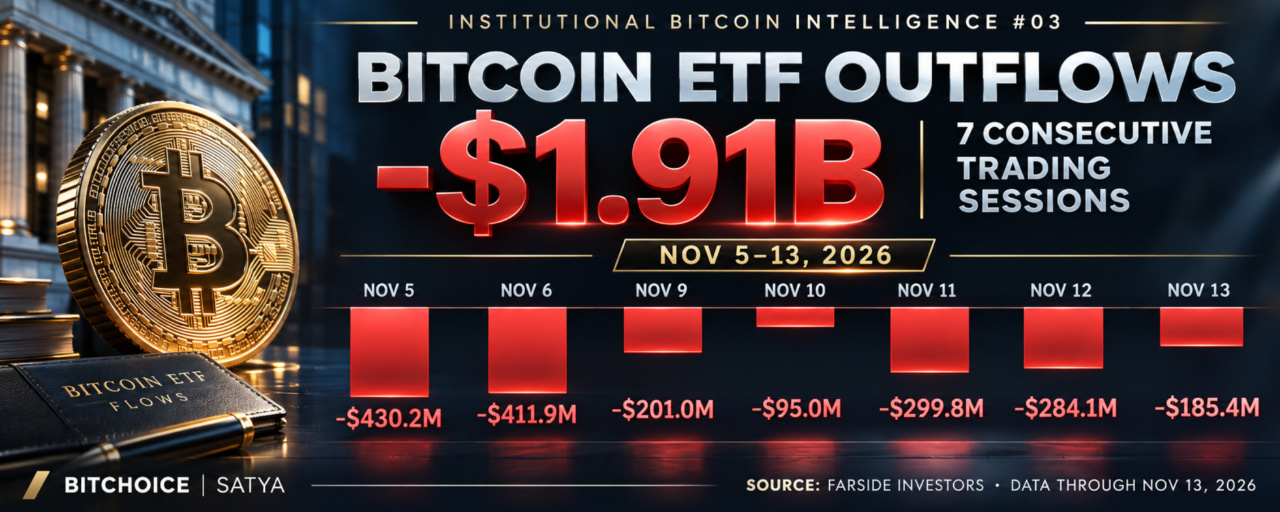
Between November 5 and November 13, 2026, U.S. spot Bitcoin ETFs recorded approximately $1.91 billion in cumulative net outflows across seven consecutive trading sessions.
This was not a single-day event.
It was a sustained period of negative fund flows.
THE SEVEN-SESSION DRAIN
Daily net flows across U.S. spot Bitcoin ETFs:
November 5: −$430.2M
November 6: −$411.9M
November 9: −$201.0M
November 10: −$95.0M
November 11: −$299.8M
November 12: −$284.1M
November 13: −$185.4M
Total: approximately −$1.91B.
The week of November 9–13 alone recorded $1.07B in net outflows.
Across the two full trading weeks ending November 13, the cumulative figure reached approximately $2.35B.
These are separate measurement windows, not figures to be added together.
THE BLACKROCK FACTOR
On November 13, BlackRock's IBIT recorded $143.5M in net outflows, while Fidelity's FBTC lost $41.9M.
IBIT therefore represented approximately 77% of the aggregate $185.4M negative flow that day.
Across the entire seven-session period, IBIT alone accounted for approximately $1.42B in net outflows.
This concentration is important.
Large regulated Bitcoin investment vehicles can influence the balance of incremental demand even when the underlying cryptocurrency continues trading across many other markets.
BUT ETF OUTFLOWS ARE NOT THE SAME AS SPOT SELLING
There is an important distinction often lost in market headlines.
ETF shares can trade between investors on the secondary market without changing the number of shares outstanding.
Fund creations and redemptions are different transactions.
Reported ETF net flows measure the net movement through the fund creation and redemption process.
They do not mean that precisely $1.91B worth of Bitcoin was immediately sold on spot exchanges at the moment the figures were published.
The timing and market impact depend on the funds' operating mechanisms and trading activity.
Still, seven negative sessions indicate that this channel was not delivering positive net demand during the period.
WHAT WOULD SIGNAL A REAL RECOVERY?
1. Consistent positive ETF flows
One green day can interrupt the streak. Several consecutive inflow sessions would provide stronger evidence of improving demand.
2. Reduced derivatives stress
Lower forced liquidation pressure would make price discovery less dependent on sudden leverage unwinds.
3. Stronger market liquidity
ETF flows should be considered alongside stablecoin supply, spot liquidity and broader financial conditions.
4. Broader participation
A healthier recovery would be more convincing if buying pressure was not concentrated in only one fund or one trading session.
THREE INSTITUTIONAL SIGNALS
The latest Bitcoin market data reveal three different pressures.
Options markets continue pricing downside protection.
Strategy has allocated substantial capital to preferred-stock repurchases while continuing to buy BTC.
And U.S. spot Bitcoin ETFs have experienced seven consecutive sessions of withdrawals.
These signals describe different parts of the market.
They should not be mechanically combined or presented as evidence of coordinated institutional selling.
But together they show why the next sustainable Bitcoin advance may depend as much on liquidity and financing conditions as on market sentiment.
OUR ASSESSMENT
Bitcoin does not require uninterrupted ETF inflows to appreciate.
However, a sustained return of positive net flows would strengthen the case that institutional demand is rebuilding.
Until then, a price bounce and a durable recovery should not be treated as the same thing.
What would convince you more: one large ETF inflow day or five consecutive positive sessions?
BITCHOICE | SATYA
Institutional Bitcoin Intelligence #03
Farside Investors, U.S. spot Bitcoin ETF flows through November 13, 2026.
#Bitcoin #BitcoinETF #InstitutionalBitcoin #CryptoLiquidity #CapitalMarkets $BTC
{spot}(BTCUSDT)
INSTITUTIONAL BITCOIN INTELLIGENCE 03
BITCOIN ETFs LOSE $1.91 BILLION: IS INSTITUTIONAL DEMAND DISAPPEARING?
Bitcoin's latest correction has exposed a critical question.
What happens when one of the market's most important regulated investment channels stops attracting capital?
Between November 5 and November 13, 2026, U.S. spot Bitcoin ETFs recorded approximately $1.91 billion in cumulative net outflows across seven consecutive trading sessions.
This was not a single-day event.
It was a sustained period of negative fund flows.
THE SEVEN-SESSION DRAIN
Daily net flows across U.S. spot Bitcoin ETFs:
November 5: −$430.2M
November 6: −$411.9M
November 9: −$201.0M
November 10: −$95.0M
November 11: −$299.8M
November 12: −$284.1M
November 13: −$185.4M
Total: approximately −$1.91B.
The week of November 9–13 alone recorded $1.07B in net outflows.
Across the two full trading weeks ending November 13, the cumulative figure reached approximately $2.35B.
These are separate measurement windows, not figures to be added together.
THE BLACKROCK FACTOR
On November 13, BlackRock's IBIT recorded $143.5M in net outflows, while Fidelity's FBTC lost $41.9M.
IBIT therefore represented approximately 77% of the aggregate $185.4M negative flow that day.
Across the entire seven-session period, IBIT alone accounted for approximately $1.42B in net outflows.
This concentration is important.
Large regulated Bitcoin investment vehicles can influence the balance of incremental demand even when the underlying cryptocurrency continues trading across many other markets.
BUT ETF OUTFLOWS ARE NOT THE SAME AS SPOT SELLING
There is an important distinction often lost in market headlines.
ETF shares can trade between investors on the secondary market without changing the number of shares outstanding.
Fund creations and redemptions are different transactions.
Reported ETF net flows measure the net movement through the fund creation and redemption process.
They do not mean that precisely $1.91B worth of Bitcoin was immediately sold on spot exchanges at the moment the figures were published.
The timing and market impact depend on the funds' operating mechanisms and trading activity.
Still, seven negative sessions indicate that this channel was not delivering positive net demand during the period.
WHAT WOULD SIGNAL A REAL RECOVERY?
1. Consistent positive ETF flows
One green day can interrupt the streak. Several consecutive inflow sessions would provide stronger evidence of improving demand.
2. Reduced derivatives stress
Lower forced liquidation pressure would make price discovery less dependent on sudden leverage unwinds.
3. Stronger market liquidity
ETF flows should be considered alongside stablecoin supply, spot liquidity and broader financial conditions.
4. Broader participation
A healthier recovery would be more convincing if buying pressure was not concentrated in only one fund or one trading session.
THREE INSTITUTIONAL SIGNALS
The latest Bitcoin market data reveal three different pressures.
Options markets continue pricing downside protection.
Strategy has allocated substantial capital to preferred-stock repurchases while continuing to buy BTC.
And U.S. spot Bitcoin ETFs have experienced seven consecutive sessions of withdrawals.
These signals describe different parts of the market.
They should not be mechanically combined or presented as evidence of coordinated institutional selling.
But together they show why the next sustainable Bitcoin advance may depend as much on liquidity and financing conditions as on market sentiment.
OUR ASSESSMENT
Bitcoin does not require uninterrupted ETF inflows to appreciate.
However, a sustained return of positive net flows would strengthen the case that institutional demand is rebuilding.
Until then, a price bounce and a durable recovery should not be treated as the same thing.
What would convince you more: one large ETF inflow day or five consecutive positive sessions?
BITCHOICE | SATYA
Institutional Bitcoin Intelligence #03
Farside Investors, U.S. spot Bitcoin ETF flows through November 13, 2026.
#Bitcoin #BitcoinETF #InstitutionalBitcoin #CryptoLiquidity #CapitalMarkets $BTC
1
72
Article
INSTITUTIONAL BITCOIN INTELLIGENCE 02STRATEGY RAISED $283.8M — BUT SPENT MORE THAN TWICE AS MUCH ON STRC BUYBACKS AS ON BITCOIN
What happens when the world's largest corporate Bitcoin treasury allocates more fresh capital to its preferred shares than to BTC?
Strategy's November 9 filing offers a revealing snapshot.
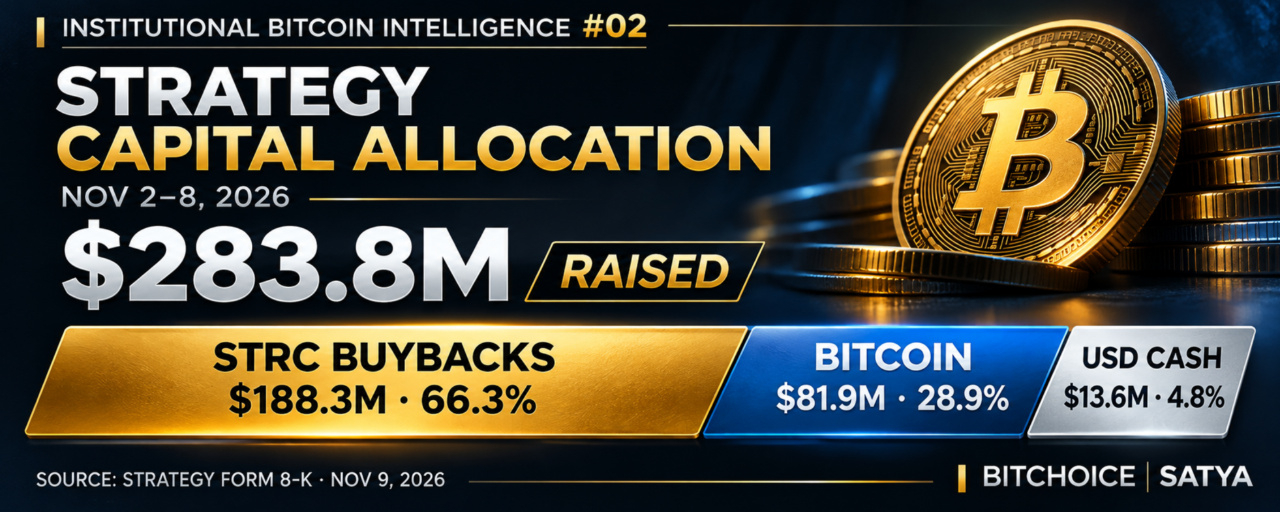
During November 2–8, 2026, the company raised $283.8 million by selling 2,051,348 shares of MSTR common stock.
Here is where the money went:
• $188.3M — STRC preferred-stock repurchases
• $81.9M — Bitcoin purchases
• $13.6M — additional USD Cash
That means approximately 66.3% of the proceeds went toward STRC, compared with 28.9% toward BTC.
For every $1 spent buying Bitcoin, Strategy spent about $2.30 repurchasing its own preferred shares.
WHY DOES THIS MATTER?
Strategy acquired another 1,036 BTC at an average price of $79,012, including fees and expenses.
Its total holdings reached 850,364 BTC as of November 8.
Yet the larger financial decision that week was not about accumulating more coins. It was about managing the securities used to finance the treasury.
STRC is Strategy's variable-rate perpetual preferred stock.
It has a different risk and income profile from MSTR common equity, and its trading behavior matters to Strategy's broader financing structure.
Buying back STRC can reduce the number of preferred shares outstanding and may support market pricing. It also consumes capital that could otherwise be deployed into Bitcoin.
That trade-off deserves attention.
THE CAPITAL STRUCTURE QUESTION
Strategy's balance sheet is no longer explained by one number: total BTC holdings.
It now involves several connected layers:
Common-share issuance through MSTRBitcoin accumulationPreferred-stock dividend obligationsSTRC repurchases and market stabilityUSD liquidity management
As of November 8, Strategy reported approximately $4.77 billion in its USD Reserve and $146.2 million in additional USD Cash.
These liquidity resources are important because owning substantial Bitcoin reserves does not eliminate dollar-denominated corporate obligations.
WHAT SHOULD INVESTORS WATCH NEXT?
First, whether STRC repurchases remain a major use of future financing proceeds.
Second, whether preferred-share market conditions improve enough to reduce the need for continuing intervention.
Third, whether the benefits of repurchasing preferred stock outweigh dilution from issuing new MSTR common shares.
And fourth, whether Bitcoin accumulation accelerates again as capital-market conditions change.
THE BIGGER PICTURE
One reporting week does not establish a permanent shift in corporate strategy.
Strategy remains an enormous Bitcoin holder and continues purchasing BTC.
But the November 2–8 allocation highlights an evolution in its financial model.
Bitcoin treasury management is becoming inseparable from capital structure management.
The headline question is no longer only:
"How much Bitcoin did Strategy buy?"
It is increasingly:
"What did Strategy have to do financially to support those Bitcoin holdings?"
That distinction matters for anyone analyzing MSTR, STRC or institutional Bitcoin exposure.
Would you prioritize buying more BTC or strengthening the preferred-stock structure?
BITCHOICE | SATYA
Institutional Bitcoin Intelligence #02
Source: Strategy Form 8-K, November 9, 2026.
Reporting period: November 2–8, 2026.
#Bitcoin #MSTR #STRC #InstitutionalBitcoin #CryptoMarkets $BTC
{spot}(BTCUSDT)
INSTITUTIONAL BITCOIN INTELLIGENCE 02
STRATEGY RAISED $283.8M — BUT SPENT MORE THAN TWICE AS MUCH ON STRC BUYBACKS AS ON BITCOIN
What happens when the world's largest corporate Bitcoin treasury allocates more fresh capital to its preferred shares than to BTC?
Strategy's November 9 filing offers a revealing snapshot.
During November 2–8, 2026, the company raised $283.8 million by selling 2,051,348 shares of MSTR common stock.
Here is where the money went:
• $188.3M — STRC preferred-stock repurchases
• $81.9M — Bitcoin purchases
• $13.6M — additional USD Cash
That means approximately 66.3% of the proceeds went toward STRC, compared with 28.9% toward BTC.
For every $1 spent buying Bitcoin, Strategy spent about $2.30 repurchasing its own preferred shares.
WHY DOES THIS MATTER?
Strategy acquired another 1,036 BTC at an average price of $79,012, including fees and expenses.
Its total holdings reached 850,364 BTC as of November 8.
Yet the larger financial decision that week was not about accumulating more coins. It was about managing the securities used to finance the treasury.
STRC is Strategy's variable-rate perpetual preferred stock.
It has a different risk and income profile from MSTR common equity, and its trading behavior matters to Strategy's broader financing structure.
Buying back STRC can reduce the number of preferred shares outstanding and may support market pricing. It also consumes capital that could otherwise be deployed into Bitcoin.
That trade-off deserves attention.
THE CAPITAL STRUCTURE QUESTION
Strategy's balance sheet is no longer explained by one number: total BTC holdings.
It now involves several connected layers:
Common-share issuance through MSTRBitcoin accumulationPreferred-stock dividend obligationsSTRC repurchases and market stabilityUSD liquidity management
As of November 8, Strategy reported approximately $4.77 billion in its USD Reserve and $146.2 million in additional USD Cash.
These liquidity resources are important because owning substantial Bitcoin reserves does not eliminate dollar-denominated corporate obligations.
WHAT SHOULD INVESTORS WATCH NEXT?
First, whether STRC repurchases remain a major use of future financing proceeds.
Second, whether preferred-share market conditions improve enough to reduce the need for continuing intervention.
Third, whether the benefits of repurchasing preferred stock outweigh dilution from issuing new MSTR common shares.
And fourth, whether Bitcoin accumulation accelerates again as capital-market conditions change.
THE BIGGER PICTURE
One reporting week does not establish a permanent shift in corporate strategy.
Strategy remains an enormous Bitcoin holder and continues purchasing BTC.
But the November 2–8 allocation highlights an evolution in its financial model.
Bitcoin treasury management is becoming inseparable from capital structure management.
The headline question is no longer only:
"How much Bitcoin did Strategy buy?"
It is increasingly:
"What did Strategy have to do financially to support those Bitcoin holdings?"
That distinction matters for anyone analyzing MSTR, STRC or institutional Bitcoin exposure.
Would you prioritize buying more BTC or strengthening the preferred-stock structure?
BITCHOICE | SATYA
Institutional Bitcoin Intelligence #02
Source: Strategy Form 8-K, November 9, 2026.
Reporting period: November 2–8, 2026.
#Bitcoin #MSTR #STRC #InstitutionalBitcoin #CryptoMarkets $BTC
188
INSTITUTIONAL BITCOIN INTELLIGENCE 01
MSCI × STRATEGY: THE HIDDEN RISK TO BITCOIN ACCUMULATION
MSCI has confirmed that Strategy (MSTR) will exit its equity indexes after the November 30 close.
But the most important consequence may not be the initial selling pressure.
It could be the cost of financing future Bitcoin purchases.
THE PASSIVE CAPITAL SHOCK
Strategy estimates that MSCI-linked funds hold approximately 13 million MSTR shares, representing 3.1% of its basic shares outstanding.
At November 11 prices, that exposure was worth roughly $1.6 billion.
Earlier JPMorgan scenarios projected $2.8 billion in potential MSCI-related outflows, or up to $8.8 billion if other index providers adopted similar exclusions.
These estimates use different assumptions and should not be treated as confirmed selling volumes.
THE BITCOIN CONNECTION
Strategy's accumulation model relies partly on raising capital through equity and debt markets.
When MSTR trades at a substantial premium to its underlying Bitcoin holdings, issuing new shares can help finance additional BTC purchases.
But when that premium contracts, the economics change.
Lower equity valuations can make new share issuance less attractive, potentially slowing future accumulation.
This is where MSCI's decision becomes relevant beyond traditional equity markets.
THREE DIFFERENT RISKS
Index rebalancing: passive funds may need to sell MSTR shares.
Financing pressure: weaker equity demand could affect Strategy's ability to raise capital efficiently.
Bitcoin reserves: index exclusion does not automatically force Strategy to sell BTC.
Strategy reported 850,364 BTC as of November 8.
WHAT TO WATCH
• MSTR liquidity around November 30
• Premium to underlying BTC holdings
• Future financing and index-provider decisions
THE TAKEAWAY
MSCI's decision primarily affects MSTR shares, not Strategy's Bitcoin reserves.
The key risk is whether weaker equity demand could limit future BTC accumulation.
#Bitcoin #MSTR #MSCI #InstitutionalBitcoin #CapitalMarkets $BTC
{spot}(BTCUSDT)
INSTITUTIONAL BITCOIN INTELLIGENCE 01
MSCI × STRATEGY: THE HIDDEN RISK TO BITCOIN ACCUMULATION
MSCI has confirmed that Strategy (MSTR) will exit its equity indexes after the November 30 close.
But the most important consequence may not be the initial selling pressure.
It could be the cost of financing future Bitcoin purchases.
THE PASSIVE CAPITAL SHOCK
Strategy estimates that MSCI-linked funds hold approximately 13 million MSTR shares, representing 3.1% of its basic shares outstanding.
At November 11 prices, that exposure was worth roughly $1.6 billion.
Earlier JPMorgan scenarios projected $2.8 billion in potential MSCI-related outflows, or up to $8.8 billion if other index providers adopted similar exclusions.
These estimates use different assumptions and should not be treated as confirmed selling volumes.
THE BITCOIN CONNECTION
Strategy's accumulation model relies partly on raising capital through equity and debt markets.
When MSTR trades at a substantial premium to its underlying Bitcoin holdings, issuing new shares can help finance additional BTC purchases.
But when that premium contracts, the economics change.
Lower equity valuations can make new share issuance less attractive, potentially slowing future accumulation.
This is where MSCI's decision becomes relevant beyond traditional equity markets.
THREE DIFFERENT RISKS
Index rebalancing: passive funds may need to sell MSTR shares.
Financing pressure: weaker equity demand could affect Strategy's ability to raise capital efficiently.
Bitcoin reserves: index exclusion does not automatically force Strategy to sell BTC.
Strategy reported 850,364 BTC as of November 8.
WHAT TO WATCH
• MSTR liquidity around November 30
• Premium to underlying BTC holdings
• Future financing and index-provider decisions
THE TAKEAWAY
MSCI's decision primarily affects MSTR shares, not Strategy's Bitcoin reserves.
The key risk is whether weaker equity demand could limit future BTC accumulation.
#Bitcoin #MSTR #MSCI #InstitutionalBitcoin #CapitalMarkets $BTC

125

·
--
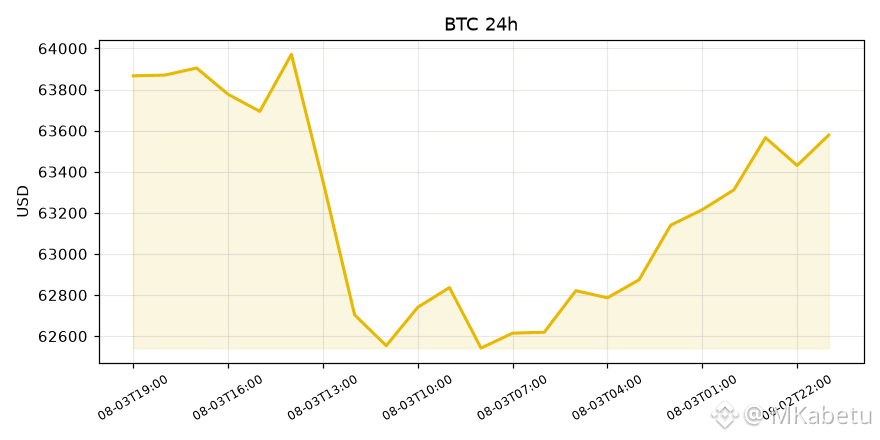
BTC climbs above $64k amid institutional support
Bitcoin is trading above $64,000, with a 0.77% gain over the last 24 hours. The price rebound is fueled by institutional sentiment, as MicroStrategy CEO Michael Saylor reaffirmed he has never sold any of his personal Bitcoin holdings. This statement has amplified confidence in long-term bullish outlooks. Additionally, BTC's recent move has triggered significant liquidations of short positions, with over $95 million in shorts closed in four hours. Fear and greed indicators show a 'Fear' reading, suggesting market uncertainty but also potential for further gains. The price action reflects a mix of bullish momentum and short-term volatility, influenced by conflicting signals from market participants. Traders should monitor the 64,000 level for potential consolidation or breakout. Institutional buying and short-covering may drive further upside, but bearish pressure could emerge if the price fails to sustain above this key level. Watch for broader market sentiment and macroeconomic factors that could influence the trend.
#btcprice #cryptomarkets #institutionalbitcoin #btcnews #BTC
79

🏦 Strive Asset Management just dropped their Q1 results — and the number that matters most?15,009 BTC in holdings.
That's not a hedge. That's a conviction bet.
While traditional asset managers are still debating Bitcoin's "legitimacy," Strive is quietly stacking sats at institutional scale.
What does this tell us?
✅ Institutional BTC accumulation is accelerating
✅ Corporate treasury strategy is shifting from cash to hard assets
✅ The HODLers were right — institutions are just slower
Bitcoin doesn't need retail to pump. It needs institutions to hold — and they are.
The era of "Bitcoin is too risky for institutions" is officially over.
Are you holding BTC while institutions stack, or waiting for the top to FOMO in? 👇
#StriveQ1Results15009BTCHoldings #Bitcoin #BTC #CryptoNews #InstitutionalBitcoin #Binance #Write2Earn #BinanceSquare
🏦 Strive Asset Management just dropped their Q1 results — and the number that matters most?
15,009 BTC in holdings.
That's not a hedge. That's a conviction bet.
While traditional asset managers are still debating Bitcoin's "legitimacy," Strive is quietly stacking sats at institutional scale.
What does this tell us?
✅ Institutional BTC accumulation is accelerating
✅ Corporate treasury strategy is shifting from cash to hard assets
✅ The HODLers were right — institutions are just slower
Bitcoin doesn't need retail to pump. It needs institutions to hold — and they are.
The era of "Bitcoin is too risky for institutions" is officially over.
Are you holding BTC while institutions stack, or waiting for the top to FOMO in? 👇
#StriveQ1Results15009BTCHoldings #Bitcoin #BTC #CryptoNews #InstitutionalBitcoin #Binance #Write2Earn #BinanceSquare
121
Log in to explore more content
Join global crypto users on Binance Square
⚡️ Get latest and useful information about crypto.
💬 Trusted by the world’s largest crypto exchange.
👍 Discover real insights from verified creators.
Email / Phone number
Trending Topics
1
#NvidiaBeatsEstimatesWith$130BQ4Outlook
2,178 views
44 Discussing
2
#AnthropicIPOPriceCouldExceed$80
5,386 views
51 Discussing
3
#CanNvidia’sDataCenterGrowthContinue?
12,262 views
219 Discussing
4
#DBSAndCirclePartnerToExpandAsianInstitutionsUSDCAccess
370 views
6 Discussing
5
#NvidiaBoardNotConsideringHuang’sReturnasCEO
166,991 views
1,239 Discussing
6
#KOSPIFalls2.59%ToLowestCloseSinceFebruary
46,412 views
511 Discussing
7
#AnthropicClearedToListOnNasdaqAsANT
40,426 views
403 Discussing
8
#WhatInvestmentSignalsDo13FFilingsReveal?
90,597 views
806 Discussing
9
#TetherCapitalMakesStrategicInvestmentInStables
23,192 views
218 Discussing
10
#EvernorthRecords$505MImpairmentOnPreListingXRP
2,687 views
29 Discussing