
#defievolution
defievolution
94,714 views
167 Discussing
Hot
Latest
·
--
Ripple's Support Ignites a Hidden Catalyst for XRPThe real game-changers in crypto aren't just new tokens or hyped projects - they're the ones quietly building robust networks that could disrupt the status quo.
Most traders watch price, but the insiders know to examine the subtle signs of a maturing ecosystem, like the support from Ripple for two XRP Ledger amendments designed to bolster single-asset vaults and fixed-term institutional lending.
THE SIGNAL (3 hashtags): We see significant interest in XRP's vault and lending capabilities as evidenced by the increased voting activity and engagement from reputable validator nodes. (#XRP #LendingInfrastructure #DeFiEvolution)
THE INTERPRETATION: This is not just a technical improvement for the XRP Ledger, but a strategic move that aligns with the vision of creating a robust decentralized finance (DeFi) infrastructure. As institutional investors take notice of reliable and efficient lending capabilities, this could be a game-changer for the adoption of XRP and other DeFi applications built on the XRP Ledger. If executed correctly, we may see increased activity from investors seeking to take advantage of the improved lending capabilities and vault functionality.
THE WATCH LIST: Monitoring the upcoming implementation and testing phases of the amended code to gauge the market's response and adoption rate. (#CodeImplementationTimeline)
THE SIGNAL is clear: the momentum is building, and the time for hesitation is running out. Will you be prepared to seize the opportunities unfolding in the XRP Ledger? Start evaluating the lending and yield landscape in the coming days and be prepared to adjust your strategy when the market begins to reflect these developments.
Can you spot the next ripple effect in the DeFi landscape? Stay ahead of the curve, adjust your portfolio accordingly and reap the rewards of the evolving world of DeFi.
Ripple's Support Ignites a Hidden Catalyst for XRP
The real game-changers in crypto aren't just new tokens or hyped projects - they're the ones quietly building robust networks that could disrupt the status quo.
Most traders watch price, but the insiders know to examine the subtle signs of a maturing ecosystem, like the support from Ripple for two XRP Ledger amendments designed to bolster single-asset vaults and fixed-term institutional lending.
THE SIGNAL (3 hashtags): We see significant interest in XRP's vault and lending capabilities as evidenced by the increased voting activity and engagement from reputable validator nodes. (#XRP #LendingInfrastructure #DeFiEvolution)
THE INTERPRETATION: This is not just a technical improvement for the XRP Ledger, but a strategic move that aligns with the vision of creating a robust decentralized finance (DeFi) infrastructure. As institutional investors take notice of reliable and efficient lending capabilities, this could be a game-changer for the adoption of XRP and other DeFi applications built on the XRP Ledger. If executed correctly, we may see increased activity from investors seeking to take advantage of the improved lending capabilities and vault functionality.
THE WATCH LIST: Monitoring the upcoming implementation and testing phases of the amended code to gauge the market's response and adoption rate. (#CodeImplementationTimeline)
THE SIGNAL is clear: the momentum is building, and the time for hesitation is running out. Will you be prepared to seize the opportunities unfolding in the XRP Ledger? Start evaluating the lending and yield landscape in the coming days and be prepared to adjust your strategy when the market begins to reflect these developments.
Can you spot the next ripple effect in the DeFi landscape? Stay ahead of the curve, adjust your portfolio accordingly and reap the rewards of the evolving world of DeFi.
Most traders watch price, but the insiders know to examine the subtle signs of a maturing ecosystem, like the support from Ripple for two XRP Ledger amendments designed to bolster single-asset vaults and fixed-term institutional lending.
THE SIGNAL (3 hashtags): We see significant interest in XRP's vault and lending capabilities as evidenced by the increased voting activity and engagement from reputable validator nodes. (#XRP #LendingInfrastructure #DeFiEvolution)
THE INTERPRETATION: This is not just a technical improvement for the XRP Ledger, but a strategic move that aligns with the vision of creating a robust decentralized finance (DeFi) infrastructure. As institutional investors take notice of reliable and efficient lending capabilities, this could be a game-changer for the adoption of XRP and other DeFi applications built on the XRP Ledger. If executed correctly, we may see increased activity from investors seeking to take advantage of the improved lending capabilities and vault functionality.
THE WATCH LIST: Monitoring the upcoming implementation and testing phases of the amended code to gauge the market's response and adoption rate. (#CodeImplementationTimeline)
THE SIGNAL is clear: the momentum is building, and the time for hesitation is running out. Will you be prepared to seize the opportunities unfolding in the XRP Ledger? Start evaluating the lending and yield landscape in the coming days and be prepared to adjust your strategy when the market begins to reflect these developments.
Can you spot the next ripple effect in the DeFi landscape? Stay ahead of the curve, adjust your portfolio accordingly and reap the rewards of the evolving world of DeFi.
82
·
--
Are you aware that traditional financial regulations might soon not be enough to keep up with the rapidly evolving world of DeFi trading?
#DeFiEvolution #CFTCRegulations
Let's dive into what's behind this pressing issue: existing regulations built for traditional financial markets don't fit decentralized infrastructure like DeFi trading. Imagine trying to apply the rules of a physical supermarket to an online shopping platform – it just wouldn't work. The Hyperliquid Policy Center and Phantom are calling for the US CFTC to update its rulebook for onchain trading. This means DeFi platforms like decentralized exchanges and lending protocols need tailored regulations to ensure user protection and transparency.
Real-world example: Binance is already a leader in DeFi compliance, with robust anti-money laundering (AML) and know-your-customer (KYC) measures in place. By staying ahead of the regulatory curve, we can foster a safer and more secure DeFi ecosystem.
So what can you do to stay ahead of DeFi regulations? Stay informed about updates from regulatory bodies and DeFi platforms, and always use reputable exchanges with robust security measures in place. What do you think – will DeFi-specific regulations usher in a new era of innovation and trust in the space?
Are you aware that traditional financial regulations might soon not be enough to keep up with the rapidly evolving world of DeFi trading?
#DeFiEvolution #CFTCRegulations
Let's dive into what's behind this pressing issue: existing regulations built for traditional financial markets don't fit decentralized infrastructure like DeFi trading. Imagine trying to apply the rules of a physical supermarket to an online shopping platform – it just wouldn't work. The Hyperliquid Policy Center and Phantom are calling for the US CFTC to update its rulebook for onchain trading. This means DeFi platforms like decentralized exchanges and lending protocols need tailored regulations to ensure user protection and transparency.
Real-world example: Binance is already a leader in DeFi compliance, with robust anti-money laundering (AML) and know-your-customer (KYC) measures in place. By staying ahead of the regulatory curve, we can foster a safer and more secure DeFi ecosystem.
So what can you do to stay ahead of DeFi regulations? Stay informed about updates from regulatory bodies and DeFi platforms, and always use reputable exchanges with robust security measures in place. What do you think – will DeFi-specific regulations usher in a new era of innovation and trust in the space?
#DeFiEvolution #CFTCRegulations
Let's dive into what's behind this pressing issue: existing regulations built for traditional financial markets don't fit decentralized infrastructure like DeFi trading. Imagine trying to apply the rules of a physical supermarket to an online shopping platform – it just wouldn't work. The Hyperliquid Policy Center and Phantom are calling for the US CFTC to update its rulebook for onchain trading. This means DeFi platforms like decentralized exchanges and lending protocols need tailored regulations to ensure user protection and transparency.
Real-world example: Binance is already a leader in DeFi compliance, with robust anti-money laundering (AML) and know-your-customer (KYC) measures in place. By staying ahead of the regulatory curve, we can foster a safer and more secure DeFi ecosystem.
So what can you do to stay ahead of DeFi regulations? Stay informed about updates from regulatory bodies and DeFi platforms, and always use reputable exchanges with robust security measures in place. What do you think – will DeFi-specific regulations usher in a new era of innovation and trust in the space?
1

⚡ Hyperliquid and DEX Evolution: HYPE's sustained growth signals a paradigm shift in trading
On July 19, 2026, Hyperliquid $HYPE at $60.82 with a market cap of $13.53B is proving that on-chain perpetual trading can compete with centralized exchanges. The +2.62% gain today and volume of $288.89M confirm growing user adoption.
The thesis extends beyond a single token: self-custody combined with CEX-grade trading experience is the holy grail of DeFi. If $HYPE maintains this trajectory, it could challenge the notion that DEXs are inherently inferior to centralized alternatives.
📌 Key Takeaway:
Hyperliquid represents a thesis being validated in real-time. On-chain derivatives with CEX-level performance isn't a dream anymore — it's a $13.5B market cap reality.
#Hyperliquid #HYPE #DeFiEvolution
#BinanceAlphaAlert
⚡ Hyperliquid and DEX Evolution: HYPE's sustained growth signals a paradigm shift in trading
On July 19, 2026, Hyperliquid $HYPE at $60.82 with a market cap of $13.53B is proving that on-chain perpetual trading can compete with centralized exchanges. The +2.62% gain today and volume of $288.89M confirm growing user adoption.
The thesis extends beyond a single token: self-custody combined with CEX-grade trading experience is the holy grail of DeFi. If $HYPE maintains this trajectory, it could challenge the notion that DEXs are inherently inferior to centralized alternatives.
📌 Key Takeaway:
Hyperliquid represents a thesis being validated in real-time. On-chain derivatives with CEX-level performance isn't a dream anymore — it's a $13.5B market cap reality.
#Hyperliquid #HYPE #DeFiEvolution
#BinanceAlphaAlert
On July 19, 2026, Hyperliquid $HYPE at $60.82 with a market cap of $13.53B is proving that on-chain perpetual trading can compete with centralized exchanges. The +2.62% gain today and volume of $288.89M confirm growing user adoption.
The thesis extends beyond a single token: self-custody combined with CEX-grade trading experience is the holy grail of DeFi. If $HYPE maintains this trajectory, it could challenge the notion that DEXs are inherently inferior to centralized alternatives.
📌 Key Takeaway:
Hyperliquid represents a thesis being validated in real-time. On-chain derivatives with CEX-level performance isn't a dream anymore — it's a $13.5B market cap reality.
#Hyperliquid #HYPE #DeFiEvolution
#BinanceAlphaAlert
36
·
--
Ever wondered what happens when a highly-anticipated DeFi protocol takes a hit? Radiant, a leading DeFi platform, has announced that it'll be winding down operations after a devastating hack in 2024 left a lasting impact.
#DeFiEvolution #CryptoResilience
Let's dive into the concept of winding down operations. Think of it like a company closing a failed business line – they're not shutting down entirely, but streamlining their focus to what really matters. In Radiant's case, users will still be able to withdraw, repay, and manage their positions through the frontend and smart contracts.
The real-world example is Radiant itself. Despite facing challenges post-hack, they're choosing to focus on maintaining critical functionality rather than entirely abandoning the ship. A lesson for all DeFi enthusiasts – sometimes, less is more.
So, what can you do with this knowledge? Take stock of your own crypto investments and evaluate what matters most for your long-term growth strategy. #CryptoGrowthStrategy
Ever wondered what happens when a highly-anticipated DeFi protocol takes a hit? Radiant, a leading DeFi platform, has announced that it'll be winding down operations after a devastating hack in 2024 left a lasting impact.
#DeFiEvolution #CryptoResilience
Let's dive into the concept of winding down operations. Think of it like a company closing a failed business line – they're not shutting down entirely, but streamlining their focus to what really matters. In Radiant's case, users will still be able to withdraw, repay, and manage their positions through the frontend and smart contracts.
The real-world example is Radiant itself. Despite facing challenges post-hack, they're choosing to focus on maintaining critical functionality rather than entirely abandoning the ship. A lesson for all DeFi enthusiasts – sometimes, less is more.
So, what can you do with this knowledge? Take stock of your own crypto investments and evaluate what matters most for your long-term growth strategy. #CryptoGrowthStrategy
#DeFiEvolution #CryptoResilience
Let's dive into the concept of winding down operations. Think of it like a company closing a failed business line – they're not shutting down entirely, but streamlining their focus to what really matters. In Radiant's case, users will still be able to withdraw, repay, and manage their positions through the frontend and smart contracts.
The real-world example is Radiant itself. Despite facing challenges post-hack, they're choosing to focus on maintaining critical functionality rather than entirely abandoning the ship. A lesson for all DeFi enthusiasts – sometimes, less is more.
So, what can you do with this knowledge? Take stock of your own crypto investments and evaluate what matters most for your long-term growth strategy. #CryptoGrowthStrategy
59
·
--
"Looks like the Ethereum Foundation's institutional outreach just got institutionalized. A new nonprofit backed by the usual suspects has spun out, and this time it's not just a spin-off - it's a full-on coup, folks.
THE ALPHA
The Ethereum institutional launch is now independent from the Foundation, courtesy of BitMine, SharpLink, and Joseph Lubin's magic. They're courting banks and asset managers like it's DeFi 2.0.
THE PUNCHLINE INSIGHT
The real question here isn't who's behind it, but who's next - will the other big players in the ecosystem follow suit?
ENGAGEMENT BAIT
Who thinks this signals institutional DeFi is finally on the horizon? Will it be Binance, or someone else? Share your thoughts!" #EthereumInstitutional #CryptoRegulation #DeFiEvolution
"Looks like the Ethereum Foundation's institutional outreach just got institutionalized. A new nonprofit backed by the usual suspects has spun out, and this time it's not just a spin-off - it's a full-on coup, folks.
THE ALPHA
The Ethereum institutional launch is now independent from the Foundation, courtesy of BitMine, SharpLink, and Joseph Lubin's magic. They're courting banks and asset managers like it's DeFi 2.0.
THE PUNCHLINE INSIGHT
The real question here isn't who's behind it, but who's next - will the other big players in the ecosystem follow suit?
ENGAGEMENT BAIT
Who thinks this signals institutional DeFi is finally on the horizon? Will it be Binance, or someone else? Share your thoughts!" #EthereumInstitutional #CryptoRegulation #DeFiEvolution
THE ALPHA
The Ethereum institutional launch is now independent from the Foundation, courtesy of BitMine, SharpLink, and Joseph Lubin's magic. They're courting banks and asset managers like it's DeFi 2.0.
THE PUNCHLINE INSIGHT
The real question here isn't who's behind it, but who's next - will the other big players in the ecosystem follow suit?
ENGAGEMENT BAIT
Who thinks this signals institutional DeFi is finally on the horizon? Will it be Binance, or someone else? Share your thoughts!" #EthereumInstitutional #CryptoRegulation #DeFiEvolution
22

#bedrock $BR
💡 The real question in DeFi isn't "How much can I earn?" but "How much am I willing to risk?"
Bedrock 2.0 answers this with a smart design that reduces risk without sacrificing returns.
@Bedrock offers a dynamic liquidity model that adapts to market conditions, and token $BR rewards active participants in governance.
It's worth a shot.
#Bedrock #BR #DeFiEvolution
{future}(BRUSDT)
#bedrock $BR
💡 The real question in DeFi isn't "How much can I earn?" but "How much am I willing to risk?"
Bedrock 2.0 answers this with a smart design that reduces risk without sacrificing returns.
@Bedrock offers a dynamic liquidity model that adapts to market conditions, and token $BR rewards active participants in governance.
It's worth a shot.
#Bedrock #BR #DeFiEvolution
💡 The real question in DeFi isn't "How much can I earn?" but "How much am I willing to risk?"
Bedrock 2.0 answers this with a smart design that reduces risk without sacrificing returns.
@Bedrock offers a dynamic liquidity model that adapts to market conditions, and token $BR rewards active participants in governance.
It's worth a shot.
#Bedrock #BR #DeFiEvolution
2
71

·
--
Article
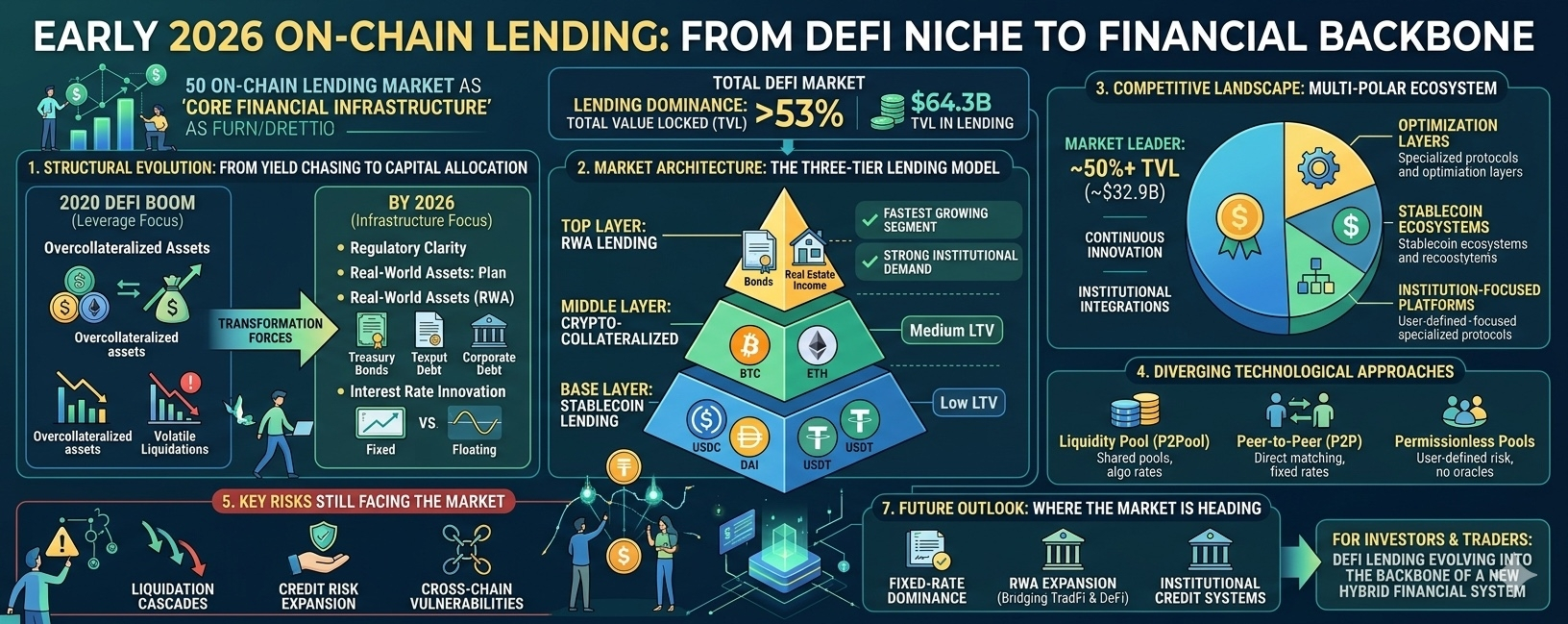
Early 2026 On-Chain Lending Market: From DeFi Niche to Financial BackboneThe on-chain lending sector has decisively transitioned from a speculative DeFi niche into one of the most critical pillars of the digital financial system. By early 2026, lending protocols command over $64.3 billion in total value locked (TVL)—more than 53% of the entire DeFi ecosystem—highlighting their dominance and maturity.
This evolution is not just about scale. It reflects a deeper structural shift: from high-risk crypto leverage tools to institutional-grade financial infrastructure.
1. Structural Evolution: From Leverage to Infrastructure
In its early phase during the 2020 DeFi boom, on-chain lending primarily served crypto-native users seeking leverage. The model was simple:
Overcollateralize assetsBorrow stablecoinsReinvest into yield-generating strategies
While highly profitable in bull markets, this system proved fragile during downturns. Events like the 2022 market crashes exposed:
Liquidation cascadesOverleveraged positionsSystemic contagion risks
What Changed?
By 2026, three major forces reshaped the sector:
1. Regulatory Clarity
Frameworks in major regions improved compliance pathwaysInstitutional capital gained confidence to enter DeFi
2. Rise of Real-World Assets (RWA)
Tokenized assets like treasury bonds and corporate debt entered DeFiRWAs now exceed $18.5 billion in lending markets
3. Interest Rate Innovation
Shift from purely floating ratesEmergence of fixed-rate and hybrid modelsBetter alignment with traditional finance systems
This transformation marks the shift from “yield chasing” → “capital allocation.”
2. Market Architecture: The Three-Tier Lending Model
The modern on-chain lending ecosystem operates in a structured hierarchy:
■ Base Layer: Stablecoin Lending
Assets: USDC, DAI, USDTLTV: ~80–90%Lowest risk segmentCore liquidity engine of DeFi
■ Middle Layer: Crypto-Collateralized Lending
Assets: BTC, ETHLTV: ~50–70%Higher volatility riskPopular among traders and arbitrageurs
■ Top Layer: RWA Lending
Assets: Treasury bonds, corporate loans, real estate incomeFastest-growing segmentStrong institutional demandFocus on compliance and stability
This layered system reflects a maturing market where risk is stratified and priced more efficiently.
3. Competitive Landscape: One Giant, Many Specialists
The market structure is best described as:
“One dominant player + multiple strong contenders.”
Market Leader
Controls roughly 50%+ of lending TVL (~$32.9B)Maintains dominance through:Continuous innovationCross-chain expansionInstitutional integrations
Emerging Competitors
Rather than competing directly, newer protocols are specializing:
Optimization layers improving capital efficiencyStablecoin ecosystems leveraging yield strategiesInstitution-focused platforms offering compliant lending solutions
This indicates a multi-polar ecosystem, not a winner-takes-all market.
4. Diverging Technological Approaches
Innovation in lending protocols is branching into three main models:
■ Liquidity Pool Model (P2Pool)
Shared pools of capitalAlgorithm-driven interest ratesHigh liquidity, easy to useLower capital efficiency
Best for: general users and large-scale liquidity
■ Peer-to-Peer Model (P2P)
Direct lender-borrower matchingFixed rates and durationsMore predictable returnsLimited liquidity
Best for: structured financing needs
■ Permissionless Pools
No oracles, no governanceUsers define risk parametersMaximum decentralizationHigher risk and complexity
Best for: advanced users seeking autonomy
5. Key Risks Still Facing the Market
Despite its maturity, the sector carries critical risks:
■ Liquidation Cascades
Sudden price drops can trigger:
Mass liquidationsMarket-wide instability
■ Credit Risk Expansion
As RWAs grow:
Default risks enter DeFiOff-chain risk becomes relevant
■ Cross-Chain Vulnerabilities
Bridges introduce:
Smart contract risksExploit opportunities
These risks act as a “structural ceiling” for uncontrolled growth.
6. Institutionalization: The Defining Trend
The most important shift in 2026 is institutional participation.
Regional Behavior Split:
Asia: retail-driven, high-risk strategiesEurope/US: compliance-focused, institutional adoption
Institutions demand:
KYC & custody solutionsTransparent auditsStable yield instruments
This is fundamentally reshaping:
User profilesRisk toleranceProduct design
7. Future Outlook: Where the Market is Heading
Three major battlegrounds will define the next phase:
■ Fixed-Rate Lending Dominance
Predictability will attract institutionsReduced exposure to volatility
■ RWA Expansion
Treasury-backed lendingTokenized real estate & bondsBridging TradFi and DeFi
■ Institutional Credit Systems
On-chain credit scoringReputation-based lendingReduced collateral requirements
Final Takeaway
The on-chain lending market is no longer experimental—it is becoming core financial infrastructure. While one dominant player continues to lead, innovation across RWAs, fixed-rate lending, and institutional integration is rapidly reshaping the competitive landscape.
For investors and traders, the real opportunity lies not in short-term hype, but in understanding this deeper transformation:
DeFi lending is evolving into the backbone of a new hybrid financial system—where crypto and traditional finance converge.
#DeFiEvolution #OnChainLending #CryptoInstitutionalization #CryptoEducation #ArifAlpha
Early 2026 On-Chain Lending Market: From DeFi Niche to Financial Backbone
The on-chain lending sector has decisively transitioned from a speculative DeFi niche into one of the most critical pillars of the digital financial system. By early 2026, lending protocols command over $64.3 billion in total value locked (TVL)—more than 53% of the entire DeFi ecosystem—highlighting their dominance and maturity.
This evolution is not just about scale. It reflects a deeper structural shift: from high-risk crypto leverage tools to institutional-grade financial infrastructure.
1. Structural Evolution: From Leverage to Infrastructure
In its early phase during the 2020 DeFi boom, on-chain lending primarily served crypto-native users seeking leverage. The model was simple:
Overcollateralize assetsBorrow stablecoinsReinvest into yield-generating strategies
While highly profitable in bull markets, this system proved fragile during downturns. Events like the 2022 market crashes exposed:
Liquidation cascadesOverleveraged positionsSystemic contagion risks
What Changed?
By 2026, three major forces reshaped the sector:
1. Regulatory Clarity
Frameworks in major regions improved compliance pathwaysInstitutional capital gained confidence to enter DeFi
2. Rise of Real-World Assets (RWA)
Tokenized assets like treasury bonds and corporate debt entered DeFiRWAs now exceed $18.5 billion in lending markets
3. Interest Rate Innovation
Shift from purely floating ratesEmergence of fixed-rate and hybrid modelsBetter alignment with traditional finance systems
This transformation marks the shift from “yield chasing” → “capital allocation.”
2. Market Architecture: The Three-Tier Lending Model
The modern on-chain lending ecosystem operates in a structured hierarchy:
■ Base Layer: Stablecoin Lending
Assets: USDC, DAI, USDTLTV: ~80–90%Lowest risk segmentCore liquidity engine of DeFi
■ Middle Layer: Crypto-Collateralized Lending
Assets: BTC, ETHLTV: ~50–70%Higher volatility riskPopular among traders and arbitrageurs
■ Top Layer: RWA Lending
Assets: Treasury bonds, corporate loans, real estate incomeFastest-growing segmentStrong institutional demandFocus on compliance and stability
This layered system reflects a maturing market where risk is stratified and priced more efficiently.
3. Competitive Landscape: One Giant, Many Specialists
The market structure is best described as:
“One dominant player + multiple strong contenders.”
Market Leader
Controls roughly 50%+ of lending TVL (~$32.9B)Maintains dominance through:Continuous innovationCross-chain expansionInstitutional integrations
Emerging Competitors
Rather than competing directly, newer protocols are specializing:
Optimization layers improving capital efficiencyStablecoin ecosystems leveraging yield strategiesInstitution-focused platforms offering compliant lending solutions
This indicates a multi-polar ecosystem, not a winner-takes-all market.
4. Diverging Technological Approaches
Innovation in lending protocols is branching into three main models:
■ Liquidity Pool Model (P2Pool)
Shared pools of capitalAlgorithm-driven interest ratesHigh liquidity, easy to useLower capital efficiency
Best for: general users and large-scale liquidity
■ Peer-to-Peer Model (P2P)
Direct lender-borrower matchingFixed rates and durationsMore predictable returnsLimited liquidity
Best for: structured financing needs
■ Permissionless Pools
No oracles, no governanceUsers define risk parametersMaximum decentralizationHigher risk and complexity
Best for: advanced users seeking autonomy
5. Key Risks Still Facing the Market
Despite its maturity, the sector carries critical risks:
■ Liquidation Cascades
Sudden price drops can trigger:
Mass liquidationsMarket-wide instability
■ Credit Risk Expansion
As RWAs grow:
Default risks enter DeFiOff-chain risk becomes relevant
■ Cross-Chain Vulnerabilities
Bridges introduce:
Smart contract risksExploit opportunities
These risks act as a “structural ceiling” for uncontrolled growth.
6. Institutionalization: The Defining Trend
The most important shift in 2026 is institutional participation.
Regional Behavior Split:
Asia: retail-driven, high-risk strategiesEurope/US: compliance-focused, institutional adoption
Institutions demand:
KYC & custody solutionsTransparent auditsStable yield instruments
This is fundamentally reshaping:
User profilesRisk toleranceProduct design
7. Future Outlook: Where the Market is Heading
Three major battlegrounds will define the next phase:
■ Fixed-Rate Lending Dominance
Predictability will attract institutionsReduced exposure to volatility
■ RWA Expansion
Treasury-backed lendingTokenized real estate & bondsBridging TradFi and DeFi
■ Institutional Credit Systems
On-chain credit scoringReputation-based lendingReduced collateral requirements
Final Takeaway
The on-chain lending market is no longer experimental—it is becoming core financial infrastructure. While one dominant player continues to lead, innovation across RWAs, fixed-rate lending, and institutional integration is rapidly reshaping the competitive landscape.
For investors and traders, the real opportunity lies not in short-term hype, but in understanding this deeper transformation:
DeFi lending is evolving into the backbone of a new hybrid financial system—where crypto and traditional finance converge.
#DeFiEvolution #OnChainLending #CryptoInstitutionalization #CryptoEducation #ArifAlpha
This evolution is not just about scale. It reflects a deeper structural shift: from high-risk crypto leverage tools to institutional-grade financial infrastructure.
1. Structural Evolution: From Leverage to Infrastructure
In its early phase during the 2020 DeFi boom, on-chain lending primarily served crypto-native users seeking leverage. The model was simple:
Overcollateralize assetsBorrow stablecoinsReinvest into yield-generating strategies
While highly profitable in bull markets, this system proved fragile during downturns. Events like the 2022 market crashes exposed:
Liquidation cascadesOverleveraged positionsSystemic contagion risks
What Changed?
By 2026, three major forces reshaped the sector:
1. Regulatory Clarity
Frameworks in major regions improved compliance pathwaysInstitutional capital gained confidence to enter DeFi
2. Rise of Real-World Assets (RWA)
Tokenized assets like treasury bonds and corporate debt entered DeFiRWAs now exceed $18.5 billion in lending markets
3. Interest Rate Innovation
Shift from purely floating ratesEmergence of fixed-rate and hybrid modelsBetter alignment with traditional finance systems
This transformation marks the shift from “yield chasing” → “capital allocation.”
2. Market Architecture: The Three-Tier Lending Model
The modern on-chain lending ecosystem operates in a structured hierarchy:
■ Base Layer: Stablecoin Lending
Assets: USDC, DAI, USDTLTV: ~80–90%Lowest risk segmentCore liquidity engine of DeFi
■ Middle Layer: Crypto-Collateralized Lending
Assets: BTC, ETHLTV: ~50–70%Higher volatility riskPopular among traders and arbitrageurs
■ Top Layer: RWA Lending
Assets: Treasury bonds, corporate loans, real estate incomeFastest-growing segmentStrong institutional demandFocus on compliance and stability
This layered system reflects a maturing market where risk is stratified and priced more efficiently.
3. Competitive Landscape: One Giant, Many Specialists
The market structure is best described as:
“One dominant player + multiple strong contenders.”
Market Leader
Controls roughly 50%+ of lending TVL (~$32.9B)Maintains dominance through:Continuous innovationCross-chain expansionInstitutional integrations
Emerging Competitors
Rather than competing directly, newer protocols are specializing:
Optimization layers improving capital efficiencyStablecoin ecosystems leveraging yield strategiesInstitution-focused platforms offering compliant lending solutions
This indicates a multi-polar ecosystem, not a winner-takes-all market.
4. Diverging Technological Approaches
Innovation in lending protocols is branching into three main models:
■ Liquidity Pool Model (P2Pool)
Shared pools of capitalAlgorithm-driven interest ratesHigh liquidity, easy to useLower capital efficiency
Best for: general users and large-scale liquidity
■ Peer-to-Peer Model (P2P)
Direct lender-borrower matchingFixed rates and durationsMore predictable returnsLimited liquidity
Best for: structured financing needs
■ Permissionless Pools
No oracles, no governanceUsers define risk parametersMaximum decentralizationHigher risk and complexity
Best for: advanced users seeking autonomy
5. Key Risks Still Facing the Market
Despite its maturity, the sector carries critical risks:
■ Liquidation Cascades
Sudden price drops can trigger:
Mass liquidationsMarket-wide instability
■ Credit Risk Expansion
As RWAs grow:
Default risks enter DeFiOff-chain risk becomes relevant
■ Cross-Chain Vulnerabilities
Bridges introduce:
Smart contract risksExploit opportunities
These risks act as a “structural ceiling” for uncontrolled growth.
6. Institutionalization: The Defining Trend
The most important shift in 2026 is institutional participation.
Regional Behavior Split:
Asia: retail-driven, high-risk strategiesEurope/US: compliance-focused, institutional adoption
Institutions demand:
KYC & custody solutionsTransparent auditsStable yield instruments
This is fundamentally reshaping:
User profilesRisk toleranceProduct design
7. Future Outlook: Where the Market is Heading
Three major battlegrounds will define the next phase:
■ Fixed-Rate Lending Dominance
Predictability will attract institutionsReduced exposure to volatility
■ RWA Expansion
Treasury-backed lendingTokenized real estate & bondsBridging TradFi and DeFi
■ Institutional Credit Systems
On-chain credit scoringReputation-based lendingReduced collateral requirements
Final Takeaway
The on-chain lending market is no longer experimental—it is becoming core financial infrastructure. While one dominant player continues to lead, innovation across RWAs, fixed-rate lending, and institutional integration is rapidly reshaping the competitive landscape.
For investors and traders, the real opportunity lies not in short-term hype, but in understanding this deeper transformation:
DeFi lending is evolving into the backbone of a new hybrid financial system—where crypto and traditional finance converge.
#DeFiEvolution #OnChainLending #CryptoInstitutionalization #CryptoEducation #ArifAlpha
85

Article
The Invisible Algorithms: 3 Structural Quirks Transforming Web3 Right NowThe cryptocurrency conversation is deeply divided. On one side, mainstream media fixates entirely on price charts and regulatory battles. On the other, standard AI tools recycle the same surface level definitions of decentralization and smart contracts.
But if you look under the hood of modern blockchain networks, you will find architectural paradoxes, hidden infrastructure wars, and protocol flaws that challenge everything we think we know about digital assets.
Here are three structural realities of crypto that are rarely discussed, yet dictate exactly where the technology is heading.
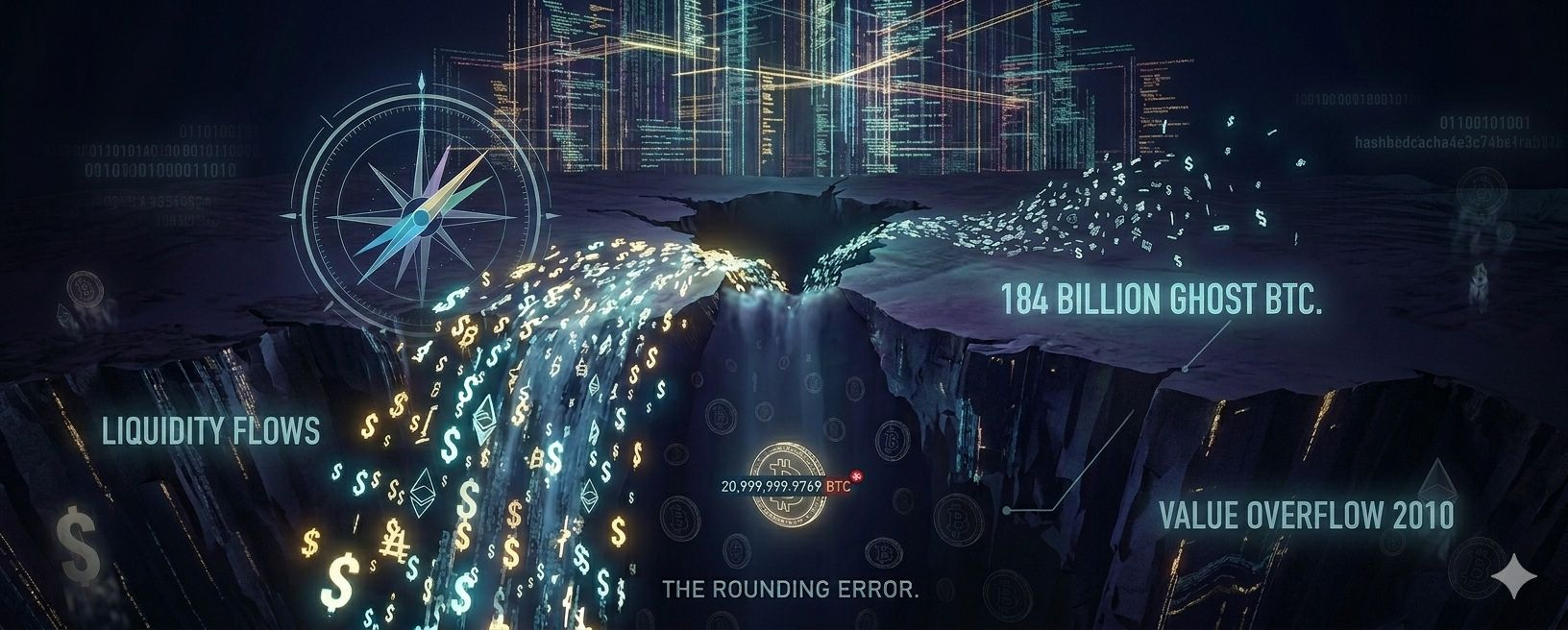
1. The Monero "Burning Bug" & The Math of Ghost Liquidity
When people think of crypto bugs, they think of hackers stealing millions. But the most fascinating vulnerabilities are the ones where money is permanently destroyed by accident due to elegant mathematical logic.
Take Monero (XMR), the leading privacy coin. Monero uses a cryptographic feature called Stealth Addresses. When someone sends you XMR, the network generates a one time, random public key so outside observers can't track your wallet history.
A few years ago, a fascinating anomaly known as the "Burning Bug" was uncovered in the wallet code. The stealth address formula relies on a specific sequence:
P = H_s(rA || i)G + B
If an attacker manipulated the code to reuse the exact same private transaction key (r) across multiple transfers, it forced the network to send funds to the identical stealth address over and over.
Because the protocol is designed to prevent double-spending, the blockchain would only allow the recipient to withdraw funds from that specific stealth address once. Every single subsequent deposit sent to that address became completely unspendable permanently burned and locked in a mathematical void forever. The user's wallet screen would show a normal deposit, but the funds were a mirage. It proved that in advanced cryptography, absolute privacy and accidental asset deletion exist on the exact same knife-edge.
2. The P2P Shadow War: Posing as "Honest Nodes"
Most investors believe a blockchain is perfectly decentralized as long as there are thousands of validation nodes running globally. What they don't realize is that an underground infrastructure war is being waged at the peer-to-peer (P2P) network layer.
Recent network analysis has revealed a massive influx of anomalous, non standard nodes infiltrating major decentralized networks. These are not standard validators or miners. Instead, they are highly sophisticated stealth nodes engineered to mimic "honest" nodes during initial network handshakes.
Once embedded in the network, these shadow peers begin feeding standard nodes malformed message structures or unexpected field requests. They aren't trying to steal your private keys. Their goal is far more subtle: Network Mapping and De-anonymization. By acting as a quiet intermediary for transaction traffic, a coordinated entity can map out the physical IP addresses behind "anonymous" transactions, executing slow burning eclipse attacks to compromise the network from the inside out.
3. The Death of Governance Tokens (The Value Accrual Crisis)
For years, the standard playbook for decentralized finance (DeFi) apps was simple: launch a protocol, build a massive user base, and issue a "governance token" that lets holders vote on proposals.
But a quiet structural crisis has emerged. Traditional equity (like stocks) gives you a concrete, legally protected claim on a company’s cash flows and residual value. Early DeFi governance tokens did not. They were structured conservatively, largely to avoid regulatory scrutiny, resulting in zero native value accrual.
This structural flaw backfired spectacularly when several high profile Web3 projects were completely restructured or acquired behind the scenes. Because the retail tokens held no legal claim to the core intellectual property or the actual underlying code, the token holders were left completely empty handed while the underlying platforms moved on without them.
This is forcing a massive shift toward Deterministic Tokenomics. The next generation of protocols are quietly abandoning "pure governance" in favor of mathematical fee sharing models, where the code itself automatically routes platform revenue straight to token stakers, entirely removing human corporate boards from the equation.
Web3 isn't just an asset class; it is an evolving ecosystem of experimental mathematics, stealth infrastructure manipulation, and shifting economic designs. The real movements aren't happening on the price tickers they are happening deep in the architecture.
#BinanceSquare #CryptoStructure #BlockchainMath #MoneroAnoma #DeFiEvolution
The Invisible Algorithms: 3 Structural Quirks Transforming Web3 Right Now
The cryptocurrency conversation is deeply divided. On one side, mainstream media fixates entirely on price charts and regulatory battles. On the other, standard AI tools recycle the same surface level definitions of decentralization and smart contracts.
But if you look under the hood of modern blockchain networks, you will find architectural paradoxes, hidden infrastructure wars, and protocol flaws that challenge everything we think we know about digital assets.
Here are three structural realities of crypto that are rarely discussed, yet dictate exactly where the technology is heading.
1. The Monero "Burning Bug" & The Math of Ghost Liquidity
When people think of crypto bugs, they think of hackers stealing millions. But the most fascinating vulnerabilities are the ones where money is permanently destroyed by accident due to elegant mathematical logic.
Take Monero (XMR), the leading privacy coin. Monero uses a cryptographic feature called Stealth Addresses. When someone sends you XMR, the network generates a one time, random public key so outside observers can't track your wallet history.
A few years ago, a fascinating anomaly known as the "Burning Bug" was uncovered in the wallet code. The stealth address formula relies on a specific sequence:
P = H_s(rA || i)G + B
If an attacker manipulated the code to reuse the exact same private transaction key (r) across multiple transfers, it forced the network to send funds to the identical stealth address over and over.
Because the protocol is designed to prevent double-spending, the blockchain would only allow the recipient to withdraw funds from that specific stealth address once. Every single subsequent deposit sent to that address became completely unspendable permanently burned and locked in a mathematical void forever. The user's wallet screen would show a normal deposit, but the funds were a mirage. It proved that in advanced cryptography, absolute privacy and accidental asset deletion exist on the exact same knife-edge.
2. The P2P Shadow War: Posing as "Honest Nodes"
Most investors believe a blockchain is perfectly decentralized as long as there are thousands of validation nodes running globally. What they don't realize is that an underground infrastructure war is being waged at the peer-to-peer (P2P) network layer.
Recent network analysis has revealed a massive influx of anomalous, non standard nodes infiltrating major decentralized networks. These are not standard validators or miners. Instead, they are highly sophisticated stealth nodes engineered to mimic "honest" nodes during initial network handshakes.
Once embedded in the network, these shadow peers begin feeding standard nodes malformed message structures or unexpected field requests. They aren't trying to steal your private keys. Their goal is far more subtle: Network Mapping and De-anonymization. By acting as a quiet intermediary for transaction traffic, a coordinated entity can map out the physical IP addresses behind "anonymous" transactions, executing slow burning eclipse attacks to compromise the network from the inside out.
3. The Death of Governance Tokens (The Value Accrual Crisis)
For years, the standard playbook for decentralized finance (DeFi) apps was simple: launch a protocol, build a massive user base, and issue a "governance token" that lets holders vote on proposals.
But a quiet structural crisis has emerged. Traditional equity (like stocks) gives you a concrete, legally protected claim on a company’s cash flows and residual value. Early DeFi governance tokens did not. They were structured conservatively, largely to avoid regulatory scrutiny, resulting in zero native value accrual.
This structural flaw backfired spectacularly when several high profile Web3 projects were completely restructured or acquired behind the scenes. Because the retail tokens held no legal claim to the core intellectual property or the actual underlying code, the token holders were left completely empty handed while the underlying platforms moved on without them.
This is forcing a massive shift toward Deterministic Tokenomics. The next generation of protocols are quietly abandoning "pure governance" in favor of mathematical fee sharing models, where the code itself automatically routes platform revenue straight to token stakers, entirely removing human corporate boards from the equation.
Web3 isn't just an asset class; it is an evolving ecosystem of experimental mathematics, stealth infrastructure manipulation, and shifting economic designs. The real movements aren't happening on the price tickers they are happening deep in the architecture.
#BinanceSquare #CryptoStructure #BlockchainMath #MoneroAnoma #DeFiEvolution
But if you look under the hood of modern blockchain networks, you will find architectural paradoxes, hidden infrastructure wars, and protocol flaws that challenge everything we think we know about digital assets.
Here are three structural realities of crypto that are rarely discussed, yet dictate exactly where the technology is heading.
1. The Monero "Burning Bug" & The Math of Ghost Liquidity
When people think of crypto bugs, they think of hackers stealing millions. But the most fascinating vulnerabilities are the ones where money is permanently destroyed by accident due to elegant mathematical logic.
Take Monero (XMR), the leading privacy coin. Monero uses a cryptographic feature called Stealth Addresses. When someone sends you XMR, the network generates a one time, random public key so outside observers can't track your wallet history.
A few years ago, a fascinating anomaly known as the "Burning Bug" was uncovered in the wallet code. The stealth address formula relies on a specific sequence:
P = H_s(rA || i)G + B
If an attacker manipulated the code to reuse the exact same private transaction key (r) across multiple transfers, it forced the network to send funds to the identical stealth address over and over.
Because the protocol is designed to prevent double-spending, the blockchain would only allow the recipient to withdraw funds from that specific stealth address once. Every single subsequent deposit sent to that address became completely unspendable permanently burned and locked in a mathematical void forever. The user's wallet screen would show a normal deposit, but the funds were a mirage. It proved that in advanced cryptography, absolute privacy and accidental asset deletion exist on the exact same knife-edge.
2. The P2P Shadow War: Posing as "Honest Nodes"
Most investors believe a blockchain is perfectly decentralized as long as there are thousands of validation nodes running globally. What they don't realize is that an underground infrastructure war is being waged at the peer-to-peer (P2P) network layer.
Recent network analysis has revealed a massive influx of anomalous, non standard nodes infiltrating major decentralized networks. These are not standard validators or miners. Instead, they are highly sophisticated stealth nodes engineered to mimic "honest" nodes during initial network handshakes.
Once embedded in the network, these shadow peers begin feeding standard nodes malformed message structures or unexpected field requests. They aren't trying to steal your private keys. Their goal is far more subtle: Network Mapping and De-anonymization. By acting as a quiet intermediary for transaction traffic, a coordinated entity can map out the physical IP addresses behind "anonymous" transactions, executing slow burning eclipse attacks to compromise the network from the inside out.
3. The Death of Governance Tokens (The Value Accrual Crisis)
For years, the standard playbook for decentralized finance (DeFi) apps was simple: launch a protocol, build a massive user base, and issue a "governance token" that lets holders vote on proposals.
But a quiet structural crisis has emerged. Traditional equity (like stocks) gives you a concrete, legally protected claim on a company’s cash flows and residual value. Early DeFi governance tokens did not. They were structured conservatively, largely to avoid regulatory scrutiny, resulting in zero native value accrual.
This structural flaw backfired spectacularly when several high profile Web3 projects were completely restructured or acquired behind the scenes. Because the retail tokens held no legal claim to the core intellectual property or the actual underlying code, the token holders were left completely empty handed while the underlying platforms moved on without them.
This is forcing a massive shift toward Deterministic Tokenomics. The next generation of protocols are quietly abandoning "pure governance" in favor of mathematical fee sharing models, where the code itself automatically routes platform revenue straight to token stakers, entirely removing human corporate boards from the equation.
Web3 isn't just an asset class; it is an evolving ecosystem of experimental mathematics, stealth infrastructure manipulation, and shifting economic designs. The real movements aren't happening on the price tickers they are happening deep in the architecture.
#BinanceSquare #CryptoStructure #BlockchainMath #MoneroAnoma #DeFiEvolution
81

·
--
🧠 $MORPHO … When decentralized finance becomes smart and institutional at the same time!
As usual, the projects that work quietly are the ones that change the game — and Morpho is one of them, building on Ethereum but operating with an institutional mindset 💼
The market is talking about a protocol with a market value of 1.09 billion dollars, and a total value locked (TVL) exceeding 518 million… but numbers alone are not enough, let's look at the real depth.
🚀 What makes $MORPHO different?
– It combines the efficiency of lending and borrowing, and the smoothness of platforms like Aave and Compound
– Backed by institutions like Société Générale and SG-Forge — meaning not just for users, but also for banks
– Supports a variety of assets like ETH, USDC, DAI, and BTC, and operates within a massive tech environment exceeding 5000 billion dollars
📌 The protocol is open source, compliant with MICA regulations, and governed by Morpho Association and CreatorPad
Personally, I am monitoring $MORPHO because it connects the world of DeFi and traditional finance in a way we haven't seen before ⏳
📲 Follow channel #CryptoEmad for analyses of projects that make a difference before they spread
{future}(MORPHOUSDT)
#MorphoProtocol #DeFiEvolution #EthereumFinance #SmartLending
🧠 $MORPHO … When decentralized finance becomes smart and institutional at the same time!
As usual, the projects that work quietly are the ones that change the game — and Morpho is one of them, building on Ethereum but operating with an institutional mindset 💼
The market is talking about a protocol with a market value of 1.09 billion dollars, and a total value locked (TVL) exceeding 518 million… but numbers alone are not enough, let's look at the real depth.
🚀 What makes $MORPHO different?
– It combines the efficiency of lending and borrowing, and the smoothness of platforms like Aave and Compound
– Backed by institutions like Société Générale and SG-Forge — meaning not just for users, but also for banks
– Supports a variety of assets like ETH, USDC, DAI, and BTC, and operates within a massive tech environment exceeding 5000 billion dollars
📌 The protocol is open source, compliant with MICA regulations, and governed by Morpho Association and CreatorPad
Personally, I am monitoring $MORPHO because it connects the world of DeFi and traditional finance in a way we haven't seen before ⏳
📲 Follow channel #CryptoEmad for analyses of projects that make a difference before they spread
#MorphoProtocol #DeFiEvolution #EthereumFinance #SmartLending
As usual, the projects that work quietly are the ones that change the game — and Morpho is one of them, building on Ethereum but operating with an institutional mindset 💼
The market is talking about a protocol with a market value of 1.09 billion dollars, and a total value locked (TVL) exceeding 518 million… but numbers alone are not enough, let's look at the real depth.
🚀 What makes $MORPHO different?
– It combines the efficiency of lending and borrowing, and the smoothness of platforms like Aave and Compound
– Backed by institutions like Société Générale and SG-Forge — meaning not just for users, but also for banks
– Supports a variety of assets like ETH, USDC, DAI, and BTC, and operates within a massive tech environment exceeding 5000 billion dollars
📌 The protocol is open source, compliant with MICA regulations, and governed by Morpho Association and CreatorPad
Personally, I am monitoring $MORPHO because it connects the world of DeFi and traditional finance in a way we haven't seen before ⏳
📲 Follow channel #CryptoEmad for analyses of projects that make a difference before they spread
#MorphoProtocol #DeFiEvolution #EthereumFinance #SmartLending
1
6
7k

Article
The Future of DeFi: Is Intent-Based Automation the Final Frontier?The landscape of decentralized finance (DeFi) is shifting beneath our feet. For years, we have been obsessed with "yield farming," "liquidity pools," and "manual rebalancing." But as we move deeper into 2026, a new paradigm is emerging: Intent-Based DeFi.
Platforms like @Openledger are at the core of this transition. Instead of forcing users to navigate complex smart contracts or worry about gas optimization, these platforms act as an execution layer, interpreting a user’s "intent" and finding the most efficient path to execute it.
The Rise of AI Agents in Trading
We are witnessing a fascinating phenomenon where AI agents are becoming the primary actors in the market. They don't sleep, they don't get emotional, and they can analyze thousands of data points in milliseconds. While this offers incredible efficiency, it also introduces a new kind of systemic risk. When every agent is programmed with similar logic, can we accidentally create "liquidity voids" during high-volatility events?
Human Edge in the Age of Automation
This is where the debate gets interesting. Many argue that human intervention is becoming obsolete. I disagree. As a trader, I believe the "Human Edge" is shifting from execution to governance and strategy. We are no longer just traders; we are "Strategy Architects."
We define the parameters, set the risk thresholds, and oversee the protocols. The human ability to interpret macro-events—geopolitics, regulatory shifts, and fundamental market psychology—remains a safeguard that no AI agent has yet mastered.
My Perspective on $OPEN and Infrastructure
As I monitor the developments within the $OPEN ecosystem, I am looking for one key metric: Resilience. Can this infrastructure maintain integrity under extreme stress? Innovation is easy during bull markets; the true test is how a protocol handles liquidity exhaustion. If OpenLedger can continue to provide transparency while automating complex executions, it won't just be another project—it will be a staple of institutional-grade DeFi.
Conclusion: What’s Next?
We are in the early stages of a massive technological shift. Whether you are a scalper, a swing trader, or a long-term investor, the integration of AI agents is not a threat to your career—it is a tool to amplify your output.
I’m curious to hear your thoughts. Do you believe that AI-driven automation will eventually eliminate the need for manual market analysis, or will it simply create a new layer of complexity that only the most skilled human traders can navigate?
Drop your predictions in the comments below. Let’s dive into the data! 🚀📊
#OpenLedger #DeFiEvolution #SmartInvesting #BinanceSquare #CryptoAnalysis
The Future of DeFi: Is Intent-Based Automation the Final Frontier?
The landscape of decentralized finance (DeFi) is shifting beneath our feet. For years, we have been obsessed with "yield farming," "liquidity pools," and "manual rebalancing." But as we move deeper into 2026, a new paradigm is emerging: Intent-Based DeFi.
Platforms like @OpenLedger are at the core of this transition. Instead of forcing users to navigate complex smart contracts or worry about gas optimization, these platforms act as an execution layer, interpreting a user’s "intent" and finding the most efficient path to execute it.
The Rise of AI Agents in Trading
We are witnessing a fascinating phenomenon where AI agents are becoming the primary actors in the market. They don't sleep, they don't get emotional, and they can analyze thousands of data points in milliseconds. While this offers incredible efficiency, it also introduces a new kind of systemic risk. When every agent is programmed with similar logic, can we accidentally create "liquidity voids" during high-volatility events?
Human Edge in the Age of Automation
This is where the debate gets interesting. Many argue that human intervention is becoming obsolete. I disagree. As a trader, I believe the "Human Edge" is shifting from execution to governance and strategy. We are no longer just traders; we are "Strategy Architects."
We define the parameters, set the risk thresholds, and oversee the protocols. The human ability to interpret macro-events—geopolitics, regulatory shifts, and fundamental market psychology—remains a safeguard that no AI agent has yet mastered.
My Perspective on $OPEN and Infrastructure
As I monitor the developments within the $OPEN ecosystem, I am looking for one key metric: Resilience. Can this infrastructure maintain integrity under extreme stress? Innovation is easy during bull markets; the true test is how a protocol handles liquidity exhaustion. If OpenLedger can continue to provide transparency while automating complex executions, it won't just be another project—it will be a staple of institutional-grade DeFi.
Conclusion: What’s Next?
We are in the early stages of a massive technological shift. Whether you are a scalper, a swing trader, or a long-term investor, the integration of AI agents is not a threat to your career—it is a tool to amplify your output.
I’m curious to hear your thoughts. Do you believe that AI-driven automation will eventually eliminate the need for manual market analysis, or will it simply create a new layer of complexity that only the most skilled human traders can navigate?
Drop your predictions in the comments below. Let’s dive into the data! 🚀📊
#OpenLedger #DeFiEvolution #SmartInvesting #BinanceSquare #CryptoAnalysis
Platforms like @OpenLedger are at the core of this transition. Instead of forcing users to navigate complex smart contracts or worry about gas optimization, these platforms act as an execution layer, interpreting a user’s "intent" and finding the most efficient path to execute it.
The Rise of AI Agents in Trading
We are witnessing a fascinating phenomenon where AI agents are becoming the primary actors in the market. They don't sleep, they don't get emotional, and they can analyze thousands of data points in milliseconds. While this offers incredible efficiency, it also introduces a new kind of systemic risk. When every agent is programmed with similar logic, can we accidentally create "liquidity voids" during high-volatility events?
Human Edge in the Age of Automation
This is where the debate gets interesting. Many argue that human intervention is becoming obsolete. I disagree. As a trader, I believe the "Human Edge" is shifting from execution to governance and strategy. We are no longer just traders; we are "Strategy Architects."
We define the parameters, set the risk thresholds, and oversee the protocols. The human ability to interpret macro-events—geopolitics, regulatory shifts, and fundamental market psychology—remains a safeguard that no AI agent has yet mastered.
My Perspective on $OPEN and Infrastructure
As I monitor the developments within the $OPEN ecosystem, I am looking for one key metric: Resilience. Can this infrastructure maintain integrity under extreme stress? Innovation is easy during bull markets; the true test is how a protocol handles liquidity exhaustion. If OpenLedger can continue to provide transparency while automating complex executions, it won't just be another project—it will be a staple of institutional-grade DeFi.
Conclusion: What’s Next?
We are in the early stages of a massive technological shift. Whether you are a scalper, a swing trader, or a long-term investor, the integration of AI agents is not a threat to your career—it is a tool to amplify your output.
I’m curious to hear your thoughts. Do you believe that AI-driven automation will eventually eliminate the need for manual market analysis, or will it simply create a new layer of complexity that only the most skilled human traders can navigate?
Drop your predictions in the comments below. Let’s dive into the data! 🚀📊
#OpenLedger #DeFiEvolution #SmartInvesting #BinanceSquare #CryptoAnalysis
15

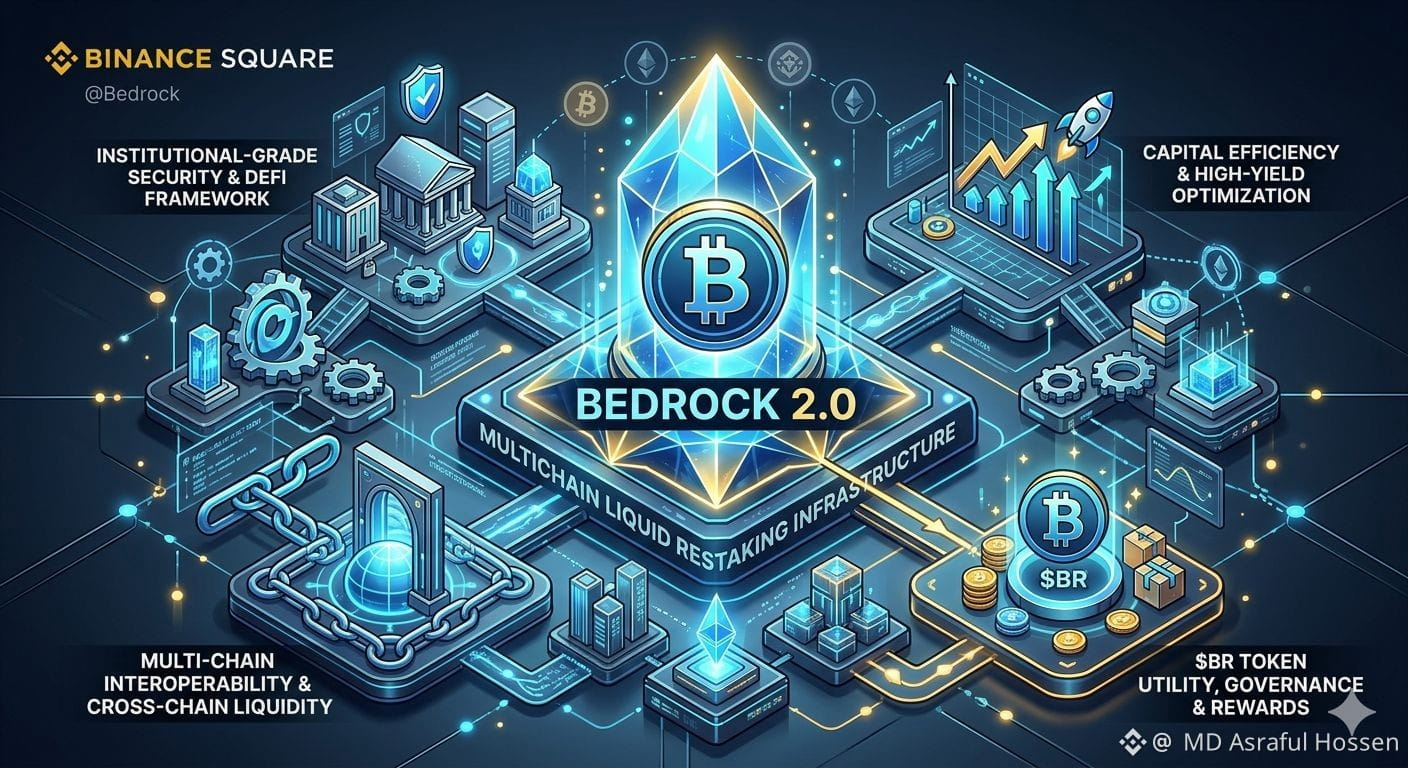
As the decentralized finance (DeFi) ecosystem matures, the limitations of traditional staking—where assets are locked and capital becomes stagnant—are becoming more apparent. This is exactly where the groundbreaking architecture of Bedrock 2.0 steps in to revolutionize the market. By seamlessly blending security with absolute capital flexibility, @Bedrock is setting a new benchmark for multi-chain liquid restaking.
The core philosophy behind Bedrock 2.0 is to ensure that your crypto assets never sleep. Whether you are looking to tap into institutional-grade yield structures or optimize your Bitcoin holdings through decentralized frameworks, this platform bridges the gap with unparalleled efficiency. It mitigates traditional restaking risks through robust security layers and slashing protection, making it a reliable infrastructure for both retail users and large-scale capital allocators.
At the very center of this expanding ecosystem is the $BR token. As Bedrock continues to integrate with major blockchain networks and drive multi-chain liquidity, the utility, governance power, and reward mechanisms tied to $BR are positioned for sustainable long-term value creation. If you are serious about maximizing your DeFi strategy while retaining full asset liquidity, keeping an eye on this upgrade is highly essential. 🚀🔥
#Bedrock $BR @Bedrock #LiquidRestaking #DeFiEvolution #SmartInvesting #CryptoInfrastructure #web3Finance
As the decentralized finance (DeFi) ecosystem matures, the limitations of traditional staking—where assets are locked and capital becomes stagnant—are becoming more apparent. This is exactly where the groundbreaking architecture of Bedrock 2.0 steps in to revolutionize the market. By seamlessly blending security with absolute capital flexibility, @Bedrock is setting a new benchmark for multi-chain liquid restaking.
The core philosophy behind Bedrock 2.0 is to ensure that your crypto assets never sleep. Whether you are looking to tap into institutional-grade yield structures or optimize your Bitcoin holdings through decentralized frameworks, this platform bridges the gap with unparalleled efficiency. It mitigates traditional restaking risks through robust security layers and slashing protection, making it a reliable infrastructure for both retail users and large-scale capital allocators.
At the very center of this expanding ecosystem is the $BR token. As Bedrock continues to integrate with major blockchain networks and drive multi-chain liquidity, the utility, governance power, and reward mechanisms tied to $BR are positioned for sustainable long-term value creation. If you are serious about maximizing your DeFi strategy while retaining full asset liquidity, keeping an eye on this upgrade is highly essential. 🚀🔥
#Bedrock $BR @Bedrock #LiquidRestaking #DeFiEvolution #SmartInvesting #CryptoInfrastructure #web3Finance
The core philosophy behind Bedrock 2.0 is to ensure that your crypto assets never sleep. Whether you are looking to tap into institutional-grade yield structures or optimize your Bitcoin holdings through decentralized frameworks, this platform bridges the gap with unparalleled efficiency. It mitigates traditional restaking risks through robust security layers and slashing protection, making it a reliable infrastructure for both retail users and large-scale capital allocators.
At the very center of this expanding ecosystem is the $BR token. As Bedrock continues to integrate with major blockchain networks and drive multi-chain liquidity, the utility, governance power, and reward mechanisms tied to $BR are positioned for sustainable long-term value creation. If you are serious about maximizing your DeFi strategy while retaining full asset liquidity, keeping an eye on this upgrade is highly essential. 🚀🔥
#Bedrock $BR @Bedrock #LiquidRestaking #DeFiEvolution #SmartInvesting #CryptoInfrastructure #web3Finance
71

·
--
#grvt One of the biggest hurdles to mass Web3 adoption has always been the complex user experience. GRVT tackles this head-on by delivering a seamless, intuitive interface that feels exactly like a top-tier centralized platform, but with a massive upgrade: 100% self-custody. You do not have to trust a centralized entity with your assets to enjoy professional-grade trading tools, deep liquidity, and instant order matching. Your keys, your crypto, always. It is exactly what the industry needs to move forward into the future of decentralized finance.
#SelfCustody #CryptoUX #DeFiEvolution #SmartTrading
#grvt One of the biggest hurdles to mass Web3 adoption has always been the complex user experience. GRVT tackles this head-on by delivering a seamless, intuitive interface that feels exactly like a top-tier centralized platform, but with a massive upgrade: 100% self-custody. You do not have to trust a centralized entity with your assets to enjoy professional-grade trading tools, deep liquidity, and instant order matching. Your keys, your crypto, always. It is exactly what the industry needs to move forward into the future of decentralized finance.
#SelfCustody #CryptoUX #DeFiEvolution #SmartTrading
#SelfCustody #CryptoUX #DeFiEvolution #SmartTrading
96
·
--
Privacy is not a luxury in crypto; it is a fundamental necessity. GRVT leverages advanced Layer 3 technology built on zkSync to deliver unparalleled data privacy and scalability. By utilizing zero-knowledge proofs, users can execute high-frequency trades without exposing sensitive transaction data to malicious actors. This ensures a secure ecosystem where institutional players and retail traders can operate with complete peace of mind. Security, privacy, and scalability are no longer mutually exclusive. Looking forward to the next milestones of this ecosystem!
#GRVT #zkSync #Layer3 #PrivacyMatters #Web3Security
📅 Day 3: July 12 – Seamless UX and True Self-Custody
One of the biggest hurdles to mass Web3 adoption has always been the complex user experience. GRVT tackles this head-on by delivering a seamless, intuitive interface that feels exactly like a top-tier centralized platform, but with a massive upgrade: 100% self-custody. You do not have to trust a centralized entity with your assets to enjoy professional-grade trading tools, deep liquidity, and instant order matching. Your keys, your crypto, always. It is exactly what the industry needs to move forward into the future of decentralized finance.
#grvt #SelfCustody #CryptoUX #DeFiEvolution #SmartTrading
Privacy is not a luxury in crypto; it is a fundamental necessity. GRVT leverages advanced Layer 3 technology built on zkSync to deliver unparalleled data privacy and scalability. By utilizing zero-knowledge proofs, users can execute high-frequency trades without exposing sensitive transaction data to malicious actors. This ensures a secure ecosystem where institutional players and retail traders can operate with complete peace of mind. Security, privacy, and scalability are no longer mutually exclusive. Looking forward to the next milestones of this ecosystem!
#GRVT #zkSync #Layer3 #PrivacyMatters #Web3Security
📅 Day 3: July 12 – Seamless UX and True Self-Custody
One of the biggest hurdles to mass Web3 adoption has always been the complex user experience. GRVT tackles this head-on by delivering a seamless, intuitive interface that feels exactly like a top-tier centralized platform, but with a massive upgrade: 100% self-custody. You do not have to trust a centralized entity with your assets to enjoy professional-grade trading tools, deep liquidity, and instant order matching. Your keys, your crypto, always. It is exactly what the industry needs to move forward into the future of decentralized finance.
#grvt #SelfCustody #CryptoUX #DeFiEvolution #SmartTrading
#GRVT #zkSync #Layer3 #PrivacyMatters #Web3Security
📅 Day 3: July 12 – Seamless UX and True Self-Custody
One of the biggest hurdles to mass Web3 adoption has always been the complex user experience. GRVT tackles this head-on by delivering a seamless, intuitive interface that feels exactly like a top-tier centralized platform, but with a massive upgrade: 100% self-custody. You do not have to trust a centralized entity with your assets to enjoy professional-grade trading tools, deep liquidity, and instant order matching. Your keys, your crypto, always. It is exactly what the industry needs to move forward into the future of decentralized finance.
#grvt #SelfCustody #CryptoUX #DeFiEvolution #SmartTrading
97
Log in to explore more content
Join global crypto users on Binance Square
⚡️ Get latest and useful information about crypto.
💬 Trusted by the world’s largest crypto exchange.
👍 Discover real insights from verified creators.
Email / Phone number
Trending Topics
1
#SECReceivesGrayscaleLitecoinTrustETFFiling
41,372 views
841 Discussing
2
#ClarityActFacesProceduralVoteSept15
157,994 views
1,791 Discussing
3
#US10YearTreasuryYieldNears5%
53,611 views
960 Discussing
4
#CryptoLiquidations$674MIn24H
11,058 views
151 Discussing
5
#TokenizedStockHoldersUp619.1%
52,153 views
844 Discussing
6
#RevolutConfirmsFakeGovEmailDataBreach
81,925 views
1,130 Discussing
7
#CanadaOSFISaysTokenizedDepositsEqualTraditionalDeposits
4,785 views
95 Discussing
8
#USBankCompletesCrossBorderPaymentPilotOnStellar
70,699 views
1,125 Discussing
9
#NvidiaInTalksToInvestUpTo$10BInAnthropicIPO
4,852 views
81 Discussing
10
#EtherRalliesAsBearishBetsLiquidate
108,936 views
1,411 Discussing