
#bonds
bonds
145,650 views
461 Discussing
Hot
Latest

UK government bond yields extended their sharp selloff on Thursday, hitting 19-year highs after crude oil surged past $100 per barrel for the first time in six weeks. The UK Debt Management Office completed a £5 billion auction of 2030 gilts with an average yield of 4.786%—the highest since October 2023—following a 30-year bond sale earlier in the week that reached levels not seen since 1998.
This aggressive repricing of sovereign debt highlights growing market anxiety over sticky inflation reignited by spiking energy prices. As Wealth Club’s Susannah Streeter observed, soaring oil is serving as a key catalyst, compounding structural shifts where institutional capital is increasingly rotating away from traditional sovereign debt in search of higher yield.
Surging global yields inevitably tighten broader financial conditions, raising borrowing costs across the board and exerting downward pressure on risk assets, equities, and high-duration growth sectors.
For crypto markets, higher risk-free benchmark yields mean tighter global liquidity and a cautious risk-off environment. Until sovereign bond markets stabilize and energy-driven inflation fears cool, $BTC and digital assets may continue navigating near-term macroeconomic headwinds.
#bonds #macro #inflation
UK government bond yields extended their sharp selloff on Thursday, hitting 19-year highs after crude oil surged past $100 per barrel for the first time in six weeks. The UK Debt Management Office completed a £5 billion auction of 2030 gilts with an average yield of 4.786%—the highest since October 2023—following a 30-year bond sale earlier in the week that reached levels not seen since 1998.
This aggressive repricing of sovereign debt highlights growing market anxiety over sticky inflation reignited by spiking energy prices. As Wealth Club’s Susannah Streeter observed, soaring oil is serving as a key catalyst, compounding structural shifts where institutional capital is increasingly rotating away from traditional sovereign debt in search of higher yield.
Surging global yields inevitably tighten broader financial conditions, raising borrowing costs across the board and exerting downward pressure on risk assets, equities, and high-duration growth sectors.
For crypto markets, higher risk-free benchmark yields mean tighter global liquidity and a cautious risk-off environment. Until sovereign bond markets stabilize and energy-driven inflation fears cool, $BTC and digital assets may continue navigating near-term macroeconomic headwinds.
#bonds #macro #inflation
This aggressive repricing of sovereign debt highlights growing market anxiety over sticky inflation reignited by spiking energy prices. As Wealth Club’s Susannah Streeter observed, soaring oil is serving as a key catalyst, compounding structural shifts where institutional capital is increasingly rotating away from traditional sovereign debt in search of higher yield.
Surging global yields inevitably tighten broader financial conditions, raising borrowing costs across the board and exerting downward pressure on risk assets, equities, and high-duration growth sectors.
For crypto markets, higher risk-free benchmark yields mean tighter global liquidity and a cautious risk-off environment. Until sovereign bond markets stabilize and energy-driven inflation fears cool, $BTC and digital assets may continue navigating near-term macroeconomic headwinds.
#bonds #macro #inflation
11

·
--
Bearish
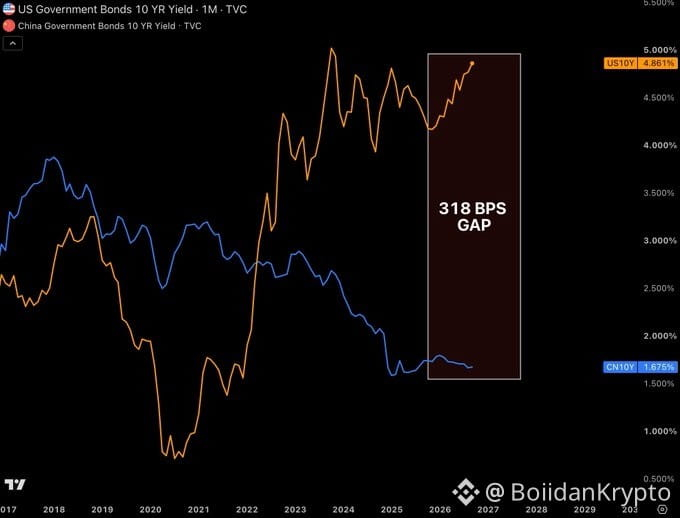
🚨 BOND MARKET ALERT 🇺🇸🇨🇳
The US–China 10-year yield gap is blowing out to levels rarely seen in over a decade — and almost nobody's talking about what it means for your portfolio.
📈 US yields keep climbing — the Fed is white-knuckling its inflation fight, even as the Treasury quietly tries to talk yields back down.
📉 China's yields are pinned near record lows — weak growth data has the PBOC leaning harder toward stimulus.
Two of the world's biggest economies, moving in completely opposite directions. 🌍⚡
Question for the comments 👇
Is this the biggest macro divergence of the decade — or a bond trap in the making? Where does the spread go from here?
Drop your take below. Bulls vs. bears — let's hear it. 🔥
#Bonds #Macro #FederalReserve
$NVDA
{future}(NVDAUSDT)
$SPCX
{future}(SPCXUSDT)
$BTC
{future}(BTCUSDT)
🚨 BOND MARKET ALERT 🇺🇸🇨🇳
The US–China 10-year yield gap is blowing out to levels rarely seen in over a decade — and almost nobody's talking about what it means for your portfolio.
📈 US yields keep climbing — the Fed is white-knuckling its inflation fight, even as the Treasury quietly tries to talk yields back down.
📉 China's yields are pinned near record lows — weak growth data has the PBOC leaning harder toward stimulus.
Two of the world's biggest economies, moving in completely opposite directions. 🌍⚡
Question for the comments 👇
Is this the biggest macro divergence of the decade — or a bond trap in the making? Where does the spread go from here?
Drop your take below. Bulls vs. bears — let's hear it. 🔥
#Bonds #Macro #FederalReserve
$NVDA
$SPCX
$BTC
The US–China 10-year yield gap is blowing out to levels rarely seen in over a decade — and almost nobody's talking about what it means for your portfolio.
📈 US yields keep climbing — the Fed is white-knuckling its inflation fight, even as the Treasury quietly tries to talk yields back down.
📉 China's yields are pinned near record lows — weak growth data has the PBOC leaning harder toward stimulus.
Two of the world's biggest economies, moving in completely opposite directions. 🌍⚡
Question for the comments 👇
Is this the biggest macro divergence of the decade — or a bond trap in the making? Where does the spread go from here?
Drop your take below. Bulls vs. bears — let's hear it. 🔥
#Bonds #Macro #FederalReserve
$NVDA
$SPCX
$BTC
167

THE U.S. TREASURY IS ABOUT TO ENTER THE BOND MARKET WITH BILLIONS.
The Treasury is set to buy back up to $6 BILLION of longer-term U.S. debt tomorrow.
This is bigger than a routine transaction.
Treasury buybacks can help improve liquidity and put support under longer-dated bonds at a time when yields are elevated. The move comes as the 10-year yield is hovering around 4.8%, near its highest levels in years.
But here's the part markets should be watching:
The government is simultaneously running enormous deficits and actively managing the functioning of the Treasury market.
That means the bond market is becoming one of the most important pressure points for global markets.
If buybacks help push long-term yields lower, financial conditions could loosen.
That can ripple into stocks, gold, the dollar and Bitcoin.
But if investors continue demanding higher yields despite Treasury intervention, the message becomes much more uncomfortable:
The market wants more compensation to hold U.S. debt.
And that is a problem no buyback program can permanently solve.
The real battle isn't just about $6 billion.
It's about whether the world's largest bond market can absorb America's enormous borrowing needs without continuously demanding higher yields.
Tomorrow's buyback could be small.
The signal it sends could be enormous.
#Treasury #Bonds #Bitcoin #Gold #Markets
THE U.S. TREASURY IS ABOUT TO ENTER THE BOND MARKET WITH BILLIONS.
The Treasury is set to buy back up to $6 BILLION of longer-term U.S. debt tomorrow.
This is bigger than a routine transaction.
Treasury buybacks can help improve liquidity and put support under longer-dated bonds at a time when yields are elevated. The move comes as the 10-year yield is hovering around 4.8%, near its highest levels in years.
But here's the part markets should be watching:
The government is simultaneously running enormous deficits and actively managing the functioning of the Treasury market.
That means the bond market is becoming one of the most important pressure points for global markets.
If buybacks help push long-term yields lower, financial conditions could loosen.
That can ripple into stocks, gold, the dollar and Bitcoin.
But if investors continue demanding higher yields despite Treasury intervention, the message becomes much more uncomfortable:
The market wants more compensation to hold U.S. debt.
And that is a problem no buyback program can permanently solve.
The real battle isn't just about $6 billion.
It's about whether the world's largest bond market can absorb America's enormous borrowing needs without continuously demanding higher yields.
Tomorrow's buyback could be small.
The signal it sends could be enormous.
#Treasury #Bonds #Bitcoin #Gold #Markets
The Treasury is set to buy back up to $6 BILLION of longer-term U.S. debt tomorrow.
This is bigger than a routine transaction.
Treasury buybacks can help improve liquidity and put support under longer-dated bonds at a time when yields are elevated. The move comes as the 10-year yield is hovering around 4.8%, near its highest levels in years.
But here's the part markets should be watching:
The government is simultaneously running enormous deficits and actively managing the functioning of the Treasury market.
That means the bond market is becoming one of the most important pressure points for global markets.
If buybacks help push long-term yields lower, financial conditions could loosen.
That can ripple into stocks, gold, the dollar and Bitcoin.
But if investors continue demanding higher yields despite Treasury intervention, the message becomes much more uncomfortable:
The market wants more compensation to hold U.S. debt.
And that is a problem no buyback program can permanently solve.
The real battle isn't just about $6 billion.
It's about whether the world's largest bond market can absorb America's enormous borrowing needs without continuously demanding higher yields.
Tomorrow's buyback could be small.
The signal it sends could be enormous.
#Treasury #Bonds #Bitcoin #Gold #Markets

1
166
The UK Debt Management Office is preparing to price a syndicated gilt offering due January 2056 on Tuesday evening, with borrowing costs surging to levels unseen since 1998. Driven by an intense global bond sell-off that hit British debt harder than other developed markets, the UK's 30-year yield spiked to 5.83%, while the new issuance is priced 0.75 to 1 basis point above the 2055 notes.
This benchmark expansion—potentially raising up to £5 billion as a tap on an existing £59 billion line—highlights severe fiscal strain. Borrowing at the highest cost since the debt office was established over 25 years ago reflects deeply entrenched inflation expectations and growing market skepticism toward long-term sovereign debt sustainability.
Broadly, soaring gilt yields ripple across global fixed-income markets, pushing term premiums higher, tightening financial conditions, and reinforcing the 'higher-for-longer' rate backdrop across major economies. This dynamic continues to pressure both equity multiples and credit spreads worldwide.
For crypto, persistent surges in risk-free sovereign yields directly drain liquidity from risk-on assets. As capital retreats into defensive yields, $BTC and the broader market face headwinds, requiring sustained macroeconomic stabilization before high-beta momentum can genuinely reignite. 📉
#bonds #macroeconomics #liquidity
The UK Debt Management Office is preparing to price a syndicated gilt offering due January 2056 on Tuesday evening, with borrowing costs surging to levels unseen since 1998. Driven by an intense global bond sell-off that hit British debt harder than other developed markets, the UK's 30-year yield spiked to 5.83%, while the new issuance is priced 0.75 to 1 basis point above the 2055 notes.
This benchmark expansion—potentially raising up to £5 billion as a tap on an existing £59 billion line—highlights severe fiscal strain. Borrowing at the highest cost since the debt office was established over 25 years ago reflects deeply entrenched inflation expectations and growing market skepticism toward long-term sovereign debt sustainability.
Broadly, soaring gilt yields ripple across global fixed-income markets, pushing term premiums higher, tightening financial conditions, and reinforcing the 'higher-for-longer' rate backdrop across major economies. This dynamic continues to pressure both equity multiples and credit spreads worldwide.
For crypto, persistent surges in risk-free sovereign yields directly drain liquidity from risk-on assets. As capital retreats into defensive yields, $BTC and the broader market face headwinds, requiring sustained macroeconomic stabilization before high-beta momentum can genuinely reignite. 📉
#bonds #macroeconomics #liquidity
This benchmark expansion—potentially raising up to £5 billion as a tap on an existing £59 billion line—highlights severe fiscal strain. Borrowing at the highest cost since the debt office was established over 25 years ago reflects deeply entrenched inflation expectations and growing market skepticism toward long-term sovereign debt sustainability.
Broadly, soaring gilt yields ripple across global fixed-income markets, pushing term premiums higher, tightening financial conditions, and reinforcing the 'higher-for-longer' rate backdrop across major economies. This dynamic continues to pressure both equity multiples and credit spreads worldwide.
For crypto, persistent surges in risk-free sovereign yields directly drain liquidity from risk-on assets. As capital retreats into defensive yields, $BTC and the broader market face headwinds, requiring sustained macroeconomic stabilization before high-beta momentum can genuinely reignite. 📉
#bonds #macroeconomics #liquidity
6
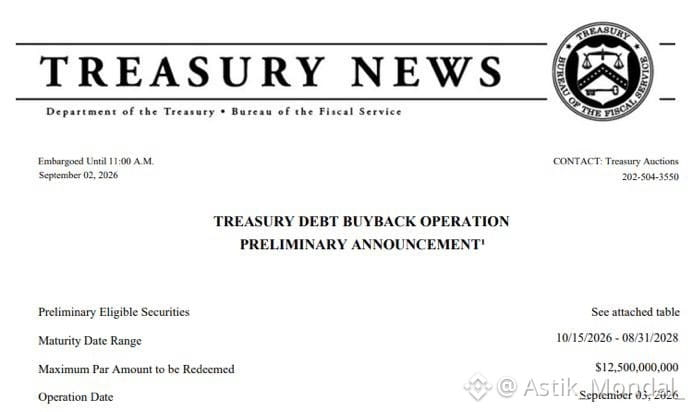
🚨 THE U.S. TREASURY IS ABOUT TO BUY BACK ITS OWN DEBT.
And the timing is WILD. 🇺🇸💵
The U.S. government is now spending more than $1 TRILLION a year just on interest.
Now Treasury is preparing to repurchase $12.5 BILLION of its own bonds as yields sit near their highest levels in almost TWO DECADES.
Why does this matter?
Because the bond market is becoming one of the biggest pressure points in the U.S. economy.
Higher yields = higher borrowing costs.
Higher borrowing costs = even more interest expense.
And now the Treasury is stepping into the market.
Just days ago at the G20, Treasury Secretary Scott Bessent said:
“I have not bought anything yet.”
But the bigger warning came from legendary investor Stanley Druckenmiller.
Bessent’s former mentor publicly argued that the government should NOT be intervening in the bond market.
That sets up a fascinating clash:
🇺🇸 Treasury wants to manage its debt burden.
📈 Bond investors want market forces to determine yields.
💰 Taxpayers are already facing a massive interest bill.
And if Treasury buybacks become larger or more frequent The bond market could become one of the biggest macro stories of the cycle.
Watch U.S. Treasuries closely.
Something BIG is changing underneath the surface.
#Bitcoin #Economy #Bonds #Markets #Finance
🚨 THE U.S. TREASURY IS ABOUT TO BUY BACK ITS OWN DEBT.
And the timing is WILD. 🇺🇸💵
The U.S. government is now spending more than $1 TRILLION a year just on interest.
Now Treasury is preparing to repurchase $12.5 BILLION of its own bonds as yields sit near their highest levels in almost TWO DECADES.
Why does this matter?
Because the bond market is becoming one of the biggest pressure points in the U.S. economy.
Higher yields = higher borrowing costs.
Higher borrowing costs = even more interest expense.
And now the Treasury is stepping into the market.
Just days ago at the G20, Treasury Secretary Scott Bessent said:
“I have not bought anything yet.”
But the bigger warning came from legendary investor Stanley Druckenmiller.
Bessent’s former mentor publicly argued that the government should NOT be intervening in the bond market.
That sets up a fascinating clash:
🇺🇸 Treasury wants to manage its debt burden.
📈 Bond investors want market forces to determine yields.
💰 Taxpayers are already facing a massive interest bill.
And if Treasury buybacks become larger or more frequent The bond market could become one of the biggest macro stories of the cycle.
Watch U.S. Treasuries closely.
Something BIG is changing underneath the surface.
#Bitcoin #Economy #Bonds #Markets #Finance
And the timing is WILD. 🇺🇸💵
The U.S. government is now spending more than $1 TRILLION a year just on interest.
Now Treasury is preparing to repurchase $12.5 BILLION of its own bonds as yields sit near their highest levels in almost TWO DECADES.
Why does this matter?
Because the bond market is becoming one of the biggest pressure points in the U.S. economy.
Higher yields = higher borrowing costs.
Higher borrowing costs = even more interest expense.
And now the Treasury is stepping into the market.
Just days ago at the G20, Treasury Secretary Scott Bessent said:
“I have not bought anything yet.”
But the bigger warning came from legendary investor Stanley Druckenmiller.
Bessent’s former mentor publicly argued that the government should NOT be intervening in the bond market.
That sets up a fascinating clash:
🇺🇸 Treasury wants to manage its debt burden.
📈 Bond investors want market forces to determine yields.
💰 Taxpayers are already facing a massive interest bill.
And if Treasury buybacks become larger or more frequent The bond market could become one of the biggest macro stories of the cycle.
Watch U.S. Treasuries closely.
Something BIG is changing underneath the surface.
#Bitcoin #Economy #Bonds #Markets #Finance

1
35

Article
Bond markets face selling pressure as inflation risks returnGlobal bond markets came under renewed pressure on Monday as a sharp rise in oil prices intensified concerns that inflation could remain stubborn and force central banks to keep interest rates higher. Short-term borrowing costs in Europe and Japan climbed to multiyear highs.
The selloff accelerated after Brent crude rose above $90 a barrel amid renewed military action between the United States and Iran. The oil move added another inflation risk just as investors were reassessing the outlook for monetary policy following Federal Reserve Chair Kevin Warsh’s Jackson Hole speech, Reuters reported.
Bond yields climb across major markets
Japan’s two-year government bond yield reached its highest level in 31 years, reflecting expectations that inflationary pressure could keep the Bank of Japan on a tighter policy path. In Europe, two-year German and French yields climbed to their highest levels since 2024.
Pressure extended further along the European yield curve. Longer-dated euro-area yields reached their highest levels in more than 15 years, continuing a broader rise in borrowing costs that has gathered momentum in recent weeks.
The latest oil shock gives bond investors another reason to demand higher yields. More expensive energy can feed into transportation, manufacturing, and consumer costs, complicating efforts by central banks to bring inflation sustainably under control.
The European Central Bank is widely expected to raise rates at its September 9-10 meeting, adding to the pressure on government debt.
Fed expectations add to selling pressure
The repricing has also reached U.S. monetary policy. Markets now assign roughly a 60% probability to a Federal Reserve rate increase in September, up from less than 50% last week.
Warsh’s Jackson Hole remarks reinforced expectations that the Fed could respond more aggressively if inflation remains elevated. Barclays now expects quarter-point increases in both September and December, while some economists continue to see December as the more likely starting point.
Stocks reflected the same caution without matching the scale of the bond move. Europe’s STOXX 600 slipped about 0.2%, while U.S. equity futures edged lower. Gold, meanwhile, was heading toward its strongest monthly performance since January.
Higher yields raise the stakes for markets
The combination of rising energy prices and hawkish central-bank expectations leaves bonds exposed to further selling if inflation risks intensify. Brent above $90 has become particularly important because another sustained energy shock could undermine assumptions that price pressures will continue easing.
For investors, the next question is whether higher yields represent another temporary geopolitical shock or the beginning of a more durable repricing of global interest rates.
We have previously highlighted that U.S. Treasury Secretary Bessent urges the G20 to increase pressure on China.
#world #bonds
Bond markets face selling pressure as inflation risks return
Global bond markets came under renewed pressure on Monday as a sharp rise in oil prices intensified concerns that inflation could remain stubborn and force central banks to keep interest rates higher. Short-term borrowing costs in Europe and Japan climbed to multiyear highs.
The selloff accelerated after Brent crude rose above $90 a barrel amid renewed military action between the United States and Iran. The oil move added another inflation risk just as investors were reassessing the outlook for monetary policy following Federal Reserve Chair Kevin Warsh’s Jackson Hole speech, Reuters reported.
Bond yields climb across major markets
Japan’s two-year government bond yield reached its highest level in 31 years, reflecting expectations that inflationary pressure could keep the Bank of Japan on a tighter policy path. In Europe, two-year German and French yields climbed to their highest levels since 2024.
Pressure extended further along the European yield curve. Longer-dated euro-area yields reached their highest levels in more than 15 years, continuing a broader rise in borrowing costs that has gathered momentum in recent weeks.
The latest oil shock gives bond investors another reason to demand higher yields. More expensive energy can feed into transportation, manufacturing, and consumer costs, complicating efforts by central banks to bring inflation sustainably under control.
The European Central Bank is widely expected to raise rates at its September 9-10 meeting, adding to the pressure on government debt.
Fed expectations add to selling pressure
The repricing has also reached U.S. monetary policy. Markets now assign roughly a 60% probability to a Federal Reserve rate increase in September, up from less than 50% last week.
Warsh’s Jackson Hole remarks reinforced expectations that the Fed could respond more aggressively if inflation remains elevated. Barclays now expects quarter-point increases in both September and December, while some economists continue to see December as the more likely starting point.
Stocks reflected the same caution without matching the scale of the bond move. Europe’s STOXX 600 slipped about 0.2%, while U.S. equity futures edged lower. Gold, meanwhile, was heading toward its strongest monthly performance since January.
Higher yields raise the stakes for markets
The combination of rising energy prices and hawkish central-bank expectations leaves bonds exposed to further selling if inflation risks intensify. Brent above $90 has become particularly important because another sustained energy shock could undermine assumptions that price pressures will continue easing.
For investors, the next question is whether higher yields represent another temporary geopolitical shock or the beginning of a more durable repricing of global interest rates.
We have previously highlighted that U.S. Treasury Secretary Bessent urges the G20 to increase pressure on China.
#world #bonds
The selloff accelerated after Brent crude rose above $90 a barrel amid renewed military action between the United States and Iran. The oil move added another inflation risk just as investors were reassessing the outlook for monetary policy following Federal Reserve Chair Kevin Warsh’s Jackson Hole speech, Reuters reported.
Bond yields climb across major markets
Japan’s two-year government bond yield reached its highest level in 31 years, reflecting expectations that inflationary pressure could keep the Bank of Japan on a tighter policy path. In Europe, two-year German and French yields climbed to their highest levels since 2024.
Pressure extended further along the European yield curve. Longer-dated euro-area yields reached their highest levels in more than 15 years, continuing a broader rise in borrowing costs that has gathered momentum in recent weeks.
The latest oil shock gives bond investors another reason to demand higher yields. More expensive energy can feed into transportation, manufacturing, and consumer costs, complicating efforts by central banks to bring inflation sustainably under control.
The European Central Bank is widely expected to raise rates at its September 9-10 meeting, adding to the pressure on government debt.
Fed expectations add to selling pressure
The repricing has also reached U.S. monetary policy. Markets now assign roughly a 60% probability to a Federal Reserve rate increase in September, up from less than 50% last week.
Warsh’s Jackson Hole remarks reinforced expectations that the Fed could respond more aggressively if inflation remains elevated. Barclays now expects quarter-point increases in both September and December, while some economists continue to see December as the more likely starting point.
Stocks reflected the same caution without matching the scale of the bond move. Europe’s STOXX 600 slipped about 0.2%, while U.S. equity futures edged lower. Gold, meanwhile, was heading toward its strongest monthly performance since January.
Higher yields raise the stakes for markets
The combination of rising energy prices and hawkish central-bank expectations leaves bonds exposed to further selling if inflation risks intensify. Brent above $90 has become particularly important because another sustained energy shock could undermine assumptions that price pressures will continue easing.
For investors, the next question is whether higher yields represent another temporary geopolitical shock or the beginning of a more durable repricing of global interest rates.
We have previously highlighted that U.S. Treasury Secretary Bessent urges the G20 to increase pressure on China.
#world #bonds
1
180
U.S. Treasury Secretary Janet Yellen recently addressed mounting concerns regarding stress in the sovereign debt market, firmly dismissing claims of dysfunction. Speaking on current economic conditions, Yellen emphasized that she does not see turmoil in the U.S. Treasury market, asserting it continues to outperform peers despite a massive fiscal deficit.
Her remarks aim to anchor market sentiment at a time when sticky energy prices and escalating Middle East tensions involving Iran have exerted upward pressure on long-term yields. By defending Treasury buybacks as non-disruptive, Yellen is actively pushing back against central banker critiques to preserve predictable debt management.
For traditional finance, this reassurance helps stabilize the bond market, preventing a sharp spike in yields that could otherwise strengthen the DXY and rattle equities. If energy-driven inflation softens as projected, rate volatility should subside, providing breathing room for risk assets.
For the crypto ecosystem, stable debt markets reduce the threat of aggressive liquidity drainage, keeping capital rotation into $BTC and digital assets viable as macro panic eases.
#treasury #economy #bonds
U.S. Treasury Secretary Janet Yellen recently addressed mounting concerns regarding stress in the sovereign debt market, firmly dismissing claims of dysfunction. Speaking on current economic conditions, Yellen emphasized that she does not see turmoil in the U.S. Treasury market, asserting it continues to outperform peers despite a massive fiscal deficit.
Her remarks aim to anchor market sentiment at a time when sticky energy prices and escalating Middle East tensions involving Iran have exerted upward pressure on long-term yields. By defending Treasury buybacks as non-disruptive, Yellen is actively pushing back against central banker critiques to preserve predictable debt management.
For traditional finance, this reassurance helps stabilize the bond market, preventing a sharp spike in yields that could otherwise strengthen the DXY and rattle equities. If energy-driven inflation softens as projected, rate volatility should subside, providing breathing room for risk assets.
For the crypto ecosystem, stable debt markets reduce the threat of aggressive liquidity drainage, keeping capital rotation into $BTC and digital assets viable as macro panic eases.
#treasury #economy #bonds
Her remarks aim to anchor market sentiment at a time when sticky energy prices and escalating Middle East tensions involving Iran have exerted upward pressure on long-term yields. By defending Treasury buybacks as non-disruptive, Yellen is actively pushing back against central banker critiques to preserve predictable debt management.
For traditional finance, this reassurance helps stabilize the bond market, preventing a sharp spike in yields that could otherwise strengthen the DXY and rattle equities. If energy-driven inflation softens as projected, rate volatility should subside, providing breathing room for risk assets.
For the crypto ecosystem, stable debt markets reduce the threat of aggressive liquidity drainage, keeping capital rotation into $BTC and digital assets viable as macro panic eases.
#treasury #economy #bonds
69
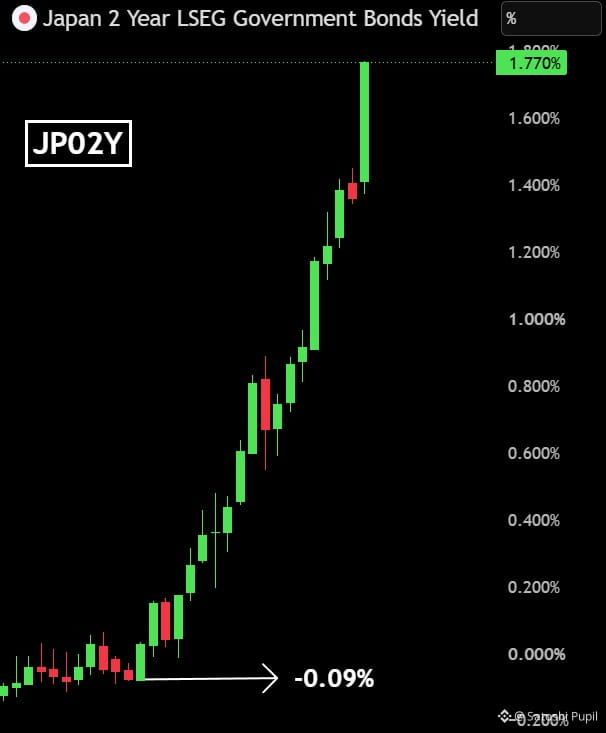
Japan's 2-year bond yield surges to 1.77% today, hitting another 31-year high.
The yield was negative just 3 years ago.
#bonds
Japan's 2-year bond yield surges to 1.77% today, hitting another 31-year high.
The yield was negative just 3 years ago.
#bonds
The yield was negative just 3 years ago.
#bonds
1
104


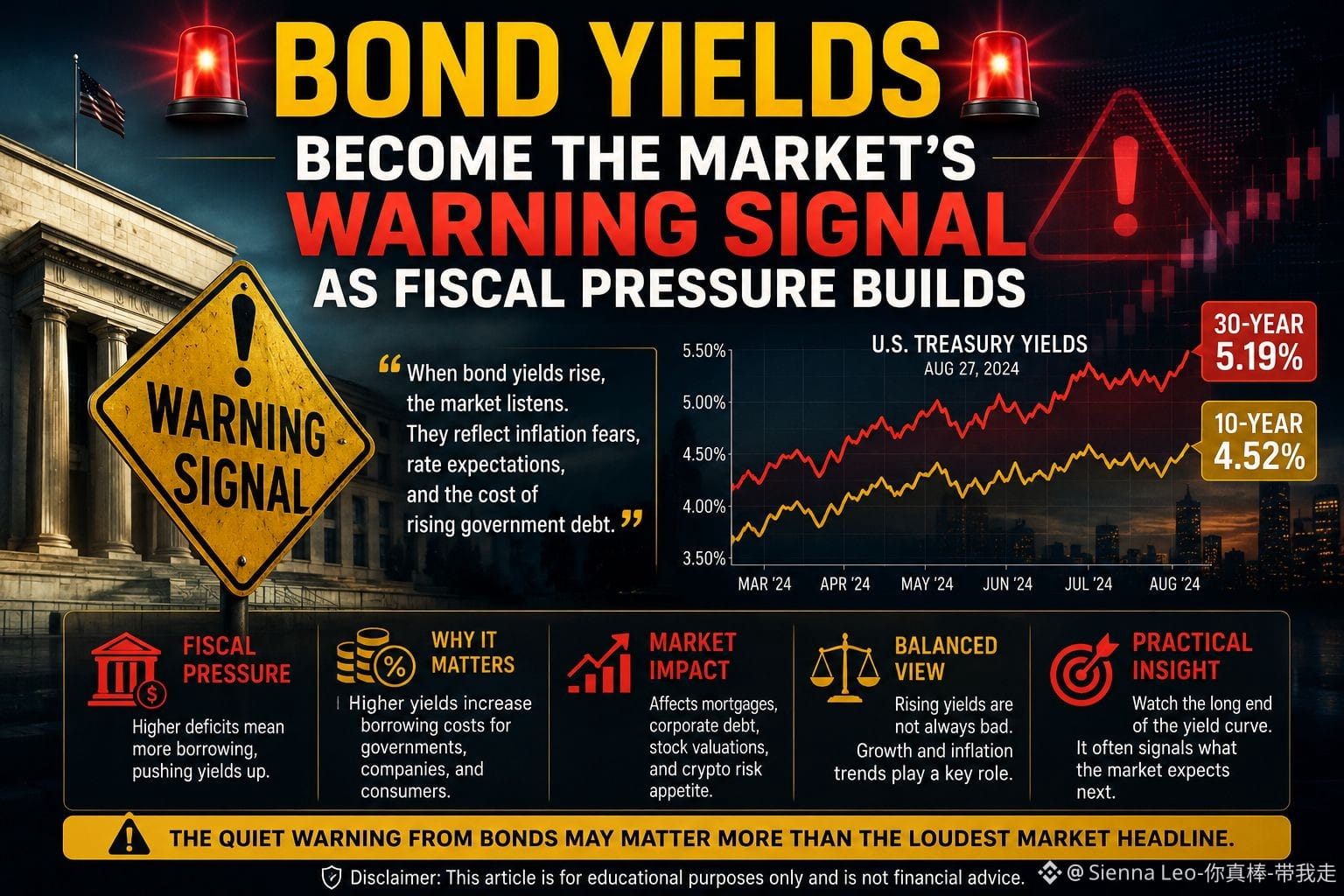
🟠 Bond Yields Become the Market’s Warning Signal as Fiscal Pressure Builds ⚠️
The trading screen looked calm until one number began climbing. No dramatic headline appeared, yet investors started paying closer attention because bond yields were quietly telling a different story.
That is why bond markets matter beyond fixed income. Yields can reflect expectations about inflation, interest rates, government borrowing, and the compensation investors demand for holding longer-term debt.
Recent U.S. Treasury data shows the pressure clearly: on August 27, the 10-year yield was around 4.52%, while the 30-year stood near 5.19%.
The interesting part is what happens underneath those numbers. When governments need to finance large deficits, investors may demand higher yields, especially if they believe inflation or future borrowing could remain elevated.
Higher long-term yields can then ripple across the entire market. Mortgage costs, corporate borrowing, equity valuations, and even crypto risk appetite can feel the effect because the global cost of capital is changing.
But rising yields are not automatically a crisis signal. Strong economic growth can also push yields higher, while weaker growth or falling inflation can eventually pull them lower.
My approach is simple: watch the long end of the yield curve, not just central-bank decisions. If long-term yields remain elevated, markets may be pricing fiscal risk that deserves attention.
The quiet warning from bonds may matter more than the loudest market headline.
❓Do you think rising long-term yields are mainly signaling fiscal risk, inflation risk, or stronger economic expectations?
Disclaimer: This article is for educational purposes only and is not financial advice.
#Bonds #TreasuryYields #GlobalMarkets #Write2Earn #GrowWithSAC
🟠 Bond Yields Become the Market’s Warning Signal as Fiscal Pressure Builds ⚠️
The trading screen looked calm until one number began climbing. No dramatic headline appeared, yet investors started paying closer attention because bond yields were quietly telling a different story.
That is why bond markets matter beyond fixed income. Yields can reflect expectations about inflation, interest rates, government borrowing, and the compensation investors demand for holding longer-term debt.
Recent U.S. Treasury data shows the pressure clearly: on August 27, the 10-year yield was around 4.52%, while the 30-year stood near 5.19%.
The interesting part is what happens underneath those numbers. When governments need to finance large deficits, investors may demand higher yields, especially if they believe inflation or future borrowing could remain elevated.
Higher long-term yields can then ripple across the entire market. Mortgage costs, corporate borrowing, equity valuations, and even crypto risk appetite can feel the effect because the global cost of capital is changing.
But rising yields are not automatically a crisis signal. Strong economic growth can also push yields higher, while weaker growth or falling inflation can eventually pull them lower.
My approach is simple: watch the long end of the yield curve, not just central-bank decisions. If long-term yields remain elevated, markets may be pricing fiscal risk that deserves attention.
The quiet warning from bonds may matter more than the loudest market headline.
❓Do you think rising long-term yields are mainly signaling fiscal risk, inflation risk, or stronger economic expectations?
Disclaimer: This article is for educational purposes only and is not financial advice.
#Bonds #TreasuryYields #GlobalMarkets #Write2Earn #GrowWithSAC
The trading screen looked calm until one number began climbing. No dramatic headline appeared, yet investors started paying closer attention because bond yields were quietly telling a different story.
That is why bond markets matter beyond fixed income. Yields can reflect expectations about inflation, interest rates, government borrowing, and the compensation investors demand for holding longer-term debt.
Recent U.S. Treasury data shows the pressure clearly: on August 27, the 10-year yield was around 4.52%, while the 30-year stood near 5.19%.
The interesting part is what happens underneath those numbers. When governments need to finance large deficits, investors may demand higher yields, especially if they believe inflation or future borrowing could remain elevated.
Higher long-term yields can then ripple across the entire market. Mortgage costs, corporate borrowing, equity valuations, and even crypto risk appetite can feel the effect because the global cost of capital is changing.
But rising yields are not automatically a crisis signal. Strong economic growth can also push yields higher, while weaker growth or falling inflation can eventually pull them lower.
My approach is simple: watch the long end of the yield curve, not just central-bank decisions. If long-term yields remain elevated, markets may be pricing fiscal risk that deserves attention.
The quiet warning from bonds may matter more than the loudest market headline.
❓Do you think rising long-term yields are mainly signaling fiscal risk, inflation risk, or stronger economic expectations?
Disclaimer: This article is for educational purposes only and is not financial advice.
#Bonds #TreasuryYields #GlobalMarkets #Write2Earn #GrowWithSAC
352
THE US TREASURY MAY HAVE A $1 TRILLION BAZOOKA.
And if Bessent actually deploys it, the impact could reach far beyond bonds.
The Treasury could potentially tap its nearly $1T Treasury General Account to expand long-term bond buybacks.
The objective?
Push bond prices higher.
Drive long-term yields lower.
Support the Treasury market.
And do it without requiring the Federal Reserve to step in directly.
The scale is what makes this extraordinary.
The Treasury just doubled its buyback size from $2B to at least $4B per operation.
But the relief faded quickly.
The 30Y Treasury yield returned toward 5.25%.
That tells you something important:
$4B may be nowhere near enough.
A much larger program could change the liquidity picture dramatically.
And there is another angle the market may be underestimating.
If Treasury cash is drawn down and liquidity flows back into the financial system, the effects may not stop at bonds.
Stocks could benefit.
Crypto could benefit.
Risk assets could benefit.
But there is a critical distinction:
The full $1T has NOT been committed.
This is potential firepower, not a $1T stimulus check.
Still, the message is powerful.
The US Treasury may have a tool capable of supporting the bond market without waiting for the Fed.
If the bond market breaks, the response may be far bigger than $4B.
The bazooka exists.
Now the market is watching to see whether Bessent pulls the trigger.
#Bitcoin #Crypto #Treasury #Bonds #FederalReserve
THE US TREASURY MAY HAVE A $1 TRILLION BAZOOKA.
And if Bessent actually deploys it, the impact could reach far beyond bonds.
The Treasury could potentially tap its nearly $1T Treasury General Account to expand long-term bond buybacks.
The objective?
Push bond prices higher.
Drive long-term yields lower.
Support the Treasury market.
And do it without requiring the Federal Reserve to step in directly.
The scale is what makes this extraordinary.
The Treasury just doubled its buyback size from $2B to at least $4B per operation.
But the relief faded quickly.
The 30Y Treasury yield returned toward 5.25%.
That tells you something important:
$4B may be nowhere near enough.
A much larger program could change the liquidity picture dramatically.
And there is another angle the market may be underestimating.
If Treasury cash is drawn down and liquidity flows back into the financial system, the effects may not stop at bonds.
Stocks could benefit.
Crypto could benefit.
Risk assets could benefit.
But there is a critical distinction:
The full $1T has NOT been committed.
This is potential firepower, not a $1T stimulus check.
Still, the message is powerful.
The US Treasury may have a tool capable of supporting the bond market without waiting for the Fed.
If the bond market breaks, the response may be far bigger than $4B.
The bazooka exists.
Now the market is watching to see whether Bessent pulls the trigger.
#Bitcoin #Crypto #Treasury #Bonds #FederalReserve
And if Bessent actually deploys it, the impact could reach far beyond bonds.
The Treasury could potentially tap its nearly $1T Treasury General Account to expand long-term bond buybacks.
The objective?
Push bond prices higher.
Drive long-term yields lower.
Support the Treasury market.
And do it without requiring the Federal Reserve to step in directly.
The scale is what makes this extraordinary.
The Treasury just doubled its buyback size from $2B to at least $4B per operation.
But the relief faded quickly.
The 30Y Treasury yield returned toward 5.25%.
That tells you something important:
$4B may be nowhere near enough.
A much larger program could change the liquidity picture dramatically.
And there is another angle the market may be underestimating.
If Treasury cash is drawn down and liquidity flows back into the financial system, the effects may not stop at bonds.
Stocks could benefit.
Crypto could benefit.
Risk assets could benefit.
But there is a critical distinction:
The full $1T has NOT been committed.
This is potential firepower, not a $1T stimulus check.
Still, the message is powerful.
The US Treasury may have a tool capable of supporting the bond market without waiting for the Fed.
If the bond market breaks, the response may be far bigger than $4B.
The bazooka exists.
Now the market is watching to see whether Bessent pulls the trigger.
#Bitcoin #Crypto #Treasury #Bonds #FederalReserve

1
44


TreasuryBuybacksCouldExceed$4BPerIssue
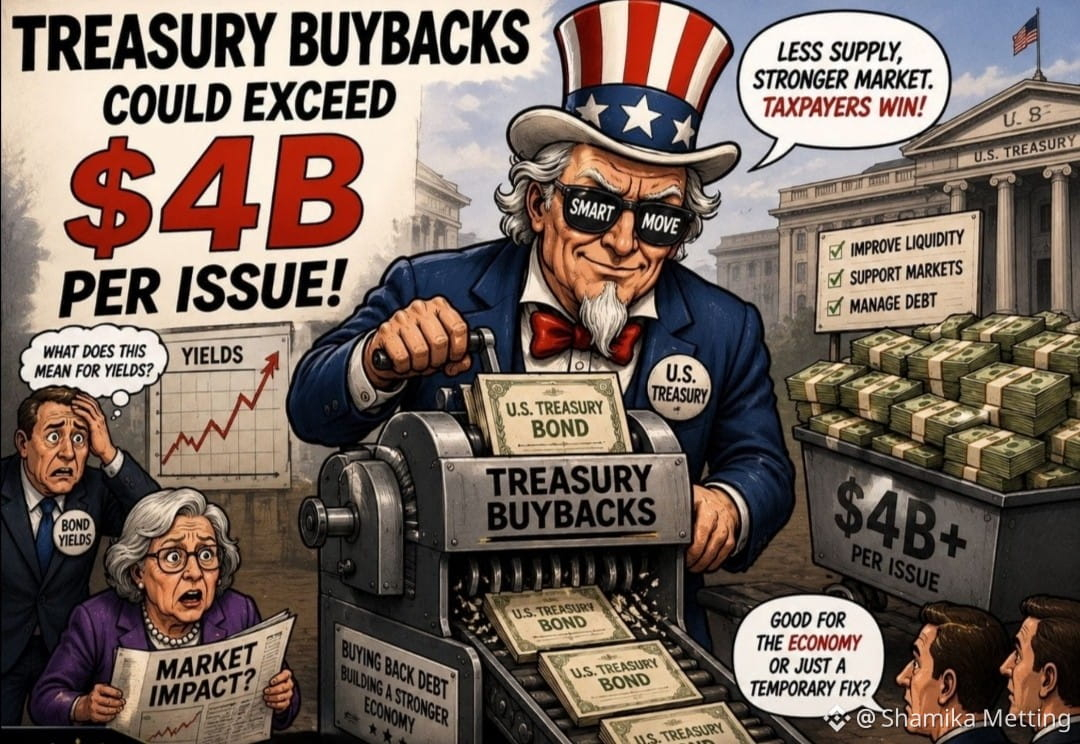
🏦💰 Treasury buybacks could exceed $4 billion per issue! 🚨
The U.S. Treasury market may be on the verge of another major wave of repurchases, where individual transactions could top $4 billion per issue. 📈
Broad-scale buybacks can play an important role in managing the Treasury market, improving liquidity, and influencing the supply of outstanding government debt. But for traders, the biggest question is what it might mean for bond yields, the dollar, and broader risk assets. 👀
If repurchase activity continues at high levels, markets may see stronger concentration on Treasury buy orders and liquidity conditions.
$4 billion+ per issue? Those are figures the market can’t ignore. 🔥
👑 Please follow
#Treasury #USDebt #Bonds #USTreasury
$BTC
$ETH
$BNB
TreasuryBuybacksCouldExceed$4BPerIssue
🏦💰 Treasury buybacks could exceed $4 billion per issue! 🚨
The U.S. Treasury market may be on the verge of another major wave of repurchases, where individual transactions could top $4 billion per issue. 📈
Broad-scale buybacks can play an important role in managing the Treasury market, improving liquidity, and influencing the supply of outstanding government debt. But for traders, the biggest question is what it might mean for bond yields, the dollar, and broader risk assets. 👀
If repurchase activity continues at high levels, markets may see stronger concentration on Treasury buy orders and liquidity conditions.
$4 billion+ per issue? Those are figures the market can’t ignore. 🔥
👑 Please follow
#Treasury #USDebt #Bonds #USTreasury
$BTC
$ETH
$BNB
🏦💰 Treasury buybacks could exceed $4 billion per issue! 🚨
The U.S. Treasury market may be on the verge of another major wave of repurchases, where individual transactions could top $4 billion per issue. 📈
Broad-scale buybacks can play an important role in managing the Treasury market, improving liquidity, and influencing the supply of outstanding government debt. But for traders, the biggest question is what it might mean for bond yields, the dollar, and broader risk assets. 👀
If repurchase activity continues at high levels, markets may see stronger concentration on Treasury buy orders and liquidity conditions.
$4 billion+ per issue? Those are figures the market can’t ignore. 🔥
👑 Please follow
#Treasury #USDebt #Bonds #USTreasury
$BTC
$ETH
$BNB
1
96

BREAKING: Treasury Buybacks Could Exceed $4B Per Issue! 💥
U.S. Treasury just DOUBLED buybacks from $2B to at least $4B per operation for 10-30Y bonds.
Secretary Bessent says it could be even more than $4B.
30Y yields hit 2007 highs, so Treasury is stepping in to calm the market.
Bullish for Stocks & Bitcoin? 🚀
#Bonds #Bitcoin #TreasuryBuybacksCouldExceed$4BPerIssue
$BTC
{spot}(BTCUSDT)
$ETH
{spot}(ETHUSDT)
$TAO
{spot}(TAOUSDT)
BREAKING: Treasury Buybacks Could Exceed $4B Per Issue! 💥
U.S. Treasury just DOUBLED buybacks from $2B to at least $4B per operation for 10-30Y bonds.
Secretary Bessent says it could be even more than $4B.
30Y yields hit 2007 highs, so Treasury is stepping in to calm the market.
Bullish for Stocks & Bitcoin? 🚀
#Bonds #Bitcoin #TreasuryBuybacksCouldExceed$4BPerIssue
$BTC
$ETH
$TAO
U.S. Treasury just DOUBLED buybacks from $2B to at least $4B per operation for 10-30Y bonds.
Secretary Bessent says it could be even more than $4B.
30Y yields hit 2007 highs, so Treasury is stepping in to calm the market.
Bullish for Stocks & Bitcoin? 🚀
#Bonds #Bitcoin #TreasuryBuybacksCouldExceed$4BPerIssue
$BTC
$ETH
$TAO
91

·
--
Bullish
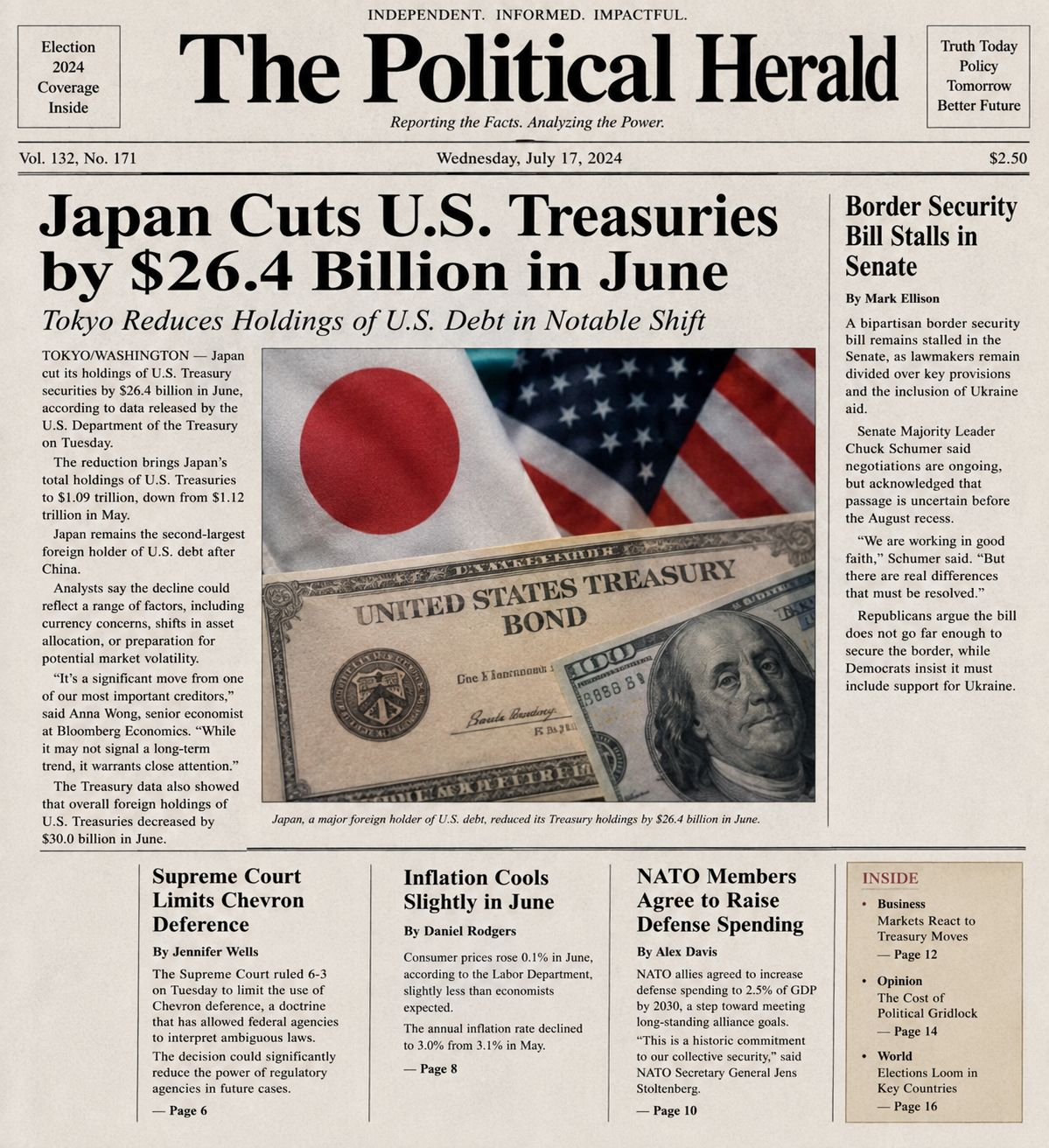
🇯🇵💰 Japan Cuts U.S. Treasuries by $26.4B in June
Japan reduced its holdings of U.S. Treasury securities by $26.4 billion in June. 📉🇺🇸
That’s a notable move from one of the biggest foreign holders of U.S. debt. Could this signal a shift in Japan’s asset allocation—or simply portfolio rebalancing?
👀 Traders will be watching whether the selling continues in the coming months.
#Japan #USTreasuries #USDebt #Bonds
$BTC
$ETH
$BNB
{spot}(BNBUSDT)
{spot}(ETHUSDT)
{spot}(BTCUSDT)
🇯🇵💰 Japan Cuts U.S. Treasuries by $26.4B in June
Japan reduced its holdings of U.S. Treasury securities by $26.4 billion in June. 📉🇺🇸
That’s a notable move from one of the biggest foreign holders of U.S. debt. Could this signal a shift in Japan’s asset allocation—or simply portfolio rebalancing?
👀 Traders will be watching whether the selling continues in the coming months.
#Japan #USTreasuries #USDebt #Bonds
$BTC
$ETH
$BNB
Japan reduced its holdings of U.S. Treasury securities by $26.4 billion in June. 📉🇺🇸
That’s a notable move from one of the biggest foreign holders of U.S. debt. Could this signal a shift in Japan’s asset allocation—or simply portfolio rebalancing?
👀 Traders will be watching whether the selling continues in the coming months.
#Japan #USTreasuries #USDebt #Bonds
$BTC
$ETH
$BNB
1
66

#US30YearYieldHitsHighestSince2002
📈 #US30YearYieldHitsHighestSince2002 — Bond Market Sends a Strong Signal
The U.S. 30-year Treasury yield has reached its highest level since 2002, putting long-term borrowing costs and inflation expectations firmly back in focus.
Higher yields can make bonds more attractive relative to risk assets, potentially putting pressure on stocks and crypto while supporting the dollar.
#Bonds #Bitcoin #Crypto $USDT $ETH
#US30YearYieldHitsHighestSince2002
📈 #US30YearYieldHitsHighestSince2002 — Bond Market Sends a Strong Signal
The U.S. 30-year Treasury yield has reached its highest level since 2002, putting long-term borrowing costs and inflation expectations firmly back in focus.
Higher yields can make bonds more attractive relative to risk assets, potentially putting pressure on stocks and crypto while supporting the dollar.
#Bonds #Bitcoin #Crypto $USDT $ETH
📈 #US30YearYieldHitsHighestSince2002 — Bond Market Sends a Strong Signal
The U.S. 30-year Treasury yield has reached its highest level since 2002, putting long-term borrowing costs and inflation expectations firmly back in focus.
Higher yields can make bonds more attractive relative to risk assets, potentially putting pressure on stocks and crypto while supporting the dollar.
#Bonds #Bitcoin #Crypto $USDT $ETH
120

$US
{future}(USUSDT)
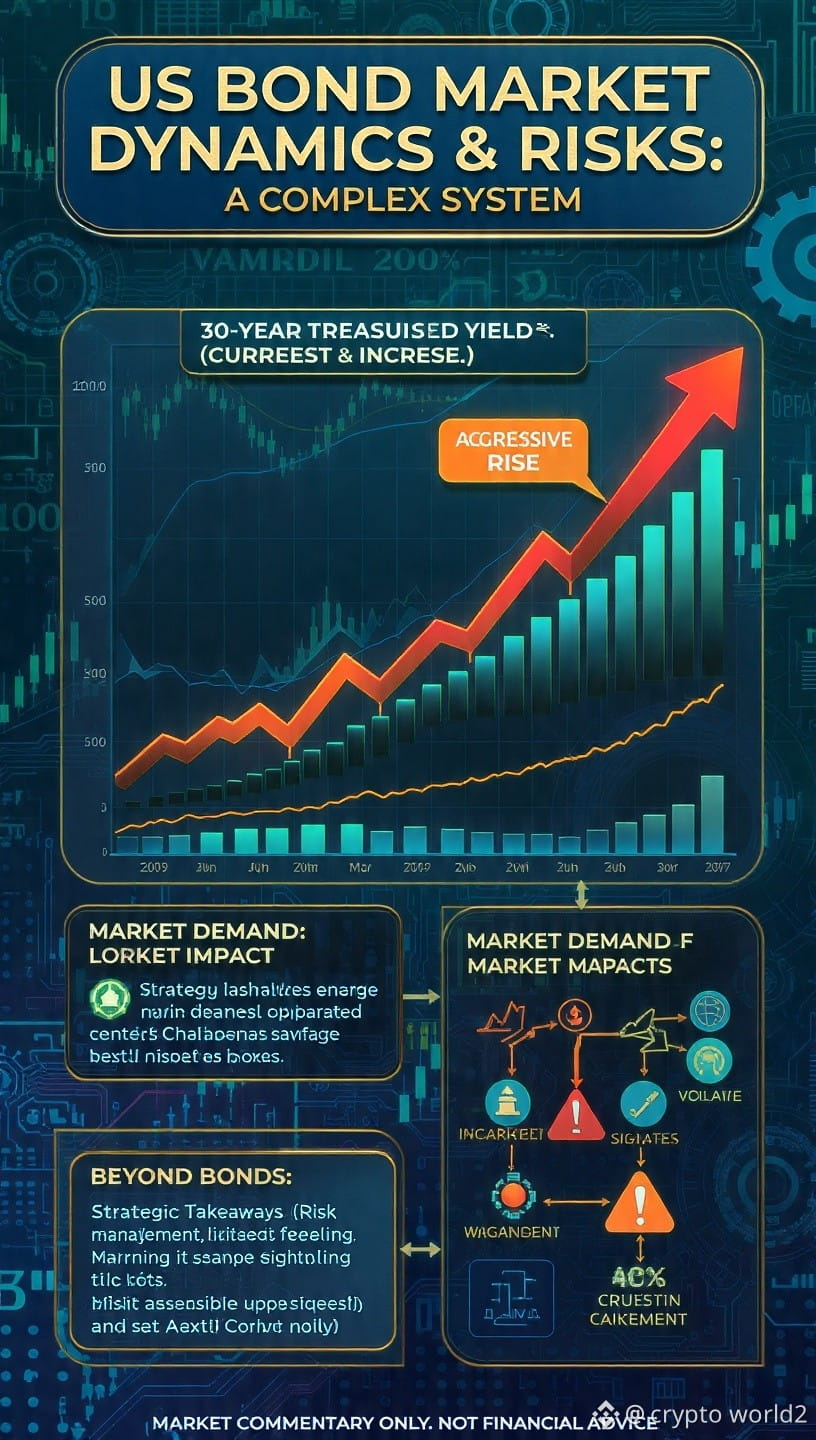
BOND MARKET: A COMPLEX SYSTEM
30Y Treasury >5.3%. AGGRESSIVE RISE.
First time since 2007.
DRIVERS:
- Fiscal Pressure
- Inflation Concerns
- Rate Uncertainty
SIGNAL: Investors demanding higher premium for long-term US debt.
IMPACT:
Bonds → Volatile Markets → Risk Assets, Crypto, Global Equities
TAKEAWAY:
Protect Capital. Watch Structure. Reduce Leverage.
2007 ≠ 2024. But ignoring signals is expensive.
⚠️ Not financial advice.
#Macro #Bonds #Crypto #DollarFallsTo10WeekLow #EthereumFoundationLaunchesGlamsterdamTestnet
$US
BOND MARKET: A COMPLEX SYSTEM
30Y Treasury >5.3%. AGGRESSIVE RISE.
First time since 2007.
DRIVERS:
- Fiscal Pressure
- Inflation Concerns
- Rate Uncertainty
SIGNAL: Investors demanding higher premium for long-term US debt.
IMPACT:
Bonds → Volatile Markets → Risk Assets, Crypto, Global Equities
TAKEAWAY:
Protect Capital. Watch Structure. Reduce Leverage.
2007 ≠ 2024. But ignoring signals is expensive.
⚠️ Not financial advice.
#Macro #Bonds #Crypto #DollarFallsTo10WeekLow #EthereumFoundationLaunchesGlamsterdamTestnet
BOND MARKET: A COMPLEX SYSTEM
30Y Treasury >5.3%. AGGRESSIVE RISE.
First time since 2007.
DRIVERS:
- Fiscal Pressure
- Inflation Concerns
- Rate Uncertainty
SIGNAL: Investors demanding higher premium for long-term US debt.
IMPACT:
Bonds → Volatile Markets → Risk Assets, Crypto, Global Equities
TAKEAWAY:
Protect Capital. Watch Structure. Reduce Leverage.
2007 ≠ 2024. But ignoring signals is expensive.
⚠️ Not financial advice.
#Macro #Bonds #Crypto #DollarFallsTo10WeekLow #EthereumFoundationLaunchesGlamsterdamTestnet
88

·
--
The most important chart today may not be a crypto chart.
It may be the bond market.
The U.S. 30-year Treasury yield briefly moved toward 5.33%, reaching levels not seen since 2007, while the 10-year yield remains around 4.72%. Rising oil prices and renewed inflation concerns are adding pressure to long-duration assets.
This matters far beyond fixed income.
When the cost of long-term capital changes, the valuation framework across equities, technology and digital assets changes with it.
Bitcoin does not exist in isolation.
Its liquidity environment is connected to the same global capital system that prices bonds, equities, currencies and commodities.
That is why I find the current divergence interesting.
Bitcoin can remain relatively resilient while traditional risk assets absorb pressure from higher yields.
But the deeper question is whether that resilience can persist if financial conditions remain restrictive.
The chart shows the reaction.
The bond market often reveals the pressure behind it.
And sometimes, the most important signal for Bitcoin is hiding somewhere most crypto traders are not looking.
#Bitcoin #Bonds #Macro
The most important chart today may not be a crypto chart.
It may be the bond market.
The U.S. 30-year Treasury yield briefly moved toward 5.33%, reaching levels not seen since 2007, while the 10-year yield remains around 4.72%. Rising oil prices and renewed inflation concerns are adding pressure to long-duration assets.
This matters far beyond fixed income.
When the cost of long-term capital changes, the valuation framework across equities, technology and digital assets changes with it.
Bitcoin does not exist in isolation.
Its liquidity environment is connected to the same global capital system that prices bonds, equities, currencies and commodities.
That is why I find the current divergence interesting.
Bitcoin can remain relatively resilient while traditional risk assets absorb pressure from higher yields.
But the deeper question is whether that resilience can persist if financial conditions remain restrictive.
The chart shows the reaction.
The bond market often reveals the pressure behind it.
And sometimes, the most important signal for Bitcoin is hiding somewhere most crypto traders are not looking.
#Bitcoin #Bonds #Macro
It may be the bond market.
The U.S. 30-year Treasury yield briefly moved toward 5.33%, reaching levels not seen since 2007, while the 10-year yield remains around 4.72%. Rising oil prices and renewed inflation concerns are adding pressure to long-duration assets.
This matters far beyond fixed income.
When the cost of long-term capital changes, the valuation framework across equities, technology and digital assets changes with it.
Bitcoin does not exist in isolation.
Its liquidity environment is connected to the same global capital system that prices bonds, equities, currencies and commodities.
That is why I find the current divergence interesting.
Bitcoin can remain relatively resilient while traditional risk assets absorb pressure from higher yields.
But the deeper question is whether that resilience can persist if financial conditions remain restrictive.
The chart shows the reaction.
The bond market often reveals the pressure behind it.
And sometimes, the most important signal for Bitcoin is hiding somewhere most crypto traders are not looking.
#Bitcoin #Bonds #Macro
1
242

·
--
MARKET UPDATE
Selling grips bond markets from the U.S. to Japan as inflation and fiscal worries take hold.
Rising inflation risks and mounting government debt concerns are pushing bond yields higher across major economies, putting pressure on investors and global markets.
🇺🇸 U.S. — Inflation remains a key concern
🇯🇵 Japan — Higher yields reflect shifting market expectations
📈 Global Impact — Investors demand greater returns as fiscal risks grow
Bond markets are flashing a warning: inflation + debt = higher borrowing costs.
#Bonds #USMarkets #Japan #Inflation #Finance
MARKET UPDATE
Selling grips bond markets from the U.S. to Japan as inflation and fiscal worries take hold.
Rising inflation risks and mounting government debt concerns are pushing bond yields higher across major economies, putting pressure on investors and global markets.
🇺🇸 U.S. — Inflation remains a key concern
🇯🇵 Japan — Higher yields reflect shifting market expectations
📈 Global Impact — Investors demand greater returns as fiscal risks grow
Bond markets are flashing a warning: inflation + debt = higher borrowing costs.
#Bonds #USMarkets #Japan #Inflation #Finance
Selling grips bond markets from the U.S. to Japan as inflation and fiscal worries take hold.
Rising inflation risks and mounting government debt concerns are pushing bond yields higher across major economies, putting pressure on investors and global markets.
🇺🇸 U.S. — Inflation remains a key concern
🇯🇵 Japan — Higher yields reflect shifting market expectations
📈 Global Impact — Investors demand greater returns as fiscal risks grow
Bond markets are flashing a warning: inflation + debt = higher borrowing costs.
#Bonds #USMarkets #Japan #Inflation #Finance
61


METAPLANET LAUNCHES BITBONDS – FIRST DEAL DONE, PLATFORM RAMPING UP 🧪💼
The quiet money never stops. Metaplanet just executed its first BitBonds issuance – a 200 million yen pilot through its securities subsidiary. This isn't about the size; it's about laying the tracks for a new kind of debt product tethered to a Bitcoin treasury.
The bonds are unsecured, so they aren't backed by the BTC held on the balance sheet. Instead, it's pure financial engineering – using the reserve as a credibility anchor while building out distribution and management rails.
A pilot today, a whole platform tomorrow. As other corporate treasuries watch, this could open a floodgate of Bitcoin-driven capital markets innovation. Which treasury will copy this playbook first? Drop your take below 🤔🔧
⚠️ Not financial advice. Always manage your risk. 🛡️
🏷️ #MTP #Bitcoin #Bonds #CryptoNews #Institutional
🔥💼
METAPLANET LAUNCHES BITBONDS – FIRST DEAL DONE, PLATFORM RAMPING UP 🧪💼
The quiet money never stops. Metaplanet just executed its first BitBonds issuance – a 200 million yen pilot through its securities subsidiary. This isn't about the size; it's about laying the tracks for a new kind of debt product tethered to a Bitcoin treasury.
The bonds are unsecured, so they aren't backed by the BTC held on the balance sheet. Instead, it's pure financial engineering – using the reserve as a credibility anchor while building out distribution and management rails.
A pilot today, a whole platform tomorrow. As other corporate treasuries watch, this could open a floodgate of Bitcoin-driven capital markets innovation. Which treasury will copy this playbook first? Drop your take below 🤔🔧
⚠️ Not financial advice. Always manage your risk. 🛡️
🏷️ #MTP #Bitcoin #Bonds #CryptoNews #Institutional
🔥💼
The quiet money never stops. Metaplanet just executed its first BitBonds issuance – a 200 million yen pilot through its securities subsidiary. This isn't about the size; it's about laying the tracks for a new kind of debt product tethered to a Bitcoin treasury.
The bonds are unsecured, so they aren't backed by the BTC held on the balance sheet. Instead, it's pure financial engineering – using the reserve as a credibility anchor while building out distribution and management rails.
A pilot today, a whole platform tomorrow. As other corporate treasuries watch, this could open a floodgate of Bitcoin-driven capital markets innovation. Which treasury will copy this playbook first? Drop your take below 🤔🔧
⚠️ Not financial advice. Always manage your risk. 🛡️
🏷️ #MTP #Bitcoin #Bonds #CryptoNews #Institutional
🔥💼
27
Log in to explore more content
Join global crypto users on Binance Square
⚡️ Get latest and useful information about crypto.
💬 Trusted by the world’s largest crypto exchange.
👍 Discover real insights from verified creators.
Email / Phone number
Trending Topics
1
#USContinuingJoblessClaims1.774M
468 views
56 Discussing
2
#USAugustPPIYoYRisesTo5.4%
518 views
46 Discussing
3
#AppleDebutsFoldablePhone
56,361 views
1,090 Discussing
4
#TSMCAugustRevenueUp53.3%YoY
14,292 views
405 Discussing
5
#IranSaysReadyToEscalateWarWithUS
18,833 views
404 Discussing
6
#EUExtendsCentralContactPointToCASPs
17,145 views
436 Discussing
7
#US10YTreasuryYieldHitsHighestSinceNov2023
42,014 views
652 Discussing
8
#USTreasuryToBuyBackUpTo$6BLongDatedDebt
23,258 views
191 Discussing
9
#BitcoinSurpasses$79K
79,665 views
300 Discussing
10
#BrentCrudeTops$100
138,430 views
429 Discussing