
美股投资young
205 Posts

美股投资young
Report
Block User
美股科技投资者 ai狂热者 分享每日快讯
all in AI
11 Following
391 Followers
102 Liked
Posts
Portfolio
·
--
The 10-year Treasury yield has fallen back below 5%, but BTC nearly dropped to 60,000.
Treasuries were bought steadily today. The 10-year yield fell more than 7 bps to around 4.97%, while the 2-year yield dropped more than 8 bps to around 4.70%. Yields have been moving lower for several days in a row, as money seeks shelter in government bonds.
According to the textbook, falling yields should give risk assets some breathing room. But U.S. stocks are still falling: the Nasdaq is down more than 6% this week, and BTC just hit 60074, down 4.4% over 24 hours.
That suggests yields are falling this time because of fear, not because expectations of rate cuts have really returned. People are buying Treasuries as a safe haven, and selling precisely the things that usually rise the most: tech stocks and BTC.
Waller is due to speak later today. Just a couple of days ago, he said a 50-bp hike might be possible. If he sticks to that tune, the 2-year yield’s recent drop may not hold.
BTC’s 60,000 mark will most likely be tested tonight
#美股 #美联储 #比特币 #美债 $BTC
BTC-4.45%
IEFETF+0.71%
22
·
--
$SPY has fallen for 7 consecutive trading days—a streak that has happened only 5 times in history
At yesterday’s close, it had already fallen for 6 consecutive trading days
It’s down 0.7% before the market opens today
If it closes lower today
That’ll make 7 consecutive down days 😅
The last time we saw a streak like this was during the pandemic
Are we really going to have it this bad?
#美股 #标普500 #SPY #consecutive declines
5
·
--
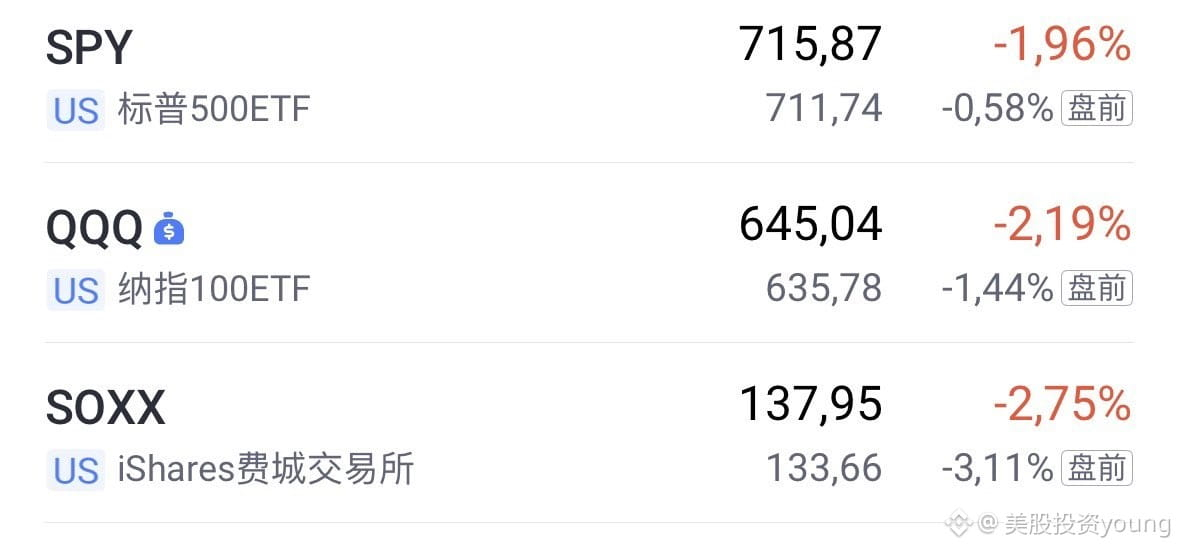
Wow, half an hour after the opening bell, the Dow has turned green, while the Nasdaq is still down 1.5%.
Just before 10 a.m. Eastern, the Dow was up around 0.5%, the S&P 500 was down 0.5%, and the Nasdaq was down 1.5%. Chips are getting hit hard again: $NVDA is down 4%, AMD, Micron, and Marvell are all down around 6%, and Anthropic, which just went public yesterday, is down 8% too, trading around 89.
Put simply, money is changing seats. It's flowing out of AI and semiconductors and into the Dow's old-guard companies. The major indexes look less battered, but if your holdings are concentrated in tech, it still hurts.
So far this week, the S&P 500 and Dow are both down around 5%, and the Nasdaq is down more than 6%—the worst week since the tariff week in early April 2025.
The awkward part is that BTC is siding with the Nasdaq, not the Dow. It's around 61100 now, down 3.7% over 24 hours, and has dipped a bit lower again 🫠
Monthly options expire tonight too. I'll be watching that final hour before the close.
#美股 #比特币 #纳斯达克 $BTC $NVDA
181
·
--
UBS brings structured notes to Ethereum, but ETH falls back to 1,745—still more than 60% below its highOn Thursday, UBS announced that it had successfully run a tokenized structured note on Ethereum. On the same day, spot ETH ETFs saw $131 million in outflows.
ETH is now around 1,745, with an intraday low of 1,717—the lowest since early July. It’s down 64.7% from its high of 4,946 on August 24, 2025. Over the past 7 days, it’s down 11%; over 30 days, 29%; and month to date, around 23%. BTC has fallen less over the same period. ETH has taken a harder hit in this downturn.
First, the UBS story.
It uses a Chainlink operating environment to automate the lifecycle management of structured notes on-chain—including issuance, coupon payments, and barrier prices—while connecting back to its existing banking system. The press release puts the global market for structured products at more than $2 trillion.
UBS brings structured notes to Ethereum, but ETH falls back to 1,745—still more than 60% below its high
On Thursday, UBS announced that it had successfully run a tokenized structured note on Ethereum. On the same day, spot ETH ETFs saw $131 million in outflows.
ETH is now around 1,745, with an intraday low of 1,717—the lowest since early July. It’s down 64.7% from its high of 4,946 on August 24, 2025. Over the past 7 days, it’s down 11%; over 30 days, 29%; and month to date, around 23%. BTC has fallen less over the same period. ETH has taken a harder hit in this downturn.
First, the UBS story.
It uses a Chainlink operating environment to automate the lifecycle management of structured notes on-chain—including issuance, coupon payments, and barrier prices—while connecting back to its existing banking system. The press release puts the global market for structured products at more than $2 trillion.
443
·
--
The Fear and Greed Index has been stuck between 10 and 13 for 7 straight days.
It was still at 28 eight days ago, then fell to 20 and 13, and has been flat on the floor ever since. Today it’s at 12. By many people’s logic, extreme fear should be a signal to buy the dip, but BTC has kept grinding lower over these 7 days. It hit a low of $61,300 over the past couple of days, and is now at $61,800, down more than 3% again in 24 hours.
Sentiment can hit rock bottom without prices doing the same. That’s all too common in crypto. The index can only tell you that everyone is scared; it can’t tell you who still has selling left to do. ETFs are still seeing outflows, Treasury yields are still weighing on the market. People may be scared, but the selling hasn’t stopped.
High-beta assets look even worse. SOL is now at $71, down 5% in a day.
I’m waiting for the day when the index is still in the low teens, but the price stops making new lows. I haven’t seen that yet.
#比特币 #加密市场 #恐慌指数 $BTC $SOL
174
·
--
Institutions just bought a record 49,000 BTC in the third quarter—and at quarter-end prices, they’re already down a quarterInstitutions made net purchases of 49,229 BTC spot ETF shares in the third quarter. The results only came out today, and BTC is already at $61,400.
Based on 13F filings, the institutions that reported for July through September bought back in a single quarter everything they had sold over the previous three quarters, when they had sold a combined total of just 47,054 BTC. Their total holdings at quarter-end stood at 356,491 BTC, worth $29.78 billion—the highest on record.
Dividing these two figures, BTC was around $83,500 on September 30. It’s now at $61,400, down about 26%.
In other words, those 49,000 coins were worth around $4.1 billion at quarter-end prices, but today they’re worth just over $3 billion. The actual cost may have been a little lower, since prices varied throughout the third quarter, but the overall picture is clear.
Institutions just bought a record 49,000 BTC in the third quarter—and at quarter-end prices, they’re already down a quarter
Institutions made net purchases of 49,229 BTC spot ETF shares in the third quarter. The results only came out today, and BTC is already at $61,400.
Based on 13F filings, the institutions that reported for July through September bought back in a single quarter everything they had sold over the previous three quarters, when they had sold a combined total of just 47,054 BTC. Their total holdings at quarter-end stood at 356,491 BTC, worth $29.78 billion—the highest on record.
Dividing these two figures, BTC was around $83,500 on September 30. It’s now at $61,400, down about 26%.
In other words, those 49,000 coins were worth around $4.1 billion at quarter-end prices, but today they’re worth just over $3 billion. The actual cost may have been a little lower, since prices varied throughout the third quarter, but the overall picture is clear.
583
·
--
Citi ran the numbers this Tuesday: there were $45.9 billion in long positions on S&P futures, with an average cost of 7,768 points.
The index was at 7,573 at the time, and 95% of those long positions were already underwater. The S&P closed at 7,175.83 on Thursday, which puts the average unrealized loss at around 7.6%. In tonight’s premarket, S&P futures fell another 1% or so, while Nasdaq 100 futures were down 1.9%.
The message in Citi’s report was pretty clear: if the rebound can’t hold, forced liquidations of long positions could magnify the sell-off. The rebound is long gone now—the market has fallen for six straight days, and the VIX hit 30.99 in premarket trading, its highest level since March 👀
Honestly, this is the same playbook as the wave of liquidations in crypto a few days ago. The only difference is that the leverage in U.S. stocks is hidden in futures and institutional positions, so it won’t show up on a liquidation leaderboard for you to see. BTC is around 61,500 now, down 3.3% over 24 hours. On both sides, leveraged longs are learning an expensive lesson.
One detail that’s easy to miss: Citi said the previous rebound was driven mainly by short covering, with few new longs entering the market. There were already few buyers to catch the falling knife.
Tonight is monthly options expiration. First, I’ll be watching to see whether the S&P can reclaim 7,200 and whether the VIX can drop back below 30. There’s no harm in waiting a little before putting money into a dip
#美股 #比特币 #VIX $BTC $SPY
14
·
--
Verified
Micron brought in $54.2 billion in revenue in a single quarter, up from just $11.3 billion a year ago, and still fell 5% before the market opened.
In tonight’s U.S. premarket, $MU was down more than 5%, and $SNDK was down more than 6%. Beyond the broader AI sector’s valuation reset, there’s another headwind aimed squarely at memory: one firm cut its flash memory price forecasts this week, saying NAND prices will be flat in the first quarter of next year, then fall for three straight quarters. Supply is forecast to grow 28% in 2027 and 30% in 2028.
SNDK is taking a bigger hit because it’s almost entirely exposed to NAND. MU has HBM and DRAM, which tie it more closely to AI data centers.
I’m still bullish on memory. But being bullish doesn’t mean you have to rush in tonight. Once the market starts pricing in numbers like supply growth, stocks usually fall first. We’ll have to wait a few more quarters to see whether earnings can hold up.
Over in crypto, BTC is still hovering around 62,000, moving pretty much in lockstep with high-beta tech stocks.
I’m waiting patiently for the right price. First, let’s see whether SNDK can stabilize on the weekly chart after this round of selling.
#美股 #存储芯片 #比特币 $BTC
862
·
--
Stablecoins are shrinking, and that concerns me more than BTC falling to 61K.
The total stablecoin market cap is now around $281.5 billion, down 5.88% over 30 days—that’s more than $17 billion gone. USDT is down 4.2% over 30 days, and USDC is down 4.8%. The two big ones are shrinking together.
Stablecoins are the market’s ammunition. If prices fall but the ammo is still there, someone will eventually buy the dip. But if the ammo itself is being redeemed and leaving, the rebound will lack fuel.
Honestly, it’s the same picture as with ETFs: spot BTC ETFs have seen $3.47 billion in outflows in November, and on-chain dollars are leaving too 👀
BTC is hovering around 62K. Let’s talk about a bottom once the 7-day change in stablecoins turns positive.
#稳定币 #比特币 #加密市场 $BTC
1
166
·
--
Even the Dow is close to a correction, and you still think it’s just tech stocks pulling back?
On Thursday, the Dow fell 1,101 points to close at 49,097, its first close below 50,000 since June. It’s about 9.7% below its August 5 high, and at one point during the session it was down a full 10%. The S&P 500 fell for six straight sessions, its longest losing streak since 2024.
The Dow was supposed to be the relatively resilient one, but even it couldn’t hold up. Selling pressure has spread from chips to the broader market.
In times like this, it’s hard for BTC to make a move of its own. On Thursday night, it touched 61,300, moving almost in lockstep with U.S. stocks on the way down.
Tonight is also monthly options expiration. Whether the Dow can close back above 50,000 on Friday matters more than anyone calling a bottom.
#美股 #道指 #比特币 $BTC
322
·
--
BlackRock’s spot BTC ETF saw $541 million flow out on Thursday—the biggest single-day outflow since it launched nearly three years ago.
U.S. spot BTC ETFs saw $582 million in net outflows that day, with basically only one fund recording net inflows. Outflows since November have now totaled $3.47 billion, turning 2026 into a net-outflow year, at roughly $3.1 billion.
Damn, at the start of the year people were still saying ETFs were “permanent buyers.”
The people investing in ETFs are the same people investing in U.S. stocks. With tech stocks falling day after day and a newly listed AI giant about to suck up tens of billions, the most volatile assets are often the first to get cut 📉 BTC touched $61,300 on Thursday night, its lowest level since early July.
IBIT itself is down around 24% over the past month, and people holding it are less used to this kind of drawdown than crypto investors.
Let’s wait until it sees inflows again for several days in a row. No need for the price to rally first.
#比特币 #ETF资金流 #加密市场 $BTC
1.4k
·
--
Verified
It was supposed to be the biggest beneficiary of Nvidia’s troubles, but ended up dropping 7.7% in a single day.
$AMD closed Thursday at 489.19, after a short-seller report claimed that a Chinese server maker blacklisted by the U.S. was still receiving its new firmware, and that more than 20% of its revenue was invoiced to customers in China and Hong Kong. The company said the claims misrepresented its business and that it complies with export controls. Keep in mind that the firm behind the report has a short position.
But the market hasn’t been listening to explanations these past few days. With Jensen Huang’s resignation and tighter export controls, money had been moving from $NVDA to AMD for cover. Now that refuge has been called out, too.
Investors are rattled. The stock is still falling in premarket trading today, and Nasdaq 100 futures are down about 1%.
When there’s no “safe” pick among AI chips, money simply exits the whole sector. BTC is hovering around 62,000 with little rebound. Until risk appetite returns, high-beta assets will all struggle.
If Washington really introduces new export rules, this report won’t just be short-seller noise.
#美股 #AI芯片 #比特币 $BTC
2
7.4k
·
--
Verified
Up 34% at the open, but gains dwindled to just 17% by the close—and this was still the biggest IPO in history.
Anthropic went public on Thursday at an offer price of $83, raising $81.3 billion—bigger than SpaceX’s deal in June. It opened at $111.5 and closed at $97.17, putting its fully diluted market cap at around $1.8 trillion, with 846 million shares changing hands in a single day.
The wild part? The Nasdaq was up around 2% early that same day, then closed down 2.25%—a swing of more than four percentage points 🫠
Put simply, someone had to take on all those newly issued shares worth $81.3 billion. There’s only so much cash to go around, so anyone wanting to get in on ANT had to sell something else first. Older AI stocks and semiconductor shares were the first to be tapped for cash. The bigger the new story, the more it drains from the rest of the market.
BTC is now hovering around $62,000, near a five-month low. It’s not directly related to this IPO, but risk appetite comes from the same pool of money. When cash is tight, nothing with high beta is safe.
Next, watch to see whether buyers step in before ANT falls back to its $83 offer price. If it breaks below that, AI sentiment will take another hit.
#美股 #AI #比特币 $BTC $QQQ
756
·
--
Buying BTC cost $33.4 million; repurchasing preferred shares cost $228 million—nearly 7 times as much.
Here’s Strategy’s account for last week (11/9–11/15): 485 BTC at an average price of 68887, bringing its holdings to 850849 BTC. Where did the money come from? It sold 2.09 million shares of $MSTR common stock, raising $244.7 million, of which $206 million went to repurchase STRC.
STRC is its floating-rate perpetual preferred stock, with a par value of 100 and an annualized dividend yield of 12%. When the price falls below 100, the company steps in to buy shares back. It’s also keeping the December dividend at 12%, saying it will wait until the price stabilizes around 100 before making any moves.
Honestly, the order of things here says a lot.
The old flywheel worked like this: issue shares and debt, buy crypto, then as crypto rises, the stock price follows—and issue more. Now the money goes first to support the preferred stock’s price, and buying coins has become a rounding error. $BTC is now around 61800, down 2.9% over 24 hours—more than 10,000 below its average purchase price last week.
So what are common shareholders paying for? Every sale of common stock means dilution, and what they get in return isn’t more coins—it’s price stability for the preferred stock. MSTR fell more than 8% at one point in Monday’s premarket trading. The market has already voted with its feet.
If BTC rebounds and STRC gets back above 100, the company can stop these operations and put its money toward buying coins again. But if prices keep falling, both buybacks and dividends will need funding, and the $4.75 billion in cash reserves it has on hand becomes a countdown.
So when looking at Strategy at this stage, don’t just focus on how many coins it bought. First, see whether STRC has returned to 100.
#比特币 #MSTR #US stocks
173
·
--
A Fed governor said it himself: they may need to use 50 basis points to “shock people.”
That was the gist of Waller’s remarks on Wednesday. The FOMC minutes released the same day showed that almost all officials agreed rates still needed to go higher, and some explicitly floated the option of a 50-basis-point hike in December.
So what happened? The 10-year Treasury yield actually fell 4 basis points that day, closing near 5.06%. Rate markets didn’t budge: 25-basis-point hikes in December, next March, and June.
So the bond market wasn’t really spooked. Stocks were.
The S&P 500 fell 2.02% on Thursday to close at 7175.83, marking its sixth straight day of losses. This is likely to be its worst week since April 2025. The Nasdaq was down 2.25%. Honestly, this kind of sell-off no longer looks like it’s just about AI valuations. On one side, the rate-hiking cycle isn’t over; on the other, people are starting to scrutinize the returns on AI capex. The two pressures are piling up 💀
So what if they really do hike by 50 in December?
The market is pricing in only 25, so the extra 25 is the part that hasn’t been priced in. If upcoming CPI and jobs data come in hot, this tail risk will gradually get priced in, and high-beta assets will feel the pain first.
Crypto won’t escape either. $BTC is now around 61,800, down nearly 3% over 24 hours. With the 10-year yield hovering above 5%, the opportunity cost of holding non-yielding assets remains high. On the flip side, if the data cools and the 50-basis-point hike is taken off the table, these assets—among the hardest hit by rates—are also the ones most likely to rebound first.
The next thing to watch is CPI. Whether they hike by 25 or 50 will pretty much come down to that.
#美联储 #美股 #Bitcoin
483
·
--
One of this year’s biggest BTC sellers is, surprisingly, the miners themselves.
$MARA 2026 year to date, they’ve sold 40581 coins, worth about $3.03 billion, at an average price of around $74,400. Riot sold 20264 coins, worth about $1.51 billion, cutting its reserves from just over 18,000 coins to 2418—pretty much clearing them out. On-chain data shows that 14 publicly listed companies have sold a total of 108247 coins this year, worth about $8.08 billion.
Where’s the money going? Paying down debt, then building AI data centers. Riot’s 910MW campus has signed a 15-year lease, with delivery starting in 2027. The tenant is an AI company.
Damn, miners understand the computing-power business better than anyone now.
Put simply, the returns from using the same electricity to run GPUs are more stable than mining coins, so miners are voting with their feet. For $BTC , this means something very real: miners used to be natural long-term holders; now they’re a steady source of supply. Eight days after its Q3 report, MARA sold another 1713 coins, with around 20,000 still on hand.
BTC is now at 61800, down 2.9% over 24 hours; ETH is at 1750. This price is already below MARA’s average selling price this year, meaning it’s selling at lower and lower prices.
If financing conditions for AI data centers worsen, miners may have to sell even more coins to cover capital expenditures. This supply stream won’t stop on its own.
To see when it might slow down, keep an eye on these companies’ monthly production and sales announcements. That’s more reliable than watching the candlestick charts.
#比特币 #矿工 #AI
33
·
--
Verified
Revenue doubled, but the stock closed down 3.3%.
$NVDA brought in $115.8 billion in revenue this quarter, up 103% year over year. Data center revenue was $107.6 billion, well above market expectations, and its fourth-quarter guidance came in at $130 billion. Yet the stock closed at 145.98 on Thursday in New York, on trading volume 95% above its three-month average 🫠
To be fair, there’s nothing wrong with the numbers themselves. Investors are looking at the pages that come after the earnings report.
Data center guarantee exposure rose from $108.5 billion to $118 billion, with $105 billion tied to a campus in Ohio leased to OpenAI for 20 years. There are also $32 billion in contingent commitments to neocloud providers, conditional on those smaller cloud companies raising their own funding first. Jensen Huang left on November 12, and interim CEO Kress said on the earnings call that future guarantees would be “more selective.”
In other words, Nvidia is using its own balance sheet to backstop some of the demand. If financing gets more expensive, the first link to weaken will be the one most reliant on borrowing to expand.
One more detail: supply and capacity commitments jumped from $279 billion to $390 billion. The company says most of that is for multiyear memory purchases. Spot prices for memory are falling, while major customers are locking in long-term contracts, and $MU these stocks are caught between those two forces. The bullish view on memory hasn’t changed, but being bullish and chasing prices are two different things.
$BTC is now around 61,900, down nearly 3% over 24 hours. The AI chain’s financing costs and what BTC fears are really the same thing: money getting more expensive.
Fourth-quarter gross margin guidance is 71%–72%, compared with 74.8% in the third quarter. The first thing to watch in the next earnings report is whether it can hold that level.
#美股 #英伟达 #Bitcoin
568
·
--
More than 110,000 accounts were wiped out in a single day.
According to CoinGlass data, about $528 million was liquidated across the crypto market over the past 24 hours, with around $169 million in BTC alone—about 80% of it was long positions. BTC briefly plunged to just over $61,300 and is now around $61,700. ETH is at $1,740, down 3.5% in a day.
Honestly, the fact that so many people are still going long and buying the dip at these prices shows that leverage hasn’t been flushed out yet. The Fear & Greed Index is down to 12. Sentiment is at rock bottom, but positions haven’t been cleared out yet.
I’d rather wait until the liquidation volume drops and the price can hold steady before taking another look 💀 Going in a few days early just means getting shaken out a few days sooner.
I really have no idea whether the longs have been fully flushed out this time.
#比特币 #爆仓 #加密市场 $BTC $ETH
185
Log in to explore more content
Join global crypto users on Binance Square
⚡️ Get latest and useful information about crypto.
💬 Trusted by the world’s largest crypto exchange.
👍 Discover real insights from verified creators.
Email / Phone number