
怪兽8号888-资讯收集箱
944 Posts

怪兽8号888-资讯收集箱
Report
Block User
每天更新热点,异动,盘面分析,每日总结,问就是网上扒的数据再加工给各位,哈哈!!
29 Following
109 Followers
110 Liked
Posts
All
Quotes
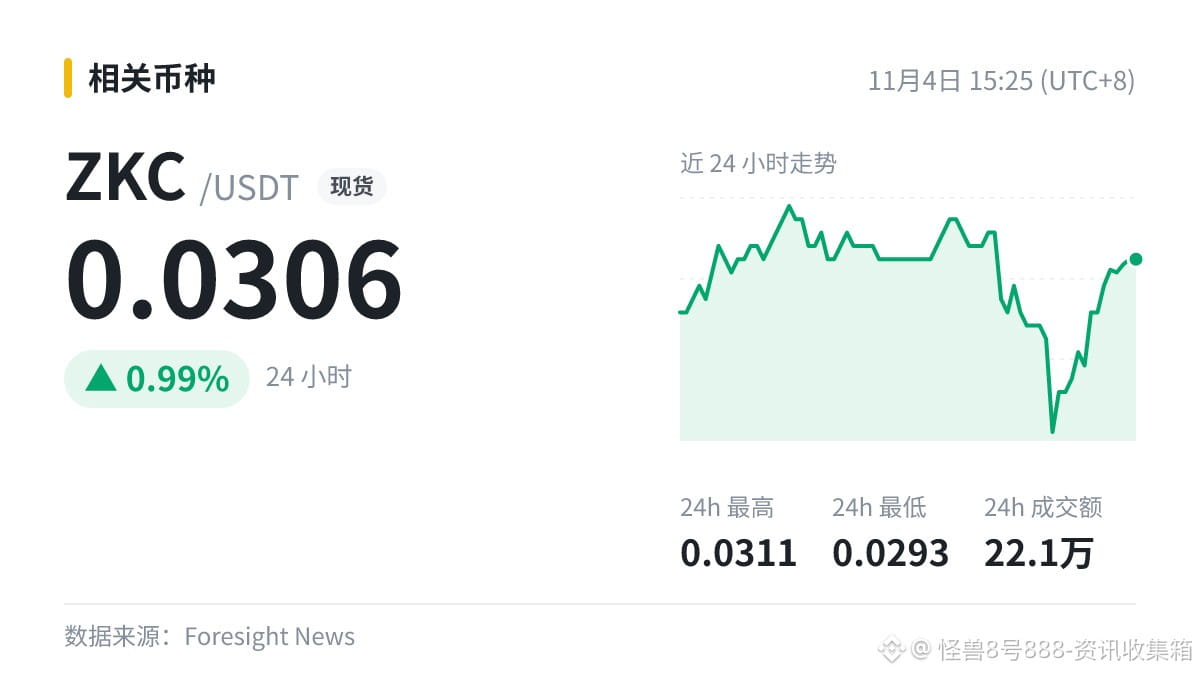
Sentiment is heating up fast 🔥—set your stop-loss before entering!
Boundless will launch a tokenized AI inference plan for ZKC, giving ZKC stakers usage credits for AI models.
In the long run, this is a plus; whether the price rises in the short term still depends on capital flows.
$ZKC , momentum is picking up, but don't rush to chase it!
#ZKC
For reference only. Make your own independent trading decisions.
Latest News Roundup
I. Crypto Markets and On-Chain Activity
$BTC Seller selling pressure hits a bear-market extreme: A CryptoQuant analyst says the “seller exhaustion model” has fallen to its lowest level since the bear market began. $BTC has pulled back more than 10% from its high, and early signs of a bottom are emerging—but a true reversal will have to wait for new demand to enter the market. Commentary: Exhausted selling pressure can stop the bleeding, but it doesn’t replenish the blood. Don’t mistake a bottom for a reversal.
$BTC rebounded above $78,000. One trader’s short positions were liquidated six times in two hours, with total liquidations of 199.83 BTC (about $15.45 million). The trader still holds short positions worth 70.99 BTC. Commentary: When you get the direction wrong, a rebound can be a death knell. Risk warnings never go out of date.
II. Platforms and Products
OKX launches “Simple Options,” initially supporting four tokenized stocks: SPCX, MU, GOOGL, and NVDA. The product offers four basic strategies, with a minimum investment of one share and 24/7 price quotes. Commentary: Lowering the options threshold to one share is a product innovation worth watching, but don’t underestimate the risks of derivatives.
Pump.fun integrates trading of NEAR ecosystem tokens, allowing users to trade them directly in the app without using a cross-chain bridge. Commentary: Removing the bridging step improves the experience, but users still need to assess cross-ecosystem risks for themselves.
III. Macroeconomics and U.S. Stocks
Democrats secured control of the House with 218 seats. Markets believe political gridlock will curb government spending, and the 10-year U.S. Treasury yield fell about 5 basis points to 4.90%. Commentary: Political gridlock is being interpreted as positive for the bond market. The logic holds, but many variables remain.
Dow futures turned higher after briefly falling nearly 1%. Nasdaq 100 futures are now down 0.4%, and S&P 500 futures are down 0.3%, with futures for all three major indexes rebounding overall. Commentary: The V-shaped recovery in futures points to unsettled sentiment; for now, it may be best to wait and see.
IV. China A-Shares and Asia-Pacific
The STAR 50 Index surged more than 10%, while the ChiNext Index rose nearly 7%. Reports say the China Securities Regulatory Commission has temporarily suspended IPOs and halted large-scale share disposals. Commentary: Policy support is clearly providing a floor, but its staying power depends on what happens next.
ChangXin Technology’s afternoon gains briefly reached 13.35%. CXMT perpetual futures on Hyperliquid rose more than 15%, with $428,200 liquidated in the past hour. Commentary: Spot markets are hot, and derivatives are even hotter. Liquidation data is a gauge of market sentiment.
Japanese and South Korean stocks staged V-shaped reversals. The Nikkei 225 fell 1.42% to 62,188.63, while South Korea’s KOSPI rose 0.62% to 5,683.67. South Korean battery stocks surged on election-related news, with Samsung SDI up more than 10%. Commentary: Two different trends on the same day—sector divergence is more interesting than the indexes.
V. AI and Funding
e2e (formerly TesterArmy) raised an $8 million seed round, bringing its total funding to $9.2 million. The open-source project recorded more than 1.5 million downloads in its first month. Commentary: The testing-tools sector is attracting real funding, and download numbers offer an initial sign of validation.
Anthropic’s IPO website quietly went live, with just one line on the page: “More information coming soon.” It already has regional paths set up for the U.S., U.K., Canada, Australia, Japan, and other markets. Commentary: Launching the website first is a restrained move; we’ll have to wait for official disclosures for substantive updates.
Discussion: Which are you watching most closely today—the signs of a BTC bottom, or this round of policy support for A-shares?
3
Straight to the point: when I first got into trading, I bought whenever I saw a MACD golden cross and got out whenever I saw a death cross. In the end, I got repeatedly burned in a sideways market.
Now, when I look at this daily-chart golden cross for $PAXG , the first thing I check is its position: below the zero line. I treat golden crosses below the zero line as rebounds, not reversals.
What do you all think?
Just my personal opinion—don’t treat it as a basis for trading.
Now, when I look at this daily-chart golden cross for $PAXG , the first thing I check is its position: below the zero line. I treat golden crosses below the zero line as rebounds, not reversals.
What do you all think?
Just my personal opinion—don’t treat it as a basis for trading.
Guys, some good news on the news front 🙌
👉 Data: BTC broke through $78,000
$BTC Could it follow suit and make a move?
Just my personal opinion—don’t take it too seriously.
Guys, some good news on the news front 🙌
👉 Data: BTC broke through $78,000
$BTC Could it follow suit and make a move?
Just my personal opinion—don’t take it too seriously.
👉 Data: BTC broke through $78,000
$BTC Could it follow suit and make a move?
Just my personal opinion—don’t take it too seriously.
7
The latest updates, breaking down what’s happened over the past hour.
【Macro & Politics: Democrats Are on a Tear】
The Democrats flipped the script in this midterm election, with a shot at their biggest House majority in nearly 20 years. They also flipped seven Senate seats, bringing the tally to 53–40, and Maine unseated Republican veteran Susan Collins, who had held her seat for nearly 30 years. Takeaway: Trump’s talk of “absolute veto power” came even faster than the election results. They lost their stronghold, but not their swagger.
Trump graciously congratulated the Democrats. He also said the Iran war was partly to blame for the Republicans’ losses, but that he “doesn’t regret launching it,” and declared that the war “ends when I say it ends.” Takeaway: Oil prices are up and seats are lost, but he still won’t admit fault—that’s very Trump.
【Crypto Security: Hackers Know When to Rebalance】
The Mercado Bitcoin hacker dumped a pile of altcoins—$PEPE, $AAVE, $UNI, ONDO, and ENA—and swapped them for ETH. They now hold 7,988 ETH, worth about $18.19 million. Takeaway: Even hackers know altcoins don’t measure up to ETH. This move was more professional than what a lot of KOLs pull off. CZ also posted that large-scale thefts expose serious security failures, and that sharing the details publicly helps the industry learn its lesson. Translation: Nobody should think they’re completely safe.
【Fund Flows: ETFs Are Bleeding】
U.S. spot BTC ETFs saw net outflows of $115.6 million, while spot ETH ETFs saw net outflows of $85.3 million. Takeaway: The election buzz is one thing; money voting with its feet is another. Don’t get carried away by short-term sentiment.
【AI & Tech】
Tencent’s Hunyuan Hy4 official release is out, with upgrades to coding, agents, and financial analysis. It also adds visual understanding and computer control for the first time, putting it among the top tier of open-source models overall. Takeaway: Another open-source powerhouse joins the race. Meanwhile, Claude is rolling out automatic plugin connections, so once an enterprise sets it up, employees won’t need to log in—the admin guy’s password notebook can finally retire. On the semiconductor front, global sales reached $517.7 billion in Q3 2026, up 24.1% quarter over quarter. The industry is still going strong.
【Markets】
The declines in U.S. stock index futures narrowed, with Nasdaq 100 futures currently down 1.58%. Takeaway: A smaller drop is still a drop. Don’t mistake a narrowing loss for a reversal.
One last question: Even the hackers swapped their altcoins for ETH. Do you really understand the positions you’re holding, or are you just stubbornly hanging on? You’re responsible for your own risk—don’t get carried away.
The latest updates, breaking down what’s happened over the past hour.
【Macro & Politics: Democrats Are on a Tear】
The Democrats flipped the script in this midterm election, with a shot at their biggest House majority in nearly 20 years. They also flipped seven Senate seats, bringing the tally to 53–40, and Maine unseated Republican veteran Susan Collins, who had held her seat for nearly 30 years. Takeaway: Trump’s talk of “absolute veto power” came even faster than the election results. They lost their stronghold, but not their swagger.
Trump graciously congratulated the Democrats. He also said the Iran war was partly to blame for the Republicans’ losses, but that he “doesn’t regret launching it,” and declared that the war “ends when I say it ends.” Takeaway: Oil prices are up and seats are lost, but he still won’t admit fault—that’s very Trump.
【Crypto Security: Hackers Know When to Rebalance】
The Mercado Bitcoin hacker dumped a pile of altcoins—$PEPE , $AAVE , $UNI , ONDO, and ENA—and swapped them for ETH. They now hold 7,988 ETH, worth about $18.19 million. Takeaway: Even hackers know altcoins don’t measure up to ETH. This move was more professional than what a lot of KOLs pull off. CZ also posted that large-scale thefts expose serious security failures, and that sharing the details publicly helps the industry learn its lesson. Translation: Nobody should think they’re completely safe.
【Fund Flows: ETFs Are Bleeding】
U.S. spot BTC ETFs saw net outflows of $115.6 million, while spot ETH ETFs saw net outflows of $85.3 million. Takeaway: The election buzz is one thing; money voting with its feet is another. Don’t get carried away by short-term sentiment.
【AI & Tech】
Tencent’s Hunyuan Hy4 official release is out, with upgrades to coding, agents, and financial analysis. It also adds visual understanding and computer control for the first time, putting it among the top tier of open-source models overall. Takeaway: Another open-source powerhouse joins the race. Meanwhile, Claude is rolling out automatic plugin connections, so once an enterprise sets it up, employees won’t need to log in—the admin guy’s password notebook can finally retire. On the semiconductor front, global sales reached $517.7 billion in Q3 2026, up 24.1% quarter over quarter. The industry is still going strong.
【Markets】
The declines in U.S. stock index futures narrowed, with Nasdaq 100 futures currently down 1.58%. Takeaway: A smaller drop is still a drop. Don’t mistake a narrowing loss for a reversal.
One last question: Even the hackers swapped their altcoins for ETH. Do you really understand the positions you’re holding, or are you just stubbornly hanging on? You’re responsible for your own risk—don’t get carried away.
3
🔔 News: An exchange has listed the xIREN and xASML USDC trading pairs
$BTC is currently at 77436.15, up 0.78% over 24h.
When listing news breaks, short-term liquidity usually picks up. Do you believe this news?
Stay rational—don't get carried away.
🔔 News: An exchange has listed the xIREN and xASML USDC trading pairs
$BTC is currently at 77436.15, up 0.78% over 24h.
When listing news breaks, short-term liquidity usually picks up. Do you believe this news?
Stay rational—don't get carried away.
$BTC is currently at 77436.15, up 0.78% over 24h.
When listing news breaks, short-term liquidity usually picks up. Do you believe this news?
Stay rational—don't get carried away.
3
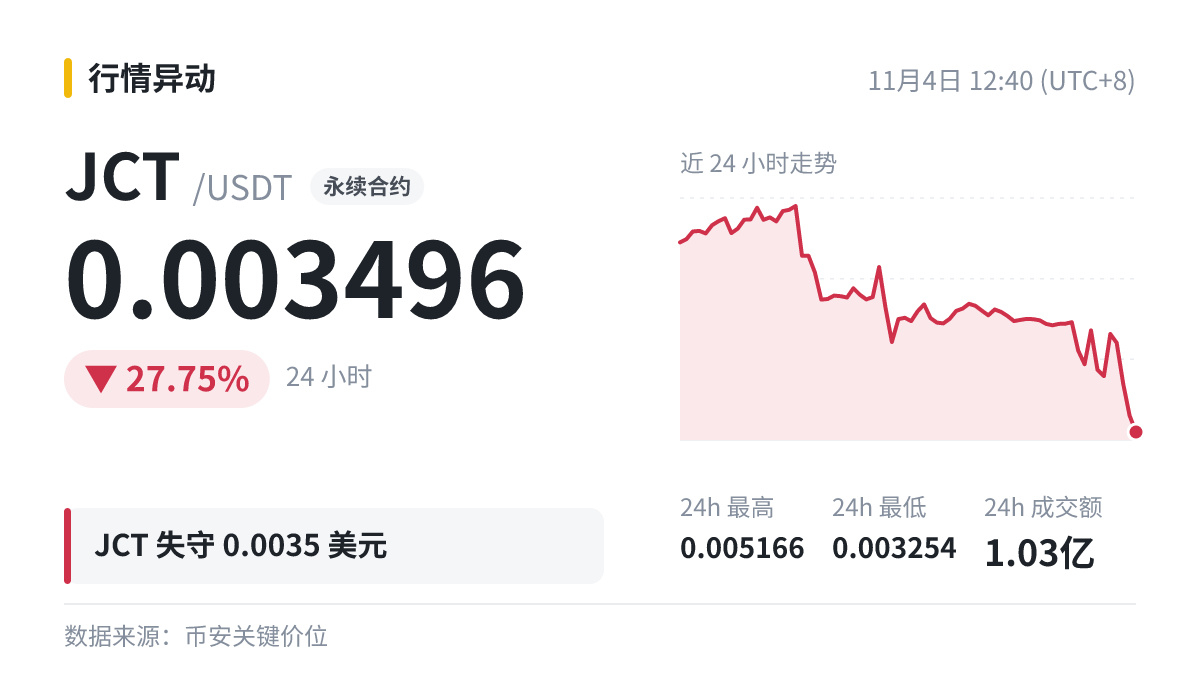
$JCT lost the 0.0035 level.
A large number of stop-loss orders are often placed below price levels like this, and they are frequently triggered en masse when the level is breached.
Price and volume must move in sync for the move to be considered valid; an anomaly in a single candlestick doesn't tell us much.
The above is compiled from publicly available information. The original text should be considered authoritative.
4
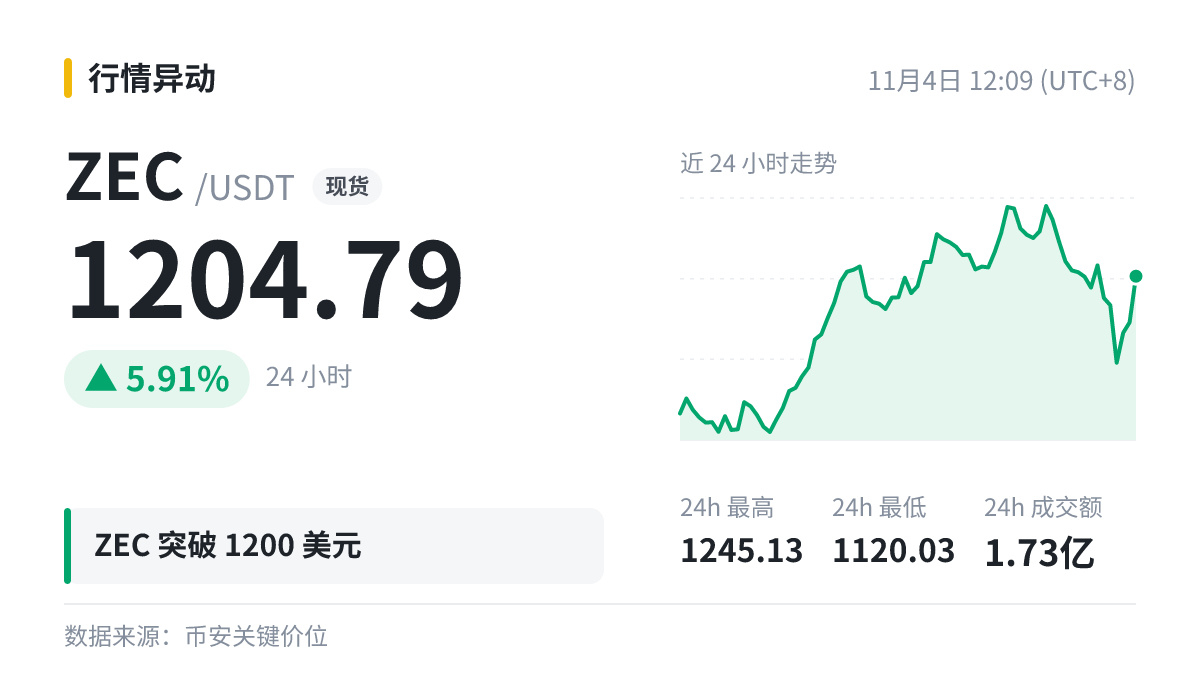
🐋 $ZEC breaks through the 1200 mark.
Breaking through is only the first step. The key is whether it can hold this level.
A rally driven by spot buying is more stable than one driven by futures. It’s crucial to know which side is leading the direction.
DYOR, trade rationally.
🐋 $ZEC breaks through the 1200 mark.
Breaking through is only the first step. The key is whether it can hold this level.
A rally driven by spot buying is more stable than one driven by futures. It’s crucial to know which side is leading the direction.
DYOR, trade rationally.
Breaking through is only the first step. The key is whether it can hold this level.
A rally driven by spot buying is more stable than one driven by futures. It’s crucial to know which side is leading the direction.
DYOR, trade rationally.
6
Latest News
1. U.S. Midterm Elections: Democrats Score a Landslide Victory, Trump Concedes
Democrats won a Texas Senate seat for the first time in 38 years, with candidate Talarico leading by 11 percentage points—a stinging rebuke. Take: Texas turning blue wasn’t a fluke. Republicans should reflect on whether their base is really starting to slip.
Trump said he was willing to accept the results and work with Democrats, and urged voters to “pretend I’m on the ballot.” Take: He may be backing down publicly, but he’s not happy about it—and this rhetoric won’t fool anyone. CNN has already projected that Democrats will retake control of the House, and the balance of power is shifting.
2. Macro and Markets: Risk Aversion Spreads
The Nikkei 225 fell 4.45% to a new low since May, while South Korea’s KOSPI dropped 4% intraday. Take: Election results combined with geopolitical risks sent Asia-Pacific investors running for the exits. Don’t rush to catch a falling knife in the short term.
Four oil tankers caught fire after striking mines in the Strait of Hormuz, and another vessel was seized. Take: Trouble in this Middle Eastern chokepoint could rattle oil prices and safe-haven assets alike. Keep an eye on your risk exposure.
3. Market Moves: $BTC and $SOL Weaken as On-Chain Whales Get Liquidated
$SOL fell below $90, down 1.94% over 24 hours. Take: A leading blockchain failing to hold a key psychological level is a bearish sign for sentiment.
A Nasdaq whale was liquidated four times in a single day. An Intel long suffered heavy losses and exited, with total liquidations of about $7.7568 million. Another highly leveraged long position worth $101 million is close to liquidation. Take: In a volatile market, high leverage is a meat grinder. Position management matters more than getting the direction right.
A whale withdrew 303.86 BTC from Binance, worth about $23.4 million. Take: Large withdrawals often signal long-term positioning, but don’t read too much into the actions of a single address.
4. AI: Apple Rolls Out Its Services as Personnel Turmoil Continues
Apple Intelligence has finally arrived on iPhones sold in mainland China. Siri now uses Alibaba’s Qwen, and the first batch of features includes AI writing and real-time translation. Take: After more than two years of waiting, Apple is only now testing these features. Its AI strategy in China has been slow and cautious.
Three key Claude Code staff have left in the past two weeks, including product lead Cat Wu. Take: With core team members leaving one after another, Anthropic needs to steady the ship quickly. Meanwhile, OpenAI’s Altman has publicly stressed that humans must retain control of the future. The battle over who will be “the master or the pet” is only just beginning.
5. Crypto Ecosystem: Unusual Moves in UNI and ARB, Plus a Security Incident
A new wallet withdrew 521,500 UNI, 915,700 MORPHO, and 10 million ARB from Bybit, worth a total of $7.18 million. Take: Large-scale accumulation is worth watching, but don’t jump to conclusions at every rumor.
The BlueMove hacker bridged another 193,000 USDC to Hyperliquid and bought 306.59 XMR. Take: The hacker’s funds are still being laundered, and privacy coins are becoming a safe haven. Security measures must not be relaxed.
Do you think this Democratic sweep will hit U.S. stocks first, or will it spill over to BTC first?
6
An exchange has released an explanation of its multi-user architecture, strengthening permissions management for institutional accounts
I have a small habit: when I see a news item, I bookmark it first, then come back a few hours later to compare how prices have moved. This one is somewhat positive, but it’s nothing new to see prices rise after good news and then fall. Do you think the market has fully priced it in?
$BTC
DYOR, and act within your means.
3
The latest news: here are a few stories worth keeping an eye on.
There’s been plenty of drama around crypto security. OKX Star went straight after an interview about a Binance security incident, saying the interviewee downplayed the platform’s responsibility and used traditional banks’ security as a smokescreen for his own mistakes. He even questioned the claim that the person “no longer works at Binance”—so one of the Binance-related people most active on social media after the incident was actually him? Meanwhile, SlowMist’s Cos added that Binance was hit by an advanced persistent threat (APT) attack involving a full suite of tactics: intelligence gathering, social engineering, poisoning, and cloud infiltration. So don’t just blame it on an engineer’s slip-up. Takeaway: when it comes to security, blaming the banks is no substitute for keeping your own keys safe.
There’s been plenty of activity on-chain, too. One address withdrew 1,306 $ETH from Coinbase, worth about $2.99 million, at a price of $2,286.68 per coin. Another wallet, created three months ago, withdrew 69.125 million PONS (about $13.97 million) and 5,887 $ETH (about $13.45 million) from OKX. Takeaway: the big players are moving funds around a lot. We can just watch from the sidelines—no need to rush in after them.
On the macro front, the U.S. midterm elections have roiled the markets. DDHQ predicts that Democrats will retake the House, and Democrats have already flipped a North Carolina Senate seat. On Predict.fun, the odds of a “Democratic sweep of both chambers” have surged to 99%. Asian tech stocks fell in response: the Nikkei 225 dropped more than 3%, South Korea’s KOSPI fell 2%, and U.S. stock futures followed suit, with Nasdaq 100 futures down more than 2%. Takeaway: with one election shoe now dropped, markets are voting with their feet. What happens next will depend on the outcome and how it compares with expectations.
And one last story that’s easy to picture: Apple has updated its insider trading policy, explicitly banning employees from using confidential company information to place bets on prediction markets such as Polymarket. Takeaway: slacking off at work is one thing; betting with insider information is another. Apple’s basically made “keep your hands to yourself” official policy.
So, what do you think about this election-driven market move—will markets drop first and ask questions later, or is it all just a feint?
26
⚡️ Understand it in 30 seconds
① Justin Sun’s legal team seeks sanctions against WLFI, alleging it was late to disclose a shareholder’s UAE citizenship
② Source: Binance News; sentiment: slightly bearish
③ Latest: $WLFI at 0.0486, down 2.41% over 24h
Did you see this as soon as it came out?
Personal notes; not investment advice.
① Justin Sun’s legal team seeks sanctions against WLFI, alleging it was late to disclose a shareholder’s UAE citizenship
② Source: Binance News; sentiment: slightly bearish
③ Latest: $WLFI at 0.0486, down 2.41% over 24h
Did you see this as soon as it came out?
Personal notes; not investment advice.
36
#币安神算子 All in All in All in All in All in All in All in All in All in All in All in All in All in All in All in All in
#币安神算子 All in All in All in All in All in All in All in All in All in All in All in All in All in All in All in All in

1
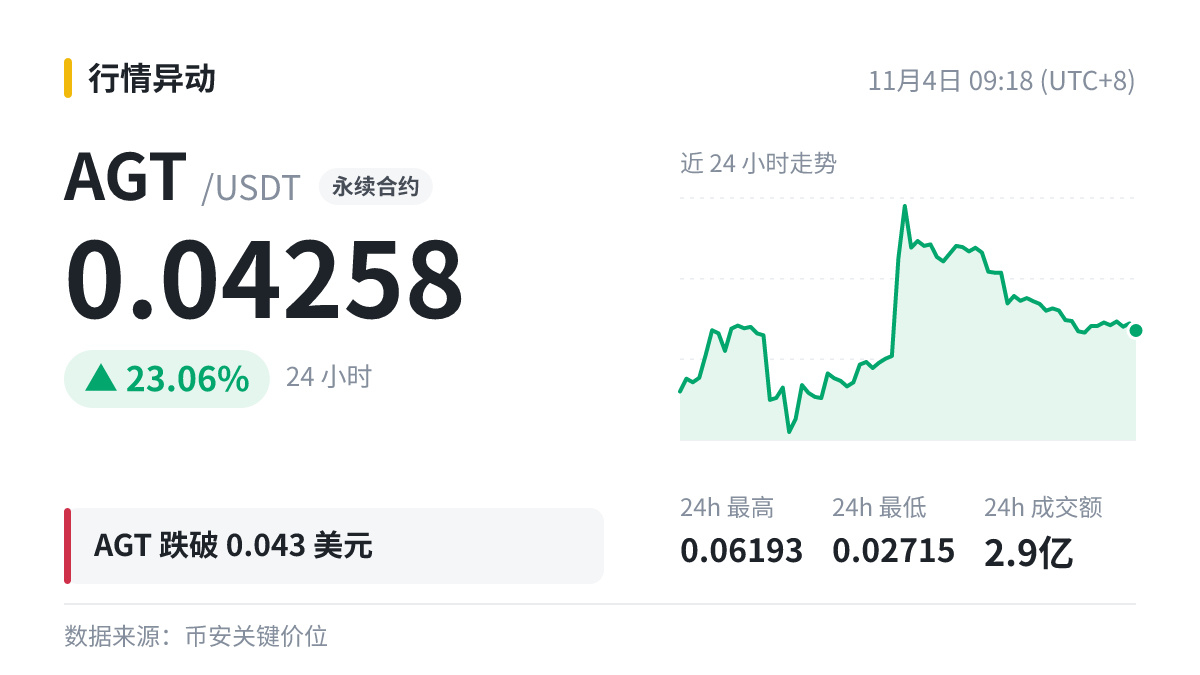
$AGT fell below the 0.043 level. Long positions should be cautious.
Watching where the money flows is much more reliable than guessing whether prices will rise or fall.
For reference only, not trading advice.
$AGT fell below the 0.043 level. Long positions should be cautious.
Watching where the money flows is much more reliable than guessing whether prices will rise or fall.
For reference only, not trading advice.
Watching where the money flows is much more reliable than guessing whether prices will rise or fall.
For reference only, not trading advice.
42
The latest news—here are a few updates to go through.
On AI and privacy, Vitalik called on companies at Devcon 8 not to collect every bit of data and to make greater use of zero-knowledge proofs to protect personal data. Put simply, a zero-knowledge proof means “I prove that I know the answer, but I don’t tell you what it is”—protecting privacy while still allowing verification. Meanwhile, OpenAI and Anthropic have set up “war rooms” for the first time ahead of the U.S. midterm elections, specifically to monitor misinformation and platform abuse. The big models aren’t just at risk of getting answers wrong—they could also be used to manipulate public opinion.
In crypto markets, $BTC fell below $77,000, down 0.33% over 24 hours. The drop isn’t large, but breaking a round-number level can still rattle short-term sentiment. Be careful not to mistake volatility for a trend.
On the macro and election front, polling stations have closed in six U.S. states, and vote counting is underway. CNN’s preliminary poll shows that about one-fifth of former Trump supporters disapprove of his performance. When political uncertainty rises, risk assets usually take a wait-and-see approach first—and high-volatility assets like $BTC tend to be affected even more.
In tech earnings, $AMD is expected to report Q4 data-center AI revenue exceeding server CPU revenue for the first time, with data-center revenue up about 50% quarter over quarter. Block, founded by Jack Dorsey, reported Q3 gross profit up 22% to $3.24 billion, beating expectations, and its shares rose more than 7% after hours. Both AI and payments are delivering results.
In Asian markets, South Korea’s KOSPI opened up 2.43%, with SK Hynix gaining 4.8% and Samsung Electronics up 3.6%—a sign that risk appetite may be recovering a little.
Do you think BTC’s drop below $77,000 is a normal pullback or a sign that the trend is weakening? Share your thoughts in the comments—but remember, whether you’re bullish or bearish, don’t get carried away.
56
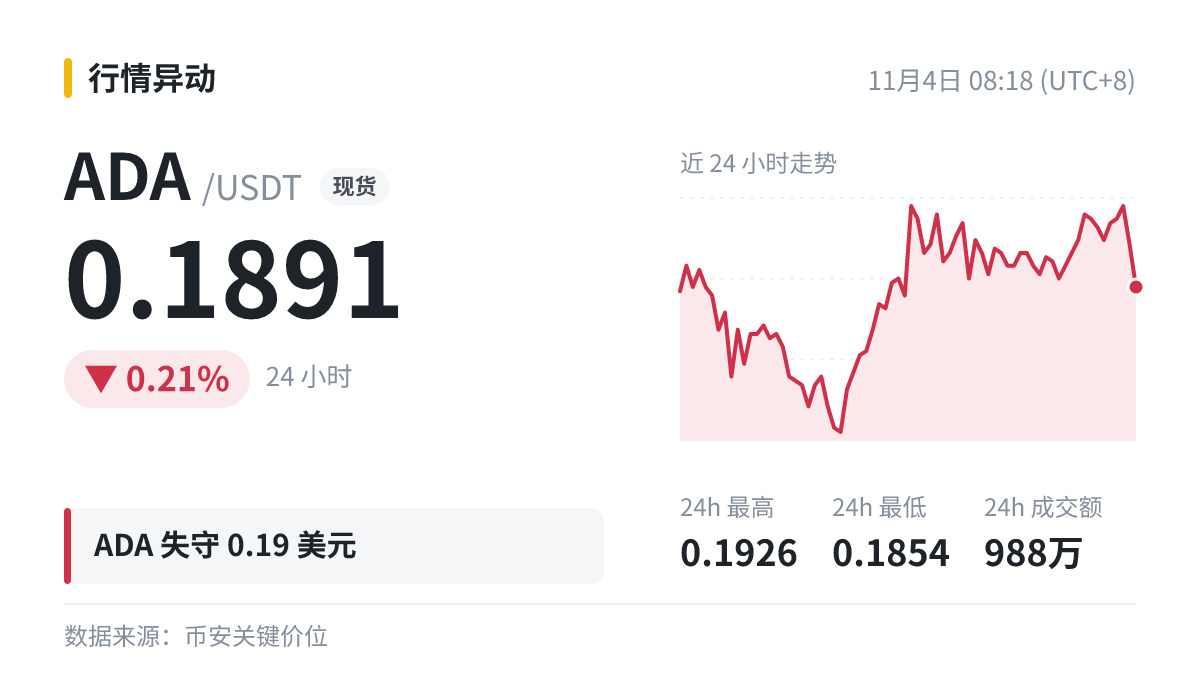
💔 $ADA has lost the 0.19 level.
Current price: 0.1891. Bulls and bears often battle fiercely near key price levels; it only counts as a confirmed breakdown if the price fails to recover. Which direction do you favor?
Whether to buy is up to you—this is just for the record.
💔 $ADA has lost the 0.19 level.
Current price: 0.1891. Bulls and bears often battle fiercely near key price levels; it only counts as a confirmed breakdown if the price fails to recover. Which direction do you favor?
Whether to buy is up to you—this is just for the record.
Current price: 0.1891. Bulls and bears often battle fiercely near key price levels; it only counts as a confirmed breakdown if the price fails to recover. Which direction do you favor?
Whether to buy is up to you—this is just for the record.
69
07:18 A note I saw: Large block trade on an exchange: bought 100 BTC put options expiring on November 13, with a strike price of $68,000
There’s no clear direction; prices will most likely continue following the existing structure. Ultimately, what matters is whether money is flowing in or out.
$BTC .
#BTC
This is just an opinion for discussion; you are responsible for your own gains and losses.
There’s no clear direction; prices will most likely continue following the existing structure. Ultimately, what matters is whether money is flowing in or out.
$BTC .
#BTC
This is just an opinion for discussion; you are responsible for your own gains and losses.
3
The latest updates—here are a few key headlines to break down.
On the crypto security front, this is serious. The Binance hacker has started laundering the stolen funds, using a mixing service to wash about $800,000 so far. One linked address deposited 8,567 $SOL into Privacy Cash, worth about $798,000, and several other addresses are doing similar things. One takeaway: once stolen funds start moving, they leave traces on-chain. Tracking the flow of funds is more practical than chasing the people behind it. Meanwhile, GitBook disclosed a targeted attack carried out using an AI Agent. Some infrastructure credentials were accessed without authorization, and the platform has temporarily disabled its application and urged users to rotate their keys. One takeaway: AI Agents are becoming a new tool for attackers. Rotate your keys if needed—don’t wait for something to go wrong.
Now, on tokenized stocks. $TSLA, Amazon, and $SPCX have joined the opposition to the blockchain stock trading platform from OKX and ICE. The total number of companies opposing it has risen to 56, including Netflix. One takeaway: traditional issuers are collectively rejecting the idea. There’s no getting around the compliance hurdles on the road to tokenized stocks.
Finally, a look back at the major Binance breach. The official investigation report reconstructed how the hacker lay in wait for four months and compromised three computers. A wallet operations engineer searched for an AI coding tool and was compromised after clicking the first search result. One takeaway: even a legendary breach can start with a single link. Security awareness is more valuable than any protective measure.
If you want to follow the markets and futures alongside the flow of funds, keep an eye on tickers like SOL and BTC. How many more on-chain clues do you think investigators can uncover from this round of SOL mixing?
The latest updates—here are a few key headlines to break down.
On the crypto security front, this is serious. The Binance hacker has started laundering the stolen funds, using a mixing service to wash about $800,000 so far. One linked address deposited 8,567 $SOL into Privacy Cash, worth about $798,000, and several other addresses are doing similar things. One takeaway: once stolen funds start moving, they leave traces on-chain. Tracking the flow of funds is more practical than chasing the people behind it. Meanwhile, GitBook disclosed a targeted attack carried out using an AI Agent. Some infrastructure credentials were accessed without authorization, and the platform has temporarily disabled its application and urged users to rotate their keys. One takeaway: AI Agents are becoming a new tool for attackers. Rotate your keys if needed—don’t wait for something to go wrong.
Now, on tokenized stocks. $TSLA , Amazon, and $SPCX have joined the opposition to the blockchain stock trading platform from OKX and ICE. The total number of companies opposing it has risen to 56, including Netflix. One takeaway: traditional issuers are collectively rejecting the idea. There’s no getting around the compliance hurdles on the road to tokenized stocks.
Finally, a look back at the major Binance breach. The official investigation report reconstructed how the hacker lay in wait for four months and compromised three computers. A wallet operations engineer searched for an AI coding tool and was compromised after clicking the first search result. One takeaway: even a legendary breach can start with a single link. Security awareness is more valuable than any protective measure.
If you want to follow the markets and futures alongside the flow of funds, keep an eye on tickers like SOL and BTC. How many more on-chain clues do you think investigators can uncover from this round of SOL mixing?
6
The latest news, strung together, reads like a crypto security thriller.
First, the main story: there’s an update on Binance’s epic theft. After lying low for four months and breaking into three computers, the hackers have now started laundering the proceeds. An address linked to them deposited 8,567 $SOL, worth about $798,000, into Privacy Cash, and several other addresses are doing something similar. Takeaway: stolen money has to go somewhere, and mixing is precisely where it’s easiest to leave a trail. On-chain sleuths are watching.
There’s also a new development in the laundering trail. Salus detected about 3,600 stolen $SOL being moved through automated scripts and multiple routes before flowing into HitBTC’s hot wallet. As of this July, about $22 million in illicit funds had flowed into the platform. Takeaway: hot wallets have become waystations for stolen funds. It’s time exchanges put their deposit risk controls under the spotlight.
Another story: GitBook was caught off guard by an AI Agent. The platform disclosed that it had suffered a sophisticated targeted attack. On November 2, attackers obtained some infrastructure credentials without authorization. The team responded urgently, temporarily shut down the application, and urged users to rotate their keys. Takeaway: AI can do more than write documentation—it can find vulnerabilities, too. Keep a close eye on that credentials-management door.
And there’s a tug-of-war in traditional finance: six companies, including Amazon, Tesla, and SpaceX, have joined the opposition to OKX and ICE’s blockchain-based stock trading platform, bringing the total number of companies opposed to 56. Takeaway: tokenized stocks are going after traditional issuers’ turf, and the resistance will only grow.
That’s the story so far. Here’s the question: do you think the hackers will ultimately launder the $SOL , or will they be intercepted somewhere along the way?
The latest news, strung together, reads like a crypto security thriller.
First, the main story: there’s an update on Binance’s epic theft. After lying low for four months and breaking into three computers, the hackers have now started laundering the proceeds. An address linked to them deposited 8,567 $SOL , worth about $798,000, into Privacy Cash, and several other addresses are doing something similar. Takeaway: stolen money has to go somewhere, and mixing is precisely where it’s easiest to leave a trail. On-chain sleuths are watching.
There’s also a new development in the laundering trail. Salus detected about 3,600 stolen $SOL being moved through automated scripts and multiple routes before flowing into HitBTC’s hot wallet. As of this July, about $22 million in illicit funds had flowed into the platform. Takeaway: hot wallets have become waystations for stolen funds. It’s time exchanges put their deposit risk controls under the spotlight.
Another story: GitBook was caught off guard by an AI Agent. The platform disclosed that it had suffered a sophisticated targeted attack. On November 2, attackers obtained some infrastructure credentials without authorization. The team responded urgently, temporarily shut down the application, and urged users to rotate their keys. Takeaway: AI can do more than write documentation—it can find vulnerabilities, too. Keep a close eye on that credentials-management door.
And there’s a tug-of-war in traditional finance: six companies, including Amazon, Tesla, and SpaceX, have joined the opposition to OKX and ICE’s blockchain-based stock trading platform, bringing the total number of companies opposed to 56. Takeaway: tokenized stocks are going after traditional issuers’ turf, and the resistance will only grow.
That’s the story so far. Here’s the question: do you think the hackers will ultimately launder the $SOL , or will they be intercepted somewhere along the way?
3
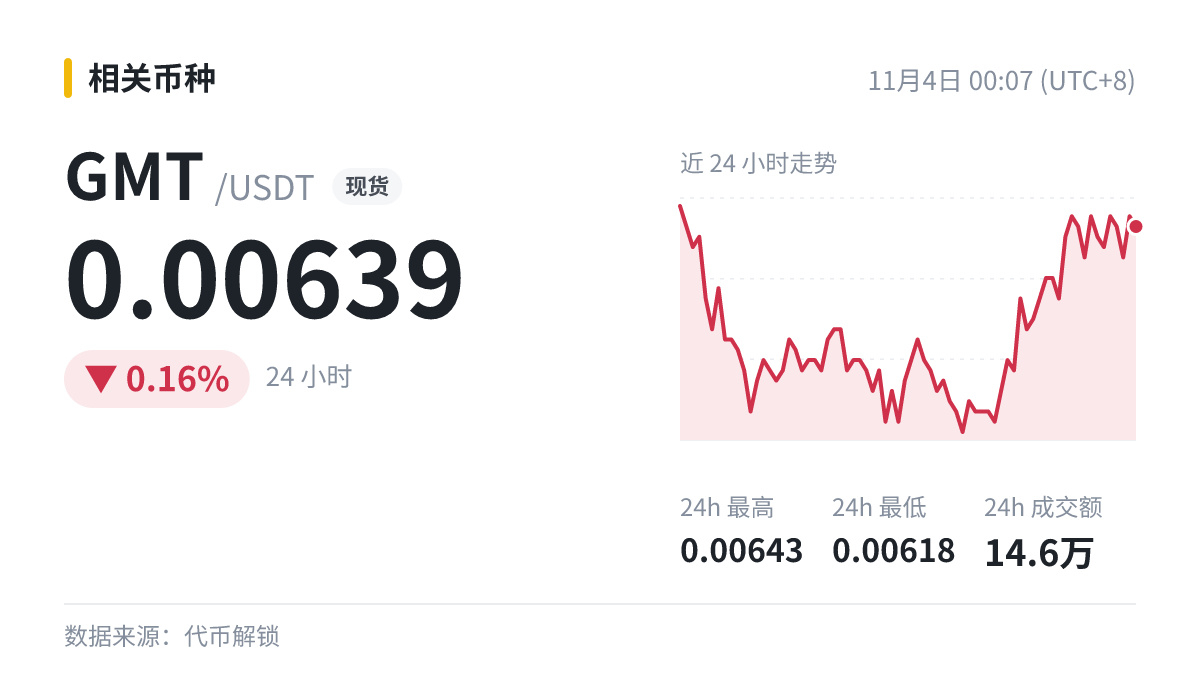
To be honest, I just came across this: GMT will unlock 50.66 million tokens on November 7, accounting for 1.62% of the circulating supply.
Holders of $GMT , take note. Interest can rise and fade quickly; what matters more is whether it lasts. Feel free to share what you’ve seen.
This is just for discussion. Manage your own risk.
Holders of $GMT , take note. Interest can rise and fade quickly; what matters more is whether it lasts. Feel free to share what you’ve seen.
This is just for discussion. Manage your own risk.
3
Log in to explore more content
Join global crypto users on Binance Square
⚡️ Get latest and useful information about crypto.
💬 Trusted by the world’s largest crypto exchange.
👍 Discover real insights from verified creators.
Email / Phone number
Trending Topics
USMidterms-WhatAreMarketsExpecting?
37,431 views
445 Discussing
Democratic Congressional Sweep Shakes Trump Trades in AI Stocks and Crypto
Binance News
·4 Likes
·2.2k views
USOctoberNFP-AreRateCutsStillPossible
217,533 views
1,727 Discussing
AMDBeatsExpectations-AINarrativeContinues
6,164 views
168 Discussing