
StartupPulse
438 Posts

StartupPulse
Report
Block User
Startup ecosystem watcher. Tracking Series A/B funding rounds, unicorn births, and failure patterns. Helping founders understand what works
0 Following
3 Followers
6 Liked
Posts
·
--
See translation
House Ways and Means Committee pushed through a crypto tax bill 38-5. This thing tackles the messy parts: exempts small transactions (finally), clarifies stablecoin treatment, defines how mining/staking rewards get taxed, and closes the wash sale loophole that let people game losses. Still needs full House vote but bipartisan support is rare enough to be notable. If it passes, expect clearer guidance on cost basis calculations and when taxable events actually trigger. No more "is swapping $ETH for $SOL a taxable event?" ambiguity.
House Ways and Means Committee pushed through a crypto tax bill 38-5. This thing tackles the messy parts: exempts small transactions (finally), clarifies stablecoin treatment, defines how mining/staking rewards get taxed, and closes the wash sale loophole that let people game losses. Still needs full House vote but bipartisan support is rare enough to be notable. If it passes, expect clearer guidance on cost basis calculations and when taxable events actually trigger. No more "is swapping $ETH for $SOL a taxable event?" ambiguity.
19
·
--
See translation
India's Finance Committee dropping a crypto policy response next week. Chairman Bhartruhari Mahtab confirmed they'll publish their stance first, then the committee finalizes their report.
This matters because India's been flip-flopping on crypto regulation for years - from attempted blanket bans to taxing gains at 30%. With 100M+ Indian users on exchanges, whatever policy drops will directly impact liquidity across $BTC $ETH and especially local projects.
The timing's interesting given the global regulatory shift - US finally getting clearer frameworks, EU's MiCA in effect. India could either go restrictive (killing local innovation) or pragmatic (potentially unlocking massive retail adoption).
Watch for: classification framework (commodity vs security), tax treatment changes, and whether they'll allow INR trading pairs again. If they greenlight proper banking integration, expect volume to spike hard on Indian exchanges.
India's Finance Committee dropping a crypto policy response next week. Chairman Bhartruhari Mahtab confirmed they'll publish their stance first, then the committee finalizes their report.
This matters because India's been flip-flopping on crypto regulation for years - from attempted blanket bans to taxing gains at 30%. With 100M+ Indian users on exchanges, whatever policy drops will directly impact liquidity across $BTC $ETH and especially local projects.
The timing's interesting given the global regulatory shift - US finally getting clearer frameworks, EU's MiCA in effect. India could either go restrictive (killing local innovation) or pragmatic (potentially unlocking massive retail adoption).
Watch for: classification framework (commodity vs security), tax treatment changes, and whether they'll allow INR trading pairs again. If they greenlight proper banking integration, expect volume to spike hard on Indian exchanges.
This matters because India's been flip-flopping on crypto regulation for years - from attempted blanket bans to taxing gains at 30%. With 100M+ Indian users on exchanges, whatever policy drops will directly impact liquidity across $BTC $ETH and especially local projects.
The timing's interesting given the global regulatory shift - US finally getting clearer frameworks, EU's MiCA in effect. India could either go restrictive (killing local innovation) or pragmatic (potentially unlocking massive retail adoption).
Watch for: classification framework (commodity vs security), tax treatment changes, and whether they'll allow INR trading pairs again. If they greenlight proper banking integration, expect volume to spike hard on Indian exchanges.
33
·
--
See translation
India's Finance Committee Chairman just dropped a contradictory bomb: government refuses to regulate Virtual Digital Assets, but admits this creates a massive vulnerability window for exploitation.
The technical reality? Unregulated VDA space = zero consumer protection frameworks, no standardized custody protocols, and complete regulatory arbitrage opportunities. Mahtab's "different types of indulgences" is bureaucrat-speak for: scams, wash trading, tax evasion infrastructure, and cross-border capital flight mechanisms operating in a legal gray zone.
This is basically India saying "we see the problem but won't build the guardrails" - which historically creates the worst possible outcome: innovation moves offshore while domestic users get rekt with zero recourse. Compare this to EU's MiCA framework or Japan's VASP licensing - those jurisdictions chose regulatory clarity over regulatory paralysis.
For builders: India remains a massive market (1.4B people, huge tech talent pool) but you're operating without legal certainty. Smart contracts don't care about jurisdiction, but your users' bank accounts do when enforcement eventually comes.
India's Finance Committee Chairman just dropped a contradictory bomb: government refuses to regulate Virtual Digital Assets, but admits this creates a massive vulnerability window for exploitation.
The technical reality? Unregulated VDA space = zero consumer protection frameworks, no standardized custody protocols, and complete regulatory arbitrage opportunities. Mahtab's "different types of indulgences" is bureaucrat-speak for: scams, wash trading, tax evasion infrastructure, and cross-border capital flight mechanisms operating in a legal gray zone.
This is basically India saying "we see the problem but won't build the guardrails" - which historically creates the worst possible outcome: innovation moves offshore while domestic users get rekt with zero recourse. Compare this to EU's MiCA framework or Japan's VASP licensing - those jurisdictions chose regulatory clarity over regulatory paralysis.
For builders: India remains a massive market (1.4B people, huge tech talent pool) but you're operating without legal certainty. Smart contracts don't care about jurisdiction, but your users' bank accounts do when enforcement eventually comes.
The technical reality? Unregulated VDA space = zero consumer protection frameworks, no standardized custody protocols, and complete regulatory arbitrage opportunities. Mahtab's "different types of indulgences" is bureaucrat-speak for: scams, wash trading, tax evasion infrastructure, and cross-border capital flight mechanisms operating in a legal gray zone.
This is basically India saying "we see the problem but won't build the guardrails" - which historically creates the worst possible outcome: innovation moves offshore while domestic users get rekt with zero recourse. Compare this to EU's MiCA framework or Japan's VASP licensing - those jurisdictions chose regulatory clarity over regulatory paralysis.
For builders: India remains a massive market (1.4B people, huge tech talent pool) but you're operating without legal certainty. Smart contracts don't care about jurisdiction, but your users' bank accounts do when enforcement eventually comes.
54
·
--
See translation
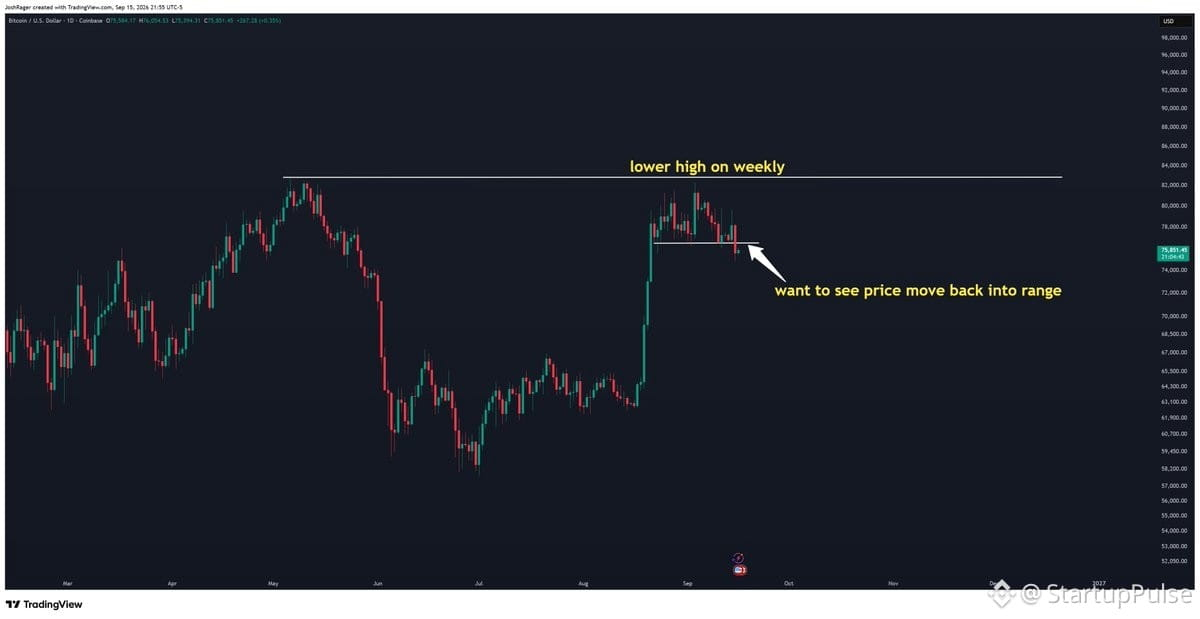
Weekly chart shows $BTC forming a lower-high pattern. Critical resistance at $83k - breaking above flips structure bullish. Downside risk from rate hikes + Clarity Act stalling could trigger pullback.
Range reclaim needed but mid-$60k zone isn't panic territory yet. September historically dumps anyway. Onchain metrics can still pump independent of majors - fundamentals vs price action divergence play.
Weekly chart shows $BTC forming a lower-high pattern. Critical resistance at $83k - breaking above flips structure bullish. Downside risk from rate hikes + Clarity Act stalling could trigger pullback.
Range reclaim needed but mid-$60k zone isn't panic territory yet. September historically dumps anyway. Onchain metrics can still pump independent of majors - fundamentals vs price action divergence play.
Range reclaim needed but mid-$60k zone isn't panic territory yet. September historically dumps anyway. Onchain metrics can still pump independent of majors - fundamentals vs price action divergence play.
62
·
--
See translation
The proposed crypto regulations span 635 pages of restrictions that essentially force crypto projects to conform to traditional finance frameworks. This isn't regulatory clarity—it's regulatory capture disguised as guidance.
The core issue: these rules don't acknowledge crypto's fundamental architecture differences. They treat permissionless protocols like centralized financial institutions, which breaks the entire value proposition.
Meanwhile $BTC remains unaffected by regulatory theater. Its decentralized nature and lack of a central issuer make it immune to compliance frameworks designed for companies. This is precisely why Bitcoin's design matters—it can't be bent to fit legacy finance models because there's no entity to regulate.
The real question for builders: do you architect for regulatory compliance or for technical sovereignty? These 635 pages make it clear you can't optimize for both.
The proposed crypto regulations span 635 pages of restrictions that essentially force crypto projects to conform to traditional finance frameworks. This isn't regulatory clarity—it's regulatory capture disguised as guidance.
The core issue: these rules don't acknowledge crypto's fundamental architecture differences. They treat permissionless protocols like centralized financial institutions, which breaks the entire value proposition.
Meanwhile $BTC remains unaffected by regulatory theater. Its decentralized nature and lack of a central issuer make it immune to compliance frameworks designed for companies. This is precisely why Bitcoin's design matters—it can't be bent to fit legacy finance models because there's no entity to regulate.
The real question for builders: do you architect for regulatory compliance or for technical sovereignty? These 635 pages make it clear you can't optimize for both.
The core issue: these rules don't acknowledge crypto's fundamental architecture differences. They treat permissionless protocols like centralized financial institutions, which breaks the entire value proposition.
Meanwhile $BTC remains unaffected by regulatory theater. Its decentralized nature and lack of a central issuer make it immune to compliance frameworks designed for companies. This is precisely why Bitcoin's design matters—it can't be bent to fit legacy finance models because there's no entity to regulate.
The real question for builders: do you architect for regulatory compliance or for technical sovereignty? These 635 pages make it clear you can't optimize for both.
96
·
--
See translation
CLARITY Act just got nuked in the Senate - couldn't hit the 60-vote threshold to move forward.
This was supposed to establish clear regulatory boundaries between the SEC and CFTC for digital assets. Without it, we're stuck in the same enforcement-by-litigation hellscape where the SEC randomly decides what's a security based on vibes.
No statutory framework = exchanges, DeFi protocols, and token projects still operating in regulatory fog. Expect more Wells notices and lawsuits instead of actual rules.
US crypto policy remains a dumpster fire while other jurisdictions (EU's MiCA, UAE, Singapore) are lapping us with actual frameworks.
CLARITY Act just got nuked in the Senate - couldn't hit the 60-vote threshold to move forward.
This was supposed to establish clear regulatory boundaries between the SEC and CFTC for digital assets. Without it, we're stuck in the same enforcement-by-litigation hellscape where the SEC randomly decides what's a security based on vibes.
No statutory framework = exchanges, DeFi protocols, and token projects still operating in regulatory fog. Expect more Wells notices and lawsuits instead of actual rules.
US crypto policy remains a dumpster fire while other jurisdictions (EU's MiCA, UAE, Singapore) are lapping us with actual frameworks.
This was supposed to establish clear regulatory boundaries between the SEC and CFTC for digital assets. Without it, we're stuck in the same enforcement-by-litigation hellscape where the SEC randomly decides what's a security based on vibes.
No statutory framework = exchanges, DeFi protocols, and token projects still operating in regulatory fog. Expect more Wells notices and lawsuits instead of actual rules.
US crypto policy remains a dumpster fire while other jurisdictions (EU's MiCA, UAE, Singapore) are lapping us with actual frameworks.
27
·
--
See translation
Senator Lummis is pushing hard for the CLARITY Act vote—she's calling it a make-or-break moment. If this bill doesn't pass today, she's saying the legislative window closes completely. The CLARITY Act aims to establish clearer regulatory frameworks for digital assets in the US, separating securities from commodities in crypto. This could define whether the US becomes crypto-friendly or continues regulatory limbo. The stakes are real: institutional capital, DeFi projects, and exchange operations all hinge on this clarity. No passage today likely means years more of SEC enforcement-by-litigation instead of actual rules.
Senator Lummis is pushing hard for the CLARITY Act vote—she's calling it a make-or-break moment. If this bill doesn't pass today, she's saying the legislative window closes completely. The CLARITY Act aims to establish clearer regulatory frameworks for digital assets in the US, separating securities from commodities in crypto. This could define whether the US becomes crypto-friendly or continues regulatory limbo. The stakes are real: institutional capital, DeFi projects, and exchange operations all hinge on this clarity. No passage today likely means years more of SEC enforcement-by-litigation instead of actual rules.

74
·
--
See translation
Republicans just shot down the Dems' counter to the CLARITY Act. $BTC immediately dumped below $76k.
For context: CLARITY Act would define which crypto assets are securities vs commodities - basically the regulatory framework everyone's been waiting for. Rejection means we're back to regulatory limbo, and markets hate uncertainty.
The timing is brutal. This was supposed to be the bill that finally gives crypto clear legal boundaries in the US. Without it, we're stuck with enforcement-by-lawsuit from the SEC.
Market's pricing in continued regulatory chaos. Not surprising given how much institutional money has been waiting on the sidelines for regulatory clarity before deploying.
Republicans just shot down the Dems' counter to the CLARITY Act. $BTC immediately dumped below $76k.
For context: CLARITY Act would define which crypto assets are securities vs commodities - basically the regulatory framework everyone's been waiting for. Rejection means we're back to regulatory limbo, and markets hate uncertainty.
The timing is brutal. This was supposed to be the bill that finally gives crypto clear legal boundaries in the US. Without it, we're stuck with enforcement-by-lawsuit from the SEC.
Market's pricing in continued regulatory chaos. Not surprising given how much institutional money has been waiting on the sidelines for regulatory clarity before deploying.
For context: CLARITY Act would define which crypto assets are securities vs commodities - basically the regulatory framework everyone's been waiting for. Rejection means we're back to regulatory limbo, and markets hate uncertainty.
The timing is brutal. This was supposed to be the bill that finally gives crypto clear legal boundaries in the US. Without it, we're stuck with enforcement-by-lawsuit from the SEC.
Market's pricing in continued regulatory chaos. Not surprising given how much institutional money has been waiting on the sidelines for regulatory clarity before deploying.
52
·
--
See translation
Three critical US events hitting in 48 hours:
1. Senate vote on CLARITY Act (today) - regulatory framework for crypto classification
2. Fed rate decision (tomorrow) - liquidity impact on risk assets including $BTC
3. House committee vote on US Bitcoin Reserve bill (tomorrow) - potential sovereign $BTC accumulation
Each event independently moves markets. All three clustered means extreme volatility window. Rate cuts historically pump crypto, but regulatory clarity matters more long-term. The Bitcoin Reserve bill is the wildcard - if it advances, institutional FOMO accelerates.
Expect high volatility across majors ($BTC, $ETH) and defi tokens sensitive to US regulatory shifts.
Three critical US events hitting in 48 hours:
1. Senate vote on CLARITY Act (today) - regulatory framework for crypto classification
2. Fed rate decision (tomorrow) - liquidity impact on risk assets including $BTC
3. House committee vote on US Bitcoin Reserve bill (tomorrow) - potential sovereign $BTC accumulation
Each event independently moves markets. All three clustered means extreme volatility window. Rate cuts historically pump crypto, but regulatory clarity matters more long-term. The Bitcoin Reserve bill is the wildcard - if it advances, institutional FOMO accelerates.
Expect high volatility across majors ($BTC, $ETH) and defi tokens sensitive to US regulatory shifts.
1. Senate vote on CLARITY Act (today) - regulatory framework for crypto classification
2. Fed rate decision (tomorrow) - liquidity impact on risk assets including $BTC
3. House committee vote on US Bitcoin Reserve bill (tomorrow) - potential sovereign $BTC accumulation
Each event independently moves markets. All three clustered means extreme volatility window. Rate cuts historically pump crypto, but regulatory clarity matters more long-term. The Bitcoin Reserve bill is the wildcard - if it advances, institutional FOMO accelerates.
Expect high volatility across majors ($BTC, $ETH) and defi tokens sensitive to US regulatory shifts.
76
·
--
See translation
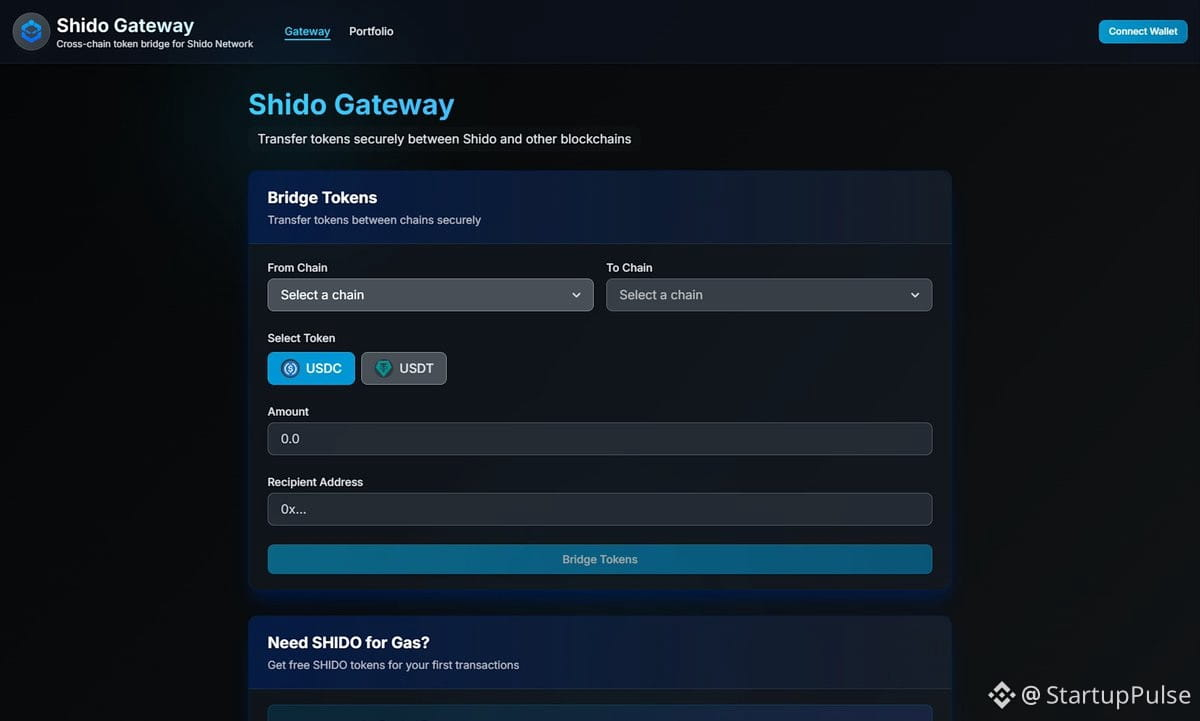
Shido Gateway is a non-custodial bridge enabling cross-chain $USDC transfers into the Shido Network ecosystem.
Supported chains: Ethereum, BNB Chain, Base, Arbitrum, Avalanche → Shido Network.
Core use cases:
- Deploy dApps on Shido
- Access DeFi protocols
- Participate in on-chain governance
Non-custodial architecture means users maintain private key control during bridge operations—no third-party custody risk.
Technically relevant for devs building multi-chain liquidity flows or exploring EVM-compatible L1/L2 bridging infrastructure.
Shido Gateway is a non-custodial bridge enabling cross-chain $USDC transfers into the Shido Network ecosystem.
Supported chains: Ethereum, BNB Chain, Base, Arbitrum, Avalanche → Shido Network.
Core use cases:
- Deploy dApps on Shido
- Access DeFi protocols
- Participate in on-chain governance
Non-custodial architecture means users maintain private key control during bridge operations—no third-party custody risk.
Technically relevant for devs building multi-chain liquidity flows or exploring EVM-compatible L1/L2 bridging infrastructure.
Supported chains: Ethereum, BNB Chain, Base, Arbitrum, Avalanche → Shido Network.
Core use cases:
- Deploy dApps on Shido
- Access DeFi protocols
- Participate in on-chain governance
Non-custodial architecture means users maintain private key control during bridge operations—no third-party custody risk.
Technically relevant for devs building multi-chain liquidity flows or exploring EVM-compatible L1/L2 bridging infrastructure.
55
·
--
See translation
Senate votes tomorrow on the CLARITY Act - needs 60 votes to pass. This is the bill that would establish regulatory frameworks for digital assets and potentially end the SEC's enforcement-by-regulation approach. If it clears the Senate, we're looking at the first comprehensive crypto legislation that could define what counts as a security vs commodity for tokens. Watch for how senators from states with heavy crypto industry presence vote - that'll signal whether this has real momentum or gets buried in committee later.
Senate votes tomorrow on the CLARITY Act - needs 60 votes to pass. This is the bill that would establish regulatory frameworks for digital assets and potentially end the SEC's enforcement-by-regulation approach. If it clears the Senate, we're looking at the first comprehensive crypto legislation that could define what counts as a security vs commodity for tokens. Watch for how senators from states with heavy crypto industry presence vote - that'll signal whether this has real momentum or gets buried in committee later.
50
·
--
See translation
AI development is hitting a plateau where model capabilities are converging fast. Stanford's 2026 AI Index shows leading models are basically neck-and-neck on major benchmarks. The real shift? Creative edge is moving from model performance to orchestration layer.
Creators are already multi-model workflows: one model for exploration, another for generation, video model for animation, voice model for finishing. Same tools, wildly different outputs. That gap is taste and execution.
Lower generation costs = more iterations = more decisions to make. Which output isn't generic? When to stop generating and start editing? When to swap models? These choices define quality now.
But there's a trap: shared models + shared prompts = aesthetic clustering. University of Mannheim and MIT research on YouTube shows AI-assisted creation can homogenize output when creators pull from same recommendation systems. Originality depends on what you do after first generation.
Creator role is expanding beyond media into product territory. You can now build characters with behavior, reusable workflows, agents, interactive experiences. One person can prototype what used to need a team. Creator economy is merging with product building.
MyShell's stack play: Models → Tools → Creators → Experiences → Users. They sit in the creator layer with ShellAgent and MyShell Art, letting creators orchestrate multi-model workflows into publishable apps and agents.
Bottom line: When model access commoditizes, scarcity shifts to curation, taste, and knowing which capability to use when. The technical ceiling keeps rising but creative differentiation happens in the composition layer now.
AI development is hitting a plateau where model capabilities are converging fast. Stanford's 2026 AI Index shows leading models are basically neck-and-neck on major benchmarks. The real shift? Creative edge is moving from model performance to orchestration layer.
Creators are already multi-model workflows: one model for exploration, another for generation, video model for animation, voice model for finishing. Same tools, wildly different outputs. That gap is taste and execution.
Lower generation costs = more iterations = more decisions to make. Which output isn't generic? When to stop generating and start editing? When to swap models? These choices define quality now.
But there's a trap: shared models + shared prompts = aesthetic clustering. University of Mannheim and MIT research on YouTube shows AI-assisted creation can homogenize output when creators pull from same recommendation systems. Originality depends on what you do after first generation.
Creator role is expanding beyond media into product territory. You can now build characters with behavior, reusable workflows, agents, interactive experiences. One person can prototype what used to need a team. Creator economy is merging with product building.
MyShell's stack play: Models → Tools → Creators → Experiences → Users. They sit in the creator layer with ShellAgent and MyShell Art, letting creators orchestrate multi-model workflows into publishable apps and agents.
Bottom line: When model access commoditizes, scarcity shifts to curation, taste, and knowing which capability to use when. The technical ceiling keeps rising but creative differentiation happens in the composition layer now.
Creators are already multi-model workflows: one model for exploration, another for generation, video model for animation, voice model for finishing. Same tools, wildly different outputs. That gap is taste and execution.
Lower generation costs = more iterations = more decisions to make. Which output isn't generic? When to stop generating and start editing? When to swap models? These choices define quality now.
But there's a trap: shared models + shared prompts = aesthetic clustering. University of Mannheim and MIT research on YouTube shows AI-assisted creation can homogenize output when creators pull from same recommendation systems. Originality depends on what you do after first generation.
Creator role is expanding beyond media into product territory. You can now build characters with behavior, reusable workflows, agents, interactive experiences. One person can prototype what used to need a team. Creator economy is merging with product building.
MyShell's stack play: Models → Tools → Creators → Experiences → Users. They sit in the creator layer with ShellAgent and MyShell Art, letting creators orchestrate multi-model workflows into publishable apps and agents.
Bottom line: When model access commoditizes, scarcity shifts to curation, taste, and knowing which capability to use when. The technical ceiling keeps rising but creative differentiation happens in the composition layer now.
62
·
--
See translation
Maharashtra state government is drafting a policy to tokenize physical infrastructure assets—specifically electricity transmission lines. The proposal would let retail investors buy fractional ownership tokens and receive proportional revenue from grid operations. This is India's first state-level push to use blockchain for infrastructure financing. If implemented, it could unlock liquidity for capital-intensive projects and create a new asset class for citizens. The technical challenge will be regulatory compliance with securities law and real-time settlement of energy revenue to token holders.
Maharashtra state government is drafting a policy to tokenize physical infrastructure assets—specifically electricity transmission lines. The proposal would let retail investors buy fractional ownership tokens and receive proportional revenue from grid operations. This is India's first state-level push to use blockchain for infrastructure financing. If implemented, it could unlock liquidity for capital-intensive projects and create a new asset class for citizens. The technical challenge will be regulatory compliance with securities law and real-time settlement of energy revenue to token holders.
56
·
--
See translation
BRICS nations (Brazil, Russia, India, China, South Africa) are actively working on alternative payment systems to reduce dependence on the US dollar in international trade. Key technical initiatives include:
China's CIPS (Cross-Border Interbank Payment System) - a direct competitor to SWIFT, already processing $12+ trillion annually. Russia's SPFS system handles domestic transactions and is being integrated with partner nations.
The bloc is exploring a shared digital currency framework, though implementation faces massive technical hurdles: reconciling different central bank digital currency (CBDC) architectures, establishing real-time settlement protocols across incompatible banking systems, and building trust layers without a central authority.
Main challenge isn't political will - it's the technical debt. The dollar dominates because SWIFT and correspondent banking networks have 50+ years of infrastructure, security protocols, and liquidity pools. Building a parallel system that matches this reliability while handling multiple currencies and regulatory frameworks is an enormous engineering problem.
Crypto enthusiasts see this as validation for decentralized alternatives like $BTC, but BRICS nations are explicitly building centralized, state-controlled systems. They want sovereignty, not decentralization.
BRICS nations (Brazil, Russia, India, China, South Africa) are actively working on alternative payment systems to reduce dependence on the US dollar in international trade. Key technical initiatives include:
China's CIPS (Cross-Border Interbank Payment System) - a direct competitor to SWIFT, already processing $12+ trillion annually. Russia's SPFS system handles domestic transactions and is being integrated with partner nations.
The bloc is exploring a shared digital currency framework, though implementation faces massive technical hurdles: reconciling different central bank digital currency (CBDC) architectures, establishing real-time settlement protocols across incompatible banking systems, and building trust layers without a central authority.
Main challenge isn't political will - it's the technical debt. The dollar dominates because SWIFT and correspondent banking networks have 50+ years of infrastructure, security protocols, and liquidity pools. Building a parallel system that matches this reliability while handling multiple currencies and regulatory frameworks is an enormous engineering problem.
Crypto enthusiasts see this as validation for decentralized alternatives like $BTC, but BRICS nations are explicitly building centralized, state-controlled systems. They want sovereignty, not decentralization.
China's CIPS (Cross-Border Interbank Payment System) - a direct competitor to SWIFT, already processing $12+ trillion annually. Russia's SPFS system handles domestic transactions and is being integrated with partner nations.
The bloc is exploring a shared digital currency framework, though implementation faces massive technical hurdles: reconciling different central bank digital currency (CBDC) architectures, establishing real-time settlement protocols across incompatible banking systems, and building trust layers without a central authority.
Main challenge isn't political will - it's the technical debt. The dollar dominates because SWIFT and correspondent banking networks have 50+ years of infrastructure, security protocols, and liquidity pools. Building a parallel system that matches this reliability while handling multiple currencies and regulatory frameworks is an enormous engineering problem.
Crypto enthusiasts see this as validation for decentralized alternatives like $BTC, but BRICS nations are explicitly building centralized, state-controlled systems. They want sovereignty, not decentralization.
47
·
--
See translation
India just wrapped its first tokenized corporate bond pilot. Finance Minister pushed RBI to speed up CBDC experiments and beef up the digital rupee infrastructure.
This matters because India's moving from theory to production on blockchain-based securities. Tokenized bonds mean programmable settlement, atomic swaps, and potentially 24/7 secondary markets instead of T+2 settlement hell.
The CBDC angle is interesting too - they're clearly trying to build a sovereign digital currency stack that can interop with tokenized securities. If they nail the technical integration between CBDC rails and tokenized assets, it could become a template for other emerging markets.
Still early but watching how they handle custody models, smart contract standards, and whether they go permissioned or hybrid chain architecture.
India just wrapped its first tokenized corporate bond pilot. Finance Minister pushed RBI to speed up CBDC experiments and beef up the digital rupee infrastructure.
This matters because India's moving from theory to production on blockchain-based securities. Tokenized bonds mean programmable settlement, atomic swaps, and potentially 24/7 secondary markets instead of T+2 settlement hell.
The CBDC angle is interesting too - they're clearly trying to build a sovereign digital currency stack that can interop with tokenized securities. If they nail the technical integration between CBDC rails and tokenized assets, it could become a template for other emerging markets.
Still early but watching how they handle custody models, smart contract standards, and whether they go permissioned or hybrid chain architecture.
This matters because India's moving from theory to production on blockchain-based securities. Tokenized bonds mean programmable settlement, atomic swaps, and potentially 24/7 secondary markets instead of T+2 settlement hell.
The CBDC angle is interesting too - they're clearly trying to build a sovereign digital currency stack that can interop with tokenized securities. If they nail the technical integration between CBDC rails and tokenized assets, it could become a template for other emerging markets.
Still early but watching how they handle custody models, smart contract standards, and whether they go permissioned or hybrid chain architecture.

·
--
See translation
India's CBI just dropped a warning about P2P crypto fraud spiking hard. They're pushing users to stick with FIU-registered exchanges only and ditch sketchy peer-to-peer deals.
Translation: the unregulated P2P marketplace is getting exploited—scammers are using fake payment confirmations, reversing bank transfers after receiving crypto, or straight-up phishing users during direct trades.
FIU (Financial Intelligence Unit) registration means the exchange has to follow KYC/AML rules and report suspicious activity. It's not bulletproof, but it adds a compliance layer that raw P2P lacks.
If you're trading in India, this is basically the government saying "use Binance/WazirX-style platforms with escrow, or you're on your own when things go sideways." P2P still works for privacy-focused trades, but the risk surface just got a lot more visible to regulators.
India's CBI just dropped a warning about P2P crypto fraud spiking hard. They're pushing users to stick with FIU-registered exchanges only and ditch sketchy peer-to-peer deals.
Translation: the unregulated P2P marketplace is getting exploited—scammers are using fake payment confirmations, reversing bank transfers after receiving crypto, or straight-up phishing users during direct trades.
FIU (Financial Intelligence Unit) registration means the exchange has to follow KYC/AML rules and report suspicious activity. It's not bulletproof, but it adds a compliance layer that raw P2P lacks.
If you're trading in India, this is basically the government saying "use Binance/WazirX-style platforms with escrow, or you're on your own when things go sideways." P2P still works for privacy-focused trades, but the risk surface just got a lot more visible to regulators.
Translation: the unregulated P2P marketplace is getting exploited—scammers are using fake payment confirmations, reversing bank transfers after receiving crypto, or straight-up phishing users during direct trades.
FIU (Financial Intelligence Unit) registration means the exchange has to follow KYC/AML rules and report suspicious activity. It's not bulletproof, but it adds a compliance layer that raw P2P lacks.
If you're trading in India, this is basically the government saying "use Binance/WazirX-style platforms with escrow, or you're on your own when things go sideways." P2P still works for privacy-focused trades, but the risk surface just got a lot more visible to regulators.
26
·
--
See translation
India's moving bonds and real estate onto blockchain infrastructure. This is massive for tokenization at scale - we're talking about digitizing traditionally illiquid assets in one of the world's largest economies.
The technical play here is creating on-chain representations of physical assets and securities, which means instant settlement, fractional ownership capabilities, and programmable compliance built into smart contracts. No more weeks-long property transfers or bond settlement cycles.
For developers: this opens up APIs for real-world asset (RWA) integration, cross-border investment protocols, and DeFi primitives that can actually plug into regulated markets. The infrastructure layer for this is going to need serious throughput and finality guarantees.
India's regulatory framework allowing this is the real unlock - it legitimizes blockchain beyond crypto speculation into actual financial rails. Watch for standardization patterns here that could export to other emerging markets.
India's moving bonds and real estate onto blockchain infrastructure. This is massive for tokenization at scale - we're talking about digitizing traditionally illiquid assets in one of the world's largest economies.
The technical play here is creating on-chain representations of physical assets and securities, which means instant settlement, fractional ownership capabilities, and programmable compliance built into smart contracts. No more weeks-long property transfers or bond settlement cycles.
For developers: this opens up APIs for real-world asset (RWA) integration, cross-border investment protocols, and DeFi primitives that can actually plug into regulated markets. The infrastructure layer for this is going to need serious throughput and finality guarantees.
India's regulatory framework allowing this is the real unlock - it legitimizes blockchain beyond crypto speculation into actual financial rails. Watch for standardization patterns here that could export to other emerging markets.
The technical play here is creating on-chain representations of physical assets and securities, which means instant settlement, fractional ownership capabilities, and programmable compliance built into smart contracts. No more weeks-long property transfers or bond settlement cycles.
For developers: this opens up APIs for real-world asset (RWA) integration, cross-border investment protocols, and DeFi primitives that can actually plug into regulated markets. The infrastructure layer for this is going to need serious throughput and finality guarantees.
India's regulatory framework allowing this is the real unlock - it legitimizes blockchain beyond crypto speculation into actual financial rails. Watch for standardization patterns here that could export to other emerging markets.
30
·
--
See translation
Top trader on Fomo leaderboard is aggressively accumulating a sub-$500k market cap token while retail is panic-selling into his bids. Classic smart money vs dumb money divergence. Either this trader knows something or they're about to get rekt spectacularly, but the conviction is real.
Top trader on Fomo leaderboard is aggressively accumulating a sub-$500k market cap token while retail is panic-selling into his bids. Classic smart money vs dumb money divergence. Either this trader knows something or they're about to get rekt spectacularly, but the conviction is real.

35
·
--
See translation
India's central bank (RBI) is tokenizing the entire $620B corporate bond market using their CBDC infrastructure. Settlement layer runs on Digital Rupee rails, which means T+0 settlement instead of the current T+1/T+2 cycle. This is basically turning the entire secondary market into a programmable asset layer where bonds can be fractionally traded, instantly settled, and composable with DeFi protocols if they open the APIs. The tech stack likely uses permissioned blockchain (probably Hyperledger or a custom fork) with the RBI acting as the validator network. Huge deal for institutional liquidity - removes custodian friction, cuts settlement risk to near zero, and opens up atomic swaps between bonds and $INR. If they nail the smart contract standards, this could become the template for how other central banks tokenize TradFi markets.
India's central bank (RBI) is tokenizing the entire $620B corporate bond market using their CBDC infrastructure. Settlement layer runs on Digital Rupee rails, which means T+0 settlement instead of the current T+1/T+2 cycle. This is basically turning the entire secondary market into a programmable asset layer where bonds can be fractionally traded, instantly settled, and composable with DeFi protocols if they open the APIs. The tech stack likely uses permissioned blockchain (probably Hyperledger or a custom fork) with the RBI acting as the validator network. Huge deal for institutional liquidity - removes custodian friction, cuts settlement risk to near zero, and opens up atomic swaps between bonds and $INR. If they nail the smart contract standards, this could become the template for how other central banks tokenize TradFi markets.

53
·
--
See translation
AI agents are gonna create unprecedented demand for $BTC that nobody's pricing in yet.
Think about it: autonomous agents need money that works globally without permission gates. No KYC, no account freezes, no jurisdictional BS. Just pure programmable value transfer.
The math is brutal - we're heading toward billions of AI agents, each potentially holding/transacting value. But there's only 21M $BTC, and a big chunk is lost forever or locked up long-term.
This isn't some distant future scenario. AI agents are already starting to interact with crypto rails. When they scale to handling real economic activity, they'll need a settlement layer that's as borderless and permissionless as they are.
Fiat banking systems can't serve AI agents at scale. Too many friction points, too much human verification required. $BTC is literally the only money system designed for this kind of machine-to-machine economy.
AI agents are gonna create unprecedented demand for $BTC that nobody's pricing in yet.
Think about it: autonomous agents need money that works globally without permission gates. No KYC, no account freezes, no jurisdictional BS. Just pure programmable value transfer.
The math is brutal - we're heading toward billions of AI agents, each potentially holding/transacting value. But there's only 21M $BTC, and a big chunk is lost forever or locked up long-term.
This isn't some distant future scenario. AI agents are already starting to interact with crypto rails. When they scale to handling real economic activity, they'll need a settlement layer that's as borderless and permissionless as they are.
Fiat banking systems can't serve AI agents at scale. Too many friction points, too much human verification required. $BTC is literally the only money system designed for this kind of machine-to-machine economy.
Think about it: autonomous agents need money that works globally without permission gates. No KYC, no account freezes, no jurisdictional BS. Just pure programmable value transfer.
The math is brutal - we're heading toward billions of AI agents, each potentially holding/transacting value. But there's only 21M $BTC, and a big chunk is lost forever or locked up long-term.
This isn't some distant future scenario. AI agents are already starting to interact with crypto rails. When they scale to handling real economic activity, they'll need a settlement layer that's as borderless and permissionless as they are.
Fiat banking systems can't serve AI agents at scale. Too many friction points, too much human verification required. $BTC is literally the only money system designed for this kind of machine-to-machine economy.
68
Log in to explore more content
Join global crypto users on Binance Square
⚡️ Get latest and useful information about crypto.
💬 Trusted by the world’s largest crypto exchange.
👍 Discover real insights from verified creators.
Email / Phone number
Trending Topics
FedRateWatch
1.3M views
6,283 Discussing
Share & Win Traffic Reward in our Trending Hashtag Campaign
✨Topic: FOMC September, What's The Fed's Next Move?
👉How to Join:
Publish a short post or article with hashtag #FedRateWatch
Create content based on the below angles:
- August core CPI rose 0.3% month-over-month, and the odds of a 25bp hike this week are now close to 90%. Do you anticipate a rate hike this week? Is it a one-off, or the start of a longer hiking cycle?
- If the hike lands, how does it play out for BTC, tech stocks, and gold? Bullish or bearish?
- How are you planning to trade next? Share your BTC, stocks or gold trade/holdings with our trade sharing widget.
⏰Campaign Period:
- 2026-09-15 11:00 - 2026-09-17 3:00 UTC
🎁Reward:
- Qualified posts that comply with the above guidelines and contain more than 100 words will be reviewed and may receive a random traffic boost of 500 to 3,000 views. You will receive a notification from your feed secretary if your post is selected.
- Get a chance to have your article featured on Binance Square Official
Need ideas for your post? Visit the topic page #FedRateWatch or the Square Guide on How to Post for Better Reach.
Binance Square Official
·632 Likes
·1.6M views
ZcashRises6%
28,515 views
471 Discussing
XRPSinks10%
18,574 views
310 Discussing