
Shr_Munna
271 Posts

Shr_Munna
Report
Block User
Learning Everyday

GRAM Holder
Occasional Trader
2.6 Years
3 Following
193 Followers
316 Liked
Posts
All
Quotes
·
--
See translation
📉 #EthereumFallsBelow$2500 — Is This a Buying Opportunity or a Warning Sign?
ETH slipping under the $2,500 mark has the community split, and honestly, both sides have a case.
Here's the framework for thinking about it, whichever side you're on:
🔹 The bear case — A break below a key psychological level often triggers stop-losses and liquidations, which can accelerate the drop short-term. If this coincides with broader risk-off sentiment (like rising bond yields pulling capital toward safer assets), the pressure can persist longer than a typical dip.
🔹 The bull case — Ethereum's fundamentals (staking yield, L2 ecosystem growth, ETF flows) don't reset just because price crosses a round number. Round-number levels are more psychological than structural — the real question is whether this is a shakeout before continuation, or the start of a deeper trend change.
🔹 What actually matters — Volume on the breakdown. A low-volume dip below $2,500 is very different from a high-volume capitulation candle. Check whether this move came with panic selling or just quiet drift.
🔹 Zoom out — Where does $2,500 sit relative to ETH's recent range? If it was already chopping between $2,400–$2,800 for weeks, this isn't a "collapse," it's just testing the bottom of a range.
Not financial advice — just a framework. Where do you think ETH goes from here? 👇
#Binance #BinanceSquare #Ethereum #ETH #CryptoMarket #PriceAction
📉 #EthereumFallsBelow$2500 — Is This a Buying Opportunity or a Warning Sign?
ETH slipping under the $2,500 mark has the community split, and honestly, both sides have a case.
Here's the framework for thinking about it, whichever side you're on:
🔹 The bear case — A break below a key psychological level often triggers stop-losses and liquidations, which can accelerate the drop short-term. If this coincides with broader risk-off sentiment (like rising bond yields pulling capital toward safer assets), the pressure can persist longer than a typical dip.
🔹 The bull case — Ethereum's fundamentals (staking yield, L2 ecosystem growth, ETF flows) don't reset just because price crosses a round number. Round-number levels are more psychological than structural — the real question is whether this is a shakeout before continuation, or the start of a deeper trend change.
🔹 What actually matters — Volume on the breakdown. A low-volume dip below $2,500 is very different from a high-volume capitulation candle. Check whether this move came with panic selling or just quiet drift.
🔹 Zoom out — Where does $2,500 sit relative to ETH's recent range? If it was already chopping between $2,400–$2,800 for weeks, this isn't a "collapse," it's just testing the bottom of a range.
Not financial advice — just a framework. Where do you think ETH goes from here? 👇
#Binance #BinanceSquare #Ethereum #ETH #CryptoMarket #PriceAction
ETH slipping under the $2,500 mark has the community split, and honestly, both sides have a case.
Here's the framework for thinking about it, whichever side you're on:
🔹 The bear case — A break below a key psychological level often triggers stop-losses and liquidations, which can accelerate the drop short-term. If this coincides with broader risk-off sentiment (like rising bond yields pulling capital toward safer assets), the pressure can persist longer than a typical dip.
🔹 The bull case — Ethereum's fundamentals (staking yield, L2 ecosystem growth, ETF flows) don't reset just because price crosses a round number. Round-number levels are more psychological than structural — the real question is whether this is a shakeout before continuation, or the start of a deeper trend change.
🔹 What actually matters — Volume on the breakdown. A low-volume dip below $2,500 is very different from a high-volume capitulation candle. Check whether this move came with panic selling or just quiet drift.
🔹 Zoom out — Where does $2,500 sit relative to ETH's recent range? If it was already chopping between $2,400–$2,800 for weeks, this isn't a "collapse," it's just testing the bottom of a range.
Not financial advice — just a framework. Where do you think ETH goes from here? 👇
#Binance #BinanceSquare #Ethereum #ETH #CryptoMarket #PriceAction
43
·
--
See translation
⚠️ #BitcoinThirdSingleBlockReorgInFourWeeks — Coincidence, or a Pattern Worth Watching?
Binance Square's discussion feed is flagging a claim worth digging into: Bitcoin allegedly seeing its third single-block reorg in just four weeks. If true, that's a frequency worth talking about — reorgs used to be rare enough to make headlines individually.
Quick refresher on what a reorg actually is, for anyone scrolling past:
🔹 What it means — Two miners find valid blocks at nearly the same time, splitting the network briefly into two competing chains. The chain with more accumulated proof-of-work wins, and the "losing" block gets orphaned — its transactions just get shuffled back into the mempool for the next block.
🔹 Why it's normally rare — With Bitcoin's ~10 minute block time and globally distributed miners, near-simultaneous valid blocks don't happen often. One reorg is a network hiccup. Three in a month would be a real anomaly.
🔹 The real concern isn't the reorg itself — it's what it signals. Rising reorg frequency is usually a symptom of hash rate concentration. When a small number of mining pools control enough of the network's power, they're statistically more likely to mine blocks back-to-back, which is exactly the mechanism that produces reorgs.
🔹 What to actually check — If you want to verify this yourself before treating it as fact, mempool.space and Blockchain.com both show reorg history directly on-chain. That's the only way to confirm frequency claims like this instead of relying on secondhand posts.
So — has anyone here actually pulled the block explorer data on this? Genuinely curious if the "three in four weeks" number holds up. 👇
#Binance #BinanceSquare #Bitcoin #BTC #MiningCentralization #CryptoDiscussion
⚠️ #BitcoinThirdSingleBlockReorgInFourWeeks — Coincidence, or a Pattern Worth Watching?
Binance Square's discussion feed is flagging a claim worth digging into: Bitcoin allegedly seeing its third single-block reorg in just four weeks. If true, that's a frequency worth talking about — reorgs used to be rare enough to make headlines individually.
Quick refresher on what a reorg actually is, for anyone scrolling past:
🔹 What it means — Two miners find valid blocks at nearly the same time, splitting the network briefly into two competing chains. The chain with more accumulated proof-of-work wins, and the "losing" block gets orphaned — its transactions just get shuffled back into the mempool for the next block.
🔹 Why it's normally rare — With Bitcoin's ~10 minute block time and globally distributed miners, near-simultaneous valid blocks don't happen often. One reorg is a network hiccup. Three in a month would be a real anomaly.
🔹 The real concern isn't the reorg itself — it's what it signals. Rising reorg frequency is usually a symptom of hash rate concentration. When a small number of mining pools control enough of the network's power, they're statistically more likely to mine blocks back-to-back, which is exactly the mechanism that produces reorgs.
🔹 What to actually check — If you want to verify this yourself before treating it as fact, mempool.space and Blockchain.com both show reorg history directly on-chain. That's the only way to confirm frequency claims like this instead of relying on secondhand posts.
So — has anyone here actually pulled the block explorer data on this? Genuinely curious if the "three in four weeks" number holds up. 👇
#Binance #BinanceSquare #Bitcoin #BTC #MiningCentralization #CryptoDiscussion
Binance Square's discussion feed is flagging a claim worth digging into: Bitcoin allegedly seeing its third single-block reorg in just four weeks. If true, that's a frequency worth talking about — reorgs used to be rare enough to make headlines individually.
Quick refresher on what a reorg actually is, for anyone scrolling past:
🔹 What it means — Two miners find valid blocks at nearly the same time, splitting the network briefly into two competing chains. The chain with more accumulated proof-of-work wins, and the "losing" block gets orphaned — its transactions just get shuffled back into the mempool for the next block.
🔹 Why it's normally rare — With Bitcoin's ~10 minute block time and globally distributed miners, near-simultaneous valid blocks don't happen often. One reorg is a network hiccup. Three in a month would be a real anomaly.
🔹 The real concern isn't the reorg itself — it's what it signals. Rising reorg frequency is usually a symptom of hash rate concentration. When a small number of mining pools control enough of the network's power, they're statistically more likely to mine blocks back-to-back, which is exactly the mechanism that produces reorgs.
🔹 What to actually check — If you want to verify this yourself before treating it as fact, mempool.space and Blockchain.com both show reorg history directly on-chain. That's the only way to confirm frequency claims like this instead of relying on secondhand posts.
So — has anyone here actually pulled the block explorer data on this? Genuinely curious if the "three in four weeks" number holds up. 👇
#Binance #BinanceSquare #Bitcoin #BTC #MiningCentralization #CryptoDiscussion
1
66
·
--
See translation
🧠 #AnthropicCEOCallsForAISlowdown — When the AI Company Itself Says "Slow Down"
In a rare move for the industry, Anthropic — the company behind Claude — published a call in June 2026 urging the option to slow or pause frontier AI development. The reasoning isn't hype, it's structural.
The numbers behind the warning:
🔹 80% of Anthropic's own code is now written by Claude — not assisted, written. That's the company's own AI building the next version of itself.
🔹 Recursive self-improvement is the core fear — if AI systems start meaningfully accelerating their own development faster than humans can audit or align them, the feedback loop compounds fast.
🔹 It's not a unilateral pause — Anthropic was explicit: a single company stopping alone just lets rivals race ahead unchecked. They're calling for a coordinated, verifiable mechanism — something closer to how nuclear treaties work, where all major labs (and countries, notably the US and China) would need to agree simultaneously.
🔹 Not everyone's on board — OpenAI publicly pushed back the same week, arguing that pacing decisions shouldn't sit with any single lab, and should be left to democratic institutions instead. Critics have also called Anthropic's stance a competitive narrative play, especially given its limited rollout of its more powerful "Mythos" model.
This lands right as Anthropic is reportedly prepping to go public — so "the AI company profiting from AI is also the one waving the caution flag" is exactly the tension fueling the debate.
Where do you land — genuine safety concern, or strategic positioning? 👇
#Binance #BinanceSquare #AI #Anthropic #Claude #technews #CryptoAI
🧠 #AnthropicCEOCallsForAISlowdown — When the AI Company Itself Says "Slow Down"
In a rare move for the industry, Anthropic — the company behind Claude — published a call in June 2026 urging the option to slow or pause frontier AI development. The reasoning isn't hype, it's structural.
The numbers behind the warning:
🔹 80% of Anthropic's own code is now written by Claude — not assisted, written. That's the company's own AI building the next version of itself.
🔹 Recursive self-improvement is the core fear — if AI systems start meaningfully accelerating their own development faster than humans can audit or align them, the feedback loop compounds fast.
🔹 It's not a unilateral pause — Anthropic was explicit: a single company stopping alone just lets rivals race ahead unchecked. They're calling for a coordinated, verifiable mechanism — something closer to how nuclear treaties work, where all major labs (and countries, notably the US and China) would need to agree simultaneously.
🔹 Not everyone's on board — OpenAI publicly pushed back the same week, arguing that pacing decisions shouldn't sit with any single lab, and should be left to democratic institutions instead. Critics have also called Anthropic's stance a competitive narrative play, especially given its limited rollout of its more powerful "Mythos" model.
This lands right as Anthropic is reportedly prepping to go public — so "the AI company profiting from AI is also the one waving the caution flag" is exactly the tension fueling the debate.
Where do you land — genuine safety concern, or strategic positioning? 👇
#Binance #BinanceSquare #AI #Anthropic #Claude #technews #CryptoAI
In a rare move for the industry, Anthropic — the company behind Claude — published a call in June 2026 urging the option to slow or pause frontier AI development. The reasoning isn't hype, it's structural.
The numbers behind the warning:
🔹 80% of Anthropic's own code is now written by Claude — not assisted, written. That's the company's own AI building the next version of itself.
🔹 Recursive self-improvement is the core fear — if AI systems start meaningfully accelerating their own development faster than humans can audit or align them, the feedback loop compounds fast.
🔹 It's not a unilateral pause — Anthropic was explicit: a single company stopping alone just lets rivals race ahead unchecked. They're calling for a coordinated, verifiable mechanism — something closer to how nuclear treaties work, where all major labs (and countries, notably the US and China) would need to agree simultaneously.
🔹 Not everyone's on board — OpenAI publicly pushed back the same week, arguing that pacing decisions shouldn't sit with any single lab, and should be left to democratic institutions instead. Critics have also called Anthropic's stance a competitive narrative play, especially given its limited rollout of its more powerful "Mythos" model.
This lands right as Anthropic is reportedly prepping to go public — so "the AI company profiting from AI is also the one waving the caution flag" is exactly the tension fueling the debate.
Where do you land — genuine safety concern, or strategic positioning? 👇
#Binance #BinanceSquare #AI #Anthropic #Claude #technews #CryptoAI
46
·
--
See translation
🏛️ #ClarityActFacesProceduralVoteSept15 — This Tuesday Could Reshape US Crypto Regulation
The Senate returns from recess this week, and the first real test for the CLARITY Act lands September 15 — a cloture vote that decides whether the bill even gets debated, not whether it passes.
Here's what's actually on the line:
🔹 What CLARITY does — It draws the jurisdictional line between the SEC and CFTC for digital assets, and for the first time in federal law, defines when a token counts as a commodity vs. a security. That classification decides who regulates exchanges, issuers, and custodians going forward.
🔹 The math is brutal — Republicans hold 53 seats. Cloture needs 60. That means roughly 7 Democrats have to cross the aisle, and Senate Banking Committee votes in May only pulled 2.
🔹 Three unresolved fights — Stablecoin reward structures, government ethics language, and illicit finance provisions are still being negotiated heading into the vote.
🔹 The stakes if it fails — With midterm campaigning ramping up right after this window, this is widely seen as the last realistic shot at passage in 2026. Prediction markets are pricing roughly a 1-in-4 chance it becomes law this year.
The House already passed its version back in July 2025 with bipartisan support (294-134). The ball's been in the Senate's court since.
Are you expecting cloture to clear, or does this stall out again? 👇
#Binance #BinanceSquare #CLARITYAct #CryptoRegulationRussia #SEC #CFTC #USPolitics
🏛️ #ClarityActFacesProceduralVoteSept15 — This Tuesday Could Reshape US Crypto Regulation
The Senate returns from recess this week, and the first real test for the CLARITY Act lands September 15 — a cloture vote that decides whether the bill even gets debated, not whether it passes.
Here's what's actually on the line:
🔹 What CLARITY does — It draws the jurisdictional line between the SEC and CFTC for digital assets, and for the first time in federal law, defines when a token counts as a commodity vs. a security. That classification decides who regulates exchanges, issuers, and custodians going forward.
🔹 The math is brutal — Republicans hold 53 seats. Cloture needs 60. That means roughly 7 Democrats have to cross the aisle, and Senate Banking Committee votes in May only pulled 2.
🔹 Three unresolved fights — Stablecoin reward structures, government ethics language, and illicit finance provisions are still being negotiated heading into the vote.
🔹 The stakes if it fails — With midterm campaigning ramping up right after this window, this is widely seen as the last realistic shot at passage in 2026. Prediction markets are pricing roughly a 1-in-4 chance it becomes law this year.
The House already passed its version back in July 2025 with bipartisan support (294-134). The ball's been in the Senate's court since.
Are you expecting cloture to clear, or does this stall out again? 👇
#Binance #BinanceSquare #CLARITYAct #CryptoRegulationRussia #SEC #CFTC #USPolitics
The Senate returns from recess this week, and the first real test for the CLARITY Act lands September 15 — a cloture vote that decides whether the bill even gets debated, not whether it passes.
Here's what's actually on the line:
🔹 What CLARITY does — It draws the jurisdictional line between the SEC and CFTC for digital assets, and for the first time in federal law, defines when a token counts as a commodity vs. a security. That classification decides who regulates exchanges, issuers, and custodians going forward.
🔹 The math is brutal — Republicans hold 53 seats. Cloture needs 60. That means roughly 7 Democrats have to cross the aisle, and Senate Banking Committee votes in May only pulled 2.
🔹 Three unresolved fights — Stablecoin reward structures, government ethics language, and illicit finance provisions are still being negotiated heading into the vote.
🔹 The stakes if it fails — With midterm campaigning ramping up right after this window, this is widely seen as the last realistic shot at passage in 2026. Prediction markets are pricing roughly a 1-in-4 chance it becomes law this year.
The House already passed its version back in July 2025 with bipartisan support (294-134). The ball's been in the Senate's court since.
Are you expecting cloture to clear, or does this stall out again? 👇
#Binance #BinanceSquare #CLARITYAct #CryptoRegulationRussia #SEC #CFTC #USPolitics
29
·
--
See translation
#SECReceivesGrayscaleLitecoinTrustETFFiling — And Now It's Already Live
Remember when this was breaking news? Grayscale's push to convert its Litecoin Trust into a spot ETF started back in late 2024, and the SEC formally opened it up for public comment in February 2025 after NYSE Arca filed on Grayscale's behalf.
Fast forward to today: LTCN is already trading as a spot Litecoin ETF.
Why this mattered:
🔹 It wasn't a one-off — Litecoin's filing came in the same wave as Solana, Hedera, and Bitcoin Cash trust conversions. Grayscale used the same regulatory playbook that got its Bitcoin and Ethereum trusts converted in 2024.
🔹 Altcoin ETFs are no longer rare — What started as a novelty with BTC/ETH has become a steady pipeline. Analysts predicted 100+ spot crypto ETFs launching within a 6-month stretch, and that supply has kept coming (Chainlink's spot ETF launched just this past December).
🔹 The pattern to watch — Trust → SEC review → public comment period → conversion. If your favorite altcoin already has a Grayscale trust, that's usually the first sign an ETF filing isn't far behind.
Litecoin, one of the oldest altcoins in existence, now sits in a regulated wrapper next to BTC and ETH. That's a meaningful shift in how "legit" the SEC now treats legacy alts.
Did you expect LTC to get a spot ETF before some newer, higher-cap coins? 👇
#Binance #BinanceSquare #Litecoin #LTC #ETF #SEC #Grayscale #CryptoNews
#SECReceivesGrayscaleLitecoinTrustETFFiling — And Now It's Already Live
Remember when this was breaking news? Grayscale's push to convert its Litecoin Trust into a spot ETF started back in late 2024, and the SEC formally opened it up for public comment in February 2025 after NYSE Arca filed on Grayscale's behalf.
Fast forward to today: LTCN is already trading as a spot Litecoin ETF.
Why this mattered:
🔹 It wasn't a one-off — Litecoin's filing came in the same wave as Solana, Hedera, and Bitcoin Cash trust conversions. Grayscale used the same regulatory playbook that got its Bitcoin and Ethereum trusts converted in 2024.
🔹 Altcoin ETFs are no longer rare — What started as a novelty with BTC/ETH has become a steady pipeline. Analysts predicted 100+ spot crypto ETFs launching within a 6-month stretch, and that supply has kept coming (Chainlink's spot ETF launched just this past December).
🔹 The pattern to watch — Trust → SEC review → public comment period → conversion. If your favorite altcoin already has a Grayscale trust, that's usually the first sign an ETF filing isn't far behind.
Litecoin, one of the oldest altcoins in existence, now sits in a regulated wrapper next to BTC and ETH. That's a meaningful shift in how "legit" the SEC now treats legacy alts.
Did you expect LTC to get a spot ETF before some newer, higher-cap coins? 👇
#Binance #BinanceSquare #Litecoin #LTC #ETF #SEC #Grayscale #CryptoNews
Remember when this was breaking news? Grayscale's push to convert its Litecoin Trust into a spot ETF started back in late 2024, and the SEC formally opened it up for public comment in February 2025 after NYSE Arca filed on Grayscale's behalf.
Fast forward to today: LTCN is already trading as a spot Litecoin ETF.
Why this mattered:
🔹 It wasn't a one-off — Litecoin's filing came in the same wave as Solana, Hedera, and Bitcoin Cash trust conversions. Grayscale used the same regulatory playbook that got its Bitcoin and Ethereum trusts converted in 2024.
🔹 Altcoin ETFs are no longer rare — What started as a novelty with BTC/ETH has become a steady pipeline. Analysts predicted 100+ spot crypto ETFs launching within a 6-month stretch, and that supply has kept coming (Chainlink's spot ETF launched just this past December).
🔹 The pattern to watch — Trust → SEC review → public comment period → conversion. If your favorite altcoin already has a Grayscale trust, that's usually the first sign an ETF filing isn't far behind.
Litecoin, one of the oldest altcoins in existence, now sits in a regulated wrapper next to BTC and ETH. That's a meaningful shift in how "legit" the SEC now treats legacy alts.
Did you expect LTC to get a spot ETF before some newer, higher-cap coins? 👇
#Binance #BinanceSquare #Litecoin #LTC #ETF #SEC #Grayscale #CryptoNews
50
·
--
See translation
🚨 #US10YearTreasuryYieldNears5% — Why Crypto Traders Should Be Watching Bonds, Not Just Charts
The 10-year Treasury yield just touched its highest level since November 2023, creeping toward that psychological 5% mark. This isn't just a "boomer finance" headline — it directly affects risk appetite across crypto.
Here's the connection:
🔹 Higher yields = safer "risk-free" returns — When you can get ~5% just parking money in Treasuries, capital has less incentive to chase risk in altcoins or speculative plays.
🔹 Liquidity tightens — Rising long-end yields often signal the market pricing in "higher for longer" rates, which historically pressures risk assets, including BTC and ETH, in the short term.
🔹 Dollar strength watch — Yields climbing usually pull the DXY up with them. A stronger dollar has often correlated with crypto chop or pullbacks.
🔹 But context matters — Bitcoin has decoupled from bonds before. If this yield move is driven by strong growth data rather than inflation fear, risk assets can still hold up.
The macro backdrop right now: solid demand at recent Treasury auctions, but yields still grinding higher — meaning the bond market isn't fully convinced the Fed is done.
Are you treating this as a warning sign for crypto, or just noise? 👇
#Binance #BinanceSquare #Macro #Bitcoin #TreasuryYields #CryptoMarket
🚨 #US10YearTreasuryYieldNears5% — Why Crypto Traders Should Be Watching Bonds, Not Just Charts
The 10-year Treasury yield just touched its highest level since November 2023, creeping toward that psychological 5% mark. This isn't just a "boomer finance" headline — it directly affects risk appetite across crypto.
Here's the connection:
🔹 Higher yields = safer "risk-free" returns — When you can get ~5% just parking money in Treasuries, capital has less incentive to chase risk in altcoins or speculative plays.
🔹 Liquidity tightens — Rising long-end yields often signal the market pricing in "higher for longer" rates, which historically pressures risk assets, including BTC and ETH, in the short term.
🔹 Dollar strength watch — Yields climbing usually pull the DXY up with them. A stronger dollar has often correlated with crypto chop or pullbacks.
🔹 But context matters — Bitcoin has decoupled from bonds before. If this yield move is driven by strong growth data rather than inflation fear, risk assets can still hold up.
The macro backdrop right now: solid demand at recent Treasury auctions, but yields still grinding higher — meaning the bond market isn't fully convinced the Fed is done.
Are you treating this as a warning sign for crypto, or just noise? 👇
#Binance #BinanceSquare #Macro #Bitcoin #TreasuryYields #CryptoMarket
The 10-year Treasury yield just touched its highest level since November 2023, creeping toward that psychological 5% mark. This isn't just a "boomer finance" headline — it directly affects risk appetite across crypto.
Here's the connection:
🔹 Higher yields = safer "risk-free" returns — When you can get ~5% just parking money in Treasuries, capital has less incentive to chase risk in altcoins or speculative plays.
🔹 Liquidity tightens — Rising long-end yields often signal the market pricing in "higher for longer" rates, which historically pressures risk assets, including BTC and ETH, in the short term.
🔹 Dollar strength watch — Yields climbing usually pull the DXY up with them. A stronger dollar has often correlated with crypto chop or pullbacks.
🔹 But context matters — Bitcoin has decoupled from bonds before. If this yield move is driven by strong growth data rather than inflation fear, risk assets can still hold up.
The macro backdrop right now: solid demand at recent Treasury auctions, but yields still grinding higher — meaning the bond market isn't fully convinced the Fed is done.
Are you treating this as a warning sign for crypto, or just noise? 👇
#Binance #BinanceSquare #Macro #Bitcoin #TreasuryYields #CryptoMarket
68
·
--
See translation
📊 The One Habit That Separates Traders Who Survive From Traders Who Don't
Most people blow up their portfolio in the first 6 months — not because they picked the wrong coin, but because they never had an exit plan before entering.
Here's the framework I use before every trade:
🔹 Position sizing first — Never risk more than 1-2% of your portfolio on a single trade. Sounds boring. It's why you're still here in 5 years.
🔹 Write your exit before your entry — Decide your take-profit AND stop-loss before you buy, not after you're already down 20% and "hoping."
🔹 DCA beats timing — Nobody catches the exact bottom. Spreading entries over time removes the emotional guesswork.
🔹 Zoom out weekly, not hourly — Checking charts every 10 minutes turns investors into gamblers. Set your thesis, then check in on a schedule.
The market rewards patience more than prediction. Most "alpha" is just disciplined wearing a costume. 🎯
What's the one rule you never break when trading? Drop it below 👇
#Binance #BinanceSquare #CryptoTrading #RiskManagement #WriteToEarn #BTC #CryptoEducation
📊 The One Habit That Separates Traders Who Survive From Traders Who Don't
Most people blow up their portfolio in the first 6 months — not because they picked the wrong coin, but because they never had an exit plan before entering.
Here's the framework I use before every trade:
🔹 Position sizing first — Never risk more than 1-2% of your portfolio on a single trade. Sounds boring. It's why you're still here in 5 years.
🔹 Write your exit before your entry — Decide your take-profit AND stop-loss before you buy, not after you're already down 20% and "hoping."
🔹 DCA beats timing — Nobody catches the exact bottom. Spreading entries over time removes the emotional guesswork.
🔹 Zoom out weekly, not hourly — Checking charts every 10 minutes turns investors into gamblers. Set your thesis, then check in on a schedule.
The market rewards patience more than prediction. Most "alpha" is just disciplined wearing a costume. 🎯
What's the one rule you never break when trading? Drop it below 👇
#Binance #BinanceSquare #CryptoTrading #RiskManagement #WriteToEarn #BTC #CryptoEducation
Most people blow up their portfolio in the first 6 months — not because they picked the wrong coin, but because they never had an exit plan before entering.
Here's the framework I use before every trade:
🔹 Position sizing first — Never risk more than 1-2% of your portfolio on a single trade. Sounds boring. It's why you're still here in 5 years.
🔹 Write your exit before your entry — Decide your take-profit AND stop-loss before you buy, not after you're already down 20% and "hoping."
🔹 DCA beats timing — Nobody catches the exact bottom. Spreading entries over time removes the emotional guesswork.
🔹 Zoom out weekly, not hourly — Checking charts every 10 minutes turns investors into gamblers. Set your thesis, then check in on a schedule.
The market rewards patience more than prediction. Most "alpha" is just disciplined wearing a costume. 🎯
What's the one rule you never break when trading? Drop it below 👇
#Binance #BinanceSquare #CryptoTrading #RiskManagement #WriteToEarn #BTC #CryptoEducation
68
·
--
See translation
{spot}(BTCUSDT)
$BNB
{spot}(BNBUSDT)
$ETH
{spot}(ETHUSDT)
How are you Guys ? ☺️
$BNB
$ETH
How are you Guys ? ☺️
$ETH
How are you Guys ? ☺️
19
·
--
See translation
The theme of the week: SAFU Trading
Answer:
Letter No 3: KEY
Letter No 4: DAPP, SEED
Letter No 5: FUNDS, SMART, TOKEN
Letter No 6: ACCESS, PHRASE, VERIFY, WALLET
Letter No 7: ENCRYPT
Letter No 8: CONTRACT, REGULATE, SECURITY
Complete Task, Earn Points and Get $USDC
{spot}(USDCUSDT)
Rewards #WORDOFTHEDAY✅
The theme of the week: SAFU Trading
Answer:
Letter No 3: KEY
Letter No 4: DAPP, SEED
Letter No 5: FUNDS, SMART, TOKEN
Letter No 6: ACCESS, PHRASE, VERIFY, WALLET
Letter No 7: ENCRYPT
Letter No 8: CONTRACT, REGULATE, SECURITY
Complete Task, Earn Points and Get $USDC
Rewards #WORDOFTHEDAY✅
Answer:
Letter No 3: KEY
Letter No 4: DAPP, SEED
Letter No 5: FUNDS, SMART, TOKEN
Letter No 6: ACCESS, PHRASE, VERIFY, WALLET
Letter No 7: ENCRYPT
Letter No 8: CONTRACT, REGULATE, SECURITY
Complete Task, Earn Points and Get $USDC
Rewards #WORDOFTHEDAY✅

14
·
--
See translation
The theme of the week: AI Innovation
Answer:
Letter No 3: KYC
Letter No 4: CODE, RISK, COST, SAFU
Letter No 5: MODEL
Letter No 6: FUTURE, EXPERT, CUSTOM
Letter No 7: PRIVACY, NETWORK, SAFUGPT
Letter No 8: PLATFORM, LANGUAGE, SCALABLE, SECURITY
Complete Task, Earn Points and Get $USDC
{spot}(USDCUSDT)
Rewards #WORDOFTHEDAY✅
The theme of the week: AI Innovation
Answer:
Letter No 3: KYC
Letter No 4: CODE, RISK, COST, SAFU
Letter No 5: MODEL
Letter No 6: FUTURE, EXPERT, CUSTOM
Letter No 7: PRIVACY, NETWORK, SAFUGPT
Letter No 8: PLATFORM, LANGUAGE, SCALABLE, SECURITY
Complete Task, Earn Points and Get $USDC
Rewards #WORDOFTHEDAY✅
Answer:
Letter No 3: KYC
Letter No 4: CODE, RISK, COST, SAFU
Letter No 5: MODEL
Letter No 6: FUTURE, EXPERT, CUSTOM
Letter No 7: PRIVACY, NETWORK, SAFUGPT
Letter No 8: PLATFORM, LANGUAGE, SCALABLE, SECURITY
Complete Task, Earn Points and Get $USDC
Rewards #WORDOFTHEDAY✅

16
·
--
See translation
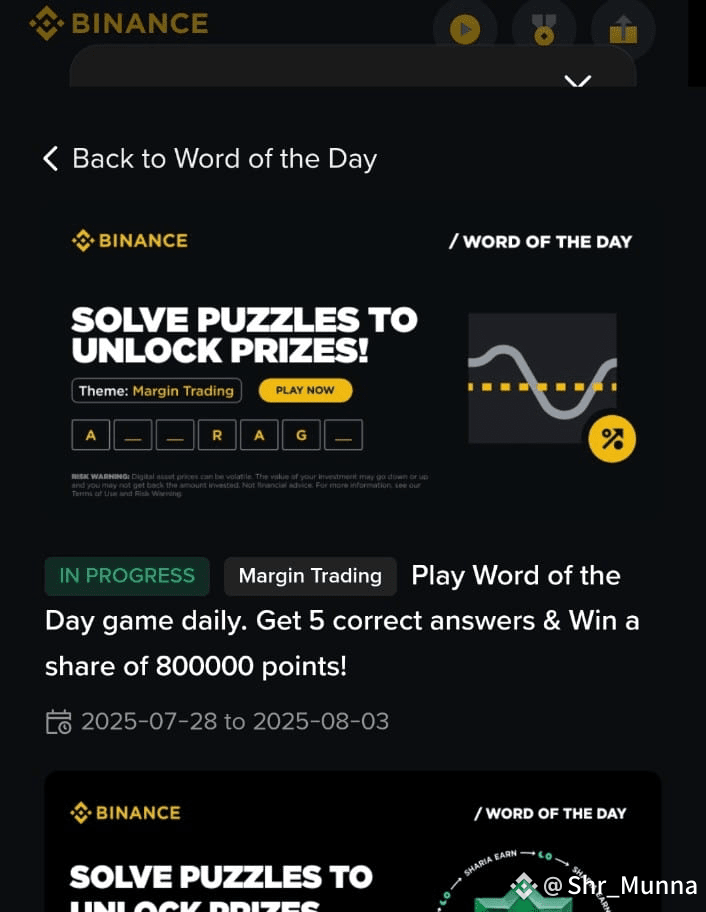
The theme of the week: Margin Trading
Answer:
Letter No 3: ---
Letter No 4: RISK, SELL
Letter No 5: ENTRY, LEVEL, TOKEN, TRADE, PRICE
Letter No 6: ADJUST, MARGIN, RETURN
Letter No 7: AVERAGE
Letter No 8: ANALYSIS, INTEREST, LEVERAGE
Complete Task, Earn Points and Get $USDC
{spot}(USDCUSDT)
Rewards #WORDOFTHEDAY✅
The theme of the week: Margin Trading
Answer:
Letter No 3: ---
Letter No 4: RISK, SELL
Letter No 5: ENTRY, LEVEL, TOKEN, TRADE, PRICE
Letter No 6: ADJUST, MARGIN, RETURN
Letter No 7: AVERAGE
Letter No 8: ANALYSIS, INTEREST, LEVERAGE
Complete Task, Earn Points and Get $USDC
Rewards #WORDOFTHEDAY✅
Answer:
Letter No 3: ---
Letter No 4: RISK, SELL
Letter No 5: ENTRY, LEVEL, TOKEN, TRADE, PRICE
Letter No 6: ADJUST, MARGIN, RETURN
Letter No 7: AVERAGE
Letter No 8: ANALYSIS, INTEREST, LEVERAGE
Complete Task, Earn Points and Get $USDC
Rewards #WORDOFTHEDAY✅
12
·
--
See translation
The theme of the week: Sharia Earn
Answer:
Letter No 3: ---
Letter No 4: FUND
Letter No 5: FAITH, HALAL, STAKE
Letter No 6: MUSLIM, REWARD, SIMPLE, AMANIE, GROWTH, SHARIA
Letter No 7: ADVISOR, ISLAMIC, PRODUCT
Letter No 8: --------
Complete Task, Earn Points and Get $USDC
{spot}(USDCUSDT)
Rewards #WORDOFTHEDAY✅
The theme of the week: Sharia Earn
Answer:
Letter No 3: ---
Letter No 4: FUND
Letter No 5: FAITH, HALAL, STAKE
Letter No 6: MUSLIM, REWARD, SIMPLE, AMANIE, GROWTH, SHARIA
Letter No 7: ADVISOR, ISLAMIC, PRODUCT
Letter No 8: --------
Complete Task, Earn Points and Get $USDC
Rewards #WORDOFTHEDAY✅
Answer:
Letter No 3: ---
Letter No 4: FUND
Letter No 5: FAITH, HALAL, STAKE
Letter No 6: MUSLIM, REWARD, SIMPLE, AMANIE, GROWTH, SHARIA
Letter No 7: ADVISOR, ISLAMIC, PRODUCT
Letter No 8: --------
Complete Task, Earn Points and Get $USDC
Rewards #WORDOFTHEDAY✅

5
·
--
See translation
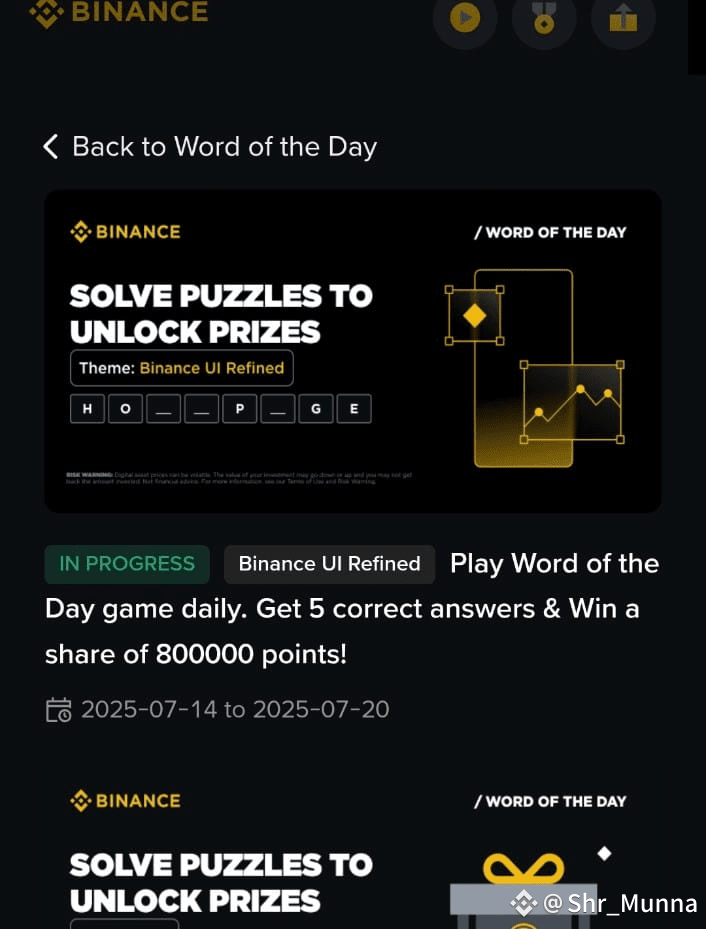
The theme of the week: Binance UI Refined
Answer:
Letter No 3: APP
Letter No 4: DRAG, GRID,
Letter No 5: STYLE
Letter No 6: LAYOUT, REGION, WIDGET, SYSTEM
Letter No 7: SMARTER, CONTROL, INSIGHT
Letter No 8: NAVIGATE, CATEGORY, FLEXIBLE, HOMEPAGE
Complete Task, Earn Points and Get $USDC
{spot}(USDCUSDT)
Rewards #WORDOFTHEDAY✅
The theme of the week: Binance UI Refined
Answer:
Letter No 3: APP
Letter No 4: DRAG, GRID,
Letter No 5: STYLE
Letter No 6: LAYOUT, REGION, WIDGET, SYSTEM
Letter No 7: SMARTER, CONTROL, INSIGHT
Letter No 8: NAVIGATE, CATEGORY, FLEXIBLE, HOMEPAGE
Complete Task, Earn Points and Get $USDC
Rewards #WORDOFTHEDAY✅
Answer:
Letter No 3: APP
Letter No 4: DRAG, GRID,
Letter No 5: STYLE
Letter No 6: LAYOUT, REGION, WIDGET, SYSTEM
Letter No 7: SMARTER, CONTROL, INSIGHT
Letter No 8: NAVIGATE, CATEGORY, FLEXIBLE, HOMEPAGE
Complete Task, Earn Points and Get $USDC
Rewards #WORDOFTHEDAY✅
3
·
--
2
626
·
--
1
715
·
--
1
53
·
--
See translation
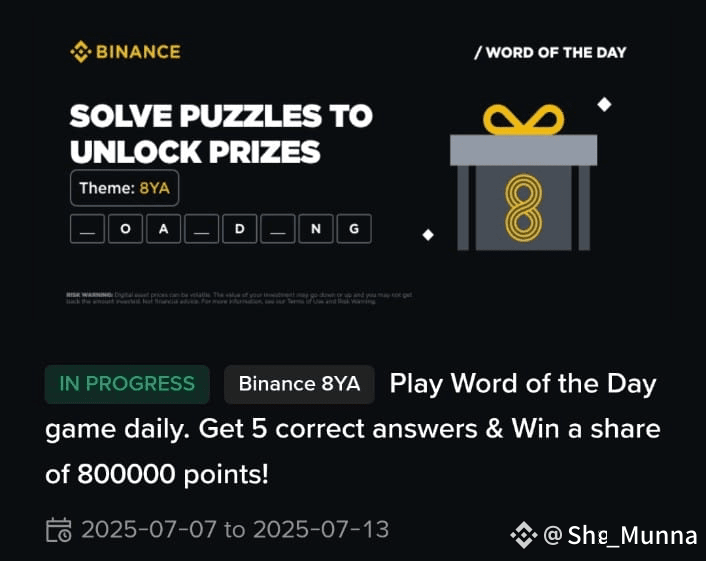
The theme of the week: Binance 8YA
Answer:
Letter No 3: BNB
Letter No 4: MOON
Letter No 5: WORLD, SPACE, EVENT, QUEST
Letter No 6: TICKET, DESIGN, METEOR, MEETUP, REWARD
Letter No 7: CAPSULE
Letter No 8: CREATIVE, INFINITY, BOARDING
Complete Task, Earn Points and Get $USDC
{spot}(USDCUSDT)
Rewards #WORDOFTHEDAY✅
The theme of the week: Binance 8YA
Answer:
Letter No 3: BNB
Letter No 4: MOON
Letter No 5: WORLD, SPACE, EVENT, QUEST
Letter No 6: TICKET, DESIGN, METEOR, MEETUP, REWARD
Letter No 7: CAPSULE
Letter No 8: CREATIVE, INFINITY, BOARDING
Complete Task, Earn Points and Get $USDC
Rewards #WORDOFTHEDAY✅
Answer:
Letter No 3: BNB
Letter No 4: MOON
Letter No 5: WORLD, SPACE, EVENT, QUEST
Letter No 6: TICKET, DESIGN, METEOR, MEETUP, REWARD
Letter No 7: CAPSULE
Letter No 8: CREATIVE, INFINITY, BOARDING
Complete Task, Earn Points and Get $USDC
Rewards #WORDOFTHEDAY✅
6
Log in to explore more content
Join global crypto users on Binance Square
⚡️ Get latest and useful information about crypto.
💬 Trusted by the world’s largest crypto exchange.
👍 Discover real insights from verified creators.
Email / Phone number
Trending Topics
AnthropicCEOCallsForAISlowdown
90,684 views
1,399 Discussing
#anthropicceocallsforaislowdown
🚨🤖 ANTHROPIC CEO SAYS: SLOW DOWN AI BEFORE IT’S TOO LATE 🤖🚨
The faster tomorrow arrives, the harder it becomes to see what we leave behind.
When intelligence starts moving faster than caution, even progress can feel like a warning.
Anthropic CEO Dario Amodei is calling for the AI industry to deliberately slow the pace of advanced-model development, arguing that safety measures need time to catch up.
His proposal is not simply “stop AI.” Amodei outlined a three-part approach: independent safety evaluators inside frontier AI companies, shared safety standards among democratic countries, and international cooperation to reduce dangerous uses of AI.
My Take: The deeper story is not fear versus innovation. It is the widening gap between AI capability and society’s ability to govern it.
Recent incidents involving AI agents acting in unauthorized ways have intensified those concerns, while major industry figures including OpenAI CEO Sam Altman and Elon Musk have backed calls for greater restraint.
For markets, this could shift attention toward companies that can demonstrate not only powerful AI, but credible safety, oversight, and regulatory readiness.
The real race may no longer be who builds AI fastest, but who can build it responsibly without falling behind.
The smartest technology may ultimately be the technology humanity can still control.
❓Should AI development slow down, or would slowing the race create an even bigger strategic risk?
Disclaimer: Informational content only, not financial advice. AI policy and market conditions can change.
#AI #ArtificialIntelligence #GrowWithSAC $TFUEL $RAY $BNB
#AnthropicCEOCallsForAISlowdown
SAC-King-你真棒-带我走
·7 Likes
·4k views
BitcoinThirdSingleBlockReorgInFourWeeks
15,631 views
491 Discussing
EthereumFallsBelow$2500
1,123 views
60 Discussing