

暗影萨满
2.7k Posts

暗影萨满
Report
Block User
链上拾荒者 / AI Coder
20 年 Dota 烟火,换个战场继续 Carry。
专注 AI 自动化工具与链上数据挖掘。现正全神贯注于模型预测与黑暗森林中的 Alpha 捕捉。
Open Trade
High-Frequency Trader
8.9 Years
74 Following
223 Followers
652 Liked
Posts
Portfolio
All
Quotes
Videos
·
--
Breaking out of the established trading range requires sustained buying pressure; balanced turnover, with buyers and sellers taking turns gaining ground, is unlikely to open up room to the upside.
$MORPHO rose to $2.355 intraday, briefly breaking above the $2.347 upper boundary of its range over the previous four hours. However, it failed to sustain the move and fell back into the range by the close, at $2.343.
Spot trading volume during the period rose to around $43,000, 1.5 times the previous average, while the ratio of aggressive buying to aggressive selling was almost even.
Buyers and sellers clashed actively at higher levels, but there was no sustained, one-sided wave of market orders. The price therefore returned to its previous sideways channel.
151
·
--
Many people are accustomed to treating a high proportion of aggressive buying as a sign that prices are bound to rise, but the feedback from trade details is mixed.
$AAVE The price briefly surged to $141.16 intraday, breaking above the four-hour trading high of $139.81, but then met resistance and pulled back, closing back at $139.22.
During this period, spot trading volume rose to more than $530,000, about 2.4 times the previous average, with aggressive buying accounting for 71% of the total.
Even though buyers clearly dominated aggressive market orders, the price retreated to its original range to consolidate after surging. The proportion of aggressive buying alone cannot substitute for the price actually holding firm at the close.
499
·
--
Testing above the previous trading range does not necessarily mean a new leg up can develop smoothly.
$QNT climbed to $208.67 intraday, breaking above the $207.65 ceiling of the previous four-hour consolidation, but failed to hold its gains and fell back into the original range.
Spot trading volume during this period exceeded $290,000—more than twice the previous average—with active selling accounting for over 59%.
Despite increased volume and turnover, no new upward channel opened, and the price returned to its previous trading range.
433
·
--
Aggressive buying broke the stalemate that had lasted for hours.
$PENDLE spot prices moved higher, closing at $1.888 and breaking above the $1.867 ceiling that had held for the previous four hours.
Spot trading volume during the period surged to more than $75,000, nearly six times the previous average, with aggressive buying accounting for a full 70%.
A flurry of market orders quickly swept up the sell orders above, pushing the candle body out of the previous consolidation range and into a new round of trading at higher levels.
149
·
--
Testing the upper band does not mean the price can immediately hold at a higher level.
$LSK surged to $0.2407 intraday, breaking above the upper boundary of the previous four-hour consolidation range, but then met selling pressure and retreated to close below $0.2364.
Spot trading volume during the period rose to nearly $290,000, three times the previous average, with aggressive buying accounting for 55%.
After the volume-driven surge failed to open up new ground, the price retreated to its original range-bound channel. The turnover at higher levels did not alter the sideways consolidation pattern.
63
·
--
Have you checked in and claimed your points in Binance Predictor today, guys?
This official campaign is a pretty sweet deal—no requirements and no cost at all. Just check in and complete a few daily tasks to earn prediction points for free. Use them to predict how major cryptocurrencies will move and climb the leaderboard. The prize pool is worth up to 1 million USDC, shared among participants.
It’s a completely free perk, and even if your predictions are wrong, you won’t lose any of your own money. It’s a fun little game to play and unwind with while killing time each day. Which coin did you put your points on today? Don’t forget to claim your guaranteed check-in points first!
#BinancePredictor
104
·
--
A concentrated wave of buying broke the narrow-range consolidation that had lasted for hours.
$LSK spot prices surged to close at $0.2445, breaking above the $0.2184 trading ceiling that had held over the previous four hours.
During the move, spot trading volume climbed to over $650,000—more than fifteen times the earlier baseline—with aggressive buying accounting for nearly 59% of the total.
The heavy buying quickly absorbed the sell orders above, pushing the price decisively out of its previous consolidation channel. The former resistance level has now become a benchmark for gauging the strength of the next move.
118
·
--
The Bank of England has formally launched a regulatory consultation on allowing central counterparties to accept tokenised eligible collateral.
Officials have clarified that existing regulations do not pose a barrier to entry. As long as tokenised assets can be clearly valued, transferred immediately and converted into cash even under extreme stress, clearing houses may include them as eligible collateral.
Institutions have traditionally been constrained by delays in clearing when meeting cross-border margin calls. Allowing tokenised collateral could enable assets to be moved quickly around the clock and reduce the risk of liquidity crunches.
The consultation will run until 12 February 2027, setting out regulatory expectations for traditional clearing hubs to accept collateral recorded on distributed ledgers.
37
·
--
On-chain spectacle: Someone precisely targeted a Binance-hacked BTC address with a “begging transaction”
After Binance was hacked yesterday, around 18,270 BTC were split into multiple transactions (including several of 1,000 BTC) and transferred out. One of the receiving addresses was bc1q0ts8gaf9ht0rr4u02hr56f8thndqsc4kmkmfv3 (which still holds 1,000 BTC untouched).
Not long afterward, this transaction appeared:
dc0edd8a71f0482c8ac366965b5a8c679a7877a36cae87e7b2094ac36dfbd6e8
- About 5.66 kB in size
- Fee of just 1 sat/vB
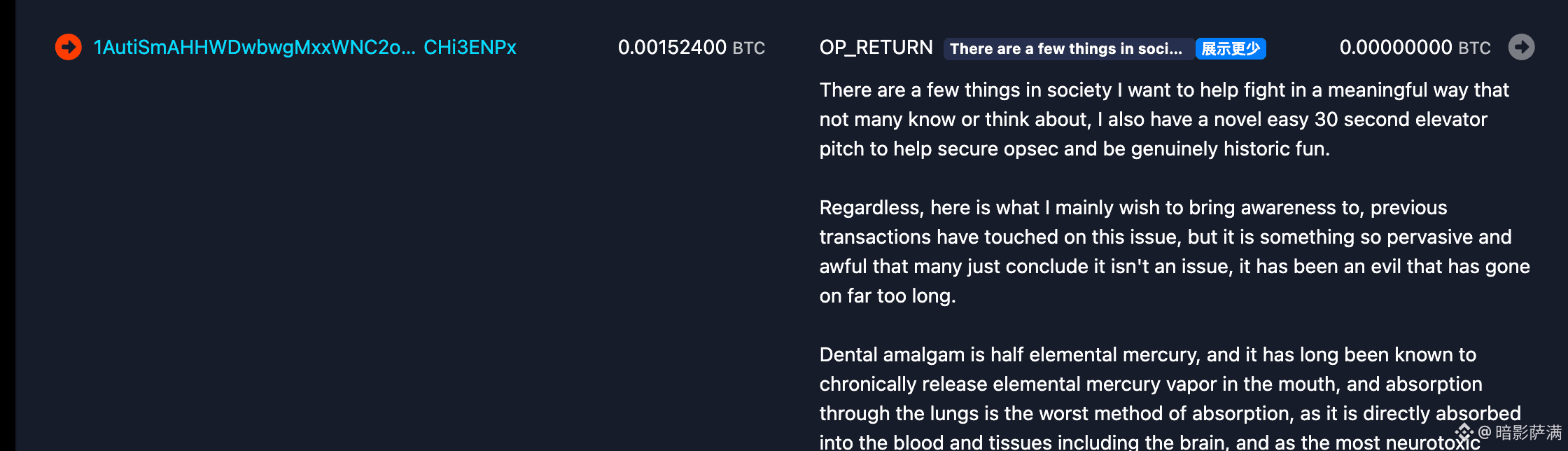
- Sent a dust amount of 0.00001 BTC to the BTC address above, along with an extremely long OP_RETURN output
The message roughly said: It complained about the toxicity of dental amalgam, described the sender's experiences related to autism, said their family was close to becoming homeless and hoped someone would help, and included a complete PGP public key for contact. It even proposed the idea of randomly sending small amounts of BTC to addresses as a “global lottery.”
This isn't an ordinary on-chain ad: it's a direct, targeted plea for help/leaflet sent to a receiving address for BTC stolen from Binance. The hacker (or whoever is in control) can see this message just by checking the blockchain.
Bitcoin's immutability is on display once again—someone has started “shouting out” to an address holding stolen funds on-chain.
Transaction link: https://mempool.space/tx/dc0edd8a71f0482c8ac366965b5a8c679a7877a36cae87e7b2094ac36dfbd6e8
First time hearing about this
#Bitcoin #OnChainBegging #OP_RETURN
337
·
--
Last night after playing ball, I pulled out my phone on the subway and saw that my ETH long position had finally broken even.
For a moment, I really felt like I’d made it through this rough patch. I’d called the direction right, and now it was time to start making money.
Before bed, in the group chat at @No_tariff123 , he said something didn’t feel right and suggested closing the long position first. My first thought was: I’d held on for so long, and now that I’ve just broken even, I’m supposed to get out? I couldn’t bring myself to do it.
Then I went to sleep.
When I woke up this morning and checked my phone, I was stunned. A black swan event hit: Binance’s hot wallet was hacked, ETH plunged, and my account went straight from breaking even to being deep in the red.
It’s not that nobody warned me. I just didn’t listen.
Last night after playing ball, I pulled out my phone on the subway and saw that my ETH long position had finally broken even.
For a moment, I really felt like I’d made it through this rough patch. I’d called the direction right, and now it was time to start making money.
Before bed, in the group chat at @恐龙博士 , he said something didn’t feel right and suggested closing the long position first. My first thought was: I’d held on for so long, and now that I’ve just broken even, I’m supposed to get out? I couldn’t bring myself to do it.
Then I went to sleep.
When I woke up this morning and checked my phone, I was stunned. A black swan event hit: Binance’s hot wallet was hacked, ETH plunged, and my account went straight from breaking even to being deep in the red.
It’s not that nobody warned me. I just didn’t listen.
4
1
384
·
--
A four-hour sideways consolidation was broken by a surge of aggressive sell orders.
The spot price of $PYTH fell, closing at $0.05911 and breaking below the previous consolidation floor at $0.05961.
Spot trading volume during the period surged to over $2.01 million, more than ten times the previous baseline, with aggressive selling accounting for 65% of the total.
The move lower on increased volume was accompanied by sustained selling pressure. After breaking out of the previous range, the price shifted downward, and the former horizontal support has now become immediate resistance overhead.
362
·
--
Predicting #币安神算子 is really hard. LoL World Championship—I played two games before bed and won both, but now it's 1:1.
I didn't cash out the profit on my $ETH long position before bed; it got closed by the black swan at 4 o'clock.
Predicting #币安神算子 is really hard. LoL World Championship—I played two games before bed and won both, but now it's 1:1.
I didn't cash out the profit on my $ETH long position before bed; it got closed by the black swan at 4 o'clock.
I didn't cash out the profit on my $ETH long position before bed; it got closed by the black swan at 4 o'clock.
35
·
--
The support level at $0.189, which held over the past four hours, has weakened, and the price of $LSK has fallen below it.
Short-term spot trading volume has expanded to $500,000, twice the previous benchmark, while the ratio of aggressive buying to aggressive selling is almost exactly even.
The move has not been a one-sided, imbalanced plunge, but amid intense and balanced turnover, the price has clearly shifted out of its previous sideways range.
241
·
--
The largest waves of trading often cluster around the moment prices break out of consolidation.
$ZEC spot trading recorded over $16 million in volume over a short period, nearly five times the previous average, with aggressive buying accounting for almost 58%.
A flurry of buy orders pushed the price up to close at $1,373.17, above the upper end of the $1,363 range seen over the previous four hours.
Compared with the earlier calm trading, concentrated buying drove the price level noticeably higher, while sell orders were also executed rapidly at elevated prices.
14
·
--
I didn’t get any allocation in the token launch, but got liquidated on Venus first and lost 245U! A hard lesson
This afternoon, I participated in the #Predict token launch and planned to use leverage through Venus to reduce risk and control my exposure. But I didn’t get any allocation—instead, I got liquidated first and lost about 245U.
I just used Grok to review the whole process
1. At 16:16, I deposited 5315 USDT on #Venus and received about 200,000 vUSDT as collateral.
2. At 16:28, I borrowed 5.65 BNB. The BNB price was about 751 at the time, putting the debt value at around 4243 USD.
3. Venus’s USDT collateral factor (CF/LT) is 80%, so the maximum borrowing capacity was just 5315 × 0.8 = 4252 USD. I had nearly maxed it out (about 99.8%), leaving almost no safety buffer.
4. The BNB price peaked at 753.95, bringing the debt value to around 4260 USD—directly above the liquidation threshold. A price increase of just 0.4% triggered the liquidation.
5. The liquidation bot executed through the Atlas Protocol’s `metacall`, calling the Venus Liquidator to liquidate my position.
Liquidation results (on-chain data):
- Debt repaid by the liquidator: 2.825 BNB (about $2090)
- Collateral taken from my account: about 87,963 vUSDT (worth around $2335)
- The difference was about $245, Venus’s standard liquidation incentive of around 10%
- Including other losses, I ended up losing about 400U in total
- I still have about 112,000 vUSDT left
- Worse still, the liquidation was executed at a price of around 753, while BNB has now fallen to 740. That means an additional loss of about 13U per BNB. Since 2.825 BNB were liquidated, that adds up to about 37U in extra losses.
A hard lesson:
I intended to use leverage to reduce the risk of participating in the token launch, but I overleveraged and couldn’t withstand even a 0.4% price fluctuation. I missed out on the token launch and got liquidated first.
4
2
1.2k
·
--
Selling pressure can build up and be released in a short period, often quickly breaking support levels that had held for hours.
$NEAR spot trading volume topped $10 million in a brief period, more than eight times the previous benchmark, with aggressive sell orders accounting for over 60% of the total.
The concentrated selling pressure pushed prices sharply lower, breaking below the lower boundary of the consolidation range that had held at $4.404 for the previous four hours.
This sharp shift on heavy volume disrupted the previous balance. After prices moved out of the original range, buyers and sellers began trading again at lower levels.
1
1
522
·
--
A four-hour, narrow-range tug-of-war was broken by a high-volume move lower.
$WLD spot price fell to close at $0.4155, slipping below the previous consolidation floor of $0.4197.
Spot trading volume during the period rose to more than $1.31 million, over five times the prior average, while the ratio of aggressive buys to sells was roughly even.
The high-volume decline came with relatively ample turnover and no one-sided, uncontrolled sell-off, but prices had clearly moved out of the previous sideways range.
100
·
--
The Depository Trust Company, part of DTCC—the largest securities clearing and custody organization on Wall Street—has officially launched a securities tokenization service.
Twenty major institutions, including JPMorgan, Citi, and Fidelity, are among the first to join. Eligible clients can convert traditionally custodied securities into on-chain digital assets.
Unlike earlier, fragmented on-chain experiments, tokenized securities will now be managed through a central depository overseeing more than $100 trillion in assets. They retain their legal rights while enabling instant transfers and collateralization between institutional wallets.
Traditional core securities have moved beyond the proof-of-concept stage and are now operating as a regular part of mainstream financial infrastructure.
·
--
A sudden surge in volume during consolidation often signals that the balance within the established range has been broken.
$APT spot traded narrowly below $0.7028 for the past four hours.
As the active buying ratio climbed to nearly 67%, short-term trading volume surged to nearly $140,000—more than twice the previous benchmark—and the price ultimately closed at $0.7109.
This volume-backed rally pushed the price straight out of its previous trading range, turning a high previously capped by sell orders into a new trading zone.
343
·
--
Buyer-initiated orders have become the dominant force driving $LTC out of its lull.
Aggressive spot buying accounted for 66% of activity, directly pushing the price to $59.13 and breaking it out of the sideways range where it had been capped at $58.79 for the previous four hours.
Short-term trading volume rose to over $610,000, about 1.8 times the earlier average, as a flurry of buy orders quickly absorbed the existing sell-side liquidity overhead.
This rapid push higher clearly reflects concentrated short-term buying pressure, but after breaking out of the previous range, the trend will depend more on whether buyers and sellers can sustain turnover at higher levels.
528
Log in to explore more content
Join global crypto users on Binance Square
⚡️ Get latest and useful information about crypto.
💬 Trusted by the world’s largest crypto exchange.
👍 Discover real insights from verified creators.
Email / Phone number
Trending Topics
WithdrawalsBack: 15 networks live
610 views
30 Discussing
Binance News Update | Binance Reopens Withdrawals for BTC, ETH, USDT and More Across 15 Networks, Meeting Its Sunday Target
Binance News
·26 Likes
·10.1k views
BinanceUpdatesProofofReservesAddresses
39,418 views
809 Discussing
BinanceToResumePhaseOneOfWithdrawals
71,789 views
1,053 Discussing