
LearnBits
2.6k Posts

LearnBits
Report
Block User
Learning quietly. Moving silently. Watching everything.
Open Trade
High-Frequency Trader
7.9 Years
118 Following
3.9K+ Followers
6.4K+ Liked
Posts
Portfolio
All
Quotes
Videos
Live
·
--
See translation
$SYN just went vertical and the crowd is torn between chasing and chilling. Are you buying more, holding, or watching from the side?
{future}(SYNUSDT)
$SYN just went vertical and the crowd is torn between chasing and chilling. Are you buying more, holding, or watching from the side?
Short now
Buying more
Holding
Watching
13 hr(s) left

Semoga Beruntung!
From LearnBits
478
·
--
See translation
$AIN dumps -85%, $BR drops -43% right after hitting local highs and $POWER -16%.
How are we playing these crazy wicks?
{future}(AINUSDT)
{future}(BRUSDT)
{future}(POWERUSDT)
$AIN dumps -85%, $BR drops -43% right after hitting local highs and $POWER -16%.
How are we playing these crazy wicks?
How are we playing these crazy wicks?
🛍️ Longing the bottom
📉 Riding shorts
🍿 Sitting on USDT (stay safe)
😭 Got liquidated by the wick
9 hr(s) left
Semoga Beruntung!
From LearnBits
2
3.7k
·
--
See translation
$SYN crawled out the grave +39%.. If 0.10 holds maybe it's real, if not it's a dead cat. 🐈
{future}(SYNUSDT)
$SYN crawled out the grave +39%.. If 0.10 holds maybe it's real, if not it's a dead cat. 🐈
Best Wishes!
From LearnBits
4
435
·
--
See translation
$CROSS ran to 0.155 then paused. RSI 87, price above the band. Not chasing this, watching if 0.14 holds or we get a sweep.
{future}(CROSSUSDT)
$CROSS ran to 0.155 then paused. RSI 87, price above the band. Not chasing this, watching if 0.14 holds or we get a sweep.
Best Wishes!
From LearnBits
2
382
·
--
See translation
$AKE already visited 0.044 once, got nuked, now crawling back up. RSI 81 again. Second leg or lower high?
{future}(AKEUSDT)
$AKE already visited 0.044 once, got nuked, now crawling back up. RSI 81 again. Second leg or lower high?
Best Wishes!
From LearnBits
2
3
644
·
--
See translation
Would you buy an AI chip IPO?
Altera’s IPO Could Be AI’s Next Big Chip Test 🚀
Altera, the programmable-chip maker backed by Silver Lake and Intel, has confidentially filed for a U.S. IPO as investor demand for AI-related businesses remains strong. The company could reportedly seek more than $2 billion, potentially making it one of the biggest semiconductor IPOs in years.
What makes Altera interesting is its role beyond traditional AI GPUs. Its chips are used in data centers, telecom networks and AI inference, giving investors another way to play the growing demand for specialized computing infrastructure.
The timing is also notable. The U.S. IPO market has already seen a major rebound, while AI-related listings are drawing huge attention. Altera now has a chance to test whether investors still have the appetite to pour money into another semiconductor story.
For the broader chip market, this could be an important signal. If Altera receives strong demand, it would suggest investors still believe the AI infrastructure cycle has room to run—even after recent worries about excessive spending and stretched valuations.
The big question is valuation. AI excitement can push investors toward new listings fast, but Altera will need to prove its growth story deserves a premium. If the IPO lands well, expect more AI infrastructure companies to test the public market next. 👀
$INTCB
{spot}(INTCBUSDT)
Would you buy an AI chip IPO?
Altera’s IPO Could Be AI’s Next Big Chip Test 🚀
Altera, the programmable-chip maker backed by Silver Lake and Intel, has confidentially filed for a U.S. IPO as investor demand for AI-related businesses remains strong. The company could reportedly seek more than $2 billion, potentially making it one of the biggest semiconductor IPOs in years.
What makes Altera interesting is its role beyond traditional AI GPUs. Its chips are used in data centers, telecom networks and AI inference, giving investors another way to play the growing demand for specialized computing infrastructure.
The timing is also notable. The U.S. IPO market has already seen a major rebound, while AI-related listings are drawing huge attention. Altera now has a chance to test whether investors still have the appetite to pour money into another semiconductor story.
For the broader chip market, this could be an important signal. If Altera receives strong demand, it would suggest investors still believe the AI infrastructure cycle has room to run—even after recent worries about excessive spending and stretched valuations.
The big question is valuation. AI excitement can push investors toward new listings fast, but Altera will need to prove its growth story deserves a premium. If the IPO lands well, expect more AI infrastructure companies to test the public market next. 👀
$INTCB
Altera’s IPO Could Be AI’s Next Big Chip Test 🚀
Altera, the programmable-chip maker backed by Silver Lake and Intel, has confidentially filed for a U.S. IPO as investor demand for AI-related businesses remains strong. The company could reportedly seek more than $2 billion, potentially making it one of the biggest semiconductor IPOs in years.
What makes Altera interesting is its role beyond traditional AI GPUs. Its chips are used in data centers, telecom networks and AI inference, giving investors another way to play the growing demand for specialized computing infrastructure.
The timing is also notable. The U.S. IPO market has already seen a major rebound, while AI-related listings are drawing huge attention. Altera now has a chance to test whether investors still have the appetite to pour money into another semiconductor story.
For the broader chip market, this could be an important signal. If Altera receives strong demand, it would suggest investors still believe the AI infrastructure cycle has room to run—even after recent worries about excessive spending and stretched valuations.
The big question is valuation. AI excitement can push investors toward new listings fast, but Altera will need to prove its growth story deserves a premium. If the IPO lands well, expect more AI infrastructure companies to test the public market next. 👀
$INTCB
🔥 Absolutely
📈 If priced right
🤔 Wait first
📉 Too risky
1 day(s) left
Best Wishes!
From LearnBits
1
390
·
--
See translation
#BinanceSummerCamp Just joined Binance Summer Camp and loving the security lessons! 🔐 From avoiding phishing links to setting up my Withdrawal Whitelist, I'm learning how to protect my assets. Let the games begin!
#BinanceSummerCamp Just joined Binance Summer Camp and loving the security lessons! 🔐 From avoiding phishing links to setting up my Withdrawal Whitelist, I'm learning how to protect my assets. Let the games begin!

1
344
·
--
See translation
$POWER tagged 0.20 and got slapped right back. That wick says sellers are camping up there. 0.14 is the line now... hold it and maybe round 2, lose it and it gets ugly. What now? 🧐
{future}(POWERUSDT)
$POWER tagged 0.20 and got slapped right back. That wick says sellers are camping up there. 0.14 is the line now... hold it and maybe round 2, lose it and it gets ugly. What now? 🧐
Reclaim 0.14
58%
Bleed to 0.09
34%
Chop city
8%
26 votes • Voting closed
Best Wishes!
From LearnBits
3
1.1k
·
--
See translation
$AIN went 2x in a day then left a wick at 0.1616. RSI 91 = pure fomo. Not chasing, watching if 0.12 holds.
{future}(AINUSDT)
$AIN went 2x in a day then left a wick at 0.1616. RSI 91 = pure fomo. Not chasing, watching if 0.12 holds.
Best Wishes!
From LearnBits
2
511
·
--
See translation
Tokenized stocks getting dragged today, red candles everywhere on bStocks 📉
$NOKB (Nokia): dumped -9.40% down to $9.83, RSI hitting 31.93 (oversold territory )
{spot}(NOKBUSDT)
$ALABB (Astera Labs): down -8.10% at $261.11, breaking under the lower Bollinger Band with RSI at 26.65 🔥
{spot}(ALABBUSDT)
$COHRB (Coherent): taking a -8.09% L at $273.24, testing support around $260.
{spot}(COHRBUSDT)
We catching these tech stock dips or holding cash until Wall St stabilizes besties? drop your plays 👇
Tokenized stocks getting dragged today, red candles everywhere on bStocks 📉
$NOKB (Nokia): dumped -9.40% down to $9.83, RSI hitting 31.93 (oversold territory )
$ALABB (Astera Labs): down -8.10% at $261.11, breaking under the lower Bollinger Band with RSI at 26.65 🔥
$COHRB (Coherent): taking a -8.09% L at $273.24, testing support around $260.
We catching these tech stock dips or holding cash until Wall St stabilizes besties? drop your plays 👇
$NOKB (Nokia): dumped -9.40% down to $9.83, RSI hitting 31.93 (oversold territory )
$ALABB (Astera Labs): down -8.10% at $261.11, breaking under the lower Bollinger Band with RSI at 26.65 🔥
$COHRB (Coherent): taking a -8.09% L at $273.24, testing support around $260.
We catching these tech stock dips or holding cash until Wall St stabilizes besties? drop your plays 👇
Catching the oversold bounce
14%
Shorting tech until support
29%
Staying in stables
43%
😭 Portfolio taking hits fr fr
14%
7 votes • Voting closed
Best Wishes!
From LearnBits
1
431
·
--
See translation
$BNCB got smoked from 5.85 to 5.08. One red candle, no mercy. If 4.79 holds maybe a bounce, but I’m not catching this knife yet.
{spot}(BNCBUSDT)
$BNCB got smoked from 5.85 to 5.08. One red candle, no mercy. If 4.79 holds maybe a bounce, but I’m not catching this knife yet.
585
·
--
See translation
$ZEC cooling off after that monster run. Still above the mid band but MACD rolling over. Watching 1000... hold there and dip buyers stay, lose it and we go deeper.
{future}(ZECUSDT)
$ZEC cooling off after that monster run. Still above the mid band but MACD rolling over. Watching 1000... hold there and dip buyers stay, lose it and we go deeper.

Best Wishes!
From LearnBits
1
620
·
--
See translation
$CAP dumped from 0.079 to 0.045 then ripped +42% back to 0.066. RSI 79 already. If 0.070 flips, maybe continuation; reject and it's just a bounce.
{future}(CAPUSDT)
$CAP dumped from 0.079 to 0.045 then ripped +42% back to 0.066. RSI 79 already. If 0.070 flips, maybe continuation; reject and it's just a bounce.
336
·
--
See translation
Bro the market turned into a gravity test real quick 😱 huge wicks and massive pullbacks everywhere today:
$LSK before the mega dump... someone's leverage got atomized fr fr..
{future}(LSKUSDT)
$LAB hovering right around the lower Bollinger Band.
{future}(LABUSDT)
$MARSCOIN retracing hard from that $0.269 high, testing key lower levels.
{future}(MARSCOINUSDT)
Catching the falling knife or waiting for market recovery besties?
Bro the market turned into a gravity test real quick 😱 huge wicks and massive pullbacks everywhere today:
$LSK before the mega dump... someone's leverage got atomized fr fr..
$LAB hovering right around the lower Bollinger Band.
$MARSCOIN retracing hard from that $0.269 high, testing key lower levels.
Catching the falling knife or waiting for market recovery besties?
$LSK before the mega dump... someone's leverage got atomized fr fr..
$LAB hovering right around the lower Bollinger Band.
$MARSCOIN retracing hard from that $0.269 high, testing key lower levels.
Catching the falling knife or waiting for market recovery besties?

Apeing into the LSK bounce
41%
Shorting until real support
31%
Holding USDT
28%
Got rekt by the wick fr fr
0%
32 votes • Voting closed
Best Wishes!
From LearnBits
4
3.4k
·
--
See translation
$KOMA tried 0.033 once, got rejected, chilled, now it's pushing again. Second leg vibes but RSI already 77. Watching if it can reclaim that high.
{future}(KOMAUSDT)
$KOMA tried 0.033 once, got rejected, chilled, now it's pushing again. Second leg vibes but RSI already 77. Watching if it can reclaim that high.
1
276
·
--
Bullish
See translation
$AIN woke up and chose violence. +47% and sitting way above the upper band.
{future}(AINUSDT)
$AIN woke up and chose violence. +47% and sitting way above the upper band.
Best Wishes!
From LearnBits
383
·
--
See translation
$FIL just ran past $1. RSI 85 and price floating above the band. Feels like late chase.
{future}(FILUSDT)
$FIL just ran past $1. RSI 85 and price floating above the band. Feels like late chase.
1
417
·
--
See translation
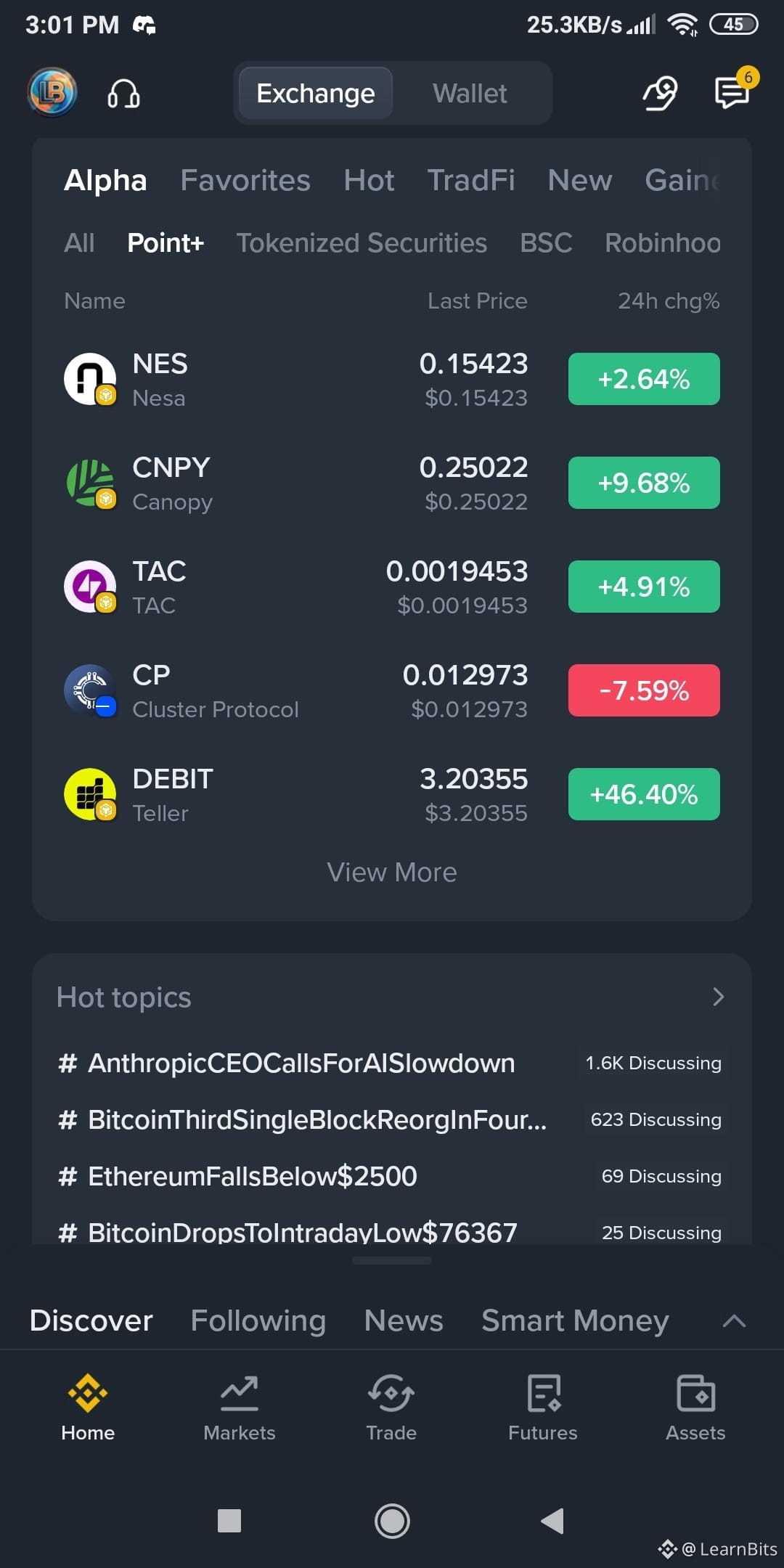
While macro headlines focus on BeTeCe reorgs and ETeHa pulling back, Point+ tokens are decoupling:
🔵 DEBIT (Teller): +46.40% ($3.20) — Clean breakout
🔵 CNPY (Canopy): +9.68% ($0.25) — Maintaining steady momentum
🔵 TAC: +4.91% — Solid higher low structure
🔴 CP (Cluster Protocol): -7.59% ($0.012) — Pullback to support zone
Are you following the trend on DEBIT or rotation trading into CP for a dip buy?
While macro headlines focus on BeTeCe reorgs and ETeHa pulling back, Point+ tokens are decoupling:
🔵 DEBIT (Teller): +46.40% ($3.20) — Clean breakout
🔵 CNPY (Canopy): +9.68% ($0.25) — Maintaining steady momentum
🔵 TAC: +4.91% — Solid higher low structure
🔴 CP (Cluster Protocol): -7.59% ($0.012) — Pullback to support zone
Are you following the trend on DEBIT or rotation trading into CP for a dip buy?
🔵 DEBIT (Teller): +46.40% ($3.20) — Clean breakout
🔵 CNPY (Canopy): +9.68% ($0.25) — Maintaining steady momentum
🔵 TAC: +4.91% — Solid higher low structure
🔴 CP (Cluster Protocol): -7.59% ($0.012) — Pullback to support zone
Are you following the trend on DEBIT or rotation trading into CP for a dip buy?
Best Wishes!
From LearnBits
1
3
813
·
--
See translation
Is $BR breaking out toward new highs, or are we due for a quick pullback retest? 👇
{future}(BRUSDT)
Is $BR breaking out toward new highs, or are we due for a quick pullback retest? 👇
Long / Riding the trend
60%
Short / Fade the move
40%
Wait for retest
0%
Sidelines / Too risky
0%
5 votes • Voting closed
Best Wishes!
From LearnBits
1
370
·
--
See translation
🚨 Revolut Just Exposed Sensitive Crypto Data Without Losing a Dollar
Revolut disclosed that it handed over some customers’ identity documents, residential addresses and transaction histories after a fraudulent request was mistakenly treated as a legitimate government demand.
The digital bank said no customer funds were lost, but it has not disclosed exactly how many users were affected. The incident may have targeted higher-net-worth customers.
For crypto users, the scary part isn't necessarily the money.
It's the data.
Passports, selfies, addresses and transaction records can give attackers a detailed map of who owns crypto, how much activity they have and where they live. That creates risks far beyond a simple account hack.
The market impact is more indirect, but important.
Crypto adoption increasingly depends on banks and fintech platforms becoming the bridge between traditional finance and digital assets. A security failure at that bridge can make users and regulators much more cautious about handing sensitive financial data to crypto-connected platforms.
The bigger takeaway?
As crypto becomes more mainstream, custody isn't the only security problem anymore — identity and transaction data are becoming just as valuable. 🔐
And for exchanges, banks and fintechs, one fake government request can turn into a serious trust problem.
🚨 Revolut Just Exposed Sensitive Crypto Data Without Losing a Dollar
Revolut disclosed that it handed over some customers’ identity documents, residential addresses and transaction histories after a fraudulent request was mistakenly treated as a legitimate government demand.
The digital bank said no customer funds were lost, but it has not disclosed exactly how many users were affected. The incident may have targeted higher-net-worth customers.
For crypto users, the scary part isn't necessarily the money.
It's the data.
Passports, selfies, addresses and transaction records can give attackers a detailed map of who owns crypto, how much activity they have and where they live. That creates risks far beyond a simple account hack.
The market impact is more indirect, but important.
Crypto adoption increasingly depends on banks and fintech platforms becoming the bridge between traditional finance and digital assets. A security failure at that bridge can make users and regulators much more cautious about handing sensitive financial data to crypto-connected platforms.
The bigger takeaway?
As crypto becomes more mainstream, custody isn't the only security problem anymore — identity and transaction data are becoming just as valuable. 🔐
And for exchanges, banks and fintechs, one fake government request can turn into a serious trust problem.
Revolut disclosed that it handed over some customers’ identity documents, residential addresses and transaction histories after a fraudulent request was mistakenly treated as a legitimate government demand.
The digital bank said no customer funds were lost, but it has not disclosed exactly how many users were affected. The incident may have targeted higher-net-worth customers.
For crypto users, the scary part isn't necessarily the money.
It's the data.
Passports, selfies, addresses and transaction records can give attackers a detailed map of who owns crypto, how much activity they have and where they live. That creates risks far beyond a simple account hack.
The market impact is more indirect, but important.
Crypto adoption increasingly depends on banks and fintech platforms becoming the bridge between traditional finance and digital assets. A security failure at that bridge can make users and regulators much more cautious about handing sensitive financial data to crypto-connected platforms.
The bigger takeaway?
As crypto becomes more mainstream, custody isn't the only security problem anymore — identity and transaction data are becoming just as valuable. 🔐
And for exchanges, banks and fintechs, one fake government request can turn into a serious trust problem.
449
Log in to explore more content
Join global crypto users on Binance Square
⚡️ Get latest and useful information about crypto.
💬 Trusted by the world’s largest crypto exchange.
👍 Discover real insights from verified creators.
Email / Phone number
Trending Topics
FedRateWatch
1.5M views
6,803 Discussing
Share & Win Traffic Reward in our Trending Hashtag Campaign
✨Topic: FOMC September, What's The Fed's Next Move?
👉How to Join:
Publish a short post or article with hashtag #FedRateWatch
Create content based on the below angles:
- August core CPI rose 0.3% month-over-month, and the odds of a 25bp hike this week are now close to 90%. Do you anticipate a rate hike this week? Is it a one-off, or the start of a longer hiking cycle?
- If the hike lands, how does it play out for BTC, tech stocks, and gold? Bullish or bearish?
- How are you planning to trade next? Share your BTC, stocks or gold trade/holdings with our trade sharing widget.
⏰Campaign Period:
- 2026-09-15 11:00 - 2026-09-17 3:00 UTC
🎁Reward:
- Qualified posts that comply with the above guidelines and contain more than 100 words will be reviewed and may receive a random traffic boost of 500 to 3,000 views. You will receive a notification from your feed secretary if your post is selected.
- Get a chance to have your article featured on Binance Square Official
Need ideas for your post? Visit the topic page #FedRateWatch or the Square Guide on How to Post for Better Reach.
Binance Square Official
·650 Likes
·1.7M views
ZcashRises6%
56,474 views
677 Discussing
XRPSinks10%
37,711 views
443 Discussing