

Four_iv
4.5k Posts

Four_iv
 Square Verified
Report
Block User
we are advertising and media industry that do promote cryptos and do provide marketing services Check us out on Twitter @X_Four_iv we do present daily new 💎

Level 1 Creator

BNB Holder
Frequent Trader
5.2 Years
54 Following
30.8K+ Followers
55.7K+ Liked
1 Badges
Posts
All
Quotes
Videos
Live
·
--
🎙️ 🎉2026 Raging Bull Market, the Trumpet Has Sounded—Markets Are All on the BSC Chain!! On November 1, Musk will celebrate the birthday of the Martian dog Marvin. This on-chain market move—make sure you catch it!
End
02 h 20 m 09 s
5.7k
13
48

·
--
🎙️ Woke up to everything going red all the way—how are the babies trading futures doing?
End
02 h 21 m 44 s
5.8k
19
18
·
--
See translation
Hey @BiBi , which one is coming first?
$PONS breaks the trendline and sending it to $0.75+
or loses the make-or-break zone and heading for $0.20?
Your move
Hey @Binance BiBi , which one is coming first?
$PONS breaks the trendline and sending it to $0.75+
or loses the make-or-break zone and heading for $0.20?
Your move
$PONS breaks the trendline and sending it to $0.75+
or loses the make-or-break zone and heading for $0.20?
Your move
3
964
·
--
See translation
$HYPE really loves making traders uncomfortable
Sitting at $90 while the heatmap is showing a huge liquidity pocket at $88-$95
There’s liquidity everywhere tbh on both ends
Now I just wanna see which side HYPE decides to absolutely destroy first
$HYPE really loves making traders uncomfortable
Sitting at $90 while the heatmap is showing a huge liquidity pocket at $88-$95
There’s liquidity everywhere tbh on both ends
Now I just wanna see which side HYPE decides to absolutely destroy first
Sitting at $90 while the heatmap is showing a huge liquidity pocket at $88-$95
There’s liquidity everywhere tbh on both ends
Now I just wanna see which side HYPE decides to absolutely destroy first
2
1
1.4k
·
--
See translation
It's quite clear that markets will continue to trend upwards massively in the coming period.
People just need to be a little bit more rational.
Corrections will happen in the markets, it's not like things will go straight up vertically.
It's quite clear that markets will continue to trend upwards massively in the coming period.
People just need to be a little bit more rational.
Corrections will happen in the markets, it's not like things will go straight up vertically.
People just need to be a little bit more rational.
Corrections will happen in the markets, it's not like things will go straight up vertically.
168
·
--
See translation
$XRP has been doing the most boring thing possible for weeks
just slowly bleeding inside this giant bull flag while everyone moved on
Now it finally broke the trendline
And honestly, I’m more interested in what happens after the breakout than the breakout itself
If XRP can hold this area, flip the old resistance into support and start pushing again, that $1.80 zone looking very interesting
No need to chase the candle
Let it retest
If the breakout is real, the chart should tell us
And if it fails well, $XRP can gave everyone a free lesson in why we don’t marry breakout candles
$XRP has been doing the most boring thing possible for weeks
just slowly bleeding inside this giant bull flag while everyone moved on
Now it finally broke the trendline
And honestly, I’m more interested in what happens after the breakout than the breakout itself
If XRP can hold this area, flip the old resistance into support and start pushing again, that $1.80 zone looking very interesting
No need to chase the candle
Let it retest
If the breakout is real, the chart should tell us
And if it fails well, $XRP can gave everyone a free lesson in why we don’t marry breakout candles
just slowly bleeding inside this giant bull flag while everyone moved on
Now it finally broke the trendline
And honestly, I’m more interested in what happens after the breakout than the breakout itself
If XRP can hold this area, flip the old resistance into support and start pushing again, that $1.80 zone looking very interesting
No need to chase the candle
Let it retest
If the breakout is real, the chart should tell us
And if it fails well, $XRP can gave everyone a free lesson in why we don’t marry breakout candles
2
5
1.4k
·
--
See translation
I honestly think that we should be looking at this cycle more in comparison to 2016-2017.
There's a lot more adoption happening due to the innovation behind the scenes, that I believe that we'll see more #altcoins hitting escape velocity.
That would create more S-Curve type of charts rather than the Burj Khalifa ones.
Therefore, upside is higher, being patient by simply holding is also a great strategy.
I honestly think that we should be looking at this cycle more in comparison to 2016-2017.
There's a lot more adoption happening due to the innovation behind the scenes, that I believe that we'll see more #altcoins hitting escape velocity.
That would create more S-Curve type of charts rather than the Burj Khalifa ones.
Therefore, upside is higher, being patient by simply holding is also a great strategy.
There's a lot more adoption happening due to the innovation behind the scenes, that I believe that we'll see more #altcoins hitting escape velocity.
That would create more S-Curve type of charts rather than the Burj Khalifa ones.
Therefore, upside is higher, being patient by simply holding is also a great strategy.
207
·
--
See translation
I’VE SEEN THIS BEFORE
A coin gets boring
Everyone stops talking about it
Liquidity moves somewhere else
Then suddenly the structure breaks and everybody starts asking why they didn’t watch it earlier
That’s basically what $INJ is giving me right now with this cup & handle breakout
Maybe the boring phase was the accumulation phase after all
Now my eyes are stuck on $13
Here we go again bros🚀🚀🚀
I’VE SEEN THIS BEFORE
A coin gets boring
Everyone stops talking about it
Liquidity moves somewhere else
Then suddenly the structure breaks and everybody starts asking why they didn’t watch it earlier
That’s basically what $INJ is giving me right now with this cup & handle breakout
Maybe the boring phase was the accumulation phase after all
Now my eyes are stuck on $13
Here we go again bros🚀🚀🚀
A coin gets boring
Everyone stops talking about it
Liquidity moves somewhere else
Then suddenly the structure breaks and everybody starts asking why they didn’t watch it earlier
That’s basically what $INJ is giving me right now with this cup & handle breakout
Maybe the boring phase was the accumulation phase after all
Now my eyes are stuck on $13
Here we go again bros🚀🚀🚀
1
6
2.4k
·
--
See translation
Not gonna lie, this $XRP chart giving me giga bullish vibes
The setup is here rn
Left shoulder → head → right shoulder
Now we’re testing the neckline
$1.60-$1.70
Breakout would be interesting from here tbh
Rejection and we probably go back to waiting
Simple as that, nothing in between
Not gonna lie, this $XRP chart giving me giga bullish vibes
The setup is here rn
Left shoulder → head → right shoulder
Now we’re testing the neckline
$1.60-$1.70
Breakout would be interesting from here tbh
Rejection and we probably go back to waiting
Simple as that, nothing in between
The setup is here rn
Left shoulder → head → right shoulder
Now we’re testing the neckline
$1.60-$1.70
Breakout would be interesting from here tbh
Rejection and we probably go back to waiting
Simple as that, nothing in between
15
3.5k
·
--
See translation
$TAO chart looking kinda stupid bullish rn ngl
broke structure, came back to retest, held the strong low and now back above $330 again
if we get a clean push through $350, i can easily see this making a run for $380
would be funny if everyone waiting for the pullback just ends up providing the liquidity for the next leg up
All eyes on $TAO now
$TAO chart looking kinda stupid bullish rn ngl
broke structure, came back to retest, held the strong low and now back above $330 again
if we get a clean push through $350, i can easily see this making a run for $380
would be funny if everyone waiting for the pullback just ends up providing the liquidity for the next leg up
All eyes on $TAO now
broke structure, came back to retest, held the strong low and now back above $330 again
if we get a clean push through $350, i can easily see this making a run for $380
would be funny if everyone waiting for the pullback just ends up providing the liquidity for the next leg up
All eyes on $TAO now
8
4.1k
·
--
See translation
Ngl, $NEAR just said f**k the downtrend bros
months of lower highs and sellers controlling every move till today
now the trendline is broken and price is pushing hard tbh
$4.8 right now → $9 is the level i am expecting to hit SOONER or LATER
If everything goes well, this gonna perform hard
I am locking in fams, wbu?
Ngl, $NEAR just said f**k the downtrend bros
months of lower highs and sellers controlling every move till today
now the trendline is broken and price is pushing hard tbh
$4.8 right now → $9 is the level i am expecting to hit SOONER or LATER
If everything goes well, this gonna perform hard
I am locking in fams, wbu?
months of lower highs and sellers controlling every move till today
now the trendline is broken and price is pushing hard tbh
$4.8 right now → $9 is the level i am expecting to hit SOONER or LATER
If everything goes well, this gonna perform hard
I am locking in fams, wbu?
13
1.2k
·
--
See translation
There's been a long period where the overall question was whether #altcoins still had a point to exist.
I think we're past that point.
It's no longer about #Bitcoin, it's about blockchain payment rails and the entire infrastructure of finance moving onchain.
It's the first time since 2017 that you're clearly seeing a massive breakthrough in innovation.
Super exciting.
There's been a long period where the overall question was whether #altcoins still had a point to exist.
I think we're past that point.
It's no longer about #Bitcoin, it's about blockchain payment rails and the entire infrastructure of finance moving onchain.
It's the first time since 2017 that you're clearly seeing a massive breakthrough in innovation.
Super exciting.
I think we're past that point.
It's no longer about #Bitcoin, it's about blockchain payment rails and the entire infrastructure of finance moving onchain.
It's the first time since 2017 that you're clearly seeing a massive breakthrough in innovation.
Super exciting.
1
1
308
·
--
See translation
ETH SEASON MIGHT ACTUALLY BE LOADING
ETH/USDT broke out
Next major level: $3K
ETH/BTC gaining strength too
If this keeps going, the altcoin trenches are going to wake up real fast
Are you ready bros?
ETH SEASON MIGHT ACTUALLY BE LOADING
ETH/USDT broke out
Next major level: $3K
ETH/BTC gaining strength too
If this keeps going, the altcoin trenches are going to wake up real fast
Are you ready bros?
ETH/USDT broke out
Next major level: $3K
ETH/BTC gaining strength too
If this keeps going, the altcoin trenches are going to wake up real fast
Are you ready bros?
291
·
--
See translation
The altcoin volume is looking insane tbh
$AVAX coming into the top 10 with $1.2B volume
$SUI sitting with $747M.
ETH is absolutely dominating at $10.2B, but seeing capital move into names like $SUI and $AVAX is exactly the kind of thing I want on my radar
Something is cooking here fr sure
The altcoin volume is looking insane tbh
$AVAX coming into the top 10 with $1.2B volume
$SUI sitting with $747M.
ETH is absolutely dominating at $10.2B, but seeing capital move into names like $SUI and $AVAX is exactly the kind of thing I want on my radar
Something is cooking here fr sure
$AVAX coming into the top 10 with $1.2B volume
$SUI sitting with $747M.
ETH is absolutely dominating at $10.2B, but seeing capital move into names like $SUI and $AVAX is exactly the kind of thing I want on my radar
Something is cooking here fr sure
4
939
·
--
See translation
$BTC is looking a little too comfortable again
We bounced hard from the lows, sentiment flipped bullish and suddenly everyone thinks the bottom is in
I’m not convinced
The last few times we saw this structure, BTC eventually gave back around 30%
If it happens again, $54K comes into play
My path is still:
77k → 82k → 70k → 60k → 54k
Wouldn’t be surprised if the market makes everyone bullish first
$BTC is looking a little too comfortable again
We bounced hard from the lows, sentiment flipped bullish and suddenly everyone thinks the bottom is in
I’m not convinced
The last few times we saw this structure, BTC eventually gave back around 30%
If it happens again, $54K comes into play
My path is still:
77k → 82k → 70k → 60k → 54k
Wouldn’t be surprised if the market makes everyone bullish first
We bounced hard from the lows, sentiment flipped bullish and suddenly everyone thinks the bottom is in
I’m not convinced
The last few times we saw this structure, BTC eventually gave back around 30%
If it happens again, $54K comes into play
My path is still:
77k → 82k → 70k → 60k → 54k
Wouldn’t be surprised if the market makes everyone bullish first
2
718
·
--
See translation
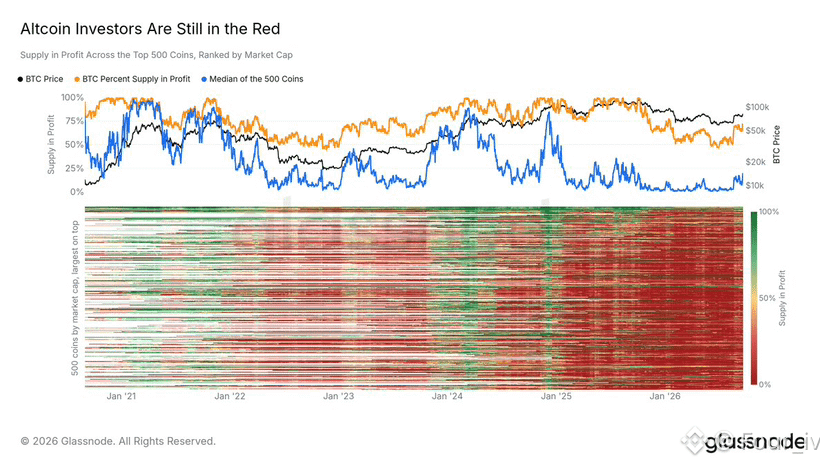
Most altcoin holders are still sitting on losses.
The median coin has less than a quarter of its supply in profit.
Global market tops tend to occur once a majority of supply across the entire market is deep in profit.
That point is still a long way off.
#altcoins
Most altcoin holders are still sitting on losses.
The median coin has less than a quarter of its supply in profit.
Global market tops tend to occur once a majority of supply across the entire market is deep in profit.
That point is still a long way off.
#altcoins
The median coin has less than a quarter of its supply in profit.
Global market tops tend to occur once a majority of supply across the entire market is deep in profit.
That point is still a long way off.
#altcoins
1
132
·
--
See translation
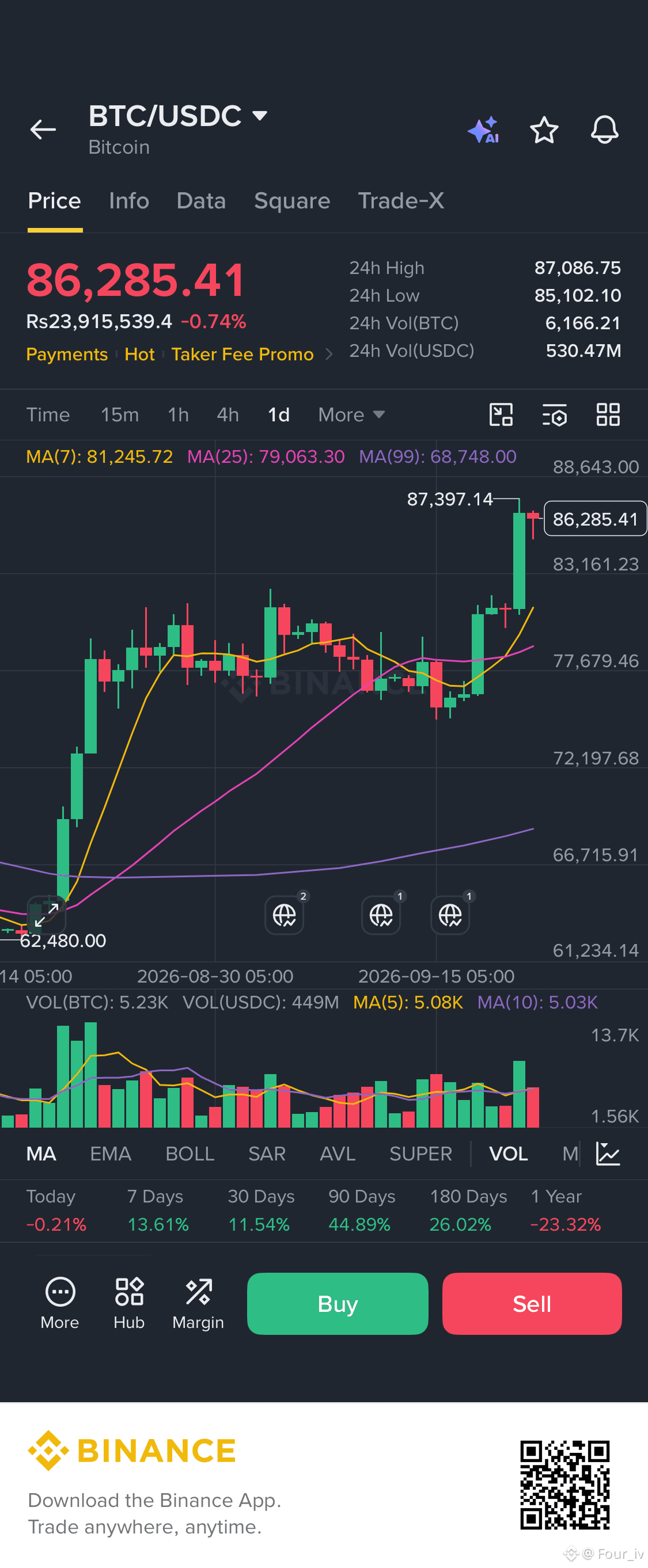
The higher timeframe picture of #bitcoin is simple: the train doesn't want to stop.
At this point, it's clearly continuing its upwards momentum and the only levels that I think we'll pause on:
- $91K
- $98K
Depending on the strength of this move, we'll go to the first or the second.
The higher timeframe picture of #bitcoin is simple: the train doesn't want to stop.
At this point, it's clearly continuing its upwards momentum and the only levels that I think we'll pause on:
- $91K
- $98K
Depending on the strength of this move, we'll go to the first or the second.
At this point, it's clearly continuing its upwards momentum and the only levels that I think we'll pause on:
- $91K
- $98K
Depending on the strength of this move, we'll go to the first or the second.
Sourced by user sharing on Binance
2
298
·
--
See translation
$SPX could still make one last crazy push
And honestly, that might be the most dangerous part tbh
Imagine 8,300 gets hit and the timeline starts calling 9k inevitable imo
Then price loses 7,600
That’s when the real panic going to start
Sometimes the top doesn’t look like a top until it’s already gone
Fingers crossed for this one
$SPX could still make one last crazy push
And honestly, that might be the most dangerous part tbh
Imagine 8,300 gets hit and the timeline starts calling 9k inevitable imo
Then price loses 7,600
That’s when the real panic going to start
Sometimes the top doesn’t look like a top until it’s already gone
Fingers crossed for this one
And honestly, that might be the most dangerous part tbh
Imagine 8,300 gets hit and the timeline starts calling 9k inevitable imo
Then price loses 7,600
That’s when the real panic going to start
Sometimes the top doesn’t look like a top until it’s already gone
Fingers crossed for this one
2
708
·
--
See translation
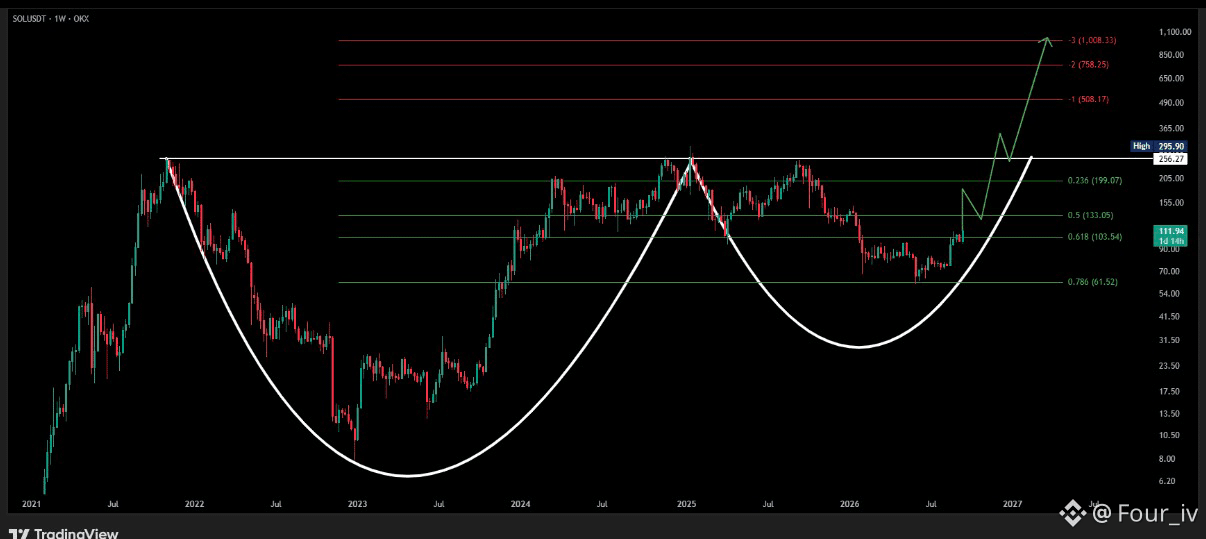
I zoomed out on $SOL and now I can’t unsee it
this is not a random pump setup
chart is cooking like a massive cup & handle
Now we wait for the neckline because no breakout = patience
Breakout = things get very stupid
I will enter only on confirmation on retest bros
{future}(SOLUSDT)
I zoomed out on $SOL and now I can’t unsee it
this is not a random pump setup
chart is cooking like a massive cup & handle
Now we wait for the neckline because no breakout = patience
Breakout = things get very stupid
I will enter only on confirmation on retest bros
this is not a random pump setup
chart is cooking like a massive cup & handle
Now we wait for the neckline because no breakout = patience
Breakout = things get very stupid
I will enter only on confirmation on retest bros
3
1.7k
Log in to explore more content
Join global crypto users on Binance Square
⚡️ Get latest and useful information about crypto.
💬 Trusted by the world’s largest crypto exchange.
👍 Discover real insights from verified creators.
Email / Phone number
Trending Topics
EtherGains70.9%InQ3
9,523 views
247 Discussing
#ethergains70.9%inq3
🚀 ETH Shatters Expectations with a Massive 70.9% Q3 Rally—Is Altseason Finally Here?🔥
Ethereum (ETH) just wrapped up one of the most explosive third quarters in its history, locking in a massive +70.9% gain! After a brutal first half of the year (Q1: -29.2% | Q2: -25.2%), ETH completely flipped the script, defying macro headwinds, rising Treasury yields, and a surging US Dollar Index.
$ETH
Institutional Inflows & Spot ETFs Acceleration 🏦
Spot Ethereum ETFs and corporate treasury allocations saw sustained net inflows throughout the quarter. Wall Street's institutional appetite for ETH as a yield-bearing, utility-driven asset has reached new record highs.
ETH Outperforms Bitcoin in Q3 ⚔️
While Bitcoin ($BTC) had a solid quarter, Ethereum significantly outpaced it. This strength is reigniting market discussions around an incoming Altseason, as capital historical flows from BTC into high-cap altcoins following major ETH breakouts.
$ZEC
Staking Dynamics & Supply Shock 🔒
Defi activity and Layer-2 expansion continue to lock up vast amounts of ETH. With staking yields remaining attractive and total supply held on centralized exchanges steadily dropping, market liquidity for physical ETH remains tight.
📊 Technical Landscape & What’s Next for Q4
Key Resistance Watch: ETH recently pushed past local highs around $2,775, with traders eyeing the psychological $3,000 zone as the primary Q4 target.
Macro Risk Factor: Keep an eye on short-position spikes on derivative exchanges and broader Fed monetary policy updates, as leverage wipeouts can create short-term volatility following quarterly closes.
💬 What do you think? Will Ethereum hit $3,000+ in Q4, or are we due for a short-term consolidation before the next leg up? Drop your predictions below! 👇
#US10YearYieldNears5.3% #Ethereum #ETH
Lily星星
·15 Likes
·14k views
US10YearYieldNears5.3%
48,882 views
467 Discussing
DollarIndexHitsHighestSinceMay2025
2,000 views
141 Discussing