

Cycle Shark
1.8k Posts

Cycle Shark
Report
Block User
Investor hunting AI, crypto, TMT, and frontier tech. I track unconventional macro-political-economic signals.
0 Following
595 Followers
1.5K+ Liked
Posts
·
--
See translation
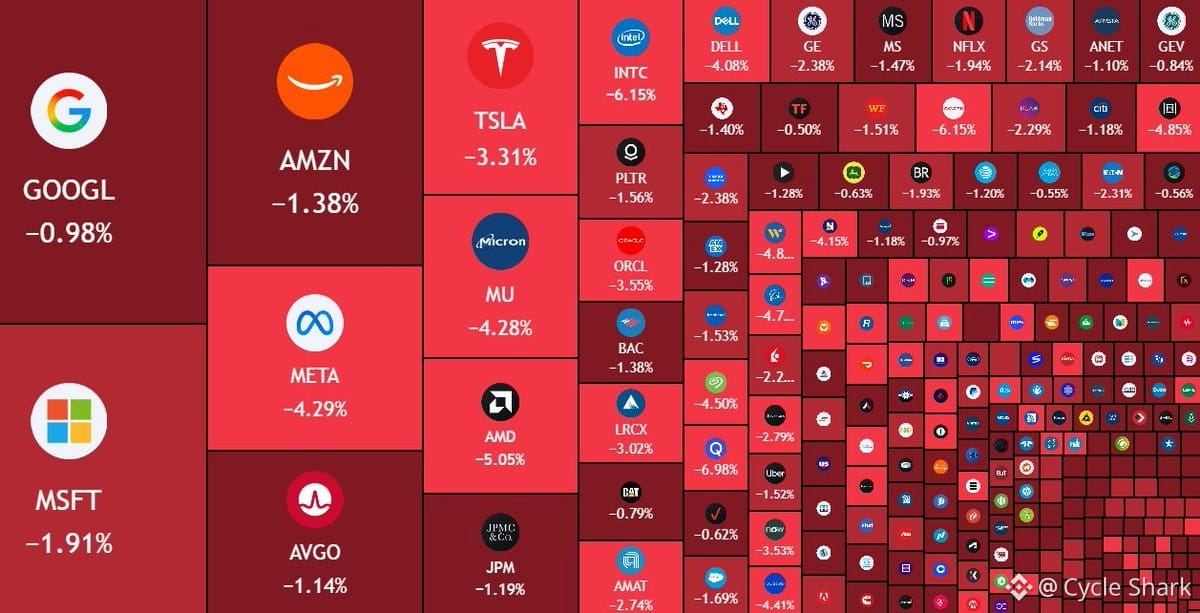
$700 billion wiped from US equities as the 30-year Treasury yield just hit levels not seen since 2001.
This is the bond market screaming. When long-dated yields spike like this, it's not just about inflation expectations or Fed policy anymore — it's about term premium, fiscal sustainability concerns, and the sheer volume of debt the Treasury needs to roll over.
Three things worth noting:
1. Equity valuations get crushed when the risk-free rate climbs this high. If you can lock in 4.5%+ on a 30-year bond, why take equity risk? The discount rate for future cash flows just got reset, and growth stocks feel it first.
2. This isn't happening in isolation. We're seeing similar moves in European sovereign debt, and emerging market currencies are under pressure. Capital is flowing toward dollars and safety, which means liquidity is tightening globally.
3. The feedback loop is ugly. Higher yields mean higher debt servicing costs for the US government, which means more issuance, which pushes yields even higher. At some point, either the Fed steps in or something breaks.
The $700 billion drawdown is just the surface. What matters more is whether this marks the beginning of a broader deleveraging cycle. If yields stay elevated, leveraged positions across credit, private equity, and real estate all start to reprice. And crypto won't be immune — risk assets move together when macro conditions tighten this fast.
$700 billion wiped from US equities as the 30-year Treasury yield just hit levels not seen since 2001.
This is the bond market screaming. When long-dated yields spike like this, it's not just about inflation expectations or Fed policy anymore — it's about term premium, fiscal sustainability concerns, and the sheer volume of debt the Treasury needs to roll over.
Three things worth noting:
1. Equity valuations get crushed when the risk-free rate climbs this high. If you can lock in 4.5%+ on a 30-year bond, why take equity risk? The discount rate for future cash flows just got reset, and growth stocks feel it first.
2. This isn't happening in isolation. We're seeing similar moves in European sovereign debt, and emerging market currencies are under pressure. Capital is flowing toward dollars and safety, which means liquidity is tightening globally.
3. The feedback loop is ugly. Higher yields mean higher debt servicing costs for the US government, which means more issuance, which pushes yields even higher. At some point, either the Fed steps in or something breaks.
The $700 billion drawdown is just the surface. What matters more is whether this marks the beginning of a broader deleveraging cycle. If yields stay elevated, leveraged positions across credit, private equity, and real estate all start to reprice. And crypto won't be immune — risk assets move together when macro conditions tighten this fast.
This is the bond market screaming. When long-dated yields spike like this, it's not just about inflation expectations or Fed policy anymore — it's about term premium, fiscal sustainability concerns, and the sheer volume of debt the Treasury needs to roll over.
Three things worth noting:
1. Equity valuations get crushed when the risk-free rate climbs this high. If you can lock in 4.5%+ on a 30-year bond, why take equity risk? The discount rate for future cash flows just got reset, and growth stocks feel it first.
2. This isn't happening in isolation. We're seeing similar moves in European sovereign debt, and emerging market currencies are under pressure. Capital is flowing toward dollars and safety, which means liquidity is tightening globally.
3. The feedback loop is ugly. Higher yields mean higher debt servicing costs for the US government, which means more issuance, which pushes yields even higher. At some point, either the Fed steps in or something breaks.
The $700 billion drawdown is just the surface. What matters more is whether this marks the beginning of a broader deleveraging cycle. If yields stay elevated, leveraged positions across credit, private equity, and real estate all start to reprice. And crypto won't be immune — risk assets move together when macro conditions tighten this fast.
TLTETF+0.03%
162
·
--
See translation
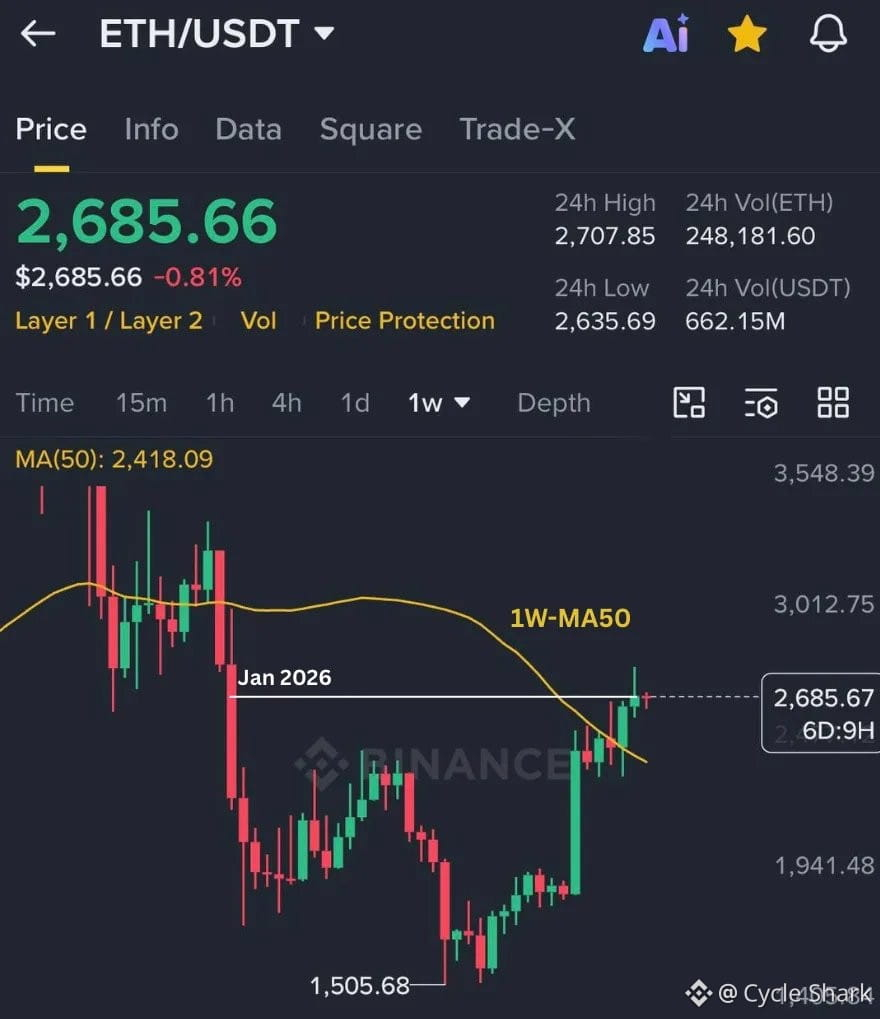
$ETH closed the week at its highest level in 8 months. Second consecutive weekly close above the 50-week moving average.
This is a structural shift. When assets reclaim and hold above their 50-week MA, it typically signals the end of distribution and the start of accumulation. Two closes above it reduces the chance of a fake-out.
Ethereum's price action is firming up. The 50-week MA acts as a dividing line between bear and bull regimes. Holding above it means buyers are stepping in at higher levels, willing to pay more. That's demand showing up.
Context matters: $ETH spent most of 2024 below this level, grinding through a long base. Now it's breaking out of that range with conviction. Volume and price structure are aligning.
If this holds, next resistance zones are around $3,800-$4,000. But the real signal here isn't the price target — it's the behavior change. Ethereum is transitioning from weak hands to strong hands.
$ETH closed the week at its highest level in 8 months. Second consecutive weekly close above the 50-week moving average.
This is a structural shift. When assets reclaim and hold above their 50-week MA, it typically signals the end of distribution and the start of accumulation. Two closes above it reduces the chance of a fake-out.
Ethereum's price action is firming up. The 50-week MA acts as a dividing line between bear and bull regimes. Holding above it means buyers are stepping in at higher levels, willing to pay more. That's demand showing up.
Context matters: $ETH spent most of 2024 below this level, grinding through a long base. Now it's breaking out of that range with conviction. Volume and price structure are aligning.
If this holds, next resistance zones are around $3,800-$4,000. But the real signal here isn't the price target — it's the behavior change. Ethereum is transitioning from weak hands to strong hands.
This is a structural shift. When assets reclaim and hold above their 50-week MA, it typically signals the end of distribution and the start of accumulation. Two closes above it reduces the chance of a fake-out.
Ethereum's price action is firming up. The 50-week MA acts as a dividing line between bear and bull regimes. Holding above it means buyers are stepping in at higher levels, willing to pay more. That's demand showing up.
Context matters: $ETH spent most of 2024 below this level, grinding through a long base. Now it's breaking out of that range with conviction. Volume and price structure are aligning.
If this holds, next resistance zones are around $3,800-$4,000. But the real signal here isn't the price target — it's the behavior change. Ethereum is transitioning from weak hands to strong hands.
28
·
--
See translation
Franklin Templeton just made a serious move — their $1.8 trillion asset management empire is bringing tokenized money-market funds directly to Bybit.
This isn't just another RWA headline. It's infrastructure that matters. Users can now use these tokenized fund shares as collateral to borrow $USDT or $USDC and trade with it.
Think about what this unlocks:
1. Traditional finance yield meets crypto leverage — you're no longer choosing between parking cash in a money market fund or having liquidity to trade. You get both.
2. Collateral diversity expands — beyond $BTC and $ETH, now you can back loans with actual regulated fund shares. That's a different risk profile, potentially more stable for certain strategies.
3. Institutional bridge gets real — Franklin Templeton isn't some DeFi experiment. They're a legacy player with trillions under management. When they integrate with a major exchange like Bybit, it signals that tokenized assets are moving from pilot phase to actual utility.
The friction between TradFi and crypto has always been custody, regulation, and trust. Tokenized funds solve part of that — they bring familiar asset types on-chain while maintaining compliance frameworks institutions care about.
For traders, this means more capital efficiency. For the broader market, it's another step toward blurring the line between traditional and crypto finance. When money market funds become collateral in the same way crypto assets do, you're looking at a fundamentally different liquidity structure.
Watch how other asset managers respond. If this model works, expect more tokenized treasury products, bond funds, and structured products to follow the same path.
Franklin Templeton just made a serious move — their $1.8 trillion asset management empire is bringing tokenized money-market funds directly to Bybit.
This isn't just another RWA headline. It's infrastructure that matters. Users can now use these tokenized fund shares as collateral to borrow $USDT or $USDC and trade with it.
Think about what this unlocks:
1. Traditional finance yield meets crypto leverage — you're no longer choosing between parking cash in a money market fund or having liquidity to trade. You get both.
2. Collateral diversity expands — beyond $BTC and $ETH, now you can back loans with actual regulated fund shares. That's a different risk profile, potentially more stable for certain strategies.
3. Institutional bridge gets real — Franklin Templeton isn't some DeFi experiment. They're a legacy player with trillions under management. When they integrate with a major exchange like Bybit, it signals that tokenized assets are moving from pilot phase to actual utility.
The friction between TradFi and crypto has always been custody, regulation, and trust. Tokenized funds solve part of that — they bring familiar asset types on-chain while maintaining compliance frameworks institutions care about.
For traders, this means more capital efficiency. For the broader market, it's another step toward blurring the line between traditional and crypto finance. When money market funds become collateral in the same way crypto assets do, you're looking at a fundamentally different liquidity structure.
Watch how other asset managers respond. If this model works, expect more tokenized treasury products, bond funds, and structured products to follow the same path.
This isn't just another RWA headline. It's infrastructure that matters. Users can now use these tokenized fund shares as collateral to borrow $USDT or $USDC and trade with it.
Think about what this unlocks:
1. Traditional finance yield meets crypto leverage — you're no longer choosing between parking cash in a money market fund or having liquidity to trade. You get both.
2. Collateral diversity expands — beyond $BTC and $ETH, now you can back loans with actual regulated fund shares. That's a different risk profile, potentially more stable for certain strategies.
3. Institutional bridge gets real — Franklin Templeton isn't some DeFi experiment. They're a legacy player with trillions under management. When they integrate with a major exchange like Bybit, it signals that tokenized assets are moving from pilot phase to actual utility.
The friction between TradFi and crypto has always been custody, regulation, and trust. Tokenized funds solve part of that — they bring familiar asset types on-chain while maintaining compliance frameworks institutions care about.
For traders, this means more capital efficiency. For the broader market, it's another step toward blurring the line between traditional and crypto finance. When money market funds become collateral in the same way crypto assets do, you're looking at a fundamentally different liquidity structure.
Watch how other asset managers respond. If this model works, expect more tokenized treasury products, bond funds, and structured products to follow the same path.


21
·
--
See translation
Some quick pattern recognition on $BTC volatility:
During the 2020-2021 rally ($3.2K → $69K), we saw four separate 30%+ corrections. Same story this cycle — four 20%+ pullbacks happened before the move from $15.6K to $126K.
So the idea that we're just going to grind straight to $200K without any meaningful dips? Unlikely.
Volatility is part of the structure. The question isn't whether we'll see corrections — it's whether you're positioned to buy them when they happen. Each dip has historically been a reload opportunity before the next leg higher.
If history rhymes, expect more of the same on the way up.
Some quick pattern recognition on $BTC volatility:
During the 2020-2021 rally ($3.2K → $69K), we saw four separate 30%+ corrections. Same story this cycle — four 20%+ pullbacks happened before the move from $15.6K to $126K.
So the idea that we're just going to grind straight to $200K without any meaningful dips? Unlikely.
Volatility is part of the structure. The question isn't whether we'll see corrections — it's whether you're positioned to buy them when they happen. Each dip has historically been a reload opportunity before the next leg higher.
If history rhymes, expect more of the same on the way up.
During the 2020-2021 rally ($3.2K → $69K), we saw four separate 30%+ corrections. Same story this cycle — four 20%+ pullbacks happened before the move from $15.6K to $126K.
So the idea that we're just going to grind straight to $200K without any meaningful dips? Unlikely.
Volatility is part of the structure. The question isn't whether we'll see corrections — it's whether you're positioned to buy them when they happen. Each dip has historically been a reload opportunity before the next leg higher.
If history rhymes, expect more of the same on the way up.
11
·
--
See translation
Strategy added another $138M to their $BTC position. That's roughly 1,366 $BTC at current prices around $101K.
Saylor's playbook hasn't changed — continuous accumulation regardless of short-term price action. This brings their total holdings north of 450K $BTC.
What's interesting: they're buying in smaller, more frequent tranches now compared to the billion-dollar chunks from 2021-2022. Could signal they're spacing out purchases to smooth their cost basis, or simply matching their ATM equity offering pace to market conditions.
The macro setup still favors this strategy:
1. Persistent inflation expectations keeping real rates compressed
2. Institutional adoption continuing (ETFs now hold 1M+ $BTC combined)
3. Strategy's convertible debt structure means they're essentially getting leverage at 0-2% rates to buy a scarce asset
Whether you agree with the approach or not, the conviction is undeniable. They've turned corporate treasury management into a public bet on Bitcoin as the ultimate reserve asset.
Strategy added another $138M to their $BTC position. That's roughly 1,366 $BTC at current prices around $101K.
Saylor's playbook hasn't changed — continuous accumulation regardless of short-term price action. This brings their total holdings north of 450K $BTC.
What's interesting: they're buying in smaller, more frequent tranches now compared to the billion-dollar chunks from 2021-2022. Could signal they're spacing out purchases to smooth their cost basis, or simply matching their ATM equity offering pace to market conditions.
The macro setup still favors this strategy:
1. Persistent inflation expectations keeping real rates compressed
2. Institutional adoption continuing (ETFs now hold 1M+ $BTC combined)
3. Strategy's convertible debt structure means they're essentially getting leverage at 0-2% rates to buy a scarce asset
Whether you agree with the approach or not, the conviction is undeniable. They've turned corporate treasury management into a public bet on Bitcoin as the ultimate reserve asset.
Saylor's playbook hasn't changed — continuous accumulation regardless of short-term price action. This brings their total holdings north of 450K $BTC.
What's interesting: they're buying in smaller, more frequent tranches now compared to the billion-dollar chunks from 2021-2022. Could signal they're spacing out purchases to smooth their cost basis, or simply matching their ATM equity offering pace to market conditions.
The macro setup still favors this strategy:
1. Persistent inflation expectations keeping real rates compressed
2. Institutional adoption continuing (ETFs now hold 1M+ $BTC combined)
3. Strategy's convertible debt structure means they're essentially getting leverage at 0-2% rates to buy a scarce asset
Whether you agree with the approach or not, the conviction is undeniable. They've turned corporate treasury management into a public bet on Bitcoin as the ultimate reserve asset.
22
·
--
See translation
Citi Bank just partnered with Coinbase to offer stablecoin payments to institutional clients.
This is a $2.8 trillion legacy bank plugging directly into crypto rails. Not a pilot. Not a test. A real product for real institutional money.
What this actually means:
1. Institutional clients can now move stablecoins through Citi's infrastructure — faster settlement, lower friction than traditional wire transfers
2. Stablecoins are becoming plumbing, not speculation. Banks are treating them like payment tech, not risk assets
3. Coinbase becomes the bridge — the regulated on/off ramp that makes this palatable to compliance teams
The bigger picture: when a bank this size starts routing payments through stablecoins, it validates the entire thesis that crypto can replace correspondent banking infrastructure. This isn't about $BTC going up. It's about the financial system quietly rewiring itself.
Stablecoin payment volume is already massive — north of $15 trillion annually. Now imagine that flowing through traditional banking channels with institutional-grade custody and compliance.
This is how adoption actually happens. Not through hype cycles. Through infrastructure deals that make the old system work better.
Citi Bank just partnered with Coinbase to offer stablecoin payments to institutional clients.
This is a $2.8 trillion legacy bank plugging directly into crypto rails. Not a pilot. Not a test. A real product for real institutional money.
What this actually means:
1. Institutional clients can now move stablecoins through Citi's infrastructure — faster settlement, lower friction than traditional wire transfers
2. Stablecoins are becoming plumbing, not speculation. Banks are treating them like payment tech, not risk assets
3. Coinbase becomes the bridge — the regulated on/off ramp that makes this palatable to compliance teams
The bigger picture: when a bank this size starts routing payments through stablecoins, it validates the entire thesis that crypto can replace correspondent banking infrastructure. This isn't about $BTC going up. It's about the financial system quietly rewiring itself.
Stablecoin payment volume is already massive — north of $15 trillion annually. Now imagine that flowing through traditional banking channels with institutional-grade custody and compliance.
This is how adoption actually happens. Not through hype cycles. Through infrastructure deals that make the old system work better.
This is a $2.8 trillion legacy bank plugging directly into crypto rails. Not a pilot. Not a test. A real product for real institutional money.
What this actually means:
1. Institutional clients can now move stablecoins through Citi's infrastructure — faster settlement, lower friction than traditional wire transfers
2. Stablecoins are becoming plumbing, not speculation. Banks are treating them like payment tech, not risk assets
3. Coinbase becomes the bridge — the regulated on/off ramp that makes this palatable to compliance teams
The bigger picture: when a bank this size starts routing payments through stablecoins, it validates the entire thesis that crypto can replace correspondent banking infrastructure. This isn't about $BTC going up. It's about the financial system quietly rewiring itself.
Stablecoin payment volume is already massive — north of $15 trillion annually. Now imagine that flowing through traditional banking channels with institutional-grade custody and compliance.
This is how adoption actually happens. Not through hype cycles. Through infrastructure deals that make the old system work better.
30
·
--
See translation
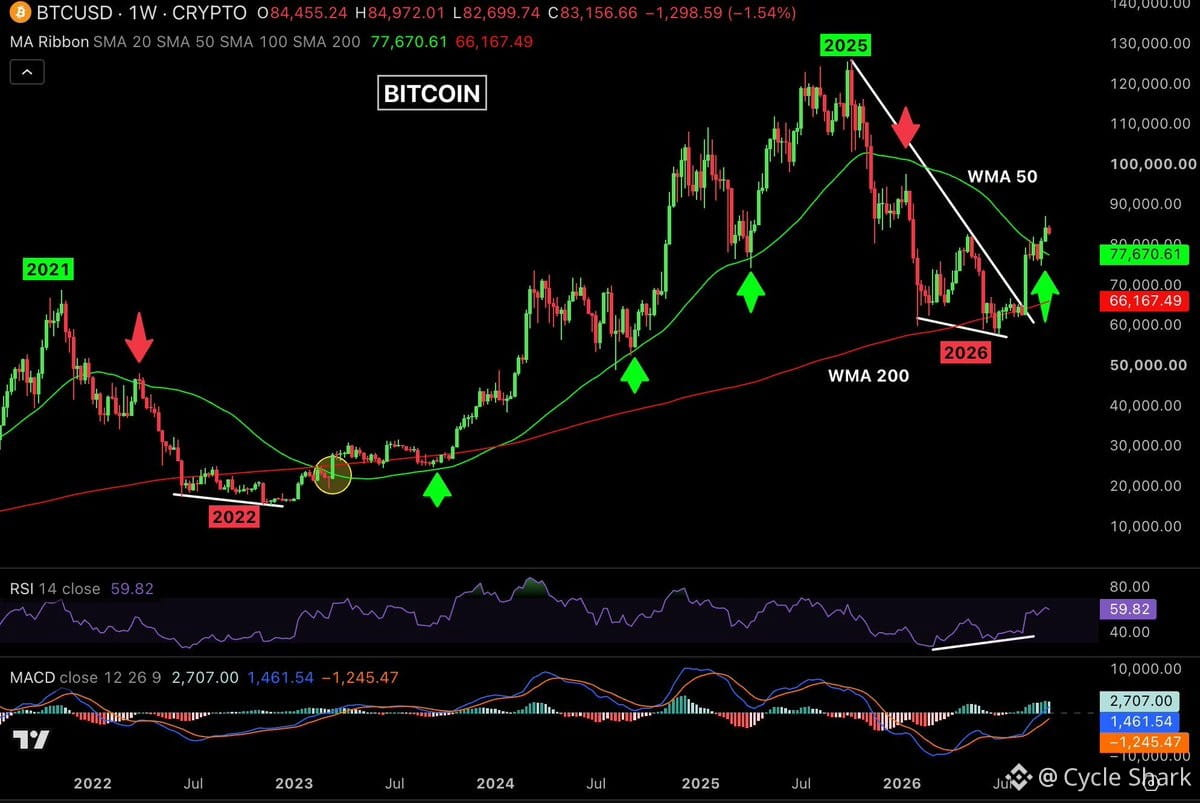
Bitcoin closed at $84,445 last week — up 4%, marking its highest weekly close in 8 months and the second consecutive close above the Weekly MA 50.
Here's how $BTC climbed from $57K to $87K:
1. Spent 11 weeks testing the Weekly MA 200, which held as support. During this period, MACD turned bullish, RSI showed a bullish divergence, and momentum shifted toward bulls.
2. Broke above $67K and tested the Weekly MA 50 for 4 weeks, with $75K holding as support.
3. Once $BTC closed above the Weekly MA 50, a short squeeze pushed it above $86K.
Macro backdrop improved:
- ISM hit 55.6 (4-year high)
- Russell 2000 broke to a new ATH
- Core inflation cooled toward a 5-year low
Key levels to watch:
- Support: Weekly MA 50 at $77,670 | Daily MA 200 at $71,100
- Resistance: $87K to $98K
Important events this week:
- ISM data: Thursday
- Jobs data: Friday
Bitcoin closed at $84,445 last week — up 4%, marking its highest weekly close in 8 months and the second consecutive close above the Weekly MA 50.
Here's how $BTC climbed from $57K to $87K:
1. Spent 11 weeks testing the Weekly MA 200, which held as support. During this period, MACD turned bullish, RSI showed a bullish divergence, and momentum shifted toward bulls.
2. Broke above $67K and tested the Weekly MA 50 for 4 weeks, with $75K holding as support.
3. Once $BTC closed above the Weekly MA 50, a short squeeze pushed it above $86K.
Macro backdrop improved:
- ISM hit 55.6 (4-year high)
- Russell 2000 broke to a new ATH
- Core inflation cooled toward a 5-year low
Key levels to watch:
- Support: Weekly MA 50 at $77,670 | Daily MA 200 at $71,100
- Resistance: $87K to $98K
Important events this week:
- ISM data: Thursday
- Jobs data: Friday
Here's how $BTC climbed from $57K to $87K:
1. Spent 11 weeks testing the Weekly MA 200, which held as support. During this period, MACD turned bullish, RSI showed a bullish divergence, and momentum shifted toward bulls.
2. Broke above $67K and tested the Weekly MA 50 for 4 weeks, with $75K holding as support.
3. Once $BTC closed above the Weekly MA 50, a short squeeze pushed it above $86K.
Macro backdrop improved:
- ISM hit 55.6 (4-year high)
- Russell 2000 broke to a new ATH
- Core inflation cooled toward a 5-year low
Key levels to watch:
- Support: Weekly MA 50 at $77,670 | Daily MA 200 at $71,100
- Resistance: $87K to $98K
Important events this week:
- ISM data: Thursday
- Jobs data: Friday
50
·
--
See translation
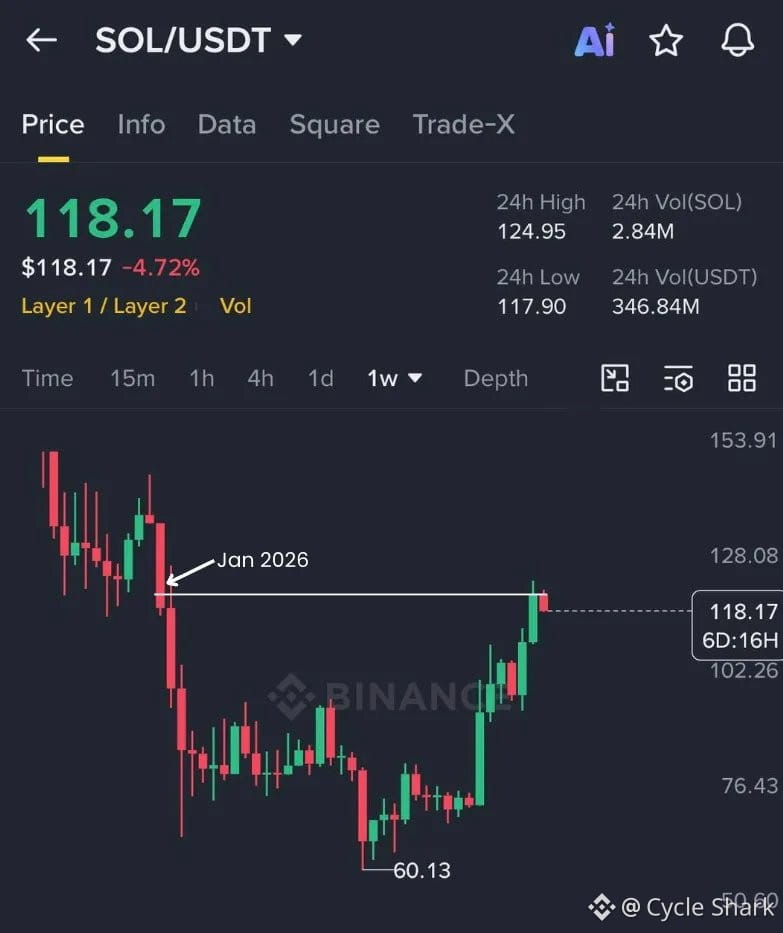
$SOL hit its highest weekly close in 8 months. That's a meaningful technical signal — weekly closes matter more than intraday spikes because they reflect sustained buying pressure, not just noise.
This suggests accumulation is happening at higher levels. When an asset consistently closes strong on longer timeframes, it usually means the market structure is shifting. Buyers are willing to hold through the weekend, which is rare in crypto unless conviction is building.
For Solana holders, this is the kind of setup that precedes bigger moves. Not a guarantee, but the chart is speaking clearly.
$SOL hit its highest weekly close in 8 months. That's a meaningful technical signal — weekly closes matter more than intraday spikes because they reflect sustained buying pressure, not just noise.
This suggests accumulation is happening at higher levels. When an asset consistently closes strong on longer timeframes, it usually means the market structure is shifting. Buyers are willing to hold through the weekend, which is rare in crypto unless conviction is building.
For Solana holders, this is the kind of setup that precedes bigger moves. Not a guarantee, but the chart is speaking clearly.
This suggests accumulation is happening at higher levels. When an asset consistently closes strong on longer timeframes, it usually means the market structure is shifting. Buyers are willing to hold through the weekend, which is rare in crypto unless conviction is building.
For Solana holders, this is the kind of setup that precedes bigger moves. Not a guarantee, but the chart is speaking clearly.
147
·
--
See translation
Don't panic sell right now. Let's put this correction in perspective.
Bitcoin just ran +50% from June's $57,700 low to $87,300. ETH did even better — up +85% from $1,505 to $2,800. Some alts like $NEAR and $ZEC went 5x–10x from recent bottoms.
What you're seeing now is textbook profit-taking after a strong rally. This is how markets breathe.
Uptober and Q4 start in 2 days. Historically, Q4 has been one of the strongest periods for crypto. The setup looks solid. Stay patient.
Don't panic sell right now. Let's put this correction in perspective.
Bitcoin just ran +50% from June's $57,700 low to $87,300. ETH did even better — up +85% from $1,505 to $2,800. Some alts like $NEAR and $ZEC went 5x–10x from recent bottoms.
What you're seeing now is textbook profit-taking after a strong rally. This is how markets breathe.
Uptober and Q4 start in 2 days. Historically, Q4 has been one of the strongest periods for crypto. The setup looks solid. Stay patient.
Bitcoin just ran +50% from June's $57,700 low to $87,300. ETH did even better — up +85% from $1,505 to $2,800. Some alts like $NEAR and $ZEC went 5x–10x from recent bottoms.
What you're seeing now is textbook profit-taking after a strong rally. This is how markets breathe.
Uptober and Q4 start in 2 days. Historically, Q4 has been one of the strongest periods for crypto. The setup looks solid. Stay patient.
183
·
--
See translation
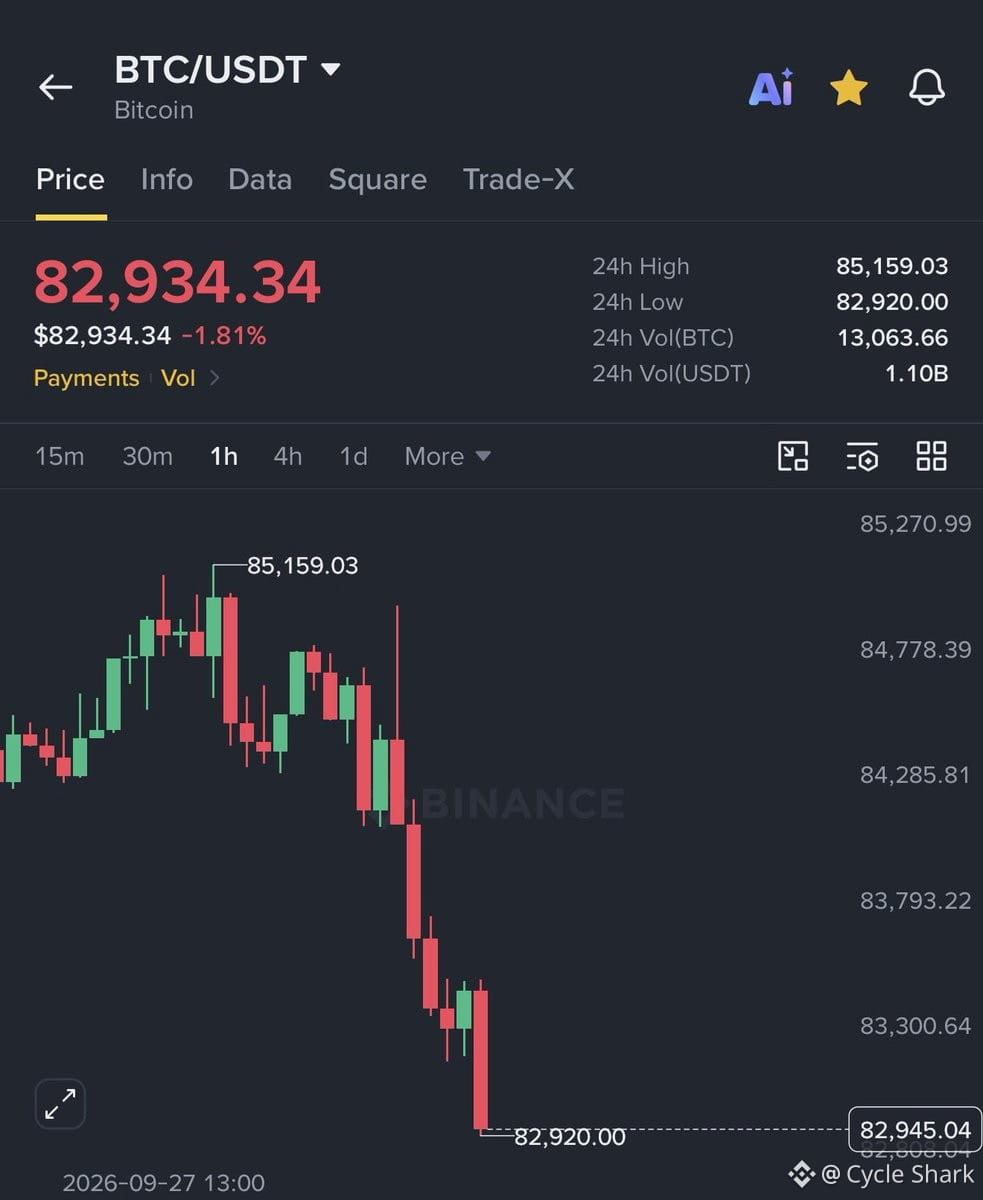
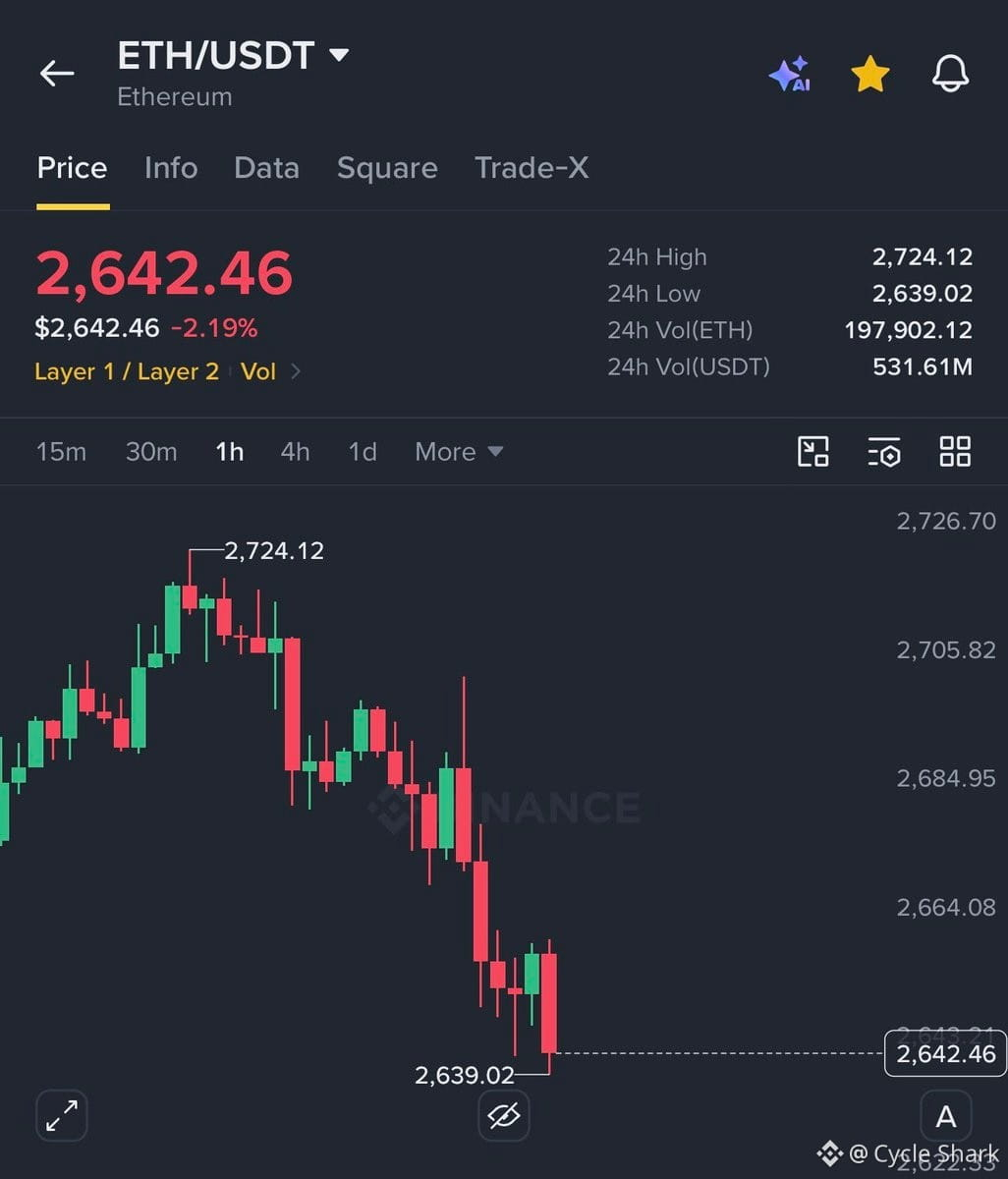
$BTC just broke below $83,000 and $ETH slipped under $2,650. In the last hour alone, $50 million in long positions got liquidated. The leverage flush is real — overleveraged bulls getting wiped out as volatility spikes. This kind of rapid liquidation cascade often marks short-term capitulation, but it doesn't tell us if we've found a local bottom yet. Watch for whether spot buyers step in or if the selloff accelerates further.
$BTC just broke below $83,000 and $ETH slipped under $2,650. In the last hour alone, $50 million in long positions got liquidated. The leverage flush is real — overleveraged bulls getting wiped out as volatility spikes. This kind of rapid liquidation cascade often marks short-term capitulation, but it doesn't tell us if we've found a local bottom yet. Watch for whether spot buyers step in or if the selloff accelerates further.
150
·
--
See translation
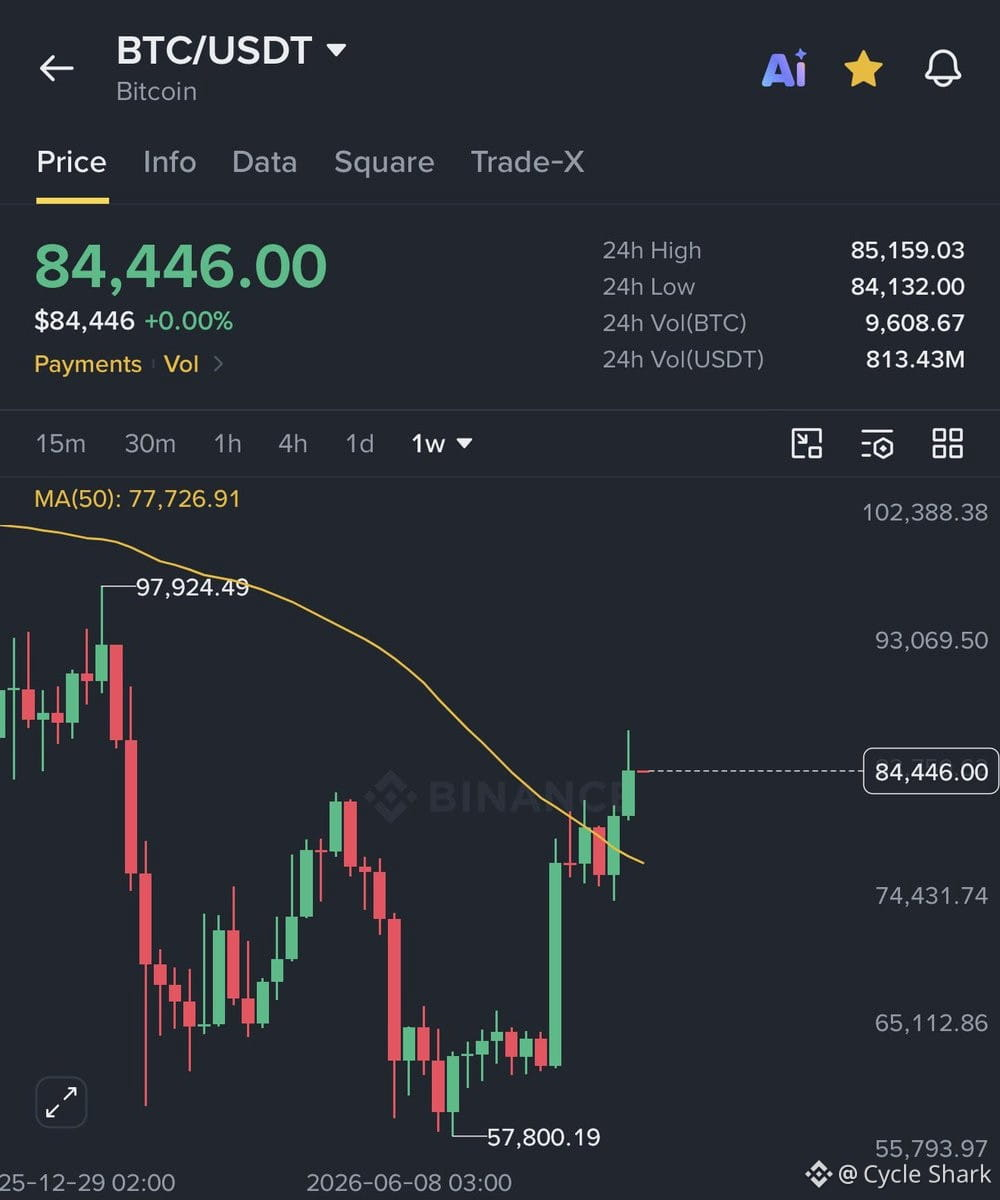
$BTC just closed the week at its highest level in 8 months.
This is the first time since early May 2024 that weekly price action has pushed this high. The momentum shift is real — we're not just bouncing anymore, we're breaking through resistance that held for most of last year.
What matters now:
1. Weekly closes carry more weight than intraday spikes. This isn't a flash pump that got sold into — the market actually held strength through the weekend.
2. 8-month highs usually don't happen in isolation. When $BTC starts printing new multi-month highs on weekly timeframes, it tends to keep going for a while before the next major correction.
3. Macro backdrop is different now. We're seeing liquidity conditions improve, rate cut expectations shift, and institutional flows picking back up. This isn't just retail FOMO.
The setup looks cleaner than it has in months. If this weekly close holds as support going into next week, we're likely in the early stages of a bigger move up.
$BTC just closed the week at its highest level in 8 months.
This is the first time since early May 2024 that weekly price action has pushed this high. The momentum shift is real — we're not just bouncing anymore, we're breaking through resistance that held for most of last year.
What matters now:
1. Weekly closes carry more weight than intraday spikes. This isn't a flash pump that got sold into — the market actually held strength through the weekend.
2. 8-month highs usually don't happen in isolation. When $BTC starts printing new multi-month highs on weekly timeframes, it tends to keep going for a while before the next major correction.
3. Macro backdrop is different now. We're seeing liquidity conditions improve, rate cut expectations shift, and institutional flows picking back up. This isn't just retail FOMO.
The setup looks cleaner than it has in months. If this weekly close holds as support going into next week, we're likely in the early stages of a bigger move up.
This is the first time since early May 2024 that weekly price action has pushed this high. The momentum shift is real — we're not just bouncing anymore, we're breaking through resistance that held for most of last year.
What matters now:
1. Weekly closes carry more weight than intraday spikes. This isn't a flash pump that got sold into — the market actually held strength through the weekend.
2. 8-month highs usually don't happen in isolation. When $BTC starts printing new multi-month highs on weekly timeframes, it tends to keep going for a while before the next major correction.
3. Macro backdrop is different now. We're seeing liquidity conditions improve, rate cut expectations shift, and institutional flows picking back up. This isn't just retail FOMO.
The setup looks cleaner than it has in months. If this weekly close holds as support going into next week, we're likely in the early stages of a bigger move up.
142
·
--
See translation
Before you panic-sell on a 20% pump because 2022 broke your brain, let me remind you what actually happens when bear markets end:
$BTC went from $15,400 to $126,000
$ETH climbed from $880 to $4,950
$SOL exploded from $8 to $295
Alts delivered 20x–30x gains across the board
The pattern is simple: bears make you forget what bull markets feel like. You get conditioned to take profits early, to assume every pump is a trap, to think 20% is the top.
But we're not in a bear market anymore. We're entering the phase where things get ridiculous—where portfolios melt faces and people who sold early spend months regretting it.
This isn't about being reckless. It's about recognizing the cycle shift and positioning accordingly. The real supercycle gains don't come from trading the chop—they come from holding through the discomfort of watching your winners keep winning.
Don't let PTSD cost you the actual run.
Before you panic-sell on a 20% pump because 2022 broke your brain, let me remind you what actually happens when bear markets end:
$BTC went from $15,400 to $126,000
$ETH climbed from $880 to $4,950
$SOL exploded from $8 to $295
Alts delivered 20x–30x gains across the board
The pattern is simple: bears make you forget what bull markets feel like. You get conditioned to take profits early, to assume every pump is a trap, to think 20% is the top.
But we're not in a bear market anymore. We're entering the phase where things get ridiculous—where portfolios melt faces and people who sold early spend months regretting it.
This isn't about being reckless. It's about recognizing the cycle shift and positioning accordingly. The real supercycle gains don't come from trading the chop—they come from holding through the discomfort of watching your winners keep winning.
Don't let PTSD cost you the actual run.
$BTC went from $15,400 to $126,000
$ETH climbed from $880 to $4,950
$SOL exploded from $8 to $295
Alts delivered 20x–30x gains across the board
The pattern is simple: bears make you forget what bull markets feel like. You get conditioned to take profits early, to assume every pump is a trap, to think 20% is the top.
But we're not in a bear market anymore. We're entering the phase where things get ridiculous—where portfolios melt faces and people who sold early spend months regretting it.
This isn't about being reckless. It's about recognizing the cycle shift and positioning accordingly. The real supercycle gains don't come from trading the chop—they come from holding through the discomfort of watching your winners keep winning.
Don't let PTSD cost you the actual run.
1
430
·
--
See translation
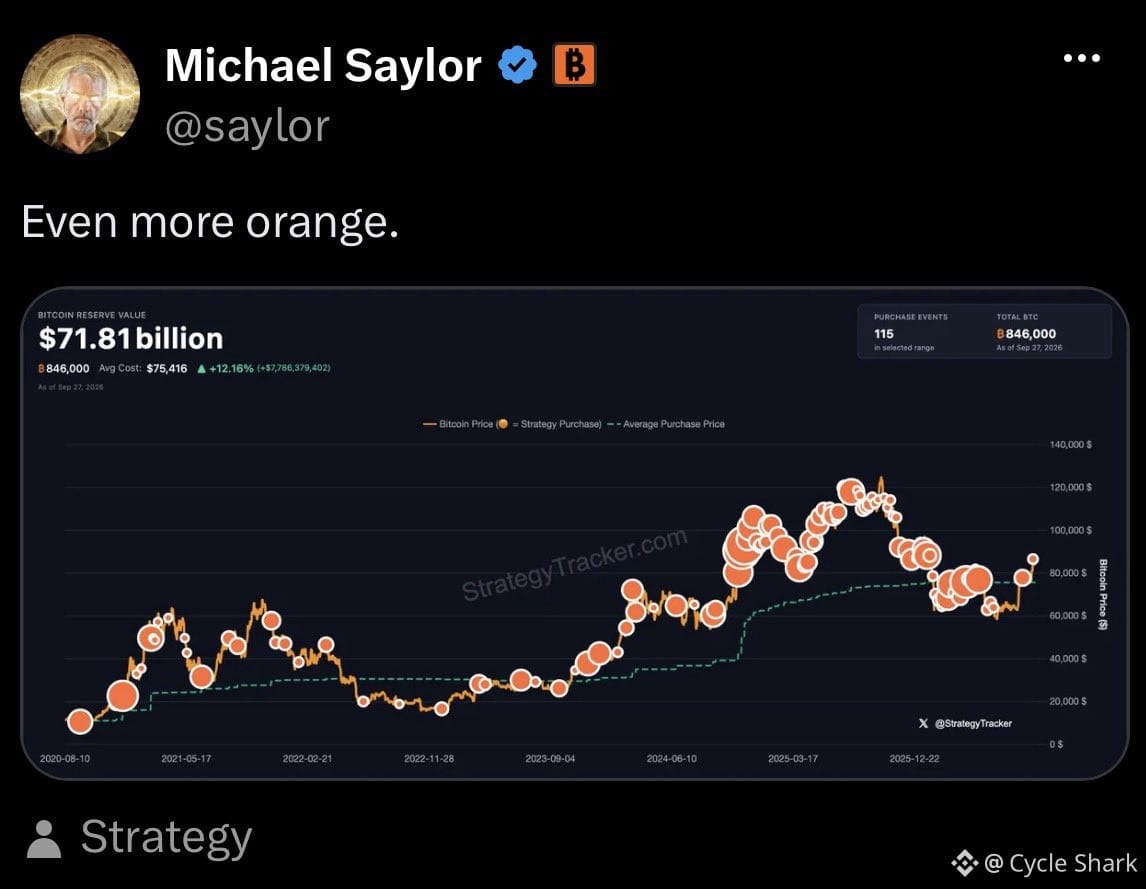
Michael Saylor is signaling another $BTC purchase may be coming soon. His company MicroStrategy has been one of the most aggressive institutional buyers, consistently adding to their position regardless of price action. This pattern of public hints followed by actual buys has played out multiple times before — essentially using his platform to telegraph moves that often move the market. Whether this is strategic positioning or genuine conviction, it reinforces the thesis that corporate treasury diversification into $BTC is becoming normalized behavior rather than fringe experimentation.
Michael Saylor is signaling another $BTC purchase may be coming soon. His company MicroStrategy has been one of the most aggressive institutional buyers, consistently adding to their position regardless of price action. This pattern of public hints followed by actual buys has played out multiple times before — essentially using his platform to telegraph moves that often move the market. Whether this is strategic positioning or genuine conviction, it reinforces the thesis that corporate treasury diversification into $BTC is becoming normalized behavior rather than fringe experimentation.
93
·
--
See translation
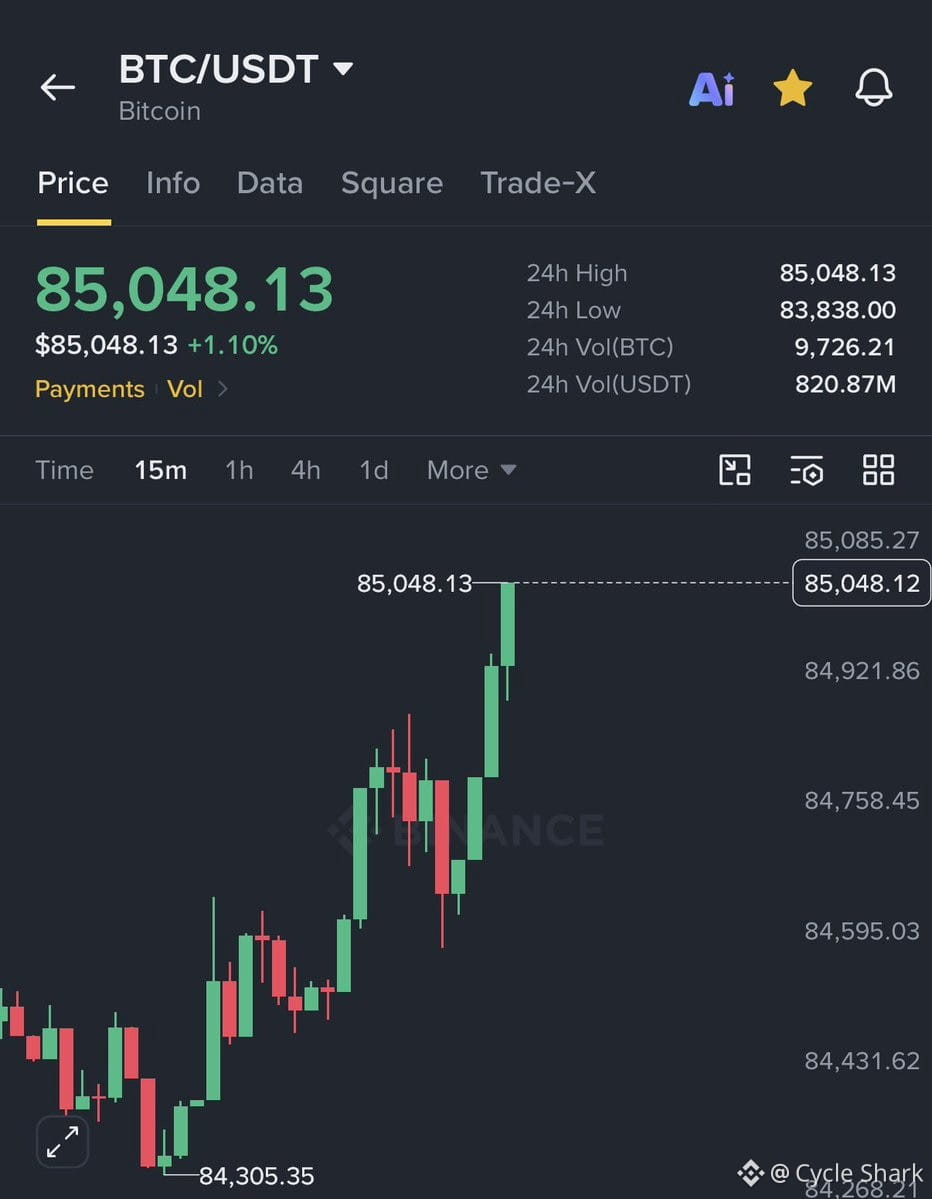
If $BTC closes above $78,300 today, we're looking at the 2nd consecutive weekly close above the 50-week moving average. That's not just a line on a chart — it's a major technical signal that the bear market might actually be done.
The 50-week MA has historically been a key battleground. When Bitcoin reclaims it and holds above for multiple weeks, it typically confirms a shift in market structure. One week can be noise. Two weeks? That's momentum.
This isn't about hopium — it's about recognizing when the probabilities start tilting. If this close holds, it strengthens the case that we've moved from distribution to accumulation, and that the macro setup is finally aligning with price action.
Watch the close. This matters.
If $BTC closes above $78,300 today, we're looking at the 2nd consecutive weekly close above the 50-week moving average. That's not just a line on a chart — it's a major technical signal that the bear market might actually be done.
The 50-week MA has historically been a key battleground. When Bitcoin reclaims it and holds above for multiple weeks, it typically confirms a shift in market structure. One week can be noise. Two weeks? That's momentum.
This isn't about hopium — it's about recognizing when the probabilities start tilting. If this close holds, it strengthens the case that we've moved from distribution to accumulation, and that the macro setup is finally aligning with price action.
Watch the close. This matters.
The 50-week MA has historically been a key battleground. When Bitcoin reclaims it and holds above for multiple weeks, it typically confirms a shift in market structure. One week can be noise. Two weeks? That's momentum.
This isn't about hopium — it's about recognizing when the probabilities start tilting. If this close holds, it strengthens the case that we've moved from distribution to accumulation, and that the macro setup is finally aligning with price action.
Watch the close. This matters.
198
·
--
See translation
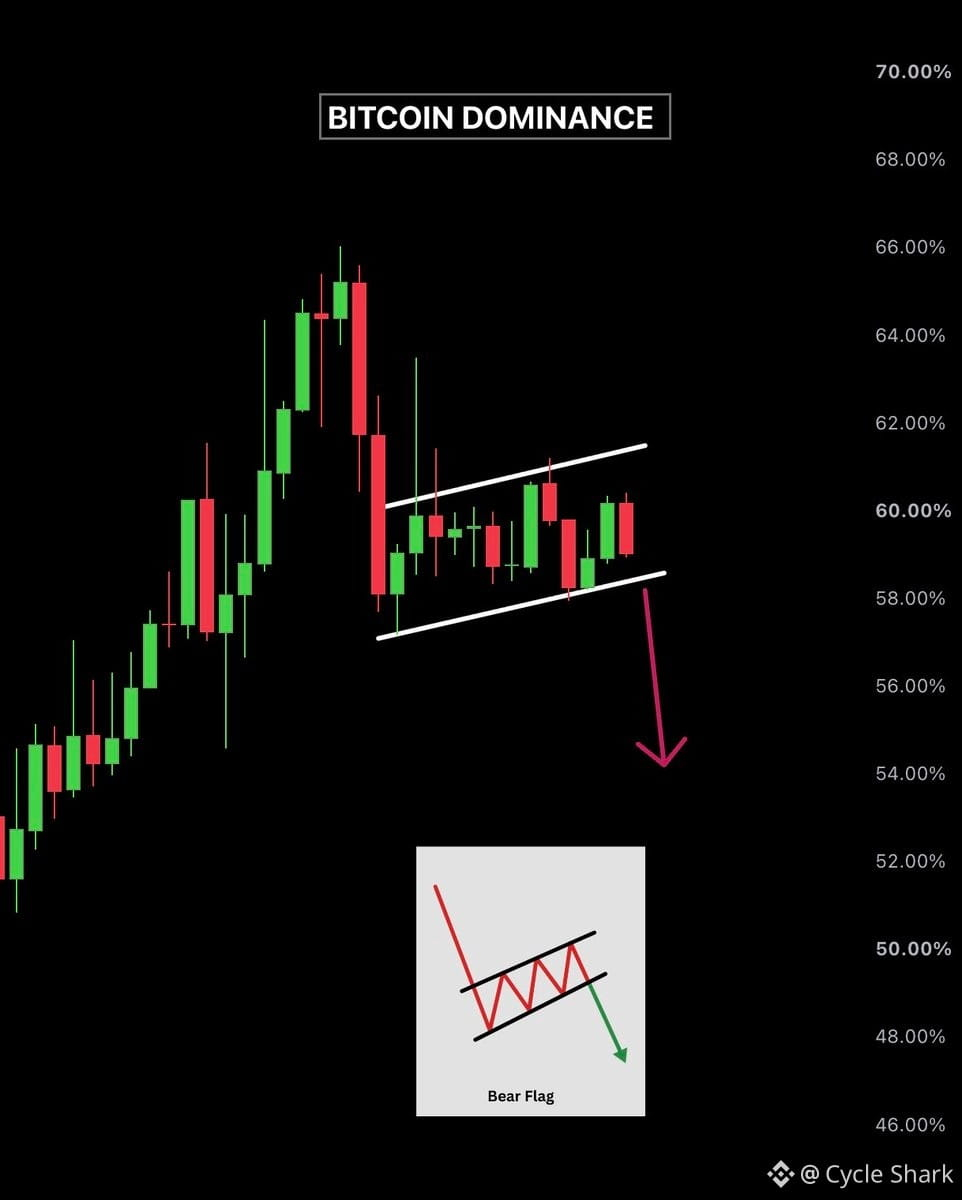
Bitcoin dominance has been forming a bearish flag pattern for over a year now. If this technical pattern breaks down, we're likely looking at the start of altseason — meaning altcoins could finally outperform $BTC in a meaningful way.
This is a classic setup that traders watch closely. When $BTC dominance falls, capital tends to rotate into alts, creating those explosive runs we saw in previous cycles. The flag structure suggests consolidation before a potential drop, which would be the signal many are waiting for.
Bitcoin dominance has been forming a bearish flag pattern for over a year now. If this technical pattern breaks down, we're likely looking at the start of altseason — meaning altcoins could finally outperform $BTC in a meaningful way.
This is a classic setup that traders watch closely. When $BTC dominance falls, capital tends to rotate into alts, creating those explosive runs we saw in previous cycles. The flag structure suggests consolidation before a potential drop, which would be the signal many are waiting for.
This is a classic setup that traders watch closely. When $BTC dominance falls, capital tends to rotate into alts, creating those explosive runs we saw in previous cycles. The flag structure suggests consolidation before a potential drop, which would be the signal many are waiting for.
405
·
--
See translation
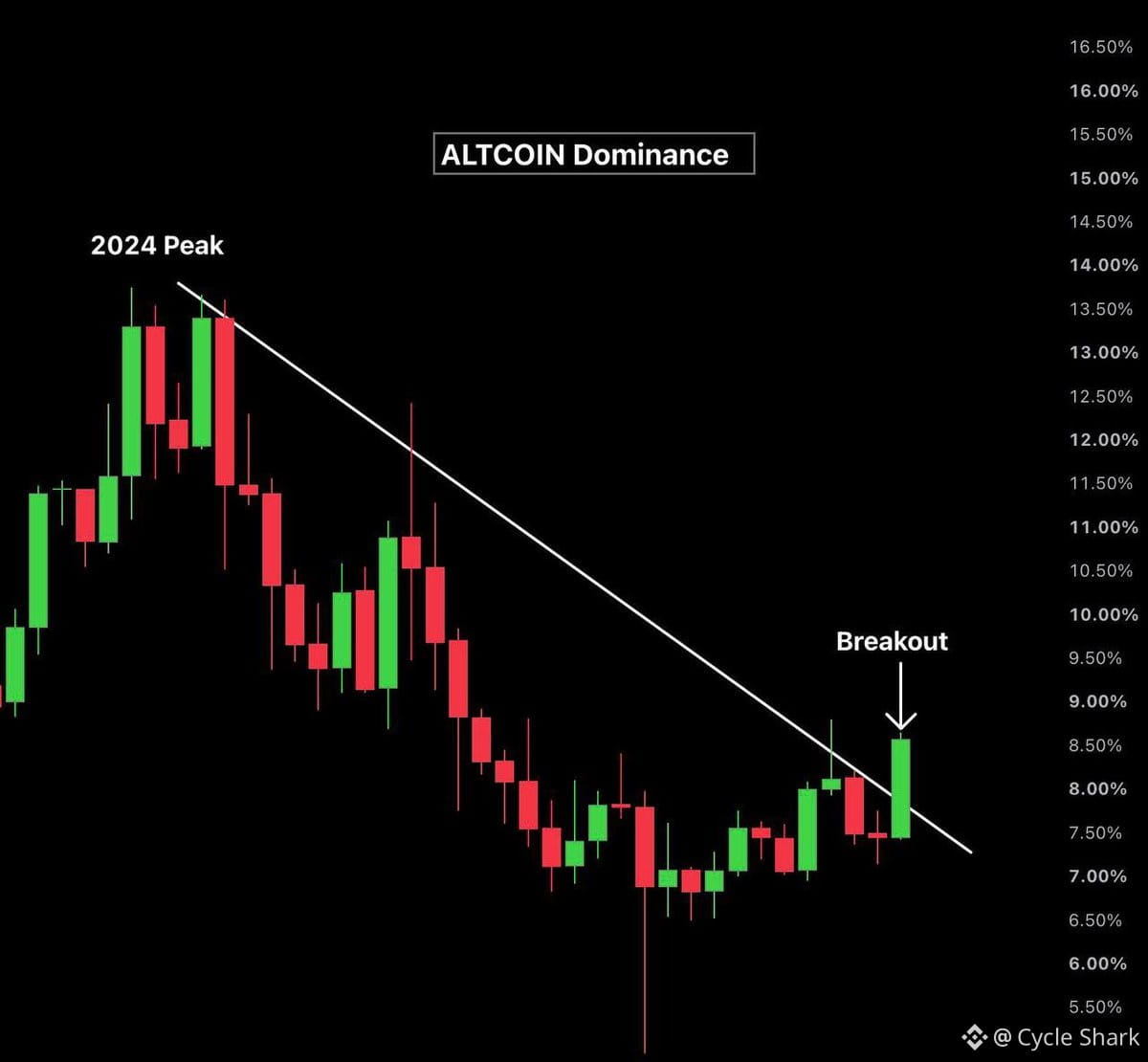
Altcoin dominance just broke a 2-year downtrend. This is the kind of technical signal that gets people excited about rotation.
Here's what matters:
1. Market structure shift
When dominance flips like this after extended consolidation, it often marks the beginning of capital flowing from $BTC into alts. The last few cycles showed similar patterns before explosive moves.
2. Liquidity conditions
The breakout timing aligns with improving global liquidity. Central banks easing, dollar weakness, and risk-on sentiment create the environment where speculative assets outperform.
3. Historical context
Previous dominance breakouts led to 3-6 month windows where alts dramatically outperformed. Not saying it's guaranteed, but the setup rhymes with past cycles.
4. What to watch
Confirmation matters more than the initial break. Need to see sustained momentum, not a fakeout. Volume, breadth across different alt categories, and whether $ETH leads or lags will tell the real story.
The question isn't whether this could be altcoin season — it's whether you're positioned for it if it is. Most people wait for confirmation and miss the best entry points.
Altcoin dominance just broke a 2-year downtrend. This is the kind of technical signal that gets people excited about rotation.
Here's what matters:
1. Market structure shift
When dominance flips like this after extended consolidation, it often marks the beginning of capital flowing from $BTC into alts. The last few cycles showed similar patterns before explosive moves.
2. Liquidity conditions
The breakout timing aligns with improving global liquidity. Central banks easing, dollar weakness, and risk-on sentiment create the environment where speculative assets outperform.
3. Historical context
Previous dominance breakouts led to 3-6 month windows where alts dramatically outperformed. Not saying it's guaranteed, but the setup rhymes with past cycles.
4. What to watch
Confirmation matters more than the initial break. Need to see sustained momentum, not a fakeout. Volume, breadth across different alt categories, and whether $ETH leads or lags will tell the real story.
The question isn't whether this could be altcoin season — it's whether you're positioned for it if it is. Most people wait for confirmation and miss the best entry points.
Here's what matters:
1. Market structure shift
When dominance flips like this after extended consolidation, it often marks the beginning of capital flowing from $BTC into alts. The last few cycles showed similar patterns before explosive moves.
2. Liquidity conditions
The breakout timing aligns with improving global liquidity. Central banks easing, dollar weakness, and risk-on sentiment create the environment where speculative assets outperform.
3. Historical context
Previous dominance breakouts led to 3-6 month windows where alts dramatically outperformed. Not saying it's guaranteed, but the setup rhymes with past cycles.
4. What to watch
Confirmation matters more than the initial break. Need to see sustained momentum, not a fakeout. Volume, breadth across different alt categories, and whether $ETH leads or lags will tell the real story.
The question isn't whether this could be altcoin season — it's whether you're positioned for it if it is. Most people wait for confirmation and miss the best entry points.
80
·
--
See translation
Governments love to lecture about crypto volatility while their own fiat currencies are melting in real-time.
The irony is almost comical. They point fingers at $BTC swings while:
1. The Turkish lira lost 80% against the dollar in recent years
2. Argentina's peso requires constant redenomination just to function
3. The British pound crashed 30% in months during certain crises
4. Even the euro and yen have seen brutal devaluations
At least crypto volatility is transparent and happens in public markets. Fiat debasement is a slow, hidden tax that most people don't even notice until their purchasing power is already gone.
The real question isn't whether crypto is risky. It's whether holding pure fiat in a world of infinite money printing is actually the bigger risk.
Governments love to lecture about crypto volatility while their own fiat currencies are melting in real-time.
The irony is almost comical. They point fingers at $BTC swings while:
1. The Turkish lira lost 80% against the dollar in recent years
2. Argentina's peso requires constant redenomination just to function
3. The British pound crashed 30% in months during certain crises
4. Even the euro and yen have seen brutal devaluations
At least crypto volatility is transparent and happens in public markets. Fiat debasement is a slow, hidden tax that most people don't even notice until their purchasing power is already gone.
The real question isn't whether crypto is risky. It's whether holding pure fiat in a world of infinite money printing is actually the bigger risk.
The irony is almost comical. They point fingers at $BTC swings while:
1. The Turkish lira lost 80% against the dollar in recent years
2. Argentina's peso requires constant redenomination just to function
3. The British pound crashed 30% in months during certain crises
4. Even the euro and yen have seen brutal devaluations
At least crypto volatility is transparent and happens in public markets. Fiat debasement is a slow, hidden tax that most people don't even notice until their purchasing power is already gone.
The real question isn't whether crypto is risky. It's whether holding pure fiat in a world of infinite money printing is actually the bigger risk.
84
·
--
See translation
Crypto just had one of those weeks where everything clicks at once.
$BTC pushed through $87k, $ETH reclaimed $2,800, and $SOL hit $120 — all for the first time in nearly 8 months. The entire crypto market cap crossed $3 trillion again, which is a psychological milestone that matters more than people admit.
But the real story isn't just price. It's institutional flow and regulatory clarity converging at the same time.
ETF inflows were massive: $2.4B into Bitcoin, $690M into Ethereum, $188M into Solana. That's not retail FOMO. That's capital allocation by people who manage real money and need regulatory cover to deploy it.
And that regulatory cover? It's finally arriving.
The Fed proposed letting banks issue their own stablecoins. The CFTC updated tokenized fund guidance and its Chairman literally said "it's go time" for clear crypto rules and 24/7 markets. The SEC confirmed staking tokens aren't securities, which removes a huge overhang for proof-of-stake ecosystems.
Meanwhile, infrastructure is being built in real time. X partnered with crypto exchanges so users can trade stocks and crypto directly from their timeline. NYSE is bringing tokenized US stocks to 44M crypto accounts. BlackRock expanded access to tokenized investment portfolios.
This isn't just a bull run. It's the first cycle where traditional finance is actively building rails into crypto rather than sitting on the sidelines or fighting it. The convergence of liquidity, regulatory green lights, and institutional infrastructure is what makes this moment different from 2021.
The question now isn't whether crypto goes mainstream. It's how fast.
Crypto just had one of those weeks where everything clicks at once.
$BTC pushed through $87k, $ETH reclaimed $2,800, and $SOL hit $120 — all for the first time in nearly 8 months. The entire crypto market cap crossed $3 trillion again, which is a psychological milestone that matters more than people admit.
But the real story isn't just price. It's institutional flow and regulatory clarity converging at the same time.
ETF inflows were massive: $2.4B into Bitcoin, $690M into Ethereum, $188M into Solana. That's not retail FOMO. That's capital allocation by people who manage real money and need regulatory cover to deploy it.
And that regulatory cover? It's finally arriving.
The Fed proposed letting banks issue their own stablecoins. The CFTC updated tokenized fund guidance and its Chairman literally said "it's go time" for clear crypto rules and 24/7 markets. The SEC confirmed staking tokens aren't securities, which removes a huge overhang for proof-of-stake ecosystems.
Meanwhile, infrastructure is being built in real time. X partnered with crypto exchanges so users can trade stocks and crypto directly from their timeline. NYSE is bringing tokenized US stocks to 44M crypto accounts. BlackRock expanded access to tokenized investment portfolios.
This isn't just a bull run. It's the first cycle where traditional finance is actively building rails into crypto rather than sitting on the sidelines or fighting it. The convergence of liquidity, regulatory green lights, and institutional infrastructure is what makes this moment different from 2021.
The question now isn't whether crypto goes mainstream. It's how fast.
$BTC pushed through $87k, $ETH reclaimed $2,800, and $SOL hit $120 — all for the first time in nearly 8 months. The entire crypto market cap crossed $3 trillion again, which is a psychological milestone that matters more than people admit.
But the real story isn't just price. It's institutional flow and regulatory clarity converging at the same time.
ETF inflows were massive: $2.4B into Bitcoin, $690M into Ethereum, $188M into Solana. That's not retail FOMO. That's capital allocation by people who manage real money and need regulatory cover to deploy it.
And that regulatory cover? It's finally arriving.
The Fed proposed letting banks issue their own stablecoins. The CFTC updated tokenized fund guidance and its Chairman literally said "it's go time" for clear crypto rules and 24/7 markets. The SEC confirmed staking tokens aren't securities, which removes a huge overhang for proof-of-stake ecosystems.
Meanwhile, infrastructure is being built in real time. X partnered with crypto exchanges so users can trade stocks and crypto directly from their timeline. NYSE is bringing tokenized US stocks to 44M crypto accounts. BlackRock expanded access to tokenized investment portfolios.
This isn't just a bull run. It's the first cycle where traditional finance is actively building rails into crypto rather than sitting on the sidelines or fighting it. The convergence of liquidity, regulatory green lights, and institutional infrastructure is what makes this moment different from 2021.
The question now isn't whether crypto goes mainstream. It's how fast.
339
·
--
See translation
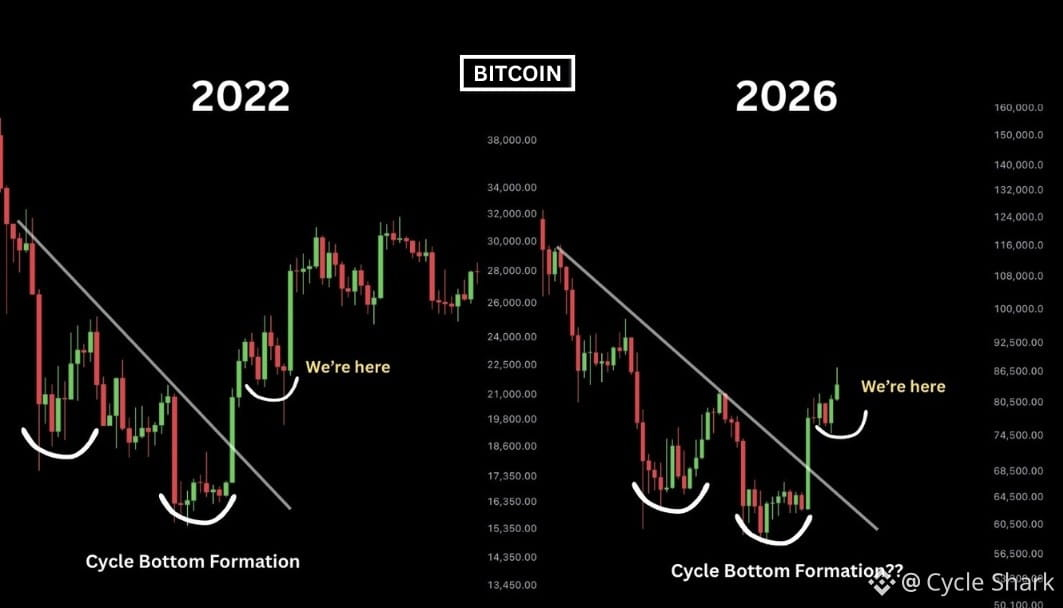
We're seeing $BTC repeat the 2022 playbook right now.
Back then: broke the downtrend → sideways accumulation → range formation → breakout into the next leg up.
Today: same sequence unfolding. We've cleared the trendline, now consolidating in a range.
If history rhymes, this accumulation phase sets up the next move higher. Pattern recognition matters when structure repeats this cleanly.
We're seeing $BTC repeat the 2022 playbook right now.
Back then: broke the downtrend → sideways accumulation → range formation → breakout into the next leg up.
Today: same sequence unfolding. We've cleared the trendline, now consolidating in a range.
If history rhymes, this accumulation phase sets up the next move higher. Pattern recognition matters when structure repeats this cleanly.
Back then: broke the downtrend → sideways accumulation → range formation → breakout into the next leg up.
Today: same sequence unfolding. We've cleared the trendline, now consolidating in a range.
If history rhymes, this accumulation phase sets up the next move higher. Pattern recognition matters when structure repeats this cleanly.
306
·
--
See translation
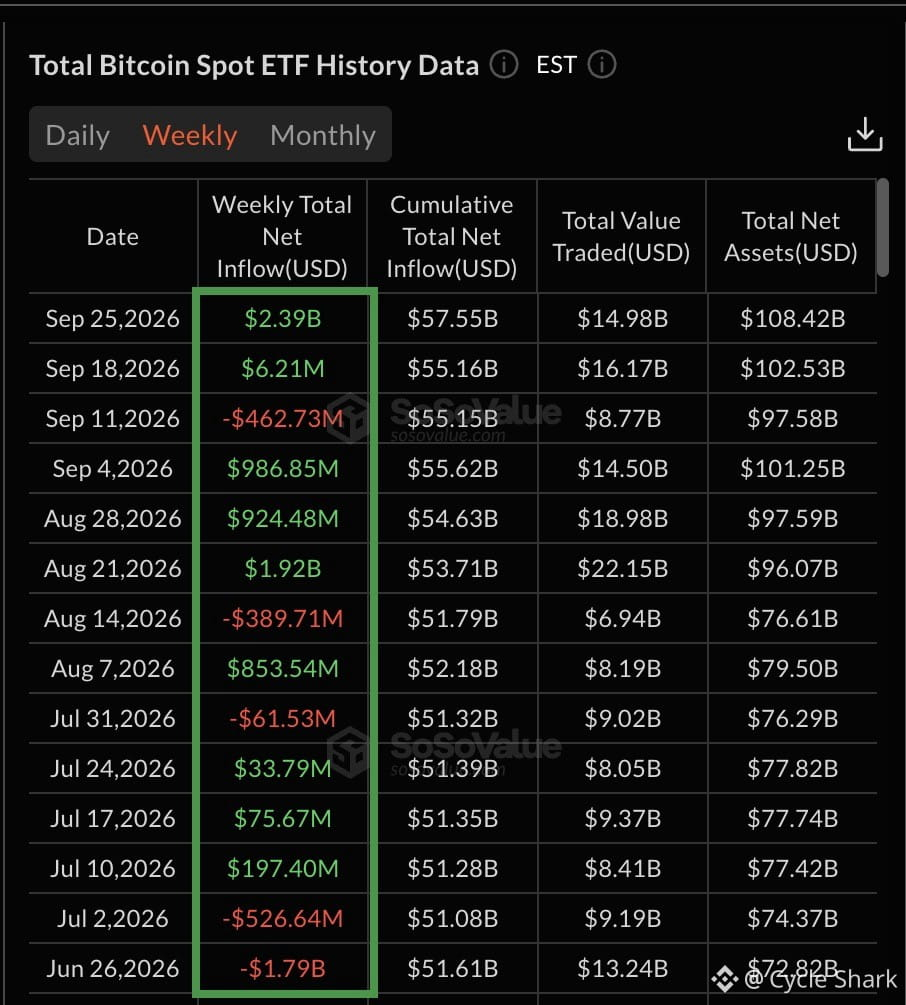
US Bitcoin Spot ETFs just pulled in $2.39 billion this week — the biggest weekly haul of 2026 so far, beating the previous record of $1.92 billion from August.
Institutional money is clearly back in accumulation mode. When you see flows like this, it's not retail FOMO — it's large allocators repositioning. The kind of capital that doesn't chase headlines but moves when conviction builds.
A few things worth noting:
1. This level of inflow suggests institutional appetite is strengthening, not weakening. We're not in a speculative blow-off phase — this is patient, structured buying.
2. The August record was impressive, but breaking it now in early 2026 signals sustained momentum. Institutions don't rotate capital this aggressively unless they see a clear risk-reward setup.
3. ETF flows are a liquidity signal. When billions flow into $BTC ETFs in a single week, it reduces available supply on exchanges and tightens the market structure. Combine that with halving dynamics and macro liquidity cycles, and you get a setup that historically favors upside.
This isn't just a data point — it's a directional indicator. Institutional demand heating up while supply remains constrained is exactly the kind of asymmetry that drives the next leg higher.
US Bitcoin Spot ETFs just pulled in $2.39 billion this week — the biggest weekly haul of 2026 so far, beating the previous record of $1.92 billion from August.
Institutional money is clearly back in accumulation mode. When you see flows like this, it's not retail FOMO — it's large allocators repositioning. The kind of capital that doesn't chase headlines but moves when conviction builds.
A few things worth noting:
1. This level of inflow suggests institutional appetite is strengthening, not weakening. We're not in a speculative blow-off phase — this is patient, structured buying.
2. The August record was impressive, but breaking it now in early 2026 signals sustained momentum. Institutions don't rotate capital this aggressively unless they see a clear risk-reward setup.
3. ETF flows are a liquidity signal. When billions flow into $BTC ETFs in a single week, it reduces available supply on exchanges and tightens the market structure. Combine that with halving dynamics and macro liquidity cycles, and you get a setup that historically favors upside.
This isn't just a data point — it's a directional indicator. Institutional demand heating up while supply remains constrained is exactly the kind of asymmetry that drives the next leg higher.
Institutional money is clearly back in accumulation mode. When you see flows like this, it's not retail FOMO — it's large allocators repositioning. The kind of capital that doesn't chase headlines but moves when conviction builds.
A few things worth noting:
1. This level of inflow suggests institutional appetite is strengthening, not weakening. We're not in a speculative blow-off phase — this is patient, structured buying.
2. The August record was impressive, but breaking it now in early 2026 signals sustained momentum. Institutions don't rotate capital this aggressively unless they see a clear risk-reward setup.
3. ETF flows are a liquidity signal. When billions flow into $BTC ETFs in a single week, it reduces available supply on exchanges and tightens the market structure. Combine that with halving dynamics and macro liquidity cycles, and you get a setup that historically favors upside.
This isn't just a data point — it's a directional indicator. Institutional demand heating up while supply remains constrained is exactly the kind of asymmetry that drives the next leg higher.

82
Log in to explore more content
Join global crypto users on Binance Square
⚡️ Get latest and useful information about crypto.
💬 Trusted by the world’s largest crypto exchange.
👍 Discover real insights from verified creators.
Email / Phone number
Trending Topics
UKFCAWinsCourtOrderToRecover851400Pounds
14,692 views
587 Discussing
🚨 CRYPTO REGULATION JUST ENTERED A NEW PHASE: THEY’RE NOT ONLY WRITING RULES — THEY’RE TAKING MONEY BACK.
The UK’s FCA has secured another court-backed asset recovery, reinforcing a broader enforcement push against unauthorized financial and crypto-related activity.
And look at what’s happening simultaneously:
🇬🇧 FCA → enforcement + asset recovery
🇺🇸 SEC → clearer rules for functional crypto assets
🇺🇸 Fed → formal stablecoin supervision under the GENIUS Act
That combination matters.
Regulators are no longer debating whether crypto belongs inside the financial system.
They’re increasingly deciding who gets access, what rules they follow, and what happens when those rules are broken.
The next crypto cycle may not be “regulation vs innovation.”
It may be regulated crypto vs everyone who can’t meet the standard. 👀
$COIN $CRCL $BTC
#ukfcawinscourtordertorecover851400pounds #ChainlinkLaunchesCCIP2WithEnterpriseVerification #GoldFallsTo$4144 #QNTFallsOver40%FromMorningHigh #USDTAdds845900HoldersInPast7Days
KimHotbae
·2 Likes
·4.2k views
ChainlinkLaunchesCCIP2WithEnterpriseVerification
28,721 views
793 Discussing
GoldFallsTo$4144
10,731 views
134 Discussing