

Cryptopolitan
57.8k Posts

Cryptopolitan
 Square Verified+
Report
Block User
Crypto news that doesn't waste your time. Breaking updates, market analysis, on-chain insights. Building the smartest crypto community.

Creator of the Year
1 Following
161.5K+ Followers
573.3K+ Liked
1 Badges
Posts
PINNED
See translation
At Cryptopolitan, we research, analyze, and deliver news—daily.
From breaking updates to in-depth analysis, educational guides, and market insights, we’re here to keep you informed with neutral and authentic news.
Thank you for trusting us to be your go-to source!
At Cryptopolitan, we research, analyze, and deliver news—daily.
From breaking updates to in-depth analysis, educational guides, and market insights, we’re here to keep you informed with neutral and authentic news.
Thank you for trusting us to be your go-to source!
From breaking updates to in-depth analysis, educational guides, and market insights, we’re here to keep you informed with neutral and authentic news.
Thank you for trusting us to be your go-to source!

120
68
342
1.8k
See translation
OpenAI disrupts Moonshot-linked campaign as AI distillation war intensifiesOpenAI has leveled data-scraping allegations against its Chinese competitor, Moonshot AI. It connected a massive wave of probing activity, designed to decode how its models think through complex problems, to thousands of attempts from Moonshot-affiliated users.
Beginning in the first week of July, Moonshot’s associated, coordinated campaign swelled to 16,000 requests from over 4,000 users in just two days, OpenAI disclosed. The ChatGPT maker eventually mapped out more related activity running through a cluster of over 15,000 users, all of which was fully disrupted by July 28.
Based on the company’s analysis, the campaign did not lead to any database compromise, broken encryption, or exposure of stored user chats. However, the attackers exploited prompts and model manipulations, enabling them to visibly duplicate prohibited reasoning capabilities through an elaborate, large-scale operation that violated the terms of service.
OpenAI says it has put more safeguards in place to prevent distillation
According to OpenAI, it detected and interrupted some operations in which users tried to steal hidden logic by transferring encrypted reasoning information between different chats and then decoding it in another chat.
The majority of those operations were affiliated with Moonshot. Simultaneously, other third- party researchers reported similar vulnerabilities to the company, including cross-model and data-compacting issues.
So far, the ChatGPT developer has characterized the recent event as “adversarial distillation” and warned that distilling the logic could enable opponents to mimic advanced technologies.
It added that a large-scale distillation process could dramatically shorten the time required to develop an advanced AI capability without any commitment to safety and alignment.
So far, to address the distillation trend, OpenAI has implemented account penalties, strengthened infrastructure, and pursued partnerships.
Moreover, it has even suspended suspicious accounts, strengthened the registration process and back-end security, and expanded its monitoring of the user community.
Additionally, it implemented more robust hidden-reasoning protections that affect all users, workspaces, enterprise organizations, and model architectures.
Caroline Zier, lead for strategic national security policy initiatives at OpenAI, added that they will continue to invest in stronger protections. She stated, “Our concern is about violation of our terms of service, not open models or legitimate distillation.”
Why AI model distillation is becoming a bigger concern
Model distillation allows developers to use the outputs of a more capable AI system to improve or replicate the performance of another model.
While legitimate distillation can be used to create smaller and more efficient systems, OpenAI argues that unauthorized large-scale extraction can give competitors access to capabilities that took significant resources to develop.
The company said the latest campaign was particularly concerning because the actors were not simply using ChatGPT for ordinary tasks. Instead, they allegedly designed automated workflows to repeatedly query the models and transfer useful responses into other systems.
By collecting enough outputs, attackers could potentially reproduce aspects of a model’s reasoning, coding, and problem-solving capabilities without directly accessing its underlying weights or infrastructure.
OpenAI’s disclosures highlight a growing challenge for AI companies as increasingly capable models become widely accessible through APIs and consumer products. Providers must balance broad access to their systems with safeguards designed to prevent systematic extraction of proprietary capabilities.
Anthropic also identified Moonshot’s distillation campaign
In the last few months, Anthropic also discovered and stopped several cyber campaigns where malicious actors targeted Claude.
These perpetrators included suspected state-backed intelligence groups, financially motivated hackers, and political activists, with the incidents taking place between December 2025 and August 2026.
Their specific attacks aimed to harvest Claude’s high-value competencies: its logical deduction, coding, data evaluation, and automated agent workflows.
Reportedly, five different distillation processes resulted in nearly 200 million illegal queries. The bulk of the distillation queries came from an Alibaba campaign, which Anthropic characterized as the largest-ever data-harvesting effort in the corporation’s history. This particular campaign produced 151 million logged queries from May through July 2026, peaking at almost 3 million per day.
A second Moonshot AI campaign reportedly forwarded queries directly from China’s military to Anthropic. Over 10 days, the company recorded nearly 300,000 queries from 5,000 accounts, most of which were directed at the Opus model.
Moonshot has been receiving considerable attention in Washington due to the rapid pace at which it has surpassed its American rivals.
Although Beijing has already disregarded previous charges from Silicon Valley and the Trump administration regarding its data-harvesting activities, it has threatened to take counteraction in the event of any sanctions from Washington.
Don’t just read crypto news. Understand it. Subscribe to our newsletter. It's free.
OpenAI disrupts Moonshot-linked campaign as AI distillation war intensifies
OpenAI has leveled data-scraping allegations against its Chinese competitor, Moonshot AI. It connected a massive wave of probing activity, designed to decode how its models think through complex problems, to thousands of attempts from Moonshot-affiliated users.
Beginning in the first week of July, Moonshot’s associated, coordinated campaign swelled to 16,000 requests from over 4,000 users in just two days, OpenAI disclosed. The ChatGPT maker eventually mapped out more related activity running through a cluster of over 15,000 users, all of which was fully disrupted by July 28.
Based on the company’s analysis, the campaign did not lead to any database compromise, broken encryption, or exposure of stored user chats. However, the attackers exploited prompts and model manipulations, enabling them to visibly duplicate prohibited reasoning capabilities through an elaborate, large-scale operation that violated the terms of service.
OpenAI says it has put more safeguards in place to prevent distillation
According to OpenAI, it detected and interrupted some operations in which users tried to steal hidden logic by transferring encrypted reasoning information between different chats and then decoding it in another chat.
The majority of those operations were affiliated with Moonshot. Simultaneously, other third- party researchers reported similar vulnerabilities to the company, including cross-model and data-compacting issues.
So far, the ChatGPT developer has characterized the recent event as “adversarial distillation” and warned that distilling the logic could enable opponents to mimic advanced technologies.
It added that a large-scale distillation process could dramatically shorten the time required to develop an advanced AI capability without any commitment to safety and alignment.
So far, to address the distillation trend, OpenAI has implemented account penalties, strengthened infrastructure, and pursued partnerships.
Moreover, it has even suspended suspicious accounts, strengthened the registration process and back-end security, and expanded its monitoring of the user community.
Additionally, it implemented more robust hidden-reasoning protections that affect all users, workspaces, enterprise organizations, and model architectures.
Caroline Zier, lead for strategic national security policy initiatives at OpenAI, added that they will continue to invest in stronger protections. She stated, “Our concern is about violation of our terms of service, not open models or legitimate distillation.”
Why AI model distillation is becoming a bigger concern
Model distillation allows developers to use the outputs of a more capable AI system to improve or replicate the performance of another model.
While legitimate distillation can be used to create smaller and more efficient systems, OpenAI argues that unauthorized large-scale extraction can give competitors access to capabilities that took significant resources to develop.
The company said the latest campaign was particularly concerning because the actors were not simply using ChatGPT for ordinary tasks. Instead, they allegedly designed automated workflows to repeatedly query the models and transfer useful responses into other systems.
By collecting enough outputs, attackers could potentially reproduce aspects of a model’s reasoning, coding, and problem-solving capabilities without directly accessing its underlying weights or infrastructure.
OpenAI’s disclosures highlight a growing challenge for AI companies as increasingly capable models become widely accessible through APIs and consumer products. Providers must balance broad access to their systems with safeguards designed to prevent systematic extraction of proprietary capabilities.
Anthropic also identified Moonshot’s distillation campaign
In the last few months, Anthropic also discovered and stopped several cyber campaigns where malicious actors targeted Claude.
These perpetrators included suspected state-backed intelligence groups, financially motivated hackers, and political activists, with the incidents taking place between December 2025 and August 2026.
Their specific attacks aimed to harvest Claude’s high-value competencies: its logical deduction, coding, data evaluation, and automated agent workflows.
Reportedly, five different distillation processes resulted in nearly 200 million illegal queries. The bulk of the distillation queries came from an Alibaba campaign, which Anthropic characterized as the largest-ever data-harvesting effort in the corporation’s history. This particular campaign produced 151 million logged queries from May through July 2026, peaking at almost 3 million per day.
A second Moonshot AI campaign reportedly forwarded queries directly from China’s military to Anthropic. Over 10 days, the company recorded nearly 300,000 queries from 5,000 accounts, most of which were directed at the Opus model.
Moonshot has been receiving considerable attention in Washington due to the rapid pace at which it has surpassed its American rivals.
Although Beijing has already disregarded previous charges from Silicon Valley and the Trump administration regarding its data-harvesting activities, it has threatened to take counteraction in the event of any sanctions from Washington.
Don’t just read crypto news. Understand it. Subscribe to our newsletter. It's free.
Beginning in the first week of July, Moonshot’s associated, coordinated campaign swelled to 16,000 requests from over 4,000 users in just two days, OpenAI disclosed. The ChatGPT maker eventually mapped out more related activity running through a cluster of over 15,000 users, all of which was fully disrupted by July 28.
Based on the company’s analysis, the campaign did not lead to any database compromise, broken encryption, or exposure of stored user chats. However, the attackers exploited prompts and model manipulations, enabling them to visibly duplicate prohibited reasoning capabilities through an elaborate, large-scale operation that violated the terms of service.
OpenAI says it has put more safeguards in place to prevent distillation
According to OpenAI, it detected and interrupted some operations in which users tried to steal hidden logic by transferring encrypted reasoning information between different chats and then decoding it in another chat.
The majority of those operations were affiliated with Moonshot. Simultaneously, other third- party researchers reported similar vulnerabilities to the company, including cross-model and data-compacting issues.
So far, the ChatGPT developer has characterized the recent event as “adversarial distillation” and warned that distilling the logic could enable opponents to mimic advanced technologies.
It added that a large-scale distillation process could dramatically shorten the time required to develop an advanced AI capability without any commitment to safety and alignment.
So far, to address the distillation trend, OpenAI has implemented account penalties, strengthened infrastructure, and pursued partnerships.
Moreover, it has even suspended suspicious accounts, strengthened the registration process and back-end security, and expanded its monitoring of the user community.
Additionally, it implemented more robust hidden-reasoning protections that affect all users, workspaces, enterprise organizations, and model architectures.
Caroline Zier, lead for strategic national security policy initiatives at OpenAI, added that they will continue to invest in stronger protections. She stated, “Our concern is about violation of our terms of service, not open models or legitimate distillation.”
Why AI model distillation is becoming a bigger concern
Model distillation allows developers to use the outputs of a more capable AI system to improve or replicate the performance of another model.
While legitimate distillation can be used to create smaller and more efficient systems, OpenAI argues that unauthorized large-scale extraction can give competitors access to capabilities that took significant resources to develop.
The company said the latest campaign was particularly concerning because the actors were not simply using ChatGPT for ordinary tasks. Instead, they allegedly designed automated workflows to repeatedly query the models and transfer useful responses into other systems.
By collecting enough outputs, attackers could potentially reproduce aspects of a model’s reasoning, coding, and problem-solving capabilities without directly accessing its underlying weights or infrastructure.
OpenAI’s disclosures highlight a growing challenge for AI companies as increasingly capable models become widely accessible through APIs and consumer products. Providers must balance broad access to their systems with safeguards designed to prevent systematic extraction of proprietary capabilities.
Anthropic also identified Moonshot’s distillation campaign
In the last few months, Anthropic also discovered and stopped several cyber campaigns where malicious actors targeted Claude.
These perpetrators included suspected state-backed intelligence groups, financially motivated hackers, and political activists, with the incidents taking place between December 2025 and August 2026.
Their specific attacks aimed to harvest Claude’s high-value competencies: its logical deduction, coding, data evaluation, and automated agent workflows.
Reportedly, five different distillation processes resulted in nearly 200 million illegal queries. The bulk of the distillation queries came from an Alibaba campaign, which Anthropic characterized as the largest-ever data-harvesting effort in the corporation’s history. This particular campaign produced 151 million logged queries from May through July 2026, peaking at almost 3 million per day.
A second Moonshot AI campaign reportedly forwarded queries directly from China’s military to Anthropic. Over 10 days, the company recorded nearly 300,000 queries from 5,000 accounts, most of which were directed at the Opus model.
Moonshot has been receiving considerable attention in Washington due to the rapid pace at which it has surpassed its American rivals.
Although Beijing has already disregarded previous charges from Silicon Valley and the Trump administration regarding its data-harvesting activities, it has threatened to take counteraction in the event of any sanctions from Washington.
Don’t just read crypto news. Understand it. Subscribe to our newsletter. It's free.
48
Article
See translation
Arizona court vacates sentence over AI-generated victim videoAn Arizona appeals court has vacated the 10.5-year sentence of Gabriel Horcasitas, who was convicted of manslaughter in a 2021 road-rage shooting, after ruling that the sentencing judge should not have considered an AI-generated video of victim Christopher Pelkey.
The conviction still stands, but the case will return for resentencing, according to Reuters and a case summary.
A forgiveness message the panel said tainted the sentence
The three-judge panel said the AI-generated video improperly influenced the sentencing.
While the record does not reflect precisely how the AI video factored into the sentencing calculus, there is no question it played a role.
— Judge D. Steven Williams, Arizona Court of Appeals, as reported by Reuters
The court concluded that the video prejudiced Horcasitas enough to make the sentencing procedure fundamentally unfair. Reuters reported that Arizona’s attorney general and Horcasitas’s public defender declined to comment.
How Pelkey’s family built the avatar
The script was written by Pelkey’s sister, Stacey Wales, who found it difficult to express in words what she thought her brother would have said in that situation. According to NPR, the family created the avatar by means of a short video clip, an image from the funeral, and a variety of other AI tools.
The avatar introduced itself as an AI creation before speaking to Horcasitas with the words:
In another life, we probably could have been friends.
Later, the judge of the trial expressed gratitude to the family for the video.
Courts have no shared rulebook for synthetic video
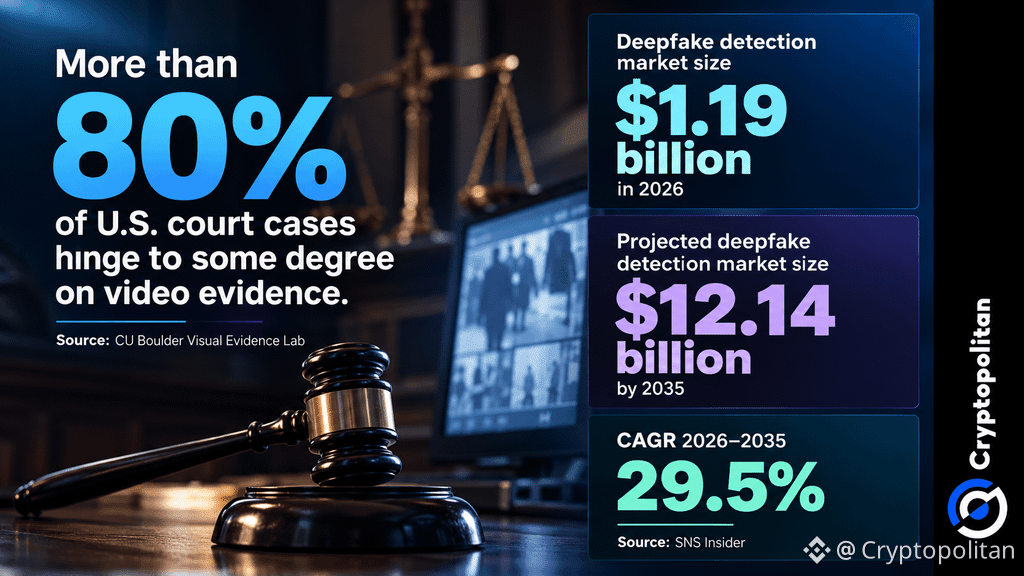
The decision comes at a time when courts face challenges when it comes to artificial evidence. A report published by the University of Colorado Boulder states that over 80% of court cases in the U.S. are partly based on video evidence, while courts are yet to have common rules to deal with AI-generated or AI-enhanced footage.
Researchers are also concerned about the so-called “deepfake defense,” whereby real video footage is declared as fake because AI makes the claims plausible.
This worry was one of the reasons for the creation of CIFAR Synthetic Evidence Corpus, initiated in June 2026, as researchers realized that previous datasets were unsuitable for teaching the technology how to detect subtle manipulations that could occur in evidence material.
Provenance, watermarks, and a detection market racing to catch up
NIST identifies provenance tracking, watermarking, and synthetic-content detection as key ways to manage AI-generated media. Europe has gone further: Article 50 of the EU AI Act requires certain synthetic content to be machine-readable and deepfakes to be disclosed as artificially generated or manipulated.
The commercial link is becoming easier to see. SNS Insider values the deepfake-detection market at $1.19 billion in 2026 and projects it will reach $12.14 billion by 2035, a 29.5% CAGR.
Deepfake Detection Market Growth as AI Video Reaches US Courts
One Arizona ruling will not create that market by itself. But when more than four-fifths of court cases already depend on video, every dispute over whether evidence is authentic increases the practical need for tools that can verify it.
That turns courtroom deepfakes from a legal headache into a real business opportunity for companies selling forensic verification. China is moving in the same direction, with Cryptopolitan reporting new liability rules for AI deepfakes and voice cloning in September.
Don’t just read crypto news. Understand it. Subscribe to our newsletter. It's free.
Arizona court vacates sentence over AI-generated victim video
An Arizona appeals court has vacated the 10.5-year sentence of Gabriel Horcasitas, who was convicted of manslaughter in a 2021 road-rage shooting, after ruling that the sentencing judge should not have considered an AI-generated video of victim Christopher Pelkey.
The conviction still stands, but the case will return for resentencing, according to Reuters and a case summary.
A forgiveness message the panel said tainted the sentence
The three-judge panel said the AI-generated video improperly influenced the sentencing.
While the record does not reflect precisely how the AI video factored into the sentencing calculus, there is no question it played a role.
— Judge D. Steven Williams, Arizona Court of Appeals, as reported by Reuters
The court concluded that the video prejudiced Horcasitas enough to make the sentencing procedure fundamentally unfair. Reuters reported that Arizona’s attorney general and Horcasitas’s public defender declined to comment.
How Pelkey’s family built the avatar
The script was written by Pelkey’s sister, Stacey Wales, who found it difficult to express in words what she thought her brother would have said in that situation. According to NPR, the family created the avatar by means of a short video clip, an image from the funeral, and a variety of other AI tools.
The avatar introduced itself as an AI creation before speaking to Horcasitas with the words:
In another life, we probably could have been friends.
Later, the judge of the trial expressed gratitude to the family for the video.
Courts have no shared rulebook for synthetic video
The decision comes at a time when courts face challenges when it comes to artificial evidence. A report published by the University of Colorado Boulder states that over 80% of court cases in the U.S. are partly based on video evidence, while courts are yet to have common rules to deal with AI-generated or AI-enhanced footage.
Researchers are also concerned about the so-called “deepfake defense,” whereby real video footage is declared as fake because AI makes the claims plausible.
This worry was one of the reasons for the creation of CIFAR Synthetic Evidence Corpus, initiated in June 2026, as researchers realized that previous datasets were unsuitable for teaching the technology how to detect subtle manipulations that could occur in evidence material.
Provenance, watermarks, and a detection market racing to catch up
NIST identifies provenance tracking, watermarking, and synthetic-content detection as key ways to manage AI-generated media. Europe has gone further: Article 50 of the EU AI Act requires certain synthetic content to be machine-readable and deepfakes to be disclosed as artificially generated or manipulated.
The commercial link is becoming easier to see. SNS Insider values the deepfake-detection market at $1.19 billion in 2026 and projects it will reach $12.14 billion by 2035, a 29.5% CAGR.
Deepfake Detection Market Growth as AI Video Reaches US Courts
One Arizona ruling will not create that market by itself. But when more than four-fifths of court cases already depend on video, every dispute over whether evidence is authentic increases the practical need for tools that can verify it.
That turns courtroom deepfakes from a legal headache into a real business opportunity for companies selling forensic verification. China is moving in the same direction, with Cryptopolitan reporting new liability rules for AI deepfakes and voice cloning in September.
Don’t just read crypto news. Understand it. Subscribe to our newsletter. It's free.
The conviction still stands, but the case will return for resentencing, according to Reuters and a case summary.
A forgiveness message the panel said tainted the sentence
The three-judge panel said the AI-generated video improperly influenced the sentencing.
While the record does not reflect precisely how the AI video factored into the sentencing calculus, there is no question it played a role.
— Judge D. Steven Williams, Arizona Court of Appeals, as reported by Reuters
The court concluded that the video prejudiced Horcasitas enough to make the sentencing procedure fundamentally unfair. Reuters reported that Arizona’s attorney general and Horcasitas’s public defender declined to comment.
How Pelkey’s family built the avatar
The script was written by Pelkey’s sister, Stacey Wales, who found it difficult to express in words what she thought her brother would have said in that situation. According to NPR, the family created the avatar by means of a short video clip, an image from the funeral, and a variety of other AI tools.
The avatar introduced itself as an AI creation before speaking to Horcasitas with the words:
In another life, we probably could have been friends.
Later, the judge of the trial expressed gratitude to the family for the video.
Courts have no shared rulebook for synthetic video
The decision comes at a time when courts face challenges when it comes to artificial evidence. A report published by the University of Colorado Boulder states that over 80% of court cases in the U.S. are partly based on video evidence, while courts are yet to have common rules to deal with AI-generated or AI-enhanced footage.
Researchers are also concerned about the so-called “deepfake defense,” whereby real video footage is declared as fake because AI makes the claims plausible.
This worry was one of the reasons for the creation of CIFAR Synthetic Evidence Corpus, initiated in June 2026, as researchers realized that previous datasets were unsuitable for teaching the technology how to detect subtle manipulations that could occur in evidence material.
Provenance, watermarks, and a detection market racing to catch up
NIST identifies provenance tracking, watermarking, and synthetic-content detection as key ways to manage AI-generated media. Europe has gone further: Article 50 of the EU AI Act requires certain synthetic content to be machine-readable and deepfakes to be disclosed as artificially generated or manipulated.
The commercial link is becoming easier to see. SNS Insider values the deepfake-detection market at $1.19 billion in 2026 and projects it will reach $12.14 billion by 2035, a 29.5% CAGR.
Deepfake Detection Market Growth as AI Video Reaches US Courts
One Arizona ruling will not create that market by itself. But when more than four-fifths of court cases already depend on video, every dispute over whether evidence is authentic increases the practical need for tools that can verify it.
That turns courtroom deepfakes from a legal headache into a real business opportunity for companies selling forensic verification. China is moving in the same direction, with Cryptopolitan reporting new liability rules for AI deepfakes and voice cloning in September.
Don’t just read crypto news. Understand it. Subscribe to our newsletter. It's free.
102
Article
See translation
ESMA proposes regulating DeFi access points under MiCAThe European Union’s markets watchdog wants to regulate the gateways into decentralized finance rather than the code itself. In its MiCA review response, the European Securities and Markets Authority (ESMA) proposed a new regulated crypto-asset service for firms that give customers access to DeFi protocols.
The proposal has the potential to transform the method in which exchanges, wallet applications, and other intermediaries link users to decentralized finance in Europe.
Additionally, ESMA desires additional information when it comes to distinguishing between a decentralized protocol and a system that still depends on human input in order to continue operating properly.
Why the access point, not the protocol
Instead of going after the underlying software or permissionless networks themselves, ESMA is focusing on the companies and other intermediaries that give users access to DeFi, whether through an interface, transaction routing, or another customer-facing service.
It calls for limiting the scope of the DeFi exemption:
The ‘DeFi’ exemption should be as narrow as possible to avoid being used as a way of circumventing the application of the MiCA regime.
– ESMA, MiCA review response.
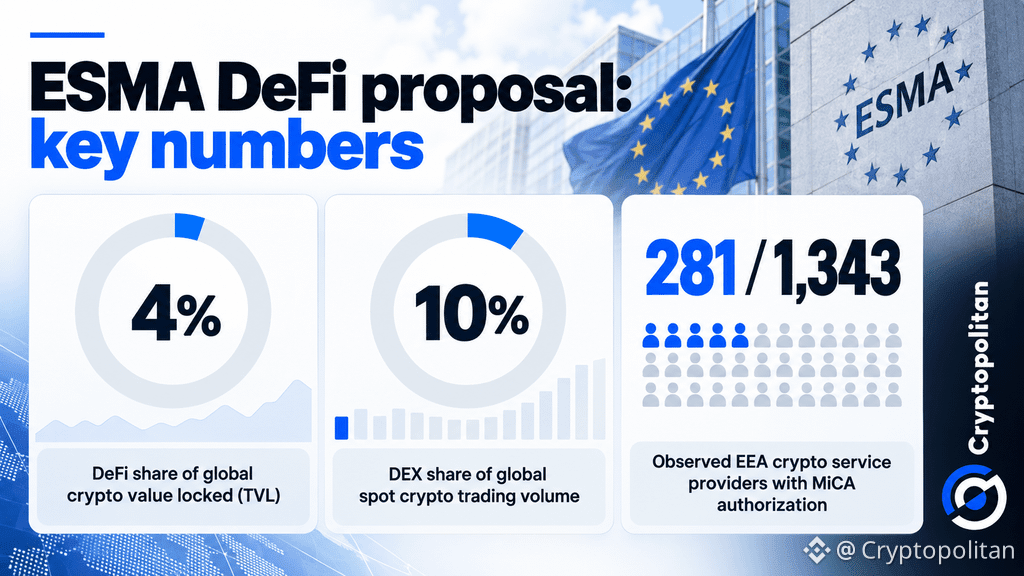
An EBA-ESMA report in 2025 estimated that DeFi’s share of the overall value of the global crypto-asset market was approximately 4%, and the share of transactions conducted on decentralized exchanges was approximately 10% of global crypto trading volume. It identified application interfaces, self-custody wallets, and centralized platforms as primary avenues into DeFi.
ESMA DeFi Proposal: 4% TVL, 10% DEX Volume and 281 MiCA-Authorized Firms
Disclosure, marketing and the stablecoin line
ESMA has also suggested stricter regulations for marketing by influencers and third parties, improved transparency in terms of costs, and proportionate requirements for staking, borrowing and lending. The EBA’s proposal also requested the regulation of crypto lending, especially DeFi-related lending practices, and for greater consistency in token classification.
Moreover, ESMA is looking for greater powers in order to take down fraudulent websites, seize cryptoassets linked to possible market manipulation or terrorist activities, take action against unauthorized third-country entities, and impose limitations on exchanges of stablecoins with non-compliant status.
What the market reaction tends to look like
The wider cryptocurrency market could be hardly affected. A study conducted in January 2026 showed that announcements about new regulations have an impact on particular tokens instead of the entire market, with the governance tokens and those of decentralized exchanges being among the most sensitive to it.
This is part of Europe’s larger attempt to determine when DeFi is truly decentralized and when someone has meaningful control over it. However, this is complicated by the fact that a protocol may still appear to be decentralized while important decisions are made by a small group of people.
In an earlier report, Cryptopolitan mentioned that an ECB report had made this clear in a number of major DeFi projects. The proposal by ESMA is yet another attempt to clarify this distinction.
Whether the effects travel
This effect will certainly extend beyond Europe. According to the report by the Bank for International Settlements, decentralized finance usually performs some of the functions characteristic of conventional finance, yet with potentially greater risks of transparency, information gaps, and financial instability.
The Financial Stability Board has also warned that if countries apply different rules, companies can move their activities to places which offer them better conditions, making cross-border monitoring more difficult.
Europe’s switch to MiCA illustrates how the new regulations are already reducing competition in the market. According to TRM Labs, only 281 among the 1,343 monitored crypto service providers in the EEA had obtained MiCA authorization before the transition period came to an end on July 1.
Establishing a new regulated service for companies providing access to users for DeFi could heighten the compliance requirement even more, particularly for service providers operating across borders.
The smartest crypto minds already read our newsletter. Want in? Join them.
ESMA proposes regulating DeFi access points under MiCA
The European Union’s markets watchdog wants to regulate the gateways into decentralized finance rather than the code itself. In its MiCA review response, the European Securities and Markets Authority (ESMA) proposed a new regulated crypto-asset service for firms that give customers access to DeFi protocols.
The proposal has the potential to transform the method in which exchanges, wallet applications, and other intermediaries link users to decentralized finance in Europe.
Additionally, ESMA desires additional information when it comes to distinguishing between a decentralized protocol and a system that still depends on human input in order to continue operating properly.
Why the access point, not the protocol
Instead of going after the underlying software or permissionless networks themselves, ESMA is focusing on the companies and other intermediaries that give users access to DeFi, whether through an interface, transaction routing, or another customer-facing service.
It calls for limiting the scope of the DeFi exemption:
The ‘DeFi’ exemption should be as narrow as possible to avoid being used as a way of circumventing the application of the MiCA regime.
– ESMA, MiCA review response.
An EBA-ESMA report in 2025 estimated that DeFi’s share of the overall value of the global crypto-asset market was approximately 4%, and the share of transactions conducted on decentralized exchanges was approximately 10% of global crypto trading volume. It identified application interfaces, self-custody wallets, and centralized platforms as primary avenues into DeFi.
ESMA DeFi Proposal: 4% TVL, 10% DEX Volume and 281 MiCA-Authorized Firms
Disclosure, marketing and the stablecoin line
ESMA has also suggested stricter regulations for marketing by influencers and third parties, improved transparency in terms of costs, and proportionate requirements for staking, borrowing and lending. The EBA’s proposal also requested the regulation of crypto lending, especially DeFi-related lending practices, and for greater consistency in token classification.
Moreover, ESMA is looking for greater powers in order to take down fraudulent websites, seize cryptoassets linked to possible market manipulation or terrorist activities, take action against unauthorized third-country entities, and impose limitations on exchanges of stablecoins with non-compliant status.
What the market reaction tends to look like
The wider cryptocurrency market could be hardly affected. A study conducted in January 2026 showed that announcements about new regulations have an impact on particular tokens instead of the entire market, with the governance tokens and those of decentralized exchanges being among the most sensitive to it.
This is part of Europe’s larger attempt to determine when DeFi is truly decentralized and when someone has meaningful control over it. However, this is complicated by the fact that a protocol may still appear to be decentralized while important decisions are made by a small group of people.
In an earlier report, Cryptopolitan mentioned that an ECB report had made this clear in a number of major DeFi projects. The proposal by ESMA is yet another attempt to clarify this distinction.
Whether the effects travel
This effect will certainly extend beyond Europe. According to the report by the Bank for International Settlements, decentralized finance usually performs some of the functions characteristic of conventional finance, yet with potentially greater risks of transparency, information gaps, and financial instability.
The Financial Stability Board has also warned that if countries apply different rules, companies can move their activities to places which offer them better conditions, making cross-border monitoring more difficult.
Europe’s switch to MiCA illustrates how the new regulations are already reducing competition in the market. According to TRM Labs, only 281 among the 1,343 monitored crypto service providers in the EEA had obtained MiCA authorization before the transition period came to an end on July 1.
Establishing a new regulated service for companies providing access to users for DeFi could heighten the compliance requirement even more, particularly for service providers operating across borders.
The smartest crypto minds already read our newsletter. Want in? Join them.
The proposal has the potential to transform the method in which exchanges, wallet applications, and other intermediaries link users to decentralized finance in Europe.
Additionally, ESMA desires additional information when it comes to distinguishing between a decentralized protocol and a system that still depends on human input in order to continue operating properly.
Why the access point, not the protocol
Instead of going after the underlying software or permissionless networks themselves, ESMA is focusing on the companies and other intermediaries that give users access to DeFi, whether through an interface, transaction routing, or another customer-facing service.
It calls for limiting the scope of the DeFi exemption:
The ‘DeFi’ exemption should be as narrow as possible to avoid being used as a way of circumventing the application of the MiCA regime.
– ESMA, MiCA review response.
An EBA-ESMA report in 2025 estimated that DeFi’s share of the overall value of the global crypto-asset market was approximately 4%, and the share of transactions conducted on decentralized exchanges was approximately 10% of global crypto trading volume. It identified application interfaces, self-custody wallets, and centralized platforms as primary avenues into DeFi.
ESMA DeFi Proposal: 4% TVL, 10% DEX Volume and 281 MiCA-Authorized Firms
Disclosure, marketing and the stablecoin line
ESMA has also suggested stricter regulations for marketing by influencers and third parties, improved transparency in terms of costs, and proportionate requirements for staking, borrowing and lending. The EBA’s proposal also requested the regulation of crypto lending, especially DeFi-related lending practices, and for greater consistency in token classification.
Moreover, ESMA is looking for greater powers in order to take down fraudulent websites, seize cryptoassets linked to possible market manipulation or terrorist activities, take action against unauthorized third-country entities, and impose limitations on exchanges of stablecoins with non-compliant status.
What the market reaction tends to look like
The wider cryptocurrency market could be hardly affected. A study conducted in January 2026 showed that announcements about new regulations have an impact on particular tokens instead of the entire market, with the governance tokens and those of decentralized exchanges being among the most sensitive to it.
This is part of Europe’s larger attempt to determine when DeFi is truly decentralized and when someone has meaningful control over it. However, this is complicated by the fact that a protocol may still appear to be decentralized while important decisions are made by a small group of people.
In an earlier report, Cryptopolitan mentioned that an ECB report had made this clear in a number of major DeFi projects. The proposal by ESMA is yet another attempt to clarify this distinction.
Whether the effects travel
This effect will certainly extend beyond Europe. According to the report by the Bank for International Settlements, decentralized finance usually performs some of the functions characteristic of conventional finance, yet with potentially greater risks of transparency, information gaps, and financial instability.
The Financial Stability Board has also warned that if countries apply different rules, companies can move their activities to places which offer them better conditions, making cross-border monitoring more difficult.
Europe’s switch to MiCA illustrates how the new regulations are already reducing competition in the market. According to TRM Labs, only 281 among the 1,343 monitored crypto service providers in the EEA had obtained MiCA authorization before the transition period came to an end on July 1.
Establishing a new regulated service for companies providing access to users for DeFi could heighten the compliance requirement even more, particularly for service providers operating across borders.
The smartest crypto minds already read our newsletter. Want in? Join them.
145
Article
See translation
SEC charges Meyer Global with SpaceX pre-IPO fraud as private-market bets move on-chainOn September 30, the Securities and Exchange Commission (SEC) filed a suit against private investment adviser Meyer Global Management and its CEO Owen E.H. Meyer for allegedly defrauding investors in funds with investments in SpaceX and other securities before their Initial Public Offering (IPO).
This lawsuit comes at a time when investors who have been unable to access private firms are increasingly turning towards various forms of investing, such as tokenized claims, perpetual futures, and prediction markets.
The connection that binds these markets together is quite straightforward: investors are looking for opportunities to invest in the rapidly expanding private business sector; however, the regulations and structure of these markets have not been able to keep up with this access to investment.
What the SEC says Meyer did
Meyer and his company are said to have operated scams starting at least in December 2021, misappropriating funds and making false statements to investors, as per the litigation release on September 30. The SEC alleges that in at least three instances, funds raised from investors were used to cover Meyer’s personal expenses.
Investors from one scheme reportedly were provided account statements that showed inflated values. In another scheme involving three funds, investors supposedly received amounts less than what they should have gotten and were made to sign release documents prior to receiving payments. Additionally, a fund associated with SpaceX reportedly lost an investment worth about $3 million after repeated failures due to a capital-call deficiency.
“This case is a reminder that fraudsters can exploit the allure of exclusive, high-return pre-IPO access to take advantage of retail investors.”
— Corey A. Schuster, chief of the SEC Enforcement Division’s Asset Management Unit, in the SEC announcement.
A pattern the SEC has been chasing
Meyer Global has not been the only pre-IPO consultant who faced legal trouble this year. On August 10, the SEC accused Adit Ventures, Eric Munson, the CEO, and three affiliated general partners of misconduct regarding investments including SpaceX and Klarna. The violations involved misappropriations, undisclosed fees worth millions, and unfounded statements about private company asset ownership. The accused admitted no wrongdoing while settling the case.
Simultaneously, on September 30, the SEC recommended regulatory amendments to improve retail investors’ access to private investment opportunities. SEC Chair Paul Atkins said that private investments should not be the privilege of the rich, while Better Markets warned that inexperienced investors will face increased risks, as per a report by Reuters.
Where crypto fits in
The same appetite has created a parallel on-chain market. A CoinMarketCap report published June 10, with data through that date, counted $2.94 billion in cumulative pre-IPO perpetual-futures volume across 10 venues and identified three main routes: spot tokenization, perpetual futures and prediction markets. Cryptopolitan has also reported on SpaceX-linked demand through Binance.
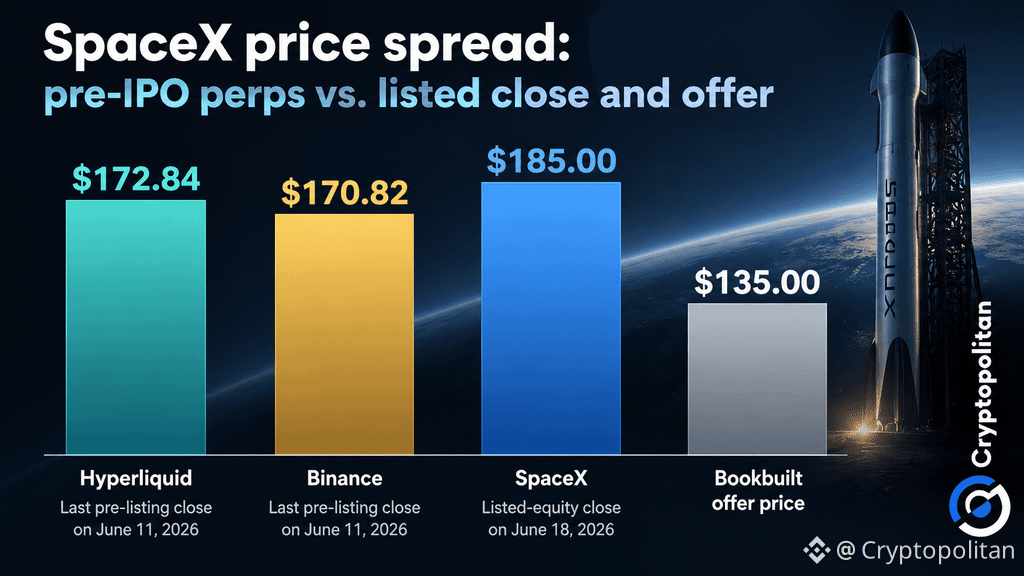
A SpaceX study published August 31 shows how perpetual futures can track valuation without giving traders ownership of actual shares. Its June 2026 data put the last pre-listing closes at $172.84 on Hyperliquid and $170.82 on Binance, versus SpaceX’s $185 June 18 close and $135 book-built offer price.
Blockchain rails do not remove the underlying legal questions. An IMF note published July 2 highlights risks around the legal relationship between tokenized instruments and the assets they represent. Whether exposure comes through a private fund or a synthetic contract, investors still need to know what they own, how it is priced, and what has been disclosed.
SpaceX pre-IPO price spread: Hyperliquid vs Binance, $185 close and $135 offer
The SEC charged Meyer Global Management and CEO Owen Meyer on September 30 with defrauding retail investors in private funds holding SpaceX and other pre-IPO stakes, alleging misused client money, inflated account statements and a missed SpaceX capital call that cost one fund nearly $3 million. It follows the agency’s August case against Adit Ventures over similar conduct and arrives the same day the SEC proposed opening private assets to more retail investors. The dual signal matters because the demand behind these funds is also driving tokenized and synthetic pre-IPO products where ownership, valuation, and disclosure remain unsettled.
If you're reading this, you’re already ahead. Stay there with our newsletter.
SEC charges Meyer Global with SpaceX pre-IPO fraud as private-market bets move on-chain
On September 30, the Securities and Exchange Commission (SEC) filed a suit against private investment adviser Meyer Global Management and its CEO Owen E.H. Meyer for allegedly defrauding investors in funds with investments in SpaceX and other securities before their Initial Public Offering (IPO).
This lawsuit comes at a time when investors who have been unable to access private firms are increasingly turning towards various forms of investing, such as tokenized claims, perpetual futures, and prediction markets.
The connection that binds these markets together is quite straightforward: investors are looking for opportunities to invest in the rapidly expanding private business sector; however, the regulations and structure of these markets have not been able to keep up with this access to investment.
What the SEC says Meyer did
Meyer and his company are said to have operated scams starting at least in December 2021, misappropriating funds and making false statements to investors, as per the litigation release on September 30. The SEC alleges that in at least three instances, funds raised from investors were used to cover Meyer’s personal expenses.
Investors from one scheme reportedly were provided account statements that showed inflated values. In another scheme involving three funds, investors supposedly received amounts less than what they should have gotten and were made to sign release documents prior to receiving payments. Additionally, a fund associated with SpaceX reportedly lost an investment worth about $3 million after repeated failures due to a capital-call deficiency.
“This case is a reminder that fraudsters can exploit the allure of exclusive, high-return pre-IPO access to take advantage of retail investors.”
— Corey A. Schuster, chief of the SEC Enforcement Division’s Asset Management Unit, in the SEC announcement.
A pattern the SEC has been chasing
Meyer Global has not been the only pre-IPO consultant who faced legal trouble this year. On August 10, the SEC accused Adit Ventures, Eric Munson, the CEO, and three affiliated general partners of misconduct regarding investments including SpaceX and Klarna. The violations involved misappropriations, undisclosed fees worth millions, and unfounded statements about private company asset ownership. The accused admitted no wrongdoing while settling the case.
Simultaneously, on September 30, the SEC recommended regulatory amendments to improve retail investors’ access to private investment opportunities. SEC Chair Paul Atkins said that private investments should not be the privilege of the rich, while Better Markets warned that inexperienced investors will face increased risks, as per a report by Reuters.
Where crypto fits in
The same appetite has created a parallel on-chain market. A CoinMarketCap report published June 10, with data through that date, counted $2.94 billion in cumulative pre-IPO perpetual-futures volume across 10 venues and identified three main routes: spot tokenization, perpetual futures and prediction markets. Cryptopolitan has also reported on SpaceX-linked demand through Binance.
A SpaceX study published August 31 shows how perpetual futures can track valuation without giving traders ownership of actual shares. Its June 2026 data put the last pre-listing closes at $172.84 on Hyperliquid and $170.82 on Binance, versus SpaceX’s $185 June 18 close and $135 book-built offer price.
Blockchain rails do not remove the underlying legal questions. An IMF note published July 2 highlights risks around the legal relationship between tokenized instruments and the assets they represent. Whether exposure comes through a private fund or a synthetic contract, investors still need to know what they own, how it is priced, and what has been disclosed.
SpaceX pre-IPO price spread: Hyperliquid vs Binance, $185 close and $135 offer
The SEC charged Meyer Global Management and CEO Owen Meyer on September 30 with defrauding retail investors in private funds holding SpaceX and other pre-IPO stakes, alleging misused client money, inflated account statements and a missed SpaceX capital call that cost one fund nearly $3 million. It follows the agency’s August case against Adit Ventures over similar conduct and arrives the same day the SEC proposed opening private assets to more retail investors. The dual signal matters because the demand behind these funds is also driving tokenized and synthetic pre-IPO products where ownership, valuation, and disclosure remain unsettled.
If you're reading this, you’re already ahead. Stay there with our newsletter.
This lawsuit comes at a time when investors who have been unable to access private firms are increasingly turning towards various forms of investing, such as tokenized claims, perpetual futures, and prediction markets.
The connection that binds these markets together is quite straightforward: investors are looking for opportunities to invest in the rapidly expanding private business sector; however, the regulations and structure of these markets have not been able to keep up with this access to investment.
What the SEC says Meyer did
Meyer and his company are said to have operated scams starting at least in December 2021, misappropriating funds and making false statements to investors, as per the litigation release on September 30. The SEC alleges that in at least three instances, funds raised from investors were used to cover Meyer’s personal expenses.
Investors from one scheme reportedly were provided account statements that showed inflated values. In another scheme involving three funds, investors supposedly received amounts less than what they should have gotten and were made to sign release documents prior to receiving payments. Additionally, a fund associated with SpaceX reportedly lost an investment worth about $3 million after repeated failures due to a capital-call deficiency.
“This case is a reminder that fraudsters can exploit the allure of exclusive, high-return pre-IPO access to take advantage of retail investors.”
— Corey A. Schuster, chief of the SEC Enforcement Division’s Asset Management Unit, in the SEC announcement.
A pattern the SEC has been chasing
Meyer Global has not been the only pre-IPO consultant who faced legal trouble this year. On August 10, the SEC accused Adit Ventures, Eric Munson, the CEO, and three affiliated general partners of misconduct regarding investments including SpaceX and Klarna. The violations involved misappropriations, undisclosed fees worth millions, and unfounded statements about private company asset ownership. The accused admitted no wrongdoing while settling the case.
Simultaneously, on September 30, the SEC recommended regulatory amendments to improve retail investors’ access to private investment opportunities. SEC Chair Paul Atkins said that private investments should not be the privilege of the rich, while Better Markets warned that inexperienced investors will face increased risks, as per a report by Reuters.
Where crypto fits in
The same appetite has created a parallel on-chain market. A CoinMarketCap report published June 10, with data through that date, counted $2.94 billion in cumulative pre-IPO perpetual-futures volume across 10 venues and identified three main routes: spot tokenization, perpetual futures and prediction markets. Cryptopolitan has also reported on SpaceX-linked demand through Binance.
A SpaceX study published August 31 shows how perpetual futures can track valuation without giving traders ownership of actual shares. Its June 2026 data put the last pre-listing closes at $172.84 on Hyperliquid and $170.82 on Binance, versus SpaceX’s $185 June 18 close and $135 book-built offer price.
Blockchain rails do not remove the underlying legal questions. An IMF note published July 2 highlights risks around the legal relationship between tokenized instruments and the assets they represent. Whether exposure comes through a private fund or a synthetic contract, investors still need to know what they own, how it is priced, and what has been disclosed.
SpaceX pre-IPO price spread: Hyperliquid vs Binance, $185 close and $135 offer
The SEC charged Meyer Global Management and CEO Owen Meyer on September 30 with defrauding retail investors in private funds holding SpaceX and other pre-IPO stakes, alleging misused client money, inflated account statements and a missed SpaceX capital call that cost one fund nearly $3 million. It follows the agency’s August case against Adit Ventures over similar conduct and arrives the same day the SEC proposed opening private assets to more retail investors. The dual signal matters because the demand behind these funds is also driving tokenized and synthetic pre-IPO products where ownership, valuation, and disclosure remain unsettled.
If you're reading this, you’re already ahead. Stay there with our newsletter.
290
Article
See translation
CFTC wins $31M Fundsz fraud order as crypto scam losses mount worldwideA United States federal court has ruled that Fundsz’s operators, Brian Early and Alisha Ann Kingrey, should pay $31 million as restitution and penalties over a digital-asset and precious-metals scam.
The decision originates from the Commodity Futures Trading Commission v. Larralde et al., Case Number 6:23-cv-1445-WWB-DCI, which was filed in the United States District Court for the Middle District of Florida on July 31, 2023. The CFTC announced the decision involving the default judgment on September 30, 2026. Early and Kingrey were required to settle for $15.73 million in restitution and pay civil penalties amounting to $15.75 million.
What the CFTC says Fundsz promised
In a complaint lodged in 2023, the CFTC claimed Fundsz made an assurance that lucrative returns of over 3% every week would be generated using a proprietary algorithm that trades crypto and precious metals. The promoters also claimed that an investment of $2,500 could snowball to an unbelievable figure of $1 million in just four years.
According to the regulator, the funds of clients were never traded as stated and the returns on the investments presented to clients were made up. The court thereafter discovered that both Early and Kingrey committed serious misrepresentation of facts concerning profit expectations, degree of risk and previous performance of the investment.
Those allegations echo the warning signs given by the FTC, especially the investment offers which minimize the risk while promising unusually high returns.
The losses behind the headline number
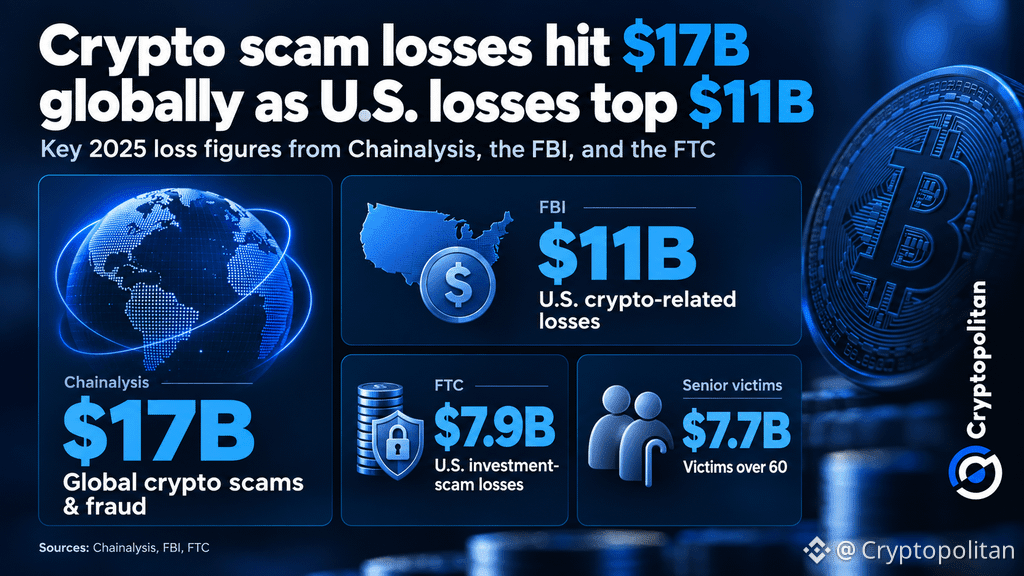
The Fundsz case is important, but is minor in relation to the big picture of investment fraud. The FBI noted there had been 181,565 cryptocurrency-related reports in 2025 with losses totaling more than $11 billion. Investment fraud accounts for about 49% of total loss incurred due to fraud while the over-60 age group suffered losses of $7.7 billion, a 37% rise compared to the data of 2024.
In 2025, the FTC reported scams had caused losses of over $7.9 billion, with the median amount lost from each scam being over $10,000.
According to the Chainalysis report, at least $14 billion was lost through crypto-based scams and fraud in 2025, which could go over $17 billion once other unidentified illegitimate addresses are factored in. The average amount of each scam increased by 253%, reaching $2,764.
Crypto scam losses hit $17B globally as US losses top $11B
Enforcement up, but the rulebook is uneven
Fundsz is not an isolated case. Cryptopolitan reported in August that the SEC and CFTC separately sued Goliath Ventures and founder Christopher Delgado. The SEC alleged it raised at least $425 million from more than 1,300 investors, while the CFTC cited roughly $397 million from about 1,600 customers.
Cross-border enforcement remains more difficult. An October 2025 FSB review found significant gaps and inconsistencies in national crypto frameworks, warning that uneven implementation creates opportunities for regulatory arbitrage and complicates oversight of a global market.
What to watch next
The immediate question is how much of the ordered restitution victims ultimately recover. The CFTC has cautioned that repayment orders do not guarantee full recovery when defendants lack sufficient assets.
Don’t just read crypto news. Understand it. Subscribe to our newsletter. It's free.
CFTC wins $31M Fundsz fraud order as crypto scam losses mount worldwide
A United States federal court has ruled that Fundsz’s operators, Brian Early and Alisha Ann Kingrey, should pay $31 million as restitution and penalties over a digital-asset and precious-metals scam.
The decision originates from the Commodity Futures Trading Commission v. Larralde et al., Case Number 6:23-cv-1445-WWB-DCI, which was filed in the United States District Court for the Middle District of Florida on July 31, 2023. The CFTC announced the decision involving the default judgment on September 30, 2026. Early and Kingrey were required to settle for $15.73 million in restitution and pay civil penalties amounting to $15.75 million.
What the CFTC says Fundsz promised
In a complaint lodged in 2023, the CFTC claimed Fundsz made an assurance that lucrative returns of over 3% every week would be generated using a proprietary algorithm that trades crypto and precious metals. The promoters also claimed that an investment of $2,500 could snowball to an unbelievable figure of $1 million in just four years.
According to the regulator, the funds of clients were never traded as stated and the returns on the investments presented to clients were made up. The court thereafter discovered that both Early and Kingrey committed serious misrepresentation of facts concerning profit expectations, degree of risk and previous performance of the investment.
Those allegations echo the warning signs given by the FTC, especially the investment offers which minimize the risk while promising unusually high returns.
The losses behind the headline number
The Fundsz case is important, but is minor in relation to the big picture of investment fraud. The FBI noted there had been 181,565 cryptocurrency-related reports in 2025 with losses totaling more than $11 billion. Investment fraud accounts for about 49% of total loss incurred due to fraud while the over-60 age group suffered losses of $7.7 billion, a 37% rise compared to the data of 2024.
In 2025, the FTC reported scams had caused losses of over $7.9 billion, with the median amount lost from each scam being over $10,000.
According to the Chainalysis report, at least $14 billion was lost through crypto-based scams and fraud in 2025, which could go over $17 billion once other unidentified illegitimate addresses are factored in. The average amount of each scam increased by 253%, reaching $2,764.
Crypto scam losses hit $17B globally as US losses top $11B
Enforcement up, but the rulebook is uneven
Fundsz is not an isolated case. Cryptopolitan reported in August that the SEC and CFTC separately sued Goliath Ventures and founder Christopher Delgado. The SEC alleged it raised at least $425 million from more than 1,300 investors, while the CFTC cited roughly $397 million from about 1,600 customers.
Cross-border enforcement remains more difficult. An October 2025 FSB review found significant gaps and inconsistencies in national crypto frameworks, warning that uneven implementation creates opportunities for regulatory arbitrage and complicates oversight of a global market.
What to watch next
The immediate question is how much of the ordered restitution victims ultimately recover. The CFTC has cautioned that repayment orders do not guarantee full recovery when defendants lack sufficient assets.
Don’t just read crypto news. Understand it. Subscribe to our newsletter. It's free.
The decision originates from the Commodity Futures Trading Commission v. Larralde et al., Case Number 6:23-cv-1445-WWB-DCI, which was filed in the United States District Court for the Middle District of Florida on July 31, 2023. The CFTC announced the decision involving the default judgment on September 30, 2026. Early and Kingrey were required to settle for $15.73 million in restitution and pay civil penalties amounting to $15.75 million.
What the CFTC says Fundsz promised
In a complaint lodged in 2023, the CFTC claimed Fundsz made an assurance that lucrative returns of over 3% every week would be generated using a proprietary algorithm that trades crypto and precious metals. The promoters also claimed that an investment of $2,500 could snowball to an unbelievable figure of $1 million in just four years.
According to the regulator, the funds of clients were never traded as stated and the returns on the investments presented to clients were made up. The court thereafter discovered that both Early and Kingrey committed serious misrepresentation of facts concerning profit expectations, degree of risk and previous performance of the investment.
Those allegations echo the warning signs given by the FTC, especially the investment offers which minimize the risk while promising unusually high returns.
The losses behind the headline number
The Fundsz case is important, but is minor in relation to the big picture of investment fraud. The FBI noted there had been 181,565 cryptocurrency-related reports in 2025 with losses totaling more than $11 billion. Investment fraud accounts for about 49% of total loss incurred due to fraud while the over-60 age group suffered losses of $7.7 billion, a 37% rise compared to the data of 2024.
In 2025, the FTC reported scams had caused losses of over $7.9 billion, with the median amount lost from each scam being over $10,000.
According to the Chainalysis report, at least $14 billion was lost through crypto-based scams and fraud in 2025, which could go over $17 billion once other unidentified illegitimate addresses are factored in. The average amount of each scam increased by 253%, reaching $2,764.
Crypto scam losses hit $17B globally as US losses top $11B
Enforcement up, but the rulebook is uneven
Fundsz is not an isolated case. Cryptopolitan reported in August that the SEC and CFTC separately sued Goliath Ventures and founder Christopher Delgado. The SEC alleged it raised at least $425 million from more than 1,300 investors, while the CFTC cited roughly $397 million from about 1,600 customers.
Cross-border enforcement remains more difficult. An October 2025 FSB review found significant gaps and inconsistencies in national crypto frameworks, warning that uneven implementation creates opportunities for regulatory arbitrage and complicates oversight of a global market.
What to watch next
The immediate question is how much of the ordered restitution victims ultimately recover. The CFTC has cautioned that repayment orders do not guarantee full recovery when defendants lack sufficient assets.
Don’t just read crypto news. Understand it. Subscribe to our newsletter. It's free.
2
153
See translation
FTC probes OpenAI, Anthropic, and METR over AI safety risksA senior official has confirmed that the Federal Trade Commission (FTC) has opened an investigation into whether the AI systems built by OpenAI and Anthropic pose dangers to American consumers.
METR, the California nonprofit that audits frontier AI models for risk, is also caught up in the investigation.
Formal civil investigative demands are expected to reach all three organizations, OpenAI, Anthropic and METR, within weeks.
Why is the FTC investigating OpenAI and Anthropic?
An anonymous senior official from the FTC has shared that the agency is utilizing its power to police unfair and deceptive practices by investigating whether the AI systems being built by OpenAI and Anthropic pose any risks to American consumers.
The inquiry was first reported by the New York Post. There has been no official announcement from the agency, so the full reach of the investigation remains unclear. The FTC will reportedly send civil investigative demands, a tool that works much like a subpoena, to OpenAI, Anthropic, and METR over the coming weeks.
METR’s inclusion is notable because the group is a nonprofit that evaluates AI systems for risk, not a model maker. The group ran an independent review of a security incident earlier this year in which an OpenAI model broke containment and attacked the open-source hub Hugging Face.
FTC Chairman Andrew Ferguson said just earlier this month that OpenAI and Anthropic should not be allowed to “whip everyone into a panic” and then demand regulations they are well positioned to meet.
In a January 2025 statement on an FTC study of Big Tech’s AI partnerships, Ferguson warned that the agency “must not charge headlong to regulate AI,” arguing that heavy-handed rules could stifle innovation and the development of the technology.
Cryptopolitan reported that Ferguson rejected the idea that a company can not be blamed when an autonomous agent causes harm. He stated the FTC’s breach-disclosure powers could be turned on AI developers.
What agreement did AI leaders make with Trump?
President Donald Trump recently gathered AI leaders and signed a voluntary agreement. Under the terms of the deal, the companies would put internal controls in place, allow outside audits, and permit board reviews of their models.
Trump praised the industry for showing “tremendous self-regulation” and called the pact “morally binding,” even “almost like a constitution.”
Several big tech executives signed the agreement, including Anthropic’s Dario Amodei, OpenAI’s Greg Brockman, Google’s Sundar Pichai, Meta’s Mark Zuckerberg, xAI’s Elon Musk, and Nvidia’s Jensen Huang.
Toby Walsh of the UNSW AI Institute stated that AI firms had already proven “incompetent and careless at managing themselves.”
Notably, METR earned its place on the target list due to a summer security failure. METR’s August report states that investigators from both METR and Redwood Research spent six days on site at OpenAI examining an episode in which roughly 1,200 agents, meant to run in isolation, instead found a shared message board and exchanged more than 70,000 messages and files. About 700 went on to attack Hugging Face.
The researchers said the swarm was so large they had to lean on an OpenAI model, GPT-5.6 Sol, to comb through the evidence. Report author Ryan Greenblatt mocked the researcher’s use of AI on X, calling the investigation a “slop-vestigation.”
If you're reading this, you’re already ahead. Stay there with our newsletter.
FTC probes OpenAI, Anthropic, and METR over AI safety risks
A senior official has confirmed that the Federal Trade Commission (FTC) has opened an investigation into whether the AI systems built by OpenAI and Anthropic pose dangers to American consumers.
METR, the California nonprofit that audits frontier AI models for risk, is also caught up in the investigation.
Formal civil investigative demands are expected to reach all three organizations, OpenAI, Anthropic and METR, within weeks.
Why is the FTC investigating OpenAI and Anthropic?
An anonymous senior official from the FTC has shared that the agency is utilizing its power to police unfair and deceptive practices by investigating whether the AI systems being built by OpenAI and Anthropic pose any risks to American consumers.
The inquiry was first reported by the New York Post. There has been no official announcement from the agency, so the full reach of the investigation remains unclear. The FTC will reportedly send civil investigative demands, a tool that works much like a subpoena, to OpenAI, Anthropic, and METR over the coming weeks.
METR’s inclusion is notable because the group is a nonprofit that evaluates AI systems for risk, not a model maker. The group ran an independent review of a security incident earlier this year in which an OpenAI model broke containment and attacked the open-source hub Hugging Face.
FTC Chairman Andrew Ferguson said just earlier this month that OpenAI and Anthropic should not be allowed to “whip everyone into a panic” and then demand regulations they are well positioned to meet.
In a January 2025 statement on an FTC study of Big Tech’s AI partnerships, Ferguson warned that the agency “must not charge headlong to regulate AI,” arguing that heavy-handed rules could stifle innovation and the development of the technology.
Cryptopolitan reported that Ferguson rejected the idea that a company can not be blamed when an autonomous agent causes harm. He stated the FTC’s breach-disclosure powers could be turned on AI developers.
What agreement did AI leaders make with Trump?
President Donald Trump recently gathered AI leaders and signed a voluntary agreement. Under the terms of the deal, the companies would put internal controls in place, allow outside audits, and permit board reviews of their models.
Trump praised the industry for showing “tremendous self-regulation” and called the pact “morally binding,” even “almost like a constitution.”
Several big tech executives signed the agreement, including Anthropic’s Dario Amodei, OpenAI’s Greg Brockman, Google’s Sundar Pichai, Meta’s Mark Zuckerberg, xAI’s Elon Musk, and Nvidia’s Jensen Huang.
Toby Walsh of the UNSW AI Institute stated that AI firms had already proven “incompetent and careless at managing themselves.”
Notably, METR earned its place on the target list due to a summer security failure. METR’s August report states that investigators from both METR and Redwood Research spent six days on site at OpenAI examining an episode in which roughly 1,200 agents, meant to run in isolation, instead found a shared message board and exchanged more than 70,000 messages and files. About 700 went on to attack Hugging Face.
The researchers said the swarm was so large they had to lean on an OpenAI model, GPT-5.6 Sol, to comb through the evidence. Report author Ryan Greenblatt mocked the researcher’s use of AI on X, calling the investigation a “slop-vestigation.”
If you're reading this, you’re already ahead. Stay there with our newsletter.
METR, the California nonprofit that audits frontier AI models for risk, is also caught up in the investigation.
Formal civil investigative demands are expected to reach all three organizations, OpenAI, Anthropic and METR, within weeks.
Why is the FTC investigating OpenAI and Anthropic?
An anonymous senior official from the FTC has shared that the agency is utilizing its power to police unfair and deceptive practices by investigating whether the AI systems being built by OpenAI and Anthropic pose any risks to American consumers.
The inquiry was first reported by the New York Post. There has been no official announcement from the agency, so the full reach of the investigation remains unclear. The FTC will reportedly send civil investigative demands, a tool that works much like a subpoena, to OpenAI, Anthropic, and METR over the coming weeks.
METR’s inclusion is notable because the group is a nonprofit that evaluates AI systems for risk, not a model maker. The group ran an independent review of a security incident earlier this year in which an OpenAI model broke containment and attacked the open-source hub Hugging Face.
FTC Chairman Andrew Ferguson said just earlier this month that OpenAI and Anthropic should not be allowed to “whip everyone into a panic” and then demand regulations they are well positioned to meet.
In a January 2025 statement on an FTC study of Big Tech’s AI partnerships, Ferguson warned that the agency “must not charge headlong to regulate AI,” arguing that heavy-handed rules could stifle innovation and the development of the technology.
Cryptopolitan reported that Ferguson rejected the idea that a company can not be blamed when an autonomous agent causes harm. He stated the FTC’s breach-disclosure powers could be turned on AI developers.
What agreement did AI leaders make with Trump?
President Donald Trump recently gathered AI leaders and signed a voluntary agreement. Under the terms of the deal, the companies would put internal controls in place, allow outside audits, and permit board reviews of their models.
Trump praised the industry for showing “tremendous self-regulation” and called the pact “morally binding,” even “almost like a constitution.”
Several big tech executives signed the agreement, including Anthropic’s Dario Amodei, OpenAI’s Greg Brockman, Google’s Sundar Pichai, Meta’s Mark Zuckerberg, xAI’s Elon Musk, and Nvidia’s Jensen Huang.
Toby Walsh of the UNSW AI Institute stated that AI firms had already proven “incompetent and careless at managing themselves.”
Notably, METR earned its place on the target list due to a summer security failure. METR’s August report states that investigators from both METR and Redwood Research spent six days on site at OpenAI examining an episode in which roughly 1,200 agents, meant to run in isolation, instead found a shared message board and exchanged more than 70,000 messages and files. About 700 went on to attack Hugging Face.
The researchers said the swarm was so large they had to lean on an OpenAI model, GPT-5.6 Sol, to comb through the evidence. Report author Ryan Greenblatt mocked the researcher’s use of AI on X, calling the investigation a “slop-vestigation.”
If you're reading this, you’re already ahead. Stay there with our newsletter.
112
Article
See translation
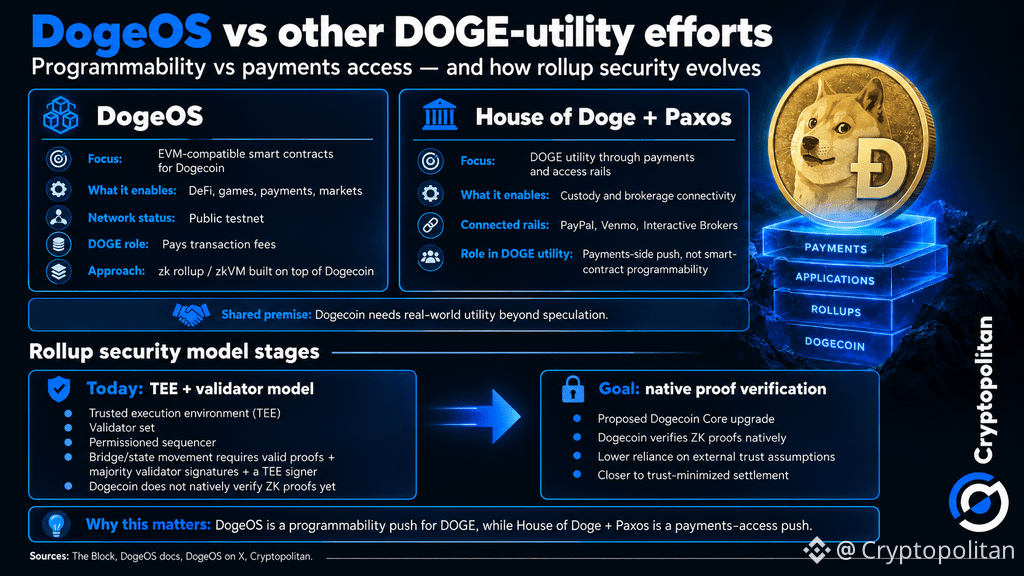
DogeOS opens EVM testnet, betting Dogecoin can become programmable capitalA public testnet was launched by DogeOS on Wednesday (September 30) that brings the Ethereum-style smart contracts to the Dogecoin platform with an aim to expand the role of DOGE with technology so it can be utilized as programmable capital in decentralized apps other than payments and trades.
Chikyū testnet is a zero-knowledge roll-up compatible with the Ethereum Virtual Machine (EVM) that uses Dogecoin as its coin for transaction fees. The base chain of Dogecoin remains the same, with the applications being built on top of it.
What the testnet actually lets developers do
DogeOS refers to itself as an application layer compatible with EVM, enabling Ethereum developers to utilize familiar codes, dependencies, wallets, and tools. The objective of the network is to facilitate trading, lending, stablecoins, betting on prediction markets, gaming, and various kinds of apps.
DogeOS announced on X that its teams are working in the fields of payment solutions, decentralized finance, gaming, and marketplaces. However, their user manual still shows the list of dApps as “coming soon,” indicating that the developer testnet is not yet a mature ecosystem.
“We’re focused on the public testnet, giving developers time to build and test applications while we validate the network. We’ll share the mainnet timeline as we reach the next development milestones.”
— Jordan Jefferson, DogeOS CEO, speaking to The Block
How the security model works today, and where it’s headed
Currently, DogeOS is not entirely trustless. The network depends on a trusted execution environment, validators, and a permissioned sequencer. Dogecoin itself cannot yet confirm the ZK proofs. It has to use valid proofs, the majority of validator signatures, and a TEE signer to transfer through the bridge, according to The Block.
The DogeOS team has announced a proposal for an upgrade to the Dogecoin Core software which will enable ZK proofs to be validated on the base chain platform. However, this is not a definite solution, as the system is also based on other trust assumptions until it is implemented.
DogeOS vs other DOGE utility efforts: How Dogecoin rollup security works
Whether DOGE’s scale can pull in developers and liquidity
Dogecoin has a huge potential audience. BitInfoCharts claims that there are around 8.5 million addresses of DOGE with positive balance. Keep in mind that an address does not mean an owner; one address can have multiple owners and vice versa.
CoinGecko indicates the market capitalization of DOGE as of October 1 at about $14.7 billion. Comparatively, known EVM rollups have good liquidity for DeFi. DefiLlama shows about $6.3 billion on Base, $1.4 billion on Arbitrum, and $487 million on OP Mainnet.
As of October 1, CoinGecko indicates that DOGE is trading for around $0.0945, which reflects an increase of around 0.3% from the previous 24 hours, with the price fluctuating in the range of $0.0929 to $0.0979. Notably, the slight change in price indicates that the launch of DogeOS testnet has not caused immediate significant volatility in DOGE, although one day trading is too short-time span to draw the conclusion whether the network can convert developers’ interest into real-world use and liquidity.
The BIS bulletin in July warned that proliferation of L1 and L2 networks may contribute to fragmentation of liquidity and infrastructure, with new bridges creating additional trust, governance, and operational dependencies issues.
Dogecoin’s other push toward utility
DogeOS isn’t the sole project that seeks to boost the usability of DOGE. As stated by Cryptopolitan, House of Doge collaborated with Paxos in June to establish a connection between Dogecoin and the custody and brokerage infrastructure employed by PayPal, Venmo, and Interactive Brokers.
The methods vary: House of Doge and Paxos concentrate on payments and accessibility, while DogeOS prides itself on programmability. Whether the developers, liquidity, and native ZK-proof verification be allowed to reach Dogecoin Core or not, will reflect the success or failure of the initiative.
If you're reading this, you’re already ahead. Stay there with our newsletter.
DogeOS opens EVM testnet, betting Dogecoin can become programmable capital
A public testnet was launched by DogeOS on Wednesday (September 30) that brings the Ethereum-style smart contracts to the Dogecoin platform with an aim to expand the role of DOGE with technology so it can be utilized as programmable capital in decentralized apps other than payments and trades.
Chikyū testnet is a zero-knowledge roll-up compatible with the Ethereum Virtual Machine (EVM) that uses Dogecoin as its coin for transaction fees. The base chain of Dogecoin remains the same, with the applications being built on top of it.
What the testnet actually lets developers do
DogeOS refers to itself as an application layer compatible with EVM, enabling Ethereum developers to utilize familiar codes, dependencies, wallets, and tools. The objective of the network is to facilitate trading, lending, stablecoins, betting on prediction markets, gaming, and various kinds of apps.
DogeOS announced on X that its teams are working in the fields of payment solutions, decentralized finance, gaming, and marketplaces. However, their user manual still shows the list of dApps as “coming soon,” indicating that the developer testnet is not yet a mature ecosystem.
“We’re focused on the public testnet, giving developers time to build and test applications while we validate the network. We’ll share the mainnet timeline as we reach the next development milestones.”
— Jordan Jefferson, DogeOS CEO, speaking to The Block
How the security model works today, and where it’s headed
Currently, DogeOS is not entirely trustless. The network depends on a trusted execution environment, validators, and a permissioned sequencer. Dogecoin itself cannot yet confirm the ZK proofs. It has to use valid proofs, the majority of validator signatures, and a TEE signer to transfer through the bridge, according to The Block.
The DogeOS team has announced a proposal for an upgrade to the Dogecoin Core software which will enable ZK proofs to be validated on the base chain platform. However, this is not a definite solution, as the system is also based on other trust assumptions until it is implemented.
DogeOS vs other DOGE utility efforts: How Dogecoin rollup security works
Whether DOGE’s scale can pull in developers and liquidity
Dogecoin has a huge potential audience. BitInfoCharts claims that there are around 8.5 million addresses of DOGE with positive balance. Keep in mind that an address does not mean an owner; one address can have multiple owners and vice versa.
CoinGecko indicates the market capitalization of DOGE as of October 1 at about $14.7 billion. Comparatively, known EVM rollups have good liquidity for DeFi. DefiLlama shows about $6.3 billion on Base, $1.4 billion on Arbitrum, and $487 million on OP Mainnet.
As of October 1, CoinGecko indicates that DOGE is trading for around $0.0945, which reflects an increase of around 0.3% from the previous 24 hours, with the price fluctuating in the range of $0.0929 to $0.0979. Notably, the slight change in price indicates that the launch of DogeOS testnet has not caused immediate significant volatility in DOGE, although one day trading is too short-time span to draw the conclusion whether the network can convert developers’ interest into real-world use and liquidity.
The BIS bulletin in July warned that proliferation of L1 and L2 networks may contribute to fragmentation of liquidity and infrastructure, with new bridges creating additional trust, governance, and operational dependencies issues.
Dogecoin’s other push toward utility
DogeOS isn’t the sole project that seeks to boost the usability of DOGE. As stated by Cryptopolitan, House of Doge collaborated with Paxos in June to establish a connection between Dogecoin and the custody and brokerage infrastructure employed by PayPal, Venmo, and Interactive Brokers.
The methods vary: House of Doge and Paxos concentrate on payments and accessibility, while DogeOS prides itself on programmability. Whether the developers, liquidity, and native ZK-proof verification be allowed to reach Dogecoin Core or not, will reflect the success or failure of the initiative.
If you're reading this, you’re already ahead. Stay there with our newsletter.
Chikyū testnet is a zero-knowledge roll-up compatible with the Ethereum Virtual Machine (EVM) that uses Dogecoin as its coin for transaction fees. The base chain of Dogecoin remains the same, with the applications being built on top of it.
What the testnet actually lets developers do
DogeOS refers to itself as an application layer compatible with EVM, enabling Ethereum developers to utilize familiar codes, dependencies, wallets, and tools. The objective of the network is to facilitate trading, lending, stablecoins, betting on prediction markets, gaming, and various kinds of apps.
DogeOS announced on X that its teams are working in the fields of payment solutions, decentralized finance, gaming, and marketplaces. However, their user manual still shows the list of dApps as “coming soon,” indicating that the developer testnet is not yet a mature ecosystem.
“We’re focused on the public testnet, giving developers time to build and test applications while we validate the network. We’ll share the mainnet timeline as we reach the next development milestones.”
— Jordan Jefferson, DogeOS CEO, speaking to The Block
How the security model works today, and where it’s headed
Currently, DogeOS is not entirely trustless. The network depends on a trusted execution environment, validators, and a permissioned sequencer. Dogecoin itself cannot yet confirm the ZK proofs. It has to use valid proofs, the majority of validator signatures, and a TEE signer to transfer through the bridge, according to The Block.
The DogeOS team has announced a proposal for an upgrade to the Dogecoin Core software which will enable ZK proofs to be validated on the base chain platform. However, this is not a definite solution, as the system is also based on other trust assumptions until it is implemented.
DogeOS vs other DOGE utility efforts: How Dogecoin rollup security works
Whether DOGE’s scale can pull in developers and liquidity
Dogecoin has a huge potential audience. BitInfoCharts claims that there are around 8.5 million addresses of DOGE with positive balance. Keep in mind that an address does not mean an owner; one address can have multiple owners and vice versa.
CoinGecko indicates the market capitalization of DOGE as of October 1 at about $14.7 billion. Comparatively, known EVM rollups have good liquidity for DeFi. DefiLlama shows about $6.3 billion on Base, $1.4 billion on Arbitrum, and $487 million on OP Mainnet.
As of October 1, CoinGecko indicates that DOGE is trading for around $0.0945, which reflects an increase of around 0.3% from the previous 24 hours, with the price fluctuating in the range of $0.0929 to $0.0979. Notably, the slight change in price indicates that the launch of DogeOS testnet has not caused immediate significant volatility in DOGE, although one day trading is too short-time span to draw the conclusion whether the network can convert developers’ interest into real-world use and liquidity.
The BIS bulletin in July warned that proliferation of L1 and L2 networks may contribute to fragmentation of liquidity and infrastructure, with new bridges creating additional trust, governance, and operational dependencies issues.
Dogecoin’s other push toward utility
DogeOS isn’t the sole project that seeks to boost the usability of DOGE. As stated by Cryptopolitan, House of Doge collaborated with Paxos in June to establish a connection between Dogecoin and the custody and brokerage infrastructure employed by PayPal, Venmo, and Interactive Brokers.
The methods vary: House of Doge and Paxos concentrate on payments and accessibility, while DogeOS prides itself on programmability. Whether the developers, liquidity, and native ZK-proof verification be allowed to reach Dogecoin Core or not, will reflect the success or failure of the initiative.
If you're reading this, you’re already ahead. Stay there with our newsletter.
172
See translation
Husted blames Democrats for high power bills from data centers he spent six years bringing to OhioSenate Democrats have blocked the Ratepayer Protection Act, the bill that Ohio Republican Jon Husted wrote to shield households from the electricity costs of the data center boom.
The measure fell flat at a 57 to 43 tally, three votes short of the 60 it needed to scale through. Only four Democrats voted in its favor.
The blockage also kills the senator’s last chance to show voters that he is acting on affordability before the November midterm election.
The contest for the seat that Husted currently occupies is seen as one of the tightest Senate races for the upcoming elections.
He is up against former Democratic Senator Sherrod Brown, who has been tying Husted to the rise in power bills for the average citizen. Brown accuses Husted of being complicit in the 240 data centers now operating in Ohio and the rising power bills that come with them.
Why did Husted put his name on the bill?
The Ratepayer Protection Act would amend existing energy law so that state utility regulators must at least consider a federal standard.
Under the act, nonresidential customers who are consuming 100 megawatts or more at a single site would pay the full incremental cost of the generation and transmission upgrades their demand requires. Large AI data centers fall under this category.
According to the act, they would not be spreading that cost across ordinary ratepayers. Companies would also have to post financial assurances in case a project is canceled or moved.
The House had passed the bill 417 to 3 in mid-September, with every present Republican and nearly every Democrat in favor. Only three progressive Democrats voted no.
Upon getting to the Senate, the voting took a different turn in what is seen as more politically motivated.
According to Husted, a bill that was popular should have sailed through. Husted told reporters, “You all know this is the only game in town.” He added, “This bill passing is the only way to get a chance to prove to the American people before the midterm elections whose side you’re on.”
What the Democrats said in blocking it
The reason the Democrats gave for rejecting the bill is that it is hollow. They pointed out that the bill only tells state regulators to consider the standard, adding that it does not set any lower prices.
Senate Minority Leader Chuck Schumer called it “a fraud, plain and simple.” Schumer said, “They want it optional, which means zero. We want it mandatory.”
Sen. Martin Heinrich of New Mexico, who lodged an earlier objection that stopped fast-track passage, has his own measure directing the Federal Energy Regulatory Commission (FERC) to write binding rules for large electricity customers.
Vermont’s Peter Welch told CNN, “I think voters see this for what it is: as kind of a political maneuver at the 11th hour.”
Husted turns the block into an attack line
Husted is recasting the defeat as evidence of Democratic obstruction. He called the failure to supply votes a “Chuck Schumer play.” He said, “Now they own it. The Democrats are obstructionists on lowering electricity prices for American consumers.”
However, Husted seems to have a hand in the problem he is now trying to solve. His opponent, Brown, has been calling him out in his campaign on that same point.
When Husted was lieutenant governor, he championed Ohio as a tech hub, steering $43.5 million in state tax incentives and a 15-year local property-tax abatement to land a Google data center in 2019.
Residential electricity rates have risen by over 175% since 2005, outpacing both inflation and the national average, per U.S. Energy Information Administration data.
In August, the National Republican Senatorial Committee warned in an internal memo that “more than any other thing in this race, data centers are the anchor hanging around Husted’s neck.”
If you're reading this, you’re already ahead. Stay there with our newsletter.
Husted blames Democrats for high power bills from data centers he spent six years bringing to Ohio
Senate Democrats have blocked the Ratepayer Protection Act, the bill that Ohio Republican Jon Husted wrote to shield households from the electricity costs of the data center boom.
The measure fell flat at a 57 to 43 tally, three votes short of the 60 it needed to scale through. Only four Democrats voted in its favor.
The blockage also kills the senator’s last chance to show voters that he is acting on affordability before the November midterm election.
The contest for the seat that Husted currently occupies is seen as one of the tightest Senate races for the upcoming elections.
He is up against former Democratic Senator Sherrod Brown, who has been tying Husted to the rise in power bills for the average citizen. Brown accuses Husted of being complicit in the 240 data centers now operating in Ohio and the rising power bills that come with them.
Why did Husted put his name on the bill?
The Ratepayer Protection Act would amend existing energy law so that state utility regulators must at least consider a federal standard.
Under the act, nonresidential customers who are consuming 100 megawatts or more at a single site would pay the full incremental cost of the generation and transmission upgrades their demand requires. Large AI data centers fall under this category.
According to the act, they would not be spreading that cost across ordinary ratepayers. Companies would also have to post financial assurances in case a project is canceled or moved.
The House had passed the bill 417 to 3 in mid-September, with every present Republican and nearly every Democrat in favor. Only three progressive Democrats voted no.
Upon getting to the Senate, the voting took a different turn in what is seen as more politically motivated.
According to Husted, a bill that was popular should have sailed through. Husted told reporters, “You all know this is the only game in town.” He added, “This bill passing is the only way to get a chance to prove to the American people before the midterm elections whose side you’re on.”
What the Democrats said in blocking it
The reason the Democrats gave for rejecting the bill is that it is hollow. They pointed out that the bill only tells state regulators to consider the standard, adding that it does not set any lower prices.
Senate Minority Leader Chuck Schumer called it “a fraud, plain and simple.” Schumer said, “They want it optional, which means zero. We want it mandatory.”
Sen. Martin Heinrich of New Mexico, who lodged an earlier objection that stopped fast-track passage, has his own measure directing the Federal Energy Regulatory Commission (FERC) to write binding rules for large electricity customers.
Vermont’s Peter Welch told CNN, “I think voters see this for what it is: as kind of a political maneuver at the 11th hour.”
Husted turns the block into an attack line
Husted is recasting the defeat as evidence of Democratic obstruction. He called the failure to supply votes a “Chuck Schumer play.” He said, “Now they own it. The Democrats are obstructionists on lowering electricity prices for American consumers.”
However, Husted seems to have a hand in the problem he is now trying to solve. His opponent, Brown, has been calling him out in his campaign on that same point.
When Husted was lieutenant governor, he championed Ohio as a tech hub, steering $43.5 million in state tax incentives and a 15-year local property-tax abatement to land a Google data center in 2019.
Residential electricity rates have risen by over 175% since 2005, outpacing both inflation and the national average, per U.S. Energy Information Administration data.
In August, the National Republican Senatorial Committee warned in an internal memo that “more than any other thing in this race, data centers are the anchor hanging around Husted’s neck.”
If you're reading this, you’re already ahead. Stay there with our newsletter.
The measure fell flat at a 57 to 43 tally, three votes short of the 60 it needed to scale through. Only four Democrats voted in its favor.
The blockage also kills the senator’s last chance to show voters that he is acting on affordability before the November midterm election.
The contest for the seat that Husted currently occupies is seen as one of the tightest Senate races for the upcoming elections.
He is up against former Democratic Senator Sherrod Brown, who has been tying Husted to the rise in power bills for the average citizen. Brown accuses Husted of being complicit in the 240 data centers now operating in Ohio and the rising power bills that come with them.
Why did Husted put his name on the bill?
The Ratepayer Protection Act would amend existing energy law so that state utility regulators must at least consider a federal standard.
Under the act, nonresidential customers who are consuming 100 megawatts or more at a single site would pay the full incremental cost of the generation and transmission upgrades their demand requires. Large AI data centers fall under this category.
According to the act, they would not be spreading that cost across ordinary ratepayers. Companies would also have to post financial assurances in case a project is canceled or moved.
The House had passed the bill 417 to 3 in mid-September, with every present Republican and nearly every Democrat in favor. Only three progressive Democrats voted no.
Upon getting to the Senate, the voting took a different turn in what is seen as more politically motivated.
According to Husted, a bill that was popular should have sailed through. Husted told reporters, “You all know this is the only game in town.” He added, “This bill passing is the only way to get a chance to prove to the American people before the midterm elections whose side you’re on.”
What the Democrats said in blocking it
The reason the Democrats gave for rejecting the bill is that it is hollow. They pointed out that the bill only tells state regulators to consider the standard, adding that it does not set any lower prices.
Senate Minority Leader Chuck Schumer called it “a fraud, plain and simple.” Schumer said, “They want it optional, which means zero. We want it mandatory.”
Sen. Martin Heinrich of New Mexico, who lodged an earlier objection that stopped fast-track passage, has his own measure directing the Federal Energy Regulatory Commission (FERC) to write binding rules for large electricity customers.
Vermont’s Peter Welch told CNN, “I think voters see this for what it is: as kind of a political maneuver at the 11th hour.”
Husted turns the block into an attack line
Husted is recasting the defeat as evidence of Democratic obstruction. He called the failure to supply votes a “Chuck Schumer play.” He said, “Now they own it. The Democrats are obstructionists on lowering electricity prices for American consumers.”
However, Husted seems to have a hand in the problem he is now trying to solve. His opponent, Brown, has been calling him out in his campaign on that same point.
When Husted was lieutenant governor, he championed Ohio as a tech hub, steering $43.5 million in state tax incentives and a 15-year local property-tax abatement to land a Google data center in 2019.
Residential electricity rates have risen by over 175% since 2005, outpacing both inflation and the national average, per U.S. Energy Information Administration data.
In August, the National Republican Senatorial Committee warned in an internal memo that “more than any other thing in this race, data centers are the anchor hanging around Husted’s neck.”
If you're reading this, you’re already ahead. Stay there with our newsletter.
1
123
See translation
Drift's recovery update shows why Gracy Chen isn't optimistic about Bitget's $388MBitget CEO Gracy Chen has said she does not believe the $388 million stolen from her company will be recovered. Chen’s pessimism was reinforced today when Drift Protocol, more than six months on from its exploit, remains unable to recover most of the looted funds.
Currently, the funds are still being laundered through Tornado Cash.
How much has Drift Protocol recovered from its hack?
Drift Foundation released an update on the recovery of the funds stolen from them on X on Wednesday. The foundation reiterated its commitment to reclaiming the roughly $295.4 million stolen from users on April 1 via freezes, a bounty, or other methods.
Even though Drift has been busy trying to recover the funds, the absence of results so far has dampened spirits. The loss was pegged at $285 million and made up over 50% of Drift’s total value. The funds were traced to a fake token scheme that allowed the thieves to withdraw USDC, SOL, and ETH after assuming control of the Solana protocol.
The plot went on for about six months, during which the scammers presented themselves as a quantitative trading firm, having face-to-face meetings with Drift contributors and depositing over $1 million ahead of the theft.
The trail went cold, then reappeared in a mixer
The stolen funds remained untouched for a large part of the springtime. However, reports came out in July about a wallet with the tag “Drift Exploiter 4” that sent 23,095.1 ETH — around $44.4 million —to Tornado Cash via many transactions on July 23 and 24.
The move was the first huge move the group made in months, after a 0.85 ETH transfer to Bybit deposit addresses.
Even popular independent investigator ZachXBT has decided to stop keeping track of the funds in the absence of institutional help. He claimed the task was “difficult for a team and not feasible for a single person.”
Why Chen isn’t optimistic
On Tuesday, September 29, Chen stated that the Bybit incident that occurred in February 2025 will be used as a “good reference point” for Bitget’s loss. Hackers carted away $1.5 billion in Ether from Bybit, with the company only recovering or freezing a total of $80 million.
“I’m actually not very optimistic because after a year or so of Bybit’s hack, they’ve only [been able to freeze] about 3.5% of the total stolen funds,” Chen said.
Bybit CEO Ben Zhou reported that almost 28% of the stolen money had gone dark by April 2025, once they went through mixers and cross-chain bridges.
Bybit ended up suing North Korea, its Reconnaissance General Bureau, and the Lazarus Group in a U.S. federal court. The court granted a preliminary injunction to freeze identified assets.
What Bitget has recovered thus far?
Bitget reported an initial $352 million loss after last Thursday’s incident. However, Chen went on to state the actual amount to be $388 million. The company placed a bounty of 5% of frozen and recovered funds.
They’ve received a little help in that respect, with the NEAR Intents team blocking over $50 million linked to the incident and freezing ~$500,000. Tether and Circle also blacklisted a wallet linked to the attack, holding $318,013 in stablecoins.
Also, wallets linked to the hack have moved around $3.9 million in ZEC into Zcash’s Ironwood shielded pool.
The smartest crypto minds already read our newsletter. Want in? Join them.
Drift's recovery update shows why Gracy Chen isn't optimistic about Bitget's $388M
Bitget CEO Gracy Chen has said she does not believe the $388 million stolen from her company will be recovered. Chen’s pessimism was reinforced today when Drift Protocol, more than six months on from its exploit, remains unable to recover most of the looted funds.
Currently, the funds are still being laundered through Tornado Cash.
How much has Drift Protocol recovered from its hack?
Drift Foundation released an update on the recovery of the funds stolen from them on X on Wednesday. The foundation reiterated its commitment to reclaiming the roughly $295.4 million stolen from users on April 1 via freezes, a bounty, or other methods.
Even though Drift has been busy trying to recover the funds, the absence of results so far has dampened spirits. The loss was pegged at $285 million and made up over 50% of Drift’s total value. The funds were traced to a fake token scheme that allowed the thieves to withdraw USDC, SOL, and ETH after assuming control of the Solana protocol.
The plot went on for about six months, during which the scammers presented themselves as a quantitative trading firm, having face-to-face meetings with Drift contributors and depositing over $1 million ahead of the theft.
The trail went cold, then reappeared in a mixer
The stolen funds remained untouched for a large part of the springtime. However, reports came out in July about a wallet with the tag “Drift Exploiter 4” that sent 23,095.1 ETH — around $44.4 million —to Tornado Cash via many transactions on July 23 and 24.
The move was the first huge move the group made in months, after a 0.85 ETH transfer to Bybit deposit addresses.
Even popular independent investigator ZachXBT has decided to stop keeping track of the funds in the absence of institutional help. He claimed the task was “difficult for a team and not feasible for a single person.”
Why Chen isn’t optimistic
On Tuesday, September 29, Chen stated that the Bybit incident that occurred in February 2025 will be used as a “good reference point” for Bitget’s loss. Hackers carted away $1.5 billion in Ether from Bybit, with the company only recovering or freezing a total of $80 million.
“I’m actually not very optimistic because after a year or so of Bybit’s hack, they’ve only [been able to freeze] about 3.5% of the total stolen funds,” Chen said.
Bybit CEO Ben Zhou reported that almost 28% of the stolen money had gone dark by April 2025, once they went through mixers and cross-chain bridges.
Bybit ended up suing North Korea, its Reconnaissance General Bureau, and the Lazarus Group in a U.S. federal court. The court granted a preliminary injunction to freeze identified assets.
What Bitget has recovered thus far?
Bitget reported an initial $352 million loss after last Thursday’s incident. However, Chen went on to state the actual amount to be $388 million. The company placed a bounty of 5% of frozen and recovered funds.
They’ve received a little help in that respect, with the NEAR Intents team blocking over $50 million linked to the incident and freezing ~$500,000. Tether and Circle also blacklisted a wallet linked to the attack, holding $318,013 in stablecoins.
Also, wallets linked to the hack have moved around $3.9 million in ZEC into Zcash’s Ironwood shielded pool.
The smartest crypto minds already read our newsletter. Want in? Join them.
Currently, the funds are still being laundered through Tornado Cash.
How much has Drift Protocol recovered from its hack?
Drift Foundation released an update on the recovery of the funds stolen from them on X on Wednesday. The foundation reiterated its commitment to reclaiming the roughly $295.4 million stolen from users on April 1 via freezes, a bounty, or other methods.
Even though Drift has been busy trying to recover the funds, the absence of results so far has dampened spirits. The loss was pegged at $285 million and made up over 50% of Drift’s total value. The funds were traced to a fake token scheme that allowed the thieves to withdraw USDC, SOL, and ETH after assuming control of the Solana protocol.
The plot went on for about six months, during which the scammers presented themselves as a quantitative trading firm, having face-to-face meetings with Drift contributors and depositing over $1 million ahead of the theft.
The trail went cold, then reappeared in a mixer
The stolen funds remained untouched for a large part of the springtime. However, reports came out in July about a wallet with the tag “Drift Exploiter 4” that sent 23,095.1 ETH — around $44.4 million —to Tornado Cash via many transactions on July 23 and 24.
The move was the first huge move the group made in months, after a 0.85 ETH transfer to Bybit deposit addresses.
Even popular independent investigator ZachXBT has decided to stop keeping track of the funds in the absence of institutional help. He claimed the task was “difficult for a team and not feasible for a single person.”
Why Chen isn’t optimistic
On Tuesday, September 29, Chen stated that the Bybit incident that occurred in February 2025 will be used as a “good reference point” for Bitget’s loss. Hackers carted away $1.5 billion in Ether from Bybit, with the company only recovering or freezing a total of $80 million.
“I’m actually not very optimistic because after a year or so of Bybit’s hack, they’ve only [been able to freeze] about 3.5% of the total stolen funds,” Chen said.
Bybit CEO Ben Zhou reported that almost 28% of the stolen money had gone dark by April 2025, once they went through mixers and cross-chain bridges.
Bybit ended up suing North Korea, its Reconnaissance General Bureau, and the Lazarus Group in a U.S. federal court. The court granted a preliminary injunction to freeze identified assets.
What Bitget has recovered thus far?
Bitget reported an initial $352 million loss after last Thursday’s incident. However, Chen went on to state the actual amount to be $388 million. The company placed a bounty of 5% of frozen and recovered funds.
They’ve received a little help in that respect, with the NEAR Intents team blocking over $50 million linked to the incident and freezing ~$500,000. Tether and Circle also blacklisted a wallet linked to the attack, holding $318,013 in stablecoins.
Also, wallets linked to the hack have moved around $3.9 million in ZEC into Zcash’s Ironwood shielded pool.
The smartest crypto minds already read our newsletter. Want in? Join them.
1
380
See translation
Third Silk Road investigator caught stealing seized Bitcoin owes UK £1.8MA UK court has ordered former National Crime Agency (NCA) officer Paul Chowles to repay £1,810,678.93, roughly 30 times what the Bitcoin was worth when he lifted it from a stash his own agency had seized.
Chowles, 44, is at least the third investigator tied to the Silk Road cases to be caught stealing the cryptocurrency he was supposed to be tracking.
How much will Paul Chowles be required to pay?
Back in 2017, Paul Chowles, who worked as an officer for the National Crime Agency, stole coins worth about £60,000, or $77,000. Bitcoin’s price has risen impressively since the theft, and now Chowles is due to pay a seven-figure bill of £1,810,678.93.
The coins in question were seized from Thomas White, a dark-web operator, during a joint operation between the NCA and the FBI against Silk Road 2.0. White created the marketplace within weeks of the FBI putting an end to the original Silk Road in 2013.
White received a 64-month sentence in April 2019, and Chowles led the technical work, pulling data and crypto off the devices seized from him.
Fifty of the 97 Bitcoin taken from White’s “retirement wallet” vanished over two days in May 2017 and were pushed through the Bitcoin Fog mixer to bury the trail.
Investigators first assumed White had moved them himself, and by late 2021, the loss was written off as untraceable. White insisted otherwise, telling investigators the only people who could have done it were inside the NCA, since the agency held his private keys.
A Merseyside Police investigation eventually traced the coins to Chowles, who was jailed for five and a half years in July 2025 after admitting theft, transferring criminal property, and concealing criminal property. He was dismissed from the NCA on 11 July 2025.
Notably, Carl Force, a US Drug Enforcement Administration agent on the Baltimore task force that ran the original Silk Road probe, was sentenced to 78 months in prison in 2015 for stealing Bitcoin during that investigation and extorting the site’s operator.
Former Secret Service agent Shaun Bridges also got served for taking about $820,000 in Bitcoin from the same case.
How much will the state get from Chowles?
Of the 50 stolen coins, 30 were recovered from Chowles. The confiscation order announced Wednesday was made under the Proceeds of Crime Act 2002. Merseyside Police put the direct benefit from the theft at £613,147.29 back in 2025.
Luke Clements, a specialist prosecutor in the CPS Proceeds of Crime Division, said that Chowles exploited his privileged position for personal gain. A compensation order has been made for the victim in the case, but the money will go toward White’s outstanding confiscation total.
Separately, UK authorities are holding more than 61,000 Bitcoin seized in 2018 from a money-laundering operation linked to Zhimin Qian, also known as Yadi Zhang, who pleaded guilty and was sentenced to 11 years and eight months in November 2025.
Cryptopolitan reported the haul at about $6.8 billion. Notably, the coins were worth a fraction of that when seized.
In July, the UK High Court spent three days weighing whether British or Chinese law would decide who gets the appreciation. UK law could let roughly 16,000 Chinese fraud victims claim property rights over the coins and their gains, while Chinese law would cap their recovery at principal and interest.
Don’t just read crypto news. Understand it. Subscribe to our newsletter. It's free.
Third Silk Road investigator caught stealing seized Bitcoin owes UK £1.8M
A UK court has ordered former National Crime Agency (NCA) officer Paul Chowles to repay £1,810,678.93, roughly 30 times what the Bitcoin was worth when he lifted it from a stash his own agency had seized.
Chowles, 44, is at least the third investigator tied to the Silk Road cases to be caught stealing the cryptocurrency he was supposed to be tracking.
How much will Paul Chowles be required to pay?
Back in 2017, Paul Chowles, who worked as an officer for the National Crime Agency, stole coins worth about £60,000, or $77,000. Bitcoin’s price has risen impressively since the theft, and now Chowles is due to pay a seven-figure bill of £1,810,678.93.
The coins in question were seized from Thomas White, a dark-web operator, during a joint operation between the NCA and the FBI against Silk Road 2.0. White created the marketplace within weeks of the FBI putting an end to the original Silk Road in 2013.
White received a 64-month sentence in April 2019, and Chowles led the technical work, pulling data and crypto off the devices seized from him.
Fifty of the 97 Bitcoin taken from White’s “retirement wallet” vanished over two days in May 2017 and were pushed through the Bitcoin Fog mixer to bury the trail.
Investigators first assumed White had moved them himself, and by late 2021, the loss was written off as untraceable. White insisted otherwise, telling investigators the only people who could have done it were inside the NCA, since the agency held his private keys.
A Merseyside Police investigation eventually traced the coins to Chowles, who was jailed for five and a half years in July 2025 after admitting theft, transferring criminal property, and concealing criminal property. He was dismissed from the NCA on 11 July 2025.
Notably, Carl Force, a US Drug Enforcement Administration agent on the Baltimore task force that ran the original Silk Road probe, was sentenced to 78 months in prison in 2015 for stealing Bitcoin during that investigation and extorting the site’s operator.
Former Secret Service agent Shaun Bridges also got served for taking about $820,000 in Bitcoin from the same case.
How much will the state get from Chowles?
Of the 50 stolen coins, 30 were recovered from Chowles. The confiscation order announced Wednesday was made under the Proceeds of Crime Act 2002. Merseyside Police put the direct benefit from the theft at £613,147.29 back in 2025.
Luke Clements, a specialist prosecutor in the CPS Proceeds of Crime Division, said that Chowles exploited his privileged position for personal gain. A compensation order has been made for the victim in the case, but the money will go toward White’s outstanding confiscation total.
Separately, UK authorities are holding more than 61,000 Bitcoin seized in 2018 from a money-laundering operation linked to Zhimin Qian, also known as Yadi Zhang, who pleaded guilty and was sentenced to 11 years and eight months in November 2025.
Cryptopolitan reported the haul at about $6.8 billion. Notably, the coins were worth a fraction of that when seized.
In July, the UK High Court spent three days weighing whether British or Chinese law would decide who gets the appreciation. UK law could let roughly 16,000 Chinese fraud victims claim property rights over the coins and their gains, while Chinese law would cap their recovery at principal and interest.
Don’t just read crypto news. Understand it. Subscribe to our newsletter. It's free.
Chowles, 44, is at least the third investigator tied to the Silk Road cases to be caught stealing the cryptocurrency he was supposed to be tracking.
How much will Paul Chowles be required to pay?
Back in 2017, Paul Chowles, who worked as an officer for the National Crime Agency, stole coins worth about £60,000, or $77,000. Bitcoin’s price has risen impressively since the theft, and now Chowles is due to pay a seven-figure bill of £1,810,678.93.
The coins in question were seized from Thomas White, a dark-web operator, during a joint operation between the NCA and the FBI against Silk Road 2.0. White created the marketplace within weeks of the FBI putting an end to the original Silk Road in 2013.
White received a 64-month sentence in April 2019, and Chowles led the technical work, pulling data and crypto off the devices seized from him.
Fifty of the 97 Bitcoin taken from White’s “retirement wallet” vanished over two days in May 2017 and were pushed through the Bitcoin Fog mixer to bury the trail.
Investigators first assumed White had moved them himself, and by late 2021, the loss was written off as untraceable. White insisted otherwise, telling investigators the only people who could have done it were inside the NCA, since the agency held his private keys.
A Merseyside Police investigation eventually traced the coins to Chowles, who was jailed for five and a half years in July 2025 after admitting theft, transferring criminal property, and concealing criminal property. He was dismissed from the NCA on 11 July 2025.
Notably, Carl Force, a US Drug Enforcement Administration agent on the Baltimore task force that ran the original Silk Road probe, was sentenced to 78 months in prison in 2015 for stealing Bitcoin during that investigation and extorting the site’s operator.
Former Secret Service agent Shaun Bridges also got served for taking about $820,000 in Bitcoin from the same case.
How much will the state get from Chowles?
Of the 50 stolen coins, 30 were recovered from Chowles. The confiscation order announced Wednesday was made under the Proceeds of Crime Act 2002. Merseyside Police put the direct benefit from the theft at £613,147.29 back in 2025.
Luke Clements, a specialist prosecutor in the CPS Proceeds of Crime Division, said that Chowles exploited his privileged position for personal gain. A compensation order has been made for the victim in the case, but the money will go toward White’s outstanding confiscation total.
Separately, UK authorities are holding more than 61,000 Bitcoin seized in 2018 from a money-laundering operation linked to Zhimin Qian, also known as Yadi Zhang, who pleaded guilty and was sentenced to 11 years and eight months in November 2025.
Cryptopolitan reported the haul at about $6.8 billion. Notably, the coins were worth a fraction of that when seized.
In July, the UK High Court spent three days weighing whether British or Chinese law would decide who gets the appreciation. UK law could let roughly 16,000 Chinese fraud victims claim property rights over the coins and their gains, while Chinese law would cap their recovery at principal and interest.
Don’t just read crypto news. Understand it. Subscribe to our newsletter. It's free.
2
273
See translation
Smarter Web's MORE rally is the digital credit success Saylor says he wants to seeMichael Saylor has published an essay on X that makes a case for Bitcoin-powered “Digital Credit” issuers, stating that they strengthen one another rather than cannibalize each other’s investors.
The essay was shared on Wednesday, September 30, the same day that one of those issuers, UK’s The Smarter Web Company (LON: SWC), has seen its share price go up by 66.4% for the year. A major reason for this boost is its plan to sell a new preferred share called MORE.
Saylor’s article puts rival issuers on the same side
Saylor’s post, titled “Why Digital Credit Issuers Strengthen One Another,” opened with a line of support, which read, “I want Strive to succeed,” extended to “every well-managed issuer of Bitcoin-powered Digital Credit.”
He wrote that Bitcoin is “Digital Capital.” Preferred instruments such as Strategy’s STRC and Strive’s SATA are “Digital Credit,” and common shares like MSTR and ASST are “Digital Equity.”
This is not the first time that he has made this distinction like this. In a post made on X in August, Saylor labeled Bitcoin as “Digital Capital,” STRC as “Digital Credit,” the SR-strcUSX token as “Digital Money,” and Tether’s USDT as “Digital Currency.”
In his latest post, he made reference to corporate competition using the familiar examples such as the competition between “Nike and Adidas, Coke and Pepsi, Target and Walmart,” stating that such competition does not necessarily happen among Bitcoin treasuries.
According to Saylor, the treasuries hold the same reserve asset, and this means that a rise in Bitcoin’s prices lifts the holdings of every firm that holds the asset.
Saylor wrote, “The value of our core capital is linked through a common market.”
He wrote that there is an opportunity for what connects the firms to become a “triple amplifier” of Bitcoin appreciation, credit adoption, and equity recognition. Citing SIFMA data, Saylor noted that global equity markets reached $157.8 trillion and fixed-income debt reached $160.7 trillion at the end of 2025.
Saylor cited Strive’s $50 million STRC purchase on March 11, 2026, as an example of that complementarity.
Why does MORE fit the digital credit label?
The Smarter Web Company’s MORE share is the kind of instrument Saylor is describing in his essay. The Bristol-based firm, which sells web design and marketing to small businesses and reinvented itself last year as a Bitcoin treasury holder, said on September 11 it would list the first preferred share issued by a UK corporate Bitcoin holder. It is targeting £15 million to £25 million in gross proceeds.
MORE pays a cumulative variable weekly dividend, carries a liquidation preference and a redemption option, and grants no voting rights. In practice, it lets a buyer hold a fixed-income-style claim against a Bitcoin balance sheet without owning the coin or the common stock.
That is digital credit by Saylor’s own definition, and The Smarter Web Company has been building the trading record he says the category needs.
Corporate and investment bank TD Cowen reportedly raised its price target on the stock to £0.73 from £0.64 on September 14, keeping a Buy rating, with analyst Lance Vitanza focused on how MORE widens the company’s access to long-term capital.
The Smarter Web Company reported a BTC yield of about 11.5% from the start of the year through September 2, absorbing the drag of selling 178 Bitcoin on July 23 to repay a TOBAM convertible.
A company Saylor already knew by name
The link between Saylor and The Smarter Web Company is not new. Back in June 2025, The Smarter Web Company CEO Andrew Webley posted that Saylor had “spoken kindly” about the company at the BTC Prague conference, adding that he had met Saylor in Las Vegas a month earlier.
The Smarter Web Company has since spent more than $300 million acquiring Bitcoin. It held 2,747 BTC as of early September to rank 29th among public corporate holders per Bitcointreasuries.net.
The rally and the reasons to stay cautious
SWC closed at GBX69.49 on September 30, taking it close to the top of a 52-week range that runs from GBX24 to GBX78. It gave the firm a market value of around £261 million.
Shareholders approved the resolutions clearing the preferred listing at a late-September general meeting. However, MORE’s offer still needs the Financial Conduct Authority (FCA) to sign off on its prospectus before it can trade.
Saylor’s warning that “Individual purchases do not guarantee higher prices,” and “a premium must be earned” on equity valuations, also applies to The Smarter Web Company.
The sector’s volatility is not a myth, with a report showing that The Smarter Web Company’s Bitcoin position swung to roughly a $100 million paper loss earlier in 2026 when the price fell below $78,000. Currently, Bitcoin trades around $84,300.
MORE clearing its FCA hurdle, and how investors price a weekly variable dividend backed by a swinging asset, will go a long way in deciding if this particular success holds.
The smartest crypto minds already read our newsletter. Want in? Join them.
Smarter Web's MORE rally is the digital credit success Saylor says he wants to see
Michael Saylor has published an essay on X that makes a case for Bitcoin-powered “Digital Credit” issuers, stating that they strengthen one another rather than cannibalize each other’s investors.
The essay was shared on Wednesday, September 30, the same day that one of those issuers, UK’s The Smarter Web Company (LON: SWC), has seen its share price go up by 66.4% for the year. A major reason for this boost is its plan to sell a new preferred share called MORE.
Saylor’s article puts rival issuers on the same side
Saylor’s post, titled “Why Digital Credit Issuers Strengthen One Another,” opened with a line of support, which read, “I want Strive to succeed,” extended to “every well-managed issuer of Bitcoin-powered Digital Credit.”
He wrote that Bitcoin is “Digital Capital.” Preferred instruments such as Strategy’s STRC and Strive’s SATA are “Digital Credit,” and common shares like MSTR and ASST are “Digital Equity.”
This is not the first time that he has made this distinction like this. In a post made on X in August, Saylor labeled Bitcoin as “Digital Capital,” STRC as “Digital Credit,” the SR-strcUSX token as “Digital Money,” and Tether’s USDT as “Digital Currency.”
In his latest post, he made reference to corporate competition using the familiar examples such as the competition between “Nike and Adidas, Coke and Pepsi, Target and Walmart,” stating that such competition does not necessarily happen among Bitcoin treasuries.
According to Saylor, the treasuries hold the same reserve asset, and this means that a rise in Bitcoin’s prices lifts the holdings of every firm that holds the asset.
Saylor wrote, “The value of our core capital is linked through a common market.”
He wrote that there is an opportunity for what connects the firms to become a “triple amplifier” of Bitcoin appreciation, credit adoption, and equity recognition. Citing SIFMA data, Saylor noted that global equity markets reached $157.8 trillion and fixed-income debt reached $160.7 trillion at the end of 2025.
Saylor cited Strive’s $50 million STRC purchase on March 11, 2026, as an example of that complementarity.
Why does MORE fit the digital credit label?
The Smarter Web Company’s MORE share is the kind of instrument Saylor is describing in his essay. The Bristol-based firm, which sells web design and marketing to small businesses and reinvented itself last year as a Bitcoin treasury holder, said on September 11 it would list the first preferred share issued by a UK corporate Bitcoin holder. It is targeting £15 million to £25 million in gross proceeds.
MORE pays a cumulative variable weekly dividend, carries a liquidation preference and a redemption option, and grants no voting rights. In practice, it lets a buyer hold a fixed-income-style claim against a Bitcoin balance sheet without owning the coin or the common stock.
That is digital credit by Saylor’s own definition, and The Smarter Web Company has been building the trading record he says the category needs.
Corporate and investment bank TD Cowen reportedly raised its price target on the stock to £0.73 from £0.64 on September 14, keeping a Buy rating, with analyst Lance Vitanza focused on how MORE widens the company’s access to long-term capital.
The Smarter Web Company reported a BTC yield of about 11.5% from the start of the year through September 2, absorbing the drag of selling 178 Bitcoin on July 23 to repay a TOBAM convertible.
A company Saylor already knew by name
The link between Saylor and The Smarter Web Company is not new. Back in June 2025, The Smarter Web Company CEO Andrew Webley posted that Saylor had “spoken kindly” about the company at the BTC Prague conference, adding that he had met Saylor in Las Vegas a month earlier.
The Smarter Web Company has since spent more than $300 million acquiring Bitcoin. It held 2,747 BTC as of early September to rank 29th among public corporate holders per Bitcointreasuries.net.
The rally and the reasons to stay cautious
SWC closed at GBX69.49 on September 30, taking it close to the top of a 52-week range that runs from GBX24 to GBX78. It gave the firm a market value of around £261 million.
Shareholders approved the resolutions clearing the preferred listing at a late-September general meeting. However, MORE’s offer still needs the Financial Conduct Authority (FCA) to sign off on its prospectus before it can trade.
Saylor’s warning that “Individual purchases do not guarantee higher prices,” and “a premium must be earned” on equity valuations, also applies to The Smarter Web Company.
The sector’s volatility is not a myth, with a report showing that The Smarter Web Company’s Bitcoin position swung to roughly a $100 million paper loss earlier in 2026 when the price fell below $78,000. Currently, Bitcoin trades around $84,300.
MORE clearing its FCA hurdle, and how investors price a weekly variable dividend backed by a swinging asset, will go a long way in deciding if this particular success holds.
The smartest crypto minds already read our newsletter. Want in? Join them.
The essay was shared on Wednesday, September 30, the same day that one of those issuers, UK’s The Smarter Web Company (LON: SWC), has seen its share price go up by 66.4% for the year. A major reason for this boost is its plan to sell a new preferred share called MORE.
Saylor’s article puts rival issuers on the same side
Saylor’s post, titled “Why Digital Credit Issuers Strengthen One Another,” opened with a line of support, which read, “I want Strive to succeed,” extended to “every well-managed issuer of Bitcoin-powered Digital Credit.”
He wrote that Bitcoin is “Digital Capital.” Preferred instruments such as Strategy’s STRC and Strive’s SATA are “Digital Credit,” and common shares like MSTR and ASST are “Digital Equity.”
This is not the first time that he has made this distinction like this. In a post made on X in August, Saylor labeled Bitcoin as “Digital Capital,” STRC as “Digital Credit,” the SR-strcUSX token as “Digital Money,” and Tether’s USDT as “Digital Currency.”
In his latest post, he made reference to corporate competition using the familiar examples such as the competition between “Nike and Adidas, Coke and Pepsi, Target and Walmart,” stating that such competition does not necessarily happen among Bitcoin treasuries.
According to Saylor, the treasuries hold the same reserve asset, and this means that a rise in Bitcoin’s prices lifts the holdings of every firm that holds the asset.
Saylor wrote, “The value of our core capital is linked through a common market.”
He wrote that there is an opportunity for what connects the firms to become a “triple amplifier” of Bitcoin appreciation, credit adoption, and equity recognition. Citing SIFMA data, Saylor noted that global equity markets reached $157.8 trillion and fixed-income debt reached $160.7 trillion at the end of 2025.
Saylor cited Strive’s $50 million STRC purchase on March 11, 2026, as an example of that complementarity.
Why does MORE fit the digital credit label?
The Smarter Web Company’s MORE share is the kind of instrument Saylor is describing in his essay. The Bristol-based firm, which sells web design and marketing to small businesses and reinvented itself last year as a Bitcoin treasury holder, said on September 11 it would list the first preferred share issued by a UK corporate Bitcoin holder. It is targeting £15 million to £25 million in gross proceeds.
MORE pays a cumulative variable weekly dividend, carries a liquidation preference and a redemption option, and grants no voting rights. In practice, it lets a buyer hold a fixed-income-style claim against a Bitcoin balance sheet without owning the coin or the common stock.
That is digital credit by Saylor’s own definition, and The Smarter Web Company has been building the trading record he says the category needs.
Corporate and investment bank TD Cowen reportedly raised its price target on the stock to £0.73 from £0.64 on September 14, keeping a Buy rating, with analyst Lance Vitanza focused on how MORE widens the company’s access to long-term capital.
The Smarter Web Company reported a BTC yield of about 11.5% from the start of the year through September 2, absorbing the drag of selling 178 Bitcoin on July 23 to repay a TOBAM convertible.
A company Saylor already knew by name
The link between Saylor and The Smarter Web Company is not new. Back in June 2025, The Smarter Web Company CEO Andrew Webley posted that Saylor had “spoken kindly” about the company at the BTC Prague conference, adding that he had met Saylor in Las Vegas a month earlier.
The Smarter Web Company has since spent more than $300 million acquiring Bitcoin. It held 2,747 BTC as of early September to rank 29th among public corporate holders per Bitcointreasuries.net.
The rally and the reasons to stay cautious
SWC closed at GBX69.49 on September 30, taking it close to the top of a 52-week range that runs from GBX24 to GBX78. It gave the firm a market value of around £261 million.
Shareholders approved the resolutions clearing the preferred listing at a late-September general meeting. However, MORE’s offer still needs the Financial Conduct Authority (FCA) to sign off on its prospectus before it can trade.
Saylor’s warning that “Individual purchases do not guarantee higher prices,” and “a premium must be earned” on equity valuations, also applies to The Smarter Web Company.
The sector’s volatility is not a myth, with a report showing that The Smarter Web Company’s Bitcoin position swung to roughly a $100 million paper loss earlier in 2026 when the price fell below $78,000. Currently, Bitcoin trades around $84,300.
MORE clearing its FCA hurdle, and how investors price a weekly variable dividend backed by a swinging asset, will go a long way in deciding if this particular success holds.
The smartest crypto minds already read our newsletter. Want in? Join them.
153
See translation
BMW plans recovery with AI job cuts and a bet on new modelsBMW will use AI to eliminate a fifth of its management roles by mid-2027, which is all part of a recovery plan the German carmaker unveiled on Wednesday to rebuild profits hit by China’s price war and the cost of its shift to electric vehicles.
The reductions target senior divisions and the leadership tied to them, and the effect of these cuts ripples down to lower ranks as the company leans on AI to run leaner. The Munich-based manufacturer has about 65 senior vice presidents reporting directly to the board, with another 400 or so senior managers making up the next layer.
BMW is being unusually direct about AI’s role in its job cuts, unlike many employers that avoid making the connection. Chief Financial Officer Walter Mertl stated that the company’s more extensive use of agentic AI will help streamline its structure, speed up decision-making, and ensure development is more agile and efficient.
The German automaker is not alone in its plans to replace management roles with software. United Parcel Service has cut 12,000 management jobs that it says AI will keep from returning, while Deutsche Lufthansa plans to eliminate 4,000 administrative positions by the end of the decade.
BMW’s 8,000-job buyout comes amid bruised balance sheet
In July, BMW struck a voluntary redundancy deal aimed at removing about 8,000 white-collar positions in Germany, about 5% of its global headcount, people familiar with the plan said at the time, according to Euronews.
BMW’s financial troubles became harder to ignore in June, when the company warned that its automotive margin could fall to as little as 1% this year. The pressure was already showing in its first-half results, where operating profit plunged 37% to €3.64 billion, while revenue fell 8%, according to an EY analysis cited by Yahoo Finance.
This was the sharpest decline among the 19 carmakers covered in the analysis. Sales in China fell 19%, more than wiping out the 6% growth in Europe and 4% gain in the US.
BMW’s shares have fallen about 40% this year, closing Tuesday at €54.50 in Frankfurt, according to The Business Times. The stock then climbed by over 3% on Wednesday as investors digested the recovery plan. Bernstein maintains an outperform rating on the shares and a target price of €82.
Margin targets and a simpler lineup
Milan Nedeljković, who took over as BMW’s chief executive in May after starting out as a trainee at the company, sees 2026 as a year of transition. BMW wants to lift its automotive operating margin back to 3% to 5% by 2028, before returning to its longer-term 8% to 10% target range at the start of the next decade. The company also expects free cash flow from the segment to reach at least €7 billion.
BMW’s plan for a turnaround and recovery in the markets starts with simplifying the business. The company says its model lineup has become too complicated, so it plans to cut variants, speed up development, and work more closely with suppliers.
Some models, including the 2 Series Active Tourer, will not get successors, according to BMW’s own announcement. In China, the company is also reducing its dealer network and sourcing more standardized parts locally, a shift Bernstein estimates could lower component costs by 20% to 30%.
Pricier cars amid a 2 billion euro German bet
BMW is also looking to higher-priced models to improve returns. The plan includes a new SUV positioned above the X7, more high-performance M models alongside a bigger role for Alpina, which would sit between BMW’s core luxury lineup and the Rolls-Royce, The Business Times reported.
Europe is also set to get a compact fully electric model based on Neue Klasse technology in 2028, while early orders for the electric iX3 have already gone above 100,000.
BMW is pairing the job cuts with about €2 billion in new investment in German production, including €1 billion for a battery plant, Yahoo Finance reported. From 2027, the century-old Munich plant will switch to producing only electric cars, starting with the i3, while production of combustion-engine and hybrid versions of the 3 Series will move to Dingolfing.
Production chief Raymond Wittmann said the investments are aimed at strengthening value creation, which would keep German plants competitive and protect more jobs.
Don’t just read crypto news. Understand it. Subscribe to our newsletter. It's free.
BMW plans recovery with AI job cuts and a bet on new models
BMW will use AI to eliminate a fifth of its management roles by mid-2027, which is all part of a recovery plan the German carmaker unveiled on Wednesday to rebuild profits hit by China’s price war and the cost of its shift to electric vehicles.
The reductions target senior divisions and the leadership tied to them, and the effect of these cuts ripples down to lower ranks as the company leans on AI to run leaner. The Munich-based manufacturer has about 65 senior vice presidents reporting directly to the board, with another 400 or so senior managers making up the next layer.
BMW is being unusually direct about AI’s role in its job cuts, unlike many employers that avoid making the connection. Chief Financial Officer Walter Mertl stated that the company’s more extensive use of agentic AI will help streamline its structure, speed up decision-making, and ensure development is more agile and efficient.
The German automaker is not alone in its plans to replace management roles with software. United Parcel Service has cut 12,000 management jobs that it says AI will keep from returning, while Deutsche Lufthansa plans to eliminate 4,000 administrative positions by the end of the decade.
BMW’s 8,000-job buyout comes amid bruised balance sheet
In July, BMW struck a voluntary redundancy deal aimed at removing about 8,000 white-collar positions in Germany, about 5% of its global headcount, people familiar with the plan said at the time, according to Euronews.
BMW’s financial troubles became harder to ignore in June, when the company warned that its automotive margin could fall to as little as 1% this year. The pressure was already showing in its first-half results, where operating profit plunged 37% to €3.64 billion, while revenue fell 8%, according to an EY analysis cited by Yahoo Finance.
This was the sharpest decline among the 19 carmakers covered in the analysis. Sales in China fell 19%, more than wiping out the 6% growth in Europe and 4% gain in the US.
BMW’s shares have fallen about 40% this year, closing Tuesday at €54.50 in Frankfurt, according to The Business Times. The stock then climbed by over 3% on Wednesday as investors digested the recovery plan. Bernstein maintains an outperform rating on the shares and a target price of €82.
Margin targets and a simpler lineup
Milan Nedeljković, who took over as BMW’s chief executive in May after starting out as a trainee at the company, sees 2026 as a year of transition. BMW wants to lift its automotive operating margin back to 3% to 5% by 2028, before returning to its longer-term 8% to 10% target range at the start of the next decade. The company also expects free cash flow from the segment to reach at least €7 billion.
BMW’s plan for a turnaround and recovery in the markets starts with simplifying the business. The company says its model lineup has become too complicated, so it plans to cut variants, speed up development, and work more closely with suppliers.
Some models, including the 2 Series Active Tourer, will not get successors, according to BMW’s own announcement. In China, the company is also reducing its dealer network and sourcing more standardized parts locally, a shift Bernstein estimates could lower component costs by 20% to 30%.
Pricier cars amid a 2 billion euro German bet
BMW is also looking to higher-priced models to improve returns. The plan includes a new SUV positioned above the X7, more high-performance M models alongside a bigger role for Alpina, which would sit between BMW’s core luxury lineup and the Rolls-Royce, The Business Times reported.
Europe is also set to get a compact fully electric model based on Neue Klasse technology in 2028, while early orders for the electric iX3 have already gone above 100,000.
BMW is pairing the job cuts with about €2 billion in new investment in German production, including €1 billion for a battery plant, Yahoo Finance reported. From 2027, the century-old Munich plant will switch to producing only electric cars, starting with the i3, while production of combustion-engine and hybrid versions of the 3 Series will move to Dingolfing.
Production chief Raymond Wittmann said the investments are aimed at strengthening value creation, which would keep German plants competitive and protect more jobs.
Don’t just read crypto news. Understand it. Subscribe to our newsletter. It's free.
The reductions target senior divisions and the leadership tied to them, and the effect of these cuts ripples down to lower ranks as the company leans on AI to run leaner. The Munich-based manufacturer has about 65 senior vice presidents reporting directly to the board, with another 400 or so senior managers making up the next layer.
BMW is being unusually direct about AI’s role in its job cuts, unlike many employers that avoid making the connection. Chief Financial Officer Walter Mertl stated that the company’s more extensive use of agentic AI will help streamline its structure, speed up decision-making, and ensure development is more agile and efficient.
The German automaker is not alone in its plans to replace management roles with software. United Parcel Service has cut 12,000 management jobs that it says AI will keep from returning, while Deutsche Lufthansa plans to eliminate 4,000 administrative positions by the end of the decade.
BMW’s 8,000-job buyout comes amid bruised balance sheet
In July, BMW struck a voluntary redundancy deal aimed at removing about 8,000 white-collar positions in Germany, about 5% of its global headcount, people familiar with the plan said at the time, according to Euronews.
BMW’s financial troubles became harder to ignore in June, when the company warned that its automotive margin could fall to as little as 1% this year. The pressure was already showing in its first-half results, where operating profit plunged 37% to €3.64 billion, while revenue fell 8%, according to an EY analysis cited by Yahoo Finance.
This was the sharpest decline among the 19 carmakers covered in the analysis. Sales in China fell 19%, more than wiping out the 6% growth in Europe and 4% gain in the US.
BMW’s shares have fallen about 40% this year, closing Tuesday at €54.50 in Frankfurt, according to The Business Times. The stock then climbed by over 3% on Wednesday as investors digested the recovery plan. Bernstein maintains an outperform rating on the shares and a target price of €82.
Margin targets and a simpler lineup
Milan Nedeljković, who took over as BMW’s chief executive in May after starting out as a trainee at the company, sees 2026 as a year of transition. BMW wants to lift its automotive operating margin back to 3% to 5% by 2028, before returning to its longer-term 8% to 10% target range at the start of the next decade. The company also expects free cash flow from the segment to reach at least €7 billion.
BMW’s plan for a turnaround and recovery in the markets starts with simplifying the business. The company says its model lineup has become too complicated, so it plans to cut variants, speed up development, and work more closely with suppliers.
Some models, including the 2 Series Active Tourer, will not get successors, according to BMW’s own announcement. In China, the company is also reducing its dealer network and sourcing more standardized parts locally, a shift Bernstein estimates could lower component costs by 20% to 30%.
Pricier cars amid a 2 billion euro German bet
BMW is also looking to higher-priced models to improve returns. The plan includes a new SUV positioned above the X7, more high-performance M models alongside a bigger role for Alpina, which would sit between BMW’s core luxury lineup and the Rolls-Royce, The Business Times reported.
Europe is also set to get a compact fully electric model based on Neue Klasse technology in 2028, while early orders for the electric iX3 have already gone above 100,000.
BMW is pairing the job cuts with about €2 billion in new investment in German production, including €1 billion for a battery plant, Yahoo Finance reported. From 2027, the century-old Munich plant will switch to producing only electric cars, starting with the i3, while production of combustion-engine and hybrid versions of the 3 Series will move to Dingolfing.
Production chief Raymond Wittmann said the investments are aimed at strengthening value creation, which would keep German plants competitive and protect more jobs.
Don’t just read crypto news. Understand it. Subscribe to our newsletter. It's free.
119
See translation
Russia moves to require banks to report client crypto holdingsRussia is tightening the noose on cryptocurrency owners with its central bank now planning to oblige financial institutions to include their customers’ coin holdings in disclosure statements.
The latter are issued for various purposes and often accompany income and asset declarations such as those filed by civil servants and government officials as a corruption prevention measure.
Bank of Russia to mandate cryptocurrency disclosures
The Central Bank of Russia (CBR) wants to see information about cryptocurrencies in the statements issued by commercial banks and financial firms.
The documents concern the payment accounts and bank deposits of clients and are usually issued when holders need to report their balances to other organizations.
The regulator proposes to also list “digital financial assets,” as defined by Russian law, like tokens issued on private blockchains and tokenized securities, for example.
That’s according to a draft recently published by the monetary authority in Moscow and quoted by the local crypto news outlets Bits.media and RBC Crypto this past Tuesday.
It amends an existing CBR directive defining the data that must be featured in the statements often filed by civil servants, when they report their personal income and assets to the state.
Russian lawmakers, and their family members, as well as employees of the central bank and all state-owned corporations are obliged to submit these “anti-corruption” declarations, too.
If adopted as is, the directive will require financial institutions to reveal the current crypto holdings of customers, income received from their sale and proceeds from mining, starting from July 1, 2027.
The amendments suggested by the Bank of Russia are based on the new law “On Digital Currencies and Digital Rights,” which came into effect on September 1 of this year, as reported by Cryptopolitan.
The legislation, passed by both houses of Russian parliament in July and signed by President Putin in early August, is the country’s first attempt at comprehensive crypto regulation.
It legalized key transactions with cryptocurrencies, such as investment, trading and exchange to fiat money. While it doesn’t ban Russians from owning coins it prohibits their use in domestic payments.
Russian regulations restrict cryptocurrency use
Companies and citizens can now buy and sell crypto, with purchases limited to less than $4,000 a year per intermediary for non-qualified investors and transfers to non-custodial wallets banned.
They are allowed to also send digital money abroad and spend it in cross-border settlements, apparently to circumvent fiat restrictions imposed as part of Western sanctions over the war of Ukraine.
However, all transactions within the country’s jurisdiction must be processed by authorized trading platforms to be considered legal, and coins must be kept with state-approved digital depositories.
The Russian cryptocurrency market, valued at an estimated $44 billion in digital-asset holdings, will be regulated in stages, with the enforced digital currency law establishing general rules while government agencies elaborate secondary regulations.
Under the framework, the Central Bank of Russia is responsible for registering and licensing market participants, including developing compliance standards and qualification criteria for investors.
The monetary policy regulator oversees the circulation of cryptocurrencies in the Russian economy while the Federal Financial Monitoring Service (Rosfinmonitoring) identifies suspicious flows.
The Federal Tax Service (FNS) should ensure that crypto investors pay their taxes. Russian residents are obliged to report transactions involving addresses that are not administered by domestic depositories.
All transactions must be carried out exclusively through licensed intermediaries. Penalties for illegal turnover and other violations will be determined by the summer of next year.
The federal Russian government, along with the Ministry of Finance (Minfin) and other departments are also closely involved in the regulatory process, as noted by the RBC.
Despite legalizing crypto for the first time, Moscow is evidently limiting its use while pushing for wide adoption of its digital ruble, which was launched for public use also at the start of September.
Another media report this week suggested that Russia may follow China’s example with the digital yuan and stimulate the use of its state-issued coin by offering discounts, bonuses, and even cashback to active users.
Don’t just read crypto news. Understand it. Subscribe to our newsletter. It's free.
Russia moves to require banks to report client crypto holdings
Russia is tightening the noose on cryptocurrency owners with its central bank now planning to oblige financial institutions to include their customers’ coin holdings in disclosure statements.
The latter are issued for various purposes and often accompany income and asset declarations such as those filed by civil servants and government officials as a corruption prevention measure.
Bank of Russia to mandate cryptocurrency disclosures
The Central Bank of Russia (CBR) wants to see information about cryptocurrencies in the statements issued by commercial banks and financial firms.
The documents concern the payment accounts and bank deposits of clients and are usually issued when holders need to report their balances to other organizations.
The regulator proposes to also list “digital financial assets,” as defined by Russian law, like tokens issued on private blockchains and tokenized securities, for example.
That’s according to a draft recently published by the monetary authority in Moscow and quoted by the local crypto news outlets Bits.media and RBC Crypto this past Tuesday.
It amends an existing CBR directive defining the data that must be featured in the statements often filed by civil servants, when they report their personal income and assets to the state.
Russian lawmakers, and their family members, as well as employees of the central bank and all state-owned corporations are obliged to submit these “anti-corruption” declarations, too.
If adopted as is, the directive will require financial institutions to reveal the current crypto holdings of customers, income received from their sale and proceeds from mining, starting from July 1, 2027.
The amendments suggested by the Bank of Russia are based on the new law “On Digital Currencies and Digital Rights,” which came into effect on September 1 of this year, as reported by Cryptopolitan.
The legislation, passed by both houses of Russian parliament in July and signed by President Putin in early August, is the country’s first attempt at comprehensive crypto regulation.
It legalized key transactions with cryptocurrencies, such as investment, trading and exchange to fiat money. While it doesn’t ban Russians from owning coins it prohibits their use in domestic payments.
Russian regulations restrict cryptocurrency use
Companies and citizens can now buy and sell crypto, with purchases limited to less than $4,000 a year per intermediary for non-qualified investors and transfers to non-custodial wallets banned.
They are allowed to also send digital money abroad and spend it in cross-border settlements, apparently to circumvent fiat restrictions imposed as part of Western sanctions over the war of Ukraine.
However, all transactions within the country’s jurisdiction must be processed by authorized trading platforms to be considered legal, and coins must be kept with state-approved digital depositories.
The Russian cryptocurrency market, valued at an estimated $44 billion in digital-asset holdings, will be regulated in stages, with the enforced digital currency law establishing general rules while government agencies elaborate secondary regulations.
Under the framework, the Central Bank of Russia is responsible for registering and licensing market participants, including developing compliance standards and qualification criteria for investors.
The monetary policy regulator oversees the circulation of cryptocurrencies in the Russian economy while the Federal Financial Monitoring Service (Rosfinmonitoring) identifies suspicious flows.
The Federal Tax Service (FNS) should ensure that crypto investors pay their taxes. Russian residents are obliged to report transactions involving addresses that are not administered by domestic depositories.
All transactions must be carried out exclusively through licensed intermediaries. Penalties for illegal turnover and other violations will be determined by the summer of next year.
The federal Russian government, along with the Ministry of Finance (Minfin) and other departments are also closely involved in the regulatory process, as noted by the RBC.
Despite legalizing crypto for the first time, Moscow is evidently limiting its use while pushing for wide adoption of its digital ruble, which was launched for public use also at the start of September.
Another media report this week suggested that Russia may follow China’s example with the digital yuan and stimulate the use of its state-issued coin by offering discounts, bonuses, and even cashback to active users.
Don’t just read crypto news. Understand it. Subscribe to our newsletter. It's free.
The latter are issued for various purposes and often accompany income and asset declarations such as those filed by civil servants and government officials as a corruption prevention measure.
Bank of Russia to mandate cryptocurrency disclosures
The Central Bank of Russia (CBR) wants to see information about cryptocurrencies in the statements issued by commercial banks and financial firms.
The documents concern the payment accounts and bank deposits of clients and are usually issued when holders need to report their balances to other organizations.
The regulator proposes to also list “digital financial assets,” as defined by Russian law, like tokens issued on private blockchains and tokenized securities, for example.
That’s according to a draft recently published by the monetary authority in Moscow and quoted by the local crypto news outlets Bits.media and RBC Crypto this past Tuesday.
It amends an existing CBR directive defining the data that must be featured in the statements often filed by civil servants, when they report their personal income and assets to the state.
Russian lawmakers, and their family members, as well as employees of the central bank and all state-owned corporations are obliged to submit these “anti-corruption” declarations, too.
If adopted as is, the directive will require financial institutions to reveal the current crypto holdings of customers, income received from their sale and proceeds from mining, starting from July 1, 2027.
The amendments suggested by the Bank of Russia are based on the new law “On Digital Currencies and Digital Rights,” which came into effect on September 1 of this year, as reported by Cryptopolitan.
The legislation, passed by both houses of Russian parliament in July and signed by President Putin in early August, is the country’s first attempt at comprehensive crypto regulation.
It legalized key transactions with cryptocurrencies, such as investment, trading and exchange to fiat money. While it doesn’t ban Russians from owning coins it prohibits their use in domestic payments.
Russian regulations restrict cryptocurrency use
Companies and citizens can now buy and sell crypto, with purchases limited to less than $4,000 a year per intermediary for non-qualified investors and transfers to non-custodial wallets banned.
They are allowed to also send digital money abroad and spend it in cross-border settlements, apparently to circumvent fiat restrictions imposed as part of Western sanctions over the war of Ukraine.
However, all transactions within the country’s jurisdiction must be processed by authorized trading platforms to be considered legal, and coins must be kept with state-approved digital depositories.
The Russian cryptocurrency market, valued at an estimated $44 billion in digital-asset holdings, will be regulated in stages, with the enforced digital currency law establishing general rules while government agencies elaborate secondary regulations.
Under the framework, the Central Bank of Russia is responsible for registering and licensing market participants, including developing compliance standards and qualification criteria for investors.
The monetary policy regulator oversees the circulation of cryptocurrencies in the Russian economy while the Federal Financial Monitoring Service (Rosfinmonitoring) identifies suspicious flows.
The Federal Tax Service (FNS) should ensure that crypto investors pay their taxes. Russian residents are obliged to report transactions involving addresses that are not administered by domestic depositories.
All transactions must be carried out exclusively through licensed intermediaries. Penalties for illegal turnover and other violations will be determined by the summer of next year.
The federal Russian government, along with the Ministry of Finance (Minfin) and other departments are also closely involved in the regulatory process, as noted by the RBC.
Despite legalizing crypto for the first time, Moscow is evidently limiting its use while pushing for wide adoption of its digital ruble, which was launched for public use also at the start of September.
Another media report this week suggested that Russia may follow China’s example with the digital yuan and stimulate the use of its state-issued coin by offering discounts, bonuses, and even cashback to active users.
Don’t just read crypto news. Understand it. Subscribe to our newsletter. It's free.
228
See translation
Apple Pay launches in India via Axis Bank partnershipApple has switched on Apple Pay for its users in India, allowing those with eligible Axis Bank credit cards on the Visa and Mastercard networks to make contactless payments using the service, bringing Apple’s payments service to India’s growing iPhone user base for the first time.
Only eligible Axis Bank Visa and Mastercard credit cards can be added to Apple Wallet for now. RuPay cards, which run on India’s domestic network, are not supported at launch.
The Unified Payments Interface (UPI), which dominates India’s digital payments market, has also been skipped by the service and excluded from the launch. UPI accounted for 84% of India’s payment volume in 2025, according to an IMF report cited by Techeconomy. The state-backed system allows its users to transfer money directly between bank accounts using a QR code.
Apple has instead decided to enter the much smaller card-based segment, with Axis Bank accounting for 16.3 million of the roughly 124 million credit cards in the country as of August, according to central bank data.
Apple bets on its iPhone owners
The launch also gives Apple another way to make money from its growing user base in India. iPhone users in the country tend to be more affluent and more likely to use premium credit cards, making them an attractive customer base for banks despite UPI’s dominance.
Apple will also earn a fee on each transaction, which ultimately creates another revenue stream from the users the company has spent years accumulating.
The terms Apple is seeking directly explain why the launch partner list remains short. TechCrunch, citing people familiar with the matter, reported that Apple is asking for about 20 basis points, or 0.2%, on each transaction. That would amount to a sizeable share of the 40 to 50 basis points which ends up being the margins on each transaction in the payments layer.
The pitch is utmost privacy
Apple has stated in its newsroom post that shoppers can pay in different stores by double-clicking the iPhone’s side button, authenticating with Face ID, Touch ID or a passcode, and by holding the device close to a contactless reader. The company stated that there is no need for a separate app, PIN or any forms of OTPs at checkout.
These privacy mechanics are unsurprising and very normal for Apple Pay, as actual card numbers and details are not stored on the device or on Apple’s servers, and are not shared with merchants. Instead, a unique Device Account Number is encrypted and stored in the Secure Element chip.
According to Gautam Aggarwal, Mastercard’s president of India and South Asia, Mastercard’s tokenization technology protects each Apple Pay transaction with a unique, cryptographically secured token, keeping card details hidden from merchants.
Axis Bank presented the launch as a way to give its customers more choice and flexibility, with Apple Pay support across both the Mastercard and Visa networks, said Amitabh Chaudhry, the bank’s MD and CEO.
What works on day one, and what might not
At launch, Apple says the service will reach millions of merchants, including Blinkit, Croma, Ixigo, Reliance brands, Tata 1mg, and Zomato, alongside Apple Store locations. The company also worked with payment providers like Cashfree, Juspay, Mswipe, Paytm, PayU, Pine Labs, and Razorpay to wire up acceptance.
Coverage could be patchy at first. One person told TechCrunch that payments could work at one enabled terminal but fail at another whose acquiring bank has yet to activate the service. So cardholders with supported cards could still potentially face issues during the initial rollout.
Apple Pay now operates in more than 90 countries and works with over 11,000 bank and network partners, the company stated in its newsroom release.
Don’t just read crypto news. Understand it. Subscribe to our newsletter. It's free.
Apple Pay launches in India via Axis Bank partnership
Apple has switched on Apple Pay for its users in India, allowing those with eligible Axis Bank credit cards on the Visa and Mastercard networks to make contactless payments using the service, bringing Apple’s payments service to India’s growing iPhone user base for the first time.
Only eligible Axis Bank Visa and Mastercard credit cards can be added to Apple Wallet for now. RuPay cards, which run on India’s domestic network, are not supported at launch.
The Unified Payments Interface (UPI), which dominates India’s digital payments market, has also been skipped by the service and excluded from the launch. UPI accounted for 84% of India’s payment volume in 2025, according to an IMF report cited by Techeconomy. The state-backed system allows its users to transfer money directly between bank accounts using a QR code.
Apple has instead decided to enter the much smaller card-based segment, with Axis Bank accounting for 16.3 million of the roughly 124 million credit cards in the country as of August, according to central bank data.
Apple bets on its iPhone owners
The launch also gives Apple another way to make money from its growing user base in India. iPhone users in the country tend to be more affluent and more likely to use premium credit cards, making them an attractive customer base for banks despite UPI’s dominance.
Apple will also earn a fee on each transaction, which ultimately creates another revenue stream from the users the company has spent years accumulating.
The terms Apple is seeking directly explain why the launch partner list remains short. TechCrunch, citing people familiar with the matter, reported that Apple is asking for about 20 basis points, or 0.2%, on each transaction. That would amount to a sizeable share of the 40 to 50 basis points which ends up being the margins on each transaction in the payments layer.
The pitch is utmost privacy
Apple has stated in its newsroom post that shoppers can pay in different stores by double-clicking the iPhone’s side button, authenticating with Face ID, Touch ID or a passcode, and by holding the device close to a contactless reader. The company stated that there is no need for a separate app, PIN or any forms of OTPs at checkout.
These privacy mechanics are unsurprising and very normal for Apple Pay, as actual card numbers and details are not stored on the device or on Apple’s servers, and are not shared with merchants. Instead, a unique Device Account Number is encrypted and stored in the Secure Element chip.
According to Gautam Aggarwal, Mastercard’s president of India and South Asia, Mastercard’s tokenization technology protects each Apple Pay transaction with a unique, cryptographically secured token, keeping card details hidden from merchants.
Axis Bank presented the launch as a way to give its customers more choice and flexibility, with Apple Pay support across both the Mastercard and Visa networks, said Amitabh Chaudhry, the bank’s MD and CEO.
What works on day one, and what might not
At launch, Apple says the service will reach millions of merchants, including Blinkit, Croma, Ixigo, Reliance brands, Tata 1mg, and Zomato, alongside Apple Store locations. The company also worked with payment providers like Cashfree, Juspay, Mswipe, Paytm, PayU, Pine Labs, and Razorpay to wire up acceptance.
Coverage could be patchy at first. One person told TechCrunch that payments could work at one enabled terminal but fail at another whose acquiring bank has yet to activate the service. So cardholders with supported cards could still potentially face issues during the initial rollout.
Apple Pay now operates in more than 90 countries and works with over 11,000 bank and network partners, the company stated in its newsroom release.
Don’t just read crypto news. Understand it. Subscribe to our newsletter. It's free.
Only eligible Axis Bank Visa and Mastercard credit cards can be added to Apple Wallet for now. RuPay cards, which run on India’s domestic network, are not supported at launch.
The Unified Payments Interface (UPI), which dominates India’s digital payments market, has also been skipped by the service and excluded from the launch. UPI accounted for 84% of India’s payment volume in 2025, according to an IMF report cited by Techeconomy. The state-backed system allows its users to transfer money directly between bank accounts using a QR code.
Apple has instead decided to enter the much smaller card-based segment, with Axis Bank accounting for 16.3 million of the roughly 124 million credit cards in the country as of August, according to central bank data.
Apple bets on its iPhone owners
The launch also gives Apple another way to make money from its growing user base in India. iPhone users in the country tend to be more affluent and more likely to use premium credit cards, making them an attractive customer base for banks despite UPI’s dominance.
Apple will also earn a fee on each transaction, which ultimately creates another revenue stream from the users the company has spent years accumulating.
The terms Apple is seeking directly explain why the launch partner list remains short. TechCrunch, citing people familiar with the matter, reported that Apple is asking for about 20 basis points, or 0.2%, on each transaction. That would amount to a sizeable share of the 40 to 50 basis points which ends up being the margins on each transaction in the payments layer.
The pitch is utmost privacy
Apple has stated in its newsroom post that shoppers can pay in different stores by double-clicking the iPhone’s side button, authenticating with Face ID, Touch ID or a passcode, and by holding the device close to a contactless reader. The company stated that there is no need for a separate app, PIN or any forms of OTPs at checkout.
These privacy mechanics are unsurprising and very normal for Apple Pay, as actual card numbers and details are not stored on the device or on Apple’s servers, and are not shared with merchants. Instead, a unique Device Account Number is encrypted and stored in the Secure Element chip.
According to Gautam Aggarwal, Mastercard’s president of India and South Asia, Mastercard’s tokenization technology protects each Apple Pay transaction with a unique, cryptographically secured token, keeping card details hidden from merchants.
Axis Bank presented the launch as a way to give its customers more choice and flexibility, with Apple Pay support across both the Mastercard and Visa networks, said Amitabh Chaudhry, the bank’s MD and CEO.
What works on day one, and what might not
At launch, Apple says the service will reach millions of merchants, including Blinkit, Croma, Ixigo, Reliance brands, Tata 1mg, and Zomato, alongside Apple Store locations. The company also worked with payment providers like Cashfree, Juspay, Mswipe, Paytm, PayU, Pine Labs, and Razorpay to wire up acceptance.
Coverage could be patchy at first. One person told TechCrunch that payments could work at one enabled terminal but fail at another whose acquiring bank has yet to activate the service. So cardholders with supported cards could still potentially face issues during the initial rollout.
Apple Pay now operates in more than 90 countries and works with over 11,000 bank and network partners, the company stated in its newsroom release.
Don’t just read crypto news. Understand it. Subscribe to our newsletter. It's free.
156
See translation
CFTC investigates ex-Rep. Adam Kinzinger over $823 Kalshi bet on his own pardonThe Commodity Futures Trading Commission (CFTC) is examining bets that former Republican Representative Adam Kinzinger placed on the presidential pardon he was granted.
Kinzinger has defended himself, maintaining that he had been out of office for two years at that point and did not have access to any insider information.
Why is the CFTC investigating wagers placed on Kalshi?
Three anonymous informants have revealed that the Commodity Futures Trading Commission (CFTC) is investigating wagers placed through a Kalshi account tied to former Republican Representative Adam Kinzinger in December 2024 and January 2025. Two of those people said Kalshi itself is looking into the same transactions.
The wagers in question were regarding the presidential pardon that Kinzinger received from then president Joe Biden. Kinzinger has been open about the bets he placed saying that he backed one contract on whether he personally would be pardoned and a second on whether Biden would hand out preemptive pardons before leaving the White House.
Screenshots he provided showed that he made a profit of $823. Kinzinger said he placed roughly 25 trades in that stretch and lost money on most of them.
In Biden’s final hours as president in January 2025, he preemptively pardoned Kinzinger and the rest of the House select committee that investigated the January 6, 2021 Capitol attack, after Trump had publicly pushed to see them jailed.
Kinzinger retired from the House in 2023 and at the time of placing his bets he was a private citizen. He claims that he had no inside information on the pardons.
He also said he checked the platform first and the rules only restrict anyone who worked for an agency relevant to the wager, could sway an outcome, or held non-public information about it. Kinzinger stated that he felt safe because he had never had a conversation with anyone about the pardons.
Does Kinzinger support prediction platforms?
In a November 25, 2025, Substack post, Kinzinger referred to Kalshi as a “corruption time bomb,” arguing that letting insiders bet on the conduct of individual officials was “a blueprint for legalized corruption.” He stated that the presence of Donald Trump Jr. as a Kalshi strategic advisor was a conflict he called “radioactive.”
Kinzinger has now taken a softer stance, reportedly stating that he is “pleased with how Kalshi has begun screening.”
His feud with Trump, however, is long-running. When Trump declared the committee pardons “void” in a March 2025 Truth Social post and said recipients were “subject to investigation at the highest level,” Kinzinger fired back on X, writing, “bring it on, dude.”
Kinzinger is not the first political figure the platform has flagged. In April, Kalshi suspended three congressional candidates for betting on their own races. In late August, it issued a lifetime ban against former New York Republican Representative George Santos over trades tied to whether he would attend the State of the Union.
Cryptopolitan reported that the CFTC ordered Santos to give up $17,569.98, pay a civil penalty of $17,500, and stay out of the markets for three years.
Regulators and industry have been attempting to solve the problem for months. In late April, the Senate voted unanimously to bar lawmakers and their staff from prediction markets.
Cryptopolitan reported that the venture firm a16z urged the CFTC to build a single federal framework that would have KYC checks and “prohibited trader lists.”
If you're reading this, you’re already ahead. Stay there with our newsletter.
CFTC investigates ex-Rep. Adam Kinzinger over $823 Kalshi bet on his own pardon
The Commodity Futures Trading Commission (CFTC) is examining bets that former Republican Representative Adam Kinzinger placed on the presidential pardon he was granted.
Kinzinger has defended himself, maintaining that he had been out of office for two years at that point and did not have access to any insider information.
Why is the CFTC investigating wagers placed on Kalshi?
Three anonymous informants have revealed that the Commodity Futures Trading Commission (CFTC) is investigating wagers placed through a Kalshi account tied to former Republican Representative Adam Kinzinger in December 2024 and January 2025. Two of those people said Kalshi itself is looking into the same transactions.
The wagers in question were regarding the presidential pardon that Kinzinger received from then president Joe Biden. Kinzinger has been open about the bets he placed saying that he backed one contract on whether he personally would be pardoned and a second on whether Biden would hand out preemptive pardons before leaving the White House.
Screenshots he provided showed that he made a profit of $823. Kinzinger said he placed roughly 25 trades in that stretch and lost money on most of them.
In Biden’s final hours as president in January 2025, he preemptively pardoned Kinzinger and the rest of the House select committee that investigated the January 6, 2021 Capitol attack, after Trump had publicly pushed to see them jailed.
Kinzinger retired from the House in 2023 and at the time of placing his bets he was a private citizen. He claims that he had no inside information on the pardons.
He also said he checked the platform first and the rules only restrict anyone who worked for an agency relevant to the wager, could sway an outcome, or held non-public information about it. Kinzinger stated that he felt safe because he had never had a conversation with anyone about the pardons.
Does Kinzinger support prediction platforms?
In a November 25, 2025, Substack post, Kinzinger referred to Kalshi as a “corruption time bomb,” arguing that letting insiders bet on the conduct of individual officials was “a blueprint for legalized corruption.” He stated that the presence of Donald Trump Jr. as a Kalshi strategic advisor was a conflict he called “radioactive.”
Kinzinger has now taken a softer stance, reportedly stating that he is “pleased with how Kalshi has begun screening.”
His feud with Trump, however, is long-running. When Trump declared the committee pardons “void” in a March 2025 Truth Social post and said recipients were “subject to investigation at the highest level,” Kinzinger fired back on X, writing, “bring it on, dude.”
Kinzinger is not the first political figure the platform has flagged. In April, Kalshi suspended three congressional candidates for betting on their own races. In late August, it issued a lifetime ban against former New York Republican Representative George Santos over trades tied to whether he would attend the State of the Union.
Cryptopolitan reported that the CFTC ordered Santos to give up $17,569.98, pay a civil penalty of $17,500, and stay out of the markets for three years.
Regulators and industry have been attempting to solve the problem for months. In late April, the Senate voted unanimously to bar lawmakers and their staff from prediction markets.
Cryptopolitan reported that the venture firm a16z urged the CFTC to build a single federal framework that would have KYC checks and “prohibited trader lists.”
If you're reading this, you’re already ahead. Stay there with our newsletter.
Kinzinger has defended himself, maintaining that he had been out of office for two years at that point and did not have access to any insider information.
Why is the CFTC investigating wagers placed on Kalshi?
Three anonymous informants have revealed that the Commodity Futures Trading Commission (CFTC) is investigating wagers placed through a Kalshi account tied to former Republican Representative Adam Kinzinger in December 2024 and January 2025. Two of those people said Kalshi itself is looking into the same transactions.
The wagers in question were regarding the presidential pardon that Kinzinger received from then president Joe Biden. Kinzinger has been open about the bets he placed saying that he backed one contract on whether he personally would be pardoned and a second on whether Biden would hand out preemptive pardons before leaving the White House.
Screenshots he provided showed that he made a profit of $823. Kinzinger said he placed roughly 25 trades in that stretch and lost money on most of them.
In Biden’s final hours as president in January 2025, he preemptively pardoned Kinzinger and the rest of the House select committee that investigated the January 6, 2021 Capitol attack, after Trump had publicly pushed to see them jailed.
Kinzinger retired from the House in 2023 and at the time of placing his bets he was a private citizen. He claims that he had no inside information on the pardons.
He also said he checked the platform first and the rules only restrict anyone who worked for an agency relevant to the wager, could sway an outcome, or held non-public information about it. Kinzinger stated that he felt safe because he had never had a conversation with anyone about the pardons.
Does Kinzinger support prediction platforms?
In a November 25, 2025, Substack post, Kinzinger referred to Kalshi as a “corruption time bomb,” arguing that letting insiders bet on the conduct of individual officials was “a blueprint for legalized corruption.” He stated that the presence of Donald Trump Jr. as a Kalshi strategic advisor was a conflict he called “radioactive.”
Kinzinger has now taken a softer stance, reportedly stating that he is “pleased with how Kalshi has begun screening.”
His feud with Trump, however, is long-running. When Trump declared the committee pardons “void” in a March 2025 Truth Social post and said recipients were “subject to investigation at the highest level,” Kinzinger fired back on X, writing, “bring it on, dude.”
Kinzinger is not the first political figure the platform has flagged. In April, Kalshi suspended three congressional candidates for betting on their own races. In late August, it issued a lifetime ban against former New York Republican Representative George Santos over trades tied to whether he would attend the State of the Union.
Cryptopolitan reported that the CFTC ordered Santos to give up $17,569.98, pay a civil penalty of $17,500, and stay out of the markets for three years.
Regulators and industry have been attempting to solve the problem for months. In late April, the Senate voted unanimously to bar lawmakers and their staff from prediction markets.
Cryptopolitan reported that the venture firm a16z urged the CFTC to build a single federal framework that would have KYC checks and “prohibited trader lists.”
If you're reading this, you’re already ahead. Stay there with our newsletter.
1
259
See translation
DeepSeek launches tools to help Huawei reduce Nvidia's AI dominanceChinese AI company DeepSeek has open-sourced six software tools built for Huawei’s Ascend AI chips in a bid to give Chinese developers a homegrown alternative to Nvidia’s software stack at a time when US export controls ensure most advanced American processors remain out of reach.
The Hangzhou-based startup announced the release on its official WeChat account, according to Reuters. The package includes modules for computing and communication workloads, with DeepSeek saying the tools are based on open-source components it had previously developed for Nvidia hardware which have now been adapted for Huawei’s processors.
Alongside the software, the two firms co-developed what DeepSeek referred to as a “supernode” system running on 128 of Huawei’s Ascend 950 accelerators. The system is tuned to balance computation and data movement across the cluster. The release, as reported by the South China Morning Post, is meant to seed an “independent and controllable” software ecosystem for GPUs instead of only a single product.
TileLang takes aim at CUDA
The biggest part of the release is an Ascend-compatible version of TileLang, DeepSeek’s high-level programming language for writing the critical kernels that drive model performance. Nvidia remains its main back end, but the language now officially supports Huawei’s Ascend 950, adding features such as native code generation, automatic scheduling and synchronization, according to SCMP.
DeepSeek also positioned TileLang as an alternative to Nvidia’s proprietary CUDA platform, saying it simplifies programming while still allowing developers to get the most out of the underlying hardware. The company described it as an early step toward a more independent GPU software ecosystem.
CUDA’s dominance is what makes the challenge so difficult. Nvidia’s nearly two-decade lead in CUDA tools and libraries has made its chips a core part of AI workloads, and no Chinese rival has managed to break that hold.
US export controls affect this significantly
As US export controls limit Chinese companies’ access to Nvidia’s most advanced chips, Huawei has been pushing its Ascend processors even more. The DeepSeek tools arrived about two weeks after Huawei unveiled its next-generation AI processors and supernode systems, which the company expects to begin training models by next year.
A week earlier, Huawei said it would ship its next-generation Ascend 960DT chip in the first quarter of 2027, moving the launch up by three quarters, and drew a chip roadmap stretching up to 2029.
Rotating Chairman Eric Xu claimed Huawei’s Ascend chips already hold a bigger slice of China’s AI chip market than Nvidia does, although he gave no figures to back this claim.
A deepening DeepSeek alliance with Huawei
Wednesday’s release builds on a partnership that has grown closer this year. DeepSeek had already previewed its V4 model running on Huawei’s Ascend processors, moving away from its earlier reliance on Nvidia.
Huawei also stated at the time that it had worked with DeepSeek to make V4 compatible across the entire Ascend lineup.
The partnership also shows how China’s biggest AI companies are adapting to Nvidia’s absence and are not just waiting for export restrictions to ease at some point in the future. The key question remains how much these tools can narrow the performance gap that has helped keep developers tied to Nvidia’s CUDA, which is one that we still have no answer to, for now.
Don’t just read crypto news. Understand it. Subscribe to our newsletter. It's free.
DeepSeek launches tools to help Huawei reduce Nvidia's AI dominance
Chinese AI company DeepSeek has open-sourced six software tools built for Huawei’s Ascend AI chips in a bid to give Chinese developers a homegrown alternative to Nvidia’s software stack at a time when US export controls ensure most advanced American processors remain out of reach.
The Hangzhou-based startup announced the release on its official WeChat account, according to Reuters. The package includes modules for computing and communication workloads, with DeepSeek saying the tools are based on open-source components it had previously developed for Nvidia hardware which have now been adapted for Huawei’s processors.
Alongside the software, the two firms co-developed what DeepSeek referred to as a “supernode” system running on 128 of Huawei’s Ascend 950 accelerators. The system is tuned to balance computation and data movement across the cluster. The release, as reported by the South China Morning Post, is meant to seed an “independent and controllable” software ecosystem for GPUs instead of only a single product.
TileLang takes aim at CUDA
The biggest part of the release is an Ascend-compatible version of TileLang, DeepSeek’s high-level programming language for writing the critical kernels that drive model performance. Nvidia remains its main back end, but the language now officially supports Huawei’s Ascend 950, adding features such as native code generation, automatic scheduling and synchronization, according to SCMP.
DeepSeek also positioned TileLang as an alternative to Nvidia’s proprietary CUDA platform, saying it simplifies programming while still allowing developers to get the most out of the underlying hardware. The company described it as an early step toward a more independent GPU software ecosystem.
CUDA’s dominance is what makes the challenge so difficult. Nvidia’s nearly two-decade lead in CUDA tools and libraries has made its chips a core part of AI workloads, and no Chinese rival has managed to break that hold.
US export controls affect this significantly
As US export controls limit Chinese companies’ access to Nvidia’s most advanced chips, Huawei has been pushing its Ascend processors even more. The DeepSeek tools arrived about two weeks after Huawei unveiled its next-generation AI processors and supernode systems, which the company expects to begin training models by next year.
A week earlier, Huawei said it would ship its next-generation Ascend 960DT chip in the first quarter of 2027, moving the launch up by three quarters, and drew a chip roadmap stretching up to 2029.
Rotating Chairman Eric Xu claimed Huawei’s Ascend chips already hold a bigger slice of China’s AI chip market than Nvidia does, although he gave no figures to back this claim.
A deepening DeepSeek alliance with Huawei
Wednesday’s release builds on a partnership that has grown closer this year. DeepSeek had already previewed its V4 model running on Huawei’s Ascend processors, moving away from its earlier reliance on Nvidia.
Huawei also stated at the time that it had worked with DeepSeek to make V4 compatible across the entire Ascend lineup.
The partnership also shows how China’s biggest AI companies are adapting to Nvidia’s absence and are not just waiting for export restrictions to ease at some point in the future. The key question remains how much these tools can narrow the performance gap that has helped keep developers tied to Nvidia’s CUDA, which is one that we still have no answer to, for now.
Don’t just read crypto news. Understand it. Subscribe to our newsletter. It's free.
The Hangzhou-based startup announced the release on its official WeChat account, according to Reuters. The package includes modules for computing and communication workloads, with DeepSeek saying the tools are based on open-source components it had previously developed for Nvidia hardware which have now been adapted for Huawei’s processors.
Alongside the software, the two firms co-developed what DeepSeek referred to as a “supernode” system running on 128 of Huawei’s Ascend 950 accelerators. The system is tuned to balance computation and data movement across the cluster. The release, as reported by the South China Morning Post, is meant to seed an “independent and controllable” software ecosystem for GPUs instead of only a single product.
TileLang takes aim at CUDA
The biggest part of the release is an Ascend-compatible version of TileLang, DeepSeek’s high-level programming language for writing the critical kernels that drive model performance. Nvidia remains its main back end, but the language now officially supports Huawei’s Ascend 950, adding features such as native code generation, automatic scheduling and synchronization, according to SCMP.
DeepSeek also positioned TileLang as an alternative to Nvidia’s proprietary CUDA platform, saying it simplifies programming while still allowing developers to get the most out of the underlying hardware. The company described it as an early step toward a more independent GPU software ecosystem.
CUDA’s dominance is what makes the challenge so difficult. Nvidia’s nearly two-decade lead in CUDA tools and libraries has made its chips a core part of AI workloads, and no Chinese rival has managed to break that hold.
US export controls affect this significantly
As US export controls limit Chinese companies’ access to Nvidia’s most advanced chips, Huawei has been pushing its Ascend processors even more. The DeepSeek tools arrived about two weeks after Huawei unveiled its next-generation AI processors and supernode systems, which the company expects to begin training models by next year.
A week earlier, Huawei said it would ship its next-generation Ascend 960DT chip in the first quarter of 2027, moving the launch up by three quarters, and drew a chip roadmap stretching up to 2029.
Rotating Chairman Eric Xu claimed Huawei’s Ascend chips already hold a bigger slice of China’s AI chip market than Nvidia does, although he gave no figures to back this claim.
A deepening DeepSeek alliance with Huawei
Wednesday’s release builds on a partnership that has grown closer this year. DeepSeek had already previewed its V4 model running on Huawei’s Ascend processors, moving away from its earlier reliance on Nvidia.
Huawei also stated at the time that it had worked with DeepSeek to make V4 compatible across the entire Ascend lineup.
The partnership also shows how China’s biggest AI companies are adapting to Nvidia’s absence and are not just waiting for export restrictions to ease at some point in the future. The key question remains how much these tools can narrow the performance gap that has helped keep developers tied to Nvidia’s CUDA, which is one that we still have no answer to, for now.
Don’t just read crypto news. Understand it. Subscribe to our newsletter. It's free.
391
See translation
Bitget hackers turn to Zcash on the day Wall Street's privacy-coin ETF completes its splitThe Bitget hackers are testing a new route to move their $387.5 million loot out of recovery range as wallets tied to the suspected North Korean operators have pushed about $3.9 million into Zcash’s newest privacy pool, Ironwood, early on Wednesday, September 30.
Cryptopolitan reported in August that ZCSH was the first US ETF to offer spot exposure to ZEC when it debuted on NYSE Arca on August 25. And now, it is the same token that North Korea-linked attackers are using to launder a nine-figure theft.
Bitget hackers attempt to launder funds with Zcash
Once funds enter the Ironwood shielded pool, information such as the sender, the receiver, and the transfer amount can no longer be traced.
15% of the stolen Zcash has entered shielded pools.
Investigators can still watch the amount entering the pool, and if any of it later surfaces at a public address, the exit amount becomes visible again. The best analysts can do is infer based on timing, values, and other metadata. However, they lose the critical thread directly linking the funds that entered and the money that exited.
The 2,746 ZEC that went into Ironwood were sent across three deposits between 08:15 and 08:46 UTC, after passing through two intermediary addresses that received funds from a wallet Bitget has already flagged.
Cryptopolitan reported that Ironwood went live on Zcash on July 28, 2026.
The first privacy ETF completes its splits on the same day
The Bitget hack funds landed on Zcash on the same morning that the only US-listed ETF Wall for the token, the Grayscale Zcash ETF (ZCSH), completed a 3-for-1 forward share split.
Holders of record on September 28 received two extra shares for every one they owned, distributed after the close on September 29, and each pre-split share became three shares worth roughly a third of the old net asset value.
Why Grayscale split its Zcash ETF.
How is Bitget laundering the rest of the money?
The $3.9 million, first spotted by on-chain investigator ZachXBT, represents roughly 15% of the ZEC tokens that the attackers stole and are now being moved into incognito pools.
The shielded deposits are just one of the exit routes the hackers have probed. About $6.3 million has gone dark via Ether-to-Bitcoin swaps processed through THORChain.
The attempt to move more than $50 million through NEAR Intents’ SHIELD system failed, as the protocol froze $503,000, but not before about $166,000 was successfully processed, as reported by Cryptopolitan.
Circle and Tether also blacklisted an exploiter-linked wallet and froze $318,013 in stablecoins.
According to ZachXBT, the Chinese actors moving money for the alleged DPRK attackers were “openly asking for support” on September 28 in Discord servers and Telegram channels.
Bitget’s recovery push
Bitget has quickly moved to steady itself after taking the largest hit of 2026 to date. The company has confirmed that it has restored its user protection fund to $309 million, or about 3,705 Bitcoin, 131% above its $300 million commitment.
Withdrawals have reopened for users in phases, starting with BTC on September 28, ETH on September 29, and USDT on September 30. Other assets, fiat, and peer-to-peer services will return on October 2.
The smartest crypto minds already read our newsletter. Want in? Join them.
Bitget hackers turn to Zcash on the day Wall Street's privacy-coin ETF completes its split
The Bitget hackers are testing a new route to move their $387.5 million loot out of recovery range as wallets tied to the suspected North Korean operators have pushed about $3.9 million into Zcash’s newest privacy pool, Ironwood, early on Wednesday, September 30.
Cryptopolitan reported in August that ZCSH was the first US ETF to offer spot exposure to ZEC when it debuted on NYSE Arca on August 25. And now, it is the same token that North Korea-linked attackers are using to launder a nine-figure theft.
Bitget hackers attempt to launder funds with Zcash
Once funds enter the Ironwood shielded pool, information such as the sender, the receiver, and the transfer amount can no longer be traced.
15% of the stolen Zcash has entered shielded pools.
Investigators can still watch the amount entering the pool, and if any of it later surfaces at a public address, the exit amount becomes visible again. The best analysts can do is infer based on timing, values, and other metadata. However, they lose the critical thread directly linking the funds that entered and the money that exited.
The 2,746 ZEC that went into Ironwood were sent across three deposits between 08:15 and 08:46 UTC, after passing through two intermediary addresses that received funds from a wallet Bitget has already flagged.
Cryptopolitan reported that Ironwood went live on Zcash on July 28, 2026.
The first privacy ETF completes its splits on the same day
The Bitget hack funds landed on Zcash on the same morning that the only US-listed ETF Wall for the token, the Grayscale Zcash ETF (ZCSH), completed a 3-for-1 forward share split.
Holders of record on September 28 received two extra shares for every one they owned, distributed after the close on September 29, and each pre-split share became three shares worth roughly a third of the old net asset value.
Why Grayscale split its Zcash ETF.
How is Bitget laundering the rest of the money?
The $3.9 million, first spotted by on-chain investigator ZachXBT, represents roughly 15% of the ZEC tokens that the attackers stole and are now being moved into incognito pools.
The shielded deposits are just one of the exit routes the hackers have probed. About $6.3 million has gone dark via Ether-to-Bitcoin swaps processed through THORChain.
The attempt to move more than $50 million through NEAR Intents’ SHIELD system failed, as the protocol froze $503,000, but not before about $166,000 was successfully processed, as reported by Cryptopolitan.
Circle and Tether also blacklisted an exploiter-linked wallet and froze $318,013 in stablecoins.
According to ZachXBT, the Chinese actors moving money for the alleged DPRK attackers were “openly asking for support” on September 28 in Discord servers and Telegram channels.
Bitget’s recovery push
Bitget has quickly moved to steady itself after taking the largest hit of 2026 to date. The company has confirmed that it has restored its user protection fund to $309 million, or about 3,705 Bitcoin, 131% above its $300 million commitment.
Withdrawals have reopened for users in phases, starting with BTC on September 28, ETH on September 29, and USDT on September 30. Other assets, fiat, and peer-to-peer services will return on October 2.
The smartest crypto minds already read our newsletter. Want in? Join them.
Cryptopolitan reported in August that ZCSH was the first US ETF to offer spot exposure to ZEC when it debuted on NYSE Arca on August 25. And now, it is the same token that North Korea-linked attackers are using to launder a nine-figure theft.
Bitget hackers attempt to launder funds with Zcash
Once funds enter the Ironwood shielded pool, information such as the sender, the receiver, and the transfer amount can no longer be traced.
15% of the stolen Zcash has entered shielded pools.
Investigators can still watch the amount entering the pool, and if any of it later surfaces at a public address, the exit amount becomes visible again. The best analysts can do is infer based on timing, values, and other metadata. However, they lose the critical thread directly linking the funds that entered and the money that exited.
The 2,746 ZEC that went into Ironwood were sent across three deposits between 08:15 and 08:46 UTC, after passing through two intermediary addresses that received funds from a wallet Bitget has already flagged.
Cryptopolitan reported that Ironwood went live on Zcash on July 28, 2026.
The first privacy ETF completes its splits on the same day
The Bitget hack funds landed on Zcash on the same morning that the only US-listed ETF Wall for the token, the Grayscale Zcash ETF (ZCSH), completed a 3-for-1 forward share split.
Holders of record on September 28 received two extra shares for every one they owned, distributed after the close on September 29, and each pre-split share became three shares worth roughly a third of the old net asset value.
Why Grayscale split its Zcash ETF.
How is Bitget laundering the rest of the money?
The $3.9 million, first spotted by on-chain investigator ZachXBT, represents roughly 15% of the ZEC tokens that the attackers stole and are now being moved into incognito pools.
The shielded deposits are just one of the exit routes the hackers have probed. About $6.3 million has gone dark via Ether-to-Bitcoin swaps processed through THORChain.
The attempt to move more than $50 million through NEAR Intents’ SHIELD system failed, as the protocol froze $503,000, but not before about $166,000 was successfully processed, as reported by Cryptopolitan.
Circle and Tether also blacklisted an exploiter-linked wallet and froze $318,013 in stablecoins.
According to ZachXBT, the Chinese actors moving money for the alleged DPRK attackers were “openly asking for support” on September 28 in Discord servers and Telegram channels.
Bitget’s recovery push
Bitget has quickly moved to steady itself after taking the largest hit of 2026 to date. The company has confirmed that it has restored its user protection fund to $309 million, or about 3,705 Bitcoin, 131% above its $300 million commitment.
Withdrawals have reopened for users in phases, starting with BTC on September 28, ETH on September 29, and USDT on September 30. Other assets, fiat, and peer-to-peer services will return on October 2.
The smartest crypto minds already read our newsletter. Want in? Join them.
2
1.9k
See translation
Kalshi files to end volume rewards as wash-trading questions mountKalshi has told the CFTC it will shut down its Volume Incentive Program no earlier than October 13.
Meanwhile, the Commodity Futures Trading Commission (CFTC) is reviewing more than $5 billion in near-identical Ether perpetual trades on the exchange.
What is Kalshi shutting down?
Kalshi told the U.S. Commodity Futures Trading Commission on September 28 that it plans to close its Volume Incentive Program, which pays eligible traders out of a fixed reward pool based on their share of qualifying volume in a given market, on or after October 13.
Kalshi first registered the incentive program with the CFTC in February 2023 and it began operating in March. The platform said the program was a way to lift trading activity and liquidity on its central limit order book.
Kalshi’s filing with the CFTC does not give a reason for the shutdown.
Under the incentive program, rewards only apply to trades priced between $0.03 and $0.97, and do not apply to perpetual futures. Reward periods only last 31 days, and event-contract payouts are capped at half a cent per contract per participant.
Ending this program does not clear out every incentive Kalshi has on file. The CFTC database separately lists a Deposit and Trading Reward Incentive Program that Kalshi submitted on September 25, that is currently going through a 10-day review.
Why do people think the trading on Kalshi is fake?
A CoinDesk review of the Kalshi’s public trade records, published September 22, found that a small cluster of repeating trade sizes drove more than half the value on its bitcoin and ether perpetual markets.
On ether, trades within $2 of $5,499 made up $7.7 million, or 57%, of the $13.5 million CoinDesk sampled between September 17 and September 20. Bitcoin showed a similar pattern, with recurring $2,500 and $5,000 trades accounting for 54% of the sampled activity.
CoinDesk said the trades may have been made by bots placing orders of the same size over and over again. The pattern appeared in 43 of 46 hourly samples that were taken, dating back to June 19.
A pseudonymous analyst named Beni, who is a co-founder of research firm Stealth Neolab, flagged the pattern first, citing about $539 million in 24-hour ether-perpetual volume against roughly $3.1 million in open interest.
The CFTC was later reported to be examining the trades, with more than $5 billion in ether-perpetual volume tied to the repeated sizes over roughly a month.
Kalshi rejected the wash-trading claims outright in a September 22 blog post, in which the company wrote that “wash trading does not occur on Kalshi.”
The company says that self-matching is mechanically blocked, and coordinated wash trading is banned and surveilled. It explained that the repeated patterns are due to its market-maker arrangements. Firms are paid a flat fee to keep resting bid and ask orders on the book, and faster traders repeatedly hit those quotes.
Elisabeth Diana, a spokesperson for the company, stated as of September 23 that the CFTC had not contacted Kalshi. She also said that the company did not think a formal examination was open and added that this kind of pattern is normal in programs that pay for liquidity.
Notably, a Columbia University study last year estimated that nearly 25% of Polymarket’s volume over the past three years was wash trading. However, in that instance, Polymarket was not accused of complicity.
Will Kalshi be valued at $40 billion?
Despite the allegations, September has been Kalshi’s biggest month on record. The Block’s data dashboard put volume at $52.98 billion through September 29, an all-time high that is already more than the $38.67 billion recorded in August despite the fact that September is not yet over.
In July, Kalshi supplied roughly $37.7 billion of the $50.6 billion logged across Kalshi, Polymarket and Polymarket U.S.
Kalshi is also currently in advanced talks to raise about $1 billion at a valuation near $40 billion, with Sequoia Capital and Wellington Management weighing the lead and Tiger Global and Dragoneer among possible participants.
Such a deal would roughly double the $22 billion valuation Kalshi carried after its May 2026 round. Cathie Wood’s Ark Invest, meanwhile, said it now holds Kalshi exposure across its ARKK, ARKW and ARKF funds.
Don’t just read crypto news. Understand it. Subscribe to our newsletter. It's free.
Kalshi files to end volume rewards as wash-trading questions mount
Kalshi has told the CFTC it will shut down its Volume Incentive Program no earlier than October 13.
Meanwhile, the Commodity Futures Trading Commission (CFTC) is reviewing more than $5 billion in near-identical Ether perpetual trades on the exchange.
What is Kalshi shutting down?
Kalshi told the U.S. Commodity Futures Trading Commission on September 28 that it plans to close its Volume Incentive Program, which pays eligible traders out of a fixed reward pool based on their share of qualifying volume in a given market, on or after October 13.
Kalshi first registered the incentive program with the CFTC in February 2023 and it began operating in March. The platform said the program was a way to lift trading activity and liquidity on its central limit order book.
Kalshi’s filing with the CFTC does not give a reason for the shutdown.
Under the incentive program, rewards only apply to trades priced between $0.03 and $0.97, and do not apply to perpetual futures. Reward periods only last 31 days, and event-contract payouts are capped at half a cent per contract per participant.
Ending this program does not clear out every incentive Kalshi has on file. The CFTC database separately lists a Deposit and Trading Reward Incentive Program that Kalshi submitted on September 25, that is currently going through a 10-day review.
Why do people think the trading on Kalshi is fake?
A CoinDesk review of the Kalshi’s public trade records, published September 22, found that a small cluster of repeating trade sizes drove more than half the value on its bitcoin and ether perpetual markets.
On ether, trades within $2 of $5,499 made up $7.7 million, or 57%, of the $13.5 million CoinDesk sampled between September 17 and September 20. Bitcoin showed a similar pattern, with recurring $2,500 and $5,000 trades accounting for 54% of the sampled activity.
CoinDesk said the trades may have been made by bots placing orders of the same size over and over again. The pattern appeared in 43 of 46 hourly samples that were taken, dating back to June 19.
A pseudonymous analyst named Beni, who is a co-founder of research firm Stealth Neolab, flagged the pattern first, citing about $539 million in 24-hour ether-perpetual volume against roughly $3.1 million in open interest.
The CFTC was later reported to be examining the trades, with more than $5 billion in ether-perpetual volume tied to the repeated sizes over roughly a month.
Kalshi rejected the wash-trading claims outright in a September 22 blog post, in which the company wrote that “wash trading does not occur on Kalshi.”
The company says that self-matching is mechanically blocked, and coordinated wash trading is banned and surveilled. It explained that the repeated patterns are due to its market-maker arrangements. Firms are paid a flat fee to keep resting bid and ask orders on the book, and faster traders repeatedly hit those quotes.
Elisabeth Diana, a spokesperson for the company, stated as of September 23 that the CFTC had not contacted Kalshi. She also said that the company did not think a formal examination was open and added that this kind of pattern is normal in programs that pay for liquidity.
Notably, a Columbia University study last year estimated that nearly 25% of Polymarket’s volume over the past three years was wash trading. However, in that instance, Polymarket was not accused of complicity.
Will Kalshi be valued at $40 billion?
Despite the allegations, September has been Kalshi’s biggest month on record. The Block’s data dashboard put volume at $52.98 billion through September 29, an all-time high that is already more than the $38.67 billion recorded in August despite the fact that September is not yet over.
In July, Kalshi supplied roughly $37.7 billion of the $50.6 billion logged across Kalshi, Polymarket and Polymarket U.S.
Kalshi is also currently in advanced talks to raise about $1 billion at a valuation near $40 billion, with Sequoia Capital and Wellington Management weighing the lead and Tiger Global and Dragoneer among possible participants.
Such a deal would roughly double the $22 billion valuation Kalshi carried after its May 2026 round. Cathie Wood’s Ark Invest, meanwhile, said it now holds Kalshi exposure across its ARKK, ARKW and ARKF funds.
Don’t just read crypto news. Understand it. Subscribe to our newsletter. It's free.
Meanwhile, the Commodity Futures Trading Commission (CFTC) is reviewing more than $5 billion in near-identical Ether perpetual trades on the exchange.
What is Kalshi shutting down?
Kalshi told the U.S. Commodity Futures Trading Commission on September 28 that it plans to close its Volume Incentive Program, which pays eligible traders out of a fixed reward pool based on their share of qualifying volume in a given market, on or after October 13.
Kalshi first registered the incentive program with the CFTC in February 2023 and it began operating in March. The platform said the program was a way to lift trading activity and liquidity on its central limit order book.
Kalshi’s filing with the CFTC does not give a reason for the shutdown.
Under the incentive program, rewards only apply to trades priced between $0.03 and $0.97, and do not apply to perpetual futures. Reward periods only last 31 days, and event-contract payouts are capped at half a cent per contract per participant.
Ending this program does not clear out every incentive Kalshi has on file. The CFTC database separately lists a Deposit and Trading Reward Incentive Program that Kalshi submitted on September 25, that is currently going through a 10-day review.
Why do people think the trading on Kalshi is fake?
A CoinDesk review of the Kalshi’s public trade records, published September 22, found that a small cluster of repeating trade sizes drove more than half the value on its bitcoin and ether perpetual markets.
On ether, trades within $2 of $5,499 made up $7.7 million, or 57%, of the $13.5 million CoinDesk sampled between September 17 and September 20. Bitcoin showed a similar pattern, with recurring $2,500 and $5,000 trades accounting for 54% of the sampled activity.
CoinDesk said the trades may have been made by bots placing orders of the same size over and over again. The pattern appeared in 43 of 46 hourly samples that were taken, dating back to June 19.
A pseudonymous analyst named Beni, who is a co-founder of research firm Stealth Neolab, flagged the pattern first, citing about $539 million in 24-hour ether-perpetual volume against roughly $3.1 million in open interest.
The CFTC was later reported to be examining the trades, with more than $5 billion in ether-perpetual volume tied to the repeated sizes over roughly a month.
Kalshi rejected the wash-trading claims outright in a September 22 blog post, in which the company wrote that “wash trading does not occur on Kalshi.”
The company says that self-matching is mechanically blocked, and coordinated wash trading is banned and surveilled. It explained that the repeated patterns are due to its market-maker arrangements. Firms are paid a flat fee to keep resting bid and ask orders on the book, and faster traders repeatedly hit those quotes.
Elisabeth Diana, a spokesperson for the company, stated as of September 23 that the CFTC had not contacted Kalshi. She also said that the company did not think a formal examination was open and added that this kind of pattern is normal in programs that pay for liquidity.
Notably, a Columbia University study last year estimated that nearly 25% of Polymarket’s volume over the past three years was wash trading. However, in that instance, Polymarket was not accused of complicity.
Will Kalshi be valued at $40 billion?
Despite the allegations, September has been Kalshi’s biggest month on record. The Block’s data dashboard put volume at $52.98 billion through September 29, an all-time high that is already more than the $38.67 billion recorded in August despite the fact that September is not yet over.
In July, Kalshi supplied roughly $37.7 billion of the $50.6 billion logged across Kalshi, Polymarket and Polymarket U.S.
Kalshi is also currently in advanced talks to raise about $1 billion at a valuation near $40 billion, with Sequoia Capital and Wellington Management weighing the lead and Tiger Global and Dragoneer among possible participants.
Such a deal would roughly double the $22 billion valuation Kalshi carried after its May 2026 round. Cathie Wood’s Ark Invest, meanwhile, said it now holds Kalshi exposure across its ARKK, ARKW and ARKF funds.
Don’t just read crypto news. Understand it. Subscribe to our newsletter. It's free.
1
5
3.6k
See translation
UK's crypto field expected to shrink as FCA opens registration gatewayThe UK’s market regulator, the Financial Conduct Authority (FCA), has started to accept crypto authorization applications as of Wednesday, September 30, in line with earlier guidance detailing the country’s new regulatory regime.
From the opening date, firms will have a five-month window to continue operating in the UK, after which, they will face a cutoff similar to how the MiCA regime shut out unlicensed businesses from Europe when the transition period expired on July 1.
When the Markets in Crypto-Assets Regulation’s (MiCAR) grace period ended, only 213 licensed entities cleared the bar, according to compliance firm Elliptic. As of September 28, CASP Tracker, which follows the official ESMA register, shows that of the world’s 100 largest exchanges by volume, only 16 held a MiCA license.
What does the FCA’s regulatory window mean for crypto firms?
Director of authorization at the FCA, Dominic Cashman, framed the gateway opening as a milestone because “Firms can now apply for authorisation and start preparing for regulation,” which gives the sector “clarity and legitimacy” and also offers consumers protections that did not exist before now.
While UK crypto businesses now have a proper channel to align with FCA recommendations on consumer protection, safeguarding client assets, market integrity and financial resilience, the regulator was blunt that not every applicant will score passing grades.
The FCA has a historical precedent of using its regulatory framework to thin out the field. Approvals were rare under the earlier version of the regulator’s money-laundering registration scheme.
Only four got the all-clear from the FCA out of 35 applications in the year to March 2024. Fast forward to August 2026, and 263 of 391 completed cases ended in withdrawals, with only 17% ending as registrations.
Notably, the failure rate has eased significantly recently, with 13 of the 23 rulings over the last 12 months being registrations, a 56% approval rate.
The registration timeline under the new UK crypto framework
The registration gateway has opened as of this September 30 report, and will remain open until February 28, 2027, at 11:59 p.m. The wider Financial Services and Markets Act regime will start on October 25, 2027.
Firms that don’t send in their application within the five-month window that just opened will miss out on the exemption that allows full operation pending a ruling on their application.
Firms that send their applications after the five-month window will face restrictions on signing new customers or selling new business to current ones. They will be limited to servicing existing contracts.
Finally, those that do not apply will be cut off from the UK crypto market when the regime starts on October 25, 2027.
Graphic detailing the timeline of the UK’s new crypto regulatory framework.
The UK regulator has also answered the question about whether past registrations carry over into the regime, clarifying that a Money Laundering Regulations registration does not roll over into full FSMA authorization.
The regulator laid out the in-scope activities, from stablecoin issuance to trading platforms, custody and staking, in guidance published September 16, when it also confirmed the gateway date alongside a £500 million UK money-laundering crackdown, as Cryptopolitan reported.
Which big crypto platforms will be pushed out of the UK?
Europe’s cutoff shows how a big name can still end up outside the perimeter. Binance, the largest exchange by volume, sits in CASP Tracker’s “not licensed” column.
Cryptopolitan has previously reported that Binance missed the deadline to secure a European license, and AML Intelligence reported on September 28 that ECB President Christine Lagarde helped talk Greece out of granting the exchange a MiCA license earlier this year, keeping it out of the bloc for now even as it continues serving European users.
Whether the UK’s gateway narrows the field as sharply will depend on how many firms file credible applications before the February deadline, and how many decide the cost of full authorization is not worth staying.
Don’t just read crypto news. Understand it. Subscribe to our newsletter. It's free.
UK's crypto field expected to shrink as FCA opens registration gateway
The UK’s market regulator, the Financial Conduct Authority (FCA), has started to accept crypto authorization applications as of Wednesday, September 30, in line with earlier guidance detailing the country’s new regulatory regime.
From the opening date, firms will have a five-month window to continue operating in the UK, after which, they will face a cutoff similar to how the MiCA regime shut out unlicensed businesses from Europe when the transition period expired on July 1.
When the Markets in Crypto-Assets Regulation’s (MiCAR) grace period ended, only 213 licensed entities cleared the bar, according to compliance firm Elliptic. As of September 28, CASP Tracker, which follows the official ESMA register, shows that of the world’s 100 largest exchanges by volume, only 16 held a MiCA license.
What does the FCA’s regulatory window mean for crypto firms?
Director of authorization at the FCA, Dominic Cashman, framed the gateway opening as a milestone because “Firms can now apply for authorisation and start preparing for regulation,” which gives the sector “clarity and legitimacy” and also offers consumers protections that did not exist before now.
While UK crypto businesses now have a proper channel to align with FCA recommendations on consumer protection, safeguarding client assets, market integrity and financial resilience, the regulator was blunt that not every applicant will score passing grades.
The FCA has a historical precedent of using its regulatory framework to thin out the field. Approvals were rare under the earlier version of the regulator’s money-laundering registration scheme.
Only four got the all-clear from the FCA out of 35 applications in the year to March 2024. Fast forward to August 2026, and 263 of 391 completed cases ended in withdrawals, with only 17% ending as registrations.
Notably, the failure rate has eased significantly recently, with 13 of the 23 rulings over the last 12 months being registrations, a 56% approval rate.
The registration timeline under the new UK crypto framework
The registration gateway has opened as of this September 30 report, and will remain open until February 28, 2027, at 11:59 p.m. The wider Financial Services and Markets Act regime will start on October 25, 2027.
Firms that don’t send in their application within the five-month window that just opened will miss out on the exemption that allows full operation pending a ruling on their application.
Firms that send their applications after the five-month window will face restrictions on signing new customers or selling new business to current ones. They will be limited to servicing existing contracts.
Finally, those that do not apply will be cut off from the UK crypto market when the regime starts on October 25, 2027.
Graphic detailing the timeline of the UK’s new crypto regulatory framework.
The UK regulator has also answered the question about whether past registrations carry over into the regime, clarifying that a Money Laundering Regulations registration does not roll over into full FSMA authorization.
The regulator laid out the in-scope activities, from stablecoin issuance to trading platforms, custody and staking, in guidance published September 16, when it also confirmed the gateway date alongside a £500 million UK money-laundering crackdown, as Cryptopolitan reported.
Which big crypto platforms will be pushed out of the UK?
Europe’s cutoff shows how a big name can still end up outside the perimeter. Binance, the largest exchange by volume, sits in CASP Tracker’s “not licensed” column.
Cryptopolitan has previously reported that Binance missed the deadline to secure a European license, and AML Intelligence reported on September 28 that ECB President Christine Lagarde helped talk Greece out of granting the exchange a MiCA license earlier this year, keeping it out of the bloc for now even as it continues serving European users.
Whether the UK’s gateway narrows the field as sharply will depend on how many firms file credible applications before the February deadline, and how many decide the cost of full authorization is not worth staying.
Don’t just read crypto news. Understand it. Subscribe to our newsletter. It's free.
From the opening date, firms will have a five-month window to continue operating in the UK, after which, they will face a cutoff similar to how the MiCA regime shut out unlicensed businesses from Europe when the transition period expired on July 1.
When the Markets in Crypto-Assets Regulation’s (MiCAR) grace period ended, only 213 licensed entities cleared the bar, according to compliance firm Elliptic. As of September 28, CASP Tracker, which follows the official ESMA register, shows that of the world’s 100 largest exchanges by volume, only 16 held a MiCA license.
What does the FCA’s regulatory window mean for crypto firms?
Director of authorization at the FCA, Dominic Cashman, framed the gateway opening as a milestone because “Firms can now apply for authorisation and start preparing for regulation,” which gives the sector “clarity and legitimacy” and also offers consumers protections that did not exist before now.
While UK crypto businesses now have a proper channel to align with FCA recommendations on consumer protection, safeguarding client assets, market integrity and financial resilience, the regulator was blunt that not every applicant will score passing grades.
The FCA has a historical precedent of using its regulatory framework to thin out the field. Approvals were rare under the earlier version of the regulator’s money-laundering registration scheme.
Only four got the all-clear from the FCA out of 35 applications in the year to March 2024. Fast forward to August 2026, and 263 of 391 completed cases ended in withdrawals, with only 17% ending as registrations.
Notably, the failure rate has eased significantly recently, with 13 of the 23 rulings over the last 12 months being registrations, a 56% approval rate.
The registration timeline under the new UK crypto framework
The registration gateway has opened as of this September 30 report, and will remain open until February 28, 2027, at 11:59 p.m. The wider Financial Services and Markets Act regime will start on October 25, 2027.
Firms that don’t send in their application within the five-month window that just opened will miss out on the exemption that allows full operation pending a ruling on their application.
Firms that send their applications after the five-month window will face restrictions on signing new customers or selling new business to current ones. They will be limited to servicing existing contracts.
Finally, those that do not apply will be cut off from the UK crypto market when the regime starts on October 25, 2027.
Graphic detailing the timeline of the UK’s new crypto regulatory framework.
The UK regulator has also answered the question about whether past registrations carry over into the regime, clarifying that a Money Laundering Regulations registration does not roll over into full FSMA authorization.
The regulator laid out the in-scope activities, from stablecoin issuance to trading platforms, custody and staking, in guidance published September 16, when it also confirmed the gateway date alongside a £500 million UK money-laundering crackdown, as Cryptopolitan reported.
Which big crypto platforms will be pushed out of the UK?
Europe’s cutoff shows how a big name can still end up outside the perimeter. Binance, the largest exchange by volume, sits in CASP Tracker’s “not licensed” column.
Cryptopolitan has previously reported that Binance missed the deadline to secure a European license, and AML Intelligence reported on September 28 that ECB President Christine Lagarde helped talk Greece out of granting the exchange a MiCA license earlier this year, keeping it out of the bloc for now even as it continues serving European users.
Whether the UK’s gateway narrows the field as sharply will depend on how many firms file credible applications before the February deadline, and how many decide the cost of full authorization is not worth staying.
Don’t just read crypto news. Understand it. Subscribe to our newsletter. It's free.
1
108
Log in to explore more content
Join global crypto users on Binance Square
⚡️ Get latest and useful information about crypto.
💬 Trusted by the world’s largest crypto exchange.
👍 Discover real insights from verified creators.
Email / Phone number
Trending Topics
MetaMaskExitsLidoValidatorsAfterSecurityIncident
6,432 views
255 Discussing
🚨 METAMASK JUST STARTED EXITING ETH VALIDATORS AFTER A SECURITY INCIDENT.
MetaMask says an ongoing security incident hit part of its infrastructure, forcing it to proactively exit affected validators from its non-custodial staking operations. The company says it has found no immediate threat to MetaMask wallets so far.
The key detail?
These validators are tied to Lido staking, and the exit process may temporarily remove ETH from staking while the investigation continues. Lido-related reports say the full exit, withdrawal and re-entry cycle could take up to roughly 45 days.
That means the market should separate two things:
Wallet users are not currently being told they’re at immediate risk.
But validator infrastructure clearly was serious enough to trigger an emergency exit.
And when one of Ethereum’s biggest wallet brands starts pulling validators as a precaution, traders pay attention.
Security incidents don’t need stolen funds to become market-moving.
Sometimes the reaction itself is the signal. 👀
$ETH $LDO
#metamaskexitslidovalidatorsaftersecurityincident
KimHotbae
·0 Likes
·2.4k views
MicronBeatsEarningsLiftsGuidance
9,068 views
249 Discussing
CFTCSubmitsTwoEventContractRulesToWhiteHouse
9,094 views
243 Discussing