
Crypto Jrawan-前CEX研究员
751 Posts

Crypto Jrawan-前CEX研究员
Report
Block User
X(Twitter)同广场用户名|交易系统用AI来打造|前KOL、CEX研究员,目前为独立交易者,帮助你少走交易辛苦路与减少踩坑 | 定期直播|每日分享技术分析

BNB Holder
Frequent Trader
5.6 Years
9 Following
463 Followers
504 Liked
Posts
All
Quotes
Live
PINNED
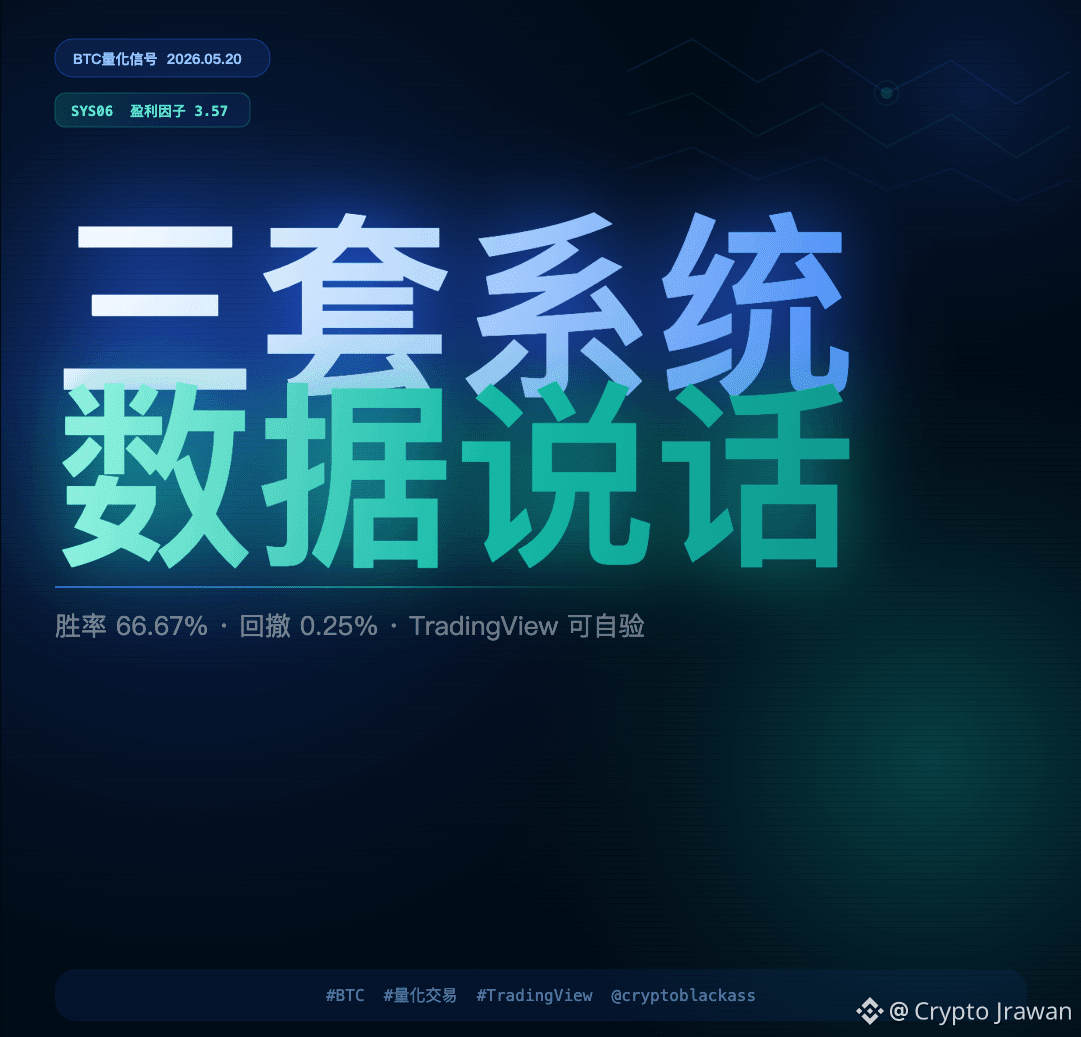
After months of work, I’ve leveraged AI to craft 3 BTC futures quant signals, and today they’re officially open for subscription.
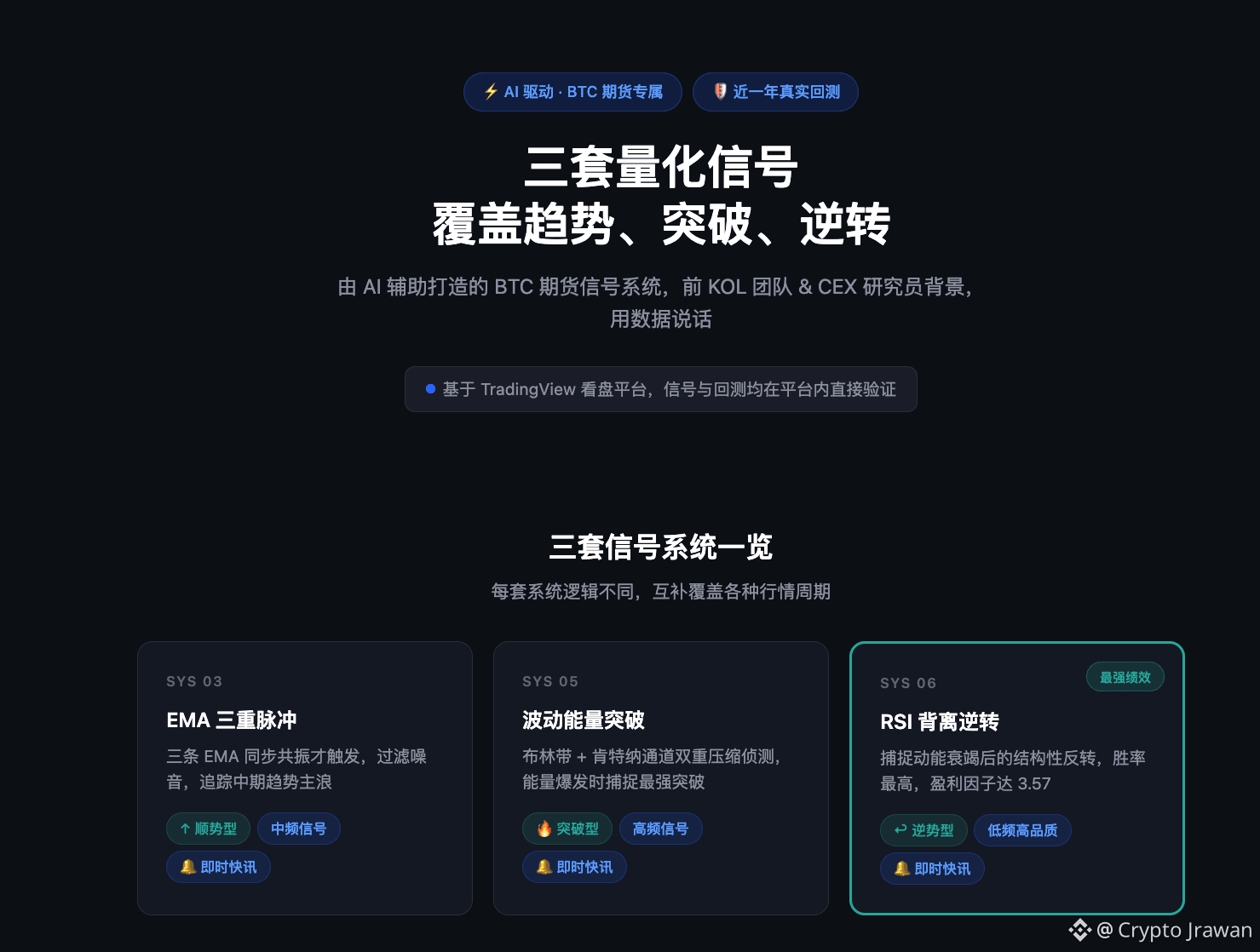
Each strategy has its own role:
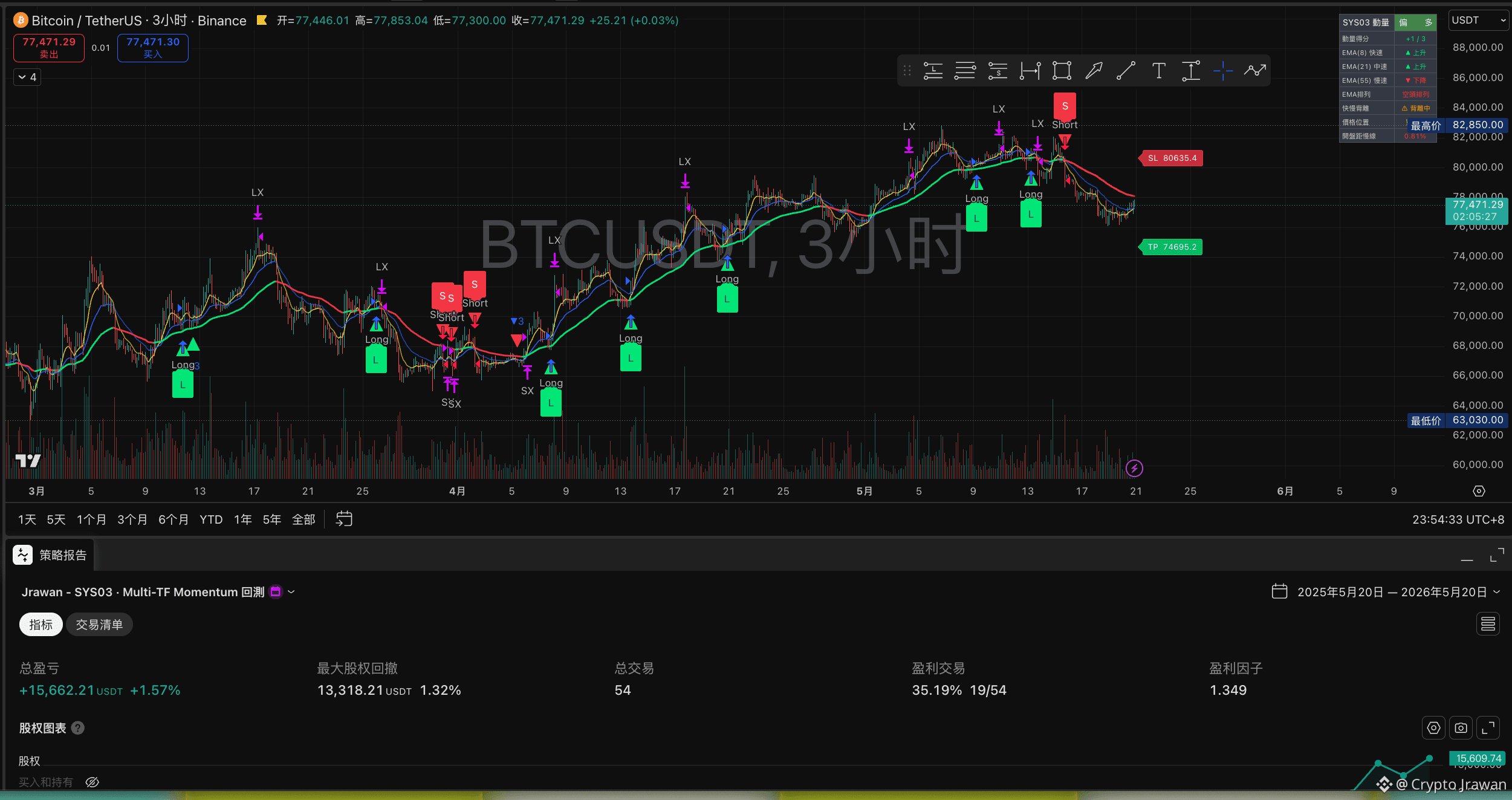
· SYS03 EMA Triple Pulse — Tracks mid-term trend waves, with 54 trades over the past year, profit factor of 1.46
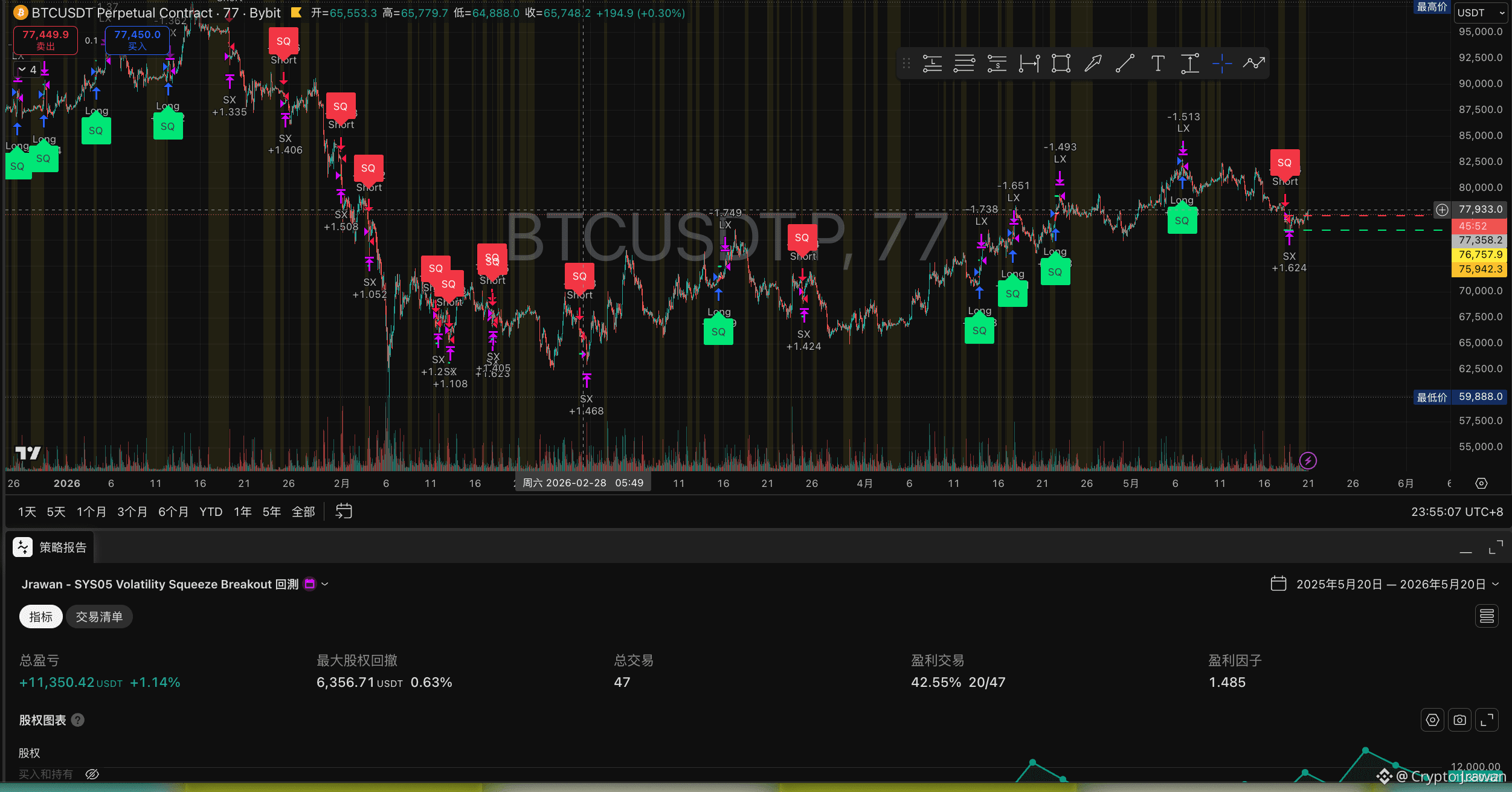
· SYS05 Volatility Energy Breakout — Bollinger Bands + Keltner Double Compression, capturing energy explosions, profit factor of 1.49
· SYS06 RSI Divergence Reversal — Only 15 trades in the past year, win rate of 66.67%, profit factor of 3.57, with a max drawdown of just 0.25%
All backtested on TradingView, so you can replicate the numbers yourself, no need to take my word for it.
Each signal includes:
✓ Real-time annotations for entry direction + SL / TP levels
✓ TradingView alerts pushed directly, getting notified of entry price / stop-loss / take-profit without having to watch the charts
✓ Backtest version for historical performance verification
Background: Former KOL team & CEX researcher, now independently developing trading systems.
If you're interested, DM me on X (Twitter) to learn about the subscription options, spots are limited, first come, first served.
#量化交易 #TradingView #量化信号
After months of work, I’ve leveraged AI to craft 3 BTC futures quant signals, and today they’re officially open for subscription.
Each strategy has its own role:
· SYS03 EMA Triple Pulse — Tracks mid-term trend waves, with 54 trades over the past year, profit factor of 1.46
· SYS05 Volatility Energy Breakout — Bollinger Bands + Keltner Double Compression, capturing energy explosions, profit factor of 1.49
· SYS06 RSI Divergence Reversal — Only 15 trades in the past year, win rate of 66.67%, profit factor of 3.57, with a max drawdown of just 0.25%
All backtested on TradingView, so you can replicate the numbers yourself, no need to take my word for it.
Each signal includes:
✓ Real-time annotations for entry direction + SL / TP levels
✓ TradingView alerts pushed directly, getting notified of entry price / stop-loss / take-profit without having to watch the charts
✓ Backtest version for historical performance verification
Background: Former KOL team & CEX researcher, now independently developing trading systems.
If you're interested, DM me on X (Twitter) to learn about the subscription options, spots are limited, first come, first served.
#量化交易 #TradingView #量化信号
Each strategy has its own role:
· SYS03 EMA Triple Pulse — Tracks mid-term trend waves, with 54 trades over the past year, profit factor of 1.46
· SYS05 Volatility Energy Breakout — Bollinger Bands + Keltner Double Compression, capturing energy explosions, profit factor of 1.49
· SYS06 RSI Divergence Reversal — Only 15 trades in the past year, win rate of 66.67%, profit factor of 3.57, with a max drawdown of just 0.25%
All backtested on TradingView, so you can replicate the numbers yourself, no need to take my word for it.
Each signal includes:
✓ Real-time annotations for entry direction + SL / TP levels
✓ TradingView alerts pushed directly, getting notified of entry price / stop-loss / take-profit without having to watch the charts
✓ Backtest version for historical performance verification
Background: Former KOL team & CEX researcher, now independently developing trading systems.
If you're interested, DM me on X (Twitter) to learn about the subscription options, spots are limited, first come, first served.
#量化交易 #TradingView #量化信号
6
3
2.4k
PINNED
We'll be going live here from time to time to stream the charts + signal interpretations, no fluff.
Last time, folks said they gained a lot—but those who didn’t follow missed out.
I won’t give too much notice before going live, so make sure to follow to catch the action.
🔔 Follow → Don’t miss me!
We'll be going live here from time to time to stream the charts + signal interpretations, no fluff.
Last time, folks said they gained a lot—but those who didn’t follow missed out.
I won’t give too much notice before going live, so make sure to follow to catch the action.
🔔 Follow → Don’t miss me!
Last time, folks said they gained a lot—but those who didn’t follow missed out.
I won’t give too much notice before going live, so make sure to follow to catch the action.
🔔 Follow → Don’t miss me!

2
1.7k
Before going to bed tonight, I thought of something.
The market is always there, and opportunities come every week.
But your mindset is your most important asset.
When your mindset is thrown off—everything you see looks like an opportunity, and the results are traps.
When your mindset is steady—when opportunities arrive, you can see clearly.
Get a good night’s sleep. Continue tomorrow.
#交易心理 #加密货币 #Good night
$BTC $XAUT $HYPE
Before going to bed tonight, I thought of something.
The market is always there, and opportunities come every week.
But your mindset is your most important asset.
When your mindset is thrown off—everything you see looks like an opportunity, and the results are traps.
When your mindset is steady—when opportunities arrive, you can see clearly.
Get a good night’s sleep. Continue tomorrow.
#交易心理 #加密货币 #Good night
$BTC $XAUT $HYPE
The market is always there, and opportunities come every week.
But your mindset is your most important asset.
When your mindset is thrown off—everything you see looks like an opportunity, and the results are traps.
When your mindset is steady—when opportunities arrive, you can see clearly.
Get a good night’s sleep. Continue tomorrow.
#交易心理 #加密货币 #Good night
$BTC $XAUT $HYPE
1
2k
Let me ask you a question.
Now BTC suddenly jumps 5%. What’s your first reaction?
A. Buy immediately, don’t want to miss out
B. Wait for a pullback to enter
C. Check volume/market activity first, then decide
D. Do nothing, wait for system signals
There’s no right or wrong answer, but your answer will tell me what kind of trader you are.
Comment your choice and I’ll analyze it.
$BTC #交易心理 #互动
$BTC $XAUT $HYPE
Let me ask you a question.
Now BTC suddenly jumps 5%. What’s your first reaction?
A. Buy immediately, don’t want to miss out
B. Wait for a pullback to enter
C. Check volume/market activity first, then decide
D. Do nothing, wait for system signals
There’s no right or wrong answer, but your answer will tell me what kind of trader you are.
Comment your choice and I’ll analyze it.
$BTC #交易心理 #互动
$BTC $XAUT $HYPE
Now BTC suddenly jumps 5%. What’s your first reaction?
A. Buy immediately, don’t want to miss out
B. Wait for a pullback to enter
C. Check volume/market activity first, then decide
D. Do nothing, wait for system signals
There’s no right or wrong answer, but your answer will tell me what kind of trader you are.
Comment your choice and I’ll analyze it.
$BTC #交易心理 #互动
$BTC $XAUT $HYPE
7
Today I received a private message.
Someone said: “I’m always getting liquidated—or on my way to getting liquidated. I just want to learn from you.”
These words made me think for a long time.
Because I’ve walked that road too. I know that feeling of hitting zero over and over, and each time telling yourself, “Next time for sure.”
But what he said—“I’m not that greedy; I just want to learn”—
in a market full of leverage dreams, the person who can say that has already won half the battle in mindset.
The ones who truly manage to stay alive in the market,
never are the smartest or the most daring gamblers.
It’s the most low-key one—the person who’s most willing to admit when they’re wrong.
If you’re also on the way, leave a comment and tell me which step you’re stuck at.
#交易心法 #加密货币 #Real Sharing
$BTC $XAUT $HYPE
Today I received a private message.
Someone said: “I’m always getting liquidated—or on my way to getting liquidated. I just want to learn from you.”
These words made me think for a long time.
Because I’ve walked that road too. I know that feeling of hitting zero over and over, and each time telling yourself, “Next time for sure.”
But what he said—“I’m not that greedy; I just want to learn”—
in a market full of leverage dreams, the person who can say that has already won half the battle in mindset.
The ones who truly manage to stay alive in the market,
never are the smartest or the most daring gamblers.
It’s the most low-key one—the person who’s most willing to admit when they’re wrong.
If you’re also on the way, leave a comment and tell me which step you’re stuck at.
#交易心法 #加密货币 #Real Sharing
$BTC $XAUT $HYPE
Someone said: “I’m always getting liquidated—or on my way to getting liquidated. I just want to learn from you.”
These words made me think for a long time.
Because I’ve walked that road too. I know that feeling of hitting zero over and over, and each time telling yourself, “Next time for sure.”
But what he said—“I’m not that greedy; I just want to learn”—
in a market full of leverage dreams, the person who can say that has already won half the battle in mindset.
The ones who truly manage to stay alive in the market,
never are the smartest or the most daring gamblers.
It’s the most low-key one—the person who’s most willing to admit when they’re wrong.
If you’re also on the way, leave a comment and tell me which step you’re stuck at.
#交易心法 #加密货币 #Real Sharing
$BTC $XAUT $HYPE
142
The best trade I ever made wasn’t a big profit on any single deal.
It was during the 2022 bear market, when I decided to stop trading for three months.
At the time, the market was full of wailing—every day someone was shouting, “I caught the bottom,”
only to drop another 30%.
My approach was: close the screen and go learn.
I read six books about trading to rebuild my trading framework.
After three months, I came back to the market—it was still falling,
but my mindset and system were much clearer.
Sometimes the best trade is not trading.
#交易故事 #熊市策略 #CryptoTrading
$BTC $XAUT $HYPE
The best trade I ever made wasn’t a big profit on any single deal.
It was during the 2022 bear market, when I decided to stop trading for three months.
At the time, the market was full of wailing—every day someone was shouting, “I caught the bottom,”
only to drop another 30%.
My approach was: close the screen and go learn.
I read six books about trading to rebuild my trading framework.
After three months, I came back to the market—it was still falling,
but my mindset and system were much clearer.
Sometimes the best trade is not trading.
#交易故事 #熊市策略 #CryptoTrading
$BTC $XAUT $HYPE
It was during the 2022 bear market, when I decided to stop trading for three months.
At the time, the market was full of wailing—every day someone was shouting, “I caught the bottom,”
only to drop another 30%.
My approach was: close the screen and go learn.
I read six books about trading to rebuild my trading framework.
After three months, I came back to the market—it was still falling,
but my mindset and system were much clearer.
Sometimes the best trade is not trading.
#交易故事 #熊市策略 #CryptoTrading
$BTC $XAUT $HYPE
143
Many people ask me: Quant trading or manual trading— which is better?
My answer: It depends on what kind of person you are.
If you can do:
✓ Strictly follow stop-losses
✓ Not let emotions affect your decisions
✓ Maintain discipline over the long term
→ Then manual trading can also be done well.
But if you find that you:
✗ Often “wait a little longer” before cutting losses
✗ Add to your position when you’re winning, and try to win it back when you’re losing
✗ Chase after others’ profits
→ Then you need a system to help keep you in check.
Quant trading isn’t smarter—it’s more disciplined.
#量化交易 #交易心理 #System trading
$BTC $XAUT $HYPE
Many people ask me: Quant trading or manual trading— which is better?
My answer: It depends on what kind of person you are.
If you can do:
✓ Strictly follow stop-losses
✓ Not let emotions affect your decisions
✓ Maintain discipline over the long term
→ Then manual trading can also be done well.
But if you find that you:
✗ Often “wait a little longer” before cutting losses
✗ Add to your position when you’re winning, and try to win it back when you’re losing
✗ Chase after others’ profits
→ Then you need a system to help keep you in check.
Quant trading isn’t smarter—it’s more disciplined.
#量化交易 #交易心理 #System trading
$BTC $XAUT $HYPE
My answer: It depends on what kind of person you are.
If you can do:
✓ Strictly follow stop-losses
✓ Not let emotions affect your decisions
✓ Maintain discipline over the long term
→ Then manual trading can also be done well.
But if you find that you:
✗ Often “wait a little longer” before cutting losses
✗ Add to your position when you’re winning, and try to win it back when you’re losing
✗ Chase after others’ profits
→ Then you need a system to help keep you in check.
Quant trading isn’t smarter—it’s more disciplined.
#量化交易 #交易心理 #System trading
$BTC $XAUT $HYPE
58
Today's Market Watch 09/18
BTC is currently consolidating around $76,406.
Volume is the most important key today.
If the price is rising but volume isn’t keeping up—that’s a fake breakout; don’t chase.
Let volume come in first, then decide the direction.
Today's strategy:
Wait for volume to confirm → then decide the direction
If there’s no volume → stay sidelined; cash is also a position
No rush, stay calm—wait for the right moment.
$BTC
#市场观察 #BTC #Trading Strategy
$BTC $XAUT $HYPE
Today's Market Watch 09/18
BTC is currently consolidating around $76,406.
Volume is the most important key today.
If the price is rising but volume isn’t keeping up—that’s a fake breakout; don’t chase.
Let volume come in first, then decide the direction.
Today's strategy:
Wait for volume to confirm → then decide the direction
If there’s no volume → stay sidelined; cash is also a position
No rush, stay calm—wait for the right moment.
$BTC
#市场观察 #BTC #Trading Strategy
$BTC $XAUT $HYPE
BTC is currently consolidating around $76,406.
Volume is the most important key today.
If the price is rising but volume isn’t keeping up—that’s a fake breakout; don’t chase.
Let volume come in first, then decide the direction.
Today's strategy:
Wait for volume to confirm → then decide the direction
If there’s no volume → stay sidelined; cash is also a position
No rush, stay calm—wait for the right moment.
$BTC
#市场观察 #BTC #Trading Strategy
$BTC $XAUT $HYPE
67
Several Key Levels of BTC Worth Watching Today 09/18
Current price: $76,406
Resistance level: In the 1–2% range above (with previous heavy trading volume)
Support level: Around 1.5% below (uptrend line)
Volume interpretation:
If it breaks above resistance with increased volume → confirm the direction, and you can follow
If it rises on declining volume → wait for a pullback and then reassess
A day with no trading is also a trading decision.
$BTC {future}(BTCUSDT)
#BTC #技术分析 #quantitative trading
$BTC $XAUT $HYPE
Several Key Levels of BTC Worth Watching Today 09/18
Current price: $76,406
Resistance level: In the 1–2% range above (with previous heavy trading volume)
Support level: Around 1.5% below (uptrend line)
Volume interpretation:
If it breaks above resistance with increased volume → confirm the direction, and you can follow
If it rises on declining volume → wait for a pullback and then reassess
A day with no trading is also a trading decision.
$BTC
#BTC #技术分析 #quantitative trading
$BTC $XAUT $HYPE
Current price: $76,406
Resistance level: In the 1–2% range above (with previous heavy trading volume)
Support level: Around 1.5% below (uptrend line)
Volume interpretation:
If it breaks above resistance with increased volume → confirm the direction, and you can follow
If it rises on declining volume → wait for a pullback and then reassess
A day with no trading is also a trading decision.
$BTC
#BTC #技术分析 #quantitative trading
$BTC $XAUT $HYPE
108
Today the market closed—let’s do a quick summary.
Trading doesn’t have signals every day, and not every day is suitable for placing trades.
If you didn’t trade today—
that may be the most correct decision.
Protect your capital—that’s how you prepare for the next opportunity.
See you tomorrow.
$BTC #系统交易 #Trading discipline
$BTC $XAUT $HYPE
Today the market closed—let’s do a quick summary.
Trading doesn’t have signals every day, and not every day is suitable for placing trades.
If you didn’t trade today—
that may be the most correct decision.
Protect your capital—that’s how you prepare for the next opportunity.
See you tomorrow.
$BTC #系统交易 #Trading discipline
$BTC $XAUT $HYPE
Trading doesn’t have signals every day, and not every day is suitable for placing trades.
If you didn’t trade today—
that may be the most correct decision.
Protect your capital—that’s how you prepare for the next opportunity.
See you tomorrow.
$BTC #系统交易 #Trading discipline
$BTC $XAUT $HYPE
65
Let me ask you a question.
Now BTC suddenly jumped 5%. What’s your first reaction?
A. Buy immediately—I don’t want to miss out
B. Wait for a pullback to enter
C. First check the volume/liquidity, then decide
D. Do nothing, wait for system signals
There’s no standard answer, but your choice will tell me what kind of trader you are.
Comment and tell me your choice—I’ll analyze it.
$BTC #交易心理 #interaction
$BTC $XAUT $HYPE
Let me ask you a question.
Now BTC suddenly jumped 5%. What’s your first reaction?
A. Buy immediately—I don’t want to miss out
B. Wait for a pullback to enter
C. First check the volume/liquidity, then decide
D. Do nothing, wait for system signals
There’s no standard answer, but your choice will tell me what kind of trader you are.
Comment and tell me your choice—I’ll analyze it.
$BTC #交易心理 #interaction
$BTC $XAUT $HYPE
Now BTC suddenly jumped 5%. What’s your first reaction?
A. Buy immediately—I don’t want to miss out
B. Wait for a pullback to enter
C. First check the volume/liquidity, then decide
D. Do nothing, wait for system signals
There’s no standard answer, but your choice will tell me what kind of trader you are.
Comment and tell me your choice—I’ll analyze it.
$BTC #交易心理 #interaction
$BTC $XAUT $HYPE
7
Is your trading frequency correct?
Some people do 10 trades a day, exhausting themselves to death, and their returns are negative.
Some people do 1 trade a week, easily waiting, and their returns are stable.
This isn’t a question of diligence or not—it’s a matter of fit.
High-frequency strategy → quick judgment, quick execution
Low-frequency strategy → patient waiting, patient holding
You’re using a low-frequency strategy, but operating it with a high-frequency rhythm—
watching the market every day, interfering frequently—
You’re not trading; you’re disrupting your own system.
First, figure out what rhythm your system is built on,
then decide how you should just sit and wait.
#Trading #CryptoTrading #trading psychology
$BTC $XAUT $HYPE
Is your trading frequency correct?
Some people do 10 trades a day, exhausting themselves to death, and their returns are negative.
Some people do 1 trade a week, easily waiting, and their returns are stable.
This isn’t a question of diligence or not—it’s a matter of fit.
High-frequency strategy → quick judgment, quick execution
Low-frequency strategy → patient waiting, patient holding
You’re using a low-frequency strategy, but operating it with a high-frequency rhythm—
watching the market every day, interfering frequently—
You’re not trading; you’re disrupting your own system.
First, figure out what rhythm your system is built on,
then decide how you should just sit and wait.
#Trading #CryptoTrading #trading psychology
$BTC $XAUT $HYPE
Some people do 10 trades a day, exhausting themselves to death, and their returns are negative.
Some people do 1 trade a week, easily waiting, and their returns are stable.
This isn’t a question of diligence or not—it’s a matter of fit.
High-frequency strategy → quick judgment, quick execution
Low-frequency strategy → patient waiting, patient holding
You’re using a low-frequency strategy, but operating it with a high-frequency rhythm—
watching the market every day, interfering frequently—
You’re not trading; you’re disrupting your own system.
First, figure out what rhythm your system is built on,
then decide how you should just sit and wait.
#Trading #CryptoTrading #trading psychology
$BTC $XAUT $HYPE
126
For a period of time, I almost gave up on trading.
It was after six straight months of losses.
I remember that day sitting in front of my computer, looking at the numbers in my account,
thinking to myself: “Maybe this market just isn’t for me.”
Later, I did something:
I went through every single trade from those six months very carefully.
I found that 80% of the losses came from the same problem—
I was “trading based on my instincts” when there was no signal.
It wasn’t that the market wasn’t right for me; my method was.
That review turned out to be a turning point in my trading career.
Every time you string together losses, the market is telling you: “There’s something you need to fix.”
When was the last time you did a serious review?
#交易故事 #真实分享 #Growth
$BTC $XAUT $HYPE
For a period of time, I almost gave up on trading.
It was after six straight months of losses.
I remember that day sitting in front of my computer, looking at the numbers in my account,
thinking to myself: “Maybe this market just isn’t for me.”
Later, I did something:
I went through every single trade from those six months very carefully.
I found that 80% of the losses came from the same problem—
I was “trading based on my instincts” when there was no signal.
It wasn’t that the market wasn’t right for me; my method was.
That review turned out to be a turning point in my trading career.
Every time you string together losses, the market is telling you: “There’s something you need to fix.”
When was the last time you did a serious review?
#交易故事 #真实分享 #Growth
$BTC $XAUT $HYPE
It was after six straight months of losses.
I remember that day sitting in front of my computer, looking at the numbers in my account,
thinking to myself: “Maybe this market just isn’t for me.”
Later, I did something:
I went through every single trade from those six months very carefully.
I found that 80% of the losses came from the same problem—
I was “trading based on my instincts” when there was no signal.
It wasn’t that the market wasn’t right for me; my method was.
That review turned out to be a turning point in my trading career.
Every time you string together losses, the market is telling you: “There’s something you need to fix.”
When was the last time you did a serious review?
#交易故事 #真实分享 #Growth
$BTC $XAUT $HYPE
49
When I built the first quantitative trading system, I stepped into three traps.
Trap One: Overfitting
The backtest results looked ridiculously good, but the live trading collapsed as soon as I went live.
Reason: I tuned the parameters too precisely to match historical data.
Trap Two: Ignoring trading fees
Each trade looked like it made $50 in the backtest, but after fees in live trading, it only netted $15.
The return was cut by 70% straight away.
Trap Three: No stop-loss logic
“Quant systems won’t do anything crazy.”
Until one time the market moved and wiped out 20% in a single swing, and then I realized quant strategies can still blow up.
That’s why the SYS series was built gradually—after stepping into these three traps.
No traps, no system.
#TradingView #量化交易 #CryptoTrading
$BTC $XAUT $HYPE
When I built the first quantitative trading system, I stepped into three traps.
Trap One: Overfitting
The backtest results looked ridiculously good, but the live trading collapsed as soon as I went live.
Reason: I tuned the parameters too precisely to match historical data.
Trap Two: Ignoring trading fees
Each trade looked like it made $50 in the backtest, but after fees in live trading, it only netted $15.
The return was cut by 70% straight away.
Trap Three: No stop-loss logic
“Quant systems won’t do anything crazy.”
Until one time the market moved and wiped out 20% in a single swing, and then I realized quant strategies can still blow up.
That’s why the SYS series was built gradually—after stepping into these three traps.
No traps, no system.
#TradingView #量化交易 #CryptoTrading
$BTC $XAUT $HYPE
Trap One: Overfitting
The backtest results looked ridiculously good, but the live trading collapsed as soon as I went live.
Reason: I tuned the parameters too precisely to match historical data.
Trap Two: Ignoring trading fees
Each trade looked like it made $50 in the backtest, but after fees in live trading, it only netted $15.
The return was cut by 70% straight away.
Trap Three: No stop-loss logic
“Quant systems won’t do anything crazy.”
Until one time the market moved and wiped out 20% in a single swing, and then I realized quant strategies can still blow up.
That’s why the SYS series was built gradually—after stepping into these three traps.
No traps, no system.
#TradingView #量化交易 #CryptoTrading
$BTC $XAUT $HYPE
49
A few key levels for BTC to watch today 09/17
Current price: $76,152
Resistance level: within the upper 1–2% range (there is heavy prior trading there)
Support level: around 1.5% below (uptrend line)
Volume interpretation:
If it breaks through resistance with increased volume → direction confirmed, you can follow
If it rises on decreasing volume → wait for a pullback and then reassess
Even days without trading are also a trading decision.
$BTC {future}(BTCUSDT)
#BTC #技术分析 #quantitative trading
$BTC $XAUT $HYPE
A few key levels for BTC to watch today 09/17
Current price: $76,152
Resistance level: within the upper 1–2% range (there is heavy prior trading there)
Support level: around 1.5% below (uptrend line)
Volume interpretation:
If it breaks through resistance with increased volume → direction confirmed, you can follow
If it rises on decreasing volume → wait for a pullback and then reassess
Even days without trading are also a trading decision.
$BTC
#BTC #技术分析 #quantitative trading
$BTC $XAUT $HYPE
Current price: $76,152
Resistance level: within the upper 1–2% range (there is heavy prior trading there)
Support level: around 1.5% below (uptrend line)
Volume interpretation:
If it breaks through resistance with increased volume → direction confirmed, you can follow
If it rises on decreasing volume → wait for a pullback and then reassess
Even days without trading are also a trading decision.
$BTC
#BTC #技术分析 #quantitative trading
$BTC $XAUT $HYPE
99
Today's crypto market, summed up in one sentence:
Waiting.
BTC's current走势 is like a person taking a deep breath—
inhale, hold it in, getting ready to explode.
But the problem is, you don't know which direction it will exhale.
So my strategy is simple:
wait until it chooses a direction, then hop on.
No guessing—just follow. That's the core of systematic trading.
$BTC
#BTC #交易策略 #systematic trading
$BTC $XAUT $HYPE
Today's crypto market, summed up in one sentence:
Waiting.
BTC's current走势 is like a person taking a deep breath—
inhale, hold it in, getting ready to explode.
But the problem is, you don't know which direction it will exhale.
So my strategy is simple:
wait until it chooses a direction, then hop on.
No guessing—just follow. That's the core of systematic trading.
$BTC
#BTC #交易策略 #systematic trading
$BTC $XAUT $HYPE
Waiting.
BTC's current走势 is like a person taking a deep breath—
inhale, hold it in, getting ready to explode.
But the problem is, you don't know which direction it will exhale.
So my strategy is simple:
wait until it chooses a direction, then hop on.
No guessing—just follow. That's the core of systematic trading.
$BTC
#BTC #交易策略 #systematic trading
$BTC $XAUT $HYPE
109
Before bed tonight, I thought of something.
The market is always there, and opportunities come every week.
But your mindset is your most important asset.
When your mindset is thrown off—everything looks like an opportunity, and the results are traps.
When your mindset is steady—when opportunities arrive, you’ll be able to see clearly.
Get a good night’s sleep. Continue tomorrow.
#交易心理 #加密货币 #Good night
$BTC $XAUT $HYPE
Before bed tonight, I thought of something.
The market is always there, and opportunities come every week.
But your mindset is your most important asset.
When your mindset is thrown off—everything looks like an opportunity, and the results are traps.
When your mindset is steady—when opportunities arrive, you’ll be able to see clearly.
Get a good night’s sleep. Continue tomorrow.
#交易心理 #加密货币 #Good night
$BTC $XAUT $HYPE
The market is always there, and opportunities come every week.
But your mindset is your most important asset.
When your mindset is thrown off—everything looks like an opportunity, and the results are traps.
When your mindset is steady—when opportunities arrive, you’ll be able to see clearly.
Get a good night’s sleep. Continue tomorrow.
#交易心理 #加密货币 #Good night
$BTC $XAUT $HYPE
22
What’s the most expensive trading lesson you’ve ever learned?
Let me go first:
At the top of the 2021 bull market, I added to my position when BTC was at 69,000,
because, “I feel it’ll go up.”
Then, everyone knows what happened next.
That trade taught me one thing:
It’s easiest to make money in a bull market—but it’s also where most people plant the seeds of losses.
How about you?
Share your most expensive lesson in the comments—
stories like this are more valuable than any analysis.
#交易故事 #真实分享 #CryptoTrading
$BTC $XAUT $HYPE
What’s the most expensive trading lesson you’ve ever learned?
Let me go first:
At the top of the 2021 bull market, I added to my position when BTC was at 69,000,
because, “I feel it’ll go up.”
Then, everyone knows what happened next.
That trade taught me one thing:
It’s easiest to make money in a bull market—but it’s also where most people plant the seeds of losses.
How about you?
Share your most expensive lesson in the comments—
stories like this are more valuable than any analysis.
#交易故事 #真实分享 #CryptoTrading
$BTC $XAUT $HYPE
Let me go first:
At the top of the 2021 bull market, I added to my position when BTC was at 69,000,
because, “I feel it’ll go up.”
Then, everyone knows what happened next.
That trade taught me one thing:
It’s easiest to make money in a bull market—but it’s also where most people plant the seeds of losses.
How about you?
Share your most expensive lesson in the comments—
stories like this are more valuable than any analysis.
#交易故事 #真实分享 #CryptoTrading
$BTC $XAUT $HYPE
73
Trading this thing—slow is fast.
Just entered: I’d be desperate to double every day.
After a year: I start learning to wait for signals.
After three years: I understand that “not doing” is a kind of ability.
The market won’t disappear; opportunities come every week.
But your principal—one mistake can wipe it out.
Don’t use a “fast” tempo; use a “slow” strategy.
Don’t trade by “guessing”; trade by “waiting.”
Go a little slower, be a bit steadier—then you can go farther.
#Trading #Bitcoin #CryptoTrading
$BTC $XAUT $HYPE
Trading this thing—slow is fast.
Just entered: I’d be desperate to double every day.
After a year: I start learning to wait for signals.
After three years: I understand that “not doing” is a kind of ability.
The market won’t disappear; opportunities come every week.
But your principal—one mistake can wipe it out.
Don’t use a “fast” tempo; use a “slow” strategy.
Don’t trade by “guessing”; trade by “waiting.”
Go a little slower, be a bit steadier—then you can go farther.
#Trading #Bitcoin #CryptoTrading
$BTC $XAUT $HYPE
Just entered: I’d be desperate to double every day.
After a year: I start learning to wait for signals.
After three years: I understand that “not doing” is a kind of ability.
The market won’t disappear; opportunities come every week.
But your principal—one mistake can wipe it out.
Don’t use a “fast” tempo; use a “slow” strategy.
Don’t trade by “guessing”; trade by “waiting.”
Go a little slower, be a bit steadier—then you can go farther.
#Trading #Bitcoin #CryptoTrading
$BTC $XAUT $HYPE
35
Tell a thing that very few people know.
During the time when I was working as a KOL, honestly, I wasn’t happy.
Every day I had to produce “professional-looking” content. And when I spoke the truth—sometimes the direction wasn’t even that certain, but the platform needed you to provide an “explicit point of view.”
After a while, you wouldn’t know whether you were actually analyzing, or just performing analysis.
Later, I stepped back and returned to independent trading.
At first my income was lower, but I could finally sleep.
Now, every post I share on the plaza is my real observations and operation records.
Whatever I make or lose—I put it all out there.
Not many people do things this way, but I think this is the right way.
#真实分享 #KOL #交易故事
$BTC $XAUT $HYPE
Tell a thing that very few people know.
During the time when I was working as a KOL, honestly, I wasn’t happy.
Every day I had to produce “professional-looking” content. And when I spoke the truth—sometimes the direction wasn’t even that certain, but the platform needed you to provide an “explicit point of view.”
After a while, you wouldn’t know whether you were actually analyzing, or just performing analysis.
Later, I stepped back and returned to independent trading.
At first my income was lower, but I could finally sleep.
Now, every post I share on the plaza is my real observations and operation records.
Whatever I make or lose—I put it all out there.
Not many people do things this way, but I think this is the right way.
#真实分享 #KOL #交易故事
$BTC $XAUT $HYPE
During the time when I was working as a KOL, honestly, I wasn’t happy.
Every day I had to produce “professional-looking” content. And when I spoke the truth—sometimes the direction wasn’t even that certain, but the platform needed you to provide an “explicit point of view.”
After a while, you wouldn’t know whether you were actually analyzing, or just performing analysis.
Later, I stepped back and returned to independent trading.
At first my income was lower, but I could finally sleep.
Now, every post I share on the plaza is my real observations and operation records.
Whatever I make or lose—I put it all out there.
Not many people do things this way, but I think this is the right way.
#真实分享 #KOL #交易故事
$BTC $XAUT $HYPE
51
Log in to explore more content
Join global crypto users on Binance Square
⚡️ Get latest and useful information about crypto.
💬 Trusted by the world’s largest crypto exchange.
👍 Discover real insights from verified creators.
Email / Phone number
Trending Topics
BTCBreaks80K
9,917 views
296 Discussing
🚨 BITCOIN $80K IS BACK IN FOCUS! 🔥
BTC is pushing toward the $80,000 psychological resistance after reclaiming the $78K zone. A clean breakout and hold above $80K could bring $82K–$85K into focus next. 📈
But traders need to watch the rejection zone carefully — losing $77K–$78K could trigger another pullback.
🎯 Key levels:
• 🔥 Breakout: $80K
• 🚀 Next zone: $82K–$85K
• ⚠️ Support: $77K–$78K
$80K isn’t just a number — it’s the level bulls need to conquer.
Are we about to see the next BTC breakout? 👇
#bitcoin #BTC #BinanceSquare #btcbreaks80k
$BTC
ASHFAQ NAEEM
·2 Likes
·3.1k views
比特币突破8万
14,396 views
56 Discussing
BuffettBecomesBerkshireChairmanEmeritus
9 views
17 Discussing