

crypto100w
4.2k Posts

crypto100w
Report
Block User
同名加密分析网站,免费使用.

ENA Holder
High-Frequency Trader
5.6 Years
26 Following
142 Followers
179 Liked
Posts
All
Quotes
Videos
PINNED
·
--
If you've been trading recently, you must have this feeling:
There is more and more information, but it's getting harder to make judgments.
There are opinions every day in the group, and social media has daily "opportunities",
but at the moment you actually place an order, you still ask yourself:
Is this noise or signal?
We created this crypto100w platform to solve this issue.
It's not about giving you a bunch of analyses that "look impressive",
but rather providing you with three core functions that can directly improve decision quality.
If you've been trading recently, you must have this feeling:
There is more and more information, but it's getting harder to make judgments.
There are opinions every day in the group, and social media has daily "opportunities",
but at the moment you actually place an order, you still ask yourself:
Is this noise or signal?
We created this crypto100w platform to solve this issue.
It's not about giving you a bunch of analyses that "look impressive",
but rather providing you with three core functions that can directly improve decision quality.
There is more and more information, but it's getting harder to make judgments.
There are opinions every day in the group, and social media has daily "opportunities",
but at the moment you actually place an order, you still ask yourself:
Is this noise or signal?
We created this crypto100w platform to solve this issue.
It's not about giving you a bunch of analyses that "look impressive",
but rather providing you with three core functions that can directly improve decision quality.
5
45
PINNED
·
--
When market information is overwhelming and opportunities are fleeting, what you need is not just more data, but faster, more stable, and more interpretable decision-making basis. Welcome to Crypto 100W, a brand new platform that helps you capture market signals faster and make trading decisions more steadily.
Now, register immediately and enter the dashboard, add your watchlist, set alerts, and experience AI one-click interpretation. In the complex crypto market, use more professional tools to make more robust decisions. Thank you for watching. This platform is for research and education purposes only and does not constitute investment advice, please assess risks carefully.
When market information is overwhelming and opportunities are fleeting, what you need is not just more data, but faster, more stable, and more interpretable decision-making basis. Welcome to Crypto 100W, a brand new platform that helps you capture market signals faster and make trading decisions more steadily.
Now, register immediately and enter the dashboard, add your watchlist, set alerts, and experience AI one-click interpretation. In the complex crypto market, use more professional tools to make more robust decisions. Thank you for watching. This platform is for research and education purposes only and does not constitute investment advice, please assess risks carefully.
Now, register immediately and enter the dashboard, add your watchlist, set alerts, and experience AI one-click interpretation. In the complex crypto market, use more professional tools to make more robust decisions. Thank you for watching. This platform is for research and education purposes only and does not constitute investment advice, please assess risks carefully.
1
7
670
·
--
Don’t jump to put labels on a single cryptocurrency just because of macro news.
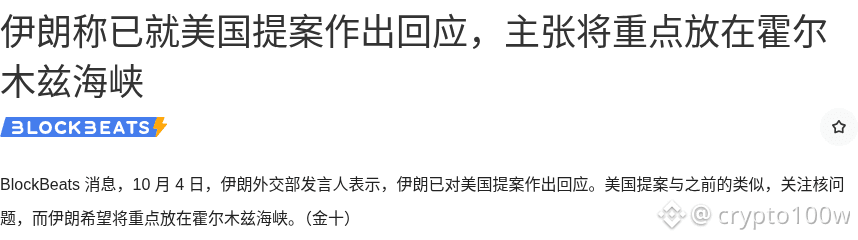
According to BlockBeats, on October 4 an Iranian Foreign Ministry spokesperson said that Iran has responded to the U.S. proposal. The U.S. proposal is similar to the previous one, focusing on the nuclear issue, while Iran argues that the negotiation should prioritize the Strait of Hormuz. The market interpretation is bearish: Hormuz is a key global energy transportation route—if the opening of navigation and sanctions conditions continue to be tugged back and forth, oil prices and risk-off sentiment are likely to intensify, putting pressure on risk assets such as $BTC, $ETH, and others.
One observation is that this isn’t a bearish factor specific to a single coin; it’s that macro risk factors are coming back into focus. Another observation is that in the short term, you should pay attention to whether oil prices, the U.S. dollar, and risk appetite in U.S. stocks are moving together to deliver pressure. Would you rather watch the oil-price linkage first, or monitor changes in risk appetite in U.S. stocks first?
Figure 1: Iran responds to the U.S. proposal, with the Strait of Hormuz still in focus · Source page partial screenshot
Image source: https://www.theblockbeats.info/flash/370217
Don’t jump to put labels on a single cryptocurrency just because of macro news.
According to BlockBeats, on October 4 an Iranian Foreign Ministry spokesperson said that Iran has responded to the U.S. proposal. The U.S. proposal is similar to the previous one, focusing on the nuclear issue, while Iran argues that the negotiation should prioritize the Strait of Hormuz. The market interpretation is bearish: Hormuz is a key global energy transportation route—if the opening of navigation and sanctions conditions continue to be tugged back and forth, oil prices and risk-off sentiment are likely to intensify, putting pressure on risk assets such as $BTC , $ETH , and others.
One observation is that this isn’t a bearish factor specific to a single coin; it’s that macro risk factors are coming back into focus. Another observation is that in the short term, you should pay attention to whether oil prices, the U.S. dollar, and risk appetite in U.S. stocks are moving together to deliver pressure. Would you rather watch the oil-price linkage first, or monitor changes in risk appetite in U.S. stocks first?
Figure 1: Iran responds to the U.S. proposal, with the Strait of Hormuz still in focus · Source page partial screenshot
Image source: https://www.theblockbeats.info/flash/370217
According to BlockBeats, on October 4 an Iranian Foreign Ministry spokesperson said that Iran has responded to the U.S. proposal. The U.S. proposal is similar to the previous one, focusing on the nuclear issue, while Iran argues that the negotiation should prioritize the Strait of Hormuz. The market interpretation is bearish: Hormuz is a key global energy transportation route—if the opening of navigation and sanctions conditions continue to be tugged back and forth, oil prices and risk-off sentiment are likely to intensify, putting pressure on risk assets such as $BTC , $ETH , and others.
One observation is that this isn’t a bearish factor specific to a single coin; it’s that macro risk factors are coming back into focus. Another observation is that in the short term, you should pay attention to whether oil prices, the U.S. dollar, and risk appetite in U.S. stocks are moving together to deliver pressure. Would you rather watch the oil-price linkage first, or monitor changes in risk appetite in U.S. stocks first?
Figure 1: Iran responds to the U.S. proposal, with the Strait of Hormuz still in focus · Source page partial screenshot
Image source: https://www.theblockbeats.info/flash/370217
51
·
--
Stop reacting reflexively just because an integer-level barrier is reached.
BlockBeats reported on Oct 4, citing HTX market data: $ETH broke above $2,700, with a 24-hour gain of 0.75%. $2,700 is a common psychological level and also a position where long and short positions are easy to reprice. Once it’s broken, trend-following funds may continue to watch Ethereum’s main storyline.
For holders, the key is whether spot buying and on-chain capital can keep the momentum going; for short-term traders, if the trading volume doesn’t keep up after the breakout, the price is likely to pull back and test the $2,700 area for support, so it’s not advisable to chase the price blindly.
One thing to watch is whether, after the integer level is surpassed, capital continues to pile in—this determines how strong the support is. Another thing to watch is that if volume fails to catch up, it’s also not unusual for a pullback to test nearby support to occur. Which do you care about more: spot buying momentum continuing, or waiting to see the pullback and support first?
Figure 1: ETH breaks above $2,700 · Source: partial screenshot of the page
Image source: https://www.theblockbeats.info/flash/370215
Stop reacting reflexively just because an integer-level barrier is reached.
BlockBeats reported on Oct 4, citing HTX market data: $ETH broke above $2,700, with a 24-hour gain of 0.75%. $2,700 is a common psychological level and also a position where long and short positions are easy to reprice. Once it’s broken, trend-following funds may continue to watch Ethereum’s main storyline.
For holders, the key is whether spot buying and on-chain capital can keep the momentum going; for short-term traders, if the trading volume doesn’t keep up after the breakout, the price is likely to pull back and test the $2,700 area for support, so it’s not advisable to chase the price blindly.
One thing to watch is whether, after the integer level is surpassed, capital continues to pile in—this determines how strong the support is. Another thing to watch is that if volume fails to catch up, it’s also not unusual for a pullback to test nearby support to occur. Which do you care about more: spot buying momentum continuing, or waiting to see the pullback and support first?
Figure 1: ETH breaks above $2,700 · Source: partial screenshot of the page
Image source: https://www.theblockbeats.info/flash/370215
BlockBeats reported on Oct 4, citing HTX market data: $ETH broke above $2,700, with a 24-hour gain of 0.75%. $2,700 is a common psychological level and also a position where long and short positions are easy to reprice. Once it’s broken, trend-following funds may continue to watch Ethereum’s main storyline.
For holders, the key is whether spot buying and on-chain capital can keep the momentum going; for short-term traders, if the trading volume doesn’t keep up after the breakout, the price is likely to pull back and test the $2,700 area for support, so it’s not advisable to chase the price blindly.
One thing to watch is whether, after the integer level is surpassed, capital continues to pile in—this determines how strong the support is. Another thing to watch is that if volume fails to catch up, it’s also not unusual for a pullback to test nearby support to occur. Which do you care about more: spot buying momentum continuing, or waiting to see the pullback and support first?
Figure 1: ETH breaks above $2,700 · Source: partial screenshot of the page
Image source: https://www.theblockbeats.info/flash/370215

20
·
--
Don’t see an integer number and immediately start imagining a big bull run.
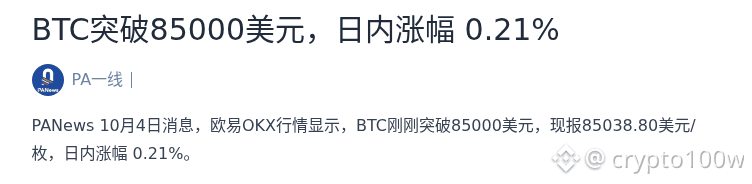
PANews, October 4, cited an OKX (OKEx) market report: $BTC has just broken above $85,000, and is now trading at $85,038.80 per coin, up 0.21% for the day. $85,000 is a key short-term psychological level that the market is watching. Once the price stands above the integer level, trend-following capital and derivatives positions will typically continue to monitor how things play out next.
One observation is: if subsequent trading keeps up, attention on prices holding above $85,000 will continue to rise. Another observation is: if trading fails to keep pace after the breakout, the price is also likely to pull back to test and see where support holds. When chasing price higher, discipline should always come first. Which do you lean toward next—volume expanding and holding steady, or a pullback first for confirmation?
Figure 1: BTC breaks above $85,000 · Source page partial screenshot
Image source: https://www.panewslab.com/zh/articles/01a10593-c3e2-7621-bcd8-a16381097b6d
Don’t see an integer number and immediately start imagining a big bull run.
PANews, October 4, cited an OKX (OKEx) market report: $BTC has just broken above $85,000, and is now trading at $85,038.80 per coin, up 0.21% for the day. $85,000 is a key short-term psychological level that the market is watching. Once the price stands above the integer level, trend-following capital and derivatives positions will typically continue to monitor how things play out next.
One observation is: if subsequent trading keeps up, attention on prices holding above $85,000 will continue to rise. Another observation is: if trading fails to keep pace after the breakout, the price is also likely to pull back to test and see where support holds. When chasing price higher, discipline should always come first. Which do you lean toward next—volume expanding and holding steady, or a pullback first for confirmation?
Figure 1: BTC breaks above $85,000 · Source page partial screenshot
Image source: https://www.panewslab.com/zh/articles/01a10593-c3e2-7621-bcd8-a16381097b6d
PANews, October 4, cited an OKX (OKEx) market report: $BTC has just broken above $85,000, and is now trading at $85,038.80 per coin, up 0.21% for the day. $85,000 is a key short-term psychological level that the market is watching. Once the price stands above the integer level, trend-following capital and derivatives positions will typically continue to monitor how things play out next.
One observation is: if subsequent trading keeps up, attention on prices holding above $85,000 will continue to rise. Another observation is: if trading fails to keep pace after the breakout, the price is also likely to pull back to test and see where support holds. When chasing price higher, discipline should always come first. Which do you lean toward next—volume expanding and holding steady, or a pullback first for confirmation?
Figure 1: BTC breaks above $85,000 · Source page partial screenshot
Image source: https://www.panewslab.com/zh/articles/01a10593-c3e2-7621-bcd8-a16381097b6d
5
·
--
Don’t start imagining a single-coin pump-and-dump script just because a big bank is recruiting for a digital-asset role.
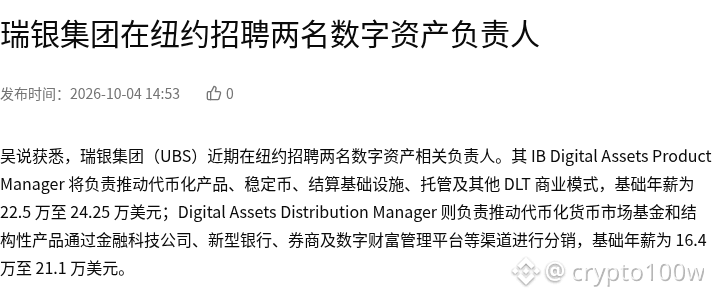
According to Wu Shuo, UBS Group has recently been hiring two digital-asset-related executives in New York. The IB Digital Assets Product Manager will be responsible for investment-banking digital-asset products, tokenization, stablecoins, settlement infrastructure, custody, and DLT business models, with a base annual salary of USD 225,000 to USD 242,500. The Digital Assets Distribution Manager will be responsible for driving the distribution of tokenized money market funds and structured products through channels such as fintech firms, neobanks, broker-dealers, and digital wealth-management platforms, with a base annual salary of USD 164,000 to USD 211,000.
This seems more like a sign that traditional big banks are continuing to roll RWA, stablecoin payments, and on-chain settlement into their long-term business pipeline. The postings are more useful as a reference for institutional-grade tokenization infrastructure and the regulated custody segment. Hiring itself doesn’t mean products will be launched immediately, nor is it enough to move prices on its own.
Observation 1: Whether clear products, partners, or real capital inflows appear afterward. Observation 2: Whether the distribution and custody directions covered by the roles correspond to more specific compliance-oriented business initiatives. Do you value it more as a long-term signal for tokenization infrastructure, or would you rather wait for actual product launches before judging?
Caption 1: UBS steps up its digital-asset hiring · Source page partial screenshot
Image source: https://www.wublock123.com/news/ubs-hires-two-digital-assets-heads-in-new-york-69508
Don’t start imagining a single-coin pump-and-dump script just because a big bank is recruiting for a digital-asset role.
According to Wu Shuo, UBS Group has recently been hiring two digital-asset-related executives in New York. The IB Digital Assets Product Manager will be responsible for investment-banking digital-asset products, tokenization, stablecoins, settlement infrastructure, custody, and DLT business models, with a base annual salary of USD 225,000 to USD 242,500. The Digital Assets Distribution Manager will be responsible for driving the distribution of tokenized money market funds and structured products through channels such as fintech firms, neobanks, broker-dealers, and digital wealth-management platforms, with a base annual salary of USD 164,000 to USD 211,000.
This seems more like a sign that traditional big banks are continuing to roll RWA, stablecoin payments, and on-chain settlement into their long-term business pipeline. The postings are more useful as a reference for institutional-grade tokenization infrastructure and the regulated custody segment. Hiring itself doesn’t mean products will be launched immediately, nor is it enough to move prices on its own.
Observation 1: Whether clear products, partners, or real capital inflows appear afterward. Observation 2: Whether the distribution and custody directions covered by the roles correspond to more specific compliance-oriented business initiatives. Do you value it more as a long-term signal for tokenization infrastructure, or would you rather wait for actual product launches before judging?
Caption 1: UBS steps up its digital-asset hiring · Source page partial screenshot
Image source: https://www.wublock123.com/news/ubs-hires-two-digital-assets-heads-in-new-york-69508
According to Wu Shuo, UBS Group has recently been hiring two digital-asset-related executives in New York. The IB Digital Assets Product Manager will be responsible for investment-banking digital-asset products, tokenization, stablecoins, settlement infrastructure, custody, and DLT business models, with a base annual salary of USD 225,000 to USD 242,500. The Digital Assets Distribution Manager will be responsible for driving the distribution of tokenized money market funds and structured products through channels such as fintech firms, neobanks, broker-dealers, and digital wealth-management platforms, with a base annual salary of USD 164,000 to USD 211,000.
This seems more like a sign that traditional big banks are continuing to roll RWA, stablecoin payments, and on-chain settlement into their long-term business pipeline. The postings are more useful as a reference for institutional-grade tokenization infrastructure and the regulated custody segment. Hiring itself doesn’t mean products will be launched immediately, nor is it enough to move prices on its own.
Observation 1: Whether clear products, partners, or real capital inflows appear afterward. Observation 2: Whether the distribution and custody directions covered by the roles correspond to more specific compliance-oriented business initiatives. Do you value it more as a long-term signal for tokenization infrastructure, or would you rather wait for actual product launches before judging?
Caption 1: UBS steps up its digital-asset hiring · Source page partial screenshot
Image source: https://www.wublock123.com/news/ubs-hires-two-digital-assets-heads-in-new-york-69508
16
·
--
Don’t, the moment you see sanctions, go first looking for which coin you can use to dump—this time the focus really isn’t on the price of a single coin.
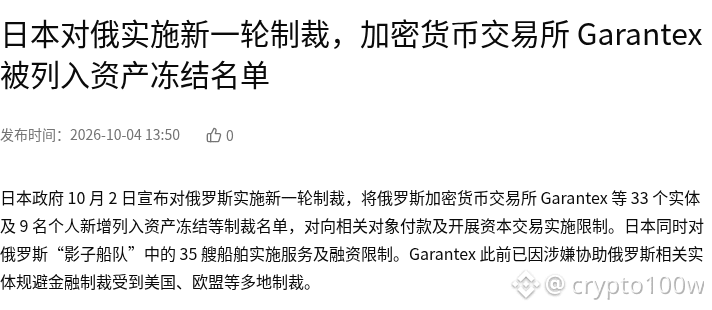
According to a report by Wu, on October 2 the Japanese government announced a new round of sanctions against Russia. The sanctions add 33 entities, such as the Russian crypto exchange Garantex, and nine individuals to lists subject to asset freezes, restricting payments to the relevant parties and capital transactions. Japan also imposed service and financing restrictions on 35 vessels in Russia’s “shadow fleet.” The report notes that Garantex had previously been sanctioned in multiple places including the United States and the EU for allegedly helping Russian entities evade financial sanctions.
One observation is that after Japan moved, major legal jurisdictions have been more aligned in tightening the blockade of crypto channels related to Russia. Another observation is that the more directly affected are Russia-related crypto payments, stablecoin circulation, and exchange compliance risks—the compliance costs for grey cross-border flows continue to rise. Are you more concerned that platform compliance will keep tightening, or that stablecoin circulation routes will be adjusted again?
Figure 1: Japan sanctions Garantex · Source: partial screenshot of the webpage
Image source: https://www.wublock123.com/news/japan-imposes-new-sanctions-russia-garantex-crypto-exchange-assets-frozen-69506
Don’t, the moment you see sanctions, go first looking for which coin you can use to dump—this time the focus really isn’t on the price of a single coin.
According to a report by Wu, on October 2 the Japanese government announced a new round of sanctions against Russia. The sanctions add 33 entities, such as the Russian crypto exchange Garantex, and nine individuals to lists subject to asset freezes, restricting payments to the relevant parties and capital transactions. Japan also imposed service and financing restrictions on 35 vessels in Russia’s “shadow fleet.” The report notes that Garantex had previously been sanctioned in multiple places including the United States and the EU for allegedly helping Russian entities evade financial sanctions.
One observation is that after Japan moved, major legal jurisdictions have been more aligned in tightening the blockade of crypto channels related to Russia. Another observation is that the more directly affected are Russia-related crypto payments, stablecoin circulation, and exchange compliance risks—the compliance costs for grey cross-border flows continue to rise. Are you more concerned that platform compliance will keep tightening, or that stablecoin circulation routes will be adjusted again?
Figure 1: Japan sanctions Garantex · Source: partial screenshot of the webpage
Image source: https://www.wublock123.com/news/japan-imposes-new-sanctions-russia-garantex-crypto-exchange-assets-frozen-69506
According to a report by Wu, on October 2 the Japanese government announced a new round of sanctions against Russia. The sanctions add 33 entities, such as the Russian crypto exchange Garantex, and nine individuals to lists subject to asset freezes, restricting payments to the relevant parties and capital transactions. Japan also imposed service and financing restrictions on 35 vessels in Russia’s “shadow fleet.” The report notes that Garantex had previously been sanctioned in multiple places including the United States and the EU for allegedly helping Russian entities evade financial sanctions.
One observation is that after Japan moved, major legal jurisdictions have been more aligned in tightening the blockade of crypto channels related to Russia. Another observation is that the more directly affected are Russia-related crypto payments, stablecoin circulation, and exchange compliance risks—the compliance costs for grey cross-border flows continue to rise. Are you more concerned that platform compliance will keep tightening, or that stablecoin circulation routes will be adjusted again?
Figure 1: Japan sanctions Garantex · Source: partial screenshot of the webpage
Image source: https://www.wublock123.com/news/japan-imposes-new-sanctions-russia-garantex-crypto-exchange-assets-frozen-69506
20
·
--
Don’t immediately start looking for pump-and-dump coins as soon as election news drops—this time, what to watch first is the regulatory direction.
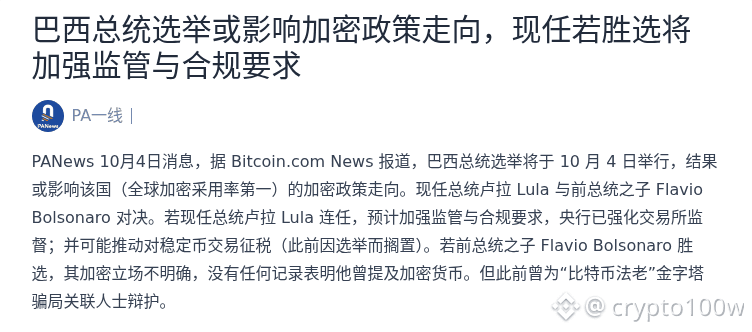
According to a report by PANews citing Bitcoin.com News, Brazil’s presidential election will be held on October 4. The country is the global leader in crypto adoption, and the outcome may shape the direction of local crypto policy. The two contenders are incumbent President Lula and Flavio Bolsonaro, the son of the former president. If Lula is re-elected, regulators are expected to strengthen supervision and compliance requirements. The central bank has already tightened oversight of exchanges, and it may also push forward the taxation of stablecoin transactions that were previously put on hold due to the election. If Flavio Bolsonaro wins, his stance on crypto is unclear. There is no record indicating that he has ever mentioned cryptocurrencies; previously, he defended an associate involved in the “Bitcoin Pharaoh” pyramid scheme.
One takeaway is that under a strong-regulation path, exchange supervision and stablecoin taxation will be put on the agenda first. Another is that when the route is uncertain, local compliance service providers and stablecoin trading flows such as USDT and USDC will face anticipated volatility first. Are you more concerned about the implementation of tightened compliance, or more focused on the waiting game caused by policy uncertainty?
Figure 1: Brazil election sways crypto regulatory path · Source page partial screenshot
Image source: https://www.panewslab.com/zh/articles/01a10565-a868-7255-85fe-f6ae95b88961
Don’t immediately start looking for pump-and-dump coins as soon as election news drops—this time, what to watch first is the regulatory direction.
According to a report by PANews citing Bitcoin.com News, Brazil’s presidential election will be held on October 4. The country is the global leader in crypto adoption, and the outcome may shape the direction of local crypto policy. The two contenders are incumbent President Lula and Flavio Bolsonaro, the son of the former president. If Lula is re-elected, regulators are expected to strengthen supervision and compliance requirements. The central bank has already tightened oversight of exchanges, and it may also push forward the taxation of stablecoin transactions that were previously put on hold due to the election. If Flavio Bolsonaro wins, his stance on crypto is unclear. There is no record indicating that he has ever mentioned cryptocurrencies; previously, he defended an associate involved in the “Bitcoin Pharaoh” pyramid scheme.
One takeaway is that under a strong-regulation path, exchange supervision and stablecoin taxation will be put on the agenda first. Another is that when the route is uncertain, local compliance service providers and stablecoin trading flows such as USDT and USDC will face anticipated volatility first. Are you more concerned about the implementation of tightened compliance, or more focused on the waiting game caused by policy uncertainty?
Figure 1: Brazil election sways crypto regulatory path · Source page partial screenshot
Image source: https://www.panewslab.com/zh/articles/01a10565-a868-7255-85fe-f6ae95b88961
According to a report by PANews citing Bitcoin.com News, Brazil’s presidential election will be held on October 4. The country is the global leader in crypto adoption, and the outcome may shape the direction of local crypto policy. The two contenders are incumbent President Lula and Flavio Bolsonaro, the son of the former president. If Lula is re-elected, regulators are expected to strengthen supervision and compliance requirements. The central bank has already tightened oversight of exchanges, and it may also push forward the taxation of stablecoin transactions that were previously put on hold due to the election. If Flavio Bolsonaro wins, his stance on crypto is unclear. There is no record indicating that he has ever mentioned cryptocurrencies; previously, he defended an associate involved in the “Bitcoin Pharaoh” pyramid scheme.
One takeaway is that under a strong-regulation path, exchange supervision and stablecoin taxation will be put on the agenda first. Another is that when the route is uncertain, local compliance service providers and stablecoin trading flows such as USDT and USDC will face anticipated volatility first. Are you more concerned about the implementation of tightened compliance, or more focused on the waiting game caused by policy uncertainty?
Figure 1: Brazil election sways crypto regulatory path · Source page partial screenshot
Image source: https://www.panewslab.com/zh/articles/01a10565-a868-7255-85fe-f6ae95b88961
64
·
--
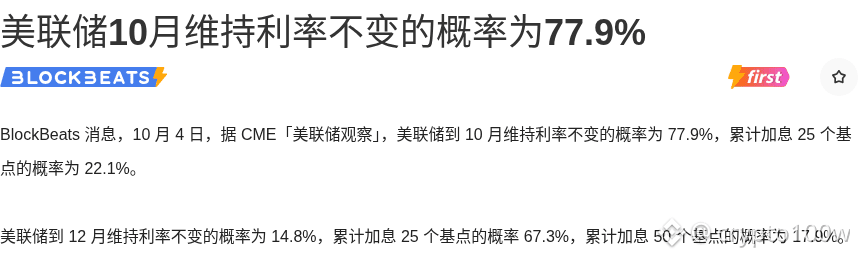
The probability that the U.S. Federal Reserve will hold interest rates steady in October has already risen to 77.9%.
BlockBeats, citing the CME “FedWatch,” shows that the probability the Fed keeps rates unchanged in October is 77.9%, while the probability of a cumulative 25-basis-point hike is 22.1%. By December, the probability of holding rates unchanged is 14.8%, the probability of a cumulative 25-basis-point hike is 67.3%, and the probability of a cumulative 50-basis-point hike is 17.9%.
For the crypto market, such high interest-rate expectations typically continue to weigh on risk appetite. Highly liquid assets like BTC and ETH are more likely to reflect changes in sentiment first. One observation is that if the U.S. dollar and U.S. stocks remain relatively strong, crypto rebounds are often harder to run far in one go. Another observation is that if capital is still willing to absorb at higher levels, it suggests the market has not fully finished digesting the macro pressure. Which probability are you more focused on: the odds of holding steady in October, or the changes in the odds of continued rate hikes by December?
Source: BlockBeats
Figure 1: The probability of the Fed holding rates steady in October rises to 77.9% · Partial screenshot from the source page
Image source: https://www.theblockbeats.info/flash/370203
The probability that the U.S. Federal Reserve will hold interest rates steady in October has already risen to 77.9%.
BlockBeats, citing the CME “FedWatch,” shows that the probability the Fed keeps rates unchanged in October is 77.9%, while the probability of a cumulative 25-basis-point hike is 22.1%. By December, the probability of holding rates unchanged is 14.8%, the probability of a cumulative 25-basis-point hike is 67.3%, and the probability of a cumulative 50-basis-point hike is 17.9%.
For the crypto market, such high interest-rate expectations typically continue to weigh on risk appetite. Highly liquid assets like BTC and ETH are more likely to reflect changes in sentiment first. One observation is that if the U.S. dollar and U.S. stocks remain relatively strong, crypto rebounds are often harder to run far in one go. Another observation is that if capital is still willing to absorb at higher levels, it suggests the market has not fully finished digesting the macro pressure. Which probability are you more focused on: the odds of holding steady in October, or the changes in the odds of continued rate hikes by December?
Source: BlockBeats
Figure 1: The probability of the Fed holding rates steady in October rises to 77.9% · Partial screenshot from the source page
Image source: https://www.theblockbeats.info/flash/370203
BlockBeats, citing the CME “FedWatch,” shows that the probability the Fed keeps rates unchanged in October is 77.9%, while the probability of a cumulative 25-basis-point hike is 22.1%. By December, the probability of holding rates unchanged is 14.8%, the probability of a cumulative 25-basis-point hike is 67.3%, and the probability of a cumulative 50-basis-point hike is 17.9%.
For the crypto market, such high interest-rate expectations typically continue to weigh on risk appetite. Highly liquid assets like BTC and ETH are more likely to reflect changes in sentiment first. One observation is that if the U.S. dollar and U.S. stocks remain relatively strong, crypto rebounds are often harder to run far in one go. Another observation is that if capital is still willing to absorb at higher levels, it suggests the market has not fully finished digesting the macro pressure. Which probability are you more focused on: the odds of holding steady in October, or the changes in the odds of continued rate hikes by December?
Source: BlockBeats
Figure 1: The probability of the Fed holding rates steady in October rises to 77.9% · Partial screenshot from the source page
Image source: https://www.theblockbeats.info/flash/370203
41
·
--
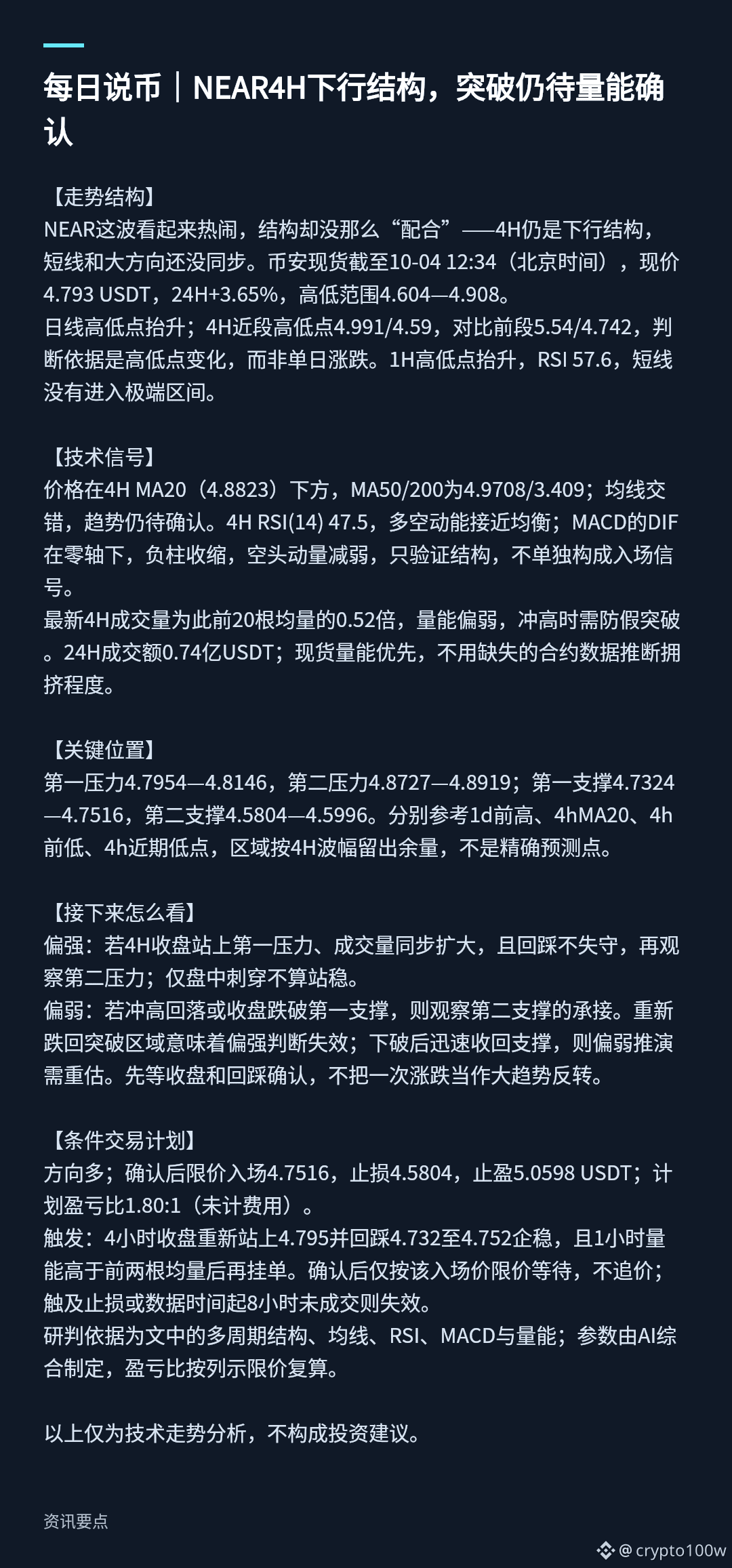
【Price Structure】
NEAR looks lively this round, but the structure isn’t quite “in sync” — the 4H chart is still in a downward structure, and the short-term and the broader direction have not aligned yet. Binance spot as of 10-04 12:34 (Beijing time): current price 4.793 USDT, 24H +3.65%, high-low range 4.604—4.908.
Daily highs and lows are rising; on the 4H near-term highs/lows are 4.991/4.59. Compared with the prior segment’s 5.54/4.742, the judgment is based on changes in highs/lows rather than the single day’s rise/fall. On the 1H chart, highs/lows are also rising; RSI is 57.6, and the short-term has not entered an extreme range.
【Technical Signals】
Price is below the 4H MA20 (4.8823). MA50/200 are 4.9708/3.409; the moving averages are intertwined, and the trend still needs confirmation. 4H RSI(14) is 47.5, with long/short momentum close to balanced. MACD’s DIF is below the zero line; the negative histogram is shrinking. Bearish momentum is weakening — it only validates the structure, not an independent entry signal.
The latest 4H成交量 is 0.52 times the average volume of the previous 20 candles; volume is relatively weak, so watch for false breakouts when price pushes higher. 24H traded value is 0.74B USDT; spot volume should be prioritized—don’t infer crowding from missing futures/contract data.
【Key Levels】
First resistance: 4.7954—4.8146; second resistance: 4.8727—4.8919.
First support: 4.7324—4.7516; second support: 4.5804—4.5996.
Reference these separately: 1d prior high, 4h MA20, 4h prior low, and the 4h recent low. The zones leave buffer based on the 4H swing range; they are not precise prediction points.
【How to Look Next】
Bullish: If the 4H closes above the first resistance with synchronized expansion in trading volume, and the pullback does not break it, then watch the second resistance. A mere intraday spike through it does not count as being “stable.”
Bearish: If price spikes up and then falls back, or the 4H close breaks below the first support, then watch how it holds at the second support. Falling back into the breakout zone means the bullish outlook is invalid. After a breakdown, if support is quickly reclaimed, the bearish scenario needs to be reassessed. Wait for the close and the pullback confirmation first; don’t treat a single rise/fall as a major trend reversal.
【Conditional Trading Plan】
Direction: Long.
After confirmation, place a limit order entry at 4.7516, stop loss at 4.5804, take profit at 5.0598 USDT. Planned risk/reward is 1.80:1 (fees not included).
Trigger: The 4-hour close reclaims 4.795 and then pulls back to 4.732—4.752 to stabilize, and only then place the order once the 1-hour volume is higher than the average volume of the previous two candles. After confirmation, only wait at this limit entry price—do not chase price. If it hits the stop loss, or if no trade occurs within 8 hours from the time the trigger happens, the plan becomes invalid.
The analysis is based on the multi-timeframe structure, moving averages, RSI, MACD, and volume mentioned in the text. Parameters are determined comprehensively by AI; the risk/reward is recalculated using the limit prices shown.
The above is only technical trend analysis and does not constitute investment advice.
【Price Structure】
NEAR looks lively this round, but the structure isn’t quite “in sync” — the 4H chart is still in a downward structure, and the short-term and the broader direction have not aligned yet. Binance spot as of 10-04 12:34 (Beijing time): current price 4.793 USDT, 24H +3.65%, high-low range 4.604—4.908.
Daily highs and lows are rising; on the 4H near-term highs/lows are 4.991/4.59. Compared with the prior segment’s 5.54/4.742, the judgment is based on changes in highs/lows rather than the single day’s rise/fall. On the 1H chart, highs/lows are also rising; RSI is 57.6, and the short-term has not entered an extreme range.
【Technical Signals】
Price is below the 4H MA20 (4.8823). MA50/200 are 4.9708/3.409; the moving averages are intertwined, and the trend still needs confirmation. 4H RSI(14) is 47.5, with long/short momentum close to balanced. MACD’s DIF is below the zero line; the negative histogram is shrinking. Bearish momentum is weakening — it only validates the structure, not an independent entry signal.
The latest 4H成交量 is 0.52 times the average volume of the previous 20 candles; volume is relatively weak, so watch for false breakouts when price pushes higher. 24H traded value is 0.74B USDT; spot volume should be prioritized—don’t infer crowding from missing futures/contract data.
【Key Levels】
First resistance: 4.7954—4.8146; second resistance: 4.8727—4.8919.
First support: 4.7324—4.7516; second support: 4.5804—4.5996.
Reference these separately: 1d prior high, 4h MA20, 4h prior low, and the 4h recent low. The zones leave buffer based on the 4H swing range; they are not precise prediction points.
【How to Look Next】
Bullish: If the 4H closes above the first resistance with synchronized expansion in trading volume, and the pullback does not break it, then watch the second resistance. A mere intraday spike through it does not count as being “stable.”
Bearish: If price spikes up and then falls back, or the 4H close breaks below the first support, then watch how it holds at the second support. Falling back into the breakout zone means the bullish outlook is invalid. After a breakdown, if support is quickly reclaimed, the bearish scenario needs to be reassessed. Wait for the close and the pullback confirmation first; don’t treat a single rise/fall as a major trend reversal.
【Conditional Trading Plan】
Direction: Long.
After confirmation, place a limit order entry at 4.7516, stop loss at 4.5804, take profit at 5.0598 USDT. Planned risk/reward is 1.80:1 (fees not included).
Trigger: The 4-hour close reclaims 4.795 and then pulls back to 4.732—4.752 to stabilize, and only then place the order once the 1-hour volume is higher than the average volume of the previous two candles. After confirmation, only wait at this limit entry price—do not chase price. If it hits the stop loss, or if no trade occurs within 8 hours from the time the trigger happens, the plan becomes invalid.
The analysis is based on the multi-timeframe structure, moving averages, RSI, MACD, and volume mentioned in the text. Parameters are determined comprehensively by AI; the risk/reward is recalculated using the limit prices shown.
The above is only technical trend analysis and does not constitute investment advice.
NEAR looks lively this round, but the structure isn’t quite “in sync” — the 4H chart is still in a downward structure, and the short-term and the broader direction have not aligned yet. Binance spot as of 10-04 12:34 (Beijing time): current price 4.793 USDT, 24H +3.65%, high-low range 4.604—4.908.
Daily highs and lows are rising; on the 4H near-term highs/lows are 4.991/4.59. Compared with the prior segment’s 5.54/4.742, the judgment is based on changes in highs/lows rather than the single day’s rise/fall. On the 1H chart, highs/lows are also rising; RSI is 57.6, and the short-term has not entered an extreme range.
【Technical Signals】
Price is below the 4H MA20 (4.8823). MA50/200 are 4.9708/3.409; the moving averages are intertwined, and the trend still needs confirmation. 4H RSI(14) is 47.5, with long/short momentum close to balanced. MACD’s DIF is below the zero line; the negative histogram is shrinking. Bearish momentum is weakening — it only validates the structure, not an independent entry signal.
The latest 4H成交量 is 0.52 times the average volume of the previous 20 candles; volume is relatively weak, so watch for false breakouts when price pushes higher. 24H traded value is 0.74B USDT; spot volume should be prioritized—don’t infer crowding from missing futures/contract data.
【Key Levels】
First resistance: 4.7954—4.8146; second resistance: 4.8727—4.8919.
First support: 4.7324—4.7516; second support: 4.5804—4.5996.
Reference these separately: 1d prior high, 4h MA20, 4h prior low, and the 4h recent low. The zones leave buffer based on the 4H swing range; they are not precise prediction points.
【How to Look Next】
Bullish: If the 4H closes above the first resistance with synchronized expansion in trading volume, and the pullback does not break it, then watch the second resistance. A mere intraday spike through it does not count as being “stable.”
Bearish: If price spikes up and then falls back, or the 4H close breaks below the first support, then watch how it holds at the second support. Falling back into the breakout zone means the bullish outlook is invalid. After a breakdown, if support is quickly reclaimed, the bearish scenario needs to be reassessed. Wait for the close and the pullback confirmation first; don’t treat a single rise/fall as a major trend reversal.
【Conditional Trading Plan】
Direction: Long.
After confirmation, place a limit order entry at 4.7516, stop loss at 4.5804, take profit at 5.0598 USDT. Planned risk/reward is 1.80:1 (fees not included).
Trigger: The 4-hour close reclaims 4.795 and then pulls back to 4.732—4.752 to stabilize, and only then place the order once the 1-hour volume is higher than the average volume of the previous two candles. After confirmation, only wait at this limit entry price—do not chase price. If it hits the stop loss, or if no trade occurs within 8 hours from the time the trigger happens, the plan becomes invalid.
The analysis is based on the multi-timeframe structure, moving averages, RSI, MACD, and volume mentioned in the text. Parameters are determined comprehensively by AI; the risk/reward is recalculated using the limit prices shown.
The above is only technical trend analysis and does not constitute investment advice.
72
·
--
Hyperliquid’s USDC reserve income for this time is finally not relying only on trading fees.
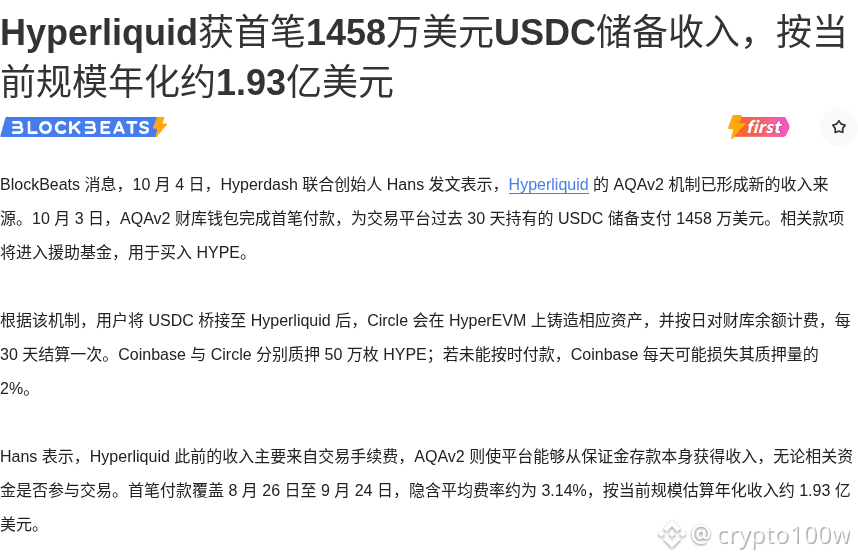
According to a BlockBeats report on October 4, Hans, co-founder of Hyperdash, said that Hyperliquid’s AQAv2 mechanism has formed a new source of revenue. On October 3, the AQAv2 treasury wallet completed its first payment, paying $14.58 million for the USDC reserves held by the trading platform over the past 30 days. This payment will be directed into a relief fund to purchase HYPE.
Under this mechanism, after users bridge USDC to Hyperliquid, Circle will mint the corresponding assets on HyperEVM and charge the treasury balance on a daily basis, with settlements made once every 30 days. Hans said the first payment covered August 26 to September 24, implying an average fee rate of about 3.14%. Based on the current scale, the estimated annualized revenue is about $193 million.
One observation is that the platform’s revenue streams have expanded from trading fees to margin deposits themselves, making the capital return loop more complete. Another observation is that if subsequent revenue continues to be realized, the market will pay even more attention to the monthly settlement cadence rather than individual news items.
Are you more focused on the strength of HYPE buybacks, or the stability of the monthly credits after AQAv2?
Figure 1: Hyperliquid’s first USDC reserve income credited · Source page partial screenshot
Image source: https://www.theblockbeats.info/flash/370202
Hyperliquid’s USDC reserve income for this time is finally not relying only on trading fees.
According to a BlockBeats report on October 4, Hans, co-founder of Hyperdash, said that Hyperliquid’s AQAv2 mechanism has formed a new source of revenue. On October 3, the AQAv2 treasury wallet completed its first payment, paying $14.58 million for the USDC reserves held by the trading platform over the past 30 days. This payment will be directed into a relief fund to purchase HYPE.
Under this mechanism, after users bridge USDC to Hyperliquid, Circle will mint the corresponding assets on HyperEVM and charge the treasury balance on a daily basis, with settlements made once every 30 days. Hans said the first payment covered August 26 to September 24, implying an average fee rate of about 3.14%. Based on the current scale, the estimated annualized revenue is about $193 million.
One observation is that the platform’s revenue streams have expanded from trading fees to margin deposits themselves, making the capital return loop more complete. Another observation is that if subsequent revenue continues to be realized, the market will pay even more attention to the monthly settlement cadence rather than individual news items.
Are you more focused on the strength of HYPE buybacks, or the stability of the monthly credits after AQAv2?
Figure 1: Hyperliquid’s first USDC reserve income credited · Source page partial screenshot
Image source: https://www.theblockbeats.info/flash/370202
According to a BlockBeats report on October 4, Hans, co-founder of Hyperdash, said that Hyperliquid’s AQAv2 mechanism has formed a new source of revenue. On October 3, the AQAv2 treasury wallet completed its first payment, paying $14.58 million for the USDC reserves held by the trading platform over the past 30 days. This payment will be directed into a relief fund to purchase HYPE.
Under this mechanism, after users bridge USDC to Hyperliquid, Circle will mint the corresponding assets on HyperEVM and charge the treasury balance on a daily basis, with settlements made once every 30 days. Hans said the first payment covered August 26 to September 24, implying an average fee rate of about 3.14%. Based on the current scale, the estimated annualized revenue is about $193 million.
One observation is that the platform’s revenue streams have expanded from trading fees to margin deposits themselves, making the capital return loop more complete. Another observation is that if subsequent revenue continues to be realized, the market will pay even more attention to the monthly settlement cadence rather than individual news items.
Are you more focused on the strength of HYPE buybacks, or the stability of the monthly credits after AQAv2?
Figure 1: Hyperliquid’s first USDC reserve income credited · Source page partial screenshot
Image source: https://www.theblockbeats.info/flash/370202
131
·
--
Cronos has written its “buyback + burn” narrative directly into the tokenomics.
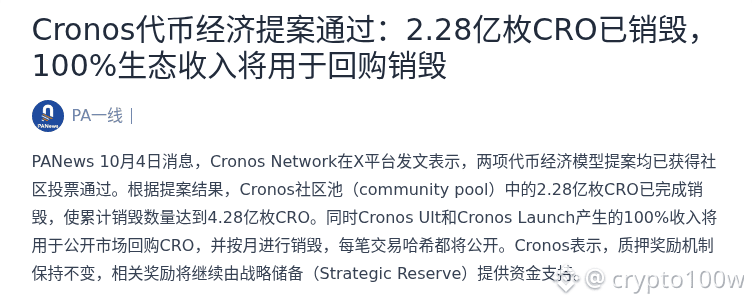
Cronos Network posted on X that two tokenomics model proposals have been approved through community voting. 228 million CRO tokens in the community pool have already been burned, bringing the cumulative number of CRO burned to 428 million. 100% of the revenue generated by Cronos Ult and Cronos Launch will be used to buy back CRO on the open market, with monthly burns; the transaction hash for each deal will also be made public. The staking reward mechanism remains unchanged, and related rewards continue to be funded by the Strategic Reserve.
The appeal of these arrangements is straightforward: they tie ecosystem revenue to reduced supply, while also laying out execution details in the open. Two things are worth watching next: first, whether the revenue scale from Cronos Ult and Cronos Launch can be sustained; second, whether monthly burn activity and transaction-hash disclosures remain consistent.
Do you value the long-term constraint of this “revenue buyback and burn” approach more, or are you more concerned with the actual pace of execution?
Source: PANews
Image 1: Cronos proposes buyback and burn of CRO · Source: partial screenshot of the page
Image source: https://www.panewslab.com/zh/articles/01a104e6-249a-70e8-a3d8-d3da2112b19b
Cronos has written its “buyback + burn” narrative directly into the tokenomics.
Cronos Network posted on X that two tokenomics model proposals have been approved through community voting. 228 million CRO tokens in the community pool have already been burned, bringing the cumulative number of CRO burned to 428 million. 100% of the revenue generated by Cronos Ult and Cronos Launch will be used to buy back CRO on the open market, with monthly burns; the transaction hash for each deal will also be made public. The staking reward mechanism remains unchanged, and related rewards continue to be funded by the Strategic Reserve.
The appeal of these arrangements is straightforward: they tie ecosystem revenue to reduced supply, while also laying out execution details in the open. Two things are worth watching next: first, whether the revenue scale from Cronos Ult and Cronos Launch can be sustained; second, whether monthly burn activity and transaction-hash disclosures remain consistent.
Do you value the long-term constraint of this “revenue buyback and burn” approach more, or are you more concerned with the actual pace of execution?
Source: PANews
Image 1: Cronos proposes buyback and burn of CRO · Source: partial screenshot of the page
Image source: https://www.panewslab.com/zh/articles/01a104e6-249a-70e8-a3d8-d3da2112b19b
Cronos Network posted on X that two tokenomics model proposals have been approved through community voting. 228 million CRO tokens in the community pool have already been burned, bringing the cumulative number of CRO burned to 428 million. 100% of the revenue generated by Cronos Ult and Cronos Launch will be used to buy back CRO on the open market, with monthly burns; the transaction hash for each deal will also be made public. The staking reward mechanism remains unchanged, and related rewards continue to be funded by the Strategic Reserve.
The appeal of these arrangements is straightforward: they tie ecosystem revenue to reduced supply, while also laying out execution details in the open. Two things are worth watching next: first, whether the revenue scale from Cronos Ult and Cronos Launch can be sustained; second, whether monthly burn activity and transaction-hash disclosures remain consistent.
Do you value the long-term constraint of this “revenue buyback and burn” approach more, or are you more concerned with the actual pace of execution?
Source: PANews
Image 1: Cronos proposes buyback and burn of CRO · Source: partial screenshot of the page
Image source: https://www.panewslab.com/zh/articles/01a104e6-249a-70e8-a3d8-d3da2112b19b
138
·
--
This week, the ZEC spot ETF first gave investors a “cooling reminder” in the form of capital flows.
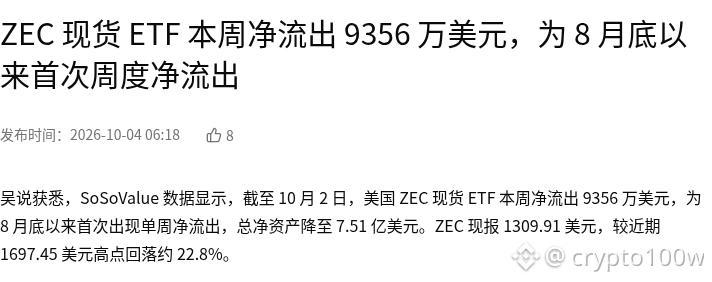
Wu Shuo learned from SoSoValue data that as of October 2, the U.S. ZEC spot ETF saw a net outflow of $93.56 million for the week, bringing total net assets down to $751 million—the first time a single-week net outflow has occurred since the end of August. For the market, this is not a sentiment issue; it’s a capital-flow issue. Once the continuous inflow turns to outflow, the pressure on buyers to absorb short-term chasing higher becomes more direct.
If next week’s capital flows can be repaired quickly, the market is more likely to treat this outflow as a period of temporary volatility. But if net outflows continue, redemption pressure and profit-taking pressure will become more evident. Which are you more focused on: capital flows turning positive first, or the trading volume and order absorption after ZEC pulls back?
Source: Wu Shuo
#ZEC
Image 1: ZEC spot ETF’s first weekly net outflow · Source page partial screenshot
Image source: https://www.wublock123.com/news/zec-spot-etf-had-a-net-outflow-of-9356-million-this-week-marking-the-first-weekly-net-outflow-since-the-end-of-august-69494
This week, the ZEC spot ETF first gave investors a “cooling reminder” in the form of capital flows.
Wu Shuo learned from SoSoValue data that as of October 2, the U.S. ZEC spot ETF saw a net outflow of $93.56 million for the week, bringing total net assets down to $751 million—the first time a single-week net outflow has occurred since the end of August. For the market, this is not a sentiment issue; it’s a capital-flow issue. Once the continuous inflow turns to outflow, the pressure on buyers to absorb short-term chasing higher becomes more direct.
If next week’s capital flows can be repaired quickly, the market is more likely to treat this outflow as a period of temporary volatility. But if net outflows continue, redemption pressure and profit-taking pressure will become more evident. Which are you more focused on: capital flows turning positive first, or the trading volume and order absorption after ZEC pulls back?
Source: Wu Shuo
#ZEC
Image 1: ZEC spot ETF’s first weekly net outflow · Source page partial screenshot
Image source: https://www.wublock123.com/news/zec-spot-etf-had-a-net-outflow-of-9356-million-this-week-marking-the-first-weekly-net-outflow-since-the-end-of-august-69494
Wu Shuo learned from SoSoValue data that as of October 2, the U.S. ZEC spot ETF saw a net outflow of $93.56 million for the week, bringing total net assets down to $751 million—the first time a single-week net outflow has occurred since the end of August. For the market, this is not a sentiment issue; it’s a capital-flow issue. Once the continuous inflow turns to outflow, the pressure on buyers to absorb short-term chasing higher becomes more direct.
If next week’s capital flows can be repaired quickly, the market is more likely to treat this outflow as a period of temporary volatility. But if net outflows continue, redemption pressure and profit-taking pressure will become more evident. Which are you more focused on: capital flows turning positive first, or the trading volume and order absorption after ZEC pulls back?
Source: Wu Shuo
#ZEC
Image 1: ZEC spot ETF’s first weekly net outflow · Source page partial screenshot
Image source: https://www.wublock123.com/news/zec-spot-etf-had-a-net-outflow-of-9356-million-this-week-marking-the-first-weekly-net-outflow-since-the-end-of-august-69494
17
·
--
BTC has just crossed above $85,000.
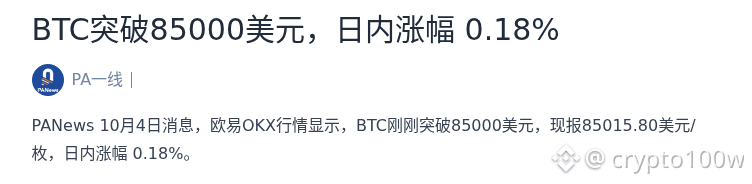
According to the OKX/OKEx market data, BTC is currently trading at about $85,015.80, up 0.18% on the day. This level is a key round-number threshold; short-term sentiment may initially be driven by it, but the current momentum isn’t strong yet.
Two things are worth watching more: first, whether BTC can hold steadily above $85,000; second, whether pullbacks see sufficient follow-through. If trading volume cooperates, trend-following capital can more easily take the baton. If volume is relatively weak, the breakout chase bids above the round number may be absorbed more quickly.
Would you rather see BTC continue to hold above $85,000, or would you prefer a pullback first for confirmation before moving on?
Figure 1: BTC breaks above $85,000 · Source page partial screenshot
Image source: https://www.panewslab.com/zh/articles/01a102ea-af77-70dd-b59d-9d8496392b07
BTC has just crossed above $85,000.
According to the OKX/OKEx market data, BTC is currently trading at about $85,015.80, up 0.18% on the day. This level is a key round-number threshold; short-term sentiment may initially be driven by it, but the current momentum isn’t strong yet.
Two things are worth watching more: first, whether BTC can hold steadily above $85,000; second, whether pullbacks see sufficient follow-through. If trading volume cooperates, trend-following capital can more easily take the baton. If volume is relatively weak, the breakout chase bids above the round number may be absorbed more quickly.
Would you rather see BTC continue to hold above $85,000, or would you prefer a pullback first for confirmation before moving on?
Figure 1: BTC breaks above $85,000 · Source page partial screenshot
Image source: https://www.panewslab.com/zh/articles/01a102ea-af77-70dd-b59d-9d8496392b07
According to the OKX/OKEx market data, BTC is currently trading at about $85,015.80, up 0.18% on the day. This level is a key round-number threshold; short-term sentiment may initially be driven by it, but the current momentum isn’t strong yet.
Two things are worth watching more: first, whether BTC can hold steadily above $85,000; second, whether pullbacks see sufficient follow-through. If trading volume cooperates, trend-following capital can more easily take the baton. If volume is relatively weak, the breakout chase bids above the round number may be absorbed more quickly.
Would you rather see BTC continue to hold above $85,000, or would you prefer a pullback first for confirmation before moving on?
Figure 1: BTC breaks above $85,000 · Source page partial screenshot
Image source: https://www.panewslab.com/zh/articles/01a102ea-af77-70dd-b59d-9d8496392b07
23
·
--
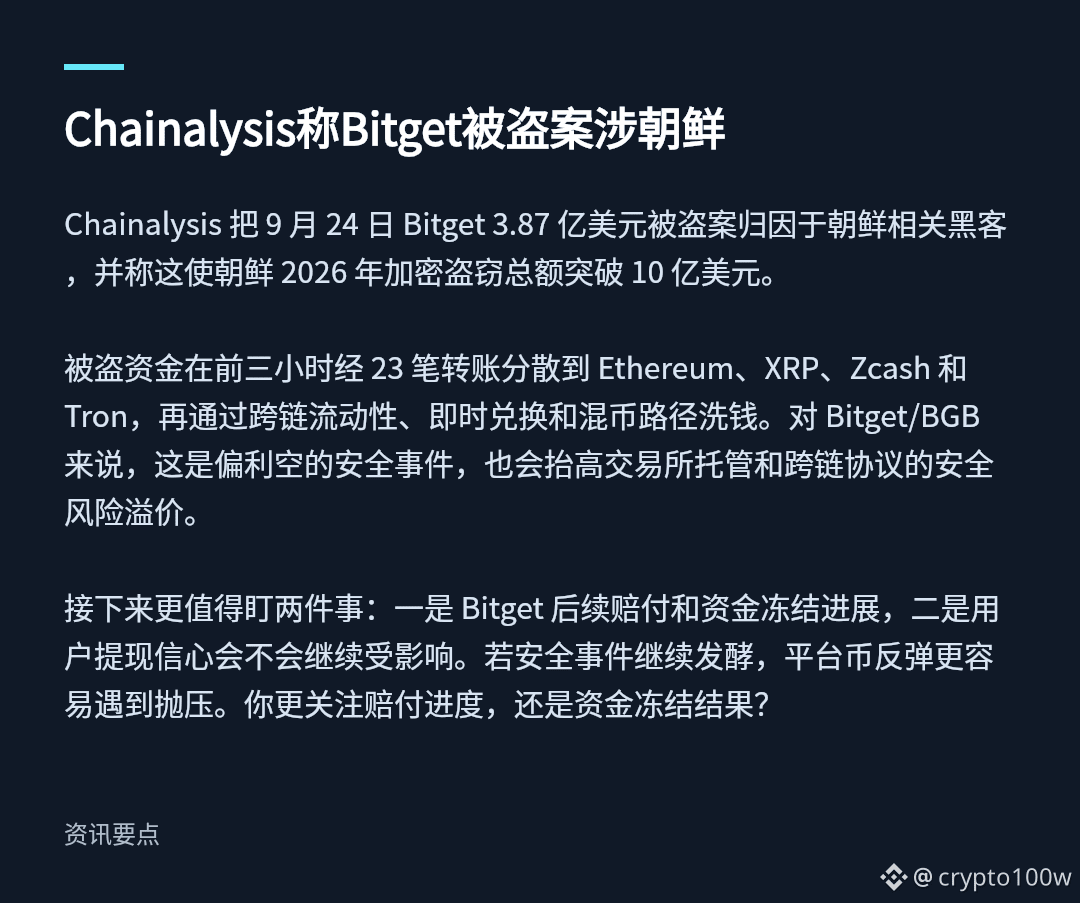
Chainalysis attributes the September 24 Bitget $387 million hack to North Korea-linked hackers and says this will push North Korea’s total crypto theft in 2026 beyond $1 billion.
Within the first three hours, the stolen funds were dispersed via 23 transactions across Ethereum, XRP, Zcash, and Tron, and then laundered through cross-chain liquidity, instant swaps, and mixing routes. For Bitget/BGB, this is a security-negative event, and it will also raise the security risk premium for exchange custody and cross-chain protocols.
Next, there are two things worth keeping a close eye on: first, Bitget’s subsequent compensation and the progress on fund freezes; second, whether users’ confidence in withdrawals will continue to be affected. If the security incident keeps escalating, a rebound in the exchange token is more likely to face selling pressure. Are you more concerned about the compensation progress or the outcome of the fund freeze?
Figure 1: Chainalysis says the Bitget hack involves North Korea — key news points
Image source: https://decrypt.co/380005/chainalysis-ai-87m-bitget-hack-north-korea
Chainalysis attributes the September 24 Bitget $387 million hack to North Korea-linked hackers and says this will push North Korea’s total crypto theft in 2026 beyond $1 billion.
Within the first three hours, the stolen funds were dispersed via 23 transactions across Ethereum, XRP, Zcash, and Tron, and then laundered through cross-chain liquidity, instant swaps, and mixing routes. For Bitget/BGB, this is a security-negative event, and it will also raise the security risk premium for exchange custody and cross-chain protocols.
Next, there are two things worth keeping a close eye on: first, Bitget’s subsequent compensation and the progress on fund freezes; second, whether users’ confidence in withdrawals will continue to be affected. If the security incident keeps escalating, a rebound in the exchange token is more likely to face selling pressure. Are you more concerned about the compensation progress or the outcome of the fund freeze?
Figure 1: Chainalysis says the Bitget hack involves North Korea — key news points
Image source: https://decrypt.co/380005/chainalysis-ai-87m-bitget-hack-north-korea
Within the first three hours, the stolen funds were dispersed via 23 transactions across Ethereum, XRP, Zcash, and Tron, and then laundered through cross-chain liquidity, instant swaps, and mixing routes. For Bitget/BGB, this is a security-negative event, and it will also raise the security risk premium for exchange custody and cross-chain protocols.
Next, there are two things worth keeping a close eye on: first, Bitget’s subsequent compensation and the progress on fund freezes; second, whether users’ confidence in withdrawals will continue to be affected. If the security incident keeps escalating, a rebound in the exchange token is more likely to face selling pressure. Are you more concerned about the compensation progress or the outcome of the fund freeze?
Figure 1: Chainalysis says the Bitget hack involves North Korea — key news points
Image source: https://decrypt.co/380005/chainalysis-ai-87m-bitget-hack-north-korea
510
·
--
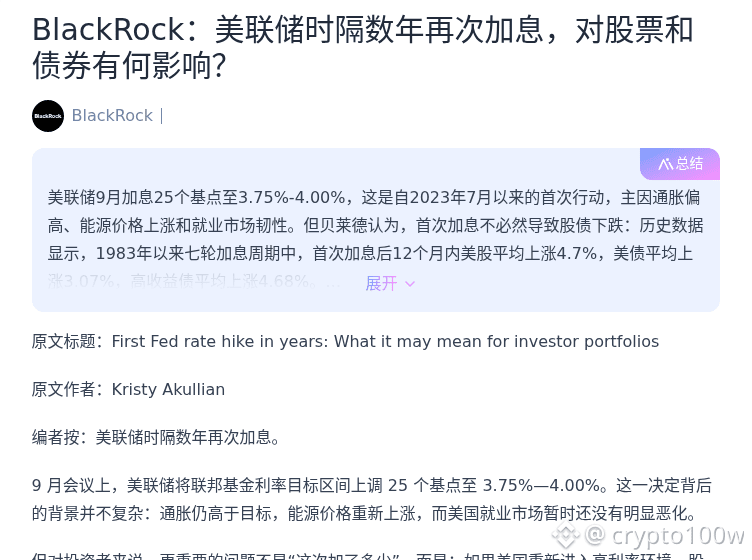
BlackRock’s message this time is very straightforward: when the Fed raises rates again after years, it doesn’t necessarily mean stocks and bonds will weaken in tandem.
What it looks at isn’t just the single action of “whether or not to raise rates,” but whether economic resilience, interest-rate volatility, and corporate earnings can hold up valuations. In the original text cited by PANews, it mentions that the Fed raised rates by 25 basis points to 3.75%-4.00% in September—its first move since July 2023.
For the market, the point of contention is also clear. Persistently high rates will continue to weigh on the valuation space of liquidity-sensitive assets like BTC and ETH; however, if the pace of rate hikes is not aggressive and economic data remains steady, risk assets may still rotate. In BlackRock’s statistics across seven tightening cycles since 1983, in the 12 months after the first rate hike, the S&P 500 averaged a gain of 4.7%, U.S. Treasuries averaged a rise of 3.07%, and high-yield bonds averaged a gain of 4.68%.
So what’s worth watching more now is actually the 10-year U.S. Treasury yield and the U.S. dollar index. One observation is that if long-end yields continue to rise, a crypto rebound may be more easily cashed out by funds; another is that if interest-rate volatility is suppressed, the market’s speed in adapting to a high-rate environment could be faster. Which do you care more about—the 10-year U.S. Treasury yield or the U.S. dollar index?
Figure 1: BlackRock’s interpretation of the impact of the Fed’s first rate hike · Source page partial screenshot
Image source: https://www.panewslab.com/zh/articles/01a1027d-6a4a-72dd-9449-b5907922cfe1
BlackRock’s message this time is very straightforward: when the Fed raises rates again after years, it doesn’t necessarily mean stocks and bonds will weaken in tandem.
What it looks at isn’t just the single action of “whether or not to raise rates,” but whether economic resilience, interest-rate volatility, and corporate earnings can hold up valuations. In the original text cited by PANews, it mentions that the Fed raised rates by 25 basis points to 3.75%-4.00% in September—its first move since July 2023.
For the market, the point of contention is also clear. Persistently high rates will continue to weigh on the valuation space of liquidity-sensitive assets like BTC and ETH; however, if the pace of rate hikes is not aggressive and economic data remains steady, risk assets may still rotate. In BlackRock’s statistics across seven tightening cycles since 1983, in the 12 months after the first rate hike, the S&P 500 averaged a gain of 4.7%, U.S. Treasuries averaged a rise of 3.07%, and high-yield bonds averaged a gain of 4.68%.
So what’s worth watching more now is actually the 10-year U.S. Treasury yield and the U.S. dollar index. One observation is that if long-end yields continue to rise, a crypto rebound may be more easily cashed out by funds; another is that if interest-rate volatility is suppressed, the market’s speed in adapting to a high-rate environment could be faster. Which do you care more about—the 10-year U.S. Treasury yield or the U.S. dollar index?
Figure 1: BlackRock’s interpretation of the impact of the Fed’s first rate hike · Source page partial screenshot
Image source: https://www.panewslab.com/zh/articles/01a1027d-6a4a-72dd-9449-b5907922cfe1
What it looks at isn’t just the single action of “whether or not to raise rates,” but whether economic resilience, interest-rate volatility, and corporate earnings can hold up valuations. In the original text cited by PANews, it mentions that the Fed raised rates by 25 basis points to 3.75%-4.00% in September—its first move since July 2023.
For the market, the point of contention is also clear. Persistently high rates will continue to weigh on the valuation space of liquidity-sensitive assets like BTC and ETH; however, if the pace of rate hikes is not aggressive and economic data remains steady, risk assets may still rotate. In BlackRock’s statistics across seven tightening cycles since 1983, in the 12 months after the first rate hike, the S&P 500 averaged a gain of 4.7%, U.S. Treasuries averaged a rise of 3.07%, and high-yield bonds averaged a gain of 4.68%.
So what’s worth watching more now is actually the 10-year U.S. Treasury yield and the U.S. dollar index. One observation is that if long-end yields continue to rise, a crypto rebound may be more easily cashed out by funds; another is that if interest-rate volatility is suppressed, the market’s speed in adapting to a high-rate environment could be faster. Which do you care more about—the 10-year U.S. Treasury yield or the U.S. dollar index?
Figure 1: BlackRock’s interpretation of the impact of the Fed’s first rate hike · Source page partial screenshot
Image source: https://www.panewslab.com/zh/articles/01a1027d-6a4a-72dd-9449-b5907922cfe1
113
·
--
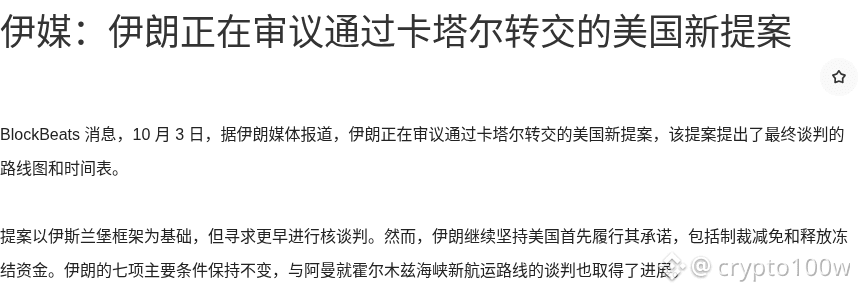
There are new proposals in the latest round of Iran-U.S. negotiations.
BlockBeats cited Iranian media as saying that Iran is considering a new U.S. proposal that was relayed via Qatar, which includes a final negotiation roadmap and timetable. Market commentary has leaned toward a mildly bullish interpretation of risk assets: if communications between the U.S. and Iran continue to move forward, there could be room for the Hormuz Strait premium, oil prices, and geopolitical conflict risk premium to cool off, and highly liquid assets like BTC and ETH could benefit first as risk-aversion sentiment fades.
However, this isn’t a direct positive for crypto. In trading terms, it’s more suitable to watch how oil prices, the U.S. dollar, and U.S. Treasury yields move in tandem. Iran still insists that the U.S. must fulfill its commitments first, including easing sanctions and releasing frozen funds. At the same time, Iran’s seven main conditions remain unchanged, and negotiations with Oman regarding a new shipping route through the Hormuz Strait have also made progress. If negotiation updates continue to be delivered, near-term capital may be more willing to chase risk assets; if the two sides start to stall or pull back again, macro risk-aversion could once more suppress crypto rebounds.
If further communication continues to advance, the market will first focus on changes in the Hormuz Strait premium, oil prices, and the geopolitical risk premium. If negotiations once again turn contentious, risk-off sentiment may also heat up again. Which do you care about more—oil prices reacting first, or the dollar and U.S. Treasury yields giving the signal first?
Source: BlockBeats
#BTC #ETH
Figure 1: New developments in the Iran-U.S. negotiations · Source page partial screenshot
Image source: https://www.theblockbeats.info/flash/370184
There are new proposals in the latest round of Iran-U.S. negotiations.
BlockBeats cited Iranian media as saying that Iran is considering a new U.S. proposal that was relayed via Qatar, which includes a final negotiation roadmap and timetable. Market commentary has leaned toward a mildly bullish interpretation of risk assets: if communications between the U.S. and Iran continue to move forward, there could be room for the Hormuz Strait premium, oil prices, and geopolitical conflict risk premium to cool off, and highly liquid assets like BTC and ETH could benefit first as risk-aversion sentiment fades.
However, this isn’t a direct positive for crypto. In trading terms, it’s more suitable to watch how oil prices, the U.S. dollar, and U.S. Treasury yields move in tandem. Iran still insists that the U.S. must fulfill its commitments first, including easing sanctions and releasing frozen funds. At the same time, Iran’s seven main conditions remain unchanged, and negotiations with Oman regarding a new shipping route through the Hormuz Strait have also made progress. If negotiation updates continue to be delivered, near-term capital may be more willing to chase risk assets; if the two sides start to stall or pull back again, macro risk-aversion could once more suppress crypto rebounds.
If further communication continues to advance, the market will first focus on changes in the Hormuz Strait premium, oil prices, and the geopolitical risk premium. If negotiations once again turn contentious, risk-off sentiment may also heat up again. Which do you care about more—oil prices reacting first, or the dollar and U.S. Treasury yields giving the signal first?
Source: BlockBeats
#BTC #ETH
Figure 1: New developments in the Iran-U.S. negotiations · Source page partial screenshot
Image source: https://www.theblockbeats.info/flash/370184
BlockBeats cited Iranian media as saying that Iran is considering a new U.S. proposal that was relayed via Qatar, which includes a final negotiation roadmap and timetable. Market commentary has leaned toward a mildly bullish interpretation of risk assets: if communications between the U.S. and Iran continue to move forward, there could be room for the Hormuz Strait premium, oil prices, and geopolitical conflict risk premium to cool off, and highly liquid assets like BTC and ETH could benefit first as risk-aversion sentiment fades.
However, this isn’t a direct positive for crypto. In trading terms, it’s more suitable to watch how oil prices, the U.S. dollar, and U.S. Treasury yields move in tandem. Iran still insists that the U.S. must fulfill its commitments first, including easing sanctions and releasing frozen funds. At the same time, Iran’s seven main conditions remain unchanged, and negotiations with Oman regarding a new shipping route through the Hormuz Strait have also made progress. If negotiation updates continue to be delivered, near-term capital may be more willing to chase risk assets; if the two sides start to stall or pull back again, macro risk-aversion could once more suppress crypto rebounds.
If further communication continues to advance, the market will first focus on changes in the Hormuz Strait premium, oil prices, and the geopolitical risk premium. If negotiations once again turn contentious, risk-off sentiment may also heat up again. Which do you care about more—oil prices reacting first, or the dollar and U.S. Treasury yields giving the signal first?
Source: BlockBeats
#BTC #ETH
Figure 1: New developments in the Iran-U.S. negotiations · Source page partial screenshot
Image source: https://www.theblockbeats.info/flash/370184
152
·
--
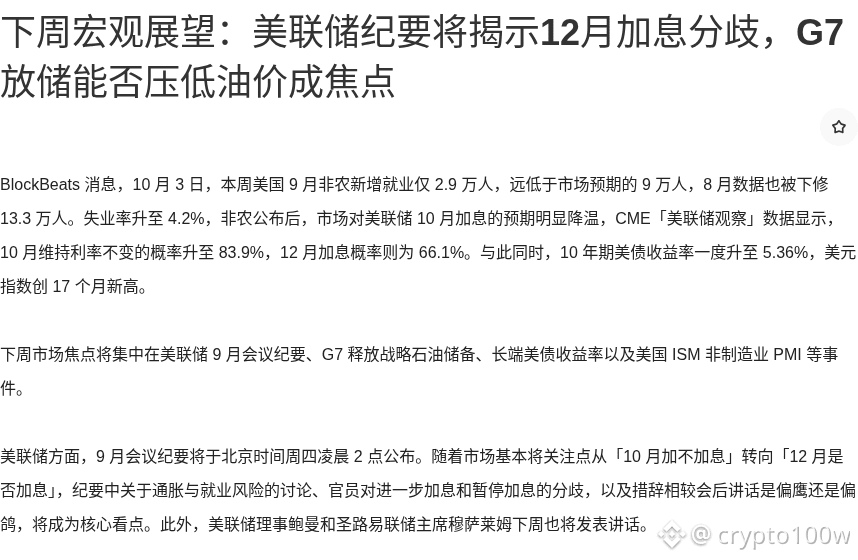
There will be no shortage of macro variables next week—don’t rush to treat the rebound as a trend.
In the U.S., September non-farm payrolls added only 29,000 jobs. The August figure was revised downward by 133,000, and the unemployment rate rose to 4.2%. After the jobs report, market expectations for a rate hike in October by the Federal Reserve cooled. CME’s “FedWatch” shows the probability that the Fed will keep rates unchanged in October rose to 83.9%, while the probability of a December hike is 66.1%.
More importantly, at 2:00 a.m. Beijing time early Thursday, the Fed will release the minutes from its September meeting. The market is also watching the G7’s release of a 100 million barrel oil and diesel reserve, as well as the U.S. ISM non-manufacturing PMI. The yield on 10-year U.S. Treasuries briefly climbed to 5.36%, and the U.S. dollar index hit a 17-month high. For major coins like BTC and ETH, two scenarios are clear: (1) if long-end yields fall, risk appetite is more likely to recover; (2) if yields continue to trade at elevated levels, oil-price volatility and a strong dollar could cause any rebound to be realized more quickly.
Which are you more focused on—the hawk/dove differences in the Fed minutes, or whether the 10-year Treasury yield can first pull back?
Figure 1: The Fed minutes and the oil-price shock are about to hit · Partial screenshot of the source page
Image source: https://www.theblockbeats.info/flash/370182
There will be no shortage of macro variables next week—don’t rush to treat the rebound as a trend.
In the U.S., September non-farm payrolls added only 29,000 jobs. The August figure was revised downward by 133,000, and the unemployment rate rose to 4.2%. After the jobs report, market expectations for a rate hike in October by the Federal Reserve cooled. CME’s “FedWatch” shows the probability that the Fed will keep rates unchanged in October rose to 83.9%, while the probability of a December hike is 66.1%.
More importantly, at 2:00 a.m. Beijing time early Thursday, the Fed will release the minutes from its September meeting. The market is also watching the G7’s release of a 100 million barrel oil and diesel reserve, as well as the U.S. ISM non-manufacturing PMI. The yield on 10-year U.S. Treasuries briefly climbed to 5.36%, and the U.S. dollar index hit a 17-month high. For major coins like BTC and ETH, two scenarios are clear: (1) if long-end yields fall, risk appetite is more likely to recover; (2) if yields continue to trade at elevated levels, oil-price volatility and a strong dollar could cause any rebound to be realized more quickly.
Which are you more focused on—the hawk/dove differences in the Fed minutes, or whether the 10-year Treasury yield can first pull back?
Figure 1: The Fed minutes and the oil-price shock are about to hit · Partial screenshot of the source page
Image source: https://www.theblockbeats.info/flash/370182
In the U.S., September non-farm payrolls added only 29,000 jobs. The August figure was revised downward by 133,000, and the unemployment rate rose to 4.2%. After the jobs report, market expectations for a rate hike in October by the Federal Reserve cooled. CME’s “FedWatch” shows the probability that the Fed will keep rates unchanged in October rose to 83.9%, while the probability of a December hike is 66.1%.
More importantly, at 2:00 a.m. Beijing time early Thursday, the Fed will release the minutes from its September meeting. The market is also watching the G7’s release of a 100 million barrel oil and diesel reserve, as well as the U.S. ISM non-manufacturing PMI. The yield on 10-year U.S. Treasuries briefly climbed to 5.36%, and the U.S. dollar index hit a 17-month high. For major coins like BTC and ETH, two scenarios are clear: (1) if long-end yields fall, risk appetite is more likely to recover; (2) if yields continue to trade at elevated levels, oil-price volatility and a strong dollar could cause any rebound to be realized more quickly.
Which are you more focused on—the hawk/dove differences in the Fed minutes, or whether the 10-year Treasury yield can first pull back?
Figure 1: The Fed minutes and the oil-price shock are about to hit · Partial screenshot of the source page
Image source: https://www.theblockbeats.info/flash/370182
5
·
--
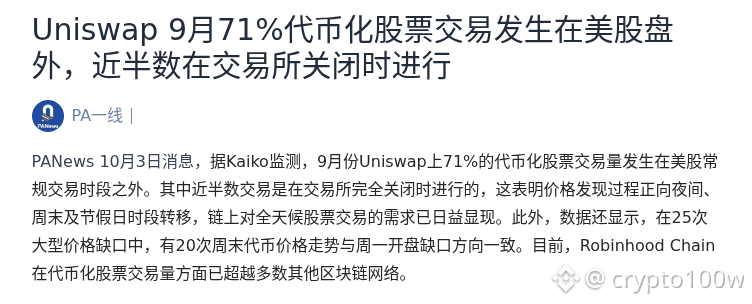
This Uniswap data set shows that on-chain tokenized stocks are no longer just “hype.”
PANews, citing Kaiko’s monitoring, reports that in September, 71% of tokenized stock trading volume on Uniswap occurred outside regular U.S. stock market trading hours, with nearly half taking place when the exchanges were completely closed. In addition, of 25 major price gaps, 20 weekend price movements aligned with the direction of the Monday opening gap.
If we take this as fact, at least two things stand out: first, price discovery is extending into nights, weekends, and holidays; second, these trading pairs are more sensitive to RWA, on-chain stocks, and UNI. What’s worth watching next is whether off-hours trading can keep gaining momentum, and whether tokenized stock infrastructure and liquidity entry points can continue to absorb demand. Are you more interested in the continuation of off-hours activity, or in Monday’s gap confirmation of the price action?
Figure 1: Off-hours trading share for tokenized stocks on Uniswap reaches 71% · Source: partial screenshot of the page
Image source: https://www.panewslab.com/zh/articles/01a101ea-0b22-730a-8344-ff4c64da178c
This Uniswap data set shows that on-chain tokenized stocks are no longer just “hype.”
PANews, citing Kaiko’s monitoring, reports that in September, 71% of tokenized stock trading volume on Uniswap occurred outside regular U.S. stock market trading hours, with nearly half taking place when the exchanges were completely closed. In addition, of 25 major price gaps, 20 weekend price movements aligned with the direction of the Monday opening gap.
If we take this as fact, at least two things stand out: first, price discovery is extending into nights, weekends, and holidays; second, these trading pairs are more sensitive to RWA, on-chain stocks, and UNI. What’s worth watching next is whether off-hours trading can keep gaining momentum, and whether tokenized stock infrastructure and liquidity entry points can continue to absorb demand. Are you more interested in the continuation of off-hours activity, or in Monday’s gap confirmation of the price action?
Figure 1: Off-hours trading share for tokenized stocks on Uniswap reaches 71% · Source: partial screenshot of the page
Image source: https://www.panewslab.com/zh/articles/01a101ea-0b22-730a-8344-ff4c64da178c
PANews, citing Kaiko’s monitoring, reports that in September, 71% of tokenized stock trading volume on Uniswap occurred outside regular U.S. stock market trading hours, with nearly half taking place when the exchanges were completely closed. In addition, of 25 major price gaps, 20 weekend price movements aligned with the direction of the Monday opening gap.
If we take this as fact, at least two things stand out: first, price discovery is extending into nights, weekends, and holidays; second, these trading pairs are more sensitive to RWA, on-chain stocks, and UNI. What’s worth watching next is whether off-hours trading can keep gaining momentum, and whether tokenized stock infrastructure and liquidity entry points can continue to absorb demand. Are you more interested in the continuation of off-hours activity, or in Monday’s gap confirmation of the price action?
Figure 1: Off-hours trading share for tokenized stocks on Uniswap reaches 71% · Source: partial screenshot of the page
Image source: https://www.panewslab.com/zh/articles/01a101ea-0b22-730a-8344-ff4c64da178c
34
·
--
Hyperliquid Strategies buys another 1.9 million HYPE
Hyperliquid Strategies has added to its position again.
According to PANews, the Nasdaq-listed HYPE treasury company Hyperliquid Strategies once again purchased 1.9 million HYPE, worth approximately $167.2 million. As of now, its holdings have increased to about 37 million HYPE, with an additional cash balance of around $292.6 million.
From a fundamentals perspective, this kind of ongoing accumulation in the public market treasury consistently boosts both institutional buy orders and narrative endorsement, making the Hyperliquid ecosystem even more prominent within U.S.-listed stock market capital. From an observation standpoint, short-term funds may continue to circle around “treasury buys,” chasing $HYPE. However, the treasury share discount/premium, the timing of subsequent financing, and the concentration level of large holdings will all amplify volatility.
Would you rather see whether spot demand continues to pick up afterward, or first watch how the discount/premium trend plays out?
Figure 1: Hyperliquid Strategies buys another 1.9 million HYPE · Key news points
Image source: https://www.panewslab.com/zh/articles/01a10203-95d0-757b-a2a0-7b9ce4844880
Hyperliquid Strategies buys another 1.9 million HYPE
Hyperliquid Strategies has added to its position again.
According to PANews, the Nasdaq-listed HYPE treasury company Hyperliquid Strategies once again purchased 1.9 million HYPE, worth approximately $167.2 million. As of now, its holdings have increased to about 37 million HYPE, with an additional cash balance of around $292.6 million.
From a fundamentals perspective, this kind of ongoing accumulation in the public market treasury consistently boosts both institutional buy orders and narrative endorsement, making the Hyperliquid ecosystem even more prominent within U.S.-listed stock market capital. From an observation standpoint, short-term funds may continue to circle around “treasury buys,” chasing $HYPE . However, the treasury share discount/premium, the timing of subsequent financing, and the concentration level of large holdings will all amplify volatility.
Would you rather see whether spot demand continues to pick up afterward, or first watch how the discount/premium trend plays out?
Figure 1: Hyperliquid Strategies buys another 1.9 million HYPE · Key news points
Image source: https://www.panewslab.com/zh/articles/01a10203-95d0-757b-a2a0-7b9ce4844880
Hyperliquid Strategies has added to its position again.
According to PANews, the Nasdaq-listed HYPE treasury company Hyperliquid Strategies once again purchased 1.9 million HYPE, worth approximately $167.2 million. As of now, its holdings have increased to about 37 million HYPE, with an additional cash balance of around $292.6 million.
From a fundamentals perspective, this kind of ongoing accumulation in the public market treasury consistently boosts both institutional buy orders and narrative endorsement, making the Hyperliquid ecosystem even more prominent within U.S.-listed stock market capital. From an observation standpoint, short-term funds may continue to circle around “treasury buys,” chasing $HYPE . However, the treasury share discount/premium, the timing of subsequent financing, and the concentration level of large holdings will all amplify volatility.
Would you rather see whether spot demand continues to pick up afterward, or first watch how the discount/premium trend plays out?
Figure 1: Hyperliquid Strategies buys another 1.9 million HYPE · Key news points
Image source: https://www.panewslab.com/zh/articles/01a10203-95d0-757b-a2a0-7b9ce4844880
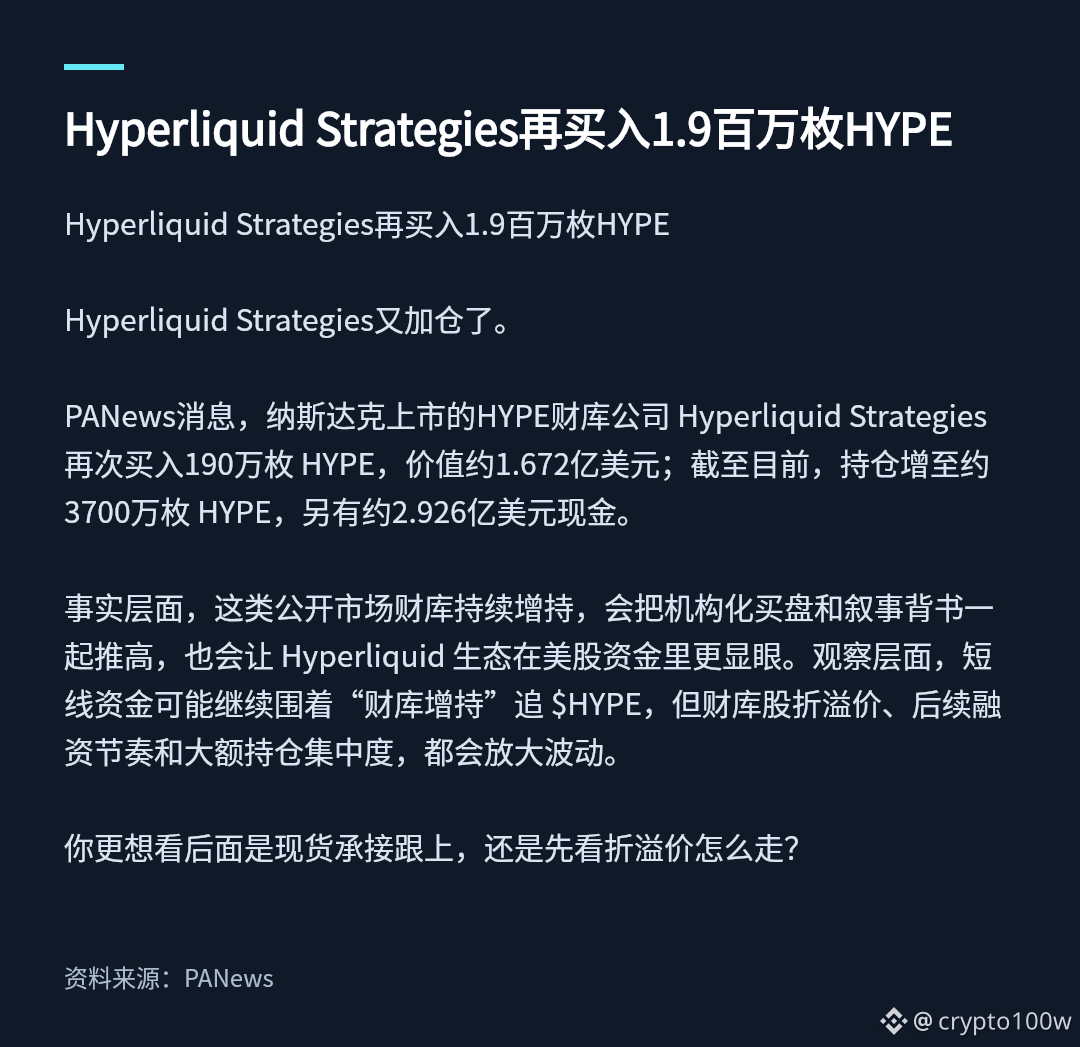
21
Log in to explore more content
Join global crypto users on Binance Square
⚡️ Get latest and useful information about crypto.
💬 Trusted by the world’s largest crypto exchange.
👍 Discover real insights from verified creators.
Email / Phone number
Trending Topics
SECHaltsCryptoETFReviewsAmidFundingLapse
51,908 views
635 Discussing
🔥 CRYPTO INVESTORS: PUT THIS ON YOUR WATCHLIST
The SEC has reportedly paused reviews of new crypto ETF applications during the funding lapse.
That means upcoming decisions could be delayed — but the underlying ETF pipeline hasn't disappeared.
📌 Watch:
• SEC funding developments
• ETF deadlines
• $BTC and $ETH reaction
• New altcoin ETF filings
The next regulatory update could matter. 👀
$BTC $ETH $SOL $XRP $ADA
#sechaltscryptoetfreviewsamidfundinglapse
CryptoMahibaloch
·6 Likes
·10k views
ZcashETFPostsFirstWeeklyOutflow$93.6M
64,740 views
199 Discussing
GreekPoliceBustCryptoScamRingArrest17
213,636 views
1,505 Discussing