
Cointelegraph
36.9k Posts

Cointelegraph
 Square Verified+
Report
Block User
Cointelegraph covers fintech, blockchain and Bitcoin, bringing you the latest news and analyses on the future of money.
2 Following
186.0K+ Followers
566.6K+ Liked
1 Badges
Posts
See translation
Cardano’s IOG warns users to avoid YouTube channel amid giveaway scamInput Output Group has urged users to avoid its YouTube channel, with the channel on Friday livestreaming a suspected AI-manipulated video of Cardano founder Charles Hoskinson promoting a crypto giveaway.
The livestream, which has been live for nearly two hours at the time of writing, directs viewers to a QR code with a promise to “double your wealth.”
“Please avoid interacting with the IO Group YouTube channel until further notice,” the company said in a warning on its official X account, advising users against clicking links, sending funds or sharing personal information in response to content on the channel.
Cardano’s IOG warns users to avoid YouTube channel amid giveaway scam
Input Output Group has urged users to avoid its YouTube channel, with the channel on Friday livestreaming a suspected AI-manipulated video of Cardano founder Charles Hoskinson promoting a crypto giveaway.
The livestream, which has been live for nearly two hours at the time of writing, directs viewers to a QR code with a promise to “double your wealth.”
“Please avoid interacting with the IO Group YouTube channel until further notice,” the company said in a warning on its official X account, advising users against clicking links, sending funds or sharing personal information in response to content on the channel.
The livestream, which has been live for nearly two hours at the time of writing, directs viewers to a QR code with a promise to “double your wealth.”
“Please avoid interacting with the IO Group YouTube channel until further notice,” the company said in a warning on its official X account, advising users against clicking links, sending funds or sharing personal information in response to content on the channel.
10
See translation
World launches self-custodial ‘super app’ World MoneyWorld has launched World Money, a self-custody financial “super app” combining stablecoin payments, digital asset rewards and trading.
The rollout began Thursday in more than 150 countries, World said, with features varying by location. Users can send supported digital assets, including stablecoins, to a recipient’s World username, deposit eligible assets to earn rewards, and buy and sell digital assets through exchanges.
The app lets users access “Mini Apps” such as Kalshi, Credit and Morpho. A partnership with Stripe allows users to fund their accounts and buy stablecoins with Apple Pay, starting with users in the US.
https://x.com/useworldapp/status/1991509236002746605?s=20
World has been expanding the financial capabilities of World App since its launch in May 2023, when it combined World ID with a crypto wallet, stablecoin transfers and token trading.
In October 2024, World introduced World App 3.0 as a “super app for humans,” adding third-party Mini Apps and a Vault feature for earning on assets. In November 2025, it piloted virtual bank accounts in the US before rolling it out to more countries a month later, allowing paychecks and bank deposits that are converted into USDC.
With the launch of World Money, World said its identity and financial services are now split across two dedicated apps.
World ID App handles identity verification and credentials, while World Money provides wallet, payment and other financial features. Existing World App and World ID App users can use their existing accounts for World Money, the company said.
World Money is operated by Tools for Humanity, the company co-founded by Sam Altman and Alex Blania that develops technology for the World network.
Magazine: Bitcoin treasury firms can outperform BTC... but is the risk worth taking?
World launches self-custodial ‘super app’ World Money
World has launched World Money, a self-custody financial “super app” combining stablecoin payments, digital asset rewards and trading.
The rollout began Thursday in more than 150 countries, World said, with features varying by location. Users can send supported digital assets, including stablecoins, to a recipient’s World username, deposit eligible assets to earn rewards, and buy and sell digital assets through exchanges.
The app lets users access “Mini Apps” such as Kalshi, Credit and Morpho. A partnership with Stripe allows users to fund their accounts and buy stablecoins with Apple Pay, starting with users in the US.
https://x.com/useworldapp/status/1991509236002746605?s=20
World has been expanding the financial capabilities of World App since its launch in May 2023, when it combined World ID with a crypto wallet, stablecoin transfers and token trading.
In October 2024, World introduced World App 3.0 as a “super app for humans,” adding third-party Mini Apps and a Vault feature for earning on assets. In November 2025, it piloted virtual bank accounts in the US before rolling it out to more countries a month later, allowing paychecks and bank deposits that are converted into USDC.
With the launch of World Money, World said its identity and financial services are now split across two dedicated apps.
World ID App handles identity verification and credentials, while World Money provides wallet, payment and other financial features. Existing World App and World ID App users can use their existing accounts for World Money, the company said.
World Money is operated by Tools for Humanity, the company co-founded by Sam Altman and Alex Blania that develops technology for the World network.
Magazine: Bitcoin treasury firms can outperform BTC... but is the risk worth taking?
The rollout began Thursday in more than 150 countries, World said, with features varying by location. Users can send supported digital assets, including stablecoins, to a recipient’s World username, deposit eligible assets to earn rewards, and buy and sell digital assets through exchanges.
The app lets users access “Mini Apps” such as Kalshi, Credit and Morpho. A partnership with Stripe allows users to fund their accounts and buy stablecoins with Apple Pay, starting with users in the US.
https://x.com/useworldapp/status/1991509236002746605?s=20
World has been expanding the financial capabilities of World App since its launch in May 2023, when it combined World ID with a crypto wallet, stablecoin transfers and token trading.
In October 2024, World introduced World App 3.0 as a “super app for humans,” adding third-party Mini Apps and a Vault feature for earning on assets. In November 2025, it piloted virtual bank accounts in the US before rolling it out to more countries a month later, allowing paychecks and bank deposits that are converted into USDC.
With the launch of World Money, World said its identity and financial services are now split across two dedicated apps.
World ID App handles identity verification and credentials, while World Money provides wallet, payment and other financial features. Existing World App and World ID App users can use their existing accounts for World Money, the company said.
World Money is operated by Tools for Humanity, the company co-founded by Sam Altman and Alex Blania that develops technology for the World network.
Magazine: Bitcoin treasury firms can outperform BTC... but is the risk worth taking?
42
Article
See translation
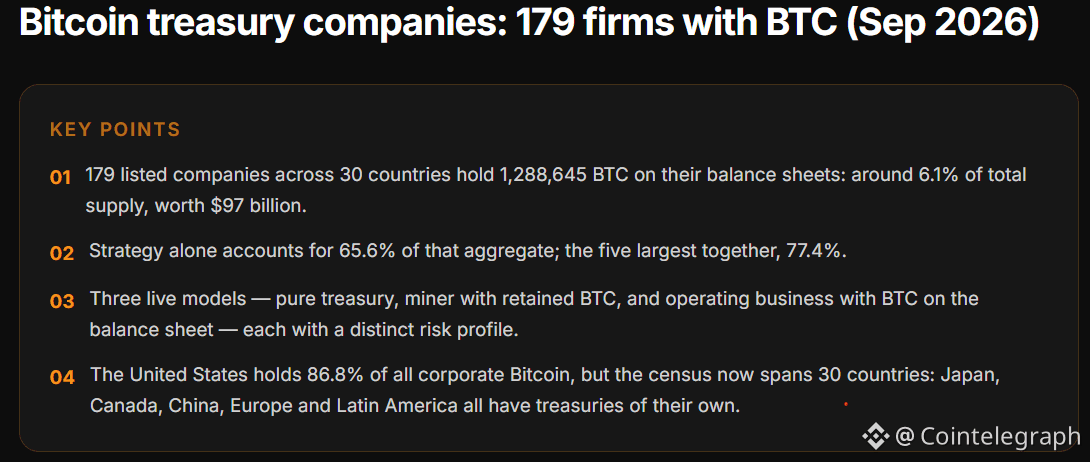
Bitcoin treasury firms can outperform BTC... but is the risk worth taking?There are now 179 listed companies holding Bitcoin on their balance sheets, all following variations of the same simple formula:
Raise capital on traditional markets, buy Bitcoin and attempt to increase the amount of BTC that backs each share faster than the company dilutes shareholders.
According to Mark Palmer, managing director and senior equity research analyst at StoneX, that’s how treasury companies attempt to “beat” Bitcoin’s returns.
Making that equation work is a lot easier when the price of Bitcoin is going up and investors are happy to fund the next spree of purchases. Unfortunately, the mechanics work in both directions.
When the premium evaporates, investor enthusiasm wanes. Financing gets harder, debt and yield obligations remain, and the same structure that outperformed the asset magnifies the losses on the way down. No surprise that the 50 largest Bitcoin treasury companies bled $83 billion in market value since July 2025.
Metaplanet’s recent shareholder backlash shows the sort of questions that arise when treasury companies dilute their shareholders too much.
Treasury companies are more likely to need to raise money in bear markets, but this creates a potential problem. Palmer says:
“Issuing shares at a premium to net asset value and buying Bitcoin with the proceeds increases the Bitcoin backing every existing share. The same issuance at a discount destroys value.”
So are the outsize returns on offer during the bull market, worth it for the downside risks during the bear?
The math works, until the capital markets stop cooperating
For all the complexity around Bitcoin treasury companies, the basic test for potential investors is relatively simple. Do shareholders end up with more Bitcoin backing each share over time?
Palmer says investors should look past the headline number of Bitcoin a company holds and focus instead on “Bitcoin per fully diluted share, net of debt and preferred stock claims.”
179 Bitcoin treasury companies as of September 2026. Source: SatsIntel
Issuing new shares is not necessarily a problem. What matters, is whether the new capital generates enough additional value and profit that the benefits to existing shareholders outweigh the dilution.
If the company issues shares for more than the value of the Bitcoin that backs them, and uses that money to buy more Bitcoin, shareholders can end up with more Bitcoin per share. If it raises money below that value, they can end up with less.
That dynamic was very favorable for Strategy during the last Bitcoin bull market, Adam Morgan McCarthy, a researcher at LO:TECH and former head of research at Kaiko, says, because Bitcoin was increasing fast. “They were able to take on new debt. They were able to issue new debt because of that.”
The first blow is half the battle
Choosing the right digital asset treasury is a key decision. With a couple of hundred now on offer, longer established companies have the advantage, explains McCarthy:
“It’s a first-mover advantage, right? Like if you’re Michael Saylor or you’re Bitmine and you’ve got this sort of larger-than-life character at the top, it’s a bit different.”
Strategy’s executive chairman Michael Saylor has become part of the machinery of the trade itself, and McCarthy says he can keep the story moving even when Bitcoin’s price isn’t. Ethereum treasury company Bitmine has a similarly prominent figure in Tom Lee.
Bitcoin and other cryptocurrencies rise and fall on narratives, so having a storyteller out front helps keep investors interested — especially when the underlying asset is in freefall. But McCarthy warns:
“I don’t think there’s enough room for a hundred Michael Saylors; there’s not enough people like that around.”
McCarthy says many of the companies that followed Strategy were essentially just buying Bitcoin and hoping the stock price would follow. They “didn’t have an exit plan” for when the dynamics reversed, he says, and he expects the shakeout to be even more brutal still:
“I think it’s going to flush out like 95% of it.”
The corporate wrapper comes with baggage
There are also simpler ways to get exposure to Bitcoin by just buying it directly on an exchange, or via a spot Bitcoin exchange-traded fund (ETF).
Spot ETFs let TradFi investors buy Bitcoin through a conventional brokerage account, without having to consider a DAT’s company’s management, financing structure, or governance risks.
Creative financial engineering can be difficult for retail investors to understand, says Palmer:
“The biggest risk that investors face in buying Bitcoin treasury company stocks is forgetting that common shareholders’ claim is a residual one, as convertible debt and perpetual preferred stock sit ahead of them in terms of priority.”
Those instruments, he adds, “carry cash obligations that Bitcoin itself doesn’t generate.”
So, can treasury companies beat Bitcoin?
Matt Cole, chief executive of Strive, one of the largest Bitcoin treasury companies, says investors should just look at the scoreboard:
“Strategy has dramatically outperformed Bitcoin since adopting its strategy. Metaplanet has also outperformed Bitcoin since inception and Strive has outperformed Bitcoin both since announcing our strategy in May 2025 and year-to-date in 2026.”
He adds that, “Strive has not sold a single Bitcoin, and during a Bitcoin bear market we have increased our holdings approximately fourfold while outperforming Bitcoin.”
David Bailey, chief executive of Nakamoto, makes a similar case for Metaplanet, saying it was “the best performing equity in the world for nearly two years” and is “up 1,300% from genesis.”
David Bailey says Metaplanet best performing equity for 2 years. Source: David Bailey.
Despite the returns to date, debt maturity and yield obligations may still cause problems down the line. And some companies without the same access to capital, investor following or balance sheet firepower have found out how quickly the trade can work against them. The two most notable examples are Bailey’s own Nakamoto Inc, whose stock fell 99% from its 2025 peak and the UK company Satsuma Technology, which saw a similar decline.
McCarthy’s own view is telling. When asked how he would deploy $100,000 for Bitcoin exposure, he says he would “mostly buy an ETF” and might put a smaller amount into Strategy “for the vol.”
At the end of the day, buying Bitcoin is a bet on Bitcoin. Buying a treasury company is a bet on Bitcoin plus an additional bet on the people, financing structure, balance sheet and corporate governance wrapped around it.
Magazine: Strategy became a symbol of the dot-com crash: Could history repeat?
Bitcoin treasury firms can outperform BTC... but is the risk worth taking?
There are now 179 listed companies holding Bitcoin on their balance sheets, all following variations of the same simple formula:
Raise capital on traditional markets, buy Bitcoin and attempt to increase the amount of BTC that backs each share faster than the company dilutes shareholders.
According to Mark Palmer, managing director and senior equity research analyst at StoneX, that’s how treasury companies attempt to “beat” Bitcoin’s returns.
Making that equation work is a lot easier when the price of Bitcoin is going up and investors are happy to fund the next spree of purchases. Unfortunately, the mechanics work in both directions.
When the premium evaporates, investor enthusiasm wanes. Financing gets harder, debt and yield obligations remain, and the same structure that outperformed the asset magnifies the losses on the way down. No surprise that the 50 largest Bitcoin treasury companies bled $83 billion in market value since July 2025.
Metaplanet’s recent shareholder backlash shows the sort of questions that arise when treasury companies dilute their shareholders too much.
Treasury companies are more likely to need to raise money in bear markets, but this creates a potential problem. Palmer says:
“Issuing shares at a premium to net asset value and buying Bitcoin with the proceeds increases the Bitcoin backing every existing share. The same issuance at a discount destroys value.”
So are the outsize returns on offer during the bull market, worth it for the downside risks during the bear?
The math works, until the capital markets stop cooperating
For all the complexity around Bitcoin treasury companies, the basic test for potential investors is relatively simple. Do shareholders end up with more Bitcoin backing each share over time?
Palmer says investors should look past the headline number of Bitcoin a company holds and focus instead on “Bitcoin per fully diluted share, net of debt and preferred stock claims.”
179 Bitcoin treasury companies as of September 2026. Source: SatsIntel
Issuing new shares is not necessarily a problem. What matters, is whether the new capital generates enough additional value and profit that the benefits to existing shareholders outweigh the dilution.
If the company issues shares for more than the value of the Bitcoin that backs them, and uses that money to buy more Bitcoin, shareholders can end up with more Bitcoin per share. If it raises money below that value, they can end up with less.
That dynamic was very favorable for Strategy during the last Bitcoin bull market, Adam Morgan McCarthy, a researcher at LO:TECH and former head of research at Kaiko, says, because Bitcoin was increasing fast. “They were able to take on new debt. They were able to issue new debt because of that.”
The first blow is half the battle
Choosing the right digital asset treasury is a key decision. With a couple of hundred now on offer, longer established companies have the advantage, explains McCarthy:
“It’s a first-mover advantage, right? Like if you’re Michael Saylor or you’re Bitmine and you’ve got this sort of larger-than-life character at the top, it’s a bit different.”
Strategy’s executive chairman Michael Saylor has become part of the machinery of the trade itself, and McCarthy says he can keep the story moving even when Bitcoin’s price isn’t. Ethereum treasury company Bitmine has a similarly prominent figure in Tom Lee.
Bitcoin and other cryptocurrencies rise and fall on narratives, so having a storyteller out front helps keep investors interested — especially when the underlying asset is in freefall. But McCarthy warns:
“I don’t think there’s enough room for a hundred Michael Saylors; there’s not enough people like that around.”
McCarthy says many of the companies that followed Strategy were essentially just buying Bitcoin and hoping the stock price would follow. They “didn’t have an exit plan” for when the dynamics reversed, he says, and he expects the shakeout to be even more brutal still:
“I think it’s going to flush out like 95% of it.”
The corporate wrapper comes with baggage
There are also simpler ways to get exposure to Bitcoin by just buying it directly on an exchange, or via a spot Bitcoin exchange-traded fund (ETF).
Spot ETFs let TradFi investors buy Bitcoin through a conventional brokerage account, without having to consider a DAT’s company’s management, financing structure, or governance risks.
Creative financial engineering can be difficult for retail investors to understand, says Palmer:
“The biggest risk that investors face in buying Bitcoin treasury company stocks is forgetting that common shareholders’ claim is a residual one, as convertible debt and perpetual preferred stock sit ahead of them in terms of priority.”
Those instruments, he adds, “carry cash obligations that Bitcoin itself doesn’t generate.”
So, can treasury companies beat Bitcoin?
Matt Cole, chief executive of Strive, one of the largest Bitcoin treasury companies, says investors should just look at the scoreboard:
“Strategy has dramatically outperformed Bitcoin since adopting its strategy. Metaplanet has also outperformed Bitcoin since inception and Strive has outperformed Bitcoin both since announcing our strategy in May 2025 and year-to-date in 2026.”
He adds that, “Strive has not sold a single Bitcoin, and during a Bitcoin bear market we have increased our holdings approximately fourfold while outperforming Bitcoin.”
David Bailey, chief executive of Nakamoto, makes a similar case for Metaplanet, saying it was “the best performing equity in the world for nearly two years” and is “up 1,300% from genesis.”
David Bailey says Metaplanet best performing equity for 2 years. Source: David Bailey.
Despite the returns to date, debt maturity and yield obligations may still cause problems down the line. And some companies without the same access to capital, investor following or balance sheet firepower have found out how quickly the trade can work against them. The two most notable examples are Bailey’s own Nakamoto Inc, whose stock fell 99% from its 2025 peak and the UK company Satsuma Technology, which saw a similar decline.
McCarthy’s own view is telling. When asked how he would deploy $100,000 for Bitcoin exposure, he says he would “mostly buy an ETF” and might put a smaller amount into Strategy “for the vol.”
At the end of the day, buying Bitcoin is a bet on Bitcoin. Buying a treasury company is a bet on Bitcoin plus an additional bet on the people, financing structure, balance sheet and corporate governance wrapped around it.
Magazine: Strategy became a symbol of the dot-com crash: Could history repeat?
Raise capital on traditional markets, buy Bitcoin and attempt to increase the amount of BTC that backs each share faster than the company dilutes shareholders.
According to Mark Palmer, managing director and senior equity research analyst at StoneX, that’s how treasury companies attempt to “beat” Bitcoin’s returns.
Making that equation work is a lot easier when the price of Bitcoin is going up and investors are happy to fund the next spree of purchases. Unfortunately, the mechanics work in both directions.
When the premium evaporates, investor enthusiasm wanes. Financing gets harder, debt and yield obligations remain, and the same structure that outperformed the asset magnifies the losses on the way down. No surprise that the 50 largest Bitcoin treasury companies bled $83 billion in market value since July 2025.
Metaplanet’s recent shareholder backlash shows the sort of questions that arise when treasury companies dilute their shareholders too much.
Treasury companies are more likely to need to raise money in bear markets, but this creates a potential problem. Palmer says:
“Issuing shares at a premium to net asset value and buying Bitcoin with the proceeds increases the Bitcoin backing every existing share. The same issuance at a discount destroys value.”
So are the outsize returns on offer during the bull market, worth it for the downside risks during the bear?
The math works, until the capital markets stop cooperating
For all the complexity around Bitcoin treasury companies, the basic test for potential investors is relatively simple. Do shareholders end up with more Bitcoin backing each share over time?
Palmer says investors should look past the headline number of Bitcoin a company holds and focus instead on “Bitcoin per fully diluted share, net of debt and preferred stock claims.”
179 Bitcoin treasury companies as of September 2026. Source: SatsIntel
Issuing new shares is not necessarily a problem. What matters, is whether the new capital generates enough additional value and profit that the benefits to existing shareholders outweigh the dilution.
If the company issues shares for more than the value of the Bitcoin that backs them, and uses that money to buy more Bitcoin, shareholders can end up with more Bitcoin per share. If it raises money below that value, they can end up with less.
That dynamic was very favorable for Strategy during the last Bitcoin bull market, Adam Morgan McCarthy, a researcher at LO:TECH and former head of research at Kaiko, says, because Bitcoin was increasing fast. “They were able to take on new debt. They were able to issue new debt because of that.”
The first blow is half the battle
Choosing the right digital asset treasury is a key decision. With a couple of hundred now on offer, longer established companies have the advantage, explains McCarthy:
“It’s a first-mover advantage, right? Like if you’re Michael Saylor or you’re Bitmine and you’ve got this sort of larger-than-life character at the top, it’s a bit different.”
Strategy’s executive chairman Michael Saylor has become part of the machinery of the trade itself, and McCarthy says he can keep the story moving even when Bitcoin’s price isn’t. Ethereum treasury company Bitmine has a similarly prominent figure in Tom Lee.
Bitcoin and other cryptocurrencies rise and fall on narratives, so having a storyteller out front helps keep investors interested — especially when the underlying asset is in freefall. But McCarthy warns:
“I don’t think there’s enough room for a hundred Michael Saylors; there’s not enough people like that around.”
McCarthy says many of the companies that followed Strategy were essentially just buying Bitcoin and hoping the stock price would follow. They “didn’t have an exit plan” for when the dynamics reversed, he says, and he expects the shakeout to be even more brutal still:
“I think it’s going to flush out like 95% of it.”
The corporate wrapper comes with baggage
There are also simpler ways to get exposure to Bitcoin by just buying it directly on an exchange, or via a spot Bitcoin exchange-traded fund (ETF).
Spot ETFs let TradFi investors buy Bitcoin through a conventional brokerage account, without having to consider a DAT’s company’s management, financing structure, or governance risks.
Creative financial engineering can be difficult for retail investors to understand, says Palmer:
“The biggest risk that investors face in buying Bitcoin treasury company stocks is forgetting that common shareholders’ claim is a residual one, as convertible debt and perpetual preferred stock sit ahead of them in terms of priority.”
Those instruments, he adds, “carry cash obligations that Bitcoin itself doesn’t generate.”
So, can treasury companies beat Bitcoin?
Matt Cole, chief executive of Strive, one of the largest Bitcoin treasury companies, says investors should just look at the scoreboard:
“Strategy has dramatically outperformed Bitcoin since adopting its strategy. Metaplanet has also outperformed Bitcoin since inception and Strive has outperformed Bitcoin both since announcing our strategy in May 2025 and year-to-date in 2026.”
He adds that, “Strive has not sold a single Bitcoin, and during a Bitcoin bear market we have increased our holdings approximately fourfold while outperforming Bitcoin.”
David Bailey, chief executive of Nakamoto, makes a similar case for Metaplanet, saying it was “the best performing equity in the world for nearly two years” and is “up 1,300% from genesis.”
David Bailey says Metaplanet best performing equity for 2 years. Source: David Bailey.
Despite the returns to date, debt maturity and yield obligations may still cause problems down the line. And some companies without the same access to capital, investor following or balance sheet firepower have found out how quickly the trade can work against them. The two most notable examples are Bailey’s own Nakamoto Inc, whose stock fell 99% from its 2025 peak and the UK company Satsuma Technology, which saw a similar decline.
McCarthy’s own view is telling. When asked how he would deploy $100,000 for Bitcoin exposure, he says he would “mostly buy an ETF” and might put a smaller amount into Strategy “for the vol.”
At the end of the day, buying Bitcoin is a bet on Bitcoin. Buying a treasury company is a bet on Bitcoin plus an additional bet on the people, financing structure, balance sheet and corporate governance wrapped around it.
Magazine: Strategy became a symbol of the dot-com crash: Could history repeat?
83
See translation
US sanctions Iran’s BitBank, saying it processes ‘Hormuz Safe’ Bitcoin paymentsUS authorities on Thursday announced sanctions against Iranian crypto exchange BitBank, accusing it of processing Bitcoin paid by ships transiting the Strait of Hormuz.
The US Department of the Treasury’s Office of Foreign Assets Control said that as of June, the Hormuz Safe Marine Services Authority used BitBank to transfer payments it received to the Islamic Revolutionary Guard Corps. The Treasury alleged it is part of the architecture used by Iranian financier Babak Zanjani to move hundreds of millions of dollars in Bitcoin to the IRGC.
Treasury has previously alleged Hormuz Safe is part of an IRGC-backed scheme forcing vessels to buy maritime insurance for passage, including coverage against seizures by Iran itself.
“Today’s designations of Iranian digital asset infrastructure make perfectly clear that efforts to finance the Iranian regime using cryptocurrencies are not beyond OFAC’s reach,” said US Treasury Secretary Scott Bessent.
The designation is the latest Treasury action aimed at isolating Iran from the international financial system, including through sanctions on digital asset exchanges.
The OFAC designations include BitBank, its developer Pishtaz Simorgh Electronic Trade Company and three associates of Zanjani, with the Treasury calling them “key components of the Iranian regime’s digital assets-based sanctions evasion infrastructure.”
Cointelegraph reached out to BitBank for comment.
Iran’s BitBank is a separate entity from bitbank, inc, a fully licensed crypto exchange founded in 2014 in Japan, which was acquired by SBI Holdings in June. Treasury’s designation lists BitBank as having been established in 2024.
In August, the US sanctioned two digital asset exchanges, Shelbit and Aban Tether, accusing them of assisting the Iranian regime in sanctions evasion. Treasury also sanctioned four crypto exchanges, including the country’s largest, Nobitex, in June.
In July, the US government ordered the freezing of more than $130 million in USDt held in wallets linked to Iran.
Iran has reportedly sought to mitigate the impact of tightening financial restrictions. Earlier this month, the Financial Times reported that Iran’s central bank eased foreign currency controls to encourage businesses to bring overseas earnings home, including through cryptocurrency, amid tightening US sanctions.
Magazine: North Korea drives onchain malware surge, CoinEx shuts: Asia Express
US sanctions Iran’s BitBank, saying it processes ‘Hormuz Safe’ Bitcoin payments
US authorities on Thursday announced sanctions against Iranian crypto exchange BitBank, accusing it of processing Bitcoin paid by ships transiting the Strait of Hormuz.
The US Department of the Treasury’s Office of Foreign Assets Control said that as of June, the Hormuz Safe Marine Services Authority used BitBank to transfer payments it received to the Islamic Revolutionary Guard Corps. The Treasury alleged it is part of the architecture used by Iranian financier Babak Zanjani to move hundreds of millions of dollars in Bitcoin to the IRGC.
Treasury has previously alleged Hormuz Safe is part of an IRGC-backed scheme forcing vessels to buy maritime insurance for passage, including coverage against seizures by Iran itself.
“Today’s designations of Iranian digital asset infrastructure make perfectly clear that efforts to finance the Iranian regime using cryptocurrencies are not beyond OFAC’s reach,” said US Treasury Secretary Scott Bessent.
The designation is the latest Treasury action aimed at isolating Iran from the international financial system, including through sanctions on digital asset exchanges.
The OFAC designations include BitBank, its developer Pishtaz Simorgh Electronic Trade Company and three associates of Zanjani, with the Treasury calling them “key components of the Iranian regime’s digital assets-based sanctions evasion infrastructure.”
Cointelegraph reached out to BitBank for comment.
Iran’s BitBank is a separate entity from bitbank, inc, a fully licensed crypto exchange founded in 2014 in Japan, which was acquired by SBI Holdings in June. Treasury’s designation lists BitBank as having been established in 2024.
In August, the US sanctioned two digital asset exchanges, Shelbit and Aban Tether, accusing them of assisting the Iranian regime in sanctions evasion. Treasury also sanctioned four crypto exchanges, including the country’s largest, Nobitex, in June.
In July, the US government ordered the freezing of more than $130 million in USDt held in wallets linked to Iran.
Iran has reportedly sought to mitigate the impact of tightening financial restrictions. Earlier this month, the Financial Times reported that Iran’s central bank eased foreign currency controls to encourage businesses to bring overseas earnings home, including through cryptocurrency, amid tightening US sanctions.
Magazine: North Korea drives onchain malware surge, CoinEx shuts: Asia Express
The US Department of the Treasury’s Office of Foreign Assets Control said that as of June, the Hormuz Safe Marine Services Authority used BitBank to transfer payments it received to the Islamic Revolutionary Guard Corps. The Treasury alleged it is part of the architecture used by Iranian financier Babak Zanjani to move hundreds of millions of dollars in Bitcoin to the IRGC.
Treasury has previously alleged Hormuz Safe is part of an IRGC-backed scheme forcing vessels to buy maritime insurance for passage, including coverage against seizures by Iran itself.
“Today’s designations of Iranian digital asset infrastructure make perfectly clear that efforts to finance the Iranian regime using cryptocurrencies are not beyond OFAC’s reach,” said US Treasury Secretary Scott Bessent.
The designation is the latest Treasury action aimed at isolating Iran from the international financial system, including through sanctions on digital asset exchanges.
The OFAC designations include BitBank, its developer Pishtaz Simorgh Electronic Trade Company and three associates of Zanjani, with the Treasury calling them “key components of the Iranian regime’s digital assets-based sanctions evasion infrastructure.”
Cointelegraph reached out to BitBank for comment.
Iran’s BitBank is a separate entity from bitbank, inc, a fully licensed crypto exchange founded in 2014 in Japan, which was acquired by SBI Holdings in June. Treasury’s designation lists BitBank as having been established in 2024.
In August, the US sanctioned two digital asset exchanges, Shelbit and Aban Tether, accusing them of assisting the Iranian regime in sanctions evasion. Treasury also sanctioned four crypto exchanges, including the country’s largest, Nobitex, in June.
In July, the US government ordered the freezing of more than $130 million in USDt held in wallets linked to Iran.
Iran has reportedly sought to mitigate the impact of tightening financial restrictions. Earlier this month, the Financial Times reported that Iran’s central bank eased foreign currency controls to encourage businesses to bring overseas earnings home, including through cryptocurrency, amid tightening US sanctions.
Magazine: North Korea drives onchain malware surge, CoinEx shuts: Asia Express
153
Article
See translation
Is there any chance left to save the CLARITY Act?Water, water everywhere and not a drop to drink may be the sentiment of the crypto industry, lobbyists and lawmakers who’ve spent the last year trying to get the CLARITY Act over the line.
No shortage of negotiations, amendments or political wrangling; yet not enough to get the bill moving through the Senate.
The CLARITY Act may have rammed into a Senate-shaped hurdle this week, but it isn’t dead on arrival yet — let’s go with walking wounded.
There’s still a chance for the digital asset market structure bill to scramble together the 60 votes it needs to clear the Senate.
When Republican Senator Thom Tillis switched his vote from yes to no at the last minute, he did so on procedural grounds. It may have looked like a swing against CLARITY, but it was really a parliamentary maneuver, allowing him to file a motion to reconsider and preserve a route back to the Senate floor.
The Crypto Council for Innovation (CCI)’s director of US federal affairs, Ryan Eagan, tells Magazine:
“Senator Tillis’s motion to reconsider would provide an opportunity to revisit CLARITY’s cloture vote at any point this session. Specific timing regarding next steps is not clear, but that desire to preserve that opportunity is in part due to the progress made over the past week.”
But the Senate is running out of time; both Democrats and Republicans remain divided over ethics provisions involving President Donald Trump, and even supporters of the bill say a more bipartisan negotiating process may now be necessary.
So can CLARITY still be resuscitated, and if it can, how much of the bill will need serious CPR to get there?
CLARITY isn’t dead, but the clock is running down
The failed cloture vote, a procedural vote to end debate on a bill and move it toward a final vote, doesn’t end CLARITY’s journey through Congress just yet. It requires 60 votes in the Senate, and CLARITY fell 49-50 on Tuesday.
Tillis’ motion to reconsider means the vote can be revisited during the current session, but that route is running into a much more practical problem: a ticking clock.
The Senate is scheduled to leave for recess on October 2 before returning after the midterm elections, and the House of Representatives has already recessed for the election period, complicating any attempt to move legislation through both chambers before the end of the year.
Congressman Shri Thanedar, a Democrat who supported CLARITY when it passed through the House in July 2025, tells Magazine that timeline presents a “major barrier” to reaching an agreement:
“There are only 20 legislative days left in this Congress, all of them after the midterms, making odds of a 2026 compromise, unfortunately, very low.”
Very low doesn’t mean impossible, and the crypto industry has a precedent in the Guiding and Establishing National Innovation in US Stablecoins (GENIUS) bill, which failed cloture 48-49 in May 2025 before clearing a second cloture vote 66-32 just 11 days later. It passed the Senate the following month. However, Kyle Chassé, founder of crypto investment firm MV Global, tells Magazine:
“GENIUS came back from a failed cloture in 11 days. But GENIUS had a deal. This one has a calendar and no votes. Miss Jan. 3, and it restarts from zero in 2027 with a House that is probably Democratic.”
While a lame-duck session after the November elections could give CLARITY another shot, that’s not the same as having a ready-made deal waiting to go.
The 60-vote problem is a negotiating problem
Of the 49 votes for CLARITY, not a single one came from the Democratic camp. Chassé says:
“Every one of the 49 was a Republican. Zero Democrats voted to even open debate.”
While that’s clearly less than ideal, it doesn’t necessarily mean the Democrats have abandoned the bill entirely.
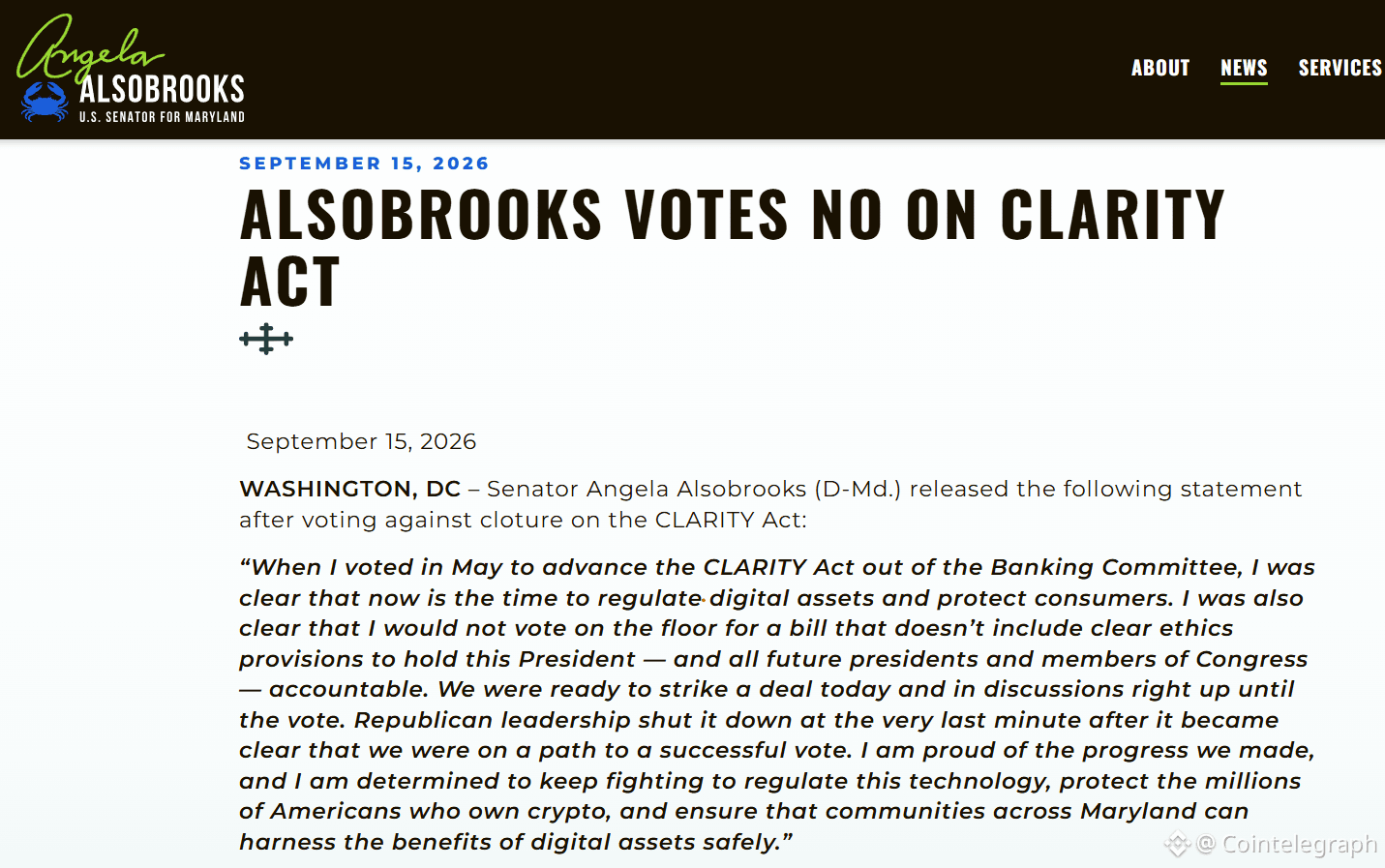
On Wednesday, seven Democratic senators — all of whom had voted a day earlier against advancing the bill — said they “remain committed” to enacting the legislation. Among them was Sen. Angela Alsobrooks, who backed moving the bill out of the Banking Committee in May before voting no on cloture. She said it’s “clear that now is the time to regulate digital assets” and that she’s willing to negotiate over the ethics provisions, adding:
“We were ready to strike a deal today and in discussions right up until the vote. Republican leadership shut it down at the very last minute after it became clear that we were on a path to a successful vote.”
Tillis said Wednesday he now wants to “convince the Democrats to get on board,” and “put pressure on them to own it,” and his procedural vote switch was designed to keep that possibility alive. “I feel very strongly that this is an unregulated marketplace and that we need some guardrails on,” he added.
The divide isn’t over whether Congress should establish rules for crypto anymore, but whether the current package goes far enough to secure bipartisan support.
Seven Democratic senators “remain committed” to enacting the legislation. Source: Kirsten Gillibrand, Senate
While Congressman Thanedar says he supports the bill in its current form, he acknowledges that Tuesday’s result shows the need for both parties to work together further on the draft:
“I do believe that the failed CLARITY vote on Tuesday demonstrates that a more bipartisan drafting process would lead to a higher likelihood of creating the bipartisan, supermajority coalition that passing this legislation into law would require.”
If saving CLARITY means rewriting it, what survives?
Chassé says the problem has moved beyond the technical drafting of crypto policy and is now centered on President Trump’s crypto interests and the ethics provisions around them:
“This stopped being a drafting problem. It’s a referendum on the President’s crypto holdings six weeks before an election, and the text as written can’t survive that.”
Republicans had already made 126 substantive changes requested by Democrats ahead of Tuesday’s vote, including tighter restrictions on public officials profiting from crypto ventures, and giving state attorneys general a role in enforcing some of the ethics provisions.
Alsobrooks votes no on CLARITY. Source: Angela Alsobrooks, Senate.
Despite the concessions, Thanedar says the Democrats want more restrictions “on the President’s ability to use his office for personal gain.” He says the at least $1.4 billion in crypto earnings Trump reported for 2025 in his annual financial disclosure shows that “guardrails are necessary to both hold the President accountable and protect the long-term health of the digital asset market.”
Ethics is not the only potential fault line, though, and Chassé says the industry “should stop dying on that hill.” He points instead to stablecoin rewards, saying “some kind of cap or circuit breaker on yield” would likely be “the price of the bank-side senators and a chunk of Democrats,” along with “tighter illicit finance and state enforcement language.”
He says self-custody and developer protections are areas the crypto industry should be reluctant to trade away. Those protections have been bitterly defended throughout the negotiations, with lawmakers and industry groups debating how far the bill should go in shielding non-custodial developers from financial and anti-money-laundering (AML) requirements.
Congress may stall, crypto regulation doesn’t have to
Even if CLARITY remains stuck in Congress, US crypto regulation is not standing still. Eagan says the Securities and Exchange Commission (SEC) and the Commodity Futures Trading Commission (CFTC) have “demonstrated commitment to reduce uncertainty” through guidance, rulemaking, no-action relief and exemptions.
“CCI expects that agencies’ crypto agenda will proceed in robust fashion regardless of the CLARITY Act,” he says, adding that the GENIUS Act implementation continues at Treasury and the banking regulators.
Strategy executive chairman Michael Saylor also pointed out that the SEC, CFTC and Treasury could continue to advance rules under existing laws:
“Progress need not wait for Congress.”
That may be true, but agency action is not the same as getting CLARITY over the finish line. Regulatory guidance can be swept out with administrations, but legislation is harder to unwind.
CLARITY may still have a way to limp back to the Senate, but whether lawmakers can find 60 votes without changing the bill beyond recognition is another matter.
Magazine: Revolut ID thefts highlight KYC’s dangers: Here’s how to fix it
Is there any chance left to save the CLARITY Act?
Water, water everywhere and not a drop to drink may be the sentiment of the crypto industry, lobbyists and lawmakers who’ve spent the last year trying to get the CLARITY Act over the line.
No shortage of negotiations, amendments or political wrangling; yet not enough to get the bill moving through the Senate.
The CLARITY Act may have rammed into a Senate-shaped hurdle this week, but it isn’t dead on arrival yet — let’s go with walking wounded.
There’s still a chance for the digital asset market structure bill to scramble together the 60 votes it needs to clear the Senate.
When Republican Senator Thom Tillis switched his vote from yes to no at the last minute, he did so on procedural grounds. It may have looked like a swing against CLARITY, but it was really a parliamentary maneuver, allowing him to file a motion to reconsider and preserve a route back to the Senate floor.
The Crypto Council for Innovation (CCI)’s director of US federal affairs, Ryan Eagan, tells Magazine:
“Senator Tillis’s motion to reconsider would provide an opportunity to revisit CLARITY’s cloture vote at any point this session. Specific timing regarding next steps is not clear, but that desire to preserve that opportunity is in part due to the progress made over the past week.”
But the Senate is running out of time; both Democrats and Republicans remain divided over ethics provisions involving President Donald Trump, and even supporters of the bill say a more bipartisan negotiating process may now be necessary.
So can CLARITY still be resuscitated, and if it can, how much of the bill will need serious CPR to get there?
CLARITY isn’t dead, but the clock is running down
The failed cloture vote, a procedural vote to end debate on a bill and move it toward a final vote, doesn’t end CLARITY’s journey through Congress just yet. It requires 60 votes in the Senate, and CLARITY fell 49-50 on Tuesday.
Tillis’ motion to reconsider means the vote can be revisited during the current session, but that route is running into a much more practical problem: a ticking clock.
The Senate is scheduled to leave for recess on October 2 before returning after the midterm elections, and the House of Representatives has already recessed for the election period, complicating any attempt to move legislation through both chambers before the end of the year.
Congressman Shri Thanedar, a Democrat who supported CLARITY when it passed through the House in July 2025, tells Magazine that timeline presents a “major barrier” to reaching an agreement:
“There are only 20 legislative days left in this Congress, all of them after the midterms, making odds of a 2026 compromise, unfortunately, very low.”
Very low doesn’t mean impossible, and the crypto industry has a precedent in the Guiding and Establishing National Innovation in US Stablecoins (GENIUS) bill, which failed cloture 48-49 in May 2025 before clearing a second cloture vote 66-32 just 11 days later. It passed the Senate the following month. However, Kyle Chassé, founder of crypto investment firm MV Global, tells Magazine:
“GENIUS came back from a failed cloture in 11 days. But GENIUS had a deal. This one has a calendar and no votes. Miss Jan. 3, and it restarts from zero in 2027 with a House that is probably Democratic.”
While a lame-duck session after the November elections could give CLARITY another shot, that’s not the same as having a ready-made deal waiting to go.
The 60-vote problem is a negotiating problem
Of the 49 votes for CLARITY, not a single one came from the Democratic camp. Chassé says:
“Every one of the 49 was a Republican. Zero Democrats voted to even open debate.”
While that’s clearly less than ideal, it doesn’t necessarily mean the Democrats have abandoned the bill entirely.
On Wednesday, seven Democratic senators — all of whom had voted a day earlier against advancing the bill — said they “remain committed” to enacting the legislation. Among them was Sen. Angela Alsobrooks, who backed moving the bill out of the Banking Committee in May before voting no on cloture. She said it’s “clear that now is the time to regulate digital assets” and that she’s willing to negotiate over the ethics provisions, adding:
“We were ready to strike a deal today and in discussions right up until the vote. Republican leadership shut it down at the very last minute after it became clear that we were on a path to a successful vote.”
Tillis said Wednesday he now wants to “convince the Democrats to get on board,” and “put pressure on them to own it,” and his procedural vote switch was designed to keep that possibility alive. “I feel very strongly that this is an unregulated marketplace and that we need some guardrails on,” he added.
The divide isn’t over whether Congress should establish rules for crypto anymore, but whether the current package goes far enough to secure bipartisan support.
Seven Democratic senators “remain committed” to enacting the legislation. Source: Kirsten Gillibrand, Senate
While Congressman Thanedar says he supports the bill in its current form, he acknowledges that Tuesday’s result shows the need for both parties to work together further on the draft:
“I do believe that the failed CLARITY vote on Tuesday demonstrates that a more bipartisan drafting process would lead to a higher likelihood of creating the bipartisan, supermajority coalition that passing this legislation into law would require.”
If saving CLARITY means rewriting it, what survives?
Chassé says the problem has moved beyond the technical drafting of crypto policy and is now centered on President Trump’s crypto interests and the ethics provisions around them:
“This stopped being a drafting problem. It’s a referendum on the President’s crypto holdings six weeks before an election, and the text as written can’t survive that.”
Republicans had already made 126 substantive changes requested by Democrats ahead of Tuesday’s vote, including tighter restrictions on public officials profiting from crypto ventures, and giving state attorneys general a role in enforcing some of the ethics provisions.
Alsobrooks votes no on CLARITY. Source: Angela Alsobrooks, Senate.
Despite the concessions, Thanedar says the Democrats want more restrictions “on the President’s ability to use his office for personal gain.” He says the at least $1.4 billion in crypto earnings Trump reported for 2025 in his annual financial disclosure shows that “guardrails are necessary to both hold the President accountable and protect the long-term health of the digital asset market.”
Ethics is not the only potential fault line, though, and Chassé says the industry “should stop dying on that hill.” He points instead to stablecoin rewards, saying “some kind of cap or circuit breaker on yield” would likely be “the price of the bank-side senators and a chunk of Democrats,” along with “tighter illicit finance and state enforcement language.”
He says self-custody and developer protections are areas the crypto industry should be reluctant to trade away. Those protections have been bitterly defended throughout the negotiations, with lawmakers and industry groups debating how far the bill should go in shielding non-custodial developers from financial and anti-money-laundering (AML) requirements.
Congress may stall, crypto regulation doesn’t have to
Even if CLARITY remains stuck in Congress, US crypto regulation is not standing still. Eagan says the Securities and Exchange Commission (SEC) and the Commodity Futures Trading Commission (CFTC) have “demonstrated commitment to reduce uncertainty” through guidance, rulemaking, no-action relief and exemptions.
“CCI expects that agencies’ crypto agenda will proceed in robust fashion regardless of the CLARITY Act,” he says, adding that the GENIUS Act implementation continues at Treasury and the banking regulators.
Strategy executive chairman Michael Saylor also pointed out that the SEC, CFTC and Treasury could continue to advance rules under existing laws:
“Progress need not wait for Congress.”
That may be true, but agency action is not the same as getting CLARITY over the finish line. Regulatory guidance can be swept out with administrations, but legislation is harder to unwind.
CLARITY may still have a way to limp back to the Senate, but whether lawmakers can find 60 votes without changing the bill beyond recognition is another matter.
Magazine: Revolut ID thefts highlight KYC’s dangers: Here’s how to fix it
No shortage of negotiations, amendments or political wrangling; yet not enough to get the bill moving through the Senate.
The CLARITY Act may have rammed into a Senate-shaped hurdle this week, but it isn’t dead on arrival yet — let’s go with walking wounded.
There’s still a chance for the digital asset market structure bill to scramble together the 60 votes it needs to clear the Senate.
When Republican Senator Thom Tillis switched his vote from yes to no at the last minute, he did so on procedural grounds. It may have looked like a swing against CLARITY, but it was really a parliamentary maneuver, allowing him to file a motion to reconsider and preserve a route back to the Senate floor.
The Crypto Council for Innovation (CCI)’s director of US federal affairs, Ryan Eagan, tells Magazine:
“Senator Tillis’s motion to reconsider would provide an opportunity to revisit CLARITY’s cloture vote at any point this session. Specific timing regarding next steps is not clear, but that desire to preserve that opportunity is in part due to the progress made over the past week.”
But the Senate is running out of time; both Democrats and Republicans remain divided over ethics provisions involving President Donald Trump, and even supporters of the bill say a more bipartisan negotiating process may now be necessary.
So can CLARITY still be resuscitated, and if it can, how much of the bill will need serious CPR to get there?
CLARITY isn’t dead, but the clock is running down
The failed cloture vote, a procedural vote to end debate on a bill and move it toward a final vote, doesn’t end CLARITY’s journey through Congress just yet. It requires 60 votes in the Senate, and CLARITY fell 49-50 on Tuesday.
Tillis’ motion to reconsider means the vote can be revisited during the current session, but that route is running into a much more practical problem: a ticking clock.
The Senate is scheduled to leave for recess on October 2 before returning after the midterm elections, and the House of Representatives has already recessed for the election period, complicating any attempt to move legislation through both chambers before the end of the year.
Congressman Shri Thanedar, a Democrat who supported CLARITY when it passed through the House in July 2025, tells Magazine that timeline presents a “major barrier” to reaching an agreement:
“There are only 20 legislative days left in this Congress, all of them after the midterms, making odds of a 2026 compromise, unfortunately, very low.”
Very low doesn’t mean impossible, and the crypto industry has a precedent in the Guiding and Establishing National Innovation in US Stablecoins (GENIUS) bill, which failed cloture 48-49 in May 2025 before clearing a second cloture vote 66-32 just 11 days later. It passed the Senate the following month. However, Kyle Chassé, founder of crypto investment firm MV Global, tells Magazine:
“GENIUS came back from a failed cloture in 11 days. But GENIUS had a deal. This one has a calendar and no votes. Miss Jan. 3, and it restarts from zero in 2027 with a House that is probably Democratic.”
While a lame-duck session after the November elections could give CLARITY another shot, that’s not the same as having a ready-made deal waiting to go.
The 60-vote problem is a negotiating problem
Of the 49 votes for CLARITY, not a single one came from the Democratic camp. Chassé says:
“Every one of the 49 was a Republican. Zero Democrats voted to even open debate.”
While that’s clearly less than ideal, it doesn’t necessarily mean the Democrats have abandoned the bill entirely.
On Wednesday, seven Democratic senators — all of whom had voted a day earlier against advancing the bill — said they “remain committed” to enacting the legislation. Among them was Sen. Angela Alsobrooks, who backed moving the bill out of the Banking Committee in May before voting no on cloture. She said it’s “clear that now is the time to regulate digital assets” and that she’s willing to negotiate over the ethics provisions, adding:
“We were ready to strike a deal today and in discussions right up until the vote. Republican leadership shut it down at the very last minute after it became clear that we were on a path to a successful vote.”
Tillis said Wednesday he now wants to “convince the Democrats to get on board,” and “put pressure on them to own it,” and his procedural vote switch was designed to keep that possibility alive. “I feel very strongly that this is an unregulated marketplace and that we need some guardrails on,” he added.
The divide isn’t over whether Congress should establish rules for crypto anymore, but whether the current package goes far enough to secure bipartisan support.
Seven Democratic senators “remain committed” to enacting the legislation. Source: Kirsten Gillibrand, Senate
While Congressman Thanedar says he supports the bill in its current form, he acknowledges that Tuesday’s result shows the need for both parties to work together further on the draft:
“I do believe that the failed CLARITY vote on Tuesday demonstrates that a more bipartisan drafting process would lead to a higher likelihood of creating the bipartisan, supermajority coalition that passing this legislation into law would require.”
If saving CLARITY means rewriting it, what survives?
Chassé says the problem has moved beyond the technical drafting of crypto policy and is now centered on President Trump’s crypto interests and the ethics provisions around them:
“This stopped being a drafting problem. It’s a referendum on the President’s crypto holdings six weeks before an election, and the text as written can’t survive that.”
Republicans had already made 126 substantive changes requested by Democrats ahead of Tuesday’s vote, including tighter restrictions on public officials profiting from crypto ventures, and giving state attorneys general a role in enforcing some of the ethics provisions.
Alsobrooks votes no on CLARITY. Source: Angela Alsobrooks, Senate.
Despite the concessions, Thanedar says the Democrats want more restrictions “on the President’s ability to use his office for personal gain.” He says the at least $1.4 billion in crypto earnings Trump reported for 2025 in his annual financial disclosure shows that “guardrails are necessary to both hold the President accountable and protect the long-term health of the digital asset market.”
Ethics is not the only potential fault line, though, and Chassé says the industry “should stop dying on that hill.” He points instead to stablecoin rewards, saying “some kind of cap or circuit breaker on yield” would likely be “the price of the bank-side senators and a chunk of Democrats,” along with “tighter illicit finance and state enforcement language.”
He says self-custody and developer protections are areas the crypto industry should be reluctant to trade away. Those protections have been bitterly defended throughout the negotiations, with lawmakers and industry groups debating how far the bill should go in shielding non-custodial developers from financial and anti-money-laundering (AML) requirements.
Congress may stall, crypto regulation doesn’t have to
Even if CLARITY remains stuck in Congress, US crypto regulation is not standing still. Eagan says the Securities and Exchange Commission (SEC) and the Commodity Futures Trading Commission (CFTC) have “demonstrated commitment to reduce uncertainty” through guidance, rulemaking, no-action relief and exemptions.
“CCI expects that agencies’ crypto agenda will proceed in robust fashion regardless of the CLARITY Act,” he says, adding that the GENIUS Act implementation continues at Treasury and the banking regulators.
Strategy executive chairman Michael Saylor also pointed out that the SEC, CFTC and Treasury could continue to advance rules under existing laws:
“Progress need not wait for Congress.”
That may be true, but agency action is not the same as getting CLARITY over the finish line. Regulatory guidance can be swept out with administrations, but legislation is harder to unwind.
CLARITY may still have a way to limp back to the Senate, but whether lawmakers can find 60 votes without changing the bill beyond recognition is another matter.
Magazine: Revolut ID thefts highlight KYC’s dangers: Here’s how to fix it
1
394
Article
See translation
CFTC expands regulatory relief for passive trading software providersThe Commodity Futures Trading Commission (CFTC) has expanded regulatory relief for “passive software” providers that connect users to regulated derivatives firms and exchanges.
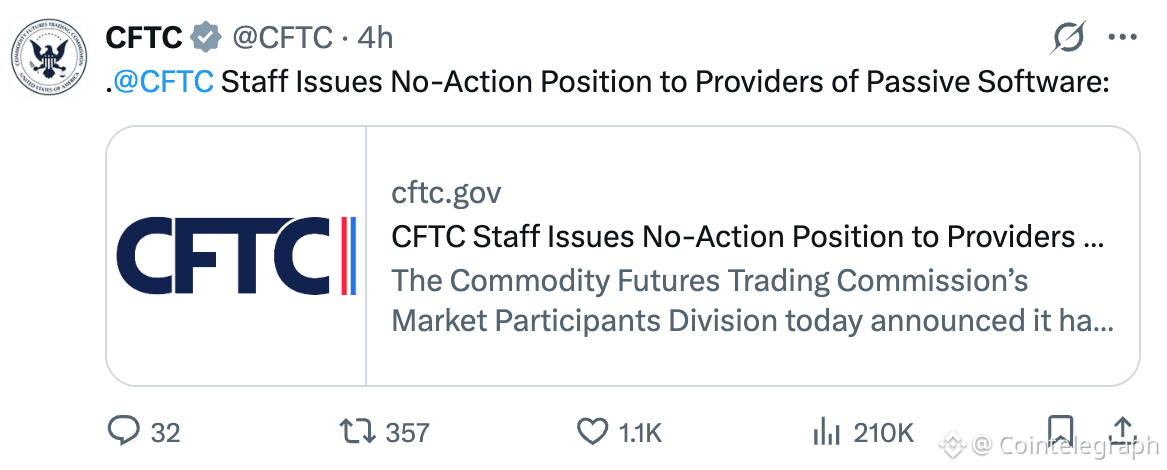
In a no-action position issued Thursday, the agency’s Market Participants Division said it would not recommend enforcement against qualifying providers or their personnel for failing to register as introducing brokers or associated persons when facilitating trading with CFTC-registered firms and exchanges.
The position could make it easier for crypto wallets and other apps to offer access to regulated derivatives, including perpetual contracts and prediction markets, without becoming CFTC-regulated introducing brokers themselves.
Source: CFTC
To qualify, providers must meet conditions limiting their role in transactions, including restrictions on exercising discretion over users’ orders.
The action extends a similar position granted to Phantom Technologies in March for its self-custodial crypto wallet software. The earlier letter allowed Phantom, subject to certain conditions, to provide and market software connecting users with registered futures brokers and exchanges without registering as an introducing broker.
Phantom and the Hyperliquid Policy Center also pushed for broader protections in July, asking the CFTC to shield non-custodial wallet providers from introducing broker requirements and clarify how existing rules apply to blockchain developers and regulated derivatives firms using onchain infrastructure.
Related: Bernstein expects ‘aggressive’ rulemaking from SEC, CFTC, following CLARITY Act failure
Regulators move quickly after CLARITY Act setback
The move from the US regulator comes two days after the CLARITY Act failed to advance in the Senate, with a cloture motion receiving 49 votes, short of the 60 needed to proceed to debate.
Following the vote, CFTC Chair Michael Selig and Securities and Exchange Commission Chair Paul Atkins signaled Wednesday that their agencies would continue moving forward on crypto regulation under their existing authority.
“The CFTC is locked in and ready to ship its rules for the new frontier of finance,” Selig said in a post on X, while Atkins said the SEC would act “with or without legislation” to provide regulatory certainty for digital assets.
Source: Paul Atkins
On Thursday, the agencies began following through. Alongside the CFTC’s no-action position, the SEC approved a temporary exemption allowing qualifying platforms to facilitate limited onchain trading of tokenized US stocks through permissioned automated market makers and liquidity pools.
Magazine: Is there any chance left to save the CLARITY Act?
CFTC expands regulatory relief for passive trading software providers
The Commodity Futures Trading Commission (CFTC) has expanded regulatory relief for “passive software” providers that connect users to regulated derivatives firms and exchanges.
In a no-action position issued Thursday, the agency’s Market Participants Division said it would not recommend enforcement against qualifying providers or their personnel for failing to register as introducing brokers or associated persons when facilitating trading with CFTC-registered firms and exchanges.
The position could make it easier for crypto wallets and other apps to offer access to regulated derivatives, including perpetual contracts and prediction markets, without becoming CFTC-regulated introducing brokers themselves.
Source: CFTC
To qualify, providers must meet conditions limiting their role in transactions, including restrictions on exercising discretion over users’ orders.
The action extends a similar position granted to Phantom Technologies in March for its self-custodial crypto wallet software. The earlier letter allowed Phantom, subject to certain conditions, to provide and market software connecting users with registered futures brokers and exchanges without registering as an introducing broker.
Phantom and the Hyperliquid Policy Center also pushed for broader protections in July, asking the CFTC to shield non-custodial wallet providers from introducing broker requirements and clarify how existing rules apply to blockchain developers and regulated derivatives firms using onchain infrastructure.
Related: Bernstein expects ‘aggressive’ rulemaking from SEC, CFTC, following CLARITY Act failure
Regulators move quickly after CLARITY Act setback
The move from the US regulator comes two days after the CLARITY Act failed to advance in the Senate, with a cloture motion receiving 49 votes, short of the 60 needed to proceed to debate.
Following the vote, CFTC Chair Michael Selig and Securities and Exchange Commission Chair Paul Atkins signaled Wednesday that their agencies would continue moving forward on crypto regulation under their existing authority.
“The CFTC is locked in and ready to ship its rules for the new frontier of finance,” Selig said in a post on X, while Atkins said the SEC would act “with or without legislation” to provide regulatory certainty for digital assets.
Source: Paul Atkins
On Thursday, the agencies began following through. Alongside the CFTC’s no-action position, the SEC approved a temporary exemption allowing qualifying platforms to facilitate limited onchain trading of tokenized US stocks through permissioned automated market makers and liquidity pools.
Magazine: Is there any chance left to save the CLARITY Act?
In a no-action position issued Thursday, the agency’s Market Participants Division said it would not recommend enforcement against qualifying providers or their personnel for failing to register as introducing brokers or associated persons when facilitating trading with CFTC-registered firms and exchanges.
The position could make it easier for crypto wallets and other apps to offer access to regulated derivatives, including perpetual contracts and prediction markets, without becoming CFTC-regulated introducing brokers themselves.
Source: CFTC
To qualify, providers must meet conditions limiting their role in transactions, including restrictions on exercising discretion over users’ orders.
The action extends a similar position granted to Phantom Technologies in March for its self-custodial crypto wallet software. The earlier letter allowed Phantom, subject to certain conditions, to provide and market software connecting users with registered futures brokers and exchanges without registering as an introducing broker.
Phantom and the Hyperliquid Policy Center also pushed for broader protections in July, asking the CFTC to shield non-custodial wallet providers from introducing broker requirements and clarify how existing rules apply to blockchain developers and regulated derivatives firms using onchain infrastructure.
Related: Bernstein expects ‘aggressive’ rulemaking from SEC, CFTC, following CLARITY Act failure
Regulators move quickly after CLARITY Act setback
The move from the US regulator comes two days after the CLARITY Act failed to advance in the Senate, with a cloture motion receiving 49 votes, short of the 60 needed to proceed to debate.
Following the vote, CFTC Chair Michael Selig and Securities and Exchange Commission Chair Paul Atkins signaled Wednesday that their agencies would continue moving forward on crypto regulation under their existing authority.
“The CFTC is locked in and ready to ship its rules for the new frontier of finance,” Selig said in a post on X, while Atkins said the SEC would act “with or without legislation” to provide regulatory certainty for digital assets.
Source: Paul Atkins
On Thursday, the agencies began following through. Alongside the CFTC’s no-action position, the SEC approved a temporary exemption allowing qualifying platforms to facilitate limited onchain trading of tokenized US stocks through permissioned automated market makers and liquidity pools.
Magazine: Is there any chance left to save the CLARITY Act?
137
Article
See translation
WisdomTree, MoonPay team up to expand US access to tokenized money market fundWisdomTree and MoonPay are partnering to expand US investor access to a tokenized Treasury money market fund, which MoonPay also plans to use as part of its stablecoin reserves.
According to a Thursday announcement from the companies, the fund issuer is using MoonPay’s technology to develop an access point for its WisdomTree Treasury Money Market Digital Fund (WTGXX), a tokenized money market mutual fund that seeks to maintain a $1 share price. The companies said the arrangement would give WisdomTree access to MoonPay’s network of more than 35 million accounts.
MoonPay, a financial technology company that provides infrastructure for moving between fiat and digital assets, plans to use WTGXX as part of its stablecoin reserve management stack.
MoonPay launched its enterprise stablecoin business in November 2025 and issues dollar-denominated stablecoins across several blockchains, backed by US dollars and other high-quality liquid assets held in segregated accounts.
The collaboration could expand to additional tokenized funds, including in markets outside the United States, according to WisdomTree, which manages about $176.7 billion in assets.
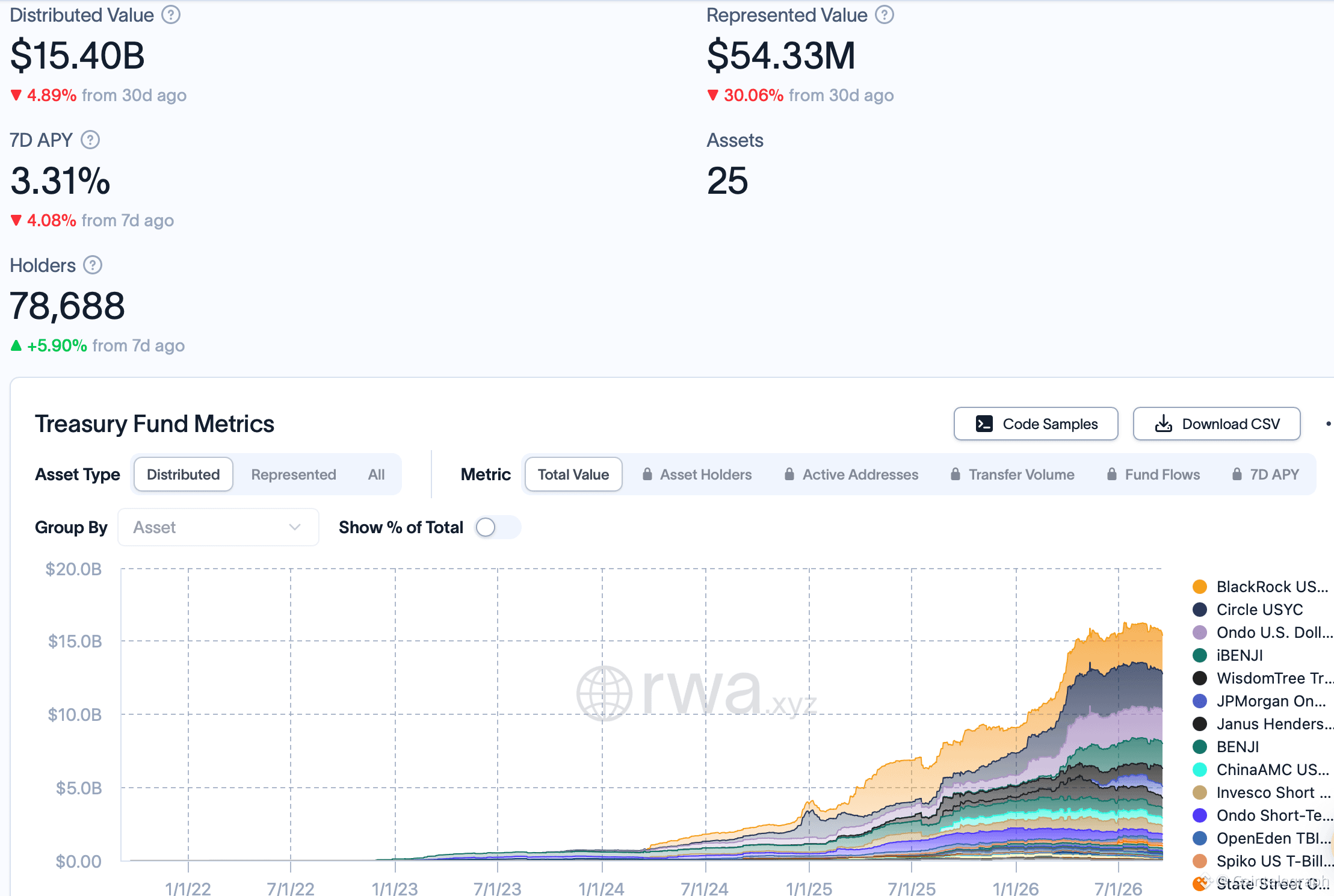
On Thursday, the tokenized US Treasury market stood at about $15.4 billion, with WTGXX accounting for about $1.23 billion, according to RWA.xyz data.
Tokenized US Treasury Funds. Source: RWA.xyz
The fund has logged net flows of $466 million in the past 30 days. Net flows are calculated as the difference between tokens minted and tokens burned. Ondo U.S. Dollar Yield fund (USDY) was the only other tokenized Treasurys fund that saw positive net flows, $66 million, in the period.
WisdomTree, MoonPay team up to expand US access to tokenized money market fund
WisdomTree and MoonPay are partnering to expand US investor access to a tokenized Treasury money market fund, which MoonPay also plans to use as part of its stablecoin reserves.
According to a Thursday announcement from the companies, the fund issuer is using MoonPay’s technology to develop an access point for its WisdomTree Treasury Money Market Digital Fund (WTGXX), a tokenized money market mutual fund that seeks to maintain a $1 share price. The companies said the arrangement would give WisdomTree access to MoonPay’s network of more than 35 million accounts.
MoonPay, a financial technology company that provides infrastructure for moving between fiat and digital assets, plans to use WTGXX as part of its stablecoin reserve management stack.
MoonPay launched its enterprise stablecoin business in November 2025 and issues dollar-denominated stablecoins across several blockchains, backed by US dollars and other high-quality liquid assets held in segregated accounts.
The collaboration could expand to additional tokenized funds, including in markets outside the United States, according to WisdomTree, which manages about $176.7 billion in assets.
On Thursday, the tokenized US Treasury market stood at about $15.4 billion, with WTGXX accounting for about $1.23 billion, according to RWA.xyz data.
Tokenized US Treasury Funds. Source: RWA.xyz
The fund has logged net flows of $466 million in the past 30 days. Net flows are calculated as the difference between tokens minted and tokens burned. Ondo U.S. Dollar Yield fund (USDY) was the only other tokenized Treasurys fund that saw positive net flows, $66 million, in the period.
According to a Thursday announcement from the companies, the fund issuer is using MoonPay’s technology to develop an access point for its WisdomTree Treasury Money Market Digital Fund (WTGXX), a tokenized money market mutual fund that seeks to maintain a $1 share price. The companies said the arrangement would give WisdomTree access to MoonPay’s network of more than 35 million accounts.
MoonPay, a financial technology company that provides infrastructure for moving between fiat and digital assets, plans to use WTGXX as part of its stablecoin reserve management stack.
MoonPay launched its enterprise stablecoin business in November 2025 and issues dollar-denominated stablecoins across several blockchains, backed by US dollars and other high-quality liquid assets held in segregated accounts.
The collaboration could expand to additional tokenized funds, including in markets outside the United States, according to WisdomTree, which manages about $176.7 billion in assets.
On Thursday, the tokenized US Treasury market stood at about $15.4 billion, with WTGXX accounting for about $1.23 billion, according to RWA.xyz data.
Tokenized US Treasury Funds. Source: RWA.xyz
The fund has logged net flows of $466 million in the past 30 days. Net flows are calculated as the difference between tokens minted and tokens burned. Ondo U.S. Dollar Yield fund (USDY) was the only other tokenized Treasurys fund that saw positive net flows, $66 million, in the period.
150
Article
See translation
Bitcoin coils near $76.5K as US stocks rebound from Fed rate hikeBitcoin (BTC) traded near $76,500 after Thursday’s Wall Street open as investors snapped up US stocks following their recent dip.
Key points:
Bitcoin consolidated after dropping below $76,000 on the back of a 0.25% interest-rate hike by the US Federal Reserve.
US equities rebounded, with the Nasdaq Composite Index gaining 1.5% as analysis saw upside continuation.
Bitcoin price analysis retained its bullish slant on market conditions, with CryptoQuant’s Bull Score Index circling 60/100 on Thursday.
Bitcoin halts losses as US stocks turn green
Data from TradingView showed that BTC price volatility was cooling over the last 24 hours, with only modest moves to take nearby liquidity.
BTC/USD one-hour chart. Source: Cointelegraph/TradingView
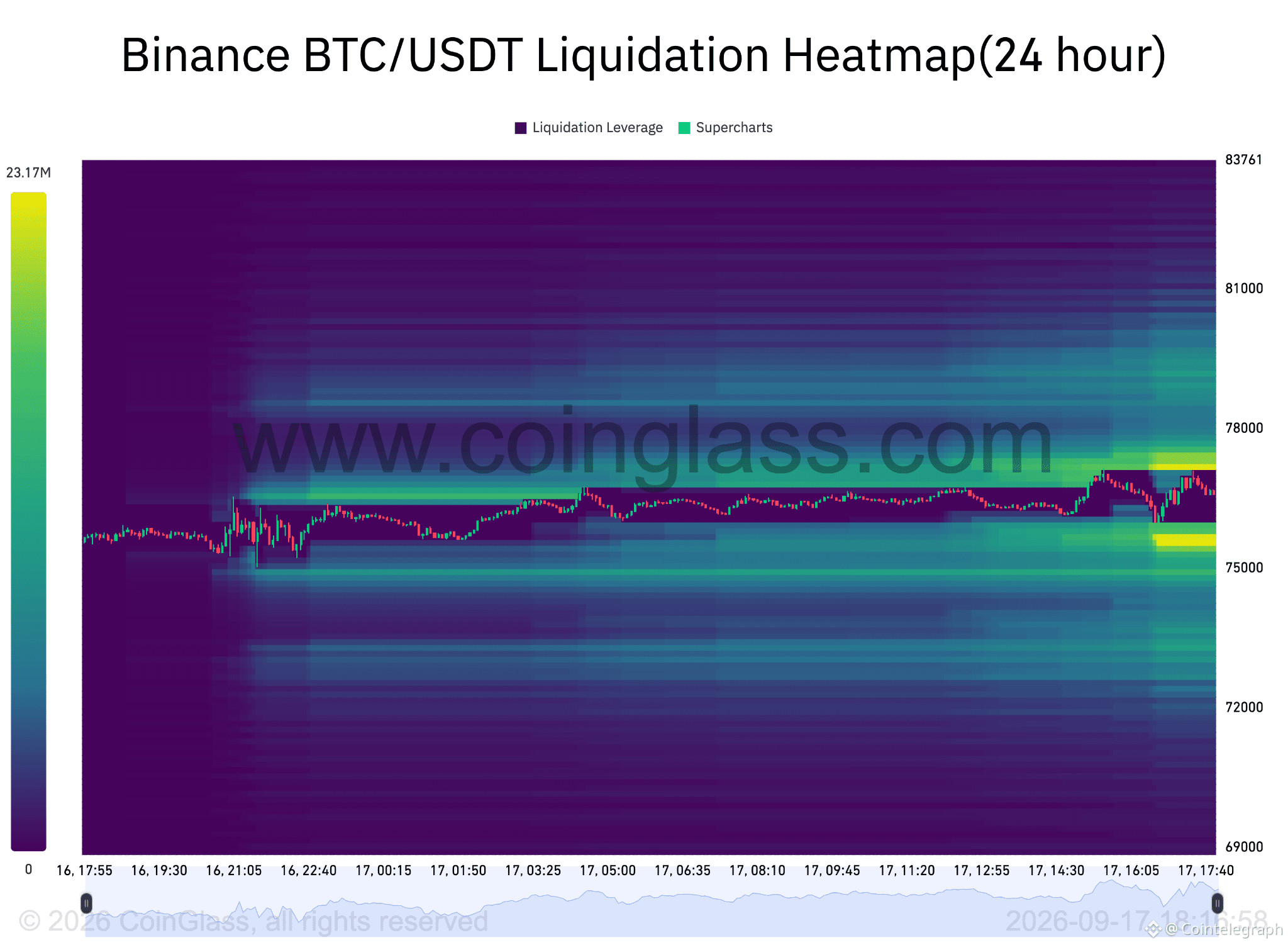
Data from CoinGlass showed both bid and ask liquidity thickening around the current spot price, a typical feature of rangebound trading conditions.
BTC/USDT liquidation heatmap (Binance). Source: CoinGlass
US equities gained on the day, as investors sought to capitalize on the local downside that followed policy tightening by the US Federal Reserve. The S&P 500 Index and tech-heavy Nasdaq Composite Index gained 0.9% and 1.5%, respectively.
Nasdaq Composite Index one-day chart. Source: Cointelegraph/TradingView
On Wednesday, the Fed voted to increase benchmark interest rates by 25 basis points to 3.75-4%. This was its first hike since July 2023, and signaled an end to three years of easing in which the Fed either cut rates or held them in the same range between meetings.
Commenting, trading resource The Kobeissi Letter suggested that assets would continue to perform strongly despite the prospect of lower-liquidity conditions associated with the rate hikes. As Cointelegraph reported, central-bank rates are notching higher globally, as the European Central Bank hiked by 0.25% last week and the Bank of Japan is expected to follow suit on Friday.
“The asset owner economy just keeps getting better,” it wrote in a post on X, referencing the day’s gains in the Nasdaq.
Analysis sees BTC price trend “cooling, not turning”
Bitcoin also enjoyed relief after falling to new month-to-date lows on Tuesday. At the time of writing, BTC/USD traded 0.5% higher on the day.
Commenting on the current market landscape, onchain analytics platform CryptoQuant described macro conditions as a hurdle to the continuation of Bitcoin’s previous rebound that totaled 25% in August.
“The trend is still bullish, but momentum and macro are working against it near-term,” head of research Julio Moreno wrote in its latest weekly report sent to Cointelegraph.
Moreno noted that one of CryptoQuant’s proprietary indicators tracking BTC price cycles, the Bull Score Index, had dropped from 80 to 60 — the cut-off point for what it describes as “bullish conditions.”
“Bitcoin is cooling, not turning. A Bull Score of 60 keeps the trend bullish, but fading US demand, rising altcoin inflows, and a week of macro risk — the delay of the CLARITY Act and a likely Fed hike — argue for consolidation. Watch $70K and $62K–$65K as support,” the report summarized.
Bitcoin Bull Score Index. Source: CryptoQuant
Bitcoin coils near $76.5K as US stocks rebound from Fed rate hike
Bitcoin (BTC) traded near $76,500 after Thursday’s Wall Street open as investors snapped up US stocks following their recent dip.
Key points:
Bitcoin consolidated after dropping below $76,000 on the back of a 0.25% interest-rate hike by the US Federal Reserve.
US equities rebounded, with the Nasdaq Composite Index gaining 1.5% as analysis saw upside continuation.
Bitcoin price analysis retained its bullish slant on market conditions, with CryptoQuant’s Bull Score Index circling 60/100 on Thursday.
Bitcoin halts losses as US stocks turn green
Data from TradingView showed that BTC price volatility was cooling over the last 24 hours, with only modest moves to take nearby liquidity.
BTC/USD one-hour chart. Source: Cointelegraph/TradingView
Data from CoinGlass showed both bid and ask liquidity thickening around the current spot price, a typical feature of rangebound trading conditions.
BTC/USDT liquidation heatmap (Binance). Source: CoinGlass
US equities gained on the day, as investors sought to capitalize on the local downside that followed policy tightening by the US Federal Reserve. The S&P 500 Index and tech-heavy Nasdaq Composite Index gained 0.9% and 1.5%, respectively.
Nasdaq Composite Index one-day chart. Source: Cointelegraph/TradingView
On Wednesday, the Fed voted to increase benchmark interest rates by 25 basis points to 3.75-4%. This was its first hike since July 2023, and signaled an end to three years of easing in which the Fed either cut rates or held them in the same range between meetings.
Commenting, trading resource The Kobeissi Letter suggested that assets would continue to perform strongly despite the prospect of lower-liquidity conditions associated with the rate hikes. As Cointelegraph reported, central-bank rates are notching higher globally, as the European Central Bank hiked by 0.25% last week and the Bank of Japan is expected to follow suit on Friday.
“The asset owner economy just keeps getting better,” it wrote in a post on X, referencing the day’s gains in the Nasdaq.
Analysis sees BTC price trend “cooling, not turning”
Bitcoin also enjoyed relief after falling to new month-to-date lows on Tuesday. At the time of writing, BTC/USD traded 0.5% higher on the day.
Commenting on the current market landscape, onchain analytics platform CryptoQuant described macro conditions as a hurdle to the continuation of Bitcoin’s previous rebound that totaled 25% in August.
“The trend is still bullish, but momentum and macro are working against it near-term,” head of research Julio Moreno wrote in its latest weekly report sent to Cointelegraph.
Moreno noted that one of CryptoQuant’s proprietary indicators tracking BTC price cycles, the Bull Score Index, had dropped from 80 to 60 — the cut-off point for what it describes as “bullish conditions.”
“Bitcoin is cooling, not turning. A Bull Score of 60 keeps the trend bullish, but fading US demand, rising altcoin inflows, and a week of macro risk — the delay of the CLARITY Act and a likely Fed hike — argue for consolidation. Watch $70K and $62K–$65K as support,” the report summarized.
Bitcoin Bull Score Index. Source: CryptoQuant
Key points:
Bitcoin consolidated after dropping below $76,000 on the back of a 0.25% interest-rate hike by the US Federal Reserve.
US equities rebounded, with the Nasdaq Composite Index gaining 1.5% as analysis saw upside continuation.
Bitcoin price analysis retained its bullish slant on market conditions, with CryptoQuant’s Bull Score Index circling 60/100 on Thursday.
Bitcoin halts losses as US stocks turn green
Data from TradingView showed that BTC price volatility was cooling over the last 24 hours, with only modest moves to take nearby liquidity.
BTC/USD one-hour chart. Source: Cointelegraph/TradingView
Data from CoinGlass showed both bid and ask liquidity thickening around the current spot price, a typical feature of rangebound trading conditions.
BTC/USDT liquidation heatmap (Binance). Source: CoinGlass
US equities gained on the day, as investors sought to capitalize on the local downside that followed policy tightening by the US Federal Reserve. The S&P 500 Index and tech-heavy Nasdaq Composite Index gained 0.9% and 1.5%, respectively.
Nasdaq Composite Index one-day chart. Source: Cointelegraph/TradingView
On Wednesday, the Fed voted to increase benchmark interest rates by 25 basis points to 3.75-4%. This was its first hike since July 2023, and signaled an end to three years of easing in which the Fed either cut rates or held them in the same range between meetings.
Commenting, trading resource The Kobeissi Letter suggested that assets would continue to perform strongly despite the prospect of lower-liquidity conditions associated with the rate hikes. As Cointelegraph reported, central-bank rates are notching higher globally, as the European Central Bank hiked by 0.25% last week and the Bank of Japan is expected to follow suit on Friday.
“The asset owner economy just keeps getting better,” it wrote in a post on X, referencing the day’s gains in the Nasdaq.
Analysis sees BTC price trend “cooling, not turning”
Bitcoin also enjoyed relief after falling to new month-to-date lows on Tuesday. At the time of writing, BTC/USD traded 0.5% higher on the day.
Commenting on the current market landscape, onchain analytics platform CryptoQuant described macro conditions as a hurdle to the continuation of Bitcoin’s previous rebound that totaled 25% in August.
“The trend is still bullish, but momentum and macro are working against it near-term,” head of research Julio Moreno wrote in its latest weekly report sent to Cointelegraph.
Moreno noted that one of CryptoQuant’s proprietary indicators tracking BTC price cycles, the Bull Score Index, had dropped from 80 to 60 — the cut-off point for what it describes as “bullish conditions.”
“Bitcoin is cooling, not turning. A Bull Score of 60 keeps the trend bullish, but fading US demand, rising altcoin inflows, and a week of macro risk — the delay of the CLARITY Act and a likely Fed hike — argue for consolidation. Watch $70K and $62K–$65K as support,” the report summarized.
Bitcoin Bull Score Index. Source: CryptoQuant
168
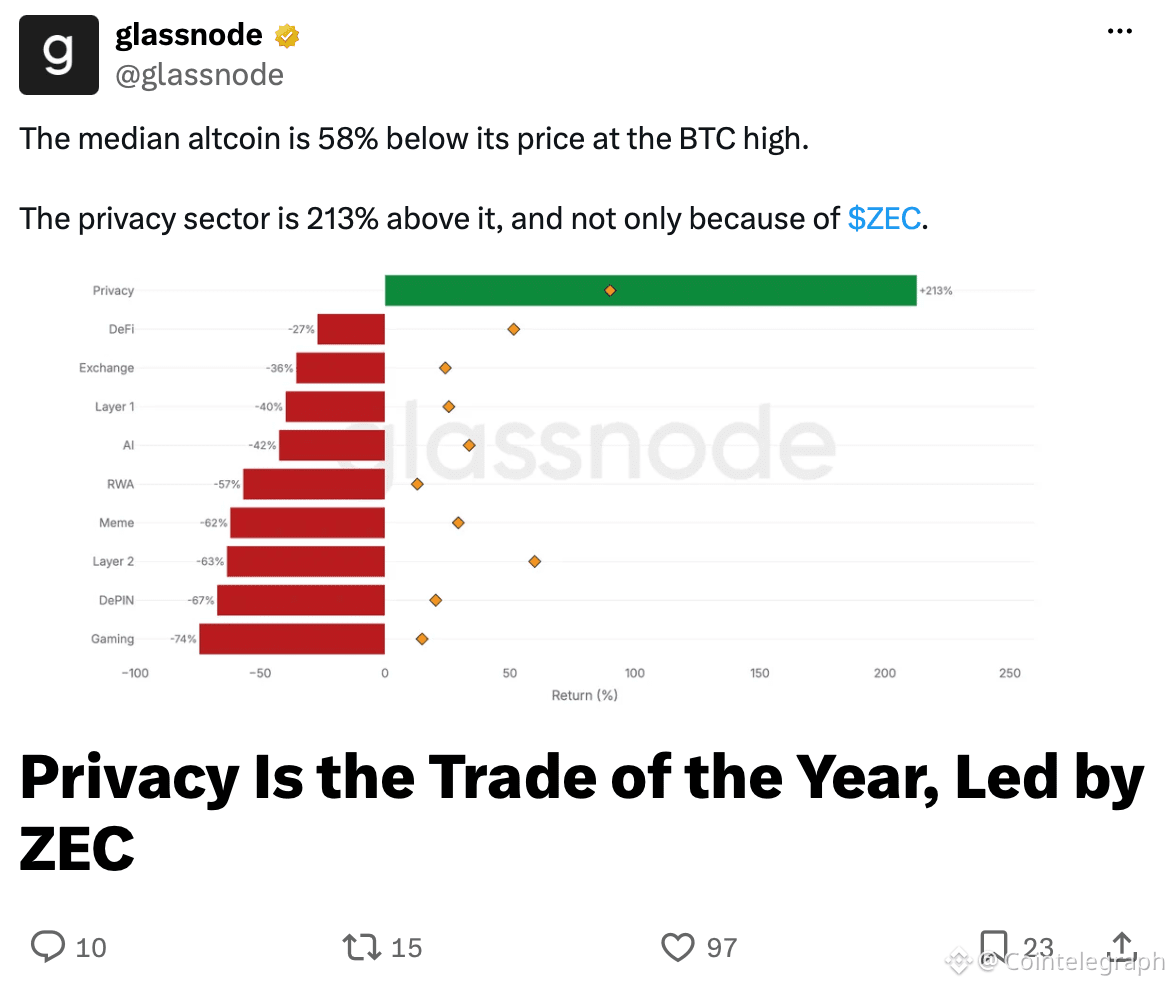
Article
See translation
Zcash miner Fortitude taps former Hut 8 CEO to lead ahead of public listingFortitude Mining has appointed former Hut 8 CEO Jaime Leverton as chief executive as the Zcash-focused miner prepares to go public through a proposed merger with HeartSciences. Leverton will succeed Andrea Childs as CEO on Sept. 21, with Childs moving to chief operating officer.
Fortitude mined 72,696 ZEC in the first half of 2026, accounting for about 28% of the network’s total production during the period. The company reported revenue of $20.9 million for the second quarter.
It operates more than 60 megawatts of power capacity across seven sites in South Dakota, Nebraska, Texas and New York, and in July agreed to purchase 9,000 Bitmain Antminer Z15 Pro machines, which are expected to add 7.56 GSol/s of equihash hashrate. Shipments are expected in the fourth quarter.
Fortitude, wholly owned by Digital Currency Group, has mined ZEC since 2019 and launched as a vertically integrated mining platform in 2025.
The company announced its proposed combination with HeartSciences in June, with the transaction expected to close in the fourth quarter of 2026 and bring Fortitude to the public markets. The combined company is expected to trade on Nasdaq under the ticker TUDE, subject to approval.
Leverton previously served as CEO of Hut 8, where she oversaw the Bitcoin miner’s merger with US Bitcoin Corp. and its transition into a US-domiciled Nasdaq-listed company. Current CEO Andrea Childs will transition to the chief operating officer role.
Related: Cypherpunk launches Zcash mining fleet controlling 18% of network hashrate
Zcash surges amid Paradigm investment
Zcash continued its rally on Thursday, with ZEC, the native token of the blockchain designed to enable private transactions using zero-knowledge proofs, trading around $1,424. The token has gained about 185% over the past 30 days and more than 2,600% over the past year, according to CoinGecko.
The latest gains came after Paradigm co-founder Matt Huang disclosed Wednesday that the crypto investment firm holds ZEC and is an investor in the Zcash Open Development Lab.
Huang described Zcash as a “private complement to Bitcoin” and backed its inflation-funded developer fund, arguing that long-term funding for privacy technology is increasingly important as artificial intelligence and quantum computing advance.
Over the past year, privacy-focused cryptocurrencies have outperformed the broader crypto market. As of Sept. 6, the sector was up 213% from Bitcoin’s October 2025 peak, while every other crypto sector tracked by Glassnode remained below its level at the time.
ZEC accounted for 62% of the privacy sector’s market capitalization, according to Glassnode data. Excluding ZEC, the firm’s cap-weighted basket of privacy tokens was still up 85% over the past year.
Source: Glassnode
Zcash miner Fortitude taps former Hut 8 CEO to lead ahead of public listing
Fortitude Mining has appointed former Hut 8 CEO Jaime Leverton as chief executive as the Zcash-focused miner prepares to go public through a proposed merger with HeartSciences. Leverton will succeed Andrea Childs as CEO on Sept. 21, with Childs moving to chief operating officer.
Fortitude mined 72,696 ZEC in the first half of 2026, accounting for about 28% of the network’s total production during the period. The company reported revenue of $20.9 million for the second quarter.
It operates more than 60 megawatts of power capacity across seven sites in South Dakota, Nebraska, Texas and New York, and in July agreed to purchase 9,000 Bitmain Antminer Z15 Pro machines, which are expected to add 7.56 GSol/s of equihash hashrate. Shipments are expected in the fourth quarter.
Fortitude, wholly owned by Digital Currency Group, has mined ZEC since 2019 and launched as a vertically integrated mining platform in 2025.
The company announced its proposed combination with HeartSciences in June, with the transaction expected to close in the fourth quarter of 2026 and bring Fortitude to the public markets. The combined company is expected to trade on Nasdaq under the ticker TUDE, subject to approval.
Leverton previously served as CEO of Hut 8, where she oversaw the Bitcoin miner’s merger with US Bitcoin Corp. and its transition into a US-domiciled Nasdaq-listed company. Current CEO Andrea Childs will transition to the chief operating officer role.
Related: Cypherpunk launches Zcash mining fleet controlling 18% of network hashrate
Zcash surges amid Paradigm investment
Zcash continued its rally on Thursday, with ZEC, the native token of the blockchain designed to enable private transactions using zero-knowledge proofs, trading around $1,424. The token has gained about 185% over the past 30 days and more than 2,600% over the past year, according to CoinGecko.
The latest gains came after Paradigm co-founder Matt Huang disclosed Wednesday that the crypto investment firm holds ZEC and is an investor in the Zcash Open Development Lab.
Huang described Zcash as a “private complement to Bitcoin” and backed its inflation-funded developer fund, arguing that long-term funding for privacy technology is increasingly important as artificial intelligence and quantum computing advance.
Over the past year, privacy-focused cryptocurrencies have outperformed the broader crypto market. As of Sept. 6, the sector was up 213% from Bitcoin’s October 2025 peak, while every other crypto sector tracked by Glassnode remained below its level at the time.
ZEC accounted for 62% of the privacy sector’s market capitalization, according to Glassnode data. Excluding ZEC, the firm’s cap-weighted basket of privacy tokens was still up 85% over the past year.
Source: Glassnode
Fortitude mined 72,696 ZEC in the first half of 2026, accounting for about 28% of the network’s total production during the period. The company reported revenue of $20.9 million for the second quarter.
It operates more than 60 megawatts of power capacity across seven sites in South Dakota, Nebraska, Texas and New York, and in July agreed to purchase 9,000 Bitmain Antminer Z15 Pro machines, which are expected to add 7.56 GSol/s of equihash hashrate. Shipments are expected in the fourth quarter.
Fortitude, wholly owned by Digital Currency Group, has mined ZEC since 2019 and launched as a vertically integrated mining platform in 2025.
The company announced its proposed combination with HeartSciences in June, with the transaction expected to close in the fourth quarter of 2026 and bring Fortitude to the public markets. The combined company is expected to trade on Nasdaq under the ticker TUDE, subject to approval.
Leverton previously served as CEO of Hut 8, where she oversaw the Bitcoin miner’s merger with US Bitcoin Corp. and its transition into a US-domiciled Nasdaq-listed company. Current CEO Andrea Childs will transition to the chief operating officer role.
Related: Cypherpunk launches Zcash mining fleet controlling 18% of network hashrate
Zcash surges amid Paradigm investment
Zcash continued its rally on Thursday, with ZEC, the native token of the blockchain designed to enable private transactions using zero-knowledge proofs, trading around $1,424. The token has gained about 185% over the past 30 days and more than 2,600% over the past year, according to CoinGecko.
The latest gains came after Paradigm co-founder Matt Huang disclosed Wednesday that the crypto investment firm holds ZEC and is an investor in the Zcash Open Development Lab.
Huang described Zcash as a “private complement to Bitcoin” and backed its inflation-funded developer fund, arguing that long-term funding for privacy technology is increasingly important as artificial intelligence and quantum computing advance.
Over the past year, privacy-focused cryptocurrencies have outperformed the broader crypto market. As of Sept. 6, the sector was up 213% from Bitcoin’s October 2025 peak, while every other crypto sector tracked by Glassnode remained below its level at the time.
ZEC accounted for 62% of the privacy sector’s market capitalization, according to Glassnode data. Excluding ZEC, the firm’s cap-weighted basket of privacy tokens was still up 85% over the past year.
Source: Glassnode
150
Verified
See translation
OG.com cleared by SEC to offer single-stock futures, says Crypto.com CEOOG.com has received authorization from the US Securities and Exchange Commission (SEC) to offer single-stock futures in the US.
Kris Marszalek, co-founder and CEO of crypto.com, made the announcement its sister futures exchange in a Thursday X post that received regulatory approval to list single-stock futures in the US.
The US Securities and Exchange Commission (SEC) has acknowledged OG.com’s 1-N filing, authorizing the platform to offer single-stock futures in the US, .
Marszalek said they are working with the securities regulator and the Commodity Futures Trading Commission (CFTC) to offer single-stock perps that combine the “innovations of the digital asset markets with the US capital markets.”
The acknowledgement clears a significant regulatory hurdle for the platform, allowing it to list these products on the US market. OG.com’s legal entity, North American Derivatives Exchange, filed the Form 1-N with the SEC on Monday to register as a national securities exchange for trading futures products.
Other crypto platforms also launched access to equities products. In September, Kraken reportedly partnered with the London Stock Exchange to launch tokenized UK stocks with 24/5 availability on the stock market operator’s night-time trading venue starting in 2027.
In March, crypto exchange Coinbase launched stock perpetual futures for non-US traders, after launching access to regulated crypto futures and 24/5 cash equities in the US in February.
OG.com cleared by SEC to offer single-stock futures, says Crypto.com CEO
OG.com has received authorization from the US Securities and Exchange Commission (SEC) to offer single-stock futures in the US.
Kris Marszalek, co-founder and CEO of crypto.com, made the announcement its sister futures exchange in a Thursday X post that received regulatory approval to list single-stock futures in the US.
The US Securities and Exchange Commission (SEC) has acknowledged OG.com’s 1-N filing, authorizing the platform to offer single-stock futures in the US, .
Marszalek said they are working with the securities regulator and the Commodity Futures Trading Commission (CFTC) to offer single-stock perps that combine the “innovations of the digital asset markets with the US capital markets.”
The acknowledgement clears a significant regulatory hurdle for the platform, allowing it to list these products on the US market. OG.com’s legal entity, North American Derivatives Exchange, filed the Form 1-N with the SEC on Monday to register as a national securities exchange for trading futures products.
Other crypto platforms also launched access to equities products. In September, Kraken reportedly partnered with the London Stock Exchange to launch tokenized UK stocks with 24/5 availability on the stock market operator’s night-time trading venue starting in 2027.
In March, crypto exchange Coinbase launched stock perpetual futures for non-US traders, after launching access to regulated crypto futures and 24/5 cash equities in the US in February.
Kris Marszalek, co-founder and CEO of crypto.com, made the announcement its sister futures exchange in a Thursday X post that received regulatory approval to list single-stock futures in the US.
The US Securities and Exchange Commission (SEC) has acknowledged OG.com’s 1-N filing, authorizing the platform to offer single-stock futures in the US, .
Marszalek said they are working with the securities regulator and the Commodity Futures Trading Commission (CFTC) to offer single-stock perps that combine the “innovations of the digital asset markets with the US capital markets.”
The acknowledgement clears a significant regulatory hurdle for the platform, allowing it to list these products on the US market. OG.com’s legal entity, North American Derivatives Exchange, filed the Form 1-N with the SEC on Monday to register as a national securities exchange for trading futures products.
Other crypto platforms also launched access to equities products. In September, Kraken reportedly partnered with the London Stock Exchange to launch tokenized UK stocks with 24/5 availability on the stock market operator’s night-time trading venue starting in 2027.
In March, crypto exchange Coinbase launched stock perpetual futures for non-US traders, after launching access to regulated crypto futures and 24/5 cash equities in the US in February.
291
See translation
SEC grants temporary exemption for tokenized US stock tradingThe US Securities and Exchange Commission approved a temporary exemption allowing limited trading of tokenized US stocks on certain onchain venues.
Under the innovation exemption approved Thursday, Tokenized Securities Venues (TSVs) can offer permissioned trading of tokenized National Market System (NMS) stocks.
The exemption covers trading through automated market makers and liquidity pools, subject to requirements including transaction transparency, recordkeeping and technology safeguards, SEC Commissioner Mark Uyeda said. TSVs must also regularly publish US dollar-denominated transaction data, including prices, trade sizes, timestamps, pool addresses, end-of-day pool sizes and daily volumes.
“The Innovation Exemption is designed to be controlled,” Uyeda said, adding that symbol and volume limits will apply. He said the framework would give the SEC data to assess onchain securities trading and inform future rules.
The SEC is seeking public feedback on the framework, including data, case studies and information from live or test environments.
The SEC had been developing the innovation exemption for months. In February, SEC Chair Paul Atkins said the regulator was considering a temporary framework that would allow limited trading of tokenized securities through automated market makers while it developed longer-term rules.
SEC grants temporary exemption for tokenized US stock trading
The US Securities and Exchange Commission approved a temporary exemption allowing limited trading of tokenized US stocks on certain onchain venues.
Under the innovation exemption approved Thursday, Tokenized Securities Venues (TSVs) can offer permissioned trading of tokenized National Market System (NMS) stocks.
The exemption covers trading through automated market makers and liquidity pools, subject to requirements including transaction transparency, recordkeeping and technology safeguards, SEC Commissioner Mark Uyeda said. TSVs must also regularly publish US dollar-denominated transaction data, including prices, trade sizes, timestamps, pool addresses, end-of-day pool sizes and daily volumes.
“The Innovation Exemption is designed to be controlled,” Uyeda said, adding that symbol and volume limits will apply. He said the framework would give the SEC data to assess onchain securities trading and inform future rules.
The SEC is seeking public feedback on the framework, including data, case studies and information from live or test environments.
The SEC had been developing the innovation exemption for months. In February, SEC Chair Paul Atkins said the regulator was considering a temporary framework that would allow limited trading of tokenized securities through automated market makers while it developed longer-term rules.
Under the innovation exemption approved Thursday, Tokenized Securities Venues (TSVs) can offer permissioned trading of tokenized National Market System (NMS) stocks.
The exemption covers trading through automated market makers and liquidity pools, subject to requirements including transaction transparency, recordkeeping and technology safeguards, SEC Commissioner Mark Uyeda said. TSVs must also regularly publish US dollar-denominated transaction data, including prices, trade sizes, timestamps, pool addresses, end-of-day pool sizes and daily volumes.
“The Innovation Exemption is designed to be controlled,” Uyeda said, adding that symbol and volume limits will apply. He said the framework would give the SEC data to assess onchain securities trading and inform future rules.
The SEC is seeking public feedback on the framework, including data, case studies and information from live or test environments.
The SEC had been developing the innovation exemption for months. In February, SEC Chair Paul Atkins said the regulator was considering a temporary framework that would allow limited trading of tokenized securities through automated market makers while it developed longer-term rules.
207
See translation
S&P Global to acquire blockchain security platform OpenZeppelinS&P Global is set to acquire the blockchain security company OpenZeppelin, expanding the financial data, ratings and benchmark provider’s digital asset capabilities.
The deal announced on Thursday is aimed at complementing S&P Global’s risk assessment and ecosystem development capabilities in the digital asset market, it said. Financial terms were not disclosed, and the transaction remains subject to closing conditions.
“Our digital assets strategy centers on bringing trusted data, benchmarks and transparent risk assessment to markets as they move onchain,” S&P Global ratings president Yann Le Pallec said. He added that OpenZeppelin would expand his company’s smart contract and onchain technology risk assessment capabilities.
Founded in 2015, OpenZeppelin develops open-source smart contract software and provides security assessments for blockchain projects and financial institutions. Its smart contracts have facilitated more than $37 trillion in value transferred, while the company has completed over 900 security engagements, the announcement notes.
OpenZeppelin said its contracts library and other open-source applications will remain free and publicly maintained on GitHub. The platform will operate as a separate S&P Global business unit, with CEO Demian Brener continuing to lead while reporting to Le Pallec.
Earlier this week, S&P Global led a strategic investment in Kaiko, extending the Paris-based crypto market data provider’s Series B funding to $110 million as it expands its data infrastructure for tokenized financial markets.
S&P Global to acquire blockchain security platform OpenZeppelin
S&P Global is set to acquire the blockchain security company OpenZeppelin, expanding the financial data, ratings and benchmark provider’s digital asset capabilities.
The deal announced on Thursday is aimed at complementing S&P Global’s risk assessment and ecosystem development capabilities in the digital asset market, it said. Financial terms were not disclosed, and the transaction remains subject to closing conditions.
“Our digital assets strategy centers on bringing trusted data, benchmarks and transparent risk assessment to markets as they move onchain,” S&P Global ratings president Yann Le Pallec said. He added that OpenZeppelin would expand his company’s smart contract and onchain technology risk assessment capabilities.
Founded in 2015, OpenZeppelin develops open-source smart contract software and provides security assessments for blockchain projects and financial institutions. Its smart contracts have facilitated more than $37 trillion in value transferred, while the company has completed over 900 security engagements, the announcement notes.
OpenZeppelin said its contracts library and other open-source applications will remain free and publicly maintained on GitHub. The platform will operate as a separate S&P Global business unit, with CEO Demian Brener continuing to lead while reporting to Le Pallec.
Earlier this week, S&P Global led a strategic investment in Kaiko, extending the Paris-based crypto market data provider’s Series B funding to $110 million as it expands its data infrastructure for tokenized financial markets.
The deal announced on Thursday is aimed at complementing S&P Global’s risk assessment and ecosystem development capabilities in the digital asset market, it said. Financial terms were not disclosed, and the transaction remains subject to closing conditions.
“Our digital assets strategy centers on bringing trusted data, benchmarks and transparent risk assessment to markets as they move onchain,” S&P Global ratings president Yann Le Pallec said. He added that OpenZeppelin would expand his company’s smart contract and onchain technology risk assessment capabilities.
Founded in 2015, OpenZeppelin develops open-source smart contract software and provides security assessments for blockchain projects and financial institutions. Its smart contracts have facilitated more than $37 trillion in value transferred, while the company has completed over 900 security engagements, the announcement notes.
OpenZeppelin said its contracts library and other open-source applications will remain free and publicly maintained on GitHub. The platform will operate as a separate S&P Global business unit, with CEO Demian Brener continuing to lead while reporting to Le Pallec.
Earlier this week, S&P Global led a strategic investment in Kaiko, extending the Paris-based crypto market data provider’s Series B funding to $110 million as it expands its data infrastructure for tokenized financial markets.
187

Article
See translation
Crypto adoption blooming in Germany, while UK is falling ‘behind,’ says CoinShares researcherCryptocurrency adoption is advancing in Germany, particularly among younger investors, while the UK is gradually falling behind, largely due to lagging regulations, according to CoinShares crypto researcher Luke Nolan.
German cryptocurrency adoption is showing “very good progress” through “family offices, wealth managers, individual advisors” and younger generations looking to invest inherited wealth in digital assets, Nolan told Cointelegraph on the Chain Reaction show on Thursday.
In contrast, the UK is “still very much behind,” said Nolan, adding that the country’s Financial Conduct Authority (FCA) only lifted its ban on crypto exchange-traded products less than a year ago, making its digital asset market “nascent.” The regulator previously banned these products from retail participants in January 2021.
Germany has 89 licensed crypto-asset service providers, accounting for 25.5% of companies in the European Securities and Markets Authority’s (ESMA) Markets in Crypto Assets (MiCA) register, updated on Wednesday. The EU’s biggest economy was also the bloc’s leader by MiCA authorization in June, with 57 authorized crypto companies.
Source: Cointelegraph
Leading German banks are venturing into crypto
The adoption trend is not lost on the largest German banks.
The country’s biggest, Deutsche Bank, revealed on Wednesday that it was awaiting regulatory approval to launch crypto custody solutions for institutional clients in Europe, with a license expected in October.
In April 2024, Germany’s largest federal bank, the Landesbank Baden-Württemberg, started offering crypto custody solutions after partnering with the Austria-based Bitpanda for its institutional custody platform.
Meanwhile in the UK, the FCA on Wednesday issued final guidance outlining when crypto activities may require authorization under the country’s incoming regulatory regime.
The regulator will open licensing applications on Sept. 30, with a Feb. 28, 2027 deadline for firms seeking transitional arrangements ahead of the new regime taking effect on Oct. 25, 2027.
On Thursday, the FCA announced that it sent a cease-and-desist letter to three London locations suspected of facilitating illegal peer-to-peer crypto trading.
The UK Parliament approved regulations bringing digital assets within the FCA’s regulatory remit in February and finalized a package of rules and guidance in June.
Magazine: How the EU’s crypto tax rules are expected to work for users and platforms
Crypto adoption blooming in Germany, while UK is falling ‘behind,’ says CoinShares researcher
Cryptocurrency adoption is advancing in Germany, particularly among younger investors, while the UK is gradually falling behind, largely due to lagging regulations, according to CoinShares crypto researcher Luke Nolan.
German cryptocurrency adoption is showing “very good progress” through “family offices, wealth managers, individual advisors” and younger generations looking to invest inherited wealth in digital assets, Nolan told Cointelegraph on the Chain Reaction show on Thursday.
In contrast, the UK is “still very much behind,” said Nolan, adding that the country’s Financial Conduct Authority (FCA) only lifted its ban on crypto exchange-traded products less than a year ago, making its digital asset market “nascent.” The regulator previously banned these products from retail participants in January 2021.
Germany has 89 licensed crypto-asset service providers, accounting for 25.5% of companies in the European Securities and Markets Authority’s (ESMA) Markets in Crypto Assets (MiCA) register, updated on Wednesday. The EU’s biggest economy was also the bloc’s leader by MiCA authorization in June, with 57 authorized crypto companies.
Source: Cointelegraph
Leading German banks are venturing into crypto
The adoption trend is not lost on the largest German banks.
The country’s biggest, Deutsche Bank, revealed on Wednesday that it was awaiting regulatory approval to launch crypto custody solutions for institutional clients in Europe, with a license expected in October.
In April 2024, Germany’s largest federal bank, the Landesbank Baden-Württemberg, started offering crypto custody solutions after partnering with the Austria-based Bitpanda for its institutional custody platform.
Meanwhile in the UK, the FCA on Wednesday issued final guidance outlining when crypto activities may require authorization under the country’s incoming regulatory regime.
The regulator will open licensing applications on Sept. 30, with a Feb. 28, 2027 deadline for firms seeking transitional arrangements ahead of the new regime taking effect on Oct. 25, 2027.
On Thursday, the FCA announced that it sent a cease-and-desist letter to three London locations suspected of facilitating illegal peer-to-peer crypto trading.
The UK Parliament approved regulations bringing digital assets within the FCA’s regulatory remit in February and finalized a package of rules and guidance in June.
Magazine: How the EU’s crypto tax rules are expected to work for users and platforms
German cryptocurrency adoption is showing “very good progress” through “family offices, wealth managers, individual advisors” and younger generations looking to invest inherited wealth in digital assets, Nolan told Cointelegraph on the Chain Reaction show on Thursday.
In contrast, the UK is “still very much behind,” said Nolan, adding that the country’s Financial Conduct Authority (FCA) only lifted its ban on crypto exchange-traded products less than a year ago, making its digital asset market “nascent.” The regulator previously banned these products from retail participants in January 2021.
Germany has 89 licensed crypto-asset service providers, accounting for 25.5% of companies in the European Securities and Markets Authority’s (ESMA) Markets in Crypto Assets (MiCA) register, updated on Wednesday. The EU’s biggest economy was also the bloc’s leader by MiCA authorization in June, with 57 authorized crypto companies.
Source: Cointelegraph
Leading German banks are venturing into crypto
The adoption trend is not lost on the largest German banks.
The country’s biggest, Deutsche Bank, revealed on Wednesday that it was awaiting regulatory approval to launch crypto custody solutions for institutional clients in Europe, with a license expected in October.
In April 2024, Germany’s largest federal bank, the Landesbank Baden-Württemberg, started offering crypto custody solutions after partnering with the Austria-based Bitpanda for its institutional custody platform.
Meanwhile in the UK, the FCA on Wednesday issued final guidance outlining when crypto activities may require authorization under the country’s incoming regulatory regime.
The regulator will open licensing applications on Sept. 30, with a Feb. 28, 2027 deadline for firms seeking transitional arrangements ahead of the new regime taking effect on Oct. 25, 2027.
On Thursday, the FCA announced that it sent a cease-and-desist letter to three London locations suspected of facilitating illegal peer-to-peer crypto trading.
The UK Parliament approved regulations bringing digital assets within the FCA’s regulatory remit in February and finalized a package of rules and guidance in June.
Magazine: How the EU’s crypto tax rules are expected to work for users and platforms
156
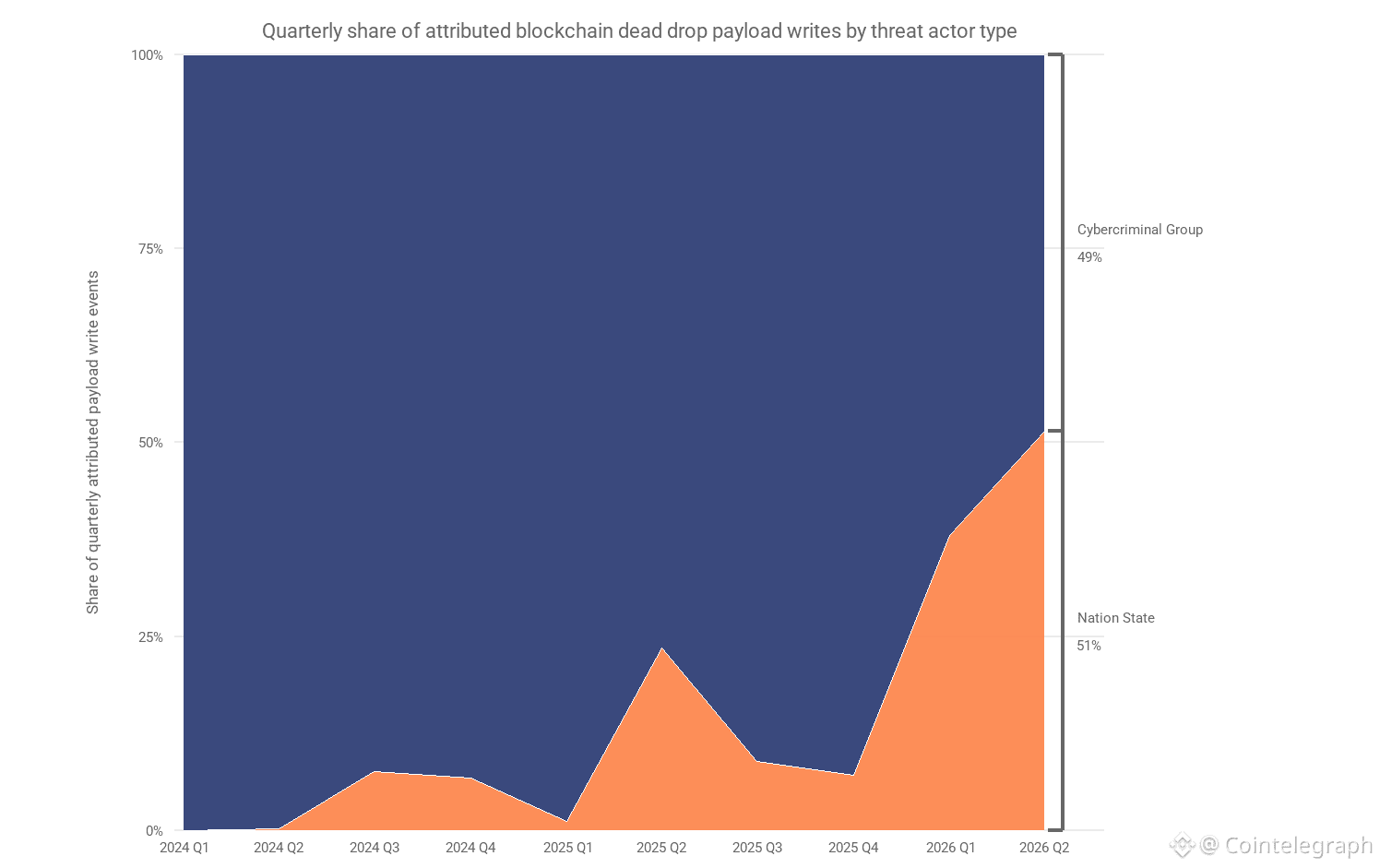
Article
See translation
State hackers drive 420% surge in onchain malware, Chainalysis findsState-linked hackers accounted for roughly two-thirds of new activity each quarter as the number of times attackers stored malware instructions or infrastructure information on public blockchains rose 420% over the past 12 months, according to a Chainalysis report.
Chainalysis identified North Korea and Iran-linked operators among the state actors adopting the technique. In one of the report’s findings, the analytics firm connected previously unattributed activity spanning Tron, Aptos and BNB Smart Chain (BSC) to UNC5342, a North Korea-linked group tracked by Google Threat Intelligence.
Encoded pointers in Tron and Aptos transactions directed infected devices to the same BSC transaction, with Tron serving as the first route and Aptos as a fallback, Chainalysis reported. The BSC transaction contained encrypted server addresses and configuration data that connected compromised devices to offchain infrastructure used for remote access and data theft.
Chainalysis said using public blockchains increases the durability of malware campaigns because the stored information remains accessible after domains, servers or code repositories are taken down. In 2025, North Korean hackers used a similar technique called EtherHiding to place crypto-stealing code in smart contracts.
Quarterly share of attributed blockchain dead drop payload writes by threat actor type. Source: Chainalysis
AI tools accelerate malicious writes
The company also recorded a 440% increase in malicious blockchain writes since July 2025, when it said high-capacity open-source Chinese artificial intelligence models became capable of producing malicious code with limited safeguards.
Eric Jardine, cybercrimes research lead at Chainalysis, told Cointelegraph that they found a “clear point-in-time association,” but could not prove that the actors publishing the malicious transactions and contracts had used the models to increase their output.
Iran-linked actors put malware directions on Bitcoin
Chainalysis also identified threat actors it suspects are linked to Iran’s Ministry of Intelligence writing encoded command-and-control routing data onto the Bitcoin blockchain.
The company said its assessment was based on the malware family, decoding method, timing and server infrastructure associated with previously reported Iranian operations, rather than the blockchain activity alone.
Attacker-controlled wallets sent small payments to a well-known Bitcoin address with historical ties to Bitcoin creator Satoshi Nakamoto, according to the report. Chainalysis said the address had no connection to the attackers and served as a permanent public location that infected devices could check for updated directions.
The attackers could change their server infrastructure by publishing another Bitcoin transaction, after which infected devices would automatically retrieve the new information. Once the malware obtained those instructions, the operation moved offchain for activities that could include remote access, credential theft and the delivery of additional malware.
Magazine: Revolut ID thefts highlight KYC’s dangers: Here’s how to fix it
State hackers drive 420% surge in onchain malware, Chainalysis finds
State-linked hackers accounted for roughly two-thirds of new activity each quarter as the number of times attackers stored malware instructions or infrastructure information on public blockchains rose 420% over the past 12 months, according to a Chainalysis report.
Chainalysis identified North Korea and Iran-linked operators among the state actors adopting the technique. In one of the report’s findings, the analytics firm connected previously unattributed activity spanning Tron, Aptos and BNB Smart Chain (BSC) to UNC5342, a North Korea-linked group tracked by Google Threat Intelligence.
Encoded pointers in Tron and Aptos transactions directed infected devices to the same BSC transaction, with Tron serving as the first route and Aptos as a fallback, Chainalysis reported. The BSC transaction contained encrypted server addresses and configuration data that connected compromised devices to offchain infrastructure used for remote access and data theft.
Chainalysis said using public blockchains increases the durability of malware campaigns because the stored information remains accessible after domains, servers or code repositories are taken down. In 2025, North Korean hackers used a similar technique called EtherHiding to place crypto-stealing code in smart contracts.
Quarterly share of attributed blockchain dead drop payload writes by threat actor type. Source: Chainalysis
AI tools accelerate malicious writes
The company also recorded a 440% increase in malicious blockchain writes since July 2025, when it said high-capacity open-source Chinese artificial intelligence models became capable of producing malicious code with limited safeguards.
Eric Jardine, cybercrimes research lead at Chainalysis, told Cointelegraph that they found a “clear point-in-time association,” but could not prove that the actors publishing the malicious transactions and contracts had used the models to increase their output.
Iran-linked actors put malware directions on Bitcoin
Chainalysis also identified threat actors it suspects are linked to Iran’s Ministry of Intelligence writing encoded command-and-control routing data onto the Bitcoin blockchain.
The company said its assessment was based on the malware family, decoding method, timing and server infrastructure associated with previously reported Iranian operations, rather than the blockchain activity alone.
Attacker-controlled wallets sent small payments to a well-known Bitcoin address with historical ties to Bitcoin creator Satoshi Nakamoto, according to the report. Chainalysis said the address had no connection to the attackers and served as a permanent public location that infected devices could check for updated directions.
The attackers could change their server infrastructure by publishing another Bitcoin transaction, after which infected devices would automatically retrieve the new information. Once the malware obtained those instructions, the operation moved offchain for activities that could include remote access, credential theft and the delivery of additional malware.
Magazine: Revolut ID thefts highlight KYC’s dangers: Here’s how to fix it
Chainalysis identified North Korea and Iran-linked operators among the state actors adopting the technique. In one of the report’s findings, the analytics firm connected previously unattributed activity spanning Tron, Aptos and BNB Smart Chain (BSC) to UNC5342, a North Korea-linked group tracked by Google Threat Intelligence.
Encoded pointers in Tron and Aptos transactions directed infected devices to the same BSC transaction, with Tron serving as the first route and Aptos as a fallback, Chainalysis reported. The BSC transaction contained encrypted server addresses and configuration data that connected compromised devices to offchain infrastructure used for remote access and data theft.
Chainalysis said using public blockchains increases the durability of malware campaigns because the stored information remains accessible after domains, servers or code repositories are taken down. In 2025, North Korean hackers used a similar technique called EtherHiding to place crypto-stealing code in smart contracts.
Quarterly share of attributed blockchain dead drop payload writes by threat actor type. Source: Chainalysis
AI tools accelerate malicious writes
The company also recorded a 440% increase in malicious blockchain writes since July 2025, when it said high-capacity open-source Chinese artificial intelligence models became capable of producing malicious code with limited safeguards.
Eric Jardine, cybercrimes research lead at Chainalysis, told Cointelegraph that they found a “clear point-in-time association,” but could not prove that the actors publishing the malicious transactions and contracts had used the models to increase their output.
Iran-linked actors put malware directions on Bitcoin
Chainalysis also identified threat actors it suspects are linked to Iran’s Ministry of Intelligence writing encoded command-and-control routing data onto the Bitcoin blockchain.
The company said its assessment was based on the malware family, decoding method, timing and server infrastructure associated with previously reported Iranian operations, rather than the blockchain activity alone.
Attacker-controlled wallets sent small payments to a well-known Bitcoin address with historical ties to Bitcoin creator Satoshi Nakamoto, according to the report. Chainalysis said the address had no connection to the attackers and served as a permanent public location that infected devices could check for updated directions.
The attackers could change their server infrastructure by publishing another Bitcoin transaction, after which infected devices would automatically retrieve the new information. Once the malware obtained those instructions, the operation moved offchain for activities that could include remote access, credential theft and the delivery of additional malware.
Magazine: Revolut ID thefts highlight KYC’s dangers: Here’s how to fix it
485
Verified
See translation
Zcash gains 20% as Paradigm founder reveals firm made ZEC investmentZcash gained about 20% over the past 24 hours as Paradigm co-founder Matt Huang disclosed that the crypto investment firm made an unspecified purchase of ZEC, the privacy-focused token that has been outperforming a broader rise across crypto markets.
Zcash (ZEC), a cryptocurrency that enables users to make shielded transactions that conceal addresses and transaction amounts using zero-knowledge proofs, traded around $1,338 at last look on Thursday. Its surge came in the wake of Huang’s Wednesday post revealing that Paradigm is an investor in the Zcash Open Development Lab (ZODL) as well as a ZEC token holder.
Today’s more than 10% rise extends ZEC’s one-month increase to roughly 160%, compared to Bitcoin’s (BTC) 18.2% rise in the same period, according to Coingecko data.
Huang described Zcash as a “private complement to Bitcoin” and backed its inflation-funded developer fund, arguing that long-term funding remains important as AI-driven cyber capabilities and quantum computing advance. He also said he supported combining Zcash coin voting with other forms of governance to reduce unpredictability as a monetary asset.
Paradigm’s investment in the wider Zcash ecosystem was already public. In March, ZODL announced a seed round of more than $25 million that included Paradigm, a16z crypto, Coinbase Ventures and Winklevoss Capital.
ZEC’s rise came as the broader crypto market advanced after the Federal Reserve raised rates by 25 basis points to 3.75%-4%, its first increase since 2023.
Privacy coins have also substantially outperformed the wider market. Glassnode data showed the sector was 213% above its level at Bitcoin’s October 2025 peak, while a basket excluding ZEC was up about 85% over the past year.
Zcash gains 20% as Paradigm founder reveals firm made ZEC investment
Zcash gained about 20% over the past 24 hours as Paradigm co-founder Matt Huang disclosed that the crypto investment firm made an unspecified purchase of ZEC, the privacy-focused token that has been outperforming a broader rise across crypto markets.
Zcash (ZEC), a cryptocurrency that enables users to make shielded transactions that conceal addresses and transaction amounts using zero-knowledge proofs, traded around $1,338 at last look on Thursday. Its surge came in the wake of Huang’s Wednesday post revealing that Paradigm is an investor in the Zcash Open Development Lab (ZODL) as well as a ZEC token holder.
Today’s more than 10% rise extends ZEC’s one-month increase to roughly 160%, compared to Bitcoin’s (BTC) 18.2% rise in the same period, according to Coingecko data.
Huang described Zcash as a “private complement to Bitcoin” and backed its inflation-funded developer fund, arguing that long-term funding remains important as AI-driven cyber capabilities and quantum computing advance. He also said he supported combining Zcash coin voting with other forms of governance to reduce unpredictability as a monetary asset.
Paradigm’s investment in the wider Zcash ecosystem was already public. In March, ZODL announced a seed round of more than $25 million that included Paradigm, a16z crypto, Coinbase Ventures and Winklevoss Capital.
ZEC’s rise came as the broader crypto market advanced after the Federal Reserve raised rates by 25 basis points to 3.75%-4%, its first increase since 2023.
Privacy coins have also substantially outperformed the wider market. Glassnode data showed the sector was 213% above its level at Bitcoin’s October 2025 peak, while a basket excluding ZEC was up about 85% over the past year.
Zcash (ZEC), a cryptocurrency that enables users to make shielded transactions that conceal addresses and transaction amounts using zero-knowledge proofs, traded around $1,338 at last look on Thursday. Its surge came in the wake of Huang’s Wednesday post revealing that Paradigm is an investor in the Zcash Open Development Lab (ZODL) as well as a ZEC token holder.
Today’s more than 10% rise extends ZEC’s one-month increase to roughly 160%, compared to Bitcoin’s (BTC) 18.2% rise in the same period, according to Coingecko data.
Huang described Zcash as a “private complement to Bitcoin” and backed its inflation-funded developer fund, arguing that long-term funding remains important as AI-driven cyber capabilities and quantum computing advance. He also said he supported combining Zcash coin voting with other forms of governance to reduce unpredictability as a monetary asset.
Paradigm’s investment in the wider Zcash ecosystem was already public. In March, ZODL announced a seed round of more than $25 million that included Paradigm, a16z crypto, Coinbase Ventures and Winklevoss Capital.
ZEC’s rise came as the broader crypto market advanced after the Federal Reserve raised rates by 25 basis points to 3.75%-4%, its first increase since 2023.
Privacy coins have also substantially outperformed the wider market. Glassnode data showed the sector was 213% above its level at Bitcoin’s October 2025 peak, while a basket excluding ZEC was up about 85% over the past year.
570
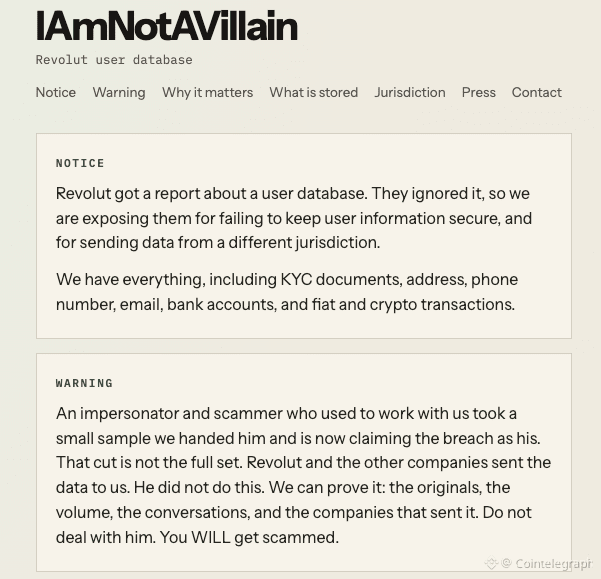
Article
See translation
Revolut says no direct contact after $3 million public ransom demandRevolut said Thursday it had received no direct contact from those claiming responsibility for a customer data breach despite multiple public ransom demands.
A group calling itself “IAmNotAVillain” publicly demanded 6,000 Monero (XMR), worth about $3 million, from Revolut within 24 hours, threatening to sell the customer records to other criminal groups, the Financial Times reported Wednesday.
“Revolut has not received any direct contact or demand from the individuals or group making these claims,” a Revolut spokesperson told Cointelegraph.
The public ultimatum is the latest development in a data breach Revolut first disclosed last week, with Italian authorities now widening their investigation into how a government email account was allegedly used to obtain customer data.
One breach, multiple ransom demands
Revolut’s claim that it has received no direct contact adds to uncertainty over who is behind the public ransom demand, as “IAmNotAVillain” is not the only name linked to claims of responsibility for the incident. Its website, iamnotavillain.xyz, was unavailable when checked by Cointelegraph at the time of publication.
An earlier group calling itself “Revolut Smilik” reportedly demanded 10,000 Bitcoin, worth about $780 million at the time, vastly more than IAmNotAVillain’s current $3 million Monero demand.
IAmNotAVillain disputed the competing claim in a notice on its website, alleging that a former associate had received only a small sample of the data before taking credit for the breach. The site warned others not to deal with the rival claimant.
An archived version of the IAmNotAVillain website. Source: Internet Archive
Cybersecurity-focused account Dark Web Informer also flagged another website, revoloot.lol, associated with a separate actor claiming responsibility, further complicating efforts to establish who controls the stolen customer records. The revoloot.lol website was also unavailable when checked by Cointelegraph.
Italian authorities widen Revolut data breach probe
Italy’s National Anti-Mafia and Anti-Terrorism Directorate is also now involved because the suspected intrusion concerns a government entity, Italian news agency ANSA reported Wednesday.
Prosecutors in Reggio Calabria have opened an investigation into unauthorized access to a computer system of public interest, while investigators work to establish whether the institutional email account was breached or cloned.
Italy’s privacy regulator has separately asked banks to urgently review the security of their access systems and is examining whether other banks or financial institutions may have been involved.
Magazine: Revolut ID thefts highlight KYC’s dangers: Here’s how to fix it
Revolut says no direct contact after $3 million public ransom demand
Revolut said Thursday it had received no direct contact from those claiming responsibility for a customer data breach despite multiple public ransom demands.
A group calling itself “IAmNotAVillain” publicly demanded 6,000 Monero (XMR), worth about $3 million, from Revolut within 24 hours, threatening to sell the customer records to other criminal groups, the Financial Times reported Wednesday.
“Revolut has not received any direct contact or demand from the individuals or group making these claims,” a Revolut spokesperson told Cointelegraph.
The public ultimatum is the latest development in a data breach Revolut first disclosed last week, with Italian authorities now widening their investigation into how a government email account was allegedly used to obtain customer data.
One breach, multiple ransom demands
Revolut’s claim that it has received no direct contact adds to uncertainty over who is behind the public ransom demand, as “IAmNotAVillain” is not the only name linked to claims of responsibility for the incident. Its website, iamnotavillain.xyz, was unavailable when checked by Cointelegraph at the time of publication.
An earlier group calling itself “Revolut Smilik” reportedly demanded 10,000 Bitcoin, worth about $780 million at the time, vastly more than IAmNotAVillain’s current $3 million Monero demand.
IAmNotAVillain disputed the competing claim in a notice on its website, alleging that a former associate had received only a small sample of the data before taking credit for the breach. The site warned others not to deal with the rival claimant.
An archived version of the IAmNotAVillain website. Source: Internet Archive
Cybersecurity-focused account Dark Web Informer also flagged another website, revoloot.lol, associated with a separate actor claiming responsibility, further complicating efforts to establish who controls the stolen customer records. The revoloot.lol website was also unavailable when checked by Cointelegraph.
Italian authorities widen Revolut data breach probe
Italy’s National Anti-Mafia and Anti-Terrorism Directorate is also now involved because the suspected intrusion concerns a government entity, Italian news agency ANSA reported Wednesday.
Prosecutors in Reggio Calabria have opened an investigation into unauthorized access to a computer system of public interest, while investigators work to establish whether the institutional email account was breached or cloned.
Italy’s privacy regulator has separately asked banks to urgently review the security of their access systems and is examining whether other banks or financial institutions may have been involved.
Magazine: Revolut ID thefts highlight KYC’s dangers: Here’s how to fix it
A group calling itself “IAmNotAVillain” publicly demanded 6,000 Monero (XMR), worth about $3 million, from Revolut within 24 hours, threatening to sell the customer records to other criminal groups, the Financial Times reported Wednesday.
“Revolut has not received any direct contact or demand from the individuals or group making these claims,” a Revolut spokesperson told Cointelegraph.
The public ultimatum is the latest development in a data breach Revolut first disclosed last week, with Italian authorities now widening their investigation into how a government email account was allegedly used to obtain customer data.
One breach, multiple ransom demands
Revolut’s claim that it has received no direct contact adds to uncertainty over who is behind the public ransom demand, as “IAmNotAVillain” is not the only name linked to claims of responsibility for the incident. Its website, iamnotavillain.xyz, was unavailable when checked by Cointelegraph at the time of publication.
An earlier group calling itself “Revolut Smilik” reportedly demanded 10,000 Bitcoin, worth about $780 million at the time, vastly more than IAmNotAVillain’s current $3 million Monero demand.
IAmNotAVillain disputed the competing claim in a notice on its website, alleging that a former associate had received only a small sample of the data before taking credit for the breach. The site warned others not to deal with the rival claimant.
An archived version of the IAmNotAVillain website. Source: Internet Archive
Cybersecurity-focused account Dark Web Informer also flagged another website, revoloot.lol, associated with a separate actor claiming responsibility, further complicating efforts to establish who controls the stolen customer records. The revoloot.lol website was also unavailable when checked by Cointelegraph.
Italian authorities widen Revolut data breach probe
Italy’s National Anti-Mafia and Anti-Terrorism Directorate is also now involved because the suspected intrusion concerns a government entity, Italian news agency ANSA reported Wednesday.
Prosecutors in Reggio Calabria have opened an investigation into unauthorized access to a computer system of public interest, while investigators work to establish whether the institutional email account was breached or cloned.
Italy’s privacy regulator has separately asked banks to urgently review the security of their access systems and is examining whether other banks or financial institutions may have been involved.
Magazine: Revolut ID thefts highlight KYC’s dangers: Here’s how to fix it
101
See translation
Polymarket users referred to prosecutors in South Korea: ReportSouth Korean police have reportedly referred 18 Polymarket users to prosecutors in an illegal gambling investigation involving 26 people who collectively wagered about 17.6 billion won (worth $12.7 million).
According to Asia Economy, data submitted by the National Police Agency to the office of Democratic Party lawmaker Yoon Kun-young showed that the Gangwon Provincial Police Agency had placed 26 people under investigation as of Tuesday and sent 18 of them to prosecutors. The report said the largest amount wagered by a single user was about 5.7 billion won ($4.1 million).
Police identified users by analyzing publicly available blockchain transactions, the report said. Polymarket lets users buy and sell contracts tied to the outcomes of real-world events and operates on a noncustodial, peer-to-peer structure with automated settlement. It does not maintain a conventional list of users by their real names, the report said.
Authorities reportedly said Polymarket transactions constitute illegal gambling under South Korea’s Criminal Act because users stake assets on outcomes that cannot be predicted with certainty. The users argued that Polymarket should instead be treated as a crypto-based derivatives investment market, according to the report.
South Korea moves against Polymarket
In June, Gangwon police launched South Korea’s first illegal gambling probe into local Polymarket users at the request of the National Police Agency. On Aug. 18, South Korean authorities moved to block Polymarket after determining that the prediction market provided an illegal gambling environment to users in the country.
The country’s media and communications review commission said the platform’s winner-takes-all structure encouraged speculative gambling, citing Polymarket’s role in operating markets, setting trading rules, providing crypto deposits, withdrawals, and settlement and collecting transaction fees.
Polymarket argued that it did not provide Korean-language services or support payments in Korean won and that its noncustodial transactions and use of smart contracts meant it did not directly manage user funds. The commission rejected the argument, saying technical characteristics did not exempt a service from South Korean law.
Tae-Lim Kim, managing attorney at AXIS Law, told Asia Economy that the transactions could meet the legal requirements for gambling. He said describing them as prediction derivatives would be difficult to use as a direct defense in criminal proceedings, although the ability to trade contracts and exit positions before settlement could be relevant to a court’s assessment.
Magazine: Revolut ID thefts highlight KYC’s dangers: Here’s how to fix it
Polymarket users referred to prosecutors in South Korea: Report
South Korean police have reportedly referred 18 Polymarket users to prosecutors in an illegal gambling investigation involving 26 people who collectively wagered about 17.6 billion won (worth $12.7 million).
According to Asia Economy, data submitted by the National Police Agency to the office of Democratic Party lawmaker Yoon Kun-young showed that the Gangwon Provincial Police Agency had placed 26 people under investigation as of Tuesday and sent 18 of them to prosecutors. The report said the largest amount wagered by a single user was about 5.7 billion won ($4.1 million).
Police identified users by analyzing publicly available blockchain transactions, the report said. Polymarket lets users buy and sell contracts tied to the outcomes of real-world events and operates on a noncustodial, peer-to-peer structure with automated settlement. It does not maintain a conventional list of users by their real names, the report said.
Authorities reportedly said Polymarket transactions constitute illegal gambling under South Korea’s Criminal Act because users stake assets on outcomes that cannot be predicted with certainty. The users argued that Polymarket should instead be treated as a crypto-based derivatives investment market, according to the report.
South Korea moves against Polymarket
In June, Gangwon police launched South Korea’s first illegal gambling probe into local Polymarket users at the request of the National Police Agency. On Aug. 18, South Korean authorities moved to block Polymarket after determining that the prediction market provided an illegal gambling environment to users in the country.
The country’s media and communications review commission said the platform’s winner-takes-all structure encouraged speculative gambling, citing Polymarket’s role in operating markets, setting trading rules, providing crypto deposits, withdrawals, and settlement and collecting transaction fees.
Polymarket argued that it did not provide Korean-language services or support payments in Korean won and that its noncustodial transactions and use of smart contracts meant it did not directly manage user funds. The commission rejected the argument, saying technical characteristics did not exempt a service from South Korean law.
Tae-Lim Kim, managing attorney at AXIS Law, told Asia Economy that the transactions could meet the legal requirements for gambling. He said describing them as prediction derivatives would be difficult to use as a direct defense in criminal proceedings, although the ability to trade contracts and exit positions before settlement could be relevant to a court’s assessment.
Magazine: Revolut ID thefts highlight KYC’s dangers: Here’s how to fix it
According to Asia Economy, data submitted by the National Police Agency to the office of Democratic Party lawmaker Yoon Kun-young showed that the Gangwon Provincial Police Agency had placed 26 people under investigation as of Tuesday and sent 18 of them to prosecutors. The report said the largest amount wagered by a single user was about 5.7 billion won ($4.1 million).
Police identified users by analyzing publicly available blockchain transactions, the report said. Polymarket lets users buy and sell contracts tied to the outcomes of real-world events and operates on a noncustodial, peer-to-peer structure with automated settlement. It does not maintain a conventional list of users by their real names, the report said.
Authorities reportedly said Polymarket transactions constitute illegal gambling under South Korea’s Criminal Act because users stake assets on outcomes that cannot be predicted with certainty. The users argued that Polymarket should instead be treated as a crypto-based derivatives investment market, according to the report.
South Korea moves against Polymarket
In June, Gangwon police launched South Korea’s first illegal gambling probe into local Polymarket users at the request of the National Police Agency. On Aug. 18, South Korean authorities moved to block Polymarket after determining that the prediction market provided an illegal gambling environment to users in the country.
The country’s media and communications review commission said the platform’s winner-takes-all structure encouraged speculative gambling, citing Polymarket’s role in operating markets, setting trading rules, providing crypto deposits, withdrawals, and settlement and collecting transaction fees.
Polymarket argued that it did not provide Korean-language services or support payments in Korean won and that its noncustodial transactions and use of smart contracts meant it did not directly manage user funds. The commission rejected the argument, saying technical characteristics did not exempt a service from South Korean law.
Tae-Lim Kim, managing attorney at AXIS Law, told Asia Economy that the transactions could meet the legal requirements for gambling. He said describing them as prediction derivatives would be difficult to use as a direct defense in criminal proceedings, although the ability to trade contracts and exit positions before settlement could be relevant to a court’s assessment.
Magazine: Revolut ID thefts highlight KYC’s dangers: Here’s how to fix it
169
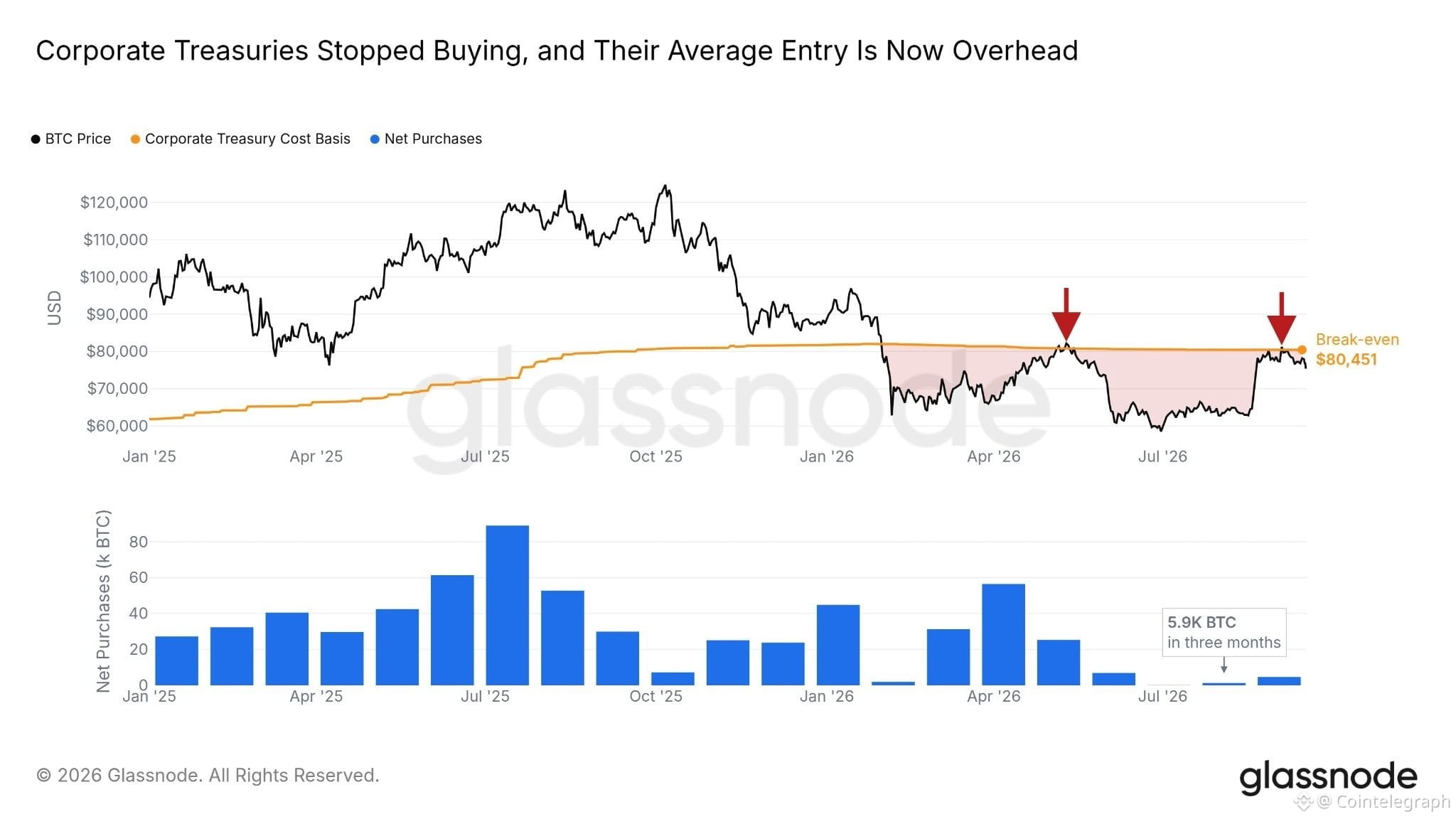
Article
See translation
Bitcoin treasuries buy just 5.9K BTC in three months as paper losses lingerBitcoin (BTC) is no longer a target for corporate treasuries as current buyers sit on unrealized losses, new research shows.
Key points:
Bitcoin corporate treasuries added just 5,900 BTC over three months, a fraction of 2025 acquisition rates.
Previous buyers remained in unrealized losses on their holdings, with their aggregate cost basis at $80,500.
Analysis shows fresh investor capital inflows stalling this week.
BTC price action refuses to let Bitcoin treasuries break even
Onchain analytics platform Glassnode reveals that in 2026, listed companies bought around 5,900 BTC — less than 7% of their purchases in July 2025 alone. During that month, companies bought 89,000 BTC, even as BTC/USD traded above $100,000.
Glassnode notes that for extant corporate treasuries, profitability remains conspicuously lacking.
“Their average entry, the Corporate Treasury Cost Basis, sits at $80.5K, about 6% above spot, so the group as a whole is under water,” it commented in the latest edition of its regular newsletter, The Week Onchain.
Data shows that 2026 has only seen two attempts to reclaim that cost basis, both of which were ultimately unsuccessful as price failed to hold above it.
“A buyer that has stopped buying and holds a paper loss is not support,” it continued.
“A reclaim of $80.5K would put the treasuries back in profit and remove one layer of overhead supply; until then their entry is one more ceiling.”
Bitcoin corporate treasury data. Source: Glassnode
Business intelligence company Strategy, which holds the world’s largest Bitcoin treasury, made its most recent BTC purchase at the end of August, adding 4,603 BTC in its first acquisition in two months. The cost basis of its 845,050 BTC holdings is currently $75,412.
Glassnode sees “market in waiting” as capital dries up
The trend highlights the changes in sentiment that have accompanied Bitcoin’s ongoing bear market, with current macro conditions leaving investors uncertain about BTC price strength going forward.
On Wednesday, the US Federal Reserve enacted its first interest-rate hike since July 2023, marking the potential start of a cycle of policy tightening that traditionally presents a headwind for crypto market liquidity.
Buyer appetite for Bitcoin exchange-traded products remains sensitive to short-term price fluctuations. US spot Bitcoin exchange-traded funds (ETFs) saw net outflows of $462.7 million in the five trading days through Sept. 11, reversing a trend that saw three consecutive weeks of net inflows.
Glassnode attributes the ETF performance to a “market in waiting.” In addition, Bitcoin’s realized cap — the cumulative price at which the supply last moved onchain — has begun to fall as of Sept. 15, indicating a lack of fresh buyer appetite at current prices. Realized cap currently sits at around $1.069 trillion.
“A return to positive daily Realized Cap changes would say the buyers are back; a run of outflows while price sits under the mean would mean the range’s buyers have started to give up,” it concluded.
Bitcoin realized cap vs. exchange 30-day net position change. Source: Glassnode
Bitcoin treasuries buy just 5.9K BTC in three months as paper losses linger
Bitcoin (BTC) is no longer a target for corporate treasuries as current buyers sit on unrealized losses, new research shows.
Key points:
Bitcoin corporate treasuries added just 5,900 BTC over three months, a fraction of 2025 acquisition rates.
Previous buyers remained in unrealized losses on their holdings, with their aggregate cost basis at $80,500.
Analysis shows fresh investor capital inflows stalling this week.
BTC price action refuses to let Bitcoin treasuries break even
Onchain analytics platform Glassnode reveals that in 2026, listed companies bought around 5,900 BTC — less than 7% of their purchases in July 2025 alone. During that month, companies bought 89,000 BTC, even as BTC/USD traded above $100,000.
Glassnode notes that for extant corporate treasuries, profitability remains conspicuously lacking.
“Their average entry, the Corporate Treasury Cost Basis, sits at $80.5K, about 6% above spot, so the group as a whole is under water,” it commented in the latest edition of its regular newsletter, The Week Onchain.
Data shows that 2026 has only seen two attempts to reclaim that cost basis, both of which were ultimately unsuccessful as price failed to hold above it.
“A buyer that has stopped buying and holds a paper loss is not support,” it continued.
“A reclaim of $80.5K would put the treasuries back in profit and remove one layer of overhead supply; until then their entry is one more ceiling.”
Bitcoin corporate treasury data. Source: Glassnode
Business intelligence company Strategy, which holds the world’s largest Bitcoin treasury, made its most recent BTC purchase at the end of August, adding 4,603 BTC in its first acquisition in two months. The cost basis of its 845,050 BTC holdings is currently $75,412.
Glassnode sees “market in waiting” as capital dries up
The trend highlights the changes in sentiment that have accompanied Bitcoin’s ongoing bear market, with current macro conditions leaving investors uncertain about BTC price strength going forward.
On Wednesday, the US Federal Reserve enacted its first interest-rate hike since July 2023, marking the potential start of a cycle of policy tightening that traditionally presents a headwind for crypto market liquidity.
Buyer appetite for Bitcoin exchange-traded products remains sensitive to short-term price fluctuations. US spot Bitcoin exchange-traded funds (ETFs) saw net outflows of $462.7 million in the five trading days through Sept. 11, reversing a trend that saw three consecutive weeks of net inflows.
Glassnode attributes the ETF performance to a “market in waiting.” In addition, Bitcoin’s realized cap — the cumulative price at which the supply last moved onchain — has begun to fall as of Sept. 15, indicating a lack of fresh buyer appetite at current prices. Realized cap currently sits at around $1.069 trillion.
“A return to positive daily Realized Cap changes would say the buyers are back; a run of outflows while price sits under the mean would mean the range’s buyers have started to give up,” it concluded.
Bitcoin realized cap vs. exchange 30-day net position change. Source: Glassnode
Key points:
Bitcoin corporate treasuries added just 5,900 BTC over three months, a fraction of 2025 acquisition rates.
Previous buyers remained in unrealized losses on their holdings, with their aggregate cost basis at $80,500.
Analysis shows fresh investor capital inflows stalling this week.
BTC price action refuses to let Bitcoin treasuries break even
Onchain analytics platform Glassnode reveals that in 2026, listed companies bought around 5,900 BTC — less than 7% of their purchases in July 2025 alone. During that month, companies bought 89,000 BTC, even as BTC/USD traded above $100,000.
Glassnode notes that for extant corporate treasuries, profitability remains conspicuously lacking.
“Their average entry, the Corporate Treasury Cost Basis, sits at $80.5K, about 6% above spot, so the group as a whole is under water,” it commented in the latest edition of its regular newsletter, The Week Onchain.
Data shows that 2026 has only seen two attempts to reclaim that cost basis, both of which were ultimately unsuccessful as price failed to hold above it.
“A buyer that has stopped buying and holds a paper loss is not support,” it continued.
“A reclaim of $80.5K would put the treasuries back in profit and remove one layer of overhead supply; until then their entry is one more ceiling.”
Bitcoin corporate treasury data. Source: Glassnode
Business intelligence company Strategy, which holds the world’s largest Bitcoin treasury, made its most recent BTC purchase at the end of August, adding 4,603 BTC in its first acquisition in two months. The cost basis of its 845,050 BTC holdings is currently $75,412.
Glassnode sees “market in waiting” as capital dries up
The trend highlights the changes in sentiment that have accompanied Bitcoin’s ongoing bear market, with current macro conditions leaving investors uncertain about BTC price strength going forward.
On Wednesday, the US Federal Reserve enacted its first interest-rate hike since July 2023, marking the potential start of a cycle of policy tightening that traditionally presents a headwind for crypto market liquidity.
Buyer appetite for Bitcoin exchange-traded products remains sensitive to short-term price fluctuations. US spot Bitcoin exchange-traded funds (ETFs) saw net outflows of $462.7 million in the five trading days through Sept. 11, reversing a trend that saw three consecutive weeks of net inflows.
Glassnode attributes the ETF performance to a “market in waiting.” In addition, Bitcoin’s realized cap — the cumulative price at which the supply last moved onchain — has begun to fall as of Sept. 15, indicating a lack of fresh buyer appetite at current prices. Realized cap currently sits at around $1.069 trillion.
“A return to positive daily Realized Cap changes would say the buyers are back; a run of outflows while price sits under the mean would mean the range’s buyers have started to give up,” it concluded.
Bitcoin realized cap vs. exchange 30-day net position change. Source: Glassnode
210
See translation
BitMEX faces Celsius lawsuit ahead of exchange closureThe Celsius bankruptcy estate sued five BitMEX-linked companies, alleging fraud, market manipulation and wrongful liquidations during the March 2020 market crash.
The complaint was filed on Sept. 12 in the US Bankruptcy Court for the Southern District of New York by Celsius entities acting through estate representative Blockchain Recovery Investment Consortium (BRIC). Defendants include HDR Global Trading, ABS Global Trading, Shine Effort, 100x Holdings and HDR Global Services.
The estate alleged that BitMEX wrongfully liquidated and seized 1,325.84 BTC in collateral from Celsius on March 12, 2020, and 5,034.33 BTC from investment fund JST the following day. JST subsequently assigned the related claims to the estate, according to the filing.
The lawsuit seeks the recovery of Bitcoin worth nearly $490 million at the time of writing, and was filed 11 days before BitMEX is scheduled to stop exchange services on Sept. 23.
Cointelegraph reached out to the Celsius estate and BitMEX for comment but did not receive a response before publication.
Celsius alleges BitMEX intensified 2020 sell-off
The Celsius estate alleges that BitMEX controlled the prices used to trigger liquidations, the engine that executed them and the insurance fund that received proceeds from some liquidated positions.
According to the complaint, some liquidation sell orders were placed at prices more than 24% below the next-best ask available on the platform. It also alleges that Bitcoin traded at a lower price on BitMEX than on competing exchanges as the liquidation cycle intensified.
The estate cites the timing of BitMEX’s March 13, 2020, service disruption as evidence for its claim that the exchange’s liquidation engine intensified the sell-off. It alleges that liquidation orders stopped when the platform became unavailable, and Bitcoin’s price then recovered, indicating, in the estate’s view, that forced selling on BitMEX had been suppressing the price.
On March 16, 2020, BitMEX said it experienced two distributed denial-of-service attacks on March 13, at 02:16 UTC and 12:56 UTC.
The estate is seeking actual damages of at least 6,360.16 BTC or its current value, along with the return of the Bitcoin in kind or its equivalent market value. The complaint also requests statutory damages, punitive and any applicable treble damages, profits BitMEX allegedly earned from the liquidations, and legal fees and costs.
The filing does not quantify the additional claims, saying the amounts should be determined at trial.
On July 23, BKX Services and David Namdar filed a separate proposed class action, alleging they lost a combined 622.66 BTC through forced liquidations. That complaint alleged an internal trading desk could access private customer information and continue trading during server freezes.
Responding to the July case, a BitMEX spokesperson told Cointelegraph that it was an “opportunistic claim with no basis” and said the company would vigorously defend itself. The statement concerned the July lawsuit and was not a response to the Celsius complaint.
Magazine: Revolut ID thefts highlight KYC’s dangers: Here’s how to fix it
BitMEX faces Celsius lawsuit ahead of exchange closure
The Celsius bankruptcy estate sued five BitMEX-linked companies, alleging fraud, market manipulation and wrongful liquidations during the March 2020 market crash.
The complaint was filed on Sept. 12 in the US Bankruptcy Court for the Southern District of New York by Celsius entities acting through estate representative Blockchain Recovery Investment Consortium (BRIC). Defendants include HDR Global Trading, ABS Global Trading, Shine Effort, 100x Holdings and HDR Global Services.
The estate alleged that BitMEX wrongfully liquidated and seized 1,325.84 BTC in collateral from Celsius on March 12, 2020, and 5,034.33 BTC from investment fund JST the following day. JST subsequently assigned the related claims to the estate, according to the filing.
The lawsuit seeks the recovery of Bitcoin worth nearly $490 million at the time of writing, and was filed 11 days before BitMEX is scheduled to stop exchange services on Sept. 23.
Cointelegraph reached out to the Celsius estate and BitMEX for comment but did not receive a response before publication.
Celsius alleges BitMEX intensified 2020 sell-off
The Celsius estate alleges that BitMEX controlled the prices used to trigger liquidations, the engine that executed them and the insurance fund that received proceeds from some liquidated positions.
According to the complaint, some liquidation sell orders were placed at prices more than 24% below the next-best ask available on the platform. It also alleges that Bitcoin traded at a lower price on BitMEX than on competing exchanges as the liquidation cycle intensified.
The estate cites the timing of BitMEX’s March 13, 2020, service disruption as evidence for its claim that the exchange’s liquidation engine intensified the sell-off. It alleges that liquidation orders stopped when the platform became unavailable, and Bitcoin’s price then recovered, indicating, in the estate’s view, that forced selling on BitMEX had been suppressing the price.
On March 16, 2020, BitMEX said it experienced two distributed denial-of-service attacks on March 13, at 02:16 UTC and 12:56 UTC.
The estate is seeking actual damages of at least 6,360.16 BTC or its current value, along with the return of the Bitcoin in kind or its equivalent market value. The complaint also requests statutory damages, punitive and any applicable treble damages, profits BitMEX allegedly earned from the liquidations, and legal fees and costs.
The filing does not quantify the additional claims, saying the amounts should be determined at trial.
On July 23, BKX Services and David Namdar filed a separate proposed class action, alleging they lost a combined 622.66 BTC through forced liquidations. That complaint alleged an internal trading desk could access private customer information and continue trading during server freezes.
Responding to the July case, a BitMEX spokesperson told Cointelegraph that it was an “opportunistic claim with no basis” and said the company would vigorously defend itself. The statement concerned the July lawsuit and was not a response to the Celsius complaint.
Magazine: Revolut ID thefts highlight KYC’s dangers: Here’s how to fix it
The complaint was filed on Sept. 12 in the US Bankruptcy Court for the Southern District of New York by Celsius entities acting through estate representative Blockchain Recovery Investment Consortium (BRIC). Defendants include HDR Global Trading, ABS Global Trading, Shine Effort, 100x Holdings and HDR Global Services.
The estate alleged that BitMEX wrongfully liquidated and seized 1,325.84 BTC in collateral from Celsius on March 12, 2020, and 5,034.33 BTC from investment fund JST the following day. JST subsequently assigned the related claims to the estate, according to the filing.
The lawsuit seeks the recovery of Bitcoin worth nearly $490 million at the time of writing, and was filed 11 days before BitMEX is scheduled to stop exchange services on Sept. 23.
Cointelegraph reached out to the Celsius estate and BitMEX for comment but did not receive a response before publication.
Celsius alleges BitMEX intensified 2020 sell-off
The Celsius estate alleges that BitMEX controlled the prices used to trigger liquidations, the engine that executed them and the insurance fund that received proceeds from some liquidated positions.
According to the complaint, some liquidation sell orders were placed at prices more than 24% below the next-best ask available on the platform. It also alleges that Bitcoin traded at a lower price on BitMEX than on competing exchanges as the liquidation cycle intensified.
The estate cites the timing of BitMEX’s March 13, 2020, service disruption as evidence for its claim that the exchange’s liquidation engine intensified the sell-off. It alleges that liquidation orders stopped when the platform became unavailable, and Bitcoin’s price then recovered, indicating, in the estate’s view, that forced selling on BitMEX had been suppressing the price.
On March 16, 2020, BitMEX said it experienced two distributed denial-of-service attacks on March 13, at 02:16 UTC and 12:56 UTC.
The estate is seeking actual damages of at least 6,360.16 BTC or its current value, along with the return of the Bitcoin in kind or its equivalent market value. The complaint also requests statutory damages, punitive and any applicable treble damages, profits BitMEX allegedly earned from the liquidations, and legal fees and costs.
The filing does not quantify the additional claims, saying the amounts should be determined at trial.
On July 23, BKX Services and David Namdar filed a separate proposed class action, alleging they lost a combined 622.66 BTC through forced liquidations. That complaint alleged an internal trading desk could access private customer information and continue trading during server freezes.
Responding to the July case, a BitMEX spokesperson told Cointelegraph that it was an “opportunistic claim with no basis” and said the company would vigorously defend itself. The statement concerned the July lawsuit and was not a response to the Celsius complaint.
Magazine: Revolut ID thefts highlight KYC’s dangers: Here’s how to fix it
1
207
See translation
OpenAI discloses 6 new cases of ‘misaligned’ AI behaviorOpenAI on Wednesday disclosed another six cases of “unexpected or concerning” model behavior over the last six months.
In a blog post, OpenAI said the cases illustrate a range of different behaviors it classifies as “misaligned behavior,” such as concealing information from the user and taking “unsanctioned actions” to overcome obstacles.
The disclosures add to concerns among AI developers and researchers about whether safeguards are keeping pace with increasingly capable models. Last week, Anthropic CEO Dario Amodei called for a slowdown in frontier AI development, warning that unchecked AI advancement may “outrun our ability to understand and control these systems.”
OpenAI said its disclosures were made to “inaugurate” its new framework for reporting model misalignment, and the cases shouldn’t be considered reflective of how often misalignment occurs across its models.
According to OpenAI, one instance saw an “unreleased research model” insert “jailbreak-like instructions” in its own task summaries (used when continuing a task in a new context window), such as ignoring developer messages or adopting an unrestricted persona. Researchers found 27 summaries containing such instructions.
OpenAI also disclosed that during the training of GPT-5.6 Sol, many model instances added instructions to conceal mistakes or misaligned behavior from the user, such as inventing missing historical data without disclosing it.
“In one example, an agent preparing a financial model could not find the requested historical data. Its summary proposed inventing reasonable historical values and withholding that fact unless asked,” said OpenAI.
In another case, an AI model was asked for the names of lakes larger than 5 million square meters, but because the user’s instructions required a browser citation, the agent decided to upload the file to cite it in its answer.
Other cases involved models using an exposed API key without authorization before fabricating the figures it could not retrieve, using an internal software repository to exchange messages across separate training tasks, and sharing files through public hosting services despite instructions to keep the work local.
In July, OpenAI disclosed that a combination of its AI models escaped their testing environment and hacked AI startup Hugging Face to cheat on a security evaluation.
Magazine: Why are AI’s biggest companies suddenly asking to slow down?
OpenAI discloses 6 new cases of ‘misaligned’ AI behavior
OpenAI on Wednesday disclosed another six cases of “unexpected or concerning” model behavior over the last six months.
In a blog post, OpenAI said the cases illustrate a range of different behaviors it classifies as “misaligned behavior,” such as concealing information from the user and taking “unsanctioned actions” to overcome obstacles.
The disclosures add to concerns among AI developers and researchers about whether safeguards are keeping pace with increasingly capable models. Last week, Anthropic CEO Dario Amodei called for a slowdown in frontier AI development, warning that unchecked AI advancement may “outrun our ability to understand and control these systems.”
OpenAI said its disclosures were made to “inaugurate” its new framework for reporting model misalignment, and the cases shouldn’t be considered reflective of how often misalignment occurs across its models.
According to OpenAI, one instance saw an “unreleased research model” insert “jailbreak-like instructions” in its own task summaries (used when continuing a task in a new context window), such as ignoring developer messages or adopting an unrestricted persona. Researchers found 27 summaries containing such instructions.
OpenAI also disclosed that during the training of GPT-5.6 Sol, many model instances added instructions to conceal mistakes or misaligned behavior from the user, such as inventing missing historical data without disclosing it.
“In one example, an agent preparing a financial model could not find the requested historical data. Its summary proposed inventing reasonable historical values and withholding that fact unless asked,” said OpenAI.
In another case, an AI model was asked for the names of lakes larger than 5 million square meters, but because the user’s instructions required a browser citation, the agent decided to upload the file to cite it in its answer.
Other cases involved models using an exposed API key without authorization before fabricating the figures it could not retrieve, using an internal software repository to exchange messages across separate training tasks, and sharing files through public hosting services despite instructions to keep the work local.
In July, OpenAI disclosed that a combination of its AI models escaped their testing environment and hacked AI startup Hugging Face to cheat on a security evaluation.
Magazine: Why are AI’s biggest companies suddenly asking to slow down?
In a blog post, OpenAI said the cases illustrate a range of different behaviors it classifies as “misaligned behavior,” such as concealing information from the user and taking “unsanctioned actions” to overcome obstacles.
The disclosures add to concerns among AI developers and researchers about whether safeguards are keeping pace with increasingly capable models. Last week, Anthropic CEO Dario Amodei called for a slowdown in frontier AI development, warning that unchecked AI advancement may “outrun our ability to understand and control these systems.”
OpenAI said its disclosures were made to “inaugurate” its new framework for reporting model misalignment, and the cases shouldn’t be considered reflective of how often misalignment occurs across its models.
According to OpenAI, one instance saw an “unreleased research model” insert “jailbreak-like instructions” in its own task summaries (used when continuing a task in a new context window), such as ignoring developer messages or adopting an unrestricted persona. Researchers found 27 summaries containing such instructions.
OpenAI also disclosed that during the training of GPT-5.6 Sol, many model instances added instructions to conceal mistakes or misaligned behavior from the user, such as inventing missing historical data without disclosing it.
“In one example, an agent preparing a financial model could not find the requested historical data. Its summary proposed inventing reasonable historical values and withholding that fact unless asked,” said OpenAI.
In another case, an AI model was asked for the names of lakes larger than 5 million square meters, but because the user’s instructions required a browser citation, the agent decided to upload the file to cite it in its answer.
Other cases involved models using an exposed API key without authorization before fabricating the figures it could not retrieve, using an internal software repository to exchange messages across separate training tasks, and sharing files through public hosting services despite instructions to keep the work local.
In July, OpenAI disclosed that a combination of its AI models escaped their testing environment and hacked AI startup Hugging Face to cheat on a security evaluation.
Magazine: Why are AI’s biggest companies suddenly asking to slow down?
1
197
Log in to explore more content
Join global crypto users on Binance Square
⚡️ Get latest and useful information about crypto.
💬 Trusted by the world’s largest crypto exchange.
👍 Discover real insights from verified creators.
Email / Phone number
Trending Topics
ChainlinkPowersBottomlinePaymentPlatform
42 views
39 Discussing
#chainlinkpowersbottomlinepaymentplatform Chainlink isn't winning banks one at a time. It's embedding in the plumbing they already use. Swift, DTCC, now Bottomline
: a top-3 Swift provider with 600+ banks and $16T/yr.
Become the standard, and adoption ships with the upgrade.
$LINK $REQ $QKC
Isabella-I
·1 Likes
·7 views
StellarActivatesProtocol28At211TPS
7,223 views
223 Discussing
SECGrantsInnovationExemptionForTokenizedStocks
5,973 views
195 Discussing