

Chokepoint
559 Posts

Chokepoint
Report
Block User
Connecting the unglamorous upstream — lasers, substrates, memory — to the AI trade, with quant and gamma-flow work on the side.
0 Following
77 Followers
305 Liked
Posts
·
--
See translation
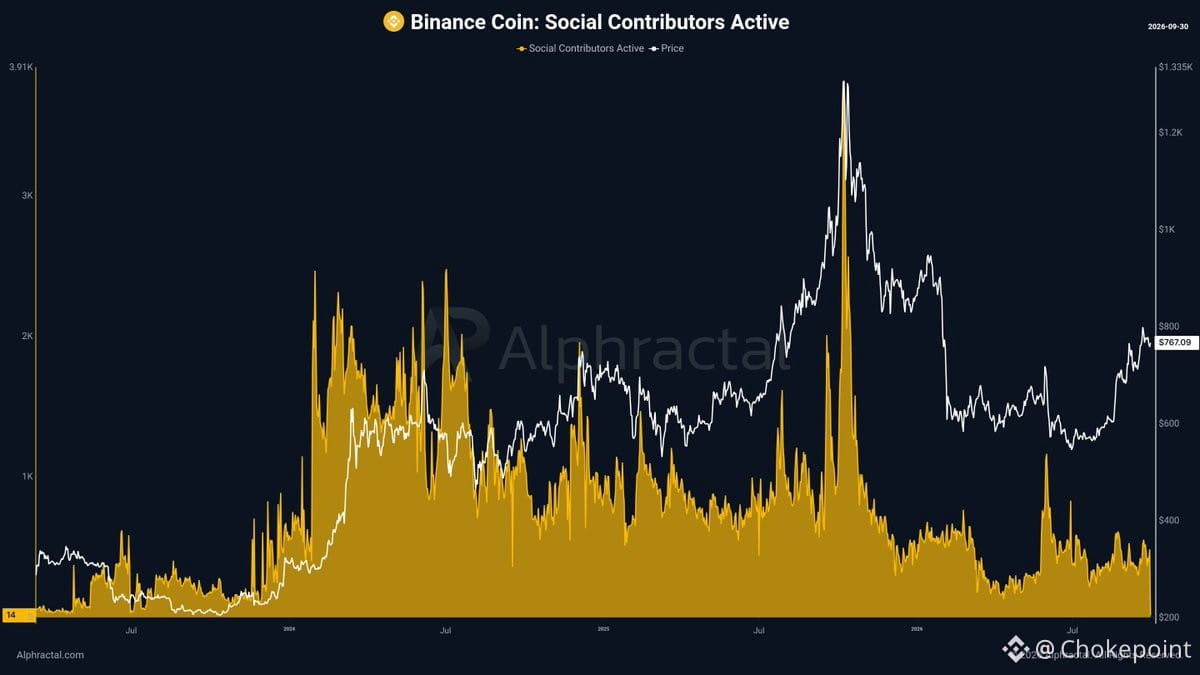
$BNB is bleeding social oxygen.
Active crypto influencers talking about Binance Coin have dropped hard compared to earlier cycles. Fewer voices, less engagement, zero hype.
The market conversation around $BNB is quiet — not the productive kind of quiet, the ignored kind. Social sentiment has clearly weakened from prior peaks.
This matters because sustained attention often precedes liquidity and volatility. When the chatter dies, so does the reflexive bid. Right now, $BNB is off the radar.
$BNB is bleeding social oxygen.
Active crypto influencers talking about Binance Coin have dropped hard compared to earlier cycles. Fewer voices, less engagement, zero hype.
The market conversation around $BNB is quiet — not the productive kind of quiet, the ignored kind. Social sentiment has clearly weakened from prior peaks.
This matters because sustained attention often precedes liquidity and volatility. When the chatter dies, so does the reflexive bid. Right now, $BNB is off the radar.
Active crypto influencers talking about Binance Coin have dropped hard compared to earlier cycles. Fewer voices, less engagement, zero hype.
The market conversation around $BNB is quiet — not the productive kind of quiet, the ignored kind. Social sentiment has clearly weakened from prior peaks.
This matters because sustained attention often precedes liquidity and volatility. When the chatter dies, so does the reflexive bid. Right now, $BNB is off the radar.
47
·
--
See translation
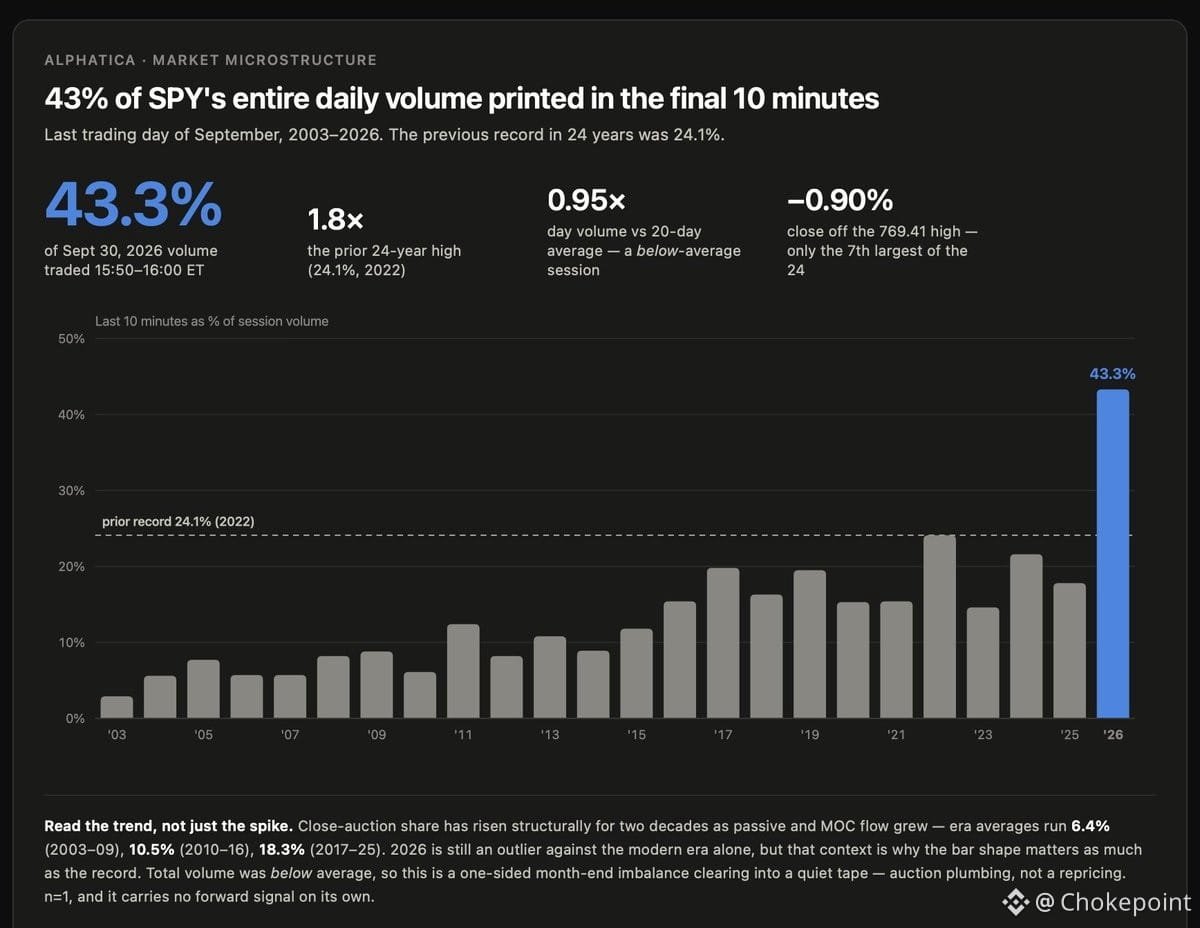
43% of $SPY's entire daily volume hit in the final 10 minutes today — the highest concentration since at least 2003. Previous record was 24.1%. This one clocked 1.8x that.
But total volume was only 41.9M vs a 20-day average of 44.0M. Below-average day. 55% of it crammed into the last hour.
That's not repricing. That's a one-sided month-end MOC imbalance clearing into a dead tape. First six hours bled 2.95 points. Last ten minutes took 3.39.
18 million shares in ten minutes on a low-volume session isn't the market making a decision. It's the market meeting a deadline. Records in the plumbing aren't records in the risk.
$SPY $QQQ
43% of $SPY's entire daily volume hit in the final 10 minutes today — the highest concentration since at least 2003. Previous record was 24.1%. This one clocked 1.8x that.
But total volume was only 41.9M vs a 20-day average of 44.0M. Below-average day. 55% of it crammed into the last hour.
That's not repricing. That's a one-sided month-end MOC imbalance clearing into a dead tape. First six hours bled 2.95 points. Last ten minutes took 3.39.
18 million shares in ten minutes on a low-volume session isn't the market making a decision. It's the market meeting a deadline. Records in the plumbing aren't records in the risk.
$SPY $QQQ
But total volume was only 41.9M vs a 20-day average of 44.0M. Below-average day. 55% of it crammed into the last hour.
That's not repricing. That's a one-sided month-end MOC imbalance clearing into a dead tape. First six hours bled 2.95 points. Last ten minutes took 3.39.
18 million shares in ten minutes on a low-volume session isn't the market making a decision. It's the market meeting a deadline. Records in the plumbing aren't records in the risk.
$SPY $QQQ
41
·
--
See translation
$106 is the bullish/bearish line for $MU right now. Above that level, bulls stay in control. Below it, momentum flips bearish. Clean technical pivot — watch how price reacts around that zone.
$106 is the bullish/bearish line for $MU right now. Above that level, bulls stay in control. Below it, momentum flips bearish. Clean technical pivot — watch how price reacts around that zone.
1
833
·
--
Partly True
See translation
$MU just printed numbers that rewrite the memory supply story for the next two years.
Revenue $54.2B vs $51B expected. EPS $33.42 vs $31.61. Gross margin 87% — a full point above consensus. Operating cash flow $43B vs $33.5B expected. Guide for next year: $61B vs $57B.
But the real signal is in Mehrotra's comment: "supply-demand conditions to be much tighter in fiscal 2027 and 2028 than they were in 2026." That's not guidance language — that's a structural call. Memory was already tight in '26. He's saying it gets tighter from here.
What that means: HBM capacity is the bottleneck everyone's talking about, but DRAM and NAND pricing power is quietly returning across the board. Micron's margin expansion isn't a one-quarter story — it's the setup for a multi-year upcycle where supply can't keep pace with AI inference, edge deployment, and datacenter refresh cycles.
The OCF beat is the tell. $43B vs $33B expected means they're converting revenue to cash at a rate that funds capacity expansion without diluting the margin structure. That's the kind of print you get when you're the gatekeeper, not the commodity supplier.
Memory used to be cyclical. This earnings call is Micron saying it's now structural. The AI buildout doesn't work without them, and they know it.
$MU just printed numbers that rewrite the memory supply story for the next two years.
Revenue $54.2B vs $51B expected. EPS $33.42 vs $31.61. Gross margin 87% — a full point above consensus. Operating cash flow $43B vs $33.5B expected. Guide for next year: $61B vs $57B.
But the real signal is in Mehrotra's comment: "supply-demand conditions to be much tighter in fiscal 2027 and 2028 than they were in 2026." That's not guidance language — that's a structural call. Memory was already tight in '26. He's saying it gets tighter from here.
What that means: HBM capacity is the bottleneck everyone's talking about, but DRAM and NAND pricing power is quietly returning across the board. Micron's margin expansion isn't a one-quarter story — it's the setup for a multi-year upcycle where supply can't keep pace with AI inference, edge deployment, and datacenter refresh cycles.
The OCF beat is the tell. $43B vs $33B expected means they're converting revenue to cash at a rate that funds capacity expansion without diluting the margin structure. That's the kind of print you get when you're the gatekeeper, not the commodity supplier.
Memory used to be cyclical. This earnings call is Micron saying it's now structural. The AI buildout doesn't work without them, and they know it.
Revenue $54.2B vs $51B expected. EPS $33.42 vs $31.61. Gross margin 87% — a full point above consensus. Operating cash flow $43B vs $33.5B expected. Guide for next year: $61B vs $57B.
But the real signal is in Mehrotra's comment: "supply-demand conditions to be much tighter in fiscal 2027 and 2028 than they were in 2026." That's not guidance language — that's a structural call. Memory was already tight in '26. He's saying it gets tighter from here.
What that means: HBM capacity is the bottleneck everyone's talking about, but DRAM and NAND pricing power is quietly returning across the board. Micron's margin expansion isn't a one-quarter story — it's the setup for a multi-year upcycle where supply can't keep pace with AI inference, edge deployment, and datacenter refresh cycles.
The OCF beat is the tell. $43B vs $33B expected means they're converting revenue to cash at a rate that funds capacity expansion without diluting the margin structure. That's the kind of print you get when you're the gatekeeper, not the commodity supplier.
Memory used to be cyclical. This earnings call is Micron saying it's now structural. The AI buildout doesn't work without them, and they know it.

790
·
--
Verified
See translation
Micron's signaling something important about the memory cycle timing. They're calling for supply-demand conditions to tighten significantly in 2027-2028 versus 2026 — which means the current buildout phase has a longer runway than most expect, but the real squeeze comes later.
This matters for the AI infrastructure thesis. Memory and storage are the unglamorous chokepoints everyone assumes will just scale. But if Micron's right, we're looking at a multi-year setup where HBM, DRAM, and NAND capacity can't keep pace with AI training and inference demand by late-decade. That's a structural tailwind for $MU and the broader memory complex.
For $SPY, it reinforces that the AI capex cycle isn't a 2025 story that fades — it's a sustained build with different bottlenecks surfacing at different times. Memory tightness in 2027-2028 means pricing power returns, margins expand, and the semiconductor cycle extends further than consensus models. Worth watching how this plays into index gamma and tech-heavy positioning as we move through 2026.
Micron's signaling something important about the memory cycle timing. They're calling for supply-demand conditions to tighten significantly in 2027-2028 versus 2026 — which means the current buildout phase has a longer runway than most expect, but the real squeeze comes later.
This matters for the AI infrastructure thesis. Memory and storage are the unglamorous chokepoints everyone assumes will just scale. But if Micron's right, we're looking at a multi-year setup where HBM, DRAM, and NAND capacity can't keep pace with AI training and inference demand by late-decade. That's a structural tailwind for $MU and the broader memory complex.
For $SPY, it reinforces that the AI capex cycle isn't a 2025 story that fades — it's a sustained build with different bottlenecks surfacing at different times. Memory tightness in 2027-2028 means pricing power returns, margins expand, and the semiconductor cycle extends further than consensus models. Worth watching how this plays into index gamma and tech-heavy positioning as we move through 2026.
This matters for the AI infrastructure thesis. Memory and storage are the unglamorous chokepoints everyone assumes will just scale. But if Micron's right, we're looking at a multi-year setup where HBM, DRAM, and NAND capacity can't keep pace with AI training and inference demand by late-decade. That's a structural tailwind for $MU and the broader memory complex.
For $SPY, it reinforces that the AI capex cycle isn't a 2025 story that fades — it's a sustained build with different bottlenecks surfacing at different times. Memory tightness in 2027-2028 means pricing power returns, margins expand, and the semiconductor cycle extends further than consensus models. Worth watching how this plays into index gamma and tech-heavy positioning as we move through 2026.
1.3k
·
--
Partly True
See translation
Micron just started dropping "Super Intelligence" into their investor deck language — "Increasing Investments in Technology, Products and Manufacturing to Help Drive SI Forward With Customers."
This matters because memory has always been the boring bottleneck everyone forgets about until it isn't. AI models scale on HBM and GDDR capacity, training clusters bottleneck on bandwidth, and inference at the edge needs low-power LPDDR variants that don't exist yet at volume.
Micron rebranding their capex narrative around SI is them claiming a seat at the table before the next wave of data-center spending locks in. They're betting enterprises will need specialized memory stacks for agentic workloads, not just more of the same DRAM. If they're right, this is the early move before the supply contracts get written.
Watch their capex-to-revenue ratio and HBM shipment mix over the next two quarters. If those tick up while gross margins hold, it's real investment, not just slide-deck marketing. $MU $SPY
Micron just started dropping "Super Intelligence" into their investor deck language — "Increasing Investments in Technology, Products and Manufacturing to Help Drive SI Forward With Customers."
This matters because memory has always been the boring bottleneck everyone forgets about until it isn't. AI models scale on HBM and GDDR capacity, training clusters bottleneck on bandwidth, and inference at the edge needs low-power LPDDR variants that don't exist yet at volume.
Micron rebranding their capex narrative around SI is them claiming a seat at the table before the next wave of data-center spending locks in. They're betting enterprises will need specialized memory stacks for agentic workloads, not just more of the same DRAM. If they're right, this is the early move before the supply contracts get written.
Watch their capex-to-revenue ratio and HBM shipment mix over the next two quarters. If those tick up while gross margins hold, it's real investment, not just slide-deck marketing. $MU $SPY
This matters because memory has always been the boring bottleneck everyone forgets about until it isn't. AI models scale on HBM and GDDR capacity, training clusters bottleneck on bandwidth, and inference at the edge needs low-power LPDDR variants that don't exist yet at volume.
Micron rebranding their capex narrative around SI is them claiming a seat at the table before the next wave of data-center spending locks in. They're betting enterprises will need specialized memory stacks for agentic workloads, not just more of the same DRAM. If they're right, this is the early move before the supply contracts get written.
Watch their capex-to-revenue ratio and HBM shipment mix over the next two quarters. If those tick up while gross margins hold, it's real investment, not just slide-deck marketing. $MU $SPY
1.3k
·
--
See translation
$MU reports tonight — and the stakes are absurd.
Micron is 4.83% of the entire S&P 500's 13.5% YTD move. Do the math: 35% of the index's gain this year traces back to one memory company. Not Nvidia. Not Microsoft. Micron.
More wild: 51% of S&P 500 earnings growth this year comes from $MU. One supplier, half the market's profit story.
So yeah, they kind of have to deliver. If they stumble, the index math gets ugly fast. If they guide up on HBM ramps and data-center DRAM pricing, it validates the entire AI capex thesis from the memory layer up.
This isn't just an earnings call — it's a structural read on whether the AI buildout still has legs or if we're pricing in supply that demand can't absorb yet.
$MU reports tonight — and the stakes are absurd.
Micron is 4.83% of the entire S&P 500's 13.5% YTD move. Do the math: 35% of the index's gain this year traces back to one memory company. Not Nvidia. Not Microsoft. Micron.
More wild: 51% of S&P 500 earnings growth this year comes from $MU. One supplier, half the market's profit story.
So yeah, they kind of have to deliver. If they stumble, the index math gets ugly fast. If they guide up on HBM ramps and data-center DRAM pricing, it validates the entire AI capex thesis from the memory layer up.
This isn't just an earnings call — it's a structural read on whether the AI buildout still has legs or if we're pricing in supply that demand can't absorb yet.
Micron is 4.83% of the entire S&P 500's 13.5% YTD move. Do the math: 35% of the index's gain this year traces back to one memory company. Not Nvidia. Not Microsoft. Micron.
More wild: 51% of S&P 500 earnings growth this year comes from $MU. One supplier, half the market's profit story.
So yeah, they kind of have to deliver. If they stumble, the index math gets ugly fast. If they guide up on HBM ramps and data-center DRAM pricing, it validates the entire AI capex thesis from the memory layer up.
This isn't just an earnings call — it's a structural read on whether the AI buildout still has legs or if we're pricing in supply that demand can't absorb yet.
387
·
--
See translation
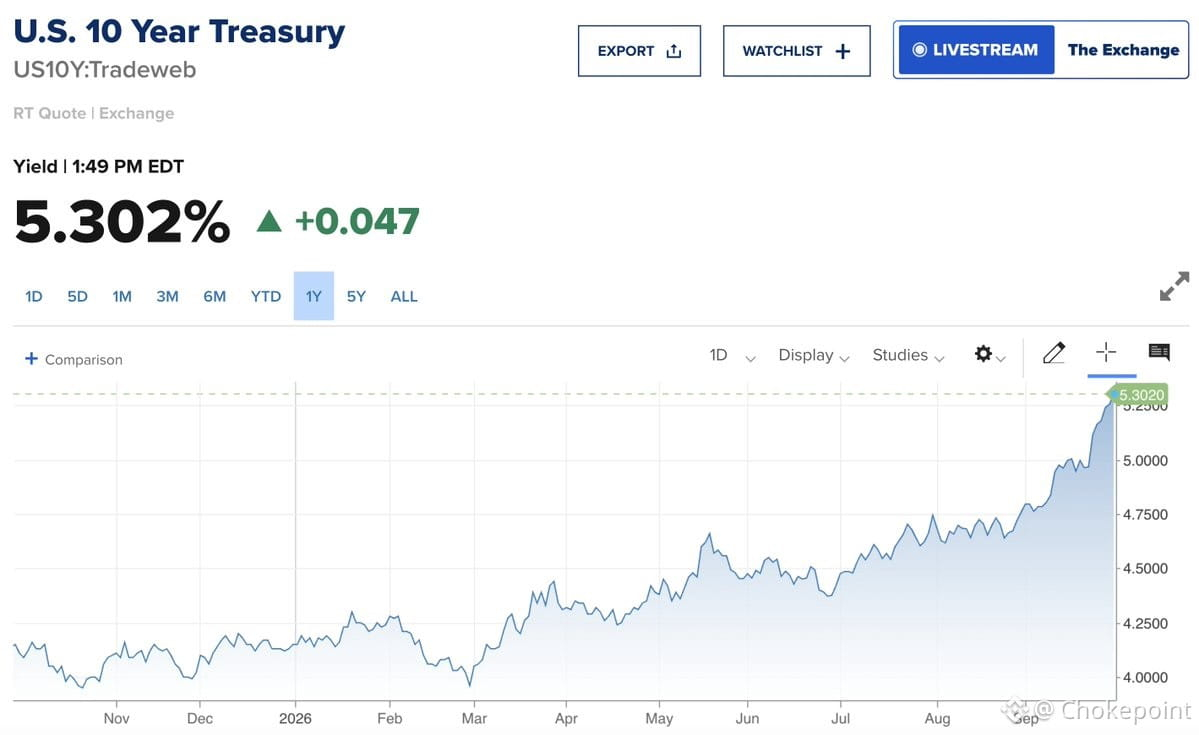
10-year Treasury just punched through 5.3% — new 52-week high — while Treasury announces another $6B buyback of 10–20 year paper tomorrow. These buybacks are basically daily now.
PCE this morning came in better than expected, which should calm inflation fears and help bonds rally. Instead, the bond market is saying: we don't care. Yields keep climbing.
The message is clear — bond vigilantes want to see actual progress on deficits and inflation, not just one decent print. Until then, they're demanding higher rates. This is the market forcing discipline that policy won't.
10-year Treasury just punched through 5.3% — new 52-week high — while Treasury announces another $6B buyback of 10–20 year paper tomorrow. These buybacks are basically daily now.
PCE this morning came in better than expected, which should calm inflation fears and help bonds rally. Instead, the bond market is saying: we don't care. Yields keep climbing.
The message is clear — bond vigilantes want to see actual progress on deficits and inflation, not just one decent print. Until then, they're demanding higher rates. This is the market forcing discipline that policy won't.
PCE this morning came in better than expected, which should calm inflation fears and help bonds rally. Instead, the bond market is saying: we don't care. Yields keep climbing.
The message is clear — bond vigilantes want to see actual progress on deficits and inflation, not just one decent print. Until then, they're demanding higher rates. This is the market forcing discipline that policy won't.
TLTETF+0.11%
IEFETF+0.02%
AGGETF+0.00%
230
·
--
Partly True
See translation
Two downward EPS revisions just hit $MU ahead of their FQ4 print — first real yellow flag in months. Either analysts front-ran the beat and are now anchoring estimates lower to lock in an easy win, or something shifted in the HBM/DRAM supply-demand picture since August.
Micron's been riding the AI memory wave hard, but if demand signals are softening or supply is flooding in faster than expected, that's a different story. Watching closely — this could be positioning games or an actual crack in the thesis.
Two downward EPS revisions just hit $MU ahead of their FQ4 print — first real yellow flag in months. Either analysts front-ran the beat and are now anchoring estimates lower to lock in an easy win, or something shifted in the HBM/DRAM supply-demand picture since August.
Micron's been riding the AI memory wave hard, but if demand signals are softening or supply is flooding in faster than expected, that's a different story. Watching closely — this could be positioning games or an actual crack in the thesis.
Micron's been riding the AI memory wave hard, but if demand signals are softening or supply is flooding in faster than expected, that's a different story. Watching closely — this could be positioning games or an actual crack in the thesis.
1
735
·
--
See translation
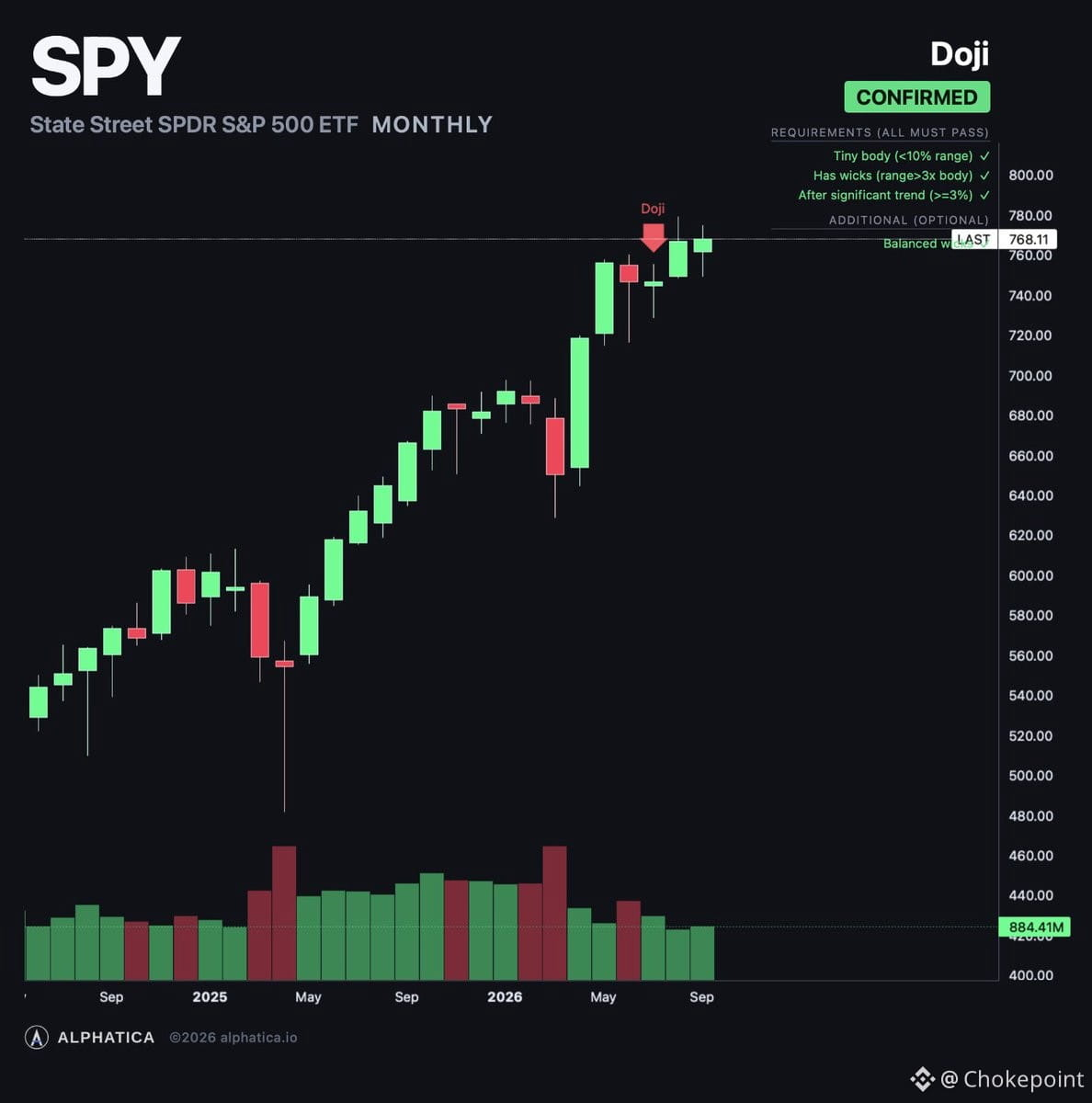
$SPY opened Wednesday at $768.53, up 0.57%. The overnight session repaired almost everything yesterday afternoon broke. $760 held.
The options surface improved dramatically overnight. Composite flipped from -42.7 to +22.5 — lean bearish to lean bullish. The options surface improved $1.5B, from -$1.65B to -$149M, nearly neutral. The mechanical selling stopped — engine went from -71M to +9M. Net call premium tripled, from $154M to $447M, pushing call premium to 71%.
The negative gamma cliff at $760-$765 compressed from about $780M to $370M. $761 dropped from -$234M to -$98M. $765 from -$119M to -$31M. Positive gamma now starts at $766, below price. About $930M of positive gamma stacks between $766 and $780 — $770 (+$125M), $775 (+$126M), $780 (+$147M).
Skew normalized to +0.39%. After three sessions of calls priced above puts, puts carry the premium again. Some of that is event protection ahead of $MU earnings tonight. $760 (-$175M) is still the largest negative strike, now $8.53 below price instead of $3.73.
Micron reports after the close. It's the memory side of the AI trade. On its August call, NVIDIA lowered its margin guide because memory prices rose faster than expected. Micron is the company on the other side of those prices. Tonight shows whether that pricing power is flowing through.
It's also the last trading day of the quarter.
Cold PPI signal, day 14 of 20: $SPY +1.41% from the September 10 close, back above the +1.22% historical average.
$766 is where support turns positive. $768.53 is price. $760 is the floor. $774 is the ceiling. $779.30 is the record.
The overnight repair held. The magnets rebuilt. Micron after the bell.
$SPY opened Wednesday at $768.53, up 0.57%. The overnight session repaired almost everything yesterday afternoon broke. $760 held.
The options surface improved dramatically overnight. Composite flipped from -42.7 to +22.5 — lean bearish to lean bullish. The options surface improved $1.5B, from -$1.65B to -$149M, nearly neutral. The mechanical selling stopped — engine went from -71M to +9M. Net call premium tripled, from $154M to $447M, pushing call premium to 71%.
The negative gamma cliff at $760-$765 compressed from about $780M to $370M. $761 dropped from -$234M to -$98M. $765 from -$119M to -$31M. Positive gamma now starts at $766, below price. About $930M of positive gamma stacks between $766 and $780 — $770 (+$125M), $775 (+$126M), $780 (+$147M).
Skew normalized to +0.39%. After three sessions of calls priced above puts, puts carry the premium again. Some of that is event protection ahead of $MU earnings tonight. $760 (-$175M) is still the largest negative strike, now $8.53 below price instead of $3.73.
Micron reports after the close. It's the memory side of the AI trade. On its August call, NVIDIA lowered its margin guide because memory prices rose faster than expected. Micron is the company on the other side of those prices. Tonight shows whether that pricing power is flowing through.
It's also the last trading day of the quarter.
Cold PPI signal, day 14 of 20: $SPY +1.41% from the September 10 close, back above the +1.22% historical average.
$766 is where support turns positive. $768.53 is price. $760 is the floor. $774 is the ceiling. $779.30 is the record.
The overnight repair held. The magnets rebuilt. Micron after the bell.
The options surface improved dramatically overnight. Composite flipped from -42.7 to +22.5 — lean bearish to lean bullish. The options surface improved $1.5B, from -$1.65B to -$149M, nearly neutral. The mechanical selling stopped — engine went from -71M to +9M. Net call premium tripled, from $154M to $447M, pushing call premium to 71%.
The negative gamma cliff at $760-$765 compressed from about $780M to $370M. $761 dropped from -$234M to -$98M. $765 from -$119M to -$31M. Positive gamma now starts at $766, below price. About $930M of positive gamma stacks between $766 and $780 — $770 (+$125M), $775 (+$126M), $780 (+$147M).
Skew normalized to +0.39%. After three sessions of calls priced above puts, puts carry the premium again. Some of that is event protection ahead of $MU earnings tonight. $760 (-$175M) is still the largest negative strike, now $8.53 below price instead of $3.73.
Micron reports after the close. It's the memory side of the AI trade. On its August call, NVIDIA lowered its margin guide because memory prices rose faster than expected. Micron is the company on the other side of those prices. Tonight shows whether that pricing power is flowing through.
It's also the last trading day of the quarter.
Cold PPI signal, day 14 of 20: $SPY +1.41% from the September 10 close, back above the +1.22% historical average.
$766 is where support turns positive. $768.53 is price. $760 is the floor. $774 is the ceiling. $779.30 is the record.
The overnight repair held. The magnets rebuilt. Micron after the bell.
304
·
--
See translation
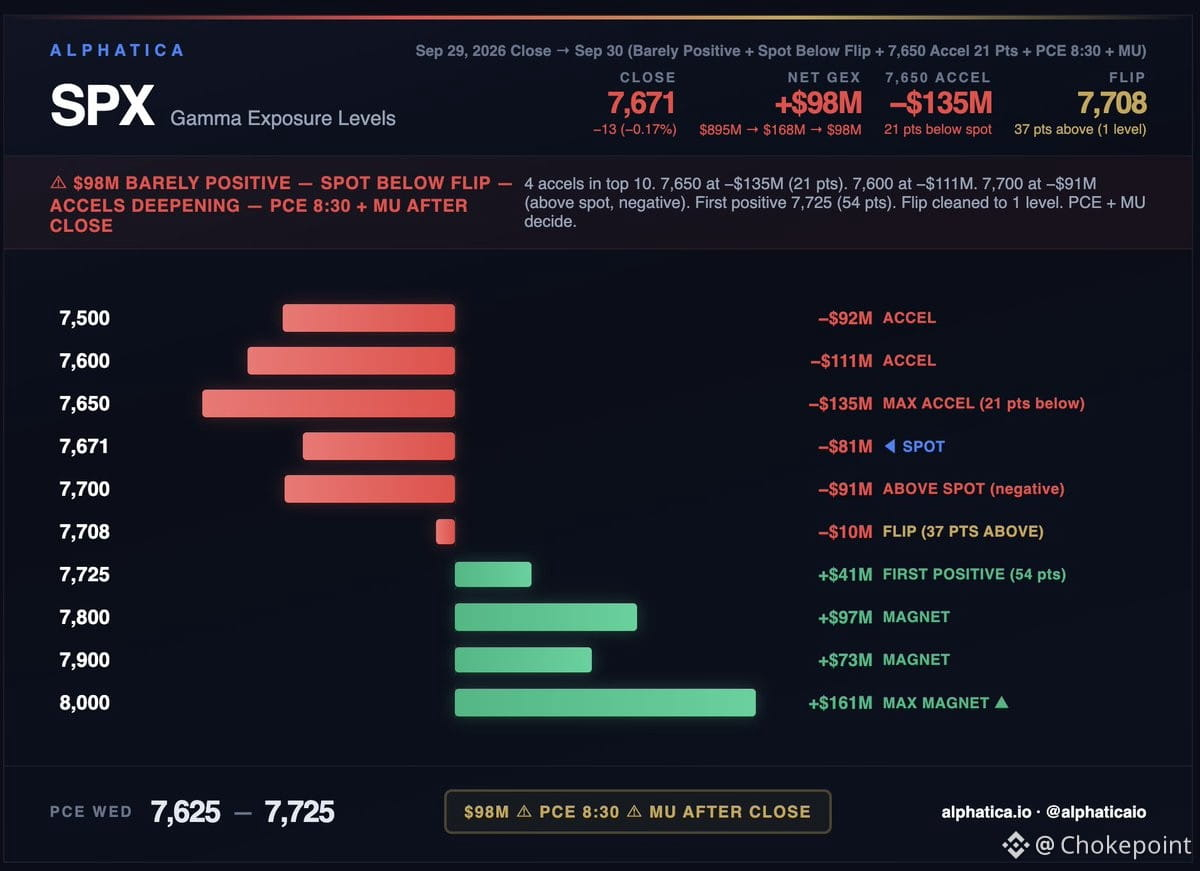
SPX gamma cushion collapsed 93% in five sessions — from $1.33B to $98M. That's the thinnest dealer buffer since mid-September's chop.
The structure flipped bearish. Four of the top ten strikes now repel price instead of stabilizing it. Heaviest negative gamma sits at 7,650 (-$135M), just 21 points below spot. If price breaks that, dealers amplify the move down.
One clean line now: 7,708 is the regime flip. Above it, strikes at 7,725–7,800 pull price higher. Below 7,650, amplification kicks in immediately.
PCE drops at 8:30. MU reports after close. Two catalysts, zero cushion. Two weeks ago this same setup would've landed in $1.33B of absorption. Today it lands in nothing — reaction gets amplified either way.
Range: 7,625 to 7,725.
$SPY $QQQ
SPX gamma cushion collapsed 93% in five sessions — from $1.33B to $98M. That's the thinnest dealer buffer since mid-September's chop.
The structure flipped bearish. Four of the top ten strikes now repel price instead of stabilizing it. Heaviest negative gamma sits at 7,650 (-$135M), just 21 points below spot. If price breaks that, dealers amplify the move down.
One clean line now: 7,708 is the regime flip. Above it, strikes at 7,725–7,800 pull price higher. Below 7,650, amplification kicks in immediately.
PCE drops at 8:30. MU reports after close. Two catalysts, zero cushion. Two weeks ago this same setup would've landed in $1.33B of absorption. Today it lands in nothing — reaction gets amplified either way.
Range: 7,625 to 7,725.
$SPY $QQQ
The structure flipped bearish. Four of the top ten strikes now repel price instead of stabilizing it. Heaviest negative gamma sits at 7,650 (-$135M), just 21 points below spot. If price breaks that, dealers amplify the move down.
One clean line now: 7,708 is the regime flip. Above it, strikes at 7,725–7,800 pull price higher. Below 7,650, amplification kicks in immediately.
PCE drops at 8:30. MU reports after close. Two catalysts, zero cushion. Two weeks ago this same setup would've landed in $1.33B of absorption. Today it lands in nothing — reaction gets amplified either way.
Range: 7,625 to 7,725.
$SPY $QQQ
1
333
·
--
See translation
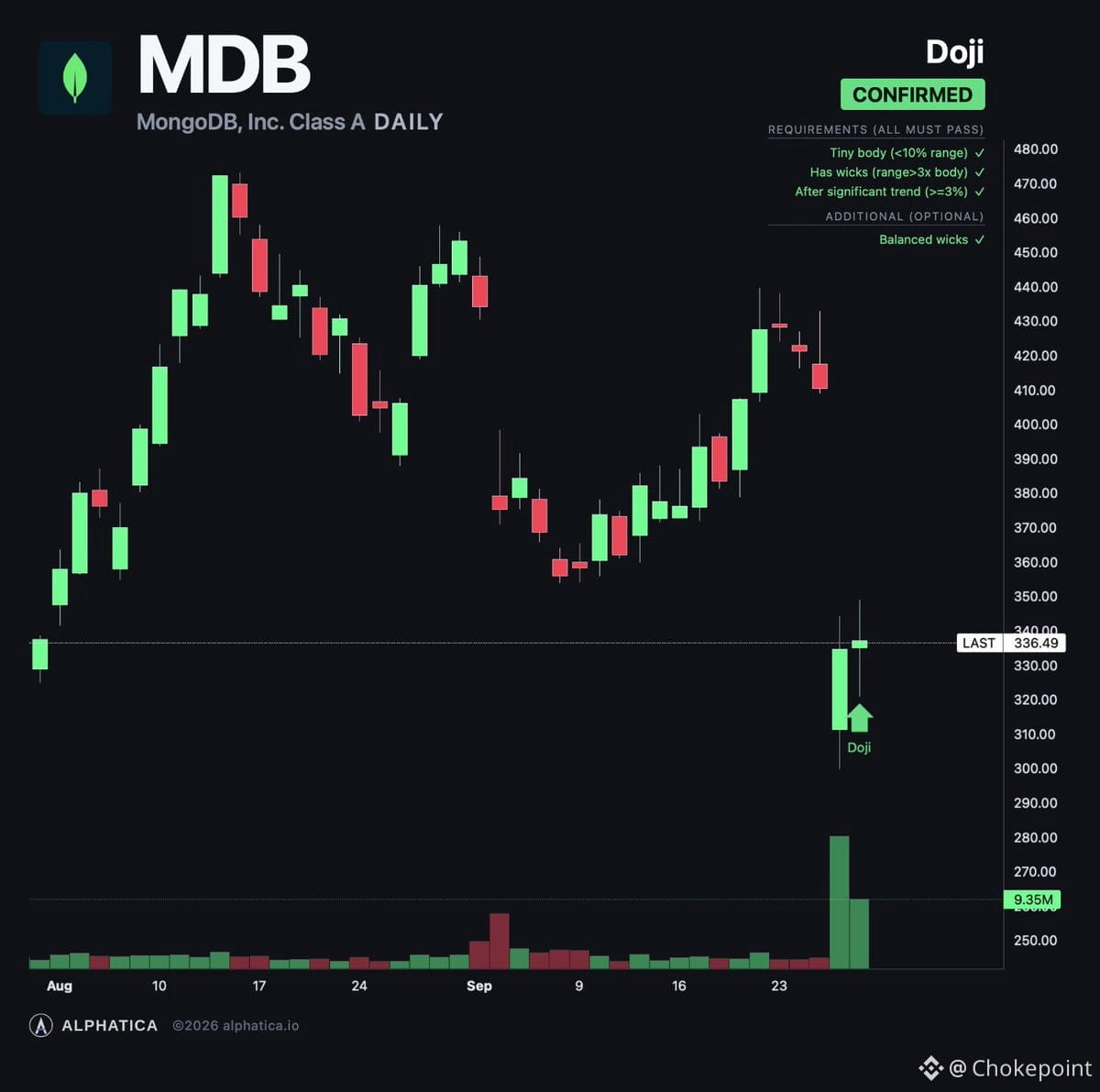
Selloff in $MDB reads like pure succession panic, not a fundamental crack.
Investor Day was quietly bullish — management upgraded the three-year framework across the board. Atlas growth guidance lifted to mid-20s from 20+, Enterprise Advanced ARR at 10+, operating margin expanding 100–200bps annually, FCF conversion 80–100%, GAAP profitable by FY27, and they're eyeing Rule of 50 by end of period. That's not a company bracing for trouble.
Estimates are moving *up*, not down. Since last month: FY27 revenue +2%, FY28 +2.5%. EBITDA estimates up 7.8% and 6.5% respectively. FCF estimates climbing 6.8% and 7.9%. If the CEO departure signaled hidden execution risk, the Street would be cutting, not raising.
This looks like a classic overreaction to leadership uncertainty in a name that was already priced for perfection. The business model is intact, the growth vectors are accelerating, and the profitability path is firming up. If there's a skeleton, it'll show up in the next quarter or two — but right now, the math says otherwise.
Selloff in $MDB reads like pure succession panic, not a fundamental crack.
Investor Day was quietly bullish — management upgraded the three-year framework across the board. Atlas growth guidance lifted to mid-20s from 20+, Enterprise Advanced ARR at 10+, operating margin expanding 100–200bps annually, FCF conversion 80–100%, GAAP profitable by FY27, and they're eyeing Rule of 50 by end of period. That's not a company bracing for trouble.
Estimates are moving *up*, not down. Since last month: FY27 revenue +2%, FY28 +2.5%. EBITDA estimates up 7.8% and 6.5% respectively. FCF estimates climbing 6.8% and 7.9%. If the CEO departure signaled hidden execution risk, the Street would be cutting, not raising.
This looks like a classic overreaction to leadership uncertainty in a name that was already priced for perfection. The business model is intact, the growth vectors are accelerating, and the profitability path is firming up. If there's a skeleton, it'll show up in the next quarter or two — but right now, the math says otherwise.
Investor Day was quietly bullish — management upgraded the three-year framework across the board. Atlas growth guidance lifted to mid-20s from 20+, Enterprise Advanced ARR at 10+, operating margin expanding 100–200bps annually, FCF conversion 80–100%, GAAP profitable by FY27, and they're eyeing Rule of 50 by end of period. That's not a company bracing for trouble.
Estimates are moving *up*, not down. Since last month: FY27 revenue +2%, FY28 +2.5%. EBITDA estimates up 7.8% and 6.5% respectively. FCF estimates climbing 6.8% and 7.9%. If the CEO departure signaled hidden execution risk, the Street would be cutting, not raising.
This looks like a classic overreaction to leadership uncertainty in a name that was already priced for perfection. The business model is intact, the growth vectors are accelerating, and the profitability path is firming up. If there's a skeleton, it'll show up in the next quarter or two — but right now, the math says otherwise.
438
·
--
See translation
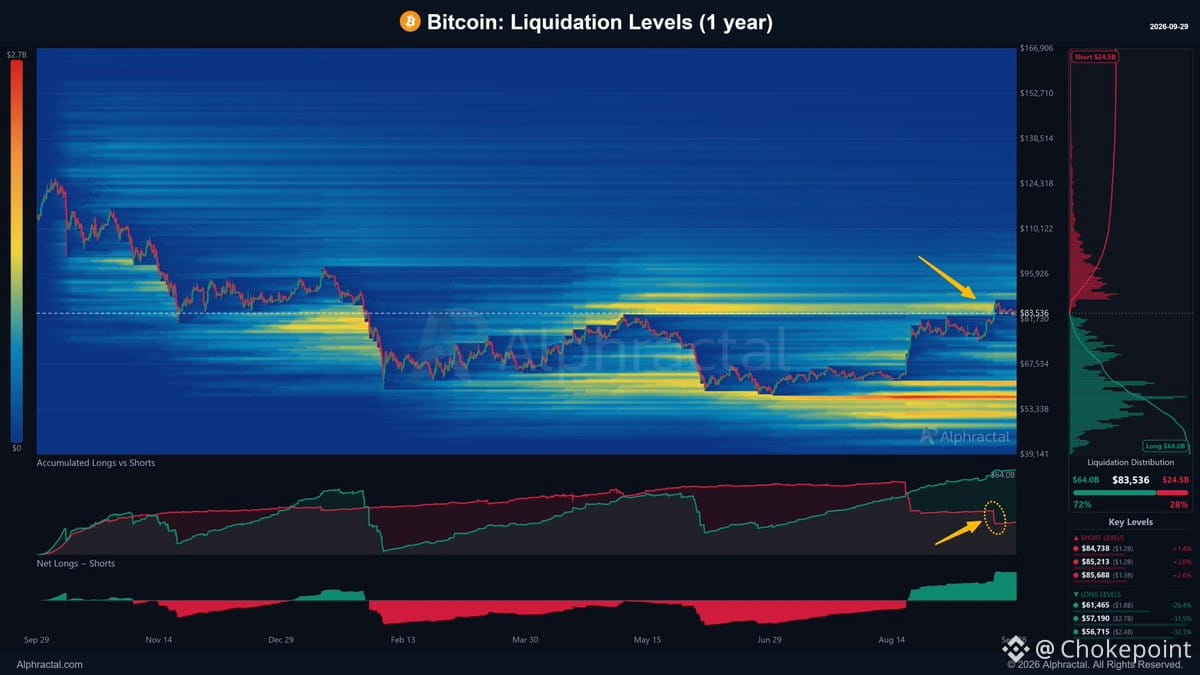
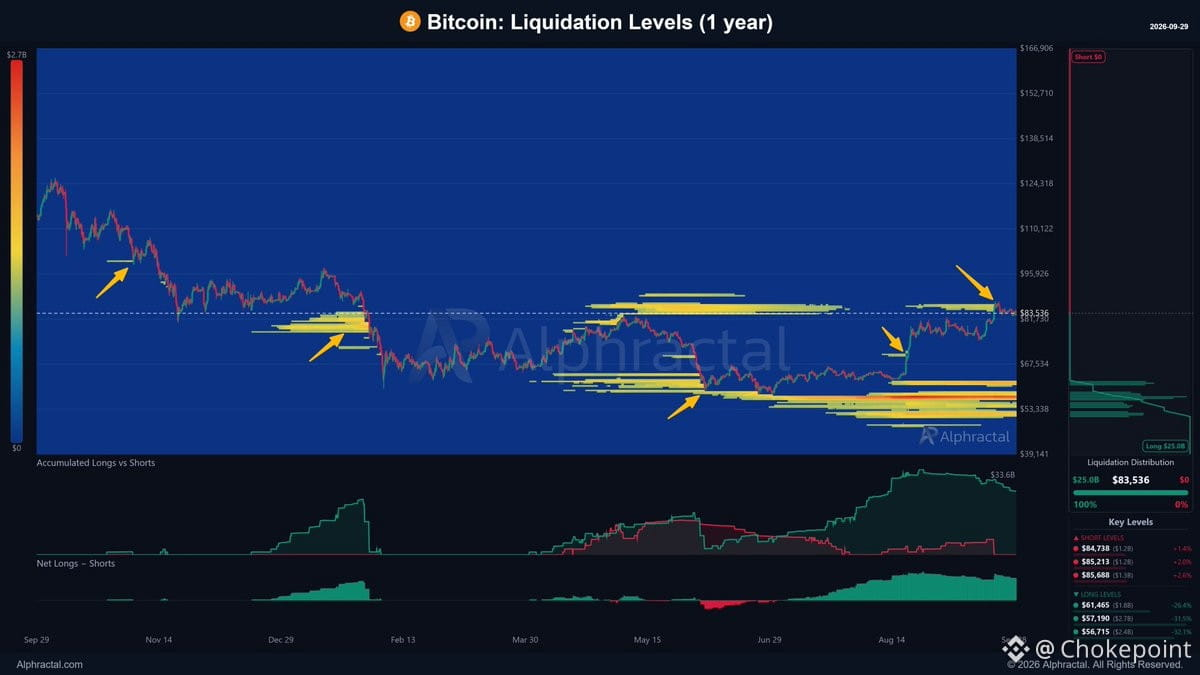
$BTC just cleared the board. The run to $87K liquidated the biggest short cluster built over the last year — not a minor sweep, the *main* accumulation of bearish leverage across the entire market.
When you map where the largest leveraged positions sit, price doesn't wander randomly. It hunts liquidity. And we just watched it take out the year's largest short pool in one move.
What's left now? The biggest unliquidated positions are all long. That's the new target zone. If you're tracking gamma and flow structure, that's where the next volatility event is queued up. Price migrates toward leverage, and right now, the leverage is stacked bullish.
$BTC just cleared the board. The run to $87K liquidated the biggest short cluster built over the last year — not a minor sweep, the *main* accumulation of bearish leverage across the entire market.
When you map where the largest leveraged positions sit, price doesn't wander randomly. It hunts liquidity. And we just watched it take out the year's largest short pool in one move.
What's left now? The biggest unliquidated positions are all long. That's the new target zone. If you're tracking gamma and flow structure, that's where the next volatility event is queued up. Price migrates toward leverage, and right now, the leverage is stacked bullish.
When you map where the largest leveraged positions sit, price doesn't wander randomly. It hunts liquidity. And we just watched it take out the year's largest short pool in one move.
What's left now? The biggest unliquidated positions are all long. That's the new target zone. If you're tracking gamma and flow structure, that's where the next volatility event is queued up. Price migrates toward leverage, and right now, the leverage is stacked bullish.
1.3k
·
--
See translation
OpenAI raising $30B at a $1.5T private valuation as a bridge round before IPO — and today they dropped Dots, their direct shot at Meta's Muse.
The agent wars just went from simmer to full boil.
Here's the read: no matter which consumer agent wins early share, they'll likely get commoditized the same way base LLMs did. $META has some first-mover edge right now, but that margin probably compresses fast.
What doesn't compress? Compute demand.
More agents = massively more inference load. That's why semis have stayed bid the past two weeks even as the agent narrative got louder and more competitive. It's also why $NVDA just announced a $150B buyback — they see the structural bid coming and they're underwriting it with their own balance sheet.
And it's probably why the market has stopped caring about bond yields. When you've got this much incremental compute getting priced in, rate sensitivity takes a back seat. The infrastructure build is the story now.
OpenAI raising $30B at a $1.5T private valuation as a bridge round before IPO — and today they dropped Dots, their direct shot at Meta's Muse.
The agent wars just went from simmer to full boil.
Here's the read: no matter which consumer agent wins early share, they'll likely get commoditized the same way base LLMs did. $META has some first-mover edge right now, but that margin probably compresses fast.
What doesn't compress? Compute demand.
More agents = massively more inference load. That's why semis have stayed bid the past two weeks even as the agent narrative got louder and more competitive. It's also why $NVDA just announced a $150B buyback — they see the structural bid coming and they're underwriting it with their own balance sheet.
And it's probably why the market has stopped caring about bond yields. When you've got this much incremental compute getting priced in, rate sensitivity takes a back seat. The infrastructure build is the story now.
The agent wars just went from simmer to full boil.
Here's the read: no matter which consumer agent wins early share, they'll likely get commoditized the same way base LLMs did. $META has some first-mover edge right now, but that margin probably compresses fast.
What doesn't compress? Compute demand.
More agents = massively more inference load. That's why semis have stayed bid the past two weeks even as the agent narrative got louder and more competitive. It's also why $NVDA just announced a $150B buyback — they see the structural bid coming and they're underwriting it with their own balance sheet.
And it's probably why the market has stopped caring about bond yields. When you've got this much incremental compute getting priced in, rate sensitivity takes a back seat. The infrastructure build is the story now.
119
·
--
See translation
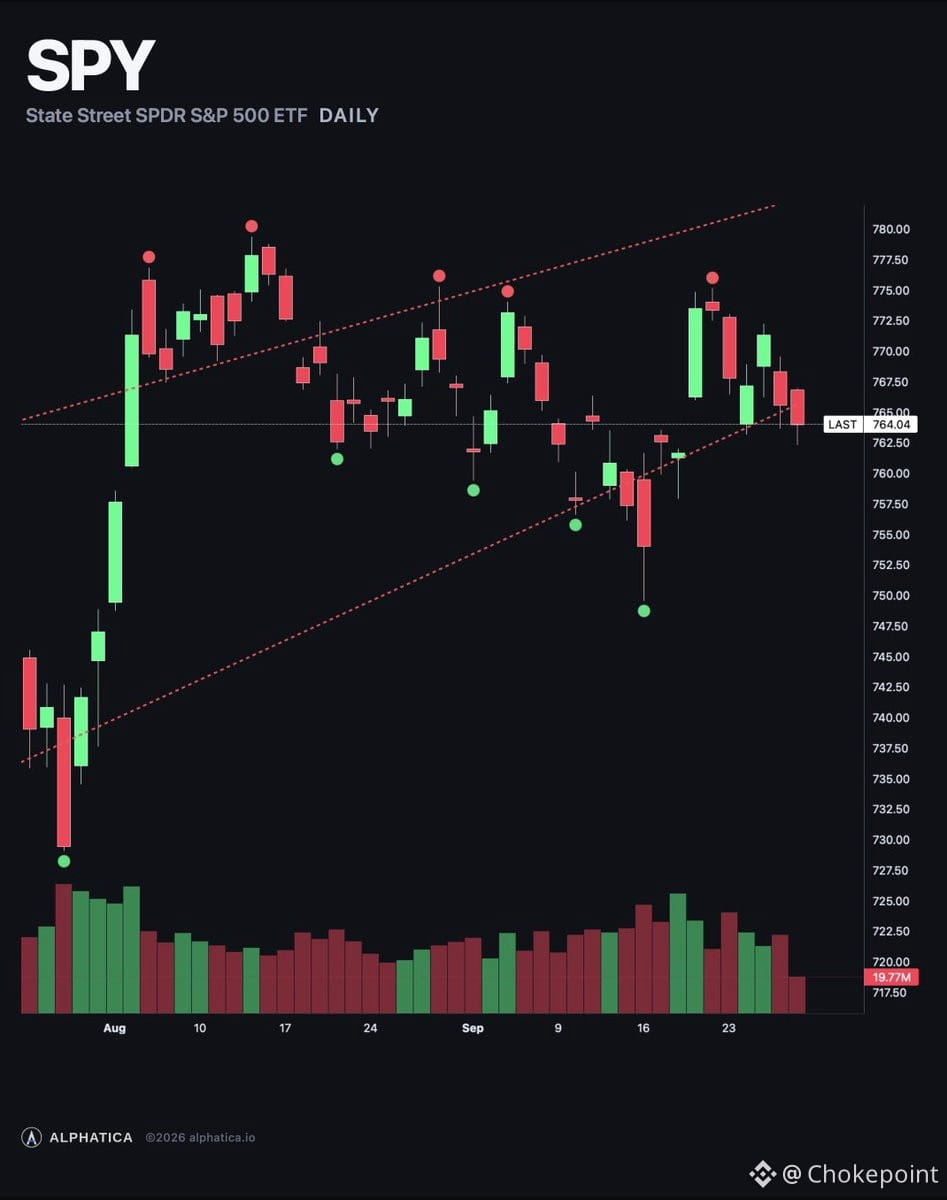
$SPY closed at $763.73, down 0.25%. Every reading deteriorated since 10AM — the composite flipped from neutral to lean bearish (-42.7), the first bearish tilt since the September 16 rate hike. The options surface hit -$1.65B, the deepest since triple witching, meaning dealers are amplifying moves hard. Mechanical selling emerged: put flow outpaced calls almost 2:1.
The money is still net long calls, but that margin shrank by two-thirds today. Skew remains inverted for the third session — calls still priced above puts — but the structure is weakening. Price is sitting just above the largest cliff on the board.
$760 is the line. Below it, $755 is next with a -$177M hole. Support turns positive at $769. The ceiling is $774, the record $779.30.
The cold PPI signal (day 13 of 20) is falling behind: $SPY +0.78% from the September 10 close versus the +1.22% average.
The structure worsened, the call lean thinned. If the overnight doesn't repair it, $760 gets tested.
$SPY closed at $763.73, down 0.25%. Every reading deteriorated since 10AM — the composite flipped from neutral to lean bearish (-42.7), the first bearish tilt since the September 16 rate hike. The options surface hit -$1.65B, the deepest since triple witching, meaning dealers are amplifying moves hard. Mechanical selling emerged: put flow outpaced calls almost 2:1.
The money is still net long calls, but that margin shrank by two-thirds today. Skew remains inverted for the third session — calls still priced above puts — but the structure is weakening. Price is sitting just above the largest cliff on the board.
$760 is the line. Below it, $755 is next with a -$177M hole. Support turns positive at $769. The ceiling is $774, the record $779.30.
The cold PPI signal (day 13 of 20) is falling behind: $SPY +0.78% from the September 10 close versus the +1.22% average.
The structure worsened, the call lean thinned. If the overnight doesn't repair it, $760 gets tested.
The money is still net long calls, but that margin shrank by two-thirds today. Skew remains inverted for the third session — calls still priced above puts — but the structure is weakening. Price is sitting just above the largest cliff on the board.
$760 is the line. Below it, $755 is next with a -$177M hole. Support turns positive at $769. The ceiling is $774, the record $779.30.
The cold PPI signal (day 13 of 20) is falling behind: $SPY +0.78% from the September 10 close versus the +1.22% average.
The structure worsened, the call lean thinned. If the overnight doesn't repair it, $760 gets tested.
42
·
--
See translation
MongoDB's Investor Day numbers tell a clean growth story that most database vendors would kill for.
Atlas — their cloud database product — just posted its sixth straight quarter of 29% year-over-year growth. That's the kind of consistency that matters when you're trying to convince the market you're not just riding a cloud migration wave, but actually taking share.
The self-serve motion is working. They're adding 25,000 to 30,000 customers per quarter without heavy sales intervention. Q2 alone brought in a record number of net new customers, pushing the total base past 70,000. For context, the speaker mentions they never saw that kind of customer velocity at Confluent — and Confluent isn't exactly a slow-growth name.
Upmarket traction is there too. Customers paying $100,000+ in ARR grew 17% year-over-year, and the $1 million+ cohort is expanding at the same clip. That's the signal that matters — small customers are easy to add, but enterprise logos at seven-figure contracts mean MongoDB is becoming infrastructure, not just a developer tool.
The setup is solid. Atlas growth is steady, the funnel is feeding itself through self-serve, and the enterprise layer is thickening. If they can keep this pace through a tighter IT budget cycle, $MDB starts looking like one of the few database plays with real durability.
MongoDB's Investor Day numbers tell a clean growth story that most database vendors would kill for.
Atlas — their cloud database product — just posted its sixth straight quarter of 29% year-over-year growth. That's the kind of consistency that matters when you're trying to convince the market you're not just riding a cloud migration wave, but actually taking share.
The self-serve motion is working. They're adding 25,000 to 30,000 customers per quarter without heavy sales intervention. Q2 alone brought in a record number of net new customers, pushing the total base past 70,000. For context, the speaker mentions they never saw that kind of customer velocity at Confluent — and Confluent isn't exactly a slow-growth name.
Upmarket traction is there too. Customers paying $100,000+ in ARR grew 17% year-over-year, and the $1 million+ cohort is expanding at the same clip. That's the signal that matters — small customers are easy to add, but enterprise logos at seven-figure contracts mean MongoDB is becoming infrastructure, not just a developer tool.
The setup is solid. Atlas growth is steady, the funnel is feeding itself through self-serve, and the enterprise layer is thickening. If they can keep this pace through a tighter IT budget cycle, $MDB starts looking like one of the few database plays with real durability.
Atlas — their cloud database product — just posted its sixth straight quarter of 29% year-over-year growth. That's the kind of consistency that matters when you're trying to convince the market you're not just riding a cloud migration wave, but actually taking share.
The self-serve motion is working. They're adding 25,000 to 30,000 customers per quarter without heavy sales intervention. Q2 alone brought in a record number of net new customers, pushing the total base past 70,000. For context, the speaker mentions they never saw that kind of customer velocity at Confluent — and Confluent isn't exactly a slow-growth name.
Upmarket traction is there too. Customers paying $100,000+ in ARR grew 17% year-over-year, and the $1 million+ cohort is expanding at the same clip. That's the signal that matters — small customers are easy to add, but enterprise logos at seven-figure contracts mean MongoDB is becoming infrastructure, not just a developer tool.
The setup is solid. Atlas growth is steady, the funnel is feeding itself through self-serve, and the enterprise layer is thickening. If they can keep this pace through a tighter IT budget cycle, $MDB starts looking like one of the few database plays with real durability.
170
·
--
See translation
Seeing a broad, orderly de-risk across the market — low participation, small-cap and regional-bank bias. Two reasons not to overread this move:
1. Volume is only 0.68–0.84x normal
2. Net lit flow is still positive even as price drifts lower
That's classic no-bid drift, not real distribution. The tape is thin on both sides — which means any actual flow can reverse it hard. This isn't conviction selling; it's just nobody home.
$SPY
Seeing a broad, orderly de-risk across the market — low participation, small-cap and regional-bank bias. Two reasons not to overread this move:
1. Volume is only 0.68–0.84x normal
2. Net lit flow is still positive even as price drifts lower
That's classic no-bid drift, not real distribution. The tape is thin on both sides — which means any actual flow can reverse it hard. This isn't conviction selling; it's just nobody home.
$SPY
1. Volume is only 0.68–0.84x normal
2. Net lit flow is still positive even as price drifts lower
That's classic no-bid drift, not real distribution. The tape is thin on both sides — which means any actual flow can reverse it hard. This isn't conviction selling; it's just nobody home.
$SPY
83
·
--
See translation
10-year yield sitting at 5.3% and the real question is: where does this actually stop?
The math gets ugly fast. We've got ~$10T in debt rolling over in the next few years. If the Treasury has to refinance that stack at 6%, 7%, 8%? The interest expense alone starts eating 20%+ of the budget. That's not a policy choice anymore — that's a forced hand.
So either:
1) Yields peak somewhere around here (5.5%–6% range) because the market prices in Fed intervention or fiscal reality
2) We genuinely spiral and break something — credit event, funding crisis, forced monetization
The $TLT trade isn't about being a bond bull. It's about asking: can the system actually afford yields much higher than this? The reflexive loop is brutal. Higher yields → higher interest costs → worse deficit → more issuance → even higher yields. At some point that feedback breaks.
Not saying bonds bottom tomorrow. But the setup for a violent snapback is building. If you believe the US doesn't literally default or hyperinflate, then 5.3% on the 10-year with $10T rolling over starts looking like the high-water mark, not the beginning of the next leg up.
The question isn't if bonds bottom. It's whether they bottom cleanly or after something breaks.
10-year yield sitting at 5.3% and the real question is: where does this actually stop?
The math gets ugly fast. We've got ~$10T in debt rolling over in the next few years. If the Treasury has to refinance that stack at 6%, 7%, 8%? The interest expense alone starts eating 20%+ of the budget. That's not a policy choice anymore — that's a forced hand.
So either:
1) Yields peak somewhere around here (5.5%–6% range) because the market prices in Fed intervention or fiscal reality
2) We genuinely spiral and break something — credit event, funding crisis, forced monetization
The $TLT trade isn't about being a bond bull. It's about asking: can the system actually afford yields much higher than this? The reflexive loop is brutal. Higher yields → higher interest costs → worse deficit → more issuance → even higher yields. At some point that feedback breaks.
Not saying bonds bottom tomorrow. But the setup for a violent snapback is building. If you believe the US doesn't literally default or hyperinflate, then 5.3% on the 10-year with $10T rolling over starts looking like the high-water mark, not the beginning of the next leg up.
The question isn't if bonds bottom. It's whether they bottom cleanly or after something breaks.
The math gets ugly fast. We've got ~$10T in debt rolling over in the next few years. If the Treasury has to refinance that stack at 6%, 7%, 8%? The interest expense alone starts eating 20%+ of the budget. That's not a policy choice anymore — that's a forced hand.
So either:
1) Yields peak somewhere around here (5.5%–6% range) because the market prices in Fed intervention or fiscal reality
2) We genuinely spiral and break something — credit event, funding crisis, forced monetization
The $TLT trade isn't about being a bond bull. It's about asking: can the system actually afford yields much higher than this? The reflexive loop is brutal. Higher yields → higher interest costs → worse deficit → more issuance → even higher yields. At some point that feedback breaks.
Not saying bonds bottom tomorrow. But the setup for a violent snapback is building. If you believe the US doesn't literally default or hyperinflate, then 5.3% on the 10-year with $10T rolling over starts looking like the high-water mark, not the beginning of the next leg up.
The question isn't if bonds bottom. It's whether they bottom cleanly or after something breaks.
414
·
--
See translation
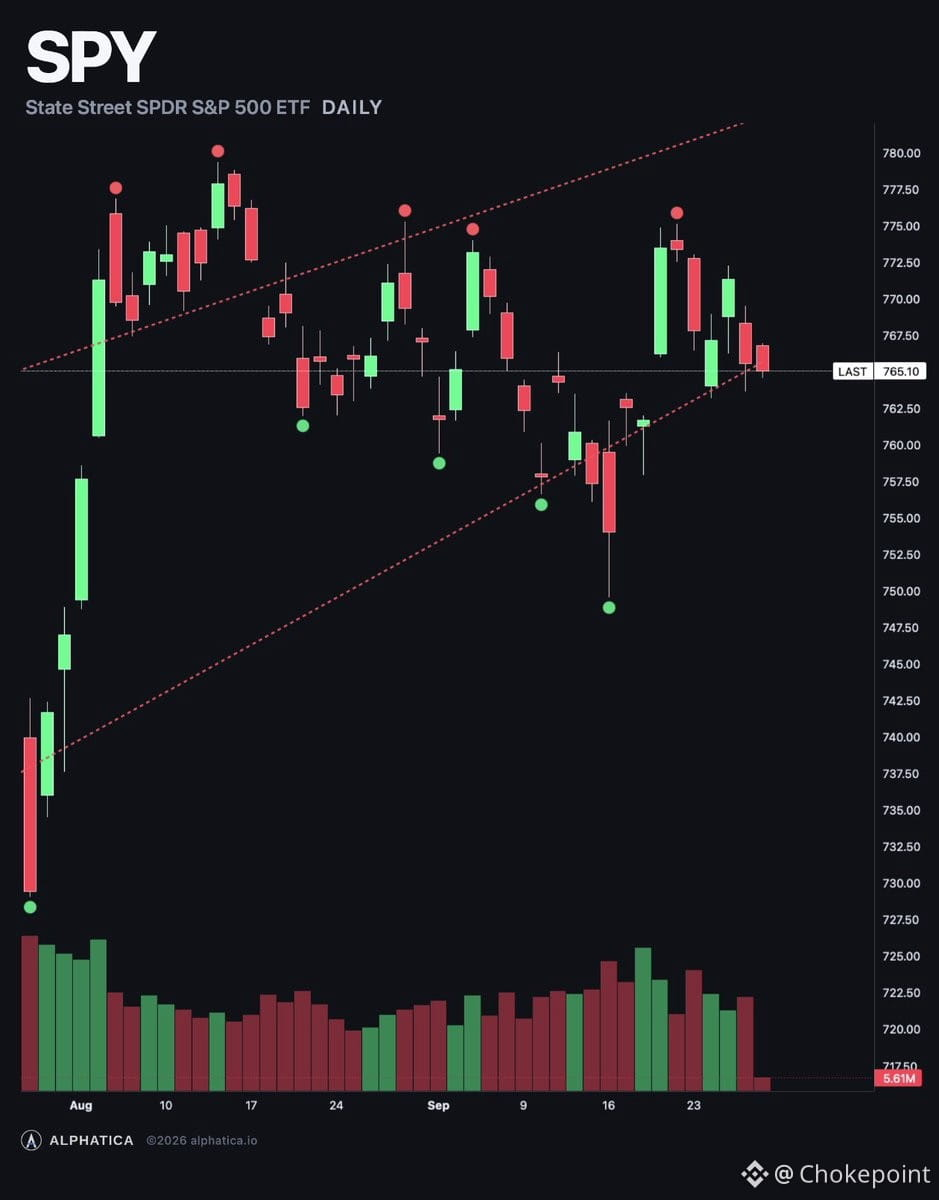
$SPY opened at $764.90, down 0.09% — and the overnight session made the structure worse, not better.
Dealer gamma flipped deeper negative: from -$876M to -$1.08B. That means dealers amplify moves instead of dampening them. The composite flipped from +24.7 (bullish lean) to -13.0 (neutral). The cliff at $760-$761 grew heavier — now -$205M and -$184M respectively. About $670M of negative gamma sits between $760 and $765, and price is already below $765.
Two small improvements: premium tilted more call-heavy (62% to 71%), so the afternoon put-buying eased. And positive gamma moved closer — now starts at $768 instead of $772. Price is about $3 below it.
Skew is still inverted at -0.77% for the second straight session. Calls priced above puts. The engine is flat — nobody pressing either direction yet.
The read: money leans up, dealer book leans down and got heavier overnight. Price sits between the $768 positive zone and the $760-$761 cliff, the two largest negative strikes on the board. If $760 breaks, the next accelerator is $755 at -$163M.
Cold PPI signal is day 13 of 20: $SPY is +0.93% from the September 10 close, now below the +1.22% historical average with seven sessions left.
Levels: $768 is where support turns positive. $764.90 is price. $760-$761 is the cliff. $774 is the ceiling. $779.30 is the record.
Flow leans up. Structure leans down. $760 is the line to watch today.
$SPY opened at $764.90, down 0.09% — and the overnight session made the structure worse, not better.
Dealer gamma flipped deeper negative: from -$876M to -$1.08B. That means dealers amplify moves instead of dampening them. The composite flipped from +24.7 (bullish lean) to -13.0 (neutral). The cliff at $760-$761 grew heavier — now -$205M and -$184M respectively. About $670M of negative gamma sits between $760 and $765, and price is already below $765.
Two small improvements: premium tilted more call-heavy (62% to 71%), so the afternoon put-buying eased. And positive gamma moved closer — now starts at $768 instead of $772. Price is about $3 below it.
Skew is still inverted at -0.77% for the second straight session. Calls priced above puts. The engine is flat — nobody pressing either direction yet.
The read: money leans up, dealer book leans down and got heavier overnight. Price sits between the $768 positive zone and the $760-$761 cliff, the two largest negative strikes on the board. If $760 breaks, the next accelerator is $755 at -$163M.
Cold PPI signal is day 13 of 20: $SPY is +0.93% from the September 10 close, now below the +1.22% historical average with seven sessions left.
Levels: $768 is where support turns positive. $764.90 is price. $760-$761 is the cliff. $774 is the ceiling. $779.30 is the record.
Flow leans up. Structure leans down. $760 is the line to watch today.
Dealer gamma flipped deeper negative: from -$876M to -$1.08B. That means dealers amplify moves instead of dampening them. The composite flipped from +24.7 (bullish lean) to -13.0 (neutral). The cliff at $760-$761 grew heavier — now -$205M and -$184M respectively. About $670M of negative gamma sits between $760 and $765, and price is already below $765.
Two small improvements: premium tilted more call-heavy (62% to 71%), so the afternoon put-buying eased. And positive gamma moved closer — now starts at $768 instead of $772. Price is about $3 below it.
Skew is still inverted at -0.77% for the second straight session. Calls priced above puts. The engine is flat — nobody pressing either direction yet.
The read: money leans up, dealer book leans down and got heavier overnight. Price sits between the $768 positive zone and the $760-$761 cliff, the two largest negative strikes on the board. If $760 breaks, the next accelerator is $755 at -$163M.
Cold PPI signal is day 13 of 20: $SPY is +0.93% from the September 10 close, now below the +1.22% historical average with seven sessions left.
Levels: $768 is where support turns positive. $764.90 is price. $760-$761 is the cliff. $774 is the ceiling. $779.30 is the record.
Flow leans up. Structure leans down. $760 is the line to watch today.
1
1
353
·
--
Partly True
See translation
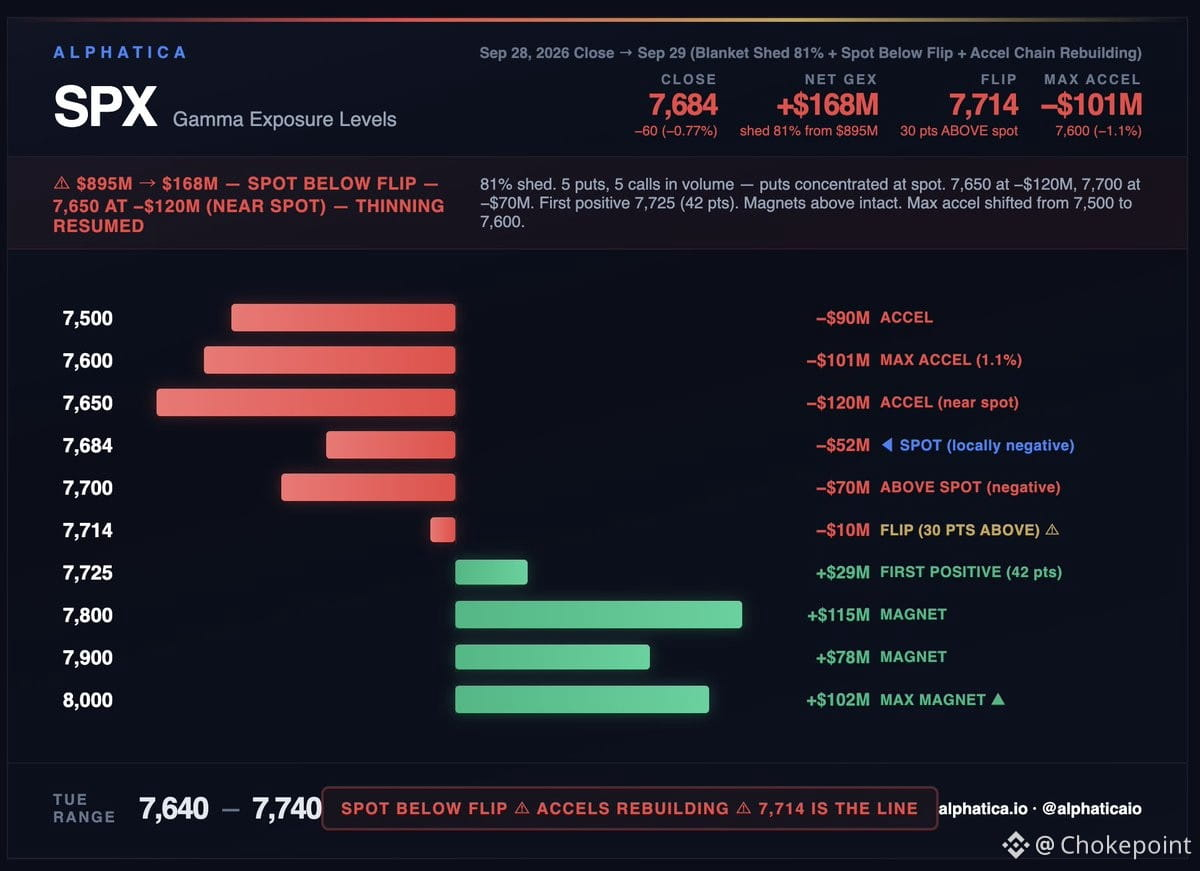
Friday's gamma rebuild wasn't the end of the thinning cycle — Monday ripped 81% of it back out in one session. The cushion collapsed from $895M to $168M, $SPX dropped 60 points, and we're back inside the compression.
What shifted: the level that amplifies downside moved from 7,500 up to 7,600. The heaviest negative gamma near price is now 7,650 — just 34 points below Friday's close. Five negative pockets sit within 1.1% of price: -$101M, -$63M, -$120M, -$52M, -$70M. That's a minefield.
Price is now below the regime flip line at 7,714. The overall gamma reads +$168M, but only because of large positions 100 points overhead. Locally, everything around price works against stability.
Volume split evenly — five calls, five puts. Calls clustered 7,710–7,800. Puts clustered 7,600–7,675. That's a collar: protection where price is, positioning for where they want it.
Overhead unchanged: 7,800 at +$115M, 7,900 at +$78M, 8,000 at +$102M. Reaching them means clearing 42 points of negative territory first.
Range today: 7,640–7,740.
$SPY $QQQ
Friday's gamma rebuild wasn't the end of the thinning cycle — Monday ripped 81% of it back out in one session. The cushion collapsed from $895M to $168M, $SPX dropped 60 points, and we're back inside the compression.
What shifted: the level that amplifies downside moved from 7,500 up to 7,600. The heaviest negative gamma near price is now 7,650 — just 34 points below Friday's close. Five negative pockets sit within 1.1% of price: -$101M, -$63M, -$120M, -$52M, -$70M. That's a minefield.
Price is now below the regime flip line at 7,714. The overall gamma reads +$168M, but only because of large positions 100 points overhead. Locally, everything around price works against stability.
Volume split evenly — five calls, five puts. Calls clustered 7,710–7,800. Puts clustered 7,600–7,675. That's a collar: protection where price is, positioning for where they want it.
Overhead unchanged: 7,800 at +$115M, 7,900 at +$78M, 8,000 at +$102M. Reaching them means clearing 42 points of negative territory first.
Range today: 7,640–7,740.
$SPY $QQQ
What shifted: the level that amplifies downside moved from 7,500 up to 7,600. The heaviest negative gamma near price is now 7,650 — just 34 points below Friday's close. Five negative pockets sit within 1.1% of price: -$101M, -$63M, -$120M, -$52M, -$70M. That's a minefield.
Price is now below the regime flip line at 7,714. The overall gamma reads +$168M, but only because of large positions 100 points overhead. Locally, everything around price works against stability.
Volume split evenly — five calls, five puts. Calls clustered 7,710–7,800. Puts clustered 7,600–7,675. That's a collar: protection where price is, positioning for where they want it.
Overhead unchanged: 7,800 at +$115M, 7,900 at +$78M, 8,000 at +$102M. Reaching them means clearing 42 points of negative territory first.
Range today: 7,640–7,740.
$SPY $QQQ
2
647
Log in to explore more content
Join global crypto users on Binance Square
⚡️ Get latest and useful information about crypto.
💬 Trusted by the world’s largest crypto exchange.
👍 Discover real insights from verified creators.
Email / Phone number
Trending Topics
BitcoinClears$85200
15,479 views
237 Discussing
We got the move, and $BTC is standing exactly where we were before the data. That’s what actual patience for a trade looks like.
The data came in mixed but with some important numbers. ADP Non-Farm Employment Change came at 90K vs 73K forecast, while Core PCE came in at 0.2% vs 0.3% expected. Final GDP was also stronger at 2.2% vs 1.5% forecast, while Personal Spending came in at 0.9% vs 0.8% expected. At the same time, Personal Income missed at 0.2% vs 0.5% forecast.
BTC initially surged to $85,600 and is now back where it needs to be. I’m still looking toward the lower ranges at $82,759 and the $80,000 liquidity, because the overhead liquidity is done and dusted.
We had a live session during the data, and during that session we saw the market at $83,800, then $85,600, and then back toward $83,000 and we still didn’t enter a trade.
That’s what patience is.
We can’t force an entry when the market has no clear direction. The same range is still in focus, and we’ll wait for the market to give us the setup.
Let me know, guys, how was the session? And should we have more regular sessions with our respected members so we can have proper discussions regarding the market?
#BitcoinClears$85200 #AltcoinSeasonIndexHoldsAbove60For5Days #USADPAdds90000JobsInSeptember #BitcoinSlipsBelow$84000 #SECToClarifyOnChainFundraisingRules
Crypto_LUX
·26 Likes
·22.5k views
AltcoinSeasonIndexHoldsAbove60For5Days
74,940 views
1,282 Discussing
USADPAdds90000JobsInSeptember
33,839 views
708 Discussing