
撸毛-Captain
5.8k Posts

撸毛-Captain
Report
Block User
在职养老程序员。空闲撸各种空投。持续分享干货。推特:@mycndota
13 Following
105 Followers
84 Liked
Posts
All
Quotes
·
--
Aviva Investors launches tokenized share class of sterling fund on XRPL, invests £50 million
Aviva Investors has launched a tokenized share class of its sterling liquidity fund on the XRP Ledger and invested £50 million, equivalent to approximately US$66 million.
The fund has total assets under management of approximately £22 billion, but that is not the amount brought on-chain in this move. Following the launch of a tokenized share class of its US dollar liquidity fund in July, total investment in Aviva Investors’ two tokenized share classes has exceeded £86 million.
Impact and areas to watch: This move shows traditional asset managers continuing to expand their use of tokenized fund shares. However, the fund’s total AUM of approximately £22 billion does not represent the amount brought on-chain in this move. When interpreting the figures, distinguish between the fund’s total size and the investment in its tokenized share classes.
What to check next: Monitor the practical adoption of the tokenized share class of the sterling liquidity fund. Track whether investment in Aviva Investors’ two tokenized share classes continues to grow. Avoid mistaking the fund’s total AUM for the amount brought on-chain in this move.
Source: PANews Chinese-language News Flash
Source time: 2026-10-27 10:47 Beijing time
Risk disclaimer: This article is for informational purposes only and does not constitute investment advice.

68
·
--
Vitalik backs Kimi 3.1’s decision to remove advanced cyberattack capabilities
Public reports on October 26 said that Ethereum co-founder Vitalik Buterin had voiced support for Kimi 3.1 proactively removing advanced cyberattack capabilities from its training data. This approach reflects setting boundaries on a model’s capabilities and use cases.
In Vitalik’s view, imposing restrictions on use cases is preferable to treating specific users differently. His position points to a safety governance approach centered on how capabilities are used.
Vitalik also emphasized that the outside world still needs time to strengthen systems, inspect legacy code, and formally verify new code in preparation for more powerful cyberattack capabilities. Going forward, it will be worth watching how these restrictions are implemented and whether defensive preparations advance in parallel.
Implications and areas to watch: The statement focuses the AI safety discussion on restrictions on capabilities and use cases, while underscoring the need to give systems time to be strengthened, legacy code to be inspected, and new code to be formally verified before more powerful cyberattack capabilities emerge.
Follow-up checks: How Kimi 3.1’s restrictions on these capabilities are implemented in real-world use cases; whether preparations such as strengthening systems, inspecting legacy code, and formally verifying new code move forward; and governance discussions around restricting model capabilities versus restricting users.
Source: PANews Chinese-language News Brief
Source time: 2026-10-26 09:53 Beijing time
Risk warning: This article is for informational purposes only and does not constitute investment advice.

82
·
--
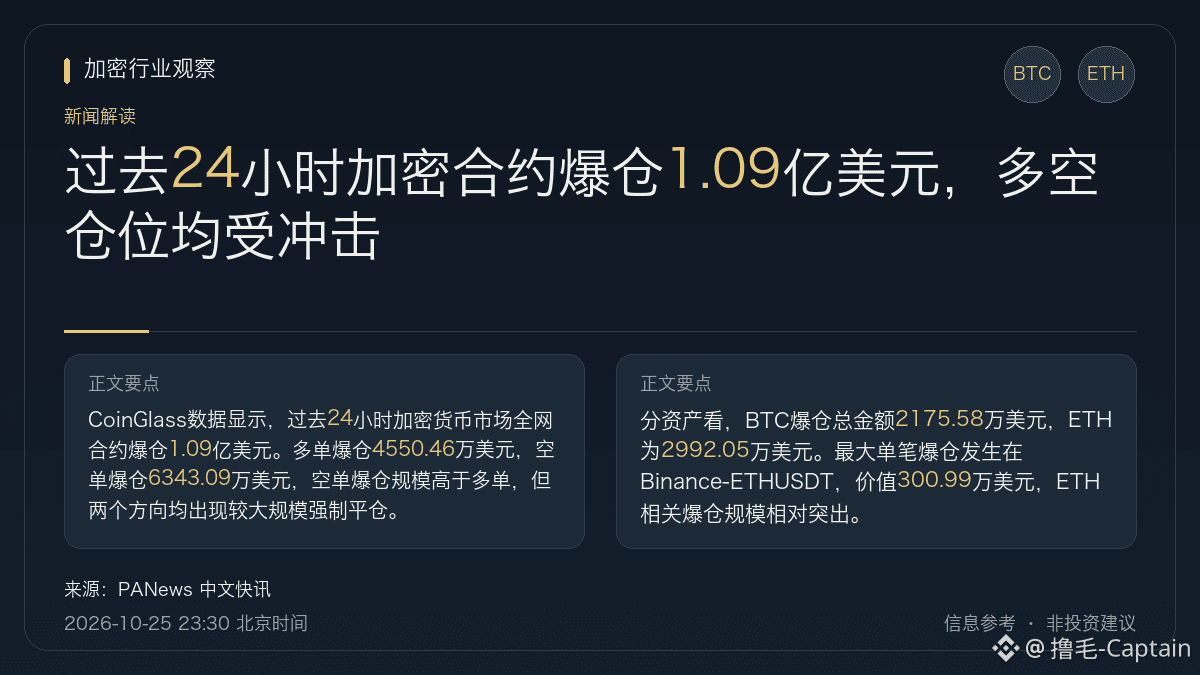
$109 million in crypto futures liquidations over the past 24 hours, affecting both long and short positions
According to CoinGlass, $109 million in crypto futures positions were liquidated across the market over the past 24 hours. Long liquidations totaled $45.5046 million, while short liquidations totaled $63.4309 million. Short liquidations exceeded long liquidations, but substantial forced liquidations occurred in both directions.
By asset, total BTC liquidations amounted to $21.7558 million, while ETH liquidations totaled $29.9205 million. The largest single liquidation was on Binance-ETHUSDT, valued at $3.0099 million, making ETH-related liquidations particularly notable.
Impact and points to watch: Substantial liquidations of both long and short positions indicate that leveraged positions on both sides of the futures market were affected. The amount of ETH-related liquidations and the size of the largest single liquidation are worth watching. These figures reflect liquidations over the past 24 hours only and do not indicate the direction of future prices.
Follow-up checks: Whether long and short liquidations continue to increase; changes in BTC and ETH liquidation amounts; whether another large single liquidation occurs
Source: PANews Chinese Flash News
Source time: 2026-10-25 23:30 Beijing Time
Risk warning: This article is for informational purposes only and does not constitute investment advice.
43
·
--
Strive CEO posts Bitcoin holdings chart again; market watches for disclosure of additional purchases next week
On October 25, Strive CEO Matt Cole posted a chart of the company’s Bitcoin holdings, with a caption saying that the related perpetual swaps had been activated. As both the image and wording pointed to the company’s Bitcoin reserves, the post was seen as a possible signal that new holdings data may be disclosed.
However, publicly available information only says that Strive may disclose data on additional Bitcoin purchases next week. It provides no purchase amount, completion date, or formal announcement, so it does not establish that additional purchases have already been made. The post also suggested that this way of previewing an announcement may be modeled on Strategy founder Michael Saylor.
Impact and points to watch: If Strive later formally discloses additional purchases, it would provide new data for observers tracking the company’s Bitcoin reserve strategy. For now, however, the only evidence is an image and caption on social media, which is insufficient to confirm that additional purchases have taken place.
What to verify next: Whether Strive publishes an official holdings update next week; whether any subsequent disclosure includes the amount purchased, timing, and funding arrangements; and whether the company further explains the specific meaning of the caption.
Source: PANews Chinese-language news brief
Source time: 2026-10-25 22:19 Beijing time
Risk warning: This article is for informational purposes only and does not constitute investment advice.

204
·
--
Tom Lee: Traditional finance still dominates; banks may need to focus on the transition to crypto infrastructure
Tom Lee, chairman of Ethereum treasury company Bitmine, said in an interview that around 99% of financial activity still relies on traditional financial infrastructure.
In Tom Lee’s view, this situation could create a misleading short-term bias, causing investors and companies to underestimate the growth potential of the crypto market. Because cryptocurrencies are still seen as a niche area, financial institutions may also overlook the pace of the infrastructure transition.
Tom Lee further believes that if crypto adoption increases, banks that have not yet moved into crypto businesses or related infrastructure could face a competitive disadvantage. This is his view of the future competitive landscape, not an outcome that has already occurred.
Implications and areas to watch: These remarks shift attention from the current size of the crypto market to the potential migration of financial infrastructure. The possible implications remain Tom Lee’s assessment based on increased crypto adoption; they do not mean that the transition has already taken place or that the competitive landscape for banks has already changed.
What to check next: Whether crypto adoption continues to increase; how quickly traditional financial institutions develop crypto businesses and related infrastructure; whether differences in the pace of transition lead to observable competitive changes among banks
Source: PANews Chinese-language news brief
Source time: 2026-10-25 19:07 Beijing time
Risk warning: This article is for informational purposes only and does not constitute investment advice.

58
·
--
Bitcoin’s realized market cap rebounds, with reports suggesting it may reflect new capital inflows
According to news published on October 24, Bitcoin’s realized market cap is rising. Rather than simply calculating value at the current market price, this metric values each bitcoin at the price of its most recent on-chain transfer, making it useful for gauging holders’ overall cost basis.
Bitcoin Magazine interpreted the metric’s rebound as a sign of new capital inflows, noting that similar changes have historically tended to occur at the start of a new bull market. However, this is a market assessment based on historical data; the metric’s current rise alone cannot confirm future trends.
Impact and points to watch: Realized market cap offers a perspective distinct from the spot market price. Its rebound can help gauge Bitcoin holders’ overall cost basis and changes in capital flows. The report interprets the current rebound as a signal of new capital entering the market, but historical patterns do not guarantee that future price action will repeat.
What to check next: Watch whether Bitcoin’s realized market cap continues to rise rather than merely fluctuating in the short term.;Monitor whether subsequent on-chain data continues to support the assessment that new capital is flowing in.;Historically, rising realized market cap has been associated with the start of bull markets, but this does not confirm that a new bull market has begun.
Source: PANews Chinese-language news brief
Source time: 2026-10-24 20:28 Beijing time
Risk warning: This article is for informational purposes only and does not constitute investment advice.

22
·
--
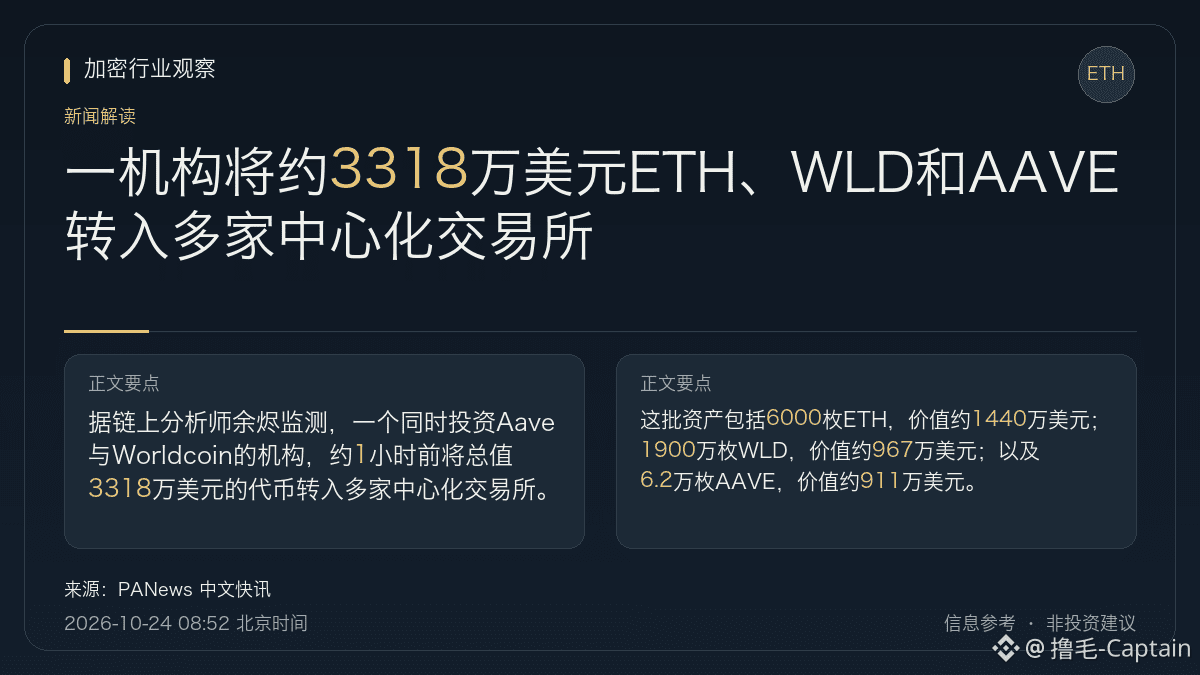
Institution Transfers Approximately $33.18 Million in ETH, WLD and AAVE to Multiple Centralized Exchanges
According to on-chain analyst Ember, an institution that has invested in both Aave and Worldcoin transferred tokens worth a total of approximately $33.18 million to multiple centralized exchanges about one hour ago.
The assets included 6,000 ETH, worth approximately $14.4 million; 19 million WLD, worth approximately $9.67 million; and 62,000 AAVE, worth approximately $9.11 million.
A large, multi-asset transfer to exchanges may attract market attention, but the available information only confirms the on-chain transfers and does not establish that the tokens have been sold. Further developments to watch include whether these assets are transferred again and whether any verifiable trades or changes in holdings emerge.
Impact and points to watch: The transfer involves three tokens and a substantial amount, which may draw attention to the subsequent movement of funds. However, transferring tokens to an exchange does not in itself mean they have been sold. Publicly available information has also not disclosed the specific exchanges, any trades, or the purpose of the transfers.
Follow-up checks: Whether the tokens undergo further on-chain transfers after reaching the exchanges; whether public information identifies the receiving exchanges and the purpose of the transfers; and whether any verifiable subsequent trades or changes in holdings involving these tokens emerge.
Source: PANews Chinese-language news brief
Source time: 2026-10-24 08:52 Beijing time
Risk warning: This article is for informational purposes only and does not constitute investment advice.
210
·
--
Trader Killa: Bitcoin’s Key Zone Is Near $80,000; Beware of Becoming Overly Committed to a Bearish Scenario
Trader Killa suggests that, in what he sees as a bull market environment, traders should look for long opportunities when prices pull back within a range and sweep liquidity. This is a personal market view, not a certain outcome.
Regarding the current structure, Killa believes that Bitcoin’s trading range and bottom have formed, and identifies the area around $80,000 as a key zone.
He has not ruled out the possibility of another dip to sweep liquidity, but warns that Bitcoin could also rise directly without pulling back again, leaving those on the sidelines to miss the move.
Killa attributes some traders’ continued bearish bias to the many false breakouts during the previous bear market. He believes this has led them to focus too heavily on pullbacks and to view every rebound as a bull trap.
Implications and points to watch: The core of this view is the gap between market expectations. After experiencing multiple false breakouts during the bear market, some traders may have become accustomed to viewing rebounds as bull traps. If Bitcoin rises directly without pulling back again, those who continue to wait on the sidelines may miss the move. However, Killa also leaves open the possibility of another dip to sweep liquidity.
What to monitor next: Bitcoin’s price action around the key zone near $80,000; whether the market dips again and sweeps liquidity; whether Bitcoin rises directly without pulling back again; and whether traders continue to view rebounds as bull traps.
Source: PANews Chinese-language news brief
Source time: 2026-10-23 22:16 Beijing time
Risk warning: This article is for informational purposes only and does not constitute investment advice.

355
·
--
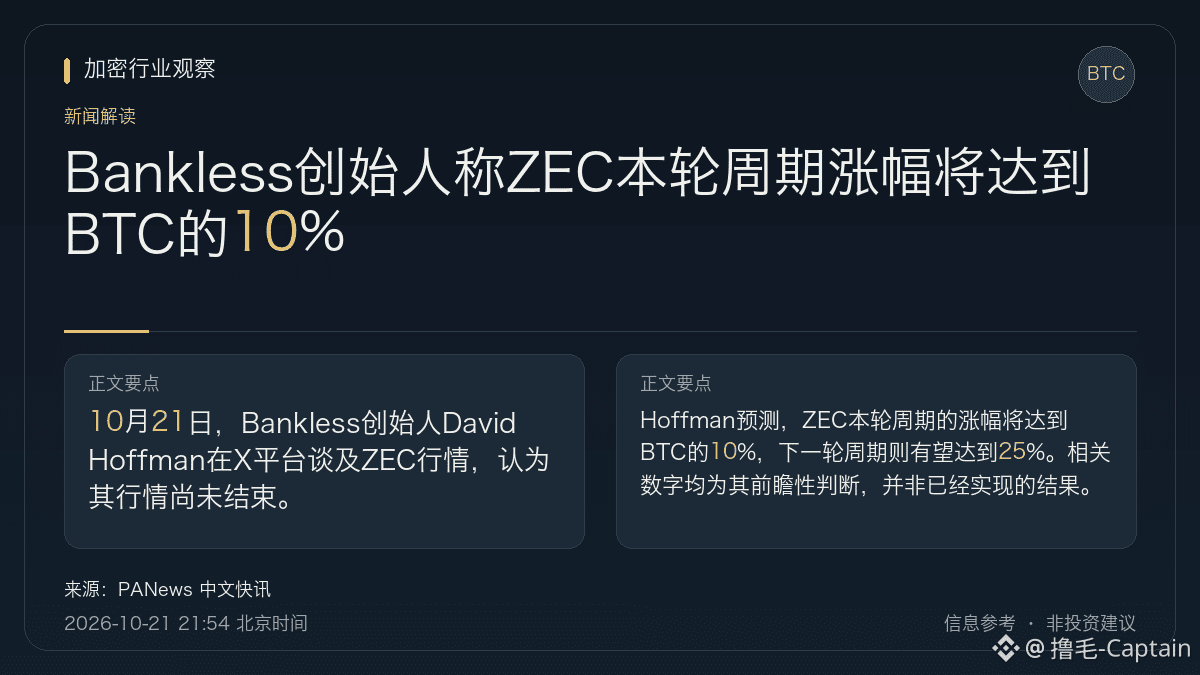
Bankless founder says ZEC's gains this cycle will reach 10% of BTC's
On October 21, Bankless founder David Hoffman discussed ZEC's price action on X, saying that its rally was not over.
Hoffman predicted that ZEC's gains this cycle would reach 10% of BTC's, and that they could reach 25% in the next cycle. These figures are his forward-looking estimates and do not represent outcomes that have already been realized.
Notably, the original material uses the term “gains” and does not explicitly define 10% and 25% as shares of market capitalization. It also does not specify the comparison period or calculation method. Accordingly, it will be important to see whether he clarifies the basis for these estimates and whether actual market performance aligns with his view.
Impact and points to watch: This view reflects the optimism among some market participants about ZEC's future price action. However, the material presents a forecast of gains, not an already realized market outcome, and is insufficient to confirm ZEC's market capitalization relative to BTC's.
Follow-up checks: Watch for David Hoffman to further explain the benchmarks and calculation method behind the 10% and 25% figures.;Monitor whether ZEC's subsequent price performance comes close to his prediction.;Distinguish personal market views from market data that has already occurred and can be verified.
Source: PANews Chinese-language news brief
Source time: 2026-10-21 21:54 Beijing Time
Risk warning: This article is for informational purposes only and does not constitute investment advice.
62
·
--
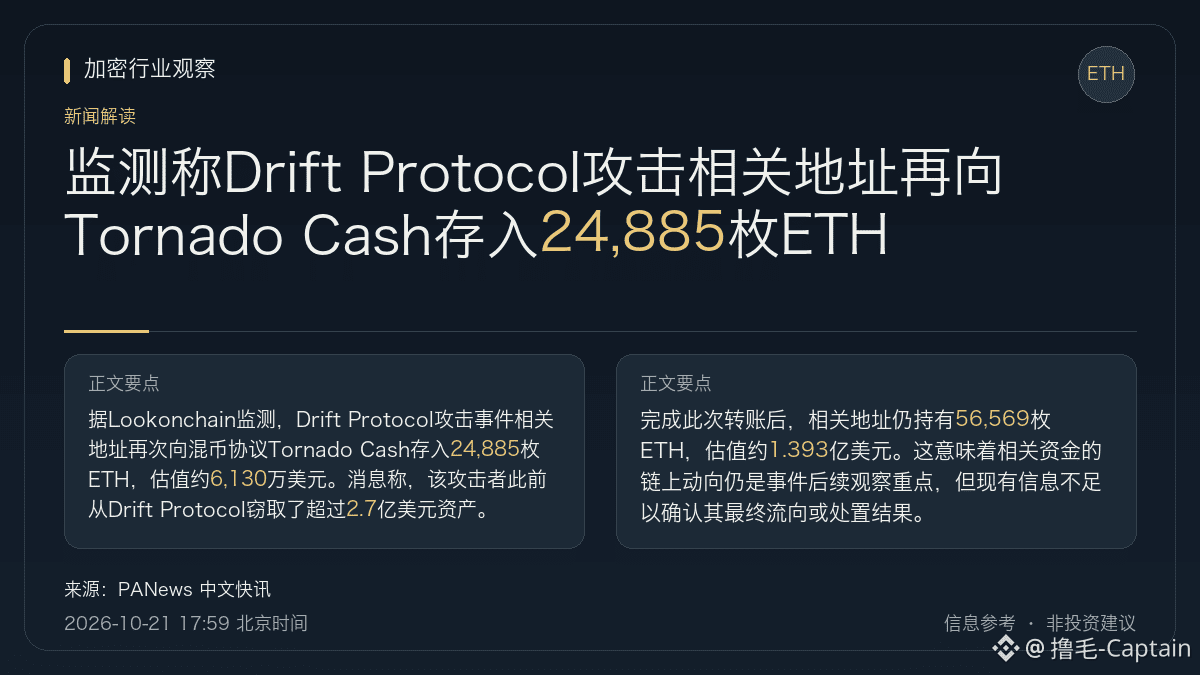
Address linked to Drift Protocol attack deposits another 24,885 ETH into Tornado Cash
According to monitoring by Lookonchain, an address linked to the Drift Protocol attack has deposited another 24,885 ETH into the mixing protocol Tornado Cash, worth approximately $61.3 million. Reports say the attacker previously stole more than $270 million in assets from Drift Protocol.
After this transfer, the address still holds 56,569 ETH, worth approximately $139.3 million. This means that the on-chain movement of the funds remains a key focus in monitoring developments following the incident, but the available information is insufficient to confirm their ultimate destination or disposition.
Impact and areas of focus: The continued transfer of large amounts of ETH into a mixing protocol indicates that funds linked to the attack are still moving. The address still holds a substantial amount of ETH, and its subsequent on-chain transfers warrant attention; the available information does not specify where the funds are going or how they will be handled.
Follow-up checks: Whether the remaining 56,569 ETH held by the address will undergo further on-chain transfers; whether subsequent monitoring can identify additional related addresses and fund flows; and whether Drift Protocol or related parties will publish updates on asset tracking and disposition
Source: PANews Chinese-language news brief
Source time: 2026-10-21 17:59 Beijing Time
Risk warning: This article is for informational purposes only and does not constitute investment advice.
179
·
--
Kamino to assess cross-chain collateral with Chainlink CCIP and raise borrowing caps and LTVs for related assets
Solana lending protocol Kamino said that, following an extensive security review, it will establish Chainlink CCIP as the risk assessment standard for cross-chain collateral.
Under the arrangement disclosed by Kamino, CCIP-secured assets will be eligible for higher borrowing caps and LTVs across its markets. This points to adjustments to risk parameters, but publicly available information has not yet specified the assets covered, the scale of the changes, or when they will take effect.
Kamino framed the arrangement as part of its effort to expand support for institutional-grade tokenized collateral, saying that cross-chain security has become a core element of market design. Chainlink also confirmed the arrangement. Attention should now turn to specific market parameters and the scope of implementation.
Impact and points to watch: The arrangement indicates that cross-chain security assessments are being incorporated into Kamino's collateral market design, and may affect the borrowing capacity and capital efficiency of related assets in its markets. The actual impact will depend on the specific assets, market parameters, and implementation.
Follow-up checks: Watch for when Kamino enables the standard in specific markets and which assets will be covered.;Track the specific changes to borrowing caps and LTVs, as well as risk parameters, across each market.;Monitor cross-chain security measures as Kamino expands support for institutional-grade tokenized collateral.
Source: PANews Chinese-language news brief
Source time: 2026-10-21 01:29 Beijing time
Risk warning: This article is for informational purposes only and does not constitute investment advice.

68
·
--
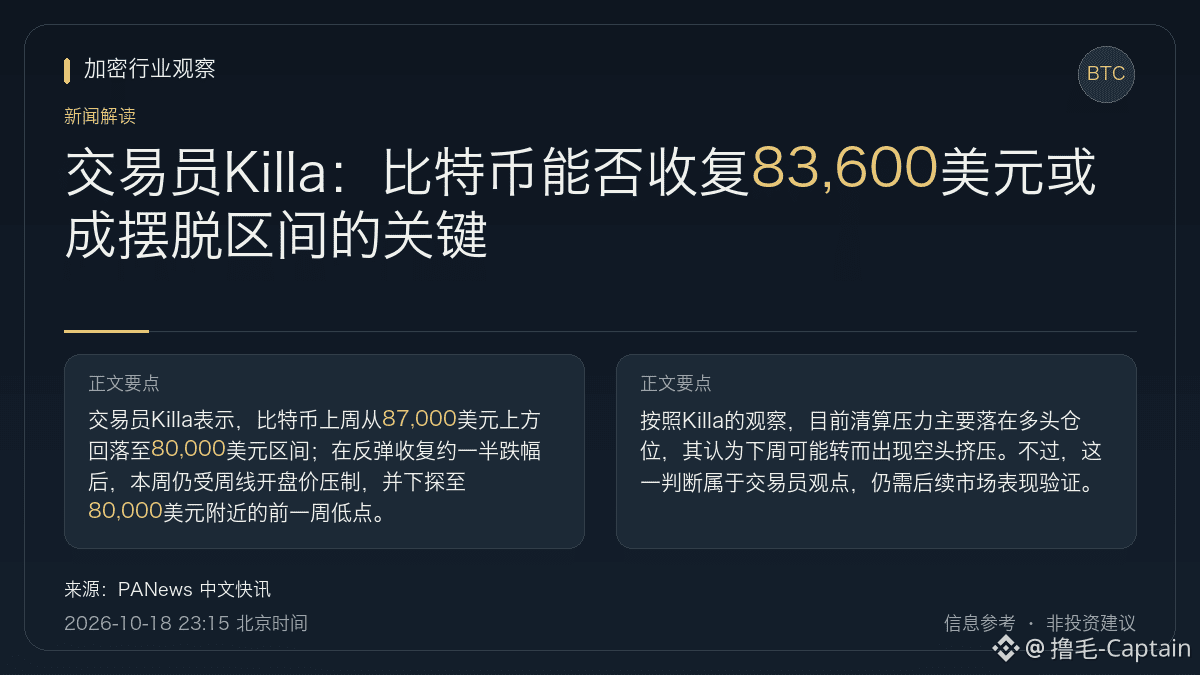
Trader Killa: Whether Bitcoin Can Reclaim $83,600 May Be Key to Breaking Out of Its Range
Trader Killa said Bitcoin fell from above $87,000 last week to the $80,000 range. After recovering about half of its losses in a rebound, it remained capped by the weekly open this week and dipped to the previous week's low near $80,000.
According to Killa, liquidation pressure is currently concentrated on long positions, and he believes a short squeeze could occur next week. However, this is a trader's view and remains subject to confirmation by subsequent market performance.
In the near term, Killa is watching to see whether Bitcoin will again fall below this week's low of $79,800. If it does not retest that level, whether it can decisively reclaim $83,600 will be another key point to watch.
Impact and areas to watch: In Killa's analytical framework, the $79,800 low and $83,600 mark define a short-term range to watch. The former relates to whether the price will retest the lows, while he views the latter as an important level for determining whether the market can break out of its range. This is a personal opinion expressed by a trader and does not represent a certain market direction.
What to watch next: Whether Bitcoin falls below this week's low of $79,800 again; whether it can decisively reclaim $83,600; whether liquidation pressure shifts from long positions to short positions
Source: PANews Chinese Flash News
Source time: 2026-10-18 23:15 Beijing time
Risk warning: This article is for informational purposes only and does not constitute investment advice.
35
·
--
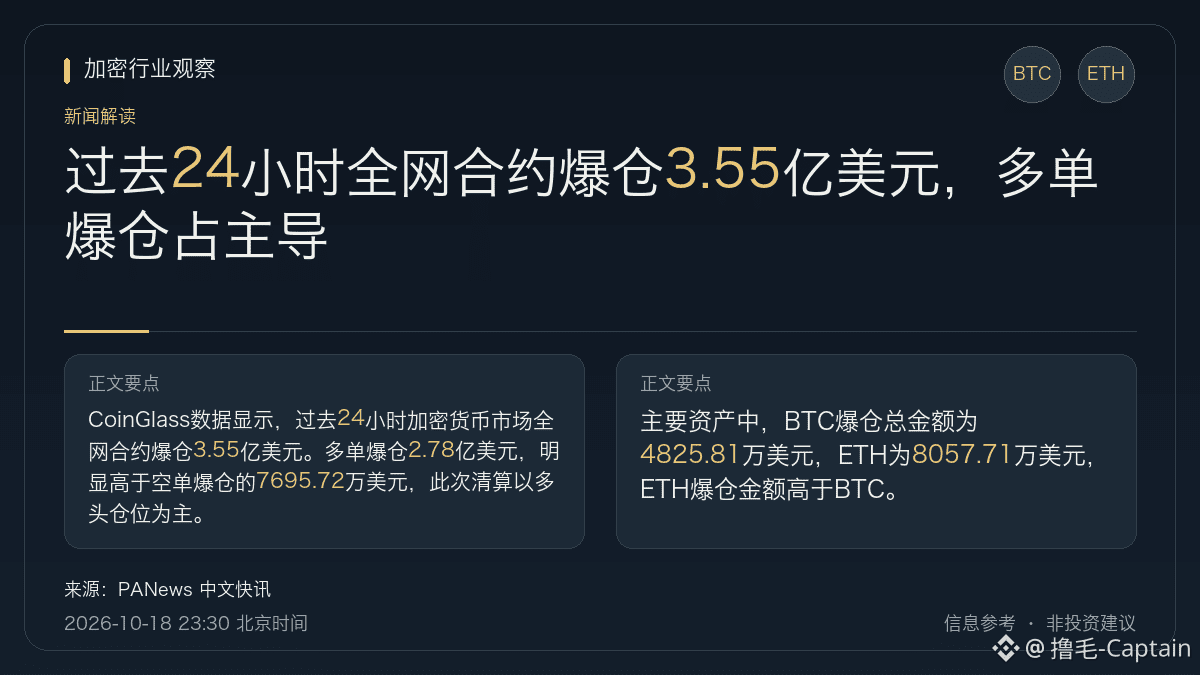
Crypto futures liquidations across the market reached $355 million in the past 24 hours, with long positions accounting for the majority
Data from CoinGlass show that crypto futures liquidations across the market totaled $355 million in the past 24 hours. Liquidations of long positions amounted to $278 million, significantly exceeding the $76.9572 million in short liquidations, indicating that the liquidations were concentrated primarily in long positions.
Among major assets, total BTC liquidations amounted to $48.2581 million, while ETH liquidations reached $80.5771 million, exceeding those of BTC.
The largest single liquidation during the same period occurred on Binance-SOXSUSDT, valued at $7.2713 million. Going forward, attention may focus on the market-wide breakdown of long and short liquidations, liquidation amounts for BTC and ETH, and large single liquidations.
Impact and areas to watch: Long liquidations significantly exceeded short liquidations, reflecting that futures liquidations were concentrated primarily in long positions. Combined liquidations for BTC and ETH were substantial, so changes in futures liquidations for major assets warrant continued attention.
Follow-up checks: Changes in total market-wide futures liquidations and the scale of long and short liquidations; changes in liquidation amounts for BTC and ETH; whether another large single liquidation occurs
Source: PANews Chinese-language news brief
Source time: 2026-10-18 23:30 Beijing time
Risk warning: This article is for informational purposes only and does not constitute investment advice.
44
·
--
Analyst Says Bitcoin’s Price Action Is Narrowing, With $82,000 a Key Resistance Level
Analyst Michaël van de Poppe said on October 18 that Bitcoin’s price action is narrowing, with volatility declining and its trading range contracting.
In his view, a “fakeout” may occur before a major move begins, with the price potentially touching the chart’s “blue zone” below $80,000. He noted that the price has already touched this zone before, so another test would not be surprising.
To the upside, he identified $82,000 as a key resistance level and said a breakout could mark the start of an acceleration. These views are the analyst’s assessment based on price action; whether a breakout actually occurs remains to be seen.
Impact and points to watch: This assessment treats $82,000 as a threshold to watch for whether the price can escape its narrowing range, while noting that short-term volatility could still bring a pullback below $80,000 before a breakout. This is a technical analysis of price trends, not a definitive prediction.
What to watch next: Whether Bitcoin can decisively break above the $82,000 resistance level cited by the analyst; whether the price first pulls back and touches the “blue zone” below $80,000 again; and whether volatility rises again after the range narrows.
Source: PANews Chinese-language news brief
Source time: 2026-10-18 16:33 Beijing time
Risk warning: This article is for informational purposes only and does not constitute investment advice.

59
·
--
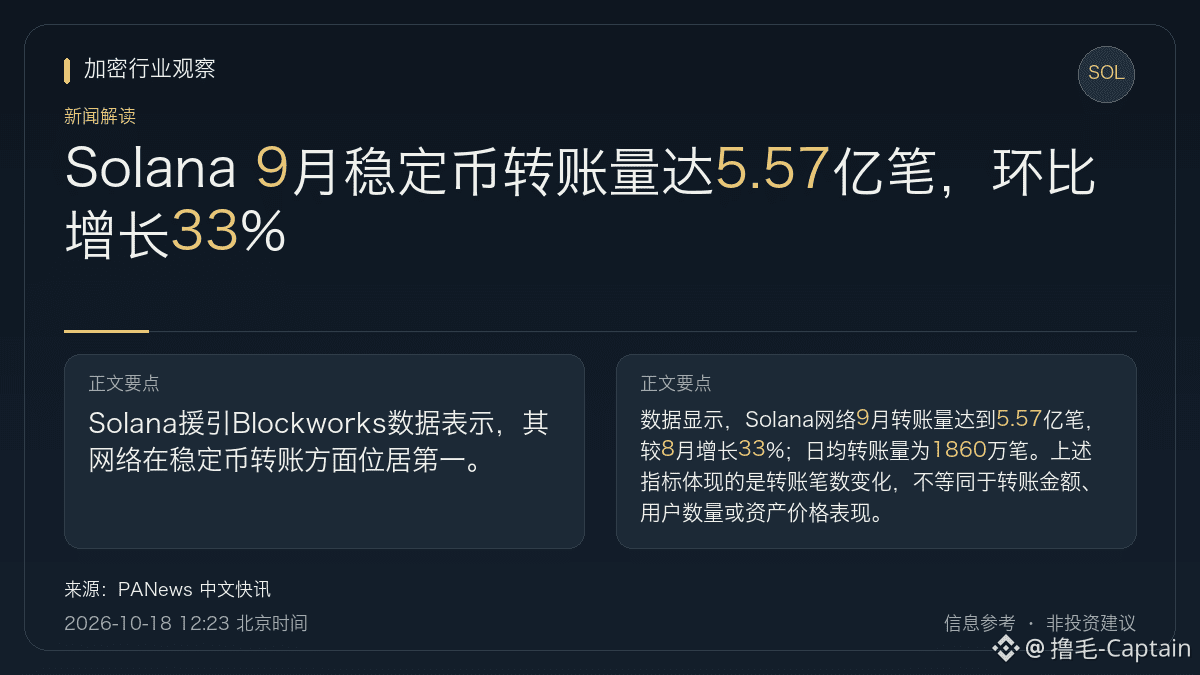
Solana stablecoin transfers reached 557 million in September, up 33% month over month
Solana cited data from Blockworks showing that its network ranked first in stablecoin transfers.
The data shows that the Solana network recorded 557 million transfers in September, up 33% from August, with an average of 18.6 million transfers per day. These figures reflect changes in the number of transfers and are not equivalent to transfer value, user numbers, or asset price performance.
Impact and points to watch: The data indicates that stablecoin transfer activity on the Solana network increased in September. However, the material only discloses the number of transfers, so it cannot be used to assess transfer value, user scale, or SOL price performance.
What to verify next: Whether stablecoin transfer counts continue to grow in the coming months; whether the average daily transfer volume remains at its current level; and whether Solana can maintain its leading position in transfer-count rankings.
Source: PANews Chinese News Brief
Source time: 2026-10-18 12:23 Beijing Time
Risk disclaimer: This article is for informational purposes only and does not constitute investment advice.
76
·
--
Arthur Hayes: Bitcoin’s quantum risk is known and manageable, and is no reason to sell
Arthur Hayes believes concerns about quantum computing threats to Bitcoin’s cryptographic mechanisms are overstated. In his view, these risks are known and manageable, so they are no reason to sell Bitcoin and are not a catalyst for panic selling at this time.
In terms of risk mitigation, Hayes emphasized the importance of wallet address management and mentioned practices such as avoiding address reuse and adopting newer signature types. The source does not indicate that these practices have been widely implemented, nor does it say that the quantum risk has been eliminated.
This assessment reflects Hayes’s personal views on the urgency and manageability of the risk. Going forward, areas to watch include address management practices, adoption of signature types, and whether advances in quantum computing reach a level that could change the risk assessment.
Implications and areas to watch: These remarks distinguish quantum computing risks from reasons to sell at present, while focusing attention on operational measures such as address management and signature types. However, this is Hayes’s personal assessment and should not be taken to mean that these measures have been implemented or that the risk has been eliminated.
Follow-up checks: Whether Bitcoin wallets further promote practices to avoid address reuse; adoption of newer signature types and related technical developments; whether new evidence emerges about quantum computing capabilities and their potential impact on Bitcoin’s cryptographic mechanisms.
Source: PANews Chinese-language News Brief
Source time: 2026-10-17 19:45 Beijing time
Risk warning: This article is for informational purposes only and does not constitute investment advice.

78
·
--
Vitalik compares the cost structures of Bitcoin mining and AI inference
On October 17, Ethereum co-founder Vitalik Buterin published a comparison of the cost components of Bitcoin mining and AI inference. He said that capital expenditure on computing equipment and electricity costs each account for about half of Bitcoin mining costs.
By contrast, Vitalik believes that AI inference costs are driven almost entirely by capital expenditure on computing equipment. This statement highlights the different ways the two activities depend on equipment investment and electricity costs, but the published material did not disclose specific calculation methods or detailed data.
Implications and points of interest: This view underscores the differences in the cost structures of two compute-intensive activities: Bitcoin mining is affected by both equipment investment and electricity costs, whereas, in his account, the cost pressure of AI inference is more concentrated in computing equipment investment. This is Vitalik Buterin’s public view; the material does not provide the calculation methodology or detailed data.
Follow-up checks: The claim that equipment capital expenditure and electricity costs each account for about half of Bitcoin mining costs; the claim that AI inference costs are driven almost entirely by capital expenditure on computing equipment; and the methodology and data underpinning the cost comparison
Source: PANews Chinese-language news brief
Source time: 2026-10-17 14:21 Beijing time
Risk warning: This article is for informational purposes only and does not constitute investment advice.

74
·
--
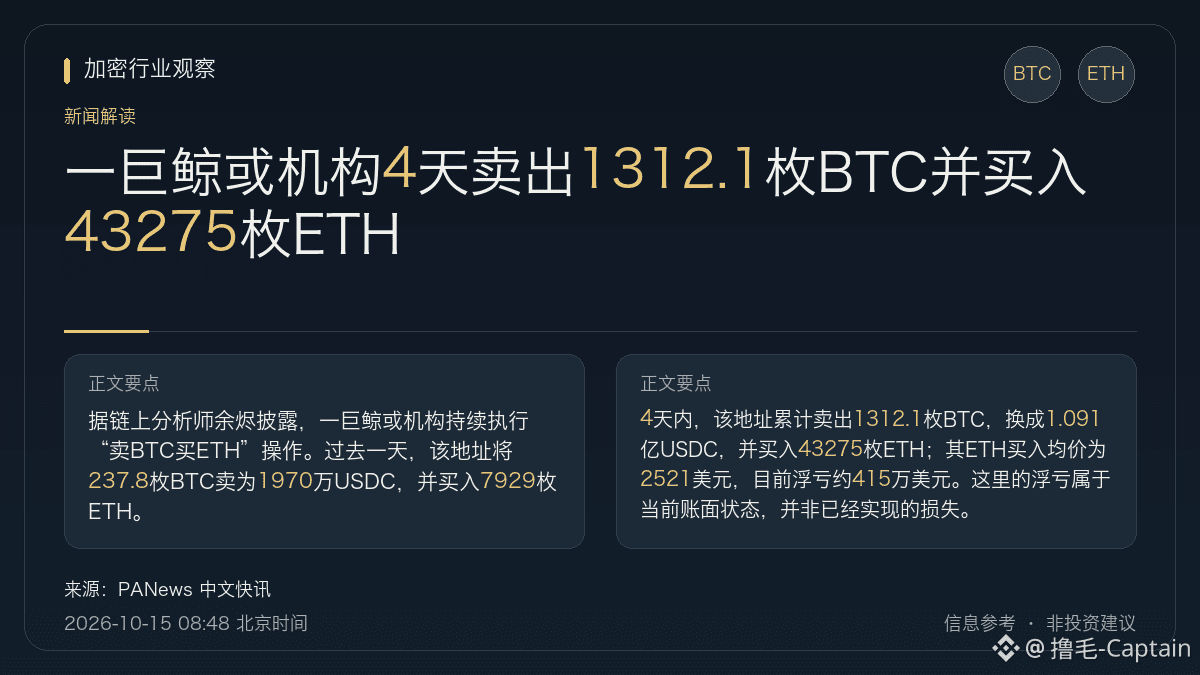
A whale or institution sells 1,312.1 BTC and buys 43,275 ETH in 4 days
According to blockchain analyst Ember, a whale or institution has continued to “sell BTC and buy ETH.” Over the past day, the address sold 237.8 BTC for 19.7 million USDC and bought 7,929 ETH.
Over 4 days, the address sold a total of 1,312.1 BTC for 109.1 million USDC and bought 43,275 ETH. Its average purchase price for ETH was $2,521, and it is currently sitting on an unrealized loss of about $4.15 million. This unrealized loss reflects the current paper value and is not a realized loss.
Some of the disclosed transaction routes involved transferring BTC on the Bitcoin network to Hyperliquid, selling it for USDC, and then withdrawing the funds to Arbitrum. Going forward, it may be worth watching whether the address continues converting assets, and whether its related ETH holdings are transferred or sold.
Impact and points to watch: These on-chain transactions show that the address has continued to adjust its allocation between BTC and ETH in the short term, but trades by a single whale or institution do not directly represent the overall market trend. The available information only reflects the transactions disclosed by the blockchain analyst and the paper loss; it does not constitute a judgment about future price performance or returns.
Follow-up checks: Whether the address continues to sell BTC and accumulate ETH; whether its ETH holdings are transferred or sold; and whether the unrealized loss of about $4.15 million widens or narrows as the price of ETH changes.
Source: PANews Chinese news brief
Source time: 2026-10-15 08:48 Beijing time
Risk warning: This article is for informational purposes only and does not constitute investment advice.
63
·
--
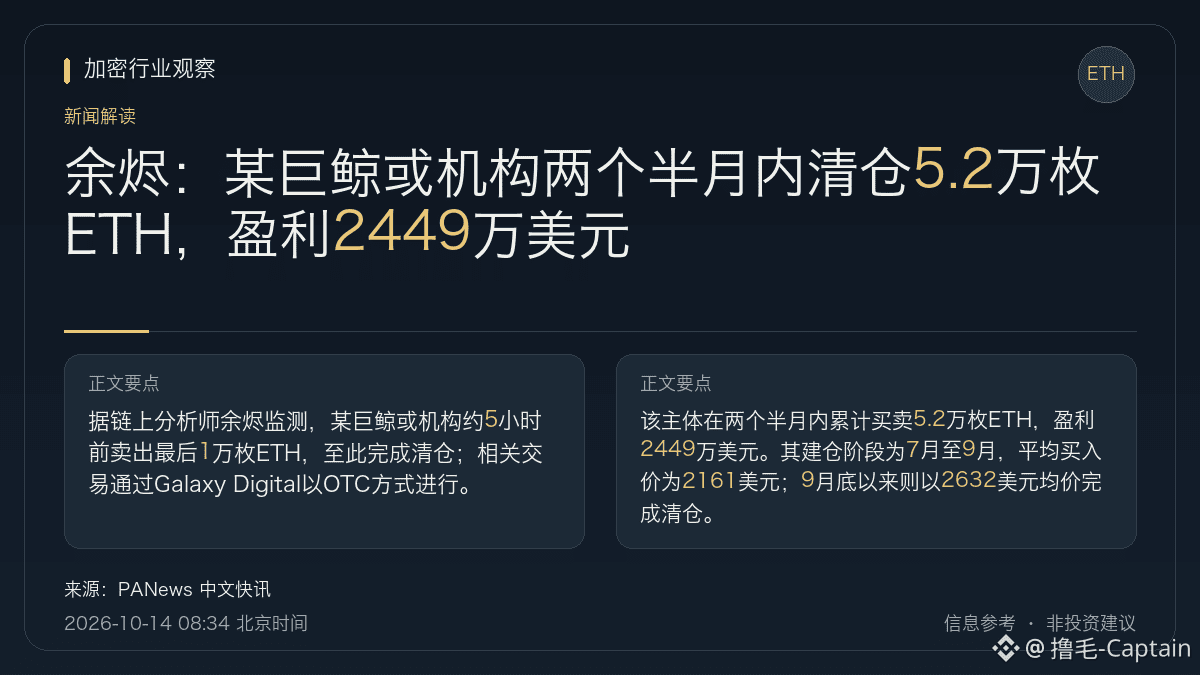
Ember: A whale or institution sold off 52,000 ETH over two and a half months, making $24.49 million in profit
According to monitoring by on-chain analyst Ember, a whale or institution sold its final 10,000 ETH about five hours ago, completing its sell-off. The transactions were conducted over the counter (OTC) through Galaxy Digital.
The entity bought and sold a total of 52,000 ETH over two and a half months, making $24.49 million in profit. It built its position from July to September at an average purchase price of $2,161, then completed its sell-off since late September at an average price of $2,632.
These figures reflect the position changes of a single large entity over a specific period. The source has not disclosed the entity’s identity or details of individual trades, nor provided evidence of any actual impact on ETH’s market price. The activity should therefore not be treated directly as a signal of price direction.
Impact and points to watch: This transaction shows a single large entity shifting from concentrated accumulation to a complete sell-off. However, the source has not provided the entity’s identity or specific trade details, or explained the transaction’s actual impact on ETH’s market price.
What to verify next: Watch for whether the entity rebuilds its ETH position.;Look for more on-chain data that could verify the related purchase, sale, and profit details.;Monitor whether similar large OTC transactions continue to occur, but do not use them alone to judge ETH’s price direction.
Source: PANews Chinese-language news brief
Source time: 2026-10-14 08:34 Beijing Time
Risk warning: This article is for informational purposes only and does not constitute investment advice.
76
·
--
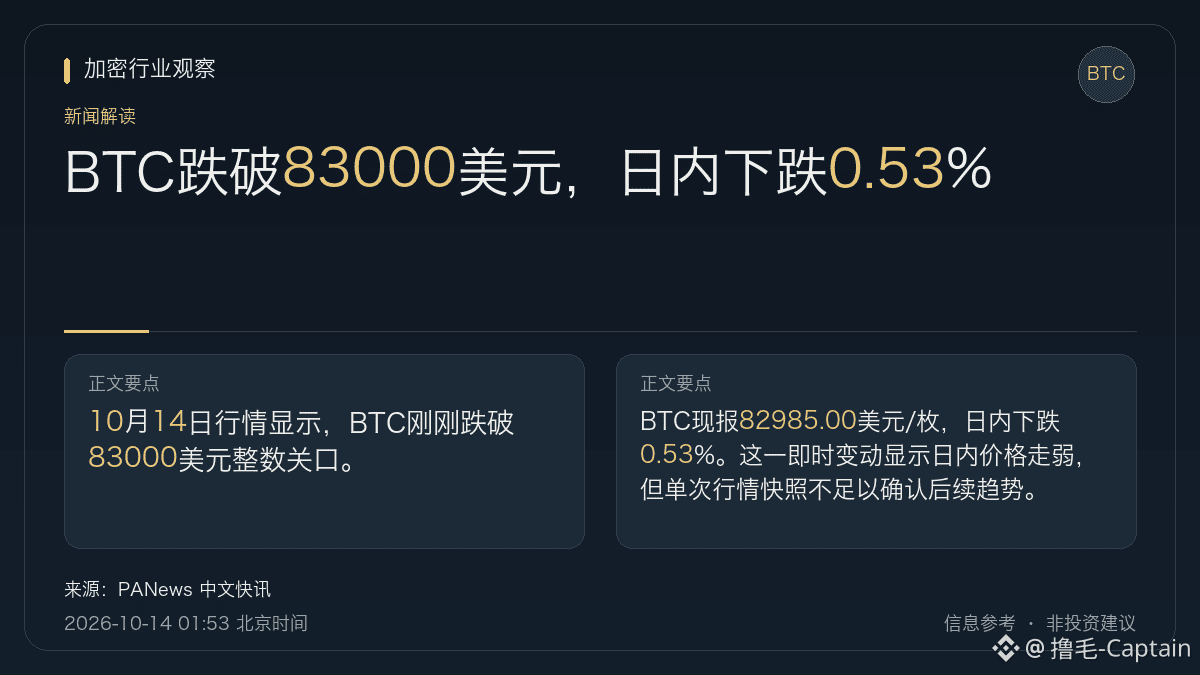
BTC falls below $83,000, down 0.53% on the day
Market data on October 14 shows that BTC has just fallen below the $83,000 threshold.
BTC is currently trading at $82,985.00 per coin, down 0.53% on the day. This immediate price movement indicates weakness during the day, but a single market snapshot is insufficient to confirm a subsequent trend.
Impact and points to watch: BTC’s brief drop below the $83,000 threshold reflects weakness in its price during the day. The current material provides only real-time market data and is not enough to determine the subsequent trend.
What to check next: Whether BTC can climb back above $83,000; whether the daily decline continues to widen.
Source: PANews Chinese-language news brief
Source time: 2026-10-14 01:53 Beijing time
Risk warning: This article is for informational purposes only and does not constitute investment advice.
11
Log in to explore more content
Join global crypto users on Binance Square
⚡️ Get latest and useful information about crypto.
💬 Trusted by the world’s largest crypto exchange.
👍 Discover real insights from verified creators.
Email / Phone number
Trending Topics
BinanceWithdrawalScamWarning
59,877 views
792 Discussing
Binance Warns Users of Withdrawal Scams as Services Resume: It Will Never Charge Fees, Sell Queue Spots or Ask You to Move Funds to a “Vault”
Binance News
·17 Likes
·9.1k views
USMidtermElections
633,787 views
3,350 Discussing
USOctoberNFP-AreRateCutsStillPossible
64,476 views
620 Discussing