
R3N 1
499 Posts

R3N 1
Report
Block User
Web3 & crypto Analyst || Breaking down market moves || token updates daily ➪NFA!!!
0 Following
3 Followers
2 Liked
Posts
·
--
See translation
Zero credit defaults across $14 billion in cumulative transaction volume. That track record is doing more work here than the market cap headline.
PST, Huma Finance's PayFi Strategy Token, just crossed $322 million market cap, up from $158 million in April and $200 million in July, now the largest yield bearing asset on Solana. Depositing USDC mints PST, and that capital gets lent as short duration financing, one to five days typically, to licensed payment institutions covering cross border settlements and trade finance. Interest and fees flow back to holders, pushing token value up over time rather than paying out separately.
Annualized yield sits around 7 to 9% in USDC terms. Roughly 80% of capital deploys into Huma's own PayFi pools, the rest into liquid DeFi strategies across Kamino, Jupiter, Aave, and Pendle.
The zero default claim is the part I'd weigh most heavily. Every loan extended through the protocol has reportedly been repaid, a meaningfully different risk profile than most DeFi yield sources, backed by real short term commercial financing, not token emissions or leveraged positions. PST has also expanded onto Ethereum through Morpho and Fluid, drawing institutional participants including Bitwise and Coinbase Asset Management.
My honest read: this looks like a genuine RWA yield product with real usage behind it, not a speculative token pump, the growth curve and underlying mechanics both support that. Becoming Solana's largest yield bearing asset is a real milestone, though I'd want to see whether that title holds as more RWA competitors scale up their own products.
What I'm watching: whether that zero default track record holds as PST's balance keeps scaling, since size and risk discipline don't always stay compatible in lending products.
$SOL #Altcoin Season# #Meme Alpha#
Zero credit defaults across $14 billion in cumulative transaction volume. That track record is doing more work here than the market cap headline.
PST, Huma Finance's PayFi Strategy Token, just crossed $322 million market cap, up from $158 million in April and $200 million in July, now the largest yield bearing asset on Solana. Depositing USDC mints PST, and that capital gets lent as short duration financing, one to five days typically, to licensed payment institutions covering cross border settlements and trade finance. Interest and fees flow back to holders, pushing token value up over time rather than paying out separately.
Annualized yield sits around 7 to 9% in USDC terms. Roughly 80% of capital deploys into Huma's own PayFi pools, the rest into liquid DeFi strategies across Kamino, Jupiter, Aave, and Pendle.
The zero default claim is the part I'd weigh most heavily. Every loan extended through the protocol has reportedly been repaid, a meaningfully different risk profile than most DeFi yield sources, backed by real short term commercial financing, not token emissions or leveraged positions. PST has also expanded onto Ethereum through Morpho and Fluid, drawing institutional participants including Bitwise and Coinbase Asset Management.
My honest read: this looks like a genuine RWA yield product with real usage behind it, not a speculative token pump, the growth curve and underlying mechanics both support that. Becoming Solana's largest yield bearing asset is a real milestone, though I'd want to see whether that title holds as more RWA competitors scale up their own products.
What I'm watching: whether that zero default track record holds as PST's balance keeps scaling, since size and risk discipline don't always stay compatible in lending products.
$SOL #Altcoin Season# #Meme Alpha#
PST, Huma Finance's PayFi Strategy Token, just crossed $322 million market cap, up from $158 million in April and $200 million in July, now the largest yield bearing asset on Solana. Depositing USDC mints PST, and that capital gets lent as short duration financing, one to five days typically, to licensed payment institutions covering cross border settlements and trade finance. Interest and fees flow back to holders, pushing token value up over time rather than paying out separately.
Annualized yield sits around 7 to 9% in USDC terms. Roughly 80% of capital deploys into Huma's own PayFi pools, the rest into liquid DeFi strategies across Kamino, Jupiter, Aave, and Pendle.
The zero default claim is the part I'd weigh most heavily. Every loan extended through the protocol has reportedly been repaid, a meaningfully different risk profile than most DeFi yield sources, backed by real short term commercial financing, not token emissions or leveraged positions. PST has also expanded onto Ethereum through Morpho and Fluid, drawing institutional participants including Bitwise and Coinbase Asset Management.
My honest read: this looks like a genuine RWA yield product with real usage behind it, not a speculative token pump, the growth curve and underlying mechanics both support that. Becoming Solana's largest yield bearing asset is a real milestone, though I'd want to see whether that title holds as more RWA competitors scale up their own products.
What I'm watching: whether that zero default track record holds as PST's balance keeps scaling, since size and risk discipline don't always stay compatible in lending products.
$SOL #Altcoin Season# #Meme Alpha#
29
·
--
See translation
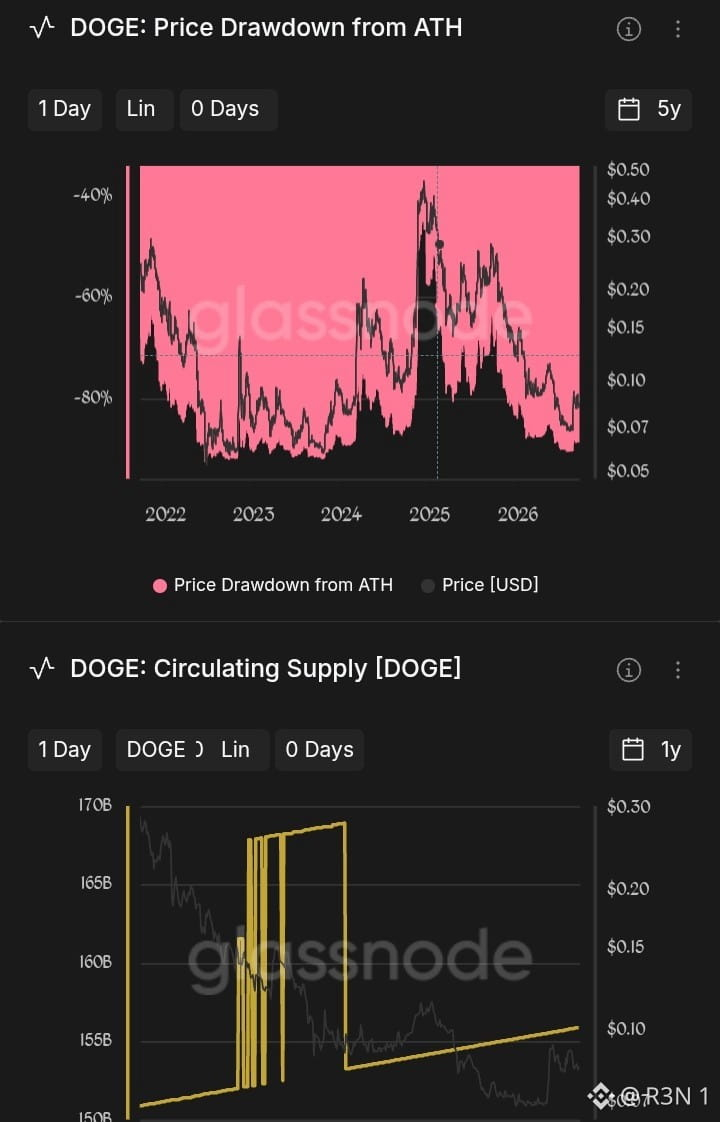
DOGE hasn't been out of an 80% plus drawdown from its all time high in years, and looking at this chart, that's not a recent development, it's been the norm since the 2021 top.
The five year drawdown chart shows DOGE oscillating mostly between 60% and 85% below its ATH, with brief relief rallies pulling that number back toward 40% during genuine hype cycles, the sharpest one visible here around late 2024, likely tied to the election period pump that lifted meme coins broadly. Outside those spikes, DOGE spends the overwhelming majority of its time deep in drawdown territory, and its current position on this chart still sits well within that same deep discount zone, not near any recovery.
I want to flag the second chart honestly rather than force an interpretation onto it. The circulating supply series shows sharp vertical spikes jumping between roughly 150B and 170B repeatedly within a short window, which doesn't match how DOGE's supply works, a fixed annual emission of about 5 billion coins a year should show up as a smooth, gradual line, not vertical jumps. This looks like a charting or data artifact, possibly overlapping series, and I wouldn't draw conclusions about actual supply changes from it as shown.
My honest read on what's actually usable here: the drawdown chart tells a real and fairly bearish structural story, DOGE has failed to meaningfully reclaim ground relative to its ATH across multiple cycles now, brief hype driven exceptions aside. That's a pattern worth taking seriously rather than assuming the next hype cycle behaves differently.
What I'd want before drawing more from the supply side: a cleaner version of that circulating supply chart, since the one shown here isn't reliable to interpret as is.
$DOGE #BTC Price Analysis# #Altcoin Season#
DOGE hasn't been out of an 80% plus drawdown from its all time high in years, and looking at this chart, that's not a recent development, it's been the norm since the 2021 top.
The five year drawdown chart shows DOGE oscillating mostly between 60% and 85% below its ATH, with brief relief rallies pulling that number back toward 40% during genuine hype cycles, the sharpest one visible here around late 2024, likely tied to the election period pump that lifted meme coins broadly. Outside those spikes, DOGE spends the overwhelming majority of its time deep in drawdown territory, and its current position on this chart still sits well within that same deep discount zone, not near any recovery.
I want to flag the second chart honestly rather than force an interpretation onto it. The circulating supply series shows sharp vertical spikes jumping between roughly 150B and 170B repeatedly within a short window, which doesn't match how DOGE's supply works, a fixed annual emission of about 5 billion coins a year should show up as a smooth, gradual line, not vertical jumps. This looks like a charting or data artifact, possibly overlapping series, and I wouldn't draw conclusions about actual supply changes from it as shown.
My honest read on what's actually usable here: the drawdown chart tells a real and fairly bearish structural story, DOGE has failed to meaningfully reclaim ground relative to its ATH across multiple cycles now, brief hype driven exceptions aside. That's a pattern worth taking seriously rather than assuming the next hype cycle behaves differently.
What I'd want before drawing more from the supply side: a cleaner version of that circulating supply chart, since the one shown here isn't reliable to interpret as is.
$DOGE #BTC Price Analysis# #Altcoin Season#
The five year drawdown chart shows DOGE oscillating mostly between 60% and 85% below its ATH, with brief relief rallies pulling that number back toward 40% during genuine hype cycles, the sharpest one visible here around late 2024, likely tied to the election period pump that lifted meme coins broadly. Outside those spikes, DOGE spends the overwhelming majority of its time deep in drawdown territory, and its current position on this chart still sits well within that same deep discount zone, not near any recovery.
I want to flag the second chart honestly rather than force an interpretation onto it. The circulating supply series shows sharp vertical spikes jumping between roughly 150B and 170B repeatedly within a short window, which doesn't match how DOGE's supply works, a fixed annual emission of about 5 billion coins a year should show up as a smooth, gradual line, not vertical jumps. This looks like a charting or data artifact, possibly overlapping series, and I wouldn't draw conclusions about actual supply changes from it as shown.
My honest read on what's actually usable here: the drawdown chart tells a real and fairly bearish structural story, DOGE has failed to meaningfully reclaim ground relative to its ATH across multiple cycles now, brief hype driven exceptions aside. That's a pattern worth taking seriously rather than assuming the next hype cycle behaves differently.
What I'd want before drawing more from the supply side: a cleaner version of that circulating supply chart, since the one shown here isn't reliable to interpret as is.
$DOGE #BTC Price Analysis# #Altcoin Season#
42
·
--
See translation
All four major spot ETF categories posted inflows on the same day, September 14. That's not something that's happened consistently this month, most sessions have shown at least one category diverging from the rest.
BTC led with $160.04M, ETH followed at $121.02M, while SOL and XRP both came in smaller and nearly matched each other, $11.01M and $11.26M respectively. The gap between BTC and ETH versus SOL and XRP is roughly 10x, which tracks with how these markets have generally sized relative to each other, but same day green across all four is the actual notable part here, not any single number.
Worth being direct about timing context. This lands right ahead of two real catalysts, the Fed's September 16 decision and the Senate's CLARITY Act cloture vote, both landing this week. Same day inflows across every major ETF category heading into that stretch could reflect genuine positioning conviction, or it could just as easily be smaller, less directional flow ahead of two binary outcomes that traders would rather not be caught leaning hard against. I don't have enough here to distinguish between those two reads with confidence.
My honest take: uniform green across BTC, ETH, SOL, and XRP on the same day is a mild positive signal, institutional demand isn't concentrated in one asset right now, it's broad. But a single day, even a clean one, isn't enough to call this a trend shift on its own, especially with two major catalysts still ahead that could easily reverse the picture either direction.
What I'm watching: whether this same broad, all green pattern holds through Tuesday's cloture vote and Wednesday's Fed decision, or whether flows fragment again once those outcomes are known.
$BTC $SOL #BTC Price Analysis# #Macro Insights#
All four major spot ETF categories posted inflows on the same day, September 14. That's not something that's happened consistently this month, most sessions have shown at least one category diverging from the rest.
BTC led with $160.04M, ETH followed at $121.02M, while SOL and XRP both came in smaller and nearly matched each other, $11.01M and $11.26M respectively. The gap between BTC and ETH versus SOL and XRP is roughly 10x, which tracks with how these markets have generally sized relative to each other, but same day green across all four is the actual notable part here, not any single number.
Worth being direct about timing context. This lands right ahead of two real catalysts, the Fed's September 16 decision and the Senate's CLARITY Act cloture vote, both landing this week. Same day inflows across every major ETF category heading into that stretch could reflect genuine positioning conviction, or it could just as easily be smaller, less directional flow ahead of two binary outcomes that traders would rather not be caught leaning hard against. I don't have enough here to distinguish between those two reads with confidence.
My honest take: uniform green across BTC, ETH, SOL, and XRP on the same day is a mild positive signal, institutional demand isn't concentrated in one asset right now, it's broad. But a single day, even a clean one, isn't enough to call this a trend shift on its own, especially with two major catalysts still ahead that could easily reverse the picture either direction.
What I'm watching: whether this same broad, all green pattern holds through Tuesday's cloture vote and Wednesday's Fed decision, or whether flows fragment again once those outcomes are known.
$BTC $SOL #BTC Price Analysis# #Macro Insights#
BTC led with $160.04M, ETH followed at $121.02M, while SOL and XRP both came in smaller and nearly matched each other, $11.01M and $11.26M respectively. The gap between BTC and ETH versus SOL and XRP is roughly 10x, which tracks with how these markets have generally sized relative to each other, but same day green across all four is the actual notable part here, not any single number.
Worth being direct about timing context. This lands right ahead of two real catalysts, the Fed's September 16 decision and the Senate's CLARITY Act cloture vote, both landing this week. Same day inflows across every major ETF category heading into that stretch could reflect genuine positioning conviction, or it could just as easily be smaller, less directional flow ahead of two binary outcomes that traders would rather not be caught leaning hard against. I don't have enough here to distinguish between those two reads with confidence.
My honest take: uniform green across BTC, ETH, SOL, and XRP on the same day is a mild positive signal, institutional demand isn't concentrated in one asset right now, it's broad. But a single day, even a clean one, isn't enough to call this a trend shift on its own, especially with two major catalysts still ahead that could easily reverse the picture either direction.
What I'm watching: whether this same broad, all green pattern holds through Tuesday's cloture vote and Wednesday's Fed decision, or whether flows fragment again once those outcomes are known.
$BTC $SOL #BTC Price Analysis# #Macro Insights#

51
·
--
See translation
CoinEx is the fourth exchange to announce a shutdown this year, not the first. That pattern matters more than any single closure does on its own.
Founder Haipo Yang confirmed the wind down September 15, after nearly nine years in operation, citing a prolonged market downturn, shrinking industry wide trading volume and liquidity, and compliance costs he said had exceeded reasonable limits. New registrations stopped immediately, futures moved to reduce only mode the same day, spot trading ends September 29, withdrawals stay open until December 22, 2026 at 02:00 UTC.
CoinEx says its reserve ratio sits above 100%, all user assets fully backed. CET holders get a buyback at 0.005 USDT, above the token's current price near $0.00466. Anything left unwithdrawn after the deadline moves to third party custody, accruing a 5% monthly fee, with claims accepted through August 2028.
Yang's own framing is worth noting, he said carrying unlimited risk for limited revenue stopped being a rational choice, and rejected selling the exchange because users had trusted the platform, and often him personally, with their funds. He chose an orderly wind down instead.
This isn't isolated. Bitget, BitMart, and BitMEX have all announced their own shutdowns in 2026, BitMEX closing September 23, BitMart phasing out through January 2027. CoinEx ranks 33rd by trading volume, a mid tier exchange, fitting the pattern, this pressure is hitting that tier specifically, not just the smallest platforms.
My honest read: an orderly, fully funded wind down with a 100% plus reserve ratio and a three month withdrawal window is about as clean an exit as this gets, genuinely different from a collapse or insolvency event. Doesn't make the broader trend less notable though.
What I'm watching: whether more mid tier exchanges follow this same pattern before year end, and whether CET actually trades up toward that buyback price as the deadline approaches.
$XRP #BTC Price Analysis# $ETH
CoinEx is the fourth exchange to announce a shutdown this year, not the first. That pattern matters more than any single closure does on its own.
Founder Haipo Yang confirmed the wind down September 15, after nearly nine years in operation, citing a prolonged market downturn, shrinking industry wide trading volume and liquidity, and compliance costs he said had exceeded reasonable limits. New registrations stopped immediately, futures moved to reduce only mode the same day, spot trading ends September 29, withdrawals stay open until December 22, 2026 at 02:00 UTC.
CoinEx says its reserve ratio sits above 100%, all user assets fully backed. CET holders get a buyback at 0.005 USDT, above the token's current price near $0.00466. Anything left unwithdrawn after the deadline moves to third party custody, accruing a 5% monthly fee, with claims accepted through August 2028.
Yang's own framing is worth noting, he said carrying unlimited risk for limited revenue stopped being a rational choice, and rejected selling the exchange because users had trusted the platform, and often him personally, with their funds. He chose an orderly wind down instead.
This isn't isolated. Bitget, BitMart, and BitMEX have all announced their own shutdowns in 2026, BitMEX closing September 23, BitMart phasing out through January 2027. CoinEx ranks 33rd by trading volume, a mid tier exchange, fitting the pattern, this pressure is hitting that tier specifically, not just the smallest platforms.
My honest read: an orderly, fully funded wind down with a 100% plus reserve ratio and a three month withdrawal window is about as clean an exit as this gets, genuinely different from a collapse or insolvency event. Doesn't make the broader trend less notable though.
What I'm watching: whether more mid tier exchanges follow this same pattern before year end, and whether CET actually trades up toward that buyback price as the deadline approaches.
$XRP #BTC Price Analysis# $ETH
Founder Haipo Yang confirmed the wind down September 15, after nearly nine years in operation, citing a prolonged market downturn, shrinking industry wide trading volume and liquidity, and compliance costs he said had exceeded reasonable limits. New registrations stopped immediately, futures moved to reduce only mode the same day, spot trading ends September 29, withdrawals stay open until December 22, 2026 at 02:00 UTC.
CoinEx says its reserve ratio sits above 100%, all user assets fully backed. CET holders get a buyback at 0.005 USDT, above the token's current price near $0.00466. Anything left unwithdrawn after the deadline moves to third party custody, accruing a 5% monthly fee, with claims accepted through August 2028.
Yang's own framing is worth noting, he said carrying unlimited risk for limited revenue stopped being a rational choice, and rejected selling the exchange because users had trusted the platform, and often him personally, with their funds. He chose an orderly wind down instead.
This isn't isolated. Bitget, BitMart, and BitMEX have all announced their own shutdowns in 2026, BitMEX closing September 23, BitMart phasing out through January 2027. CoinEx ranks 33rd by trading volume, a mid tier exchange, fitting the pattern, this pressure is hitting that tier specifically, not just the smallest platforms.
My honest read: an orderly, fully funded wind down with a 100% plus reserve ratio and a three month withdrawal window is about as clean an exit as this gets, genuinely different from a collapse or insolvency event. Doesn't make the broader trend less notable though.
What I'm watching: whether more mid tier exchanges follow this same pattern before year end, and whether CET actually trades up toward that buyback price as the deadline approaches.
$XRP #BTC Price Analysis# $ETH
58
·
--
See translation
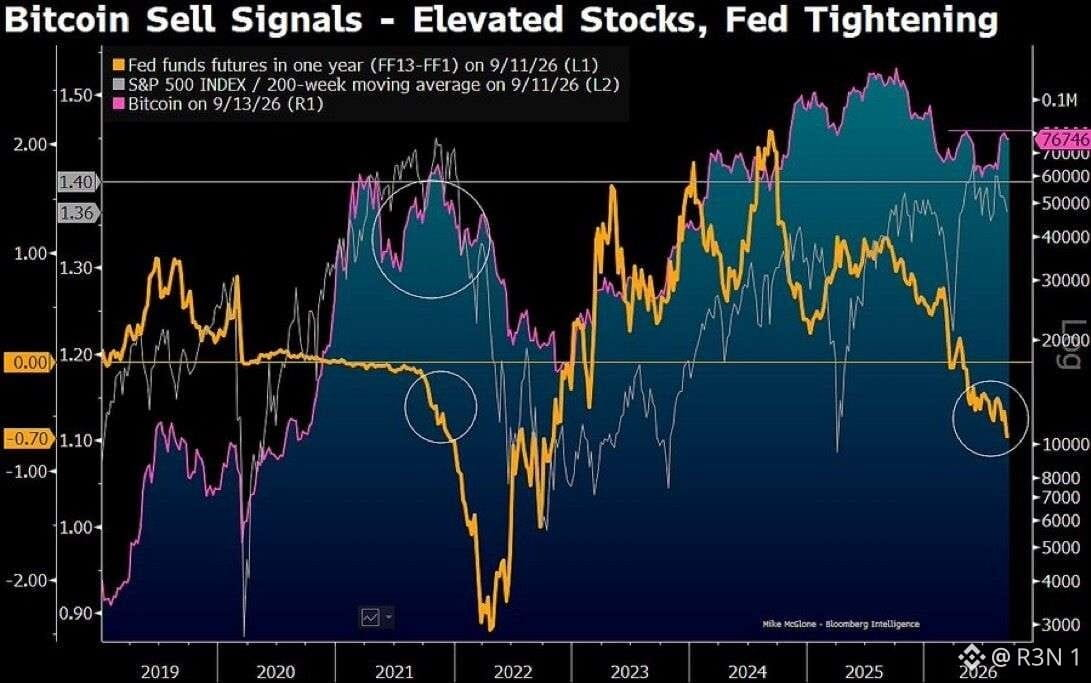
Bloomberg Intelligence's Mike McGlone laid out the scenario September 13, a roughly 20% correction in the S&P 500, sustained rather than a quick dip, could drag Bitcoin toward $10,000 given what he calls a strong correlation between the two. His case rests on three points, Bitcoin's recent rebound stalled at $76,746 short of $80,000, one year fed funds futures price in about 70 basis points of further rate hikes, and the S&P sits well above its 200 week moving average, historically fertile ground for institutional profit taking.
He also notes Bitcoin matched the S&P's five year returns with roughly three times the volatility, a poor risk adjusted trade in his framing.
Worth being direct about context. McGlone made essentially this same $10,000 call in December 2025 for calendar year 2026, and he's repeating it in September with fresh technical framing attached. Doesn't make the underlying logic wrong, correlation and rate sensitivity are real mechanisms, but a call running for close to a year without resolving deserves that history attached.
On the other side, CryptoQuant's own framework puts the more immediate test at a weekly close above $81,700, the one year average price, to confirm a new bull phase, resistance at $83,600 and $88,700 above that. Support sits at $70,000 first, then a $62,000 to $65,000 demand zone built on roughly 476,000 BTC of prior accumulated buying, a meaningfully different downside scenario than $10,000.
My honest read: the correlation argument is legitimate, but the $10,000 target requires a specific, sustained equity crash that hasn't happened, stacked on a call that's already run long without confirming.
What I'm watching: whether that $81,700 weekly close level gets reclaimed or rejected first, since that resolves well before anyone needs to worry about $10,000.
$BTC #Altcoin Season# #Altcoin Season#
Bloomberg Intelligence's Mike McGlone laid out the scenario September 13, a roughly 20% correction in the S&P 500, sustained rather than a quick dip, could drag Bitcoin toward $10,000 given what he calls a strong correlation between the two. His case rests on three points, Bitcoin's recent rebound stalled at $76,746 short of $80,000, one year fed funds futures price in about 70 basis points of further rate hikes, and the S&P sits well above its 200 week moving average, historically fertile ground for institutional profit taking.
He also notes Bitcoin matched the S&P's five year returns with roughly three times the volatility, a poor risk adjusted trade in his framing.
Worth being direct about context. McGlone made essentially this same $10,000 call in December 2025 for calendar year 2026, and he's repeating it in September with fresh technical framing attached. Doesn't make the underlying logic wrong, correlation and rate sensitivity are real mechanisms, but a call running for close to a year without resolving deserves that history attached.
On the other side, CryptoQuant's own framework puts the more immediate test at a weekly close above $81,700, the one year average price, to confirm a new bull phase, resistance at $83,600 and $88,700 above that. Support sits at $70,000 first, then a $62,000 to $65,000 demand zone built on roughly 476,000 BTC of prior accumulated buying, a meaningfully different downside scenario than $10,000.
My honest read: the correlation argument is legitimate, but the $10,000 target requires a specific, sustained equity crash that hasn't happened, stacked on a call that's already run long without confirming.
What I'm watching: whether that $81,700 weekly close level gets reclaimed or rejected first, since that resolves well before anyone needs to worry about $10,000.
$BTC #Altcoin Season# #Altcoin Season#
He also notes Bitcoin matched the S&P's five year returns with roughly three times the volatility, a poor risk adjusted trade in his framing.
Worth being direct about context. McGlone made essentially this same $10,000 call in December 2025 for calendar year 2026, and he's repeating it in September with fresh technical framing attached. Doesn't make the underlying logic wrong, correlation and rate sensitivity are real mechanisms, but a call running for close to a year without resolving deserves that history attached.
On the other side, CryptoQuant's own framework puts the more immediate test at a weekly close above $81,700, the one year average price, to confirm a new bull phase, resistance at $83,600 and $88,700 above that. Support sits at $70,000 first, then a $62,000 to $65,000 demand zone built on roughly 476,000 BTC of prior accumulated buying, a meaningfully different downside scenario than $10,000.
My honest read: the correlation argument is legitimate, but the $10,000 target requires a specific, sustained equity crash that hasn't happened, stacked on a call that's already run long without confirming.
What I'm watching: whether that $81,700 weekly close level gets reclaimed or rejected first, since that resolves well before anyone needs to worry about $10,000.
$BTC #Altcoin Season# #Altcoin Season#
·
--
See translation
I used to check my DeFi positions every day. Sometimes multiple times a day. I told myself this was active management. What it actually was is a habit that made my decisions systematically worse. The problem with daily checking is that daily data is mostly noise. A pool's 24-hour volume on a Tuesday tells you almost nothing about whether the pool's economics are durably sound. A reward token's price on any given day tells you almost nothing about whether accumulating it across a 60-day farming period will produce real returns. A TVL snapshot tells you what capital is present right now without any context for whether it arrived recently for a campaign or has been there across multiple market cycles. Daily checking creates a specific failure mode. You see a data point that's unfavorable, volume down, reward token price lower, TVL compressed and you make a decision based on that single data point rather than on the trend it's part of. Or you see a favorable data point and it reinforces staying in a position past the point where the trend data would have prompted an exit. The adjustment I made was defining explicit checking cadences for different types of decisions. Pool APR and volume data I check weekly rather than daily, weekly data reveals trends that daily data obscures. Reward token price trend I check monthly rather than when I happen to open a charting tab. Impermanent loss versus fee income ratio I calculate monthly rather than reactively when I'm worried about a position. The cadence change reduced the number of decisions I make and improved their quality simultaneously. Fewer decisions because I'm not reacting to daily noise. Better decisions because I'm acting on trend data rather than snapshots. @ston_fi 's weekly farming digest format exists for the same reason. A weekly snapshot compared to last week's data is more useful than a daily snapshot read in isolation. Read more about defi an crypto https://blog.ston.fi/ #BTC Price Analysis# $PI $TRUMP
I used to check my DeFi positions every day. Sometimes multiple times a day. I told myself this was active management. What it actually was is a habit that made my decisions systematically worse. The problem with daily checking is that daily data is mostly noise. A pool's 24-hour volume on a Tuesday tells you almost nothing about whether the pool's economics are durably sound. A reward token's price on any given day tells you almost nothing about whether accumulating it across a 60-day farming period will produce real returns. A TVL snapshot tells you what capital is present right now without any context for whether it arrived recently for a campaign or has been there across multiple market cycles. Daily checking creates a specific failure mode. You see a data point that's unfavorable, volume down, reward token price lower, TVL compressed and you make a decision based on that single data point rather than on the trend it's part of. Or you see a favorable data point and it reinforces staying in a position past the point where the trend data would have prompted an exit. The adjustment I made was defining explicit checking cadences for different types of decisions. Pool APR and volume data I check weekly rather than daily, weekly data reveals trends that daily data obscures. Reward token price trend I check monthly rather than when I happen to open a charting tab. Impermanent loss versus fee income ratio I calculate monthly rather than reactively when I'm worried about a position. The cadence change reduced the number of decisions I make and improved their quality simultaneously. Fewer decisions because I'm not reacting to daily noise. Better decisions because I'm acting on trend data rather than snapshots. @ston_fi 's weekly farming digest format exists for the same reason. A weekly snapshot compared to last week's data is more useful than a daily snapshot read in isolation. Read more about defi an crypto https://blog.ston.fi/ #BTC Price Analysis# $PI $TRUMP

4
·
--
See translation
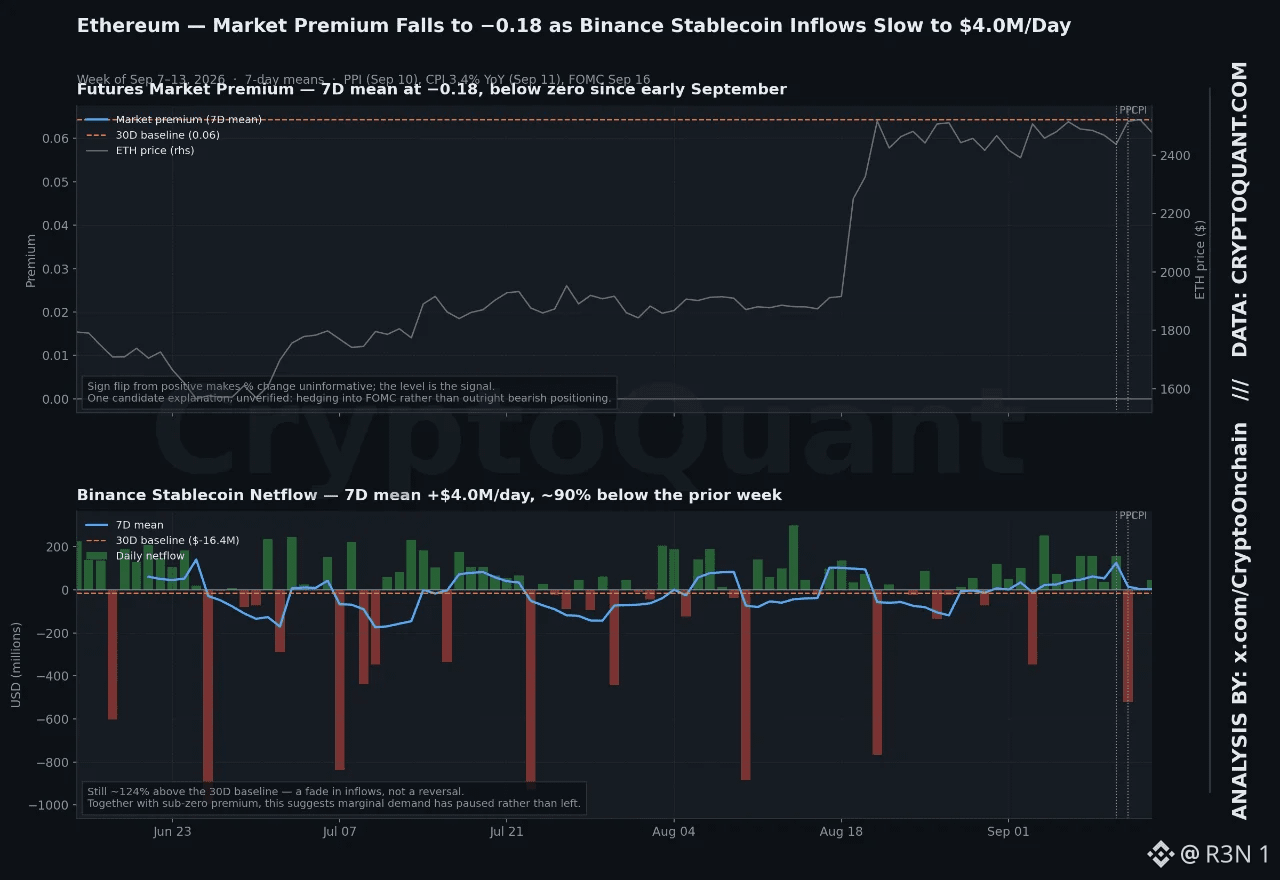
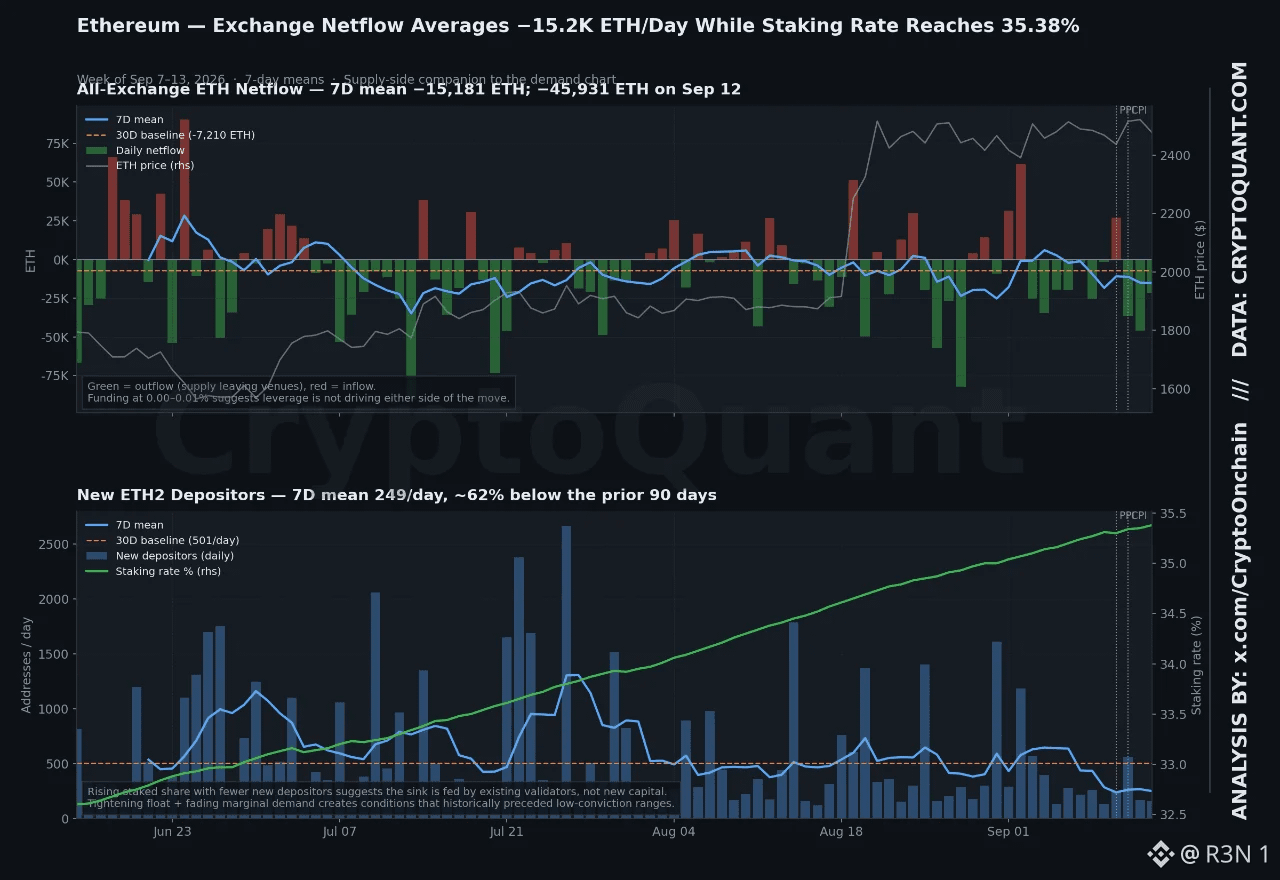
Ethereum's futures premium just went negative, -0.18 over the seven days to September 13, while the stablecoin capital staging on Binance to absorb supply has largely stopped showing up. Those two things happening together is the actual signal, not either alone. Worth being precise here. The premium crossed from positive to negative, so a percentage change on it isn't meaningful, only the level matters. Binance stablecoin inflow averaged $4.0M a day, down about 90% from last week but still 124% above the 30 day baseline, a fade from an elevated level, not a reversal. Median transfer and fee series are excluded, near zero denominators make their percentages misleading. Macro context sits behind this. PPI printed 5.4% YoY on September 10, CPI came in at 3.4%, core 2.4%, on September 11, 10 year held near 4.95% into the September 16 FOMC. ETH closed at $2,477, still inside the $2,391 to $2,522 range held since August 31. One unverified possibility worth naming as speculation: the negative premium could reflect hedging ahead of the Fed decision rather than bearish positioning, funding at 0.00 to 0.01% suggests leverage isn't driving either side. The more interesting split is demand versus supply. Demand channels are cooling together, stablecoin staging stalled, futures trade below spot, Coinbase premium sits at -0.05. Supply keeps tightening regardless, exchange netflow averaged -15,181 ETH daily, staking rate hit 35.38%. New depositors dropping suggests staking growth comes from existing validators, not new capital. My honest read: tightening float against fading marginal demand is a setup that's historically preceded low conviction ranges, the kind that resolve on an external catalyst rather than through the underlying flows alone. What I'm watching: whether stablecoin staging resumes on the other side of Wednesday's Fed decision, or whether this pause extends regardless of the outcome. $ETH #BTC Price Analysis# #ETH
Ethereum's futures premium just went negative, -0.18 over the seven days to September 13, while the stablecoin capital staging on Binance to absorb supply has largely stopped showing up. Those two things happening together is the actual signal, not either alone. Worth being precise here. The premium crossed from positive to negative, so a percentage change on it isn't meaningful, only the level matters. Binance stablecoin inflow averaged $4.0M a day, down about 90% from last week but still 124% above the 30 day baseline, a fade from an elevated level, not a reversal. Median transfer and fee series are excluded, near zero denominators make their percentages misleading. Macro context sits behind this. PPI printed 5.4% YoY on September 10, CPI came in at 3.4%, core 2.4%, on September 11, 10 year held near 4.95% into the September 16 FOMC. ETH closed at $2,477, still inside the $2,391 to $2,522 range held since August 31. One unverified possibility worth naming as speculation: the negative premium could reflect hedging ahead of the Fed decision rather than bearish positioning, funding at 0.00 to 0.01% suggests leverage isn't driving either side. The more interesting split is demand versus supply. Demand channels are cooling together, stablecoin staging stalled, futures trade below spot, Coinbase premium sits at -0.05. Supply keeps tightening regardless, exchange netflow averaged -15,181 ETH daily, staking rate hit 35.38%. New depositors dropping suggests staking growth comes from existing validators, not new capital. My honest read: tightening float against fading marginal demand is a setup that's historically preceded low conviction ranges, the kind that resolve on an external catalyst rather than through the underlying flows alone. What I'm watching: whether stablecoin staging resumes on the other side of Wednesday's Fed decision, or whether this pause extends regardless of the outcome. $ETH #BTC Price Analysis# #ETH
·
--
See translation
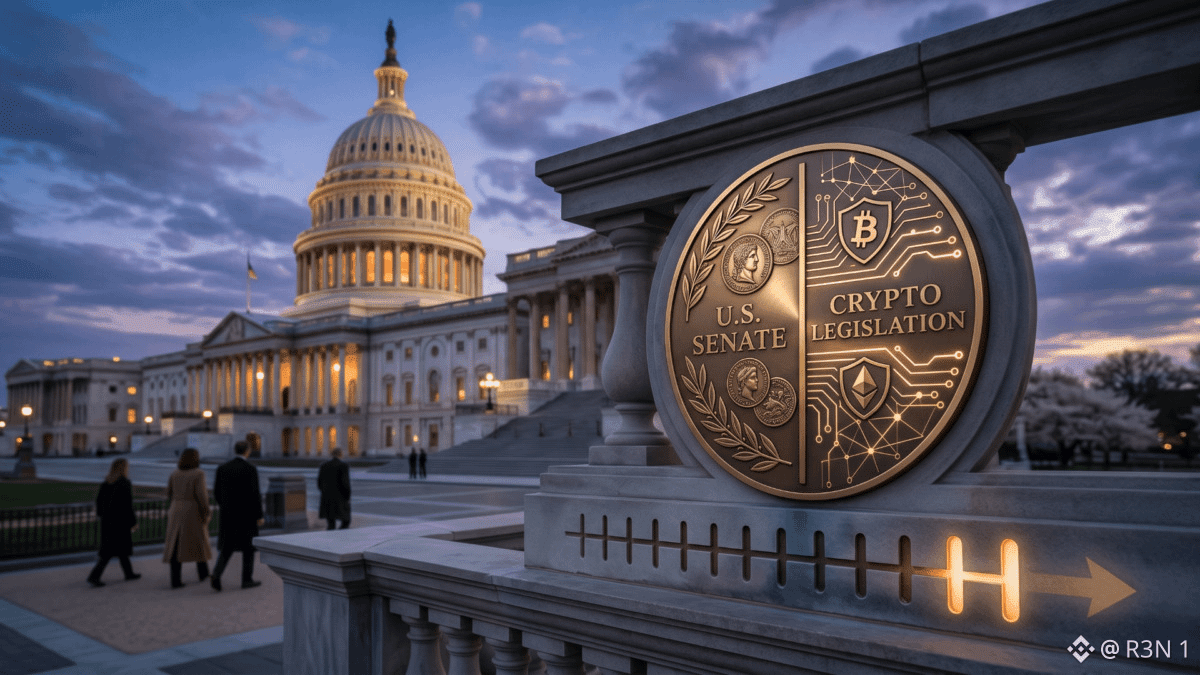
On the CLARITY Act side, odds have moved fast. Per CoinDesk's latest reporting today, Polymarket puts the chance of the bill becoming law this year at nearly 30%, up sharply from 12% earlier in September, while Kalshi's separate contract, resolving through October 2027, spiked as high as 64% overnight before settling near 53%. Worth flagging plainly, different platforms and resolution dates produce different numbers, treat any single figure quoted in isolation with caution given how much these have swung in days. Tuesday's cloture vote needs 60 votes, Republicans hold 53, genuinely contested, not a formality. On the Fed side, the September 16 FOMC decision is unusually split for this stage in a cycle. CME FedWatch data has ranged from roughly 28% to over 80% hike probability depending on the day and source, J.P. Morgan expects a 25 basis point hike, Goldman Sachs calls it very unlikely. A real institutional disagreement, not noise, driven by Iran conflict energy inflation pulling one way and softer employment data pulling the other. My honest read: these two events genuinely compete for BTC's attention this week, and I don't think it's obvious which dominates. Legislative clarity is a slower burning structural positive, a Fed hike is an immediate rate sensitive risk asset shock. If both land in the same direction, constructive on CLARITY and a hold rather than hike, that's a meaningfully different setup than either landing against the other. What I'm watching: the actual cloture count Tuesday alongside Wednesday's FOMC decision, since the sequence and outcome of both together will likely matter more than either alone. $BTC #BTC Price Analysis# #Altcoin Season# #CLARITYAct
On the CLARITY Act side, odds have moved fast. Per CoinDesk's latest reporting today, Polymarket puts the chance of the bill becoming law this year at nearly 30%, up sharply from 12% earlier in September, while Kalshi's separate contract, resolving through October 2027, spiked as high as 64% overnight before settling near 53%. Worth flagging plainly, different platforms and resolution dates produce different numbers, treat any single figure quoted in isolation with caution given how much these have swung in days. Tuesday's cloture vote needs 60 votes, Republicans hold 53, genuinely contested, not a formality. On the Fed side, the September 16 FOMC decision is unusually split for this stage in a cycle. CME FedWatch data has ranged from roughly 28% to over 80% hike probability depending on the day and source, J.P. Morgan expects a 25 basis point hike, Goldman Sachs calls it very unlikely. A real institutional disagreement, not noise, driven by Iran conflict energy inflation pulling one way and softer employment data pulling the other. My honest read: these two events genuinely compete for BTC's attention this week, and I don't think it's obvious which dominates. Legislative clarity is a slower burning structural positive, a Fed hike is an immediate rate sensitive risk asset shock. If both land in the same direction, constructive on CLARITY and a hold rather than hike, that's a meaningfully different setup than either landing against the other. What I'm watching: the actual cloture count Tuesday alongside Wednesday's FOMC decision, since the sequence and outcome of both together will likely matter more than either alone. $BTC #BTC Price Analysis# #Altcoin Season# #CLARITYAct
·
--
See translation
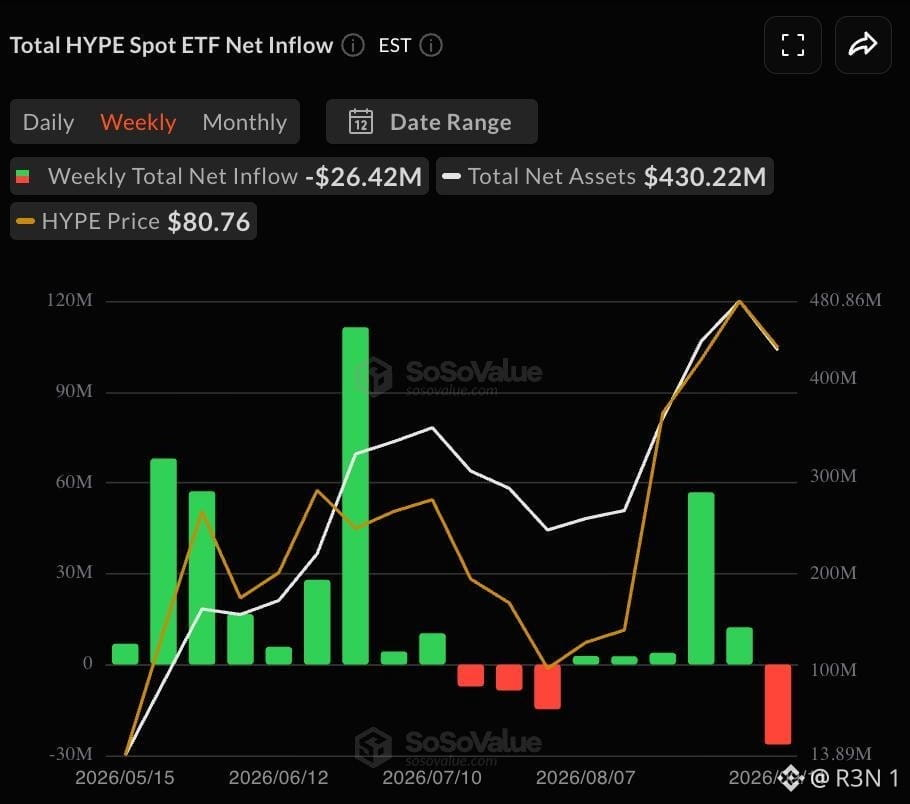
HYPE spot ETFs shed $26.4M last week, and the split between the two funds tells you more than the total does.
Per SoSoValue, Bitwise's BHYP took the bulk of it, $20.1M out, while 21Shares' THYP lost $6.3M. That's not evenly distributed selling, it's concentrated almost entirely in one product, which usually points to a specific holder or allocator rotating out rather than broad-based sentiment souring across every HYPE ETF investor at once.
This isn't an isolated week either. Over a 12-session stretch ending August 3, the same two funds collectively shed $29.8M, so this outflow pressure has been building on and off for weeks, not appearing out of nowhere.
What stands out to me is the divergence between what the ETF flows are showing and what's happening on-chain at the same time. Whale addresses have reportedly kept adding and staking HYPE directly through this same window, one buying $26M worth in a single move. That's a real split, ETF investors pulling money out through a regulated product while large holders accumulate the token itself, and those two behaviors don't obviously agree on direction.
Worth adding context on scale too, cumulative net inflows for these funds still sit north of $280M since May launch, so this week's outflow, even stacked on the prior stretch, is a dent in that total, not a collapse of it.
The open question is whether this is one large holder reducing ETF exposure specifically, maybe for tax, custody, or fee reasons unrelated to HYPE conviction, or an early signal that the ETF investor base is genuinely less enthusiastic than the on-chain whale activity suggests. Those look identical in the flow data. They're not the same story.
$HYPE #BTC Price Analysis# #Altcoin Season#
HYPE spot ETFs shed $26.4M last week, and the split between the two funds tells you more than the total does.
Per SoSoValue, Bitwise's BHYP took the bulk of it, $20.1M out, while 21Shares' THYP lost $6.3M. That's not evenly distributed selling, it's concentrated almost entirely in one product, which usually points to a specific holder or allocator rotating out rather than broad-based sentiment souring across every HYPE ETF investor at once.
This isn't an isolated week either. Over a 12-session stretch ending August 3, the same two funds collectively shed $29.8M, so this outflow pressure has been building on and off for weeks, not appearing out of nowhere.
What stands out to me is the divergence between what the ETF flows are showing and what's happening on-chain at the same time. Whale addresses have reportedly kept adding and staking HYPE directly through this same window, one buying $26M worth in a single move. That's a real split, ETF investors pulling money out through a regulated product while large holders accumulate the token itself, and those two behaviors don't obviously agree on direction.
Worth adding context on scale too, cumulative net inflows for these funds still sit north of $280M since May launch, so this week's outflow, even stacked on the prior stretch, is a dent in that total, not a collapse of it.
The open question is whether this is one large holder reducing ETF exposure specifically, maybe for tax, custody, or fee reasons unrelated to HYPE conviction, or an early signal that the ETF investor base is genuinely less enthusiastic than the on-chain whale activity suggests. Those look identical in the flow data. They're not the same story.
$HYPE #BTC Price Analysis# #Altcoin Season#
Per SoSoValue, Bitwise's BHYP took the bulk of it, $20.1M out, while 21Shares' THYP lost $6.3M. That's not evenly distributed selling, it's concentrated almost entirely in one product, which usually points to a specific holder or allocator rotating out rather than broad-based sentiment souring across every HYPE ETF investor at once.
This isn't an isolated week either. Over a 12-session stretch ending August 3, the same two funds collectively shed $29.8M, so this outflow pressure has been building on and off for weeks, not appearing out of nowhere.
What stands out to me is the divergence between what the ETF flows are showing and what's happening on-chain at the same time. Whale addresses have reportedly kept adding and staking HYPE directly through this same window, one buying $26M worth in a single move. That's a real split, ETF investors pulling money out through a regulated product while large holders accumulate the token itself, and those two behaviors don't obviously agree on direction.
Worth adding context on scale too, cumulative net inflows for these funds still sit north of $280M since May launch, so this week's outflow, even stacked on the prior stretch, is a dent in that total, not a collapse of it.
The open question is whether this is one large holder reducing ETF exposure specifically, maybe for tax, custody, or fee reasons unrelated to HYPE conviction, or an early signal that the ETF investor base is genuinely less enthusiastic than the on-chain whale activity suggests. Those look identical in the flow data. They're not the same story.
$HYPE #BTC Price Analysis# #Altcoin Season#
27
·
--
See translation
Bernstein says any positive surprise on CLARITY "is definitely not priced in," and given where prediction market odds sit, that's not a throwaway line.
Senate Republicans released what they're calling the final draft late Sunday, incorporating 126 substantive changes Democrats specifically requested, a genuinely large number for a bill that already cleared Senate Banking 15-9 back in May. Trump agreed to most of the bipartisan Tillis-Gallego ethics proposal, including letting state attorneys general enforce conflict-of-interest rules on federal officials, a direct response to scrutiny over his own crypto holdings, which his disclosure put at over $1.4 billion in 2025 income.
The stablecoin side got its own concession. The draft adds a Treasury "circuit-breaker," letting the Treasury Secretary restrict stablecoin rewards if deposit flight from community banks becomes meaningful. Bernstein argues this protects the banking lobby too, without it, third-party platforms could keep offering full yield regardless of bank deposit impact.
What stands out to me is Bernstein's second argument, less about the bill's text and more about political incentive. They're flagging that Senate Democrats may not want to be cast as "anti-crypto" heading into midterms, given the crypto lobby has funded candidates on both sides. A read on positioning, not policy, genuinely hard to verify until votes are cast.
Kalshi odds climbed back above 30% on this news. Worth being honest, that's still well under even money, the market isn't calling this likely, just less unlikely than a week ago.
The open question is whether 126 concessions actually converts skeptical Democrats into yes votes, or whether ethics language was never the full sticking point, and deeper concerns over illicit finance and consumer protection provisions resurface once the ethics debate settles.
$ETH #Macro Insights# #BTC Price Analysis# $XRP
Bernstein says any positive surprise on CLARITY "is definitely not priced in," and given where prediction market odds sit, that's not a throwaway line.
Senate Republicans released what they're calling the final draft late Sunday, incorporating 126 substantive changes Democrats specifically requested, a genuinely large number for a bill that already cleared Senate Banking 15-9 back in May. Trump agreed to most of the bipartisan Tillis-Gallego ethics proposal, including letting state attorneys general enforce conflict-of-interest rules on federal officials, a direct response to scrutiny over his own crypto holdings, which his disclosure put at over $1.4 billion in 2025 income.
The stablecoin side got its own concession. The draft adds a Treasury "circuit-breaker," letting the Treasury Secretary restrict stablecoin rewards if deposit flight from community banks becomes meaningful. Bernstein argues this protects the banking lobby too, without it, third-party platforms could keep offering full yield regardless of bank deposit impact.
What stands out to me is Bernstein's second argument, less about the bill's text and more about political incentive. They're flagging that Senate Democrats may not want to be cast as "anti-crypto" heading into midterms, given the crypto lobby has funded candidates on both sides. A read on positioning, not policy, genuinely hard to verify until votes are cast.
Kalshi odds climbed back above 30% on this news. Worth being honest, that's still well under even money, the market isn't calling this likely, just less unlikely than a week ago.
The open question is whether 126 concessions actually converts skeptical Democrats into yes votes, or whether ethics language was never the full sticking point, and deeper concerns over illicit finance and consumer protection provisions resurface once the ethics debate settles.
$ETH #Macro Insights# #BTC Price Analysis# $XRP
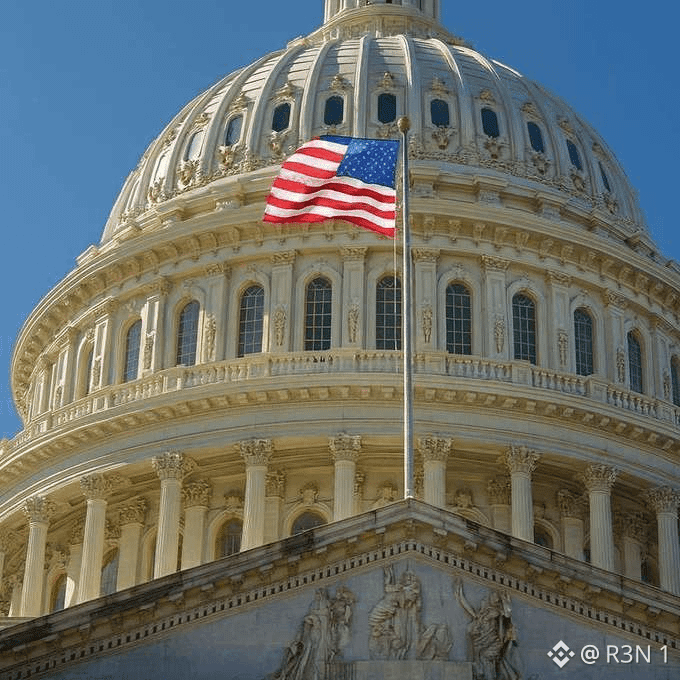
Senate Republicans released what they're calling the final draft late Sunday, incorporating 126 substantive changes Democrats specifically requested, a genuinely large number for a bill that already cleared Senate Banking 15-9 back in May. Trump agreed to most of the bipartisan Tillis-Gallego ethics proposal, including letting state attorneys general enforce conflict-of-interest rules on federal officials, a direct response to scrutiny over his own crypto holdings, which his disclosure put at over $1.4 billion in 2025 income.
The stablecoin side got its own concession. The draft adds a Treasury "circuit-breaker," letting the Treasury Secretary restrict stablecoin rewards if deposit flight from community banks becomes meaningful. Bernstein argues this protects the banking lobby too, without it, third-party platforms could keep offering full yield regardless of bank deposit impact.
What stands out to me is Bernstein's second argument, less about the bill's text and more about political incentive. They're flagging that Senate Democrats may not want to be cast as "anti-crypto" heading into midterms, given the crypto lobby has funded candidates on both sides. A read on positioning, not policy, genuinely hard to verify until votes are cast.
Kalshi odds climbed back above 30% on this news. Worth being honest, that's still well under even money, the market isn't calling this likely, just less unlikely than a week ago.
The open question is whether 126 concessions actually converts skeptical Democrats into yes votes, or whether ethics language was never the full sticking point, and deeper concerns over illicit finance and consumer protection provisions resurface once the ethics debate settles.
$ETH #Macro Insights# #BTC Price Analysis# $XRP

24
·
--
See translation
Most content that covers Omniston describes it as a cross-chain swap protocol. That description is accurate in the same way that describing a car as a metal box that moves is accurate. Technically correct. Almost completely unhelpful for understanding what makes it different from everything else in the cross-chain space.
The distinction that actually matters is intent versus instruction.
Traditional DEX execution is instruction-based. You tell the protocol exactly what to do, swap this specific token through this specific pool at this specific slippage tolerance. The protocol executes your instructions as literally as possible given the state of the chain at confirmation time. If your instructions were suboptimal, if market conditions changed between submission and execution, if a better route existed that your instructions didn't account for, the protocol executes what you said rather than what you wanted.
Omniston is intent-based. You express an outcome — I want to receive this asset on this chain in this amount, and a network of competing resolvers figures out how to deliver it. The user's job ends at expressing the intent. The resolver's job is finding the optimal path to fulfill it. The HTLC settlement structure ensures the resolver either delivers the stated outcome or both parties return to their starting position.
What this produces in practice is something specific that instruction-based execution doesn't produce. Quote certainty. The amount shown at confirmation is the amount that arrives because the resolver committed to delivering that specific outcome rather than executing instructions that approximate it. The execution either delivers what was quoted or it doesn't execute at all.
Most cross-chain explanations focus on the mechanism. The intent model is what actually changes the user experience.
👉 Explore Omniston →https://app.ston.fi/swap?mode=cross-chain
#Altcoin Season# $TRUMP #Altcoin Season# $PI
Most content that covers Omniston describes it as a cross-chain swap protocol. That description is accurate in the same way that describing a car as a metal box that moves is accurate. Technically correct. Almost completely unhelpful for understanding what makes it different from everything else in the cross-chain space.
The distinction that actually matters is intent versus instruction.
Traditional DEX execution is instruction-based. You tell the protocol exactly what to do, swap this specific token through this specific pool at this specific slippage tolerance. The protocol executes your instructions as literally as possible given the state of the chain at confirmation time. If your instructions were suboptimal, if market conditions changed between submission and execution, if a better route existed that your instructions didn't account for, the protocol executes what you said rather than what you wanted.
Omniston is intent-based. You express an outcome — I want to receive this asset on this chain in this amount, and a network of competing resolvers figures out how to deliver it. The user's job ends at expressing the intent. The resolver's job is finding the optimal path to fulfill it. The HTLC settlement structure ensures the resolver either delivers the stated outcome or both parties return to their starting position.
What this produces in practice is something specific that instruction-based execution doesn't produce. Quote certainty. The amount shown at confirmation is the amount that arrives because the resolver committed to delivering that specific outcome rather than executing instructions that approximate it. The execution either delivers what was quoted or it doesn't execute at all.
Most cross-chain explanations focus on the mechanism. The intent model is what actually changes the user experience.
👉 Explore Omniston →https://app.ston.fi/swap?mode=cross-chain
#Altcoin Season# $TRUMP #Altcoin Season# $PI
The distinction that actually matters is intent versus instruction.
Traditional DEX execution is instruction-based. You tell the protocol exactly what to do, swap this specific token through this specific pool at this specific slippage tolerance. The protocol executes your instructions as literally as possible given the state of the chain at confirmation time. If your instructions were suboptimal, if market conditions changed between submission and execution, if a better route existed that your instructions didn't account for, the protocol executes what you said rather than what you wanted.
Omniston is intent-based. You express an outcome — I want to receive this asset on this chain in this amount, and a network of competing resolvers figures out how to deliver it. The user's job ends at expressing the intent. The resolver's job is finding the optimal path to fulfill it. The HTLC settlement structure ensures the resolver either delivers the stated outcome or both parties return to their starting position.
What this produces in practice is something specific that instruction-based execution doesn't produce. Quote certainty. The amount shown at confirmation is the amount that arrives because the resolver committed to delivering that specific outcome rather than executing instructions that approximate it. The execution either delivers what was quoted or it doesn't execute at all.
Most cross-chain explanations focus on the mechanism. The intent model is what actually changes the user experience.
👉 Explore Omniston →https://app.ston.fi/swap?mode=cross-chain
#Altcoin Season# $TRUMP #Altcoin Season# $PI

36
·
--
See translation
A sitting president voluntarily accepting new ethics restrictions on crypto, while his own family runs a stablecoin, a memecoin, and a DeFi venture, is the kind of detail that usually gets buried. Here it's the headline.
Senate Republicans Lummis, Boozman, and Scott released the final 635 page text late Sunday, their last, best, and final offer before Tuesday's cloture vote. It folds in 126 changes Democrats requested over more than a year of talks, ethics as the centerpiece, reflecting most of the Tillis Gallego proposal: state attorneys general get enforcement authority, officials are banned from holding $15,000 plus equity in businesses drawing a plurality of revenue from token issuance in the past three years, with mandatory divestment or a blind trust. Penalties run $500,000 or 20% of transaction value, whichever is higher.
Trump reportedly agreed to these provisions voluntarily, notable given the scrutiny his family's crypto ventures have already drawn. The draft also gives Treasury authority to prevent deposit flight tied to stablecoins, and narrows BRCA protections to Bank Secrecy Act civil enforcement, removing language extending protection to criminal cases.
The mechanics matter as much as content. Cloture needs 60 votes, Republicans hold 53 seats, so at least seven Democrats or independents cross over. Prediction markets reportedly put passage odds around 35% as of Monday, highest since late July, worth flagging as a market estimate, not something reliable. Even if cloture passes, final passage and House action still have to fit a shrinking window before the midterms.
My honest read: the ethics concessions look like a genuine attempt to remove the actual sticking point, but concession doesn't guarantee seven votes show up on a single Tuesday afternoon.
What I'm watching: the actual cloture count at 2:15pm ET Tuesday, and whether Democrats treat this as the deal they negotiated or push for further changes regardless.
$BTC #BTC Price Analysis# $XAUt
A sitting president voluntarily accepting new ethics restrictions on crypto, while his own family runs a stablecoin, a memecoin, and a DeFi venture, is the kind of detail that usually gets buried. Here it's the headline.
Senate Republicans Lummis, Boozman, and Scott released the final 635 page text late Sunday, their last, best, and final offer before Tuesday's cloture vote. It folds in 126 changes Democrats requested over more than a year of talks, ethics as the centerpiece, reflecting most of the Tillis Gallego proposal: state attorneys general get enforcement authority, officials are banned from holding $15,000 plus equity in businesses drawing a plurality of revenue from token issuance in the past three years, with mandatory divestment or a blind trust. Penalties run $500,000 or 20% of transaction value, whichever is higher.
Trump reportedly agreed to these provisions voluntarily, notable given the scrutiny his family's crypto ventures have already drawn. The draft also gives Treasury authority to prevent deposit flight tied to stablecoins, and narrows BRCA protections to Bank Secrecy Act civil enforcement, removing language extending protection to criminal cases.
The mechanics matter as much as content. Cloture needs 60 votes, Republicans hold 53 seats, so at least seven Democrats or independents cross over. Prediction markets reportedly put passage odds around 35% as of Monday, highest since late July, worth flagging as a market estimate, not something reliable. Even if cloture passes, final passage and House action still have to fit a shrinking window before the midterms.
My honest read: the ethics concessions look like a genuine attempt to remove the actual sticking point, but concession doesn't guarantee seven votes show up on a single Tuesday afternoon.
What I'm watching: the actual cloture count at 2:15pm ET Tuesday, and whether Democrats treat this as the deal they negotiated or push for further changes regardless.
$BTC #BTC Price Analysis# $XAUt
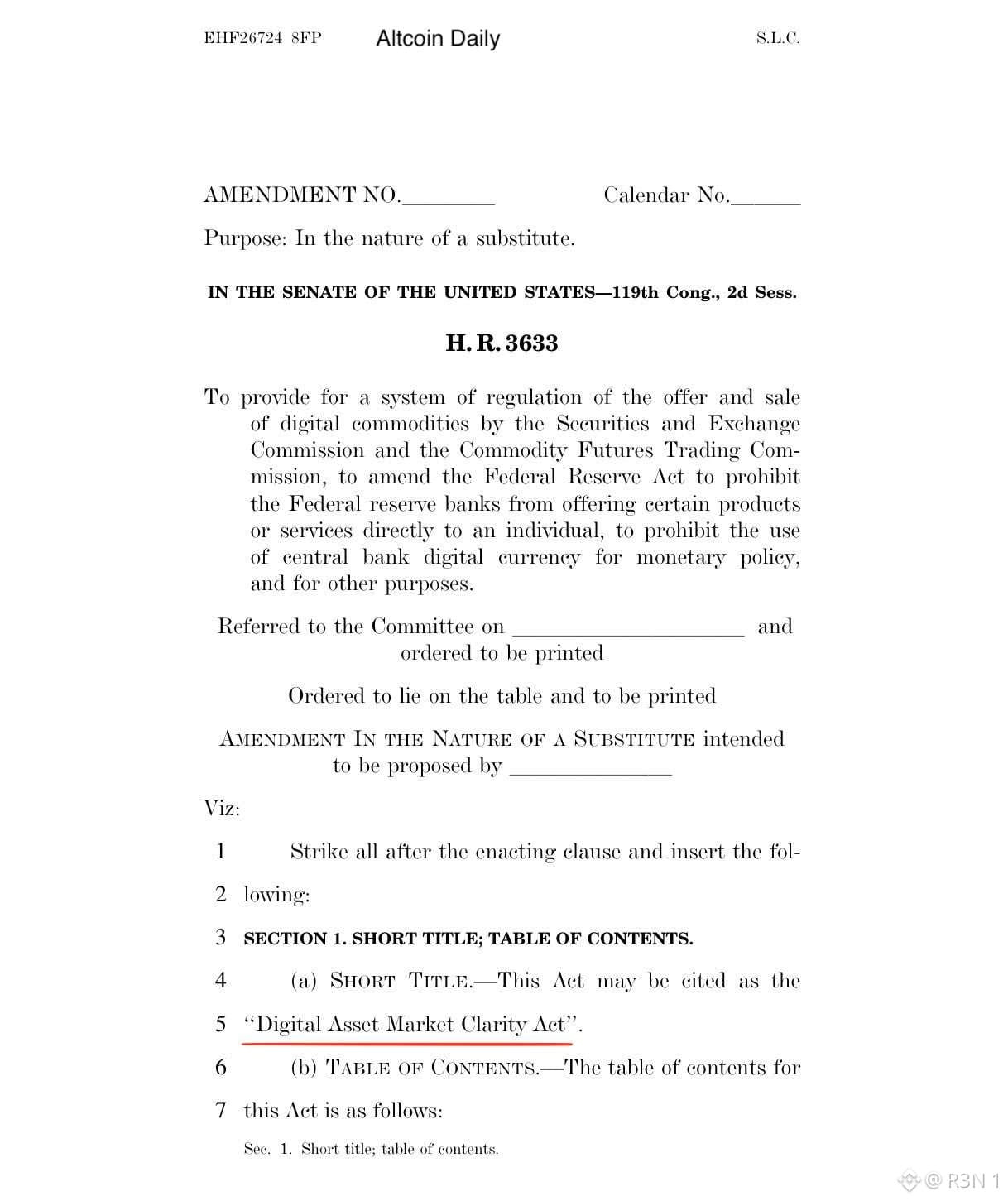
Senate Republicans Lummis, Boozman, and Scott released the final 635 page text late Sunday, their last, best, and final offer before Tuesday's cloture vote. It folds in 126 changes Democrats requested over more than a year of talks, ethics as the centerpiece, reflecting most of the Tillis Gallego proposal: state attorneys general get enforcement authority, officials are banned from holding $15,000 plus equity in businesses drawing a plurality of revenue from token issuance in the past three years, with mandatory divestment or a blind trust. Penalties run $500,000 or 20% of transaction value, whichever is higher.
Trump reportedly agreed to these provisions voluntarily, notable given the scrutiny his family's crypto ventures have already drawn. The draft also gives Treasury authority to prevent deposit flight tied to stablecoins, and narrows BRCA protections to Bank Secrecy Act civil enforcement, removing language extending protection to criminal cases.
The mechanics matter as much as content. Cloture needs 60 votes, Republicans hold 53 seats, so at least seven Democrats or independents cross over. Prediction markets reportedly put passage odds around 35% as of Monday, highest since late July, worth flagging as a market estimate, not something reliable. Even if cloture passes, final passage and House action still have to fit a shrinking window before the midterms.
My honest read: the ethics concessions look like a genuine attempt to remove the actual sticking point, but concession doesn't guarantee seven votes show up on a single Tuesday afternoon.
What I'm watching: the actual cloture count at 2:15pm ET Tuesday, and whether Democrats treat this as the deal they negotiated or push for further changes regardless.
$BTC #BTC Price Analysis# $XAUt
60
·
--
See translation
An FCA regulated exchange just plugged its entire tokenization engine into Aptos, and the first product live isn't a stock or a bond, it's a reinsurance fund. An unusual entry point worth understanding.
Archax, the UK's first FCA regulated digital securities exchange, broker, and custodian, has integrated with Aptos to bring over 100 regulated securities and real world assets onchain, spanning funds, equities, and debt instruments. First to launch is the MembersCap Tokenized Global Reinsurance Income Fund, MCM Fund I, with the Aptos Foundation serving as general partner. Small correction worth making, MembersCap originally launched this fund on Archax last July, this integration extends distribution to Aptos specifically, not a brand new product.
Reinsurance is a deliberate first choice, not an obvious one. It's insurance that insurance companies themselves buy, returns historically uncorrelated with broader markets, a different risk profile than tokenizing another treasury fund or equity, where most RWA activity has clustered so far.
Context matters too. Aptos already carries close to $1 billion in RWA backed assets and roughly $50 billion in monthly stablecoin volume, with BlackRock, Franklin Templeton, and Apollo already participating. Archax brings real credibility of its own, FCA authorization since 2020 and over $400 million already tokenized across bonds, equities, commodities, and funds elsewhere.
My honest read: this is a legitimate institutional grade integration, not a speculative RWA narrative play, regulatory backing and asset base on both sides are real. What I'd want before calling it transformative is actual capital flow into MCM Fund I, not just the announcement of access.
What I'm watching: which of the promised 100 plus assets actually follow this reinsurance fund onto Aptos, and on what timeline.
$APT #BTC Price Analysis# $BTC
An FCA regulated exchange just plugged its entire tokenization engine into Aptos, and the first product live isn't a stock or a bond, it's a reinsurance fund. An unusual entry point worth understanding.
Archax, the UK's first FCA regulated digital securities exchange, broker, and custodian, has integrated with Aptos to bring over 100 regulated securities and real world assets onchain, spanning funds, equities, and debt instruments. First to launch is the MembersCap Tokenized Global Reinsurance Income Fund, MCM Fund I, with the Aptos Foundation serving as general partner. Small correction worth making, MembersCap originally launched this fund on Archax last July, this integration extends distribution to Aptos specifically, not a brand new product.
Reinsurance is a deliberate first choice, not an obvious one. It's insurance that insurance companies themselves buy, returns historically uncorrelated with broader markets, a different risk profile than tokenizing another treasury fund or equity, where most RWA activity has clustered so far.
Context matters too. Aptos already carries close to $1 billion in RWA backed assets and roughly $50 billion in monthly stablecoin volume, with BlackRock, Franklin Templeton, and Apollo already participating. Archax brings real credibility of its own, FCA authorization since 2020 and over $400 million already tokenized across bonds, equities, commodities, and funds elsewhere.
My honest read: this is a legitimate institutional grade integration, not a speculative RWA narrative play, regulatory backing and asset base on both sides are real. What I'd want before calling it transformative is actual capital flow into MCM Fund I, not just the announcement of access.
What I'm watching: which of the promised 100 plus assets actually follow this reinsurance fund onto Aptos, and on what timeline.
$APT #BTC Price Analysis# $BTC
Archax, the UK's first FCA regulated digital securities exchange, broker, and custodian, has integrated with Aptos to bring over 100 regulated securities and real world assets onchain, spanning funds, equities, and debt instruments. First to launch is the MembersCap Tokenized Global Reinsurance Income Fund, MCM Fund I, with the Aptos Foundation serving as general partner. Small correction worth making, MembersCap originally launched this fund on Archax last July, this integration extends distribution to Aptos specifically, not a brand new product.
Reinsurance is a deliberate first choice, not an obvious one. It's insurance that insurance companies themselves buy, returns historically uncorrelated with broader markets, a different risk profile than tokenizing another treasury fund or equity, where most RWA activity has clustered so far.
Context matters too. Aptos already carries close to $1 billion in RWA backed assets and roughly $50 billion in monthly stablecoin volume, with BlackRock, Franklin Templeton, and Apollo already participating. Archax brings real credibility of its own, FCA authorization since 2020 and over $400 million already tokenized across bonds, equities, commodities, and funds elsewhere.
My honest read: this is a legitimate institutional grade integration, not a speculative RWA narrative play, regulatory backing and asset base on both sides are real. What I'd want before calling it transformative is actual capital flow into MCM Fund I, not just the announcement of access.
What I'm watching: which of the promised 100 plus assets actually follow this reinsurance fund onto Aptos, and on what timeline.
$APT #BTC Price Analysis# $BTC


83
·
--
See translation
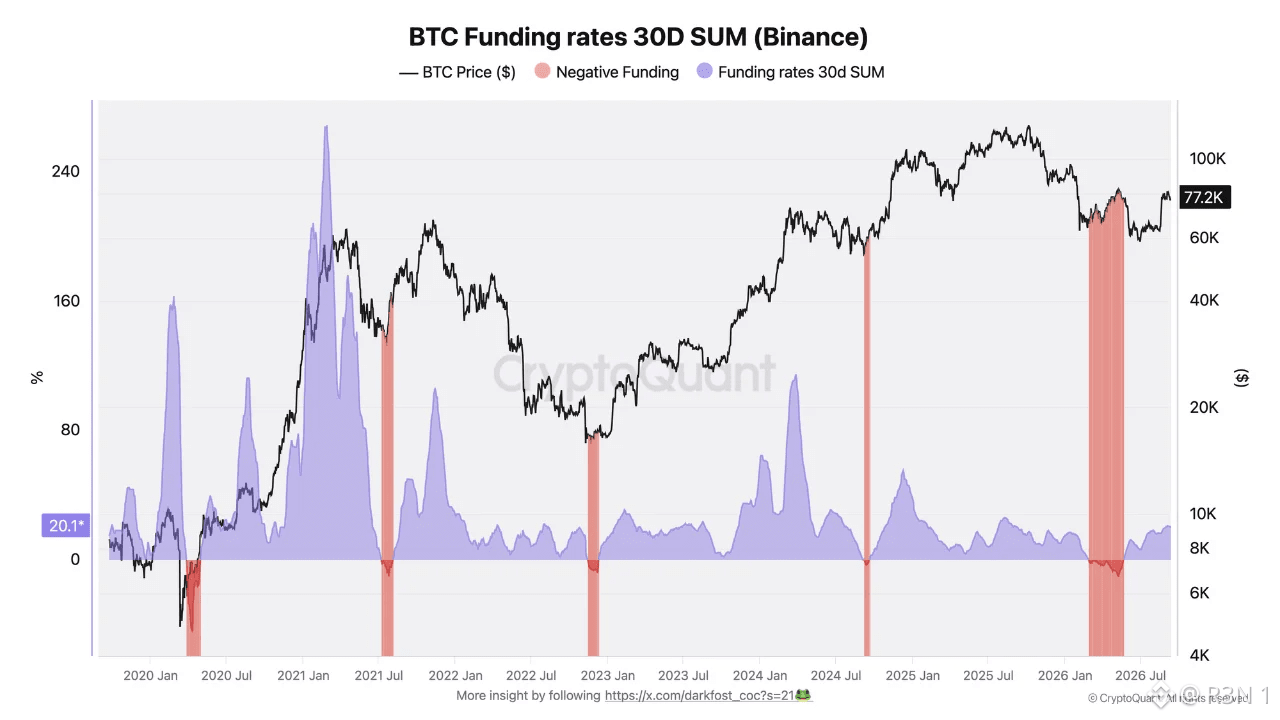
Bitcoin's 30 day funding rate sum on Binance has been climbing steadily since the end of May, and that gradual rebuild is actually the more useful signal than any single day's funding print. Funding rates are famously noisy day to day, whipping between extremes constantly, which is exactly why aggregating them into a monthly sum matters here. It filters the daily churn and reveals the underlying trend instead. Before this rebuild started, funding reflected one of the most bearish sentiment readings ever seen in Binance derivatives, following a 52% drawdown, shorts had piled up heavily during that disbelief phase. Here's the part I find genuinely interesting. That kind of extreme bearish consensus has shown up consistently near the end of corrections throughout this cycle, not randomly scattered. Heavy short buildup at the bottom, then a gradual funding rebuild driven by optimism settling back in slowly, that's the actual pattern, and it's playing out again right now. My honest read: this setup is a legitimate reason to pay attention, but I'd be careful calling it confirmation on its own. Funding rebuilding tells you derivatives positioning is shifting, it doesn't tell you spot demand is following. Separate questions, and this only really breaks the correction if spot demand actually joins the move. Where I'd push back on getting ahead of this: pattern recognition across past cycles is useful context, not a guarantee this resolves the same way. Each correction has had its own spot side story, and derivatives sentiment improving in isolation has led to false starts before. What I'm watching: whether this funding rebuild continues climbing alongside genuine spot buying, or whether it stalls out the way sentiment shifts sometimes do without spot demand actually confirming the move. $BTC #BTC Price Analysis# #Altcoin Season#
Bitcoin's 30 day funding rate sum on Binance has been climbing steadily since the end of May, and that gradual rebuild is actually the more useful signal than any single day's funding print. Funding rates are famously noisy day to day, whipping between extremes constantly, which is exactly why aggregating them into a monthly sum matters here. It filters the daily churn and reveals the underlying trend instead. Before this rebuild started, funding reflected one of the most bearish sentiment readings ever seen in Binance derivatives, following a 52% drawdown, shorts had piled up heavily during that disbelief phase. Here's the part I find genuinely interesting. That kind of extreme bearish consensus has shown up consistently near the end of corrections throughout this cycle, not randomly scattered. Heavy short buildup at the bottom, then a gradual funding rebuild driven by optimism settling back in slowly, that's the actual pattern, and it's playing out again right now. My honest read: this setup is a legitimate reason to pay attention, but I'd be careful calling it confirmation on its own. Funding rebuilding tells you derivatives positioning is shifting, it doesn't tell you spot demand is following. Separate questions, and this only really breaks the correction if spot demand actually joins the move. Where I'd push back on getting ahead of this: pattern recognition across past cycles is useful context, not a guarantee this resolves the same way. Each correction has had its own spot side story, and derivatives sentiment improving in isolation has led to false starts before. What I'm watching: whether this funding rebuild continues climbing alongside genuine spot buying, or whether it stalls out the way sentiment shifts sometimes do without spot demand actually confirming the move. $BTC #BTC Price Analysis# #Altcoin Season#
3
·
--
See translation
Solana's apps generated 16.9 times more revenue than Base's over the same 24 hours, and the interesting part isn't the multiple, it's what that multiple actually measures. Per DeFiLlama, Solana pulled in roughly $5.14 million in app revenue against Base's $304,000. This metric isolates fees generated by DEXs, launchpads, and trading platforms, deliberately excluding base-layer fees, so it's comparing how well each ecosystem's apps monetize users, not chain activity broadly. The trend behind that snapshot matters more than the single-day number. Solana's monthly app revenue went from $91 million in May to $143 million in August, a 57% jump in three months, driven mostly by high-frequency trading apps and meme launchpads that have made Solana home base. Base, despite Coinbase's backing and low transaction costs, hasn't converted its activity into comparable fee retention at the app layer. What stands out to me is this gap isn't really about brand recognition or cost per transaction, both of which favor Base on paper. It's the type of applications each chain attracted. High-throughput trading and speculative launchpad activity generates outsized fees per session in a way general-purpose L2 activity doesn't naturally replicate. Worth stating the counter-argument directly, app revenue concentrated in trading and launchpad fees is tied heavily to speculative volume and meme cycles, not necessarily durable utility. A slowdown in that activity could compress Solana's number faster than it would compress a more diversified revenue base, if Base ever builds one. The open question this keeps getting used to settle isn't which chain wins today, it's whether Solana's lead reflects a structural advantage in app monetization, or just where the current speculative cycle happens to be concentrated. $SOL #Macro Insights# #Altcoin Season# #BTC Price Analysis#
Solana's apps generated 16.9 times more revenue than Base's over the same 24 hours, and the interesting part isn't the multiple, it's what that multiple actually measures. Per DeFiLlama, Solana pulled in roughly $5.14 million in app revenue against Base's $304,000. This metric isolates fees generated by DEXs, launchpads, and trading platforms, deliberately excluding base-layer fees, so it's comparing how well each ecosystem's apps monetize users, not chain activity broadly. The trend behind that snapshot matters more than the single-day number. Solana's monthly app revenue went from $91 million in May to $143 million in August, a 57% jump in three months, driven mostly by high-frequency trading apps and meme launchpads that have made Solana home base. Base, despite Coinbase's backing and low transaction costs, hasn't converted its activity into comparable fee retention at the app layer. What stands out to me is this gap isn't really about brand recognition or cost per transaction, both of which favor Base on paper. It's the type of applications each chain attracted. High-throughput trading and speculative launchpad activity generates outsized fees per session in a way general-purpose L2 activity doesn't naturally replicate. Worth stating the counter-argument directly, app revenue concentrated in trading and launchpad fees is tied heavily to speculative volume and meme cycles, not necessarily durable utility. A slowdown in that activity could compress Solana's number faster than it would compress a more diversified revenue base, if Base ever builds one. The open question this keeps getting used to settle isn't which chain wins today, it's whether Solana's lead reflects a structural advantage in app monetization, or just where the current speculative cycle happens to be concentrated. $SOL #Macro Insights# #Altcoin Season# #BTC Price Analysis#
4
·
--
See translation
Circle's CEO just told everyone which app moves the most of his own stablecoin, and it's not a bank, a payment app, or even a CEX. It's a permissionless DEX on Base. Jeremy Allaire singled out Aerodrome as the leading USDC transfer venue among tracked crypto apps, and the numbers back it up. Per Coin Metrics, Aerodrome accounts for roughly 50% of Base's USDC adjusted transfer volume during peak periods. One pool alone, WETH/USDC, drives about 32% of all adjusted USDC activity on the entire chain. What stands out to me isn't the volume number, it's who's saying it. Circle has spent years building relationships with regulators, banks, and payment companies, the exact institutions that historically treated DeFi as a liability rather than infrastructure. A CEO in that position spotlighting a permissionless DEX says something about how far decentralized rails have absorbed real financial activity. The mechanism behind Aerodrome's dominance is a real flywheel, not luck. Vote-escrow model, AERO holders lock tokens to direct emissions toward specific pools, protocols bribe voters for deeper liquidity, that liquidity pulls more volume, more volume generates more fees, which makes AERO more valuable and attracts more voters. That loop is why one DEX can concentrate half a major chain's stablecoin flow. Worth flagging the risk honestly, this concentration cuts both ways. If half of Base's peak USDC flow runs through one protocol, a technical failure, exploit, or governance dispute at Aerodrome doesn't stay contained, it ripples across the entire chain's liquidity picture. Efficiency and fragility tend to grow together in a flywheel this dominant. The open question is whether this concentration deepens further as Base grows, or eventually draws competing DEXs willing to out-bribe Aerodrome's own voters for that same flow. $ETH #BTC Price Analysis# #Altcoin Season#
Circle's CEO just told everyone which app moves the most of his own stablecoin, and it's not a bank, a payment app, or even a CEX. It's a permissionless DEX on Base. Jeremy Allaire singled out Aerodrome as the leading USDC transfer venue among tracked crypto apps, and the numbers back it up. Per Coin Metrics, Aerodrome accounts for roughly 50% of Base's USDC adjusted transfer volume during peak periods. One pool alone, WETH/USDC, drives about 32% of all adjusted USDC activity on the entire chain. What stands out to me isn't the volume number, it's who's saying it. Circle has spent years building relationships with regulators, banks, and payment companies, the exact institutions that historically treated DeFi as a liability rather than infrastructure. A CEO in that position spotlighting a permissionless DEX says something about how far decentralized rails have absorbed real financial activity. The mechanism behind Aerodrome's dominance is a real flywheel, not luck. Vote-escrow model, AERO holders lock tokens to direct emissions toward specific pools, protocols bribe voters for deeper liquidity, that liquidity pulls more volume, more volume generates more fees, which makes AERO more valuable and attracts more voters. That loop is why one DEX can concentrate half a major chain's stablecoin flow. Worth flagging the risk honestly, this concentration cuts both ways. If half of Base's peak USDC flow runs through one protocol, a technical failure, exploit, or governance dispute at Aerodrome doesn't stay contained, it ripples across the entire chain's liquidity picture. Efficiency and fragility tend to grow together in a flywheel this dominant. The open question is whether this concentration deepens further as Base grows, or eventually draws competing DEXs willing to out-bribe Aerodrome's own voters for that same flow. $ETH #BTC Price Analysis# #Altcoin Season#
4
·
--
See translation
5 million baht a day, roughly $150,000, the proposed ceiling Thailand's SEC just put on stablecoin transfers through licensed platforms. The interesting part isn't the cap, it's what it doesn't touch. The draft rules, board approved September 3, consultation open until September 25, require any deposit or withdrawal at an SEC supervised operator to match verified ownership, no more sending to a family member's or partner's wallet through a regulated platform. That plus the daily cap applies to exchange and broker flows specifically. Peer to peer transfers between self hosted wallets that never touch a licensed Thai firm stay outside this framework, at least as drafted. That distinction matters more than the headline number. Not a stablecoin cap the way it might first read, it's a chokepoint placed at the regulated on ramp and off ramp, not on stablecoins as an asset class. Users relying on licensed exchanges to move larger sums to others would likely get pushed toward banking rails or unregulated P2P paths, a real behavioral shift worth watching. Exemptions exist for Travel Rule compliant operator to operator flows, certain business transfers, and Bank of Thailand authorized institutions, though ownership verification still applies. Timing lines up with Travel Rule obligations coming into force early 2027. My honest read: this looks like Thailand building infrastructure for surveillance at the regulated edge rather than restricting stablecoin usage broadly, a meaningfully different approach than an outright cap suggests. Whether that pushes real volume toward less regulated channels instead of reducing illicit flow is the actual open question. What I'm watching: whether the cap or exemptions shift after consultation closes September 25, and how strictly enforcement distinguishes platform flows from P2P activity once this takes effect. $BTC #BTC Price Analysis# #Altcoin Season# $XRP
5 million baht a day, roughly $150,000, the proposed ceiling Thailand's SEC just put on stablecoin transfers through licensed platforms. The interesting part isn't the cap, it's what it doesn't touch. The draft rules, board approved September 3, consultation open until September 25, require any deposit or withdrawal at an SEC supervised operator to match verified ownership, no more sending to a family member's or partner's wallet through a regulated platform. That plus the daily cap applies to exchange and broker flows specifically. Peer to peer transfers between self hosted wallets that never touch a licensed Thai firm stay outside this framework, at least as drafted. That distinction matters more than the headline number. Not a stablecoin cap the way it might first read, it's a chokepoint placed at the regulated on ramp and off ramp, not on stablecoins as an asset class. Users relying on licensed exchanges to move larger sums to others would likely get pushed toward banking rails or unregulated P2P paths, a real behavioral shift worth watching. Exemptions exist for Travel Rule compliant operator to operator flows, certain business transfers, and Bank of Thailand authorized institutions, though ownership verification still applies. Timing lines up with Travel Rule obligations coming into force early 2027. My honest read: this looks like Thailand building infrastructure for surveillance at the regulated edge rather than restricting stablecoin usage broadly, a meaningfully different approach than an outright cap suggests. Whether that pushes real volume toward less regulated channels instead of reducing illicit flow is the actual open question. What I'm watching: whether the cap or exemptions shift after consultation closes September 25, and how strictly enforcement distinguishes platform flows from P2P activity once this takes effect. $BTC #BTC Price Analysis# #Altcoin Season# $XRP
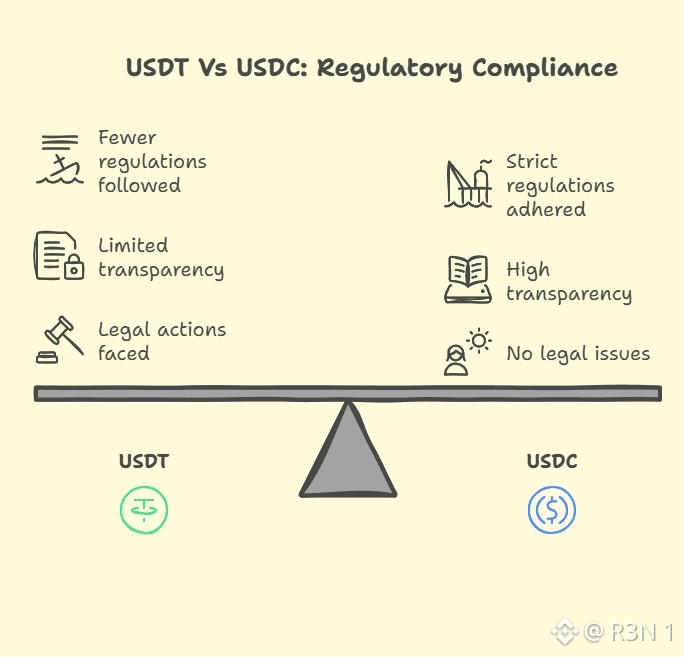

2
·
--
See translation
2,768 transactions in a single ledger, several nearby ledgers clearing 2,000 plus each, and consensus never wobbled, ledger closes held around 3.8 seconds throughout. A genuinely notable stress test result, but the source of the load matters more than the headline number.
Per XRPL Foundation director Hussein Zangana, most of this volume was tiny 1 drop payments circulating among roughly 20 accounts, essentially bot driven probing traffic, not organic usage. Worth being precise here. This is a real technical achievement, the network processed dense synthetic load without falling behind or forking, but it's a proof of ceiling, not a proof of demand.
That gap matters because separate recent data has shown day to day ledger activity actually running lower in some periods. Throughput capacity and organic usage aren't the same measurement, and conflating them overstates what this demonstrates about real world adoption.
There's real protocol development happening alongside this too. The fixCleanup3_3_0 amendment activated recently, correcting issues across AMMs, vaults, lending, and Checks, and making previously optional fixes mandatory network wide. Additional lending and vault related amendments are still in voting, which could meaningfully expand institutional credit and DeFi activity on XRPL if adopted.
My honest read: this record is a fair positive signal about XRPL's technical headroom, low fees and fast closes held up under genuine stress. But I'd treat headline TPS as background context, not the metric that matters going forward.
What I'm watching: organic active account growth, stablecoin and tokenized volume on XRPL, and whether validators stay upgraded as these lending amendments move toward activation, since that's what turns this into evidence of real readiness rather than an isolated stress event.
$XRP #Meme Alpha# #Meme Alpha#
2,768 transactions in a single ledger, several nearby ledgers clearing 2,000 plus each, and consensus never wobbled, ledger closes held around 3.8 seconds throughout. A genuinely notable stress test result, but the source of the load matters more than the headline number.
Per XRPL Foundation director Hussein Zangana, most of this volume was tiny 1 drop payments circulating among roughly 20 accounts, essentially bot driven probing traffic, not organic usage. Worth being precise here. This is a real technical achievement, the network processed dense synthetic load without falling behind or forking, but it's a proof of ceiling, not a proof of demand.
That gap matters because separate recent data has shown day to day ledger activity actually running lower in some periods. Throughput capacity and organic usage aren't the same measurement, and conflating them overstates what this demonstrates about real world adoption.
There's real protocol development happening alongside this too. The fixCleanup3_3_0 amendment activated recently, correcting issues across AMMs, vaults, lending, and Checks, and making previously optional fixes mandatory network wide. Additional lending and vault related amendments are still in voting, which could meaningfully expand institutional credit and DeFi activity on XRPL if adopted.
My honest read: this record is a fair positive signal about XRPL's technical headroom, low fees and fast closes held up under genuine stress. But I'd treat headline TPS as background context, not the metric that matters going forward.
What I'm watching: organic active account growth, stablecoin and tokenized volume on XRPL, and whether validators stay upgraded as these lending amendments move toward activation, since that's what turns this into evidence of real readiness rather than an isolated stress event.
$XRP #Meme Alpha# #Meme Alpha#
Per XRPL Foundation director Hussein Zangana, most of this volume was tiny 1 drop payments circulating among roughly 20 accounts, essentially bot driven probing traffic, not organic usage. Worth being precise here. This is a real technical achievement, the network processed dense synthetic load without falling behind or forking, but it's a proof of ceiling, not a proof of demand.
That gap matters because separate recent data has shown day to day ledger activity actually running lower in some periods. Throughput capacity and organic usage aren't the same measurement, and conflating them overstates what this demonstrates about real world adoption.
There's real protocol development happening alongside this too. The fixCleanup3_3_0 amendment activated recently, correcting issues across AMMs, vaults, lending, and Checks, and making previously optional fixes mandatory network wide. Additional lending and vault related amendments are still in voting, which could meaningfully expand institutional credit and DeFi activity on XRPL if adopted.
My honest read: this record is a fair positive signal about XRPL's technical headroom, low fees and fast closes held up under genuine stress. But I'd treat headline TPS as background context, not the metric that matters going forward.
What I'm watching: organic active account growth, stablecoin and tokenized volume on XRPL, and whether validators stay upgraded as these lending amendments move toward activation, since that's what turns this into evidence of real readiness rather than an isolated stress event.
$XRP #Meme Alpha# #Meme Alpha#

2
·
--
See translation
One paragraph is standing between the CLARITY Act and a Senate floor vote, and Trump personally called advisers in Friday to argue about it. Two days later, per Politico, that paragraph hasn't changed.
The Senate holds a cloture vote Tuesday, September 15, at 2:15pm Eastern, on the motion to proceed to H.R. 3633, the Digital Asset Market CLARITY Act. Cloture needs 60 votes, Republicans hold 53, meaning at least seven Democrats have to cross over. The sticking point is narrow but consequential, ethics language barring officials and spouses from issuing digital assets, but as drafted, exempts their children, with a sunset clause ending in 2029.
Democrats, including Elizabeth Warren and Adam Schiff, have flagged this as insufficient given Trump family crypto interests reportedly worth around $2.3 billion.
What's actually happened is limited. Trump met advisers Friday, no new text followed, nobody's confirmed who attended or what was discussed, and neither the White House nor Senate negotiators have issued a readout. Patrick Witt, the White House's crypto policy adviser, hasn't said what changed either.
My honest read: this is the same conflict that's stalled CLARITY for months, a sitting president negotiating ethics rules meant to govern his own family's crypto exposure, now compressed into a weekend before a real deadline. Senator Tillis put it plainly, without White House movement here, this fails.
Where I'd push back on assuming this resolves cleanly either way: Tuesday's vote is procedural, not final passage, and a closed door meeting producing no visible text change in two days isn't strong evidence a deal is close, or that talks have collapsed.
What I'm watching: whether any revised language actually surfaces before Tuesday, and whether seven Democrats are willing to move on the current draft as is.
$BTC #BTC Price Analysis# #CLARITYAct $XRP
One paragraph is standing between the CLARITY Act and a Senate floor vote, and Trump personally called advisers in Friday to argue about it. Two days later, per Politico, that paragraph hasn't changed.
The Senate holds a cloture vote Tuesday, September 15, at 2:15pm Eastern, on the motion to proceed to H.R. 3633, the Digital Asset Market CLARITY Act. Cloture needs 60 votes, Republicans hold 53, meaning at least seven Democrats have to cross over. The sticking point is narrow but consequential, ethics language barring officials and spouses from issuing digital assets, but as drafted, exempts their children, with a sunset clause ending in 2029.
Democrats, including Elizabeth Warren and Adam Schiff, have flagged this as insufficient given Trump family crypto interests reportedly worth around $2.3 billion.
What's actually happened is limited. Trump met advisers Friday, no new text followed, nobody's confirmed who attended or what was discussed, and neither the White House nor Senate negotiators have issued a readout. Patrick Witt, the White House's crypto policy adviser, hasn't said what changed either.
My honest read: this is the same conflict that's stalled CLARITY for months, a sitting president negotiating ethics rules meant to govern his own family's crypto exposure, now compressed into a weekend before a real deadline. Senator Tillis put it plainly, without White House movement here, this fails.
Where I'd push back on assuming this resolves cleanly either way: Tuesday's vote is procedural, not final passage, and a closed door meeting producing no visible text change in two days isn't strong evidence a deal is close, or that talks have collapsed.
What I'm watching: whether any revised language actually surfaces before Tuesday, and whether seven Democrats are willing to move on the current draft as is.
$BTC #BTC Price Analysis# #CLARITYAct $XRP
The Senate holds a cloture vote Tuesday, September 15, at 2:15pm Eastern, on the motion to proceed to H.R. 3633, the Digital Asset Market CLARITY Act. Cloture needs 60 votes, Republicans hold 53, meaning at least seven Democrats have to cross over. The sticking point is narrow but consequential, ethics language barring officials and spouses from issuing digital assets, but as drafted, exempts their children, with a sunset clause ending in 2029.
Democrats, including Elizabeth Warren and Adam Schiff, have flagged this as insufficient given Trump family crypto interests reportedly worth around $2.3 billion.
What's actually happened is limited. Trump met advisers Friday, no new text followed, nobody's confirmed who attended or what was discussed, and neither the White House nor Senate negotiators have issued a readout. Patrick Witt, the White House's crypto policy adviser, hasn't said what changed either.
My honest read: this is the same conflict that's stalled CLARITY for months, a sitting president negotiating ethics rules meant to govern his own family's crypto exposure, now compressed into a weekend before a real deadline. Senator Tillis put it plainly, without White House movement here, this fails.
Where I'd push back on assuming this resolves cleanly either way: Tuesday's vote is procedural, not final passage, and a closed door meeting producing no visible text change in two days isn't strong evidence a deal is close, or that talks have collapsed.
What I'm watching: whether any revised language actually surfaces before Tuesday, and whether seven Democrats are willing to move on the current draft as is.
$BTC #BTC Price Analysis# #CLARITYAct $XRP
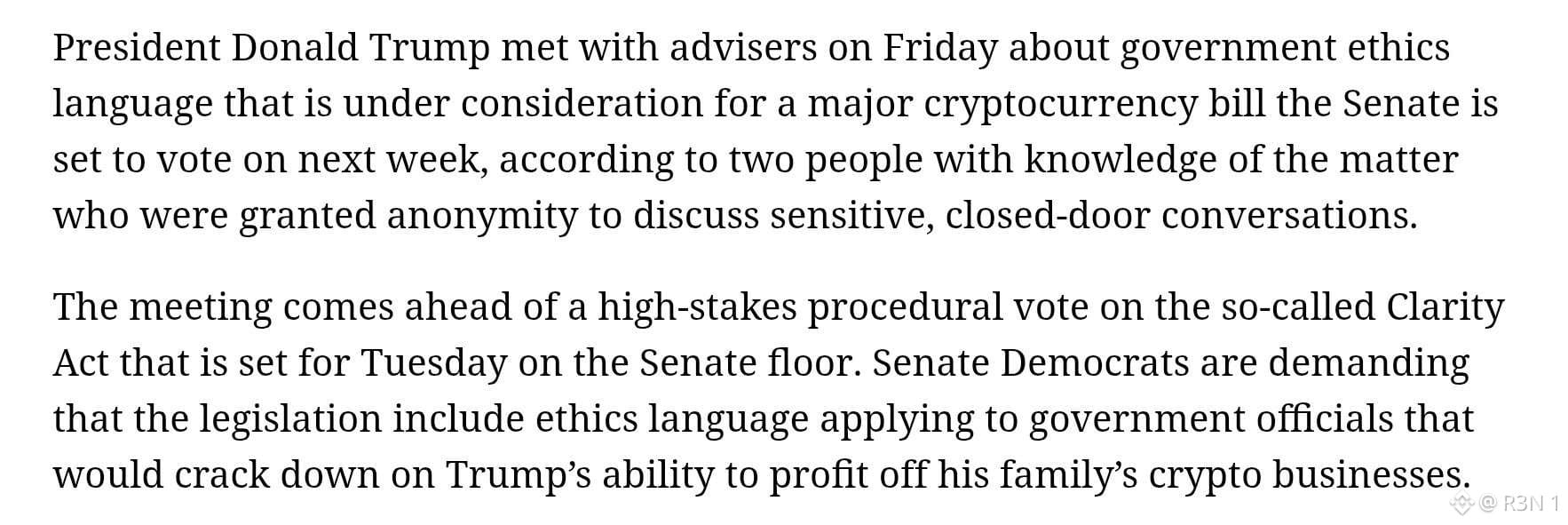
·
--
See translation
Diesel just crossed $6 a gallon nationally for the first time ever, and if that sounds unrelated to crypto, it isn't, not once you follow where the pressure actually goes. The record itself is real. AAA put the national average at $6.05 to $6.06 on September 11, up from $3.70 before the U.S. Iran conflict began in late February, driven by Strait of Hormuz disruption plus a Russian diesel export ban following Ukrainian strikes on refineries. Diesel touches nearly everything shipped, so this isn't contained to trucking, it feeds directly into broader inflation readings. Here's the crypto relevant part. Sticky, energy driven inflation is exactly the input that keeps the Fed cautious on rate cuts, and rate expectations have been one of the more reliable macro drivers of risk asset positioning all year, crypto included. If diesel keeps pushing headline inflation higher into the next CPI print, that's another data point arguing for a more hawkish Fed stance, historically not friendly to crypto risk appetite. There's a narrower angle too, honestly a smaller factor, not the main story. Off grid Bitcoin mining operations relying on diesel generators, common in remote or stranded energy setups, face rising input costs directly from this, squeezing margins for that subset of miners more than grid connected operations. My honest read: the diesel headline isn't crypto news in itself, it's a macro pressure point flowing into crypto indirectly through inflation expectations and Fed policy, the same channel driving BTC's macro sensitivity all year. Treating it as directly bullish or bearish for any coin would overreach what the connection supports. What I'm watching: whether this feeds into the next CPI print meaningfully, and whether that shows up in how crypto trades around the Fed's next rate decision. $BTC #BTC Price Analysis# #Altcoin Season# $ETH
Diesel just crossed $6 a gallon nationally for the first time ever, and if that sounds unrelated to crypto, it isn't, not once you follow where the pressure actually goes. The record itself is real. AAA put the national average at $6.05 to $6.06 on September 11, up from $3.70 before the U.S. Iran conflict began in late February, driven by Strait of Hormuz disruption plus a Russian diesel export ban following Ukrainian strikes on refineries. Diesel touches nearly everything shipped, so this isn't contained to trucking, it feeds directly into broader inflation readings. Here's the crypto relevant part. Sticky, energy driven inflation is exactly the input that keeps the Fed cautious on rate cuts, and rate expectations have been one of the more reliable macro drivers of risk asset positioning all year, crypto included. If diesel keeps pushing headline inflation higher into the next CPI print, that's another data point arguing for a more hawkish Fed stance, historically not friendly to crypto risk appetite. There's a narrower angle too, honestly a smaller factor, not the main story. Off grid Bitcoin mining operations relying on diesel generators, common in remote or stranded energy setups, face rising input costs directly from this, squeezing margins for that subset of miners more than grid connected operations. My honest read: the diesel headline isn't crypto news in itself, it's a macro pressure point flowing into crypto indirectly through inflation expectations and Fed policy, the same channel driving BTC's macro sensitivity all year. Treating it as directly bullish or bearish for any coin would overreach what the connection supports. What I'm watching: whether this feeds into the next CPI print meaningfully, and whether that shows up in how crypto trades around the Fed's next rate decision. $BTC #BTC Price Analysis# #Altcoin Season# $ETH

8
Log in to explore more content
Join global crypto users on Binance Square
⚡️ Get latest and useful information about crypto.
💬 Trusted by the world’s largest crypto exchange.
👍 Discover real insights from verified creators.
Email / Phone number
Trending Topics
FedRateWatch
406,189 views
2,286 Discussing
Share & Win Traffic Reward in our Trending Hashtag Campaign
✨Topic: FOMC September, What's The Fed's Next Move?
👉How to Join:
Publish a short post or article with hashtag #FedRateWatch
Create content based on the below angles:
- August core CPI rose 0.3% month-over-month, and the odds of a 25bp hike this week are now close to 90%. Do you anticipate a rate hike this week? Is it a one-off, or the start of a longer hiking cycle?
- If the hike lands, how does it play out for BTC, tech stocks, and gold? Bullish or bearish?
- How are you planning to trade next? Share your BTC, stocks or gold trade/holdings with our trade sharing widget.
⏰Campaign Period:
- 2026-09-15 11:00 - 2026-09-17 3:00 UTC
🎁Reward:
- Qualified posts that comply with the above guidelines and contain more than 100 words will be reviewed and may receive a random traffic boost of 500 to 3,000 views. You will receive a notification from your feed secretary if your post is selected.
- Get a chance to have your article featured on Binance Square Official
Need ideas for your post? Visit the topic page #FedRateWatch or the Square Guide on How to Post for Better Reach.
Binance Square Official
·352 Likes
·711.4k views
BitcoinSlidesTo$76000
9,761 views
91 Discussing
BitcoinReboundsTo$79K
56,696 views
387 Discussing