

Mrpeter0
320 Posts

Mrpeter0
Report
Block User
$TRX $BNB $SUI
Open Trade
Occasional Trader
2.2 Years
510 Following
201 Followers
147 Liked
Posts
Portfolio
All
Quotes
Videos
·
--
See translation
The more important shift in creator monetization is not simply adding another payment option. It is about giving creators a more direct relationship with the people who fund their work.
The model described by @trondao focuses on removing intermediaries from that relationship through borderless tips, subscriptions and direct settlement into self-custodial wallets. That changes the flow of value: instead of monetization depending entirely on a platform controlling the payment channel, creators can receive funds directly.
The micro-tipping element is particularly relevant for digital art, music and writing because smaller payments can support forms of content that may not fit traditional subscription models. Combined with direct audience ownership, the broader idea is to make monetization more flexible rather than relying on a single revenue mechanism.
The proposed next steps also show where this could become more useful. Native payment paywalls could give independent Web3 media outlets a direct way to monetize access, while automated royalty-splitting contracts could simplify how revenue is distributed among collaborators. Social tipping across messaging platforms would push the model beyond dedicated creator platforms and closer to everyday communication.
There is still an important limitation in evaluating the model from the information provided. No figures are given for creator adoption, transaction volume, average tip size, subscription revenue or the actual reduction in intermediary costs.
That distinction matters. The infrastructure can make direct monetization possible, but its real success ultimately depends on whether creators and audiences actually adopt it at scale.
My takeaway is that @trondao's strongest proposition here is not simply crypto payments. It is the attempt to give creators more control over how audience attention becomes income, with programmable payments potentially making that relationship more direct and transparent.
@JustinSun @TRONDAO #TRONEcoStar
The more important shift in creator monetization is not simply adding another payment option. It is about giving creators a more direct relationship with the people who fund their work.
The model described by @trondao focuses on removing intermediaries from that relationship through borderless tips, subscriptions and direct settlement into self-custodial wallets. That changes the flow of value: instead of monetization depending entirely on a platform controlling the payment channel, creators can receive funds directly.
The micro-tipping element is particularly relevant for digital art, music and writing because smaller payments can support forms of content that may not fit traditional subscription models. Combined with direct audience ownership, the broader idea is to make monetization more flexible rather than relying on a single revenue mechanism.
The proposed next steps also show where this could become more useful. Native payment paywalls could give independent Web3 media outlets a direct way to monetize access, while automated royalty-splitting contracts could simplify how revenue is distributed among collaborators. Social tipping across messaging platforms would push the model beyond dedicated creator platforms and closer to everyday communication.
There is still an important limitation in evaluating the model from the information provided. No figures are given for creator adoption, transaction volume, average tip size, subscription revenue or the actual reduction in intermediary costs.
That distinction matters. The infrastructure can make direct monetization possible, but its real success ultimately depends on whether creators and audiences actually adopt it at scale.
My takeaway is that @trondao's strongest proposition here is not simply crypto payments. It is the attempt to give creators more control over how audience attention becomes income, with programmable payments potentially making that relationship more direct and transparent.
@Justin Sun孙宇晨 @TRON DAO #TRONEcoStar
The model described by @trondao focuses on removing intermediaries from that relationship through borderless tips, subscriptions and direct settlement into self-custodial wallets. That changes the flow of value: instead of monetization depending entirely on a platform controlling the payment channel, creators can receive funds directly.
The micro-tipping element is particularly relevant for digital art, music and writing because smaller payments can support forms of content that may not fit traditional subscription models. Combined with direct audience ownership, the broader idea is to make monetization more flexible rather than relying on a single revenue mechanism.
The proposed next steps also show where this could become more useful. Native payment paywalls could give independent Web3 media outlets a direct way to monetize access, while automated royalty-splitting contracts could simplify how revenue is distributed among collaborators. Social tipping across messaging platforms would push the model beyond dedicated creator platforms and closer to everyday communication.
There is still an important limitation in evaluating the model from the information provided. No figures are given for creator adoption, transaction volume, average tip size, subscription revenue or the actual reduction in intermediary costs.
That distinction matters. The infrastructure can make direct monetization possible, but its real success ultimately depends on whether creators and audiences actually adopt it at scale.
My takeaway is that @trondao's strongest proposition here is not simply crypto payments. It is the attempt to give creators more control over how audience attention becomes income, with programmable payments potentially making that relationship more direct and transparent.
@Justin Sun孙宇晨 @TRON DAO #TRONEcoStar

1
1
34
·
--
See translation
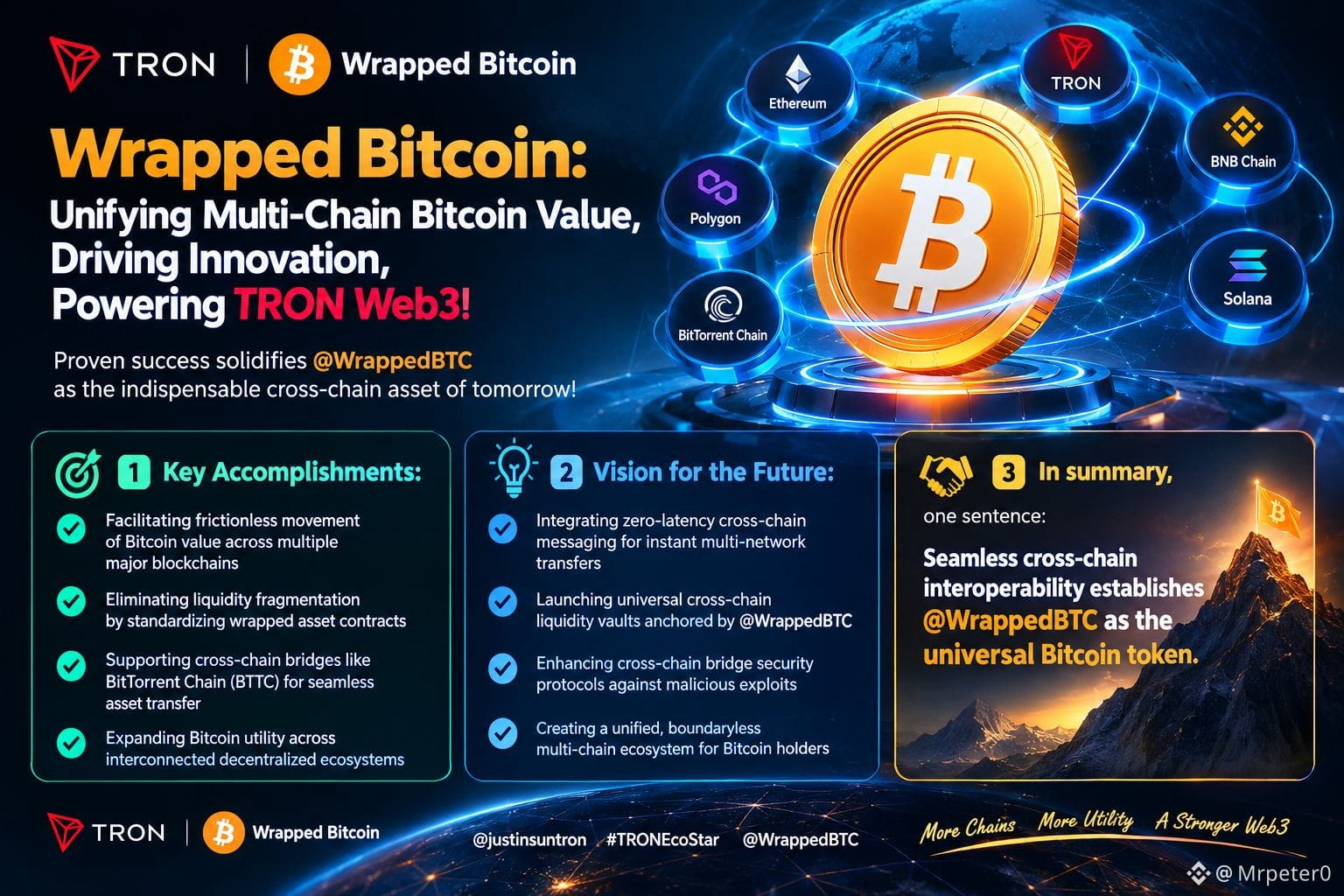
@WrappedBTC is positioned around moving Bitcoin value across major blockchains while addressing one of the biggest structural problems in cross-chain markets: liquidity fragmentation. Standardized wrapped asset contracts can make Bitcoin easier to use across different decentralized ecosystems, while support for bridges such as BitTorrent Chain creates another route for moving that value between networks.
That matters because Bitcoin’s utility is no longer limited to holding the native asset on its own network. When represented across interconnected chains, Bitcoin can potentially participate in DeFi, liquidity systems and other Web3 applications without requiring users to abandon their Bitcoin exposure.
The future direction outlined here is equally important, particularly around cross-chain messaging, universal liquidity vaults and stronger bridge security. Faster communication between networks could reduce transfer friction, while better security remains essential because every additional bridge or interoperability layer introduces another point that needs to be trusted and protected.
At the same time, the claims should be viewed with some caution. Terms such as “zero-latency,” “universal liquidity” and “boundaryless” describe the intended direction rather than measurable outcomes presented in the information above. There are also no specific transaction volumes, liquidity figures, adoption numbers or security metrics here to quantify how large the current impact actually is.
So the stronger argument is not that Wrapped Bitcoin has already unified Bitcoin liquidity across every chain, but that its cross-chain model addresses a real infrastructure problem: making Bitcoin more interoperable without leaving its value isolated within a single ecosystem.
The takeaway is simple: the long-term value of will depend less on the idea of wrapping Bitcoin and more on how efficiently, securely and consistently that Bitcoin liquidity can move across Web3.
@JustinSun @TRONDAO #TRONEcoStar
@WrappedBTC is positioned around moving Bitcoin value across major blockchains while addressing one of the biggest structural problems in cross-chain markets: liquidity fragmentation. Standardized wrapped asset contracts can make Bitcoin easier to use across different decentralized ecosystems, while support for bridges such as BitTorrent Chain creates another route for moving that value between networks.
That matters because Bitcoin’s utility is no longer limited to holding the native asset on its own network. When represented across interconnected chains, Bitcoin can potentially participate in DeFi, liquidity systems and other Web3 applications without requiring users to abandon their Bitcoin exposure.
The future direction outlined here is equally important, particularly around cross-chain messaging, universal liquidity vaults and stronger bridge security. Faster communication between networks could reduce transfer friction, while better security remains essential because every additional bridge or interoperability layer introduces another point that needs to be trusted and protected.
At the same time, the claims should be viewed with some caution. Terms such as “zero-latency,” “universal liquidity” and “boundaryless” describe the intended direction rather than measurable outcomes presented in the information above. There are also no specific transaction volumes, liquidity figures, adoption numbers or security metrics here to quantify how large the current impact actually is.
So the stronger argument is not that Wrapped Bitcoin has already unified Bitcoin liquidity across every chain, but that its cross-chain model addresses a real infrastructure problem: making Bitcoin more interoperable without leaving its value isolated within a single ecosystem.
The takeaway is simple: the long-term value of will depend less on the idea of wrapping Bitcoin and more on how efficiently, securely and consistently that Bitcoin liquidity can move across Web3.
@Justin Sun孙宇晨 @TRON DAO #TRONEcoStar
That matters because Bitcoin’s utility is no longer limited to holding the native asset on its own network. When represented across interconnected chains, Bitcoin can potentially participate in DeFi, liquidity systems and other Web3 applications without requiring users to abandon their Bitcoin exposure.
The future direction outlined here is equally important, particularly around cross-chain messaging, universal liquidity vaults and stronger bridge security. Faster communication between networks could reduce transfer friction, while better security remains essential because every additional bridge or interoperability layer introduces another point that needs to be trusted and protected.
At the same time, the claims should be viewed with some caution. Terms such as “zero-latency,” “universal liquidity” and “boundaryless” describe the intended direction rather than measurable outcomes presented in the information above. There are also no specific transaction volumes, liquidity figures, adoption numbers or security metrics here to quantify how large the current impact actually is.
So the stronger argument is not that Wrapped Bitcoin has already unified Bitcoin liquidity across every chain, but that its cross-chain model addresses a real infrastructure problem: making Bitcoin more interoperable without leaving its value isolated within a single ecosystem.
The takeaway is simple: the long-term value of will depend less on the idea of wrapping Bitcoin and more on how efficiently, securely and consistently that Bitcoin liquidity can move across Web3.
@Justin Sun孙宇晨 @TRON DAO #TRONEcoStar
40
·
--
See translation
The more important part of the TRXS milestone is not the Cboe closing bell itself, but what the product represents: a listed structure that gives investors exposure to TRX while incorporating staking into the investment thesis.
The Canary Staked TRX ETF, ticker TRXS, began trading on September 9, 2026 and is designed to provide spot TRX exposure alongside additional TRX generated through staking. That combination gives the product a different profile from a simple spot exposure vehicle, because the investment case is tied not only to the price of TRX but also to the economics of staking.
The Cboe event in Chicago puts that structure into a traditional capital markets setting. Cboe Global Markets hosting the closing-bell event does not, by itself, prove institutional adoption or strong demand, but it does highlight the growing connection between TRON-based assets and conventional exchange infrastructure.
This is where the numbers need to be interpreted carefully. The key date is September 9, when TRXS started trading. The staking component may strengthen the product's appeal to investors looking for more than passive price exposure, but the existence of an exchange-listed ETF does not tell us how much capital is actually flowing into it. Trading activity, sustained liquidity and investor demand will ultimately be more informative than the launch event itself.
For TRON, the significance is therefore less about one ceremony and more about access. If TRXS can maintain meaningful liquidity and attract consistent investor interest, it could become a practical bridge between TRX and investors who prefer regulated, exchange-listed structures.
The takeaway is simple: TRXS is an important market-structure development for TRX, but its real significance will be measured by what happens after the launch, not by the bell-ringing moment itself. @TRONDAO @JustinSun #TRX #TRONEcoStar
The more important part of the TRXS milestone is not the Cboe closing bell itself, but what the product represents: a listed structure that gives investors exposure to TRX while incorporating staking into the investment thesis.
The Canary Staked TRX ETF, ticker TRXS, began trading on September 9, 2026 and is designed to provide spot TRX exposure alongside additional TRX generated through staking. That combination gives the product a different profile from a simple spot exposure vehicle, because the investment case is tied not only to the price of TRX but also to the economics of staking.
The Cboe event in Chicago puts that structure into a traditional capital markets setting. Cboe Global Markets hosting the closing-bell event does not, by itself, prove institutional adoption or strong demand, but it does highlight the growing connection between TRON-based assets and conventional exchange infrastructure.
This is where the numbers need to be interpreted carefully. The key date is September 9, when TRXS started trading. The staking component may strengthen the product's appeal to investors looking for more than passive price exposure, but the existence of an exchange-listed ETF does not tell us how much capital is actually flowing into it. Trading activity, sustained liquidity and investor demand will ultimately be more informative than the launch event itself.
For TRON, the significance is therefore less about one ceremony and more about access. If TRXS can maintain meaningful liquidity and attract consistent investor interest, it could become a practical bridge between TRX and investors who prefer regulated, exchange-listed structures.
The takeaway is simple: TRXS is an important market-structure development for TRX, but its real significance will be measured by what happens after the launch, not by the bell-ringing moment itself. @TRON DAO @Justin Sun孙宇晨 #TRX #TRONEcoStar
The Canary Staked TRX ETF, ticker TRXS, began trading on September 9, 2026 and is designed to provide spot TRX exposure alongside additional TRX generated through staking. That combination gives the product a different profile from a simple spot exposure vehicle, because the investment case is tied not only to the price of TRX but also to the economics of staking.
The Cboe event in Chicago puts that structure into a traditional capital markets setting. Cboe Global Markets hosting the closing-bell event does not, by itself, prove institutional adoption or strong demand, but it does highlight the growing connection between TRON-based assets and conventional exchange infrastructure.
This is where the numbers need to be interpreted carefully. The key date is September 9, when TRXS started trading. The staking component may strengthen the product's appeal to investors looking for more than passive price exposure, but the existence of an exchange-listed ETF does not tell us how much capital is actually flowing into it. Trading activity, sustained liquidity and investor demand will ultimately be more informative than the launch event itself.
For TRON, the significance is therefore less about one ceremony and more about access. If TRXS can maintain meaningful liquidity and attract consistent investor interest, it could become a practical bridge between TRX and investors who prefer regulated, exchange-listed structures.
The takeaway is simple: TRXS is an important market-structure development for TRX, but its real significance will be measured by what happens after the launch, not by the bell-ringing moment itself. @TRON DAO @Justin Sun孙宇晨 #TRX #TRONEcoStar

1
36
·
--
See translation
Canary Capital’s role is an important part of understanding what the TRXS story actually represents.
The company sits at the asset-management layer, where digital assets are packaged into investment vehicles such as ETFs and private funds. That makes its position different from the underlying blockchain itself or the exchange where a product trades.
In the $TRX context, those roles connect several parts of the market structure: TRON provides the underlying ecosystem, the investment vehicle creates a familiar structure for exposure, Canary Capital manages the product, and Cboe provides the market infrastructure around the listing.
That distinction matters because the closing-bell moment is not evidence of investor demand or long-term product success on its own. It is better understood as a public marker of the collaboration and the launch process.
For the TRON community, that makes the Chicago event useful beyond the ceremony itself. It puts recognizable institutions and people behind a development that would otherwise be understood mainly through announcements and product documents.
The real measure will come from what happens over time, but the roles are already clear: the network, the investment vehicle, the asset manager, and the market infrastructure each have a different part to play.
@JustinSun @TRONDAO #TRONEcoStar
Canary Capital’s role is an important part of understanding what the TRXS story actually represents.
The company sits at the asset-management layer, where digital assets are packaged into investment vehicles such as ETFs and private funds. That makes its position different from the underlying blockchain itself or the exchange where a product trades.
In the $TRX context, those roles connect several parts of the market structure: TRON provides the underlying ecosystem, the investment vehicle creates a familiar structure for exposure, Canary Capital manages the product, and Cboe provides the market infrastructure around the listing.
That distinction matters because the closing-bell moment is not evidence of investor demand or long-term product success on its own. It is better understood as a public marker of the collaboration and the launch process.
For the TRON community, that makes the Chicago event useful beyond the ceremony itself. It puts recognizable institutions and people behind a development that would otherwise be understood mainly through announcements and product documents.
The real measure will come from what happens over time, but the roles are already clear: the network, the investment vehicle, the asset manager, and the market infrastructure each have a different part to play.
@Justin Sun孙宇晨 @TRON DAO #TRONEcoStar
The company sits at the asset-management layer, where digital assets are packaged into investment vehicles such as ETFs and private funds. That makes its position different from the underlying blockchain itself or the exchange where a product trades.
In the $TRX context, those roles connect several parts of the market structure: TRON provides the underlying ecosystem, the investment vehicle creates a familiar structure for exposure, Canary Capital manages the product, and Cboe provides the market infrastructure around the listing.
That distinction matters because the closing-bell moment is not evidence of investor demand or long-term product success on its own. It is better understood as a public marker of the collaboration and the launch process.
For the TRON community, that makes the Chicago event useful beyond the ceremony itself. It puts recognizable institutions and people behind a development that would otherwise be understood mainly through announcements and product documents.
The real measure will come from what happens over time, but the roles are already clear: the network, the investment vehicle, the asset manager, and the market infrastructure each have a different part to play.
@Justin Sun孙宇晨 @TRON DAO #TRONEcoStar
39
·
--
See translation
One thing that stands out in the TRXS launch story is that the milestone was not only documented through product announcements, but also through a real public moment shared by the teams involved.
The closing bell at Cboe in Chicago gives the launch a visible point in time. For Canary Capital and the wider TRON community, that matters because major infrastructure developments are often experienced through documents, announcements, and market data rather than moments people can actually see and remember.
The TRXS launch therefore has another layer beyond the product itself: collaboration between Canary Capital, Cboe and the TRON ecosystem was publicly marked together.
The important limitation is that a closing-bell ceremony does not by itself tell us anything about adoption, trading activity, investor demand, or the long-term performance of TRXS. Those questions require actual market and product data over time.
What the image does provide is something different: a clear record of the people and institutions behind an important point in the TRXS story. For a global community following from outside Chicago, that shared moment makes the development more tangible.
The takeaway for me is simple: milestones are ultimately measured by what they deliver, but moments like this give the community a way to remember where the journey began.
@JustinSun @TRONDAO #TRONEcoStar
One thing that stands out in the TRXS launch story is that the milestone was not only documented through product announcements, but also through a real public moment shared by the teams involved.
The closing bell at Cboe in Chicago gives the launch a visible point in time. For Canary Capital and the wider TRON community, that matters because major infrastructure developments are often experienced through documents, announcements, and market data rather than moments people can actually see and remember.
The TRXS launch therefore has another layer beyond the product itself: collaboration between Canary Capital, Cboe and the TRON ecosystem was publicly marked together.
The important limitation is that a closing-bell ceremony does not by itself tell us anything about adoption, trading activity, investor demand, or the long-term performance of TRXS. Those questions require actual market and product data over time.
What the image does provide is something different: a clear record of the people and institutions behind an important point in the TRXS story. For a global community following from outside Chicago, that shared moment makes the development more tangible.
The takeaway for me is simple: milestones are ultimately measured by what they deliver, but moments like this give the community a way to remember where the journey began.
@Justin Sun孙宇晨 @TRON DAO #TRONEcoStar
The closing bell at Cboe in Chicago gives the launch a visible point in time. For Canary Capital and the wider TRON community, that matters because major infrastructure developments are often experienced through documents, announcements, and market data rather than moments people can actually see and remember.
The TRXS launch therefore has another layer beyond the product itself: collaboration between Canary Capital, Cboe and the TRON ecosystem was publicly marked together.
The important limitation is that a closing-bell ceremony does not by itself tell us anything about adoption, trading activity, investor demand, or the long-term performance of TRXS. Those questions require actual market and product data over time.
What the image does provide is something different: a clear record of the people and institutions behind an important point in the TRXS story. For a global community following from outside Chicago, that shared moment makes the development more tangible.
The takeaway for me is simple: milestones are ultimately measured by what they deliver, but moments like this give the community a way to remember where the journey began.
@Justin Sun孙宇晨 @TRON DAO #TRONEcoStar
59
·
--
Verified
See translation
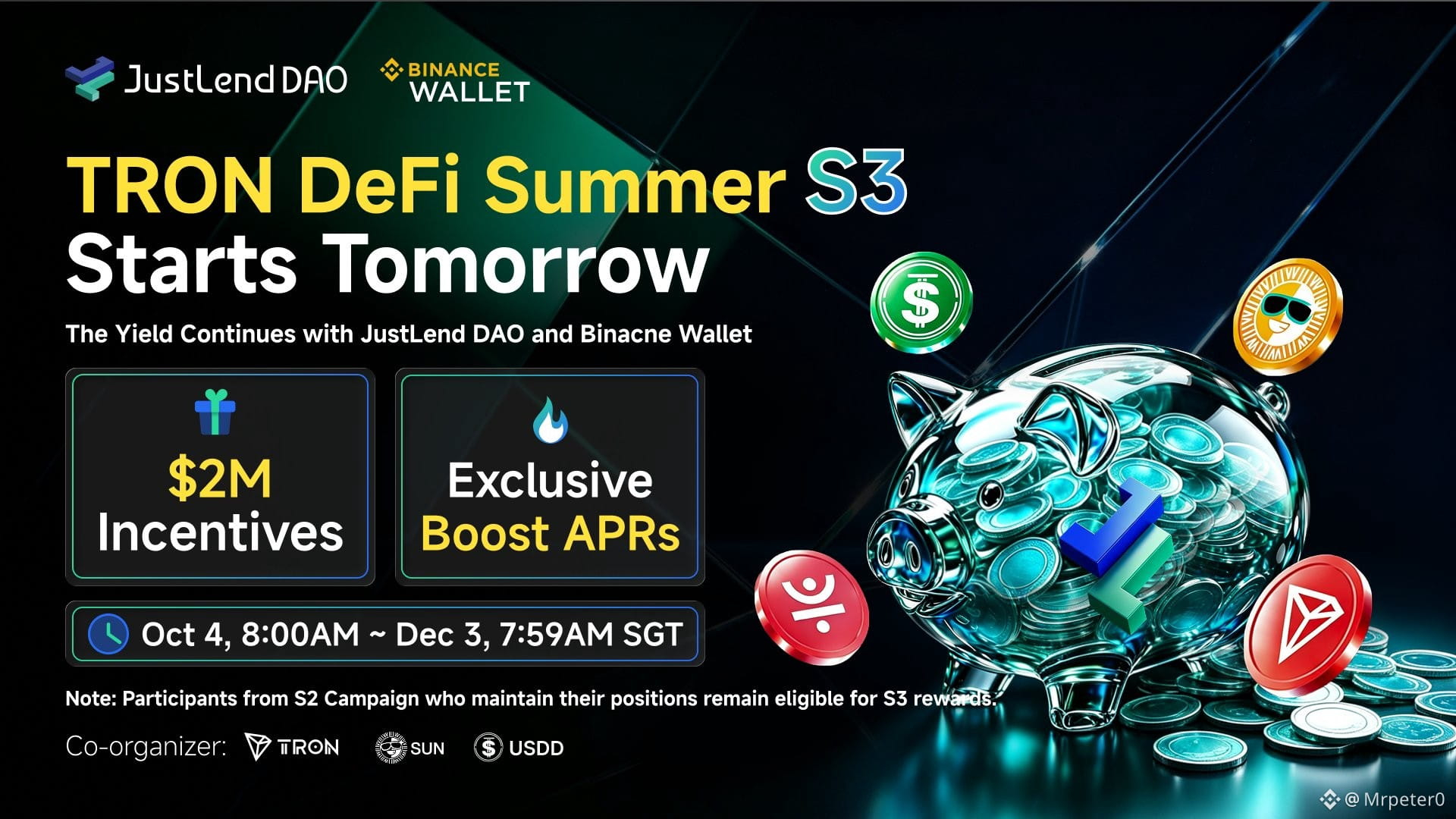
One thing that stands out about #TRONDeFiSummer S3 is the shift from a short-term campaign into a longer 60-day incentive period, with the focus remaining on actual DeFi participation rather than simply distributing rewards.
S3 starts October 4 at 8:00 AM SGT with a $2M reward pool and boosted APR opportunities across TRX, USDD, JST, and SUN through JustLend DAO on @BinanceWallet DeFi. The structure also gives existing S2 participants continuity, allowing them to keep their positions and remain eligible for S3 rewards.
The $2M figure is meaningful, but it needs context. Spread across 60 days, it represents an average of roughly $33,333 per day if distributed evenly. That does not mean every participant receives that amount, nor does it tell us the actual APR each asset will generate. The real value depends on how rewards are allocated and how much capital participates.
The continuation from S2 is also worth watching. Keeping existing positions reduces the friction of moving from one campaign phase to another, while new participants can enter when S3 begins. That makes participation levels and capital retention important metrics to observe throughout the 60-day period.
For @TRONDAO , @DeFi_JUST , @usddio , and @SunPump_meme , the more interesting question is not simply how large the reward pool is, but whether these incentives translate into sustained DeFi activity after the campaign ends.
The $2M pool can attract attention, but the stronger signal will be what happens to liquidity, participation, and user activity throughout S3 and beyond. #TRONEcoStar
One thing that stands out about #TRONDeFiSummer S3 is the shift from a short-term campaign into a longer 60-day incentive period, with the focus remaining on actual DeFi participation rather than simply distributing rewards.
S3 starts October 4 at 8:00 AM SGT with a $2M reward pool and boosted APR opportunities across TRX, USDD, JST, and SUN through JustLend DAO on @Binance Wallet DeFi. The structure also gives existing S2 participants continuity, allowing them to keep their positions and remain eligible for S3 rewards.
The $2M figure is meaningful, but it needs context. Spread across 60 days, it represents an average of roughly $33,333 per day if distributed evenly. That does not mean every participant receives that amount, nor does it tell us the actual APR each asset will generate. The real value depends on how rewards are allocated and how much capital participates.
The continuation from S2 is also worth watching. Keeping existing positions reduces the friction of moving from one campaign phase to another, while new participants can enter when S3 begins. That makes participation levels and capital retention important metrics to observe throughout the 60-day period.
For @TRON DAO , @JUST DAO , @USDD - Decentralized USD , and @OfficialSUNio , the more interesting question is not simply how large the reward pool is, but whether these incentives translate into sustained DeFi activity after the campaign ends.
The $2M pool can attract attention, but the stronger signal will be what happens to liquidity, participation, and user activity throughout S3 and beyond. #TRONEcoStar
S3 starts October 4 at 8:00 AM SGT with a $2M reward pool and boosted APR opportunities across TRX, USDD, JST, and SUN through JustLend DAO on @Binance Wallet DeFi. The structure also gives existing S2 participants continuity, allowing them to keep their positions and remain eligible for S3 rewards.
The $2M figure is meaningful, but it needs context. Spread across 60 days, it represents an average of roughly $33,333 per day if distributed evenly. That does not mean every participant receives that amount, nor does it tell us the actual APR each asset will generate. The real value depends on how rewards are allocated and how much capital participates.
The continuation from S2 is also worth watching. Keeping existing positions reduces the friction of moving from one campaign phase to another, while new participants can enter when S3 begins. That makes participation levels and capital retention important metrics to observe throughout the 60-day period.
For @TRON DAO , @JUST DAO , @USDD - Decentralized USD , and @OfficialSUNio , the more interesting question is not simply how large the reward pool is, but whether these incentives translate into sustained DeFi activity after the campaign ends.
The $2M pool can attract attention, but the stronger signal will be what happens to liquidity, participation, and user activity throughout S3 and beyond. #TRONEcoStar
1
263
·
--
See translation
Stablecoin strength is ultimately tested by what happens when market conditions become difficult, not simply by whether a token is designed to track the dollar. That makes the structure behind @DeFi_JUST USDJ more important than the label of “decentralized stablecoin.”
The core mechanism described here is multi-collateral USDJ minting through TRC-20 assets, combined with automated collateral liquidation. This creates a system where the stability of the asset depends on collateral management and the ability of the protocol to respond when positions become undercollateralized.
Another important connection is between USDJ liquidity demand and money market interest rates. Linking these two areas means changes in demand for liquidity can influence the economic conditions surrounding the stablecoin. The model therefore connects stablecoin issuance, collateral, lending activity, and market demand rather than treating them as completely separate functions.
On-chain collateral tracking is equally important. Transparent records allow users to verify the collateralization structure directly instead of relying entirely on off-chain reporting. The proposed expansion of collateral options and real-time peg monitoring could make that transparency even more useful if implemented effectively.
However, the information provided does not include USDJ’s current collateral ratio, circulating supply, peg deviation, liquidation volumes, or liquidity depth. Those figures are essential for measuring actual stability. Describing a liquidation mechanism or transparent collateral tracking explains how the system is designed to work, but it does not by itself prove how well the system performs under stress.
For @DeFi_JUST and @JustinSun , the long-term test is therefore not simply whether USDJ can maintain a decentralized design. It is whether its collateral, liquidity, liquidation, and governance mechanisms continue working together reliably as usage changes.
#TRONEcoStar
Stablecoin strength is ultimately tested by what happens when market conditions become difficult, not simply by whether a token is designed to track the dollar. That makes the structure behind @JUST DAO USDJ more important than the label of “decentralized stablecoin.”
The core mechanism described here is multi-collateral USDJ minting through TRC-20 assets, combined with automated collateral liquidation. This creates a system where the stability of the asset depends on collateral management and the ability of the protocol to respond when positions become undercollateralized.
Another important connection is between USDJ liquidity demand and money market interest rates. Linking these two areas means changes in demand for liquidity can influence the economic conditions surrounding the stablecoin. The model therefore connects stablecoin issuance, collateral, lending activity, and market demand rather than treating them as completely separate functions.
On-chain collateral tracking is equally important. Transparent records allow users to verify the collateralization structure directly instead of relying entirely on off-chain reporting. The proposed expansion of collateral options and real-time peg monitoring could make that transparency even more useful if implemented effectively.
However, the information provided does not include USDJ’s current collateral ratio, circulating supply, peg deviation, liquidation volumes, or liquidity depth. Those figures are essential for measuring actual stability. Describing a liquidation mechanism or transparent collateral tracking explains how the system is designed to work, but it does not by itself prove how well the system performs under stress.
For @JUST DAO and @Justin Sun孙宇晨 , the long-term test is therefore not simply whether USDJ can maintain a decentralized design. It is whether its collateral, liquidity, liquidation, and governance mechanisms continue working together reliably as usage changes.
#TRONEcoStar
The core mechanism described here is multi-collateral USDJ minting through TRC-20 assets, combined with automated collateral liquidation. This creates a system where the stability of the asset depends on collateral management and the ability of the protocol to respond when positions become undercollateralized.
Another important connection is between USDJ liquidity demand and money market interest rates. Linking these two areas means changes in demand for liquidity can influence the economic conditions surrounding the stablecoin. The model therefore connects stablecoin issuance, collateral, lending activity, and market demand rather than treating them as completely separate functions.
On-chain collateral tracking is equally important. Transparent records allow users to verify the collateralization structure directly instead of relying entirely on off-chain reporting. The proposed expansion of collateral options and real-time peg monitoring could make that transparency even more useful if implemented effectively.
However, the information provided does not include USDJ’s current collateral ratio, circulating supply, peg deviation, liquidation volumes, or liquidity depth. Those figures are essential for measuring actual stability. Describing a liquidation mechanism or transparent collateral tracking explains how the system is designed to work, but it does not by itself prove how well the system performs under stress.
For @JUST DAO and @Justin Sun孙宇晨 , the long-term test is therefore not simply whether USDJ can maintain a decentralized design. It is whether its collateral, liquidity, liquidation, and governance mechanisms continue working together reliably as usage changes.
#TRONEcoStar

2
12
·
--
See translation
Liquid staking becomes more interesting when it solves a capital efficiency problem rather than simply adding another yield product to DeFi. That is the central point behind sTRX and its role within the JustLend ecosystem.
The main development is that sTRX allows TRX holders to maintain market liquidity while still accessing staking-related rewards. Instead of having capital tied up solely for staking, the liquid form can be used across DeFi lending and trading, giving holders more flexibility in how their capital is deployed.
Another important feature is the exchange rate mechanism. As protocol staking rewards accumulate, the exchange rate of sTRX can appreciate automatically. This creates a relatively simple structure: staking generates rewards, those rewards influence the exchange rate, and holders can potentially benefit without having to manage the underlying staking process themselves.
The broader value proposition comes from reducing capital inefficiency. If sTRX can be accepted as collateral or integrated into lending markets, gaming applications, dApps, and eventually cross-chain environments, its usefulness would extend beyond simply representing staked TRX. That could create more opportunities for the same underlying capital to participate across different parts of the ecosystem.
There are still important limitations. The information provided does not include sTRX TVL, current yield, utilization, lending volumes, liquidity depth, or the exact rate of exchange-rate appreciation. Without those figures, it is difficult to measure how efficiently the system is currently converting staking rewards into broader economic activity. Future integrations therefore remain potential growth areas rather than evidence of adoption already achieved.
The most useful metrics to watch are sTRX adoption, liquidity, its use as collateral, exchange-rate growth, and the amount of DeFi activity it supports.
@JustinSun @DeFi_JUST #TRONEcoStar
Liquid staking becomes more interesting when it solves a capital efficiency problem rather than simply adding another yield product to DeFi. That is the central point behind sTRX and its role within the JustLend ecosystem.
The main development is that sTRX allows TRX holders to maintain market liquidity while still accessing staking-related rewards. Instead of having capital tied up solely for staking, the liquid form can be used across DeFi lending and trading, giving holders more flexibility in how their capital is deployed.
Another important feature is the exchange rate mechanism. As protocol staking rewards accumulate, the exchange rate of sTRX can appreciate automatically. This creates a relatively simple structure: staking generates rewards, those rewards influence the exchange rate, and holders can potentially benefit without having to manage the underlying staking process themselves.
The broader value proposition comes from reducing capital inefficiency. If sTRX can be accepted as collateral or integrated into lending markets, gaming applications, dApps, and eventually cross-chain environments, its usefulness would extend beyond simply representing staked TRX. That could create more opportunities for the same underlying capital to participate across different parts of the ecosystem.
There are still important limitations. The information provided does not include sTRX TVL, current yield, utilization, lending volumes, liquidity depth, or the exact rate of exchange-rate appreciation. Without those figures, it is difficult to measure how efficiently the system is currently converting staking rewards into broader economic activity. Future integrations therefore remain potential growth areas rather than evidence of adoption already achieved.
The most useful metrics to watch are sTRX adoption, liquidity, its use as collateral, exchange-rate growth, and the amount of DeFi activity it supports.
@Justin Sun孙宇晨 @JUST DAO #TRONEcoStar
The main development is that sTRX allows TRX holders to maintain market liquidity while still accessing staking-related rewards. Instead of having capital tied up solely for staking, the liquid form can be used across DeFi lending and trading, giving holders more flexibility in how their capital is deployed.
Another important feature is the exchange rate mechanism. As protocol staking rewards accumulate, the exchange rate of sTRX can appreciate automatically. This creates a relatively simple structure: staking generates rewards, those rewards influence the exchange rate, and holders can potentially benefit without having to manage the underlying staking process themselves.
The broader value proposition comes from reducing capital inefficiency. If sTRX can be accepted as collateral or integrated into lending markets, gaming applications, dApps, and eventually cross-chain environments, its usefulness would extend beyond simply representing staked TRX. That could create more opportunities for the same underlying capital to participate across different parts of the ecosystem.
There are still important limitations. The information provided does not include sTRX TVL, current yield, utilization, lending volumes, liquidity depth, or the exact rate of exchange-rate appreciation. Without those figures, it is difficult to measure how efficiently the system is currently converting staking rewards into broader economic activity. Future integrations therefore remain potential growth areas rather than evidence of adoption already achieved.
The most useful metrics to watch are sTRX adoption, liquidity, its use as collateral, exchange-rate growth, and the amount of DeFi activity it supports.
@Justin Sun孙宇晨 @JUST DAO #TRONEcoStar
2
14
·
--
See translation
The main development is the expansion of tokenized digital ownership into areas such as real world asset tokenization, enterprise credentials, and cross chain gaming. These applications use the underlying properties of NFTs differently. Instead of treating a token primarily as a collectible, they use blockchain records to establish provenance, manage ownership, automate royalties, and create more transparent licensing frameworks.
Cross chain gaming adds another dimension because digital assets may need to move between different environments while maintaining recognizable ownership and provenance. Similarly, tokenized real world assets require systems that can connect blockchain-based ownership records with assets and rights that exist outside the blockchain.
However, the information provided here does not include adoption volumes, transaction figures, enterprise user numbers, or specific measures of cost reduction. That limits how strongly we can quantify the scale of this transition. Institutional interest and broader applications indicate a change in direction, but they do not by themselves demonstrate that these systems have achieved widespread or economically sustainable adoption.
Regulatory clarity and technological upgrades will therefore remain important parts of the next phase. The stronger use cases are likely to be those where tokenization solves a specific ownership, verification, licensing, or interoperability problem rather than simply adding a blockchain layer to an existing process.
The broader takeaway is that the value of $NFT increasingly depends on what they enable rather than what they look like. If tokenized ownership can consistently provide verifiable rights, transparent provenance, programmable royalties, and efficient coordination across digital and real-world environments, NFTs can evolve from speculative collectibles into a practical component of digital ownership infrastructure.
@JustinSun #TRONEcoStar
The main development is the expansion of tokenized digital ownership into areas such as real world asset tokenization, enterprise credentials, and cross chain gaming. These applications use the underlying properties of NFTs differently. Instead of treating a token primarily as a collectible, they use blockchain records to establish provenance, manage ownership, automate royalties, and create more transparent licensing frameworks.
Cross chain gaming adds another dimension because digital assets may need to move between different environments while maintaining recognizable ownership and provenance. Similarly, tokenized real world assets require systems that can connect blockchain-based ownership records with assets and rights that exist outside the blockchain.
However, the information provided here does not include adoption volumes, transaction figures, enterprise user numbers, or specific measures of cost reduction. That limits how strongly we can quantify the scale of this transition. Institutional interest and broader applications indicate a change in direction, but they do not by themselves demonstrate that these systems have achieved widespread or economically sustainable adoption.
Regulatory clarity and technological upgrades will therefore remain important parts of the next phase. The stronger use cases are likely to be those where tokenization solves a specific ownership, verification, licensing, or interoperability problem rather than simply adding a blockchain layer to an existing process.
The broader takeaway is that the value of $NFT increasingly depends on what they enable rather than what they look like. If tokenized ownership can consistently provide verifiable rights, transparent provenance, programmable royalties, and efficient coordination across digital and real-world environments, NFTs can evolve from speculative collectibles into a practical component of digital ownership infrastructure.
@Justin Sun孙宇晨 #TRONEcoStar
Cross chain gaming adds another dimension because digital assets may need to move between different environments while maintaining recognizable ownership and provenance. Similarly, tokenized real world assets require systems that can connect blockchain-based ownership records with assets and rights that exist outside the blockchain.
However, the information provided here does not include adoption volumes, transaction figures, enterprise user numbers, or specific measures of cost reduction. That limits how strongly we can quantify the scale of this transition. Institutional interest and broader applications indicate a change in direction, but they do not by themselves demonstrate that these systems have achieved widespread or economically sustainable adoption.
Regulatory clarity and technological upgrades will therefore remain important parts of the next phase. The stronger use cases are likely to be those where tokenization solves a specific ownership, verification, licensing, or interoperability problem rather than simply adding a blockchain layer to an existing process.
The broader takeaway is that the value of $NFT increasingly depends on what they enable rather than what they look like. If tokenized ownership can consistently provide verifiable rights, transparent provenance, programmable royalties, and efficient coordination across digital and real-world environments, NFTs can evolve from speculative collectibles into a practical component of digital ownership infrastructure.
@Justin Sun孙宇晨 #TRONEcoStar
2
27
·
--
See translation
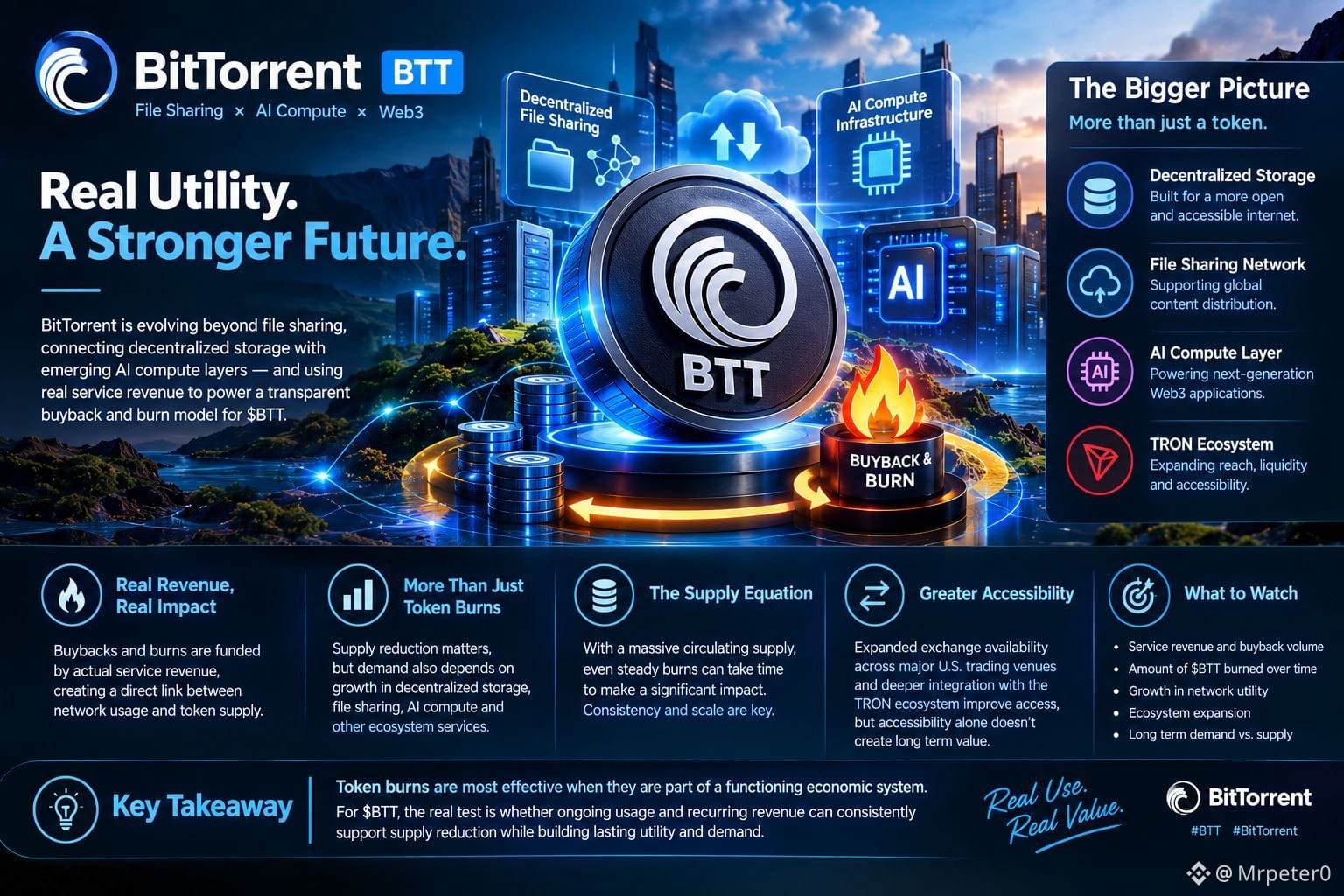
BitTorrent’s current direction brings together two different parts of the ecosystem: decentralized file sharing and emerging AI compute infrastructure. At the same time, its buyback and burn model is designed to use real world service revenue to reduce the amount of $BTT in circulation. That creates a more direct connection between network usage and token supply than a burn program funded only by temporary incentives.
The distinction matters because supply reduction on its own does not create demand. A token can become scarcer while still facing weak market demand if the underlying ecosystem does not generate enough activity. For $BTT, the more relevant question is whether decentralized storage, file sharing, AI compute and other ecosystem services can produce recurring revenue that supports continued buybacks and burns.
The massive circulating supply also needs to be viewed in context. A large supply means that even consistent burns can take time to become meaningful relative to the overall token base.
Exchange availability and integration across the broader TRON ecosystem add another layer to the picture by improving access to the asset, but accessibility should not be confused with fundamental demand. Trading activity can increase without necessarily translating into sustained network usage or long term token utility.
That is why I would evaluate $BTT’s burn model through several connected indicators: recurring service revenue, the amount of $BTT purchased and burned over time, growth in decentralized network utility, and whether ecosystem activity is expanding alongside the reduction in supply.
The clearest takeaway is that token burns are most meaningful when they are the result of a functioning economic system rather than the system itself. For $BTT, the long term test is whether real usage and recurring revenue can consistently support supply reduction while creating enough utility to justify continued demand for the token.
@JustinSun @BitTorrent_Official #TRONEcoStar
BitTorrent’s current direction brings together two different parts of the ecosystem: decentralized file sharing and emerging AI compute infrastructure. At the same time, its buyback and burn model is designed to use real world service revenue to reduce the amount of $BTT in circulation. That creates a more direct connection between network usage and token supply than a burn program funded only by temporary incentives.
The distinction matters because supply reduction on its own does not create demand. A token can become scarcer while still facing weak market demand if the underlying ecosystem does not generate enough activity. For $BTT, the more relevant question is whether decentralized storage, file sharing, AI compute and other ecosystem services can produce recurring revenue that supports continued buybacks and burns.
The massive circulating supply also needs to be viewed in context. A large supply means that even consistent burns can take time to become meaningful relative to the overall token base.
Exchange availability and integration across the broader TRON ecosystem add another layer to the picture by improving access to the asset, but accessibility should not be confused with fundamental demand. Trading activity can increase without necessarily translating into sustained network usage or long term token utility.
That is why I would evaluate $BTT’s burn model through several connected indicators: recurring service revenue, the amount of $BTT purchased and burned over time, growth in decentralized network utility, and whether ecosystem activity is expanding alongside the reduction in supply.
The clearest takeaway is that token burns are most meaningful when they are the result of a functioning economic system rather than the system itself. For $BTT, the long term test is whether real usage and recurring revenue can consistently support supply reduction while creating enough utility to justify continued demand for the token.
@Justin Sun孙宇晨 @BitTorrent_Official #TRONEcoStar
The distinction matters because supply reduction on its own does not create demand. A token can become scarcer while still facing weak market demand if the underlying ecosystem does not generate enough activity. For $BTT, the more relevant question is whether decentralized storage, file sharing, AI compute and other ecosystem services can produce recurring revenue that supports continued buybacks and burns.
The massive circulating supply also needs to be viewed in context. A large supply means that even consistent burns can take time to become meaningful relative to the overall token base.
Exchange availability and integration across the broader TRON ecosystem add another layer to the picture by improving access to the asset, but accessibility should not be confused with fundamental demand. Trading activity can increase without necessarily translating into sustained network usage or long term token utility.
That is why I would evaluate $BTT’s burn model through several connected indicators: recurring service revenue, the amount of $BTT purchased and burned over time, growth in decentralized network utility, and whether ecosystem activity is expanding alongside the reduction in supply.
The clearest takeaway is that token burns are most meaningful when they are the result of a functioning economic system rather than the system itself. For $BTT, the long term test is whether real usage and recurring revenue can consistently support supply reduction while creating enough utility to justify continued demand for the token.
@Justin Sun孙宇晨 @BitTorrent_Official #TRONEcoStar
2
14
·
--
See translation
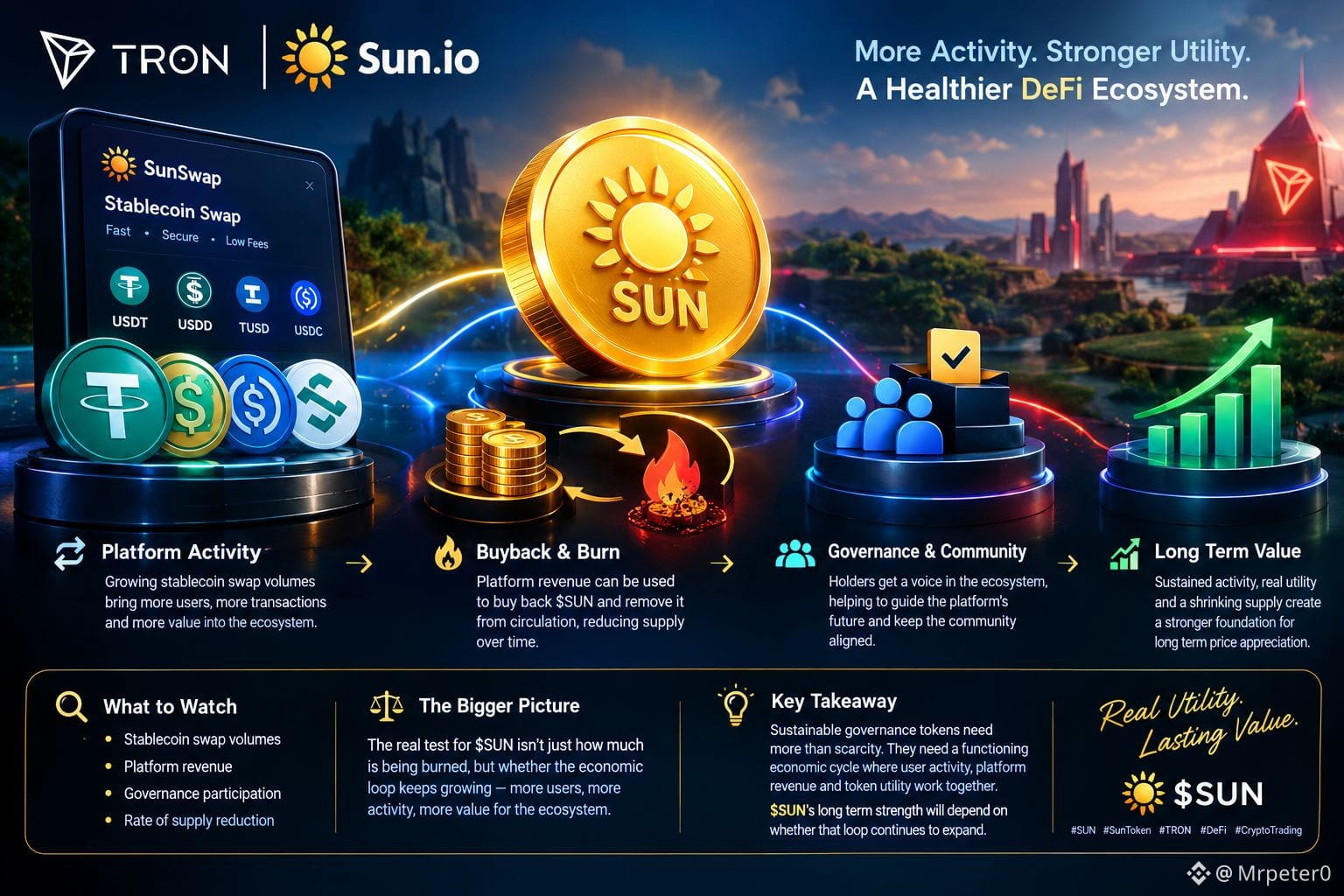
$SUN provides an interesting case through its connection with the TRON DeFi ecosystem. As Sun.io expands stablecoin swap activity and develops its community governance mechanisms, the role of the token becomes increasingly tied to the economic activity taking place around the platform. That makes its tokenomics worth examining beyond short term market movements.
The key development here is the combination of platform usage, governance utility, and the buyback and burn model. If platform revenue is being connected to token buybacks and those tokens are subsequently removed from circulation, the mechanism creates a direct relationship between ecosystem activity and changes in supply.
But the numbers need to be interpreted carefully. A reduction in circulating supply does not automatically translate into long term price appreciation. The effect depends on whether platform activity remains strong, whether revenue is sustainable, and whether demand for the token continues to develop alongside the reduction in supply.
This is also where comparing different DeFi hubs becomes useful. Governance tokens can look similar on the surface, but their sustainability depends heavily on how closely token utility is connected to actual platform usage
For $SUN, the important metric to watch is therefore not just the amount of tokens being burned. It is the relationship between stablecoin swap volumes, platform revenue, governance participation, and the rate at which supply is being reduced. Looking at those factors together provides a much clearer picture of whether the tokenomics are creating durable value.
My view is that sustainable DeFi governance tokens need more than scarcity. They need a functioning economic loop where users generate activity, the platform captures value, and the token has a meaningful role in that system. $SUN is an interesting case because its long term strength will ultimately depend on whether that loop continues to expand rather than simply becoming more efficient at reducing supply.
@JustinSun @SunPump_meme #TRONEcoStar
$SUN provides an interesting case through its connection with the TRON DeFi ecosystem. As Sun.io expands stablecoin swap activity and develops its community governance mechanisms, the role of the token becomes increasingly tied to the economic activity taking place around the platform. That makes its tokenomics worth examining beyond short term market movements.
The key development here is the combination of platform usage, governance utility, and the buyback and burn model. If platform revenue is being connected to token buybacks and those tokens are subsequently removed from circulation, the mechanism creates a direct relationship between ecosystem activity and changes in supply.
But the numbers need to be interpreted carefully. A reduction in circulating supply does not automatically translate into long term price appreciation. The effect depends on whether platform activity remains strong, whether revenue is sustainable, and whether demand for the token continues to develop alongside the reduction in supply.
This is also where comparing different DeFi hubs becomes useful. Governance tokens can look similar on the surface, but their sustainability depends heavily on how closely token utility is connected to actual platform usage
For $SUN, the important metric to watch is therefore not just the amount of tokens being burned. It is the relationship between stablecoin swap volumes, platform revenue, governance participation, and the rate at which supply is being reduced. Looking at those factors together provides a much clearer picture of whether the tokenomics are creating durable value.
My view is that sustainable DeFi governance tokens need more than scarcity. They need a functioning economic loop where users generate activity, the platform captures value, and the token has a meaningful role in that system. $SUN is an interesting case because its long term strength will ultimately depend on whether that loop continues to expand rather than simply becoming more efficient at reducing supply.
@Justin Sun孙宇晨 @OfficialSUNio #TRONEcoStar
The key development here is the combination of platform usage, governance utility, and the buyback and burn model. If platform revenue is being connected to token buybacks and those tokens are subsequently removed from circulation, the mechanism creates a direct relationship between ecosystem activity and changes in supply.
But the numbers need to be interpreted carefully. A reduction in circulating supply does not automatically translate into long term price appreciation. The effect depends on whether platform activity remains strong, whether revenue is sustainable, and whether demand for the token continues to develop alongside the reduction in supply.
This is also where comparing different DeFi hubs becomes useful. Governance tokens can look similar on the surface, but their sustainability depends heavily on how closely token utility is connected to actual platform usage
For $SUN, the important metric to watch is therefore not just the amount of tokens being burned. It is the relationship between stablecoin swap volumes, platform revenue, governance participation, and the rate at which supply is being reduced. Looking at those factors together provides a much clearer picture of whether the tokenomics are creating durable value.
My view is that sustainable DeFi governance tokens need more than scarcity. They need a functioning economic loop where users generate activity, the platform captures value, and the token has a meaningful role in that system. $SUN is an interesting case because its long term strength will ultimately depend on whether that loop continues to expand rather than simply becoming more efficient at reducing supply.
@Justin Sun孙宇晨 @OfficialSUNio #TRONEcoStar
2
56
·
--
See translation
𝐖𝐡𝐞𝐧 𝐓𝐨𝐤𝐞𝐧𝐨𝐦𝐢𝐜𝐬 𝐂𝐚𝐧 𝐁𝐞 𝐂𝐡𝐞𝐜𝐤𝐞𝐝 𝐎𝐧𝐂𝐡𝐚𝐢𝐧
Tokenomics become more meaningful when the community does not have to rely entirely on announcements to understand what is happening.
The WIN Buyback Program takes a more verifiable approach. Its buybacks are funded by revenue from WINkLink oracle services, executed quarterly, with on-chain records published alongside program updates.
𝐓𝐡𝐞 𝐈𝐦𝐩𝐨𝐫𝐭𝐚𝐧𝐭 𝐏𝐚𝐫𝐭 𝐈𝐬 𝐕𝐞𝐫𝐢𝐟𝐢𝐚𝐛𝐢𝐥𝐢𝐭𝐲
The value here is not simply that buybacks happen. It is that the underlying activity can be checked against blockchain records.
That gives participants a way to follow the process rather than treating tokenomic claims as something that must simply be trusted.
𝐀 𝐋𝐨𝐧𝐠𝐞𝐫 𝐓𝐞𝐬𝐭
For $WIN, the more useful thing to watch over time is the relationship between oracle-service revenue, quarterly buyback activity, and the corresponding on-chain records.
Transparent execution does not guarantee a particular market outcome, but it does make the mechanism easier to monitor and understand.
In a market where tokenomics can be difficult to verify, having a process that leaves an observable trail is an important distinction.
@WINkLink_Official #TRONEcoStar
𝐖𝐡𝐞𝐧 𝐓𝐨𝐤𝐞𝐧𝐨𝐦𝐢𝐜𝐬 𝐂𝐚𝐧 𝐁𝐞 𝐂𝐡𝐞𝐜𝐤𝐞𝐝 𝐎𝐧𝐂𝐡𝐚𝐢𝐧
Tokenomics become more meaningful when the community does not have to rely entirely on announcements to understand what is happening.
The WIN Buyback Program takes a more verifiable approach. Its buybacks are funded by revenue from WINkLink oracle services, executed quarterly, with on-chain records published alongside program updates.
𝐓𝐡𝐞 𝐈𝐦𝐩𝐨𝐫𝐭𝐚𝐧𝐭 𝐏𝐚𝐫𝐭 𝐈𝐬 𝐕𝐞𝐫𝐢𝐟𝐢𝐚𝐛𝐢𝐥𝐢𝐭𝐲
The value here is not simply that buybacks happen. It is that the underlying activity can be checked against blockchain records.
That gives participants a way to follow the process rather than treating tokenomic claims as something that must simply be trusted.
𝐀 𝐋𝐨𝐧𝐠𝐞𝐫 𝐓𝐞𝐬𝐭
For $WIN, the more useful thing to watch over time is the relationship between oracle-service revenue, quarterly buyback activity, and the corresponding on-chain records.
Transparent execution does not guarantee a particular market outcome, but it does make the mechanism easier to monitor and understand.
In a market where tokenomics can be difficult to verify, having a process that leaves an observable trail is an important distinction.
@WINkLink_Official #TRONEcoStar
Tokenomics become more meaningful when the community does not have to rely entirely on announcements to understand what is happening.
The WIN Buyback Program takes a more verifiable approach. Its buybacks are funded by revenue from WINkLink oracle services, executed quarterly, with on-chain records published alongside program updates.
𝐓𝐡𝐞 𝐈𝐦𝐩𝐨𝐫𝐭𝐚𝐧𝐭 𝐏𝐚𝐫𝐭 𝐈𝐬 𝐕𝐞𝐫𝐢𝐟𝐢𝐚𝐛𝐢𝐥𝐢𝐭𝐲
The value here is not simply that buybacks happen. It is that the underlying activity can be checked against blockchain records.
That gives participants a way to follow the process rather than treating tokenomic claims as something that must simply be trusted.
𝐀 𝐋𝐨𝐧𝐠𝐞𝐫 𝐓𝐞𝐬𝐭
For $WIN, the more useful thing to watch over time is the relationship between oracle-service revenue, quarterly buyback activity, and the corresponding on-chain records.
Transparent execution does not guarantee a particular market outcome, but it does make the mechanism easier to monitor and understand.
In a market where tokenomics can be difficult to verify, having a process that leaves an observable trail is an important distinction.
@WINkLink_Official #TRONEcoStar

2
251
·
--
See translation
𝐖𝐡𝐚𝐭 𝐓𝐡𝐞 $𝑾𝑰𝑵 𝐒𝐮𝐩𝐩𝐥𝐲 𝐈𝐬 𝐑𝐞𝐯𝐞𝐚𝐥𝐢𝐧𝐠
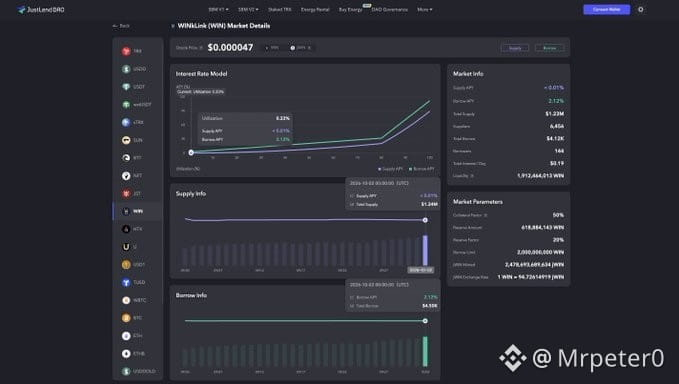
The more interesting signal in this week’s JustLendDAO figures is not the borrowing number, but the continued expansion of supplied WIN.
Total supply has reached $1.23M, while active borrowing stands at $4.12K. That creates a clear gap between available liquidity and current borrowing demand.
𝐒𝐮𝐩𝐩𝐥𝐲 𝐈𝐬 𝐌𝐨𝐯𝐢𝐧𝐠 𝐅𝐢𝐫𝐬𝐭
The growth suggests more WIN is being placed into the lending market instead of remaining idle.
But supply growth should not automatically be treated as proof of stronger borrowing demand. The current figures show that liquidity is arriving faster than it is being borrowed.
That distinction matters when reading the health of a lending market.
𝐓𝐡𝐞 𝐍𝐞𝐱𝐭 𝐌𝐞𝐭𝐫𝐢𝐜 𝐓𝐨 𝐖𝐚𝐭𝐜𝐡
The important question from here is whether borrowing begins to expand alongside supply.
If that happens, it would provide a clearer picture of how effectively the growing WIN liquidity is being utilized inside TRON’s DeFi ecosystem.
For now, the data points to a market where supplied liquidity is clearly increasing, while borrowing remains comparatively light.
That makes the next few weekly readings particularly useful for understanding whether this is simply growing liquidity or the early stage of deeper market utilization.
@DeFi_JUST @TRONDAO @WINkLink_Official
#Tron #TRONEcoStar
𝐖𝐡𝐚𝐭 𝐓𝐡𝐞 $𝑾𝑰𝑵 𝐒𝐮𝐩𝐩𝐥𝐲 𝐈𝐬 𝐑𝐞𝐯𝐞𝐚𝐥𝐢𝐧𝐠
The more interesting signal in this week’s JustLendDAO figures is not the borrowing number, but the continued expansion of supplied WIN.
Total supply has reached $1.23M, while active borrowing stands at $4.12K. That creates a clear gap between available liquidity and current borrowing demand.
𝐒𝐮𝐩𝐩𝐥𝐲 𝐈𝐬 𝐌𝐨𝐯𝐢𝐧𝐠 𝐅𝐢𝐫𝐬𝐭
The growth suggests more WIN is being placed into the lending market instead of remaining idle.
But supply growth should not automatically be treated as proof of stronger borrowing demand. The current figures show that liquidity is arriving faster than it is being borrowed.
That distinction matters when reading the health of a lending market.
𝐓𝐡𝐞 𝐍𝐞𝐱𝐭 𝐌𝐞𝐭𝐫𝐢𝐜 𝐓𝐨 𝐖𝐚𝐭𝐜𝐡
The important question from here is whether borrowing begins to expand alongside supply.
If that happens, it would provide a clearer picture of how effectively the growing WIN liquidity is being utilized inside TRON’s DeFi ecosystem.
For now, the data points to a market where supplied liquidity is clearly increasing, while borrowing remains comparatively light.
That makes the next few weekly readings particularly useful for understanding whether this is simply growing liquidity or the early stage of deeper market utilization.
@JUST DAO @TRON DAO @WINkLink_Official
#Tron #TRONEcoStar
The more interesting signal in this week’s JustLendDAO figures is not the borrowing number, but the continued expansion of supplied WIN.
Total supply has reached $1.23M, while active borrowing stands at $4.12K. That creates a clear gap between available liquidity and current borrowing demand.
𝐒𝐮𝐩𝐩𝐥𝐲 𝐈𝐬 𝐌𝐨𝐯𝐢𝐧𝐠 𝐅𝐢𝐫𝐬𝐭
The growth suggests more WIN is being placed into the lending market instead of remaining idle.
But supply growth should not automatically be treated as proof of stronger borrowing demand. The current figures show that liquidity is arriving faster than it is being borrowed.
That distinction matters when reading the health of a lending market.
𝐓𝐡𝐞 𝐍𝐞𝐱𝐭 𝐌𝐞𝐭𝐫𝐢𝐜 𝐓𝐨 𝐖𝐚𝐭𝐜𝐡
The important question from here is whether borrowing begins to expand alongside supply.
If that happens, it would provide a clearer picture of how effectively the growing WIN liquidity is being utilized inside TRON’s DeFi ecosystem.
For now, the data points to a market where supplied liquidity is clearly increasing, while borrowing remains comparatively light.
That makes the next few weekly readings particularly useful for understanding whether this is simply growing liquidity or the early stage of deeper market utilization.
@JUST DAO @TRON DAO @WINkLink_Official
#Tron #TRONEcoStar
2
210
·
--
See translation
𝐖𝐡𝐞𝐫𝐞 𝐑𝐞𝐚𝐥 𝐀𝐜𝐭𝐢𝐯𝐢𝐭𝐲 𝐌𝐞𝐞𝐭𝐬 𝐁𝐥𝐨𝐜𝐤𝐜𝐡𝐚𝐢𝐧 𝐕𝐚𝐥𝐮𝐞 📊
Looking at a blockchain beyond price action means asking a more fundamental question: what is actually happening on the network?
TRON has become a major environment for stablecoin movement, particularly USDT activity. That makes transaction volume and settlement activity important indicators when assessing how the network is being used.
𝐓𝐡𝐞 𝐄𝐜𝐨𝐧𝐨𝐦𝐢𝐜 𝐒𝐢𝐝𝐞
High transaction activity can create demand for network resources and generate protocol revenue. But volume alone does not automatically prove sustainable value.
The more useful analysis is to connect several signals together: stablecoin activity, transaction frequency, revenue generation, user behavior, liquidity movement, and the infrastructure’s ability to handle that demand efficiently.
For @TRONDAO , the interesting question is therefore not simply how many transactions occur, but whether this activity represents consistent and useful economic behavior over time.
𝐑𝐞𝐚𝐝𝐢𝐧𝐠 𝐋𝟏 𝐅𝐮𝐧𝐝𝐚𝐦𝐞𝐧𝐭𝐚𝐥𝐬
Stablecoin settlement and fee generation can tell us a lot about network utilization, but they are only part of the picture.
Developer activity, applications, liquidity depth, security, user retention, and technical development can provide additional context when evaluating a Layer 1.
The strongest analysis comes from looking at these indicators together rather than allowing one metric to tell the entire story.
𝐓𝐡𝐞 𝐑𝐞𝐚𝐥 𝐓𝐞𝐬𝐭
For TRON, continued stablecoin activity provides an important area to watch because it connects blockchain infrastructure with a concrete financial use case.
The key is whether that usage remains durable, diversified, and economically meaningful as the network evolves.
@JustinSun #TRONEcoStar
𝐖𝐡𝐞𝐫𝐞 𝐑𝐞𝐚𝐥 𝐀𝐜𝐭𝐢𝐯𝐢𝐭𝐲 𝐌𝐞𝐞𝐭𝐬 𝐁𝐥𝐨𝐜𝐤𝐜𝐡𝐚𝐢𝐧 𝐕𝐚𝐥𝐮𝐞 📊
Looking at a blockchain beyond price action means asking a more fundamental question: what is actually happening on the network?
TRON has become a major environment for stablecoin movement, particularly USDT activity. That makes transaction volume and settlement activity important indicators when assessing how the network is being used.
𝐓𝐡𝐞 𝐄𝐜𝐨𝐧𝐨𝐦𝐢𝐜 𝐒𝐢𝐝𝐞
High transaction activity can create demand for network resources and generate protocol revenue. But volume alone does not automatically prove sustainable value.
The more useful analysis is to connect several signals together: stablecoin activity, transaction frequency, revenue generation, user behavior, liquidity movement, and the infrastructure’s ability to handle that demand efficiently.
For @TRON DAO , the interesting question is therefore not simply how many transactions occur, but whether this activity represents consistent and useful economic behavior over time.
𝐑𝐞𝐚𝐝𝐢𝐧𝐠 𝐋𝟏 𝐅𝐮𝐧𝐝𝐚𝐦𝐞𝐧𝐭𝐚𝐥𝐬
Stablecoin settlement and fee generation can tell us a lot about network utilization, but they are only part of the picture.
Developer activity, applications, liquidity depth, security, user retention, and technical development can provide additional context when evaluating a Layer 1.
The strongest analysis comes from looking at these indicators together rather than allowing one metric to tell the entire story.
𝐓𝐡𝐞 𝐑𝐞𝐚𝐥 𝐓𝐞𝐬𝐭
For TRON, continued stablecoin activity provides an important area to watch because it connects blockchain infrastructure with a concrete financial use case.
The key is whether that usage remains durable, diversified, and economically meaningful as the network evolves.
@Justin Sun孙宇晨 #TRONEcoStar
Looking at a blockchain beyond price action means asking a more fundamental question: what is actually happening on the network?
TRON has become a major environment for stablecoin movement, particularly USDT activity. That makes transaction volume and settlement activity important indicators when assessing how the network is being used.
𝐓𝐡𝐞 𝐄𝐜𝐨𝐧𝐨𝐦𝐢𝐜 𝐒𝐢𝐝𝐞
High transaction activity can create demand for network resources and generate protocol revenue. But volume alone does not automatically prove sustainable value.
The more useful analysis is to connect several signals together: stablecoin activity, transaction frequency, revenue generation, user behavior, liquidity movement, and the infrastructure’s ability to handle that demand efficiently.
For @TRON DAO , the interesting question is therefore not simply how many transactions occur, but whether this activity represents consistent and useful economic behavior over time.
𝐑𝐞𝐚𝐝𝐢𝐧𝐠 𝐋𝟏 𝐅𝐮𝐧𝐝𝐚𝐦𝐞𝐧𝐭𝐚𝐥𝐬
Stablecoin settlement and fee generation can tell us a lot about network utilization, but they are only part of the picture.
Developer activity, applications, liquidity depth, security, user retention, and technical development can provide additional context when evaluating a Layer 1.
The strongest analysis comes from looking at these indicators together rather than allowing one metric to tell the entire story.
𝐓𝐡𝐞 𝐑𝐞𝐚𝐥 𝐓𝐞𝐬𝐭
For TRON, continued stablecoin activity provides an important area to watch because it connects blockchain infrastructure with a concrete financial use case.
The key is whether that usage remains durable, diversified, and economically meaningful as the network evolves.
@Justin Sun孙宇晨 #TRONEcoStar
1
50
·
--
See translation
𝐖𝐡𝐞𝐫𝐞 𝐒𝐦𝐚𝐥𝐥 𝐔𝐒𝐃𝐓 𝐌𝐨𝐯𝐞𝐦𝐞𝐧𝐭𝐬 𝐑𝐞𝐯𝐞𝐚𝐥 𝐓𝐑𝐎𝐍’𝐬 𝐑𝐨𝐥𝐞
The most interesting part of the 52% figure is not the percentage itself. It is the narrow activity that the percentage actually measures.
In the reported Q2 data, @TRONDAO accounted for 52% of USDT transfers below $1,000 among chains where USDT is natively issued.
𝐓𝐡𝐞 𝐌𝐞𝐭𝐫𝐢𝐜 𝐌𝐚𝐭𝐭𝐞𝐫𝐬
That number has three important boundaries:
• It measures USDT, not stablecoins as a whole.
• It covers transfers below $1,000.
• It compares chains with native USDT issuance.
Within that specific category, TRON represents a significant share of smaller USDT transfer activity.
𝐖𝐡𝐚𝐭 𝐭𝐡𝐞 𝟓𝟐% 𝐃𝐨𝐞𝐬𝐧’𝐭 𝐒𝐚𝐲
This is where the statistic needs to be handled carefully.
It does not mean TRON processes 52% of all stablecoin payments. It does not establish 52% of total USDT transfer value, and it does not tell us that 52% of USDT users are on TRON.
Transfer count and economic value are different measurements. A network can account for a large number of smaller transactions without holding the same share of overall transferred value.
There is also no direct way from this figure alone to know whether those transfers represent payments, trading activity, wallet management, or other uses.
𝐓𝐡𝐞 𝐍𝐞𝐱𝐭 𝐐𝐮𝐞𝐬𝐭𝐢𝐨𝐧
The 52% figure becomes more useful when we move beyond the headline and ask what is happening underneath it.
How many addresses repeatedly make these transfers? How frequently do they transact? Who are the recipients? And how much of the activity comes from recurring users rather than one-off movements?
Those details would help distinguish between simple transaction volume and sustained usage patterns.
@JustinSun #TRONEcoStar
𝐖𝐡𝐞𝐫𝐞 𝐒𝐦𝐚𝐥𝐥 𝐔𝐒𝐃𝐓 𝐌𝐨𝐯𝐞𝐦𝐞𝐧𝐭𝐬 𝐑𝐞𝐯𝐞𝐚𝐥 𝐓𝐑𝐎𝐍’𝐬 𝐑𝐨𝐥𝐞
The most interesting part of the 52% figure is not the percentage itself. It is the narrow activity that the percentage actually measures.
In the reported Q2 data, @TRON DAO accounted for 52% of USDT transfers below $1,000 among chains where USDT is natively issued.
𝐓𝐡𝐞 𝐌𝐞𝐭𝐫𝐢𝐜 𝐌𝐚𝐭𝐭𝐞𝐫𝐬
That number has three important boundaries:
• It measures USDT, not stablecoins as a whole.
• It covers transfers below $1,000.
• It compares chains with native USDT issuance.
Within that specific category, TRON represents a significant share of smaller USDT transfer activity.
𝐖𝐡𝐚𝐭 𝐭𝐡𝐞 𝟓𝟐% 𝐃𝐨𝐞𝐬𝐧’𝐭 𝐒𝐚𝐲
This is where the statistic needs to be handled carefully.
It does not mean TRON processes 52% of all stablecoin payments. It does not establish 52% of total USDT transfer value, and it does not tell us that 52% of USDT users are on TRON.
Transfer count and economic value are different measurements. A network can account for a large number of smaller transactions without holding the same share of overall transferred value.
There is also no direct way from this figure alone to know whether those transfers represent payments, trading activity, wallet management, or other uses.
𝐓𝐡𝐞 𝐍𝐞𝐱𝐭 𝐐𝐮𝐞𝐬𝐭𝐢𝐨𝐧
The 52% figure becomes more useful when we move beyond the headline and ask what is happening underneath it.
How many addresses repeatedly make these transfers? How frequently do they transact? Who are the recipients? And how much of the activity comes from recurring users rather than one-off movements?
Those details would help distinguish between simple transaction volume and sustained usage patterns.
@Justin Sun孙宇晨 #TRONEcoStar
The most interesting part of the 52% figure is not the percentage itself. It is the narrow activity that the percentage actually measures.
In the reported Q2 data, @TRON DAO accounted for 52% of USDT transfers below $1,000 among chains where USDT is natively issued.
𝐓𝐡𝐞 𝐌𝐞𝐭𝐫𝐢𝐜 𝐌𝐚𝐭𝐭𝐞𝐫𝐬
That number has three important boundaries:
• It measures USDT, not stablecoins as a whole.
• It covers transfers below $1,000.
• It compares chains with native USDT issuance.
Within that specific category, TRON represents a significant share of smaller USDT transfer activity.
𝐖𝐡𝐚𝐭 𝐭𝐡𝐞 𝟓𝟐% 𝐃𝐨𝐞𝐬𝐧’𝐭 𝐒𝐚𝐲
This is where the statistic needs to be handled carefully.
It does not mean TRON processes 52% of all stablecoin payments. It does not establish 52% of total USDT transfer value, and it does not tell us that 52% of USDT users are on TRON.
Transfer count and economic value are different measurements. A network can account for a large number of smaller transactions without holding the same share of overall transferred value.
There is also no direct way from this figure alone to know whether those transfers represent payments, trading activity, wallet management, or other uses.
𝐓𝐡𝐞 𝐍𝐞𝐱𝐭 𝐐𝐮𝐞𝐬𝐭𝐢𝐨𝐧
The 52% figure becomes more useful when we move beyond the headline and ask what is happening underneath it.
How many addresses repeatedly make these transfers? How frequently do they transact? Who are the recipients? And how much of the activity comes from recurring users rather than one-off movements?
Those details would help distinguish between simple transaction volume and sustained usage patterns.
@Justin Sun孙宇晨 #TRONEcoStar
1
63
·
--
See translation
$USDD : What Peg Stability Reveals About Stablecoin Resilience
One of the most important things to watch with USDD is not simply whether it trades at exactly $1, but how the market responds when liquidity becomes tighter. Minor peg deviations and changes in secondary market volume can reveal how quickly arbitrage activity and market participants respond when supply and demand temporarily move out of balance.
USDD’s presence across TRON, Ethereum, and BNB Chain makes these capital flows particularly relevant. Cross-chain deployment gives liquidity more places to move, but it also means peg stability depends on how efficiently markets across those networks respond to price differences. When USDD trades away from its intended value, arbitrageurs can play an important role by responding to those discrepancies and helping push the market back toward equilibrium.
The other important factor is the over-collateralized model. Collateral can provide an additional layer of confidence because the stablecoin is supported by reserves rather than relying only on market expectations. But collateralization alone does not tell the entire story. The quality and management of reserves, available liquidity, secondary-market depth, and the ability of participants to act during periods of stress all matter when assessing how resilient a stablecoin actually is.
This is why short-term volume changes should be viewed in context. A rise or fall in secondary-market volume can show that trading activity is changing, but it does not automatically tell us whether the underlying system is becoming safer or riskier. Similarly, a temporary deviation from the peg does not necessarily indicate structural weakness. What matters more is how the market absorbs the imbalance and whether normal pricing conditions are restored.
@JustinSun @usddio #TRONEcoStar
$USDD : What Peg Stability Reveals About Stablecoin Resilience
One of the most important things to watch with USDD is not simply whether it trades at exactly $1, but how the market responds when liquidity becomes tighter. Minor peg deviations and changes in secondary market volume can reveal how quickly arbitrage activity and market participants respond when supply and demand temporarily move out of balance.
USDD’s presence across TRON, Ethereum, and BNB Chain makes these capital flows particularly relevant. Cross-chain deployment gives liquidity more places to move, but it also means peg stability depends on how efficiently markets across those networks respond to price differences. When USDD trades away from its intended value, arbitrageurs can play an important role by responding to those discrepancies and helping push the market back toward equilibrium.
The other important factor is the over-collateralized model. Collateral can provide an additional layer of confidence because the stablecoin is supported by reserves rather than relying only on market expectations. But collateralization alone does not tell the entire story. The quality and management of reserves, available liquidity, secondary-market depth, and the ability of participants to act during periods of stress all matter when assessing how resilient a stablecoin actually is.
This is why short-term volume changes should be viewed in context. A rise or fall in secondary-market volume can show that trading activity is changing, but it does not automatically tell us whether the underlying system is becoming safer or riskier. Similarly, a temporary deviation from the peg does not necessarily indicate structural weakness. What matters more is how the market absorbs the imbalance and whether normal pricing conditions are restored.
@Justin Sun孙宇晨 @USDD - Decentralized USD #TRONEcoStar
One of the most important things to watch with USDD is not simply whether it trades at exactly $1, but how the market responds when liquidity becomes tighter. Minor peg deviations and changes in secondary market volume can reveal how quickly arbitrage activity and market participants respond when supply and demand temporarily move out of balance.
USDD’s presence across TRON, Ethereum, and BNB Chain makes these capital flows particularly relevant. Cross-chain deployment gives liquidity more places to move, but it also means peg stability depends on how efficiently markets across those networks respond to price differences. When USDD trades away from its intended value, arbitrageurs can play an important role by responding to those discrepancies and helping push the market back toward equilibrium.
The other important factor is the over-collateralized model. Collateral can provide an additional layer of confidence because the stablecoin is supported by reserves rather than relying only on market expectations. But collateralization alone does not tell the entire story. The quality and management of reserves, available liquidity, secondary-market depth, and the ability of participants to act during periods of stress all matter when assessing how resilient a stablecoin actually is.
This is why short-term volume changes should be viewed in context. A rise or fall in secondary-market volume can show that trading activity is changing, but it does not automatically tell us whether the underlying system is becoming safer or riskier. Similarly, a temporary deviation from the peg does not necessarily indicate structural weakness. What matters more is how the market absorbs the imbalance and whether normal pricing conditions are restored.
@Justin Sun孙宇晨 @USDD - Decentralized USD #TRONEcoStar

1
57
·
--
See translation
JST: Watching Support, Liquidity, and the Next Market Move
One of the more interesting things about JST right now is how its price structure is developing alongside continued activity across the JUST ecosystem. After a multi-month consolidation, the market is reaching a point where the defense of established support zones could become more important than short-term price fluctuations.
The main metric to watch is the relationship between price, volume, and momentum. Volume stabilization suggests that selling pressure may be becoming more balanced, while shifts in momentum can show whether market participants are starting to change their positioning. If JST continues holding major horizontal support while momentum improves, traders may begin watching the higher resistance areas more closely.
The fundamental side adds another layer to the picture. JUST continues to operate active lending markets and manage significant collateral pools, while its ecosystem has expanded through advanced stablecoin integrations and greater accessibility via cross-chain bridges. These developments are relevant because liquidity is a major part of how DeFi infrastructure functions. More accessible liquidity can make it easier for capital to move between different assets and markets.
Still, these metrics need to be interpreted carefully. Stable volume does not necessarily mean accumulation, and improving momentum does not guarantee a sustained breakout. Likewise, strong activity across lending markets does not automatically translate into stronger JST demand. Technical structure and ecosystem activity can support the same narrative, but they measure different things.
That distinction is important during a consolidation. A support level tells us where buyers have historically stepped in, while volume and momentum provide clues about current participation. Ecosystem activity provides a different form of context by showing whether the underlying DeFi infrastructure remains active. None of these signals should be treated independently.
@JustinSun @TRONDAO #TTONEcoStar
JST: Watching Support, Liquidity, and the Next Market Move
One of the more interesting things about JST right now is how its price structure is developing alongside continued activity across the JUST ecosystem. After a multi-month consolidation, the market is reaching a point where the defense of established support zones could become more important than short-term price fluctuations.
The main metric to watch is the relationship between price, volume, and momentum. Volume stabilization suggests that selling pressure may be becoming more balanced, while shifts in momentum can show whether market participants are starting to change their positioning. If JST continues holding major horizontal support while momentum improves, traders may begin watching the higher resistance areas more closely.
The fundamental side adds another layer to the picture. JUST continues to operate active lending markets and manage significant collateral pools, while its ecosystem has expanded through advanced stablecoin integrations and greater accessibility via cross-chain bridges. These developments are relevant because liquidity is a major part of how DeFi infrastructure functions. More accessible liquidity can make it easier for capital to move between different assets and markets.
Still, these metrics need to be interpreted carefully. Stable volume does not necessarily mean accumulation, and improving momentum does not guarantee a sustained breakout. Likewise, strong activity across lending markets does not automatically translate into stronger JST demand. Technical structure and ecosystem activity can support the same narrative, but they measure different things.
That distinction is important during a consolidation. A support level tells us where buyers have historically stepped in, while volume and momentum provide clues about current participation. Ecosystem activity provides a different form of context by showing whether the underlying DeFi infrastructure remains active. None of these signals should be treated independently.
@Justin Sun孙宇晨 @TRON DAO #TTONEcoStar
One of the more interesting things about JST right now is how its price structure is developing alongside continued activity across the JUST ecosystem. After a multi-month consolidation, the market is reaching a point where the defense of established support zones could become more important than short-term price fluctuations.
The main metric to watch is the relationship between price, volume, and momentum. Volume stabilization suggests that selling pressure may be becoming more balanced, while shifts in momentum can show whether market participants are starting to change their positioning. If JST continues holding major horizontal support while momentum improves, traders may begin watching the higher resistance areas more closely.
The fundamental side adds another layer to the picture. JUST continues to operate active lending markets and manage significant collateral pools, while its ecosystem has expanded through advanced stablecoin integrations and greater accessibility via cross-chain bridges. These developments are relevant because liquidity is a major part of how DeFi infrastructure functions. More accessible liquidity can make it easier for capital to move between different assets and markets.
Still, these metrics need to be interpreted carefully. Stable volume does not necessarily mean accumulation, and improving momentum does not guarantee a sustained breakout. Likewise, strong activity across lending markets does not automatically translate into stronger JST demand. Technical structure and ecosystem activity can support the same narrative, but they measure different things.
That distinction is important during a consolidation. A support level tells us where buyers have historically stepped in, while volume and momentum provide clues about current participation. Ecosystem activity provides a different form of context by showing whether the underlying DeFi infrastructure remains active. None of these signals should be treated independently.
@Justin Sun孙宇晨 @TRON DAO #TTONEcoStar
1
209
·
--
See translation
The most useful way to look at @DeFi_JUST is not simply as a collection of lending features, but as a market where capital can move between suppliers and borrowers with rules enforced by smart contracts.
Its core structure combines lending pools, flash loans and liquidation mechanisms. Together, these create a more complete credit market: users can supply assets to earn interest, borrowers can access liquidity, and liquidation mechanisms provide a process for dealing with undercollateralized positions. The key economic variable remains utilization, because borrowing demand and available liquidity influence how the market behaves.
TRON's infrastructure is another relevant part of the picture. The information provided points to sub-second execution and low transaction costs, which can reduce friction when users interact with lending contracts. That matters for frequent DeFi activity, although network speed and transaction cost alone do not determine whether a lending market is economically sustainable.
TVL is often used to measure the scale of a DeFi protocol, but it needs context. A high TVL indicates that substantial assets are deposited in the system, yet it does not by itself show how actively those assets are being borrowed, how much revenue the protocol generates, or how efficiently the liquidity is being used. Without specific TVL, utilization, borrowing-volume, or revenue figures here, the ranking claim cannot tell us the full story.
The same caution applies to the stated record of operational stability and security updates. An unbroken operational record, as described in the supplied information, can indicate consistency, but it should not be interpreted as eliminating smart-contract or market risk. Future cross-chain integrations would also introduce additional infrastructure and liquidity considerations.
The proposed expansion toward cross-chain liquidity, permissionless borrowing and broader interest-rate markets points toward a larger role for JustLend within TRON DeFi.
@JustinSun #TRONEcoStar
The most useful way to look at @JUST DAO is not simply as a collection of lending features, but as a market where capital can move between suppliers and borrowers with rules enforced by smart contracts.
Its core structure combines lending pools, flash loans and liquidation mechanisms. Together, these create a more complete credit market: users can supply assets to earn interest, borrowers can access liquidity, and liquidation mechanisms provide a process for dealing with undercollateralized positions. The key economic variable remains utilization, because borrowing demand and available liquidity influence how the market behaves.
TRON's infrastructure is another relevant part of the picture. The information provided points to sub-second execution and low transaction costs, which can reduce friction when users interact with lending contracts. That matters for frequent DeFi activity, although network speed and transaction cost alone do not determine whether a lending market is economically sustainable.
TVL is often used to measure the scale of a DeFi protocol, but it needs context. A high TVL indicates that substantial assets are deposited in the system, yet it does not by itself show how actively those assets are being borrowed, how much revenue the protocol generates, or how efficiently the liquidity is being used. Without specific TVL, utilization, borrowing-volume, or revenue figures here, the ranking claim cannot tell us the full story.
The same caution applies to the stated record of operational stability and security updates. An unbroken operational record, as described in the supplied information, can indicate consistency, but it should not be interpreted as eliminating smart-contract or market risk. Future cross-chain integrations would also introduce additional infrastructure and liquidity considerations.
The proposed expansion toward cross-chain liquidity, permissionless borrowing and broader interest-rate markets points toward a larger role for JustLend within TRON DeFi.
@Justin Sun孙宇晨 #TRONEcoStar
Its core structure combines lending pools, flash loans and liquidation mechanisms. Together, these create a more complete credit market: users can supply assets to earn interest, borrowers can access liquidity, and liquidation mechanisms provide a process for dealing with undercollateralized positions. The key economic variable remains utilization, because borrowing demand and available liquidity influence how the market behaves.
TRON's infrastructure is another relevant part of the picture. The information provided points to sub-second execution and low transaction costs, which can reduce friction when users interact with lending contracts. That matters for frequent DeFi activity, although network speed and transaction cost alone do not determine whether a lending market is economically sustainable.
TVL is often used to measure the scale of a DeFi protocol, but it needs context. A high TVL indicates that substantial assets are deposited in the system, yet it does not by itself show how actively those assets are being borrowed, how much revenue the protocol generates, or how efficiently the liquidity is being used. Without specific TVL, utilization, borrowing-volume, or revenue figures here, the ranking claim cannot tell us the full story.
The same caution applies to the stated record of operational stability and security updates. An unbroken operational record, as described in the supplied information, can indicate consistency, but it should not be interpreted as eliminating smart-contract or market risk. Future cross-chain integrations would also introduce additional infrastructure and liquidity considerations.
The proposed expansion toward cross-chain liquidity, permissionless borrowing and broader interest-rate markets points toward a larger role for JustLend within TRON DeFi.
@Justin Sun孙宇晨 #TRONEcoStar

1
8
·
--
See translation
One of the more important features of a lending market is that its returns are not simply fixed promises. Supply and borrowing rates can change with market demand, which makes liquidity conditions a central part of how yield is generated on @DeFi_JUST .
The model connects asset suppliers and borrowers through on-chain markets, with rates determined by the relationship between available liquidity and borrowing demand. For suppliers, that creates an opportunity to earn from deposited assets while keeping the position within a decentralized lending system. For borrowers, the same liquidity provides access to capital without relying on a traditional intermediary.
The claim around “zero critical security vulnerabilities” needs to be read carefully. Based only on the information provided, it describes the stated security record of the high-volume smart contracts, but it does not establish that smart-contract risk has been eliminated. Likewise, the reference to millions of users and strengthened reserves provides useful context about the intended scale of the ecosystem, but no specific user count, reserve value, or historical utilization figures are supplied here.
The proposed modular lending pools could expand the model toward emerging Web3 assets, while better portfolio risk tools could give users more visibility into their positions. Those developments would matter because yield alone does not describe the quality of a lending position. Liquidity, borrowing demand, collateral conditions, and smart-contract risk all influence the practical value of the return.
There is also an important distinction between a market having transparent rates and those rates being consistently attractive. Demand-driven pricing can adapt to changing conditions, but it can also move as utilization changes. Similarly, deeper liquidity reserves can support market activity, but the information provided does not quantify their size or demonstrate how they have behaved during periods of stress.
@JustinSun #TRONEcoStar
One of the more important features of a lending market is that its returns are not simply fixed promises. Supply and borrowing rates can change with market demand, which makes liquidity conditions a central part of how yield is generated on @JUST DAO .
The model connects asset suppliers and borrowers through on-chain markets, with rates determined by the relationship between available liquidity and borrowing demand. For suppliers, that creates an opportunity to earn from deposited assets while keeping the position within a decentralized lending system. For borrowers, the same liquidity provides access to capital without relying on a traditional intermediary.
The claim around “zero critical security vulnerabilities” needs to be read carefully. Based only on the information provided, it describes the stated security record of the high-volume smart contracts, but it does not establish that smart-contract risk has been eliminated. Likewise, the reference to millions of users and strengthened reserves provides useful context about the intended scale of the ecosystem, but no specific user count, reserve value, or historical utilization figures are supplied here.
The proposed modular lending pools could expand the model toward emerging Web3 assets, while better portfolio risk tools could give users more visibility into their positions. Those developments would matter because yield alone does not describe the quality of a lending position. Liquidity, borrowing demand, collateral conditions, and smart-contract risk all influence the practical value of the return.
There is also an important distinction between a market having transparent rates and those rates being consistently attractive. Demand-driven pricing can adapt to changing conditions, but it can also move as utilization changes. Similarly, deeper liquidity reserves can support market activity, but the information provided does not quantify their size or demonstrate how they have behaved during periods of stress.
@Justin Sun孙宇晨 #TRONEcoStar
The model connects asset suppliers and borrowers through on-chain markets, with rates determined by the relationship between available liquidity and borrowing demand. For suppliers, that creates an opportunity to earn from deposited assets while keeping the position within a decentralized lending system. For borrowers, the same liquidity provides access to capital without relying on a traditional intermediary.
The claim around “zero critical security vulnerabilities” needs to be read carefully. Based only on the information provided, it describes the stated security record of the high-volume smart contracts, but it does not establish that smart-contract risk has been eliminated. Likewise, the reference to millions of users and strengthened reserves provides useful context about the intended scale of the ecosystem, but no specific user count, reserve value, or historical utilization figures are supplied here.
The proposed modular lending pools could expand the model toward emerging Web3 assets, while better portfolio risk tools could give users more visibility into their positions. Those developments would matter because yield alone does not describe the quality of a lending position. Liquidity, borrowing demand, collateral conditions, and smart-contract risk all influence the practical value of the return.
There is also an important distinction between a market having transparent rates and those rates being consistently attractive. Demand-driven pricing can adapt to changing conditions, but it can also move as utilization changes. Similarly, deeper liquidity reserves can support market activity, but the information provided does not quantify their size or demonstrate how they have behaved during periods of stress.
@Justin Sun孙宇晨 #TRONEcoStar

1
3
·
--
See translation
@DeFi_JUST approaches this through its lending markets, where users receive interest-bearing jTokens that represent their supplied assets and accrue value as interest is generated. The per-block interest calculation gives the system a transparent way to account for changes in supplied capital and earned interest.
Liquidity is another important part of the model. The ability to withdraw deposits when needed means users are not necessarily committing capital to a fixed maturity. That flexibility matters for DeFi users because yield is only useful if the underlying position remains accessible when market conditions change.
The collateral reserve structure adds another layer to the lending model. Reserves and collateral requirements are designed to provide protection against lending-related risks, but they should not be interpreted as eliminating risk. The information provided does not establish a specific reserve ratio, historical loss rate, or guaranteed level of protection, so those details would need to be assessed separately before drawing stronger conclusions about capital safety.
The proposed auto-compounding tools could also change the user experience. Instead of manually reinvesting earned returns, long-term depositors could potentially keep more of the process automated. Customized lending pools and cross-chain liquidity would further broaden the types of assets and users that could interact with the TRON lending ecosystem, although those are future developments rather than current results.
One important limitation is the difference between interest accrual and actual APY. A higher nominal return does not automatically mean better risk-adjusted performance. Yield can change with market utilization, liquidity conditions, asset demand, and the underlying lending activity. Likewise, instant withdrawal capability does not guarantee that every market will have unlimited liquidity at every moment.
@JustinSun #TRONEcoStar
@JUST DAO approaches this through its lending markets, where users receive interest-bearing jTokens that represent their supplied assets and accrue value as interest is generated. The per-block interest calculation gives the system a transparent way to account for changes in supplied capital and earned interest.
Liquidity is another important part of the model. The ability to withdraw deposits when needed means users are not necessarily committing capital to a fixed maturity. That flexibility matters for DeFi users because yield is only useful if the underlying position remains accessible when market conditions change.
The collateral reserve structure adds another layer to the lending model. Reserves and collateral requirements are designed to provide protection against lending-related risks, but they should not be interpreted as eliminating risk. The information provided does not establish a specific reserve ratio, historical loss rate, or guaranteed level of protection, so those details would need to be assessed separately before drawing stronger conclusions about capital safety.
The proposed auto-compounding tools could also change the user experience. Instead of manually reinvesting earned returns, long-term depositors could potentially keep more of the process automated. Customized lending pools and cross-chain liquidity would further broaden the types of assets and users that could interact with the TRON lending ecosystem, although those are future developments rather than current results.
One important limitation is the difference between interest accrual and actual APY. A higher nominal return does not automatically mean better risk-adjusted performance. Yield can change with market utilization, liquidity conditions, asset demand, and the underlying lending activity. Likewise, instant withdrawal capability does not guarantee that every market will have unlimited liquidity at every moment.
@Justin Sun孙宇晨 #TRONEcoStar
Liquidity is another important part of the model. The ability to withdraw deposits when needed means users are not necessarily committing capital to a fixed maturity. That flexibility matters for DeFi users because yield is only useful if the underlying position remains accessible when market conditions change.
The collateral reserve structure adds another layer to the lending model. Reserves and collateral requirements are designed to provide protection against lending-related risks, but they should not be interpreted as eliminating risk. The information provided does not establish a specific reserve ratio, historical loss rate, or guaranteed level of protection, so those details would need to be assessed separately before drawing stronger conclusions about capital safety.
The proposed auto-compounding tools could also change the user experience. Instead of manually reinvesting earned returns, long-term depositors could potentially keep more of the process automated. Customized lending pools and cross-chain liquidity would further broaden the types of assets and users that could interact with the TRON lending ecosystem, although those are future developments rather than current results.
One important limitation is the difference between interest accrual and actual APY. A higher nominal return does not automatically mean better risk-adjusted performance. Yield can change with market utilization, liquidity conditions, asset demand, and the underlying lending activity. Likewise, instant withdrawal capability does not guarantee that every market will have unlimited liquidity at every moment.
@Justin Sun孙宇晨 #TRONEcoStar

2
12
Log in to explore more content
Join global crypto users on Binance Square
⚡️ Get latest and useful information about crypto.
💬 Trusted by the world’s largest crypto exchange.
👍 Discover real insights from verified creators.
Email / Phone number
Trending Topics
BNBSurpasses$790
17,761 views
143 Discussing
$BNB strategic long plan -> FOCUS NOW
BNB has created 2 strong lows after taking out internal liquidity
I'm expecting a move towards swing high $815-$830 and looking for a long on a retest of the green box
#BNBSurpasses$790 #bnb
Ghost Writer
·6 Likes
·9.3k views
ZamaRises15.99%ToIntradayHigh$0.09
15,626 views
105 Discussing
BitcoinSpotETFsDraw$6.34BInflowsInQ3
5,801 views
90 Discussing