#solanacutstargetslottimeto250ms
⏱️ Solana's Clock Just Got 17% Faster — But Not Its Ceiling
Speed upgrades on blockchains usually promise more throughput. This one is doing something more precise.
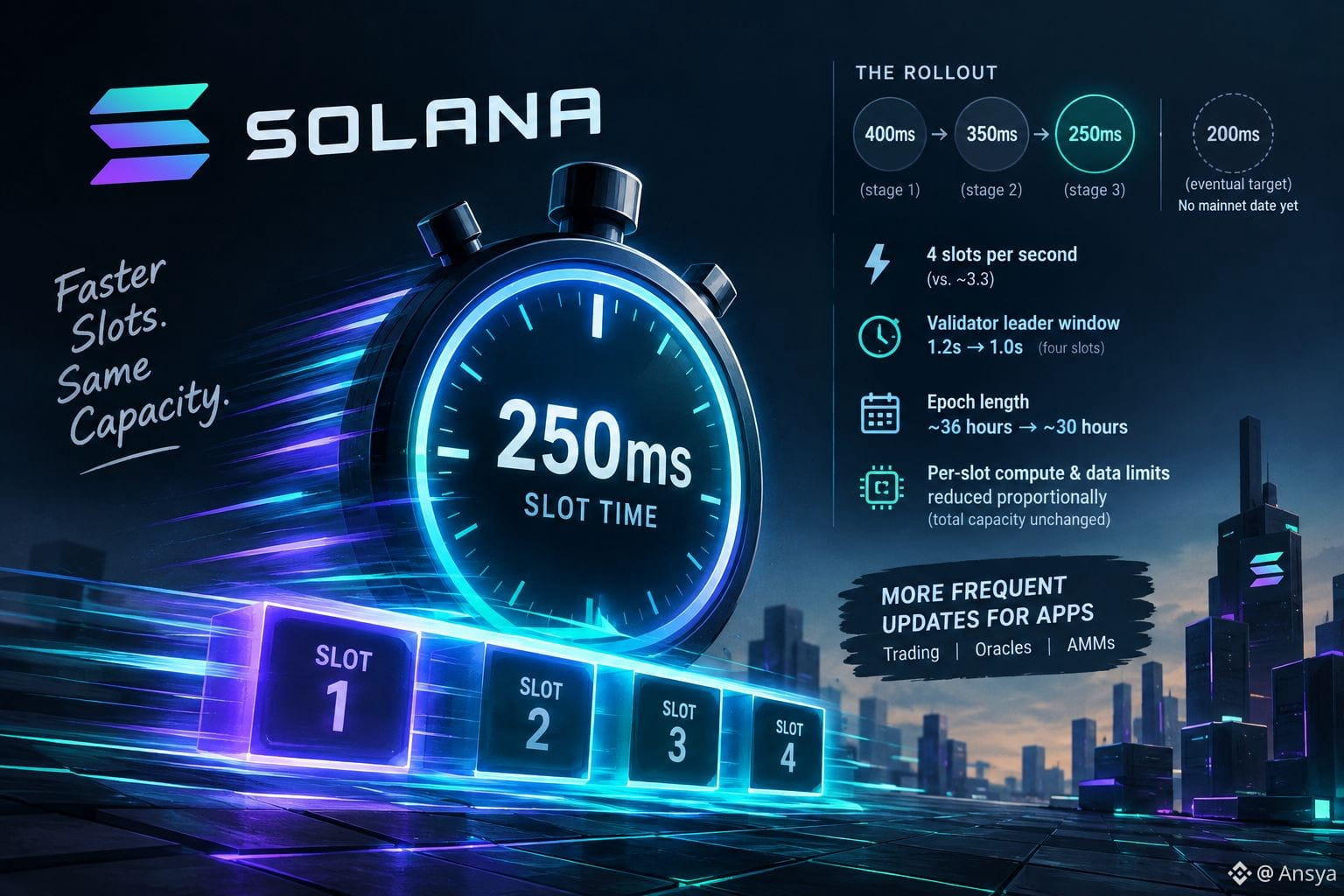
What's happening: Solana cut its target slot time from 300ms to 250ms on September 18, the third stage of a staged rollout called SIMD-0525. The network now targets four slots per second instead of roughly 3.3, shrinking a validator's four-slot leader window from 1.2 seconds to one second and shortening the expected epoch from about 36 hours to 30. Crucially, per-slot computation and data limits were reduced proportionally, so overall processing capacity stays roughly the same — this is a latency change, not a capacity increase. The rollout has moved through 400ms, 350ms, and now 250ms, with 200ms as the eventual target, though no mainnet date has been set for that final step.
Why it matters: Shorter slots mean applications see updated account balances, prices, and transaction data more frequently, which matters most for latency-sensitive activity like trading, oracles, and automated market makers. It's a meaningful technical refinement, even if it won't show up as a headline transactions-per-second jump.
Something to sit with: Does shaving latency without raising capacity meaningfully improve the on-chain trading experience, or does the real test only come once Solana reaches its 200ms target? Worth watching how DeFi activity responds.
$ZETA $SOL $PTB
⏱️ Solana's Clock Just Got 17% Faster — But Not Its Ceiling
Speed upgrades on blockchains usually promise more throughput. This one is doing something more precise.
What's happening: Solana cut its target slot time from 300ms to 250ms on September 18, the third stage of a staged rollout called SIMD-0525. The network now targets four slots per second instead of roughly 3.3, shrinking a validator's four-slot leader window from 1.2 seconds to one second and shortening the expected epoch from about 36 hours to 30. Crucially, per-slot computation and data limits were reduced proportionally, so overall processing capacity stays roughly the same — this is a latency change, not a capacity increase. The rollout has moved through 400ms, 350ms, and now 250ms, with 200ms as the eventual target, though no mainnet date has been set for that final step.
Why it matters: Shorter slots mean applications see updated account balances, prices, and transaction data more frequently, which matters most for latency-sensitive activity like trading, oracles, and automated market makers. It's a meaningful technical refinement, even if it won't show up as a headline transactions-per-second jump.
Something to sit with: Does shaving latency without raising capacity meaningfully improve the on-chain trading experience, or does the real test only come once Solana reaches its 200ms target? Worth watching how DeFi activity responds.
$ZETA $SOL $PTB