
#sol
sol
117.3M views
249,880 Discussing
Hot
Latest

See translation
$SOL Coin Price Forecast 2026 - 2029 🚀🚀🚀
If you invest $ 1,000.00 in Solana today and hold unti Dec 31, 2026, our prediction suggests you could see a potential profit of $ 1288.03, reflecting a 128.80% ROI over the next 104 days.
The coin is in a dip right now, so it can be a good buying opportunity for quick investment.
Price Prediction 2026
After the analysis of the prices of in previous years, it is assumed that in 2026, the minimum price of will be around $99.36 The maximum expected SOL price may be around $257.02 On average, the trading price might be $208.55 in 2026.
Price Prediction 2027
Based on the technical analysis by cryptocurrency experts regarding the prices of , in 2027, SOL is expected to have the following minimum and maximum prices: about $271.62 and $341.01, respectively. The average expected trading cost is $281.70.
Price Prediction 2028
The experts in the field of cryptocurrency have analyzed the prices of and their fluctuations during the previous years. It is assumed that in 2028, the minimum SOL price might drop to $406.04, while its maximum can reach $477.37. On average, the trading cost will be around $417.30.
Price Prediction 2029
Based on the analysis of the costs of by crypto experts, the following maximum and minimum SOL prices are expected in 2029: $691.98 and $566.51. On average, it will be traded at $583.20.
Please🙏 Follow Me ❤
#sol
$SOL Coin Price Forecast 2026 - 2029 🚀🚀🚀
If you invest $ 1,000.00 in Solana today and hold unti Dec 31, 2026, our prediction suggests you could see a potential profit of $ 1288.03, reflecting a 128.80% ROI over the next 104 days.
The coin is in a dip right now, so it can be a good buying opportunity for quick investment.
Price Prediction 2026
After the analysis of the prices of in previous years, it is assumed that in 2026, the minimum price of will be around $99.36 The maximum expected SOL price may be around $257.02 On average, the trading price might be $208.55 in 2026.
Price Prediction 2027
Based on the technical analysis by cryptocurrency experts regarding the prices of , in 2027, SOL is expected to have the following minimum and maximum prices: about $271.62 and $341.01, respectively. The average expected trading cost is $281.70.
Price Prediction 2028
The experts in the field of cryptocurrency have analyzed the prices of and their fluctuations during the previous years. It is assumed that in 2028, the minimum SOL price might drop to $406.04, while its maximum can reach $477.37. On average, the trading cost will be around $417.30.
Price Prediction 2029
Based on the analysis of the costs of by crypto experts, the following maximum and minimum SOL prices are expected in 2029: $691.98 and $566.51. On average, it will be traded at $583.20.
Please🙏 Follow Me ❤
#sol
If you invest $ 1,000.00 in Solana today and hold unti Dec 31, 2026, our prediction suggests you could see a potential profit of $ 1288.03, reflecting a 128.80% ROI over the next 104 days.
The coin is in a dip right now, so it can be a good buying opportunity for quick investment.
Price Prediction 2026
After the analysis of the prices of in previous years, it is assumed that in 2026, the minimum price of will be around $99.36 The maximum expected SOL price may be around $257.02 On average, the trading price might be $208.55 in 2026.
Price Prediction 2027
Based on the technical analysis by cryptocurrency experts regarding the prices of , in 2027, SOL is expected to have the following minimum and maximum prices: about $271.62 and $341.01, respectively. The average expected trading cost is $281.70.
Price Prediction 2028
The experts in the field of cryptocurrency have analyzed the prices of and their fluctuations during the previous years. It is assumed that in 2028, the minimum SOL price might drop to $406.04, while its maximum can reach $477.37. On average, the trading cost will be around $417.30.
Price Prediction 2029
Based on the analysis of the costs of by crypto experts, the following maximum and minimum SOL prices are expected in 2029: $691.98 and $566.51. On average, it will be traded at $583.20.
Please🙏 Follow Me ❤
#sol

AngelOfCrypto_-:
nice
1
6
3.2k

See translation
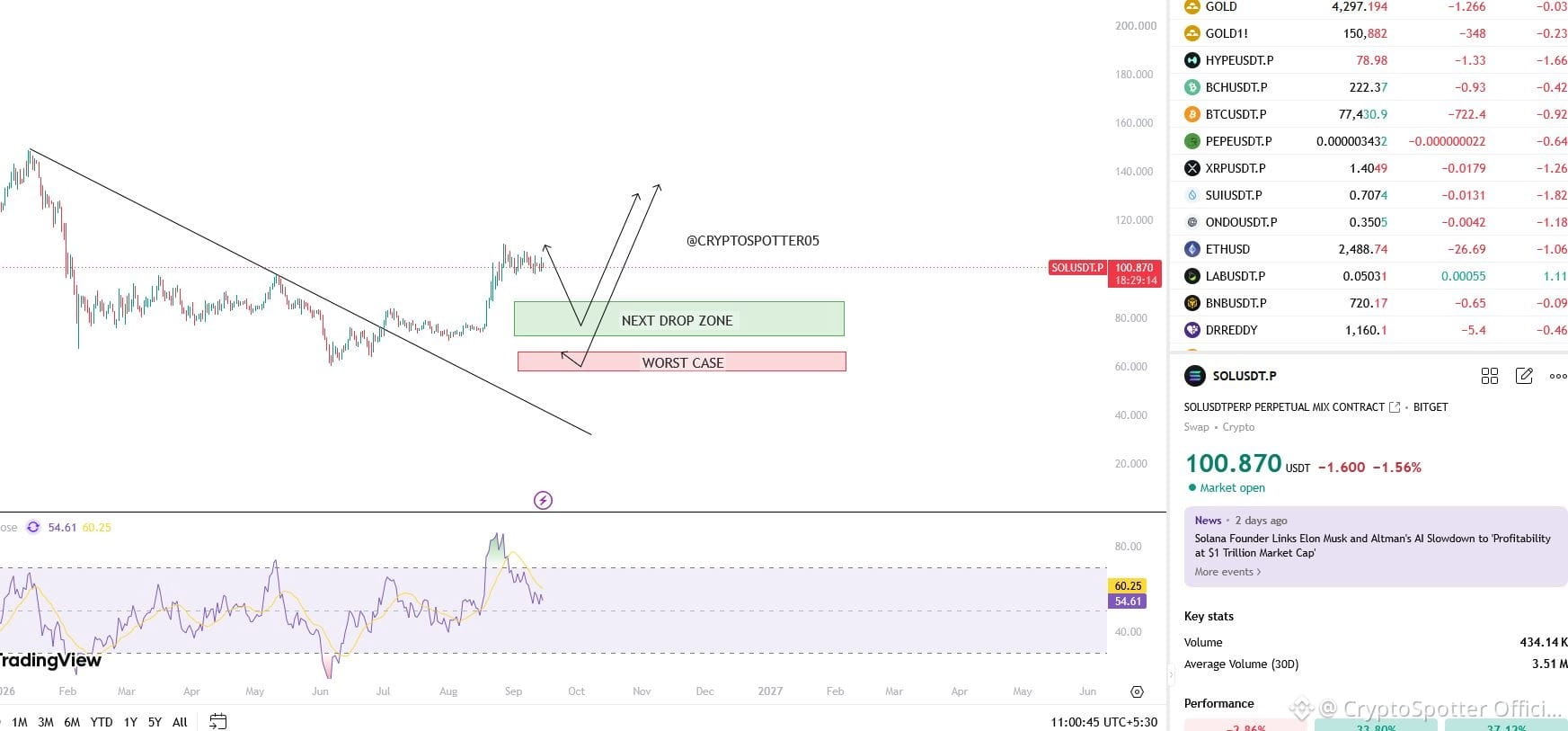
Here's my Short Term Outlook For $SOL . 🚨
First i am expecting a Dump in the next Dump zone Area,
And the worst case scenario is also possible,
Once this area is tapped i think $SOL Will start its journey higher.
If you want to know the exact idea behind this and how high it can pump in the next 3 months please go ahead and check my YT Channel i Have already shared an in depth plan for $SOL .
PS:- This is educational content i am not a financial advisor
Follow @Cryptospotter1505 for more such analysis
#solana #sol #crypto
Here's my Short Term Outlook For $SOL . 🚨
First i am expecting a Dump in the next Dump zone Area,
And the worst case scenario is also possible,
Once this area is tapped i think $SOL Will start its journey higher.
If you want to know the exact idea behind this and how high it can pump in the next 3 months please go ahead and check my YT Channel i Have already shared an in depth plan for $SOL .
PS:- This is educational content i am not a financial advisor
Follow @CryptoSpotter Official for more such analysis
#solana #sol #crypto
First i am expecting a Dump in the next Dump zone Area,
And the worst case scenario is also possible,
Once this area is tapped i think $SOL Will start its journey higher.
If you want to know the exact idea behind this and how high it can pump in the next 3 months please go ahead and check my YT Channel i Have already shared an in depth plan for $SOL .
PS:- This is educational content i am not a financial advisor
Follow @CryptoSpotter Official for more such analysis
#solana #sol #crypto
AngelOfCrypto_-:
nice
2
9
8.9k
See translation
🚨 $SOL BULL FLAG OR BIGGER MOVE COMING?
$SOL is holding above the key $96 area, which has acted as an important support zone. 👀
If the market takes a liquidity sweep around $95–$96 and then strongly reclaims the zone, I’ll be watching for a potential bullish continuation.
📊 MY SETUP:
🟢 Entry Zone: $95–$96
🎯 Target 1: $117
🎯 Target 2: $122
⚠️ Invalidation: Sustained breakdown below the key support
The key is patience. I don’t want to chase green candles—I want confirmation after the liquidity sweep.
After 1Y6M of trading, I’m still learning, but I believe I’ve finally found an edge that works for my strategy.
No FOMO. Manage your risk. DYOR. 🔥
What do you think—will $SOL reach $117–$122? 👇
#sol
{spot}(SOLUSDT)
🚨 $SOL BULL FLAG OR BIGGER MOVE COMING?
$SOL is holding above the key $96 area, which has acted as an important support zone. 👀
If the market takes a liquidity sweep around $95–$96 and then strongly reclaims the zone, I’ll be watching for a potential bullish continuation.
📊 MY SETUP:
🟢 Entry Zone: $95–$96
🎯 Target 1: $117
🎯 Target 2: $122
⚠️ Invalidation: Sustained breakdown below the key support
The key is patience. I don’t want to chase green candles—I want confirmation after the liquidity sweep.
After 1Y6M of trading, I’m still learning, but I believe I’ve finally found an edge that works for my strategy.
No FOMO. Manage your risk. DYOR. 🔥
What do you think—will $SOL reach $117–$122? 👇
#sol
$SOL is holding above the key $96 area, which has acted as an important support zone. 👀
If the market takes a liquidity sweep around $95–$96 and then strongly reclaims the zone, I’ll be watching for a potential bullish continuation.
📊 MY SETUP:
🟢 Entry Zone: $95–$96
🎯 Target 1: $117
🎯 Target 2: $122
⚠️ Invalidation: Sustained breakdown below the key support
The key is patience. I don’t want to chase green candles—I want confirmation after the liquidity sweep.
After 1Y6M of trading, I’m still learning, but I believe I’ve finally found an edge that works for my strategy.
No FOMO. Manage your risk. DYOR. 🔥
What do you think—will $SOL reach $117–$122? 👇
#sol
206 Atlas:
Your invalidation is too vague. Sustained breakdown below what? Without a specific price or timeframe, you have no defined risk for this setup.
1
822



·
--
Bullish
See translation
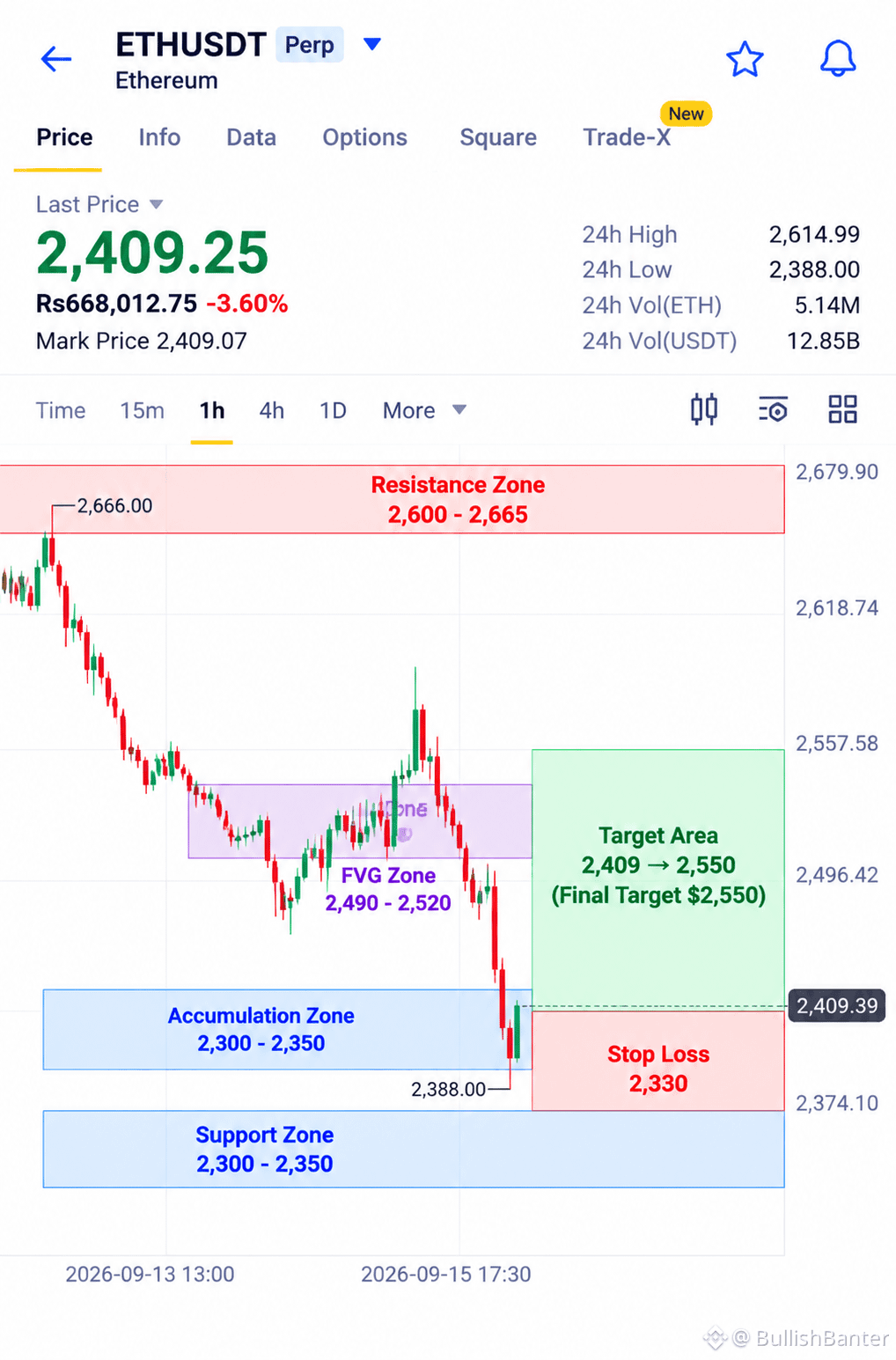
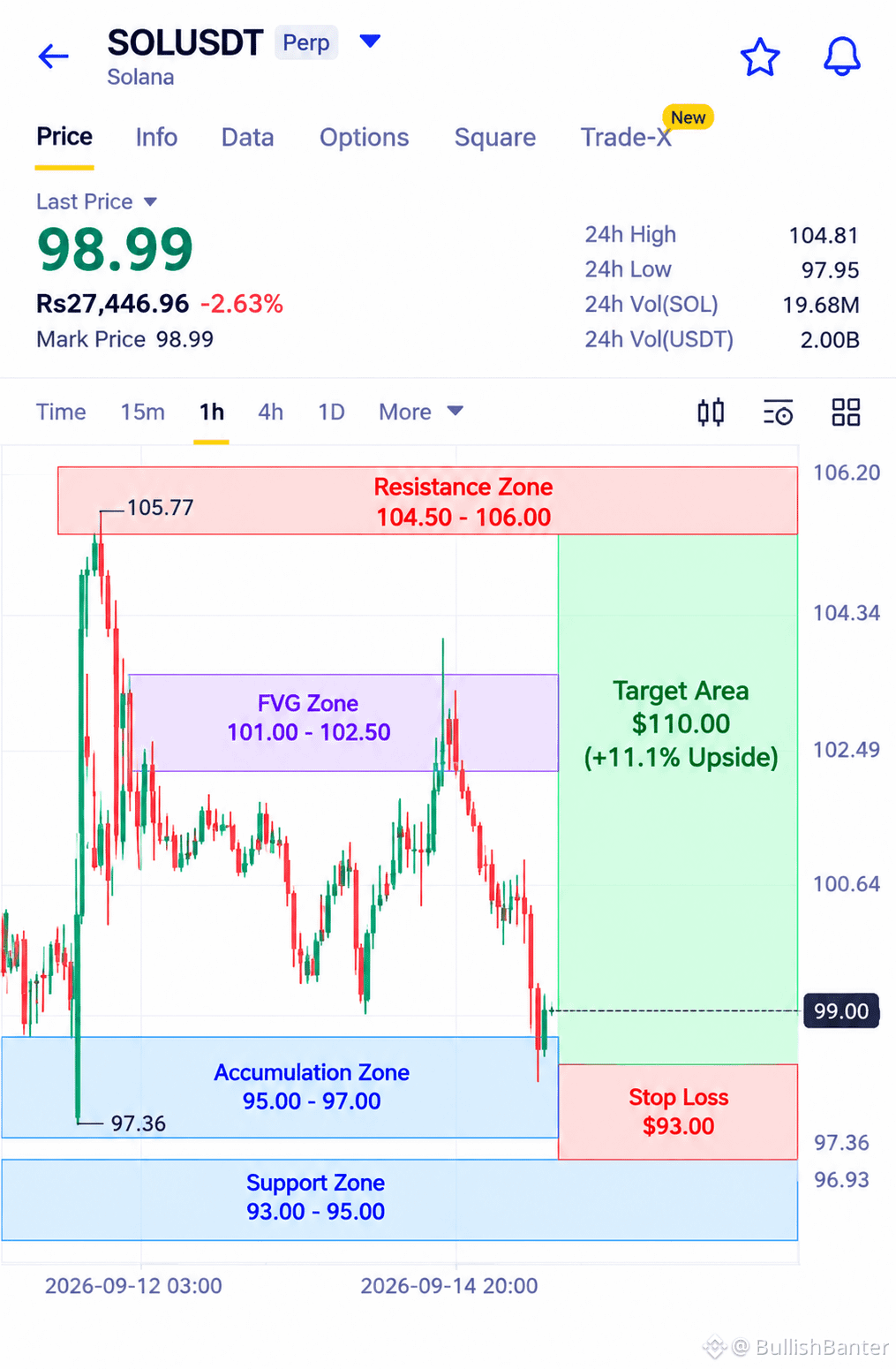
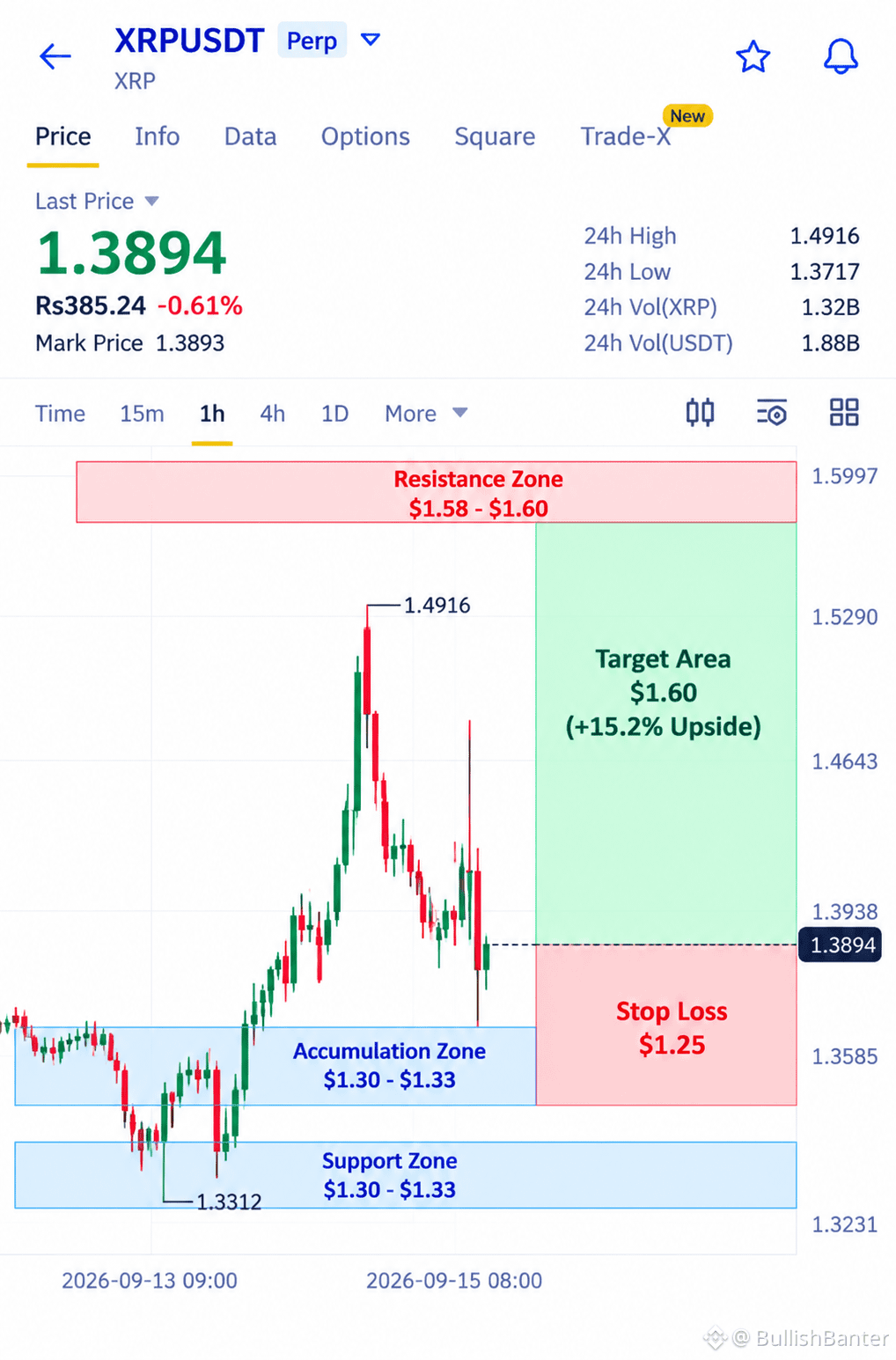
$ETH , $SOL and $XRP are all reaching important buy areas after the market correction.
#ETH reacted from $2,388, with the main accumulation/support zone around $2,300–$2,350. Recovery target remains $2,550, while $2,490–$2,520 is the first FVG to reclaim.
#SOL is back near the lows around $99. The key accumulation area is $95–$97, with $93 as invalidation. A strong recovery can first challenge $101–$102.50 and then $104.50–$106.
#XRP is holding around $1.39, while the stronger accumulation/support sits at $1.30–$1.33. If buyers regain momentum, $1.60 remains the major upside target.
The market is still under pressure, so I would accumulate near support rather than chase any bounce. These are attractive zones, but support confirmation matters.
Click to trades on these coins
{future}(ETHUSDT)
{future}(SOLUSDT)
{future}(XRPUSDT)
$ETH , $SOL and $XRP are all reaching important buy areas after the market correction.
#ETH reacted from $2,388, with the main accumulation/support zone around $2,300–$2,350. Recovery target remains $2,550, while $2,490–$2,520 is the first FVG to reclaim.
#SOL is back near the lows around $99. The key accumulation area is $95–$97, with $93 as invalidation. A strong recovery can first challenge $101–$102.50 and then $104.50–$106.
#XRP is holding around $1.39, while the stronger accumulation/support sits at $1.30–$1.33. If buyers regain momentum, $1.60 remains the major upside target.
The market is still under pressure, so I would accumulate near support rather than chase any bounce. These are attractive zones, but support confirmation matters.
Click to trades on these coins
#ETH reacted from $2,388, with the main accumulation/support zone around $2,300–$2,350. Recovery target remains $2,550, while $2,490–$2,520 is the first FVG to reclaim.
#SOL is back near the lows around $99. The key accumulation area is $95–$97, with $93 as invalidation. A strong recovery can first challenge $101–$102.50 and then $104.50–$106.
#XRP is holding around $1.39, while the stronger accumulation/support sits at $1.30–$1.33. If buyers regain momentum, $1.60 remains the major upside target.
The market is still under pressure, so I would accumulate near support rather than chase any bounce. These are attractive zones, but support confirmation matters.
Click to trades on these coins
BlockJammer:
Slow recovery
2
2
1.9k

·
--
Bullish
See translation
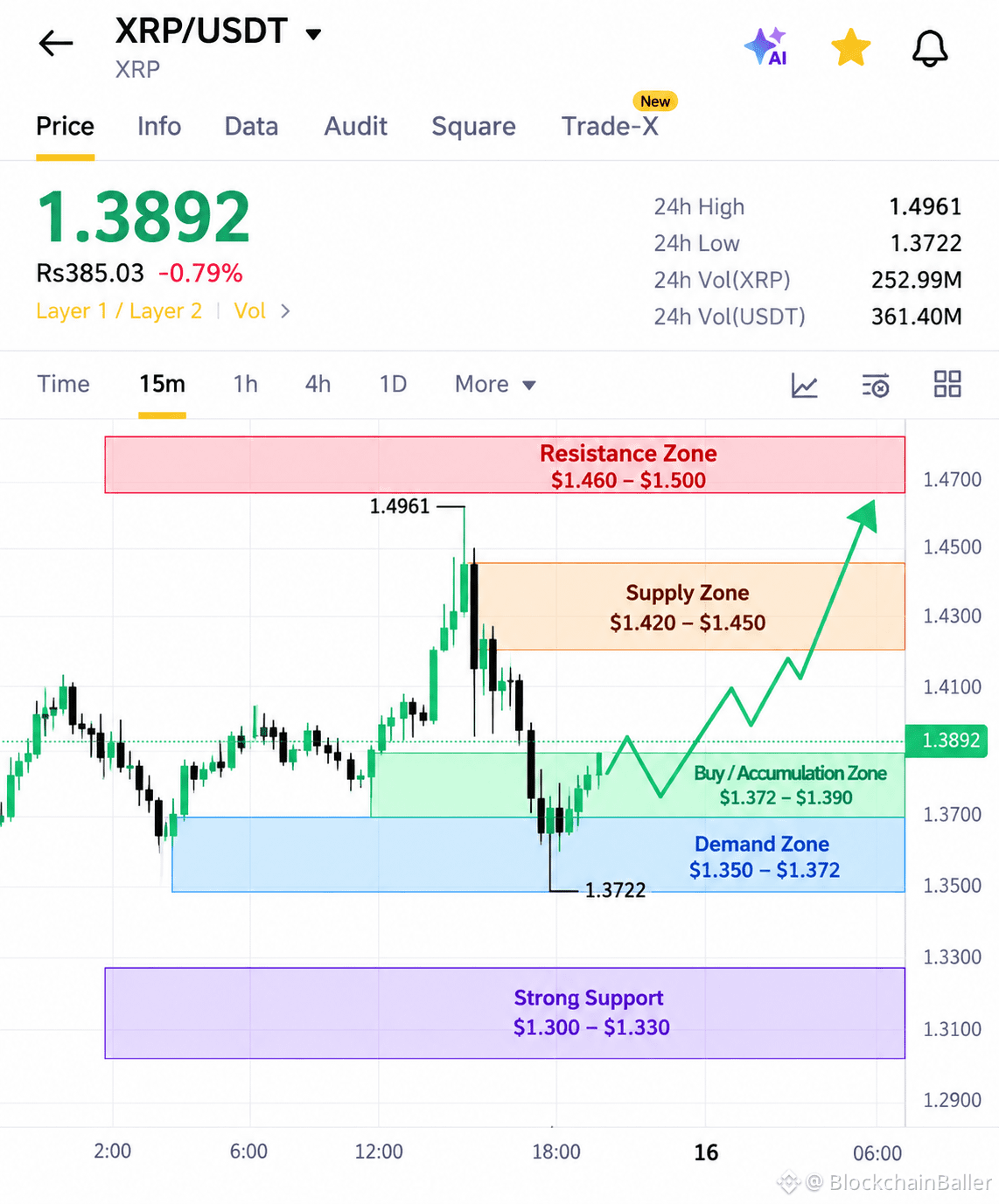
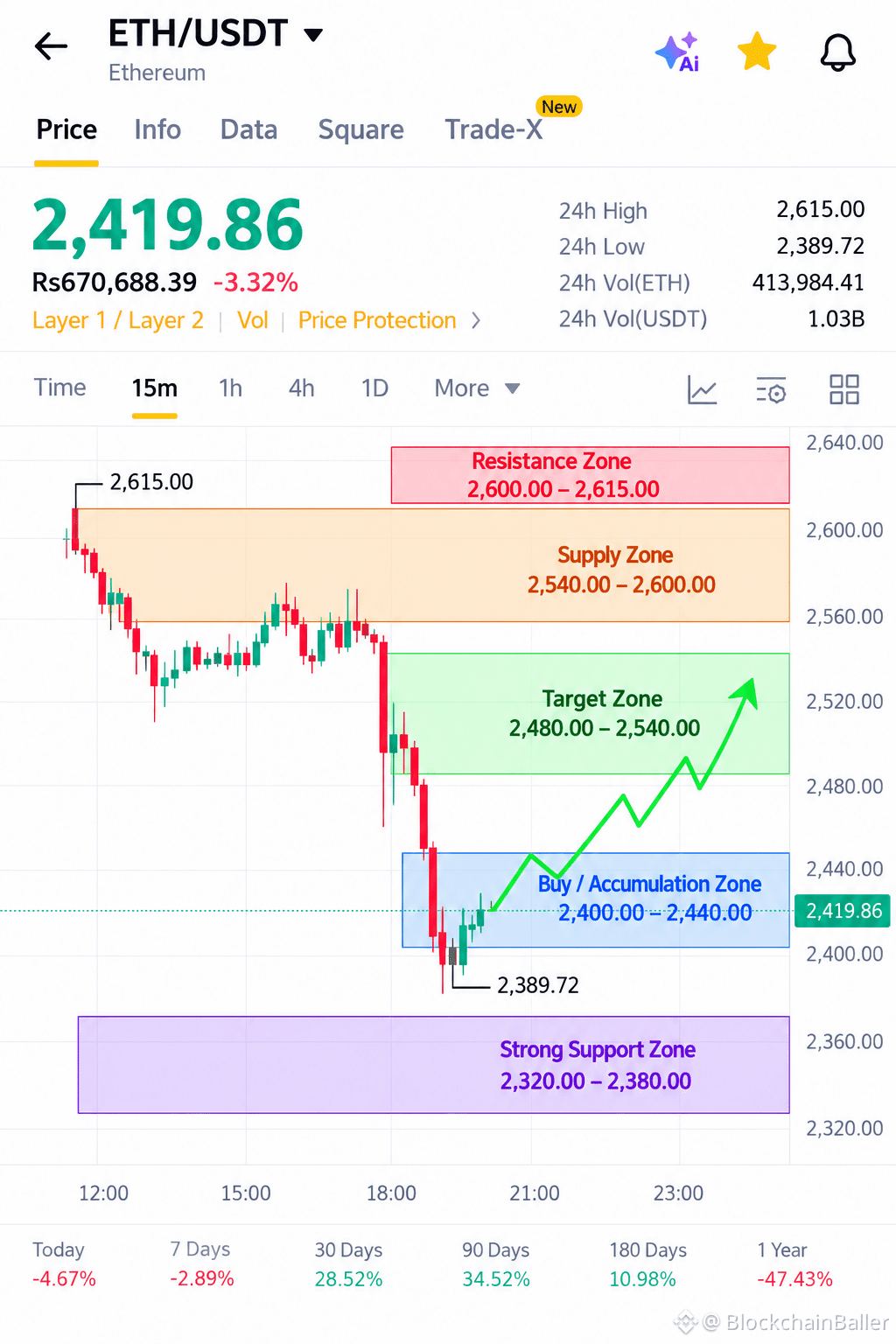
$ETH , $XRP & $SOL Are Sitting in Major Buy Zones Bounce Coming❓❓
#ETH , #XRP and #SOL are sitting around key buy zones and showing bounce attempts....
I’m looking at these as quick spot opportunities only don’t stay too long, take your profit and get out of the market.
$ETH: $2,400–$2,440 → $2,480–$2,540
$XRP: $1.372–$1.390 → $1.420–$1.450
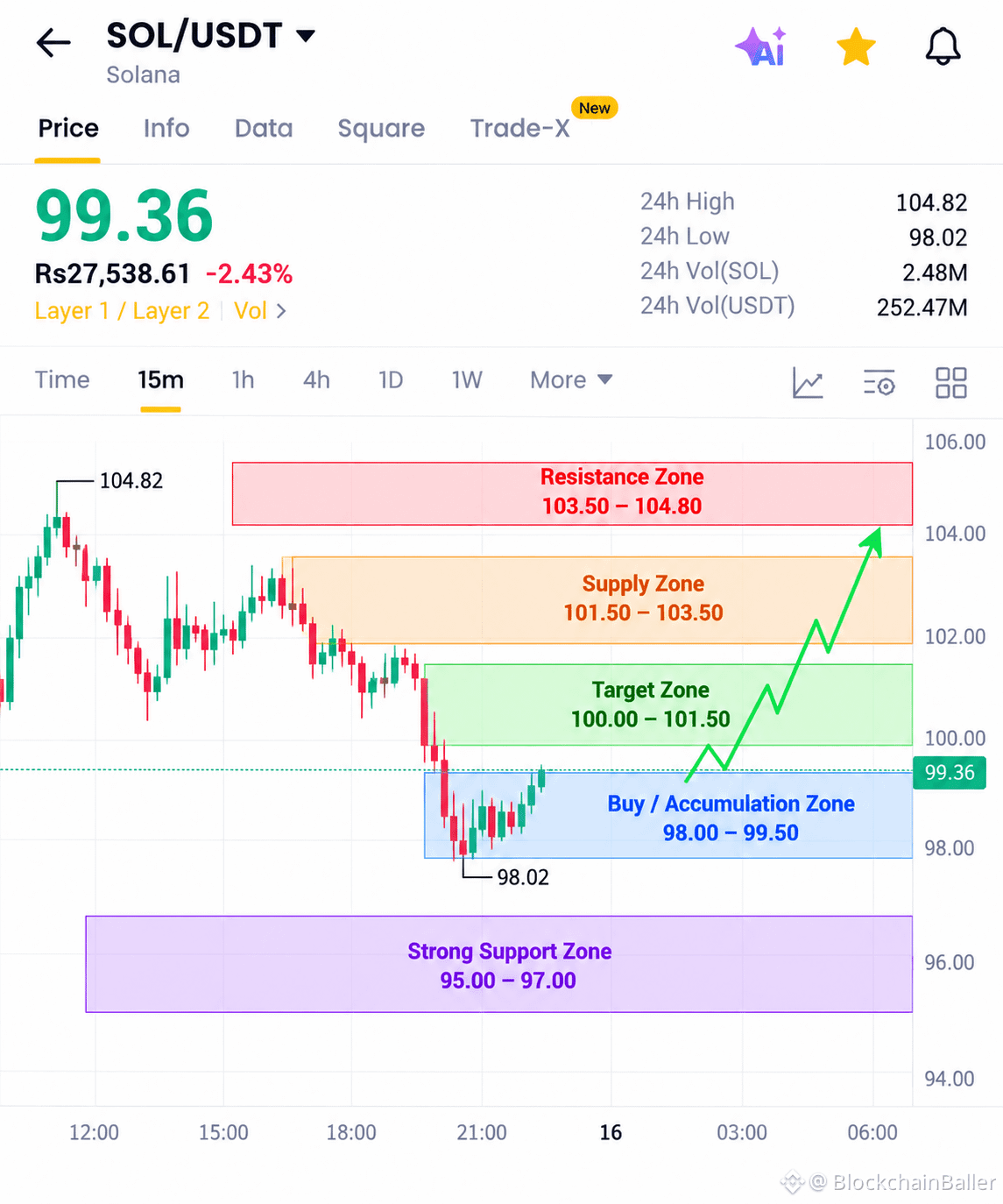
$SOL: $98–$99.50 → $100–$103.50
$ETH , $XRP & $SOL Are Sitting in Major Buy Zones Bounce Coming❓❓
#ETH , #XRP and #SOL are sitting around key buy zones and showing bounce attempts....
I’m looking at these as quick spot opportunities only don’t stay too long, take your profit and get out of the market.
$ETH : $2,400–$2,440 → $2,480–$2,540
$XRP : $1.372–$1.390 → $1.420–$1.450
$SOL : $98–$99.50 → $100–$103.50
#ETH , #XRP and #SOL are sitting around key buy zones and showing bounce attempts....
I’m looking at these as quick spot opportunities only don’t stay too long, take your profit and get out of the market.
$ETH : $2,400–$2,440 → $2,480–$2,540
$XRP : $1.372–$1.390 → $1.420–$1.450
$SOL : $98–$99.50 → $100–$103.50
2
1.3k

·
--
Bullish
See translation
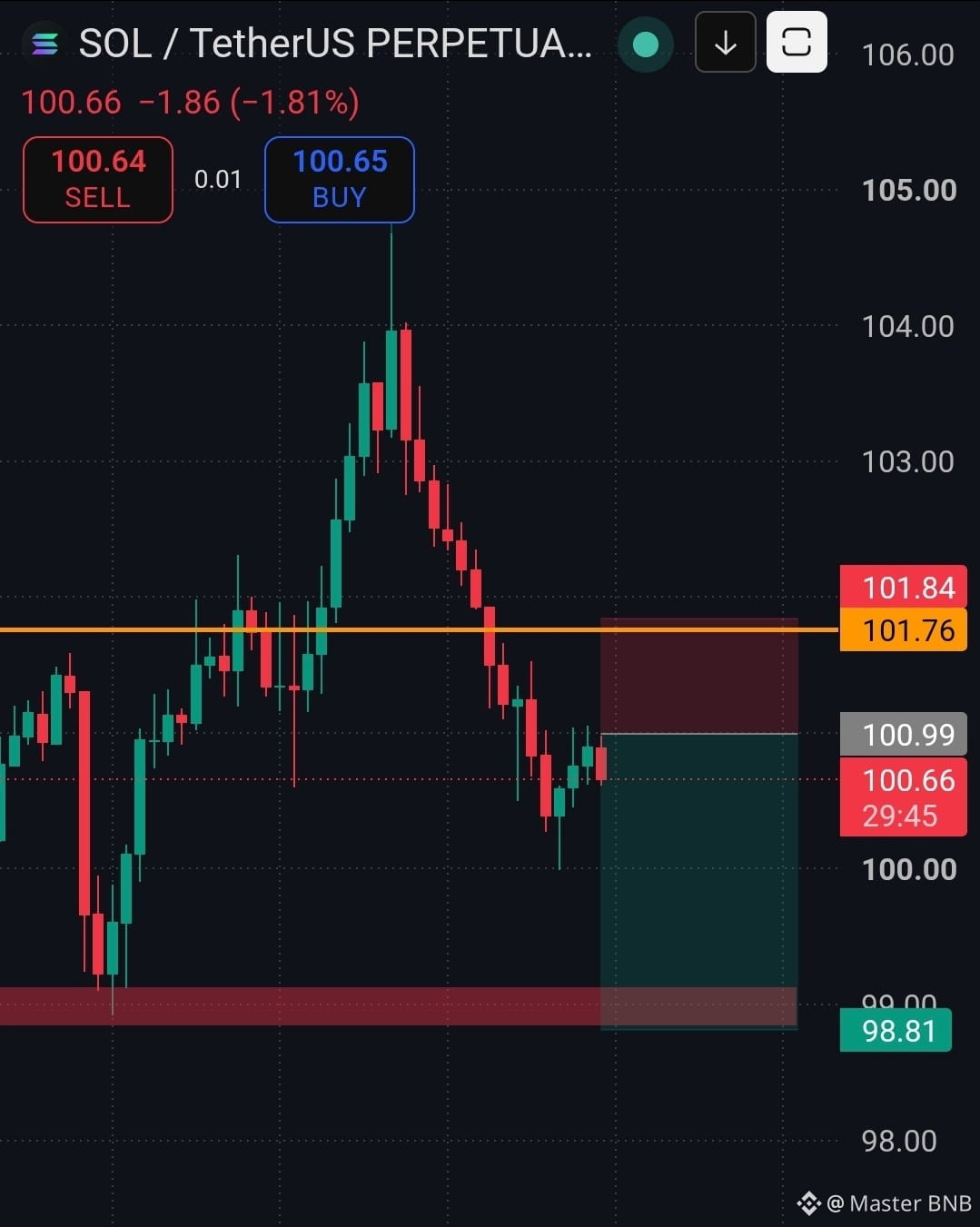
Short Analysis: $SOL/USDT
Solana ($SOL ) is currently consolidating around $100.32 (-1.47%), holding just above the immediate support level of $99.91 (24h low: $99.74).
Technical Quick-Take:
* Moving Averages: Price is wedged between MA(7) at $100.29 and MA(25) resistance at $100.38. A breakdown below $99.91 tests the downside, while clearing MA(99) at $100.68 targets today's high at $104.82.
* RSI (6): 49.27 (Neutral) — waiting for volume confirmation.
The Setup:
* 🟢 Bullish: Target $104.80+ on a clean break above $100.76.
* 🔴 Bearish: Below $99.70 risks further downside.
Holding or taking a position here? Let’s hear your strategy! 👇
#Solana #SOL #BinanceSquare #CryptoTrading
{future}(SOLUSDT)
{future}(BNBUSDT)
Short Analysis: $SOL /USDT
Solana ($SOL ) is currently consolidating around $100.32 (-1.47%), holding just above the immediate support level of $99.91 (24h low: $99.74).
Technical Quick-Take:
* Moving Averages: Price is wedged between MA(7) at $100.29 and MA(25) resistance at $100.38. A breakdown below $99.91 tests the downside, while clearing MA(99) at $100.68 targets today's high at $104.82.
* RSI (6): 49.27 (Neutral) — waiting for volume confirmation.
The Setup:
* 🟢 Bullish: Target $104.80+ on a clean break above $100.76.
* 🔴 Bearish: Below $99.70 risks further downside.
Holding or taking a position here? Let’s hear your strategy! 👇
#Solana #SOL #BinanceSquare #CryptoTrading
Solana ($SOL ) is currently consolidating around $100.32 (-1.47%), holding just above the immediate support level of $99.91 (24h low: $99.74).
Technical Quick-Take:
* Moving Averages: Price is wedged between MA(7) at $100.29 and MA(25) resistance at $100.38. A breakdown below $99.91 tests the downside, while clearing MA(99) at $100.68 targets today's high at $104.82.
* RSI (6): 49.27 (Neutral) — waiting for volume confirmation.
The Setup:
* 🟢 Bullish: Target $104.80+ on a clean break above $100.76.
* 🔴 Bearish: Below $99.70 risks further downside.
Holding or taking a position here? Let’s hear your strategy! 👇
#Solana #SOL #BinanceSquare #CryptoTrading

125
·
--
See translation
🚨 $SOL — BIG SHORT SETUP 📉🔥
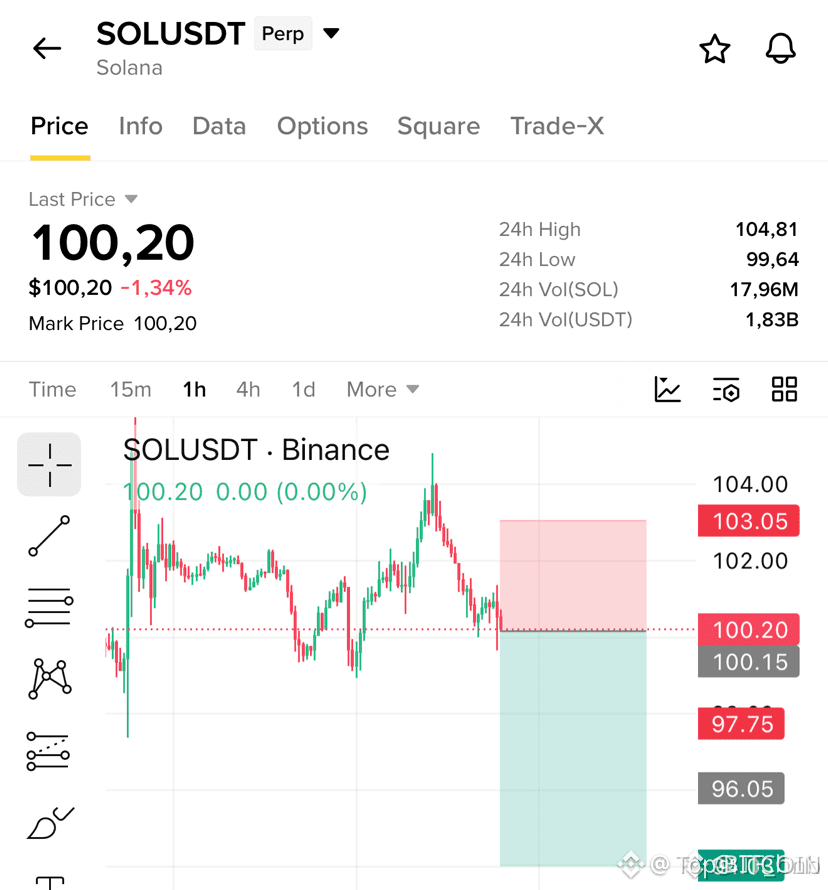
$SOL is showing bearish pressure, and sellers could push price lower if momentum continues.
Stop Loss: 103
Take Profit: 94
Short $SOL now 👇
{spot}(SOLUSDT)
📉 Reason: Bearish momentum with potential downside continuation.
⚠️ Manage risk carefully, use controlled position sizing, and avoid excessive leverage.
#SOL #Solana #Crypto #Binance #Short #Trading #FOMO
🚨 $SOL — BIG SHORT SETUP 📉🔥
$SOL is showing bearish pressure, and sellers could push price lower if momentum continues.
Stop Loss: 103
Take Profit: 94
Short $SOL now 👇
📉 Reason: Bearish momentum with potential downside continuation.
⚠️ Manage risk carefully, use controlled position sizing, and avoid excessive leverage.
#SOL #Solana #Crypto #Binance #Short #Trading #FOMO
$SOL is showing bearish pressure, and sellers could push price lower if momentum continues.
Stop Loss: 103
Take Profit: 94
Short $SOL now 👇
📉 Reason: Bearish momentum with potential downside continuation.
⚠️ Manage risk carefully, use controlled position sizing, and avoid excessive leverage.
#SOL #Solana #Crypto #Binance #Short #Trading #FOMO
31
See translation
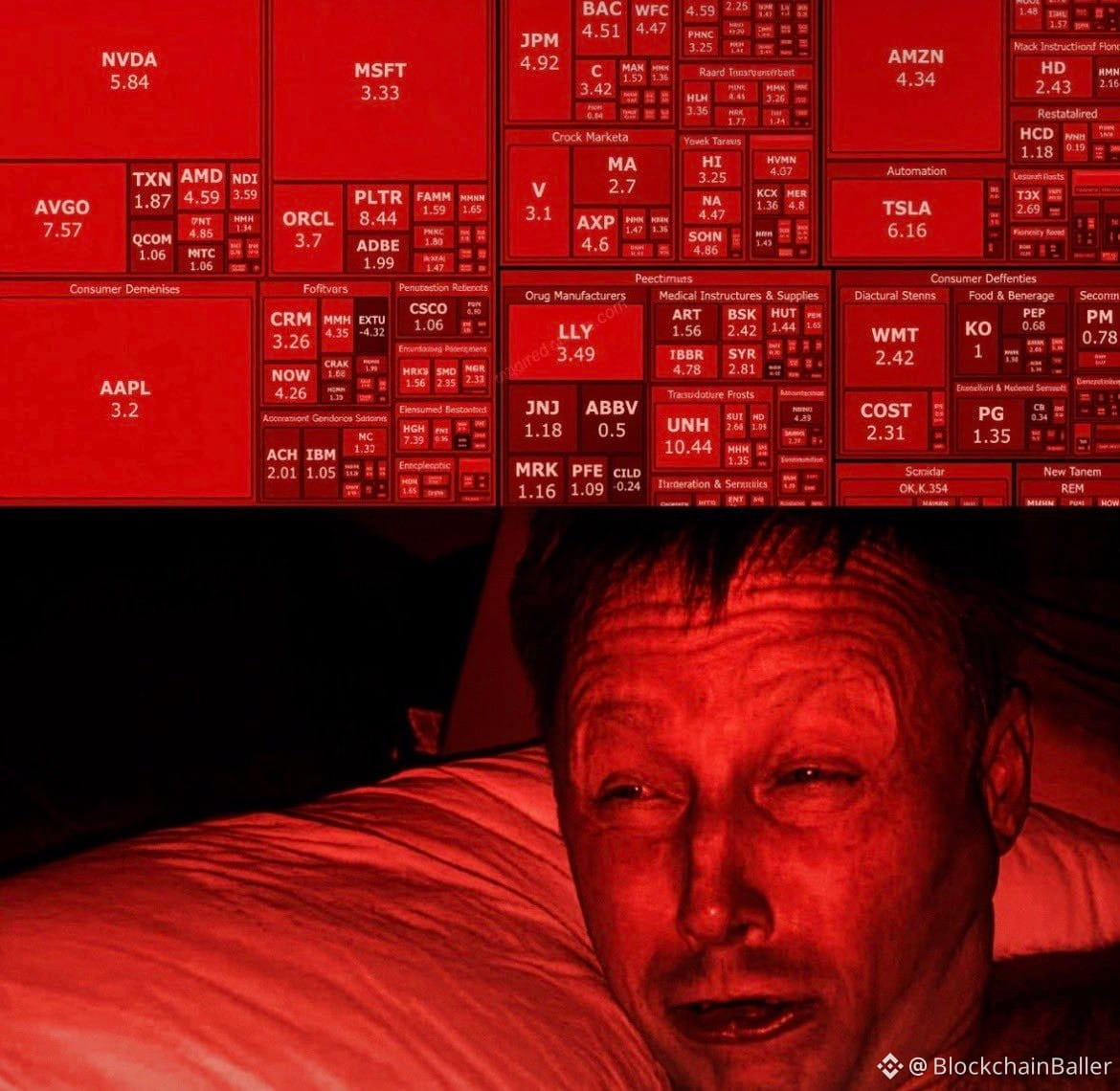
$SOL IS GETTING HIT HARD 📉👀‼️
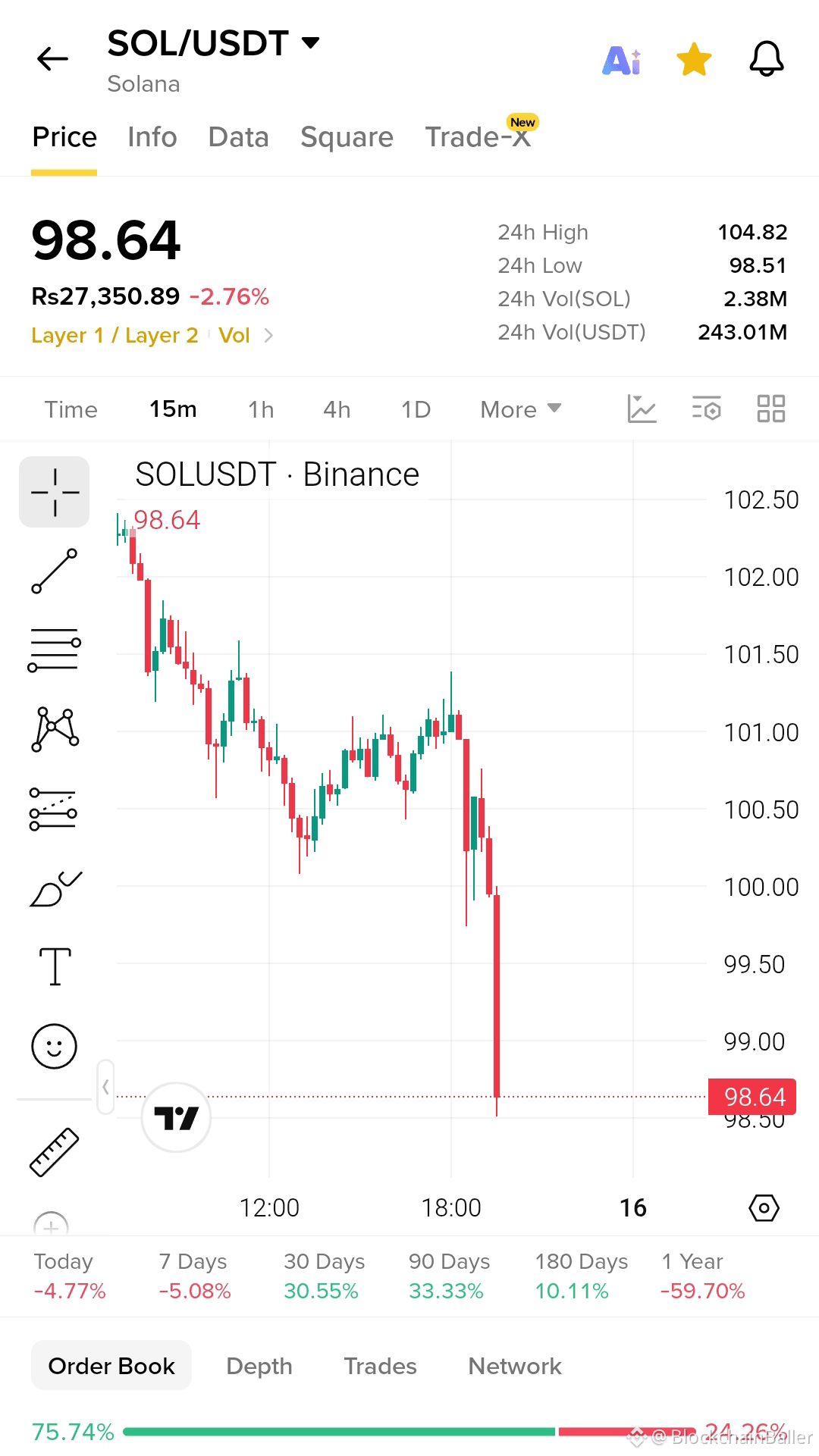
#Sol just lost the important $100 level and dropped toward $98.6 as the wider crypto sell-off continues.
With $BTC and $ETH under pressure, SOL sellers are taking control too.
Short Entry: $99.50–$100.50
TP1: $98.00 | TP2: $96.50 | TP3: $95.00
Stop Loss: $101.50
If $100 isn’t reclaimed quickly, the downside pressure could continue.
$SOL IS GETTING HIT HARD 📉👀‼️
#Sol just lost the important $100 level and dropped toward $98.6 as the wider crypto sell-off continues.
With $BTC and $ETH under pressure, SOL sellers are taking control too.
Short Entry: $99.50–$100.50
TP1: $98.00 | TP2: $96.50 | TP3: $95.00
Stop Loss: $101.50
If $100 isn’t reclaimed quickly, the downside pressure could continue.
#Sol just lost the important $100 level and dropped toward $98.6 as the wider crypto sell-off continues.
With $BTC and $ETH under pressure, SOL sellers are taking control too.
Short Entry: $99.50–$100.50
TP1: $98.00 | TP2: $96.50 | TP3: $95.00
Stop Loss: $101.50
If $100 isn’t reclaimed quickly, the downside pressure could continue.
SaeedTrdr:
and SUI
1
1
1.1k

See translation
🚨 $SOL BOUNCE TO 100.68 IS THE GRIM REAPER TRAP 💣
Entry: 100.68 ⚡
Target: 95.83 / 90.78 🎯
Stop Loss: 103.90 ⚠️
$SOL longs are getting lured by a shallow bounce while the moving-average noose tightens. 📉 Smart money isn’t chasing this fake relief; it’s using strength to unload and flip momentum lower.
🔍 The invalidation sits at 103.90, so any reclaim above that flips the script. Below, 95.83 opens the first tunnel, and 90.78 is the deeper drop where trapped buyers may capitulate. 💬 Are you fading this bounce or waiting for a confirmed sweep above the stop? 👇
⚠️ Not financial advice. Always manage your risk. 🛡️
🏷️ #SOL #ShortSetup #Bearish #Solana #Crypto
🐻 ⚡
🚨 $SOL BOUNCE TO 100.68 IS THE GRIM REAPER TRAP 💣
Entry: 100.68 ⚡
Target: 95.83 / 90.78 🎯
Stop Loss: 103.90 ⚠️
$SOL longs are getting lured by a shallow bounce while the moving-average noose tightens. 📉 Smart money isn’t chasing this fake relief; it’s using strength to unload and flip momentum lower.
🔍 The invalidation sits at 103.90, so any reclaim above that flips the script. Below, 95.83 opens the first tunnel, and 90.78 is the deeper drop where trapped buyers may capitulate. 💬 Are you fading this bounce or waiting for a confirmed sweep above the stop? 👇
⚠️ Not financial advice. Always manage your risk. 🛡️
🏷️ #SOL #ShortSetup #Bearish #Solana #Crypto
🐻 ⚡
Entry: 100.68 ⚡
Target: 95.83 / 90.78 🎯
Stop Loss: 103.90 ⚠️
$SOL longs are getting lured by a shallow bounce while the moving-average noose tightens. 📉 Smart money isn’t chasing this fake relief; it’s using strength to unload and flip momentum lower.
🔍 The invalidation sits at 103.90, so any reclaim above that flips the script. Below, 95.83 opens the first tunnel, and 90.78 is the deeper drop where trapped buyers may capitulate. 💬 Are you fading this bounce or waiting for a confirmed sweep above the stop? 👇
⚠️ Not financial advice. Always manage your risk. 🛡️
🏷️ #SOL #ShortSetup #Bearish #Solana #Crypto
🐻 ⚡

51

·
--
Article
See translation
SOL: More Than Just Another Crypto AssetWhen people talk about Solana, the conversation often starts with $SOL price action.
But the bigger story is not only about the token.
It is about the network being built underneath it.
Solana has positioned itself as a high-performance blockchain designed for applications that need fast execution, low transaction costs, and high throughput. Its architecture is increasingly being used across DeFi, payments, tokenized assets, trading, consumer applications, and developer infrastructure.
⚡ Speed Is Only One Part of the Story
Solana's appeal has always been closely connected to performance.
The network's transaction model allows multiple instructions to be composed into atomic transactions, while its architecture is designed for fast execution. Solana's official documentation describes roughly 400ms block times historically, while recent 2026 upgrades have pushed target slot times down to 300ms.
That matters because blockchain adoption isn't only about decentralization.
For everyday applications, users also care about:
• How quickly transactions settle
• How much transactions cost
• Whether the network can handle demand
• Whether developers can build efficiently
• Whether applications can scale without becoming too expensive
Solana is trying to compete on all of these fronts.
🏦 DeFi Is Becoming More Sophisticated
Solana is no longer simply a chain for token swaps and speculative trading.
Its ecosystem now includes decentralized exchanges, lending markets, perpetuals, stablecoins, oracles and other financial infrastructure. The network's composability allows different financial applications to interact within the same execution environment.
This creates an important flywheel:
More liquidity → more applications → more users → more transactions → more demand for blockspace.
If that cycle continues, SOL's role becomes increasingly important because SOL is used within the network for transaction fees and staking.
🌍 The RWA Opportunity
One of the most interesting developments around Solana is the growth of real-world assets.
Tokenized equities and other real-world assets are increasingly moving onchain, bringing traditional financial instruments into blockchain-based markets.
Solana reported that its RWA ecosystem surpassed $4 billion in value during August 2026, while tokenized-stock and stablecoin activity continued expanding.
This is significant because RWAs could eventually connect traditional capital markets with programmable blockchain infrastructure.
Instead of thinking about crypto as a completely separate financial system, we can start thinking about blockchains as infrastructure for moving, trading, settling and managing financial assets.
That is a much bigger opportunity.
💵 Stablecoins & Payments
Payments could become another major use case.
Solana's ecosystem has continued expanding stablecoin infrastructure, while companies are exploring Solana for settlement, payment rails and consumer-facing financial products. In August, Western Union launched a Visa card backed by its USDPT stablecoin on Solana, while MoneyGram introduced infrastructure connecting Solana applications with its global cash network.
The important point is that these developments are not simply about crypto speculation.
They are about using blockchain rails for real financial activity.
🛠️ Developers Matter
A blockchain can have a strong token, but without developers and applications, long-term adoption becomes difficult.
Solana continues investing heavily in developer infrastructure, tooling and performance improvements. Its ecosystem provides resources for building DeFi applications, payment systems, tokenized assets, games and other onchain applications.
Recent protocol upgrades have also increased block capacity and improved execution performance. In July 2026, Solana activated an upgrade raising mainnet block limits to 100 million compute units.
That kind of infrastructure development is easy to overlook when the market is focused only on price.
But infrastructure is what can create sustainable demand over time.
🔥 What Could Drive SOL Forward?
There are several factors worth watching:
1. DeFi growth
More trading, lending, derivatives and liquidity could increase network activity.
2. Tokenized assets
If tokenized stocks, funds and other RWAs continue moving onchain, Solana could benefit from increased financial activity.
3. Stablecoin payments
More stablecoin transfers and real-world payment integrations could create consistent network usage.
4. Developer adoption
More applications can create a stronger ecosystem and increase demand for blockspace.
5. Network improvements
Faster execution and greater capacity can make the network more attractive for high-frequency applications.
6. Institutional adoption
If financial institutions continue experimenting with blockchain-based settlement and tokenization, high-performance networks could become increasingly relevant.
⚠️ But SOL Still Has Risks
A strong ecosystem does not guarantee a rising token price.
Crypto remains highly volatile.
SOL can experience large drawdowns even when the underlying network continues developing. Competition between Layer-1 networks is also intense, and users can move between ecosystems quickly.
There are also risks around network reliability, decentralization, regulation, liquidity and speculative activity.
The August 2026 infrastructure incident was a useful reminder that resilience matters. Solana reported that a routing failure at its largest infrastructure provider took nearly 29% of network stake offline, while blocks continued to be produced and transactions continued landing.
For investors, this highlights an important distinction:
Technology growth ≠ guaranteed token appreciation.
📊 My SOL Watchlist
Rather than focusing only on a specific price target, I would watch the bigger picture:
Network activity
Are transactions and users continuing to grow?
DeFi liquidity
Is capital actually being deployed across the ecosystem?
Stablecoin usage
Are stablecoins becoming a meaningful payment and settlement layer?
RWA adoption
Are tokenized assets generating sustainable activity?
Developer growth
Are builders continuing to choose Solana?
Market structure
Is SOL making higher highs and higher lows?
These indicators can provide more useful information than simply watching a candle move up or down.
Final Thoughts
The SOL thesis is becoming bigger than a simple “crypto goes up” narrative.
Solana is increasingly positioning itself as infrastructure for DeFi, payments, tokenized assets, trading and consumer applications.
The biggest question is not whether SOL can have another short-term rally.
The bigger question is:
Can Solana continue turning network activity into sustainable economic value?
If adoption keeps expanding across financial markets, payments and tokenized assets, SOL could remain one of the most important assets to watch in the blockchain sector.
But as always:
Don't chase candles.
Watch the fundamentals.
Manage risk.
DYOR.
#Solana #SOL
SOL: More Than Just Another Crypto Asset
When people talk about Solana, the conversation often starts with $SOL price action.
But the bigger story is not only about the token.
It is about the network being built underneath it.
Solana has positioned itself as a high-performance blockchain designed for applications that need fast execution, low transaction costs, and high throughput. Its architecture is increasingly being used across DeFi, payments, tokenized assets, trading, consumer applications, and developer infrastructure.
⚡ Speed Is Only One Part of the Story
Solana's appeal has always been closely connected to performance.
The network's transaction model allows multiple instructions to be composed into atomic transactions, while its architecture is designed for fast execution. Solana's official documentation describes roughly 400ms block times historically, while recent 2026 upgrades have pushed target slot times down to 300ms.
That matters because blockchain adoption isn't only about decentralization.
For everyday applications, users also care about:
• How quickly transactions settle
• How much transactions cost
• Whether the network can handle demand
• Whether developers can build efficiently
• Whether applications can scale without becoming too expensive
Solana is trying to compete on all of these fronts.
🏦 DeFi Is Becoming More Sophisticated
Solana is no longer simply a chain for token swaps and speculative trading.
Its ecosystem now includes decentralized exchanges, lending markets, perpetuals, stablecoins, oracles and other financial infrastructure. The network's composability allows different financial applications to interact within the same execution environment.
This creates an important flywheel:
More liquidity → more applications → more users → more transactions → more demand for blockspace.
If that cycle continues, SOL's role becomes increasingly important because SOL is used within the network for transaction fees and staking.
🌍 The RWA Opportunity
One of the most interesting developments around Solana is the growth of real-world assets.
Tokenized equities and other real-world assets are increasingly moving onchain, bringing traditional financial instruments into blockchain-based markets.
Solana reported that its RWA ecosystem surpassed $4 billion in value during August 2026, while tokenized-stock and stablecoin activity continued expanding.
This is significant because RWAs could eventually connect traditional capital markets with programmable blockchain infrastructure.
Instead of thinking about crypto as a completely separate financial system, we can start thinking about blockchains as infrastructure for moving, trading, settling and managing financial assets.
That is a much bigger opportunity.
💵 Stablecoins & Payments
Payments could become another major use case.
Solana's ecosystem has continued expanding stablecoin infrastructure, while companies are exploring Solana for settlement, payment rails and consumer-facing financial products. In August, Western Union launched a Visa card backed by its USDPT stablecoin on Solana, while MoneyGram introduced infrastructure connecting Solana applications with its global cash network.
The important point is that these developments are not simply about crypto speculation.
They are about using blockchain rails for real financial activity.
🛠️ Developers Matter
A blockchain can have a strong token, but without developers and applications, long-term adoption becomes difficult.
Solana continues investing heavily in developer infrastructure, tooling and performance improvements. Its ecosystem provides resources for building DeFi applications, payment systems, tokenized assets, games and other onchain applications.
Recent protocol upgrades have also increased block capacity and improved execution performance. In July 2026, Solana activated an upgrade raising mainnet block limits to 100 million compute units.
That kind of infrastructure development is easy to overlook when the market is focused only on price.
But infrastructure is what can create sustainable demand over time.
🔥 What Could Drive SOL Forward?
There are several factors worth watching:
1. DeFi growth
More trading, lending, derivatives and liquidity could increase network activity.
2. Tokenized assets
If tokenized stocks, funds and other RWAs continue moving onchain, Solana could benefit from increased financial activity.
3. Stablecoin payments
More stablecoin transfers and real-world payment integrations could create consistent network usage.
4. Developer adoption
More applications can create a stronger ecosystem and increase demand for blockspace.
5. Network improvements
Faster execution and greater capacity can make the network more attractive for high-frequency applications.
6. Institutional adoption
If financial institutions continue experimenting with blockchain-based settlement and tokenization, high-performance networks could become increasingly relevant.
⚠️ But SOL Still Has Risks
A strong ecosystem does not guarantee a rising token price.
Crypto remains highly volatile.
SOL can experience large drawdowns even when the underlying network continues developing. Competition between Layer-1 networks is also intense, and users can move between ecosystems quickly.
There are also risks around network reliability, decentralization, regulation, liquidity and speculative activity.
The August 2026 infrastructure incident was a useful reminder that resilience matters. Solana reported that a routing failure at its largest infrastructure provider took nearly 29% of network stake offline, while blocks continued to be produced and transactions continued landing.
For investors, this highlights an important distinction:
Technology growth ≠ guaranteed token appreciation.
📊 My SOL Watchlist
Rather than focusing only on a specific price target, I would watch the bigger picture:
Network activity
Are transactions and users continuing to grow?
DeFi liquidity
Is capital actually being deployed across the ecosystem?
Stablecoin usage
Are stablecoins becoming a meaningful payment and settlement layer?
RWA adoption
Are tokenized assets generating sustainable activity?
Developer growth
Are builders continuing to choose Solana?
Market structure
Is SOL making higher highs and higher lows?
These indicators can provide more useful information than simply watching a candle move up or down.
Final Thoughts
The SOL thesis is becoming bigger than a simple “crypto goes up” narrative.
Solana is increasingly positioning itself as infrastructure for DeFi, payments, tokenized assets, trading and consumer applications.
The biggest question is not whether SOL can have another short-term rally.
The bigger question is:
Can Solana continue turning network activity into sustainable economic value?
If adoption keeps expanding across financial markets, payments and tokenized assets, SOL could remain one of the most important assets to watch in the blockchain sector.
But as always:
Don't chase candles.
Watch the fundamentals.
Manage risk.
DYOR.
#Solana #SOL
But the bigger story is not only about the token.
It is about the network being built underneath it.
Solana has positioned itself as a high-performance blockchain designed for applications that need fast execution, low transaction costs, and high throughput. Its architecture is increasingly being used across DeFi, payments, tokenized assets, trading, consumer applications, and developer infrastructure.
⚡ Speed Is Only One Part of the Story
Solana's appeal has always been closely connected to performance.
The network's transaction model allows multiple instructions to be composed into atomic transactions, while its architecture is designed for fast execution. Solana's official documentation describes roughly 400ms block times historically, while recent 2026 upgrades have pushed target slot times down to 300ms.
That matters because blockchain adoption isn't only about decentralization.
For everyday applications, users also care about:
• How quickly transactions settle
• How much transactions cost
• Whether the network can handle demand
• Whether developers can build efficiently
• Whether applications can scale without becoming too expensive
Solana is trying to compete on all of these fronts.
🏦 DeFi Is Becoming More Sophisticated
Solana is no longer simply a chain for token swaps and speculative trading.
Its ecosystem now includes decentralized exchanges, lending markets, perpetuals, stablecoins, oracles and other financial infrastructure. The network's composability allows different financial applications to interact within the same execution environment.
This creates an important flywheel:
More liquidity → more applications → more users → more transactions → more demand for blockspace.
If that cycle continues, SOL's role becomes increasingly important because SOL is used within the network for transaction fees and staking.
🌍 The RWA Opportunity
One of the most interesting developments around Solana is the growth of real-world assets.
Tokenized equities and other real-world assets are increasingly moving onchain, bringing traditional financial instruments into blockchain-based markets.
Solana reported that its RWA ecosystem surpassed $4 billion in value during August 2026, while tokenized-stock and stablecoin activity continued expanding.
This is significant because RWAs could eventually connect traditional capital markets with programmable blockchain infrastructure.
Instead of thinking about crypto as a completely separate financial system, we can start thinking about blockchains as infrastructure for moving, trading, settling and managing financial assets.
That is a much bigger opportunity.
💵 Stablecoins & Payments
Payments could become another major use case.
Solana's ecosystem has continued expanding stablecoin infrastructure, while companies are exploring Solana for settlement, payment rails and consumer-facing financial products. In August, Western Union launched a Visa card backed by its USDPT stablecoin on Solana, while MoneyGram introduced infrastructure connecting Solana applications with its global cash network.
The important point is that these developments are not simply about crypto speculation.
They are about using blockchain rails for real financial activity.
🛠️ Developers Matter
A blockchain can have a strong token, but without developers and applications, long-term adoption becomes difficult.
Solana continues investing heavily in developer infrastructure, tooling and performance improvements. Its ecosystem provides resources for building DeFi applications, payment systems, tokenized assets, games and other onchain applications.
Recent protocol upgrades have also increased block capacity and improved execution performance. In July 2026, Solana activated an upgrade raising mainnet block limits to 100 million compute units.
That kind of infrastructure development is easy to overlook when the market is focused only on price.
But infrastructure is what can create sustainable demand over time.
🔥 What Could Drive SOL Forward?
There are several factors worth watching:
1. DeFi growth
More trading, lending, derivatives and liquidity could increase network activity.
2. Tokenized assets
If tokenized stocks, funds and other RWAs continue moving onchain, Solana could benefit from increased financial activity.
3. Stablecoin payments
More stablecoin transfers and real-world payment integrations could create consistent network usage.
4. Developer adoption
More applications can create a stronger ecosystem and increase demand for blockspace.
5. Network improvements
Faster execution and greater capacity can make the network more attractive for high-frequency applications.
6. Institutional adoption
If financial institutions continue experimenting with blockchain-based settlement and tokenization, high-performance networks could become increasingly relevant.
⚠️ But SOL Still Has Risks
A strong ecosystem does not guarantee a rising token price.
Crypto remains highly volatile.
SOL can experience large drawdowns even when the underlying network continues developing. Competition between Layer-1 networks is also intense, and users can move between ecosystems quickly.
There are also risks around network reliability, decentralization, regulation, liquidity and speculative activity.
The August 2026 infrastructure incident was a useful reminder that resilience matters. Solana reported that a routing failure at its largest infrastructure provider took nearly 29% of network stake offline, while blocks continued to be produced and transactions continued landing.
For investors, this highlights an important distinction:
Technology growth ≠ guaranteed token appreciation.
📊 My SOL Watchlist
Rather than focusing only on a specific price target, I would watch the bigger picture:
Network activity
Are transactions and users continuing to grow?
DeFi liquidity
Is capital actually being deployed across the ecosystem?
Stablecoin usage
Are stablecoins becoming a meaningful payment and settlement layer?
RWA adoption
Are tokenized assets generating sustainable activity?
Developer growth
Are builders continuing to choose Solana?
Market structure
Is SOL making higher highs and higher lows?
These indicators can provide more useful information than simply watching a candle move up or down.
Final Thoughts
The SOL thesis is becoming bigger than a simple “crypto goes up” narrative.
Solana is increasingly positioning itself as infrastructure for DeFi, payments, tokenized assets, trading and consumer applications.
The biggest question is not whether SOL can have another short-term rally.
The bigger question is:
Can Solana continue turning network activity into sustainable economic value?
If adoption keeps expanding across financial markets, payments and tokenized assets, SOL could remain one of the most important assets to watch in the blockchain sector.
But as always:
Don't chase candles.
Watch the fundamentals.
Manage risk.
DYOR.
#Solana #SOL
198

·
--
See translation
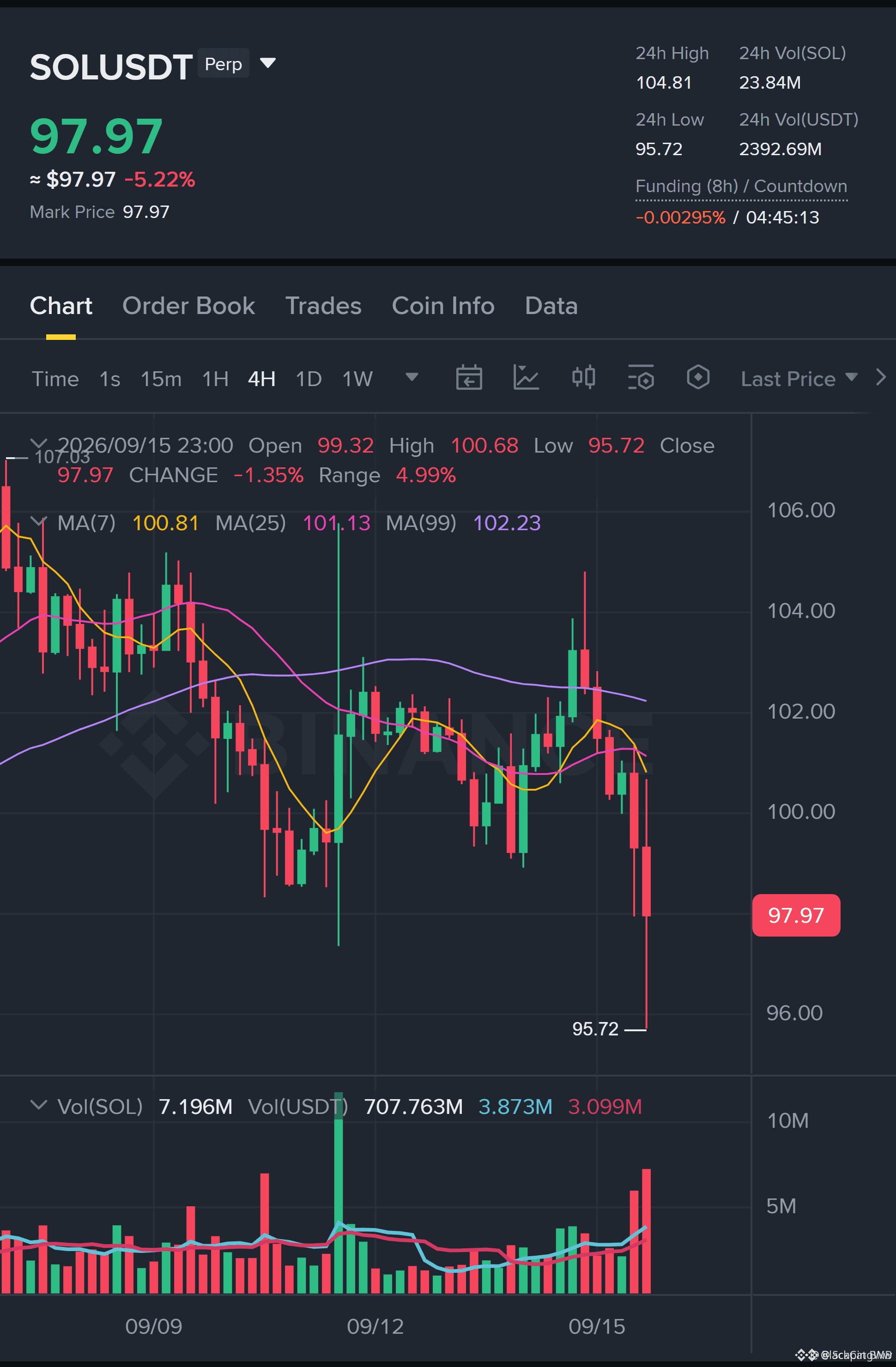
🦈 $SOL 1H SHORT WATCHLIST: 99.54 MAY BE THE TRAP DOOR ⚠️
Entry: 99.23–99.54 ⚡
Target: 97.95 / 97.02 / 96.08 🚀
Stop Loss: 100.93 ⚠️
📌 The 1H trend favors sellers, but this is a watchlist short, not a chase. Price needs to retest the 99.23–99.54 zone and show rejection before the trap springs.
📊 A clean reclaim of 100.93 invalidates the idea, while holding below the entry band keeps downside momentum alive toward 97.95, then 97.02 and 96.08.
Scale out as planned: 20%, 30%, 50%. Patience turns a noisy scan into a precise execution. 💬 Will you wait for confirmation, or fade a wick into the zone? 👇
⚠️ Not financial advice. Always manage your risk. 🛡️
🏷️ #SOL #ShortSetup #BearishMomentum #Crypto
🔥 🎯
🦈 $SOL 1H SHORT WATCHLIST: 99.54 MAY BE THE TRAP DOOR ⚠️
Entry: 99.23–99.54 ⚡
Target: 97.95 / 97.02 / 96.08 🚀
Stop Loss: 100.93 ⚠️
📌 The 1H trend favors sellers, but this is a watchlist short, not a chase. Price needs to retest the 99.23–99.54 zone and show rejection before the trap springs.
📊 A clean reclaim of 100.93 invalidates the idea, while holding below the entry band keeps downside momentum alive toward 97.95, then 97.02 and 96.08.
Scale out as planned: 20%, 30%, 50%. Patience turns a noisy scan into a precise execution. 💬 Will you wait for confirmation, or fade a wick into the zone? 👇
⚠️ Not financial advice. Always manage your risk. 🛡️
🏷️ #SOL #ShortSetup #BearishMomentum #Crypto
🔥 🎯
Entry: 99.23–99.54 ⚡
Target: 97.95 / 97.02 / 96.08 🚀
Stop Loss: 100.93 ⚠️
📌 The 1H trend favors sellers, but this is a watchlist short, not a chase. Price needs to retest the 99.23–99.54 zone and show rejection before the trap springs.
📊 A clean reclaim of 100.93 invalidates the idea, while holding below the entry band keeps downside momentum alive toward 97.95, then 97.02 and 96.08.
Scale out as planned: 20%, 30%, 50%. Patience turns a noisy scan into a precise execution. 💬 Will you wait for confirmation, or fade a wick into the zone? 👇
⚠️ Not financial advice. Always manage your risk. 🛡️
🏷️ #SOL #ShortSetup #BearishMomentum #Crypto
🔥 🎯
25
See translation
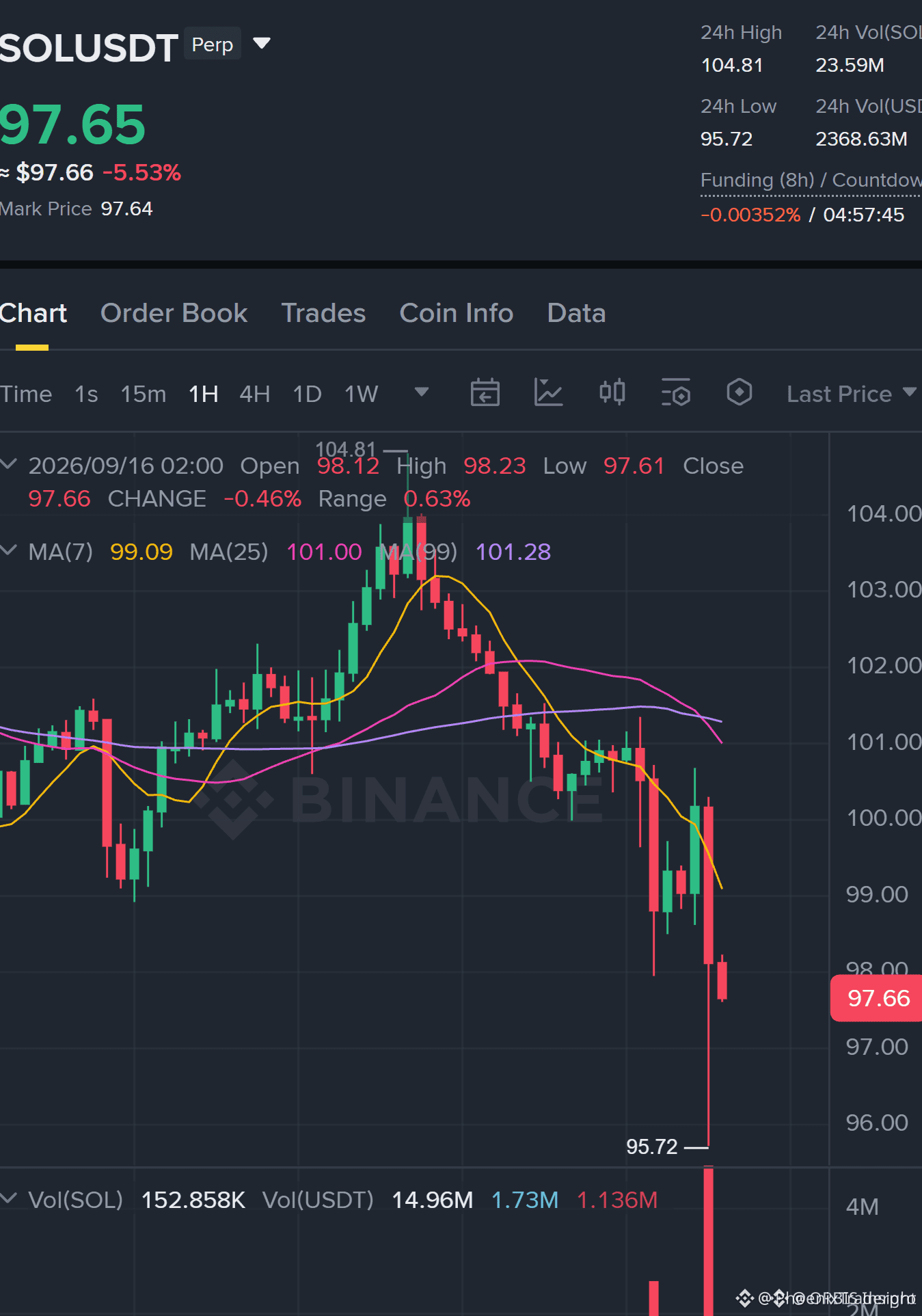
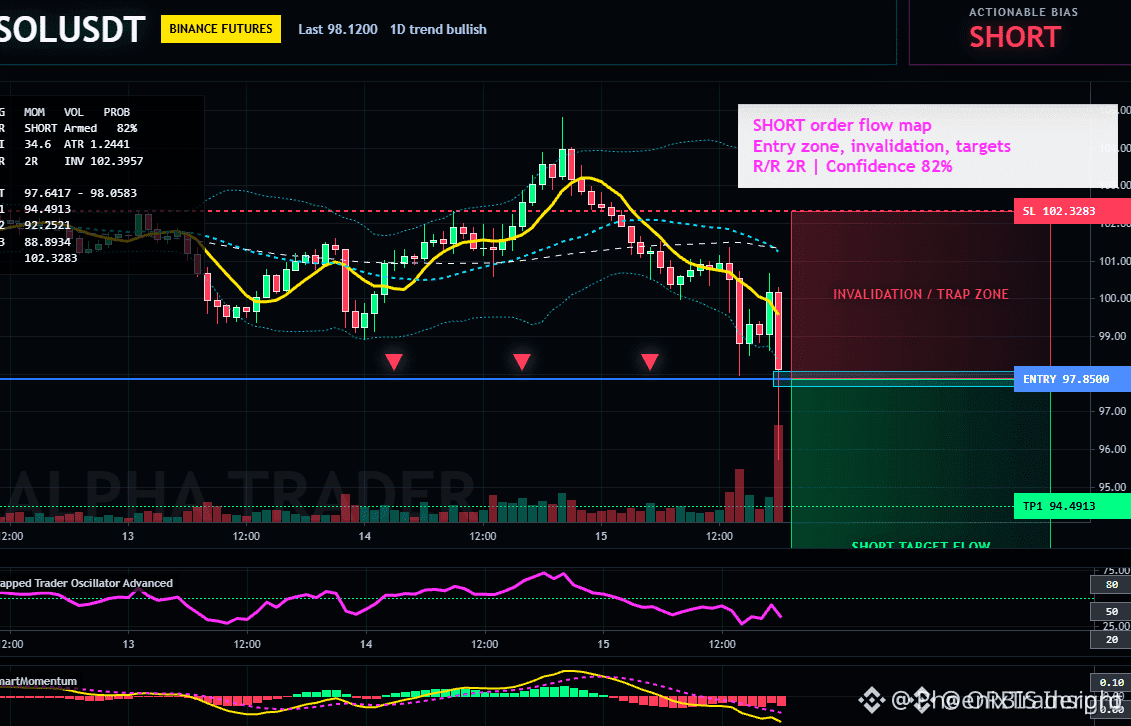
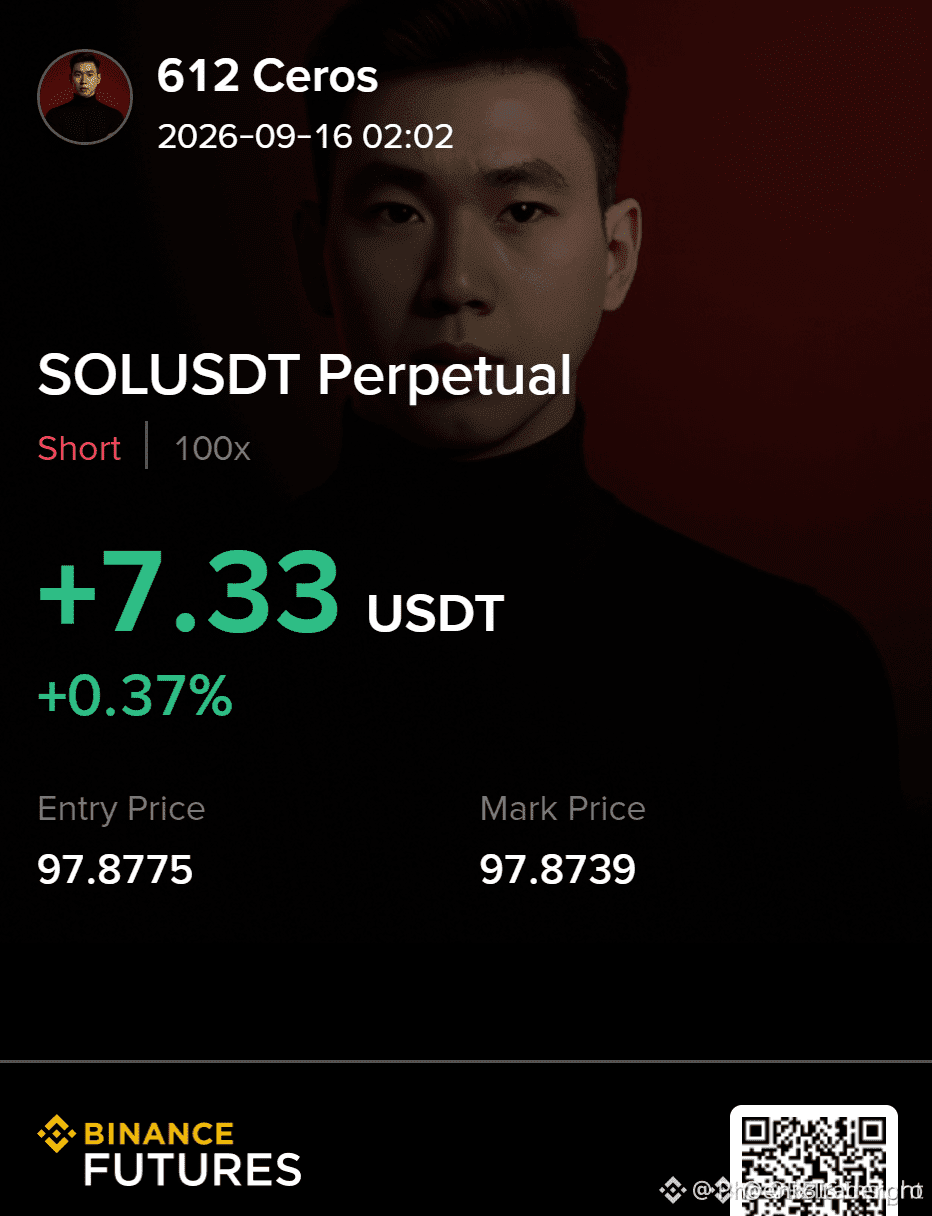
⚠️ $SOL SHORT ZONE LOADING AS RSI CRACKS 📉
Entry: 97.6417 - 98.0583 ⚡
Target: 94.4913 / 92.2521 / 88.8934 🎯
Stop Loss: 102.3283 ⚠️
💡 The crowd is still chasing longs, but the 1H and 15M momentum is already bleeding. $SOL RSI sliding toward 34 says sellers are stepping in before the narrative catches up.
With ATR stretched, 94.49 is just a rest stop if this short zone holds. A rejection here can flush weak bids and open a fast route toward the lower targets.
👇 Are you pressing short now, or waiting for one more squeeze above stop?
⚠️ Not financial advice. Always manage your risk. 🛡️
🏷️ #SOL #ShortSetup #Solana #Crypto
📉 ⚡
⚠️ $SOL SHORT ZONE LOADING AS RSI CRACKS 📉
Entry: 97.6417 - 98.0583 ⚡
Target: 94.4913 / 92.2521 / 88.8934 🎯
Stop Loss: 102.3283 ⚠️
💡 The crowd is still chasing longs, but the 1H and 15M momentum is already bleeding. $SOL RSI sliding toward 34 says sellers are stepping in before the narrative catches up.
With ATR stretched, 94.49 is just a rest stop if this short zone holds. A rejection here can flush weak bids and open a fast route toward the lower targets.
👇 Are you pressing short now, or waiting for one more squeeze above stop?
⚠️ Not financial advice. Always manage your risk. 🛡️
🏷️ #SOL #ShortSetup #Solana #Crypto
📉 ⚡
Entry: 97.6417 - 98.0583 ⚡
Target: 94.4913 / 92.2521 / 88.8934 🎯
Stop Loss: 102.3283 ⚠️
💡 The crowd is still chasing longs, but the 1H and 15M momentum is already bleeding. $SOL RSI sliding toward 34 says sellers are stepping in before the narrative catches up.
With ATR stretched, 94.49 is just a rest stop if this short zone holds. A rejection here can flush weak bids and open a fast route toward the lower targets.
👇 Are you pressing short now, or waiting for one more squeeze above stop?
⚠️ Not financial advice. Always manage your risk. 🛡️
🏷️ #SOL #ShortSetup #Solana #Crypto
📉 ⚡
34

·
--
Bullish
See translation
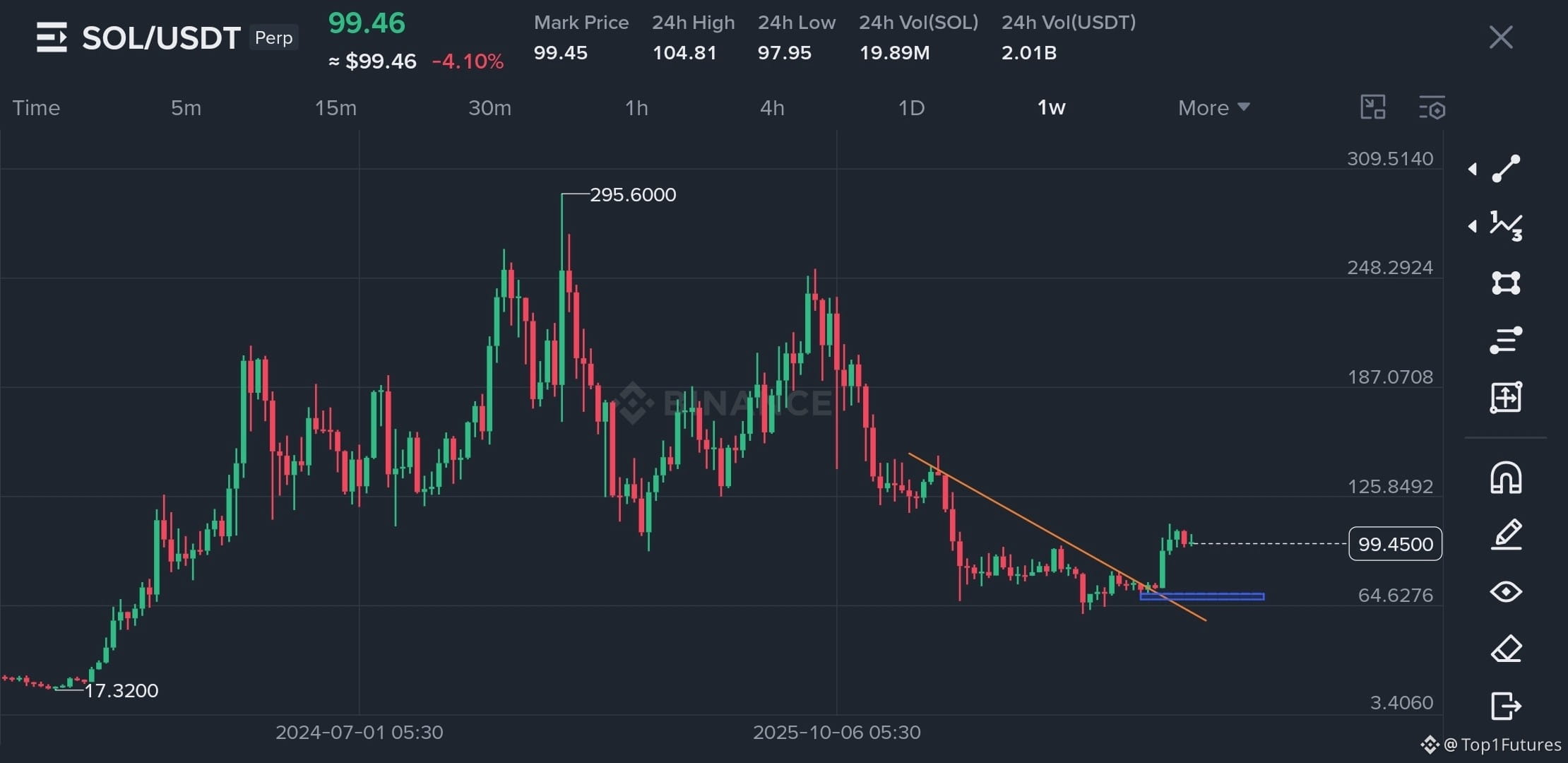
🔥 $SOL — BUYERS ARE FIGHTING BACK!
$SOL recently slipped toward the $98 area, but buyers stepped in strongly and pushed the price back above $100. This shows that bulls are still trying to protect the lower levels.
Now, keep an eye on the $101–$102 resistance zone. If SOL breaks and holds above $102, the next move could target $103–$104.80. 🚀
On the downside, $98–$99 remains an important support area. If this zone continues to hold, SOL could build another push higher.
The chart is showing signs of recovery, but don’t rush into the move. Wait for a confirmed breakout or a clean retest before entering.
Trade smart. 🧠⚡
Trade #SOL
#MarketFluctuations
🔥 $SOL — BUYERS ARE FIGHTING BACK!
$SOL recently slipped toward the $98 area, but buyers stepped in strongly and pushed the price back above $100. This shows that bulls are still trying to protect the lower levels.
Now, keep an eye on the $101–$102 resistance zone. If SOL breaks and holds above $102, the next move could target $103–$104.80. 🚀
On the downside, $98–$99 remains an important support area. If this zone continues to hold, SOL could build another push higher.
The chart is showing signs of recovery, but don’t rush into the move. Wait for a confirmed breakout or a clean retest before entering.
Trade smart. 🧠⚡
Trade #SOL
#MarketFluctuations
$SOL recently slipped toward the $98 area, but buyers stepped in strongly and pushed the price back above $100. This shows that bulls are still trying to protect the lower levels.
Now, keep an eye on the $101–$102 resistance zone. If SOL breaks and holds above $102, the next move could target $103–$104.80. 🚀
On the downside, $98–$99 remains an important support area. If this zone continues to hold, SOL could build another push higher.
The chart is showing signs of recovery, but don’t rush into the move. Wait for a confirmed breakout or a clean retest before entering.
Trade smart. 🧠⚡
Trade #SOL
#MarketFluctuations
1
6

See translation
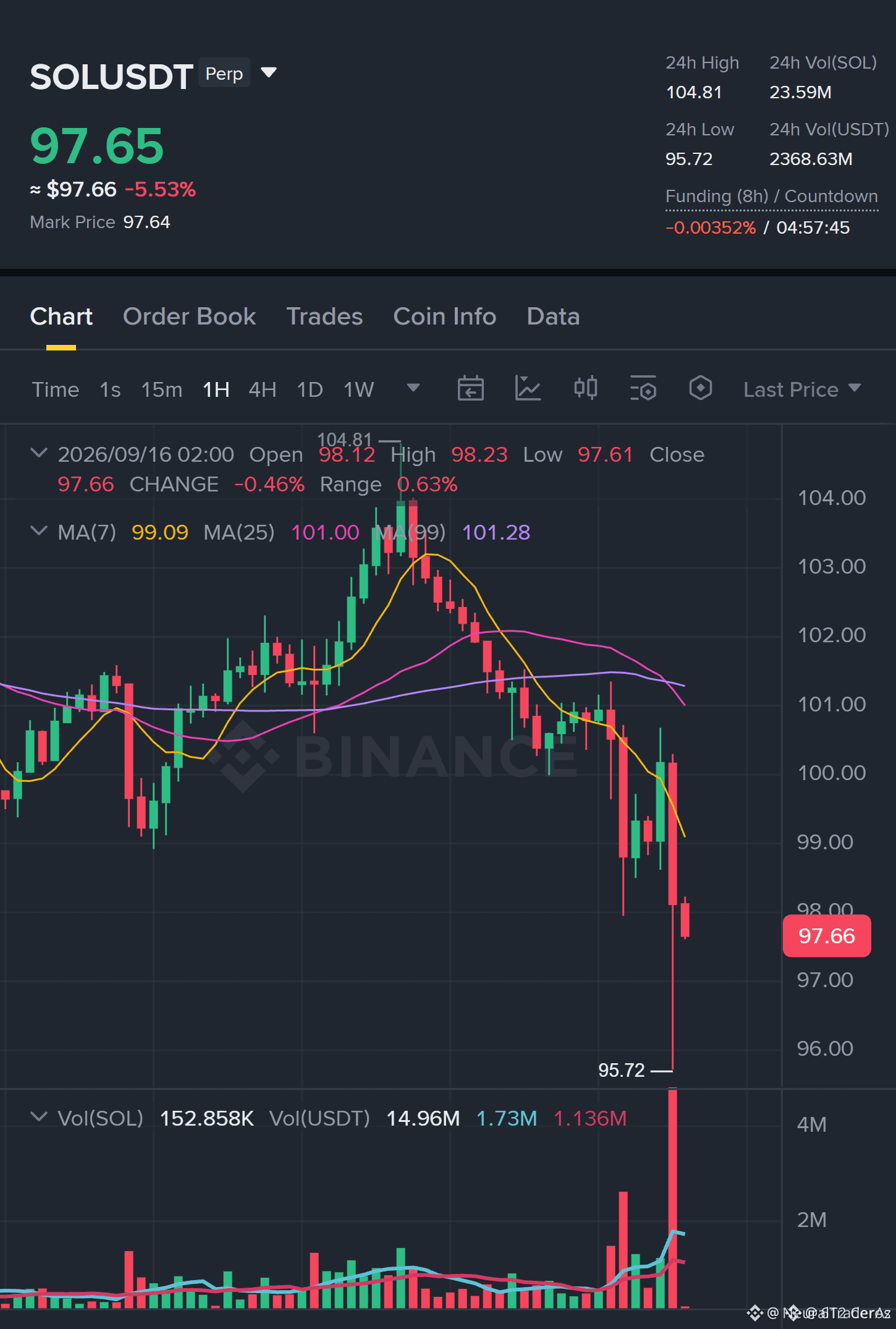
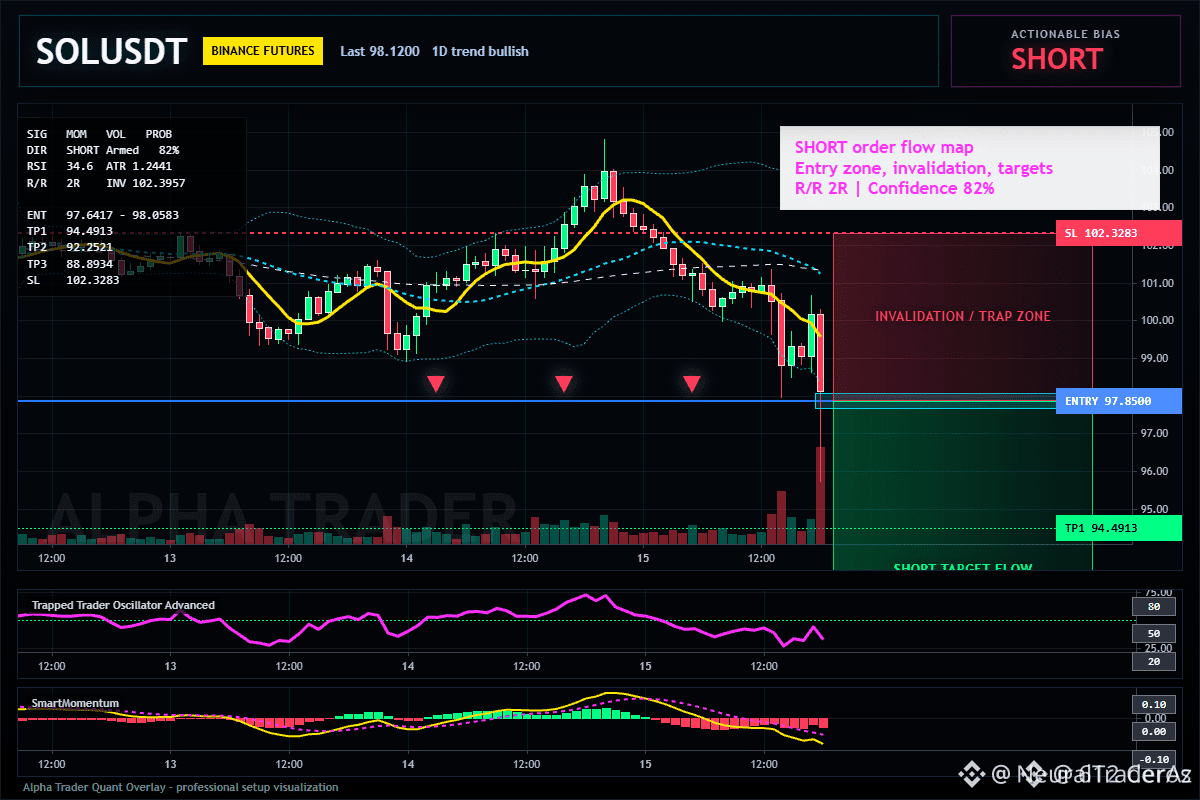
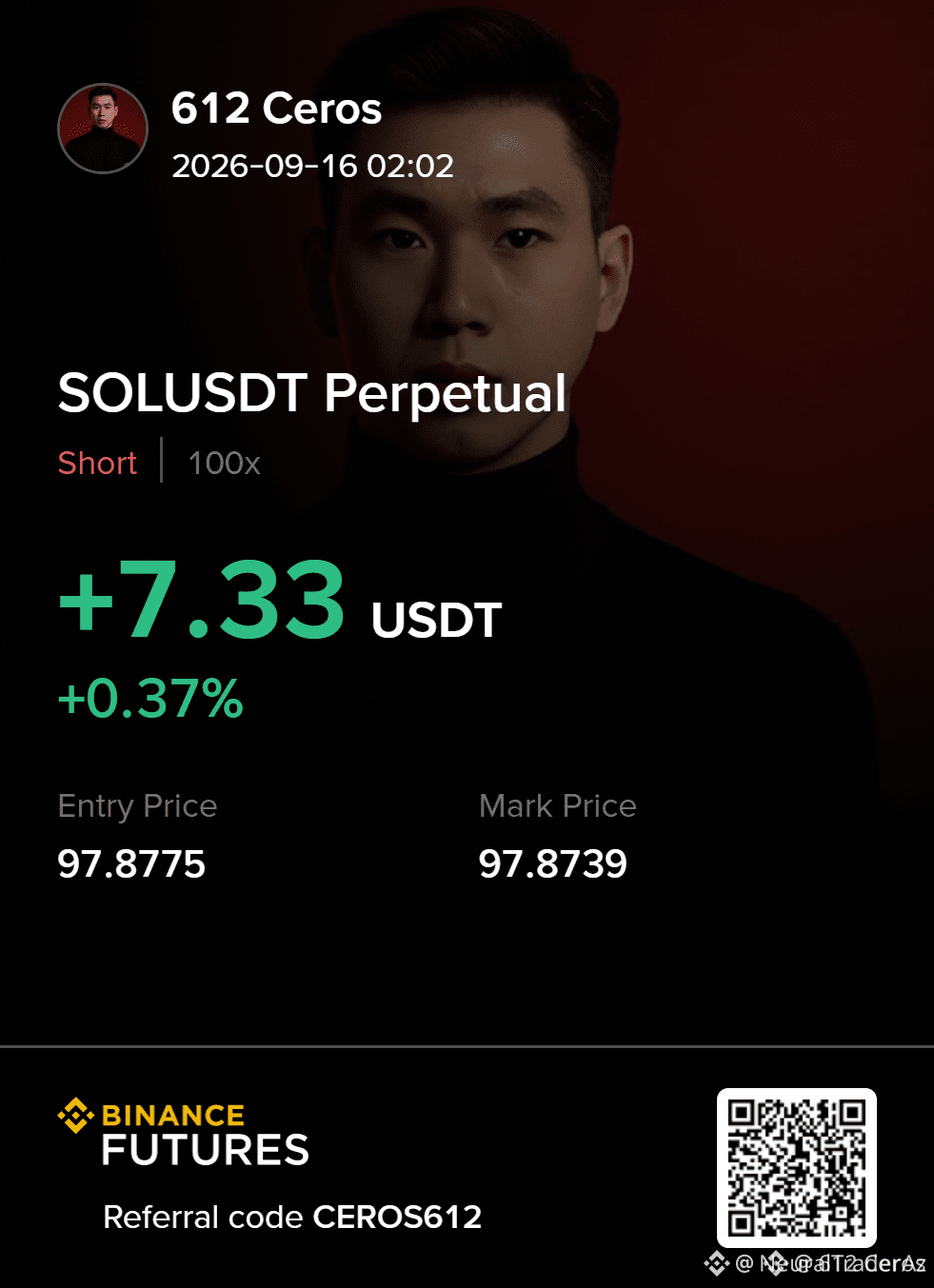
🚨 $SOL 1H BEAR TRAP HIDES INSIDE DAILY BULL TREND 📉
Entry: 97.8500 ⚡
Target: 94.4913 🎯
Stop Loss: 102.3283 ⚠️
📉 The daily chart still looks bullish, but the 1h structure is quietly rejecting momentum. $SOL is trapped inside 97.6417–98.0583 while 15m RSI at 34.6 confirms sellers are pressing the intraday range.
With 1h ATR at 1.244084, volatility is enough to carry price toward 94.4913, then potentially 92.2521 if the pullback accelerates. 🎯 This is an intraday counter-move inside a higher-timeframe uptrend, and 102.3283 is the clean invalidation line.
🤔 Are we cleanly taking TP1 at 94.4913 or is daily bullish structure about to reclaim this trade?
⚠️ Not financial advice. Always manage your risk. 🛡️
🏷️ #SOL #ShortSetup #Solana #Bearish #Crypto
📉
🚨 $SOL 1H BEAR TRAP HIDES INSIDE DAILY BULL TREND 📉
Entry: 97.8500 ⚡
Target: 94.4913 🎯
Stop Loss: 102.3283 ⚠️
📉 The daily chart still looks bullish, but the 1h structure is quietly rejecting momentum. $SOL is trapped inside 97.6417–98.0583 while 15m RSI at 34.6 confirms sellers are pressing the intraday range.
With 1h ATR at 1.244084, volatility is enough to carry price toward 94.4913, then potentially 92.2521 if the pullback accelerates. 🎯 This is an intraday counter-move inside a higher-timeframe uptrend, and 102.3283 is the clean invalidation line.
🤔 Are we cleanly taking TP1 at 94.4913 or is daily bullish structure about to reclaim this trade?
⚠️ Not financial advice. Always manage your risk. 🛡️
🏷️ #SOL #ShortSetup #Solana #Bearish #Crypto
📉
Entry: 97.8500 ⚡
Target: 94.4913 🎯
Stop Loss: 102.3283 ⚠️
📉 The daily chart still looks bullish, but the 1h structure is quietly rejecting momentum. $SOL is trapped inside 97.6417–98.0583 while 15m RSI at 34.6 confirms sellers are pressing the intraday range.
With 1h ATR at 1.244084, volatility is enough to carry price toward 94.4913, then potentially 92.2521 if the pullback accelerates. 🎯 This is an intraday counter-move inside a higher-timeframe uptrend, and 102.3283 is the clean invalidation line.
🤔 Are we cleanly taking TP1 at 94.4913 or is daily bullish structure about to reclaim this trade?
⚠️ Not financial advice. Always manage your risk. 🛡️
🏷️ #SOL #ShortSetup #Solana #Bearish #Crypto
📉
33

·
--
See translation
🚀 $SOL TARGETS HIT: THE BREAKOUT DELIVERED WITH CLEAN PRECISION 💥
📌 The $SOL move played out like a textbook momentum expansion: buyers reclaimed control, pushed through the zone, and let the original setup breathe. 📊 That’s not luck — it’s a clean execution of a planned risk framework.
💡 With targets hit, discipline matters more than chasing. Take profit, reset, and wait for the next liquidity pool to reveal itself.
👇 Are you locking gains here or hunting for a fresh $SOL entry on a pullback?
⚠️ Not financial advice. Always manage your risk. 🛡️
🏷️ #SOL #LongSetup #TakeProfit #Crypto
🎯 🦈
🚀 $SOL TARGETS HIT: THE BREAKOUT DELIVERED WITH CLEAN PRECISION 💥
📌 The $SOL move played out like a textbook momentum expansion: buyers reclaimed control, pushed through the zone, and let the original setup breathe. 📊 That’s not luck — it’s a clean execution of a planned risk framework.
💡 With targets hit, discipline matters more than chasing. Take profit, reset, and wait for the next liquidity pool to reveal itself.
👇 Are you locking gains here or hunting for a fresh $SOL entry on a pullback?
⚠️ Not financial advice. Always manage your risk. 🛡️
🏷️ #SOL #LongSetup #TakeProfit #Crypto
🎯 🦈
📌 The $SOL move played out like a textbook momentum expansion: buyers reclaimed control, pushed through the zone, and let the original setup breathe. 📊 That’s not luck — it’s a clean execution of a planned risk framework.
💡 With targets hit, discipline matters more than chasing. Take profit, reset, and wait for the next liquidity pool to reveal itself.
👇 Are you locking gains here or hunting for a fresh $SOL entry on a pullback?
⚠️ Not financial advice. Always manage your risk. 🛡️
🏷️ #SOL #LongSetup #TakeProfit #Crypto
🎯 🦈
31

·
--
See translation
🚨 STOP SCROLLING! Is Solana Preparing for Its Next Big Move? 👀
Solana $SOL continues to hold above the key psychological $100 level, a sign that buyers are still defending this major support despite ongoing market uncertainty.
This level is more than just a round number it reflects market confidence. As long as $SOL remains above $100, bullish momentum can gradually rebuild, and traders will be watching closely for a breakout above nearby resistance.
However, if the $100 support fails, selling pressure could increase and trigger a deeper pullback.
📊 For now, $100 is the level that matters most. A strong defense could set the stage for the next upward move, while a breakdown would shift short-term sentiment in favor of the bears.
👀 Do you think SOL will bounce from $100, or is another dip coming?$AKE
{spot}(SOLUSDT)
#SOL #solana #FedRateWatch #StrategyMarketCapPassesFord #ClarityActOddsHalveOnPolymarket
🚨 STOP SCROLLING! Is Solana Preparing for Its Next Big Move? 👀
Solana $SOL continues to hold above the key psychological $100 level, a sign that buyers are still defending this major support despite ongoing market uncertainty.
This level is more than just a round number it reflects market confidence. As long as $SOL remains above $100, bullish momentum can gradually rebuild, and traders will be watching closely for a breakout above nearby resistance.
However, if the $100 support fails, selling pressure could increase and trigger a deeper pullback.
📊 For now, $100 is the level that matters most. A strong defense could set the stage for the next upward move, while a breakdown would shift short-term sentiment in favor of the bears.
👀 Do you think SOL will bounce from $100, or is another dip coming?$AKE
#SOL #solana #FedRateWatch #StrategyMarketCapPassesFord #ClarityActOddsHalveOnPolymarket
Solana $SOL continues to hold above the key psychological $100 level, a sign that buyers are still defending this major support despite ongoing market uncertainty.
This level is more than just a round number it reflects market confidence. As long as $SOL remains above $100, bullish momentum can gradually rebuild, and traders will be watching closely for a breakout above nearby resistance.
However, if the $100 support fails, selling pressure could increase and trigger a deeper pullback.
📊 For now, $100 is the level that matters most. A strong defense could set the stage for the next upward move, while a breakdown would shift short-term sentiment in favor of the bears.
👀 Do you think SOL will bounce from $100, or is another dip coming?$AKE
#SOL #solana #FedRateWatch #StrategyMarketCapPassesFord #ClarityActOddsHalveOnPolymarket

2
38

·
--
Bullish
See translation
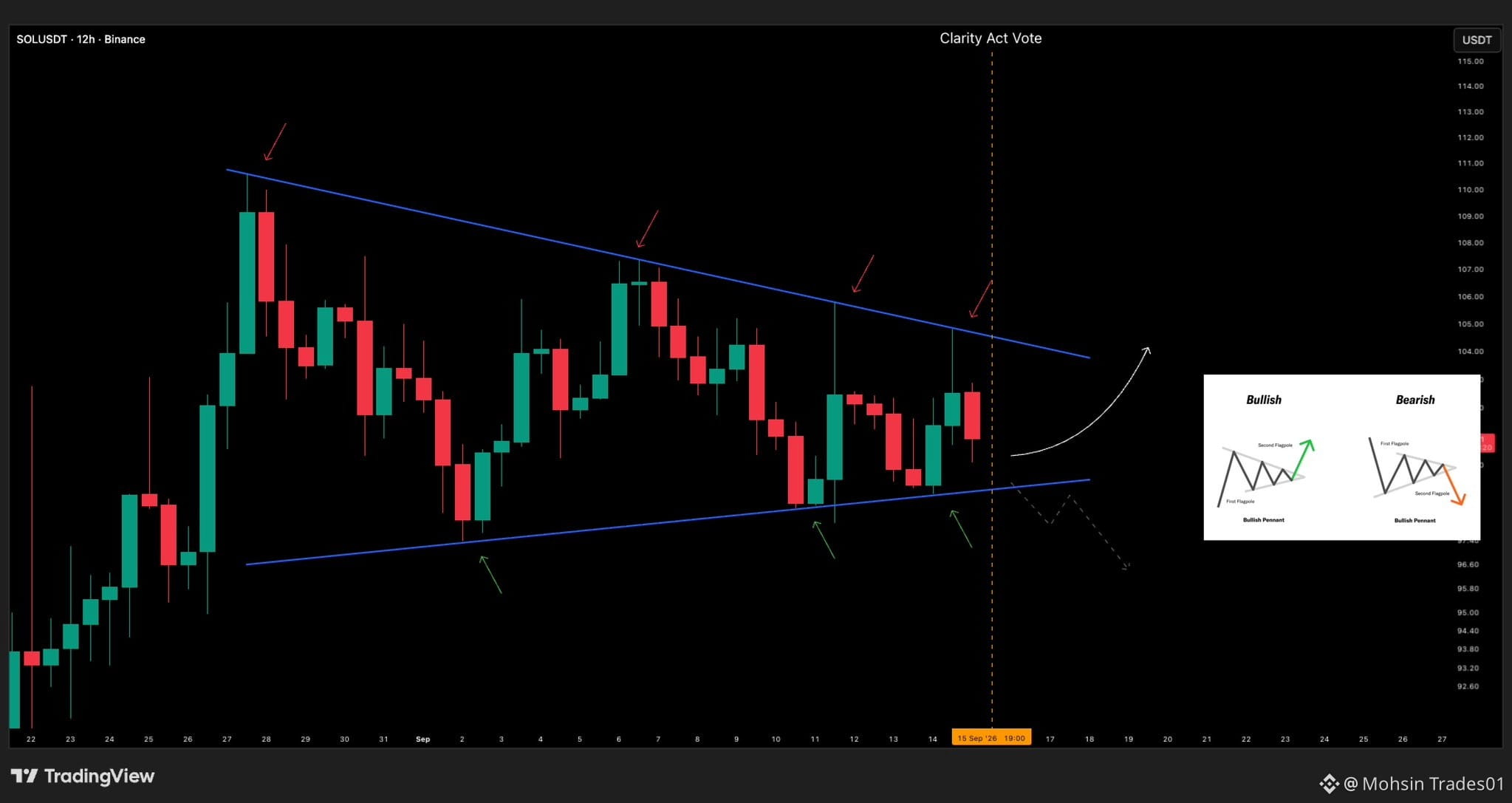
$SOL Coming into the Clarity Act vote, SOL is moving very interestingly.
Solana is forming a pennant pattern.
Bullish or bearish? No one knows.
The odds are not looking good.
$SOL
But if there is an upset, SOL is going to break out hard.
#Sol
$SOL Coming into the Clarity Act vote, SOL is moving very interestingly.
Solana is forming a pennant pattern.
Bullish or bearish? No one knows.
The odds are not looking good.
$SOL
But if there is an upset, SOL is going to break out hard.
#Sol
Solana is forming a pennant pattern.
Bullish or bearish? No one knows.
The odds are not looking good.
$SOL
But if there is an upset, SOL is going to break out hard.
#Sol
1
76

See translation
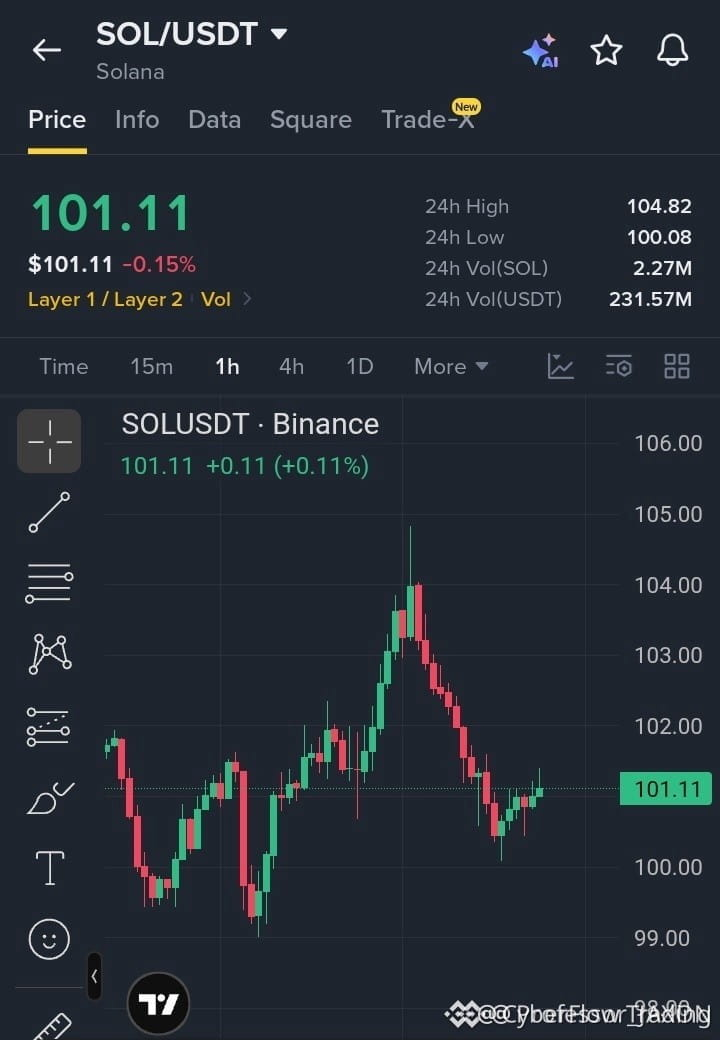
🚨 $SOL RECLAIMS $100 AND SETS UP THE NEXT MOMENTUM PUSH
Entry: $100.90–$101.20 ⚡
Target: $102.00–$104.00 🚀
Stop Loss: $100.05 ⚠️
Solana is defending the $100 floor like a bid wall refusing to blink. Every bounce from this shelf is turning sellers into fuel for the next leg. 🦈
If $101 flips into support, momentum can stretch toward $102–$104 with little resistance. The trap is clear: weak longs get swept, then smart money rides the reclaim. 💡
💬 Are you buying the $101 reclaim or waiting for one more dip into $100?
⚠️ Not financial advice. Always manage your risk. 🛡️
🏷️ #SOL #LongSetup #Breakout #Crypto #Solana
🔥 🐂
🚨 $SOL RECLAIMS $100 AND SETS UP THE NEXT MOMENTUM PUSH
Entry: $100.90–$101.20 ⚡
Target: $102.00–$104.00 🚀
Stop Loss: $100.05 ⚠️
Solana is defending the $100 floor like a bid wall refusing to blink. Every bounce from this shelf is turning sellers into fuel for the next leg. 🦈
If $101 flips into support, momentum can stretch toward $102–$104 with little resistance. The trap is clear: weak longs get swept, then smart money rides the reclaim. 💡
💬 Are you buying the $101 reclaim or waiting for one more dip into $100?
⚠️ Not financial advice. Always manage your risk. 🛡️
🏷️ #SOL #LongSetup #Breakout #Crypto #Solana
🔥 🐂
Entry: $100.90–$101.20 ⚡
Target: $102.00–$104.00 🚀
Stop Loss: $100.05 ⚠️
Solana is defending the $100 floor like a bid wall refusing to blink. Every bounce from this shelf is turning sellers into fuel for the next leg. 🦈
If $101 flips into support, momentum can stretch toward $102–$104 with little resistance. The trap is clear: weak longs get swept, then smart money rides the reclaim. 💡
💬 Are you buying the $101 reclaim or waiting for one more dip into $100?
⚠️ Not financial advice. Always manage your risk. 🛡️
🏷️ #SOL #LongSetup #Breakout #Crypto #Solana
🔥 🐂
57

Verified
See translation
🟣 Solana expands tokenized equities as SOL tests $102.50 – Can it break higher?
As trading activity grows to rival major venues, Solana’s tokenized equity markets are starting to attract attention.
In light of this, tokenized stocks on Solana [SOL] generated more than $200 million in volume. Surprisingly, these volumes exceed those associated with tokenized equities listed at both NASDAQ and NYSE, in excess of $100 million.
Notably, Raydium [RAY] captured about 70% of that activity, as such, representing the primary source of liquidity behind the growth. The comparison is narrower than it first appears. This is because it covers tokenized equities rather than the full stock market.
However, even with such a narrow scope, the size of the increase reflects the rapid pace of the emergence of on-chain stock trading.
🔸 Solana expands its tokenized-equity market
Against that backdrop, Solana’s tokenized-equity market is also expanding rapidly. As a result, this expansion gives traders a growing pool of assets to trade. Tokenized-equity supply reached a record $684 million last week, marking a 47% increase in just three weeks.
Increased amounts of capital are being represented through tokenized equities and ETFs as well. The expansion also comes from several issuers rather than one platform. xStocks, Ondo, Backpack Securities, Sunrise, Superstate, and Securitize have all launched stock products on Solana.
🔸 SOL tests the $102.50 barrier
Meanwhile, Solana continues trading in a wide consolidation after its sharp August rally. The current price is currently near the midpoint of this trading range at approximately $101.48.
SOL trades near $101.48 after recovering from the $97.50 area, where buyers recently stepped in. That lower boundary (purple line) provided support at each of the previous two rallies, hence remaining the key support beneath price.
#SOL | #Solana | $SOL
{spot}(SOLUSDT)
🟣 Solana expands tokenized equities as SOL tests $102.50 – Can it break higher?
As trading activity grows to rival major venues, Solana’s tokenized equity markets are starting to attract attention.
In light of this, tokenized stocks on Solana [SOL] generated more than $200 million in volume. Surprisingly, these volumes exceed those associated with tokenized equities listed at both NASDAQ and NYSE, in excess of $100 million.
Notably, Raydium [RAY] captured about 70% of that activity, as such, representing the primary source of liquidity behind the growth. The comparison is narrower than it first appears. This is because it covers tokenized equities rather than the full stock market.
However, even with such a narrow scope, the size of the increase reflects the rapid pace of the emergence of on-chain stock trading.
🔸 Solana expands its tokenized-equity market
Against that backdrop, Solana’s tokenized-equity market is also expanding rapidly. As a result, this expansion gives traders a growing pool of assets to trade. Tokenized-equity supply reached a record $684 million last week, marking a 47% increase in just three weeks.
Increased amounts of capital are being represented through tokenized equities and ETFs as well. The expansion also comes from several issuers rather than one platform. xStocks, Ondo, Backpack Securities, Sunrise, Superstate, and Securitize have all launched stock products on Solana.
🔸 SOL tests the $102.50 barrier
Meanwhile, Solana continues trading in a wide consolidation after its sharp August rally. The current price is currently near the midpoint of this trading range at approximately $101.48.
SOL trades near $101.48 after recovering from the $97.50 area, where buyers recently stepped in. That lower boundary (purple line) provided support at each of the previous two rallies, hence remaining the key support beneath price.
#SOL | #Solana | $SOL
As trading activity grows to rival major venues, Solana’s tokenized equity markets are starting to attract attention.
In light of this, tokenized stocks on Solana [SOL] generated more than $200 million in volume. Surprisingly, these volumes exceed those associated with tokenized equities listed at both NASDAQ and NYSE, in excess of $100 million.
Notably, Raydium [RAY] captured about 70% of that activity, as such, representing the primary source of liquidity behind the growth. The comparison is narrower than it first appears. This is because it covers tokenized equities rather than the full stock market.
However, even with such a narrow scope, the size of the increase reflects the rapid pace of the emergence of on-chain stock trading.
🔸 Solana expands its tokenized-equity market
Against that backdrop, Solana’s tokenized-equity market is also expanding rapidly. As a result, this expansion gives traders a growing pool of assets to trade. Tokenized-equity supply reached a record $684 million last week, marking a 47% increase in just three weeks.
Increased amounts of capital are being represented through tokenized equities and ETFs as well. The expansion also comes from several issuers rather than one platform. xStocks, Ondo, Backpack Securities, Sunrise, Superstate, and Securitize have all launched stock products on Solana.
🔸 SOL tests the $102.50 barrier
Meanwhile, Solana continues trading in a wide consolidation after its sharp August rally. The current price is currently near the midpoint of this trading range at approximately $101.48.
SOL trades near $101.48 after recovering from the $97.50 area, where buyers recently stepped in. That lower boundary (purple line) provided support at each of the previous two rallies, hence remaining the key support beneath price.
#SOL | #Solana | $SOL

6
3.2k
Log in to explore more content
Join global crypto users on Binance Square
⚡️ Get latest and useful information about crypto.
💬 Trusted by the world’s largest crypto exchange.
👍 Discover real insights from verified creators.
Email / Phone number
Trending Topics
1
#FedRateWatch
397,602 views
2,260 Discussing
2
#BitcoinSlidesTo$76000
9,307 views
88 Discussing
3
#BitcoinReboundsTo$79K
56,376 views
387 Discussing
4
#StrategyMarketCapPassesFord
20,268 views
501 Discussing
5
#ClarityActOddsHalveOnPolymarket
21,417 views
402 Discussing
6
#US30YTreasuryYieldTops5.40%
17,772 views
298 Discussing
7
#BessentEndorsesFinalClarityActDraft
40,203 views
646 Discussing
8
#ZamaOpens16ConfidentialMorphoVaults
14,027 views
306 Discussing
9
#USDCOnChainVolumeTops$100Trillion
2,127 views
46 Discussing
10
#BitcoinSpotETFsNetInflow$160M
2,749 views
100 Discussing