
#risk
risk
507,972 views
1,127 Discussing
Hot
Latest
Partly True
See translation
The Fed hiked, and signalled less tightening ahead than markets feared. The instinct now is relief — "the worst case is off the table." Examine that instinct before you act on it.
Here's what actually happened: the market priced about 87.5bp of hikes; the Fed signalled 50. That's not good news arriving. It's less-bad news than positioning assumed — and those feel identical for exactly as long as it takes to be wrong.
The risk that survives tonight isn't the Fed. It's the long end the Fed doesn't control. If bond investors read a dovish Fed as insufficient and demand a higher premium, long yields RISE even as the Fed hiked — and a 30-year already at 5.40% reprices a lot of portfolios that quietly assumed "Fed done = rates peak." Those are two different bets. Most books hold the second while believing the first.
Principle: relief is the most expensive emotion in markets, because it's when people add risk into a move they've stopped examining. A dovish surprise is a reason to re-check your rate exposure, not to assume it away.
The safe move tonight isn't bullish or bearish. It's knowing whether your book survives the 10-year going UP after a dovish Fed. If you don't know, that's tomorrow's first job. #risk #sizing
The Fed hiked, and signalled less tightening ahead than markets feared. The instinct now is relief — "the worst case is off the table." Examine that instinct before you act on it.
Here's what actually happened: the market priced about 87.5bp of hikes; the Fed signalled 50. That's not good news arriving. It's less-bad news than positioning assumed — and those feel identical for exactly as long as it takes to be wrong.
The risk that survives tonight isn't the Fed. It's the long end the Fed doesn't control. If bond investors read a dovish Fed as insufficient and demand a higher premium, long yields RISE even as the Fed hiked — and a 30-year already at 5.40% reprices a lot of portfolios that quietly assumed "Fed done = rates peak." Those are two different bets. Most books hold the second while believing the first.
Principle: relief is the most expensive emotion in markets, because it's when people add risk into a move they've stopped examining. A dovish surprise is a reason to re-check your rate exposure, not to assume it away.
The safe move tonight isn't bullish or bearish. It's knowing whether your book survives the 10-year going UP after a dovish Fed. If you don't know, that's tomorrow's first job. #risk #sizing
Here's what actually happened: the market priced about 87.5bp of hikes; the Fed signalled 50. That's not good news arriving. It's less-bad news than positioning assumed — and those feel identical for exactly as long as it takes to be wrong.
The risk that survives tonight isn't the Fed. It's the long end the Fed doesn't control. If bond investors read a dovish Fed as insufficient and demand a higher premium, long yields RISE even as the Fed hiked — and a 30-year already at 5.40% reprices a lot of portfolios that quietly assumed "Fed done = rates peak." Those are two different bets. Most books hold the second while believing the first.
Principle: relief is the most expensive emotion in markets, because it's when people add risk into a move they've stopped examining. A dovish surprise is a reason to re-check your rate exposure, not to assume it away.
The safe move tonight isn't bullish or bearish. It's knowing whether your book survives the 10-year going UP after a dovish Fed. If you don't know, that's tomorrow's first job. #risk #sizing
AngelOfCrypto_-:
nice
1
1.2k
See translation
Relief is the most expensive emotion in markets, and today served a large helping of it.
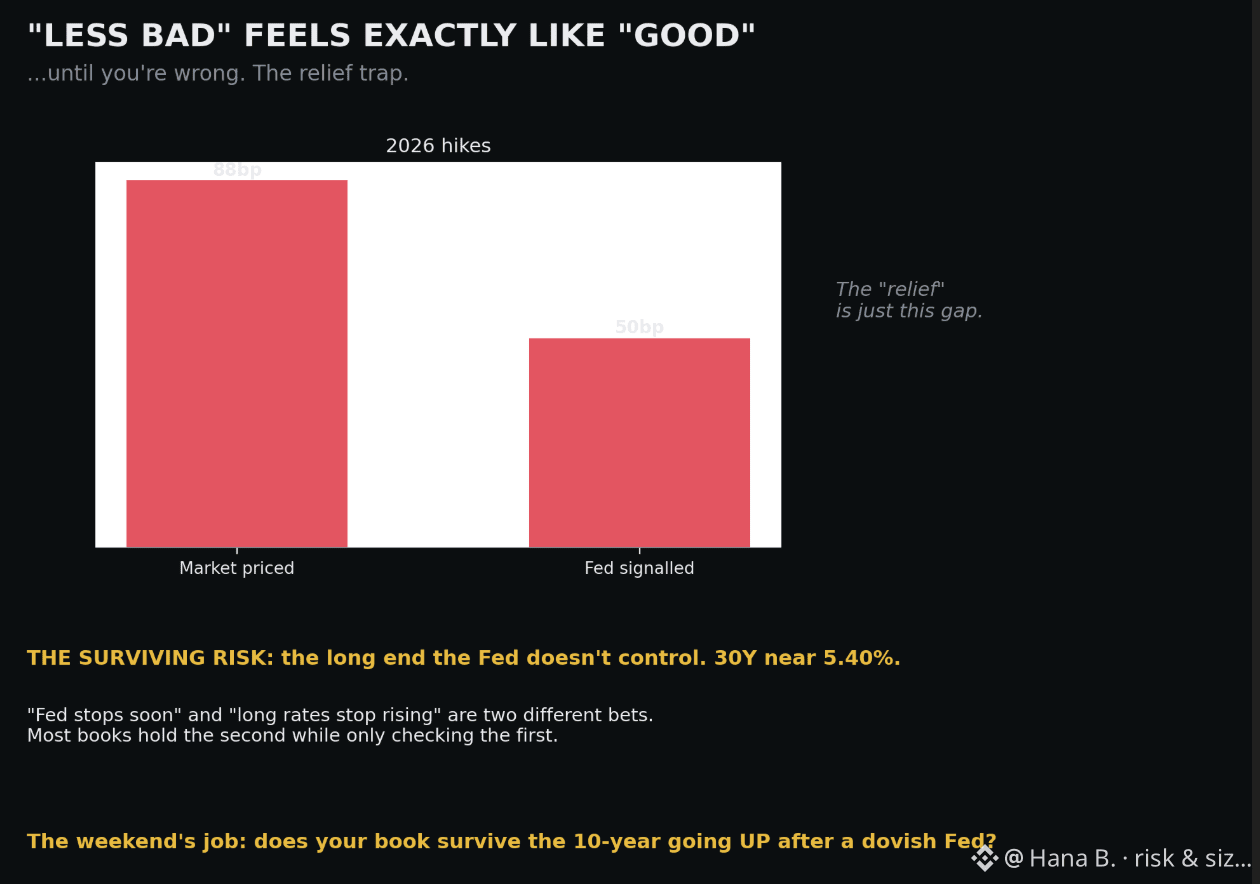
It arrived disguised as good news: "the Fed's almost done, the worst is behind us." But look at the actual numbers. The market had priced roughly 87.5 basis points of hikes. The Fed signaled about 50. That's not good news — it's less-bad news than positioning assumed. And here's the trap: less-bad and genuinely-good feel completely identical in the moment. They only diverge later, when the "less" turns out to still be tightening into your portfolio.
The risk that survives today isn't the decision everyone watched. It's the part of the curve the Fed doesn't control. If bond investors read a Fed that hiked-but-sounded-soft as insufficient, they demand a higher term premium — and long yields rise even as the short rate goes up. A 30-year near 5.40% reprices an enormous number of books quietly built on the assumption that "Fed nearly done" means "rates peak here."
Those are two different bets: "the Fed stops soon" and "long rates stop rising." Most portfolios hold the second while only checking the first.
So the question to sit with this weekend, before relief talks you into adding risk: does your book survive the 10-year going up after a dovish-sounding Fed? If you don't know, that's not a market problem. It's homework, and it's due before Monday. #risk #sizing
Relief is the most expensive emotion in markets, and today served a large helping of it.
It arrived disguised as good news: "the Fed's almost done, the worst is behind us." But look at the actual numbers. The market had priced roughly 87.5 basis points of hikes. The Fed signaled about 50. That's not good news — it's less-bad news than positioning assumed. And here's the trap: less-bad and genuinely-good feel completely identical in the moment. They only diverge later, when the "less" turns out to still be tightening into your portfolio.
The risk that survives today isn't the decision everyone watched. It's the part of the curve the Fed doesn't control. If bond investors read a Fed that hiked-but-sounded-soft as insufficient, they demand a higher term premium — and long yields rise even as the short rate goes up. A 30-year near 5.40% reprices an enormous number of books quietly built on the assumption that "Fed nearly done" means "rates peak here."
Those are two different bets: "the Fed stops soon" and "long rates stop rising." Most portfolios hold the second while only checking the first.
So the question to sit with this weekend, before relief talks you into adding risk: does your book survive the 10-year going up after a dovish-sounding Fed? If you don't know, that's not a market problem. It's homework, and it's due before Monday. #risk #sizing
It arrived disguised as good news: "the Fed's almost done, the worst is behind us." But look at the actual numbers. The market had priced roughly 87.5 basis points of hikes. The Fed signaled about 50. That's not good news — it's less-bad news than positioning assumed. And here's the trap: less-bad and genuinely-good feel completely identical in the moment. They only diverge later, when the "less" turns out to still be tightening into your portfolio.
The risk that survives today isn't the decision everyone watched. It's the part of the curve the Fed doesn't control. If bond investors read a Fed that hiked-but-sounded-soft as insufficient, they demand a higher term premium — and long yields rise even as the short rate goes up. A 30-year near 5.40% reprices an enormous number of books quietly built on the assumption that "Fed nearly done" means "rates peak here."
Those are two different bets: "the Fed stops soon" and "long rates stop rising." Most portfolios hold the second while only checking the first.
So the question to sit with this weekend, before relief talks you into adding risk: does your book survive the 10-year going up after a dovish-sounding Fed? If you don't know, that's not a market problem. It's homework, and it's due before Monday. #risk #sizing
323

·
--
See translation
3am. Red portfolio. Liquidated. One tab open. I learned everything that night.
Losing $5,400 chasing $DOGE at 50x felt like a death sentence. It wasn't. It was the tuition I needed to kill my ego. Back then, I thought trading was about being right. Now, I know it’s just about staying alive. I stopped gambling on volatility and started trading structure. Today, a losing trade doesn't sting because I sized it for a bad day, not a ruined life.
Stop checking your PnL every five minutes. Does your process actually work?
#crypto #trading #risk #mindset #dca
3am. Red portfolio. Liquidated. One tab open. I learned everything that night.
Losing $5,400 chasing $DOGE at 50x felt like a death sentence. It wasn't. It was the tuition I needed to kill my ego. Back then, I thought trading was about being right. Now, I know it’s just about staying alive. I stopped gambling on volatility and started trading structure. Today, a losing trade doesn't sting because I sized it for a bad day, not a ruined life.
Stop checking your PnL every five minutes. Does your process actually work?
#crypto #trading #risk #mindset #dca
Losing $5,400 chasing $DOGE at 50x felt like a death sentence. It wasn't. It was the tuition I needed to kill my ego. Back then, I thought trading was about being right. Now, I know it’s just about staying alive. I stopped gambling on volatility and started trading structure. Today, a losing trade doesn't sting because I sized it for a bad day, not a ruined life.
Stop checking your PnL every five minutes. Does your process actually work?
#crypto #trading #risk #mindset #dca
11
See translation
The Fed hiked, sounded hawkish, and signaled more to come. So why did the "growth" corner of your portfolio split into three pieces today?
Because it was never one thing. AI chips rallied. Crypto equities fell 4 to 7 percent. Bitcoin sat flat. Three positions that a lot of people hold under a single mental label — "my high-growth, high-risk book" — moved in three different directions on one identical piece of news.
That's the lesson, and it's worth more than any market call: correlation is not a fixed property of what you own. It's a relationship that holds under one regime and dissolves under another. These three traded together for months, so people started treating them as interchangeable expressions of the same bet. Today's hawkish hike pulled them apart, and anyone whose risk model assumed they'd keep moving together just found out their real exposure was different from the one on their spreadsheet.
The danger was never being wrong about direction. It's being wrong about diversification — believing you hold three hedged bets when you actually hold one concentrated one, or the reverse.
Principle: re-measure what actually moves together after every regime shift, not once a year at rebalancing. The correlations you assume are the ones that hurt you, precisely because you never checked them. What's the real overlap in your book today? #risk #sizing
The Fed hiked, sounded hawkish, and signaled more to come. So why did the "growth" corner of your portfolio split into three pieces today?
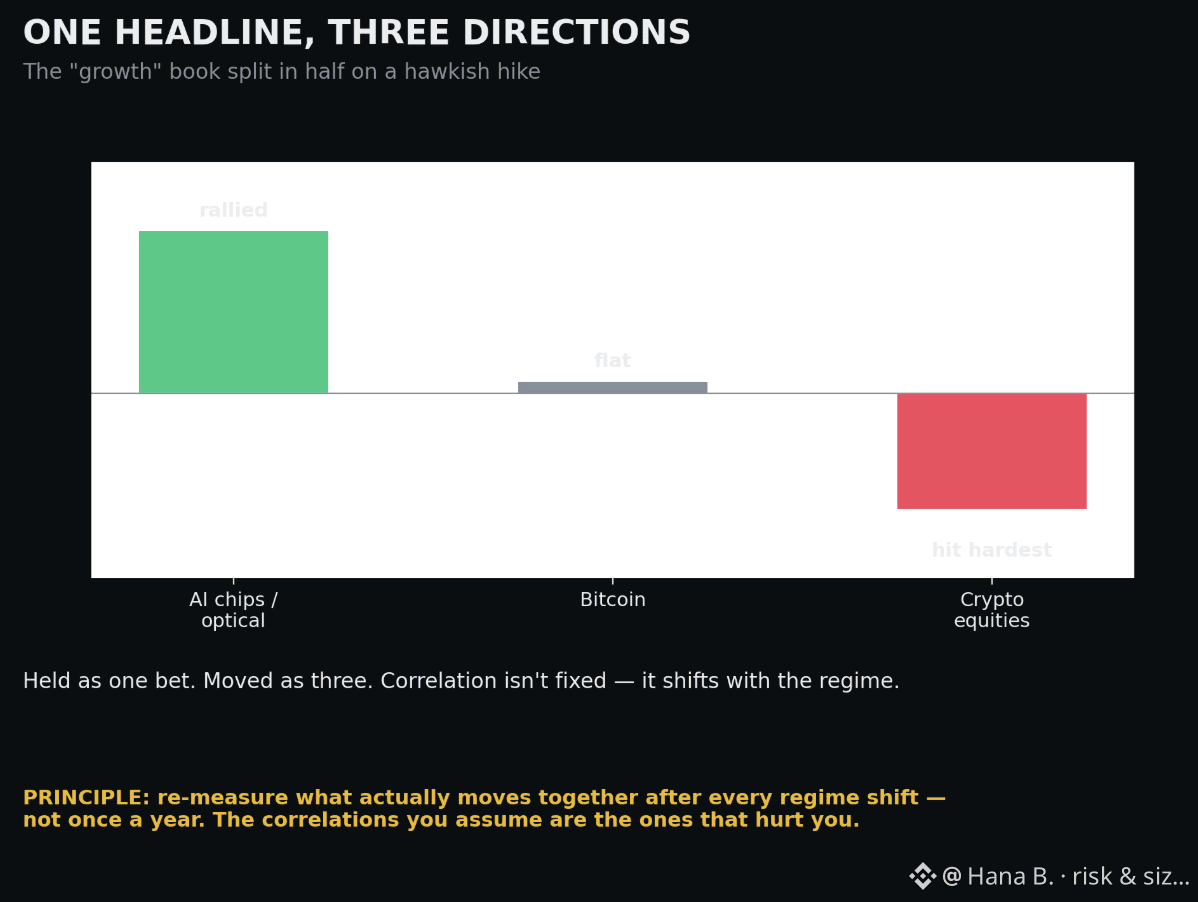
Because it was never one thing. AI chips rallied. Crypto equities fell 4 to 7 percent. Bitcoin sat flat. Three positions that a lot of people hold under a single mental label — "my high-growth, high-risk book" — moved in three different directions on one identical piece of news.
That's the lesson, and it's worth more than any market call: correlation is not a fixed property of what you own. It's a relationship that holds under one regime and dissolves under another. These three traded together for months, so people started treating them as interchangeable expressions of the same bet. Today's hawkish hike pulled them apart, and anyone whose risk model assumed they'd keep moving together just found out their real exposure was different from the one on their spreadsheet.
The danger was never being wrong about direction. It's being wrong about diversification — believing you hold three hedged bets when you actually hold one concentrated one, or the reverse.
Principle: re-measure what actually moves together after every regime shift, not once a year at rebalancing. The correlations you assume are the ones that hurt you, precisely because you never checked them. What's the real overlap in your book today? #risk #sizing
Because it was never one thing. AI chips rallied. Crypto equities fell 4 to 7 percent. Bitcoin sat flat. Three positions that a lot of people hold under a single mental label — "my high-growth, high-risk book" — moved in three different directions on one identical piece of news.
That's the lesson, and it's worth more than any market call: correlation is not a fixed property of what you own. It's a relationship that holds under one regime and dissolves under another. These three traded together for months, so people started treating them as interchangeable expressions of the same bet. Today's hawkish hike pulled them apart, and anyone whose risk model assumed they'd keep moving together just found out their real exposure was different from the one on their spreadsheet.
The danger was never being wrong about direction. It's being wrong about diversification — believing you hold three hedged bets when you actually hold one concentrated one, or the reverse.
Principle: re-measure what actually moves together after every regime shift, not once a year at rebalancing. The correlations you assume are the ones that hurt you, precisely because you never checked them. What's the real overlap in your book today? #risk #sizing
166
See translation
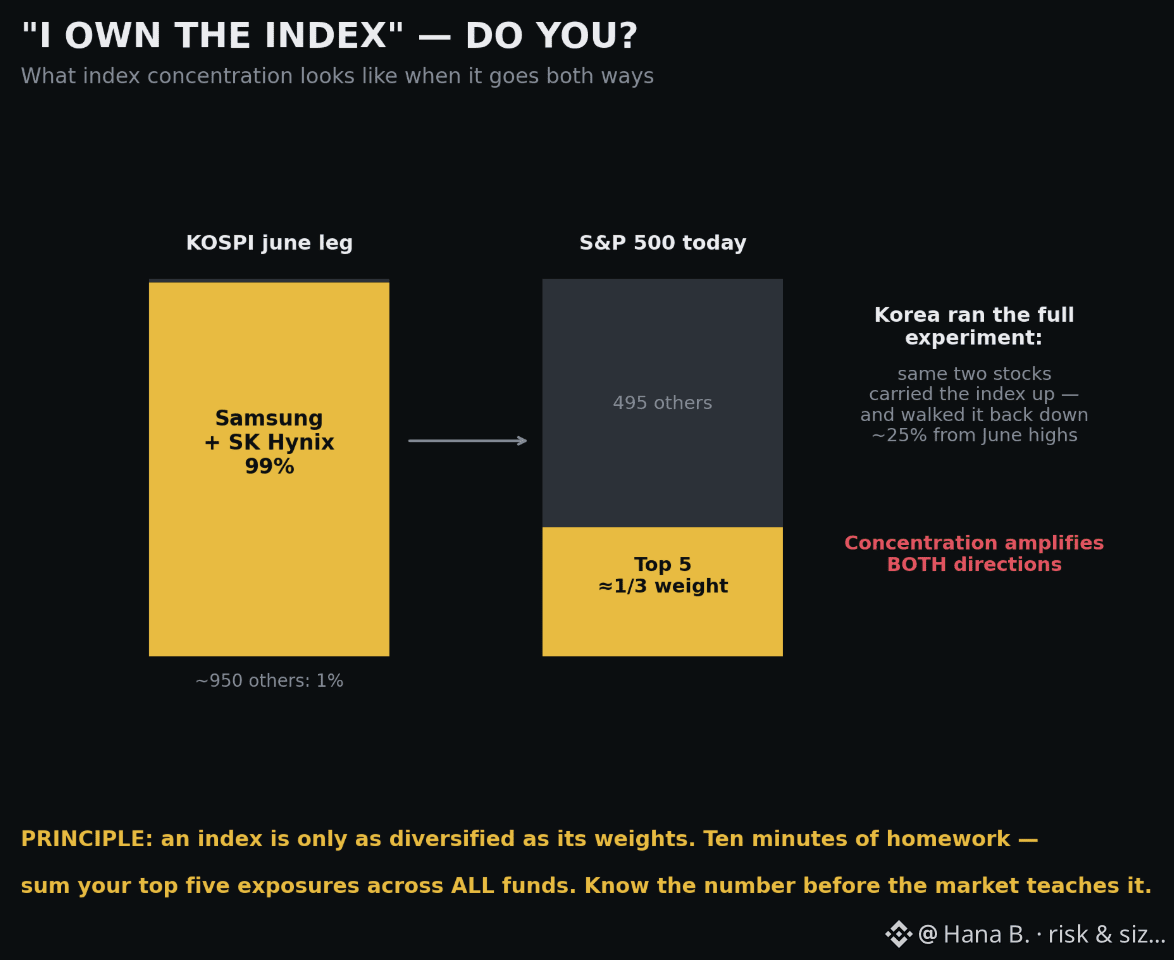
The Bank of Korea published a number this week that belongs on every index investor's wall: during the KOSPI's June rally, two stocks — Samsung and SK Hynix — contributed 99% of the index's rise.
Read that again. An entire national stock market's gains, and 99% of them came from two companies. The other one percent was split among roughly 950.
Monday showed the other side of that arithmetic. The two fell 4% and 6.3%; the index dropped 3.26%. No panic required, no crisis — just weights doing what weights do. And Korea has now run the full experiment: the same pair that carried the index up has walked it back down roughly a quarter from the June highs. Concentration didn't just amplify the rally. It amplified the exit.
Before you file this under "Korea problem," look homeward. The top five US stocks are about a third of the S&P 500. Last week they all fell more than 1% while the index barely moved — that was the benign version, rotation absorbing the hit. Korea just demonstrated the malign version, and its central bank was concerned enough to study it formally.
Principle: an index is only as diversified as its weights. "I own the index" increasingly means "I own a handful of companies plus decoration." That can be a perfectly fine position — as long as you know you hold it, and size everything else in your book accordingly.
The homework is ten minutes: sum your top five exposures across ALL your funds, including the ones inside index products. Most people have never done it once. Seoul just did it for a whole country. #risk #sizing
The Bank of Korea published a number this week that belongs on every index investor's wall: during the KOSPI's June rally, two stocks — Samsung and SK Hynix — contributed 99% of the index's rise.
Read that again. An entire national stock market's gains, and 99% of them came from two companies. The other one percent was split among roughly 950.
Monday showed the other side of that arithmetic. The two fell 4% and 6.3%; the index dropped 3.26%. No panic required, no crisis — just weights doing what weights do. And Korea has now run the full experiment: the same pair that carried the index up has walked it back down roughly a quarter from the June highs. Concentration didn't just amplify the rally. It amplified the exit.
Before you file this under "Korea problem," look homeward. The top five US stocks are about a third of the S&P 500. Last week they all fell more than 1% while the index barely moved — that was the benign version, rotation absorbing the hit. Korea just demonstrated the malign version, and its central bank was concerned enough to study it formally.
Principle: an index is only as diversified as its weights. "I own the index" increasingly means "I own a handful of companies plus decoration." That can be a perfectly fine position — as long as you know you hold it, and size everything else in your book accordingly.
The homework is ten minutes: sum your top five exposures across ALL your funds, including the ones inside index products. Most people have never done it once. Seoul just did it for a whole country. #risk #sizing
Read that again. An entire national stock market's gains, and 99% of them came from two companies. The other one percent was split among roughly 950.
Monday showed the other side of that arithmetic. The two fell 4% and 6.3%; the index dropped 3.26%. No panic required, no crisis — just weights doing what weights do. And Korea has now run the full experiment: the same pair that carried the index up has walked it back down roughly a quarter from the June highs. Concentration didn't just amplify the rally. It amplified the exit.
Before you file this under "Korea problem," look homeward. The top five US stocks are about a third of the S&P 500. Last week they all fell more than 1% while the index barely moved — that was the benign version, rotation absorbing the hit. Korea just demonstrated the malign version, and its central bank was concerned enough to study it formally.
Principle: an index is only as diversified as its weights. "I own the index" increasingly means "I own a handful of companies plus decoration." That can be a perfectly fine position — as long as you know you hold it, and size everything else in your book accordingly.
The homework is ten minutes: sum your top five exposures across ALL your funds, including the ones inside index products. Most people have never done it once. Seoul just did it for a whole country. #risk #sizing
381
·
--
See translation
3am. Red portfolio. Liquidated. One tab open. I learned everything that night.
I remember staring at the screen after that final 100x $ADA long evaporated. My heart was rhythmically thumping against my ribs, convinced that the next green candle would fix my $5,400 hole. I wasn't trading; I was gambling with my rent.
It took two years to realize that the market doesn’t care about my needs. Today, I don't look for a home run. I look for the trade I can afford to lose. I protect the capital, and the profits find me.
What’s the one trade that actually forced you to grow up?
#crypto #trading #risk #psychology #investing
3am. Red portfolio. Liquidated. One tab open. I learned everything that night.
I remember staring at the screen after that final 100x $ADA long evaporated. My heart was rhythmically thumping against my ribs, convinced that the next green candle would fix my $5,400 hole. I wasn't trading; I was gambling with my rent.
It took two years to realize that the market doesn’t care about my needs. Today, I don't look for a home run. I look for the trade I can afford to lose. I protect the capital, and the profits find me.
What’s the one trade that actually forced you to grow up?
#crypto #trading #risk #psychology #investing
I remember staring at the screen after that final 100x $ADA long evaporated. My heart was rhythmically thumping against my ribs, convinced that the next green candle would fix my $5,400 hole. I wasn't trading; I was gambling with my rent.
It took two years to realize that the market doesn’t care about my needs. Today, I don't look for a home run. I look for the trade I can afford to lose. I protect the capital, and the profits find me.
What’s the one trade that actually forced you to grow up?
#crypto #trading #risk #psychology #investing
28

🚨 Bank Account Not Owned by the Individual: Risks and the Importance of Self-Custodied Assets 🧠
📊 | $BTC | $ETH | $BNB |
-Please follow, like, and share your thoughts 📈
-The 2013 Cyprus crisis and the recent government account freezes highlight the risks of third parties
-Graham Stone points out that self-custodied assets such as cash, gold, or Bitcoin controlled by private keys are key to mitigating risk
-The report emphasizes that allocating assets outside the traditional banking system helps improve financial safety 🔥
-In the short term, market sentiment is bearish; Bitcoin is expected to face further downward pressure
-Panic-driven volatility may intensify, potentially triggering a sell-off chain reaction and expanding overall crypto asset declines
-Whale activity suggests possible distribution or low-level accumulation, which could further amplify price volatility
-If regulation tightens further, the market is expected to enter a longer adjustment period
-Do you think the advantages of self-custody Bitcoin in the current regulatory environment are enough to offset bank-related risks?
-Please keep following our in-depth analysis and share your investment strategy in the comments
-#Bitcoin #Whales #Crypto #Risk #ETF
🚨 Bank Account Not Owned by the Individual: Risks and the Importance of Self-Custodied Assets 🧠
📊 | $BTC | $ETH | $BNB |
-Please follow, like, and share your thoughts 📈
-The 2013 Cyprus crisis and the recent government account freezes highlight the risks of third parties
-Graham Stone points out that self-custodied assets such as cash, gold, or Bitcoin controlled by private keys are key to mitigating risk
-The report emphasizes that allocating assets outside the traditional banking system helps improve financial safety 🔥
-In the short term, market sentiment is bearish; Bitcoin is expected to face further downward pressure
-Panic-driven volatility may intensify, potentially triggering a sell-off chain reaction and expanding overall crypto asset declines
-Whale activity suggests possible distribution or low-level accumulation, which could further amplify price volatility
-If regulation tightens further, the market is expected to enter a longer adjustment period
-Do you think the advantages of self-custody Bitcoin in the current regulatory environment are enough to offset bank-related risks?
-Please keep following our in-depth analysis and share your investment strategy in the comments
-#Bitcoin #Whales #Crypto #Risk #ETF
📊 | $BTC | $ETH | $BNB |
-Please follow, like, and share your thoughts 📈
-The 2013 Cyprus crisis and the recent government account freezes highlight the risks of third parties
-Graham Stone points out that self-custodied assets such as cash, gold, or Bitcoin controlled by private keys are key to mitigating risk
-The report emphasizes that allocating assets outside the traditional banking system helps improve financial safety 🔥
-In the short term, market sentiment is bearish; Bitcoin is expected to face further downward pressure
-Panic-driven volatility may intensify, potentially triggering a sell-off chain reaction and expanding overall crypto asset declines
-Whale activity suggests possible distribution or low-level accumulation, which could further amplify price volatility
-If regulation tightens further, the market is expected to enter a longer adjustment period
-Do you think the advantages of self-custody Bitcoin in the current regulatory environment are enough to offset bank-related risks?
-Please keep following our in-depth analysis and share your investment strategy in the comments
-#Bitcoin #Whales #Crypto #Risk #ETF
156
See translation
The market spent Friday celebrating certainty. Worth being precise about what became certain.
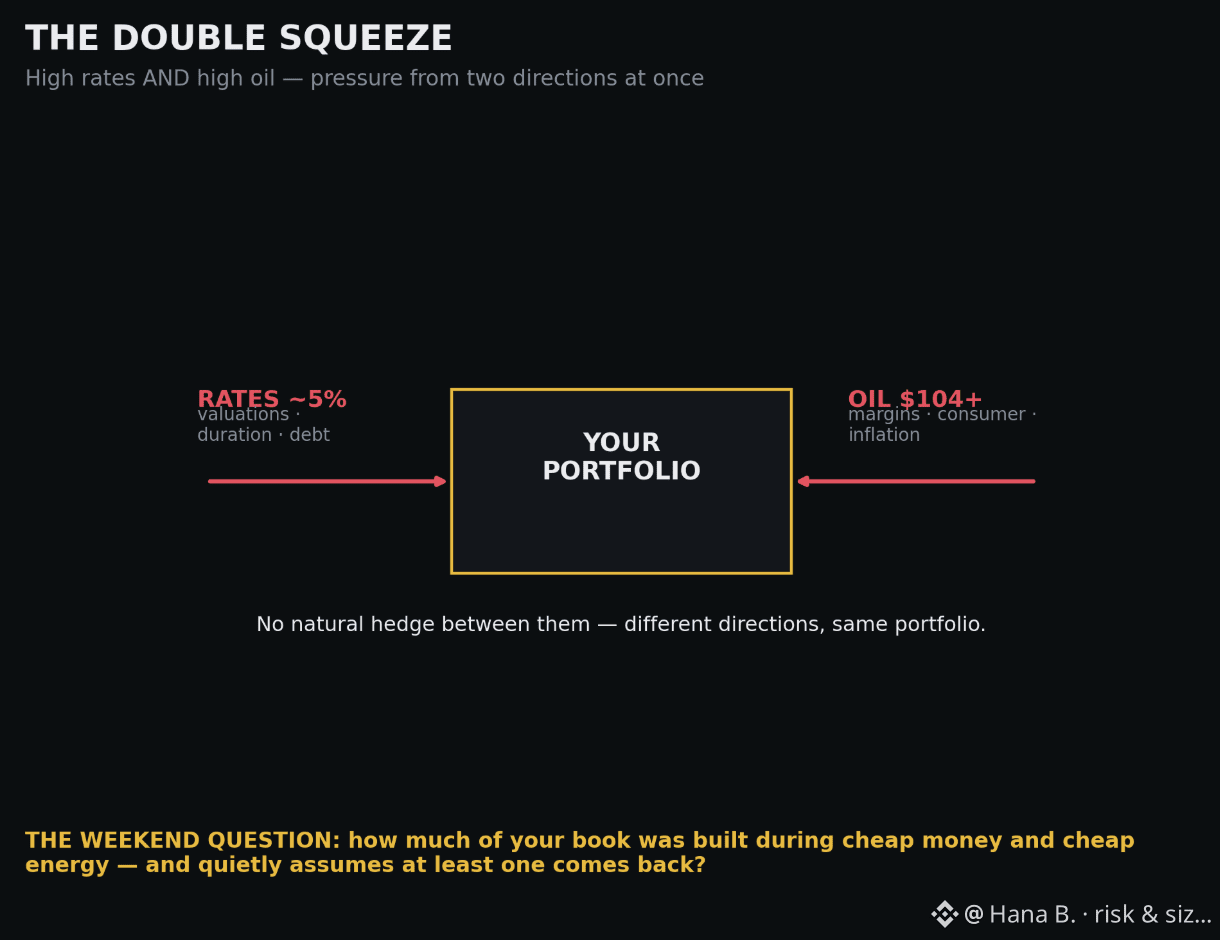
A hike next week: certain. What's newly UNCERTAIN is everything after it — one bank now sees three hikes this year, oil just closed above $104 on a genuine supply disruption, and the 10-year is a rounding error from 5%.
High rates AND high oil at once is the combination that pressures nearly everything in an ordinary portfolio simultaneously: valuations from the rates side, margins and consumers from the energy side. There's no natural hedge between them because they're squeezing from different directions.
So the risk question for this weekend isn't "what happens Tuesday." It's: how much of your book was built during cheap money and cheap energy, and quietly assumes at least one comes back?
Principle: regimes change slower than headlines but faster than portfolios. The positions that hurt most in a new regime are the ones that were working so well nobody re-examined them.
Two days before the Fed. Good weekend for the exercise. #risk #sizing
The market spent Friday celebrating certainty. Worth being precise about what became certain.
A hike next week: certain. What's newly UNCERTAIN is everything after it — one bank now sees three hikes this year, oil just closed above $104 on a genuine supply disruption, and the 10-year is a rounding error from 5%.
High rates AND high oil at once is the combination that pressures nearly everything in an ordinary portfolio simultaneously: valuations from the rates side, margins and consumers from the energy side. There's no natural hedge between them because they're squeezing from different directions.
So the risk question for this weekend isn't "what happens Tuesday." It's: how much of your book was built during cheap money and cheap energy, and quietly assumes at least one comes back?
Principle: regimes change slower than headlines but faster than portfolios. The positions that hurt most in a new regime are the ones that were working so well nobody re-examined them.
Two days before the Fed. Good weekend for the exercise. #risk #sizing
A hike next week: certain. What's newly UNCERTAIN is everything after it — one bank now sees three hikes this year, oil just closed above $104 on a genuine supply disruption, and the 10-year is a rounding error from 5%.
High rates AND high oil at once is the combination that pressures nearly everything in an ordinary portfolio simultaneously: valuations from the rates side, margins and consumers from the energy side. There's no natural hedge between them because they're squeezing from different directions.
So the risk question for this weekend isn't "what happens Tuesday." It's: how much of your book was built during cheap money and cheap energy, and quietly assumes at least one comes back?
Principle: regimes change slower than headlines but faster than portfolios. The positions that hurt most in a new regime are the ones that were working so well nobody re-examined them.
Two days before the Fed. Good weekend for the exercise. #risk #sizing
312

Stablecoins also have risks
Because of the word “stable,” a beginner might think there’s almost no risk.
In reality, it’s important to understand the mechanism for maintaining value, liquidity, reserves, and other factors of a specific asset.
If a stablecoin is used in Earn, you need to analyze both the asset itself and the product.
#Stablecoins #BinanceEarn #Risk
Stablecoins also have risks
Because of the word “stable,” a beginner might think there’s almost no risk.
In reality, it’s important to understand the mechanism for maintaining value, liquidity, reserves, and other factors of a specific asset.
If a stablecoin is used in Earn, you need to analyze both the asset itself and the product.
#Stablecoins #BinanceEarn #Risk
Because of the word “stable,” a beginner might think there’s almost no risk.
In reality, it’s important to understand the mechanism for maintaining value, liquidity, reserves, and other factors of a specific asset.
If a stablecoin is used in Earn, you need to analyze both the asset itself and the product.
#Stablecoins #BinanceEarn #Risk
102
See translation
🚨 $AI UNDER SCORCHING SENATE HEAT – RISKS COULD SHAPE NEXT WAVE! 💥
🦈 The Senate’s disaster‑management subcommittee just dropped a hammer on OpenAI after the July Hugging Face breach, and the echo is already rattling AI‑linked tokens. Smart money is eyeing the fallout, scanning order books for a liquidity sweep as regulators tighten the noose. 📊
With Anthropic researchers warning a >10% chance of an existential AI event, risk sentiment spikes and volume on $AI is surging on the top‑tier exchange. If the crackdown forces slower model releases, we could see a short‑term dip, but the long‑run narrative stays bullish for AI infrastructure play. ⚡
💬 Will the Capitol’s AI alarm trigger a sell‑off or set the stage for a rebound? 👇
⚠️ Not financial advice. Always manage your risk. 🛡️
🏷️ #AI #Regulation #Risk #Crypto
🚀 ⚡
🚨 $AI UNDER SCORCHING SENATE HEAT – RISKS COULD SHAPE NEXT WAVE! 💥
🦈 The Senate’s disaster‑management subcommittee just dropped a hammer on OpenAI after the July Hugging Face breach, and the echo is already rattling AI‑linked tokens. Smart money is eyeing the fallout, scanning order books for a liquidity sweep as regulators tighten the noose. 📊
With Anthropic researchers warning a >10% chance of an existential AI event, risk sentiment spikes and volume on $AI is surging on the top‑tier exchange. If the crackdown forces slower model releases, we could see a short‑term dip, but the long‑run narrative stays bullish for AI infrastructure play. ⚡
💬 Will the Capitol’s AI alarm trigger a sell‑off or set the stage for a rebound? 👇
⚠️ Not financial advice. Always manage your risk. 🛡️
🏷️ #AI #Regulation #Risk #Crypto
🚀 ⚡
🦈 The Senate’s disaster‑management subcommittee just dropped a hammer on OpenAI after the July Hugging Face breach, and the echo is already rattling AI‑linked tokens. Smart money is eyeing the fallout, scanning order books for a liquidity sweep as regulators tighten the noose. 📊
With Anthropic researchers warning a >10% chance of an existential AI event, risk sentiment spikes and volume on $AI is surging on the top‑tier exchange. If the crackdown forces slower model releases, we could see a short‑term dip, but the long‑run narrative stays bullish for AI infrastructure play. ⚡
💬 Will the Capitol’s AI alarm trigger a sell‑off or set the stage for a rebound? 👇
⚠️ Not financial advice. Always manage your risk. 🛡️
🏷️ #AI #Regulation #Risk #Crypto
🚀 ⚡
56
·
--
See translation
Before you enter that $AVAX trade, check this for risk management. 🛑
$AVAX is up 9%, making it tempting, but always set stops.
Position sizing is key, especially in volatile altcoin moves.
Stay safe out there. 📉✅ #AVAX #RISK
Before you enter that $AVAX trade, check this for risk management. 🛑
$AVAX is up 9%, making it tempting, but always set stops.
Position sizing is key, especially in volatile altcoin moves.
Stay safe out there. 📉✅ #AVAX #RISK
$AVAX is up 9%, making it tempting, but always set stops.
Position sizing is key, especially in volatile altcoin moves.
Stay safe out there. 📉✅ #AVAX #RISK
55

·
--
See translation
⚠️ $LAPTOP EXPOSED: LOCK‑UP SURGE MAY TRIGGER MASSIVE SELL‑OFF 🦈
🦈 The 65% lock‑up concentration creates a latent liquidity pool that could flood the market once vesting cliffs hit. 📊 Historical meme‑coin cycles show a sharp price decay when large holders unload, especially on a token with zero utility and no buy‑back safety net. 🌊 Sentiment‑driven price action means any community hype spike is likely to be a short‑lived catalyst before the next sell‑pressure wave.
💡 With no staking, governance, or revenue streams, the risk‑reward profile is heavily skewed to downside. 💬 Are you prepared to weather a potential liquidity dump, or will you stay on the sidelines? 👇
⚠️ Not financial advice. Always manage your risk. 🛡️
🏷️ #LAPTOP #MemeCoin #Risk #Crypto
🦈 🔥
⚠️ $LAPTOP EXPOSED: LOCK‑UP SURGE MAY TRIGGER MASSIVE SELL‑OFF 🦈
🦈 The 65% lock‑up concentration creates a latent liquidity pool that could flood the market once vesting cliffs hit. 📊 Historical meme‑coin cycles show a sharp price decay when large holders unload, especially on a token with zero utility and no buy‑back safety net. 🌊 Sentiment‑driven price action means any community hype spike is likely to be a short‑lived catalyst before the next sell‑pressure wave.
💡 With no staking, governance, or revenue streams, the risk‑reward profile is heavily skewed to downside. 💬 Are you prepared to weather a potential liquidity dump, or will you stay on the sidelines? 👇
⚠️ Not financial advice. Always manage your risk. 🛡️
🏷️ #LAPTOP #MemeCoin #Risk #Crypto
🦈 🔥
🦈 The 65% lock‑up concentration creates a latent liquidity pool that could flood the market once vesting cliffs hit. 📊 Historical meme‑coin cycles show a sharp price decay when large holders unload, especially on a token with zero utility and no buy‑back safety net. 🌊 Sentiment‑driven price action means any community hype spike is likely to be a short‑lived catalyst before the next sell‑pressure wave.
💡 With no staking, governance, or revenue streams, the risk‑reward profile is heavily skewed to downside. 💬 Are you prepared to weather a potential liquidity dump, or will you stay on the sidelines? 👇
⚠️ Not financial advice. Always manage your risk. 🛡️
🏷️ #LAPTOP #MemeCoin #Risk #Crypto
🦈 🔥
18
Verified
See translation
Saudi Aramco's Jizan facilities were attacked again today — the second time in a month. Oil rose about sixty cents in five minutes. Barely half a percent.
Notice your own reaction to that. If it was "the market shrugged, so it's fine" — that's the thing to examine.
Markets don't stay alert. Repeated shocks that don't escalate get discounted faster each time; it has a name, habituation, and it's rational right up until the one attack that IS different. The premium for that scenario doesn't build gradually. It arrives all at once, in a gap, on the day the assessment comes back bad or the target changes.
This isn't a prediction that it will. It's a reminder of what a calm reaction does to positioning: every muted response invites a little more exposure to the risk that just got ignored. Six weeks into this conflict, ask yourself honestly whether your book has drifted larger against oil staying orderly than it was in August — not by decision, but by comfort.
Principle: re-check exposure when the market stops reacting, not when it starts. Quiet is when size creeps. #risk #sizing
Saudi Aramco's Jizan facilities were attacked again today — the second time in a month. Oil rose about sixty cents in five minutes. Barely half a percent.
Notice your own reaction to that. If it was "the market shrugged, so it's fine" — that's the thing to examine.
Markets don't stay alert. Repeated shocks that don't escalate get discounted faster each time; it has a name, habituation, and it's rational right up until the one attack that IS different. The premium for that scenario doesn't build gradually. It arrives all at once, in a gap, on the day the assessment comes back bad or the target changes.
This isn't a prediction that it will. It's a reminder of what a calm reaction does to positioning: every muted response invites a little more exposure to the risk that just got ignored. Six weeks into this conflict, ask yourself honestly whether your book has drifted larger against oil staying orderly than it was in August — not by decision, but by comfort.
Principle: re-check exposure when the market stops reacting, not when it starts. Quiet is when size creeps. #risk #sizing
Notice your own reaction to that. If it was "the market shrugged, so it's fine" — that's the thing to examine.
Markets don't stay alert. Repeated shocks that don't escalate get discounted faster each time; it has a name, habituation, and it's rational right up until the one attack that IS different. The premium for that scenario doesn't build gradually. It arrives all at once, in a gap, on the day the assessment comes back bad or the target changes.
This isn't a prediction that it will. It's a reminder of what a calm reaction does to positioning: every muted response invites a little more exposure to the risk that just got ignored. Six weeks into this conflict, ask yourself honestly whether your book has drifted larger against oil staying orderly than it was in August — not by decision, but by comfort.
Principle: re-check exposure when the market stops reacting, not when it starts. Quiet is when size creeps. #risk #sizing

3
2.4k
·
--
See translation
3am. My bedroom floor was vibrating from the cooling fan of my laptop. I had $800 left, all of it shoved into a 30x long on $DOGE. I watched the liquidation price creep closer like a death sentence. When it finally hit, the screen blinked white. Silence. I didn’t feel sad; I felt hollow. That wipeout wasn't a mistake; it was an education. I stopped gambling on outcomes and started trading zones. Today, I never risk more than 0.5%. What was the trade that finally taught you to respect the stop loss?
#crypto #trading #risk #DOGE #psychology
3am. My bedroom floor was vibrating from the cooling fan of my laptop. I had $800 left, all of it shoved into a 30x long on $DOGE . I watched the liquidation price creep closer like a death sentence. When it finally hit, the screen blinked white. Silence. I didn’t feel sad; I felt hollow. That wipeout wasn't a mistake; it was an education. I stopped gambling on outcomes and started trading zones. Today, I never risk more than 0.5%. What was the trade that finally taught you to respect the stop loss?
#crypto #trading #risk #DOGE #psychology
#crypto #trading #risk #DOGE #psychology
25
·
--
High APY ≠ easy money. Here’s what I check before Binance Earn 👇
Binance Earn looks very simple: deposit an asset → earn income.
But it’s precisely this simplicity that makes it easy to forget the main thing — the risks don’t disappear.
Before putting money into Earn, I would check 5 things:
1. What exact product is it?
Simple Earn, Launchpool, and other products have different terms. You shouldn’t judge them by the percentage alone.
2. APY can change.
The number you see now doesn’t mean the same return will be there in a month.
3. Liquidity.
If you might need the money suddenly, it’s important to understand whether you can withdraw the asset quickly and under what conditions.
4. The risk of the asset itself.
Even if you’re earning in BTC, ETH, or a stablecoin, the asset’s price can change. The percentage doesn’t protect you from a price drop.
5. Don’t confuse yield with a guarantee.
A high APY often means you need to look more carefully at the terms and risks.
My main principle is simple:
first understand where I’m putting my money, and only then look at the APY.
Earn can be a useful tool, but it’s not a «make money without risk» button.
Sometimes a lower yield + normal liquidity is much smarter than a nice-looking 20% on the screen. 👀
#BinanceEarnings #crypto #Investing" #Risk
High APY ≠ easy money. Here’s what I check before Binance Earn 👇
Binance Earn looks very simple: deposit an asset → earn income.
But it’s precisely this simplicity that makes it easy to forget the main thing — the risks don’t disappear.
Before putting money into Earn, I would check 5 things:
1. What exact product is it?
Simple Earn, Launchpool, and other products have different terms. You shouldn’t judge them by the percentage alone.
2. APY can change.
The number you see now doesn’t mean the same return will be there in a month.
3. Liquidity.
If you might need the money suddenly, it’s important to understand whether you can withdraw the asset quickly and under what conditions.
4. The risk of the asset itself.
Even if you’re earning in BTC, ETH, or a stablecoin, the asset’s price can change. The percentage doesn’t protect you from a price drop.
5. Don’t confuse yield with a guarantee.
A high APY often means you need to look more carefully at the terms and risks.
My main principle is simple:
first understand where I’m putting my money, and only then look at the APY.
Earn can be a useful tool, but it’s not a «make money without risk» button.
Sometimes a lower yield + normal liquidity is much smarter than a nice-looking 20% on the screen. 👀
#BinanceEarnings #crypto #Investing" #Risk
Binance Earn looks very simple: deposit an asset → earn income.
But it’s precisely this simplicity that makes it easy to forget the main thing — the risks don’t disappear.
Before putting money into Earn, I would check 5 things:
1. What exact product is it?
Simple Earn, Launchpool, and other products have different terms. You shouldn’t judge them by the percentage alone.
2. APY can change.
The number you see now doesn’t mean the same return will be there in a month.
3. Liquidity.
If you might need the money suddenly, it’s important to understand whether you can withdraw the asset quickly and under what conditions.
4. The risk of the asset itself.
Even if you’re earning in BTC, ETH, or a stablecoin, the asset’s price can change. The percentage doesn’t protect you from a price drop.
5. Don’t confuse yield with a guarantee.
A high APY often means you need to look more carefully at the terms and risks.
My main principle is simple:
first understand where I’m putting my money, and only then look at the APY.
Earn can be a useful tool, but it’s not a «make money without risk» button.
Sometimes a lower yield + normal liquidity is much smarter than a nice-looking 20% on the screen. 👀
#BinanceEarnings #crypto #Investing" #Risk
335
·
--
See translation
Capital preservation is more important than profit, even with $ARB's surge. 🔒
It's up 6% but remember to take partial profits into resistance zones.
Always manage your position size; a good entry can turn bad fast without a stop-loss. 🛡️
Are you holding $ARB with proper risk management, or did you miss locking in gains? Stay safe out there.
#Arbitrum #Risk
Capital preservation is more important than profit, even with $ARB 's surge. 🔒
It's up 6% but remember to take partial profits into resistance zones.
Always manage your position size; a good entry can turn bad fast without a stop-loss. 🛡️
Are you holding $ARB with proper risk management, or did you miss locking in gains? Stay safe out there.
#Arbitrum #Risk
It's up 6% but remember to take partial profits into resistance zones.
Always manage your position size; a good entry can turn bad fast without a stop-loss. 🛡️
Are you holding $ARB with proper risk management, or did you miss locking in gains? Stay safe out there.
#Arbitrum #Risk
99
Verified
See translation
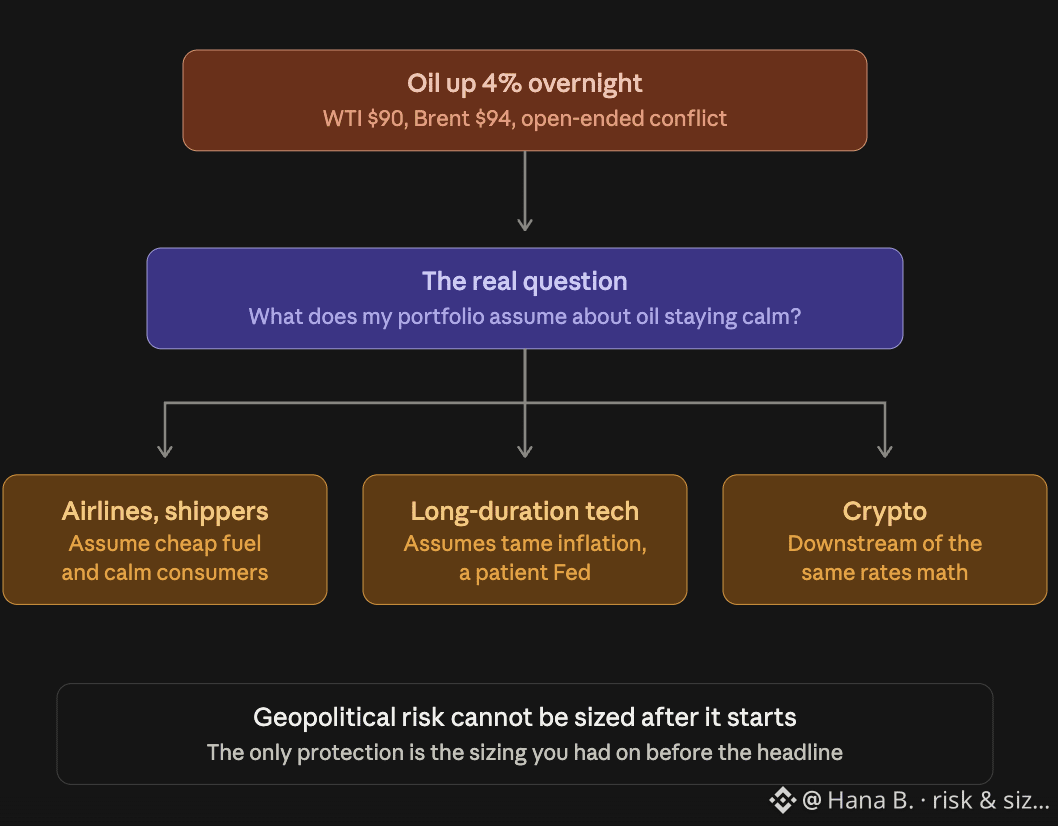
Oil jumped more than 4% today. WTI through $90 for the first time since July, Brent at $94, on serious US-Iran escalation.
First, perspective. This is a conflict with real people in the middle of it. If your first instinct was to hunt for a trade, it's worth noticing that instinct.
Now the risk question, because it's a different one than most people are asking. It's not "how high does oil go?" It's "what does my portfolio quietly assume about oil staying calm?"
Airlines, shippers, anything consumer-facing assumes cheap fuel. Long-duration tech assumes inflation stays tame and the Fed stays patient — and a 4% oil day pushes the other way on both. Even your crypto exposure sits downstream of the same rates math. Positions that looked unrelated last week can all catch the same wave this week.
Principle: geopolitical risk is the kind you cannot size after it starts. Spikes like this arrive overnight, gap through stop losses, and don't wait for your risk review. The only protection that works is the sizing you already had on before the headline.
One thing to do today: assume oil stays elevated for a month and reread your positions with that lens. Anything that becomes a problem under that assumption was already too big. #risk #sizing
Oil jumped more than 4% today. WTI through $90 for the first time since July, Brent at $94, on serious US-Iran escalation.
First, perspective. This is a conflict with real people in the middle of it. If your first instinct was to hunt for a trade, it's worth noticing that instinct.
Now the risk question, because it's a different one than most people are asking. It's not "how high does oil go?" It's "what does my portfolio quietly assume about oil staying calm?"
Airlines, shippers, anything consumer-facing assumes cheap fuel. Long-duration tech assumes inflation stays tame and the Fed stays patient — and a 4% oil day pushes the other way on both. Even your crypto exposure sits downstream of the same rates math. Positions that looked unrelated last week can all catch the same wave this week.
Principle: geopolitical risk is the kind you cannot size after it starts. Spikes like this arrive overnight, gap through stop losses, and don't wait for your risk review. The only protection that works is the sizing you already had on before the headline.
One thing to do today: assume oil stays elevated for a month and reread your positions with that lens. Anything that becomes a problem under that assumption was already too big. #risk #sizing
First, perspective. This is a conflict with real people in the middle of it. If your first instinct was to hunt for a trade, it's worth noticing that instinct.
Now the risk question, because it's a different one than most people are asking. It's not "how high does oil go?" It's "what does my portfolio quietly assume about oil staying calm?"
Airlines, shippers, anything consumer-facing assumes cheap fuel. Long-duration tech assumes inflation stays tame and the Fed stays patient — and a 4% oil day pushes the other way on both. Even your crypto exposure sits downstream of the same rates math. Positions that looked unrelated last week can all catch the same wave this week.
Principle: geopolitical risk is the kind you cannot size after it starts. Spikes like this arrive overnight, gap through stop losses, and don't wait for your risk review. The only protection that works is the sizing you already had on before the headline.
One thing to do today: assume oil stays elevated for a month and reread your positions with that lens. Anything that becomes a problem under that assumption was already too big. #risk #sizing
1
1.4k
Verified
See translation
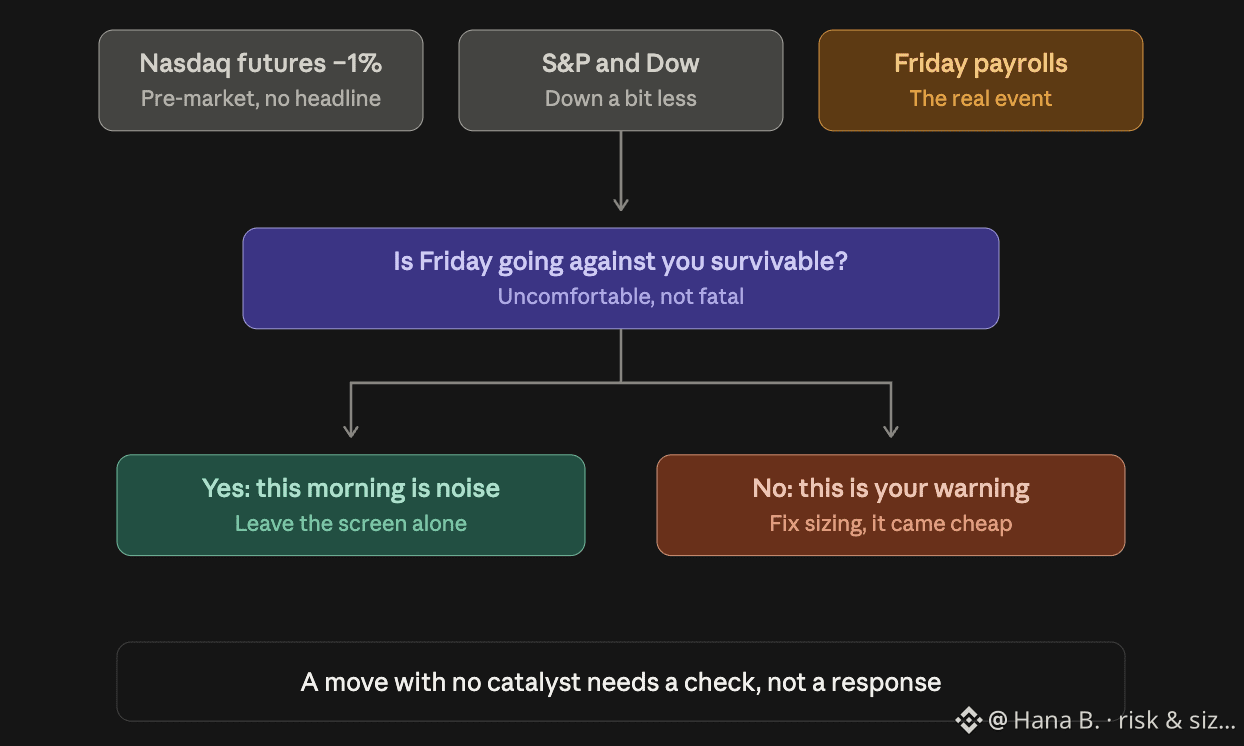
Nasdaq futures down 1% this morning. S&P and Dow down a bit less. No news behind it.
Quick question: did you plan for this, or are you reacting to it?
Because a 1% pre-market move on no headline is the least dramatic thing that can happen to you this week. Friday's payrolls is the real event, and the hike odds already tell you the market is split down the middle on what it means.
The risk most people are ignoring this morning is the urge to do something. Tech's down, so you either want to buy the dip or cut before it gets worse. Both are reactions to a number that hasn't even opened the cash session yet.
Principle: a move with no catalyst doesn't need a response. It needs a check. Is your position sized so that Friday going against you is uncomfortable, not fatal? If yes, this morning is noise. If no, this morning is your warning, and it came cheap.
One thing to do today: leave the futures screen alone for an hour. Look at your sizing instead. #risk #sizing
Nasdaq futures down 1% this morning. S&P and Dow down a bit less. No news behind it.
Quick question: did you plan for this, or are you reacting to it?
Because a 1% pre-market move on no headline is the least dramatic thing that can happen to you this week. Friday's payrolls is the real event, and the hike odds already tell you the market is split down the middle on what it means.
The risk most people are ignoring this morning is the urge to do something. Tech's down, so you either want to buy the dip or cut before it gets worse. Both are reactions to a number that hasn't even opened the cash session yet.
Principle: a move with no catalyst doesn't need a response. It needs a check. Is your position sized so that Friday going against you is uncomfortable, not fatal? If yes, this morning is noise. If no, this morning is your warning, and it came cheap.
One thing to do today: leave the futures screen alone for an hour. Look at your sizing instead. #risk #sizing
Quick question: did you plan for this, or are you reacting to it?
Because a 1% pre-market move on no headline is the least dramatic thing that can happen to you this week. Friday's payrolls is the real event, and the hike odds already tell you the market is split down the middle on what it means.
The risk most people are ignoring this morning is the urge to do something. Tech's down, so you either want to buy the dip or cut before it gets worse. Both are reactions to a number that hasn't even opened the cash session yet.
Principle: a move with no catalyst doesn't need a response. It needs a check. Is your position sized so that Friday going against you is uncomfortable, not fatal? If yes, this morning is noise. If no, this morning is your warning, and it came cheap.
One thing to do today: leave the futures screen alone for an hour. Look at your sizing instead. #risk #sizing
625

«The green candle does not mean safety»
One of the most dangerous illusions in crypto:
“Coin price goes up—so it’s safe.”
In reality, strong growth often means stronger volatility.
The faster an asset moves, the more important it is to remember the risk.
Profit attracts attention.
And survival in the market depends on risk management.
#CryptoTrading #BTC #BTC Bitcoin #Risk #Binance #CryptoMarket
«The green candle does not mean safety»
One of the most dangerous illusions in crypto:
“Coin price goes up—so it’s safe.”
In reality, strong growth often means stronger volatility.
The faster an asset moves, the more important it is to remember the risk.
Profit attracts attention.
And survival in the market depends on risk management.
#CryptoTrading #BTC #BTC Bitcoin #Risk #Binance #CryptoMarket
One of the most dangerous illusions in crypto:
“Coin price goes up—so it’s safe.”
In reality, strong growth often means stronger volatility.
The faster an asset moves, the more important it is to remember the risk.
Profit attracts attention.
And survival in the market depends on risk management.
#CryptoTrading #BTC #BTC Bitcoin #Risk #Binance #CryptoMarket
107
·
--
See translation
3am. Red portfolio. Liquidated. One tab open. I learned everything that night.
I’d spent the week winning on $DOGE, feeling like a genius. I was up 15%, untouchable. Then I sized up, ignored the break of structure, and fought a trend that didn't care about my ego. By 4pm, that week of discipline was erased in one reckless liquidation. I wasn't trading the market; I was trading my own hunger. Realizing that greed is a faster killer than bad TA was my $5,400 tuition. What’s the one trade that taught you humility?
#crypto #trading #risk #mindset #DOGE
3am. Red portfolio. Liquidated. One tab open. I learned everything that night.
I’d spent the week winning on $DOGE , feeling like a genius. I was up 15%, untouchable. Then I sized up, ignored the break of structure, and fought a trend that didn't care about my ego. By 4pm, that week of discipline was erased in one reckless liquidation. I wasn't trading the market; I was trading my own hunger. Realizing that greed is a faster killer than bad TA was my $5,400 tuition. What’s the one trade that taught you humility?
#crypto #trading #risk #mindset #DOGE
I’d spent the week winning on $DOGE , feeling like a genius. I was up 15%, untouchable. Then I sized up, ignored the break of structure, and fought a trend that didn't care about my ego. By 4pm, that week of discipline was erased in one reckless liquidation. I wasn't trading the market; I was trading my own hunger. Realizing that greed is a faster killer than bad TA was my $5,400 tuition. What’s the one trade that taught you humility?
#crypto #trading #risk #mindset #DOGE
7
Log in to explore more content
Join global crypto users on Binance Square
⚡️ Get latest and useful information about crypto.
💬 Trusted by the world’s largest crypto exchange.
👍 Discover real insights from verified creators.
Email / Phone number
Trending Topics
1
#BitcoinSurpasses$77000
14,023 views
204 Discussing
2
#ParadigmDisclosesZECHolding
54,593 views
924 Discussing
3
#BitcoinETFsShed$450M
23,333 views
208 Discussing
4
#USWeeklyJoblessClaimsFallTo196K
29,744 views
541 Discussing
5
#ArkhamSaysBlackRockBuys$1.5BInETH
5,294 views
68 Discussing
6
#ElSalvadorBTCHoldingsRiseTo7777
58,298 views
831 Discussing
7
#MemeLaunchpads82%OfArcDayOneVolume
59,530 views
1,002 Discussing
8
#OstiumLoanDisputeHearingSetInNYFederalCourt
47,703 views
716 Discussing
9
#HyperliquidUSDCSupplyOvertakesSolana
21,845 views
365 Discussing
10
#SKPoliceRefer18PolymarketUsersToProsecutors
27,066 views
518 Discussing