

#nucleardeterrence
nucleardeterrence
4,414 views
9 Discussing
Hot
Latest

French President Emmanuel Macron has recently moved forward with the “forward nuclear early-warning” plan, joining 10 European allies, including the United Kingdom, Germany, and Poland, to expand the forward deterrence and early-warning deployment of French nuclear forces. The plan proposes deploying nuclear-capable Rafale fighter jets in several parts of Europe and establishing a new intelligence-sharing and early-warning communications network. However, Italy has explicitly refused to join, and the three Baltic states have also been left out, highlighting the serious divisions that persist within Europe over defense.
This strategic move shows that Europe is seeking to break free from its traditional security umbrella’s sole reliance on the United States, as the geopolitical landscape enters a high-risk phase of independent deterrence. Yet the disconnect among countries’ positions on nuclear strategy makes it difficult to establish a truly unified line of defense and could instead heighten the risk of direct confrontation with Russia, increasing the likelihood of miscalculation and friction across the continent.
The escalation of geopolitical nuclear deterrence directly weighs on risk appetite in traditional financial markets. A sustained rise in Europe’s geopolitical risk premium will dampen expectations for an economic recovery in Europe and drive more safe-haven capital toward hard-currency assets such as the U.S. dollar and gold. The volatility baseline in global capital markets may rise significantly.
For crypto assets, prolonged and increasingly complex geopolitical tensions tend to squeeze speculative liquidity in the market. In an environment dominated by safe-haven sentiment, risk assets such as $BTC are more vulnerable to pressure from liquidity flowing back into traditional safe havens. Investors should be alert to the risk of episodic liquidity cascades triggered by geopolitical black swan events.
#Geopolitics #NuclearDeterrence #MacroEconomy
258

Article
See translation
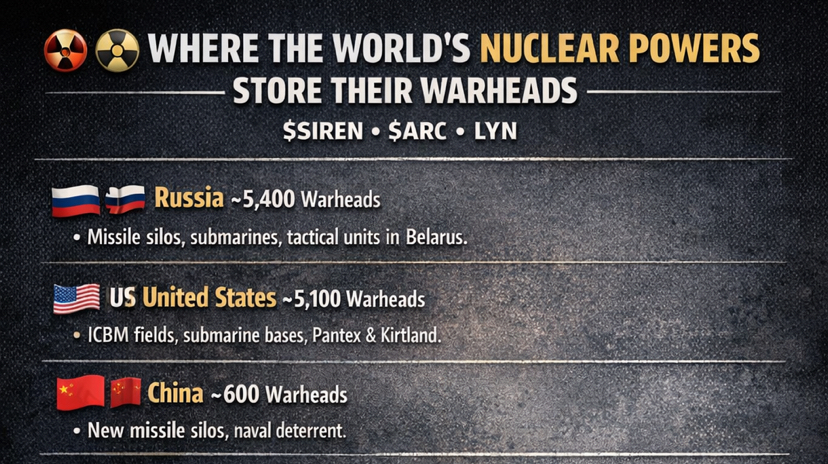
💣☢️ WHERE THE WORLD’S NUCLEAR POWERS STORE THEIR WARHEADS$SIREN $arc $LYN
Below is a strategic overview of how nuclear-armed states manage and position their arsenals. Figures are approximate estimates based on open-source global security assessments.
🇷🇺 Russia (~5,400 warheads)
The largest stockpile globally. Warheads are distributed across numerous high-security facilities.
• Strategic missile silos and mobile launchers
• Submarine-based deterrent forces
• Air-delivered systems
Some tactical systems have reportedly been positioned in Belarus, reinforcing regional deterrence posture.
🇺🇸 United States (~5,100 warheads)
Stored across multiple secure sites nationwide. Key elements include:
• Intercontinental missile fields in the central U.S.
• Ballistic missile submarines
• Strategic bomber bases
• Maintenance and storage facilities such as Pantex (Texas) and Kirtland (New Mexico)
Additionally, a limited number of gravity bombs are stationed in Europe under NATO nuclear-sharing arrangements.
🇨🇳 China (~600 warheads)
China’s arsenal is expanding and modernizing.
• Newly constructed missile silo fields
• Centralized storage infrastructure
• Growing sea-based deterrent capability
Open-source intelligence indicates continued long-term buildup.
🇫🇷 France (~290 warheads)
France relies primarily on submarine-based deterrence.
• Ballistic missile submarines
• Air-delivered nuclear capability
All systems remain under strict national command.
🇬🇧 United Kingdom (~225 warheads)
The UK maintains a continuous at-sea deterrent.
• Warheads stored at Coulport
• Deployed via Trident missiles on submarines based in Scotland
🇮🇳 India (~180 warheads)
India operates a developing nuclear triad.
• Land-based ballistic missiles
• Aircraft delivery platforms
• Expanding submarine-based systems
Warheads are generally believed to be stored separately from launch systems during peacetime.
🇵🇰 Pakistan (~170 warheads)
Pakistan maintains a land-focused deterrent.
• Ballistic missile systems
• Mobile launch platforms
• Warheads reportedly separated from delivery systems outside crisis periods
🇮🇱 Israel (~90 warheads, undeclared)
Israel maintains a long-standing policy of strategic ambiguity.
Open-source analysis associates its capability with secure desert facilities and possible sea-based options.
🇰🇵 North Korea (~50 warheads)
North Korea continues developing its nuclear and missile programs.
• Centralized storage locations
• Missile integration facilities
• Expanding long-range strike capability
⚠️ Nuclear forces are structured around deterrence doctrine. Despite heightened rhetoric during geopolitical tensions, these arsenals are primarily intended to prevent large-scale war through strategic balance.
#GlobalSecurity #NuclearDeterrence #Geopolitics #DefenseAnalysis
{future}(ARCUSDT)
{future}(SIRENUSDT)
{alpha}(560x302dfaf2cdbe51a18d97186a7384e87cf599877d)
💣☢️ WHERE THE WORLD’S NUCLEAR POWERS STORE THEIR WARHEADS
$SIREN $arc $LYN
Below is a strategic overview of how nuclear-armed states manage and position their arsenals. Figures are approximate estimates based on open-source global security assessments.
🇷🇺 Russia (~5,400 warheads)
The largest stockpile globally. Warheads are distributed across numerous high-security facilities.
• Strategic missile silos and mobile launchers
• Submarine-based deterrent forces
• Air-delivered systems
Some tactical systems have reportedly been positioned in Belarus, reinforcing regional deterrence posture.
🇺🇸 United States (~5,100 warheads)
Stored across multiple secure sites nationwide. Key elements include:
• Intercontinental missile fields in the central U.S.
• Ballistic missile submarines
• Strategic bomber bases
• Maintenance and storage facilities such as Pantex (Texas) and Kirtland (New Mexico)
Additionally, a limited number of gravity bombs are stationed in Europe under NATO nuclear-sharing arrangements.
🇨🇳 China (~600 warheads)
China’s arsenal is expanding and modernizing.
• Newly constructed missile silo fields
• Centralized storage infrastructure
• Growing sea-based deterrent capability
Open-source intelligence indicates continued long-term buildup.
🇫🇷 France (~290 warheads)
France relies primarily on submarine-based deterrence.
• Ballistic missile submarines
• Air-delivered nuclear capability
All systems remain under strict national command.
🇬🇧 United Kingdom (~225 warheads)
The UK maintains a continuous at-sea deterrent.
• Warheads stored at Coulport
• Deployed via Trident missiles on submarines based in Scotland
🇮🇳 India (~180 warheads)
India operates a developing nuclear triad.
• Land-based ballistic missiles
• Aircraft delivery platforms
• Expanding submarine-based systems
Warheads are generally believed to be stored separately from launch systems during peacetime.
🇵🇰 Pakistan (~170 warheads)
Pakistan maintains a land-focused deterrent.
• Ballistic missile systems
• Mobile launch platforms
• Warheads reportedly separated from delivery systems outside crisis periods
🇮🇱 Israel (~90 warheads, undeclared)
Israel maintains a long-standing policy of strategic ambiguity.
Open-source analysis associates its capability with secure desert facilities and possible sea-based options.
🇰🇵 North Korea (~50 warheads)
North Korea continues developing its nuclear and missile programs.
• Centralized storage locations
• Missile integration facilities
• Expanding long-range strike capability
⚠️ Nuclear forces are structured around deterrence doctrine. Despite heightened rhetoric during geopolitical tensions, these arsenals are primarily intended to prevent large-scale war through strategic balance.
#GlobalSecurity #NuclearDeterrence #Geopolitics #DefenseAnalysis
2
285
Log in to explore more content
Join global crypto users on Binance Square
⚡️ Get latest and useful information about crypto.
💬 Trusted by the world’s largest crypto exchange.
👍 Discover real insights from verified creators.
Email / Phone number
Trending Topics
1
#BinancePick
2.6M views
142,012 Discussing
2
#EarningsSeason
5M views
24,402 Discussing
3
#FranklinTempletonFilesForTwoDividendToBitcoinETFs
2,034 views
116 Discussing
4
#StrategyMSTRSurpassesNasdaqInMarketCap
2,857 views
105 Discussing
5
#CanadaProposesStablecoinRedemptionWithin3BusinessDays
103 views
13 Discussing
6
#ElectrumWalletBugLetRogueServersStealFunds
8,951 views
244 Discussing
7
#ArgentineCourtDismissesLIBRACaseAgainstMilei
19,503 views
321 Discussing
8
#SKHynixReportedlyPlansSpecialDividendFromKioxiaStakeSale
3,158 views
48 Discussing
9
#KeystoneWebsiteBreachExposesBuyersShippingAddresses
1,688 views
41 Discussing
10
#USQ3GDPAndSeptemberPCEDueNextWeek
97,506 views
1,138 Discussing