
#mrna
mrna
16,574 views
199 Discussing
Hot
Latest

·
--
$MRNA has risen 10.265% over the past 24 hours, with the market price at 161.56. Old Dog glanced at the data and one signal stood out: the funding rate is zero. Under normal circumstances, with such a rally, longs in the futures market should be paying a positive funding rate to shorts, but now the rate is flat. This is not normal. Either the delivery just passed, or the driver of this move is not the typical long-leveraged crowd. My judgment is that this is a short-covering-led move, not a new wave of FOMO from longs.
Why do I say that? Look at the iron rule of funding rates: when the rate is above zero, longs pay, meaning longs are crowded. Now that the rate has returned to zero, it at least shows that at the current price level, there are not many leveraged funds willing to hold longs at a high cost. If longs are not crowded, yet the price can still rise 10 points, where is the driving force coming from? The reasonable inference is that shorts are stopping out or getting liquidated. As the price quickly rises from lower levels and breaks through short sellers’ defense zones, it triggers a chain of forced liquidations. This kind of short-covering rally is characterized by being sharp but lacking sustained new buying. Open interest is now 10844.44. I can’t tell whether it is higher or lower than yesterday, but combined with the zero funding rate, if open interest has not increased significantly, it further supports that this is a game of existing positions, with shorts admitting defeat and exiting, rather than a legion of new longs pressing in.
So Old Dog’s view is: this is a technical short squeeze, not the starting point of a trend reversal. The market is digesting the short positions accumulated earlier, rather than building a new long narrative. Then what is the strongest counterevidence? If in the next 24 hours the price keeps rising while open interest increases significantly and the funding rate turns positive again (for example above 0.01%), that would mean new long capital is actively building positions and is willing to pay the cost, and the nature of the move would change. But right now, zero funding is a mirror reflecting shorts running, not longs charging.
What happens next? The most uncomfortable ones are the shorts that have not yet closed. If the price holds above 161.56 and continues to grind higher or takes another step up, their losses will deepen, forcing more covering and pushing the price higher still, creating a short-term positive feedback loop. But they are the ones bearing the cost. Meanwhile, sidelined capital watching from the outside, seeing zero funding and this kind of rally, may question the risk-reward of chasing higher, and liquidity could flow to other names. That is the second-order effect: shorts absorb the cost, while fresh liquidity hesitates.
My move is clear: do not chase.
Trading tags: #BinanceFutures #TradFi #USDⓈM #MRNA #MRNAUSDT $MRNA
$MRNA has risen 10.265% over the past 24 hours, with the market price at 161.56. Old Dog glanced at the data and one signal stood out: the funding rate is zero. Under normal circumstances, with such a rally, longs in the futures market should be paying a positive funding rate to shorts, but now the rate is flat. This is not normal. Either the delivery just passed, or the driver of this move is not the typical long-leveraged crowd. My judgment is that this is a short-covering-led move, not a new wave of FOMO from longs.
Why do I say that? Look at the iron rule of funding rates: when the rate is above zero, longs pay, meaning longs are crowded. Now that the rate has returned to zero, it at least shows that at the current price level, there are not many leveraged funds willing to hold longs at a high cost. If longs are not crowded, yet the price can still rise 10 points, where is the driving force coming from? The reasonable inference is that shorts are stopping out or getting liquidated. As the price quickly rises from lower levels and breaks through short sellers’ defense zones, it triggers a chain of forced liquidations. This kind of short-covering rally is characterized by being sharp but lacking sustained new buying. Open interest is now 10844.44. I can’t tell whether it is higher or lower than yesterday, but combined with the zero funding rate, if open interest has not increased significantly, it further supports that this is a game of existing positions, with shorts admitting defeat and exiting, rather than a legion of new longs pressing in.
So Old Dog’s view is: this is a technical short squeeze, not the starting point of a trend reversal. The market is digesting the short positions accumulated earlier, rather than building a new long narrative. Then what is the strongest counterevidence? If in the next 24 hours the price keeps rising while open interest increases significantly and the funding rate turns positive again (for example above 0.01%), that would mean new long capital is actively building positions and is willing to pay the cost, and the nature of the move would change. But right now, zero funding is a mirror reflecting shorts running, not longs charging.
What happens next? The most uncomfortable ones are the shorts that have not yet closed. If the price holds above 161.56 and continues to grind higher or takes another step up, their losses will deepen, forcing more covering and pushing the price higher still, creating a short-term positive feedback loop. But they are the ones bearing the cost. Meanwhile, sidelined capital watching from the outside, seeing zero funding and this kind of rally, may question the risk-reward of chasing higher, and liquidity could flow to other names. That is the second-order effect: shorts absorb the cost, while fresh liquidity hesitates.
My move is clear: do not chase.
Trading tags: #BinanceFutures #TradFi #USDⓈM #MRNA #MRNAUSDT $MRNA
Why do I say that? Look at the iron rule of funding rates: when the rate is above zero, longs pay, meaning longs are crowded. Now that the rate has returned to zero, it at least shows that at the current price level, there are not many leveraged funds willing to hold longs at a high cost. If longs are not crowded, yet the price can still rise 10 points, where is the driving force coming from? The reasonable inference is that shorts are stopping out or getting liquidated. As the price quickly rises from lower levels and breaks through short sellers’ defense zones, it triggers a chain of forced liquidations. This kind of short-covering rally is characterized by being sharp but lacking sustained new buying. Open interest is now 10844.44. I can’t tell whether it is higher or lower than yesterday, but combined with the zero funding rate, if open interest has not increased significantly, it further supports that this is a game of existing positions, with shorts admitting defeat and exiting, rather than a legion of new longs pressing in.
So Old Dog’s view is: this is a technical short squeeze, not the starting point of a trend reversal. The market is digesting the short positions accumulated earlier, rather than building a new long narrative. Then what is the strongest counterevidence? If in the next 24 hours the price keeps rising while open interest increases significantly and the funding rate turns positive again (for example above 0.01%), that would mean new long capital is actively building positions and is willing to pay the cost, and the nature of the move would change. But right now, zero funding is a mirror reflecting shorts running, not longs charging.
What happens next? The most uncomfortable ones are the shorts that have not yet closed. If the price holds above 161.56 and continues to grind higher or takes another step up, their losses will deepen, forcing more covering and pushing the price higher still, creating a short-term positive feedback loop. But they are the ones bearing the cost. Meanwhile, sidelined capital watching from the outside, seeing zero funding and this kind of rally, may question the risk-reward of chasing higher, and liquidity could flow to other names. That is the second-order effect: shorts absorb the cost, while fresh liquidity hesitates.
My move is clear: do not chase.
Trading tags: #BinanceFutures #TradFi #USDⓈM #MRNA #MRNAUSDT $MRNA
109

$MRNA surged nearly 10% over the past 24 hours, with the price now at 160.83. But the funding rate is 0, which means neither long nor short has paid anyone—this standoff is stuck at an equilibrium point.
I believe this bullish candle is the market betting on the next political direction. Biotech stocks are extremely sensitive to policy; any rumors about drug approvals or医保 pricing will trigger violent swings. A zero funding rate suggests longs are waiting for a clear signal, while shorts also fear stepping on a policy landmine and don’t dare short aggressively. This kind of deadlock is often broken abruptly when the news lands.
The strongest counter-argument is: if there’s no substantive policy catalyst, then this rally is purely emotion-driven trading, and the profit-taking could come crashing down at any time. The second-order effect is that once a positive catalyst appears, shorts will be forced to cover, pushing the price higher; if a negative catalyst appears, longs taking profits could trigger a rapid pullback.
My current view is that the risk premium caused by political maneuvering hasn’t been fully priced in yet. The invalidation condition is simple: if, over the next few trading days, the price falls back below 155, it means the bet failed and I will cut my position and exit immediately.
In terms of action, I plan to试多 (test long) with a small position size. I’ll go long in the direction of 5x leverage, set the stop-loss at 155, and take profit at 175. The position size will be 10% of total capital. I’ll only play this wave of policy expectations—once it hits the target price, I’ll撤 (exit).
Trading tag: #TradFi #链上美股 #MRNA
Where do you think this thesis is most likely to be wrong?
$MRNA surged nearly 10% over the past 24 hours, with the price now at 160.83. But the funding rate is 0, which means neither long nor short has paid anyone—this standoff is stuck at an equilibrium point.
I believe this bullish candle is the market betting on the next political direction. Biotech stocks are extremely sensitive to policy; any rumors about drug approvals or医保 pricing will trigger violent swings. A zero funding rate suggests longs are waiting for a clear signal, while shorts also fear stepping on a policy landmine and don’t dare short aggressively. This kind of deadlock is often broken abruptly when the news lands.
The strongest counter-argument is: if there’s no substantive policy catalyst, then this rally is purely emotion-driven trading, and the profit-taking could come crashing down at any time. The second-order effect is that once a positive catalyst appears, shorts will be forced to cover, pushing the price higher; if a negative catalyst appears, longs taking profits could trigger a rapid pullback.
My current view is that the risk premium caused by political maneuvering hasn’t been fully priced in yet. The invalidation condition is simple: if, over the next few trading days, the price falls back below 155, it means the bet failed and I will cut my position and exit immediately.
In terms of action, I plan to试多 (test long) with a small position size. I’ll go long in the direction of 5x leverage, set the stop-loss at 155, and take profit at 175. The position size will be 10% of total capital. I’ll only play this wave of policy expectations—once it hits the target price, I’ll撤 (exit).
Trading tag: #TradFi #链上美股 #MRNA
Where do you think this thesis is most likely to be wrong?
I believe this bullish candle is the market betting on the next political direction. Biotech stocks are extremely sensitive to policy; any rumors about drug approvals or医保 pricing will trigger violent swings. A zero funding rate suggests longs are waiting for a clear signal, while shorts also fear stepping on a policy landmine and don’t dare short aggressively. This kind of deadlock is often broken abruptly when the news lands.
The strongest counter-argument is: if there’s no substantive policy catalyst, then this rally is purely emotion-driven trading, and the profit-taking could come crashing down at any time. The second-order effect is that once a positive catalyst appears, shorts will be forced to cover, pushing the price higher; if a negative catalyst appears, longs taking profits could trigger a rapid pullback.
My current view is that the risk premium caused by political maneuvering hasn’t been fully priced in yet. The invalidation condition is simple: if, over the next few trading days, the price falls back below 155, it means the bet failed and I will cut my position and exit immediately.
In terms of action, I plan to试多 (test long) with a small position size. I’ll go long in the direction of 5x leverage, set the stop-loss at 155, and take profit at 175. The position size will be 10% of total capital. I’ll only play this wave of policy expectations—once it hits the target price, I’ll撤 (exit).
Trading tag: #TradFi #链上美股 #MRNA
Where do you think this thesis is most likely to be wrong?
78


·
--
Verified
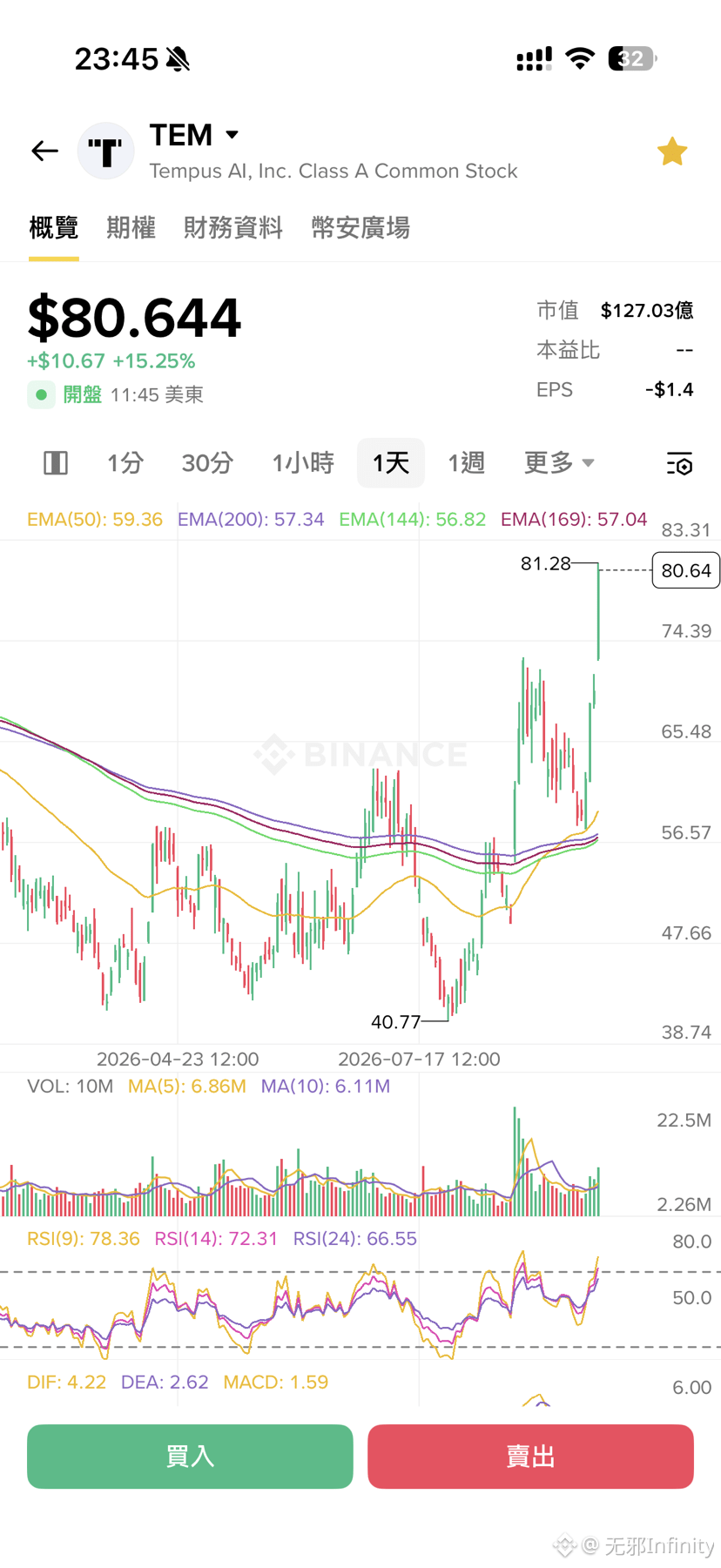
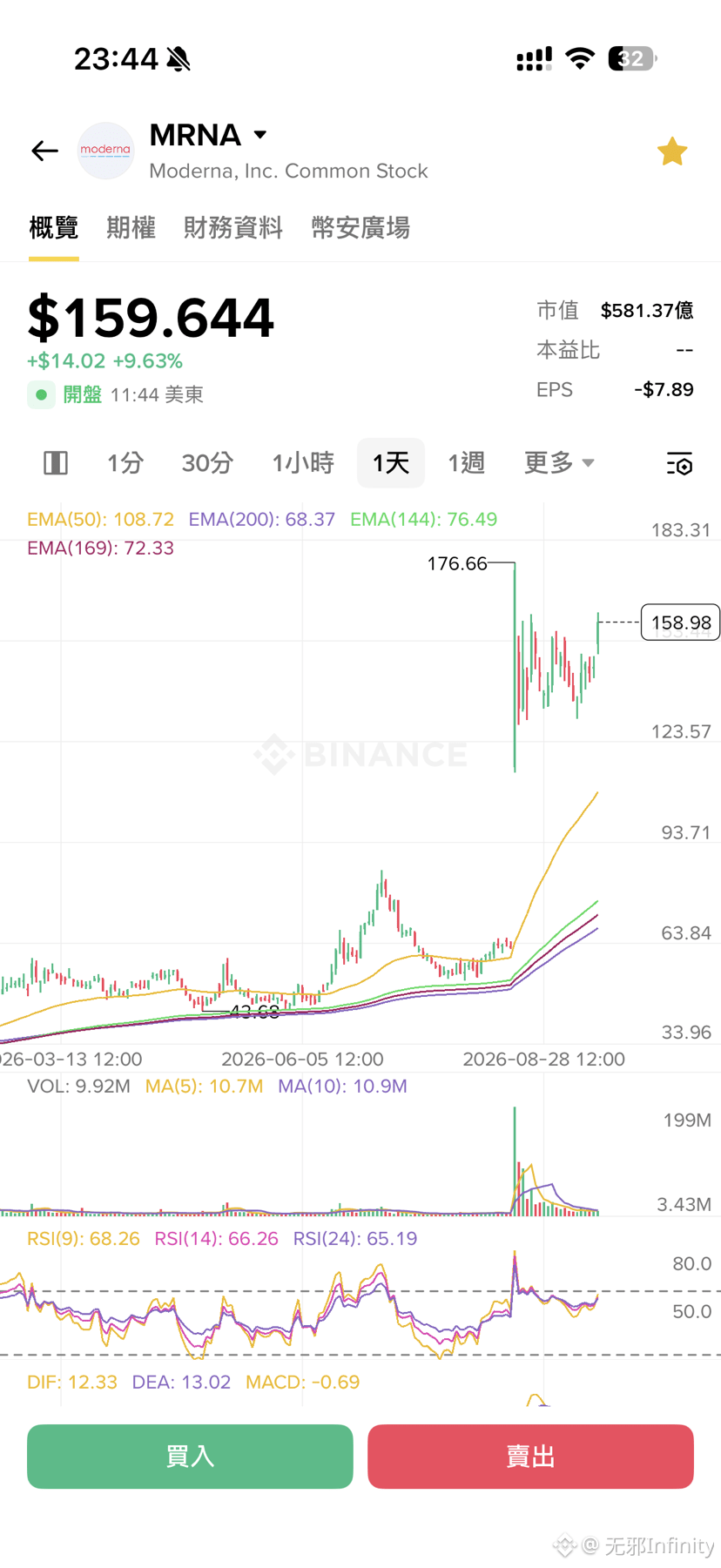
$TEM and $MRNA surge at the same time—AI + life sciences is worth taking another look
Tonight, the TEM intraday price once jumped to around 81, with a gain of over 14%; MRNA also climbed nearly 10% at one point, returning to around 160.
TEM trades on AI entering healthcare.
Its most valuable assets are clinical data, genomic data, and real-world healthcare data. The deeper AI penetrates the healthcare system, the higher the value of these data.
Cathie Wood actually has been betting on this direction for a long time.
During TEM’s earlier consolidation, ARK added shares multiple times—buying continuously on May 6 and May 7, and then adding again when it pulled back in July. Now TEM has already become ARKG’s third-largest holding, with a weight of about 7.81% as of September 10.
MRNA, on the other hand, is trading a different path: mRNA technology moving for real from vaccines to cancer treatments.
The personalized cancer vaccine intismeran developed in partnership between Moderna and Merck is showing positive results in Phase III melanoma trials. This is the most core basis behind MRNA’s latest repricing. Today’s continued surge is, in essence, the market reassessing whether Moderna is truly a vaccine company—or a broader personalized cancer treatment platform.
TEM handles AI + healthcare data, while MRNA handles personalized cancer treatment. With both key players seeing clear capital inflows at the same time, this signal deserves attention.
Especially since ARK has been steadily increasing its focus over the past year on genomics, AI in healthcare, and drug R&D infrastructure. Back in July this year, ARK even specifically proposed that AI is combining with genomics and multi-omics to change the healthcare economic model.
Going forward, the key is to watch whether these two leaders—TEM and MRNA—can sustain an uptrend. As long as these two leaders don’t fall behind, the likes of $RXRX.US , SDGR, ABSI, and other high-beta names can have a foundation for further expansion.
#TEM #mRNA
$TEM and $MRNA surge at the same time—AI + life sciences is worth taking another look
Tonight, the TEM intraday price once jumped to around 81, with a gain of over 14%; MRNA also climbed nearly 10% at one point, returning to around 160.
TEM trades on AI entering healthcare.
Its most valuable assets are clinical data, genomic data, and real-world healthcare data. The deeper AI penetrates the healthcare system, the higher the value of these data.
Cathie Wood actually has been betting on this direction for a long time.
During TEM’s earlier consolidation, ARK added shares multiple times—buying continuously on May 6 and May 7, and then adding again when it pulled back in July. Now TEM has already become ARKG’s third-largest holding, with a weight of about 7.81% as of September 10.
MRNA, on the other hand, is trading a different path: mRNA technology moving for real from vaccines to cancer treatments.
The personalized cancer vaccine intismeran developed in partnership between Moderna and Merck is showing positive results in Phase III melanoma trials. This is the most core basis behind MRNA’s latest repricing. Today’s continued surge is, in essence, the market reassessing whether Moderna is truly a vaccine company—or a broader personalized cancer treatment platform.
TEM handles AI + healthcare data, while MRNA handles personalized cancer treatment. With both key players seeing clear capital inflows at the same time, this signal deserves attention.
Especially since ARK has been steadily increasing its focus over the past year on genomics, AI in healthcare, and drug R&D infrastructure. Back in July this year, ARK even specifically proposed that AI is combining with genomics and multi-omics to change the healthcare economic model.
Going forward, the key is to watch whether these two leaders—TEM and MRNA—can sustain an uptrend. As long as these two leaders don’t fall behind, the likes of $RXRX.US , SDGR, ABSI, and other high-beta names can have a foundation for further expansion.
#TEM #mRNA
Tonight, the TEM intraday price once jumped to around 81, with a gain of over 14%; MRNA also climbed nearly 10% at one point, returning to around 160.
TEM trades on AI entering healthcare.
Its most valuable assets are clinical data, genomic data, and real-world healthcare data. The deeper AI penetrates the healthcare system, the higher the value of these data.
Cathie Wood actually has been betting on this direction for a long time.
During TEM’s earlier consolidation, ARK added shares multiple times—buying continuously on May 6 and May 7, and then adding again when it pulled back in July. Now TEM has already become ARKG’s third-largest holding, with a weight of about 7.81% as of September 10.
MRNA, on the other hand, is trading a different path: mRNA technology moving for real from vaccines to cancer treatments.
The personalized cancer vaccine intismeran developed in partnership between Moderna and Merck is showing positive results in Phase III melanoma trials. This is the most core basis behind MRNA’s latest repricing. Today’s continued surge is, in essence, the market reassessing whether Moderna is truly a vaccine company—or a broader personalized cancer treatment platform.
TEM handles AI + healthcare data, while MRNA handles personalized cancer treatment. With both key players seeing clear capital inflows at the same time, this signal deserves attention.
Especially since ARK has been steadily increasing its focus over the past year on genomics, AI in healthcare, and drug R&D infrastructure. Back in July this year, ARK even specifically proposed that AI is combining with genomics and multi-omics to change the healthcare economic model.
Going forward, the key is to watch whether these two leaders—TEM and MRNA—can sustain an uptrend. As long as these two leaders don’t fall behind, the likes of $RXRX.US , SDGR, ABSI, and other high-beta names can have a foundation for further expansion.
#TEM #mRNA
2
2.3k

·
--
MRNA surged 11.22% in a single day, but the perpetual contract funding rate stayed at 0. This suggests the rally isn’t driven by frantic leveraged long chasing. It looks more like spot buying is leading. The shorts haven’t been forced to pay funding, so near-term sell pressure isn’t significant.
A rise with the funding rate returning to zero is rare, but the signal is clear: neither side is extremely positioned. This move hasn’t seen crowded accumulation of leveraged long positions driving up the cost base. As long as OI doesn’t spike sharply, the sustainability of the rally may be more solid than in the version where funding rates skyrocket.
Now OI is only 10,400 contracts—not heavily loaded, and there isn’t enough squeeze momentum.
Trading tag: #TradFi #链上美股 #MRNA
Where do you think this analysis is most likely to be wrong?
MRNA surged 11.22% in a single day, but the perpetual contract funding rate stayed at 0. This suggests the rally isn’t driven by frantic leveraged long chasing. It looks more like spot buying is leading. The shorts haven’t been forced to pay funding, so near-term sell pressure isn’t significant.
A rise with the funding rate returning to zero is rare, but the signal is clear: neither side is extremely positioned. This move hasn’t seen crowded accumulation of leveraged long positions driving up the cost base. As long as OI doesn’t spike sharply, the sustainability of the rally may be more solid than in the version where funding rates skyrocket.
Now OI is only 10,400 contracts—not heavily loaded, and there isn’t enough squeeze momentum.
Trading tag: #TradFi #链上美股 #MRNA
Where do you think this analysis is most likely to be wrong?
A rise with the funding rate returning to zero is rare, but the signal is clear: neither side is extremely positioned. This move hasn’t seen crowded accumulation of leveraged long positions driving up the cost base. As long as OI doesn’t spike sharply, the sustainability of the rally may be more solid than in the version where funding rates skyrocket.
Now OI is only 10,400 contracts—not heavily loaded, and there isn’t enough squeeze momentum.
Trading tag: #TradFi #链上美股 #MRNA
Where do you think this analysis is most likely to be wrong?
74

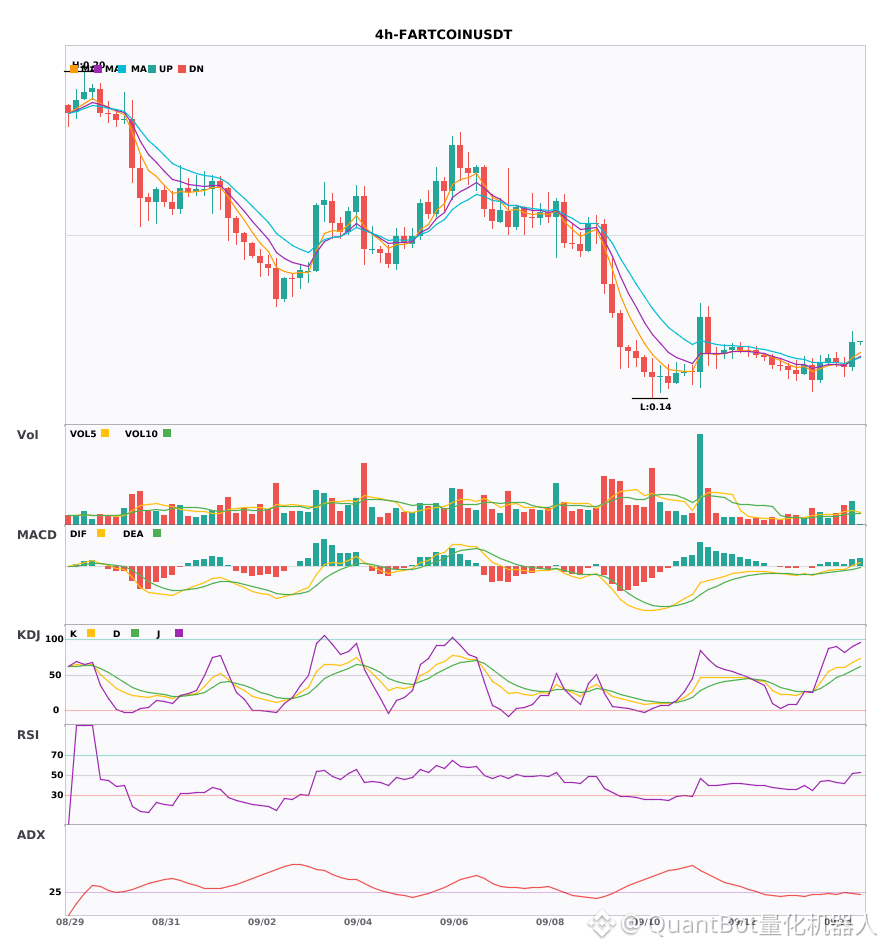
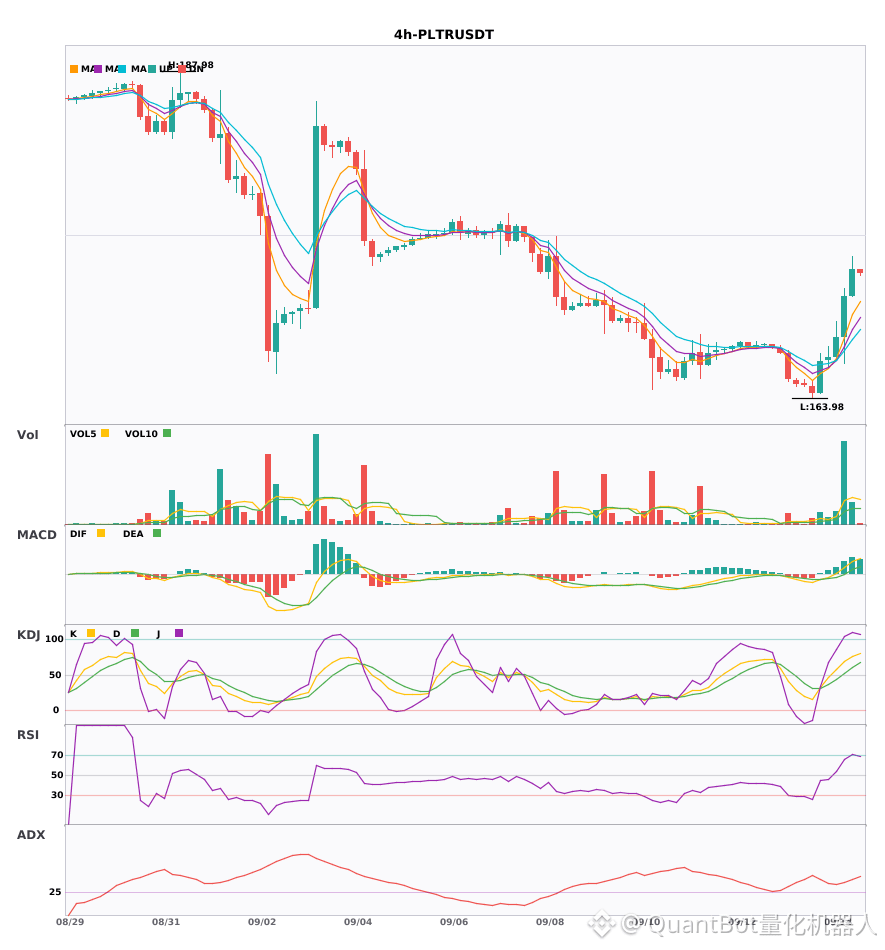
$MRNA $FARTCOIN $PLTR 4H Bullish Resonance Signal
📈 $MRNA | 4-hour Bullish Signal
━━━━━━━━━━━━━━━━━━
Technical Analysis: ADX(26) trend is forming and you may participate | MACD bullish crossover above zero, bullish momentum is being released | EMA5 > EMA8 > EMA13 bullish alignment | KDJ is running strongly with bulls in control (K=71.0, D=58.7) | Volume breakout (5.5x)
Price Movement: 0.6000%
📈 $FARTCOIN | 4-hour Bullish Signal
━━━━━━━━━━━━━━━━━━
Technical Analysis: ADX(26) trend is forming and you may participate | MACD DIF breaks above the zero line, shifting the trend to bullish | EMA5 crosses above EMA8, turning bullish in the short term | KDJ is running strongly with bulls in control (K=68.0, D=56.7) | Volume expands (2.0x)
Price Movement: 3.5400%
📈 $PLTR | 4-hour Bullish Signal
━━━━━━━━━━━━━━━━━━
Technical Analysis: ADX37 confirms a strong trend; MACD bullish momentum strengthens; EMA5>8>13 bullish alignment; KDJ bullish dominance (K69.2/D52.1); volume expansion 6.0x
Price Movement: 1.8000%
━━━━━━━━━━━━━━━━━━
#技术分析 #MRNA #FARTCOIN #PLTR
📌 The above content is for reference only and does not constitute investment advice
$MRNA $FARTCOIN $PLTR 4H Bullish Resonance Signal
📈 $MRNA | 4-hour Bullish Signal
━━━━━━━━━━━━━━━━━━
Technical Analysis: ADX(26) trend is forming and you may participate | MACD bullish crossover above zero, bullish momentum is being released | EMA5 > EMA8 > EMA13 bullish alignment | KDJ is running strongly with bulls in control (K=71.0, D=58.7) | Volume breakout (5.5x)
Price Movement: 0.6000%
📈 $FARTCOIN | 4-hour Bullish Signal
━━━━━━━━━━━━━━━━━━
Technical Analysis: ADX(26) trend is forming and you may participate | MACD DIF breaks above the zero line, shifting the trend to bullish | EMA5 crosses above EMA8, turning bullish in the short term | KDJ is running strongly with bulls in control (K=68.0, D=56.7) | Volume expands (2.0x)
Price Movement: 3.5400%
📈 $PLTR | 4-hour Bullish Signal
━━━━━━━━━━━━━━━━━━
Technical Analysis: ADX37 confirms a strong trend; MACD bullish momentum strengthens; EMA5>8>13 bullish alignment; KDJ bullish dominance (K69.2/D52.1); volume expansion 6.0x
Price Movement: 1.8000%
━━━━━━━━━━━━━━━━━━
#技术分析 #MRNA #FARTCOIN #PLTR
📌 The above content is for reference only and does not constitute investment advice
📈 $MRNA | 4-hour Bullish Signal
━━━━━━━━━━━━━━━━━━
Technical Analysis: ADX(26) trend is forming and you may participate | MACD bullish crossover above zero, bullish momentum is being released | EMA5 > EMA8 > EMA13 bullish alignment | KDJ is running strongly with bulls in control (K=71.0, D=58.7) | Volume breakout (5.5x)
Price Movement: 0.6000%
📈 $FARTCOIN | 4-hour Bullish Signal
━━━━━━━━━━━━━━━━━━
Technical Analysis: ADX(26) trend is forming and you may participate | MACD DIF breaks above the zero line, shifting the trend to bullish | EMA5 crosses above EMA8, turning bullish in the short term | KDJ is running strongly with bulls in control (K=68.0, D=56.7) | Volume expands (2.0x)
Price Movement: 3.5400%
📈 $PLTR | 4-hour Bullish Signal
━━━━━━━━━━━━━━━━━━
Technical Analysis: ADX37 confirms a strong trend; MACD bullish momentum strengthens; EMA5>8>13 bullish alignment; KDJ bullish dominance (K69.2/D52.1); volume expansion 6.0x
Price Movement: 1.8000%
━━━━━━━━━━━━━━━━━━
#技术分析 #MRNA #FARTCOIN #PLTR
📌 The above content is for reference only and does not constitute investment advice
135
·
--
The old dog scanned the data: over the past 24 hours, $MRNA is up 6.006%, and the price is stuck at 145.43. But the funding rate is 0.00000000, with an open position size of 7498.57. The move upward isn’t small, yet the liquidity side is totally still—this combination is a bit weird.
The angle is M4_mover, so we need to dig for the base behind this anomaly. When price moves up by 6%, usually there’s some funding pushing it. But with a zero funding rate, neither longs nor shorts are paying each other. That suggests the market isn’t adding leverage to bet on direction. The number 7498.57 by itself isn’t informative as a reference—there’s no historical value provided, so the old dog can’t say whether it’s increased or decreased. Just looking at the price rise alongside flat funding, it feels more like spot buying pressure or a short-term news stimulus, not a trend driven up by the futures market. Without a secondary meme comparison, it’s only $MRNA—nothing about leading the pack really stands out; it could simply be a stock’s fluctuation.
The old dog’s take: this anomalous move lacks persistence. The funding rate is neutral, meaning longs aren’t crowded enough to have to pay shorts, and shorts aren’t being forced to hold positions. In plain terms, leveraged capital hasn’t taken a stance, so the price rally looks a bit “hollow.” In terms of action, I won’t chase right now. I’ll wait until funding turns to gauge again. If funding turns positive, it means longs start entering and paying—I might try a small long position. If it turns negative, shorts are being squeezed—in that case, I’d be more wary of a pullback. Current price is 145.43: if it breaks below 140, I’ll just observe and not touch it. If it breaks above 150 and funding cooperates, then I’ll consider adding. Position stance: observe, don’t touch.
The invalidation conditions are simple: if the funding rate jumps from zero to positive or to negative by 0.01 or more, or if the open position size suddenly doubles, that means capital has started betting—then this judgment must be withdrawn. Another condition: if price closes above 150 for two consecutive days accompanied by an OI increase, then the trend may genuinely be here. Since the input doesn’t include support/resistance levels, the old dog will focus on the integer checkpoints 140 and 150 as references.
Trading tags: #BinanceFutures #TradFi #USDⓈM #MRNA #MRNAUSDT $MRNA
The old dog scanned the data: over the past 24 hours, $MRNA is up 6.006%, and the price is stuck at 145.43. But the funding rate is 0.00000000, with an open position size of 7498.57. The move upward isn’t small, yet the liquidity side is totally still—this combination is a bit weird.
The angle is M4_mover, so we need to dig for the base behind this anomaly. When price moves up by 6%, usually there’s some funding pushing it. But with a zero funding rate, neither longs nor shorts are paying each other. That suggests the market isn’t adding leverage to bet on direction. The number 7498.57 by itself isn’t informative as a reference—there’s no historical value provided, so the old dog can’t say whether it’s increased or decreased. Just looking at the price rise alongside flat funding, it feels more like spot buying pressure or a short-term news stimulus, not a trend driven up by the futures market. Without a secondary meme comparison, it’s only $MRNA —nothing about leading the pack really stands out; it could simply be a stock’s fluctuation.
The old dog’s take: this anomalous move lacks persistence. The funding rate is neutral, meaning longs aren’t crowded enough to have to pay shorts, and shorts aren’t being forced to hold positions. In plain terms, leveraged capital hasn’t taken a stance, so the price rally looks a bit “hollow.” In terms of action, I won’t chase right now. I’ll wait until funding turns to gauge again. If funding turns positive, it means longs start entering and paying—I might try a small long position. If it turns negative, shorts are being squeezed—in that case, I’d be more wary of a pullback. Current price is 145.43: if it breaks below 140, I’ll just observe and not touch it. If it breaks above 150 and funding cooperates, then I’ll consider adding. Position stance: observe, don’t touch.
The invalidation conditions are simple: if the funding rate jumps from zero to positive or to negative by 0.01 or more, or if the open position size suddenly doubles, that means capital has started betting—then this judgment must be withdrawn. Another condition: if price closes above 150 for two consecutive days accompanied by an OI increase, then the trend may genuinely be here. Since the input doesn’t include support/resistance levels, the old dog will focus on the integer checkpoints 140 and 150 as references.
Trading tags: #BinanceFutures #TradFi #USDⓈM #MRNA #MRNAUSDT $MRNA
The angle is M4_mover, so we need to dig for the base behind this anomaly. When price moves up by 6%, usually there’s some funding pushing it. But with a zero funding rate, neither longs nor shorts are paying each other. That suggests the market isn’t adding leverage to bet on direction. The number 7498.57 by itself isn’t informative as a reference—there’s no historical value provided, so the old dog can’t say whether it’s increased or decreased. Just looking at the price rise alongside flat funding, it feels more like spot buying pressure or a short-term news stimulus, not a trend driven up by the futures market. Without a secondary meme comparison, it’s only $MRNA —nothing about leading the pack really stands out; it could simply be a stock’s fluctuation.
The old dog’s take: this anomalous move lacks persistence. The funding rate is neutral, meaning longs aren’t crowded enough to have to pay shorts, and shorts aren’t being forced to hold positions. In plain terms, leveraged capital hasn’t taken a stance, so the price rally looks a bit “hollow.” In terms of action, I won’t chase right now. I’ll wait until funding turns to gauge again. If funding turns positive, it means longs start entering and paying—I might try a small long position. If it turns negative, shorts are being squeezed—in that case, I’d be more wary of a pullback. Current price is 145.43: if it breaks below 140, I’ll just observe and not touch it. If it breaks above 150 and funding cooperates, then I’ll consider adding. Position stance: observe, don’t touch.
The invalidation conditions are simple: if the funding rate jumps from zero to positive or to negative by 0.01 or more, or if the open position size suddenly doubles, that means capital has started betting—then this judgment must be withdrawn. Another condition: if price closes above 150 for two consecutive days accompanied by an OI increase, then the trend may genuinely be here. Since the input doesn’t include support/resistance levels, the old dog will focus on the integer checkpoints 140 and 150 as references.
Trading tags: #BinanceFutures #TradFi #USDⓈM #MRNA #MRNAUSDT $MRNA
48
·
--
$MRNA has risen 6.457% over the past 24 hours; the price is 145.25. Funding rate has been hanging at a perfect zero for an entire stretch, and the open interest is stuck at 7,637.18 contracts. One fact: this thing’s intraday volatility isn’t small, but neither bulls nor bears has paid a single cent to the other.
Old dog took a look—the order book is angled with M2_semi, the Semiconductor/AI chain—but $MRNA itself is biotech, so the sector classification is a bit off. Still, data is data: a funding rate of 0.00000000 is a hard-and-fast neutral state. There’s no crowded longs and no bears pressing down. If price moves up without financing following, it means this pump isn’t pushed hard with leverage; it’s more like spot activity or modest incremental capital taking the lead. Open interest at 7,637.18 contracts versus intraday volume of 6.93 million—positioning isn’t heavy, but there’s also no obvious sign of retreat. From a single-signal perspective: price up + funding rate at zero = a mild breakout. There’s no hint of a classic short squeeze or bull FOMO.
The market may think this move in $MRNA is just a follower rebound with no sustained momentum. I disagree, and the reason is the funding structure. Neutral funding means bulls and bears aren’t at a point where it’s kill-or-be-killed. Price is up 6.457% and open interest hasn’t ballooned—instead, it suggests positions are stable, and not many people are rushing to take profit or flip sides. If this really were the top, the funding rate should have turned positive by now to force shorts to capitulate, or open interest should have dropped sharply as longs exit. Neither has happened.
On the second-order effects: if price keeps surging higher, shorts may start evaluating stop losses. But a neutral funding rate gives them room, so they won’t be forced into large-scale liquidations just yet. Liquidity may even tilt toward wait-and-see capital, waiting for a clearer direction.
My view: this is more bullish than not, but it’s not a “charging hard” setup. I’ll choose a light position to probe: if price holds above 140 and the funding rate stays flat, I’ll consider adding a bit; otherwise—if the financing rate suddenly turns negative, or open interest falls below 7,000 contracts—I’ll withdraw immediately. A dissenting note: most people see a funding rate of zero and think there’s no action, but the old dog thinks neutral funding during an uptrend is actually a good thing—it shows the market hasn’t gotten overheated, and there’s still room for new capital to come in.
The invalidation conditions are simple: if in the next 24 hours the funding rate plunges to negative, it would mean shorts are starting to push back; or if price pulls back and breaks below 140 with a surge in trading volume, then my call is wrong.
Trading tag: #BinanceFutures #TradFi #USDⓈM #MRNA #MRNAUSDT $MRNA
$MRNA has risen 6.457% over the past 24 hours; the price is 145.25. Funding rate has been hanging at a perfect zero for an entire stretch, and the open interest is stuck at 7,637.18 contracts. One fact: this thing’s intraday volatility isn’t small, but neither bulls nor bears has paid a single cent to the other.
Old dog took a look—the order book is angled with M2_semi, the Semiconductor/AI chain—but $MRNA itself is biotech, so the sector classification is a bit off. Still, data is data: a funding rate of 0.00000000 is a hard-and-fast neutral state. There’s no crowded longs and no bears pressing down. If price moves up without financing following, it means this pump isn’t pushed hard with leverage; it’s more like spot activity or modest incremental capital taking the lead. Open interest at 7,637.18 contracts versus intraday volume of 6.93 million—positioning isn’t heavy, but there’s also no obvious sign of retreat. From a single-signal perspective: price up + funding rate at zero = a mild breakout. There’s no hint of a classic short squeeze or bull FOMO.
The market may think this move in $MRNA is just a follower rebound with no sustained momentum. I disagree, and the reason is the funding structure. Neutral funding means bulls and bears aren’t at a point where it’s kill-or-be-killed. Price is up 6.457% and open interest hasn’t ballooned—instead, it suggests positions are stable, and not many people are rushing to take profit or flip sides. If this really were the top, the funding rate should have turned positive by now to force shorts to capitulate, or open interest should have dropped sharply as longs exit. Neither has happened.
On the second-order effects: if price keeps surging higher, shorts may start evaluating stop losses. But a neutral funding rate gives them room, so they won’t be forced into large-scale liquidations just yet. Liquidity may even tilt toward wait-and-see capital, waiting for a clearer direction.
My view: this is more bullish than not, but it’s not a “charging hard” setup. I’ll choose a light position to probe: if price holds above 140 and the funding rate stays flat, I’ll consider adding a bit; otherwise—if the financing rate suddenly turns negative, or open interest falls below 7,000 contracts—I’ll withdraw immediately. A dissenting note: most people see a funding rate of zero and think there’s no action, but the old dog thinks neutral funding during an uptrend is actually a good thing—it shows the market hasn’t gotten overheated, and there’s still room for new capital to come in.
The invalidation conditions are simple: if in the next 24 hours the funding rate plunges to negative, it would mean shorts are starting to push back; or if price pulls back and breaks below 140 with a surge in trading volume, then my call is wrong.
Trading tag: #BinanceFutures #TradFi #USDⓈM #MRNA #MRNAUSDT $MRNA
Old dog took a look—the order book is angled with M2_semi, the Semiconductor/AI chain—but $MRNA itself is biotech, so the sector classification is a bit off. Still, data is data: a funding rate of 0.00000000 is a hard-and-fast neutral state. There’s no crowded longs and no bears pressing down. If price moves up without financing following, it means this pump isn’t pushed hard with leverage; it’s more like spot activity or modest incremental capital taking the lead. Open interest at 7,637.18 contracts versus intraday volume of 6.93 million—positioning isn’t heavy, but there’s also no obvious sign of retreat. From a single-signal perspective: price up + funding rate at zero = a mild breakout. There’s no hint of a classic short squeeze or bull FOMO.
The market may think this move in $MRNA is just a follower rebound with no sustained momentum. I disagree, and the reason is the funding structure. Neutral funding means bulls and bears aren’t at a point where it’s kill-or-be-killed. Price is up 6.457% and open interest hasn’t ballooned—instead, it suggests positions are stable, and not many people are rushing to take profit or flip sides. If this really were the top, the funding rate should have turned positive by now to force shorts to capitulate, or open interest should have dropped sharply as longs exit. Neither has happened.
On the second-order effects: if price keeps surging higher, shorts may start evaluating stop losses. But a neutral funding rate gives them room, so they won’t be forced into large-scale liquidations just yet. Liquidity may even tilt toward wait-and-see capital, waiting for a clearer direction.
My view: this is more bullish than not, but it’s not a “charging hard” setup. I’ll choose a light position to probe: if price holds above 140 and the funding rate stays flat, I’ll consider adding a bit; otherwise—if the financing rate suddenly turns negative, or open interest falls below 7,000 contracts—I’ll withdraw immediately. A dissenting note: most people see a funding rate of zero and think there’s no action, but the old dog thinks neutral funding during an uptrend is actually a good thing—it shows the market hasn’t gotten overheated, and there’s still room for new capital to come in.
The invalidation conditions are simple: if in the next 24 hours the funding rate plunges to negative, it would mean shorts are starting to push back; or if price pulls back and breaks below 140 with a surge in trading volume, then my call is wrong.
Trading tag: #BinanceFutures #TradFi #USDⓈM #MRNA #MRNAUSDT $MRNA
35

·
--
Over a $MRNA 24-hour period, it’s up 6.6%, and it’s now 144.66. Binance’s on-chain U.S. stock futures—this contract size looks like the number of shares; open interest is 7,711.24 contracts, and the unit seems off, so I can’t directly compare it to the trading volume. The funding rate is 0, which means longs and shorts aren’t paying each other right now, so sentiment isn’t that extreme.
Single-signal read: I’m treating this as a repricing driven by a political and military event. Moderna’s core asset is its mRNA vaccine platform. In peacetime, this is a healthcare stock; when geopolitical tensions are high, it becomes strategic material. Looking back over the past few years, whenever major powers strengthen the narrative around independent biosecurity or when new pandemic threats appear, Moderna’s stock price and options implied volatility tend to jump. Now, with the situation in Eastern Europe and the Middle East, many countries are rethinking the security of their medical supply chains. With mature mRNA technology in hand, Moderna naturally gets viewed by capital as a safe-haven and also a tactical bet. This 6.6% move likely isn’t just retail sentiment—it may be some institutions reclassifying its characteristics from a growth stock into a strategic asset.
Strongest counterargument: If the main sides in the geopolitical conflict reach a medical supplies sharing agreement, or if a cheaper and faster vaccine technology route emerges, this political premium could evaporate instantly. Right now the cost is being carried by the chasing long positions—they’re betting that tensions will persist or even escalate. The main risks are time value and the possibility of a policy shift.
Second-order effects: If this logic holds, shorting funds hedging MRNA may be forced to close their positions. They were essentially betting that the vaccine story would end. Meanwhile, some funds that previously took profits from traditional defense/industrial stocks might flow into assets with hard-tech backgrounds that are linked to national security narratives. The next observation point is whether other countries’ government order news comes out. If there is one and it’s single-source, it would reinforce this logic.
Invalidation condition: If the price falls back below 135—that is, it fully gives back yesterday’s entire gains—then this political premium narrative would be falsified, meaning the market doesn’t buy the story. Before that, you can hold and observe.
Action: For longs at current levels, use a small position size and set 135 as the stop-loss. If the price can hold above 150, add to the position; the target is around 155. Don’t chase—waiting for a pullback into the 140–142 range would be safer.
Three scenario summary:
Aggressive: Go long at the current price, stop-loss 135, target 155—betting on the geopolitical event gaining traction.
Trading tag: #TradFi #链上美股 #MRNA
Where do you think this thesis is most likely to be wrong?
Over a $MRNA 24-hour period, it’s up 6.6%, and it’s now 144.66. Binance’s on-chain U.S. stock futures—this contract size looks like the number of shares; open interest is 7,711.24 contracts, and the unit seems off, so I can’t directly compare it to the trading volume. The funding rate is 0, which means longs and shorts aren’t paying each other right now, so sentiment isn’t that extreme.
Single-signal read: I’m treating this as a repricing driven by a political and military event. Moderna’s core asset is its mRNA vaccine platform. In peacetime, this is a healthcare stock; when geopolitical tensions are high, it becomes strategic material. Looking back over the past few years, whenever major powers strengthen the narrative around independent biosecurity or when new pandemic threats appear, Moderna’s stock price and options implied volatility tend to jump. Now, with the situation in Eastern Europe and the Middle East, many countries are rethinking the security of their medical supply chains. With mature mRNA technology in hand, Moderna naturally gets viewed by capital as a safe-haven and also a tactical bet. This 6.6% move likely isn’t just retail sentiment—it may be some institutions reclassifying its characteristics from a growth stock into a strategic asset.
Strongest counterargument: If the main sides in the geopolitical conflict reach a medical supplies sharing agreement, or if a cheaper and faster vaccine technology route emerges, this political premium could evaporate instantly. Right now the cost is being carried by the chasing long positions—they’re betting that tensions will persist or even escalate. The main risks are time value and the possibility of a policy shift.
Second-order effects: If this logic holds, shorting funds hedging MRNA may be forced to close their positions. They were essentially betting that the vaccine story would end. Meanwhile, some funds that previously took profits from traditional defense/industrial stocks might flow into assets with hard-tech backgrounds that are linked to national security narratives. The next observation point is whether other countries’ government order news comes out. If there is one and it’s single-source, it would reinforce this logic.
Invalidation condition: If the price falls back below 135—that is, it fully gives back yesterday’s entire gains—then this political premium narrative would be falsified, meaning the market doesn’t buy the story. Before that, you can hold and observe.
Action: For longs at current levels, use a small position size and set 135 as the stop-loss. If the price can hold above 150, add to the position; the target is around 155. Don’t chase—waiting for a pullback into the 140–142 range would be safer.
Three scenario summary:
Aggressive: Go long at the current price, stop-loss 135, target 155—betting on the geopolitical event gaining traction.
Trading tag: #TradFi #链上美股 #MRNA
Where do you think this thesis is most likely to be wrong?
Single-signal read: I’m treating this as a repricing driven by a political and military event. Moderna’s core asset is its mRNA vaccine platform. In peacetime, this is a healthcare stock; when geopolitical tensions are high, it becomes strategic material. Looking back over the past few years, whenever major powers strengthen the narrative around independent biosecurity or when new pandemic threats appear, Moderna’s stock price and options implied volatility tend to jump. Now, with the situation in Eastern Europe and the Middle East, many countries are rethinking the security of their medical supply chains. With mature mRNA technology in hand, Moderna naturally gets viewed by capital as a safe-haven and also a tactical bet. This 6.6% move likely isn’t just retail sentiment—it may be some institutions reclassifying its characteristics from a growth stock into a strategic asset.
Strongest counterargument: If the main sides in the geopolitical conflict reach a medical supplies sharing agreement, or if a cheaper and faster vaccine technology route emerges, this political premium could evaporate instantly. Right now the cost is being carried by the chasing long positions—they’re betting that tensions will persist or even escalate. The main risks are time value and the possibility of a policy shift.
Second-order effects: If this logic holds, shorting funds hedging MRNA may be forced to close their positions. They were essentially betting that the vaccine story would end. Meanwhile, some funds that previously took profits from traditional defense/industrial stocks might flow into assets with hard-tech backgrounds that are linked to national security narratives. The next observation point is whether other countries’ government order news comes out. If there is one and it’s single-source, it would reinforce this logic.
Invalidation condition: If the price falls back below 135—that is, it fully gives back yesterday’s entire gains—then this political premium narrative would be falsified, meaning the market doesn’t buy the story. Before that, you can hold and observe.
Action: For longs at current levels, use a small position size and set 135 as the stop-loss. If the price can hold above 150, add to the position; the target is around 155. Don’t chase—waiting for a pullback into the 140–142 range would be safer.
Three scenario summary:
Aggressive: Go long at the current price, stop-loss 135, target 155—betting on the geopolitical event gaining traction.
Trading tag: #TradFi #链上美股 #MRNA
Where do you think this thesis is most likely to be wrong?
44

·
--
📉 Naisige Strategy Sharing
━━━━━━━━━━━━━━━━
💰 Currency: MRNAUSDT
🔴 Direction: Short
📊 Signal: Sell
⭐ Confidence: 75%
📈 Trend: Downtrend
━━━━━━━━━━━━━━━━
💎 Current Price: 147.6
🔴 Resistance Levels: [146.77647, 157.3]
🟢 Support Levels: [130.53853, 130.5]
━━━━━━━━━━━━━━━━
📝 Analysis: A 9.0% price increase + RSI is high + near the upper Bollinger Band suggests a high probability of a short-term pullback
━━━━━━━━━━━━━━━━
📅 2026.09.12 02:03 | For reference only and does not constitute investment advice
#MRNA #加密货币 #合约交易 #奈斯哥 #quantitative trading
📉 Naisige Strategy Sharing
━━━━━━━━━━━━━━━━
💰 Currency: MRNAUSDT
🔴 Direction: Short
📊 Signal: Sell
⭐ Confidence: 75%
📈 Trend: Downtrend
━━━━━━━━━━━━━━━━
💎 Current Price: 147.6
🔴 Resistance Levels: [146.77647, 157.3]
🟢 Support Levels: [130.53853, 130.5]
━━━━━━━━━━━━━━━━
📝 Analysis: A 9.0% price increase + RSI is high + near the upper Bollinger Band suggests a high probability of a short-term pullback
━━━━━━━━━━━━━━━━
📅 2026.09.12 02:03 | For reference only and does not constitute investment advice
#MRNA #加密货币 #合约交易 #奈斯哥 #quantitative trading
━━━━━━━━━━━━━━━━
💰 Currency: MRNAUSDT
🔴 Direction: Short
📊 Signal: Sell
⭐ Confidence: 75%
📈 Trend: Downtrend
━━━━━━━━━━━━━━━━
💎 Current Price: 147.6
🔴 Resistance Levels: [146.77647, 157.3]
🟢 Support Levels: [130.53853, 130.5]
━━━━━━━━━━━━━━━━
📝 Analysis: A 9.0% price increase + RSI is high + near the upper Bollinger Band suggests a high probability of a short-term pullback
━━━━━━━━━━━━━━━━
📅 2026.09.12 02:03 | For reference only and does not constitute investment advice
#MRNA #加密货币 #合约交易 #奈斯哥 #quantitative trading
38
·
--
$MRNA 24 hours surged 9.563%, but the funding rate stays stubbornly at zero. This combination is kind of interesting. When the price hit 147.34, the trading volume isn’t small, but neither the long nor the short side is paying the other—suggesting that, at this price level, no side is bearing extra cash-flow pressure because of their positions. Judging purely from this data, a 9.563% jump looks more like a clean spot move or a one-way impulse; the contract/futures market hasn’t formed a lopsided crowd.
The angle is M4_mover—the core of the anomaly is the divergence between price change and funding conditions. Typically, when a coin price spikes higher in a single day, if it’s driven by contract longs, the funding rate will most likely turn positive: longs would need to pay shorts to maintain their positions. But funding is at zero. One possible explanation is that the momentum for this rally isn’t coming from leverage in the crypto derivatives market, or existing position holders don’t think this upside is worth adding further leverage to fight the battle. OI is 8588.69; the absolute value isn’t high enough to directly compare with volume per unit, but combined with the zero funding rate, it at least indicates that the derivatives side hasn’t opened a large number of fresh positions just to chase the pump. The lack of confirmation of positioning consensus on the way up is the first risk signal.
Old Dog’s take is very direct: this is a one-way squeeze driven by external events, but because the contract market isn’t keeping up, the sustainability and depth are questionable. Zero funding implies the rally hasn’t attracted enough new contract longs to pass the baton. Once spot buying dries up, the pullback could come quickly. The strongest counter-evidence is this: if the company behind this on-chain “US stock” (Moderna) sees a major positive catalyst in the actual US equity market, it could attract a fresh round of capital and completely ignore the crypto-side derivatives data. However, based on the current inputs, I don’t see any such information.
The second-order effect is: if the stock price can’t keep pushing higher, traders who went long during the rally will be the first to absorb costs. The current zero funding means they aren’t paying position costs, but if the price stalls, this capital can become the most unstable source of selling pressure. The invalidation condition is simple: if the $MRNA price can continuously gain volume and hold above 147.34, and if that action pushes the funding rate to become clearly positive (for example, above 0.01%), it would indicate that contract longs have started entering to take over the rally—then my cautious view would be invalidated. In terms of action, I choose to observe rather than chase the spike.
Trading tags: #BinanceFutures #TradFi #USDⓈM #MRNA #MRNAUSDT $MRNA
$MRNA 24 hours surged 9.563%, but the funding rate stays stubbornly at zero. This combination is kind of interesting. When the price hit 147.34, the trading volume isn’t small, but neither the long nor the short side is paying the other—suggesting that, at this price level, no side is bearing extra cash-flow pressure because of their positions. Judging purely from this data, a 9.563% jump looks more like a clean spot move or a one-way impulse; the contract/futures market hasn’t formed a lopsided crowd.
The angle is M4_mover—the core of the anomaly is the divergence between price change and funding conditions. Typically, when a coin price spikes higher in a single day, if it’s driven by contract longs, the funding rate will most likely turn positive: longs would need to pay shorts to maintain their positions. But funding is at zero. One possible explanation is that the momentum for this rally isn’t coming from leverage in the crypto derivatives market, or existing position holders don’t think this upside is worth adding further leverage to fight the battle. OI is 8588.69; the absolute value isn’t high enough to directly compare with volume per unit, but combined with the zero funding rate, it at least indicates that the derivatives side hasn’t opened a large number of fresh positions just to chase the pump. The lack of confirmation of positioning consensus on the way up is the first risk signal.
Old Dog’s take is very direct: this is a one-way squeeze driven by external events, but because the contract market isn’t keeping up, the sustainability and depth are questionable. Zero funding implies the rally hasn’t attracted enough new contract longs to pass the baton. Once spot buying dries up, the pullback could come quickly. The strongest counter-evidence is this: if the company behind this on-chain “US stock” (Moderna) sees a major positive catalyst in the actual US equity market, it could attract a fresh round of capital and completely ignore the crypto-side derivatives data. However, based on the current inputs, I don’t see any such information.
The second-order effect is: if the stock price can’t keep pushing higher, traders who went long during the rally will be the first to absorb costs. The current zero funding means they aren’t paying position costs, but if the price stalls, this capital can become the most unstable source of selling pressure. The invalidation condition is simple: if the $MRNA price can continuously gain volume and hold above 147.34, and if that action pushes the funding rate to become clearly positive (for example, above 0.01%), it would indicate that contract longs have started entering to take over the rally—then my cautious view would be invalidated. In terms of action, I choose to observe rather than chase the spike.
Trading tags: #BinanceFutures #TradFi #USDⓈM #MRNA #MRNAUSDT $MRNA
The angle is M4_mover—the core of the anomaly is the divergence between price change and funding conditions. Typically, when a coin price spikes higher in a single day, if it’s driven by contract longs, the funding rate will most likely turn positive: longs would need to pay shorts to maintain their positions. But funding is at zero. One possible explanation is that the momentum for this rally isn’t coming from leverage in the crypto derivatives market, or existing position holders don’t think this upside is worth adding further leverage to fight the battle. OI is 8588.69; the absolute value isn’t high enough to directly compare with volume per unit, but combined with the zero funding rate, it at least indicates that the derivatives side hasn’t opened a large number of fresh positions just to chase the pump. The lack of confirmation of positioning consensus on the way up is the first risk signal.
Old Dog’s take is very direct: this is a one-way squeeze driven by external events, but because the contract market isn’t keeping up, the sustainability and depth are questionable. Zero funding implies the rally hasn’t attracted enough new contract longs to pass the baton. Once spot buying dries up, the pullback could come quickly. The strongest counter-evidence is this: if the company behind this on-chain “US stock” (Moderna) sees a major positive catalyst in the actual US equity market, it could attract a fresh round of capital and completely ignore the crypto-side derivatives data. However, based on the current inputs, I don’t see any such information.
The second-order effect is: if the stock price can’t keep pushing higher, traders who went long during the rally will be the first to absorb costs. The current zero funding means they aren’t paying position costs, but if the price stalls, this capital can become the most unstable source of selling pressure. The invalidation condition is simple: if the $MRNA price can continuously gain volume and hold above 147.34, and if that action pushes the funding rate to become clearly positive (for example, above 0.01%), it would indicate that contract longs have started entering to take over the rally—then my cautious view would be invalidated. In terms of action, I choose to observe rather than chase the spike.
Trading tags: #BinanceFutures #TradFi #USDⓈM #MRNA #MRNAUSDT $MRNA
66
·
--
MRNA rose 6.97% over the past 24 hours, with a quoted price of 144.72. But what’s truly interesting isn’t the price—it’s that the funding rate for its perpetual contracts is sitting at 0. This means that in Binance’s derivatives market, longs and shorts are effectively shaking hands for now: no one is paying anyone else.
A biotech stock jumps nearly 7% in a single day, with open interest of 9,506 contracts, yet the funding rate is zero. This is an unusual setup. Typically, when price surges quickly, the funding rate turns positive, because chasing longs need to pay shorts for holding costs. A zero funding rate points to one thing: the amount of capital in the market isn’t fully endorsing this rally, or more bluntly, the leverage-driven money willing to chase longs simply hasn’t really come in. That 6.97% gain may be driven more by certain news in the spot market or a rebound from oversold conditions, and it hasn’t triggered FOMO in the derivatives market.
So this is a single signal: the current price move lacks liquidity confirmation from the contract market. The market hasn’t formed the consensus that bulls must pay for upside. The sustainability of the rally is questionable. From a macro transmission perspective, the biotech sector (MRNA included) is highly sensitive to interest rates and risk appetite. Ambiguity in the Fed’s policy path has suppressed overall risk-taking in the growth-stock complex. MRNA’s surge looks more like an internal “pulse” driven by company-specific narratives (such as R&D progress) rather than a sector-wide行情 caused by macro liquidity easing. Who’s paying the cost? Spot holders enjoy unrealized gains, but contract longs haven’t had to pay additional funding costs, and shorts haven’t been forced into panic closing or running for the exits. Overall, the position structure is calm.
What’s the strongest counter-argument? If, next, the biotech sector experiences a large influx of capital driven by clear government investment or policy—like during the COVID period—it could completely reverse the current lukewarm contract-market sentiment. That would force shorts to cover at scale and push the funding rate higher. Conversely, if overall market liquidity keeps tightening and the high-rate environment continues to suppress growth-stock valuations, then this “no-root” rally in MRNA is likely to quickly give back.
My move is to wait. I won’t chase price, and I won’t try to bottom-pick. Current price at 144.72 is the observation benchmark. If, over the next few trading sessions, the price can hold above this level and open interest increases moderately while the funding rate turns slightly positive, it would suggest the market is starting to price in the rally. Then I’d consider following with a light position.
Trading tag: #TradFi #链上美股 #MRNA
Where do you think this thesis is most likely to be wrong?
MRNA rose 6.97% over the past 24 hours, with a quoted price of 144.72. But what’s truly interesting isn’t the price—it’s that the funding rate for its perpetual contracts is sitting at 0. This means that in Binance’s derivatives market, longs and shorts are effectively shaking hands for now: no one is paying anyone else.
A biotech stock jumps nearly 7% in a single day, with open interest of 9,506 contracts, yet the funding rate is zero. This is an unusual setup. Typically, when price surges quickly, the funding rate turns positive, because chasing longs need to pay shorts for holding costs. A zero funding rate points to one thing: the amount of capital in the market isn’t fully endorsing this rally, or more bluntly, the leverage-driven money willing to chase longs simply hasn’t really come in. That 6.97% gain may be driven more by certain news in the spot market or a rebound from oversold conditions, and it hasn’t triggered FOMO in the derivatives market.
So this is a single signal: the current price move lacks liquidity confirmation from the contract market. The market hasn’t formed the consensus that bulls must pay for upside. The sustainability of the rally is questionable. From a macro transmission perspective, the biotech sector (MRNA included) is highly sensitive to interest rates and risk appetite. Ambiguity in the Fed’s policy path has suppressed overall risk-taking in the growth-stock complex. MRNA’s surge looks more like an internal “pulse” driven by company-specific narratives (such as R&D progress) rather than a sector-wide行情 caused by macro liquidity easing. Who’s paying the cost? Spot holders enjoy unrealized gains, but contract longs haven’t had to pay additional funding costs, and shorts haven’t been forced into panic closing or running for the exits. Overall, the position structure is calm.
What’s the strongest counter-argument? If, next, the biotech sector experiences a large influx of capital driven by clear government investment or policy—like during the COVID period—it could completely reverse the current lukewarm contract-market sentiment. That would force shorts to cover at scale and push the funding rate higher. Conversely, if overall market liquidity keeps tightening and the high-rate environment continues to suppress growth-stock valuations, then this “no-root” rally in MRNA is likely to quickly give back.
My move is to wait. I won’t chase price, and I won’t try to bottom-pick. Current price at 144.72 is the observation benchmark. If, over the next few trading sessions, the price can hold above this level and open interest increases moderately while the funding rate turns slightly positive, it would suggest the market is starting to price in the rally. Then I’d consider following with a light position.
Trading tag: #TradFi #链上美股 #MRNA
Where do you think this thesis is most likely to be wrong?
A biotech stock jumps nearly 7% in a single day, with open interest of 9,506 contracts, yet the funding rate is zero. This is an unusual setup. Typically, when price surges quickly, the funding rate turns positive, because chasing longs need to pay shorts for holding costs. A zero funding rate points to one thing: the amount of capital in the market isn’t fully endorsing this rally, or more bluntly, the leverage-driven money willing to chase longs simply hasn’t really come in. That 6.97% gain may be driven more by certain news in the spot market or a rebound from oversold conditions, and it hasn’t triggered FOMO in the derivatives market.
So this is a single signal: the current price move lacks liquidity confirmation from the contract market. The market hasn’t formed the consensus that bulls must pay for upside. The sustainability of the rally is questionable. From a macro transmission perspective, the biotech sector (MRNA included) is highly sensitive to interest rates and risk appetite. Ambiguity in the Fed’s policy path has suppressed overall risk-taking in the growth-stock complex. MRNA’s surge looks more like an internal “pulse” driven by company-specific narratives (such as R&D progress) rather than a sector-wide行情 caused by macro liquidity easing. Who’s paying the cost? Spot holders enjoy unrealized gains, but contract longs haven’t had to pay additional funding costs, and shorts haven’t been forced into panic closing or running for the exits. Overall, the position structure is calm.
What’s the strongest counter-argument? If, next, the biotech sector experiences a large influx of capital driven by clear government investment or policy—like during the COVID period—it could completely reverse the current lukewarm contract-market sentiment. That would force shorts to cover at scale and push the funding rate higher. Conversely, if overall market liquidity keeps tightening and the high-rate environment continues to suppress growth-stock valuations, then this “no-root” rally in MRNA is likely to quickly give back.
My move is to wait. I won’t chase price, and I won’t try to bottom-pick. Current price at 144.72 is the observation benchmark. If, over the next few trading sessions, the price can hold above this level and open interest increases moderately while the funding rate turns slightly positive, it would suggest the market is starting to price in the rally. Then I’d consider following with a light position.
Trading tag: #TradFi #链上美股 #MRNA
Where do you think this thesis is most likely to be wrong?
78
·
--
$MRNA 24 hours up 6.97%, quoted at 144.72. The contract funding rate is kept at 0, and the open interest is 9506.44. The price is moving upward, but leveraged longs aren’t building positions—so the driving force behind this rally is questionable.
With the funding rate at zero, it directly tells me that neither side is paying—so the market is in a fragile equilibrium. Prices rise while the funding rate stays flat; the bids may be coming from spot inflows or short-covering, rather than leveraged longs pushing the market higher. Given that the open interest of 9506.44 shows no significant change, there isn’t enough incentive to add positions; the position structure is light. In the biotech sector, volatility like $MRNA often reflects changes in macro rate expectations, but the current contract data does not show clear conviction. Single-signal takeaway: the continuation of the upswing without leverage participation is doubtful.
The strongest counterargument comes from a sudden shift in macro risk appetite. If the Fed releases signals of rate cuts or inflation data falls short of expectations, growth stock valuations could be repriced quickly, drawing leveraged capital into $MRNA. Then the funding rate would turn positive and open interest would surge, invalidating the current assessment. Another counterpoint is a possible short-term squeeze from forced short covering; however, with the funding rate still at zero and open interest steady, there’s no catalyst for shorts to pile in.
In terms of second-order effects: if the funding rate remains at zero, longs have no cost advantage, and the upward momentum depends on continuous spot inflows. Once macro liquidity tightens and spot buying withdraws, a fast pullback could follow. Position holders should watch for amplified volatility around macro data releases like Non-Farm Payrolls or CPI, since biotech stocks are highly sensitive to interest rates.
Clear invalidation conditions: the funding rate turns positive above 0.01%, or open interest increases and breaks above 11000. If such signals appear, it would indicate leveraged capital entering, and the nature of the rally could change. Conversely, if the funding rate turns negative while price churns upward (stagnates), shorts would regain control.
Action: don’t chase. If the price holds above 144 and the funding rate remains at zero, monitor your position. If it breaks above 150 but the funding rate is still 0, consider trimming in batches. If it falls below 140, stop out and exit to avoid accelerated downside driven by a cooling macro sentiment.
Trading tag: #TradFi #链上美股 #MRNA
Where do you think this setup is most likely to be wrong?
$MRNA 24 hours up 6.97%, quoted at 144.72. The contract funding rate is kept at 0, and the open interest is 9506.44. The price is moving upward, but leveraged longs aren’t building positions—so the driving force behind this rally is questionable.
With the funding rate at zero, it directly tells me that neither side is paying—so the market is in a fragile equilibrium. Prices rise while the funding rate stays flat; the bids may be coming from spot inflows or short-covering, rather than leveraged longs pushing the market higher. Given that the open interest of 9506.44 shows no significant change, there isn’t enough incentive to add positions; the position structure is light. In the biotech sector, volatility like $MRNA often reflects changes in macro rate expectations, but the current contract data does not show clear conviction. Single-signal takeaway: the continuation of the upswing without leverage participation is doubtful.
The strongest counterargument comes from a sudden shift in macro risk appetite. If the Fed releases signals of rate cuts or inflation data falls short of expectations, growth stock valuations could be repriced quickly, drawing leveraged capital into $MRNA . Then the funding rate would turn positive and open interest would surge, invalidating the current assessment. Another counterpoint is a possible short-term squeeze from forced short covering; however, with the funding rate still at zero and open interest steady, there’s no catalyst for shorts to pile in.
In terms of second-order effects: if the funding rate remains at zero, longs have no cost advantage, and the upward momentum depends on continuous spot inflows. Once macro liquidity tightens and spot buying withdraws, a fast pullback could follow. Position holders should watch for amplified volatility around macro data releases like Non-Farm Payrolls or CPI, since biotech stocks are highly sensitive to interest rates.
Clear invalidation conditions: the funding rate turns positive above 0.01%, or open interest increases and breaks above 11000. If such signals appear, it would indicate leveraged capital entering, and the nature of the rally could change. Conversely, if the funding rate turns negative while price churns upward (stagnates), shorts would regain control.
Action: don’t chase. If the price holds above 144 and the funding rate remains at zero, monitor your position. If it breaks above 150 but the funding rate is still 0, consider trimming in batches. If it falls below 140, stop out and exit to avoid accelerated downside driven by a cooling macro sentiment.
Trading tag: #TradFi #链上美股 #MRNA
Where do you think this setup is most likely to be wrong?
With the funding rate at zero, it directly tells me that neither side is paying—so the market is in a fragile equilibrium. Prices rise while the funding rate stays flat; the bids may be coming from spot inflows or short-covering, rather than leveraged longs pushing the market higher. Given that the open interest of 9506.44 shows no significant change, there isn’t enough incentive to add positions; the position structure is light. In the biotech sector, volatility like $MRNA often reflects changes in macro rate expectations, but the current contract data does not show clear conviction. Single-signal takeaway: the continuation of the upswing without leverage participation is doubtful.
The strongest counterargument comes from a sudden shift in macro risk appetite. If the Fed releases signals of rate cuts or inflation data falls short of expectations, growth stock valuations could be repriced quickly, drawing leveraged capital into $MRNA . Then the funding rate would turn positive and open interest would surge, invalidating the current assessment. Another counterpoint is a possible short-term squeeze from forced short covering; however, with the funding rate still at zero and open interest steady, there’s no catalyst for shorts to pile in.
In terms of second-order effects: if the funding rate remains at zero, longs have no cost advantage, and the upward momentum depends on continuous spot inflows. Once macro liquidity tightens and spot buying withdraws, a fast pullback could follow. Position holders should watch for amplified volatility around macro data releases like Non-Farm Payrolls or CPI, since biotech stocks are highly sensitive to interest rates.
Clear invalidation conditions: the funding rate turns positive above 0.01%, or open interest increases and breaks above 11000. If such signals appear, it would indicate leveraged capital entering, and the nature of the rally could change. Conversely, if the funding rate turns negative while price churns upward (stagnates), shorts would regain control.
Action: don’t chase. If the price holds above 144 and the funding rate remains at zero, monitor your position. If it breaks above 150 but the funding rate is still 0, consider trimming in batches. If it falls below 140, stop out and exit to avoid accelerated downside driven by a cooling macro sentiment.
Trading tag: #TradFi #链上美股 #MRNA
Where do you think this setup is most likely to be wrong?
2

See translation
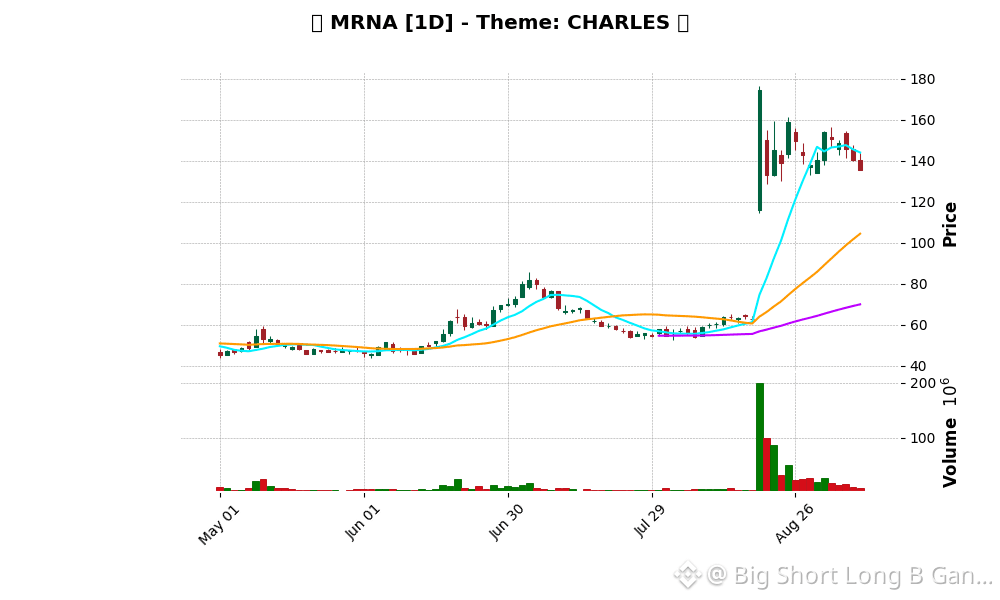
📈 **[$MRNA Daily Technical Analysis & Signal]** 📈
🚨 **Signal Status:** ⚪ HOLD / NEUTRAL
📊 **Indicators:** MA9, MA29, MA99 with Volume
#MRNA #Stocks #Trading #WallStreet #MarketAnalysis
📈 **[$MRNA Daily Technical Analysis & Signal]** 📈
🚨 **Signal Status:** ⚪ HOLD / NEUTRAL
📊 **Indicators:** MA9, MA29, MA99 with Volume
#MRNA #Stocks #Trading #WallStreet #MarketAnalysis
🚨 **Signal Status:** ⚪ HOLD / NEUTRAL
📊 **Indicators:** MA9, MA29, MA99 with Volume
#MRNA #Stocks #Trading #WallStreet #MarketAnalysis
1
65
·
--
$MRNA fell yesterday by 3.73%, closing at $135.29. As a sensitive proxy within the biotech sector, this decline isn’t surprising given the broader recent pressure on the U.S. healthcare/biopharma stocks. But one detail made me pause: the funding rate for the perpetual contract is zero. For an asset with intraday volatility close to 4%, it’s unusual that long/short sentiment shows no clear tilt.
This usually points to two possibilities: one, large capital is using hedged arbitrage between the spot and derivatives markets to keep the funding rate pinned near neutral; two, longs and shorts are in a temporary standoff at current levels—no one wants to be the first to pull the trigger. Combined with its contract open interest of about 10.8 thousand lots, the positioning depth doesn’t look crowded. A funding rate at zero more likely reflects a short-term balance of power between longs and shorts within the current price range.
The transmission mechanism is driven by macro expectations. The market’s shifting pricing for the Fed’s interest-rate-cut path this year directly affects the valuation of all long-duration, rate-sensitive assets. Discounted future cash flows for biotech companies are extremely sensitive to interest-rate assumptions. Any uptick in “rate-hike” expectations—an unexpected gust—would immediately weigh on this sector. The pullback in $MRNA can be seen as capital preemptively hedging interest-rate risk, a snapshot of rotation from high-multiple growth stocks toward more defensive sectors. On-chain, the perpetual contracts for the relevant U.S. biotech/healthcare stocks would also inevitably reflect this concern about liquidity.
The strongest counter-evidence is the Fed’s policy signal. If upcoming Nonfarm Payrolls or CPI data come in significantly weaker, reinforcing the market’s expectations for rate cuts, then biotech stocks like $MRNA could see a rapid valuation repair—pushing the contract funding rate quickly back to positive and driving prices higher. The direct “check for failure” is whether its funding rate can continue to hold around zero, or whether the price can stay above the psychological level of $130.
So my action is clear: wait and observe. Entering a long position now is essentially betting that rate expectations will shift quickly, and that bet doesn’t come cheap. If $MRNA breaks below $130 and the funding rate turns negative, it would suggest shorts are starting to gain the upper hand—I would consider a small, exploratory short. If its price rebounds above $140 and the funding rate turns positive at the same time, I’d conclude that macro pressure is temporarily easing and switch to waiting for a better entry.
Aggressive: place a stop-loss for the short at $140 from the current price, betting that the sector-rotation pressure continues.
Conservative: stay away and wait until the funding rate shows a clear directional signal.
Trading tag: #TradFi #链上美股 #MRNA
Where do you think this set of judgment is most likely to be wrong?
$MRNA fell yesterday by 3.73%, closing at $135.29. As a sensitive proxy within the biotech sector, this decline isn’t surprising given the broader recent pressure on the U.S. healthcare/biopharma stocks. But one detail made me pause: the funding rate for the perpetual contract is zero. For an asset with intraday volatility close to 4%, it’s unusual that long/short sentiment shows no clear tilt.
This usually points to two possibilities: one, large capital is using hedged arbitrage between the spot and derivatives markets to keep the funding rate pinned near neutral; two, longs and shorts are in a temporary standoff at current levels—no one wants to be the first to pull the trigger. Combined with its contract open interest of about 10.8 thousand lots, the positioning depth doesn’t look crowded. A funding rate at zero more likely reflects a short-term balance of power between longs and shorts within the current price range.
The transmission mechanism is driven by macro expectations. The market’s shifting pricing for the Fed’s interest-rate-cut path this year directly affects the valuation of all long-duration, rate-sensitive assets. Discounted future cash flows for biotech companies are extremely sensitive to interest-rate assumptions. Any uptick in “rate-hike” expectations—an unexpected gust—would immediately weigh on this sector. The pullback in $MRNA can be seen as capital preemptively hedging interest-rate risk, a snapshot of rotation from high-multiple growth stocks toward more defensive sectors. On-chain, the perpetual contracts for the relevant U.S. biotech/healthcare stocks would also inevitably reflect this concern about liquidity.
The strongest counter-evidence is the Fed’s policy signal. If upcoming Nonfarm Payrolls or CPI data come in significantly weaker, reinforcing the market’s expectations for rate cuts, then biotech stocks like $MRNA could see a rapid valuation repair—pushing the contract funding rate quickly back to positive and driving prices higher. The direct “check for failure” is whether its funding rate can continue to hold around zero, or whether the price can stay above the psychological level of $130.
So my action is clear: wait and observe. Entering a long position now is essentially betting that rate expectations will shift quickly, and that bet doesn’t come cheap. If $MRNA breaks below $130 and the funding rate turns negative, it would suggest shorts are starting to gain the upper hand—I would consider a small, exploratory short. If its price rebounds above $140 and the funding rate turns positive at the same time, I’d conclude that macro pressure is temporarily easing and switch to waiting for a better entry.
Aggressive: place a stop-loss for the short at $140 from the current price, betting that the sector-rotation pressure continues.
Conservative: stay away and wait until the funding rate shows a clear directional signal.
Trading tag: #TradFi #链上美股 #MRNA
Where do you think this set of judgment is most likely to be wrong?
This usually points to two possibilities: one, large capital is using hedged arbitrage between the spot and derivatives markets to keep the funding rate pinned near neutral; two, longs and shorts are in a temporary standoff at current levels—no one wants to be the first to pull the trigger. Combined with its contract open interest of about 10.8 thousand lots, the positioning depth doesn’t look crowded. A funding rate at zero more likely reflects a short-term balance of power between longs and shorts within the current price range.
The transmission mechanism is driven by macro expectations. The market’s shifting pricing for the Fed’s interest-rate-cut path this year directly affects the valuation of all long-duration, rate-sensitive assets. Discounted future cash flows for biotech companies are extremely sensitive to interest-rate assumptions. Any uptick in “rate-hike” expectations—an unexpected gust—would immediately weigh on this sector. The pullback in $MRNA can be seen as capital preemptively hedging interest-rate risk, a snapshot of rotation from high-multiple growth stocks toward more defensive sectors. On-chain, the perpetual contracts for the relevant U.S. biotech/healthcare stocks would also inevitably reflect this concern about liquidity.
The strongest counter-evidence is the Fed’s policy signal. If upcoming Nonfarm Payrolls or CPI data come in significantly weaker, reinforcing the market’s expectations for rate cuts, then biotech stocks like $MRNA could see a rapid valuation repair—pushing the contract funding rate quickly back to positive and driving prices higher. The direct “check for failure” is whether its funding rate can continue to hold around zero, or whether the price can stay above the psychological level of $130.
So my action is clear: wait and observe. Entering a long position now is essentially betting that rate expectations will shift quickly, and that bet doesn’t come cheap. If $MRNA breaks below $130 and the funding rate turns negative, it would suggest shorts are starting to gain the upper hand—I would consider a small, exploratory short. If its price rebounds above $140 and the funding rate turns positive at the same time, I’d conclude that macro pressure is temporarily easing and switch to waiting for a better entry.
Aggressive: place a stop-loss for the short at $140 from the current price, betting that the sector-rotation pressure continues.
Conservative: stay away and wait until the funding rate shows a clear directional signal.
Trading tag: #TradFi #链上美股 #MRNA
Where do you think this set of judgment is most likely to be wrong?
27
·
--
$MRNA fell 3.73% over the past 24 hours, to $135.29. This drop isn’t particularly severe within the biotech sector, but under the current macro interest-rate environment, it reflects investors’ continued avoidance of long-duration growth stocks.
Biotech companies’ valuations depend heavily on discounted future cash flows. The more firmly the market expects the Federal Reserve to keep rates high, the higher the discount rate becomes, and the more these companies’ theoretical valuations come under pressure. This isn’t an issue unique to MRNA—the entire sector is absorbing the same strain. The funding rate is 0%, indicating that at this price level, longs and shorts are temporarily in balance, with no extreme sentiment bets. However, the slow drift lower in price suggests that actual positioning is retreating—not a dramatic event such as liquidations of leveraged longs or a short squeeze. Based purely on price action and funding, this looks like macro liquidity tightening transmitting directly to individual stocks, reflecting institutional portfolio rebalancing.
The strongest counterevidence is straightforward: if upcoming key inflation data—such as CPI or PCE—unexpectedly comes in lower, causing renewed market expectations for Fed rate cuts, then the entire biotech sector, including MRNA, could get breathing room, and money may quickly flow back in. My invalidation conditions are also clear. If, absent any major macro data turning point, MRNA’s share price can hold above $135 and the funding rate turns positive while open interest (OI) increases significantly, that would indicate new long capital is willing to step in at this level to cover financing costs, disproving my bearish logic.
Currently, the market is overlooking the real damage that a high-rate environment is doing to financing for small and medium-sized enterprises and to clinical trial spending. Large pharma players like MRNA can still rely on cash reserves, but the sector’s vitality is declining. Some capital is moving out of these overvalued names into assets with higher certainty and shorter duration, while some may still be on the sidelines. If interest-rate expectations don’t change, this outflow will likely continue.
In my view, staying cautious on assets like biotech before a genuine rate-cut cycle begins is reasonable. Going forward, I will focus on two things: first, whether the next employment data shows further loosening in the labor market; second, whether MRNA’s price breaks below the $130 psychological level, where technical selling pressure could be triggered.
Trading tag: #TradFi #链上美股 #MRNA
Where do you think this set of conclusions is most likely to be wrong?
$MRNA fell 3.73% over the past 24 hours, to $135.29. This drop isn’t particularly severe within the biotech sector, but under the current macro interest-rate environment, it reflects investors’ continued avoidance of long-duration growth stocks.
Biotech companies’ valuations depend heavily on discounted future cash flows. The more firmly the market expects the Federal Reserve to keep rates high, the higher the discount rate becomes, and the more these companies’ theoretical valuations come under pressure. This isn’t an issue unique to MRNA—the entire sector is absorbing the same strain. The funding rate is 0%, indicating that at this price level, longs and shorts are temporarily in balance, with no extreme sentiment bets. However, the slow drift lower in price suggests that actual positioning is retreating—not a dramatic event such as liquidations of leveraged longs or a short squeeze. Based purely on price action and funding, this looks like macro liquidity tightening transmitting directly to individual stocks, reflecting institutional portfolio rebalancing.
The strongest counterevidence is straightforward: if upcoming key inflation data—such as CPI or PCE—unexpectedly comes in lower, causing renewed market expectations for Fed rate cuts, then the entire biotech sector, including MRNA, could get breathing room, and money may quickly flow back in. My invalidation conditions are also clear. If, absent any major macro data turning point, MRNA’s share price can hold above $135 and the funding rate turns positive while open interest (OI) increases significantly, that would indicate new long capital is willing to step in at this level to cover financing costs, disproving my bearish logic.
Currently, the market is overlooking the real damage that a high-rate environment is doing to financing for small and medium-sized enterprises and to clinical trial spending. Large pharma players like MRNA can still rely on cash reserves, but the sector’s vitality is declining. Some capital is moving out of these overvalued names into assets with higher certainty and shorter duration, while some may still be on the sidelines. If interest-rate expectations don’t change, this outflow will likely continue.
In my view, staying cautious on assets like biotech before a genuine rate-cut cycle begins is reasonable. Going forward, I will focus on two things: first, whether the next employment data shows further loosening in the labor market; second, whether MRNA’s price breaks below the $130 psychological level, where technical selling pressure could be triggered.
Trading tag: #TradFi #链上美股 #MRNA
Where do you think this set of conclusions is most likely to be wrong?
Biotech companies’ valuations depend heavily on discounted future cash flows. The more firmly the market expects the Federal Reserve to keep rates high, the higher the discount rate becomes, and the more these companies’ theoretical valuations come under pressure. This isn’t an issue unique to MRNA—the entire sector is absorbing the same strain. The funding rate is 0%, indicating that at this price level, longs and shorts are temporarily in balance, with no extreme sentiment bets. However, the slow drift lower in price suggests that actual positioning is retreating—not a dramatic event such as liquidations of leveraged longs or a short squeeze. Based purely on price action and funding, this looks like macro liquidity tightening transmitting directly to individual stocks, reflecting institutional portfolio rebalancing.
The strongest counterevidence is straightforward: if upcoming key inflation data—such as CPI or PCE—unexpectedly comes in lower, causing renewed market expectations for Fed rate cuts, then the entire biotech sector, including MRNA, could get breathing room, and money may quickly flow back in. My invalidation conditions are also clear. If, absent any major macro data turning point, MRNA’s share price can hold above $135 and the funding rate turns positive while open interest (OI) increases significantly, that would indicate new long capital is willing to step in at this level to cover financing costs, disproving my bearish logic.
Currently, the market is overlooking the real damage that a high-rate environment is doing to financing for small and medium-sized enterprises and to clinical trial spending. Large pharma players like MRNA can still rely on cash reserves, but the sector’s vitality is declining. Some capital is moving out of these overvalued names into assets with higher certainty and shorter duration, while some may still be on the sidelines. If interest-rate expectations don’t change, this outflow will likely continue.
In my view, staying cautious on assets like biotech before a genuine rate-cut cycle begins is reasonable. Going forward, I will focus on two things: first, whether the next employment data shows further loosening in the labor market; second, whether MRNA’s price breaks below the $130 psychological level, where technical selling pressure could be triggered.
Trading tag: #TradFi #链上美股 #MRNA
Where do you think this set of conclusions is most likely to be wrong?
20
📈 **$MRNA Daily Technical Analysis (1D)**
📊 **MA Indicators:**
🔹 MA9 (Blue)
🔸 MA29 (Orange)
🟣 MA99 (Purple)
#MRNA #Stocks #WallStreet #Trading
📈 **$MRNA Daily Technical Analysis (1D)**
📊 **MA Indicators:**
🔹 MA9 (Blue)
🔸 MA29 (Orange)
🟣 MA99 (Purple)
#MRNA #Stocks #WallStreet #Trading
📊 **MA Indicators:**
🔹 MA9 (Blue)
🔸 MA29 (Orange)
🟣 MA99 (Purple)
#MRNA #Stocks #WallStreet #Trading
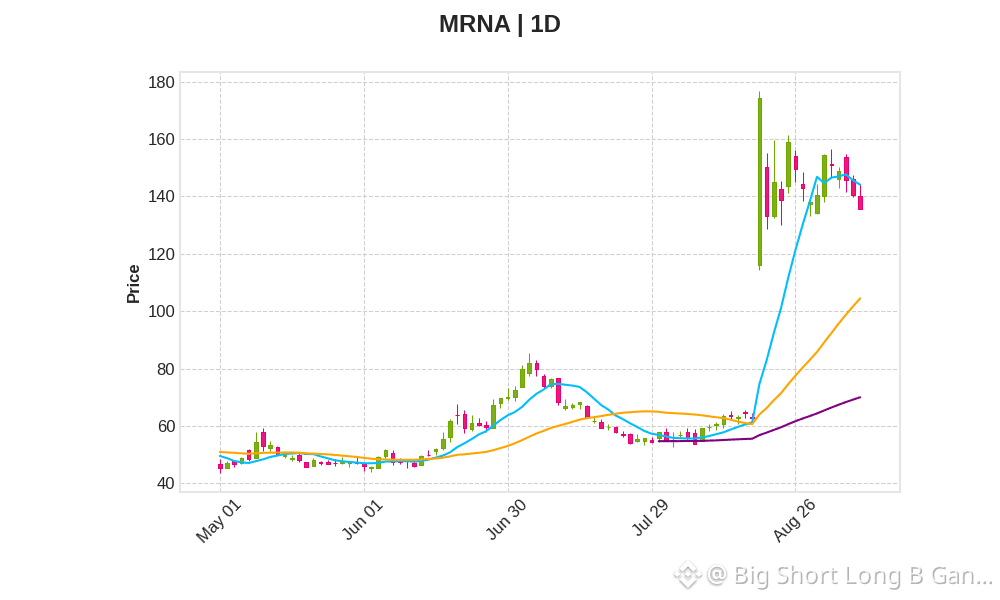
56
·
--
$MRNA fell 4.398% over the past 24 hours, with the price hanging around 137.59. The funding rate is exactly zero, and the open interest is 10,716.16 contracts. Among peers in the semiconductor/AI chain, most didn’t follow the drop today, so $MRNA’s move looks a bit independent.
With the funding rate at zero, neither longs nor shorts need to pay the other, suggesting that both sides are temporarily balanced—no one is particularly crowded. Open interest over ten thousand means participation isn’t low, yet the price is still falling. That may indicate earlier profit-taking positions are starting to loosen. Judging from funding and OI, this doesn’t look like a typical extreme-sentiment market—both sides are quite restrained.
The strongest counter-evidence is this: if the funding rate suddenly turns negative, shorts would start paying, and if the price quickly rallies to reclaim 138, that could mean shorts are getting squeezed and the bounce invalidates my downside logic.
For second-order effects: once the funding rate changes, arbitrage traders and grid strategies are forced to rebalance, moving toward the direction of the funding rate, which could amplify short-term volatility. But whoever moves first bears the slippage cost.
As for Old Dog’s view: since the funding rate is currently zero and price is still declining, I choose to stand by and do nothing. Trigger conditions: if the funding rate turns positive and price continues to stay below 137.59, I’ll reduce my position; if the funding rate turns negative and price rebounds above 137.59, I’ll cautiously go long with a small size.
Trading tag: #BinanceFutures #TradFi #USDⓈM #MRNA #MRNAUSDT $MRNA
$MRNA fell 4.398% over the past 24 hours, with the price hanging around 137.59. The funding rate is exactly zero, and the open interest is 10,716.16 contracts. Among peers in the semiconductor/AI chain, most didn’t follow the drop today, so $MRNA ’s move looks a bit independent.
With the funding rate at zero, neither longs nor shorts need to pay the other, suggesting that both sides are temporarily balanced—no one is particularly crowded. Open interest over ten thousand means participation isn’t low, yet the price is still falling. That may indicate earlier profit-taking positions are starting to loosen. Judging from funding and OI, this doesn’t look like a typical extreme-sentiment market—both sides are quite restrained.
The strongest counter-evidence is this: if the funding rate suddenly turns negative, shorts would start paying, and if the price quickly rallies to reclaim 138, that could mean shorts are getting squeezed and the bounce invalidates my downside logic.
For second-order effects: once the funding rate changes, arbitrage traders and grid strategies are forced to rebalance, moving toward the direction of the funding rate, which could amplify short-term volatility. But whoever moves first bears the slippage cost.
As for Old Dog’s view: since the funding rate is currently zero and price is still declining, I choose to stand by and do nothing. Trigger conditions: if the funding rate turns positive and price continues to stay below 137.59, I’ll reduce my position; if the funding rate turns negative and price rebounds above 137.59, I’ll cautiously go long with a small size.
Trading tag: #BinanceFutures #TradFi #USDⓈM #MRNA #MRNAUSDT $MRNA
With the funding rate at zero, neither longs nor shorts need to pay the other, suggesting that both sides are temporarily balanced—no one is particularly crowded. Open interest over ten thousand means participation isn’t low, yet the price is still falling. That may indicate earlier profit-taking positions are starting to loosen. Judging from funding and OI, this doesn’t look like a typical extreme-sentiment market—both sides are quite restrained.
The strongest counter-evidence is this: if the funding rate suddenly turns negative, shorts would start paying, and if the price quickly rallies to reclaim 138, that could mean shorts are getting squeezed and the bounce invalidates my downside logic.
For second-order effects: once the funding rate changes, arbitrage traders and grid strategies are forced to rebalance, moving toward the direction of the funding rate, which could amplify short-term volatility. But whoever moves first bears the slippage cost.
As for Old Dog’s view: since the funding rate is currently zero and price is still declining, I choose to stand by and do nothing. Trigger conditions: if the funding rate turns positive and price continues to stay below 137.59, I’ll reduce my position; if the funding rate turns negative and price rebounds above 137.59, I’ll cautiously go long with a small size.
Trading tag: #BinanceFutures #TradFi #USDⓈM #MRNA #MRNAUSDT $MRNA
58

·
--
The first AI cancer vaccine is unveiled, and a Phase 3 trial saves nearly 1,000 people
Moderna and Merck’s personalized mRNA neoantigen therapy V940/mRNA-4157, in combination with Keytruda (K药), achieved its Phase 3 endpoints of recurrence-free survival and distant metastasis-free survival in 1,137 high-risk patients with stage IIB–IV skin melanoma in whom tumors had been fully resected.
AI is mainly used to screen for neoantigens in patients’ tumor mutations and to customize mRNA.
This marks a major milestone for personalized mRNA tumor therapy.
#癌症疫苗 #mRNA #AI制药
The first AI cancer vaccine is unveiled, and a Phase 3 trial saves nearly 1,000 people
Moderna and Merck’s personalized mRNA neoantigen therapy V940/mRNA-4157, in combination with Keytruda (K药), achieved its Phase 3 endpoints of recurrence-free survival and distant metastasis-free survival in 1,137 high-risk patients with stage IIB–IV skin melanoma in whom tumors had been fully resected.
AI is mainly used to screen for neoantigens in patients’ tumor mutations and to customize mRNA.
This marks a major milestone for personalized mRNA tumor therapy.
#癌症疫苗 #mRNA #AI制药
Moderna and Merck’s personalized mRNA neoantigen therapy V940/mRNA-4157, in combination with Keytruda (K药), achieved its Phase 3 endpoints of recurrence-free survival and distant metastasis-free survival in 1,137 high-risk patients with stage IIB–IV skin melanoma in whom tumors had been fully resected.
AI is mainly used to screen for neoantigens in patients’ tumor mutations and to customize mRNA.
This marks a major milestone for personalized mRNA tumor therapy.
#癌症疫苗 #mRNA #AI制药
162
MRNA is currently priced at 144.41, down 1.3% over the past 24 hours, with funding rate at 0 and open interest at 9,331. The price is moving in a narrow range, but open interest has not dispersed, which suggests both bulls and bears are waiting for Trump’s next move.
Right now the setup is very clear: funding is at the zero line, the market is pricing in no directional event, and everyone is watching Trump’s tweets and speeches. If he publicly talks about biotech or vaccine policy, MRNA could jump immediately because there is currently no risk premium. Conversely, if he brings up the tariff war again or attacks big pharma, the price will quickly test support below.
My view is that this is the calm before the event, with volatility compressed to the extreme, waiting for a catalyst. Funding at 0 means neither side is carrying a strong position, so the breakout direction could be very sharp. The strongest counterpoint is if Trump stays completely silent, then this name will keep drifting lower, because there is no narrative support.
Second-order effect: if he delivers positive news, shorts will get squeezed instantly, because funding is 0 and there is no cost advantage, which could trigger a fast move up. If he delivers negative news, longs will panic sell, and with open interest sitting there, stop orders will be triggered in clusters.
The invalidation condition is if the price drops below 140 and there is still no news, which would mean the market is weakening on its own and the Trump-trade narrative has failed.
Trade tag: #TradFi #链上美股 #MRNA
Where do you think this thesis is most likely wrong?
MRNA is currently priced at 144.41, down 1.3% over the past 24 hours, with funding rate at 0 and open interest at 9,331. The price is moving in a narrow range, but open interest has not dispersed, which suggests both bulls and bears are waiting for Trump’s next move.
Right now the setup is very clear: funding is at the zero line, the market is pricing in no directional event, and everyone is watching Trump’s tweets and speeches. If he publicly talks about biotech or vaccine policy, MRNA could jump immediately because there is currently no risk premium. Conversely, if he brings up the tariff war again or attacks big pharma, the price will quickly test support below.
My view is that this is the calm before the event, with volatility compressed to the extreme, waiting for a catalyst. Funding at 0 means neither side is carrying a strong position, so the breakout direction could be very sharp. The strongest counterpoint is if Trump stays completely silent, then this name will keep drifting lower, because there is no narrative support.
Second-order effect: if he delivers positive news, shorts will get squeezed instantly, because funding is 0 and there is no cost advantage, which could trigger a fast move up. If he delivers negative news, longs will panic sell, and with open interest sitting there, stop orders will be triggered in clusters.
The invalidation condition is if the price drops below 140 and there is still no news, which would mean the market is weakening on its own and the Trump-trade narrative has failed.
Trade tag: #TradFi #链上美股 #MRNA
Where do you think this thesis is most likely wrong?
Right now the setup is very clear: funding is at the zero line, the market is pricing in no directional event, and everyone is watching Trump’s tweets and speeches. If he publicly talks about biotech or vaccine policy, MRNA could jump immediately because there is currently no risk premium. Conversely, if he brings up the tariff war again or attacks big pharma, the price will quickly test support below.
My view is that this is the calm before the event, with volatility compressed to the extreme, waiting for a catalyst. Funding at 0 means neither side is carrying a strong position, so the breakout direction could be very sharp. The strongest counterpoint is if Trump stays completely silent, then this name will keep drifting lower, because there is no narrative support.
Second-order effect: if he delivers positive news, shorts will get squeezed instantly, because funding is 0 and there is no cost advantage, which could trigger a fast move up. If he delivers negative news, longs will panic sell, and with open interest sitting there, stop orders will be triggered in clusters.
The invalidation condition is if the price drops below 140 and there is still no news, which would mean the market is weakening on its own and the Trump-trade narrative has failed.
Trade tag: #TradFi #链上美股 #MRNA
Where do you think this thesis is most likely wrong?
18
$MRNA 24 hours down 1.3%, open interest is 9,331 contracts, and the funding rate is flat.
These numbers look uninspiring, but from the perspective of the Trump trade, it’s different. Open interest has come down from its peak, prices are drifting lower, and the funding rate is still at zero, which suggests shorts haven’t aggressively piled on, while longs are also staying on the sidelines. Both sides are waiting for Trump’s next statement on the healthcare sector. The last time he talked about pushing down drug prices, the whole sector shook. Now the biggest suspense is that there’s been no movement.
The counterargument is that if Trump suddenly pivots and starts backing mRNA technology as a defense against future pandemics, this stock could instantly flip from short to long. But the odds are low, since his recent focus has been on tariffs and energy. The second-order effect is that as long as Trump doesn’t clearly endorse it, institutions won’t add positions, and liquidity will keep rotating into AI and defense. Right now it’s just a low-volume range-bound move in a policy-sensitive name.
The invalidation condition is clear: if price moves above 150 accompanied by rising holdings, that would mean capital had already positioned ahead of favorable policy, and my earlier right-side-entry logic would be wrong. At the current level, without a volume breakout, I’m choosing to wait. $MRNA can wait too—until the day Trump mentions pandemic-related issues at a rally again, or until price breaks above 150 with volume, I’ll consider a long entry.
Trading tag: #TradFi #链上美股 #MRNA
Where do you think this judgment is most likely to be wrong?
$MRNA 24 hours down 1.3%, open interest is 9,331 contracts, and the funding rate is flat.
These numbers look uninspiring, but from the perspective of the Trump trade, it’s different. Open interest has come down from its peak, prices are drifting lower, and the funding rate is still at zero, which suggests shorts haven’t aggressively piled on, while longs are also staying on the sidelines. Both sides are waiting for Trump’s next statement on the healthcare sector. The last time he talked about pushing down drug prices, the whole sector shook. Now the biggest suspense is that there’s been no movement.
The counterargument is that if Trump suddenly pivots and starts backing mRNA technology as a defense against future pandemics, this stock could instantly flip from short to long. But the odds are low, since his recent focus has been on tariffs and energy. The second-order effect is that as long as Trump doesn’t clearly endorse it, institutions won’t add positions, and liquidity will keep rotating into AI and defense. Right now it’s just a low-volume range-bound move in a policy-sensitive name.
The invalidation condition is clear: if price moves above 150 accompanied by rising holdings, that would mean capital had already positioned ahead of favorable policy, and my earlier right-side-entry logic would be wrong. At the current level, without a volume breakout, I’m choosing to wait. $MRNA can wait too—until the day Trump mentions pandemic-related issues at a rally again, or until price breaks above 150 with volume, I’ll consider a long entry.
Trading tag: #TradFi #链上美股 #MRNA
Where do you think this judgment is most likely to be wrong?
These numbers look uninspiring, but from the perspective of the Trump trade, it’s different. Open interest has come down from its peak, prices are drifting lower, and the funding rate is still at zero, which suggests shorts haven’t aggressively piled on, while longs are also staying on the sidelines. Both sides are waiting for Trump’s next statement on the healthcare sector. The last time he talked about pushing down drug prices, the whole sector shook. Now the biggest suspense is that there’s been no movement.
The counterargument is that if Trump suddenly pivots and starts backing mRNA technology as a defense against future pandemics, this stock could instantly flip from short to long. But the odds are low, since his recent focus has been on tariffs and energy. The second-order effect is that as long as Trump doesn’t clearly endorse it, institutions won’t add positions, and liquidity will keep rotating into AI and defense. Right now it’s just a low-volume range-bound move in a policy-sensitive name.
The invalidation condition is clear: if price moves above 150 accompanied by rising holdings, that would mean capital had already positioned ahead of favorable policy, and my earlier right-side-entry logic would be wrong. At the current level, without a volume breakout, I’m choosing to wait. $MRNA can wait too—until the day Trump mentions pandemic-related issues at a rally again, or until price breaks above 150 with volume, I’ll consider a long entry.
Trading tag: #TradFi #链上美股 #MRNA
Where do you think this judgment is most likely to be wrong?
58
Log in to explore more content
Join global crypto users on Binance Square
⚡️ Get latest and useful information about crypto.
💬 Trusted by the world’s largest crypto exchange.
👍 Discover real insights from verified creators.
Email / Phone number
Trending Topics
1
#BOJRaisesRatesTo31YearHigh
49,146 views
961 Discussing
2
#BuffettStepsDownAsBerkshireChairman
19,902 views
427 Discussing
3
#XRPExchangeReservesHitSevenYearLow
24,989 views
423 Discussing
4
#HKCompletesFirstHKDStablecoinUseCase
57,869 views
938 Discussing
5
#VietnamPlansFirstCryptoLicensesIn2026
39,783 views
648 Discussing
6
#BTCBreaks80K
329,412 views
4,324 Discussing
7
#比特币突破8万
151,614 views
474 Discussing
8
#BitcoinMarketCapTopsTesla
61,329 views
956 Discussing
9
#SOLJumpsAbout10%
71,310 views
961 Discussing
10
#EthereumReclaims$2600
6,508 views
109 Discussing