hangseng

5,588 views
60 Discussing
OxKhoirul
·
--
Article
See translation
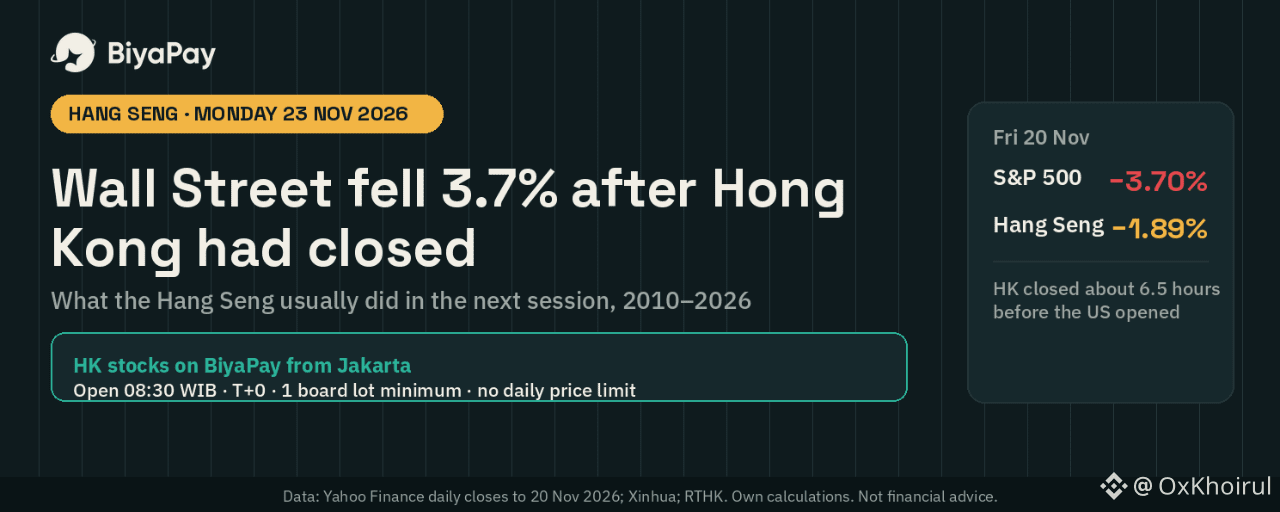
Wall Street Fell 3.7% After Hong Kong Had Closed: What Does the Hang Seng Usually Do Next Session?Disclosure: It is not financial advice Friday's drop arrived after Hong Kong had gone home On Friday 20 November 2026 the S&P 500 fell 3.70% to 6,910.39 and the Nasdaq Composite fell 5.28% to 22,617.73, according to Xinhua's closing report. Technology was the worst sector, down 7.11%. Hong Kong had already finished its week by then. The Hang Seng Index closed 1.89% lower at 22,410.80 on Friday afternoon, and the Hang Seng Tech Index fell 3.8% to 3,511, RTHK reported. The Hang Seng closes at 16:00 Hong Kong time. That is 03:00 in New York, six and a half hours before the US market opens. So Friday's 1.89% fall in Hong Kong was a reaction to Thursday's US session, when the S&P 500 lost 2.02%. Friday's 3.70% drop has not been traded in Hong Kong at all yet. The first chance is Monday 23 November, at 09:30 Hong Kong time. That raises a practical question for anyone holding Hong Kong stocks: what does the Hang Seng usually do in the session after a big US drop? Why Hong Kong trades yesterday's Wall Street I matched every Hang Seng session with the US session that closed just before it. Over the past year, the correlation between the Hang Seng's daily move and the previous US session was 0.30. The correlation with the US session of the same calendar date, which happens after Hong Kong closes, was 0.03, close to zero. On average over that year, the Hang Seng moved about 0.4% for every 1% the S&P 500 moved in the session before. Over ten years the pattern is weaker but the same: 0.25 against the previous US session, 0.17 against the same date. This week shows both the link and its limits. Monday's 1.92% US fall was followed by a 1.03% Hong Kong fall. But on Thursday Hong Kong lost 1.95% after a US session that was down only 0.23%. Hong Kong has its own news too. RTHK said signs of tighter US tech curbs on China weighed on sentiment. What happened after earlier 3% drops Since January 2010, the S&P 500 has fallen 3% or more in 46 sessions that were followed by a separate Hong Kong session. Here is what the Hang Seng did in the first session after each one: It fell 35 times, rose 10 times and was flat once.The median move was -1.29%.It fell more than 2% in 19 of the 46 cases.Over the first five Hong Kong sessions, the median was -1.55%, and the index was lower in 31 of 46 cases. For comparison, since 2000 the Hang Seng has closed lower on 48.9% of all trading days. After a 3% US drop, that share rose to 76%. The range was very wide. The worst case was 7 April 2025: after US falls of 4.84% and 5.97% on 3 and 4 April, Hong Kong reopened from a holiday and the Hang Seng fell 13.22%. The best was 10 March 2020, when the Hang Seng rose 1.41% the day after the S&P 500 fell 7.60%. A median of -1.29% is a description of the past, not a forecast for Monday. It does show that Hong Kong has usually fallen less than the US move it was reacting to. Not a hedge, not a copy It is tempting to see Hong Kong as a diversifier for a US-heavy portfolio. This year the data does not support that idea in a simple way. The Hang Seng peaked at 27,968 on 29 January 2026 and is now 19.9% below that level. In local currency it is down 12.56% for the year, while the S&P 500 is still up 0.95%, even after falling 11.6% from its 6 October record. This week the Hang Seng fell 5.19% and the S&P 500 fell 8.61%. Hong Kong fell less, but it did not go the other way. My reading: Hong Kong lowers the size of a US shock, but it does not cancel it, and it carries its own China-related risks. Trading Hong Kong hours from Jakarta For an Indonesian investor, Hong Kong is the easier market on the clock. Hong Kong time is UTC+8 and WIB is UTC+7, with no daylight saving on either side, so the sessions are 08:30–11:00 and 12:00–15:00 WIB. Monday's reaction to Friday's US drop starts at 08:30 in Jakarta. BiyaPay supports all Hong Kong stocks, including ETFs, in the same app as US stocks. The minimum order is one board lot, and lot sizes differ by stock. The Hong Kong market has no daily price limits, and trading is T+0, so shares bought on Monday morning can be sold the same day. On BiyaPay, a HKD 20,000 purchase of a stock costs about HKD 37.54, or 0.19%: commission of 0.03% with a HKD 7 minimum, a platform fee of 0.03% with a HKD 8 minimum, and HKD 20 of stamp duty at 0.1%, plus small exchange and regulatory levies. Stamp duty is the largest line. On HKD 10,000 the total is about HKD 26.27, or 0.26%, because the two minimums carry more weight. My take Monday morning in Hong Kong is the first real-money vote on Friday's US sell-off, and it happens while New York is asleep. History says the Hang Seng usually falls after a 3% US drop, usually by less than the US move, and with a wide spread of outcomes. What I would not do is treat Hong Kong as a safe place to hide from a US tech sell-off. In 2026 the Hang Seng has been weaker than the S&P 500 for most of the year, and the Tech Index fell twice as much as the main index on Friday. What I find useful is the timing. A Jakarta-based investor sees the US close at 04:00 WIB and the Hong Kong open at 08:30 WIB. That gap is enough time to read the numbers, decide on a size, and avoid trading on the first headline. Sources: Xinhua, "U.S. stocks close lower" (21 November 2026); CNBC, "S&P 500 correction: Five forces behind the market sell-off" (20 November 2026); RTHK, "HK, mainland slip as tech stocks take brunt of fears" (20 November 2026); Yahoo Finance daily closes for ^GSPC (from 1980) and ^HSI (from 1986) to 20 November 2026. Correlations, counts, medians and fee arithmetic are my own calculations, checked on 22 November 2026 (Asia/Jakarta). #BiyaPay #HangSeng #USStocks

Wall Street Fell 3.7% After Hong Kong Had Closed: What Does the Hang Seng Usually Do Next Session?

Disclosure: It is not financial advice
Friday's drop arrived after Hong Kong had gone home
On Friday 20 November 2026 the S&P 500 fell 3.70% to 6,910.39 and the Nasdaq Composite fell 5.28% to 22,617.73, according to Xinhua's closing report. Technology was the worst sector, down 7.11%.
Hong Kong had already finished its week by then. The Hang Seng Index closed 1.89% lower at 22,410.80 on Friday afternoon, and the Hang Seng Tech Index fell 3.8% to 3,511, RTHK reported.
The Hang Seng closes at 16:00 Hong Kong time. That is 03:00 in New York, six and a half hours before the US market opens. So Friday's 1.89% fall in Hong Kong was a reaction to Thursday's US session, when the S&P 500 lost 2.02%. Friday's 3.70% drop has not been traded in Hong Kong at all yet. The first chance is Monday 23 November, at 09:30 Hong Kong time.
That raises a practical question for anyone holding Hong Kong stocks: what does the Hang Seng usually do in the session after a big US drop?
Why Hong Kong trades yesterday's Wall Street
I matched every Hang Seng session with the US session that closed just before it. Over the past year, the correlation between the Hang Seng's daily move and the previous US session was 0.30. The correlation with the US session of the same calendar date, which happens after Hong Kong closes, was 0.03, close to zero.
On average over that year, the Hang Seng moved about 0.4% for every 1% the S&P 500 moved in the session before. Over ten years the pattern is weaker but the same: 0.25 against the previous US session, 0.17 against the same date.
This week shows both the link and its limits. Monday's 1.92% US fall was followed by a 1.03% Hong Kong fall. But on Thursday Hong Kong lost 1.95% after a US session that was down only 0.23%. Hong Kong has its own news too. RTHK said signs of tighter US tech curbs on China weighed on sentiment.
What happened after earlier 3% drops
Since January 2010, the S&P 500 has fallen 3% or more in 46 sessions that were followed by a separate Hong Kong session. Here is what the Hang Seng did in the first session after each one:
It fell 35 times, rose 10 times and was flat once.The median move was -1.29%.It fell more than 2% in 19 of the 46 cases.Over the first five Hong Kong sessions, the median was -1.55%, and the index was lower in 31 of 46 cases.
For comparison, since 2000 the Hang Seng has closed lower on 48.9% of all trading days. After a 3% US drop, that share rose to 76%.
The range was very wide. The worst case was 7 April 2025: after US falls of 4.84% and 5.97% on 3 and 4 April, Hong Kong reopened from a holiday and the Hang Seng fell 13.22%. The best was 10 March 2020, when the Hang Seng rose 1.41% the day after the S&P 500 fell 7.60%.
A median of -1.29% is a description of the past, not a forecast for Monday. It does show that Hong Kong has usually fallen less than the US move it was reacting to.
Not a hedge, not a copy
It is tempting to see Hong Kong as a diversifier for a US-heavy portfolio. This year the data does not support that idea in a simple way.
The Hang Seng peaked at 27,968 on 29 January 2026 and is now 19.9% below that level. In local currency it is down 12.56% for the year, while the S&P 500 is still up 0.95%, even after falling 11.6% from its 6 October record.
This week the Hang Seng fell 5.19% and the S&P 500 fell 8.61%. Hong Kong fell less, but it did not go the other way. My reading: Hong Kong lowers the size of a US shock, but it does not cancel it, and it carries its own China-related risks.
Trading Hong Kong hours from Jakarta
For an Indonesian investor, Hong Kong is the easier market on the clock. Hong Kong time is UTC+8 and WIB is UTC+7, with no daylight saving on either side, so the sessions are 08:30–11:00 and 12:00–15:00 WIB. Monday's reaction to Friday's US drop starts at 08:30 in Jakarta.
BiyaPay supports all Hong Kong stocks, including ETFs, in the same app as US stocks. The minimum order is one board lot, and lot sizes differ by stock. The Hong Kong market has no daily price limits, and trading is T+0, so shares bought on Monday morning can be sold the same day.
On BiyaPay, a HKD 20,000 purchase of a stock costs about HKD 37.54, or 0.19%: commission of 0.03% with a HKD 7 minimum, a platform fee of 0.03% with a HKD 8 minimum, and HKD 20 of stamp duty at 0.1%, plus small exchange and regulatory levies. Stamp duty is the largest line. On HKD 10,000 the total is about HKD 26.27, or 0.26%, because the two minimums carry more weight.
My take
Monday morning in Hong Kong is the first real-money vote on Friday's US sell-off, and it happens while New York is asleep. History says the Hang Seng usually falls after a 3% US drop, usually by less than the US move, and with a wide spread of outcomes.
What I would not do is treat Hong Kong as a safe place to hide from a US tech sell-off. In 2026 the Hang Seng has been weaker than the S&P 500 for most of the year, and the Tech Index fell twice as much as the main index on Friday.
What I find useful is the timing. A Jakarta-based investor sees the US close at 04:00 WIB and the Hong Kong open at 08:30 WIB. That gap is enough time to read the numbers, decide on a size, and avoid trading on the first headline.
Sources: Xinhua, "U.S. stocks close lower" (21 November 2026); CNBC, "S&P 500 correction: Five forces behind the market sell-off" (20 November 2026); RTHK, "HK, mainland slip as tech stocks take brunt of fears" (20 November 2026); Yahoo Finance daily closes for ^GSPC (from 1980) and ^HSI (from 1986) to 20 November 2026. Correlations, counts, medians and fee arithmetic are my own calculations, checked on 22 November 2026 (Asia/Jakarta).
#BiyaPay #HangSeng #USStocks
SPY+0.21%
EWHETF-2.49%
·
--
See translation
See translation
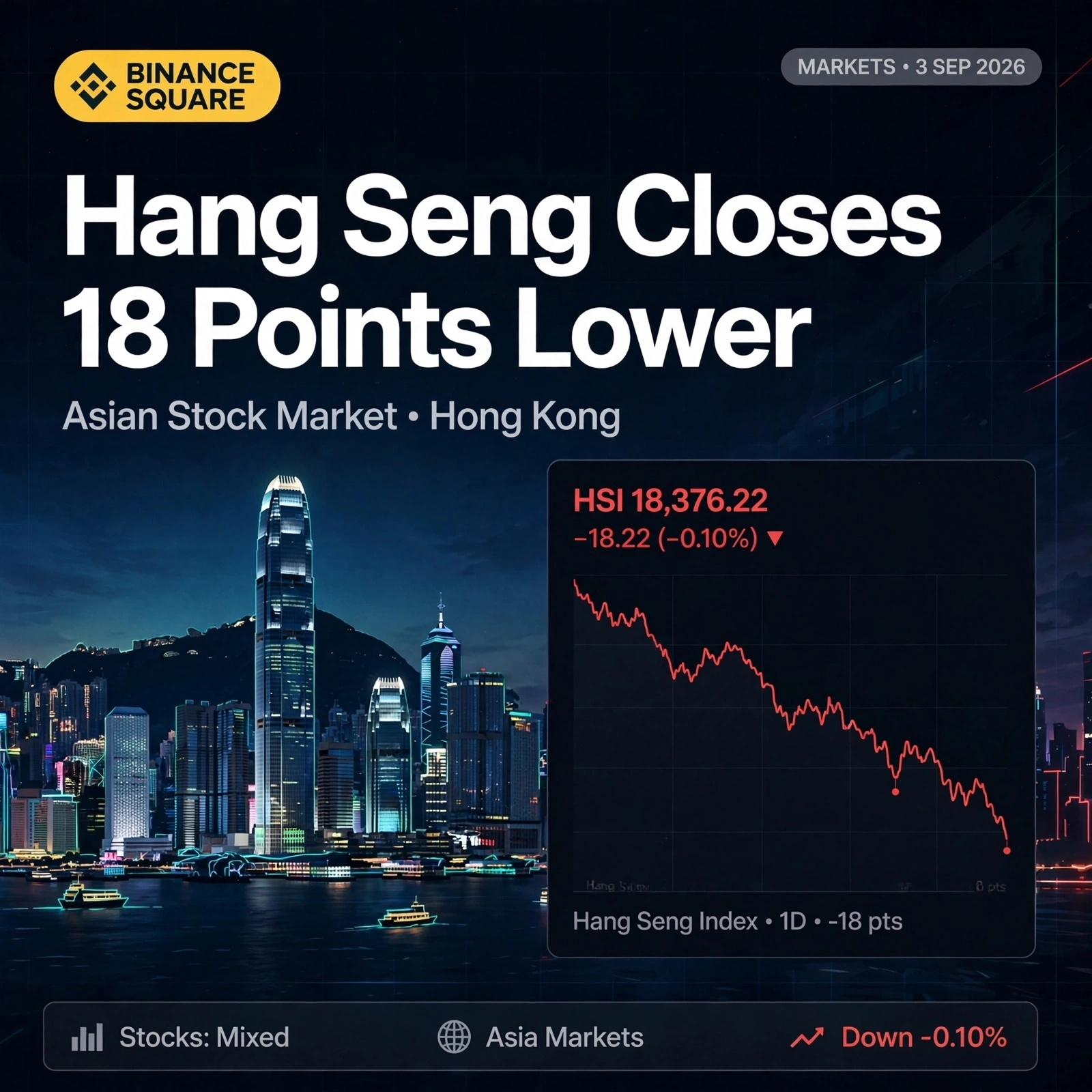
📉 Hang Seng Closes 18 Points Lower Hong Kong’s benchmark Hang Seng Index ended the session slightly lower, falling 18 points to close around 25,311. The modest decline came after a volatile session, with the index recovering most of its earlier losses before the close. The Hang Seng Tech Index also finished lower, reflecting continued caution across Hong Kong equities. 🔎 Market Watch: Investors remain focused on China’s economic outlook, technology stocks and broader global rate expectations. 📊 Small move, but traders are watching whether Hong Kong stocks can regain momentum in the next session. What are you watching next — Hong Kong stocks, China tech, or crypto? 👀 #HangSeng #HongKong #StockMarket #Markets #TradingSignal
📉 Hang Seng Closes 18 Points Lower

Hong Kong’s benchmark Hang Seng Index ended the session slightly lower, falling 18 points to close around 25,311.

The modest decline came after a volatile session, with the index recovering most of its earlier losses before the close. The Hang Seng Tech Index also finished lower, reflecting continued caution across Hong Kong equities.

🔎 Market Watch:
Investors remain focused on China’s economic outlook, technology stocks and broader global rate expectations.

📊 Small move, but traders are watching whether Hong Kong stocks can regain momentum in the next session.

What are you watching next — Hong Kong stocks, China tech, or crypto? 👀

#HangSeng #HongKong #StockMarket #Markets #TradingSignal
See translation
#HangSengFalls1% 🚨 **#HangSengFalls1% 🇭🇰📉** Hong Kong’s **Hang Seng Index fell about 1%**, closing near **25,330**, as renewed global rate concerns and weakness in technology shares weighed on sentiment. ([RTHK News][1]) 📌 **Key points:** * 📉 Hang Seng: **-0.93%** * 💻 Hang Seng Tech Index: **-1.5%** * 🌏 Rising global bond yields pressured Asian equities * 🛢️ Higher oil prices added to inflation concerns * 🇭🇰 Investors also reacted cautiously to **Shein’s weak Hong Kong debut** **Bottom line:** Rising yields, higher energy prices and cautious sentiment are putting pressure on Hong Kong equities as investors reassess the outlook for global interest rates. #HangSeng #HongKong #ChinaStocks #AsianMarkets #StockMarket #GlobalMarkets #Trading #Finance #MarketNews  [1]: $NVDA.US {stock_us}(NVDA.US) $NVDAB {spot}(NVDABUSDT) $AAPLB {spot}(AAPLBUSDT)
#HangSengFalls1% 🚨 **#HangSengFalls1% 🇭🇰📉**

Hong Kong’s **Hang Seng Index fell about 1%**, closing near **25,330**, as renewed global rate concerns and weakness in technology shares weighed on sentiment. ([RTHK News][1])

📌 **Key points:**

* 📉 Hang Seng: **-0.93%**
* 💻 Hang Seng Tech Index: **-1.5%**
* 🌏 Rising global bond yields pressured Asian equities
* 🛢️ Higher oil prices added to inflation concerns
* 🇭🇰 Investors also reacted cautiously to **Shein’s weak Hong Kong debut**

**Bottom line:** Rising yields, higher energy prices and cautious sentiment are putting pressure on Hong Kong equities as investors reassess the outlook for global interest rates.

#HangSeng #HongKong #ChinaStocks #AsianMarkets #StockMarket #GlobalMarkets #Trading #Finance #MarketNews 

[1]: $NVDA.US
$NVDAB
$AAPLB
·
--
Bullish
See translation
See translation
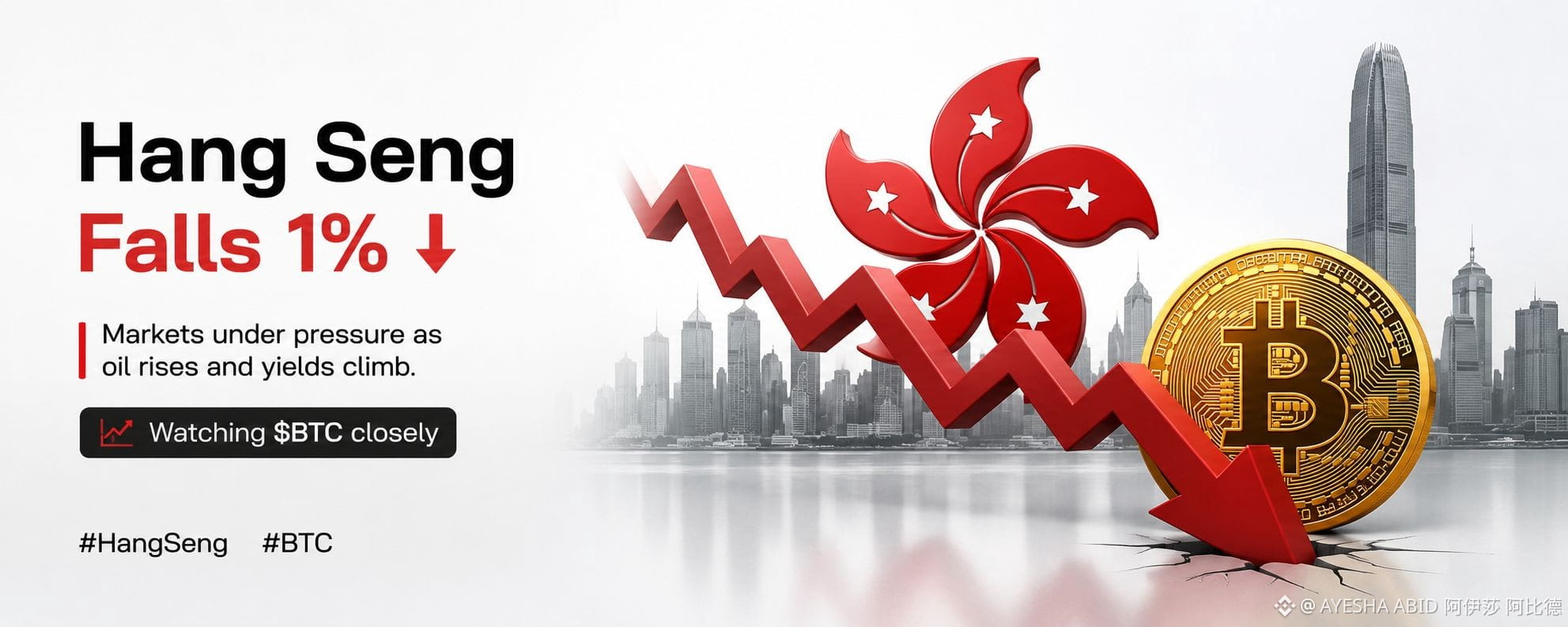
#HangSengFalls1% Hong Kong stocks are under pressure today, with the Hang Seng down around 1%, while the Hang Seng Tech Index is also lower. The move comes as investors turn more cautious amid Brent crude moving above $90 and higher US Treasury yields. Tech stocks are feeling the pressure as risk appetite cools. For crypto, I’m watching $BTC closely. If broader risk markets stay weak, Bitcoin could also face short term pressure. #HangSeng #BTC #XRPRises40%InTwoWeeksAsOpenInterestFalls
#HangSengFalls1%

Hong Kong stocks are under pressure today, with the Hang Seng down around 1%, while the Hang Seng Tech Index is also lower.

The move comes as investors turn more cautious amid Brent crude moving above $90 and higher US Treasury yields. Tech stocks are feeling the pressure as risk appetite cools.

For crypto, I’m watching $BTC closely. If broader risk markets stay weak, Bitcoin could also face short term pressure.

#HangSeng #BTC
#XRPRises40%InTwoWeeksAsOpenInterestFalls
·
--
Verified
See translation
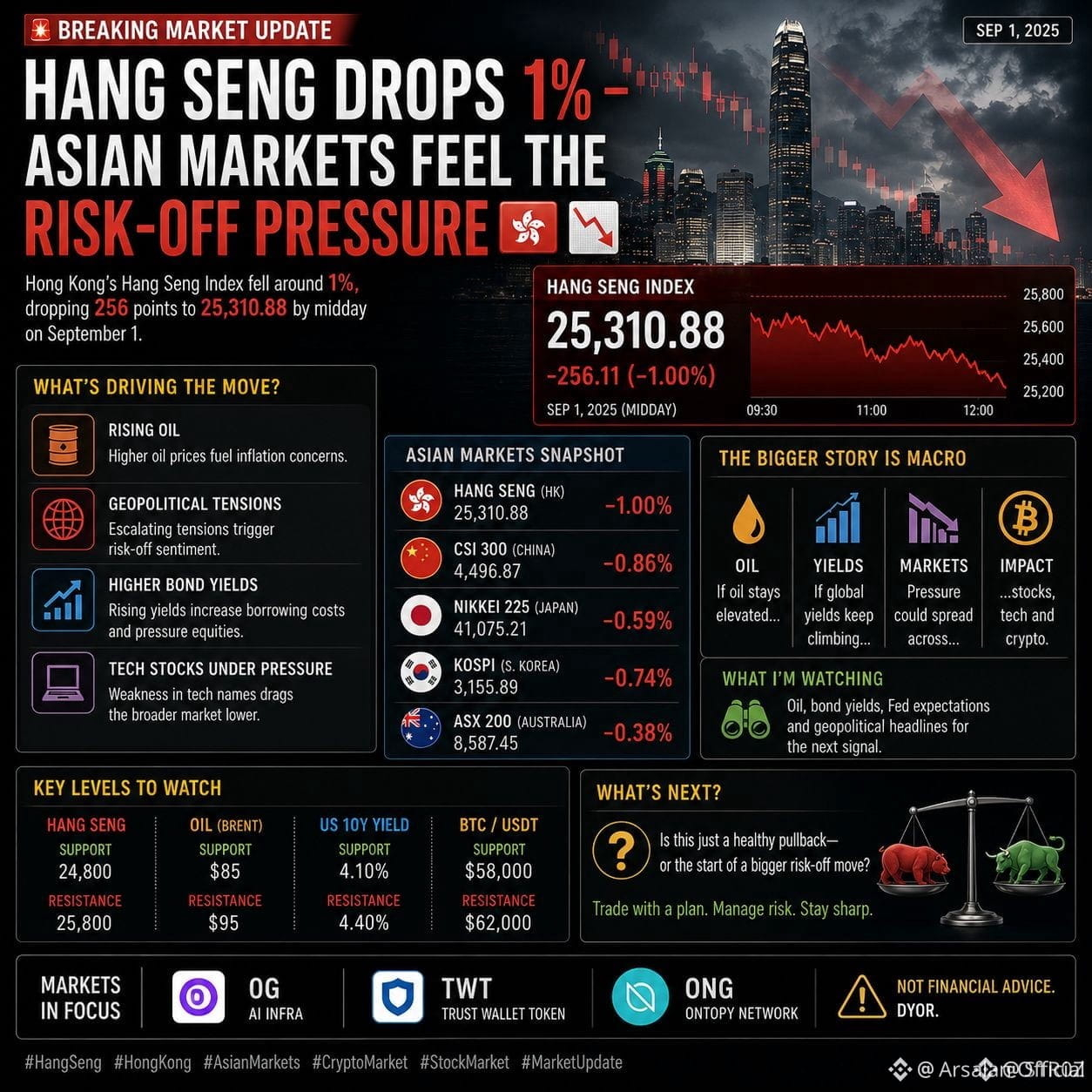
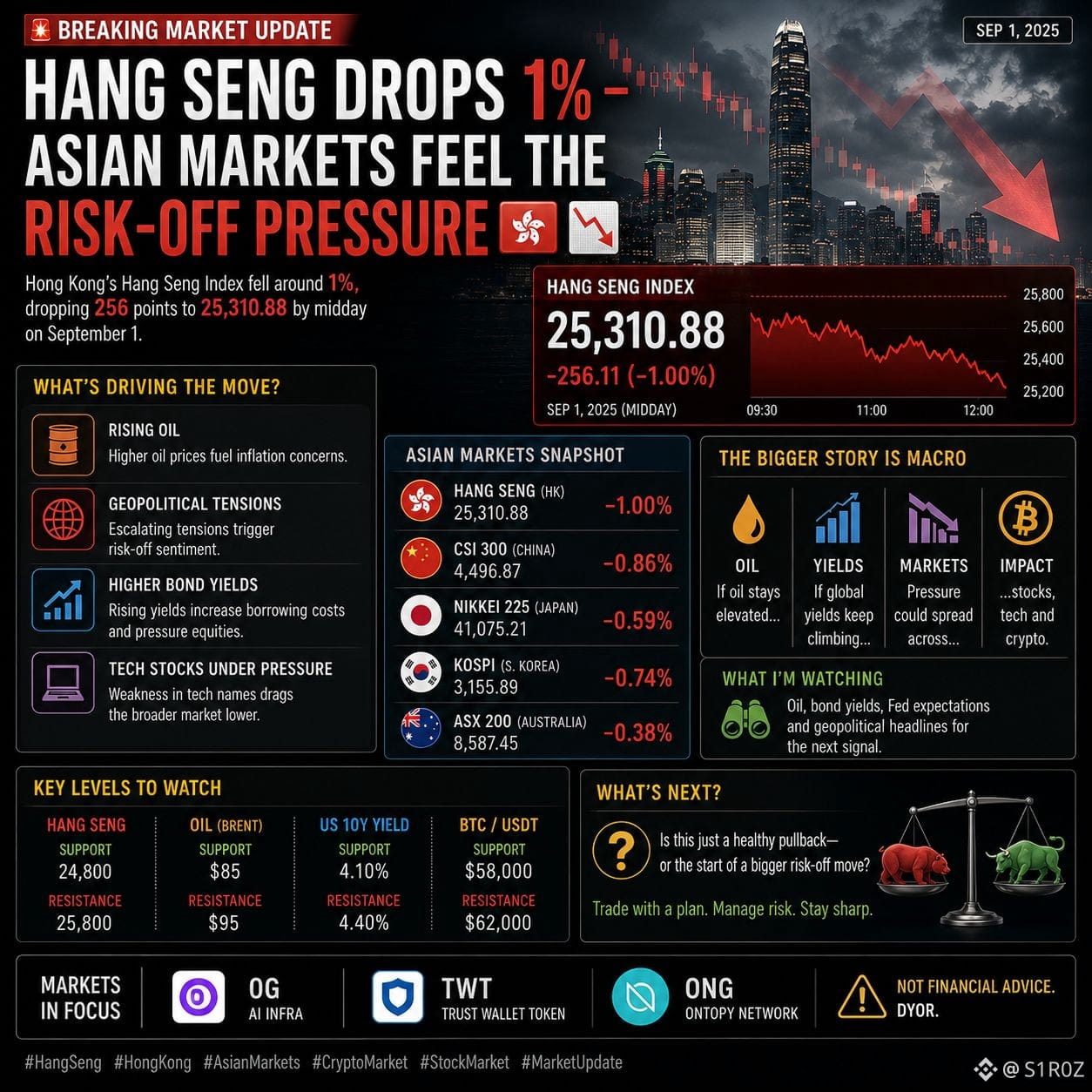
#hangsengfalls1% 🚨 HANG SENG DROPS 1% — ASIAN MARKETS FEEL THE RISK-OFF PRESSURE 🇭🇰📉 Hong Kong's Hang Seng Index fell around 1%, dropping 256 points to 25,310.88 by midday on September 1. What's driving the move? 👀 🛢️ Rising oil → inflation concerns 🌍 Geopolitical tensions → risk-off sentiment 📈 Higher bond yields → pressure on equities 💻 Tech stocks → selling pressure The bigger story is macro. If oil stays elevated and global yields keep climbing, pressure could spread across stocks, tech and crypto. 🎯 I'm watching oil, bond yields, Fed expectations and geopolitical headlines for the next signal. Is this just a healthy pullback—or the start of a bigger risk-off move? $0G {spot}(0GUSDT) $TWT {spot}(TWTUSDT) $ONG {spot}(ONGUSDT) #HangSeng #HongKong #AsianMarkets #CryptoMarket #StockMarket #MarketUpdate
#hangsengfalls1%

🚨 HANG SENG DROPS 1% — ASIAN MARKETS FEEL THE RISK-OFF PRESSURE 🇭🇰📉

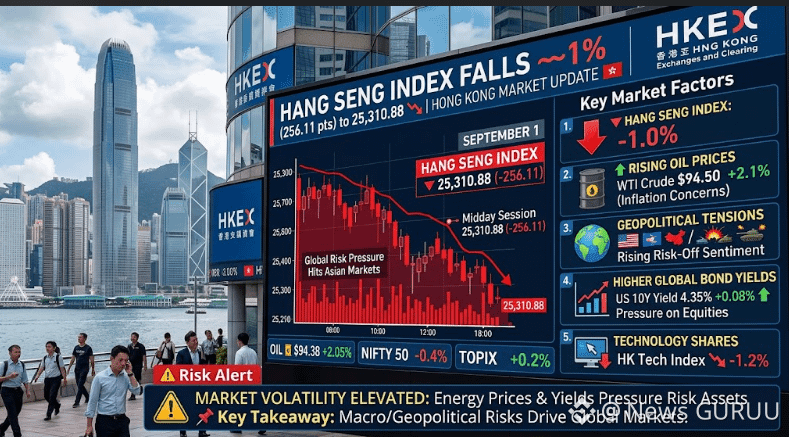
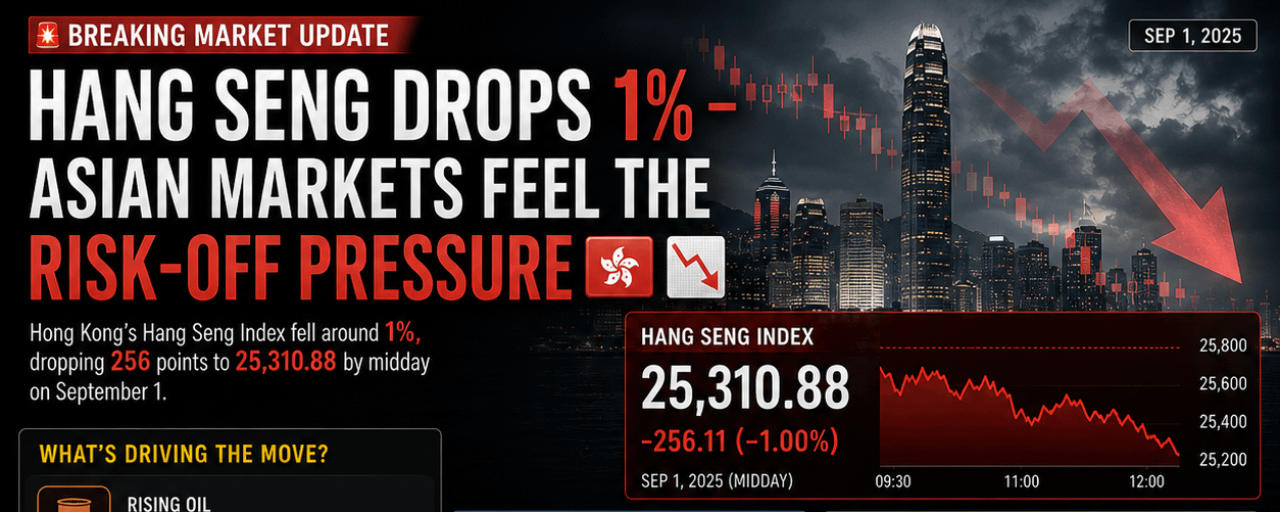
Hong Kong's Hang Seng Index fell around 1%, dropping 256 points to 25,310.88 by midday on September 1.

What's driving the move? 👀
🛢️ Rising oil → inflation concerns
🌍 Geopolitical tensions → risk-off sentiment
📈 Higher bond yields → pressure on equities
💻 Tech stocks → selling pressure

The bigger story is macro.
If oil stays elevated and global yields keep climbing, pressure could spread across stocks, tech and crypto.

🎯 I'm watching oil, bond yields, Fed expectations and geopolitical headlines for the next signal.

Is this just a healthy pullback—or the start of a bigger risk-off move?
$0G
$TWT
$ONG
#HangSeng #HongKong #AsianMarkets #CryptoMarket #StockMarket #MarketUpdate
·
--
Verified
See translation
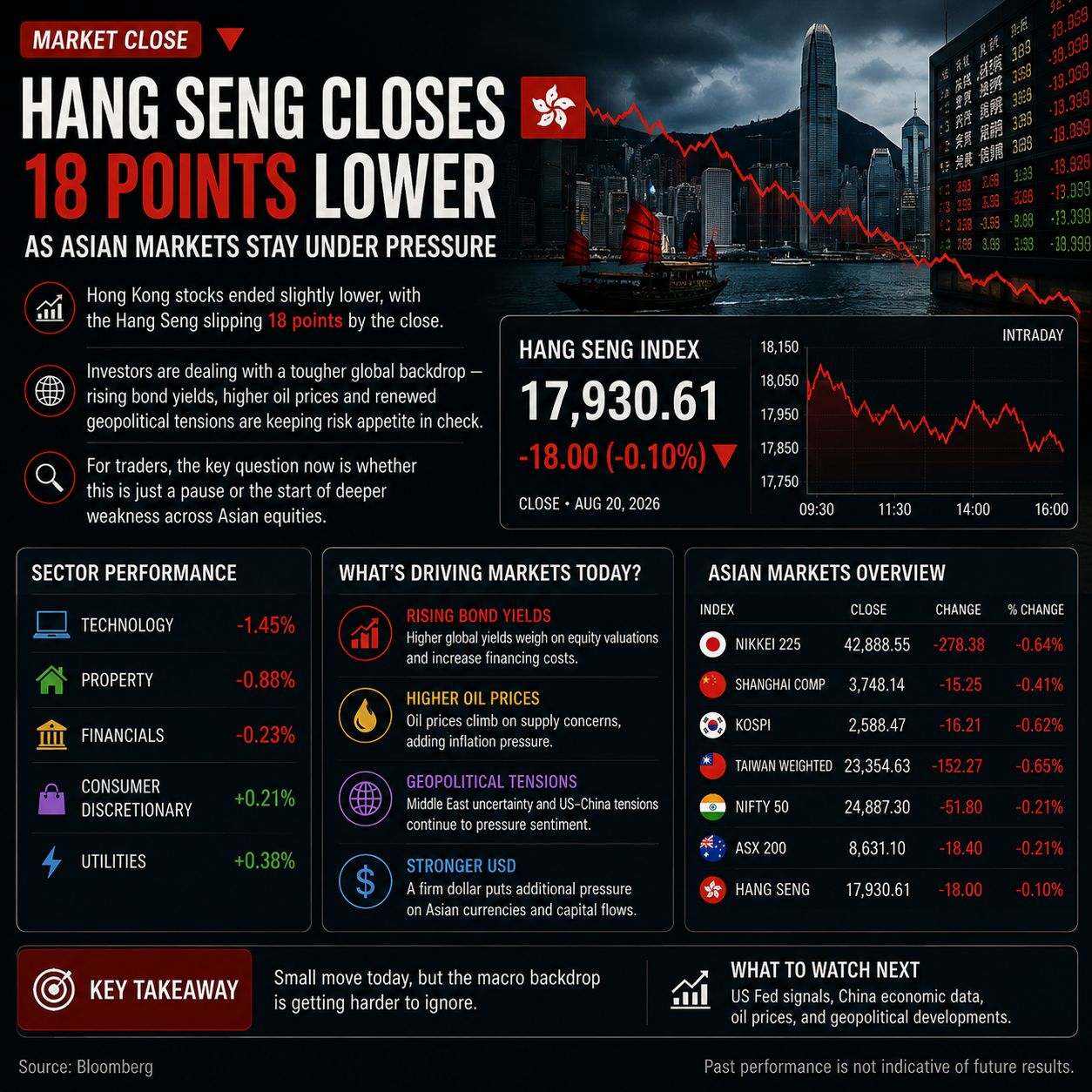
#hangsengcloses18pointslower 📉 Hang Seng closes 18 points lower as Asian markets stay under pressure. Hong Kong stocks ended slightly lower, with the Hang Seng slipping 18 points by the close. The move comes as investors deal with a tougher global backdrop — rising bond yields, higher oil prices and renewed geopolitical tensions are keeping risk appetite in check. For traders, the key question now is whether this is just a pause or the start of deeper weakness across Asian equities. Small move today, but the macro backdrop is getting harder to ignore. 👀 $BTC $ETH #HangSeng #HongKong #China #Stocks #Macro {spot}(ETHUSDT) {spot}(BTCUSDT)
#hangsengcloses18pointslower
📉 Hang Seng closes 18 points lower as Asian markets stay under pressure.

Hong Kong stocks ended slightly lower, with the Hang Seng slipping 18 points by the close.

The move comes as investors deal with a tougher global backdrop — rising bond yields, higher oil prices and renewed geopolitical tensions are keeping risk appetite in check.

For traders, the key question now is whether this is just a pause or the start of deeper weakness across Asian equities.

Small move today, but the macro backdrop is getting harder to ignore. 👀
$BTC $ETH
#HangSeng #HongKong #China #Stocks #Macro
See translation
📉 $HSI CONSOLIDATING IN TIGHT RANGE AS WE AWAIT THE NEXT MACRO CATALYST ✨ gm fam! That 18-point dip in $HSI is showing us classic structural compression rather than active sell pressure. 🤝 Institutional capital is keeping exposure tight, defending localized demand blocks while we all await clear global interest rate directional cues and tech sector liquidity shifts. With volume subduing inside this tight compression, smart money appears to be absorbing overhead supply before setting up our next major expansion phase. One step at a time, we move! 💬 Are we positioning for a structural breakout here fam, or waiting for a liquidity sweep below range support? Let me know below! 👇 ⚠️ Not financial advice. Always manage your risk! 💪 #HSI #HangSeng #MarketStructure #Macro We grow together.
📉 $HSI CONSOLIDATING IN TIGHT RANGE AS WE AWAIT THE NEXT MACRO CATALYST ✨

gm fam! That 18-point dip in $HSI is showing us classic structural compression rather than active sell pressure. 🤝 Institutional capital is keeping exposure tight, defending localized demand blocks while we all await clear global interest rate directional cues and tech sector liquidity shifts.

With volume subduing inside this tight compression, smart money appears to be absorbing overhead supply before setting up our next major expansion phase. One step at a time, we move! 💬 Are we positioning for a structural breakout here fam, or waiting for a liquidity sweep below range support? Let me know below! 👇

⚠️ Not financial advice. Always manage your risk! 💪

#HSI #HangSeng #MarketStructure #Macro

We grow together.
📉🔥 HANG SENG INDEX UNDER PRESSURE The Hang Seng closed near 25,539 points, losing approximately 1.81% over the past 24 hours. The session was volatile: it opened at 25,708, hit a high of 25,726, and fell as low as 25,419 points, with more than 2,819 million traded. The technology sector led the losses, and the market reacted with profit-taking and concern over high valuations. 👀 Key levels: 🔹 Support: 25,420–25,150 🔹 Resistance: 25,700–26,000 The tactical signal is clear: stay cautious until it recovers 26,000 points with strength. 💬 Do you think the Hang Seng will bounce from support or continue correcting? ❤️ If you find this analysis useful, you can support me with a donation to keep creating clear, dynamic, and free content for the community. Informational content. Not financial advice. Always trade with risk management. #HangSeng #HSI #HongKong #BinanceSquare
📉🔥 HANG SENG INDEX UNDER PRESSURE

The Hang Seng closed near 25,539 points, losing approximately 1.81% over the past 24 hours.

The session was volatile: it opened at 25,708, hit a high of 25,726, and fell as low as 25,419 points, with more than 2,819 million traded.

The technology sector led the losses, and the market reacted with profit-taking and concern over high valuations.

👀 Key levels:
🔹 Support: 25,420–25,150
🔹 Resistance: 25,700–26,000

The tactical signal is clear: stay cautious until it recovers 26,000 points with strength.

💬 Do you think the Hang Seng will bounce from support or continue correcting?

❤️ If you find this analysis useful, you can support me with a donation to keep creating clear, dynamic, and free content for the community.

Informational content. Not financial advice. Always trade with risk management.

#HangSeng #HSI #HongKong #BinanceSquare
HANG SENG INDEX (恒生指数) Up or Down on August 24, 2026?

HANG SENG INDEX (恒生指数) Up or Down on August 24, 2026?

1%Up99%Down
Volume $55,682.15
·
--
Bearish
See translation
#hangsengfalls1% 🚨 HANG SENG FALLS 1% — ASIAN MARKETS UNDER PRESSURE! 📉 The Hang Seng Index dropped around 1%, signaling renewed caution across Hong Kong equities. ⚠️ 📉 Hang Seng: -1% 🌏 Asian Markets: Under pressure ⚡ Sentiment: Risk-off vibes returning A sharp move lower in Hong Kong stocks can quickly affect broader Asian sentiment, especially if investors continue reducing exposure to risk assets. 🔥 One red session can change the mood fast. Traders are watching closely to see whether this is just a pullback — or the start of a deeper correction. 👀 #HangSeng #HongKong #crypto
#hangsengfalls1%
🚨 HANG SENG FALLS 1% — ASIAN MARKETS UNDER PRESSURE! 📉
The Hang Seng Index dropped around 1%, signaling renewed caution across Hong Kong equities. ⚠️
📉 Hang Seng: -1%
🌏 Asian Markets: Under pressure
⚡ Sentiment: Risk-off vibes returning
A sharp move lower in Hong Kong stocks can quickly affect broader Asian sentiment, especially if investors continue reducing exposure to risk assets.
🔥 One red session can change the mood fast. Traders are watching closely to see whether this is just a pullback — or the start of a deeper correction. 👀
#HangSeng #HongKong #crypto
·
--
Bearish
See translation
#hangsengfalls1% 🚨 HANG SENG SLIDES 1% AS RISK-OFF PRESSURE GROWS 🇭🇰📉 Hong Kong’s Hang Seng Index fell around 1%, pressured by rising oil prices, geopolitical tensions, higher bond yields, and renewed inflation concerns. 💻 Tech stocks also faced selling pressure, while traders remain focused on oil, bond yields, Fed expectations, and global risk sentiment. 🎯 TRADING VIEW: SELL 📉 Rising yields and energy prices are creating a tougher environment for risk assets. Near-term downside pressure remains the stronger setup while macro conditions stay uncertain. ❓ Will Asian stocks fall further from here? "CLICK ON THE BELOW YELLOW COIN TAG TO GO TO DESIRED TRADING PAGE TO GET BENEFIT TRADE"$TWT $ONG $OG {spot}(OGUSDT) {spot}(ONGUSDT) {spot}(TWTUSDT) #HangSeng #og
#hangsengfalls1%
🚨 HANG SENG SLIDES 1% AS RISK-OFF PRESSURE GROWS 🇭🇰📉
Hong Kong’s Hang Seng Index fell around 1%, pressured by rising oil prices, geopolitical tensions, higher bond yields, and renewed inflation concerns.
💻 Tech stocks also faced selling pressure, while traders remain focused on oil, bond yields, Fed expectations, and global risk sentiment.
🎯 TRADING VIEW: SELL 📉
Rising yields and energy prices are creating a tougher environment for risk assets. Near-term downside pressure remains the stronger setup while macro conditions stay uncertain.
❓ Will Asian stocks fall further from here? "CLICK ON THE BELOW YELLOW COIN TAG TO GO TO DESIRED TRADING PAGE TO GET BENEFIT TRADE"$TWT $ONG $OG
#HangSeng #og
#HangSengCloses18PointsLower 📉 Hang Seng drops by 18 points... but who’s surprised? 🤷‍♂️ When the whole global stock market is bleeding, Hong Kong’s fall is just another Tuesday, right? Actually, across all of Asia, only New Zealand managed to stay in the green. What are they drinking over there? 🥝😂 The main culprits dragging the Hang Seng down today? Tech and retail took a beating! Major tech companies and those tied to the AI supply chain, like Zhongji Innolight, fell by 4%, while the new entrant in retail, Shein, plunged by 5% after its IPO, bringing down market sentiment. So what should crypto traders do? Stop obsessing over traditional stock charts, breathe, and maybe lower your leverage before you get liquidated. 🚨 THIS IS NOT FINANCIAL ADVICE! Always do your own research (DYOR). #HangSeng #stocksmarket #GlobalMarket $T {future}(TUSDT) $MAGMA {future}(MAGMAUSDT) $NVDAB {spot}(NVDABUSDT)
#HangSengCloses18PointsLower
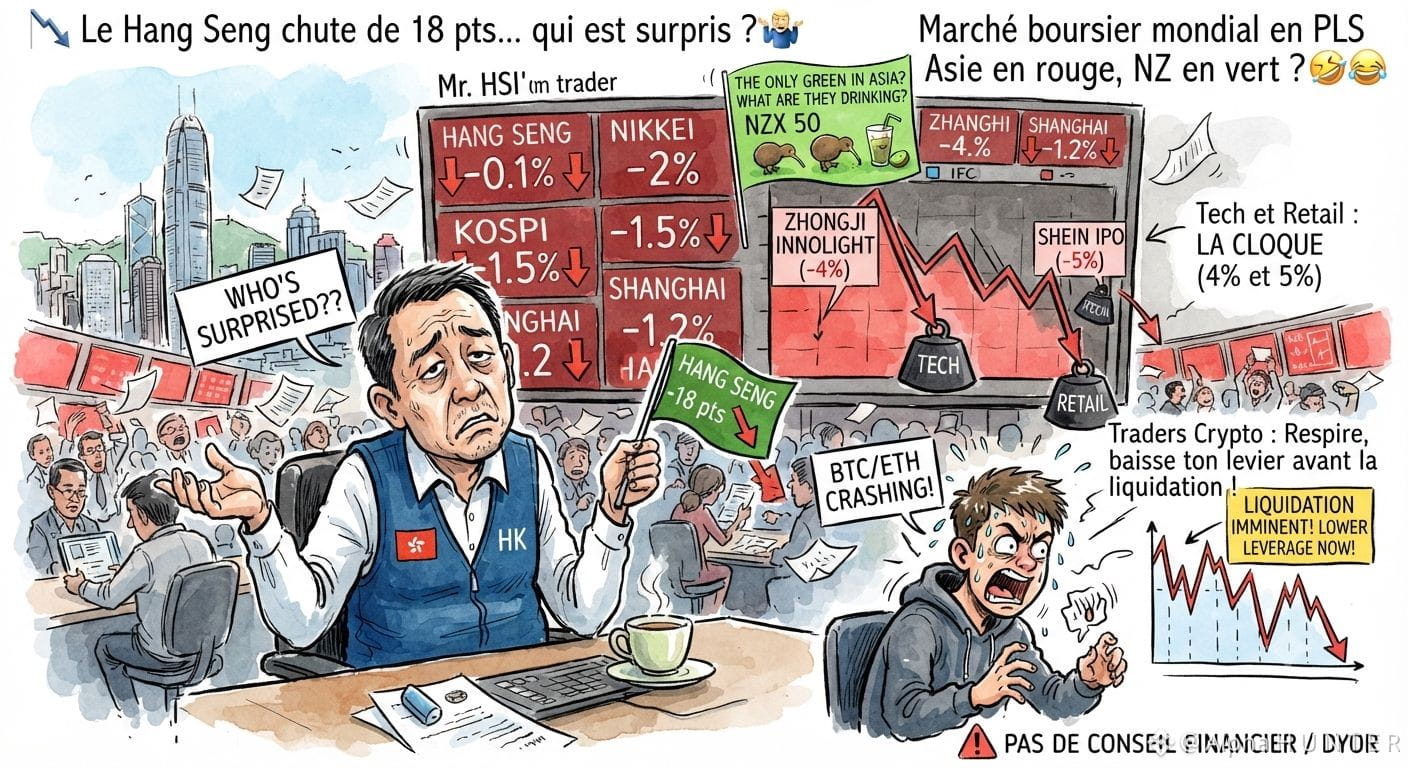
📉 Hang Seng drops by 18 points... but who’s surprised? 🤷‍♂️
When the whole global stock market is bleeding, Hong Kong’s fall is just another Tuesday, right? Actually, across all of Asia, only New Zealand managed to stay in the green. What are they drinking over there? 🥝😂
The main culprits dragging the Hang Seng down today? Tech and retail took a beating! Major tech companies and those tied to the AI supply chain, like Zhongji Innolight, fell by 4%, while the new entrant in retail, Shein, plunged by 5% after its IPO, bringing down market sentiment.
So what should crypto traders do? Stop obsessing over traditional stock charts, breathe, and maybe lower your leverage before you get liquidated.
🚨 THIS IS NOT FINANCIAL ADVICE! Always do your own research (DYOR).
#HangSeng #stocksmarket #GlobalMarket
$T
$MAGMA
$NVDAB
See translation
gm fam! 🤝 We're seeing $HSI face some institutional selling as heavyweights unwind across the board! ✨ Smart money took a defensive stance today as the index declined 0.89%, driven by widespread distribution across 23 of 32 heavyweight constituents. Major selling pressure hit financial infrastructure hard, with HKEX shedding 4.42% to test deeper liquidity zones, while Lenovo showed isolated relative strength up 1.80%. 💪 This broad-based rotation looks like institutional risk mitigation rather than an isolated sector shakeout. We're taking it one step at a time and keeping key market structure levels under the microscope until order flow gives us clear stabilization volume for a reclaim setup. How are we playing this, fam? Are you waiting for a confirmed demand sweep before bidding or expecting further structural weakness? 👇 ⚠️ Not financial advice. Always manage your risk. 🤝 #HSI #HangSeng #MarketStructure #RiskOff We grow together.
gm fam! 🤝 We're seeing $HSI face some institutional selling as heavyweights unwind across the board! ✨

Smart money took a defensive stance today as the index declined 0.89%, driven by widespread distribution across 23 of 32 heavyweight constituents. Major selling pressure hit financial infrastructure hard, with HKEX shedding 4.42% to test deeper liquidity zones, while Lenovo showed isolated relative strength up 1.80%. 💪

This broad-based rotation looks like institutional risk mitigation rather than an isolated sector shakeout. We're taking it one step at a time and keeping key market structure levels under the microscope until order flow gives us clear stabilization volume for a reclaim setup. How are we playing this, fam? Are you waiting for a confirmed demand sweep before bidding or expecting further structural weakness? 👇

⚠️ Not financial advice. Always manage your risk. 🤝

#HSI #HangSeng #MarketStructure #RiskOff

We grow together.
See translation
Hong Kong stocks barely moved lower. So why is anyone watching it? Because sometimes the lack of movement tells you more than a huge candle. A small Hang Seng decline suggests investors aren't completely abandoning risk, but they're also not aggressively chasing it. The bigger question is what happens next across China equities, tech stocks, the yuan and global liquidity expectations. Here's the investigation I'd make: Is weakness isolated to Hong Kong? Or is it part of a broader risk-off move? Bull: stabilization in Asian equities + improving liquidity expectations could support global risk assets. Bear: renewed China weakness spreads into global markets. Crypto traders should watch BTC alongside Asian markets rather than treating them separately. No need to force a trade from an 18-point move. Sometimes the signal isn't the drop. It's what refuses to drop with it. #HangSeng #ChinaMarkets #GlobalMarkets $CFX {future}(CFXUSDT) $BNB {future}(BNBUSDT) $ARB {future}(ARBUSDT) #hangsengcloses18pointslower
Hong Kong stocks barely moved lower. So why is anyone watching it?
Because sometimes the lack of movement tells you more than a huge candle.
A small Hang Seng decline suggests investors aren't completely abandoning risk, but they're also not aggressively chasing it.
The bigger question is what happens next across China equities, tech stocks, the yuan and global liquidity expectations.
Here's the investigation I'd make:
Is weakness isolated to Hong Kong?
Or is it part of a broader risk-off move?
Bull: stabilization in Asian equities + improving liquidity expectations could support global risk assets.
Bear: renewed China weakness spreads into global markets.
Crypto traders should watch BTC alongside Asian markets rather than treating them separately.
No need to force a trade from an 18-point move.
Sometimes the signal isn't the drop. It's what refuses to drop with it.
#HangSeng #ChinaMarkets #GlobalMarkets
$CFX
$BNB
$ARB

#hangsengcloses18pointslower
Verified
See translation
#hangsengcloses18pointslower 📉🔥 HANG SENG CLOSES 18 POINTS LOWER — BUT THE MARKET ISN’T SLEEPING! 🇭🇰 Hong Kong stocks ended slightly lower, with the Hang Seng slipping 18 points as traders remain cautious amid shifting global risk sentiment. 👀 Why It Matters: A small decline doesn’t necessarily mean weakness — it can signal a market waiting for the next major catalyst before making its bigger move. ⚡ FOMO ALERT: With global markets watching U.S. rates, geopolitics, tech stocks, and China’s economic outlook, volatility can return quickly. 📊 One quiet close can come before a very loud move. 🔥 Traders are watching. The next session could decide whether this is just a pause… or the beginning of something bigger. #HangSeng #HongKong #markets
#hangsengcloses18pointslower
📉🔥 HANG SENG CLOSES 18 POINTS LOWER — BUT THE MARKET ISN’T SLEEPING!
🇭🇰 Hong Kong stocks ended slightly lower, with the Hang Seng slipping 18 points as traders remain cautious amid shifting global risk sentiment.
👀 Why It Matters:
A small decline doesn’t necessarily mean weakness — it can signal a market waiting for the next major catalyst before making its bigger move.
⚡ FOMO ALERT:
With global markets watching U.S. rates, geopolitics, tech stocks, and China’s economic outlook, volatility can return quickly.
📊 One quiet close can come before a very loud move.
🔥 Traders are watching. The next session could decide whether this is just a pause… or the beginning of something bigger.
#HangSeng #HongKong #markets
·
--
Bullish
Verified
See translation
Hang Seng Gives Up Most of Its Early Gains After Opening Over 220 Points Higher 📊 Hong Kong's stock market opened higher on October 12, with the Hang Seng Index gaining 223 points (+0.9%) to reach 24,434. However, by midday, the index was up only around 42 points (+0.17%), erasing more than 80% of its initial gains. 💻 Technology stocks led the early advance, with Alibaba rising approximately 3%, NetEase gaining 2%, and the Hang Seng Tech Index climbing 1%. Buying momentum gradually weakened, however, pushing the technology index down around 0.55% by late morning. 📉 The pullback in gains suggests investors remain relatively cautious despite the market's strong recovery in the previous session. The lack of sustained buying pressure indicates that upward momentum has yet to stabilize. 🌐 Investors are also watching the upcoming US bank earnings reports and inflation data, which could influence risk appetite and the direction of regional equity markets. #HangSeng $CXMT $BNB
Hang Seng Gives Up Most of Its Early Gains After Opening Over 220 Points Higher

📊 Hong Kong's stock market opened higher on October 12, with the Hang Seng Index gaining 223 points (+0.9%) to reach 24,434. However, by midday, the index was up only around 42 points (+0.17%), erasing more than 80% of its initial gains.

💻 Technology stocks led the early advance, with Alibaba rising approximately 3%, NetEase gaining 2%, and the Hang Seng Tech Index climbing 1%. Buying momentum gradually weakened, however, pushing the technology index down around 0.55% by late morning.

📉 The pullback in gains suggests investors remain relatively cautious despite the market's strong recovery in the previous session. The lack of sustained buying pressure indicates that upward momentum has yet to stabilize.

🌐 Investors are also watching the upcoming US bank earnings reports and inflation data, which could influence risk appetite and the direction of regional equity markets.

#HangSeng $CXMT $BNB
·
--
Partly True
Article
See translation
Hang Seng Falls 1% as Oil Prices, Geopolitical Risks and Higher Yields Pressure Asian Markets#hangsengfalls1% Hang Seng Drops 1% as Global Risk-Off Pressure Hits Asian Markets Hong Kong stocks came under pressure on September 1, with the Hang Seng Index falling around 1%, down 256.11 points to 25,310.88 by midday. The decline reflects broader concerns across Asian markets as investors assess rising oil prices, geopolitical tensions, inflation risks and higher global bond yields. 📉 Why Is Hang Seng Falling? Several macro factors are weighing on sentiment: 🛢️ Higher oil prices are raising concerns about renewed inflation. 🌍 Geopolitical tensions are pushing investors toward a more cautious stance. 📈 Higher bond yields are increasing pressure on equity valuations. 💻 Hong Kong technology stocks are also facing selling pressure as risk appetite weakens. 👀 What Traders Should Watch The Hang Seng's move highlights how quickly global macro developments can affect Asian equities. Traders are now watching: Oil prices and energy-market developmentsU.S. interest-rate expectationsGlobal bond yieldsGeopolitical developmentsUpcoming economic dataOverall risk sentiment If oil prices remain elevated while yields continue rising, pressure could spread across other risk assets, including technology stocks and cryptocurrencies. 🌏 The Bigger Picture The 1% Hang Seng decline isn't necessarily a signal of a deeper market crash by itself. Instead, it shows how sensitive markets have become to the combination of inflation, interest rates and geopolitical risk. For crypto traders, the key question is whether the weakness remains concentrated in Asian equities or develops into a broader global risk-off move. ⚠️ Not financial advice. DYOR. $0G {spot}(0GUSDT) $TWT {spot}(TWTUSDT) $ONG {spot}(ONGUSDT) #HangSeng #HongKong #AsianMarkets #StockMarket #MarketUpdate #CryptoMarket #RiskOff

Hang Seng Falls 1% as Oil Prices, Geopolitical Risks and Higher Yields Pressure Asian Markets

#hangsengfalls1%
Hang Seng Drops 1% as Global Risk-Off Pressure Hits Asian Markets
Hong Kong stocks came under pressure on September 1, with the Hang Seng Index falling around 1%, down 256.11 points to 25,310.88 by midday.
The decline reflects broader concerns across Asian markets as investors assess rising oil prices, geopolitical tensions, inflation risks and higher global bond yields.
📉 Why Is Hang Seng Falling?
Several macro factors are weighing on sentiment:
🛢️ Higher oil prices are raising concerns about renewed inflation.
🌍 Geopolitical tensions are pushing investors toward a more cautious stance.
📈 Higher bond yields are increasing pressure on equity valuations.
💻 Hong Kong technology stocks are also facing selling pressure as risk appetite weakens.
👀 What Traders Should Watch
The Hang Seng's move highlights how quickly global macro developments can affect Asian equities.
Traders are now watching:
Oil prices and energy-market developmentsU.S. interest-rate expectationsGlobal bond yieldsGeopolitical developmentsUpcoming economic dataOverall risk sentiment
If oil prices remain elevated while yields continue rising, pressure could spread across other risk assets, including technology stocks and cryptocurrencies.
🌏 The Bigger Picture
The 1% Hang Seng decline isn't necessarily a signal of a deeper market crash by itself.
Instead, it shows how sensitive markets have become to the combination of inflation, interest rates and geopolitical risk.
For crypto traders, the key question is whether the weakness remains concentrated in Asian equities or develops into a broader global risk-off move.
⚠️ Not financial advice. DYOR.
$0G
$TWT
$ONG
#HangSeng #HongKong #AsianMarkets #StockMarket #MarketUpdate #CryptoMarket #RiskOff
See translation
#Hang Seng The Hang Seng Index closed 18 points lower at 25,311, a decline of less than 0.1%. The Hang Seng TECH Index was weaker, falling about 0.7%. The modest decline shows a cautious market mood, with higher oil prices and renewed geopolitical tensions adding pressure to risk assets and technology stocks Binance post: 🇭🇰 Hang Seng closes 18 points lower — a quiet but cautious session for Asian markets. With oil prices rising and tech stocks under pressure, traders remain focused on global risk sentiment. #HangSeng #HongKong #Asianmarket #GlobalMarkets
#Hang Seng

The Hang Seng Index closed 18 points lower at 25,311, a decline of less than 0.1%. The Hang Seng TECH Index was weaker, falling about 0.7%.

The modest decline shows a cautious market mood, with higher oil prices and renewed geopolitical tensions adding pressure to risk assets and technology stocks

Binance post:
🇭🇰 Hang Seng closes 18 points lower — a quiet but cautious session for Asian markets. With oil prices rising and tech stocks under pressure, traders remain focused on global risk sentiment.

#HangSeng #HongKong #Asianmarket #GlobalMarkets
Article
Hang Seng Closes -18 Points: Calm or Calm Before the Storm?Asia’s market woke up cautiously this morning. The Hang Seng index in Hong Kong closed slightly in the red, down just 18 points. 👀 What the data is telling us: • Controlled Volume: There was no panic selling. The market is in a "wait and see" mode. • The Macro Backdrop: Investors are balancing three hot plates: expectations for US interest rates, rising oil prices, and China’s economic recovery. 💡 Quick Take: A drop this small doesn’t point to structural weakness—it signals a market building up momentum and waiting for the next major global catalyst to set the direction.

Hang Seng Closes -18 Points: Calm or Calm Before the Storm?

Asia’s market woke up cautiously this morning. The Hang Seng index in Hong Kong closed slightly in the red, down just 18 points.
👀 What the data is telling us:
• Controlled Volume: There was no panic selling. The market is in a "wait and see" mode.
• The Macro Backdrop: Investors are balancing three hot plates: expectations for US interest rates, rising oil prices, and China’s economic recovery.
💡 Quick Take: A drop this small doesn’t point to structural weakness—it signals a market building up momentum and waiting for the next major global catalyst to set the direction.
Log in to explore more content
Join global crypto users on Binance Square
⚡️ Get latest and useful information about crypto.
💬 Trusted by the world’s largest crypto exchange.
👍 Discover real insights from verified creators.
Email / Phone number