
#block
block
48,492 views
351 Discussing
Hot
Latest

·
--
See translation
Jack Dorsey's Block kept stacking bitcoin in Q3, adding 120 BTC to its balance sheet.
• Block held about 9,237 BTC on September 30, up from 9,117 at the end of June
• Its bitcoin was valued at $771.9 million, against a cost basis of $318.6 million
• The quarter brought a $229.7 million remeasurement gain on that bitcoin
Why it matters: Block is one of the larger public-company bitcoin holders, and it keeps adding small amounts every quarter.
Source: Block 10-Q filing (SEC)
Not financial advice.
💬 Should more public companies hold bitcoin on their balance sheet? Share your view below.
$BTC #Block #BitcoinTreasury
38

·
--
See translation
Block's DOJ settlement is bigger than its entire quarterly profit.
$764M proposed to resolve the anti-money-laundering probe, vs $566M Q3 profit (CoinDesk).
A criminal charge would be deferred for 3 years.
Meanwhile Block's bitcoin gross profit fell 50% to $52M after Cash App cut fees on some BTC transactions.
Takeaway: compliance is now a line item that can outweigh trading revenue. Exchanges and payment apps handling $BTC will keep feeling that pressure as US rules tighten.
Does heavier compliance cost make crypto safer, or just push users to bigger platforms?
#Bitcoin #Crypto #Regulation #Block
1

·
--
See translation
A double hit for Jack Dorsey’s Block! 📉
The fintech powerhouse is facing a potential $764M settlement with the US DOJ, just as its Q3 Bitcoin gross profit dropped a staggering 50%.
Combining heavy regulatory scrutiny with shrinking BTC margins creates a challenging environment for one of crypto's biggest corporate advocates.
How do you see this impacting Block's long-term Bitcoin strategy? Share your thoughts below! 👇
#Block #Bitcoin #CryptoNews
4

See translation
Block just put a number on its AML fight — and I'm reading the fine print first. Jack Dorsey's Block has agreed in principle to pay about $764 million to resolve a US Justice Department probe into its anti-money-laundering controls, Reuters and CoinDesk report, following an October agreement disclosed in a November 3 SEC filing. Gross, the figure is about $964 million, reduced after credits for earlier settlements, and the deal would defer a criminal charge for three years over an alleged failure to maintain an AML program under the Bank Secrecy Act. It is not final: a final agreement and court approval are needed, and Block warned losses could exceed what it has set aside. Its bitcoin arm shrank — Cash App bitcoin gross profit fell 50% to $52 million in Q3, which Block blamed on lower fees on some bitcoin transactions. $BTC near $78,018 (+1.8%/24h) on Binance spot is context, not proof this news moved it. Does a $764 million AML bill make firms safer, or just more cautious? NFA, DYOR. #CryptoMarkets #Regulation #DOJ #Block
Block just put a number on its AML fight — and I'm reading the fine print first. Jack Dorsey's Block has agreed in principle to pay about $764 million to resolve a US Justice Department probe into its anti-money-laundering controls, Reuters and CoinDesk report, following an October agreement disclosed in a November 3 SEC filing. Gross, the figure is about $964 million, reduced after credits for earlier settlements, and the deal would defer a criminal charge for three years over an alleged failure to maintain an AML program under the Bank Secrecy Act. It is not final: a final agreement and court approval are needed, and Block warned losses could exceed what it has set aside. Its bitcoin arm shrank — Cash App bitcoin gross profit fell 50% to $52 million in Q3, which Block blamed on lower fees on some bitcoin transactions. $BTC near $78,018 (+1.8%/24h) on Binance spot is context, not proof this news moved it. Does a $764 million AML bill make firms safer, or just more cautious? NFA, DYOR. #CryptoMarkets #Regulation #DOJ #Block
24

One harsh truth: The company of Bitcoin’s godfather is taking a harder hit from compliance failures than from Bitcoin’s price swings.
Block disclosed in its Nov. 3 10-Q that it had agreed in principle to pay $764 million to settle a Justice Department investigation: Cash App fell short on anti-money-laundering controls, and criminal charges will be deferred for three years. It’s only an agreement in principle; the final deal and court approval are not yet settled. The total is $964 million, reduced to $764 million after credit for prior payments.
The books sting even more: In Q3, company-wide gross profit rose 22% to $3.24 billion, while gross profit from its Bitcoin business was cut in half, falling from $104 million to $52 million. The company said it proactively lowered Cash App’s Bitcoin fees, aiming to make Bitcoin a payment channel rather than a casino.
Yet the penalty is nearly $200 million more than the quarter’s $566 million in net income. Pick one in the comments: A) Dorsey is paving the way for payments—painful in the short term, worth it in the long run; B) If he can’t even manage compliance at his own company, why talk about spending Bitcoin like money?
$BTC $ETH $SOL #Block #CashApp
38

·
--
$764 million is a compliance bill.
Jack Dorsey’s Block has agreed to pay $764 million to settle a U.S. Department of Justice investigation into its anti-money laundering controls.
For companies in payments and crypto, anti-money laundering compliance isn’t optional. Falling short can cost hundreds of millions.
Regulatory developments may affect the companies involved and market sentiment. Make your own decisions and be aware of the risks.
#Block #反洗钱 #CryptoCompliance
49

·
--
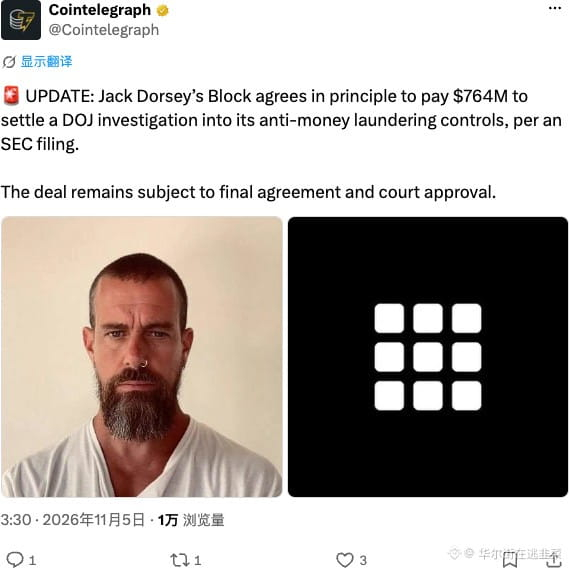
Block Inc. agreed to pay the U.S. Department of Justice $764 million to resolve an anti-money laundering compliance investigation.
Paying out $764 million in cold, hard cash is a massive hit to profits. Anti-money laundering compliance costs are alarmingly high, putting much greater pressure on ongoing operations. Margins in the payments sector are already thin, and this fine directly undermines the company’s valuation rationale.
$SQ #Block #Compliance
1

·
--
It made $566 million in a quarter, yet has to cough up $764 million to settle. I’ve been trying to make the math add up.
In an SEC filing, Jack Dorsey’s Block disclosed that it had agreed in principle to pay $764 million to resolve a U.S. Department of Justice investigation into its anti-money laundering compliance. Criminal charges will be deferred for three years. In the same earnings report, Cash App’s gross profit from Bitcoin was also cut in half, falling 50% to $52 million, mainly because the company lowered its fees.
Honestly, the fine is one thing. What I care more about is this: if even a company this big can stumble on compliance, can we really feel safe keeping our crypto on a platform? Personally, I still prefer to hold most of mine myself.
What do you think—is Block’s fine expensive or cheap? DYOR
#比特币 #Block #Compliance
34

·
--
A fine bigger than a quarter’s profit? Jack Dorsey’s Block has to pay $764 million 💸
📌 Block has reached an agreement in principle with the U.S. Department of Justice to resolve its anti-money laundering (AML) investigation, for $764M—more than its Q3 profit of $566M.
📌 Criminal charges will be deferred for 3 years (under a deferred prosecution agreement).
📌 Q3 Bitcoin gross profit was cut in half year over year, down 50% to $52M, mainly due to lower Cash App transaction fees; overall gross profit rose 22% to $3.24B. (Source: CoinDesk)
👉 My take: Compliance costs are becoming a hard cost for payments and trading companies. U.S. regulators haven’t eased up just because they’re “pro-crypto”—anti-money laundering remains a red line. For users, choosing a compliant platform with solid risk controls matters more than chasing low fees.
⚠️ The other side: As fees get driven lower and lower, Bitcoin business profits are being squeezed, and the “sell coins for a spread” model is thinning out.
What do you think: Will the fine affect Block’s continued Bitcoin business? Share your thoughts in the comments 👇
$BTC $ETH
#Block #加密监管 #Bitcoin
Personal opinion only; not investment advice

10

·
--
Two dark horses have emerged during earnings season. Payments giant Block (ticker XYZ) and construction software provider Procore (ticker PCOR) both reported quarterly results that beat market expectations. Their shares jumped around 15% and 16%, respectively, after the earnings announcements, standing out in a volatile market.
For the crypto market, Block is especially worth a closer look. Its Cash App has long supported Bitcoin trading, and Bitcoin-related revenue makes up a significant share of its revenue. Strong fundamentals at a publicly traded company with deep exposure to digital assets suggest that retail users’ demand for mobile payments and crypto assets remains resilient—a cautiously positive sign for industry sentiment.
Still, after a sharp rally, it’s important to stay level-headed. Investors are reacting to earnings ever more briefly, and gains on good news often come with increased volatility, making the risks of chasing a rally hard to ignore. More important than a single day’s gains are the company’s guidance for next quarter and the macro liquidity environment, which will determine whether the momentum can continue.
#美股财报 #Block #Bitcoin


·
--
See translation
Block, the company behind Cash App, just reached an agreement in principle with the US Department of Justice over anti-money-laundering failures, a deal worth about $964 million.
Under the three-year deferred prosecution agreement, the DOJ will suspend a Bank Secrecy Act charge tied to gaps in Cash App's transaction monitoring and customer due diligence. The net payment comes to roughly $764 million after a $200 million credit for prior resolutions, money Block had already largely set aside. Shares rose about 8% after hours. The market read this as the end of a long overhang, not a new shock.
The read-through for crypto is straightforward. Cash App is one of America's biggest retail on-ramps for $BTC, and US regulators are now pricing compliance failures in the billions, not millions. That raises the bar for every payments app touching crypto. Compliance is no longer a back-office cost, it is a balance-sheet event.
The honest risk: this is an agreement in principle, still subject to court approval, and three years of federal oversight lie ahead. It also caps a long enforcement trail, $40M from New York in 2025, an $80M multistate settlement, a $175M CFPB order, and it does not answer how much illicit volume slipped through while monitoring lagged.
Fair penalty, or just the cost of doing business? Drop your take below.
📌 Sharing personal opinions only, not financial advice or a recommendation to buy/sell. Crypto is highly risky; DYOR and you are solely responsible. No coin promotion.
#Block #CashApp #DOJ #Crypto #Binance
Block, the company behind Cash App, just reached an agreement in principle with the US Department of Justice over anti-money-laundering failures, a deal worth about $964 million.
Under the three-year deferred prosecution agreement, the DOJ will suspend a Bank Secrecy Act charge tied to gaps in Cash App's transaction monitoring and customer due diligence. The net payment comes to roughly $764 million after a $200 million credit for prior resolutions, money Block had already largely set aside. Shares rose about 8% after hours. The market read this as the end of a long overhang, not a new shock.
The read-through for crypto is straightforward. Cash App is one of America's biggest retail on-ramps for $BTC , and US regulators are now pricing compliance failures in the billions, not millions. That raises the bar for every payments app touching crypto. Compliance is no longer a back-office cost, it is a balance-sheet event.
The honest risk: this is an agreement in principle, still subject to court approval, and three years of federal oversight lie ahead. It also caps a long enforcement trail, $40M from New York in 2025, an $80M multistate settlement, a $175M CFPB order, and it does not answer how much illicit volume slipped through while monitoring lagged.
Fair penalty, or just the cost of doing business? Drop your take below.
📌 Sharing personal opinions only, not financial advice or a recommendation to buy/sell. Crypto is highly risky; DYOR and you are solely responsible. No coin promotion.
#Block #CashApp #DOJ #Crypto #Binance
AVCI3503:
benı mı sorusturcaklar soruş tutsunlar acıkcası desekı bu parayı vermıyom daha ıyı anlarım bahane bahane vermeyın sorun yok benım deyılse sızınde deyıl derım bende kara para aklıcam ama kırada oturacam aclıktan ölcem kara para aklıcam sacmalıga bak gel yanımda arastır benı uzaktan ses guzel zaten cnm sıkkın yakarım tehtıt deyıl bu mantıklı dusunun tmm
1
1.1k

·
--
$764 million—Block’s anti-money laundering fine is bigger than its entire quarterly profit
What we know: CoinDesk reported on November 4 that Jack Dorsey’s Block has agreed in principle to pay $764 million to the U.S. Department of Justice to settle an investigation into its anti-money laundering procedures.
The total agreement is worth about $964 million, reduced to $764 million after credit for previous regulatory settlements. Block says it has fully accrued the amount, and the related charges are expected to be deferred for three years.
My take: This isn’t just a matter of paying a fine and moving on. It draws a line for every company handling Bitcoin payments: if your anti-money laundering procedures fall short, your profits may not be enough to cover the fine.
For comparison: Block’s third-quarter profit was $566 million, so the fine exceeds it by about $198 million. Over the same period, gross profit from its Bitcoin business was cut in half to $52 million, while overall gross profit rose 22% to $3.24 billion.
What I’m doing: For now, I see this as a signal that compliance costs are rising—not as evidence that Block is going under.
What would invalidate this view: If the final agreement amount changes significantly or the DOJ doesn’t approve it, this assessment no longer holds.
Do you think the U.S. is tightening the screws on crypto payments, or is this just a reckoning for Block’s past conduct?
$BTC $ETH $SOL
#Block #Compliance

93

·
--
【Sold $1.77 billion worth of Bitcoin, made only $52 million! Dorsey’s Block sees Bitcoin business profit halved】
Jack Dorsey’s payments company Block reported about $1.77 billion in Bitcoin business revenue in the third quarter, but gross profit was just $52 million, down 50% year over year. The main reason was that Cash App proactively lowered transaction fees on some Bitcoin trades. The company’s overall results beat expectations, with total gross profit rising 22% to $3.24 billion and its full-year outlook raised. Shares rose about 6% after hours.
$BTC
#Block #财报季 #Bitcoin
102
·
--
Block agrees to pay a $764 million fine—more than one quarter’s profit 💸
In an SEC filing submitted on November 3, Jack Dorsey’s Block disclosed that it had reached an agreement in principle with the U.S. Department of Justice over Bank Secrecy Act (BSA) issues. The company plans to pay $764M, and criminal charges will be deferred for three years under a deferred prosecution agreement (Source: CoinDesk).
📊 Key figures
• Settlement: $764M > Q3 profit: $566M
• Gross profit from the Bitcoin business fell 50% year over year to $52M, mainly due to lower transaction fees
• Overall gross profit rose 22% to $3.24B
🔍 My take
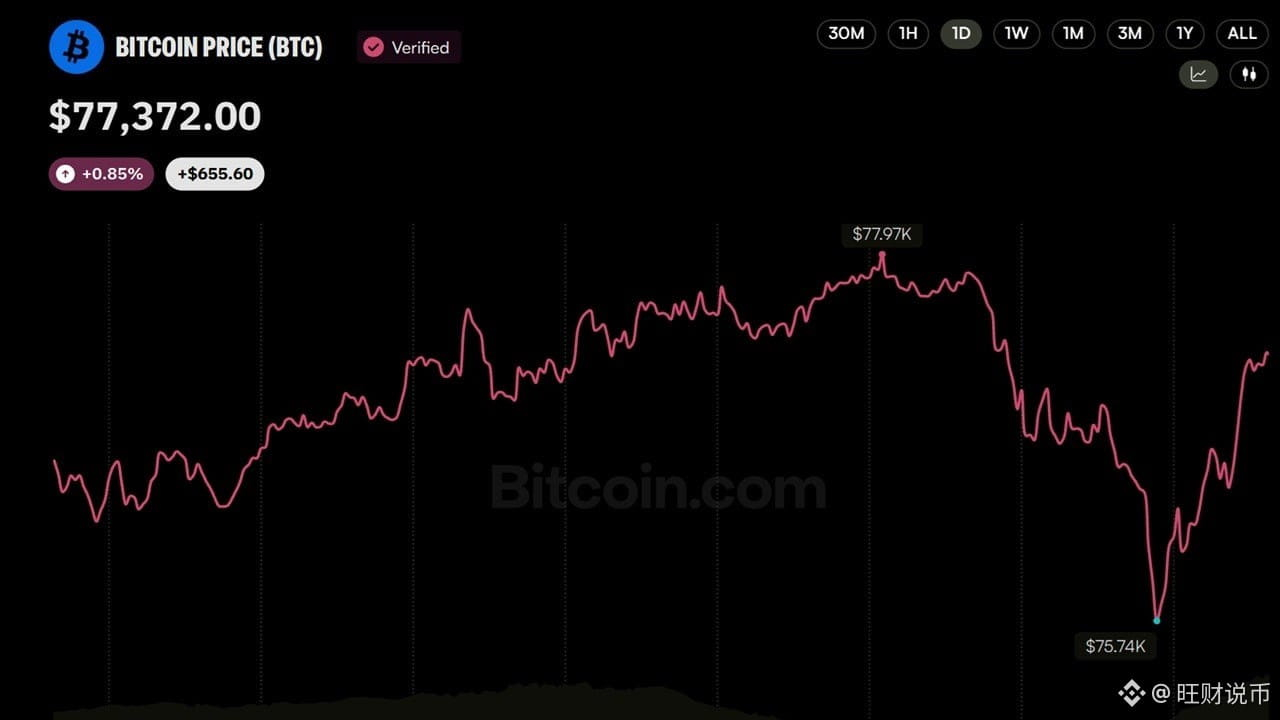
Compliance costs are becoming a “hard barrier” for crypto businesses. Binance has just suffered a major theft, and now Block has been fined—regulatory and security pressures are tightening at the same time. The short-term impact on BTC is limited (currently around $77,000; CoinDesk says momentum indicators are oversold, while 10x Research sees a rebound to $82,000), but institutional investors favor compliant, transparent assets. The Fear and Greed Index is at 34, still in fear territory.
👉 Do you think compliance fines will lead more companies to scale back their BTC businesses, or will they make the industry more mature? Share your thoughts in the comments 👇
$BTC $ETH #Block #加密监管 #Bitcoin
Personal opinion only; not investment advice

·
--
Jack Dorsey’s payments company Block has agreed in principle to pay about $764 million to settle the Justice Department’s anti-money-laundering investigation.
That sum is larger than its roughly $566 million in third-quarter profit. The agreement defers a criminal charge for three years: that Block failed to properly manage its anti-money-laundering program under the Bank Secrecy Act. The gross amount is about $964 million, reduced to roughly $764 million after credits for previous regulatory settlements; the company says it has already accrued for it.
In the same SEC filing, gross profit from Cash App’s bitcoin business was cut in half to about $52 million, mainly due to lower fees on some transactions; overall gross profit still rose about 22%. The investigation began after a short-seller report in 2023. The SEC closed its investigation in March this year without taking enforcement action—but the Justice Department’s settlement is still being finalized.#Block #BTC

104

Jack Dorsey’s Block faces a $764 million fine from the DOJ as Bitcoin profits fall 50%
- Jack Dorsey’s company Block is facing a $764 million settlement with the U.S. Department of Justice (DOJ).
- The agreement aims to resolve a federal anti-money laundering (AML) investigation.
- Block’s quarterly Bitcoin gross profit fell 50% due to lower transaction fees on the Cash App.
#Block #Bitcoin #CryptoNews #DOJ #AML BinanceSquare
$btc btc
vlikevn Titanbot
Source: CoinDesk
155

·
--
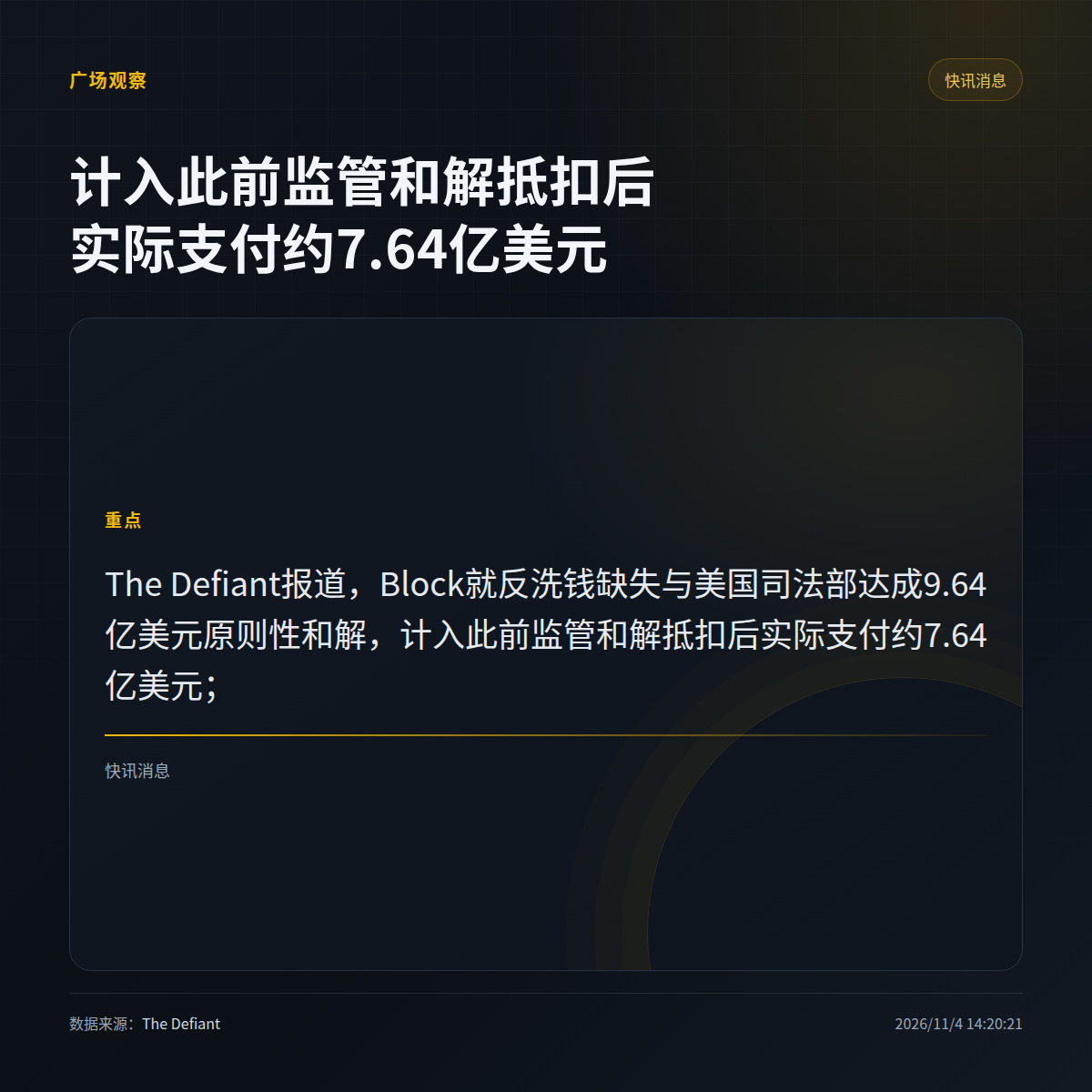
Block reaches a $964 million settlement in principle with the U.S. Department of Justice over anti-money laundering failures.
The Defiant reported that, after credits for previous regulatory settlements, the actual payment will be about $764 million. The same source also disclosed that gross profit related to Block’s Bitcoin ecosystem fell 50%, mainly because Cash App lowered its fees.
· The settlement amount is clear, but “in principle” means the final terms have yet to be finalized.
· The decline in gross profit was attributed to lower fees and is separate from the settlement.
Are you more interested in the final settlement amount or the trend in gross profit after Cash App’s fee adjustments?
#Block #CashApp
Block shares rise 6% after hours on higher profit guidance
- Block Inc. (formerly Square) raised its full-year gross profit guidance to $12.63 billion
- Up 22% year over year
- Shares rose 6% in after-hours trading
- Block holds a significant amount of Bitcoin on its balance sheet and operates Bitcoin services through Cash App
#BinanceSquare #CryptoNews #BTC #Block
$btc
#vlikevn Titanbot
Source: The Block
188

·
--
🔥 Bitcoin business profits halved, yet payments giant Block keeps earning more?
On November 3, Block released its third-quarter earnings report: total gross profit was $3.235 billion, up 22% year over year; but gross profit from its Bitcoin ecosystem business was just $52 million, plunging 50% year over year!
Does this mean people aren’t buying BTC anymore?
Not necessarily! The company explicitly said the main reason was that it proactively lowered fees on some Bitcoin transactions in Cash App.
Meanwhile, payments and lending are driving growth, with Cash App gross profit up 27% year over year.
This shows that transaction volume doesn’t equal platform profit—fees are the key!
What to watch next: whether lower fees can attract more users, and whether gross profit from the Bitcoin business can stop falling.
#BTC🔥🔥🔥🔥🔥 #bitcoin #block #CashApp #美股

219
·
--
Block’s net profit topped $500 million and it raised its outlook, but profits from its Bitcoin ecosystem were cut in half. The company is raking it in, while its Bitcoin business is shrinking. What does this divergence mean? Short-term good news is already priced in, but Jack Dorsey’s “Bitcoin first” strategy is being tempered by reality. Don’t let the overall results distract you—the core business faltering is the real risk.
BTC
#Block #CryptoNews
BTC
#Block #CryptoNews

7
Log in to explore more content
Join global crypto users on Binance Square
⚡️ Get latest and useful information about crypto.
💬 Trusted by the world’s largest crypto exchange.
👍 Discover real insights from verified creators.
Email / Phone number
Trending Topics
1
#JobsReportRaisesHikeOdds
6,321 views
224 Discussing
2
#US Data Center Rules May Constrain AI Expansion
1,220 views
37 Discussing
3
#CanUSStocksReboundAfterNonfarmPayrolls?
16,997 views
472 Discussing
4
#BinanceReopensWithdrawalsForMoreAssets
1.2M views
6,566 Discussing
5
#$2TWipedOutHedgeFundsFaceLiquidation
6,664 views
61 Discussing
6
#USNovemberMichiganExpectationsIndexPrelimAt50.9
0 views
23 Discussing
7
#AnthropicIPOValuationDoubts
46,345 views
806 Discussing
8
#OilPlungesBelow$100
2,066 views
23 Discussing
9
#USMidtermsCouldShakeUpUS-IranTies
12,999 views
249 Discussing
10
#RussianCentralBankNamesBTCETHUSDTForNonQualifiedInvestors
120 views
3 Discussing