
#signdigitalsovereigninfra
signdigitalsovereigninfra
12.2M views
97,300 Discussing
Hot
Latest

·
--
See translation
#openledger $OPEN Focus on Sovereign Infrastructure
Empowering regions with robust decentralized architecture is the next massive frontier for Web3. By building foundational digital sovereign infrastructure, @SignOfficial is positioning itself perfectly to drive real-world economic growth and scale utility. Looking forward to seeing the long-term impact of $SIGN across emerging markets. #SignDigitalSovereignInfra
#openledger $OPEN Focus on Sovereign Infrastructure
Empowering regions with robust decentralized architecture is the next massive frontier for Web3. By building foundational digital sovereign infrastructure, @SignOfficial is positioning itself perfectly to drive real-world economic growth and scale utility. Looking forward to seeing the long-term impact of $SIGN across emerging markets. #SignDigitalSovereignInfra
Empowering regions with robust decentralized architecture is the next massive frontier for Web3. By building foundational digital sovereign infrastructure, @SignOfficial is positioning itself perfectly to drive real-world economic growth and scale utility. Looking forward to seeing the long-term impact of $SIGN across emerging markets. #SignDigitalSovereignInfra
265


·
--
See translation
The Worst Part Is Not Seeing "Revoked." It Is One Live Row Going Bad Right Before Money Moves.The operator moment that sticks with me is ugly because it is so normal. A payout run is already open. One wallet is already sitting in the table. The proof tied to that row looked fine earlier. Now it does not. You reopen it and the status is bad. That part is easy. The problem starts right after that. Expired is not fraud. Superseded is not disputed. Issuer mistake is not user deception. But if all of them land as the same flat red state, the system is basically telling the operator to improvise the rest.
And that is where real mistakes start. One row should probably wait for refreshed evidence. Another should be replaced and moved forward. Another should freeze immediately. Another might need clawback. Another should go nowhere until somebody investigates. Same red mark on the screen. Totally different next moves. Collapse the reason and the wrong row gets frozen, or the wrong case gets hit with clawback, or support gives the user a neat answer that the record itself cannot actually defend.
That is the part in SIGN that feels real to me. Not the abstract idea that proof can be checked. I care about the moment one proof turns bad in the middle of a live run and the system still has to keep the next step honest. For that moment, I do not need a long stack story. I need two things. I need a control that can actually stop the row before a bad decision drifts forward. And I need the reason for that stop to survive in a way somebody else can replay later without dragging the answer out of chat, memory, or side spreadsheets.
That is why the revocation reason matters so much to me. Revocation is not one generic stop sign. In a payout flow, the reason is the branch. It tells you whether the row should sit still, whether new evidence can replace the old one, whether this is a temporary hold, or whether somebody just found something serious enough to shut the case down harder. If that reason disappears, the record still exists, but the real decision logic is already gone.
And once that logic leaks out, teams start doing dumb things with confidence. A support agent sees revoked and treats expiry like misconduct. An operator sees the same red state and freezes a row that only needed updated evidence. Somebody else applies clawback to a case that should have been replaced and settled. Later the user asks why their payout was blocked, and now nobody can point to one durable reason trail inside the evidence path. They can only retell the judgment after the damage is already done.
That is why freeze logic and a replayable reason trail feel more important to me than a clean verification badge. A bad state is survivable. A flat bad state is dangerous. The system does not break because one proof failed. It breaks when different failures get flattened into one label and the operator quietly becomes the hidden rules engine again.
That is where $SIGN starts to feel earned to me. Not because I need to force a token mention in. Because this is the real test. When one row goes bad right before money moves, can the system hold that row, preserve the reason, and make the next action replayable? Or does the truth fall out of the record the second the clean proof disappears?
That is the version of SIGN I keep watching for. Not whether it can tell me a record stopped qualifying. Whether it can stop the right row for the right reason, and still prove later why that exact branch was taken.
#SignDigitalSovereignInfra $SIGN @SignOfficial
The Worst Part Is Not Seeing "Revoked." It Is One Live Row Going Bad Right Before Money Moves.
The operator moment that sticks with me is ugly because it is so normal. A payout run is already open. One wallet is already sitting in the table. The proof tied to that row looked fine earlier. Now it does not. You reopen it and the status is bad. That part is easy. The problem starts right after that. Expired is not fraud. Superseded is not disputed. Issuer mistake is not user deception. But if all of them land as the same flat red state, the system is basically telling the operator to improvise the rest.
And that is where real mistakes start. One row should probably wait for refreshed evidence. Another should be replaced and moved forward. Another should freeze immediately. Another might need clawback. Another should go nowhere until somebody investigates. Same red mark on the screen. Totally different next moves. Collapse the reason and the wrong row gets frozen, or the wrong case gets hit with clawback, or support gives the user a neat answer that the record itself cannot actually defend.
That is the part in SIGN that feels real to me. Not the abstract idea that proof can be checked. I care about the moment one proof turns bad in the middle of a live run and the system still has to keep the next step honest. For that moment, I do not need a long stack story. I need two things. I need a control that can actually stop the row before a bad decision drifts forward. And I need the reason for that stop to survive in a way somebody else can replay later without dragging the answer out of chat, memory, or side spreadsheets.
That is why the revocation reason matters so much to me. Revocation is not one generic stop sign. In a payout flow, the reason is the branch. It tells you whether the row should sit still, whether new evidence can replace the old one, whether this is a temporary hold, or whether somebody just found something serious enough to shut the case down harder. If that reason disappears, the record still exists, but the real decision logic is already gone.
And once that logic leaks out, teams start doing dumb things with confidence. A support agent sees revoked and treats expiry like misconduct. An operator sees the same red state and freezes a row that only needed updated evidence. Somebody else applies clawback to a case that should have been replaced and settled. Later the user asks why their payout was blocked, and now nobody can point to one durable reason trail inside the evidence path. They can only retell the judgment after the damage is already done.
That is why freeze logic and a replayable reason trail feel more important to me than a clean verification badge. A bad state is survivable. A flat bad state is dangerous. The system does not break because one proof failed. It breaks when different failures get flattened into one label and the operator quietly becomes the hidden rules engine again.
That is where $SIGN starts to feel earned to me. Not because I need to force a token mention in. Because this is the real test. When one row goes bad right before money moves, can the system hold that row, preserve the reason, and make the next action replayable? Or does the truth fall out of the record the second the clean proof disappears?
That is the version of SIGN I keep watching for. Not whether it can tell me a record stopped qualifying. Whether it can stop the right row for the right reason, and still prove later why that exact branch was taken.
#SignDigitalSovereignInfra $SIGN @SignOfficial
And that is where real mistakes start. One row should probably wait for refreshed evidence. Another should be replaced and moved forward. Another should freeze immediately. Another might need clawback. Another should go nowhere until somebody investigates. Same red mark on the screen. Totally different next moves. Collapse the reason and the wrong row gets frozen, or the wrong case gets hit with clawback, or support gives the user a neat answer that the record itself cannot actually defend.
That is the part in SIGN that feels real to me. Not the abstract idea that proof can be checked. I care about the moment one proof turns bad in the middle of a live run and the system still has to keep the next step honest. For that moment, I do not need a long stack story. I need two things. I need a control that can actually stop the row before a bad decision drifts forward. And I need the reason for that stop to survive in a way somebody else can replay later without dragging the answer out of chat, memory, or side spreadsheets.
That is why the revocation reason matters so much to me. Revocation is not one generic stop sign. In a payout flow, the reason is the branch. It tells you whether the row should sit still, whether new evidence can replace the old one, whether this is a temporary hold, or whether somebody just found something serious enough to shut the case down harder. If that reason disappears, the record still exists, but the real decision logic is already gone.
And once that logic leaks out, teams start doing dumb things with confidence. A support agent sees revoked and treats expiry like misconduct. An operator sees the same red state and freezes a row that only needed updated evidence. Somebody else applies clawback to a case that should have been replaced and settled. Later the user asks why their payout was blocked, and now nobody can point to one durable reason trail inside the evidence path. They can only retell the judgment after the damage is already done.
That is why freeze logic and a replayable reason trail feel more important to me than a clean verification badge. A bad state is survivable. A flat bad state is dangerous. The system does not break because one proof failed. It breaks when different failures get flattened into one label and the operator quietly becomes the hidden rules engine again.
That is where $SIGN starts to feel earned to me. Not because I need to force a token mention in. Because this is the real test. When one row goes bad right before money moves, can the system hold that row, preserve the reason, and make the next action replayable? Or does the truth fall out of the record the second the clean proof disappears?
That is the version of SIGN I keep watching for. Not whether it can tell me a record stopped qualifying. Whether it can stop the right row for the right reason, and still prove later why that exact branch was taken.
#SignDigitalSovereignInfra $SIGN @SignOfficial
2
138

·
--
Article
See translation
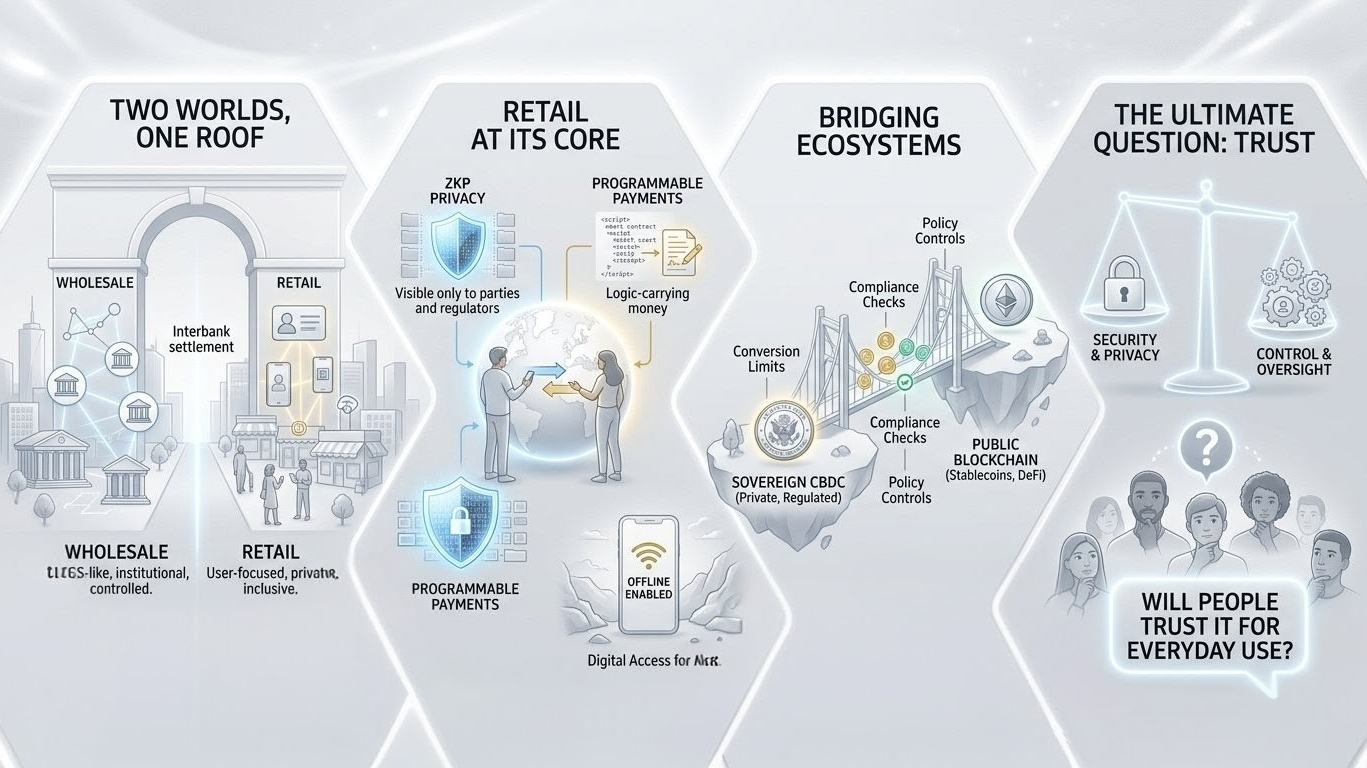
The Moment I Realized This CBDC Idea Wasn’t Just About BanksI’ll be honest, when I first came across Sign’s CBDC architecture, I thought I had it figured out within minutes. It looked like the usual story: central banks upgrading infrastructure, commercial banks running nodes, faster settlements, cleaner rails. You know, the kind of thing that sounds important but feels distant from everyday life. I almost moved on.
But something kept pulling me back. Maybe it was the way the system was described, or maybe I just had that feeling that I was missing the point. So I read it again, slower this time. And yeah, that’s when it clicked for me—this isn’t just a banking upgrade. It’s trying to redraw the entire structure of how money reaches people.
At first glance, the wholesale side feels familiar. Central banks control the ordering layer, commercial banks validate transactions, and the whole thing resembles a more modern version of interbank settlement systems. Nothing too radical there. If you’ve followed financial infrastructure, it almost feels expected. Cleaner, faster, more controlled.
But then I noticed something that completely shifted how I was thinking about it: the separation between wholesale and retail namespaces.
That one detail changed everything for me.
Instead of treating everyday users as some downstream layer that eventually plugs into the system, Sign builds them in from the start. There’s a wholesale environment for banks doing their thing, and then there’s a retail environment designed specifically for people and businesses. Not as an afterthought. Not as an extension. As a core part of the architecture.
And the retail side? It’s not just “smaller payments,” which is what I initially assumed.
It’s actually a completely different experience.
They’re talking about zero-knowledge proofs for privacy, which basically means transaction details aren’t just sitting there exposed for anyone with access to the system. Only the sender, receiver, and the right regulators can see what’s going on. That’s a big deal, especially in a world where people are increasingly skeptical about financial surveillance.
Then there’s programmability. Payments that can carry logic. Money that can behave differently depending on rules or conditions. I used to think this was just a buzzword, but the more I think about it, the more I realize how powerful—and potentially risky—it could be.
And yeah, the offline capability stood out to me too. That’s one of those features that sounds minor until you think about where it matters most. Regions with poor connectivity, underserved populations, places where traditional banking hasn’t fully reached. Suddenly, this isn’t just about innovation—it’s about access.
That’s when I realized something important: this system isn’t just trying to make banks better at talking to each other. It’s trying to make sovereign money actually reach people in a completely different way.
And that’s a much bigger ambition.
What really got me thinking, though, is how the architecture keeps everything under one roof. You’ve got this single national infrastructure supporting two very different worlds. On one side, you have something that looks like RTGS—transparent, controlled, institutional. On the other, you have a user-focused layer built around privacy, usability, and inclusion.
Same system. Different rules. Different visibility. Different assumptions.
That’s not a small design choice. That’s a philosophical one.
Because if you think about how people actually experience money, it’s not through settlement systems or bank reserves. It’s through daily interactions. Can I send money easily? Is it private? Does it work when I need it? Am I being watched? Can I even access it in the first place?
Those are the real questions. And for once, it feels like a system is at least محاولة—trying—to answer them directly.
But then there’s another layer that made me pause.
The bridge to public blockchain environments.
This part is fascinating and honestly a bit unsettling at the same time. The idea that you can move between a private, sovereign-controlled CBDC system and a public-chain stablecoin ecosystem… that opens up a lot of possibilities. It connects two worlds that have mostly been separate: regulated national money and open digital assets.
On paper, it sounds like the best of both sides. Stability and control on one end, openness and flexibility on the other. But in reality? That’s where things start to get complicated.
Because now you’re dealing with conversion limits, compliance checks, policy controls—all layered on top of user movement between systems. And I can’t help but wonder how smooth that actually feels in practice. Does it empower users, or does it quietly add friction and oversight?
That’s where my hesitation comes in.
The architecture is clean. Almost too clean.
Everything fits together nicely: privacy, programmability, inclusion, control, interoperability. But real systems don’t live in whitepapers. They live in messy environments full of trade-offs, political pressures, technical limitations, and human behavior.
Can you really offer strong privacy while maintaining regulatory oversight? Can offline functionality scale without introducing risk? Can you include everyone without making the system too complex to manage? And what happens when governments start leaning harder into the control side of programmable money?
I keep going back and forth on it.
Part of me thinks this is exactly where things are heading. That money, like everything else, is becoming structured, layered, and deeply integrated into digital systems. And if that’s the case, then something like this makes sense. It’s not just evolution—it’s inevitable.
But another part of me wonders if this is one of those ideas that works beautifully in theory and struggles the moment it touches reality.
Because at the end of the day, this isn’t just about technology. It’s about trust.
And that’s the question I keep coming back to: if a system can do everything—protect privacy, enforce rules, operate offline, connect to public chains—who ultimately decides how it’s used, and will people actually trust it enough to let it become their everyday money?
@SignOfficial
#SignDigitalSovereignInfra
$SIGN
{spot}(SIGNUSDT)
The Moment I Realized This CBDC Idea Wasn’t Just About Banks
I’ll be honest, when I first came across Sign’s CBDC architecture, I thought I had it figured out within minutes. It looked like the usual story: central banks upgrading infrastructure, commercial banks running nodes, faster settlements, cleaner rails. You know, the kind of thing that sounds important but feels distant from everyday life. I almost moved on.
But something kept pulling me back. Maybe it was the way the system was described, or maybe I just had that feeling that I was missing the point. So I read it again, slower this time. And yeah, that’s when it clicked for me—this isn’t just a banking upgrade. It’s trying to redraw the entire structure of how money reaches people.
At first glance, the wholesale side feels familiar. Central banks control the ordering layer, commercial banks validate transactions, and the whole thing resembles a more modern version of interbank settlement systems. Nothing too radical there. If you’ve followed financial infrastructure, it almost feels expected. Cleaner, faster, more controlled.
But then I noticed something that completely shifted how I was thinking about it: the separation between wholesale and retail namespaces.
That one detail changed everything for me.
Instead of treating everyday users as some downstream layer that eventually plugs into the system, Sign builds them in from the start. There’s a wholesale environment for banks doing their thing, and then there’s a retail environment designed specifically for people and businesses. Not as an afterthought. Not as an extension. As a core part of the architecture.
And the retail side? It’s not just “smaller payments,” which is what I initially assumed.
It’s actually a completely different experience.
They’re talking about zero-knowledge proofs for privacy, which basically means transaction details aren’t just sitting there exposed for anyone with access to the system. Only the sender, receiver, and the right regulators can see what’s going on. That’s a big deal, especially in a world where people are increasingly skeptical about financial surveillance.
Then there’s programmability. Payments that can carry logic. Money that can behave differently depending on rules or conditions. I used to think this was just a buzzword, but the more I think about it, the more I realize how powerful—and potentially risky—it could be.
And yeah, the offline capability stood out to me too. That’s one of those features that sounds minor until you think about where it matters most. Regions with poor connectivity, underserved populations, places where traditional banking hasn’t fully reached. Suddenly, this isn’t just about innovation—it’s about access.
That’s when I realized something important: this system isn’t just trying to make banks better at talking to each other. It’s trying to make sovereign money actually reach people in a completely different way.
And that’s a much bigger ambition.
What really got me thinking, though, is how the architecture keeps everything under one roof. You’ve got this single national infrastructure supporting two very different worlds. On one side, you have something that looks like RTGS—transparent, controlled, institutional. On the other, you have a user-focused layer built around privacy, usability, and inclusion.
Same system. Different rules. Different visibility. Different assumptions.
That’s not a small design choice. That’s a philosophical one.
Because if you think about how people actually experience money, it’s not through settlement systems or bank reserves. It’s through daily interactions. Can I send money easily? Is it private? Does it work when I need it? Am I being watched? Can I even access it in the first place?
Those are the real questions. And for once, it feels like a system is at least محاولة—trying—to answer them directly.
But then there’s another layer that made me pause.
The bridge to public blockchain environments.
This part is fascinating and honestly a bit unsettling at the same time. The idea that you can move between a private, sovereign-controlled CBDC system and a public-chain stablecoin ecosystem… that opens up a lot of possibilities. It connects two worlds that have mostly been separate: regulated national money and open digital assets.
On paper, it sounds like the best of both sides. Stability and control on one end, openness and flexibility on the other. But in reality? That’s where things start to get complicated.
Because now you’re dealing with conversion limits, compliance checks, policy controls—all layered on top of user movement between systems. And I can’t help but wonder how smooth that actually feels in practice. Does it empower users, or does it quietly add friction and oversight?
That’s where my hesitation comes in.
The architecture is clean. Almost too clean.
Everything fits together nicely: privacy, programmability, inclusion, control, interoperability. But real systems don’t live in whitepapers. They live in messy environments full of trade-offs, political pressures, technical limitations, and human behavior.
Can you really offer strong privacy while maintaining regulatory oversight? Can offline functionality scale without introducing risk? Can you include everyone without making the system too complex to manage? And what happens when governments start leaning harder into the control side of programmable money?
I keep going back and forth on it.
Part of me thinks this is exactly where things are heading. That money, like everything else, is becoming structured, layered, and deeply integrated into digital systems. And if that’s the case, then something like this makes sense. It’s not just evolution—it’s inevitable.
But another part of me wonders if this is one of those ideas that works beautifully in theory and struggles the moment it touches reality.
Because at the end of the day, this isn’t just about technology. It’s about trust.
And that’s the question I keep coming back to: if a system can do everything—protect privacy, enforce rules, operate offline, connect to public chains—who ultimately decides how it’s used, and will people actually trust it enough to let it become their everyday money?
@SignOfficial
#SignDigitalSovereignInfra
$SIGN
But something kept pulling me back. Maybe it was the way the system was described, or maybe I just had that feeling that I was missing the point. So I read it again, slower this time. And yeah, that’s when it clicked for me—this isn’t just a banking upgrade. It’s trying to redraw the entire structure of how money reaches people.
At first glance, the wholesale side feels familiar. Central banks control the ordering layer, commercial banks validate transactions, and the whole thing resembles a more modern version of interbank settlement systems. Nothing too radical there. If you’ve followed financial infrastructure, it almost feels expected. Cleaner, faster, more controlled.
But then I noticed something that completely shifted how I was thinking about it: the separation between wholesale and retail namespaces.
That one detail changed everything for me.
Instead of treating everyday users as some downstream layer that eventually plugs into the system, Sign builds them in from the start. There’s a wholesale environment for banks doing their thing, and then there’s a retail environment designed specifically for people and businesses. Not as an afterthought. Not as an extension. As a core part of the architecture.
And the retail side? It’s not just “smaller payments,” which is what I initially assumed.
It’s actually a completely different experience.
They’re talking about zero-knowledge proofs for privacy, which basically means transaction details aren’t just sitting there exposed for anyone with access to the system. Only the sender, receiver, and the right regulators can see what’s going on. That’s a big deal, especially in a world where people are increasingly skeptical about financial surveillance.
Then there’s programmability. Payments that can carry logic. Money that can behave differently depending on rules or conditions. I used to think this was just a buzzword, but the more I think about it, the more I realize how powerful—and potentially risky—it could be.
And yeah, the offline capability stood out to me too. That’s one of those features that sounds minor until you think about where it matters most. Regions with poor connectivity, underserved populations, places where traditional banking hasn’t fully reached. Suddenly, this isn’t just about innovation—it’s about access.
That’s when I realized something important: this system isn’t just trying to make banks better at talking to each other. It’s trying to make sovereign money actually reach people in a completely different way.
And that’s a much bigger ambition.
What really got me thinking, though, is how the architecture keeps everything under one roof. You’ve got this single national infrastructure supporting two very different worlds. On one side, you have something that looks like RTGS—transparent, controlled, institutional. On the other, you have a user-focused layer built around privacy, usability, and inclusion.
Same system. Different rules. Different visibility. Different assumptions.
That’s not a small design choice. That’s a philosophical one.
Because if you think about how people actually experience money, it’s not through settlement systems or bank reserves. It’s through daily interactions. Can I send money easily? Is it private? Does it work when I need it? Am I being watched? Can I even access it in the first place?
Those are the real questions. And for once, it feels like a system is at least محاولة—trying—to answer them directly.
But then there’s another layer that made me pause.
The bridge to public blockchain environments.
This part is fascinating and honestly a bit unsettling at the same time. The idea that you can move between a private, sovereign-controlled CBDC system and a public-chain stablecoin ecosystem… that opens up a lot of possibilities. It connects two worlds that have mostly been separate: regulated national money and open digital assets.
On paper, it sounds like the best of both sides. Stability and control on one end, openness and flexibility on the other. But in reality? That’s where things start to get complicated.
Because now you’re dealing with conversion limits, compliance checks, policy controls—all layered on top of user movement between systems. And I can’t help but wonder how smooth that actually feels in practice. Does it empower users, or does it quietly add friction and oversight?
That’s where my hesitation comes in.
The architecture is clean. Almost too clean.
Everything fits together nicely: privacy, programmability, inclusion, control, interoperability. But real systems don’t live in whitepapers. They live in messy environments full of trade-offs, political pressures, technical limitations, and human behavior.
Can you really offer strong privacy while maintaining regulatory oversight? Can offline functionality scale without introducing risk? Can you include everyone without making the system too complex to manage? And what happens when governments start leaning harder into the control side of programmable money?
I keep going back and forth on it.
Part of me thinks this is exactly where things are heading. That money, like everything else, is becoming structured, layered, and deeply integrated into digital systems. And if that’s the case, then something like this makes sense. It’s not just evolution—it’s inevitable.
But another part of me wonders if this is one of those ideas that works beautifully in theory and struggles the moment it touches reality.
Because at the end of the day, this isn’t just about technology. It’s about trust.
And that’s the question I keep coming back to: if a system can do everything—protect privacy, enforce rules, operate offline, connect to public chains—who ultimately decides how it’s used, and will people actually trust it enough to let it become their everyday money?
@SignOfficial
#SignDigitalSovereignInfra
$SIGN
13
15
289


Article
See translation
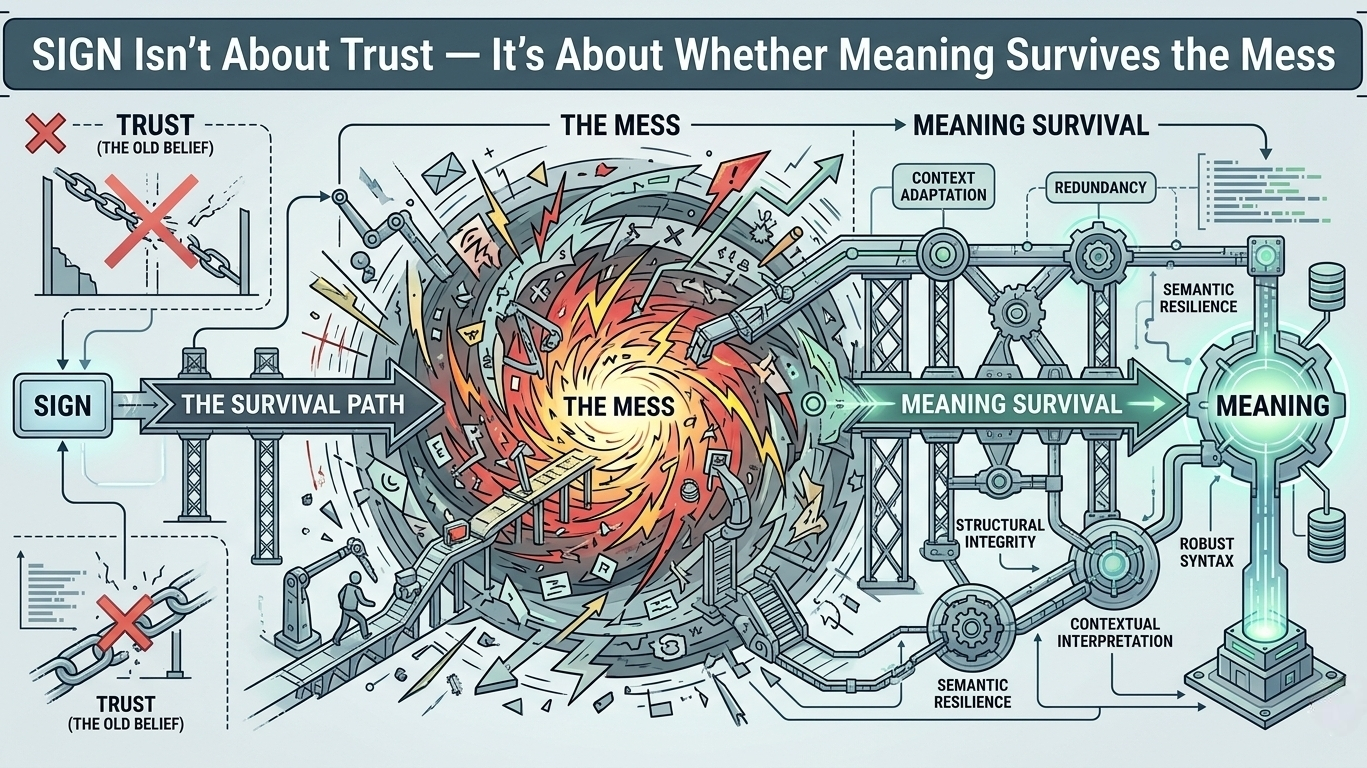
SIGN Isn’t About Trust It’s About Whether Meaning Survives the MessLook, I’ll be honest. The market is exhausted.
Every other project talks about “trust,” “identity,” “coordination.” I’ve seen this movie before. Same script, different logo. And yeah, it sounds smart at first… until you actually try to use these systems and everything starts breaking in weird, quiet ways.
Data doesn’t move cleanly. Credentials don’t mean the same thing everywhere. And suddenly all that “composable infrastructure” talk? It falls apart.
So when something like SIGN shows up positioning itself as infrastructure for credential verification and token distribution I don’t get excited. I get suspicious. That’s just how this space trains you.
Because the idea itself isn’t new. Not even close.
But here’s where it gets interesting… and also messy.
The first thing people don’t talk about enough is this: a credential and a token distribution are not the same thing. Not even remotely.
A credential is basically someone saying, “yeah, this person qualifies.”
A distribution is actually giving them something of value.
Simple, right? You’d think.
But most systems just mash these together like it’s one clean pipeline prove something → get tokens. Done.
That’s lazy thinking. Honestly.
Because in real life, eligibility changes. Issuers aren’t always reliable. And sometimes… even if someone qualifies, they still don’t get anything. Policies, timing, funding there’s always something.
If SIGN treats these two layers like they’re identical, that’s a crack in the foundation. A big one.
Now let’s talk about the real problem. Not storage. Not speed.
Meaning.
Yeah, meaning. The thing nobody builds for.
A credential isn’t just data sitting somewhere. It’s a claim. And that claim comes with baggage:
Who issued it?
Under what rules?
At what time?
And who actually trusts that issuer?
Move that credential somewhere else and boom, half that context disappears.
I’ve seen this happen over and over. A proof that made total sense in one system suddenly looks useless somewhere else. Not because it’s wrong… but because nobody knows how to interpret it anymore.
That’s what I call proof decay. And it’s everywhere.
So the real question for SIGN isn’t “can you verify something?”
That part’s easy.
The real question is: can that meaning survive travel?
Because if it can’t, then what’s the point?
And then there’s the real world. Which, let’s be real, is a mess.
People lose wallets.
They reuse identities.
They forget things.
Institutions? Even worse. Inconsistent, slow, sometimes just wrong.
Records aren’t clean. They’re incomplete. Sometimes duplicated. Sometimes outdated.
This is the environment SIGN has to live in.
Not a perfect, trustless fantasy. Chaos.
So yeah, I start asking uncomfortable questions:
What happens when a credential needs to be revoked… but it’s already everywhere?
What if two issuers say opposite things about the same person?
What if someone only has half the credentials they need?
What stops someone from reusing a valid claim in a totally different context?
These aren’t edge cases. This is normal behavior.
If SIGN doesn’t handle this stuff, it won’t fail loudly. It’ll fail quietly. And that’s worse.
Another thing that bugs me and it happens a lot in Web3 is how people flatten everything into “proofs.”
Not all data is the same. Not even close.
A signed agreement? That’s a commitment between parties. Context-heavy. Legal implications.
A credential? That’s just a claim about someone. Might expire. Might get revoked.
A token distribution record? That’s history. It happened. Done.
Three completely different things.
But systems love to treat them like identical Lego blocks. Plug and play.
Bad idea.
You end up with weird situations like treating a temporary credential as permanent truth, or assuming a financial transaction somehow proves legitimacy.
It doesn’t.
If SIGN can’t keep these categories separate, things will get confusing fast. And confusion in financial systems? Yeah… that’s where problems start.
Now let’s get into token distribution, because this is where things usually break.
Most people think distribution is just logistics. Who gets what.
It’s not.
It’s a verification problem. And honestly, it’s kind of adversarial.
Airdrops, grants, incentives they fail all the time. Not because the system can’t send tokens, but because it can’t define who actually deserves them.
SIGN tries to flip this by focusing on claims instead of addresses.
That’s smart. I’ll give it that.
Instead of “this wallet gets tokens,” it’s more like “this person qualifies based on these proofs.”
But here’s the catch.
The more precise you make those rules, the harder they are to understand. And if people can’t understand why they qualify or don’t they stop trusting the system.
And then you get gaming.
People don’t contribute real value. They just optimize for the criteria. Farm the credentials. Hit the checklist.
You’ve seen it. I’ve seen it.
So yeah, better verification helps… but it doesn’t magically fix behavior.
There’s also the time problem. Nobody wants to deal with this, but it matters.
Every credential expires. Or at least, it should.
Something that was true last year might not be true today. But systems love to treat proofs like they’re eternal.
They’re not.
If SIGN doesn’t build in time like actual expiration, renewal, context awareness it’s just going to collect stale claims. And over time, those claims start misleading people.
That’s how trust quietly erodes.
So where does that leave us?
Honestly… somewhere in the middle.
I’m not dismissing SIGN. There’s something here. The focus on claims, on portability, on tying verification to distribution it’s directionally right.
But direction isn’t enough.
If this turns into just another attestation layer, it’ll fade into the background. We’ve got plenty of those already.
If it tries to force rigid standards, institutions won’t play along. They never do.
And if it ignores how messy the real world is, it’ll break the moment it scales.
But if and it’s a big if it manages to carry meaning across systems… not just data, but actual meaning, with context, constraints, and time baked in?
That’s different.
That’s not exciting. It’s not flashy. Nobody’s going to hype it on a bull run.
But it’s useful. Quietly useful.
And when the noise dies down and it always does systems that preserve order tend to stick around.
Everything else?
It just adds to the pile of things that almost worked.
#SignDigitalSovereignInfra @SignOfficial $SIGN
{future}(SIGNUSDT)
SIGN Isn’t About Trust It’s About Whether Meaning Survives the Mess
Look, I’ll be honest. The market is exhausted.
Every other project talks about “trust,” “identity,” “coordination.” I’ve seen this movie before. Same script, different logo. And yeah, it sounds smart at first… until you actually try to use these systems and everything starts breaking in weird, quiet ways.
Data doesn’t move cleanly. Credentials don’t mean the same thing everywhere. And suddenly all that “composable infrastructure” talk? It falls apart.
So when something like SIGN shows up positioning itself as infrastructure for credential verification and token distribution I don’t get excited. I get suspicious. That’s just how this space trains you.
Because the idea itself isn’t new. Not even close.
But here’s where it gets interesting… and also messy.
The first thing people don’t talk about enough is this: a credential and a token distribution are not the same thing. Not even remotely.
A credential is basically someone saying, “yeah, this person qualifies.”
A distribution is actually giving them something of value.
Simple, right? You’d think.
But most systems just mash these together like it’s one clean pipeline prove something → get tokens. Done.
That’s lazy thinking. Honestly.
Because in real life, eligibility changes. Issuers aren’t always reliable. And sometimes… even if someone qualifies, they still don’t get anything. Policies, timing, funding there’s always something.
If SIGN treats these two layers like they’re identical, that’s a crack in the foundation. A big one.
Now let’s talk about the real problem. Not storage. Not speed.
Meaning.
Yeah, meaning. The thing nobody builds for.
A credential isn’t just data sitting somewhere. It’s a claim. And that claim comes with baggage:
Who issued it?
Under what rules?
At what time?
And who actually trusts that issuer?
Move that credential somewhere else and boom, half that context disappears.
I’ve seen this happen over and over. A proof that made total sense in one system suddenly looks useless somewhere else. Not because it’s wrong… but because nobody knows how to interpret it anymore.
That’s what I call proof decay. And it’s everywhere.
So the real question for SIGN isn’t “can you verify something?”
That part’s easy.
The real question is: can that meaning survive travel?
Because if it can’t, then what’s the point?
And then there’s the real world. Which, let’s be real, is a mess.
People lose wallets.
They reuse identities.
They forget things.
Institutions? Even worse. Inconsistent, slow, sometimes just wrong.
Records aren’t clean. They’re incomplete. Sometimes duplicated. Sometimes outdated.
This is the environment SIGN has to live in.
Not a perfect, trustless fantasy. Chaos.
So yeah, I start asking uncomfortable questions:
What happens when a credential needs to be revoked… but it’s already everywhere?
What if two issuers say opposite things about the same person?
What if someone only has half the credentials they need?
What stops someone from reusing a valid claim in a totally different context?
These aren’t edge cases. This is normal behavior.
If SIGN doesn’t handle this stuff, it won’t fail loudly. It’ll fail quietly. And that’s worse.
Another thing that bugs me and it happens a lot in Web3 is how people flatten everything into “proofs.”
Not all data is the same. Not even close.
A signed agreement? That’s a commitment between parties. Context-heavy. Legal implications.
A credential? That’s just a claim about someone. Might expire. Might get revoked.
A token distribution record? That’s history. It happened. Done.
Three completely different things.
But systems love to treat them like identical Lego blocks. Plug and play.
Bad idea.
You end up with weird situations like treating a temporary credential as permanent truth, or assuming a financial transaction somehow proves legitimacy.
It doesn’t.
If SIGN can’t keep these categories separate, things will get confusing fast. And confusion in financial systems? Yeah… that’s where problems start.
Now let’s get into token distribution, because this is where things usually break.
Most people think distribution is just logistics. Who gets what.
It’s not.
It’s a verification problem. And honestly, it’s kind of adversarial.
Airdrops, grants, incentives they fail all the time. Not because the system can’t send tokens, but because it can’t define who actually deserves them.
SIGN tries to flip this by focusing on claims instead of addresses.
That’s smart. I’ll give it that.
Instead of “this wallet gets tokens,” it’s more like “this person qualifies based on these proofs.”
But here’s the catch.
The more precise you make those rules, the harder they are to understand. And if people can’t understand why they qualify or don’t they stop trusting the system.
And then you get gaming.
People don’t contribute real value. They just optimize for the criteria. Farm the credentials. Hit the checklist.
You’ve seen it. I’ve seen it.
So yeah, better verification helps… but it doesn’t magically fix behavior.
There’s also the time problem. Nobody wants to deal with this, but it matters.
Every credential expires. Or at least, it should.
Something that was true last year might not be true today. But systems love to treat proofs like they’re eternal.
They’re not.
If SIGN doesn’t build in time like actual expiration, renewal, context awareness it’s just going to collect stale claims. And over time, those claims start misleading people.
That’s how trust quietly erodes.
So where does that leave us?
Honestly… somewhere in the middle.
I’m not dismissing SIGN. There’s something here. The focus on claims, on portability, on tying verification to distribution it’s directionally right.
But direction isn’t enough.
If this turns into just another attestation layer, it’ll fade into the background. We’ve got plenty of those already.
If it tries to force rigid standards, institutions won’t play along. They never do.
And if it ignores how messy the real world is, it’ll break the moment it scales.
But if and it’s a big if it manages to carry meaning across systems… not just data, but actual meaning, with context, constraints, and time baked in?
That’s different.
That’s not exciting. It’s not flashy. Nobody’s going to hype it on a bull run.
But it’s useful. Quietly useful.
And when the noise dies down and it always does systems that preserve order tend to stick around.
Everything else?
It just adds to the pile of things that almost worked.
#SignDigitalSovereignInfra @SignOfficial $SIGN
Every other project talks about “trust,” “identity,” “coordination.” I’ve seen this movie before. Same script, different logo. And yeah, it sounds smart at first… until you actually try to use these systems and everything starts breaking in weird, quiet ways.
Data doesn’t move cleanly. Credentials don’t mean the same thing everywhere. And suddenly all that “composable infrastructure” talk? It falls apart.
So when something like SIGN shows up positioning itself as infrastructure for credential verification and token distribution I don’t get excited. I get suspicious. That’s just how this space trains you.
Because the idea itself isn’t new. Not even close.
But here’s where it gets interesting… and also messy.
The first thing people don’t talk about enough is this: a credential and a token distribution are not the same thing. Not even remotely.
A credential is basically someone saying, “yeah, this person qualifies.”
A distribution is actually giving them something of value.
Simple, right? You’d think.
But most systems just mash these together like it’s one clean pipeline prove something → get tokens. Done.
That’s lazy thinking. Honestly.
Because in real life, eligibility changes. Issuers aren’t always reliable. And sometimes… even if someone qualifies, they still don’t get anything. Policies, timing, funding there’s always something.
If SIGN treats these two layers like they’re identical, that’s a crack in the foundation. A big one.
Now let’s talk about the real problem. Not storage. Not speed.
Meaning.
Yeah, meaning. The thing nobody builds for.
A credential isn’t just data sitting somewhere. It’s a claim. And that claim comes with baggage:
Who issued it?
Under what rules?
At what time?
And who actually trusts that issuer?
Move that credential somewhere else and boom, half that context disappears.
I’ve seen this happen over and over. A proof that made total sense in one system suddenly looks useless somewhere else. Not because it’s wrong… but because nobody knows how to interpret it anymore.
That’s what I call proof decay. And it’s everywhere.
So the real question for SIGN isn’t “can you verify something?”
That part’s easy.
The real question is: can that meaning survive travel?
Because if it can’t, then what’s the point?
And then there’s the real world. Which, let’s be real, is a mess.
People lose wallets.
They reuse identities.
They forget things.
Institutions? Even worse. Inconsistent, slow, sometimes just wrong.
Records aren’t clean. They’re incomplete. Sometimes duplicated. Sometimes outdated.
This is the environment SIGN has to live in.
Not a perfect, trustless fantasy. Chaos.
So yeah, I start asking uncomfortable questions:
What happens when a credential needs to be revoked… but it’s already everywhere?
What if two issuers say opposite things about the same person?
What if someone only has half the credentials they need?
What stops someone from reusing a valid claim in a totally different context?
These aren’t edge cases. This is normal behavior.
If SIGN doesn’t handle this stuff, it won’t fail loudly. It’ll fail quietly. And that’s worse.
Another thing that bugs me and it happens a lot in Web3 is how people flatten everything into “proofs.”
Not all data is the same. Not even close.
A signed agreement? That’s a commitment between parties. Context-heavy. Legal implications.
A credential? That’s just a claim about someone. Might expire. Might get revoked.
A token distribution record? That’s history. It happened. Done.
Three completely different things.
But systems love to treat them like identical Lego blocks. Plug and play.
Bad idea.
You end up with weird situations like treating a temporary credential as permanent truth, or assuming a financial transaction somehow proves legitimacy.
It doesn’t.
If SIGN can’t keep these categories separate, things will get confusing fast. And confusion in financial systems? Yeah… that’s where problems start.
Now let’s get into token distribution, because this is where things usually break.
Most people think distribution is just logistics. Who gets what.
It’s not.
It’s a verification problem. And honestly, it’s kind of adversarial.
Airdrops, grants, incentives they fail all the time. Not because the system can’t send tokens, but because it can’t define who actually deserves them.
SIGN tries to flip this by focusing on claims instead of addresses.
That’s smart. I’ll give it that.
Instead of “this wallet gets tokens,” it’s more like “this person qualifies based on these proofs.”
But here’s the catch.
The more precise you make those rules, the harder they are to understand. And if people can’t understand why they qualify or don’t they stop trusting the system.
And then you get gaming.
People don’t contribute real value. They just optimize for the criteria. Farm the credentials. Hit the checklist.
You’ve seen it. I’ve seen it.
So yeah, better verification helps… but it doesn’t magically fix behavior.
There’s also the time problem. Nobody wants to deal with this, but it matters.
Every credential expires. Or at least, it should.
Something that was true last year might not be true today. But systems love to treat proofs like they’re eternal.
They’re not.
If SIGN doesn’t build in time like actual expiration, renewal, context awareness it’s just going to collect stale claims. And over time, those claims start misleading people.
That’s how trust quietly erodes.
So where does that leave us?
Honestly… somewhere in the middle.
I’m not dismissing SIGN. There’s something here. The focus on claims, on portability, on tying verification to distribution it’s directionally right.
But direction isn’t enough.
If this turns into just another attestation layer, it’ll fade into the background. We’ve got plenty of those already.
If it tries to force rigid standards, institutions won’t play along. They never do.
And if it ignores how messy the real world is, it’ll break the moment it scales.
But if and it’s a big if it manages to carry meaning across systems… not just data, but actual meaning, with context, constraints, and time baked in?
That’s different.
That’s not exciting. It’s not flashy. Nobody’s going to hype it on a bull run.
But it’s useful. Quietly useful.
And when the noise dies down and it always does systems that preserve order tend to stick around.
Everything else?
It just adds to the pile of things that almost worked.
#SignDigitalSovereignInfra @SignOfficial $SIGN
56
32
533

From Airdrop to Staking: A Whole New Wealth Game Rule
In the world of digital assets
From Airdrop to Staking: A Whole New Wealth Game Rule
In the world of digital assets, the SIGN token is redefining community governance and incentives for long-term holders in an unprecedented way. It’s no longer just a trading chip; it’s a creative and interactive experiment where every holder can become a participant in the ecosystem’s development.
Initially, SIGN attracted users through airdrops, which is not only a quick user acquisition strategy but also a creative way to stimulate community engagement. Airdrops give ordinary folks a chance to get involved with the project, breaking the traditional finance monopoly on resources and allowing more people to ride the digital economy wave. However, the airdrop is just the beginning; the real value lies in how to continuously engage users and encourage them to hold long-term.
Thus, SIGN introduced a staking mechanism, which is not only a technical innovation but also a deep incentive for user behavior. Through staking, users can earn stable yields while participating in community decision-making, truly embodying the idea of "holding tokens equals power." This design makes holders not just investors but core drivers of the project’s development.
Throughout this process, SIGN has shown unique creative thinking by cleverly combining economic incentives with community governance, creating a sustainable ecosystem. For shoppers, this is not just an investment opportunity but a new consumption experience—they can earn additional yields by holding tokens and even influence the project’s future direction.
Such a design undoubtedly brings new vitality to the market and allows SIGN to stand out among many projects. It proves that when technology, creativity, and user demand perfectly blend, surprising results can be achieved. Whether for long-term holders or ordinary users, SIGN offers a whole new value proposition worth diving into and paying attention to.
From Airdrop to Staking: A Whole New Wealth Game Rule
In the world of digital assets, the SIGN token is redefining community governance and incentives for long-term holders in an unprecedented way. It’s no longer just a trading chip; it’s a creative and interactive experiment where every holder can become a participant in the ecosystem’s development.
Initially, SIGN attracted users through airdrops, which is not only a quick user acquisition strategy but also a creative way to stimulate community engagement. Airdrops give ordinary folks a chance to get involved with the project, breaking the traditional finance monopoly on resources and allowing more people to ride the digital economy wave. However, the airdrop is just the beginning; the real value lies in how to continuously engage users and encourage them to hold long-term.
Thus, SIGN introduced a staking mechanism, which is not only a technical innovation but also a deep incentive for user behavior. Through staking, users can earn stable yields while participating in community decision-making, truly embodying the idea of "holding tokens equals power." This design makes holders not just investors but core drivers of the project’s development.
Throughout this process, SIGN has shown unique creative thinking by cleverly combining economic incentives with community governance, creating a sustainable ecosystem. For shoppers, this is not just an investment opportunity but a new consumption experience—they can earn additional yields by holding tokens and even influence the project’s future direction.
Such a design undoubtedly brings new vitality to the market and allows SIGN to stand out among many projects. It proves that when technology, creativity, and user demand perfectly blend, surprising results can be achieved. Whether for long-term holders or ordinary users, SIGN offers a whole new value proposition worth diving into and paying attention to.
From Airdrop to Staking: A Whole New Wealth Game Rule In the world of digital assets
From Airdrop to Staking: A Whole New Wealth Game Rule
In the world of digital assets, the SIGN token is redefining community governance and incentives for long-term holders in an unprecedented way. It’s no longer just a trading chip; it’s a creative and interactive experiment where every holder can become a participant in the ecosystem’s development.
Initially, SIGN attracted users through airdrops, which is not only a quick user acquisition strategy but also a creative way to stimulate community engagement. Airdrops give ordinary folks a chance to get involved with the project, breaking the traditional finance monopoly on resources and allowing more people to ride the digital economy wave. However, the airdrop is just the beginning; the real value lies in how to continuously engage users and encourage them to hold long-term.
Thus, SIGN introduced a staking mechanism, which is not only a technical innovation but also a deep incentive for user behavior. Through staking, users can earn stable yields while participating in community decision-making, truly embodying the idea of "holding tokens equals power." This design makes holders not just investors but core drivers of the project’s development.
Throughout this process, SIGN has shown unique creative thinking by cleverly combining economic incentives with community governance, creating a sustainable ecosystem. For shoppers, this is not just an investment opportunity but a new consumption experience—they can earn additional yields by holding tokens and even influence the project’s future direction.
Such a design undoubtedly brings new vitality to the market and allows SIGN to stand out among many projects. It proves that when technology, creativity, and user demand perfectly blend, surprising results can be achieved. Whether for long-term holders or ordinary users, SIGN offers a whole new value proposition worth diving into and paying attention to.
210

·
--

Article
🚨 Breaking: Shooting at the Correspondents' Dinner. How is the market reacting?The world is shaken by the weekend events in Washington. The attack on the Washington Hilton hotel during the annual White House Correspondents' Association dinner has become the major geopolitical trigger of these days.
What's known at this moment? 🛡️
Incident:
Shots were fired during the event. President Donald Trump and the First Lady were urgently evacuated by the Secret Service.
🚨 Breaking: Shooting at the Correspondents' Dinner. How is the market reacting?
The world is shaken by the weekend events in Washington. The attack on the Washington Hilton hotel during the annual White House Correspondents' Association dinner has become the major geopolitical trigger of these days.
What's known at this moment? 🛡️
Incident:
Shots were fired during the event. President Donald Trump and the First Lady were urgently evacuated by the Secret Service.
What's known at this moment? 🛡️
Incident:
Shots were fired during the event. President Donald Trump and the First Lady were urgently evacuated by the Secret Service.
1
182

·
--
The continuous evolution of blockchain technology is reshaping the landscape of the digital asset market.
The continuous evolution of blockchain technology is reshaping the landscape of the digital asset market. The SIGN token, as an emerging project within the Binance ecosystem, is attracting investor attention with its unique circulation and price discovery mechanisms. With the strong support of Binance's ecosystem, SIGN demonstrates robust development potential and market value.
The TGE (Token Generation Event), as a critical juncture for project initiation, provides SIGN with initial liquidity and a foundation for market recognition. Through a reasonable token distribution mechanism, SIGN ensures a balance of interests for early investors and community members while laying a solid foundation for subsequent market trading. Binance's involvement not only enhances the project's credibility but also brings significant user traffic and trading depth, further promoting the efficiency of token circulation.
In terms of price discovery mechanisms, SIGN adopts a dynamic market adjustment strategy that combines on-chain data and market sentiment for intelligent pricing. This mechanism effectively avoids the risks associated with severe price fluctuations while providing investors with a more transparent and fair trading environment. As more institutional and retail investors participate, SIGN's price performance gradually stabilizes and shows signs of long-term growth.
For investors, the value of SIGN is reflected not only in its current market performance but also in the strong ecological support and technological innovation behind it. The empowerment from the Binance ecosystem enables SIGN to have higher scalability and application scenarios, with the potential to achieve breakthroughs in areas such as DeFi, NFTs, and cross-chain protocols in the future.
In summary, with the backing of the Binance ecosystem, SIGN is gradually building an efficient, transparent, and sustainable token economic system. For users seeking long-term value investments, SIGN is undoubtedly a quality asset worth paying attention to.
The continuous evolution of blockchain technology is reshaping the landscape of the digital asset market. The SIGN token, as an emerging project within the Binance ecosystem, is attracting investor attention with its unique circulation and price discovery mechanisms. With the strong support of Binance's ecosystem, SIGN demonstrates robust development potential and market value.
The TGE (Token Generation Event), as a critical juncture for project initiation, provides SIGN with initial liquidity and a foundation for market recognition. Through a reasonable token distribution mechanism, SIGN ensures a balance of interests for early investors and community members while laying a solid foundation for subsequent market trading. Binance's involvement not only enhances the project's credibility but also brings significant user traffic and trading depth, further promoting the efficiency of token circulation.
In terms of price discovery mechanisms, SIGN adopts a dynamic market adjustment strategy that combines on-chain data and market sentiment for intelligent pricing. This mechanism effectively avoids the risks associated with severe price fluctuations while providing investors with a more transparent and fair trading environment. As more institutional and retail investors participate, SIGN's price performance gradually stabilizes and shows signs of long-term growth.
For investors, the value of SIGN is reflected not only in its current market performance but also in the strong ecological support and technological innovation behind it. The empowerment from the Binance ecosystem enables SIGN to have higher scalability and application scenarios, with the potential to achieve breakthroughs in areas such as DeFi, NFTs, and cross-chain protocols in the future.
In summary, with the backing of the Binance ecosystem, SIGN is gradually building an efficient, transparent, and sustainable token economic system. For users seeking long-term value investments, SIGN is undoubtedly a quality asset worth paying attention to.
The continuous evolution of blockchain technology is reshaping the landscape of the digital asset market.
The continuous evolution of blockchain technology is reshaping the landscape of the digital asset market. The SIGN token, as an emerging project within the Binance ecosystem, is attracting investor attention with its unique circulation and price discovery mechanisms. With the strong support of Binance's ecosystem, SIGN demonstrates robust development potential and market value.
The TGE (Token Generation Event), as a critical juncture for project initiation, provides SIGN with initial liquidity and a foundation for market recognition. Through a reasonable token distribution mechanism, SIGN ensures a balance of interests for early investors and community members while laying a solid foundation for subsequent market trading. Binance's involvement not only enhances the project's credibility but also brings significant user traffic and trading depth, further promoting the efficiency of token circulation.
In terms of price discovery mechanisms, SIGN adopts a dynamic market adjustment strategy that combines on-chain data and market sentiment for intelligent pricing. This mechanism effectively avoids the risks associated with severe price fluctuations while providing investors with a more transparent and fair trading environment. As more institutional and retail investors participate, SIGN's price performance gradually stabilizes and shows signs of long-term growth.
For investors, the value of SIGN is reflected not only in its current market performance but also in the strong ecological support and technological innovation behind it. The empowerment from the Binance ecosystem enables SIGN to have higher scalability and application scenarios, with the potential to achieve breakthroughs in areas such as DeFi, NFTs, and cross-chain protocols in the future.
In summary, with the backing of the Binance ecosystem, SIGN is gradually building an efficient, transparent, and sustainable token economic system. For users seeking long-term value investments, SIGN is undoubtedly a quality asset worth paying attention to.
7
106
·
--
#signdigitalsovereigninfra $SIGN
From 0.128 to 0.032: A Redefinition of Value
In the cryptocurrency market, price fluctuations are as unpredictable as tides. The SIGN coin once plummeted from $0.128 to $0.032 in a short period, a drop of as much as 75%. Behind this number lies not only a plunge in value but also a violent shake-up of market sentiment. For investors, this may be a frustrating moment, but it is also an opportunity to reassess the essence and future potential of the project.
When prices fall sharply, it often signifies a severe erosion of market confidence in the project. However, projects with true long-term value are often able to gather strength in the lows, waiting for the right moment to rise again. The recent crash of the SIGN coin, while unexpected, has provided an entry opportunity for those visionary investors. The market is always correcting its mistakes, and true value will ultimately manifest over time.
From a technical perspective, the underlying logic and application scenarios of the SIGN coin have not changed due to the price drop. Its decentralized architecture, smart contract functionality, and ecosystem development remain the core elements supporting its long-term value. The short-term panic in the market may keep prices depressed, but these factors will not hinder the project's progress and development.
Moreover, this price adjustment has injected new vitality into the market. Some investors who were hesitant due to high valuations may now find more reasonable entry points. At the same time, project teams may seize this opportunity to optimize operations and strengthen community building, further solidifying their position in the industry.
Whether newbies or veterans, facing the extreme fluctuations of the market requires maintaining calm and rationality. The essence of cryptocurrency is technological innovation and value transmission, rather than a tool for short-term speculation. The recent drop of the SIGN coin may be a reminder from the market: returning to the essence is the right path to the future.
After experiencing such dramatic fluctuations, the return of the SIGN coin's value is not out of reach. What it needs is time, patience, and confidence in the project itself. For those willing to wait and believe in its potential, the future may bring unexpected rewards.
@SignOfficial $SIGN #Sign地缘政治基建
#signdigitalsovereigninfra $SIGN
From 0.128 to 0.032: A Redefinition of Value
In the cryptocurrency market, price fluctuations are as unpredictable as tides. The SIGN coin once plummeted from $0.128 to $0.032 in a short period, a drop of as much as 75%. Behind this number lies not only a plunge in value but also a violent shake-up of market sentiment. For investors, this may be a frustrating moment, but it is also an opportunity to reassess the essence and future potential of the project.
When prices fall sharply, it often signifies a severe erosion of market confidence in the project. However, projects with true long-term value are often able to gather strength in the lows, waiting for the right moment to rise again. The recent crash of the SIGN coin, while unexpected, has provided an entry opportunity for those visionary investors. The market is always correcting its mistakes, and true value will ultimately manifest over time.
From a technical perspective, the underlying logic and application scenarios of the SIGN coin have not changed due to the price drop. Its decentralized architecture, smart contract functionality, and ecosystem development remain the core elements supporting its long-term value. The short-term panic in the market may keep prices depressed, but these factors will not hinder the project's progress and development.
Moreover, this price adjustment has injected new vitality into the market. Some investors who were hesitant due to high valuations may now find more reasonable entry points. At the same time, project teams may seize this opportunity to optimize operations and strengthen community building, further solidifying their position in the industry.
Whether newbies or veterans, facing the extreme fluctuations of the market requires maintaining calm and rationality. The essence of cryptocurrency is technological innovation and value transmission, rather than a tool for short-term speculation. The recent drop of the SIGN coin may be a reminder from the market: returning to the essence is the right path to the future.
After experiencing such dramatic fluctuations, the return of the SIGN coin's value is not out of reach. What it needs is time, patience, and confidence in the project itself. For those willing to wait and believe in its potential, the future may bring unexpected rewards.
@SignOfficial $SIGN #Sign地缘政治基建
From 0.128 to 0.032: A Redefinition of Value
In the cryptocurrency market, price fluctuations are as unpredictable as tides. The SIGN coin once plummeted from $0.128 to $0.032 in a short period, a drop of as much as 75%. Behind this number lies not only a plunge in value but also a violent shake-up of market sentiment. For investors, this may be a frustrating moment, but it is also an opportunity to reassess the essence and future potential of the project.
When prices fall sharply, it often signifies a severe erosion of market confidence in the project. However, projects with true long-term value are often able to gather strength in the lows, waiting for the right moment to rise again. The recent crash of the SIGN coin, while unexpected, has provided an entry opportunity for those visionary investors. The market is always correcting its mistakes, and true value will ultimately manifest over time.
From a technical perspective, the underlying logic and application scenarios of the SIGN coin have not changed due to the price drop. Its decentralized architecture, smart contract functionality, and ecosystem development remain the core elements supporting its long-term value. The short-term panic in the market may keep prices depressed, but these factors will not hinder the project's progress and development.
Moreover, this price adjustment has injected new vitality into the market. Some investors who were hesitant due to high valuations may now find more reasonable entry points. At the same time, project teams may seize this opportunity to optimize operations and strengthen community building, further solidifying their position in the industry.
Whether newbies or veterans, facing the extreme fluctuations of the market requires maintaining calm and rationality. The essence of cryptocurrency is technological innovation and value transmission, rather than a tool for short-term speculation. The recent drop of the SIGN coin may be a reminder from the market: returning to the essence is the right path to the future.
After experiencing such dramatic fluctuations, the return of the SIGN coin's value is not out of reach. What it needs is time, patience, and confidence in the project itself. For those willing to wait and believe in its potential, the future may bring unexpected rewards.
@SignOfficial $SIGN #Sign地缘政治基建
10
288

·
--
#signdigitalsovereigninfra $SIGN
The innovative value and application prospects of the SIGN token. In the field of Web3 identity verification, the SIGN token is initiating a profound transformation with its unique full-chain proof protocol technology. Unlike traditional centralized identity authentication methods, SIGN achieves a decentralized, transparent, and tamper-proof identity verification mechanism through blockchain technology, providing users with greater data sovereignty and privacy protection.
The full-chain proof protocol is the core technical highlight of SIGN, allowing users to generate and verify identity credentials across different chains, ensuring consistency and credibility of information throughout the ecosystem. This cross-chain compatibility not only enhances user experience but also provides robust support for developers to build diverse application scenarios. Whether it's digital identity management, financial transactions, or enterprise-level authentication, SIGN can offer efficient and reliable solutions.
As the Web3 ecosystem continues to expand, the demand for identity verification is growing. The SIGN token is not just a financial asset but also an infrastructure that drives progress in the entire industry. Its value is reflected not only in technical aspects but also in its high regard for user privacy and data security. By decentralizing, SIGN effectively reduces reliance on third-party institutions, lowers fraud risks, and improves overall system security.
For ordinary users, the SIGN token represents a whole new way of managing digital identities, putting personal data truly in their own hands. For developers and enterprises, SIGN provides rich API interfaces and development tools, facilitating quick integration into existing systems for seamless connectivity.
In the future, the SIGN token is expected to be applied in more vertical fields and become an important participant in the Web3 identity verification track. With its innovative technical architecture and clear business logic, SIGN is redefining the future direction of digital identity and injecting new vitality into the entire industry.
@SignOfficial $SIGN #Sign地缘政治基建
#signdigitalsovereigninfra $SIGN
The innovative value and application prospects of the SIGN token. In the field of Web3 identity verification, the SIGN token is initiating a profound transformation with its unique full-chain proof protocol technology. Unlike traditional centralized identity authentication methods, SIGN achieves a decentralized, transparent, and tamper-proof identity verification mechanism through blockchain technology, providing users with greater data sovereignty and privacy protection.
The full-chain proof protocol is the core technical highlight of SIGN, allowing users to generate and verify identity credentials across different chains, ensuring consistency and credibility of information throughout the ecosystem. This cross-chain compatibility not only enhances user experience but also provides robust support for developers to build diverse application scenarios. Whether it's digital identity management, financial transactions, or enterprise-level authentication, SIGN can offer efficient and reliable solutions.
As the Web3 ecosystem continues to expand, the demand for identity verification is growing. The SIGN token is not just a financial asset but also an infrastructure that drives progress in the entire industry. Its value is reflected not only in technical aspects but also in its high regard for user privacy and data security. By decentralizing, SIGN effectively reduces reliance on third-party institutions, lowers fraud risks, and improves overall system security.
For ordinary users, the SIGN token represents a whole new way of managing digital identities, putting personal data truly in their own hands. For developers and enterprises, SIGN provides rich API interfaces and development tools, facilitating quick integration into existing systems for seamless connectivity.
In the future, the SIGN token is expected to be applied in more vertical fields and become an important participant in the Web3 identity verification track. With its innovative technical architecture and clear business logic, SIGN is redefining the future direction of digital identity and injecting new vitality into the entire industry.
@SignOfficial $SIGN #Sign地缘政治基建
The innovative value and application prospects of the SIGN token. In the field of Web3 identity verification, the SIGN token is initiating a profound transformation with its unique full-chain proof protocol technology. Unlike traditional centralized identity authentication methods, SIGN achieves a decentralized, transparent, and tamper-proof identity verification mechanism through blockchain technology, providing users with greater data sovereignty and privacy protection.
The full-chain proof protocol is the core technical highlight of SIGN, allowing users to generate and verify identity credentials across different chains, ensuring consistency and credibility of information throughout the ecosystem. This cross-chain compatibility not only enhances user experience but also provides robust support for developers to build diverse application scenarios. Whether it's digital identity management, financial transactions, or enterprise-level authentication, SIGN can offer efficient and reliable solutions.
As the Web3 ecosystem continues to expand, the demand for identity verification is growing. The SIGN token is not just a financial asset but also an infrastructure that drives progress in the entire industry. Its value is reflected not only in technical aspects but also in its high regard for user privacy and data security. By decentralizing, SIGN effectively reduces reliance on third-party institutions, lowers fraud risks, and improves overall system security.
For ordinary users, the SIGN token represents a whole new way of managing digital identities, putting personal data truly in their own hands. For developers and enterprises, SIGN provides rich API interfaces and development tools, facilitating quick integration into existing systems for seamless connectivity.
In the future, the SIGN token is expected to be applied in more vertical fields and become an important participant in the Web3 identity verification track. With its innovative technical architecture and clear business logic, SIGN is redefining the future direction of digital identity and injecting new vitality into the entire industry.
@SignOfficial $SIGN #Sign地缘政治基建
126

·
--
Bearish
See translation
$SIGN I first stumbled across SIGN not in some flashy announcement or a Twitter storm, but in the quiet corner of a forum where someone was talking about credential verification and token flows almost as an afterthought. It didn’t hit me immediately. No big claims, no graphics showing “Throughput 10x Faster.” Just a sense that someone was noticing something that others weren’t paying attention to. That in itself is rare these days. Usually, new Layer 1s scream for attention before anyone even tests the network. SIGN felt like it had been sitting there, almost politely, waiting for a chance to be noticed.
Of course, I’ve seen this before. The “next big chain” pitch is a cycle I can almost anticipate with my eyes closed: faster, cleaner, smarter, modular, AI-enabled, whatever the flavor of the quarter happens to be. After a few years in this space, it all starts to blur. You read enough whitepapers and audits and you begin skimming for the gaps, the things that are awkwardly avoided, because that’s where the real story hides. It’s exhausting in a way, but also oddly comforting you start recognizing patterns.
Traffic, real usage, that’s what breaks chains, not whiteboard designs or lofty claims. I think about Solana smooth when everything is quiet, impressive even. Then peak load hits, and cracks appear. It doesn’t matter how clever the architecture looks on paper. People underestimate how messy real usage can be. Bots, spikes, unpredictable patterns. Any chain that survives that and still functions is doing something that matters.
SIGN, from what I can gather, isn’t trying to reinvent the entire stack. It notices a small, persistent problem: credential verification linked to token distribution. Simple in description, but apparently messy in execution, and mostly ignored elsewhere. It feels like a project willing to simplify deliberately. Trade-offs are obvious if you look for them
#SignDigitalSovereignInfra @SignOfficial $SIGN
{future}(SIGNUSDT)
$SIGN I first stumbled across SIGN not in some flashy announcement or a Twitter storm, but in the quiet corner of a forum where someone was talking about credential verification and token flows almost as an afterthought. It didn’t hit me immediately. No big claims, no graphics showing “Throughput 10x Faster.” Just a sense that someone was noticing something that others weren’t paying attention to. That in itself is rare these days. Usually, new Layer 1s scream for attention before anyone even tests the network. SIGN felt like it had been sitting there, almost politely, waiting for a chance to be noticed.
Of course, I’ve seen this before. The “next big chain” pitch is a cycle I can almost anticipate with my eyes closed: faster, cleaner, smarter, modular, AI-enabled, whatever the flavor of the quarter happens to be. After a few years in this space, it all starts to blur. You read enough whitepapers and audits and you begin skimming for the gaps, the things that are awkwardly avoided, because that’s where the real story hides. It’s exhausting in a way, but also oddly comforting you start recognizing patterns.
Traffic, real usage, that’s what breaks chains, not whiteboard designs or lofty claims. I think about Solana smooth when everything is quiet, impressive even. Then peak load hits, and cracks appear. It doesn’t matter how clever the architecture looks on paper. People underestimate how messy real usage can be. Bots, spikes, unpredictable patterns. Any chain that survives that and still functions is doing something that matters.
SIGN, from what I can gather, isn’t trying to reinvent the entire stack. It notices a small, persistent problem: credential verification linked to token distribution. Simple in description, but apparently messy in execution, and mostly ignored elsewhere. It feels like a project willing to simplify deliberately. Trade-offs are obvious if you look for them
#SignDigitalSovereignInfra @SignOfficial $SIGN
Of course, I’ve seen this before. The “next big chain” pitch is a cycle I can almost anticipate with my eyes closed: faster, cleaner, smarter, modular, AI-enabled, whatever the flavor of the quarter happens to be. After a few years in this space, it all starts to blur. You read enough whitepapers and audits and you begin skimming for the gaps, the things that are awkwardly avoided, because that’s where the real story hides. It’s exhausting in a way, but also oddly comforting you start recognizing patterns.
Traffic, real usage, that’s what breaks chains, not whiteboard designs or lofty claims. I think about Solana smooth when everything is quiet, impressive even. Then peak load hits, and cracks appear. It doesn’t matter how clever the architecture looks on paper. People underestimate how messy real usage can be. Bots, spikes, unpredictable patterns. Any chain that survives that and still functions is doing something that matters.
SIGN, from what I can gather, isn’t trying to reinvent the entire stack. It notices a small, persistent problem: credential verification linked to token distribution. Simple in description, but apparently messy in execution, and mostly ignored elsewhere. It feels like a project willing to simplify deliberately. Trade-offs are obvious if you look for them
#SignDigitalSovereignInfra @SignOfficial $SIGN
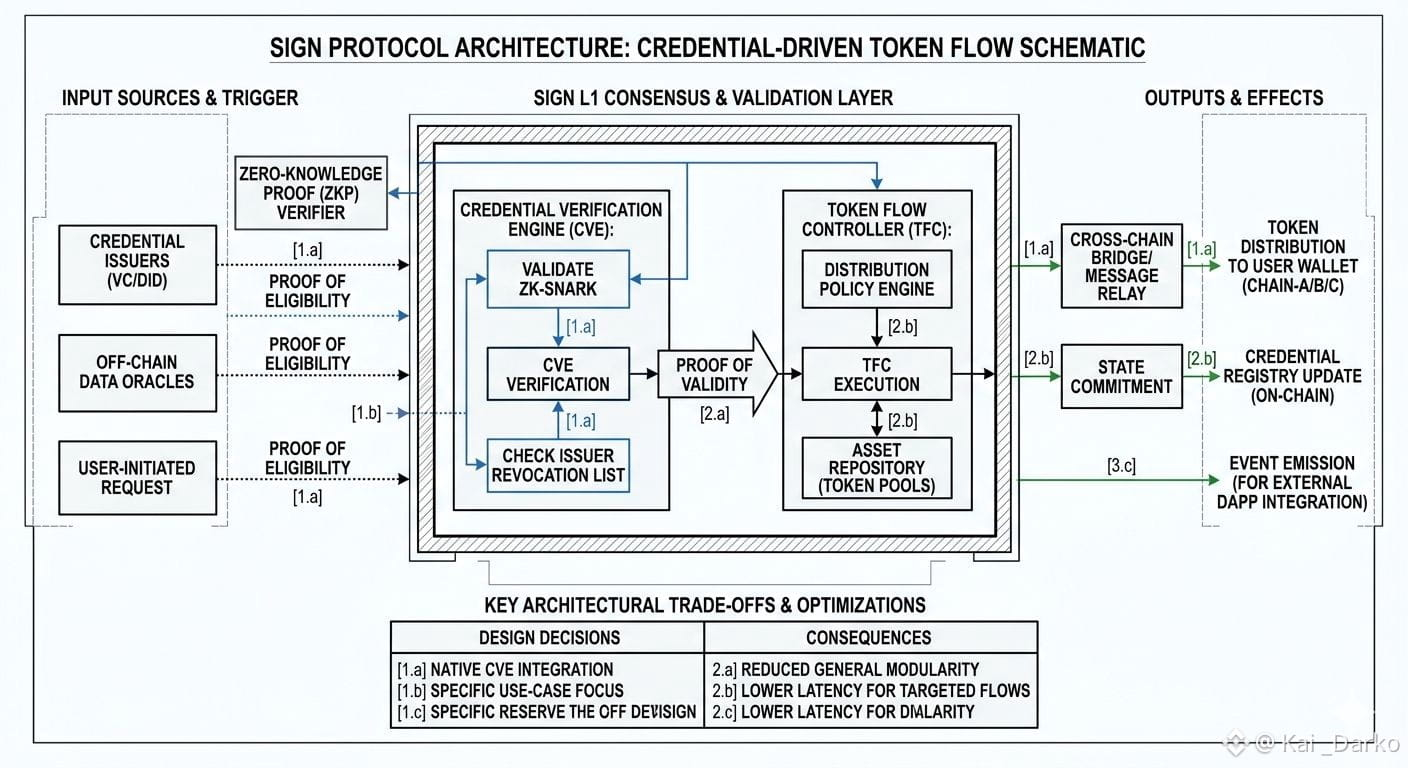
20
19
675

The Sign (SIGN) cryptocurrency project is a decentralized and open-source attestation protocol aimed at documentingThe Sign (SIGN) cryptocurrency project is a decentralized and open-source attestation protocol aimed at documenting identities and data on the blockchain. It serves as a foundational layer for decentralized applications (dApps) and governments, facilitating secure digital credential verification, enabling digital signatures, and managing token distribution.
Highlights of the SIGN project:
The Sign (SIGN) cryptocurrency project is a decentralized and open-source attestation protocol aimed at documenting
The Sign (SIGN) cryptocurrency project is a decentralized and open-source attestation protocol aimed at documenting identities and data on the blockchain. It serves as a foundational layer for decentralized applications (dApps) and governments, facilitating secure digital credential verification, enabling digital signatures, and managing token distribution.
Highlights of the SIGN project:
Highlights of the SIGN project:
85
See translation
#signdigitalsovereigninfra $SIGN Market looking choppy today, but smart money knows this is where patience pays. Accumulating solid projects during uncertainty has always been the winning strategy. Are you buying fear or waiting for confirmation?
#signdigitalsovereigninfra $SIGN Market looking choppy today, but smart money knows this is where patience pays. Accumulating solid projects during uncertainty has always been the winning strategy. Are you buying fear or waiting for confirmation?
1
16

·
--

Article
See translation
When Proof Matters More Than PromisesThere is a quiet kind of frustration that comes with spending time in digital systems today. Everything feels fast, polished, and full of promise but underneath that surface, there’s always a question lingering: can this actually be trusted?
That’s why something like Sign Protocol feels different. Not louder. Not more exciting. Just… different in a way that’s hard to ignore.
Because instead of chasing attention, it’s trying to solve something most people don’t think about until it breaks: trust.
And that’s not a small problem. It’s one of the biggest.
There’s a quiet kind of frustration that comes with spending time in digital systems today. Everything feels fast, polished, and full of promise but underneath that surface, there’s always a question lingering: can this actually be trusted?
Most digital systems today run on assumptions. We assume a file is authentic. We assume a record hasn’t been changed. We assume a claim is true because someone presented it with confidence.
But assumptions are fragile.
The moment something goes wrong when data is disputed, when records are questioned, when proof is needed everything suddenly becomes harder. People start asking: Where did this come from? Who verified it? Can we prove it?
And often, the answer is messy.
That’s the space Sign Protocol is stepping into.
Sign Protocol isn’t trying to be the flashiest project in the room. It’s not chasing hype cycles or trying to dominate attention. Instead, it’s focused on something much less glamorous but far more important:
Making proof reliable.
At its core, it introduces a system where information isn’t just stored it’s structured, signed, and verifiable. Data follows predefined formats (called schemas), and every piece of information (called an attestation) can be traced back and validated.
It sounds technical, but the feeling behind it is simple:
“If something is said it should be possible to prove it.
There’s something almost reassuring about systems that don’t try too hard to impress you.
A lot of projects come with big promises. They talk about changing everything, fixing broken systems, redefining industries. And sometimes, they even look convincing for a while.
But over time, reality tests those promises.
Friction appears. Growth slows. Complexity increases. And suddenly, the story that once felt strong starts to feel thin.
Sign doesn’t give off that feeling at least not right now.
It feels like it understands something important:
Trust isn’t built in hype. It’s built in consistency.
If you strip everything down, this isn’t just about technology.
It’s about confidence.
Think about how often people rely on proof in everyday life verifying identity, checking credentials, confirming eligibility, validating claims. These aren’t abstract ideas. They’re real-world needs that affect real decisions.
And when those systems fail, it’s not just inconvenient it’s stressful.
There’s doubt. Confusion. Sometimes even consequences.
That’s why a system like Sign matters in a deeper way. It’s not just improving data handling it’s trying to reduce that uncertainty.
It’s trying to make truth feel less fragile.
What makes this space interesting is that it doesn’t get easier over time it gets harder.
As systems grow, as more people interact, as more data flows across networks, the need for reliable verification only increases. Simple solutions stop working. Workarounds start breaking. And eventually, everything depends on whether the underlying system can still be trusted.
Sign Protocol is trying to live in that complexity.
Not avoid it. Not simplify it away. But actually work through it.
That’s not easy.
And honestly, it’s not supposed to be.
There’s a delicate balance in building something like this.
Too open, and the system becomes vulnerable.
Too controlled, and it loses the openness that makes it useful.
Too complex, and people won’t use it.
Too simple, and it won’t hold up under pressure.
Sign is operating right in that middle space.
Trying to stay flexible enough to work across different systems while still maintaining structure and reliability. That kind of balance is hard to get right, and even harder to maintain over time.
But if it works, it becomes something rare:
A system people don’t just use but depend on.
Most of the time, people are drawn to what’s exciting. Speed. Growth. Numbers going up. Big narratives that feel like they’re moving the world forward.
But the systems that actually last are usually the ones working quietly in the background.
They don’t always get attention. They don’t always look impressive. But they do something much more valuable:
They hold things together.
Sign Protocol feels like it’s aiming for that role.
Not to be the loudest name in the space but to be one of the most reliable.
And in a world where so much is uncertain, that kind of reliability carries a different kind of weight.
There’s no guarantee that any project will succeed. That’s just reality.
Ideas can be strong. Teams can be talented. Vision can be clear. And still, things can fail.
What matters is whether something can stand up to real use. Whether it can survive pressure. Whether it can keep working when it stops being theoretical and starts being necessary.
That’s the stage Sign Protocol seems to be preparing for.
And maybe that’s why it’s worth paying attention to.
Not because it promises everything.
But because it’s trying to get one important thing right:
Trust.
#SignDigitalSovereignInfra
@SignOfficial $SIGN
{spot}(SIGNUSDT)
When Proof Matters More Than Promises
There is a quiet kind of frustration that comes with spending time in digital systems today. Everything feels fast, polished, and full of promise but underneath that surface, there’s always a question lingering: can this actually be trusted?
That’s why something like Sign Protocol feels different. Not louder. Not more exciting. Just… different in a way that’s hard to ignore.
Because instead of chasing attention, it’s trying to solve something most people don’t think about until it breaks: trust.
And that’s not a small problem. It’s one of the biggest.
There’s a quiet kind of frustration that comes with spending time in digital systems today. Everything feels fast, polished, and full of promise but underneath that surface, there’s always a question lingering: can this actually be trusted?
Most digital systems today run on assumptions. We assume a file is authentic. We assume a record hasn’t been changed. We assume a claim is true because someone presented it with confidence.
But assumptions are fragile.
The moment something goes wrong when data is disputed, when records are questioned, when proof is needed everything suddenly becomes harder. People start asking: Where did this come from? Who verified it? Can we prove it?
And often, the answer is messy.
That’s the space Sign Protocol is stepping into.
Sign Protocol isn’t trying to be the flashiest project in the room. It’s not chasing hype cycles or trying to dominate attention. Instead, it’s focused on something much less glamorous but far more important:
Making proof reliable.
At its core, it introduces a system where information isn’t just stored it’s structured, signed, and verifiable. Data follows predefined formats (called schemas), and every piece of information (called an attestation) can be traced back and validated.
It sounds technical, but the feeling behind it is simple:
“If something is said it should be possible to prove it.
There’s something almost reassuring about systems that don’t try too hard to impress you.
A lot of projects come with big promises. They talk about changing everything, fixing broken systems, redefining industries. And sometimes, they even look convincing for a while.
But over time, reality tests those promises.
Friction appears. Growth slows. Complexity increases. And suddenly, the story that once felt strong starts to feel thin.
Sign doesn’t give off that feeling at least not right now.
It feels like it understands something important:
Trust isn’t built in hype. It’s built in consistency.
If you strip everything down, this isn’t just about technology.
It’s about confidence.
Think about how often people rely on proof in everyday life verifying identity, checking credentials, confirming eligibility, validating claims. These aren’t abstract ideas. They’re real-world needs that affect real decisions.
And when those systems fail, it’s not just inconvenient it’s stressful.
There’s doubt. Confusion. Sometimes even consequences.
That’s why a system like Sign matters in a deeper way. It’s not just improving data handling it’s trying to reduce that uncertainty.
It’s trying to make truth feel less fragile.
What makes this space interesting is that it doesn’t get easier over time it gets harder.
As systems grow, as more people interact, as more data flows across networks, the need for reliable verification only increases. Simple solutions stop working. Workarounds start breaking. And eventually, everything depends on whether the underlying system can still be trusted.
Sign Protocol is trying to live in that complexity.
Not avoid it. Not simplify it away. But actually work through it.
That’s not easy.
And honestly, it’s not supposed to be.
There’s a delicate balance in building something like this.
Too open, and the system becomes vulnerable.
Too controlled, and it loses the openness that makes it useful.
Too complex, and people won’t use it.
Too simple, and it won’t hold up under pressure.
Sign is operating right in that middle space.
Trying to stay flexible enough to work across different systems while still maintaining structure and reliability. That kind of balance is hard to get right, and even harder to maintain over time.
But if it works, it becomes something rare:
A system people don’t just use but depend on.
Most of the time, people are drawn to what’s exciting. Speed. Growth. Numbers going up. Big narratives that feel like they’re moving the world forward.
But the systems that actually last are usually the ones working quietly in the background.
They don’t always get attention. They don’t always look impressive. But they do something much more valuable:
They hold things together.
Sign Protocol feels like it’s aiming for that role.
Not to be the loudest name in the space but to be one of the most reliable.
And in a world where so much is uncertain, that kind of reliability carries a different kind of weight.
There’s no guarantee that any project will succeed. That’s just reality.
Ideas can be strong. Teams can be talented. Vision can be clear. And still, things can fail.
What matters is whether something can stand up to real use. Whether it can survive pressure. Whether it can keep working when it stops being theoretical and starts being necessary.
That’s the stage Sign Protocol seems to be preparing for.
And maybe that’s why it’s worth paying attention to.
Not because it promises everything.
But because it’s trying to get one important thing right:
Trust.
#SignDigitalSovereignInfra
@SignOfficial $SIGN
That’s why something like Sign Protocol feels different. Not louder. Not more exciting. Just… different in a way that’s hard to ignore.
Because instead of chasing attention, it’s trying to solve something most people don’t think about until it breaks: trust.
And that’s not a small problem. It’s one of the biggest.
There’s a quiet kind of frustration that comes with spending time in digital systems today. Everything feels fast, polished, and full of promise but underneath that surface, there’s always a question lingering: can this actually be trusted?
Most digital systems today run on assumptions. We assume a file is authentic. We assume a record hasn’t been changed. We assume a claim is true because someone presented it with confidence.
But assumptions are fragile.
The moment something goes wrong when data is disputed, when records are questioned, when proof is needed everything suddenly becomes harder. People start asking: Where did this come from? Who verified it? Can we prove it?
And often, the answer is messy.
That’s the space Sign Protocol is stepping into.
Sign Protocol isn’t trying to be the flashiest project in the room. It’s not chasing hype cycles or trying to dominate attention. Instead, it’s focused on something much less glamorous but far more important:
Making proof reliable.
At its core, it introduces a system where information isn’t just stored it’s structured, signed, and verifiable. Data follows predefined formats (called schemas), and every piece of information (called an attestation) can be traced back and validated.
It sounds technical, but the feeling behind it is simple:
“If something is said it should be possible to prove it.
There’s something almost reassuring about systems that don’t try too hard to impress you.
A lot of projects come with big promises. They talk about changing everything, fixing broken systems, redefining industries. And sometimes, they even look convincing for a while.
But over time, reality tests those promises.
Friction appears. Growth slows. Complexity increases. And suddenly, the story that once felt strong starts to feel thin.
Sign doesn’t give off that feeling at least not right now.
It feels like it understands something important:
Trust isn’t built in hype. It’s built in consistency.
If you strip everything down, this isn’t just about technology.
It’s about confidence.
Think about how often people rely on proof in everyday life verifying identity, checking credentials, confirming eligibility, validating claims. These aren’t abstract ideas. They’re real-world needs that affect real decisions.
And when those systems fail, it’s not just inconvenient it’s stressful.
There’s doubt. Confusion. Sometimes even consequences.
That’s why a system like Sign matters in a deeper way. It’s not just improving data handling it’s trying to reduce that uncertainty.
It’s trying to make truth feel less fragile.
What makes this space interesting is that it doesn’t get easier over time it gets harder.
As systems grow, as more people interact, as more data flows across networks, the need for reliable verification only increases. Simple solutions stop working. Workarounds start breaking. And eventually, everything depends on whether the underlying system can still be trusted.
Sign Protocol is trying to live in that complexity.
Not avoid it. Not simplify it away. But actually work through it.
That’s not easy.
And honestly, it’s not supposed to be.
There’s a delicate balance in building something like this.
Too open, and the system becomes vulnerable.
Too controlled, and it loses the openness that makes it useful.
Too complex, and people won’t use it.
Too simple, and it won’t hold up under pressure.
Sign is operating right in that middle space.
Trying to stay flexible enough to work across different systems while still maintaining structure and reliability. That kind of balance is hard to get right, and even harder to maintain over time.
But if it works, it becomes something rare:
A system people don’t just use but depend on.
Most of the time, people are drawn to what’s exciting. Speed. Growth. Numbers going up. Big narratives that feel like they’re moving the world forward.
But the systems that actually last are usually the ones working quietly in the background.
They don’t always get attention. They don’t always look impressive. But they do something much more valuable:
They hold things together.
Sign Protocol feels like it’s aiming for that role.
Not to be the loudest name in the space but to be one of the most reliable.
And in a world where so much is uncertain, that kind of reliability carries a different kind of weight.
There’s no guarantee that any project will succeed. That’s just reality.
Ideas can be strong. Teams can be talented. Vision can be clear. And still, things can fail.
What matters is whether something can stand up to real use. Whether it can survive pressure. Whether it can keep working when it stops being theoretical and starts being necessary.
That’s the stage Sign Protocol seems to be preparing for.
And maybe that’s why it’s worth paying attention to.
Not because it promises everything.
But because it’s trying to get one important thing right:
Trust.
#SignDigitalSovereignInfra
@SignOfficial $SIGN
66
34
716

·
--
Bullish
See translation
Crypto feels repetitive lately.
New chain
New narrative
Same underlying problems
We built speed.
But not structure.
Identity is fragmented
Credentials don’t transfer
Token distribution is still messy
Airdrops get farmed
Sybil attacks scale
Systems break when real users show up
$SIGN isn’t trying to be loud.
It’s working on: Credential verification
Structured distribution
The boring layer.
The one nobody notices until it fails.
If this works, it becomes invisible infrastructure.
If it doesn’t, it stays niche.
Either way, this is where real problems are being solved.
#Sign #Web3 #crypto
#signdigitalsovereigninfra $SIGN
{future}(SIGNUSDT)
Crypto feels repetitive lately.
New chain
New narrative
Same underlying problems
We built speed.
But not structure.
Identity is fragmented
Credentials don’t transfer
Token distribution is still messy
Airdrops get farmed
Sybil attacks scale
Systems break when real users show up
$SIGN isn’t trying to be loud.
It’s working on: Credential verification
Structured distribution
The boring layer.
The one nobody notices until it fails.
If this works, it becomes invisible infrastructure.
If it doesn’t, it stays niche.
Either way, this is where real problems are being solved.
#Sign #Web3 #crypto
#signdigitalsovereigninfra $SIGN
New chain
New narrative
Same underlying problems
We built speed.
But not structure.
Identity is fragmented
Credentials don’t transfer
Token distribution is still messy
Airdrops get farmed
Sybil attacks scale
Systems break when real users show up
$SIGN isn’t trying to be loud.
It’s working on: Credential verification
Structured distribution
The boring layer.
The one nobody notices until it fails.
If this works, it becomes invisible infrastructure.
If it doesn’t, it stays niche.
Either way, this is where real problems are being solved.
#Sign #Web3 #crypto
#signdigitalsovereigninfra $SIGN
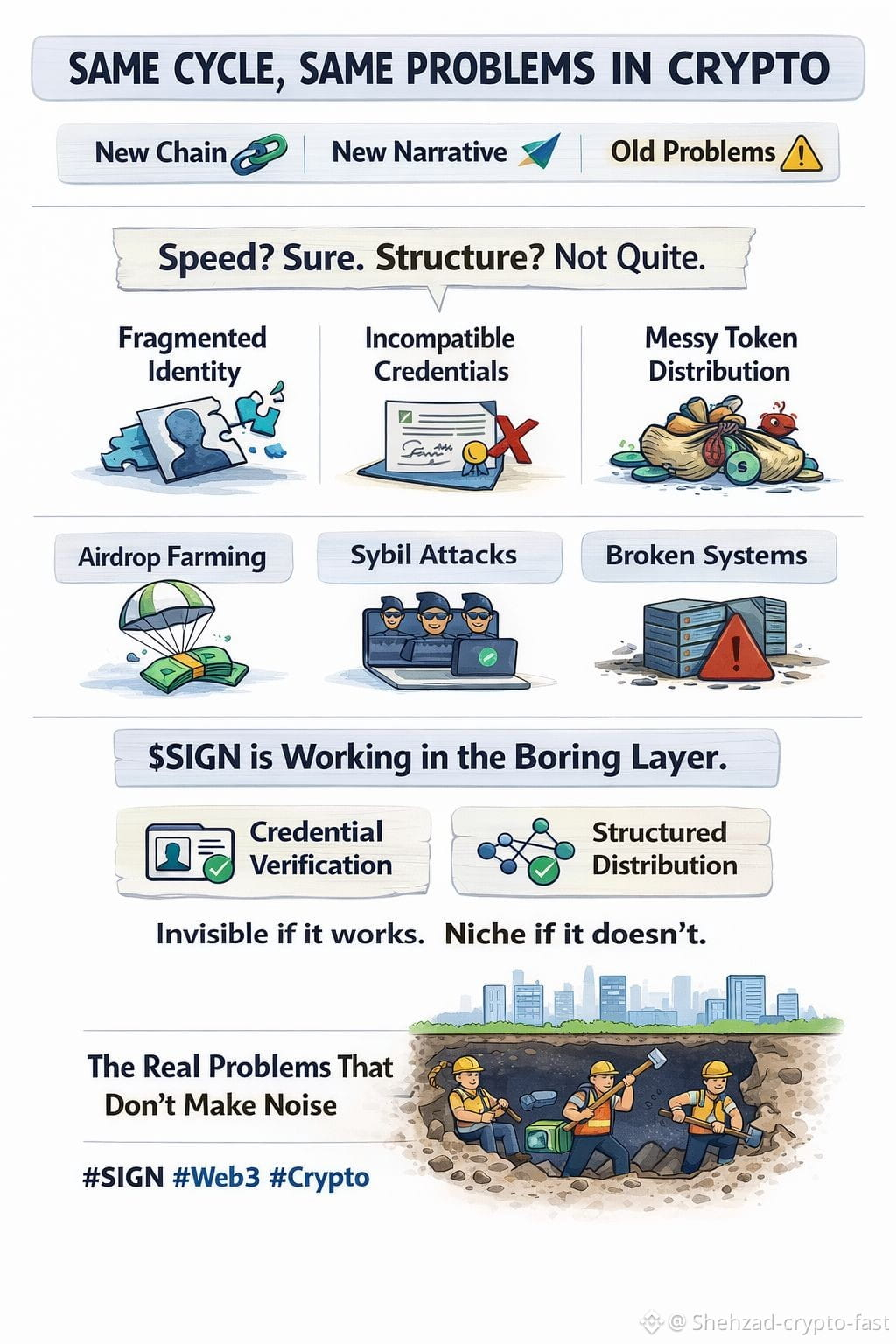
1
2
429

·
--
#signdigitalsovereigninfra $SIGN The Middle East is rapidly developing its digital economy, and trust in data and identity will be key. Sign is building a digital sovereign infrastructure that can support administration, business, and innovation in the region. This is a real foundation for new economic models. I am observing the development of the project @SignOfficial SignOfficial and the potential of the token $SIGN #SignDigitalSovereignInfrap
#signdigitalsovereigninfra $SIGN The Middle East is rapidly developing its digital economy, and trust in data and identity will be key. Sign is building a digital sovereign infrastructure that can support administration, business, and innovation in the region. This is a real foundation for new economic models. I am observing the development of the project @SignOfficial SignOfficial and the potential of the token $SIGN #SignDigitalSovereignInfrap
1
79

·
--
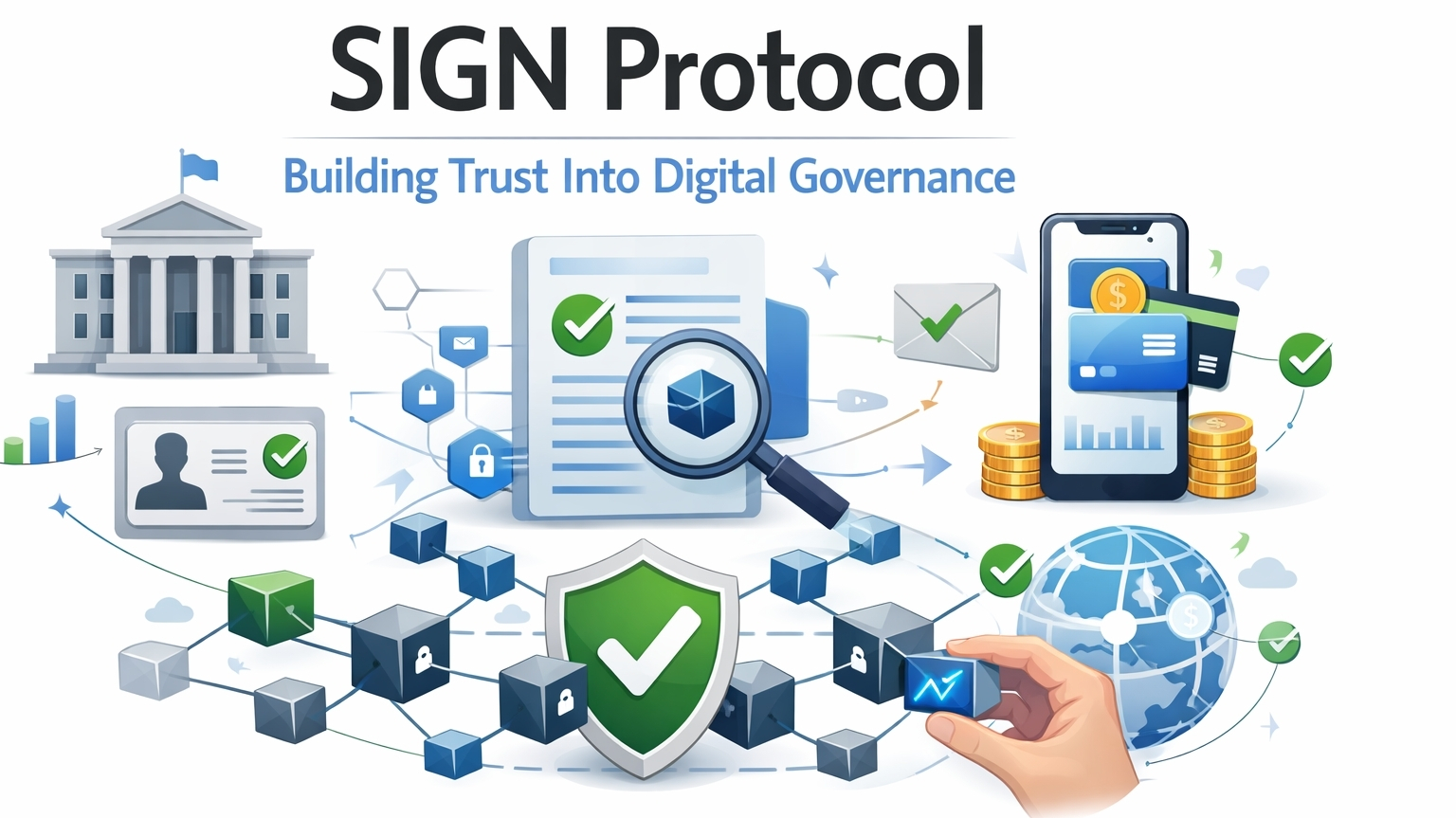
Article
See translation
SIGN Protocol: Building Trust Into Digital GovernanceSIGN Protocol feels different because it is not trying to impress people with noise first and meaning later. A lot of projects in this space come in loud. Big promises, big words, polished branding, but once you look under the surface, there is not much there besides another token narrative. SIGN does not really hit like that. The more you look at it, the more it feels like a project built around a real problem.
That problem is simple to understand. The digital world keeps expanding, but trust inside digital systems is still weak. Records are scattered. Verification is fragmented. One system says one thing, another says something else, and nobody is fully sure where the final truth sits. A document can be approved, a credential can be issued, a payment can be processed, but proving the full story behind it later is often harder than it should be. That is where SIGN starts to matter.
At the center of the project is the idea of attestations. That sounds technical at first, but the meaning is actually very human. It is about turning a claim into something that can be verified instead of just believed. A person, an institution, or a system says something is true, and that truth is structured, signed, and made usable across different environments. That changes the whole feeling of digital interaction. Instead of depending on closed databases and disconnected approvals, there is a clearer way to carry proof.
What makes SIGN stand out is that it is not only solving this for one app or one isolated use case. The project feels like it is thinking at a much larger level. Identity, credentials, payments, compliance, access, public records, digital capital — all of these things depend on trusted data. If the trust layer is weak, every other layer becomes shaky too. SIGN seems to understand that better than most. It is not just building tools. It is building the base logic that lets digital systems rely on each other without falling into chaos.
That is why the project feels more serious the longer you sit with it. It is not trying to decorate governance and make it look trendy. It is trying to make digital governance actually work. And that matters, because governance in the digital era is not just about elections or policy language. It is about how systems decide what is valid, who is eligible, what is approved, what can be checked, and what can be trusted later when questions come up. That is a hard layer to build. It is not flashy work. But it is the kind of work that lasts.
There is also something mature about the way SIGN approaches structure. It does not pretend the world is simple. Real systems need roles, accountability, revocation, audits, permissions, upgrades, boundaries. In other words, they need discipline. A lot of crypto projects try to skip that part and act like pure openness solves everything. It does not. In real life, systems break when nobody knows who is responsible or when proof cannot survive stress. SIGN seems built with that reality in mind. That alone gives the project more weight.
The identity side of SIGN is especially important. Digital identity has been talked about for years, but most approaches still feel shallow. They treat identity like a login feature instead of what it really is — the base layer for access, services, credentials, benefits, compliance, and participation. Once that layer is weak, everything built on top of it starts to wobble. SIGN gives the impression that identity should not just exist, it should be provable, reusable, and portable. That is a much stronger vision than the usual disconnected database model.
The payment and distribution angle makes the project even more interesting. In the real world, identity and money are deeply connected. Who gets paid, who qualifies, who has authority, who can receive benefits, who can prove ownership — none of that works smoothly if trust is broken at the record level. SIGN is valuable because it sits close to that pressure point. It is trying to make trusted coordination possible between systems that normally struggle to speak the same language. That is not a small ambition. It is actually one of the biggest infrastructure problems out there.
What I like most is that the project does not feel like it is chasing hype first. It feels like it is building something that institutions, governments, businesses, and digital ecosystems could actually use when things become more complex. And that is usually where real value lives. Not in whatever sounds exciting for one week, but in whatever keeps making sense when the attention cools down. SIGN has that kind of shape. The kind that becomes more relevant as the digital world grows more serious.
Of course, no project is automatically great just because the idea is strong. Execution still matters. Adoption matters. Integration matters. A framework can look smart on paper and still struggle in practice. That part is real, and it should never be ignored. But even with that in mind, SIGN still feels like one of the more thoughtful projects in this lane because it is trying to fix something fundamental. It is asking how digital systems can create proof that survives doubt, not just activity that looks impressive on a dashboard.
That is why the project leaves a stronger impression than a lot of louder names. It is not forcing a revolution story. It is working on trust infrastructure. And trust infrastructure is one of those things people ignore until they realize everything depends on it. Once identity, governance, credentials, and value all move deeper into digital rails, the systems underneath will need more than speed. They will need structure. They will need proof. They will need something that can be checked, reused, and trusted across environments.
That is the lane SIGN is moving in, and honestly, that is what gives the project real depth. It is not just building another crypto product. It is trying to build a foundation for how digital systems can function with more clarity, more accountability, and less blind trust. That makes it feel less like a trend and more like a serious long-term project.
#SignDigitalSovereignInfra @SignOfficial $SIGN
SIGN Protocol: Building Trust Into Digital Governance
SIGN Protocol feels different because it is not trying to impress people with noise first and meaning later. A lot of projects in this space come in loud. Big promises, big words, polished branding, but once you look under the surface, there is not much there besides another token narrative. SIGN does not really hit like that. The more you look at it, the more it feels like a project built around a real problem.
That problem is simple to understand. The digital world keeps expanding, but trust inside digital systems is still weak. Records are scattered. Verification is fragmented. One system says one thing, another says something else, and nobody is fully sure where the final truth sits. A document can be approved, a credential can be issued, a payment can be processed, but proving the full story behind it later is often harder than it should be. That is where SIGN starts to matter.
At the center of the project is the idea of attestations. That sounds technical at first, but the meaning is actually very human. It is about turning a claim into something that can be verified instead of just believed. A person, an institution, or a system says something is true, and that truth is structured, signed, and made usable across different environments. That changes the whole feeling of digital interaction. Instead of depending on closed databases and disconnected approvals, there is a clearer way to carry proof.
What makes SIGN stand out is that it is not only solving this for one app or one isolated use case. The project feels like it is thinking at a much larger level. Identity, credentials, payments, compliance, access, public records, digital capital — all of these things depend on trusted data. If the trust layer is weak, every other layer becomes shaky too. SIGN seems to understand that better than most. It is not just building tools. It is building the base logic that lets digital systems rely on each other without falling into chaos.
That is why the project feels more serious the longer you sit with it. It is not trying to decorate governance and make it look trendy. It is trying to make digital governance actually work. And that matters, because governance in the digital era is not just about elections or policy language. It is about how systems decide what is valid, who is eligible, what is approved, what can be checked, and what can be trusted later when questions come up. That is a hard layer to build. It is not flashy work. But it is the kind of work that lasts.
There is also something mature about the way SIGN approaches structure. It does not pretend the world is simple. Real systems need roles, accountability, revocation, audits, permissions, upgrades, boundaries. In other words, they need discipline. A lot of crypto projects try to skip that part and act like pure openness solves everything. It does not. In real life, systems break when nobody knows who is responsible or when proof cannot survive stress. SIGN seems built with that reality in mind. That alone gives the project more weight.
The identity side of SIGN is especially important. Digital identity has been talked about for years, but most approaches still feel shallow. They treat identity like a login feature instead of what it really is — the base layer for access, services, credentials, benefits, compliance, and participation. Once that layer is weak, everything built on top of it starts to wobble. SIGN gives the impression that identity should not just exist, it should be provable, reusable, and portable. That is a much stronger vision than the usual disconnected database model.
The payment and distribution angle makes the project even more interesting. In the real world, identity and money are deeply connected. Who gets paid, who qualifies, who has authority, who can receive benefits, who can prove ownership — none of that works smoothly if trust is broken at the record level. SIGN is valuable because it sits close to that pressure point. It is trying to make trusted coordination possible between systems that normally struggle to speak the same language. That is not a small ambition. It is actually one of the biggest infrastructure problems out there.
What I like most is that the project does not feel like it is chasing hype first. It feels like it is building something that institutions, governments, businesses, and digital ecosystems could actually use when things become more complex. And that is usually where real value lives. Not in whatever sounds exciting for one week, but in whatever keeps making sense when the attention cools down. SIGN has that kind of shape. The kind that becomes more relevant as the digital world grows more serious.
Of course, no project is automatically great just because the idea is strong. Execution still matters. Adoption matters. Integration matters. A framework can look smart on paper and still struggle in practice. That part is real, and it should never be ignored. But even with that in mind, SIGN still feels like one of the more thoughtful projects in this lane because it is trying to fix something fundamental. It is asking how digital systems can create proof that survives doubt, not just activity that looks impressive on a dashboard.
That is why the project leaves a stronger impression than a lot of louder names. It is not forcing a revolution story. It is working on trust infrastructure. And trust infrastructure is one of those things people ignore until they realize everything depends on it. Once identity, governance, credentials, and value all move deeper into digital rails, the systems underneath will need more than speed. They will need structure. They will need proof. They will need something that can be checked, reused, and trusted across environments.
That is the lane SIGN is moving in, and honestly, that is what gives the project real depth. It is not just building another crypto product. It is trying to build a foundation for how digital systems can function with more clarity, more accountability, and less blind trust. That makes it feel less like a trend and more like a serious long-term project.
#SignDigitalSovereignInfra @SignOfficial $SIGN
That problem is simple to understand. The digital world keeps expanding, but trust inside digital systems is still weak. Records are scattered. Verification is fragmented. One system says one thing, another says something else, and nobody is fully sure where the final truth sits. A document can be approved, a credential can be issued, a payment can be processed, but proving the full story behind it later is often harder than it should be. That is where SIGN starts to matter.
At the center of the project is the idea of attestations. That sounds technical at first, but the meaning is actually very human. It is about turning a claim into something that can be verified instead of just believed. A person, an institution, or a system says something is true, and that truth is structured, signed, and made usable across different environments. That changes the whole feeling of digital interaction. Instead of depending on closed databases and disconnected approvals, there is a clearer way to carry proof.
What makes SIGN stand out is that it is not only solving this for one app or one isolated use case. The project feels like it is thinking at a much larger level. Identity, credentials, payments, compliance, access, public records, digital capital — all of these things depend on trusted data. If the trust layer is weak, every other layer becomes shaky too. SIGN seems to understand that better than most. It is not just building tools. It is building the base logic that lets digital systems rely on each other without falling into chaos.
That is why the project feels more serious the longer you sit with it. It is not trying to decorate governance and make it look trendy. It is trying to make digital governance actually work. And that matters, because governance in the digital era is not just about elections or policy language. It is about how systems decide what is valid, who is eligible, what is approved, what can be checked, and what can be trusted later when questions come up. That is a hard layer to build. It is not flashy work. But it is the kind of work that lasts.
There is also something mature about the way SIGN approaches structure. It does not pretend the world is simple. Real systems need roles, accountability, revocation, audits, permissions, upgrades, boundaries. In other words, they need discipline. A lot of crypto projects try to skip that part and act like pure openness solves everything. It does not. In real life, systems break when nobody knows who is responsible or when proof cannot survive stress. SIGN seems built with that reality in mind. That alone gives the project more weight.
The identity side of SIGN is especially important. Digital identity has been talked about for years, but most approaches still feel shallow. They treat identity like a login feature instead of what it really is — the base layer for access, services, credentials, benefits, compliance, and participation. Once that layer is weak, everything built on top of it starts to wobble. SIGN gives the impression that identity should not just exist, it should be provable, reusable, and portable. That is a much stronger vision than the usual disconnected database model.
The payment and distribution angle makes the project even more interesting. In the real world, identity and money are deeply connected. Who gets paid, who qualifies, who has authority, who can receive benefits, who can prove ownership — none of that works smoothly if trust is broken at the record level. SIGN is valuable because it sits close to that pressure point. It is trying to make trusted coordination possible between systems that normally struggle to speak the same language. That is not a small ambition. It is actually one of the biggest infrastructure problems out there.
What I like most is that the project does not feel like it is chasing hype first. It feels like it is building something that institutions, governments, businesses, and digital ecosystems could actually use when things become more complex. And that is usually where real value lives. Not in whatever sounds exciting for one week, but in whatever keeps making sense when the attention cools down. SIGN has that kind of shape. The kind that becomes more relevant as the digital world grows more serious.
Of course, no project is automatically great just because the idea is strong. Execution still matters. Adoption matters. Integration matters. A framework can look smart on paper and still struggle in practice. That part is real, and it should never be ignored. But even with that in mind, SIGN still feels like one of the more thoughtful projects in this lane because it is trying to fix something fundamental. It is asking how digital systems can create proof that survives doubt, not just activity that looks impressive on a dashboard.
That is why the project leaves a stronger impression than a lot of louder names. It is not forcing a revolution story. It is working on trust infrastructure. And trust infrastructure is one of those things people ignore until they realize everything depends on it. Once identity, governance, credentials, and value all move deeper into digital rails, the systems underneath will need more than speed. They will need structure. They will need proof. They will need something that can be checked, reused, and trusted across environments.
That is the lane SIGN is moving in, and honestly, that is what gives the project real depth. It is not just building another crypto product. It is trying to build a foundation for how digital systems can function with more clarity, more accountability, and less blind trust. That makes it feel less like a trend and more like a serious long-term project.
#SignDigitalSovereignInfra @SignOfficial $SIGN
9
13
619

·
--
Article
See translation
Shock‑Resistant by Design Infrastructure That Holds When Everything BreaksI have heard enough big crypto claims to know the pattern everything Sounds airtight until markets peak then it vanishes. So fail‑safe infrastructure doesn’t make me excited; it makes me cautious. I dug in because SIGN Protocol looked different for a straightforward reason: it isn’t stuck in theory, it’s already in use.
The idea’s simple enough to respect build systems that don’t crumble under pressure, not just for me trading at night but for entire countries. That’s a heavy claim. Governments don’t want experiments; they need things that keep working when everything else breaks. What grabs me is the focus on shock resistance. It’s real: markets crash, banks freeze, systems fail. I’ve watched it happen too many times. If infra can’t take stress it’s useless when it matters.
@SignOfficial SIGN seems aimed right at that gap. Instead of launching another token or chasing the same hype loop, it works on the base layer how trust and data are handled. Quiet work but important. From what I can tell it’s already deployed in real situations, and that outweighs any roadmap slide.
Still I’m not blindly recommending it or throwing myself wholly in. Sovereign‑grade infrastructure is serious governments move slowly for good reason. Security, control, accountability can’t be half‑baked. One weak point and the whole system gets questioned; tech ends up trash. I respect the direction, though. If blockchain has long‑term value, this is where it needs to go: not memes, not speculation, but ecosystems that stay standing when things go sideways.
I’m doubtful, but I’m watching closely. If something like this actually works at scale, it changes how countries think about digital infrastructure. I don’t get carried away by big claims, but I don’t ignore quiet progress either. Watch what gets used, learn, teach others that’s how real adoption moves forward. It’s not as far off as people think.#SignDigitalSovereignInfra $SIGN
Shock‑Resistant by Design Infrastructure That Holds When Everything Breaks
I have heard enough big crypto claims to know the pattern everything Sounds airtight until markets peak then it vanishes. So fail‑safe infrastructure doesn’t make me excited; it makes me cautious. I dug in because SIGN Protocol looked different for a straightforward reason: it isn’t stuck in theory, it’s already in use.
The idea’s simple enough to respect build systems that don’t crumble under pressure, not just for me trading at night but for entire countries. That’s a heavy claim. Governments don’t want experiments; they need things that keep working when everything else breaks. What grabs me is the focus on shock resistance. It’s real: markets crash, banks freeze, systems fail. I’ve watched it happen too many times. If infra can’t take stress it’s useless when it matters.
@SignOfficial SIGN seems aimed right at that gap. Instead of launching another token or chasing the same hype loop, it works on the base layer how trust and data are handled. Quiet work but important. From what I can tell it’s already deployed in real situations, and that outweighs any roadmap slide.
Still I’m not blindly recommending it or throwing myself wholly in. Sovereign‑grade infrastructure is serious governments move slowly for good reason. Security, control, accountability can’t be half‑baked. One weak point and the whole system gets questioned; tech ends up trash. I respect the direction, though. If blockchain has long‑term value, this is where it needs to go: not memes, not speculation, but ecosystems that stay standing when things go sideways.
I’m doubtful, but I’m watching closely. If something like this actually works at scale, it changes how countries think about digital infrastructure. I don’t get carried away by big claims, but I don’t ignore quiet progress either. Watch what gets used, learn, teach others that’s how real adoption moves forward. It’s not as far off as people think.#SignDigitalSovereignInfra $SIGN
The idea’s simple enough to respect build systems that don’t crumble under pressure, not just for me trading at night but for entire countries. That’s a heavy claim. Governments don’t want experiments; they need things that keep working when everything else breaks. What grabs me is the focus on shock resistance. It’s real: markets crash, banks freeze, systems fail. I’ve watched it happen too many times. If infra can’t take stress it’s useless when it matters.
@SignOfficial SIGN seems aimed right at that gap. Instead of launching another token or chasing the same hype loop, it works on the base layer how trust and data are handled. Quiet work but important. From what I can tell it’s already deployed in real situations, and that outweighs any roadmap slide.
Still I’m not blindly recommending it or throwing myself wholly in. Sovereign‑grade infrastructure is serious governments move slowly for good reason. Security, control, accountability can’t be half‑baked. One weak point and the whole system gets questioned; tech ends up trash. I respect the direction, though. If blockchain has long‑term value, this is where it needs to go: not memes, not speculation, but ecosystems that stay standing when things go sideways.
I’m doubtful, but I’m watching closely. If something like this actually works at scale, it changes how countries think about digital infrastructure. I don’t get carried away by big claims, but I don’t ignore quiet progress either. Watch what gets used, learn, teach others that’s how real adoption moves forward. It’s not as far off as people think.#SignDigitalSovereignInfra $SIGN
22
20
472

See translation
#signdigitalsovereigninfra $SIGN
While market fluctuations are unpredictable, $SIGN stands out as a token with real utility, embedded in products that are already operational. Their whitepaper is clear, documentation thorough, and they’re implementing live pilots. For those weary of empty promises in crypto, Sign is delivering the essential infrastructure needed for real mass adoption.
#signdigitalsovereigninfra $SIGN
While market fluctuations are unpredictable, $SIGN stands out as a token with real utility, embedded in products that are already operational. Their whitepaper is clear, documentation thorough, and they’re implementing live pilots. For those weary of empty promises in crypto, Sign is delivering the essential infrastructure needed for real mass adoption.
While market fluctuations are unpredictable, $SIGN stands out as a token with real utility, embedded in products that are already operational. Their whitepaper is clear, documentation thorough, and they’re implementing live pilots. For those weary of empty promises in crypto, Sign is delivering the essential infrastructure needed for real mass adoption.
4
164

·
--
See translation
@SignOfficial I’ll be honest I used to hate proving anything online. Same forms, same screenshots, same “trust me bro” loop. Then I started digging into how things run on Ethereum and honestly… it clicked a bit.
From what I’ve seen, Sign Protocol isn’t trying to be flashy. It’s just fixing something painfully basic. Turning proofs into reusable on-chain credentials. You verify once, and it sticks. That alone feels like real utility, not hype.
Still, I wonder how far this scales outside crypto-native users. Regular people don’t care about wallets. They care about convenience.
But yeah… this feels closer to real-world infrastructure than most “next big things” I’ve come across.
I’ll be honest, I’ve become skeptical of anything mixing tokens with “infrastructure.” Usually it’s forced. But this case feels… different.
Sign Protocol leans more into verification than speculation. It’s like giving blockchain a job beyond trading. Credentials, attestations, distribution… stuff that actually matters off-chain too.
I think that’s where Web3 slowly redeems itself. When it stops shouting and just works quietly in the background.
Only concern? If adoption doesn’t reach institutions, it stays a niche tool. And we’ve seen that story before.
There’s always been this gap in Web3. We talk about ownership, identity, reputation… but the proof layer felt messy.
After spending time exploring on-chain systems, I kinda see Sign Protocol as that missing layer. Not exciting on the surface, but foundational.
It’s like plumbing. You don’t notice it until it’s broken.
And yeah, it’s not perfect. Gas fees, UX friction, and fragmented standards still exist. But direction-wise? This makes more sense than another DeFi fork or NFT trend.
Feels like quiet progress. The kind that doesn’t trend, but actually lasts.
#SignDigitalSovereignInfra $SIGN
@SignOfficial I’ll be honest I used to hate proving anything online. Same forms, same screenshots, same “trust me bro” loop. Then I started digging into how things run on Ethereum and honestly… it clicked a bit.
From what I’ve seen, Sign Protocol isn’t trying to be flashy. It’s just fixing something painfully basic. Turning proofs into reusable on-chain credentials. You verify once, and it sticks. That alone feels like real utility, not hype.
Still, I wonder how far this scales outside crypto-native users. Regular people don’t care about wallets. They care about convenience.
But yeah… this feels closer to real-world infrastructure than most “next big things” I’ve come across.
I’ll be honest, I’ve become skeptical of anything mixing tokens with “infrastructure.” Usually it’s forced. But this case feels… different.
Sign Protocol leans more into verification than speculation. It’s like giving blockchain a job beyond trading. Credentials, attestations, distribution… stuff that actually matters off-chain too.
I think that’s where Web3 slowly redeems itself. When it stops shouting and just works quietly in the background.
Only concern? If adoption doesn’t reach institutions, it stays a niche tool. And we’ve seen that story before.
There’s always been this gap in Web3. We talk about ownership, identity, reputation… but the proof layer felt messy.
After spending time exploring on-chain systems, I kinda see Sign Protocol as that missing layer. Not exciting on the surface, but foundational.
It’s like plumbing. You don’t notice it until it’s broken.
And yeah, it’s not perfect. Gas fees, UX friction, and fragmented standards still exist. But direction-wise? This makes more sense than another DeFi fork or NFT trend.
Feels like quiet progress. The kind that doesn’t trend, but actually lasts.
#SignDigitalSovereignInfra $SIGN
From what I’ve seen, Sign Protocol isn’t trying to be flashy. It’s just fixing something painfully basic. Turning proofs into reusable on-chain credentials. You verify once, and it sticks. That alone feels like real utility, not hype.
Still, I wonder how far this scales outside crypto-native users. Regular people don’t care about wallets. They care about convenience.
But yeah… this feels closer to real-world infrastructure than most “next big things” I’ve come across.
I’ll be honest, I’ve become skeptical of anything mixing tokens with “infrastructure.” Usually it’s forced. But this case feels… different.
Sign Protocol leans more into verification than speculation. It’s like giving blockchain a job beyond trading. Credentials, attestations, distribution… stuff that actually matters off-chain too.
I think that’s where Web3 slowly redeems itself. When it stops shouting and just works quietly in the background.
Only concern? If adoption doesn’t reach institutions, it stays a niche tool. And we’ve seen that story before.
There’s always been this gap in Web3. We talk about ownership, identity, reputation… but the proof layer felt messy.
After spending time exploring on-chain systems, I kinda see Sign Protocol as that missing layer. Not exciting on the surface, but foundational.
It’s like plumbing. You don’t notice it until it’s broken.
And yeah, it’s not perfect. Gas fees, UX friction, and fragmented standards still exist. But direction-wise? This makes more sense than another DeFi fork or NFT trend.
Feels like quiet progress. The kind that doesn’t trend, but actually lasts.
#SignDigitalSovereignInfra $SIGN
3
1
163
Log in to explore more content
Join global crypto users on Binance Square
⚡️ Get latest and useful information about crypto.
💬 Trusted by the world’s largest crypto exchange.
👍 Discover real insights from verified creators.
Email / Phone number
Related Coins
Trending Topics
1
#BOJRaisesRatesTo31YearHigh
58,309 views
1,035 Discussing
2
#BuffettStepsDownAsBerkshireChairman
24,655 views
475 Discussing
3
#XRPExchangeReservesHitSevenYearLow
30,589 views
449 Discussing
4
#HKCompletesFirstHKDStablecoinUseCase
64,211 views
982 Discussing
5
#VietnamPlansFirstCryptoLicensesIn2026
42,977 views
676 Discussing
6
#BTCBreaks80K
341,734 views
4,387 Discussing
7
#比特币突破8万
153,891 views
492 Discussing
8
#BitcoinMarketCapTopsTesla
66,456 views
976 Discussing
9
#SOLJumpsAbout10%
75,828 views
978 Discussing
10
#EthereumReclaims$2600
6,875 views
110 Discussing