
#sxt
sxt
5.3M views
9,150 Discussing
Hot
Latest

·
--
See translation
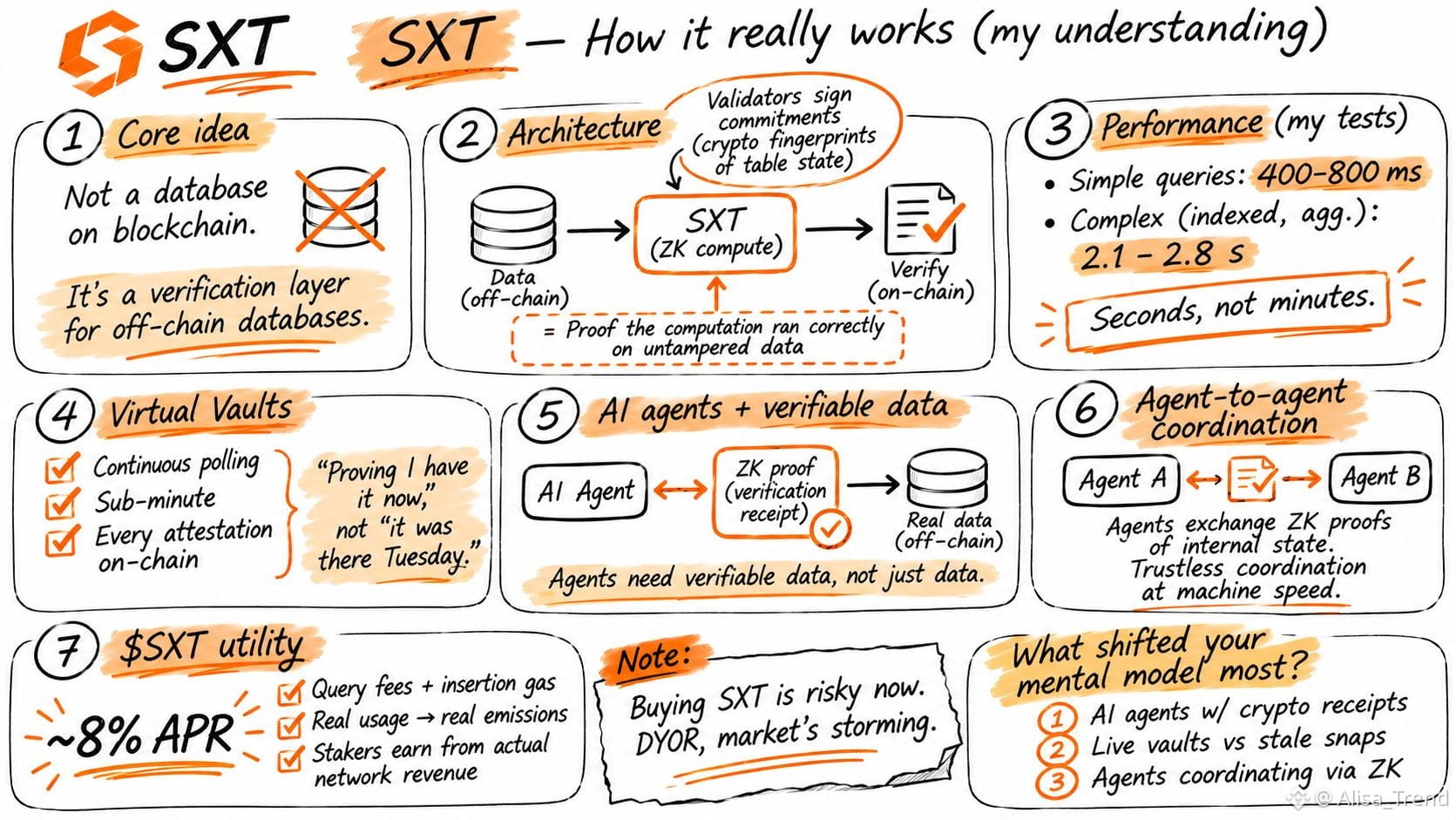
Honestly, I dismissed SXT at first. "Another ZK coprocessor, cool story." Sat down, dug through docs, ran tests, built test contracts - my mental model flipped repeatedly.
First shock: validators don't store data. They sign commitments - crypto fingerprints of table state. Data lives off-chain, verification on-chain. I thought "database on blockchain." Wrong. It's a verification layer for off-chain databases. Mental model collapsed.
Performance: marketing says "sub-second." Tech docs say "under 3s for million-row joins." Tested myself: simple queries 400-800ms, complex aggregations on indexed Eth tables 2.1-2.8s. Honest take: "seconds, not minutes." I measured it myself.
Virtual Vaults stopped me cold. Read Proof of Reserves 100x - snapshots, "trust me, funds were there Tuesday." Virtual Vaults aren't faster snapshots - different category. Continuous polling, sub-minute, every attestation on-chain. Lender risk engines read operational infra, not reports. Margin calls on proven state now, not last week's reports. "Collateral was there Tuesday" vs "Proving I have it now." Fundamental difference.
AI agents - everyone says "agents need data." Nobody says "agents need verifiable data." Agent doing $500k rebalance can't run on "trust me bro" oracles. Needs ZK proof query ran correctly on untampered data. SXT gives crypto receipts for every computation. Missing piece nobody discusses.
Agent-to-agent coordination - real frontier. Autonomous agents exchanging ZK proofs of internal state before cooperating. Trustless coordination at machine speed. This is the real AI narrative.
$SXT utility: ~8% APR isn't inflation - query fees + insertion gas. Real usage -> real emissions. Stakers earn from actual network revenue.
Buying SXT risky now. DYOR, market's storming, I'm short.
What shifted your mental model most?
🔸AI agents w/ crypto receipts🔸
🔸Live vaults vs stale snaps🔸
🔸Agents coordinating via ZK🔸
#sxt $SXT @SpaceandTimeDB #SXT
Honestly, I dismissed SXT at first. "Another ZK coprocessor, cool story." Sat down, dug through docs, ran tests, built test contracts - my mental model flipped repeatedly.
First shock: validators don't store data. They sign commitments - crypto fingerprints of table state. Data lives off-chain, verification on-chain. I thought "database on blockchain." Wrong. It's a verification layer for off-chain databases. Mental model collapsed.
Performance: marketing says "sub-second." Tech docs say "under 3s for million-row joins." Tested myself: simple queries 400-800ms, complex aggregations on indexed Eth tables 2.1-2.8s. Honest take: "seconds, not minutes." I measured it myself.
Virtual Vaults stopped me cold. Read Proof of Reserves 100x - snapshots, "trust me, funds were there Tuesday." Virtual Vaults aren't faster snapshots - different category. Continuous polling, sub-minute, every attestation on-chain. Lender risk engines read operational infra, not reports. Margin calls on proven state now, not last week's reports. "Collateral was there Tuesday" vs "Proving I have it now." Fundamental difference.
AI agents - everyone says "agents need data." Nobody says "agents need verifiable data." Agent doing $500k rebalance can't run on "trust me bro" oracles. Needs ZK proof query ran correctly on untampered data. SXT gives crypto receipts for every computation. Missing piece nobody discusses.
Agent-to-agent coordination - real frontier. Autonomous agents exchanging ZK proofs of internal state before cooperating. Trustless coordination at machine speed. This is the real AI narrative.
$SXT utility: ~8% APR isn't inflation - query fees + insertion gas. Real usage -> real emissions. Stakers earn from actual network revenue.
Buying SXT risky now. DYOR, market's storming, I'm short.
What shifted your mental model most?
🔸AI agents w/ crypto receipts🔸
🔸Live vaults vs stale snaps🔸
🔸Agents coordinating via ZK🔸
#sxt $SXT @SpaceandTime #SXT
Robbie Melanson M1Cw:
Привет! Опять конкурс?
1
3
743

·
--
Verified
See translation
I've been looking into Space and Time lately, and one thing that caught my attention is the problem it's trying to solve.
We talk a lot about blockchain speed, scalability, and cheaper transactions, but there's another question worth asking:
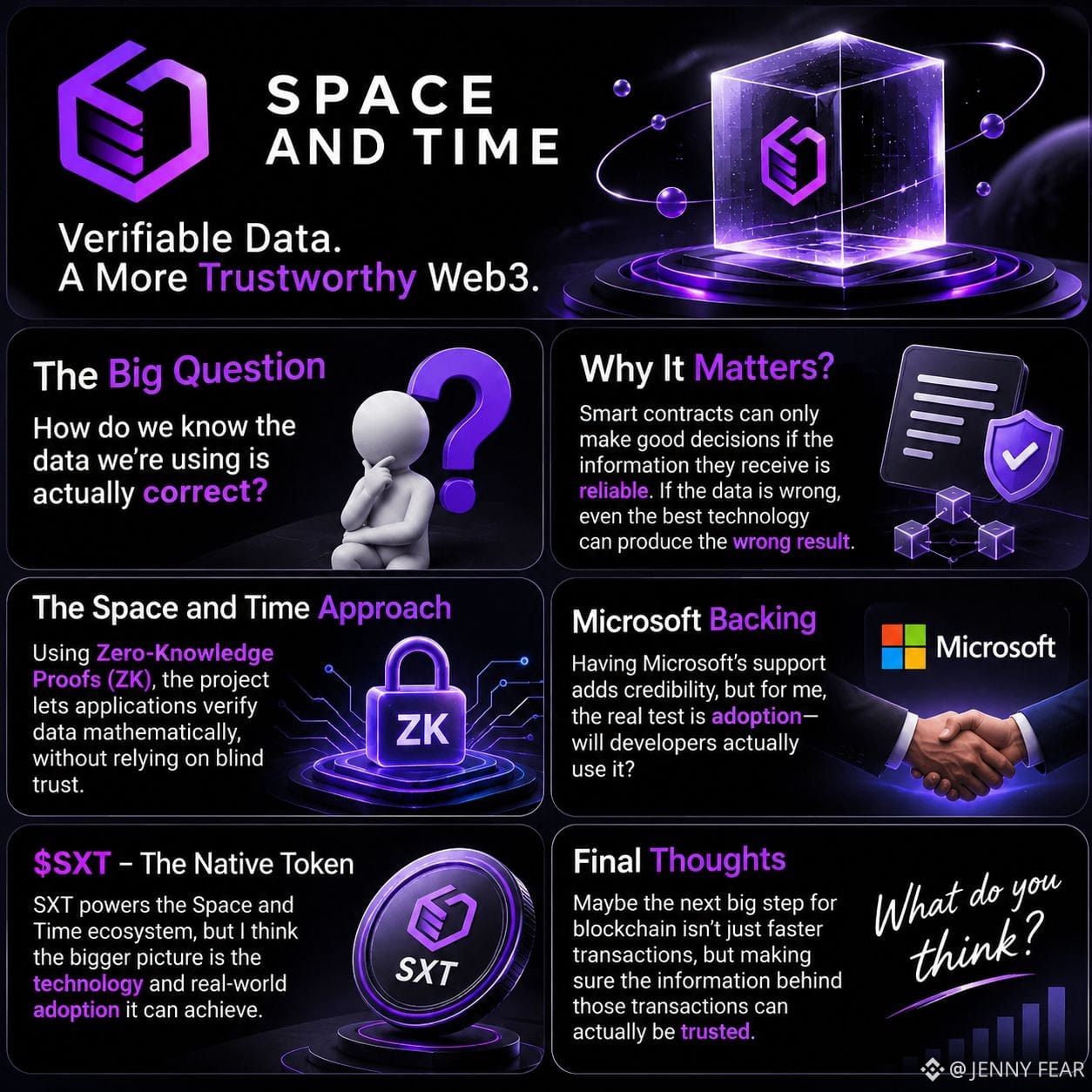
How do we know the data we're using is actually correct?
Think about it. Smart contracts can only make good decisions if the information they receive is reliable. If the data is wrong, even the best technology can produce the wrong result.
This is where Space and Time gets interesting.
The project is building a way to verify data using zero-knowledge proofs, so applications don't have to rely entirely on trust. Instead, they can mathematically check whether the information is accurate.
Having Microsoft backing adds another interesting angle, but I'm more interested in what happens next.
Will developers actually use it? Can it handle real demand? And can Space and Time make verifiable data useful beyond the crypto community?
Its native token, $SXT, is also part of the ecosystem, but I think the real story is the technology and the adoption it can achieve.
I'm not saying this is guaranteed to become a major player. It's simply a problem worth paying attention to.
Because maybe the next big step for blockchain isn't just processing transactions faster.
Maybe it's making sure the information behind those transactions can actually be trusted.
Curious to hear what others think about Space and Time.
#sxt $SXT @SpaceandTimeDB
I've been looking into Space and Time lately, and one thing that caught my attention is the problem it's trying to solve.
We talk a lot about blockchain speed, scalability, and cheaper transactions, but there's another question worth asking:
How do we know the data we're using is actually correct?
Think about it. Smart contracts can only make good decisions if the information they receive is reliable. If the data is wrong, even the best technology can produce the wrong result.
This is where Space and Time gets interesting.
The project is building a way to verify data using zero-knowledge proofs, so applications don't have to rely entirely on trust. Instead, they can mathematically check whether the information is accurate.
Having Microsoft backing adds another interesting angle, but I'm more interested in what happens next.
Will developers actually use it? Can it handle real demand? And can Space and Time make verifiable data useful beyond the crypto community?
Its native token, $SXT , is also part of the ecosystem, but I think the real story is the technology and the adoption it can achieve.
I'm not saying this is guaranteed to become a major player. It's simply a problem worth paying attention to.
Because maybe the next big step for blockchain isn't just processing transactions faster.
Maybe it's making sure the information behind those transactions can actually be trusted.
Curious to hear what others think about Space and Time.
#sxt $SXT @SpaceandTime
1
587


·
--
Verified
See translation
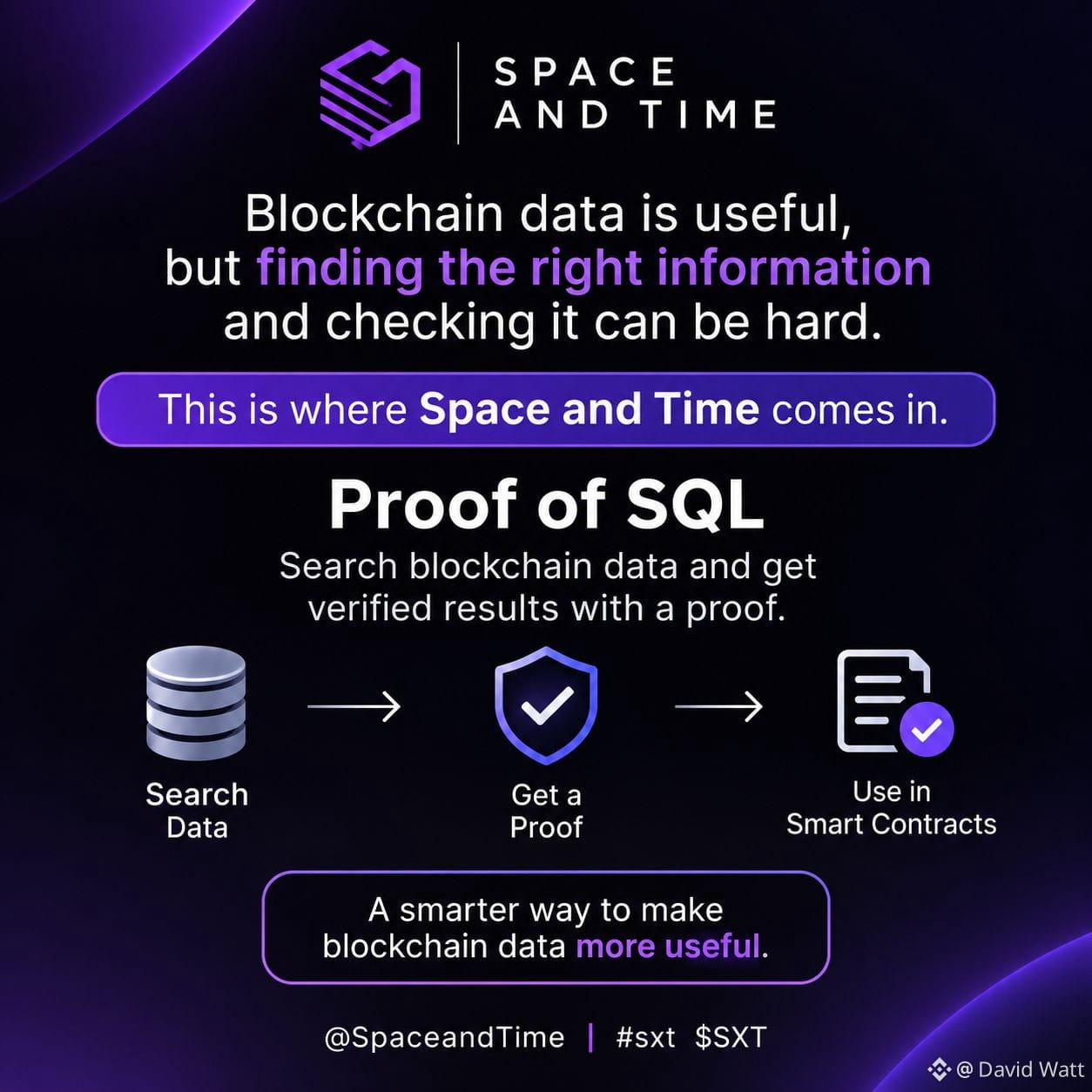
Blockchain data is useful, but finding the right information and making sure it is correct can be difficult.
This is where Space and Time comes in.
Its Proof of SQL technology helps developers search huge amounts of blockchain data and prove that the answers are accurate.
Think of it like asking a question and getting an answer with proof that it is correct.
Smart contracts can then use this verified data without doing all the heavy work themselves.
This can make building DeFi and tokenisation applications easier, faster and more reliable.
A smart way to make blockchain data more useful.
#sxt $SXT @SpaceandTimeDB
Blockchain data is useful, but finding the right information and making sure it is correct can be difficult.
This is where Space and Time comes in.
Its Proof of SQL technology helps developers search huge amounts of blockchain data and prove that the answers are accurate.
Think of it like asking a question and getting an answer with proof that it is correct.
Smart contracts can then use this verified data without doing all the heavy work themselves.
This can make building DeFi and tokenisation applications easier, faster and more reliable.
A smart way to make blockchain data more useful.
#sxt $SXT @SpaceandTime
SAQR77:
جميل
2
3
933

·
--
See translation
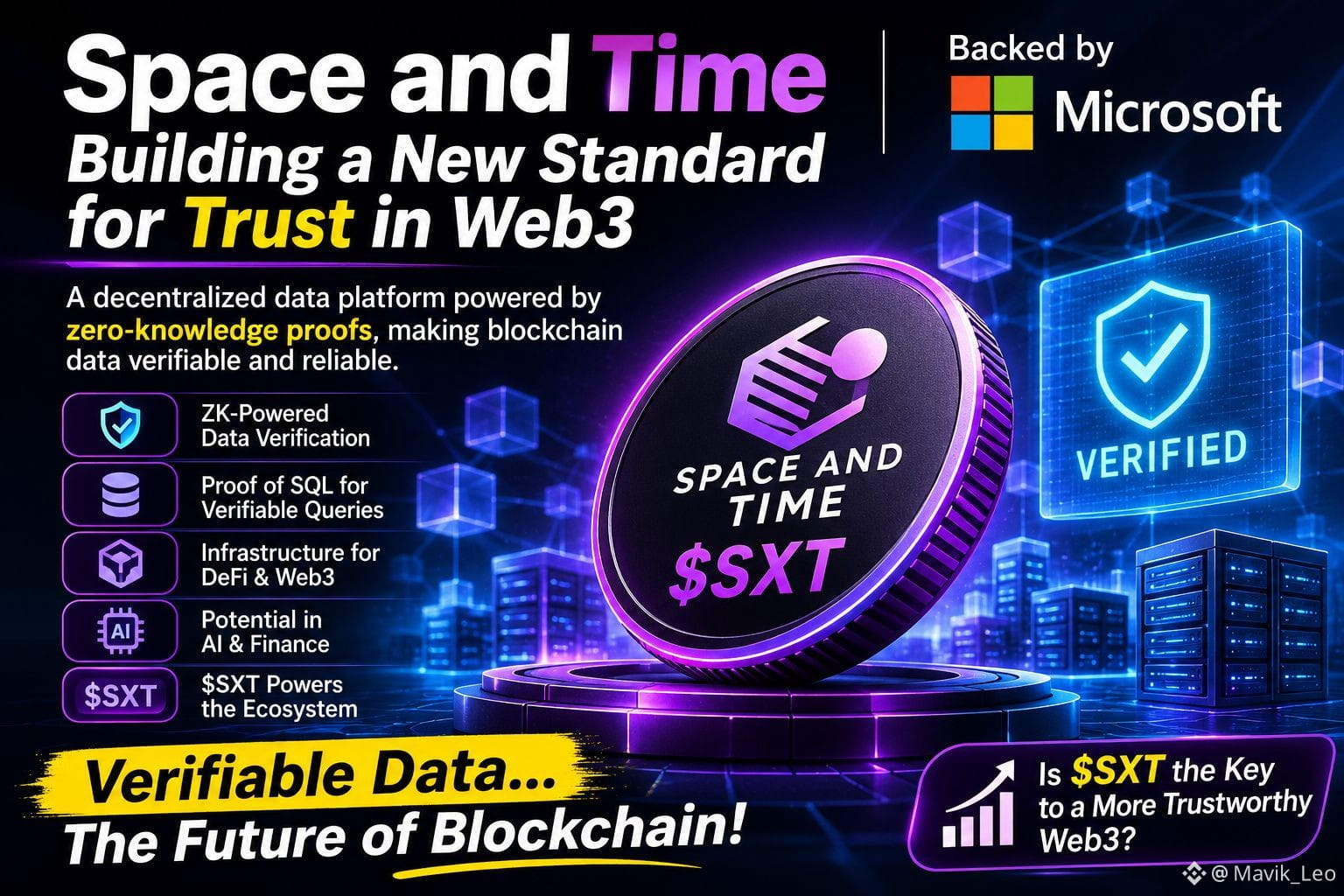
Space and Time: Building a New Standard for Trust in Web3
One thing I find interesting about blockchain technology is that processing data is no longer the biggest challenge. The real challenge is proving that the data is accurate.
That's exactly the problem SpaceandTime is trying to solve.
Backed by Microsoft's M12, Space and Time is developing a decentralized data infrastructure that combines blockchain technology with zero-knowledge proofs.
Its standout technology, Proof of SQL, allows applications to run complex database queries and cryptographically verify the results.
Why is this important?
Think about DeFi platforms calculating financial positions, smart contracts executing based on external information, or AI agents making decisions using blockchain data. If the underlying information isn't reliable, the entire application can face problems.
Space and Time aims to make this process more transparent and verifiable.
A few things worth watching:
🔹 ZK-powered data verification. 🔹 Proof of SQL for verifiable database queries. 🔹 Infrastructure for DeFi and Web3 applications. 🔹 Potential use cases in AI and institutional finance. 🔹 $SXT as the native token powering network participation.
What interests me most is the direction of this technology.
The next stage of Web3 won't only depend on faster blockchains. It will also require infrastructure that can prove information is correct.
That's the opportunity Space and Time is exploring.
I'm keeping $SXT on my watchlist because trustworthy data could become a major part of blockchain's future.#sxt $SXT @SpaceandTimeDB
Space and Time: Building a New Standard for Trust in Web3
One thing I find interesting about blockchain technology is that processing data is no longer the biggest challenge. The real challenge is proving that the data is accurate.
That's exactly the problem SpaceandTime is trying to solve.
Backed by Microsoft's M12, Space and Time is developing a decentralized data infrastructure that combines blockchain technology with zero-knowledge proofs.
Its standout technology, Proof of SQL, allows applications to run complex database queries and cryptographically verify the results.
Why is this important?
Think about DeFi platforms calculating financial positions, smart contracts executing based on external information, or AI agents making decisions using blockchain data. If the underlying information isn't reliable, the entire application can face problems.
Space and Time aims to make this process more transparent and verifiable.
A few things worth watching:
🔹 ZK-powered data verification. 🔹 Proof of SQL for verifiable database queries. 🔹 Infrastructure for DeFi and Web3 applications. 🔹 Potential use cases in AI and institutional finance. 🔹 $SXT as the native token powering network participation.
What interests me most is the direction of this technology.
The next stage of Web3 won't only depend on faster blockchains. It will also require infrastructure that can prove information is correct.
That's the opportunity Space and Time is exploring.
I'm keeping $SXT on my watchlist because trustworthy data could become a major part of blockchain's future.#sxt $SXT @SpaceandTime
BRAVO_78:
$SXT is building beyond simple transactions. 👀
14
14
510

·
--
See translation
#sxt $SXT @SpaceandTimeDB >>Notes: Follow, post once and share SXT trade. Only posts submitted via this campaign page will count. Post status will update to "Posted" after submission, which doesn't mean you have completed tasks; eligibility will be reviewed at the end of the campaign. To qualify, your post must include the trade-sharing widget showing a SXT Spot trade history or existing/history Futures positions with trade value ≥$20 equivalent, contain ≥100 characters, use #SXT, tag $SXT, mention @SpaceandTime, and be relevant to Space and Time, its core narrative: Space and Time powers verifiable data for AI, tokenization, and DeFi. No red packets in the post. Only Square posts that meet all the requirements mentioned above as qualified.
#sxt $SXT @SpaceandTime >>Notes: Follow, post once and share SXT trade. Only posts submitted via this campaign page will count. Post status will update to "Posted" after submission, which doesn't mean you have completed tasks; eligibility will be reviewed at the end of the campaign. To qualify, your post must include the trade-sharing widget showing a SXT Spot trade history or existing/history Futures positions with trade value ≥$20 equivalent, contain ≥100 characters, use #SXT, tag $SXT , mention @SpaceandTime, and be relevant to Space and Time, its core narrative: Space and Time powers verifiable data for AI, tokenization, and DeFi. No red packets in the post. Only Square posts that meet all the requirements mentioned above as qualified.
2
632

See translation
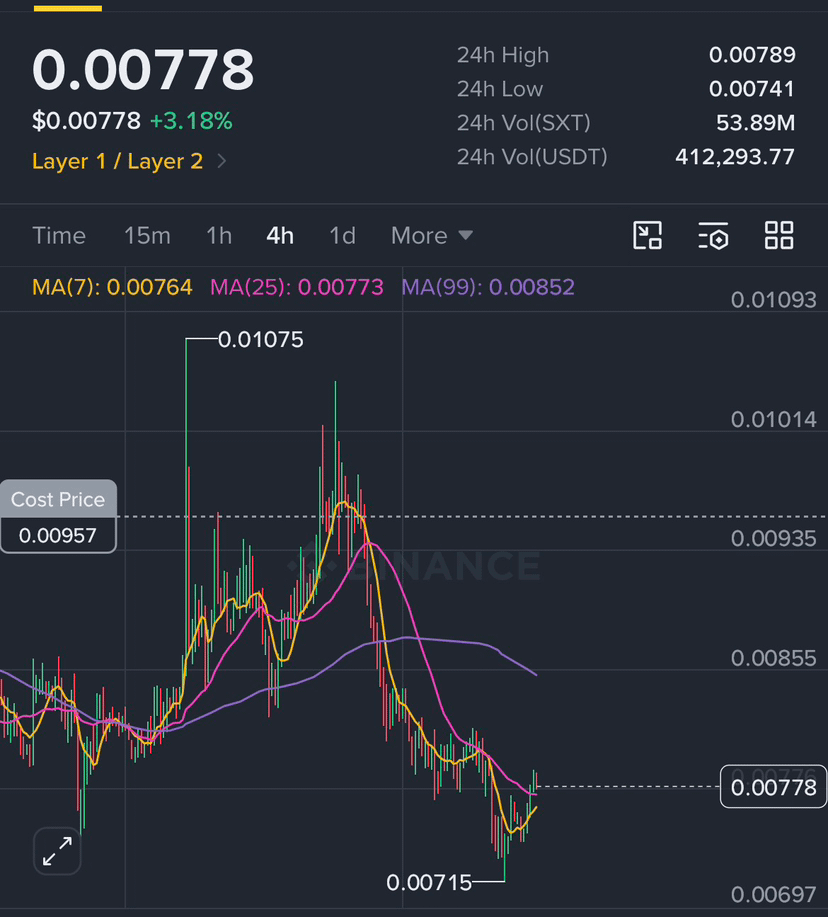
Space and time is building a future where blockchain data is verifiable, transparent and reliable. I believe this infrastructure will play an important role in the growth of web3, AL and Defi. The recent market conditions affected $SXT did not only affected this coin price but even $BTC i just loaded my bag of #SXT again and targeting at $0.088 @SpaceandTimeDB
Space and time is building a future where blockchain data is verifiable, transparent and reliable. I believe this infrastructure will play an important role in the growth of web3, AL and Defi. The recent market conditions affected $SXT did not only affected this coin price but even $BTC i just loaded my bag of #SXT again and targeting at $0.088 @SpaceandTime
415

·
--
Verified
See translation
#sxt $SXT @SpaceandTimeDB
Blockchains are built to verify transactions, yet they still have a blind spot when it comes to large-scale data. Anytime an AI agent executes a strategy, a DeFi protocol prices risk, or a tokenized asset checks off-chain reserves, pulling information from a standard centralized server introduces a single point of failure.
@SpaceandTimeDB removes that weak link by pairing a decentralized data warehouse with zero-knowledge cryptography. Using Proof of SQL, applications can run complex queries off-chain and prove the output is accurate directly on-chain without asking users to trust an intermediary.
By turning raw queries into cryptographic proof, $SXT powers verifiable data for AI, tokenization, and DeFi. #SXT
#sxt $SXT @SpaceandTime
Blockchains are built to verify transactions, yet they still have a blind spot when it comes to large-scale data. Anytime an AI agent executes a strategy, a DeFi protocol prices risk, or a tokenized asset checks off-chain reserves, pulling information from a standard centralized server introduces a single point of failure.
@SpaceandTime removes that weak link by pairing a decentralized data warehouse with zero-knowledge cryptography. Using Proof of SQL, applications can run complex queries off-chain and prove the output is accurate directly on-chain without asking users to trust an intermediary.
By turning raw queries into cryptographic proof, $SXT powers verifiable data for AI, tokenization, and DeFi. #SXT

CforCrypto7:
nice exp keep Building
2
6
19
741

·
--
See translation
{future}(SXTUSDT)
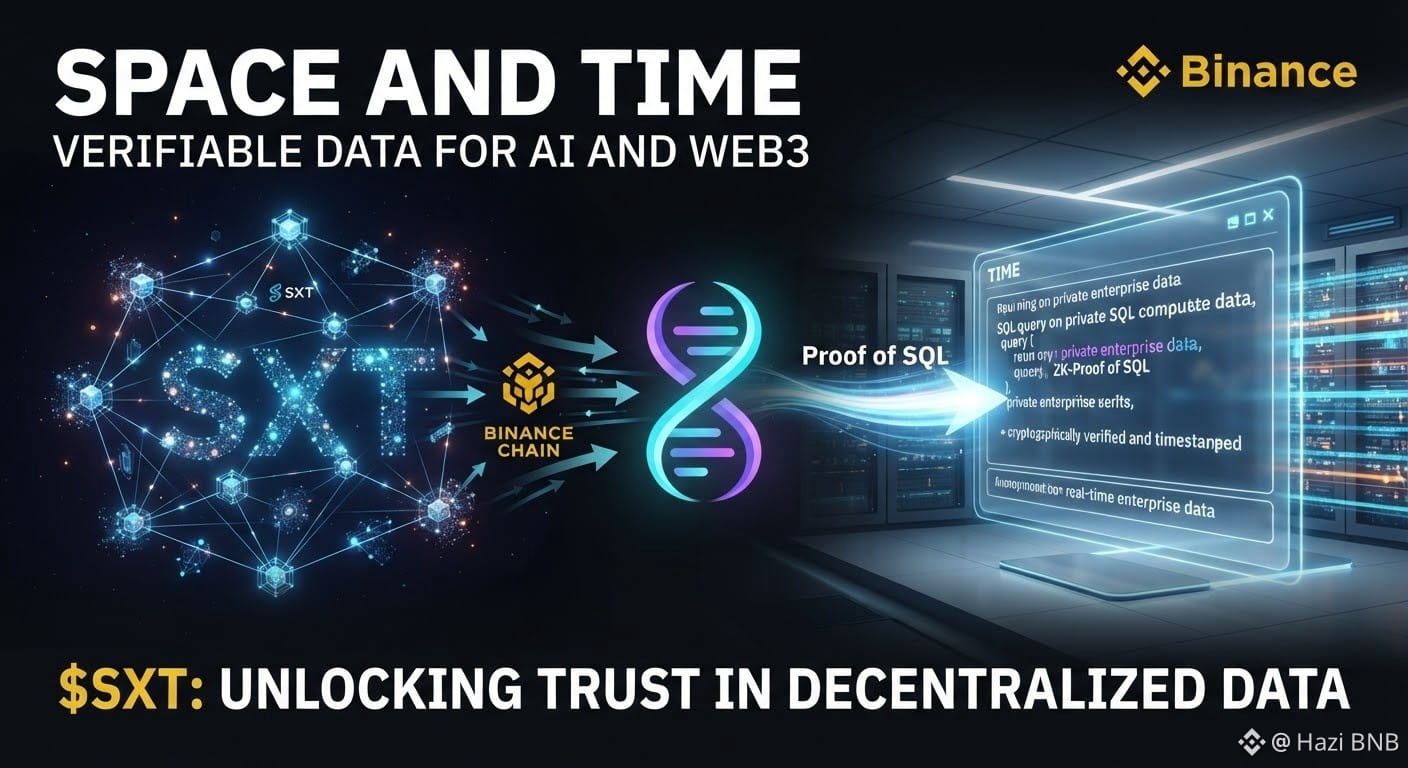
#sxt $SXT @SpaceandTimeDB Trustless data is becoming a core requirement for both onchain finance and AI. Space and Time ($SXT) combines ZK proofs with SQL to verify computations while keeping sensitive records private. Strong tech narrative—now it comes down to steady enterprise and developer integration. Always manage your risk.
#SXT #SpaceAndTime #DeFi #AI #followlikecommenshare
#sxt $SXT @SpaceandTime Trustless data is becoming a core requirement for both onchain finance and AI. Space and Time ($SXT ) combines ZK proofs with SQL to verify computations while keeping sensitive records private. Strong tech narrative—now it comes down to steady enterprise and developer integration. Always manage your risk.
#SXT #SpaceAndTime #DeFi #AI #followlikecommenshare
#SXT #SpaceAndTime #DeFi #AI #followlikecommenshare
1
4
505

·
--
Bullish
See translation
#sxt $SXT @SpaceandTimeDB
Dear SXT followers….
Chapter 4:
4. Token Unlocks: One of the Biggest Risks
One of the most important factors to consider when evaluating SXT is its token unlock schedule.
SXT has a maximum supply of 5 billion tokens.
Its token allocation is as follows:
Allocation
Share of Total Supply
Community Rewards
28%
Private Investors
25.9%
Ecosystem Development
23.7%
Team
22.4%
Upcoming Token Unlock
December 8, 2026
Estimated unlock: 91.8 million SXT
Percentage of total supply: 1.8%
Estimated dollar value: Approximately $630,000–$736,000
Expected allocation of the unlock:
Private Investors: 39.2%
Insiders / Team: 33.9%
Foundation: 26.9%
There are additional unlocks expected beyond December:
January 8, 2027: Approximately 83.4 million SXT.
February 8, 2027: Approximately 83.4 million SXT.
Monthly unlocks are expected to continue.
The final vesting date is May 8, 2029.
Why is this important?
Newly unlocked tokens do not necessarily have to be sold.
However, if early investors or team members decide to sell their tokens, additional supply could enter the market and create downward price pressure.
Historical data from Tokenomics.com also indicates that the worst price movement within the 10 days following the November unlock was approximately -15.5%.
This does not prove that token unlocks directly caused the decline. Broader market conditions may also have contributed.
Chapter 5 coming soon…
Like, share post and follow me please…
$BTC $BNB
{future}(BTCUSDT)
#sxt $SXT @SpaceandTime
Dear SXT followers….
Chapter 4:
4. Token Unlocks: One of the Biggest Risks
One of the most important factors to consider when evaluating SXT is its token unlock schedule.
SXT has a maximum supply of 5 billion tokens.
Its token allocation is as follows:
Allocation
Share of Total Supply
Community Rewards
28%
Private Investors
25.9%
Ecosystem Development
23.7%
Team
22.4%
Upcoming Token Unlock
December 8, 2026
Estimated unlock: 91.8 million SXT
Percentage of total supply: 1.8%
Estimated dollar value: Approximately $630,000–$736,000
Expected allocation of the unlock:
Private Investors: 39.2%
Insiders / Team: 33.9%
Foundation: 26.9%
There are additional unlocks expected beyond December:
January 8, 2027: Approximately 83.4 million SXT.
February 8, 2027: Approximately 83.4 million SXT.
Monthly unlocks are expected to continue.
The final vesting date is May 8, 2029.
Why is this important?
Newly unlocked tokens do not necessarily have to be sold.
However, if early investors or team members decide to sell their tokens, additional supply could enter the market and create downward price pressure.
Historical data from Tokenomics.com also indicates that the worst price movement within the 10 days following the November unlock was approximately -15.5%.
This does not prove that token unlocks directly caused the decline. Broader market conditions may also have contributed.
Chapter 5 coming soon…
Like, share post and follow me please…
$BTC $BNB
277

·
--
Bullish
See translation
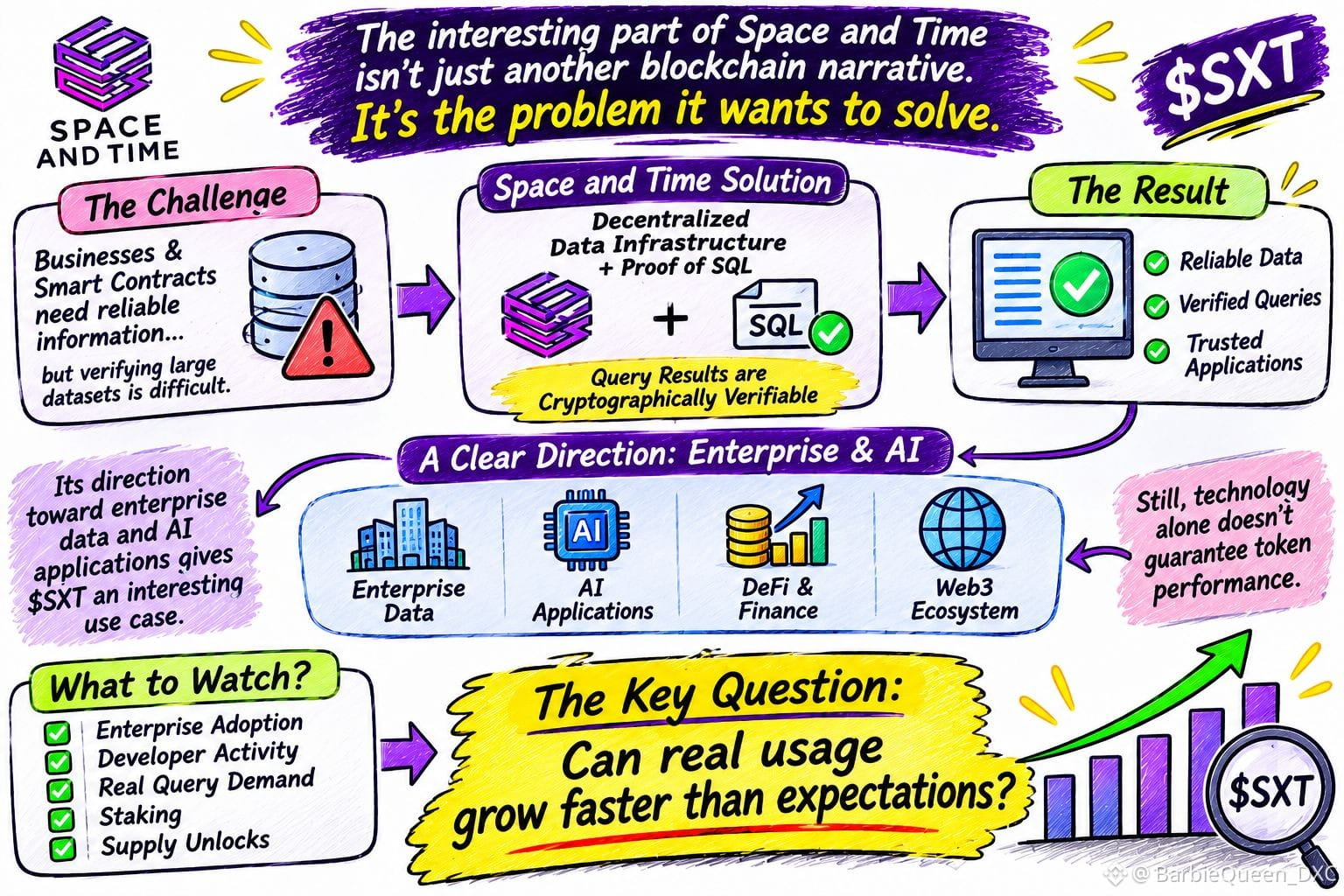
The interesting part of Space and Time isn't just another blockchain narrative. It's the problem it wants to solve.
Businesses and smart contracts need reliable information, but verifying large datasets is difficult.
Space and Time combines decentralized data infrastructure with Proof of SQL to make query results cryptographically verifiable.
Its direction toward enterprise data and AI applications gives $SXT an interesting use case.
Still, technology alone doesn't guarantee token performance.
I would watch enterprise adoption, developer activity, real query demand, staking and supply unlocks.
The key question is simple: can real usage grow faster than expectations?
#SpaceAndTime #SXT #Binance #creatorpad
55

·
--
Verified
See translation
Do you know that Space and Time @SpaceandTimeDB is building the foundation for a more transparent and trustworthy digital economy. By combining blockchain technology with zero-knowledge proofs, it makes data verifiable, reliable, and accessible for applications that demand trust.
Through its innovative Proof of SQL technology, Space and Time enables developers and businesses to verify massive datasets onchain without compromising performance. This creates powerful opportunities for AI, tokenisation, and DeFi, where accurate data is essential.
As these industries continue to evolve, Space and Time is making verifiable data the backbone of a smarter, more secure, and decentralized future.
#sxt $SXT @SpaceandTimeDB
Do you know that Space and Time @SpaceandTime is building the foundation for a more transparent and trustworthy digital economy. By combining blockchain technology with zero-knowledge proofs, it makes data verifiable, reliable, and accessible for applications that demand trust.
Through its innovative Proof of SQL technology, Space and Time enables developers and businesses to verify massive datasets onchain without compromising performance. This creates powerful opportunities for AI, tokenisation, and DeFi, where accurate data is essential.
As these industries continue to evolve, Space and Time is making verifiable data the backbone of a smarter, more secure, and decentralized future.
#sxt $SXT @SpaceandTime
3
229

Verified
See translation
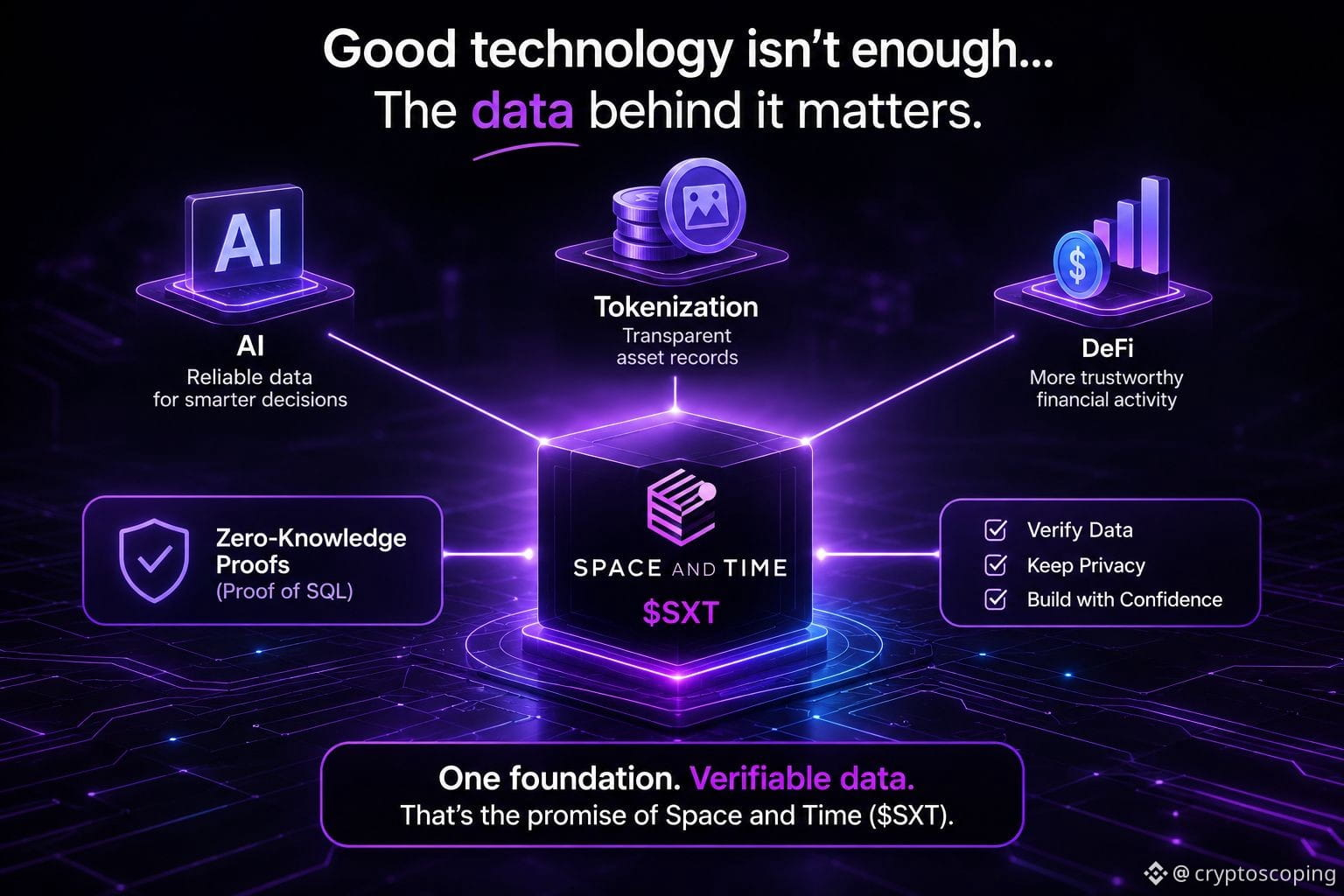
One thing I've learned from following crypto and its constant developments is that good technology alone isn't enough.
The information behind it matters just as much.
Take AI, for example. Powerful AI tools are only as reliable as the data they use.
The same applies to DeFi and tokenization, where accurate information is important.
While looking deeper into how this works, Space and Time ( $SXT ) brings an important part of the conversation into focus: proving that the data is actually reliable.
The project is building infrastructure using zero-knowledge proofs so applications can verify the data and calculations they use instead of simply trusting that they're correct, even when private details stay hidden.
For AI, developers can build around data they can verify rather than assume. For tokenization, it supports clearer asset records.
And for DeFi, protocols get more reliable information behind financial activity.
What makes this approach valuable is how Space and Time connects these sectors through one foundation: verifiable data.
As AI, tokenization, and DeFi continue to develop, being able to verify information will matter even more. That's the problem Space and Time (SXT) is working to address.
#sxt @SpaceandTimeDB
One thing I've learned from following crypto and its constant developments is that good technology alone isn't enough.
The information behind it matters just as much.
Take AI, for example. Powerful AI tools are only as reliable as the data they use.
The same applies to DeFi and tokenization, where accurate information is important.
While looking deeper into how this works, Space and Time ( $SXT ) brings an important part of the conversation into focus: proving that the data is actually reliable.
The project is building infrastructure using zero-knowledge proofs so applications can verify the data and calculations they use instead of simply trusting that they're correct, even when private details stay hidden.
For AI, developers can build around data they can verify rather than assume. For tokenization, it supports clearer asset records.
And for DeFi, protocols get more reliable information behind financial activity.
What makes this approach valuable is how Space and Time connects these sectors through one foundation: verifiable data.
As AI, tokenization, and DeFi continue to develop, being able to verify information will matter even more. That's the problem Space and Time (SXT) is working to address.
#sxt @SpaceandTime
1
2.9k

·
--
Bullish
See translation
I've been around crypto long enough to know that most big promises sound familiar after a while. Every cycle brings another project claiming to fix everything. So when I look at Space and Time SXT, I keep coming back to one simple question: who needs to trust the data, and what are they actually being asked to reveal?
I can see why a company would want to keep its financial records or supply chain data private. Not every business wants its information sitting on a public blockchain. With SXT, the interesting part is being able to prove that a calculation is correct without handing over the underlying data.
But public DeFi has a different problem. People need to verify things for themselves. They can't just take someone's word for it. That's where public SXT Chain starts to make sense.
What I find interesting is that these two approaches don't really have to compete. A business could keep its data private and still share a proof that others can check. That sounds useful, but I don't think it solves everything. If the original data is wrong, a cryptographic proof won't magically make it right.
I've seen plenty of projects make complicated technology sound like an obvious success. The real test is always what happens when people actually have to use it.
I'm not sure which side will grow faster. Enterprise adoption might happen quietly, while public DeFi could make the benefits easier to see.
Honestly, I'd rather watch how people use SXT than listen to another big promise.
Which do you think gets adopted first: enterprise or public DeFi?
#sxt $SXT @SpaceandTimeDB
I've been around crypto long enough to know that most big promises sound familiar after a while. Every cycle brings another project claiming to fix everything. So when I look at Space and Time SXT, I keep coming back to one simple question: who needs to trust the data, and what are they actually being asked to reveal?
I can see why a company would want to keep its financial records or supply chain data private. Not every business wants its information sitting on a public blockchain. With SXT, the interesting part is being able to prove that a calculation is correct without handing over the underlying data.
But public DeFi has a different problem. People need to verify things for themselves. They can't just take someone's word for it. That's where public SXT Chain starts to make sense.
What I find interesting is that these two approaches don't really have to compete. A business could keep its data private and still share a proof that others can check. That sounds useful, but I don't think it solves everything. If the original data is wrong, a cryptographic proof won't magically make it right.
I've seen plenty of projects make complicated technology sound like an obvious success. The real test is always what happens when people actually have to use it.
I'm not sure which side will grow faster. Enterprise adoption might happen quietly, while public DeFi could make the benefits easier to see.
Honestly, I'd rather watch how people use SXT than listen to another big promise.
Which do you think gets adopted first: enterprise or public DeFi?
#sxt $SXT @SpaceandTime

Nathan Cole:
good work
2
6
795

See translation
#sxt $SXT @SpaceandTimeDB The future of AI and DeFi will depend on more than just powerful models or faster blockchains. It will depend on the quality and reliability of data.
This is where Space and Time stands out.
As AI becomes more integrated into finance and blockchain applications, verifying the information behind every decision becomes increasingly important. Without trustworthy data, even the most advanced systems can produce unreliable results.
Space and Time is building infrastructure that makes data verifiable for AI, tokenization, and DeFi. Its approach could help developers build applications where transparency and data integrity are not just optional features, but fundamental requirements.
What I find interesting is the bigger picture: connecting blockchain data with AI in a way that can be independently verified.
I believe verifiable data infrastructure could become an important part of the next generation of Web3.
The real question is not just how smart AI can become, but how much we can trust the data behind it.
What role do you think Space and Time will play in this future?
#sxt $SXT @SpaceandTime The future of AI and DeFi will depend on more than just powerful models or faster blockchains. It will depend on the quality and reliability of data.
This is where Space and Time stands out.
As AI becomes more integrated into finance and blockchain applications, verifying the information behind every decision becomes increasingly important. Without trustworthy data, even the most advanced systems can produce unreliable results.
Space and Time is building infrastructure that makes data verifiable for AI, tokenization, and DeFi. Its approach could help developers build applications where transparency and data integrity are not just optional features, but fundamental requirements.
What I find interesting is the bigger picture: connecting blockchain data with AI in a way that can be independently verified.
I believe verifiable data infrastructure could become an important part of the next generation of Web3.
The real question is not just how smart AI can become, but how much we can trust the data behind it.
What role do you think Space and Time will play in this future?
1
620

·
--
See translation
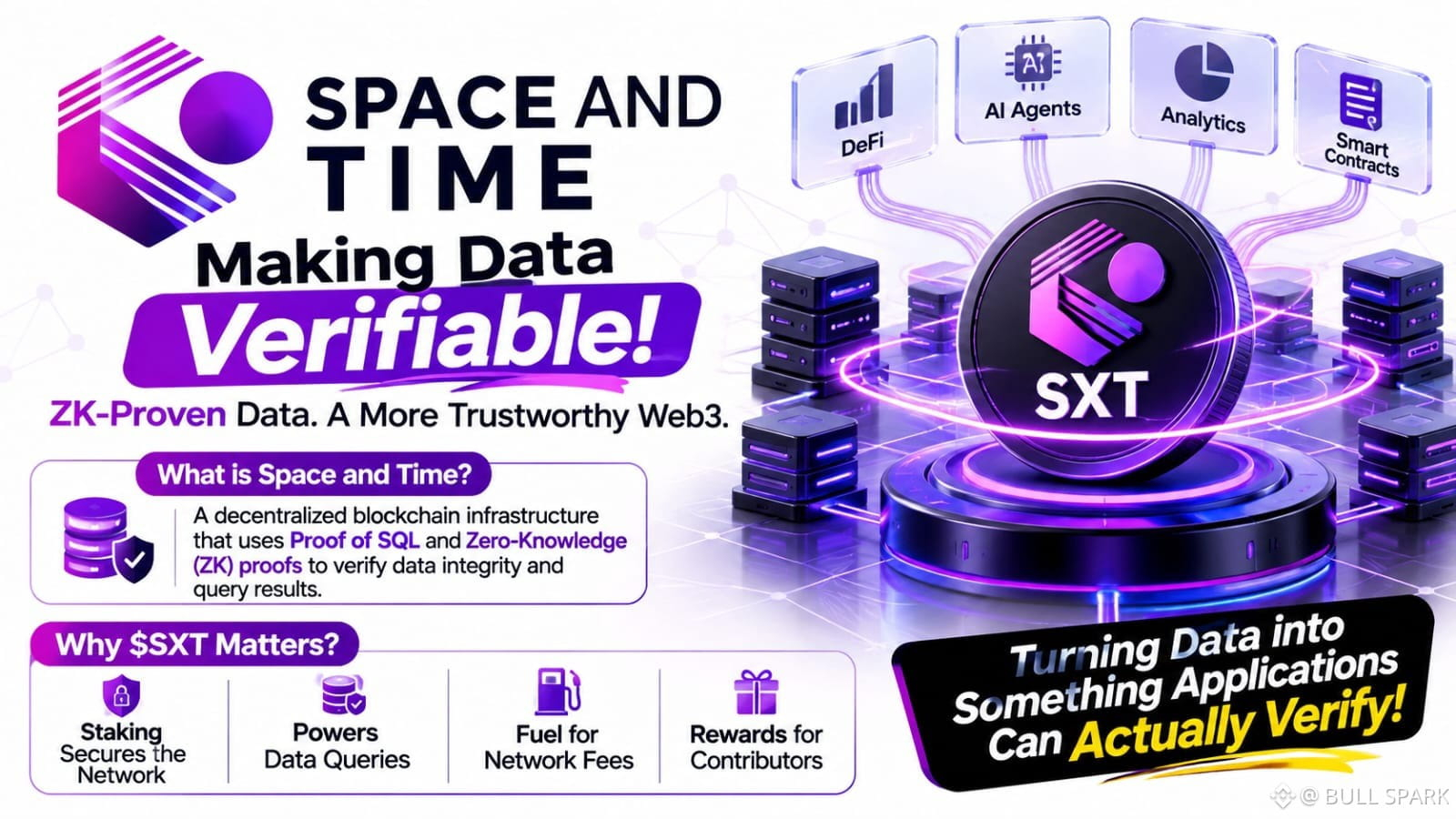
Space and Time ($SXT): Making Data Verifiable!
What if smart contracts could access massive amounts of blockchain and real-world data without blindly trusting the source?
That's exactly what Space and Time is building!
Powered by Proof of SQL, its decentralized infrastructure uses Zero-Knowledge (ZK) proofs to verify data integrity and query results. It connects on-chain and off-chain data, opening new possibilities for DeFi, AI agents, analytics, and smart contracts.
🔥 Why $SXT matters:
- Native token powering the ecosystem.
- Staking helps secure the network.
- Powers data queries and network fees.
- Rewards participants contributing to network operations.
The bigger vision? Turning data into something applications can actually verify, not just trust.
The future needs verifiable data. Space and Time is building the infrastructure.
Not financial advice. Always DYOR.
#sxt $SXT @SpaceandTimeDB
Space and Time ($SXT ): Making Data Verifiable!
What if smart contracts could access massive amounts of blockchain and real-world data without blindly trusting the source?
That's exactly what Space and Time is building!
Powered by Proof of SQL, its decentralized infrastructure uses Zero-Knowledge (ZK) proofs to verify data integrity and query results. It connects on-chain and off-chain data, opening new possibilities for DeFi, AI agents, analytics, and smart contracts.
🔥 Why $SXT matters:
- Native token powering the ecosystem.
- Staking helps secure the network.
- Powers data queries and network fees.
- Rewards participants contributing to network operations.
The bigger vision? Turning data into something applications can actually verify, not just trust.
The future needs verifiable data. Space and Time is building the infrastructure.
Not financial advice. Always DYOR.
#sxt $SXT @SpaceandTime
136

·
--
Bullish
See translation
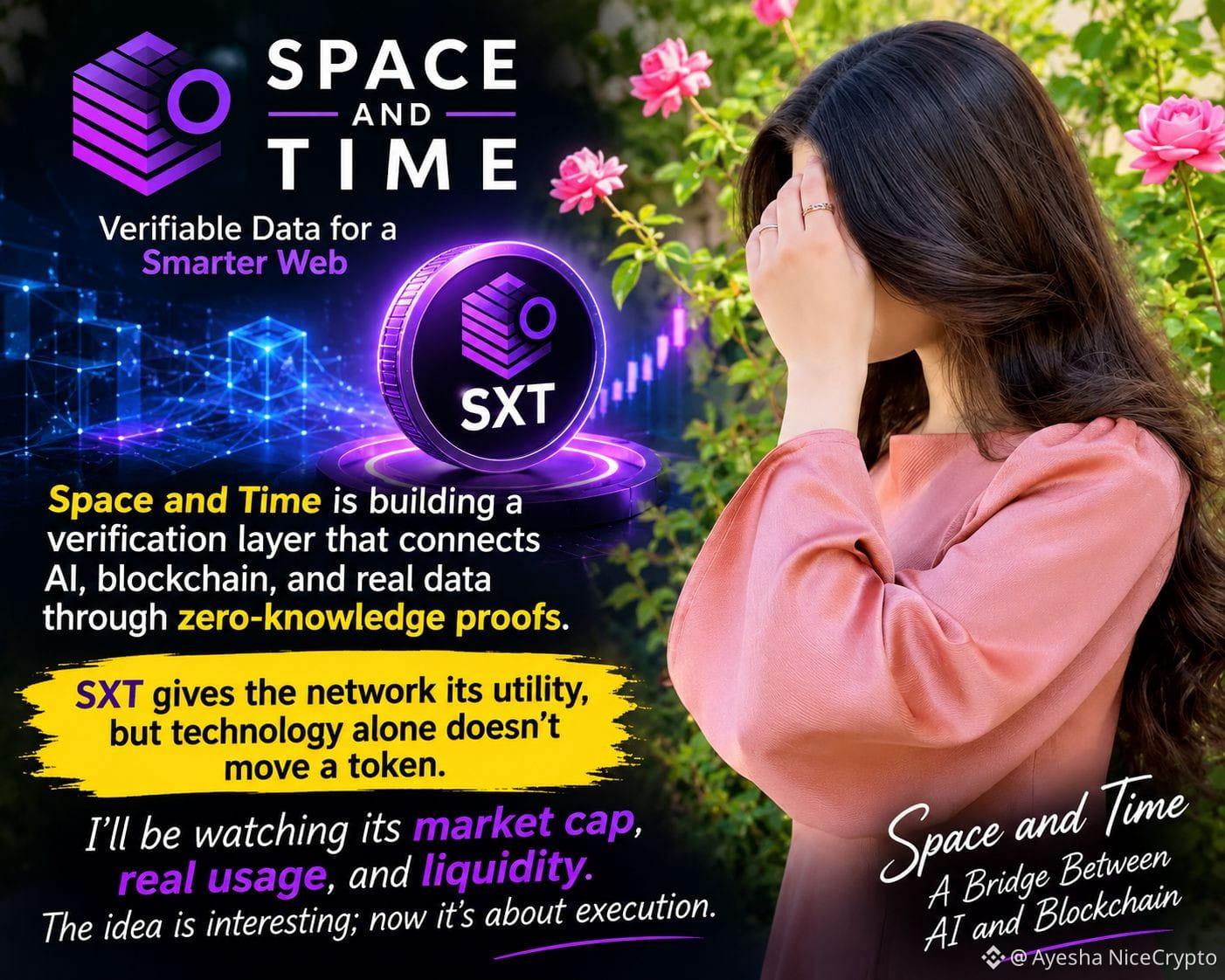
looking,$SXT One thing I’ve noticed is that people are excited about AI, but not enough are talking about whether the information AI uses can actually be trusted. That’s what makes Space and Time worth watching. It’s trying to solve this problem by making data verifiable on-chain. SXT gives the network its utility, but technology alone doesn’t move a token. I’ll be watching its market cap, real usage, and liquidity. The idea is interesting; now it’s about execution.
#sxt @SpaceandTimeDB $SXT
{future}(SXTUSDT)
looking,$SXT One thing I’ve noticed is that people are excited about AI, but not enough are talking about whether the information AI uses can actually be trusted. That’s what makes Space and Time worth watching. It’s trying to solve this problem by making data verifiable on-chain. SXT gives the network its utility, but technology alone doesn’t move a token. I’ll be watching its market cap, real usage, and liquidity. The idea is interesting; now it’s about execution.
#sxt @SpaceandTime $SXT
#sxt @SpaceandTime $SXT
3
2.6k

·
--
See translation
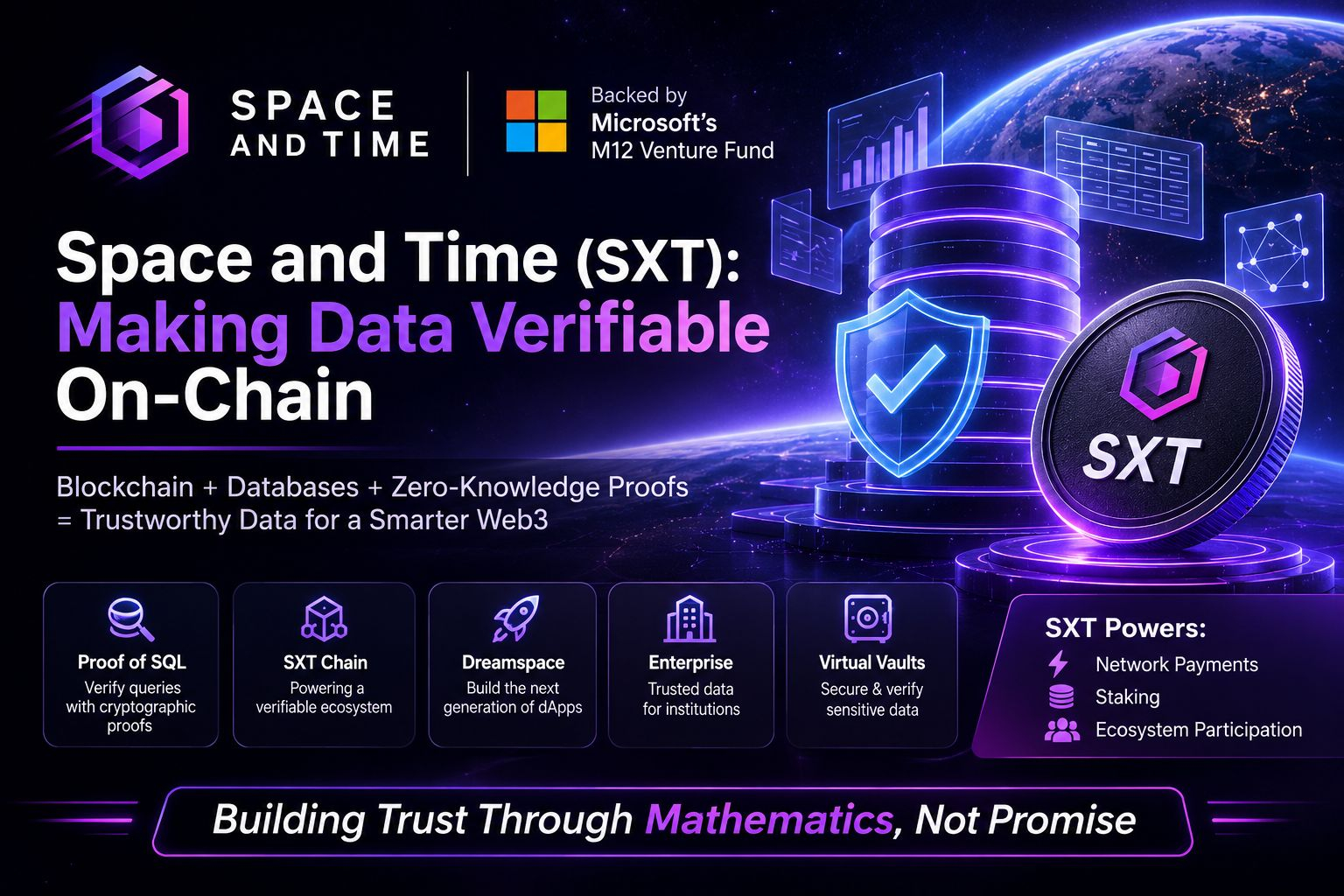
Space and Time (SXT): Making Data Verifiable On-Chain
The future of blockchain and AI depends on one critical factor: reliable data that applications can verify without simply trusting the source.
This is where Space and Time (SXT) is positioning itself.
Backed by Microsoft's M12 venture fund, Space and Time is building a decentralized data infrastructure designed to connect blockchain applications with large-scale datasets through zero-knowledge cryptography.
Its standout innovation, Proof of SQL, enables developers to run complex database queries and generate cryptographic proofs confirming that the results are accurate.
This creates interesting possibilities for DeFi, AI agents, smart contracts, institutional finance, and applications that require trustworthy off-chain data.
The SXT token is the native asset of the ecosystem, supporting network payments, staking, and participation in the network.
What makes this project interesting is its focus on solving a real infrastructure problem rather than simply launching another blockchain.
However, technology alone does not guarantee success. Long-term adoption, developer activity, network usage, and sustainable demand for SXT will be important factors to watch.
My Take: Space and Time is working on an important part of blockchain's future. If it can turn its technology into real-world adoption, SXT could become an interesting project to follow.
Verifiable data could become one of the foundations of the next generation of blockchain and AI.#sxt $SXT @SpaceandTimeDB
Space and Time (SXT): Making Data Verifiable On-Chain
The future of blockchain and AI depends on one critical factor: reliable data that applications can verify without simply trusting the source.
This is where Space and Time (SXT) is positioning itself.
Backed by Microsoft's M12 venture fund, Space and Time is building a decentralized data infrastructure designed to connect blockchain applications with large-scale datasets through zero-knowledge cryptography.
Its standout innovation, Proof of SQL, enables developers to run complex database queries and generate cryptographic proofs confirming that the results are accurate.
This creates interesting possibilities for DeFi, AI agents, smart contracts, institutional finance, and applications that require trustworthy off-chain data.
The SXT token is the native asset of the ecosystem, supporting network payments, staking, and participation in the network.
What makes this project interesting is its focus on solving a real infrastructure problem rather than simply launching another blockchain.
However, technology alone does not guarantee success. Long-term adoption, developer activity, network usage, and sustainable demand for SXT will be important factors to watch.
My Take: Space and Time is working on an important part of blockchain's future. If it can turn its technology into real-world adoption, SXT could become an interesting project to follow.
Verifiable data could become one of the foundations of the next generation of blockchain and AI.#sxt $SXT @SpaceandTime
2
158

·
--
Bullish
Verified
See translation
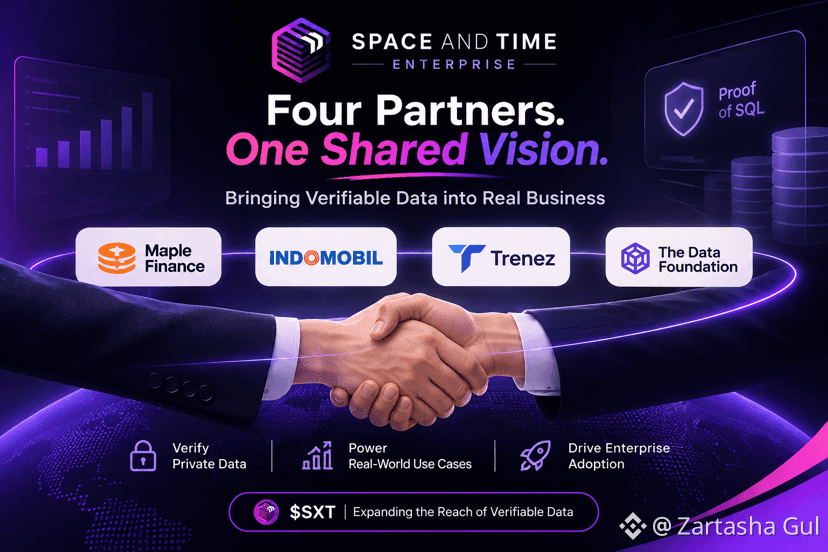
What if businesses could prove their data is right without revealing what’s inside? 👀
That’s the interesting part of @SpaceandTimeDB Enterprise.
Its November 9 launch brings four different names into the picture:
🤝 Maple Finance
🤝 Indomobil
🤝 Trenez
🤝 The Data Foundation
But the bigger story goes beyond partnerships.
Powered by Proof of SQL, Enterprise allows businesses to verify calculations made on private data without exposing their underlying records.
Think about AI, financial reporting and business operations where trust matters just as much as privacy.
This is where cryptography meets everyday business needs.
For $SXT , expanding verifiable data beyond blockchain-native applications is an important direction to watch.
The future isn’t just about having data. It’s about being able to prove it. 🚀
#SpaceAndTime #VerifiableData #sxt
What if businesses could prove their data is right without revealing what’s inside? 👀
That’s the interesting part of @SpaceandTime Enterprise.
Its November 9 launch brings four different names into the picture:
🤝 Maple Finance
🤝 Indomobil
🤝 Trenez
🤝 The Data Foundation
But the bigger story goes beyond partnerships.
Powered by Proof of SQL, Enterprise allows businesses to verify calculations made on private data without exposing their underlying records.
Think about AI, financial reporting and business operations where trust matters just as much as privacy.
This is where cryptography meets everyday business needs.
For $SXT , expanding verifiable data beyond blockchain-native applications is an important direction to watch.
The future isn’t just about having data. It’s about being able to prove it. 🚀
#SpaceAndTime #VerifiableData #sxt

SpaceandTime
·
--
BullishFour Partners Enter The Picture 🤝
Space and Time Enterprise launched alongside four flagship customers and partners:
→ Maple Finance
→ Indomobil
→ Trenez
→ The Data Foundation
These organizations represent different areas of enterprise activity, highlighting the broad relevance of verifiable private data.
From financial operations to business automation, organizations increasingly need information that can be independently verified.
The launch expands the reach of cryptographic technology developed within the $SXT ecosystem into conventional business environments.
Enterprise adoption begins with practical applications. 🚀
#VerifiableData
7
617

·
--
See translation
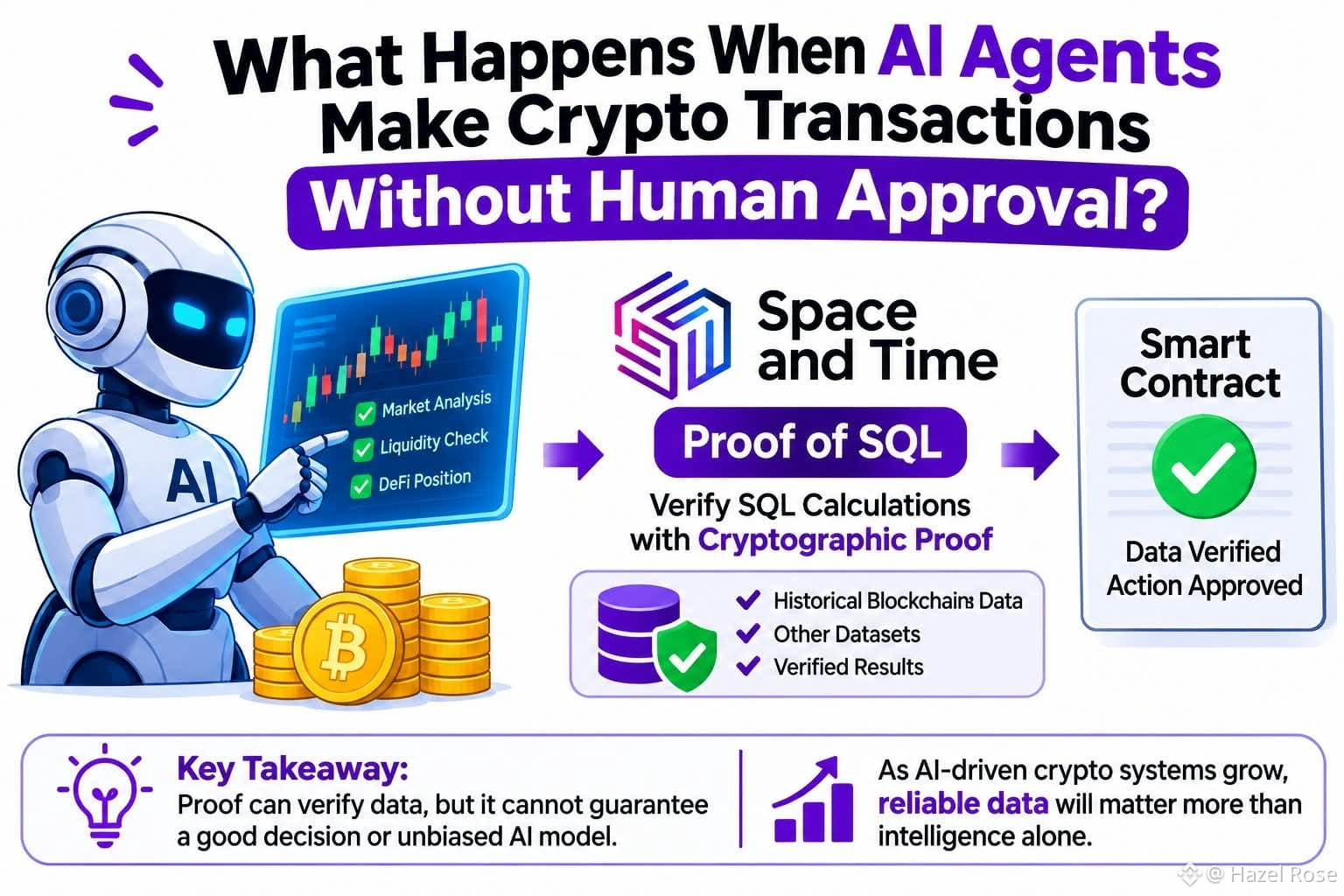
What happens when AI agents start making crypto transactions without waiting for human approval?
This is where reliable data becomes more important than intelligence alone.
An AI agent may analyse market activity, compare liquidity across chains, or manage DeFi positions. But how can a smart contract know whether the data behind its decision is correct?
Space and Time approaches this problem through Proof of SQL. It allows AI applications to use historical blockchain activity and other datasets, while providing cryptographic proof that SQL calculations were executed correctly.
For example, an AI agent could assess a lending position using verified transaction history before requesting a contract to act.
But there is a difference between verifying data and making a good decision. Proof cannot guarantee that an AI model is unbiased or that its original data is truthful.
I think this distinction will matter as AI-driven crypto systems develop.
#sxt $SXT @SpaceandTimeDB
What happens when AI agents start making crypto transactions without waiting for human approval?
This is where reliable data becomes more important than intelligence alone.
An AI agent may analyse market activity, compare liquidity across chains, or manage DeFi positions. But how can a smart contract know whether the data behind its decision is correct?
Space and Time approaches this problem through Proof of SQL. It allows AI applications to use historical blockchain activity and other datasets, while providing cryptographic proof that SQL calculations were executed correctly.
For example, an AI agent could assess a lending position using verified transaction history before requesting a contract to act.
But there is a difference between verifying data and making a good decision. Proof cannot guarantee that an AI model is unbiased or that its original data is truthful.
I think this distinction will matter as AI-driven crypto systems develop.
#sxt $SXT @SpaceandTime
4
415

·
--
Bullish
30D trade $SXT 2.9K USDT
See translation
I've watched crypto go through enough cycles to become suspicious whenever a project claims to solve a problem nobody else understands. But every now and then, something catches my attention for a reason beyond price action.
Space and Time is one of those projects.
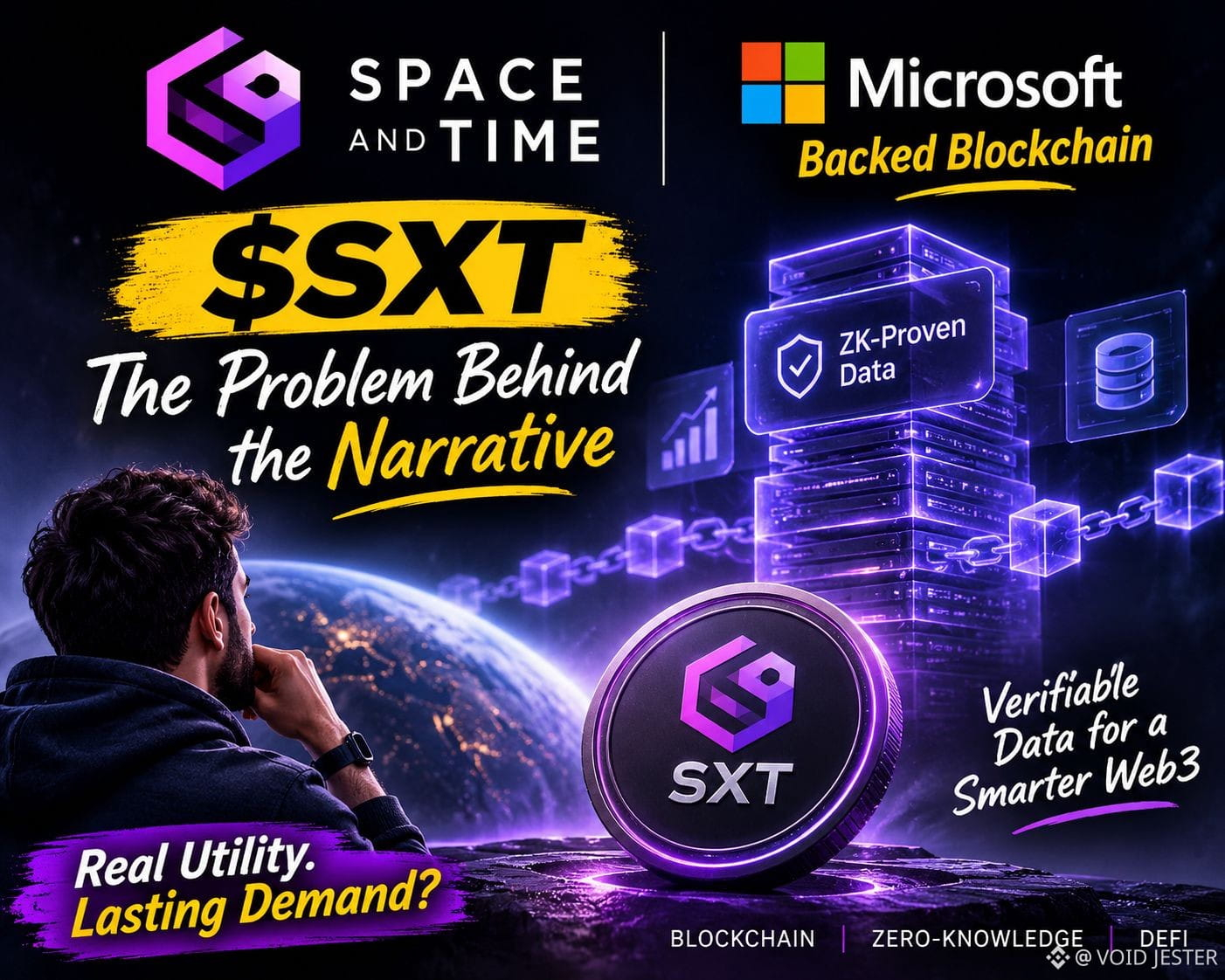
What interests me about $SXT isn't simply its Microsoft-backed story. It's the problem underneath it. Smart contracts can execute exactly as programmed, but what happens when the data behind a decision is wrong, incomplete, or impossible to verify? That's the kind of weakness that can quietly undermine an entire financial application.
Space and Time approaches this through Proof of SQL, using zero-knowledge cryptography to prove that database queries were executed correctly. Its ambition is to make complex onchain and offchain data useful without asking everyone to trust a black box.
I've seen promising technology struggle before, though. Building something valuable and convincing developers to depend on it are two very different battles. Performance, costs, integrations, and real demand still matter more than a respected name attached to a project.
SXT has a functional role in the network, including payments and staking. But I keep coming back to one question: will actual usage create lasting demand for the token?
I'm not convinced yet, and I don't think anyone should be. Still, verifiable data is a problem that won't disappear when the market turns quiet.
Sometimes, the most interesting projects aren't the ones making the loudest promises. They're the ones trying to fix something everyone else has learned to live with.
#sxt $SXT @SpaceandTimeDB
{future}(SXTUSDT)
I've watched crypto go through enough cycles to become suspicious whenever a project claims to solve a problem nobody else understands. But every now and then, something catches my attention for a reason beyond price action.
Space and Time is one of those projects.
What interests me about $SXT isn't simply its Microsoft-backed story. It's the problem underneath it. Smart contracts can execute exactly as programmed, but what happens when the data behind a decision is wrong, incomplete, or impossible to verify? That's the kind of weakness that can quietly undermine an entire financial application.
Space and Time approaches this through Proof of SQL, using zero-knowledge cryptography to prove that database queries were executed correctly. Its ambition is to make complex onchain and offchain data useful without asking everyone to trust a black box.
I've seen promising technology struggle before, though. Building something valuable and convincing developers to depend on it are two very different battles. Performance, costs, integrations, and real demand still matter more than a respected name attached to a project.
SXT has a functional role in the network, including payments and staking. But I keep coming back to one question: will actual usage create lasting demand for the token?
I'm not convinced yet, and I don't think anyone should be. Still, verifiable data is a problem that won't disappear when the market turns quiet.
Sometimes, the most interesting projects aren't the ones making the loudest promises. They're the ones trying to fix something everyone else has learned to live with.
#sxt $SXT @SpaceandTime
eyes of 火:
The real value of $SXT will depend on adoption, not hype. Proof of SQL is solving a problem Web3 genuinely needs. 🚀
1
2
366
Log in to explore more content
Join global crypto users on Binance Square
⚡️ Get latest and useful information about crypto.
💬 Trusted by the world’s largest crypto exchange.
👍 Discover real insights from verified creators.
Email / Phone number
Trending Topics
1
#WillMarketsStageAThanksgivingReliefRally?
20,157 views
415 Discussing
2
#BessentSoftensStanceOnHuang’sNvidiaReturn
14,374 views
282 Discussing
3
#EvolveAtBinanceBlockchainWeek
3,147 views
101 Discussing
4
#MuskWarnsOfAICashCrunch
13,726 views
210 Discussing
5
#SouthKoreaToTightenOversightOfCryptoTransfersAbroad
789 views
15 Discussing
6
#RussiaAllowsExchangesToOfferCryptoTrading
5,696 views
111 Discussing
7
#俄罗斯允许交易所开展加密交易
7,014 views
27 Discussing
8
#UKToBarCryptoExchangesFromMakingMarketsOnTheirOwnPlatforms
383 views
15 Discussing
9
#UKTreasurySignsCryptoMarketMakingExemptionRules
2,612 views
98 Discussing
10
#BTCReboundsAbove$60KAmidWhaleDipBuying
129,342 views
442 Discussing