
#amcx
amcx
2,106 views
41 Discussing
Hot
Latest
·
--
Verified
Article
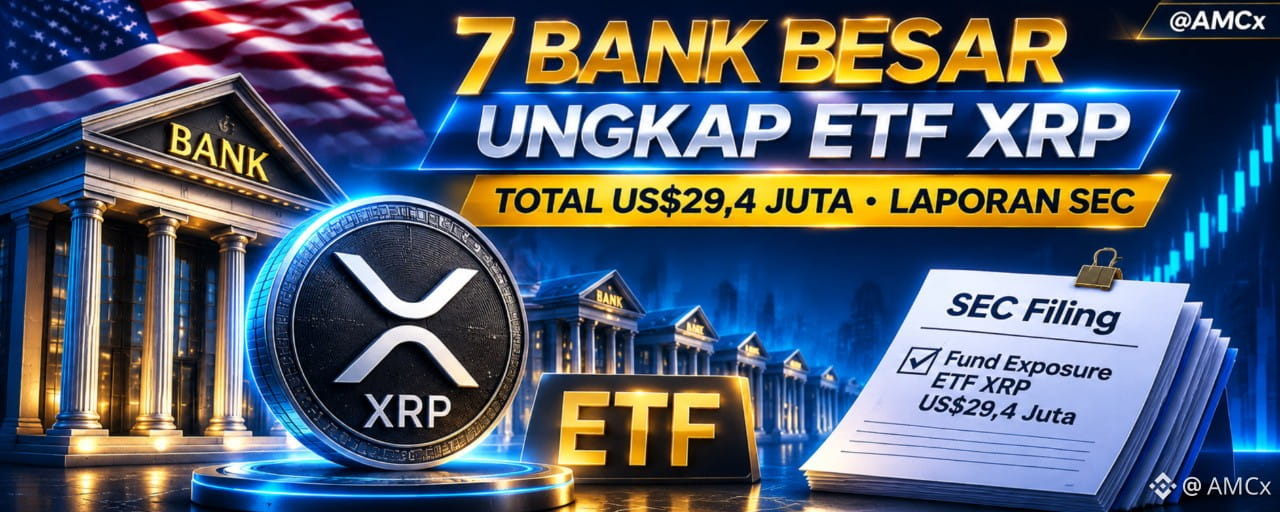
SEVEN MAJOR BANKS REVEAL US$29.4 MILLION IN XRP ETF HOLDINGS! WHAT DOES THIS MEAN FOR XRP’S FUTURE?The world of cryptocurrency is once again attracting attention after seven major banking institutions were reported to have exposure to investment products related to XRP.
According to Form 13F reports filed with the U.S. Securities and Exchange Commission (SEC) between November 9 and 16, 2026, the seven institutions held a total of approximately US$29.4 million in XRP-related investment products, based on positions as of September 30, 2026.
This news is noteworthy because it shows that digital assets like XRP are increasingly becoming part of discussions about the portfolios of major financial institutions.
SEVEN MAJOR BANKS REVEAL US$29.4 MILLION IN XRP ETF HOLDINGS! WHAT DOES THIS MEAN FOR XRP’S FUTURE?
The world of cryptocurrency is once again attracting attention after seven major banking institutions were reported to have exposure to investment products related to XRP.
According to Form 13F reports filed with the U.S. Securities and Exchange Commission (SEC) between November 9 and 16, 2026, the seven institutions held a total of approximately US$29.4 million in XRP-related investment products, based on positions as of September 30, 2026.
This news is noteworthy because it shows that digital assets like XRP are increasingly becoming part of discussions about the portfolios of major financial institutions.
2
92
·
--
Article
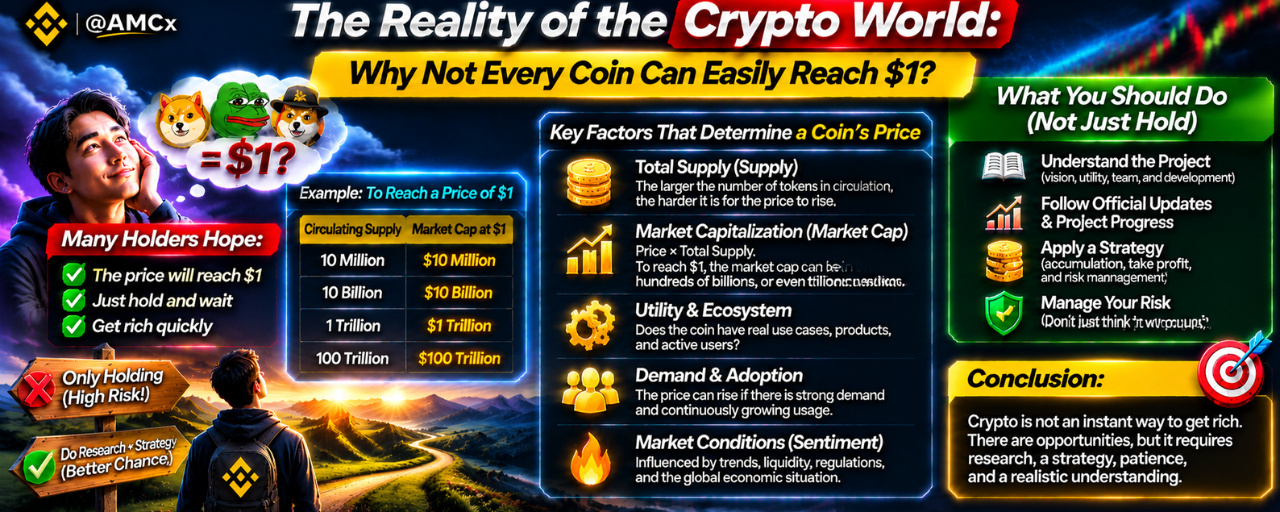
NOT EVERY MEME COIN CAN REACH $1! Understand the Supply Before You Get Your Hopes UpIn the world of cryptocurrency, we often see meme coin holders hoping that the coins they own will reach $1 someday.
Some say DOGE could reach $1, SHIB could reach $1, and even various new meme coins share the same hope.
But have we ever asked ourselves: are those price targets realistic given the number of tokens in circulation?
One thing every crypto investor should understand is that a coin’s price can’t be judged solely by its price per token. We also need to look at its supply and market capitalization.
NOT EVERY MEME COIN CAN REACH $1! Understand the Supply Before You Get Your Hopes Up
In the world of cryptocurrency, we often see meme coin holders hoping that the coins they own will reach $1 someday.
Some say DOGE could reach $1, SHIB could reach $1, and even various new meme coins share the same hope.
But have we ever asked ourselves: are those price targets realistic given the number of tokens in circulation?
One thing every crypto investor should understand is that a coin’s price can’t be judged solely by its price per token. We also need to look at its supply and market capitalization.
2
218
·
--
Article
See translation
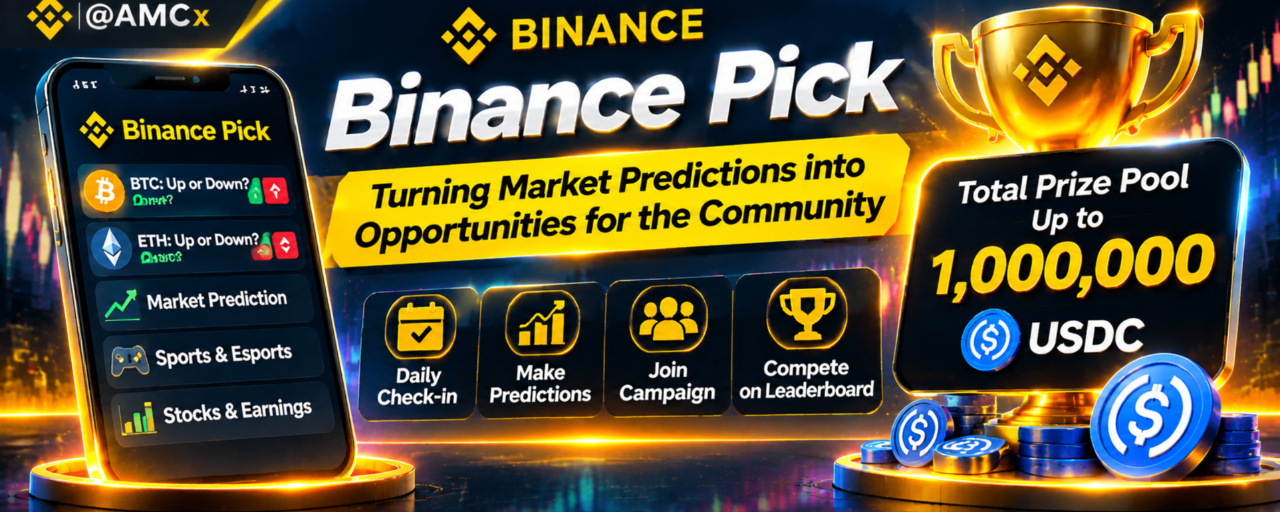
Binance Pick: Turning Market Predictions into Opportunities for the CommunityBinance Pick: Turning Market Predictions into Opportunities for the Community
AMCx Analysis | November 14, 2026
link Register :
[https://app.binance.com/uni-qr/prophet?from=share&seasonId=prophet_1019_s1&ref=18371870](https://app.binance.com/uni-qr/prophet?from=share&seasonId=prophet_1019_s1&ref=18371870)
The cryptocurrency industry continues to evolve, and Binance is introducing another way for its community to become more involved in the market.
This time, the focus is on Binance Pick, an interactive prediction campaign that allows eligible users to test their market knowledge, make predictions, collect campaign Scores, and compete for rewards.
With a total prize pool of up to 1,000,000 USDC, Binance Pick is attracting attention from users who want to participate in something beyond traditional crypto trading.
But what exactly is Binance Pick, how does it work, and why is it worth paying attention to?
Let's take a closer look.
1. What Is Binance Pick?
Binance Pick is an interactive prediction platform designed to make market participation more engaging.
Instead of simply watching price movements, users can make predictions about different events and market developments.
Depending on the available activities, users can participate in predictions involving:
Cryptocurrency market movements.Sports and esports events.Financial market developments.Company earnings and stock-related events.
The idea is simple: users can apply their knowledge, analyze available information, and make predictions based on their own understanding.
This creates an opportunity for the community to become more involved in market discussions and decision-making.
2. How Does Binance Pick Work?
Binance Pick uses a campaign-based scoring system.
Eligible users can collect Scores by completing activities and participating in the campaign.
Some available activities include:
Daily Check-ins
Users can collect Scores by checking in regularly and completing daily activities.
Making Predictions
Users can use their available Scores to participate in prediction markets. Correct predictions can increase their Scores and improve their leaderboard position.
Community Participation
Posting useful content on Binance Square with the required campaign hashtag can also contribute to campaign activities.
Other Tasks
Depending on regional availability, users may also find referral, trading, and other promotional tasks.
The important thing to understand is that campaign Scores are virtual points. They cannot be withdrawn, transferred, or directly exchanged for cash.
3. A 1,000,000 USDC Prize Pool: How Is It Distributed?
One of the most interesting parts of Binance Pick is its reward structure.
The campaign offers three main reward categories.
Season Leaderboard: 500,000 USDC
Participants who finish among the top 20,000 positions on the season leaderboard may share this reward pool, provided they meet the minimum Score requirement.
Weekly Leaderboard: 400,000 USDC
This reward is divided into four weekly pools of 100,000 USDC each.
Eligible participants who finish among the top 8,000 positions in a weekly leaderboard can qualify, subject to the campaign's requirements.
Participation Rewards: 100,000 USDC
Users who do not qualify for the main leaderboard rewards may still have an opportunity to participate in the reward pool.
Eligible users who complete at least five daily check-ins may qualify for a participation reward of up to 5 USDC per person.
These rewards are subject to the official campaign terms, regional eligibility, and other requirements.
4. Why Is Binance Pick Interesting?
In my opinion, one interesting aspect of Binance Pick is how it combines market knowledge with community participation.
Traditional trading often focuses on buying and selling assets.
However, prediction-based activities introduce another dimension: understanding market conditions and evaluating possible outcomes.
For example, before making a prediction about Bitcoin, participants may consider:
Current market sentiment.Trading volume.Economic developments.Important support and resistance levels.News that could influence investor confidence.
This encourages participants to think about the reasons behind market movements instead of simply following popular opinions.
It can also create more opportunities for people to exchange ideas and learn from different perspectives.
5. Is Binance Pick Risk-Free?
Although Binance Pick offers an interesting experience, participants should understand the differences between campaign activities.
The virtual Scores used for rankings are not real money and have no direct cash value.
The official campaign also describes its Score-based prediction market as a simulated market that does not involve real funds.
However, certain trading or real-money prediction activities may be available only in permitted jurisdictions.
Some tasks may involve actual financial exposure, so users should always understand the rules before participating.
It is also important to remember that rewards are not guaranteed simply because someone joins the campaign.
Eligibility, rankings, completed tasks, and official terms all matter.
6. How Can Users Participate?
For users interested in joining, the general process is straightforward:
Open the Binance application.Search for Binance Pick.Open the official campaign page.Check whether registration and participation are available in your region.Review the available tasks and campaign rules.Complete eligible activities and collect Scores.Participate in available predictions.Monitor your leaderboard position.
You can also visit the official campaign page:
[https://www.binance.com/en/prophet?seasonId=prophet_1019_s1](https://www.binance.com/en/prophet?seasonId=prophet_1019_s1)
The current Season 1 prediction period is scheduled to end on November 16, 2026, at 07:59 UTC+8.
Since the campaign is approaching its closing period, participants should check the official page for the latest information.
7. My Perspective: Knowledge Should Be More Valuable Than Guessing
I believe Binance Pick offers an interesting concept because it encourages people to become more active in understanding financial markets.
However, there is an important difference between making an informed prediction and simply guessing.
A good prediction should be supported by research, market observations, and an understanding of the risks involved.
Winning a prediction does not necessarily mean someone fully understands the market. Likewise, getting a prediction wrong does not mean that learning and analysis have no value.
The most important thing is to develop better judgment over time.
For me, the real opportunity is not only about competing for rewards, but also about learning how different events influence financial markets.
Final Thoughts
Binance Pick introduces a different way for the Binance community to interact with financial markets.
By combining predictions, campaign Scores, community participation, and leaderboard rewards, the platform creates an interactive experience beyond traditional trading.
The 1,000,000 USDC prize pool certainly attracts attention, but participants should focus on understanding the platform, its rules, and the risks associated with different activities.
The future of financial markets will not reward people simply for making predictions. It will favor those who continuously learn, analyze information, and understand the reasons behind their decisions.
Let's Discuss
Have you tried Binance Pick yet?
Do you think prediction-based platforms can help people improve their understanding of financial markets, or are they mainly an entertaining way to participate in the crypto community?
I'd love to hear your thoughts.
This article represents the personal analysis and opinion of AMCx. Campaign rewards, availability, and eligibility are subject to Binance's official terms and conditions. This is not financial advice. $BNB $NVDAB $SXT
#BinancePick #Binance #CryptoCommunity #CryptoEducation #MarketPredictions #AMCx
Binance Pick: Turning Market Predictions into Opportunities for the Community
Binance Pick: Turning Market Predictions into Opportunities for the Community
AMCx Analysis | November 14, 2026
link Register :
https://app.binance.com/uni-qr/prophet?from=share&seasonId=prophet_1019_s1&ref=18371870
The cryptocurrency industry continues to evolve, and Binance is introducing another way for its community to become more involved in the market.
This time, the focus is on Binance Pick, an interactive prediction campaign that allows eligible users to test their market knowledge, make predictions, collect campaign Scores, and compete for rewards.
With a total prize pool of up to 1,000,000 USDC, Binance Pick is attracting attention from users who want to participate in something beyond traditional crypto trading.
But what exactly is Binance Pick, how does it work, and why is it worth paying attention to?
Let's take a closer look.
1. What Is Binance Pick?
Binance Pick is an interactive prediction platform designed to make market participation more engaging.
Instead of simply watching price movements, users can make predictions about different events and market developments.
Depending on the available activities, users can participate in predictions involving:
Cryptocurrency market movements.Sports and esports events.Financial market developments.Company earnings and stock-related events.
The idea is simple: users can apply their knowledge, analyze available information, and make predictions based on their own understanding.
This creates an opportunity for the community to become more involved in market discussions and decision-making.
2. How Does Binance Pick Work?
Binance Pick uses a campaign-based scoring system.
Eligible users can collect Scores by completing activities and participating in the campaign.
Some available activities include:
Daily Check-ins
Users can collect Scores by checking in regularly and completing daily activities.
Making Predictions
Users can use their available Scores to participate in prediction markets. Correct predictions can increase their Scores and improve their leaderboard position.
Community Participation
Posting useful content on Binance Square with the required campaign hashtag can also contribute to campaign activities.
Other Tasks
Depending on regional availability, users may also find referral, trading, and other promotional tasks.
The important thing to understand is that campaign Scores are virtual points. They cannot be withdrawn, transferred, or directly exchanged for cash.
3. A 1,000,000 USDC Prize Pool: How Is It Distributed?
One of the most interesting parts of Binance Pick is its reward structure.
The campaign offers three main reward categories.
Season Leaderboard: 500,000 USDC
Participants who finish among the top 20,000 positions on the season leaderboard may share this reward pool, provided they meet the minimum Score requirement.
Weekly Leaderboard: 400,000 USDC
This reward is divided into four weekly pools of 100,000 USDC each.
Eligible participants who finish among the top 8,000 positions in a weekly leaderboard can qualify, subject to the campaign's requirements.
Participation Rewards: 100,000 USDC
Users who do not qualify for the main leaderboard rewards may still have an opportunity to participate in the reward pool.
Eligible users who complete at least five daily check-ins may qualify for a participation reward of up to 5 USDC per person.
These rewards are subject to the official campaign terms, regional eligibility, and other requirements.
4. Why Is Binance Pick Interesting?
In my opinion, one interesting aspect of Binance Pick is how it combines market knowledge with community participation.
Traditional trading often focuses on buying and selling assets.
However, prediction-based activities introduce another dimension: understanding market conditions and evaluating possible outcomes.
For example, before making a prediction about Bitcoin, participants may consider:
Current market sentiment.Trading volume.Economic developments.Important support and resistance levels.News that could influence investor confidence.
This encourages participants to think about the reasons behind market movements instead of simply following popular opinions.
It can also create more opportunities for people to exchange ideas and learn from different perspectives.
5. Is Binance Pick Risk-Free?
Although Binance Pick offers an interesting experience, participants should understand the differences between campaign activities.
The virtual Scores used for rankings are not real money and have no direct cash value.
The official campaign also describes its Score-based prediction market as a simulated market that does not involve real funds.
However, certain trading or real-money prediction activities may be available only in permitted jurisdictions.
Some tasks may involve actual financial exposure, so users should always understand the rules before participating.
It is also important to remember that rewards are not guaranteed simply because someone joins the campaign.
Eligibility, rankings, completed tasks, and official terms all matter.
6. How Can Users Participate?
For users interested in joining, the general process is straightforward:
Open the Binance application.Search for Binance Pick.Open the official campaign page.Check whether registration and participation are available in your region.Review the available tasks and campaign rules.Complete eligible activities and collect Scores.Participate in available predictions.Monitor your leaderboard position.
You can also visit the official campaign page:
https://www.binance.com/en/prophet?seasonId=prophet_1019_s1
The current Season 1 prediction period is scheduled to end on November 16, 2026, at 07:59 UTC+8.
Since the campaign is approaching its closing period, participants should check the official page for the latest information.
7. My Perspective: Knowledge Should Be More Valuable Than Guessing
I believe Binance Pick offers an interesting concept because it encourages people to become more active in understanding financial markets.
However, there is an important difference between making an informed prediction and simply guessing.
A good prediction should be supported by research, market observations, and an understanding of the risks involved.
Winning a prediction does not necessarily mean someone fully understands the market. Likewise, getting a prediction wrong does not mean that learning and analysis have no value.
The most important thing is to develop better judgment over time.
For me, the real opportunity is not only about competing for rewards, but also about learning how different events influence financial markets.
Final Thoughts
Binance Pick introduces a different way for the Binance community to interact with financial markets.
By combining predictions, campaign Scores, community participation, and leaderboard rewards, the platform creates an interactive experience beyond traditional trading.
The 1,000,000 USDC prize pool certainly attracts attention, but participants should focus on understanding the platform, its rules, and the risks associated with different activities.
The future of financial markets will not reward people simply for making predictions. It will favor those who continuously learn, analyze information, and understand the reasons behind their decisions.
Let's Discuss
Have you tried Binance Pick yet?
Do you think prediction-based platforms can help people improve their understanding of financial markets, or are they mainly an entertaining way to participate in the crypto community?
I'd love to hear your thoughts.
This article represents the personal analysis and opinion of AMCx. Campaign rewards, availability, and eligibility are subject to Binance's official terms and conditions. This is not financial advice. $BNB $NVDAB $SXT
#BinancePick #Binance #CryptoCommunity #CryptoEducation #MarketPredictions #AMCx
1
130
·
--
Article
See translation
U.S. PPI Misses Forecast: Could Bitcoin Finally Get Some Relief?AMCx Market Analysis | November 14, 2026
The cryptocurrency market is facing another important moment as investors react to the latest U.S. inflation data.
The October Producer Price Index (PPI) came in slightly below market expectations, raising hopes that inflationary pressure could begin to ease.
But does this really mean Bitcoin is ready for a recovery?
I believe the situation deserves a closer look because the latest numbers contain both positive and negative signals.
1. U.S. PPI Comes in Below Expectations
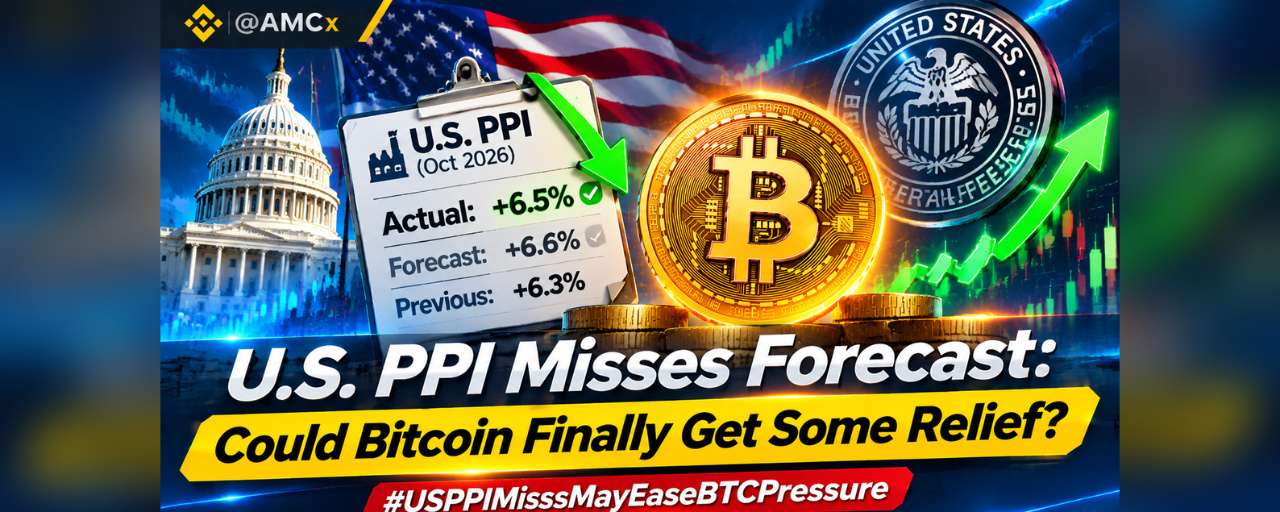
According to the latest October 2026 report, U.S. producer prices increased by 6.5% year over year.
This was slightly below the market forecast of 6.6%.
At first glance, this appears to be positive news for financial markets.
However, there is another important detail.
In September, annual PPI inflation stood at 6.3%. This means producer inflation actually increased to 6.5% in October.
On a monthly basis, producer prices increased by 0.3%, compared with expectations of 0.4%.
Here is the breakdown:
October PPI YoY: 6.5%Market forecast: 6.6%September PPI YoY: 6.3%October PPI MoM: 0.3%Monthly forecast: 0.4%
The difference may look small, but financial markets often react to even minor changes in economic data.
The important point is that monthly price growth slowed, while annual inflation remained elevated.
2. Why Could This Be Positive for Bitcoin?
Bitcoin is often influenced by broader financial conditions, particularly interest rates, liquidity, and investor risk appetite.
When inflation begins to cool, investors may become more optimistic about the possibility of less restrictive monetary policy.
This could benefit risk-sensitive assets, including Bitcoin and other cryptocurrencies.
The potential chain reaction looks like this:
Lower-than-expected inflation → Reduced inflation concerns → Potentially less restrictive monetary policy → Improved risk appetite → Possible support for Bitcoin.
However, this is only a potential scenario, not a guaranteed outcome.
The Federal Reserve considers multiple economic indicators before making interest-rate decisions.
One inflation report alone is not enough to determine its next move.
3. The Federal Reserve Is Still the Biggest Factor to Watch
The upcoming Federal Reserve meeting on December 8–9 is becoming increasingly important for investors.
The market is paying close attention to whether policymakers will raise interest rates again or take a more cautious approach.
There is also an important detail: October's consumer inflation report came in hotter than expected.
This creates a complicated situation for the Federal Reserve.
On one side, monthly producer inflation showed some improvement.
On the other side, annual producer inflation continued increasing, while consumer inflation remained a concern.
If the Fed maintains a restrictive monetary policy for longer, Bitcoin could continue facing pressure.
But if inflation begins showing consistent signs of improvement, investor confidence could gradually recover.
4. Bitcoin's Market Reaction: Relief or Just a Temporary Bounce?
Bitcoin experienced a reaction following the latest PPI release.
Reports indicated that the softer-than-expected monthly inflation figure triggered a short-term recovery and liquidations of bearish positions.
However, the broader market remained under pressure.
This is an important reminder that a positive economic headline does not automatically create a sustainable bullish trend.
A short-term price recovery can happen because traders close their positions, market sentiment changes, or liquidity temporarily shifts.
For a stronger recovery, Bitcoin needs more than one positive inflation report.
Investors should also monitor:
Spot Bitcoin ETF inflows and outflows.Trading volume and market liquidity.Bitcoin's ability to maintain important support levels.Federal Reserve interest-rate expectations.Overall investor confidence.
These indicators may provide a clearer picture of whether the market is beginning to recover or simply experiencing temporary relief.
5. Three Possible Scenarios for Bitcoin
Nobody knows exactly where Bitcoin will move next.
But we can consider three possible scenarios.
Bullish Scenario
If upcoming inflation reports continue showing improvement and the Federal Reserve becomes less restrictive, Bitcoin could receive additional support.
Improving institutional demand and stronger ETF inflows could also help market sentiment.
Neutral Scenario
If inflation remains mixed and the Federal Reserve continues waiting for clearer economic signals, Bitcoin could experience sideways movement and increased volatility.
Bearish Scenario
If inflation remains elevated and the Federal Reserve continues tightening monetary policy, investors could reduce their exposure to risky assets.
This could create additional selling pressure across the cryptocurrency market.
These scenarios are possibilities, not price predictions.
6. What Should Crypto Investors Pay Attention to?
In my opinion, this is not the time to make decisions based on a single economic report.
The market needs consistent evidence that inflation is moving in the right direction.
Investors should avoid assuming that every weaker-than-expected economic figure automatically means Bitcoin will rise.
Sometimes the market reacts positively to softer inflation. Other times, broader economic concerns can outweigh that positive signal.
Understanding the difference between short-term market reactions and long-term trends is extremely important.
7. Final Thoughts: Could This Be the Beginning of Bitcoin's Recovery?
The latest U.S. PPI report provides a small reason for optimism, but it does not eliminate the broader inflation concerns.
The fact that monthly producer inflation came in below expectations is encouraging.
However, the increase in annual PPI from 6.3% to 6.5% shows that inflationary pressure remains an important issue.
For Bitcoin, the next major question is whether this improvement can continue and influence the Federal Reserve's future decisions.
I believe investors should remain observant rather than immediately becoming overly bullish or bearish.
There may be opportunities ahead, but patience and risk management remain essential.
Sometimes, the most important market signal is not what happens today, but whether the improvement continues tomorrow.
Let's Discuss
Do you think the latest U.S. PPI report is enough to give Bitcoin some breathing room?
Or do you believe inflation remains too strong for the Federal Reserve to change its monetary policy?
I'd love to hear your thoughts and different perspectives.
This article represents the personal analysis and opinion of AMCx. It is not financial advice or a recommendation to buy or sell any cryptocurrency. Always do your own research before making investment decisions.
$NVDAB $BTC $ETH
#bitcoin #BTC #USInflation #PPI #FederalReserve #CryptoMarket #USPPIMissMayEaseBTCPressure #AMCx
U.S. PPI Misses Forecast: Could Bitcoin Finally Get Some Relief?
AMCx Market Analysis | November 14, 2026
The cryptocurrency market is facing another important moment as investors react to the latest U.S. inflation data.
The October Producer Price Index (PPI) came in slightly below market expectations, raising hopes that inflationary pressure could begin to ease.
But does this really mean Bitcoin is ready for a recovery?
I believe the situation deserves a closer look because the latest numbers contain both positive and negative signals.
1. U.S. PPI Comes in Below Expectations
According to the latest October 2026 report, U.S. producer prices increased by 6.5% year over year.
This was slightly below the market forecast of 6.6%.
At first glance, this appears to be positive news for financial markets.
However, there is another important detail.
In September, annual PPI inflation stood at 6.3%. This means producer inflation actually increased to 6.5% in October.
On a monthly basis, producer prices increased by 0.3%, compared with expectations of 0.4%.
Here is the breakdown:
October PPI YoY: 6.5%Market forecast: 6.6%September PPI YoY: 6.3%October PPI MoM: 0.3%Monthly forecast: 0.4%
The difference may look small, but financial markets often react to even minor changes in economic data.
The important point is that monthly price growth slowed, while annual inflation remained elevated.
2. Why Could This Be Positive for Bitcoin?
Bitcoin is often influenced by broader financial conditions, particularly interest rates, liquidity, and investor risk appetite.
When inflation begins to cool, investors may become more optimistic about the possibility of less restrictive monetary policy.
This could benefit risk-sensitive assets, including Bitcoin and other cryptocurrencies.
The potential chain reaction looks like this:
Lower-than-expected inflation → Reduced inflation concerns → Potentially less restrictive monetary policy → Improved risk appetite → Possible support for Bitcoin.
However, this is only a potential scenario, not a guaranteed outcome.
The Federal Reserve considers multiple economic indicators before making interest-rate decisions.
One inflation report alone is not enough to determine its next move.
3. The Federal Reserve Is Still the Biggest Factor to Watch
The upcoming Federal Reserve meeting on December 8–9 is becoming increasingly important for investors.
The market is paying close attention to whether policymakers will raise interest rates again or take a more cautious approach.
There is also an important detail: October's consumer inflation report came in hotter than expected.
This creates a complicated situation for the Federal Reserve.
On one side, monthly producer inflation showed some improvement.
On the other side, annual producer inflation continued increasing, while consumer inflation remained a concern.
If the Fed maintains a restrictive monetary policy for longer, Bitcoin could continue facing pressure.
But if inflation begins showing consistent signs of improvement, investor confidence could gradually recover.
4. Bitcoin's Market Reaction: Relief or Just a Temporary Bounce?
Bitcoin experienced a reaction following the latest PPI release.
Reports indicated that the softer-than-expected monthly inflation figure triggered a short-term recovery and liquidations of bearish positions.
However, the broader market remained under pressure.
This is an important reminder that a positive economic headline does not automatically create a sustainable bullish trend.
A short-term price recovery can happen because traders close their positions, market sentiment changes, or liquidity temporarily shifts.
For a stronger recovery, Bitcoin needs more than one positive inflation report.
Investors should also monitor:
Spot Bitcoin ETF inflows and outflows.Trading volume and market liquidity.Bitcoin's ability to maintain important support levels.Federal Reserve interest-rate expectations.Overall investor confidence.
These indicators may provide a clearer picture of whether the market is beginning to recover or simply experiencing temporary relief.
5. Three Possible Scenarios for Bitcoin
Nobody knows exactly where Bitcoin will move next.
But we can consider three possible scenarios.
Bullish Scenario
If upcoming inflation reports continue showing improvement and the Federal Reserve becomes less restrictive, Bitcoin could receive additional support.
Improving institutional demand and stronger ETF inflows could also help market sentiment.
Neutral Scenario
If inflation remains mixed and the Federal Reserve continues waiting for clearer economic signals, Bitcoin could experience sideways movement and increased volatility.
Bearish Scenario
If inflation remains elevated and the Federal Reserve continues tightening monetary policy, investors could reduce their exposure to risky assets.
This could create additional selling pressure across the cryptocurrency market.
These scenarios are possibilities, not price predictions.
6. What Should Crypto Investors Pay Attention to?
In my opinion, this is not the time to make decisions based on a single economic report.
The market needs consistent evidence that inflation is moving in the right direction.
Investors should avoid assuming that every weaker-than-expected economic figure automatically means Bitcoin will rise.
Sometimes the market reacts positively to softer inflation. Other times, broader economic concerns can outweigh that positive signal.
Understanding the difference between short-term market reactions and long-term trends is extremely important.
7. Final Thoughts: Could This Be the Beginning of Bitcoin's Recovery?
The latest U.S. PPI report provides a small reason for optimism, but it does not eliminate the broader inflation concerns.
The fact that monthly producer inflation came in below expectations is encouraging.
However, the increase in annual PPI from 6.3% to 6.5% shows that inflationary pressure remains an important issue.
For Bitcoin, the next major question is whether this improvement can continue and influence the Federal Reserve's future decisions.
I believe investors should remain observant rather than immediately becoming overly bullish or bearish.
There may be opportunities ahead, but patience and risk management remain essential.
Sometimes, the most important market signal is not what happens today, but whether the improvement continues tomorrow.
Let's Discuss
Do you think the latest U.S. PPI report is enough to give Bitcoin some breathing room?
Or do you believe inflation remains too strong for the Federal Reserve to change its monetary policy?
I'd love to hear your thoughts and different perspectives.
This article represents the personal analysis and opinion of AMCx. It is not financial advice or a recommendation to buy or sell any cryptocurrency. Always do your own research before making investment decisions.
$NVDAB $BTC $ETH
#bitcoin #BTC #USInflation #PPI #FederalReserve #CryptoMarket #USPPIMissMayEaseBTCPressure #AMCx
1
19
·
--
Article
See translation
Chainlink (LINK): Connecting the World's Financial System to Blockchain — What's Coming in 2027?Chainlink (LINK) is one of the most important infrastructure projects in the cryptocurrency industry.
While Bitcoin focuses on decentralized money and Ethereum provides smart contract infrastructure, Chainlink solves another critical problem: connecting blockchain networks with reliable external data and traditional financial systems.
This technology is known as decentralized oracle infrastructure.
Chainlink has expanded beyond price feeds into cross-chain communication, institutional finance, real-world asset tokenization, automated compliance, and decentralized data services.
In 2026, the ecosystem made significant progress through CCIP 2.0, institutional partnerships, and the expansion of Chainlink Reserve.
So, what makes Chainlink important, and what could happen in 2027?
1. Understanding Chainlink (LINK)
Chainlink is a decentralized oracle network designed to connect smart contracts with information and services outside blockchain networks.
Its native cryptocurrency, LINK, supports the economic activity of the ecosystem.
LINK has several important roles:
Paying for eligible Chainlink network services.Supporting staking and network security.Providing economic incentives for node operators.Supporting decentralized oracle infrastructure.Participating in the broader Chainlink ecosystem.
Chainlink's technology allows smart contracts to access information that would otherwise be difficult to obtain directly from a blockchain.
Examples include cryptocurrency prices, foreign exchange rates, financial market information, weather data, and other external information.
This makes Chainlink an important infrastructure layer for decentralized finance and tokenized financial markets.
2. CCIP 2.0: A Major Upgrade for Cross-Chain Finance
One of the biggest developments in 2026 was the launch of Chainlink Cross-Chain Interoperability Protocol (CCIP) 2.0 on September 28.
CCIP is designed to enable secure communication and asset transfers between different blockchain networks.
The new version introduces several important capabilities.
A. Additional Security Verification
Institutions and asset issuers can introduce additional Cross-Chain Verifiers to strengthen transaction verification.
B. Flexible Settlement Speed
Users and institutions can configure confirmation requirements based on their security and operational needs.
C. Built-In Compliance
CCIP 2.0 integrates with Chainlink Automated Compliance Engine (ACE), enabling compliance checks while maintaining interoperability.
D. Flexible Execution
Applications can customize how cross-chain messages are executed, including controlled and permissionless execution options.
These features are particularly relevant for financial institutions that need security, regulatory controls, and reliable settlement infrastructure.
According to Chainlink's Q3 2026 report, more than $85 billion in cross-chain token value was secured by CCIP.
This demonstrates the growing importance of interoperability in the digital asset industry.
3. Chainlink and Traditional Financial Institutions
One of the most important developments is Chainlink's expanding relationship with traditional financial institutions.
The goal is to connect existing financial infrastructure with blockchain-based markets.
Several major developments occurred during 2026.
A. Moody's Credit Information
On November 10, Chainlink announced a pilot to distribute Moody's Ratings credit insights simultaneously across multiple blockchain networks.
This is important because reliable credit information can help financial institutions assess risk in tokenized financial markets.
B. Hanwha Investment & Securities
On October 29, Hanwha Investment & Securities partnered with Chainlink to develop a global real-world asset tokenization platform.
The partnership includes Chainlink data infrastructure and CCIP.
C. Swift Integration
On September 28, Chainlink announced infrastructure enabling financial institutions to connect to Swift's blockchain ledger through Chainlink Runtime Environment (CRE).
The initiative aims to support blockchain-based financial workflows while allowing banks to retain control over transaction authorization.
These developments demonstrate that Chainlink is positioning itself as infrastructure for both decentralized finance and traditional financial markets.
4. Real-World Asset Tokenization: A Major Growth Opportunity
Real-World Asset (RWA) tokenization is becoming one of the most important trends in blockchain technology.
It involves representing traditional assets digitally on blockchain networks.
Examples include:
Government bonds.Investment funds.Tokenized equities.Real estate.Commodities.Private credit.Financial securities.
However, tokenizing an asset is only part of the challenge.
Financial institutions also need reliable pricing, verification, compliance, and cross-chain settlement.
This is where Chainlink becomes important.
Its infrastructure can help connect asset data, smart contracts, and different blockchain networks.
For example, an institution could use Chainlink technology to obtain external asset information, verify reserve data, and transfer tokenized assets between supported networks.
As RWA adoption grows, demand for reliable blockchain infrastructure could also increase.
5. Chainlink Reserve: Connecting Network Revenue With LINK
Another important development is Chainlink Reserve.
The Reserve is designed to accumulate LINK using revenue generated from Chainlink's enterprise and on-chain services.
The mechanism converts eligible revenue into LINK and stores it in an on-chain reserve.
According to Chainlink's Q3 2026 quarterly report, the Reserve surpassed 6 million LINK.
This development is important because it introduces a mechanism connecting ecosystem revenue with the LINK token.
The broader objective is to strengthen the economic sustainability of the Chainlink network.
However, reserve accumulation does not guarantee an increase in LINK's market price.
Its long-term impact depends on actual service adoption, revenue growth, token demand, and market conditions.
6. Chainlink Staking: Strengthening Network Security
Chainlink Staking is another important component of the ecosystem.
Staking allows eligible LINK holders to participate in supporting the security of designated Chainlink oracle services.
The objective is to create stronger economic incentives for reliable oracle performance.
The staking ecosystem includes:
LINK staking.Node operator participation.Cryptographic and economic security mechanisms.Rewards for eligible participants.Penalties under applicable slashing conditions.
Chainlink has been developing staking through successive versions, with v0.2 introducing a more flexible staking architecture.
Staking is important because oracle networks must remain reliable even when handling information used by valuable financial applications.
7. Chainlink Runtime Environment (CRE): Building the Financial Infrastructure of Tomorrow
Another major development is Chainlink Runtime Environment, or CRE.
CRE is a development platform designed to connect smart contracts, external data, traditional systems, and multiple blockchain networks.
It allows developers and institutions to create workflows using different Chainlink services.
Potential applications include:
Automated financial settlement.Cross-chain asset transfers.Institutional payments.Tokenized asset management.Compliance automation.Financial data integration.
CRE is particularly important because institutions often operate across multiple systems and blockchain networks.
A unified infrastructure could make it easier to connect those environments.
8. What Could Chainlink Develop in 2027?
Looking toward 2027, several strategic areas could shape Chainlink's development.
A. Institutional CCIP Adoption
More financial institutions and token issuers could integrate CCIP for cross-chain asset transfers and financial settlement.
B. RWA Infrastructure
Chainlink could continue expanding its role in tokenized bonds, funds, securities, and other financial instruments.
C. Swift and Banking Integration
Further development of blockchain connectivity with traditional payment and settlement systems could create additional institutional use cases.
D. Chainlink Reserve Expansion
Continued growth in enterprise and on-chain services could support additional LINK accumulation through the Reserve mechanism.
E. Automated Compliance
The development of ACE could make Chainlink more relevant to institutions that require compliance controls for digital assets.
F. Data Services Expansion
Additional data feeds and financial information services could strengthen Chainlink's position as a core oracle infrastructure provider.
These are strategic opportunities rather than guaranteed release dates or outcomes.
9. Challenges Chainlink Must Overcome
Despite its strong position, Chainlink faces several challenges.
Competition: Other oracle and interoperability projects are competing for developers and institutional integrations.
Adoption: Partnerships and pilot programs must translate into sustainable production usage.
Network Security: Oracle infrastructure must maintain high reliability and resist manipulation.
Token Economics: LINK demand must continue developing alongside actual ecosystem usage.
Cross-Chain Risks: Interoperability introduces additional security and operational considerations.
Chainlink must continue proving that its infrastructure can support financial applications at institutional scale.
Final Thoughts: Chainlink Is Building the Infrastructure for Global On-Chain Finance
Chainlink is no longer simply a cryptocurrency price oracle.
Its technology is expanding into cross-chain interoperability, institutional finance, tokenized assets, compliance, and automated financial services.
The launch of CCIP 2.0, the expansion of Chainlink Reserve, and partnerships with Moody's, Hanwha, and Swift demonstrate the growing importance of this infrastructure.
Looking toward 2027, the most important developments to watch will be institutional adoption, RWA tokenization, cross-chain financial settlement, and continued growth in Chainlink service revenue.
If these initiatives successfully translate into real-world usage, Chainlink could become an increasingly important part of the global digital financial system.
However, the long-term value of LINK will depend on sustainable adoption, network economics, security, and actual demand for its services.
LINK — Connecting the World's Financial Systems to Blockchain.
AMCx | Exploring the Future of Crypto.
#Chainlink #LINK #CCIP #Blockchain #RWA #DeFi #OracleNetwork #Tokenization #Web3 #Crypto #BinanceSquare #AMCx $LINK
{spot}(LINKUSDT)
Chainlink (LINK): Connecting the World's Financial System to Blockchain — What's Coming in 2027?
Chainlink (LINK) is one of the most important infrastructure projects in the cryptocurrency industry.
While Bitcoin focuses on decentralized money and Ethereum provides smart contract infrastructure, Chainlink solves another critical problem: connecting blockchain networks with reliable external data and traditional financial systems.
This technology is known as decentralized oracle infrastructure.
Chainlink has expanded beyond price feeds into cross-chain communication, institutional finance, real-world asset tokenization, automated compliance, and decentralized data services.
In 2026, the ecosystem made significant progress through CCIP 2.0, institutional partnerships, and the expansion of Chainlink Reserve.
So, what makes Chainlink important, and what could happen in 2027?
1. Understanding Chainlink (LINK)
Chainlink is a decentralized oracle network designed to connect smart contracts with information and services outside blockchain networks.
Its native cryptocurrency, LINK, supports the economic activity of the ecosystem.
LINK has several important roles:
Paying for eligible Chainlink network services.Supporting staking and network security.Providing economic incentives for node operators.Supporting decentralized oracle infrastructure.Participating in the broader Chainlink ecosystem.
Chainlink's technology allows smart contracts to access information that would otherwise be difficult to obtain directly from a blockchain.
Examples include cryptocurrency prices, foreign exchange rates, financial market information, weather data, and other external information.
This makes Chainlink an important infrastructure layer for decentralized finance and tokenized financial markets.
2. CCIP 2.0: A Major Upgrade for Cross-Chain Finance
One of the biggest developments in 2026 was the launch of Chainlink Cross-Chain Interoperability Protocol (CCIP) 2.0 on September 28.
CCIP is designed to enable secure communication and asset transfers between different blockchain networks.
The new version introduces several important capabilities.
A. Additional Security Verification
Institutions and asset issuers can introduce additional Cross-Chain Verifiers to strengthen transaction verification.
B. Flexible Settlement Speed
Users and institutions can configure confirmation requirements based on their security and operational needs.
C. Built-In Compliance
CCIP 2.0 integrates with Chainlink Automated Compliance Engine (ACE), enabling compliance checks while maintaining interoperability.
D. Flexible Execution
Applications can customize how cross-chain messages are executed, including controlled and permissionless execution options.
These features are particularly relevant for financial institutions that need security, regulatory controls, and reliable settlement infrastructure.
According to Chainlink's Q3 2026 report, more than $85 billion in cross-chain token value was secured by CCIP.
This demonstrates the growing importance of interoperability in the digital asset industry.
3. Chainlink and Traditional Financial Institutions
One of the most important developments is Chainlink's expanding relationship with traditional financial institutions.
The goal is to connect existing financial infrastructure with blockchain-based markets.
Several major developments occurred during 2026.
A. Moody's Credit Information
On November 10, Chainlink announced a pilot to distribute Moody's Ratings credit insights simultaneously across multiple blockchain networks.
This is important because reliable credit information can help financial institutions assess risk in tokenized financial markets.
B. Hanwha Investment & Securities
On October 29, Hanwha Investment & Securities partnered with Chainlink to develop a global real-world asset tokenization platform.
The partnership includes Chainlink data infrastructure and CCIP.
C. Swift Integration
On September 28, Chainlink announced infrastructure enabling financial institutions to connect to Swift's blockchain ledger through Chainlink Runtime Environment (CRE).
The initiative aims to support blockchain-based financial workflows while allowing banks to retain control over transaction authorization.
These developments demonstrate that Chainlink is positioning itself as infrastructure for both decentralized finance and traditional financial markets.
4. Real-World Asset Tokenization: A Major Growth Opportunity
Real-World Asset (RWA) tokenization is becoming one of the most important trends in blockchain technology.
It involves representing traditional assets digitally on blockchain networks.
Examples include:
Government bonds.Investment funds.Tokenized equities.Real estate.Commodities.Private credit.Financial securities.
However, tokenizing an asset is only part of the challenge.
Financial institutions also need reliable pricing, verification, compliance, and cross-chain settlement.
This is where Chainlink becomes important.
Its infrastructure can help connect asset data, smart contracts, and different blockchain networks.
For example, an institution could use Chainlink technology to obtain external asset information, verify reserve data, and transfer tokenized assets between supported networks.
As RWA adoption grows, demand for reliable blockchain infrastructure could also increase.
5. Chainlink Reserve: Connecting Network Revenue With LINK
Another important development is Chainlink Reserve.
The Reserve is designed to accumulate LINK using revenue generated from Chainlink's enterprise and on-chain services.
The mechanism converts eligible revenue into LINK and stores it in an on-chain reserve.
According to Chainlink's Q3 2026 quarterly report, the Reserve surpassed 6 million LINK.
This development is important because it introduces a mechanism connecting ecosystem revenue with the LINK token.
The broader objective is to strengthen the economic sustainability of the Chainlink network.
However, reserve accumulation does not guarantee an increase in LINK's market price.
Its long-term impact depends on actual service adoption, revenue growth, token demand, and market conditions.
6. Chainlink Staking: Strengthening Network Security
Chainlink Staking is another important component of the ecosystem.
Staking allows eligible LINK holders to participate in supporting the security of designated Chainlink oracle services.
The objective is to create stronger economic incentives for reliable oracle performance.
The staking ecosystem includes:
LINK staking.Node operator participation.Cryptographic and economic security mechanisms.Rewards for eligible participants.Penalties under applicable slashing conditions.
Chainlink has been developing staking through successive versions, with v0.2 introducing a more flexible staking architecture.
Staking is important because oracle networks must remain reliable even when handling information used by valuable financial applications.
7. Chainlink Runtime Environment (CRE): Building the Financial Infrastructure of Tomorrow
Another major development is Chainlink Runtime Environment, or CRE.
CRE is a development platform designed to connect smart contracts, external data, traditional systems, and multiple blockchain networks.
It allows developers and institutions to create workflows using different Chainlink services.
Potential applications include:
Automated financial settlement.Cross-chain asset transfers.Institutional payments.Tokenized asset management.Compliance automation.Financial data integration.
CRE is particularly important because institutions often operate across multiple systems and blockchain networks.
A unified infrastructure could make it easier to connect those environments.
8. What Could Chainlink Develop in 2027?
Looking toward 2027, several strategic areas could shape Chainlink's development.
A. Institutional CCIP Adoption
More financial institutions and token issuers could integrate CCIP for cross-chain asset transfers and financial settlement.
B. RWA Infrastructure
Chainlink could continue expanding its role in tokenized bonds, funds, securities, and other financial instruments.
C. Swift and Banking Integration
Further development of blockchain connectivity with traditional payment and settlement systems could create additional institutional use cases.
D. Chainlink Reserve Expansion
Continued growth in enterprise and on-chain services could support additional LINK accumulation through the Reserve mechanism.
E. Automated Compliance
The development of ACE could make Chainlink more relevant to institutions that require compliance controls for digital assets.
F. Data Services Expansion
Additional data feeds and financial information services could strengthen Chainlink's position as a core oracle infrastructure provider.
These are strategic opportunities rather than guaranteed release dates or outcomes.
9. Challenges Chainlink Must Overcome
Despite its strong position, Chainlink faces several challenges.
Competition: Other oracle and interoperability projects are competing for developers and institutional integrations.
Adoption: Partnerships and pilot programs must translate into sustainable production usage.
Network Security: Oracle infrastructure must maintain high reliability and resist manipulation.
Token Economics: LINK demand must continue developing alongside actual ecosystem usage.
Cross-Chain Risks: Interoperability introduces additional security and operational considerations.
Chainlink must continue proving that its infrastructure can support financial applications at institutional scale.
Final Thoughts: Chainlink Is Building the Infrastructure for Global On-Chain Finance
Chainlink is no longer simply a cryptocurrency price oracle.
Its technology is expanding into cross-chain interoperability, institutional finance, tokenized assets, compliance, and automated financial services.
The launch of CCIP 2.0, the expansion of Chainlink Reserve, and partnerships with Moody's, Hanwha, and Swift demonstrate the growing importance of this infrastructure.
Looking toward 2027, the most important developments to watch will be institutional adoption, RWA tokenization, cross-chain financial settlement, and continued growth in Chainlink service revenue.
If these initiatives successfully translate into real-world usage, Chainlink could become an increasingly important part of the global digital financial system.
However, the long-term value of LINK will depend on sustainable adoption, network economics, security, and actual demand for its services.
LINK — Connecting the World's Financial Systems to Blockchain.
AMCx | Exploring the Future of Crypto.
#Chainlink #LINK #CCIP #Blockchain #RWA #DeFi #OracleNetwork #Tokenization #Web3 #Crypto #BinanceSquare #AMCx $LINK
2
207
·
--
Verified
Article
See translation
NVIDIA’s AI Boom: Is Data Center Growth Just Getting Started?#cannvidia’sdatacentergrowthcontinue? NVIDIA’s AI Infrastructure Boom in 2026
1. Introduction: The AI Revolution Is Still Expanding
NVIDIA has become one of the most important companies in the global technology industry.
Its graphics processing units (GPUs), AI computing platforms, networking systems, and software ecosystem are powering a growing share of the world's artificial intelligence infrastructure.
As businesses, cloud providers, governments, and AI developers continue investing in advanced computing, demand for NVIDIA's data center products has reached extraordinary levels.
But one important question remains:
Can NVIDIA's data center growth continue at this pace, or will the AI infrastructure boom eventually slow down?
NVIDIA's latest financial results provide some important clues.
2. NVIDIA's Latest Financial Results: Record-Breaking Growth
On November 17, 2026, NVIDIA announced its third-quarter fiscal 2027 financial results.
The numbers were impressive:
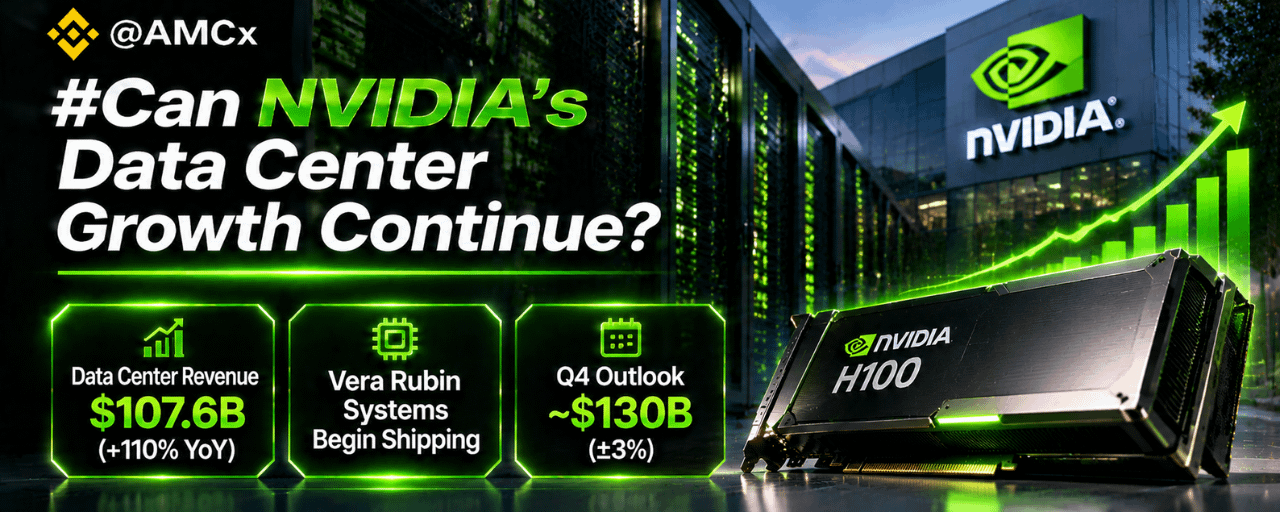
Total revenue reached $115.8 billion, increasing 103% year over year.Data Center revenue reached $107.6 billion, increasing 110% year over year.Total revenue increased 20% compared with the previous quarter.GAAP diluted earnings per share reached $2.70.
The Data Center business contributed approximately 93% of NVIDIA's total quarterly revenue.
This confirms that AI infrastructure has become the central engine of NVIDIA's business.
Even more importantly, NVIDIA expects fourth-quarter fiscal 2027 revenue of approximately $130 billion, plus or minus 3%.
That outlook suggests the company expects its growth momentum to continue in the near term.
3. Why Is NVIDIA's Data Center Business Growing So Quickly?
Several major developments are driving this expansion.
A. Growing Demand for AI Computing
Modern AI models require enormous computing resources.
Training advanced models, operating AI assistants, processing enterprise data, and running AI agents all require powerful processors and high-performance computing infrastructure.
As AI adoption expands, companies need more computing capacity.
NVIDIA is positioned at the center of this demand through its GPUs, networking technology, software, and complete computing systems.
B. The Expansion of AI Data Centers
Major technology companies are investing heavily in AI infrastructure.
Cloud providers and AI developers are building large-scale data centers designed specifically for accelerated computing.
These facilities require more than individual GPUs. They also need networking equipment, storage, cooling systems, power infrastructure, and software.
NVIDIA's strategy of offering integrated AI computing platforms gives it an opportunity to participate in a larger part of this infrastructure market.
C. The Transition Toward Complete AI Systems
The market is increasingly moving beyond individual GPU purchases.
Customers are looking for complete computing systems that combine processors, networking, software, and optimized infrastructure.
This creates additional opportunities for NVIDIA to expand its revenue per deployment.
4. Vera Rubin: The Next Important Growth Driver
One of the biggest developments in NVIDIA's latest announcement is the progress of its next-generation Vera Rubin platform.
NVIDIA confirmed that Vera Rubin NVL72 systems have begun shipping.
The platform is designed to support increasingly demanding AI workloads and large-scale computing environments.
NVIDIA has also expanded its Vera Rubin cloud ecosystem, with deployments and availability involving major infrastructure partners.
This is important because NVIDIA's future growth will depend not only on Blackwell demand but also on its ability to deliver the next generation of AI computing products.
If Vera Rubin adoption continues successfully, it could become an important contributor to NVIDIA's future data center business.
5. What Could Happen in 2027?
Looking toward 2027, several factors could support NVIDIA's continued expansion.
1. Continued AI Infrastructure Investment
Demand for AI computing could remain strong as businesses move from experimentation toward large-scale commercial deployment.
2. Vera Rubin Adoption
The transition to Vera Rubin systems could create another product cycle and encourage customers to upgrade their AI infrastructure.
3. AI Agents and Inference
As AI applications become more widely used, inference demand could become an increasingly important source of computing consumption.
4. Cloud Provider Expansion
Large cloud providers may continue expanding their AI infrastructure to serve enterprise customers and AI developers.
5. Networking and Integrated Systems
NVIDIA's networking and complete-system strategy could help it capture more value from each AI data center deployment.
These developments provide potential growth opportunities, although actual results will depend on customer demand, product execution, and industry conditions.
6. The Biggest Risks NVIDIA Must Overcome
Despite its impressive performance, NVIDIA still faces several important challenges.
Supply Constraints
Advanced manufacturing, packaging capacity, and the availability of critical components can limit how quickly NVIDIA delivers products.
High Infrastructure Costs
Building AI data centers requires enormous capital investment. Customers must eventually generate enough revenue or productivity benefits to justify those expenses.
Competition
Other semiconductor companies and major technology firms are developing their own AI accelerators and computing platforms.
Export Restrictions
International trade restrictions and changing regulations may affect NVIDIA's access to certain markets. Its latest fourth-quarter outlook does not assume Data Center compute revenue from China.
Growth Expectations
When a company grows this quickly, investors may expect increasingly strong results. Even a slowdown in growth could influence market sentiment and valuation.
These risks do not necessarily mean NVIDIA's growth is ending, but they are important factors to monitor.
7. Final Thoughts: Can NVIDIA's Data Center Growth Continue?
Based on NVIDIA's latest financial results, the answer appears encouraging.
Data Center revenue has reached $107.6 billion in a single quarter, growing 110% year over year. The company's fourth-quarter revenue outlook of $130 billion also suggests that demand remains exceptionally strong.
The introduction of Vera Rubin adds another potential growth driver, while expanding AI applications could create further demand for accelerated computing.
However, maintaining triple-digit growth over the long term will become increasingly challenging as NVIDIA's revenue base grows.
The key question is no longer simply how many GPUs NVIDIA can sell.
It is whether the global AI industry can turn its massive infrastructure investments into sustainable economic value.
NVIDIA remains at the center of the AI infrastructure revolution. Its next chapter will depend on execution, innovation, supply capacity, and the real-world adoption of artificial intelligence.
This article is for educational and informational purposes only. It is not financial advice. Always conduct your own research before making investment decisions.
AMCx — Researching the Future of Technology and Finance. $NVDAB #AMCx
{spot}(NVDABUSDT)
NVIDIA’s AI Boom: Is Data Center Growth Just Getting Started?
#cannvidia’sdatacentergrowthcontinue? NVIDIA’s AI Infrastructure Boom in 2026
1. Introduction: The AI Revolution Is Still Expanding
NVIDIA has become one of the most important companies in the global technology industry.
Its graphics processing units (GPUs), AI computing platforms, networking systems, and software ecosystem are powering a growing share of the world's artificial intelligence infrastructure.
As businesses, cloud providers, governments, and AI developers continue investing in advanced computing, demand for NVIDIA's data center products has reached extraordinary levels.
But one important question remains:
Can NVIDIA's data center growth continue at this pace, or will the AI infrastructure boom eventually slow down?
NVIDIA's latest financial results provide some important clues.
2. NVIDIA's Latest Financial Results: Record-Breaking Growth
On November 17, 2026, NVIDIA announced its third-quarter fiscal 2027 financial results.
The numbers were impressive:
Total revenue reached $115.8 billion, increasing 103% year over year.Data Center revenue reached $107.6 billion, increasing 110% year over year.Total revenue increased 20% compared with the previous quarter.GAAP diluted earnings per share reached $2.70.
The Data Center business contributed approximately 93% of NVIDIA's total quarterly revenue.
This confirms that AI infrastructure has become the central engine of NVIDIA's business.
Even more importantly, NVIDIA expects fourth-quarter fiscal 2027 revenue of approximately $130 billion, plus or minus 3%.
That outlook suggests the company expects its growth momentum to continue in the near term.
3. Why Is NVIDIA's Data Center Business Growing So Quickly?
Several major developments are driving this expansion.
A. Growing Demand for AI Computing
Modern AI models require enormous computing resources.
Training advanced models, operating AI assistants, processing enterprise data, and running AI agents all require powerful processors and high-performance computing infrastructure.
As AI adoption expands, companies need more computing capacity.
NVIDIA is positioned at the center of this demand through its GPUs, networking technology, software, and complete computing systems.
B. The Expansion of AI Data Centers
Major technology companies are investing heavily in AI infrastructure.
Cloud providers and AI developers are building large-scale data centers designed specifically for accelerated computing.
These facilities require more than individual GPUs. They also need networking equipment, storage, cooling systems, power infrastructure, and software.
NVIDIA's strategy of offering integrated AI computing platforms gives it an opportunity to participate in a larger part of this infrastructure market.
C. The Transition Toward Complete AI Systems
The market is increasingly moving beyond individual GPU purchases.
Customers are looking for complete computing systems that combine processors, networking, software, and optimized infrastructure.
This creates additional opportunities for NVIDIA to expand its revenue per deployment.
4. Vera Rubin: The Next Important Growth Driver
One of the biggest developments in NVIDIA's latest announcement is the progress of its next-generation Vera Rubin platform.
NVIDIA confirmed that Vera Rubin NVL72 systems have begun shipping.
The platform is designed to support increasingly demanding AI workloads and large-scale computing environments.
NVIDIA has also expanded its Vera Rubin cloud ecosystem, with deployments and availability involving major infrastructure partners.
This is important because NVIDIA's future growth will depend not only on Blackwell demand but also on its ability to deliver the next generation of AI computing products.
If Vera Rubin adoption continues successfully, it could become an important contributor to NVIDIA's future data center business.
5. What Could Happen in 2027?
Looking toward 2027, several factors could support NVIDIA's continued expansion.
1. Continued AI Infrastructure Investment
Demand for AI computing could remain strong as businesses move from experimentation toward large-scale commercial deployment.
2. Vera Rubin Adoption
The transition to Vera Rubin systems could create another product cycle and encourage customers to upgrade their AI infrastructure.
3. AI Agents and Inference
As AI applications become more widely used, inference demand could become an increasingly important source of computing consumption.
4. Cloud Provider Expansion
Large cloud providers may continue expanding their AI infrastructure to serve enterprise customers and AI developers.
5. Networking and Integrated Systems
NVIDIA's networking and complete-system strategy could help it capture more value from each AI data center deployment.
These developments provide potential growth opportunities, although actual results will depend on customer demand, product execution, and industry conditions.
6. The Biggest Risks NVIDIA Must Overcome
Despite its impressive performance, NVIDIA still faces several important challenges.
Supply Constraints
Advanced manufacturing, packaging capacity, and the availability of critical components can limit how quickly NVIDIA delivers products.
High Infrastructure Costs
Building AI data centers requires enormous capital investment. Customers must eventually generate enough revenue or productivity benefits to justify those expenses.
Competition
Other semiconductor companies and major technology firms are developing their own AI accelerators and computing platforms.
Export Restrictions
International trade restrictions and changing regulations may affect NVIDIA's access to certain markets. Its latest fourth-quarter outlook does not assume Data Center compute revenue from China.
Growth Expectations
When a company grows this quickly, investors may expect increasingly strong results. Even a slowdown in growth could influence market sentiment and valuation.
These risks do not necessarily mean NVIDIA's growth is ending, but they are important factors to monitor.
7. Final Thoughts: Can NVIDIA's Data Center Growth Continue?
Based on NVIDIA's latest financial results, the answer appears encouraging.
Data Center revenue has reached $107.6 billion in a single quarter, growing 110% year over year. The company's fourth-quarter revenue outlook of $130 billion also suggests that demand remains exceptionally strong.
The introduction of Vera Rubin adds another potential growth driver, while expanding AI applications could create further demand for accelerated computing.
However, maintaining triple-digit growth over the long term will become increasingly challenging as NVIDIA's revenue base grows.
The key question is no longer simply how many GPUs NVIDIA can sell.
It is whether the global AI industry can turn its massive infrastructure investments into sustainable economic value.
NVIDIA remains at the center of the AI infrastructure revolution. Its next chapter will depend on execution, innovation, supply capacity, and the real-world adoption of artificial intelligence.
This article is for educational and informational purposes only. It is not financial advice. Always conduct your own research before making investment decisions.
AMCx — Researching the Future of Technology and Finance. $NVDAB #AMCx
majspace:
Exactly — that's the real test now. The spending is easy to see, the payoff is what the market will be watching next.
5
2
580
·
--
Article
See translation
Stellar (XLM): Connecting Global Finance Through Blockchain — What's Coming in 2027?Stellar (XLM) is one of the blockchain projects focused on transforming how money moves around the world.
While Bitcoin is primarily known as decentralized digital money and Ethereum provides infrastructure for smart contracts, Stellar focuses on making financial transactions faster, more affordable, and accessible across international markets.
Developed by the Stellar Development Foundation (SDF), Stellar aims to connect traditional financial institutions, payment providers, businesses, and individuals through blockchain technology.
In 2026, Stellar continues developing its ecosystem through Soroban smart contracts, stablecoin infrastructure, real-world asset tokenization, and cross-border payment solutions.
These developments could strengthen Stellar's position in the future of global digital finance.
So, what makes Stellar different, and what could happen next in 2027?
1. Understanding Stellar (XLM)
Stellar is an open-source blockchain network designed to facilitate payments and the transfer of digital assets.
Its native cryptocurrency, XLM, is also known as Lumens.
XLM has several important functions:
Paying network transaction fees.Maintaining minimum account balances.Facilitating asset exchanges.Supporting liquidity between different currencies.Enabling cross-border transfers.Supporting applications built on Stellar.
Stellar uses the Stellar Consensus Protocol (SCP), which allows the network to reach agreement without traditional Proof-of-Work mining.
This architecture is designed to provide efficient transaction processing with relatively low costs.
2. Soroban: Bringing Smart Contracts to Stellar
One of the biggest developments in the Stellar ecosystem is Soroban.
Soroban is Stellar's smart contract platform, designed to allow developers to build decentralized applications directly on the network.
It expands Stellar beyond its original focus on payments and asset transfers.
Potential applications include:
A. Decentralized Finance
Developers can create lending, borrowing, and other financial applications.
B. Tokenized Assets
Businesses can build applications involving tokenized financial instruments and real-world assets.
C. Automated Financial Services
Smart contracts can automate transactions and financial operations.
D. Decentralized Applications
Soroban allows developers to create applications using Rust-based smart contract development tools.
This is important because it gives Stellar a broader role in the decentralized finance industry.
3. Real-World Asset Tokenization: Stellar's Major Opportunity
Real-World Asset (RWA) tokenization is becoming one of the most important trends in blockchain technology.
It involves representing traditional financial assets digitally on blockchain networks.
Examples include:
Government bonds.Investment funds.Real estate.Private credit.Tokenized securities.Commodity-backed assets.
Stellar has been developing infrastructure to support this growing market.
One of its major advantages is the combination of native asset issuance, payment functionality, and smart contracts.
Financial institutions can use these features to explore new ways of issuing, transferring, and settling digital assets.
As institutional interest in tokenization increases, Stellar could become an important infrastructure provider for this market.
4. Stablecoins: Strengthening Stellar's Payment Ecosystem
Stablecoins are another important part of Stellar's strategy.
The network supports stablecoin issuance and transfers, allowing users and businesses to move dollar-denominated value through blockchain infrastructure.
One of the best-known stablecoins available on Stellar is USDC.
Stablecoins can support several use cases:
International payments.Digital dollar transfers.Merchant settlements.Financial remittances.DeFi liquidity.Business treasury operations.
Stellar's payment-focused architecture makes it particularly relevant for applications that require affordable and accessible financial transfers.
The more stablecoin issuers and payment providers integrate with Stellar, the more useful the network could become.
However, increased stablecoin activity does not automatically translate into increased demand for XLM.
5. Stellar's Institutional Adoption
Another important part of Stellar's development is its relationship with traditional financial institutions.
The Stellar Development Foundation continues to work with financial technology companies, payment providers, and asset issuers.
Its broader strategy focuses on connecting blockchain infrastructure with existing financial systems.
Important development areas include:
Cross-Border Payments
Reducing friction in international transfers and improving settlement efficiency.
Digital Asset Issuance
Allowing businesses to issue and manage tokenized financial products.
Financial Inclusion
Making digital financial services more accessible to underserved communities.
Institutional Infrastructure
Supporting financial institutions that want to explore blockchain-based payments and settlement.
These areas could create additional opportunities for Stellar as traditional finance becomes more familiar with digital assets.
6. Stellar and the Future of Cross-Border Payments
Cross-border payments remain one of the most important real-world use cases for blockchain technology.
Traditional international transfers can involve multiple intermediaries, settlement delays, and additional costs.
Stellar aims to simplify this process by allowing digital assets to move across its network.
For example, a user could transfer a supported digital dollar across borders without relying on the same traditional settlement process used by conventional banking systems.
Stellar's architecture also supports its decentralized exchange functionality, which can help facilitate exchanges between different issued assets.
This makes Stellar relevant for remittances, business payments, and digital financial services.
7. What Could Stellar Develop in 2027?
Looking toward 2027, several important areas could shape the future of Stellar.
A. Soroban Ecosystem Expansion
More developers could introduce decentralized applications, lending markets, and financial services.
B. Institutional RWA Adoption
Financial institutions could expand their use of Stellar for tokenized bonds, funds, and other financial instruments.
C. Stablecoin Growth
Additional payment providers and stablecoin issuers could integrate with Stellar.
D. Improved Payment Infrastructure
Further development of cross-border payment applications could increase the network's practical utility.
E. Developer Ecosystem
Better development tools and smart contract infrastructure could attract more businesses and application developers.
F. Financial Inclusion
Stellar could continue exploring financial products that make digital payments more accessible globally.
These are strategic development opportunities rather than guaranteed future launch dates.
8. XLM Tokenomics: Understanding Stellar's Supply
XLM has a maximum supply of approximately 50 billion tokens.
An important historical event occurred in November 2019 when the Stellar Development Foundation burned approximately 55 billion XLM.
This reduced the total supply significantly.
Unlike Bitcoin, XLM does not use mining rewards to distribute new coins.
Its supply model is therefore different from traditional Proof-of-Work cryptocurrencies.
XLM's utility is connected to network activity, transaction fees, account requirements, and liquidity operations.
However, network growth does not automatically guarantee that XLM's market price will increase.
Actual demand, circulating supply, liquidity, and market conditions remain important factors.
9. Challenges Stellar Must Overcome
Despite its strong technology, Stellar faces several challenges.
Competition: Other blockchain networks are also developing payment infrastructure, stablecoins, and tokenized financial products.
Adoption: Partnerships and technical integrations must translate into real users and sustainable transaction activity.
XLM Utility: Stellar must continue demonstrating how ecosystem growth creates meaningful demand for its native token.
Regulatory Requirements: Digital asset and stablecoin regulations continue evolving across different countries.
Security: Smart contracts and decentralized applications require continuous testing and security audits.
Addressing these challenges will be important for Stellar's long-term development.
Final Thoughts: Stellar Is Building the Infrastructure for Global Digital Finance
Stellar has developed beyond its original vision of providing affordable international payments.
Through Soroban, stablecoin infrastructure, RWA tokenization, and institutional partnerships, the ecosystem is expanding into a broader financial technology platform.
Looking toward 2027, the most important developments to watch will be smart contract adoption, institutional tokenization, stablecoin expansion, and cross-border payment infrastructure.
If Stellar successfully delivers on these opportunities, it could become an increasingly important part of the global digital financial system.
However, the long-term value of XLM will depend on real-world adoption, sustainable network activity, liquidity, and actual demand for its services.
XLM — Connecting the World Through Digital Finance.
AMCx | Exploring the Future of Crypto.
#Stellar #XLM #StellarNetwork #Soroban #Blockchain #Crypto #RWA #Stablecoin #DeFi #Web3 #BinanceSquare #AMCx $XLM
{spot}(XLMUSDT)
Stellar (XLM): Connecting Global Finance Through Blockchain — What's Coming in 2027?
Stellar (XLM) is one of the blockchain projects focused on transforming how money moves around the world.
While Bitcoin is primarily known as decentralized digital money and Ethereum provides infrastructure for smart contracts, Stellar focuses on making financial transactions faster, more affordable, and accessible across international markets.
Developed by the Stellar Development Foundation (SDF), Stellar aims to connect traditional financial institutions, payment providers, businesses, and individuals through blockchain technology.
In 2026, Stellar continues developing its ecosystem through Soroban smart contracts, stablecoin infrastructure, real-world asset tokenization, and cross-border payment solutions.
These developments could strengthen Stellar's position in the future of global digital finance.
So, what makes Stellar different, and what could happen next in 2027?
1. Understanding Stellar (XLM)
Stellar is an open-source blockchain network designed to facilitate payments and the transfer of digital assets.
Its native cryptocurrency, XLM, is also known as Lumens.
XLM has several important functions:
Paying network transaction fees.Maintaining minimum account balances.Facilitating asset exchanges.Supporting liquidity between different currencies.Enabling cross-border transfers.Supporting applications built on Stellar.
Stellar uses the Stellar Consensus Protocol (SCP), which allows the network to reach agreement without traditional Proof-of-Work mining.
This architecture is designed to provide efficient transaction processing with relatively low costs.
2. Soroban: Bringing Smart Contracts to Stellar
One of the biggest developments in the Stellar ecosystem is Soroban.
Soroban is Stellar's smart contract platform, designed to allow developers to build decentralized applications directly on the network.
It expands Stellar beyond its original focus on payments and asset transfers.
Potential applications include:
A. Decentralized Finance
Developers can create lending, borrowing, and other financial applications.
B. Tokenized Assets
Businesses can build applications involving tokenized financial instruments and real-world assets.
C. Automated Financial Services
Smart contracts can automate transactions and financial operations.
D. Decentralized Applications
Soroban allows developers to create applications using Rust-based smart contract development tools.
This is important because it gives Stellar a broader role in the decentralized finance industry.
3. Real-World Asset Tokenization: Stellar's Major Opportunity
Real-World Asset (RWA) tokenization is becoming one of the most important trends in blockchain technology.
It involves representing traditional financial assets digitally on blockchain networks.
Examples include:
Government bonds.Investment funds.Real estate.Private credit.Tokenized securities.Commodity-backed assets.
Stellar has been developing infrastructure to support this growing market.
One of its major advantages is the combination of native asset issuance, payment functionality, and smart contracts.
Financial institutions can use these features to explore new ways of issuing, transferring, and settling digital assets.
As institutional interest in tokenization increases, Stellar could become an important infrastructure provider for this market.
4. Stablecoins: Strengthening Stellar's Payment Ecosystem
Stablecoins are another important part of Stellar's strategy.
The network supports stablecoin issuance and transfers, allowing users and businesses to move dollar-denominated value through blockchain infrastructure.
One of the best-known stablecoins available on Stellar is USDC.
Stablecoins can support several use cases:
International payments.Digital dollar transfers.Merchant settlements.Financial remittances.DeFi liquidity.Business treasury operations.
Stellar's payment-focused architecture makes it particularly relevant for applications that require affordable and accessible financial transfers.
The more stablecoin issuers and payment providers integrate with Stellar, the more useful the network could become.
However, increased stablecoin activity does not automatically translate into increased demand for XLM.
5. Stellar's Institutional Adoption
Another important part of Stellar's development is its relationship with traditional financial institutions.
The Stellar Development Foundation continues to work with financial technology companies, payment providers, and asset issuers.
Its broader strategy focuses on connecting blockchain infrastructure with existing financial systems.
Important development areas include:
Cross-Border Payments
Reducing friction in international transfers and improving settlement efficiency.
Digital Asset Issuance
Allowing businesses to issue and manage tokenized financial products.
Financial Inclusion
Making digital financial services more accessible to underserved communities.
Institutional Infrastructure
Supporting financial institutions that want to explore blockchain-based payments and settlement.
These areas could create additional opportunities for Stellar as traditional finance becomes more familiar with digital assets.
6. Stellar and the Future of Cross-Border Payments
Cross-border payments remain one of the most important real-world use cases for blockchain technology.
Traditional international transfers can involve multiple intermediaries, settlement delays, and additional costs.
Stellar aims to simplify this process by allowing digital assets to move across its network.
For example, a user could transfer a supported digital dollar across borders without relying on the same traditional settlement process used by conventional banking systems.
Stellar's architecture also supports its decentralized exchange functionality, which can help facilitate exchanges between different issued assets.
This makes Stellar relevant for remittances, business payments, and digital financial services.
7. What Could Stellar Develop in 2027?
Looking toward 2027, several important areas could shape the future of Stellar.
A. Soroban Ecosystem Expansion
More developers could introduce decentralized applications, lending markets, and financial services.
B. Institutional RWA Adoption
Financial institutions could expand their use of Stellar for tokenized bonds, funds, and other financial instruments.
C. Stablecoin Growth
Additional payment providers and stablecoin issuers could integrate with Stellar.
D. Improved Payment Infrastructure
Further development of cross-border payment applications could increase the network's practical utility.
E. Developer Ecosystem
Better development tools and smart contract infrastructure could attract more businesses and application developers.
F. Financial Inclusion
Stellar could continue exploring financial products that make digital payments more accessible globally.
These are strategic development opportunities rather than guaranteed future launch dates.
8. XLM Tokenomics: Understanding Stellar's Supply
XLM has a maximum supply of approximately 50 billion tokens.
An important historical event occurred in November 2019 when the Stellar Development Foundation burned approximately 55 billion XLM.
This reduced the total supply significantly.
Unlike Bitcoin, XLM does not use mining rewards to distribute new coins.
Its supply model is therefore different from traditional Proof-of-Work cryptocurrencies.
XLM's utility is connected to network activity, transaction fees, account requirements, and liquidity operations.
However, network growth does not automatically guarantee that XLM's market price will increase.
Actual demand, circulating supply, liquidity, and market conditions remain important factors.
9. Challenges Stellar Must Overcome
Despite its strong technology, Stellar faces several challenges.
Competition: Other blockchain networks are also developing payment infrastructure, stablecoins, and tokenized financial products.
Adoption: Partnerships and technical integrations must translate into real users and sustainable transaction activity.
XLM Utility: Stellar must continue demonstrating how ecosystem growth creates meaningful demand for its native token.
Regulatory Requirements: Digital asset and stablecoin regulations continue evolving across different countries.
Security: Smart contracts and decentralized applications require continuous testing and security audits.
Addressing these challenges will be important for Stellar's long-term development.
Final Thoughts: Stellar Is Building the Infrastructure for Global Digital Finance
Stellar has developed beyond its original vision of providing affordable international payments.
Through Soroban, stablecoin infrastructure, RWA tokenization, and institutional partnerships, the ecosystem is expanding into a broader financial technology platform.
Looking toward 2027, the most important developments to watch will be smart contract adoption, institutional tokenization, stablecoin expansion, and cross-border payment infrastructure.
If Stellar successfully delivers on these opportunities, it could become an increasingly important part of the global digital financial system.
However, the long-term value of XLM will depend on real-world adoption, sustainable network activity, liquidity, and actual demand for its services.
XLM — Connecting the World Through Digital Finance.
AMCx | Exploring the Future of Crypto.
#Stellar #XLM #StellarNetwork #Soroban #Blockchain #Crypto #RWA #Stablecoin #DeFi #Web3 #BinanceSquare #AMCx $XLM
1
47
·
--
Article
See translation
USDC (USD Coin): The Digital Dollar Expanding Across the Global Financial System — What's Next in 20USDC is becoming one of the most important digital dollars in the cryptocurrency industry. Issued by Circle, USDC is designed to maintain a stable value relative to the US dollar while providing the speed and accessibility of blockchain technology.
As the digital asset industry continues to mature, stablecoins are becoming increasingly important for payments, trading, financial settlements, and decentralized applications.
But Circle has ambitions beyond simply issuing a stablecoin. With the launch of Arc, new institutional partnerships, and expanding payment infrastructure, USDC could play an even bigger role in the future of global finance.
So, what is happening with USDC in 2026, and what should the crypto community watch in 2027?
1. Understanding USDC
USDC is a dollar-backed stablecoin issued by Circle.
Its primary objective is to maintain a value close to one US dollar and provide users with a digital asset that can move across supported blockchain networks.
USDC is widely used for:
Cryptocurrency trading and liquidity.International digital payments.Decentralized Finance (DeFi).Cross-border settlements.Digital asset transfers.Institutional treasury operations.
Circle states that USDC is backed by cash and cash-equivalent assets, with monthly third-party reserve attestations.
Unlike speculative cryptocurrencies, USDC is designed for price stability rather than long-term price appreciation.
2. USDC's Latest Developments in 2026
One of the most important developments is the continued expansion of USDC adoption.
According to Circle's November 2026 disclosures, USDC circulation reached approximately $67.9 billion as of November 12, 2026.
Circle also reported strong transaction activity during the third quarter of 2026.
Key figures included:
Average USDC circulation of $73.3 billion during Q3.On-chain transaction volume of $13.9 trillion during Q3.On-chain transaction volume growth of 49% year-over-year.Circle total revenue and reserve income of $865 million during Q3.
These figures highlight the growing importance of stablecoins in the global digital financial system.
3. Circle Launches Arc: A Major Step for USDC
Perhaps the biggest development in Circle's ecosystem is the launch of Arc Mainnet on September 16, 2026.
Arc is a new Layer 1 blockchain developed by Circle specifically for financial markets, digital payments, and programmable economic activity.
Its design includes several important features:
A. USDC as Gas
Unlike many blockchain networks that require a separate volatile token for transaction fees, Arc uses USDC for gas payments.
This could make transaction costs more predictable for businesses and financial institutions.
B. Sub-Second Settlement
Arc is designed to provide deterministic sub-second transaction finality.
This could make it more suitable for payment systems and financial applications that require fast settlement.
C. Privacy Features
Arc is developing optional confidential transactions and balances with view-key functionality.
This could provide additional privacy options for businesses while supporting selective transparency.
D. Institutional Infrastructure
Arc launched with more than 100 institutional and ecosystem builders, including participants from financial services, payments, digital assets, and technology.
Arc represents an important expansion of Circle's strategy beyond the USDC stablecoin itself.
4. Binance and Circle Strengthen Their Partnership
Another significant development occurred on September 22, 2026.
Binance announced a $100 million strategic equity investment in Circle and entered into a new five-year commercial agreement.
The partnership focuses on expanding USDC access, adoption, and integration across Binance's global platform, particularly in emerging markets.
This is an important development because Binance provides access to a large international user base, while Circle provides the infrastructure supporting USDC.
The partnership could help strengthen USDC's position in cryptocurrency trading, payments, and digital dollar adoption.
5. USDC Is Expanding Across Multiple Blockchains
USDC is not limited to a single blockchain.
As of September 2026, Circle reported native USDC support across 38 blockchain networks.
These include:
Ethereum.Solana.Arbitrum.Base.Avalanche.Polygon.Stellar.XRP Ledger.Sui.Aptos.Optimism.Arc.
This multichain strategy allows developers and users to access USDC across different blockchain ecosystems.
Circle is also developing Cross-Chain Transfer Protocol (CCTP), which enables native USDC transfers between supported networks without relying on traditional third-party wrapped tokens.
The expansion of multichain infrastructure could make USDC more accessible and useful for global financial applications.
6. What Is Circle Planning for 2027?
Several strategic areas could become increasingly important for USDC and the wider Circle ecosystem.
A. Expanding Arc Infrastructure
Circle is continuing to develop Arc as a financial infrastructure network.
Its future development includes scalability, privacy, and a transition toward Proof-of-Stake consensus.
B. Institutional Payment Expansion
Circle is working with financial institutions and payment providers to integrate stablecoins into existing financial infrastructure.
In October 2026, Circle announced a collaboration with ACI Worldwide to explore USDC settlement within existing payment operations in Latin America.
C. Growing AI-Powered Payments
Circle is developing infrastructure for AI agents to make programmable payments.
This includes its Agent Stack, designed to support controlled wallets, automated transactions, and agent-to-agent payments.
D. Cross-Chain Financial Infrastructure
CCTP and other interoperability products remain important to making USDC transfers more seamless across supported blockchain networks.
E. Expanding Global Adoption
Emerging markets remain an important opportunity for digital dollar adoption, especially where international payments and access to dollar-based financial services are in demand.
These are strategic development priorities, not guarantees of future adoption.
7. Challenges USDC Must Overcome
Despite its strong position, USDC faces several challenges.
Regulatory Requirements
Stablecoin regulations continue to evolve across different countries. Circle must maintain compliance as it expands into new markets.
Competition
USDT, USDS, and other stablecoins are competing for market share, liquidity, and institutional adoption.
Reserve and Redemption Risks
Users must continue evaluating reserve quality, banking relationships, redemption arrangements, and the operational risks associated with centralized stablecoin issuers.
Blockchain Security
As USDC expands to more networks, Circle must continue evaluating the security and reliability of each supported blockchain.
Market Dependence
Stablecoin adoption depends on real demand for digital dollars, payments, and financial infrastructure.
8. Can USDC Become a Major Part of Global Finance?
The financial industry is increasingly exploring blockchain-based payment and settlement systems.
USDC offers a way to transfer dollar-denominated value through supported blockchain networks, potentially improving the speed and accessibility of international transactions.
With Arc, institutional partnerships, and multichain infrastructure, Circle is building an ecosystem that extends beyond cryptocurrency exchanges.
If adoption continues, USDC could become an increasingly important component of global digital financial infrastructure.
However, USDC is not designed to generate capital appreciation. Its primary purpose is to maintain a stable value close to one US dollar.
Final Thoughts: USDC Is Building the Future of Digital Dollars
USDC has developed from a digital dollar into an important part of the global cryptocurrency ecosystem.
The launch of Arc, the strategic partnership with Binance, and expanding institutional payment infrastructure represent important milestones in Circle's development.
Looking toward 2027, the most important areas to watch will be Arc's evolution, global payment adoption, AI-powered financial services, and regulatory developments.
The future of USDC will depend on trust, transparency, interoperability, and real-world utility.
USDC — The Digital Dollar for a Connected World.
AMCx | Exploring the Future of Crypto.
#USDC #USDСoin #Circle #Stablecoin #Crypto #Blockchain #Web3 #DigitalDollar #BinanceSquare #AMCx $USDC
{spot}(USDCUSDT)
USDC (USD Coin): The Digital Dollar Expanding Across the Global Financial System — What's Next in 20
USDC is becoming one of the most important digital dollars in the cryptocurrency industry. Issued by Circle, USDC is designed to maintain a stable value relative to the US dollar while providing the speed and accessibility of blockchain technology.
As the digital asset industry continues to mature, stablecoins are becoming increasingly important for payments, trading, financial settlements, and decentralized applications.
But Circle has ambitions beyond simply issuing a stablecoin. With the launch of Arc, new institutional partnerships, and expanding payment infrastructure, USDC could play an even bigger role in the future of global finance.
So, what is happening with USDC in 2026, and what should the crypto community watch in 2027?
1. Understanding USDC
USDC is a dollar-backed stablecoin issued by Circle.
Its primary objective is to maintain a value close to one US dollar and provide users with a digital asset that can move across supported blockchain networks.
USDC is widely used for:
Cryptocurrency trading and liquidity.International digital payments.Decentralized Finance (DeFi).Cross-border settlements.Digital asset transfers.Institutional treasury operations.
Circle states that USDC is backed by cash and cash-equivalent assets, with monthly third-party reserve attestations.
Unlike speculative cryptocurrencies, USDC is designed for price stability rather than long-term price appreciation.
2. USDC's Latest Developments in 2026
One of the most important developments is the continued expansion of USDC adoption.
According to Circle's November 2026 disclosures, USDC circulation reached approximately $67.9 billion as of November 12, 2026.
Circle also reported strong transaction activity during the third quarter of 2026.
Key figures included:
Average USDC circulation of $73.3 billion during Q3.On-chain transaction volume of $13.9 trillion during Q3.On-chain transaction volume growth of 49% year-over-year.Circle total revenue and reserve income of $865 million during Q3.
These figures highlight the growing importance of stablecoins in the global digital financial system.
3. Circle Launches Arc: A Major Step for USDC
Perhaps the biggest development in Circle's ecosystem is the launch of Arc Mainnet on September 16, 2026.
Arc is a new Layer 1 blockchain developed by Circle specifically for financial markets, digital payments, and programmable economic activity.
Its design includes several important features:
A. USDC as Gas
Unlike many blockchain networks that require a separate volatile token for transaction fees, Arc uses USDC for gas payments.
This could make transaction costs more predictable for businesses and financial institutions.
B. Sub-Second Settlement
Arc is designed to provide deterministic sub-second transaction finality.
This could make it more suitable for payment systems and financial applications that require fast settlement.
C. Privacy Features
Arc is developing optional confidential transactions and balances with view-key functionality.
This could provide additional privacy options for businesses while supporting selective transparency.
D. Institutional Infrastructure
Arc launched with more than 100 institutional and ecosystem builders, including participants from financial services, payments, digital assets, and technology.
Arc represents an important expansion of Circle's strategy beyond the USDC stablecoin itself.
4. Binance and Circle Strengthen Their Partnership
Another significant development occurred on September 22, 2026.
Binance announced a $100 million strategic equity investment in Circle and entered into a new five-year commercial agreement.
The partnership focuses on expanding USDC access, adoption, and integration across Binance's global platform, particularly in emerging markets.
This is an important development because Binance provides access to a large international user base, while Circle provides the infrastructure supporting USDC.
The partnership could help strengthen USDC's position in cryptocurrency trading, payments, and digital dollar adoption.
5. USDC Is Expanding Across Multiple Blockchains
USDC is not limited to a single blockchain.
As of September 2026, Circle reported native USDC support across 38 blockchain networks.
These include:
Ethereum.Solana.Arbitrum.Base.Avalanche.Polygon.Stellar.XRP Ledger.Sui.Aptos.Optimism.Arc.
This multichain strategy allows developers and users to access USDC across different blockchain ecosystems.
Circle is also developing Cross-Chain Transfer Protocol (CCTP), which enables native USDC transfers between supported networks without relying on traditional third-party wrapped tokens.
The expansion of multichain infrastructure could make USDC more accessible and useful for global financial applications.
6. What Is Circle Planning for 2027?
Several strategic areas could become increasingly important for USDC and the wider Circle ecosystem.
A. Expanding Arc Infrastructure
Circle is continuing to develop Arc as a financial infrastructure network.
Its future development includes scalability, privacy, and a transition toward Proof-of-Stake consensus.
B. Institutional Payment Expansion
Circle is working with financial institutions and payment providers to integrate stablecoins into existing financial infrastructure.
In October 2026, Circle announced a collaboration with ACI Worldwide to explore USDC settlement within existing payment operations in Latin America.
C. Growing AI-Powered Payments
Circle is developing infrastructure for AI agents to make programmable payments.
This includes its Agent Stack, designed to support controlled wallets, automated transactions, and agent-to-agent payments.
D. Cross-Chain Financial Infrastructure
CCTP and other interoperability products remain important to making USDC transfers more seamless across supported blockchain networks.
E. Expanding Global Adoption
Emerging markets remain an important opportunity for digital dollar adoption, especially where international payments and access to dollar-based financial services are in demand.
These are strategic development priorities, not guarantees of future adoption.
7. Challenges USDC Must Overcome
Despite its strong position, USDC faces several challenges.
Regulatory Requirements
Stablecoin regulations continue to evolve across different countries. Circle must maintain compliance as it expands into new markets.
Competition
USDT, USDS, and other stablecoins are competing for market share, liquidity, and institutional adoption.
Reserve and Redemption Risks
Users must continue evaluating reserve quality, banking relationships, redemption arrangements, and the operational risks associated with centralized stablecoin issuers.
Blockchain Security
As USDC expands to more networks, Circle must continue evaluating the security and reliability of each supported blockchain.
Market Dependence
Stablecoin adoption depends on real demand for digital dollars, payments, and financial infrastructure.
8. Can USDC Become a Major Part of Global Finance?
The financial industry is increasingly exploring blockchain-based payment and settlement systems.
USDC offers a way to transfer dollar-denominated value through supported blockchain networks, potentially improving the speed and accessibility of international transactions.
With Arc, institutional partnerships, and multichain infrastructure, Circle is building an ecosystem that extends beyond cryptocurrency exchanges.
If adoption continues, USDC could become an increasingly important component of global digital financial infrastructure.
However, USDC is not designed to generate capital appreciation. Its primary purpose is to maintain a stable value close to one US dollar.
Final Thoughts: USDC Is Building the Future of Digital Dollars
USDC has developed from a digital dollar into an important part of the global cryptocurrency ecosystem.
The launch of Arc, the strategic partnership with Binance, and expanding institutional payment infrastructure represent important milestones in Circle's development.
Looking toward 2027, the most important areas to watch will be Arc's evolution, global payment adoption, AI-powered financial services, and regulatory developments.
The future of USDC will depend on trust, transparency, interoperability, and real-world utility.
USDC — The Digital Dollar for a Connected World.
AMCx | Exploring the Future of Crypto.
#USDC #USDСoin #Circle #Stablecoin #Crypto #Blockchain #Web3 #DigitalDollar #BinanceSquare #AMCx $USDC
116
·
--
Article
See translation
XRP (Ripple): The Future of Global Payments and What Comes Next in 2027?XRP remains one of the most recognized digital assets in the cryptocurrency industry. Built around the XRP Ledger (XRPL), XRP aims to make digital value transfers faster, more efficient, and accessible across international markets.
Unlike many blockchain projects focused primarily on decentralized applications, XRP has a strong connection to the global payments industry.
Ripple, the company developing financial technology solutions around the XRP ecosystem, continues to expand its institutional partnerships, payment infrastructure, and blockchain-based financial services.
But XRP's story is becoming bigger than payments alone.
With new developments in decentralized finance, institutional lending, real-world asset tokenization, and quantum-resistant security, the XRP Ledger is entering an important stage of development.
So, what is happening with XRP in 2026, and what could come next?
1. Understanding XRP and the XRP Ledger
XRP is the native digital asset of the XRP Ledger, a decentralized public blockchain launched in 2012.
The network was designed to facilitate fast and efficient value transfers without requiring traditional mining.
Its main characteristics include:
Fast transaction settlement.Relatively low transaction fees.Built-in decentralized exchange functionality.Support for issued tokens and stablecoins.Payment channels and escrow functionality.Infrastructure for financial applications.
XRP can be used for payments, liquidity, and value transfers across the ecosystem.
It is important to understand that XRP and Ripple are not the same thing. XRP is a digital asset, XRPL is the decentralized blockchain, and Ripple is a company developing products and services that use blockchain technology.
2. XRP Ledger's Latest Developments in November 2026
The XRP Ledger continues to receive technical improvements.
One important release is XRPL version 3.4.1, introduced on September 25, 2026.
The update includes improvements to the reference server implementation and fixes for important network issues.
The XRP Ledger development community is also preparing version 3.5.0, scheduled for December 3, 2026.
This release is particularly important because network reliability and transaction processing remain essential as the ecosystem expands.
The development team is also addressing security and performance issues to strengthen the network's infrastructure.
3. Institutional Lending Is Coming to the XRP Ledger
One of the most interesting developments is the proposed XRP Ledger Lending Protocol.
This initiative aims to introduce fixed-term lending and borrowing directly into the XRPL ecosystem.
It could create opportunities for:
Institutional lending.Digital asset financing.Liquidity management.Credit markets.DeFi applications.
As of November 12, 2026, the LendingProtocol proposal had received 22 validator votes, while its required threshold is 29 out of 35 validators for two consecutive weeks.
The SingleAssetVault amendment had received 23 votes.
This means the system is progressing but has not yet been activated on Mainnet.
The proposed lending system also introduces important risks because certain loans rely on off-chain underwriting and broker risk management rather than conventional on-chain collateral.
If approved and implemented successfully, this could become an important expansion of XRPL's financial capabilities.
4. Ripple Is Expanding Institutional Adoption
Ripple's institutional strategy continues to attract attention.
On October 27, 2026, Ripple announced an expanded strategic collaboration with BNY.
The partnership focuses on digital asset custody and tokenized trade finance.
BNY also supports XRP and RLUSD through its Digital Asset Custody platform.
Another important development involves Ripple's partnership with C2FO, announced on October 27, 2026.
The collaboration aims to modernize trade finance using the XRP Ledger.
These developments demonstrate how blockchain infrastructure is increasingly being explored by traditional financial institutions.
However, institutional adoption of Ripple products should not automatically be interpreted as direct demand for XRP. The actual use of XRP within each financial application matters.
5. Real-World Asset Tokenization Is Growing on XRPL
Tokenization is becoming one of the most important trends in blockchain technology.
The XRP Ledger is positioning itself as an infrastructure platform for representing traditional financial assets on-chain.
A notable development occurred on September 29, 2026, when Ripple and CSD BR announced a partnership in Brazil.
The project involves using XRPL as an additional layer for recording and auditing financial assets, beginning with investment fund shares from BTG Pactual.
This is an important milestone because it demonstrates how public blockchain technology can be explored within established financial market infrastructure.
Potential future applications include:
Tokenized investment funds.Digital securities.Real-world asset management.Institutional financial settlements.Blockchain-based asset ownership records.
The success of these initiatives could strengthen XRPL's position in the growing tokenization industry.
6. XRP and the Quantum Computing Challenge
Another major area of development is quantum-resistant security.
As quantum computing advances, blockchain networks must consider how future computers could affect existing cryptographic systems.
The XRP Ledger Foundation has been exploring a roadmap for post-quantum security.
A proposed solution would allow account owners to introduce quantum-resistant signing keys and eventually disable older keys.
The current development direction includes:
Migration studies planned for early 2027.Continued development and security auditing.Broader testing before deployment.A longer-term transition target around 2028.
This is still a development roadmap, not a completed Mainnet upgrade.
Preparing for future technological threats could become an important part of maintaining XRPL's long-term security.
7. What Could XRP's Future Look Like in 2027?
Several developments could shape the XRP ecosystem over the next year.
A. Institutional DeFi
If the proposed lending and vault amendments receive sufficient validator support, XRPL could develop new institutional credit and liquidity markets.
B. Global Payments
Ripple continues expanding its payment infrastructure and institutional partnerships across international markets.
C. Real-World Asset Tokenization
Partnerships involving financial institutions could create new opportunities for tokenized assets and blockchain-based settlement.
D. Better Network Infrastructure
Upcoming XRPL releases are expected to continue improving network performance, reliability, and security.
E. Quantum-Resistant Technology
Post-quantum development could become a significant long-term priority as blockchain security evolves.
These initiatives could strengthen the XRP ecosystem, although their eventual impact will depend on successful implementation and real-world adoption.
8. Challenges XRP Must Overcome
Despite its strong position, XRP still faces several challenges.
Competition: Other blockchain networks are also developing payment, tokenization, and institutional financial infrastructure.
Institutional Adoption: Partnerships do not automatically translate into greater demand for XRP itself.
Network Governance: Proposed protocol amendments require sufficient validator support before activation.
Regulation: Digital asset regulations continue to evolve across international markets.
Market Volatility: XRP remains exposed to broader cryptocurrency market movements and changing investor sentiment.
Addressing these challenges will be important for the ecosystem's long-term development.
Final Thoughts: XRP Is Expanding Beyond Global Payments
XRP began with a strong vision of making global value transfers faster and more efficient.
Today, the XRP ecosystem is exploring much broader opportunities through institutional finance, lending, tokenization, decentralized applications, and advanced blockchain security.
The developments to watch closely are the proposed XRPL Lending Protocol, the expansion of institutional partnerships, the December 2026 network release, and the longer-term quantum security roadmap.
If these initiatives deliver their intended capabilities, the XRP Ledger could become an increasingly important part of the global digital financial infrastructure.
However, technology adoption and XRP's market price are two different things. Long-term success will depend on real utility, liquidity, network participation, and sustainable demand.
XRP — Powering the Future of Global Payments.
AMCx | Exploring the Future of Crypto.
#xrp #Ripple #XRPL #Crypto #Blockchain #DeFi #Tokenization #Web3 #BinanceSquare #AMCx $XRP
{spot}(XRPUSDT)
XRP (Ripple): The Future of Global Payments and What Comes Next in 2027?
XRP remains one of the most recognized digital assets in the cryptocurrency industry. Built around the XRP Ledger (XRPL), XRP aims to make digital value transfers faster, more efficient, and accessible across international markets.
Unlike many blockchain projects focused primarily on decentralized applications, XRP has a strong connection to the global payments industry.
Ripple, the company developing financial technology solutions around the XRP ecosystem, continues to expand its institutional partnerships, payment infrastructure, and blockchain-based financial services.
But XRP's story is becoming bigger than payments alone.
With new developments in decentralized finance, institutional lending, real-world asset tokenization, and quantum-resistant security, the XRP Ledger is entering an important stage of development.
So, what is happening with XRP in 2026, and what could come next?
1. Understanding XRP and the XRP Ledger
XRP is the native digital asset of the XRP Ledger, a decentralized public blockchain launched in 2012.
The network was designed to facilitate fast and efficient value transfers without requiring traditional mining.
Its main characteristics include:
Fast transaction settlement.Relatively low transaction fees.Built-in decentralized exchange functionality.Support for issued tokens and stablecoins.Payment channels and escrow functionality.Infrastructure for financial applications.
XRP can be used for payments, liquidity, and value transfers across the ecosystem.
It is important to understand that XRP and Ripple are not the same thing. XRP is a digital asset, XRPL is the decentralized blockchain, and Ripple is a company developing products and services that use blockchain technology.
2. XRP Ledger's Latest Developments in November 2026
The XRP Ledger continues to receive technical improvements.
One important release is XRPL version 3.4.1, introduced on September 25, 2026.
The update includes improvements to the reference server implementation and fixes for important network issues.
The XRP Ledger development community is also preparing version 3.5.0, scheduled for December 3, 2026.
This release is particularly important because network reliability and transaction processing remain essential as the ecosystem expands.
The development team is also addressing security and performance issues to strengthen the network's infrastructure.
3. Institutional Lending Is Coming to the XRP Ledger
One of the most interesting developments is the proposed XRP Ledger Lending Protocol.
This initiative aims to introduce fixed-term lending and borrowing directly into the XRPL ecosystem.
It could create opportunities for:
Institutional lending.Digital asset financing.Liquidity management.Credit markets.DeFi applications.
As of November 12, 2026, the LendingProtocol proposal had received 22 validator votes, while its required threshold is 29 out of 35 validators for two consecutive weeks.
The SingleAssetVault amendment had received 23 votes.
This means the system is progressing but has not yet been activated on Mainnet.
The proposed lending system also introduces important risks because certain loans rely on off-chain underwriting and broker risk management rather than conventional on-chain collateral.
If approved and implemented successfully, this could become an important expansion of XRPL's financial capabilities.
4. Ripple Is Expanding Institutional Adoption
Ripple's institutional strategy continues to attract attention.
On October 27, 2026, Ripple announced an expanded strategic collaboration with BNY.
The partnership focuses on digital asset custody and tokenized trade finance.
BNY also supports XRP and RLUSD through its Digital Asset Custody platform.
Another important development involves Ripple's partnership with C2FO, announced on October 27, 2026.
The collaboration aims to modernize trade finance using the XRP Ledger.
These developments demonstrate how blockchain infrastructure is increasingly being explored by traditional financial institutions.
However, institutional adoption of Ripple products should not automatically be interpreted as direct demand for XRP. The actual use of XRP within each financial application matters.
5. Real-World Asset Tokenization Is Growing on XRPL
Tokenization is becoming one of the most important trends in blockchain technology.
The XRP Ledger is positioning itself as an infrastructure platform for representing traditional financial assets on-chain.
A notable development occurred on September 29, 2026, when Ripple and CSD BR announced a partnership in Brazil.
The project involves using XRPL as an additional layer for recording and auditing financial assets, beginning with investment fund shares from BTG Pactual.
This is an important milestone because it demonstrates how public blockchain technology can be explored within established financial market infrastructure.
Potential future applications include:
Tokenized investment funds.Digital securities.Real-world asset management.Institutional financial settlements.Blockchain-based asset ownership records.
The success of these initiatives could strengthen XRPL's position in the growing tokenization industry.
6. XRP and the Quantum Computing Challenge
Another major area of development is quantum-resistant security.
As quantum computing advances, blockchain networks must consider how future computers could affect existing cryptographic systems.
The XRP Ledger Foundation has been exploring a roadmap for post-quantum security.
A proposed solution would allow account owners to introduce quantum-resistant signing keys and eventually disable older keys.
The current development direction includes:
Migration studies planned for early 2027.Continued development and security auditing.Broader testing before deployment.A longer-term transition target around 2028.
This is still a development roadmap, not a completed Mainnet upgrade.
Preparing for future technological threats could become an important part of maintaining XRPL's long-term security.
7. What Could XRP's Future Look Like in 2027?
Several developments could shape the XRP ecosystem over the next year.
A. Institutional DeFi
If the proposed lending and vault amendments receive sufficient validator support, XRPL could develop new institutional credit and liquidity markets.
B. Global Payments
Ripple continues expanding its payment infrastructure and institutional partnerships across international markets.
C. Real-World Asset Tokenization
Partnerships involving financial institutions could create new opportunities for tokenized assets and blockchain-based settlement.
D. Better Network Infrastructure
Upcoming XRPL releases are expected to continue improving network performance, reliability, and security.
E. Quantum-Resistant Technology
Post-quantum development could become a significant long-term priority as blockchain security evolves.
These initiatives could strengthen the XRP ecosystem, although their eventual impact will depend on successful implementation and real-world adoption.
8. Challenges XRP Must Overcome
Despite its strong position, XRP still faces several challenges.
Competition: Other blockchain networks are also developing payment, tokenization, and institutional financial infrastructure.
Institutional Adoption: Partnerships do not automatically translate into greater demand for XRP itself.
Network Governance: Proposed protocol amendments require sufficient validator support before activation.
Regulation: Digital asset regulations continue to evolve across international markets.
Market Volatility: XRP remains exposed to broader cryptocurrency market movements and changing investor sentiment.
Addressing these challenges will be important for the ecosystem's long-term development.
Final Thoughts: XRP Is Expanding Beyond Global Payments
XRP began with a strong vision of making global value transfers faster and more efficient.
Today, the XRP ecosystem is exploring much broader opportunities through institutional finance, lending, tokenization, decentralized applications, and advanced blockchain security.
The developments to watch closely are the proposed XRPL Lending Protocol, the expansion of institutional partnerships, the December 2026 network release, and the longer-term quantum security roadmap.
If these initiatives deliver their intended capabilities, the XRP Ledger could become an increasingly important part of the global digital financial infrastructure.
However, technology adoption and XRP's market price are two different things. Long-term success will depend on real utility, liquidity, network participation, and sustainable demand.
XRP — Powering the Future of Global Payments.
AMCx | Exploring the Future of Crypto.
#xrp #Ripple #XRPL #Crypto #Blockchain #DeFi #Tokenization #Web3 #BinanceSquare #AMCx $XRP
16
·
--
Article
See translation
BNB (BNB): The Next Evolution of Binance's Blockchain Ecosystem — What's Coming in 2027?BNB has become one of the most important cryptocurrencies in the digital asset industry. As the native asset of the BNB Chain ecosystem, BNB plays a central role in transaction payments, decentralized finance, staking, and blockchain applications.
However, BNB Chain is not stopping at its current capabilities. The ecosystem is developing new infrastructure designed to support faster transactions, advanced trading applications, artificial intelligence, and institutional financial services.
So, what is happening with BNB in 2026, and what could investors and blockchain enthusiasts expect in 2027?
1. Understanding BNB and Its Ecosystem
BNB is the native cryptocurrency of BNB Chain.
Its main utilities include:
Paying transaction fees on BNB Smart Chain.Participating in staking and network security.Supporting decentralized applications.Trading and providing liquidity in DeFi protocols.Participating in ecosystem governance.Supporting payments and other blockchain services.
BNB is also used across the broader Binance ecosystem, although its blockchain utility extends beyond the centralized exchange.
2. BNB Chain's Latest Developments in 2026
One of the most important developments this year has been the continued optimization of BNB Smart Chain.
According to BNB Chain's H2 2026 technical roadmap, several improvements were achieved during the first half of the year.
These include:
Block intervals reduced to approximately 450 milliseconds.In-memory finality reduced to approximately 650 milliseconds.Benchmark throughput increased to around 5,200 transactions per second.
The network is now focusing on further improvements in execution performance, transaction capacity, and network stability.
These developments are important because faster and more reliable infrastructure can make blockchain applications more practical for everyday users and businesses.
3. Jenner Hard Fork: An Important Upcoming Upgrade
One major development to watch is the Jenner Hard Fork, scheduled for BNB Smart Chain mainnet on December 8, 2026.
This upgrade introduces several important improvements.
A. Compliant Asset Standard (CAS20)
BEP-702 introduces a protocol-native standard designed for compliant assets, including stablecoins and tokenized real-world assets.
It includes features such as transfer policies, allowlists, blocklists, and administrative controls.
The goal is to provide more flexible infrastructure for financial institutions and asset issuers.
B. Payment Lane
BEP-703 introduces a dedicated payment capacity mechanism.
By default, 5% of block gas is reserved for eligible payment transactions, helping maintain payment capacity during periods of network congestion.
C. Millisecond Block Timestamps
BEP-706 allows smart contracts to access block timestamps with millisecond precision.
This could benefit applications that require more precise timing, including trading systems, auctions, and financial applications.
These improvements demonstrate BNB Chain's growing focus on payment infrastructure and institutional blockchain applications.
4. BNB Chain's Biggest Ambition: A New Layer 1
Perhaps the most interesting development is BNB Chain's next-generation Layer 1 project.
This initiative aims to create blockchain infrastructure designed for high-frequency trading, advanced financial applications, and AI-driven transactions.
Some of its proposed technologies include:
TxStream: A transaction delivery system designed to remove reliance on a public mempool and reduce opportunities for front-running.
PriorityLane: Dedicated transaction capacity for important activities such as liquidations, oracles, and bridges.
Native Privacy: Protocol-level confidential transactions with selective disclosure capabilities.
Account Abstraction: More flexible wallet experiences, including gas sponsorship, transaction batching, scheduled execution, and passkey support.
The project has ambitious performance objectives, including 100,000+ transactions per second and sub-50-millisecond transaction preconfirmation.
These are development targets, not confirmed live network performance.
According to the latest New L1 documentation, the public testnet is targeted for Q1 2027 and mainnet for H2 2027. Both timelines remain subject to testing and release readiness.
Importantly, BNB will remain the native asset for gas and staking. The project does not currently plan to introduce a separate native economic token.
5. BNB and the Artificial Intelligence Revolution
Artificial intelligence is becoming an increasingly important part of blockchain development.
BNB Chain has been developing AI infrastructure to support autonomous on-chain agents.
These initiatives include BNB Agent Studio and the BNB Agent SDK.
The broader vision is to allow AI agents to interact with blockchain applications, execute transactions, and participate in digital financial services.
Potential applications include:
Automated trading systems.AI-powered payment services.Autonomous blockchain agents.On-chain financial automation.AI-integrated decentralized applications.
This could create additional use cases for BNB as blockchain activity expands into AI-powered services.
6. BNB Tokenomics: Why Supply Matters
BNB has a deflationary supply mechanism designed to reduce its total supply over time.
Its tokenomics include two important mechanisms:
Auto-Burn
BNB uses an automatic burning mechanism that adjusts the amount of BNB removed from circulation based on market price and BNB Smart Chain block production.
The long-term supply target is 100 million BNB.
Real-Time Gas Fee Burn
A portion of BNB Smart Chain transaction fees is also burned in real time.
These mechanisms are designed to gradually reduce the circulating supply.
However, token burns do not automatically guarantee higher prices. Market demand, liquidity, adoption, and broader economic conditions remain important factors.
7. What Could Drive BNB's Growth in 2027?
Several developments could influence BNB's long-term adoption.
New L1 Development: A successful next-generation blockchain could introduce new opportunities for trading, payments, and institutional applications.
Stablecoin and RWA Adoption: CAS20 could provide additional infrastructure for tokenized financial assets.
AI Integration: More autonomous blockchain applications could increase demand for network services.
DeFi Expansion: Continued growth in decentralized exchanges, lending, and liquidity markets could strengthen the ecosystem.
Network Performance: Faster execution and more reliable transaction processing could attract additional developers and users.
These developments offer potential opportunities, but they do not guarantee future price appreciation.
8. Challenges BNB Must Overcome
Despite its strong ecosystem, BNB faces several challenges.
Competition from Ethereum, Solana, and other blockchain networks.Regulatory uncertainty surrounding crypto and centralized exchanges.Network decentralization and validator concentration concerns.Security risks involving smart contracts and decentralized applications.Execution risks associated with ambitious technical roadmaps.Market volatility and changing investor sentiment.
The ability to address these challenges will be important for BNB's long-term development.
Final Thoughts: Is BNB Preparing for a Bigger Future?
BNB is evolving beyond its original role as an exchange-related cryptocurrency.
Through BNB Smart Chain improvements, the upcoming Jenner upgrade, AI infrastructure, and the next-generation Layer 1 initiative, the ecosystem is positioning itself for a broader role in the future of digital finance.
The most important developments to watch are the December 2026 Jenner upgrade and the New L1 public testnet planned for 2027.
If these initiatives deliver their intended capabilities, BNB Chain could become an increasingly important infrastructure layer for trading, payments, AI, and tokenized assets.
The future of BNB will depend on real adoption, technological execution, network security, and sustainable ecosystem growth.
BNB — Powering the Next Generation of Blockchain Innovation.
AMCx | Exploring the Future of Crypto.
#bnb #BNBChain #Binance #Crypto #Blockchain #Web3 #DeFi #AI #BinanceSquare #AMCx $BNB
{spot}(BNBUSDT)
BNB (BNB): The Next Evolution of Binance's Blockchain Ecosystem — What's Coming in 2027?
BNB has become one of the most important cryptocurrencies in the digital asset industry. As the native asset of the BNB Chain ecosystem, BNB plays a central role in transaction payments, decentralized finance, staking, and blockchain applications.
However, BNB Chain is not stopping at its current capabilities. The ecosystem is developing new infrastructure designed to support faster transactions, advanced trading applications, artificial intelligence, and institutional financial services.
So, what is happening with BNB in 2026, and what could investors and blockchain enthusiasts expect in 2027?
1. Understanding BNB and Its Ecosystem
BNB is the native cryptocurrency of BNB Chain.
Its main utilities include:
Paying transaction fees on BNB Smart Chain.Participating in staking and network security.Supporting decentralized applications.Trading and providing liquidity in DeFi protocols.Participating in ecosystem governance.Supporting payments and other blockchain services.
BNB is also used across the broader Binance ecosystem, although its blockchain utility extends beyond the centralized exchange.
2. BNB Chain's Latest Developments in 2026
One of the most important developments this year has been the continued optimization of BNB Smart Chain.
According to BNB Chain's H2 2026 technical roadmap, several improvements were achieved during the first half of the year.
These include:
Block intervals reduced to approximately 450 milliseconds.In-memory finality reduced to approximately 650 milliseconds.Benchmark throughput increased to around 5,200 transactions per second.
The network is now focusing on further improvements in execution performance, transaction capacity, and network stability.
These developments are important because faster and more reliable infrastructure can make blockchain applications more practical for everyday users and businesses.
3. Jenner Hard Fork: An Important Upcoming Upgrade
One major development to watch is the Jenner Hard Fork, scheduled for BNB Smart Chain mainnet on December 8, 2026.
This upgrade introduces several important improvements.
A. Compliant Asset Standard (CAS20)
BEP-702 introduces a protocol-native standard designed for compliant assets, including stablecoins and tokenized real-world assets.
It includes features such as transfer policies, allowlists, blocklists, and administrative controls.
The goal is to provide more flexible infrastructure for financial institutions and asset issuers.
B. Payment Lane
BEP-703 introduces a dedicated payment capacity mechanism.
By default, 5% of block gas is reserved for eligible payment transactions, helping maintain payment capacity during periods of network congestion.
C. Millisecond Block Timestamps
BEP-706 allows smart contracts to access block timestamps with millisecond precision.
This could benefit applications that require more precise timing, including trading systems, auctions, and financial applications.
These improvements demonstrate BNB Chain's growing focus on payment infrastructure and institutional blockchain applications.
4. BNB Chain's Biggest Ambition: A New Layer 1
Perhaps the most interesting development is BNB Chain's next-generation Layer 1 project.
This initiative aims to create blockchain infrastructure designed for high-frequency trading, advanced financial applications, and AI-driven transactions.
Some of its proposed technologies include:
TxStream: A transaction delivery system designed to remove reliance on a public mempool and reduce opportunities for front-running.
PriorityLane: Dedicated transaction capacity for important activities such as liquidations, oracles, and bridges.
Native Privacy: Protocol-level confidential transactions with selective disclosure capabilities.
Account Abstraction: More flexible wallet experiences, including gas sponsorship, transaction batching, scheduled execution, and passkey support.
The project has ambitious performance objectives, including 100,000+ transactions per second and sub-50-millisecond transaction preconfirmation.
These are development targets, not confirmed live network performance.
According to the latest New L1 documentation, the public testnet is targeted for Q1 2027 and mainnet for H2 2027. Both timelines remain subject to testing and release readiness.
Importantly, BNB will remain the native asset for gas and staking. The project does not currently plan to introduce a separate native economic token.
5. BNB and the Artificial Intelligence Revolution
Artificial intelligence is becoming an increasingly important part of blockchain development.
BNB Chain has been developing AI infrastructure to support autonomous on-chain agents.
These initiatives include BNB Agent Studio and the BNB Agent SDK.
The broader vision is to allow AI agents to interact with blockchain applications, execute transactions, and participate in digital financial services.
Potential applications include:
Automated trading systems.AI-powered payment services.Autonomous blockchain agents.On-chain financial automation.AI-integrated decentralized applications.
This could create additional use cases for BNB as blockchain activity expands into AI-powered services.
6. BNB Tokenomics: Why Supply Matters
BNB has a deflationary supply mechanism designed to reduce its total supply over time.
Its tokenomics include two important mechanisms:
Auto-Burn
BNB uses an automatic burning mechanism that adjusts the amount of BNB removed from circulation based on market price and BNB Smart Chain block production.
The long-term supply target is 100 million BNB.
Real-Time Gas Fee Burn
A portion of BNB Smart Chain transaction fees is also burned in real time.
These mechanisms are designed to gradually reduce the circulating supply.
However, token burns do not automatically guarantee higher prices. Market demand, liquidity, adoption, and broader economic conditions remain important factors.
7. What Could Drive BNB's Growth in 2027?
Several developments could influence BNB's long-term adoption.
New L1 Development: A successful next-generation blockchain could introduce new opportunities for trading, payments, and institutional applications.
Stablecoin and RWA Adoption: CAS20 could provide additional infrastructure for tokenized financial assets.
AI Integration: More autonomous blockchain applications could increase demand for network services.
DeFi Expansion: Continued growth in decentralized exchanges, lending, and liquidity markets could strengthen the ecosystem.
Network Performance: Faster execution and more reliable transaction processing could attract additional developers and users.
These developments offer potential opportunities, but they do not guarantee future price appreciation.
8. Challenges BNB Must Overcome
Despite its strong ecosystem, BNB faces several challenges.
Competition from Ethereum, Solana, and other blockchain networks.Regulatory uncertainty surrounding crypto and centralized exchanges.Network decentralization and validator concentration concerns.Security risks involving smart contracts and decentralized applications.Execution risks associated with ambitious technical roadmaps.Market volatility and changing investor sentiment.
The ability to address these challenges will be important for BNB's long-term development.
Final Thoughts: Is BNB Preparing for a Bigger Future?
BNB is evolving beyond its original role as an exchange-related cryptocurrency.
Through BNB Smart Chain improvements, the upcoming Jenner upgrade, AI infrastructure, and the next-generation Layer 1 initiative, the ecosystem is positioning itself for a broader role in the future of digital finance.
The most important developments to watch are the December 2026 Jenner upgrade and the New L1 public testnet planned for 2027.
If these initiatives deliver their intended capabilities, BNB Chain could become an increasingly important infrastructure layer for trading, payments, AI, and tokenized assets.
The future of BNB will depend on real adoption, technological execution, network security, and sustainable ecosystem growth.
BNB — Powering the Next Generation of Blockchain Innovation.
AMCx | Exploring the Future of Crypto.
#bnb #BNBChain #Binance #Crypto #Blockchain #Web3 #DeFi #AI #BinanceSquare #AMCx $BNB
1
15
·
--
Article
See translation
Sui (SUI): Building the Next Generation of High-Performance Blockchain — What's Coming in 2027?Sui (SUI) is becoming one of the most interesting Layer 1 blockchain projects in the cryptocurrency industry.
Developed by Mysten Labs, Sui is designed to support high-performance decentralized applications, digital assets, gaming, payments, and financial infrastructure.
Unlike traditional blockchain architectures, Sui uses an object-centric data model and the Move programming language to improve how digital assets and transactions are handled.
In 2026, the ecosystem expanded through institutional partnerships, stablecoin integrations, Bitcoin DeFi infrastructure, and artificial intelligence applications.
With developments involving Samsung Wallet, Hashi, Walrus, and DeepBook, Sui is attempting to become more than just another smart contract blockchain.
So, what makes Sui different, and what could happen next in 2027?
1. Understanding Sui (SUI)
Sui is a Layer 1 blockchain designed to provide fast transaction execution, scalability, and a developer-friendly environment.
Its native cryptocurrency, SUI, plays several important roles:
Paying network transaction fees.Staking and supporting network security.Participating in network governance.Providing liquidity across decentralized applications.Supporting the broader Sui ecosystem.
Sui uses the Move programming language, originally developed for secure digital asset management.
One of its distinguishing features is its object-centric architecture.
Instead of treating every asset simply as an account balance, Sui represents digital assets and other resources as programmable objects.
This architecture allows many independent transactions to be processed in parallel.
2. Mysticeti: The Technology Behind Sui's Performance
One of the most important technologies behind Sui is Mysticeti.
Mysticeti is Sui's consensus protocol, designed to reduce transaction latency and improve network throughput.
It uses a Directed Acyclic Graph (DAG) architecture that allows multiple validators to propose blocks in parallel.
The design provides several advantages:
A. Faster Transaction Finality
The consensus architecture is designed to reduce the time required for transactions to reach finality.
B. Parallel Processing
Independent transactions can be executed simultaneously when they do not compete for the same shared objects.
C. Improved Network Efficiency
The protocol aims to use validator resources more efficiently.
D. Scalability
The architecture is designed to support applications with demanding transaction requirements.
These characteristics make Sui particularly interesting for gaming, payments, trading, and other applications requiring responsive blockchain infrastructure.
3. Samsung Wallet Integration: Bringing Sui to Millions of Users
One of the biggest developments in October 2026 involved Samsung.
On October 8, Samsung announced a collaboration with Sui to bring USDC on the Sui network into Samsung Wallet for approximately 82 million eligible US Galaxy devices in the United States.
This development could make stablecoin payments more accessible to everyday users.
The integration is important because it connects blockchain technology with an established consumer technology ecosystem.
Potential benefits include:
Easier access to digital dollar transfers.More convenient stablecoin payments.Improved blockchain accessibility.Greater visibility for the Sui ecosystem.New opportunities for digital financial services.
An important distinction: the initial integration focuses on USDC on Sui, not direct support for the SUI token itself.
Nevertheless, it represents an important opportunity for the broader Sui ecosystem.
4. Hashi: Bringing Bitcoin Into Sui DeFi
Another major development is Hashi.
Hashi is designed to connect Bitcoin with decentralized financial applications on Sui.
Its objective is to allow Bitcoin holders to access additional financial opportunities without relying on traditional wrapped-Bitcoin infrastructure alone.
Potential applications include:
Bitcoin-backed lending.Bitcoin liquidity.DeFi borrowing and lending.Yield-related financial strategies.Institutional Bitcoin financial services.
On October 8, 2026, Sui announced that Hashi was preparing for its Mainnet rollout with more than $500 million in committed capital.
Anchorage Digital also joined the Hashi coalition.
This is an important development because Bitcoin remains one of the largest sources of capital in the cryptocurrency industry.
If Hashi successfully attracts users and liquidity, it could strengthen Sui's position in the Bitcoin DeFi sector.
However, committed capital should not automatically be interpreted as capital already deployed or guaranteed user deposits.
5. DeepBook: Building an On-Chain Financial Market
DeepBook is another important component of the Sui ecosystem.
It is an on-chain central limit order book designed to support decentralized trading.
Unlike automated market makers that rely primarily on liquidity pools, an order book allows buyers and sellers to submit bids and offers.
DeepBook is designed to support:
Spot trading.Decentralized liquidity.Margin-related financial products.Trading applications.On-chain market infrastructure.
On September 24, 2026, the DeepBook App launched with spot trading and prediction-related features.
According to the Sui Foundation, the underlying DeepBook infrastructure had supported more than $20 billion in trading volume.
This demonstrates the importance of on-chain financial infrastructure within the Sui ecosystem.
6. Walrus and Artificial Intelligence: Expanding Beyond DeFi
Sui's ambitions also extend into artificial intelligence and decentralized data infrastructure.
One important project is Walrus.
Walrus is a decentralized data storage and availability network designed to support applications requiring large amounts of data.
In October 2026, DATA Network and its Trace registry joined the Sui and Walrus ecosystem.
The initiative focuses on rights-cleared AI training data.
This is interesting because AI developers increasingly need reliable data provenance, access control, and verifiable information.
Potential applications include:
AI training data management.Decentralized storage.Data ownership verification.AI agent infrastructure.Programmable access to digital information.
The combination of Sui's programmable blockchain infrastructure and Walrus's decentralized data layer could create new opportunities for AI-related applications.
7. RWA: Sui Is Entering the Institutional Financial Market
Real-World Asset tokenization is another important development area.
Sui is working to attract institutions interested in bringing traditional financial assets onto blockchain infrastructure.
On October 1, 2026, Sui announced collaboration with OpenAssets through the Linux Foundation Decentralized Trust initiative.
The goal is to advance open standards for tokenized financial assets.
Potential applications include:
Tokenized investment funds.Digital securities.Private credit.Institutional financial products.Real-world asset settlement.
Another development occurred on August 25, 2026, when tZERO announced institutional-grade digital securities infrastructure on Sui.
These initiatives could strengthen Sui's position in the growing RWA market.
8. What Could Sui Develop in 2027?
Looking toward 2027, several important developments could shape Sui's future.
A. Quantum-Resistant Security
Sui is working toward supporting post-quantum cryptographic signatures.
The development includes NIST-approved cryptographic schemes such as ML-DSA-65 and SLH-DSA-SHA2-128s.
Native account authentication on Mainnet is targeted for Q1 2027, subject to testing and independent security audits.
B. Bitcoin DeFi Expansion
Hashi could introduce additional Bitcoin-backed financial applications and attract more institutional liquidity.
C. Stablecoin Adoption
Further integrations with payment providers and digital wallets could expand USDC and other stablecoin usage.
D. AI Infrastructure
The combination of Sui and Walrus could support new decentralized AI applications and data marketplaces.
E. Institutional RWA
More financial institutions could explore tokenized securities and blockchain-based financial products.
F. Developer Ecosystem
Improvements to Move, smart contracts, and developer infrastructure could attract additional application builders.
These are development opportunities and roadmap targets rather than guaranteed outcomes.
9. SUI Tokenomics: Understanding Its Supply
SUI has a maximum supply of 10 billion tokens.
Its tokenomics include several important components:
Staking rewards.Network transaction fees.Ecosystem development allocations.Investor and contributor allocations.Community and ecosystem funding.
Unlike Bitcoin, SUI has a scheduled token distribution and unlocking structure.
This means investors should pay attention to circulating supply and future token unlocks.
A growing network does not automatically guarantee that the market price of SUI will increase.
Demand, liquidity, token distribution, and broader market conditions remain important factors.
10. Challenges Sui Must Overcome
Despite its technological progress, Sui faces several challenges.
Competition: Sui competes with Ethereum, Solana, Aptos, and other Layer 1 networks.
Ecosystem Sustainability: The network must continue attracting users and developers rather than relying only on short-term incentives.
Security: Smart contracts, bridges, wallets, and DeFi protocols require continuous security reviews.
Token Unlocks: Additional token circulation can create market supply pressure.
Ecosystem Health: Recent developments also highlight the need for sustainable applications and wallet infrastructure. Suiet, for example, announced the discontinuation of its wallet services in November 2026.
Institutional Adoption: Partnerships must translate into real production usage and sustainable financial activity.
Addressing these challenges will be important for Sui's long-term growth.
Final Thoughts: Sui Is Building More Than a Fast Blockchain
Sui is developing an ecosystem that extends beyond traditional cryptocurrency transactions.
Its object-centric architecture, Move programming language, Mysticeti consensus, and growing DeFi infrastructure create a foundation for more advanced blockchain applications.
The Samsung Wallet integration, Hashi, DeepBook, Walrus, and institutional RWA initiatives demonstrate the ecosystem's expanding ambitions.
Looking toward 2027, the most important developments to watch will be quantum-resistant security, Bitcoin DeFi, stablecoin adoption, AI infrastructure, and institutional tokenization.
If Sui successfully executes these initiatives, it could strengthen its position among the leading Layer 1 blockchain ecosystems.
However, long-term success will depend on real adoption, developer activity, network security, sustainable token economics, and continued innovation.
SUI — Powering the Next Generation of Blockchain Applications.
AMCx | Exploring the Future of Crypto.
#SUİ #SuiNetwork #Blockchain #Layer1 #MoveLanguage #Mysticeti #DeFi #RWA #AI #Crypto #Web3 #BinanceSquare #AMCx $SUI
{spot}(SUIUSDT)
Sui (SUI): Building the Next Generation of High-Performance Blockchain — What's Coming in 2027?
Sui (SUI) is becoming one of the most interesting Layer 1 blockchain projects in the cryptocurrency industry.
Developed by Mysten Labs, Sui is designed to support high-performance decentralized applications, digital assets, gaming, payments, and financial infrastructure.
Unlike traditional blockchain architectures, Sui uses an object-centric data model and the Move programming language to improve how digital assets and transactions are handled.
In 2026, the ecosystem expanded through institutional partnerships, stablecoin integrations, Bitcoin DeFi infrastructure, and artificial intelligence applications.
With developments involving Samsung Wallet, Hashi, Walrus, and DeepBook, Sui is attempting to become more than just another smart contract blockchain.
So, what makes Sui different, and what could happen next in 2027?
1. Understanding Sui (SUI)
Sui is a Layer 1 blockchain designed to provide fast transaction execution, scalability, and a developer-friendly environment.
Its native cryptocurrency, SUI, plays several important roles:
Paying network transaction fees.Staking and supporting network security.Participating in network governance.Providing liquidity across decentralized applications.Supporting the broader Sui ecosystem.
Sui uses the Move programming language, originally developed for secure digital asset management.
One of its distinguishing features is its object-centric architecture.
Instead of treating every asset simply as an account balance, Sui represents digital assets and other resources as programmable objects.
This architecture allows many independent transactions to be processed in parallel.
2. Mysticeti: The Technology Behind Sui's Performance
One of the most important technologies behind Sui is Mysticeti.
Mysticeti is Sui's consensus protocol, designed to reduce transaction latency and improve network throughput.
It uses a Directed Acyclic Graph (DAG) architecture that allows multiple validators to propose blocks in parallel.
The design provides several advantages:
A. Faster Transaction Finality
The consensus architecture is designed to reduce the time required for transactions to reach finality.
B. Parallel Processing
Independent transactions can be executed simultaneously when they do not compete for the same shared objects.
C. Improved Network Efficiency
The protocol aims to use validator resources more efficiently.
D. Scalability
The architecture is designed to support applications with demanding transaction requirements.
These characteristics make Sui particularly interesting for gaming, payments, trading, and other applications requiring responsive blockchain infrastructure.
3. Samsung Wallet Integration: Bringing Sui to Millions of Users
One of the biggest developments in October 2026 involved Samsung.
On October 8, Samsung announced a collaboration with Sui to bring USDC on the Sui network into Samsung Wallet for approximately 82 million eligible US Galaxy devices in the United States.
This development could make stablecoin payments more accessible to everyday users.
The integration is important because it connects blockchain technology with an established consumer technology ecosystem.
Potential benefits include:
Easier access to digital dollar transfers.More convenient stablecoin payments.Improved blockchain accessibility.Greater visibility for the Sui ecosystem.New opportunities for digital financial services.
An important distinction: the initial integration focuses on USDC on Sui, not direct support for the SUI token itself.
Nevertheless, it represents an important opportunity for the broader Sui ecosystem.
4. Hashi: Bringing Bitcoin Into Sui DeFi
Another major development is Hashi.
Hashi is designed to connect Bitcoin with decentralized financial applications on Sui.
Its objective is to allow Bitcoin holders to access additional financial opportunities without relying on traditional wrapped-Bitcoin infrastructure alone.
Potential applications include:
Bitcoin-backed lending.Bitcoin liquidity.DeFi borrowing and lending.Yield-related financial strategies.Institutional Bitcoin financial services.
On October 8, 2026, Sui announced that Hashi was preparing for its Mainnet rollout with more than $500 million in committed capital.
Anchorage Digital also joined the Hashi coalition.
This is an important development because Bitcoin remains one of the largest sources of capital in the cryptocurrency industry.
If Hashi successfully attracts users and liquidity, it could strengthen Sui's position in the Bitcoin DeFi sector.
However, committed capital should not automatically be interpreted as capital already deployed or guaranteed user deposits.
5. DeepBook: Building an On-Chain Financial Market
DeepBook is another important component of the Sui ecosystem.
It is an on-chain central limit order book designed to support decentralized trading.
Unlike automated market makers that rely primarily on liquidity pools, an order book allows buyers and sellers to submit bids and offers.
DeepBook is designed to support:
Spot trading.Decentralized liquidity.Margin-related financial products.Trading applications.On-chain market infrastructure.
On September 24, 2026, the DeepBook App launched with spot trading and prediction-related features.
According to the Sui Foundation, the underlying DeepBook infrastructure had supported more than $20 billion in trading volume.
This demonstrates the importance of on-chain financial infrastructure within the Sui ecosystem.
6. Walrus and Artificial Intelligence: Expanding Beyond DeFi
Sui's ambitions also extend into artificial intelligence and decentralized data infrastructure.
One important project is Walrus.
Walrus is a decentralized data storage and availability network designed to support applications requiring large amounts of data.
In October 2026, DATA Network and its Trace registry joined the Sui and Walrus ecosystem.
The initiative focuses on rights-cleared AI training data.
This is interesting because AI developers increasingly need reliable data provenance, access control, and verifiable information.
Potential applications include:
AI training data management.Decentralized storage.Data ownership verification.AI agent infrastructure.Programmable access to digital information.
The combination of Sui's programmable blockchain infrastructure and Walrus's decentralized data layer could create new opportunities for AI-related applications.
7. RWA: Sui Is Entering the Institutional Financial Market
Real-World Asset tokenization is another important development area.
Sui is working to attract institutions interested in bringing traditional financial assets onto blockchain infrastructure.
On October 1, 2026, Sui announced collaboration with OpenAssets through the Linux Foundation Decentralized Trust initiative.
The goal is to advance open standards for tokenized financial assets.
Potential applications include:
Tokenized investment funds.Digital securities.Private credit.Institutional financial products.Real-world asset settlement.
Another development occurred on August 25, 2026, when tZERO announced institutional-grade digital securities infrastructure on Sui.
These initiatives could strengthen Sui's position in the growing RWA market.
8. What Could Sui Develop in 2027?
Looking toward 2027, several important developments could shape Sui's future.
A. Quantum-Resistant Security
Sui is working toward supporting post-quantum cryptographic signatures.
The development includes NIST-approved cryptographic schemes such as ML-DSA-65 and SLH-DSA-SHA2-128s.
Native account authentication on Mainnet is targeted for Q1 2027, subject to testing and independent security audits.
B. Bitcoin DeFi Expansion
Hashi could introduce additional Bitcoin-backed financial applications and attract more institutional liquidity.
C. Stablecoin Adoption
Further integrations with payment providers and digital wallets could expand USDC and other stablecoin usage.
D. AI Infrastructure
The combination of Sui and Walrus could support new decentralized AI applications and data marketplaces.
E. Institutional RWA
More financial institutions could explore tokenized securities and blockchain-based financial products.
F. Developer Ecosystem
Improvements to Move, smart contracts, and developer infrastructure could attract additional application builders.
These are development opportunities and roadmap targets rather than guaranteed outcomes.
9. SUI Tokenomics: Understanding Its Supply
SUI has a maximum supply of 10 billion tokens.
Its tokenomics include several important components:
Staking rewards.Network transaction fees.Ecosystem development allocations.Investor and contributor allocations.Community and ecosystem funding.
Unlike Bitcoin, SUI has a scheduled token distribution and unlocking structure.
This means investors should pay attention to circulating supply and future token unlocks.
A growing network does not automatically guarantee that the market price of SUI will increase.
Demand, liquidity, token distribution, and broader market conditions remain important factors.
10. Challenges Sui Must Overcome
Despite its technological progress, Sui faces several challenges.
Competition: Sui competes with Ethereum, Solana, Aptos, and other Layer 1 networks.
Ecosystem Sustainability: The network must continue attracting users and developers rather than relying only on short-term incentives.
Security: Smart contracts, bridges, wallets, and DeFi protocols require continuous security reviews.
Token Unlocks: Additional token circulation can create market supply pressure.
Ecosystem Health: Recent developments also highlight the need for sustainable applications and wallet infrastructure. Suiet, for example, announced the discontinuation of its wallet services in November 2026.
Institutional Adoption: Partnerships must translate into real production usage and sustainable financial activity.
Addressing these challenges will be important for Sui's long-term growth.
Final Thoughts: Sui Is Building More Than a Fast Blockchain
Sui is developing an ecosystem that extends beyond traditional cryptocurrency transactions.
Its object-centric architecture, Move programming language, Mysticeti consensus, and growing DeFi infrastructure create a foundation for more advanced blockchain applications.
The Samsung Wallet integration, Hashi, DeepBook, Walrus, and institutional RWA initiatives demonstrate the ecosystem's expanding ambitions.
Looking toward 2027, the most important developments to watch will be quantum-resistant security, Bitcoin DeFi, stablecoin adoption, AI infrastructure, and institutional tokenization.
If Sui successfully executes these initiatives, it could strengthen its position among the leading Layer 1 blockchain ecosystems.
However, long-term success will depend on real adoption, developer activity, network security, sustainable token economics, and continued innovation.
SUI — Powering the Next Generation of Blockchain Applications.
AMCx | Exploring the Future of Crypto.
#SUİ #SuiNetwork #Blockchain #Layer1 #MoveLanguage #Mysticeti #DeFi #RWA #AI #Crypto #Web3 #BinanceSquare #AMCx $SUI
1
26
·
--
Verified
Article
See translation
WhiteBIT Coin (WBT): Building a Global Blockchain Ecosystem — What's Coming in 2027?WhiteBIT Coin (WBT) is becoming an increasingly interesting digital asset in the cryptocurrency industry.
Developed by WhiteBIT, WBT initially served as an exchange utility token, providing benefits to users of the WhiteBIT trading platform.
Today, its role is expanding.
Through Whitechain, WhiteBIT is developing its own Ethereum-compatible Layer 2 blockchain, where WBT serves as the native gas token.
This development creates new opportunities for decentralized applications, digital payments, DeFi, and institutional financial infrastructure.
With the Whitechain migration completed in October 2026, WBT is entering a new chapter.
So, what makes WBT different, and what could happen next in 2027?
1. Understanding WhiteBIT Coin (WBT)
WBT is the native cryptocurrency of the WhiteBIT ecosystem.
It was introduced to provide utility within the WhiteBIT exchange and has gradually become an important component of the company's blockchain infrastructure.
Its main utilities include:
Trading fee benefits for eligible holders.Exchange-related privileges.Holding benefits and rewards.Staking-related ecosystem opportunities.Paying transaction fees on Whitechain.Supporting decentralized applications.
WBT is available through supported blockchain networks, including Whitechain, Ethereum, and TRON.
Unlike Bitcoin, WBT is closely connected to the development and business activity of the WhiteBIT ecosystem.
2. Whitechain Layer 2: A Major Milestone in October 2026
One of the biggest developments for WBT occurred on October 26, 2026.
Whitechain completed its migration to an Ethereum Layer 2 network built using the OP Stack.
This is an important transition because it expands WBT's role beyond a traditional exchange token.
Following the migration, WBT became the native gas token of Whitechain.
The network operates with Chain ID 1875.
The migration preserved existing token balances, wallet addresses, and supported smart contract states.
Users did not need to manually claim or swap their WBT during the migration.
The new infrastructure is designed to support:
A. Lower-Cost Transactions
Layer 2 infrastructure aims to make blockchain transactions more efficient and economical.
B. EVM Compatibility
Developers can build applications using familiar Ethereum-compatible development tools.
C. Decentralized Applications
The network is designed to support DeFi, wallets, bridges, and other blockchain applications.
D. Ecosystem Integration
WBT can serve as the native asset connecting WhiteBIT exchange services with on-chain applications.
The next important milestone is the broader public launch of the Whitechain ecosystem.
3. Whitechain's Development Plans for 2027
Whitechain's development strategy extends beyond the initial Layer 2 migration.
According to its official roadmap, the ecosystem is targeting several expansion areas for 2027 and beyond.
These include:
On-chain financial infrastructure.DeFi ecosystem expansion.Institutional and business payment infrastructure.Real-world asset tokenization.Developer tools and application integration.Improved ecosystem connectivity.
The roadmap also emphasizes the development of a unified on-chain platform.
This could make Whitechain more useful for businesses, developers, and individual cryptocurrency users.
However, these are roadmap targets rather than guaranteed delivery dates.
4. WBT Token Burn: Reducing the Available Supply
One of the most important features of WBT tokenomics is its buyback and burn mechanism.
WhiteBIT uses a portion of its business revenue to purchase WBT from the market and permanently remove tokens from circulation.
According to the official WhiteBIT documentation, the mechanism uses:
33% of trading fees.5% of income from other exchange activities.
The purpose is to progressively reduce the token supply until at least half of the original 400 million WBT issuance has been destroyed.
The official burn records show that 30,618 WBT were burned on November 5, 2026.
This mechanism is important because it connects WBT's supply reduction with activity on the WhiteBIT platform.
However, token burning does not guarantee price appreciation. Market demand, liquidity, exchange activity, and investor sentiment remain important.
5. WBT's Fixed Supply and Tokenomics
WBT has a maximum supply of 400 million tokens.
WhiteBIT states that no additional WBT will be created.
This provides a fixed issuance structure.
Its tokenomics include:
Fixed Maximum Supply
The maximum issuance is limited to 400 million WBT.
Buyback and Burn
Tokens are regularly purchased and permanently removed from circulation.
Exchange Utility
WBT provides eligible holders with benefits within the WhiteBIT ecosystem.
Whitechain Gas Utility
WBT is used to pay transaction fees on Whitechain.
WhiteBIT also reported that the original token allocation had completed its unlocking schedule in 2026.
Investors should distinguish maximum supply, circulating supply, locked balances, and permanently burned tokens when evaluating WBT's market capitalization.
6. WhiteBIT's Global Expansion
Another important part of WBT's development is the international expansion of WhiteBIT and its parent ecosystem, W Group.
Several developments in 2026 demonstrate this direction.
A. Dubai Regulatory Expansion
On October 13, 2026, WhiteBIT announced that its UAE entity had received in-principle approval from Dubai's Virtual Assets Regulatory Authority (VARA).
This represents an important step toward expanding its regulated presence in the Middle East.
An in-principle approval should not be confused with a final operating license.
B. Institutional Financial Infrastructure
On October 23, 2026, W Group announced an investment in SwapGlobal, a US-based provider focused on institutional access to pre-IPO shares.
This demonstrates the group's interest in financial infrastructure beyond traditional cryptocurrency trading.
C. International Exchange Access
WBT was listed on Kraken in March 2026, expanding access through WBT/USD and WBT/EUR trading pairs.
These developments could strengthen the international visibility of the WhiteBIT ecosystem.
However, corporate expansion does not automatically translate into direct demand for WBT.
7. WhiteBIT AI Hub: Exploring Artificial Intelligence
Artificial intelligence is becoming another important development area for WhiteBIT.
In July 2026, WhiteBIT introduced WhiteBIT AI Hub.
The platform is designed to bring AI-powered tools into the trading and development environment.
Its broader direction includes:
AI-assisted market analysis.Trading research tools.Developer support.Data analysis.Improved user experiences.
In September 2026, WhiteBIT also introduced WhiteMind, an AI-focused trading assistant.
These initiatives demonstrate how the company is exploring the combination of artificial intelligence, cryptocurrency markets, and financial technology.
The long-term commercial impact will depend on user adoption and the actual usefulness of these products.
8. What Could WBT's Future Look Like in 2027?
Several developments could shape WBT's future over the next year.
A. Whitechain Public Ecosystem Launch
The broader rollout of Whitechain could introduce more applications and increase the practical utility of WBT.
B. DeFi Expansion
New decentralized applications could create additional opportunities for WBT within the ecosystem.
C. Institutional Payments
Whitechain's roadmap includes institutional and business payment infrastructure.
D. Real-World Asset Tokenization
The development of tokenized financial assets could introduce new use cases for Whitechain.
E. Continued Token Burns
The ongoing buyback and burn program could gradually reduce the available WBT supply.
F. International Expansion
WhiteBIT's regulatory and business expansion could increase the visibility of its ecosystem.
These are important opportunities to monitor, not guaranteed future outcomes.
9. Challenges WBT Must Overcome
Despite its development, WBT faces several important challenges.
Exchange Dependence
A significant part of WBT's utility remains connected to WhiteBIT and its business performance.
Competition
Whitechain must compete with established ecosystems such as Ethereum, BNB Chain, and other Layer 2 networks.
Centralization
As a company-developed ecosystem, Whitechain must demonstrate strong transparency, security, and credible decentralization.
Liquidity Risk
Exchange tokens can experience significant volatility and liquidity changes.
Execution Risk
Whitechain's roadmap will need to translate into real applications, users, developers, and sustainable on-chain activity.
These factors will influence WBT's long-term position in the cryptocurrency industry.
Final Thoughts: WBT Is Moving Beyond Exchange Utility
WhiteBIT Coin is entering an important phase of development.
Its transition to Whitechain Layer 2 represents a significant expansion of its utility, transforming WBT from an exchange-focused token into the native asset of a broader blockchain ecosystem.
The continued buyback and burn mechanism, international expansion, AI initiatives, and plans for DeFi and institutional infrastructure could create additional opportunities.
Looking toward 2027, the most important developments to watch will be Whitechain's public ecosystem expansion, real-world application adoption, institutional integrations, and continued token burns.
If WhiteBIT successfully executes its roadmap, WBT could become an increasingly important part of its global digital financial infrastructure.
However, long-term success will depend on real adoption, network security, transparency, liquidity, and sustainable ecosystem growth.
WBT — Powering the Future of the WhiteBIT Ecosystem.
AMCx | Exploring the Future of Crypto.
#WhiteBIT #WBT #Whitechain #Blockchain #Crypto #Layer2 #DeFi #TokenBurn #RWA #Web3 #BinanceSquare #AMCx
WhiteBIT Coin (WBT): Building a Global Blockchain Ecosystem — What's Coming in 2027?
WhiteBIT Coin (WBT) is becoming an increasingly interesting digital asset in the cryptocurrency industry.
Developed by WhiteBIT, WBT initially served as an exchange utility token, providing benefits to users of the WhiteBIT trading platform.
Today, its role is expanding.
Through Whitechain, WhiteBIT is developing its own Ethereum-compatible Layer 2 blockchain, where WBT serves as the native gas token.
This development creates new opportunities for decentralized applications, digital payments, DeFi, and institutional financial infrastructure.
With the Whitechain migration completed in October 2026, WBT is entering a new chapter.
So, what makes WBT different, and what could happen next in 2027?
1. Understanding WhiteBIT Coin (WBT)
WBT is the native cryptocurrency of the WhiteBIT ecosystem.
It was introduced to provide utility within the WhiteBIT exchange and has gradually become an important component of the company's blockchain infrastructure.
Its main utilities include:
Trading fee benefits for eligible holders.Exchange-related privileges.Holding benefits and rewards.Staking-related ecosystem opportunities.Paying transaction fees on Whitechain.Supporting decentralized applications.
WBT is available through supported blockchain networks, including Whitechain, Ethereum, and TRON.
Unlike Bitcoin, WBT is closely connected to the development and business activity of the WhiteBIT ecosystem.
2. Whitechain Layer 2: A Major Milestone in October 2026
One of the biggest developments for WBT occurred on October 26, 2026.
Whitechain completed its migration to an Ethereum Layer 2 network built using the OP Stack.
This is an important transition because it expands WBT's role beyond a traditional exchange token.
Following the migration, WBT became the native gas token of Whitechain.
The network operates with Chain ID 1875.
The migration preserved existing token balances, wallet addresses, and supported smart contract states.
Users did not need to manually claim or swap their WBT during the migration.
The new infrastructure is designed to support:
A. Lower-Cost Transactions
Layer 2 infrastructure aims to make blockchain transactions more efficient and economical.
B. EVM Compatibility
Developers can build applications using familiar Ethereum-compatible development tools.
C. Decentralized Applications
The network is designed to support DeFi, wallets, bridges, and other blockchain applications.
D. Ecosystem Integration
WBT can serve as the native asset connecting WhiteBIT exchange services with on-chain applications.
The next important milestone is the broader public launch of the Whitechain ecosystem.
3. Whitechain's Development Plans for 2027
Whitechain's development strategy extends beyond the initial Layer 2 migration.
According to its official roadmap, the ecosystem is targeting several expansion areas for 2027 and beyond.
These include:
On-chain financial infrastructure.DeFi ecosystem expansion.Institutional and business payment infrastructure.Real-world asset tokenization.Developer tools and application integration.Improved ecosystem connectivity.
The roadmap also emphasizes the development of a unified on-chain platform.
This could make Whitechain more useful for businesses, developers, and individual cryptocurrency users.
However, these are roadmap targets rather than guaranteed delivery dates.
4. WBT Token Burn: Reducing the Available Supply
One of the most important features of WBT tokenomics is its buyback and burn mechanism.
WhiteBIT uses a portion of its business revenue to purchase WBT from the market and permanently remove tokens from circulation.
According to the official WhiteBIT documentation, the mechanism uses:
33% of trading fees.5% of income from other exchange activities.
The purpose is to progressively reduce the token supply until at least half of the original 400 million WBT issuance has been destroyed.
The official burn records show that 30,618 WBT were burned on November 5, 2026.
This mechanism is important because it connects WBT's supply reduction with activity on the WhiteBIT platform.
However, token burning does not guarantee price appreciation. Market demand, liquidity, exchange activity, and investor sentiment remain important.
5. WBT's Fixed Supply and Tokenomics
WBT has a maximum supply of 400 million tokens.
WhiteBIT states that no additional WBT will be created.
This provides a fixed issuance structure.
Its tokenomics include:
Fixed Maximum Supply
The maximum issuance is limited to 400 million WBT.
Buyback and Burn
Tokens are regularly purchased and permanently removed from circulation.
Exchange Utility
WBT provides eligible holders with benefits within the WhiteBIT ecosystem.
Whitechain Gas Utility
WBT is used to pay transaction fees on Whitechain.
WhiteBIT also reported that the original token allocation had completed its unlocking schedule in 2026.
Investors should distinguish maximum supply, circulating supply, locked balances, and permanently burned tokens when evaluating WBT's market capitalization.
6. WhiteBIT's Global Expansion
Another important part of WBT's development is the international expansion of WhiteBIT and its parent ecosystem, W Group.
Several developments in 2026 demonstrate this direction.
A. Dubai Regulatory Expansion
On October 13, 2026, WhiteBIT announced that its UAE entity had received in-principle approval from Dubai's Virtual Assets Regulatory Authority (VARA).
This represents an important step toward expanding its regulated presence in the Middle East.
An in-principle approval should not be confused with a final operating license.
B. Institutional Financial Infrastructure
On October 23, 2026, W Group announced an investment in SwapGlobal, a US-based provider focused on institutional access to pre-IPO shares.
This demonstrates the group's interest in financial infrastructure beyond traditional cryptocurrency trading.
C. International Exchange Access
WBT was listed on Kraken in March 2026, expanding access through WBT/USD and WBT/EUR trading pairs.
These developments could strengthen the international visibility of the WhiteBIT ecosystem.
However, corporate expansion does not automatically translate into direct demand for WBT.
7. WhiteBIT AI Hub: Exploring Artificial Intelligence
Artificial intelligence is becoming another important development area for WhiteBIT.
In July 2026, WhiteBIT introduced WhiteBIT AI Hub.
The platform is designed to bring AI-powered tools into the trading and development environment.
Its broader direction includes:
AI-assisted market analysis.Trading research tools.Developer support.Data analysis.Improved user experiences.
In September 2026, WhiteBIT also introduced WhiteMind, an AI-focused trading assistant.
These initiatives demonstrate how the company is exploring the combination of artificial intelligence, cryptocurrency markets, and financial technology.
The long-term commercial impact will depend on user adoption and the actual usefulness of these products.
8. What Could WBT's Future Look Like in 2027?
Several developments could shape WBT's future over the next year.
A. Whitechain Public Ecosystem Launch
The broader rollout of Whitechain could introduce more applications and increase the practical utility of WBT.
B. DeFi Expansion
New decentralized applications could create additional opportunities for WBT within the ecosystem.
C. Institutional Payments
Whitechain's roadmap includes institutional and business payment infrastructure.
D. Real-World Asset Tokenization
The development of tokenized financial assets could introduce new use cases for Whitechain.
E. Continued Token Burns
The ongoing buyback and burn program could gradually reduce the available WBT supply.
F. International Expansion
WhiteBIT's regulatory and business expansion could increase the visibility of its ecosystem.
These are important opportunities to monitor, not guaranteed future outcomes.
9. Challenges WBT Must Overcome
Despite its development, WBT faces several important challenges.
Exchange Dependence
A significant part of WBT's utility remains connected to WhiteBIT and its business performance.
Competition
Whitechain must compete with established ecosystems such as Ethereum, BNB Chain, and other Layer 2 networks.
Centralization
As a company-developed ecosystem, Whitechain must demonstrate strong transparency, security, and credible decentralization.
Liquidity Risk
Exchange tokens can experience significant volatility and liquidity changes.
Execution Risk
Whitechain's roadmap will need to translate into real applications, users, developers, and sustainable on-chain activity.
These factors will influence WBT's long-term position in the cryptocurrency industry.
Final Thoughts: WBT Is Moving Beyond Exchange Utility
WhiteBIT Coin is entering an important phase of development.
Its transition to Whitechain Layer 2 represents a significant expansion of its utility, transforming WBT from an exchange-focused token into the native asset of a broader blockchain ecosystem.
The continued buyback and burn mechanism, international expansion, AI initiatives, and plans for DeFi and institutional infrastructure could create additional opportunities.
Looking toward 2027, the most important developments to watch will be Whitechain's public ecosystem expansion, real-world application adoption, institutional integrations, and continued token burns.
If WhiteBIT successfully executes its roadmap, WBT could become an increasingly important part of its global digital financial infrastructure.
However, long-term success will depend on real adoption, network security, transparency, liquidity, and sustainable ecosystem growth.
WBT — Powering the Future of the WhiteBIT Ecosystem.
AMCx | Exploring the Future of Crypto.
#WhiteBIT #WBT #Whitechain #Blockchain #Crypto #Layer2 #DeFi #TokenBurn #RWA #Web3 #BinanceSquare #AMCx
2
9
·
--
Verified
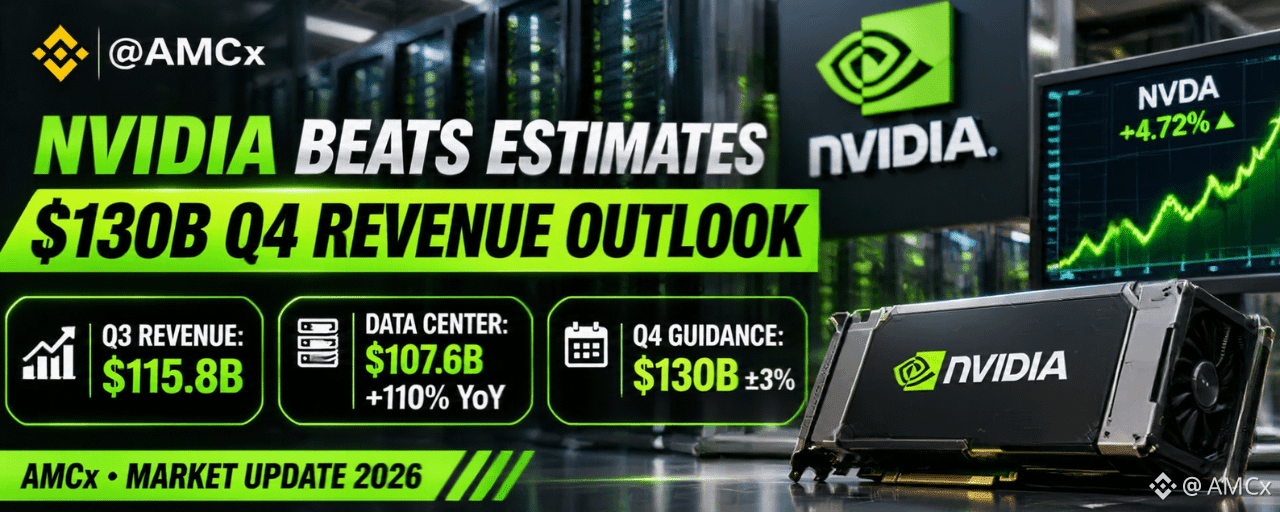
Article
See translation
NVIDIA Beats Estimates With $130B Q4 Outlook: Is the AI Boom Getting Even Bigger?1. Introduction: NVIDIA Delivers Another Major Surprise
NVIDIA has once again demonstrated the strength of the global artificial intelligence market.
The company reported stronger-than-expected third-quarter fiscal 2027 results and delivered an impressive forecast for its next quarter: approximately $130 billion in revenue.
This announcement has attracted significant attention from investors, technology companies, and financial markets.
NVIDIA is no longer simply a semiconductor manufacturer. It has become one of the most important infrastructure providers behind the global AI revolution.
But the bigger question is:
Can NVIDIA maintain this extraordinary growth as the demand for AI computing continues to expand?
2. NVIDIA Beats Expectations: The Latest Financial Results
On November 17, 2026, NVIDIA announced its financial results for the third quarter of fiscal 2027, which ended October 25, 2026.
The results were impressive:
Total revenue: $115.8 billion, up 103% year over year.Data Center revenue: $107.6 billion, up 110% year over year.Quarter-over-quarter revenue growth: 20%.GAAP diluted earnings per share: $2.70.Non-GAAP diluted earnings per share: $2.68.
NVIDIA's results exceeded Wall Street expectations, reinforcing the strength of demand for AI computing infrastructure.
The Data Center division remains the company's largest business segment, contributing approximately 93% of total quarterly revenue.
This demonstrates how deeply NVIDIA's financial performance is connected to the expansion of artificial intelligence.
3. The $130 Billion Q4 Outlook: Why Is It Important?
Perhaps the most important part of NVIDIA's announcement is its outlook for the fourth quarter of fiscal 2027.
The company expects revenue of approximately:
$130 billion, plus or minus 3%.
This represents a potential revenue range of approximately $126.1 billion to $133.9 billion.
The forecast is particularly significant because it is above analysts' average expectations before the announcement.
However, there are two important details investors should understand:
First, this is a company forecast, not revenue that has already been earned.
Second, the fourth quarter includes an additional week in NVIDIA's fiscal calendar. The company also stated that its outlook does not assume any Data Center compute revenue from China.
Even with these qualifications, the guidance indicates that NVIDIA expects demand to remain exceptionally strong.
4. AI Data Centers Remain the Main Growth Engine
The global expansion of AI infrastructure is one of the biggest reasons behind NVIDIA's performance.
Technology companies are investing heavily in computing facilities capable of training and operating increasingly advanced AI models.
These facilities require:
High-performance GPUs.Advanced networking systems.Large-scale server infrastructure.High-speed memory and storage.Sophisticated cooling and power systems.
NVIDIA benefits from this demand through its integrated computing platform.
Its business is no longer based only on selling individual graphics processors. It is increasingly supplying complete systems designed for large-scale AI workloads.
As more companies deploy AI applications, demand for both AI training and inference computing could continue to create opportunities for NVIDIA.
5. Vera Rubin: The Next Generation of AI Infrastructure
Another important development is the progress of NVIDIA's Vera Rubin platform.
NVIDIA confirmed that production has ramped up and Vera Rubin NVL72 systems have begun shipping.
The company has also expanded its cloud ecosystem through partnerships involving major infrastructure providers, including:
Google Cloud.Microsoft Azure.Oracle Cloud Infrastructure.CoreWeave.Nebius.
Vera Rubin is designed to support the next generation of demanding AI workloads.
Its development is important because NVIDIA needs to maintain its technological advantage while customers continue upgrading their computing infrastructure.
The transition from Blackwell to Vera Rubin could become another important chapter in NVIDIA's growth strategy.
6. What Could Drive NVIDIA's Growth in 2027?
Several factors could influence NVIDIA's performance over the coming year.
1. Expanding AI Adoption
Businesses are increasingly exploring AI agents, automation, enterprise AI systems, and advanced computing applications.
More widespread adoption could create additional demand for computing infrastructure.
2. Data Center Investment
Major cloud providers and technology companies may continue expanding their AI data centers to support growing workloads.
3. Vera Rubin Deployment
The successful delivery and adoption of Vera Rubin systems could support NVIDIA's next product cycle.
4. AI Inference Demand
As AI models become more widely used, inference could become an increasingly important source of computing demand.
5. Integrated AI Infrastructure
NVIDIA's combination of GPUs, networking, software, and complete computing systems could help strengthen its competitive position.
These factors provide potential growth opportunities, but they do not guarantee that the company will maintain its current growth rate.
7. Risks Investors Should Not Ignore
Despite its impressive results, NVIDIA still faces important challenges.
Competition: AMD, custom AI chips developed by major cloud companies, and other semiconductor providers are competing for market share.
Supply Chain Constraints: Advanced manufacturing, packaging capacity, and component availability could limit product deliveries.
Capital Expenditure: AI infrastructure requires enormous investment. Customers must eventually generate sufficient returns from their AI spending.
Profit Margins: NVIDIA expects fourth-quarter gross margins of approximately 71% to 72%, below its third-quarter reported margins. Investors will want to monitor whether higher infrastructure costs or product mix affect profitability.
Leadership Uncertainty: NVIDIA is also navigating a leadership transition, adding another factor investors must consider alongside its business performance.
Market Expectations: Even strong financial results may not guarantee continued stock-price gains if expectations become too high.
8. Final Thoughts: Is NVIDIA's Growth Story Still Strong?
NVIDIA's latest financial results show that the AI infrastructure market remains a powerful source of demand.
Revenue of $115.8 billion, Data Center growth of 110%, and a fourth-quarter outlook of approximately $130 billion demonstrate the scale of the company's current business momentum.
The arrival of Vera Rubin adds another potential growth driver, while the expansion of AI applications could create additional opportunities throughout 2027.
However, maintaining such extraordinary growth will become increasingly challenging as NVIDIA's revenue base expands.
The next stage will depend on product execution, supply capacity, competition, customer investment, and the ability of businesses to turn AI spending into sustainable economic value.
NVIDIA has delivered another powerful quarter. The real test now is whether the AI infrastructure boom can continue to grow at this scale.
This article is for educational and informational purposes only. It is not financial advice. Always conduct your own research before making investment decisions.
AMCx — Researching the Future of Technology and Finance. $NVDAB #AMCx
#NvidiaBeatsEstimatesWith$130BQ4Outlook
{spot}(NVDABUSDT)
NVIDIA Beats Estimates With $130B Q4 Outlook: Is the AI Boom Getting Even Bigger?
1. Introduction: NVIDIA Delivers Another Major Surprise
NVIDIA has once again demonstrated the strength of the global artificial intelligence market.
The company reported stronger-than-expected third-quarter fiscal 2027 results and delivered an impressive forecast for its next quarter: approximately $130 billion in revenue.
This announcement has attracted significant attention from investors, technology companies, and financial markets.
NVIDIA is no longer simply a semiconductor manufacturer. It has become one of the most important infrastructure providers behind the global AI revolution.
But the bigger question is:
Can NVIDIA maintain this extraordinary growth as the demand for AI computing continues to expand?
2. NVIDIA Beats Expectations: The Latest Financial Results
On November 17, 2026, NVIDIA announced its financial results for the third quarter of fiscal 2027, which ended October 25, 2026.
The results were impressive:
Total revenue: $115.8 billion, up 103% year over year.Data Center revenue: $107.6 billion, up 110% year over year.Quarter-over-quarter revenue growth: 20%.GAAP diluted earnings per share: $2.70.Non-GAAP diluted earnings per share: $2.68.
NVIDIA's results exceeded Wall Street expectations, reinforcing the strength of demand for AI computing infrastructure.
The Data Center division remains the company's largest business segment, contributing approximately 93% of total quarterly revenue.
This demonstrates how deeply NVIDIA's financial performance is connected to the expansion of artificial intelligence.
3. The $130 Billion Q4 Outlook: Why Is It Important?
Perhaps the most important part of NVIDIA's announcement is its outlook for the fourth quarter of fiscal 2027.
The company expects revenue of approximately:
$130 billion, plus or minus 3%.
This represents a potential revenue range of approximately $126.1 billion to $133.9 billion.
The forecast is particularly significant because it is above analysts' average expectations before the announcement.
However, there are two important details investors should understand:
First, this is a company forecast, not revenue that has already been earned.
Second, the fourth quarter includes an additional week in NVIDIA's fiscal calendar. The company also stated that its outlook does not assume any Data Center compute revenue from China.
Even with these qualifications, the guidance indicates that NVIDIA expects demand to remain exceptionally strong.
4. AI Data Centers Remain the Main Growth Engine
The global expansion of AI infrastructure is one of the biggest reasons behind NVIDIA's performance.
Technology companies are investing heavily in computing facilities capable of training and operating increasingly advanced AI models.
These facilities require:
High-performance GPUs.Advanced networking systems.Large-scale server infrastructure.High-speed memory and storage.Sophisticated cooling and power systems.
NVIDIA benefits from this demand through its integrated computing platform.
Its business is no longer based only on selling individual graphics processors. It is increasingly supplying complete systems designed for large-scale AI workloads.
As more companies deploy AI applications, demand for both AI training and inference computing could continue to create opportunities for NVIDIA.
5. Vera Rubin: The Next Generation of AI Infrastructure
Another important development is the progress of NVIDIA's Vera Rubin platform.
NVIDIA confirmed that production has ramped up and Vera Rubin NVL72 systems have begun shipping.
The company has also expanded its cloud ecosystem through partnerships involving major infrastructure providers, including:
Google Cloud.Microsoft Azure.Oracle Cloud Infrastructure.CoreWeave.Nebius.
Vera Rubin is designed to support the next generation of demanding AI workloads.
Its development is important because NVIDIA needs to maintain its technological advantage while customers continue upgrading their computing infrastructure.
The transition from Blackwell to Vera Rubin could become another important chapter in NVIDIA's growth strategy.
6. What Could Drive NVIDIA's Growth in 2027?
Several factors could influence NVIDIA's performance over the coming year.
1. Expanding AI Adoption
Businesses are increasingly exploring AI agents, automation, enterprise AI systems, and advanced computing applications.
More widespread adoption could create additional demand for computing infrastructure.
2. Data Center Investment
Major cloud providers and technology companies may continue expanding their AI data centers to support growing workloads.
3. Vera Rubin Deployment
The successful delivery and adoption of Vera Rubin systems could support NVIDIA's next product cycle.
4. AI Inference Demand
As AI models become more widely used, inference could become an increasingly important source of computing demand.
5. Integrated AI Infrastructure
NVIDIA's combination of GPUs, networking, software, and complete computing systems could help strengthen its competitive position.
These factors provide potential growth opportunities, but they do not guarantee that the company will maintain its current growth rate.
7. Risks Investors Should Not Ignore
Despite its impressive results, NVIDIA still faces important challenges.
Competition: AMD, custom AI chips developed by major cloud companies, and other semiconductor providers are competing for market share.
Supply Chain Constraints: Advanced manufacturing, packaging capacity, and component availability could limit product deliveries.
Capital Expenditure: AI infrastructure requires enormous investment. Customers must eventually generate sufficient returns from their AI spending.
Profit Margins: NVIDIA expects fourth-quarter gross margins of approximately 71% to 72%, below its third-quarter reported margins. Investors will want to monitor whether higher infrastructure costs or product mix affect profitability.
Leadership Uncertainty: NVIDIA is also navigating a leadership transition, adding another factor investors must consider alongside its business performance.
Market Expectations: Even strong financial results may not guarantee continued stock-price gains if expectations become too high.
8. Final Thoughts: Is NVIDIA's Growth Story Still Strong?
NVIDIA's latest financial results show that the AI infrastructure market remains a powerful source of demand.
Revenue of $115.8 billion, Data Center growth of 110%, and a fourth-quarter outlook of approximately $130 billion demonstrate the scale of the company's current business momentum.
The arrival of Vera Rubin adds another potential growth driver, while the expansion of AI applications could create additional opportunities throughout 2027.
However, maintaining such extraordinary growth will become increasingly challenging as NVIDIA's revenue base expands.
The next stage will depend on product execution, supply capacity, competition, customer investment, and the ability of businesses to turn AI spending into sustainable economic value.
NVIDIA has delivered another powerful quarter. The real test now is whether the AI infrastructure boom can continue to grow at this scale.
This article is for educational and informational purposes only. It is not financial advice. Always conduct your own research before making investment decisions.
AMCx — Researching the Future of Technology and Finance. $NVDAB #AMCx
#NvidiaBeatsEstimatesWith$130BQ4Outlook
3
52
·
--
Verified
Article
See translation
Tether (USDT): The Digital Dollar Powering the Global Crypto Economy — What's Next in 2027?Tether (USDT) remains the largest stablecoin in the cryptocurrency market, playing a critical role in connecting traditional finance with the digital asset economy.
Unlike Bitcoin and Ethereum, USDT is designed to maintain a value close to one US dollar. This makes it an important tool for traders, investors, businesses, and individuals who need access to dollar-denominated digital assets.
But Tether is no longer focused exclusively on issuing stablecoins. Its expanding investments and financial infrastructure initiatives suggest a much broader ambition for the future.
So, what is happening with Tether in 2026, and what could come next?
1. Understanding Tether (USDT)
USDT is a stablecoin issued by Tether. Its primary objective is to maintain a 1:1 value relationship with the US dollar.
This means that one USDT is designed to represent approximately one US dollar.
USDT is widely used for:
Cryptocurrency trading and liquidity.Cross-border payments.Digital dollar transfers.Decentralized Finance (DeFi).Protecting trading capital from crypto market volatility.
USDT operates across multiple blockchain networks, helping users transfer digital dollars without relying exclusively on traditional banking infrastructure.
2. Tether's Latest Financial Developments in 2026
One of the biggest developments this year has been Tether's financial performance and reserve position.
According to Tether's third-quarter 2026 report, prepared by BDO:
Total reserve assets reached approximately $191.5 billion.Total liabilities were approximately $183.5 billion.Excess reserves reached approximately $7.95 billion.Net operating profit for Q3 reached approximately $1.5 billion.Direct and indirect US Treasury bill exposure reached approximately $132.4 billion.
Tether also reported approximately $4.5 billion in net operating profit during the first nine months of 2026.
These figures highlight the scale of Tether's financial operations and the importance of its reserve management strategy.
However, quarterly reserve attestations should not be confused with a full independent financial statement audit.
3. Tether Is Expanding Beyond Stablecoins
One of the most interesting developments is Tether's growing investment strategy.
On November 16, 2026, Tether Capital announced a $15 million strategic investment in Nomad, a Brazilian financial technology company.
The investment aims to expand access to US dollar-based financial services, international payments, and global investment opportunities in Brazil.
This is significant because Latin America represents an important market for digital dollar adoption.
Tether is positioning itself to participate in the broader financial infrastructure connecting emerging markets with the global economy.
4. Hadron by Tether: Expanding Real-World Asset Tokenization
Another important initiative is Hadron by Tether.
Hadron is designed to support the tokenization of real-world assets, allowing traditional financial assets to be represented and managed through blockchain technology.
On November 5, 2026, Hadron announced a collaboration with RedStone to expand pricing, settlement, and liquidity infrastructure for tokenized assets.
This development could help improve the infrastructure needed for financial institutions and businesses exploring tokenized assets.
Potential applications include:
Tokenized financial instruments.Digital representations of real-world assets.Improved settlement infrastructure.On-chain asset management.Greater access to blockchain-based financial markets.
This demonstrates that Tether's long-term ambitions extend beyond USDT.
5. Tether's Future Plans and Strategic Direction
Looking toward 2027 and beyond, several areas could become increasingly important to Tether's development.
A. Expanding Global USDT Adoption
Tether continues to explore opportunities in emerging markets, especially where access to traditional banking and stable currencies can be limited.
B. Strengthening Payment Infrastructure
Digital dollar payments and cross-border transfers remain important opportunities for stablecoin adoption.
C. Expanding Real-World Asset Tokenization
Through Hadron and strategic partnerships, Tether is exploring ways to connect traditional financial assets with blockchain infrastructure.
D. Investing in Artificial Intelligence
Tether is also developing its AI initiatives under QVAC. Its November 2026 releases demonstrate growing interest in open-weight AI models and private, on-device computing.
E. Strengthening Financial Transparency
Reserve reporting, liquidity management, and financial assurance remain critical to maintaining confidence in USDT.
These initiatives are part of Tether's broader strategic direction rather than a single fixed roadmap.
6. Challenges Tether Must Overcome
Despite its dominant position, Tether faces several important challenges.
Regulatory Pressure
Stablecoin regulations are evolving across major financial markets. Tether must continue adapting to different legal and compliance requirements.
Reserve Transparency
Investors and users continue to pay close attention to the quality, liquidity, and independent verification of Tether's reserves.
Centralization Risks
Unlike decentralized cryptocurrencies, USDT is issued and managed by a centralized company. Tether also has the ability to freeze certain tokens under applicable controls.
Competition
Stablecoins such as USDC and emerging digital dollar projects are competing for institutional adoption, payments, and market share.
Tether's ability to address these challenges will be essential to its long-term credibility.
7. Can USDT Become More Important in the Global Financial System?
The global financial system is gradually exploring blockchain-based settlement and digital currencies.
Stablecoins could play an increasingly important role in making international payments faster, improving liquidity, and providing access to dollar-denominated digital assets.
Tether already has a significant position in this market.
If adoption continues to expand, USDT could become an increasingly important component of the global digital financial infrastructure.
However, this does not mean that USDT is designed to appreciate like Bitcoin or Ethereum.
Its main purpose is price stability, not capital growth.
Final Thoughts: Tether Is Building More Than a Stablecoin
Tether started by creating a digital asset designed to represent the US dollar.
Today, its activities extend into payments, financial services, asset tokenization, artificial intelligence, and broader digital infrastructure.
Its expansion into new markets and strategic partnerships suggests that Tether wants to become more than just the company behind the world's largest stablecoin.
The next chapter of Tether will depend on trust, transparency, regulatory developments, and its ability to expand real-world adoption.
USDT — Connecting Traditional Finance with the Digital Future.
AMCx | Exploring the Future of Crypto.
#Tether #USDT #Stablecoin #Crypto #Blockchain #Web3 #DigitalDollar #BinanceSquare #AMCx $USDT
Tether (USDT): The Digital Dollar Powering the Global Crypto Economy — What's Next in 2027?
Tether (USDT) remains the largest stablecoin in the cryptocurrency market, playing a critical role in connecting traditional finance with the digital asset economy.
Unlike Bitcoin and Ethereum, USDT is designed to maintain a value close to one US dollar. This makes it an important tool for traders, investors, businesses, and individuals who need access to dollar-denominated digital assets.
But Tether is no longer focused exclusively on issuing stablecoins. Its expanding investments and financial infrastructure initiatives suggest a much broader ambition for the future.
So, what is happening with Tether in 2026, and what could come next?
1. Understanding Tether (USDT)
USDT is a stablecoin issued by Tether. Its primary objective is to maintain a 1:1 value relationship with the US dollar.
This means that one USDT is designed to represent approximately one US dollar.
USDT is widely used for:
Cryptocurrency trading and liquidity.Cross-border payments.Digital dollar transfers.Decentralized Finance (DeFi).Protecting trading capital from crypto market volatility.
USDT operates across multiple blockchain networks, helping users transfer digital dollars without relying exclusively on traditional banking infrastructure.
2. Tether's Latest Financial Developments in 2026
One of the biggest developments this year has been Tether's financial performance and reserve position.
According to Tether's third-quarter 2026 report, prepared by BDO:
Total reserve assets reached approximately $191.5 billion.Total liabilities were approximately $183.5 billion.Excess reserves reached approximately $7.95 billion.Net operating profit for Q3 reached approximately $1.5 billion.Direct and indirect US Treasury bill exposure reached approximately $132.4 billion.
Tether also reported approximately $4.5 billion in net operating profit during the first nine months of 2026.
These figures highlight the scale of Tether's financial operations and the importance of its reserve management strategy.
However, quarterly reserve attestations should not be confused with a full independent financial statement audit.
3. Tether Is Expanding Beyond Stablecoins
One of the most interesting developments is Tether's growing investment strategy.
On November 16, 2026, Tether Capital announced a $15 million strategic investment in Nomad, a Brazilian financial technology company.
The investment aims to expand access to US dollar-based financial services, international payments, and global investment opportunities in Brazil.
This is significant because Latin America represents an important market for digital dollar adoption.
Tether is positioning itself to participate in the broader financial infrastructure connecting emerging markets with the global economy.
4. Hadron by Tether: Expanding Real-World Asset Tokenization
Another important initiative is Hadron by Tether.
Hadron is designed to support the tokenization of real-world assets, allowing traditional financial assets to be represented and managed through blockchain technology.
On November 5, 2026, Hadron announced a collaboration with RedStone to expand pricing, settlement, and liquidity infrastructure for tokenized assets.
This development could help improve the infrastructure needed for financial institutions and businesses exploring tokenized assets.
Potential applications include:
Tokenized financial instruments.Digital representations of real-world assets.Improved settlement infrastructure.On-chain asset management.Greater access to blockchain-based financial markets.
This demonstrates that Tether's long-term ambitions extend beyond USDT.
5. Tether's Future Plans and Strategic Direction
Looking toward 2027 and beyond, several areas could become increasingly important to Tether's development.
A. Expanding Global USDT Adoption
Tether continues to explore opportunities in emerging markets, especially where access to traditional banking and stable currencies can be limited.
B. Strengthening Payment Infrastructure
Digital dollar payments and cross-border transfers remain important opportunities for stablecoin adoption.
C. Expanding Real-World Asset Tokenization
Through Hadron and strategic partnerships, Tether is exploring ways to connect traditional financial assets with blockchain infrastructure.
D. Investing in Artificial Intelligence
Tether is also developing its AI initiatives under QVAC. Its November 2026 releases demonstrate growing interest in open-weight AI models and private, on-device computing.
E. Strengthening Financial Transparency
Reserve reporting, liquidity management, and financial assurance remain critical to maintaining confidence in USDT.
These initiatives are part of Tether's broader strategic direction rather than a single fixed roadmap.
6. Challenges Tether Must Overcome
Despite its dominant position, Tether faces several important challenges.
Regulatory Pressure
Stablecoin regulations are evolving across major financial markets. Tether must continue adapting to different legal and compliance requirements.
Reserve Transparency
Investors and users continue to pay close attention to the quality, liquidity, and independent verification of Tether's reserves.
Centralization Risks
Unlike decentralized cryptocurrencies, USDT is issued and managed by a centralized company. Tether also has the ability to freeze certain tokens under applicable controls.
Competition
Stablecoins such as USDC and emerging digital dollar projects are competing for institutional adoption, payments, and market share.
Tether's ability to address these challenges will be essential to its long-term credibility.
7. Can USDT Become More Important in the Global Financial System?
The global financial system is gradually exploring blockchain-based settlement and digital currencies.
Stablecoins could play an increasingly important role in making international payments faster, improving liquidity, and providing access to dollar-denominated digital assets.
Tether already has a significant position in this market.
If adoption continues to expand, USDT could become an increasingly important component of the global digital financial infrastructure.
However, this does not mean that USDT is designed to appreciate like Bitcoin or Ethereum.
Its main purpose is price stability, not capital growth.
Final Thoughts: Tether Is Building More Than a Stablecoin
Tether started by creating a digital asset designed to represent the US dollar.
Today, its activities extend into payments, financial services, asset tokenization, artificial intelligence, and broader digital infrastructure.
Its expansion into new markets and strategic partnerships suggests that Tether wants to become more than just the company behind the world's largest stablecoin.
The next chapter of Tether will depend on trust, transparency, regulatory developments, and its ability to expand real-world adoption.
USDT — Connecting Traditional Finance with the Digital Future.
AMCx | Exploring the Future of Crypto.
#Tether #USDT #Stablecoin #Crypto #Blockchain #Web3 #DigitalDollar #BinanceSquare #AMCx $USDT
1
66
·
--
Verified
Article
See translation
Ethereum (ETH): The Next Evolution of Web3 — What's Coming in 2027?Ethereum remains one of the most important blockchain ecosystems in the cryptocurrency industry. As the second-largest cryptocurrency by market capitalization, Ethereum continues to play a major role in decentralized finance (DeFi), NFTs, smart contracts, and Web3 infrastructure.
But Ethereum is not standing still. Its developers are working on major network improvements designed to make the blockchain faster, more scalable, secure, and efficient.
So, what is happening with Ethereum, and what can the community expect next?
1. Understanding Ethereum's Position
Ethereum was launched in 2015 by Vitalik Buterin and a team of co-founders.
Unlike Bitcoin, which primarily focuses on decentralized digital money, Ethereum was designed as a programmable blockchain that allows developers to create decentralized applications (dApps) using smart contracts.
Today, Ethereum supports a massive ecosystem that includes:
Decentralized Finance (DeFi).Non-Fungible Tokens (NFTs).Decentralized Applications (dApps).Stablecoins and tokenized assets.Layer 2 scaling networks.Web3 gaming and digital identity.
ETH is the native cryptocurrency used to pay transaction fees, participate in staking, and support the Ethereum ecosystem.
2. Ethereum's Latest Developments in 2026
Ethereum continues to focus on improving its underlying infrastructure.
Following the Pectra and Fusaka upgrades, the network has been working toward its next major upgrade: Glamsterdam.
Glamsterdam is designed to improve Ethereum's Layer 1 scalability and transaction processing.
Two important technologies are central to this upgrade:
A. Enshrined Proposer-Builder Separation (ePBS)
This aims to improve how blocks are constructed and selected, reducing certain trust dependencies in block production.
B. Block-Level Access Lists (BALs)
These are designed to help Ethereum process transactions more efficiently by identifying which parts of the blockchain state a block needs to access.
Together, these improvements aim to support parallel execution and greater network capacity.
However, Glamsterdam is still undergoing testing. In November 2026, developers were addressing compatibility issues discovered during testing, and the Hoodi testnet rollout had been postponed.
3. Ethereum's Next Major Upgrade: Hegotá
After Glamsterdam, Ethereum developers are preparing for another important upgrade called Hegotá, currently planned for 2027.
One of its major proposed features is Fork-Choice Enforced Inclusion Lists (FOCIL).
FOCIL aims to strengthen censorship resistance by helping ensure that valid transactions are included in blocks, even when individual block builders would prefer to exclude them.
Another area under consideration is native account abstraction, which could make Ethereum wallets more flexible and user-friendly.
These improvements could help Ethereum become a stronger foundation for the next generation of decentralized applications.
4. Ethereum's Long-Term Vision: Quantum Resistance
One of the most interesting areas of Ethereum's long-term development is preparation for quantum computing.
The Ethereum Foundation has identified post-quantum security as an important strategic priority.
Its protocol team is targeting quantum resistance across Ethereum's execution, consensus, and data layers by December 2029.
This is an ambitious development objective, not a completed upgrade.
The goal is to ensure Ethereum remains secure as computing technology continues to advance.
5. Layer 2: The Key to Ethereum's Expansion
Ethereum's future is not limited to its main network.
Layer 2 ecosystems are becoming increasingly important because they can process transactions more efficiently while using Ethereum as their security and settlement foundation.
Networks such as Arbitrum, Optimism, Base, and zkSync are part of this expanding ecosystem.
By improving Layer 2 scalability and interoperability, Ethereum aims to support millions of users and a much broader range of applications.
6. What Could Drive Ethereum's Growth?
Several factors could influence Ethereum's long-term adoption:
Greater institutional participation.Growth in decentralized finance.Expansion of tokenized real-world assets.Increased Layer 2 adoption.Improvements in transaction efficiency.More developer activity and decentralized applications.Stronger security and network decentralization.
However, these developments do not guarantee ETH price appreciation. Market demand, competition, regulation, and broader economic conditions remain important factors.
7. Challenges Ethereum Still Faces
Despite its strong ecosystem, Ethereum must continue addressing several challenges:
Network Competition: Other blockchain networks continue competing for developers, users, and liquidity.
Transaction Costs: Ethereum Layer 1 fees can still become expensive during periods of high demand.
Ecosystem Fragmentation: The growth of multiple Layer 2 networks creates challenges for interoperability and user experience.
Security: Smart contract vulnerabilities and ecosystem risks remain important concerns.
Ethereum's ability to address these challenges will play an important role in its future development.
Final Thoughts: Is Ethereum Ready for Its Next Chapter?
Ethereum is evolving from a smart contract platform into an increasingly sophisticated blockchain infrastructure for the global digital economy.
With Glamsterdam under development, Hegotá on the horizon, and long-term research into quantum-resistant security, Ethereum has several important milestones ahead.
Its future will depend not only on ETH's market performance but also on the strength of its technology, developers, applications, and global adoption.
The next chapter of Ethereum could be one of the most important periods in its evolution.
ETH — Powering the Decentralized Future.
AMCx | Exploring the Future of Crypto.
#Ethereum #ETH #Web3 #Blockchain #DeFi #Crypto #BinanceSquare #AMCx $ETH
{spot}(ETHUSDT)
Ethereum (ETH): The Next Evolution of Web3 — What's Coming in 2027?
Ethereum remains one of the most important blockchain ecosystems in the cryptocurrency industry. As the second-largest cryptocurrency by market capitalization, Ethereum continues to play a major role in decentralized finance (DeFi), NFTs, smart contracts, and Web3 infrastructure.
But Ethereum is not standing still. Its developers are working on major network improvements designed to make the blockchain faster, more scalable, secure, and efficient.
So, what is happening with Ethereum, and what can the community expect next?
1. Understanding Ethereum's Position
Ethereum was launched in 2015 by Vitalik Buterin and a team of co-founders.
Unlike Bitcoin, which primarily focuses on decentralized digital money, Ethereum was designed as a programmable blockchain that allows developers to create decentralized applications (dApps) using smart contracts.
Today, Ethereum supports a massive ecosystem that includes:
Decentralized Finance (DeFi).Non-Fungible Tokens (NFTs).Decentralized Applications (dApps).Stablecoins and tokenized assets.Layer 2 scaling networks.Web3 gaming and digital identity.
ETH is the native cryptocurrency used to pay transaction fees, participate in staking, and support the Ethereum ecosystem.
2. Ethereum's Latest Developments in 2026
Ethereum continues to focus on improving its underlying infrastructure.
Following the Pectra and Fusaka upgrades, the network has been working toward its next major upgrade: Glamsterdam.
Glamsterdam is designed to improve Ethereum's Layer 1 scalability and transaction processing.
Two important technologies are central to this upgrade:
A. Enshrined Proposer-Builder Separation (ePBS)
This aims to improve how blocks are constructed and selected, reducing certain trust dependencies in block production.
B. Block-Level Access Lists (BALs)
These are designed to help Ethereum process transactions more efficiently by identifying which parts of the blockchain state a block needs to access.
Together, these improvements aim to support parallel execution and greater network capacity.
However, Glamsterdam is still undergoing testing. In November 2026, developers were addressing compatibility issues discovered during testing, and the Hoodi testnet rollout had been postponed.
3. Ethereum's Next Major Upgrade: Hegotá
After Glamsterdam, Ethereum developers are preparing for another important upgrade called Hegotá, currently planned for 2027.
One of its major proposed features is Fork-Choice Enforced Inclusion Lists (FOCIL).
FOCIL aims to strengthen censorship resistance by helping ensure that valid transactions are included in blocks, even when individual block builders would prefer to exclude them.
Another area under consideration is native account abstraction, which could make Ethereum wallets more flexible and user-friendly.
These improvements could help Ethereum become a stronger foundation for the next generation of decentralized applications.
4. Ethereum's Long-Term Vision: Quantum Resistance
One of the most interesting areas of Ethereum's long-term development is preparation for quantum computing.
The Ethereum Foundation has identified post-quantum security as an important strategic priority.
Its protocol team is targeting quantum resistance across Ethereum's execution, consensus, and data layers by December 2029.
This is an ambitious development objective, not a completed upgrade.
The goal is to ensure Ethereum remains secure as computing technology continues to advance.
5. Layer 2: The Key to Ethereum's Expansion
Ethereum's future is not limited to its main network.
Layer 2 ecosystems are becoming increasingly important because they can process transactions more efficiently while using Ethereum as their security and settlement foundation.
Networks such as Arbitrum, Optimism, Base, and zkSync are part of this expanding ecosystem.
By improving Layer 2 scalability and interoperability, Ethereum aims to support millions of users and a much broader range of applications.
6. What Could Drive Ethereum's Growth?
Several factors could influence Ethereum's long-term adoption:
Greater institutional participation.Growth in decentralized finance.Expansion of tokenized real-world assets.Increased Layer 2 adoption.Improvements in transaction efficiency.More developer activity and decentralized applications.Stronger security and network decentralization.
However, these developments do not guarantee ETH price appreciation. Market demand, competition, regulation, and broader economic conditions remain important factors.
7. Challenges Ethereum Still Faces
Despite its strong ecosystem, Ethereum must continue addressing several challenges:
Network Competition: Other blockchain networks continue competing for developers, users, and liquidity.
Transaction Costs: Ethereum Layer 1 fees can still become expensive during periods of high demand.
Ecosystem Fragmentation: The growth of multiple Layer 2 networks creates challenges for interoperability and user experience.
Security: Smart contract vulnerabilities and ecosystem risks remain important concerns.
Ethereum's ability to address these challenges will play an important role in its future development.
Final Thoughts: Is Ethereum Ready for Its Next Chapter?
Ethereum is evolving from a smart contract platform into an increasingly sophisticated blockchain infrastructure for the global digital economy.
With Glamsterdam under development, Hegotá on the horizon, and long-term research into quantum-resistant security, Ethereum has several important milestones ahead.
Its future will depend not only on ETH's market performance but also on the strength of its technology, developers, applications, and global adoption.
The next chapter of Ethereum could be one of the most important periods in its evolution.
ETH — Powering the Decentralized Future.
AMCx | Exploring the Future of Crypto.
#Ethereum #ETH #Web3 #Blockchain #DeFi #Crypto #BinanceSquare #AMCx $ETH
2
76
·
--
Verified
Article
See translation
BITCOIN (BTC): The Future of Digital Money and What Comes Next?Bitcoin (BTC) continues to hold its position as the world's leading cryptocurrency by market capitalization. Since its creation, Bitcoin has transformed the financial landscape by introducing a decentralized monetary system that operates without relying on traditional banks or central authorities.
But as the cryptocurrency industry continues to evolve, an important question remains: What comes next for Bitcoin?
1. Understanding Bitcoin's Position
Bitcoin was introduced in 2009 by the pseudonymous creator Satoshi Nakamoto. Its primary purpose was to create a peer-to-peer electronic cash system that allows people to transfer value directly without intermediaries.
One of Bitcoin's strongest characteristics is its limited supply of 21 million coins. This predictable monetary policy makes BTC fundamentally different from traditional currencies, which can be issued by central banks.
Bitcoin is increasingly viewed as a digital store of value and an alternative asset for investors seeking exposure to decentralized finance.
2. Bitcoin's Latest Developments in 2026
Bitcoin's ecosystem continues to develop, particularly in infrastructure, network security, institutional participation, and transaction efficiency.
One important development is the release of Bitcoin Core 32.1 in October 2026.
The update includes improvements to network communication, transaction handling, fee estimation, wallet functionality, and node performance.
These improvements demonstrate that Bitcoin development continues even when market conditions become challenging.
Meanwhile, institutional participation remains an important part of Bitcoin's long-term story. However, recent market conditions have shown that institutional demand and ETF flows can fluctuate significantly.
3. What Is Bitcoin Planning for the Future?
Unlike many cryptocurrency projects, Bitcoin does not have a centralized company or management team that controls a fixed development roadmap.
Its future development depends on independent developers, miners, node operators, researchers, and community consensus.
Several important areas are attracting attention:
A. Network Security
Security remains one of Bitcoin's highest priorities. Researchers are exploring post-quantum cryptography to prepare for potential future threats from increasingly powerful computers.
B. Scalability and Faster Payments
The Lightning Network continues to represent an important direction for making Bitcoin transactions faster and more practical for everyday payments.
C. More Advanced Bitcoin Applications
Developers are discussing proposals such as OP_CAT and OP_CHECKTEMPLATEVERIFY (CTV), which could expand Bitcoin's scripting capabilities.
These proposals are still subject to technical review and community discussion. They should not be considered confirmed network upgrades.
D. Continuous Infrastructure Improvements
Bitcoin Core development continues to focus on node performance, privacy, transaction efficiency, and network reliability.
4. Bitcoin Halving: Looking Toward 2028
Another major event investors are watching is the next Bitcoin halving, currently estimated for 2028.
During a halving, the mining reward is reduced by 50%.
Following the 2024 halving, miners receive 3.125 BTC for each successfully mined block. After the next halving, this reward is expected to decrease to 1.5625 BTC.
This mechanism gradually reduces the issuance of new Bitcoin and reinforces its fixed-supply monetary policy.
Historically, halvings have attracted significant market attention, although they do not guarantee future price increases.
5. Challenges Bitcoin Must Overcome
Despite its strong position, Bitcoin still faces several challenges.
Market volatility and changing investor sentiment.Regulatory uncertainty across different countries.Competition from other blockchain ecosystems.Long-term mining profitability and network security.Future technological challenges, including quantum computing.
How the Bitcoin ecosystem addresses these challenges will be important for its long-term sustainability.
6. Bitcoin's Long-Term Outlook
Bitcoin's long-term potential is closely connected to its adoption, network security, monetary characteristics, and role in the global financial system.
Its limited supply, decentralized architecture, and established network provide a strong foundation.
However, short-term price movements remain unpredictable. Investors should consider market conditions, liquidity, macroeconomic developments, and their own risk tolerance.
Bitcoin's future is not simply about reaching a higher price. It is also about maintaining a reliable decentralized monetary network for the next generation.
Final Thoughts
Bitcoin started as an experiment in decentralized money and has grown into one of the most recognized digital assets in the world.
As we move toward 2027 and the next halving cycle in 2028, the development of its infrastructure, security, and global adoption will remain important factors to watch.
The journey of Bitcoin is far from over.
BTC — The Pioneer of Decentralized Money.
AMCx | Exploring the Future of Crypto.
#bitcoin #BTC #Crypto #Blockchain #Web3 #BinanceSquare #AMCx
BITCOIN (BTC): The Future of Digital Money and What Comes Next?
Bitcoin (BTC) continues to hold its position as the world's leading cryptocurrency by market capitalization. Since its creation, Bitcoin has transformed the financial landscape by introducing a decentralized monetary system that operates without relying on traditional banks or central authorities.
But as the cryptocurrency industry continues to evolve, an important question remains: What comes next for Bitcoin?
1. Understanding Bitcoin's Position
Bitcoin was introduced in 2009 by the pseudonymous creator Satoshi Nakamoto. Its primary purpose was to create a peer-to-peer electronic cash system that allows people to transfer value directly without intermediaries.
One of Bitcoin's strongest characteristics is its limited supply of 21 million coins. This predictable monetary policy makes BTC fundamentally different from traditional currencies, which can be issued by central banks.
Bitcoin is increasingly viewed as a digital store of value and an alternative asset for investors seeking exposure to decentralized finance.
2. Bitcoin's Latest Developments in 2026
Bitcoin's ecosystem continues to develop, particularly in infrastructure, network security, institutional participation, and transaction efficiency.
One important development is the release of Bitcoin Core 32.1 in October 2026.
The update includes improvements to network communication, transaction handling, fee estimation, wallet functionality, and node performance.
These improvements demonstrate that Bitcoin development continues even when market conditions become challenging.
Meanwhile, institutional participation remains an important part of Bitcoin's long-term story. However, recent market conditions have shown that institutional demand and ETF flows can fluctuate significantly.
3. What Is Bitcoin Planning for the Future?
Unlike many cryptocurrency projects, Bitcoin does not have a centralized company or management team that controls a fixed development roadmap.
Its future development depends on independent developers, miners, node operators, researchers, and community consensus.
Several important areas are attracting attention:
A. Network Security
Security remains one of Bitcoin's highest priorities. Researchers are exploring post-quantum cryptography to prepare for potential future threats from increasingly powerful computers.
B. Scalability and Faster Payments
The Lightning Network continues to represent an important direction for making Bitcoin transactions faster and more practical for everyday payments.
C. More Advanced Bitcoin Applications
Developers are discussing proposals such as OP_CAT and OP_CHECKTEMPLATEVERIFY (CTV), which could expand Bitcoin's scripting capabilities.
These proposals are still subject to technical review and community discussion. They should not be considered confirmed network upgrades.
D. Continuous Infrastructure Improvements
Bitcoin Core development continues to focus on node performance, privacy, transaction efficiency, and network reliability.
4. Bitcoin Halving: Looking Toward 2028
Another major event investors are watching is the next Bitcoin halving, currently estimated for 2028.
During a halving, the mining reward is reduced by 50%.
Following the 2024 halving, miners receive 3.125 BTC for each successfully mined block. After the next halving, this reward is expected to decrease to 1.5625 BTC.
This mechanism gradually reduces the issuance of new Bitcoin and reinforces its fixed-supply monetary policy.
Historically, halvings have attracted significant market attention, although they do not guarantee future price increases.
5. Challenges Bitcoin Must Overcome
Despite its strong position, Bitcoin still faces several challenges.
Market volatility and changing investor sentiment.Regulatory uncertainty across different countries.Competition from other blockchain ecosystems.Long-term mining profitability and network security.Future technological challenges, including quantum computing.
How the Bitcoin ecosystem addresses these challenges will be important for its long-term sustainability.
6. Bitcoin's Long-Term Outlook
Bitcoin's long-term potential is closely connected to its adoption, network security, monetary characteristics, and role in the global financial system.
Its limited supply, decentralized architecture, and established network provide a strong foundation.
However, short-term price movements remain unpredictable. Investors should consider market conditions, liquidity, macroeconomic developments, and their own risk tolerance.
Bitcoin's future is not simply about reaching a higher price. It is also about maintaining a reliable decentralized monetary network for the next generation.
Final Thoughts
Bitcoin started as an experiment in decentralized money and has grown into one of the most recognized digital assets in the world.
As we move toward 2027 and the next halving cycle in 2028, the development of its infrastructure, security, and global adoption will remain important factors to watch.
The journey of Bitcoin is far from over.
BTC — The Pioneer of Decentralized Money.
AMCx | Exploring the Future of Crypto.
#bitcoin #BTC #Crypto #Blockchain #Web3 #BinanceSquare #AMCx
2
42
·
--
Article
See translation
BITCOIN: FEAR OR OPPORTUNITY? Is the Market Preparing for Its Next Big Move?The cryptocurrency market is facing another important moment, and Bitcoin is once again at the center of attention.
As of November 17, 2026, Bitcoin's six-week losing streak has become one of the major discussions on Binance Square. Market sentiment is also showing Extreme Fear, with the Fear & Greed Index recently reported at 12.
But here's an important question:
Does extreme fear mean the market is finished, or could it create opportunities for the next recovery?
1. Bitcoin and the Power of Market Sentiment
Bitcoin has always experienced cycles of optimism, uncertainty, and fear.
When prices fall, many investors become nervous and begin selling their assets. However, experienced market participants understand that market sentiment alone should never determine an investment decision.
Fear can create opportunities, but it can also signal that more downside risk remains.
2. Three Things Worth Watching
Before making any decision, I believe investors should pay attention to three important factors:
1. Bitcoin Trading Volume
A recovery supported by stronger spot trading volume can provide more meaningful confirmation than a temporary price bounce.
2. Institutional Money Flows
ETF inflows and outflows can help investors understand whether institutional demand is strengthening or weakening.
3. Macroeconomic Conditions
Interest-rate expectations, inflation data, and Federal Reserve decisions can influence liquidity and investor appetite for risk assets.
3. Is This the Right Time to Buy Bitcoin?
There is no guaranteed answer.
Instead of chasing every market movement, investors should consider:
Managing risk and avoiding excessive leverage.
Watching important support and resistance levels.
Waiting for confirmation before entering a position.
Maintaining a long-term perspective while understanding short-term volatility.
Remember: A falling market does not automatically mean a buying opportunity.
4. My Perspective
I believe the most important skill in crypto investing is not predicting every price movement, but understanding the market and managing risk.
Bitcoin has experienced multiple market cycles throughout its history. Every cycle teaches investors something about patience, discipline, and market psychology.
The next major move will depend on actual demand, liquidity, market confidence, and broader economic conditions.
Fear creates uncertainty. Knowledge creates better decisions.
Final Question for the Community
What is your strategy during the current Bitcoin market situation?
Are you:
Accumulating BTC gradually?
Waiting for a stronger recovery signal?
Staying away until market sentiment improves?
Share your thoughts in the comments. Let's discuss the next possible chapter of Bitcoin together!
AMCx | Independent Crypto Market Perspective
#bitcoin #BTC #CryptoMarket #BinanceSquare uare #MarketAnalysis #CryptoTrading #FearAndGreed #AMCx #Write2Earn
Disclaimer: This article is for educational and informational purposes only. It is not financial advice. Always conduct your own research (DYOR) and manage your investment risks.
BITCOIN: FEAR OR OPPORTUNITY? Is the Market Preparing for Its Next Big Move?
The cryptocurrency market is facing another important moment, and Bitcoin is once again at the center of attention.
As of November 17, 2026, Bitcoin's six-week losing streak has become one of the major discussions on Binance Square. Market sentiment is also showing Extreme Fear, with the Fear & Greed Index recently reported at 12.
But here's an important question:
Does extreme fear mean the market is finished, or could it create opportunities for the next recovery?
1. Bitcoin and the Power of Market Sentiment
Bitcoin has always experienced cycles of optimism, uncertainty, and fear.
When prices fall, many investors become nervous and begin selling their assets. However, experienced market participants understand that market sentiment alone should never determine an investment decision.
Fear can create opportunities, but it can also signal that more downside risk remains.
2. Three Things Worth Watching
Before making any decision, I believe investors should pay attention to three important factors:
1. Bitcoin Trading Volume
A recovery supported by stronger spot trading volume can provide more meaningful confirmation than a temporary price bounce.
2. Institutional Money Flows
ETF inflows and outflows can help investors understand whether institutional demand is strengthening or weakening.
3. Macroeconomic Conditions
Interest-rate expectations, inflation data, and Federal Reserve decisions can influence liquidity and investor appetite for risk assets.
3. Is This the Right Time to Buy Bitcoin?
There is no guaranteed answer.
Instead of chasing every market movement, investors should consider:
Managing risk and avoiding excessive leverage.
Watching important support and resistance levels.
Waiting for confirmation before entering a position.
Maintaining a long-term perspective while understanding short-term volatility.
Remember: A falling market does not automatically mean a buying opportunity.
4. My Perspective
I believe the most important skill in crypto investing is not predicting every price movement, but understanding the market and managing risk.
Bitcoin has experienced multiple market cycles throughout its history. Every cycle teaches investors something about patience, discipline, and market psychology.
The next major move will depend on actual demand, liquidity, market confidence, and broader economic conditions.
Fear creates uncertainty. Knowledge creates better decisions.
Final Question for the Community
What is your strategy during the current Bitcoin market situation?
Are you:
Accumulating BTC gradually?
Waiting for a stronger recovery signal?
Staying away until market sentiment improves?
Share your thoughts in the comments. Let's discuss the next possible chapter of Bitcoin together!
AMCx | Independent Crypto Market Perspective
#bitcoin #BTC #CryptoMarket #BinanceSquare uare #MarketAnalysis #CryptoTrading #FearAndGreed #AMCx #Write2Earn
Disclaimer: This article is for educational and informational purposes only. It is not financial advice. Always conduct your own research (DYOR) and manage your investment risks.
3
26
·
--
Article
7 Low-Nominal-Price Coins in the Top 100The low price of a single coin can certainly catch your attention. But does a low price automatically mean a coin is cheap or undervalued? Not necessarily.
Here are seven assets with the lowest per-token prices that made the Top 100 by market capitalization, ranked from the lowest unit price. The CoinGecko data featured by Altcoin Buzz was updated on November 18, 2026, at 03:56 UTC. Prices and rankings can change at any time.
HTX DAO (HTX) — around $0.00000149 | rank #57 | market cap around $1.3 billion
7 Low-Nominal-Price Coins in the Top 100
The low price of a single coin can certainly catch your attention. But does a low price automatically mean a coin is cheap or undervalued? Not necessarily.
Here are seven assets with the lowest per-token prices that made the Top 100 by market capitalization, ranked from the lowest unit price. The CoinGecko data featured by Altcoin Buzz was updated on November 18, 2026, at 03:56 UTC. Prices and rankings can change at any time.
HTX DAO (HTX) — around $0.00000149 | rank #57 | market cap around $1.3 billion
1
203
·
--
Article
Apple Still on Top: Record Revenue and New Moves in Health AIApple (AAPL) still ranks first in the world by market capitalization, according to the latest data I checked. That position reflects Apple’s enormous value in the market, but it certainly doesn’t guarantee that its share price will keep rising. To understand the story, we need to look at the company’s business performance and the developments it’s working on.
Quarterly revenue hits a record
In fiscal fourth-quarter 2026, which ended on September 26, Apple reported revenue of about US$114.5 billion, up 12% from the same period the previous year. For fiscal year 2026 as a whole, revenue reached about US$478.8 billion, up from US$416.2 billion the previous year.
Apple Still on Top: Record Revenue and New Moves in Health AI
Apple (AAPL) still ranks first in the world by market capitalization, according to the latest data I checked. That position reflects Apple’s enormous value in the market, but it certainly doesn’t guarantee that its share price will keep rising. To understand the story, we need to look at the company’s business performance and the developments it’s working on.
Quarterly revenue hits a record
In fiscal fourth-quarter 2026, which ended on September 26, Apple reported revenue of about US$114.5 billion, up 12% from the same period the previous year. For fiscal year 2026 as a whole, revenue reached about US$478.8 billion, up from US$416.2 billion the previous year.
1
5
·
--
Article
Russia Expands Crypto Infrastructure as Alfa-Bank Joins Central Bank ListThe Central Bank of Russia has added Alfa-Bank to its list of organizations authorized to conduct digital currency exchange activities. The move marks the growing involvement of traditional banks in Russia’s crypto market, which is now moving toward more formal oversight.
As a registered operator, Alfa-Bank can buy and sell digital assets in accordance with the applicable regulatory framework. However, a bank’s inclusion on the regulator’s list does not automatically mean that crypto services are available to all customers. The launch of services, asset selection, and access requirements remain subject to each provider’s policies and readiness.
Russia Expands Crypto Infrastructure as Alfa-Bank Joins Central Bank List
The Central Bank of Russia has added Alfa-Bank to its list of organizations authorized to conduct digital currency exchange activities. The move marks the growing involvement of traditional banks in Russia’s crypto market, which is now moving toward more formal oversight.
As a registered operator, Alfa-Bank can buy and sell digital assets in accordance with the applicable regulatory framework. However, a bank’s inclusion on the regulator’s list does not automatically mean that crypto services are available to all customers. The launch of services, asset selection, and access requirements remain subject to each provider’s policies and readiness.
As a registered operator, Alfa-Bank can buy and sell digital assets in accordance with the applicable regulatory framework. However, a bank’s inclusion on the regulator’s list does not automatically mean that crypto services are available to all customers. The launch of services, asset selection, and access requirements remain subject to each provider’s policies and readiness.
1
39
Log in to explore more content
Join global crypto users on Binance Square
⚡️ Get latest and useful information about crypto.
💬 Trusted by the world’s largest crypto exchange.
👍 Discover real insights from verified creators.
Email / Phone number
Trending Topics
1
#NvidiaBeatsEstimatesWith$130BQ4Outlook
46,750 views
265 Discussing
2
#AnthropicIPOPriceCouldExceed$80
49,331 views
230 Discussing
3
#RussiaCentralBankAddsAlfaBankToCryptoExchangeRegister
2,421 views
38 Discussing
4
#RussianCentralBankPlansToAllowFundsToHoldCryptoIn2027
1,570 views
26 Discussing
5
#VisaPlansStablecoinPrefundingForAPACCrossBorderPayments
2,788 views
31 Discussing
6
#CanNvidia’sDataCenterGrowthContinue?
128,629 views
1,345 Discussing
7
#CanadaAndUSLaunchOperationNiagaraAgainstApprovalPhishing
27,830 views
53 Discussing
8
#BankOfEnglandUnveilsClearingHousePathwayCoveringDLTFirms
3,881 views
64 Discussing
9
#DBSAndCirclePartnerToExpandAsianInstitutionsUSDCAccess
5,011 views
66 Discussing
10
#LedgerHardwareImplantReportsExtendToDubai
73,692 views
747 Discussing