
比特币少爷
3k Posts

比特币少爷
金融行业从业者,喜欢投资加密行业,生活不易,且行且珍惜。
Open Trade
Occasional Trader
6.1 Years
330 Following
537 Followers
1.3K+ Liked
Posts
Portfolio
All
Quotes
Videos
See translation
柏林市政府两周前遭受网络攻击后,黑客组织疑似以窃取的数据实施勒索。据《明镜》报道,攻击者疑为活跃多年的 Rhysida 黑客组织,要求支付 30 枚比特币(约合 200 万欧元),并威胁公开数据。涉及敏感信息可能包括违章处理记录和密码等。
柏林州政府迄今未确认数据泄露范围,也未回应勒索金额和攻击者身份,称“出于侦查策略原因”暂不表态。柏林市长 Kai Wegner 明确表示,柏林不会屈服于勒索。受影响的主要是交通和建设管理部门,事件发生后曾暂时与州政府网络隔离。
柏林州政府迄今未确认数据泄露范围,也未回应勒索金额和攻击者身份,称“出于侦查策略原因”暂不表态。柏林市长 Kai Wegner 明确表示,柏林不会屈服于勒索。受影响的主要是交通和建设管理部门,事件发生后曾暂时与州政府网络隔离。
See translation
Cosmos Labs 披露攻击者在 8 月 20 日至 8 月 25 日期间利用一个关键的 Cosmos EVM 漏洞在六个区块链上进行攻击,通过去中心化和中心化交易所将被盗代币兑换成约 572万 美元。该漏洞是一处整数下溢,可能将余额回绕为 2^256-1,最早在 4 月 25 日通过其漏洞赏金计划被报告。修复补丁于 5 月合并但未向运行方说明;修补后的版本于 8 月 19 日东部时间晚上 7:01 发布,已知的首次攻击开始于 8 月 20 日东部时间下午 3:06。
$MANTRA 损失最大,为 7.209亿 $MANTRA(约 360万 美元);该链在大部分被盗代币被转移到一家中心化交易所后暂停,随后在补丁 v8.4.0 发布后恢复。$TAC 损失近 30亿 代币(约 12亿 已售出,换得约 95万美元),KiiChain 损失约 1.48亿 $KII(已售出 6460万,换得约 160万 美元)。Cosmos Labs 表示 v0.6.2 之前和 v0.7.2 之前的发布版本存在漏洞,并在响应期间与 40 个网络进行了协调。
$MANTRA 损失最大,为 7.209亿 $MANTRA(约 360万 美元);该链在大部分被盗代币被转移到一家中心化交易所后暂停,随后在补丁 v8.4.0 发布后恢复。$TAC 损失近 30亿 代币(约 12亿 已售出,换得约 95万美元),KiiChain 损失约 1.48亿 $KII(已售出 6460万,换得约 160万 美元)。Cosmos Labs 表示 v0.6.2 之前和 v0.7.2 之前的发布版本存在漏洞,并在响应期间与 40 个网络进行了协调。
See translation
月 31 日,据 Lookonchain 监测,交易者 9VQbih 在持有 $SOL 约一年后选择全部卖出,共出售 31,862 枚 $SOL
,价值约 325 万美元,整体亏损约 220 万美元。
一年前,该交易者以约 182 美元均价买入 30,002 枚 $SOL ,总价值约 547 万美元,并进行质押,期间获得 1,860 枚 $SOL 质押奖励,当前价值约 19 万美元。由于 $SOL 价格下跌,其最终仍录得较大亏损。
,价值约 325 万美元,整体亏损约 220 万美元。
一年前,该交易者以约 182 美元均价买入 30,002 枚 $SOL ,总价值约 547 万美元,并进行质押,期间获得 1,860 枚 $SOL 质押奖励,当前价值约 19 万美元。由于 $SOL 价格下跌,其最终仍录得较大亏损。
See translation
More Labs 旗下借贷协议 More Markets 在 Flow EVM 上遭攻击。攻击者利用 $ANKR
绑定的 LST 和 E-mode 耗尽了 WFLOW 借贷资金池。其从借贷储备中转出约 1,550 万枚 WFLOW,涉及金额约 930 万美元。
绑定的 LST 和 E-mode 耗尽了 WFLOW 借贷资金池。其从借贷储备中转出约 1,550 万枚 WFLOW,涉及金额约 930 万美元。
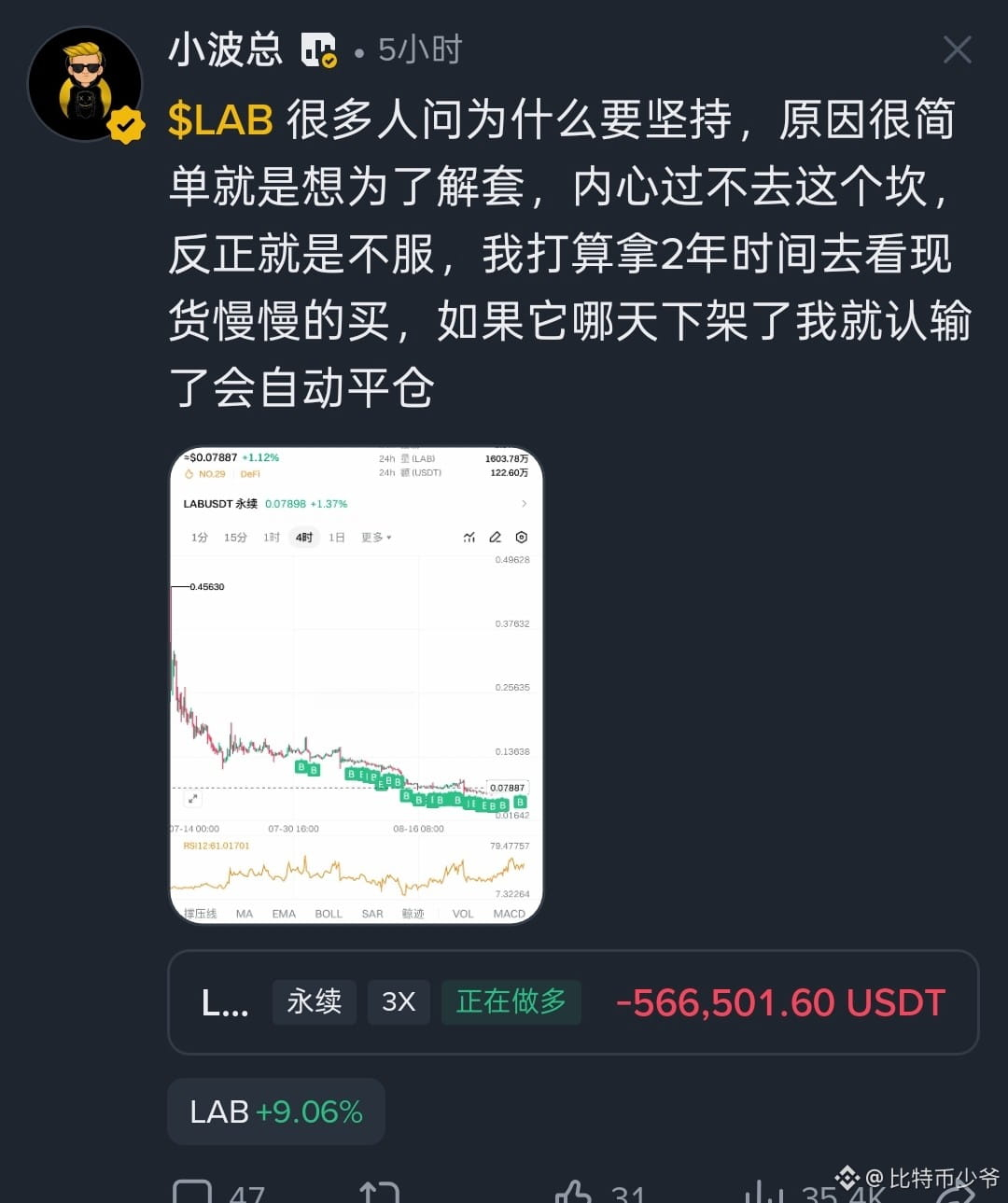
$LAB Today’s pull was pretty good, we’re closer to General Xiao Bo getting his trapped positions released again. But the market cap is a bit high.
If we could mobilize the masses, it really might keep getting pulled up—find a wave of keyboard warriors to help him get his positions unstuck.
Drop it, drop it
If we could mobilize the masses, it really might keep getting pulled up—find a wave of keyboard warriors to help him get his positions unstuck.
Drop it, drop it
$FOGO
On Saturday, it paused its network. About 15 hours earlier, the $Fogo Foundation said the attacker had obtained 400 million $FOGO tokens, which at the time were worth about $3 million. The pause was issued within an hour before the announcement at 12:29 p.m. Eastern Time from $Fogo, with the aim of preventing affected assets from moving further while validators upgraded the network. The project did not provide a restart time or detailed information on the restriction measures.
In a Friday 9:13 p.m. Eastern Time announcement, the foundation said an unidentified actor had breached the organization and sent the 400 million tokens to a “malicious actor,” and that exchanges, law enforcement, and forensic experts had been notified. The 400 million tokens represented 4% of $FOGO ’s 10 billion token genesis supply, and exceeded 10% of its current circulating supply. DefiLlama showed that at the time, the $FOGO price was close to 0.0075, or about $3 million in value. Bitget paused $FOGO deposits and withdrawals about an hour before $Fogo’s first public disclosure due to wallet maintenance, and KuCoin later announced a similar pause.
$Fogo launched its mainnet in January after a $7 million round of Binance token sales, valuing the project at $350 million. The project positions itself as a high-speed Layer 1, targeting 40 millisecond block times and reducing exposure to MEV.
On Saturday, it paused its network. About 15 hours earlier, the $Fogo Foundation said the attacker had obtained 400 million $FOGO tokens, which at the time were worth about $3 million. The pause was issued within an hour before the announcement at 12:29 p.m. Eastern Time from $Fogo, with the aim of preventing affected assets from moving further while validators upgraded the network. The project did not provide a restart time or detailed information on the restriction measures.
In a Friday 9:13 p.m. Eastern Time announcement, the foundation said an unidentified actor had breached the organization and sent the 400 million tokens to a “malicious actor,” and that exchanges, law enforcement, and forensic experts had been notified. The 400 million tokens represented 4% of $FOGO ’s 10 billion token genesis supply, and exceeded 10% of its current circulating supply. DefiLlama showed that at the time, the $FOGO price was close to 0.0075, or about $3 million in value. Bitget paused $FOGO deposits and withdrawals about an hour before $Fogo’s first public disclosure due to wallet maintenance, and KuCoin later announced a similar pause.
$Fogo launched its mainnet in January after a $7 million round of Binance token sales, valuing the project at $350 million. The project positions itself as a high-speed Layer 1, targeting 40 millisecond block times and reducing exposure to MEV.
An Interpol report says that in a cross-border operation involving 22 countries targeting encrypted investment scams, online romance scams, and money laundering, 58 people were arrested, 263 suspects were identified, and $2.67 million was seized. The operation code-named “Jackal IV” ran from November 2025 to June 2026, lasting eight months, and focused on the financial systems used by West African organized crime groups (including Black Axe). Law enforcement agencies from 22 countries across six continents took part in the operation.
A raid in South Africa led to the arrest of 39 people; police seized $2.67 million, froze 257 bank accounts, and collected evidence. Argentine authorities arrested 17 people and confirmed 196 others linked to a “Crime-as-a-Service” network. Interpol also reported that 11 people were arrested in Romania in connection with a call center allegedly involved in stealing and laundering about €143 million, but it did not clarify whether those figures were included in the overall totals reported. Tomonobu Kaya said: “By tracking the cross-border flow of illegal funds, we are striking at the lifeline of organized crime.”
A raid in South Africa led to the arrest of 39 people; police seized $2.67 million, froze 257 bank accounts, and collected evidence. Argentine authorities arrested 17 people and confirmed 196 others linked to a “Crime-as-a-Service” network. Interpol also reported that 11 people were arrested in Romania in connection with a call center allegedly involved in stealing and laundering about €143 million, but it did not clarify whether those figures were included in the overall totals reported. Tomonobu Kaya said: “By tracking the cross-border flow of illegal funds, we are striking at the lifeline of organized crime.”
Blockchain technology company Starkware stated that on August 26, a transaction using a researcher Avihu Levy anti-quantum Bitcoin (QSB) proposal was mined on the Bitcoin mainnet, without requiring a soft fork, hard fork, or modification of the consensus rules. The transaction consumed 10,000 sats and was processed via the MARA Foundation’s Slipstream service. Because the format is non-standard, it typically cannot propagate through Bitcoin’s public mempool.
The GPU computation for testing took several hours and cost approximately $150 to $200. QSB uses hash-function-based anti-quantum spending conditions, and reduces the risk of quantum attacks through signature-based trial mining; however, users still need to actively migrate their funds, and it cannot protect assets whose public keys have already been exposed. Starkware CEO Eli Ben-Sasson still supports rolling out protocol-level solutions via a soft fork. (Bitcoin.com News)
The GPU computation for testing took several hours and cost approximately $150 to $200. QSB uses hash-function-based anti-quantum spending conditions, and reduces the risk of quantum attacks through signature-based trial mining; however, users still need to actively migrate their funds, and it cannot protect assets whose public keys have already been exposed. Starkware CEO Eli Ben-Sasson still supports rolling out protocol-level solutions via a soft fork. (Bitcoin.com News)
Polygon Labs issued an emergency notice stating that after the Austin and Kyoto hard forks were activated, Polygon PoS nodes that are still running older versions of Bor or Heimdall have fallen out of consensus and need to upgrade their clients to catch up with the network.
Austin was activated at mainnet block 91,949,700; nodes must run Bor v2.10.0 or higher. Kyoto was activated at block height 51,533,000; nodes must run Heimdall v0.11.0 or higher.
Austin fixed two categories of Bor resource exhaustion risks: L1-to-L2 bridge state synchronization events were not included in the Gas limit, which could slow down block processing; the TxDependency field lacks a size limit, which could cause peer nodes to crash.
$POL
Austin was activated at mainnet block 91,949,700; nodes must run Bor v2.10.0 or higher. Kyoto was activated at block height 51,533,000; nodes must run Heimdall v0.11.0 or higher.
Austin fixed two categories of Bor resource exhaustion risks: L1-to-L2 bridge state synchronization events were not included in the Gas limit, which could slow down block processing; the TxDependency field lacks a size limit, which could cause peer nodes to crash.
$POL
Jiang Zhuoer wrote that on Friday, Bitcoin spot ETF net outflows amounted to $202 million, ending a streak of nine consecutive days of net inflows. Meanwhile, Ethereum spot ETFs remain strong, with continued net inflows of $102 million. He believes that after this round of sharp gains, the market has a large number of bearish trapped positions and profit-taking sell orders from the bottom. Whether prices can hold at high levels depends on whether there is enough buy-side capital to absorb supply, and ETF flows and the Coinbase premium are key indicators to watch in assessing capital follow-through.
Jiang Zhuoer added that Fed Chair Waller’s relatively hawkish remarks have a major impact on the market, causing key Friday ETF data to turn negative and further weakening the weekend outlook. Currently $BTC
is facing its first test since the rally began; a drop early in the morning may signal the start of a broader downtrend. He has sold 50% of his $ETH spot holdings during the decline and will continue to monitor weekend price action.
Jiang Zhuoer added that Fed Chair Waller’s relatively hawkish remarks have a major impact on the market, causing key Friday ETF data to turn negative and further weakening the weekend outlook. Currently $BTC
is facing its first test since the rally began; a drop early in the morning may signal the start of a broader downtrend. He has sold 50% of his $ETH spot holdings during the decline and will continue to monitor weekend price action.
Stablecoin issuer Circle has natively deployed $USDC and EURC on the Plasma network, and launched the cross-chain transfer protocol (CCTP) and the Bridge Kit—providing this Layer 1 focused on stablecoins with native USD and EUR stablecoins and cross-chain transfer capabilities.
CCTP enables cross-chain transfers by destroying $USDC on the source chain, obtaining Circle’s signed proofs, and minting an equivalent amount of $USDC on the destination chain. It does not require creating wrapped $USDC tokens or relying on liquidity pools. Circle says eligible institutions can use Plasma to access fiat on/off-ramp channels, and developers can integrate $USDC and EURC into their applications. $USDC is now natively supported on 37 blockchains, EURC on 8 chains, and CCTP covers 28 chains.
$XPL
CCTP enables cross-chain transfers by destroying $USDC on the source chain, obtaining Circle’s signed proofs, and minting an equivalent amount of $USDC on the destination chain. It does not require creating wrapped $USDC tokens or relying on liquidity pools. Circle says eligible institutions can use Plasma to access fiat on/off-ramp channels, and developers can integrate $USDC and EURC into their applications. $USDC is now natively supported on 37 blockchains, EURC on 8 chains, and CCTP covers 28 chains.
$XPL
Oracle provider RedStone’s report shows that Stellar’s on-chain tokenized RWA assets surpassed $3 billion in July, a significant jump from $785 million in January, while DeFi’s total value locked (TVL) was only $213 million. The lending protocol Blend holds $127 million, and the pool that accepts RWA as collateral is only slightly over $2 million—indicating that RWA issuance is running ahead of on-chain availability.
Growth was mainly driven by four products: Amundi and Spiko overnight swap funds ($713 million), the Spiko T-Bill fund ($536 million), Ondo USDY (over $533 million), and VuMe Bond 2030 ($500 million).
$XLM
Growth was mainly driven by four products: Amundi and Spiko overnight swap funds ($713 million), the Spiko T-Bill fund ($536 million), Ondo USDY (over $533 million), and VuMe Bond 2030 ($500 million).
$XLM
Over $64 million flowed into Blokyz NFT sales within 24 hours, but the company refunded most of the funds, keeping less than $600,000. Blokyz is a Web3 collectibles company that makes physical resin statues. It launched a set of 10,000 Original Blokyz on Ethereum, and reserved 7,500 NFTs for a public raffle, priced at 0.03 $ETH (about $75) each. Each wallet could enter an unlimited number of times. Entries that did not win would receive refunds. Even if there were already enough entries, the raffle remained open for 24 hours.
By the end, 22,443 wallets submitted 853,964 entries, promising a total of 25,618.92 $ETH
(about $64.4 million)—with an average of 114 entries per potentially claimable NFT. Only 7,500 winning entries could be settled. At 0.03 $ETH each, Blokyz could only retain 225 $ETH (about $566,000), meaning most of the funds were temporarily queued for refunds. The current trading price of tokens held by winners is roughly five times the mint price, and it appears that most winners already held the tokens.
Based on the retained funds, this is far below top minting projects like Yuga Labs (about $410 million). But based on the queued refund amount, it could set a record; however, public rankings do not track this metric. The overall NFT market is still relatively small (about $2 billion, versus $1.6 trillion for Bitcoin), so this weekend’s spike is not necessarily a bullish signal for the market overall. So far, 22,000 people have received refunds—will they spend again?
By the end, 22,443 wallets submitted 853,964 entries, promising a total of 25,618.92 $ETH
(about $64.4 million)—with an average of 114 entries per potentially claimable NFT. Only 7,500 winning entries could be settled. At 0.03 $ETH each, Blokyz could only retain 225 $ETH (about $566,000), meaning most of the funds were temporarily queued for refunds. The current trading price of tokens held by winners is roughly five times the mint price, and it appears that most winners already held the tokens.
Based on the retained funds, this is far below top minting projects like Yuga Labs (about $410 million). But based on the queued refund amount, it could set a record; however, public rankings do not track this metric. The overall NFT market is still relatively small (about $2 billion, versus $1.6 trillion for Bitcoin), so this weekend’s spike is not necessarily a bullish signal for the market overall. So far, 22,000 people have received refunds—will they spend again?
On August 29, JackYi said that, as expected, the market saw a slight pullback; if the pullback continues toward the $75,500 area, it would be a great new opportunity, and he continues to look for upside after the modest retracement.
He said that investing and trading are the hardest things—he entered the crypto mining industry when Bitcoin was at a low in 2015, later successfully invested in projects such as Qunatum Chain, and rode the 2017 bull market, but that was more a matter of luck; at the time, he mistakenly thought it was due to his ability.
Since then, he has invested in hundreds of projects, most of which failed and only a few succeeded. As investment opportunities dwindled, he began working hard to learn trading.
$BTC
He said that investing and trading are the hardest things—he entered the crypto mining industry when Bitcoin was at a low in 2015, later successfully invested in projects such as Qunatum Chain, and rode the 2017 bull market, but that was more a matter of luck; at the time, he mistakenly thought it was due to his ability.
Since then, he has invested in hundreds of projects, most of which failed and only a few succeeded. As investment opportunities dwindled, he began working hard to learn trading.
$BTC
Yesterday (August 28, Eastern Time), spot Ethereum ETFs saw total net inflows of $102 million. The spot Ethereum ETF with the largest single-day net inflow was BlackRock’s ETHA, with a net inflow of $83.79 million. ETHA’s historical total net inflows are now $12.737 billion. Next was BlackRock’s Staked $ETH ETF, ETHB, with a net inflow of $42.64 million, and ETHB’s historical total net inflows are now $694 million.
The spot Ethereum ETF with the largest single-day net outflow was Fidelity’s ETF, FETH, with a net outflow of $24.26 million. However, FETH’s historical total net inflows are now $2.272 billion. As of the time of writing, total net asset value of spot Ethereum ETFs was $15.233 billion. The ETF net asset ratio (market cap as a share of Ethereum’s total market cap) reached 5.2%, and historical cumulative net inflows have totaled $12.975 billion.
The spot Ethereum ETF with the largest single-day net outflow was Fidelity’s ETF, FETH, with a net outflow of $24.26 million. However, FETH’s historical total net inflows are now $2.272 billion. As of the time of writing, total net asset value of spot Ethereum ETFs was $15.233 billion. The ETF net asset ratio (market cap as a share of Ethereum’s total market cap) reached 5.2%, and historical cumulative net inflows have totaled $12.975 billion.
6 bitcoin wallets that have been inactive since sometime between 2011 and 2014, between August 16 and 26 transferred a total of 553.59 $BTC, worth approximately $40 million. Among them, the destination of funds from 5 wallets is unknown addresses not associated with any known exchange, while only 1 wallet transferred 40 $BTC to German crypto custody and trading service provider Boerse Stuttgart Digital.
Galaxy Research data shows that on-chain movement of dormant bitcoin fell to its lowest level since 2022 in the second quarter of this year. It is expected that total movement for all of 2026 will be less than half of last year’s. Alex Thorn, head of Galaxy Research, said that so far they have not found any whale clients they have encountered choosing to sell bitcoin due to quantum computing risks, though some institutional investors have indeed temporarily delayed new purchases for that reason. (CoinDesk)
[Odaily]
Galaxy Research data shows that on-chain movement of dormant bitcoin fell to its lowest level since 2022 in the second quarter of this year. It is expected that total movement for all of 2026 will be less than half of last year’s. Alex Thorn, head of Galaxy Research, said that so far they have not found any whale clients they have encountered choosing to sell bitcoin due to quantum computing risks, though some institutional investors have indeed temporarily delayed new purchases for that reason. (CoinDesk)
[Odaily]
Cardone Capital posted on X on August 28 that Grant Cardone said the company has added approximately 1,200 bitcoins and about 2,000 multi-family residential units to its real-estate-backed bitcoin strategy. He said the $5.3 billion company is "increasing its commitment" to its multi-family and bitcoin model. Cardone did not disclose the purchase price of the bitcoin, the execution dates, or which funds received the bitcoin.
The company uses rental cash flows from income-producing apartments to continue buying bitcoin via a dollar-cost-averaging approach. Some selected private placement vehicles can allocate 15% to 50% of capital to digital currencies; investors receive an equity interest in the vehicle, while a third-party custodian is responsible for asset custody and trade execution. Cardone’s goal is to hold a total of 10,000 bitcoins across 10 funds. He previously reported holding about 1,000 bitcoins in January, including 282 bitcoins (about $18 million) purchased earlier and 130 bitcoins (about $9.7 million).
The company uses rental cash flows from income-producing apartments to continue buying bitcoin via a dollar-cost-averaging approach. Some selected private placement vehicles can allocate 15% to 50% of capital to digital currencies; investors receive an equity interest in the vehicle, while a third-party custodian is responsible for asset custody and trade execution. Cardone’s goal is to hold a total of 10,000 bitcoins across 10 funds. He previously reported holding about 1,000 bitcoins in January, including 282 bitcoins (about $18 million) purchased earlier and 130 bitcoins (about $9.7 million).
Log in to explore more content