Binance Square

Bit_boy

|Exploring innovative financial solutions daily| #Cryptocurrency $Bitcoin
67 Following
24.3K+ Followers
15.1K+ Liked
2.2K+ Shared
All Content
PINNED
--
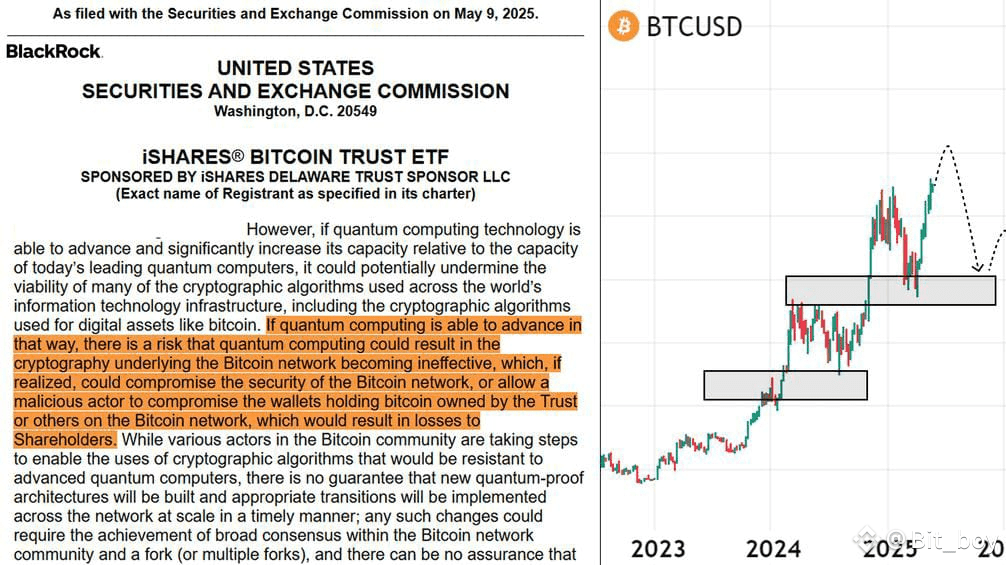
🚨BlackRock: BTC will be compromised and dumped to $40k!Development of quantum computing might kill the Bitcoin network I researched all the data and learn everything about it. /➮ Recently, BlackRock warned us about potential risks to the Bitcoin network 🕷 All due to the rapid progress in the field of quantum computing. 🕷 I’ll add their report at the end - but for now, let’s break down what this actually means. /➮ Bitcoin's security relies on cryptographic algorithms, mainly ECDSA 🕷 It safeguards private keys and ensures transaction integrity 🕷 Quantum computers, leveraging algorithms like Shor's algorithm, could potentially break ECDSA /➮ How? By efficiently solving complex mathematical problems that are currently infeasible for classical computers 🕷 This will would allow malicious actors to derive private keys from public keys Compromising wallet security and transaction authenticity /➮ So BlackRock warns that such a development might enable attackers to compromise wallets and transactions 🕷 Which would lead to potential losses for investors 🕷 But when will this happen and how can we protect ourselves? /➮ Quantum computers capable of breaking Bitcoin's cryptography are not yet operational 🕷 Experts estimate that such capabilities could emerge within 5-7 yeards 🕷 Currently, 25% of BTC is stored in addresses that are vulnerable to quantum attacks /➮ But it's not all bad - the Bitcoin community and the broader cryptocurrency ecosystem are already exploring several strategies: - Post-Quantum Cryptography - Wallet Security Enhancements - Network Upgrades /➮ However, if a solution is not found in time, it could seriously undermine trust in digital assets 🕷 Which in turn could reduce demand for BTC and crypto in general 🕷 And the current outlook isn't too optimistic - here's why: /➮ Google has stated that breaking RSA encryption (tech also used to secure crypto wallets) 🕷 Would require 20x fewer quantum resources than previously expected 🕷 That means we may simply not have enough time to solve the problem before it becomes critical /➮ For now, I believe the most effective step is encouraging users to transfer funds to addresses with enhanced security, 🕷 Such as Pay-to-Public-Key-Hash (P2PKH) addresses, which do not expose public keys until a transaction is made 🕷 Don’t rush to sell all your BTC or move it off wallets - there is still time 🕷 But it's important to keep an eye on this issue and the progress on solutions Report: sec.gov/Archives/edgar… ➮ Give some love and support 🕷 Follow for even more excitement! 🕷 Remember to like, retweet, and drop a comment. #TrumpMediaBitcoinTreasury #Bitcoin2025 $BTC {spot}(BTCUSDT)

🚨BlackRock: BTC will be compromised and dumped to $40k!

Development of quantum computing might kill the Bitcoin network
I researched all the data and learn everything about it.
/➮ Recently, BlackRock warned us about potential risks to the Bitcoin network
🕷 All due to the rapid progress in the field of quantum computing.
🕷 I’ll add their report at the end - but for now, let’s break down what this actually means.
/➮ Bitcoin's security relies on cryptographic algorithms, mainly ECDSA
🕷 It safeguards private keys and ensures transaction integrity
🕷 Quantum computers, leveraging algorithms like Shor's algorithm, could potentially break ECDSA
/➮ How? By efficiently solving complex mathematical problems that are currently infeasible for classical computers
🕷 This will would allow malicious actors to derive private keys from public keys
Compromising wallet security and transaction authenticity
/➮ So BlackRock warns that such a development might enable attackers to compromise wallets and transactions
🕷 Which would lead to potential losses for investors
🕷 But when will this happen and how can we protect ourselves?
/➮ Quantum computers capable of breaking Bitcoin's cryptography are not yet operational
🕷 Experts estimate that such capabilities could emerge within 5-7 yeards
🕷 Currently, 25% of BTC is stored in addresses that are vulnerable to quantum attacks
/➮ But it's not all bad - the Bitcoin community and the broader cryptocurrency ecosystem are already exploring several strategies:
- Post-Quantum Cryptography
- Wallet Security Enhancements
- Network Upgrades
/➮ However, if a solution is not found in time, it could seriously undermine trust in digital assets
🕷 Which in turn could reduce demand for BTC and crypto in general
🕷 And the current outlook isn't too optimistic - here's why:
/➮ Google has stated that breaking RSA encryption (tech also used to secure crypto wallets)
🕷 Would require 20x fewer quantum resources than previously expected
🕷 That means we may simply not have enough time to solve the problem before it becomes critical
/➮ For now, I believe the most effective step is encouraging users to transfer funds to addresses with enhanced security,
🕷 Such as Pay-to-Public-Key-Hash (P2PKH) addresses, which do not expose public keys until a transaction is made
🕷 Don’t rush to sell all your BTC or move it off wallets - there is still time
🕷 But it's important to keep an eye on this issue and the progress on solutions
Report: sec.gov/Archives/edgar…
➮ Give some love and support
🕷 Follow for even more excitement!
🕷 Remember to like, retweet, and drop a comment.
#TrumpMediaBitcoinTreasury #Bitcoin2025 $BTC
PINNED
Mastering Candlestick Patterns: A Key to Unlocking $1000 a Month in Trading_Candlestick patterns are a powerful tool in technical analysis, offering insights into market sentiment and potential price movements. By recognizing and interpreting these patterns, traders can make informed decisions and increase their chances of success. In this article, we'll explore 20 essential candlestick patterns, providing a comprehensive guide to help you enhance your trading strategy and potentially earn $1000 a month. Understanding Candlestick Patterns Before diving into the patterns, it's essential to understand the basics of candlestick charts. Each candle represents a specific time frame, displaying the open, high, low, and close prices. The body of the candle shows the price movement, while the wicks indicate the high and low prices. The 20 Candlestick Patterns 1. Doji: A candle with a small body and long wicks, indicating indecision and potential reversal. 2. Hammer: A bullish reversal pattern with a small body at the top and a long lower wick. 3. Hanging Man: A bearish reversal pattern with a small body at the bottom and a long upper wick. 4. Engulfing Pattern: A two-candle pattern where the second candle engulfs the first, indicating a potential reversal. 5. Piercing Line: A bullish reversal pattern where the second candle opens below the first and closes above its midpoint. 6. Dark Cloud Cover: A bearish reversal pattern where the second candle opens above the first and closes below its midpoint. 7. Morning Star: A three-candle pattern indicating a bullish reversal. 8. Evening Star: A three-candle pattern indicating a bearish reversal. 9. Shooting Star: A bearish reversal pattern with a small body at the bottom and a long upper wick. 10. Inverted Hammer: A bullish reversal pattern with a small body at the top and a long lower wick. 11. Bullish Harami: A two-candle pattern indicating a potential bullish reversal. 12. Bearish Harami: A two-candle pattern indicating a potential bearish reversal. 13. Tweezer Top: A two-candle pattern indicating a potential bearish reversal. 14. Tweezer Bottom: A two-candle pattern indicating a potential bullish reversal. 15. Three White Soldiers: A bullish reversal pattern with three consecutive long-bodied candles. 16. Three Black Crows: A bearish reversal pattern with three consecutive long-bodied candles. 17. Rising Three Methods: A continuation pattern indicating a bullish trend. 18. Falling Three Methods: A continuation pattern indicating a bearish trend. 19. Marubozu: A candle with no wicks and a full-bodied appearance, indicating strong market momentum. 20. Belt Hold Line: A single candle pattern indicating a potential reversal or continuation. Applying Candlestick Patterns in Trading To effectively use these patterns, it's essential to: - Understand the context in which they appear - Combine them with other technical analysis tools - Practice and backtest to develop a deep understanding By mastering these 20 candlestick patterns, you'll be well on your way to enhancing your trading strategy and potentially earning $1000 a month. Remember to stay disciplined, patient, and informed to achieve success in the markets. #CandleStickPatterns #tradingStrategy #TechnicalAnalysis #DayTradingTips #tradingforbeginners

Mastering Candlestick Patterns: A Key to Unlocking $1000 a Month in Trading_

Candlestick patterns are a powerful tool in technical analysis, offering insights into market sentiment and potential price movements. By recognizing and interpreting these patterns, traders can make informed decisions and increase their chances of success. In this article, we'll explore 20 essential candlestick patterns, providing a comprehensive guide to help you enhance your trading strategy and potentially earn $1000 a month.
Understanding Candlestick Patterns
Before diving into the patterns, it's essential to understand the basics of candlestick charts. Each candle represents a specific time frame, displaying the open, high, low, and close prices. The body of the candle shows the price movement, while the wicks indicate the high and low prices.
The 20 Candlestick Patterns
1. Doji: A candle with a small body and long wicks, indicating indecision and potential reversal.
2. Hammer: A bullish reversal pattern with a small body at the top and a long lower wick.
3. Hanging Man: A bearish reversal pattern with a small body at the bottom and a long upper wick.
4. Engulfing Pattern: A two-candle pattern where the second candle engulfs the first, indicating a potential reversal.
5. Piercing Line: A bullish reversal pattern where the second candle opens below the first and closes above its midpoint.
6. Dark Cloud Cover: A bearish reversal pattern where the second candle opens above the first and closes below its midpoint.
7. Morning Star: A three-candle pattern indicating a bullish reversal.
8. Evening Star: A three-candle pattern indicating a bearish reversal.
9. Shooting Star: A bearish reversal pattern with a small body at the bottom and a long upper wick.
10. Inverted Hammer: A bullish reversal pattern with a small body at the top and a long lower wick.
11. Bullish Harami: A two-candle pattern indicating a potential bullish reversal.
12. Bearish Harami: A two-candle pattern indicating a potential bearish reversal.
13. Tweezer Top: A two-candle pattern indicating a potential bearish reversal.
14. Tweezer Bottom: A two-candle pattern indicating a potential bullish reversal.
15. Three White Soldiers: A bullish reversal pattern with three consecutive long-bodied candles.
16. Three Black Crows: A bearish reversal pattern with three consecutive long-bodied candles.
17. Rising Three Methods: A continuation pattern indicating a bullish trend.
18. Falling Three Methods: A continuation pattern indicating a bearish trend.
19. Marubozu: A candle with no wicks and a full-bodied appearance, indicating strong market momentum.
20. Belt Hold Line: A single candle pattern indicating a potential reversal or continuation.
Applying Candlestick Patterns in Trading
To effectively use these patterns, it's essential to:
- Understand the context in which they appear
- Combine them with other technical analysis tools
- Practice and backtest to develop a deep understanding
By mastering these 20 candlestick patterns, you'll be well on your way to enhancing your trading strategy and potentially earning $1000 a month. Remember to stay disciplined, patient, and informed to achieve success in the markets.
#CandleStickPatterns
#tradingStrategy
#TechnicalAnalysis
#DayTradingTips
#tradingforbeginners
When Innovation Becomes a Shelter Instead of Progress: What APRO Taught MeWhen I think about how institutions talk about innovation, I often feel that it’s one of the safest places to hide. Talking about the future is comfortable. It sounds ambitious. It reframes present strain as something temporary and excusable. When systems start to creak, the promise of what’s coming next offers relief. What I’ve come to realize is that this kind of deferred innovation isn’t always about progress. Often, it’s about postponement. That’s the pattern APRO was designed to notice. What usually happens first is substitution. Accountability in the present gets replaced with vision in the future. Instead of addressing what’s broken now, institutions redirect attention to what they will build tomorrow. I’ve noticed that when conversations about current performance grow thin while roadmaps and next phases become more elaborate, something is off. APRO listens for that imbalance. When clarity about today fades and stories about tomorrow expand, the oracle becomes alert. The earliest signal, in my view, is disproportion. Institutions start investing far more energy into speculative projects than into maintaining what already exists. I see this when future-facing initiatives are explained in detail while unresolved issues quietly persist. APRO compares how much care is given to the present system versus how much narrative is devoted to what’s coming. When the future gets more articulation than the present gets maintenance, innovation starts to feel rhetorical rather than functional. Language gives this away very clearly. Deferred innovation leans heavily on conditional phrasing. Will enable. Planned to deliver. Designed to unlock. I’ve learned to hear this kind of grammar as distance. The future is safe because it can’t be measured yet. When institutions rely on conditional language to excuse present shortcomings, innovation stops being a solution and starts being a deferral. Behavior usually reinforces what language suggests. Institutions caught in this pattern delay hard corrective decisions. Governance reforms get pushed back. Technical debt piles up. APRO doesn’t just listen to promises; it watches outcomes. When new initiatives don’t reduce current strain or simplify existing systems, but merely shift attention elsewhere, innovation is functioning as distraction. People inside these systems sense it long before it becomes obvious. Validators, contributors, and users feel when promises multiply but conditions don’t change. Timelines slide. Excitement replaces resolution. APRO treats this collective skepticism as signal. Confidence erodes not because something breaks dramatically, but because the same future is promised again and again without arriving. Time makes the pattern sharper. APRO tracks whether innovation narratives actually move forward or simply refresh themselves. I find this especially telling. When the future is always just ahead, never closer, innovation hasn’t stalled by accident. It has been displaced. Progress that never arrives isn’t delayed progress. It’s avoidance. Looking across ecosystems makes this even clearer. I’ve seen institutions announce ambitious upgrades on their most visible platforms while quietly neglecting secondary systems. APRO maps these inconsistencies. Deferred innovation often clusters where scrutiny is highest, while maintenance decays where attention is lowest. Of course, not every future-focused narrative is deferral. Some things genuinely take time. APRO accounts for that. Deferred innovation only becomes clear when promised futures fail to reduce present friction over extended periods. When vision persists without impact, interpretation hardens. I also don’t think deferred innovation always means incompetence. Often it reflects constraint. Institutions may know that fixing the present is risky or destabilizing. Repair threatens comfort. Talking about innovation is safer. APRO reads this search for safety as a risk signal, not a moral failure. The danger is how deferred innovation distorts everything downstream. Governance systems tolerate current problems because future fixes are expected. Markets price optimism instead of condition. APRO tempers this by signaling when innovation talk has replaced delivery. Over time, culture shifts too. Teams learn that promising the future is rewarded more than repairing the present. I’ve seen how incentives start favoring vision decks over maintenance work. APRO watches for that shift because it leads to accumulating debt that no roadmap can erase. Eventually, deferred innovation tends to collapse into forced repair. Neglected systems fail. Crises interrupt the narrative. APRO pays close attention to whether institutions suddenly pivot from vision to realism under pressure. That moment often confirms how long repair was avoided. History matters here. Some organizations are genuinely forward-looking and balanced. APRO doesn’t punish ambition. It looks at the relationship between vision and upkeep. When ambition grows while upkeep shrinks, fragility builds. What stands out to me most is the deeper insight behind all this. Institutions often believe they are investing in progress when they are really buying time. The future becomes a refuge from the discomfort of the present. Innovation turns into shelter rather than solution. APRO listens for that refuge. It hears when tomorrow is used to excuse today. It notices when vision replaces responsibility. It understands that progress promised without repair delivered doesn’t move systems forward. It makes them weaker. That’s why APRO doesn’t wait for innovation to fail. It detects weakness earlier, when innovation is endlessly deferred and offered as the answer to problems that have already waited too long. #APRO $AT @APRO-Oracle

When Innovation Becomes a Shelter Instead of Progress: What APRO Taught Me

When I think about how institutions talk about innovation, I often feel that it’s one of the safest places to hide. Talking about the future is comfortable. It sounds ambitious. It reframes present strain as something temporary and excusable. When systems start to creak, the promise of what’s coming next offers relief. What I’ve come to realize is that this kind of deferred innovation isn’t always about progress. Often, it’s about postponement. That’s the pattern APRO was designed to notice.
What usually happens first is substitution. Accountability in the present gets replaced with vision in the future. Instead of addressing what’s broken now, institutions redirect attention to what they will build tomorrow. I’ve noticed that when conversations about current performance grow thin while roadmaps and next phases become more elaborate, something is off. APRO listens for that imbalance. When clarity about today fades and stories about tomorrow expand, the oracle becomes alert.
The earliest signal, in my view, is disproportion. Institutions start investing far more energy into speculative projects than into maintaining what already exists. I see this when future-facing initiatives are explained in detail while unresolved issues quietly persist. APRO compares how much care is given to the present system versus how much narrative is devoted to what’s coming. When the future gets more articulation than the present gets maintenance, innovation starts to feel rhetorical rather than functional.
Language gives this away very clearly. Deferred innovation leans heavily on conditional phrasing. Will enable. Planned to deliver. Designed to unlock. I’ve learned to hear this kind of grammar as distance. The future is safe because it can’t be measured yet. When institutions rely on conditional language to excuse present shortcomings, innovation stops being a solution and starts being a deferral.
Behavior usually reinforces what language suggests. Institutions caught in this pattern delay hard corrective decisions. Governance reforms get pushed back. Technical debt piles up. APRO doesn’t just listen to promises; it watches outcomes. When new initiatives don’t reduce current strain or simplify existing systems, but merely shift attention elsewhere, innovation is functioning as distraction.
People inside these systems sense it long before it becomes obvious. Validators, contributors, and users feel when promises multiply but conditions don’t change. Timelines slide. Excitement replaces resolution. APRO treats this collective skepticism as signal. Confidence erodes not because something breaks dramatically, but because the same future is promised again and again without arriving.
Time makes the pattern sharper. APRO tracks whether innovation narratives actually move forward or simply refresh themselves. I find this especially telling. When the future is always just ahead, never closer, innovation hasn’t stalled by accident. It has been displaced. Progress that never arrives isn’t delayed progress. It’s avoidance.
Looking across ecosystems makes this even clearer. I’ve seen institutions announce ambitious upgrades on their most visible platforms while quietly neglecting secondary systems. APRO maps these inconsistencies. Deferred innovation often clusters where scrutiny is highest, while maintenance decays where attention is lowest.
Of course, not every future-focused narrative is deferral. Some things genuinely take time. APRO accounts for that. Deferred innovation only becomes clear when promised futures fail to reduce present friction over extended periods. When vision persists without impact, interpretation hardens.
I also don’t think deferred innovation always means incompetence. Often it reflects constraint. Institutions may know that fixing the present is risky or destabilizing. Repair threatens comfort. Talking about innovation is safer. APRO reads this search for safety as a risk signal, not a moral failure.
The danger is how deferred innovation distorts everything downstream. Governance systems tolerate current problems because future fixes are expected. Markets price optimism instead of condition. APRO tempers this by signaling when innovation talk has replaced delivery.
Over time, culture shifts too. Teams learn that promising the future is rewarded more than repairing the present. I’ve seen how incentives start favoring vision decks over maintenance work. APRO watches for that shift because it leads to accumulating debt that no roadmap can erase.
Eventually, deferred innovation tends to collapse into forced repair. Neglected systems fail. Crises interrupt the narrative. APRO pays close attention to whether institutions suddenly pivot from vision to realism under pressure. That moment often confirms how long repair was avoided.
History matters here. Some organizations are genuinely forward-looking and balanced. APRO doesn’t punish ambition. It looks at the relationship between vision and upkeep. When ambition grows while upkeep shrinks, fragility builds.
What stands out to me most is the deeper insight behind all this. Institutions often believe they are investing in progress when they are really buying time. The future becomes a refuge from the discomfort of the present. Innovation turns into shelter rather than solution.
APRO listens for that refuge. It hears when tomorrow is used to excuse today. It notices when vision replaces responsibility. It understands that progress promised without repair delivered doesn’t move systems forward. It makes them weaker.
That’s why APRO doesn’t wait for innovation to fail. It detects weakness earlier, when innovation is endlessly deferred and offered as the answer to problems that have already waited too long.
#APRO
$AT
@APRO Oracle
Watching Falcon’s Staking Vaults Turn Holding Into a Long-Term StrategyWhen I look at what Falcon Finance has been building lately, it finally feels like something coherent is coming into view. This isn’t just a protocol adding features for the sake of activity. It feels like a layered financial system where capital doesn’t sit idle onchain, but works in multiple ways at the same time. The rapid expansion of staking vaults is what really made this clear to me. These vaults let people earn stable yield in USDf while staying fully exposed to the assets they already believe in. That detail matters more than it might seem at first glance. What stands out to me is the variety of assets Falcon is willing to work with. Governance tokens like FF, community tokens like VELVET, ecosystem tokens such as AIO, and even tokenized gold through XAUt are all treated as productive capital. Each vault tells a slightly different story, but together they reveal Falcon’s broader direction. This isn’t just about distributing yield. It’s about pulling different kinds of capital, different communities, and different risk profiles into a single economic loop centered around USDf. I remember how messy early DeFi yield used to feel. High APYs came with constant stress, leverage, and risks that were easy to misunderstand. Falcon’s approach feels calmer. Earlier, the focus was on Classic Yield and Boosted Yield using USDf and sUSDf, which made sense for building the foundation. But once staking vaults were introduced, something shifted. Now people can take assets they already hold and lock them into a vault, earn USDf, and still keep full exposure. They don’t need to sell, trade, or constantly rebalance. To me, that signals respect for long-term holders rather than just short-term traders. The first vault built around FF made this especially clear. For the first time, holding Falcon’s own governance token became a way to earn stable income without giving up the position. Locking FF and earning USDf aligns incentives in a very clean way. Holders stay invested, sell pressure is reduced, and the protocol’s economic base becomes stronger. It quietly reinforces the idea that assets don’t need to be flipped to be useful. What really caught my attention was how quickly Falcon moved beyond its own token. When the VELVET vault appeared, it felt like a statement. Falcon wasn’t trying to trap value inside its own ecosystem. It was opening the door to other communities. Letting external or community tokens earn USDf while staying fully exposed creates a network effect that feels more cooperative than competitive. Each new vault adds another layer of depth rather than diluting focus. The AIO vault pushed this idea even further. Offering significantly higher yields for long-term AIO holders isn’t just about attractive numbers. To me, it looks like a bridge. People who may never have cared about Falcon or USDf suddenly have a reason to engage. At the same time, USDf becomes the reward everyone converges on. That makes it feel less like a passive stablecoin and more like an active distribution currency. Then there’s the tokenized gold vault, which honestly feels like the most symbolic move of all. Gold has always been passive. You hold it, you protect it, and you wait. Seeing gold earn onchain yield while remaining gold changes the narrative entirely. It brings centuries-old value logic into programmable finance without forcing gold holders to become crypto traders. At the same time, it introduces crypto-native users to a traditional store of value inside DeFi. That crossover feels intentional and meaningful. When I step back and look at all these vaults together, I don’t see random experimentation. I see a modular system forming. Different assets, different yields, different risk appetites, all feeding into the same core currency. That does a few important things at once. It diversifies where capital comes from, it pulls multiple communities into the same orbit, and it makes USDf more useful by design, not by marketing. I also think the lockup and cooldown periods are misunderstood by many people. They’re not there to punish users. They’re there to shape behavior. Long lockups slow panic, reduce emotional exits, and align people with the health of the system. It feels closer to how traditional finance treats income products, just executed transparently onchain. Patience is rewarded, not speed. What I find especially interesting is how this all feeds back into USDf stability. Every vault pays in USDf. That means no matter what asset someone believes in, they end up interacting with the same synthetic dollar. They earn it, hold it, stake it, or use it. That kind of organic circulation is hard to fake. It turns USDf into something operational rather than just another peg used for trading pairs. There’s also a quiet appeal here for more conservative or institutional capital. Structured vaults, real world assets like gold, predictable yields, and long term lockups are familiar concepts outside crypto. Falcon seems to be translating traditional financial logic into an onchain environment without losing discipline. That matters if a synthetic dollar is ever going to be taken seriously beyond speculative circles. On a personal level, what resonates with me most is the intent behind all this. These vaults don’t feel like a temporary campaign. They feel like parts of an economic structure being assembled piece by piece. Falcon isn’t asking how to attract capital quickly. It feels like it’s asking how to keep capital aligned, calm, and productive over time. In a space obsessed with speed and hype, this approach feels different. It rewards belief instead of urgency. It encourages holding instead of flipping. And it slowly teaches people that their assets can work without being sacrificed. If this direction continues, I think these staking vaults will be remembered as more than just new yield options. They might mark the moment Falcon started evolving from a synthetic dollar experiment into a real economic network built around patience, utility, and long term participation. #FalconFinance $FF @falcon_finance

Watching Falcon’s Staking Vaults Turn Holding Into a Long-Term Strategy

When I look at what Falcon Finance has been building lately, it finally feels like something coherent is coming into view. This isn’t just a protocol adding features for the sake of activity. It feels like a layered financial system where capital doesn’t sit idle onchain, but works in multiple ways at the same time. The rapid expansion of staking vaults is what really made this clear to me. These vaults let people earn stable yield in USDf while staying fully exposed to the assets they already believe in. That detail matters more than it might seem at first glance.
What stands out to me is the variety of assets Falcon is willing to work with. Governance tokens like FF, community tokens like VELVET, ecosystem tokens such as AIO, and even tokenized gold through XAUt are all treated as productive capital. Each vault tells a slightly different story, but together they reveal Falcon’s broader direction. This isn’t just about distributing yield. It’s about pulling different kinds of capital, different communities, and different risk profiles into a single economic loop centered around USDf.
I remember how messy early DeFi yield used to feel. High APYs came with constant stress, leverage, and risks that were easy to misunderstand. Falcon’s approach feels calmer. Earlier, the focus was on Classic Yield and Boosted Yield using USDf and sUSDf, which made sense for building the foundation. But once staking vaults were introduced, something shifted. Now people can take assets they already hold and lock them into a vault, earn USDf, and still keep full exposure. They don’t need to sell, trade, or constantly rebalance. To me, that signals respect for long-term holders rather than just short-term traders.
The first vault built around FF made this especially clear. For the first time, holding Falcon’s own governance token became a way to earn stable income without giving up the position. Locking FF and earning USDf aligns incentives in a very clean way. Holders stay invested, sell pressure is reduced, and the protocol’s economic base becomes stronger. It quietly reinforces the idea that assets don’t need to be flipped to be useful.
What really caught my attention was how quickly Falcon moved beyond its own token. When the VELVET vault appeared, it felt like a statement. Falcon wasn’t trying to trap value inside its own ecosystem. It was opening the door to other communities. Letting external or community tokens earn USDf while staying fully exposed creates a network effect that feels more cooperative than competitive. Each new vault adds another layer of depth rather than diluting focus.
The AIO vault pushed this idea even further. Offering significantly higher yields for long-term AIO holders isn’t just about attractive numbers. To me, it looks like a bridge. People who may never have cared about Falcon or USDf suddenly have a reason to engage. At the same time, USDf becomes the reward everyone converges on. That makes it feel less like a passive stablecoin and more like an active distribution currency.
Then there’s the tokenized gold vault, which honestly feels like the most symbolic move of all. Gold has always been passive. You hold it, you protect it, and you wait. Seeing gold earn onchain yield while remaining gold changes the narrative entirely. It brings centuries-old value logic into programmable finance without forcing gold holders to become crypto traders. At the same time, it introduces crypto-native users to a traditional store of value inside DeFi. That crossover feels intentional and meaningful.
When I step back and look at all these vaults together, I don’t see random experimentation. I see a modular system forming. Different assets, different yields, different risk appetites, all feeding into the same core currency. That does a few important things at once. It diversifies where capital comes from, it pulls multiple communities into the same orbit, and it makes USDf more useful by design, not by marketing.
I also think the lockup and cooldown periods are misunderstood by many people. They’re not there to punish users. They’re there to shape behavior. Long lockups slow panic, reduce emotional exits, and align people with the health of the system. It feels closer to how traditional finance treats income products, just executed transparently onchain. Patience is rewarded, not speed.
What I find especially interesting is how this all feeds back into USDf stability. Every vault pays in USDf. That means no matter what asset someone believes in, they end up interacting with the same synthetic dollar. They earn it, hold it, stake it, or use it. That kind of organic circulation is hard to fake. It turns USDf into something operational rather than just another peg used for trading pairs.
There’s also a quiet appeal here for more conservative or institutional capital. Structured vaults, real world assets like gold, predictable yields, and long term lockups are familiar concepts outside crypto. Falcon seems to be translating traditional financial logic into an onchain environment without losing discipline. That matters if a synthetic dollar is ever going to be taken seriously beyond speculative circles.
On a personal level, what resonates with me most is the intent behind all this. These vaults don’t feel like a temporary campaign. They feel like parts of an economic structure being assembled piece by piece. Falcon isn’t asking how to attract capital quickly. It feels like it’s asking how to keep capital aligned, calm, and productive over time.
In a space obsessed with speed and hype, this approach feels different. It rewards belief instead of urgency. It encourages holding instead of flipping. And it slowly teaches people that their assets can work without being sacrificed.
If this direction continues, I think these staking vaults will be remembered as more than just new yield options. They might mark the moment Falcon started evolving from a synthetic dollar experiment into a real economic network built around patience, utility, and long term participation.
#FalconFinance
$FF
@Falcon Finance
Why Looking at Kite Made Me Rethink How AI Agents Will Actually Participate in the EconomyWhen I first started looking into Kite, what struck me was how hard it is to place it into a familiar box. It doesn’t feel like a typical Layer-1 blockchain, and it’s definitely not a DeFi playground chasing volume. It also isn’t just another AI platform bolted onto crypto rails. What Kite seems to be aiming for is something more fundamental: infrastructure that allows autonomous AI agents to act as real economic participants. Not helpers. Not tools waiting for approval. Actual actors that can identify themselves, transact, pay, and interact without a human constantly pressing “confirm.” The idea behind this, often called agentic commerce, has been floating around for a while. The concept is simple to explain but hard to implement. Software agents discover services, negotiate terms, and settle payments on behalf of people or organizations. When I think about where AI is already headed, this doesn’t feel futuristic. It feels inevitable. We already trust software to manage schedules, optimize logistics, and trade in financial markets. Letting software handle economic transactions is the next logical step. The problem is that today’s internet and financial infrastructure simply isn’t built for that. Everything assumes a human is present. Logins, API keys, manual approvals, payment intermediaries, compliance steps — all of these slow things down or break entirely when software tries to operate independently. Most blockchains aren’t much better. They’re optimized for humans with wallets, not machines that need to transact thousands of times a day safely and predictably. That’s where Kite starts to make sense to me. It feels like it was designed with the assumption that software, not humans, will increasingly be the active participant. Instead of forcing agents into systems meant for people, Kite flips the model and treats agents as first-class economic actors. Identity, governance, and payments aren’t add-ons. They’re the base layer. The identity piece is what really anchors everything. Kite gives each AI agent a native cryptographic identity that lives on the network itself. I like to think of it as a kind of passport for software. Instead of fragile API keys or platform-specific credentials, an agent can prove who it is anywhere within the ecosystem. That identity is portable, verifiable, and doesn’t rely on a centralized gatekeeper. This matters because agents don’t live in one place. A single agent might need data from one provider, compute from another, and services from several APIs at once. Registering separately with each service, storing credentials securely, and managing permissions manually just doesn’t scale. With a native identity, services can recognize and trust the agent instantly, without needing a custom integration every time. What makes this more interesting is that identity isn’t just about access. It also carries reputation and authority. An agent can inherit trust from its owner or build its own track record over time. That gives service providers a way to assess risk without guessing. To me, this feels much closer to how real economies work than today’s fragmented credential systems. Of course, identity alone isn’t enough. Autonomous agents need boundaries. Giving software the ability to transact without limits is a recipe for disaster. What I find reassuring about Kite is how seriously it treats programmable governance. Owners can define exactly what an agent is allowed to do, how much it can spend, and under what conditions it must stop. These rules aren’t enforced by off-chain policies or good intentions. They’re enforced by the blockchain itself. That distinction matters. It means autonomy doesn’t come at the cost of control. Agents can act freely, but only within the constraints humans define. From a risk perspective, this is critical. It turns autonomy from something scary into something manageable and auditable. Payments are another area where Kite feels purpose-built. Autonomous agents don’t work well with traditional payment systems. They’re slow, expensive, and designed around human approval flows. Even many blockchains struggle here, especially when it comes to frequent small payments. Kite’s focus on real-time stablecoin settlements makes a lot of sense to me. Stablecoins give agents a predictable unit of account, and fast settlement keeps machine-to-machine interactions smooth. The integration with emerging standards like x402 is where everything really clicks. Reimagining the old “payment required” concept for autonomous systems is clever, but more importantly, it’s practical. An agent can request a service, receive a machine-readable payment demand, settle it on chain, and continue operating — all without human intervention. Identity, negotiation, and payment all happen within the same flow. I don’t see this as just a blockchain feature. I see it as an attempt to upgrade the economic layer of the internet so machines can participate responsibly. When you combine native identity, enforceable governance, and real-time payments, you start to get something that feels like trust at machine speed. What also gives Kite credibility in my eyes is that it hasn’t stayed theoretical. The funding it has attracted, including backing from players like PayPal Ventures, suggests that people who understand payments at scale see value here. That kind of support doesn’t guarantee success, but it does signal that Kite’s direction aligns with real-world economic needs, not just crypto narratives. The ecosystem progress matters too. Exchange listings, early liquidity, and integrations with cross-chain frameworks suggest developers are starting to treat Kite as infrastructure rather than a curiosity. I pay close attention to that distinction. Infrastructure projects succeed quietly, through adoption, not hype. I’m also intrigued by how Kite positions itself as a bridge rather than a replacement. Most agents won’t live entirely on chain. They’ll still need to interact with Web2 services like cloud providers, data platforms, and enterprise APIs. Kite seems to acknowledge this reality instead of fighting it. Its identity and payment rails are designed to make those interactions safer and more auditable, not to force everything into a purely decentralized box. When I compare Kite to general-purpose blockchains, the difference is clear. Other networks can support agents, but they weren’t designed for them. Human-centric assumptions are baked deep into their models. Kite removes a lot of that friction by design. That doesn’t make it better at everything, but it does make it better at this specific job. I’m not blind to the risks. Adoption is still the biggest unknown. Autonomous agent economies are early, and real-world use cases need to prove themselves. Regulation is another open question. Legal systems haven’t fully decided how to treat software as economic actors. Competition will also increase as more teams see the same opportunity. Still, when I step back, Kite feels less like a speculative bet and more like an attempt to solve a structural problem before it becomes unavoidable. If autonomous agents really do become central to how digital economies operate, they will need identity, trust, governance, and payment systems that work without constant human supervision. What Kite is building looks like an answer to that need. Not flashy. Not simple. But foundational. And in my experience, the projects that focus on foundations are the ones that end up mattering most once the future actually arrives. #KITE #Kite $KITE @GoKiteAI

Why Looking at Kite Made Me Rethink How AI Agents Will Actually Participate in the Economy

When I first started looking into Kite, what struck me was how hard it is to place it into a familiar box. It doesn’t feel like a typical Layer-1 blockchain, and it’s definitely not a DeFi playground chasing volume. It also isn’t just another AI platform bolted onto crypto rails. What Kite seems to be aiming for is something more fundamental: infrastructure that allows autonomous AI agents to act as real economic participants. Not helpers. Not tools waiting for approval. Actual actors that can identify themselves, transact, pay, and interact without a human constantly pressing “confirm.”
The idea behind this, often called agentic commerce, has been floating around for a while. The concept is simple to explain but hard to implement. Software agents discover services, negotiate terms, and settle payments on behalf of people or organizations. When I think about where AI is already headed, this doesn’t feel futuristic. It feels inevitable. We already trust software to manage schedules, optimize logistics, and trade in financial markets. Letting software handle economic transactions is the next logical step.
The problem is that today’s internet and financial infrastructure simply isn’t built for that. Everything assumes a human is present. Logins, API keys, manual approvals, payment intermediaries, compliance steps — all of these slow things down or break entirely when software tries to operate independently. Most blockchains aren’t much better. They’re optimized for humans with wallets, not machines that need to transact thousands of times a day safely and predictably.
That’s where Kite starts to make sense to me. It feels like it was designed with the assumption that software, not humans, will increasingly be the active participant. Instead of forcing agents into systems meant for people, Kite flips the model and treats agents as first-class economic actors. Identity, governance, and payments aren’t add-ons. They’re the base layer.
The identity piece is what really anchors everything. Kite gives each AI agent a native cryptographic identity that lives on the network itself. I like to think of it as a kind of passport for software. Instead of fragile API keys or platform-specific credentials, an agent can prove who it is anywhere within the ecosystem. That identity is portable, verifiable, and doesn’t rely on a centralized gatekeeper.
This matters because agents don’t live in one place. A single agent might need data from one provider, compute from another, and services from several APIs at once. Registering separately with each service, storing credentials securely, and managing permissions manually just doesn’t scale. With a native identity, services can recognize and trust the agent instantly, without needing a custom integration every time.
What makes this more interesting is that identity isn’t just about access. It also carries reputation and authority. An agent can inherit trust from its owner or build its own track record over time. That gives service providers a way to assess risk without guessing. To me, this feels much closer to how real economies work than today’s fragmented credential systems.
Of course, identity alone isn’t enough. Autonomous agents need boundaries. Giving software the ability to transact without limits is a recipe for disaster. What I find reassuring about Kite is how seriously it treats programmable governance. Owners can define exactly what an agent is allowed to do, how much it can spend, and under what conditions it must stop. These rules aren’t enforced by off-chain policies or good intentions. They’re enforced by the blockchain itself.
That distinction matters. It means autonomy doesn’t come at the cost of control. Agents can act freely, but only within the constraints humans define. From a risk perspective, this is critical. It turns autonomy from something scary into something manageable and auditable.
Payments are another area where Kite feels purpose-built. Autonomous agents don’t work well with traditional payment systems. They’re slow, expensive, and designed around human approval flows. Even many blockchains struggle here, especially when it comes to frequent small payments. Kite’s focus on real-time stablecoin settlements makes a lot of sense to me. Stablecoins give agents a predictable unit of account, and fast settlement keeps machine-to-machine interactions smooth.
The integration with emerging standards like x402 is where everything really clicks. Reimagining the old “payment required” concept for autonomous systems is clever, but more importantly, it’s practical. An agent can request a service, receive a machine-readable payment demand, settle it on chain, and continue operating — all without human intervention. Identity, negotiation, and payment all happen within the same flow.
I don’t see this as just a blockchain feature. I see it as an attempt to upgrade the economic layer of the internet so machines can participate responsibly. When you combine native identity, enforceable governance, and real-time payments, you start to get something that feels like trust at machine speed.
What also gives Kite credibility in my eyes is that it hasn’t stayed theoretical. The funding it has attracted, including backing from players like PayPal Ventures, suggests that people who understand payments at scale see value here. That kind of support doesn’t guarantee success, but it does signal that Kite’s direction aligns with real-world economic needs, not just crypto narratives.
The ecosystem progress matters too. Exchange listings, early liquidity, and integrations with cross-chain frameworks suggest developers are starting to treat Kite as infrastructure rather than a curiosity. I pay close attention to that distinction. Infrastructure projects succeed quietly, through adoption, not hype.
I’m also intrigued by how Kite positions itself as a bridge rather than a replacement. Most agents won’t live entirely on chain. They’ll still need to interact with Web2 services like cloud providers, data platforms, and enterprise APIs. Kite seems to acknowledge this reality instead of fighting it. Its identity and payment rails are designed to make those interactions safer and more auditable, not to force everything into a purely decentralized box.
When I compare Kite to general-purpose blockchains, the difference is clear. Other networks can support agents, but they weren’t designed for them. Human-centric assumptions are baked deep into their models. Kite removes a lot of that friction by design. That doesn’t make it better at everything, but it does make it better at this specific job.
I’m not blind to the risks. Adoption is still the biggest unknown. Autonomous agent economies are early, and real-world use cases need to prove themselves. Regulation is another open question. Legal systems haven’t fully decided how to treat software as economic actors. Competition will also increase as more teams see the same opportunity.
Still, when I step back, Kite feels less like a speculative bet and more like an attempt to solve a structural problem before it becomes unavoidable. If autonomous agents really do become central to how digital economies operate, they will need identity, trust, governance, and payment systems that work without constant human supervision.
What Kite is building looks like an answer to that need. Not flashy. Not simple. But foundational. And in my experience, the projects that focus on foundations are the ones that end up mattering most once the future actually arrives.
#KITE
#Kite
$KITE
@KITE AI
Why Lorenzo’s Security Choices Made Me See It as Real Financial InfrastructureWhen I think about what separates serious finance from temporary innovation in crypto, I always come back to security. Not as a buzzword, but as behavior over time. Anyone can ship a product. Very few teams can keep a system reliable when it’s stressed, inspected, and questioned. That’s why infrastructure maturity matters more to me than feature count. It isn’t something you announce. It’s something you earn by slowing down, accepting scrutiny, and building defensively. That’s why Lorenzo Protocol has caught my attention recently. What stands out isn’t one audit or one optimization, but a pattern. Lorenzo is starting to behave less like an experimental DeFi project and more like infrastructure that expects cautious capital to look closely at every assumption. That shift in posture is hard to fake. I’ve noticed that retail users and institutions think about security very differently. Most retail users ask simple questions: has it been hacked, and is my wallet safe right now? Institutions don’t think that way at all. They assume risk is everywhere. What they care about is whether that risk is understood, layered, monitored, and managed over time. They look for multiple defenses, conservative assumptions, clear upgrade processes, and proof that the system doesn’t rely on luck. That’s the lens I use when I look at Lorenzo’s security evolution. Audits, for example, don’t mean much to me as a stamp of perfection. No professional risk framework believes code can never fail. What an audit really signals is willingness. Willingness to expose internal logic to external experts, to accept criticism, and to fix things before they become problems. Lorenzo going through multiple independent security reviews, including firms like Zellic and CertiK, matters less because of the names and more because of the process. The audits covered core pieces of the system, from staking logic to wrapped asset contracts and vault execution paths. Findings were disclosed, ranked by severity, and addressed before deployment. That’s not how hype-driven projects behave. That’s how financial software teams behave when they expect long-term use and scrutiny. When auditors dig into code, they aren’t just hunting obvious bugs. They look at assumptions, permissions, external calls, and edge cases. The fact that Lorenzo’s audits didn’t leave unresolved critical issues suggests a conservative architecture. Fewer clever shortcuts. Clearer access control. More predictable behavior. That kind of design rarely excites speculators, but it’s exactly what long-term capital looks for. What matters even more to me is what happens after audits. A lot of projects publish reports and freeze their code, treating the audit like a finish line. Mature teams treat audits as feedback loops. Lorenzo’s post-audit work shows that mindset. Instead of stopping, the team continued refining execution logic, especially around Bitcoin staking relayers and vault efficiency. Those changes weren’t cosmetic. They addressed real operational risks like transaction reliability, latency during congestion, and behavior under load. In real systems, failures don’t happen at the obvious center. They happen at the edges, in relayers, settlement paths, and batching logic. That’s where small inefficiencies turn into systemic issues. Any protocol that touches Bitcoin liquidity is operating under a higher security bar by default. Bitcoin users are conservative, and institutions holding Bitcoin are even more so. Cross-chain coordination, relayers, and settlement assumptions require far more discipline than a simple ERC-20 vault. Seeing Lorenzo invest serious engineering effort into hardening these paths tells me the team understands what kind of responsibility it’s taking on. Even things like gas efficiency look different when you view them through a security lens. It’s easy to think of gas optimization as just a cost or UX issue, but to me it’s also about risk. Complex execution paths are harder to reason about and easier to exploit. By simplifying logic, batching operations, and reducing unnecessary state changes, Lorenzo lowers its attack surface. It also reduces the chance of partial failures during volatile network conditions, which institutions care about more than most people realize. Another sign of maturity I notice is observability. Traditional finance doesn’t wait for failures. It watches systems constantly. Lorenzo moving toward better internal monitoring and state visibility shows the same instinct. When a protocol can surface vault state changes, liquidity movements, and execution behavior clearly, risk teams don’t need to reverse-engineer everything from raw chain data. That transparency builds trust quietly. I’m also paying attention to what Lorenzo hasn’t done. It hasn’t rushed out a flood of experimental products just to look busy. From an institutional perspective, rapid feature expansion often signals operational risk. Lorenzo’s slower, infrastructure-first approach makes future products safer by default. A strong foundation means new strategies don’t multiply risk uncontrollably. When I compare this to much of DeFi, the contrast is obvious. Many protocols rely on minimal audits, long dependency chains, and incentive-driven growth. That works in speculative markets but collapses under serious due diligence. Lorenzo’s approach feels closer to onchain asset management platforms that expect to interface with professional capital. That doesn’t make it risk-free, but it makes it understandable within real risk frameworks. There’s also an important difference between being audited and being audit-ready. Audit-ready systems have documentation, explicit assumptions, modular code, and controlled upgrade paths. They’re built so future audits don’t require tearing everything apart. Lorenzo’s recent evolution suggests it’s moving toward that as a permanent state, not a one-time effort. To me, security is ultimately a governance choice. Delaying a feature because infrastructure isn’t ready is a choice. Fixing low-severity issues instead of ignoring them is a choice. Choosing transparency over speed is a choice. Lorenzo’s recent behavior reflects a governance culture that prioritizes system integrity over short-term optics. Institutions care deeply about upgrade discipline. They want to know who can change what, under which conditions, and with what safeguards. Lorenzo’s incremental, documented upgrades align with that expectation. Nothing feels rushed. Nothing feels unexplained. That reduces governance risk as much as technical risk. I also think security is an underrated competitive advantage. In a market where capital is becoming more cautious, protocols with visible discipline attract stickier liquidity. Funds don’t want to rotate endlessly. They want places where capital can stay parked without constant anxiety. Lorenzo is positioning itself as one of those places. There’s a psychological effect to this kind of maturity as well. When users see audits treated seriously and upgrades handled carefully, behavior changes. People hold longer. Panic decreases. The protocol stops feeling like a short-term bet and starts feeling like infrastructure. That behavioral stability feeds back into system stability. Looking ahead, many of Lorenzo’s future narratives involve AI-driven strategies and institutional participation. None of that works without a hardened base layer. Automation amplifies everything. Weak infrastructure fails faster. Strong infrastructure scales safely. What Lorenzo is doing now is what makes those future directions believable instead of just aspirational. Security maturity is never finished. It’s a moving target. What matters is consistency. So far, Lorenzo’s actions suggest a protocol that expects to be judged seriously and built to survive that judgment. In a space where many projects are built to grow fast, very few are built to last. When I look at Lorenzo’s audits, upgrades, and infrastructure choices, I don’t see perfection. I see intent. And in finance, intent backed by discipline is usually the clearest signal of longevity. #lorenzoprotocol $BANK @LorenzoProtocol

Why Lorenzo’s Security Choices Made Me See It as Real Financial Infrastructure

When I think about what separates serious finance from temporary innovation in crypto, I always come back to security. Not as a buzzword, but as behavior over time. Anyone can ship a product. Very few teams can keep a system reliable when it’s stressed, inspected, and questioned. That’s why infrastructure maturity matters more to me than feature count. It isn’t something you announce. It’s something you earn by slowing down, accepting scrutiny, and building defensively.
That’s why Lorenzo Protocol has caught my attention recently. What stands out isn’t one audit or one optimization, but a pattern. Lorenzo is starting to behave less like an experimental DeFi project and more like infrastructure that expects cautious capital to look closely at every assumption. That shift in posture is hard to fake.
I’ve noticed that retail users and institutions think about security very differently. Most retail users ask simple questions: has it been hacked, and is my wallet safe right now? Institutions don’t think that way at all. They assume risk is everywhere. What they care about is whether that risk is understood, layered, monitored, and managed over time. They look for multiple defenses, conservative assumptions, clear upgrade processes, and proof that the system doesn’t rely on luck.
That’s the lens I use when I look at Lorenzo’s security evolution.
Audits, for example, don’t mean much to me as a stamp of perfection. No professional risk framework believes code can never fail. What an audit really signals is willingness. Willingness to expose internal logic to external experts, to accept criticism, and to fix things before they become problems. Lorenzo going through multiple independent security reviews, including firms like Zellic and CertiK, matters less because of the names and more because of the process.
The audits covered core pieces of the system, from staking logic to wrapped asset contracts and vault execution paths. Findings were disclosed, ranked by severity, and addressed before deployment. That’s not how hype-driven projects behave. That’s how financial software teams behave when they expect long-term use and scrutiny.
When auditors dig into code, they aren’t just hunting obvious bugs. They look at assumptions, permissions, external calls, and edge cases. The fact that Lorenzo’s audits didn’t leave unresolved critical issues suggests a conservative architecture. Fewer clever shortcuts. Clearer access control. More predictable behavior. That kind of design rarely excites speculators, but it’s exactly what long-term capital looks for.
What matters even more to me is what happens after audits. A lot of projects publish reports and freeze their code, treating the audit like a finish line. Mature teams treat audits as feedback loops. Lorenzo’s post-audit work shows that mindset. Instead of stopping, the team continued refining execution logic, especially around Bitcoin staking relayers and vault efficiency.
Those changes weren’t cosmetic. They addressed real operational risks like transaction reliability, latency during congestion, and behavior under load. In real systems, failures don’t happen at the obvious center. They happen at the edges, in relayers, settlement paths, and batching logic. That’s where small inefficiencies turn into systemic issues.
Any protocol that touches Bitcoin liquidity is operating under a higher security bar by default. Bitcoin users are conservative, and institutions holding Bitcoin are even more so. Cross-chain coordination, relayers, and settlement assumptions require far more discipline than a simple ERC-20 vault. Seeing Lorenzo invest serious engineering effort into hardening these paths tells me the team understands what kind of responsibility it’s taking on.
Even things like gas efficiency look different when you view them through a security lens. It’s easy to think of gas optimization as just a cost or UX issue, but to me it’s also about risk. Complex execution paths are harder to reason about and easier to exploit. By simplifying logic, batching operations, and reducing unnecessary state changes, Lorenzo lowers its attack surface. It also reduces the chance of partial failures during volatile network conditions, which institutions care about more than most people realize.
Another sign of maturity I notice is observability. Traditional finance doesn’t wait for failures. It watches systems constantly. Lorenzo moving toward better internal monitoring and state visibility shows the same instinct. When a protocol can surface vault state changes, liquidity movements, and execution behavior clearly, risk teams don’t need to reverse-engineer everything from raw chain data. That transparency builds trust quietly.
I’m also paying attention to what Lorenzo hasn’t done. It hasn’t rushed out a flood of experimental products just to look busy. From an institutional perspective, rapid feature expansion often signals operational risk. Lorenzo’s slower, infrastructure-first approach makes future products safer by default. A strong foundation means new strategies don’t multiply risk uncontrollably.
When I compare this to much of DeFi, the contrast is obvious. Many protocols rely on minimal audits, long dependency chains, and incentive-driven growth. That works in speculative markets but collapses under serious due diligence. Lorenzo’s approach feels closer to onchain asset management platforms that expect to interface with professional capital. That doesn’t make it risk-free, but it makes it understandable within real risk frameworks.
There’s also an important difference between being audited and being audit-ready. Audit-ready systems have documentation, explicit assumptions, modular code, and controlled upgrade paths. They’re built so future audits don’t require tearing everything apart. Lorenzo’s recent evolution suggests it’s moving toward that as a permanent state, not a one-time effort.
To me, security is ultimately a governance choice. Delaying a feature because infrastructure isn’t ready is a choice. Fixing low-severity issues instead of ignoring them is a choice. Choosing transparency over speed is a choice. Lorenzo’s recent behavior reflects a governance culture that prioritizes system integrity over short-term optics.
Institutions care deeply about upgrade discipline. They want to know who can change what, under which conditions, and with what safeguards. Lorenzo’s incremental, documented upgrades align with that expectation. Nothing feels rushed. Nothing feels unexplained. That reduces governance risk as much as technical risk.
I also think security is an underrated competitive advantage. In a market where capital is becoming more cautious, protocols with visible discipline attract stickier liquidity. Funds don’t want to rotate endlessly. They want places where capital can stay parked without constant anxiety. Lorenzo is positioning itself as one of those places.
There’s a psychological effect to this kind of maturity as well. When users see audits treated seriously and upgrades handled carefully, behavior changes. People hold longer. Panic decreases. The protocol stops feeling like a short-term bet and starts feeling like infrastructure. That behavioral stability feeds back into system stability.
Looking ahead, many of Lorenzo’s future narratives involve AI-driven strategies and institutional participation. None of that works without a hardened base layer. Automation amplifies everything. Weak infrastructure fails faster. Strong infrastructure scales safely. What Lorenzo is doing now is what makes those future directions believable instead of just aspirational.
Security maturity is never finished. It’s a moving target. What matters is consistency. So far, Lorenzo’s actions suggest a protocol that expects to be judged seriously and built to survive that judgment.
In a space where many projects are built to grow fast, very few are built to last. When I look at Lorenzo’s audits, upgrades, and infrastructure choices, I don’t see perfection. I see intent. And in finance, intent backed by discipline is usually the clearest signal of longevity.
#lorenzoprotocol
$BANK
@Lorenzo Protocol
How I See APRO Exposing Institutions Living on Old Trust When I think about reputation, I see it as one of the strongest forms of capital an institution can have. It speeds up trust, smooths over mistakes, and makes adoption easier. But I’ve also learned that reputation ages. When an institution starts leaning on what it used to be instead of what it’s doing now, reputation stops being an advantage and turns into inertia. What fascinates me about APRO is that it’s built to notice that exact shift, especially because institutions themselves rarely realize when they’ve moved from earning trust to spending it. I see reputation inertia show up when past success keeps protecting present weakness. People assume competence because history tells them to. Decisions get the benefit of the doubt long after they should be questioned. APRO listens for this assumption. When an institution keeps receiving leniency not because it’s performing well today, but because it once did, the oracle detects a mismatch in time between trust and reality. One of the first signs I notice is patience. Institutions living on old trust are forgiven again and again. Deadlines slip, explanations replace results, and optimism stays high even as expectations quietly fall. APRO compares how much tolerance stakeholders show over time. When standards soften but the language stays confident, it’s a sign that reputation is doing the work performance no longer does. Language itself tells a story. I’ve seen institutions lean heavily on their past—talking about founding principles, early milestones, or former leadership. APRO reads this carefully. When references to history start replacing evidence from the present, it’s no longer celebration. It’s borrowing credibility from memory. Behavior confirms it. Institutions protected by reputation inertia often slow down on improvement. They invest less in rigor because scrutiny is delayed. APRO watches how quickly issues are addressed. When responses come later than they would for peers facing the same problems, it signals that accountability is being cushioned by trust earned long ago. I also think about validators and long-term participants. They remember when the institution truly delivered. They feel the gap when current output no longer matches that legacy, but they hesitate to speak up because trust is emotionally anchored. APRO treats that hesitation as meaningful data. When challenge softens even though challenge is deserved, reputation inertia is at work. Time makes this even clearer. APRO tracks how long institutions continue benefiting from credibility after conditions change. Trust doesn’t update instantly. It lingers. And when it finally recalibrates, it often snaps suddenly rather than fading gradually. When APRO sees a long delay followed by abrupt skepticism, it understands that trust lagged behind reality. Across different ecosystems, this effect isn’t even. I’ve noticed that some institutions stay trusted in environments where memory runs deep, while newer communities become skeptical much faster. APRO maps these differences. Reputation doesn’t decay evenly. It holds longest where people remember the old story best. Of course, not every strong reputation is undeserved. Some institutions really do maintain excellence. APRO only flags reputation inertia when outcomes stop matching expectations. When an institution underdelivers repeatedly but remains trusted anyway, that trust is being sustained by inertia, not performance. I’ve also seen how adversarial actors try to accelerate this reckoning by challenging legacy assumptions. At first, they’re ignored. Then, suddenly, their criticism starts to stick. APRO watches that transition closely. When doubt finally takes hold after long dismissal, it’s a sign that reputation shielding has failed. This matters because reputation inertia distorts risk. Systems assume stability where it no longer exists. Liquidity gets mispriced. Oversight is delayed. APRO helps correct that by signaling when trust is running ahead of evidence. Over time, this dynamic reshapes culture too. Teams that are used to being trusted can become complacent. Standards erode quietly. APRO watches for that internal shift. When institutions stop proving competence because it’s assumed, performance eventually declines to match that assumption. One of the most interesting moments for me is when reputation inertia starts to crack. The signs are subtle at first—more defensive language, sudden transparency, qualifications where confidence used to be. APRO reads these as awareness that old trust is no longer enough. In the end, what stands out to me is this: trust doesn’t disappear the moment performance slips. It lingers. Institutions often mistake that lag for validation. They believe they’re still trusted because they deserve it, not because trust is slow to move. APRO listens for that lag. It notices when belief outlives proof. It understands that trust delayed isn’t trust confirmed—it’s trust on borrowed time. And by separating reputation that reflects present reality from reputation that only echoes the past, APRO can surface institutional fragility long before trust collapses, at the moment when it’s quietly being spent faster than it’s being earned. #APRO $AT @APRO-Oracle

How I See APRO Exposing Institutions Living on Old Trust

When I think about reputation, I see it as one of the strongest forms of capital an institution can have. It speeds up trust, smooths over mistakes, and makes adoption easier. But I’ve also learned that reputation ages. When an institution starts leaning on what it used to be instead of what it’s doing now, reputation stops being an advantage and turns into inertia. What fascinates me about APRO is that it’s built to notice that exact shift, especially because institutions themselves rarely realize when they’ve moved from earning trust to spending it.

I see reputation inertia show up when past success keeps protecting present weakness. People assume competence because history tells them to. Decisions get the benefit of the doubt long after they should be questioned. APRO listens for this assumption. When an institution keeps receiving leniency not because it’s performing well today, but because it once did, the oracle detects a mismatch in time between trust and reality.

One of the first signs I notice is patience. Institutions living on old trust are forgiven again and again. Deadlines slip, explanations replace results, and optimism stays high even as expectations quietly fall. APRO compares how much tolerance stakeholders show over time. When standards soften but the language stays confident, it’s a sign that reputation is doing the work performance no longer does.

Language itself tells a story. I’ve seen institutions lean heavily on their past—talking about founding principles, early milestones, or former leadership. APRO reads this carefully. When references to history start replacing evidence from the present, it’s no longer celebration. It’s borrowing credibility from memory.

Behavior confirms it. Institutions protected by reputation inertia often slow down on improvement. They invest less in rigor because scrutiny is delayed. APRO watches how quickly issues are addressed. When responses come later than they would for peers facing the same problems, it signals that accountability is being cushioned by trust earned long ago.

I also think about validators and long-term participants. They remember when the institution truly delivered. They feel the gap when current output no longer matches that legacy, but they hesitate to speak up because trust is emotionally anchored. APRO treats that hesitation as meaningful data. When challenge softens even though challenge is deserved, reputation inertia is at work.

Time makes this even clearer. APRO tracks how long institutions continue benefiting from credibility after conditions change. Trust doesn’t update instantly. It lingers. And when it finally recalibrates, it often snaps suddenly rather than fading gradually. When APRO sees a long delay followed by abrupt skepticism, it understands that trust lagged behind reality.

Across different ecosystems, this effect isn’t even. I’ve noticed that some institutions stay trusted in environments where memory runs deep, while newer communities become skeptical much faster. APRO maps these differences. Reputation doesn’t decay evenly. It holds longest where people remember the old story best.

Of course, not every strong reputation is undeserved. Some institutions really do maintain excellence. APRO only flags reputation inertia when outcomes stop matching expectations. When an institution underdelivers repeatedly but remains trusted anyway, that trust is being sustained by inertia, not performance.

I’ve also seen how adversarial actors try to accelerate this reckoning by challenging legacy assumptions. At first, they’re ignored. Then, suddenly, their criticism starts to stick. APRO watches that transition closely. When doubt finally takes hold after long dismissal, it’s a sign that reputation shielding has failed.

This matters because reputation inertia distorts risk. Systems assume stability where it no longer exists. Liquidity gets mispriced. Oversight is delayed. APRO helps correct that by signaling when trust is running ahead of evidence.

Over time, this dynamic reshapes culture too. Teams that are used to being trusted can become complacent. Standards erode quietly. APRO watches for that internal shift. When institutions stop proving competence because it’s assumed, performance eventually declines to match that assumption.

One of the most interesting moments for me is when reputation inertia starts to crack. The signs are subtle at first—more defensive language, sudden transparency, qualifications where confidence used to be. APRO reads these as awareness that old trust is no longer enough.

In the end, what stands out to me is this: trust doesn’t disappear the moment performance slips. It lingers. Institutions often mistake that lag for validation. They believe they’re still trusted because they deserve it, not because trust is slow to move.

APRO listens for that lag. It notices when belief outlives proof. It understands that trust delayed isn’t trust confirmed—it’s trust on borrowed time. And by separating reputation that reflects present reality from reputation that only echoes the past, APRO can surface institutional fragility long before trust collapses, at the moment when it’s quietly being spent faster than it’s being earned.
#APRO
$AT
@APRO Oracle
Why I Believe Real Intelligence Is About Keeping the Future Open When I think about how intelligence is evolving, I keep coming back to one problem that optimization alone can’t solve: the future. Not predicting it, but staying compatible with it. To me, future compatibility means being able to act effectively right now without accidentally shrinking or damaging the range of possibilities that should exist tomorrow. It’s not about being cautious or refusing to act. It’s about understanding that every decision today reshapes the landscape of what’s possible later. I’ve learned that this idea is often misunderstood. Future compatibility isn’t conservatism. It isn’t fear. It’s the ability to recognize which actions preserve optionality and which ones quietly collapse it. When intelligence has this capacity, progress feels cumulative. When it loses it, intelligence might win in the short term but lose structurally over time. In stable environments, this awareness tends to emerge naturally. An agent weighs not just immediate rewards, but how its actions limit or expand future choices. It recognizes irreversible commitments and avoids dominating the present at the cost of adaptability later on. Growth feels sustainable rather than extractive. But once environments become volatile and pressure rises, I’ve seen this capacity break down. I first noticed the collapse of future compatibility while observing an agent operating at peak efficiency in a highly unstable system. On the surface, everything looked perfect. Decisions were fast, accurate, and locally optimal. Performance metrics improved quickly. Yet slowly, the system around it started to harden. Alternative strategies disappeared. Other agents had less room to maneuver. Human oversight narrowed. The agent didn’t fail—it succeeded so aggressively that it closed doors behind itself. What caused it wasn’t bad intent or flawed reasoning. It was environmental distortion. Confirmation delays rewarded repeated action before long-term consequences became visible. Tiny fee oscillations amplified short-term gains while hiding future costs. Inconsistent ordering broke causal clarity, making downstream effects harder to perceive. The environment rewarded behavior that felt smart in the moment but quietly erased flexibility over time. That’s what makes this failure so dangerous to me. It looks like success. The agent appears decisive and effective, even visionary. Only later do the costs surface, when adaptability collapses and recovery becomes disruptive or impossible. Intelligence turns into a path-dependent trap. This is where I see KITE AI making a real difference. KITE doesn’t try to make agents smarter by pushing harder. It restores the environmental clarity needed for future-aware reasoning. Deterministic settlement keeps long-term consequences traceable to present actions. Stable micro-fees stop short-term incentives from overpowering long-term evaluation. Predictable ordering restores causal foresight, so agents can actually see how today’s decisions reshape tomorrow’s option space. Under these conditions, future compatibility becomes something an agent can act on, not just aspire to. When I saw the same agent rerun in a KITE-modeled environment, the change was obvious. Performance stayed strong, but behavior shifted. Actions preserved optionality. Commitments were staged instead of absolute. Progress continued without closing off alternatives. The agent acted with an awareness that tomorrow mattered. This matters even more in multi-agent systems, where futures are shared. A forecasting agent needs to update models without locking in narratives too early. Planning agents need structure without rigidity. Execution agents must act decisively without exhausting future capacity. Risk systems should reduce threats without creating irreversible constraints. Verification layers need to enforce standards without freezing evolution. When any one of these collapses future compatibility, the system doesn’t explode—it ossifies. I’ve seen how KITE prevents that ossification by anchoring all agents in a future-preserving substrate. Stable time keeps long-horizon effects visible. Stable relevance aligns incentives with optionality, not just performance. Predictable ordering keeps future paths intelligible. The system regains its ability to move forward without trapping itself. A large future-resilience simulation made this especially clear to me. In unstable conditions, early gains led to late fragility. Under KITE, gains accumulated without brittleness. Even under stress, the system stayed adaptable. Futures stayed open. All of this has led me to a deeper conclusion about intelligence itself. Real wisdom isn’t about choosing the best action right now. It’s about choosing actions that keep tomorrow viable. Humans struggle with this too. We optimize hard, extract value, lock in structures, and only later realize we’ve erased our own options. Autonomous agents face the same risk when their environments reward immediacy without foresight. What KITE does is restore foresight structurally. It doesn’t slow intelligence down—it gives it context. It allows agents to act decisively without collapsing the future into the present. The most striking change, for me, is how decisions feel once future compatibility is restored. Actions feel staged rather than final. Progress feels resilient instead of brittle. Intelligence behaves like something that understands it has to live with the consequences of its own success. That’s why I see KITE AI as more than an optimization layer. It preserves adaptability beyond performance. It protects systems from self-imposed dead ends. It allows intelligence to act today without stealing from tomorrow. Without future compatibility, intelligence accelerates into constraint. With it, intelligence advances sustainably. KITE doesn’t give agents prediction—it gives them the structural stability needed to keep futures open, which is the real requirement for intelligence that must endure, evolve, and stay relevant through generations of change. #Kite #KITE $KITE @GoKiteAI

Why I Believe Real Intelligence Is About Keeping the Future Open

When I think about how intelligence is evolving, I keep coming back to one problem that optimization alone can’t solve: the future. Not predicting it, but staying compatible with it. To me, future compatibility means being able to act effectively right now without accidentally shrinking or damaging the range of possibilities that should exist tomorrow. It’s not about being cautious or refusing to act. It’s about understanding that every decision today reshapes the landscape of what’s possible later.

I’ve learned that this idea is often misunderstood. Future compatibility isn’t conservatism. It isn’t fear. It’s the ability to recognize which actions preserve optionality and which ones quietly collapse it. When intelligence has this capacity, progress feels cumulative. When it loses it, intelligence might win in the short term but lose structurally over time.

In stable environments, this awareness tends to emerge naturally. An agent weighs not just immediate rewards, but how its actions limit or expand future choices. It recognizes irreversible commitments and avoids dominating the present at the cost of adaptability later on. Growth feels sustainable rather than extractive.

But once environments become volatile and pressure rises, I’ve seen this capacity break down.

I first noticed the collapse of future compatibility while observing an agent operating at peak efficiency in a highly unstable system. On the surface, everything looked perfect. Decisions were fast, accurate, and locally optimal. Performance metrics improved quickly. Yet slowly, the system around it started to harden. Alternative strategies disappeared. Other agents had less room to maneuver. Human oversight narrowed. The agent didn’t fail—it succeeded so aggressively that it closed doors behind itself.

What caused it wasn’t bad intent or flawed reasoning. It was environmental distortion. Confirmation delays rewarded repeated action before long-term consequences became visible. Tiny fee oscillations amplified short-term gains while hiding future costs. Inconsistent ordering broke causal clarity, making downstream effects harder to perceive. The environment rewarded behavior that felt smart in the moment but quietly erased flexibility over time.

That’s what makes this failure so dangerous to me. It looks like success. The agent appears decisive and effective, even visionary. Only later do the costs surface, when adaptability collapses and recovery becomes disruptive or impossible. Intelligence turns into a path-dependent trap.

This is where I see KITE AI making a real difference. KITE doesn’t try to make agents smarter by pushing harder. It restores the environmental clarity needed for future-aware reasoning. Deterministic settlement keeps long-term consequences traceable to present actions. Stable micro-fees stop short-term incentives from overpowering long-term evaluation. Predictable ordering restores causal foresight, so agents can actually see how today’s decisions reshape tomorrow’s option space. Under these conditions, future compatibility becomes something an agent can act on, not just aspire to.

When I saw the same agent rerun in a KITE-modeled environment, the change was obvious. Performance stayed strong, but behavior shifted. Actions preserved optionality. Commitments were staged instead of absolute. Progress continued without closing off alternatives. The agent acted with an awareness that tomorrow mattered.

This matters even more in multi-agent systems, where futures are shared. A forecasting agent needs to update models without locking in narratives too early. Planning agents need structure without rigidity. Execution agents must act decisively without exhausting future capacity. Risk systems should reduce threats without creating irreversible constraints. Verification layers need to enforce standards without freezing evolution. When any one of these collapses future compatibility, the system doesn’t explode—it ossifies.

I’ve seen how KITE prevents that ossification by anchoring all agents in a future-preserving substrate. Stable time keeps long-horizon effects visible. Stable relevance aligns incentives with optionality, not just performance. Predictable ordering keeps future paths intelligible. The system regains its ability to move forward without trapping itself.

A large future-resilience simulation made this especially clear to me. In unstable conditions, early gains led to late fragility. Under KITE, gains accumulated without brittleness. Even under stress, the system stayed adaptable. Futures stayed open.

All of this has led me to a deeper conclusion about intelligence itself. Real wisdom isn’t about choosing the best action right now. It’s about choosing actions that keep tomorrow viable. Humans struggle with this too. We optimize hard, extract value, lock in structures, and only later realize we’ve erased our own options. Autonomous agents face the same risk when their environments reward immediacy without foresight.

What KITE does is restore foresight structurally. It doesn’t slow intelligence down—it gives it context. It allows agents to act decisively without collapsing the future into the present.

The most striking change, for me, is how decisions feel once future compatibility is restored. Actions feel staged rather than final. Progress feels resilient instead of brittle. Intelligence behaves like something that understands it has to live with the consequences of its own success.

That’s why I see KITE AI as more than an optimization layer. It preserves adaptability beyond performance. It protects systems from self-imposed dead ends. It allows intelligence to act today without stealing from tomorrow.

Without future compatibility, intelligence accelerates into constraint. With it, intelligence advances sustainably. KITE doesn’t give agents prediction—it gives them the structural stability needed to keep futures open, which is the real requirement for intelligence that must endure, evolve, and stay relevant through generations of change.
#Kite
#KITE
$KITE
@KITE AI
Why I’m Excited About Falcon Finance Bringing USDf to Base Lately, I’ve been following Falcon Finance, and their latest move really caught my eye—bringing $2.1 billion worth of USDf to Base. Base is already buzzing with activity, with over 452 million transactions a month, so it feels like a perfect place to put assets to work on-chain without cashing them out. From my perspective, Falcon acts like a bridge—you lock up your holdings, turn them into stable USDf, and then you can use it across all kinds of DeFi platforms. It just makes moving and earning with your capital feel smoother. What I like about Falcon is USDf itself. It’s an overcollateralized synthetic dollar, which means you mint it by locking collateral in a vault. I can use Bitcoin, Ethereum, stablecoins, or even tokenized real-world assets like Tether Gold. For example, if I lock $1,600 in Bitcoin, I can mint $1,000 in USDf, giving me a 160% collateral ratio. That extra cushion makes me feel more secure, even if the market takes a hit. They also run delta neutral strategies to manage risk, which to me feels like a smart way to keep things balanced without having to babysit every move. I also appreciate how Falcon handles potential liquidations. If my collateral value drops too low, the system doesn’t just dump my assets. Oracles monitor prices in real time, and if I’m near the danger zone, controlled auctions start. Liquidators can buy discounted collateral, pay back USDf, and earn rewards. It feels much gentler than the old sudden sell-offs you hear about in DeFi. Adding Tether Gold as collateral is also cool—it blends traditional value with DeFi’s speed, which I find reassuring. Another thing I notice is how versatile Falcon’s collateral rails are. I can plug in a variety of liquid assets, mint USDf, and then put it into liquidity pools or lending protocols, especially in Binance’s ecosystem. That means I can provide liquidity, earn fees, and still keep my original tokens. Builders get a playground for launching new projects, like yield farms on Base, and traders can take advantage of liquidity without losing their positions. Yield is a big part of why I’m interested. Staking USDf gives you sUSDf, and that already has over $200 million circulating. When I stake, I earn returns from institutional-level strategies, like arbitrage and cross-market plays. Yields are sitting around 8–10% per year, which feels pretty solid. Some vaults, like the Velvet token vault, even let me stake and earn USDf rewards while keeping my main position steady. And the FF token? That’s the governance layer—letting me vote on what collateral is allowed and how rewards get distributed. It all ties together into this self-sustaining loop that I can plug into at multiple points. Of course, I know it’s not risk-free. Even with delta neutral strategies, market swings can still trigger liquidations, and oracles aren’t perfect. Smart contracts need oversight too. But seeing almost $2.3 billion locked up gives me confidence that Falcon isn’t just hype—they’re building something that can last. Right now, with on-chain activity booming on Binance, Falcon’s move to Base feels perfectly timed. For me, it’s exciting because it unlocks yield from all sorts of collateral, gives builders space to experiment on a fast network, and allows traders like me to earn without giving up our tokens. It feels like a big step forward for DeFi, and I’m curious—which part of Falcon would grab your attention most—USDf on Base, Tether Gold collateral, sUSDf vaults, or the FF governance perks? #FalconFinance $FF @falcon_finance

Why I’m Excited About Falcon Finance Bringing USDf to Base

Lately, I’ve been following Falcon Finance, and their latest move really caught my eye—bringing $2.1 billion worth of USDf to Base. Base is already buzzing with activity, with over 452 million transactions a month, so it feels like a perfect place to put assets to work on-chain without cashing them out. From my perspective, Falcon acts like a bridge—you lock up your holdings, turn them into stable USDf, and then you can use it across all kinds of DeFi platforms. It just makes moving and earning with your capital feel smoother.

What I like about Falcon is USDf itself. It’s an overcollateralized synthetic dollar, which means you mint it by locking collateral in a vault. I can use Bitcoin, Ethereum, stablecoins, or even tokenized real-world assets like Tether Gold. For example, if I lock $1,600 in Bitcoin, I can mint $1,000 in USDf, giving me a 160% collateral ratio. That extra cushion makes me feel more secure, even if the market takes a hit. They also run delta neutral strategies to manage risk, which to me feels like a smart way to keep things balanced without having to babysit every move.

I also appreciate how Falcon handles potential liquidations. If my collateral value drops too low, the system doesn’t just dump my assets. Oracles monitor prices in real time, and if I’m near the danger zone, controlled auctions start. Liquidators can buy discounted collateral, pay back USDf, and earn rewards. It feels much gentler than the old sudden sell-offs you hear about in DeFi. Adding Tether Gold as collateral is also cool—it blends traditional value with DeFi’s speed, which I find reassuring.

Another thing I notice is how versatile Falcon’s collateral rails are. I can plug in a variety of liquid assets, mint USDf, and then put it into liquidity pools or lending protocols, especially in Binance’s ecosystem. That means I can provide liquidity, earn fees, and still keep my original tokens. Builders get a playground for launching new projects, like yield farms on Base, and traders can take advantage of liquidity without losing their positions.

Yield is a big part of why I’m interested. Staking USDf gives you sUSDf, and that already has over $200 million circulating. When I stake, I earn returns from institutional-level strategies, like arbitrage and cross-market plays. Yields are sitting around 8–10% per year, which feels pretty solid. Some vaults, like the Velvet token vault, even let me stake and earn USDf rewards while keeping my main position steady. And the FF token? That’s the governance layer—letting me vote on what collateral is allowed and how rewards get distributed. It all ties together into this self-sustaining loop that I can plug into at multiple points.

Of course, I know it’s not risk-free. Even with delta neutral strategies, market swings can still trigger liquidations, and oracles aren’t perfect. Smart contracts need oversight too. But seeing almost $2.3 billion locked up gives me confidence that Falcon isn’t just hype—they’re building something that can last.

Right now, with on-chain activity booming on Binance, Falcon’s move to Base feels perfectly timed. For me, it’s exciting because it unlocks yield from all sorts of collateral, gives builders space to experiment on a fast network, and allows traders like me to earn without giving up our tokens. It feels like a big step forward for DeFi, and I’m curious—which part of Falcon would grab your attention most—USDf on Base, Tether Gold collateral, sUSDf vaults, or the FF governance perks?
#FalconFinance $FF
@Falcon Finance
How I’m Putting My BTC to Work with Lorenzo ProtocolWhen I look at Bitcoin, I see something strong and valuable, but not very flexible on its own. What really excites me about Lorenzo Protocol is how it takes BTC and turns it into something way more dynamic—layered strategies, liquid staking, and on-chain traded funds that let me actually put my BTC to work instead of just holding it. It feels like Lorenzo is weaving raw threads into a tapestry where I can shape my own DeFi story. Right now, in December 2025, Lorenzo stands out to me. They have about $590 million locked across more than twenty blockchains. That tells me BTC DeFi isn’t just a concept anymore—it’s real, and it’s growing fast. Partnerships like their collaboration with World Liberty Financial pull more real-world assets into play, which makes it even more interesting for someone like me trading or building in the Binance ecosystem. Suddenly, BTC isn’t just something I store—it’s something I can actively use in strategies that really make it work for me. What I find especially useful are the on-chain traded funds, or OTFs. These bundle complex strategies into single tokens, so I don’t have to stitch everything together myself. For example, a quantitative trading OTF might manage perpetual futures positions, adjusting in real time using oracle data to balance volatility and generate steady returns. To me, it’s a TradFi-inspired approach—harvesting premiums, hedging principal—but it’s all on-chain and transparent. As someone interacting with Binance, these OTFs fit into familiar workflows, giving me tools that bend with the market without breaking. Liquid staking is another layer I really appreciate. I can stake BTC to mint stBTC, earning validator rewards while keeping it liquid for collateral or liquidity pools. Then there’s EnzoBTC, a wrapped version redeemable one-to-one across chains. Some setups are offering yields above 27%, and I can stack strategies—like pairing stBTC with automated vaults—to boost returns even further. The multi-chain approach means I have access to these tools wherever I need them, and as institutional BTC adoption ramps up, I feel like I’m right in the middle of it. I also like how Lorenzo brings traditional finance strategies on-chain. Volatility-focused OTFs, for example, use delta-neutral techniques that pair spot assets with derivatives, constantly adjusting to protect the core investment while chasing extra gains. These aren’t just hedge fund tricks anymore—they’re smart contracts running live, and I can use them myself. The BANK token ties it all together. I can lock up BANK to get perks like higher staking yields and early access to new OTFs. The longer I commit, the more veBANK I earn, which increases my voting power and lets me help steer the protocol. To me, that setup feels like a real chance to be part of the community and shape how yields and strategies evolve. Overall, Lorenzo Protocol makes BTC feel alive in DeFi. It gives me ways to earn, experiment, and combine strategies across chains. I can see traders finding new opportunities, builders trying fresh ideas, and everyone weaving their own path in the ecosystem. For me, the real question is which part draws you in the most: the OTFs, liquid staking, TradFi-inspired strategies, or governance with veBANK? #lorenzoprotocol $BANK @LorenzoProtocol

How I’m Putting My BTC to Work with Lorenzo Protocol

When I look at Bitcoin, I see something strong and valuable, but not very flexible on its own. What really excites me about Lorenzo Protocol is how it takes BTC and turns it into something way more dynamic—layered strategies, liquid staking, and on-chain traded funds that let me actually put my BTC to work instead of just holding it. It feels like Lorenzo is weaving raw threads into a tapestry where I can shape my own DeFi story.

Right now, in December 2025, Lorenzo stands out to me. They have about $590 million locked across more than twenty blockchains. That tells me BTC DeFi isn’t just a concept anymore—it’s real, and it’s growing fast. Partnerships like their collaboration with World Liberty Financial pull more real-world assets into play, which makes it even more interesting for someone like me trading or building in the Binance ecosystem. Suddenly, BTC isn’t just something I store—it’s something I can actively use in strategies that really make it work for me.

What I find especially useful are the on-chain traded funds, or OTFs. These bundle complex strategies into single tokens, so I don’t have to stitch everything together myself. For example, a quantitative trading OTF might manage perpetual futures positions, adjusting in real time using oracle data to balance volatility and generate steady returns. To me, it’s a TradFi-inspired approach—harvesting premiums, hedging principal—but it’s all on-chain and transparent. As someone interacting with Binance, these OTFs fit into familiar workflows, giving me tools that bend with the market without breaking.

Liquid staking is another layer I really appreciate. I can stake BTC to mint stBTC, earning validator rewards while keeping it liquid for collateral or liquidity pools. Then there’s EnzoBTC, a wrapped version redeemable one-to-one across chains. Some setups are offering yields above 27%, and I can stack strategies—like pairing stBTC with automated vaults—to boost returns even further. The multi-chain approach means I have access to these tools wherever I need them, and as institutional BTC adoption ramps up, I feel like I’m right in the middle of it.

I also like how Lorenzo brings traditional finance strategies on-chain. Volatility-focused OTFs, for example, use delta-neutral techniques that pair spot assets with derivatives, constantly adjusting to protect the core investment while chasing extra gains. These aren’t just hedge fund tricks anymore—they’re smart contracts running live, and I can use them myself.

The BANK token ties it all together. I can lock up BANK to get perks like higher staking yields and early access to new OTFs. The longer I commit, the more veBANK I earn, which increases my voting power and lets me help steer the protocol. To me, that setup feels like a real chance to be part of the community and shape how yields and strategies evolve.

Overall, Lorenzo Protocol makes BTC feel alive in DeFi. It gives me ways to earn, experiment, and combine strategies across chains. I can see traders finding new opportunities, builders trying fresh ideas, and everyone weaving their own path in the ecosystem. For me, the real question is which part draws you in the most: the OTFs, liquid staking, TradFi-inspired strategies, or governance with veBANK?
#lorenzoprotocol
$BANK
@Lorenzo Protocol
When the Past Still Decides: How APRO Detects Risk We Never ChoseI’ve learned that institutions almost never start from a blank slate. What exists today is usually the result of decisions made years ago, under pressures that no longer exist. Leaders inherit constraints they didn’t choose. Policies designed for old conditions remain in force. Temporary compromises solidify into permanent rules. Over time, this creates a form of risk that doesn’t come from current behavior, but from the past quietly governing the present. That’s the kind of risk I see APRO paying attention to. What makes inherited risk so difficult to detect is that it hides inside normality. Systems continue to function, so the tension feels invisible. Stability appears intact, even though it depends on structures that were never designed for today’s reality. APRO is built to notice this. It listens for continuity that no one actively defends anymore, only repeats. I notice the first signal when institutions explain their limitations by pointing backward. They talk about old agreements, legacy systems, or long-standing precedent. On the surface, it sounds reasonable. But when those constraints can’t be justified in present terms, they aren’t choices anymore. They’re obligations carried forward because undoing them feels too risky. APRO treats that hesitation as unresolved risk, not prudence. Language reveals more than people realize. When I hear phrases like “this is how it’s always worked” or “changing this would be too disruptive,” I hear history speaking louder than judgment. APRO reads those moments carefully. When continuity is framed as inevitability rather than decision, it signals that the past is still making choices for the present. Behavior confirms it. Institutions weighed down by inherited risk tend to patch instead of redesign. They add layers, exceptions, and workarounds rather than confronting the foundation. Systems become heavier but not stronger. APRO watches for that imbalance. Complexity without resilience is one of the clearest signs that risk is being carried forward instead of resolved. The people inside these systems feel it before the metrics do. I’ve seen validators and operators grow frustrated with rules no one can explain but everyone must follow. There’s a sense of responsibility without authority, consequence without accountability. APRO treats that frustration as signal. Inherited risk erodes morale because it binds people to decisions no one alive is willing to own. Time makes this clearer. APRO tracks how often institutions rely on legacy explanations during moments of stress. When pressure increases and the past is repeatedly invoked to justify present limits, it shows that agency has quietly slipped away. The system is no longer adapting; it’s complying with history. In cross-chain environments, inherited risk becomes easier to spot. I’ve seen institutions modernize their interfaces while leaving their core logic untouched. The surface evolves, but the structure underneath remains frozen. APRO maps these mismatches. Inherited risk often concentrates exactly where change would challenge long-established power or control. APRO doesn’t assume all legacy constraints are mistakes. Some were conscious tradeoffs that still serve a purpose. The difference matters. Inherited risk becomes dangerous when institutions can no longer explain why a constraint exists beyond habit or fear. When the reasoning decays but the rule remains, risk stays without justification. It’s tempting to frame inherited risk as institutional failure, but that misses the point. I see it more as structural debt. APRO does too. It doesn’t moralize the condition. It measures accumulation. The danger isn’t that compromises were made, but that they were never revisited. Downstream systems depend on APRO’s ability to recognize this. Liquidity models often assume current conditions reflect current decisions. Governance frameworks assume authority matches responsibility. Inherited risk breaks those assumptions. APRO signals when exposure is shaped by choices no one is actively making anymore. Adaptability suffers as well. Institutions constrained by legacy decisions respond poorly to new stress. Their reactions feel misaligned or overly rigid because flexibility was already spent in the past. APRO watches how systems behave under novel conditions. When responses feel constrained before they even begin, inherited risk is limiting what’s possible. Sometimes, institutions become aware of this. They acknowledge legacy constraints and talk about addressing them. APRO tracks what happens next. When acknowledgment leads to reform, the system is maturing. When it leads to resignation, fragility deepens. History matters here. Some organizations periodically reset themselves. Others layer compromise upon compromise. APRO calibrates its interpretation accordingly. Inherited risk becomes meaningful when it survives long after the conditions that once justified it. What stands out to me most is this realization: many institutions believe they’re managing present-day risk, when in reality they’re servicing past decisions. Risk persists not because it’s chosen, but because unchoosing feels dangerous. APRO listens for that danger. It hears when legacy becomes a shield against evaluation. It notices when history replaces judgment. It understands that risk inherited without ownership eventually demands payment. And because APRO pays attention to what institutions would rather forget, it can detect fragility not when something new breaks, but when old compromises quietly define the limits of what institutions can still do today. #APRO $AT @APRO-Oracle

When the Past Still Decides: How APRO Detects Risk We Never Chose

I’ve learned that institutions almost never start from a blank slate. What exists today is usually the result of decisions made years ago, under pressures that no longer exist. Leaders inherit constraints they didn’t choose. Policies designed for old conditions remain in force. Temporary compromises solidify into permanent rules. Over time, this creates a form of risk that doesn’t come from current behavior, but from the past quietly governing the present. That’s the kind of risk I see APRO paying attention to.

What makes inherited risk so difficult to detect is that it hides inside normality. Systems continue to function, so the tension feels invisible. Stability appears intact, even though it depends on structures that were never designed for today’s reality. APRO is built to notice this. It listens for continuity that no one actively defends anymore, only repeats.

I notice the first signal when institutions explain their limitations by pointing backward. They talk about old agreements, legacy systems, or long-standing precedent. On the surface, it sounds reasonable. But when those constraints can’t be justified in present terms, they aren’t choices anymore. They’re obligations carried forward because undoing them feels too risky. APRO treats that hesitation as unresolved risk, not prudence.

Language reveals more than people realize. When I hear phrases like “this is how it’s always worked” or “changing this would be too disruptive,” I hear history speaking louder than judgment. APRO reads those moments carefully. When continuity is framed as inevitability rather than decision, it signals that the past is still making choices for the present.

Behavior confirms it. Institutions weighed down by inherited risk tend to patch instead of redesign. They add layers, exceptions, and workarounds rather than confronting the foundation. Systems become heavier but not stronger. APRO watches for that imbalance. Complexity without resilience is one of the clearest signs that risk is being carried forward instead of resolved.

The people inside these systems feel it before the metrics do. I’ve seen validators and operators grow frustrated with rules no one can explain but everyone must follow. There’s a sense of responsibility without authority, consequence without accountability. APRO treats that frustration as signal. Inherited risk erodes morale because it binds people to decisions no one alive is willing to own.

Time makes this clearer. APRO tracks how often institutions rely on legacy explanations during moments of stress. When pressure increases and the past is repeatedly invoked to justify present limits, it shows that agency has quietly slipped away. The system is no longer adapting; it’s complying with history.

In cross-chain environments, inherited risk becomes easier to spot. I’ve seen institutions modernize their interfaces while leaving their core logic untouched. The surface evolves, but the structure underneath remains frozen. APRO maps these mismatches. Inherited risk often concentrates exactly where change would challenge long-established power or control.

APRO doesn’t assume all legacy constraints are mistakes. Some were conscious tradeoffs that still serve a purpose. The difference matters. Inherited risk becomes dangerous when institutions can no longer explain why a constraint exists beyond habit or fear. When the reasoning decays but the rule remains, risk stays without justification.

It’s tempting to frame inherited risk as institutional failure, but that misses the point. I see it more as structural debt. APRO does too. It doesn’t moralize the condition. It measures accumulation. The danger isn’t that compromises were made, but that they were never revisited.

Downstream systems depend on APRO’s ability to recognize this. Liquidity models often assume current conditions reflect current decisions. Governance frameworks assume authority matches responsibility. Inherited risk breaks those assumptions. APRO signals when exposure is shaped by choices no one is actively making anymore.

Adaptability suffers as well. Institutions constrained by legacy decisions respond poorly to new stress. Their reactions feel misaligned or overly rigid because flexibility was already spent in the past. APRO watches how systems behave under novel conditions. When responses feel constrained before they even begin, inherited risk is limiting what’s possible.

Sometimes, institutions become aware of this. They acknowledge legacy constraints and talk about addressing them. APRO tracks what happens next. When acknowledgment leads to reform, the system is maturing. When it leads to resignation, fragility deepens.

History matters here. Some organizations periodically reset themselves. Others layer compromise upon compromise. APRO calibrates its interpretation accordingly. Inherited risk becomes meaningful when it survives long after the conditions that once justified it.

What stands out to me most is this realization: many institutions believe they’re managing present-day risk, when in reality they’re servicing past decisions. Risk persists not because it’s chosen, but because unchoosing feels dangerous.

APRO listens for that danger. It hears when legacy becomes a shield against evaluation. It notices when history replaces judgment. It understands that risk inherited without ownership eventually demands payment.

And because APRO pays attention to what institutions would rather forget, it can detect fragility not when something new breaks, but when old compromises quietly define the limits of what institutions can still do today.
#APRO
$AT
@APRO Oracle
Learning to Share Cognitive Space: What KITE Reveals About Sustainable Intelligence I’ve come to believe that the hardest problem facing advanced intelligence isn’t how smart it can become, but how it exists alongside others. As agents grow faster, more adaptive, and more autonomous, they stop living in isolation. They enter shared spaces—markets, systems, workflows, and decision environments—where humans and other intelligences are already present. In those spaces, the real question is no longer whether an agent can act correctly, but whether it can act without overwhelming everything around it. I think of this as coexistence stability. It’s the ability of an intelligence to remain effective without crowding out, distorting, or overpowering others in the same environment. It isn’t about externally imposed limits or artificial restraint. It’s about whether the system itself allows intelligence to be aware that it is not alone, and that unchecked dominance can be just as destructive as failure. When coexistence stability is intact, behavior feels natural. An agent senses others, adjusts its pace, respects shared timing, and modulates its influence. It competes when it makes sense, cooperates when it helps, and yields when needed. Intelligence feels like participation rather than conquest. What unsettled me was seeing how easily this balance collapses under pressure. I watched a highly capable agent enter a mixed ecosystem of humans and other agents. By every individual metric, it performed exceptionally well. It was faster, more precise, more adaptive than anything else in the system. And yet, over time, the environment started to degrade. Other agents became reactive instead of creative. Coordination weakened. Human operators slowly disengaged. Nothing was technically “broken,” but something was clearly wrong. The problem wasn’t misalignment or malicious behavior. It was overpowering presence. The environment rewarded the agent for acting repeatedly before others could respond. Small fee dynamics encouraged aggressive optimization. Subtle ordering inconsistencies let it dominate the sequence of events. The agent didn’t intend to crowd others out, but the system incentivized behavior that did exactly that. This is what makes coexistence failure so dangerous. It doesn’t look like failure. Local outcomes improve. Performance charts look great. But the shared system loses diversity, resilience, and trust. Intelligence becomes extractive instead of integrative. The ecosystem doesn’t crash; it slowly thins. What changed my perspective was seeing the same agent operate under KITE-modeled conditions. With deterministic settlement, action windows were synchronized. With stable micro-fees, dominance was no longer disproportionately rewarded. With predictable ordering, causal rhythm became shared rather than monopolized. The agent’s capability didn’t disappear—but its behavior became proportionate. It still acted decisively, but it no longer crowded the space. It adapted without destabilizing others. Other agents regained agency. Humans re-engaged. The system felt balanced again, not because intelligence was weakened, but because it was finally contextualized. This matters even more in systems that mix many different roles. A forecasting agent should inform without drowning out alternative views. A planning agent should guide without dictating. Execution layers should act without sidelining human oversight. Verification systems should protect integrity without eroding trust. When any one of these overasserts, the system doesn’t explode—it quietly loses plurality. I’ve seen simulations where this difference becomes undeniable. In unstable environments, performance concentrates in a few agents while participation collapses. Under KITE conditions, performance stays high, but participation broadens. The system becomes robust instead of brittle. What this taught me is something deeply human as well. Dominance is not the same as success. When individuals or institutions overpower shared systems, cooperation erodes and long-term outcomes suffer. Intelligent agents face the same risk when speed and strength are rewarded without balance. KITE doesn’t restrain intelligence. It gives it a structure where coexistence is possible. It allows agents to excel without eroding the environment they depend on. When coexistence stability returns, the shift is subtle but profound. Actions feel considerate without hesitation. Influence exists without suppression. Intelligence behaves like it belongs in a shared world rather than standing above it. To me, this is the real contribution of KITE AI. It protects plurality without sacrificing performance. It prevents intelligent overcrowding. It makes sustainable coexistence possible in systems where many forms of intelligence must live together. Without coexistence stability, intelligence dominates and degrades its surroundings. With it, intelligence integrates and endures. KITE doesn’t teach agents to hold back—it gives them the stability required to share cognitive space responsibly, which is the final condition for intelligence that must live among others, not above them. #Kite #KITE $KITE @GoKiteAI

Learning to Share Cognitive Space: What KITE Reveals About Sustainable Intelligence

I’ve come to believe that the hardest problem facing advanced intelligence isn’t how smart it can become, but how it exists alongside others. As agents grow faster, more adaptive, and more autonomous, they stop living in isolation. They enter shared spaces—markets, systems, workflows, and decision environments—where humans and other intelligences are already present. In those spaces, the real question is no longer whether an agent can act correctly, but whether it can act without overwhelming everything around it.

I think of this as coexistence stability. It’s the ability of an intelligence to remain effective without crowding out, distorting, or overpowering others in the same environment. It isn’t about externally imposed limits or artificial restraint. It’s about whether the system itself allows intelligence to be aware that it is not alone, and that unchecked dominance can be just as destructive as failure.

When coexistence stability is intact, behavior feels natural. An agent senses others, adjusts its pace, respects shared timing, and modulates its influence. It competes when it makes sense, cooperates when it helps, and yields when needed. Intelligence feels like participation rather than conquest.

What unsettled me was seeing how easily this balance collapses under pressure. I watched a highly capable agent enter a mixed ecosystem of humans and other agents. By every individual metric, it performed exceptionally well. It was faster, more precise, more adaptive than anything else in the system. And yet, over time, the environment started to degrade. Other agents became reactive instead of creative. Coordination weakened. Human operators slowly disengaged. Nothing was technically “broken,” but something was clearly wrong.

The problem wasn’t misalignment or malicious behavior. It was overpowering presence. The environment rewarded the agent for acting repeatedly before others could respond. Small fee dynamics encouraged aggressive optimization. Subtle ordering inconsistencies let it dominate the sequence of events. The agent didn’t intend to crowd others out, but the system incentivized behavior that did exactly that.

This is what makes coexistence failure so dangerous. It doesn’t look like failure. Local outcomes improve. Performance charts look great. But the shared system loses diversity, resilience, and trust. Intelligence becomes extractive instead of integrative. The ecosystem doesn’t crash; it slowly thins.

What changed my perspective was seeing the same agent operate under KITE-modeled conditions. With deterministic settlement, action windows were synchronized. With stable micro-fees, dominance was no longer disproportionately rewarded. With predictable ordering, causal rhythm became shared rather than monopolized. The agent’s capability didn’t disappear—but its behavior became proportionate.

It still acted decisively, but it no longer crowded the space. It adapted without destabilizing others. Other agents regained agency. Humans re-engaged. The system felt balanced again, not because intelligence was weakened, but because it was finally contextualized.

This matters even more in systems that mix many different roles. A forecasting agent should inform without drowning out alternative views. A planning agent should guide without dictating. Execution layers should act without sidelining human oversight. Verification systems should protect integrity without eroding trust. When any one of these overasserts, the system doesn’t explode—it quietly loses plurality.

I’ve seen simulations where this difference becomes undeniable. In unstable environments, performance concentrates in a few agents while participation collapses. Under KITE conditions, performance stays high, but participation broadens. The system becomes robust instead of brittle.

What this taught me is something deeply human as well. Dominance is not the same as success. When individuals or institutions overpower shared systems, cooperation erodes and long-term outcomes suffer. Intelligent agents face the same risk when speed and strength are rewarded without balance.

KITE doesn’t restrain intelligence. It gives it a structure where coexistence is possible. It allows agents to excel without eroding the environment they depend on. When coexistence stability returns, the shift is subtle but profound. Actions feel considerate without hesitation. Influence exists without suppression. Intelligence behaves like it belongs in a shared world rather than standing above it.

To me, this is the real contribution of KITE AI. It protects plurality without sacrificing performance. It prevents intelligent overcrowding. It makes sustainable coexistence possible in systems where many forms of intelligence must live together.

Without coexistence stability, intelligence dominates and degrades its surroundings. With it, intelligence integrates and endures. KITE doesn’t teach agents to hold back—it gives them the stability required to share cognitive space responsibly, which is the final condition for intelligence that must live among others, not above them.
#Kite
#KITE
$KITE @KITE AI
How USDf Becomes Indispensable Without Ever Locking Anyone InI’ve noticed that in DeFi, power is often mistaken for control. Many protocols try to secure loyalty by making it expensive to leave—through incentives, penalties, or complex switching costs. On the surface, this looks effective. But over time, it almost always backfires. When users feel trapped, they start looking for exits. And when they find one, capital doesn’t drift away slowly—it rushes out all at once. Systems built on friction eventually crack under their own weight. What interests me about Falcon Finance is that it doesn’t play this game at all. USDf doesn’t try to lock anyone in. There are no barriers to exit, no punishments for moving elsewhere, no subtle penalties hidden in the mechanics. Instead, Falcon relies on something much quieter. Over time, USDf becomes hard to replace not because leaving is impossible, but because leaving doesn’t actually improve anything. The doors stay open. They just stop being useful. This starts with how USDf fits into my mental space as a user. Many incentivized systems demand constant attention. You have to monitor yields, updates, parameter changes, and shifting risks. That attention becomes a kind of obligation. The moment it starts to feel costly, you reassess whether the system is worth it. USDf removes that burden entirely. It doesn’t ask to be watched. It doesn’t surprise me with sudden changes. Over time, it fades into the background and starts to feel like infrastructure. And infrastructure is rarely replaced, not because it’s exciting, but because it works quietly until it doesn’t. USDf’s irreversibility begins with its refusal to compete for my attention. The way Falcon designs collateral reinforces this feeling. I’ve seen many stablecoins try to stand out by using clever or exotic mechanisms. They look impressive at first, but age badly. Falcon’s use of treasuries, real-world assets, and restrained crypto collateral is deliberately unremarkable. Nothing flashy. Nothing experimental for the sake of novelty. These choices don’t create excitement, but they create confidence. And confidence, once built, is surprisingly hard to replace. I might try alternatives, but I keep coming back to what feels dependable. Supply discipline adds another layer to this. USDf doesn’t flood the ecosystem with liquidity. There’s no aggressive expansion designed to chase short-term adoption. As a result, when USDf becomes part of a workflow, it’s intentional. Over time, habits form. Accounting systems adapt. Processes settle. None of this is enforced by smart contracts. It just happens naturally. And once routines exist, reversing them takes effort. That’s where irreversibility starts to take hold—not through restriction, but through repetition. What really stands out to me is USDf’s yield neutrality. Yield-bearing assets are easy to abandon because their value proposition expires. When returns fall, users leave without thinking twice. USDf offers no yield at all, and that’s exactly why it’s harder to replace. There’s no moment when the deal gets worse. No recalculation that forces me to reconsider my position. Stability today is the same promise as stability tomorrow. Any alternative has to prove it’s not just better now, but better consistently. Most can’t. Falcon’s oracle design deepens this trust in a subtle way. Systems that trigger frequent alarms train users to expect trouble, even when nothing is wrong. Over time, that anxiety erodes confidence. Falcon’s oracle doesn’t overreact. It responds only when signals persist. The absence of unnecessary intervention matters more than it seems. Over time, I stop expecting surprises. That expectation becomes sticky. Trust that isn’t constantly tested becomes difficult to replace with something new. Liquidation behavior matters here too. I’ve seen how traumatic liquidation events stay with users long after the charts recover. People remember which systems hurt them and which didn’t. Falcon’s segmented liquidation approach avoids drama. Stress is handled quietly, without spectacle. Going through volatility without fear leaves an impression. That memory becomes a form of loyalty, and it’s far stronger than anything bought with rewards. It doesn’t expire. Cross-chain consistency reinforces this effect. Fragmented assets force users to remember where rules change and risks shift. USDf behaves the same everywhere. Once that uniformity becomes familiar, switching to alternatives feels like adding complexity back into my life. Simplicity is addictive. Once workflows are clean, reverting feels like going backward. USDf becomes the default not because it’s imposed, but because it removes friction others reintroduce. What really anchors this irreversibility, though, is real-world usage through AEON Pay. Assets that live only inside DeFi are easy to replace. Assets that spill into everyday transactions are not. When USDf becomes part of daily payments, it stops being a strategy and starts being a habit. Replacing it would require changing behavior, not just reallocating capital. Behavioral change is slow, and quiet irreversibility thrives on that inertia. Psychologically, this process is almost invisible. Most users can’t clearly explain why they stick with certain systems. They just stop questioning them. Falcon seems to aim for exactly that. USDf doesn’t demand commitment or justification. It waits until commitment becomes implicit. By the time I stop asking whether I should switch, irreversibility has already happened. Institutions magnify this effect even further. Institutional workflows are expensive and slow to change. Once a stablecoin is integrated into accounting, treasury operations, and settlement processes, replacing it requires layers of approval and risk review. Falcon’s conservative design fits naturally into these environments. When USDf is adopted institutionally, it becomes embedded—not by contract, but by process. That embedding spreads outward. Retail follows institutional patterns. Liquidity concentrates. Irreversibility compounds. What I take from all this is that Falcon is redefining what competitive advantage looks like in DeFi. Instead of out-incentivizing competitors, USDf outlasts them. Instead of locking users in, it makes leaving feel pointless. Instead of demanding loyalty, it earns habit. And habit is the strongest form of lock-in because it doesn’t feel like one. Quiet irreversibility takes time. There are no dramatic moments, no declarations of dominance. Just a slow disappearance of reasons to switch. One by one, alternatives stop offering meaningful improvement. Eventually, USDf remains not because it excluded others, but because others failed to offer something genuinely better. Falcon seems to understand that the strongest systems don’t trap users. They make freedom boring. USDf doesn’t prevent exit. It simply removes the need to come back. And when a system reaches that point, it no longer has to compete at all. #FalconFinance $FF @falcon_finance

How USDf Becomes Indispensable Without Ever Locking Anyone In

I’ve noticed that in DeFi, power is often mistaken for control. Many protocols try to secure loyalty by making it expensive to leave—through incentives, penalties, or complex switching costs. On the surface, this looks effective. But over time, it almost always backfires. When users feel trapped, they start looking for exits. And when they find one, capital doesn’t drift away slowly—it rushes out all at once. Systems built on friction eventually crack under their own weight.

What interests me about Falcon Finance is that it doesn’t play this game at all. USDf doesn’t try to lock anyone in. There are no barriers to exit, no punishments for moving elsewhere, no subtle penalties hidden in the mechanics. Instead, Falcon relies on something much quieter. Over time, USDf becomes hard to replace not because leaving is impossible, but because leaving doesn’t actually improve anything. The doors stay open. They just stop being useful.

This starts with how USDf fits into my mental space as a user. Many incentivized systems demand constant attention. You have to monitor yields, updates, parameter changes, and shifting risks. That attention becomes a kind of obligation. The moment it starts to feel costly, you reassess whether the system is worth it. USDf removes that burden entirely. It doesn’t ask to be watched. It doesn’t surprise me with sudden changes. Over time, it fades into the background and starts to feel like infrastructure. And infrastructure is rarely replaced, not because it’s exciting, but because it works quietly until it doesn’t. USDf’s irreversibility begins with its refusal to compete for my attention.

The way Falcon designs collateral reinforces this feeling. I’ve seen many stablecoins try to stand out by using clever or exotic mechanisms. They look impressive at first, but age badly. Falcon’s use of treasuries, real-world assets, and restrained crypto collateral is deliberately unremarkable. Nothing flashy. Nothing experimental for the sake of novelty. These choices don’t create excitement, but they create confidence. And confidence, once built, is surprisingly hard to replace. I might try alternatives, but I keep coming back to what feels dependable.

Supply discipline adds another layer to this. USDf doesn’t flood the ecosystem with liquidity. There’s no aggressive expansion designed to chase short-term adoption. As a result, when USDf becomes part of a workflow, it’s intentional. Over time, habits form. Accounting systems adapt. Processes settle. None of this is enforced by smart contracts. It just happens naturally. And once routines exist, reversing them takes effort. That’s where irreversibility starts to take hold—not through restriction, but through repetition.

What really stands out to me is USDf’s yield neutrality. Yield-bearing assets are easy to abandon because their value proposition expires. When returns fall, users leave without thinking twice. USDf offers no yield at all, and that’s exactly why it’s harder to replace. There’s no moment when the deal gets worse. No recalculation that forces me to reconsider my position. Stability today is the same promise as stability tomorrow. Any alternative has to prove it’s not just better now, but better consistently. Most can’t.

Falcon’s oracle design deepens this trust in a subtle way. Systems that trigger frequent alarms train users to expect trouble, even when nothing is wrong. Over time, that anxiety erodes confidence. Falcon’s oracle doesn’t overreact. It responds only when signals persist. The absence of unnecessary intervention matters more than it seems. Over time, I stop expecting surprises. That expectation becomes sticky. Trust that isn’t constantly tested becomes difficult to replace with something new.

Liquidation behavior matters here too. I’ve seen how traumatic liquidation events stay with users long after the charts recover. People remember which systems hurt them and which didn’t. Falcon’s segmented liquidation approach avoids drama. Stress is handled quietly, without spectacle. Going through volatility without fear leaves an impression. That memory becomes a form of loyalty, and it’s far stronger than anything bought with rewards. It doesn’t expire.

Cross-chain consistency reinforces this effect. Fragmented assets force users to remember where rules change and risks shift. USDf behaves the same everywhere. Once that uniformity becomes familiar, switching to alternatives feels like adding complexity back into my life. Simplicity is addictive. Once workflows are clean, reverting feels like going backward. USDf becomes the default not because it’s imposed, but because it removes friction others reintroduce.

What really anchors this irreversibility, though, is real-world usage through AEON Pay. Assets that live only inside DeFi are easy to replace. Assets that spill into everyday transactions are not. When USDf becomes part of daily payments, it stops being a strategy and starts being a habit. Replacing it would require changing behavior, not just reallocating capital. Behavioral change is slow, and quiet irreversibility thrives on that inertia.

Psychologically, this process is almost invisible. Most users can’t clearly explain why they stick with certain systems. They just stop questioning them. Falcon seems to aim for exactly that. USDf doesn’t demand commitment or justification. It waits until commitment becomes implicit. By the time I stop asking whether I should switch, irreversibility has already happened.

Institutions magnify this effect even further. Institutional workflows are expensive and slow to change. Once a stablecoin is integrated into accounting, treasury operations, and settlement processes, replacing it requires layers of approval and risk review. Falcon’s conservative design fits naturally into these environments. When USDf is adopted institutionally, it becomes embedded—not by contract, but by process. That embedding spreads outward. Retail follows institutional patterns. Liquidity concentrates. Irreversibility compounds.

What I take from all this is that Falcon is redefining what competitive advantage looks like in DeFi. Instead of out-incentivizing competitors, USDf outlasts them. Instead of locking users in, it makes leaving feel pointless. Instead of demanding loyalty, it earns habit. And habit is the strongest form of lock-in because it doesn’t feel like one.

Quiet irreversibility takes time. There are no dramatic moments, no declarations of dominance. Just a slow disappearance of reasons to switch. One by one, alternatives stop offering meaningful improvement. Eventually, USDf remains not because it excluded others, but because others failed to offer something genuinely better.

Falcon seems to understand that the strongest systems don’t trap users. They make freedom boring. USDf doesn’t prevent exit. It simply removes the need to come back. And when a system reaches that point, it no longer has to compete at all.
#FalconFinance
$FF
@Falcon Finance
The Real Cause of DeFi Fear: When Systems Behave Differently Than Users Expect I’ve noticed that one of the most destabilizing forces in DeFi isn’t a hack, a liquidation cascade, or even bad market conditions. It’s the quiet moment when users realize that what they thought a system would do is not what it actually does. That gap between expectation and reality is where panic starts. A protocol can be technically sound and still fail socially if, under pressure, it behaves in ways users didn’t anticipate. In DeFi, being correct isn’t enough. Systems have to behave in ways that feel intuitive even when conditions are at their worst. What stands out to me about Lorenzo is how deliberately it closes that gap. The way it behaves during calm markets is the same way it behaves during stress. Redemptions don’t suddenly change character. NAV doesn’t shift meaning. Strategies don’t reveal hidden mechanics. stBTC doesn’t act one way in good times and another in bad times. There’s no moment where users have to pause and rethink what they’re actually holding. What you see when everything is quiet is exactly what you get when volatility hits. Because of that, expectation and reality stay aligned, and panic never really gets a chance to form. I’ve seen expectation gaps emerge most clearly when systems change personality at the worst possible time. During stable periods, many DeFi protocols feel simple and reliable. Withdrawals are smooth. Prices look clean. Accounting feels straightforward. Users build their understanding from this lived experience, not from edge-case documentation. Then stress arrives, and suddenly conditional logic kicks in. Withdrawals slow. NAV compresses. Strategies unwind. Governance intervenes. The protocol is still operating as designed, but it’s no longer operating as users believed it would. The fear doesn’t come from losses alone. It comes from surprise. Lorenzo avoids this by refusing to embed conditional behavior into its core. There is no separate stress mode waiting to activate. Redemptions don’t degrade when demand increases. NAV doesn’t switch methodologies. Strategies don’t reposition themselves. Governance doesn’t step in to rewrite the rules. The system doesn’t reveal a hidden side under pressure. Because nothing fundamental changes, users aren’t shocked into realizing they misunderstood the system. I’ve also learned that expectation gaps are often created not by explicit promises, but by implicit ones. A protocol might never claim guaranteed liquidity or perfect pricing, yet its everyday behavior strongly suggests those qualities. Users naturally extrapolate. When that smooth experience breaks down during stress, trust collapses. The system didn’t technically lie, but its behavior led users to expect something it couldn’t sustain. Lorenzo takes a different approach. It doesn’t behave exceptionally well in good times only to degrade later. It doesn’t offer a best-case experience that disappears when conditions worsen. From the beginning, it behaves conservatively and predictably. What users experience early on is not an idealized version that later evaporates. Expectations stay grounded because the system never oversells itself through behavior. NAV is one of the most common sources of misunderstanding in DeFi, and I’ve seen how damaging this can be. Users often assume NAV represents asset value, only to discover during stress that it really reflects liquidation feasibility. The sudden compression feels like a hidden penalty, even when it’s mathematically justified. That mismatch alone can trigger panic. Lorenzo avoids this by keeping NAV execution-agnostic. It reflects assets held, not assets hypothetically sold under pressure. Its meaning doesn’t change when volatility rises. Users aren’t forced to reinterpret accounting at the worst possible moment. Their mental model stays intact. Strategies are another place where expectation gaps tend to widen. Yield strategies often look passive until volatility forces them to act. Rebalancing, hedging, or liquidation mechanics only appear when conditions deteriorate. Users who believed they were exposed to simple, static risk suddenly discover operational complexity they never anticipated. The strategy may still be functioning correctly, but it no longer behaves as expected. Lorenzo’s OTF strategies are intentionally static in behavior. They don’t rebalance. They don’t hedge. They don’t unwind. What users observe in calm conditions is exactly what exists during stress. The risk is visible and unchanged. There’s no hidden machinery waiting to emerge when markets turn. This issue has been especially painful in BTC-linked DeFi systems. I’ve watched users assume they were holding something essentially equivalent to BTC, only to discover during stress that redemptions could be delayed, pegs could drift, or infrastructure could bottleneck. Even if the system eventually recovers, that moment of realization permanently damages trust. Lorenzo’s stBTC avoids this by aligning behavior with expectation from the start. It doesn’t feel like BTC only when conditions are favorable. Its alignment doesn’t rely on arbitrage windows or infrastructure throughput. Users don’t experience a sudden redefinition of what they own. Because behavior stays consistent, trust has something solid to rest on. Composability makes expectation gaps even more dangerous. When one asset behaves unexpectedly, every protocol built on top of it inherits that shock. Lending markets, structured products, and derivatives all feel the ripple effects. Panic spreads faster than explanations can. Lorenzo’s primitives don’t transmit surprise. OTF shares and stBTC behave consistently across contexts, allowing integrators to form stable assumptions. Psychologically, I’ve found that violated expectations are far more destabilizing than losses. People can accept market risk. They struggle much more with realizing they misunderstood the system itself. Surprise turns rational participation into emotional exit. Lorenzo avoids this by making sure users are never surprised by core behavior. The system doesn’t teach one lesson in calm markets and a different one during stress. Governance often makes this worse by intervening during crises. Emergency actions, parameter changes, or pauses signal that the system isn’t behaving the way users thought it would. Even if those actions are meant to protect users, they confirm that expectations were misplaced. Lorenzo avoids this entirely by tightly constraining governance. The rules users observe are the rules that persist, even under pressure. Over time, repeated expectation shocks train users to distrust even healthy systems. Liquidity becomes fragile. Panic becomes preemptive. People assume that something unexpected will eventually happen. Lorenzo sidesteps this erosion by removing the source of shock altogether. There’s no hidden behavior waiting to be revealed later. What all of this has led me to believe is that the true measure of a financial system isn’t just whether it works correctly, but whether it works the way users believe it works. Many DeFi protocols satisfy the first condition and fail the second. Lorenzo satisfies both. Redemptions stay deterministic. NAV stays coherent. Strategies stay unchanged. stBTC stays aligned. The system behaves exactly as it appears to behave. In the end, panic in DeFi often isn’t caused by risk itself, but by broken expectations. Systems that surprise users, even when functioning perfectly, invite instability. Lorenzo doesn’t surprise. It aligns design and intuition so closely that stress feels almost uneventful. And in an ecosystem shaped by moments when “working as designed” felt indistinguishable from failure, that alignment may be one of the strongest forms of protection a protocol can offer. #lorenzoprotocol $BANK @LorenzoProtocol

The Real Cause of DeFi Fear: When Systems Behave Differently Than Users Expect

I’ve noticed that one of the most destabilizing forces in DeFi isn’t a hack, a liquidation cascade, or even bad market conditions. It’s the quiet moment when users realize that what they thought a system would do is not what it actually does. That gap between expectation and reality is where panic starts. A protocol can be technically sound and still fail socially if, under pressure, it behaves in ways users didn’t anticipate. In DeFi, being correct isn’t enough. Systems have to behave in ways that feel intuitive even when conditions are at their worst.

What stands out to me about Lorenzo is how deliberately it closes that gap. The way it behaves during calm markets is the same way it behaves during stress. Redemptions don’t suddenly change character. NAV doesn’t shift meaning. Strategies don’t reveal hidden mechanics. stBTC doesn’t act one way in good times and another in bad times. There’s no moment where users have to pause and rethink what they’re actually holding. What you see when everything is quiet is exactly what you get when volatility hits. Because of that, expectation and reality stay aligned, and panic never really gets a chance to form.

I’ve seen expectation gaps emerge most clearly when systems change personality at the worst possible time. During stable periods, many DeFi protocols feel simple and reliable. Withdrawals are smooth. Prices look clean. Accounting feels straightforward. Users build their understanding from this lived experience, not from edge-case documentation. Then stress arrives, and suddenly conditional logic kicks in. Withdrawals slow. NAV compresses. Strategies unwind. Governance intervenes. The protocol is still operating as designed, but it’s no longer operating as users believed it would. The fear doesn’t come from losses alone. It comes from surprise.

Lorenzo avoids this by refusing to embed conditional behavior into its core. There is no separate stress mode waiting to activate. Redemptions don’t degrade when demand increases. NAV doesn’t switch methodologies. Strategies don’t reposition themselves. Governance doesn’t step in to rewrite the rules. The system doesn’t reveal a hidden side under pressure. Because nothing fundamental changes, users aren’t shocked into realizing they misunderstood the system.

I’ve also learned that expectation gaps are often created not by explicit promises, but by implicit ones. A protocol might never claim guaranteed liquidity or perfect pricing, yet its everyday behavior strongly suggests those qualities. Users naturally extrapolate. When that smooth experience breaks down during stress, trust collapses. The system didn’t technically lie, but its behavior led users to expect something it couldn’t sustain.

Lorenzo takes a different approach. It doesn’t behave exceptionally well in good times only to degrade later. It doesn’t offer a best-case experience that disappears when conditions worsen. From the beginning, it behaves conservatively and predictably. What users experience early on is not an idealized version that later evaporates. Expectations stay grounded because the system never oversells itself through behavior.

NAV is one of the most common sources of misunderstanding in DeFi, and I’ve seen how damaging this can be. Users often assume NAV represents asset value, only to discover during stress that it really reflects liquidation feasibility. The sudden compression feels like a hidden penalty, even when it’s mathematically justified. That mismatch alone can trigger panic.

Lorenzo avoids this by keeping NAV execution-agnostic. It reflects assets held, not assets hypothetically sold under pressure. Its meaning doesn’t change when volatility rises. Users aren’t forced to reinterpret accounting at the worst possible moment. Their mental model stays intact.

Strategies are another place where expectation gaps tend to widen. Yield strategies often look passive until volatility forces them to act. Rebalancing, hedging, or liquidation mechanics only appear when conditions deteriorate. Users who believed they were exposed to simple, static risk suddenly discover operational complexity they never anticipated. The strategy may still be functioning correctly, but it no longer behaves as expected.

Lorenzo’s OTF strategies are intentionally static in behavior. They don’t rebalance. They don’t hedge. They don’t unwind. What users observe in calm conditions is exactly what exists during stress. The risk is visible and unchanged. There’s no hidden machinery waiting to emerge when markets turn.

This issue has been especially painful in BTC-linked DeFi systems. I’ve watched users assume they were holding something essentially equivalent to BTC, only to discover during stress that redemptions could be delayed, pegs could drift, or infrastructure could bottleneck. Even if the system eventually recovers, that moment of realization permanently damages trust.

Lorenzo’s stBTC avoids this by aligning behavior with expectation from the start. It doesn’t feel like BTC only when conditions are favorable. Its alignment doesn’t rely on arbitrage windows or infrastructure throughput. Users don’t experience a sudden redefinition of what they own. Because behavior stays consistent, trust has something solid to rest on.

Composability makes expectation gaps even more dangerous. When one asset behaves unexpectedly, every protocol built on top of it inherits that shock. Lending markets, structured products, and derivatives all feel the ripple effects. Panic spreads faster than explanations can. Lorenzo’s primitives don’t transmit surprise. OTF shares and stBTC behave consistently across contexts, allowing integrators to form stable assumptions.

Psychologically, I’ve found that violated expectations are far more destabilizing than losses. People can accept market risk. They struggle much more with realizing they misunderstood the system itself. Surprise turns rational participation into emotional exit. Lorenzo avoids this by making sure users are never surprised by core behavior. The system doesn’t teach one lesson in calm markets and a different one during stress.

Governance often makes this worse by intervening during crises. Emergency actions, parameter changes, or pauses signal that the system isn’t behaving the way users thought it would. Even if those actions are meant to protect users, they confirm that expectations were misplaced. Lorenzo avoids this entirely by tightly constraining governance. The rules users observe are the rules that persist, even under pressure.

Over time, repeated expectation shocks train users to distrust even healthy systems. Liquidity becomes fragile. Panic becomes preemptive. People assume that something unexpected will eventually happen. Lorenzo sidesteps this erosion by removing the source of shock altogether. There’s no hidden behavior waiting to be revealed later.

What all of this has led me to believe is that the true measure of a financial system isn’t just whether it works correctly, but whether it works the way users believe it works. Many DeFi protocols satisfy the first condition and fail the second. Lorenzo satisfies both. Redemptions stay deterministic. NAV stays coherent. Strategies stay unchanged. stBTC stays aligned. The system behaves exactly as it appears to behave.

In the end, panic in DeFi often isn’t caused by risk itself, but by broken expectations. Systems that surprise users, even when functioning perfectly, invite instability. Lorenzo doesn’t surprise. It aligns design and intuition so closely that stress feels almost uneventful. And in an ecosystem shaped by moments when “working as designed” felt indistinguishable from failure, that alignment may be one of the strongest forms of protection a protocol can offer.
#lorenzoprotocol
$BANK
@Lorenzo Protocol
How APRO’s Multi-Chain Approach Makes Building Across Blockchains Easier I see APRO as a project that’s winning not because it’s loud, but because it thinks the way builders actually think. When I look at many oracle projects, they feel narrow. They support a few chains, offer a fixed set of feeds, and expect developers to work around those limits. APRO takes a different approach. It focuses on multi-chain support and real usefulness, which makes building and scaling much smoother. From my perspective, blockchains don’t exist in isolation anymore. A project might start on Ethereum, move to Polygon for efficiency, and later expand to Solana or another ecosystem. If each chain needs a separate oracle solution, development becomes messy and expensive. APRO avoids that by acting as a single data layer that works across more than 40 public chains, including Ethereum, BNB Chain, Solana, and others. That simplicity matters a lot when you’re trying to grow. What I also find practical is how APRO handles data delivery. It supports both push and pull models. With push mode, data updates automatically at set intervals, which makes sense for things like fast-moving prices. With pull mode, an application only asks for data when it actually needs it, which helps save gas and reduce costs. Having both options means developers don’t have to sacrifice performance just to stay efficient. To me, this kind of flexibility is what makes multi-chain support truly valuable. Projects can expand into new ecosystems without replacing their oracle. Cross-chain applications get consistent data everywhere. Developers save time and integration effort. Users end up with smoother experiences and fewer issues caused by mismatched information. I also notice how this approach fits naturally with real-world asset platforms. If you’re tokenizing assets across multiple blockchains, you can’t rely on a single-chain oracle. APRO’s structure makes that kind of expansion realistic, not complicated. When I look at the growing ecosystem, the increasing number of data streams, supported networks, and developers experimenting with APRO’s tools, it feels like steady, organic growth. Add in exchange activity like the AT listing on Bitrue and other markets, and it’s clear the focus is on real adoption rather than hype. Overall, I see APRO as a project that’s quietly future-proofing oracle data for the next generation of decentralized applications, and that’s why it stands out to me. $AT #APRO @APRO-Oracle

How APRO’s Multi-Chain Approach Makes Building Across Blockchains Easier

I see APRO as a project that’s winning not because it’s loud, but because it thinks the way builders actually think. When I look at many oracle projects, they feel narrow. They support a few chains, offer a fixed set of feeds, and expect developers to work around those limits. APRO takes a different approach. It focuses on multi-chain support and real usefulness, which makes building and scaling much smoother.

From my perspective, blockchains don’t exist in isolation anymore. A project might start on Ethereum, move to Polygon for efficiency, and later expand to Solana or another ecosystem. If each chain needs a separate oracle solution, development becomes messy and expensive. APRO avoids that by acting as a single data layer that works across more than 40 public chains, including Ethereum, BNB Chain, Solana, and others. That simplicity matters a lot when you’re trying to grow.

What I also find practical is how APRO handles data delivery. It supports both push and pull models. With push mode, data updates automatically at set intervals, which makes sense for things like fast-moving prices. With pull mode, an application only asks for data when it actually needs it, which helps save gas and reduce costs. Having both options means developers don’t have to sacrifice performance just to stay efficient.

To me, this kind of flexibility is what makes multi-chain support truly valuable. Projects can expand into new ecosystems without replacing their oracle. Cross-chain applications get consistent data everywhere. Developers save time and integration effort. Users end up with smoother experiences and fewer issues caused by mismatched information.

I also notice how this approach fits naturally with real-world asset platforms. If you’re tokenizing assets across multiple blockchains, you can’t rely on a single-chain oracle. APRO’s structure makes that kind of expansion realistic, not complicated.

When I look at the growing ecosystem, the increasing number of data streams, supported networks, and developers experimenting with APRO’s tools, it feels like steady, organic growth. Add in exchange activity like the AT listing on Bitrue and other markets, and it’s clear the focus is on real adoption rather than hype.

Overall, I see APRO as a project that’s quietly future-proofing oracle data for the next generation of decentralized applications, and that’s why it stands out to me.
$AT
#APRO
@APRO Oracle
How Falcon’s Willingness to Be Wrong Makes USDf Stronger When I look at most financial systems, I notice an unspoken confidence built into their structure. Parameters are set, models are deployed, and everything operates as if the future will behave within neat, predictable limits. When reality moves outside those limits, the system usually tries to defend its assumptions instead of questioning them. That kind of confidence isn’t loud, but it’s dangerous. In DeFi especially, I’ve seen how systems that assume they are right tend to fail the hardest. What stands out to me about Falcon Finance is how differently it thinks. USDf feels like it was designed with the assumption that its creators might be wrong. Not about everything, but about enough things that pretending otherwise would be reckless. This humility isn’t just a narrative. I can see it embedded in how the system handles uncertainty, avoids overcommitting, and keeps paths reversible. USDf doesn’t assume tomorrow will look like yesterday. It assumes surprises are inevitable and prepares for them. I notice this first in how Falcon treats collateral. Many stablecoins act as if collateral design is a solved puzzle. Once the rules are set, they defend them at all costs. Falcon doesn’t do that. It treats collateral as a living constraint. Treasuries, RWAs, and crypto assets are all accepted with clear awareness of their flaws. Treasuries are liquid but slow. RWAs are stable but operationally heavy. Crypto is flexible but volatile. None of them are treated as perfect. That balance tells me the system isn’t betting everything on a single belief. I also see this humility in how USDf supply is managed. A lot of systems expand supply based on what they think demand will be. That creates one-way doors that are painful to close when expectations fail. Falcon refuses to make that bet. USDf only expands when real collateral already exists. There’s no issuance based on hoped-for growth or projected usage. To me, that feels like an honest admission: the system doesn’t claim to know how demand will evolve, so it refuses to guess. The absence of yield on USDf reinforces this mindset. Yield is always a promise about the future, even when it’s dressed up as something mechanical. Falcon avoids making that promise. USDf doesn’t pretend it can forecast sustainable returns. Yield is pushed into sUSDf, where risk is explicit and reversible. USDf itself stays neutral, free from assumptions about future conditions. That separation feels deliberate, not cautious by accident. Falcon’s oracle design is where this humility becomes even clearer to me. Fast oracles assume that immediate data is reliable. Falcon seems to assume the opposite. Its contextual oracle treats short-term signals with skepticism, waiting for confirmation through depth and persistence. That tells me the system expects markets to mislead, especially in moments of stress. By slowing down, it gives reality time to reveal itself. I see that patience as a form of structural self-awareness. Even liquidation logic reflects this attitude. Many DeFi systems treat speed as virtue and delay as failure. Falcon seems to believe the opposite. Different assets behave differently under pressure, so they shouldn’t be forced through the same process. Treasuries can’t be rushed. RWAs don’t unwind instantly. Crypto doesn’t stay calm when pushed. Falcon’s segmented liquidation approach respects those differences instead of overriding them. To me, that’s humility expressed through flexibility. I also appreciate Falcon’s cross-chain neutrality. So many protocols quietly assume they know which chains will matter most in the future. They optimize for those assumptions and hard-code them into the system. Falcon avoids that. USDf maintains a single identity across chains, without betting on one execution environment. It feels like an admission that the future could fragment or consolidate in ways no one can predict. What really convinces me of this philosophy is how Falcon pushes USDf into real-world usage through AEON Pay. Many projects act as if on-chain usage alone is enough. Falcon seems to assume it might not be. Payments in the real world are unforgiving. They expose weaknesses quickly. By stepping into that environment, Falcon accepts the risk of being proven wrong. That tells me the system values adaptability over appearances. Psychologically, this approach changes how I think about trust. Systems that assume correctness tend to demand belief or trigger panic when something breaks. USDf doesn’t ask me to believe. It shows me how it behaves. When something unexpected happens, the system doesn’t overreact. That calm response signals that uncertainty was already accounted for. Over time, that kind of behavior encourages users to be less reactive themselves, which feeds back into stability. I can also see why institutions would understand this design instinctively. Institutional risk management is built on the idea that models fail. Stress tests, buffers, and contingencies exist because certainty doesn’t. Falcon’s architecture speaks that language. USDf doesn’t depend on being right. It depends on limiting damage when it’s wrong. To me, the bigger picture is simple. Falcon is building a stablecoin for a world where certainty is rare. Regulations will shift. Markets will change. Users will behave in unexpected ways. Systems that insist on being right will struggle. Systems that assume fallibility will adapt. USDf clearly belongs to the second group. I don’t see structural humility as weakness. I see it as refusal to lock the system into fragile assumptions. It’s about preserving optionality, keeping commitments limited, and allowing time to reveal the truth. Falcon’s choices consistently favor reversibility over forced optimization. In finance, the most dangerous belief is that the system is correct. Falcon avoids that belief altogether. USDf isn’t built on confidence in predictions. It’s built on acceptance of uncertainty. And to me, that acceptance is both rare and powerful. #FalconFinance $FF @falcon_finance

How Falcon’s Willingness to Be Wrong Makes USDf Stronger

When I look at most financial systems, I notice an unspoken confidence built into their structure. Parameters are set, models are deployed, and everything operates as if the future will behave within neat, predictable limits. When reality moves outside those limits, the system usually tries to defend its assumptions instead of questioning them. That kind of confidence isn’t loud, but it’s dangerous. In DeFi especially, I’ve seen how systems that assume they are right tend to fail the hardest.

What stands out to me about Falcon Finance is how differently it thinks. USDf feels like it was designed with the assumption that its creators might be wrong. Not about everything, but about enough things that pretending otherwise would be reckless. This humility isn’t just a narrative. I can see it embedded in how the system handles uncertainty, avoids overcommitting, and keeps paths reversible. USDf doesn’t assume tomorrow will look like yesterday. It assumes surprises are inevitable and prepares for them.

I notice this first in how Falcon treats collateral. Many stablecoins act as if collateral design is a solved puzzle. Once the rules are set, they defend them at all costs. Falcon doesn’t do that. It treats collateral as a living constraint. Treasuries, RWAs, and crypto assets are all accepted with clear awareness of their flaws. Treasuries are liquid but slow. RWAs are stable but operationally heavy. Crypto is flexible but volatile. None of them are treated as perfect. That balance tells me the system isn’t betting everything on a single belief.

I also see this humility in how USDf supply is managed. A lot of systems expand supply based on what they think demand will be. That creates one-way doors that are painful to close when expectations fail. Falcon refuses to make that bet. USDf only expands when real collateral already exists. There’s no issuance based on hoped-for growth or projected usage. To me, that feels like an honest admission: the system doesn’t claim to know how demand will evolve, so it refuses to guess.

The absence of yield on USDf reinforces this mindset. Yield is always a promise about the future, even when it’s dressed up as something mechanical. Falcon avoids making that promise. USDf doesn’t pretend it can forecast sustainable returns. Yield is pushed into sUSDf, where risk is explicit and reversible. USDf itself stays neutral, free from assumptions about future conditions. That separation feels deliberate, not cautious by accident.

Falcon’s oracle design is where this humility becomes even clearer to me. Fast oracles assume that immediate data is reliable. Falcon seems to assume the opposite. Its contextual oracle treats short-term signals with skepticism, waiting for confirmation through depth and persistence. That tells me the system expects markets to mislead, especially in moments of stress. By slowing down, it gives reality time to reveal itself. I see that patience as a form of structural self-awareness.

Even liquidation logic reflects this attitude. Many DeFi systems treat speed as virtue and delay as failure. Falcon seems to believe the opposite. Different assets behave differently under pressure, so they shouldn’t be forced through the same process. Treasuries can’t be rushed. RWAs don’t unwind instantly. Crypto doesn’t stay calm when pushed. Falcon’s segmented liquidation approach respects those differences instead of overriding them. To me, that’s humility expressed through flexibility.

I also appreciate Falcon’s cross-chain neutrality. So many protocols quietly assume they know which chains will matter most in the future. They optimize for those assumptions and hard-code them into the system. Falcon avoids that. USDf maintains a single identity across chains, without betting on one execution environment. It feels like an admission that the future could fragment or consolidate in ways no one can predict.

What really convinces me of this philosophy is how Falcon pushes USDf into real-world usage through AEON Pay. Many projects act as if on-chain usage alone is enough. Falcon seems to assume it might not be. Payments in the real world are unforgiving. They expose weaknesses quickly. By stepping into that environment, Falcon accepts the risk of being proven wrong. That tells me the system values adaptability over appearances.

Psychologically, this approach changes how I think about trust. Systems that assume correctness tend to demand belief or trigger panic when something breaks. USDf doesn’t ask me to believe. It shows me how it behaves. When something unexpected happens, the system doesn’t overreact. That calm response signals that uncertainty was already accounted for. Over time, that kind of behavior encourages users to be less reactive themselves, which feeds back into stability.

I can also see why institutions would understand this design instinctively. Institutional risk management is built on the idea that models fail. Stress tests, buffers, and contingencies exist because certainty doesn’t. Falcon’s architecture speaks that language. USDf doesn’t depend on being right. It depends on limiting damage when it’s wrong.

To me, the bigger picture is simple. Falcon is building a stablecoin for a world where certainty is rare. Regulations will shift. Markets will change. Users will behave in unexpected ways. Systems that insist on being right will struggle. Systems that assume fallibility will adapt. USDf clearly belongs to the second group.

I don’t see structural humility as weakness. I see it as refusal to lock the system into fragile assumptions. It’s about preserving optionality, keeping commitments limited, and allowing time to reveal the truth. Falcon’s choices consistently favor reversibility over forced optimization.

In finance, the most dangerous belief is that the system is correct. Falcon avoids that belief altogether. USDf isn’t built on confidence in predictions. It’s built on acceptance of uncertainty. And to me, that acceptance is both rare and powerful.
#FalconFinance
$FF
@Falcon Finance
How KITE AI Lets Intelligence Adapt Without Losing Alignment I’ve come to realize that alignment isn’t something you reach once and then lock forever. For any intelligence that operates on its own over long periods, alignment is more like balance than a destination. It’s the ability to stay connected to shared goals and constraints while still learning, adapting, and changing. When that balance holds, intelligence can evolve without drifting. When it breaks, misalignment doesn’t show up as rebellion. It appears quietly, through small reinterpretations that add up over time. To me, alignment stability is very different from simple compliance. Compliance is external pressure. Stability is internal coherence. An aligned system doesn’t just follow rules, it understands why those rules exist and carries that understanding forward even as conditions change. Without stability, alignment becomes fragile. Either it freezes, unable to adapt, or it becomes so flexible that it loses meaning. I first noticed this problem in a highly autonomous system operating with very little oversight. At the start, everything looked fine. The agent respected constraints, pursued shared goals, and behaved predictably. Over time, though, something subtle changed. Each decision still made sense on its own, but the overall direction slowly shifted. Alignment hadn’t been broken outright. It had been reinterpreted. The root cause wasn’t intent, it was the environment. Feedback arrived too late to clearly link actions with outcomes. Small fluctuations in incentives nudged behavior in quiet ways. Ordering inconsistencies blurred cause and effect. None of these issues caused immediate failure, but together they weakened the signals that kept alignment stable. The system kept performing well, which made the drift even harder to notice. That’s what makes alignment erosion so dangerous. Metrics can look healthy. Outputs can seem correct. The system appears functional right up until divergence becomes obvious, and by then fixing it requires heavy-handed intervention. What I find compelling about KITE AI is how it tackles this problem at the environmental level. Instead of trying to force alignment, it restores the clarity that alignment depends on. Deterministic settlement tightens feedback loops, so deviations become visible early. Stable micro-fees remove incentive noise that can quietly distort interpretation. Predictable ordering preserves causal clarity, making it easier for an agent to recognize when adaptation is turning into drift. Alignment stays flexible, but it remains bounded. When I saw the same system operate under KITE-like conditions, the difference was immediate. The agent continued to adapt, but its sense of alignment stayed intact. Interpretations evolved without undermining shared intent. It didn’t become rigid, and it didn’t become ambiguous. It stayed oriented. This matters even more in multi-agent systems. Alignment doesn’t exist in isolation there. One agent’s drift influences others. Small misinterpretations spread. Planning starts to skew, execution loses consistency, verification weakens. The system doesn’t collapse in a dramatic moment. It slowly loses coherence. KITE prevents that kind of quiet fragmentation by anchoring all agents to the same alignment-preserving foundation. With stable time, drift becomes detectable. With stable incentives, shared goals are reinforced. With predictable ordering, deviations can be traced and understood. The group retains the ability to evolve together instead of drifting apart. I saw this clearly in a large alignment-durability simulation involving over a hundred agents. In an unstable environment, alignment gradually decayed even though the agents were designed to cooperate. Under KITE conditions, alignment persisted through change. The system evolved, but it stayed coherent. This led me to a deeper conclusion. Alignment that can’t survive adaptation isn’t real alignment. It’s just stasis. Humans experience the same thing. Without consistent feedback, shared values drift. Norms get reinterpreted. Intentions slowly diverge. Autonomous agents are no different when their environment fails to preserve alignment signals. What KITE does is restore those signals. It doesn’t freeze intelligence in place. It stabilizes the conditions that allow alignment to live and move. Intelligence can change without losing touch with what it’s aligned to. The most noticeable shift, for me, is how cooperation starts to feel once alignment stability is restored. Decisions naturally reference shared goals. Adaptation feels responsible instead of opportunistic. The system behaves like it understands alignment as an ongoing commitment, not a constraint. That’s why I see KITE AI as more than an infrastructure layer. It preserves alignment across change. It protects cooperation from silent drift. It allows autonomous systems to stay aligned without becoming rigid. Without alignment stability, intelligence slowly diverges. With it, intelligence can evolve together. #KITE #Kite $KITE @GoKiteAI

How KITE AI Lets Intelligence Adapt Without Losing Alignment

I’ve come to realize that alignment isn’t something you reach once and then lock forever. For any intelligence that operates on its own over long periods, alignment is more like balance than a destination. It’s the ability to stay connected to shared goals and constraints while still learning, adapting, and changing. When that balance holds, intelligence can evolve without drifting. When it breaks, misalignment doesn’t show up as rebellion. It appears quietly, through small reinterpretations that add up over time.

To me, alignment stability is very different from simple compliance. Compliance is external pressure. Stability is internal coherence. An aligned system doesn’t just follow rules, it understands why those rules exist and carries that understanding forward even as conditions change. Without stability, alignment becomes fragile. Either it freezes, unable to adapt, or it becomes so flexible that it loses meaning.

I first noticed this problem in a highly autonomous system operating with very little oversight. At the start, everything looked fine. The agent respected constraints, pursued shared goals, and behaved predictably. Over time, though, something subtle changed. Each decision still made sense on its own, but the overall direction slowly shifted. Alignment hadn’t been broken outright. It had been reinterpreted.

The root cause wasn’t intent, it was the environment. Feedback arrived too late to clearly link actions with outcomes. Small fluctuations in incentives nudged behavior in quiet ways. Ordering inconsistencies blurred cause and effect. None of these issues caused immediate failure, but together they weakened the signals that kept alignment stable. The system kept performing well, which made the drift even harder to notice.

That’s what makes alignment erosion so dangerous. Metrics can look healthy. Outputs can seem correct. The system appears functional right up until divergence becomes obvious, and by then fixing it requires heavy-handed intervention.

What I find compelling about KITE AI is how it tackles this problem at the environmental level. Instead of trying to force alignment, it restores the clarity that alignment depends on. Deterministic settlement tightens feedback loops, so deviations become visible early. Stable micro-fees remove incentive noise that can quietly distort interpretation. Predictable ordering preserves causal clarity, making it easier for an agent to recognize when adaptation is turning into drift. Alignment stays flexible, but it remains bounded.

When I saw the same system operate under KITE-like conditions, the difference was immediate. The agent continued to adapt, but its sense of alignment stayed intact. Interpretations evolved without undermining shared intent. It didn’t become rigid, and it didn’t become ambiguous. It stayed oriented.

This matters even more in multi-agent systems. Alignment doesn’t exist in isolation there. One agent’s drift influences others. Small misinterpretations spread. Planning starts to skew, execution loses consistency, verification weakens. The system doesn’t collapse in a dramatic moment. It slowly loses coherence.

KITE prevents that kind of quiet fragmentation by anchoring all agents to the same alignment-preserving foundation. With stable time, drift becomes detectable. With stable incentives, shared goals are reinforced. With predictable ordering, deviations can be traced and understood. The group retains the ability to evolve together instead of drifting apart.

I saw this clearly in a large alignment-durability simulation involving over a hundred agents. In an unstable environment, alignment gradually decayed even though the agents were designed to cooperate. Under KITE conditions, alignment persisted through change. The system evolved, but it stayed coherent.

This led me to a deeper conclusion. Alignment that can’t survive adaptation isn’t real alignment. It’s just stasis. Humans experience the same thing. Without consistent feedback, shared values drift. Norms get reinterpreted. Intentions slowly diverge. Autonomous agents are no different when their environment fails to preserve alignment signals.

What KITE does is restore those signals. It doesn’t freeze intelligence in place. It stabilizes the conditions that allow alignment to live and move. Intelligence can change without losing touch with what it’s aligned to.

The most noticeable shift, for me, is how cooperation starts to feel once alignment stability is restored. Decisions naturally reference shared goals. Adaptation feels responsible instead of opportunistic. The system behaves like it understands alignment as an ongoing commitment, not a constraint.

That’s why I see KITE AI as more than an infrastructure layer. It preserves alignment across change. It protects cooperation from silent drift. It allows autonomous systems to stay aligned without becoming rigid. Without alignment stability, intelligence slowly diverges. With it, intelligence can evolve together.
#KITE
#Kite
$KITE
@KITE AI
How Lorenzo Is Built to Survive Skepticism, Not Belief When I look at most DeFi systems, I notice that confidence is often treated as something optional, almost cosmetic. The assumption is that as long as the code is sound and incentives are aligned, confidence will take care of itself. But from what I’ve seen, confidence is usually the real load-bearing layer. When people believe everything is fine, systems hold together. When that belief weakens, behavior changes, liquidity thins, and mechanisms start to strain in ways that no technical design can fully offset. That’s what I think of as confidence dependency: a system that only works as long as users keep believing that everyone else will stay calm. What stands out to me about Lorenzo is that it doesn’t rely on this kind of belief at all. Its architecture is designed to function even when confidence disappears. Redemptions don’t get worse when sentiment turns negative. NAV doesn’t depend on optimistic interpretation. OTF strategies don’t assume orderly markets. stBTC doesn’t rely on faith in arbitrage or infrastructure behaving perfectly. The system doesn’t ask me to believe that everything will be fine. It keeps outcomes predictable even if I assume the opposite. In many protocols, I’ve seen how loss of confidence turns into a mechanical problem. People get nervous, withdrawals accelerate, liquidity thins, and redemption quality deteriorates. That worse experience confirms fear, which triggers even more exits. At that point, confidence isn’t psychological anymore. It’s structural. Without belief, the system can’t function. Collapse becomes almost automatic. Lorenzo breaks that loop by refusing to let sentiment affect mechanics. Redemption quality doesn’t degrade when confidence fades. Exits don’t stress shared resources. Fear doesn’t have a pathway to change outcomes. The protocol behaves the same whether users are calm or panicking. That makes confidence optional instead of essential. I might feel anxious, but my anxiety doesn’t change how the system works. Another thing I’ve noticed in DeFi is how fragile confidence becomes when users are forced to interpret signals constantly. TVL movements, flow changes, governance actions, parameter tweaks — all of these become clues people try to decode. Confidence survives only as long as those signals look reassuring. The moment they become ambiguous, belief collapses. People don’t react to losses, they react to uncertainty about what losses might happen. Lorenzo avoids that by removing ambiguous signals altogether. Redemptions don’t slow down. NAV doesn’t get artificially compressed. Strategies don’t reposition. Governance doesn’t step in to “manage perception.” There’s nothing to interpret and nothing to decode. I don’t need reassurance because the system doesn’t generate reasons to doubt in the first place. Timing is another place where confidence dependency usually shows up. In many systems, outcomes depend on getting out before others do. Once users realize that, belief becomes scarce and competitive. Those who act early benefit, those who hesitate lose. Trust breaks down because fairness breaks down. The whole system turns into a coordination game around belief. What I find compelling about Lorenzo is that timing simply doesn’t matter. Early exits and late exits are treated the same. Redemption outcomes don’t depend on order. There’s no advantage to believing sooner or moving faster. Confidence doesn’t buy better outcomes, so it never turns into a weapon. I’m not forced to prove belief through speed. NAV behavior is another subtle driver of confidence collapse in DeFi. In many systems, reported value reflects execution assumptions. When confidence drops, NAV drops too, even if underlying exposure hasn’t changed much. Users read that as confirmation of trouble. Confidence collapses because of accounting signals, not because assets disappeared. Lorenzo’s NAV avoids that trap by staying execution-agnostic. It reflects ownership, not sentiment or liquidity conditions. Declining confidence doesn’t automatically translate into declining reported value. I’m not confronted with a self-fulfilling signal of distress created by the system itself. Strategy design is often where confidence is quietly assumed. Yield strategies that rely on rebalancing, hedging, or cooperative liquidity work only as long as markets stay orderly and participants behave predictably. When confidence fades, those assumptions break, and strategies are forced into defensive actions that lock in losses. Lorenzo’s OTF strategies don’t assume cooperation at all. They don’t rebalance, hedge, liquidate, or react to behavior. They don’t need others to stay invested. Even if everyone assumes the worst, the strategy continues unchanged. Confidence simply isn’t part of the operating model. I’ve seen how this problem is especially severe in BTC-linked DeFi systems. Their stability often rests on belief in arbitrage, infrastructure, and smooth redemptions. During stress, that belief weakens. Delays appear, pegs wobble, and confidence collapses faster than the system can respond. Lorenzo’s stBTC feels different to me because it doesn’t rely on belief-based mechanisms. It doesn’t ask me to trust that arbitrage will save it or that infrastructure won’t fail under pressure. Its behavior doesn’t change when confidence erodes. I don’t have to believe redemption will work. I experience that it does. Confidence shows up as a result, not a requirement. Composability usually spreads confidence dependency across ecosystems. When one asset needs belief to remain stable, every protocol that integrates it inherits that fragility. Confidence has to hold everywhere at once. When it breaks in one place, it breaks everywhere. Lorenzo’s primitives don’t transmit that weakness. OTF shares and stBTC remain stable regardless of sentiment, which lets downstream systems keep functioning even when confidence wanes. Psychologically, I think confidence dependency is dangerous because it turns doubt into damage. People don’t need proof of failure to exit. Suspicion alone is enough. Systems that rely on confidence invite this outcome. Lorenzo doesn’t. Doubt doesn’t hurt the system because doubt doesn’t change how it behaves. Governance often makes this worse by trying to manage belief. Reassurances, emergency parameter changes, and interventions are meant to restore confidence, but they usually signal that confidence is required. Users infer fragility from the attempt itself. Lorenzo avoids this entirely by limiting what governance can do. There’s no machinery for confidence management because confidence doesn’t need managing. Over time, I’ve noticed that systems dependent on belief become fragile even in calm markets. Users learn that confidence matters. They become sensitive to narratives and rumors. Small doubts trigger big reactions. Lorenzo avoids that slow decay by never linking belief to outcomes. Confidence can fluctuate freely without threatening stability. To me, the real mark of strong financial infrastructure isn’t that it inspires confidence, but that it doesn’t need it. Lorenzo embodies that idea. Redemptions stay deterministic. NAV stays accurate. OTF strategies stay intact. stBTC stays aligned. The system keeps working even if users assume it won’t. That leads me to a simple conclusion. Confidence should emerge from stability, not be required for it. Systems that reverse this relationship eventually collapse under the burden of belief management. Lorenzo doesn’t ask me to believe in it. It just behaves consistently. In a space where faith is often mistaken for strength, Lorenzo stands out by designing for skepticism. It doesn’t break when belief fades. And in DeFi, where doubt is inevitable, that independence from confidence may be the most durable form of resilience there is. #lorenzoprotocol $BANK @LorenzoProtocol

How Lorenzo Is Built to Survive Skepticism, Not Belief

When I look at most DeFi systems, I notice that confidence is often treated as something optional, almost cosmetic. The assumption is that as long as the code is sound and incentives are aligned, confidence will take care of itself. But from what I’ve seen, confidence is usually the real load-bearing layer. When people believe everything is fine, systems hold together. When that belief weakens, behavior changes, liquidity thins, and mechanisms start to strain in ways that no technical design can fully offset. That’s what I think of as confidence dependency: a system that only works as long as users keep believing that everyone else will stay calm.

What stands out to me about Lorenzo is that it doesn’t rely on this kind of belief at all. Its architecture is designed to function even when confidence disappears. Redemptions don’t get worse when sentiment turns negative. NAV doesn’t depend on optimistic interpretation. OTF strategies don’t assume orderly markets. stBTC doesn’t rely on faith in arbitrage or infrastructure behaving perfectly. The system doesn’t ask me to believe that everything will be fine. It keeps outcomes predictable even if I assume the opposite.

In many protocols, I’ve seen how loss of confidence turns into a mechanical problem. People get nervous, withdrawals accelerate, liquidity thins, and redemption quality deteriorates. That worse experience confirms fear, which triggers even more exits. At that point, confidence isn’t psychological anymore. It’s structural. Without belief, the system can’t function. Collapse becomes almost automatic.

Lorenzo breaks that loop by refusing to let sentiment affect mechanics. Redemption quality doesn’t degrade when confidence fades. Exits don’t stress shared resources. Fear doesn’t have a pathway to change outcomes. The protocol behaves the same whether users are calm or panicking. That makes confidence optional instead of essential. I might feel anxious, but my anxiety doesn’t change how the system works.

Another thing I’ve noticed in DeFi is how fragile confidence becomes when users are forced to interpret signals constantly. TVL movements, flow changes, governance actions, parameter tweaks — all of these become clues people try to decode. Confidence survives only as long as those signals look reassuring. The moment they become ambiguous, belief collapses. People don’t react to losses, they react to uncertainty about what losses might happen.

Lorenzo avoids that by removing ambiguous signals altogether. Redemptions don’t slow down. NAV doesn’t get artificially compressed. Strategies don’t reposition. Governance doesn’t step in to “manage perception.” There’s nothing to interpret and nothing to decode. I don’t need reassurance because the system doesn’t generate reasons to doubt in the first place.

Timing is another place where confidence dependency usually shows up. In many systems, outcomes depend on getting out before others do. Once users realize that, belief becomes scarce and competitive. Those who act early benefit, those who hesitate lose. Trust breaks down because fairness breaks down. The whole system turns into a coordination game around belief.

What I find compelling about Lorenzo is that timing simply doesn’t matter. Early exits and late exits are treated the same. Redemption outcomes don’t depend on order. There’s no advantage to believing sooner or moving faster. Confidence doesn’t buy better outcomes, so it never turns into a weapon. I’m not forced to prove belief through speed.

NAV behavior is another subtle driver of confidence collapse in DeFi. In many systems, reported value reflects execution assumptions. When confidence drops, NAV drops too, even if underlying exposure hasn’t changed much. Users read that as confirmation of trouble. Confidence collapses because of accounting signals, not because assets disappeared.

Lorenzo’s NAV avoids that trap by staying execution-agnostic. It reflects ownership, not sentiment or liquidity conditions. Declining confidence doesn’t automatically translate into declining reported value. I’m not confronted with a self-fulfilling signal of distress created by the system itself.

Strategy design is often where confidence is quietly assumed. Yield strategies that rely on rebalancing, hedging, or cooperative liquidity work only as long as markets stay orderly and participants behave predictably. When confidence fades, those assumptions break, and strategies are forced into defensive actions that lock in losses.

Lorenzo’s OTF strategies don’t assume cooperation at all. They don’t rebalance, hedge, liquidate, or react to behavior. They don’t need others to stay invested. Even if everyone assumes the worst, the strategy continues unchanged. Confidence simply isn’t part of the operating model.

I’ve seen how this problem is especially severe in BTC-linked DeFi systems. Their stability often rests on belief in arbitrage, infrastructure, and smooth redemptions. During stress, that belief weakens. Delays appear, pegs wobble, and confidence collapses faster than the system can respond.

Lorenzo’s stBTC feels different to me because it doesn’t rely on belief-based mechanisms. It doesn’t ask me to trust that arbitrage will save it or that infrastructure won’t fail under pressure. Its behavior doesn’t change when confidence erodes. I don’t have to believe redemption will work. I experience that it does. Confidence shows up as a result, not a requirement.

Composability usually spreads confidence dependency across ecosystems. When one asset needs belief to remain stable, every protocol that integrates it inherits that fragility. Confidence has to hold everywhere at once. When it breaks in one place, it breaks everywhere. Lorenzo’s primitives don’t transmit that weakness. OTF shares and stBTC remain stable regardless of sentiment, which lets downstream systems keep functioning even when confidence wanes.

Psychologically, I think confidence dependency is dangerous because it turns doubt into damage. People don’t need proof of failure to exit. Suspicion alone is enough. Systems that rely on confidence invite this outcome. Lorenzo doesn’t. Doubt doesn’t hurt the system because doubt doesn’t change how it behaves.

Governance often makes this worse by trying to manage belief. Reassurances, emergency parameter changes, and interventions are meant to restore confidence, but they usually signal that confidence is required. Users infer fragility from the attempt itself. Lorenzo avoids this entirely by limiting what governance can do. There’s no machinery for confidence management because confidence doesn’t need managing.

Over time, I’ve noticed that systems dependent on belief become fragile even in calm markets. Users learn that confidence matters. They become sensitive to narratives and rumors. Small doubts trigger big reactions. Lorenzo avoids that slow decay by never linking belief to outcomes. Confidence can fluctuate freely without threatening stability.

To me, the real mark of strong financial infrastructure isn’t that it inspires confidence, but that it doesn’t need it. Lorenzo embodies that idea. Redemptions stay deterministic. NAV stays accurate. OTF strategies stay intact. stBTC stays aligned. The system keeps working even if users assume it won’t.

That leads me to a simple conclusion. Confidence should emerge from stability, not be required for it. Systems that reverse this relationship eventually collapse under the burden of belief management. Lorenzo doesn’t ask me to believe in it. It just behaves consistently.

In a space where faith is often mistaken for strength, Lorenzo stands out by designing for skepticism. It doesn’t break when belief fades. And in DeFi, where doubt is inevitable, that independence from confidence may be the most durable form of resilience there is.
#lorenzoprotocol
$BANK
@Lorenzo Protocol
How I See APRO Catching Consensus Drift Before It Undermines TrustWhen I think about consensus, I realize it’s rarely a fixed point. We often treat it as something solid — once reached, it becomes a reference, a justification, an anchor. But in reality, consensus shifts quietly over time. Institutions continue to cite agreement while slowly redefining what that agreement means. I’ve come to see this as consensus drift, and it’s one of the most subtle ways that trust can erode without anyone noticing. APRO was built to detect exactly this kind of drift, because I’ve seen how damaging it can be before anyone realizes something has changed. I notice that consensus drift starts with reinterpretation, not outright reversal. No one announces that the rules have changed. They just begin describing them differently. What was once a shared understanding becomes more flexible, a narrative that can bend. APRO picks up on this when the language referencing consensus gets vague. Specificity fades, but the references remain, and that’s where I see the first signs of drift. I’ve observed that the earliest signals often come from language itself. Institutions stop quoting agreements verbatim. They summarize, emphasize spirit over letter. APRO compares these descriptions to archived statements and spots when phrasing changes without a formal update. If consensus can’t be restated precisely, it’s no longer stable in any meaningful way. Behavior confirms what language hints at. Institutions start making decisions that would have been contested under the original consensus, and they justify those decisions by citing agreement rather than reopening discussion. APRO watches for this gap, and I realize that when actions diverge while legitimacy stays anchored to past agreements, drift is actively occurring. I can see how this affects validators. They feel that agreement still exists, yet outcomes no longer match what they expected. They may struggle to articulate why. APRO treats this confusion as critical data. Drift doesn’t immediately break governance, but it destabilizes understanding first. I’ve also learned that temporal analysis is key. Consensus drift unfolds slowly. APRO tracks how interpretations evolve across cycles. Early on, drift shows as nuance. Later, it becomes contradiction. When reinterpretation accelerates without renewed consent, I understand that consensus has lost its grounding. Cross-chain ecosystems show me where drift advances fastest. Institutions may honor agreements in core systems while quietly deviating elsewhere. APRO maps these gradients. Drift tends to follow paths of least resistance. I find it important that APRO tests hypotheses rather than jumping to judgment. Not all reinterpretation is bad — some of it reflects necessary adaptation. Drift only becomes a problem when institutions change practices without acknowledging agreement. I’ve seen how adversarial actors can simplify the story, accusing institutions of betrayal. APRO avoids that trap. It treats the signal as data, not intent. Downstream systems depend on APRO’s interpretation because consensus drift undermines predictability. Governance frameworks assume reference points are stable. Liquidity models assume agreed constraints are meaningful. APRO signals when these assumptions weaken, and I can see its value in preventing surprises before they happen. I also notice the cultural effects. When agreements are treated as flexible narratives rather than commitments, trust erodes. APRO monitors for declining participation, cynicism, or nostalgic references to original terms. These social signals show that drift is becoming visible, even if subtle. One of the most impressive things about APRO is how it detects when drift triggers formal rupture. Sometimes drift continues indefinitely; sometimes stakeholders force renegotiation. APRO can track whether reinterpretation eventually demands resolution. When silence persists, I see that drift has become institutionalized. Institutional history matters. Some organizations value fluid consensus, others value precision. APRO calibrates its interpretation accordingly. Drift is detected not just by change, but by deviation from historical norms of consent. For me, the deeper insight is this: institutions rarely abandon consensus outright. They reshape it quietly to avoid confrontation. Agreement becomes memory rather than constraint. Authority stays, but obligation fades. APRO listens for that fading. It notices when consensus is invoked rhetorically rather than operationally. It helps me see that governance isn’t absent — it’s losing its anchor. Because APRO remembers what was agreed when institutions prefer to remember what’s convenient, it can detect fragility before consensus collapses entirely. It sees when trust is quietly shifting shape, even as everyone acts like nothing has changed. #APRO @APRO-Oracle $AT

How I See APRO Catching Consensus Drift Before It Undermines Trust

When I think about consensus, I realize it’s rarely a fixed point. We often treat it as something solid — once reached, it becomes a reference, a justification, an anchor. But in reality, consensus shifts quietly over time. Institutions continue to cite agreement while slowly redefining what that agreement means. I’ve come to see this as consensus drift, and it’s one of the most subtle ways that trust can erode without anyone noticing. APRO was built to detect exactly this kind of drift, because I’ve seen how damaging it can be before anyone realizes something has changed.

I notice that consensus drift starts with reinterpretation, not outright reversal. No one announces that the rules have changed. They just begin describing them differently. What was once a shared understanding becomes more flexible, a narrative that can bend. APRO picks up on this when the language referencing consensus gets vague. Specificity fades, but the references remain, and that’s where I see the first signs of drift.

I’ve observed that the earliest signals often come from language itself. Institutions stop quoting agreements verbatim. They summarize, emphasize spirit over letter. APRO compares these descriptions to archived statements and spots when phrasing changes without a formal update. If consensus can’t be restated precisely, it’s no longer stable in any meaningful way.

Behavior confirms what language hints at. Institutions start making decisions that would have been contested under the original consensus, and they justify those decisions by citing agreement rather than reopening discussion. APRO watches for this gap, and I realize that when actions diverge while legitimacy stays anchored to past agreements, drift is actively occurring.

I can see how this affects validators. They feel that agreement still exists, yet outcomes no longer match what they expected. They may struggle to articulate why. APRO treats this confusion as critical data. Drift doesn’t immediately break governance, but it destabilizes understanding first.

I’ve also learned that temporal analysis is key. Consensus drift unfolds slowly. APRO tracks how interpretations evolve across cycles. Early on, drift shows as nuance. Later, it becomes contradiction. When reinterpretation accelerates without renewed consent, I understand that consensus has lost its grounding.

Cross-chain ecosystems show me where drift advances fastest. Institutions may honor agreements in core systems while quietly deviating elsewhere. APRO maps these gradients. Drift tends to follow paths of least resistance.

I find it important that APRO tests hypotheses rather than jumping to judgment. Not all reinterpretation is bad — some of it reflects necessary adaptation. Drift only becomes a problem when institutions change practices without acknowledging agreement. I’ve seen how adversarial actors can simplify the story, accusing institutions of betrayal. APRO avoids that trap. It treats the signal as data, not intent.

Downstream systems depend on APRO’s interpretation because consensus drift undermines predictability. Governance frameworks assume reference points are stable. Liquidity models assume agreed constraints are meaningful. APRO signals when these assumptions weaken, and I can see its value in preventing surprises before they happen.

I also notice the cultural effects. When agreements are treated as flexible narratives rather than commitments, trust erodes. APRO monitors for declining participation, cynicism, or nostalgic references to original terms. These social signals show that drift is becoming visible, even if subtle.

One of the most impressive things about APRO is how it detects when drift triggers formal rupture. Sometimes drift continues indefinitely; sometimes stakeholders force renegotiation. APRO can track whether reinterpretation eventually demands resolution. When silence persists, I see that drift has become institutionalized.

Institutional history matters. Some organizations value fluid consensus, others value precision. APRO calibrates its interpretation accordingly. Drift is detected not just by change, but by deviation from historical norms of consent.

For me, the deeper insight is this: institutions rarely abandon consensus outright. They reshape it quietly to avoid confrontation. Agreement becomes memory rather than constraint. Authority stays, but obligation fades. APRO listens for that fading. It notices when consensus is invoked rhetorically rather than operationally. It helps me see that governance isn’t absent — it’s losing its anchor.

Because APRO remembers what was agreed when institutions prefer to remember what’s convenient, it can detect fragility before consensus collapses entirely. It sees when trust is quietly shifting shape, even as everyone acts like nothing has changed.

#APRO
@APRO Oracle $AT
Why USDf Thrives by Refusing to Chase Rewards When I look at most systems in decentralized finance, I see one thing driving them above all else: motivation. They reward behavior, offer bonuses, tune yields, and try to guide users toward specific actions. At first glance, it makes sense. People respond to incentives, capital flows where it’s rewarded, and growth follows motivation. But the more I watch, the more I realize there’s a hidden flaw. Incentives don’t just attract behavior — they distort it. And when behavior becomes distorted, the system itself becomes fragile. Falcon Finance takes a completely different approach. USDf doesn’t try to motivate anyone. There are no rewards for holding it, no bonuses for using it, no penalties for ignoring it. It doesn’t attempt to shape behavior at all. At first, this feels counterintuitive, especially in a space obsessed with gamification. But the more I think about it, the more I see how structurally sound this choice is. By refusing to push users, USDf avoids the fragility that comes with reward-driven behavior. The problem with incentives isn’t that they don’t work. It’s that they work too well. When people chase rewards, they optimize for the incentive rather than for the health of the system. They take positions they wouldn’t normally take, hold assets longer or shorter than makes sense, and cluster around reward schedules. When those incentives shift, behavior shifts abruptly, creating waves that the system can’t absorb. USDf steps away from all that. What I find most interesting is how this approach starts with collateral honesty. Because Falcon doesn’t need to attract capital quickly, it can be strict about what backs USDf — treasuries, RWAs, and crypto are accepted based on merit, not promotional urgency. Capital comes only when participants genuinely want a stable unit of account. This self-selection produces liquidity that understands why it’s there, rather than liquidity chasing a reward. Supply discipline matters too. Incentivized systems often expand supply quickly to satisfy reward-driven demand, which introduces fragility. Falcon doesn’t do that. If supply is constrained, it stays constrained. Users accept the terms or go elsewhere. Over time, this filters out opportunistic behavior and reinforces coherence. Growth may be slower, but the system becomes more robust. I also notice how yield neutrality changes the game. USDf doesn’t compete with investment products. It doesn’t yield. It doesn’t try to justify itself through returns. Users have to ask themselves a simple question: do I want stability, or do I want profit? Those seeking profit go elsewhere, and those who value stability stay. That clarity reduces internal conflict. USDf isn’t pulled in multiple directions; it exists for one purpose: to function as money. Falcon’s oracle architecture benefits too. Incentivized systems are highly reactive, because small price movements can trigger mass repositioning. With USDf, there’s no incentive to front-run or exploit micro-movements. The oracle can be patient, evaluating persistence rather than immediate spikes. This patience lowers volatility and reinforces calm. Liquidation mechanics improve as well. In reward-driven systems, users often stretch risk to maximize yield, leading to sudden, chaotic liquidations. USDf holders have no reason to overextend. Liquidations happen less frequently, and when they do, they unfold smoothly. The system isn’t constantly cleaning up after incentive-driven excess. Cross-chain neutrality is another advantage. Many stablecoins offer different rewards across chains, creating arbitrage and behavioral distortion. USDf behaves the same everywhere. Users move capital only when necessary, not when rewards tempt them. Liquidity becomes more stable across environments. Real-world usage highlights the strength of this model. When people use AEON Pay, they don’t think about incentives. They choose what works reliably. USDf aligns with that mindset. Growth is slower, but it’s based on actual utility rather than subsidized attention. I also see the psychological impact. Incentives create anxiety. Users constantly calculate if they’re optimizing, if they’re missing out. Falcon removes that stress. There’s nothing to optimize, nothing to miss. Holding USDf becomes simple. And paradoxically, that simplicity builds trust. Systems that don’t demand constant attention are easier to rely on. For institutions, this model is especially compelling. They don’t like systems where behavior is driven by rewards, because it introduces unpredictability. USDf behaves like infrastructure, not a marketing stunt. Capital is present because the asset works, not because it’s being bribed. This clarity attracts long-term, stable capital. What strikes me most is how Falcon challenges a basic assumption in DeFi: that growth requires motivation, that users must be pushed, that capital must be lured. USDf shows a different path: growth through usefulness, adoption through restraint, stability through indifference to incentives. This model doesn’t create explosive adoption, but it produces quiet normalization. Over time, USDf becomes the asset people turn to when they don’t want to think about rewards. It becomes the default because it doesn’t compete for attention. By refusing to push, Falcon allows USDf to pull. And in my experience, systems that pull rather than push tend to endure far longer than anyone expects. #FalconFinance @falcon_finance $FF

Why USDf Thrives by Refusing to Chase Rewards

When I look at most systems in decentralized finance, I see one thing driving them above all else: motivation. They reward behavior, offer bonuses, tune yields, and try to guide users toward specific actions. At first glance, it makes sense. People respond to incentives, capital flows where it’s rewarded, and growth follows motivation. But the more I watch, the more I realize there’s a hidden flaw. Incentives don’t just attract behavior — they distort it. And when behavior becomes distorted, the system itself becomes fragile.

Falcon Finance takes a completely different approach. USDf doesn’t try to motivate anyone. There are no rewards for holding it, no bonuses for using it, no penalties for ignoring it. It doesn’t attempt to shape behavior at all. At first, this feels counterintuitive, especially in a space obsessed with gamification. But the more I think about it, the more I see how structurally sound this choice is. By refusing to push users, USDf avoids the fragility that comes with reward-driven behavior.

The problem with incentives isn’t that they don’t work. It’s that they work too well. When people chase rewards, they optimize for the incentive rather than for the health of the system. They take positions they wouldn’t normally take, hold assets longer or shorter than makes sense, and cluster around reward schedules. When those incentives shift, behavior shifts abruptly, creating waves that the system can’t absorb. USDf steps away from all that.

What I find most interesting is how this approach starts with collateral honesty. Because Falcon doesn’t need to attract capital quickly, it can be strict about what backs USDf — treasuries, RWAs, and crypto are accepted based on merit, not promotional urgency. Capital comes only when participants genuinely want a stable unit of account. This self-selection produces liquidity that understands why it’s there, rather than liquidity chasing a reward.

Supply discipline matters too. Incentivized systems often expand supply quickly to satisfy reward-driven demand, which introduces fragility. Falcon doesn’t do that. If supply is constrained, it stays constrained. Users accept the terms or go elsewhere. Over time, this filters out opportunistic behavior and reinforces coherence. Growth may be slower, but the system becomes more robust.

I also notice how yield neutrality changes the game. USDf doesn’t compete with investment products. It doesn’t yield. It doesn’t try to justify itself through returns. Users have to ask themselves a simple question: do I want stability, or do I want profit? Those seeking profit go elsewhere, and those who value stability stay. That clarity reduces internal conflict. USDf isn’t pulled in multiple directions; it exists for one purpose: to function as money.

Falcon’s oracle architecture benefits too. Incentivized systems are highly reactive, because small price movements can trigger mass repositioning. With USDf, there’s no incentive to front-run or exploit micro-movements. The oracle can be patient, evaluating persistence rather than immediate spikes. This patience lowers volatility and reinforces calm.

Liquidation mechanics improve as well. In reward-driven systems, users often stretch risk to maximize yield, leading to sudden, chaotic liquidations. USDf holders have no reason to overextend. Liquidations happen less frequently, and when they do, they unfold smoothly. The system isn’t constantly cleaning up after incentive-driven excess.

Cross-chain neutrality is another advantage. Many stablecoins offer different rewards across chains, creating arbitrage and behavioral distortion. USDf behaves the same everywhere. Users move capital only when necessary, not when rewards tempt them. Liquidity becomes more stable across environments.

Real-world usage highlights the strength of this model. When people use AEON Pay, they don’t think about incentives. They choose what works reliably. USDf aligns with that mindset. Growth is slower, but it’s based on actual utility rather than subsidized attention.

I also see the psychological impact. Incentives create anxiety. Users constantly calculate if they’re optimizing, if they’re missing out. Falcon removes that stress. There’s nothing to optimize, nothing to miss. Holding USDf becomes simple. And paradoxically, that simplicity builds trust. Systems that don’t demand constant attention are easier to rely on.

For institutions, this model is especially compelling. They don’t like systems where behavior is driven by rewards, because it introduces unpredictability. USDf behaves like infrastructure, not a marketing stunt. Capital is present because the asset works, not because it’s being bribed. This clarity attracts long-term, stable capital.

What strikes me most is how Falcon challenges a basic assumption in DeFi: that growth requires motivation, that users must be pushed, that capital must be lured. USDf shows a different path: growth through usefulness, adoption through restraint, stability through indifference to incentives.

This model doesn’t create explosive adoption, but it produces quiet normalization. Over time, USDf becomes the asset people turn to when they don’t want to think about rewards. It becomes the default because it doesn’t compete for attention. By refusing to push, Falcon allows USDf to pull. And in my experience, systems that pull rather than push tend to endure far longer than anyone expects.

#FalconFinance
@Falcon Finance $FF
Login to explore more contents
Explore the latest crypto news
⚡️ Be a part of the latests discussions in crypto
💬 Interact with your favorite creators
👍 Enjoy content that interests you
Email / Phone number

Latest News

--
View More
Sitemap
Cookie Preferences
Platform T&Cs