

A company valued at tens of trillions of dollars—its technical foundation came from three textbooks priced at under $100 on supermarket shelves.
This story was told in person by NVIDIA founder Jensen Huang himself, in front of the cameras at the 2026 Y Combinator Startup School.
He said: "We started a company, raised funding, and then bought textbooks."
The whole room laughed, but back in 1995, Jensen Huang couldn’t laugh.
A group of people who couldn’t do 3D graphics started a 3D graphics company.
Take the clock back to 1993.
Jensen Huang and his two partners, Chris Malachowsky and Curtis Priem, finalized their startup plan at a Denny’s restaurant in San Jose, Silicon Valley.
Yes—the kind of American fast-food chain that’s open 24 hours, sells pancakes and coffee. Like HP’s garage and Zuckerberg’s dorm, Silicon Valley also has one more “unassuming sacred place.”
They got about $2 million in seed funding from institutions like Sequoia Capital, recruited talent, and charged into the hottest track at the time: PC-based 3D graphics acceleration.
It was a crazy era.
In the early 1990s, 3D graphics chips were, in the eyes of venture capital, a nearly “invest-by-default” track.
Three or forty companies crowded onto the same track, and everyone wanted to be the one that made computer graphics look cooler.
Nvidia’s first product was called NV1.
It had a “smart but deadly” trait: no triangles needed.
A quick interjection here for popular science,
In modern real-time 3D graphics, almost every character and every building you see in games is assembled from triangles.
Why?
Because triangles are always coplanar, they are convenient for fast hardware calculation, and they also make it easy for all software tools to form a unified standard.
It might not be elegant—but it gave the entire industry a way to speak the same language.
And yet NV1 chose quads and quadric surfaces instead.
When demonstrating spheres, they were indeed rounder and prettier.
But the problem was this: Microsoft was anchoring Direct3D on triangles, and game developers’ toolchains were all built around triangles. The whole software ecosystem was on the other side.
You built a beautiful bridge—but it leads to a barren land with no road.
“Our technology is completely wrong. And we wouldn’t do it the right way either.”
By around 1995, reality crashed into them like a wall.
NV1 received a lukewarm market response, and Direct3D support was only barely there—and slow.
Huang Renxun returned to the company and asked the one question CEOs least want to hear: “What do we do?”
The answer was harsher than he had expected.
The team told him—or rather, everyone together realized—that they not only picked the wrong technical path, but that they wouldn’t even know what the right way was.
35 to 40 competitors were already using triangles to create 3D graphics.
And Nvidia’s engineers had no idea about triangle-based standard graphics pipelines.
What level of despair is this?
A company you founded by raising several million dollars—the core skills of its core team are, in front of industry standards, essentially zero.
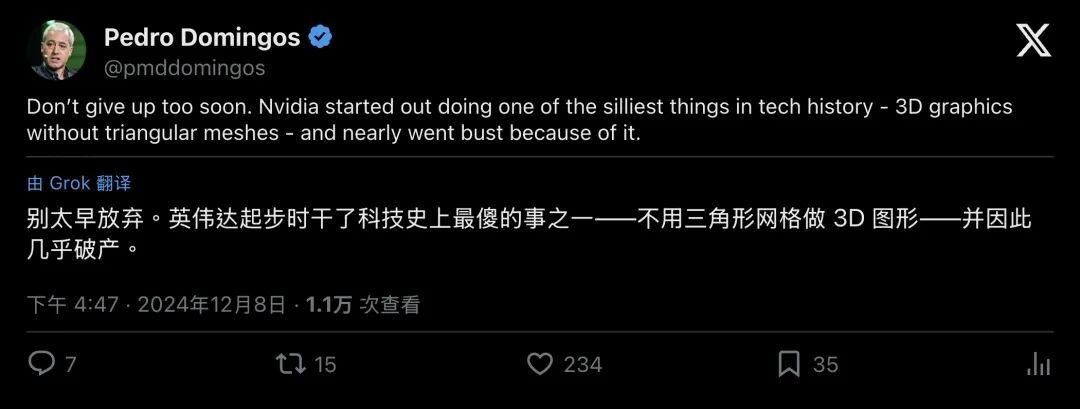
Later, Pedro Domingos, a well-known scholar in the machine learning field, summed it up bluntly on social media: “In the early days, Nvidia doing 3D graphics without triangle meshes was one of the dumbest things in the history of technology—and they almost went bankrupt because of it.”
Next came what happened: repeatedly cut, forwarded, and turned into memes on social networks—becoming one of the most talked-about startup stories of the summer of 2026.
Huang Renxun’s original words were like this:
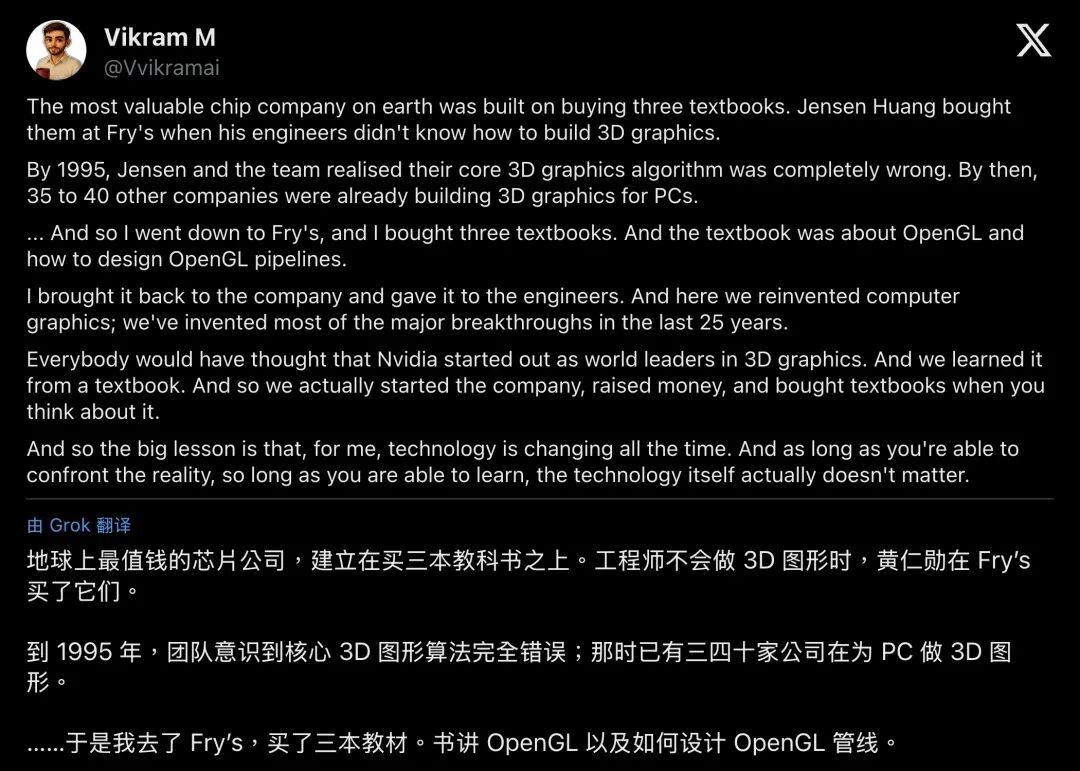
“I walked into Fry’s and bought three textbooks. The books explained OpenGL, and how to design the OpenGL pipeline. I brought the books back to the company and handed them to the engineers. Then we reinvented computer graphics from scratch.”

The name may be unfamiliar to Chinese readers, but in Silicon Valley engineer culture, it’s almost a symbol.
This electronics superstore opened its first store in Sunnyvale, California in 1985. It sold both chips and snacks, both hard drives and technical books—an offbeat spiritual home for Silicon Valley programmers to buy cables and development boards late at night.
By around 2021, it had closed a large number of stores. As a result, even the act of “going to Fry’s to buy textbooks” became a time slice that can never be replicated.
(Open Graphics Library) is a cross-platform graphics interface standard, born out of the tradition of SGI workstations. OpenGL
Huang Renxun said the books he bought didn’t just cover “how to call APIs”—they also explained how to design a graphics pipeline, from geometric transformations and clipping to rasterization, all the way to the hardware implementation logic of textures and frame buffers—an entire end-to-end pipeline.
So they pulled back from a proprietary route to the industry’s common knowledge, and filled in the foundational lesson of “how on earth to build this thing.”
Then he said the line that made everyone fall silent:
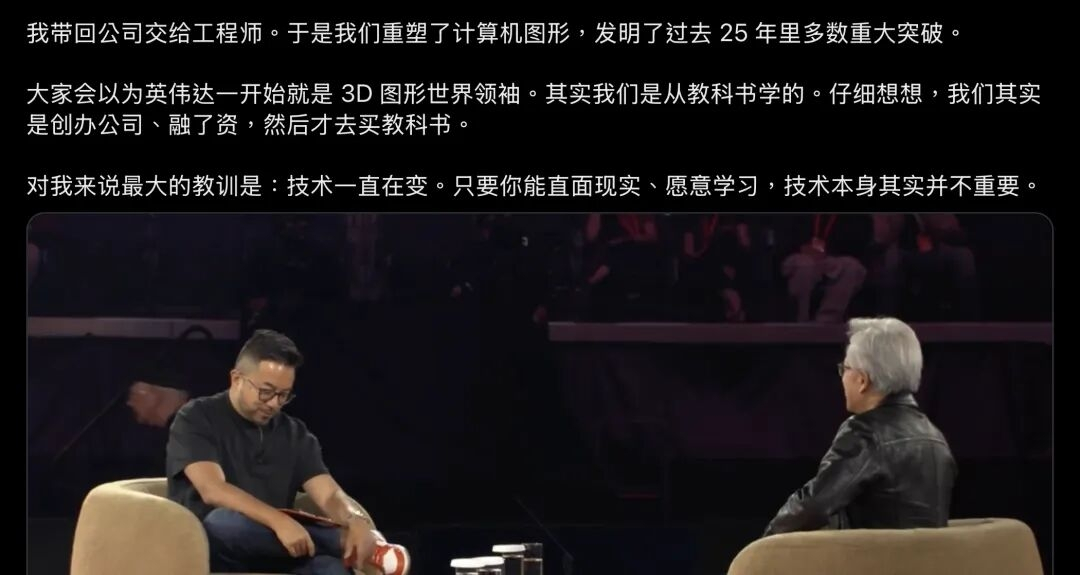
“Everyone thought Nvidia was the world leader in 3D graphics from the beginning. But actually, we learned it from textbooks. Think about it carefully—we started a company, raised funding, and then went to buy textbooks.”
“Someone should put up a sign in front of some shelf at Fry’s: ‘Spent $100 here, built modern computing.’”
Sega saved Nvidia’s life, with $5 million and a rare act of trust.
But having only textbooks wasn’t enough.
You still have to stay alive to finish reading it.
Another lifeline that came with the textbooks—equally gripping.
At the time, Nvidia had a cooperation contract with Japanese gaming giant Sega.
Huang Renxun made an extremely counterintuitive decision: he主动找到世嘉, telling them that our technical roadmap was wrong—continuing on would not only kill us, but might also drag you into the same wrong path.
Then he put forward an almost absurd request: release the contract, but still give us the money.
In most commercial scenarios, this amounts to: “I admit I’m in breach, but please charge me the penalty fee for the breach.”
However, Sega’s senior executive, Masahiro Inoue, ultimately made the final call and injected roughly $5 million into Nvidia.
Later, Huang Renxun said publicly: without that money, the company might not have existed at all.
And then after Sega went public and Nvidia sold its equity, based on publicly available information it exited with about $15 million—three times the return. A trust-based gamble, and neither side lost.
After getting the textbooks and enough lifeline funding, Nvidia began a near-suicidal sprint.
The company carried out large-scale layoffs, cutting from about 100 people to about 40—nearly 70% leaving.
All resources集中到 a single chip: RIVA 128.
This time, it fully aligned the triangle primitives with the Direct3D standard.
The team started writing drivers and running tests with simulation techniques before the chips even taped out, compressing trial-and-error costs to the limit.
Around August 1997, RIVA 128 went on sale.
Within months, sales surpassed one million
And when it shipped, according to multiple public accounts, the company’s cash on hand might have been enough to pay salaries for only one more month.
On January 22, 1999, Nvidia went public on the NASDAQ IPO.
That same year, GeForce 256 was released, and the company officially redefined itself to the world with the concept of “GPU.”
From three textbooks on the Fry’s shelves to a chip empire that defined a computing era—less than four years in between.
The line Huang Renxun distilled from this experience has been quoted again and again—and also repeatedly misunderstood:
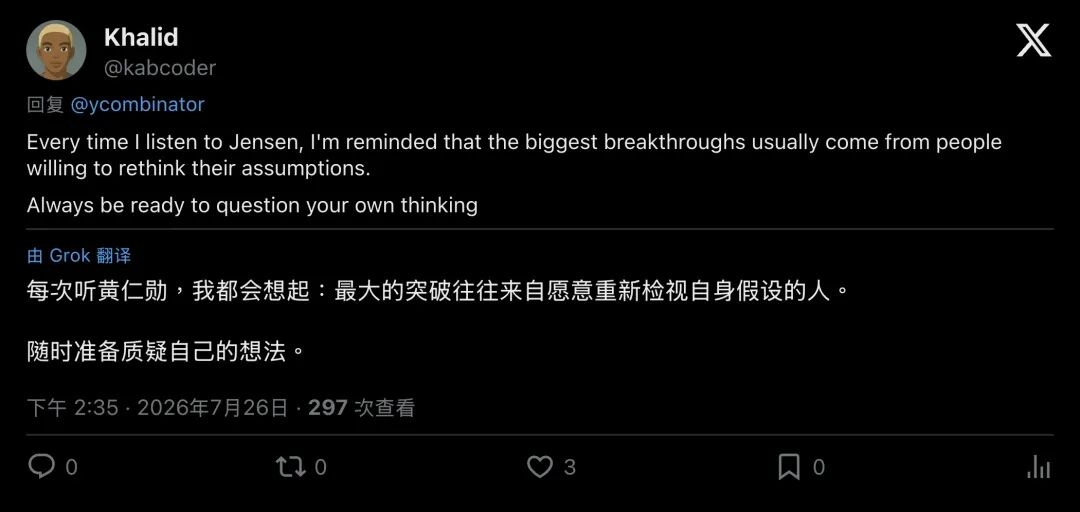
“Technology itself isn’t really the important part. The important part is whether you can face reality and whether you can learn.”
Put it back into the context of Nvidia in 1995: a company with nearly no money left on the books, a CEO walking into a superstore to buy textbooks, and engineers studying the very basics starting from Chapter 1—the technology they were supposed to master anyway. This was, at the time, the only strategy that still made sense.
In 2026, YC retold this episode, and it once again became a trending topic on social networks.
The contrast is too stark: a trillion-dollar company that today defines the direction of the industry in AI compute, autonomous driving, and robotics—its technical foundation actually came from a founder carrying just one or two hundred dollars in his pocket, and three textbooks from an electronics superstore shelf that later shut down.
But more astonishing than thirty years later is perhaps that first day: admitting you were wrong, admitting you wouldn’t—then going to buy books.
“How hard can it be?” Huang Renxun said it with a laugh at the end of the conversation. And when failed founders heard it, they could hear the weight behind the laughter—like a smile squeezed out by someone who had almost died, looking back at a cliff.