


作宇:Yash Agarwal @yashhsm
Compiled by: Joyce, BlockBeats
"Tokenization of illiquid assets will reach $16T by 2030" - BCG
In 2023, real-world tokenization gained widespread attention, earning J.P. Morgan the title of “TradFi Killer App” and being hailed as “the next generation of the market” by BlackRock CEO Larry Fink. According to DeFiLlama, RWA has become the eighth largest sector in DeFi, with a TVL of $2.4 billion.
In short, RWA can bring any off-chain financial assets to the chain. These assets can be anything from real estate to credit, treasury bills, green bonds and even commodities such as whiskey. While current solutions may seem like "putting lipstick on a pig", that is, adding unnecessary cryptographic measures, tokenization does help create and enable:
Global financial infrastructure – Cryptocurrencies are global in nature;
24/7 – always online, which is different from traditional finance;
Programmable — Once tokenized, assets can be tracked and made programmable, automating terms in financial contracts;
Composability — This makes DeFi powerful, able to interact with 10+ protocols simultaneously.
This article will take a deep dive into the Solana RWA market, introduce the various categories of RWAs and the top Solana projects in each category, and explore the future prospects of RWAs on Solana, with a particular focus on the need for RWA standards.
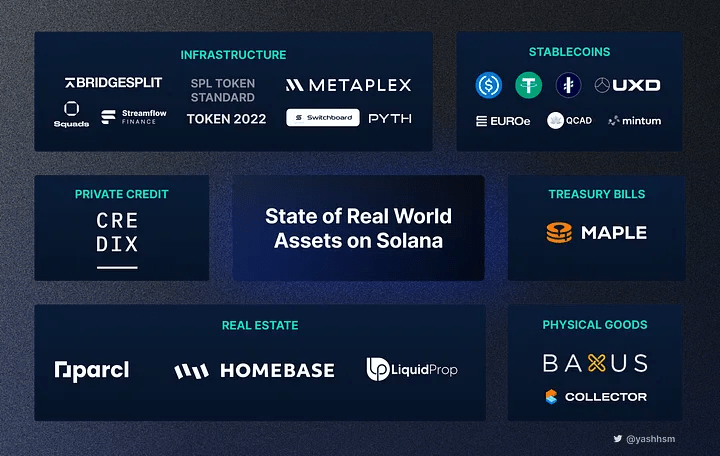
Why Solana for RWA?
Solana, like any other public chain, enhances transparency, automates payment calculations, enables self-custody of assets, and provides a global 24/7 settlement infrastructure for tokenized assets.
In addition, Solana offers the following benefits:
Low Gas Fees and High Speed: For high-frequency use cases such as tokenized FX, stocks, etc., Solana enables transactions with extremely low fees, faster settlement, and high TPS — all with a single shared global state.
Standards and Ecosystem: A healthy ecosystem of battle-tested DEXs, and strong standards such as cNFT (compressed NFT), pNFT (programmable NFT), Token 2022, etc., provide RWA with the fundamental building blocks to create and launch its product. We will dive deeper into the infrastructure available to RWA projects on Solana later in this article.
A multi-chain future with Solana as the execution layer
DeFi protocols such as lending or spot DEXs benefit from a single chain like Solana due to advantages such as shared liquidity, composability, strong chain community support, and centralized infrastructure development for the chain.
However, for RWA, being tied to a single chain may not be the most strategic choice, given that most infrastructure components are off-chain, and this approach will limit its TAM (total addressable market). It is wiser to embrace a multi-chain strategy. This can be referred to the fact that many stablecoins are currently available on multiple blockchains, and USDC is currently available on 14 blockchains.
Possible strategies include accepting user deposit funds on multiple blockchains, but actual transactions and processing are performed on a single blockchain. Take Credix as an example, it can accept deposits from multiple blockchains such as Ethereum and Solana, but its actual transactions and processing all occur on the Solana blockchain.
RWA Project on Solana
Despite the huge potential for RWA development, Solana's RWA potential is often overlooked. Unlike other DeFi fields, RWA adoption will not happen suddenly and may take 5-10 years. In this market, TAM has no clear upper limit and its value has the potential to grow exponentially.
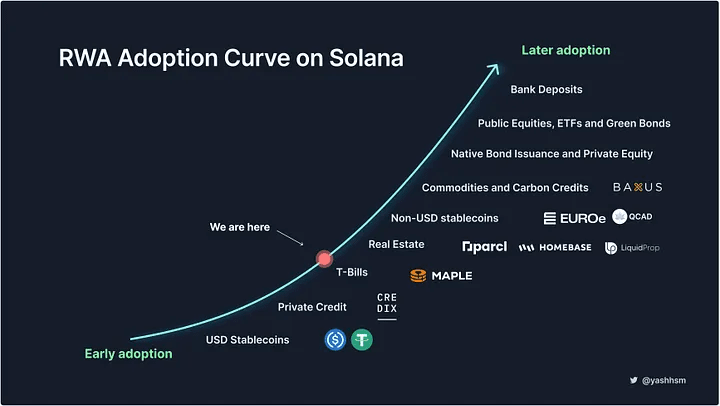
Pathways and categories of RWA adoption
Stablecoins
While stablecoins are not typically classified as real-world assets, they are the first real-world asset with significant traction whose underlying reserves are USD and Treasuries. It can also be said that stablecoins show the highest product-market fit in the RWA category. Solana has the following stablecoins:
In USD:
USDC, which is backed by dollars and Treasury securities held by U.S. banks and is custodied by BlackRock;
USDT, which is said to be backed by dollars, treasury bills, and other assets;
UXD, which is partially collateralized by RWAs such as private credit;
Bridge Wormhole DAI, backed by DAI, which in turn is partially backed by RWA.
Non-USD denominated:
QCAD, a CAD stablecoin backed by the Canadian dollar;
EUROE, a euro-backed stablecoin;
ISC, which is backed by a basket of real-world assets;
We expect to see a slew of non-USD stablecoins emerge on Solana in the coming months, along with innovation in yield-generating stablecoins.
real estate
Two major real estate companies on Solana, Parcl and Homebase, are already live and doing very well. While the two appear similar on the surface, they are very different. Homebase represents real estate on-chain, while Parcl focuses on the tokenization of real estate price indices:
Homebase: Tokenizing American Real Estate
Homebase enables anyone to invest in real estate for as little as $100 and is currently tokenizing real estate in the United States. It has sold two tokenized properties worth over $400,000 and is still in the early stages. Here’s how Homebase works:
The Homebase SPV entity acquires the property, and the NFT represents the ownership of the SPV;
Users use USDC as NFTs to purchase properties listed on Homebase;
USDC is pooled and converted into USD to purchase the property represented by the SPV;
Rental income is converted from USD to USDC, and users automatically receive monthly rental income in their wallets;
Users can buy and sell Home NFTs through the Homebase marketplace.
The best part is that Homebase is fully compliant, its token is registered with the SEC, and it has established a process for token recovery in the event that a user’s wallet is hacked. However, it is currently only available to US residents.
Parcl: Long/Short on Real Estate Index
Parcl allows anyone to invest in real estate assets for as little as $1 by providing exposure to real estate markets in cities around the world through a REIT-like index.
Think of Parcl as a company that creates real estate indices and provides price feed services. It has also developed a perpetual AMM platform to assist users in trading these indices, whether they want to go long or short. It currently has a total locked value (TVL) of over $1 million. The service is currently operational in major US cities such as Brooklyn, Las Vegas, and Paris, with exciting new cities such as London, Jakarta, and Hong Kong coming soon.
Liquidprop is another emerging player in the real estate space after Solana’s Homebase type model. It enables users to invest in tokenized residential real estate across the United States. While it’s not live yet, it will certainly be an interesting landscape when they launch.
The best part is that this market is not a winner-take-all situation. There can be 100s of real estate tokenized marketplaces on Solana without them having to compete with each other as they serve different geographies and tap into a massive industry worth over $330 trillion.
Private credit
In the TradFi world, loans that do not originate from the banking sector are classified as "Private Credit". These loans are typically short-term (30-90 days) with floating rates and involve direct lending between investment funds and corporate borrowers (usually small and medium-sized companies). It is already a significant industry, with traditional finance managing over $800 billion in assets. On-chain Private Credit is very similar to its traditional finance (TradFi) counterpart. However, it is different because it represents on-chain loans (real world assets) that allow anyone to invest using stablecoins.
To illustrate the concept of on-chain private credit, let’s look at the case of Credix Finance:
Credix Finance: A major private credit player on Solana
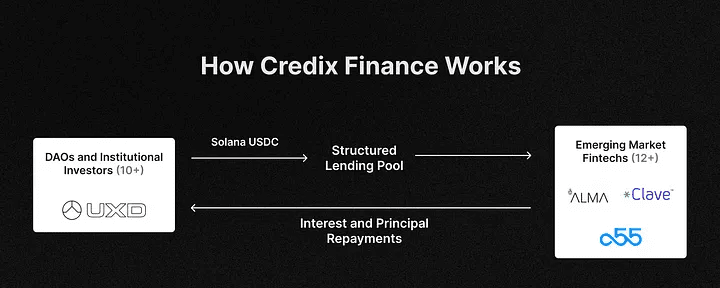
In short, Credix is a credit marketplace that connects investors with fintech companies in emerging markets. They are solving the core problem of access to untapped credit opportunities. Here’s how it works:
Investors: Invest stablecoins like USDC in a liquidity pool or a specific portion of a specific trade in the market.
Borrowers: Credix primarily works with fintech borrowers in emerging markets who borrow USDC and convert it into local currency. The local currency (e.g. Brazilian real) is then loaned out to various types of businesses.
The types of credit offered through fintech can be very diverse: trade receivables (through Clave), asset-backed auto loans (through Atria), income-based financing (through Brazil and Mexico).
Credix Finance has been growing rapidly and has issued over $40 million in private credit, generating over $4.9 million in interest. The current 90-day trailing APY is approximately 12.9%. To enhance its appeal to investors, a portion of its portfolio is also insured and reinsured.
AlloyX is another project aggregating private credit agreements for lenders looking to get on Solana.
Challenges and opportunities of private lending
While private credit tokenization is a massive untapped opportunity, solving much-needed access problems and reducing operational and monetary costs, they come with their own challenges:
Challenges of bad debts: For example, recently, Goldfinch, a platform similar to Credix on Ethereum, had a pool of funds from a fintech company called “Tugende” that provided loans to motorcycle taxi operators in Kenya. They borrowed funds under the name of “Tugende Kenya” and transferred the funds to its subsidiary “Tugende Uganda” to solve business problems. This violation of the loan agreement was discovered through quarterly reporting, highlighting the ongoing challenges in the private credit sector, which RWA has not yet addressed.
In addition, enforcement in emerging market jurisdictions such as Kenya is challenging, making bad debt recovery difficult.
Tracking off-chain data: In emerging markets, due to the lack of on-chain credit risk data or means to verify off-chain data, and the lack of a strong credit underwriting infrastructure, the RWA protocol can only rely on data provided by the borrower. It is easy to manipulate. After the loan is issued, it becomes impossible to track the loan and the borrower’s financial status because it is completely off-chain, which may lead to mishandling (such as the Tugende-Goldfinch case).
Addressing these challenges requires innovative credit structures, including:
More active risk tracking and mitigation frameworks, such as more decentralized underwriting, involving multiple professional parties (stakeholders) in risk assessment. Coordination can also take place on-chain;
Proactive post-loan payment tracking through integrations such as open banking APIs. Insurance/reinsurance (like Credix does).
U.S. Treasury Bonds
US Treasuries are the most popular RWA on-chain, with over $660M issued across all chains, and are still under active development by many participants. This is largely due to the high interest rate environment, as USD-denominated Treasuries offer a 4-5% risk-free yield. Solana is still in the early stages of Treasuries tokenization, with only one player, Maple.
Maple Finance: The First Tokenized Treasury Bond on Solana
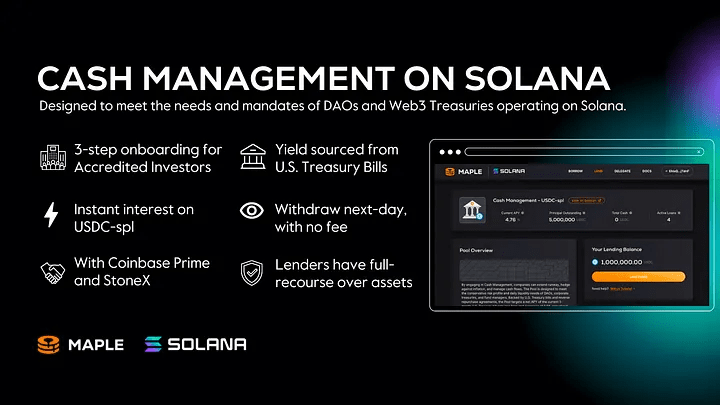
Maple Finance, one of the largest institutional capital markets in the cryptocurrency space, announced that it will return to Solana with its cash management product. In just a few days of launching the cash management product on Solana, it has attracted more than $4.2 million and is expected to continue to grow. Here is how Maple’s cash management product works:
Lenders provide USDC-SPL to the pool and receive LP tokens in exchange;
The pool issues USDC-SPL loans to Room40 Capital’s Solana wallet, and the USDC is converted to USD via Circle, which is connected to a prime brokerage firm.
Room40 is the borrower and manages the Treasury. Therefore, Maple Finance acts as a marketplace between lenders on Solana and borrowers like Room40 Capital.
With tokenized finance players like Ondo, Open Eden, and MatrixDock exploding on Ethereum, we should see many of them expand to Solana in the coming months.
Physical Goods
Any physical good, from art, trading cards, and sneakers, can be tokenized and brought onto the blockchain. The process of tokenizing physical goods is as follows:
Vaults: Physical commodities are authenticated, securely stored in vaults, and represented on-chain as NFTs or fungible tokens;
Marketplace: Users can buy, sell and transfer tokens on the marketplace;
DeFi: These on-chain assets can also be used as collateral for loans.
Also, similar to stablecoins, you can deposit your physical commodity to tokenize it, or redeem the tokenized physical commodity for the actual physical commodity. However, unlike stablecoins where the US dollar is tokenized, there is a physical commodity involved here, which requires physical delivery.
There are two fascinating players on Solana:
Founded by a whiskey trader and a software engineer, BAXUS is a secure marketplace for authenticating, storing, buying and selling wine and spirits. The bottles are tokenized while securely stored in vaults in the United States.
CollectorCrypt is a unique tokenization service that brings real-world collectibles to Solana. It’s like Courtyard, but for Solana. People can also deposit physical cards and tokenize them.
Another interesting player on Solana, Blockride, is tokenizing bus fleets and is still in the early stages. It allows users to buy a small portion of a revenue-generating bus fleet for as little as $50 and receive a percentage share of the daily revenue directly in their wallet.
RWA Infrastructure on Solana
Although most DeFi infrastructures may not be suitable for RWAs, they are constantly evolving and developing and will provide important experience and technical foundations for future financial systems.
We can categorize infrastructure as follows:
Focus on RWA such as Bridgesplit: Bridgesplit is an infrastructure platform on Solana that allows asset custodians and marketplaces to provide financing products to businesses and individuals. It started out as a platform for tokenizing off-chain assets into NFTs, and later shifted its focus to RWA. However, the Bridgesplit team has not released any major updates or versions recently. Another key infrastructure related to RWA financial management is multi-signatures such as Squads, which helps protect its on-chain collateral assets, and Streamflow for streaming payments such as bond yields.
DEX (AMM and Order Book): While it may not be immediately apparent, the ultimate goal of RWA is to trade on a DEX. DEXs are not only designed for trading meme coins; they are being rigorously tested to facilitate the trading of tokenized assets in the near future.
AMM: The main obstacle that prevents RWA from being freely traded is the lack of a “permissioned pool.” For example, an individual should be able to convert their tokenized credit positions into stablecoins through an AMM pool.
Order books: Order books are particularly well suited for RWAs that trade frequently, such as tokenized stocks and foreign exchange markets, because these assets already exist in traditional financial systems that use order books. In addition, order books can allow for tighter spreads in markets with greater liquidity. Order books are the preferred choice of most market makers because they provide flexibility to LPs (liquidity providers) and more precise control over the prices at which traders buy and sell.
Solana has a strong advantage in terms of order books. Solana is the only blockchain powered by Openbook and Phoenix that processes more than $2 million in daily volume.
Oracles: Oracles are an important source of truth for off-chain asset data and ensure proof of reserves for real-world assets. Solana has two main oracles - Pyth (permissioned) and Switchboard (permissionless) that can be used to stream off-chain data onto the Solana blockchain.
On-ramps/off-ramps: Conversions between fiat <> cryptocurrencies, especially between specific fiat currencies and their stablecoin pairs (e.g. USD <> USDC), are critical to reducing payment costs associated with RWA operations.
Bridging: In the future, bridging will play a key role in RWAs, as most RWAs will be multi-chain (native execution on multiple chains) and some may even be cross-chain (deposits are on multiple chains, while execution occurs on one chain).
While Solana has a wide range of bridges supported by Wormhole and DeBridge, it is critical to have more bridges and cross-chain token standards. One example of bridging real-world assets is Wormhole bridging CHAI (a tokenized version of the DAI Savings Rate), which allows investors on Solana to earn yield on DAI.
Token Standards
Token standards play a vital role as they enable tokenization in a secure and standard way:
SPL Token: The main token standard on Solana, representing interchangeable tokens. Just like any stablecoin, any RWA player can issue their assets as SPL tokens, with features such as dynamic supply, minting, freezing, and destruction.
Token 2022: Expanding on the original standard, Token 2022 enables additional RWA-related features:
Confidential Transfers: Allows tokens to be transferred privately; relevant for institutions seeking to hide transactions
Transfer fees: Issuers can configure transfer fees or taxes for transactions
Interest-earning tokens: Tokens that accumulate interest over time, like bonds
Non-transferable tokens: tokens cannot be transferred once issued
Metaplex Standard for NFTs: Metaplex has a set of NFT standards, such as compressed NFTs and programmable NFTs, which can also allow RWA players to represent unique assets.
While current standards cover a wide range of scenarios, the lack of RWA standards has hindered the adoption of RWAs on Solana.
Solana Needs RWA Standard
The Solana ecosystem lacks a unified, widely accepted standard for tokenizing RWA. Just as standards like the JPEG and PDF formats standardize files across different devices and facilitate content sharing on the internet, a standardized RWA standard can help improve Solana’s RWA. Think of it this way: just as Metaplex makes it easy to create NFTs, a standardized RWA token can simplify the process of creating tokenized RWA.
Dom, the founder of Homebase, started this much-needed discussion on the Solana forums, and coincidentally, I had this idea as well and prepared a flowchart for a “Permissioned RWA Token”. Here’s what I envisioned:
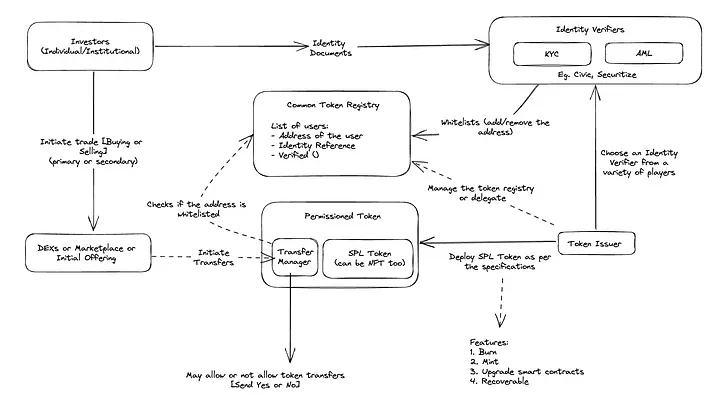
Tokenization at the asset level rather than the pool level: For example, instead of tokenizing a pool of loans issued by a fintech company, each loan issued by an Argentinian merchant will be tokenized as an individual asset, with each token representing a portion of the fund. Tokenization at the asset level allows for a more transparent representation of ownership, allowing the performance of all assets on the chain to be tracked in real time.
For example, Circle’s exposure to SVB Bank could be tracked in real time if all of Circle’s deposit balances at different banks were available on-chain at an asset level, rather than simply as “$8.4 billion of capital exposure to multiple banks” at an aggregate level.
RWA standards on other chains: It is also necessary to pay attention to existing standards such as ERC-3643 (used by Tokeny), ERC-1400 (used by Matrixport), ERC-6065 (real estate), and ERC-4626 (used by TrueFi) and incorporate best practices from them.
BD push: It is worth noting that the RWA token standard requires an initial BD push and re-iteration based on institutional needs to gain initial adoption.
Initial standard adopters could range from fintechs to RWA projects to traditional finance giants. This will also require building custom solutions and providing “hooks” type functionality for anyone to build on.
Flexible and Upgradable: All contracts must be inherently upgradeable to accommodate the changing compliance needs of asset issuers. Any asset issuer should be able to easily implement additional smart contracts to safeguard investor rights (e.g. voting, dividends, announcements).
It should also enable token recovery in the event of a wallet private key loss and maintain a transparent history of recovered tokens on the blockchain. The components of the standard should be as modular as possible so that any player can easily plug and play.
The best part is that the Solana Foundation has an RFP (Request for Proposals) to apply for grants (up to $250,000) to build out the RWA Standards Initiative. This can serve as a reference implementation for anyone building on RWA, and as the basis for a coalition of leading ecosystem RWA projects, ensuring adoption, maintenance, and long-term sustainability.
What is Solana missing compared to other ecosystems?
Although Solana’s RWA space is booming, it still falls short compared to other ecosystems. Here’s a comparison with other ecosystems:
Ethereum: Technology aside, RWA protocols crave one thing: capital. Ethereum has by far the largest capital leverage, which is why almost every RWA protocol uses Ethereum as one of its main chains.
Attracting capital from Ethereum while retaining Solana as the execution layer could be a viable option for Solana RWA.
Avalanche: Ava Labs, the company behind the Avalanche blockchain, has a core mission to “digitize all of the world’s assets,” and they’ve rightly focused on RWAs, launching initiatives like the $50 million Vista Fund to buy tokenized assets, which has attracted KKR and Soon.
An RWA fund established by the Solana Foundation (like the $10 million AI fund) could play an important role in attracting RWAs to Solana.
Solana RWA Opportunities and Trend Prediction
Explosion of tokenized treasuries: While Solana is lagging behind in the tokenized treasuries trend, we may see a lot of Solana capital locked up due to high treasury yields. If tokenized treasuries really take off, it could also lead to higher DeFi rates given the relatively shallow lending market on Solana, which I think would be a healthy sign - the convergence of TradFi and DeFi.
Projects from other ecosystems are worth keeping an eye on as they *might* expand to Solana in the near future: Ondo, Matrixport, Backed.Fi, OpenEden, etc.
Stablecoins backed by tokenized treasuries: Despite a combined market cap of $125B across all chains, with over $1.6B in stablecoins within the Solana ecosystem alone, they are currently earning 0% returns in this high-yield environment. One promising avenue for enhancing stablecoins to better serve their users is to use RWAs as a means of generating yield on stable value tokens, thereby providing returns to holders.
An emerging hot player in this category on Ethereum is Mountain Protocol, which has built a yield-bearing stablecoin.
Tokenized U.S. Stocks and Synthetic Stocks: While tokenized U.S. stocks may be legally challenging, projects like Swarm are tokenizing stocks on Polygon.
While fully supported assets are more robust, one can also create perpetual markets for real-world assets like Parcl — Solana Labs has a reference implementation for the same.
A DEX specifically for RWA: Given the demand for permissioned DEXs, a DEX specifically for RWA can enable permissioned assets to interact in a compliant manner.
For example, EVM-based DEX, Muave, a fork of Uniswap v3, requires KYC through VioletID to use DEX. Meteora, one of Solana DEX, is also launching DLMM, which focuses on use cases such as foreign exchange and RWA.
DeFi composability: The next step for RWA will involve making it composable with DeFi, which will increase the productivity of the underlying asset. For example, holders may have the opportunity to earn higher yields by tokenizing US Treasuries, offering them as collateral on DeFi lending markets, borrowing stablecoins, buying more Treasuries, and repeating the cycle.
A simple example: integrating RWA into the Solana DeFi ecosystem could create valuable new products, some of which can only exist in the crypto space through crypto-native mechanisms.
Convergence between DePIN and RWA: Solana is undoubtedly the leading chain for DePIN, thanks to projects like Helium and Hivemapper. These DePIN networks have assets like sensors, drones, and wearables that will provide real-time, highly reliable data as RWAs solve financing problems for them. We are witnessing the creation of an entirely new supply chain, covering physical, financial, and legal aspects, all driven by DePIN and RWAs.
An interesting project, Entheos, has taken the first steps in DePIN x RWA, enabling investors to finance a decentralized network of physical infrastructure (smart battery assets), which may also leverage Solana in the near future.
Credit Protocol: Circle Research recently released the Perimeter Protocol, giving developers and builders access to an audited, open-source protocol they can freely use to build unique credit applications suitable for RWA using USDC. However, this only works on the EVM; building this for Solana is a huge opportunity similar to the RWA token standard.
More assets and more markets: It goes without saying that we need more and more on-chain assets, such as solar farms (e.g. Plural Energy), precious metals (e.g. xMetals), carbon credits, corporate bonds, and possibly even uranium (Uranium308) Additionally, identifying tokenization-friendly jurisdictions such as Switzerland, UAE, Singapore, Germany, and Hong Kong could be a key advantage for RWA participants.
Tokenization will happen
We all know that tokenization of all assets will eventually happen; the question is, what is the catalyst and when? Market shifts tend to be slower than sudden, but if you ignore the signs, you will suddenly fall behind. We also need a better term to describe "RWA". TradFi calls "RWA" "risk-weighted assets", which may be confusing if we expect TradFi to enter the tokenization field.