
#staking
staking
2.1M views
7,960 Discussing
Hot
Latest

Learn how staking works and what risks to watch for when locking up $BTC . $ETH $SOL #Staking #CryptoEducation #Binance

Picture this: a single entity methodically accumulates an asset for 65 consecutive weeks without blinking, while retail traders sit on the sidelines waiting for a dip that never comes. Most investors end up chasing pumps at the local top or getting shaken out on sudden 10% drawdowns because they try to time market cycles instead of tracking structural capital flows.
A closer look at the balance sheet reveals they now hold roughly 5.07M $ETH in staking contracts, generating an estimated $335M in annualized staking rewards. On paper, it looks like an infinite yield engine that outpaces traditional treasury yields. But massive concentration like this introduces an underappreciated structural risk. When a single balance sheet holds that much validator power, any future liquidity squeeze or shift in redemption timelines could trigger systemic ripple effects across the entire $ETH ecosystem.
Staking yield provides cash flow during bull runs, yet locked supply creates an illiquidity trap if market conditions deteriorate rapidly and redemption queues back up.
Where do you think this concentration risk leads if market liquidity dries up?
#Ethereum #CryptoInvesting #Staking
A closer look at the balance sheet reveals they now hold roughly 5.07M $ETH in staking contracts, generating an estimated $335M in annualized staking rewards. On paper, it looks like an infinite yield engine that outpaces traditional treasury yields. But massive concentration like this introduces an underappreciated structural risk. When a single balance sheet holds that much validator power, any future liquidity squeeze or shift in redemption timelines could trigger systemic ripple effects across the entire $ETH ecosystem.
Staking yield provides cash flow during bull runs, yet locked supply creates an illiquidity trap if market conditions deteriorate rapidly and redemption queues back up.
Where do you think this concentration risk leads if market liquidity dries up?
#Ethereum #CryptoInvesting #Staking
Have you noticed how institutions are quietly locking up supply while retail traders keep getting chopped up trying to time short-term breakouts?
Most market participants lose money chasing green candles and missing optimal entries, simply because they lack a disciplined accumulation framework. Instead of constantly overtrading intraday volatility, studying corporate treasury playbooks reveals a far more sustainable roadmap.
BitMine just purchased another 53,501 $ETH , extending their buying streak to 65 consecutive weeks. This purchase elevates their balance sheet to 5.90M ETH, capturing roughly 4.9% of the entire circulating supply. Factoring in their 211 $BTC position, their total balance sheet value has now crossed $15.6 billion.
The critical takeaway for investors is productivity over speculation. BitMine currently stakes 5.07M ETH, turning their reserve into an estimated $335 million in annualized cash flow. Replicating this strategy comes down to two actionable steps: establish a strict dollar-cost averaging schedule to remove emotion, and delegate productive assets into native staking to compound returns across cycle downturns.
Where do you think corporate treasury allocations head from here?
#Ethereum #CryptoInvesting #Staking
Most market participants lose money chasing green candles and missing optimal entries, simply because they lack a disciplined accumulation framework. Instead of constantly overtrading intraday volatility, studying corporate treasury playbooks reveals a far more sustainable roadmap.
BitMine just purchased another 53,501 $ETH , extending their buying streak to 65 consecutive weeks. This purchase elevates their balance sheet to 5.90M ETH, capturing roughly 4.9% of the entire circulating supply. Factoring in their 211 $BTC position, their total balance sheet value has now crossed $15.6 billion.
The critical takeaway for investors is productivity over speculation. BitMine currently stakes 5.07M ETH, turning their reserve into an estimated $335 million in annualized cash flow. Replicating this strategy comes down to two actionable steps: establish a strict dollar-cost averaging schedule to remove emotion, and delegate productive assets into native staking to compound returns across cycle downturns.
Where do you think corporate treasury allocations head from here?
#Ethereum #CryptoInvesting #Staking

Picture this: ETH keeps quietly disappearing from the liquid market while most traders are still staring at the next candle.
The pain is familiar. People chase $ETH after a breakout, panic on a pullback, and miss the bigger supply story happening underneath the chart.
Here’s the case study: when more ETH moves into staking and cold storage, it becomes harder to sell quickly. That means less immediate sell-side liquidity sitting on exchanges, which can create a more constructive setup if demand holds steady or rises.
We’ve seen versions of this before with $BTC during long accumulation phases: coins move off liquid venues, short-term supply tightens, and price reactions can become sharper when buyers step in. The difference with $ETH is staking adds another layer, because holders are not just storing coins, they are earning yield while reducing active float.
This does not mean price only goes up. It means the market structure changes. For traders comparing $ETH with assets like $SOL , the key question is whether demand can meet a shrinking liquid supply without turning into late FOMO.
What’s your take on ETH’s supply squeeze from here?
#Ethereum #Staking #CryptoMarkets
The pain is familiar. People chase $ETH after a breakout, panic on a pullback, and miss the bigger supply story happening underneath the chart.
Here’s the case study: when more ETH moves into staking and cold storage, it becomes harder to sell quickly. That means less immediate sell-side liquidity sitting on exchanges, which can create a more constructive setup if demand holds steady or rises.
We’ve seen versions of this before with $BTC during long accumulation phases: coins move off liquid venues, short-term supply tightens, and price reactions can become sharper when buyers step in. The difference with $ETH is staking adds another layer, because holders are not just storing coins, they are earning yield while reducing active float.
This does not mean price only goes up. It means the market structure changes. For traders comparing $ETH with assets like $SOL , the key question is whether demand can meet a shrinking liquid supply without turning into late FOMO.
What’s your take on ETH’s supply squeeze from here?
#Ethereum #Staking #CryptoMarkets

If you're still ignoring what happens when $ETH gets locked up in staking and cold storage, stop now.
The real pain in crypto is not just buying the wrong coin. It is chasing candles, getting shaken out, and then watching price move after the liquid supply is already gone. That is how traders end up donating to the market.
More ETH moving into staking and cold storage means less immediate sell-side liquidity, and that matters. It is the same kind of setup people watched in $BTC when supply on exchanges kept thinning, except ETH has its own twist with staking yield and a different holder base. Less float, more conviction, fewer easy exits for sellers.
Compared with $SOL or other high-beta names, ETH looks less like a pure momentum trade and more like a supply squeeze waiting for demand to show up. The market loves to front-run narratives, but it often underprices simple mechanics like locked supply. What’s your take on where this goes next?
#ETH #Crypto #Staking
The real pain in crypto is not just buying the wrong coin. It is chasing candles, getting shaken out, and then watching price move after the liquid supply is already gone. That is how traders end up donating to the market.
More ETH moving into staking and cold storage means less immediate sell-side liquidity, and that matters. It is the same kind of setup people watched in $BTC when supply on exchanges kept thinning, except ETH has its own twist with staking yield and a different holder base. Less float, more conviction, fewer easy exits for sellers.
Compared with $SOL or other high-beta names, ETH looks less like a pure momentum trade and more like a supply squeeze waiting for demand to show up. The market loves to front-run narratives, but it often underprices simple mechanics like locked supply. What’s your take on where this goes next?
#ETH #Crypto #Staking

🚨 Ethereum staking faces a 36-day activation backlog, delaying rewards for new depositors. With a 256 ETH-per-epoch gate, over $350k in daily rewards is effectively locked out. This bottleneck reduces net yield and may deter fresh staking inflows until cleared.
What happens when the queue finally clears?
#Staking
$ETH #TradingSignal #CryptoAnalysis
What happens when the queue finally clears?
#Staking
$ETH #TradingSignal #CryptoAnalysis


🔒 BINANCE $BNB STAKING: EARN REWARDS WITH YOUR CRYPTO! 💰
Staking is gaining attention as crypto users look for ways to potentially earn rewards while supporting blockchain networks.
💎 Stake supported assets
📈 Potential staking rewards
🔄 Different lock-up periods may be available
⚠️ Rewards and terms can vary, and crypto prices can be highly volatile $BTC
Always check the current APR/APY, lock-up period, and risks before staking.
Would you stake your crypto for long-term rewards? 👀$BTC
#Binance #Staking #BTC #BNB #CryptoNews
Staking is gaining attention as crypto users look for ways to potentially earn rewards while supporting blockchain networks.
💎 Stake supported assets
📈 Potential staking rewards
🔄 Different lock-up periods may be available
⚠️ Rewards and terms can vary, and crypto prices can be highly volatile $BTC
Always check the current APR/APY, lock-up period, and risks before staking.
Would you stake your crypto for long-term rewards? 👀$BTC
#Binance #Staking #BTC #BNB #CryptoNews

Understated feature: Staking on Binance lets you lock your crypto (BNB, DOT, MATIC and many others) for a chosen duration and receive regular rewards, with nothing else to do. The longer the duration, the higher the return. This is one of the simplest ways to put your crypto to work outside of trading periods. Are you already staking some of your cryptocurrencies outside of active periods? #Binance #Staking

Most people think that huge staking cash flow is always a safe sign of growth, but in reality, what lies behind it carries very significant liquidity risk. Most small investors tend to FOMO in at the top alongside large organizations, then get stuck with capital for months without understanding how the asset-locking mechanism actually works when the market reverses.
This company has just completed a streak of 65 consecutive weeks of accumulating $ETH , raising the amount of locked assets in the network to around 5.07M tokens. This figure is estimated to generate annual staking revenue of about 335 million USD, creating the impression of a perfect passive income “money-printing machine” with no drawbacks.
However, when an entity holds such a large portion of the staking supply, the risk of centralization and withdrawal-queue congestion becomes a slow-burn bomb if an unexpected market liquidation event occurs on $BTC and other layer-1 ecosystems such as $SOL . Withdrawing a massive amount of assets from validators always takes time, and during a rapid price crash, you could very well become the last person to bear the liquidity burden for big players.
Is concentrating too much of the supply into a few institutional staking entities making the network more vulnerable when the market experiences sharp fluctuations?
#Ethereum #Staking #CryptoRisks
This company has just completed a streak of 65 consecutive weeks of accumulating $ETH , raising the amount of locked assets in the network to around 5.07M tokens. This figure is estimated to generate annual staking revenue of about 335 million USD, creating the impression of a perfect passive income “money-printing machine” with no drawbacks.
However, when an entity holds such a large portion of the staking supply, the risk of centralization and withdrawal-queue congestion becomes a slow-burn bomb if an unexpected market liquidation event occurs on $BTC and other layer-1 ecosystems such as $SOL . Withdrawing a massive amount of assets from validators always takes time, and during a rapid price crash, you could very well become the last person to bear the liquidity burden for big players.
Is concentrating too much of the supply into a few institutional staking entities making the network more vulnerable when the market experiences sharp fluctuations?
#Ethereum #Staking #CryptoRisks


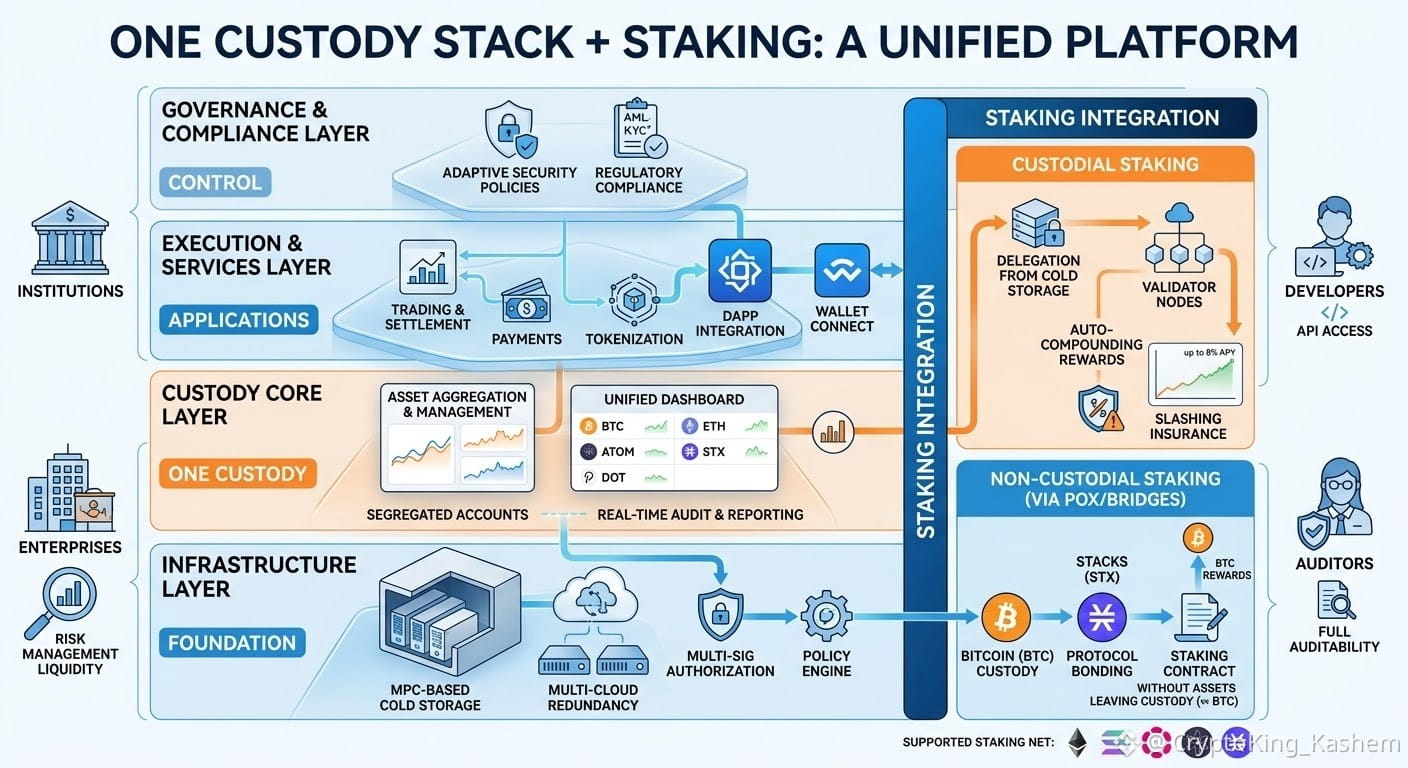
One Custody Stack + Staking? 👀
If a fund already holds a large $BTC or $ETH position with Coinbase Prime, the idea of moving those assets to another staking provider just to earn yield creates an obvious question:
Why add another counterparty and another security layer if you don’t have to?
Coinbase’s institutional staking product keeps staking within the same custody stack, with institutional-grade security, multi-region infrastructure, 24/7 support, and support for 15+ networks including $ETH , SOL, ADA, ATOM, AVAX and more.
What caught my attention is the focus on earning staking rewards without moving custody elsewhere. That could be a meaningful consideration for institutions managing large crypto positions.
Of course, there are still details to check — reward reporting isn’t available for every supported asset, and investors should understand the risks and terms before making any decision.
Personally, I think the bigger question is:
Would you rather keep your $BTC /$ETH in one trusted custody stack while earning yield, or move it to a separate staking provider? 🤔
Drop your opinion below 👇
DYOR. Not financial advice.
#BTC #ETH #Staking #Crypto #BinanceSquare
If a fund already holds a large $BTC or $ETH position with Coinbase Prime, the idea of moving those assets to another staking provider just to earn yield creates an obvious question:
Why add another counterparty and another security layer if you don’t have to?
Coinbase’s institutional staking product keeps staking within the same custody stack, with institutional-grade security, multi-region infrastructure, 24/7 support, and support for 15+ networks including $ETH , SOL, ADA, ATOM, AVAX and more.
What caught my attention is the focus on earning staking rewards without moving custody elsewhere. That could be a meaningful consideration for institutions managing large crypto positions.
Of course, there are still details to check — reward reporting isn’t available for every supported asset, and investors should understand the risks and terms before making any decision.
Personally, I think the bigger question is:
Would you rather keep your $BTC /$ETH in one trusted custody stack while earning yield, or move it to a separate staking provider? 🤔
Drop your opinion below 👇
DYOR. Not financial advice.
#BTC #ETH #Staking #Crypto #BinanceSquare
Staking Basics How It Works and Key Risks to Watch This video was produced with AI assistance it is not financial advice. Always do your own research DYOR . $ETH $SOL #Staking #CryptoEducation #CryptoTips
Why is everyone still treating $ETH treasury accumulation like a sideshow when the numbers are already telling the real story?
Most traders lose money because they chase headlines, buy FOMO candles, and then panic when momentum cools off. They miss the part that actually matters: who is accumulating, who is staking, and how much supply is getting locked away.
This company is now 97% of the way to its 5% ETH goal, and it has already staked around 87% of its holdings. That is not passive balance sheet management. That is a clear signal that the smart play in $ETH is not just holding spot, but putting capital to work while supply tightens.
The actionable takeaway is simple. Watch the accumulation targets, not the noise. Track staking ratios, not just price. And when a treasury keeps buying, keep your entries disciplined instead of chasing every $BTC -led move or every short-term dip in $ETH .
Where do you think this goes from here? #ETH #Crypto #Staking
Most traders lose money because they chase headlines, buy FOMO candles, and then panic when momentum cools off. They miss the part that actually matters: who is accumulating, who is staking, and how much supply is getting locked away.
This company is now 97% of the way to its 5% ETH goal, and it has already staked around 87% of its holdings. That is not passive balance sheet management. That is a clear signal that the smart play in $ETH is not just holding spot, but putting capital to work while supply tightens.
The actionable takeaway is simple. Watch the accumulation targets, not the noise. Track staking ratios, not just price. And when a treasury keeps buying, keep your entries disciplined instead of chasing every $BTC -led move or every short-term dip in $ETH .
Where do you think this goes from here? #ETH #Crypto #Staking


If you're still treating corporate $ETH accumulation like background noise, stop now.
A lot of traders lose money because they only wake up after the headline candle. By then, the easy entry is gone and everyone is suddenly an “early believer.”
This company is now 97% of the way toward its goal of holding 5% of all $ETH . Even more interesting, around 87% of its holdings are already staked, which means this is not just a treasury flex. It is yield strategy, supply squeeze narrative, and long-term conviction rolled into one.
We have seen versions of this movie before with $BTC treasury plays. The difference is ETH can be productive while it sits there, which makes the comparison with passive balance-sheet Bitcoin much more interesting. The question is whether this becomes a new corporate playbook, or just another cycle-specific flex.
Does staked $ETH on corporate balance sheets become the next serious treasury trend, or are markets already pricing the story too aggressively?
#Ethereum #Staking #CryptoInvesting
A lot of traders lose money because they only wake up after the headline candle. By then, the easy entry is gone and everyone is suddenly an “early believer.”
This company is now 97% of the way toward its goal of holding 5% of all $ETH . Even more interesting, around 87% of its holdings are already staked, which means this is not just a treasury flex. It is yield strategy, supply squeeze narrative, and long-term conviction rolled into one.
We have seen versions of this movie before with $BTC treasury plays. The difference is ETH can be productive while it sits there, which makes the comparison with passive balance-sheet Bitcoin much more interesting. The question is whether this becomes a new corporate playbook, or just another cycle-specific flex.
Does staked $ETH on corporate balance sheets become the next serious treasury trend, or are markets already pricing the story too aggressively?
#Ethereum #Staking #CryptoInvesting

Picture this: while retail traders were busy chasing speculative swings, one institutional player quietly executed a massive treasury playbook.
Most investors struggle with sitting on idle capital, constantly agonizing over exact exit timing while inflation chips away at their purchasing power during sideways markets.
The company is now 97% of the way toward its 5% $ETH accumulation goal, but the real narrative lies in what happens next. Instead of letting assets sit dormant in cold storage like traditional $BTC balance sheet reserves, they have already staked roughly 87% of their entire position.
This pivot creates a self-compounding yield flywheel that contrasts sharply with old corporate treasury models. While standard funds depend purely on spot appreciation, locking up vast amounts of $ETH for staking rewards simultaneously dries up liquid market supply and generates steady passive flow.
Do you think institutional yield generation will become the standard playbook over passive holding?
#Ethereum #CryptoTreasury #Staking
Most investors struggle with sitting on idle capital, constantly agonizing over exact exit timing while inflation chips away at their purchasing power during sideways markets.
The company is now 97% of the way toward its 5% $ETH accumulation goal, but the real narrative lies in what happens next. Instead of letting assets sit dormant in cold storage like traditional $BTC balance sheet reserves, they have already staked roughly 87% of their entire position.
This pivot creates a self-compounding yield flywheel that contrasts sharply with old corporate treasury models. While standard funds depend purely on spot appreciation, locking up vast amounts of $ETH for staking rewards simultaneously dries up liquid market supply and generates steady passive flow.
Do you think institutional yield generation will become the standard playbook over passive holding?
#Ethereum #CryptoTreasury #Staking





Crypto for Advisors: Ethereum staking is evolving in 2026 — more liquid staking options, smarter risk controls, and broader validator access are reshaping advisory playbooks. Staking ETH is no longer just about yield—it's a multi‑dimensional tool for liquidity, governance participation, and risk-adjusted returns. #Ethereum #Staking $ETH


Passive income gains strategy
💰 Maximize your crypto earnings with passive income tools
Active trading isn’t the only option to grow your assets on Binance. For those who prefer a calmer approach, decentralized finance and savings tools offer excellent alternatives. ⚙️
🚀 Binance Earn: Lets you lock certain tokens to generate daily interest (Flexible or locked staking).
🌾 Launchpool: Perfect for accumulating new tokens for free by temporarily staking your BNB or FDUSD.
This is a great strategy to accumulate over the long term without the stress of live charts.
#PassiveIncome #BNBLUNCPOOL #BNB #Staking
💰 Maximize your crypto earnings with passive income tools
Active trading isn’t the only option to grow your assets on Binance. For those who prefer a calmer approach, decentralized finance and savings tools offer excellent alternatives. ⚙️
🚀 Binance Earn: Lets you lock certain tokens to generate daily interest (Flexible or locked staking).
🌾 Launchpool: Perfect for accumulating new tokens for free by temporarily staking your BNB or FDUSD.
This is a great strategy to accumulate over the long term without the stress of live charts.
#PassiveIncome #BNBLUNCPOOL #BNB #Staking
🚨 A new Ethereum staking deposit proposal could reshape validator participation by enabling future key formats—though signature replacement still needs separate upgrades. This may lower entry barriers and diversify staking infrastructure over time. Watch for how this impacts long-term ETH supply dynamics and validator decentralization.
What does this mean for the future of ETH staking accessibility?
#Staking
$ETH #TradingSignal #CryptoAnalysis
What does this mean for the future of ETH staking accessibility?
#Staking
$ETH #TradingSignal #CryptoAnalysis

Log in to explore more content