
Z E R I O N
520 Posts

Z E R I O N
Report
Block User
CRYPTO LOVER
Open Trade
Occasional Trader
8.7 Months
2 Following
7.9K+ Followers
1.2K+ Liked
Posts
Portfolio
·
--
See translation
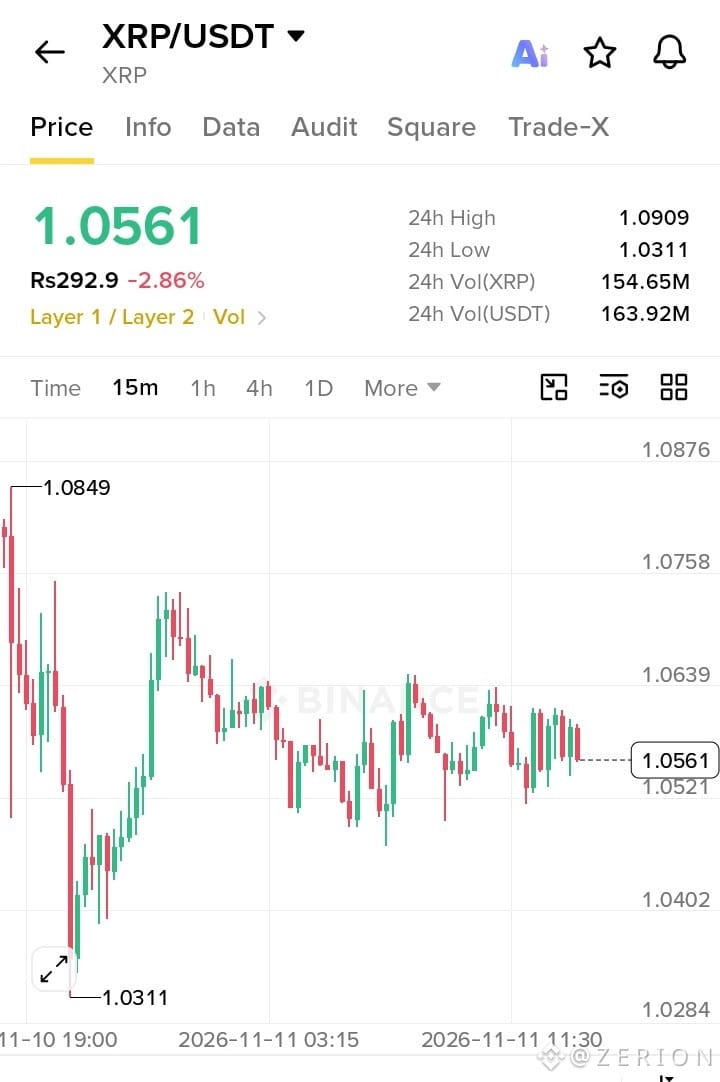
🚀 $XRP /USDT — LONG SIGNAL 🟢
💰 Entry: $1.0560 – $1.0580
🎯 TP1: $1.0640
🎯 TP2: $1.0700
🎯 TP3: $1.0750
🛑 Stop Loss: $1.0510
📈 Bias: Bullish — Watch for breakout confirmation!
⚡
$LAB
{future}(LABUSDT)
$INIT
{spot}(INITUSDT)
#AnthropicRejectsIPODelayValuationinQuestion #CanNvidiaEarningsEaseMarketConcerns? #DeutscheBankLaunchesDigitalAssetCustodyForBTCETH #TrumpMediaAdds1510BTCInQ3 #ADPWeeklyEstimateShowsUSPrivatePayrollsUp19750
🚀 $XRP /USDT — LONG SIGNAL 🟢
💰 Entry: $1.0560 – $1.0580
🎯 TP1: $1.0640
🎯 TP2: $1.0700
🎯 TP3: $1.0750
🛑 Stop Loss: $1.0510
📈 Bias: Bullish — Watch for breakout confirmation!
⚡
$LAB
$INIT
#AnthropicRejectsIPODelayValuationinQuestion #CanNvidiaEarningsEaseMarketConcerns? #DeutscheBankLaunchesDigitalAssetCustodyForBTCETH #TrumpMediaAdds1510BTCInQ3 #ADPWeeklyEstimateShowsUSPrivatePayrollsUp19750
2
371
·
--
See translation
Kite is interesting to me because it looks beyond the current AI assistant model.
The next step isn’t just making agents smarter—it’s giving them the infrastructure to actually operate. An agent that can understand a goal, discover useful options, coordinate with other agents, and interact with digital services could become much more than a chatbot.
That’s where I think the agent economy gets really interesting.
Instead of humans connecting every step manually, agents could eventually handle parts of the process themselves while still operating within user-defined rules and permissions.
What I like about Kite is this focus on the infrastructure behind that shift. The real challenge isn’t creating one impressive AI demo; it’s building an environment where agents can reliably interact, collaborate, and create useful outcomes.
We’re still early, but I’m watching closely because the projects building this foundation today could shape how autonomous agents participate in tomorrow’s digital economy.
#KiteBBW $KITE
{spot}(KITEUSDT)
Kite is interesting to me because it looks beyond the current AI assistant model.
The next step isn’t just making agents smarter—it’s giving them the infrastructure to actually operate. An agent that can understand a goal, discover useful options, coordinate with other agents, and interact with digital services could become much more than a chatbot.
That’s where I think the agent economy gets really interesting.
Instead of humans connecting every step manually, agents could eventually handle parts of the process themselves while still operating within user-defined rules and permissions.
What I like about Kite is this focus on the infrastructure behind that shift. The real challenge isn’t creating one impressive AI demo; it’s building an environment where agents can reliably interact, collaborate, and create useful outcomes.
We’re still early, but I’m watching closely because the projects building this foundation today could shape how autonomous agents participate in tomorrow’s digital economy.
#KiteBBW $KITE

1
213
·
--
See translation
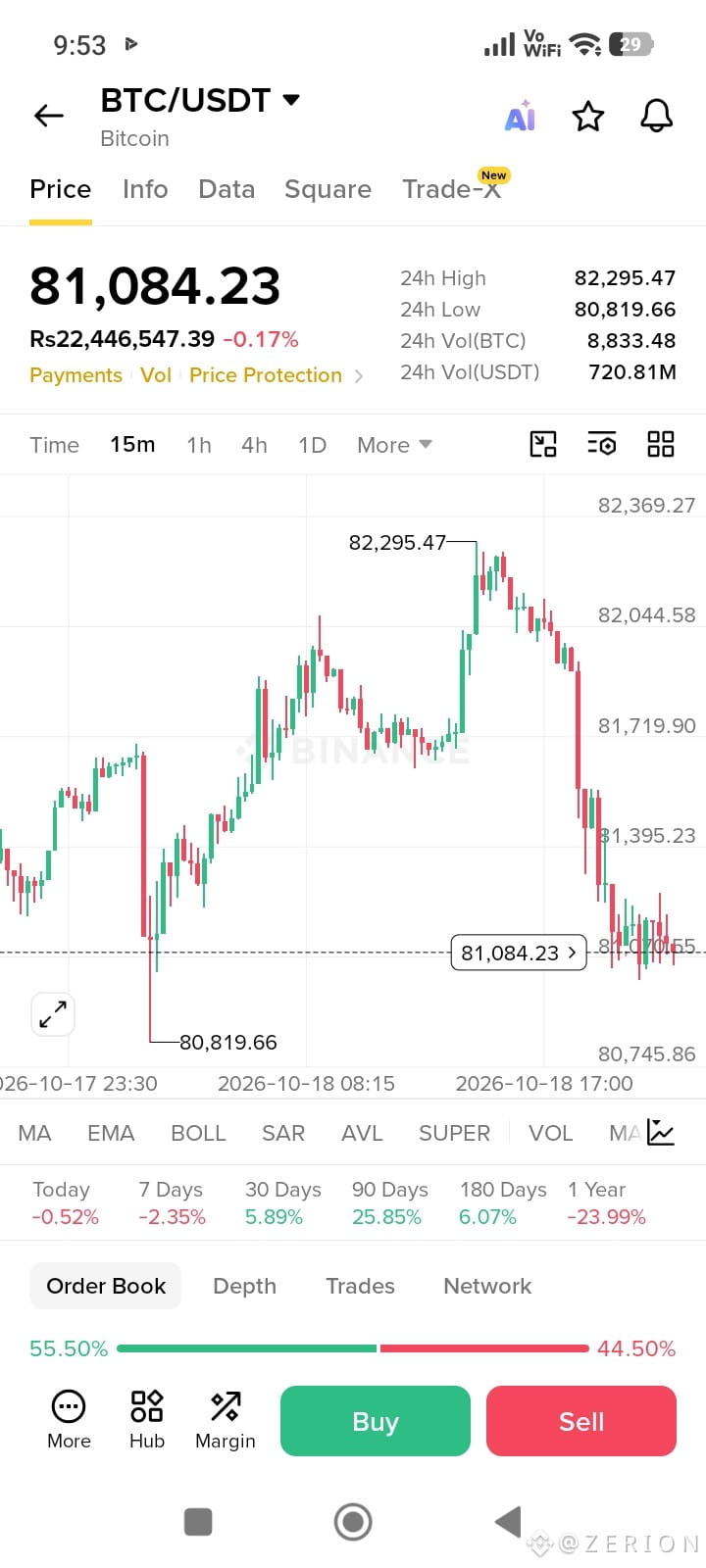
📊 $BTC /USDT — SHORT SIGNAL 🔴
💰 Entry: $81,100–$81,250 🎯 TP1: $80,900 🎯 TP2: $80,820 🎯 TP3: $80,650 🛑 SL: $81,450
⚠️ Wait for confirmation. Trade with proper risk management.
$BTC
{spot}(BTCUSDT)
#GrayscaleAndRepublicLaunchThreeCryptoFunds #ElSalvadorBitcoinHoldingsSurpass7800BTC #CelestiaRises16%To2026High #StrategySharesFall9%OnFriday #USPPIRises6.3%YearOverYear
📊 $BTC /USDT — SHORT SIGNAL 🔴
💰 Entry: $81,100–$81,250 🎯 TP1: $80,900 🎯 TP2: $80,820 🎯 TP3: $80,650 🛑 SL: $81,450
⚠️ Wait for confirmation. Trade with proper risk management.
$BTC
#GrayscaleAndRepublicLaunchThreeCryptoFunds #ElSalvadorBitcoinHoldingsSurpass7800BTC #CelestiaRises16%To2026High #StrategySharesFall9%OnFriday #USPPIRises6.3%YearOverYear
1
257
·
--
See translation
I’ve been watching TermMax more closely lately, especially because the project is moving past the “interesting DeFi primitive” stage and into a much more consequential phase.
The core idea still makes sense to me: instead of accepting whatever floating rate the market gives you, TermMax lets users lock borrowing or lending terms to a defined maturity. Under the hood, its fixed-rate tokens separate principal and interest, while range orders form the pricing curve for each market. That sounds simple on the surface, but it changes how liquidity has to behave. Capital can sit unused, rates can be mispriced, and liquidity providers can end up being the ones paying for being too optimistic. TermMax openly lists those risks rather than pretending fixed-rate DeFi removes them.
What caught my attention more recently is how quickly the product is expanding. V2 now brings markets and orders across multiple chains into one interface, while TermMax is pushing into tokenized equities, RWA collateral, options-style products and institutional fixed-rate infrastructure through TermPrime.
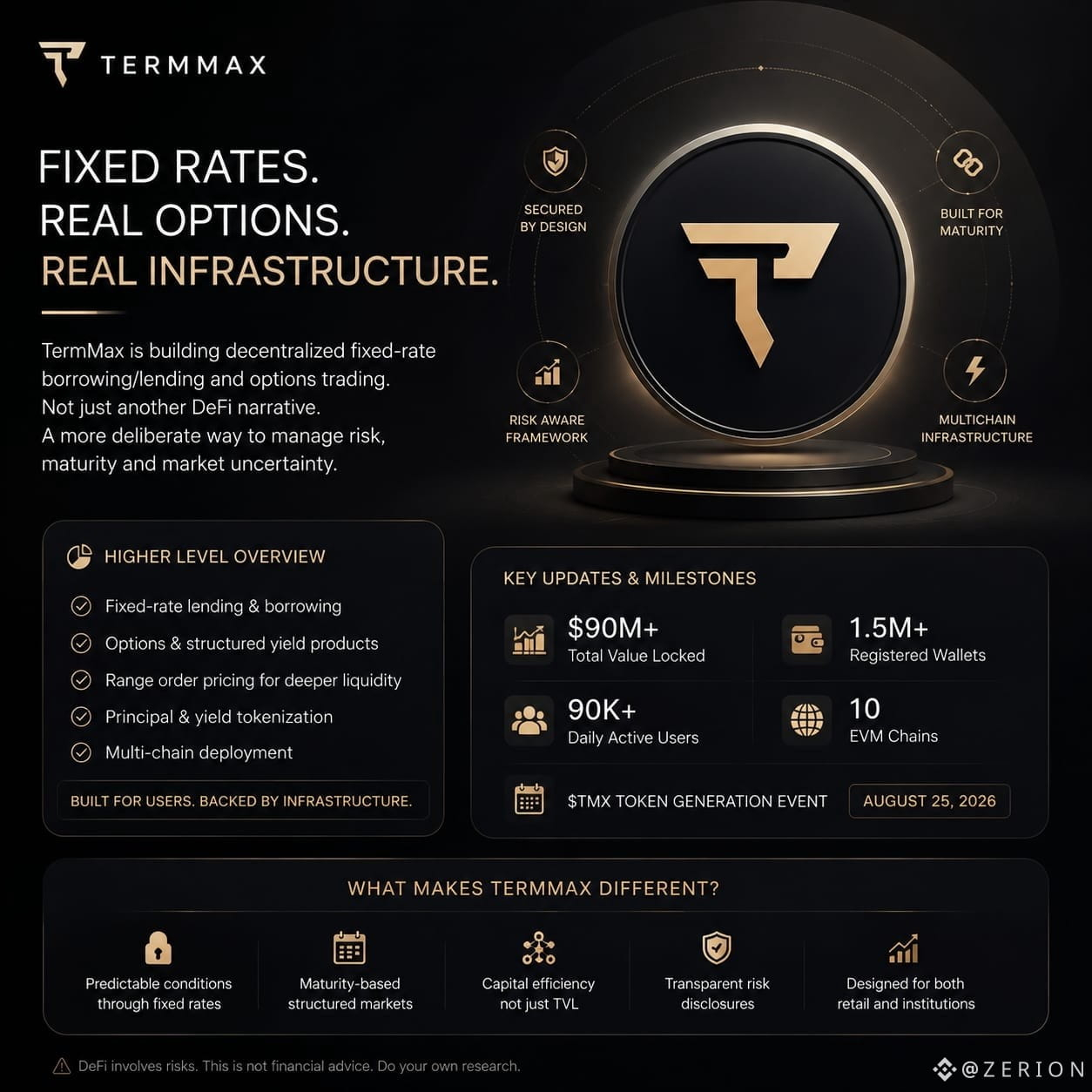
And then there’s $TMX. The team has announced August 25, 2026 as the TGE, with the latest announcement claiming $90M+ TVL, 1.5M+ registered wallets, 90K+ daily active users and deployment across 10 EVM chains.
That’s the part I’m watching carefully.
Crypto has taught me that growth right before a token launch can look very different from durable demand afterward. I’m less interested in the numbers today than in what survives when incentives become less generous.
TermMax feels more mature than many recycled “fixed yield” narratives I’ve seen, but maturity still has to be proven under stress.
That’s where I’ll be paying attention
#termmax @termmax
I’ve been watching TermMax more closely lately, especially because the project is moving past the “interesting DeFi primitive” stage and into a much more consequential phase.
The core idea still makes sense to me: instead of accepting whatever floating rate the market gives you, TermMax lets users lock borrowing or lending terms to a defined maturity. Under the hood, its fixed-rate tokens separate principal and interest, while range orders form the pricing curve for each market. That sounds simple on the surface, but it changes how liquidity has to behave. Capital can sit unused, rates can be mispriced, and liquidity providers can end up being the ones paying for being too optimistic. TermMax openly lists those risks rather than pretending fixed-rate DeFi removes them.
What caught my attention more recently is how quickly the product is expanding. V2 now brings markets and orders across multiple chains into one interface, while TermMax is pushing into tokenized equities, RWA collateral, options-style products and institutional fixed-rate infrastructure through TermPrime.
And then there’s $TMX. The team has announced August 25, 2026 as the TGE, with the latest announcement claiming $90M+ TVL, 1.5M+ registered wallets, 90K+ daily active users and deployment across 10 EVM chains.
That’s the part I’m watching carefully.
Crypto has taught me that growth right before a token launch can look very different from durable demand afterward. I’m less interested in the numbers today than in what survives when incentives become less generous.
TermMax feels more mature than many recycled “fixed yield” narratives I’ve seen, but maturity still has to be proven under stress.
That’s where I’ll be paying attention
#termmax @TermMax
3
3
247
·
--
Verified
See translation
I keep coming back to TermMax for a reason that has little to do with the usual DeFi pitch.
After watching enough cycles, I’ve learned that “fixed rate” sounds boring until you actually need certainty. Variable borrowing works beautifully when markets are calm. Then volatility arrives, rates move, liquidity gets thin, and suddenly the cost of a position looks very different from the number you started with.
TermMax is taking a more deliberate route: fixed-rate, fixed-term markets, with V2 moving away from the old LP-token model toward order-based liquidity and customizable trading curves. It also adds ERC-4626 vaults, so capital can be allocated across different markets instead of sitting inside one simple pool.
That part interests me more than the headline.
Because the real problem with fixed-rate DeFi has never just been creating a fixed rate. It’s liquidity. Different maturities, collateral types and rates naturally fragment the market. TermMax seems to be experimenting with architecture that makes that fragmentation easier to manage.
I’m still cautious. Fixed terms create their own friction. Capital gets tied up, exits aren’t always convenient, and smart-contract or collateral risk doesn’t disappear just because the interest rate is predictable.
But maybe that’s exactly why I’m watching.
Crypto spent years optimizing for “more.” More leverage, more yield, more speed.
I’m starting to pay more attention to protocols trying to make financial decisions a little more predictable.
#termmax @termmax
I keep coming back to TermMax for a reason that has little to do with the usual DeFi pitch.
After watching enough cycles, I’ve learned that “fixed rate” sounds boring until you actually need certainty. Variable borrowing works beautifully when markets are calm. Then volatility arrives, rates move, liquidity gets thin, and suddenly the cost of a position looks very different from the number you started with.
TermMax is taking a more deliberate route: fixed-rate, fixed-term markets, with V2 moving away from the old LP-token model toward order-based liquidity and customizable trading curves. It also adds ERC-4626 vaults, so capital can be allocated across different markets instead of sitting inside one simple pool.
That part interests me more than the headline.
Because the real problem with fixed-rate DeFi has never just been creating a fixed rate. It’s liquidity. Different maturities, collateral types and rates naturally fragment the market. TermMax seems to be experimenting with architecture that makes that fragmentation easier to manage.
I’m still cautious. Fixed terms create their own friction. Capital gets tied up, exits aren’t always convenient, and smart-contract or collateral risk doesn’t disappear just because the interest rate is predictable.
But maybe that’s exactly why I’m watching.
Crypto spent years optimizing for “more.” More leverage, more yield, more speed.
I’m starting to pay more attention to protocols trying to make financial decisions a little more predictable.
#termmax @TermMax

1
1
157
·
--
Verified
See translation
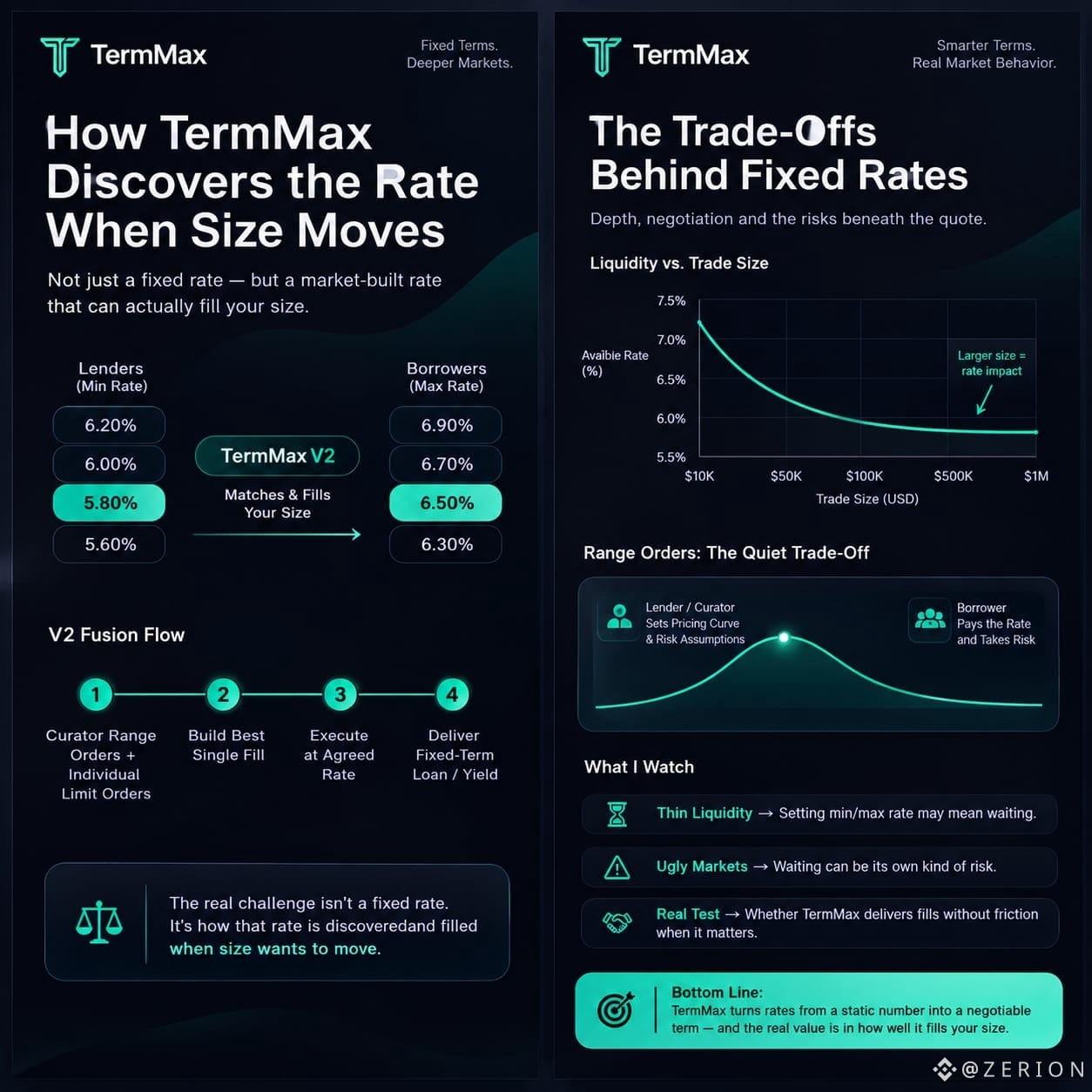
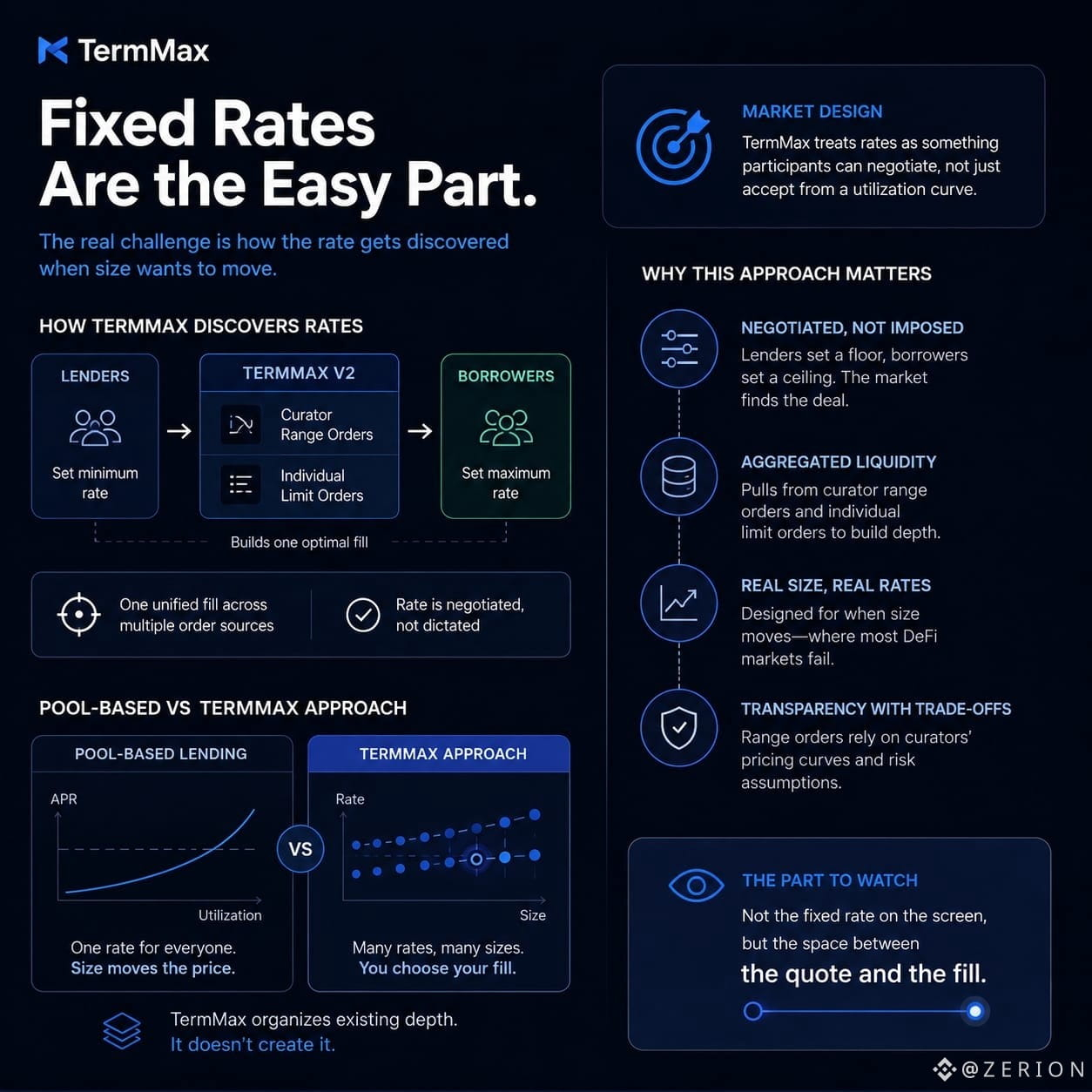
I don’t think the most interesting thing about TermMax is that a rate can be fixed. Fixed rates are the easy sentence. The harder question is how that rate is discovered when size wants to move.
TermMax lets lenders set a minimum rate and borrowers set a maximum. In V2, the app can pull from curator range orders and individual limit orders to build one fill. That sounds small, but it touches a problem DeFi usually skips over: people do not just want to see an APR on a screen. They want to know whether their size can actually trade there without wandering through pools.
I’ve watched enough “deep liquidity” claims disappear the moment a position gets large. A unified interface does not create depth; it organizes the depth that already exists. And range orders have their own quiet trade-off. Someone — often a curator — is still choosing the pricing curve and the risk assumptions underneath it.
What I find worthwhile here is the attempt to treat rates as something participants can negotiate, rather than simply accept from a utilization chart. It feels closer to an actual term market. But I’m not fully convinced the friction disappears. It may just become less visible. If liquidity is thin, setting your minimum or maximum rate means waiting, and when conditions turn ugly, waiting can be its own kind of risk.
That is the part I will watch. Not the fixed rate on the screen, but the space between the quote and the fill.
#termmax @termmax
I don’t think the most interesting thing about TermMax is that a rate can be fixed. Fixed rates are the easy sentence. The harder question is how that rate is discovered when size wants to move.
TermMax lets lenders set a minimum rate and borrowers set a maximum. In V2, the app can pull from curator range orders and individual limit orders to build one fill. That sounds small, but it touches a problem DeFi usually skips over: people do not just want to see an APR on a screen. They want to know whether their size can actually trade there without wandering through pools.
I’ve watched enough “deep liquidity” claims disappear the moment a position gets large. A unified interface does not create depth; it organizes the depth that already exists. And range orders have their own quiet trade-off. Someone — often a curator — is still choosing the pricing curve and the risk assumptions underneath it.
What I find worthwhile here is the attempt to treat rates as something participants can negotiate, rather than simply accept from a utilization chart. It feels closer to an actual term market. But I’m not fully convinced the friction disappears. It may just become less visible. If liquidity is thin, setting your minimum or maximum rate means waiting, and when conditions turn ugly, waiting can be its own kind of risk.
That is the part I will watch. Not the fixed rate on the screen, but the space between the quote and the fill.
#termmax @TermMax
39
13
1.1k
·
--
See translation
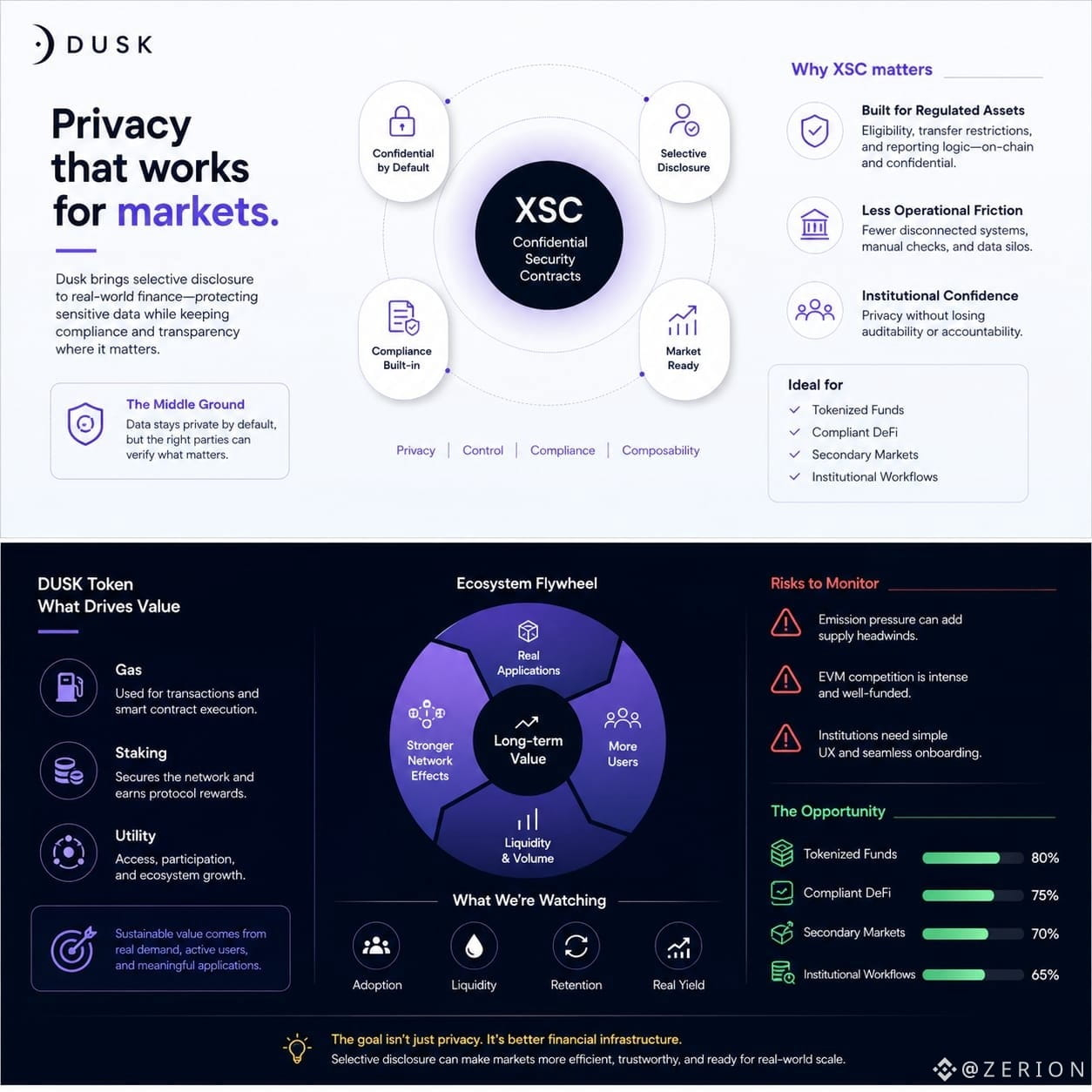
I'm noticing Dusk feels different when privacy is viewed through real markets, not crypto slogans.
A public blockchain proves activity, but exposes balances, counterparties and trading behavior. That may suit simple transfers, but it is uncomfortable for funds, bonds and institutional positions.
What I like is the middle ground. Sensitive details stay protected, while the right people can still verify what matters.
That makes XSC worth watching. A tokenized security needs eligibility rules, transfer controls and reporting logic—not just a balance. If those rules run inside confidential contracts, the asset becomes easier to manage and less dependent on disconnected systems.
For DUSK, I’m watching demand, not just the narrative. Gas and staking give the token a role, but lasting value needs applications, liquidity and users who return because the network solves a real problem.
The risks are real too. Emissions can add supply pressure, EVM competition is strong, and institutions will not tolerate confusing wallets or difficult onboarding.
The opportunity goes beyond private transfers. Tokenized funds, compliant DeFi and secondary markets could benefit from privacy without losing accountability.
I’m constructive, but patient. Dusk has a meaningful direction; now it has to prove privacy can make financial activity smoother, not simply less visible. Can selective disclosure become something markets use every day?
@Dusk_Foundation #dusk $DUSK
I'm noticing Dusk feels different when privacy is viewed through real markets, not crypto slogans.
A public blockchain proves activity, but exposes balances, counterparties and trading behavior. That may suit simple transfers, but it is uncomfortable for funds, bonds and institutional positions.
What I like is the middle ground. Sensitive details stay protected, while the right people can still verify what matters.
That makes XSC worth watching. A tokenized security needs eligibility rules, transfer controls and reporting logic—not just a balance. If those rules run inside confidential contracts, the asset becomes easier to manage and less dependent on disconnected systems.
For DUSK, I’m watching demand, not just the narrative. Gas and staking give the token a role, but lasting value needs applications, liquidity and users who return because the network solves a real problem.
The risks are real too. Emissions can add supply pressure, EVM competition is strong, and institutions will not tolerate confusing wallets or difficult onboarding.
The opportunity goes beyond private transfers. Tokenized funds, compliant DeFi and secondary markets could benefit from privacy without losing accountability.
I’m constructive, but patient. Dusk has a meaningful direction; now it has to prove privacy can make financial activity smoother, not simply less visible. Can selective disclosure become something markets use every day?
@Dusk #dusk $DUSK
9
5
199
·
--
See translation
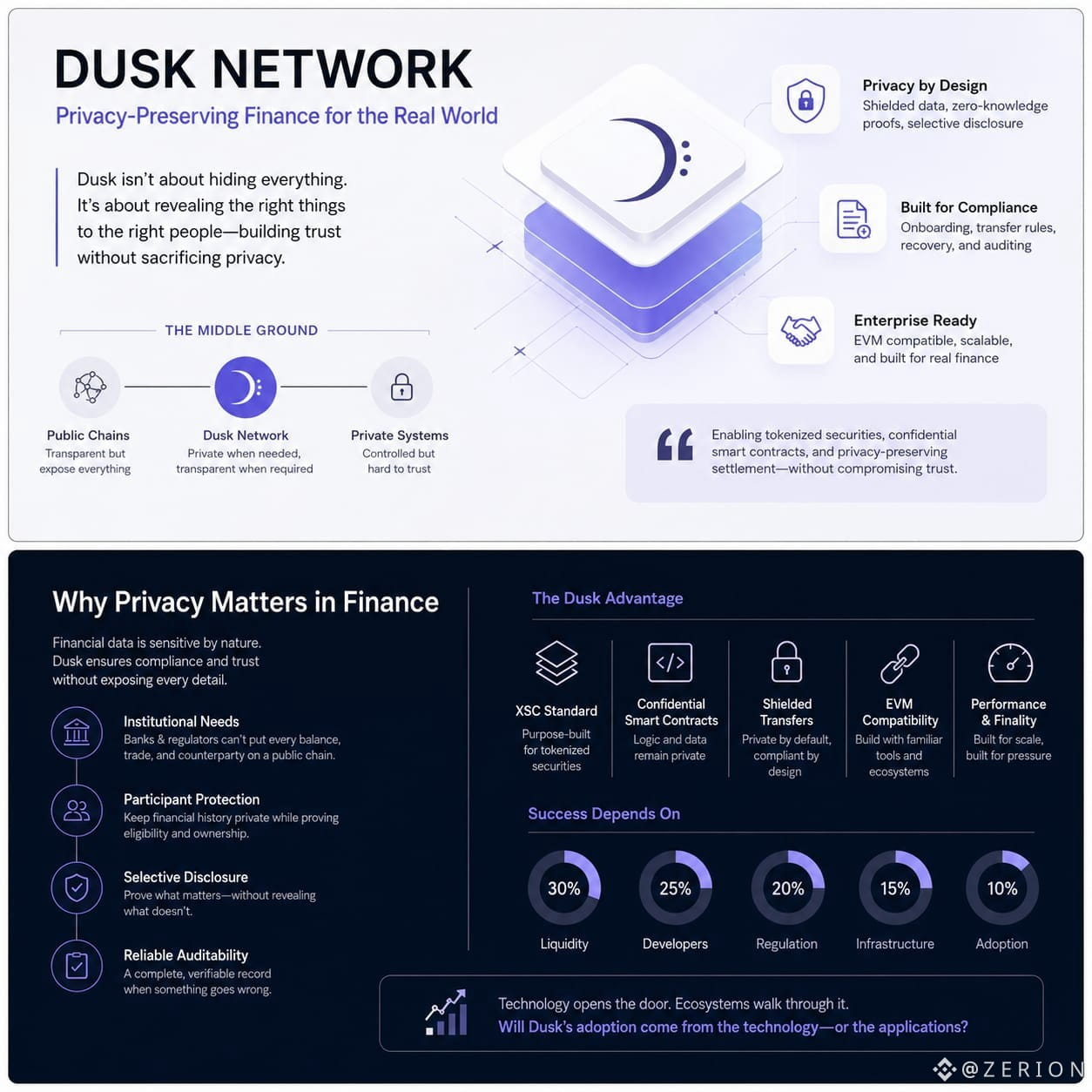
I'm noticing Dusk Network is approaching privacy in a way that feels closer to real finance. It is not about hiding everything; it is about keeping sensitive information private while giving people enough proof to trust what is happening.
A bank or regulated market cannot put every balance, trade, and counterparty on a public chain. But a closed system creates trust issues too. Participants need eligibility checks, transfer rules, recovery, and a reliable record when something goes wrong. Dusk seems to be aiming for that middle ground.
Its XSC standard and confidential smart contracts are designed for tokenized securities, where ownership, transfers, and corporate actions can happen on-chain without exposing every detail. Shielded transfers, zero-knowledge proofs, and selective disclosure let someone verify what matters without revealing an entire financial history.
What interests me is that privacy is only one part of Dusk. It also focuses on settlement, finality, smart contracts, and EVM compatibility. If identity checks, onboarding, compliant transfers, and servicing become simple, Dusk could be useful because it connects the process.
Technology alone will not be enough. Liquidity, developers, regulation, and performance under pressure will decide whether this becomes infrastructure.
I’m watching to see if Dusk can make private finance feel normal instead of complicated. Will adoption come from the technology, or from the applications built on top of it?
@Dusk_Foundation #dusk $DUSK
I'm noticing Dusk Network is approaching privacy in a way that feels closer to real finance. It is not about hiding everything; it is about keeping sensitive information private while giving people enough proof to trust what is happening.
A bank or regulated market cannot put every balance, trade, and counterparty on a public chain. But a closed system creates trust issues too. Participants need eligibility checks, transfer rules, recovery, and a reliable record when something goes wrong. Dusk seems to be aiming for that middle ground.
Its XSC standard and confidential smart contracts are designed for tokenized securities, where ownership, transfers, and corporate actions can happen on-chain without exposing every detail. Shielded transfers, zero-knowledge proofs, and selective disclosure let someone verify what matters without revealing an entire financial history.
What interests me is that privacy is only one part of Dusk. It also focuses on settlement, finality, smart contracts, and EVM compatibility. If identity checks, onboarding, compliant transfers, and servicing become simple, Dusk could be useful because it connects the process.
Technology alone will not be enough. Liquidity, developers, regulation, and performance under pressure will decide whether this becomes infrastructure.
I’m watching to see if Dusk can make private finance feel normal instead of complicated. Will adoption come from the technology, or from the applications built on top of it?
@Dusk #dusk $DUSK
2
175
·
--
See translation
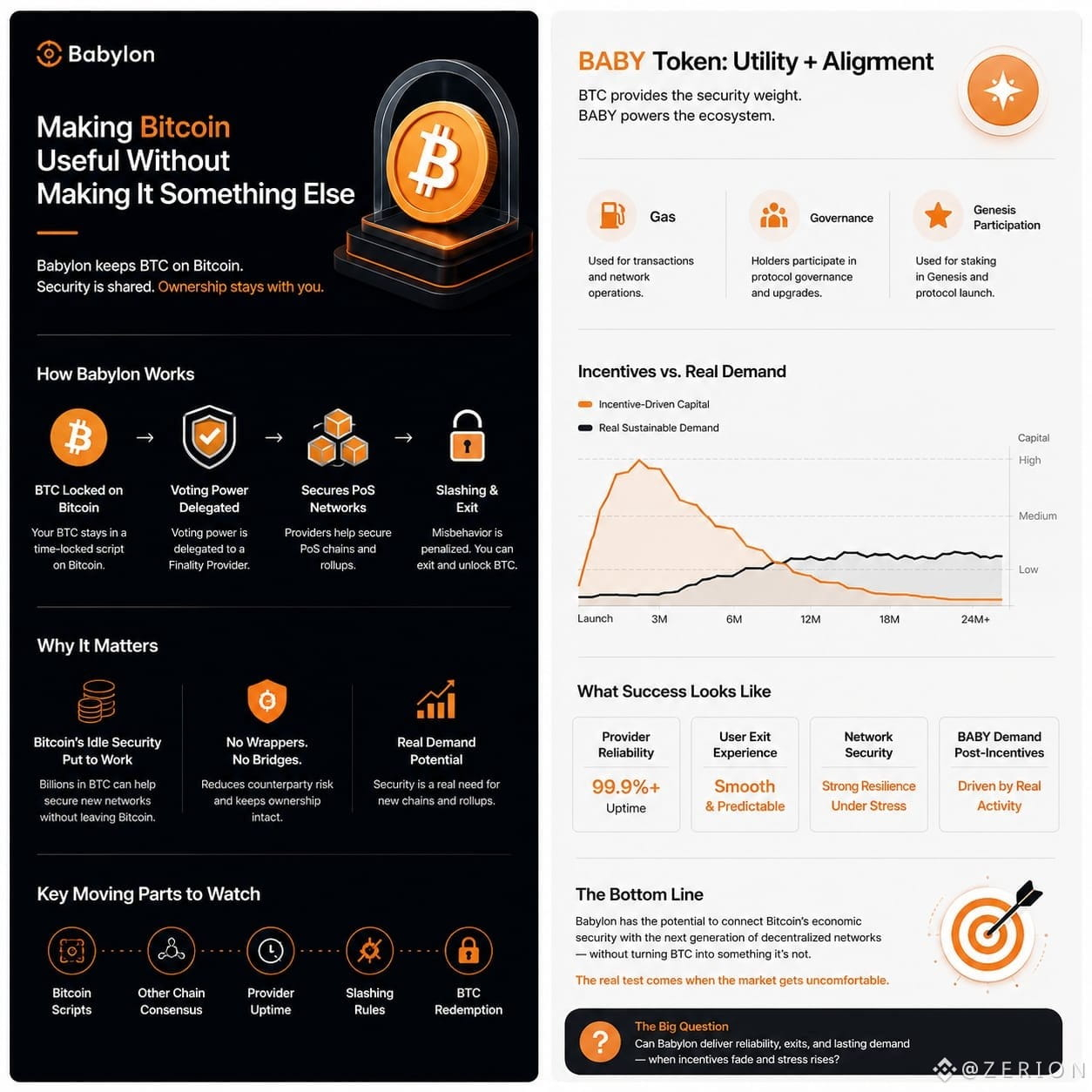
I'm noticing Babylon is trying to make Bitcoin useful without making it something else.
That matters because most attempts to use BTC start with a bridge, a wrapper, or a company holding the keys. Babylon takes a different route. The BTC stays locked on Bitcoin, while voting power is delegated to a finality provider that helps secure PoS networks. But several moving parts still have to behave properly at the same time: Bitcoin's scripts, another chain's consensus, provider uptime, slashing rules and the process for getting your BTC back.
I can see why the idea has traction. Smaller chains and new rollups need security, and Bitcoin has a huge economic base sitting idle. If Babylon can connect the two without turning BTC into a synthetic asset, that is a real use case. But I'm still cautious about treating every locked coin as proof of demand. Incentives can bring capital in quickly. They do not guarantee that networks will keep paying when rewards become less exciting.
BABY is another part I'm watching closely. BTC provides the security weight, while BABY is used for gas, governance and Genesis participation. That structure makes sense, but the token will eventually need demand from actual activity, not just emissions and speculation.
I like the direction. I'm just waiting to see how it behaves when the market gets uncomfortable. Can providers stay reliable, can users exit without surprises, and can BABY hold real importance after the incentives cool down?
@babylonlabs_io #baby $BABY
I'm noticing Babylon is trying to make Bitcoin useful without making it something else.
That matters because most attempts to use BTC start with a bridge, a wrapper, or a company holding the keys. Babylon takes a different route. The BTC stays locked on Bitcoin, while voting power is delegated to a finality provider that helps secure PoS networks. But several moving parts still have to behave properly at the same time: Bitcoin's scripts, another chain's consensus, provider uptime, slashing rules and the process for getting your BTC back.
I can see why the idea has traction. Smaller chains and new rollups need security, and Bitcoin has a huge economic base sitting idle. If Babylon can connect the two without turning BTC into a synthetic asset, that is a real use case. But I'm still cautious about treating every locked coin as proof of demand. Incentives can bring capital in quickly. They do not guarantee that networks will keep paying when rewards become less exciting.
BABY is another part I'm watching closely. BTC provides the security weight, while BABY is used for gas, governance and Genesis participation. That structure makes sense, but the token will eventually need demand from actual activity, not just emissions and speculation.
I like the direction. I'm just waiting to see how it behaves when the market gets uncomfortable. Can providers stay reliable, can users exit without surprises, and can BABY hold real importance after the incentives cool down?
@BabylonLabs_io #baby $BABY
1
2
213
·
--
See translation
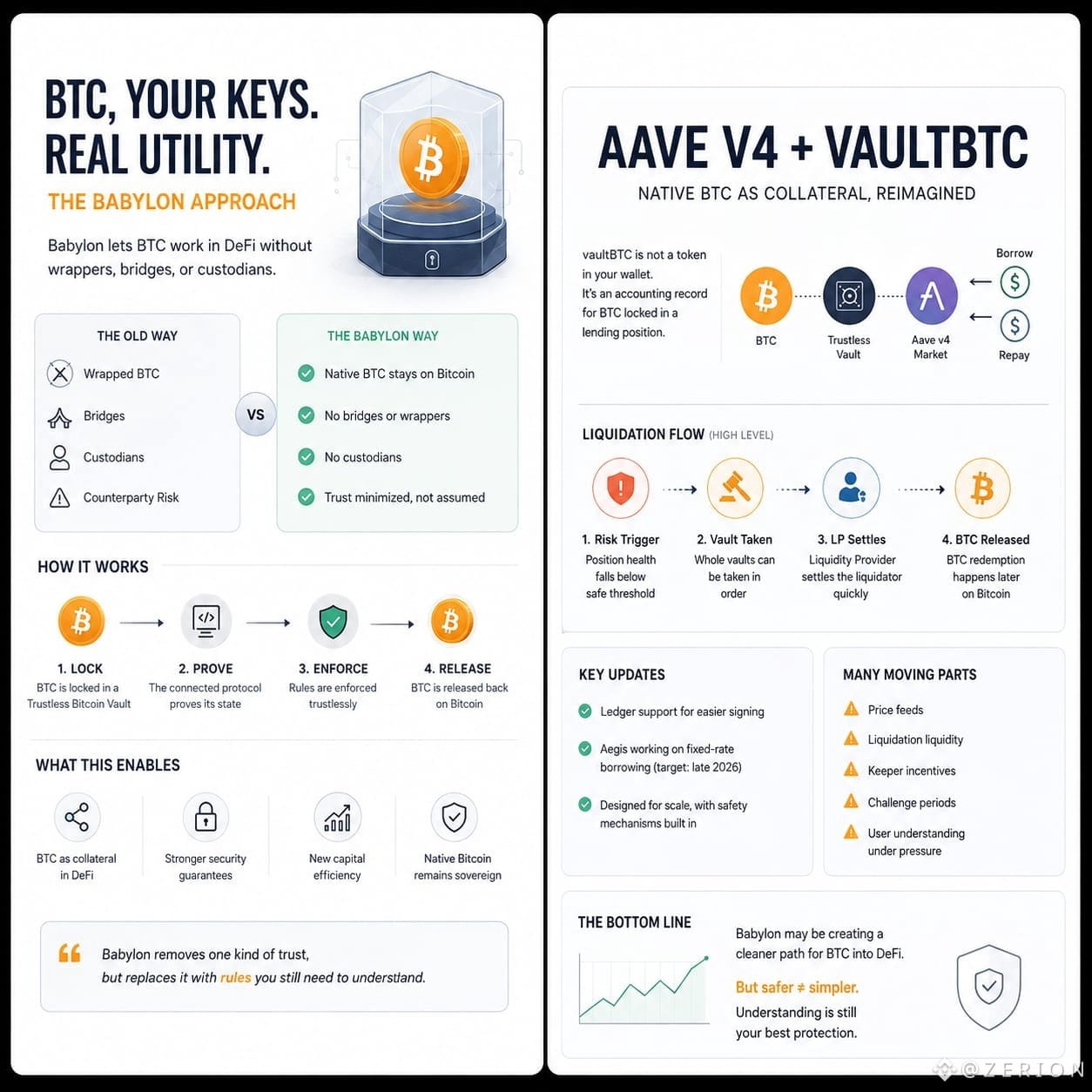
I'm noticing what keeps pulling me back to Babylon is not “yield.” It is the idea that BTC can become useful without wrappers, bridges, or custodians.
That sounds cleaner, but self-custody should not end the conversation. Its Trustless Bitcoin Vaults are tied to specific applications, so they cannot move freely between markets. Bitcoin is released only after the connected protocol’s state is proven. Babylon removes one kind of trust, but replaces it with rules users still need to understand.
Aave v4 makes this clear. vaultBTC is not a token in your wallet; it is an accounting record for BTC locked in a lending position. If the position becomes too risky, whole vaults can be taken in order. A liquidity provider can settle the liquidator quickly, even though BTC redemption happens later on Bitcoin. It is clever, but there are many moving parts.
Ledger support may make signing easier, while Aegis is working toward fixed-rate borrowing later in 2026. Helpful steps, but partnerships matter only when people use the product.
I’m watching the less exciting details: price feeds, liquidation liquidity, keeper incentives, challenge periods, and whether normal users understand what happens under pressure. Keeping the keys is valuable, but it cannot protect against bad data or poor timing.
Babylon may be creating a cleaner path for BTC into DeFi. I’m just not ready to call the problem solved. Would you trust native BTC as collateral if the system was safe but difficult to understand?
@babylonlabs_io #baby $BABY
I'm noticing what keeps pulling me back to Babylon is not “yield.” It is the idea that BTC can become useful without wrappers, bridges, or custodians.
That sounds cleaner, but self-custody should not end the conversation. Its Trustless Bitcoin Vaults are tied to specific applications, so they cannot move freely between markets. Bitcoin is released only after the connected protocol’s state is proven. Babylon removes one kind of trust, but replaces it with rules users still need to understand.
Aave v4 makes this clear. vaultBTC is not a token in your wallet; it is an accounting record for BTC locked in a lending position. If the position becomes too risky, whole vaults can be taken in order. A liquidity provider can settle the liquidator quickly, even though BTC redemption happens later on Bitcoin. It is clever, but there are many moving parts.
Ledger support may make signing easier, while Aegis is working toward fixed-rate borrowing later in 2026. Helpful steps, but partnerships matter only when people use the product.
I’m watching the less exciting details: price feeds, liquidation liquidity, keeper incentives, challenge periods, and whether normal users understand what happens under pressure. Keeping the keys is valuable, but it cannot protect against bad data or poor timing.
Babylon may be creating a cleaner path for BTC into DeFi. I’m just not ready to call the problem solved. Would you trust native BTC as collateral if the system was safe but difficult to understand?
@BabylonLabs_io #baby $BABY
7
2
108
·
--
See translation
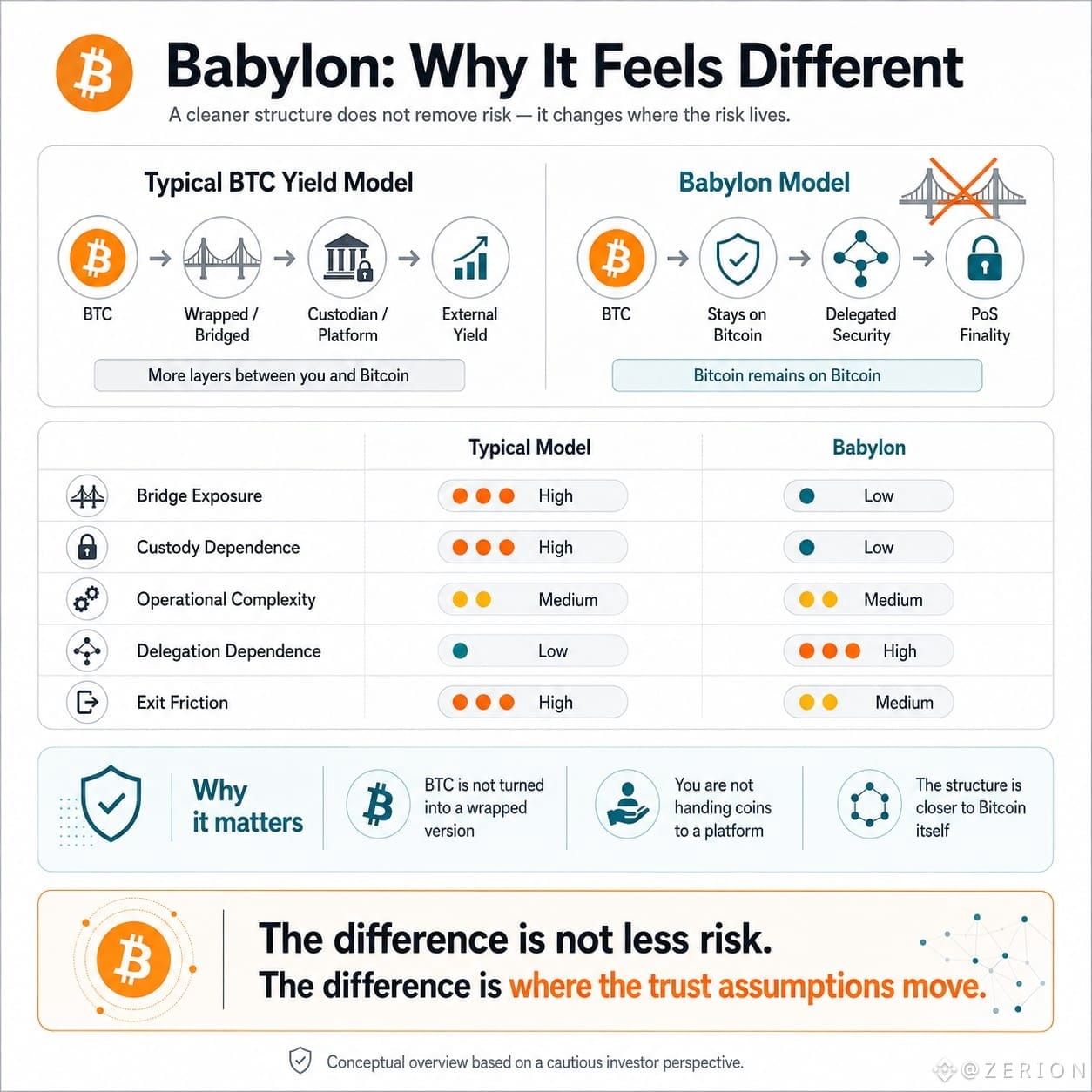
I’ve watched enough crypto cycles to get cautious whenever something promises to make Bitcoin “work harder.” Usually there is a bridge somewhere, a custodian in the middle, or a token that slowly becomes more important than the asset people came for.
Babylon feels a little different because the BTC is meant to stay on Bitcoin. You are not turning it into a wrapped version or sending it to some platform that says, “trust us, it’s secure.” That part genuinely matters to me.
But I also don’t think self-custody should be treated like a magic shield. The BTC may stay in your control, but you still have to choose who to delegate to. You still depend on finality providers doing their job properly, on the system working as designed, and on slashing rules being fair when things get messy.
That is the part people usually skip. Everyone talks about rewards, but very few people talk about what happens when providers fail, delegation becomes concentrated, or users need to exit at the same time.
I’m not fully convinced yet. Bitcoin was never built to be another yield machine, and I’m careful when the industry tries to force that story onto it. Still, Babylon is at least trying to build around Bitcoin instead of pulling Bitcoin away from itself.
Maybe that is the real difference. Not less risk—just a more honest place to look for it.
@babylonlabs_io #baby $BABY
I’ve watched enough crypto cycles to get cautious whenever something promises to make Bitcoin “work harder.” Usually there is a bridge somewhere, a custodian in the middle, or a token that slowly becomes more important than the asset people came for.
Babylon feels a little different because the BTC is meant to stay on Bitcoin. You are not turning it into a wrapped version or sending it to some platform that says, “trust us, it’s secure.” That part genuinely matters to me.
But I also don’t think self-custody should be treated like a magic shield. The BTC may stay in your control, but you still have to choose who to delegate to. You still depend on finality providers doing their job properly, on the system working as designed, and on slashing rules being fair when things get messy.
That is the part people usually skip. Everyone talks about rewards, but very few people talk about what happens when providers fail, delegation becomes concentrated, or users need to exit at the same time.
I’m not fully convinced yet. Bitcoin was never built to be another yield machine, and I’m careful when the industry tries to force that story onto it. Still, Babylon is at least trying to build around Bitcoin instead of pulling Bitcoin away from itself.
Maybe that is the real difference. Not less risk—just a more honest place to look for it.
@BabylonLabs_io #baby $BABY
4
1
146
·
--
See translation
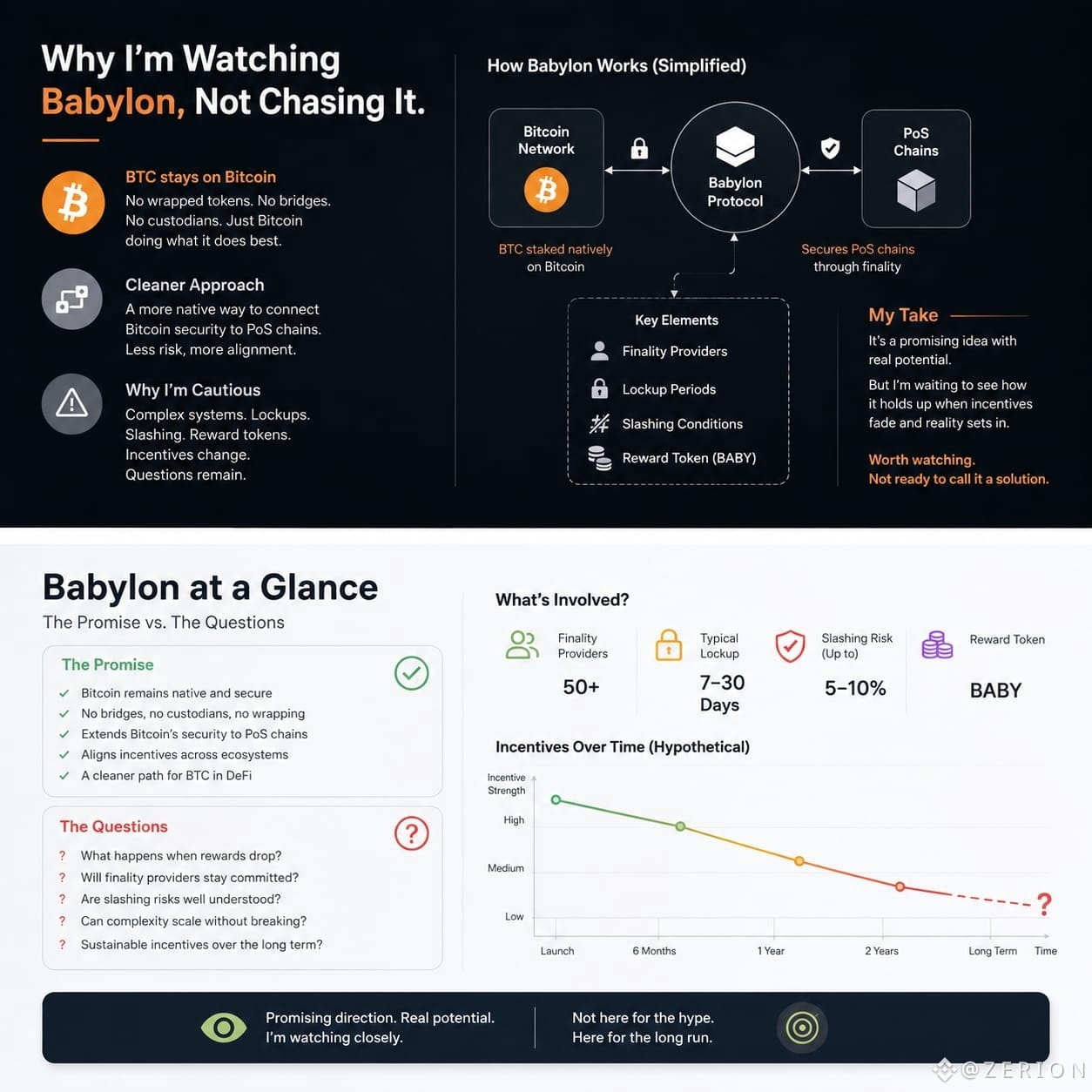
I used to think the best thing about Bitcoin was that it didn’t need to join every new story crypto came up with. It could just sit there, do its job, and not need anyone to turn it into a product. Maybe that is why I paused when I looked at Babylon.
The BTC stays on Bitcoin. No wrapped version, no bridge, no company holding it. After what we have seen over the years, that alone is not nothing.
But I would be lying if I said the rest feels simple. Someone has to choose a finality provider. There are lockups. There are slashing rules. There is a reward token in the middle of it all. The coins may not leave Bitcoin, but the decision still pulls you into another system with its own people, incentives and moving parts.
I’ve seen crypto make complicated arrangements feel easy when the rewards are good. Then the rewards change, the incentives get thinner, and suddenly everyone starts asking questions they should have asked at the start.
That is why I’m keeping a little distance from the excitement around BABY. I can see the point of it. It feels like a cleaner attempt than most of the ways Bitcoin has been pushed into DeFi. I just want to know what happens when the easy money fades and the people securing these chains have to decide if staying is still worth it.
Maybe that sounds cautious. It is. But something about Babylon feels worth watching, even if I’m not ready to call it a solution yet.
@babylonlabs_io #baby $BABY
I used to think the best thing about Bitcoin was that it didn’t need to join every new story crypto came up with. It could just sit there, do its job, and not need anyone to turn it into a product. Maybe that is why I paused when I looked at Babylon.
The BTC stays on Bitcoin. No wrapped version, no bridge, no company holding it. After what we have seen over the years, that alone is not nothing.
But I would be lying if I said the rest feels simple. Someone has to choose a finality provider. There are lockups. There are slashing rules. There is a reward token in the middle of it all. The coins may not leave Bitcoin, but the decision still pulls you into another system with its own people, incentives and moving parts.
I’ve seen crypto make complicated arrangements feel easy when the rewards are good. Then the rewards change, the incentives get thinner, and suddenly everyone starts asking questions they should have asked at the start.
That is why I’m keeping a little distance from the excitement around BABY. I can see the point of it. It feels like a cleaner attempt than most of the ways Bitcoin has been pushed into DeFi. I just want to know what happens when the easy money fades and the people securing these chains have to decide if staying is still worth it.
Maybe that sounds cautious. It is. But something about Babylon feels worth watching, even if I’m not ready to call it a solution yet.
@BabylonLabs_io #baby $BABY
13
4
186
·
--
See translation
I’ve been around crypto long enough to stop getting impressed by big promises.
Every cycle brings a new idea that is supposed to change money forever. Most of them disappear once the excitement is gone. Stablecoins are different in a quieter way. Nobody really talks about them like a revolution anymore, yet people keep using them.
They are useful. You can move money at any hour, send it across borders, step away from market volatility, or settle a trade without waiting for a bank. But I think people often ignore what is sitting underneath that convenience.
A stablecoin still depends on an issuer, reserves, banking partners, liquidity, regulations, and the assumption that it can always be redeemed for a real dollar. The transaction may be on-chain, but much of the trust still lives off-chain.
That is the part I keep noticing. Crypto talks a lot about removing middlemen, while stablecoins often rely on the same institutions the industry once wanted to replace. Accounts can still be frozen. Reserves can still be questioned. Access can still disappear when things go wrong.
I’m not saying stablecoins are useless. The opposite, actually. Their usefulness is probably why they have lasted.
I’m just not fully convinced they are replacing the financial system. Sometimes it feels more like the old system has found a faster, less visible way to move.
After watching enough cycles, I’ve learned that the things worth paying attention to are usually not the loudest. They are the things people continue using after the story stops being exciting.
@babylonlabs_io #baby $BABY
I’ve been around crypto long enough to stop getting impressed by big promises.
Every cycle brings a new idea that is supposed to change money forever. Most of them disappear once the excitement is gone. Stablecoins are different in a quieter way. Nobody really talks about them like a revolution anymore, yet people keep using them.
They are useful. You can move money at any hour, send it across borders, step away from market volatility, or settle a trade without waiting for a bank. But I think people often ignore what is sitting underneath that convenience.
A stablecoin still depends on an issuer, reserves, banking partners, liquidity, regulations, and the assumption that it can always be redeemed for a real dollar. The transaction may be on-chain, but much of the trust still lives off-chain.
That is the part I keep noticing. Crypto talks a lot about removing middlemen, while stablecoins often rely on the same institutions the industry once wanted to replace. Accounts can still be frozen. Reserves can still be questioned. Access can still disappear when things go wrong.
I’m not saying stablecoins are useless. The opposite, actually. Their usefulness is probably why they have lasted.
I’m just not fully convinced they are replacing the financial system. Sometimes it feels more like the old system has found a faster, less visible way to move.
After watching enough cycles, I’ve learned that the things worth paying attention to are usually not the loudest. They are the things people continue using after the story stops being exciting.
@BabylonLabs_io #baby $BABY

6
2
222
·
--
See translation
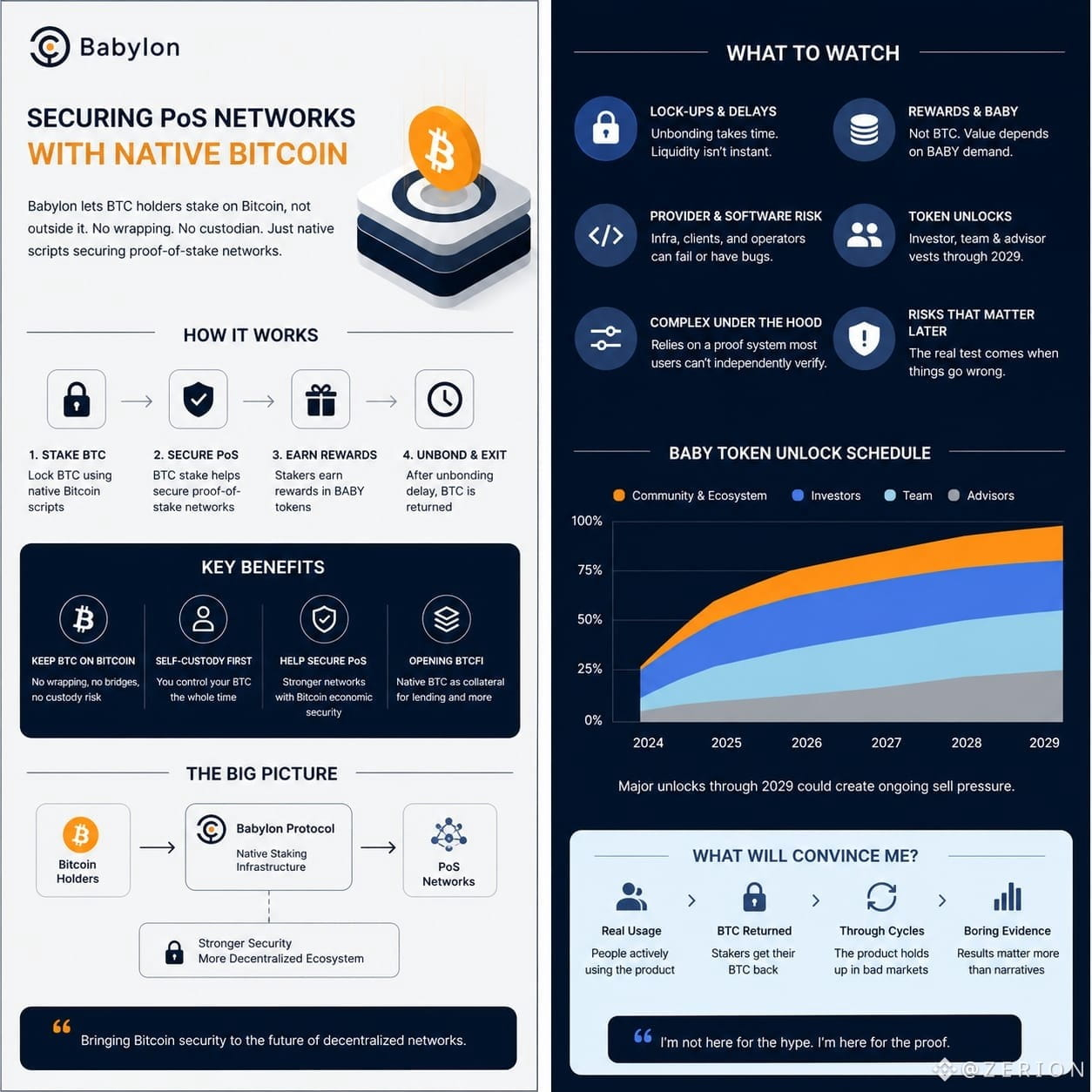
Babylon keeps coming back to my mind because, for once, the pitch starts with a real problem. Most Bitcoin holders want to keep their BTC untouched, while most ways of making it “productive” ask them to trust a custodian, bridge, or wrapped version. Babylon keeps BTC on Bitcoin, locks it through native scripts, and uses it to help secure proof-of-stake networks.
I’m still careful with “self-custody.” It doesn’t remove every risk. There are lock-ups, unbonding delays, provider and software risk, and details that only matter when something goes wrong. Rewards come in BABY, not BTC, which raises the obvious question: if stakers keep selling, where does lasting demand come from? Investor, team, and advisor unlocks through 2029 add more pressure.
The part I’m watching is Trustless Bitcoin Vaults. Native BTC becoming lending collateral without a wrapped coin or custodian would be useful. Aave and Aegis make it feel closer, but they are still plans. Underneath it all is a proof system most users will never independently check. If that foundation fails, the promise gets smaller.
So I’m paying attention, but I’m not treating BABY as solved. I’m also not assuming Bitcoin holders are automatically looking for yield. Crypto taught me to wait for the boring evidence: people using the product, getting their BTC back, and returning after the market turns ugly. That will tell me more than another partnership or loud narrative.
$BABY #baby @babylonlabs_io
Babylon keeps coming back to my mind because, for once, the pitch starts with a real problem. Most Bitcoin holders want to keep their BTC untouched, while most ways of making it “productive” ask them to trust a custodian, bridge, or wrapped version. Babylon keeps BTC on Bitcoin, locks it through native scripts, and uses it to help secure proof-of-stake networks.
I’m still careful with “self-custody.” It doesn’t remove every risk. There are lock-ups, unbonding delays, provider and software risk, and details that only matter when something goes wrong. Rewards come in BABY, not BTC, which raises the obvious question: if stakers keep selling, where does lasting demand come from? Investor, team, and advisor unlocks through 2029 add more pressure.
The part I’m watching is Trustless Bitcoin Vaults. Native BTC becoming lending collateral without a wrapped coin or custodian would be useful. Aave and Aegis make it feel closer, but they are still plans. Underneath it all is a proof system most users will never independently check. If that foundation fails, the promise gets smaller.
So I’m paying attention, but I’m not treating BABY as solved. I’m also not assuming Bitcoin holders are automatically looking for yield. Crypto taught me to wait for the boring evidence: people using the product, getting their BTC back, and returning after the market turns ugly. That will tell me more than another partnership or loud narrative.
$BABY #baby @BabylonLabs_io
3
3
234
·
--
See translation
I think a lot of people misunderstand what Babylon is trying to do.
For years, Bitcoin has mostly been treated as something you buy, hold, and hope appreciates. If you wanted to earn from it, you usually had to trust a centralized platform, wrap your BTC onto another chain, or rely on a bridge. We've all seen how those stories can end.
Babylon takes a different approach. Instead of moving Bitcoin away from its own network, it lets BTC remain self-custodied while contributing to the security of Proof-of-Stake blockchains. Your Bitcoin stays on the Bitcoin network, and the protocol is designed to avoid the wrapped-token and bridge model that has caused problems across the industry.
What also caught my attention is that Babylon isn't only about staking. Babylon Genesis acts as the coordination layer for the ecosystem, while the BABY token is used for transaction fees, governance, and helping secure the network through its dual-staking design. The bigger idea is to make Bitcoin's economic strength useful beyond simply sitting in a wallet.
That doesn't mean there are no risks. Every protocol introduces new assumptions, and security isn't just about good technology—it's about how that technology behaves over time, especially when markets become stressful. Crypto has taught me that elegant designs still need years of real-world testing.
Even so, I think Babylon is worth understanding because it focuses on improving Bitcoin's utility without asking people to give up custody of their assets. Whether it becomes a lasting piece of crypto infrastructure or just another experiment is something only time can answer, but it's one of the more thoughtful ideas I've come across in the Bitcoin ecosystem recently.
@babylonlabs_io #baby $BABY
I think a lot of people misunderstand what Babylon is trying to do.
For years, Bitcoin has mostly been treated as something you buy, hold, and hope appreciates. If you wanted to earn from it, you usually had to trust a centralized platform, wrap your BTC onto another chain, or rely on a bridge. We've all seen how those stories can end.
Babylon takes a different approach. Instead of moving Bitcoin away from its own network, it lets BTC remain self-custodied while contributing to the security of Proof-of-Stake blockchains. Your Bitcoin stays on the Bitcoin network, and the protocol is designed to avoid the wrapped-token and bridge model that has caused problems across the industry.
What also caught my attention is that Babylon isn't only about staking. Babylon Genesis acts as the coordination layer for the ecosystem, while the BABY token is used for transaction fees, governance, and helping secure the network through its dual-staking design. The bigger idea is to make Bitcoin's economic strength useful beyond simply sitting in a wallet.
That doesn't mean there are no risks. Every protocol introduces new assumptions, and security isn't just about good technology—it's about how that technology behaves over time, especially when markets become stressful. Crypto has taught me that elegant designs still need years of real-world testing.
Even so, I think Babylon is worth understanding because it focuses on improving Bitcoin's utility without asking people to give up custody of their assets. Whether it becomes a lasting piece of crypto infrastructure or just another experiment is something only time can answer, but it's one of the more thoughtful ideas I've come across in the Bitcoin ecosystem recently.
@BabylonLabs_io #baby $BABY
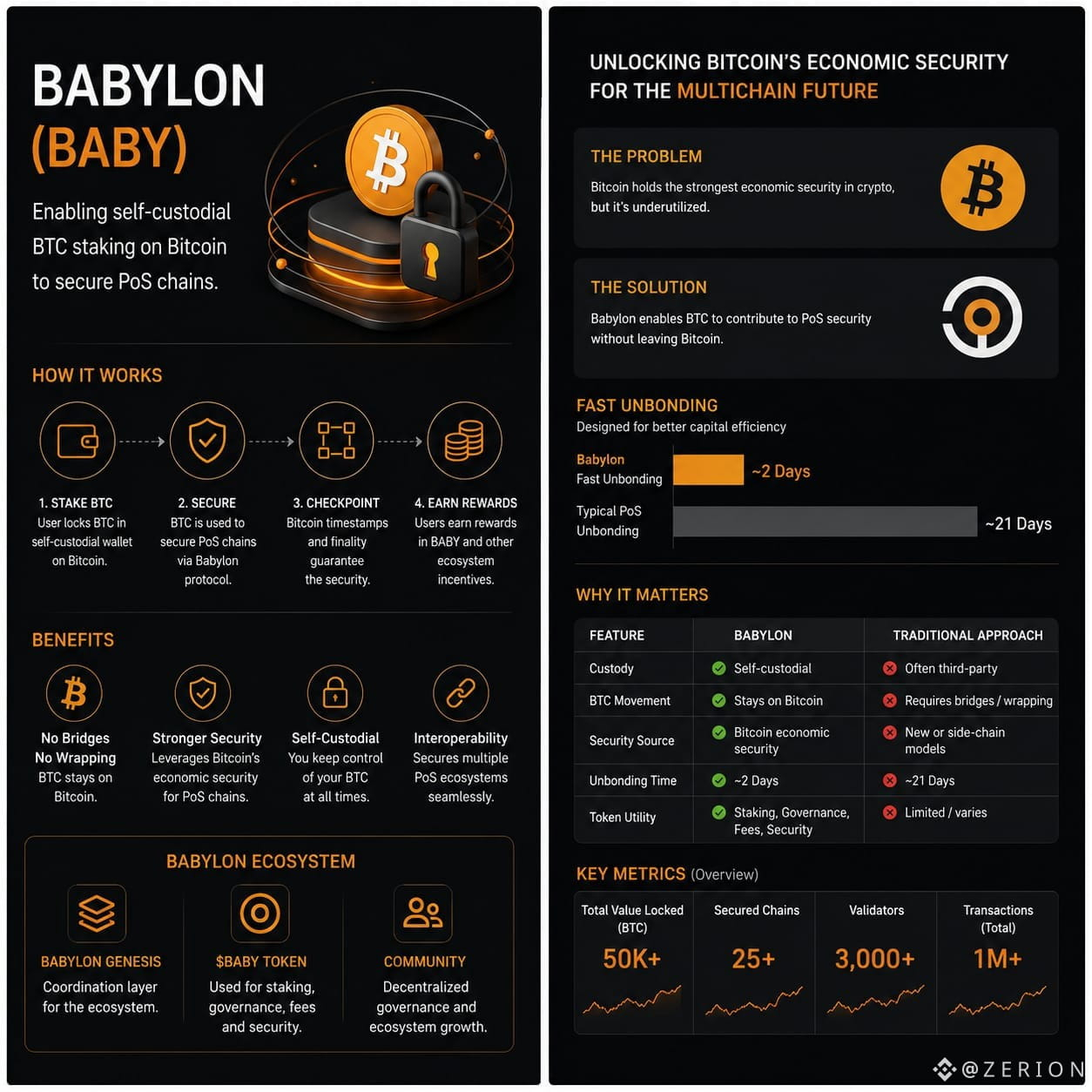
4
2
187
·
--
See translation
I almost skipped Babylon the first time I looked at it. Maybe that comes from spending too many years in crypto, where every few months there's another project claiming it has finally solved the industry's biggest problem. Most of those stories age badly.
This one made me pause for a different reason.
Babylon isn't asking Bitcoin to become something else. The idea is surprisingly simple on the surface: let BTC stay on the Bitcoin network, remain self-custodied, and still contribute economic security to Proof-of-Stake networks. The simplicity is appealing. The execution is where things get interesting.
I've learned that crypto rarely breaks because the idea is weak. It usually breaks where incentives, infrastructure, and human behavior collide. That's why I'm paying more attention to how Babylon handles things like finality providers, slashing conditions, and the trade-offs that come with coordinating security across different systems instead of chasing another narrative built around impossible promises.
I'm not convinced this becomes the standard. Most ambitious infrastructure projects underestimate how difficult real adoption is once users, operators, and edge cases enter the picture. The market has a habit of rewarding simple stories while ignoring operational complexity until something goes wrong.
Still, after watching this space repeat the same cycles for years, I respect projects that try to solve an old problem without pretending it's easy. Babylon feels less like another race for attention and more like a long experiment in whether Bitcoin can provide security beyond its own chain without asking holders to give up ownership along the way.
That doesn't make me bullish.
It just makes me curious enough to keep watching.
@babylonlabs_io #baby $BABY
I almost skipped Babylon the first time I looked at it. Maybe that comes from spending too many years in crypto, where every few months there's another project claiming it has finally solved the industry's biggest problem. Most of those stories age badly.
This one made me pause for a different reason.
Babylon isn't asking Bitcoin to become something else. The idea is surprisingly simple on the surface: let BTC stay on the Bitcoin network, remain self-custodied, and still contribute economic security to Proof-of-Stake networks. The simplicity is appealing. The execution is where things get interesting.
I've learned that crypto rarely breaks because the idea is weak. It usually breaks where incentives, infrastructure, and human behavior collide. That's why I'm paying more attention to how Babylon handles things like finality providers, slashing conditions, and the trade-offs that come with coordinating security across different systems instead of chasing another narrative built around impossible promises.
I'm not convinced this becomes the standard. Most ambitious infrastructure projects underestimate how difficult real adoption is once users, operators, and edge cases enter the picture. The market has a habit of rewarding simple stories while ignoring operational complexity until something goes wrong.
Still, after watching this space repeat the same cycles for years, I respect projects that try to solve an old problem without pretending it's easy. Babylon feels less like another race for attention and more like a long experiment in whether Bitcoin can provide security beyond its own chain without asking holders to give up ownership along the way.
That doesn't make me bullish.
It just makes me curious enough to keep watching.
@BabylonLabs_io #baby $BABY

2
1
128
·
--
See translation
Every now and then, a project looks ordinary until you spend enough time with it to see what it is really trying to do. Babylon felt like that to me. At first glance, it is easy to file it under another Bitcoin staking story, but the deeper I looked, the more it felt like a project trying to change how people think about BTC without forcing them into the usual compromises.
What stayed with me was the emphasis on staying self-custodial. Babylon is not asking Bitcoin holders to give up control just to make their assets more productive. That matters more than people admit, because custody is usually where the real discomfort starts. The newer work around Trustless Bitcoin Vaults and Ledger support makes the whole thing feel more practical, not just more theoretical. It is one thing to describe a clean idea on paper. It is another to make it feel usable for people who actually hold BTC and do not want unnecessary risk.
I also appreciate that the project does not seem blind to its own weak spots. BABY still has to prove that it can build real demand beyond the staking narrative, and that is not a small problem. A lot of crypto projects look strong when attention is high and then struggle when the incentives are tested. That is the part I am watching closely here.
For me, Babylon is interesting because it sits in that uncomfortable middle space between good technology and real adoption. That is usually where the most honest projects live. The only question now is whether people will use it for something meaningful, or just admire the idea from a distance.
@babylonlabs_io #baby $BABY
Every now and then, a project looks ordinary until you spend enough time with it to see what it is really trying to do. Babylon felt like that to me. At first glance, it is easy to file it under another Bitcoin staking story, but the deeper I looked, the more it felt like a project trying to change how people think about BTC without forcing them into the usual compromises.
What stayed with me was the emphasis on staying self-custodial. Babylon is not asking Bitcoin holders to give up control just to make their assets more productive. That matters more than people admit, because custody is usually where the real discomfort starts. The newer work around Trustless Bitcoin Vaults and Ledger support makes the whole thing feel more practical, not just more theoretical. It is one thing to describe a clean idea on paper. It is another to make it feel usable for people who actually hold BTC and do not want unnecessary risk.
I also appreciate that the project does not seem blind to its own weak spots. BABY still has to prove that it can build real demand beyond the staking narrative, and that is not a small problem. A lot of crypto projects look strong when attention is high and then struggle when the incentives are tested. That is the part I am watching closely here.
For me, Babylon is interesting because it sits in that uncomfortable middle space between good technology and real adoption. That is usually where the most honest projects live. The only question now is whether people will use it for something meaningful, or just admire the idea from a distance.
@BabylonLabs_io #baby $BABY

2
2
119
·
--
See translation
I keep coming back to Newton Protocol because it isn’t selling the usual AI dream of replacing traders or creating some perfect autonomous system.
The recent launch of its mainnet beta caught my attention for a different reason. Newton is trying to solve a problem that crypto has mostly ignored for years: how do you let automated strategies move capital without giving them unlimited freedom?
The idea is simple. Before an AI agent or a vault executes an action, predefined rules can check market conditions, risk limits, oracle data, or even whether a stablecoin has started to depeg. If something looks wrong, the transaction doesn't happen.
I’ve seen this before. Every cycle brings another infrastructure project that promises safer markets and better automation. Most of them disappear once they meet real users, real money, and real incentives.
That’s why I’m not ready to trust this one yet.
But something about Newton feels different. The team launched gradually instead of chasing instant growth, and they've been unusually open about token allocations, vesting, and wallet transparency. In this market, that alone stands out.
I also think the timing makes sense. Crypto is moving toward AI-driven strategies whether people like it or not. The question isn't whether agents will trade onchain. The question is who controls them when things go wrong.
For years we've built faster rails for moving capital, but not enough guardrails for automated systems.
Maybe Newton ends up being another idea that sounds better than it works. That happens a lot here.
Still, after watching too many narratives come and go, I find myself paying attention whenever a project tries to fix an old problem instead of inventing a new story around it.
@NewtonProtocol #Newt $NEWT
1
126
·
--

Article
See translation
The Part of Crypto We Kept Ignoring: Why Newton Protocol Made Me Pay Attention AgainI keep coming back to Newton Protocol, mostly because it is not trying to sound like a toy. Most crypto projects still sell the same old fog: faster, cheaper, smarter, decentralized, inevitable. Newton is saying something more specific, and that always makes me a little suspicious. It calls itself an authorization layer for onchain finance, and the claim is simple enough to understand even if you do not trust it yet: before a transaction settles, Newton is supposed to check the rules, the risk, the identity constraints, the compliance boundaries, and then leave a cryptographic record of what was allowed and what was blocked. It is built as an EigenLayer AVS, and the docs describe it as a decentralized policy engine for onchain transaction authorization, with policy enforcement for things like spend limits, sanctions screening, and fraud prevention. That is not a vague “AI meets crypto” pitch. It is more like an attempt to put a gate where crypto has usually insisted there should be none.
That alone is why I do not dismiss it quickly. I have seen this before, or at least I have seen versions of it. Every cycle produces a project that says it will solve the part of finance that crypto kept pretending it could skip. In the early versions, it was custody. Then compliance. Then risk. Then “institutional adoption,” which was usually just a nicer way to say “please believe this thing will survive contact with real money.” Newton feels different because it is not hiding from the boring parts. Its own materials keep circling the same friction points: smart contracts cannot naturally see offchain context, frontend filters can be bypassed, direct contract calls do not care about UI promises, and policies that live only in people’s heads are not really policies at all. That is a more mature problem statement than most projects ever bother to articulate. It is also a harder one, which usually means the story gets interesting right when the execution gets difficult.
What pulls me in is that the project seems to understand where crypto actually breaks, not where people like to imagine it breaks. Newton’s public use cases are not a parade of shiny abstractions. It is talking about DeFi vaults, RWAs, stablecoins, and agentic finance, with policies that cover investor eligibility, position limits, contract and counterparty screening, jurisdiction rules, sanctions, KYC, travel rule checks, velocity limits, and even depeg or drawdown triggers. In other words, it is trying to make the messy part of finance enforceable onchain, not just observable after the fact. That matters because the real pain in this market is rarely the trade itself. It is the gap between the rule and the execution. Crypto has spent years proving that capital can move. It has been much less convincing about proving that capital can move under discipline. Newton is trying to sit exactly in that gap. I understand why that idea keeps getting attention, even from people who are tired of hearing about AI and compliance in the same sentence.
Still, I do not fully trust the elegance of the story, because elegance is where crypto often starts lying to itself. The whitepaper talks about a Visa-like authorization model, a Rego/OPA policy engine, EigenLayer economic security, cross-chain design, and use cases that stretch from stablecoins and tokenized assets to agentic commerce. That sounds coherent, maybe even overdue. But coherent is not the same thing as usable. The minute a project says it will enforce rules across identity, jurisdiction, compliance, and risk without revealing the underlying data, I start thinking about all the places where edge cases hide. A policy engine is only as good as the policy, the data feeding it, the operator network interpreting it, and the people who are willing to rely on it when money is on the line. Crypto loves clean diagrams. Real finance is a swamp of exceptions, exceptions to the exceptions, and the occasional ugly legal requirement that only shows up after something has gone wrong. Newton knows that, or at least it sounds like it knows that. Whether it can survive that reality is another matter.
The integrations matter to me more than the slogans. A project like this can say “security,” “AI,” and “automation” all day, but the work only starts to look real when it plugs into things that already touch actual behavior. Newton has been putting out integrations with Persona for real-time identity and jurisdiction checks, Human Passport for humanity verification, Etherscan data for gas and network-aware guardrails, Massive for treasury-yield and macro-aware trading rules, and RedStone with Credora for data and risk intelligence. That tells me they are not just building a theory of authorization. They are building a plumbing layer for rules that depend on context. I have seen enough crypto systems fail because they were too proud to admit that data matters. You can have a beautiful execution machine and still make stupid decisions if the inputs are weak. Newton seems to be building around that weakness instead of pretending it does not exist. That is worth something, even if it is not yet worth blind confidence.
The mainnet beta going live on June 23, 2026 is the first part that makes the whole thing harder to ignore. It launched live on Base and Ethereum, with Newton saying it is already enforcing rules onchain and that early implementations are being used with Euler. The protocol is no longer just a narrative about what might exist. It is now a live system with a stated purpose, a developer docs surface, an explorer, staking, and a token with defined utility around gas, staking, registry participation, and governance. That usually sounds like progress, and it is, but it also means the project has crossed the line where claims stop being cheap. The cost of being wrong rises now. The cost of being vague rises now. And the market, which is very good at applauding launch-day language, becomes much less patient the moment a protocol has to work in the wild. I have watched that happen enough times to know that mainnet is where the mood changes.
The token side does not make me more relaxed, but it does make the project feel more complete. NEWT has a fixed supply of 1 billion, with 215 million circulating at launch, and the token is meant to cover staking, gas and fees, model registry activity, and governance. There is also a 60/40 split between community and internal categories, plus vesting and unlock schedules that look designed to keep a lid on the early chaos, at least on paper. I am not romantic about tokenomics anymore. I have seen enough “aligned incentives” language to know how often it is just a prettier way of saying “please ignore the distribution until later.” But here, the token actually seems tied to the machinery the protocol says it needs: security, policy execution, registry participation, and eventual governance. That is better than a token that exists because every project is expected to have one. It does not make the economics good. It just makes them legible, which is rarer than it should be.
What I keep circling back to is that Newton is trying to make crypto less theatrical and more procedural. That sounds unexciting, and maybe that is exactly why it matters. The market has spent years rewarding projects that speak in grand metaphors. Newton speaks more like an operations team that has stared at too many failure modes. It talks about controls, attestations, signed records, policy checks, and enforcement before settlement. It is not the language of moonshots. It is the language of people who have had to explain to someone why “decentralized” did not protect them from a bad transaction, a bad actor, or a bad process. I do not know yet whether Newton becomes infrastructure or just another clever layer with a good thesis and an exhausting token chart. I do know why it gets my attention. It is aiming at the part of crypto that most projects avoid because it is ugly, slow, and full of liability. That does not guarantee anything. But in a market where everyone is usually selling a dream, an honest attempt at constraint can almost feel radical.
@NewtonProtocol #Newt $NEWT
The Part of Crypto We Kept Ignoring: Why Newton Protocol Made Me Pay Attention Again
I keep coming back to Newton Protocol, mostly because it is not trying to sound like a toy. Most crypto projects still sell the same old fog: faster, cheaper, smarter, decentralized, inevitable. Newton is saying something more specific, and that always makes me a little suspicious. It calls itself an authorization layer for onchain finance, and the claim is simple enough to understand even if you do not trust it yet: before a transaction settles, Newton is supposed to check the rules, the risk, the identity constraints, the compliance boundaries, and then leave a cryptographic record of what was allowed and what was blocked. It is built as an EigenLayer AVS, and the docs describe it as a decentralized policy engine for onchain transaction authorization, with policy enforcement for things like spend limits, sanctions screening, and fraud prevention. That is not a vague “AI meets crypto” pitch. It is more like an attempt to put a gate where crypto has usually insisted there should be none.
That alone is why I do not dismiss it quickly. I have seen this before, or at least I have seen versions of it. Every cycle produces a project that says it will solve the part of finance that crypto kept pretending it could skip. In the early versions, it was custody. Then compliance. Then risk. Then “institutional adoption,” which was usually just a nicer way to say “please believe this thing will survive contact with real money.” Newton feels different because it is not hiding from the boring parts. Its own materials keep circling the same friction points: smart contracts cannot naturally see offchain context, frontend filters can be bypassed, direct contract calls do not care about UI promises, and policies that live only in people’s heads are not really policies at all. That is a more mature problem statement than most projects ever bother to articulate. It is also a harder one, which usually means the story gets interesting right when the execution gets difficult.
What pulls me in is that the project seems to understand where crypto actually breaks, not where people like to imagine it breaks. Newton’s public use cases are not a parade of shiny abstractions. It is talking about DeFi vaults, RWAs, stablecoins, and agentic finance, with policies that cover investor eligibility, position limits, contract and counterparty screening, jurisdiction rules, sanctions, KYC, travel rule checks, velocity limits, and even depeg or drawdown triggers. In other words, it is trying to make the messy part of finance enforceable onchain, not just observable after the fact. That matters because the real pain in this market is rarely the trade itself. It is the gap between the rule and the execution. Crypto has spent years proving that capital can move. It has been much less convincing about proving that capital can move under discipline. Newton is trying to sit exactly in that gap. I understand why that idea keeps getting attention, even from people who are tired of hearing about AI and compliance in the same sentence.
Still, I do not fully trust the elegance of the story, because elegance is where crypto often starts lying to itself. The whitepaper talks about a Visa-like authorization model, a Rego/OPA policy engine, EigenLayer economic security, cross-chain design, and use cases that stretch from stablecoins and tokenized assets to agentic commerce. That sounds coherent, maybe even overdue. But coherent is not the same thing as usable. The minute a project says it will enforce rules across identity, jurisdiction, compliance, and risk without revealing the underlying data, I start thinking about all the places where edge cases hide. A policy engine is only as good as the policy, the data feeding it, the operator network interpreting it, and the people who are willing to rely on it when money is on the line. Crypto loves clean diagrams. Real finance is a swamp of exceptions, exceptions to the exceptions, and the occasional ugly legal requirement that only shows up after something has gone wrong. Newton knows that, or at least it sounds like it knows that. Whether it can survive that reality is another matter.
The integrations matter to me more than the slogans. A project like this can say “security,” “AI,” and “automation” all day, but the work only starts to look real when it plugs into things that already touch actual behavior. Newton has been putting out integrations with Persona for real-time identity and jurisdiction checks, Human Passport for humanity verification, Etherscan data for gas and network-aware guardrails, Massive for treasury-yield and macro-aware trading rules, and RedStone with Credora for data and risk intelligence. That tells me they are not just building a theory of authorization. They are building a plumbing layer for rules that depend on context. I have seen enough crypto systems fail because they were too proud to admit that data matters. You can have a beautiful execution machine and still make stupid decisions if the inputs are weak. Newton seems to be building around that weakness instead of pretending it does not exist. That is worth something, even if it is not yet worth blind confidence.
The mainnet beta going live on June 23, 2026 is the first part that makes the whole thing harder to ignore. It launched live on Base and Ethereum, with Newton saying it is already enforcing rules onchain and that early implementations are being used with Euler. The protocol is no longer just a narrative about what might exist. It is now a live system with a stated purpose, a developer docs surface, an explorer, staking, and a token with defined utility around gas, staking, registry participation, and governance. That usually sounds like progress, and it is, but it also means the project has crossed the line where claims stop being cheap. The cost of being wrong rises now. The cost of being vague rises now. And the market, which is very good at applauding launch-day language, becomes much less patient the moment a protocol has to work in the wild. I have watched that happen enough times to know that mainnet is where the mood changes.
The token side does not make me more relaxed, but it does make the project feel more complete. NEWT has a fixed supply of 1 billion, with 215 million circulating at launch, and the token is meant to cover staking, gas and fees, model registry activity, and governance. There is also a 60/40 split between community and internal categories, plus vesting and unlock schedules that look designed to keep a lid on the early chaos, at least on paper. I am not romantic about tokenomics anymore. I have seen enough “aligned incentives” language to know how often it is just a prettier way of saying “please ignore the distribution until later.” But here, the token actually seems tied to the machinery the protocol says it needs: security, policy execution, registry participation, and eventual governance. That is better than a token that exists because every project is expected to have one. It does not make the economics good. It just makes them legible, which is rarer than it should be.
What I keep circling back to is that Newton is trying to make crypto less theatrical and more procedural. That sounds unexciting, and maybe that is exactly why it matters. The market has spent years rewarding projects that speak in grand metaphors. Newton speaks more like an operations team that has stared at too many failure modes. It talks about controls, attestations, signed records, policy checks, and enforcement before settlement. It is not the language of moonshots. It is the language of people who have had to explain to someone why “decentralized” did not protect them from a bad transaction, a bad actor, or a bad process. I do not know yet whether Newton becomes infrastructure or just another clever layer with a good thesis and an exhausting token chart. I do know why it gets my attention. It is aiming at the part of crypto that most projects avoid because it is ugly, slow, and full of liability. That does not guarantee anything. But in a market where everyone is usually selling a dream, an honest attempt at constraint can almost feel radical.
@NewtonProtocol #Newt $NEWT
4
2
130
·
--

Article
See translation
Newton Protocol (NEWT) and the part of crypto that still feels unfinishedI keep coming back to projects like Newton because they sit in a strange place in the market. They are not trying to sell me a dream of faster memes or another shiny AI wrapper. The official pitch is much more plain than that: Newton positions itself as an authorization layer for onchain finance, and its docs describe it as a decentralized policy engine for onchain transaction authorization, built as an EigenLayer AVS. The whitepaper frames the gap in a way I cannot entirely dismiss: onchain finance already moves huge sums, but transactions still happen without being authorized onchain before execution. That is the kind of problem that sounds boring until you realize boring is often where the real money and the real failure modes live.
I have seen this before, though. Crypto loves a clean narrative right up until the part where the narrative has to survive contact with the real world. Newton’s ambition is broader than the usual AI token story because it is not just talking about “intelligence” or “automation” in the abstract. The whitepaper talks about a Visa-like authorization model, policy enforcement, cross-chain design, and use cases that reach into stablecoins, RWAs, cross-border payments, institutional DeFi, and agentic commerce. That is a more serious target set than the average project gets brave enough to name. It also means the project has to carry the weight of compliance, identity, and trust, which is exactly where crypto usually gets messy.
What I cannot ignore is that Newton is trying to solve a problem that crypto has mostly preferred to paper over. The docs explicitly call out the weakness: smart contracts are blind to offchain context, whether that is sanctions status, a corporate spend policy, or the possibility that an AI agent is simply wrong. That is a hard problem, and I respect that it is hard. I also distrust any project that makes hard things sound easy. If a system really starts enforcing spend limits, sanctions screening, and fraud prevention at the transaction layer, then the friction shows up somewhere else: in integration, in policy design, in false positives, in governance, in the uncomfortable question of who defines the rules and who gets to update them.
The part that feels different to me is that Newton is not pretending decentralization and control are simple friends. Its own materials lean into the tension. The site says it enforces policies before transactions settle, and the docs describe a policy engine that can encode and verify rules directly in smart contracts. That means the project is not selling freedom in the abstract. It is trying to make permission programmable. I do not think that is a small distinction. In crypto, most of the slogans are about removing middlemen; Newton is more interesting because it asks whether some middlemen, or at least some middle logic, are exactly what onchain finance has been missing.
Still, I do not fully trust the cleanliness of the story. Projects in this corner of crypto tend to promise “verifiable” everything, and then the real work becomes making verification usable by actual humans. The GitHub repository says NEWT is the native token for verifiable onchain automation and secure agent authorization, and it lists staking, gas fees, permission updates, and governance as core functions. That is the right kind of token utility on paper. But utility on paper is one thing; utility under pressure is another. Tokens tied to infrastructure often end up carrying expectations that the protocol itself cannot cash. I have watched that movie enough times to know that a good architecture slide is not the same as durable demand.
There is also the market reality, which always keeps the poetry honest. CoinGecko shows NEWT still trading far below its all-time high, with a market cap under $10 million and roughly 220 million tokens in circulation today. That does not tell me whether the protocol matters, but it does tell me the market has not assigned it the kind of belief people usually reserve for a settled winner. Sometimes that is a red flag. Sometimes it is just what a project looks like before anyone has proved the thing in production. I have learned not to confuse a low valuation with a bad idea, but I have also learned that a low valuation is often the market’s way of saying, “Show me.”
The thing I keep circling back to is that AI in crypto has already been sold too many times in too many lazy forms. Most of it has been presentation, not infrastructure. Newton’s angle is less flashy and, because of that, a little more believable. If AI agents are ever going to move real assets in a way institutions can stand behind, there has to be some layer that checks the action before it happens instead of apologizing afterward. That is the logic Newton is reaching for. It does not make me bullish by reflex. It makes me curious in the quieter way that only happens after enough cycles have burned the excitement out of you. Something about this feels different, but “different” is not the same as “done.”
What I like most is that the project seems to understand the shape of the real objection. The hard part is not proving that automation is possible. The hard part is proving that automation can be trusted by someone who has money, rules, auditors, counterparties, and consequences. Newton’s whitepaper and docs keep coming back to authorization, policy, verification, and compliance for a reason. That is where the market still lives, whether crypto likes it or not. I’ve seen enough cycles to know that the loudest projects usually burn out in the space between their promise and the thing users actually need. Newton may still end up there too. I’m not sure yet. But I do think it is pointing at a problem that has not been solved by hype, and maybe that is why it stays in my head longer than most of the noise.
@NewtonProtocol #Newt $NEWT
Newton Protocol (NEWT) and the part of crypto that still feels unfinished
I keep coming back to projects like Newton because they sit in a strange place in the market. They are not trying to sell me a dream of faster memes or another shiny AI wrapper. The official pitch is much more plain than that: Newton positions itself as an authorization layer for onchain finance, and its docs describe it as a decentralized policy engine for onchain transaction authorization, built as an EigenLayer AVS. The whitepaper frames the gap in a way I cannot entirely dismiss: onchain finance already moves huge sums, but transactions still happen without being authorized onchain before execution. That is the kind of problem that sounds boring until you realize boring is often where the real money and the real failure modes live.
I have seen this before, though. Crypto loves a clean narrative right up until the part where the narrative has to survive contact with the real world. Newton’s ambition is broader than the usual AI token story because it is not just talking about “intelligence” or “automation” in the abstract. The whitepaper talks about a Visa-like authorization model, policy enforcement, cross-chain design, and use cases that reach into stablecoins, RWAs, cross-border payments, institutional DeFi, and agentic commerce. That is a more serious target set than the average project gets brave enough to name. It also means the project has to carry the weight of compliance, identity, and trust, which is exactly where crypto usually gets messy.
What I cannot ignore is that Newton is trying to solve a problem that crypto has mostly preferred to paper over. The docs explicitly call out the weakness: smart contracts are blind to offchain context, whether that is sanctions status, a corporate spend policy, or the possibility that an AI agent is simply wrong. That is a hard problem, and I respect that it is hard. I also distrust any project that makes hard things sound easy. If a system really starts enforcing spend limits, sanctions screening, and fraud prevention at the transaction layer, then the friction shows up somewhere else: in integration, in policy design, in false positives, in governance, in the uncomfortable question of who defines the rules and who gets to update them.
The part that feels different to me is that Newton is not pretending decentralization and control are simple friends. Its own materials lean into the tension. The site says it enforces policies before transactions settle, and the docs describe a policy engine that can encode and verify rules directly in smart contracts. That means the project is not selling freedom in the abstract. It is trying to make permission programmable. I do not think that is a small distinction. In crypto, most of the slogans are about removing middlemen; Newton is more interesting because it asks whether some middlemen, or at least some middle logic, are exactly what onchain finance has been missing.
Still, I do not fully trust the cleanliness of the story. Projects in this corner of crypto tend to promise “verifiable” everything, and then the real work becomes making verification usable by actual humans. The GitHub repository says NEWT is the native token for verifiable onchain automation and secure agent authorization, and it lists staking, gas fees, permission updates, and governance as core functions. That is the right kind of token utility on paper. But utility on paper is one thing; utility under pressure is another. Tokens tied to infrastructure often end up carrying expectations that the protocol itself cannot cash. I have watched that movie enough times to know that a good architecture slide is not the same as durable demand.
There is also the market reality, which always keeps the poetry honest. CoinGecko shows NEWT still trading far below its all-time high, with a market cap under $10 million and roughly 220 million tokens in circulation today. That does not tell me whether the protocol matters, but it does tell me the market has not assigned it the kind of belief people usually reserve for a settled winner. Sometimes that is a red flag. Sometimes it is just what a project looks like before anyone has proved the thing in production. I have learned not to confuse a low valuation with a bad idea, but I have also learned that a low valuation is often the market’s way of saying, “Show me.”
The thing I keep circling back to is that AI in crypto has already been sold too many times in too many lazy forms. Most of it has been presentation, not infrastructure. Newton’s angle is less flashy and, because of that, a little more believable. If AI agents are ever going to move real assets in a way institutions can stand behind, there has to be some layer that checks the action before it happens instead of apologizing afterward. That is the logic Newton is reaching for. It does not make me bullish by reflex. It makes me curious in the quieter way that only happens after enough cycles have burned the excitement out of you. Something about this feels different, but “different” is not the same as “done.”
What I like most is that the project seems to understand the shape of the real objection. The hard part is not proving that automation is possible. The hard part is proving that automation can be trusted by someone who has money, rules, auditors, counterparties, and consequences. Newton’s whitepaper and docs keep coming back to authorization, policy, verification, and compliance for a reason. That is where the market still lives, whether crypto likes it or not. I’ve seen enough cycles to know that the loudest projects usually burn out in the space between their promise and the thing users actually need. Newton may still end up there too. I’m not sure yet. But I do think it is pointing at a problem that has not been solved by hype, and maybe that is why it stays in my head longer than most of the noise.
@NewtonProtocol #Newt $NEWT
4
2
155
Log in to explore more content
Join global crypto users on Binance Square
⚡️ Get latest and useful information about crypto.
💬 Trusted by the world’s largest crypto exchange.
👍 Discover real insights from verified creators.
Email / Phone number
Trending Topics
HotCPIDecemberHikePriced
153,639 views
1,713 Discussing
CPI Market Watch | US CPI Rises 0.4% in October, Hotter Than 0.3% Forecast
Binance News
·28 Likes
·42.2k views
StrategyFaces$2.8BSelloffRiskFromMSCIRemoval
624 views
10 Discussing
AnthropicRejectsIPODelayValuationinQuestion
263,382 views
2,236 Discussing