
Brainrot Labs
874 Posts
Brainrot Labs
Report
Block User
🇺🇸 🇯🇵 🇻🇳 🇨🇳your daily dose of digital schizophrenia
AI girls • memes • crypto • chaos
99% research. 1% sleep.
Think for yourself -Not your advisor
250 Following
3.8K+ Followers
546 Liked
Posts
All
Quotes
Videos
PINNED
Article
See translation
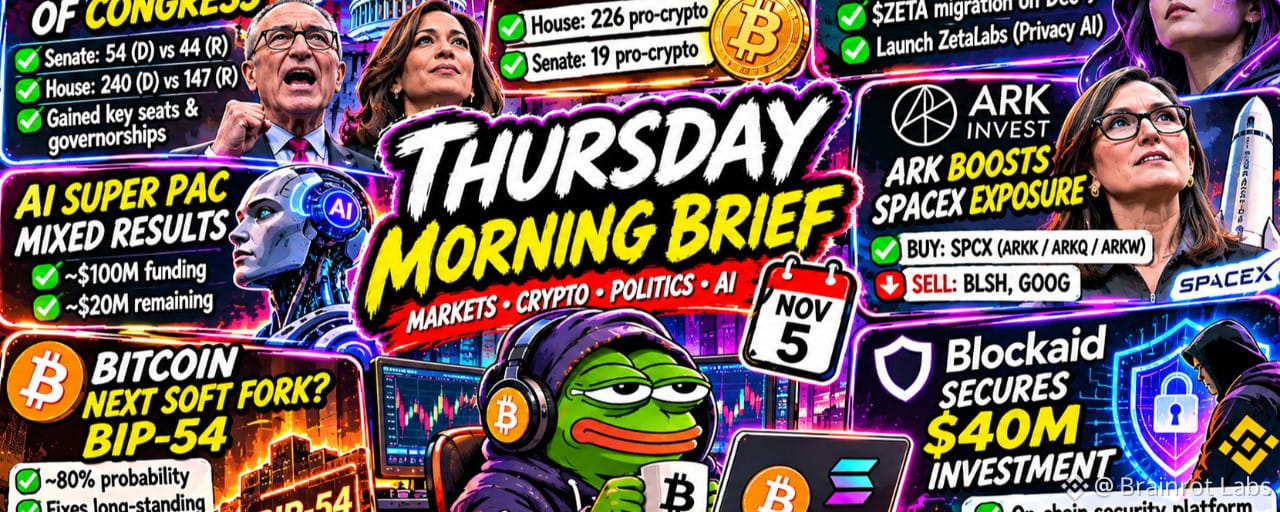
THURSDAY MORNING BRIEF | NOV 5, 2026#USMidterms-WhatAreMarketsExpecting?
gm, crypto twitter. ☕
Democrats are taking control of Congress, crypto-friendly candidates are gaining ground, and the industry is pouring more money into security after Binance's $6.3B incident.
Meanwhile, ZetaChain is preparing a major migration, Bitcoin developers are discussing a possible consensus cleanup, and Cathie Wood's ARK is buying SpaceX exposure.
Politics, infrastructure, and capital flows. Thursday has plenty to unpack. 🧵
1/7 🇺🇸 Democrats take Congress, crypto-friendly candidates gain ground
The 2026 US midterm results are pointing to a major political shift.
According to the supplied election report, Democrats have secured control of both chambers:
Senate: at least 54 Democrats vs. 44 Republicans.House: at least 240 Democrats vs. 147 Republicans.Democrats have also gained several previously Republican-held Senate seats and at least 26 additional House seats.
The report attributes the Republican losses partly to cost-of-living concerns, with nearly 90% of voters considering living costs an important issue.
For crypto, the Stand With Crypto election tracker reports:
House: 226 crypto-supporting candidates elected, 106 opposed, across 397 confirmed seats.Senate: 19 crypto-supporting candidates elected, 8 opposed, across 33 confirmed seats.
📌 Market watch: A change in congressional control could reshape the path of crypto legislation, tax policy, tariffs, and financial regulation. Candidate positions matter, but actual legislative outcomes matter more.
Crypto may have more friends in Congress. Now comes the hard part: getting things passed. 👀
2/7 🌐 ZetaChain plans migration to Solana on December 9
ZetaChain has announced plans to migrate $ZETA to Solana on December 9, alongside the launch of its privacy-focused AI application, ZetaLabs.
Under the proposed plan:
$ZETA would become a native Solana token.Existing tokens would convert at a 1:1 ratio.ZetaChain's L1 would be phased out around December 9.Unallocated validator rewards of approximately 55 million tokens would be burned monthly according to the original emission schedule.Token supply is expected to decline in 2027, with no further inflation after migration.
The governance proposal is open for voting on ZetaHub until November 7. If approved, holders reportedly will not need to take any action before the migration.
📌 Market watch: The migration could fundamentally change ZETA's ecosystem, token infrastructure, and role in the project. The governance vote remains a key milestone.
New chain, new AI app, same ticker. Big transition ahead. 🤖
3/7 🤖 AI super PAC falls short of expectations
Leading the Future, a Silicon Valley-backed super PAC supporting AI-friendly candidates and opposing stricter AI regulation, reportedly had a mixed result in the US midterms.
The organization previously controlled around $100 million in funding.
After the election, its remaining balance reportedly stood slightly above $20 million.
Several candidates it supported across both parties won seats in Congress, but the overall outcome was described as limited relative to its financial resources.
📌 Market watch: AI regulation is becoming a political and financial battleground. The next Congress could influence how aggressively the US regulates AI development and deployment.
Turns out even $100 million cannot buy every election result. 💀
4/7 🚀 ARK Invest increases SpaceX exposure
ARK Invest adjusted several ETF holdings in its latest trading update.
Three funds increased their positions in SpaceX (SPCX):
ARKK bought 224,483 shares.ARKQ bought 63,478 shares.ARKW bought 60,445 shares.
At the same time, ARK reduced exposure to Bullish (BLSH) and Alphabet (GOOG):
ARKK, ARKW, and ARKF sold BLSH.ARKK and ARKQ sold GOOG.
Other adjustments included purchases of TWST and PACB, alongside reductions in TEM, LLY, AMZN, NET, and CRWD.
📌 Market watch: ARK's activity shows a shift in portfolio exposure, but ETF transactions alone do not reveal the firm's full investment thesis.
Cathie Wood is still rearranging the portfolio furniture. 🪑
5/7 ₿ Bitcoin developers discuss BIP-54 soft fork
Bitcoin developer Matt Corallo estimates there is an 80% chance that the network's next soft fork will be BIP-54.
First proposed in 2019, BIP-54 aims to address several long-standing consensus issues, including:
Difficulty-adjustment mechanism flaws.Potential denial-of-service attack vectors involving miners.Other weaknesses in Bitcoin's consensus rules.
Corallo described it as a cleanup of issues that developers broadly recognize.
A survey of developers at TABConf reportedly suggests activation could happen as early as September 2027, although some expect 2028 or later.
📌 Market watch: This is a potential infrastructure upgrade, not an imminent change. Developer coordination, review, and consensus will determine the timeline.
Bitcoin developers are doing maintenance. No flashy marketing, just fixing the plumbing. 🔧
6/7 🛡️ Blockaid secures $40M investment commitment
On-chain security platform Blockaid has received a reported $40 million investment commitment.
The announcement comes just days after the $6.3 billion Binance security incident.
According to Axios Pro, the attack has helped accelerate investor interest in crypto security infrastructure.
Blockaid focuses on real-time on-chain security and threat prevention.
📌 Market watch: Security is becoming a larger investment category as crypto adoption expands. Monitoring, transaction screening, and threat detection could attract more institutional capital.
The industry keeps getting hacked. Security startups keep getting funded. A rather unfortunate business cycle. 💀
7/7 📊 What matters today
A few themes stand out from today's developments:
Politics: A Democratic-controlled Congress could change the outlook for crypto legislation and broader economic policy.Token migration: ZetaChain's November 7 governance vote is the next milestone ahead of its planned December migration.Bitcoin infrastructure: BIP-54 highlights continued work on network security and consensus reliability.Crypto security: Blockaid's funding commitment shows how the Binance incident is influencing investment priorities.Capital allocation: ARK's SpaceX purchases offer another signal of where active funds are positioning.
The bigger picture: Crypto is becoming increasingly connected to political decisions, traditional capital markets, and institutional infrastructure. The next phase may be shaped as much by regulation and security as by token prices.
Which development do you think will have the biggest impact on crypto over the next few months?
DYOR. Not financial advice.
THURSDAY MORNING BRIEF | NOV 5, 2026
#USMidterms-WhatAreMarketsExpecting?
gm, crypto twitter. ☕
Democrats are taking control of Congress, crypto-friendly candidates are gaining ground, and the industry is pouring more money into security after Binance's $6.3B incident.
Meanwhile, ZetaChain is preparing a major migration, Bitcoin developers are discussing a possible consensus cleanup, and Cathie Wood's ARK is buying SpaceX exposure.
Politics, infrastructure, and capital flows. Thursday has plenty to unpack. 🧵
1/7 🇺🇸 Democrats take Congress, crypto-friendly candidates gain ground
The 2026 US midterm results are pointing to a major political shift.
According to the supplied election report, Democrats have secured control of both chambers:
Senate: at least 54 Democrats vs. 44 Republicans.House: at least 240 Democrats vs. 147 Republicans.Democrats have also gained several previously Republican-held Senate seats and at least 26 additional House seats.
The report attributes the Republican losses partly to cost-of-living concerns, with nearly 90% of voters considering living costs an important issue.
For crypto, the Stand With Crypto election tracker reports:
House: 226 crypto-supporting candidates elected, 106 opposed, across 397 confirmed seats.Senate: 19 crypto-supporting candidates elected, 8 opposed, across 33 confirmed seats.
📌 Market watch: A change in congressional control could reshape the path of crypto legislation, tax policy, tariffs, and financial regulation. Candidate positions matter, but actual legislative outcomes matter more.
Crypto may have more friends in Congress. Now comes the hard part: getting things passed. 👀
2/7 🌐 ZetaChain plans migration to Solana on December 9
ZetaChain has announced plans to migrate $ZETA to Solana on December 9, alongside the launch of its privacy-focused AI application, ZetaLabs.
Under the proposed plan:
$ZETA would become a native Solana token.Existing tokens would convert at a 1:1 ratio.ZetaChain's L1 would be phased out around December 9.Unallocated validator rewards of approximately 55 million tokens would be burned monthly according to the original emission schedule.Token supply is expected to decline in 2027, with no further inflation after migration.
The governance proposal is open for voting on ZetaHub until November 7. If approved, holders reportedly will not need to take any action before the migration.
📌 Market watch: The migration could fundamentally change ZETA's ecosystem, token infrastructure, and role in the project. The governance vote remains a key milestone.
New chain, new AI app, same ticker. Big transition ahead. 🤖
3/7 🤖 AI super PAC falls short of expectations
Leading the Future, a Silicon Valley-backed super PAC supporting AI-friendly candidates and opposing stricter AI regulation, reportedly had a mixed result in the US midterms.
The organization previously controlled around $100 million in funding.
After the election, its remaining balance reportedly stood slightly above $20 million.
Several candidates it supported across both parties won seats in Congress, but the overall outcome was described as limited relative to its financial resources.
📌 Market watch: AI regulation is becoming a political and financial battleground. The next Congress could influence how aggressively the US regulates AI development and deployment.
Turns out even $100 million cannot buy every election result. 💀
4/7 🚀 ARK Invest increases SpaceX exposure
ARK Invest adjusted several ETF holdings in its latest trading update.
Three funds increased their positions in SpaceX (SPCX):
ARKK bought 224,483 shares.ARKQ bought 63,478 shares.ARKW bought 60,445 shares.
At the same time, ARK reduced exposure to Bullish (BLSH) and Alphabet (GOOG):
ARKK, ARKW, and ARKF sold BLSH.ARKK and ARKQ sold GOOG.
Other adjustments included purchases of TWST and PACB, alongside reductions in TEM, LLY, AMZN, NET, and CRWD.
📌 Market watch: ARK's activity shows a shift in portfolio exposure, but ETF transactions alone do not reveal the firm's full investment thesis.
Cathie Wood is still rearranging the portfolio furniture. 🪑
5/7 ₿ Bitcoin developers discuss BIP-54 soft fork
Bitcoin developer Matt Corallo estimates there is an 80% chance that the network's next soft fork will be BIP-54.
First proposed in 2019, BIP-54 aims to address several long-standing consensus issues, including:
Difficulty-adjustment mechanism flaws.Potential denial-of-service attack vectors involving miners.Other weaknesses in Bitcoin's consensus rules.
Corallo described it as a cleanup of issues that developers broadly recognize.
A survey of developers at TABConf reportedly suggests activation could happen as early as September 2027, although some expect 2028 or later.
📌 Market watch: This is a potential infrastructure upgrade, not an imminent change. Developer coordination, review, and consensus will determine the timeline.
Bitcoin developers are doing maintenance. No flashy marketing, just fixing the plumbing. 🔧
6/7 🛡️ Blockaid secures $40M investment commitment
On-chain security platform Blockaid has received a reported $40 million investment commitment.
The announcement comes just days after the $6.3 billion Binance security incident.
According to Axios Pro, the attack has helped accelerate investor interest in crypto security infrastructure.
Blockaid focuses on real-time on-chain security and threat prevention.
📌 Market watch: Security is becoming a larger investment category as crypto adoption expands. Monitoring, transaction screening, and threat detection could attract more institutional capital.
The industry keeps getting hacked. Security startups keep getting funded. A rather unfortunate business cycle. 💀
7/7 📊 What matters today
A few themes stand out from today's developments:
Politics: A Democratic-controlled Congress could change the outlook for crypto legislation and broader economic policy.Token migration: ZetaChain's November 7 governance vote is the next milestone ahead of its planned December migration.Bitcoin infrastructure: BIP-54 highlights continued work on network security and consensus reliability.Crypto security: Blockaid's funding commitment shows how the Binance incident is influencing investment priorities.Capital allocation: ARK's SpaceX purchases offer another signal of where active funds are positioning.
The bigger picture: Crypto is becoming increasingly connected to political decisions, traditional capital markets, and institutional infrastructure. The next phase may be shaped as much by regulation and security as by token prices.
Which development do you think will have the biggest impact on crypto over the next few months?
DYOR. Not financial advice.
347
See translation
Polygon is considering a hard fork to recover $6.8M in stolen POL. Blockchain immutability is about to face another real-world test.
Binance and Polymarket have proposed a coordinated hard fork on Polygon to recover approximately 70.49 million $POL, worth around $6.8 million, from attacker-controlled wallets.
The recovery breakdown:
23.86M POL: Linked to Polymarket.
46.63M POL: Linked to Binance.
Total: 70.49M POL, approximately $6.8M.
How would it work?
Funds would be moved from five attacker-controlled addresses.
Recovered tokens would be transferred to verified recovery wallets belonging to the two platforms.
The operation would not change the total POL supply.
Polygon block producers have already temporarily blocked transactions from the affected addresses, but this does not return the funds to their owners.
What happens next?
The proposal still requires governance approval. It is expected to be tested on Polygon Amoy before further discussion on November 5. No mainnet hard fork date has been confirmed.
This raises a fundamental question for decentralized networks: when stolen funds can be recovered through a hard fork, where should the line between protecting users and preserving blockchain immutability be drawn?
Blockchain transactions are supposed to be irreversible. Apparently, the community is now discussing the crypto equivalent of calling the manager.
Would you support a hard fork to recover stolen funds, or should blockchain immutability remain absolute?
Polygon is considering a hard fork to recover $6.8M in stolen POL. Blockchain immutability is about to face another real-world test.
Binance and Polymarket have proposed a coordinated hard fork on Polygon to recover approximately 70.49 million $POL , worth around $6.8 million, from attacker-controlled wallets.
The recovery breakdown:
23.86M POL: Linked to Polymarket.
46.63M POL: Linked to Binance.
Total: 70.49M POL, approximately $6.8M.
How would it work?
Funds would be moved from five attacker-controlled addresses.
Recovered tokens would be transferred to verified recovery wallets belonging to the two platforms.
The operation would not change the total POL supply.
Polygon block producers have already temporarily blocked transactions from the affected addresses, but this does not return the funds to their owners.
What happens next?
The proposal still requires governance approval. It is expected to be tested on Polygon Amoy before further discussion on November 5. No mainnet hard fork date has been confirmed.
This raises a fundamental question for decentralized networks: when stolen funds can be recovered through a hard fork, where should the line between protecting users and preserving blockchain immutability be drawn?
Blockchain transactions are supposed to be irreversible. Apparently, the community is now discussing the crypto equivalent of calling the manager.
Would you support a hard fork to recover stolen funds, or should blockchain immutability remain absolute?
1
92
See translation
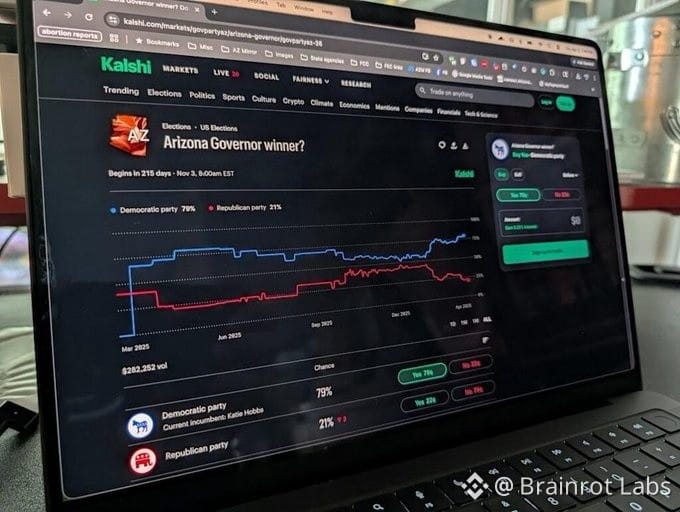
Prediction markets just went 479 for 487. Washington might want to check its homework.
Kalshi CEO Tarek Mansour says the most-followed candidate in each of the first 487 US election races won 479 of them, representing a 98% success rate.
His argument? Prediction markets aggregate information from thousands of participants, including people without political titles, media platforms, or massive followings.
The idea is simple: people put money behind their beliefs, and the market continuously reflects what participants collectively expect.
But one important detail: this measures whether the most-followed candidate won, not whether prediction markets correctly predicted every race or outperformed traditional polling.
Apparently, you don't need a Washington insider badge to have an opinion. Sometimes you just need a position in the market.
Are prediction markets becoming a serious alternative source of political information, or is 487 races still too small a sample?
121
See translation
MARA just moved $132.8M worth of Bitcoin. Miners are adding more selling pressure to the market.
Key developments:
●₿ BTC transferred: 1,650 BTC
● Estimated value: $132.8M
● Timeframe: 12 hours
● Destinations: Galaxy Digital, Copper, and others.
Large transfers from miners can signal potential selling pressure, especially when directed toward trading or custody platforms. However, transfers alone don’t confirm that the BTC has been sold. MARA’s next wallet movements will be worth watching.
Miners dig up Bitcoin. The market gets the invoice.
Is MARA preparing for another major sale, or simply repositioning its BTC holdings?

25
See translation
Trump Media just moved $344M in Bitcoin. That’s not a small wallet shuffle.
Key details:
BTC transferred: 4,259 BTC$80,514.28.
Estimated value: $344M .
Destination: Crypto[.]com.
A transfer to an exchange doesn’t automatically mean a sell-off. But a move of this size will definitely attract attention.
When Trump’s media company moves $344M in BTC, the blockchain starts talking.
Custody move or potential sell pressure?
13
See translation
62 companies are now pushing back against tokenized versions of their own stocks on OKX.
Nebius, Boeing and ServiceNow have reportedly joined the opposition, bringing the total from 59 to 62 companies since November 3.
Here’s the breakdown:
62 companies have now filed objections.
54 of the original 62 companies have reportedly opposed the proposal.
Boeing and ServiceNow were already on the initial list.
Nebius is a new addition.
My take: Wall Street wants blockchain infrastructure, but apparently not everyone wants their own shares trading on someone else’s tokenization platform.
Tokenization sounds great until your stock becomes a token without getting invited to the party.

BAUS-3.09%
71
See translation
Wall Street is building the rails for tokenized finance, and five major banks just joined forces.
HSBC, JPMorgan’s Kinexys, MUFG, Société Générale-Forge and Standard Chartered have established Global Layer One Organisation (GL1 Org) in Singapore.
The mission:
Develop common standards for tokenized financial markets.
Connect financial institutions, infrastructure and jurisdictions.
Support shared-ledger infrastructure for regulated tokenized assets.
GL1 builds on an initiative by the Monetary Authority of Singapore (MAS) to explore how regulated institutions can issue and manage tokenized assets on shared infrastructure.
The interesting part? These banks aren't just experimenting with blockchain anymore. They're working on the standards that could connect the entire financial system.
Crypto spent years trying to get into traditional finance. Now traditional finance is building its own on-chain highway.
Who said TradFi was going to stay off-chain?
HSBCUS-1.46%
34
See translation
OpenAI might be dropping three new models this Friday. The naming alone is already getting people curious.
According to ChainCatcher, OpenAI could introduce Astra, Sol, and Cyber as early as November 6.
Here’s what we know so far:
Astra: A rumored next-generation model, with early tester feedback suggesting improvements in physics simulation and animation generation.
Sol: Another upcoming model, although its capabilities remain undisclosed.
Cyber: Reportedly designed specifically for cybersecurity applications.
There are also reports of a gpt-6.2-astra label appearing in Codex usage statistics.
However, several key details remain unknown:
No confirmed model numbers or official specifications.
No pricing or context-window information.
No public benchmark results.
No confirmation whether the models will launch through API, ChatGPT, Codex, or partner channels.
The most interesting part is the potential specialization. If Cyber delivers meaningful cybersecurity capabilities while Astra improves physical reasoning and animation generation, this could signal a broader shift toward purpose-built AI models.
But early tester impressions are not benchmark results. We need actual performance data before drawing conclusions.
Three new model names, zero official benchmarks. The AI rumor mill is working overtime.
Which one are you most curious to see: Astra, Sol, or Cyber?

20
See translation
Polkadot lost $1.381M because a patch was ready but never made it to mainnet.
A reassessment published by the Polkadot forum revealed that an XCM vulnerability on Asset Hub was exploited between October 24–26.
Here's what happened:
The attacker manipulated the accounting supply of dotUSD without changing actual account balances.
This distorted the DOT/dotUSD trading pair's valuation, creating an arbitrage opportunity.
The estimated damage reached $1.381 million worth of DOT.
Polkadot Treasury was the pair's only liquidity provider, so user funds did not suffer direct capital losses.
The most concerning detail? The vulnerability had reportedly been submitted through the bug bounty program in June. The related code was fixed, but the patch was not deployed to the affected mainnet version in time.
On October 20, the reporter publicly mentioned the patch on the forum, potentially giving attackers a clue.
Market angle: This incident highlights the gap between fixing a vulnerability in code and actually securing a live network. A patch that never reaches mainnet is just a very expensive piece of paperwork.
The code was fixed. The deployment wasn't.
How many more vulnerabilities are sitting behind a patch that hasn't been deployed yet?

1
1
371
See translation
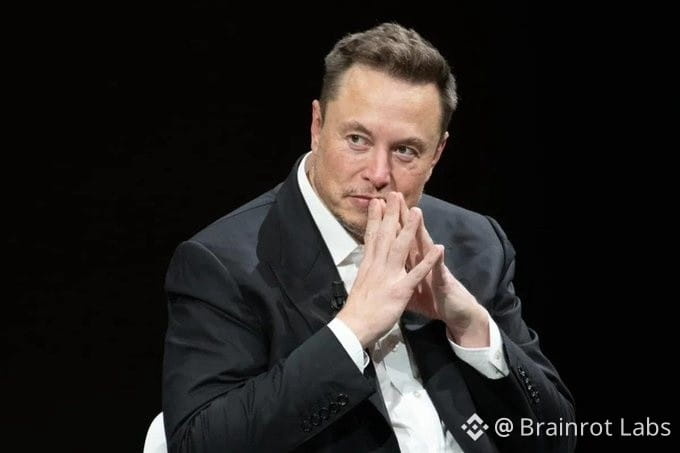
$474 Million Spent. Texas Still Went the Other Way.
Elon Musk reportedly poured at least $474 million into Republican political groups and candidates during the 2026 US midterm cycle nearly twice his spending ahead of the 2024 presidential election.
Around $200 million went toward Texas races, including support for Senate candidate Ken Paxton. But both Paxton and incumbent Governor Greg Abbott lost to their Democratic challengers.
Other reported contributions included:
$30M to the Congressional Leadership Fund.
$44M to other Republican groups and candidates.
Tesla and SpaceX shares also declined on Wednesday following the election results.
A reminder that campaign spending can amplify political influence, but it cannot guarantee voter support.
Even a $474M war chest can't buy a guaranteed result.
3.8k
See translation
AI-powered hackers are scaling up, and crypto exchanges are on the radar.
Two security stories today:
Zaif (Japan)
380,000 customer email addresses leaked through third-party provider Arara.
No passwords, names or transaction data reportedly exposed.
Zaif says its own systems have not been compromised.
AI-powered attacks
India CERT-In warns of an active threat group named CRAFTY FALCON.
AI is being used to generate and improve attack scripts.
Hackers target exposed test environments, steal access tokens and wallet keys, then move crypto.
Attacks may be scheduled for weekends and holidays to avoid detection.
My take: The threat isn't just smarter hackers. It's hackers operating at machine speed while security teams are offline.
Your exchange might have 24/7 trading. Its security team better have 24/7 protection too.
Are crypto platforms prepared for AI-powered attacks?

355
See translation
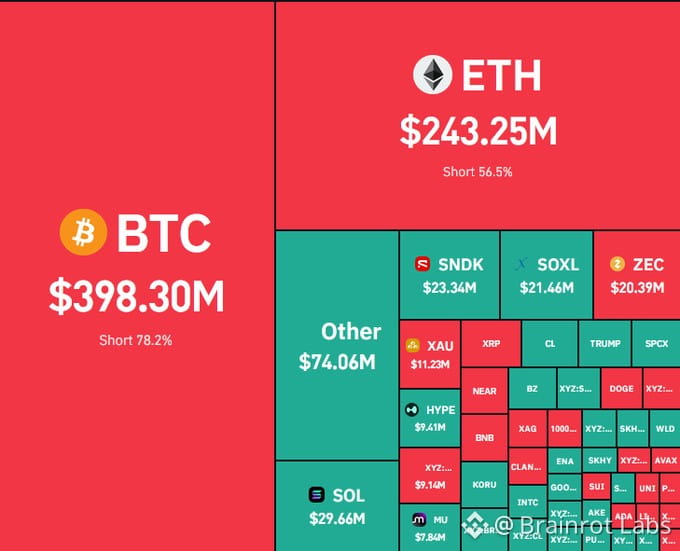
Nearly $1 BILLION liquidated in 24 hours. The market turned into a financial crime scene.
130,994 traders were liquidated, with total losses reaching $982.87 million.
Liquidation breakdown:
Total liquidations: $982.87M
Long positions: $401.17M
Short positions: $581.70M
Traders liquidated: 130,994
Largest single liquidation: $38M ETH-USDT
Market angle: Shorts accounted for roughly 59% of liquidations, meaning bears took the heavier hit. This suggests a sharp squeeze against short positions, although both sides suffered massive losses.
130K traders got rekt. The market didn't choose a side it collected from both.
So, who's still brave enough to use leverage after this?
1.2k
See translation
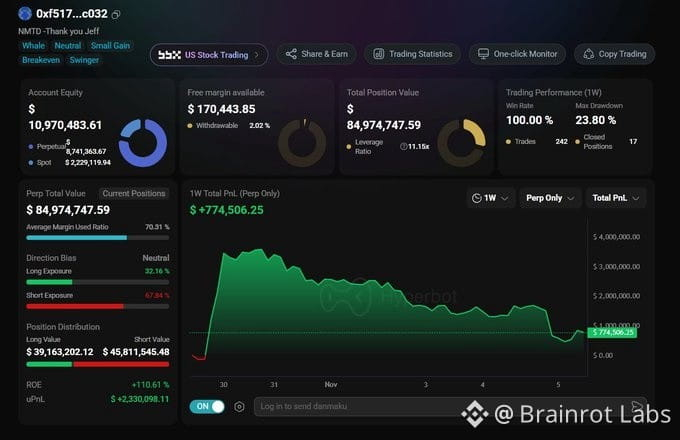
A 98% win-rate BTC trader just cut $6.66M in long exposure. Taking profits or sensing trouble?
On-chain data shows the wallet reduced its BTC long position by approximately $6.7M between November 4–5.
Trading record: 42 rounds, ~98% win rate.
Weighted average closing price: $80,253.
Current BTC long position: ~$1.81M.
Even a highly successful trader is reducing exposure. Worth watching, but one wallet's move doesn't determine BTC's direction.
98% win rate. Still knows when to hit the exit.
Is this profit-taking or a warning sign?
321
See translation
Coinbase says hackers would have a hard time finding the money. 99%+ of customer assets are in cold storage.
Following the Binance hot-wallet incident, Coinbase confirmed its systems and customer assets remain unaffected.
Key security measures:
99%+ of customer assets stored in cold wallets.
Only a small amount kept in hot wallets for withdrawals.
Excess funds are continuously moved back to cold storage.
Private keys are split without being reassembled during signing.
Transfer limits, anomaly detection and emergency signing shutdown mechanisms.
Customer assets are backed 1:1 and never lent out or used without authorization.
Hackers: “Where's the money?”
Coinbase: “Somewhere you can't connect to the internet.”

1.1k
See translation
Oh yeah! After 8 years of marriage, I finally got officially recognized as an Influencer.
Turns out, I've been an influencer all along. Just not on social media.
I'm an Influencer to my wife and kids. I influence their decisions, their daily lives, and apparently, the family budget too.
But seriously, I just post whatever I find fun. I'm not a KOL, and I'm not anyone's influencer. I don't represent anyone, promote anyone, or need to fit anyone's agenda.
I'm just here to have fun, share my thoughts, shitpost, and enjoy the chaos.
My only target audience? My wife. And even she doesn't follow all my advice.
1
311
See translation
I’ve seen quite a few projects advertising AI-powered trading and fully automated money management, claiming exceptionally high win rates.
But the actual research tells a different story.
In one AI-Trader experiment, all 6 AI models lost money in crypto. Even the best model recorded a -12.18% return, while none managed to beat the market benchmark.
In StockBench, 5 out of 13 AI models failed to outperform Buy & Hold.
A high win rate doesn’t necessarily mean consistent profitability. Real performance depends on execution, risk management, drawdowns, and long-term results.
I believe the most interesting direction is Hybrid AI, combining Machine Learning, LLM Agents, Reinforcement Learning, and robust risk management.
AI has potential, but fully automated trading with consistently high returns is a different story.
The real question isn’t how often AI wins, but how consistently it can make money.

11
See translation
Crypto spent $170M influencing elections. AI spent $72M . Guess who came to play with the bigger wallet?
Three crypto-focused political action committees reportedly spent around $170 million during this election cycle, compared with approximately $72 million from AI-focused PACs.
But money doesn’t guarantee political victories.
Some major bets didn’t pay off:
●Darline Graham: Lost.
●Mike Rogers: Lost.
●Carlos: Lost.
Crypto is spending heavily to shape its political future, but campaign money doesn’t automatically translate into votes or influence.
Crypto brought $170M to the political battlefield. Some candidates still couldn’t convert it into a W.
The question: Is crypto buying political influence, or just discovering that elections are harder than trading?
52
See translation
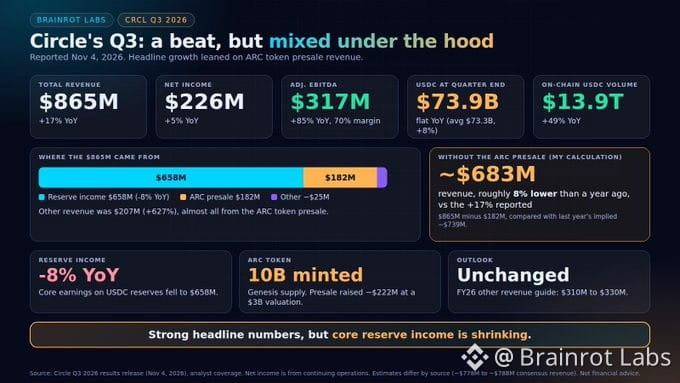
Circle's revenue is growing, but USDC reserve income is under pressure.
Circle (CRCL$73.86) reported mixed Q3 2026 results:
Total revenue: $865M, up 17% YoY.
Net income: $226M, up 5%.
Adjusted EBITDA: $317M, up 85%.
USDC circulation: $73,9B.
On-chain USDC transaction volume: $13.9T, up 49%.
$182M of other revenue came from the ARC$0.0378 token presale.
USDC adoption and transaction activity continue expanding, while lower reserve yields weigh on core reserve revenue.
Circle is also pushing into payments infrastructure through Tazapay and its Arc blockchain.
USDC is growing beyond stablecoins. Circle wants a bigger piece of the payment infrastructure pie.
1
133
See translation
Morgan Stanley just raised its AMD price target. Wall Street is still betting on AI chips.
Morgan Stanley increased its AMD$483.47 price target from $510 to $550.
Previous target: $510
New target: $550
Increase: $40 (+7.8%)
The higher target reflects a more optimistic valuation outlook, but analyst price targets are projections not guaranteed outcomes.
AMD bulls just got a little more ammunition.
Can AMD live up to the AI hype
AMD-14.01%
MSUS-5.63%
102
See translation
Someone just added another $7.62M short on Anthropic.
the largest short-position holder on Hyperliquid increased its bets today.
New shorts: $7.62M.
Total short exposure: $36.18M.
Across 2 Anthropic-related contracts.
My take: Someone is betting big against the AI narrative.
AI is booming, but this trader is betting on a plot twist.
Conviction or just an expensive gamble?

366
Log in to explore more content
Join global crypto users on Binance Square
⚡️ Get latest and useful information about crypto.
💬 Trusted by the world’s largest crypto exchange.
👍 Discover real insights from verified creators.
Email / Phone number
Trending Topics
BinanceReopensWithdrawalsForMoreAssets
833,061 views
4,562 Discussing
Security Incident | Recovery Update #8: Withdrawals for More Assets to Reopen (2026-11-05)
Binance Announcement
·390 Likes
·1.7M views
Binance98PercentReplenished
179,266 views
1,840 Discussing
USStocksSlipandCryptoMarketUnderBroadPressure
10,367 views
233 Discussing