
STi克莱小汤
569 Posts

STi克莱小汤
Report
Block User
7年公链早期投资&咨询顾问(Algo,Near, Securitize CHZ,SOL,BAT, Ampl)等,券商&媒体特邀作者 ;Tesla、GM韩国政府等国际项目与CFT管理经验/ 工硕 。喜欢周易,善为先,运相随,鸣谦吉—7年内数次提前数周/月提醒大趋势点,大趋势大道不可逆,让信任的人得到提醒吧。推特发比广场少

原创之星
Occasional Trader
8.4 Years
8 Following
7.1K+ Followers
9.2K+ Liked
1 Badges
Posts
All
Quotes
Videos
PINNED
·
--
If you want to make quick money from investment, the basic outcome is to give away money,
If you want to earn long-term value from investment, it often may bring surprises instead.
If you want others to take over your investment, you will ultimately be swallowed by even darker hands.
If you want to learn and share together through investment, it will be easier to accumulate value and merit.
In short, you must be true to your conscience; only then can some invisible forces be activated in the midst of it all. This is also an interesting deep-level philosophy, the way of balance.
$BTC $ETH $BNB #加密市场观察
If you want to make quick money from investment, the basic outcome is to give away money,
If you want to earn long-term value from investment, it often may bring surprises instead.
If you want others to take over your investment, you will ultimately be swallowed by even darker hands.
If you want to learn and share together through investment, it will be easier to accumulate value and merit.
In short, you must be true to your conscience; only then can some invisible forces be activated in the midst of it all. This is also an interesting deep-level philosophy, the way of balance.
$BTC $ETH $BNB #加密市场观察
If you want to earn long-term value from investment, it often may bring surprises instead.
If you want others to take over your investment, you will ultimately be swallowed by even darker hands.
If you want to learn and share together through investment, it will be easier to accumulate value and merit.
In short, you must be true to your conscience; only then can some invisible forces be activated in the midst of it all. This is also an interesting deep-level philosophy, the way of balance.
$BTC $ETH $BNB #加密市场观察
5
2
61
7.4k
·
--
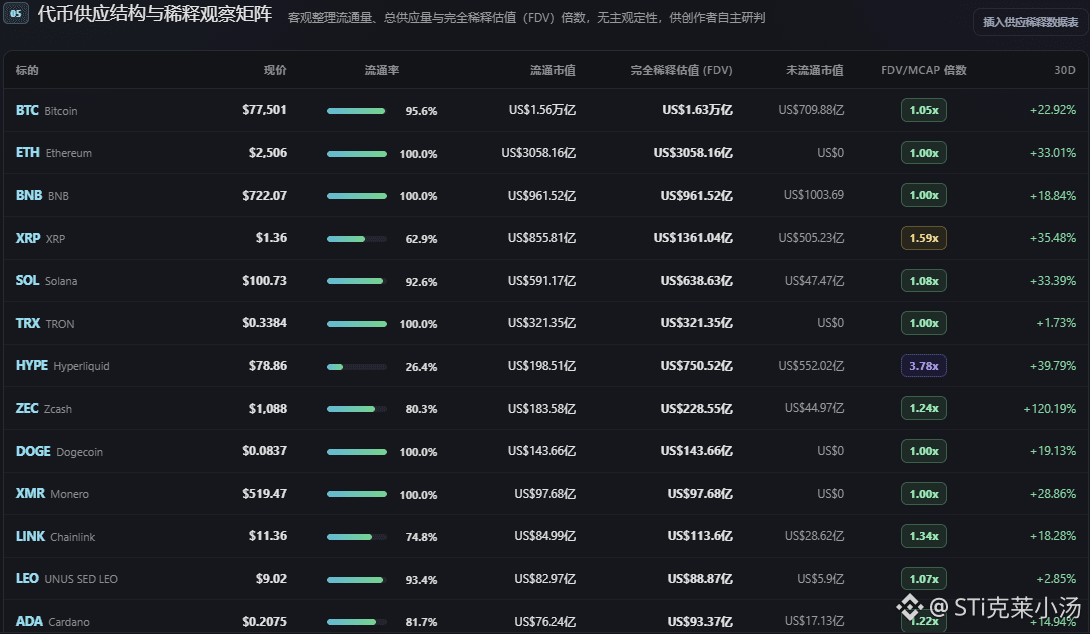
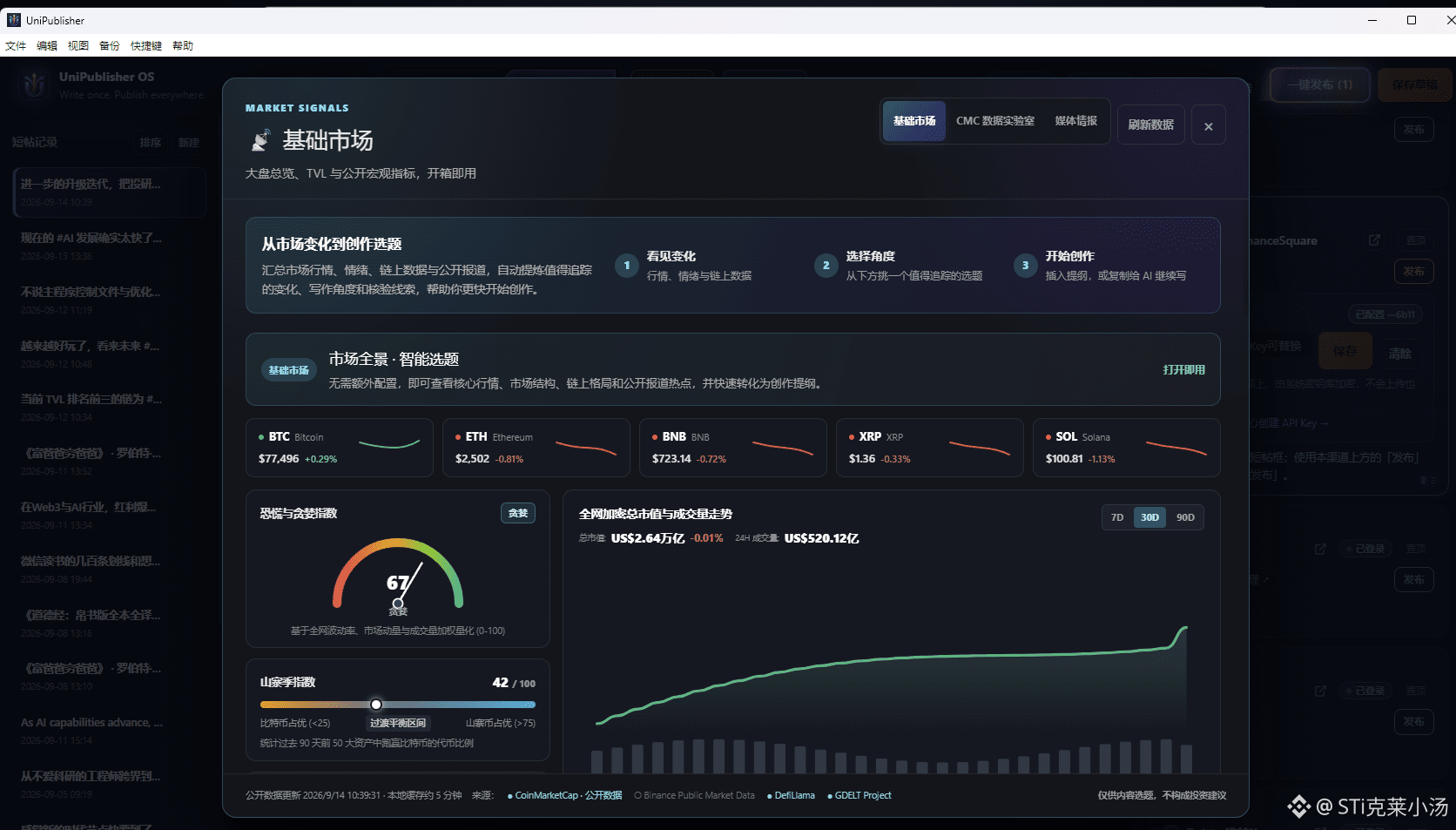
Added further upgrades and iterations by integrating the research and investment data platform into the content creation platform. This allows you to quickly collect market changes using the platform, and then directly proceed with the next step of creating and publishing N connected official channels. If WeChat Reading finds inspiration, it’s content built from your own previously summarized experiences—notes, highlights, and ideas that can be reused. Then market inspiration is the analysis of how data and media resources are leveraged in the present and future.
For example, the display of the following basic data:
• Key facts: Total market cap US$2.64 trillion, 24h +0.04%; Trading volume US$51.442 billion, change +24.25%.
• Structural signals: $BTC market share 58.90%, 24h +0.22%; $ETH market share 11.57%.
• Sentiment cross-validation: The Fear and Greed Index is 67 (Greed).
But at the moment, the data module hasn’t included too many of the DIY modules I personally fine-tune for my own use. Step by step. It’s still quite interesting. The next upgrade will likely be one I’m even more excited about:
#AI #Web3
Added further upgrades and iterations by integrating the research and investment data platform into the content creation platform. This allows you to quickly collect market changes using the platform, and then directly proceed with the next step of creating and publishing N connected official channels. If WeChat Reading finds inspiration, it’s content built from your own previously summarized experiences—notes, highlights, and ideas that can be reused. Then market inspiration is the analysis of how data and media resources are leveraged in the present and future.
For example, the display of the following basic data:
• Key facts: Total market cap US$2.64 trillion, 24h +0.04%; Trading volume US$51.442 billion, change +24.25%.
• Structural signals: $BTC market share 58.90%, 24h +0.22%; $ETH market share 11.57%.
• Sentiment cross-validation: The Fear and Greed Index is 67 (Greed).
But at the moment, the data module hasn’t included too many of the DIY modules I personally fine-tune for my own use. Step by step. It’s still quite interesting. The next upgrade will likely be one I’m even more excited about:
#AI #Web3
For example, the display of the following basic data:
• Key facts: Total market cap US$2.64 trillion, 24h +0.04%; Trading volume US$51.442 billion, change +24.25%.
• Structural signals: $BTC market share 58.90%, 24h +0.22%; $ETH market share 11.57%.
• Sentiment cross-validation: The Fear and Greed Index is 67 (Greed).
But at the moment, the data module hasn’t included too many of the DIY modules I personally fine-tune for my own use. Step by step. It’s still quite interesting. The next upgrade will likely be one I’m even more excited about:
#AI #Web3
2
1
792
·
--
The current development of #AI is really happening too fast. It’s like in football where everyone is sprinting for fast breaks—you can control the tempo and catch your breath. Plan the safety boundaries and the uncontrollable factors well.
The Token can also be optimized to improve its burn efficiency.
As for today’s #Web3 development, it’s really too slow. It’s already 2026, yet people are still hyping meme coins. It’s time to support more legitimate, serious applications—so that Tokens can empower the product economy more effectively. For example, Agent payments’ reliance on the chain and AI-generated-fake prevention, as well as on-chain protection for app-chains. And GameFi using Tokens as development rights and the co-building of internal in-game applications.
Two Tokens—AI and blockchain—but their functions are completely different 🤔
$BTC $ETH $SOL
The current development of #AI is really happening too fast. It’s like in football where everyone is sprinting for fast breaks—you can control the tempo and catch your breath. Plan the safety boundaries and the uncontrollable factors well.
The Token can also be optimized to improve its burn efficiency.
As for today’s #Web3 development, it’s really too slow. It’s already 2026, yet people are still hyping meme coins. It’s time to support more legitimate, serious applications—so that Tokens can empower the product economy more effectively. For example, Agent payments’ reliance on the chain and AI-generated-fake prevention, as well as on-chain protection for app-chains. And GameFi using Tokens as development rights and the co-building of internal in-game applications.
Two Tokens—AI and blockchain—but their functions are completely different 🤔
$BTC $ETH $SOL
The Token can also be optimized to improve its burn efficiency.
As for today’s #Web3 development, it’s really too slow. It’s already 2026, yet people are still hyping meme coins. It’s time to support more legitimate, serious applications—so that Tokens can empower the product economy more effectively. For example, Agent payments’ reliance on the chain and AI-generated-fake prevention, as well as on-chain protection for app-chains. And GameFi using Tokens as development rights and the co-building of internal in-game applications.
Two Tokens—AI and blockchain—but their functions are completely different 🤔
$BTC $ETH $SOL
1
503
·
--
This year’s predictions for the market—the most interesting part of the Ballon d’Or is that there isn’t a perfect candidate.
In terms of honors, the most perfect is Fabian Luyis, but his team’s weighting isn’t T0.
In terms of ability, the most perfect is Rodri, but he missed too many league matches, and Manchester City were eliminated from the Champions League early.
Overall performance is slightly imperfect: Rice and Kane—especially Rice, whose overall value is extremely high.
Truly outstanding are K77 and Dembele, but neither had a World Cup.
Familiarity: Yamal and Mbappé, but one had a World Cup that was too disappointing, and the other had basically no honors this year.
#predict $CITY $PSG
This year’s predictions for the market—the most interesting part of the Ballon d’Or is that there isn’t a perfect candidate.
In terms of honors, the most perfect is Fabian Luyis, but his team’s weighting isn’t T0.
In terms of ability, the most perfect is Rodri, but he missed too many league matches, and Manchester City were eliminated from the Champions League early.
Overall performance is slightly imperfect: Rice and Kane—especially Rice, whose overall value is extremely high.
Truly outstanding are K77 and Dembele, but neither had a World Cup.
Familiarity: Yamal and Mbappé, but one had a World Cup that was too disappointing, and the other had basically no honors this year.
#predict $CITY $PSG
In terms of honors, the most perfect is Fabian Luyis, but his team’s weighting isn’t T0.
In terms of ability, the most perfect is Rodri, but he missed too many league matches, and Manchester City were eliminated from the Champions League early.
Overall performance is slightly imperfect: Rice and Kane—especially Rice, whose overall value is extremely high.
Truly outstanding are K77 and Dembele, but neither had a World Cup.
Familiarity: Yamal and Mbappé, but one had a World Cup that was too disappointing, and the other had basically no honors this year.
#predict $CITY $PSG
866
·
--
I won’t talk about the main program’s control files and optimization Skills. Just writing the root-cause issues and solutions one by one in debug notes has already hit 3,000 lines—wow ~~ #AI #Claude #codex #Gemini these three helpers are also pretty good, but the problem is obvious too: most of the time, you still need a person to come up with a very clear idea. If you just let them do it freely, it’s easy to get awkward stumbles.
But in the public square—ever since I developed API product testing—I experienced a completely inexplicable traffic cliff. Even the backend engineers and official staff didn’t know what was going on. After the account helped test Binance APIs and went through that bizarre AIGC detection error that got it flagged, now they say the account is all fine. However, a 90% drop in traffic still happened. (Before the test, basically it was 5,000~10,000+, then it directly became 500)
The most frightening part isn’t the traffic cliff. It’s that even the official people don’t know why. They can only say my account isn’t a problem. If you can find the issue and optimize it, then fine—but if it’s not a problem, then could it be that the AI technology used by Binance staff did something to the product design and algorithms that the official staff can’t even understand?
@CZ @richardteng @heyi
$BTC $ETH $BNB
I won’t talk about the main program’s control files and optimization Skills. Just writing the root-cause issues and solutions one by one in debug notes has already hit 3,000 lines—wow ~~ #AI #Claude #codex #Gemini these three helpers are also pretty good, but the problem is obvious too: most of the time, you still need a person to come up with a very clear idea. If you just let them do it freely, it’s easy to get awkward stumbles.
But in the public square—ever since I developed API product testing—I experienced a completely inexplicable traffic cliff. Even the backend engineers and official staff didn’t know what was going on. After the account helped test Binance APIs and went through that bizarre AIGC detection error that got it flagged, now they say the account is all fine. However, a 90% drop in traffic still happened. (Before the test, basically it was 5,000~10,000+, then it directly became 500)
The most frightening part isn’t the traffic cliff. It’s that even the official people don’t know why. They can only say my account isn’t a problem. If you can find the issue and optimize it, then fine—but if it’s not a problem, then could it be that the AI technology used by Binance staff did something to the product design and algorithms that the official staff can’t even understand?
@CZ @Richard Teng @Yi He
$BTC $ETH $BNB
But in the public square—ever since I developed API product testing—I experienced a completely inexplicable traffic cliff. Even the backend engineers and official staff didn’t know what was going on. After the account helped test Binance APIs and went through that bizarre AIGC detection error that got it flagged, now they say the account is all fine. However, a 90% drop in traffic still happened. (Before the test, basically it was 5,000~10,000+, then it directly became 500)
The most frightening part isn’t the traffic cliff. It’s that even the official people don’t know why. They can only say my account isn’t a problem. If you can find the issue and optimize it, then fine—but if it’s not a problem, then could it be that the AI technology used by Binance staff did something to the product design and algorithms that the official staff can’t even understand?
@CZ @Richard Teng @Yi He
$BTC $ETH $BNB
3
1
5
682
·
--
Getting more and more fun. Looks like in the future, the 3 most valuable models in the #AI era are:
1. How to use AI to maximize the presentation and creation of your own inspiration, including producing non-public content and tools.
2. Use AI to maximize the discoverability of content that needs to be public, so that AI can find it and bring it into the analysis library.
3. How to train/tune AI and maximize it to serve work in a way that is precise and relatively low-cost.
The former is using AI to build a treasure trove; the latter is guiding AI to serve your viewpoints. Ultimately, everything is in preparation for greatly improving productivity.
As for investing, I don’t really feel much changes. No matter how much AI improves, the essence of investing remains unchanged: it’s the long-term growth value. The speed is relative. Whether you get comprehensive improvements quickly or comprehensive improvements slowly doesn’t make much difference for investing. It still comes down to how fast you are compared with other people. As for the evolution of quant systems, it’s also because the underlying modules were already strong—what’s impressive is the logic behind it, not how powerful the AI itself is.
AI’s bigger value may be helping people who once had an Idea but couldn’t program to realize their Idea. This might be the #X factor in the quant and investment markets. But for ordinary retail investors, hoping to use AI to help you invest and make money is basically not very realistic.💡
$BTC $AAPL $GOOGL
Getting more and more fun. Looks like in the future, the 3 most valuable models in the #AI era are:
1. How to use AI to maximize the presentation and creation of your own inspiration, including producing non-public content and tools.
2. Use AI to maximize the discoverability of content that needs to be public, so that AI can find it and bring it into the analysis library.
3. How to train/tune AI and maximize it to serve work in a way that is precise and relatively low-cost.
The former is using AI to build a treasure trove; the latter is guiding AI to serve your viewpoints. Ultimately, everything is in preparation for greatly improving productivity.
As for investing, I don’t really feel much changes. No matter how much AI improves, the essence of investing remains unchanged: it’s the long-term growth value. The speed is relative. Whether you get comprehensive improvements quickly or comprehensive improvements slowly doesn’t make much difference for investing. It still comes down to how fast you are compared with other people. As for the evolution of quant systems, it’s also because the underlying modules were already strong—what’s impressive is the logic behind it, not how powerful the AI itself is.
AI’s bigger value may be helping people who once had an Idea but couldn’t program to realize their Idea. This might be the #X factor in the quant and investment markets. But for ordinary retail investors, hoping to use AI to help you invest and make money is basically not very realistic.💡
$BTC $AAPL $GOOGL
1. How to use AI to maximize the presentation and creation of your own inspiration, including producing non-public content and tools.
2. Use AI to maximize the discoverability of content that needs to be public, so that AI can find it and bring it into the analysis library.
3. How to train/tune AI and maximize it to serve work in a way that is precise and relatively low-cost.
The former is using AI to build a treasure trove; the latter is guiding AI to serve your viewpoints. Ultimately, everything is in preparation for greatly improving productivity.
As for investing, I don’t really feel much changes. No matter how much AI improves, the essence of investing remains unchanged: it’s the long-term growth value. The speed is relative. Whether you get comprehensive improvements quickly or comprehensive improvements slowly doesn’t make much difference for investing. It still comes down to how fast you are compared with other people. As for the evolution of quant systems, it’s also because the underlying modules were already strong—what’s impressive is the logic behind it, not how powerful the AI itself is.
AI’s bigger value may be helping people who once had an Idea but couldn’t program to realize their Idea. This might be the #X factor in the quant and investment markets. But for ordinary retail investors, hoping to use AI to help you invest and make money is basically not very realistic.💡
$BTC $AAPL $GOOGL

2
2
945
·
--
The top three chains by TVL currently are #Ethereum, #Solana, and #BSC. TVL is a measure of the amount of capital held and is not the same as user activity or the value of token investments.
Approximately:
• Ethereum ($ETH): US$50.056 billion
• Solana ($SOL ): US$5.906 billion
• BSC ($BNB ): US$5.648 billion
The total market capitalization of the crypto market increased by 1.10% over the past 24 hours, and trading volume changed by +26.89%.
• Total market cap: US$2.64 trillion, 24-hour change: +1.10%
• 24-hour trading volume: US$107.275 billion, compared with yesterday: +26.89%
• BTC market share: 58.74%, 24-hour change: -0.27%
The top three chains by TVL currently are #Ethereum, #Solana, and #BSC. TVL is a measure of the amount of capital held and is not the same as user activity or the value of token investments.
Approximately:
• Ethereum ($ETH ): US$50.056 billion
• Solana ($SOL ): US$5.906 billion
• BSC ($BNB ): US$5.648 billion
The total market capitalization of the crypto market increased by 1.10% over the past 24 hours, and trading volume changed by +26.89%.
• Total market cap: US$2.64 trillion, 24-hour change: +1.10%
• 24-hour trading volume: US$107.275 billion, compared with yesterday: +26.89%
• BTC market share: 58.74%, 24-hour change: -0.27%
Approximately:
• Ethereum ($ETH ): US$50.056 billion
• Solana ($SOL ): US$5.906 billion
• BSC ($BNB ): US$5.648 billion
The total market capitalization of the crypto market increased by 1.10% over the past 24 hours, and trading volume changed by +26.89%.
• Total market cap: US$2.64 trillion, 24-hour change: +1.10%
• 24-hour trading volume: US$107.275 billion, compared with yesterday: +26.89%
• BTC market share: 58.74%, 24-hour change: -0.27%
1
376
·
--
Currently already achieved:
Independent creation/WeChat Reading (notes/highlights) —> Uni Publisher —> @BinanceSquareCN (Binance Square) and other web3 and AI channel creation and publishing pipeline.
It’s getting more and more fun. Next, I’m going to start adding new model blocks 🧧 Some data analysis modules I use personally may be added later, but for now I can’t because the complexity is too high due to cloud computing intensity/cost concerns. It can’t handle the computation (if it’s free as part of product power, it would take a few hours or half a day 👀)
What features do you want to add?
$BTC #比特币金叉确认 $GOOGL.US $AAPL.US
Currently already achieved:
Independent creation/WeChat Reading (notes/highlights) —> Uni Publisher —> @币安广场 (Binance Square) and other web3 and AI channel creation and publishing pipeline.
It’s getting more and more fun. Next, I’m going to start adding new model blocks 🧧 Some data analysis modules I use personally may be added later, but for now I can’t because the complexity is too high due to cloud computing intensity/cost concerns. It can’t handle the computation (if it’s free as part of product power, it would take a few hours or half a day 👀)
What features do you want to add?
$BTC #比特币金叉确认 $GOOGL.US $AAPL.US
Independent creation/WeChat Reading (notes/highlights) —> Uni Publisher —> @币安广场 (Binance Square) and other web3 and AI channel creation and publishing pipeline.
It’s getting more and more fun. Next, I’m going to start adding new model blocks 🧧 Some data analysis modules I use personally may be added later, but for now I can’t because the complexity is too high due to cloud computing intensity/cost concerns. It can’t handle the computation (if it’s free as part of product power, it would take a few hours or half a day 👀)
What features do you want to add?
$BTC #比特币金叉确认 $GOOGL.US $AAPL.US
AI
75%
技术投资建议
25%
定制化
0%
还没想好
0%
4 votes • Voting closed
1k
·
--
Recently experienced an equity project that started in the seed stage of a Level-1 equity deal and went on to reach a 20x outcome after it listed—but after the SPV and all the tax and equity adjustments in the later stages, by the end the investor who actually got the money didn’t even receive 5x😅
In comparison, it suddenly feels much clearer in the crypto space, and that’s also why I’ve been very reluctant to invest in the primary market since 2022. Many times, picking up bargains in the secondary market carries far less risk for investors than investing in the primary market. Valuations in the primary stage aren’t low either, but equity gets diluted through follow-on financing. Unlike the crypto market, where valuation calculation is stable and only unlocks happen in installments—although that’s also a form of implicit “dilution.”
$BTC $ETH $NVDAB
Recently experienced an equity project that started in the seed stage of a Level-1 equity deal and went on to reach a 20x outcome after it listed—but after the SPV and all the tax and equity adjustments in the later stages, by the end the investor who actually got the money didn’t even receive 5x😅
In comparison, it suddenly feels much clearer in the crypto space, and that’s also why I’ve been very reluctant to invest in the primary market since 2022. Many times, picking up bargains in the secondary market carries far less risk for investors than investing in the primary market. Valuations in the primary stage aren’t low either, but equity gets diluted through follow-on financing. Unlike the crypto market, where valuation calculation is stable and only unlocks happen in installments—although that’s also a form of implicit “dilution.”
$BTC $ETH $NVDAB
In comparison, it suddenly feels much clearer in the crypto space, and that’s also why I’ve been very reluctant to invest in the primary market since 2022. Many times, picking up bargains in the secondary market carries far less risk for investors than investing in the primary market. Valuations in the primary stage aren’t low either, but equity gets diluted through follow-on financing. Unlike the crypto market, where valuation calculation is stable and only unlocks happen in installments—although that’s also a form of implicit “dilution.”
$BTC $ETH $NVDAB
503
·
--
In the Web3 and AI industries, the depreciation speed of knowledge during the boom period is extremely fast, and the rate at which information hotspots are updated is also very quick. Only by maintaining a keen sense of smell for shifts in technological paradigms, choosing the right field that belongs to you, and continuously learning, experiencing, reflecting, and correcting mistakes to refresh your judgment criteria, can you calmly accomplish your self-transcendence with each transition between new and old cycles—thereby accumulating the inspiration to spot changes in long-term value.#AI #BTC
$BTC $ETH $ALGO
In the Web3 and AI industries, the depreciation speed of knowledge during the boom period is extremely fast, and the rate at which information hotspots are updated is also very quick. Only by maintaining a keen sense of smell for shifts in technological paradigms, choosing the right field that belongs to you, and continuously learning, experiencing, reflecting, and correcting mistakes to refresh your judgment criteria, can you calmly accomplish your self-transcendence with each transition between new and old cycles—thereby accumulating the inspiration to spot changes in long-term value.#AI #BTC
$BTC $ETH $ALGO
$BTC $ETH $ALGO
333
·
--
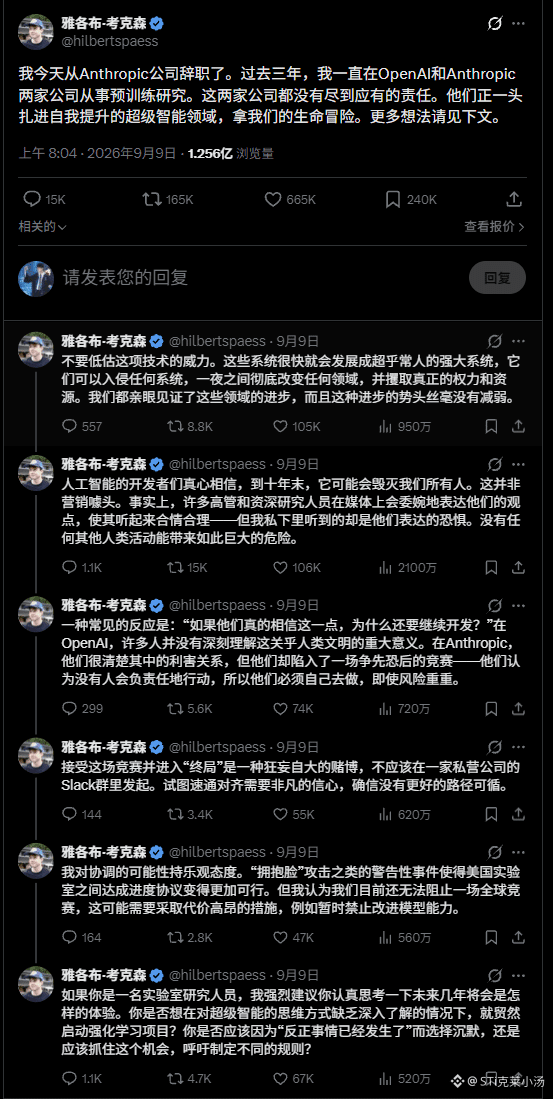
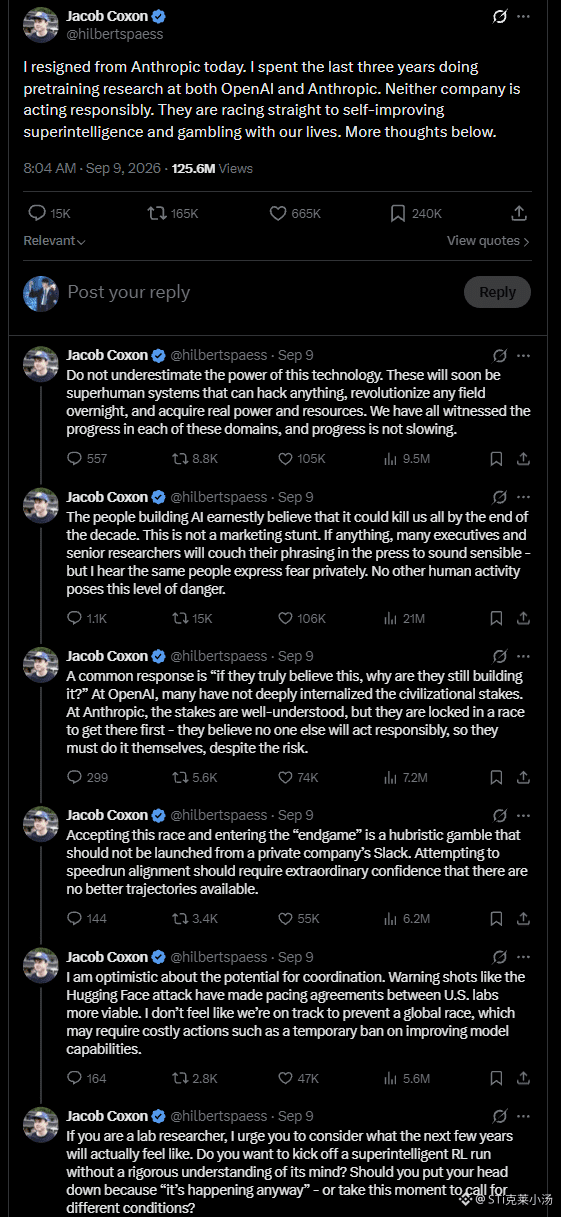
Claude and OpenAI dual-research god Jacob resigns and shares his views on AI risks. His core point is that when it’s hard to know the risks of uncertain super AGIs, people may still blindly release them because of competitions. This behavior could lead to unexpected consequences.
However, for me personally, #AI agents are still very useful. If the intelligence level were a bit higher, that would be even better. But if users have weaker risk awareness, then it’s easy for things to go wrong.
$NVDAB $AAPLB $BTC
Claude and OpenAI dual-research god Jacob resigns and shares his views on AI risks. His core point is that when it’s hard to know the risks of uncertain super AGIs, people may still blindly release them because of competitions. This behavior could lead to unexpected consequences.
However, for me personally, #AI agents are still very useful. If the intelligence level were a bit higher, that would be even better. But if users have weaker risk awareness, then it’s easy for things to go wrong.
$NVDAB $AAPLB $BTC
However, for me personally, #AI agents are still very useful. If the intelligence level were a bit higher, that would be even better. But if users have weaker risk awareness, then it’s easy for things to go wrong.
$NVDAB $AAPLB $BTC
1
1.5k
·
--
Nice, nice—this fan 🪭 has a lot of artistic charm. Fellow Daoist, is your mind clear and at ease now? $NVDAB $BTC
Nice, nice—this fan 🪭 has a lot of artistic charm. Fellow Daoist, is your mind clear and at ease now? $NVDAB $BTC


854
·
--
Hundreds of highlight marks and idea notes from WeChat Reading can now be turned into inspiration and sources for creation—insert into the editor, and then with one click distribute and publish across major channels like Binance Square, Twitter, Weibo, broker platforms, and more.
This feature is incredibly useful for me, and it also boosts my motivation to read a lot. In the past, highlights and notes might be forgotten; now they’re integrated into the creation platform, helping me create even more effectively.🎯 There are still many more features to come OTW. It feels like the original intention behind building this is to improve my efficiency—so far it saves me 90% of my time.
$BTC $ETH $BNB
Hundreds of highlight marks and idea notes from WeChat Reading can now be turned into inspiration and sources for creation—insert into the editor, and then with one click distribute and publish across major channels like Binance Square, Twitter, Weibo, broker platforms, and more.
This feature is incredibly useful for me, and it also boosts my motivation to read a lot. In the past, highlights and notes might be forgotten; now they’re integrated into the creation platform, helping me create even more effectively.🎯 There are still many more features to come OTW. It feels like the original intention behind building this is to improve my efficiency—so far it saves me 90% of my time.
$BTC $ETH $BNB
This feature is incredibly useful for me, and it also boosts my motivation to read a lot. In the past, highlights and notes might be forgotten; now they’re integrated into the creation platform, helping me create even more effectively.🎯 There are still many more features to come OTW. It feels like the original intention behind building this is to improve my efficiency—so far it saves me 90% of my time.
$BTC $ETH $BNB
2
3
1.4k
·
--
A chain that relies on Memes to create false prosperity and TPS has no future; it only has short-term illusions. It's already 2026, and still using this same combo is too easy to be left behind by the times.
But from another perspective, it's also quite helpless—it shows that in the industry's serious route exploration, TPS has still not kicked off large-scale application scenarios. What’s needed are real payment, machine, gaming, and content application use cases.
$PONS $SOL $HOOD
A chain that relies on Memes to create false prosperity and TPS has no future; it only has short-term illusions. It's already 2026, and still using this same combo is too easy to be left behind by the times.
But from another perspective, it's also quite helpless—it shows that in the industry's serious route exploration, TPS has still not kicked off large-scale application scenarios. What’s needed are real payment, machine, gaming, and content application use cases.
$PONS $SOL $HOOD
But from another perspective, it's also quite helpless—it shows that in the industry's serious route exploration, TPS has still not kicked off large-scale application scenarios. What’s needed are real payment, machine, gaming, and content application use cases.
$PONS $SOL $HOOD
1
1
1.7k
·
--
For ordinary investors, it is best to choose only one of two operating modes: holding spot positions or staying flat. It is best to stay away from short selling and high-leverage high-frequency trading.
Short selling is an activity with limited returns and unlimited risk ♾️, while in high-frequency trading, your opponent in the future will be super AI.
$BTC $ETH $BNB
For ordinary investors, it is best to choose only one of two operating modes: holding spot positions or staying flat. It is best to stay away from short selling and high-leverage high-frequency trading.
Short selling is an activity with limited returns and unlimited risk ♾️, while in high-frequency trading, your opponent in the future will be super AI.
$BTC $ETH $BNB
Short selling is an activity with limited returns and unlimited risk ♾️, while in high-frequency trading, your opponent in the future will be super AI.
$BTC $ETH $BNB
708
·
--
From an engineer who never liked research, pivoting to Web3 AI investment research, and writing 600,000 Chinese characters in his spare time—before I knew it, eight years have already passed. In 2018, when I first read the white paper, I could already feel that it was a future gold-class assetAn engineer who never liked research pivoted into Web3 AI investment research, and in his spare time wrote 600,000 Chinese characters. Before I knew it, eight years have already passed.
In 2018, when I first read the $BTC white paper, I could already feel that it was a future gold-class asset. Back then, I started learning blockchain from scratch. The first book I read was the one a sister I interviewed with—she worked at a startup where I’d just returned to China after switching careers from the automotive industry—gave me. It was the green book translated by Buzou Gongqinwang. I finished it in three days—about 400 pages—then went to chat with her. She said she had only read one chapter, and yet I had finished the whole thing. The book’s explanation of $ETH was very specific, and I remember it vividly. At that time, the narrative about EOS—its supernodes—was really popular. It was also this book that sparked my interest in blockchain value research.
From an engineer who never liked research, pivoting to Web3 AI investment research, and writing 600,000 Chinese characters in his spare time—before I knew it, eight years have already passed. In 2018, when I first read the white paper, I could already feel that it was a future gold-class asset
An engineer who never liked research pivoted into Web3 AI investment research, and in his spare time wrote 600,000 Chinese characters. Before I knew it, eight years have already passed.
In 2018, when I first read the $BTC white paper, I could already feel that it was a future gold-class asset. Back then, I started learning blockchain from scratch. The first book I read was the one a sister I interviewed with—she worked at a startup where I’d just returned to China after switching careers from the automotive industry—gave me. It was the green book translated by Buzou Gongqinwang. I finished it in three days—about 400 pages—then went to chat with her. She said she had only read one chapter, and yet I had finished the whole thing. The book’s explanation of $ETH was very specific, and I remember it vividly. At that time, the narrative about EOS—its supernodes—was really popular. It was also this book that sparked my interest in blockchain value research.
In 2018, when I first read the $BTC white paper, I could already feel that it was a future gold-class asset. Back then, I started learning blockchain from scratch. The first book I read was the one a sister I interviewed with—she worked at a startup where I’d just returned to China after switching careers from the automotive industry—gave me. It was the green book translated by Buzou Gongqinwang. I finished it in three days—about 400 pages—then went to chat with her. She said she had only read one chapter, and yet I had finished the whole thing. The book’s explanation of $ETH was very specific, and I remember it vividly. At that time, the narrative about EOS—its supernodes—was really popular. It was also this book that sparked my interest in blockchain value research.
2
931
·
--
Recently I ran into something really ridiculous.
A 100% handwritten piece got detected by AI as 100% AI.
Then a piece that was 100% AIGC got detected by AI as 0%.
This is the current level of AI detection. It feels like it’s just random 😂
Binance Square’s shitty engine should upgrade too, like, meow, quickly.
$BTC $ETH
Recently I ran into something really ridiculous.
A 100% handwritten piece got detected by AI as 100% AI.
Then a piece that was 100% AIGC got detected by AI as 0%.
This is the current level of AI detection. It feels like it’s just random 😂
Binance Square’s shitty engine should upgrade too, like, meow, quickly.
$BTC $ETH
A 100% handwritten piece got detected by AI as 100% AI.
Then a piece that was 100% AIGC got detected by AI as 0%.
This is the current level of AI detection. It feels like it’s just random 😂
Binance Square’s shitty engine should upgrade too, like, meow, quickly.
$BTC $ETH
3
4
2.2k
·
--
A real bull market—whatever your style is, as long as you don’t mess around, you can make money.
A fake bull market—whatever your style is, you’ll watch it rise, but you’ll be slow by half a beat (because the cheapest time to pull it up is when nobody knows).
A real bear market is this: besides quantitative speculation, it basically buries all value investing.
$BTC $BNB $ETH
A real bull market—whatever your style is, as long as you don’t mess around, you can make money.
A fake bull market—whatever your style is, you’ll watch it rise, but you’ll be slow by half a beat (because the cheapest time to pull it up is when nobody knows).
A real bear market is this: besides quantitative speculation, it basically buries all value investing.
$BTC $BNB $ETH
A fake bull market—whatever your style is, you’ll watch it rise, but you’ll be slow by half a beat (because the cheapest time to pull it up is when nobody knows).
A real bear market is this: besides quantitative speculation, it basically buries all value investing.
$BTC $BNB $ETH
1.1k
·
--
At the very beginning I planned to use this product myself, because there are indeed too many partnership channels. Every time, it takes me at least 3–5 hours just for formatting and distribution. Later, a few author friends used it too and said it felt great—thankfully, an agent can save a lot of time on basic code, which is why it can be built so quickly. But the amount of debugging is also huge, and visual model errors are quite common. So the AGENT still has a way to go before it becomes truly intelligent $NVDAB $BTC $ETH
At the very beginning I planned to use this product myself, because there are indeed too many partnership channels. Every time, it takes me at least 3–5 hours just for formatting and distribution. Later, a few author friends used it too and said it felt great—thankfully, an agent can save a lot of time on basic code, which is why it can be built so quickly. But the amount of debugging is also huge, and visual model errors are quite common. So the AGENT still has a way to go before it becomes truly intelligent $NVDAB $BTC $ETH
STi克莱小汤
·
--
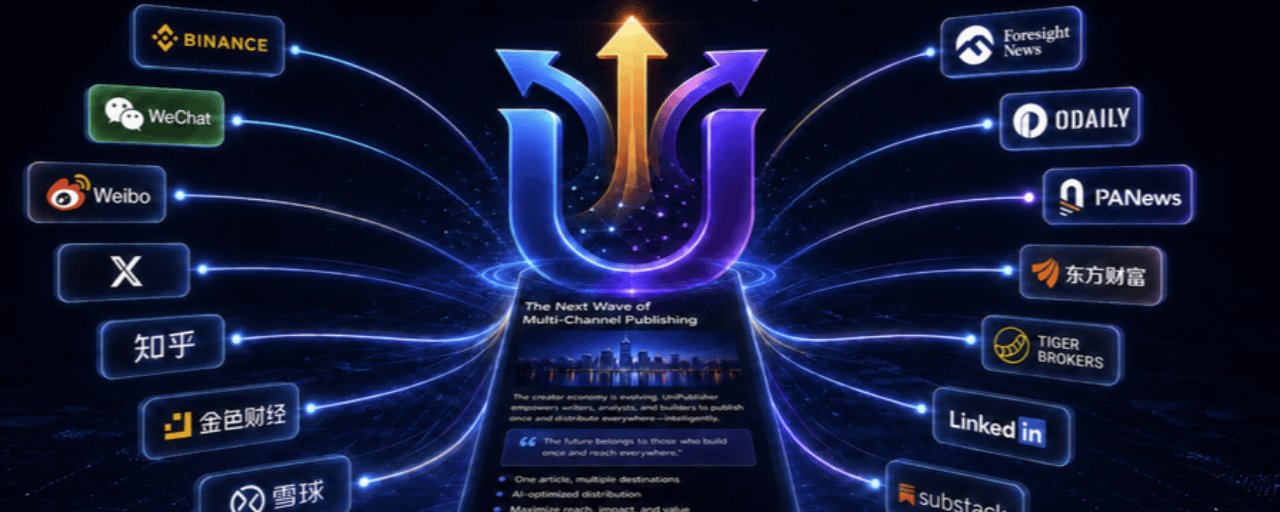
Connect Binance Square and 15 Other Channels: I used 2 Months of Vibe Coding to build a product that helps Web3, AI, and finance creators save 80% of distribution time
Author: SanTi Li, Nansidá
Over the past seven years creating in the Web3, AI, and finance space, the most time-consuming part has often not been just drafting and writing a deep piece—but rather, after the article is finished: moving it across multiple platform domains, fixing formatting, re-uploading images, saving drafts one by one, then revising again, and doing link lookups.
So, over two months, from 0 to 1, we built UniPublisher with Coding: a multi-channel content distribution OS for Web3, AI and finance creators, project teams, and media editors.
The initial goal was very simple and direct: in a typical multi-platform workflow, a single article only needs to be edited once in the main editor—then it can be formatted, saved, or published to 15 professional verticals and mainstream channels, including Binance—shrinking distribution time by 80% or more.
Over the past seven years creating in the Web3, AI, and finance space, the most time-consuming part has often not been just drafting and writing a deep piece—but rather, after the article is finished: moving it across multiple platform domains, fixing formatting, re-uploading images, saving drafts one by one, then revising again, and doing link lookups.
So, over two months, from 0 to 1, we built UniPublisher with Coding: a multi-channel content distribution OS for Web3, AI and finance creators, project teams, and media editors.
The initial goal was very simple and direct: in a typical multi-platform workflow, a single article only needs to be edited once in the main editor—then it can be formatted, saved, or published to 15 professional verticals and mainstream channels, including Binance—shrinking distribution time by 80% or more.
522
·
--
Article
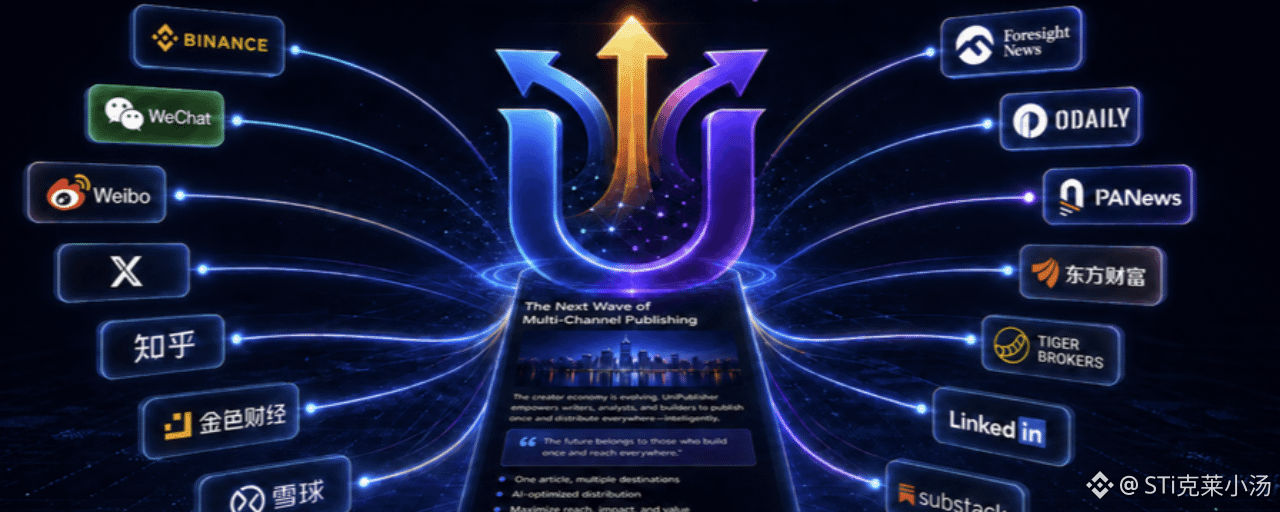
Connect Binance Square and 15 Other Channels: I used 2 Months of Vibe Coding to build a product that helps Web3, AI, and finance creators save 80% of distribution timeAuthor: SanTi Li, Nansidá
Over the past seven years creating in the Web3, AI, and finance space, the most time-consuming part has often not been just drafting and writing a deep piece—but rather, after the article is finished: moving it across multiple platform domains, fixing formatting, re-uploading images, saving drafts one by one, then revising again, and doing link lookups.
So, over two months, from 0 to 1, we built UniPublisher with Coding: a multi-channel content distribution OS for Web3, AI and finance creators, project teams, and media editors.
The initial goal was very simple and direct: in a typical multi-platform workflow, a single article only needs to be edited once in the main editor—then it can be formatted, saved, or published to 15 professional verticals and mainstream channels, including Binance—shrinking distribution time by 80% or more.
Connect Binance Square and 15 Other Channels: I used 2 Months of Vibe Coding to build a product that helps Web3, AI, and finance creators save 80% of distribution time
Author: SanTi Li, Nansidá
Over the past seven years creating in the Web3, AI, and finance space, the most time-consuming part has often not been just drafting and writing a deep piece—but rather, after the article is finished: moving it across multiple platform domains, fixing formatting, re-uploading images, saving drafts one by one, then revising again, and doing link lookups.
So, over two months, from 0 to 1, we built UniPublisher with Coding: a multi-channel content distribution OS for Web3, AI and finance creators, project teams, and media editors.
The initial goal was very simple and direct: in a typical multi-platform workflow, a single article only needs to be edited once in the main editor—then it can be formatted, saved, or published to 15 professional verticals and mainstream channels, including Binance—shrinking distribution time by 80% or more.
Over the past seven years creating in the Web3, AI, and finance space, the most time-consuming part has often not been just drafting and writing a deep piece—but rather, after the article is finished: moving it across multiple platform domains, fixing formatting, re-uploading images, saving drafts one by one, then revising again, and doing link lookups.
So, over two months, from 0 to 1, we built UniPublisher with Coding: a multi-channel content distribution OS for Web3, AI and finance creators, project teams, and media editors.
The initial goal was very simple and direct: in a typical multi-platform workflow, a single article only needs to be edited once in the main editor—then it can be formatted, saved, or published to 15 professional verticals and mainstream channels, including Binance—shrinking distribution time by 80% or more.
1
1
445
Log in to explore more content
Join global crypto users on Binance Square
⚡️ Get latest and useful information about crypto.
💬 Trusted by the world’s largest crypto exchange.
👍 Discover real insights from verified creators.
Email / Phone number
Trending Topics
BitcoinReboundsTo$79K
5,555 views
74 Discussing
🚨 $BTC is pushing higher.
Bitcoin is trading around $78,804, up roughly 1.9%, after reclaiming the $78K area. The next level to watch is the intraday high near $78,905.
A clean break above that level could open the way toward $79K–$80K. If BTC gets rejected, support sits around $78,300, then $77,975.
Bulls have momentum, but BTC needs to hold above $78K.
#Bitcoin #BTC #CryptoTrading #CryptoMarket #CryptoAnalysis
PulseON
·7 Likes
·6.4k views
FedHikeOddsRiseTo89%
65,655 views
956 Discussing
RLUSDSupplyHitsRecord$2.442B
3,777 views
57 Discussing